WO2024253013A1 - Battery pack - Google Patents
Battery pack Download PDFInfo
- Publication number
- WO2024253013A1 WO2024253013A1 PCT/JP2024/019836 JP2024019836W WO2024253013A1 WO 2024253013 A1 WO2024253013 A1 WO 2024253013A1 JP 2024019836 W JP2024019836 W JP 2024019836W WO 2024253013 A1 WO2024253013 A1 WO 2024253013A1
- Authority
- WO
- WIPO (PCT)
- Prior art keywords
- heat
- battery
- battery module
- resistant sheet
- cell
- Prior art date
- Legal status (The legal status is an assumption and is not a legal conclusion. Google has not performed a legal analysis and makes no representation as to the accuracy of the status listed.)
- Ceased
Links
Images

Classifications
-
- H—ELECTRICITY
- H01—ELECTRIC ELEMENTS
- H01M—PROCESSES OR MEANS, e.g. BATTERIES, FOR THE DIRECT CONVERSION OF CHEMICAL ENERGY INTO ELECTRICAL ENERGY
- H01M50/00—Constructional details or processes of manufacture of the non-active parts of electrochemical cells other than fuel cells, e.g. hybrid cells
- H01M50/20—Mountings; Secondary casings or frames; Racks, modules or packs; Suspension devices; Shock absorbers; Transport or carrying devices; Holders
- H01M50/204—Racks, modules or packs for multiple batteries or multiple cells
-
- H—ELECTRICITY
- H01—ELECTRIC ELEMENTS
- H01M—PROCESSES OR MEANS, e.g. BATTERIES, FOR THE DIRECT CONVERSION OF CHEMICAL ENERGY INTO ELECTRICAL ENERGY
- H01M50/00—Constructional details or processes of manufacture of the non-active parts of electrochemical cells other than fuel cells, e.g. hybrid cells
- H01M50/30—Arrangements for facilitating escape of gases
- H01M50/35—Gas exhaust passages comprising elongated, tortuous or labyrinth-shaped exhaust passages
- H01M50/367—Internal gas exhaust passages forming part of the battery cover or case; Double cover vent systems
-
- H—ELECTRICITY
- H01—ELECTRIC ELEMENTS
- H01M—PROCESSES OR MEANS, e.g. BATTERIES, FOR THE DIRECT CONVERSION OF CHEMICAL ENERGY INTO ELECTRICAL ENERGY
- H01M50/00—Constructional details or processes of manufacture of the non-active parts of electrochemical cells other than fuel cells, e.g. hybrid cells
- H01M50/50—Current conducting connections for cells or batteries
- H01M50/569—Constructional details of current conducting connections for detecting conditions inside cells or batteries, e.g. details of voltage sensing terminals
-
- Y—GENERAL TAGGING OF NEW TECHNOLOGICAL DEVELOPMENTS; GENERAL TAGGING OF CROSS-SECTIONAL TECHNOLOGIES SPANNING OVER SEVERAL SECTIONS OF THE IPC; TECHNICAL SUBJECTS COVERED BY FORMER USPC CROSS-REFERENCE ART COLLECTIONS [XRACs] AND DIGESTS
- Y02—TECHNOLOGIES OR APPLICATIONS FOR MITIGATION OR ADAPTATION AGAINST CLIMATE CHANGE
- Y02E—REDUCTION OF GREENHOUSE GAS [GHG] EMISSIONS, RELATED TO ENERGY GENERATION, TRANSMISSION OR DISTRIBUTION
- Y02E60/00—Enabling technologies; Technologies with a potential or indirect contribution to GHG emissions mitigation
- Y02E60/10—Energy storage using batteries
Definitions
- the present invention relates to a battery pack.
- a battery pack includes multiple battery modules and a housing that houses the multiple battery modules.
- Each battery module has multiple battery cells that are electrically connected to each other through a series and parallel combination.
- Patent Document 1 describes a battery tray that houses single cells.
- the battery tray includes a bottom plate, side beams, and multiple partition plates. Gas generated from the single cells passes through an intake port provided in each partition plate and a gas passage provided inside each partition plate and side beam, and is exhausted from a battery pack explosion-proof valve provided in the side beam.
- Patent Document 2 describes a battery device.
- the battery device includes a battery and a housing that houses the battery.
- the housing has a housing section that houses the battery, an inflow section into which air flows, and an outflow section through which gas that flows in from the inflow section and passes through the housing section flows out.
- Patent Document 3 describes a battery pack.
- the battery pack includes a battery stack, and a lower case and an upper case that house the battery stack.
- a discharge valve is provided on the upper surface of each cell included in the battery stack.
- a plate material is provided on the lower surface of the upper case. With the upper case covering the upper surface of each cell, the plate material and the discharge valve overlap each other.
- Gas discharged from the battery module is discharged from a gas exhaust section such as a pressure relief device (PRD) provided in the housing.
- the gas discharged from the battery module may be at a relatively high temperature.
- the gas may raise the temperature around the space inside the housing that is connected to the battery module and the gas exhaust section.
- One object of the present invention is to suppress an increase in the temperature of a battery pack caused by gas discharged from a battery module. Other objects of the present invention will become apparent from the description of this specification.
- a battery module ; a housing that houses the battery module; a gas exhaust section that exhausts gas exhausted from the battery module from the container; a heat-resistant body disposed at least partially around a space inside the housing that is in communication with the battery module and the gas exhaust portion;
- a battery pack comprising: 2. The battery pack according to 1., wherein the heat-resistant body covers at least a portion of the battery module. 3.
- the battery module includes a battery cell having a tab and a voltage detection device electrically connected to the tab; 3.
- the battery module has a gas exhaust section through which the gas is exhausted, 4.
- the housing further houses another battery module; 5.
- the above aspect of the present invention makes it possible to suppress the temperature rise of the battery pack caused by gas discharged from the battery module.
- FIG. 1 is a perspective view of a battery pack according to an embodiment
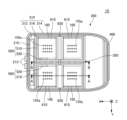
- 2 is a plan view of the battery pack according to the embodiment with a harness guide and an upper case removed.
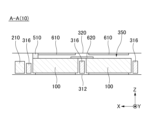
- FIG. This is a cross-sectional view taken along line AA in FIG.
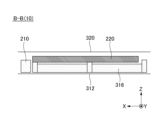
- This is a cross-sectional view taken along line B-B of FIG.
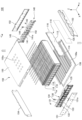
- FIG. 2 is an exploded perspective view of an example of a battery module according to the embodiment.
- 13 is a plan view of a battery pack according to a modified example with a harness guide and an upper case removed.
- FIG. FIG. 11 is a perspective view of a cell upper plate and a first heat-resistant sheet according to a modified example.
- FIG. 1 is a perspective view of a battery pack 10 according to an embodiment.
- FIG. 2 is a plan view of the battery pack 10 according to an embodiment with the harness guide 220 and upper case 320 removed.
- FIG. 3 is a cross-sectional view taken along line A-A in FIG. 2.
- FIG. 4 is a cross-sectional view taken along line B-B in FIG. 2.
- FIG. 5 is an exploded perspective view of an example of a battery module 100 according to an embodiment.
- the battery pack 10 is mounted on an automobile. Specifically, the battery pack 10 is mounted between the front and rear wheels of the automobile. In the following, unless otherwise specified, the battery pack 10 will be described as being mounted on an automobile. However, the battery pack 10 can also be used for purposes other than automobiles.
- the X direction indicates the front-rear direction of the battery pack 10.
- the Y direction is perpendicular to the X direction.
- the Y direction indicates the left-right direction of the battery pack 10.
- the Z direction is perpendicular to both the X and Y directions.
- the Z direction indicates the up-down direction of the battery pack 10.
- the arrows pointing to the X direction, the Y direction, and the Z direction indicate the front, left, and up directions of the battery pack 10, respectively.
- a white circle with a black dot indicating the Y direction or the Z direction indicates that the arrow indicating the direction indicated by the white circle extends from the back to the front of the paper.
- the relationship between the X direction, Y direction, and Z direction and the front-rear direction, left-right direction, and up-down direction of the battery pack 10 is not limited to this example.
- the front-rear, left-right and up-down directions of the battery pack 10 are determined by the vehicle in which the battery pack 10 is mounted.
- the X, Y and Z directions indicate the front-rear, left-right and up-down directions of the vehicle, respectively.
- the arrow pointing to the X direction, the arrow pointing to the Y direction and the arrow pointing to the Z direction indicate the front, left and up directions of the vehicle, respectively.
- the relationship between the front-rear, left-right and up-down directions of the battery pack 10 and the front-rear, left-right and up-down directions of the vehicle is not limited to this example.
- the direction perpendicular to the Z direction will be referred to as the horizontal direction.
- the battery pack 10 will be described with reference to Figures 1 to 4.
- the battery pack 10 includes four battery modules 100, a junction box 210, a harness guide 220, a module housing 300, a gas exhaust section 400, two spacers 500, four upper heat-resistant sheets 610, and two lower heat-resistant sheets 620.
- the module housing 300 has a lower case 310 and an upper case 320.
- the lower case 310 includes a module lower plate 312, a side frame 314, and a support frame 316.
- the lower case 310 may generally be referred to as, for example, a tray or a main body.
- the upper case 320 may generally be referred to as, for example, a cover or a lid.
- the four battery modules 100 when viewed from the Z direction, are arranged in two rows and two columns in each of the X and Y directions.
- the battery module 100 located on the left front side of the four battery modules 100 will be referred to as the left front battery module 100
- the battery module 100 located on the right front side of the four battery modules 100 will be referred to as the right front battery module 100
- the battery module 100 located on the left rear side of the four battery modules 100 will be referred to as the left rear battery module 100
- the battery module 100 located on the right rear side of the four battery modules 100 will be referred to as the right rear battery module 100.
- the number and arrangement of the battery modules 100 are not limited to the example shown in FIG. 2.
- Each battery module 100 will be described with reference to Figure 5.
- Each battery module 100 has a number of battery cells 110, a number of compression pads 120, a front voltage detection device 130, a rear voltage detection device 140, and a cell housing 150.
- the multiple battery cells 110 are stacked in the Y direction.
- the multiple compression pads 120 and the multiple battery cells 110 are stacked alternately in the Y direction.
- Each compression pad 120 is disposed between adjacent battery cells 110 in the Y direction and on both sides of the multiple battery cells 110 in the Y direction.
- the multiple battery cells 110 and the multiple compression pads 120 stacked alternately in the Y direction are referred to as a stack of battery cells 110.
- the longitudinal direction of each battery cell 110 is approximately parallel to the X direction.
- the lateral direction of each battery cell 110 is approximately parallel to the Z direction.
- the thickness direction of each battery cell 110 is approximately parallel to the Y direction.
- the shape of each battery cell 110 is not limited to this example.
- Each battery cell 110 includes a battery element (not shown), an exterior material 112, a positive electrode tab 114, and a negative electrode tab 116.
- the battery element includes a plurality of positive electrodes and a plurality of negative electrodes (not shown) stacked alternately in the Y direction, and a separator (not shown) located between adjacent positive electrodes and negative electrodes in the Y direction.
- the exterior material 112 seals the battery element and an electrolyte (not shown).
- the positive electrode tab 114 is electrically connected to the positive electrode of the battery element.
- the positive electrode tab 114 is pulled out from one of both sides of the exterior material 112 in the X direction.
- the negative electrode tab 116 is electrically connected to the negative electrode of the battery element.
- the negative electrode tab 116 is pulled out from the other side of both sides of the exterior material 112 in the X direction.
- the structure of each battery cell 110 is not limited to this example.
- Each battery cell 110 may be an all-solid-state battery.
- an all-solid-state battery a solid electrolyte layer is provided in the portion corresponding to the separator.
- An all-solid-state battery does not contain an electrolyte.
- each battery cell 110 will be described as a battery cell that contains an electrolyte.
- the battery cells 110 are electrically connected in a combination of series and parallel. Specifically, a cell group including at least two battery cells 110 adjacent to each other in the Y direction and connected in parallel is stacked in the Y direction and connected in series. In front of the stack of battery cells 110, a tab group 118 including a positive electrode tab 114 drawn from a battery cell 110 of one cell group connected in parallel and a negative electrode tab 116 drawn from a battery cell 110 of another cell group connected in parallel are electrically connected to each other and include the positive electrode tab 114 and the negative electrode tab 116. The positive electrode tab 114 and the negative electrode tab 116 in the tab group 118 are joined to each other by, for example, laser welding.
- the tab group 118 is also similarly arranged at the rear of the stack of battery cells 110.
- a plurality of cell groups are connected in series from the cell group located at one end side of the stack of battery cells 110 in the Y direction to the cell group located at the other end side of the stack of battery cells 110 in the Y direction.
- the tab group 118 located on the front side of the stack of battery cells 110 will be referred to as the front tab group 118
- the tab group 118 located on the rear side of the stack of battery cells 110 will be referred to as the rear tab group 118.
- the electrical connection of the multiple battery cells 110 is not limited to the above example.
- a stack of battery cells 110 may be formed by connecting single battery cells 110 in series.
- each cell group may include three or more battery cells 110 connected in parallel.
- the front voltage detection device 130 detects the voltages of the multiple front tab groups 118.
- the front voltage detection device 130 includes a front protector 131, multiple front voltage detection terminals 132, multiple front voltage detection lines 133, a front connector 134, and a front bus bar 135.
- the front protector 131 covers the front of the stack of battery cells 110.
- the front protector 131 is, for example, an insulator such as resin.
- the front protector 131 defines a plurality of front openings 131a. Each of the plurality of front tab groups 118 is exposed forward through each of the plurality of front openings 131a.
- Each of the multiple front voltage detection terminals 132 is located in front of each of the multiple front tab groups 118.
- Each front voltage detection terminal 132 is, for example, a conductor such as metal.
- the rear surface of each front voltage detection terminal 132 and the front surface of each front tab group 118 are joined to each other by a joining method such as laser welding. Therefore, each front voltage detection terminal 132 and each front tab group 118 are electrically connected to each other. Therefore, the front voltage detection device 130 can detect the voltage of each front tab group 118 by each front voltage detection terminal 132.
- the multiple front voltage detection terminals 132 are held together by the front protector 131. Therefore, by placing the front protector 131 at an appropriate position relative to the stack of battery cells 110, each of the multiple front voltage detection terminals 132 can be placed at an appropriate position relative to each of the multiple front tab groups 118.
- each front voltage detection line 133 and each front voltage detection terminal 132 are electrically connected to each other.
- the other end of each front voltage detection line 133 and the front connector 134 are electrically connected to each other.
- the front voltage detection terminals 132 and the front connector 134 are electrically connected to each other via the front voltage detection lines 133.
- Each front voltage detection line 133 is routed between one end of each front voltage detection line 133 and the other end of each front voltage detection line 133 via the front protector 131.
- the front bus bar 135 is disposed at the right end of the front protector 131.
- the front bus bar 135 is electrically connected to the positive electrode tab 114 pulled forward from the battery cell 110 of the cell group located at the right end of the stack of battery cells 110.
- the front bus bar 135 functions as an external terminal for electrically connecting the battery module 100 to an external device such as another battery module.
- the rear voltage detection device 140 detects the voltages of the multiple rear tab groups 118.
- the rear voltage detection device 140 includes a rear protector 141, multiple rear voltage detection terminals 142, multiple rear voltage detection lines 143, a rear connector 144, and a rear bus bar 145.
- the rear protector 141 covers the rear of the stack of battery cells 110.
- the rear protector 141 is, for example, an insulator such as resin.
- the rear protector 141 defines a plurality of rear openings 141a. Each of the multiple rear tab groups 118 is exposed rearward through each of the multiple rear openings 141a.
- Each of the rear voltage detection terminals 142 is located behind each of the rear tab groups 118.
- Each rear voltage detection terminal 142 is, for example, a conductor such as metal.
- the front surface of each rear voltage detection terminal 142 and the rear surface of each rear tab group 118 are joined to each other by a joining method such as laser welding. Therefore, each rear voltage detection terminal 142 and each rear tab group 118 are electrically connected to each other. Therefore, the rear voltage detection device 140 can detect the voltage of each rear tab group 118 by each rear voltage detection terminal 142.
- the rear voltage detection terminals 142 are held together by the rear protector 141. Therefore, by placing the rear protector 141 at an appropriate position relative to the stack of battery cells 110, each of the rear voltage detection terminals 142 can be positioned at an appropriate position relative to each of the rear tab groups 118.
- each rear voltage detection line 143 and each rear voltage detection terminal 142 are electrically connected to each other.
- the other end of each rear voltage detection line 143 and the rear connector 144 are electrically connected to each other.
- the multiple rear voltage detection terminals 142 and the rear connector 144 are electrically connected to each other via the multiple rear voltage detection lines 143.
- Each rear voltage detection line 143 is routed between one end of each rear voltage detection line 143 and the other end of each rear voltage detection line 143 via the rear protector 141.
- the rear bus bar 145 is disposed at the left end of the rear protector 141.
- the rear bus bar 145 is electrically connected to the negative electrode tab 116 pulled out rearward from the battery cell 110 of the cell group located at the left end of the stack of battery cells 110.
- the rear bus bar 145 functions as an external terminal for electrically connecting the battery module 100 to an external device such as another battery module.
- the positive electrode tab 114 at the end of the multiple cell groups connected in series is pulled forward from the battery cell 110 of the cell group located at the right end of the stack of battery cells 110, and the negative electrode tab 116 at the end of the multiple cell groups connected in series is pulled backward from the battery cell 110 of the cell group located at the left end of the stack of battery cells 110.
- the front bus bar 135 is disposed on the right front side of the stack of battery cells 110
- the rear bus bar 145 is disposed on the left rear side of the stack of battery cells 110.
- the arrangement of the positive electrode tab 114 and the negative electrode tab 116 at the end of the multiple cell groups connected in series may differ depending on the number of battery cells 110 included in the stack of battery cells 110.
- the bus bar electrically connected to the positive electrode tab 114 at the end of the group of cells connected in series is disposed on the right front side of the stack of battery cells 110
- the bus bar electrically connected to the negative electrode tab 116 at the end of the group of cells connected in series is disposed on the left front side of the stack of battery cells 110.
- the cell container 150 includes a cell front plate 151, a cell rear plate 152, a cell left plate 153, a cell right plate 154, a cell upper plate 155, and a cell lower plate 156.
- Each plate is made of a metal such as aluminum.
- the cell front plate 151 covers the stack of battery cells 110 and the front of the front voltage detection device 130.
- the cell rear plate 152 covers the stack of battery cells 110 and the rear of the rear voltage detection device 140.
- the cell left plate 153 covers the left part of the stack of battery cells 110.
- the cell right plate 154 covers the right part of the stack of battery cells 110.
- the cell upper plate 155 covers the upper part of the stack of battery cells 110.
- the cell upper plate 155 is provided with a plurality of gas exhaust holes 155a. Therefore, gas generated from the battery cells 110 can be exhausted toward the upper part of the battery module 100 through the plurality of gas exhaust holes 155a.
- the plurality of gas exhaust holes 155a are arranged in a plurality of rows and a plurality of columns in the X direction and the Y direction, respectively. However, the arrangement of the plurality of gas exhaust holes 155a is not limited to this example. Alternatively, the gas exhaust holes 155a may not be provided.
- the cell lower plate 156 covers the lower part of the stack of battery cells 110.
- a thermally conductive adhesive 156a is disposed between the upper surface of the cell lower plate 156 and the lower surface of the stack of battery cells 110. Therefore, heat generated from the stack of battery cells 110 can be released toward the bottom of the battery module 100 through the thermally conductive adhesive 156a.
- the battery pack 10 will be described with reference to Figs. 1 to 4 again.
- the external shape of the battery module 100 shown in Figs. 2 to 4 is a schematic representation of the external shape of the cell housing 150 described with reference to Fig. 5. Therefore, the front, rear, left, right, top, and bottom of the battery module 100 shown in Figs. 2 to 4 correspond to the front of the cell front plate 151, the rear of the cell rear plate 152, the left side of the cell left plate 153, the right side of the cell right plate 154, the top of the cell upper plate 155, and the bottom of the cell lower plate 156 shown in Fig. 5.
- the junction box 210 is disposed forward of the four battery modules 100.
- a pair of junction terminals 212 are provided at the front of the junction box 210. As shown in FIG. 1, the front end of the junction terminals 212 protrudes forward from the front surface of the side frame 314.
- the pair of junction terminals 212 and the four battery modules 100 are electrically connected to each other via the junction box 210. Therefore, in the electrical path, the four battery modules 100 are electrically connected in series between the pair of junction terminals 212.
- the electronic device arranged in front of the four battery modules 100 is not limited to the junction box 210. Instead of or in addition to the junction box 210, an electronic device electrically connected to at least one battery module 100 may be arranged in front of the four battery modules 100. Alternatively, the electronic device arranged in front of the four battery modules 100 may be another battery module different from these four battery modules 100.
- the harness guide 220 is located above the support frame 316 between the battery modules 100 adjacent in the Y direction.
- the harness guide 220 at least guides and holds the harness (not shown).
- the arrangement of the harness guide 220 is not limited to the example shown in FIG. 4.
- the harness may also be arranged at a position different from the position where the harness guide 220 is arranged.
- the harness includes at least one wire.
- Examples of the wires included in the harness include low-voltage wires such as wires that operate as signal wires and wires that form a circuit made of a 12V power source for a vehicle, high-voltage wires such as voltage detection wires electrically connected to at least one of the front connector 134 and the rear connector 144 of the battery module 100 and signal wires of the thermistors that detect the temperature of each battery cell 110 included in the battery module 100, and high-voltage wires such as wires for supplying power to a heater that heats each battery cell 110 included in the battery module 100.
- low-voltage wires such as wires that operate as signal wires and wires that form a circuit made of a 12V power source for a vehicle
- high-voltage wires such as voltage detection wires electrically connected to at least one of the front connector 134 and the rear connector 144 of the battery module 100 and signal wires of the thermistors that detect the temperature of each battery cell 110 included in the battery module 100
- high-voltage wires such as wire
- the module lower plate 312 extends approximately parallel to the horizontal direction.
- the side frame 314 is approximately perpendicular to the module lower plate 312. When viewed from the Z direction, the side frame 314 extends along the outer periphery of the module lower plate 312.
- the support frame 316 When viewed from the Z direction, the support frame 316 is approximately a frame body that surrounds each of the four battery modules 100.
- the upper case 320 is located above the lower case 310 and covers the lower case 310.
- the lower case 310 and the upper case 320 are attached to each other via a sealant such as rubber between the upper surface of the side frame 314 and a portion of the lower case 310 facing the upper surface of the side frame 314 in the Z direction.
- the lower case 310 and the upper case 320 define an accommodation space that accommodates the four battery modules 100, the junction box 210, and the harness guide 220.
- the accommodation space defined by the lower case 310 and the upper case 320 will be referred to as the accommodation space of the module accommodation body 300 as necessary.
- the accommodation space of the module accommodation body 300 is sealed from the area outside the module accommodation body 300 when the lower case 310 and the upper case 320 are attached to each other via a sealant.
- the gas exhaust section 400 is disposed on the rear side of the side frame 314.
- the gas exhaust section 400 has a pressure relief device (PRD) such as a pressure relief valve.
- PRD pressure relief device
- the pressure in the storage space of the module housing 300 may increase due to gas discharged from the battery modules 100.
- a relatively high temperature gas may be generated from the battery cells 110 due to an abnormality in the battery cells 110.
- the gas generated from the battery cells 110 is discharged above the battery modules 100 via multiple gas exhaust holes 155a.
- a communication space 350 exists in the storage space of the module housing 300.
- the communication space 350 is a space above the upper surfaces of the four battery modules 100 that is connected to the four battery modules 100 and the gas exhaust section 400.
- the gas discharged from each battery module 100 reaches the gas exhaust section 400 via the communication space 350.
- Gas generated from the battery cell 110 may be discharged from a gas discharge section other than the multiple gas discharge holes 155a.
- gas generated from the battery cell 110 may be discharged from the gap between the cell front plate 151 and the cell upper plate 155, the gap between the cell rear plate 152 and the cell upper plate 155, the gap between the cell left plate 153 and the cell upper plate 155, or the gap between the cell right plate 154 and the cell upper plate 155. Gas discharged from these gaps is also discharged above the battery module 100 and reaches the gas discharge section 400 via the communication space 350.
- the two spacers 500 are arranged substantially symmetrically in the Y direction when viewed from the Z direction.
- One spacer 500 is arranged on the upper surface side of the left front battery module 100.
- the spacer 500 arranged on the upper surface side of the left front battery module 100 will be referred to as the left spacer 500, as necessary.
- the left spacer 500 is arranged in the gap between the upper surface of the left front battery module 100 and the lower surface of the upper case 320.
- the other spacer 500 is arranged on the upper surface side of the right front battery module 100.
- the spacer 500 arranged on the upper surface side of the right front battery module 100 will be referred to as the right spacer 500, as necessary.
- the right spacer 500 is arranged in the gap between the upper surface of the right front battery module 100 and the lower surface of the upper case 320.
- left spacer 500 The following describes the left spacer 500. Unless otherwise specified, the following description of the left spacer 500 also applies to the right spacer 500, except that the left spacer 500 and the right spacer 500 are arranged approximately symmetrically when viewed from the Z direction.
- the left spacer 500 is substantially L-shaped when viewed from the Z direction.
- the left spacer 500 includes a first spacer extension 510 and a second spacer extension 520.
- first spacer extension 510 of the left spacer 500 and the second spacer extension 520 of the left spacer 500 will be referred to as the left first spacer extension 510 and the left second spacer extension 520, respectively.
- the first spacer extension 510 on the left side when viewed from the Z direction, extends in the Y direction along the front outer edge of the top surface of the left front battery module 100.
- the length in the Y direction of the first spacer extension 510 on the left side is approximately equal to the length in the Y direction of the top surface of the left front battery module 100.
- the second spacer extension 520 on the left side extends in the X direction along the right outer edge of the top surface of the left front battery module 100.
- the length in the X direction of the second spacer extension 520 on the left side is shorter than the length in the X direction of the top surface of the left front battery module 100.
- the shape of the first spacer extension 510 on the left side is not limited to the shape shown in FIG. 2.
- the left first spacer extension 510 when viewed from the Z direction, the left first spacer extension 510 is located forward of the multiple gas exhaust holes 155a of the left front battery module 100. Therefore, when gas is exhausted from the left front battery module 100, the left first spacer extension 510 serves as a gas shield that blocks gas flowing in the opposite direction from the left front battery module 100 toward the gas exhaust section 400. Therefore, compared to when the left first spacer extension 510 is not provided, the gas exhausted from the left front battery module 100 can be efficiently moved toward the gas exhaust section 400, and the gas exhausted from the left front battery module 100 can be efficiently exhausted from the gas exhaust section 400.
- the first spacer extension 510 on the left side can block not only the gas discharged from the battery module 100 on the front left side, but also the gas discharged from the battery module 100 on the rear left side.
- the first spacer extension 510 on the left side can function as a gas shielding section that blocks gas flowing in the opposite direction from the battery module 100 on the rear left side toward the gas exhaust section 400. Therefore, compared to a case in which the first spacer extension 510 on the left side is not provided, the gas discharged from the battery module 100 on the rear left side can be efficiently moved toward the gas exhaust section 400, and the gas discharged from the battery module 100 on the rear left side can be efficiently exhausted from the gas exhaust section 400.
- the left first spacer extension 510 when viewed from the Z direction, is located between the multiple gas exhaust holes 155a of the left front battery module 100 and the left portion of the junction box 210. Therefore, the left first spacer extension 510 serves as a gas shield that blocks gas flowing from the left front battery module 100 or the left rear battery module 100 toward the junction box 210. Therefore, the left first spacer extension 510 can protect the junction box 210 from gas generated from the left front battery module 100 or the left rear side.
- the left second spacer extension 520 when viewed from the Z direction, the left second spacer extension 520 is located to the right of the gas exhaust hole 155a on the front side of the left front battery module 100. Therefore, the left second spacer extension 520 serves as a gas shield that blocks gas flowing to the right in the direction from the left front battery module 100 toward the gas exhaust section 400. Therefore, compared to when the left second spacer extension 520 is not provided, gas exhausted from the left front battery module 100 can be moved toward the gas exhaust section 400 more efficiently, and gas exhausted from the left front battery module 100 can be efficiently exhausted from the gas exhaust section 400.
- the left second spacer extension 520 when viewed from the Z direction, the left second spacer extension 520 is located between a gas exhaust hole 155a on the front side of the left front battery module 100 and the front part of the right front battery module 100. Therefore, the left second spacer extension 520 serves as a gas shield that blocks gas flowing from the left front battery module 100 toward the right front battery module 100. Therefore, the left second spacer extension 520 can protect the right front battery module 100 from gas generated from the left front battery module 100.
- the left spacer 500 is an elastic body having heat resistance and flame retardancy, such as foamed silicone.
- the material used for the spacer 500 is not limited to foamed silicone, as long as it has the desired heat resistance, flame retardancy, and resilience.
- the left spacer 500 is compressed in the Z direction by the upper surface of the left front battery module 100 and the lower surface of the upper case 320. Therefore, the left spacer 500 is elastically deformed. Therefore, compared to a case in which the left spacer 500 does not elastically deform, it is possible to make it difficult for a gap to occur between the lower surface of the left spacer 500 and the upper surface of the left front battery module 100, and between the upper surface of the left spacer 500 and the lower surface of the upper case 320.
- the material of the left spacer 500 is not limited to an elastic body.
- the left spacer 500 may be a rigid body that does not elastically deform due to compression of the top surface of the left front battery module 100 and the bottom surface of the upper case 320.
- the method of fixing the left spacer 500 is not particularly limited.
- the bottom surface of the left spacer 500 and the top surface of the battery module 100 may be joined together in advance with a bonding material such as an adhesive.
- the top surface of the left spacer 500 and the bottom surface of the upper case 320 may be joined together in advance with a bonding material such as an adhesive.
- the bottom surface and top surface of the left spacer 500 do not have to be joined to the top surface of the battery module 100 and the bottom surface of the upper case 320, respectively, in advance.
- the spacer 500 is a gas shield that blocks gas flowing in a direction different from the direction from the battery module 100 toward the gas exhaust section 400. Therefore, when the spacer 500 is provided, the gas exhausted from the battery module 100 can be exhausted from the gas exhaust section 400 more efficiently than when the spacer 500 is not provided.
- Each upper heat-resistant sheet 610 may be, for example, a commercially available heat-resistant sheet.
- Heat-resistant sheets may be, for example, fiber sheets in which fibers containing carbon, silica, alumina, magnesia, etc. are formed into a sheet together with silicone resin or fluorine-based resin, ceramic plates, etc., but are not limited to these. From the standpoint of formability and heat resistance, the above-mentioned fiber sheets in which the heat resistance temperature of the fibers is 1000°C or higher are particularly preferred. As shown in Figure 2, the four upper heat-resistant sheets 610 and the four battery modules 100 overlap each other in the Z direction.
- the upper heat-resistant sheet 610 located on the left front side among the four upper heat-resistant sheets 610 will be referred to as the left front upper heat-resistant sheet 610
- the upper heat-resistant sheet 610 located on the right front side among the four upper heat-resistant sheets 610 will be referred to as the right front upper heat-resistant sheet 610
- the upper heat-resistant sheet 610 located on the left rear side among the four upper heat-resistant sheets 610 will be referred to as the left rear upper heat-resistant sheet 610
- the upper heat-resistant sheet 610 located on the right rear side among the four upper heat-resistant sheets 610 will be referred to as the right rear upper heat-resistant sheet 610.
- each upper heat-resistant sheet 610 on the left front side covers the underside of the portion of the upper case 320 that overlaps with the battery module 100 on the left front side in the Z direction.
- the upper heat-resistant sheet 610 on the left rear side covers the upper heat-resistant sheet 610 on the left rear side, the upper heat-resistant sheet 610 on the right front side, and the upper heat-resistant sheet 610 on the right rear side.
- each upper heat-resistant sheet 610 is a heat-resistant body disposed on the underside of the upper case 320 around the communication space 350. Therefore, compared to when these upper heat-resistant sheets 610 are not provided, the increase in temperature of the upper case 320 due to the high-temperature gas passing through the communication space 350 can be suppressed.
- the underside of the upper case 320 may be coated with a material such as an anti-rust paint. If this material is exposed to high-temperature gas and melts off, the melted material may come into contact with any part of the battery module 100.
- a material such as an anti-rust paint.
- the method of attaching the top surface of the left front upper heat-resistant sheet 610 and the bottom surface of the upper case 320 is not particularly limited.
- the top surface of the left front upper heat-resistant sheet 610 and the bottom surface of the upper case 320 may be attached to each other, for example, via an adhesive layer provided on the top surface side of the left front upper heat-resistant sheet 610.
- Each lower heat-resistant sheet 620 may be, for example, a commercially available heat-resistant sheet.
- Heat-resistant sheets may be, for example, fiber sheets in which fibers containing carbon, silica, alumina, magnesia, etc. are formed into a sheet together with silicone resin or fluorine-based resin, ceramic plates, etc., but are not limited thereto. From the viewpoint of moldability and heat resistance, the above-mentioned fiber sheets having a heat-resistant temperature of 1000°C or higher are particularly preferable. As shown in FIG. 2, when viewed from the Z direction, the two lower heat-resistant sheets 620 are arranged approximately symmetrically in line in the Y direction.
- the lower heat-resistant sheet 620 located on the left side of the two lower heat-resistant sheets 620 will be referred to as the left lower heat-resistant sheet 620
- the lower heat-resistant sheet 620 located on the right side of the two lower heat-resistant sheets 620 will be referred to as the right lower heat-resistant sheet 620.
- left-side lower heat-resistant sheet 620 The following describes the left-side lower heat-resistant sheet 620. Unless otherwise specified, the following description of the left-side lower heat-resistant sheet 620 also applies to the right-side lower heat-resistant sheet 620, except that the left-side lower heat-resistant sheet 620 and the right-side lower heat-resistant sheet 620 are arranged approximately symmetrically when viewed from the Z direction.
- the left lower heat-resistant sheet 620 covers the upper surface of the rear of the left front battery module 100 and the upper surface of the front of the left rear battery module 100. Therefore, the left lower heat-resistant sheet 620 is a heat-resistant body arranged on the upper surface of the rear of the left front battery module 100 and the upper surface of the front of the left rear battery module 100 around the communication space 350. Therefore, compared to when the left lower heat-resistant sheet 620 is not provided, it is possible to suppress the rise in temperature of the rear of the left front battery module 100 and the front of the left rear battery module 100 due to high-temperature gas passing through the communication space 350.
- the left lower heat-resistant sheet 620 exposes multiple gas exhaust holes 155a of the battery module 100 on the left front side and multiple gas exhaust holes 155a of the battery module 100 on the left rear side. Therefore, gas can be exhausted more efficiently from these gas exhaust holes 155a compared to when these gas exhaust holes 155a are covered by the left lower heat-resistant sheet 620.
- the front part of the left lower heat-resistant sheet 620 overlaps in the Z direction with at least one of the rear tab group 118 and the rear voltage detection device 140 shown in FIG. 5 of the left front battery module 100. Therefore, the left lower heat-resistant sheet 620 can protect the tab group 118 and the rear voltage detection device 140 from high-temperature gas passing through the communication space 350 above the rear part of the left front battery module 100.
- the rear of the left lower heat-resistant sheet 620 overlaps in the Z direction with at least one of the rear tab group 118 and the front voltage detection device 130 shown in FIG. 5 of the left rear battery module 100. Therefore, the left lower heat-resistant sheet 620 can protect the tab group 118 and the front voltage detection device 130 from high-temperature gas passing through the communication space 350 above the front of the left rear battery module 100.
- the left lower heat-resistant sheet 620 extends from the rear of the left front battery module 100 to the front of the left rear battery module 100. Therefore, a single lower heat-resistant sheet 620 can cover the upper surface of the rear of the left front battery module 100 and the upper surface of the front of the left rear battery module 100. Therefore, the number of parts in the battery pack 10 can be reduced compared to when the upper surface of the rear of the left front battery module 100 and the upper surface of the front of the left rear battery module 100 are covered with separate lower heat-resistant sheets 620.
- the method of attachment of the underside of the front of the left lower heat-resistant sheet 620 and the upper surface of the rear of the left front battery module 100 is not particularly limited.
- the underside of the front of the left lower heat-resistant sheet 620 and the upper surface of the rear of the left front battery module 100 may be attached to each other, for example, via an adhesive layer provided on the underside of the left lower heat-resistant sheet 620.
- the arrangement of the upper heat-resistant sheet 610 and the lower heat-resistant sheet 620 is not limited to the example shown in Figures 2 and 3.
- Heat-resistant bodies such as the upper heat-resistant sheet 610 and the lower heat-resistant sheet 620 can be arranged at least partially around the communication space 350.
- the increase in temperature around the communication space 350 due to high-temperature gas passing through the communication space 350 can be suppressed compared to when a heat-resistant body is not provided.
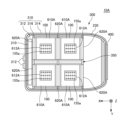
- FIG. 6 is a plan view of a modified battery pack 10A with the harness guide and upper case removed.
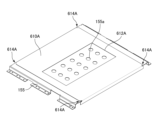
- FIG. 7 is a perspective view of a modified cell upper plate 155 and a first heat-resistant sheet 610A.
- the modified battery pack 10A is similar to the battery pack 10 according to the embodiment, except for the following points.
- the battery pack 10A according to the modified example may also include spacers corresponding to the two spacers 500 according to the embodiment, similar to the battery pack 10 according to the embodiment.
- the battery pack 10A includes four first heat-resistant sheets 610A and six second heat-resistant sheets 620A.
- the four first heat-resistant sheets 610A and the four battery modules 100 overlap each other in the Z direction.
- Each first heat-resistant sheet 610A covers the upper surface of the peripheral portion of the gas exhaust holes 155a of each battery module 100.
- the six second heat-resistant sheets 620A include two second heat-resistant sheets 620A on the front side in the X direction, two second heat-resistant sheets 620A on the center side in the X direction, and two second heat-resistant sheets 620A on the rear side in the X direction.
- One of the two second heat-resistant sheets 620A on the front side in the X direction covers the front part of the battery module 100 on the left front side.
- the other of the two second heat-resistant sheets 620A on the front side in the X direction covers the front part of the battery module 100 on the right front side.
- One of the two second heat-resistant sheets 620A at the center in the X direction covers the rear of the battery module 100 on the left front side and the front of the battery module 100 on the left rear side.
- the other of the two second heat-resistant sheets 620A at the center in the X direction covers the rear of the battery module 100 on the right front side and the front of the battery module 100 on the right rear side.
- One of the two second heat-resistant sheets 620A at the rear side in the X direction covers the rear of the battery module 100 on the left rear side.
- the other of the two second heat-resistant sheets 620A at the rear side in the X direction covers the rear of the battery module 100 on the right rear side.
- the second heat-resistant sheet 620A located on the left front side among the six second heat-resistant sheets 620A will be referred to as the left front second heat-resistant sheet 620A
- the second heat-resistant sheet 620A located on the right front side among the six second heat-resistant sheets 620A will be referred to as the right front second heat-resistant sheet 620A
- the second heat-resistant sheet 620A located on the left center side among the six second heat-resistant sheets 620A will be referred to as the left center second heat-resistant sheet 620A.
- the second heat-resistant sheet 620A located on the right center side of the six second heat-resistant sheets 620A is referred to as the right center second heat-resistant sheet 620A
- the second heat-resistant sheet 620A located on the left rear side of the six second heat-resistant sheets 620A is referred to as the left rear second heat-resistant sheet 620A
- the second heat-resistant sheet 620A located on the right rear side of the six second heat-resistant sheets 620A is referred to as the right rear second heat-resistant sheet 620A.
- the first heat-resistant sheet 610A according to the modified example will be described with reference to FIG. 7.
- the first heat-resistant sheet 610A defines a center opening 612A. From the center opening 612A, multiple gas exhaust holes 155a are exposed. Therefore, gas can be exhausted more efficiently from the multiple gas exhaust holes 155a compared to when the first heat-resistant sheet 610A covers the multiple gas exhaust holes 155a.
- the left and right ends of the first heat-resistant sheet 610A are bent downward at approximately right angles to the left and right edges of the cell upper plate 155, respectively. Therefore, the left and right edges of the cell upper plate 155 can be covered by the left and right ends of the first heat-resistant sheet 610A.
- a pair of notches 614A are provided at the bent portions at the left and right edges of the cell upper plate 155 at the front edge of the first heat-resistant sheet 610A.
- a pair of notches 614A are provided at the bent portions at the left and right edges of the cell upper plate 155 at the rear edge of the first heat-resistant sheet 610A. Therefore, the left and right end portions of the first heat-resistant sheet 610A can be easily folded compared to when these notches 614A are not provided.
- the front and rear of the upper surface of the cell upper plate 155 are exposed from the first heat-resistant sheet 610A.
- the front and rear of the upper surface of the cell upper plate 155 exposed from the first heat-resistant sheet 610A can be used as a margin for attaching the second heat-resistant sheet 620A.
- Each first heat-resistant sheet 610A is a heat-resistant body arranged on the upper surface of the peripheral portion of the multiple gas exhaust holes 155a of each battery module 100 around the communication space 350. Therefore, compared to a case where each first heat-resistant sheet 610A is not provided, it is possible to suppress the rise in temperature of the peripheral portion of the multiple gas exhaust holes 155a of each battery module 100 caused by high-temperature gas passing through the communication space 350.
- the second heat-resistant sheet 620A on the left center side is a heat-resistant body arranged on the upper surface of the rear of the left front battery module 100 and the upper surface of the front of the left rear battery module 100 around the communication space 350. Therefore, compared to when the second heat-resistant sheet 620A on the left center side is not provided, it is possible to suppress the rise in temperature of the rear of the left front battery module 100 and the front of the left rear battery module 100 caused by high-temperature gas passing through the communication space 350.
- the front part of the second heat-resistant sheet 620A on the left center side overlaps in the Z direction with at least one of the rear tab group 118 and the rear voltage detection device 140 of the left front battery module 100 shown in FIG. 5. Therefore, the tab group 118 and the rear voltage detection device 140 can be protected by the second heat-resistant sheet 620A on the left center side from the high-temperature gas passing through the communication space 350 above the rear part of the left front battery module 100.
- the rear part of the second heat-resistant sheet 620A on the left center side overlaps in the Z direction with at least one of the front tab group 118 and the front voltage detection device 130 shown in FIG. 5 of the battery module 100 on the left rear side. Therefore, the tab group 118 and the front voltage detection device 130 can be protected by the second heat-resistant sheet 620A on the left center side from the high-temperature gas passing through the communication space 350 above the front part of the battery module 100 on the left rear side.
- the left front second heat-resistant sheet 620A is a heat-resistant body arranged on the upper surface of the front part of the left front battery module 100 around the communication space 350. Therefore, compared to a case where the left front second heat-resistant sheet 620A is not provided, it is possible to suppress the rise in temperature of the front part of the left front battery module 100 caused by high-temperature gas passing through the communication space 350.
- the left front second heat-resistant sheet 620A overlaps in the Z direction with at least one of the front tab group 118 and the front voltage detection device 130 shown in FIG. 5 of the left front battery module 100. Therefore, the left front second heat-resistant sheet 620A can protect the tab group 118 and the front voltage detection device 130 from high-temperature gas passing through the communication space 350 above the front of the left front battery module 100.
- the second heat-resistant sheet 620A on the left rear side is a heat-resistant body arranged on the upper surface of the rear part of the left rear battery module 100 around the communication space 350. Therefore, compared to when the second heat-resistant sheet 620A on the left rear side is not provided, it is possible to suppress the rise in temperature of the rear part of the left rear battery module 100 caused by high-temperature gas passing through the communication space 350.
- the second heat-resistant sheet 620A on the rear left side overlaps in the Z direction with at least one of the rear tab group 118 and the rear voltage detection device 140 shown in FIG. 5 of the rear left side battery module 100. Therefore, the second heat-resistant sheet 620A on the rear left side can protect the tab group 118 and the rear voltage detection device 140 from high-temperature gas passing through the communication space 350 above the rear of the rear left side battery module 100.
- the gas discharged from the battery module 100 can be efficiently discharged by the spacer 500.
- 10, 10A battery pack 100 battery module, 110 battery cell, 112 exterior material, 114 positive electrode tab, 116 negative electrode tab, 118 tab group, 120 compression pad, 130 front voltage detection device, 131 front protector, 131a front opening, 132 front voltage detection terminal, 133 front voltage detection line, 134 front connector, 135 front bus bar, 140 rear voltage detection device, 141 rear protector, 141a rear opening, 142 rear voltage detection terminal, 143 rear voltage detection line, 144 rear connector, 145 rear bus bar, 150 cell housing, 151 cell front plate, 152 cell rear plate, 153 cell left plate Rate, 154 Cellulite plate, 155 Cell upper plate, 155a Gas exhaust hole, 156 Cell lower plate, 156a Thermally conductive adhesive, 210 Junction box, 212 Junction terminal, 220 Harness guide, 300 Module housing, 310 Lower case, 312 Module lower plate, 314 Side frame, 316 Support frame, 320 Upper case, 350 Communication space, 400 Gas exhaust section, 500 Spacer, 510 First spacer extension, 520 Second spacer extension,
Landscapes
- Chemical & Material Sciences (AREA)
- Chemical Kinetics & Catalysis (AREA)
- Electrochemistry (AREA)
- General Chemical & Material Sciences (AREA)
- Battery Mounting, Suspending (AREA)
Abstract
Description
本発明は、電池パックに関する。 The present invention relates to a battery pack.
近年、様々な電池パックが開発されている。電池パックは、複数の電池モジュールと、複数の電池モジュールを収容する収容体と、を備えている。各電池モジュールは、直列及び並列の組み合わせを介して互いに電気的に接続された複数の電池セルを有している。 In recent years, various battery packs have been developed. A battery pack includes multiple battery modules and a housing that houses the multiple battery modules. Each battery module has multiple battery cells that are electrically connected to each other through a series and parallel combination.
特許文献1には、単電池を収容する電池トレイについて記載されている。電池トレイは、底板、サイドビーム及び複数の仕切り板を備えている。単電池から発生したガスは、各仕切り板に設けられた吸気口と、各仕切り板及びサイドビームの内部に設けられたガス通路と、を経由して、サイドビームに設けられた電池パック防爆弁から排出される。 Patent Document 1 describes a battery tray that houses single cells. The battery tray includes a bottom plate, side beams, and multiple partition plates. Gas generated from the single cells passes through an intake port provided in each partition plate and a gas passage provided inside each partition plate and side beam, and is exhausted from a battery pack explosion-proof valve provided in the side beam.
特許文献2には、電池装置について記載されている。電池装置は、電池と、電池を収容する収容体と、を備えている。収容体は、電池を収容する収容部と、空気が流入する流入部と、流入部から流入して収容部を通過したガスが流出する流出部と、を有している。
特許文献3には、電池パックについて記載されている。電池パックは、電池スタックと、電池スタックを収容するロアケース及びアッパケースと、を備えている。電池スタックに含まれる各セルの上面には、排出弁が設けられている。アッパケースの下面には、板材が設けられている。アッパケースが各セルの上面を覆う状態で、板材及び排出弁は、互いに重なっている。 Patent Document 3 describes a battery pack. The battery pack includes a battery stack, and a lower case and an upper case that house the battery stack. A discharge valve is provided on the upper surface of each cell included in the battery stack. A plate material is provided on the lower surface of the upper case. With the upper case covering the upper surface of each cell, the plate material and the discharge valve overlap each other.
電池モジュールから排出されたガスは、収容体に設けられた圧力開放装置(PRD)等のガス排出部から排出される。電池モジュールから排出されたガスは、比較的高温であることがある。高温のガスが電池モジュールから排出されると、収容体の内部で電池モジュール及びガス排出部に連通した空間の周囲の温度がガスによって上昇することがある。 Gas discharged from the battery module is discharged from a gas exhaust section such as a pressure relief device (PRD) provided in the housing. The gas discharged from the battery module may be at a relatively high temperature. When high-temperature gas is discharged from the battery module, the gas may raise the temperature around the space inside the housing that is connected to the battery module and the gas exhaust section.
本発明の目的の一例は、電池モジュールから排出されたガスによる電池パックの温度の上昇を抑制することにある。本発明の他の目的は、本明細書の記載から明らかになるであろう。 One object of the present invention is to suppress an increase in the temperature of a battery pack caused by gas discharged from a battery module. Other objects of the present invention will become apparent from the description of this specification.
本発明の一態様は、以下のとおりである。
1.電池モジュールと、
前記電池モジュールを収容する収容体と、
前記電池モジュールから排出されるガスを前記収容体から排出するガス排出部と、
前記収容体の内部で前記電池モジュール及び前記ガス排出部に連通した空間の周囲に少なくとも部分的に配置された耐熱体と、
を備える電池パック。
2.前記耐熱体は、前記電池モジュールの少なくとも一部分を覆っている、1.に記載の電池パック。
3.前記電池モジュールは、タブを有する電池セルと、前記タブに電気的に接続した電圧検出装置と、を有し、
前記耐熱体は、前記タブ及び前記電圧検出装置の少なくとも一方と重なっている、2.に記載の電池パック。
4.前記電池モジュールは、前記ガスが排出されるガス排出部を有し、
前記ガス排出部は、前記耐熱体から露出されている、2.又は3.に記載の電池パック。
5.前記収容体は、他の電池モジュールをさらに収容しており、
前記耐熱体は、前記他の電池モジュールの少なくとも一部分を覆っている、1.~4.のいずれか一に記載の電池パック。
6.前記耐熱体は、前記収容体の少なくとも一部分を覆っている、1.~5.のいずれか一に記載の電池パック。
One aspect of the present invention is as follows.
1. A battery module;
a housing that houses the battery module;
a gas exhaust section that exhausts gas exhausted from the battery module from the container;
a heat-resistant body disposed at least partially around a space inside the housing that is in communication with the battery module and the gas exhaust portion;
A battery pack comprising:
2. The battery pack according to 1., wherein the heat-resistant body covers at least a portion of the battery module.
3. The battery module includes a battery cell having a tab and a voltage detection device electrically connected to the tab;
3. The battery pack according to
4. The battery module has a gas exhaust section through which the gas is exhausted,
4. The battery pack according to
5. The housing further houses another battery module;
5. The battery pack according to any one of 1. to 4., wherein the heat-resistant body covers at least a portion of the other battery module.
6. The battery pack according to any one of 1. to 5., wherein the heat-resistant body covers at least a portion of the housing.
本発明の上記態様によれば、電池モジュールから排出されたガスによる電池パックの温度の上昇を抑制することができる。 The above aspect of the present invention makes it possible to suppress the temperature rise of the battery pack caused by gas discharged from the battery module.
以下、本発明の実施形態及び変形例について、図面を用いて説明する。すべての図面において、同様な構成要素には同様の符号を付し、適宜説明を省略する。 Below, embodiments and variations of the present invention will be described with reference to the drawings. In all drawings, similar components are given similar reference symbols and descriptions will be omitted where appropriate.
図1は、実施形態に係る電池パック10の斜視図である。図2は、実施形態に係る電池パック10からハーネスガイド220及びアッパケース320が取り外された状態の平面図である。図3は、図2のA-A断面図である。図4は、図2のB-B断面図である。図5は、実施形態に係る電池モジュール100の一例の分解斜視図である。
FIG. 1 is a perspective view of a
実施形態において、電池パック10は、自動車に搭載されている。具体的には、電池パック10は、自動車の前輪及び後輪の間に搭載されている。以下、特に断りがない限り、電池パック10が自動車に搭載されているものとして説明する。ただし、電池パック10は、自動車以外の用途にも適用可能である。
In this embodiment, the
各図には、説明のため、X方向、Y方向及びZ方向が示されている。X方向は、電池パック10の前後方向を示している。Y方向は、X方向に直交している。Y方向は、電池パック10の左右方向を示している。Z方向は、X方向及びY方向の双方に直交している。Z方向は、電池パック10の上下方向を示している。X方向を指し示す矢印、Y方向を指し示す及びZ方向を指し示す矢印は、それぞれ、電池パック10の前方向、左方向及び上方向を示している。図2~図4において、Y方向又はZ方向を示す黒点付き白丸は、当該白丸によって示される方向を指し示す矢印が紙面の奥から手前に向けて延びていることを示している。ただし、X方向、Y方向及びZ方向と、電池パック10の前後方向、左右方向及び上下方向と、の関係はこの例に限定されない。
In each figure, the X, Y, and Z directions are shown for the purpose of explanation. The X direction indicates the front-rear direction of the
実施形態において、電池パック10の前後方向、左右方向及び上下方向は、電池パック10が搭載される自動車によって決定されている。X方向、Y方向及びZ方向は、それぞれ、自動車の前後方向、左右方向及び上下方向を示している。X方向を指し示す矢印、Y方向を指し示す矢印及びZ方向を指し示す矢印は、それぞれ、自動車の前方向、左方向及び上方向を示している。ただし、電池パック10の前後方向、左右方向及び上下方向と、自動車の前後方向、左右方向及び上下方向と、の関係はこの例に限定されない。
In the embodiment, the front-rear, left-right and up-down directions of the
以下、必要に応じて、Z方向に垂直な方向を水平方向という。 In the following, where necessary, the direction perpendicular to the Z direction will be referred to as the horizontal direction.
図1~図4を参照して、電池パック10について説明する。
The
図2~図4に示すように、電池パック10は、4つの電池モジュール100、ジャンクションボックス210、ハーネスガイド220、モジュール収容体300、ガス排出部400、2つのスペーサ500、4枚のアッパ耐熱シート610及び2枚のロア耐熱シート620を備えている。モジュール収容体300は、ロアケース310及びアッパケース320を有している。ロアケース310は、モジュールロアプレート312、サイドフレーム314及び支持フレーム316を含んでいる。ロアケース310は、概して、例えば、トレイ又は本体部とも称されることがある。アッパケース320は、概して、例えば、カバー又は蓋部とも称されることがある。
As shown in Figures 2 to 4, the
図2に示すように、Z方向から見て、4つの電池モジュール100は、X方向及びY方向にそれぞれ2行2列に配置されている。以下、必要に応じて、4つの電池モジュール100のうち左前側に位置する電池モジュール100を左前側の電池モジュール100といい、4つの電池モジュール100のうち右前側に位置する電池モジュール100を右前側の電池モジュール100といい、4つの電池モジュール100のうち左後側に位置する電池モジュール100を左後側の電池モジュール100といい、4つの電池モジュール100のうち右後側に位置する電池モジュール100を右後側の電池モジュール100という。ただし、電池モジュール100の数及び配置は、図2に示す例に限定されない。
As shown in FIG. 2, when viewed from the Z direction, the four
図5を参照して、各電池モジュール100について説明する。
Each
各電池モジュール100は、複数の電池セル110、複数のコンプレッションパッド120、フロント電圧検出装置130、リア電圧検出装置140及びセル収容体150を有している。
Each
複数の電池セル110は、Y方向に積層されている。複数のコンプレッションパッド120及び複数の電池セル110は、Y方向に交互に積層されている。各コンプレッションパッド120は、Y方向に隣り合う電池セル110の間と、複数の電池セル110のY方向の両側と、に配置されている。以下、必要に応じて、Y方向に交互に積層された複数の電池セル110及び複数のコンプレッションパッド120を電池セル110の積層体という。各電池セル110の長手方向は、X方向に対して略平行となっている。各電池セル110の短手方向は、Z方向に対して略平行となっている。各電池セル110の厚み方向は、Y方向に対して略平行となっている。各電池セル110の形状は、この例に限定されない。
The
各電池セル110は、不図示の電池要素、外装材112、正極タブ114及び負極タブ116を含んでいる。一例において、電池要素は、Y方向に交互に積層された不図示の複数の正極及び複数の負極と、Y方向に隣り合う正極及び負極の間に位置する不図示のセパレータと、を含んでいる。外装材112は、電池要素と、不図示の電解液と、を封止している。正極タブ114は、電池要素の正極に電気的に接続されている。正極タブ114は、外装材112のX方向の両側の辺の一方から引き出されている。負極タブ116は、電池要素の負極に電気的に接続されている。負極タブ116は、外装材112のX方向の両側の辺の他方から引き出されている。ただし、各電池セル110の構造は、この例に限定されない。
Each
各電池セル110は、全固体電池であってもよい。全固体電池においては、セパレータに相当する部分に固体電解質層が設けられている。全固体電池は、電解液を含んでいない。以下、特に断りがない限り、各電池セル110は電解液を含む電池セルであるとして説明する。
Each
複数の電池セル110は、直列及び並列の組み合わせによって電気的に接続されている。具体的には、Y方向に隣り合って並列に接続された少なくとも2つの電池セル110を含むセル群が、Y方向に積層され直列に接続されている。電池セル110の積層体の前方には、並列に接続された一のセル群の電池セル110から引き出された正極タブ114と、並列に接続された他のセル群の電池セル110から引き出された負極タブ116と、が互いに電気的に接続されて、当該正極タブ114及び当該負極タブ116を含むタブ群118が配置されている。タブ群118における正極タブ114及び負極タブ116は、例えば、レーザ溶接によって互いに接合されている。電池セル110の積層体の後方においても、タブ群118が同様に配置されている。よって、電池セル110の積層体のY方向の一端側に位置する上述のセル群から電池セル110の積層体のY方向の他端側に位置する上述のセル群にかけて複数のセル群が直列に接続されている。以下、必要に応じて、電池セル110の積層体の前側に位置するタブ群118を前側のタブ群118といい、電池セル110の積層体の後側に位置するタブ群118を後側のタブ群118という。
The
複数の電池セル110の電気的接続は、上述した例に限定されない。例えば、単一の電池セル110が直列に接続されて電池セル110の積層体が構成されていてもよい。或いは、各セル群は、並列に接続された3つ以上の電池セル110を含んでいてもよい。
The electrical connection of the
フロント電圧検出装置130は、複数の前側のタブ群118の電圧を検出している。フロント電圧検出装置130は、フロントプロテクタ131、複数のフロント電圧検出端子132、複数のフロント電圧検出線133、フロントコネクタ134及びフロントバスバー135を含んでいる。
The front
フロントプロテクタ131は、電池セル110の積層体の前部を覆っている。フロントプロテクタ131は、例えば、樹脂等の絶縁体である。フロントプロテクタ131は、複数のフロント開口131aを画定している。複数の前側のタブ群118の各々は、複数のフロント開口131aの各々を介して前方に向けて露出されている。
The
複数のフロント電圧検出端子132の各々は、複数の前側のタブ群118の各々の前方に位置している。各フロント電圧検出端子132は、例えば、金属等の導体である。各フロント電圧検出端子132の後面と、各前側のタブ群118の前面と、は例えばレーザ溶接等の接合方法によって互いに接合されている。よって、各フロント電圧検出端子132及び各前側のタブ群118は、電気的に互いに接続されている。したがって、フロント電圧検出装置130は、各フロント電圧検出端子132によって、各前側のタブ群118の電圧を検出することができる。複数のフロント電圧検出端子132は、フロントプロテクタ131によって一体的に保持されている。よって、フロントプロテクタ131を電池セル110の積層体に対して適当な位置に設置することで、複数のフロント電圧検出端子132の各々を、複数の前側のタブ群118の各々に対して適当な位置に配置することができる。
Each of the multiple front
各フロント電圧検出線133の一端と、各フロント電圧検出端子132と、は互いに電気的に接続されている。各フロント電圧検出線133の他端と、フロントコネクタ134と、は互いに電気的に接続されている。よって、複数のフロント電圧検出端子132及びフロントコネクタ134は、複数のフロント電圧検出線133を介して互いに電気的に接続されている。各フロント電圧検出線133は、各フロント電圧検出線133の一端及び各フロント電圧検出線133の他端の間で、フロントプロテクタ131を介して配策されている。
One end of each front
フロントバスバー135は、フロントプロテクタ131の右端部に配置されている。フロントバスバー135は、電池セル110の積層体の右端部に位置するセル群の電池セル110から前方に引き出された正極タブ114に電気的に接続されている。フロントバスバー135は、電池モジュール100を他の電池モジュール等の外部装置に電気的に接続するための外部端子として機能している。
The
リア電圧検出装置140は、複数の後側のタブ群118の電圧を検出している。リア電圧検出装置140は、リアプロテクタ141、複数のリア電圧検出端子142、複数のリア電圧検出線143、リアコネクタ144及びリアバスバー145を含んでいる。
The rear
リアプロテクタ141は、電池セル110の積層体の後部を覆っている。リアプロテクタ141は、例えば、樹脂等の絶縁体である。リアプロテクタ141は、複数のリア開口141aを画定している。複数の後側のタブ群118の各々は、複数のリア開口141aの各々を介して後方に向けて露出されている。
The
複数のリア電圧検出端子142の各々は、複数の後側のタブ群118の各々の後方に位置している。各リア電圧検出端子142は、例えば、金属等の導体である。各リア電圧検出端子142の前面と、各後側のタブ群118の後面と、は例えばレーザ溶接等の接合方法によって互いに接合されている。よって、各リア電圧検出端子142及び各後側のタブ群118は、電気的に互いに接続されている。したがって、リア電圧検出装置140は、各リア電圧検出端子142によって、各後側のタブ群118の電圧を検出することができる。複数のリア電圧検出端子142は、リアプロテクタ141によって一体的に保持されている。よって、リアプロテクタ141を電池セル110の積層体に対して適当な位置に設置することで、複数のリア電圧検出端子142の各々を、複数の後側のタブ群118の各々に対して適当な位置に配置することができる。
Each of the rear
各リア電圧検出線143の一端と、各リア電圧検出端子142と、は互いに電気的に接続されている。各リア電圧検出線143の他端と、リアコネクタ144と、は互いに電気的に接続されている。よって、複数のリア電圧検出端子142及びリアコネクタ144は、複数のリア電圧検出線143を介して互いに電気的に接続されている。各リア電圧検出線143は、各リア電圧検出線143の一端及び各リア電圧検出線143の他端の間で、リアプロテクタ141を介して配策されている。
One end of each rear
リアバスバー145は、リアプロテクタ141の左端部に配置されている。リアバスバー145は、電池セル110の積層体の左端部に位置するセル群の電池セル110から後方に引き出された負極タブ116に電気的に接続されている。リアバスバー145は、電池モジュール100を他の電池モジュール等の外部装置に電気的に接続するための外部端子として機能している。
The
図5に示す例では、直列に接続された複数のセル群の終端の正極タブ114が、電池セル110の積層体の右端側に位置するセル群の電池セル110から前方に向けて引き出されており、直列に接続された複数のセル群の終端の負極タブ116が、電池セル110の積層体の左端側に位置するセル群の電池セル110から後方に向けて引き出されている。よって、フロントバスバー135は、電池セル110の積層体に対して右前側に配置されており、リアバスバー145は、電池セル110の積層体に対して左後側に配置されている。しかしながら、直列に接続された複数のセル群の終端の正極タブ114及び負極タブ116の配置は、電池セル110の積層体に含まれる電池セル110の数に応じて、異なることがある。例えば、直列に接続された複数のセル群の終端の正極タブ114が、電池セル110の積層体の右端側に位置するセル群の電池セル110から前方に向けて引き出されて、直列に接続された複数のセル群の終端の負極タブ116が、電池セル110の積層体の左端側に位置するセル群の電池セル110から前方に向けて引き出されている場合を検討する。この場合、直列に接続された複数のセル群の終端の正極タブ114に電気的に接続されるバスバーは、電池セル110の積層体に対して右前側に配置され、直列に接続された複数のセル群の終端の負極タブ116に電気的に接続されるバスバーは、電池セル110の積層体に対して左前側に配置される。
In the example shown in FIG. 5, the
セル収容体150は、セルフロントプレート151、セルリアプレート152、セルレフトプレート153、セルライトプレート154、セルアッパプレート155及びセルロアプレート156を含んでいる。各プレートは、例えば、アルミニウム等の金属体である。
The
セルフロントプレート151は、電池セル110の積層体及びフロント電圧検出装置130の前部を覆っている。セルリアプレート152は、電池セル110の積層体及びリア電圧検出装置140の後部を覆っている。セルレフトプレート153は、電池セル110の積層体の左部を覆っている。セルライトプレート154は、電池セル110の積層体の右部を覆っている。セルアッパプレート155は、電池セル110の積層体の上部を覆っている。セルアッパプレート155には、複数のガス排出孔155aが設けられている。よって、電池セル110から発生したガスを、複数のガス排出孔155aを通して電池モジュール100の上方に向けて排出することができる。複数のガス排出孔155aは、X方向及びY方向にそれぞれ複数行及び複数列に配置されている。ただし、複数のガス排出孔155aの配置はこの例に限定されない。或いは、ガス排出孔155aは設けられていなくてもよい。セルロアプレート156は、電池セル110の積層体の下部を覆っている。セルロアプレート156の上面と、電池セル110の積層体の下面と、の間には熱伝導性接着剤156aが配置されている。よって、電池セル110の積層体から発生した熱を、熱伝導性接着剤156aを通して電池モジュール100の下方に向けて逃がすことができる。
The
図1~図4を再び参照して、電池パック10について説明する。図2~図4に示す電池モジュール100の外形は、図5を用いて説明したセル収容体150の外形を模式的に示している。よって、図2~図4に示す電池モジュール100の前面、後面、左面、右面、上面及び下面は、図5に示すセルフロントプレート151の前面、セルリアプレート152の後面、セルレフトプレート153の左面、セルライトプレート154の右面、セルアッパプレート155の上面及びセルロアプレート156の下面に相当している。
The
図2に示すように、ジャンクションボックス210は、4つの電池モジュール100に対して前方に配置されている。ジャンクションボックス210の前部には、一対のジャンクション端子212が設けられている。図1に示すように、ジャンクション端子212の前端部は、サイドフレーム314の前面から前方に向けて突出している。一対のジャンクション端子212及び4つの電池モジュール100は、ジャンクションボックス210を介して互いに電気的に接続されている。よって、電気的な経路において、4つの電池モジュール100は、一対のジャンクション端子212の間において電気的に直列に接続されている。
As shown in FIG. 2, the
4つの電池モジュール100に対して前方に配置される電子機器は、ジャンクションボックス210に限定されない。4つの電池モジュール100に対して前方には、ジャンクションボックス210に代えて又は加えて、少なくとも1つの電池モジュール100と電気的に接続された電子機器が配置されていてもよい。或いは、4つの電池モジュール100に対して前方に配置される電子機器は、これら4つの電池モジュール100と異なる他の電池モジュールであってもよい。
The electronic device arranged in front of the four
図4に示すように、ハーネスガイド220は、Y方向に隣り合う電池モジュール100の間において支持フレーム316の上方に位置している。ハーネスガイド220は、不図示のハーネスの案内及び保持の少なくとも一方を行っている。ただし、ハーネスガイド220の配置は、図4に示す例に限定されない。また、ハーネスは、ハーネスガイド220が配置されている位置と異なる位置にも配策されていてもよい。ハーネスは、少なくとも1本の配線を含んでいる。ハーネスに含まれる配線としては、信号線として動作する配線や、車両用12V電源からなる回路を構成する配線等の低圧配線、電池モジュール100のフロントコネクタ134及びリアコネクタ144の少なくとも一方に電気的に接続された電圧検出線や電池モジュール100に含まれる各電池セル110の温度を検出するサーミスタの信号線等の高圧配線、電池モジュール100に含まれる各電池セル110を加熱するヒータに電力を供給するための配線等の高圧配線等が例示される。
As shown in FIG. 4, the
モジュールロアプレート312は、水平方向に対して略平行に延在している。サイドフレーム314は、モジュールロアプレート312に対して略垂直となっている。Z方向から見て、サイドフレーム314は、モジュールロアプレート312の外周縁に沿って延在している。Z方向から見て、支持フレーム316は、4つの電池モジュール100の各々を囲む略枠体となっている。
The module
アッパケース320は、ロアケース310の上方に位置し、ロアケース310を覆っている。ロアケース310及びアッパケース320は、サイドフレーム314の上面と、ロアケース310のサイドフレーム314の上面とZ方向に対向する部分と、の間にゴム等のシール材を介して互いに取り付けられている。ロアケース310及びアッパケース320は、4つの電池モジュール100、ジャンクションボックス210及びハーネスガイド220を収容する収容空間を画定している。以下、必要に応じて、ロアケース310及びアッパケース320によって画定される収容空間をモジュール収容体300の収容空間という。モジュール収容体300の収容空間は、ロアケース310及びアッパケース320がシール材を介して互いに取り付けられた状態において、モジュール収容体300の外部の領域から封止されている。
The
ガス排出部400は、サイドフレーム314の後部側に配置されている。ガス排出部400は、例えば、圧力開放弁等の圧力開放装置(PRD)を有している。モジュール収容体300の収容空間の圧力が所定値を超えると、ガス排出部400が動作して、ガス排出部400を介してモジュール収容体300の内部の収容空間からガスが排出される。
The
モジュール収容体300の収容空間の圧力は、電池モジュール100から排出されたガスによって上昇することがある。具体的には、電池セル110の異常によって電池セル110から比較的高温のガスが発生することがある。電池セル110から発生したガスは、複数のガス排出孔155aを経由して電池モジュール100の上方へ排出される。図3に示すように、モジュール収容体300の収容空間には、連通空間350が存在している。連通空間350は、4つの電池モジュール100の上面の上方において、4つの電池モジュール100及びガス排出部400に連通した空間である。各電池モジュール100から排出されたガスは、連通空間350を経由してガス排出部400に達している。
The pressure in the storage space of the
電池セル110から発生したガスは、複数のガス排出孔155aと異なるガス排出部から排出されていてもよい。例えば、電池セル110から発生したガスは、セルフロントプレート151及びセルアッパプレート155の間の隙間、セルリアプレート152及びセルアッパプレート155の間の隙間、セルレフトプレート153及びセルアッパプレート155の間の隙間、又はセルライトプレート154及びセルアッパプレート155の間の隙間から排出されていてもよい。これらの隙間から排出されたガスも、電池モジュール100の上方へ排出されて、連通空間350を経由してガス排出部400に達する。
Gas generated from the
図2に示すように、Z方向から見て、2つのスペーサ500は、Y方向に並んで、略対称に配置されている。一方のスペーサ500は、左前側の電池モジュール100の上面側に配置されている。以下、必要に応じて、左前側の電池モジュール100の上面側に配置されたスペーサ500を左側のスペーサ500という。図3に示すように、左側のスペーサ500は、左前側の電池モジュール100の上面及びアッパケース320の下面の間の隙間に配置されている。他方のスペーサ500は、右前側の電池モジュール100の上面側に配置されている。以下、必要に応じて、右前側の電池モジュール100の上面側に配置されたスペーサ500を右側のスペーサ500という。右側のスペーサ500は、右前側の電池モジュール100の上面及びアッパケース320の下面の間の隙間に配置されている。
As shown in FIG. 2, the two
左側のスペーサ500について説明する。以下、特に断りがない限り、左側のスペーサ500について説明する事項は、Z方向から見て左側のスペーサ500及び右側のスペーサ500が略対称に配置されている点を除いて、右側のスペーサ500についても適用可能である。
The following describes the
図2に示すように、Z方向から見て、左側のスペーサ500は、略L字形状となっている。左側のスペーサ500は、第1スペーサ延在体510及び第2スペーサ延在体520を含んでいる。以下、必要に応じて、左側のスペーサ500の第1スペーサ延在体510及び左側のスペーサ500の第2スペーサ延在体520を、それぞれ、左側の第1スペーサ延在体510及び左側の第2スペーサ延在体520という。
As shown in FIG. 2, the
図2に示すように、Z方向から見て、左側の第1スペーサ延在体510は、左前側の電池モジュール100の上面の前側の外縁に沿ってY方向に延在している。左側の第1スペーサ延在体510のY方向の長さは、左前側の電池モジュール100の上面のY方向の長さと略等しくなっている。Z方向から見て、左側の第2スペーサ延在体520は、左前側の電池モジュール100の上面の右側の外縁に沿ってX方向に延在している。左側の第2スペーサ延在体520のX方向の長さは、左前側の電池モジュール100の上面のX方向の長さより短くなっている。ただし、左側の第1スペーサ延在体510の形状は、図2に示す形状に限定されない。
As shown in FIG. 2, when viewed from the Z direction, the
図2に示すように、Z方向から見て、左側の第1スペーサ延在体510は、左前側の電池モジュール100の複数のガス排出孔155aに対して前方に位置している。よって、左前側の電池モジュール100からガスが排出された状態において、左側の第1スペーサ延在体510は、左前側の電池モジュール100からガス排出部400へ向かう方向の反対方向へ流れるガスを遮るガス遮蔽部となっている。したがって、左側の第1スペーサ延在体510が設けられていない場合と比較して、左前側の電池モジュール100から排出されたガスをガス排出部400に向けて効率的に移動させることができ、左前側の電池モジュール100から排出されたガスをガス排出部400から効率的に排出することができる。
2, when viewed from the Z direction, the left
左側の第1スペーサ延在体510は、左前側の電池モジュール100から排出されたガスだけでなく、左後側の電池モジュール100から排出されたガスも遮ることができる。すなわち、左後側の電池モジュール100からガスが排出された状態において、左側の第1スペーサ延在体510は、左後側の電池モジュール100からガス排出部400へ向かう方向の反対方向へ流れるガスを遮るガス遮蔽部となることができる。したがって、左側の第1スペーサ延在体510が設けられていない場合と比較して、左後側の電池モジュール100から排出されたガスをガス排出部400に向けて効率的に移動させることができ、左後側の電池モジュール100から排出されたガスをガス排出部400から効率的に排出することができる。
The
図2に示すように、Z方向から見て、左側の第1スペーサ延在体510は、左前側の電池モジュール100の複数のガス排出孔155aと、ジャンクションボックス210の左部分と、の間に位置している。よって、左側の左側の第1スペーサ延在体510は、左前側の電池モジュール100又は左後側の電池モジュール100からジャンクションボックス210に向けて流れるガスを遮るガス遮蔽部となっている。したがって、左前側の電池モジュール100又は左後側から発生するガスからジャンクションボックス210を左側の第1スペーサ延在体510によって保護することができる。
As shown in FIG. 2, when viewed from the Z direction, the left
図2に示すように、Z方向から見て、左側の第2スペーサ延在体520は、左前側の電池モジュール100の前側の一部のガス排出孔155aに対して右側に位置している。よって、左側の第2スペーサ延在体520は、左前側の電池モジュール100からガス排出部400へ向かう方向に対して右側へ流れるガスを遮るガス遮蔽部となっている。したがって、左側の第2スペーサ延在体520が設けられていない場合と比較して、左前側の電池モジュール100から排出されたガスをガス排出部400に向けて効率的に移動させることができ、左前側の電池モジュール100から排出されたガスをガス排出部400から効率的に排出することができる。
As shown in FIG. 2, when viewed from the Z direction, the left
図2に示すように、Z方向から見て、左側の第2スペーサ延在体520は、左前側の電池モジュール100の前側の一部のガス排出孔155aと、右前側の電池モジュール100の前部と、の間に位置している。よって、左側の第2スペーサ延在体520は、左前側の電池モジュール100から右前側の電池モジュール100に向けて流れるガスを遮るガス遮蔽部となっている。したがって、左前側の電池モジュール100から発生するガスから右前側の電池モジュール100を左側の第2スペーサ延在体520によって保護することができる。
As shown in FIG. 2, when viewed from the Z direction, the left
左側のスペーサ500は、例えば発泡シリコーン等、耐熱性及び難燃性を有する弾性体である。ただし、スペーサ500に用いられる材料としては、所望の耐熱性、難燃性及び反発弾性率を有する材料であれば、発泡シリコーンに限定されない。左側のスペーサ500は、左前側の電池モジュール100の上面及びアッパケース320の下面によってZ方向に圧縮されている。よって、左側のスペーサ500は、弾性的に変形している。したがって、左側のスペーサ500が弾性的に変形しない場合と比較して、左側のスペーサ500の下面及び左前側の電池モジュール100の上面の間と、左側のスペーサ500の上面及びアッパケース320の下面の間と、に隙間が生じにくくすることができる。よって、当該隙間が生じている場合と比較して、左側のスペーサ500によってガスを遮りやすくすることができる。左側のスペーサ500の材料は、弾性体に限定されない。例えば、左側のスペーサ500は、左前側の電池モジュール100の上面及びアッパケース320の下面の圧縮によって弾性的に変形しない剛体であってもよい。
The
左側のスペーサ500の固定方法は、特に限定されない。例えば、左側のスペーサ500の下面及び電池モジュール100の上面は、予め、接着剤等の接合材によって互いに接合されていてもよい。或いは、左側のスペーサ500の上面及びアッパケース320の下面は、予め、接着剤等の接合材によって互いに接合されていてもよい。或いは、左側のスペーサ500の下面及び上面は、電池モジュール100の上面及びアッパケース320の下面にそれぞれ予め接合されていなくてもよい。
The method of fixing the
上述した説明のとおり、スペーサ500は、電池モジュール100からガス排出部400へ向かう方向と異なる方向へ流れるガスを遮るガス遮蔽部となっている。よって、スペーサ500が設けられている場合、スペーサ500が設けられていない場合と比較して、電池モジュール100から排出されたガスをガス排出部400から効率的に排出することができる。
As explained above, the
各アッパ耐熱シート610としては、例えば、市販の耐熱シートを用いることができる。耐熱シートとしては、例えば、カーボン、シリカ、アルミナ、マグネシア等を含む繊維をシリコーン樹脂やフッ素系樹脂とともにシート化した繊維シート、セラミックプレート等を用いることができるがこれに限らない。成形性と耐熱性の観点から、繊維の耐熱温度が1000℃以上の上記繊維シートが特に好ましい。図2に示すように、4つのアッパ耐熱シート610及び4つの電池モジュール100は、Z方向に互いに重なっている。以下、必要に応じて、4つのアッパ耐熱シート610のうち左前側に位置するアッパ耐熱シート610を左前側のアッパ耐熱シート610といい、4つのアッパ耐熱シート610のうち右前側に位置するアッパ耐熱シート610を右前側のアッパ耐熱シート610といい、4つのアッパ耐熱シート610のうち左後側に位置するアッパ耐熱シート610を左後側のアッパ耐熱シート610といい、4つのアッパ耐熱シート610のうち右後側に位置するアッパ耐熱シート610を右後側のアッパ耐熱シート610という。
Each upper heat-
図3に示すように、左前側のアッパ耐熱シート610は、アッパケース320の左前側の電池モジュール100とZ方向に重なる部分の下面を覆っている。左後側のアッパ耐熱シート610、右前側のアッパ耐熱シート610及び右後側のアッパ耐熱シート610についても同様である。よって、各アッパ耐熱シート610は、連通空間350の周囲においてアッパケース320の下面に配置された耐熱体となっている。したがって、これらのアッパ耐熱シート610が設けられていない場合と比較して、連通空間350を通過する高温のガスによるアッパケース320の温度の上昇を抑制することができる。例えば、アッパケース320の下面には、防錆塗料等の材料がコーティングされていることがある。この材料が高温ガスに曝されて溶け落ちると、溶け落ちた材料が電池モジュール100のいずれかの部分に接触する可能性がある。しかしながら、アッパ耐熱シート610が設けられている場合、アッパ耐熱シート610が設けられていない場合と比較して、上述した材料が高温ガスによって溶け落ちる可能性を低減することができる。
As shown in FIG. 3, the upper heat-
左前側のアッパ耐熱シート610の上面及びアッパケース320の下面の取付方法は、特に限定されない。左前側のアッパ耐熱シート610の上面及びアッパケース320の下面は、例えば、左前側のアッパ耐熱シート610の上面側に設けられた接着層を介して、互いに貼り合わせられていてもよい。
The method of attaching the top surface of the left front upper heat-
各ロア耐熱シート620としては、例えば、市販の耐熱シートを用いることができる。耐熱シートとしては、例えば、カーボン、シリカ、アルミナ、マグネシア等を含む繊維をシリコーン樹脂やフッ素系樹脂とともにシート化した繊維シート、セラミックプレート等を用いることができるがこれに限らない。成形性と耐熱性の観点から、繊維の耐熱温度が1000℃以上の上記繊維シートが特に好ましい。図2に示すように、Z方向から見て、2枚のロア耐熱シート620は、Y方向に並んで、略対称に配置されている。以下、必要に応じて、2枚のロア耐熱シート620のうち左側に位置するロア耐熱シート620を、左側のロア耐熱シート620といい、2枚のロア耐熱シート620のうち右側に位置するロア耐熱シート620を、右側のロア耐熱シート620という。
Each lower heat-
左側のロア耐熱シート620について説明する。以下、特に断りがない限り、左側のロア耐熱シート620について説明する事項は、Z方向から見て左側のロア耐熱シート620及び右側のロア耐熱シート620が略対称に配置されている点を除いて、右側のロア耐熱シート620についても適用可能である。
The following describes the left-side lower heat-
図2及び図3に示すように、左側のロア耐熱シート620は、左前側の電池モジュール100の後部の上面と、左後側の電池モジュール100の前部の上面と、を覆っている。よって、左側のロア耐熱シート620は、連通空間350の周囲において左前側の電池モジュール100の後部の上面及び左後側の電池モジュール100の前部の上面に配置された耐熱体となっている。したがって、左側のロア耐熱シート620が設けられていない場合と比較して、連通空間350を通過する高温のガスによる左前側の電池モジュール100の後部及び左後側の電池モジュール100の前部の温度の上昇を抑制することができる。
2 and 3, the left lower heat-
図3に示すように、左側のロア耐熱シート620は、左前側の電池モジュール100の複数のガス排出孔155a及び左後側の電池モジュール100の複数のガス排出孔155aを露出している。よって、これらのガス排出孔155aが左側のロア耐熱シート620によって覆われている場合と比較して、これらのガス排出孔155aから効率的にガスを排出することができる。
As shown in FIG. 3, the left lower heat-
左側のロア耐熱シート620の前部は、左前側の電池モジュール100の図5に示した後側のタブ群118及びリア電圧検出装置140の少なくとも一方とZ方向に重なっている。よって、左前側の電池モジュール100の後部の上方において連通空間350を通過する高温のガスから、当該タブ群118及び当該リア電圧検出装置140を左側のロア耐熱シート620によって保護することができる。
The front part of the left lower heat-
左側のロア耐熱シート620の後部は、左後側の電池モジュール100の図5に示した後側のタブ群118及びフロント電圧検出装置130の少なくとも一方とZ方向に重なっている。よって、左後側の電池モジュール100の前部の上方において連通空間350を通過する高温のガスから、当該タブ群118及び当該フロント電圧検出装置130を左側のロア耐熱シート620によって保護することができる。
The rear of the left lower heat-
図2及び図3に示すように、左側のロア耐熱シート620は、左前側の電池モジュール100の後部から左後側の電池モジュール100の前部にかけて延在している。よって、1枚のロア耐熱シート620によって、左前側の電池モジュール100の後部の上面と、左後側の電池モジュール100の前部の上面と、を覆うことができる。したがって、左前側の電池モジュール100の後部の上面と、左後側の電池モジュール100の前部の上面と、を別々のロア耐熱シート620によって覆う場合と比較して、電池パック10の部品点数を少なくすることができる。
As shown in Figures 2 and 3, the left lower heat-
左側のロア耐熱シート620の前部の下面の及び左前側の電池モジュール100の後部の上面の取付方法は、特に限定されない。左側のロア耐熱シート620の前部の下面及び左前側の電池モジュール100の後部の上面は、例えば、左側のロア耐熱シート620の下面側に設けられた接着層を介して、互いに貼り合わされていてもよい。左側のロア耐熱シート620の後部の下面及び左後側の電池モジュール100の前部の上面についても同様である。
The method of attachment of the underside of the front of the left lower heat-
アッパ耐熱シート610及びロア耐熱シート620の配置は、図2及び図3に示す例に限定されない。アッパ耐熱シート610、ロア耐熱シート620等の耐熱体は、連通空間350の周囲に少なくとも部分的に配置させることができる。耐熱体が設けられている場合、耐熱体が設けられていない場合と比較して、連通空間350を通過する高温のガスによる連通空間350の周囲の温度の上昇を抑制することができる。
The arrangement of the upper heat-
図6は、変形例に係る電池パック10Aからハーネスガイド及びアッパケースが取り除かれた状態の平面図である。図7は、変形例に係るセルアッパプレート155及び第1耐熱シート610Aの斜視図である。変形例に係る電池パック10Aは、以下の点を除いて、実施形態に係る電池パック10と同様である。
FIG. 6 is a plan view of a modified
図6では、実施形態に係る2つのスペーサ500に相当するスペーサが取り除かれている。変形例に係る電池パック10Aも、実施形態に係る電池パック10と同様にして、実施形態に係る2つのスペーサ500に相当するスペーサを備えていてもよい。
In FIG. 6, the spacers corresponding to the two
図6に示すように、変形例に係る電池パック10Aは、4枚の第1耐熱シート610A及び6枚の第2耐熱シート620Aを備えている。4枚の第1耐熱シート610A及び4つの電池モジュール100は、Z方向に互いに重なっている。各第1耐熱シート610Aは、各電池モジュール100の複数のガス排出孔155aの周辺部分の上面を覆っている。6枚の第2耐熱シート620Aは、X方向の前側の2枚の第2耐熱シート620Aと、X方向の中央側の2枚の第2耐熱シート620Aと、X方向の後側の2枚の第2耐熱シート620Aと、を含んでいる。X方向の前側の2枚の第2耐熱シート620Aの一方は、左前側の電池モジュール100の前部を覆っている。X方向の前側の2枚の第2耐熱シート620Aの他方は、右前側の電池モジュール100の前部を覆っている。X方向の中央側の2枚の第2耐熱シート620Aの一方は、左前側の電池モジュール100の後部及び左後側の電池モジュール100の前部を覆っている。X方向の中央側の2枚の第2耐熱シート620Aの他方は、右前側の電池モジュール100の後部及び右後側の電池モジュール100の前部を覆っている。X方向の後側の2枚の第2耐熱シート620Aの一方は、左後側の電池モジュール100の後部を覆っている。X方向の後側の2枚の第2耐熱シート620Aの他方は、右後側の電池モジュール100の後部を覆っている。
As shown in FIG. 6, the
以下、必要に応じて、6枚の第2耐熱シート620Aのうち左前側に位置する第2耐熱シート620Aを左前側の第2耐熱シート620Aといい、6枚の第2耐熱シート620Aのうち右前側に位置する第2耐熱シート620Aを右前側の第2耐熱シート620Aといい、6枚の第2耐熱シート620Aのうち左中央側に位置する第2耐熱シート620Aを左中央側の第2耐熱シート620Aといい、6枚の第2耐熱シート620Aのうち右中央側に位置する第2耐熱シート620Aを右中央側の第2耐熱シート620Aといい、6枚の第2耐熱シート620Aのうち左後側に位置する第2耐熱シート620Aを左後側の第2耐熱シート620Aといい、6枚の第2耐熱シート620Aのうち右後側に位置する第2耐熱シート620Aを右後側の第2耐熱シート620Aという。
Hereinafter, as necessary, the second heat-
図7を参照して、変形例に係る第1耐熱シート610Aについて説明する。
The first heat-
第1耐熱シート610Aは、センタ開口612Aを画定している。センタ開口612Aからは、複数のガス排出孔155aが露出している。よって、第1耐熱シート610Aが複数のガス排出孔155aを覆っている場合と比較して、複数のガス排出孔155aからガスを効率的に排出することができる。
The first heat-
第1耐熱シート610Aの左端部及び右端部は、それぞれ、セルアッパプレート155の左縁及び右縁に対して下方に向けて略直角に折り曲げられている。よって、第1耐熱シート610Aの左端部及び右端部によってセルアッパプレート155の左縁及び右縁を覆うことができる。第1耐熱シート610Aの前縁のセルアッパプレート155の左縁及び右縁における折り曲げ部分には、一対の切欠き614Aが設けられている。同様に、第1耐熱シート610Aの後縁のセルアッパプレート155の左縁及び右縁における折り曲げ部分には、一対の切欠き614Aが設けられている。よって、これらの切欠き614Aが設けられていない場合と比較して、第1耐熱シート610Aの左端部分及び右端部分を折り曲げやすくすることができる。
The left and right ends of the first heat-
セルアッパプレート155の上面の前部及び後部は、第1耐熱シート610Aから露出されている。セルアッパプレート155の上面の前部及び後部の第1耐熱シート610Aから露出された部分は、第2耐熱シート620Aを取り付けるためのマージンとして利用可能になっている。
The front and rear of the upper surface of the cell
図6を参照して、変形例に係る第1耐熱シート610A及び第2耐熱シート620Aについて説明する。
With reference to FIG. 6, the first heat-
各第1耐熱シート610Aは、連通空間350の周囲において各電池モジュール100の複数のガス排出孔155aの周辺部分の上面に配置された耐熱体となっている。したがって、各第1耐熱シート610Aが設けられていない場合と比較して、連通空間350を通過する高温のガスによる各電池モジュール100の複数のガス排出孔155aの周辺部分の温度の上昇を抑制することができる。
Each first heat-
左中央側の第2耐熱シート620Aは、連通空間350の周囲において左前側の電池モジュール100の後部の上面及び左後側の電池モジュール100の前部の上面に配置された耐熱体となっている。したがって、左中央側の第2耐熱シート620Aが設けられていない場合と比較して、連通空間350を通過する高温のガスによる左前側の電池モジュール100の後部及び左後側の電池モジュール100の前部の温度の上昇を抑制することができる。
The second heat-
左中央側の第2耐熱シート620Aの前部は、左前側の電池モジュール100の図5に示した後側のタブ群118及びリア電圧検出装置140の少なくとも一方とZ方向に重なっている。よって、左前側の電池モジュール100の後部の上方において連通空間350を通過する高温のガスから、当該タブ群118及び当該リア電圧検出装置140を左中央側の第2耐熱シート620Aによって保護することができる。
The front part of the second heat-
左中央側の第2耐熱シート620Aの後部は、左後側の電池モジュール100の図5に示した前側のタブ群118及びフロント電圧検出装置130の少なくとも一方とZ方向に重なっている。よって、左後側の電池モジュール100の前部の上方において連通空間350を通過する高温のガスから、当該タブ群118及び当該フロント電圧検出装置130を左中央側の第2耐熱シート620Aによって保護することができる。
The rear part of the second heat-
左中央側の第2耐熱シート620Aについて説明した事項は、右中央側の第2耐熱シート620Aについても同様に適用可能である。
The points explained regarding the second heat-
左前側の第2耐熱シート620Aは、連通空間350の周囲において左前側の電池モジュール100の前部の上面に配置された耐熱体となっている。したがって、左前側の第2耐熱シート620Aが設けられていない場合と比較して、連通空間350を通過する高温のガスによる左前側の電池モジュール100の前部の温度の上昇を抑制することができる。
The left front second heat-
左前側の第2耐熱シート620Aは、左前側の電池モジュール100の図5に示した前側のタブ群118及びフロント電圧検出装置130の少なくとも一方とZ方向に重なっている。よって、左前側の電池モジュール100の前部の上方において連通空間350を通過する高温のガスから、当該タブ群118及び当該フロント電圧検出装置130を左前側の第2耐熱シート620Aによって保護することができる。
The left front second heat-
左前側の第2耐熱シート620Aについて説明した事項は、右前側の第2耐熱シート620Aについても同様に適用可能である。
The points explained regarding the second heat-
左後側の第2耐熱シート620Aは、連通空間350の周囲において左後側の電池モジュール100の後部の上面に配置された耐熱体となっている。したがって、左後側の第2耐熱シート620Aが設けられていない場合と比較して、連通空間350を通過する高温のガスによる左後側の電池モジュール100の後部の温度の上昇を抑制することができる。
The second heat-
左後側の第2耐熱シート620Aは、左後側の電池モジュール100の図5に示した後側のタブ群118及びリア電圧検出装置140の少なくとも一方とZ方向に重なっている。よって、左後側の電池モジュール100の後部の上方において連通空間350を通過する高温のガスから、当該タブ群118及び当該リア電圧検出装置140を左後側の第2耐熱シート620Aによって保護することができる。
The second heat-
左後側の第2耐熱シート620Aについて説明した事項は、右後側の第2耐熱シート620Aについても同様に適用可能である。
The points explained regarding the second heat-
上述したように、実施形態においては、電池モジュール100から排出されたガスをスペーサ500によって効率的に排出することができる。
As described above, in the embodiment, the gas discharged from the
以上、図面を参照して本発明の実施形態及び変形例について述べたが、これらは本発明の例示であり、上記以外の様々な構成を採用することもできる。 The above describes the embodiments and modifications of the present invention with reference to the drawings, but these are merely examples of the present invention, and various configurations other than those described above can also be adopted.
この出願は、2023年6月7日に出願された日本出願特願2023-094020号を基礎とする優先権を主張し、その開示の全てをここに取り込む。 This application claims priority based on Japanese Patent Application No. 2023-094020, filed on June 7, 2023, the entire disclosure of which is incorporated herein by reference.
10,10A 電池パック、100 電池モジュール、110 電池セル、112 外装材、114 正極タブ、116 負極タブ、118 タブ群、120 コンプレッションパッド、130 フロント電圧検出装置、131 フロントプロテクタ、131a フロント開口、132 フロント電圧検出端子、133 フロント電圧検出線、134 フロントコネクタ、135 フロントバスバー、140 リア電圧検出装置、141 リアプロテクタ、141a リア開口、142 リア電圧検出端子、143 リア電圧検出線、144 リアコネクタ、145 リアバスバー、150 セル収容体、151 セルフロントプレート、152 セルリアプレート、153 セルレフトプレート、154 セルライトプレート、155 セルアッパプレート、155a ガス排出孔、156 セルロアプレート、156a 熱伝導性接着剤、210 ジャンクションボックス、212 ジャンクション端子、220 ハーネスガイド、300 モジュール収容体、310 ロアケース、312 モジュールロアプレート、314 サイドフレーム、316 支持フレーム、320 アッパケース、350 連通空間、400 ガス排出部、500 スペーサ、510 第1スペーサ延在体、520 第2スペーサ延在体、610 アッパ耐熱シート、610A 第1耐熱シート、612A センタ開口、614A 切欠き、620 ロア耐熱シート、620A 第2耐熱シート 10, 10A battery pack, 100 battery module, 110 battery cell, 112 exterior material, 114 positive electrode tab, 116 negative electrode tab, 118 tab group, 120 compression pad, 130 front voltage detection device, 131 front protector, 131a front opening, 132 front voltage detection terminal, 133 front voltage detection line, 134 front connector, 135 front bus bar, 140 rear voltage detection device, 141 rear protector, 141a rear opening, 142 rear voltage detection terminal, 143 rear voltage detection line, 144 rear connector, 145 rear bus bar, 150 cell housing, 151 cell front plate, 152 cell rear plate, 153 cell left plate Rate, 154 Cellulite plate, 155 Cell upper plate, 155a Gas exhaust hole, 156 Cell lower plate, 156a Thermally conductive adhesive, 210 Junction box, 212 Junction terminal, 220 Harness guide, 300 Module housing, 310 Lower case, 312 Module lower plate, 314 Side frame, 316 Support frame, 320 Upper case, 350 Communication space, 400 Gas exhaust section, 500 Spacer, 510 First spacer extension, 520 Second spacer extension, 610 Upper heat-resistant sheet, 610A First heat-resistant sheet, 612A Center opening, 614A Notch, 620 Lower heat-resistant sheet, 620A Second heat-resistant sheet
Claims (6)
前記電池モジュールを収容する収容体と、
前記電池モジュールから排出されるガスを前記収容体から排出するガス排出部と、
前記収容体の内部で前記電池モジュール及び前記ガス排出部に連通した空間の周囲に少なくとも部分的に配置された耐熱体と、
を備える電池パック。 A battery module;
a housing that houses the battery module;
a gas exhaust section that exhausts gas exhausted from the battery module from the container;
a heat-resistant body disposed at least partially around a space inside the housing that is in communication with the battery module and the gas exhaust portion;
A battery pack comprising:
前記耐熱体は、前記タブ及び前記電圧検出装置の少なくとも一方と重なっている、請求項2に記載の電池パック。 the battery module includes a battery cell having a tab and a voltage detection device electrically connected to the tab;
The battery pack according to claim 2 , wherein the heat resistant body overlaps at least one of the tab and the voltage detection device.
前記ガス排出部は、前記耐熱体から露出されている、請求項2に記載の電池パック。 the battery module has a gas exhaust section through which the gas is exhausted,
The battery pack according to claim 2 , wherein the gas exhaust portion is exposed from the heat-resistant body.
前記耐熱体は、前記他の電池モジュールの少なくとも一部分を覆っている、請求項1~4のいずれか一項に記載の電池パック。 the housing further houses another battery module;
The battery pack according to any one of claims 1 to 4, wherein the heat-resistant body covers at least a portion of the other battery module.
Priority Applications (3)
| Application Number | Priority Date | Filing Date | Title |
|---|---|---|---|
| EP24819244.5A EP4726878A1 (en) | 2023-06-07 | 2024-05-30 | Battery pack |
| CN202480037031.6A CN121241471A (en) | 2023-06-07 | 2024-05-30 | Battery pack |
| JP2025526077A JPWO2024253013A1 (en) | 2023-06-07 | 2024-05-30 |
Applications Claiming Priority (2)
| Application Number | Priority Date | Filing Date | Title |
|---|---|---|---|
| JP2023-094020 | 2023-06-07 | ||
| JP2023094020 | 2023-06-07 |
Publications (1)
| Publication Number | Publication Date |
|---|---|
| WO2024253013A1 true WO2024253013A1 (en) | 2024-12-12 |
Family
ID=93795907
Family Applications (1)
| Application Number | Title | Priority Date | Filing Date |
|---|---|---|---|
| PCT/JP2024/019836 Ceased WO2024253013A1 (en) | 2023-06-07 | 2024-05-30 | Battery pack |
Country Status (4)
| Country | Link |
|---|---|
| EP (1) | EP4726878A1 (en) |
| JP (1) | JPWO2024253013A1 (en) |
| CN (1) | CN121241471A (en) |
| WO (1) | WO2024253013A1 (en) |
Citations (9)
| Publication number | Priority date | Publication date | Assignee | Title |
|---|---|---|---|---|
| JP2019197622A (en) | 2018-05-08 | 2019-11-14 | トヨタ自動車株式会社 | Battery pack |
| JP2020053223A (en) | 2018-09-26 | 2020-04-02 | いすゞ自動車株式会社 | Battery device |
| WO2020153015A1 (en) * | 2019-01-25 | 2020-07-30 | 三洋電機株式会社 | Battery pack |
| JP2021022545A (en) * | 2019-07-30 | 2021-02-18 | 三洋電機株式会社 | Power supply device |
| JP2021507483A (en) * | 2017-12-21 | 2021-02-22 | ハー カー オー イゾリアー ウント テクスティルテヒニーク ゲゼルシャフト ミット ベシュレンクテル ハフツング | Multi-layer insulation element for batteries |
| WO2022250311A1 (en) * | 2021-05-26 | 2022-12-01 | 주식회사 엘지에너지솔루션 | Battery pack having structure reducing temperature of venting gas and blocking external emission of spark |
| JP2023059480A (en) * | 2021-10-15 | 2023-04-27 | トヨタ自動車株式会社 | power storage device |
| WO2023090219A1 (en) * | 2021-11-19 | 2023-05-25 | マフテック株式会社 | Inorganic fiber blanket, laminate, battery pack unit, and electric mobility |
| JP2023094020A (en) | 2021-12-23 | 2023-07-05 | Jfeスチール株式会社 | Vessel for iron-making and operation method of vessel for iron-making |
-
2024
- 2024-05-30 WO PCT/JP2024/019836 patent/WO2024253013A1/en not_active Ceased
- 2024-05-30 CN CN202480037031.6A patent/CN121241471A/en active Pending
- 2024-05-30 JP JP2025526077A patent/JPWO2024253013A1/ja active Pending
- 2024-05-30 EP EP24819244.5A patent/EP4726878A1/en active Pending
Patent Citations (9)
| Publication number | Priority date | Publication date | Assignee | Title |
|---|---|---|---|---|
| JP2021507483A (en) * | 2017-12-21 | 2021-02-22 | ハー カー オー イゾリアー ウント テクスティルテヒニーク ゲゼルシャフト ミット ベシュレンクテル ハフツング | Multi-layer insulation element for batteries |
| JP2019197622A (en) | 2018-05-08 | 2019-11-14 | トヨタ自動車株式会社 | Battery pack |
| JP2020053223A (en) | 2018-09-26 | 2020-04-02 | いすゞ自動車株式会社 | Battery device |
| WO2020153015A1 (en) * | 2019-01-25 | 2020-07-30 | 三洋電機株式会社 | Battery pack |
| JP2021022545A (en) * | 2019-07-30 | 2021-02-18 | 三洋電機株式会社 | Power supply device |
| WO2022250311A1 (en) * | 2021-05-26 | 2022-12-01 | 주식회사 엘지에너지솔루션 | Battery pack having structure reducing temperature of venting gas and blocking external emission of spark |
| JP2023059480A (en) * | 2021-10-15 | 2023-04-27 | トヨタ自動車株式会社 | power storage device |
| WO2023090219A1 (en) * | 2021-11-19 | 2023-05-25 | マフテック株式会社 | Inorganic fiber blanket, laminate, battery pack unit, and electric mobility |
| JP2023094020A (en) | 2021-12-23 | 2023-07-05 | Jfeスチール株式会社 | Vessel for iron-making and operation method of vessel for iron-making |
Also Published As
| Publication number | Publication date |
|---|---|
| JPWO2024253013A1 (en) | 2024-12-12 |
| CN121241471A (en) | 2025-12-30 |
| EP4726878A1 (en) | 2026-04-15 |
Similar Documents
| Publication | Publication Date | Title |
|---|---|---|
| CN116349081B (en) | Battery cell assembly, battery pack comprising same and vehicle | |
| CN101395737B (en) | Medium or large battery modules | |
| JP6459207B2 (en) | Power storage device | |
| CN102804447A (en) | Battery module including novel structural sensing member | |
| KR102860577B1 (en) | Battery module and battery pack including the same | |
| KR102514497B1 (en) | Battery module and battery packr including the same | |
| JP2023538387A (en) | Battery module and battery pack containing it | |
| JP2019186040A (en) | Battery pack | |
| JP2019186038A (en) | Battery pack | |
| JP2019186034A (en) | Battery module and battery pack | |
| JP2023525008A (en) | Battery modules and battery packs containing the same | |
| JP2019186043A (en) | Terminal component | |
| KR102877572B1 (en) | Battery module and battery pack including the same | |
| WO2024253013A1 (en) | Battery pack | |
| WO2024253012A1 (en) | Battery pack | |
| CN110495017B (en) | Connection plate and battery module including the same | |
| JP2019186039A (en) | Battery pack | |
| KR20240003775A (en) | Battery system with thermal runaway stability | |
| KR102837609B1 (en) | Battery module, Battery pack and vehicle including the same | |
| JP7702375B2 (en) | Temperature sensor device and battery module | |
| KR102954205B1 (en) | Battery module and battery pack including the same | |
| JP7738527B2 (en) | Temperature sensor device and battery module | |
| WO2025182985A1 (en) | Battery module and battery pack | |
| JP2025130919A (en) | Battery pack | |
| JP2025157844A (en) | Battery module |
Legal Events
| Date | Code | Title | Description |
|---|---|---|---|
| 121 | Ep: the epo has been informed by wipo that ep was designated in this application |
Ref document number: 24819244 Country of ref document: EP Kind code of ref document: A1 |
|
| ENP | Entry into the national phase |
Ref document number: 2025526077 Country of ref document: JP Kind code of ref document: A |
|
| WWE | Wipo information: entry into national phase |
Ref document number: CN2024800370316 Country of ref document: CN |
|
| WWE | Wipo information: entry into national phase |
Ref document number: 2024819244 Country of ref document: EP |
|
| NENP | Non-entry into the national phase |
Ref country code: DE |
|
| ENP | Entry into the national phase |
Ref document number: 2024819244 Country of ref document: EP Effective date: 20260107 |
|
| ENP | Entry into the national phase |
Ref document number: 2024819244 Country of ref document: EP Effective date: 20260107 |
|
| ENP | Entry into the national phase |
Ref document number: 2024819244 Country of ref document: EP Effective date: 20260107 |
|
| ENP | Entry into the national phase |
Ref document number: 2024819244 Country of ref document: EP Effective date: 20260107 |
|
| ENP | Entry into the national phase |
Ref document number: 2024819244 Country of ref document: EP Effective date: 20260107 |
|
| WWP | Wipo information: published in national office |
Ref document number: 2024819244 Country of ref document: EP |