WO2024253013A1 - Bloc-batterie - Google Patents
Bloc-batterie Download PDFInfo
- Publication number
- WO2024253013A1 WO2024253013A1 PCT/JP2024/019836 JP2024019836W WO2024253013A1 WO 2024253013 A1 WO2024253013 A1 WO 2024253013A1 JP 2024019836 W JP2024019836 W JP 2024019836W WO 2024253013 A1 WO2024253013 A1 WO 2024253013A1
- Authority
- WO
- WIPO (PCT)
- Prior art keywords
- heat
- battery
- battery module
- resistant sheet
- cell
- Prior art date
- Legal status (The legal status is an assumption and is not a legal conclusion. Google has not performed a legal analysis and makes no representation as to the accuracy of the status listed.)
- Ceased
Links
Images

Classifications
-
- H—ELECTRICITY
- H01—ELECTRIC ELEMENTS
- H01M—PROCESSES OR MEANS, e.g. BATTERIES, FOR THE DIRECT CONVERSION OF CHEMICAL ENERGY INTO ELECTRICAL ENERGY
- H01M50/00—Constructional details or processes of manufacture of the non-active parts of electrochemical cells other than fuel cells, e.g. hybrid cells
- H01M50/20—Mountings; Secondary casings or frames; Racks, modules or packs; Suspension devices; Shock absorbers; Transport or carrying devices; Holders
- H01M50/204—Racks, modules or packs for multiple batteries or multiple cells
-
- H—ELECTRICITY
- H01—ELECTRIC ELEMENTS
- H01M—PROCESSES OR MEANS, e.g. BATTERIES, FOR THE DIRECT CONVERSION OF CHEMICAL ENERGY INTO ELECTRICAL ENERGY
- H01M50/00—Constructional details or processes of manufacture of the non-active parts of electrochemical cells other than fuel cells, e.g. hybrid cells
- H01M50/30—Arrangements for facilitating escape of gases
- H01M50/35—Gas exhaust passages comprising elongated, tortuous or labyrinth-shaped exhaust passages
- H01M50/367—Internal gas exhaust passages forming part of the battery cover or case; Double cover vent systems
-
- H—ELECTRICITY
- H01—ELECTRIC ELEMENTS
- H01M—PROCESSES OR MEANS, e.g. BATTERIES, FOR THE DIRECT CONVERSION OF CHEMICAL ENERGY INTO ELECTRICAL ENERGY
- H01M50/00—Constructional details or processes of manufacture of the non-active parts of electrochemical cells other than fuel cells, e.g. hybrid cells
- H01M50/50—Current conducting connections for cells or batteries
- H01M50/569—Constructional details of current conducting connections for detecting conditions inside cells or batteries, e.g. details of voltage sensing terminals
-
- Y—GENERAL TAGGING OF NEW TECHNOLOGICAL DEVELOPMENTS; GENERAL TAGGING OF CROSS-SECTIONAL TECHNOLOGIES SPANNING OVER SEVERAL SECTIONS OF THE IPC; TECHNICAL SUBJECTS COVERED BY FORMER USPC CROSS-REFERENCE ART COLLECTIONS [XRACs] AND DIGESTS
- Y02—TECHNOLOGIES OR APPLICATIONS FOR MITIGATION OR ADAPTATION AGAINST CLIMATE CHANGE
- Y02E—REDUCTION OF GREENHOUSE GAS [GHG] EMISSIONS, RELATED TO ENERGY GENERATION, TRANSMISSION OR DISTRIBUTION
- Y02E60/00—Enabling technologies; Technologies with a potential or indirect contribution to GHG emissions mitigation
- Y02E60/10—Energy storage using batteries
Definitions
- the present invention relates to a battery pack.
- a battery pack includes multiple battery modules and a housing that houses the multiple battery modules.
- Each battery module has multiple battery cells that are electrically connected to each other through a series and parallel combination.
- Patent Document 1 describes a battery tray that houses single cells.
- the battery tray includes a bottom plate, side beams, and multiple partition plates. Gas generated from the single cells passes through an intake port provided in each partition plate and a gas passage provided inside each partition plate and side beam, and is exhausted from a battery pack explosion-proof valve provided in the side beam.
- Patent Document 2 describes a battery device.
- the battery device includes a battery and a housing that houses the battery.
- the housing has a housing section that houses the battery, an inflow section into which air flows, and an outflow section through which gas that flows in from the inflow section and passes through the housing section flows out.
- Patent Document 3 describes a battery pack.
- the battery pack includes a battery stack, and a lower case and an upper case that house the battery stack.
- a discharge valve is provided on the upper surface of each cell included in the battery stack.
- a plate material is provided on the lower surface of the upper case. With the upper case covering the upper surface of each cell, the plate material and the discharge valve overlap each other.
- Gas discharged from the battery module is discharged from a gas exhaust section such as a pressure relief device (PRD) provided in the housing.
- the gas discharged from the battery module may be at a relatively high temperature.
- the gas may raise the temperature around the space inside the housing that is connected to the battery module and the gas exhaust section.
- One object of the present invention is to suppress an increase in the temperature of a battery pack caused by gas discharged from a battery module. Other objects of the present invention will become apparent from the description of this specification.
- a battery module ; a housing that houses the battery module; a gas exhaust section that exhausts gas exhausted from the battery module from the container; a heat-resistant body disposed at least partially around a space inside the housing that is in communication with the battery module and the gas exhaust portion;
- a battery pack comprising: 2. The battery pack according to 1., wherein the heat-resistant body covers at least a portion of the battery module. 3.
- the battery module includes a battery cell having a tab and a voltage detection device electrically connected to the tab; 3.
- the battery module has a gas exhaust section through which the gas is exhausted, 4.
- the housing further houses another battery module; 5.
- the above aspect of the present invention makes it possible to suppress the temperature rise of the battery pack caused by gas discharged from the battery module.
- FIG. 1 is a perspective view of a battery pack according to an embodiment
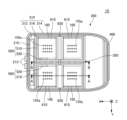
- 2 is a plan view of the battery pack according to the embodiment with a harness guide and an upper case removed.
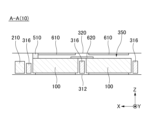
- FIG. This is a cross-sectional view taken along line AA in FIG.
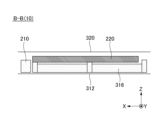
- This is a cross-sectional view taken along line B-B of FIG.
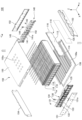
- FIG. 2 is an exploded perspective view of an example of a battery module according to the embodiment.
- 13 is a plan view of a battery pack according to a modified example with a harness guide and an upper case removed.
- FIG. FIG. 11 is a perspective view of a cell upper plate and a first heat-resistant sheet according to a modified example.
- FIG. 1 is a perspective view of a battery pack 10 according to an embodiment.
- FIG. 2 is a plan view of the battery pack 10 according to an embodiment with the harness guide 220 and upper case 320 removed.
- FIG. 3 is a cross-sectional view taken along line A-A in FIG. 2.
- FIG. 4 is a cross-sectional view taken along line B-B in FIG. 2.
- FIG. 5 is an exploded perspective view of an example of a battery module 100 according to an embodiment.
- the battery pack 10 is mounted on an automobile. Specifically, the battery pack 10 is mounted between the front and rear wheels of the automobile. In the following, unless otherwise specified, the battery pack 10 will be described as being mounted on an automobile. However, the battery pack 10 can also be used for purposes other than automobiles.
- the X direction indicates the front-rear direction of the battery pack 10.
- the Y direction is perpendicular to the X direction.
- the Y direction indicates the left-right direction of the battery pack 10.
- the Z direction is perpendicular to both the X and Y directions.
- the Z direction indicates the up-down direction of the battery pack 10.
- the arrows pointing to the X direction, the Y direction, and the Z direction indicate the front, left, and up directions of the battery pack 10, respectively.
- a white circle with a black dot indicating the Y direction or the Z direction indicates that the arrow indicating the direction indicated by the white circle extends from the back to the front of the paper.
- the relationship between the X direction, Y direction, and Z direction and the front-rear direction, left-right direction, and up-down direction of the battery pack 10 is not limited to this example.
- the front-rear, left-right and up-down directions of the battery pack 10 are determined by the vehicle in which the battery pack 10 is mounted.
- the X, Y and Z directions indicate the front-rear, left-right and up-down directions of the vehicle, respectively.
- the arrow pointing to the X direction, the arrow pointing to the Y direction and the arrow pointing to the Z direction indicate the front, left and up directions of the vehicle, respectively.
- the relationship between the front-rear, left-right and up-down directions of the battery pack 10 and the front-rear, left-right and up-down directions of the vehicle is not limited to this example.
- the direction perpendicular to the Z direction will be referred to as the horizontal direction.
- the battery pack 10 will be described with reference to Figures 1 to 4.
- the battery pack 10 includes four battery modules 100, a junction box 210, a harness guide 220, a module housing 300, a gas exhaust section 400, two spacers 500, four upper heat-resistant sheets 610, and two lower heat-resistant sheets 620.
- the module housing 300 has a lower case 310 and an upper case 320.
- the lower case 310 includes a module lower plate 312, a side frame 314, and a support frame 316.
- the lower case 310 may generally be referred to as, for example, a tray or a main body.
- the upper case 320 may generally be referred to as, for example, a cover or a lid.
- the four battery modules 100 when viewed from the Z direction, are arranged in two rows and two columns in each of the X and Y directions.
- the battery module 100 located on the left front side of the four battery modules 100 will be referred to as the left front battery module 100
- the battery module 100 located on the right front side of the four battery modules 100 will be referred to as the right front battery module 100
- the battery module 100 located on the left rear side of the four battery modules 100 will be referred to as the left rear battery module 100
- the battery module 100 located on the right rear side of the four battery modules 100 will be referred to as the right rear battery module 100.
- the number and arrangement of the battery modules 100 are not limited to the example shown in FIG. 2.
- Each battery module 100 will be described with reference to Figure 5.
- Each battery module 100 has a number of battery cells 110, a number of compression pads 120, a front voltage detection device 130, a rear voltage detection device 140, and a cell housing 150.
- the multiple battery cells 110 are stacked in the Y direction.
- the multiple compression pads 120 and the multiple battery cells 110 are stacked alternately in the Y direction.
- Each compression pad 120 is disposed between adjacent battery cells 110 in the Y direction and on both sides of the multiple battery cells 110 in the Y direction.
- the multiple battery cells 110 and the multiple compression pads 120 stacked alternately in the Y direction are referred to as a stack of battery cells 110.
- the longitudinal direction of each battery cell 110 is approximately parallel to the X direction.
- the lateral direction of each battery cell 110 is approximately parallel to the Z direction.
- the thickness direction of each battery cell 110 is approximately parallel to the Y direction.
- the shape of each battery cell 110 is not limited to this example.
- Each battery cell 110 includes a battery element (not shown), an exterior material 112, a positive electrode tab 114, and a negative electrode tab 116.
- the battery element includes a plurality of positive electrodes and a plurality of negative electrodes (not shown) stacked alternately in the Y direction, and a separator (not shown) located between adjacent positive electrodes and negative electrodes in the Y direction.
- the exterior material 112 seals the battery element and an electrolyte (not shown).
- the positive electrode tab 114 is electrically connected to the positive electrode of the battery element.
- the positive electrode tab 114 is pulled out from one of both sides of the exterior material 112 in the X direction.
- the negative electrode tab 116 is electrically connected to the negative electrode of the battery element.
- the negative electrode tab 116 is pulled out from the other side of both sides of the exterior material 112 in the X direction.
- the structure of each battery cell 110 is not limited to this example.
- Each battery cell 110 may be an all-solid-state battery.
- an all-solid-state battery a solid electrolyte layer is provided in the portion corresponding to the separator.
- An all-solid-state battery does not contain an electrolyte.
- each battery cell 110 will be described as a battery cell that contains an electrolyte.
- the battery cells 110 are electrically connected in a combination of series and parallel. Specifically, a cell group including at least two battery cells 110 adjacent to each other in the Y direction and connected in parallel is stacked in the Y direction and connected in series. In front of the stack of battery cells 110, a tab group 118 including a positive electrode tab 114 drawn from a battery cell 110 of one cell group connected in parallel and a negative electrode tab 116 drawn from a battery cell 110 of another cell group connected in parallel are electrically connected to each other and include the positive electrode tab 114 and the negative electrode tab 116. The positive electrode tab 114 and the negative electrode tab 116 in the tab group 118 are joined to each other by, for example, laser welding.
- the tab group 118 is also similarly arranged at the rear of the stack of battery cells 110.
- a plurality of cell groups are connected in series from the cell group located at one end side of the stack of battery cells 110 in the Y direction to the cell group located at the other end side of the stack of battery cells 110 in the Y direction.
- the tab group 118 located on the front side of the stack of battery cells 110 will be referred to as the front tab group 118
- the tab group 118 located on the rear side of the stack of battery cells 110 will be referred to as the rear tab group 118.
- the electrical connection of the multiple battery cells 110 is not limited to the above example.
- a stack of battery cells 110 may be formed by connecting single battery cells 110 in series.
- each cell group may include three or more battery cells 110 connected in parallel.
- the front voltage detection device 130 detects the voltages of the multiple front tab groups 118.
- the front voltage detection device 130 includes a front protector 131, multiple front voltage detection terminals 132, multiple front voltage detection lines 133, a front connector 134, and a front bus bar 135.
- the front protector 131 covers the front of the stack of battery cells 110.
- the front protector 131 is, for example, an insulator such as resin.
- the front protector 131 defines a plurality of front openings 131a. Each of the plurality of front tab groups 118 is exposed forward through each of the plurality of front openings 131a.
- Each of the multiple front voltage detection terminals 132 is located in front of each of the multiple front tab groups 118.
- Each front voltage detection terminal 132 is, for example, a conductor such as metal.
- the rear surface of each front voltage detection terminal 132 and the front surface of each front tab group 118 are joined to each other by a joining method such as laser welding. Therefore, each front voltage detection terminal 132 and each front tab group 118 are electrically connected to each other. Therefore, the front voltage detection device 130 can detect the voltage of each front tab group 118 by each front voltage detection terminal 132.
- the multiple front voltage detection terminals 132 are held together by the front protector 131. Therefore, by placing the front protector 131 at an appropriate position relative to the stack of battery cells 110, each of the multiple front voltage detection terminals 132 can be placed at an appropriate position relative to each of the multiple front tab groups 118.
- each front voltage detection line 133 and each front voltage detection terminal 132 are electrically connected to each other.
- the other end of each front voltage detection line 133 and the front connector 134 are electrically connected to each other.
- the front voltage detection terminals 132 and the front connector 134 are electrically connected to each other via the front voltage detection lines 133.
- Each front voltage detection line 133 is routed between one end of each front voltage detection line 133 and the other end of each front voltage detection line 133 via the front protector 131.
- the front bus bar 135 is disposed at the right end of the front protector 131.
- the front bus bar 135 is electrically connected to the positive electrode tab 114 pulled forward from the battery cell 110 of the cell group located at the right end of the stack of battery cells 110.
- the front bus bar 135 functions as an external terminal for electrically connecting the battery module 100 to an external device such as another battery module.
- the rear voltage detection device 140 detects the voltages of the multiple rear tab groups 118.
- the rear voltage detection device 140 includes a rear protector 141, multiple rear voltage detection terminals 142, multiple rear voltage detection lines 143, a rear connector 144, and a rear bus bar 145.
- the rear protector 141 covers the rear of the stack of battery cells 110.
- the rear protector 141 is, for example, an insulator such as resin.
- the rear protector 141 defines a plurality of rear openings 141a. Each of the multiple rear tab groups 118 is exposed rearward through each of the multiple rear openings 141a.
- Each of the rear voltage detection terminals 142 is located behind each of the rear tab groups 118.
- Each rear voltage detection terminal 142 is, for example, a conductor such as metal.
- the front surface of each rear voltage detection terminal 142 and the rear surface of each rear tab group 118 are joined to each other by a joining method such as laser welding. Therefore, each rear voltage detection terminal 142 and each rear tab group 118 are electrically connected to each other. Therefore, the rear voltage detection device 140 can detect the voltage of each rear tab group 118 by each rear voltage detection terminal 142.
- the rear voltage detection terminals 142 are held together by the rear protector 141. Therefore, by placing the rear protector 141 at an appropriate position relative to the stack of battery cells 110, each of the rear voltage detection terminals 142 can be positioned at an appropriate position relative to each of the rear tab groups 118.
- each rear voltage detection line 143 and each rear voltage detection terminal 142 are electrically connected to each other.
- the other end of each rear voltage detection line 143 and the rear connector 144 are electrically connected to each other.
- the multiple rear voltage detection terminals 142 and the rear connector 144 are electrically connected to each other via the multiple rear voltage detection lines 143.
- Each rear voltage detection line 143 is routed between one end of each rear voltage detection line 143 and the other end of each rear voltage detection line 143 via the rear protector 141.
- the rear bus bar 145 is disposed at the left end of the rear protector 141.
- the rear bus bar 145 is electrically connected to the negative electrode tab 116 pulled out rearward from the battery cell 110 of the cell group located at the left end of the stack of battery cells 110.
- the rear bus bar 145 functions as an external terminal for electrically connecting the battery module 100 to an external device such as another battery module.
- the positive electrode tab 114 at the end of the multiple cell groups connected in series is pulled forward from the battery cell 110 of the cell group located at the right end of the stack of battery cells 110, and the negative electrode tab 116 at the end of the multiple cell groups connected in series is pulled backward from the battery cell 110 of the cell group located at the left end of the stack of battery cells 110.
- the front bus bar 135 is disposed on the right front side of the stack of battery cells 110
- the rear bus bar 145 is disposed on the left rear side of the stack of battery cells 110.
- the arrangement of the positive electrode tab 114 and the negative electrode tab 116 at the end of the multiple cell groups connected in series may differ depending on the number of battery cells 110 included in the stack of battery cells 110.
- the bus bar electrically connected to the positive electrode tab 114 at the end of the group of cells connected in series is disposed on the right front side of the stack of battery cells 110
- the bus bar electrically connected to the negative electrode tab 116 at the end of the group of cells connected in series is disposed on the left front side of the stack of battery cells 110.
- the cell container 150 includes a cell front plate 151, a cell rear plate 152, a cell left plate 153, a cell right plate 154, a cell upper plate 155, and a cell lower plate 156.
- Each plate is made of a metal such as aluminum.
- the cell front plate 151 covers the stack of battery cells 110 and the front of the front voltage detection device 130.
- the cell rear plate 152 covers the stack of battery cells 110 and the rear of the rear voltage detection device 140.
- the cell left plate 153 covers the left part of the stack of battery cells 110.
- the cell right plate 154 covers the right part of the stack of battery cells 110.
- the cell upper plate 155 covers the upper part of the stack of battery cells 110.
- the cell upper plate 155 is provided with a plurality of gas exhaust holes 155a. Therefore, gas generated from the battery cells 110 can be exhausted toward the upper part of the battery module 100 through the plurality of gas exhaust holes 155a.
- the plurality of gas exhaust holes 155a are arranged in a plurality of rows and a plurality of columns in the X direction and the Y direction, respectively. However, the arrangement of the plurality of gas exhaust holes 155a is not limited to this example. Alternatively, the gas exhaust holes 155a may not be provided.
- the cell lower plate 156 covers the lower part of the stack of battery cells 110.
- a thermally conductive adhesive 156a is disposed between the upper surface of the cell lower plate 156 and the lower surface of the stack of battery cells 110. Therefore, heat generated from the stack of battery cells 110 can be released toward the bottom of the battery module 100 through the thermally conductive adhesive 156a.
- the battery pack 10 will be described with reference to Figs. 1 to 4 again.
- the external shape of the battery module 100 shown in Figs. 2 to 4 is a schematic representation of the external shape of the cell housing 150 described with reference to Fig. 5. Therefore, the front, rear, left, right, top, and bottom of the battery module 100 shown in Figs. 2 to 4 correspond to the front of the cell front plate 151, the rear of the cell rear plate 152, the left side of the cell left plate 153, the right side of the cell right plate 154, the top of the cell upper plate 155, and the bottom of the cell lower plate 156 shown in Fig. 5.
- the junction box 210 is disposed forward of the four battery modules 100.
- a pair of junction terminals 212 are provided at the front of the junction box 210. As shown in FIG. 1, the front end of the junction terminals 212 protrudes forward from the front surface of the side frame 314.
- the pair of junction terminals 212 and the four battery modules 100 are electrically connected to each other via the junction box 210. Therefore, in the electrical path, the four battery modules 100 are electrically connected in series between the pair of junction terminals 212.
- the electronic device arranged in front of the four battery modules 100 is not limited to the junction box 210. Instead of or in addition to the junction box 210, an electronic device electrically connected to at least one battery module 100 may be arranged in front of the four battery modules 100. Alternatively, the electronic device arranged in front of the four battery modules 100 may be another battery module different from these four battery modules 100.
- the harness guide 220 is located above the support frame 316 between the battery modules 100 adjacent in the Y direction.
- the harness guide 220 at least guides and holds the harness (not shown).
- the arrangement of the harness guide 220 is not limited to the example shown in FIG. 4.
- the harness may also be arranged at a position different from the position where the harness guide 220 is arranged.
- the harness includes at least one wire.
- Examples of the wires included in the harness include low-voltage wires such as wires that operate as signal wires and wires that form a circuit made of a 12V power source for a vehicle, high-voltage wires such as voltage detection wires electrically connected to at least one of the front connector 134 and the rear connector 144 of the battery module 100 and signal wires of the thermistors that detect the temperature of each battery cell 110 included in the battery module 100, and high-voltage wires such as wires for supplying power to a heater that heats each battery cell 110 included in the battery module 100.
- low-voltage wires such as wires that operate as signal wires and wires that form a circuit made of a 12V power source for a vehicle
- high-voltage wires such as voltage detection wires electrically connected to at least one of the front connector 134 and the rear connector 144 of the battery module 100 and signal wires of the thermistors that detect the temperature of each battery cell 110 included in the battery module 100
- high-voltage wires such as wire
- the module lower plate 312 extends approximately parallel to the horizontal direction.
- the side frame 314 is approximately perpendicular to the module lower plate 312. When viewed from the Z direction, the side frame 314 extends along the outer periphery of the module lower plate 312.
- the support frame 316 When viewed from the Z direction, the support frame 316 is approximately a frame body that surrounds each of the four battery modules 100.
- the upper case 320 is located above the lower case 310 and covers the lower case 310.
- the lower case 310 and the upper case 320 are attached to each other via a sealant such as rubber between the upper surface of the side frame 314 and a portion of the lower case 310 facing the upper surface of the side frame 314 in the Z direction.
- the lower case 310 and the upper case 320 define an accommodation space that accommodates the four battery modules 100, the junction box 210, and the harness guide 220.
- the accommodation space defined by the lower case 310 and the upper case 320 will be referred to as the accommodation space of the module accommodation body 300 as necessary.
- the accommodation space of the module accommodation body 300 is sealed from the area outside the module accommodation body 300 when the lower case 310 and the upper case 320 are attached to each other via a sealant.
- the gas exhaust section 400 is disposed on the rear side of the side frame 314.
- the gas exhaust section 400 has a pressure relief device (PRD) such as a pressure relief valve.
- PRD pressure relief device
- the pressure in the storage space of the module housing 300 may increase due to gas discharged from the battery modules 100.
- a relatively high temperature gas may be generated from the battery cells 110 due to an abnormality in the battery cells 110.
- the gas generated from the battery cells 110 is discharged above the battery modules 100 via multiple gas exhaust holes 155a.
- a communication space 350 exists in the storage space of the module housing 300.
- the communication space 350 is a space above the upper surfaces of the four battery modules 100 that is connected to the four battery modules 100 and the gas exhaust section 400.
- the gas discharged from each battery module 100 reaches the gas exhaust section 400 via the communication space 350.
- Gas generated from the battery cell 110 may be discharged from a gas discharge section other than the multiple gas discharge holes 155a.
- gas generated from the battery cell 110 may be discharged from the gap between the cell front plate 151 and the cell upper plate 155, the gap between the cell rear plate 152 and the cell upper plate 155, the gap between the cell left plate 153 and the cell upper plate 155, or the gap between the cell right plate 154 and the cell upper plate 155. Gas discharged from these gaps is also discharged above the battery module 100 and reaches the gas discharge section 400 via the communication space 350.
- the two spacers 500 are arranged substantially symmetrically in the Y direction when viewed from the Z direction.
- One spacer 500 is arranged on the upper surface side of the left front battery module 100.
- the spacer 500 arranged on the upper surface side of the left front battery module 100 will be referred to as the left spacer 500, as necessary.
- the left spacer 500 is arranged in the gap between the upper surface of the left front battery module 100 and the lower surface of the upper case 320.
- the other spacer 500 is arranged on the upper surface side of the right front battery module 100.
- the spacer 500 arranged on the upper surface side of the right front battery module 100 will be referred to as the right spacer 500, as necessary.
- the right spacer 500 is arranged in the gap between the upper surface of the right front battery module 100 and the lower surface of the upper case 320.
- left spacer 500 The following describes the left spacer 500. Unless otherwise specified, the following description of the left spacer 500 also applies to the right spacer 500, except that the left spacer 500 and the right spacer 500 are arranged approximately symmetrically when viewed from the Z direction.
- the left spacer 500 is substantially L-shaped when viewed from the Z direction.
- the left spacer 500 includes a first spacer extension 510 and a second spacer extension 520.
- first spacer extension 510 of the left spacer 500 and the second spacer extension 520 of the left spacer 500 will be referred to as the left first spacer extension 510 and the left second spacer extension 520, respectively.
- the first spacer extension 510 on the left side when viewed from the Z direction, extends in the Y direction along the front outer edge of the top surface of the left front battery module 100.
- the length in the Y direction of the first spacer extension 510 on the left side is approximately equal to the length in the Y direction of the top surface of the left front battery module 100.
- the second spacer extension 520 on the left side extends in the X direction along the right outer edge of the top surface of the left front battery module 100.
- the length in the X direction of the second spacer extension 520 on the left side is shorter than the length in the X direction of the top surface of the left front battery module 100.
- the shape of the first spacer extension 510 on the left side is not limited to the shape shown in FIG. 2.
- the left first spacer extension 510 when viewed from the Z direction, the left first spacer extension 510 is located forward of the multiple gas exhaust holes 155a of the left front battery module 100. Therefore, when gas is exhausted from the left front battery module 100, the left first spacer extension 510 serves as a gas shield that blocks gas flowing in the opposite direction from the left front battery module 100 toward the gas exhaust section 400. Therefore, compared to when the left first spacer extension 510 is not provided, the gas exhausted from the left front battery module 100 can be efficiently moved toward the gas exhaust section 400, and the gas exhausted from the left front battery module 100 can be efficiently exhausted from the gas exhaust section 400.
- the first spacer extension 510 on the left side can block not only the gas discharged from the battery module 100 on the front left side, but also the gas discharged from the battery module 100 on the rear left side.
- the first spacer extension 510 on the left side can function as a gas shielding section that blocks gas flowing in the opposite direction from the battery module 100 on the rear left side toward the gas exhaust section 400. Therefore, compared to a case in which the first spacer extension 510 on the left side is not provided, the gas discharged from the battery module 100 on the rear left side can be efficiently moved toward the gas exhaust section 400, and the gas discharged from the battery module 100 on the rear left side can be efficiently exhausted from the gas exhaust section 400.
- the left first spacer extension 510 when viewed from the Z direction, is located between the multiple gas exhaust holes 155a of the left front battery module 100 and the left portion of the junction box 210. Therefore, the left first spacer extension 510 serves as a gas shield that blocks gas flowing from the left front battery module 100 or the left rear battery module 100 toward the junction box 210. Therefore, the left first spacer extension 510 can protect the junction box 210 from gas generated from the left front battery module 100 or the left rear side.
- the left second spacer extension 520 when viewed from the Z direction, the left second spacer extension 520 is located to the right of the gas exhaust hole 155a on the front side of the left front battery module 100. Therefore, the left second spacer extension 520 serves as a gas shield that blocks gas flowing to the right in the direction from the left front battery module 100 toward the gas exhaust section 400. Therefore, compared to when the left second spacer extension 520 is not provided, gas exhausted from the left front battery module 100 can be moved toward the gas exhaust section 400 more efficiently, and gas exhausted from the left front battery module 100 can be efficiently exhausted from the gas exhaust section 400.
- the left second spacer extension 520 when viewed from the Z direction, the left second spacer extension 520 is located between a gas exhaust hole 155a on the front side of the left front battery module 100 and the front part of the right front battery module 100. Therefore, the left second spacer extension 520 serves as a gas shield that blocks gas flowing from the left front battery module 100 toward the right front battery module 100. Therefore, the left second spacer extension 520 can protect the right front battery module 100 from gas generated from the left front battery module 100.
- the left spacer 500 is an elastic body having heat resistance and flame retardancy, such as foamed silicone.
- the material used for the spacer 500 is not limited to foamed silicone, as long as it has the desired heat resistance, flame retardancy, and resilience.
- the left spacer 500 is compressed in the Z direction by the upper surface of the left front battery module 100 and the lower surface of the upper case 320. Therefore, the left spacer 500 is elastically deformed. Therefore, compared to a case in which the left spacer 500 does not elastically deform, it is possible to make it difficult for a gap to occur between the lower surface of the left spacer 500 and the upper surface of the left front battery module 100, and between the upper surface of the left spacer 500 and the lower surface of the upper case 320.
- the material of the left spacer 500 is not limited to an elastic body.
- the left spacer 500 may be a rigid body that does not elastically deform due to compression of the top surface of the left front battery module 100 and the bottom surface of the upper case 320.
- the method of fixing the left spacer 500 is not particularly limited.
- the bottom surface of the left spacer 500 and the top surface of the battery module 100 may be joined together in advance with a bonding material such as an adhesive.
- the top surface of the left spacer 500 and the bottom surface of the upper case 320 may be joined together in advance with a bonding material such as an adhesive.
- the bottom surface and top surface of the left spacer 500 do not have to be joined to the top surface of the battery module 100 and the bottom surface of the upper case 320, respectively, in advance.
- the spacer 500 is a gas shield that blocks gas flowing in a direction different from the direction from the battery module 100 toward the gas exhaust section 400. Therefore, when the spacer 500 is provided, the gas exhausted from the battery module 100 can be exhausted from the gas exhaust section 400 more efficiently than when the spacer 500 is not provided.
- Each upper heat-resistant sheet 610 may be, for example, a commercially available heat-resistant sheet.
- Heat-resistant sheets may be, for example, fiber sheets in which fibers containing carbon, silica, alumina, magnesia, etc. are formed into a sheet together with silicone resin or fluorine-based resin, ceramic plates, etc., but are not limited to these. From the standpoint of formability and heat resistance, the above-mentioned fiber sheets in which the heat resistance temperature of the fibers is 1000°C or higher are particularly preferred. As shown in Figure 2, the four upper heat-resistant sheets 610 and the four battery modules 100 overlap each other in the Z direction.
- the upper heat-resistant sheet 610 located on the left front side among the four upper heat-resistant sheets 610 will be referred to as the left front upper heat-resistant sheet 610
- the upper heat-resistant sheet 610 located on the right front side among the four upper heat-resistant sheets 610 will be referred to as the right front upper heat-resistant sheet 610
- the upper heat-resistant sheet 610 located on the left rear side among the four upper heat-resistant sheets 610 will be referred to as the left rear upper heat-resistant sheet 610
- the upper heat-resistant sheet 610 located on the right rear side among the four upper heat-resistant sheets 610 will be referred to as the right rear upper heat-resistant sheet 610.
- each upper heat-resistant sheet 610 on the left front side covers the underside of the portion of the upper case 320 that overlaps with the battery module 100 on the left front side in the Z direction.
- the upper heat-resistant sheet 610 on the left rear side covers the upper heat-resistant sheet 610 on the left rear side, the upper heat-resistant sheet 610 on the right front side, and the upper heat-resistant sheet 610 on the right rear side.
- each upper heat-resistant sheet 610 is a heat-resistant body disposed on the underside of the upper case 320 around the communication space 350. Therefore, compared to when these upper heat-resistant sheets 610 are not provided, the increase in temperature of the upper case 320 due to the high-temperature gas passing through the communication space 350 can be suppressed.
- the underside of the upper case 320 may be coated with a material such as an anti-rust paint. If this material is exposed to high-temperature gas and melts off, the melted material may come into contact with any part of the battery module 100.
- a material such as an anti-rust paint.
- the method of attaching the top surface of the left front upper heat-resistant sheet 610 and the bottom surface of the upper case 320 is not particularly limited.
- the top surface of the left front upper heat-resistant sheet 610 and the bottom surface of the upper case 320 may be attached to each other, for example, via an adhesive layer provided on the top surface side of the left front upper heat-resistant sheet 610.
- Each lower heat-resistant sheet 620 may be, for example, a commercially available heat-resistant sheet.
- Heat-resistant sheets may be, for example, fiber sheets in which fibers containing carbon, silica, alumina, magnesia, etc. are formed into a sheet together with silicone resin or fluorine-based resin, ceramic plates, etc., but are not limited thereto. From the viewpoint of moldability and heat resistance, the above-mentioned fiber sheets having a heat-resistant temperature of 1000°C or higher are particularly preferable. As shown in FIG. 2, when viewed from the Z direction, the two lower heat-resistant sheets 620 are arranged approximately symmetrically in line in the Y direction.
- the lower heat-resistant sheet 620 located on the left side of the two lower heat-resistant sheets 620 will be referred to as the left lower heat-resistant sheet 620
- the lower heat-resistant sheet 620 located on the right side of the two lower heat-resistant sheets 620 will be referred to as the right lower heat-resistant sheet 620.
- left-side lower heat-resistant sheet 620 The following describes the left-side lower heat-resistant sheet 620. Unless otherwise specified, the following description of the left-side lower heat-resistant sheet 620 also applies to the right-side lower heat-resistant sheet 620, except that the left-side lower heat-resistant sheet 620 and the right-side lower heat-resistant sheet 620 are arranged approximately symmetrically when viewed from the Z direction.
- the left lower heat-resistant sheet 620 covers the upper surface of the rear of the left front battery module 100 and the upper surface of the front of the left rear battery module 100. Therefore, the left lower heat-resistant sheet 620 is a heat-resistant body arranged on the upper surface of the rear of the left front battery module 100 and the upper surface of the front of the left rear battery module 100 around the communication space 350. Therefore, compared to when the left lower heat-resistant sheet 620 is not provided, it is possible to suppress the rise in temperature of the rear of the left front battery module 100 and the front of the left rear battery module 100 due to high-temperature gas passing through the communication space 350.
- the left lower heat-resistant sheet 620 exposes multiple gas exhaust holes 155a of the battery module 100 on the left front side and multiple gas exhaust holes 155a of the battery module 100 on the left rear side. Therefore, gas can be exhausted more efficiently from these gas exhaust holes 155a compared to when these gas exhaust holes 155a are covered by the left lower heat-resistant sheet 620.
- the front part of the left lower heat-resistant sheet 620 overlaps in the Z direction with at least one of the rear tab group 118 and the rear voltage detection device 140 shown in FIG. 5 of the left front battery module 100. Therefore, the left lower heat-resistant sheet 620 can protect the tab group 118 and the rear voltage detection device 140 from high-temperature gas passing through the communication space 350 above the rear part of the left front battery module 100.
- the rear of the left lower heat-resistant sheet 620 overlaps in the Z direction with at least one of the rear tab group 118 and the front voltage detection device 130 shown in FIG. 5 of the left rear battery module 100. Therefore, the left lower heat-resistant sheet 620 can protect the tab group 118 and the front voltage detection device 130 from high-temperature gas passing through the communication space 350 above the front of the left rear battery module 100.
- the left lower heat-resistant sheet 620 extends from the rear of the left front battery module 100 to the front of the left rear battery module 100. Therefore, a single lower heat-resistant sheet 620 can cover the upper surface of the rear of the left front battery module 100 and the upper surface of the front of the left rear battery module 100. Therefore, the number of parts in the battery pack 10 can be reduced compared to when the upper surface of the rear of the left front battery module 100 and the upper surface of the front of the left rear battery module 100 are covered with separate lower heat-resistant sheets 620.
- the method of attachment of the underside of the front of the left lower heat-resistant sheet 620 and the upper surface of the rear of the left front battery module 100 is not particularly limited.
- the underside of the front of the left lower heat-resistant sheet 620 and the upper surface of the rear of the left front battery module 100 may be attached to each other, for example, via an adhesive layer provided on the underside of the left lower heat-resistant sheet 620.
- the arrangement of the upper heat-resistant sheet 610 and the lower heat-resistant sheet 620 is not limited to the example shown in Figures 2 and 3.
- Heat-resistant bodies such as the upper heat-resistant sheet 610 and the lower heat-resistant sheet 620 can be arranged at least partially around the communication space 350.
- the increase in temperature around the communication space 350 due to high-temperature gas passing through the communication space 350 can be suppressed compared to when a heat-resistant body is not provided.
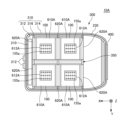
- FIG. 6 is a plan view of a modified battery pack 10A with the harness guide and upper case removed.
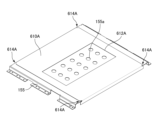
- FIG. 7 is a perspective view of a modified cell upper plate 155 and a first heat-resistant sheet 610A.
- the modified battery pack 10A is similar to the battery pack 10 according to the embodiment, except for the following points.
- the battery pack 10A according to the modified example may also include spacers corresponding to the two spacers 500 according to the embodiment, similar to the battery pack 10 according to the embodiment.
- the battery pack 10A includes four first heat-resistant sheets 610A and six second heat-resistant sheets 620A.
- the four first heat-resistant sheets 610A and the four battery modules 100 overlap each other in the Z direction.
- Each first heat-resistant sheet 610A covers the upper surface of the peripheral portion of the gas exhaust holes 155a of each battery module 100.
- the six second heat-resistant sheets 620A include two second heat-resistant sheets 620A on the front side in the X direction, two second heat-resistant sheets 620A on the center side in the X direction, and two second heat-resistant sheets 620A on the rear side in the X direction.
- One of the two second heat-resistant sheets 620A on the front side in the X direction covers the front part of the battery module 100 on the left front side.
- the other of the two second heat-resistant sheets 620A on the front side in the X direction covers the front part of the battery module 100 on the right front side.
- One of the two second heat-resistant sheets 620A at the center in the X direction covers the rear of the battery module 100 on the left front side and the front of the battery module 100 on the left rear side.
- the other of the two second heat-resistant sheets 620A at the center in the X direction covers the rear of the battery module 100 on the right front side and the front of the battery module 100 on the right rear side.
- One of the two second heat-resistant sheets 620A at the rear side in the X direction covers the rear of the battery module 100 on the left rear side.
- the other of the two second heat-resistant sheets 620A at the rear side in the X direction covers the rear of the battery module 100 on the right rear side.
- the second heat-resistant sheet 620A located on the left front side among the six second heat-resistant sheets 620A will be referred to as the left front second heat-resistant sheet 620A
- the second heat-resistant sheet 620A located on the right front side among the six second heat-resistant sheets 620A will be referred to as the right front second heat-resistant sheet 620A
- the second heat-resistant sheet 620A located on the left center side among the six second heat-resistant sheets 620A will be referred to as the left center second heat-resistant sheet 620A.
- the second heat-resistant sheet 620A located on the right center side of the six second heat-resistant sheets 620A is referred to as the right center second heat-resistant sheet 620A
- the second heat-resistant sheet 620A located on the left rear side of the six second heat-resistant sheets 620A is referred to as the left rear second heat-resistant sheet 620A
- the second heat-resistant sheet 620A located on the right rear side of the six second heat-resistant sheets 620A is referred to as the right rear second heat-resistant sheet 620A.
- the first heat-resistant sheet 610A according to the modified example will be described with reference to FIG. 7.
- the first heat-resistant sheet 610A defines a center opening 612A. From the center opening 612A, multiple gas exhaust holes 155a are exposed. Therefore, gas can be exhausted more efficiently from the multiple gas exhaust holes 155a compared to when the first heat-resistant sheet 610A covers the multiple gas exhaust holes 155a.
- the left and right ends of the first heat-resistant sheet 610A are bent downward at approximately right angles to the left and right edges of the cell upper plate 155, respectively. Therefore, the left and right edges of the cell upper plate 155 can be covered by the left and right ends of the first heat-resistant sheet 610A.
- a pair of notches 614A are provided at the bent portions at the left and right edges of the cell upper plate 155 at the front edge of the first heat-resistant sheet 610A.
- a pair of notches 614A are provided at the bent portions at the left and right edges of the cell upper plate 155 at the rear edge of the first heat-resistant sheet 610A. Therefore, the left and right end portions of the first heat-resistant sheet 610A can be easily folded compared to when these notches 614A are not provided.
- the front and rear of the upper surface of the cell upper plate 155 are exposed from the first heat-resistant sheet 610A.
- the front and rear of the upper surface of the cell upper plate 155 exposed from the first heat-resistant sheet 610A can be used as a margin for attaching the second heat-resistant sheet 620A.
- Each first heat-resistant sheet 610A is a heat-resistant body arranged on the upper surface of the peripheral portion of the multiple gas exhaust holes 155a of each battery module 100 around the communication space 350. Therefore, compared to a case where each first heat-resistant sheet 610A is not provided, it is possible to suppress the rise in temperature of the peripheral portion of the multiple gas exhaust holes 155a of each battery module 100 caused by high-temperature gas passing through the communication space 350.
- the second heat-resistant sheet 620A on the left center side is a heat-resistant body arranged on the upper surface of the rear of the left front battery module 100 and the upper surface of the front of the left rear battery module 100 around the communication space 350. Therefore, compared to when the second heat-resistant sheet 620A on the left center side is not provided, it is possible to suppress the rise in temperature of the rear of the left front battery module 100 and the front of the left rear battery module 100 caused by high-temperature gas passing through the communication space 350.
- the front part of the second heat-resistant sheet 620A on the left center side overlaps in the Z direction with at least one of the rear tab group 118 and the rear voltage detection device 140 of the left front battery module 100 shown in FIG. 5. Therefore, the tab group 118 and the rear voltage detection device 140 can be protected by the second heat-resistant sheet 620A on the left center side from the high-temperature gas passing through the communication space 350 above the rear part of the left front battery module 100.
- the rear part of the second heat-resistant sheet 620A on the left center side overlaps in the Z direction with at least one of the front tab group 118 and the front voltage detection device 130 shown in FIG. 5 of the battery module 100 on the left rear side. Therefore, the tab group 118 and the front voltage detection device 130 can be protected by the second heat-resistant sheet 620A on the left center side from the high-temperature gas passing through the communication space 350 above the front part of the battery module 100 on the left rear side.
- the left front second heat-resistant sheet 620A is a heat-resistant body arranged on the upper surface of the front part of the left front battery module 100 around the communication space 350. Therefore, compared to a case where the left front second heat-resistant sheet 620A is not provided, it is possible to suppress the rise in temperature of the front part of the left front battery module 100 caused by high-temperature gas passing through the communication space 350.
- the left front second heat-resistant sheet 620A overlaps in the Z direction with at least one of the front tab group 118 and the front voltage detection device 130 shown in FIG. 5 of the left front battery module 100. Therefore, the left front second heat-resistant sheet 620A can protect the tab group 118 and the front voltage detection device 130 from high-temperature gas passing through the communication space 350 above the front of the left front battery module 100.
- the second heat-resistant sheet 620A on the left rear side is a heat-resistant body arranged on the upper surface of the rear part of the left rear battery module 100 around the communication space 350. Therefore, compared to when the second heat-resistant sheet 620A on the left rear side is not provided, it is possible to suppress the rise in temperature of the rear part of the left rear battery module 100 caused by high-temperature gas passing through the communication space 350.
- the second heat-resistant sheet 620A on the rear left side overlaps in the Z direction with at least one of the rear tab group 118 and the rear voltage detection device 140 shown in FIG. 5 of the rear left side battery module 100. Therefore, the second heat-resistant sheet 620A on the rear left side can protect the tab group 118 and the rear voltage detection device 140 from high-temperature gas passing through the communication space 350 above the rear of the rear left side battery module 100.
- the gas discharged from the battery module 100 can be efficiently discharged by the spacer 500.
- 10, 10A battery pack 100 battery module, 110 battery cell, 112 exterior material, 114 positive electrode tab, 116 negative electrode tab, 118 tab group, 120 compression pad, 130 front voltage detection device, 131 front protector, 131a front opening, 132 front voltage detection terminal, 133 front voltage detection line, 134 front connector, 135 front bus bar, 140 rear voltage detection device, 141 rear protector, 141a rear opening, 142 rear voltage detection terminal, 143 rear voltage detection line, 144 rear connector, 145 rear bus bar, 150 cell housing, 151 cell front plate, 152 cell rear plate, 153 cell left plate Rate, 154 Cellulite plate, 155 Cell upper plate, 155a Gas exhaust hole, 156 Cell lower plate, 156a Thermally conductive adhesive, 210 Junction box, 212 Junction terminal, 220 Harness guide, 300 Module housing, 310 Lower case, 312 Module lower plate, 314 Side frame, 316 Support frame, 320 Upper case, 350 Communication space, 400 Gas exhaust section, 500 Spacer, 510 First spacer extension, 520 Second spacer extension,
Landscapes
- Chemical & Material Sciences (AREA)
- Chemical Kinetics & Catalysis (AREA)
- Electrochemistry (AREA)
- General Chemical & Material Sciences (AREA)
- Battery Mounting, Suspending (AREA)
Abstract
Priority Applications (3)
| Application Number | Priority Date | Filing Date | Title |
|---|---|---|---|
| EP24819244.5A EP4726878A1 (fr) | 2023-06-07 | 2024-05-30 | Bloc-batterie |
| CN202480037031.6A CN121241471A (zh) | 2023-06-07 | 2024-05-30 | 电池组 |
| JP2025526077A JPWO2024253013A1 (fr) | 2023-06-07 | 2024-05-30 |
Applications Claiming Priority (2)
| Application Number | Priority Date | Filing Date | Title |
|---|---|---|---|
| JP2023-094020 | 2023-06-07 | ||
| JP2023094020 | 2023-06-07 |
Publications (1)
| Publication Number | Publication Date |
|---|---|
| WO2024253013A1 true WO2024253013A1 (fr) | 2024-12-12 |
Family
ID=93795907
Family Applications (1)
| Application Number | Title | Priority Date | Filing Date |
|---|---|---|---|
| PCT/JP2024/019836 Ceased WO2024253013A1 (fr) | 2023-06-07 | 2024-05-30 | Bloc-batterie |
Country Status (4)
| Country | Link |
|---|---|
| EP (1) | EP4726878A1 (fr) |
| JP (1) | JPWO2024253013A1 (fr) |
| CN (1) | CN121241471A (fr) |
| WO (1) | WO2024253013A1 (fr) |
Citations (9)
| Publication number | Priority date | Publication date | Assignee | Title |
|---|---|---|---|---|
| JP2019197622A (ja) | 2018-05-08 | 2019-11-14 | トヨタ自動車株式会社 | 電池パック |
| JP2020053223A (ja) | 2018-09-26 | 2020-04-02 | いすゞ自動車株式会社 | バッテリー装置 |
| WO2020153015A1 (fr) * | 2019-01-25 | 2020-07-30 | 三洋電機株式会社 | Bloc batterie |
| JP2021022545A (ja) * | 2019-07-30 | 2021-02-18 | 三洋電機株式会社 | 電源装置 |
| JP2021507483A (ja) * | 2017-12-21 | 2021-02-22 | ハー カー オー イゾリアー ウント テクスティルテヒニーク ゲゼルシャフト ミット ベシュレンクテル ハフツング | 電池用の多層断熱要素 |
| WO2022250311A1 (fr) * | 2021-05-26 | 2022-12-01 | 주식회사 엘지에너지솔루션 | Bloc-batterie ayant une structure réduisant la température de gaz de ventilation et bloquant l'émission externe d'étincelles |
| JP2023059480A (ja) * | 2021-10-15 | 2023-04-27 | トヨタ自動車株式会社 | 蓄電装置 |
| WO2023090219A1 (fr) * | 2021-11-19 | 2023-05-25 | マフテック株式会社 | Couverture en fibres inorganiques, stratifié, unité de bloc-batterie et mobilité électrique |
| JP2023094020A (ja) | 2021-12-23 | 2023-07-05 | Jfeスチール株式会社 | 製鉄用容器および製鉄用容器の操業方法 |
-
2024
- 2024-05-30 WO PCT/JP2024/019836 patent/WO2024253013A1/fr not_active Ceased
- 2024-05-30 CN CN202480037031.6A patent/CN121241471A/zh active Pending
- 2024-05-30 JP JP2025526077A patent/JPWO2024253013A1/ja active Pending
- 2024-05-30 EP EP24819244.5A patent/EP4726878A1/fr active Pending
Patent Citations (9)
| Publication number | Priority date | Publication date | Assignee | Title |
|---|---|---|---|---|
| JP2021507483A (ja) * | 2017-12-21 | 2021-02-22 | ハー カー オー イゾリアー ウント テクスティルテヒニーク ゲゼルシャフト ミット ベシュレンクテル ハフツング | 電池用の多層断熱要素 |
| JP2019197622A (ja) | 2018-05-08 | 2019-11-14 | トヨタ自動車株式会社 | 電池パック |
| JP2020053223A (ja) | 2018-09-26 | 2020-04-02 | いすゞ自動車株式会社 | バッテリー装置 |
| WO2020153015A1 (fr) * | 2019-01-25 | 2020-07-30 | 三洋電機株式会社 | Bloc batterie |
| JP2021022545A (ja) * | 2019-07-30 | 2021-02-18 | 三洋電機株式会社 | 電源装置 |
| WO2022250311A1 (fr) * | 2021-05-26 | 2022-12-01 | 주식회사 엘지에너지솔루션 | Bloc-batterie ayant une structure réduisant la température de gaz de ventilation et bloquant l'émission externe d'étincelles |
| JP2023059480A (ja) * | 2021-10-15 | 2023-04-27 | トヨタ自動車株式会社 | 蓄電装置 |
| WO2023090219A1 (fr) * | 2021-11-19 | 2023-05-25 | マフテック株式会社 | Couverture en fibres inorganiques, stratifié, unité de bloc-batterie et mobilité électrique |
| JP2023094020A (ja) | 2021-12-23 | 2023-07-05 | Jfeスチール株式会社 | 製鉄用容器および製鉄用容器の操業方法 |
Also Published As
| Publication number | Publication date |
|---|---|
| JPWO2024253013A1 (fr) | 2024-12-12 |
| CN121241471A (zh) | 2025-12-30 |
| EP4726878A1 (fr) | 2026-04-15 |
Similar Documents
| Publication | Publication Date | Title |
|---|---|---|
| CN116349081B (zh) | 电池单体组件以及包括该电池单体组件的电池组和车辆 | |
| CN101395737B (zh) | 中型或大型电池模块 | |
| JP6459207B2 (ja) | 蓄電装置 | |
| CN102804447A (zh) | 包括结构新颖的感测构件的电池模块 | |
| KR102860577B1 (ko) | 전지 모듈 및 이를 포함하는 전지팩 | |
| KR102514497B1 (ko) | 전지 모듈 및 이를 포함하는 전지 팩 | |
| JP2023538387A (ja) | 電池モジュールおよびこれを含む電池パック | |
| JP2019186040A (ja) | 組電池 | |
| JP2019186038A (ja) | 組電池 | |
| JP2019186034A (ja) | 電池モジュール及び組電池 | |
| JP2023525008A (ja) | 電池モジュールおよびこれを含む電池パック | |
| JP2019186043A (ja) | 端子部品 | |
| KR102877572B1 (ko) | 전지 모듈 및 이를 포함하는 전지팩 | |
| WO2024253013A1 (fr) | Bloc-batterie | |
| WO2024253012A1 (fr) | Bloc-batterie | |
| CN110495017B (zh) | 连接板和包括该连接板的电池模块 | |
| JP2019186039A (ja) | 組電池 | |
| KR20240003775A (ko) | 열폭주 안정성을 갖는 배터리 시스템 | |
| KR102837609B1 (ko) | 배터리 모듈, 이를 포함하는 배터리 팩 및 자동차 | |
| JP7702375B2 (ja) | 温度センサ装置及び電池モジュール | |
| KR102954205B1 (ko) | 전지 모듈 및 이를 포함하는 전지 팩 | |
| JP7738527B2 (ja) | 温度センサ装置及び電池モジュール | |
| WO2025182985A1 (fr) | Module de batterie et bloc-batterie | |
| JP2025130919A (ja) | 電池パック | |
| JP2025157844A (ja) | 電池モジュール |
Legal Events
| Date | Code | Title | Description |
|---|---|---|---|
| 121 | Ep: the epo has been informed by wipo that ep was designated in this application |
Ref document number: 24819244 Country of ref document: EP Kind code of ref document: A1 |
|
| ENP | Entry into the national phase |
Ref document number: 2025526077 Country of ref document: JP Kind code of ref document: A |
|
| WWE | Wipo information: entry into national phase |
Ref document number: CN2024800370316 Country of ref document: CN |
|
| WWE | Wipo information: entry into national phase |
Ref document number: 2024819244 Country of ref document: EP |
|
| NENP | Non-entry into the national phase |
Ref country code: DE |
|
| ENP | Entry into the national phase |
Ref document number: 2024819244 Country of ref document: EP Effective date: 20260107 |
|
| ENP | Entry into the national phase |
Ref document number: 2024819244 Country of ref document: EP Effective date: 20260107 |
|
| ENP | Entry into the national phase |
Ref document number: 2024819244 Country of ref document: EP Effective date: 20260107 |
|
| ENP | Entry into the national phase |
Ref document number: 2024819244 Country of ref document: EP Effective date: 20260107 |
|
| ENP | Entry into the national phase |
Ref document number: 2024819244 Country of ref document: EP Effective date: 20260107 |
|
| WWP | Wipo information: published in national office |
Ref document number: 2024819244 Country of ref document: EP |