WO2024253044A1 - 香味油、及び香味油を添加した飲食品 - Google Patents
香味油、及び香味油を添加した飲食品 Download PDFInfo
- Publication number
- WO2024253044A1 WO2024253044A1 PCT/JP2024/020083 JP2024020083W WO2024253044A1 WO 2024253044 A1 WO2024253044 A1 WO 2024253044A1 JP 2024020083 W JP2024020083 W JP 2024020083W WO 2024253044 A1 WO2024253044 A1 WO 2024253044A1
- Authority
- WO
- WIPO (PCT)
- Prior art keywords
- flavor
- oil
- mass
- added
- oils
- Prior art date
- Legal status (The legal status is an assumption and is not a legal conclusion. Google has not performed a legal analysis and makes no representation as to the accuracy of the status listed.)
- Ceased
Links
Classifications
-
- A—HUMAN NECESSITIES
- A23—FOODS OR FOODSTUFFS; TREATMENT THEREOF, NOT COVERED BY OTHER CLASSES
- A23D—EDIBLE OILS OR FATS, e.g. MARGARINES, SHORTENINGS OR COOKING OILS
- A23D9/00—Other edible oils or fats, e.g. shortenings or cooking oils
-
- A—HUMAN NECESSITIES
- A23—FOODS OR FOODSTUFFS; TREATMENT THEREOF, NOT COVERED BY OTHER CLASSES
- A23L—FOODS, FOODSTUFFS OR NON-ALCOHOLIC BEVERAGES, NOT OTHERWISE PROVIDED FOR; PREPARATION OR TREATMENT THEREOF
- A23L11/00—Pulses, i.e. fruits of leguminous plants, for production of food; Products from legumes; Preparation or treatment thereof
- A23L11/40—Pulse curds
- A23L11/45—Soy bean curds, e.g. tofu
-
- A—HUMAN NECESSITIES
- A23—FOODS OR FOODSTUFFS; TREATMENT THEREOF, NOT COVERED BY OTHER CLASSES
- A23L—FOODS, FOODSTUFFS OR NON-ALCOHOLIC BEVERAGES, NOT OTHERWISE PROVIDED FOR; PREPARATION OR TREATMENT THEREOF
- A23L17/00—Food-from-the-sea products; Fish products; Fish meal; Fish-egg substitutes; Preparation or treatment thereof
-
- A—HUMAN NECESSITIES
- A23—FOODS OR FOODSTUFFS; TREATMENT THEREOF, NOT COVERED BY OTHER CLASSES
- A23L—FOODS, FOODSTUFFS OR NON-ALCOHOLIC BEVERAGES, NOT OTHERWISE PROVIDED FOR; PREPARATION OR TREATMENT THEREOF
- A23L27/00—Spices; Flavouring agents or condiments; Artificial sweetening agents; Table salts; Dietetic salt substitutes; Preparation or treatment thereof
-
- A—HUMAN NECESSITIES
- A23—FOODS OR FOODSTUFFS; TREATMENT THEREOF, NOT COVERED BY OTHER CLASSES
- A23L—FOODS, FOODSTUFFS OR NON-ALCOHOLIC BEVERAGES, NOT OTHERWISE PROVIDED FOR; PREPARATION OR TREATMENT THEREOF
- A23L27/00—Spices; Flavouring agents or condiments; Artificial sweetening agents; Table salts; Dietetic salt substitutes; Preparation or treatment thereof
- A23L27/10—Natural spices, flavouring agents or condiments; Extracts thereof
Definitions
- the present invention relates to flavor oils.
- the vegan market has grown significantly, and there is a strong demand for a way to impart a fish-like flavor without using animal ingredients. Demand is expected to grow further in the future, as seasonings with a fish-like flavor can easily impart flavor and a cooked texture.
- flavor oils are known as seasonings for enhancing the palatability of various foods and beverages.
- Flavor oils also called flavor oils, are well known as oils and fats that have been imparted with a desired flavor (such as green onion or garlic), but no oils or fats that have been imparted with a fish-like flavor have been obtained to date.
- Algae powder has been considered for use in foods and nutritional supplements in recent years as a highly nutritious food source.
- algae powder itself is included in foods, but algae powder has a distinctive unpleasant flavor.
- Patent Document 3 proposes adding perilla flavor components to Japanese-flavored liquid seasonings, particularly those based on soy sauce and sweet ingredients, such as natto sauce, dressing, noodle soup, ponzu sauce, and pasta sauce, in order to eliminate the unpleasant flavor characteristic of the algae powder, Euglena.
- the conventional technology does not focus on the flavor of algae, but aims to reduce the unpleasant flavor derived from algae.
- Patent Document 4 proposes a seafood flavor enhancer for foods containing seafood as an ingredient, which contains a substance derived from Euglena as an active ingredient. Like Patent Documents 1 and 2, Patent Document 4 contains algae itself in the food, and describes enhancing the seafood flavor of foods containing seafood as an ingredient. However, it does not focus on the relationship between flavor oils, particularly the polyunsaturated fatty acids contained in algae powder, and flavor. Furthermore, since the amount of polyunsaturated fatty acids varies depending on the strain of algae such as Euglena, Patent Document 4, which does not specify the strain, does not disclose the amount of polyunsaturated fatty acids contained in Euglena.
- Patent Document 5 proposes an oil containing long-chain polyunsaturated fatty acids that includes algae oil.
- Patent Document 5 focuses on the oxidative stability of algal oil, not on the flavor of the algae. Furthermore, the potency of the algal oil is low, and the resulting flavor is unsatisfactory.
- the present invention was made in consideration of the above circumstances, and aims to provide a flavor oil that imparts a fish-like flavor.
- the inventors conducted extensive research to solve the above problems, and discovered that by adding algae powder containing polyunsaturated fatty acids to edible oils and fats, the oil-soluble components that contribute to flavor are transferred to the substrate oil and fat, and the oil and fat becomes a savory oil and fat with a fishy flavor, rather than the unpleasant flavor specific to algae powder, which led to the completion of the present invention. More specifically, the present invention provides the following.
- the present invention provides a flavor oil that imparts a fish-like flavor.
- fishy flavor means a flavor that is pronounced of the distinctive sea odor of fish.
- the flavor oils of the present invention may also have body.
- "richness” means a rich and full-bodied flavor.
- the flavor oil of the present invention may also have the effect of masking a grassy smell.
- grassy smell refers to the unpleasant smell and strange flavor (such as soybean smell) that vegetable proteins including soybeans have.
- the flavor oil of the present invention may also have a sashimi-like flavor.
- sashimi-like flavor means a flavor similar to raw fish sashimi.
- the flavor oil of the present invention may also have the effect of masking fishy odors.
- fishy odor refers to the unpleasant odor of seafood, including raw fish.
- the amount of a certain component based on the total amount of the flavor oil basically means the amount of the certain component itself added in the flavor oil manufacturing process. After being added in the flavor oil manufacturing process, a portion of the certain component may migrate to the flavor oil, for example, becoming an extract, and it is intended that such a component remaining in the flavor oil after removing the remaining solids may also be expressed as the certain component.
- the certain component includes algae powder and other components added in the flavor oil manufacturing process. When expressed in a broad sense including extracts that migrate from algae powder to flavor oil, the present invention can be specified as follows.
- a flavor oil comprising the following (A) and (B): (A) an oil or fat; and (B) an algae powder containing 0.5% by mass or more of a polyunsaturated fatty acid, or a component in the algae powder that transfers to the oil or fat.
- the flavor oil of the present invention is obtained by adding algae powder containing 0.5% by mass or more of polyunsaturated fatty acids.
- the content of polyunsaturated fatty acids in the algae powder is preferably 0.7% by mass or more from the viewpoint of imparting a sufficient fish-like flavor to the flavor oil.
- Polyunsaturated fatty acids include n-3 unsaturated fatty acids such as ⁇ -linolenic acid, DHA (docosahexaenoic acid), and EPA (eicosapentaenoic acid), and n-6 unsaturated fatty acids such as linoleic acid, ⁇ -linolenic acid, and arachidonic acid. These may be used alone or in combination of two or more. Among these, from the viewpoint of imparting a sufficient fish-like flavor to the flavor oil, n-3 unsaturated fatty acids are preferred, of which DHA and EPA are particularly preferred, with DHA being the most preferred.
- the total content of DHA and EPA in the algae powder is preferably 0.5% by mass or more, more preferably 1.0% by mass or more, even more preferably 2.0% by mass or more, and particularly preferably 3.0% by mass or more, from the viewpoint of imparting a sufficient fish-like flavor to the flavor oil.
- the DHA content in the algae powder is preferably 0.5% by mass or more, more preferably 1.0% by mass or more, even more preferably 2.0% by mass or more, and particularly preferably 3.0% by mass or more, from the viewpoint of imparting a sufficient fish-like flavor to the flavor oil.
- the mass ratio of DHA to EPA (DHA:EPA) in the algae powder is preferably 50:50 to 100:0, more preferably 60:40 to 100:0, even more preferably 70:30 to 100:0, particularly preferably 80:20 to 100:0, even more preferably 90:10 to 100:0, and most preferably 95:5 to 100:0, from the viewpoint of imparting a sufficient fish-like flavor to the flavor oil.
- the algae powder used in the present invention is preferably a powder of microalgae.
- microalgae include Euglenophyceae such as Nannochloropsis; Euglenophyceae such as Euglena; Trebouxiophyceae such as Chlorella; Labyrinthulophyceae such as Labyrinthulophyceae and Schizochytrium; and Cyanobacteria such as Spirulina.
- Euglenophyceae, Euglenophyceae, Trebouxiophyceae, and Labyrinthulophyceae are more preferred, and Labyrinthulophyceae are particularly preferred. These may be used alone or in combination of two or more types.
- Known algae powders can be used and are commercially available.
- the algae powder includes the added algae powder itself.
- the algae powder also includes components that migrate from the algae powder itself to the flavor oil after the algae powder itself is added during the flavor oil production process, such as extracts, particularly extracts whose migration is accelerated by heating.
- the extract may be, for example, components that remain in the flavor oil after the algae powder itself is added, followed by heating and removal of solids.
- the amount of algae powder added to the flavor oil of the present invention is preferably 0.01% by mass or more, more preferably 0.05% by mass or more, even more preferably 0.1% by mass or more, and particularly preferably 0.5% by mass or more, based on the total amount of the flavor oil, from the viewpoint of sufficiently imparting a fish-like flavor to the flavor oil.
- the upper limit of the amount of algae powder added is not particularly limited, but from the viewpoint of the balance between the potency and cost of the flavor oil and effectively imparting a fish-like flavor to the flavor oil, it is preferably 15% by mass or less, more preferably 10% by mass or less, even more preferably 8% by mass or less, particularly preferably 6% by mass or less, and particularly preferably 4% by mass or less, based on the total amount of the flavor oil.
- the amount of algae powder added here refers to the amount of algae powder itself added during the flavor oil production process.
- the amount of polyunsaturated fatty acid derived from algae powder added to the flavor oil of the present invention is preferably 0.005% by mass or more, more preferably 0.01% by mass or more, even more preferably 0.04% by mass or more, and particularly preferably 0.07% by mass or more, based on the total amount of the flavor oil, from the viewpoint of sufficiently imparting a fish-like flavor to the flavor oil.
- the amount of polyunsaturated fatty acid derived from algae powder added is preferably 3% by mass or less, more preferably 1% by mass or less, even more preferably 0.7% by mass or less, particularly preferably 0.5% by mass or less, and especially preferably 0.3% by mass or less, based on the total amount of the flavor oil.
- Fats and oils are the subject to which flavor is imparted as flavor oils, and are components that serve as the base for flavor oils.
- oil or fat edible oil or fat is usually used.
- oil or fat include vegetable oil or fat, animal oil or fat, synthetic oil or fat, processed oil or fat, etc. These may be used alone or as a blended oil of two or more kinds.
- a fish-like flavor can be imparted even if no animal ingredients are used. Therefore, according to the present invention, even if only fats other than animal fats are used as fats and oils (preferably only vegetable fats and oils and/or processed vegetable fats and oils and oils), a good fish-like flavor can be imparted.
- Vegetable oils and fats include rapeseed oil, coconut oil, palm oil, sunflower oil, soybean oil, corn oil, sesame oil, perilla oil, linseed oil, peanut oil, safflower oil, high oleic acid safflower oil, high oleic acid sunflower oil, cottonseed oil, grape seed oil, macadamia nut oil, hazelnut oil, pumpkin seed oil, walnut oil, camellia oil, tea seed oil, perilla oil, borage oil, avocado oil, olive oil, rice bran oil, wheat germ oil, cocoa butter, palm kernel oil, and algae oil.
- Animal fats and oils include fish oils (fats and oils derived from tuna, mackerel, sardines, bonito, herring, etc.), lard, beef tallow, milk fat, mutton fat, chicken oil, etc.
- Synthetic oils and fats include medium-chain fatty acid oils and diacylglycerol.
- Processed fats and oils may be fats and oils that have been subjected to the above-mentioned treatments. Such treatments include fractionation (e.g., fractionated milk fat low melting point fraction, palm superolein, and other fractionated oils), hardening, transesterification, and the like. The fats and oils may be subjected to one or more treatments.
- fractionation e.g., fractionated milk fat low melting point fraction, palm superolein, and other fractionated oils
- the fats and oils may be subjected to one or more treatments.
- the melting point of the oil or fat is preferably 50°C or lower.
- oils and fats that are liquid at room temperature (25°C) are preferably used.
- the amount of oil-soluble components is not particularly limited, but from the viewpoint of having sufficient fluidity, it is preferably 50% by mass or more, more preferably 60% by mass or more, and even more preferably 70% by mass or more, based on the total amount of the flavor oil.
- the oil-soluble components refer to fats and oils and components that dissolve in fats and oils.
- known foods and food additives that are incorporated into foods and beverages can be added as other ingredients to the flavor oil within a range that does not impair the effects of the present invention.
- the other ingredients are not particularly limited, and may include animal raw materials (meat, meat-derived ingredients, fish, fish-derived ingredients, animal fats and oils, milk ingredients, eggs, etc.), yeast-derived substances (yeast cells themselves (including cultures and dried products), yeast extracts (yeast autolysates, yeast enzymatic hydrolysates, acid hydrolysates), etc.), protein hydrolysates, vitamin B1 , carbohydrates, flavored edible oils, grains, vegetables, fruits, virgin olive oil, virgin avocado oil, virgin coconut oil, nut oil, sesame oil, emulsifiers, antioxidants, silicone, colorants, fragrances, vitamins other than vitamin B1 , pH adjusters, etc.; however, according to the present invention, a fish-like flavor can be imparted even if no animal raw materials are added at all
- the flavor oil of the present invention can further contain a yeast-derived product.
- yeast-derived product examples include yeast cells themselves (including cultures and dried products), yeast extracts (yeast autolysates, yeast enzyme decomposition products, acid hydrolysates), etc. These may be used alone or in combination of two or more.
- the yeast-derived product can be a known product, and is commercially available. By adding the yeast-derived product, it is possible to impart a grilled fish-like flavor among fish-like flavors. Among these, yeast extract is preferred from the viewpoint of being able to impart a particularly good fish-like flavor.
- yeast examples include baker's yeast, brewer's yeast, sake yeast, wine yeast, soy sauce yeast, torula yeast, etc. Among these, baker's yeast and torula yeast are preferred from the viewpoint of imparting a particularly good fish-like flavor.
- the amount of yeast-derived substances added is preferably 0.01% by mass or more, more preferably 0.05% by mass or more, and even more preferably 0.1% by mass or more, based on the total amount of flavor oil, from the viewpoint of providing a sufficient fish-like flavor to the flavor oil.
- the amount of yeast-derived substances added is preferably 5.0% by mass or less, more preferably 3.0% by mass or less, and even more preferably 1.0% by mass or less, based on the total amount of flavor oil.
- the flavor oil of the present invention can further contain an avocado-derived substance.
- the avocado-derived substance include avocado itself, avocado paste, avocado powder, and virgin avocado oil. These substances may be used alone or in combination of two or more.
- the avocado-derived substance may be a known substance, and is commercially available.
- the addition of the avocado-derived substance can impart a sashimi-like flavor and richness.
- virgin avocado oil is particularly preferred from the viewpoint of imparting a particularly good sashimi-like flavor.
- the amount of the avocado-derived substance added is preferably 1.0% by mass or more, more preferably 5.0% by mass or more, and even more preferably 10% by mass or more, based on the total amount of the flavor oil, from the viewpoint of providing a sufficient sashimi-like flavor to the flavor oil.
- the amount of the avocado-derived substance added is preferably 30% by mass or less, more preferably 20% by mass or less, based on the total amount of the flavor oil.
- the types and amounts of the above-mentioned foods and food additives can be appropriately set depending on the effects to be obtained.
- By blending such foods and food additives with flavor oils in the present invention it is possible to achieve, for example, the effects of adjusting flavor and color, inhibiting oxidative deterioration, and improving functionality.
- the moisture content of the flavor oil of the present invention is preferably 5.0% by mass or less, more preferably 3.0% by mass or less, even more preferably 1.0% by mass or less, and particularly preferably 0.5% by mass or less, based on the total amount of the flavor oil.
- the moisture content of the flavor oil includes not only the water blended into the flavor oil, but also moisture transferred from raw materials other than the water blended into the flavor oil.
- the moisture content of the flavor oil in the present invention can be measured by "Standard Methods for the Analysis of Fats, Oils and Related Compounds 2.1.3.4-2013 Moisture Content (Karl Fischer Method)".
- the flavor oil of the present invention is added with algae powder containing polyunsaturated fatty acids.
- the algae powder is "added" regardless of the procedure in the production process.
- the algae powder may be added to the oil or fat, or after the algae powder is added to the oil or fat, a separate oil or fat may be further added.
- the order of the production process does not matter.
- algae powder which is an oil-insoluble component
- the algae powder itself may be added, or a mixture of algae powder and other components, particularly water, may be added.
- the manner of adding the flavor oil is not particularly limited, and may be, for example, immersion, mixing, or the like.
- ingredients other than the algae powder they may be added after the heating step, like the oil-soluble ingredients in the flavor oil production method 4 below.
- the flavor oil of the present invention can be obtained by appropriately mixing and stirring each component using a stirrer or the like.
- the order in which the components are mixed is not particularly limited. If a heating step is performed, it is performed at least after the algae powder has been added. Examples of methods for producing flavor oil include the following.
- the oil-soluble components are added to oils and fats (oil phase), and the water-soluble and oil-insoluble components are added to water (aqueous phase).
- the oil phase and the aqueous phase are mixed, stirred, and heated, and then cooled to room temperature.
- the oil-soluble components are added to oils and fats (oil phase), and the water-soluble and oil-insoluble components are added to water (aqueous phase).
- the oil phase and the aqueous phase are mixed, stirred, and heated, after which the solids and water are removed and the mixture is cooled to room temperature.
- the water-soluble and oil-insoluble components are added to water (aqueous phase), and the oil-and-fat substrate (oil phase) and the aqueous phase are mixed and stirred, heated, and then the oil-soluble components are added. After that, the solids and water are removed, and the mixture is cooled to room temperature.
- the heating temperature in the heating step is preferably 50°C or higher, more preferably 70°C or higher, even more preferably 90°C or higher, and particularly preferably 100°C or higher, from the viewpoint of imparting a sufficient fish-like flavor to the oil or fat.
- the upper limit of the heating temperature in the heating step is preferably 260°C or lower, more preferably 240°C or lower, even more preferably 220°C or lower, particularly preferably 200°C or lower, and even more preferably 160°C or lower.
- the heating time in the heating step is preferably 1 minute or more, more preferably 10 minutes or more, even more preferably 30 minutes or more, particularly preferably 60 minutes or more, and even more preferably 90 minutes or more, from the viewpoint of imparting a sufficient fish-like flavor to the oil.
- the heating method used in the heating step is not particularly limited, but methods such as normal pressure heating, pressurized heating, and reduced pressure heating can be used. Among these, pressurized heating is preferred from the viewpoint of imparting a sufficient fish-like flavor to the flavor oil.
- the mass ratio of water to the water-soluble and oil-insoluble components is preferably 0.01 or more, more preferably 0.05 or more, even more preferably 0.1 or more, particularly preferably 0.5 or more, and especially preferably 1 or more, when the heating process is performed at or below normal pressure, from the viewpoint of imparting a sufficient flavor to the oil. Also, it is preferably 50 or less, more preferably 30 or less, even more preferably 20 or less, particularly preferably 10 or less, and especially preferably 5 or less.
- the mass ratio of water to water-soluble and oil-insoluble components is preferably 1 or more, more preferably 3 or more, and even more preferably 5 or more, from the viewpoint of applying sufficient pressure and imparting sufficient flavor to the oils and fats. Also, it is preferably 50 or less, more preferably 40 or less, and even more preferably 30 or less.
- a dehydration treatment When producing the flavor oil of the present invention, it is preferable to carry out a dehydration treatment in order to improve the shelf life of the flavor oil.
- the dehydration treatment is carried out simultaneously with the heating step and/or after the heating step.
- Methods for carrying out the dehydration treatment include evaporation by heating, centrifugation, heating under reduced pressure, drying under reduced pressure, static separation, addition of a moisture absorbent, etc.
- the solids When producing the flavor oil of the present invention, it is preferable to remove the solids, as this improves the handleability and mouthfeel of the flavor oil.
- the solids are removed after the heating step. Methods for removing the solids include filtration, centrifugation, decantation, etc.
- flavor oil of the present invention uses of the flavor oil of the present invention are not particularly limited, and it can be used as a substitute for conventionally known flavor oils, or in combination with any seasoning (conventionally known flavor oils, etc.).
- the flavor oil of the present invention can be added to any food or drink, and can impart a fish-like flavor to the food or drink to which the flavor oil has been added. Therefore, the present invention also provides a food or drink (preferably a seafood substitute) to which the flavor oil has been added.
- Foods and beverages to which the flavor oil of the present invention can be added are not particularly limited, but include various side dishes prepared using fats and oils (such as tuna flakes and fish fry foods), sashimi-like foods (such as tuna sashimi and negitoro-like foods), seafood foods (such as negitoro), sauces, soups, and sauces.
- the flavor oil of the present invention can be used as it is in foods and beverages, but can also be added to various types of fats and oils (frying oil, margarine, fat spreads, shortening, edible fats and oils, oil-in-water emulsions (mayonnaise, etc.), powdered fats and oils, dressings, etc.) and then used as an ingredient in foods and beverages.
- the amount of the flavor oil of the present invention added to food or beverage is preferably 0.1% by mass or more, more preferably 0.5% by mass or more, even more preferably 1.0% by mass or more, particularly preferably 3.0% by mass or more, and especially preferably 5.0% by mass or more, based on the total amount of the food or beverage, from the viewpoint of imparting a sufficient fish-like flavor to the food or beverage.
- a good fish-like flavor can be imparted even if no animal ingredients are blended in. Therefore, according to the present invention, a good fish-like flavor can be imparted even if no animal food (fish meat, etc.) and no food additive (fish meat-derived components such as animal extracts) are included. Furthermore, according to the present invention, it is possible to impart a good richness to seafood substitutes, sauces (pasta sauce, etc.), seasonings, etc., and to suppress odors derived from the ingredients (soybean odor, etc.).
- the term "substitute seafood food” includes any food that uses a plant-based raw material (legumes (soybeans, peas, chickpeas, broad beans, etc.), rice, grains, etc.) as a main raw material.
- the seafood alternative food of the present invention preferably does not contain any animal ingredients (fish meat, livestock meat, components derived from livestock meat, animal fats and oils, milk components, eggs, etc.).
- Seafood substitutes include tuna flakes, tuna filling, salmon flakes, fish fry, fish sausage, grilled eel, salmon roe, fish paste foods (chikuwa, kamaboko, hanpen), sashimi, negitoro, etc.
- compositions in the table are in mass %.
- Table 1 shows the raw material name, classification, polyunsaturated fatty acid content (mass%), DHA and EPA content (mass%), and DHA to EPA mass ratio for each algae powder used in the present invention.
- the flavor oils were prepared in the following manner. (1) The raw materials shown in Tables 2A, 2B, and 2C other than virgin avocado oil were dispersed in water and then added to rapeseed oil. In Example 7 and Comparative Example 3, the raw materials were added directly to rapeseed oil. (2) The mixture was heated according to the heating conditions shown in Tables 2A, 2B, and 2C. (3) (2) was filtered to remove solids and water. In Example 13, the solids and water were removed after adding virgin avocado oil. (4) The flavor oil obtained in (3) was cooled to room temperature and subjected to the following tests.
- ⁇ Test 2 Preparation and evaluation of plant-based tuna flakes> Water and vegetable bouillon powder were mixed, and the dried textured soy protein was soaked for 1 hour to rehydrate. The rehydrated soy protein was placed in a food cutter and crushed into flakes. Next, salt and the flavor oil of Example 3, Example 12, Comparative Example 1, or Comparative Example 2 were added, mixed, and subjected to testing. The formulation is shown in Table 3.
- Body ⁇ : Average value is 2 points or more. ⁇ : Average value is 1 point or more and less than 2 points. ⁇ : Average value is 0.6 points or more and less than 1 point. ⁇ : Average value is less than 0.6 points.
- Soybean odor ⁇ : Average value is less than -2 points ⁇ : Average value is -2 points or more and less than -1 point ⁇ : Average value is -1 point or more and less than -0.6 points ⁇ : Average value is -0.6 points or more
- ⁇ Test 3 Preparation and evaluation of plant-based tuna sashimi and negitoro> Curdlan was dissolved in trisodium phosphate and water as an alkaline solution, then neutralized with 50% lactic acid, and the ingredients other than the flavor oil were added and mixed with a food cutter to obtain the base formulation.
- the base formulation is shown below.
- 3% by weight of the flavor oil of Examples 12 and 13 or Comparative Example 1 was added, mixed, and heated at 95° C. for 30 minutes. The gel cooled overnight in a refrigerator was used for the test as a plant-based tuna sashimi-like gel.
- negitoro-like a gel was prepared by heating in the same manner without adding flavor oil at first. After the gel was disintegrated with a food cutter, 3% by mass of the flavor oil of Examples 12, 13, or Comparative Example 1 was added and mixed, and the mixture was subjected to the test as negitoro-like.
- Body ⁇ : Average value is 2 points or more. ⁇ : Average value is 1 point or more and less than 2 points. ⁇ : Average value is 0.6 points or more and less than 1 point. ⁇ : Average value is less than 0.6 points.
- ⁇ Test 4 Preparation and evaluation of ramen soup> The ingredients shown in the base recipe below were mixed and heated to make concentrated soup. This was then diluted 6 times with boiling water to make salt ramen soup.
- 2% by mass of the flavor oil of Example 12 or Comparative Example 1 was added, mixed and subjected to the test.
- ⁇ Test 5 Preparation and evaluation of eel kabayaki sauce> The ingredients listed in the base recipe below were heated and mixed to make a sauce similar to that of grilled eel.
- the flavor oils of Example 12 and Comparative Example 1 were added at 5% by weight, mixed and subjected to the test.
- ⁇ Test 6 Preparation and evaluation of tuna negitoro> 15 g of oil (PS Fat LT, manufactured by Miyoshi Oil & Fat) was added to 85 g of bigeye tuna sashimi, and the mixture was mixed in a food cutter to make negitoro.
- the flavor oils of Example 12 and Comparative Example 1 were added at 2% by mass, mixed, and subjected to the test.
Landscapes
- Life Sciences & Earth Sciences (AREA)
- Chemical & Material Sciences (AREA)
- Polymers & Plastics (AREA)
- Engineering & Computer Science (AREA)
- Food Science & Technology (AREA)
- Health & Medical Sciences (AREA)
- Nutrition Science (AREA)
- Oil, Petroleum & Natural Gas (AREA)
- Marine Sciences & Fisheries (AREA)
- Zoology (AREA)
- Agronomy & Crop Science (AREA)
- Botany (AREA)
- Edible Oils And Fats (AREA)
- Seasonings (AREA)
Abstract
魚様の風味を付与した香味油を提供する。 本発明の香味油は、多価不飽和脂肪酸を0.5質量%以上含有する藻類粉末を添加したものである。
Description
本発明は、香味油に関する。
近年、「持続可能な開発目標(SDGs)」の達成に向け、世界各国では真に持続可能な食料生産システムの開発に対する関心が高まっており、中でも注目されているのが、「代替肉」や「培養肉」である。ここ最近、フレキシタリアン、ベジタリアン、ビーガン等の多様なライフスタイルに対応した、植物由来の材料を原料とする代替肉や、各種調味料の市場が成長を続けている。
特にビーガン市場の成長は著しく、動物性原料を用いずに魚様の風味を付与することが強く望まれており、とりわけ魚様の風味を付与した調味料は、風味や調理感を容易に付与することができるため、今後ますます需要が高まっていくと予想される。
しかしながら、プラントベースで魚様の風味を付与する技術としては、香料による風味付けが知られている程度であるが、風味が人工的であり、さらに力価が強く風味の調節が難しい等の問題があることから、魚様の風味を付与する新たな技術が求められていた。
他方、各種飲食品の嗜好性を高めるための調味料としては、香味油が知られている。
香味油は、風味油とも呼ばれ、油脂に所望の風味(ネギ、ガーリック等)を付与したものがよく知られているが、魚様の風味が付与されたものはこれまで得られていなかった。
香味油は、風味油とも呼ばれ、油脂に所望の風味(ネギ、ガーリック等)を付与したものがよく知られているが、魚様の風味が付与されたものはこれまで得られていなかった。
藻類粉末は、栄養価の高い食料源として、近年では食品や栄養補助食品への適用が検討されている。例えば特許文献1、2は藻類粉末自体を食品に含むものであるが、藻類粉末は、特有の不快な風味を有する。特許文献3には、納豆のたれ、ドレッシング、めんつゆ、ポン酢、パスタソース等の、特に醤油成分と甘味成分をベースとした和風味の液体調味料において、藻類粉末であるユーグレナの特有の不快な風味を解消するために、シソの香味成分を添加することが提案されている。従来技術は藻類の風味に着目したものではなく、藻類由来の不快風味を低減することを目的としている。
特許文献4には、ユーグレナ由来物質を有効成分として含む、海産物を原料として含む食品の海産物風味増強剤が提案されている。特許文献4は特許文献1、2と同じく藻類自体を食品に含むものであり、海産物を原料として含む食品の海産物風味を増強することが記載されているが、香味油、その中でも藻類粉末に含まれる多価不飽和脂肪酸と風味との関係に着目したものではなく、またユーグレナ等の藻類は株によって多価不飽和脂肪酸量が異なるため、株が特定されていない特許文献4においては、ユーグレナに含まれる多価不飽和脂肪酸量も開示されていない。
特許文献5には、藻類油を含有する長鎖多価不飽和脂肪酸含有油脂が提案されている。
しかしながら、特許文献5は藻類油の酸化安定性に着目したものであり、藻類の風味に着目したものではなかった。さらに、藻類油は力価が弱く、得られる風味としては満足いくものではなかった。
本発明は、以上のような事情に鑑みてなされたものであり、魚様の風味を付与した香味油を提供することを課題としている。
上記課題を解決するために本発明者らは鋭意検討した結果、多価不飽和脂肪酸を含有する藻類粉末を食用油脂に添加することで、基質となる油脂へ風味に寄与する油溶成分等を移行すると、その油脂は、藻類粉末に特有の不快な風味ではなく、魚様の風味を持つ香味のある油脂となることを見出し本発明を完成するに至った。より具体的には、本発明は以下を提供する。
(1) 多価不飽和脂肪酸を0.5質量%以上含有する藻類粉末を添加した、香味油。
(2) 前記藻類粉末が多価不飽和脂肪酸としてDHA及びEPAから選ばれる1種以上を含有する、(1)に記載の香味油。
(3) 前記藻類粉末におけるDHAとEPAの質量比(DHA:EPA)が50:50~100:0である、(2)に記載の香味油。
(4) (1)~(3)のいずれか1項に記載の香味油を添加した、飲食品。
(5) 多価不飽和脂肪酸を0.5質量%以上含有する藻類粉末を油脂に添加する、油脂に魚様の風味を付与する方法。
(6) 多価不飽和脂肪酸を0.5質量%以上含有する藻類粉末を油脂に添加する工程を含む、香味油の製造方法。
(2) 前記藻類粉末が多価不飽和脂肪酸としてDHA及びEPAから選ばれる1種以上を含有する、(1)に記載の香味油。
(3) 前記藻類粉末におけるDHAとEPAの質量比(DHA:EPA)が50:50~100:0である、(2)に記載の香味油。
(4) (1)~(3)のいずれか1項に記載の香味油を添加した、飲食品。
(5) 多価不飽和脂肪酸を0.5質量%以上含有する藻類粉末を油脂に添加する、油脂に魚様の風味を付与する方法。
(6) 多価不飽和脂肪酸を0.5質量%以上含有する藻類粉末を油脂に添加する工程を含む、香味油の製造方法。
本発明によれば、魚様の風味を付与した香味油が提供される。
以下に、本発明の具体的な実施形態を説明するが、本発明はこれに限定されない。
本発明において「魚様の風味」とは、魚特有の磯臭さを連想するような風味を意味する。
本発明の香味油は、コクをも有し得る。
本発明において「コク」とは、濃厚で厚みのある風味を意味する。
本発明において「コク」とは、濃厚で厚みのある風味を意味する。
本発明の香味油は、青臭さをマスキングする効果をも有し得る。
本発明において「青臭さ」とは、大豆をはじめとする植物たん白がもつ不快臭、及び風味の違和感(大豆臭等)を意味する。
本発明において「青臭さ」とは、大豆をはじめとする植物たん白がもつ不快臭、及び風味の違和感(大豆臭等)を意味する。
本発明の香味油は、刺身様の風味をも有し得る。
本発明において「刺身様の風味」とは、生魚の刺身のような風味を意味する。
本発明において「刺身様の風味」とは、生魚の刺身のような風味を意味する。
本発明の香味油は、生臭さをマスキングする効果をも有し得る。
本発明において「生臭さ」とは、生魚をはじめとする魚介類がもつ不快臭を意味する。
本発明において「生臭さ」とは、生魚をはじめとする魚介類がもつ不快臭を意味する。
本開示において、ある成分を「添加した」とは、当該成分を他の成分に加える場合のみならず、広義に、他の成分に加えるのではなく当該成分を最初に配合した場合も包含する。従って、油脂と藻類粉末を混合する形態は特に限定されない。
本開示において、ある成分の香味油の全量を基準とする量とは、基本的に、香味油の製造工程において添加したある成分それ自体の添加量を意味する。当該ある成分は、香味油の製造工程において添加後、そこから一部が香味油に移行する場合もあり、例えば抽出物となり得るが、そのような、残余の固形分を除去した後に、香味油に残る成分も、当該ある成分と表現する場合があることを意図している。ここで、ある成分とは、香味油の製造工程において添加する藻類粉末及びその他の成分を包含する。藻類粉末を香味油に移行する抽出物等も含めて広義に表現する場合においては、本発明は以下のように特定し得る。
以下の(A)及び(B)を含む、香味油。
(A)油脂
(B)多価不飽和脂肪酸を0.5質量%以上含有する藻類粉末、又は該藻類粉末における前記油脂への移行成分
以下の(A)及び(B)を含む、香味油。
(A)油脂
(B)多価不飽和脂肪酸を0.5質量%以上含有する藻類粉末、又は該藻類粉末における前記油脂への移行成分
本発明の香味油は、多価不飽和脂肪酸を0.5質量%以上含有する藻類粉末を添加したものである。藻類粉末における多価不飽和脂肪酸の含有量としては、香味油に魚様の風味を十分に付与する観点から、0.7質量%以上が好ましい。
多価不飽和脂肪酸としては、n-3系不飽和脂肪酸であるα-リノレン酸、DHA(ドコサヘキサエン酸)、EPA(エイコサペンタエン酸)、n-6系不飽和脂肪酸であるリノール酸、γ-リノレン酸、アラキドン酸等が挙げられる。これらは1種単独で使用してもよく、2種以上を組み合わせて使用してもよい。これらの中でも、香味油に魚様の風味を十分に付与する観点から、n-3系不飽和脂肪酸であることが好ましく、その内DHA、EPAが特に好ましく、DHAが最も好ましい。
藻類粉末におけるDHA、EPAの合計含有量としては、香味油に魚様の風味を十分に付与する観点から、0.5質量%以上が好ましく、1.0質量%以上がより好ましく、2.0質量%以上がさらに好ましく、3.0質量%以上が特に好ましい。
藻類粉末におけるDHAの含有量としては、香味油に魚様の風味を十分に付与する観点から、0.5質量%以上が好ましく、1.0質量%以上がより好ましく、2.0質量%以上がさらに好ましく、3.0質量%以上が特に好ましい。
藻類粉末におけるDHAとEPAの質量比(DHA:EPA)としては、香味油に魚様の風味を十分に付与する観点から、50:50~100:0が好ましく、60:40~100:0がより好ましく、70:30~100:0がさらに好ましく、80:20~100:0が特に好ましく、90:10~100:0が殊更好ましく、95:5~100:0が最も好ましい。
本発明に使用される藻類粉末としては、微細藻類の粉末であることが好ましい。微細藻類としては、ナンノクロロプシス等の真正眼点藻綱;ミドリムシ等のユーグレナ藻綱;クロレラ等のトレボウキシア藻綱;ラビリンチュラ、シゾキトリウム等のラビリンチュラ綱;スピルリナ等の藍藻鋼等が挙げられ、真正眼点藻綱、ユーグレナ藻綱、トレボウキシア藻綱、ラビリンチュラ綱がより好ましく、ラビリンチュラ綱が特に好ましい。これらは1種単独で使用してもよく、2種以上を組み合わせて使用してもよい。藻類粉末は公知のものを使用でき、商業的にも入手可能である。
本発明の香味油において、藻類粉末は、添加した藻類粉末それ自体を包含する。また、藻類粉末は、香味油の製造工程において藻類粉末それ自体を添加後、そこから香味油に移行した成分、例えば抽出物、特に加熱により移行が促進された抽出物を包含する。抽出物は、例えば、藻類粉末それ自体を添加した後、加熱し、固形分を除去した後に、香味油に残る成分であってもよい。
本発明の香味油に対する、藻類粉末の添加量としては、香味油に魚様の風味を十分に付与する観点から、香味油の全量を基準として、0.01質量%以上が好ましく、0.05質量%以上がより好ましく、0.1質量%以上がさらに好ましく、0.5質量%以上が特に好ましい。藻類粉末の添加量の上限は特に限定されないが、香味油の力価とコストのバランスや、香味油に魚様の風味を効果的に付与する観点から、香味油の全量を基準として、15質量%以下が好ましく、10質量%以下がより好ましく、8質量%以下がさらに好ましく、6質量%以下が特に好ましく、4質量%以下が殊更好ましい。
なお、ここでの藻類粉末の添加量とは、香味油の製造工程において添加した藻類粉末それ自体の添加量のことである。
なお、ここでの藻類粉末の添加量とは、香味油の製造工程において添加した藻類粉末それ自体の添加量のことである。
本発明の香味油に対する、藻類粉末由来の多価不飽和脂肪酸の添加量としては、香味油に魚様の風味を十分に付与する観点から、香味油の全量を基準として、0.005質量%以上が好ましく、0.01質量%以上がより好ましく、0.04質量%以上がさらに好ましく、0.07質量%以上が特に好ましい。藻類粉末由来の多価不飽和脂肪酸の添加量の上限は特に限定されないが、香味油の力価とコストのバランスや、香味油に魚様の風味を効果的に付与する観点から、香味油の全量を基準として、3質量%以下が好ましく、1質量%以下がより好ましく、0.7質量%以下がさらに好ましく、0.5質量%以下が特に好ましく、0.3質量%以下が殊更好ましい。
なお、本発明において、多価不飽和脂肪酸の分析は、ガスクロマトグラフ法(基準油脂分析試験法(公益社団法人日本油化学会)の「2.4.2.2-2013 脂肪酸組成(FID昇温ガスクロマトグラフ法)」に準じて行った。
<油脂>
油脂は、香味油としての風味を付与する対象であり、香味油の基質となる成分である。
油脂としては、通常、食用油脂が用いられる。このような油脂としては、植物性油脂、動物性油脂、合成油脂、加工油脂等が挙げられる。これらは1種単独で用いてもよく、2種以上を組み合わせた調合油として用いてもよい。
油脂は、香味油としての風味を付与する対象であり、香味油の基質となる成分である。
油脂としては、通常、食用油脂が用いられる。このような油脂としては、植物性油脂、動物性油脂、合成油脂、加工油脂等が挙げられる。これらは1種単独で用いてもよく、2種以上を組み合わせた調合油として用いてもよい。
本発明によれば、動物性原料が全く配合されていなくとも、魚様の風味を付与することができる。したがって、本発明によれば、油脂として動物性油脂以外のみ(好ましくは植物性油脂及び/又は植物性油脂の加工油脂のみ)を用いた場合であっても、良好な魚様の風味が付与される。
植物性油脂としては、菜種油、ヤシ油、パーム油、ヒマワリ油、大豆油、コーン油、ゴマ油、シソ油、亜麻仁油、落花生油、紅花油、高オレイン酸紅花油、高オレイン酸ヒマワリ油、綿実油、ブドウ種子油、マカデミアナッツ油、ヘーゼルナッツ油、カボチャ種子油、クルミ油、椿油、茶実油、エゴマ油、ボラージ油、アボカド油、オリーブ油、米ぬか油、小麦胚芽油、カカオ脂、パーム核油及び藻類油等が挙げられる。
動物性油脂としては、魚油(マグロ、サバ、イワシ、カツオ、ニシン等に由来する油脂)、豚脂、牛脂、乳脂、羊脂、鶏油等が挙げられる。
合成油脂としては、中鎖脂肪酸油、ジアシルグリセロール等が挙げられる。
加工油脂としては、上記の油脂に対して所望の処理を施した油脂であってもよい。このような処理としては、分別(例えば分別乳脂低融点部、パームスーパーオレイン等の分別油)、硬化、エステル交換反応等が挙げられる。油脂に対しては、1又は2以上の処理を施してもよい。
油脂は、1種単独の場合はそれ自体が、また調合する場合は油脂全体として、油脂に対して十分な風味を付与する観点から、油脂の融点は50℃以下が好ましい。その中でも常温(25℃)で液状の油脂を好ましく使用できる。
本発明の香味油において、油溶性成分の配合量としては、特に限定されないが、十分な流動性を有する観点から、香味油の全量を基準として、50質量%以上が好ましく、60質量%以上がより好ましく、70質量%以上がさらに好ましい。ここで油溶性成分とは、油脂と、油脂に溶解する成分のことである。
<その他の成分>
本発明において、香味油には、本発明の効果を阻害しない範囲で、飲食品等に配合される公知の食品及び食品添加物等をその他の成分として添加することができる。
本発明において、その他の成分は、特に限定されず、動物性原料(畜肉、畜肉由来成分、魚、魚由来成分、動物性油脂、乳成分、卵等)、酵母由来物(酵母菌体自体(培養物、乾燥物を含む)、酵母エキス(酵母自己消化物、酵母酵素分解物、酸加水分解物)等)、蛋白加水分解物、ビタミンB1、糖質、香味食用油、穀類、野菜、果物、ヴァージンオリーブオイル、ヴァージンアボカドオイル、ヴァージンココナッツオイル、ナッツオイル、ゴマ油、乳化剤、酸化防止剤、シリコーン、色素、香料、ビタミンB1以外のビタミン類、pH調整剤等を配合してもよいが、本発明によれば、動物性原料が全く配合されていなくても魚様の風味を付与し得ることから、持続可能な食料生産システムに適応する観点では動物性原料はなるべく少ないことが好ましく、動物性原料が全く配合されていないことが特に好ましい。
本発明において、香味油には、本発明の効果を阻害しない範囲で、飲食品等に配合される公知の食品及び食品添加物等をその他の成分として添加することができる。
本発明において、その他の成分は、特に限定されず、動物性原料(畜肉、畜肉由来成分、魚、魚由来成分、動物性油脂、乳成分、卵等)、酵母由来物(酵母菌体自体(培養物、乾燥物を含む)、酵母エキス(酵母自己消化物、酵母酵素分解物、酸加水分解物)等)、蛋白加水分解物、ビタミンB1、糖質、香味食用油、穀類、野菜、果物、ヴァージンオリーブオイル、ヴァージンアボカドオイル、ヴァージンココナッツオイル、ナッツオイル、ゴマ油、乳化剤、酸化防止剤、シリコーン、色素、香料、ビタミンB1以外のビタミン類、pH調整剤等を配合してもよいが、本発明によれば、動物性原料が全く配合されていなくても魚様の風味を付与し得ることから、持続可能な食料生産システムに適応する観点では動物性原料はなるべく少ないことが好ましく、動物性原料が全く配合されていないことが特に好ましい。
本発明の香味油では、さらに酵母由来物を添加することができる。酵母由来物としては、酵母菌体自体(培養物、乾燥物を含む)、酵母エキス(酵母自己消化物、酵母酵素分解物、酸加水分解物)等が挙げられる。これらは1種単独で使用してもよく、2種以上を組み合わせて使用してもよい。酵母由来物は公知のものを使用でき、商業的にも入手可能である。酵母由来物を添加することで、魚様の風味の中でも焼き魚様の風味を付与することができる。
これらの中でも、特に良好な魚様の風味を付与できる観点から、酵母エキスが好ましい。
酵母としては、パン酵母、ビール酵母、清酒酵母、ワイン酵母、醤油酵母、トルラ酵母等が挙げられる。これらの中でも、特に良好な魚様の風味を付与できる観点から、パン酵母、トルラ酵母が好ましい。
これらの中でも、特に良好な魚様の風味を付与できる観点から、酵母エキスが好ましい。
酵母としては、パン酵母、ビール酵母、清酒酵母、ワイン酵母、醤油酵母、トルラ酵母等が挙げられる。これらの中でも、特に良好な魚様の風味を付与できる観点から、パン酵母、トルラ酵母が好ましい。
酵母由来物を添加する場合、酵母由来物の添加量としては、香味油に魚様の風味を十分に付与する観点から、香味油の全量を基準として、0.01質量%以上が好ましく、0.05質量%以上がより好ましく、0.1質量%以上がさらに好ましい。酵母由来物の添加量の上限は特に限定されないが、微細藻類由来の風味とのバランスの観点から、香味油の全量を基準として、5.0質量%以下が好ましく、3.0質量%以下がより好ましく、1.0質量%以下がさらに好ましい。
本発明の香味油では、さらにアボカド由来物を添加することができる。アボカド由来物としては、アボカド自体、アボカドペースト、アボカドパウダー、ヴァージンアボカドオイル等が挙げられる。これらは1種単独で使用してもよく、2種以上を組み合わせて使用してもよい。アボカド由来物は公知のものを使用でき、商業的にも入手可能である。アボカド由来物を添加することで、刺身様の風味とコクを付与することができる。
これらの中でも、特に良好な刺身様の風味を付与できる観点から、ヴァージンアボカドオイルが特に好ましい。
これらの中でも、特に良好な刺身様の風味を付与できる観点から、ヴァージンアボカドオイルが特に好ましい。
アボカド由来物を添加する場合、アボカド由来物の添加量としては、香味油に刺身様の風味を十分に付与する観点から、香味油の全量を基準として、1.0質量%以上が好ましく、5.0質量%以上がより好ましく、10質量%以上がさらに好ましい。アボカド由来物の添加量の上限は特に限定されないが、微細藻類由来の風味とのバランスの観点から、香味油の全量を基準として、30質量%以下が好ましく、20質量%以下がより好ましい。
上記のような食品及び食品添加物の種類や量は、得ようとする効果等に応じて適宜設定できる。このような食品及び食品添加物を本発明において香味油とともに配合することで、例えば、風味や色調の調整効果、酸化劣化の抑制効果、機能の向上効果等を奏し得る。
本発明の香味油に含まれる水分量は、日持ち向上の観点から、香味油全体に対して5.0質量%以下が好ましく、3.0質量%以下がより好ましく、1.0質量%以下がさらに好ましく、0.5質量%以下が特に好ましい。なお、香味油に含まれる水分としては、香味油に配合する水だけでなく、香味油に配合する水以外の原料から移行される水分も含まれる。
なお、本発明における香味油の水分は、「基準油脂分析試験法2.1.3.4-2013 水分(カールフィッシャー法)」により測定することができる。
なお、本発明における香味油の水分は、「基準油脂分析試験法2.1.3.4-2013 水分(カールフィッシャー法)」により測定することができる。
<香味油の製造方法>
本発明の香味油は、多価不飽和脂肪酸を含有する藻類粉末を添加したものである。
本発明の香味油において藻類粉末を「添加した」とは、その製造工程における手順を問わない。
例えば、藻類粉末を油脂に添加してもよい。また藻類粉末を油脂に添加後、別途の油脂をさらに添加してもよい。
本発明の香味油を製造する際に、藻類粉末を添加後、加熱、水分除去、固形分除去等を行う場合、その製造工程における手順を問わない。油不溶性成分である藻類粉末を添加する際には、藻類粉末自体を添加してもよく、あるいは藻類粉末を他の成分、特に水に添加した混合物を添加してもよい。下記香味油の製造方法-2から香味油の製造方法-5までにおいては後者が可能である。
香味油に添加する態様は、特に限定されず、例えば浸漬、混合等であってよい。
藻類粉末以外のその他の成分を添加する場合、下記香味油の製造方法-4における油溶性成分のように加熱工程の後であってもよい。
本発明の香味油は、多価不飽和脂肪酸を含有する藻類粉末を添加したものである。
本発明の香味油において藻類粉末を「添加した」とは、その製造工程における手順を問わない。
例えば、藻類粉末を油脂に添加してもよい。また藻類粉末を油脂に添加後、別途の油脂をさらに添加してもよい。
本発明の香味油を製造する際に、藻類粉末を添加後、加熱、水分除去、固形分除去等を行う場合、その製造工程における手順を問わない。油不溶性成分である藻類粉末を添加する際には、藻類粉末自体を添加してもよく、あるいは藻類粉末を他の成分、特に水に添加した混合物を添加してもよい。下記香味油の製造方法-2から香味油の製造方法-5までにおいては後者が可能である。
香味油に添加する態様は、特に限定されず、例えば浸漬、混合等であってよい。
藻類粉末以外のその他の成分を添加する場合、下記香味油の製造方法-4における油溶性成分のように加熱工程の後であってもよい。
本発明の香味油は、各成分を、撹拌機等を用いて適宜混合撹拌することで得られる。成分の混合順序等は特に限定されない。加熱工程を行う場合には、少なくとも藻類粉末を添加した後に行う。香味油の製造方法としては、例えば以下の例が挙げられる。
(香味油の製造方法-1)
各成分を油脂に直接添加後、混合撹拌し、加熱する工程を経た後、室温まで冷却する。
各成分を油脂に直接添加後、混合撹拌し、加熱する工程を経た後、室温まで冷却する。
(香味油の製造方法-2)
各成分を油脂に直接添加後、混合撹拌し、加熱する工程を経た後、固形分及び水分を除去し、室温まで冷却する。
各成分を油脂に直接添加後、混合撹拌し、加熱する工程を経た後、固形分及び水分を除去し、室温まで冷却する。
(香味油の製造方法-3)
各成分の内、油溶性成分は油脂に添加し(油相部)、水溶性成分及び油不溶性成分は水に添加し(水相部)、前記油相部と前記水相部を混合撹拌し、加熱する工程を経た後、室温まで冷却する。
各成分の内、油溶性成分は油脂に添加し(油相部)、水溶性成分及び油不溶性成分は水に添加し(水相部)、前記油相部と前記水相部を混合撹拌し、加熱する工程を経た後、室温まで冷却する。
(香味油の製造方法-4)
各成分の内、油溶性成分は油脂に添加し(油相部)、水溶性成分及び油不溶性成分は水に添加し(水相部)、前記油相部と前記水相部を混合撹拌し、加熱する工程を経た後、固形分及び水分を除去し、室温まで冷却する。
各成分の内、油溶性成分は油脂に添加し(油相部)、水溶性成分及び油不溶性成分は水に添加し(水相部)、前記油相部と前記水相部を混合撹拌し、加熱する工程を経た後、固形分及び水分を除去し、室温まで冷却する。
(香味油の製造方法-5)
各成分の内、水溶性成分及び油不溶性成分は水に添加し(水相部)、基質となる油脂部(油相部)と前記水相部を混合撹拌し、加熱する工程を経た後、油溶性成分を添加する。その後、固形分及び水分を除去し、室温まで冷却する。
各成分の内、水溶性成分及び油不溶性成分は水に添加し(水相部)、基質となる油脂部(油相部)と前記水相部を混合撹拌し、加熱する工程を経た後、油溶性成分を添加する。その後、固形分及び水分を除去し、室温まで冷却する。
加熱工程における加熱温度としては、油脂に対して魚様の風味を十分に付与する観点から、50℃以上が好ましく、70℃以上がより好ましく、90℃以上がさらに好ましく、100℃以上が特に好ましい。加熱工程における加熱温度の上限は特に限定されないが、好ましくない風味(劣化臭等)がより生じにくい観点から、260℃以下が好ましく、240℃以下がより好ましく、220℃以下がさらに好ましく、200℃以下が特に好ましく、160℃以下が殊更好ましい。
加熱工程における加熱時間としては、油脂に対して魚様の風味を十分に付与する観点から、1分以上が好ましく、10分以上がより好ましく、30分以上がさらに好ましく、60分以上が特に好ましく、90分以上が殊更好ましい。加熱工程における加熱時間の上限は特に限定されないが、香味油に焦げ臭がより生じにくい観点から、240分以下が好ましく、200分以下がより好ましく、160分以下がさらに好ましい。
加熱工程における加熱方法としては、特に限定されないが、常圧加熱、加圧加熱、減圧加熱等の方法が用いられる。その中でも、香味油に魚様の風味を十分に付与する観点から、加圧加熱が好ましい。
水溶性成分及び油不溶性成分は水に添加後、油脂と混合する方が、より良好な魚様の風味とコクを得る点で好ましい。水溶性成分及び油不溶性成分を水に添加する場合における、水溶性成分及び油不溶性成分に対する水の質量比(水/(水溶性成分+油不溶性成分))としては、油脂に対して十分な風味を付与する観点から、加熱工程を常圧以下で行う場合には、0.01以上が好ましく、0.05以上がより好ましく、0.1以上がさらに好ましく、0.5以上が特に好ましく、1以上が殊更好ましい。また、50以下が好ましく、30以下がより好ましく、20以下がさらに好ましく、10以下が特に好ましく、5以下が殊更好ましい。
加熱方法として加圧加熱を行う場合における、水溶性成分及び油不溶性成分に対する水の質量比(水/(水溶性成分+油不溶性成分))としては、圧力を十分に加え、油脂に対して十分な風味を付与する観点から、1以上が好ましく、3以上がより好ましく、5以上がさらに好ましい。また、50以下が好ましく、40以下がより好ましく、30以下がさらに好ましい。
本発明の香味油を製造する際には、脱水処理することが、香味油の日持ち向上の点で好ましい。脱水処理は、加熱工程と同時に、及び/又は加熱工程の後に行う。脱水処理する方法としては、加熱蒸発、遠心分離、減圧加熱、減圧乾燥、静置分離、吸湿剤の添加等が挙げられる。
本発明の香味油を製造する際には、固形分を除去することが、香味油のハンドリング性や口当たりが良好になる点で好ましい。固形分の除去は、加熱工程の後に行う。固形分を除去する方法としては、濾過、遠心分離、デカンテーション等が挙げられる。
<香味油の用途>
本発明の香味油の用途は特に限定されず、従来知られる香味油の代替物等として使用したり、任意の調味料(従来知られる香味油等)と組み合わせて使用したりすることができる。
本発明の香味油の用途は特に限定されず、従来知られる香味油の代替物等として使用したり、任意の調味料(従来知られる香味油等)と組み合わせて使用したりすることができる。
本発明の香味油は、任意の飲食品に添加でき、該香味油を添加された飲食品等に対し、魚様の風味を付与できる。
したがって、本発明として、該香味油を添加した、飲食品(好ましくは、水産代替食品)も提供する。
したがって、本発明として、該香味油を添加した、飲食品(好ましくは、水産代替食品)も提供する。
本発明の香味油を添加し得る飲食品等としては、特に限定されないが、油脂を使用して作製する各種惣菜(ツナフレーク様、フィッシュフライ様食品等)、刺身様食品(まぐろ刺身様、ネギトロ様食品等)、水産食品(ネギトロ等)、タレ、スープ、ソース等が挙げられる。
また、本発明の香味油は、そのまま飲食品に使用することもできるが、香味油を各種形態の油脂(フライ油、マーガリン、ファットスプレッド、ショートニング、食用油脂、水中油型乳化物(マヨネーズ等)、粉末油脂、ドレッシング等)に添加した後、飲食品の原料としても使用することができる。
また、本発明の香味油は、そのまま飲食品に使用することもできるが、香味油を各種形態の油脂(フライ油、マーガリン、ファットスプレッド、ショートニング、食用油脂、水中油型乳化物(マヨネーズ等)、粉末油脂、ドレッシング等)に添加した後、飲食品の原料としても使用することができる。
本発明の香味油の飲食品への添加量としては、飲食品に魚様の風味を十分に付与する観点から、飲食品の全量を基準として、0.1質量%以上が好ましく、0.5質量%以上がより好ましく、1.0質量%以上がさらに好ましく、3.0質量%以上が特に好ましく、5.0質量%以上が殊更好ましい。本発明の香味油の飲食品への添加量の上限は特に限定されないが、40質量%以下が好ましく、35質量%以下がより好ましく、30質量%以下がさらに好ましく、25質量%以下が特に好ましく、20質量%以下が殊更好ましい。
本発明によれば、動物性原料が全く配合されていなくとも、良好な魚様の風味を付与することができる。したがって、本発明によれば、動物性の食品(魚肉等)及び食品添加物(動物性エキス等の魚肉由来成分)を含まない場合であっても、良好な魚様の風味が付与される。
さらに、本発明によれば、水産代替食品、ソース類(パスタソース等)、調味料等に対して良好なコクを付与し得るうえ、材料由来の臭い(大豆臭等)を抑制し得る。
さらに、本発明によれば、水産代替食品、ソース類(パスタソース等)、調味料等に対して良好なコクを付与し得るうえ、材料由来の臭い(大豆臭等)を抑制し得る。
本発明において「水産代替食品」とは、植物性原料(豆類(大豆、エンドウ豆、ヒヨコマメ、ソラマメ等)、米、穀物等)を主原料として用いた任意の食品を包含する。
本発明における水産代替食品は、本発明の効果を付与しやすいという観点から、動物性原料(魚肉、畜肉、畜肉由来成分、動物油脂、乳成分、卵等)を全く含まないものが好ましい。
本発明における水産代替食品は、本発明の効果を付与しやすいという観点から、動物性原料(魚肉、畜肉、畜肉由来成分、動物油脂、乳成分、卵等)を全く含まないものが好ましい。
水産代替食品としては、ツナフレーク様、ツナフィリング様、鮭フレーク様、フィッシュフライ様、魚肉ソーセージ様、ウナギ蒲焼き様、イクラ様、水産練り様食品(ちくわ様、蒲鉾様、はんぺん様)、刺身様、ネギトロ様等が挙げられる。
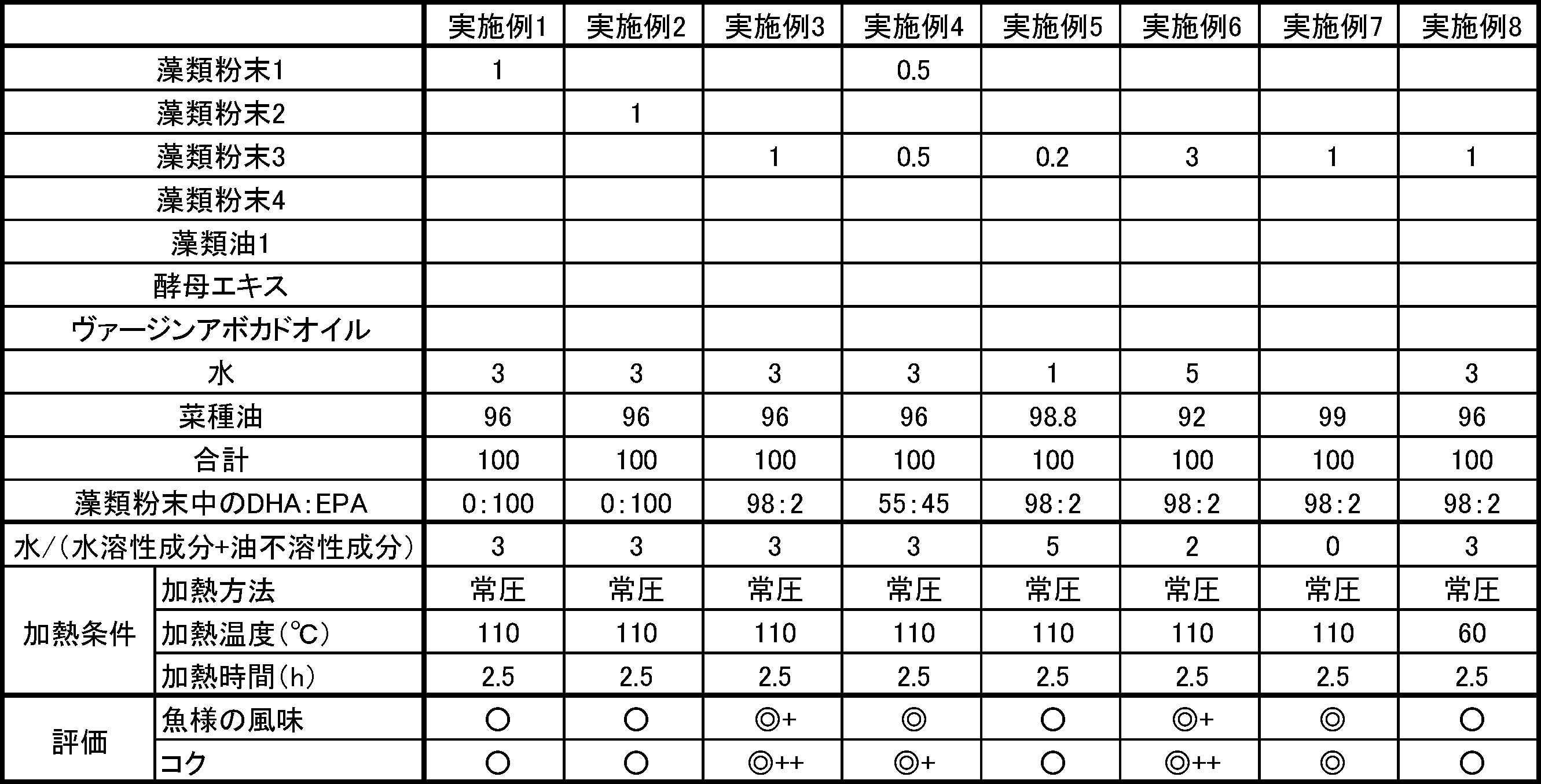
以下に、実施例により本発明をさらに詳しく説明するが、本発明はこれらの実施例に限定されるものではない。なお、表中の配合は質量%を示す。
本発明で使用した各藻類粉末の原料名、分類、多価不飽和脂肪酸の含有量(質量%)、DHA及びEPAの含有量(質量%)、DHAとEPAの質量比を表1に示す。

<試験1:香味油の作製及び評価>
以下の方法で香味油を作製し、その評価を行った。
以下の方法で香味油を作製し、その評価を行った。
(香味油の作製)
以下の方法で、香味油を作製した。
(1)ヴァージンアボカドオイル以外の表2A、2B、2Cに示す原料を水に分散させた後、菜種油に添加した。なお、実施例7、比較例3では前記原料を直接菜種油に添加した。
(2)表2A、2B、2Cに記載の加熱条件に従って加熱した。
(3)(2)を濾過し、固形分及び水分を除去した。なお、実施例13ではヴァージンアボカドオイルを添加後に、固形分及び水分を除去した。
(4)(3)で得られた香味油を室温まで冷却し、以下の試験に供した。
以下の方法で、香味油を作製した。
(1)ヴァージンアボカドオイル以外の表2A、2B、2Cに示す原料を水に分散させた後、菜種油に添加した。なお、実施例7、比較例3では前記原料を直接菜種油に添加した。
(2)表2A、2B、2Cに記載の加熱条件に従って加熱した。
(3)(2)を濾過し、固形分及び水分を除去した。なお、実施例13ではヴァージンアボカドオイルを添加後に、固形分及び水分を除去した。
(4)(3)で得られた香味油を室温まで冷却し、以下の試験に供した。
(香味油の評価)
各香味油における、魚様の風味及びコクのそれぞれについて、以下の官能評価を行った。
各香味油における、魚様の風味及びコクのそれぞれについて、以下の官能評価を行った。
なお、官能評価は、下記のように選抜されたパネルによって行った。
パネル候補に対し、五味(甘味、酸味、塩味、苦味、うま味)の識別テスト、味の濃度差識別テスト、食品の味の識別テスト、基準嗅覚テストを実施し、その各々のテストで適合と判定された10名をパネルとして選抜した。
また、評価を実施するにあたり、パネル全体で討議し、各評価項目の特性に対してすり合わせを行って、各パネルが共通認識を持つようにした。また、官能評価におけるパネルの偏りを排除し、評価の精度を高めるために、サンプルの試験区番号や内容はパネルに知らせず、ランダムに提示した。
[官能評価]
表2A、2B、2Cに記載の香味油についてパネル10名で官能評価を行い、喫食時の「魚様の風味」、「コク」の強度を、比較例1を1点、精製魚油を10点とした場合の点数で評価し、その平均値を求めた。なお、各評価は〇以上を合格とした。その結果を表2A、2B、2C中の「評価」の項に示す。
パネル候補に対し、五味(甘味、酸味、塩味、苦味、うま味)の識別テスト、味の濃度差識別テスト、食品の味の識別テスト、基準嗅覚テストを実施し、その各々のテストで適合と判定された10名をパネルとして選抜した。
また、評価を実施するにあたり、パネル全体で討議し、各評価項目の特性に対してすり合わせを行って、各パネルが共通認識を持つようにした。また、官能評価におけるパネルの偏りを排除し、評価の精度を高めるために、サンプルの試験区番号や内容はパネルに知らせず、ランダムに提示した。
[官能評価]
表2A、2B、2Cに記載の香味油についてパネル10名で官能評価を行い、喫食時の「魚様の風味」、「コク」の強度を、比較例1を1点、精製魚油を10点とした場合の点数で評価し、その平均値を求めた。なお、各評価は〇以上を合格とした。その結果を表2A、2B、2C中の「評価」の項に示す。
(評価基準)魚様の風味
◎+++:平均値が9点以上
◎++:平均値が7点以上9点未満
◎+:平均値が6点以上7点未満
◎:平均値が5点以上6点未満
○:平均値が3点以上5点未満
×:平均値が3点未満
◎+++:平均値が9点以上
◎++:平均値が7点以上9点未満
◎+:平均値が6点以上7点未満
◎:平均値が5点以上6点未満
○:平均値が3点以上5点未満
×:平均値が3点未満
(評価基準)コク
◎+++:平均値が9点以上
◎++:平均値が7点以上9点未満
◎+:平均値が6点以上7点未満
◎:平均値が5点以上6点未満
○:平均値が3点以上5点未満
×:平均値が3点未満
◎+++:平均値が9点以上
◎++:平均値が7点以上9点未満
◎+:平均値が6点以上7点未満
◎:平均値が5点以上6点未満
○:平均値が3点以上5点未満
×:平均値が3点未満


<試験2:プラントベースツナフレークの作製及び評価>
水、野菜ブイヨンパウダーを混ぜ合わせ、乾燥した組織状大豆たん白を1時間浸漬させ、水戻しした。水戻しした大豆たん白をフードカッターに入れ、フレーク状になるように粉砕した。次に食塩及び実施例3、実施例12、比較例1、又は比較例2の香味油を添加し、混ぜ合わせたものを試験に供した。配合を表3に示す。
水、野菜ブイヨンパウダーを混ぜ合わせ、乾燥した組織状大豆たん白を1時間浸漬させ、水戻しした。水戻しした大豆たん白をフードカッターに入れ、フレーク状になるように粉砕した。次に食塩及び実施例3、実施例12、比較例1、又は比較例2の香味油を添加し、混ぜ合わせたものを試験に供した。配合を表3に示す。
[官能評価]
作製したプラントベースツナフレークについて前記の選抜されたパネル10名で官能評価を行い、喫食時の「魚様の風味」、「コク」、「大豆臭」の強度を、比較例4を基準(0点)とした場合のそれぞれの強度を-3~+3の7段階で評価し、その平均値を求めた(「大豆臭」の強度が弱いほど、大豆臭がマスキングされていることを表す。)。なお、各項目において〇以上を合格とした。その結果を表3中の「評価」の項に示す。
作製したプラントベースツナフレークについて前記の選抜されたパネル10名で官能評価を行い、喫食時の「魚様の風味」、「コク」、「大豆臭」の強度を、比較例4を基準(0点)とした場合のそれぞれの強度を-3~+3の7段階で評価し、その平均値を求めた(「大豆臭」の強度が弱いほど、大豆臭がマスキングされていることを表す。)。なお、各項目において〇以上を合格とした。その結果を表3中の「評価」の項に示す。
(評価基準)魚様の風味
◎:平均値が2点以上
○:平均値が1点以上2点未満
△:平均値が0.6点以上1点未満
×:平均値が0.6点未満
◎:平均値が2点以上
○:平均値が1点以上2点未満
△:平均値が0.6点以上1点未満
×:平均値が0.6点未満
(評価基準)コク
◎:平均値が2点以上
○:平均値が1点以上2点未満
△:平均値が0.6点以上1点未満
×:平均値が0.6点未満
◎:平均値が2点以上
○:平均値が1点以上2点未満
△:平均値が0.6点以上1点未満
×:平均値が0.6点未満
(評価基準)大豆臭
◎:平均値が-2点未満
○:平均値が-2点以上-1点未満
△:平均値が-1点以上-0.6点未満
×:平均値が-0.6点以上
◎:平均値が-2点未満
○:平均値が-2点以上-1点未満
△:平均値が-1点以上-0.6点未満
×:平均値が-0.6点以上

<試験3:プラントベースマグロ刺身様及びネギトロ様の作製及び評価>
カードランをリン酸三ナトリウム、水によりアルカリ溶解させた後、50%乳酸により中和させ、香味油以外の原料を添加し、フードカッターで攪拌したものをベース配合とした。ベース配合を以下に示す。
<ベース配合>
カードラン 3質量部
リン酸三ナトリウム 0.5質量部
50%乳酸 0.8質量部
組織状大豆たん白 1質量部
加工澱粉 3質量部
食物繊維 2質量部
醤油 1質量部
色素 0.2質量部
水 88.5質量部
合計 100質量部
マグロ刺身様の評価では、実施例12、13、又は比較例1の香味油を3質量%添加し、混合した後、95℃、30分加熱した。冷蔵で一晩冷却したゲルをプラントベースマグロ刺身様として試験に供した。
ネギトロ様の評価では、始めに香味油を加えず、同様の加熱によりゲルを作製した。フードカッターでゲルを崩壊させた後、実施例12、13、又は比較例1の香味油を3質量%添加し、混合したものをネギトロ様として試験に供した。
カードランをリン酸三ナトリウム、水によりアルカリ溶解させた後、50%乳酸により中和させ、香味油以外の原料を添加し、フードカッターで攪拌したものをベース配合とした。ベース配合を以下に示す。
<ベース配合>
カードラン 3質量部
リン酸三ナトリウム 0.5質量部
50%乳酸 0.8質量部
組織状大豆たん白 1質量部
加工澱粉 3質量部
食物繊維 2質量部
醤油 1質量部
色素 0.2質量部
水 88.5質量部
合計 100質量部
マグロ刺身様の評価では、実施例12、13、又は比較例1の香味油を3質量%添加し、混合した後、95℃、30分加熱した。冷蔵で一晩冷却したゲルをプラントベースマグロ刺身様として試験に供した。
ネギトロ様の評価では、始めに香味油を加えず、同様の加熱によりゲルを作製した。フードカッターでゲルを崩壊させた後、実施例12、13、又は比較例1の香味油を3質量%添加し、混合したものをネギトロ様として試験に供した。
[官能評価]
作製したプラントベースマグロ刺身様およびネギトロ様について、前記の選抜されたパネル7名で官能評価を行い、喫食時の「魚様の風味」、「刺身様の風味」、「コク」の強度を、マグロ刺身様は比較例6を基準(0点)、ネギトロ様は比較例7を基準(0点)とした場合のそれぞれの強度を-3~+3の7段階で評価し、その平均値を求めた。なお、各項目において〇以上を合格とした。その結果を表4中の「評価」の項に示す。
作製したプラントベースマグロ刺身様およびネギトロ様について、前記の選抜されたパネル7名で官能評価を行い、喫食時の「魚様の風味」、「刺身様の風味」、「コク」の強度を、マグロ刺身様は比較例6を基準(0点)、ネギトロ様は比較例7を基準(0点)とした場合のそれぞれの強度を-3~+3の7段階で評価し、その平均値を求めた。なお、各項目において〇以上を合格とした。その結果を表4中の「評価」の項に示す。
(評価基準)魚様の風味
◎:平均値が2点以上
○:平均値が1点以上2点未満
△:平均値が0.6点以上1点未満
×:平均値が0.6点未満
◎:平均値が2点以上
○:平均値が1点以上2点未満
△:平均値が0.6点以上1点未満
×:平均値が0.6点未満
(評価基準)刺身様の風味
◎:平均値が2点以上
○:平均値が1点以上2点未満
△:平均値が0.6点以上1点未満
×:平均値が0.6点未満
◎:平均値が2点以上
○:平均値が1点以上2点未満
△:平均値が0.6点以上1点未満
×:平均値が0.6点未満
(評価基準)コク
◎:平均値が2点以上
○:平均値が1点以上2点未満
△:平均値が0.6点以上1点未満
×:平均値が0.6点未満
◎:平均値が2点以上
○:平均値が1点以上2点未満
△:平均値が0.6点以上1点未満
×:平均値が0.6点未満

<試験4:ラーメンスープの作製及び評価>
下記のベース配合に記載の材料を加熱混合し、濃縮スープとした。熱湯で6倍に希釈し、塩ラーメンスープとした。
<ベース配合>
水 71.8質量部
清酒 5質量部
醤油 3質量部
食塩 7.5質量部
砂糖 5質量部
昆布エキスパウダー 4質量部
野菜ブイヨン 3質量部
ガーリックパウダー 0.4質量部
ネギパウダー 0.2質量部
白コショウ 0.1質量部
合計 100質量部
ラーメンスープの評価では、実施例12又は比較例1の香味油を2質量%添加し、混ぜ合わせたものを試験に供した。
下記のベース配合に記載の材料を加熱混合し、濃縮スープとした。熱湯で6倍に希釈し、塩ラーメンスープとした。
<ベース配合>
水 71.8質量部
清酒 5質量部
醤油 3質量部
食塩 7.5質量部
砂糖 5質量部
昆布エキスパウダー 4質量部
野菜ブイヨン 3質量部
ガーリックパウダー 0.4質量部
ネギパウダー 0.2質量部
白コショウ 0.1質量部
合計 100質量部
ラーメンスープの評価では、実施例12又は比較例1の香味油を2質量%添加し、混ぜ合わせたものを試験に供した。
[官能評価]
作製した塩ラーメンスープについて、喫食時の「魚様の風味」、「コク」、の強度を、比較例8を基準とし、それよりも各項目において強く感じる人数を求めた。官能評価は、前記の選抜されたパネル7名で行った。なお、各項目において〇以上を合格とした。その結果を表5中の「評価」の項に示す。
作製した塩ラーメンスープについて、喫食時の「魚様の風味」、「コク」、の強度を、比較例8を基準とし、それよりも各項目において強く感じる人数を求めた。官能評価は、前記の選抜されたパネル7名で行った。なお、各項目において〇以上を合格とした。その結果を表5中の「評価」の項に示す。
(評価基準)魚様の風味
◎:パネル7名中、5名以上が強く感じると回答した。
〇:パネル7名中、4名が強く感じると回答した。
×:パネル7名中、3名以下が強く感じると回答した。
◎:パネル7名中、5名以上が強く感じると回答した。
〇:パネル7名中、4名が強く感じると回答した。
×:パネル7名中、3名以下が強く感じると回答した。
(評価基準)コク
◎:パネル7名中、5名以上が強く感じると回答した。
〇:パネル7名中、4名が強く感じると回答した。
×:パネル7名中、3名以下が強く感じると回答した。
◎:パネル7名中、5名以上が強く感じると回答した。
〇:パネル7名中、4名が強く感じると回答した。
×:パネル7名中、3名以下が強く感じると回答した。

<試験5:うなぎ蒲焼き様タレの作製及び評価>
下記のベース配合に記載の材料を加熱混合し、うなぎ蒲焼き様のタレとした。
<ベース配合>
醤油 71.8質量部
みりん 5質量部
酒 3質量部
水飴 7.5質量部
きび糖 5質量部
加工澱粉 4質量部
増粘多糖類 3質量部
水飴 0.4質量部
合計 99.7質量部
タレの評価では、実施例12及び比較例1の香味油を5質量%添加し、混ぜ合わせたものを試験に供した。
下記のベース配合に記載の材料を加熱混合し、うなぎ蒲焼き様のタレとした。
<ベース配合>
醤油 71.8質量部
みりん 5質量部
酒 3質量部
水飴 7.5質量部
きび糖 5質量部
加工澱粉 4質量部
増粘多糖類 3質量部
水飴 0.4質量部
合計 99.7質量部
タレの評価では、実施例12及び比較例1の香味油を5質量%添加し、混ぜ合わせたものを試験に供した。
[官能評価]
作製したタレについて、喫食時の「魚様の風味」、「コク」、の強度を、比較例9を基準とし、それよりも各項目において強く感じる人数を求めた。官能評価は、前記の選抜されたパネル7名で行った。なお、各項目において〇以上を合格とした。その結果を表6中の「評価」の項に示す。実施例24は、うなぎをタレに壺漬けにしたような、コクや風味を付与できることが分かった。
作製したタレについて、喫食時の「魚様の風味」、「コク」、の強度を、比較例9を基準とし、それよりも各項目において強く感じる人数を求めた。官能評価は、前記の選抜されたパネル7名で行った。なお、各項目において〇以上を合格とした。その結果を表6中の「評価」の項に示す。実施例24は、うなぎをタレに壺漬けにしたような、コクや風味を付与できることが分かった。
(評価基準)魚様の風味
◎:パネル7名中、5名以上が強く感じると回答した。
〇:パネル7名中、4名が強く感じると回答した。
×:パネル7名中、3名以下が強く感じると回答した。
◎:パネル7名中、5名以上が強く感じると回答した。
〇:パネル7名中、4名が強く感じると回答した。
×:パネル7名中、3名以下が強く感じると回答した。
(評価基準)コク
◎:パネル7名中、5名以上が強く感じると回答した。
〇:パネル7名中、4名が強く感じると回答した。
×:パネル7名中、3名以下が強く感じると回答した。
◎:パネル7名中、5名以上が強く感じると回答した。
〇:パネル7名中、4名が強く感じると回答した。
×:パネル7名中、3名以下が強く感じると回答した。

<試験6:まぐろネギトロの作製及び評価>
メバチマグロの刺身85gに対して、油脂(ミヨシ油脂製、PSファットLT)15gを加え、フードカッターで攪拌し、ネギトロとした。
ネギトロの評価では、実施例12及び比較例1の香味油を2質量%添加し、混ぜ合わせたものを試験に供した。
メバチマグロの刺身85gに対して、油脂(ミヨシ油脂製、PSファットLT)15gを加え、フードカッターで攪拌し、ネギトロとした。
ネギトロの評価では、実施例12及び比較例1の香味油を2質量%添加し、混ぜ合わせたものを試験に供した。
[官能評価]
作製したネギトロについて、喫食時の「魚の生臭さマスキング」を、比較例10を基準とし、魚の生臭さを弱く感じる人数を求めた。官能評価は、前記の選抜されたパネル7名で行った。なお、評価基準において〇以上を合格とした。その結果を表7中の「評価」の項に示す。実施例12品を添加することで、魚の風味のなかでも嫌われる生臭さをマスキングしながら、魚本来の風味を損なうことなく、食べやすくすることができることが分かった。
作製したネギトロについて、喫食時の「魚の生臭さマスキング」を、比較例10を基準とし、魚の生臭さを弱く感じる人数を求めた。官能評価は、前記の選抜されたパネル7名で行った。なお、評価基準において〇以上を合格とした。その結果を表7中の「評価」の項に示す。実施例12品を添加することで、魚の風味のなかでも嫌われる生臭さをマスキングしながら、魚本来の風味を損なうことなく、食べやすくすることができることが分かった。
(評価基準)魚の生臭さマスキング
◎:パネル7名中、5名以上が生臭さを弱く感じると回答した。
〇:パネル7名中、4名が生臭さを弱く感じると回答した。
×:パネル7名中、3名以下が生臭さを弱く感じると回答した。
◎:パネル7名中、5名以上が生臭さを弱く感じると回答した。
〇:パネル7名中、4名が生臭さを弱く感じると回答した。
×:パネル7名中、3名以下が生臭さを弱く感じると回答した。

Claims (6)
- 多価不飽和脂肪酸を0.5質量%以上含有する藻類粉末を添加した、香味油。
- 前記藻類粉末が多価不飽和脂肪酸としてDHA及びEPAから選ばれる1種以上を含有する、請求項1に記載の香味油。
- 前記藻類粉末におけるDHAとEPAの質量比(DHA:EPA)が50:50~100:0である、請求項2に記載の香味油。
- 請求項1~3のいずれか1項に記載の香味油を添加した、飲食品。
- 多価不飽和脂肪酸を0.5質量%以上含有する藻類粉末を油脂に添加する、油脂に魚様の風味を付与する方法。
- 多価不飽和脂肪酸を0.5質量%以上含有する藻類粉末を油脂に添加する工程を含む、香味油の製造方法。
Priority Applications (1)
| Application Number | Priority Date | Filing Date | Title |
|---|---|---|---|
| JP2025526093A JPWO2024253044A1 (ja) | 2023-06-05 | 2024-05-31 |
Applications Claiming Priority (2)
| Application Number | Priority Date | Filing Date | Title |
|---|---|---|---|
| JP2023092092 | 2023-06-05 | ||
| JP2023-092092 | 2023-06-05 |
Publications (1)
| Publication Number | Publication Date |
|---|---|
| WO2024253044A1 true WO2024253044A1 (ja) | 2024-12-12 |
Family
ID=93795954
Family Applications (1)
| Application Number | Title | Priority Date | Filing Date |
|---|---|---|---|
| PCT/JP2024/020083 Ceased WO2024253044A1 (ja) | 2023-06-05 | 2024-05-31 | 香味油、及び香味油を添加した飲食品 |
Country Status (2)
| Country | Link |
|---|---|
| JP (1) | JPWO2024253044A1 (ja) |
| WO (1) | WO2024253044A1 (ja) |
Citations (4)
| Publication number | Priority date | Publication date | Assignee | Title |
|---|---|---|---|---|
| JPS5026626B1 (ja) * | 1967-05-06 | 1975-09-02 | ||
| JPS60221034A (ja) * | 1984-04-16 | 1985-11-05 | Kazuhiro Watanabe | 食用スピルリナ藻含有油脂組成物 |
| JP2013523188A (ja) * | 2010-04-14 | 2013-06-17 | ソラザイム ロケット ニュートリショナルズ, エルエルシー | 高脂質微細藻類粉末食品組成物 |
| JP2016052283A (ja) * | 2014-09-04 | 2016-04-14 | キッコーマン株式会社 | 液体調味料 |
-
2024
- 2024-05-31 WO PCT/JP2024/020083 patent/WO2024253044A1/ja not_active Ceased
- 2024-05-31 JP JP2025526093A patent/JPWO2024253044A1/ja active Pending
Patent Citations (4)
| Publication number | Priority date | Publication date | Assignee | Title |
|---|---|---|---|---|
| JPS5026626B1 (ja) * | 1967-05-06 | 1975-09-02 | ||
| JPS60221034A (ja) * | 1984-04-16 | 1985-11-05 | Kazuhiro Watanabe | 食用スピルリナ藻含有油脂組成物 |
| JP2013523188A (ja) * | 2010-04-14 | 2013-06-17 | ソラザイム ロケット ニュートリショナルズ, エルエルシー | 高脂質微細藻類粉末食品組成物 |
| JP2016052283A (ja) * | 2014-09-04 | 2016-04-14 | キッコーマン株式会社 | 液体調味料 |
Non-Patent Citations (1)
| Title |
|---|
| LEE YA-LIN; CHUANG YAO-CHUN; SU HUEI-MEEI; WU FANG-SHENG: "Freeze-dried microalgae ofNannochloropsis oculataimprove soybean oil's oxidative stability", APPLIED MICROBIOLOGY AND BIOTECHNOLOGY, SPRINGER BERLIN HEIDELBERG, BERLIN/HEIDELBERG, vol. 97, no. 22, 10 September 2013 (2013-09-10), Berlin/Heidelberg, pages 9675 - 9683, XP035328570, ISSN: 0175-7598, DOI: 10.1007/s00253-013-5183-4 * |
Also Published As
| Publication number | Publication date |
|---|---|
| JPWO2024253044A1 (ja) | 2024-12-12 |
Similar Documents
| Publication | Publication Date | Title |
|---|---|---|
| WO2008085840A2 (en) | Food compositions incorporating additional long chain fatty acids | |
| RU2423878C2 (ru) | Улучшитель основного вкуса, содержащий высшую длинноцепочечную ненасыщенную жирную кислоту и/или ее эфир | |
| TWI746733B (zh) | 不良氣味抑制劑 | |
| JP7312017B2 (ja) | 加熱調理用油脂組成物 | |
| CN109600984A (zh) | 乳酪风味的赋予增强用组合物、乳酪风味的赋予增强用组合物的制备方法、食品的乳酪风味的赋予增强方法及乳酪风味经赋予增强的食品的制造方法 | |
| JP7106829B2 (ja) | マウスコーティング感増強剤 | |
| JP2000333604A (ja) | 食用油脂組成物およびその利用 | |
| WO2024253044A1 (ja) | 香味油、及び香味油を添加した飲食品 | |
| JP4104814B2 (ja) | 配合食用油脂 | |
| JP6971541B2 (ja) | マヨネーズ様食品 | |
| WO2023218687A1 (ja) | 呈味改善剤、油脂組成物、及び飲食品 | |
| WO2022131093A1 (ja) | 塩味増強剤、塩味増強用油脂組成物、飲食品の塩味増強方法、及び塩味増強剤の製造方法 | |
| JP2022080382A (ja) | 卵黄油由来の生卵臭を抑制する方法および調理用油脂組成物 | |
| Queiroz et al. | Sensorial characters of microalgae biomass and its individual components | |
| JP7348420B1 (ja) | 香味組成物、及び飲食品の製造方法 | |
| TWI837250B (zh) | 加熱烹調用油脂組成物 | |
| KR0144306B1 (ko) | 디에이치에이 함유김치 및 이의 제조방법 | |
| JP2024097287A (ja) | 風味油の製造方法、風味油混合油の製造方法、食品への風味の付与方法、及び微細藻類の風味油の製造のための使用 | |
| JP7000071B2 (ja) | 加熱調理用油脂組成物 | |
| JP2026052910A (ja) | 飲食品のうま味増強方法、飲食品のうま味増強剤及びうま味を含む飲食品。 | |
| JP7055676B2 (ja) | 加熱調理用油脂組成物 | |
| Sinkiewicz | Lipids and Food Quality | |
| US20120148723A1 (en) | Dressing and method for producing the same | |
| WO2022131094A1 (ja) | 塩味増強剤、塩味増強用油脂組成物、飲食品の塩味増強方法、及び塩味増強剤の製造方法 | |
| JPS62278947A (ja) | 食用油脂 |
Legal Events
| Date | Code | Title | Description |
|---|---|---|---|
| 121 | Ep: the epo has been informed by wipo that ep was designated in this application |
Ref document number: 24819274 Country of ref document: EP Kind code of ref document: A1 |
|
| ENP | Entry into the national phase |
Ref document number: 2025526093 Country of ref document: JP Kind code of ref document: A |
|
| NENP | Non-entry into the national phase |
Ref country code: DE |