WO2024257440A1 - Disposable diaper - Google Patents
Disposable diaper Download PDFInfo
- Publication number
- WO2024257440A1 WO2024257440A1 PCT/JP2024/013548 JP2024013548W WO2024257440A1 WO 2024257440 A1 WO2024257440 A1 WO 2024257440A1 JP 2024013548 W JP2024013548 W JP 2024013548W WO 2024257440 A1 WO2024257440 A1 WO 2024257440A1
- Authority
- WO
- WIPO (PCT)
- Prior art keywords
- absorbent body
- groove
- area
- region
- absorbent
- Prior art date
- Legal status (The legal status is an assumption and is not a legal conclusion. Google has not performed a legal analysis and makes no representation as to the accuracy of the status listed.)
- Ceased
Links
Images




Classifications
-
- A—HUMAN NECESSITIES
- A61—MEDICAL OR VETERINARY SCIENCE; HYGIENE
- A61F—FILTERS IMPLANTABLE INTO BLOOD VESSELS; PROSTHESES; DEVICES PROVIDING PATENCY TO, OR PREVENTING COLLAPSING OF, TUBULAR STRUCTURES OF THE BODY, e.g. STENTS; ORTHOPAEDIC, NURSING OR CONTRACEPTIVE DEVICES; FOMENTATION; TREATMENT OR PROTECTION OF EYES OR EARS; BANDAGES, DRESSINGS OR ABSORBENT PADS; FIRST-AID KITS
- A61F13/00—Bandages or dressings; Absorbent pads
- A61F13/15—Absorbent pads, e.g. sanitary towels, swabs or tampons for external or internal application to the body; Supporting or fastening means therefor; Tampon applicators
- A61F13/45—Absorbent pads, e.g. sanitary towels, swabs or tampons for external or internal application to the body; Supporting or fastening means therefor; Tampon applicators characterised by the shape
- A61F13/49—Absorbent pads, e.g. sanitary towels, swabs or tampons for external or internal application to the body; Supporting or fastening means therefor; Tampon applicators characterised by the shape specially adapted to be worn around the waist, e.g. diapers, nappies
-
- A—HUMAN NECESSITIES
- A61—MEDICAL OR VETERINARY SCIENCE; HYGIENE
- A61F—FILTERS IMPLANTABLE INTO BLOOD VESSELS; PROSTHESES; DEVICES PROVIDING PATENCY TO, OR PREVENTING COLLAPSING OF, TUBULAR STRUCTURES OF THE BODY, e.g. STENTS; ORTHOPAEDIC, NURSING OR CONTRACEPTIVE DEVICES; FOMENTATION; TREATMENT OR PROTECTION OF EYES OR EARS; BANDAGES, DRESSINGS OR ABSORBENT PADS; FIRST-AID KITS
- A61F13/00—Bandages or dressings; Absorbent pads
- A61F13/15—Absorbent pads, e.g. sanitary towels, swabs or tampons for external or internal application to the body; Supporting or fastening means therefor; Tampon applicators
- A61F13/53—Absorbent pads, e.g. sanitary towels, swabs or tampons for external or internal application to the body; Supporting or fastening means therefor; Tampon applicators characterised by the absorbing medium
-
- A—HUMAN NECESSITIES
- A61—MEDICAL OR VETERINARY SCIENCE; HYGIENE
- A61F—FILTERS IMPLANTABLE INTO BLOOD VESSELS; PROSTHESES; DEVICES PROVIDING PATENCY TO, OR PREVENTING COLLAPSING OF, TUBULAR STRUCTURES OF THE BODY, e.g. STENTS; ORTHOPAEDIC, NURSING OR CONTRACEPTIVE DEVICES; FOMENTATION; TREATMENT OR PROTECTION OF EYES OR EARS; BANDAGES, DRESSINGS OR ABSORBENT PADS; FIRST-AID KITS
- A61F13/00—Bandages or dressings; Absorbent pads
- A61F13/15—Absorbent pads, e.g. sanitary towels, swabs or tampons for external or internal application to the body; Supporting or fastening means therefor; Tampon applicators
- A61F13/53—Absorbent pads, e.g. sanitary towels, swabs or tampons for external or internal application to the body; Supporting or fastening means therefor; Tampon applicators characterised by the absorbing medium
- A61F13/531—Absorbent pads, e.g. sanitary towels, swabs or tampons for external or internal application to the body; Supporting or fastening means therefor; Tampon applicators characterised by the absorbing medium having a homogeneous composition through the thickness of the pad
- A61F13/532—Absorbent pads, e.g. sanitary towels, swabs or tampons for external or internal application to the body; Supporting or fastening means therefor; Tampon applicators characterised by the absorbing medium having a homogeneous composition through the thickness of the pad inhomogeneous in the plane of the pad
-
- A—HUMAN NECESSITIES
- A61—MEDICAL OR VETERINARY SCIENCE; HYGIENE
- A61F—FILTERS IMPLANTABLE INTO BLOOD VESSELS; PROSTHESES; DEVICES PROVIDING PATENCY TO, OR PREVENTING COLLAPSING OF, TUBULAR STRUCTURES OF THE BODY, e.g. STENTS; ORTHOPAEDIC, NURSING OR CONTRACEPTIVE DEVICES; FOMENTATION; TREATMENT OR PROTECTION OF EYES OR EARS; BANDAGES, DRESSINGS OR ABSORBENT PADS; FIRST-AID KITS
- A61F13/00—Bandages or dressings; Absorbent pads
- A61F13/15—Absorbent pads, e.g. sanitary towels, swabs or tampons for external or internal application to the body; Supporting or fastening means therefor; Tampon applicators
- A61F13/53—Absorbent pads, e.g. sanitary towels, swabs or tampons for external or internal application to the body; Supporting or fastening means therefor; Tampon applicators characterised by the absorbing medium
- A61F13/531—Absorbent pads, e.g. sanitary towels, swabs or tampons for external or internal application to the body; Supporting or fastening means therefor; Tampon applicators characterised by the absorbing medium having a homogeneous composition through the thickness of the pad
- A61F13/532—Absorbent pads, e.g. sanitary towels, swabs or tampons for external or internal application to the body; Supporting or fastening means therefor; Tampon applicators characterised by the absorbing medium having a homogeneous composition through the thickness of the pad inhomogeneous in the plane of the pad
- A61F13/533—Absorbent pads, e.g. sanitary towels, swabs or tampons for external or internal application to the body; Supporting or fastening means therefor; Tampon applicators characterised by the absorbing medium having a homogeneous composition through the thickness of the pad inhomogeneous in the plane of the pad having discontinuous areas of compression
Definitions
- the present invention relates to a disposable diaper that aims to improve the maintenance of the urine receiving space in the crotch area (the gap between the surface of the crotch area of the disposable diaper and the skin) and improves conforming and deformable properties.
- Disposable diapers generally use an absorbent body made of a mixture and accumulation of pulp fibers and highly absorbent polymer particles, and in order to improve the shape retention during and after manufacturing, such absorbents are generally wrapped in a wrapping sheet made of crepe paper or the like and incorporated as an absorbing element (see, for example, Patent Document 1).
- the absorbent element of a disposable diaper is sandwiched between the legs and receives forces in various directions from both sides in the width direction due to leg movements such as walking, so while it is required to have the ability to deform to fit the crotch width, it is also required to have the shape retention to maintain a preferred wearing shape.
- the absorbent element of a disposable diaper is also required to ensure the amount of absorption in the crotch area.
- the crotch area of a typical disposable diaper when worn, has a bottom at the middle in the width direction, and both sides rise up to form side walls, giving the crotch area a roughly U-shaped cross section.
- a urine-receiving space is formed between the surface of the crotch area of the disposable diaper and the skin, making it less likely to leak even when a large amount of urine is excreted at one time.
- a pair of slits penetrating in the thickness direction have traditionally been formed along the front-to-rear direction on both sides of the absorbent in the width direction in the crotch area.
- the absorbent is more likely to bend at the slits, and the center area between the pair of slits forms the bottom while the side areas on the sides of each slit rise up to form side walls, making it easier for the crotch area of the diaper to have an approximately U-shaped cross-section.
- the side walls have an absorbent, which increases their rigidity (i.e. the urine receiving space is less likely to collapse), and the diaper also has an absorbing function. However, this function is lost or greatly reduced when the absorbent expands with urine absorption, reducing the shape retention of the absorbent and the slits collapse.
- a known method for improving the shape retention of an absorbent body is to provide grooves with bottoms in a grid pattern, etc., by compressing the absorbent element in the thickness direction (see, for example, Patent Document 1).
- providing grooves by compression leads to improved rigidity, so if compressed grooves are provided in a uniform, dense pattern throughout the absorbent body in consideration of shape retention after urine absorption, the part located at the bottom will be less likely to bend when the crotch area is deformed into a roughly U-shaped cross section, and will be less likely to deform to follow the crotch width (reduced ability to follow deformation).
- the main objective of the present invention is to improve the maintenance of the urine receiving space in the crotch area and to improve the conforming and deformable nature of the area.
- the disposable diaper that solves the above problems is as follows.
- the garment has a crotch portion and a front portion and a rear portion extending forward and rearward from the crotch portion, an absorbent element including an absorbent body provided over a range in the front-rear direction including the crotch area and a wrapping sheet wrapping the absorbent body;
- the absorbent body is formed by mixing and accumulating pulp fibers and highly absorbent polymer particles,
- the absorbent body has a pair of elongated slits extending in the front-rear direction and provided on one side and the other side of the width direction of the crotch portion,
- the absorbent body has a center region defined between one of the slits and the other of the slits, and a pair of side regions defined between the slits on both sides in the width direction and side edges of the absorbent body, In the center region and the side regions, grooves are provided in a widthwise continuous pattern over a range of 60% or more in the front-
- the present disposable diaper improves both the maintenance of the urine-receiving space in the crotch area and the conforming and deformable properties for the following reasons.
- Both the center region and the side regions have grooves in a predetermined pattern that extend from at least one of the front and back surfaces of the absorbent element into the absorbent body and have bottoms that are compressed in the thickness direction, so that the absorbent body is more likely to maintain its shape even after absorbing urine than if this were not the case.
- the center region is relatively flexible and the side regions are relatively shape-retaining, so that when the diaper is worn with the crotch portion of the diaper in a U-shaped cross section, the side walls become more rigid and the urine receiving space becomes less likely to collapse, while the bottom portion becomes more easily bent and easily deformed to conform to the crotch width.
- the center region and the side region are regions in which the grooves are continuous in a lattice pattern, the thickness and width of the bottom of the groove are the same in the center region and the side region; a maximum area of a unit frame formed by the groove in the center region is 1.5 to 4 times a maximum area of a unit frame formed by the groove in the side region;
- the absorbent body When the absorbent body is provided with a continuous lattice pattern of grooves having bottoms that are recessed from the surface of the absorbent body into the absorbent body and compressed in the thickness direction, the bottoms of the grooves, which are high density and high rigidity, are continuous at least in the width direction, so that the region having the grooves has particularly high shape retention at least in the width direction.
- the liquid diffusion in the direction along the grooves is improved.
- the shape retention varies depending on the thickness of the bottoms of the grooves of the absorbent body, the variation is not large.
- the width of the bottoms of the grooves is increased, the feeling of the hard bottoms of the grooves is easily transmitted to the skin.
- the thickness and width of the bottoms of the grooves are same in the center region and the side region, while making the area of the unit frame consisting of the grooves different. This not only improves the shape retention, but also makes the liquid diffusion in the side region higher than that in the center region, making it less likely to leak sideways.
- the absorbent body is made of one or more layers formed by mixing and accumulating pulp fibers and highly absorbent polymer particles,
- the basis weight of the pulp fibers in the absorbent body is 80 to 450 g/ m2 , the weight ratio of pulp fibers to superabsorbent polymer particles in the absorbent body is 20:80 to 80:20;
- the maximum thickness of the absorbent body is 1 to 20 mm,
- the thickness of the bottom portion is 5 to 40% of the maximum thickness of the absorbent body.
- the width of the bottom is 1 to 3 mm;
- the area of the unit frame consisting of the groove in the center region is 150 to 500 mm2 ;
- a disposable diaper according to a second embodiment A disposable diaper according to a second embodiment.
- the dimensions of the grooves can be determined as appropriate, but in an absorbent body such as that of this embodiment, it is preferable to form the grooves within the range of this embodiment.
- the grooves are formed in a diagonal lattice shape including a first portion inclined at 40 to 60 degrees clockwise in a plan view with respect to the front-rear direction and a second portion inclined at 40 to 60 degrees counterclockwise in a plan view with respect to the front-rear direction.
- the disposable diaper according to the second or third aspect.
- the groove pattern can be determined as appropriate, but a diagonal lattice pattern as in this embodiment is preferable.
- the width direction dimension of the unit frame in the side region is 0.5 times or less the minimum width direction dimension of the side region.
- the groove pattern in both side regions is composed of only a slit adjacent frame consisting of a side edge of the slit and the groove, a side edge adjacent frame consisting of a side edge of the absorber and the groove, and a complete unit frame having the same size and shape;
- the area of each slit adjacent frame and the area of each side edge adjacent frame in both side regions are smaller than the area of the unit frame.
- This configuration is preferable because when the diaper assumes a generally U-shaped cross section, the rigidity of the side walls is particularly high, making the urine receiving space less likely to collapse.
- Both side edges of the absorbent body extend linearly along the front-rear direction,
- the pair of slits extend from the middle in the front-rear direction toward the front side and the rear side, respectively, so as to approach the side edges of the absorbent body.
- the center region forms the bottom and each side region rises to form a side wall, so that when the crotch area of the diaper has a roughly U-shaped cross-section, the side walls not only fit easily to the inside of the thighs, but also the side walls become shorter toward the front and back and less likely to fold, making the urine receiving space particularly less likely to collapse in those areas.
- the present invention improves the maintenance of the urine receiving space in the crotch area and improves the conforming and deformable properties.
- FIG. 2 is a plan view showing the front surface of the pants-type disposable diaper in an unfolded state.
- FIG. 2 is a plan view showing the underside of the pants-type disposable diaper in an unfolded state.
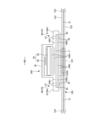
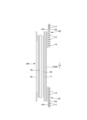
- This is a cross-sectional view of FIG. 1 along line 3-3.
- This is a cross-sectional view of FIG. 1 along line 4-4.
- This is a cross-sectional view of FIG. 1 along line 5-5.
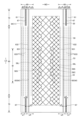
- FIG. 2 is a plan view showing the surface of the inner body.
- FIG. 2 is a front perspective view of the pants-type disposable diaper, viewed diagonally from below.
- FIG. 4 is a cross-sectional view of a main part showing a mounted state.
- FIG. FIG. FIG. 11 is an enlarged plan view showing a main part of FIG. 10 .
- FIG. FIG. FIG. 13 is a plan view of the absorbent body in a deployed state showing examples of slits.
- each component member adjacent in the thickness direction is fixed or joined as necessary in the same manner as known diapers.
- the dotted pattern in the cross-sectional view indicates an adhesive such as a hot melt adhesive as the fixing or joining means.
- the hot melt adhesive can be applied by known methods such as slot application, continuous line or dotted line bead application, spiral, Z-shaped, wavy (regular or irregular) spray application, or pattern coating (transfer of hot melt adhesive using a letterpress method).
- the hot melt adhesive can be applied to the outer peripheral surface of the elastic member to fix the elastic member to the adjacent member.
- the hot melt adhesive for example, EVA-based, adhesive rubber-based (elastomer-based), polyolefin-based, polyester-polyamide-based, and other types are available, but there are no particular limitations on the types that can be used.
- material welding means such as heat sealing or ultrasonic sealing can be used. In a portion where liquid permeability in the thickness direction is required, adjacent components in the thickness direction are fixed or joined in an intermittent pattern.
- intermittent pattern application such as a spiral, Z-shape, or wave shape
- intermittent pattern application when applying to an area greater than the application width of one nozzle, intermittent pattern application such as a spiral, Z-shape, or wave shape can be performed with or without gaps in the width direction.
- material welding means such as heat sealing or ultrasonic sealing can be used.
- the constituent fibers of the nonwoven fabric can be selected without particular limitation, for example, synthetic fibers such as polyolefins such as polyethylene or polypropylene, polyesters, polyamides, etc. (including single-component fibers as well as composite fibers such as core-sheath fibers), regenerated fibers such as rayon or cupra, natural fibers such as cotton, etc., and these can also be used in combination.
- synthetic fibers such as polyolefins such as polyethylene or polypropylene, polyesters, polyamides, etc. (including single-component fibers as well as composite fibers such as core-sheath fibers), regenerated fibers such as rayon or cupra, natural fibers such as cotton, etc., and these can also be used in combination.
- the constituent fibers are crimped fibers.
- constituent fibers of the nonwoven fabric can be hydrophilic fibers (including fibers that have been made hydrophilic by a hydrophilizing agent), hydrophobic fibers, or water-repellent fibers (including fibers that have been made water-repellent by a water-repellent agent).
- nonwoven fabrics are generally classified into staple fiber nonwoven fabrics, long fiber nonwoven fabrics, spunbond nonwoven fabrics, meltblown nonwoven fabrics, spunlace nonwoven fabrics, thermal bond (air-through) nonwoven fabrics, needle punch nonwoven fabrics, point bond nonwoven fabrics, laminated nonwoven fabrics (including SMS nonwoven fabrics and SMMS nonwoven fabrics in which a meltblown layer is sandwiched between spunbond layers), etc., depending on the fiber length, sheet formation method, fiber bonding method, and laminated structure, but any of these nonwoven fabrics can be used.
- This pants-type disposable diaper 100 comprises a rectangular front outer body 12F constituting the front waist region FT, a rectangular rear outer body 12B constituting the rear waist region BT, and an inner body 200 joined to the middle of the outer bodies 12F, 12B in the width direction WD so as to extend from the front outer body 12F through the crotch region M to the rear outer body 12B.
- Both sides of the front outer body 12F and both sides of the rear outer body 12B are joined to form side seals 12A, whereby an opening formed by the front and rear edges of the outer bodies 12F, 12B becomes a waist opening WO through which the wearer's torso passes, and the portions on both sides of the inner body 200 in the width direction WD that are surrounded by the lower edges of the outer bodies 12F, 12B and the side edges of the inner body 200 respectively become leg openings LO through which the legs pass.
- the inner body 200 is a part that absorbs and retains excrement such as urine
- the outer bodies 12F and 12B are parts that support the inner body 200 against the wearer's body.
- the symbol Y indicates the total length of the diaper in the unfolded state (the length in the front-to-rear direction from the edge of the waist opening WO of the front body F to the edge of the waist opening WO of the back body B), and the symbol X indicates the total width of the diaper in the unfolded state.
- This pants-type disposable diaper 100 has a waist region T defined as the front-to-back range having the side seal 12A (the front-to-back range from the waist opening WO to the upper end of the leg opening LO), and an intermediate region L defined as the front-to-back range of the portion forming the leg opening LO (between the front-to-back region having the side seal 12A of the front body F and the front-to-back region having the side seal 12A of the rear body B).
- the portions of the front outer body 12F and the rear outer body 12B located in the waist region T i.e., the front waist region FT and the rear waist region BT, can be conceptually distinguished into a "waist portion” W which forms the edge of the waist opening, and a “lower waist portion” U which is the portion below this.
- the waist portion W is the portion closer to the waist opening WO than the boundary closest to the waist opening WO side, and when there is no such boundary, the portion extending further toward the waist opening WO side than the absorbent body 56 or the inner body 200 is the waist portion W.
- the length of these in the front-rear direction varies depending on the size of the product and can be determined appropriately, but as an example, the waist portion W can be 15 to 40 mm, and the lower waist portion U can be 65 to 120 mm.
- both side edges of the middle region L are narrowed in a U-shape or curved shape to fit around the wearer's legs, and this is the portion where the wearer's legs are inserted.
- the pants-type disposable diaper in the unfolded state has a generally hourglass shape.
- the inner body 200 can be fixed to the outer bodies 12F, 12B by a joining means such as heat sealing or ultrasonic sealing that uses material welding, or by a hot melt adhesive HM3.
- the back surface of the inner body 200 is fixed to the inner surface of the outer bodies 12F, 12B via the hot melt adhesive HM3.
- the fixing region 201 of the inner body 200 is provided in the region where the front waist portion FT and the rear waist portion BT overlap with the inner body 200. It is preferable that the fixing region of the inner body is provided over substantially the entire area except for the periphery of the region where the outer bodies 12F, 12B and the inner body 200 overlap.
- the exterior bodies 12F, 12B are composed of a rectangular front exterior body 12F that is a part that constitutes at least the front waistline FT (the waistline of the front body F) and a rectangular rear exterior body 12B that is a part that constitutes at least the rear waistline BT (the waistline of the rear body B).
- the front exterior body 12F and the rear exterior body 12B may not be continuous on the crotch side and may be separated in the front-to-back direction LD (two-piece exterior type), or may be continuous from the front body F through the crotch M to the rear body B (front and back integrated exterior type), although not shown.
- the separation distance 12d in the front-to-back direction in the two-piece exterior type can be, for example, about 40 to 60% of the total length Y.
- the lower edges of the front exterior body 12F and the rear exterior body 12B are linear along the width direction WD, but at least one of the lower edges of the front exterior body 12F and the rear exterior body 12B may be curved so as to follow the leg circumference.
- the interior body 200 is exposed between the front exterior body 12F and the rear exterior body 12B, so that the liquid-impermeable sheet 11 is not exposed on the rear surface of the interior body 200, it is preferable to provide a cover nonwoven fabric layer 13 on the rear surface of the interior body 200, which extends from between the front exterior body 12F and the interior body 200 to between the rear exterior body 12B and the interior body 200.
- the inner and outer surfaces of the cover nonwoven fabric layer 13 can be bonded to the opposing surfaces via a second hot melt adhesive HM2 and a third hot melt adhesive HM3, respectively.
- the nonwoven fabric used for the cover nonwoven fabric layer 13 can be appropriately selected from the same material as the exterior bodies 12F and 12B, for example.
- the front-to-rear dimension of the rear exterior body 12B is longer than that of the front exterior body 12F, the front exterior body 12F does not have a portion corresponding to the middle region L, and the rear exterior body 12B has a buttocks covering portion 14 that extends from the waist region T toward the middle region L, but the front exterior body 12F and the rear exterior body 12B have the same dimensions in the front-to-rear direction LD, and the front exterior body 12F and the rear exterior body 12B do not necessarily have a portion corresponding to the middle region L.
- the exterior bodies 12F, 12B are formed by bonding an outer sheet layer 12S and an inner sheet layer 12H adjacent to the outer and inner sides of the elastic members 15 to 17 described below, respectively, by a bonding means such as a hot melt adhesive or welding.
- the outer sheet layer 12S and the inner sheet layer 12H are formed by folding a single sheet material so that the crease is located on the waist opening side, but they can also be formed by bonding two sheets of material together, although this is not shown.
- the sheet material used for the outer sheet layer 12S and the inner sheet layer 12H is not particularly limited, but nonwoven fabric is preferable.
- the weight per sheet is preferably about 8 to 20 g/ m2 .
- the exterior bodies 12F, 12B have elastic members 15-17 attached between the outer sheet layer 12S and the inner sheet layer 12H at a predetermined stretch rate, forming a stretch region that stretches elastically in the width direction WD together with the elastic members 15-17.
- the stretch region can stretch between a natural length state in which it contracts together with the elastic members 15-17 and wrinkles or folds are formed, and an extended state in which it is extended in the width direction to a predetermined stretch rate together with the elastic members 15-17 and fully stretched without wrinkles.
- the elastic members 15-17 can be long and thin elastic members such as rubber thread (illustrated example), as well as known elastic members such as band-shaped, net-shaped, and film-shaped, without any particular restrictions.
- the elastic members 15-17 can be synthetic or natural rubber.
- the outer sheet layer 12S and the inner sheet layer 12H are bonded together, and the elongated elastic members 15-17 sandwiched between them can be fixed using at least one of various application methods of hot melt adhesives and material welding such as heat sealing and ultrasonic sealing. Since the flexibility is lost if the entire surface of the exterior bodies 12F, 12B is strongly fixed, it is preferable that the parts other than the adhesive parts of the elongated elastic members 15-17 are not bonded or are bonded weakly.
- hot melt adhesive is applied only to the outer peripheral surfaces of the elongated elastic members 15-17 using an application means such as a comb gun or a surwrap nozzle, and the elongated elastic members are sandwiched between the two sheet layers 12S, 12H, so that the elongated elastic members 15-17 are fixed to the two sheet layers 12S, 12H and fixed between the two sheet layers 12S, 12H only with the hot melt adhesive applied to the outer peripheral surfaces of the elongated elastic members 15-17.
- an application means such as a comb gun or a surwrap nozzle
- a plurality of waist elastic members 17 are attached between the outer sheet layer 12S and the inner sheet layer 12H in the waist portion W of the outer bodies 12F, 12B at intervals in the front-rear direction and in a state stretched in the width direction at a predetermined stretch rate, forming a continuous waist stretch region over the entire width direction WD.
- one or more members arranged in the region adjacent to the waist lower portion U may overlap the inner body 200, or may be provided on both sides of the width direction WD except for the width direction central portion overlapping the inner body 200.
- the waist elastic member 17 is preferably made of 2 to 15, and more preferably 4 to 10, rubber threads having a thickness of 300 to 940 dtex, and especially 470 to 780 dtex (in the case of synthetic rubber; in the case of natural rubber, a cross-sectional area of 0.05 to 1.5 mm2 , and especially 0.1 to 1.0 mm2 ) spaced at intervals of 2 to 12 mm, and especially 3 to 7 mm, and the resulting elongation rate in the width direction WD of the waist portion W is preferably 150 to 300%, and especially 200 to 280%. It is not necessary for the waist portion W to use elastic members of the same thickness or to have the same elongation rate in all of its front-to-rear direction LD, and for example the thickness or elongation rate may be different in some parts.
- a plurality of waist lower elastic members 15 made of elongated elastic members are attached at intervals in the front-rear direction and in a state stretched in the width direction at a predetermined stretch rate, forming waist lower stretchable regions on both sides in the width direction WD except for the width direction central portion overlapping with the inner body 200.
- the waist lower elastic members 15 are preferably about 5 to 30 pieces of rubber thread having a thickness of 300 to 940 dtex, particularly about 470 to 780 dtex (in the case of synthetic rubber; in the case of natural rubber, a cross-sectional area of 0.05 to 1.5 mm2 , particularly about 0.1 to 1.0 mm2 ) spaced at intervals of 1 to 15 mm, particularly 3 to 8 mm, and the resulting stretch rate in the width direction WD of the waist lower portion U is preferably about 200 to 350%, particularly about 240 to 300%. Furthermore, it is not necessary for the waist lower portion U to use elastic members of the same thickness or to have the same stretch rate all along the front-to-rear direction LD, and the thickness or stretch rate may be partially different.
- one or more buttocks cover elastic members 16 made of elongated elastic members are attached, spaced apart in the vertical direction and stretched along the width direction at a predetermined elongation rate, on both sides of the width direction WD except for the width direction central portion overlapping with the interior body 200, forming buttocks cover stretchable regions on both sides of the width direction WD except for the width direction central portion overlapping with the interior body 200.
- the buttocks-covering elastic member 16 is preferably made of 2 to 10 rubber threads having a thickness of 300 to 940 dtex, especially 470 to 780 dtex (in the case of synthetic rubber; in the case of natural rubber, a cross-sectional area of 0.05 to 1.5 mm2, especially 0.1 to 1.0 mm2 ) fixed at intervals of 5 to 40 mm, especially 5 to 20 mm, each with an elongation rate of 150 to 300%, especially 180 to 260%.
- the first region of the front waistband FT and rear waistband BT consisting of the portion overlapping the absorbent 56 and the portion between this and the side seal 12A, is an intermittent stretch band A1 having a non-stretch area 12X provided at least in the middle in the width direction WD of the portion overlapping the absorbent 56, and a stretch area provided between each of the non-stretch area 12X and the side seal 12A, and the second region located between this intermittent stretch band A1 and the waist opening WO is preferably a continuous stretch band A2 whose stretch area continues in the width direction WD from one side seal 12A to the other side seal 12A.
- the intermittent stretch band A1 in the illustrated example may extend beyond the range of the first region (beyond the absorbent 56) to the waist opening WO side as long as it includes the first region.
- the intermittent stretch band A1 only the first region in the rear waistband BT is the intermittent stretch band A1
- the area between the first region and the waist opening WO is the continuous stretch band A2
- the front waistband FT the area consisting of the part overlapping the fixed region 201 of the inner body 200 and the part between this and the side seal 12A (the area continuing to the waist opening WO side from the first region) is the intermittent stretch band A1, but this is not limited to this.
- the area consisting of the part overlapping the fixed region 201 of the inner body 200 and the part between this and the side seal 12A in both the front waistband FT and the rear waistband BT may be the intermittent stretch band A1, or only the first region may be the intermittent stretch band A1 in both the front waistband FT and the rear waistband BT.
- the intermittent stretch band A1 in the illustrated example is formed in a range in the front-to-back direction LD that includes only the lower waist stretch area with the lower waist elastic member 15, but the range may be expanded toward the waist opening WO to include a portion of the waist stretch area with the lower waist elastic member 17.
- the continuous stretch band A2 is formed only from a waist stretch area having a waist elastic member 17 in the front waist portion FT, and is formed from the entire waist stretch area having the waist elastic member 17 and a part of the lower waist stretch area including the lower waist elastic member 15 in the rear waist portion BT, but is not limited to this. Therefore, these may be reversed, and the continuous stretch bands A2 in both the front waist portion FT and the rear waist portion BT may be formed only from a waist stretch area having a waist elastic member 17, or may be formed from the entire waist stretch area having the waist elastic member 17 and a part of the lower waist stretch area having the lower waist elastic member 15.
- the absorbent body 56 will not shrink more than necessary in the width direction WD, and there will be no loss of fit, a poor appearance due to bulkiness, or loss of absorbency.
- Such intermittent stretch bands A1 include cases in which the elastic members 15, 16 are present only on both sides in the width direction WD, as well as cases in which the elastic members 15, 16 are present across the absorbent body 56 from one side to the other in the width direction WD, but the widthwise intermediate portion or all of the portion overlapping with the absorbent body 56 is a non-stretch region 12X where almost no contraction force acts (effectively equivalent to no elastic members 15, 16 being provided) due to the elastic members 15, 16 being cut into small pieces, etc., and both sides in the width direction WD are stretch regions (parts where contraction force acts).
- the non-stretchable region 12X is preferably located between both side edges of the inner body 200, and more preferably between both side edges of the absorbent body 56.
- the dimension of the width direction WD of the non-stretchable region 12X can be determined as appropriate, but is preferably 0.6 to 1.2 times the maximum width of the absorbent body 56, and more preferably 0.8 to 1.0 times.
- the dimension of the width direction WD of the non-stretchable region 12X is preferably 0.5 to 1.0 times the dimension of the width direction WD of the continuous stretchable band A2, and more preferably 0.6 to 0.8 times.
- the shape of the inner body 200 is arbitrary, but in the illustrated example, it is rectangular. As shown in Figures 3 to 5, the inner body 200 comprises a liquid-permeable top sheet 30 that faces the wearer's skin, a liquid-impermeable sheet 11, and an absorbent element 50 interposed therebetween.
- Reference numeral 60 denotes a side flap 60 having flat gathers.
- the top sheet 30 can be made of any liquid-permeable material, such as a perforated or non-perforated nonwoven fabric, a perforated plastic sheet, or the like, without any particular limitations. However, when the top sheet 30 also serves as a covering material for the liquid-impermeable sheet layer 64, as in the examples shown in Figures 3 and 4, the top sheet 30 is preferably made of a nonwoven fabric.
- the two sides of the top sheet 30 may be folded back at the side edges of the absorbent element 50 to the back side of the absorbent element 50, or may not be folded back and extend out to the side beyond the side edges of the absorbent element 50. If necessary, the overall width of the top sheet 30 may be made shorter than the overall width of the absorbent element 50, and both side edges of the top sheet 30 may be positioned above the absorbent element 50.
- an intermediate sheet (also called a "second sheet”) that has a faster liquid permeability than the top sheet 30 can be provided in order to quickly transfer liquid that has permeated the top sheet 30 to the absorbent body.
- This intermediate sheet is intended to quickly transfer liquid to the absorbent body, improve the absorption performance of the absorbent body, and prevent the "backflow” phenomenon of absorbed liquid from the absorbent body.
- the intermediate sheet can also be omitted.
- the material of the liquid-impermeable sheet 11 provided on the back side of the absorbent 56 is not particularly limited, but may be, for example, a plastic film made of a polyolefin resin such as polyethylene or polypropylene. In recent years, it is preferable to use a liquid-impermeable and moisture-permeable material that has been used with preference from the viewpoint of preventing stuffiness for the liquid-impermeable sheet 11.
- a microporous plastic film obtained by kneading an inorganic filler into a polyolefin resin such as polyethylene or polypropylene to form a sheet and then stretching the sheet in a uniaxial or biaxial direction is widely used.
- the liquid-impermeable sheet 11 can be extended into the side flaps to improve the waterproofing of the flat gathers, as in the example shown in Figures 3 and 4, or it can be made to a width that fits on the back side of the absorbent element 50 (not shown), or it can be folded back on the front side at the side edge of the absorbent element 50 and extend between the absorbent element 50 and the top sheet 30.
- the absorbent element 50 has an absorbent body 56 and a wrapping sheet 58 that wraps the entire absorbent body 56.
- the wrapping sheet 58 may be omitted.
- the absorbent body 56 is a mixture of pulp fibers and highly absorbent polymer particles.
- the basis weight of the pulp fibers can be, for example, about 80 to 450 g/ m2 , and more preferably about 80 to 200 g/ m2 .
- Superabsorbent polymer particles are mixed into the fiber aggregate.
- Superabsorbent polymer particles include not only “particles” but also "powder".
- the superabsorbent polymer particles can be the same as those used in this type of disposable diaper. For example, it is desirable that the percentage of particles remaining on a 500 ⁇ m standard sieve (JIS Z8801-1:2006) when sieved (shaking for 5 minutes) is 30% by weight or less, and it is also desirable that the percentage of particles remaining on a 180 ⁇ m standard sieve (JIS Z8801-1:2006) when sieved (shaking for 5 minutes) is 60% by weight or more.
- the material for the superabsorbent polymer particles is not particularly limited, but one with a water absorption capacity of 40 g/g or more (JIS K7223-1996 "Test method for water absorption capacity of superabsorbent resins") is preferable.
- the superabsorbent polymer particles include starch-based, cellulose-based and synthetic polymer-based ones, and examples of the superabsorbent polymer that can be used include starch-acrylic acid (salt) graft copolymers, saponified starch-acrylonitrile copolymers, crosslinked products of sodium carboxymethylcellulose and acrylic acid (salt) polymers.
- the shape of the superabsorbent polymer particles is preferably the commonly used powder-like one, but other shapes can also be used.
- the highly absorbent polymer particles preferably have a water absorption speed of 70 seconds or less, and particularly 40 seconds or less. If the water absorption speed is too slow, the liquid supplied to the absorbent body 56 tends to flow back out of the absorbent body 56, which is known as backflow.
- highly absorbent polymer particles with a gel strength of 1000 Pa or more are preferably used. This makes it possible to effectively suppress the sticky feeling after absorbing liquid, even when a bulky absorbent body 56 is used.
- the basis weight of the highly absorbent polymer particles can be appropriately determined according to the absorption amount required for the application of the absorbent body 56. Therefore, although it cannot be generally stated, it can be set to 50 to 350 g/ m2 . If the basis weight of the polymer is less than 50 g/ m2 , it becomes difficult to ensure the absorption amount. If it exceeds 350 g/ m2 , the effect becomes saturated.
- the ratio of fibers and superabsorbent polymer particles in the absorbent body 56 is not particularly limited, and for example, the weight ratio of pulp fibers:superabsorbent polymer particles can be 20:80 to 80:20, more preferably 40:60 to 60:40. In particular, when the weight ratio of pulp fibers:superabsorbent polymer particles is 40:60 to 60:40, a thinner absorbent body 56 can be obtained when compared for the same area and the same absorption amount.
- the thickness 56t of the absorbent body 56 is not particularly limited, but can be 1 to 20 mm, more preferably 2 to 5 mm.
- the absorbent body 56 is provided over a range in the front-to-rear direction LD, including the crotch area M.
- the absorbent body 56 preferably extends from the front waist area FT to the rear waist area BT.
- the portion of the absorbent body 56 located in the fixing area 201 of the inner body 200 is preferably fixed to the outer bodies 12F, 12B via a packaging sheet 58, a liquid-impermeable sheet 11, hot melt adhesive HM3, etc.
- the symbol 56X indicates the maximum width (total width) of the absorbent body 56.
- the absorbent body 56 has a generally rectangular shape as shown in the figure, since this makes it easier to ensure an adequate amount of absorption in the crotch area M, but it may have a constricted portion in the crotch area M (i.e., the absorbent body 56 has a minimum width portion located midway in the front-to-rear direction LD, and a widening portion that gradually widens from this minimum width portion to a maximum width portion forward of the crotch area M, and to a maximum width portion rearward of the crotch area M).
- the crotch area M refers to the area in the front-to-rear direction LD that has the slit described below, and the front and rear parts extend forward and rearward from this area, respectively.
- the absorbent body 56 has a pair of elongated slits 56L extending in the front-rear direction LD on one side and the other side of the crotch region M in the width direction WD.
- slits 56L By providing such slits 56L in the absorbent body 56, the crotch region M of the diaper can be deformed into a substantially U-shaped cross-sectional shape by encouraging the absorbent body 56 to bend along the slits 56L when worn, as shown in Fig. 8.
- a center region 56C defined between one slit 56L and the other slit 56L forms a bottom
- a pair of side regions 56S defined between the slits 56L on both sides in the width direction WD and the side edges 56e of the absorbent body 56 rise up to form side walls, so that the crotch region M of the diaper has a substantially U-shaped cross-sectional shape.
- the center region 56C and the pair of side regions 56S are shown by dot patterns in Fig. 14.
- the slit 56L may extend linearly along the front-rear direction LD as shown in FIG. 14(b), or may extend closer to the side edge of the absorbent body 56 as it moves from the middle of the slit 56L in the front-rear direction LD to the front and rear, respectively, as shown in FIG. 14(a) etc.
- at least one of the front and rear ends of the slit 56L may be separated from the side edge of the absorbent body 56 as shown in FIG. 14(a)(b), or one or both of the front and rear ends may reach the side edge of the absorbent body 56 as shown in FIG. 14(c)(d).
- the front and rear ends of the slit 56L may be of any suitable shape, for example, a straight line as shown in the example shown in FIG. 14(d), a curved bulge (semicircular arc, etc.) as shown in the example shown in FIG. 14(a) etc., or, although not shown, the corners of both ends may be rounded and the middle part may be straight.
- the width m1 of the slit 56L can be determined as appropriate, for example, to be 4 to 12 mm.
- the width m1 of the slit 56L may be constant in its length direction, or may vary.
- the dimensions and arrangement of the slit 56L in the front-to-rear direction LD can be determined as appropriate.
- the dimension m2 of the slit 56L in the front-to-rear direction LD (equal to the dimension of the crotch area M in the front-to-rear direction LD) can be 200 to 600% of the minimum spacing CW between the slits 56L, and more preferably 300 to 500%.
- the material may be a liquid-permeable material such as tissue paper, particularly crepe paper, nonwoven fabric, polylaminated nonwoven fabric, or a sheet with small holes.
- tissue paper particularly crepe paper, nonwoven fabric, polylaminated nonwoven fabric, or a sheet with small holes.
- the sheet is one from which the superabsorbent polymer particles do not escape.
- a nonwoven fabric instead of crepe paper, a hydrophilic nonwoven fabric having a dense layer is preferable.
- a nonwoven fabric As such a nonwoven fabric, a laminated nonwoven fabric (including SMS nonwoven fabric, SSMMS nonwoven fabric, etc.) in which one or more meltblown layers and one or more protective layers such as a non-spunbond layer that protects the meltblown layer are laminated is particularly preferable, and the material may be polypropylene, a polyethylene/polypropylene composite material, or the like.
- the basis weight of the packaging sheet 58 may be, for example, 5 to 40 g/m 2 , preferably 8 to 20 g/m 2 .
- the packaging structure of the packaging sheet 58 can be determined as appropriate, but from the standpoint of ease of manufacture and prevention of leakage of superabsorbent polymer particles from the front and rear edges, it is preferable for the packaging sheet 58 to be wrapped around the front, back and both sides of the absorbent body 56 in a cylindrical shape.
- the packaging sheet 58 may extend beyond the front and rear edges of the absorbent body, or as shown in the illustrated example, the front and rear edges of the packaging sheet 58 may be approximately aligned with the front and rear edges of the absorbent body.
- the inner body 200 preferably has side flaps 60.
- the side flaps 60 are a pair of portions extending from the side edges of the absorbent body 56 on both sides in the width direction WD, and each extends in the front-rear direction LD from an area overlapping with the waist circumference stretchable area of the front body F (in the illustrated example, an area having the waist lower elastic member 15) to an area overlapping with the waist circumference stretchable area of the back body B (in the illustrated example, an area having the waist lower elastic member 15).
- the side flaps 60 also have side nonwoven fabric 66 extending from the front surface of the side flap 60 through the side edges of the side flap 60 to the back surface of the side flap 60, and elongated gather elastic members 631 to 633 provided between the front surface portion 61 and the back surface portion 62 along the front-rear direction LD.
- the front surface portion 61 and the back surface portion 62 extend over the entire front-rear direction LD of the side flap 60.
- the surface portion 61 is formed by the folded-back portion 66r of the side nonwoven fabric 66, but is not limited thereto.
- the front end and rear end of the side flap 60 are not contracted in the front-rear direction LD together with the gathered elastic members 631-633, and form a side non-stretchable region 70 having a fixed portion 67 where the surface portion 61 is fixed to the back portion 62.
- the portion between the front and rear side non-stretchable regions 70 of the side flap 60 is a flat gathered region 80 to which the gathered elastic members 631-633 are fixed, contracted in the front-rear direction LD together with the gathered elastic members 631-633, and stretchable in the front-rear direction LD together with the gathered elastic members 631-633.
- This pants-type disposable diaper does not have three-dimensional gathers that rise up on the front side, and has only flat gathers of the side flap 60.
- the front surface portion 61 is indirectly fixed to the back surface portion 62 via the liquid-impermeable sheet layer 64, but if no other components such as the liquid-impermeable sheet layer 64 are interposed, the front surface portion 61 will be directly fixed.
- the dimension of the side non-stretchable region 70 in the front-to-rear direction LD may be different at the front end and rear end of the side flap 60 as shown in the example, or may be the same.
- the reference symbol 60w in the figure indicates the dimension of the side flap 60 in the width direction WD.
- the reference symbol w1 indicates the distance in the width direction WD between the fixing part 67 and the side edge of the side non-stretchable region 70 (first distance)
- the reference symbol w2 indicates the dimension in the width direction WD of the part of the both sides (side flaps) of the inner body that is not fixed to the outer body 12 (second distance)
- the reference symbol w3 indicates the dimension in the width direction WD of the fixing part 67
- the reference symbol w4 indicates the distance in the width direction WD between the fixing part 67 and the side edge of the absorbent body 56 (third distance)
- the reference symbol w5 indicates the distance in the width direction WD between the fixing part 67 and the edge of the center side of the width direction WD of the surface part 61 (fourth distance).
- the gathered elastic members 631-633 may be elongated elastic members such as rubber threads or rubber strips. When rubber threads are used, the thickness of the gathered elastic members 631-633 is preferably 400-950 dtex, and more preferably 470-780 dtex. The elongation of the gathered elastic members 631-633 is preferably 200-320%, and more preferably 240-320%.
- reference numeral 631 indicates a first gathered elastic member located first counting from the absorbent body 56 side
- reference numeral 632 indicates a second gathered elastic member located second
- reference numeral 633 indicates a third gathered elastic member located third or later.
- the symbol d1 indicates the distance in the width direction WD (first distance) between the side edge of the widest part of the absorbent body 56 and the first gather elastic member 631
- the symbol d2 indicates the distance in the width direction WD between the first gather elastic member 631 and the second gather elastic member 632 (second distance)
- the symbol d3 indicates the distance in the width direction WD between the second gather elastic member 632 and the third gather elastic member 633 and the distance in the width direction WD between adjacent third gather elastic members 633 (third distance).
- At least one of hot melt adhesives applied by various application methods and material welding fixing means such as heat sealing and ultrasonic sealing can be used to bond adjacent layers in the thickness direction and to fix the gathered elastic members 631-633 sandwiched between them. Since bonding the entire surfaces of adjacent layers on the front and back sides of the gathered elastic members 631-633 impairs flexibility, it is preferable that the parts other than the adhesive parts of the gathered elastic members 631-633 are not bonded or are weakly bonded.
- hot melt adhesive is applied only to the outer peripheral surfaces of the gathered elastic members 631-633 by an application means such as a comb gun or a surwrap nozzle, and the gathered elastic members 631-633 are sandwiched between adjacent layers on the front and back sides, so that the hot melt adhesive applied only to the outer peripheral surfaces of the gathered elastic members 631-633 fixes the gathered elastic members 631-633 to the layers adjacent to them on the front and back sides, and fixes the layers adjacent to the front and back sides of the gathered elastic members 631-633 to each other.
- an application means such as a comb gun or a surwrap nozzle
- first hot melt adhesive HM1 in the illustrated example can be applied to secure it.
- a nonwoven fabric that is soft and has excellent uniformity and hiding properties such as a spunbond nonwoven fabric (SS, SSS, etc.), an SMS nonwoven fabric (SMS, SSMMS, etc.), or a meltblown nonwoven fabric, which has been subjected to a water repellent treatment with silicone or the like as necessary, can be suitably used, and the fiber basis weight is preferably about 10 to 30 g/m 2.
- the absorbent body 56 is preferably provided with grooves 53 having bottoms 51 that are recessed from the surface of the absorbent body 56 into the absorbent body 56 and compressed in the thickness direction.
- the bottoms 51 of the grooves 53 are high-density parts that are compressed by pressing (direct pressure) and have a substantially uniform thickness.
- the parts other than the bottoms 51 are referred to as non-compressed parts 52.
- the non-compressed parts 52 are parts that are thicker and have a lower density than the bottoms 51, but even in the non-compressed parts 52, the absorbent body 56 is deformed as if pulled by the compression of the bottoms 51 near the periphery of the bottoms 51, so that the density increases as it approaches the bottoms 51. As long as the non-compressed parts 52 are thicker and have a lower density than the bottoms 51, the entire non-compressed parts 52 may be compressed in the thickness direction simultaneously with, before, or after the compression process that forms the bottoms 51.
- the shape and arrangement of the non-compressed parts 52 are determined according to the shape and arrangement of the bottoms 51.
- the grooves 53 in the absorbent body 56 may be formed by subjecting only the absorbent body 56 to embossing with or without heating, but they may also be formed by embossing the absorbent body 56 and other laminated members, such as the absorbent element 50 (i.e., together with the packaging sheet 58) and the inner body 200, in a laminated state.
- the compressed bottom 51 has a high density and high rigidity, so that the shape retention of the center region 56C and the side region 56S is improved.
- the compressed bottom 51 since providing a compressed bottom 51 leads to an improvement in rigidity, if the compressed bottom 51 is provided in a uniform dense pattern over the center region 56C and the side region 56S in consideration of the shape retention after absorbing urine, the part located at the bottom (center region 56C) becomes difficult to bend and difficult to deform following the crotch width when the crotch region M is deformed into a substantially U-shaped cross-sectional shape (decreased following deformation). Therefore, it is preferable that the thickness of the bottom 51 of the groove 53 is constant and the area ratio of the bottom 51 of the groove 53 is low in the center region 56C compared to the side region 56S.
- the center region 56C may have a constant area ratio of the bottoms 51 of the grooves 53 and a thicker bottom 51 of the grooves 53 than the side regions 56S, or the area ratio of the bottoms 51 of the grooves 53 may be lower and the thickness of the bottoms 51 of the grooves 53 may be thicker.
- the absorbent 56 is easily bent at the slits 56L, with the center region 56C forming the bottom and each side region 56S rising up to form a side wall, which not only makes it easier for the crotch region M of the diaper to have an approximately U-shaped cross-section, but also increases the rigidity of the side walls (i.e., the urine receiving space SP is less likely to collapse), and provides an absorption function.
- Both the center region 56C and the side region 56S have grooves 53 in a predetermined pattern that extend from at least one of the front and back surfaces of the absorbent element 50 into the absorbent body 56 and have bottoms 51 compressed in the thickness direction.
- the absorbent body 56 is more likely to maintain its shape even after absorbing urine.
- the center region 56C is relatively flexible and the side regions 56S are relatively shape-retaining, so that when the crotch portion M of the diaper is worn in a U-shaped cross-section, the side walls become more rigid and the urine receiving space SP becomes less likely to collapse, while the bottom portion becomes more easily bent and easily deformed to conform to the crotch width.
- the grooves 53 are provided in a pattern that is continuous in the width direction WD over a range of 60% or more of the front-rear direction LD of the center region 56C and the side regions 56S, they may be formed over a range of 80% or more of the front-rear direction LD, or may be formed over the entire front-rear direction LD as in the illustrated example, or may be formed only in a range of 60% or more but less than 100% of the front-rear direction LD from the front end or rear end of the center region 56C and the side regions 56S, or may be formed only in the intermediate portion between the front end and rear end of the center region 56C and the side regions 56S.
- the pattern of the grooves 53 is uniformly continuous over the entire range of the front-rear direction LD from the front side of the front end of the center region 56C and the side regions 56S to the rear side of the rear end of the center region 56C and the side regions 56S (the entire front-rear direction LD of the absorbent body 56 in the illustrated example), since it is unnecessary to position the grooves 53 in the front-rear direction LD, and manufacturing is easy.
- the area including 60% or more of the center region 56C and side region 56S in the front-to-rear direction LD and the other areas may have different patterns of grooves 53.
- the dimensions and number of the bottoms 51 of the grooves 53 can be determined as appropriate, but it is preferable that the depth 51h of the bottoms 51 (thickness 56t of the absorbent 56 - thickness 51t of the groove bottoms) is 0.5 to 5 mm, and the area ratio of the bottoms 51 of the grooves 53 (the ratio of the area of the bottoms 51 to the surface of the absorbent element 50) is 20 to 40%.
- the grooves 53 having the bottom 51 may be arranged in a continuous grid pattern as shown in Figs. 10 and 11, or, although not shown, multiple grooves 53 along the width direction WD may be arranged at intervals in the front-rear direction LD (horizontal stripe pattern), multiple grooves 53 along the diagonal direction may be arranged at intervals in a direction perpendicular to the continuous direction of the grooves 53 (diagonal stripe pattern), multiple grooves 53 extending in a wavy line may be arranged at intervals in the front-rear direction LD, or other geometric patterns may be arranged, or continuous patterns may be arranged with motifs of letters, animals, plants, etc.
- the non-compressed portions 52 are intermittently arranged at least in the front-rear direction LD.
- the pulp fibers and superabsorbent polymer particles constituting the absorbent 56 are constrained within the unit frame 54 (minimum frame) consisting of the bottom 51 compressed in the thickness direction, which contributes to reducing twisting and cracking of the absorbent 56.
- the width 51w of the bottom 51 of the groove 53 can be determined as appropriate, but in general, it is preferable for it to be approximately 1 to 3 mm.
- the thickness 51t of the bottom 51 of the groove 53 can be determined as appropriate, but in general, it is preferably 5 to 40%, and more preferably 5 to 30%, of the maximum thickness 50t of the absorbent element 50.
- the shape of the unit frames 54 is not particularly limited, and may be an approximately square shape as in the illustrated example, an approximately rhombus (excluding a square), or another polygonal shape such as an approximately rectangular shape, an approximately square shape, an approximately triangular shape, etc. Furthermore, as long as the bottoms 51 of the grooves are arranged in a lattice pattern, the unit frames 54 may have different shapes.
- One preferred grid pattern for the grooves 53 is a diagonal grid pattern, as shown in the example in Figures 10 and 11, consisting of first portions 51a extending in a direction inclined by 40 to 60 degrees (more preferably 45 to 50 degrees) clockwise in plan view with respect to the front-to-rear direction LD, and second portions 51b extending in a direction inclined by 40 to 60 degrees (more preferably 45 to 50 degrees) counterclockwise in plan view with respect to the front-to-rear direction LD.
- the shape of the unit frame 54 is approximately rhombus. It is particularly preferred that the angle of the first portions 51a and second portions 51b with respect to the front-to-rear direction LD is 45 degrees.
- the dimensions of the unit frame 54 can be set as appropriate, but if they are too large, the effect of improving rigidity will be poor, and if they are too small, they will be too hard. Therefore, in normal cases, it is preferable that the dimension 54x of the width direction WD of the unit frame 54 be approximately 15 to 20 mm. Also, it is preferable that the dimension 54y of the front-rear direction LD of the unit frame 54 be approximately 15 to 20 mm.
- the width of the bottom 51 of the groove 53 can be changed while keeping the pattern of the groove 53 approximately constant, or the pattern of the groove 53 can be changed while keeping the width 51w of the bottom 51 of the groove 53 approximately constant, or both the pattern of the groove 53 and the width 51w of the bottom 51 of the groove 53 can be changed.
- the width 51w of the bottom 51 of the groove 53 is increased to increase the area ratio of the bottom 51 of the groove 53, the feeling of the hard bottom 51 of the groove 53 is easily transmitted to the skin. Therefore, as shown in the illustrated example, it is preferable to change the pattern of the groove 53 (specifically, the number of grooves 53 per unit area) while keeping the width 51w of the bottom 51 of the groove 53 approximately constant.
- the change in the shape retention of the absorbent 56 is not large, and the effect on the absorption performance such as liquid diffusion is large, and the ease of manufacture is also reduced. Therefore, although it is possible to change the thickness of the bottom 51 of the groove 53 while keeping the area ratio of the bottom 51 of the groove 53 approximately constant, it is more preferable to change the area ratio of the bottom 51 of the groove 53 while keeping the thickness of the bottom 51 of the groove 53 approximately constant.
- FIGS. 10 to 13 show some preferred examples of groove patterns.
- the width 51w and thickness of the bottom 51 of the groove 53 are approximately constant, while the pattern of the groove 53 changes in the width direction WD so that the area ratio of the bottom 51 of the groove 53 is larger in the side region 56S than in the center region 56C.
- the groove 53 has a lattice pattern, as shown in Figures 10, 11, and 12, by combining a plurality of unit frame 54 shapes to form a pattern in which the area of the unit frame 54 gradually decreases from the center in the width direction WD toward both side edges, the area ratio of the bottom 51 of the groove 53 in the side region 56S can be made higher than that in the center region 56C. Also, as shown in Figure 13, by combining unit frames 54 of the same shape (diamond (square) in the illustrated example) but different sizes to form a pattern in which the area of the unit frame 54 gradually decreases from the center in the width direction WD toward both side edges, the area ratio of the bottom 51 of the groove 53 in the side region 56S can be made higher than that in the center region 56C.
- the size of the area of each unit frame 54 can be determined as appropriate, but of a pair of unit frames 54 adjacent in the width direction WD so as to have a common side, it is preferable that the area of the larger unit frame 54 is 1.1 to 2.5 times the area of the smaller unit frame 54. It is also preferable that the maximum area of the unit frame 54 made up of grooves 53 in the center region 56C is 1.5 to 4 times the maximum area of the unit frame 54 made up of grooves 53 in the side region 56S. In this case, it is preferable that the area of the unit frame 54 made up of grooves 53 in the center region 56C is 150 to 500 mm2 .
- the pattern of grooves 53 in the example shown in Figures 10 and 11 is a diagonal grid.
- a diamond-shaped first unit frame 54a having the largest area is lined up without any gaps in the center of the width direction WD to form a group continuing in the front-to-back direction LD, and along the side edges of the group of first unit frames 54a, a rectangular second unit frame 54b having one side in common with the first unit frame 54a and a short side that intersects with the common side having a length that is 2/3 of the length of the common side, and an L-shaped third unit frame 54c having two sides in common with the first unit frame 54a and a short side that intersects with the common side having a length that is 2/3 of the length of the common side are lined up without any gaps to form a group continuing in the front-to-back direction LD, and along the side edges of the group of the second and third unit frames 54b and 54c, a diamond-shaped fourth unit frame 54d having a side length that is 2/3 of the length of
- the pattern of the grooves 53 in the example shown in Fig. 12 is also a diagonal lattice pattern.
- the diamond-shaped first unit frames 54e having the largest area are lined up without gaps in the center of the width direction WD to form a group continuing in the front-to-rear direction LD, and along the side edges of the group of first unit frames 54e, diamond-shaped second unit frames 54f each having a side length 1/2 that of the first unit frame 54e and L-shaped third unit frames 54g each having two long sides the same as that of the first unit frame 54e and four short sides each having a side length 1/2 that of the first unit frame 54e are lined up without gaps in the group continuing in the front-to-rear direction LD, and along the side edges of the group of third unit frames 54g, diamond-shaped second unit frames 54f each having a side length 1/2 that of the first unit frame 54e are lined up without gaps in the group continuing in the front-to-rear direction LD.
- the maximum area of unit frames 54e-g is 1, and
- the pattern of the grooves 53 in the example shown in FIG. 13 is also a diagonal lattice pattern.
- the diamond-shaped first unit frames 54h having the largest area are lined up without gaps in the center of the width direction WD and form a group continuing in the front-to-back direction LD, and along the side edges of the group of first unit frames 54h, diamond-shaped second unit frames 54i whose side length is 1/2 that of the first unit frames 54h are lined up without gaps and form a group continuing in the front-to-back direction LD, and along the side edges of the group of second unit frames 54i, diamond-shaped third unit frames 54j whose side length is 1/3 that of the first unit frames 54h are lined up without gaps and form a group continuing in the front-to-back direction LD.
- the area of the unit frames 54h-j is 1/9 at maximum.
- the groove 53 has a lattice pattern, as in the example shown in Figure 10, if the dimension in the width direction WD of the unit frame 54 in the side region 56S is 0.5 times or less, preferably 0.3 to 0.5 times, the minimum dimension in the width direction WD of the side region 56S, there will be at least one unit frame 54 in the side region 56S, which is particularly preferable in terms of both improved rigidity and improved diffusion, even if the position of the lattice pattern is slightly shifted due to manufacturing errors.
- the pattern of the grooves 53 in both side regions 56S consists only of a slit adjacent frame 54m consisting of the side edge of the slit 56L and the groove 53, a side edge adjacent frame 54n consisting of the side edge 56e of the absorbent body 56 and the groove 53, and a complete (without missing parts) unit frame 54 having the same dimensions and shape, and it is preferable that the area of each slit adjacent frame 54m and the area of each side edge adjacent frame 54n are smaller than the area of the unit frame 54, because when the diaper has a substantially U-shaped cross section, the rigidity of the side walls is particularly high, making the urine receiving space SP less likely to collapse.
- the area of some or all of the slit adjacent frames 54m may be larger than the area of the unit frame 54, as in the examples shown in Figures 12 and 13.
- the pattern of the grooves 53 in the center region 56C has a complete (without missing parts) unit frame 54 having the same dimensions and shape, as in the illustrated example.
- it may have a slit adjacent frame 54m consisting of the side edge of the slit 56L and the groove 53.
- the pattern of the groove 53 in at least one of the side region 56S and the center region 56C can be a pattern consisting of only complete (no missing) unit frames 54.
- the shape of the absorbent 56 and the shape of the slits 56L are as described above, but as shown in FIG. 14(a), if both side edges of the absorbent 56 extend linearly in the front-to-rear direction LD, and the pair of slits 56L extend from the middle in the front-to-rear direction LD toward the front and rear, respectively, so as to approach the side edges 56e of the absorbent 56, not only will the side walls fit easily around the inside of the thighs when the crotch portion M of the diaper has a roughly U-shaped cross section, but the side walls will also become lower in height toward the front and rear, making them less likely to fold, and therefore the urine receiving space SP will be particularly less likely to collapse in the vicinity of these areas.
- Front-to-rear direction refers to the direction indicated by the symbol LD in the drawing (longitudinal direction), and "width direction” refers to the direction indicated by the symbol WD in the drawing (left-to-right direction), with the front-to-rear direction and width direction being perpendicular to each other.
- Front side means the side closest to the wearer's skin when worn
- back side means the side furthest from the wearer's skin when worn
- Elongation rate refers to the value when the natural length is 100%. For example, an elongation rate of 200% is synonymous with an elongation ratio of 2 times.
- Gel strength is measured as follows. 1.0 g of superabsorbent polymer is added to 49.0 g of artificial urine (a mixture of urea: 2 wt%, sodium chloride: 0.8 wt%, calcium chloride dihydrate: 0.03 wt%, magnesium sulfate heptahydrate: 0.08 wt%, and ion-exchanged water: 97.09 wt%) and stirred with a stirrer. The resulting gel is left in a thermo-hygrostat at 40°C x 60% RH for 3 hours, then returned to room temperature and the gel strength is measured with a curd meter (I.techno Engineering: Curdmeter-MAX ME-500).
- ⁇ "Balance weight is measured as follows. After pre-drying the sample or test piece, leave it in a test room or device under standard conditions (test location: temperature 23 ⁇ 1°C, relative humidity 50 ⁇ 2%) until it reaches a constant weight. Pre-drying refers to bringing the sample or test piece to a constant weight in an environment at a temperature of 100°C. Note that pre-drying is not necessary for fibers with an official moisture regain of 0.0%. Using a sample collection template (100mm x 100mm), cut out a sample measuring 100mm x 100mm from the test piece that has reached a constant weight. Measure the weight of the sample and multiply it by 100 to calculate the weight per square meter, which is the basis weight.
- the "thickness" of thick components such as the absorber 56, the absorbent element 50, and the bottom 51 of the groove is measured using a thickness gauge from Ozaki Manufacturing Co., Ltd. (Peacock, dial thickness gauge, model H (measurement range 0-10 mm, measurement area circular terminal with diameter 10 mm, measurement force approximately 1.7 N, pressure approximately 21.7 KPa)) with the sample and thickness gauge held horizontally.
- the "thickness" of a thin sheet such as a nonwoven fabric is automatically measured using an automatic thickness measuring device (KES-G5 handy compression measurement program) under the conditions of a load of 0.098 N/cm 2 and a pressurized area of 2 cm 2 .
- KS-G5 handy compression measurement program automatic thickness measuring device
- the water absorption rate is the "time to the end point" when JIS K7224-1996 "Water absorption rate test method for superabsorbent polymers" is performed using 2 g of superabsorbent polymer and 50 g of physiological saline.
- “Expanded state” means a flat, unfolded state without contraction (including any contraction, such as contraction due to elastic members) or sagging.
- Maximum stretch means the maximum stretch in the stretch direction in the stretch region (i.e. the stretch at the elastic limit, which is equal to the stretch in the unfolded state), and is expressed as a percentage of the unfolded length, with the natural length being 100%.
- the dimensions of each part refer to the dimensions in the unfolded state, not the natural length.
- test or measurement shall be performed in a test room or device under standard conditions (the test location shall be a temperature of 23 ⁇ 1°C and a relative humidity of 50 ⁇ 2%).
- the present invention can be used with all disposable diapers, including tape-type disposable diapers and pad-type disposable diapers.
Landscapes
- Health & Medical Sciences (AREA)
- Epidemiology (AREA)
- Engineering & Computer Science (AREA)
- Biomedical Technology (AREA)
- Heart & Thoracic Surgery (AREA)
- Vascular Medicine (AREA)
- Life Sciences & Earth Sciences (AREA)
- Animal Behavior & Ethology (AREA)
- General Health & Medical Sciences (AREA)
- Public Health (AREA)
- Veterinary Medicine (AREA)
- Absorbent Articles And Supports Therefor (AREA)
Abstract
Description
本発明は、股間における、尿受容空間(使い捨ておむつの股間部の表面と肌との隙間)の維持性の向上及び追従変形性の向上を図った使い捨ておむつに関するものである。 The present invention relates to a disposable diaper that aims to improve the maintenance of the urine receiving space in the crotch area (the gap between the surface of the crotch area of the disposable diaper and the skin) and improves conforming and deformable properties.
使い捨ておむつでは、パルプ繊維及び高吸収性ポリマー粒子を混合・集積してなる吸収体を用いることが一般的であり、このような吸収体は製造時及び製造後の形状維持性を高めるために、クレープ紙等からなる包装シートが巻き付けられてなる吸収要素として内蔵されることが一般的である(例えば特許文献1参照)。 Disposable diapers generally use an absorbent body made of a mixture and accumulation of pulp fibers and highly absorbent polymer particles, and in order to improve the shape retention during and after manufacturing, such absorbents are generally wrapped in a wrapping sheet made of crepe paper or the like and incorporated as an absorbing element (see, for example, Patent Document 1).
使い捨ておむつの吸収要素は両脚の間に挟まれた状態で、歩行等の脚の動きにより幅方向両側から様々な方向の力を受けるため、股間幅に追従して変形可能な追従変形性が求められる一方で、好ましい装着形状を維持する形状維持性も求められている。もちろん、使い捨ておむつの吸収要素では、股間部における吸収量の確保等も要求される。 The absorbent element of a disposable diaper is sandwiched between the legs and receives forces in various directions from both sides in the width direction due to leg movements such as walking, so while it is required to have the ability to deform to fit the crotch width, it is also required to have the shape retention to maintain a preferred wearing shape. Of course, the absorbent element of a disposable diaper is also required to ensure the amount of absorption in the crotch area.
例えば、一般的な使い捨ておむつの股間部は、着用時には股間部の幅方向の中間が底をなすとともに、その両側方が起き上がって側壁をなすことにより略U字状の断面形状となる。この結果、使い捨ておむつの股間部の表面と肌との間に尿受容空間が形成され、一度の排尿量が多い場合であっても漏れにくいものとなる。 For example, when worn, the crotch area of a typical disposable diaper has a bottom at the middle in the width direction, and both sides rise up to form side walls, giving the crotch area a roughly U-shaped cross section. As a result, a urine-receiving space is formed between the surface of the crotch area of the disposable diaper and the skin, making it less likely to leak even when a large amount of urine is excreted at one time.
略U字状の断面形状への変形を容易にするために、従来から、股間部における吸収体の幅方向両側に、厚み方向に貫通する一対のスリットを前後方向に沿って形成することが行われている。この場合、吸収体がスリットで折れ曲がりやすくなり、一対のスリットの間のセンター領域が底をなすとともに各スリットより側方のサイド領域が起き上がって側壁をなすことにより、おむつの股間部が略U字状の断面形状となりやすいだけでなく、側壁が吸収体を有することにより剛性が高くなり(つまり尿受容空間が潰れにくくなり)、吸収機能も有するものとなる。ただし、このような機能は、尿の吸収により、高吸収性ポリマー粒子が膨張して吸収体の形状維持性が低下し、スリットが潰れると、失われるか又は極端に低下することとなる。 In order to facilitate deformation into an approximately U-shaped cross-section, a pair of slits penetrating in the thickness direction have traditionally been formed along the front-to-rear direction on both sides of the absorbent in the width direction in the crotch area. In this case, the absorbent is more likely to bend at the slits, and the center area between the pair of slits forms the bottom while the side areas on the sides of each slit rise up to form side walls, making it easier for the crotch area of the diaper to have an approximately U-shaped cross-section. The side walls have an absorbent, which increases their rigidity (i.e. the urine receiving space is less likely to collapse), and the diaper also has an absorbing function. However, this function is lost or greatly reduced when the absorbent expands with urine absorption, reducing the shape retention of the absorbent and the slits collapse.
吸収体の形状維持性を改善する手法としては、吸収要素を厚み方向に圧縮した底部を有する溝を格子状等のパターンで設けることが知られている(例えば特許文献1参照)。しかし、圧縮により溝を設けることは剛性の向上につながるため、尿吸収後の形状維持性を考慮して吸収体全体にわたり一様に密なパターンで圧縮による溝を設けると、股間部が略U字状の断面形状に変形した状態で、底に位置する部分が折れ曲がりにくくなり、股間幅に追従して変形しにくくなる(追従変形性の低下)。 A known method for improving the shape retention of an absorbent body is to provide grooves with bottoms in a grid pattern, etc., by compressing the absorbent element in the thickness direction (see, for example, Patent Document 1). However, providing grooves by compression leads to improved rigidity, so if compressed grooves are provided in a uniform, dense pattern throughout the absorbent body in consideration of shape retention after urine absorption, the part located at the bottom will be less likely to bend when the crotch area is deformed into a roughly U-shaped cross section, and will be less likely to deform to follow the crotch width (reduced ability to follow deformation).
そこで、本発明の主たる課題は、股間における、尿受容空間の維持性の向上及び追従変形性の向上を図ること等にある。 The main objective of the present invention is to improve the maintenance of the urine receiving space in the crotch area and to improve the conforming and deformable nature of the area.
上記課題を解決した使い捨ておむつは以下のとおりである。
<第1の態様>
股間部と、前記股間部より前側及び後側にそれぞれ延びた前側部分及び後側部分とを有しており、
前記股間部を含む前後方向の範囲にわたり設けられた吸収体、及びこの吸収体を包む包装シートを有する吸収要素を備え、
前記吸収体は、パルプ繊維及び高吸収性ポリマー粒子を混合・集積してなるものであり、
前記吸収体は、前記股間部における幅方向の一方側及び他方側にそれぞれ設けられた、前後方向に延びた一対の細長状のスリットを有し、
前記吸収体は、一方の前記スリットと他方の前記スリットとの間として定まるセンター領域と、幅方向の両側における前記スリットと前記吸収体の側縁との間として定まる一対のサイド領域とを有し、
前記センター領域及び前記サイド領域には、その60%以上の前後方向の範囲にわたり、前記吸収体の表面及び裏面の少なくとも一方から前記吸収体内まで窪むとともに厚み方向に圧縮された底部を有する溝が、幅方向に連続するパターンで設けられており、
前記センター領域は、前記サイド領域と比べて、前記溝の底部の厚みが一定で前記溝の底部の面積率が低いか、前記溝の底部の面積率が一定で前記溝の底部の厚みが厚いか、又は前記溝の底部の面積率が低いとともに、前記溝の底部の厚みが厚い、
ことを特徴とする、使い捨ておむつ。
The disposable diaper that solves the above problems is as follows.
<First aspect>
The garment has a crotch portion and a front portion and a rear portion extending forward and rearward from the crotch portion,
an absorbent element including an absorbent body provided over a range in the front-rear direction including the crotch area and a wrapping sheet wrapping the absorbent body;
The absorbent body is formed by mixing and accumulating pulp fibers and highly absorbent polymer particles,
The absorbent body has a pair of elongated slits extending in the front-rear direction and provided on one side and the other side of the width direction of the crotch portion,
The absorbent body has a center region defined between one of the slits and the other of the slits, and a pair of side regions defined between the slits on both sides in the width direction and side edges of the absorbent body,
In the center region and the side regions, grooves are provided in a widthwise continuous pattern over a range of 60% or more in the front-rear direction, the grooves being recessed from at least one of the front and rear surfaces of the absorbent body into the absorbent body and having bottoms compressed in the thickness direction,
In the center region, the thickness of the bottom of the groove is constant and the area ratio of the bottom of the groove is low, or the area ratio of the bottom of the groove is constant and the thickness of the bottom of the groove is large, or the area ratio of the bottom of the groove is low and the thickness of the bottom of the groove is large, compared to the side regions.
A disposable diaper characterized by the above.
(作用効果)
本使い捨ておむつは、次の理由で、股間における尿受容空間の維持性及び追従変形性がともに向上するものである。
(ア)吸収体がスリットで折れ曲がりやすくなり、センター領域が底をなすとともに各サイド領域が起き上がって側壁をなすことにより、おむつの股間部が略U字状の断面形状となりやすいだけでなく、側壁の剛性が高くなり(つまり尿受容空間が潰れにくくなり)、吸収機能も有するものとなる。
(イ)センター領域及びサイド領域ともに、吸収要素の表面及び裏面の少なくとも一方から吸収体内まで窪むとともに厚み方向に圧縮された底部を有する溝が所定のパターンで設けられているため、そうでない場合と比べて、吸収体は尿の吸収後も形状が維持されやすい。
(ウ)そして、上記(ア)及び(イ)の利点を有するものでありながら、センター領域は相対的に柔軟性に富み、サイド領域は相対的に形状維持性に富むことにより、おむつの股間部がU字状断面の着用状態になったときに、側壁はより高剛性となり、尿受容空間が潰れにくくなる一方で、底をなす部分は折れ曲がりやすくなり、股間幅に追従して変形しやすくなる。
(Action and Effect)
The present disposable diaper improves both the maintenance of the urine-receiving space in the crotch area and the conforming and deformable properties for the following reasons.
(a) The absorbent body is easily bent at the slits, and the center region forms the bottom while the side regions rise up to form the side walls, which not only makes it easier for the crotch area of the diaper to have an approximately U-shaped cross-section, but also increases the rigidity of the side walls (i.e., the urine-receiving space is less likely to collapse), and provides an absorption function.
(i) Both the center region and the side regions have grooves in a predetermined pattern that extend from at least one of the front and back surfaces of the absorbent element into the absorbent body and have bottoms that are compressed in the thickness direction, so that the absorbent body is more likely to maintain its shape even after absorbing urine than if this were not the case.
(C) While having the advantages of (A) and (B) above, the center region is relatively flexible and the side regions are relatively shape-retaining, so that when the diaper is worn with the crotch portion of the diaper in a U-shaped cross section, the side walls become more rigid and the urine receiving space becomes less likely to collapse, while the bottom portion becomes more easily bent and easily deformed to conform to the crotch width.
<第2の態様>
前記センター領域及び前記サイド領域は、それぞれ前記溝が格子状に連続した領域であり、
前記センター領域及び前記サイド領域における前記溝の底部の厚み及び前記溝の底部の幅が同一であるとともに、
前記センター領域における前記溝からなる単位枠の最大面積が、前記サイド領域における前記溝からなる単位枠の最大面積の1.5~4倍である、
第1の態様の使い捨ておむつ。
<Second aspect>
the center region and the side region are regions in which the grooves are continuous in a lattice pattern,
the thickness and width of the bottom of the groove are the same in the center region and the side region;
a maximum area of a unit frame formed by the groove in the center region is 1.5 to 4 times a maximum area of a unit frame formed by the groove in the side region;
A disposable diaper according to a first aspect.
(作用効果)
吸収体の表面から吸収体内まで窪むとともに厚み方向に圧縮された底部を有する溝を格子状に連続するパターンで吸収体に設けると、高密度で高剛性となった溝の底部が少なくとも幅方向に連続することにより、溝を有する領域は少なくとも幅方向における形状維持性が特に高いものとなる。また、溝に沿う方向の液拡散性が向上するという利点もある。ここで、吸収体の溝の底部の厚みによって形状維持性は変化するものの、その変化幅は大きいものではない。また、溝の底部の幅を大きくすると、硬質な溝の底部の感触が肌に伝わりやすくなる。よって、本態様のように、溝の底部の厚み及び溝の底部の幅をセンター領域及びサイド領域で同じとしつつ、溝からなる単位枠の面積を異ならしめるのは好ましい。これにより、形状維持性の向上はもちろんのこと、センター領域よりもサイド領域における液拡散性が高くなり、横漏れしにくいものとなる。
(Action and Effect)
When the absorbent body is provided with a continuous lattice pattern of grooves having bottoms that are recessed from the surface of the absorbent body into the absorbent body and compressed in the thickness direction, the bottoms of the grooves, which are high density and high rigidity, are continuous at least in the width direction, so that the region having the grooves has particularly high shape retention at least in the width direction. There is also an advantage that the liquid diffusion in the direction along the grooves is improved. Here, although the shape retention varies depending on the thickness of the bottoms of the grooves of the absorbent body, the variation is not large. In addition, if the width of the bottoms of the grooves is increased, the feeling of the hard bottoms of the grooves is easily transmitted to the skin. Therefore, as in this embodiment, it is preferable to make the thickness and width of the bottoms of the grooves the same in the center region and the side region, while making the area of the unit frame consisting of the grooves different. This not only improves the shape retention, but also makes the liquid diffusion in the side region higher than that in the center region, making it less likely to leak sideways.
<第3の態様>
前記吸収体は、パルプ繊維及び高吸収性ポリマー粒子を混合・集積してなる一層又は複数の層からなるものであり、
前記吸収体における前記パルプ繊維の目付けが80~450g/m2であり、
前記吸収体におけるパルプ繊維:高吸収性ポリマー粒子が、重量比で20:80~80:20であり、
前記吸収体の厚みの最大値は1~20mmであり、
前記底部の厚みは前記吸収体の厚みの最大値の5~40%である、
前記底部の幅は1~3mmであり、
前記センター領域における前記溝からなる単位枠の面積が150~500mm2である、
第2の態様の使い捨ておむつ。
<Third aspect>
The absorbent body is made of one or more layers formed by mixing and accumulating pulp fibers and highly absorbent polymer particles,
The basis weight of the pulp fibers in the absorbent body is 80 to 450 g/ m2 ,
the weight ratio of pulp fibers to superabsorbent polymer particles in the absorbent body is 20:80 to 80:20;
The maximum thickness of the absorbent body is 1 to 20 mm,
The thickness of the bottom portion is 5 to 40% of the maximum thickness of the absorbent body.
The width of the bottom is 1 to 3 mm;
The area of the unit frame consisting of the groove in the center region is 150 to 500 mm2 ;
A disposable diaper according to a second embodiment.
(作用効果)
溝の寸法は適宜定めることができるが、本態様のような吸収体においては、本態様の範囲内で溝を形成することが好ましい。
(Action and Effect)
The dimensions of the grooves can be determined as appropriate, but in an absorbent body such as that of this embodiment, it is preferable to form the grooves within the range of this embodiment.
<第4の態様>
前記溝は、前後方向に対して平面視で時計回りに40~60°傾斜した第1部分と、前後方向に対して平面視で反時計回りに40~60°傾斜した第2部分とからなる斜め格子状に形成されている、
第2又は3の態様の使い捨ておむつ。
<Fourth aspect>
The grooves are formed in a diagonal lattice shape including a first portion inclined at 40 to 60 degrees clockwise in a plan view with respect to the front-rear direction and a second portion inclined at 40 to 60 degrees counterclockwise in a plan view with respect to the front-rear direction.
The disposable diaper according to the second or third aspect.
(作用効果)
溝のパターンは適宜定めることができるが、本態様のような斜め格子状であると好ましい。
(Action and Effect)
The groove pattern can be determined as appropriate, but a diagonal lattice pattern as in this embodiment is preferable.
<第5の態様>
前記サイド領域における前記単位枠の幅方向の寸法が、前記サイド領域の幅方向の最小寸法の0.5倍以下である、
第2~4のいずれか1つの態様の使い捨ておむつ。
<Fifth aspect>
The width direction dimension of the unit frame in the side region is 0.5 times or less the minimum width direction dimension of the side region.
The disposable diaper according to any one of the second to fourth aspects.
(作用効果)
本態様のように構成されていると、サイド領域には単位枠が少なくとも1つ存在することになり、格子状パターンの位置が製造誤差で多少ずれたとしても、剛性向上及び拡散性向上の両面で特に好ましいものとなる。
(Action and Effect)
When configured in this manner, there is at least one unit frame in the side region, which is particularly preferable in terms of both improved rigidity and improved diffusion, even if the position of the grid pattern is slightly shifted due to manufacturing errors.
<第6の態様>
両方の前記サイド領域における前記溝のパターンは、前記スリットの側縁と前記溝とからなるスリット隣接枠、前記吸収体の側縁と前記溝とからなる側縁隣接枠、並びに同一の寸法及び形状を有する完全な前記単位枠のみからなり、
両方の前記サイド領域における各スリット隣接枠の面積及び各側縁隣接枠の面積が、前記単位枠の面積よりも小さい、
第5の態様の使い捨ておむつ。
<Sixth aspect>
the groove pattern in both side regions is composed of only a slit adjacent frame consisting of a side edge of the slit and the groove, a side edge adjacent frame consisting of a side edge of the absorber and the groove, and a complete unit frame having the same size and shape;
The area of each slit adjacent frame and the area of each side edge adjacent frame in both side regions are smaller than the area of the unit frame.
A disposable diaper according to a fifth aspect.
(作用効果)
本態様のように構成されていると、おむつが略U字状の断面形状となったときに、両側壁の剛性が特に高くなることにより、尿受容空間が潰れにくくなるため好ましい。
(Action and Effect)
This configuration is preferable because when the diaper assumes a generally U-shaped cross section, the rigidity of the side walls is particularly high, making the urine receiving space less likely to collapse.
<第7の態様>
前記吸収体の両側縁は前後方向に沿って直線的に延びているとともに、
前記一対のスリットは、前後方向の中間から前側及び後側にそれぞれ向かうにつれて、前記吸収体の側縁に近づくように延びている、
第1~6のいずれか1つの態様の使い捨ておむつ
<Seventh aspect>
Both side edges of the absorbent body extend linearly along the front-rear direction,
The pair of slits extend from the middle in the front-rear direction toward the front side and the rear side, respectively, so as to approach the side edges of the absorbent body.
The disposable diaper according to any one of the first to sixth aspects
(作用効果)
スリットの形状が本態様のようになっていると、センター領域が底をなすとともに各サイド領域が起き上がって側壁をなすことにより、おむつの股間部が略U字状の断面形状となった状態で、側壁が太ももの付根の内側にフィットしやすいだけでなく、側壁は前後両側に向かうにつれて高さが低くなり、折れにくくなるため、その近傍では尿受容空間が特に潰れにくいものとなる。
(Action and Effect)
When the slit is shaped as in this embodiment, the center region forms the bottom and each side region rises to form a side wall, so that when the crotch area of the diaper has a roughly U-shaped cross-section, the side walls not only fit easily to the inside of the thighs, but also the side walls become shorter toward the front and back and less likely to fold, making the urine receiving space particularly less likely to collapse in those areas.
本発明によれば、股間における、尿受容空間の維持性の向上及び追従変形性の向上を図ることができる。 The present invention improves the maintenance of the urine receiving space in the crotch area and improves the conforming and deformable properties.
以下、上述した使い捨ておむつについて、添付図面に示すパンツタイプ使い捨ておむつの例を参照しつつ詳説する。なお、厚み方向に隣接する各構成部材は、以下に述べる固定又は接合部分以外も、必要に応じて公知のおむつと同様に固定又は接合される。断面図における点模様部分は、この固定又は接合手段としてのホットメルト接着剤等の接着剤を示している。ホットメルト接着剤は、スロット塗布、連続線状又は点線状のビード塗布、スパイラル状、Z状、波状(規則的又は不規則)等のスプレー塗布、又はパターンコート(凸版方式でのホットメルト接着剤の転写)等、公知の手法により塗布することができる。これに代えて又はこれとともに、弾性部材の固定部分では、ホットメルト接着剤を弾性部材の外周面に塗布し、弾性部材を隣接部材に固定することができる。ホットメルト接着剤としては、例えばEVA系、粘着ゴム系(エラストマー系)、ポリオレフィン系、ポリエステル・ポリアミド系などの種類のものが存在するが、特に限定無く使用できる。各構成部材を接合する固定又は接合手段としてはヒートシールや超音波シール等の素材溶着による手段を用いることもできる。厚み方向の液の透過性が要求される部分では、厚み方向に隣接する構成部材は間欠的なパターンで固定又は接合される。例えば、ホットメルト接着剤によりこのような間欠的な固定又は接合を行う場合、スパイラル状、Z状、波状等の間欠パターン塗布を好適に用いることができ、一つのノズルによる塗布幅以上の範囲に塗布する場合には、幅方向に間隔を空けて又は空けずにスパイラル状、Z状、波状等の間欠パターン塗布を行うことができる。各構成部材を接合する接合手段としてはヒートシールや超音波シール等の素材溶着による手段を用いることもできる。 The above-mentioned disposable diaper will be described in detail below with reference to an example of a pants-type disposable diaper shown in the attached drawings. Note that, in addition to the fixing or joining parts described below, each component member adjacent in the thickness direction is fixed or joined as necessary in the same manner as known diapers. The dotted pattern in the cross-sectional view indicates an adhesive such as a hot melt adhesive as the fixing or joining means. The hot melt adhesive can be applied by known methods such as slot application, continuous line or dotted line bead application, spiral, Z-shaped, wavy (regular or irregular) spray application, or pattern coating (transfer of hot melt adhesive using a letterpress method). Alternatively or in addition to this, at the fixing part of the elastic member, the hot melt adhesive can be applied to the outer peripheral surface of the elastic member to fix the elastic member to the adjacent member. As the hot melt adhesive, for example, EVA-based, adhesive rubber-based (elastomer-based), polyolefin-based, polyester-polyamide-based, and other types are available, but there are no particular limitations on the types that can be used. As a fixing or joining means for joining each component, material welding means such as heat sealing or ultrasonic sealing can be used. In a portion where liquid permeability in the thickness direction is required, adjacent components in the thickness direction are fixed or joined in an intermittent pattern. For example, when such intermittent fixing or joining is performed with a hot melt adhesive, intermittent pattern application such as a spiral, Z-shape, or wave shape can be suitably used, and when applying to an area greater than the application width of one nozzle, intermittent pattern application such as a spiral, Z-shape, or wave shape can be performed with or without gaps in the width direction. As a joining means for joining each component, material welding means such as heat sealing or ultrasonic sealing can be used.
また、以下の説明における不織布としては、部位や目的に応じて公知の不織布を適宜使用することができる。不織布の構成繊維としては、例えばポリエチレン又はポリプロピレン等のポリオレフィン系、ポリエステル系、ポリアミド系等の合成繊維(単成分繊維の他、芯鞘等の複合繊維も含む)の他、レーヨンやキュプラ等の再生繊維、綿等の天然繊維等、特に限定なく選択することができ、これらを混合して用いることもできる。不織布の柔軟性を高めるために、構成繊維を捲縮繊維とするのは好ましい。また、不織布の構成繊維は、親水性繊維(親水化剤により親水性となった繊維を含む)であっても、疎水性繊維若しくは撥水性繊維(撥水剤により撥水性となった繊維を含む)であってもよい。また、不織布は一般に繊維の長さや、シート形成方法、繊維結合方法、積層構造により、短繊維不織布、長繊維不織布、スパンボンド不織布、メルトブローン不織布、スパンレース不織布、サーマルボンド(エアスルー)不織布、ニードルパンチ不織布、ポイントボンド不織布、積層不織布(スパンボンド層間にメルトブローン層を挟んだSMS不織布、SMMS不織布等を含む)等に分類されるが、これらのどの不織布も用いることができる。 Furthermore, as the nonwoven fabric in the following description, known nonwoven fabrics can be appropriately used depending on the part and purpose. The constituent fibers of the nonwoven fabric can be selected without particular limitation, for example, synthetic fibers such as polyolefins such as polyethylene or polypropylene, polyesters, polyamides, etc. (including single-component fibers as well as composite fibers such as core-sheath fibers), regenerated fibers such as rayon or cupra, natural fibers such as cotton, etc., and these can also be used in combination. In order to increase the flexibility of the nonwoven fabric, it is preferable that the constituent fibers are crimped fibers. Furthermore, the constituent fibers of the nonwoven fabric can be hydrophilic fibers (including fibers that have been made hydrophilic by a hydrophilizing agent), hydrophobic fibers, or water-repellent fibers (including fibers that have been made water-repellent by a water-repellent agent). In addition, nonwoven fabrics are generally classified into staple fiber nonwoven fabrics, long fiber nonwoven fabrics, spunbond nonwoven fabrics, meltblown nonwoven fabrics, spunlace nonwoven fabrics, thermal bond (air-through) nonwoven fabrics, needle punch nonwoven fabrics, point bond nonwoven fabrics, laminated nonwoven fabrics (including SMS nonwoven fabrics and SMMS nonwoven fabrics in which a meltblown layer is sandwiched between spunbond layers), etc., depending on the fiber length, sheet formation method, fiber bonding method, and laminated structure, but any of these nonwoven fabrics can be used.
図1~図7は、パンツタイプ使い捨ておむつの一例を示している。本パンツタイプ使い捨ておむつ100は、前胴周り部FTを構成する長方形の前外装体12F及び後胴周り部BTを構成する長方形の後外装体12Bと、前外装体12Fから股間部Mを経て後外装体12Bまで延びるように外装体12F,12Bの幅方向WDの中間に接合された内装体200とを備えている。前外装体12Fの両側部と後外装体12Bの両側部とが接合されてサイドシール12Aが形成されており、これにより、外装体12F,12Bの前縁及び後縁により形成される開口が着用者の胴を通すウエスト開口WOとなり、内装体200の幅方向WDの両側において外装体12F,12Bの下縁及び内装体200の側縁によりそれぞれ囲まれる部分が脚を通す脚開口LOとなっている。内装体200は、尿等の排泄物等を吸収保持する部分であり、外装体12F,12Bは着用者の身体に対して内装体200を支えるための部分である。また、符号Yは展開状態におけるおむつの全長(前身頃Fのウエスト開口WOの縁から後身頃Bのウエスト開口WOの縁までの前後方向長さ)を示しており、符号Xは展開状態におけるおむつの全幅を示している。
1 to 7 show an example of a pants-type disposable diaper. This pants-type disposable diaper 100 comprises a rectangular front
本パンツタイプ使い捨ておむつ100は、サイドシール12Aを有する前後方向範囲(ウエスト開口WOから脚開口LOの上端に至る前後方向範囲)として定まる胴周り領域Tと、脚開口LOを形成する部分の前後方向範囲(前身頃Fのサイドシール12Aを有する前後方向領域と後身頃Bのサイドシール12Aを有する前後方向領域との間)として定まる中間領域Lとを有する。前外装体12F及び後外装体12Bにおける胴周り領域Tに位置する部分、つまり前胴周り部FT及び後胴周り部BTは、ウエスト開口の縁部を形成する「ウエスト部」Wと、これよりも下側の部分である「ウエスト下方部」Uとに概念的に区別することができる。通常、前胴周り部FT及び後胴周り部BT内に幅方向WDの伸縮応力が変化する境界(例えば弾性部材の太さや伸長率が変化する)を有する場合は、最もウエスト開口WO側の境界よりもウエスト開口WO側がウエスト部Wとなり、このような境界が無い場合は吸収体56又は内装体200よりもウエスト開口WO側に延び出た部分がウエスト部Wとなる。これらの前後方向長さは、製品のサイズによって異なり、適宜定めることができるが、一例を挙げると、ウエスト部Wは15~40mm、ウエスト下方部Uは65~120mmとすることができる。一方、中間領域Lの両側縁は被着者の脚周りに沿うようにコ字状又は曲線状に括れており、ここが着用者の脚を入れる部位となる。この結果、展開状態のパンツタイプ使い捨ておむつは、全体として略砂時計形状をなしている。
This pants-type disposable diaper 100 has a waist region T defined as the front-to-back range having the
(内装体の固定領域)
外装体12F,12Bに対する内装体200の固定は、ヒートシール、超音波シールのような素材溶着による接合手段や、ホットメルト接着剤HM3により行うことができる。図示例では、内装体200の裏面がホットメルト接着剤HM3を介して外装体12F,12Bの内面に対して固定されている。この内装体200の固定領域201は、図示例では前胴周り部FT及び後胴周り部BTと内装体200とが重なる領域に設けられている。内装体の固定領域は、外装体12F,12B及び内装体200が重なる領域の周縁を除いて略全体にわたり設けられていると好ましい。
(Fixed area of the inner body)
The
(外装体)
外装体12F,12Bは、図示例のように、少なくとも前胴周り部FT(前身頃Fの胴周り部)を構成する部分である長方形の前外装体12Fと、少なくとも後胴周り部BT(後身頃Bの胴周り部)を構成する部分である長方形の後外装体12Bとからなり、前外装体12F及び後外装体12Bは股間側で連続しておらず、前後方向LDに離間されたものとなっていても(外装二分割タイプ)よいし、図示しないが前身頃Fから股間部Mを経て後身頃Bまで連続していても(外装前後一体タイプ)よい。外装二分割タイプにおける前後方向の離間距離12dは例えば全長Yの40~60%程度とすることができる。図示例では、前外装体12F及び後外装体12Bの下縁は幅方向WDに沿う直線状となっているが、前外装体12F及び後外装体12Bの少なくとも一方の下縁が脚周りに沿うような曲線状となっていてもよい。
(Exterior body)
As shown in the figure, the
外装二分割タイプのパンツタイプ使い捨ておむつでは、前外装体12F及び後外装体12Bとの間に内装体200が露出するため、内装体200の裏面に液不透過性シート11が露出しないように、内装体200の裏面には、前外装体12Fと内装体200との間から、後外装体12Bと内装体200との間にわたるカバー不織布層13を備えていることが好ましい。カバー不織布層13の内面及び外面は、それぞれ対向面に第2ホットメルト接着剤HM2及び第3ホットメルト接着剤HM3を介して接着することができる。カバー不織布層13に用いる不織布は、例えば外装体12F,12Bの素材と同様のものを適宜選択することができる。
In a pants-type disposable diaper with a two-part exterior, the
図1及び図2に示す例では、前外装体12Fよりも後外装体12Bの前後方向寸法が長く、前外装体12Fには中間領域Lと対応する部分を有せず、後外装体12Bは胴周り領域Tから中間領域L側に延び出た臀部カバー部14を有しているが、前外装体12F及び後外装体12Bの前後方向LDの寸法が等しく、前外装体12F及び後外装体12Bは中間領域Lと対応する部分を有していなくてもよい。
In the example shown in Figures 1 and 2, the front-to-rear dimension of the rear
外装体12F,12Bは、図3~図5に示されるように、後述する弾性部材15~17の外側及び内側にそれぞれ隣接する外側シート層12S及び内側シート層12Hがホットメルト接着剤や溶着等の接合手段により接合されて形成されたものである。外側シート層12S及び内側シート層12Hは、図5に示すように、一枚のシート材をウエスト開口側に折目が位置するように折り畳んで形成する他、図示しないが、二枚のシート材を貼り合わせて形成することもできる。
As shown in Figures 3 to 5, the
外側シート層12S及び内側シート層12Hに用いるシート材としては、特に限定無く使用できるが不織布が好ましい。不織布を用いる場合、1枚あたりの目付けは8~20g/m2程度とするのが好ましい。
The sheet material used for the
外装体12F,12Bには、着用者の胴周りに対するフィット性を高めるために、外側シート層12S及び内側シート層12H間に弾性部材15~17が所定の伸長率で取り付けられ、弾性部材15~17とともに幅方向WDに弾性伸縮する伸縮領域が形成されている。伸縮領域は、弾性部材15~17とともに収縮し、皺又は襞が形成された自然長の状態と、弾性部材15~17とともに皺なく伸び切る所定の伸長率まで幅方向に伸長した伸長状態との間で伸縮が可能である。弾性部材15~17としては、糸ゴム等の細長状の弾性部材(図示例)のほか、帯状、網状、フィルム状等、公知の弾性部材を特に限定なく用いることができる。弾性部材15~17としては合成ゴムを用いても、天然ゴムを用いても良い。外装体12F,12Bにおける外側シート層12S及び内側シート層12Hの貼り合せや、その間に挟まれる細長状弾性部材15~17の固定には、種々の塗布方法によるホットメルト接着剤及びヒートシールや超音波シール等の素材溶着による固定手段の少なくとも一方を用いることができる。外装体12F,12B全面を強固に固定すると柔軟性を損ねるため、細長状弾性部材15~17の接着部以外の部分は接着しないか弱く接着するのが好ましい。図示例では、コームガンやシュアラップノズル等の塗布手段により細長状弾性部材15~17の外周面にのみホットメルト接着剤を塗布して両シート層12S,12H間に挟むことにより、当該細長状弾性部材15~17の外周面に塗布したホットメルト接着剤のみで、両シート層12S,12Hへの細長状弾性部材15~17の固定と、両シート層12S,12H間の固定とを行う構造となっている。
In order to improve the fit around the waist of the wearer, the
図示例の弾性部材15~17についてより詳細に説明すると、外装体12F,12Bのウエスト部Wにおける外側シート層12S及び内側シート層12H間には、複数のウエスト弾性部材17が前後方向に間隔を空けて、かつ所定の伸長率で幅方向に沿って伸長された状態で取り付けられ、幅方向WDの全体にわたり連続するウエスト伸縮領域が形成されている。取り付けられている。また、ウエスト弾性部材17のうち、ウエスト下方部Uに隣接する領域に配設される1本又は複数本については、内装体200と重なっていてもよいし、内装体200と重なる幅方向中央部を除いてその幅方向WDの両側にそれぞれ設けてもよい。このウエスト弾性部材17としては、太さ300~940dtex、特に470~780dtex程度(合成ゴムの場合。天然ゴムの場合には断面積0.05~1.5mm2、特に0.1~1.0mm2程度)の糸ゴムを、2~12mmの間隔、特に3~7mmの間隔で、2~15本程度、特に4~10本程度設けるのが好ましく、これによるウエスト部Wの幅方向WDの伸長率は150~300%、特に200~280%程度であるのが好ましい。また、ウエスト部Wは、その前後方向LDのすべてに同じ太さの弾性部材を用いたり、同じ伸長率にしたりする必要はなく、例えば部分的に太さや伸長率が異なるようにしてもよい。
To explain the elastic members 15-17 in the illustrated example in more detail, a plurality of waist
また、外装体12F,12Bのウエスト下方部Uにおける外側シート層12S及び内側シート層12H間には、細長状の弾性部材からなるウエスト下方弾性部材15が複数本、前後方向に間隔を空けて、かつ所定の伸長率で幅方向に沿って伸長された状態で取り付けられ、内装体200と重なる幅方向中央部を除いた幅方向WDの両側にウエスト下方伸縮領域が形成されている。ウエスト下方弾性部材15としては、太さ300~940dtex、特に470~780dtex程度(合成ゴムの場合。天然ゴムの場合には断面積0.05~1.5mm2、特に0.1~1.0mm2程度)の糸ゴムを、1~15mm、特に3~8mmの間隔で5~30本程度設けるのが好ましく、これによるウエスト下方部Uの幅方向WDの伸長率は200~350%、特に240~300%程度であるのが好ましい。また、ウエスト下方部Uは、その前後方向LDのすべてに同じ太さの弾性部材を用いたり、同じ伸長率にしたりする必要はなく、部分的に太さや伸長率が異なるようにしてもよい。
In addition, between the
また、後外装体12Bの臀部カバー部14における外側シート層12S及び内側シート層12H間には、内装体200と重なる幅方向中央部を除いた幅方向WDの両側に、細長状弾性部材からなる臀部カバー弾性部材16が一本又は複数本、上下方向に間隔を空けて、かつ所定の伸長率で幅方向に沿って伸長された状態で取り付けられ、内装体200と重なる幅方向中央部を除いた幅方向WDの両側に臀部カバー伸縮領域が形成されている。臀部カバー弾性部材16としては、太さ300~940dtex、特に470~780dtex程度(合成ゴムの場合。天然ゴムの場合には断面積0.05~1.5mm2、特に0.1~1.0mm2程度)の糸ゴムを、5~40mm、特に5~20mmの間隔で2~10本程度、それぞれ伸長率150~300%、特に180~260%で固定するのが好ましい。
In addition, between the
前胴周り部FT及び後胴周り部BTのうち、吸収体56と重なる部分及びこれとサイドシール12Aとの間の部分からなる第1領域は、吸収体56と重なる部分における少なくとも幅方向WDの中間部に設けられた非伸縮領域12Xと、非伸縮領域12Xとサイドシール12Aの各々との間に設けられた伸縮領域とを有する間欠伸縮帯A1であり、この間欠伸縮帯A1とウエスト開口WOとの間に位置する第2領域は、一方のサイドシール12Aから他方のサイドシール12Aまで伸縮領域が幅方向WDに連続する連続伸縮帯A2であると好ましい。
The first region of the front waistband FT and rear waistband BT, consisting of the portion overlapping the absorbent 56 and the portion between this and the
図示例の間欠伸縮帯A1は、第1領域を含む限り、第1領域の範囲を越えて(吸収体56よりも)ウエスト開口WO側まで延びていてもよい。図示例では、後胴周り部BTでは第1領域のみが間欠伸縮帯A1となり、第1領域とウエスト開口WOとの間は連続伸縮帯A2となっており、前胴周り部FTでは内装体200の固定領域201と重なる部分及びこれとサイドシール12Aとの間の部分からなる領域(第1領域よりもウエスト開口WO側まで続く領域)が間欠伸縮帯A1となっているが、これに限定されるものではない。よって、これらは反対になっていてもよいし、前胴周り部FT及び後胴周り部BTの両方で内装体200の固定領域201と重なる部分及びこれとサイドシール12Aとの間の部分からなる領域が間欠伸縮帯A1となっていてもよいし、前胴周り部FT及び後胴周り部BTの両方で第1領域のみが間欠伸縮帯A1となっていてもよい。また、図示例の間欠伸縮帯A1は、ウエスト下方弾性部材15を有するウエスト下方伸縮領域のみを含む前後方向LDの範囲に形成されているが、ウエスト弾性部材17を有するウエスト伸縮領域の一部を含むようにウエスト開口WO側に範囲を拡大してもよい。
The intermittent stretch band A1 in the illustrated example may extend beyond the range of the first region (beyond the absorbent 56) to the waist opening WO side as long as it includes the first region. In the illustrated example, only the first region in the rear waistband BT is the intermittent stretch band A1, and the area between the first region and the waist opening WO is the continuous stretch band A2, and in the front waistband FT, the area consisting of the part overlapping the fixed
図示例の連続伸縮帯A2は、前胴周り部FTではウエスト弾性部材17を有するウエスト伸縮領域のみにより形成され、後胴周り部BTではウエスト弾性部材17を有するウエスト伸縮領域の全部とウエスト下方弾性部材15を含むウエスト下方伸縮領域の一部とにより形成されているが、これらに限定されるものではない。よって、これらは反対になっていてもよいし、前胴周り部FT及び後胴周り部BTの両方の連続伸縮帯A2がウエスト弾性部材17を有するウエスト伸縮領域のみにより形成されていても、ウエスト弾性部材17を有するウエスト伸縮領域の全部とウエスト下方弾性部材15を有するウエスト下方伸縮領域の一部とにより形成されていてもよい。
In the illustrated example, the continuous stretch band A2 is formed only from a waist stretch area having a waist
図示のように、吸収体56と重なる部分及びこれとサイドシール12Aとの間の部分からなる第1領域が連続伸縮帯A2ではなく間欠伸縮帯A1となっていると、吸収体56が幅方向WDに必要以上に収縮することがなく、フィット性が低下したり、モコモコと見た目が悪かったり、吸収性が低下したりすることがない。このような間欠伸縮帯A1には、幅方向WDの両側にのみ弾性部材15,16が存在する場合の他、吸収体56を横切ってその幅方向WD一方側から他方側まで弾性部材15,16が存在しているが、吸収体56と重なる部分の幅方中間部又は全部は弾性部材15,16が細かく切断される等により収縮力が殆ど作用せずに(実質的には、弾性部材15,16を設けないことに等しい)に非伸縮領域12Xとなっているとともに、その幅方向WDの両側は伸縮領域(収縮力作用部分)となっている場合も含まれる。非伸縮領域12Xは内装体200の両側縁の間に位置していることが好ましく、吸収体56の両側縁の間に位置しているとより好ましい。非伸縮領域12Xの幅方向WDの寸法は適宜定めることができるが、吸収体56の最大幅の0.6~1.2倍であると好ましく、0.8~1.0倍であるとより好ましい。また、非伸縮領域12Xの幅方向WDの寸法は、連続伸縮帯A2の幅方向WDの寸法の0.5~1.0倍であると好ましく、0.6倍~0.8倍であるとより好ましい。
As shown, if the first region consisting of the portion overlapping with the
(内装体)
内装体200の形状は任意であるが、図示例では長方形である。内装体200は、図3~図5に示されるように、着用者の肌側となる液透過性トップシート30と、液不透過性シート11と、これらの間に介在された吸収要素50とを備えている。符号60は、平面ギャザーを有するサイドフラップ60を示している。
(Interior body)
The shape of the
(トップシート)
トップシート30は、有孔又は無孔の不織布や、有孔プラスチックシート等、液透過性素材であれば特に限定無く利用できるが、図3及び図4に示す例のようにトップシート30が液不透過性シート層64の被覆材を兼ねる場合にはトップシート30は不織布が好適である。
(Top sheet)
The
トップシート30の両側部は、吸収要素50の側縁で吸収要素50の裏側に折り返しても良く、また折り返さずに吸収要素50の側縁より側方にはみ出させてもよい。また必要に応じて、トップシート30の全幅を吸収要素50の全幅よりも短くし、トップシート30の両側縁が吸収要素50上に位置する構造としても良い。
The two sides of the
(中間シート)
図示しないが、トップシート30を透過した液を速やかに吸収体へ移行させるために、トップシート30より液の透過速度が速い、中間シート(「セカンドシート」とも呼ばれている)を設けることができる。この中間シートは、液を速やかに吸収体へ移行させて吸収体による吸収性能を高め、吸収した液の吸収体からの「逆戻り」現象を防止するためのものである。中間シートは省略することもできる。
(middle seat)
Although not shown, an intermediate sheet (also called a "second sheet") that has a faster liquid permeability than the
(液不透過性シート)
吸収体56の裏側に設けられる液不透過性シート11の素材は、特に限定されるものではないが、例えば、ポリエチレンやポリプロピレン等のポリオレフィン系樹脂等からなるプラスチックフィルムを例示することができる。液不透過性シート11には、近年、ムレ防止の観点から好まれて使用されている不透液性かつ透湿性を有する素材を用いることが好ましい。透湿性を有するプラスチックフィルムとしては、ポリエチレンやポリプロピレン等のポリオレフィン系樹脂中に無機充填剤を混練して、シートを成形した後、一軸又は二軸方向に延伸して得られた微多孔性プラスチックフィルムが広く用いられている。
(Liquid-impermeable sheet)
The material of the liquid-
液不透過性シート11は、図3及び図4に示す例のように、サイドフラップ内まで延長して、平面ギャザーの防水性を向上させるように構成したり、図示しないが吸収要素50の裏側に収まる幅としたり、又は吸収要素50の側縁で表側に折り返して、吸収要素50とトップシート30との間まで延ばしたりすることができる。
The liquid-
(吸収要素)
吸収要素50は、図3,図4,図9に示すように、吸収体56と、この吸収体56の全体を包む包装シート58とを有する。包装シート58は省略することもできる。
(Absorption element)
3, 4 and 9, the
(吸収体)
吸収体56は、パルプ繊維及び高吸収性ポリマー粒子を混合・集積したものである。パルプ繊維の目付けは、例えば80~450g/m2程度、より好ましくは80~200g/m2程度とすることができる。
(Absorbent)
The
繊維集合体中には高吸収性ポリマー粒子が混合される。高吸収性ポリマー粒子とは、「粒子」以外に「粉体」も含む。高吸収性ポリマー粒子としては、この種の使い捨ておむつに使用されるものをそのまま使用でき、例えば500μmの標準ふるい(JIS Z8801-1:2006)を用いたふるい分け(5分間の振とう)でふるい上に残る粒子の割合が30重量%以下のものが望ましく、また、180μmの標準ふるい(JIS Z8801-1:2006)を用いたふるい分け(5分間の振とう)でふるい上に残る粒子の割合が60重量%以上のものが望ましい。 Superabsorbent polymer particles are mixed into the fiber aggregate. Superabsorbent polymer particles include not only "particles" but also "powder". The superabsorbent polymer particles can be the same as those used in this type of disposable diaper. For example, it is desirable that the percentage of particles remaining on a 500 μm standard sieve (JIS Z8801-1:2006) when sieved (shaking for 5 minutes) is 30% by weight or less, and it is also desirable that the percentage of particles remaining on a 180 μm standard sieve (JIS Z8801-1:2006) when sieved (shaking for 5 minutes) is 60% by weight or more.
高吸収性ポリマー粒子の材料としては、特に限定無く用いることができるが、吸水量(JIS K7223-1996「高吸水性樹脂の吸水量試験方法」)が40g/g以上のものが好適である。高吸収性ポリマー粒子としては、でんぷん系、セルロース系や合成ポリマー系などのものがあり、でんぷん-アクリル酸(塩)グラフト共重合体、でんぷん-アクリロニトリル共重合体のケン化物、ナトリウムカルボキシメチルセルロースの架橋物やアクリル酸(塩)重合体などのものを用いることができる。高吸収性ポリマー粒子の形状としては、通常用いられる粉粒体状のものが好適であるが、他の形状のものも用いることができる。 The material for the superabsorbent polymer particles is not particularly limited, but one with a water absorption capacity of 40 g/g or more (JIS K7223-1996 "Test method for water absorption capacity of superabsorbent resins") is preferable. The superabsorbent polymer particles include starch-based, cellulose-based and synthetic polymer-based ones, and examples of the superabsorbent polymer that can be used include starch-acrylic acid (salt) graft copolymers, saponified starch-acrylonitrile copolymers, crosslinked products of sodium carboxymethylcellulose and acrylic acid (salt) polymers. The shape of the superabsorbent polymer particles is preferably the commonly used powder-like one, but other shapes can also be used.
高吸収性ポリマー粒子としては、吸水速度が70秒以下、特に40秒以下のものが好適に用いられる。吸水速度が遅すぎると、吸収体56内に供給された液が吸収体56外に戻り出てしまう所謂逆戻りを発生し易くなる。
The highly absorbent polymer particles preferably have a water absorption speed of 70 seconds or less, and particularly 40 seconds or less. If the water absorption speed is too slow, the liquid supplied to the
また、高吸収性ポリマー粒子としては、ゲル強度が1000Pa以上のものが好適に用いられる。これにより、嵩高な吸収体56とした場合であっても、液吸収後のべとつき感を効果的に抑制できる。
Furthermore, highly absorbent polymer particles with a gel strength of 1000 Pa or more are preferably used. This makes it possible to effectively suppress the sticky feeling after absorbing liquid, even when a bulky
高吸収性ポリマー粒子の目付け量は、当該吸収体56の用途で要求される吸収量に応じて適宜定めることができる。したがって一概には言えないが、50~350g/m2とすることができる。ポリマーの目付け量が50g/m2未満では、吸収量を確保し難くなる。350g/m2を超えると、効果が飽和する。
The basis weight of the highly absorbent polymer particles can be appropriately determined according to the absorption amount required for the application of the
吸収体56における繊維及び高吸収性ポリマー粒子の比率は特に限定されず、例えばパルプ繊維:高吸収性ポリマー粒子は重量比で20:80~80:20、より好ましくは40:60~60:40とすることができる。特に、パルプ繊維:高吸収性ポリマー粒子が重量比で40:60~60:40であると、同じ面積かつ同じ吸収量で比較するとより薄い吸収体56とすることができる。吸収体56の厚み56tは特に限定されるものではないが、1~20mm、より好ましくは2~5mmとすることができる。
The ratio of fibers and superabsorbent polymer particles in the
吸収体56は、股間部Mを含む前後方向LDの範囲にわたり設けられる。吸収体56は、前胴周り部FTから後胴周り部BTまで続いていると好ましい。吸収体56のうち、内装体200の固定領域201に位置する部分は、包装シート58、液不透過性シート11、ホットメルト接着剤HM3等を介して外装体12F,12Bに対して固定されていると好ましい。なお、符号56Xは吸収体56の最大幅(全幅)を示している。
The
吸収体56は図示例のように略長方形形状であると、股間部Mにおける吸収量を確保しやすくなるため好ましいが、股間部Mに括れ部を有していてもよい(つまり、吸収体56は、前後方向LDの中間に位置する最小幅の部分と、この最小幅の部分から股間部Mより前側の最大幅の部分にかけて、及び股間部Mより後側の最大幅の部分にかけてそれぞれ次第に幅が広くなる拡幅部分とを有する)。
It is preferable that the
なお、股間部Mとは、後述のスリットを有する前後方向LDの範囲を意味し、これよりも前側及び後側に前側部分及び後側部分がそれぞれ延びている。 The crotch area M refers to the area in the front-to-rear direction LD that has the slit described below, and the front and rear parts extend forward and rearward from this area, respectively.
(スリット)
吸収体56は、股間部Mにおける幅方向WDの一方側及び他方側に、前後方向LDに延びた一対の細長状のスリット56Lを有している。吸収体56にこのようなスリット56Lを設けることにより、着用時に図8に示すように、スリット56Lに沿う吸収体56の屈曲を促して、おむつの股間部Mを略U字状の断面形状に変形させることができる。すなわち、一方のスリット56Lと他方のスリット56Lとの間として定まるセンター領域56Cが底をなすとともに、幅方向WDの両側におけるスリット56Lと吸収体56の側縁56eとの間として定まる一対のサイド領域56Sがそれぞれ起き上がって側壁をなすことにより、おむつの股間部Mが略U字状の断面形状となる。なお、センター領域56C及び一対のサイド領域56Sは、図14に点模様で示されている。
(slit)
The
スリット56Lは、前後方向LDに延びる細長状である限り、図14(b)に示すように前後方向LDに沿って直線状に延びていてもよいし、図14(a)等に示すように前後方向LDのスリット56Lの前後方向LDの中間から前側及び後側にそれぞれ向かうにつれて、吸収体56の側縁に近づくように延びていてもよい。また、スリット56Lの前端及び後端の少なくとも一方は、図14(a)(b)に示すように、吸収体56の側縁から離間していてもよいし、図14(c)(d)に示すように、前後いずれか一方又は両方の末端が吸収体56の側縁に達していてもよい。また、スリット56Lの前後端は適宜の形状とすることができ、例えば図14(d)に示す例のように直線状とする他、図14(a)等に示す例のように曲線状に膨らんだ形状(半円弧状等)としたり、図示しないが両端部の角を丸くして中間の部分を直線状としたりすることができる。スリット56Lの幅m1は適宜定めることができ、例えば4~12mmとすることができる。スリット56Lの幅m1はその長さ方向に一定であってもよいし、変化してもよい。スリット56Lの前後方向LDの寸法・配置は適宜定めることができる。例えば、スリット56Lの前後方向LDの寸法m2(股間部Mの前後方向LDの寸法に等しい)は、両スリット56Lの最小間隔CWの200~600%、より好ましくは300~500%とすることができる。
As long as the
(包装シート)
包装シート58を用いる場合、その素材としては、ティッシュペーパ、特にクレープ紙、不織布、ポリラミ不織布、小孔が開いたシート等の液透過性素材を用いることができる。ただし、高吸収性ポリマー粒子が抜け出ないシートであるのが望ましい。クレープ紙に換えて不織布を使用する場合、緻密な層を有する親水性の不織布が好適である。このような不織布としては、一層又は複数層のメルトブローン層と、これを保護する一層又は複数層の不パンボンド層等の保護層とが積層された積層不織布(SMS不織布、SSMMS不織布等を含む)が特に好適であり、その材質はポリプロピレン、ポリエチレン/ポリプロピレン複合材などを使用できる。包装シート58の目付けは、例えば5~40g/m2、好ましくは8~20g/m2とすることができる。
(packaging sheet)
When the
包装シート58の包装構造は適宜定めることができるが、製造容易性や前後端縁からの高吸収性ポリマー粒子の漏れ防止等の観点から、吸収体56の表面、裏面及び両側面を取り囲むように筒状に巻き付けたものが好適である。包装シート58は吸収体の前縁及び後縁からはみ出していてもよいし、図示例のように包装シート58の前縁及び後縁が吸収体の前縁及び後縁に略一致しいていてもよい。
The packaging structure of the
(サイドフラップ)
内装体200は、図1~図4、図7及び図8に示すように、サイドフラップ60を有していると好ましい。サイドフラップ60は、吸収体56の側縁から幅方向WDの両側に延び出た一対の部分であり、それぞれ前身頃Fの胴周り伸縮領域(図示例ではウエスト下方弾性部材15を有する領域)と重なる領域から後身頃Bの胴周り伸縮領域(図示例ではウエスト下方弾性部材15を有する領域)と重なる領域まで前後方向LDに延びている。また、サイドフラップ60は、サイドフラップ60の表面からサイドフラップ60の側縁を経てサイドフラップ60の裏面に至るサイド不織布66と、その表面部分61及び裏面部分62の間等に前後方向LDに沿って設けられた細長状のギャザー弾性部材631~633とを有している。表面部分61及び裏面部分62はサイドフラップ60の前後方向LDの全体にわたり延びている。図示例では、表面部分61はサイド不織布66の折り返し部分66rにより形成されているが、これに限定されるものではない。サイドフラップ60における前端部及び後端部は、ギャザー弾性部材631~633とともに前後方向LDに収縮しておらず、かつ表面部分61が裏面部分62に対して固定された固定部67を有するサイド非伸縮領域70となっている。サイドフラップ60における前後のサイド非伸縮領域70の間の部分は、ギャザー弾性部材631~633が固定され、ギャザー弾性部材631~633とともに前後方向LDに収縮しているとともに、ギャザー弾性部材631~633とともに前後方向LDに伸長可能な平面ギャザー領域80となっている。本パンツタイプ使い捨ておむつは、表側に起き上がる立体ギャザーを有しておらず、サイドフラップ60の平面ギャザーのみを有している。図示例の固定部67では、表面部分61は液不透過性シート層64を介して間接的に裏面部分62に固定されているが、液不透過性シート層64等の他の部材が介在しない場合には直接的に固定されることとなる。
(Side flap)
As shown in Figs. 1 to 4, 7 and 8, the
サイド非伸縮領域70の前後方向LDの寸法は、図示例のようにサイドフラップ60における前端部及び後端部で異なっていてもよいし、同一でもよい。なお、図中の符号60wはサイドフラップ60の幅方向WDの寸法を示している。また、符号w1は固定部67とサイド非伸縮領域70の側縁との幅方向WDの距離(第1の距離)を示し、符号w2は内装体の両側部(サイドフラップ)における外装体12に固定されていない部分の幅方向WDの寸法(第2の距離)を示し、符号w3は固定部67の幅方向WDの寸法を示し、符号w4は、固定部67と吸収体56の側縁との幅方向WDの距離(第3の距離)を示し、符号w5は、固定部67と表面部分61の幅方向WDの中央側の縁との幅方向WDの距離(第4の距離)を示している。
The dimension of the side
ギャザー弾性部材631~633としては糸状のゴム、帯状のゴム等の細長状弾性部材を用いることができる。糸ゴムを用いる場合は、ギャザー弾性部材631~633の太さは400~950dtexであると好ましく、470~780dtexであるとより好ましい。また、ギャザー弾性部材631~633の伸長率は200~320%が好ましく、240~320%がより好ましい。図中の符号631は吸収体56側から数えて1番目に位置する第1ギャザー弾性部材を示し、符号632は2番目に位置する第2ギャザー弾性部材を示し、符号633は3番目以降に位置する第3ギャザー弾性部材を示している。また、符号d1は吸収体56の最大幅の部分の側縁と第1ギャザー弾性部材631との幅方向WDの間隔(第1の間隔)を示し、符号d2は第1ギャザー弾性部材631と第2ギャザー弾性部材632との幅方向WDの間隔(第2の間隔)を示し、符号d3は第2ギャザー弾性部材632と第3ギャザー弾性部材633との幅方向WDの間隔及び隣り合う第3ギャザー弾性部材633の幅方向WDの間隔(第3の間隔)を示している。
The gathered elastic members 631-633 may be elongated elastic members such as rubber threads or rubber strips. When rubber threads are used, the thickness of the gathered elastic members 631-633 is preferably 400-950 dtex, and more preferably 470-780 dtex. The elongation of the gathered elastic members 631-633 is preferably 200-320%, and more preferably 240-320%. In the figure,
サイドフラップ60において厚み方向に隣接する層の貼り合わせや、その間に挟まれるギャザー弾性部材631~633の固定に、種々の塗布方法によるホットメルト接着剤及びヒートシールや超音波シール等の素材溶着による固定手段の少なくとも一方を用いることができる。ギャザー弾性部材631~633の表側及び裏側に隣接する層の全面を貼り合わせると柔軟性を損ねるため、ギャザー弾性部材631~633の接着部以外の部分は接着しないか弱く接着するのが好ましい。図示例では、コームガンやシュアラップノズル等の塗布手段によりギャザー弾性部材631~633の外周面にのみホットメルト接着剤を塗布してその表側及び裏側に隣接する層間に挟むことにより、当該ギャザー弾性部材631~633の外周面に塗布したホットメルト接着剤のみで、ギャザー弾性部材631~633とその表側及び裏側に隣接する層との固定と、ギャザー弾性部材631~633の表側及び裏側に隣接する層同士の固定とを行う構造となっている。図示例のトップシート30の端部のように、ギャザー弾性部材631~633から離れた不織布やシートの端部が存在する場合には、これを固定するために別途ホットメルト接着剤(図示例における第1ホットメルト接着剤HM1)を塗布することもできる。
In the
サイド不織布66としてはスパンボンド不織布(SS、SSS等)やSMS不織布(SMS、SSMMS等)、メルトブローン不織布等の柔軟で均一性・隠蔽性に優れた不織布に、必要に応じてシリコーンなどにより撥水処理を施したものを好適に用いることができ、繊維目付けは10~30g/m2程度とするのが好ましい。図3及び図4に示す例では、不織布不存在部分65より基端側の表面不織布層がトップシート30により形成されていることからも分かるように、表面不織布層及び裏面不織布層の素材を部分的に異ならしめることも可能であり、また表面不織布層及び裏面不織布層の素材を異ならしめることも可能である。
As the
(溝)
吸収体56には、図9~図11に示すように、吸収体56の表面から吸収体56内まで窪むとともに厚み方向に圧縮された底部51を有する溝53が設けられていると好ましい。溝53の底部51は押圧(直接的な加圧)により圧縮されて厚みが略等しくなった高密度部分である。以下、底部51以外の部分を非圧縮部52という。非圧縮部52は底部51よりも厚くかつ低密度の部分であるが、非圧縮部52であっても底部51の周囲近くでは、底部51の圧縮形成に引っ張られるように吸収体56が変形する結果、底部51に近づくにつれて密度は増加する。非圧縮部52は底部51よりも厚くかつ低密度である限り、底部51を形成する圧縮加工と同時、又はその前若しくはその後に、全体が厚み方向に圧縮されていてもよい。非圧縮部52の形状や配列は底部51の形状や配列に応じて定まる。
(groove)
As shown in Figs. 9 to 11, the
吸収体56の溝53は、吸収体56のみを非加熱の又は加熱を伴うエンボス加工等を施すことにより形成してもよいが、吸収要素50(つまり包装シート58とともに)や内装体200のように、吸収体56以外の部材を積層した状態でエンボス加工することにより、吸収体56及び他の積層部材を含めて形成してもよい。
The
上述の溝53が、センター領域56C及びサイド領域56Sにおける、60%以上の前後方向LDの範囲にわたり、幅方向WDに連続するパターンで設けられていると、圧縮された底部51が高密度で高剛性となるため、センター領域56C及びサイド領域56Sの形状維持性が向上する。しかし、圧縮された底部51を設けることは剛性の向上につながるため、尿吸収後の形状維持性を考慮してセンター領域56C及びサイド領域56Sにわたり一様に密なパターンで圧縮された底部51を設けると、股間部Mが略U字状の断面形状に変形した状態で、底に位置する部分(センター領域56C)が折れ曲がりにくくなり、股間幅に追従して変形しにくくなる(追従変形性の低下)。よって、センター領域56Cはサイド領域56Sと比べて、溝53の底部51の厚みが一定で溝53の底部51の面積率が低くなっていると好ましい。これに代えて、図示しないが、センター領域56Cはサイド領域56Sと比べて、溝53の底部51の面積率が一定で溝53の底部51の厚みが厚くなっているか、又は溝53の底部51の面積率が低くなっているとともに、溝53の底部51の厚みが厚くなってもよい。このように溝53の底部51の面積率及び底部51の厚みの少なくとも一方を変化させて、股間部Mにおけるセンター領域56Cの剛性をサイド領域56Sよりも低くすると、次の理由で、図8に示すように股間における尿受容空間SPの維持性及び追従変形性がともに向上するものである。
(ア)吸収体56がスリット56Lで折れ曲がりやすくなり、センター領域56Cが底をなすとともに各サイド領域56Sが起き上がって側壁をなすことにより、おむつの股間部Mが略U字状の断面形状となりやすいだけでなく、側壁の剛性が高くなり(つまり尿受容空間SPが潰れにくくなり)、吸収機能も有するものとなる。
(イ)センター領域56C及びサイド領域56Sともに、吸収要素50の表面及び裏面の少なくとも一方から吸収体56内まで窪むとともに厚み方向に圧縮された底部51を有する溝53が所定のパターンで設けられているため、そうでない場合と比べて、吸収体56は尿の吸収後も形状が維持されやすい。
(ウ)そして、上記(ア)及び(イ)の利点を有するものでありながら、センター領域56Cは相対的に柔軟性に富み、サイド領域56Sは相対的に形状維持性に富むことにより、おむつの股間部MがU字状断面の着用状態になったときに、側壁はより高剛性となり、尿受容空間SPが潰れにくくなる一方で、底をなす部分は折れ曲がりやすくなり、股間幅に追従して変形しやすくなる。
When the above-mentioned
(a) The absorbent 56 is easily bent at the
(i) Both the
(C) While having the advantages of (A) and (B) above, the
上述の溝53は、センター領域56C及びサイド領域56Sのうち60%以上の前後方向LDの範囲にわたり幅方向WDに連続するパターンで設けられる限り、80%以上の前後方向LDの範囲にわたり形成してもよいし、図示例のように前後方向LDの全体にわたり形成してもよいし、センター領域56C及びサイド領域56Sの前端又は後端から60%以上100%未満の前後方向LDの範囲のみに形成してもよいし、センター領域56C及びサイド領域56Sの前端部及び後端部には形成せずに、それらの間の中間部のみに形成してもよい。特に、溝53のパターンは、センター領域56C及びサイド領域56Sの前端よりも前側からセンター領域56C及びサイド領域56Sの後端よりも後側までの前後方向LDの範囲の全体(図示例では吸収体56の前後方向LDの全体)にわたり一様に続いていると、溝53の前後方向LDの位置決めが不要となり、製造が容易であるため好ましい。しかし、センター領域56C及びサイド領域56Sの60%以上の前後方向LDの範囲を含む領域とそれ以外の領域とは互いに異なるパターンの溝53を有することもできる。
As long as the
溝53の底部51の寸法や数等は適宜定めることができるが、底部51の深さ51h(吸収体56の厚み56t-溝の底部の厚み51t)は0.5~5mmであると好ましく、溝53の底部51の面積率(吸収要素50の表面に占める底部51の面積の割合)は20~40%であると好ましい。
The dimensions and number of the
底部51を有する溝53は、幅方向WDに連続する限り、図10及び図11に示すように格子状に連続するパターンで設けたり、図示しないが、幅方向WDに沿う溝53を前後方向LDに間隔を空けて複数本設けたり(横縞状パターン)、斜め方向に沿う溝53を溝53の連続方向と直交する方向に間隔を空けて複数本設けたり(斜め縞状パターン)、波線状に延びる溝53を前後方向LDに間隔を空けて複数本設けたり、他の幾何学的パターンで設けたり、文字、動物、植物等をモチーフにした連続パターンで設けたりすることができる。よって、非圧縮部52は少なくとも前後方向LDに間欠的に配置される。特に、溝53を格子状に連続するパターンで設けると、吸収体56を構成するパルプ繊維及び高吸収性ポリマー粒子が、厚み方向に圧縮された底部51からなる単位枠54(最小枠)内に拘束されるため、吸収体56のヨレや割れの低減に資するものとなる。
The
溝53の底部51の幅51wは適宜定めることができるが、通常の場合、1~3mm程度であると好ましい。
The
溝53の底部51の厚み51tは適宜定めることができるが、通常の場合、吸収要素50の厚み50tの最大値の5~40%、特に5~30%であると好ましい。
The
溝53を格子状に設ける場合、単位枠54の形状は特に限定されるものではなく、図示例のような略正方形の他、略菱形(正方形を除く)の他、略長方形、略正方形、略三角形等、他の多角形状であってもよい。また、溝の底部51が格子状に設けられる限り、異なる形状の単位枠54を含んでいてもよい。
When the
溝53の一つの好ましい格子状パターンは、図10及び図11に示す例のように、前後方向LDに対して平面視で時計回りに40~60°(より好ましくは45~50゜)傾斜した方向に延びる第1部分51aと、前後方向LDに対して平面視で反時計回りに40~60°(より好ましくは45~50゜)傾斜した方向に延びる第2部分51bとからなる斜め格子状のパターンである。この場合、単位枠54の形状は略菱形となる。第1部分51a及び第2部分51bの前後方向LDに対する角度は45度であると特に好ましい。
One preferred grid pattern for the
単位枠54の寸法は適宜定めることができるが、大き過ぎると剛性向上効果に乏しくなり、小さ過ぎると硬くなる。よって、通常の場合、単位枠54の幅方向WDの寸法54xは15~20mm程度とすることが好ましい。また、単位枠54の前後方向LDの寸法54yは15~20mm程度とすることが好ましい。
The dimensions of the
溝53の底部51の面積率を変化させる場合、溝53のパターンを略一定としつつ溝53の底部51の幅を変化させるか、溝53の底部51の幅51wを略一定としつつ溝53のパターンを変化させるか、又は溝53のパターン及び溝53の底部51の幅51wの両方を変化させることができる。ただし、溝53の底部51の面積率を増加させるために溝53の底部51の幅51wを大きくすると、硬質な溝53の底部51の感触が肌に伝わりやすくなる。よって、図示例のように、溝53の底部51の幅51wは略一定としつつ溝53のパターン(具体的には単位面積当たりの溝53の本数)を変化させることが好ましい。また、溝53の底部51の厚みを吸収体56の幅方向WDに変化させる場合、それによる吸収体56の形状維持性の変化幅は大きくなく、液拡散性等の吸収性能への影響が大きく、製造容易性も低下する。よって、溝53の底部51の面積率を略一定としつつ溝53の底部51の厚みを変化させることもできるが、それよりも溝53の底部51の厚みを略一定としつつ溝53の底部51の面積率を変化させる方が好ましい。
When changing the area ratio of the bottom 51 of the
図10~図13は溝のパターンのいくつかの好ましい例を示している。これらの例では、溝53の底部51の幅51w及び厚みがそれぞれ略一定であるのに対して、溝53の底部51の面積率がセンター領域56Cよりもサイド領域56Sの方が大きくなるように、溝53のパターンが幅方向WDに変化している。
FIGS. 10 to 13 show some preferred examples of groove patterns. In these examples, the
溝53のパターンが格子状である場合、図10及び図11、並びに図12に示すように単位枠54の形状を複数種組み合わせて、単位枠54の面積が幅方向WDの中央から両側縁に向かうにつれて段階的に小さくなるパターンを構成することにより、サイド領域56Sにおける溝53の底部51の面積率をセンター領域56Cのそれよりも高くすることができる。また、図13に示すように、単位枠54の形状は同じ(図示例は菱形(正方形))であるものの大小異なる寸法の単位枠54を組み合わせて、単位枠54の面積が幅方向WDの中央から両側縁に向かうにつれて段階的に小さくなるパターンを構成することにより、サイド領域56Sにおける溝53の底部51の面積率をセンター領域56Cのそれよりも高くすることができる。
When the
各単位枠54の面積の大きさは適宜定めることができるが、共通辺を有するように幅方向WDに隣接する一対の単位枠54のうち、大きい方の単位枠54の面積は小さい方の単位枠54の面積の1.1~2.5倍であると好ましい。また、センター領域56Cにおける溝53からなる単位枠54の最大面積が、サイド領域56Sにおける溝53からなる単位枠54の最大面積の1.5~4倍であると好ましい。この場合、センター領域56Cにおける溝53からなる単位枠54の面積は150~500mm2であると好ましい。
The size of the area of each
より詳細には、図10及び図11に示す例の溝53のパターンは斜め格子状である。このパターンは、最大の面積を有する菱形の第1の単位枠54aが幅方向WDの中央に隙間なく並んで前後方向LDに続く群をなし、この第1の単位枠54aの群の側縁に沿って、第1の単位枠54aと一辺が共通するとともに共通辺と交差する短辺の長さが共通辺の長さの2/3である長方形の第2の単位枠54bと、第1の単位枠54aと二辺が共通するとともに共通辺と交差する短辺の長さが共通辺の長さの2/3であるL形の第3の単位枠54cとが隙間なく並んで前後方向LDに続く群をなし、この第2の単位枠54b及び第3の単位枠54cの群の側縁に沿って、一辺の長さが第1の単位枠54aの一辺の長さの2/3である菱形の第4の単位枠54dが隙間なく並んで前後方向LDに続く群をなしたものである。この場合の溝53の単位枠54の面積は最大を1とすると最小は4/9となり、後述する2つの例に比べて少ない変化であるが、製造容易性の観点からは、この変化が好ましい。
More specifically, the pattern of
また、図12に示す例における溝53のパターンも斜め格子状である。このパターンは、最大の面積を有する菱形の第1の単位枠54eが幅方向WDの中央に隙間なく並んで前後方向LDに続く群をなし、この第1の単位枠54eの群の側縁に沿って、一辺の長さが第1の単位枠54eの1/2である菱形の第2の単位枠54fと、2つの長辺の長さが第1の単位枠54eの一辺の長さと同じであるとともに、4つの短辺の長さが第1の単位枠54eの一辺の長さの1/2であるL形の第3の単位枠54gとが隙間なく並んで前後方向LDに続く群をなし、第3の単位枠54gの群の側縁に沿って、一辺の長さが第1の単位枠54eの一辺の長さの1/2である菱形の第2の単位枠54fが隙間なく並んで前後方向LDに続く群をなしたものである。この場合の単位枠54e~gの面積は最大を1とすると最小は1/4となる。
The pattern of the
また、図13に示す例の溝53のパターンも斜め格子状である。このパターンは、最大の面積を有する菱形の第1の単位枠54hが幅方向WDの中央に隙間なく並んで前後方向LDに続く群をなし、この第1の単位枠54hの群の側縁に沿って、一辺の長さが第1の単位枠54hの1/2である菱形の第2の単位枠54iが隙間なく並んで前後方向LDに続く群をなし、この第2の単位枠54iの群の側縁に沿って、一辺の長さが第1の単位枠54hの1/3である菱形の第3の単位枠54jが隙間なく並んで前後方向LDに続く群をなしたものである。この場合の単位枠54h~jの面積は最大を1とすると最小は1/9となる。
The pattern of the
溝53のパターンが格子状である場合、図10に示す例のように、サイド領域56Sにおける単位枠54の幅方向WDの寸法は、サイド領域56Sの幅方向WDの最小寸法の0.5倍以下、好適には0.3~0.5倍であると、サイド領域56Sには単位枠54が少なくとも1つ存在することになり、格子状パターンの位置が製造誤差で多少ずれたとしても、剛性向上及び拡散性向上の両面で特に好ましいものとなる。
When the
この場合、図10に示す例のように、両方のサイド領域56Sにおける溝53のパターンは、スリット56Lの側縁と溝53とからなるスリット隣接枠54m、吸収体56の側縁56eと溝53とからなる側縁隣接枠54n、並びに同一の寸法及び形状を有する完全な(欠落の無い)単位枠54のみからなり、各スリット隣接枠54mの面積及び各側縁隣接枠54nの面積が単位枠54の面積よりも小さいと、おむつが略U字状の断面形状となったときに、側壁の剛性が特に高くなることにより、尿受容空間SPが潰れにくくなるため好ましい。
In this case, as shown in the example of FIG. 10, the pattern of the
もちろん、サイド領域56Sにおいて、図12に示す例や図13に示す例のように、一部又は全部のスリット隣接枠54m(側縁隣接枠54nについても同様)の面積が単位枠54の面積より大きくてもよい。
Of course, in the
一方、センター領域56Cにおける溝53のパターンは、図示例のように、同一の寸法及び形状を有する完全な(欠落の無い)単位枠54を有することが好ましい。この場合、図示例のように、スリット56Lの側縁と溝53とからなるスリット隣接枠54mを有していてもよい。
On the other hand, it is preferable that the pattern of the
図示しないが、スリット56Lの側縁の方向・位置と溝53の方向・位置とを合わせることにより、サイド領域56S及びセンター領域56Cの少なくとも一方の溝53のパターンを、完全な(欠落の無い)単位枠54のみからなるパターンとすることもできる。
Although not shown, by aligning the direction and position of the side edge of the
他方、吸収体56の形状及びスリット56Lの形状については前述のとおりであるが、図14(a)に示すように、吸収体56の両側縁は前後方向LDに沿って直線的に延びているとともに、一対のスリット56Lは、前後方向LDの中間から前側及び後側にそれぞれ向かうにつれて、吸収体56の側縁56eに近づくように延びていると、おむつの股間部Mが略U字状の断面形状となった状態で、側壁が太ももの付根の内側にフィットしやすいだけでなく、側壁は前後両側に向かうにつれて高さが低くなり、折れにくくなるため、その近傍では尿受容空間SPが特に潰れにくいものとなる、という利点がある。
On the other hand, the shape of the absorbent 56 and the shape of the
<明細書中の用語の説明>
明細書中の以下の用語は、明細書中に特に記載が無い限り、以下の意味を有するものである。
<Explanation of terms used in the specification>
As used herein, the following terms have the following meanings unless otherwise specified in the specification.
・「前後方向」とは図中に符号LDで示す方向(縦方向)を意味し、「幅方向」とは図中にWDで示す方向(左右方向)を意味し、前後方向と幅方向とは直交するものである。 "Front-to-rear direction" refers to the direction indicated by the symbol LD in the drawing (longitudinal direction), and "width direction" refers to the direction indicated by the symbol WD in the drawing (left-to-right direction), with the front-to-rear direction and width direction being perpendicular to each other.
・「表側」とは、着用した際に着用者の肌に近い方を意味し、「裏側」とは、着用した際に着用者の肌から遠い方を意味する。 "Front side" means the side closest to the wearer's skin when worn, and "back side" means the side furthest from the wearer's skin when worn.
・「表面」とは、着用した際に着用者の肌に近い方の面を意味し、「裏面」とは、着用した際に着用者の肌から遠い方の面を意味する。 "Front" means the side closest to the wearer's skin when worn, and "back" means the side away from the wearer's skin when worn.
・「伸長率」は、自然長を100%としたときの値を意味する。例えば、伸長率が200%とは、伸長倍率が2倍であることと同義である。 - "Elongation rate" refers to the value when the natural length is 100%. For example, an elongation rate of 200% is synonymous with an elongation ratio of 2 times.
・「ゲル強度」は次のようにして測定されるものである。人工尿(尿素:2wt%、塩化ナトリウム:0.8wt%、塩化カルシウム二水和物:0.03wt%、硫酸マグネシウム七水和物:0.08wt%、及びイオン交換水:97.09wt%を混合したもの)49.0gに、高吸収性ポリマーを1.0g加え、スターラーで攪拌させる。生成したゲルを40℃×60%RHの恒温恒湿槽内に3時間放置したあと常温にもどし、カードメーター(I.techno Engineering社製:Curdmeter-MAX ME-500)でゲル強度を測定する。 - "Gel strength" is measured as follows. 1.0 g of superabsorbent polymer is added to 49.0 g of artificial urine (a mixture of urea: 2 wt%, sodium chloride: 0.8 wt%, calcium chloride dihydrate: 0.03 wt%, magnesium sulfate heptahydrate: 0.08 wt%, and ion-exchanged water: 97.09 wt%) and stirred with a stirrer. The resulting gel is left in a thermo-hygrostat at 40°C x 60% RH for 3 hours, then returned to room temperature and the gel strength is measured with a curd meter (I.techno Engineering: Curdmeter-MAX ME-500).
・「目付け」は次のようにして測定されるものである。試料又は試験片を予備乾燥した後、標準状態(試験場所は、温度23±1℃、相対湿度50±2%)の試験室又は装置内に放置し、恒量になった状態にする。予備乾燥は、試料又は試験片を温度100℃の環境で恒量にすることをいう。なお、公定水分率が0.0%の繊維については、予備乾燥を行わなくてもよい。恒量になった状態の試験片から、試料採取用の型板(100mm×100mm)を使用し、100mm×100mmの寸法の試料を切り取る。試料の重量を測定し、100倍して1平米あたりの重さを算出し、目付けとする。
・"Balance weight" is measured as follows. After pre-drying the sample or test piece, leave it in a test room or device under standard conditions (test location: temperature 23±1°C,
・吸収体56、吸収要素50、溝の底部51等の厚い部材の「厚み」は、株式会社尾崎製作所の厚み測定器(ピーコック、ダイヤルシックネスゲージ、型式H(測定範囲0~10mm、測定面積直径10mmの円形端子、測定力約1.7N、圧力約21.7KPa))を用い、試料と厚み測定器を水平にして、測定する。
The "thickness" of thick components such as the
・不織布等の薄いシートの「厚み」は、自動厚み測定器(KES-G5 ハンディ圧縮計測プログラム)を用い、荷重:0.098N/cm2、及び加圧面積:2cm2の条件下で自動測定する。 The "thickness" of a thin sheet such as a nonwoven fabric is automatically measured using an automatic thickness measuring device (KES-G5 handy compression measurement program) under the conditions of a load of 0.098 N/cm 2 and a pressurized area of 2 cm 2 .
・吸水量は、JIS K7223-1996「高吸水性樹脂の吸水量試験方法」によって測定する。 - Water absorption is measured according to JIS K7223-1996 "Water absorption test method for superabsorbent resins."
・吸水速度は、2gの高吸収性ポリマー及び50gの生理食塩水を使用して、JIS K7224-1996「高吸水性樹脂の吸水速度試験法」を行ったときの「終点までの時間」とする。 The water absorption rate is the "time to the end point" when JIS K7224-1996 "Water absorption rate test method for superabsorbent polymers" is performed using 2 g of superabsorbent polymer and 50 g of physiological saline.
・「展開状態」とは、収縮(弾性部材による収縮等、あらゆる収縮を含む)や弛み無く平坦に展開した状態を意味する。 "Expanded state" means a flat, unfolded state without contraction (including any contraction, such as contraction due to elastic members) or sagging.
・「最大伸び」とは、伸縮領域における伸縮方向の伸びの最大値(つまり弾性限界における伸び。展開状態の伸びに等しい)を意味し、展開状態の長さを自然長を100%としたときの百分率で表すものである。 "Maximum stretch" means the maximum stretch in the stretch direction in the stretch region (i.e. the stretch at the elastic limit, which is equal to the stretch in the unfolded state), and is expressed as a percentage of the unfolded length, with the natural length being 100%.
・各部の寸法は、特に記載が無い限り、自然長状態ではなく展開状態における寸法を意味する。 ・Unless otherwise specified, the dimensions of each part refer to the dimensions in the unfolded state, not the natural length.
・試験や測定における環境条件についての記載が無い場合、その試験や測定は、標準状態(試験場所は、温度23±1℃、相対湿度50±2%)の試験室又は装置内で行うものとする。 - If there is no description of the environmental conditions for a test or measurement, the test or measurement shall be performed in a test room or device under standard conditions (the test location shall be a temperature of 23±1°C and a relative humidity of 50±2%).
本発明は、上記例のパンツタイプ使い捨ておむつの他、テープタイプ使い捨ておむつ、パッドタイプ使い捨ておむつ等、使い捨ておむつ全般に利用できるものである。 In addition to the pants-type disposable diapers mentioned above, the present invention can be used with all disposable diapers, including tape-type disposable diapers and pad-type disposable diapers.
11…液不透過性シート、12A…サイドシール、12B…後外装体、12F…前外装体、12H…内側シート層、12S…外側シート層、12X…非伸縮領域、13…カバー不織布層、14…臀部カバー部、15…ウエスト下方弾性部材、16…臀部カバー弾性部材、17…ウエスト弾性部材、200…内装体、201…固定領域、30…トップシート、50…吸収要素、51…底部、52…非圧縮部、53…溝、54…単位枠、54m…スリット隣接枠、54n…側縁隣接枠、56…吸収体、56C…センター領域、56L…スリット、56S…サイド領域、58…包装シート、60…サイドフラップ、61…表面部分、62…裏面部分、631~633…ギャザー弾性部材、631…第1ギャザー弾性部材、632…第2ギャザー弾性部材、633…第3ギャザー弾性部材、64…液不透過性シート層、65…不織布不存在部分、66…サイド不織布、66r…折り返し部分、67…固定部、70…サイド非伸縮領域、80…平面ギャザー領域、A1…間欠伸縮帯、A2…連続伸縮帯、B…後身頃、BT…後胴周り部、F…前身頃、FT…前胴周り部、HM1…第1ホットメルト接着剤、HM2…第2ホットメルト接着剤、HM3…第3ホットメルト接着剤、L…中間領域、LD…前後方向、M…股間部、SP…尿受容空間、T…胴周り領域、U…ウエスト下方部、W…ウエスト部、WD…幅方向、WO…ウエスト開口、d1…第1の間隔、d2…第2の間隔、d3…第3の間隔、w1…第1の距離、w2…第2の距離、w3…固定部の幅方向の寸法、w4…第3の距離、w5…第4の距離。 11...liquid-impermeable sheet, 12A...side seal, 12B...rear outer body, 12F...front outer body, 12H...inner sheet layer, 12S...outer sheet layer, 12X...non-stretchable region, 13...cover nonwoven fabric layer, 14...buttocks cover portion, 15...lower waist elastic member, 16...buttocks cover elastic member, 17...waist elastic member, 200...inner body, 201...fixed region, 30...top sheet, 50...absorbent element , 51... bottom portion, 52... non-compressed portion, 53... groove, 54... unit frame, 54m... slit adjacent frame, 54n... side edge adjacent frame, 56... absorbent body, 56C... center region, 56L... slit, 56S... side region, 58... packaging sheet, 60... side flap, 61... front surface portion, 62... back surface portion, 631 to 633... gathered elastic member, 631... first gathered elastic member, 632... second gathered elastic member, 633...third gathered elastic member, 64...liquid-impermeable sheet layer, 65...non-woven fabric portion, 66...side nonwoven fabric, 66r...folded-back portion, 67...fixed portion, 70...side non-stretchable region, 80...flat gathered region, A1...intermittent stretch band, A2...continuous stretch band, B...back body, BT...back waist portion, F...front body, FT...front waist portion, HM1...first hot melt adhesive, HM2...second hot melt adhesive Adhesive, HM3...third hot melt adhesive, L...middle region, LD...front-to-back direction, M...crotch area, SP...urine receiving space, T...torso area, U...lower waist area, W...waist area, WD...width direction, WO...waist opening, d1...first distance, d2...second distance, d3...third distance, w1...first distance, w2...second distance, w3...width direction dimension of fixed part, w4...third distance, w5...fourth distance.
Claims (7)
前記股間部を含む前後方向の範囲にわたり設けられた吸収体、及びこの吸収体を包む包装シートを有する吸収要素を備え、
前記吸収体は、パルプ繊維及び高吸収性ポリマー粒子を混合・集積してなるものであり、
前記吸収体は、前記股間部における幅方向の一方側及び他方側にそれぞれ設けられた、前後方向に延びた一対の細長状のスリットを有し、
前記吸収体は、一方の前記スリットと他方の前記スリットとの間として定まるセンター領域と、幅方向の両側における前記スリットと前記吸収体の側縁との間として定まる一対のサイド領域とを有し、
前記センター領域及び前記サイド領域には、その60%以上の前後方向の範囲にわたり、前記吸収体の表面及び裏面の少なくとも一方から前記吸収体内まで窪むとともに厚み方向に圧縮された底部を有する溝が、幅方向に連続するパターンで設けられており、
前記センター領域は、前記サイド領域と比べて、前記溝の底部の厚みが一定で前記溝の底部の面積率が低いか、前記溝の底部の面積率が一定で前記溝の底部の厚みが厚いか、又は前記溝の底部の面積率が低いとともに、前記溝の底部の厚みが厚い、
ことを特徴とする、使い捨ておむつ。 The garment has a crotch portion and a front portion and a rear portion extending forward and rearward from the crotch portion,
an absorbent element including an absorbent body provided over a range in the front-rear direction including the crotch area and a wrapping sheet wrapping the absorbent body;
The absorbent body is formed by mixing and accumulating pulp fibers and highly absorbent polymer particles,
The absorbent body has a pair of elongated slits extending in the front-rear direction and provided on one side and the other side of the width direction of the crotch portion,
The absorbent body has a center region defined between one of the slits and the other of the slits, and a pair of side regions defined between the slits on both sides in the width direction and side edges of the absorbent body,
In the center region and the side regions, grooves are provided in a widthwise continuous pattern over a range of 60% or more in the front-rear direction, the grooves being recessed from at least one of the front and rear surfaces of the absorbent body into the absorbent body and having bottoms compressed in the thickness direction,
In the center region, the thickness of the bottom of the groove is constant and the area ratio of the bottom of the groove is low, or the area ratio of the bottom of the groove is constant and the thickness of the bottom of the groove is large, or the area ratio of the bottom of the groove is low and the thickness of the bottom of the groove is large, compared to the side regions.
A disposable diaper characterized by the above.
前記センター領域及び前記サイド領域における前記溝の底部の厚み及び前記溝の底部の幅が同一であるとともに、
前記センター領域における前記溝からなる単位枠の最大面積が、前記サイド領域における前記溝からなる単位枠の最大面積の1.5~4倍である、
請求項1記載の使い捨ておむつ。 the center region and the side region are regions in which the grooves are continuous in a lattice pattern,
the thickness and the width of the bottom of the groove are the same in the center region and the side region;
a maximum area of a unit frame formed by the groove in the center region is 1.5 to 4 times a maximum area of a unit frame formed by the groove in the side region;
The disposable diaper according to claim 1.
前記吸収体における前記パルプ繊維の目付けが80~450g/m2であり、
前記吸収体におけるパルプ繊維:高吸収性ポリマー粒子が、重量比で20:80~80:20であり、
前記吸収体の厚みの最大値は1~20mmであり、
前記底部の厚みは前記吸収体の厚みの最大値の5~40%である、
前記底部の幅は1~3mmであり、
前記センター領域における前記溝からなる単位枠の面積が150~500mm2である、
請求項2記載の使い捨ておむつ。 The absorbent body is made of one or more layers formed by mixing and accumulating pulp fibers and highly absorbent polymer particles,
The basis weight of the pulp fibers in the absorbent body is 80 to 450 g/ m2 ,
the weight ratio of pulp fibers to superabsorbent polymer particles in the absorbent body is 20:80 to 80:20;
The maximum thickness of the absorbent body is 1 to 20 mm,
The thickness of the bottom portion is 5 to 40% of the maximum thickness of the absorbent body.
The width of the bottom is 1 to 3 mm;
The area of the unit frame consisting of the groove in the center region is 150 to 500 mm2 ;
The disposable diaper according to claim 2.
請求項2又は3記載の使い捨ておむつ。 The grooves are formed in a diagonal lattice shape including a first portion inclined at 40 to 60 degrees clockwise in a plan view with respect to the front-rear direction and a second portion inclined at 40 to 60 degrees counterclockwise in a plan view with respect to the front-rear direction.
The disposable diaper according to claim 2 or 3.
請求項2又は3記載の使い捨ておむつ。 The width direction dimension of the unit frame in the side region is 0.5 times or less the minimum width direction dimension of the side region.
The disposable diaper according to claim 2 or 3.
両方の前記サイド領域における各スリット隣接枠の面積及び各側縁隣接枠の面積が、前記単位枠の面積よりも小さい、
請求項5記載の使い捨ておむつ。 the groove pattern in both side regions is composed of only a slit adjacent frame consisting of a side edge of the slit and the groove, a side edge adjacent frame consisting of a side edge of the absorber and the groove, and a complete unit frame having the same size and shape;
The area of each slit adjacent frame and the area of each side edge adjacent frame in both side regions are smaller than the area of the unit frame.
The disposable diaper according to claim 5.
前記一対のスリットは、前後方向の中間から前側及び後側にそれぞれ向かうにつれて、前記吸収体の側縁に近づくように延びている、
請求項1又は2記載の使い捨ておむつ。 Both side edges of the absorbent body extend linearly along the front-rear direction,
The pair of slits extend from the middle in the front-rear direction toward the front side and the rear side, respectively, so as to approach the side edges of the absorbent body.
3. The disposable diaper according to claim 1 or 2.
Priority Applications (2)
| Application Number | Priority Date | Filing Date | Title |
|---|---|---|---|
| EP24823063.3A EP4710905A1 (en) | 2023-06-16 | 2024-04-02 | Disposable diaper |
| CN202480018796.5A CN120813321A (en) | 2023-06-16 | 2024-04-02 | Disposable paper diaper |
Applications Claiming Priority (2)
| Application Number | Priority Date | Filing Date | Title |
|---|---|---|---|
| JP2023-099311 | 2023-06-16 | ||
| JP2023099311A JP2024179960A (en) | 2023-06-16 | 2023-06-16 | Disposable diapers |
Publications (1)
| Publication Number | Publication Date |
|---|---|
| WO2024257440A1 true WO2024257440A1 (en) | 2024-12-19 |
Family
ID=93851866
Family Applications (1)
| Application Number | Title | Priority Date | Filing Date |
|---|---|---|---|
| PCT/JP2024/013548 Ceased WO2024257440A1 (en) | 2023-06-16 | 2024-04-02 | Disposable diaper |
Country Status (4)
| Country | Link |
|---|---|
| EP (1) | EP4710905A1 (en) |
| JP (1) | JP2024179960A (en) |
| CN (1) | CN120813321A (en) |
| WO (1) | WO2024257440A1 (en) |
Citations (8)
| Publication number | Priority date | Publication date | Assignee | Title |
|---|---|---|---|---|
| JP2003033397A (en) * | 2001-07-25 | 2003-02-04 | Daio Paper Corp | Absorbing article |
| JP2004016648A (en) * | 2002-06-19 | 2004-01-22 | Crecia Corp | Disposable diaper provided with absorption core |
| JP2017047147A (en) * | 2015-09-10 | 2017-03-09 | ユニ・チャーム株式会社 | Absorbent pad |
| JP2017136273A (en) * | 2016-02-04 | 2017-08-10 | 王子ホールディングス株式会社 | Absorbent articles |
| JP2020000591A (en) * | 2018-06-29 | 2020-01-09 | 花王株式会社 | Absorbent articles |
| JP2021000236A (en) | 2019-06-20 | 2021-01-07 | ユニ・チャーム株式会社 | Absorbent article, manufacturing method for absorber, and manufacturing apparatus for absorber |
| JP2023068194A (en) * | 2021-04-20 | 2023-05-16 | ユニ・チャーム株式会社 | absorbent article |
| JP2023089757A (en) * | 2021-12-16 | 2023-06-28 | ユニ・チャーム株式会社 | absorbent article |
-
2023
- 2023-06-16 JP JP2023099311A patent/JP2024179960A/en active Pending
-
2024
- 2024-04-02 WO PCT/JP2024/013548 patent/WO2024257440A1/en not_active Ceased
- 2024-04-02 EP EP24823063.3A patent/EP4710905A1/en active Pending
- 2024-04-02 CN CN202480018796.5A patent/CN120813321A/en active Pending
Patent Citations (8)
| Publication number | Priority date | Publication date | Assignee | Title |
|---|---|---|---|---|
| JP2003033397A (en) * | 2001-07-25 | 2003-02-04 | Daio Paper Corp | Absorbing article |
| JP2004016648A (en) * | 2002-06-19 | 2004-01-22 | Crecia Corp | Disposable diaper provided with absorption core |
| JP2017047147A (en) * | 2015-09-10 | 2017-03-09 | ユニ・チャーム株式会社 | Absorbent pad |
| JP2017136273A (en) * | 2016-02-04 | 2017-08-10 | 王子ホールディングス株式会社 | Absorbent articles |
| JP2020000591A (en) * | 2018-06-29 | 2020-01-09 | 花王株式会社 | Absorbent articles |
| JP2021000236A (en) | 2019-06-20 | 2021-01-07 | ユニ・チャーム株式会社 | Absorbent article, manufacturing method for absorber, and manufacturing apparatus for absorber |
| JP2023068194A (en) * | 2021-04-20 | 2023-05-16 | ユニ・チャーム株式会社 | absorbent article |
| JP2023089757A (en) * | 2021-12-16 | 2023-06-28 | ユニ・チャーム株式会社 | absorbent article |
Also Published As
| Publication number | Publication date |
|---|---|
| CN120813321A (en) | 2025-10-17 |
| EP4710905A1 (en) | 2026-03-18 |
| JP2024179960A (en) | 2024-12-26 |
Similar Documents
| Publication | Publication Date | Title |
|---|---|---|
| JP5964389B2 (en) | Pants-type disposable diaper | |
| CN113518604B (en) | Shorts-type disposable wearing articles | |
| JP2020156929A5 (en) | ||
| JP7476139B2 (en) | Disposable diapers | |
| CN110691575B (en) | Shorts type disposable diaper | |
| JP7456731B2 (en) | Disposable wearing items | |
| JP2020168221A (en) | Underpants type disposable wearing article | |
| JP2020168221A5 (en) | ||
| WO2024257440A1 (en) | Disposable diaper | |
| JP6986403B2 (en) | Pants type disposable diapers and their manufacturing methods | |
| JP7750789B2 (en) | Pants-type disposable wear | |
| JP6084327B2 (en) | Pants-type disposable diaper | |
| JP7767222B2 (en) | Pants-type disposable wear | |
| WO2024195196A1 (en) | Underpants-style disposable wearable article | |
| JP7424811B2 (en) | Disposable wearing items | |
| JP7538674B2 (en) | Pants-type disposable wear | |
| JP2023162995A5 (en) | ||
| JP2024179960A5 (en) | ||
| JP2020195420A (en) | Underpants type disposable wearing article | |
| JP2020195420A5 (en) | ||
| WO2025075077A1 (en) | Disposable wearable article | |
| JP2023162994A5 (en) | ||
| JP2019170555A (en) | Stretchable structure for disposable wearing article and pants-type disposable wearing article with such stretchable structure | |
| JP2024074409A (en) | Pants-type disposable diapers | |
| JP2025031005A (en) | Pants-type absorbent articles |
Legal Events
| Date | Code | Title | Description |
|---|---|---|---|
| 121 | Ep: the epo has been informed by wipo that ep was designated in this application |
Ref document number: 24823063 Country of ref document: EP Kind code of ref document: A1 |
|
| WWE | Wipo information: entry into national phase |
Ref document number: 202480018796.5 Country of ref document: CN |
|
| REG | Reference to national code |
Ref country code: BR Ref legal event code: B01A Ref document number: 112025020310 Country of ref document: BR |
|
| WWE | Wipo information: entry into national phase |
Ref document number: 2501006860 Country of ref document: TH |
|
| WWP | Wipo information: published in national office |
Ref document number: 202480018796.5 Country of ref document: CN |
|
| WWE | Wipo information: entry into national phase |
Ref document number: 2024823063 Country of ref document: EP |
|
| ENP | Entry into the national phase |
Ref document number: 2024823063 Country of ref document: EP Effective date: 20251209 |
|
| ENP | Entry into the national phase |
Ref document number: 2024823063 Country of ref document: EP Effective date: 20251209 |
|
| ENP | Entry into the national phase |
Ref document number: 2024823063 Country of ref document: EP Effective date: 20251209 |
|
| ENP | Entry into the national phase |
Ref document number: 2024823063 Country of ref document: EP Effective date: 20251209 |
|
| NENP | Non-entry into the national phase |
Ref country code: DE |
|
| ENP | Entry into the national phase |
Ref document number: 2024823063 Country of ref document: EP Effective date: 20251209 |
|
| ENP | Entry into the national phase |
Ref document number: 2024823063 Country of ref document: EP Effective date: 20251209 |
|
| ENP | Entry into the national phase |
Ref document number: 2024823063 Country of ref document: EP Effective date: 20251209 |
|
| ENP | Entry into the national phase |
Ref document number: 2024823063 Country of ref document: EP Effective date: 20251209 |
|
| WWP | Wipo information: published in national office |
Ref document number: 2024823063 Country of ref document: EP |