WO2024257445A1 - カチオン電着塗料組成物、電着塗装物および電着塗装物の製造方法 - Google Patents
カチオン電着塗料組成物、電着塗装物および電着塗装物の製造方法 Download PDFInfo
- Publication number
- WO2024257445A1 WO2024257445A1 PCT/JP2024/013701 JP2024013701W WO2024257445A1 WO 2024257445 A1 WO2024257445 A1 WO 2024257445A1 JP 2024013701 W JP2024013701 W JP 2024013701W WO 2024257445 A1 WO2024257445 A1 WO 2024257445A1
- Authority
- WO
- WIPO (PCT)
- Prior art keywords
- electrodeposition coating
- coating composition
- compound
- cationic electrodeposition
- aminated
- Prior art date
- Legal status (The legal status is an assumption and is not a legal conclusion. Google has not performed a legal analysis and makes no representation as to the accuracy of the status listed.)
- Ceased
Links
Classifications
-
- C—CHEMISTRY; METALLURGY
- C09—DYES; PAINTS; POLISHES; NATURAL RESINS; ADHESIVES; COMPOSITIONS NOT OTHERWISE PROVIDED FOR; APPLICATIONS OF MATERIALS NOT OTHERWISE PROVIDED FOR
- C09D—COATING COMPOSITIONS, e.g. PAINTS, VARNISHES OR LACQUERS; FILLING PASTES; CHEMICAL PAINT OR INK REMOVERS; INKS; CORRECTING FLUIDS; WOODSTAINS; PASTES OR SOLIDS FOR COLOURING OR PRINTING; USE OF MATERIALS THEREFOR
- C09D133/00—Coating compositions based on homopolymers or copolymers of compounds having one or more unsaturated aliphatic radicals, each having only one carbon-to-carbon double bond, and at least one being terminated by only one carboxyl radical, or of salts, anhydrides, esters, amides, imides, or nitriles thereof; Coating compositions based on derivatives of such polymers
-
- C—CHEMISTRY; METALLURGY
- C09—DYES; PAINTS; POLISHES; NATURAL RESINS; ADHESIVES; COMPOSITIONS NOT OTHERWISE PROVIDED FOR; APPLICATIONS OF MATERIALS NOT OTHERWISE PROVIDED FOR
- C09D—COATING COMPOSITIONS, e.g. PAINTS, VARNISHES OR LACQUERS; FILLING PASTES; CHEMICAL PAINT OR INK REMOVERS; INKS; CORRECTING FLUIDS; WOODSTAINS; PASTES OR SOLIDS FOR COLOURING OR PRINTING; USE OF MATERIALS THEREFOR
- C09D163/00—Coating compositions based on epoxy resins; Coating compositions based on derivatives of epoxy resins
-
- C—CHEMISTRY; METALLURGY
- C09—DYES; PAINTS; POLISHES; NATURAL RESINS; ADHESIVES; COMPOSITIONS NOT OTHERWISE PROVIDED FOR; APPLICATIONS OF MATERIALS NOT OTHERWISE PROVIDED FOR
- C09D—COATING COMPOSITIONS, e.g. PAINTS, VARNISHES OR LACQUERS; FILLING PASTES; CHEMICAL PAINT OR INK REMOVERS; INKS; CORRECTING FLUIDS; WOODSTAINS; PASTES OR SOLIDS FOR COLOURING OR PRINTING; USE OF MATERIALS THEREFOR
- C09D175/00—Coating compositions based on polyureas or polyurethanes; Coating compositions based on derivatives of such polymers
- C09D175/02—Polyureas
-
- C—CHEMISTRY; METALLURGY
- C09—DYES; PAINTS; POLISHES; NATURAL RESINS; ADHESIVES; COMPOSITIONS NOT OTHERWISE PROVIDED FOR; APPLICATIONS OF MATERIALS NOT OTHERWISE PROVIDED FOR
- C09D—COATING COMPOSITIONS, e.g. PAINTS, VARNISHES OR LACQUERS; FILLING PASTES; CHEMICAL PAINT OR INK REMOVERS; INKS; CORRECTING FLUIDS; WOODSTAINS; PASTES OR SOLIDS FOR COLOURING OR PRINTING; USE OF MATERIALS THEREFOR
- C09D5/00—Coating compositions, e.g. paints, varnishes or lacquers, characterised by their physical nature or the effects produced; Filling pastes
- C09D5/44—Coating compositions, e.g. paints, varnishes or lacquers, characterised by their physical nature or the effects produced; Filling pastes for electrophoretic applications
-
- C—CHEMISTRY; METALLURGY
- C09—DYES; PAINTS; POLISHES; NATURAL RESINS; ADHESIVES; COMPOSITIONS NOT OTHERWISE PROVIDED FOR; APPLICATIONS OF MATERIALS NOT OTHERWISE PROVIDED FOR
- C09D—COATING COMPOSITIONS, e.g. PAINTS, VARNISHES OR LACQUERS; FILLING PASTES; CHEMICAL PAINT OR INK REMOVERS; INKS; CORRECTING FLUIDS; WOODSTAINS; PASTES OR SOLIDS FOR COLOURING OR PRINTING; USE OF MATERIALS THEREFOR
- C09D7/00—Features of coating compositions, not provided for in group C09D5/00; Processes for incorporating ingredients in coating compositions
- C09D7/40—Additives
- C09D7/60—Additives non-macromolecular
- C09D7/61—Additives non-macromolecular inorganic
-
- C—CHEMISTRY; METALLURGY
- C09—DYES; PAINTS; POLISHES; NATURAL RESINS; ADHESIVES; COMPOSITIONS NOT OTHERWISE PROVIDED FOR; APPLICATIONS OF MATERIALS NOT OTHERWISE PROVIDED FOR
- C09D—COATING COMPOSITIONS, e.g. PAINTS, VARNISHES OR LACQUERS; FILLING PASTES; CHEMICAL PAINT OR INK REMOVERS; INKS; CORRECTING FLUIDS; WOODSTAINS; PASTES OR SOLIDS FOR COLOURING OR PRINTING; USE OF MATERIALS THEREFOR
- C09D7/00—Features of coating compositions, not provided for in group C09D5/00; Processes for incorporating ingredients in coating compositions
- C09D7/40—Additives
- C09D7/65—Additives macromolecular
Definitions
- the present invention relates to a cationic electrocoating composition, an electrocoated article, and a method for producing an electrocoated article.
- Cationic electrocoating paints are often used as undercoats to impart rust resistance to industrial products such as automobiles. From the viewpoint of rust resistance, it is required that the coating film is formed uniformly on the substrate. However, it is difficult to cover edges in particular with a sufficiently thick coating film, which makes them susceptible to corrosion. For this reason, it has been proposed to increase the viscosity of the paint.
- Patent Document 1 teaches the addition of polyvinyl formamide polymer to the cationic electrocoating paint.
- Patent Document 2 teaches the addition of a polyvinyl compound to the cationic electrocoating paint.
- the present invention aims to solve the above-mentioned conventional problems, and to provide a cationic electrodeposition coating composition that can provide a coating film that has excellent rust prevention properties, especially edge rust prevention properties, and excellent appearance.
- an aminated epoxy resin A
- an aminated acrylic resin B
- a blocked polyisocyanate curing agent C
- a pigment D
- E a polyamidine compound or a hydrophobically modified product thereof
- the polyamidine compound or its hydrophobically modified derivative (E) is represented by the following general formula (I):
- R 1 and R 2 are each independently a hydrogen atom or a hydrocarbon group having 1 to 3 carbon atoms, and X is an anion.
- a cationic electrodeposition coating composition having a structural unit represented by the formula:
- the hydrophobized modified product of the polyamidine compound contains, in addition to the structural unit (I), a cyclized structural unit derived from an unsaturated nitrile or a structural unit represented by the following general formula (X): (In the formula, R 1 and R 2 are each independently a hydrogen atom or a hydrocarbon group having 1 to 3 carbon atoms,
- the aminated epoxy resin (A) is obtained by reacting an amine compound with an epoxy resin, the amine compound is a combination of two types of amines, a primary amine and a secondary amine,
- the primary amine has the formula: NH 2 -(CH 2 )n-NR 11 R 12 (In the formula, R 11 and R 12 may be the same or different and each represents an alkyl group having 1 to 6 carbon atoms which may have a hydroxyl group at its terminal, and n represents an integer of 2 to 4.) having
- the secondary amine has the formula: R13 R14 NH (In the formula, R 13 and R 14 are the same or different and each represents an alkyl group having 1 to 4 carbon atoms and a hydroxyl group at its terminal.) or the amine compound comprises one or more compounds selected from the group consisting of ketimine compounds and diketimine compounds;
- the cationic electrodeposition coating composition according to [1] or [2].
- the blocked polyisocyanate curing agent (C) contains an oxime-blocked isocyanate curing agent which is a blocked reaction product between a blocking agent containing an oxime compound and a polyisocyanate, and the polyisocyanate in the blocking reaction contains one or more compounds selected from the group consisting of an aromatic polyisocyanate compound, an aliphatic polyisocyanate compound, and an alicyclic polyisocyanate compound.
- the cationic electrodeposition coating composition according to [1] or [2].
- the present invention provides a cationic electrocoating paint composition that provides a coating film with excellent rust prevention properties, particularly edge rust prevention properties, and excellent appearance, as well as an electrocoated product and a method for producing the same.
- the polymeric viscous agent interacts with the film-forming resin and pigment to increase the viscosity of the cationic electrodeposition coating composition.
- the coating composition is prevented from flowing when heated. However, it is difficult to cure the coating composition while covering the edges.
- a polyamidine compound having a cyclic amidine skeleton (hereinafter referred to as a cyclic polyamidine compound) is added to the paint composition.
- a cyclic polyamidine compound is added to the paint composition.
- a polyamidine compound having an electric charge is likely to precipitate on the edge.
- the paint composition can harden while covering the edge, improving edge rust prevention.
- the cyclic polyamidine compound may be modified to introduce a hydrophobic group from the viewpoint of paint stability.
- a compound into which a hydrophobic group has been introduced is referred to as a "hydrophobized modified product" in this specification.
- the film-forming resin flows to a certain extent when heated, so the surface of the resulting cured coating is leveled, resulting in a good appearance.
- the cationic electrodeposition coating composition according to this embodiment contains, in addition to the aminated epoxy resin (A), an aminated acrylic resin (B) as a film-forming resin component that reacts with a curing agent to harden. This has the advantage of providing better weather resistance.
- the cationic electrodeposition coating composition according to this embodiment contains an aminated epoxy resin (A), an aminated acrylic resin (B), a blocked polyisocyanate curing agent (C), a pigment (D), and a polyamidine compound or a hydrophobically modified product thereof (E).
- the polyamidine compound or its hydrophobized modification (E) is represented by the following general formula: (In the formula, R 1 and R 2 are each independently a hydrogen atom or a hydrocarbon group having 1 to 3 carbon atoms, and X is an anion.) It has a structural unit represented by the following formula:
- the aminated epoxy resin (A) is a coating film-forming resin.
- at least one oxirane ring (also called "epoxy group") of the epoxy resin is aminated.
- the aminated epoxy resin (A) is preferably contained in the electrodeposition coating composition in the form of a resin emulsion together with the blocked polyisocyanate curing agent (C).
- the number average molecular weight of the aminated epoxy resin (A) is, for example, 1,000 or more and 7,000 or less. When the number average molecular weight is 1,000 or more, the rust prevention and solvent resistance of the resulting cured electrodeposition coating film are likely to be improved. When the number average molecular weight is 7,000 or less, the viscosity of the aminated epoxy resin (A) can be easily adjusted, allowing for smooth synthesis, and in addition, the resulting aminated epoxy resin (A) can be easily emulsified and dispersed.
- the number average molecular weight of the aminated epoxy resin (A) may be 1,500 or more and 4,000 or less.
- the number average molecular weight of the aminated epoxy resin (A) is a styrene homopolymer equivalent value measured using gel permeation chromatography.
- the amine value of the aminated epoxy resin (A) is, for example, 20 mgKOH/g or more and 100 mgKOH/g or less.
- the amine value of the aminated epoxy resin (A) is 20 mgKOH/g or more, the stability of the emulsion dispersion of the aminated epoxy resin (A) in the coating composition is good.
- the amine value is 100 mgKOH/g or less, the amount of amino groups in the cured electrodeposition coating film is appropriate, and a decrease in the water resistance of the coating film is suppressed.
- the amine value of the aminated epoxy resin (A) may be 20 mgKOH/g or more and 80 mgKOH/g or less.
- the amine value can be determined by the following method in accordance with ASTM D2073. (1) 500 mg of aminated epoxy resin is weighed out accurately into a 200-ml Erlenmeyer flask. (2) Add approximately 50 ml of glacial acetic acid and dissolve uniformly. (3) Add 5 to 6 drops of indicator (methyl violet solution) and stir evenly. (4) Titrate with 0.1 N perchloric acid and acetic acid solution, and the endpoint is when the color turns bright green. (The above (3) and (4) may be replaced by potentiometric titration.)
- the aminated epoxy resin (A) may have hydroxyl groups, and the hydroxyl value of the aminated epoxy resin (A) is, for example, 150 mgKOH/g or more and 650 mgKOH/g or less.
- the hydroxyl value is 150 mgKOH/g or more, the curability of the coating composition is enhanced and the appearance of the coating film is improved.
- the hydroxyl value is 650 mgKOH/g or less, the amount of hydroxyl groups remaining in the cured electrodeposition coating is appropriate, making it easier to improve the water resistance of the coating film.
- the hydroxyl value of the aminated epoxy resin (A) is 150 mgKOH/g or more, 180 mgKOH/g or more, 200 mgKOH/g or more, 250 mgKOH/g or more, 300 mgKOH/g or more, 350 mgKOH/g or more, 400 mgKOH/g or more, 450 mgKOH/g or more, 500 mgKOH/g or more, 550 mgKOH/g or more, or 600 mgKOH/g or more.
- the hydroxyl value of the aminated epoxy resin (A) component is 650 mgKOH/g or less, 600 mgKOH/g or less, 550 mgKOH/g or less, 500 mgKOH/g or less, 450 mgKOH/g or less, 400 mgKOH/g or less, 350 mgKOH/g or less, 300 mgKOH/g or less, 250 mgKOH/g or less, or 200 mgKOH/g or less.
- the hydroxyl value of component (A) is 180 to 300 mgKOH/g.
- the hydroxyl value can be determined by the neutralization titration method using an aqueous potassium hydroxide solution as described in JIS K 0070.
- the number average molecular weight of the aminated epoxy resin (A) is within the range of 1,000 to 7,000, the amine value is 20 to 100 mgKOH/g, and the hydroxyl value is 150 to 650 mgKOH/g (preferably 150 to 400 mgKOH/g), the rust prevention properties of the coated object are likely to be further improved.
- the coating composition may contain multiple aminated epoxy resins (A) with different amine values and/or hydroxyl values.
- the average amine value and average hydroxyl value calculated based on the mass ratio of the multiple aminated epoxy resins (A) are within the above ranges.
- the multiple aminated epoxy resins (A) contain an aminated epoxy resin with an amine value of 20 to 50 mgKOH/g and a hydroxyl value of 50 to 300 mgKOH/g, and an aminated epoxy resin with an amine value of 50 to 200 mgKOH/g and a hydroxyl value of 200 to 500 mgKOH/g. This makes the core of the emulsion more hydrophobic and the shell more hydrophilic, making it easier to improve the rust prevention properties of the coated object.
- the above-mentioned aminated epoxy resin (A) can be prepared, for example, by reacting the oxirane ring of the above-mentioned epoxy resin with an amine compound.
- an amine compound generally used in the production of aminated epoxy resins is used.
- commonly used amine compounds include primary amines such as butylamine, octylamine, and monoethanolamine; secondary amines such as diethylamine, dibutylamine, methylbutylamine, diethanolamine, and N-methylethanolamine; and complex amines such as diethylenetriamine.
- the above-mentioned primary amines can form ketimine groups using ketone compounds, thereby controlling the reaction by so-called blocking.
- amine compounds having a ketimine group or diketimine group examples include ketimine of aminoethylethanolamine and diketimine of diethylenetriamine.
- Ketone compounds that generate ketimine groups include methyl isopropyl ketone (MIPK), diisobutyl ketone (DIBK), methyl isobutyl ketone (MIBK), diethyl ketone (DEK), ethyl butyl ketone (EBK), ethyl propyl ketone (EPK), dipropyl ketone (DPK), and methyl ethyl ketone (MEK), with methyl isobutyl ketone (MIBK) being preferred.
- MIPK isopropyl ketone
- DIBK diisobutyl ketone
- MIBK methyl isobutyl ketone
- DEK diethyl ketone
- EBK ethyl butyl ketone
- Tertiary amines may be used as amine compounds, and specific examples thereof include triethylamine, N,N-dimethylbenzylamine, and N,N-dimethylethanolamine. These amines may be used alone or in combination of two or more.
- the amine compound is preferably used in an amount that is 0.9 to 1.2 equivalents per equivalent of epoxy groups in the raw epoxy resin.
- the reaction conditions for the conversion to amination can be appropriately selected depending on the reaction scale, etc. For example, the reaction can be carried out at 80°C to 150°C for 0.1 to 5 hours, or at 120°C to 150°C for 0.5 to 3 hours.
- an amine compound having at least one of a primary amino group, a secondary amino group, and a tertiary amino group, excluding ketimines (including diketimines), is used as the amine compound that modifies the oxirane ring (also called the "epoxy group") of the epoxy resin.
- the amine compound is a combination of two types of amines, a primary amine and a secondary amine
- the primary amine is represented by the formula: NH 2 -(CH 2 )n-NR 11 R 12 (1)
- R 11 and R 12 may be the same or different and each represent an alkyl group having 1 to 6 carbon atoms which may have a hydroxyl group at its terminal, and n represents an integer of 2 to 4.
- the secondary amine has the formula: R 13 R 14 NH (2) (In formula (2), R 13 and R 14 represent an alkyl group having 1 to 4 carbon atoms and a hydroxyl group at its terminal.)
- the primary amino group of the primary amine reacts with the epoxy resin and is consumed, and the remaining amino group is only the secondary amino group, which reacts with the epoxy group of the epoxy resin, so that the reaction proceeds evenly without superiority or inferiority in reactivity, and it is believed that the molecular weight distribution can be controlled.
- the primary amine has the above formula (1), and R 11 and R 12 are specifically methyl, ethyl, propyl, or butyl, and may have a hydroxyl group at the end. n is 2 to 4, and preferably 3. Specific examples of the primary amine include aminopropyldiethanolamine, dimethylaminopropanediamine, diethylaminopropanediamine, and dibutylaminopropanediamine.
- the secondary amine is a secondary amine having the above formula (2), in which R 13 and R 14 are bonded to a nitrogen atom, and both R 3 and R 4 have an alkyl group having 1 to 4 carbon atoms and a hydroxyl group. Specific examples of the secondary amine include dimethanolamine and diethanolamine.
- the amine compound used for the amination may include an amine compound having a ketimine group or a diketimine group.
- the aminated acrylic resin (B) is a film-forming resin.
- the aminated acrylic resin (B) has a function as a film-forming resin and a function of mainly imparting weather resistance to the electrodeposition coating film.
- Amino-containing acrylic resin (B) can be obtained by copolymerizing (i) an amino-containing acrylic monomer, (ii) a hydroxyl-containing acrylic monomer, and (iii) other ethylenically unsaturated monomers. Furthermore, it can also be obtained by copolymerizing an epoxy-containing acrylic monomer (iv) instead of the amino-containing acrylic monomer with a hydroxyl-containing acrylic monomer and other ethylenically unsaturated monomers, and ring-opening the epoxy groups of the resulting copolymer with an amine.
- amino group-containing acrylic monomers (i) examples include N,N-dimethylaminoethyl (meth)acrylate, N,N-diethylaminoethyl (meth)acrylate, N,N-dimethylaminopropyl (meth)acrylate, and N,N-diethylaminopropyl (meth)acrylate.
- Preferred examples of the hydroxyl group-containing acrylic monomer (ii) include mono(meth)acrylates of alkylene diols such as 2-hydroxyethyl(meth)acrylate, 2-hydroxypropyl(meth)acrylate, 6-hydroxyhexyl(meth)acrylate, 4-hydroxybutyl(meth)acrylate, polypropylene glycol mono(meth)acrylate, and 1,6-hexanediol mono(meth)acrylate.
- (meth)acrylamides such as N-hydroxyethyl(meth)acrylamide and N-hydroxypropyl(meth)acrylamide are also preferred, and furthermore, reaction products of hydroxyalkyl mono(meth)acrylates with ⁇ -caprolactone or reaction products of hydroxyalkyl mono(meth)acrylates with six-membered cyclic carbonates can also be suitably used as the hydroxyl group-containing acrylic monomer (ii).
- Examples of other ethylenically unsaturated monomers (iii) include methyl (meth)acrylate, ethyl (meth)acrylate, n-propyl (meth)acrylate, isopropyl (meth)acrylate, n-butyl (meth)acrylate, isobutyl (meth)acrylate, cyclohexyl (meth)acrylate, 2-ethylhexyl (meth)acrylate, dodecyl (meth)acrylate, styrene, vinyl toluene, ⁇ -methylstyrene, (meth)acrylonitrile, (meth)acrylamide, vinyl acetate, etc.
- an acrylic monomer having a hydroxyl group and other ethylenically unsaturated monomers may be copolymerized with an epoxy group-containing acrylic monomer (iv) such as glycidyl (meth)acrylate, and then a secondary amine may be reacted with the epoxy group.
- an epoxy group-containing acrylic monomer (iv) such as glycidyl (meth)acrylate
- Secondary amines that can be used for the reaction with the epoxy group include diethylamine, dibutylamine, dicyclohexylamine, morpholine, diethanolamine, N-methylethanolamine, etc., and amines having a hydroxyl group and a secondary amino group in the molecule are particularly preferred.
- methyl isobutyl ketone diketimine of diethylenetriamine and methyl isobutyl ketone monoketimine of 2-(2-aminoethylamino)ethanol can also be used.
- examples of the above epoxy group-containing acrylic monomer (iv) include glycidyl (meth)acrylate, methyl glycidyl (meth)acrylate, 3,4-epoxycyclohexylmethyl (meth)acrylate, etc.
- the polymerization of the acrylic monomers (i) to (iv) can be carried out by a conventional method such as solution polymerization.
- the number average molecular weight of the copolymer may be, for example, 1000 or more, 1500 or more, or 2000 or more, and may be 50000 or less, 40000 or less, 30000 or less, or 20000 or less.
- the degree of polymerization can be adjusted, if necessary, by using a chain transfer agent such as dodecyl mercaptan or 2-ethylhexyl thioglycolate.
- Half-blocked diisocyanates may be added to amino group-containing acrylic polymers via urethane bonds to impart self-crosslinking properties.
- alicyclic diisocyanates such as isophorone diisocyanate (IPDI), 4,4'-methylenebis(cyclohexyl isocyanate) (hydrogenated MDI), and norbornane diisocyanate (NBDI).
- a known blocking agent can be used to block one of the isocyanate groups of a diisocyanate to form a half-blocked diisocyanate.
- blocking agents include alcohols such as n-butanol, 2-ethylhexanol, ethylene glycol monobutyl ether, and cyclohexanol; phenols such as phenol, nitrophenol, cresol, and nonylphenol; oximes such as dimethyl ketoxime, methyl ethyl ketoxime, and methyl isobutyl ketoxime; and lactams such as ⁇ -caprolactam.
- the aminated acrylic resin (B) can be designed to have a lower SP value than the aminated epoxy resin (A).
- aminated epoxy resin (A) in combination with aminated acrylic resin (B) having a lower SP value than the aminated epoxy resin (A), at least a portion of the aminated epoxy resin (A) migrates to the metal substrate side during baking after electrodeposition coating, improving corrosion resistance, and at least a portion of the aminated acrylic resin (B) migrates to the coating film surface side, improving weather resistance, for example, as a single cured electrodeposition coating film.
- the SP values of the aminated epoxy resin (A) and the aminated acrylic resin (B) can be determined by calculation based on the SP values of the homopolymers of the constituent monomers that make up the resins and the weight fractions of each constituent monomer in the monomer mixture.
- the aminated acrylic resin (B) also preferably contains hydroxyl groups.
- the hydroxyl value of the aminated acrylic resin (B) may be, for example, 20 to 250 mgKOH/g or more.
- the hydroxyl value of the aminated acrylic resin (B) may be 40 mgKOH/g or more, 50 mgKOH/g or more, or 55 mgKOH/g or more, and may be 200 mgKOH/g or less, 180 mgKOH/g or less, or 160 mgKOH/g or less.
- the monomer composition can be configured so that the hydroxyl value falls within the above range by a method well known to those skilled in the art.
- the amine value of the aminated acrylic resin (B) may be, for example, 20 to 100.
- the amine value of the aminated acrylic resin (B) may be 20 or more, 30 or more, or 35 or more, and may be 95 or less, 90 or less, 85 or less, or 80 or less.
- the monomer composition can be configured so that the amine value of the aminated acrylic resin (B) falls within the above range by a method well known to those skilled in the art.
- the resin solids mass ratio of aminated epoxy resin (A) to aminated acrylic resin (B) in aminated acrylic resin (A):(B) may be in the range of 5:95 to 30:70, or in the range of 10:90 to 40:60.
- the coating composition may contain, as necessary, an aminated resin other than the aminated epoxy resin (A) and the aminated acrylic resin (B), such as an aminated polyester resin.
- the coating composition may also contain other film-forming resins other than the above-mentioned aminated resins.
- other film-forming resins include hydroxyl-containing acrylic resins, hydroxyl-containing polyester resins, urethane resins, butadiene resins, phenolic resins, and xylene resins.
- film-forming resins contained in the coating composition that react with a curing agent to form a coating film 80% by mass or more, further 90% by mass or more, and particularly 100% by mass may be composed of the aminated epoxy resin (A) and the aminated acrylic resin (B).
- the blocked polyisocyanate curing agent (C) (hereinafter sometimes simply referred to as curing agent (C)) also constitutes the electrodeposition coating film.
- the blocked polyisocyanate curing agent (C) reacts preferentially with the amine groups of the aminated epoxy resin (A) and the aminated acrylic resin (B), and further reacts with the hydroxyl groups to cure the aminated epoxy resin (A) and the aminated acrylic resin (B).
- the blocked polyisocyanate curing agent (C) can be prepared by blocking a polyisocyanate compound with a blocking agent.
- polyisocyanate compound examples include: Aliphatic polyisocyanate compounds having 3 to 12 carbon atoms, such as hexamethylene diisocyanate (including trimer), 2,2,4-trimethylhexane diisocyanate, and lysine diisocyanate; Alicyclic polyisocyanate compounds such as 1,4-cyclohexane diisocyanate (CDI), isophorone diisocyanate (IPDI), 4,4'-dicyclohexylmethane diisocyanate (hydrogenated MDI), methylcyclohexane diisocyanate, isopropylidenedicyclohexyl-4,4'-diisocyanate, 1,3-diisocyanatomethylcyclohexane (hydrogenated XDI), hydrogenated TDI, 2,5- or 2,6-bis(isocyanatomethyl)-bicyclo[2.2.1]heptane (also referred to as norbornane diisocyan
- the isocyanurate of hexamethylene diisocyanate is included in the aliphatic polyisocyanate compound.
- the polyisocyanate compound may be used alone or in combination with two or more other polyisocyanate compounds.
- an adduct or prepolymer obtained by reacting the above polyisocyanate compound with a polyhydric alcohol such as ethylene glycol, propylene glycol, trimethylolpropane, or hexanetriol at an NCO/OH ratio of 2 or more may also be used to prepare the blocked isocyanate curing agent (C).
- blocking agents examples include monovalent alkyl (or aromatic) alcohols such as n-butanol, n-hexyl alcohol, 2-ethylhexanol, lauryl alcohol, phenol carbinol, and methylphenyl carbinol; cellosolves such as ethylene glycol monohexyl ether and ethylene glycol mono 2-ethylhexyl ether; polyether-type diols at both ends such as polyethylene glycol, polypropylene glycol, and polytetramethylene ether glycol phenol; polyester-type polyols at both ends obtained from diols such as ethylene glycol, propylene glycol, and 1,4-butanediol and dicarboxylic acids such as oxalic acid, succinic acid, adipic acid, suberic acid, and sebacic acid; phenols such as para-t-butylphenol and cresol; oximes such as dimethyl ketoxime,
- the blocked polyisocyanate curing agent (C) contains an oxime-blocked isocyanate curing agent which is a blocked reaction product between a blocking agent containing an oxime compound and a polyisocyanate, and the polyisocyanate in the blocking reaction contains one or more compounds selected from the group consisting of an aromatic polyisocyanate compound, an aliphatic polyisocyanate compound, and an alicyclic polyisocyanate compound. Examples of the embodiment include the above-mentioned oximes. Blocking with oximes has the effect of lowering the curing temperature of the electrodeposition coating composition.
- the curability of the electrodeposition coating film is specifically evaluated by baking at 135°C for 25 minutes.
- high curability is obtained by curing at 135°C for 25 minutes, it can be judged that the low-temperature curability is high.
- the blocked polyisocyanate curing agent (C) contains an oxime-blocked isocyanate curing agent which is a blocked reaction product between a blocking agent containing an oxime compound and a polyisocyanate, and the polyisocyanate in the blocking reaction contains an aliphatic polyisocyanate compound and/or an alicyclic polyisocyanate compound.
- the embodiments include:
- the blocked polyisocyanate curing agent (C) contains an oxime-blocked isocyanate curing agent which is a blocked reaction product between a blocking agent containing an oxime compound and a polyisocyanate, and the polyisocyanate in the blocking reaction contains at least an aliphatic polyisocyanate compound and an alicyclic polyisocyanate compound.
- the embodiments include:
- the blocked polyisocyanate curing agent is preferably a combination of an aliphatic polyisocyanate compound and an alicyclic polyisocyanate compound as the polyisocyanate curing agent before blocking, since this alleviates the internal stress in the curing agent.
- the mass ratio of the aliphatic polyisocyanate compound/alicyclic polyisocyanate compound is 5/95 to 95/5, preferably 20/80 to 80/20, and more preferably 30/70 to 70/30.
- the content of the blocked polyisocyanate curing agent (C) is set taking into consideration the structure of the curable resin (specifically, the combination of the aminated epoxy resin (A) and the aminated acrylic resin (B)). Specifically, a sufficient amount of curing agent is used to react with the active hydrogen-containing functional groups, such as primary amino groups, secondary amino groups, and hydroxyl groups, of the curable resin.
- the curing agent is blended, for example, so that the solids mass ratio of the curable resin to the blocked polyisocyanate curing agent (C) (referred to as curable resin/curing agent) is 90/10 to 50/50, more preferably 80/20 to 65/35.
- the fluidity and curing speed of the electrodeposition coating composition are controlled by the solids mass ratio of the curable resin to the curing agent.
- the content of the curing agent (typically, curing agent (C)) is set taking into consideration the amount and structure of the film-forming resin (typically, aminated epoxy resin (A) and aminated acrylic resin (B)). Specifically, a sufficient amount of curing agent is used to react with the active hydrogen-containing functional groups, such as primary amino groups, secondary amino groups, and hydroxyl groups, of the film-forming resin.
- the curing agent is blended, for example, so that the solids mass ratio of the film-forming resin to the curing agent (film-forming resin/curing agent) is 90/10 to 50/50, more preferably 80/20 to 65/35.
- the fluidity and curing speed of the paint composition are controlled by the solids mass ratio of the film-forming resin to the curing agent.
- the coating composition may contain a curing agent other than the blocked polyisocyanate curing agent (C) as necessary.
- a curing agent other than the blocked polyisocyanate curing agent (C) examples include organic curing agents such as melamine resins or phenolic resins, silane coupling agents, and metal curing agents.
- organic curing agents such as melamine resins or phenolic resins, silane coupling agents, and metal curing agents.
- 80% by mass or more, even 90% by mass or more, and particularly 100% by mass may be the blocked polyisocyanate curing agent (C).
- the pigment is a pigment that is generally used in coating compositions.
- pigments include color pigments such as titanium white (titanium dioxide), carbon black, and red iron oxide; extender pigments such as kaolin, talc, aluminum silicate, calcium carbonate, mica, and clay; and rust-preventive pigments such as iron phosphate, aluminum phosphate, calcium phosphate, aluminum tripolyphosphate, aluminum phosphomolybdate, and aluminum zinc phosphomolybdate.
- the coating composition may contain an extender pigment in that edge rust prevention can be further improved.
- the extender pigment can moderately interact with the cyclic polyamidine compound.
- the solid content of the paint composition refers to all components contained in the paint composition that remain in a solid form even after the solvent is removed. Specifically, the solid content of the paint composition refers to solid components contained in the paint composition, such as aminated epoxy resin (A), aminated acrylic resin (B), blocked polyisocyanate curing agent (C), pigment (D), and cyclic polyamidine compound or its hydrophobized modified form (E), as well as pigment dispersing resins that are included as necessary.
- A aminated epoxy resin
- B aminated acrylic resin
- C blocked polyisocyanate curing agent
- pigment D
- E cyclic polyamidine compound or its hydrophobized modified form
- Pigments are typically added to paint compositions as a pigment dispersion paste that contains a pigment dispersing resin and a pigment.
- the pigment dispersion resin is a resin for dispersing a pigment.
- the pigment dispersion resin include pigment dispersion resins having a cationic group, such as modified epoxy resins having at least one selected from a quaternary ammonium group, a tertiary sulfonium group, and a primary amino group.
- Specific examples of the pigment dispersion resin include quaternary ammonium group-containing epoxy resins and tertiary sulfonium group-containing epoxy resins.
- the aqueous solvent include ion-exchanged water and ion-exchanged water containing a small amount of alcohol.
- the cyclic polyamidine compound or its hydrophobically modified derivative (E) is represented by the following general formula: (In the formula, R 1 and R 2 are each independently a hydrogen atom or a hydrocarbon group having 1 to 3 carbon atoms, and X is an anion.) It has a structural unit represented by the following formula:
- Polyamidine compounds with such a cyclic structure are prone to depositing on edges because they have an electric charge, and also increase the viscosity of the paint composition. This is thought to improve the rust prevention properties of the edges.
- R 1 and R 2 may each independently be a hydrogen atom.
- X represents an anion, for example, a halogen ion.
- the halogen ion include F - , Cl - , Br - , and I - .
- the halogen ion may be Cl - because it is easily available.
- the cyclic polyamidine compound (E) can be synthesized, for example, by hydrolyzing a copolymer of N-vinylcarboxylic acid amide and an unsaturated nitrile in the presence of an acid. During hydrolysis in the presence of an acid, the amide group derived from the N-vinylcarboxylic acid amide is hydrolyzed and reacts with the cyano group of the unsaturated nitrile to form a cyclic amidine skeleton.
- N-vinyl carboxylic acid amides examples include N-vinyl acetamide, N-vinyl-N-methyl acetamide, N-vinyl formamide, N-methyl-N-vinyl formamide, N-vinyl propionic acid amide, and N-vinyl butyric acid amide. These may be used alone or in combination of two or more.
- the unsaturated nitrile may have, for example, 3 to 18 carbon atoms, or 3 to 9 carbon atoms.
- Specific examples of unsaturated nitriles include acrylonitrile; ⁇ -alkyl acrylonitriles such as methacrylonitrile and ethacrylonitrile; fumaronitrile; and ⁇ -halogenoacrylonitriles such as ⁇ -chloroacrylonitrile and ⁇ -bromoacrylonitrile. These may be used alone or in combination of two or more.
- the acid used for hydrolysis is, for example, a strong inorganic acid, specific examples of which include hydrochloric acid, nitric acid, and p-toluenesulfonic acid.
- the cyclic polyamidine compound (E) may be a partial hydrolysis product of a copolymer of N-vinyl carboxylic acid amide and an unsaturated nitrile. It can be explained using the chemical formula as follows:
- R 4 , R 5 and R 6 are each independently a hydrogen atom or a hydrocarbon group having 1 to 3 carbon atoms.
- the copolymer of the general formula (II) represents a state in which each monomer is polymerized alternately, but in reality, it is composed of the following N-vinyl carboxylic acid amide constituent unit (III) and the unsaturated nitrile constituent unit (IV) bonded randomly: (In the above formulas (III) and (IV), R 4 to R 6 have the same meanings as defined above.)
- the ratio of the number of structural units (I) to the total number of structural units (I) and structural units (II) in one molecule of the cyclic polyamidine compound (E): I/(I+II) may be 5% or more, 10% or more, or 20% or more.
- the ratio: I/(I+II) may be 100%, 90% or less, or 80% or less.
- hydrophobization has the advantage of improving the stability of the coating material when it is formed into a coating material (cationic electrodeposition coating composition). More specifically, hydrophobizing the polyamidine compound has the advantage of improving the storage stability when the polyamidine compound is mixed with a resin emulsion containing the aminated epoxy resin (A) and a curing agent.
- the hydrophobization modification is mainly carried out by the following two methods. In the first method of hydrophobization modification, when the unsaturated nitrile structural units (IV) are arranged next to each other, a cyclization reaction between the nitrile groups occurs with an acid, producing a cyclized structural unit.
- the formation of the nitrile cyclized structural unit can be expressed by the following chemical reaction formula:
- two nitrile groups (CN) are cyclized to form the above-mentioned nitrogen atom-containing six-membered ring structure (aminopyridine structure or six-membered pyridine derivative-like structure), and this nitrile cyclized structural unit has higher hydrophobicity than other parts, so that it can be hydrophobized.
- the first method of hydrophobic modification involves heating the reaction in the presence of an acid.
- the acid is, for example, a weak acid such as acetic acid, formic acid, lactic acid, phosphoric acid, oxalic acid, or hydrogen sulfide, and the heating condition is preferably 70 to 98°C.
- the amount of acid added is preferably 5 to 40 parts by mass, more preferably 8 to 25 parts by mass, per 100 parts by mass of the polyamidine compound.
- the reaction time can be appropriately selected depending on the heating conditions and the amount of acid added, and can be selected, for example, in the range of 3 to 80 hours, more preferably 6 to 46 hours. In the above reaction, pressurized conditions may be added to accelerate the reaction.
- the second method of hydrophobic modification is to further react the amidine ring represented by the above formula (I) with an alkyl halide compound to bond an alkyl group to the amidine ring and impart hydrophobicity.
- This reaction is represented by the following reaction formula: (In the above reaction scheme, R 1 to R 3 and X are defined as above, and Hal represents a halogen atom.)
- the second method of hydrophobic modification involves heating in the presence of an alkali to carry out the reaction.
- Reaction conditions include, for example, pH 4.0 to 6.5 and the addition of an alkaline substance such as sodium hydroxide, potassium hydroxide, or aqueous ammonia. Heating conditions are preferably 80°C to 98°C.
- the reaction time can be appropriately selected depending on the heating conditions, pH conditions, and the type of alkaline substance used, and can be selected, for example, within the range of 2 to 36 hours, and more preferably 10 to 24 hours. Pressurized conditions may be added to accelerate the reaction.
- R 3 includes at least one of a substituted or unsubstituted linear or branched alkyl group having 3 to 12 carbon atoms, or a substituted or unsubstituted aromatic group having 6 to 12 carbon atoms.
- R 3 includes an alkyl group (e.g., n-propyl group, sec-propyl group, n-butyl group, sec-butyl group, hexyl group, n-pentyl group, sec-pentyl group, neopentyl group, heptyl group, pentyl group, octyl group, etc.); or an aromatic group (e.g., benzyl group, naphthalene group, etc.).
- any substituent that does not affect the hydrophobic modification can be used without any particular limitation.
- an alkenyl group having 3 to 6 carbon atoms for example, an alkenyl group having 3 to 6 carbon atoms, an alkyl ether group having 3 to 6 carbon atoms, etc. are included.
- the above alkyl group and aromatic group preferably have no substituent.
- the halogen atom in the alkyl halide include a chlorine atom, a bromine atom, and a fluorine atom.
- the alkyl halide (R 3 -Hal) is chlorohexane, bromohexane, chloropentane, bromopentane, iodohexane, iodopentane, chloroheptane, bromoheptane, iodoheptane, chlorooctane, bromooctane, iodooctane, and the like.
- the weight average molecular weight of the cyclic polyamidine compound or its hydrophobically modified product (E) is, for example, 50,000 or more. This allows the effect of improving edge rust prevention to be obtained with a small amount.
- the weight average molecular weight of the cyclic polyamidine compound or its hydrophobically modified product (E) may be 80,000 or more, 100,000 or more, or 300,000 or more.
- the weight average molecular weight of the cyclic polyamidine compound or its hydrophobically modified product (E) may be 4 million or less, 3.5 million or less, 3.2 million or less, or 3 million or less. In one embodiment, the weight average molecular weight of the cyclic polyamidine compound or its hydrophobically modified product (E) may be 50,000 or more and 4 million or less, or 80,000 or more and 3.2 million or less.
- the weight average molecular weight of the cyclic polyamidine compound or its hydrophobically modified derivative (E) in this disclosure is measured using a molecular weight measuring device (such as DLS-7000 manufactured by Otsuka Electronics) using the static light scattering method.
- a molecular weight measuring device such as DLS-7000 manufactured by Otsuka Electronics
- the solid content mass of the cyclic polyamidine compound or its hydrophobized modified product (E) may be 0.2 ppm or more of the solid content mass of the cationic electrodeposition coating composition.
- the solid content mass of the cyclic polyamidine compound or its hydrophobized modified product (E) may be 1,200 ppm or less. Even if the amount of the cyclic polyamidine compound or its hydrophobized modified product (E) added is so small, the effect of improving edge rust prevention can be obtained.
- the solid content mass of the cyclic polyamidine compound or its hydrophobized modified product (E) may be 1 ppm or more, 2 ppm or more, or 50 ppm or more.
- the solid content mass of the cyclic polyamidine compound or its hydrophobized modified product (E) may be 1,000 ppm or less, 700 ppm or less, or 200 ppm or less. In one embodiment, the solid content mass of the cyclic polyamidine compound or its hydrophobized modified product (E) is 20 ppm or more and 1,200 ppm or less, may be 25 ppm or more and 1,000 ppm or less, may be 25 ppm or more and 700 ppm or less, or may be 50 ppm or more and 200 ppm or less.
- the coating composition may contain a curing catalyst.
- the curing catalyst is not particularly limited, and any known catalyst in the coating field can be used.
- the curing catalyst include organic tin compounds and bismuth compounds.
- the organic tin compounds include dibutyltin oxide, dioctyltin oxide, dioctyltin dilaurate, dibutyltin dilaurate, dioctyltin dilaurate, dibutyltin diacetate, dibutyltin dibenzoate, and dioctyltin dibenzoate.
- bismuth compounds examples include bismuth oxide, bismuth hydroxide, bismuth subsalicylate, and bismuth subnitrate.
- a curing catalyst containing a bismuth compound can be used.
- the content of the curing catalyst may be 0.5 mass % or less of the solid content of the coating composition, and may be 0.25 mass % or less.
- the coating composition may further include a metal nitrite.
- the metal nitrite can further improve edge rust prevention.
- an alkali metal nitrite or an alkaline earth metal nitrite is preferable, and an alkaline earth metal nitrite is more preferable.
- the metal nitrite for example, calcium nitrite, sodium nitrite, potassium nitrite, magnesium nitrite, strontium nitrite, barium nitrite, and zinc nitrite can be mentioned.
- the content of metal nitrite is, for example, 0.001% by mass or more and 0.2% by mass or less, calculated as the metal element of the metal component, relative to the total mass of the coating-forming resin and the hardener.
- the coating composition may contain additives commonly used in the coating field, such as organic solvents, surfactants such as drying inhibitors and defoamers, viscosity modifiers such as acrylic resin particles, anti-repellent agents, and inorganic rust inhibitors, as necessary.
- organic solvents include ethylene glycol monobutyl ether, ethylene glycol monohexyl ether, ethylene glycol monoethylhexyl ether, propylene glycol monobutyl ether, dipropylene glycol monobutyl ether, and propylene glycol monophenyl ether.
- examples of inorganic rust inhibitors include vanadium salts, copper salts, iron salts, manganese salts, magnesium salts, and calcium salts.
- auxiliary complexing agents buffering agents, smoothing agents, stress relief agents, gloss agents, semi-gloss agents, antioxidants, and ultraviolet absorbing agents may also be included depending on the purpose.
- the coating composition is prepared by mixing a resin emulsion containing a film-forming resin (typically, an aminated epoxy resin (A) and an aminated acrylic resin (B)) and a curing agent (typically, a blocked polyisocyanate curing agent (C)), a pigment dispersion paste containing a pigment (D), and a cyclic polyamidine compound or a hydrophobically modified product thereof (E: hereinafter, when simply referred to as a "cyclic polyamidine compound (E)", this may also represent "a cyclic polyamidine or a hydrophobically modified product thereof (E)") by a commonly used method.
- a resin emulsion containing a film-forming resin typically, an aminated epoxy resin (A) and an aminated acrylic resin (B)
- a curing agent typically, a blocked polyisocyanate curing agent (C)
- E cyclic polyamidine compound or
- the cyclic polyamidine compound or its hydrophobically modified form (E), other components and additives may be added to the resin emulsion, or to the pigment dispersion paste, or may be added during or after mixing of the resin emulsion and the pigment dispersion paste.
- the cyclic polyamidine compound or its hydrophobically modified form (E), etc. are added to these, for example, in the form of an aqueous solution.
- the aminated epoxy resin (A), the aminated acrylic resin (B), and optionally other film-forming resins, as well as the blocked polyisocyanate curing agent (C) and other curing agents are each dissolved in an organic solvent to prepare a solution, and these solutions are mixed and then neutralized with a neutralizing acid, thereby enabling the preparation of the resin emulsion.
- each of the aminated epoxy resin (A) and the aminated acrylic resin (B) can be prepared as a resin emulsion.
- the aminated epoxy resin (A), other film-forming resins as required, the blocked polyisocyanate curing agent (C) and other curing agents are dissolved in an organic solvent to prepare a solution, and these solutions are mixed and neutralized with a neutralizing acid to prepare the epoxy resin emulsion.
- the aminated acrylic resin (B), other film-forming resins as required, the blocked polyisocyanate curing agent (C) and other curing agents are dissolved in an organic solvent to prepare a solution, and these solutions are mixed and neutralized with a neutralizing acid to prepare the acrylic resin emulsion.
- Examples of the neutralizing acid include organic acids such as methanesulfonic acid, sulfamic acid, lactic acid, dimethylolpropionic acid, formic acid, and acetic acid.
- the neutralizing acid may be one or more selected from the group consisting of formic acid, acetic acid, and lactic acid.
- the solid content of the resin emulsion may be, for example, 25% by mass or more and 50% by mass or less, and 35% by mass or more and 45% by mass or less, based on the total amount of the resin emulsion.
- the solid content of the resin emulsion refers to all components contained in the resin emulsion that remain in a solid form even after the solvent is removed.
- the solid content of the resin emulsion refers to the aminated epoxy resin (A), aminated acrylic resin (B), blocked polyisocyanate curing agent (C), and other solid components added as necessary that are contained in the resin emulsion.
- the amount of neutralizing acid used may be 10% or more and 100% or less, or 20% or more and 70% or less, in terms of the equivalent ratio of the neutralizing acid to the equivalent of the amino group in the aminated epoxy resin.
- the equivalent ratio of the neutralizing acid to the equivalent of the amino group in the aminated epoxy resin is referred to as the neutralization rate.
- a neutralization rate of 10% or more ensures affinity to water and provides good water dispersibility.
- the pigment dispersion paste is prepared by mixing a pigment dispersion resin and a pigment.
- the solid content of the pigment dispersion resin in the pigment dispersion paste is not particularly limited, and may be, for example, 20 parts by mass or more and 100 parts by mass or less per 100 parts by mass of the pigment.
- the solids content of the pigment dispersion paste may be, for example, 40% by mass or more and 70% by mass or less, and may be 50% by mass or more and 60% by mass or less.
- the solid content of the pigment dispersion paste refers to all components contained in the pigment dispersion paste that remain in a solid form even after the solvent is removed. Specifically, the solid content of the pigment dispersion paste refers to the pigment dispersion resin, pigment, and other solid components that are added as necessary that are contained in the pigment dispersion paste.
- An electrodeposition coating film is formed by electrocoating a substrate with the coating composition.
- An electrodeposition-coated article having an electrodeposition coating film is produced by a method (production method 1) comprising the steps of immersing an article to be coated in the cationic electrodeposition coating composition according to this embodiment, applying a voltage between the article to be coated and a counter electrode to form an uncured electrodeposition coating film on the article to be coated, and heating the coating film at a temperature of 75°C or higher and 200°C or lower to obtain a cured electrodeposition coating film.
- the cationic electrodeposition coating composition contains an aminated epoxy resin (A), an aminated acrylic resin (B), a blocked polyisocyanate curing agent (C), a pigment (D), and a cyclic polyamidine compound or a hydrophobized modified product thereof (E).
- the voltage is, for example, 50 V or more and 450 V or less.
- the bath liquid temperature is, for example, 10° C. or more and 45° C. or less.
- the time for which the voltage is applied is not particularly limited, and is, for example, 2 minutes or more and 5 minutes or less.
- the material of the substrate is not particularly limited as long as it is capable of conducting electricity.
- the shape of the substrate is not particularly limited either, and may be flat or may be a complex three-dimensional shape.
- Examples of substrates include cold-rolled steel sheets, hot-rolled steel sheets, stainless steel, electrogalvanized steel sheets, hot-dip galvanized steel sheets, zinc-aluminum alloy-based plated steel sheets, zinc-iron alloy-based plated steel sheets, zinc-magnesium alloy-based plated steel sheets, zinc-aluminum-magnesium alloy-based plated steel sheets, aluminum-based plated steel sheets, aluminum-silicon alloy-based plated steel sheets, tin-based plated steel sheets, and those that have been subjected to chemical conversion treatment (for example, surface treatment using phosphates, zirconium salts, etc.).
- the substrate may be surface-conditioned with a zinc-based, titanium-based, or manganese-based surface conditioner prior to chemical conversion treatment. This makes the crystal
- the curing temperature may be 100° C. or higher, or may be 110° C. or higher.
- the curing temperature may be, for example, 180° C. or lower, or may be 150° C. or lower.
- the heating time is not particularly limited, and is, for example, 10 to 30 minutes.
- the electrodeposition-coated product has a substrate and an electrodeposition coating film formed on the substrate by the cationic electrodeposition coating composition.
- the electrodeposition coating film is cured.
- the electrodeposition-coated product is produced, for example, by the method described above.
- the electrodeposition-coated product has excellent rust prevention properties, particularly edge rust prevention properties.
- the electrodeposition-coated product further has a good appearance.
- the thickness of the electrocoating film after curing may be 5 ⁇ m or more and 60 ⁇ m or less.
- the thickness of the electrocoating film after curing may be 10 ⁇ m or more.
- the thickness of the electrocoating film after curing may be 25 ⁇ m or less.
- Edge rust prevention is evaluated, for example, by a salt spray test (35°C x 72 hours) in accordance with JIS Z 2371 (2000) performed on a cured electrocoating film with a thickness of 25 to 50 ⁇ m. If the number of rust particles on the edge of the coated object is less than 5 particles/cm2 after the salt spray test, the edge rust prevention can be evaluated as excellent.
- the cyclic polyamidine compound may be used as a pretreatment agent for electrodeposition coating (electrodeposition pretreatment agent).
- the electrodeposition pretreatment layer containing the cyclic polyamidine compound is also deposited on the edge portion, so that a coating film having excellent edge rust prevention properties can be obtained.
- an electrodeposition-coated article having an electrodeposition coating film can also be produced by a method comprising the steps of applying an electrodeposition pretreatment agent containing a cyclic polyamidine compound or a hydrophobically modified form (E) to an object to be coated, immersing the object to which the electrodeposition pretreatment agent has been applied in a cationic electrodeposition paint composition, and then applying a voltage between the object to be coated and a counter electrode to form an uncured electrodeposition coating film on the object to be coated, and heating the uncured electrodeposition coating film at a temperature of 75°C or higher and 200°C or lower to obtain a cured electrodeposition coating film.
- an electrodeposition pretreatment agent containing a cyclic polyamidine compound or a hydrophobically modified form (E) immersing the object to which the electrodeposition pretreatment agent has been applied in a cationic electrodeposition paint composition, and then applying a voltage between the object to be coated and a counter electrode to form an uncured electrodeposition coating film on the object to be coated, and heating the un
- the cationic electrodeposition coating composition used in manufacturing method 2 contains aminated epoxy resin (A), aminated acrylic resin (B), blocked polyisocyanate curing agent (C), and pigment (D).
- the cyclic polyamidine compound or its hydrophobically modified form (E) is contained in the electrodeposition pretreatment agent, which is applied to the substrate prior to the application of the cationic electrodeposition coating composition.
- the cationic electrodeposition coating composition containing aminated epoxy resin (A), aminated acrylic resin (B), blocked polyisocyanate curing agent (C), and pigment (D) and the electrodeposition pretreatment agent containing the cyclic polyamidine compound or its hydrophobically modified form (E) are used in combination as a coating set.
- Electroposition pretreatment agent containing a cyclic polyamidine compound or a hydrophobically modified form (E) thereof is applied to the substrate.
- the electrodeposition pretreatment agent is, for example, an aqueous solution of the cyclic polyamidine compound or a hydrophobically modified form (E) thereof.
- the concentration of the cyclic polyamidine compound is, for example, 10% by mass.
- the method of application is not particularly limited, and the substrate may be immersed in the electrodeposition pretreatment agent, or the electrodeposition pretreatment agent may be applied to the substrate.
- Application methods include coating and spraying. After the electrodeposition pretreatment agent has been applied, a voltage may be applied to the substrate. The voltage is, for example, 50 V or more and 450 V or less. The bath liquid temperature is, for example, 10°C or more and 45°C or less. The time for which the voltage is applied is not particularly limited, and is, for example, 2 minutes or more and 5 minutes or less. After the electrodeposition pretreatment agent has been applied, the substrate may be subjected to the next process without applying a voltage.
- the substrate may be the same as that in manufacturing method 1.
- the application of the electrodeposition pretreatment agent is carried out after the above-mentioned surface conditioning treatment and chemical conversion treatment, and before electrodeposition coating.
- the thickness of the electrocoating film after curing may be 5 ⁇ m or more and 60 ⁇ m or less.
- the thickness of the electrocoating film after curing may be 10 ⁇ m or more.
- the thickness of the electrocoating film after curing may be 25 ⁇ m or less.
- Electrodeposition coating 2 According to the production method 2, there can be obtained an electrodeposition coated article comprising a substrate, an electrodeposition pretreatment layer formed on the substrate and containing a cyclic polyamidine compound or a hydrophobically modified product thereof (E), and an electrodeposition coating film formed from a cationic electrodeposition coating composition containing an aminated epoxy resin (A), a blocked polyisocyanate curing agent (C) and a pigment (D).
- a cationic electrodeposition coating composition containing an aminated epoxy resin (A), a blocked polyisocyanate curing agent (C) and a pigment (D).
- an electrodeposition coating can be obtained that includes a substrate and an electrodeposition coating film formed on the substrate.
- the electrodeposition coating film is formed from a cationic electrodeposition coating composition that includes an aminated epoxy resin (A), an aminated acrylic resin (B), a blocked polyisocyanate curing agent (C) and a pigment (D), and further includes at least a portion of the cyclic polyamidine compound or its hydrophobized modified form (E) contained in the electrodeposition pretreatment agent.
- the cationic electrodeposition coating composition according to this embodiment has the advantage of providing good weather resistance by containing aminated epoxy resin (A) and aminated acrylic resin (B) as coating film-forming resins that react with a curing agent. Therefore, the cationic electrodeposition coating composition according to this embodiment has the advantage that it can be suitably used in coating aspects in which the formation of an undercoat coating film and/or a topcoat coating film that are generally formed on an electrodeposition coating film is omitted, such as the coating of specific parts or components of an automobile body.
- Production Example 1-1 Production of aminated epoxy resin (A1) 26 parts of butyl cellosolve, 940 parts of bisphenol A type epoxy resin (trade name DER-331J, manufactured by Dow Chemical Company), 380 parts of bisphenol A, 58 parts of phenol, and 2 parts of dimethylbenzylamine were added to a reaction vessel, and the internal temperature was maintained at 120°C. The reaction was continued until the epoxy equivalent reached 1100 g/eq, and then the reaction vessel was cooled until the temperature inside the reaction vessel reached 110°C.
- A1 aminated epoxy resin
- Production Example 1-2 Production of aminated epoxy resin (A2) 12 parts of butyl cellosolve, 940 parts of bisphenol A type epoxy resin (trade name DER-331J, manufactured by Dow Chemical Company), 325 parts of bisphenol A, 4.2 parts of phenol, and 2 parts of dimethylbenzylamine were added, and the temperature inside the reaction vessel was kept at 120° C. and reacted until the epoxy equivalent reached 620 g/eq, and then cooled until the temperature inside the reaction vessel reached 110° C. Then, a mixture of 110 parts of diethanolamine (DETA) and 70 parts of diethylaminopropanediamine (DEAPA) was added, and the mixture was reacted at 140° C. for 1 hour to obtain aminated epoxy resin (A2).
- DETA diethanolamine
- DEAPA diethylaminopropanediamine
- Production Example 2-1 Production of blocked polyisocyanate curing agent (C1) 222 parts of isophorone diisocyanate was placed in a reaction vessel equipped with a stirrer, a nitrogen inlet tube, a cooling tube and a thermometer, and diluted with 56 parts of methyl isobutyl ketone (MIBK), after which 0.2 parts of butyltin laurate was added and the temperature was raised to 50° C., after which 17 parts of methyl ethyl ketoxime was added so that the temperature of the contents did not exceed 70° C. The mixture was then kept at 70° C.
- MIBK methyl isobutyl ketone
- Production Example 2-2 Production of blocked polyisocyanate curing agent (curing agent C2) 165 parts of isocyanurate of hexamethylene diisocyanate (trade name Sumidur N3300, manufactured by Sumika Bayer Urethane Co., Ltd.) and 24 parts of MIBK were charged into a reaction vessel and heated to 60°C. 75 parts of methyl ethyl ketoxime (MEK oxime) were added dropwise over 2 hours. After further heating at 70°C for 2 hours, it was confirmed that the absorption based on the isocyanate group disappeared in the measurement of the IR spectrum. Then, 36 parts of butyl cellosolve was added to obtain a blocked polyisocyanate curing agent (C2).
- curing agent C2 165 parts of isocyanurate of hexamethylene diisocyanate (trade name Sumidur N3300, manufactured by Sumika Bayer Urethane Co., Ltd.) and 24 parts of MIBK were charged into a reaction vessel and heated to
- Production Example 2-3 Production of blocked polyisocyanate curing agent (C3) 1,400 parts of polymeric MDI (MDI: diphenylmethane diisocyanate) was charged into a reaction vessel and heated to 60°C. A mixture of 330 parts of butyl diglycol ether (BDG) and 950 parts of butyl cellosolve (BC) was added dropwise to the reaction vessel over 2 hours at 60°C. After further heating at 75°C for 4 hours, it was confirmed that the absorption due to the isocyanate group disappeared in the measurement of the IR spectrum, and after cooling, 27 parts of methyl isobutyl ketone (MIBK) was added to obtain a blocked polyisocyanate curing agent (C3).
- MDI diphenylmethane diisocyanate
- Production Example 3 Production of aminated acrylic resin (B1) 82 parts of MIBK was charged into a five-neck flask equipped with a reflux condenser, a stirrer, a dropping funnel, and a nitrogen inlet tube, and heated and maintained at 115°C under a nitrogen atmosphere. A mixture of 24 parts of glycidyl methacrylate, 25 parts of hydroxyethyl methacrylate, 40 parts of methyl methacrylate, 25 parts of styrene, 35 parts of n-butyl acrylate, and 8 parts of t-butylperoxy 2-ethylhexanoic acid was added dropwise from the dropping funnel over a period of 3 hours.
- the temperature was maintained at 115°C for about 1 hour, and then 3 parts of t-butylperoxy 2-ethylhexanoic acid was added dropwise, and the mixture was maintained at 115°C for about 30 minutes to obtain an acrylic resin solution with a solid content of 64%. Thereafter, the mixture was concentrated under reduced pressure to a nonvolatile content of 73%, and after cooling, 3 parts of N-methylethanolamine and 10 parts of 2-ethylaminoethanol were added thereto, and the mixture was reacted at 120° C. for 2 hours in a nitrogen atmosphere to obtain a solution of aminated acrylic resin (B1) with a solid content of approximately 76%.
- the obtained aminated acrylic resin (B1) had a number average molecular weight (Mn) of 7,000 and a glass transition temperature (Tg) of 30°C.
- Production Example 3-1 Production of aminated acrylic resin emulsion (Em-1) 240 parts of the aminated acrylic resin (B) solution obtained in Production Example 3 and 85 parts of the blocked isocyanate curing agent (C2) obtained in Production Example 2-2 were added and stirred for 30 minutes. Thereafter, 4.5 parts of acetic acid was added, and the mixture was diluted with ion-exchanged water to a nonvolatile content of 24%, and then concentrated under reduced pressure to a nonvolatile content of 30% to obtain aminated acrylic resin emulsion (Em-1).
- Em-1 Production of aminated acrylic resin emulsion (Em-1) 240 parts of the aminated acrylic resin (B) solution obtained in Production Example 3 and 85 parts of the blocked isocyanate curing agent (C2) obtained in Production Example 2-2 were added and stirred for 30 minutes. Thereafter, 4.5 parts of acetic acid was added, and the mixture was diluted with ion-exchanged water to a nonvolatile content of 24%
- Preparation Example 4 Preparation of pigment dispersion resin 2220 parts of isophorone diisocyanate and 342.1 parts of methyl isobutyl ketone were charged into a reaction vessel equipped with a stirring device, a cooling tube, a nitrogen introduction tube and a thermometer. The temperature was raised to 50°C, and 2.2 parts of dibutyltin laurate were further charged, and the temperature was raised to 60°C, and 878.7 parts of methyl ethyl ketone oxime were further charged. After that, the mixture was kept at 60°C for 1 hour, and it was confirmed that the NCO equivalent was 348, and 890 parts of dimethylethanolamine were further charged.
- the mixture was further kept at 60°C for 1 hour, and it was confirmed by IR that the NCO peak had disappeared.
- a reaction vessel equipped with a stirrer, cooling tube, nitrogen inlet tube, and thermometer was charged with 940.0 parts of bisphenol A epoxy resin (DER-331J, Dow Chemical Company) and 38.5 parts of methanol, and then 0.1 parts of dibutyltin dilaurate was added. After heating this to 50°C, 87.1 parts of tolylene diisocyanate were added. The temperature was further raised to 100°C and 1.4 parts of N,N-dimethylbenzylamine were added, and then the mixture was kept at 130°C for 2 hours. At this time, methanol was fractionated using a fractionating tube. This was cooled to 115°C, and methyl isobutyl ketone was added until the solids concentration reached 90%.
- Example 1 Preparation of cationic electrodeposition coating composition (preparation of epoxy resin emulsion) 400 g (solid content) of aminated epoxy resin (A1) obtained in Production Example 1-1, 80 g (solid content) of blocked polyisocyanate curing agent (C1) obtained in Production Example 2-1, and 80 g (solid content) of blocked polyisocyanate curing agent (C2) obtained in Production Example 2-2 were mixed, and ethylene glycol mono-2-ethylhexyl ether was added so that the amount was 3% (15 g) based on the solid content. Next, formic acid was added to neutralize the mixture to a neutralization rate of 40%, and ion-exchanged water was added to slowly dilute the mixture to obtain an epoxy resin emulsion.
- the cyclic polyamidine compound (E1) has a structural unit of the following formula:
- a cold-rolled steel sheet (JIS G3141, SPCC-SD) was prepared as a coating substrate. This steel sheet was degreased by immersing it in Surf Cleaner EC90 (manufactured by Nippon Paint Surf Chemicals) at 50°C for 2 minutes. It was then immersed in Surfdyne EC3200 (manufactured by Nippon Paint Surf Chemicals, zirconium conversion treatment agent) at 35°C for 90 seconds. It was then rinsed with deionized water.
- Surf Cleaner EC90 manufactured by Nippon Paint Surf Chemicals
- Surfdyne EC3200 manufactured by Nippon Paint Surf Chemicals, zirconium conversion treatment agent
- the viscosity was adjusted by adding a required amount of 2-ethylhexyl glycol to the cationic electrodeposition coating composition obtained above so that the thickness of the electrodeposition coating film after curing would be 20 ⁇ m.
- voltage application was immediately started. The voltage was increased for 30 seconds, and after reaching 180 V, it was maintained for 150 seconds. This caused an uncured electrodeposition coating film to be deposited on the substrate.
- the obtained uncured electrodeposition coating film was heated and cured at 135°C for 25 minutes to obtain an electrodeposition coated object (single coating film) with a cured electrodeposition coating film thickness of 20 ⁇ m.
- Example 2 A cationic electrodeposition coating composition was produced in the same manner as in Example 1, except that the aminated epoxy resin (A2) obtained in Production Example 1-2 was used instead of the aminated epoxy resin (A1) obtained in Production Example 1-1. Using the resulting cationic electrodeposition coating composition, an electrodeposition coated product (single layer coating film) was prepared in the same manner as in Example 1.
- polyamidine compound E2 hydrophobic modified polyamidine compound having an unsaturated nitrile cyclization segment (two nitrile groups (CN) are cyclized) unit.
- a cationic electrodeposition coating composition was obtained by the same procedure as in Example 1, except that the hydrophobized modified product (E2) of the polyamidine compound obtained above was added in place of the polyamidine compound (E1) so that the solid content was 100 ppm of the solid content mass of the cationic electrodeposition coating composition.
- an electrodeposition coated product (single layer coating film) was prepared in the same manner as in Example 1.
- Example 1 A cationic electrodeposition coating composition was produced in the same manner as in Example 1, except that the aminated acrylic resin (B1) and the polyamidine compound (E1) were not used. Using the resulting cationic electrodeposition coating composition, an electrodeposition coated product (single layer coating film) was prepared in the same manner as in Example 1.
- Example 2 A cationic electrodeposition coating composition was produced in the same manner as in Example 2, except that the aminated acrylic resin (B1) and the polyamidine compound (D1) were not used. Using the resulting cationic electrodeposition coating composition, an electrodeposition coated product (single layer coating film) was prepared in the same manner as in Example 2.
- Example 3 A cationic electrodeposition coating composition was produced in the same manner as in Example 1, except that the aminated acrylic resin (B1) and the polyamidine compound (D1) were not used, and the polyisocyanate curing agent (C3) was used instead of the polyisocyanate curing agent (C1+C2). Using the resulting cationic electrodeposition coating composition, an electrodeposition coated product (single layer coating film) was prepared in the same manner as in Example 1.
- Example 4 A cationic electrodeposition coating composition was produced in the same manner as in Example 1, except that no polyamidine compound (D1) was used. Using the resulting cationic electrodeposition coating composition, an electrodeposition coated product (single layer coating film) was prepared in the same manner as in Example 1.
- Example 5 A cationic electrodeposition coating composition was produced in the same manner as in Example 1, except that the aminated acrylic resin (B1) was not used. Using the resulting cationic electrodeposition coating composition, an electrodeposition coated product (single layer coating film) was prepared in the same manner as in Example 1.
- Example 6 A cationic electrodeposition coating composition was obtained in the same manner as in Example 1, except that a commercially available viscosity modifier, poly-N-vinylacetamide (weight average molecular weight 50,000: product name GE191-107, manufactured by Showa Denko K.K.), was added instead of the polyamidine compound (D1), and an electrodeposition coated article (single-layer coating film) was produced.
- a commercially available viscosity modifier poly-N-vinylacetamide (weight average molecular weight 50,000: product name GE191-107, manufactured by Showa Denko K.K.)
- D1 polyamidine compound
- the edge of the coated article is the region extending from the apex of the blade toward the blade body by 5 mm, and exists on both the front and back surfaces of the blade.
- the total area of the edge is 10 cm2 , which is the blade length (100 mm) x the width of the region (5 mm x 2). If there are less than 50 rust particles on the edge (10 cm2 ), the edge rust prevention can be evaluated as good.
- the paint was diluted with a No. 4 Ford cup for 30 seconds at 20°C and then air sprayed to a dry film thickness of 40 ⁇ m to form an uncured clear coating film. After setting for 7 minutes, the coating was baked at 140°C for 25 minutes for curing to form a multi-layer coating film.
- the test piece having the multi-layer coating film prepared above was attached to a Spark Xenon Weather Meter SX2-75 (manufactured by Suga Test Instruments Co., Ltd.), and accelerated exposure was performed for 1000 hours under conditions of simulated sunlight with an illuminance of 180 W/ m2 according to the xenon lamp method of JIS K5600-7-7.
- the test piece was then immersed in 40°C warm water for 24 hours, dried at room temperature for 1 hour, and then a tape peeling test was performed to visually confirm the presence or absence of peeling of the intermediate coating film, and judged as ⁇ (no peeling) or ⁇ (peel-off was confirmed).
- the tape peeling test was performed according to JIS K5600.
- test piece was immersed in pure water and kept at 40°C for 24 hours, and then adhesive cellophane tape (registered trademark) was attached to the test piece, and the tape was rapidly peeled off at 20°C, and the presence or absence of peeling of the intermediate and topcoat coating film was visually confirmed.
- adhesive cellophane tape registered trademark
- Example 3 is an example using a cationic electrocoating coating composition using a polyamidine compound hydrophobized by the general formula (X), and has the advantage of good long-term storage stability of the resin emulsion.
- Comparative Examples 1 to 3 are examples in which the aminated acrylic resin (B) and the polyamidine compound (D) are not used, with Comparative Example 1 being a comparative example for Example 1, Comparative Example 2 being a comparative example for Example 2, and Comparative Example 3 being an example in which the polyisocyanate curing agent in Example 1 is changed to blocked polymeric MDI and the aminated acrylic resin (B) and the polyamidine compound (D) are not used, and all of these have poor edge rust prevention and weather resistance (single layer coating).
- the evaluation of the gel fraction is B, and it can be seen that the curing property is poor. In the example of Comparative Example 3, this is believed to be because the curing temperature is high when using blocked polymeric MDI.
- Comparative Example 4 is an example in which the polyamidine compound (E) is not used in Example 1, and it is clear that the edge rust prevention is poor.
- Comparative Example 5 is an example in which the aminated acrylic resin (B) is not used in Example 1, and the weather resistance is poor in a single layer coating film consisting of only a cationic electrodeposition coating film.
- Comparative Example 6 is an example in which a commercially available thickener (poly N-vinylacetamide) is used in place of the polyamidine compound (E), and the coating appearance (surface roughness Ra of the single layer coating film) tends to deteriorate.
- the cationic electrocoating paint composition of the present invention provides a coating film that is excellent in curability, rust prevention, especially edge rust prevention, as well as coating appearance and weather resistance. Therefore, the cationic electrocoating paint composition of the present invention is suitable for coating substrates that have edges.
- an aminated epoxy resin A
- an aminated acrylic resin B
- a blocked polyisocyanate curing agent C
- a pigment D
- E a polyamidine compound or a hydrophobically modified product thereof
- the polyamidine compound or its hydrophobically modified derivative (E) is represented by the following general formula (I):
- R 1 and R 2 are each independently a hydrogen atom or a hydrocarbon group having 1 to 3 carbon atoms, and X is an anion.
- a cationic electrodeposition coating composition having a structural unit represented by the formula:
- the hydrophobized modified product of the polyamidine compound contains, in addition to the structural unit (I), a cyclized structural unit derived from an unsaturated nitrile or a structural unit represented by the following general formula (X): (In the formula, R 1 and R 2 are each independently a hydrogen atom or a hydrocarbon group having 1 to 3 carbon atoms, and R 3 is
- the aminated epoxy resin (A) is obtained by reacting an amine compound with an epoxy resin, the amine compound is a combination of two types of amines, a primary amine and a secondary amine,
- the primary amine has the formula: NH 2 -(CH 2 )n-NR 11 R 12 (In the formula, R 11 and R 12 may be the same or different and each represents an alkyl group having 1 to 6 carbon atoms which may have a hydroxyl group at its terminal, and n represents an integer of 2 to 4.) having
- the secondary amine has the formula: R13 R14 NH (In the formula, R 13 and R 14 are the same or different and each represents an alkyl group having 1 to 4 carbon atoms and a hydroxyl group at its terminal.) or the amine compound comprises one or more compounds selected from the group consisting of ketimine compounds and diketimine compounds;
- the cationic electrodeposition coating composition according to any one of [1] to [6].
- the blocked polyisocyanate curing agent (C) contains an oxime-blocked isocyanate curing agent which is a blocked reaction product between a blocking agent containing an oxime compound and a polyisocyanate, and the polyisocyanate in the blocking reaction contains one or more compounds selected from the group consisting of an aromatic polyisocyanate compound, an aliphatic polyisocyanate compound, and an alicyclic polyisocyanate compound.
- the cationic electrodeposition coating composition according to any one of [1] to [7].
Landscapes
- Chemical & Material Sciences (AREA)
- Life Sciences & Earth Sciences (AREA)
- Engineering & Computer Science (AREA)
- Materials Engineering (AREA)
- Wood Science & Technology (AREA)
- Organic Chemistry (AREA)
- Health & Medical Sciences (AREA)
- Molecular Biology (AREA)
- Inorganic Chemistry (AREA)
- Paints Or Removers (AREA)
Abstract
防錆性および塗膜外観に優れる塗膜を形成できるカチオン電着塗料組成物を提供すること。 アミン化エポキシ樹脂(A)と、 アミン化アクリル樹脂(B)と、 ブロック化ポリイソシアネート硬化剤(C)と、 顔料(D)と、 ポリアミジン化合物またはその疎水化変性体(E)と、を含み、 前記ポリアミジン化合物またはその疎水化変性体(E)は、下記一般式(I):(式中、R1およびR2はそれぞれ独立して、水素原子または炭素数1~3の炭化水素基であり、Xはアニオンである。) で表される構成単位を有する、カチオン電着塗料組成物。
Description
本発明は、カチオン電着塗料組成物、電着塗装物および電着塗装物の製造方法に関する。
カチオン電着塗料は、自動車などの工業製品に防錆性を付与するための下塗り塗料として多用されている。防錆性の観点から、塗膜は被塗物上に均一に形成されることが求められる。しかし、特にエッジ部を十分に厚い塗膜で覆うことは難しく、腐食が生じ易い。そこで、塗料の粘性を高めることが提案されている。これに関し、特許文献1は、カチオン電着塗料にポリビニルホルムアミドポリマーを添加することを教示している。特許文献2は、カチオン電着塗料にポリビニル化合物を添加することを教示している。
しかしながら、上記のような粘性剤を添加しても、エッジ部の腐食を抑制する効果は不十分である。さらに、エッジ部の腐食を抑制しようとすると、通常、塗膜の外観は低下する。本発明は、上記従来の課題を解決するものであり、防錆性、特にエッジ部防錆性および外観に優れる塗膜が得られる、カチオン電着塗料組成物を提供することを目的とする。
上記課題を解決するため、本発明は下記態様を提供する。
[1]
アミン化エポキシ樹脂(A)と、
アミン化アクリル樹脂(B)と、
ブロック化ポリイソシアネート硬化剤(C)と、
顔料(D)と、
ポリアミジン化合物またはその疎水化変性体(E)と、を含み、
前記ポリアミジン化合物またはその疎水化変性体(E)は、下記一般式(I):
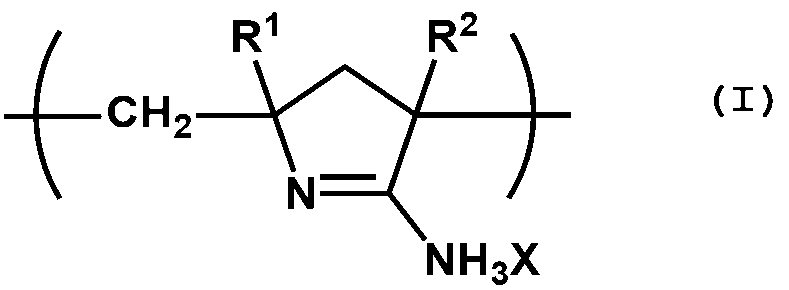
(式中、R1およびR2はそれぞれ独立して、水素原子または炭素数1~3の炭化水素基であり、Xはアニオンである。)
で表される構成単位を有する、カチオン電着塗料組成物。
[2]
前記ポリアミジン化合物の疎水化変性体が、構成単位(I)に加えて、不飽和ニトリルに由来する環化構造単位または以下の一般式(X):

(式中、R1およびR2はそれぞれ独立して、水素原子または炭素数1~3の炭化水素基であり、R3は置換または非置換の直鎖状または分枝状の炭素数3~12のアルキル基、または、置換または非置換の炭素数6~12の芳香族基のいずれかを少なくとも含む、疎水性構成単位である。)
で表される構造単位を有する、[1]に記載のカチオン電着塗料組成物。
[3]
前記ポリアミジン化合物またはその疎水化変性体(E)の固形分質量は、前記カチオン電着塗料組成物の固形分質量の0.2ppm以上1,200ppm以下である、[1]または[2]に記載のカチオン電着塗料組成物。
[4]
前記ポリアミジン化合物またはその疎水化変性体(E)の重量平均分子量は、5万以上である、[1]または[2]に記載のカチオン電着塗料組成物。
[5]
前記顔料(D)は、体質顔料を含む、[1]または[2]に記載のカチオン電着塗料組成物。
[6]
前記カチオン電着塗料組成物は、有機スズ化合物を含まないか、あるいは、有機スズ化合物の含有量が、0.25質量%以下である、[1]または[2]に記載のカチオン電着塗料組成物。
[7]
前記アミン化エポキシ樹脂(A)が、アミン化合物とエポキシ樹脂を反応させることで得られるアミン化エポキシ樹脂であり、
前記アミン化合物が、第1アミンと第2アミンとの2種類の組合せであり、
前記第1アミンが、式:
NH2-(CH2)n-NR11R12
(式中、R11およびR12は、同一または異なって、末端に水酸基を有してもよい炭素数1~6のアルキル基を表し、nは2~4の整数を表す。)
を有し、
前記第2アミンが式:
R13R14NH
(式中、R13およびR14は、同一または異なって、末端に水酸基を有する炭素数1~4のアルキル基を表す。)
を有する、か、または
前記アミン化合物は、ケチミン化合物およびジケチミン化合物からなる群から選択される1種または2種以上を含む、
[1]または[2]に記載のカチオン電着塗料組成物。
[8]
前記ブロック化ポリイソシアネート硬化剤(C)は、オキシム化合物を含むブロック剤 とポリイソシアネートとのブロック化反応生成物である、オキシムブロック化イソシアネート硬化剤を含み、前記ブロック化反応におけるポリイソシアネートは、芳香族ポリイソシアネート化合物、脂肪族ポリイソシアネート化合物および脂環式ポリイソシアネート化合物からなる群から選択される1種または2種以上を含む、
[1]または[2]に記載のカチオン電着塗料組成物。
[9]
被塗物と、
前記被塗物上に、[1]または[2]に記載のカチオン電着塗料組成物により形成された電着塗膜と、を有する電着塗装物。
[10]
[1]または[2]に記載のカチオン電着塗料組成物に被塗物を浸漬した後、前記被塗物と対極との間に電圧を印加して、前記被塗物に未硬化の電着塗膜を形成する工程と、
前記未硬化の電着塗膜を75℃以上200℃以下の温度で加熱して、硬化された電着塗膜を得る工程と、を備える、電着塗装物の製造方法。
[1]
アミン化エポキシ樹脂(A)と、
アミン化アクリル樹脂(B)と、
ブロック化ポリイソシアネート硬化剤(C)と、
顔料(D)と、
ポリアミジン化合物またはその疎水化変性体(E)と、を含み、
前記ポリアミジン化合物またはその疎水化変性体(E)は、下記一般式(I):
で表される構成単位を有する、カチオン電着塗料組成物。
[2]
前記ポリアミジン化合物の疎水化変性体が、構成単位(I)に加えて、不飽和ニトリルに由来する環化構造単位または以下の一般式(X):
(式中、R1およびR2はそれぞれ独立して、水素原子または炭素数1~3の炭化水素基であり、R3は置換または非置換の直鎖状または分枝状の炭素数3~12のアルキル基、または、置換または非置換の炭素数6~12の芳香族基のいずれかを少なくとも含む、疎水性構成単位である。)
で表される構造単位を有する、[1]に記載のカチオン電着塗料組成物。
[3]
前記ポリアミジン化合物またはその疎水化変性体(E)の固形分質量は、前記カチオン電着塗料組成物の固形分質量の0.2ppm以上1,200ppm以下である、[1]または[2]に記載のカチオン電着塗料組成物。
[4]
前記ポリアミジン化合物またはその疎水化変性体(E)の重量平均分子量は、5万以上である、[1]または[2]に記載のカチオン電着塗料組成物。
[5]
前記顔料(D)は、体質顔料を含む、[1]または[2]に記載のカチオン電着塗料組成物。
[6]
前記カチオン電着塗料組成物は、有機スズ化合物を含まないか、あるいは、有機スズ化合物の含有量が、0.25質量%以下である、[1]または[2]に記載のカチオン電着塗料組成物。
[7]
前記アミン化エポキシ樹脂(A)が、アミン化合物とエポキシ樹脂を反応させることで得られるアミン化エポキシ樹脂であり、
前記アミン化合物が、第1アミンと第2アミンとの2種類の組合せであり、
前記第1アミンが、式:
NH2-(CH2)n-NR11R12
(式中、R11およびR12は、同一または異なって、末端に水酸基を有してもよい炭素数1~6のアルキル基を表し、nは2~4の整数を表す。)
を有し、
前記第2アミンが式:
R13R14NH
(式中、R13およびR14は、同一または異なって、末端に水酸基を有する炭素数1~4のアルキル基を表す。)
を有する、か、または
前記アミン化合物は、ケチミン化合物およびジケチミン化合物からなる群から選択される1種または2種以上を含む、
[1]または[2]に記載のカチオン電着塗料組成物。
[8]
前記ブロック化ポリイソシアネート硬化剤(C)は、オキシム化合物を含むブロック剤 とポリイソシアネートとのブロック化反応生成物である、オキシムブロック化イソシアネート硬化剤を含み、前記ブロック化反応におけるポリイソシアネートは、芳香族ポリイソシアネート化合物、脂肪族ポリイソシアネート化合物および脂環式ポリイソシアネート化合物からなる群から選択される1種または2種以上を含む、
[1]または[2]に記載のカチオン電着塗料組成物。
[9]
被塗物と、
前記被塗物上に、[1]または[2]に記載のカチオン電着塗料組成物により形成された電着塗膜と、を有する電着塗装物。
[10]
[1]または[2]に記載のカチオン電着塗料組成物に被塗物を浸漬した後、前記被塗物と対極との間に電圧を印加して、前記被塗物に未硬化の電着塗膜を形成する工程と、
前記未硬化の電着塗膜を75℃以上200℃以下の温度で加熱して、硬化された電着塗膜を得る工程と、を備える、電着塗装物の製造方法。
本発明によれば、防錆性、特にエッジ部防錆性および外観に優れる塗膜が得られる、カチオン電着塗料組成物、ならびに、電着塗装物およびその製造方法を提供することができる。
高分子粘性剤は、塗膜形成樹脂や顔料と相互作用して、カチオン電着塗料組成物の粘性を高める。塗料組成物の粘性が高まることにより、加熱時に塗料組成物が流動することが抑制される。しかしながら、塗料組成物を、エッジ部を覆った状態で硬化させることは困難である。
本実施形態では、塗料組成物に、環状のアミジン骨格を有するポリアミジン化合物(以下、環状ポリアミジン化合物と称する。)を添加する。これにより、エッジ部防錆性が著しく向上する。環状ポリアミジン化合物によってエッジ部防錆性が向上する理由は明確ではないが、ポリアミジン化合物は電荷を有するためであると考えられる。電荷を有するポリアミジン化合物は、エッジ部に析出し易い。加えて、環状構造によって塗料組成物の粘度が高められるため、塗料組成物は、エッジ部を覆った状態で硬化することができて、エッジ部防錆性が向上する。環状ポリアミジン化合物は、塗料安定性の観点から変性して疎水基を導入することがある。疎水基を導入したものを、本明細書中では「疎水化変性体」と呼ぶ。
塗膜形成樹脂は加熱によってある程度流動するため、得られる硬化塗膜の表面はレベリングされて、良好な外観が得られる。
また、本実施形態に係るカチオン電着塗料組成物は、硬化剤と反応して硬化する塗膜形成樹脂成分として、アミン化エポキシ樹脂(A)に加えてアミン化アクリル樹脂(B)を含む。これにより、より良好な耐候性を得ることができる利点がある。
[カチオン電着塗料組成物]
本実施形態に係るカチオン電着塗料組成物(以下、単に塗料組成物と称する場合がある。)は、アミン化エポキシ樹脂(A)と、アミン化アクリル樹脂(B)と、ブロック化ポリイソシアネート硬化剤(C)と、顔料(D)と、ポリアミジン化合物またはその疎水化変性体(E)と、を含む。
前記ポリアミジン化合物またはその疎水化変性体(E)は、下記一般式:
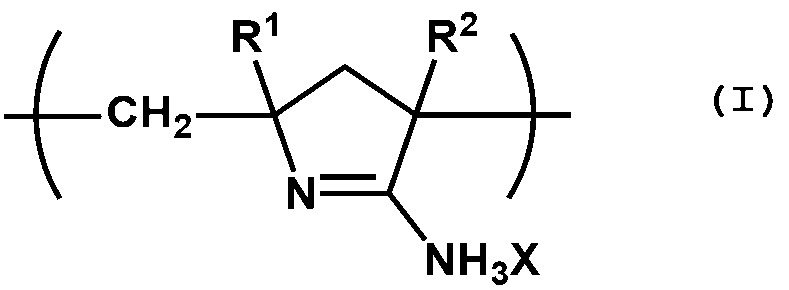
(式中、R1およびR2はそれぞれ独立して、水素原子または炭素数1~3の炭化水素基であり、Xはアニオンである。)
で表される構成単位を有する。
本実施形態に係るカチオン電着塗料組成物(以下、単に塗料組成物と称する場合がある。)は、アミン化エポキシ樹脂(A)と、アミン化アクリル樹脂(B)と、ブロック化ポリイソシアネート硬化剤(C)と、顔料(D)と、ポリアミジン化合物またはその疎水化変性体(E)と、を含む。
前記ポリアミジン化合物またはその疎水化変性体(E)は、下記一般式:
で表される構成単位を有する。
<アミン化エポキシ樹脂(A)>
アミン化エポキシ樹脂(A)は塗膜形成樹脂である。アミン化エポキシ樹脂(A)において、エポキシ樹脂の少なくとも1つのオキシラン環(「エポキシ基」ともいう。)がアミン化されている。アミン化エポキシ樹脂(A)は、ブロック化ポリイソシアネート硬化剤(C)とともに、樹脂エマルションの形態で電着塗料組成物に含まれるのが好ましい。
アミン化エポキシ樹脂(A)は塗膜形成樹脂である。アミン化エポキシ樹脂(A)において、エポキシ樹脂の少なくとも1つのオキシラン環(「エポキシ基」ともいう。)がアミン化されている。アミン化エポキシ樹脂(A)は、ブロック化ポリイソシアネート硬化剤(C)とともに、樹脂エマルションの形態で電着塗料組成物に含まれるのが好ましい。
アミン化エポキシ樹脂(A)の数平均分子量は、例えば、1,000以上7,000以下である。数平均分子量が1,000以上であると、得られる硬化電着塗膜の防錆性および耐溶剤性が向上し易い。数平均分子量が7,000以下であると、アミン化エポキシ樹脂(A)の粘度調整が容易となって円滑な合成が可能となり、加えて、得られたアミン化エポキシ樹脂(A)の乳化分散が容易になる。アミン化エポキシ樹脂(A)の数平均分子量は、1,500以上4,000以下であってもよい。
アミン化エポキシ樹脂(A)の数平均分子量は、ゲルパーミエーションクロマトグラフィーを用いて測定される、スチレンホモポリマー換算値である。
アミン化エポキシ樹脂(A)のアミン価は、例えば、20mgKOH/g以上100mgKOH/g以下である。アミン化エポキシ樹脂(A)のアミン価が20mgKOH/g以上であると、塗料組成物中におけるアミン化エポキシ樹脂(A)の乳化分散の安定性が良好となる。アミン価が100mgKOH/g以下であると、硬化電着塗膜中のアミノ基の量が適正となり、塗膜の耐水性の低下が抑制される。アミン化エポキシ樹脂(A)のアミン価は、20mgKOH/g以上80mgKOH/g以下であってもよい。
アミン価は、ASTM D2073に準じ、以下の方法で求めることができる。
(1)200ml三角フラスコにアミン化エポキシ樹脂を500mg精秤する。
(2)氷酢酸約50mlを加え、均一に溶解する。
(3)指示薬(メチルバイオレット溶液)を5~6滴加え、均一に攪拌する。
(4)0.1N過塩素酸酢酸溶液で滴定していき、明緑色となった点を終点とする。
(上記(3)および(4)は電位差滴定に置き換えてもよい。)
(1)200ml三角フラスコにアミン化エポキシ樹脂を500mg精秤する。
(2)氷酢酸約50mlを加え、均一に溶解する。
(3)指示薬(メチルバイオレット溶液)を5~6滴加え、均一に攪拌する。
(4)0.1N過塩素酸酢酸溶液で滴定していき、明緑色となった点を終点とする。
(上記(3)および(4)は電位差滴定に置き換えてもよい。)
アミン化エポキシ樹脂(A)は、水酸基を有しても良く、アミン化エポキシ樹脂(A)の水酸基価は、例えば、150mgKOH/g以上650mgKOH/g以下である。水酸基価が150mgKOH/g以上であると、塗料組成物の硬化性が高まるとともに、塗膜外観が向上する。水酸基価が650mgKOH/g以下であると、硬化電着塗中に残存する水酸基の量が適正となり、塗膜の耐水性が向上し易くなる。一実施形態では、アミン化エポキシ樹脂(A)の水酸基価は、150mgKOH/g以上、180mgKOH/g以上、200mgKOH/g以上、250mgKOH/g以上、300mgKOH/g以上、350mgKOH/g以上、400mgKOH/g以上、450mgKOH/g以上、500mgKOH/g以上、550mgKOH/g以上または600mgKOH/g以上である。別の実施形態では、アミン化エポキシ樹脂(A)成分の水酸基価は、650mgKOH/g以下、600mgKOH/g以下、550mgKOH/g以下、500mgKOH/g以下、450mgKOH/g以下、400mgKOH/g以下、350mgKOH/g以下、300mgKOH/g以下、250mgKOH/g以下または200mgKOH/g以下である。さらに別の実施形態では、(A)成分の水酸基価は、180~300mgKOH/gである。
水酸基価は、JIS K 0070に記載されている水酸化カリウム水溶液を用いる中和滴定法により求めることができる。
特に、アミン化エポキシ樹脂(A)の数平均分子量が1,000~7,000の範囲内であり、アミン価が20~100mgKOH/gであり、かつ、水酸基価が150~650mgKOH/g(好ましくは150~400mgKOH/g)であると、被塗物の防錆性はさらに向上し易い。
塗料組成物は、アミン価および/または水酸基価の異なる複数のアミン化エポキシ樹脂(A)を含んでもよい。この場合、複数のアミン化エポキシ樹脂(A)の質量比に基づいて算出される平均アミン価および平均水酸基価が、上記の範囲に含まれることが好ましい。なかでも、複数のアミン化エポキシ樹脂(A)は、アミン価が20~50mgKOH/gであり、かつ、水酸基価が50~300mgKOH/gであるアミン化エポキシ樹脂と、アミン価が50~200mgKOH/gであり、かつ、水酸基価が200~500mgKOH/gであるアミン化エポキシ樹脂と、を含むことが好ましい。これにより、エマルションのコア部がより疎水性となり、シェル部がより親水性となるため、被塗物の防錆性はより向上し易くなる。
上記アミン化エポキシ樹脂(A)は、例えば、上記エポキシ樹脂のオキシラン環とアミン化合物とを反応させることによって、アミン化エポキシ樹脂を調製することができる。アミン化合物としては、一般にアミン化エポキシ樹脂を製造する時に用いられているアミン化合物を用いる。一般的に使用するアミン化合物の例としては、ブチルアミン、オクチルアミン、モノエタノールアミンなどの一級アミン;ジエチルアミン、ジブチルアミン、メチルブチルアミン、ジエタノールアミン、N-メチルエタノールアミンなどの二級アミン;ジエチレントリアミンなどの複合アミンが挙げられる。上記一級アミンは、ケトン化合物を用いてケチミン基を形成して、いわゆるブロック化により反応を制御することが可能である。使用できるケチミン基またはジケチミン基を有するアミン化合物はアミノエチルエタノールアミンのケチミン、ジエチレントリアミンのジケチミンなどが挙げられる。ケチミン基を生成するケトン化合物は、メチルイソプロピルケトン(MIPK)、ジイソブチルケトン(DIBK)、メチルイソブチルケトン(MIBK)、ジエチルケトン(DEK)、エチルブチルケトン(EBK)、エチルプロピルケトン(EPK)、ジプロピルケトン(DPK)、メチルエチルケトン(MEK)などが挙げられるが、メチルイソブチルケトン(MIBK)が好ましく用いられる。アミン化合物としては、三級アミンを使用してもよく、その具体例として、例えば、トリエチルアミン、N,N-ジメチルベンジルアミン、N,N-ジメチルエタノールアミンなどが挙げられる。これらのアミン類は1種のみを単独で用いてもよく、2種以上を併用してもよい。
アミン化の際、アミン化合物は、原料エポキシ樹脂が有するエポキシ基1当量に対して0.9当量以上1.2当量以下となる量で用いられることが好ましい。アミン化の反応条件は、反応スケールなどに応じて適宜選択することができる。例えば、80℃以上150℃以下で、0.1時間以上5時間以下、あるいは120℃以上150℃以下で、0.5時間以上3時間以下反応させればよい。
本発明のある1態様において、エポキシ樹脂のオキシラン環(「エポキシ基」ともいう。)を変性するアミン化合物として、ケチミン(ジケチミンを含む)を除く、一級アミノ基、二級アミノ基および三級アミノ基の少なくとも1種を有するアミン化合物を用いる態様が挙げられる。
アミン化エポキシ樹脂は分子量分布を狭く制御する必要がある場合、特に分子量分布を2.7以下に制御する必要がある場合には、上記アミン化合物を特定のものに選択すると、制御しやすくなるなどの利点がある。具体的には、例えば、アミン化合物は第1アミンと第2アミンとの2種類の組合せであり、かつ
第1アミンが、式:
NH2-(CH2)n-NR11R12 (1)
(式(1)中、R11およびR12が、同一または異なって、末端に水酸基を有してもよい炭素数1~6のアルキル基を表し、nは2~4の整数を表す。)
を有し、
第2アミンが式:
R13R14NH (2)
(式(2)中、R13およびR14が、末端に水酸基を有する炭素数1~4のアルキル基を表す。)
を有するものを用いる態様が挙げられる。これらのアミン化合物を用いると、まず、第1アミンの一級アミノ基がエポキシ樹脂と反応して消費され、残るアミノ基は二級アミノ基だけになり、これがエポキシ樹脂のエポキシ基と反応するので、反応性に優劣が無く均等に反応が進んで、分子量分布を制御できると考えている。第1アミンに存在する三級アミノ基あるいは二級アミノ基の反応で生じた三級アミノ基も、エポキシ基と反応して4級アンモニウム基になることも考えられるが、この反応は少ないと考えられる。
第1アミンが、式:
NH2-(CH2)n-NR11R12 (1)
(式(1)中、R11およびR12が、同一または異なって、末端に水酸基を有してもよい炭素数1~6のアルキル基を表し、nは2~4の整数を表す。)
を有し、
第2アミンが式:
R13R14NH (2)
(式(2)中、R13およびR14が、末端に水酸基を有する炭素数1~4のアルキル基を表す。)
を有するものを用いる態様が挙げられる。これらのアミン化合物を用いると、まず、第1アミンの一級アミノ基がエポキシ樹脂と反応して消費され、残るアミノ基は二級アミノ基だけになり、これがエポキシ樹脂のエポキシ基と反応するので、反応性に優劣が無く均等に反応が進んで、分子量分布を制御できると考えている。第1アミンに存在する三級アミノ基あるいは二級アミノ基の反応で生じた三級アミノ基も、エポキシ基と反応して4級アンモニウム基になることも考えられるが、この反応は少ないと考えられる。
上記第1アミンは、上記式(1)を有するものであり、R11およびR12は、具体的にはメチル、エチル、プロピルまたはブチルであり、末端に水酸基を有していてもよい。また、nは2~4であり、好ましくは3である。第1アミンの具体例は、アミノプロピルジエタノールアミン、ジメチルアミノプロパンジアミン、ジエチルアミノプロパンジアミン、ジブチルアミノプロパンジアミン等が挙げられる。上記第2アミンは、上記式(2)を有する二級アミンであるが、窒素原子にR13およびR14が結合したものであり、R3およびR4は、共に水酸基を有する炭素数1~4のアルキル基を有するものである。第2アミンは具体的にはジメタノールアミンやジエタノールアミンが挙げられる。
また本発明の他の1態様において、アミン化に用いるアミン化合物は、ケチミン基またはジケチミン基を有するアミン化合物を含んでもよい。
<アミン化アクリル樹脂(B)>
アミン化アクリル樹脂(B)は塗膜形成樹脂である。アミン化アクリル樹脂(B)は、塗膜形成樹脂としての機能と、電着塗膜に主に耐候性を付与する機能を有する。
アミン化アクリル樹脂(B)は塗膜形成樹脂である。アミン化アクリル樹脂(B)は、塗膜形成樹脂としての機能と、電着塗膜に主に耐候性を付与する機能を有する。
アミン化アクリル樹脂(B)は、(i)アミノ基含有アクリルモノマー、(ii)水酸基含有アクリルモノマー、および(iii)その他のエチレン性不飽和モノマーの共重合によって得られる。さらにアミノ基含有アクリルモノマーの代わりにエポキシ基含有アクリルモノマー(iv)を水酸基含有アクリルモノマーおよびその他のエチレン性不飽和モノマーと共重合し、得られた共重合体のエポキシ基をアミンで開環することにより得ることもできる。
アミノ基含有アクリルモノマー(i)の例は、N,N-ジメチルアミノエチル(メタ)アクリレート、N,N-ジエチルアミノエチル(メタ)アクリレート、N,N-ジメチルアミノプロピル(メタ)アクリレート、N,N-ジエチルアミノプロピル(メタ)アクリレート等である。
水酸基含有アクリルモノマー(ii)の例は、2-ヒドロキシエチル(メタ)アクリレート、2-ヒドロキシプロピル(メタ)アクリレート、6-ヒドロキシヘキシル(メタ)アクリレート、4-ヒドロキシブチル(メタ)アクリレート、ポリプロピレングリコールモノ(メタ)アクリレート、1,6-へキサンジオールモノ(メタ)アクリレート等のようなアルキレンジオールのモノ(メタ)アクリレート類が好ましい。
また、N-ヒドロキシエチル(メタ)アクリルアミド、N-ヒドロキシブロピル(メタ)アクリルアミド等のような(メタ)アクリルアミド類も好ましく、さらにヒドロキシアルキルモノ(メタ)アクリレートとε-カプロラクトンとの反応生成物またはヒドロキシアルキルモノ(メタ)アクリレートと六員環カーボネートとの反応生成物も水酸基含有アクリルモノマー(ii)として好適に使用できる。
その他のエチレン性不飽和モノマー(iii)の例は、メチル(メタ)アクリレート、エチル(メタ)アクリレート、n-プロピル(メタ)アクリレート、イソブロピル(メタ)アクリレート、n-ブチル(メタ)アクリレート、イソブチル(メタ)アクリレート、シクロヘキシル(メタ)アクリレート、2-エチルヘキシル(メタ)アクリレート、ドデシル(メタ)アクリレート、スチレン、ビニルトルエン、α-メチルスチレン、(メタ)アクリロニトリル、(メタ)アクリルアミド、酢酸ビニルなどである。
アミン化アクリル樹脂(B)を調製するための別法として、前述したように、水酸基を有するアクリルモノマーおよびその他のエチレン性不飽和モノマーと、グリシジル(メタ)アクリレートのようなエポキシ基含有アクリルモノマー(iv)とを共重合させた後、エポキシ基に2級アミンを反応させてもよい。エポキシ基との反応に使用し得る2級アミンは、ジエチルアミン、ジブチルアミン、ジシクロヘキシルアミン、モルホリン、ジエタノールアミン、N-メチルエタノールアミン等であり、特に分子内にヒドロキシル基と2級アミノ基とを有するアミンが好ましい。また、ジエチレントリアミンのメチルイソブチルケトンジケチミン化物や2-(2-アミノエチルアミノ)エタノールのメチルイソブチルケトンモノケチミン化物等も使用できる。また、上記のエポキシ基含有アクリルモノマー(iv)の例としては、グリシジル(メタ)アクリレート、メチルグリシジル(メタ)アクリレート、3,4-エポキシシクロヘキシルメチル(メタ)アクリレート等が挙げられる。
上記アクリルモノマー(i)~(iv)の重合は溶液重合法のような常法により行うことができる。共重合体の数平均分子量は、例えば1000以上、1500以上、2000以上であってよく、50000以下、40000以下、30000以下、20000以下であってよい。アミン化アクリル樹脂(B)の調製時において、必要に応じてドデシルメルカプタンまたはチオグリコ-ル酸2-エチルヘキシルのような連鎖移動剤を使用して重合度を調節することもできる。
アミノ基含有アクリル重合体へハーフブロックジイソシアネートをウレタン結合により付加し、自己架橋性を持たせてもよい。その場合ジイソシアネートは、イソホロンジイソシアネート(IPDI)、4,4’-メチレンビス(シクロヘキシルイソシアネート)(水添MDI)、ノルボルナンジイソシアネート(NBDI)のような脂環式ジイソシアネートを使用するのが好ましい。
ジイソシアネートの一方のイソシアネート基をブロックしてハーフブロックジイソシアネートとするために、公知のブロック剤を用いうる。ブロック剤の例は、n-ブタノール、2-エチルヘキサノール、エチレングリコ一ルモノブチルエーテル、シクロヘキサノール等のアルコール類;フェノール、ニトロフェノール、クレゾール、ノニルフェノール等のフェノール類;ジメチルケトオキシム、メチルエチルケトオキシム、メチルイソブチルケトオキシム等のオキシム類、ε-カプロラクタム等のラクタム類などを使用することができる。
本実施態様の一態様として、アミン化アクリル樹脂(B)は、アミン化エポキシ樹脂(A)よりそのSP値が低くなるように設計することができる。アミン化エポキシ樹脂(A)と、アミン化エポキシ樹脂(A)よりSP値が低いアミン化アクリル樹脂(B)とを併用することによって、電着塗装後の焼付け時に、アミン化エポキシ樹脂(A)の少なくとも1部が金属基材側に移行して防食性を向上させ、そしてアミン化アクリル樹脂(B)の少なくとも1部が塗膜表面側に移行して、例えば硬化電着塗膜単膜としての耐候性を向上させることができる利点がある。
アミン化エポキシ樹脂(A)およびアミン化アクリル樹脂(B)のSP値は、樹脂を構成する構成モノマーのホモポリマーのSP値と、モノマー混合物中の各構成モノマーの重量分率に基づいて算出することにより、求めることができる。
アミン化アクリル樹脂(B)も好ましくは水酸基を含有する。アミン化アクリル樹脂(B)の水酸基価は、例えば20~250mgKOH/g以上であってよい。アミン化アクリル樹脂(B)の水酸基価は、40mgKOH/g以上、50mgKOH/g以上、55mgKOH/g以上であってよく、200mgKOH/g以下、180mgKOH/g以下、160mgKOH/g以下であってよい。水酸基価が上記範囲となるようにモノマー組成を構成することは当業者に周知の方法で行うことができる。
アミン化アクリル樹脂(B)のアミン価は、例えば20~100であってよい。アミン化アクリル樹脂(B)のアミン価は、20以上、30以上、35以上であってよく、95以下、90以下、85以下、80以下であってよい。アミン化アクリル樹脂(B)のアミン価が上記範囲となるようにモノマー組成を構成することは当業者に周知の方法で行うことができる。
アミン化アクリル樹脂(B)は、アミン化エポキシ樹脂(A)およびアミン化アクリル樹脂(B)の樹脂固形分質量比として、(A):(B)=5:95~30:70の範囲内であってよく、10:90~40:60の範囲内であってよい。アミン化エポキシ樹脂(A)およびアミン化アクリル樹脂(B)の樹脂固形分質量比を上記範囲とすることによって、電着塗膜単膜の耐候性をより向上させることができる利点がある。
(他の塗膜形成樹脂)
塗料組成物は、必要に応じて、アミン化エポキシ樹脂(A)およびアミン化アクリル樹脂(B)以外のアミン化樹脂、例えば、アミン化ポリエステル樹脂など、を含んでもよい。塗料組成物は、また、上記アミン化樹脂以外の他の塗膜形成樹脂を含んでもよい。他の塗膜形成樹脂としては、例えば、水酸基含有アクリル樹脂、水酸基含有ポリエステル樹脂、ウレタン樹脂、ブタジエン系樹脂、フェノール樹脂、キシレン樹脂が挙げられる。塗料組成物に含まれる、硬化剤と反応して塗膜を形成する塗膜形成樹脂のうち、80質量%以上、さらには90質量%以上、特には100質量%が、アミン化エポキシ樹脂(A)およびアミン化アクリル樹脂(B)によって構成されてよい。
塗料組成物は、必要に応じて、アミン化エポキシ樹脂(A)およびアミン化アクリル樹脂(B)以外のアミン化樹脂、例えば、アミン化ポリエステル樹脂など、を含んでもよい。塗料組成物は、また、上記アミン化樹脂以外の他の塗膜形成樹脂を含んでもよい。他の塗膜形成樹脂としては、例えば、水酸基含有アクリル樹脂、水酸基含有ポリエステル樹脂、ウレタン樹脂、ブタジエン系樹脂、フェノール樹脂、キシレン樹脂が挙げられる。塗料組成物に含まれる、硬化剤と反応して塗膜を形成する塗膜形成樹脂のうち、80質量%以上、さらには90質量%以上、特には100質量%が、アミン化エポキシ樹脂(A)およびアミン化アクリル樹脂(B)によって構成されてよい。
<ブロック化ポリイソシアネート硬化剤(C)>
ブロック化ポリイソシアネート硬化剤(C)(以下、単に硬化剤(C)と称する場合がある。)もまた、電着塗膜を構成する。ブロック化ポリイソシアネート硬化剤(C)は、アミン化エポキシ樹脂(A)およびアミン化アクリル樹脂(B)のアミン基と優先的に反応し、さらに水酸基と反応して、アミン化エポキシ樹脂(A)およびアミン化アクリル樹脂(B)を硬化させる。ブロック化ポリイソシアネート硬化剤(C)は、ポリイソシアネート化合物を、ブロック剤でブロック化することによって調製することができる。
ブロック化ポリイソシアネート硬化剤(C)(以下、単に硬化剤(C)と称する場合がある。)もまた、電着塗膜を構成する。ブロック化ポリイソシアネート硬化剤(C)は、アミン化エポキシ樹脂(A)およびアミン化アクリル樹脂(B)のアミン基と優先的に反応し、さらに水酸基と反応して、アミン化エポキシ樹脂(A)およびアミン化アクリル樹脂(B)を硬化させる。ブロック化ポリイソシアネート硬化剤(C)は、ポリイソシアネート化合物を、ブロック剤でブロック化することによって調製することができる。
ポリイソシアネート化合物としては、例えば、
ヘキサメチレンジイソシアネート(3量体を含む)、2,2,4-トリメチルヘキサンジイソシアネート、リジンジイソシアネート等の炭素数3~12の脂肪族ポリイソシアネート化合物;
1,4-シクロヘキサンジイソシアネート(CDI)、イソホロンジイソシアネート(IPDI)、4,4’-ジシクロヘキシルメタンジイソシアネート(水添MDI)、メチルシクロヘキサンジイソシアネート、イソプロピリデンジシクロヘキシル-4,4’-ジイソシアネート、1,3-ジイソシアナトメチルシクロヘキサン(水添XDI)、水添TDI、2,5-又は2,6-ビス(イソシアナートメチル)-ビシクロ[2.2.1]ヘプタン(ノルボルナンジイソシアネートとも称される。)等の脂環式ポリイソシアネート化合物;
トリレンジイソシアネート(TDI)、ジフェニルメタン-4,4’-ジイソシアネート(MDI)、ポリメチレンポリフェニルポリイソシアネート(MDI多量体、ポリメリックMDI)、p-フェニレンジイソシアネート、ナフタレンジイソシアネート等の芳香族ポリイソシアネート化合物;
キシリレンジイソシアネート(XDI)、テトラメチルキシリレンジイソシアネート(TMXDI)等の芳香環を有する脂肪族ポリイソシアネート化合物;
これらのジイソシアネートの変性物(ウレタン化物、カーボジイミド、ウレトジオン、ウレトイミン、ビューレット、イソシアヌレート変性物等)など;。
が挙げられる。尚、本明細書において、ポリイソシアネート化合物(特に、脂肪族ポリイソシアネート化合物)は、それらのイソシアヌレート体も含む。例えば本明細書においては、ヘキサメチレンジイソシアネートのイソシアヌレートは、脂肪族ポリイソシアネート化合物に含まれる。ポリイソシアネート化合物は、1種又は2種以上を用いることができる。さらに、上記ポリイソシアネート化合物と、エチレングリコール、プロピレングリコール、トリメチロールプロパン、ヘキサントリオールなどの多価アルコールとNCO/OH比2以上で反応させて得られる付加体またはプレポリマーも、ブロック化イソシアネート硬化剤(C)の調製に用いることができる。
ヘキサメチレンジイソシアネート(3量体を含む)、2,2,4-トリメチルヘキサンジイソシアネート、リジンジイソシアネート等の炭素数3~12の脂肪族ポリイソシアネート化合物;
1,4-シクロヘキサンジイソシアネート(CDI)、イソホロンジイソシアネート(IPDI)、4,4’-ジシクロヘキシルメタンジイソシアネート(水添MDI)、メチルシクロヘキサンジイソシアネート、イソプロピリデンジシクロヘキシル-4,4’-ジイソシアネート、1,3-ジイソシアナトメチルシクロヘキサン(水添XDI)、水添TDI、2,5-又は2,6-ビス(イソシアナートメチル)-ビシクロ[2.2.1]ヘプタン(ノルボルナンジイソシアネートとも称される。)等の脂環式ポリイソシアネート化合物;
トリレンジイソシアネート(TDI)、ジフェニルメタン-4,4’-ジイソシアネート(MDI)、ポリメチレンポリフェニルポリイソシアネート(MDI多量体、ポリメリックMDI)、p-フェニレンジイソシアネート、ナフタレンジイソシアネート等の芳香族ポリイソシアネート化合物;
キシリレンジイソシアネート(XDI)、テトラメチルキシリレンジイソシアネート(TMXDI)等の芳香環を有する脂肪族ポリイソシアネート化合物;
これらのジイソシアネートの変性物(ウレタン化物、カーボジイミド、ウレトジオン、ウレトイミン、ビューレット、イソシアヌレート変性物等)など;。
が挙げられる。尚、本明細書において、ポリイソシアネート化合物(特に、脂肪族ポリイソシアネート化合物)は、それらのイソシアヌレート体も含む。例えば本明細書においては、ヘキサメチレンジイソシアネートのイソシアヌレートは、脂肪族ポリイソシアネート化合物に含まれる。ポリイソシアネート化合物は、1種又は2種以上を用いることができる。さらに、上記ポリイソシアネート化合物と、エチレングリコール、プロピレングリコール、トリメチロールプロパン、ヘキサントリオールなどの多価アルコールとNCO/OH比2以上で反応させて得られる付加体またはプレポリマーも、ブロック化イソシアネート硬化剤(C)の調製に用いることができる。
ブロック剤の例としては、n-ブタノール、n-ヘキシルアルコール、2-エチルヘキサノール、ラウリルアルコール、フェノールカルビノール、メチルフェニルカルビノールなどの一価のアルキル(または芳香族)アルコール類;エチレングリコールモノヘキシルエーテル、エチレングリコールモノ2-エチルヘキシルエーテルなどのセロソルブ類;ポリエチレングリコール、ポリプロピレングリコール、ポリテトラメチレンエーテルグリコールフェノールなどのポリエーテル型両末端ジオール類;エチレングリコール、プロピレングリコール、1,4-ブタンジオールなどのジオール類と、シュウ酸、コハク酸、アジピン酸、スベリン酸、セバシン酸などのジカルボン酸類から得られるポリエステル型両末端ポリオール類;パラ-t-ブチルフェノール、クレゾールなどのフェノール類;ジメチルケトオキシム、メチルエチルケトオキシム、メチルイソブチルケトオキシム、メチルアミルケトオキシム、シクロヘキサノンオキシムなどのオキシム類;およびε-カプロラクタム、γ-ブチロラクタムに代表されるラクタム類が好ましく用いられる。
本開示のカチオン電着塗料組成物の好適な1態様として、
前記ブロック化ポリイソシアネート硬化剤(C)は、オキシム化合物を含むブロック剤 とポリイソシアネートとのブロック化反応生成物である、オキシムブロック化イソシアネート硬化剤を含み、前記ブロック化反応におけるポリイソシアネートは、芳香族ポリイソシアネート化合物、脂肪族ポリイソシアネート化合物および脂環式ポリイソシアネート化合物からなる群から選択される1種または2種以上を含む、
態様が挙げられる。オキシム類は前述したが、オキシム類でブロック化すると、電着塗料組成物の硬化温度が低温化する効果がある。本発明の実施例では、電着塗膜(単層塗膜)の硬化性評価は、具体的には135℃で25分の焼き付けで評価している。135℃25分の硬化で高い硬化性が出ているときは、低温硬化性が高いと判断できる。
前記ブロック化ポリイソシアネート硬化剤(C)は、オキシム化合物を含むブロック剤 とポリイソシアネートとのブロック化反応生成物である、オキシムブロック化イソシアネート硬化剤を含み、前記ブロック化反応におけるポリイソシアネートは、芳香族ポリイソシアネート化合物、脂肪族ポリイソシアネート化合物および脂環式ポリイソシアネート化合物からなる群から選択される1種または2種以上を含む、
態様が挙げられる。オキシム類は前述したが、オキシム類でブロック化すると、電着塗料組成物の硬化温度が低温化する効果がある。本発明の実施例では、電着塗膜(単層塗膜)の硬化性評価は、具体的には135℃で25分の焼き付けで評価している。135℃25分の硬化で高い硬化性が出ているときは、低温硬化性が高いと判断できる。
本開示のカチオン電着塗料組成物のある1態様として、
上記ブロック化ポリイソシアネート硬化剤(C)は、オキシム化合物を含むブロック剤とポリイソシアネートとのブロック化反応生成物である、オキシムブロック化イソシアネート硬化剤を含み、前記ブロック化反応におけるポリイソシアネートは、脂肪族ポリイソシアネート化合物および/または脂環式ポリイソシアネート化合物を含む、
態様が挙げられる。
上記ブロック化ポリイソシアネート硬化剤(C)は、オキシム化合物を含むブロック剤とポリイソシアネートとのブロック化反応生成物である、オキシムブロック化イソシアネート硬化剤を含み、前記ブロック化反応におけるポリイソシアネートは、脂肪族ポリイソシアネート化合物および/または脂環式ポリイソシアネート化合物を含む、
態様が挙げられる。
本開示のカチオン電着塗料組成物の他のある1態様として、
上記ブロック化ポリイソシアネート硬化剤(C)は、オキシム化合物を含むブロック剤とポリイソシアネートとのブロック化反応生成物である、オキシムブロック化イソシアネート硬化剤を含み、前記ブロック化反応におけるポリイソシアネートは、脂肪族ポリイソシアネート化合物および脂環式ポリイソシアネート化合物を少なくとも含む、
態様が挙げられる。
上記ブロック化ポリイソシアネート硬化剤(C)は、オキシム化合物を含むブロック剤とポリイソシアネートとのブロック化反応生成物である、オキシムブロック化イソシアネート硬化剤を含み、前記ブロック化反応におけるポリイソシアネートは、脂肪族ポリイソシアネート化合物および脂環式ポリイソシアネート化合物を少なくとも含む、
態様が挙げられる。
上記構成によって、低温硬化性を確保でき、また、得られる電着塗膜物性の性能バランスを好適に保つことができるという利点がある。上記の態様において、ブロック化ポリイソシアネート硬化剤は、ブロック化前のポリイソシアネート硬化剤は脂肪族ポリイソシアネート化合物と脂環式ポリイソシアネート化合物との組合せを用いると、硬化剤中の内部応力が緩和されるので、好ましい。脂肪族ポリイソシアネート化合物および脂環式ポリイソシアネート化合物を併用する場合における質量比は、脂肪族ポリイソシアネート化合物/脂環式ポリイソシアネート化合物で質量比で5/95~95/5、好ましくは20/80~80/20、より好ましくは30/70~70/30である。
ブロック化ポリイソシアネート硬化剤(C)の含有量は、硬化性樹脂(具体的には、アミン化エポキシ樹脂(A)およびアミン化アクリル樹脂(B)の組合せ)の構造等を考慮して設定される。具体的には、硬化性樹脂が有する一級アミノ基、二級アミノ基および水酸基などの活性水素含有官能基と反応するのに十分な量の硬化剤が用いられる。硬化剤は、例えば、硬化性樹脂とブロック化ポリイソシアネート硬化剤(C)との固形分質量比(硬化性樹脂/硬化剤と表す。)が、90/10~50/50、より好ましくは80/20~65/35になるように配合される。硬化性樹脂と硬化剤との固形分質量比によって、電着塗料組成物の流動性および硬化速度が制御される。
硬化剤(代表的には、硬化剤(C))の含有量は、塗膜形成樹脂(代表的には、アミン化エポキシ樹脂(A)およびアミン化アクリル樹脂(B))の量、構造等を考慮して設定される。具体的には、塗膜形成樹脂が有する一級アミノ基、二級アミノ基および水酸基などの活性水素含有官能基と反応するのに十分な量の硬化剤が用いられる。硬化剤は、例えば、塗膜形成樹脂と硬化剤との固形分質量比(塗膜形成樹脂/硬化剤)が、90/10~50/50、より好ましくは80/20~65/35になるように配合される。塗膜形成樹脂と硬化剤との固形分質量比によって、塗料組成物の流動性および硬化速度が制御される。
塗料組成物は、必要に応じて、ブロック化ポリイソシアネート硬化剤(C)以外の硬化剤を含んでいてよい。他の硬化剤としては、例えば、メラミン樹脂またはフェノール樹脂などの有機硬化剤、シランカップリング剤、金属硬化剤が挙げられる。塗料組成物に含まれるすべての硬化剤のうち、80質量%以上、さらには90質量%以上、特には100質量%が、ブロック化ポリイソシアネート硬化剤(C)であってよい。
<顔料(D)>
顔料は、塗料組成物において一般的に用いられる顔料である。顔料としては、例えば、チタンホワイト(二酸化チタン)、カーボンブラックおよびベンガラなどの着色顔料;カオリン、タルク、ケイ酸アルミニウム、炭酸カルシウム、マイカおよびクレーなどの体質顔料;リン酸鉄、リン酸アルミニウム、リン酸カルシウム、トリポリリン酸アルミニウム、およびリンモリブデン酸アルミニウム、リンモリブデン酸アルミニウム亜鉛などの防錆顔料が挙げられる。エッジ部防錆性がより向上し得る点で、塗料組成物は体質顔料を含んでいてよい。体質顔料は、環状ポリアミジン化合物と適度に相互作用し得る。
顔料は、塗料組成物において一般的に用いられる顔料である。顔料としては、例えば、チタンホワイト(二酸化チタン)、カーボンブラックおよびベンガラなどの着色顔料;カオリン、タルク、ケイ酸アルミニウム、炭酸カルシウム、マイカおよびクレーなどの体質顔料;リン酸鉄、リン酸アルミニウム、リン酸カルシウム、トリポリリン酸アルミニウム、およびリンモリブデン酸アルミニウム、リンモリブデン酸アルミニウム亜鉛などの防錆顔料が挙げられる。エッジ部防錆性がより向上し得る点で、塗料組成物は体質顔料を含んでいてよい。体質顔料は、環状ポリアミジン化合物と適度に相互作用し得る。
塗料組成物の固形分とは、塗料組成物中に含まれる成分であって、溶媒の除去によっても固形となって残存する成分全てを意味する。塗料組成物の固形分とは、具体的には、塗料組成物中に含まれる、アミン化エポキシ樹脂(A)、アミン化アクリル樹脂(B)、ブロック化ポリイソシアネート硬化剤(C)、顔料(D)および環状ポリアミジン化合物またはその疎水化変性体(E)、ならびに必要に応じて含まれる顔料分散樹脂等の固形成分である。
顔料は、通常、顔料分散樹脂および顔料を含む顔料分散ペーストとして、塗料組成物に添加される。
(顔料分散樹脂)
顔料分散樹脂は、顔料を分散させるための樹脂である。顔料分散樹脂としては、例えば、四級アンモニウム基、三級スルホニウム基および一級アミノ基から選択される少なくとも1種を有する変性エポキシ樹脂などの、カチオン基を有する顔料分散樹脂が挙げられる。顔料分散樹脂の具体例としては、四級アンモニウム基含有エポキシ樹脂、三級スルホニウム基含有エポキシ樹脂が挙げられる。水性溶媒としては、例えば、イオン交換水、少量のアルコール類を含むイオン交換水が挙げられる。
顔料分散樹脂は、顔料を分散させるための樹脂である。顔料分散樹脂としては、例えば、四級アンモニウム基、三級スルホニウム基および一級アミノ基から選択される少なくとも1種を有する変性エポキシ樹脂などの、カチオン基を有する顔料分散樹脂が挙げられる。顔料分散樹脂の具体例としては、四級アンモニウム基含有エポキシ樹脂、三級スルホニウム基含有エポキシ樹脂が挙げられる。水性溶媒としては、例えば、イオン交換水、少量のアルコール類を含むイオン交換水が挙げられる。
<環状ポリアミジン化合物またはその疎水化変性体(E)>
環状ポリアミジン化合物またはその疎水化変性体(E)は、下記一般式:

(式中、R1およびR2はそれぞれ独立して、水素原子または炭素数1~3の炭化水素基であり、Xはアニオンである。)
で表される構成単位を有する。
環状ポリアミジン化合物またはその疎水化変性体(E)は、下記一般式:
で表される構成単位を有する。
このような環状構造を有するポリアミジン化合物は、電荷を有するためエッジ部に析出し易く、さらに塗料組成物の粘度を高める。そのため、エッジ部防錆性が向上すると考えられる。
R1およびR2はそれぞれ独立して、水素原子であってよい。Xは、アニオンを表し、例えば、ハロゲンイオンである。ハロゲンイオンとしては、F-、Cl-、Br-、I-が挙げられる。なかでも、入手し易い点で、ハロゲンイオンはCl-であってよい。
環状ポリアミジン化合物(E)は、例えば、N-ビニルカルボン酸アミドと不飽和ニトリルとの共重合物を、酸の存在下で加水分解することにより合成することができる。酸の存在下における加水分解の際、N-ビニルカルボン酸アミドに由来するアミド基が加水分解するとともに、不飽和ニトリルのシアノ基との反応が生じて、環状のアミジン骨格が形成される。
N-ビニルカルボン酸アミドとしては、例えば、N-ビニルアセトアミド、N-ビニル-N-メチルアセトアミド、N-ビニルホルムアミド、N-メチル-N-ビニルホルムアミド、N-ビニルプロピオン酸アミドおよびN-ビニル酪酸アミドが挙げられる。これらは、1種を単独で、あるいは2種以上を組み合わせて用いられる。
不飽和ニトリルは、例えば、炭素数3~18であってよく、炭素数3~9であってよい。不飽和ニトリルとして、具体的には、アクリロニトリル;メタクリロニトリル、エタクリロニトリルなどのα-アルキルアクリロニトリル;フマロニトリル;α-クロロアクリロニトリル、α-ブロモアクリロニトリルなどのα-ハロゲノアクリロニトリルが挙げられる。これらは、1種を単独で、あるいは2種以上を組み合わせて用いられる。
加水分解に使用される酸は、例えば無機の強酸であり、具体的には塩酸、硝酸およびp-トルエンスルフォン酸が挙げられる。
環状ポリアミジン化合物(E)は、N-ビニルカルボン酸アミドと不飽和ニトリルとの共重合物の部分加水分化物であってよい。化学式を用いて、説明すると以下のように説明することができる。
例えば、N-ビニルカルボン酸アミドをCH2=CR4-NH-CO-R6と表し、不飽和ニトリルをCH2=CR5-CNと表すと、それらが共重合したポリマーは以下の一般式(II)として通常表される。尚、一般式(I)ではR1やR2としているのに、R4~R6を使用しているのは、一般式(I)と一般式(II)が共重合体の異なる部分を表しているからである。
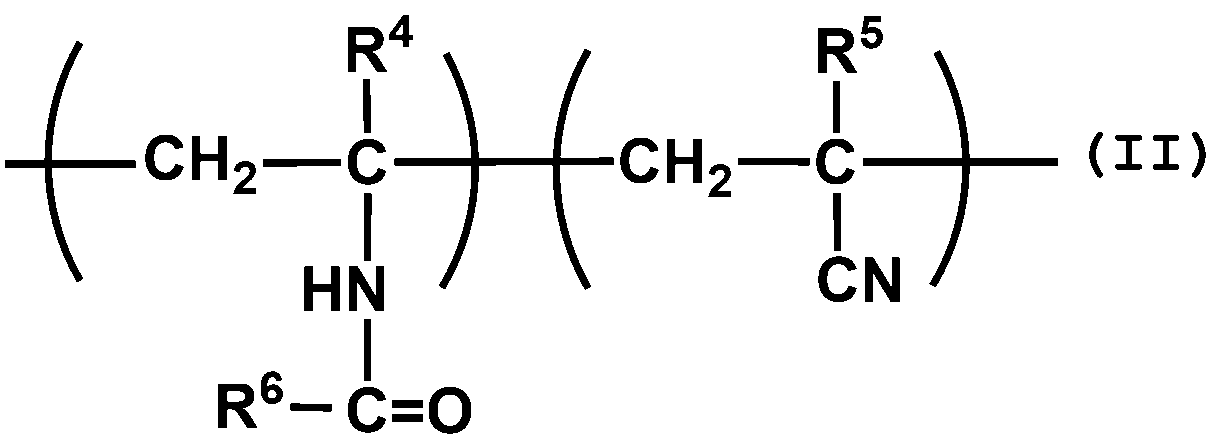
(上記一般式(II)中、R4、R5およびR6は、それぞれ独立して、水素原子または炭素数1~3の炭化水素基である。)
この一般式の(II)の共重合体は、各モノマーが交互に重合した状態を表しているが、実際は以下のN-ビニルカルボン酸アミドからの構成単位(III)と、不飽和ニトリルからの構成単位(IV)と、がランダムに結合して構成されているものである:
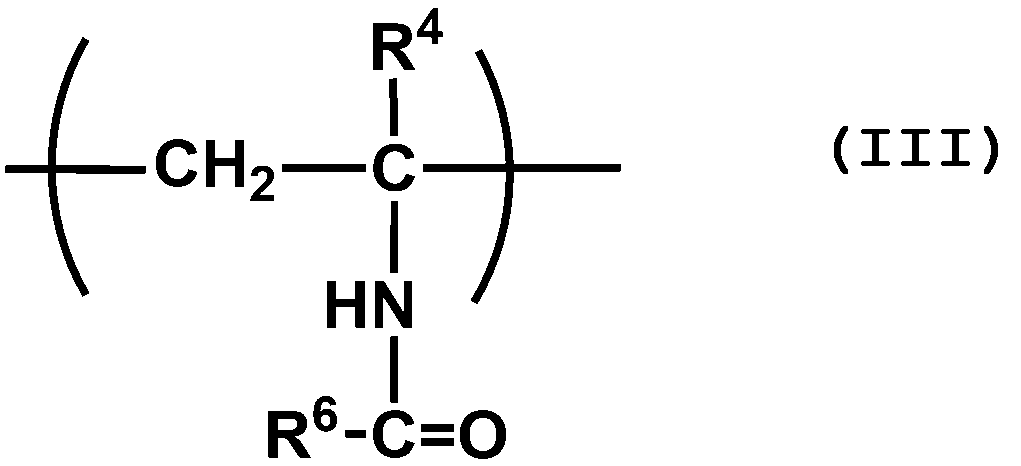

(上記式(III)および(IV)中、R4~R6は、前記と同意義。)
(上記一般式(II)中、R4、R5およびR6は、それぞれ独立して、水素原子または炭素数1~3の炭化水素基である。)
この一般式の(II)の共重合体は、各モノマーが交互に重合した状態を表しているが、実際は以下のN-ビニルカルボン酸アミドからの構成単位(III)と、不飽和ニトリルからの構成単位(IV)と、がランダムに結合して構成されているものである:
(上記式(III)および(IV)中、R4~R6は、前記と同意義。)
このような、共重合体において、上記一般式(II)のように、構造体単位(III)と構造体単位(IV)が横に並ぶ構造を取った時、酸の存在下で加水分解すると、N-ビニルカルボン酸アミドに由来するアミド基(式(III)のアミド基)が加水分解するとともに、不飽和ニトリルのシアノ基(式(IV)のシアノ基)との反応が生じて、環状のアミジン骨格が形成されて、一般式(I)の環状アミジン構造が生じる。
環状ポリアミジン化合物(E)1分子中の、構成単位(I)と構成単位(II)との合計数に対する、構成単位(I)数の割合:I/(I+II)は、5%以上であってよく、10%以上であってよく、20%以上であってよい。割合:I/(I+II)は、100%であってよく、90%以下であってよく、80%以下であってよい。
本発明ではまた、上記環状ポリアミジン化合物を変性して、疎水性部分をポリアミジン化合物中に導入することが、好適な1態様である。疎水化すると、塗料(カチオン電着塗料組成物)を形成する時に、塗料の安定性が向上するなどの利点がある。より具体的には、ポリアミジン化合物を疎水化することにより、アミン化エポキシ樹脂(A)および硬化剤を含む樹脂エマルションとポリアミジン化合物とを混合する場合における保存安定性を良好なものとすることができる利点がある。疎水化変性は、主として以下の2つの方法で行われる。疎水化変性の第1の方法は、上記の不飽和ニトリル構成単位(IV)が隣同士に並んだ時に、ニトリル基同士の酸による環化反応が起こり、環化構造単位が生じる。
アクリロニトリルを例に取って、ニトリル環化構造単位の形成を化学反応式で表すと、以下のようになると考えられる:

この反応式から明らかなように、二つのニトリル基(CN)が環化して、上記のような窒素原子含有6員環構造(アミノピリジン構造または6員環ピリジン誘導体様構造)が形成され、このニトリル環化構造単位が他部分と比較して疎水性が高くなっているため、疎水化することができる。
この反応式から明らかなように、二つのニトリル基(CN)が環化して、上記のような窒素原子含有6員環構造(アミノピリジン構造または6員環ピリジン誘導体様構造)が形成され、このニトリル環化構造単位が他部分と比較して疎水性が高くなっているため、疎水化することができる。
上記疎水化変性の第1の方法は、酸の存在下に加温で反応が行われる。酸は、例えば、酢酸、ギ酸、乳酸、リン酸、シュウ酸、硫化水素などの弱酸であり、加温条件は70~98℃であるのが好ましい。また、酸の添加量は、ポリアミジン化合物100質量部に対して5~40質量部であるのが好ましく、8~25質量部であるのがより好ましい。反応時間は、加温条件および酸添加量に応じて適宜選択することができ、例えば3~80時間、より好ましくは6~46時間の範囲で選択することができる。上記反応において、反応を加速するために、加圧条件を付加してもよい。
疎水化変性の第2の方法は、上記式(I)で表されるアミジン環を更にハロゲン化アルキル化合物と反応して、アルキル基をアミジン環に結合して、疎水性を付与する方法である。これを反応式で表すと、以下のようになる:
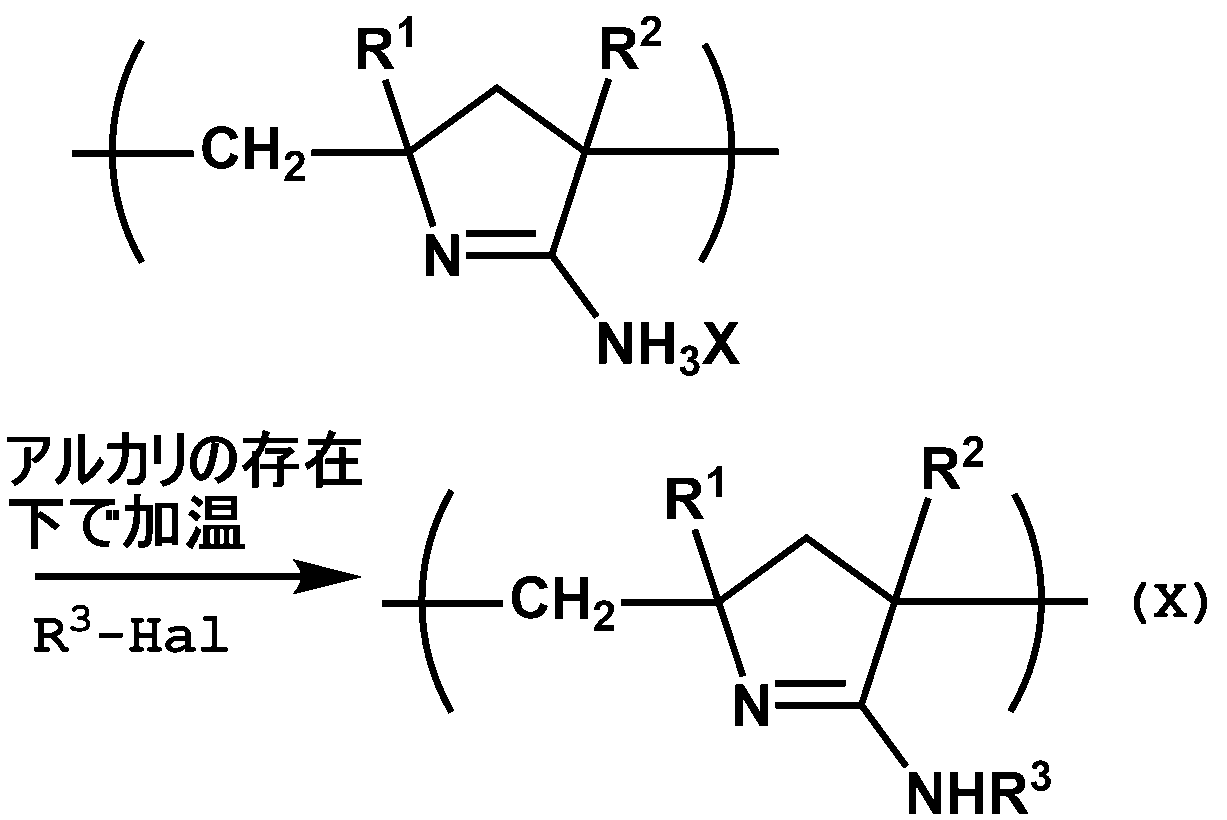
(上記反応式中、R1~R3およびXは、前記と同意義であり、Halはハロゲン原子を表す。)
上記疎水化変性の第2の方法は、アルカリの存在下に加温することにより反応が行われる。反応条件として、例えばpH4.0~6.5条件下で、アルカリ性物質として水酸化ナトリウム、水酸化カリウム、アンモニア水などを加える態様が挙げられる。加温条件は80℃~98℃であるのが好ましい。反応時間は、加温条件、pH条件および使用するアルカリ性物質の種類に応じて適宜選択することができ、例えば2~36時間、より好ましくは10~24時間の範囲で選択することができる。上記反応において反応を加速するために、加圧条件を付加してもよい。
ハロゲン化アルキル(R3-Hal)では、R3は置換または非置換の直鎖状または分枝状の炭素数3~12のアルキル基、または、置換または非置換の炭素数6~12の芳香族基のいずれかを少なくとも含むものである。より具体的には、R3は、アルキル基(例えば、n-プロピル基、sec-プロピル基、n-ブチル基、sec-ブチル基、ヘキシル基、n-ペンチル基、sec-ペンチル基、ネオペンチル基、へプチル基、ペンチル基、オクチル基等);または芳香族基(例えば、ベンジル基、ナフタレン基等)が挙げられる。これらの基の置換基として、疎水化変性に影響を及ぼさない置換基を特に限定されることなく用いることができる。置換基として、例えば、炭素数3~6のアルケニル基、炭素数3~6のアルキルエーテル基などが挙げられる。上記アルキル基、芳香族基は、置換基を有しないのが好ましい。ハロゲン化アルキル中のハロゲン原子は塩素原子、臭素原子、フッ素原子が挙げられる。ハロゲン化アルキル(R3-Hal)は、より具体的にクロロヘキサン、ブロモヘキサン、クロロペンタン、ブロモペンタン、ヨードヘキサン、ヨードペンタン、クロロヘプタン、ブロモヘプタン、ヨードヘプタン、クロロオクタン、ブロモオクタン、ヨードオクタン等である。
環状ポリアミジン化合物またはその疎水化変性体(E)の重量平均分子量は、例えば、5万以上である。これにより、少量で、エッジ部防錆性向上の効果を得ることができる。環状ポリアミジン化合物またはその疎水化変性体(E)の重量平均分子量は、8万以上であってよく、10万以上であってよく、30万以上であってよい。環状ポリアミジン化合物またはその疎水化変性体(E)の重量平均分子量は、400万以下であってよく、350万以下であってよく、320万以下であってよく、300万以下であってよい。一態様において、環状ポリアミジン化合物またはその疎水化変性体(E)の重量平均分子量は、5万以上400万以下であり、8万以上320万以下であり得る。
本開示における、環状ポリアミジン化合物またはその疎水化変性体(E)の重量平均分子量は、静的光散乱法による分子量測定器(大塚電子製DLS-7000など)によって測定される。
環状ポリアミジン化合物またはその疎水化変性体(E)の固形分質量は、カチオン電着塗料組成物の固形分質量の0.2ppm以上であってよい。環状ポリアミジン化合物またはその疎水化変性体(E)の固形分質量は、1,200ppm以下であってよい。環状ポリアミジン化合物またはその疎水化変性体(E)の添加量がこのように少量であっても、エッジ部防錆性向上の効果を得ることができる。環状ポリアミジン化合物またはその疎水化変性体(E)の固形分質量は、1ppm以上であってよく、2ppm以上であってよく、50ppm以上であってよい。環状ポリアミジン化合物またはその疎水化変性体(E)の固形分質量は、1,000ppm以下であってよく、700ppm以下であってよく、200ppm以下であってよい。一態様において、環状ポリアミジン化合物またはその疎水化変性体(E)の上記固形分質量は、20ppm以上1,200ppm以下であり、25ppm以上1,000ppm以下であり得、25ppm以上700ppm以下であり得、50ppm以上200ppm以下であり得る。
<硬化触媒>
塗料組成物は、硬化触媒を含んでもよい。硬化触媒は特に限定されず、塗料分野において公知のものが使用できる。硬化触媒としては、例えば、有機スズ化合物、ビスマス化合物が挙げられる。有機スズ化合物としては、例えば、ジブチル錫オキサイド、ジオクチル錫オキサイド、ジオクチル錫ジラウレート、ジブチル錫ジラウレート、ジオクチル錫ジラウレート、ジブチル錫ジアセテート、ジブチル錫ジベンゾエート、ジオクチル錫ジベンゾエートが挙げられる。ビスマス化合物としては、酸化ビスマス、水酸化ビスマス、次サリチル酸ビスマス、次硝酸ビスマスが挙げられる。本開示のカチオン電着塗料組成物の好適な1態様においては、ビスマス化合物を含む硬化触媒を用いることができる。
塗料組成物は、硬化触媒を含んでもよい。硬化触媒は特に限定されず、塗料分野において公知のものが使用できる。硬化触媒としては、例えば、有機スズ化合物、ビスマス化合物が挙げられる。有機スズ化合物としては、例えば、ジブチル錫オキサイド、ジオクチル錫オキサイド、ジオクチル錫ジラウレート、ジブチル錫ジラウレート、ジオクチル錫ジラウレート、ジブチル錫ジアセテート、ジブチル錫ジベンゾエート、ジオクチル錫ジベンゾエートが挙げられる。ビスマス化合物としては、酸化ビスマス、水酸化ビスマス、次サリチル酸ビスマス、次硝酸ビスマスが挙げられる。本開示のカチオン電着塗料組成物の好適な1態様においては、ビスマス化合物を含む硬化触媒を用いることができる。
環境負荷の観点から、硬化触媒(特に、有機スズ化合物)の含有量は、塗料組成物の固形分の0.5質量%以下であってよく、0.25質量%以下であってよい。
<亜硝酸金属塩>
塗料組成物は、さらに亜硝酸金属塩を含んでもよい。亜硝酸金属塩によって、エッジ部防錆性がより向上し得る。亜硝酸金属塩としては、アルカリ金属の亜硝酸塩またはアルカリ土類金属の亜硝酸塩が好ましく、アルカリ土類金属の亜硝酸塩がより好ましい。亜硝酸金属塩としては、例えば、亜硝酸カルシウム、亜硝酸ナトリウム、亜硝酸カリウム、亜硝酸マグネシウム、亜硝酸ストロンチウム、亜硝酸バリウム、亜硝酸亜鉛が挙げられる。
塗料組成物は、さらに亜硝酸金属塩を含んでもよい。亜硝酸金属塩によって、エッジ部防錆性がより向上し得る。亜硝酸金属塩としては、アルカリ金属の亜硝酸塩またはアルカリ土類金属の亜硝酸塩が好ましく、アルカリ土類金属の亜硝酸塩がより好ましい。亜硝酸金属塩としては、例えば、亜硝酸カルシウム、亜硝酸ナトリウム、亜硝酸カリウム、亜硝酸マグネシウム、亜硝酸ストロンチウム、亜硝酸バリウム、亜硝酸亜鉛が挙げられる。
亜硝酸金属塩の含有量は、例えば、塗膜形成樹脂および硬化剤の合計質量に対して、金属成分の金属元素換算で0.001質量%以上0.2質量%以下である。
(その他の成分)
塗料組成物は、必要に応じて、塗料分野において一般的に用いられている添加剤、例えば、有機溶媒、乾き防止剤、消泡剤などの界面活性剤、アクリル樹脂微粒子などの粘度調整剤、はじき防止剤、無機防錆剤を含んでよい。有機溶媒としては、例えば、エチレングリコールモノブチルエーテル、エチレングリコールモノヘキシルエーテル、エチレングリコールモノエチルヘキシルエーテル、プロピレングリコールモノブチルエーテル、ジプロピレングリコールモノブチルエーテル、プロピレングリコールモノフェニルエーテルが挙げられる。無機防錆剤としては、例えば、バナジウム塩、銅、鉄、マンガン、マグネシウム、カルシウム塩が挙げられる。
塗料組成物は、必要に応じて、塗料分野において一般的に用いられている添加剤、例えば、有機溶媒、乾き防止剤、消泡剤などの界面活性剤、アクリル樹脂微粒子などの粘度調整剤、はじき防止剤、無機防錆剤を含んでよい。有機溶媒としては、例えば、エチレングリコールモノブチルエーテル、エチレングリコールモノヘキシルエーテル、エチレングリコールモノエチルヘキシルエーテル、プロピレングリコールモノブチルエーテル、ジプロピレングリコールモノブチルエーテル、プロピレングリコールモノフェニルエーテルが挙げられる。無機防錆剤としては、例えば、バナジウム塩、銅、鉄、マンガン、マグネシウム、カルシウム塩が挙げられる。
さらに、上記以外に、目的に応じて公知の補助錯化剤、緩衝剤、平滑剤、応力緩和剤、光沢剤、半光沢剤、酸化防止剤、および紫外線吸収剤などが含まれてもよい。
<カチオン電着塗料組成物の調製>
塗料組成物は、塗膜形成樹脂(代表的には、アミン化エポキシ樹脂(A)およびアミン化アクリル樹脂(B))および硬化剤(代表的には、ブロック化ポリイソシアネート硬化剤(C))を含む樹脂エマルション、顔料(D)を含む顔料分散ペースト、および、環状ポリアミジン化合物またはその疎水化変性体(E:以下、単に「環状ポリアミジン化合物(E)」と表すと、「環状ポリアミジンまたはその疎水化変性体(E)」を表すこともある。)を、通常用いられる方法により混合することによって、調製される。
塗料組成物は、塗膜形成樹脂(代表的には、アミン化エポキシ樹脂(A)およびアミン化アクリル樹脂(B))および硬化剤(代表的には、ブロック化ポリイソシアネート硬化剤(C))を含む樹脂エマルション、顔料(D)を含む顔料分散ペースト、および、環状ポリアミジン化合物またはその疎水化変性体(E:以下、単に「環状ポリアミジン化合物(E)」と表すと、「環状ポリアミジンまたはその疎水化変性体(E)」を表すこともある。)を、通常用いられる方法により混合することによって、調製される。
環状ポリアミジン化合物またはその疎水化変性体(E)、その他の成分および添加剤は、樹脂エマルションに添加されてもよいし、顔料分散ペーストに添加されてもよいし、樹脂エマルションと顔料分散ペーストとの混合時または混合後に添加されてもよい。環状ポリアミジン化合物またはその疎水化変性体(E)等は、例えば、水溶液の形態でこれらに添加される。
(樹脂エマルションの調製)
樹脂エマルションの調製の1態様として、アミン化エポキシ樹脂(A)およびアミン化アクリル樹脂(B)、さらに必要に応じたその他の塗膜形成樹脂、ならびに、ブロック化ポリイソシアネート硬化剤(C)およびさらにその他の硬化剤のそれぞれを、有機溶媒中に溶解させて溶液を調製し、これらの溶液を混合した後、中和酸を用いて中和することにより、調製することができる。
樹脂エマルションの調製の他の1態様として、アミン化エポキシ樹脂(A)およびアミン化アクリル樹脂(B)それぞれを樹脂エマルションとして調製することができる。この態様では、アミン化エポキシ樹脂(A)、さらに必要に応じたその他の塗膜形成樹脂、ならびに、ブロック化ポリイソシアネート硬化剤(C)およびさらにその他の硬化剤のそれぞれを、有機溶媒中に溶解させて溶液を調製し、これらの溶液を混合した後、中和酸を用いて中和することにより、エポキシ樹脂エマルションを調製する。そして、アミン化アクリル樹脂(B)、さらに必要に応じたその他の塗膜形成樹脂、ならびに、ブロック化ポリイソシアネート硬化剤(C)およびさらにその他の硬化剤のそれぞれを、有機溶媒中に溶解させて溶液を調製し、これらの溶液を混合した後、中和酸を用いて中和することにより、アクリル樹脂エマルションを調製することができる。
樹脂エマルションの調製の1態様として、アミン化エポキシ樹脂(A)およびアミン化アクリル樹脂(B)、さらに必要に応じたその他の塗膜形成樹脂、ならびに、ブロック化ポリイソシアネート硬化剤(C)およびさらにその他の硬化剤のそれぞれを、有機溶媒中に溶解させて溶液を調製し、これらの溶液を混合した後、中和酸を用いて中和することにより、調製することができる。
樹脂エマルションの調製の他の1態様として、アミン化エポキシ樹脂(A)およびアミン化アクリル樹脂(B)それぞれを樹脂エマルションとして調製することができる。この態様では、アミン化エポキシ樹脂(A)、さらに必要に応じたその他の塗膜形成樹脂、ならびに、ブロック化ポリイソシアネート硬化剤(C)およびさらにその他の硬化剤のそれぞれを、有機溶媒中に溶解させて溶液を調製し、これらの溶液を混合した後、中和酸を用いて中和することにより、エポキシ樹脂エマルションを調製する。そして、アミン化アクリル樹脂(B)、さらに必要に応じたその他の塗膜形成樹脂、ならびに、ブロック化ポリイソシアネート硬化剤(C)およびさらにその他の硬化剤のそれぞれを、有機溶媒中に溶解させて溶液を調製し、これらの溶液を混合した後、中和酸を用いて中和することにより、アクリル樹脂エマルションを調製することができる。
中和酸としては、例えば、メタンスルホン酸、スルファミン酸、乳酸、ジメチロールプロピオン酸、ギ酸、酢酸などの有機酸が挙げられる。中和酸は、ギ酸、酢酸および乳酸よりなる群から選択される1種またはそれ以上であってよい。
樹脂エマルションの固形分量は、例えば、樹脂エマルション全量に対して25質量%以上50質量%以下であり、35質量%以上45質量%以下であってよい。樹脂エマルションの固形分とは、樹脂エマルション中に含まれる成分であって、溶媒の除去によっても固形となって残存する成分全てを意味する。樹脂エマルションの固形分とは、具体的には、樹脂エマルション中に含まれる、アミン化エポキシ樹脂(A)、アミン化アクリル樹脂(B)、ブロック化ポリイソシアネート硬化剤(C)および必要に応じて添加される他の固形成分である。
中和酸の使用量は、アミン化エポキシ樹脂が有するアミノ基の当量に対する中和酸の当量比率として、10%以上100%以下であってよく、20%以上70%以下であってよい。以下、アミン化エポキシ樹脂が有するアミノ基の当量に対する中和酸の当量比率を、中和率と称する。中和率が10%以上であることにより、水への親和性が確保され、水分散性が良好となる。
(顔料分散ペーストの調製方法)
顔料分散ペーストは、顔料分散樹脂および顔料を混合して調製される。顔料分散ペースト中の顔料分散樹脂の固形分質量は特に限定されず、例えば、顔料100質量部に対して20質量部以上100質量部以下であってよい。
顔料分散ペーストは、顔料分散樹脂および顔料を混合して調製される。顔料分散ペースト中の顔料分散樹脂の固形分質量は特に限定されず、例えば、顔料100質量部に対して20質量部以上100質量部以下であってよい。
顔料分散ペーストの固形分質量は、例えば、40質量%以上70質量%以下であり、50質量%以上60質量%以下であってよい。
顔料分散ペーストの固形分とは、顔料分散ペースト中に含まれる成分であって、溶媒の除去によっても固形となって残存する成分全てを意味する。顔料分散ペーストの固形分とは、具体的には、顔料分散ペースト中に含まれる、顔料分散樹脂、顔料および必要に応じて添加される他の固形成分である。
[電着塗装物の製造方法]
塗料組成物を用いて被塗物に対し電着塗装することによって、電着塗膜が形成される。
電着塗膜を有する電着塗装物は、本実施形態に係るカチオン電着塗料組成物中に被塗物を浸漬した後、被塗物と対極との間に電圧を印加して、被塗物に未硬化の電着塗膜を形成する工程と、塗膜を75℃以上200℃以下の温度で加熱して、硬化された電着塗膜を得る工程と、を備える方法(製造方法1)により製造される。
塗料組成物を用いて被塗物に対し電着塗装することによって、電着塗膜が形成される。
電着塗膜を有する電着塗装物は、本実施形態に係るカチオン電着塗料組成物中に被塗物を浸漬した後、被塗物と対極との間に電圧を印加して、被塗物に未硬化の電着塗膜を形成する工程と、塗膜を75℃以上200℃以下の温度で加熱して、硬化された電着塗膜を得る工程と、を備える方法(製造方法1)により製造される。
カチオン電着塗料組成物は、上記の通り、アミン化エポキシ樹脂(A)と、アミン化アクリル樹脂(B)と、ブロック化ポリイソシアネート硬化剤(C)と、顔料(D)と、環状ポリアミジン化合物またはその疎水化変性体(E)と、を含む。
(1)未硬化の電着塗膜の形成
カチオン電着塗料組成物中に被塗物を浸漬した後、被塗物を陰極として、対極(陽極)との間に電圧を印加する。これにより、未硬化の電着塗膜が被塗物上に析出する。
カチオン電着塗料組成物中に被塗物を浸漬した後、被塗物を陰極として、対極(陽極)との間に電圧を印加する。これにより、未硬化の電着塗膜が被塗物上に析出する。
(印加条件)
電圧は、例えば、50V以上450V以下である。浴液温度は、例えば、10℃以上45℃以下である。電圧を印加する時間は特に限定されず、例えば、2分以上5分以下である。
電圧は、例えば、50V以上450V以下である。浴液温度は、例えば、10℃以上45℃以下である。電圧を印加する時間は特に限定されず、例えば、2分以上5分以下である。
(被塗物)
被塗物の材質は特に限定されず、通電可能であればよい。被塗物の形状も特に限定されず、平板状であってよく、複雑な立体形状であってよい。被塗物としては、例えば、冷延鋼板、熱延鋼板、ステンレス、電気亜鉛めっき鋼板、溶融亜鉛めっき鋼板、亜鉛-アルミニウム合金系めっき鋼板、亜鉛-鉄合金系めっき鋼板、亜鉛-マグネシウム合金系めっき鋼板、亜鉛-アルミニウム-マグネシウム合金系めっき鋼板、アルミニウム系めっき鋼板、アルミニウム-シリコン合金系めっき鋼板、錫系めっき鋼板、およびこれらに化成処理(例えば、リン酸塩、ジルコニウム塩などを用いた表面処理)を施したものが挙げられる。リン酸塩で化成処理する場合、化成処理の前に、被塗物を亜鉛系、チタン系、マンガン系の表面調整剤で表面調整処理してもよい。これにより、リン酸亜鉛皮膜の結晶がより緻密になる。
被塗物の材質は特に限定されず、通電可能であればよい。被塗物の形状も特に限定されず、平板状であってよく、複雑な立体形状であってよい。被塗物としては、例えば、冷延鋼板、熱延鋼板、ステンレス、電気亜鉛めっき鋼板、溶融亜鉛めっき鋼板、亜鉛-アルミニウム合金系めっき鋼板、亜鉛-鉄合金系めっき鋼板、亜鉛-マグネシウム合金系めっき鋼板、亜鉛-アルミニウム-マグネシウム合金系めっき鋼板、アルミニウム系めっき鋼板、アルミニウム-シリコン合金系めっき鋼板、錫系めっき鋼板、およびこれらに化成処理(例えば、リン酸塩、ジルコニウム塩などを用いた表面処理)を施したものが挙げられる。リン酸塩で化成処理する場合、化成処理の前に、被塗物を亜鉛系、チタン系、マンガン系の表面調整剤で表面調整処理してもよい。これにより、リン酸亜鉛皮膜の結晶がより緻密になる。
(2)電着塗膜の硬化
形成された未硬化の電着塗膜を、必要に応じて水洗した後、75℃以上200℃以下の温度で加熱する。これにより、硬化反応が生じて、硬化した電着塗膜が得られる。
形成された未硬化の電着塗膜を、必要に応じて水洗した後、75℃以上200℃以下の温度で加熱する。これにより、硬化反応が生じて、硬化した電着塗膜が得られる。
(硬化条件)
硬化温度は、100℃以上であってよく、110℃以上であってよい。硬化温度は、例えば180℃以下であってよく、150℃以下であってよい。加熱時間は特に限定されず、例えば、10分から30分である。
硬化温度は、100℃以上であってよく、110℃以上であってよい。硬化温度は、例えば180℃以下であってよく、150℃以下であってよい。加熱時間は特に限定されず、例えば、10分から30分である。
[電着塗装物]
電着塗装物は、被塗物と、被塗物上に、上記のカチオン電着塗料組成物により形成された電着塗膜と、を有する。電着塗膜は硬化している。電着塗装物は、例えば、上記の方法により製造される。電着塗装物は、防錆性、特にエッジ部防錆性に優れる。電着塗装物は、さらに、良好な外観を有する。
電着塗装物は、被塗物と、被塗物上に、上記のカチオン電着塗料組成物により形成された電着塗膜と、を有する。電着塗膜は硬化している。電着塗装物は、例えば、上記の方法により製造される。電着塗装物は、防錆性、特にエッジ部防錆性に優れる。電着塗装物は、さらに、良好な外観を有する。
硬化後の電着塗膜の膜厚は、防錆性の観点から、5μm以上60μm以下であってよい。硬化後の電着塗膜の膜厚は、10μm以上であってよい。硬化後の電着塗膜の膜厚は、25μm以下であってよい。
エッジ部防錆性は、例えば、膜厚25~50μmの硬化電着塗膜に対して行われる、JIS Z 2371(2000)に準拠した塩水噴霧試験(35℃×72時間)により評価される。塩水噴霧試験後、被塗物のエッジ部において、錆の発生個数が5個/cm2未満であれば、エッジ部防錆性に優れていると評価できる。
[電着塗装物の製造方法2]
環状ポリアミジン化合物の作用効果を考慮すると、環状ポリアミジン化合物は、電着塗装の前処理剤(電着前処理剤)として用いられてもよい。環状ポリアミジン化合物を含む電着前処理層は、エッジ部にも析出するため、優れたエッジ部防錆性を有する塗膜が得られる。
環状ポリアミジン化合物の作用効果を考慮すると、環状ポリアミジン化合物は、電着塗装の前処理剤(電着前処理剤)として用いられてもよい。環状ポリアミジン化合物を含む電着前処理層は、エッジ部にも析出するため、優れたエッジ部防錆性を有する塗膜が得られる。
すなわち、電着塗膜を有する電着塗装物は、被塗物に環状ポリアミジン化合物またはその疎水化変性体(E)を含む電着前処理剤を付与する工程と、カチオン電着塗料組成物中に、電着前処理剤が付与された被塗物を浸漬し、次いで、被塗物と対極との間に電圧を印加して、被塗物に未硬化の電着塗膜を形成する工程と、未硬化の電着塗膜を75℃以上200℃以下の温度で加熱して、硬化された電着塗膜を得る工程と、を備える方法によっても製造される。
製造方法2で用いられるカチオン電着塗料組成物は、アミン化エポキシ樹脂(A)と、アミン化アクリル樹脂(B)と、ブロック化ポリイソシアネート硬化剤(C)と、顔料(D)と、を含む。環状ポリアミジン化合物またはその疎水化変性体(E)は電着前処理剤に含まれ、カチオン電着塗料組成物の前に被塗物に付与される。アミン化エポキシ樹脂(A)、アミン化アクリル樹脂(B)、ブロック化ポリイソシアネート硬化剤(C)、および、顔料(D)を含むカチオン電着塗料組成物と、環状ポリアミジン化合物またはその疎水化変性体(E)を含む電着前処理剤とは、塗料セットとして組み合わせて使用される。
(1)電着前処理剤の付与
被塗物に環状ポリアミジン化合物またはその疎水化変性体(E)を含む電着前処理剤を付与する。電着前処理剤は、例えば、環状ポリアミジン化合物またはその疎水化変性体(E)の水溶液である。環状ポリアミジン化合物の濃度は、例えば10質量%である。
被塗物に環状ポリアミジン化合物またはその疎水化変性体(E)を含む電着前処理剤を付与する。電着前処理剤は、例えば、環状ポリアミジン化合物またはその疎水化変性体(E)の水溶液である。環状ポリアミジン化合物の濃度は、例えば10質量%である。
付与方法は特に限定されず、電着前処理剤に被塗物を浸漬してもよく、被塗物に電着前処理剤を塗布してもよい。塗布方法としては、コーティング法およびスプレー法が挙げられる。電着前処理剤が付与された後、被塗物に電圧を印加してもよい。電圧は、例えば、50V以上450V以下である。浴液温度は、例えば、10℃以上45℃以下である。電圧を印加する時間は特に限定されず、例えば、2分以上5分以下である。電着前処理剤が付与された後、電圧の印加を行わずに、被塗物を次の工程に供してもよい。
被塗物としては、製造方法1と同様のものが挙げられる。電着前処理剤の付与は、上記の表面調整処理および化成処理の後であって、電着塗装の前に行われる。
(2)未硬化の電着塗膜の形成
カチオン電着塗料組成物中に、電着前処理剤が付与された被塗物を浸漬した後、被塗物を陰極として、対極(陽極)との間に電圧を印加する。これにより、未硬化の電着塗膜が、環状ポリアミジン化合物またはその疎水化変性体(E)を含む膜を介して、被塗物上に析出する。印加条件は、製造方法1と同様であってよい。
カチオン電着塗料組成物中に、電着前処理剤が付与された被塗物を浸漬した後、被塗物を陰極として、対極(陽極)との間に電圧を印加する。これにより、未硬化の電着塗膜が、環状ポリアミジン化合物またはその疎水化変性体(E)を含む膜を介して、被塗物上に析出する。印加条件は、製造方法1と同様であってよい。
(3)電着塗膜の硬化
形成された未硬化の電着塗膜を、必要に応じて水洗し、75℃以上200℃以下の温度で加熱する。これにより、硬化反応が生じて、硬化した電着塗膜が得られる。硬化条件は、製造方法1と同様であってよい。
形成された未硬化の電着塗膜を、必要に応じて水洗し、75℃以上200℃以下の温度で加熱する。これにより、硬化反応が生じて、硬化した電着塗膜が得られる。硬化条件は、製造方法1と同様であってよい。
硬化後の電着塗膜の膜厚は、防錆性の観点から、5μm以上60μm以下であってよい。硬化後の電着塗膜の膜厚は、10μm以上であってよい。硬化後の電着塗膜の膜厚は、25μm以下であってよい。
[電着塗装物2]
製造方法2により、被塗物と、被塗物上に形成された環状ポリアミジン化合物またはその疎水化変性体(E)を含む電着前処理層と、アミン化エポキシ樹脂(A)、ブロック化ポリイソシアネート硬化剤(C)および顔料(D)を含むカチオン電着塗料組成物により形成される電着塗膜と、を含む電着塗装物が得られる。
製造方法2により、被塗物と、被塗物上に形成された環状ポリアミジン化合物またはその疎水化変性体(E)を含む電着前処理層と、アミン化エポキシ樹脂(A)、ブロック化ポリイソシアネート硬化剤(C)および顔料(D)を含むカチオン電着塗料組成物により形成される電着塗膜と、を含む電着塗装物が得られる。
あるいは、製造方法2により、被塗物と、被塗物上に形成された電着塗膜と、を含む電着塗装物が得られる。電着塗膜は、アミン化エポキシ樹脂(A)、アミン化アクリル樹脂(B)、ブロック化ポリイソシアネート硬化剤(C)および顔料(D)を含むカチオン電着塗料組成物により形成され、さらに、電着前処理剤に含まれた少なくとも一部の環状ポリアミジン化合物またはその疎水化変性体(E)を含む。これらの電着塗膜は、優れたエッジ部防錆性および外観を有する。
本実施態様に係るカチオン電着塗料組成物は、硬化剤と反応する塗膜形成樹脂としてアミン化エポキシ樹脂(A)およびアミン化アクリル樹脂(B)を含むことにより、良好な耐候性が得られる利点がある。そのため、本実施態様に係るカチオン電着塗料組成物は、電着塗膜の上に一般的に形成される中塗り塗膜および/または上塗塗膜の形成が省略される塗装態様、例えば、自動車車体の特定部位または構成部品などの塗装など、において、好適に用いることができる利点がある。
以下の実施例により本発明をさらに具体的に説明するが、本発明はこれらに限定されない。実施例中、「部」および「%」は、ことわりのない限り、質量基準による。
製造例1-1 アミン化エポキシ樹脂(A1)の製造
反応容器に、ブチルセロソルブ26部、ビスフェノールA型エポキシ樹脂(商品名DER-331J、ダウケミカル社製)940部、ビスフェノールA380部、フェノール58部、ジメチルベンジルアミン2部を加え、内部の温度を120℃に保持した。エポキシ当量が1100g/eqになるまで反応させた後、反応容器内の温度が110℃になるまで冷却した。ジエタノールアミン(DETA)60部、N-メチルエタノールアミン(MMA)20部、ジエチレントリアミンジケチミン(ジケチミン:固形分73%のメチルイソブチルケトン溶液)85部を添加し、140℃で1時間反応させることにより、アミン化エポキシ樹脂(A1)を得た。
反応容器に、ブチルセロソルブ26部、ビスフェノールA型エポキシ樹脂(商品名DER-331J、ダウケミカル社製)940部、ビスフェノールA380部、フェノール58部、ジメチルベンジルアミン2部を加え、内部の温度を120℃に保持した。エポキシ当量が1100g/eqになるまで反応させた後、反応容器内の温度が110℃になるまで冷却した。ジエタノールアミン(DETA)60部、N-メチルエタノールアミン(MMA)20部、ジエチレントリアミンジケチミン(ジケチミン:固形分73%のメチルイソブチルケトン溶液)85部を添加し、140℃で1時間反応させることにより、アミン化エポキシ樹脂(A1)を得た。
製造例1-2 アミン化エポキシ樹脂(A2)の製造
ブチルセロソルブ12部、ビスフェノールA型エポキシ樹脂(商品名DER-331J、ダウケミカル社製)940部、ビスフェノールA325部、フェノール4.2部、ジメチルベンジルアミン2部を加え、反応容器内の温度を120℃に保持し、エポキシ当量が620g/eqになるまで反応させた後、反応容器内の温度が110℃になるまで冷却した。ついでジエタノールアミン(DETA)110部、ジエチルアミノプロパンジアミン(DEAPA)70部の混合物を添加し、140℃で1時間反応させることにより、アミン化エポキシ樹脂(A2)を得た。
ブチルセロソルブ12部、ビスフェノールA型エポキシ樹脂(商品名DER-331J、ダウケミカル社製)940部、ビスフェノールA325部、フェノール4.2部、ジメチルベンジルアミン2部を加え、反応容器内の温度を120℃に保持し、エポキシ当量が620g/eqになるまで反応させた後、反応容器内の温度が110℃になるまで冷却した。ついでジエタノールアミン(DETA)110部、ジエチルアミノプロパンジアミン(DEAPA)70部の混合物を添加し、140℃で1時間反応させることにより、アミン化エポキシ樹脂(A2)を得た。
製造例2-1:ブロック化ポリイソシアネート硬化剤(C1)の製造
撹拌機、窒素導入管、冷却管および温度計を備え付けた反応容器にイソホロンジイソシアネート222部を入れ、メチルイソブチルケトン(MIBK)56部で希釈した後、ブチル錫ラウレート0.2部を加え、50℃まで昇温の後、メチルエチルケトオキシム17部を内容物温度が70℃を超えないように加えた。そして赤外吸収スペクトルによりイソシアネート残基の吸収が実質上消滅するまで70℃で1時間保温し、その後n-ブタノール43部で希釈することによって、固形分70%のブロック化ポリイソシアネート硬化剤(C1)を得た。
撹拌機、窒素導入管、冷却管および温度計を備え付けた反応容器にイソホロンジイソシアネート222部を入れ、メチルイソブチルケトン(MIBK)56部で希釈した後、ブチル錫ラウレート0.2部を加え、50℃まで昇温の後、メチルエチルケトオキシム17部を内容物温度が70℃を超えないように加えた。そして赤外吸収スペクトルによりイソシアネート残基の吸収が実質上消滅するまで70℃で1時間保温し、その後n-ブタノール43部で希釈することによって、固形分70%のブロック化ポリイソシアネート硬化剤(C1)を得た。
製造例2-2 ブロック化ポリイソシアネート硬化剤(硬化剤C2)の製造
ヘキサメチレンジイソシアネートのイソシアヌレート体(商品名スミジュールN3300、住化バイエルウレタン社製)165部およびMIBK24部を反応容器に仕込み、これを60℃まで加熱した。ここに、メチルエチルケトオキシム(MEKオキシム)75部を2時間かけ滴下した。さらに70℃で2時間加熱した後、IRスペクトルの測定において、イソシアネート基に基づく吸収が消失したことを確認した。その後、ブチルセロソルブ36部を加え、ブロック化ポリイソシアネート硬化剤(C2)を得た。
ヘキサメチレンジイソシアネートのイソシアヌレート体(商品名スミジュールN3300、住化バイエルウレタン社製)165部およびMIBK24部を反応容器に仕込み、これを60℃まで加熱した。ここに、メチルエチルケトオキシム(MEKオキシム)75部を2時間かけ滴下した。さらに70℃で2時間加熱した後、IRスペクトルの測定において、イソシアネート基に基づく吸収が消失したことを確認した。その後、ブチルセロソルブ36部を加え、ブロック化ポリイソシアネート硬化剤(C2)を得た。
製造例2-3 ブロック化ポリイソシアネート硬化剤(C3)の製造
ポリメリックMDI(MDI:ジフェニルメタンジイソシアネート)を1400部、反応容器に仕込み、これを60℃まで加熱した。ここに、ブチルジグリコールエーテル(BDG)330部と、ブチルセロソルブ(BC)950部との混合物を、60℃で2時間かけて滴下した。さらに75℃で4時間加熱した後、IRスペクトルの測定において、イソシアネート基に基づく吸収が消失したことを確認し、放冷後、メチルイソブチルケトン(MIBK)27部を加えてブロック化ポリイソシアネート硬化剤(C3)を得た。
ポリメリックMDI(MDI:ジフェニルメタンジイソシアネート)を1400部、反応容器に仕込み、これを60℃まで加熱した。ここに、ブチルジグリコールエーテル(BDG)330部と、ブチルセロソルブ(BC)950部との混合物を、60℃で2時間かけて滴下した。さらに75℃で4時間加熱した後、IRスペクトルの測定において、イソシアネート基に基づく吸収が消失したことを確認し、放冷後、メチルイソブチルケトン(MIBK)27部を加えてブロック化ポリイソシアネート硬化剤(C3)を得た。
製造例3 アミン化アクリル樹脂(B1)の製造
環流冷却器、撹拌機、滴下ロートおよび窒素導入管を備えた5つ口フラスコに、MIBK82部を仕込み、窒素雰囲気下115℃に加熱保持した。これへ、メタクリル酸グリシジル24部、メタクリル酸ヒドロキシエチル25部、メタクリル酸メチル40部、スチレン25部、アクリル酸n-ブチル35部、およびt-ブチルパーオキシ 2-エチルヘキサン酸8部の混合物を滴下ロートから3時間かけて滴下した。滴下終了後115℃に約1時間保持した後、t-ブチルパーオキシ 2-エチルヘキサン酸3部を滴下し、115℃で約30分保持し、固形分64%のアクリル樹脂の溶液を得た。その後、減圧下で不揮発分73%まで濃縮し、冷却後、これへN-メチルエタノールアミン3部、2-エチルアミノエタノール10部を加え、窒素雰囲気下120℃で2時間反応させ、固形分約76%のアミン化アクリル樹脂(B1)の溶液を得た。
得られたアミン化アクリル樹脂(B1)の数平均分子量(Mn)は7000、ガラス転移温度(Tg)は30℃であった。
環流冷却器、撹拌機、滴下ロートおよび窒素導入管を備えた5つ口フラスコに、MIBK82部を仕込み、窒素雰囲気下115℃に加熱保持した。これへ、メタクリル酸グリシジル24部、メタクリル酸ヒドロキシエチル25部、メタクリル酸メチル40部、スチレン25部、アクリル酸n-ブチル35部、およびt-ブチルパーオキシ 2-エチルヘキサン酸8部の混合物を滴下ロートから3時間かけて滴下した。滴下終了後115℃に約1時間保持した後、t-ブチルパーオキシ 2-エチルヘキサン酸3部を滴下し、115℃で約30分保持し、固形分64%のアクリル樹脂の溶液を得た。その後、減圧下で不揮発分73%まで濃縮し、冷却後、これへN-メチルエタノールアミン3部、2-エチルアミノエタノール10部を加え、窒素雰囲気下120℃で2時間反応させ、固形分約76%のアミン化アクリル樹脂(B1)の溶液を得た。
得られたアミン化アクリル樹脂(B1)の数平均分子量(Mn)は7000、ガラス転移温度(Tg)は30℃であった。
製造例3-1:アミン化アクリル樹脂エマルション(Em-1)の製造
製造例3で得られたアミン化アクリル樹脂(B)溶液240部、製造例2-2で得られたブロック化イソシアネート硬化剤(C2)85部を加え30分攪拌した。その後、酢酸4.5部を加え、イオン交換水で不揮発分24%まで希釈した後、減圧下で不揮発分30%まで濃縮し、アミン化アクリル樹脂エマルション(Em-1)を得た。
製造例3で得られたアミン化アクリル樹脂(B)溶液240部、製造例2-2で得られたブロック化イソシアネート硬化剤(C2)85部を加え30分攪拌した。その後、酢酸4.5部を加え、イオン交換水で不揮発分24%まで希釈した後、減圧下で不揮発分30%まで濃縮し、アミン化アクリル樹脂エマルション(Em-1)を得た。
製造例4 顔料分散樹脂の調製
撹拌装置、冷却管、窒素導入管及び温度計を装備した反応容器に、イソホロンジイソシアネート2220部およびメチルイソブチルケトン342.1部を仕込んだ。50℃に昇温して、さらにジブチル錫ラウレート2.2部を投入し、60℃に昇温して、さらにメチルエチルケトンオキシム878.7部を投入した。その後、60℃で1時間保温し、NCO当量が348となっていることを確認し、ジメチルエタノールアミン890部をさらに投入した。さらに、60℃で1時間保温し、IRでNCOピークが消失していることを確認した。次いで、60℃を超えないよう冷却しながら、50%乳酸1872.6部および脱イオン水495部を投入して四級化剤を得た。
撹拌装置、冷却管、窒素導入管及び温度計を装備した反応容器に、イソホロンジイソシアネート2220部およびメチルイソブチルケトン342.1部を仕込んだ。50℃に昇温して、さらにジブチル錫ラウレート2.2部を投入し、60℃に昇温して、さらにメチルエチルケトンオキシム878.7部を投入した。その後、60℃で1時間保温し、NCO当量が348となっていることを確認し、ジメチルエタノールアミン890部をさらに投入した。さらに、60℃で1時間保温し、IRでNCOピークが消失していることを確認した。次いで、60℃を超えないよう冷却しながら、50%乳酸1872.6部および脱イオン水495部を投入して四級化剤を得た。
異なる反応容器にトリレンジイソシアネート870部およびメチルイソブチルケトン49.5部を仕込んだ。50℃以上にならないように冷却しながら、反応容器に2-エチルヘキサノール667.2部を2.5時間かけて滴下した。滴下終了後、さらにメチルイソブチルケトン35.5部を投入し、30分保温した。その後、NCO当量が330~370になっていることを確認して、ハーフブロックポリイソシアネートを得た。
撹拌装置、冷却管、窒素導入管及び温度計を装備した反応容器に、ビスフェノールA型エポキシ樹脂(商品名DER-331J、ダウケミカル社製)940.0部およびメタノール38.5部を仕込み、さらにジブチル錫ジラウレート0.1部を加えた。これを50℃に昇温した後、トリレンジイソシアネート87.1部投入した。さらに100℃に昇温してN,N-ジメチルベンジルアミン1.4部を投入し、その後、130℃で2時間保温した。このとき、分留管によりメタノールを分留した。これを115℃まで冷却し、メチルイソブチルケトンを固形分濃度90%になるまで仕込んだ。その後、ビスフェノールA270.3部および2-エチルヘキサン酸39.2部を仕込み、125℃で2時間加熱撹拌した。続いて、上記ハーフブロックポリイソシアネート516.4部を30分間かけて滴下し、その後、30分間加熱撹拌した。さらに、ポリオキシエチレンビスフェノールAエーテル1506部を徐々に加えて、これに溶解させた。90℃まで冷却後、上記四級化剤を加え、70~80℃に保持した。その後、酸価が2以下になったことを確認して、顔料分散樹脂(樹脂固形分30%)を得た。
[製造例5]顔料分散ペーストの調製
サンドグラインドミルに製造例4で得た顔料分散樹脂1,200部、カーボンブラック3部、カオリン620部、二酸化チタン500部、酸化ビスマス70部、脱イオン水1100を入れ、粒度10μm以下になるまで分散して、顔料分散ペースト(固形分50%)を得た。
サンドグラインドミルに製造例4で得た顔料分散樹脂1,200部、カーボンブラック3部、カオリン620部、二酸化チタン500部、酸化ビスマス70部、脱イオン水1100を入れ、粒度10μm以下になるまで分散して、顔料分散ペースト(固形分50%)を得た。
[実施例1]
カチオン電着塗料組成物の調製
(エポキシ樹脂エマルションの調製)
製造例1-1で得たアミン化エポキシ樹脂(A1)400g(固形分)と、製造例2-1で得たブロック化ポリイソシアネート硬化剤(C1)80g(固形分)、製造例2-2で得たブロック化ポリイソシアネート硬化剤(C2)80g(固形分)とを混合し、エチレングリコールモノ-2-エチルヘキシルエーテルを固形分に対して3%(15g)になるように添加した。次にギ酸を中和率40%になるように加えて中和し、イオン交換水を加えてゆっくり希釈してエポキシ樹脂エマルションを得た。
カチオン電着塗料組成物の調製
(エポキシ樹脂エマルションの調製)
製造例1-1で得たアミン化エポキシ樹脂(A1)400g(固形分)と、製造例2-1で得たブロック化ポリイソシアネート硬化剤(C1)80g(固形分)、製造例2-2で得たブロック化ポリイソシアネート硬化剤(C2)80g(固形分)とを混合し、エチレングリコールモノ-2-エチルヘキシルエーテルを固形分に対して3%(15g)になるように添加した。次にギ酸を中和率40%になるように加えて中和し、イオン交換水を加えてゆっくり希釈してエポキシ樹脂エマルションを得た。
(カチオン電着塗料組成物の調製)
ステンレス容器に、イオン交換水1800部、上記で調製したエポキシ樹脂エマルション700部、製造例3-1で得られたアクリル樹脂エマルション(Em-1)1200部および製造例5で得られた顔料分散ペースト330部を添加した。その後、40℃で16時間エージングした。さらに、ポリアミジン化合物(E1)(ハイモ株式会社、ハイモロックZP-700、重量平均分子量300万、アクリロニトリル・N-ビニルホルムアミド共重合物の部分加水分解物、構成単位(I)構成単位(I+II)の割合:I/I+II=30~40%)の2%水溶液を、その固形分量がカチオン電着塗料組成物の固形分質量の100ppmになるように、添加して、カチオン電着塗料組成物を得た。
ステンレス容器に、イオン交換水1800部、上記で調製したエポキシ樹脂エマルション700部、製造例3-1で得られたアクリル樹脂エマルション(Em-1)1200部および製造例5で得られた顔料分散ペースト330部を添加した。その後、40℃で16時間エージングした。さらに、ポリアミジン化合物(E1)(ハイモ株式会社、ハイモロックZP-700、重量平均分子量300万、アクリロニトリル・N-ビニルホルムアミド共重合物の部分加水分解物、構成単位(I)構成単位(I+II)の割合:I/I+II=30~40%)の2%水溶液を、その固形分量がカチオン電着塗料組成物の固形分質量の100ppmになるように、添加して、カチオン電着塗料組成物を得た。
環状ポリアミジン化合物(E1)は、下記式の構成単位を有する。

電着塗装物の作製
被塗物として冷延鋼板(JIS G3141、SPCC-SD)を準備した。この鋼板を、サーフクリーナーEC90(日本ペイント・サーフケミカルズ社製)中に50℃で2分間浸漬して、脱脂処理した。続いて、サーフダインEC3200(日本ペイント・サーフケミカルズ社製、ジルコニウム化成処理剤)に35℃で90秒浸漬した。その後、脱イオン水による水洗を行った。
被塗物として冷延鋼板(JIS G3141、SPCC-SD)を準備した。この鋼板を、サーフクリーナーEC90(日本ペイント・サーフケミカルズ社製)中に50℃で2分間浸漬して、脱脂処理した。続いて、サーフダインEC3200(日本ペイント・サーフケミカルズ社製、ジルコニウム化成処理剤)に35℃で90秒浸漬した。その後、脱イオン水による水洗を行った。
上記で得られたカチオン電着塗料組成物に、硬化後の電着塗膜の膜厚が20μmとなるように2-エチルヘキシルグリコールを必要量添加して粘度を調整した。得られたカチオン電着塗料組成物に上記の鋼板を全て埋没させた後、直ちに電圧の印加を開始した。電圧は、30秒間昇圧し180Vに達してから150秒間保持する条件で印加した。これにより、被塗物上に未硬化の電着塗膜を析出させた。得られた未硬化の電着塗膜を、135℃で25分間加熱硬化させて、膜厚20μmの硬化電着塗膜を有する電着塗装物(単膜塗膜)を得た。
[実施例2]
製造例1-1で得たアミン化エポキシ樹脂(A1)の代わりに、製造例1-2で得たアミン化エポキシ樹脂(A2)を用いたこと以外は、実施例1と同様の手順により、カチオン電着塗料組成物を製造した。
得られたカチオン電着塗料組成物を用いて、実施例1と同様の手順により、電着塗装物(単層塗膜)を作製した。
製造例1-1で得たアミン化エポキシ樹脂(A1)の代わりに、製造例1-2で得たアミン化エポキシ樹脂(A2)を用いたこと以外は、実施例1と同様の手順により、カチオン電着塗料組成物を製造した。
得られたカチオン電着塗料組成物を用いて、実施例1と同様の手順により、電着塗装物(単層塗膜)を作製した。
[実施例3]
ポリアミジン化合物の疎水化変性体の調製
(1)アミン化剤の調製
反応容器にジエタノールアミン179部を加え、50度まで昇温しビスフェノールA型エポキシ樹脂(商品名DER-331J、ダウケミカル社製)320部を加えた。その後、110度に保持し、エポキシ当量が290g/eq になるまで反応させた後、80度まで冷却し、90%酢酸17部を加えた。10分間撹拌した後、脱イオン水420部を加えて、アミン基を導入したエポキシ樹脂を得た。
ポリアミジン化合物の疎水化変性体の調製
(1)アミン化剤の調製
反応容器にジエタノールアミン179部を加え、50度まで昇温しビスフェノールA型エポキシ樹脂(商品名DER-331J、ダウケミカル社製)320部を加えた。その後、110度に保持し、エポキシ当量が290g/eq になるまで反応させた後、80度まで冷却し、90%酢酸17部を加えた。10分間撹拌した後、脱イオン水420部を加えて、アミン基を導入したエポキシ樹脂を得た。
(2)ニトリル基の環化によるポリアミジン化合物の疎水化調製
ポリアミジン(ハイモ株式会社、ハイモロックZP-700、重量平均分子量300万、アクリロニトリル・N-ビニルホルムアミド共重合物の部分加水分解物、構成単位(I)構成単位(I+II)の割合:I/I+II=30~40%)1部、脱イオン水 499部を反応容器内に加えて撹拌し2%水溶液を調製した。その後、反応容器内の温度を90度に保持し、90%酢酸 1部、そしてアミン触媒として上記で調製したアミン基を導入したエポキシ樹脂 30部加えて46時間加温することで、不飽和ニトリル環化セグメント(二つのニトリル基(CN)が環化した)単位を有するポリアミジン化合物E2(ポリアミジン化合物の疎水化変性体)を得た。
ポリアミジン(ハイモ株式会社、ハイモロックZP-700、重量平均分子量300万、アクリロニトリル・N-ビニルホルムアミド共重合物の部分加水分解物、構成単位(I)構成単位(I+II)の割合:I/I+II=30~40%)1部、脱イオン水 499部を反応容器内に加えて撹拌し2%水溶液を調製した。その後、反応容器内の温度を90度に保持し、90%酢酸 1部、そしてアミン触媒として上記で調製したアミン基を導入したエポキシ樹脂 30部加えて46時間加温することで、不飽和ニトリル環化セグメント(二つのニトリル基(CN)が環化した)単位を有するポリアミジン化合物E2(ポリアミジン化合物の疎水化変性体)を得た。
カチオン電着塗料組成物の調製および電着塗装物の作製
ポリアミジン化合物(E1)の代わりに、上記で得られたポリアミジン化合物の疎水化変性体(E2)を、その固形分量がカチオン電着塗料組成物の固形分質量の100ppmになるように添加したこと以外は、実施例1と同様の手順により、カチオン電着塗料組成物を得た。
得られたカチオン電着塗料組成物を用いて、実施例1と同様の手順により、電着塗装物(単層塗膜)を作製した。
ポリアミジン化合物(E1)の代わりに、上記で得られたポリアミジン化合物の疎水化変性体(E2)を、その固形分量がカチオン電着塗料組成物の固形分質量の100ppmになるように添加したこと以外は、実施例1と同様の手順により、カチオン電着塗料組成物を得た。
得られたカチオン電着塗料組成物を用いて、実施例1と同様の手順により、電着塗装物(単層塗膜)を作製した。
[比較例1]
アミン化アクリル樹脂(B1)およびポリアミジン化合物(E1)を使用しない以外は実施例1と同様に、同様の手順により、カチオン電着塗料組成物を製造した。
得られたカチオン電着塗料組成物を用いて、実施例1と同様の手順により、電着塗装物(単層塗膜)を作製した。
アミン化アクリル樹脂(B1)およびポリアミジン化合物(E1)を使用しない以外は実施例1と同様に、同様の手順により、カチオン電着塗料組成物を製造した。
得られたカチオン電着塗料組成物を用いて、実施例1と同様の手順により、電着塗装物(単層塗膜)を作製した。
[比較例2]
アミン化アクリル樹脂(B1)およびポリアミジン化合物(D1)を使用しない以外は実施例2と同様に、同様の手順により、カチオン電着塗料組成物を製造した。
得られたカチオン電着塗料組成物を用いて、実施例2と同様の手順により、電着塗装物(単層塗膜)を作製した。
アミン化アクリル樹脂(B1)およびポリアミジン化合物(D1)を使用しない以外は実施例2と同様に、同様の手順により、カチオン電着塗料組成物を製造した。
得られたカチオン電着塗料組成物を用いて、実施例2と同様の手順により、電着塗装物(単層塗膜)を作製した。
[比較例3]
アミン化アクリル樹脂(B1)およびポリアミジン化合物(D1)を使用せず、またポリイソシアネート硬化剤(C1+C2)に代えてポリイソシアネート硬化剤(C3)を使用すること以外は実施例1と同様に、同様の手順により、カチオン電着塗料組成物を製造した。
得られたカチオン電着塗料組成物を用いて、実施例1と同様の手順により、電着塗装物(単層塗膜)を作製した。
アミン化アクリル樹脂(B1)およびポリアミジン化合物(D1)を使用せず、またポリイソシアネート硬化剤(C1+C2)に代えてポリイソシアネート硬化剤(C3)を使用すること以外は実施例1と同様に、同様の手順により、カチオン電着塗料組成物を製造した。
得られたカチオン電着塗料組成物を用いて、実施例1と同様の手順により、電着塗装物(単層塗膜)を作製した。
[比較例4]
ポリアミジン化合物(D1)を使用しない以外は実施例1と同様に、同様の手順により、カチオン電着塗料組成物を製造した。
得られたカチオン電着塗料組成物を用いて、実施例1と同様の手順により、電着塗装物(単層塗膜)を作製した。
ポリアミジン化合物(D1)を使用しない以外は実施例1と同様に、同様の手順により、カチオン電着塗料組成物を製造した。
得られたカチオン電着塗料組成物を用いて、実施例1と同様の手順により、電着塗装物(単層塗膜)を作製した。
[比較例5]
アミン化アクリル樹脂(B1)を使用しない以外は実施例1と同様に、同様の手順により、カチオン電着塗料組成物を製造した。
得られたカチオン電着塗料組成物を用いて、実施例1と同様の手順により、電着塗装物(単層塗膜)を作製した。
アミン化アクリル樹脂(B1)を使用しない以外は実施例1と同様に、同様の手順により、カチオン電着塗料組成物を製造した。
得られたカチオン電着塗料組成物を用いて、実施例1と同様の手順により、電着塗装物(単層塗膜)を作製した。
[比較例6]
ポリアミジン化合物(D1)の代わりに、市販の粘度調整剤であるポリN-ビニルアセトアミド(重量平均分子量5万:商品名GE191-107、昭和電工社製)を添加したこと以外は、実施例1と同様にしてカチオン電着塗料組成物を得て、電着塗装物(単層塗膜)を作製した。
ポリアミジン化合物(D1)の代わりに、市販の粘度調整剤であるポリN-ビニルアセトアミド(重量平均分子量5万:商品名GE191-107、昭和電工社製)を添加したこと以外は、実施例1と同様にしてカチオン電着塗料組成物を得て、電着塗装物(単層塗膜)を作製した。
[カチオン電着塗料組成物および電着塗装物の評価]
上記実施例1~3および比較例1~6で得られたカチオン電着塗料組成物および電着塗装物(単層塗膜)について、ゲル分率、塗膜外観、エッジ部防錆性および耐候性(単層塗膜および複層塗膜の両方)を以下に記載するように評価して、結果を表1に示す。表1には、ポリアミジン化合物、ポリビニルホルムアミドまたはポリN-ビニルアセトアミドの電着塗料中への配合量も記載している。
上記実施例1~3および比較例1~6で得られたカチオン電着塗料組成物および電着塗装物(単層塗膜)について、ゲル分率、塗膜外観、エッジ部防錆性および耐候性(単層塗膜および複層塗膜の両方)を以下に記載するように評価して、結果を表1に示す。表1には、ポリアミジン化合物、ポリビニルホルムアミドまたはポリN-ビニルアセトアミドの電着塗料中への配合量も記載している。
(1)ゲル分率(硬化性)
上記実施例及び比較例に係るカチオン電着塗料組成物を、重量を予め測定したブリキ板に対して、乾燥塗膜の膜厚が20μmとなるように塗膜を析出させた。その後、135℃で25分間焼き付けて塗膜を硬化させ、ブリキ板上にカチオン電着塗膜を作成した。得られた試験板は、その重量を測定した後、アセトンに浸漬して6時間還流を行い、その後105℃で20分間乾燥した。乾燥後の重量を測定し、以下の式(1)によりゲル分率を求めた。ゲル分率の数値により、以下の基準で硬化性の評価を行い、Aを合格とした。結果を表1に示す。
ゲル分率(%)=(W2-W0)/(W1-W0)×100・・・(1)
式(1)中、W0はブリキ板の重量、W1は焼き付け後の塗板の重量、W2はアセトン浸漬後の塗板の重量をそれぞれ示す。
上記実施例及び比較例に係るカチオン電着塗料組成物を、重量を予め測定したブリキ板に対して、乾燥塗膜の膜厚が20μmとなるように塗膜を析出させた。その後、135℃で25分間焼き付けて塗膜を硬化させ、ブリキ板上にカチオン電着塗膜を作成した。得られた試験板は、その重量を測定した後、アセトンに浸漬して6時間還流を行い、その後105℃で20分間乾燥した。乾燥後の重量を測定し、以下の式(1)によりゲル分率を求めた。ゲル分率の数値により、以下の基準で硬化性の評価を行い、Aを合格とした。結果を表1に示す。
ゲル分率(%)=(W2-W0)/(W1-W0)×100・・・(1)
式(1)中、W0はブリキ板の重量、W1は焼き付け後の塗板の重量、W2はアセトン浸漬後の塗板の重量をそれぞれ示す。
(評価基準)
A:ゲル分率90%以上
B:ゲル分率90%未満
A:ゲル分率90%以上
B:ゲル分率90%未満
(2)塗膜外観(単層塗膜の表面粗さRa)
実施例1~3および比較例1~6で得られた電着塗装物(単層塗膜)の表面粗さを、JIS-B0601に準拠した方法により、評価型表面粗さ測定機(Mitsutoyo社製、SURFTEST SJ-201P)を用いて、硬化した電着塗膜の粗さ曲線の算術平均粗さ(Ra)について測定した。2.5mm幅カットオフ(区画数5)を入れたサンプルを用いて7回測定し、上下消去平均によりRa値(μm)を得た。表1には、Ra値のみを記載した。Ra値が小さい程、凹凸が少なく、単層塗膜外観が良好である。
実施例1~3および比較例1~6で得られた電着塗装物(単層塗膜)の表面粗さを、JIS-B0601に準拠した方法により、評価型表面粗さ測定機(Mitsutoyo社製、SURFTEST SJ-201P)を用いて、硬化した電着塗膜の粗さ曲線の算術平均粗さ(Ra)について測定した。2.5mm幅カットオフ(区画数5)を入れたサンプルを用いて7回測定し、上下消去平均によりRa値(μm)を得た。表1には、Ra値のみを記載した。Ra値が小さい程、凹凸が少なく、単層塗膜外観が良好である。
(3)エッジ部防錆性
実施例1~3および比較例1~6において、被塗物をL型専用替刃(LB10K:オルファ株式会社製、長さ100mm、幅18mm、厚さ0.5mm)に変更して、これら実施例および比較例と同様の手順で、膜厚20μmの硬化電着塗膜を有する試験片を作製した。
この試験片に対して、JIS Z 2371(2000)に準拠した塩水噴霧試験(35℃×72時間)を行い、被塗物のエッジ部に発生した錆の個数を調べた。
実施例1~3および比較例1~6において、被塗物をL型専用替刃(LB10K:オルファ株式会社製、長さ100mm、幅18mm、厚さ0.5mm)に変更して、これら実施例および比較例と同様の手順で、膜厚20μmの硬化電着塗膜を有する試験片を作製した。
この試験片に対して、JIS Z 2371(2000)に準拠した塩水噴霧試験(35℃×72時間)を行い、被塗物のエッジ部に発生した錆の個数を調べた。
被塗物のエッジ部は、刃の頂点から替刃本体方向に向かって5mmまでの領域であり、替刃の表裏面にそれぞれ存在する。エッジ部の全面積は、替刃の長さ100mm×領域の幅(5mm×2)で10cm2である。エッジ部(10cm2)に発生した錆が50個未満である場合、エッジ部防錆性が良好であると評価できる。
(評価基準)
最良:錆が10個未満
良:錆が10個以上20個未満
可:錆が20個以上50個未満
不良:錆が50個以上100個未満
不可:錆が100個以上
最良:錆が10個未満
良:錆が10個以上20個未満
可:錆が20個以上50個未満
不良:錆が50個以上100個未満
不可:錆が100個以上
(4)耐候性(複層塗膜)
複層塗膜の形成
上記実施例1~3および比較例1~6で作成したカチオン電着塗膜を有する試験片に、AR-620#7018(日本ペイント・オートモーティブコーティングス社製中塗り塗料)を乾燥膜厚25μmとなるように塗装し、80℃で5分間乾燥させることにより未硬化ベース塗膜を形成した。その上にAR-3020#7A21(日本ペイント・オートモーティブコーティングス社製水性ベース塗料)を乾燥膜厚が15μmとなるようにエアースプレー塗装し、80℃で5分間乾燥させることにより未硬化ベース塗膜を形成した。更に、その上に、O-1820(日本ペイント・オートモーティブコーティングス社製クリヤー塗料)を、酢酸ノルマルブチル/3-エトキシプロピオン酸エチル=1/2(質量比)からなるシンナーによってNo.4フォードカップで30秒/20℃となるように希釈した塗料を、乾燥膜厚が40μmとなるようにエアースプレー塗装して未硬化クリヤー塗膜を形成し、7分間セッティング後、140℃で25分間焼き付け硬化させ、複層塗膜を形成した。
複層塗膜の形成
上記実施例1~3および比較例1~6で作成したカチオン電着塗膜を有する試験片に、AR-620#7018(日本ペイント・オートモーティブコーティングス社製中塗り塗料)を乾燥膜厚25μmとなるように塗装し、80℃で5分間乾燥させることにより未硬化ベース塗膜を形成した。その上にAR-3020#7A21(日本ペイント・オートモーティブコーティングス社製水性ベース塗料)を乾燥膜厚が15μmとなるようにエアースプレー塗装し、80℃で5分間乾燥させることにより未硬化ベース塗膜を形成した。更に、その上に、O-1820(日本ペイント・オートモーティブコーティングス社製クリヤー塗料)を、酢酸ノルマルブチル/3-エトキシプロピオン酸エチル=1/2(質量比)からなるシンナーによってNo.4フォードカップで30秒/20℃となるように希釈した塗料を、乾燥膜厚が40μmとなるようにエアースプレー塗装して未硬化クリヤー塗膜を形成し、7分間セッティング後、140℃で25分間焼き付け硬化させ、複層塗膜を形成した。
上記で作製した複層塗膜を有する試験片を貼付け、スパーキセノンウェザーメーターSX2-75(スガ試験機社製)に取り付け、JIS K5600-7-7のキセノンランプ法に準じ、疑似太陽光を照度180W/m2の条件で1000時間の促進暴露を行った。その後、試験片を40℃の温水に24時間浸漬し、1時間室温乾燥した後、テープ剥離試験を行い、目視で中塗り塗膜の剥離の有無を確認し、○(剥離なし)および×(剥離が確認された)を判定した。なお、テープ剥離試験は、JIS K5600に準じて行った。具体的には、試験片を純水に浸して40℃で24時間保温したのちに試験片に粘着セロハンテープ(登録商標)を貼着し、20℃においてそのテープを急激に剥離した後の中上塗り塗膜の剥離の有無を目視で確認した。
(5)耐候性(単膜塗膜)
上記実施例1~3および比較例1~6で得られたカチオン電着塗料組成物を用いて作製した試験片に対し、下記の評価を行った。評価結果を表1に示す。
[耐候性(単膜塗膜)試験]
電着塗装した亜鉛処理鋼板をサンシャインウェザオメーター(JIS B 7753(サンシャインカーボンアーク燈式耐候性試験機)に規定されるもの)に取り付け、400時間照射した。その後、電着塗膜表面の60°グロスを測定し、初期60°グロスに対するグロス保持率を求めた。
評価基準
良好:グロス保持率≧80%
不良:グロス保持率<80%
上記実施例1~3および比較例1~6で得られたカチオン電着塗料組成物を用いて作製した試験片に対し、下記の評価を行った。評価結果を表1に示す。
[耐候性(単膜塗膜)試験]
電着塗装した亜鉛処理鋼板をサンシャインウェザオメーター(JIS B 7753(サンシャインカーボンアーク燈式耐候性試験機)に規定されるもの)に取り付け、400時間照射した。その後、電着塗膜表面の60°グロスを測定し、初期60°グロスに対するグロス保持率を求めた。
評価基準
良好:グロス保持率≧80%
不良:グロス保持率<80%

表1の結果から明らかなように、実施例のカチオン電着塗料組成物を用いた場合はいずれもゲル分率、塗膜外観(単層塗膜)、エッジ部防錆性(単層塗膜)および耐候性(複層塗膜および単層塗膜の両方)の評価が良好である。実施例3は、前記一般式(X)により疎水化したポリアミジン化合物を用いたカチオン電着塗料組成物を用いた例であり、樹脂エマルションの長期保存安定性も良好であるという利点もある。比較例1~3は、アミン化アクリル樹脂(B)およびポリアミジン化合物(D)を使用しない例であって、比較例1は実施例1に対する比較例であり、比較例2は実施例2に対する比較例であり、比較例3は実施例1でポリイソシアネート硬化剤をブロック化ポリメリックMDIに変更した上で、アミン化アクリル樹脂(B)およびポリアミジン化合物(D)を使用しない例であり、これらはいずれもエッジ部防錆性および耐候性(単層塗膜)が良くない。また、比較例3では、ゲル分率の評価がBで硬化性が劣ることがわかる。比較例3の例では、ブロック化ポリメリックMDIの場合に硬化温度が高くなるからであると考えられる。比較例4は実施例1においてポリアミジン化合物(E)を用いない例であり、エッジ部防錆性が劣ることが解る。比較例5は実施例1においてアミン化アクリル樹脂(B)を用いない例であり、カチオン電着塗膜のみの単層塗膜では耐候性が悪くなる。比較例6は、ポリアミジン化合物(E)を市販の増粘剤(ポリN-ビニルアセトアミド)を使用した例であり、塗膜外観(単層塗膜の表面粗さRa)が悪くなる傾向にある。
本発明のカチオン電着塗料組成物によれば、硬化性、防錆性、特にエッジ部防錆性、そして、塗膜外観および耐候性に優れる塗膜が得られる。そのため、本発明のカチオン電着塗料組成物は、エッジ部を備える被塗物の塗装に適している。
以下の態様も本発明に含まれる:
[1]
アミン化エポキシ樹脂(A)と、
アミン化アクリル樹脂(B)と、
ブロック化ポリイソシアネート硬化剤(C)と、
顔料(D)と、
ポリアミジン化合物またはその疎水化変性体(E)と、を含み、
前記ポリアミジン化合物またはその疎水化変性体(E)は、下記一般式(I):

(式中、R1およびR2はそれぞれ独立して、水素原子または炭素数1~3の炭化水素基であり、Xはアニオンである。)
で表される構成単位を有する、カチオン電着塗料組成物。
[2]
前記ポリアミジン化合物の疎水化変性体が、構成単位(I)に加えて、不飽和ニトリルに由来する環化構造単位または以下の一般式(X):
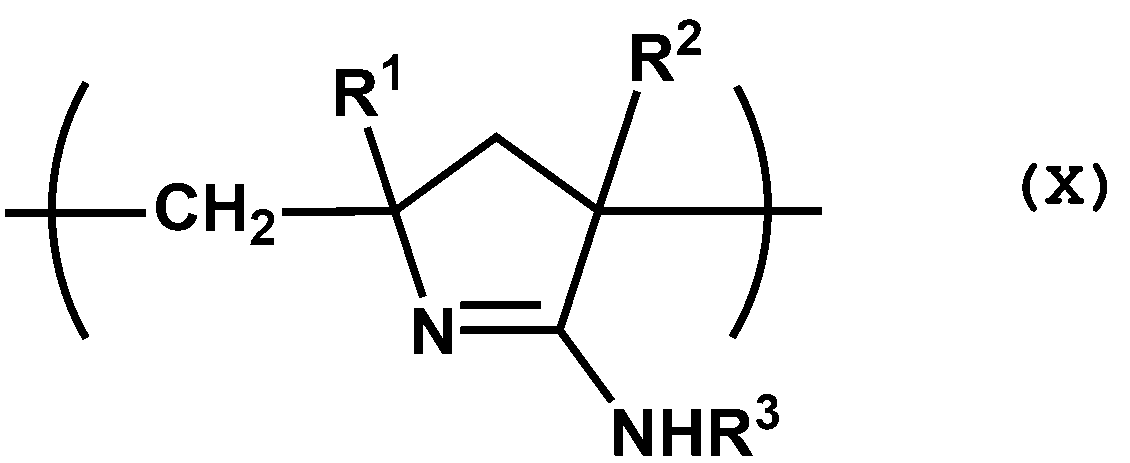
(式中、R1およびR2はそれぞれ独立して、水素原子または炭素数1~3の炭化水素基であり、R3は置換または非置換の直鎖状または分枝状の炭素数3~12のアルキル基、または、置換または非置換の炭素数6~12の芳香族基のいずれかを少なくとも含む、疎水性構成単位である。)
で表される構造単位を有する、[1]に記載のカチオン電着塗料組成物。
[3]
前記ポリアミジン化合物またはその疎水化変性体(E)の固形分質量は、前記カチオン電着塗料組成物の固形分質量の0.2ppm以上1,200ppm以下である、[1]または[2]に記載のカチオン電着塗料組成物。
[4]
前記ポリアミジン化合物またはその疎水化変性体(E)の重量平均分子量は、5万以上である、[1]~[3]のいずれかに記載のカチオン電着塗料組成物。
[5]
前記顔料(D)は、体質顔料を含む、[1]~[4]のいずれかに記載のカチオン電着塗料組成物。
[6]
前記カチオン電着塗料組成物は、有機スズ化合物を含まないか、あるいは、有機スズ化合物の含有量が、0.25質量%以下である、[1]~[5]のいずれかにに記載のカチオン電着塗料組成物。
[7]
前記アミン化エポキシ樹脂(A)が、アミン化合物とエポキシ樹脂を反応させることで得られるアミン化エポキシ樹脂であり、
前記アミン化合物が、第1アミンと第2アミンとの2種類の組合せであり、
前記第1アミンが、式:
NH2-(CH2)n-NR11R12
(式中、R11およびR12は、同一または異なって、末端に水酸基を有してもよい炭素数1~6のアルキル基を表し、nは2~4の整数を表す。)
を有し、
前記第2アミンが式:
R13R14NH
(式中、R13およびR14は、同一または異なって、末端に水酸基を有する炭素数1~4のアルキル基を表す。)
を有する、か、または
前記アミン化合物は、ケチミン化合物およびジケチミン化合物からなる群から選択される1種または2種以上を含む、
[1]~[6]のいずれかに記載のカチオン電着塗料組成物。
[8]
前記ブロック化ポリイソシアネート硬化剤(C)は、オキシム化合物を含むブロック剤 とポリイソシアネートとのブロック化反応生成物である、オキシムブロック化イソシアネート硬化剤を含み、前記ブロック化反応におけるポリイソシアネートは、芳香族ポリイソシアネート化合物、脂肪族ポリイソシアネート化合物および脂環式ポリイソシアネート化合物からなる群から選択される1種または2種以上を含む、
[1]~[7]のいずれかに記載のカチオン電着塗料組成物。
[9]
被塗物と、
前記被塗物上に、[1]~[8]のいずれかに記載のカチオン電着塗料組成物により形成された電着塗膜と、を有する電着塗装物。
[10]
[1]~[8]のいずれかに記載のカチオン電着塗料組成物に被塗物を浸漬した後、前記被塗物と対極との間に電圧を印加して、前記被塗物に未硬化の電着塗膜を形成する工程と、
前記未硬化の電着塗膜を75℃以上200℃以下の温度で加熱して、硬化された電着塗膜を得る工程と、を備える、電着塗装物の製造方法。
[1]
アミン化エポキシ樹脂(A)と、
アミン化アクリル樹脂(B)と、
ブロック化ポリイソシアネート硬化剤(C)と、
顔料(D)と、
ポリアミジン化合物またはその疎水化変性体(E)と、を含み、
前記ポリアミジン化合物またはその疎水化変性体(E)は、下記一般式(I):
で表される構成単位を有する、カチオン電着塗料組成物。
[2]
前記ポリアミジン化合物の疎水化変性体が、構成単位(I)に加えて、不飽和ニトリルに由来する環化構造単位または以下の一般式(X):
(式中、R1およびR2はそれぞれ独立して、水素原子または炭素数1~3の炭化水素基であり、R3は置換または非置換の直鎖状または分枝状の炭素数3~12のアルキル基、または、置換または非置換の炭素数6~12の芳香族基のいずれかを少なくとも含む、疎水性構成単位である。)
で表される構造単位を有する、[1]に記載のカチオン電着塗料組成物。
[3]
前記ポリアミジン化合物またはその疎水化変性体(E)の固形分質量は、前記カチオン電着塗料組成物の固形分質量の0.2ppm以上1,200ppm以下である、[1]または[2]に記載のカチオン電着塗料組成物。
[4]
前記ポリアミジン化合物またはその疎水化変性体(E)の重量平均分子量は、5万以上である、[1]~[3]のいずれかに記載のカチオン電着塗料組成物。
[5]
前記顔料(D)は、体質顔料を含む、[1]~[4]のいずれかに記載のカチオン電着塗料組成物。
[6]
前記カチオン電着塗料組成物は、有機スズ化合物を含まないか、あるいは、有機スズ化合物の含有量が、0.25質量%以下である、[1]~[5]のいずれかにに記載のカチオン電着塗料組成物。
[7]
前記アミン化エポキシ樹脂(A)が、アミン化合物とエポキシ樹脂を反応させることで得られるアミン化エポキシ樹脂であり、
前記アミン化合物が、第1アミンと第2アミンとの2種類の組合せであり、
前記第1アミンが、式:
NH2-(CH2)n-NR11R12
(式中、R11およびR12は、同一または異なって、末端に水酸基を有してもよい炭素数1~6のアルキル基を表し、nは2~4の整数を表す。)
を有し、
前記第2アミンが式:
R13R14NH
(式中、R13およびR14は、同一または異なって、末端に水酸基を有する炭素数1~4のアルキル基を表す。)
を有する、か、または
前記アミン化合物は、ケチミン化合物およびジケチミン化合物からなる群から選択される1種または2種以上を含む、
[1]~[6]のいずれかに記載のカチオン電着塗料組成物。
[8]
前記ブロック化ポリイソシアネート硬化剤(C)は、オキシム化合物を含むブロック剤 とポリイソシアネートとのブロック化反応生成物である、オキシムブロック化イソシアネート硬化剤を含み、前記ブロック化反応におけるポリイソシアネートは、芳香族ポリイソシアネート化合物、脂肪族ポリイソシアネート化合物および脂環式ポリイソシアネート化合物からなる群から選択される1種または2種以上を含む、
[1]~[7]のいずれかに記載のカチオン電着塗料組成物。
[9]
被塗物と、
前記被塗物上に、[1]~[8]のいずれかに記載のカチオン電着塗料組成物により形成された電着塗膜と、を有する電着塗装物。
[10]
[1]~[8]のいずれかに記載のカチオン電着塗料組成物に被塗物を浸漬した後、前記被塗物と対極との間に電圧を印加して、前記被塗物に未硬化の電着塗膜を形成する工程と、
前記未硬化の電着塗膜を75℃以上200℃以下の温度で加熱して、硬化された電着塗膜を得る工程と、を備える、電着塗装物の製造方法。
Claims (10)
- アミン化エポキシ樹脂(A)と、
アミン化アクリル樹脂(B)と、
ブロック化ポリイソシアネート硬化剤(C)と、
顔料(D)と、
ポリアミジン化合物またはその疎水化変性体(E)と、を含み、
前記ポリアミジン化合物またはその疎水化変性体(E)は、下記一般式(I):

で表される構成単位を有する、カチオン電着塗料組成物。 - 前記ポリアミジン化合物の疎水化変性体が、構成単位(I)に加えて、不飽和ニトリルに由来する環化構造単位または以下の一般式(X):

(式中、R1およびR2はそれぞれ独立して、水素原子または炭素数1~3の炭化水素基であり、R3は置換または非置換の直鎖状または分枝状の炭素数3~12のアルキル基、または、置換または非置換の炭素数6~12の芳香族基のいずれかを少なくとも含む、疎水性構成単位である。)
で表される構造単位を有する、請求項1に記載のカチオン電着塗料組成物。 - 前記ポリアミジン化合物またはその疎水化変性体(E)の固形分質量は、前記カチオン電着塗料組成物の固形分質量の0.2ppm以上1,200ppm以下である、請求項1または2に記載のカチオン電着塗料組成物。
- 前記ポリアミジン化合物またはその疎水化変性体(E)の重量平均分子量は、5万以上である、請求項1または2に記載のカチオン電着塗料組成物。
- 前記顔料(D)は、体質顔料を含む、請求項1または2に記載のカチオン電着塗料組成物。
- 前記カチオン電着塗料組成物は、有機スズ化合物を含まないか、あるいは、有機スズ化合物の含有量が、0.25質量%以下である、請求項1または2に記載のカチオン電着塗料組成物。
- 前記アミン化エポキシ樹脂(A)が、アミン化合物とエポキシ樹脂を反応させることで得られるアミン化エポキシ樹脂であり、
前記アミン化合物が、第1アミンと第2アミンとの2種類の組合せであり、
前記第1アミンが、式:
NH2-(CH2)n-NR11R12
(式中、R11およびR12は、同一または異なって、末端に水酸基を有してもよい炭素数1~6のアルキル基を表し、nは2~4の整数を表す。)
を有し、
前記第2アミンが式:
R13R14NH
(式中、R13およびR14は、同一または異なって、末端に水酸基を有する炭素数1~4のアルキル基を表す。)
を有する、か、または
前記アミン化合物は、ケチミン化合物およびジケチミン化合物からなる群から選択される1種または2種以上を含む、
請求項1または2に記載のカチオン電着塗料組成物。 - 前記ブロック化ポリイソシアネート硬化剤(C)は、オキシム化合物を含むブロック剤 とポリイソシアネートとのブロック化反応生成物である、オキシムブロック化イソシアネート硬化剤を含み、前記ブロック化反応におけるポリイソシアネートは、芳香族ポリイソシアネート化合物、脂肪族ポリイソシアネート化合物および脂環式ポリイソシアネート化合物からなる群から選択される1種または2種以上を含む、
請求項1または2に記載のカチオン電着塗料組成物。 - 被塗物と、
前記被塗物上に、請求項1または2に記載のカチオン電着塗料組成物により形成された電着塗膜と、を有する電着塗装物。 - 請求項1または2に記載のカチオン電着塗料組成物に被塗物を浸漬した後、前記被塗物と対極との間に電圧を印加して、前記被塗物に未硬化の電着塗膜を形成する工程と、
前記未硬化の電着塗膜を75℃以上200℃以下の温度で加熱して、硬化された電着塗膜を得る工程と、を備える、電着塗装物の製造方法。
Applications Claiming Priority (2)
| Application Number | Priority Date | Filing Date | Title |
|---|---|---|---|
| JP2023-097673 | 2023-06-14 | ||
| JP2023097673A JP7570463B1 (ja) | 2023-06-14 | 2023-06-14 | カチオン電着塗料組成物、電着塗装物および電着塗装物の製造方法 |
Publications (1)
| Publication Number | Publication Date |
|---|---|
| WO2024257445A1 true WO2024257445A1 (ja) | 2024-12-19 |
Family
ID=93151002
Family Applications (1)
| Application Number | Title | Priority Date | Filing Date |
|---|---|---|---|
| PCT/JP2024/013701 Ceased WO2024257445A1 (ja) | 2023-06-14 | 2024-04-03 | カチオン電着塗料組成物、電着塗装物および電着塗装物の製造方法 |
Country Status (2)
| Country | Link |
|---|---|
| JP (1) | JP7570463B1 (ja) |
| WO (1) | WO2024257445A1 (ja) |
Citations (4)
| Publication number | Priority date | Publication date | Assignee | Title |
|---|---|---|---|---|
| JP2000026790A (ja) * | 1998-07-09 | 2000-01-25 | Mitsubishi Chemicals Corp | コーティング用重合体組成物及びその製造法 |
| JP2009183889A (ja) * | 2008-02-07 | 2009-08-20 | Daiyanitorikkusu Kk | 汚泥の脱水処理方法 |
| JP2011524934A (ja) * | 2008-06-19 | 2011-09-08 | ビーエーエスエフ コーティングス ゲゼルシャフト ミット ベシュレンクテル ハフツング | 電着組成物および方法 |
| WO2020262549A1 (ja) * | 2019-06-28 | 2020-12-30 | 関西ペイント株式会社 | カチオン電着塗料組成物 |
-
2023
- 2023-06-14 JP JP2023097673A patent/JP7570463B1/ja active Active
-
2024
- 2024-04-03 WO PCT/JP2024/013701 patent/WO2024257445A1/ja not_active Ceased
Patent Citations (4)
| Publication number | Priority date | Publication date | Assignee | Title |
|---|---|---|---|---|
| JP2000026790A (ja) * | 1998-07-09 | 2000-01-25 | Mitsubishi Chemicals Corp | コーティング用重合体組成物及びその製造法 |
| JP2009183889A (ja) * | 2008-02-07 | 2009-08-20 | Daiyanitorikkusu Kk | 汚泥の脱水処理方法 |
| JP2011524934A (ja) * | 2008-06-19 | 2011-09-08 | ビーエーエスエフ コーティングス ゲゼルシャフト ミット ベシュレンクテル ハフツング | 電着組成物および方法 |
| WO2020262549A1 (ja) * | 2019-06-28 | 2020-12-30 | 関西ペイント株式会社 | カチオン電着塗料組成物 |
Also Published As
| Publication number | Publication date |
|---|---|
| JP2024179113A (ja) | 2024-12-26 |
| JP7570463B1 (ja) | 2024-10-21 |
Similar Documents
| Publication | Publication Date | Title |
|---|---|---|
| JP6608463B2 (ja) | カチオン電着塗料組成物の製造方法 | |
| JP6933645B2 (ja) | カチオン電着塗料組成物 | |
| JP2024149621A (ja) | カチオン電着塗料組成物 | |
| JP2009114468A (ja) | 電着塗膜形成方法および複層塗膜形成方法 | |
| CN102344708A (zh) | 固化电沉积涂膜和多层涂膜的形成方法 | |
| JP2002201410A (ja) | 二層分離型カチオン電着塗料組成物 | |
| JP7587394B2 (ja) | カチオン電着塗料組成物 | |
| JP7064291B2 (ja) | カチオン電着塗料組成物 | |
| EP3747552B1 (en) | Cationic electrodeposition material composition and method for forming cured electrodeposition coating | |
| JP2010037481A (ja) | カチオン電着塗料組成物およびカチオン電着塗装方法 | |
| JP7570463B1 (ja) | カチオン電着塗料組成物、電着塗装物および電着塗装物の製造方法 | |
| JP7538777B2 (ja) | カチオン電着塗料組成物、電着塗装物および電着塗装物の製造方法 | |
| CN101616748A (zh) | 固化电沉积涂膜形成方法和多层涂膜形成方法 | |
| JP3883190B2 (ja) | 塗膜形成方法 | |
| JP2008174819A (ja) | 塗膜形成方法 | |
| JP5996338B2 (ja) | 電着塗料組成物 | |
| JP2001288598A (ja) | カチオン電着塗装方法 | |
| JP2008231452A (ja) | 複層塗膜形成方法 | |
| JP7634360B2 (ja) | カチオン電着塗料組成物、電着塗装方法及びカチオン電着塗膜 | |
| JP7530847B2 (ja) | カチオン電着塗料組成物 | |
| JPWO2008015955A1 (ja) | 複層塗膜形成方法 | |
| JP2022129797A (ja) | カチオン電着塗料組成物 | |
| JP7429332B2 (ja) | カチオン電着塗料組成物、電着塗装物および電着塗装物の製造方法 | |
| JP7744882B2 (ja) | カチオン電着塗料組成物、カチオン電着塗膜および塗装方法 | |
| JP2009221408A (ja) | カチオン性電着塗料組成物 |
Legal Events
| Date | Code | Title | Description |
|---|---|---|---|
| 121 | Ep: the epo has been informed by wipo that ep was designated in this application |
Ref document number: 24823068 Country of ref document: EP Kind code of ref document: A1 |
|
| NENP | Non-entry into the national phase |
Ref country code: DE |
|
| 122 | Ep: pct application non-entry in european phase |
Ref document number: 24823068 Country of ref document: EP Kind code of ref document: A1 |