WO2024257611A1 - Plastic-cleaning method and apparatus - Google Patents
Plastic-cleaning method and apparatus Download PDFInfo
- Publication number
- WO2024257611A1 WO2024257611A1 PCT/JP2024/019639 JP2024019639W WO2024257611A1 WO 2024257611 A1 WO2024257611 A1 WO 2024257611A1 JP 2024019639 W JP2024019639 W JP 2024019639W WO 2024257611 A1 WO2024257611 A1 WO 2024257611A1
- Authority
- WO
- WIPO (PCT)
- Prior art keywords
- temperature
- superheated steam
- low
- plastic
- treatment area
- Prior art date
- Legal status (The legal status is an assumption and is not a legal conclusion. Google has not performed a legal analysis and makes no representation as to the accuracy of the status listed.)
- Ceased
Links
Images
Classifications
-
- B—PERFORMING OPERATIONS; TRANSPORTING
- B08—CLEANING
- B08B—CLEANING IN GENERAL; PREVENTION OF FOULING IN GENERAL
- B08B3/00—Cleaning by methods involving the use or presence of liquid or steam
- B08B3/04—Cleaning involving contact with liquid
-
- B—PERFORMING OPERATIONS; TRANSPORTING
- B29—WORKING OF PLASTICS; WORKING OF SUBSTANCES IN A PLASTIC STATE IN GENERAL
- B29B—PREPARATION OR PRETREATMENT OF THE MATERIAL TO BE SHAPED; MAKING GRANULES OR PREFORMS; RECOVERY OF PLASTICS OR OTHER CONSTITUENTS OF WASTE MATERIAL CONTAINING PLASTICS
- B29B13/00—Conditioning or physical treatment of the material to be shaped
- B29B13/02—Conditioning or physical treatment of the material to be shaped by heating
-
- B—PERFORMING OPERATIONS; TRANSPORTING
- B29—WORKING OF PLASTICS; WORKING OF SUBSTANCES IN A PLASTIC STATE IN GENERAL
- B29B—PREPARATION OR PRETREATMENT OF THE MATERIAL TO BE SHAPED; MAKING GRANULES OR PREFORMS; RECOVERY OF PLASTICS OR OTHER CONSTITUENTS OF WASTE MATERIAL CONTAINING PLASTICS
- B29B17/00—Recovery of plastics or other constituents of waste material containing plastics
- B29B17/02—Separating plastics from other materials
-
- Y—GENERAL TAGGING OF NEW TECHNOLOGICAL DEVELOPMENTS; GENERAL TAGGING OF CROSS-SECTIONAL TECHNOLOGIES SPANNING OVER SEVERAL SECTIONS OF THE IPC; TECHNICAL SUBJECTS COVERED BY FORMER USPC CROSS-REFERENCE ART COLLECTIONS [XRACs] AND DIGESTS
- Y02—TECHNOLOGIES OR APPLICATIONS FOR MITIGATION OR ADAPTATION AGAINST CLIMATE CHANGE
- Y02W—CLIMATE CHANGE MITIGATION TECHNOLOGIES RELATED TO WASTEWATER TREATMENT OR WASTE MANAGEMENT
- Y02W30/00—Technologies for solid waste management
- Y02W30/50—Reuse, recycling or recovery technologies
- Y02W30/62—Plastics recycling; Rubber recycling
Definitions
- the present invention relates to a method and apparatus for cleaning plastics, and more particularly to a method and apparatus for cleaning plastics to remove impurities from used plastics.
- a common method for removing impurities from plastics is washing with an organic solvent or water.
- Patent Document 1 discloses a method of removing impurities by contacting polyethylene with an organic solvent and purifying the solution.
- Patent Document 2 discloses a method of crushing packaging materials (plastic films) and then chemically cleaning them with an acid or alkali for recycling, and
- Patent Document 3 discloses a method of separating foreign matter and plastics by washing with water.
- Patent Document 4 the applicant has proposed a method for removing impurities from plastics by washing with superheated steam as a washing medium.
- Patent Document 4 uses water, so it does not have a negative impact on the environment, does not require large-scale exhaust equipment or waste liquid treatment equipment, and can cleanly remove not only oily stains such as grease and oils adhering to the plastic surface, but also impurities such as oily stains (i.e., sorption components) that have soaked into the plastic, just as when an organic solvent is used as a cleaning medium.
- oily stains i.e., sorption components
- the object of the present invention is therefore to provide a method and apparatus for removing contaminants from plastics using superheated steam treatment, which effectively removes contaminants in a significantly reduced treatment time.
- the inventors discovered that in order to effectively remove contaminants from used plastics by superheated steam treatment and obtain plastics with almost no odor in a short time, it is effective to remove the plastics that have been kept at high temperatures for cleaning from the superheated steam treatment area not immediately, but by allowing the temperature to drop appropriately while undergoing superheated steam treatment, and then removing them from the superheated steam treatment area, thus completing the present invention.
- a superheated steam treatment area maintained at a temperature of 100° C. or more is provided in a conveying path, and plastics are introduced into the superheated steam treatment area through which superheated steam flows to perform cleaning of the plastics
- the superheated steam treatment area is formed of a high-temperature treatment area to which relatively high-temperature superheated steam is supplied and a low-temperature treatment area to which relatively low-temperature superheated steam is supplied, the high-temperature treatment area and the low-temperature treatment area are continuous with each other,
- the plastic is continuously transferred from the high temperature processing area to the low temperature processing area for superheated steam processing; continuously removing treated plastic from said low temperature treatment zone; A method for cleaning plastics is provided.
- the following means are preferably used: (1) Superheated steam having a temperature of 100°C to 150°C is supplied to the low-temperature treatment area, and superheated steam having a temperature 20°C or more higher than that of the superheated steam supplied to the low-temperature treatment area is supplied to the high-temperature treatment area. (2) The time during which the plastic passes through the high-temperature treatment area is set to be longer than the time during which the plastic passes through the low-temperature treatment area. (3) The plastic to be processed is used plastic. (4) The oxygen concentration in the superheated steam treatment area is adjusted to 5% or less throughout the area.
- a plastic washing apparatus including a superheated steam treatment chamber to which a steam supply pipe and a steam exhaust pipe are connected and which is maintained at a temperature of 100° C. or higher, and a plastic transport member passing through the superheated steam treatment chamber, the superheated steam treatment chamber is provided with a high-temperature treatment region located on an inlet side of the plastic and supplied with relatively high-temperature superheated steam, and a low-temperature treatment region located on an outlet side of the plastic and supplied with relatively low-temperature superheated steam, the steam supply pipe is connected to each of the high temperature processing area and the low temperature processing area;
- a plastic cleaning device is provided, comprising: In such a plastic washing device, (5) The steam exhaust pipe is connected to each of the high temperature treatment area and the low temperature treatment area; is preferred.
- the plastic washing method of the present invention involves supplying the plastic to be treated (specifically used plastic) to a superheated steam treatment area maintained at a temperature of 100°C or higher and washing with superheated steam, but this treatment area is divided into a high-temperature treatment area and a low-temperature treatment area, and the plastic is passed continuously from the high-temperature treatment area to the low-temperature treatment area and continuously removed.
- the plastic following the superheated steam treatment in the high-temperature treatment area, the plastic is continuously removed while the treatment temperature is lowered in the presence of superheated steam, eliminating the need for a post-process dehydration process, and effectively washing in a very short time, not only effectively removing contaminants but also obtaining plastic that has almost no odor.
- This type of washing process effectively removes foreign matter, and not only removes contaminants, but also preferably washes away (deodorizes) odorous components resulting from the decomposition of the plastic or contaminants.
- the treatment chamber was divided into a high-temperature treatment area and a low-temperature treatment area, and superheated steam set at a temperature of 220° C. was supplied to the high-temperature treatment area, and superheated steam set at a temperature of 150° C. was supplied to the low-temperature treatment area, and cleaning with superheated steam was performed continuously.
- the conveying speed of the plastic was set so that the treatment time (passage time) in the high-temperature treatment area was 5 minutes, and the treatment time (passage time) in the low-temperature treatment area was 2 minutes, and the total treatment time in the treatment chamber was quite short at 7 minutes.
- the inventors have concluded that while the cleaning time at high temperatures is important when using superheated steam treatment, if plastic kept at a relatively high temperature is kept in an atmosphere with a high oxygen content for a long period of time, the deterioration of the plastic will progress, and the amount of pollutants (acids and aldehydes) that cause odors will increase, causing the generation of odors.
- the present invention has succeeded in sufficiently removing pollutants in a short period of time and effectively suppressing the generation of odors by continuously performing superheated steam treatment while preventing the plastic from being kept in the atmosphere at a temperature above a certain level.
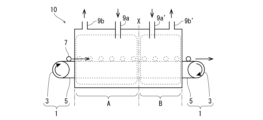
- FIG. 1 is a schematic diagram showing a cleaning device for carrying out the method of the present invention.
- the cleaning apparatus designated by the numeral 10
- the cleaning apparatus has a high-temperature treatment chamber A (high-temperature treatment area) and a low-temperature treatment chamber B (low-temperature treatment area) arranged side by side in series, and a continuous conveying device 1 is provided so as to pass through the interior of these chambers.
- the continuous conveying device 1 is composed of a pair of conveying rollers 3, 3 and a conveying belt 5 stretched between the conveying rollers 3, 3.
- the conveying belt 5 is driven by the rotation of the conveying rollers 3, 3, and the plastic 7 to be treated is continuously conveyed from the high-temperature treatment chamber A to the low-temperature treatment chamber B, from which it is removed to the outside.
- the high-temperature processing chamber A and the low-temperature processing chamber B are connected to each other, and there is no partition between them.
- Each processing chamber is provided with its own steam supply pipe (9a and 9a') and steam exhaust pipe (9b and 9b'). That is, in the high-temperature processing chamber A, high-temperature steam is supplied from the steam supply pipe 9a and exhausted from the steam exhaust pipe 9b, and in the low-temperature processing chamber B, low-temperature steam is supplied from the steam supply pipe 9a' and exhausted from the steam exhaust pipe 9b'.
- the superheated steam introduced creates a high-temperature atmosphere in the high-temperature processing chamber A, and a low-temperature atmosphere compared to the high-temperature processing chamber A is created in the low-temperature processing chamber B.
- the high-temperature treatment chamber A is provided with a steam exhaust pipe 9b
- the low-temperature treatment chamber B is provided with a steam exhaust pipe 9b', but depending on the overall capacity of the cleaning device 10 and the steam supply speed from the steam supply pipe 9a or 9a', it is possible to use only one steam exhaust pipe.
- a steam exhaust pipe 9b for exhausting high-temperature superheated steam in the high-temperature treatment chamber A and a steam exhaust pipe 9b' for exhausting low-temperature superheated steam in the low-temperature treatment chamber B with dedicated steam exhaust pipes provided for each, as shown in FIG. 1.
- inert gas such as nitrogen can be appropriately supplied and discharged from these steam supply pipes 9a and 9a', so that the atmosphere in the high-temperature processing chamber A and the low-temperature processing chamber B can be replaced with the inert gas, and the oxygen concentration in the chambers can be further reduced.
- the supply of the inert gas is not limited to the above-mentioned method as long as it is possible to reduce the oxygen concentration in the high-temperature processing chamber A and the low-temperature processing chamber B, and a method of supplying the inert gas from a source other than the steam supply pipes 9a and 9a' may also be used.
- cleaning equipment examples include a series of high-temperature treatment chambers (high-temperature treatment zones) with different temperature settings, each of which is provided with its own steam supply pipe (and even a steam exhaust pipe), allowing each chamber to be set to an arbitrary temperature depending on the plastic being treated.
- the cleaning device 10 is also constructed so that the atmosphere in the high-temperature processing chamber A and the low-temperature processing chamber B is maintained at 100°C or higher, condensation of the supplied superheated steam is prevented (particularly at the inlet and outlet sides of the device), and the temperature sprayed onto the plastic 7 in each processing chamber A and B is maintained at the set temperature by a heater or the like.
- ⁇ Cleaning medium> impurities are removed from plastics using the above-mentioned cleaning device 10, and superheated steam (i.e., water) is used as the cleaning medium.
- superheated steam i.e., water
- This superheated steam has a lower dielectric constant due to heating compared to water at 100° C. or less, and for example, superheated steam with a relative dielectric constant of 60 or less, preferably 40 or less, more preferably 25 or less, and even more preferably 10 or less is used.
- the relative dielectric constant of water at room temperature is significantly higher than that of organic solvents, making it a unique polar solvent, which has poor affinity (oil repellency) for organic components (oil components such as fats and oils), making it difficult to remove dirt.
- the relative dielectric constant decreases as the temperature increases. As can be understood from this, cleaning is performed with water (superheated steam) that is in a state close to that of an organic solvent, with the dielectric constant being reduced by heating.
- Patent Document 4 also provides a detailed explanation of the method of measuring the relative dielectric constant, but when water is heated to about 200°C, its relative dielectric constant becomes about 35, which is close to the relative dielectric constant of methanol at room temperature, and when heated to about 300°C, its relative dielectric constant becomes about 20, which is close to the relative dielectric constant of acetone at room temperature, and when heated further and near the critical point, it becomes the same as non-polar organic solvents such as chloroform and ethyl ether.
- the superheated steam used as the cleaning medium is in a state close to an organic solvent due to its non-polarity caused by its low dielectric constant, and furthermore, due to this low dielectric constant, the water becomes high-temperature steam at over 100° C.
- the polymer chains that make up the plastic loosen, and the low-dielectric water easily penetrates into the plastic.
- water vapor which has been made to have a low dielectric constant and become nearly non-polar like an organic solvent, and which has been heated to a high temperature to reduce the dielectric constant, as a cleaning medium, impurities adhering to the surface of plastics and impurities sorbed within the plastics can be effectively removed.
- the water used as the cleaning medium may be in a state called superheated steam, subcritical water, or supercritical water, for example, in high-temperature treatment chamber A, due to heating to reduce the dielectric constant as described above.
- the plastic to be cleaned is a so-called used plastic, and any plastic can be used as long as it is not decomposed by cleaning with heated steam as described above.
- preferred examples include olefin resins that are widely recycled by sorting and recovery, such as low-density polyethylene, linear low-density polyethylene, medium or high-density polyethylene, polypropylene, poly-1-butene, and poly-4-methyl-1-pentene.
- ⁇ -olefins such as ethylene, propylene, 1-butene, and 4-methyl-1-pentene
- cyclic olefin copolymers disclosed in JP-A-2007-284066 and the like can also be suitably used.
- Such olefin resins are chemically very stable, and when cleaning with high-temperature water with a low dielectric constant, not only is there little risk of hydrolysis, but they can also be easily recovered.
- EVOH ethylene-vinyl alcohol copolymer
- the effects of the present invention are maximized.
- EVOH is a resin that is widely used in the field of packaging materials as a gas barrier resin, and prevents oxidative deterioration of packaged materials by blocking the permeation of oxygen.
- it is susceptible to thermal degradation, and has the property of generating odorous components such as acids and aldehydes due to thermal degradation.
- the treatment method of the present invention the generation of odorous components can be effectively prevented even when EVOH is contained.
- the used plastics are collected from waste plastic molded products (such as containers and lids), appropriately separated from other molded products of different materials, and subjected to crushing, washing, separation by specific gravity, etc. to remove as much foreign matter as possible.
- waste plastic molded products such as containers and lids
- specific gravity, etc. to remove as much foreign matter as possible.
- the plastics it is preferable for the plastics to be crushed into a flake or granular form, and in particular those with a mesh diameter of 10 mm or less, more preferably 8 mm or less, and even more preferably 6 mm or less.
- the above-mentioned cleaning of plastics i.e., the cleaning process for removing contaminants, is carried out using the cleaning apparatus 10 described above. That is, by continuously driving the conveyor device 1 (conveyor belt 5), used plastics 7 are continuously introduced into the cleaning device 10, and the plastics are cleaned by spraying superheated steam onto them in the cleaning device 10, and the cleaned plastics are continuously removed from the cleaning device 10.
- the present invention makes it possible to obtain plastics from which contaminants have been removed in an extremely short period of time.
- the above-mentioned cleaning device 10 is divided into a high-temperature processing chamber A and a low-temperature processing chamber B. While the plastic 7 is being transported, a cleaning process using relatively high-temperature superheated steam is carried out in the high-temperature processing chamber A, and then a cleaning process using relatively low-temperature superheated steam is carried out in the low-temperature processing chamber B.
- the high-temperature treatment chamber A is structured to be kept at a high temperature using a heater or the like, while the low-temperature treatment chamber B is structured so that the interior atmosphere is cooled using a heat exchanger, and the temperature of the water vapor supplied can be made lower than that of the high-temperature treatment chamber A.
- low-temperature treatment chamber B is supplied with water vapor at a relatively lower temperature than that in high-temperature treatment chamber A, for example, water vapor at a temperature preferably between 100°C and 150°C, more preferably between 100°C and 135°C, and even more preferably between 100°C and 120°C, and is set so as to be sprayed onto the plastics 7 being continuously transported.
- water vapor at a temperature preferably between 100°C and 150°C, more preferably between 100°C and 135°C, and even more preferably between 100°C and 120°C
- the high-temperature treatment chamber A is set up so that superheated steam at a higher temperature is sprayed compared to the low-temperature treatment chamber B.
- superheated steam at a temperature at least 20°C higher, preferably 35°C or higher, and more preferably 50°C higher than the superheated steam supplied in the low-temperature treatment chamber B is supplied and sprayed onto the plastic 7 being continuously transported.
- sorbed substances such as oil stains adhering to the plastic surface and oil stains that have penetrated into the plastic can be effectively cleaned and removed.
- the high-temperature treatment chamber A since the high-temperature treatment chamber A is connected to the low-temperature treatment chamber B, there is an overall temperature distribution in the high-temperature treatment chamber A and the low-temperature treatment chamber B, with the atmospheric temperature at the outlet side of the low-temperature treatment chamber B being the lowest.
- the maximum temperature in the high-temperature treatment chamber A is set to 300°C or less, more preferably 260°C or less, and even more preferably 230°C or less. If this maximum temperature is higher than necessary, it may cause decomposition of the plastic 7, or it may become difficult to adjust the temperature in the next low-temperature treatment chamber B, making it difficult to complete the treatment in a short time.
- the low-temperature treatment chamber B which is provided adjacent to the high-temperature treatment chamber A, is supplied with water vapor at a lower temperature than the superheated steam supplied to the high-temperature treatment chamber A to perform the cleaning process, thereby effectively suppressing deterioration of the plastic 7.
- Example 12 of Patent Document 4 if there is no low-temperature treatment chamber B and the temperature of the treatment chamber A is lowered and cooled after the treatment in the high-temperature treatment chamber A, this becomes a so-called batch process rather than a continuous process, and cooling takes a long time, making it impossible to complete cleaning in a short time.
- the plastics 7 maintained at a high temperature are cleaned with superheated steam without coming into direct contact with the atmosphere having a high oxygen concentration. That is, if the plastics 7 were to come into contact with the atmosphere at a high temperature, it would deteriorate, and as shown in the experimental example described later, aldehyde would be produced, which would result in the generation of an odor. Therefore, in this low-temperature treatment chamber B, cleaning is performed with superheated steam, so the temperature at the outlet side must be maintained at at least 100° C. to prevent condensation of the superheated steam.
- the temperature at the outlet side is excessively high, the temperature of the plastics 7 cleaned in the high-temperature treatment chamber A will not be sufficiently reduced, and the plastics 7 treated with superheated steam will come into contact with the atmosphere at a high temperature, causing deterioration of the plastics 7, increasing the amount of aldehyde generated, and causing a strong odor.
- the high-temperature processing chamber A and the low-temperature processing chamber B are not separated by a partition or the like, but are connected to each other. For this reason, the two chambers A and B cannot be strictly distinguished from each other.
- the temperature gradient from the high-temperature processing chamber A to the low-temperature processing chamber B can be confirmed by measuring the temperature of the upper surface of the conveyor belt 5 running through the processing chambers A and B or its vicinity with a thermocouple or the like in advance laboratory tests, thereby confirming the ambient temperature (or temperature gradient) in the high-temperature processing chamber A where the processing with high-temperature superheated steam is performed, and the ambient temperature (or temperature gradient) in the low-temperature processing chamber B where the processing with low-temperature superheated steam is performed.
- the residence time in the high-temperature treatment chamber A long and the residence time in the low-temperature treatment chamber B short.
- the low-temperature treatment chamber B is an area whose main purpose is to suppress the deterioration of the plastic 7 rather than to remove contaminants, and there is no need to set the residence time long, as long as the residence time required to lower the temperature to a certain level is ensured.
- the residence time in the high-temperature treatment chamber A can be set long by positioning the steam supply pipe 9a for supplying high-temperature superheated steam closer to the outlet side than the center.
- the residence time in the high-temperature treatment chamber A can be set long by providing multiple high-temperature treatment chambers (high-temperature treatment areas) in succession and providing a dedicated steam supply pipe (and even a steam exhaust pipe) for each high-temperature treatment chamber.
- the residence time in the two chambers A and B can be set arbitrarily by installing a transport device in each of the high-temperature treatment chambers A and B and connecting them.
- the temperature gradient in the high-temperature processing chamber A and the low-temperature processing chamber B can be measured by the method described above, and the position where the temperature drops sharply can be set as the boundary line X between the high-temperature processing chamber A and the low-temperature processing chamber B.
- the residence time in the high-temperature processing chamber A and the residence time of the continuously transported plastic 7 in the low-temperature processing chamber B can be set.
- the residence time in the high-temperature processing chamber A (the passage time of the plastic 7) set in this way is longer than the residence time in the low-temperature processing chamber B.
- the residence time in the low-temperature processing chamber B is about 95 to 10% of the residence time in the high-temperature processing chamber A.
- the oxygen concentration is adjusted to 5% or less throughout, more preferably 3% or less, and further preferably 1% or less.
- the amount of superheated steam supplied (kg/h) to the high-temperature treatment chamber A and the low-temperature treatment chamber B to which the superheated steam is supplied a state in which the oxygen concentration is maintained low can be obtained.
- Plastics from which impurities (organic impurities such as oily stains from grease and oils) have been removed in a shorter time by the above-mentioned cleaning process are less likely to deteriorate and produce less odor, so they can be pelletized by melt extrusion, either alone or after being molten and mixed with virgin plastic using an extruder or the like, and then molded again as recycled plastic, and reused as packaging containers, etc.
- the plastic after cleaning can also be reused as a recycled product as is.
- the present invention does not require large-scale exhaust equipment or waste liquid treatment equipment, and can remove contaminants from used plastics in an extremely short time, just as when organic solvents are used, making it an extremely useful technology for recycling plastics.
- Sample to be cleaned Sample A was used as the plastic to be cleaned. This was flakes obtained by crushing a high-density polyethylene bottle after filling it with edible oil. The sample was left untreated and the aldehydes were measured in the same manner as in the experimental example described below. As a reference, the same measurement was also carried out on sample A0, which was flakes obtained by crushing a high-density polyethylene bottle not filled with oil.
- the SPME fiber was measured using a gas chromatography mass spectrometer (Agilent Technology GC/MS GC-7890A, MSD-5975C) to desorb the components adsorbed on the SPME fiber, and the components separated by gas chromatography were detected and analyzed by mass spectrometry to qualitatively and quantitatively identify the impurity components.
- a gas chromatography mass spectrometer Alignment Technology GC/MS GC-7890A, MSD-5975C
- Example 1 The above-mentioned sample A was used as the plastic to be cleaned. Sample A was placed on the conveying device 1 (conveyor belt 5) and treated by passing through the high-temperature treatment chamber A filled with superheated steam at 220°C for 5 minutes, and then passed through the low-temperature treatment chamber B filled with superheated steam at 150°C for 2 minutes, and sample A was removed from the cleaning device 10. In this case, the treatment time was 7 minutes. In addition, the water supply rate of superheated steam was 20 kg/h for a sample charge of 10 g. The obtained sample was pretreated by solid-phase microextraction and aldehydes were measured by gas chromatography mass spectrometry.
- the position of the boundary line X between the high-temperature processing chamber A and the low-temperature processing chamber B was determined by measuring the temperature distribution on the conveyor belt 5 and determining the portion where the temperature suddenly drops from 220° C. to 150° C.
- the evaluation results are shown in Table 1.
- Example 2 The same treatment and measurement as in Experimental Example 1 were carried out, except that the temperature of the superheated steam in the low-temperature treatment chamber B was set to 100° C. The evaluation results are shown in Table 1. The boundary line X between the high temperature processing chamber A and the low temperature processing chamber B was almost the same as in the first experimental example.
- Example 3 The same treatment and measurement as in Experimental Example 1 were carried out, except that the superheated steam temperature in the high-temperature treatment chamber A was 200° C. and the superheated steam temperature in the low-temperature treatment chamber B was 100° C. In this example, too, the boundary line X between the high-temperature treatment chamber A and the low-temperature treatment chamber B was almost the same as in Experimental Example 1. The evaluation results are shown in Table 1.
- Example 4 The same treatment and measurement as in Experimental Example 1 were carried out, except that the temperature of the superheated steam in the low-temperature treatment chamber B was set to 100° C. and the treatment was carried out by passing the superheated steam through the low-temperature treatment chamber B for 10 minutes. The evaluation results are shown in Table 1.
- Example 5 The same processing and measurement as in Experimental Example 1 were carried out, except that the low-temperature processing chamber B was not used (the entire cleaning apparatus 10 was filled with superheated steam at 220° C.) and the sample A was immediately removed from the cleaning apparatus 10. In other words, the entire cleaning apparatus 10 was the high-temperature processing apparatus A, and the low-temperature processing chamber B was not provided.
- the evaluation results are shown in Table 1.
- Example 6 The same treatment and measurement as in Experimental Example 3 were carried out, except that the entire cleaning device 10 was filled with superheated steam at 200° C., sample A was passed through it for 5 minutes, and then immediately removed. In this example, the entire cleaning device 10 was the high-temperature treatment device A, and no low-temperature treatment chamber B was provided. The evaluation results are shown in Table 1.
- Example 7 The entire cleaning apparatus 10 was filled with superheated steam at 150° C., and the sample A was passed through it for 7 minutes and then removed. Except for this, the same treatment and measurement as in Experimental Example 1 were carried out. In other words, the entire cleaning apparatus 10 was the high-temperature treatment apparatus A, and the low-temperature treatment chamber B was not provided. The evaluation results are shown in Table 1.
- Example 8 The cleaning device 10 was entirely filled with superheated steam at 100° C., and sample A was passed through it for 7 minutes and then removed, but the same treatment and measurement as in Experimental Example 7 were carried out. That is, in this example, the entire cleaning apparatus 10 is a high-temperature processing apparatus A, and a low-temperature processing chamber B is not provided. The evaluation results are shown in Table 1.
- Example 9 (Batch type) Sample A was placed in a batch-type reactor filled with superheated steam at 240° C. and treated for 5 minutes. After completion of the treatment, the reactor was opened at the treatment temperature and sample A was taken out. In this case, the treatment time was 5 minutes. The amount of superheated steam supplied was 20 kg/h for a sample charge of 10 g. The obtained sample was subjected to measurement of aldehydes by gas chromatography mass spectrometry in the same manner as in Experimental Example 1. The evaluation results are shown in Table 1.
- Example 10 (Batch type) Sample A was placed in a batch-type reactor filled with superheated steam at 240° C., treated for 5 minutes, and then cooled to 150° C. in a superheated steam atmosphere before opening the reactor and removing the sample. The measurements were carried out in the same manner as in Experimental Example 9. The evaluation results are shown in Table 1. At this time, it took 20 minutes to lower the temperature to 150° C., and the total treatment time was 25 minutes. In Table 1, the low-temperature treatment chamber B is described as cooling chamber B.
Landscapes
- Engineering & Computer Science (AREA)
- Mechanical Engineering (AREA)
- Environmental & Geological Engineering (AREA)
- Physics & Mathematics (AREA)
- Thermal Sciences (AREA)
- Treatments Of Macromolecular Shaped Articles (AREA)
- Separation, Recovery Or Treatment Of Waste Materials Containing Plastics (AREA)
- Glass Compositions (AREA)
- Cleaning By Liquid Or Steam (AREA)
- Processing And Handling Of Plastics And Other Materials For Molding In General (AREA)
Abstract
Description
本発明は、プラスチックの洗浄方法及び装置に関するものであり、より詳細には、使用済みプラスチックから不純物質を除去するためのプラスチックの洗浄方法及び装置に関する。 The present invention relates to a method and apparatus for cleaning plastics, and more particularly to a method and apparatus for cleaning plastics to remove impurities from used plastics.
近年における環境保護の観点から、フィルムや容器などの各種プラスチック成形品についても、リサイクル使用が求められている。プラスチックのリサイクルに際しては、プラスチック成形品を、その形態を損なわずにそのまま再利用する場合のみならず、これを粉砕し、粒状物やペレットの形態で回収し、再生プラスチックとして再び成形に供する場合もある。 In recent years, from the perspective of environmental protection, there has been a demand for the recycling of various plastic molded products such as films and containers. When recycling plastics, not only can the plastic molded products be reused as they are without damaging their shape, but they can also be crushed and collected in the form of granules or pellets, which can then be molded again as recycled plastic.
何れの形態でプラスチックを再利用する場合にも、使用により汚れたプラスチックから不純物質を取り除く必要がある。
プラスチックから不純物質を除去する方法としては、有機溶媒や水などを用いて洗浄することが一般的な方法である。
In any form of plastic recycling, it is necessary to remove impurities from the plastic that have become contaminated through use.
A common method for removing impurities from plastics is washing with an organic solvent or water.
例えば、特許文献1には、ポリエチレンを有機溶媒に接触させて、その溶液を精製することにより不純物質を除去する方法が開示されている。
また、特許文献2には、梱包材(プラスチックフィルム)を破砕後、酸またはアルカリで化学洗浄して再資源化処理することが開示されており、特許文献3には、水洗により異物とプラスチックを分離することが開示されている。
For example,
Furthermore, Patent Document 2 discloses a method of crushing packaging materials (plastic films) and then chemically cleaning them with an acid or alkali for recycling, and
ところで、プラスチックからの不純物質の除去を、有機溶媒を媒体として用いる場合には、環境汚染の問題があり、排気システムや有機溶媒の廃液処理などに要するコストが大きいという問題がある。また、酸やアルカリを洗浄媒体として用いた場合には、環境汚染の問題を回避できるが、設備が重厚長大となる。 However, when organic solvents are used as a medium to remove impurities from plastics, there are problems with environmental pollution and the high costs required for exhaust systems and waste treatment of organic solvents. In addition, when acids or alkalis are used as cleaning media, the problem of environmental pollution can be avoided, but the equipment required is large and heavy.
一方、水を洗浄媒体として用いた場合には、廃液処理の問題は生じないといってよい。しかしながら、洗浄性の点では、有機溶媒に大きく劣っており、プラスチックの表面に付着した油脂等の油汚れに対する洗浄性が不十分であり、さらに、プラスチックの内部に吸収されている収着物質にいたってはほとんど除去することができない。 On the other hand, when water is used as the cleaning medium, it can be said that there are no problems with waste liquid treatment. However, in terms of cleaning ability, water is far inferior to organic solvents, and is insufficient for cleaning oily stains such as grease and oils that adhere to the surface of plastics, and furthermore, it is almost unable to remove sorbed substances that are absorbed inside the plastic.
したがって、水を用いての洗浄により効果的に油汚れやプラスチック内部の収着物質の除去を行うことができれば、最も好ましい。特許文献4には、このような観点から、過熱水蒸気を洗浄媒体として用いての洗浄により、プラスチックから不純物質を除去する方法が、本出願人により提案されている。 It would therefore be most desirable if oily stains and sorbed substances inside plastics could be effectively removed by washing with water. From this perspective, in Patent Document 4, the applicant has proposed a method for removing impurities from plastics by washing with superheated steam as a washing medium.
特許文献4の方法では、水を用いているため、環境に悪影響を与えることがなく、大掛かりな排気設備や廃液処理設備は不要であり、プラスチック表面に付着した油脂等の油汚れは勿論のこと、プラスチックの内部に浸み込んだ油汚れ(即ち、収着成分)等の不純物質を、有機溶媒を洗浄媒体として用いた場合と同様に、きれいに除去することができるのであるが、洗浄に時間がかかるという点で、未だ改善の余地がある。即ち、十分に時間をかけて過熱水蒸気処理を行わないと、臭いが十分に取り除かれていないという問題があった。特に使用済みプラスチックがポリプロピレンを主体としているとき、臭いを取り除くのに長時間を要していた。 The method of Patent Document 4 uses water, so it does not have a negative impact on the environment, does not require large-scale exhaust equipment or waste liquid treatment equipment, and can cleanly remove not only oily stains such as grease and oils adhering to the plastic surface, but also impurities such as oily stains (i.e., sorption components) that have soaked into the plastic, just as when an organic solvent is used as a cleaning medium. However, there is still room for improvement in that cleaning takes time. In other words, there was a problem that odors were not sufficiently removed unless the superheated steam treatment was performed over a sufficient period of time. In particular, when the used plastic was mainly made of polypropylene, it took a long time to remove the odor.
従って、本発明の目的は、過熱水蒸気処理によりプラスチックから汚染物質を除去する方法において、大幅に短縮された処理時間で汚染物質が効果的に除去される方法及び装置を提供することにある。 The object of the present invention is therefore to provide a method and apparatus for removing contaminants from plastics using superheated steam treatment, which effectively removes contaminants in a significantly reduced treatment time.
本発明者等は、上記課題について多くの実験を行い検討した結果、使用済みプラスチックから過熱水蒸気処理により汚染物質を効果的に除去し、ほとんど臭わないプラスチックを短時間で得るためには、洗浄のために高温に保持されたプラスチックを、直ちに過熱水蒸気処理域から取り出すのではなく、過熱水蒸気処理を行いながら適度に温度降下させた後に、過熱水蒸気処理領域から取り出すことが効果的であるという知見を見出し、本発明を完成させるに至った。 After conducting numerous experiments and studies into the above-mentioned problems, the inventors discovered that in order to effectively remove contaminants from used plastics by superheated steam treatment and obtain plastics with almost no odor in a short time, it is effective to remove the plastics that have been kept at high temperatures for cleaning from the superheated steam treatment area not immediately, but by allowing the temperature to drop appropriately while undergoing superheated steam treatment, and then removing them from the superheated steam treatment area, thus completing the present invention.
即ち、本発明によれば、100℃以上の温度に保持されている過熱水蒸気処理領域が搬送路に設けられており、過熱水蒸気が流されている該過熱水蒸気処理領域に、プラスチックを導入して洗浄を行うプラスチックの洗浄方法であって、
前記過熱水蒸気処理領域が、相対的に高温の過熱水蒸気が供給される高温処理領域と、相対的に低温の過熱水蒸気が供給される低温処理領域とから形成されており、該高温処理領域と低温処理領域とが連続していると共に、
前記プラスチックを、前記高温処理領域から前記低温処理領域に連続的に移送して過熱水蒸気処理を行い、
処理済みプラスチックを、前記低温処理領域から連続的に取り出すこと、
を特徴とするプラスチックの洗浄方法が提供される。
That is, according to the present invention, a superheated steam treatment area maintained at a temperature of 100° C. or more is provided in a conveying path, and plastics are introduced into the superheated steam treatment area through which superheated steam flows to perform cleaning of the plastics,
The superheated steam treatment area is formed of a high-temperature treatment area to which relatively high-temperature superheated steam is supplied and a low-temperature treatment area to which relatively low-temperature superheated steam is supplied, the high-temperature treatment area and the low-temperature treatment area are continuous with each other,
The plastic is continuously transferred from the high temperature processing area to the low temperature processing area for superheated steam processing;
continuously removing treated plastic from said low temperature treatment zone;
A method for cleaning plastics is provided.
本発明の方法においては、次の手段が好適に使用される。
(1)前記低温処理領域には、100℃~150℃の温度の過熱水蒸気が供給され、前記高温処理領域には、該低温処理領域に供給される過熱水蒸気よりも20℃以上高い温度の過熱水蒸気が供給されること。
(2)前記高温処理領域でのプラスチックの通過時間が、前記低温処理領域での通過時間よりも長く設定されていること。
(3)処理するプラスチックが、使用済みプラスチックであること。
(4)前記過熱水蒸気処理領域は、全体を通して酸素濃度が5%以下に調整されていること。
In the method of the present invention, the following means are preferably used:
(1) Superheated steam having a temperature of 100°C to 150°C is supplied to the low-temperature treatment area, and superheated steam having a temperature 20°C or more higher than that of the superheated steam supplied to the low-temperature treatment area is supplied to the high-temperature treatment area.
(2) The time during which the plastic passes through the high-temperature treatment area is set to be longer than the time during which the plastic passes through the low-temperature treatment area.
(3) The plastic to be processed is used plastic.
(4) The oxygen concentration in the superheated steam treatment area is adjusted to 5% or less throughout the area.
本発明によれば、また、蒸気供給管及び蒸気排出管が接続されており且つ100℃以上の温度に保持される過熱水蒸気処理室と、該過熱水蒸気処理室を通っているプラスチック搬送部材とを備えたプラスチックの洗浄装置において、
前記過熱水蒸気処理室は、前記プラスチックの導入側に位置し且つ相対的に高温の過熱水蒸気が供給される高温処理領域と、前記プラスチックの排出側に位置し且つ相対的に低温の過熱水蒸気が供給される低温処理領域とを備えており、
前記高温処理領域及び前記低温処理領域のそれぞれに、前記蒸気供給管が接続されていること、
を特徴とするプラスチックの洗浄装置が提供される。
かかるプラスチックの洗浄装置においては、
(5)前記高温処理領域及び前記低温処理領域のそれぞれに、前記蒸気排出管が接続されていること、
が好適である。
According to the present invention, there is also provided a plastic washing apparatus including a superheated steam treatment chamber to which a steam supply pipe and a steam exhaust pipe are connected and which is maintained at a temperature of 100° C. or higher, and a plastic transport member passing through the superheated steam treatment chamber,
the superheated steam treatment chamber is provided with a high-temperature treatment region located on an inlet side of the plastic and supplied with relatively high-temperature superheated steam, and a low-temperature treatment region located on an outlet side of the plastic and supplied with relatively low-temperature superheated steam,
the steam supply pipe is connected to each of the high temperature processing area and the low temperature processing area;
A plastic cleaning device is provided, comprising:
In such a plastic washing device,
(5) The steam exhaust pipe is connected to each of the high temperature treatment area and the low temperature treatment area;
is preferred.
本発明のプラスチックの洗浄方法は、100℃以上の温度に保持されている過熱水蒸気処理領域に、処理するプラスチック(具体的に使用済みプラスチック)を供給して過熱水蒸気による洗浄を行うものであるが、この処理領域を高温処理領域と低温処理領域とに分け、高温処理領域から低温処理領域にかけて連続的にプラスチックを通過させ、連続的に取り出すというものである。即ち、高温処理領域での過熱水蒸気処理に引き続き、過熱水蒸気の存在下で処理温度を低下させながら連続して取り出すため、後工程として脱水処理の手間が不要であり、非常に短時間で効果的に洗浄が行われ、汚染物質が有効に取り出されるばかりか、臭いもほとんどしないプラスチックが得られるのである。このような洗浄工程によれば、異物の除去が有効に行われ、汚染物質の除去のみならず、プラスチック或いは汚染物質の分解等により生じた臭い成分の洗浄(脱臭)も好適に行われる。 The plastic washing method of the present invention involves supplying the plastic to be treated (specifically used plastic) to a superheated steam treatment area maintained at a temperature of 100°C or higher and washing with superheated steam, but this treatment area is divided into a high-temperature treatment area and a low-temperature treatment area, and the plastic is passed continuously from the high-temperature treatment area to the low-temperature treatment area and continuously removed. In other words, following the superheated steam treatment in the high-temperature treatment area, the plastic is continuously removed while the treatment temperature is lowered in the presence of superheated steam, eliminating the need for a post-process dehydration process, and effectively washing in a very short time, not only effectively removing contaminants but also obtaining plastic that has almost no odor. This type of washing process effectively removes foreign matter, and not only removes contaminants, but also preferably washes away (deodorizes) odorous components resulting from the decomposition of the plastic or contaminants.
例えば、後述するバッチ式の処理炉を用いた実験例9では、使用済みプラスチックを240℃で過熱水蒸気による洗浄を処理室で5分間行った後、そのまま取り出したときには、汚染物質を十分に除去できず、臭いも強いという結果であった(室温で評価)。汚染物質量は、アルデヒドの量で評価した。 For example, in Experimental Example 9, which uses a batch-type processing furnace (described below), when used plastics were cleaned with superheated steam at 240°C for five minutes in a processing chamber and then taken out as is, the results showed that contaminants could not be sufficiently removed and there was a strong odor (evaluated at room temperature). The amount of contaminants was evaluated based on the amount of aldehyde.
また、同様のバッチ式の処理炉を用いた実験例10では、240℃での5分間の処理後、処理室内を150℃の温度に降下させた後に、処理室からプラスチックを取り出したときには、150℃の温度に降温するまでに約20分間を要したため、処理室内でのプラスチックの滞留時間は、トータルで25分程度と非常に長いものであった。また、実験例9に対しては良化する傾向がみられたが、依然として、汚染物質の除去が不十分であり、臭気も強いという結果であった。 In addition, in Experimental Example 10, which used a similar batch-type processing furnace, after five minutes of processing at 240°C, the temperature inside the processing chamber was lowered to 150°C, and when the plastic was removed from the processing chamber, it took about 20 minutes for the temperature to drop to 150°C, so the residence time of the plastic in the processing chamber was a very long 25 minutes in total. Also, although there was a tendency for improvement compared to Experimental Example 9, the results showed that the removal of pollutants was still insufficient and there was a strong odor.
実験例9及び実験例10の結果から、150℃以上の温度に保持されている時間が長い方が、汚染物質の除去が効果的に行われ、さらに臭いも効果的に除去されると推定したのであるが、実験例1及び実験例2の結果は、この推定を覆すものであった。 From the results of Experimental Examples 9 and 10, it was presumed that the longer the temperature was maintained at 150°C or above, the more effective the removal of pollutants and odors would be. However, the results of Experimental Examples 1 and 2 overturned this presumption.
即ち、後述する実験例1では、本発明にしたがい、処理室を高温処理領域と低温処理領域とに分け、高温処理領域には220℃の温度に設定された過熱水蒸気を供給し、低温処理領域には、150℃の温度に設定された過熱水蒸気が供給されるように設定して過熱水蒸気による洗浄を連続して行った。プラスチックの搬送速度は、高温処理領域での処理時間(通過時間)が5分となるように設定されており、低温処理領域での処理時間(通過時間)は2分であり、処理室内でのトータルの処理時間は7分とかなり短かった。
係る実験例1においては、上記の実験例9及び実験例10と比較して、汚染物質が十分に除去でき、臭いもほとんどしないという結果であった(室温で評価)。即ち、プラスチックを連続搬送しながら過熱水蒸気処理を行ったため、処理時間が短縮されたのであるが、上記の推定とは異なり、150℃以上に保持されている時間が短くとも、汚染物質が十分に除去でき、臭いもほとんどしないという結果が得られたのである。
That is, in Experimental Example 1 described later, in accordance with the present invention, the treatment chamber was divided into a high-temperature treatment area and a low-temperature treatment area, and superheated steam set at a temperature of 220° C. was supplied to the high-temperature treatment area, and superheated steam set at a temperature of 150° C. was supplied to the low-temperature treatment area, and cleaning with superheated steam was performed continuously. The conveying speed of the plastic was set so that the treatment time (passage time) in the high-temperature treatment area was 5 minutes, and the treatment time (passage time) in the low-temperature treatment area was 2 minutes, and the total treatment time in the treatment chamber was quite short at 7 minutes.
In Experimental Example 1, compared to Experimental Examples 9 and 10, the results showed that contaminants were sufficiently removed and there was almost no odor (evaluated at room temperature). That is, because the superheated steam treatment was performed while the plastic was continuously conveyed, the treatment time was shortened, but contrary to the above assumption, the results showed that contaminants were sufficiently removed and there was almost no odor even if the time during which the plastic was held at 150°C or higher was short.
このことから、実験例2では、低温処理領域の出口側温度をさらに低く、100℃に設定し、実験例1と同じ搬送速度に設定してプラスチックの洗浄処理を行ったが、やはり、実験例1と同様に、汚染物質が十分に除去でき、臭いもほとんどしないという結果が得られた。
さらに、高温処理領域或いは低温処理領域での温度、さらには、搬送速度を種々変更して行ったが、何れも、バッチ式の処理炉を用いた場合と比較して、短時間で汚染物質の除去や、臭いの発生を効果的に抑制できた。
For this reason, in Experimental Example 2, the temperature at the outlet side of the low-temperature treatment area was set even lower at 100°C, and the plastic washing process was performed at the same conveying speed as in Experimental Example 1. Again, similar to Experimental Example 1, the results were that contaminants were sufficiently removed and there was almost no odor.
Furthermore, the temperatures in the high-temperature and low-temperature treatment areas, as well as the conveying speed, were varied, but in all cases, contaminants were effectively removed in a short time and odor generation was effectively suppressed compared to the case where a batch-type treatment furnace was used.
これらのことから、過熱水蒸気処理による洗浄では、高温での洗浄時間も重要であるが、ある程度の高温に保持されているプラスチックが、酸素量が多い大気中に長時間保持されると、プラスチックの劣化が進行し、臭いの要因となる汚染物質(酸やアルデヒド)の発生量が多くなり、臭いを発生するようになると、本発明者等は推定するに至った。即ち、本発明は、ある程度以上の温度でプラスチックが大気中に保持されないようにして過熱水蒸気処理を連続して行うことにより、短時間で汚染物質が十分に除去でき、臭いの発生も効果的に抑制することに成功したものである。 From these findings, the inventors have concluded that while the cleaning time at high temperatures is important when using superheated steam treatment, if plastic kept at a relatively high temperature is kept in an atmosphere with a high oxygen content for a long period of time, the deterioration of the plastic will progress, and the amount of pollutants (acids and aldehydes) that cause odors will increase, causing the generation of odors. In other words, the present invention has succeeded in sufficiently removing pollutants in a short period of time and effectively suppressing the generation of odors by continuously performing superheated steam treatment while preventing the plastic from being kept in the atmosphere at a temperature above a certain level.
<洗浄装置>
本発明の洗浄方法を実施するための洗浄装置を示す図1において、10で示されているこの洗浄装置は、高温処理室A(高温処理領域)と低温処理室B(低温処理領域)とが連続して並置されており、この内部を通過するように連続搬送装置1が設けられている。
<Cleaning Equipment>
In FIG. 1 showing a cleaning apparatus for carrying out the cleaning method of the present invention, the cleaning apparatus, designated by the
連続搬送装置1は、一対の搬送ローラ3,3と、搬送ローラ3,3に張架された搬送ベルト5からなっており、搬送ローラ3、3の回転によって駆動する搬送ベルト5により、処理すべきプラスチック7が、高温処理室Aから低温処理室Bに連続して搬送され、低温処理室Bから外部に取り出されるようになっている。
The
図1の洗浄装置10において、高温処理室Aと低温処理室Bとは連通しており、両者の間には隔壁などは設けられておらず、それぞれの処理室に専用の蒸気供給管(9aおよび9a’)と蒸気排出管(9b及び9b’)が設けられている。即ち、高温処理室Aでは、高温の水蒸気が蒸気供給管9aから供給され、且つ蒸気排出管9bから排気されるようになっており、低温処理室Bでは、低温の水蒸気が蒸気供給管9a’から供給され、且つ蒸気排出管9b’から排気される構造となっており、導入される過熱水蒸気によって、高温処理室Aでは、高温雰囲気が形成され、低温処理室Bでは、高温処理室Aと比較して低温の雰囲気が形成されている。
In the
尚、図1の例では、高温処理室Aには、蒸気排出管9bが設けられており、低温処理室Bには、蒸気排出管9b’が設けられているが、この洗浄装置10の全体容量や蒸気供給管9a或いは9a’からの水蒸気供給速度などによっては、蒸気排出管を1本とすることも可能である。しかし、高温処理室Aでは確実に高温の過熱水蒸気がプラスチック7に吹き付けられ、低温処理室Bでは確実に低温の過熱水蒸気が吹き付けられるようにするために、図1で示されているように、高温処理室Aでは、高温の過熱水蒸気排出用の蒸気排出管9bを設け、低温処理室Bでは、低温の過熱水蒸気排出用の蒸気排出管9b’を設け、それぞれ専用の蒸気排出管を設けておくことが好ましい。
In the example shown in FIG. 1, the high-temperature treatment chamber A is provided with a
また、プラスチック7の連続搬送が損なわれない限り、専用の蒸気排出管9b,9b’を設けると同時に、高温処理室Aと低温処理室Bとの間の一部に隔壁(図示せず)を設けることで、より厳密に処理温度や各処理室A,Bでの処理時間をコントロールすることができる。
Also, as long as the continuous transport of the
さらに、必要に応じて、これらの、蒸気供給管9aおよび9a’からは、適宜、窒素などの不活性ガスの供給及び排出も行い得るようになっており、これにより、高温処理室A及び低温処理室B内の雰囲気を不活性ガスで置換し、室内での酸素濃度をさらに低下させ得るようになっている。不活性ガスの供給に関しては、高温処理室A及び低温処理室Bの酸素濃度を低下させることができれば上述の方法に限定されず、蒸気供給管9aおよび9a’以外から供給する方式であっても良い。
その他、洗浄装置の例として、温度の設定の異なる複数の高温処理室(高温処理領域)を連続して設けたものであっても良く、それぞれの処理室に専用の蒸気供給管(さらには蒸気排出管)を設け、処理するプラスチックに応じて、任意の温度にそれぞれ設定し処理できるようなものであっても良い。
Furthermore, as necessary, inert gas such as nitrogen can be appropriately supplied and discharged from these
Other examples of cleaning equipment include a series of high-temperature treatment chambers (high-temperature treatment zones) with different temperature settings, each of which is provided with its own steam supply pipe (and even a steam exhaust pipe), allowing each chamber to be set to an arbitrary temperature depending on the plastic being treated.
また、上記の洗浄装置10は、高温処理室A及び低温処理室B内の雰囲気が100℃以上に維持され、供給される過熱水蒸気の凝縮が防止され(特に装置の入り口や出口側)且つ各処理室A,Bでプラスチック7に吹き付けられる温度が設定温度に維持されるように、ヒータなどにより加熱される構造となっている。
The
<洗浄媒体>
本発明では、上記の洗浄装置10を用いてプラスチックから不純物質を除去するのであるが、この際の洗浄媒体として過熱水蒸気(即ち、水)を用いる。この過熱水蒸気は、100℃以下の水に比して、加熱によって低誘電率化されているものであり、例えば、比誘電率が60以下、好ましくは40以下、より好ましくは25以下、さらに好ましくは10以下とされている過熱水蒸気が使用される。
<Cleaning medium>
In the present invention, impurities are removed from plastics using the above-mentioned
即ち、常温における水の比誘電率は、有機溶媒などに比して著しく高く、特異な極性溶媒であり、これが有機成分(油脂等の油成分)に対して親和性が乏しく(撥油性である)、汚れを落とし難い要因となっている。一方、比誘電率は、温度が高くなるほど低下することが知られている。このことから理解されるように、加熱による低誘電率化を図り、有機溶媒に近い状態となっている水(過熱水蒸気)で洗浄を行うわけである。例えば、前述した特許文献4にも比誘電率の測定法など共に詳細に説明されているが、水を200℃程度に加熱すると、その比誘電率は35程度となり、メタノールの常温での比誘電率に近くなり、300℃程度に加熱すると比誘電率は20程度となり、アセトンの常温での比誘電率に近くなり、さらに加熱して臨界点付近では、無極性有機溶媒のクロロホルムやエチルエーテルと同程度となる。 In other words, the relative dielectric constant of water at room temperature is significantly higher than that of organic solvents, making it a unique polar solvent, which has poor affinity (oil repellency) for organic components (oil components such as fats and oils), making it difficult to remove dirt. On the other hand, it is known that the relative dielectric constant decreases as the temperature increases. As can be understood from this, cleaning is performed with water (superheated steam) that is in a state close to that of an organic solvent, with the dielectric constant being reduced by heating. For example, the aforementioned Patent Document 4 also provides a detailed explanation of the method of measuring the relative dielectric constant, but when water is heated to about 200°C, its relative dielectric constant becomes about 35, which is close to the relative dielectric constant of methanol at room temperature, and when heated to about 300°C, its relative dielectric constant becomes about 20, which is close to the relative dielectric constant of acetone at room temperature, and when heated further and near the critical point, it becomes the same as non-polar organic solvents such as chloroform and ethyl ether.
上記の説明から理解されるように、洗浄媒体として使用される過熱水蒸気は、低誘電率化による無極性化によって有機溶媒に近い状態となっており、しかも、このような低誘電率化のため、水は、100℃を越える高温の水蒸気となっている。このような高温の水が接触しているとプラスチックを構成しているポリマー鎖が緩み、プラスチック内に低誘電率化した水が入り込みやすくなる。
本発明によれば、このように、低誘電率化されて有機溶媒のような無極性に近い状態となり且つ低誘電率化のために高温加熱された水蒸気を洗浄媒体として使用することにより、プラスチック表面に付着している不純物質及びプラスチック内の収着している不純物質を効果的に除去することができる。
As can be understood from the above explanation, the superheated steam used as the cleaning medium is in a state close to an organic solvent due to its non-polarity caused by its low dielectric constant, and furthermore, due to this low dielectric constant, the water becomes high-temperature steam at over 100° C. When in contact with such high-temperature water, the polymer chains that make up the plastic loosen, and the low-dielectric water easily penetrates into the plastic.
According to the present invention, by using water vapor, which has been made to have a low dielectric constant and become nearly non-polar like an organic solvent, and which has been heated to a high temperature to reduce the dielectric constant, as a cleaning medium, impurities adhering to the surface of plastics and impurities sorbed within the plastics can be effectively removed.
さらに、本発明において、洗浄媒体として使用される水は、上記のような低誘電率化のための加熱により、例えば高温処理室Aでは、過熱水蒸気や亜臨界水或いは超臨界水と呼ばれる状態となっていてもよい。 Furthermore, in the present invention, the water used as the cleaning medium may be in a state called superheated steam, subcritical water, or supercritical water, for example, in high-temperature treatment chamber A, due to heating to reduce the dielectric constant as described above.
<洗浄対象のプラスチック>
本発明において、洗浄対象であるプラスチックは、所謂使用済みのプラスチックであり、上記の様に加熱されている水蒸気での洗浄により分解しない限り、任意のプラスチックを挙げることができるが、好ましくは、分別回収による再生利用が普及しているオレフィン系樹脂、例えば、低密度ポリエチレン、直鎖低密度ポリエチレン、中或いは高密度ポリエチレン、ポリプロピレン、ポリ1-ブテン、ポリ4-メチル-1-ペンテンなどを挙げることができる。勿論、エチレン、プロピレン、1-ブテン、4-メチル-1-ペンテン等のα-オレフィン同志のランダムあるいはブロック共重合体等であってもよいし、また、特開2007-284066号等に開示されている環状オレフィン共重合体も好適に使用することができる。このようなオレフィン系樹脂は、化学的に極めて安定であり、低誘電率化された高温の水を用いての洗浄に際しては、加水分解などを生じる恐れが小さいばかりか、容易に回収できるからである。
<Plastics to be cleaned>
In the present invention, the plastic to be cleaned is a so-called used plastic, and any plastic can be used as long as it is not decomposed by cleaning with heated steam as described above. However, preferred examples include olefin resins that are widely recycled by sorting and recovery, such as low-density polyethylene, linear low-density polyethylene, medium or high-density polyethylene, polypropylene, poly-1-butene, and poly-4-methyl-1-pentene. Of course, random or block copolymers of α-olefins such as ethylene, propylene, 1-butene, and 4-methyl-1-pentene may also be used, and cyclic olefin copolymers disclosed in JP-A-2007-284066 and the like can also be suitably used. Such olefin resins are chemically very stable, and when cleaning with high-temperature water with a low dielectric constant, not only is there little risk of hydrolysis, but they can also be easily recovered.
さらに、この使用済みプラスチックにエチレン・ビニルアルコール共重合体(EVOH)が含まれているとき、本発明の効果が最大限に発揮される。EVOHは、ガスバリア性樹脂として包装材の分野で広く使用されている樹脂であり、酸素の透過を遮断することにより包装されている物質の酸化劣化を防止するものであるが、熱劣化し易く、熱劣化により酸やアルデヒドなどの有臭成分を発生するという性質を有している。しかるに、本発明の処理方法によれば、EVOHを含んでいる場合にも、有臭成分の発生を有効に防止できる。 Furthermore, when the used plastic contains ethylene-vinyl alcohol copolymer (EVOH), the effects of the present invention are maximized. EVOH is a resin that is widely used in the field of packaging materials as a gas barrier resin, and prevents oxidative deterioration of packaged materials by blocking the permeation of oxygen. However, it is susceptible to thermal degradation, and has the property of generating odorous components such as acids and aldehydes due to thermal degradation. However, according to the treatment method of the present invention, the generation of odorous components can be effectively prevented even when EVOH is contained.
尚、本発明において、上記の使用済みプラスチックは、各種プラスチック成形品(例えば容器や蓋材など)の廃棄物を回収し、適宜、材質の異なる他の成形品と分別し、粉砕、洗浄、比重による分離などを経て、できるだけ異物を排除したものである。以下に述べる処理に際しては、特に制限されないが、搬送性、処理性などの点から、フレーク状或いは粒状の形態に粉砕されているものが好ましく、特にメッシュ径が10mm以下、より好ましくは8mm以下、さらに6mm以下の大きさになっているものが好適である。 In the present invention, the used plastics are collected from waste plastic molded products (such as containers and lids), appropriately separated from other molded products of different materials, and subjected to crushing, washing, separation by specific gravity, etc. to remove as much foreign matter as possible. There are no particular restrictions on the processing described below, but from the standpoint of transportability and processability, it is preferable for the plastics to be crushed into a flake or granular form, and in particular those with a mesh diameter of 10 mm or less, more preferably 8 mm or less, and even more preferably 6 mm or less.
<プラスチックの洗浄>
上述したプラスチックの洗浄、即ち、汚染物質を除去するための洗浄処理は、前述した洗浄装置10を用いて行われる。
即ち、搬送装置1(搬送ベルト5)の連続駆動により、使用済みプラスチック7を洗浄装置10内に連続的に導入し、該洗浄装置10内で過熱水蒸気を吹き付けることにより、プラスチックの洗浄が行われ、洗浄されたプラスチックは、連続的に洗浄装置10から取り出される。このような連続的な処理により、本発明では、著しく短時間で汚染物質が除去されたプラスチックを得ることができる。
<Plastic cleaning>
The above-mentioned cleaning of plastics, i.e., the cleaning process for removing contaminants, is carried out using the
That is, by continuously driving the conveyor device 1 (conveyor belt 5), used
本発明において、上記の洗浄装置10は、高温処理室Aと低温処理室Bとに分けられており、プラスチック7を搬送しながら高温処理室Aでは、相対的に高温の過熱水蒸気による洗浄処理が行われ、次いで低温処理室Bにおいて相対的に低温の過熱水蒸気による洗浄処理が行われる。
In the present invention, the above-mentioned
このような処理において、高温処理室Aは、ヒータなどにより高温に保持される構造として、一方、低温処理室Bは、熱交換機により室内雰囲気が冷却される構造とし、供給される水蒸気の温度が高温処理室Aに比して低温となるようにすることもできる。 In this type of treatment, the high-temperature treatment chamber A is structured to be kept at a high temperature using a heater or the like, while the low-temperature treatment chamber B is structured so that the interior atmosphere is cooled using a heat exchanger, and the temperature of the water vapor supplied can be made lower than that of the high-temperature treatment chamber A.
本発明において、低温処理室Bでは、高温処理室Aよりも相対的に低温の水蒸気、例えば好ましくは100℃~150℃、より好ましくは100℃~135℃、さらに好ましくは100℃~120℃の温度の水蒸気が供給され、連続搬送されるプラスチック7に吹き付けられるように設定される。即ち、低温処理室Bでの処理温度を低く設定することにより、洗浄装置10からプラスチック7を取り出したときの劣化が抑制され、臭いの発生も効果的に抑制することができる。
In the present invention, low-temperature treatment chamber B is supplied with water vapor at a relatively lower temperature than that in high-temperature treatment chamber A, for example, water vapor at a temperature preferably between 100°C and 150°C, more preferably between 100°C and 135°C, and even more preferably between 100°C and 120°C, and is set so as to be sprayed onto the
また、高温処理室Aでは、低温処理室Bに比してより高温の過熱水蒸気が吹き付けられるように設定される。例えば、低温処理室Bで供給される過熱水蒸気よりも少なくとも20℃以上、好ましくは35℃以上、さらに好ましくは50℃以上高い温度の過熱水蒸気が供給され、連続搬送されるプラスチック7に吹き付けられるように設定される。このような高温に保持された過熱水蒸気を吹き付けることにより、プラスチック表面に付着した油汚れやプラスチックの内部にまで浸透した油汚れなどの収着物質を有効に洗浄除去できる。
Furthermore, the high-temperature treatment chamber A is set up so that superheated steam at a higher temperature is sprayed compared to the low-temperature treatment chamber B. For example, superheated steam at a temperature at least 20°C higher, preferably 35°C or higher, and more preferably 50°C higher than the superheated steam supplied in the low-temperature treatment chamber B is supplied and sprayed onto the
また、図1の洗浄装置10において、高温処理室Aは、低温処理室B内に連通しているため、高温処理室A及び低温処理室B内には、全体的に温度分布が生じており、特に低温処理室Bの出口側での雰囲気温度が最も低温となっている。このような温度分布を考慮して、高温処理室A内の最高温度は300℃以下、より好ましくは260℃以下、さらに好ましくは230℃以下に設定されていることが好ましい。この最高温度が必要以上に高いと、プラスチック7の分解を生じてしまったり、或いは次の低温処理室Bでの温度調整が困難となり、処理時間を短時間で行うことが困難となる場合がある。
In addition, in the
上記の説明から理解されるように、本発明では、高温処理室Aに連続して設けられている低温処理室Bに、高温処理室Aに供給される過熱水蒸気よりも低温の水蒸気が供給されて洗浄処理が行われることにより、プラスチック7の劣化を有効に抑制できる。例えば、特許文献4の実施例12のように、低温処理室Bを設けず、高温処理室Aでの処理後、この処理室Aの温度を降下させて冷却する場合には、連続処理ではなく、所謂バッチ処理となってしまい、冷却に長時間を要してしまい、短時間で洗浄を完了させることができない。
As can be understood from the above explanation, in the present invention, the low-temperature treatment chamber B, which is provided adjacent to the high-temperature treatment chamber A, is supplied with water vapor at a lower temperature than the superheated steam supplied to the high-temperature treatment chamber A to perform the cleaning process, thereby effectively suppressing deterioration of the
また、この低温処理室Bでは、高温に保持されたプラスチック7が、酸素濃度の高い大気に直接接触することなく、過熱水蒸気による洗浄が行われることになる。即ち、高温で大気に接触すると、プラスチック7の劣化を生じてしまい、後述する実験例で示されているように、アルデヒドが生成し、この結果、臭いも発生してしまう。
従って、この低温処理室Bでは、過熱水蒸気による洗浄を行うため、出口側での温度は、過熱水蒸気の凝縮が生じないように少なくとも100℃以上の温度に維持しておくことが必要なる。また、出口側での温度が過度に高いと、高温処理室Aで洗浄されたプラスチック7の温度低下が不十分となり、過熱水蒸気処理されたプラスチック7が、高温で大気と接触することとなり、プラスチック7の劣化を生じ、アルデヒドの発生量が多くなり、また臭いもきついものとなってしまう。
In addition, in the low-temperature treatment chamber B, the
Therefore, in this low-temperature treatment chamber B, cleaning is performed with superheated steam, so the temperature at the outlet side must be maintained at at least 100° C. to prevent condensation of the superheated steam. If the temperature at the outlet side is excessively high, the temperature of the
尚、本発明においては、高温処理室Aと低温処理室Bとが隔壁などで区画されておらず、互いに連通している。このため、2つの室A,Bを厳密に区別することはできないが、基本的には、高温処理室Aから低温処理室Bにかけての温度勾配を、予めのラボ試験などにより、処理室A,B内を貫走している搬送ベルト5の上面もしくはその近傍の温度を熱電対などで測定することにより、高温の過熱水蒸気での処理が行われる高温処理室Aでの雰囲気温度(若しくは温度勾配)と、及び低温の過熱水蒸気での処理が行われる低温処理室Bでの雰囲気温度(若しくは温度勾配)を確認することができる。
In the present invention, the high-temperature processing chamber A and the low-temperature processing chamber B are not separated by a partition or the like, but are connected to each other. For this reason, the two chambers A and B cannot be strictly distinguished from each other. However, basically, the temperature gradient from the high-temperature processing chamber A to the low-temperature processing chamber B can be confirmed by measuring the temperature of the upper surface of the
また、本発明では、プラスチック表面に付着した汚染物質や内部に収着した汚染物質を効果的に洗浄除去するために、高温処理室Aでの滞留時間を長く、低温処理室B内での滞留時間を短くすることが好適である。低温処理室Bは、汚染物質を除去するというよりは、プラスチック7の劣化抑制を主目的とする領域であり、滞留時間を長く設定する必要はなく、一定温度まで低下する滞留時間が確保できればよい。例えば、高温の過熱水蒸気を供給するための蒸気供給管9aの位置を、中心よりも出口側に位置させることにより、高温処理室Aでの滞留時間を長く設定することができる。また、複数の高温処理室(高温処理領域)を連続して設けて、それぞれの高温処理室に専用の蒸気供給管(さらには蒸気排出管)を設けることにより、高温処理室Aでの滞留時間を長く設定することもできる。さらに、高温処理室Aおよび低温処理室Bにおいて、搬送装置をそれぞれ設置してこれらを連結させることにより、2つの室A,Bの滞留時間を任意に設定することもできる。また、厳密ではないが、高温処理室A及び低温処理室Bの温度勾配を前述した方法により測定し、温度が急激に低下する位置を高温処理室Aと低温処理室Bと境界ラインXとすることもできる。このようにして形成される境界ラインXに基づいて、高温処理室A内での滞留時間や低温処理室B内での連続搬送されるプラスチック7の滞留時間を設定することができる。このようにして設定される高温処理室A内での滞留時間(プラスチック7の通過時間)が、低温処理室Bでの滞留時間よりも長くなる構造とすることが、より短時間で効果的に洗浄を行う上で好適である。例えば、低温処理室Bでの滞留時間が、高温処理室A内での滞留時間の95~10%程度とすることが好適である。
In addition, in the present invention, in order to effectively clean and remove contaminants attached to the surface of the plastic or sorbed inside, it is preferable to make the residence time in the high-temperature treatment chamber A long and the residence time in the low-temperature treatment chamber B short. The low-temperature treatment chamber B is an area whose main purpose is to suppress the deterioration of the plastic 7 rather than to remove contaminants, and there is no need to set the residence time long, as long as the residence time required to lower the temperature to a certain level is ensured. For example, the residence time in the high-temperature treatment chamber A can be set long by positioning the
さらに、上述した高温処理室A及び低温処理室Bでの過熱水蒸気による処理は、全体を通して酸素濃度が5%以下に調整されており、より好ましくは3%以下、さらに1%以下に調整されていることが好ましい。このとき、過熱水蒸気が供給されている高温処理室Aおよび低温処理室Bへの過熱水蒸気の水供給量(kg/h)を適宜調整することによって、酸素濃度が低く維持された状態を得ることができる。
また、必要に応じて、これら室内の雰囲気を窒素ガス等の不活性ガスで置換し、不活性ガスを流しながら行われることも好ましい。これにより酸素濃度がより低い状態で過熱水蒸気処理が行われ、プラスチック7の劣化をより確実に防止することができる。
Furthermore, in the above-mentioned treatment with superheated steam in the high-temperature treatment chamber A and the low-temperature treatment chamber B, the oxygen concentration is adjusted to 5% or less throughout, more preferably 3% or less, and further preferably 1% or less. At this time, by appropriately adjusting the amount of superheated steam supplied (kg/h) to the high-temperature treatment chamber A and the low-temperature treatment chamber B to which the superheated steam is supplied, a state in which the oxygen concentration is maintained low can be obtained.
In addition, it is also preferable to replace the atmosphere in these chambers with an inert gas such as nitrogen gas and to perform the treatment while flowing the inert gas, as necessary. This allows the superheated steam treatment to be performed in an environment with a lower oxygen concentration, making it possible to more reliably prevent deterioration of the
上記のような洗浄によって不純物質(油脂等の油汚れに代表される有機系不純物)がより短時間で除去されたプラスチックは、劣化が抑制され、臭いの発生も抑制されていることから、例えば、押出機等を用いて単独で、もしくはバージンのプラスチックと溶融混錬しての溶融押出によりペレタイズし、再生プラスチックとして再度の成形に供され、包装容器などとして再利用することができる。勿論、洗浄後のプラスチックを、そのままリサイクル品として再利用することもできる。 Plastics from which impurities (organic impurities such as oily stains from grease and oils) have been removed in a shorter time by the above-mentioned cleaning process are less likely to deteriorate and produce less odor, so they can be pelletized by melt extrusion, either alone or after being molten and mixed with virgin plastic using an extruder or the like, and then molded again as recycled plastic, and reused as packaging containers, etc. Of course, the plastic after cleaning can also be reused as a recycled product as is.
このように、本発明では、大掛かりな排気設備や廃液処理設備を必要とせず、極めて短時間で且つ有機溶媒を用いた場合と同様に、汚染物質を使用済みプラスチックから取り除くことができ、プラスチックの再生利用のために非常に有用な技術である。 In this way, the present invention does not require large-scale exhaust equipment or waste liquid treatment equipment, and can remove contaminants from used plastics in an extremely short time, just as when organic solvents are used, making it an extremely useful technology for recycling plastics.
本発明を次の実験例によりさらに説明するが、本発明はこれらの例に制限されるものではない。
尚、以下の実験で用いる各種サンプル、測定および評価は以下の通りである。
The present invention will be further illustrated by the following experimental examples, but the present invention is not limited to these examples.
The various samples used in the following experiments, and the measurements and evaluations are as follows:
(1)洗浄対象のサンプル
洗浄対象のプラスチックとして、サンプルAを用いた。これは食用油充填後の高密度ポリエチレン製のボトルを粉砕したフレークである。前記サンプルについては未処理のまま、以下に示す実験例と同様に、アルデヒド類の測定を実施した。
また、参考として、油を充填してない高密度ポリエチレン製のボトルを粉砕したフレークであるサンプルA0について同様に測定を実施した。
(1) Sample to be cleaned Sample A was used as the plastic to be cleaned. This was flakes obtained by crushing a high-density polyethylene bottle after filling it with edible oil. The sample was left untreated and the aldehydes were measured in the same manner as in the experimental example described below.
As a reference, the same measurement was also carried out on sample A0, which was flakes obtained by crushing a high-density polyethylene bottle not filled with oil.
(2)アルデヒド類の測定
洗浄後のプラスチックに含まれるアルデヒド類は、以下に示す、固相マイクロ抽出による前処理を行い、ガスクロマトグラフィー質量分析法で測定した。
固相マイクロ抽出による前処理は、以下の様にして行った。
ヘッドスペースバイアル瓶にサンプル2gを封入し、吸着剤となるSPMEファイバー(Supelco社製 CAR/PDMS 85μm膜厚)を入れ、40℃下で15分間保管し、SPMEファイバーへ不純物質成分(アルデヒド類)を吸着させることにより、前処理を行った。
(2) Measurement of Aldehydes The aldehydes contained in the washed plastics were measured by gas chromatography-mass spectrometry after pretreatment using solid-phase microextraction as described below.
Pretreatment by solid-phase microextraction was carried out as follows.
2 g of the sample was placed in a headspace vial, and an SPME fiber (CAR/PDMS, 85 μm film thickness, manufactured by Supelco) serving as an adsorbent was placed therein. The vial was then stored at 40° C. for 15 minutes to allow the SPME fiber to adsorb impurity components (aldehydes), thereby carrying out pretreatment.
このSPMEファイバーをガスクロマトグラフィー質量分析装置(Agilent Technology社製GC/MS GC-7890A、MSD-5975C)で、測定することにより、SPMEファイバーに吸着した成分を脱着させ、ガスクロマトグラフで分離した成分検出及び質量分析を行うことで、不純物質成分の定性及び定量を行った。 The SPME fiber was measured using a gas chromatography mass spectrometer (Agilent Technology GC/MS GC-7890A, MSD-5975C) to desorb the components adsorbed on the SPME fiber, and the components separated by gas chromatography were detected and analyzed by mass spectrometry to qualitatively and quantitatively identify the impurity components.
測定条件は、以下のとおりである。
カラム:
Agilent Technology J&W製 DB-WAX
(60m×0.25mm、0.25μ膜厚)
キャリアガス:ヘリウム
検出器:MSD
イオン化法:EI
オーブン温度:45℃から7℃/分の速度で220℃まで昇温し15
分ホールド
注入口温度:250℃
注入モード:スプリットレス
質量スペクトル範囲:27~600
The measurement conditions are as follows.
column:
Agilent Technology J&W DB-WAX
(60m x 0.25mm, 0.25μ film thickness)
Carrier gas: Helium Detector: MSD
Ionization method: EI
Oven temperature: 45°C to 220°C at a rate of 7°C/min.
Hold time: 2 min. Injection port temperature: 250°C
Injection mode: splitless Mass spectrum range: 27-600
<実験例1>
洗浄対象のプラスチックとして、前述したサンプルAを用いた。
サンプルAを搬送装置1(搬送ベルト5)上に静置させ、220℃の過熱水蒸気下で満たされた高温処理室Aの中を、5分間かけて通過させることで処理した後に、150℃の過熱水蒸気下で満たされた低温処理室Bを2分間かけて通過させることで処理を行い、洗浄装置10内からサンプルAを取り出した。この場合、処理時間は7分間である。また、サンプル仕込み量10gに対し、過熱水蒸気の水供給量は20kg/hとした。得られたサンプルは、固相マイクロ抽出による前処理及びガスクロマトグラフィー質量分析法にてアルデヒド類の測定を実施した。
尚、高温処理室Aと低温処理室Bとの境界ラインXの位置は、搬送ベルト5上での温度分布を測定し、220℃から150℃に急激に低下している部分とした。
評価結果を表1に示す。
<Experimental Example 1>
The above-mentioned sample A was used as the plastic to be cleaned.
Sample A was placed on the conveying device 1 (conveyor belt 5) and treated by passing through the high-temperature treatment chamber A filled with superheated steam at 220°C for 5 minutes, and then passed through the low-temperature treatment chamber B filled with superheated steam at 150°C for 2 minutes, and sample A was removed from the
The position of the boundary line X between the high-temperature processing chamber A and the low-temperature processing chamber B was determined by measuring the temperature distribution on the
The evaluation results are shown in Table 1.
<実験例2>
低温処理室B内の過熱水蒸気温度を100℃とした以外は実験例1と同様の処理および測定を実施した。評価結果を表1に示す。
尚、高温処理室Aと低温処理室Bとの境界ラインXは、実験例1とほぼ同じであった。
<Experimental Example 2>
The same treatment and measurement as in Experimental Example 1 were carried out, except that the temperature of the superheated steam in the low-temperature treatment chamber B was set to 100° C. The evaluation results are shown in Table 1.
The boundary line X between the high temperature processing chamber A and the low temperature processing chamber B was almost the same as in the first experimental example.
<実験例3>
高温処理室A内の過熱水蒸気温度を200℃、低温処理室B内の過熱水蒸気温度を100℃とした以外は実験例1と同様の処理および測定を実施した。この例においても、高温処理室Aと低温処理室Bとの境界ラインXは、実験例1とほぼ同じであった。
評価結果を表1に示す。
<Experimental Example 3>
The same treatment and measurement as in Experimental Example 1 were carried out, except that the superheated steam temperature in the high-temperature treatment chamber A was 200° C. and the superheated steam temperature in the low-temperature treatment chamber B was 100° C. In this example, too, the boundary line X between the high-temperature treatment chamber A and the low-temperature treatment chamber B was almost the same as in Experimental Example 1.
The evaluation results are shown in Table 1.
<実験例4>
低温処理室B内の過熱水蒸気温度を100℃とし且つ低温処理室B内を10分かけて通過させることで処理を行ったこと以外は実験例1と同様の処理および測定を実施した。評価結果を表1に示す。
<Experimental Example 4>
The same treatment and measurement as in Experimental Example 1 were carried out, except that the temperature of the superheated steam in the low-temperature treatment chamber B was set to 100° C. and the treatment was carried out by passing the superheated steam through the low-temperature treatment chamber B for 10 minutes. The evaluation results are shown in Table 1.
<実験例5>
低温処理室Bを用いることなく(洗浄装置10内全体を220℃の過熱水蒸気で充満させる)、洗浄装置10内から直ちにサンプルAを取り出した以外は実験例1と同様の処理および測定を実施した。即ち、洗浄装置10全体が高温処理装置Aとなっており、低温処理室Bが設けられていない。
評価結果を表1に示す。
<Experimental Example 5>
The same processing and measurement as in Experimental Example 1 were carried out, except that the low-temperature processing chamber B was not used (the
The evaluation results are shown in Table 1.
<実験例6>
洗浄装置10内全体を200℃の過熱水蒸気で充満させて5分間かけてサンプルAを通過させて直ちに取り出した以外は、実験例3と同様の処理および測定を実施した。この例も、洗浄装置10全体が高温処理装置Aとなっており、低温処理室Bが設けられていない。評価結果を表1に示す。
<Experimental Example 6>
The same treatment and measurement as in Experimental Example 3 were carried out, except that the
<実験例7>
洗浄装置10内全体を150℃の過熱水蒸気で充満させ、サンプルAを7分間かけて通過させ取り出した以外は、実験例1と同様の処理および測定を実施した。即ち、洗浄装置10全体が高温処理装置Aとなっており、低温処理室Bが設けられていない。
評価結果を表1に示す。
<Experimental Example 7>
The
The evaluation results are shown in Table 1.
<実験例8>
洗浄装置10内全体を100℃の過熱水蒸気で充満させ、サンプルAを7分間かけて通過させ取り出した以外は、実験例7と同様の処理および測定を実施した。
即ち、この例も洗浄装置10全体が高温処理装置Aとなっており、低温処理室Bが設けられていない。
評価結果を表1に示す。
<Experimental Example 8>
The
That is, in this example, the
The evaluation results are shown in Table 1.
<実験例9>(バッチ式)
サンプルAを240℃の過熱水蒸気下で満たされたバッチ式の反応炉の中に静置させ、5分間処理し、処理完了後に処理温度のまま反応炉を開けてサンプルAを取り出した。この場合、処理時間は5分間である。また、サンプル仕込み量10gに対し、過熱水蒸気の水供給量は20kg/hとした。得られたサンプルを、実験例1と同様にガスクロマトグラフィー質量分析法にてアルデヒド類の測定を実施した。
評価結果を表1に示す。
<Experimental Example 9> (Batch type)
Sample A was placed in a batch-type reactor filled with superheated steam at 240° C. and treated for 5 minutes. After completion of the treatment, the reactor was opened at the treatment temperature and sample A was taken out. In this case, the treatment time was 5 minutes. The amount of superheated steam supplied was 20 kg/h for a sample charge of 10 g. The obtained sample was subjected to measurement of aldehydes by gas chromatography mass spectrometry in the same manner as in Experimental Example 1.
The evaluation results are shown in Table 1.
<実験例10>(バッチ式)
サンプルAを240℃の過熱水蒸気下で満たされたバッチ式の反応炉の中に静置させ、5分間処理した後、過熱水蒸気雰囲気下で150℃まで降温させてから反応炉を開け取り出した以外は、実験例9と同様に測定を実施した。
評価結果を表1に示す。
このとき、150℃に降温させるために20分間を要し、トータルの処理時間は25分間であった。
尚、表1では、低温処理室Bを冷却室Bと記載した。
<Experimental Example 10> (Batch type)
Sample A was placed in a batch-type reactor filled with superheated steam at 240° C., treated for 5 minutes, and then cooled to 150° C. in a superheated steam atmosphere before opening the reactor and removing the sample. The measurements were carried out in the same manner as in Experimental Example 9.
The evaluation results are shown in Table 1.
At this time, it took 20 minutes to lower the temperature to 150° C., and the total treatment time was 25 minutes.
In Table 1, the low-temperature treatment chamber B is described as cooling chamber B.

1:連続搬送装置
3:搬送ローラ
5:搬送ベルト
7:処理するプラスチック
9a、9a’:蒸気供給管
9b、9b’:蒸気排出管
10:洗浄装置
A:高温処理室
B:低温処理室
X:高温処理室Aと低温処理室Bとの境界ライン
1: Continuous conveying device 3: Conveying roller 5: Conveying belt 7: Plastic to be treated 9a, 9a':
Claims (7)
前記過熱水蒸気処理領域が、相対的に高温の過熱水蒸気が供給される高温処理領域と、相対的に低温の過熱水蒸気が供給される低温処理領域とから形成されており、該高温処理領域と低温処理領域とが連続していると共に、
前記プラスチックを、前記高温処理領域から前記低温処理領域に連続的に移送して過熱水蒸気処理を行い、
処理済みプラスチックを、前記低温処理領域から連続的に取り出すこと、
を特徴とするプラスチックの洗浄方法。 A method for cleaning plastics, comprising the steps of: providing a superheated steam treatment area maintained at a temperature of 100° C. or more in a conveying path; introducing plastics into the superheated steam treatment area through which superheated steam flows;
The superheated steam treatment area is formed of a high-temperature treatment area to which relatively high-temperature superheated steam is supplied and a low-temperature treatment area to which relatively low-temperature superheated steam is supplied, the high-temperature treatment area and the low-temperature treatment area are continuous with each other,
The plastic is continuously transferred from the high temperature processing area to the low temperature processing area for superheated steam processing;
continuously removing treated plastic from said low temperature treatment zone;
A method for cleaning plastics, comprising:
前記過熱水蒸気処理室は、前記プラスチックの導入側に位置し且つ相対的に高温の過熱水蒸気が供給される高温処理領域と、前記プラスチックの排出側に位置し且つ相対的に低温の過熱水蒸気が供給される低温処理領域とを備えており、
前記高温処理領域及び前記低温処理領域のそれぞれに、前記蒸気供給管が接続されていること、
を特徴とするプラスチックの洗浄装置。 A plastic washing device comprising a superheated steam treatment chamber to which a steam supply pipe and a steam exhaust pipe are connected and which is maintained at a temperature of 100°C or higher, and a plastic transport member passing through the superheated steam treatment chamber,
the superheated steam treatment chamber is provided with a high-temperature treatment region located on an inlet side of the plastic and supplied with relatively high-temperature superheated steam, and a low-temperature treatment region located on an outlet side of the plastic and supplied with relatively low-temperature superheated steam,
the steam supply pipe is connected to each of the high temperature processing area and the low temperature processing area;
A plastic cleaning device characterized by the above.
7. The plastic cleaning apparatus according to claim 6, wherein said steam exhaust pipe is connected to each of said high temperature processing area and said low temperature processing area.
Applications Claiming Priority (2)
| Application Number | Priority Date | Filing Date | Title |
|---|---|---|---|
| JP2023096245A JP2024177868A (en) | 2023-06-12 | 2023-06-12 | Plastic cleaning method and equipment |
| JP2023-096245 | 2023-06-12 |
Publications (1)
| Publication Number | Publication Date |
|---|---|
| WO2024257611A1 true WO2024257611A1 (en) | 2024-12-19 |
Family
ID=93851857
Family Applications (1)
| Application Number | Title | Priority Date | Filing Date |
|---|---|---|---|
| PCT/JP2024/019639 Ceased WO2024257611A1 (en) | 2023-06-12 | 2024-05-29 | Plastic-cleaning method and apparatus |
Country Status (3)
| Country | Link |
|---|---|
| JP (1) | JP2024177868A (en) |
| TW (1) | TW202504741A (en) |
| WO (1) | WO2024257611A1 (en) |
Citations (11)
| Publication number | Priority date | Publication date | Assignee | Title |
|---|---|---|---|---|
| JPH03137977A (en) * | 1989-10-24 | 1991-06-12 | Shinichi Mori | Washing apparatus |
| US5120370A (en) * | 1991-04-01 | 1992-06-09 | Shinichi Mori | Cleaning process |
| JPH0655114A (en) * | 1992-06-09 | 1994-03-01 | Kanken Techno Kk | Cleaning device and cleaning method |
| JP2003251627A (en) * | 2002-03-07 | 2003-09-09 | Jfe Steel Kk | Cleaning method and apparatus for recycling waste plastic |
| JP2006272621A (en) * | 2005-03-28 | 2006-10-12 | Kurimoto Ltd | Waste plastic washing and dewatering equipment |
| JP2010142779A (en) * | 2008-12-22 | 2010-07-01 | Nippon Handa Kk | Washing apparatus performing defatting washing of lengthy article, and washing method |
| JP2012167213A (en) * | 2011-02-15 | 2012-09-06 | Astec Irie Co Ltd | Method for processing plastic component with coating film |
| JP2018141201A (en) * | 2017-02-28 | 2018-09-13 | モリテックスチール株式会社 | Oil content removal system by overheat steam and overheat steam generation device |
| JP2019103969A (en) * | 2017-12-12 | 2019-06-27 | 株式会社ショウワ | Washing dryer |
| WO2022124015A1 (en) * | 2020-12-07 | 2022-06-16 | 東洋製罐グループホールディングス株式会社 | Method for removing impurities from plastic |
| JP2023148861A (en) * | 2022-03-30 | 2023-10-13 | リンテック株式会社 | Coating layer removal method and coating layer removal device |
-
2023
- 2023-06-12 JP JP2023096245A patent/JP2024177868A/en active Pending
-
2024
- 2024-05-29 WO PCT/JP2024/019639 patent/WO2024257611A1/en not_active Ceased
- 2024-05-30 TW TW113119952A patent/TW202504741A/en unknown
Patent Citations (11)
| Publication number | Priority date | Publication date | Assignee | Title |
|---|---|---|---|---|
| JPH03137977A (en) * | 1989-10-24 | 1991-06-12 | Shinichi Mori | Washing apparatus |
| US5120370A (en) * | 1991-04-01 | 1992-06-09 | Shinichi Mori | Cleaning process |
| JPH0655114A (en) * | 1992-06-09 | 1994-03-01 | Kanken Techno Kk | Cleaning device and cleaning method |
| JP2003251627A (en) * | 2002-03-07 | 2003-09-09 | Jfe Steel Kk | Cleaning method and apparatus for recycling waste plastic |
| JP2006272621A (en) * | 2005-03-28 | 2006-10-12 | Kurimoto Ltd | Waste plastic washing and dewatering equipment |
| JP2010142779A (en) * | 2008-12-22 | 2010-07-01 | Nippon Handa Kk | Washing apparatus performing defatting washing of lengthy article, and washing method |
| JP2012167213A (en) * | 2011-02-15 | 2012-09-06 | Astec Irie Co Ltd | Method for processing plastic component with coating film |
| JP2018141201A (en) * | 2017-02-28 | 2018-09-13 | モリテックスチール株式会社 | Oil content removal system by overheat steam and overheat steam generation device |
| JP2019103969A (en) * | 2017-12-12 | 2019-06-27 | 株式会社ショウワ | Washing dryer |
| WO2022124015A1 (en) * | 2020-12-07 | 2022-06-16 | 東洋製罐グループホールディングス株式会社 | Method for removing impurities from plastic |
| JP2023148861A (en) * | 2022-03-30 | 2023-10-13 | リンテック株式会社 | Coating layer removal method and coating layer removal device |
Also Published As
| Publication number | Publication date |
|---|---|
| JP2024177868A (en) | 2024-12-24 |
| TW202504741A (en) | 2025-02-01 |
Similar Documents
| Publication | Publication Date | Title |
|---|---|---|
| US11028248B2 (en) | System and process for recycling contaminated polyolefins | |
| Roosen et al. | Deodorization of post-consumer plastic waste fractions: A comparison of different washing media | |
| KR102205183B1 (en) | Method for producing polyolefin recycled material | |
| TWI544999B (en) | A method for treating and detoxifying, and a device for carrying out the method | |
| KR100351785B1 (en) | Methods for removing contaminants from polymers | |
| TW202110977A (en) | Aldehyde content reduction process and recycled polyolefin with low aldehyde content | |
| US9550132B2 (en) | Removing volatile compounds from polymer granules by vapour distillation | |
| KR102327161B1 (en) | Plasma exhaust purification | |
| EP3981486A1 (en) | Method and system for the elimination of odours in recycled plastics | |
| KR20020055580A (en) | Process for Preparing Food Contact Grade Polyethylene Terephthalate Resin from Waste PET Container | |
| CN114058073A (en) | Solvent-based recycling of drum-to-drum processing steps using a drum | |
| CN111688055B (en) | Process for recovering polyolefin | |
| WO2021047545A1 (en) | Polymer impurity removal method based on steam distillation | |
| JP2022036914A (en) | Solvent removal method from polymer solution by integrated drum drying and extrusion | |
| JP2024177868A (en) | Plastic cleaning method and equipment | |
| JP2012061392A (en) | Method for treating aluminum waste | |
| US12558817B2 (en) | Method of removing impurities from plastic | |
| Wulandari et al. | VOC removal from automotive waste by supercritical CO2 extraction | |
| US20070249804A1 (en) | Preparation of Ultrapure Polymeric Articles | |
| CN112454725A (en) | Polyethylene gas removing device | |
| CN114230693A (en) | Method for continuously removing VOC (volatile organic compounds) in ethylene propylene rubber and reducing odor level | |
| EP4235070A2 (en) | Plant for drying granular polymer material | |
| JP2019527644A (en) | Heat treatment of irradiated material solid using heat transfer liquid | |
| US6288131B1 (en) | Inline solid state polymerization of pet flakes for manufacturing plastic strap | |
| TH2201006304A (en) | The process of odor removal from recycled polyolefin pellets. |
Legal Events
| Date | Code | Title | Description |
|---|---|---|---|
| 121 | Ep: the epo has been informed by wipo that ep was designated in this application |
Ref document number: 24823231 Country of ref document: EP Kind code of ref document: A1 |
|
| NENP | Non-entry into the national phase |
Ref country code: DE |
|
| 122 | Ep: pct application non-entry in european phase |
Ref document number: 24823231 Country of ref document: EP Kind code of ref document: A1 |