WO2024257761A1 - Strengthened crystallized glass and method for producing same - Google Patents
Strengthened crystallized glass and method for producing same Download PDFInfo
- Publication number
- WO2024257761A1 WO2024257761A1 PCT/JP2024/021191 JP2024021191W WO2024257761A1 WO 2024257761 A1 WO2024257761 A1 WO 2024257761A1 JP 2024021191 W JP2024021191 W JP 2024021191W WO 2024257761 A1 WO2024257761 A1 WO 2024257761A1
- Authority
- WO
- WIPO (PCT)
- Prior art keywords
- crystallized glass
- strengthened
- less
- layer
- ion exchange
- Prior art date
- Legal status (The legal status is an assumption and is not a legal conclusion. Google has not performed a legal analysis and makes no representation as to the accuracy of the status listed.)
- Ceased
Links
Images



Classifications
-
- C—CHEMISTRY; METALLURGY
- C03—GLASS; MINERAL OR SLAG WOOL
- C03C—CHEMICAL COMPOSITION OF GLASSES, GLAZES OR VITREOUS ENAMELS; SURFACE TREATMENT OF GLASS; SURFACE TREATMENT OF FIBRES OR FILAMENTS MADE FROM GLASS, MINERALS OR SLAGS; JOINING GLASS TO GLASS OR OTHER MATERIALS
- C03C21/00—Treatment of glass, not in the form of fibres or filaments, by diffusing ions or metals in the surface
- C03C21/001—Treatment of glass, not in the form of fibres or filaments, by diffusing ions or metals in the surface in liquid phase, e.g. molten salts, solutions
- C03C21/002—Treatment of glass, not in the form of fibres or filaments, by diffusing ions or metals in the surface in liquid phase, e.g. molten salts, solutions to perform ion-exchange between alkali ions
-
- C—CHEMISTRY; METALLURGY
- C03—GLASS; MINERAL OR SLAG WOOL
- C03C—CHEMICAL COMPOSITION OF GLASSES, GLAZES OR VITREOUS ENAMELS; SURFACE TREATMENT OF GLASS; SURFACE TREATMENT OF FIBRES OR FILAMENTS MADE FROM GLASS, MINERALS OR SLAGS; JOINING GLASS TO GLASS OR OTHER MATERIALS
- C03C10/00—Devitrified glass ceramics, i.e. glass ceramics having a crystalline phase dispersed in a glassy phase and constituting at least 50% by weight of the total composition
-
- C—CHEMISTRY; METALLURGY
- C03—GLASS; MINERAL OR SLAG WOOL
- C03C—CHEMICAL COMPOSITION OF GLASSES, GLAZES OR VITREOUS ENAMELS; SURFACE TREATMENT OF GLASS; SURFACE TREATMENT OF FIBRES OR FILAMENTS MADE FROM GLASS, MINERALS OR SLAGS; JOINING GLASS TO GLASS OR OTHER MATERIALS
- C03C10/00—Devitrified glass ceramics, i.e. glass ceramics having a crystalline phase dispersed in a glassy phase and constituting at least 50% by weight of the total composition
- C03C10/0009—Devitrified glass ceramics, i.e. glass ceramics having a crystalline phase dispersed in a glassy phase and constituting at least 50% by weight of the total composition containing silica as main constituent
-
- C—CHEMISTRY; METALLURGY
- C03—GLASS; MINERAL OR SLAG WOOL
- C03C—CHEMICAL COMPOSITION OF GLASSES, GLAZES OR VITREOUS ENAMELS; SURFACE TREATMENT OF GLASS; SURFACE TREATMENT OF FIBRES OR FILAMENTS MADE FROM GLASS, MINERALS OR SLAGS; JOINING GLASS TO GLASS OR OTHER MATERIALS
- C03C10/00—Devitrified glass ceramics, i.e. glass ceramics having a crystalline phase dispersed in a glassy phase and constituting at least 50% by weight of the total composition
- C03C10/0018—Devitrified glass ceramics, i.e. glass ceramics having a crystalline phase dispersed in a glassy phase and constituting at least 50% by weight of the total composition containing SiO2, Al2O3 and monovalent metal oxide as main constituents
- C03C10/0027—Devitrified glass ceramics, i.e. glass ceramics having a crystalline phase dispersed in a glassy phase and constituting at least 50% by weight of the total composition containing SiO2, Al2O3 and monovalent metal oxide as main constituents containing SiO2, Al2O3, Li2O as main constituents
-
- C—CHEMISTRY; METALLURGY
- C03—GLASS; MINERAL OR SLAG WOOL
- C03C—CHEMICAL COMPOSITION OF GLASSES, GLAZES OR VITREOUS ENAMELS; SURFACE TREATMENT OF GLASS; SURFACE TREATMENT OF FIBRES OR FILAMENTS MADE FROM GLASS, MINERALS OR SLAGS; JOINING GLASS TO GLASS OR OTHER MATERIALS
- C03C21/00—Treatment of glass, not in the form of fibres or filaments, by diffusing ions or metals in the surface
Definitions
- the present invention relates to crystallized glass and its manufacturing method, and in particular to crystallized glass suitable for use as cover glass for mobile phones, digital cameras, PDAs (personal digital assistants), and touch panel displays, and its manufacturing method.
- Chemically strengthened glass that has been ion-exchanged is used for these applications.
- chemically strengthened glass has also been increasingly used for the exterior parts of digital signage, mice, smartphones, etc.
- Crystallized glass is glass in which crystals have been precipitated inside, i.e., glass that contains crystals within, and is known for its strength. It is believed that by subjecting crystallized glass to ion exchange, it is possible to obtain glass with even greater strength.
- the object of the present invention is to provide a reinforced crystallized glass having excellent optical properties and a manufacturing method for obtaining the same.
- the method for producing reinforced crystallized glass of the present invention is a method for producing reinforced crystallized glass, in which a part or all of crystallized glass containing an alkali metal component is immersed in an ion exchange mixture to perform an ion exchange treatment to obtain reinforced crystallized glass, the ion exchange mixture containing a molten salt and silicic acid or a silicate as an additive, and is characterized in that the average reflectance of visible light in the wavelength range of 360 to 780 nm of the reinforced crystallized glass after the ion exchange treatment is lower than the average reflectance of visible light in the wavelength range of 360 to 780 nm of the crystallized glass before the ion exchange treatment.
- the molten salt contains NaNO3
- the additive is an alkali metal silicate
- the alkali metal silicate contains at least one selected from Na2SiO3 , Na4SiO4 , Na2Si2O5 , and Na2Si4O9 , preferably .
- the molten salt contains, in mass %, 50 to 100% NaNO3 and 0 to 50% KNO3 + LiNO3, and that in the ion exchange treatment, the average reflectance at wavelengths of 360 to 780 nm is reduced and a compressive stress layer is formed in the crystallized glass.
- the amount of the additive is 0.1 to 30 parts by mass when the molten salt is 100 parts by mass.
- the crystallized glass preferably contains, in mole percent, 50-80% SiO 2 , 0-12% Al 2 O 3 , 0-15% P 2 O 5 , 1.5-30% Li 2 O , 0-15% Na 2 O , and 1.5-10% ZrO 2 .
- the method for producing reinforced crystallized glass of the present invention further comprises a step of reducing the crystallization degree of the surface of the crystallized glass to form a low crystallization layer, and it is preferable that the crystallization degree of the low crystallization layer is smaller than the crystallization degree of a central layer located more centrally in the thickness direction of the glass than the low crystallization layer.
- Eighth aspect of the present invention In the method for producing reinforced crystallized glass of the present invention, in the seventh aspect described above, it is preferable that in the ion exchange treatment, a compressive stress layer is formed in the crystallized glass and the low crystallinity layer is also formed.
- a ninth aspect of the present invention In the manufacturing method of the reinforced crystallized glass of the present invention, in the above-mentioned first to eighth aspects, it is preferable to adjust the conditions of the ion exchange treatment so that the molten salt temperature is within the range of 350 to 450°C and the immersion time is within the range of 2 hours or more, so that the depth of the compressive stress layer is 50 ⁇ m or more.
- the strengthened crystallized glass of the present invention is a strengthened crystallized glass having a compressive stress layer on its surface, and is characterized in that the average reflectance at wavelengths of 360 to 780 nm is 9.5% or less.
- the strengthened crystallized glass of the present invention preferably has an average reflectance of 8.5% or less at wavelengths of 360 to 780 nm.
- Twelfth aspect of the present invention In the reinforced crystallized glass of the present invention, in the above tenth or eleventh aspect, it is preferable that at least one of lithium disilicate and lithium metasilicate is precipitated.
- the strengthened glass-ceramics of the present invention preferably contains, in mole percent, 50-80% SiO 2 , 0-12% Al 2 O 3 , 0.2-15% P 2 O 5 , 1.5-30% Li 2 O , 0-15% Na 2 O , and 1.5-10% ZrO 2 .
- the composition preferably contains, in mole percent, 50-80% SiO 2 , 0-4.8% Al 2 O 3 , 0.2-15% P 2 O 5 , 1.5-30% Li 2 O , 0-less than 3.8% Na 2 O + K 2 O , 0-10% Na 2 O , 0-less than 3.8% K 2 O , and 1.5-10% ZrO 2 .
- the plate thickness is 1.5 mm or less and the compressive stress value of the compressive stress layer is 400 MPa or more.
- the strengthened crystallized glass of the present invention preferably comprises a central layer located in the center in the thickness direction and containing a mixture of amorphous and crystalline materials, and a low-crystallinity layer located on the surface side in the thickness direction and having a lower degree of crystallinity than the central layer.
- the difference in crystallinity between the central layer and the low crystallinity layer is 10% or more.
- the low crystallinity layer contains the components of the central layer.
- Aspect 19 of the present invention In the strengthened crystallized glass of the present invention, in the aspect 16 or 17 above, it is preferable that the depth of the low crystal layer is 0.02 ⁇ m or more.
- the depth of the low crystal layer is smaller than the depth of the compressive stress layer.
- the reinforced crystallized glass of the present invention is a reinforced crystallized glass having a compressive stress layer on its surface, characterized in that it has a central layer located in the center in the thickness direction and containing a mixture of amorphous and crystalline materials, and a surface layer located on the surface side in the thickness direction and having a lower degree of crystallinity than the central layer.
- the method for producing reinforced crystallized glass of the present invention is a method for producing reinforced crystallized glass, which obtains reinforced crystallized glass by immersing a part or all of the crystallized glass containing an alkali metal component in an ion exchange mixture and performing an ion exchange process, and further includes a step of reducing the crystallinity of the surface of the crystallized glass to form a low crystallinity layer, characterized in that the crystallinity of the low crystallinity layer is smaller than the crystallinity of a central layer located in the center of the glass thickness direction from the low crystallinity layer.
- a twenty-third aspect of the present invention is a method for producing strengthened crystallized glass, comprising the steps of immersing a part or whole of a crystallized glass containing an alkali metal component in a mixture for ion exchange to obtain a strengthened crystallized glass,
- the ion exchange mixture includes a molten salt and an alkali metal silicate as an additive,
- the method is characterized in that the average reflectance of the strengthened crystallized glass after the ion exchange treatment in the wavelength range of 360 to 780 nm is lower than the average reflectance of the strengthened crystallized glass before the ion exchange treatment in the wavelength range of 360 to 780 nm.
- the present invention makes it possible to obtain reinforced crystallized glass with superior optical properties compared to conventional techniques.
- 1 is a schematic diagram of a cross-sectional structure of the strengthened crystallized glass of the present invention.
- 1 is a graph showing the reflectance at each wavelength of glasses of examples and comparative examples of the present invention.
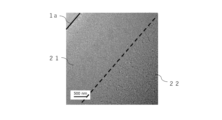
- 1 is an enlarged observation image of the vicinity of the surface of a cross section of a strengthened crystallized glass according to an embodiment of the present invention.
- 1 is an enlarged observation image of the vicinity of the surface of a cross section of a strengthened crystallized glass of a comparative example of the present invention.
- crystallizable glass glass that does not necessarily contain crystals (at least crystals are not intentionally precipitated) before crystallization treatment.
- glass containing crystals obtained by subjecting crystallizable glass to crystallization treatment is called crystallized glass.
- glass obtained by subjecting crystallized glass to ion exchange treatment is called reinforced crystallized glass.
- the crystallizable glass, crystallized glass, and strengthened crystallized glass of the present invention preferably contain, in mole percent, SiO 2 50-80%, Al 2 O 3 0-12%, P 2 O 5 0-15%, Li 2 O 1.5-30%, Na 2 O 0-15%, and ZrO 2 1.5-10%.
- the reasons for limiting the content of each component as described above are as follows. In the description of the content of each component, the percentage indicates mole percent unless otherwise specified.
- the numerical range indicated by "to” means a range including the numerical values before and after "to” as the minimum and maximum values, respectively.
- SiO 2 is a component that forms a glass network and is a component for precipitating crystals such as lithium disilicate and lithium metasilicate.
- the content of SiO 2 is preferably 50-80%, 55-75%, 60-73%, 60-70%, and particularly 65-70%. If the content of SiO 2 is too small, vitrification becomes difficult, the Young's modulus and weather resistance tend to decrease, and lithium disilicate and lithium metasilicate tend to precipitate. On the other hand, if the content of SiO 2 is too large, melting property and moldability tend to decrease, the thermal expansion coefficient becomes too low, making it difficult to match the thermal expansion coefficient of the surrounding material, and the transmittance tends to decrease due to the precipitation of heterogeneous crystals (unintended crystals).
- Al 2 O 3 is a component that adjusts the precipitation crystals and adjusts the compressive stress.
- the upper limit range of Al 2 O 3 is preferably 12% or less, 10% or less, 8% or less, 6% or less, 4.8% or less, 4.7% or less, 4.5% or less, 4.4% or less, 4.3% or less, 4.2% or less, 4.0% or less, 3.8% or less, 3.5% or less, 3.3% or less, 3.0% or less, 2.8% or less, 2.5% or less, 2.2% or less, 2.1% or less, and particularly 2.0% or less. If the content of Al 2 O 3 is too high, the compressive stress value of the strengthened crystallized glass may decrease.
- the lower limit range of the Al2O3 content is preferably 0% or more, 0.1% or more, 0.2% or more, 0.3% or more, 0.4% or more, 0.5% or more, 0.7% or more, 1.0% or more, particularly 1.5% or more.
- P2O5 is a component that promotes the phase separation of glass and helps the formation of crystal nuclei. However, if a large amount of P2O5 is introduced , the glass will be too phase separated and will tend to become cloudy. Therefore, the upper limit of the content of P2O5 is preferably 15% or less, 10% or less, 8% or less, 5% or less, particularly 3% or less, and the lower limit is preferably 0% or more, 0.2% or more, 0.3% or more, 0.4% or more, particularly 0.5% or more.
- Li 2 O is a component for precipitating crystals such as lithium disilicate and lithium metasilicate, and is also a component for enhancing ion exchange performance. However, if the content of Li 2 O is too high, the weather resistance is likely to decrease. Therefore, the upper limit range of Li 2 O is preferably 30% or less, 29% or less, 28% or less, 26% or less, particularly 25% or less, and the lower limit range is preferably 1.5% or more, 2% or more, 3% or more, 4% or more, 4.5% or more, 5% or more, 5.5% or more, 6% or more, 6.3% or more, 6.5% or more, 6.6% or more, 8% or more, 10% or more, 12% or more, 15% or more, 18% or more, 20% or more, 21% or more, 22% or more, 22.5% or more, 23% or more, 23.5% or more, 24% or more, particularly 24.5% or more.
- Na 2 O is a component that reduces high-temperature viscosity and significantly increases melting property. It is also a component that contributes to the initial melting of glass raw materials. However, if the content of Na 2 O is too high, the crystallite size tends to become coarse and the weather resistance tends to decrease.
- the upper limit range of Na 2 O is preferably 15% or less, 12% or less, 10% or less, 9.8% or less, 9.5% or less, 9.3% or less, 9.1% or less, 9% or less, 8.7% or less, particularly 7% or less, 6% or less, 5% or less, 4% or less, 3% or less, less than 2.4%, 2.2% or less, 2% or less, 1.8% or less, 1.5% or less, and when weather resistance is important, 1% or less, particularly less than 1%. In particular, 5% or less, 4% or less, and less than 3.8% are preferable in the crystallized glass before ion exchange.
- the lower limit range is preferably 0% or more, 0.1% or more, 0.3% or more, 0.5% or more, 0.8% or more, 1% or more, and particularly preferably 2% or more.
- ZrO2 is a component for generating crystal nuclei.
- the upper limit range of ZrO2 is preferably 10% or less, 9% or less, 8% or less, 7% or less, 6.5% or less, particularly 6% or less
- the lower limit range is preferably 1.5% or more, 1.7% or more, 1.9% or more, 2% or more, 2.1% or more, 2.3% or more, 2.5% or more, 2.7% or more, 3% or more, 3.3% or more, 3.5% or more, particularly 4% or more.
- the molar ratio Al 2 O 3 /SiO 2 is preferably 0.07 or less, 0.06 or less, 0.05 or less, 0.045 or less, 0.043 or less, 0.04 or less, 0.038 or less, 0.035 or less, 0.033 or less, 0.03 or less, 0.028 or less, particularly 0 to 0.025. If the molar ratio Al 2 O 3 /SiO 2 is too large, it may be difficult to vitrify or the compressive stress value of the strengthened crystallized glass may decrease. Note that "Al 2 O 3 /SiO 2 " is the value obtained by dividing the content of Al 2 O 3 by the content of SiO 2 .
- the molar ratio Al 2 O 3 /Li 2 O is preferably 0.2 or less, 0.15 or less, 0.14 or less, 0.13 or less, 0.12 or less, 0.11 or less, 0.1 or less, 0.09 or less, 0.08 or less, 0.07 or less, particularly 0 to 0.065. If the molar ratio Al 2 O 3 /Li 2 O is too large, crystals such as lithium disilicate and lithium metasilicate may be difficult to precipitate, crystals such as petalite may be easily precipitated, and the compressive stress value of the strengthened crystallized glass may be reduced. Note that "Al 2 O 3 /Li 2 O" is the value obtained by dividing the content of Al 2 O 3 by the content of Li 2 O.
- the molar ratio Al 2 O 3 /(SiO 2 +Li 2 O) is preferably 0.06 or less, 0.055 or less, 0.05 or less, 0.047 or less, 0.045 or less, 0.043 or less, 0.04 or less, 0.038 or less, 0.035 or less, 0.033 or less, particularly 0 to 0.03. If the molar ratio Al 2 O 3 /(SiO 2 +Li 2 O) is too large, crystals such as lithium disilicate and lithium metasilicate may be difficult to precipitate, crystals such as petalite may be easily precipitated, and the compressive stress value of the strengthened crystallized glass may be reduced. Note that "Al 2 O 3 /(SiO 2 +Li 2 O)" is the value obtained by dividing the content of Al 2 O 3 by the total amount of SiO 2 and Li 2 O.
- K 2 O is a component that enhances ion exchange performance, reduces high-temperature viscosity, and enhances melting property. However, if the content of K 2 O is too high, the crystallite size tends to become coarse. Therefore, the content of K 2 O is preferably 0 to 7%, 0 to 5%, 0 to 3%, 0 to 2%, 0 to 1.5%, 0 to 1.2%, 0 to less than 0 to 1%, and particularly 0 to 0.8%.
- the total amount of Na 2 O and K 2 O, Na 2 O + K 2 O, in the crystallizable glass before crystallization is preferably 0 to 8%, 0 to 7%, 0 to 5%, 0 to less than 3.8%, 0 to 3.5%, 0 to 3%, 0 to 2.5%, particularly preferably 0 to 2%. If the content of Na 2 O + K 2 O is too high, the crystallite size tends to become coarse.
- the molar ratio (Na 2 O+K 2 O)/(Li 2 O+Na 2 O+K 2 O) is preferably less than 1.50, 1.40 or less, 1.30 or less, 1.20 or less, 1.10 or less, 1.00 or less, 0.05 to 0.90, particularly 0.10 to 0.80. If the molar ratio (Na 2 O+K 2 O)/(Li 2 O+Na 2 O+K 2 O) is too large, the ion exchange performance of the NaNO 3 molten salt decreases, and it becomes difficult to form a portion in the strengthened crystallized glass where the Na ion concentration decreases from the surface side of the glass toward the inside, that is, a compressive stress layer based on Na ions.
- ( Na2O + K2O )/( Li2O + Na2O + K2O ) is a value obtained by dividing the total amount of Na2O and K2O by the total amount of Li2O , Na2O and K2O .
- B 2 O 3 is a component that enhances melting property and devitrification resistance. However, if the content of B 2 O 3 is too high, the weather resistance is likely to decrease. Therefore, the content of B 2 O 3 is preferably 0 to 10%, 0 to 7%, 0 to 5%, 0 to 3%, and particularly preferably 0 to less than 1%.
- MgO is a component that increases Young's modulus and ion exchange performance, as well as lowering high-temperature viscosity and improving meltability.
- the MgO content is preferably 0-10%, 0-7%, 0-4%, 0-2%, 0-1%, and especially 0-0.1%.
- CaO is a component that reduces high-temperature viscosity and improves melting properties.
- it is a component that reduces batch costs because the raw material is relatively inexpensive to introduce.
- the CaO content is preferably 0-5%, 0-3%, 0-1%, and especially 0-0.5%.
- SrO is a component that suppresses phase separation and also suppresses coarsening of crystallite size, but if the content is too high, it becomes difficult to precipitate crystals by heat treatment. Therefore, the SrO content is preferably 0-5%, 0-3%, 0-2%, and especially 0-1%.
- BaO is a component that suppresses coarsening of crystallite size, but if its content is too high, it becomes difficult to precipitate crystals by heat treatment. Therefore, the BaO content is preferably 0-5%, 0-3%, 0-2%, and especially 0-1%.
- ZnO is a component that reduces high-temperature viscosity and significantly increases meltability, as well as suppresses coarsening of crystallite size. However, if the ZnO content is too high, the glass becomes more susceptible to devitrification during molding. Therefore, the ZnO content is preferably 0-5%, 0-3%, 0-2%, and especially 0-1%.
- TiO2 is a component for generating crystal nuclei and improving weather resistance. However, if a large amount of TiO2 is introduced, the glass becomes colored and the transmittance tends to decrease. Therefore, the content of TiO2 is preferably 0 to 5%, 0 to 3%, and particularly 0 to less than 1%.
- SnO2 is a component that enhances ion exchange performance, but if its content is too high, devitrification resistance is likely to decrease. Therefore, the content of SnO2 is preferably 0 to 3%, 0.01 to 3%, 0.05 to 3%, 0.1 to 3%, particularly 0.2 to 3%.
- an effective fining agent can be added.
- the fining agent one or more selected from the group consisting of Cl, SO 3 , CeO 2 , and Sb 2 O 3 (preferably Cl and SO 3 ) may be added in an amount of 0.001 to 1%.
- the preferred content of Fe2O3 is less than 1000 ppm (less than 0.1%), less than 800 ppm, less than 600 ppm, less than 400 ppm, and particularly less than 300 ppm. Furthermore, it is preferable to regulate the content of Fe2O3 within the above range and the molar ratio SnO2 /( Fe2O3 + SnO2 ) to 0.8 or more, 0.9 or more, and particularly 0.95 or more. In this way, the total light transmittance at wavelengths of 400 to 770 nm is easily improved.
- Y 2 O 3 is a component that increases the strength of glass.
- the cost of the raw material itself is high, and if added in a large amount, the devitrification resistance is likely to decrease. Therefore, the content of Y 2 O 3 is preferably 0 to 15%, 0 to 12%, 0 to 10%, and particularly preferably 0.1 to 1%.
- Gd 2 O 3 , Nb 2 O 5 , La 2 O 3 , Ta 2 O 5 , and HfO 2 are components that increase the strength of glass.
- the raw materials of Gd 2 O 3 , Nb 2 O 5 , La 2 O 3 , Ta 2 O 5 , and HfO 2 are expensive, and when added in large amounts, the devitrification resistance is likely to decrease.
- the total and individual contents of Gd 2 O 3 , Nb 2 O 5 , La 2 O 3 , Ta 2 O 5 , and HfO 2 are preferably 0 to 15%, 0 to 10%, 0 to 5%, and particularly 0 to 3%.
- the strengthened crystallized glass of the present invention preferably does not substantially contain As 2 O 3 , PbO, F, etc., as a composition. Also, from an environmental perspective, it is preferable that the strengthened crystallized glass of the present invention does not substantially contain Bi 2 O 3.
- the phrase "substantially does not contain " means that the specified components are not actively added as glass components, but the addition of impurity levels is permitted, and specifically refers to the case where the content of the specified components is less than 0.05%.
- the preferred content ranges of each component can be appropriately combined to obtain a preferred composition range.
- the following composition ranges (1) to (3) are preferred because they can achieve high levels of strength, transmittance, and impact resistance.
- (1) Contains, in mole percent, 50-80% SiO 2 , 0-12% Al 2 O 3 , 0-15% P 2 O 5 , 1.5-30% Li 2 O , 0-less than 3.8% Na 2 O + K 2 O , 0-less than 3.8% Na 2 O , 0-less than 3.8% K 2 O , and 1.5-10% ZrO 2 .
- composition in mole percent, is 50-80% SiO 2 , 0-12% Al 2 O 3 , 0-15% P 2 O 5 , 1.5-30% Li 2 O , 0-less than 3.8% Na 2 O + K 2 O , 0-less than 3.8% Na 2 O , 0-less than 3.8% K 2 O , and 1.5-10% ZrO 2 , with a molar ratio of (Na 2 O + K 2 O) / (Li 2 O + Na 2 O + K 2 O) being 1.20 or less.
- the crystallized glass and reinforced crystallized glass of the present invention preferably have the following properties:
- any of lithium disilicate, lithium metasilicate, ⁇ -quartz, ⁇ -spodumene, trilithium phosphate, and petalite is precipitated, and it is particularly preferable that any of lithium disilicate, lithium metasilicate, and trilithium phosphate is precipitated. It is also preferable that lithium disilicate or lithium metasilicate is precipitated as the main crystal (the crystal with the largest amount of precipitation).
- the full width at half maximum (FWHM) of the maximum peak of the X-ray diffraction spectrum is preferably 0.120° or more, 0.121° or more, 0.122° or more, 0.123° or more, 0.125° or more, 0.130° or more, 0.135° or more, 0.140° or more, and particularly preferably 0.150° or more. If the full width at half maximum (FWHM) of the maximum peak of the X-ray diffraction spectrum is too small, the transmittance is likely to decrease.
- the fracture toughness K 1C of the crystallized glass before the ion exchange treatment is preferably 0.7 MPa ⁇ m 0.5 or more, 0.8 MPa ⁇ m 0.5 or more, 1.0 MPa ⁇ m 0.5 or more, 1.2 MPa ⁇ m 0.5 or more, particularly 1.5 to 3.5 MPa ⁇ m 0.5 . If the fracture toughness K 1C is too small, the strength is likely to be low.
- the "fracture toughness K 1C" is measured using a pre-crack introduction fracture test method (SEPB method: Single-Edge-Precracked-Beam method) based on JIS R1607 "Fracture toughness test method for fine ceramics".
- the SEPB method is a method in which the maximum load until a test piece breaks is measured by a three-point bending fracture test of a precracked test piece, and the plane strain fracture toughness K1C is calculated from the maximum load, the precrack length, the test piece dimensions, and the distance between bending supports.
- the measured value of the fracture toughness K1C of each glass is the average value of five measurements.
- the Young's modulus of the crystallized glass before the ion exchange treatment is preferably 70 GPa or more, 72 GPa or more, 73 GPa or more, 74 GPa or more, 75 GPa or more, 76 GPa or more, 77 GPa or more, 78 GPa or more, 79 GPa or more, 80 GPa or more, 83 GPa or more, 85 GPa or more, 87 GPa or more, 90 GPa or more, and particularly 100 to 150 GPa. If the Young's modulus is low, the crystallized glass will be easily bent if the plate thickness is thin. The "Young's modulus" can be measured by the well-known resonance method.
- the Vickers hardness of the crystallized glass before the ion exchange treatment is preferably 500 or more, 550 or more, 580 or more, and particularly 600 to 2500. If the Vickers hardness is too low, it will be easily scratched.
- the "Vickers hardness” is a value measured by pressing a Vickers indenter with a load of 100 gf using a Vickers hardness tester.
- the transmittance of the crystallized glass in the thickness direction at a wavelength of 550 nm is preferably 75% or more, 76% or more, 77% or more, 78% or more, 79% or more, 81% or more, 83% or more, 85% or more, 88% or more, and particularly 89% or more.
- the "transmittance" at a specific wavelength is measured using a spectrophotometer (V-670 manufactured by JASCO Corporation) to measure the transmittance at that wavelength in the thickness direction.
- the strengthened crystallized glass of the present invention preferably has the following properties:
- the average reflectance of the reinforced crystallized glass of the present invention at wavelengths of 360 to 780 nm is 9.5% or less.
- the average reflectance of the reinforced crystallized glass at wavelengths of 360 to 780 nm is more preferably 9.4% or less, 9.3% or less, 9.2% or less, 9.1% or less, 9.0% or less, 8.9% or less, 8.8% or less, 8.7% or less, 8.6% or less, 8.5% or less, 8.4% or less, 8.3% or less, 8.2% or less, or 8.1% or less.
- the average reflectance in the wavelength range i.e., the reflectance in the visible light wavelength range
- the reinforced crystallized glass is used as a cover glass for a display device, it is likely to reflect external light, and the visibility of the display is likely to decrease.
- the average reflectance in the wavelength range is preferably 3% or more, more preferably 3.5% or more.
- the average reflectance for wavelengths between 360 and 780 nm can be determined by measurement and calculation using a spectrophotometer. The average reflectance can also be measured and calculated based on JIS R 3106.
- the transmittance of the reinforced crystallized glass in the thickness direction at a wavelength of 550 nm is preferably 75% or more, 76% or more, 77% or more, 78% or more, 79% or more, 81% or more, 83% or more, 85% or more, 88% or more, and particularly 89% or more.
- the strengthened crystallized glass of the present invention preferably has a portion where the Na ion concentration decreases from the surface side of the glass to the inside side, in other words, a portion where the Na ion concentration increases from the inside side of the glass to the surface side. This increases the resistance to crack penetration from the glass surface, and the impact resistance is likely to be high.
- an ion exchange process is performed to introduce Na ions into the glass using NaNO 3 molten salt, the Na ion concentration at the glass surface becomes relatively high, and it is possible to form a portion where the Na ion concentration decreases from the surface side of the glass to the inside side.
- the strengthened crystallized glass has a portion where the Li ion concentration increases from the surface side of the glass to the inside side, that is, a portion where the Li ion concentration decreases from the inside side of the glass to the surface side.
- the "Na ion concentration" can be confirmed by, for example, measuring the cross section of the sample with SEM-EDX. In this way, a strengthened crystallized glass having high transmittance and high impact resistance can be obtained.
- Figure 1 is a schematic diagram of the cross-sectional structure of the strengthened crystallized glass 1 of the present invention.
- the strengthened crystallized glass 1 has a compressive stress layer 11 formed by ion exchange on the surface, and a tensile stress layer 12 at the center in the thickness direction from the compressive stress layer 11.
- the maximum compressive stress value (CS) of the compressive stress layer 11 is preferably 200 MPa or more, 250 MPa or more, 300 MPa or more, 400 MPa or more, 500 MPa or more, 520 MPa or more, 530 MPa or more, and particularly 550 MPa or more. If the compressive stress value is low, the resistance to crack penetration is low and impact resistance is likely to be low. However, if the compressive stress value is too high, the tensile stress value in the center becomes excessive, which is dangerous as it will cause many fragments when broken. Therefore, the compressive stress value is preferably 1500 MPa or less, 1400 MPa or less, 1300 MPa or less, or 1200 MPa or less.
- the stress depth (DOC) of the compressive stress layer 11 is preferably 50 ⁇ m or more, 60 ⁇ m or more, 70 ⁇ m or more, 80 ⁇ m or more, 85 ⁇ m or more, 90 ⁇ m or more, 95 ⁇ m or more, or 100 ⁇ m or more.
- the stress depth of the compressive stress layer is preferably 13% or more, 14% or more, 15% or more, 16% or more, 17% or more, 17.5% or more, 18% or more, 18.5% or more, and particularly 19% or more of the plate thickness. If the stress depth is small, the resistance to crack penetration is small and impact resistance is likely to be low.
- the maximum tensile stress value of the internal tensile stress layer 12 is preferably 180 MPa or less, 150 PMa or less, 120 MPa or less, and particularly 110 MPa or less. If the internal tensile stress value is too high, the strengthened crystallized glass is prone to self-destruction due to hard scratches. On the other hand, if the internal tensile stress value is too low, it becomes difficult to ensure the strength of the strengthened crystallized glass.
- the internal tensile stress value is preferably 35 MPa or more, 45 MPa or more, 55 MPa or more, and particularly 70 MPa or more.
- the internal tensile stress value can be measured, for example, using a scattered light photoelastic stress meter SLP-2000 from Orihara Seisakusho.
- the P180 scratch strength is an index of impact resistance, and is preferably 250 MPa or more, 270 MPa or more, 290 MPa or more, and particularly 300 MPa or more. There is no particular upper limit to the P180 scratch strength, but in reality it is 800 MPa or less.
- the P180 scratch strength can be measured by the method described below.
- the strengthened crystallized glass of the present invention is preferably in a plate shape, and the plate thickness is preferably 2.0 mm or less, 1.5 mm or less, 1.3 mm or less, 1.1 mm or less, 1.0 mm or less, and particularly 0.9 mm or less.
- the plate thickness is preferably 0.3 mm or more, 0.4 mm or more, 0.5 mm or more, 0.6 mm or more, and particularly 0.7 mm or more.
- the strengthened crystallized glass 1 of the present invention has a low crystallization layer 21 on the surface, and a central layer 22 on the inner side (center side) of the low crystallization layer 21 in the thickness direction of the glass.
- amorphous and crystalline materials are mixed.
- the low crystallinity layer 21 is a surface layer having a lower degree of crystallinity than the central layer 22.
- the depth of the low crystallinity layer 21 is more preferably 0.05 ⁇ m or more, 0.1 ⁇ m or more, 0.2 ⁇ m or more, 0.3 ⁇ m or more, 0.5 ⁇ m or more, 0.8 ⁇ m or more, 1.0 ⁇ m or more, 1.5 ⁇ m or more, or 2.0 ⁇ m or more.
- the depth of the low crystallinity layer 21 is preferably 150 ⁇ m or less, 120 ⁇ m or less, 100 ⁇ m or less, 90 ⁇ m or less, 80 ⁇ m or less, 70 ⁇ m or less, 60 ⁇ m or less, 50 ⁇ m or less, 45 ⁇ m or less, 40 ⁇ m or less, 35 ⁇ m or less, or 30 ⁇ m or less.
- the depth of the low crystallinity layer 21 can be confirmed from a transmission electron microscope (TEM) image or an electron diffraction pattern of a cross section of the strengthened crystallized glass.
- the low crystallinity layer 21 is preferably formed by modifying the surface of glass of the same quality as the amorphous part of the central layer 22, rather than by subsequent film formation.
- the components of the low crystallinity layer 21 preferably have the same components as the central layer 22. More preferably, it contains SiO 2 , Al 2 O 3 , Li 2 O, Na 2 O, P 2 O 5 , and ZrO 2 .
- the components of the surface layer can be measured by energy dispersive X-ray spectroscopy (EDX) or the like. More specifically, it is preferable that the glass composition of the amorphous part contained in the low crystallinity layer 21 and the glass composition of the amorphous part contained in the central layer 22 are substantially the same glass composition.
- the crystals contained in the low crystallinity layer 21 and the crystals contained in the central layer 22 are substantially the same type of crystals. According to such a configuration, the low crystallinity layer 21 can be formed integrally with the central layer 22 by a modification process, so that the risk of delamination can be reduced compared to the case where the optical film layer is formed afterwards.
- the low crystallinity layer 21 of the reinforced crystallized glass 1 of the present invention may be a layer in which amorphous and crystalline materials are mixed.
- the crystallinity of the low crystallinity layer 21 is preferably 60% or less. More preferably, it is 58% or less, 55% or less, 53% or less, 50% or less, 48% or less, 45% or less, 43% or less, 40% or less, 35% or less, 30% or less, 25% or less, 20% or less, 15% or less, or 10% or less.
- the crystallinity of the low crystallinity layer 21 of the reinforced crystallized glass 1 of the present invention is preferably 1% or more, 2% or more, 5% or more, 10% or more, 15% or more, 20% or more, or 30% or more.
- productivity can be improved.
- the crystallinity of the low crystallinity layer 21 may be 0%.
- the crystallinity of the low crystal layer 21 can be measured by in-plane measurement using an X-ray diffraction device.
- the degree of crystallization in the central layer 22 of the reinforced crystallized glass 1 of the present invention is preferably 3% or more, 5% or more, 10% or more, 13% or more, 15% or more, 20% or more, 25% or more, 30% or more, 35% or more, 40% or more, 45% or more, or 50% or more.
- the difference between the degree of crystallization in the central layer 22 of the reinforced crystallized glass 1 of the present invention and the degree of crystallization in the low crystallization layer 21 is preferably 1% or more, 2% or more, 3% or more, 5% or more, 10% or more, 15% or more, 20% or more, 30% or more, 40% or more, or 50% or more.
- the technical concepts of the low crystallinity layer 21 and the central layer 22 and the technical concepts of the compressive stress layer 11 and the tensile stress layer 12 are independent of each other, and these concepts can coexist in each region in the depth direction of the strengthened crystallized glass 1.
- the region shown by diagonal hatching in FIG. 1 is the low crystallinity layer 21 and also part of the compressive stress layer 11.
- the region shown by dot hatching in FIG. 1 is the central layer 22 and also part of the compressive stress layer 11.
- the non-hatched region in FIG. 1 is the central layer 22 and also the tensile stress layer 12.
- the strengthened crystallized glass of the present invention may be configured such that the depth of the compressive stress layer 11 is less than the depth of the low crystallinity layer 21.
- the depth of the compressive stress layer 11 can be changed by adjusting the ion exchange treatment time, etc.
- the method for producing the strengthened crystallized glass of the present invention includes a step of preparing the crystallized glass and a step of chemically strengthening the crystallized glass by an ion exchange treatment.
- any method may be used as long as crystallized glass having the above characteristics is available.
- it can be prepared according to the following procedure.
- Glass raw materials prepared to obtain a glass composition within the above-mentioned composition range are fed into a continuous melting furnace, heated and melted at 1200-1700°C, and clarified.
- the molten glass is then fed into a molding device, formed into a plate shape, and cooled to obtain crystalline glass. After forming into a plate shape, the glass can be cut to the specified dimensions using a well-known method.
- the method for forming the molten glass into a sheet shape can be any method, such as the overflow downdraw method, the float method, the slot downdraw method, the redraw method, the roll-out method, the press method, etc.
- the heat treatment step preferably includes a phase separation forming step for generating phase separation in the glass matrix, a crystal nucleus generating step for generating crystal nuclei, and a crystal growth step for growing the generated crystal nuclei.
- the heat treatment temperature in the phase separation forming step is 400 to 600°C, particularly preferably 480 to 580°C, and the heat treatment time is 10 minutes to 24 hours, particularly preferably 30 minutes to 12 hours.
- the heat treatment temperature in the crystal nucleus generating step is 500 to 700°C, particularly preferably 520 to 650°C, and the heat treatment time is 10 minutes to 24 hours, particularly preferably 30 minutes to 12 hours.
- the heat treatment temperature in the crystal growth step is also preferably 690 to 920°C, particularly preferably 700 to 830°C, and the heat treatment time is 10 minutes to 5 hours, particularly preferably 30 minutes to 3 hours.
- the heating rate is preferably 1° C./min to 30° C./min, particularly preferably 1° C./min to 10° C./min. If the heat treatment temperature, heat treatment time and heating rate are outside the above ranges, the crystallite size becomes coarse and the crystallinity decreases.
- ⁇ Ion exchange treatment> The crystallized glass plate prepared as described above is subjected to an ion exchange treatment to obtain a strengthened crystallized glass having a compressive stress layer on the surface due to ion exchange. By performing the ion exchange treatment, a compressive stress layer is formed on the surface, so that the strength can be increased.
- an ion exchange process is carried out using an ion exchange mixture.
- the ion exchange mixture is a processing agent that undergoes ion exchange with the components in the crystallized glass by coming into contact with the crystallized glass.
- the ion exchange mixture contains a molten salt and an additive.
- the molten salt is a salt containing a component that can be ion-exchanged with the component in the crystallized glass, and is typically an alkali nitrate.
- the alkali nitrate preferably contains at least NaNO 3.
- Other examples of the alkali nitrate include KNO 3 and LiNO 3 , which can be mixed with NaNO 3 for use.
- the molten salt preferably contains, in mass %, 50-100% NaNO 3 and 0-50% KNO 3 + LiNO 3 . In this embodiment, the case where NaNO 3 (100%) is used is illustrated.
- the additive is silicic acid or a silicate, typically an alkali metal silicate.
- silicic acid or a silicate particularly an alkali metal silicate, it is possible to suppress the reflectance of the reinforced crystallized glass before and after ion exchange.
- the additive is preferably sodium silicate.
- the alkali metal silicate preferably contains at least one selected from Na 2 SiO 3 , Na 4 SiO 4 , Na 2 Si 2 O 5 , and Na 2 Si 4 O 9.
- the sodium silicate is preferably an anhydride, but may be a hydrate.
- the silicic acid or silicate as an additive is preferably a crystalline substance. Furthermore, the silicic acid or silicate is preferably a powdered silicic acid or silicate crystalline substance.
- the silicic acid or silicate crystalline substance is preferably in a powdered form when added to the molten salt, but may be in a powdered form by grinding in the molten salt after addition to the molten salt.
- the average particle size D50 of the powder is preferably 10 to 1000 ⁇ m.
- the average particle size D50 of the powder is more preferably 900 ⁇ m or less, 800 ⁇ m or less, 700 ⁇ m or less, 500 ⁇ m or less, or 450 ⁇ m or less. In order to prevent dust before addition, the average particle size D50 of the powder is more preferably 20 ⁇ m or more, 50 ⁇ m or more, 100 ⁇ m or more, 150 ⁇ m or more, 200 ⁇ m or more, or 250 ⁇ m or more.
- the amount of additive to be added to the molten salt i.e., the amount of silicic acid or silicate
- the amount of silicic acid or silicate added is more preferably 1 to 30 parts by mass, 2 to 25 parts by mass, 3 to 20 parts by mass, or 4 to 15 parts by mass. If the amount of additive added is too small, the reflectance suppression effect and sufficient ion adjustment effect will not be obtained, and if the amount added is too large, there is a concern that the cost of the additive will increase.
- the additive is preferably an alkali metal silicate.
- the alkali metal silicate as an additive is preferably a metal salt that contains an alkali metal component that is ion-exchangeable with the alkali metal component that dissolves from the crystallized glass into the molten salt during ion exchange processing, and contains a monovalent metal component different from the dissolve ion.
- the alkali metal component that dissolves into the molten salt is Li ions
- using sodium silicate as the additive can ion-exchange the Li ions dissolved in the molten salt with the Na ions contained in the alkali metal silicate, thereby suppressing an increase in the concentration of Li ions in the molten salt.
- the conditions for the ion exchange treatment such as the temperature of the molten salt and the immersion time, may be determined as desired, but the temperature of the molten salt is, for example, 350°C to 500°C, preferably 360°C to 480°C, 370°C to 450°C, or 380°C to 440°C.
- the immersion time is, for example, 0.1 to 30 hours, preferably 0.2 to 20 hours, 0.3 to 15 hours, 0.5 to 10 hours, 1 to 9 hours, 2 to 9 hours, and particularly 3.5 to 8 hours.
- Reinforced crystallized glass is obtained by immersing part or all of the crystallized glass in the above-mentioned ion exchange mixture and performing ion exchange processing.
- This type of processing makes part of the surface layer of the crystallized glass before the ion exchange processing amorphous, creating a low crystal layer 21, and by lowering the refractive index, it is possible to lower the average reflectance of the reinforced crystallized glass after the ion exchange processing at wavelengths of 360 to 780 nm.
- the effect of improving scratch resistance and crack resistance by improving the plasticity of the surface and improving ion exchange performance by reducing the density can be obtained.
- the additives After the additives are added to the molten salt, it is preferable to stir the molten salt. Stirring can be done manually with a stick or paddle, or automatically by machine. After stirring, the additives can be dispersed in the molten salt before the next lot of ion exchange treatment is performed, or the additives can be left to settle on the inner bottom of the tank containing the molten salt.
- glass raw materials were mixed to obtain the glass compositions shown in Tables 1 to 3, and melted at 1500°C for 8 hours using a platinum pot.
- the resulting molten glass was then poured onto a carbon plate and formed into a flat plate to obtain a glass plate.
- the surface of the resulting glass plate was optically polished to a plate thickness of 1000 ⁇ m (1.0 mm) or 600 ⁇ m (0.6 mm).
- the obtained glass samples No. 1 to 13 were heat-treated in an electric furnace under the heat treatment conditions shown in Tables 1 to 3 to precipitate and grow crystals in the glass matrix. They were then cooled to room temperature to obtain crystallized glass plates. No special heat treatment was performed on the non-crystalline glass plates (samples No. 14 and 15). The obtained glass plates were evaluated for the following properties.
- the crystallinity of the central layer was calculated from the ratio of the area excluding the background from the obtained X-ray diffraction spectrum to the area excluding the amorphous part (halo peak).
- the full width at half maximum (FWHM) was derived by peak fitting at the peak with the maximum intensity excluding the background and amorphous part (halo peak).
- samples No. 1, 2, 4, 5, 7, 8, 10, 11, 12, 14, and 15 were subjected to ion exchange treatment under the conditions shown in Tables 1 to 3 to form a compressive stress layer on the surface, thereby obtaining reinforced crystallized glass (No. 1, 2, 4, 5, 7, 8, 10, 11, and 12) and reinforced amorphous glass (No. 14 and 15).
- Samples No. 1, 4, 7, 10, 11, and 14 were subjected to ion exchange treatment using an ion exchange mixture containing silicic acid or an alkali metal silicate as an additive.
- samples No. 2, 5, 8, 12, and 15 were subjected to ion exchange treatment using a molten salt that did not contain an additive.
- the amount of additives shown in Tables 1 to 3 is the amount of alkali metal silicate added in parts by mass when the molten salt is taken as 100 parts by mass.
- the surface compressive stress value and compressive stress depth were measured using an Orihara Manufacturing Co., Ltd. scattered light photoelastic stress meter SLP-2000.
- the photoelastic constant of No. 1, 2, 4, 5, 7, 8, 10, 11, and 12 was set to 27.0 and the refractive index was set to 1.55, and the photoelastic constant of No. 14 and 15 was set to 30.5 and the refractive index was set to 1.51.
- the 550 nm transmittance is the value measured at a wavelength of 550 nm in the thickness direction of the glass using a spectrophotometer (V-670 manufactured by JASCO Corporation).
- Reflectance was measured and calculated as the average reflectance for wavelengths from 360 to 780 nm. Reflectance at each wavelength was measured using a spectrophotometer (using an integrating sphere, manufactured by JASCO Corporation, Model V-670).
- Figure 2 shows the measurement results of reflectance at each wavelength for samples No. 1 to 3. In Figure 2, the horizontal axis indicates wavelength, and the vertical axis indicates reflectance at each wavelength.
- the degree of crystallinity of the low crystallinity layer was evaluated by in-plane measurement using a parallel beam method with an X-ray diffraction device (SmarLab, manufactured by Rigaku).
- sample No. 1 which is an embodiment, is a reinforced crystallized glass, and therefore has a higher fracture toughness value and better impact resistance than comparative samples Nos. 14 and 15.
- sample No. 1 uses an ion exchange mixture containing sodium metasilicate as an additive in the ion exchange treatment, and thus the reflectance is suitably suppressed compared to comparative samples Nos. 2 and 3.
- Sample No. 1, which is an embodiment, corresponds to the reinforced crystallized glass of comparative sample No. 3 after ion exchange treatment, and its average reflectance at wavelengths of 360 to 780 nm is lower than that before ion exchange treatment.
- Sample No. 12 which is a comparative example, was composed of relatively homogeneous crystallized glass with a high degree of crystallization filled with black dot crystals from the glass surface 1a to the inside of the glass.
- sample No. 12 which is a comparative example, was composed of relatively homogeneous crystallized glass with a high degree of crystallization filled with black dot crystals from the glass surface 1a to the inside of the glass.
- sample No. 10 an ion exchange mixture containing sodium metasilicate was used as an additive in the ion exchange process, which resulted in the formation of a low crystallinity layer on the surface, lowering the refractive index of the surface and effectively suppressing the reflectance.
- the principle by which this low crystallinity layer was formed is unclear, but when a similar sample was measured using energy dispersive X-ray spectroscopy (EDX), ions such as Si, Al, P, Zr, and Na were detected, suggesting that the ion exchange process changed part of the crystalline glass to amorphous.
- EDX energy dispersive X-ray spectroscopy
Landscapes
- Chemical & Material Sciences (AREA)
- Engineering & Computer Science (AREA)
- Materials Engineering (AREA)
- Life Sciences & Earth Sciences (AREA)
- Chemical Kinetics & Catalysis (AREA)
- General Chemical & Material Sciences (AREA)
- Geochemistry & Mineralogy (AREA)
- Organic Chemistry (AREA)
- Crystallography & Structural Chemistry (AREA)
- Dispersion Chemistry (AREA)
- Ceramic Engineering (AREA)
- Glass Compositions (AREA)
- Surface Treatment Of Glass (AREA)
Abstract
Description
本発明は、結晶化ガラス、およびその製造方法に関し、特に、携帯電話、デジタルカメラ、PDA(携帯端末)、タッチパネルディスプレイのカバーガラスに好適な結晶化ガラスおよびその製造方法に関する。 The present invention relates to crystallized glass and its manufacturing method, and in particular to crystallized glass suitable for use as cover glass for mobile phones, digital cameras, PDAs (personal digital assistants), and touch panel displays, and its manufacturing method.
携帯電話(特にスマートフォン)、デジタルカメラ、PDA、タッチパネルディスプレイ、大型テレビ、非接触給電等のデバイスは、益々普及する傾向にある。これらの用途には、イオン交換処理された化学強化ガラスが用いられている。また、近年では、デジタルサイネージ、マウス、スマートフォン等の外装部品に化学強化ガラスを使用することが増えてきている。 Devices such as mobile phones (especially smartphones), digital cameras, PDAs, touch panel displays, large TVs, and non-contact power supplies are becoming more and more popular. Chemically strengthened glass that has been ion-exchanged is used for these applications. In recent years, chemically strengthened glass has also been increasingly used for the exterior parts of digital signage, mice, smartphones, etc.
上記用途のカバーガラスとしてさらに強度を高めるべく、結晶化ガラスをイオン交換により化学強化して強化結晶化ガラスを得る技術が開発されている(例えば、特許文献1)。結晶化ガラスは、ガラス内部に結晶を析出させたもの、すなわちガラス内部に結晶を含むものであり、強度が高いことで知られている。結晶化ガラスをイオン交換することにより、一層強度の高いガラスを得ることができると考えられている。 In order to further increase the strength of the cover glass for the above applications, technology has been developed to obtain strengthened crystallized glass by chemically strengthening it through ion exchange (for example, Patent Document 1). Crystallized glass is glass in which crystals have been precipitated inside, i.e., glass that contains crystals within, and is known for its strength. It is believed that by subjecting crystallized glass to ion exchange, it is possible to obtain glass with even greater strength.
しかしながら、従来の強化結晶化ガラスはカバーガラス用途としては光学特性に改善の余地が残されていた。 However, there was still room for improvement in the optical properties of conventional reinforced crystallized glass when used as cover glass.
本発明の目的は、光学特性に優れた強化結晶化ガラス、およびこれを得られる製造方法を提供することにある。 The object of the present invention is to provide a reinforced crystallized glass having excellent optical properties and a manufacturing method for obtaining the same.
本発明の第1の態様:本発明の強化結晶化ガラスの製造方法は、アルカリ金属成分を含む結晶化ガラスの一部または全部を、イオン交換用混合物に浸漬させてイオン交換処理することにより強化結晶化ガラスを得る、強化結晶化ガラスの製造方法であって、前記イオン交換用混合物は、溶融塩と、添加物として 珪酸または珪酸塩と、を含み、前記イオン交換処理前の前記結晶化ガラスの波長360 ~780nmにおける可視光の平均反射率より、前記イオン交換処理後の前記強化結晶化ガラスの波長360~780nmにおける可視光の平均反射率を低下させることを特徴とする。 First aspect of the present invention: The method for producing reinforced crystallized glass of the present invention is a method for producing reinforced crystallized glass, in which a part or all of crystallized glass containing an alkali metal component is immersed in an ion exchange mixture to perform an ion exchange treatment to obtain reinforced crystallized glass, the ion exchange mixture containing a molten salt and silicic acid or a silicate as an additive, and is characterized in that the average reflectance of visible light in the wavelength range of 360 to 780 nm of the reinforced crystallized glass after the ion exchange treatment is lower than the average reflectance of visible light in the wavelength range of 360 to 780 nm of the crystallized glass before the ion exchange treatment.
本発明の第2の態様:本発明の強化結晶化ガラスの製造方法は、上記第1の態様において、前記溶融塩は、NaNO3を含み、前記添加物は、アルカリ金属珪酸塩であり、前記アルカリ金属珪酸塩は、Na2SiO3、Na4SiO4、Na2Si2O5、およびNa2Si4O9から選ばれた少なくとも1種類以上を含む、ことが好ましい。 Second aspect of the present invention: In the manufacturing method of the reinforced crystallized glass of the present invention, in the above-mentioned first aspect, the molten salt contains NaNO3 , the additive is an alkali metal silicate, and the alkali metal silicate contains at least one selected from Na2SiO3 , Na4SiO4 , Na2Si2O5 , and Na2Si4O9 , preferably .
本発明の第3の態様:本発明の強化結晶化ガラスの製造方法は、上記第1または2の態様において、前記溶融塩は、組成として質量%で、NaNO3 50~100%、KNO3+LiNO3 0~50%含み、前記イオン交換処理において、波長360~780nmにおける平均反射率を低下させるとともに、前記結晶化ガラスに圧縮応力層を形成することが好ましい。 Third aspect of the present invention: In the manufacturing method of the strengthened crystallized glass of the present invention, in the above-mentioned first or second aspect, it is preferable that the molten salt contains, in mass %, 50 to 100% NaNO3 and 0 to 50% KNO3 + LiNO3, and that in the ion exchange treatment, the average reflectance at wavelengths of 360 to 780 nm is reduced and a compressive stress layer is formed in the crystallized glass.
本発明の第4の態様:本発明の強化結晶化ガラスの製造方法は、上記第1~3のいずれかの態様において、前記溶融塩を100質量部とした場合に、前記添加物の添加量は0.1~30質量部であることが好ましい。 Fourth aspect of the present invention: In the method for producing reinforced crystallized glass of the present invention, in any one of the first to third aspects described above, it is preferable that the amount of the additive is 0.1 to 30 parts by mass when the molten salt is 100 parts by mass.
本発明の第5の態様:本発明の強化結晶化ガラスの製造方法は、上記第1~4のいずれかの態様において、前記結晶化ガラスが、組成として、モル%で、SiO2 50~80%、Al2O3 0~12%、P2O5 0~15%、Li2O 1.5~30%、Na2O 0~15%、ZrO2 1.5~10%を含有することが好ましい。 Fifth aspect of the present invention: In the method for producing strengthened crystallized glass of the present invention in any one of the first to fourth aspects, the crystallized glass preferably contains, in mole percent, 50-80% SiO 2 , 0-12% Al 2 O 3 , 0-15% P 2 O 5 , 1.5-30% Li 2 O , 0-15% Na 2 O , and 1.5-10% ZrO 2 .
本発明の第6の態様:本発明の強化結晶化ガラスの製造方法は、上記第1~5のいずれかの態様において、リチウムダイシリケート及びリチウムメタシリケートの少なくとも一方が析出していることが好ましい。 Sixth aspect of the present invention: In the method for producing reinforced crystallized glass of the present invention, in any one of the first to fifth aspects described above, it is preferable that at least one of lithium disilicate and lithium metasilicate is precipitated.
本発明の第7の態様:本発明の強化結晶化ガラスの製造方法は、上記第1~6のいずれかの態様において、前記結晶化ガラスの表面の結晶化度を低下させて低結晶層を形成する工程をさらに備え、前記低結晶層の結晶化度が、当該低結晶層よりガラスの厚さ方向中央に位置する中央層の結晶化度より小さいことが好ましい。 Seventh aspect of the present invention: In any one of the first to sixth aspects, the method for producing reinforced crystallized glass of the present invention further comprises a step of reducing the crystallization degree of the surface of the crystallized glass to form a low crystallization layer, and it is preferable that the crystallization degree of the low crystallization layer is smaller than the crystallization degree of a central layer located more centrally in the thickness direction of the glass than the low crystallization layer.
本発明の第8の態様:本発明の強化結晶化ガラスの製造方法は、上記第7の態様において、前記イオン交換処理において、前記結晶化ガラスに圧縮応力層を形成するとともに前記低結晶層を形成することが好ましい。 Eighth aspect of the present invention: In the method for producing reinforced crystallized glass of the present invention, in the seventh aspect described above, it is preferable that in the ion exchange treatment, a compressive stress layer is formed in the crystallized glass and the low crystallinity layer is also formed.
本発明の第9の態様:本発明の強化結晶化ガラスの製造方法は、上記第1~8の態様において、前記圧縮応力層の深さが50μm以上となるよう、前記イオン交換処理の条件を前記溶融塩の温度を350~450℃、浸漬時間を2時間以上の範囲内で調整することが好ましい。 A ninth aspect of the present invention: In the manufacturing method of the reinforced crystallized glass of the present invention, in the above-mentioned first to eighth aspects, it is preferable to adjust the conditions of the ion exchange treatment so that the molten salt temperature is within the range of 350 to 450°C and the immersion time is within the range of 2 hours or more, so that the depth of the compressive stress layer is 50 μm or more.
本発明の第10の態様:本発明の強化結晶化ガラスは、表面に圧縮応力層を有する強化結晶化ガラスであって、波長360~780nmの平均反射率が9.5%以下であることを特徴とする。 A tenth aspect of the present invention: The strengthened crystallized glass of the present invention is a strengthened crystallized glass having a compressive stress layer on its surface, and is characterized in that the average reflectance at wavelengths of 360 to 780 nm is 9.5% or less.
本発明の第11の態様:本発明の強化結晶化ガラスは、上記第10の態様において、波長360~780nmの平均反射率が8.5%以下であることが好ましい。 Eleventh aspect of the present invention: In the above tenth aspect, the strengthened crystallized glass of the present invention preferably has an average reflectance of 8.5% or less at wavelengths of 360 to 780 nm.
本発明の第12の態様:本発明の強化結晶化ガラスは、上記第10または11の態様において、リチウムダイシリケート及びリチウムメタシリケートの少なくとも一方が析出していることが好ましい。 Twelfth aspect of the present invention: In the reinforced crystallized glass of the present invention, in the above tenth or eleventh aspect, it is preferable that at least one of lithium disilicate and lithium metasilicate is precipitated.
本発明の第13の態様:本発明の強化結晶化ガラスは、上記第10~12のいずれかの態様において、組成として、モル%で、SiO2 50~80%、Al2O3 0~12%、P2O5 0.2~15%、Li2O 1.5~30%、Na2O 0~15%、ZrO2 1.5~10%を含有することが好ましい。 Thirteenth aspect of the present invention: In any one of the tenth to twelfth aspects, the strengthened glass-ceramics of the present invention preferably contains, in mole percent, 50-80% SiO 2 , 0-12% Al 2 O 3 , 0.2-15% P 2 O 5 , 1.5-30% Li 2 O , 0-15% Na 2 O , and 1.5-10% ZrO 2 .
本発明の第14の態様:本発明の強化結晶化ガラスは、上記第13の態様において、組成として、モル%で、SiO2 50~80%、Al2O3 0~4.8%、P2O5 0.2~15%、Li2O 1.5~30%、Na2O+K2O 0~3.8%未満、Na2O 0~10%、K2O 0~3.8%未満、ZrO2 1.5~10%を含有することが好ましい。 Fourteenth aspect of the present invention: In the strengthened glass-ceramics of the present invention according to the thirteenth aspect, the composition preferably contains, in mole percent, 50-80% SiO 2 , 0-4.8% Al 2 O 3 , 0.2-15% P 2 O 5 , 1.5-30% Li 2 O , 0-less than 3.8% Na 2 O + K 2 O , 0-10% Na 2 O , 0-less than 3.8% K 2 O , and 1.5-10% ZrO 2 .
本発明の第15の態様:本発明の強化結晶化ガラスは、上記第10~14のいずれかの態様において、板厚が1.5mm以下であり、前記圧縮応力層の圧縮応力値が400MPa以上であることが好ましい。 15th aspect of the present invention: In any of the 10th to 14th aspects of the reinforced crystallized glass of the present invention, it is preferable that the plate thickness is 1.5 mm or less and the compressive stress value of the compressive stress layer is 400 MPa or more.
本発明の第16の態様:本発明の強化結晶化ガラスは、上記第10~15のいずれかの態様において、厚さ方向の中央に位置し非晶質と結晶質が混在する中央層と、厚さ方向の表面側に位置し前記中央層より結晶化度の低い低結晶層と、を備えることが好ましい。 16th aspect of the present invention: In any of the 10th to 15th aspects above, the strengthened crystallized glass of the present invention preferably comprises a central layer located in the center in the thickness direction and containing a mixture of amorphous and crystalline materials, and a low-crystallinity layer located on the surface side in the thickness direction and having a lower degree of crystallinity than the central layer.
本発明の第17の態様:本発明の強化結晶化ガラスは、上記第16の態様において、前記中央層の結晶化度と前記低結晶層の結晶化度との差が10%以上であることが好ましい。 17th aspect of the present invention: In the reinforced crystallized glass of the present invention, in the 16th aspect described above, it is preferable that the difference in crystallinity between the central layer and the low crystallinity layer is 10% or more.
本発明の第18の態様:本発明の強化結晶化ガラスは、上記第16または17の態様において、前記低結晶層が、前記中央層の構成成分を含むことが好ましい。 18th aspect of the present invention: In the reinforced crystallized glass of the present invention, in the 16th or 17th aspect, it is preferable that the low crystallinity layer contains the components of the central layer.
本発明の第19の態様:本発明の強化結晶化ガラスは、上記第16または17の態様において、前記低結晶層の深さが0.02μm以上であることが好ましい。 Aspect 19 of the present invention: In the strengthened crystallized glass of the present invention, in the aspect 16 or 17 above, it is preferable that the depth of the low crystal layer is 0.02 μm or more.
本発明の第20の態様:本発明の強化結晶化ガラスの製造方法は、上記第19の態様において、前記低結晶層の深さが、前記圧縮応力層の深さより小さいことが好ましい。 20th aspect of the present invention: In the manufacturing method of the reinforced crystallized glass of the present invention, in the 19th aspect described above, it is preferable that the depth of the low crystal layer is smaller than the depth of the compressive stress layer.
本発明の第21の態様:本発明の強化結晶化ガラスは、表面に圧縮応力層を有する強化結晶化ガラスであって、厚さ方向の中央に位置し非晶質と結晶質が混在する中央層と、厚さ方向の表面側に位置し前記中央層より結晶化度の低い表面層と、を備えることを特徴とする。 21st aspect of the present invention: The reinforced crystallized glass of the present invention is a reinforced crystallized glass having a compressive stress layer on its surface, characterized in that it has a central layer located in the center in the thickness direction and containing a mixture of amorphous and crystalline materials, and a surface layer located on the surface side in the thickness direction and having a lower degree of crystallinity than the central layer.
本発明の第22の態様:本発明の強化結晶化ガラスの製造方法は、アルカリ金属成分を含む結晶化ガラスの一部または全部を、イオン交換用混合物に浸漬させてイオン交換処理することにより強化結晶化ガラスを得る、強化結晶化ガラスの製造方法であって、前記結晶化ガラスの表面の結晶化度を低下させて低結晶層を形成する工程をさらに備え、前記低結晶層の結晶化度が、当該低結晶層よりガラスの厚さ方向中央に位置する中央層の結晶化度より小さいことを特徴とする。 22nd aspect of the present invention: The method for producing reinforced crystallized glass of the present invention is a method for producing reinforced crystallized glass, which obtains reinforced crystallized glass by immersing a part or all of the crystallized glass containing an alkali metal component in an ion exchange mixture and performing an ion exchange process, and further includes a step of reducing the crystallinity of the surface of the crystallized glass to form a low crystallinity layer, characterized in that the crystallinity of the low crystallinity layer is smaller than the crystallinity of a central layer located in the center of the glass thickness direction from the low crystallinity layer.
本発明の第23の態様:本発明の強化結晶化ガラスの製造方法は、アルカリ金属成分を含む結晶化ガラスの一部または全部を、イオン交換用混合物に浸漬させてイオン交換処理することにより強化結晶化ガラスを得る、強化結晶化ガラスの製造方法であって、
前記イオン交換用混合物は、溶融塩と、添加物としてアルカリ金属珪酸塩と、を含み、
前記イオン交換処理前の前記結晶化ガラスの波長360~780nmにおける平均反射率より、前記イオン交換処理後の前記強化結晶化ガラスの波長360~780nmにおける平均反射率を低下させる、ことを特徴とする。
A twenty-third aspect of the present invention is a method for producing strengthened crystallized glass, comprising the steps of immersing a part or whole of a crystallized glass containing an alkali metal component in a mixture for ion exchange to obtain a strengthened crystallized glass,
The ion exchange mixture includes a molten salt and an alkali metal silicate as an additive,
The method is characterized in that the average reflectance of the strengthened crystallized glass after the ion exchange treatment in the wavelength range of 360 to 780 nm is lower than the average reflectance of the strengthened crystallized glass before the ion exchange treatment in the wavelength range of 360 to 780 nm.
本発明によれば、従来技術に比べ、光学特性に優れた強化結晶化ガラスを得られる。 The present invention makes it possible to obtain reinforced crystallized glass with superior optical properties compared to conventional techniques.
本発明において、結晶化処理前の必ずしも結晶を含まない(少なくとも意図的に結晶が析出されていない)ガラスを結晶性ガラスと称する。また、本発明において、結晶性ガラスに結晶化処理を施して得られた結晶を含むガラスを結晶化ガラスと称する。また、本発明において、結晶化ガラスにイオン交換処理を施して得られたガラスを強化結晶化ガラスと称する。 In the present invention, glass that does not necessarily contain crystals (at least crystals are not intentionally precipitated) before crystallization treatment is called crystallizable glass. Also, in the present invention, glass containing crystals obtained by subjecting crystallizable glass to crystallization treatment is called crystallized glass. Also, in the present invention, glass obtained by subjecting crystallized glass to ion exchange treatment is called reinforced crystallized glass.
本発明の結晶性ガラス、結晶化ガラス、および強化結晶化ガラスは、組成として、モル%で、SiO2 50~80%、Al2O3 0~12%、P2O5 0~15%、Li2O 1.5~30%、Na2O 0~15%、ZrO2 1.5~10%を含有することが好ましい。上記のように各成分の含有量を限定した理由を以下に示す。なお、各成分の含有量の説明において、%表示は、特に断りがある場合を除き、モル%を表す。本明細書において「~」を用いて示された数値範囲は、「~」の前後に記載の数値を最小値及び最大値としてそれぞれ含む範囲を意味する。 The crystallizable glass, crystallized glass, and strengthened crystallized glass of the present invention preferably contain, in mole percent, SiO 2 50-80%, Al 2 O 3 0-12%, P 2 O 5 0-15%, Li 2 O 1.5-30%, Na 2 O 0-15%, and ZrO 2 1.5-10%. The reasons for limiting the content of each component as described above are as follows. In the description of the content of each component, the percentage indicates mole percent unless otherwise specified. In this specification, the numerical range indicated by "to" means a range including the numerical values before and after "to" as the minimum and maximum values, respectively.
SiO2は、ガラスのネットワークを形成する成分であり、またリチウムダイシリケート、リチウムメタシリケート等の結晶を析出させるための成分である。SiO2の含有量は、好ましくは50~80%、55~75%、60~73%、60~70%、特に65~70%である。SiO2の含有量が少な過ぎると、ガラス化し難くなり、またヤング率や耐候性が低下し易くなり、またリチウムダイシリケート、リチウムメタシリケートが析出し難くなる。一方、SiO2の含有量が多過ぎると、溶融性や成形性が低下し易くなり、また熱膨張係数が低くなり過ぎて、周辺材料の熱膨張係数に整合させ難くなり、また異種結晶(意図しない結晶)の析出によって透過率が低下し易くなる。 SiO 2 is a component that forms a glass network and is a component for precipitating crystals such as lithium disilicate and lithium metasilicate. The content of SiO 2 is preferably 50-80%, 55-75%, 60-73%, 60-70%, and particularly 65-70%. If the content of SiO 2 is too small, vitrification becomes difficult, the Young's modulus and weather resistance tend to decrease, and lithium disilicate and lithium metasilicate tend to precipitate. On the other hand, if the content of SiO 2 is too large, melting property and moldability tend to decrease, the thermal expansion coefficient becomes too low, making it difficult to match the thermal expansion coefficient of the surrounding material, and the transmittance tends to decrease due to the precipitation of heterogeneous crystals (unintended crystals).
Al2O3は、析出結晶を調整し、圧縮応力を調整する成分である。Al2O3の上限範囲は、好ましくは12%以下、10%以下、8%以下、6%以下、4.8%以下、4.7%以下、4.5%以下、4.4%以下、4.3%以下、4.2%以下、4.0%以下、3.8%以下、3.5%以下、3.3%以下、3.0%以下、2.8%以下、2.5%以下、2.2%以下、2.1%以下、特に2.0%以下である。Al2O3の含有量が多過ぎると、強化結晶化ガラスの圧縮応力値が低下する虞がある。一方、Al2O3の含有量が少な過ぎると、透過率や耐失透性が低下し易くなる虞がある。したがって、Al2O3の含有量の下限範囲は、好ましくは0%以上、0.1%以上、0.2%以上、0.3%以上、0.4%以上、0.5%以上、0.7%以上、1.0%以上、特に1.5%以上である。 Al 2 O 3 is a component that adjusts the precipitation crystals and adjusts the compressive stress. The upper limit range of Al 2 O 3 is preferably 12% or less, 10% or less, 8% or less, 6% or less, 4.8% or less, 4.7% or less, 4.5% or less, 4.4% or less, 4.3% or less, 4.2% or less, 4.0% or less, 3.8% or less, 3.5% or less, 3.3% or less, 3.0% or less, 2.8% or less, 2.5% or less, 2.2% or less, 2.1% or less, and particularly 2.0% or less. If the content of Al 2 O 3 is too high, the compressive stress value of the strengthened crystallized glass may decrease. On the other hand, if the content of Al 2 O 3 is too low, the transmittance and devitrification resistance may be easily reduced. Therefore, the lower limit range of the Al2O3 content is preferably 0% or more, 0.1% or more, 0.2% or more, 0.3% or more, 0.4% or more, 0.5% or more, 0.7% or more, 1.0% or more, particularly 1.5% or more.
P2O5は、ガラスの分相を促進して結晶核の形成を助ける成分である。しかし、P2O5を多量に導入すると、ガラスが分相し過ぎて白濁し易くなる。よって、P2O5の含有量の上限範囲は、好ましくは15%以下、10%以下、8%以下、5%以下、特に3%以下であり、また下限範囲は、好ましくは0%以上、0.2%以上、0.3%以上、0.4%以上、特に0.5%以上である。 P2O5 is a component that promotes the phase separation of glass and helps the formation of crystal nuclei. However, if a large amount of P2O5 is introduced , the glass will be too phase separated and will tend to become cloudy. Therefore, the upper limit of the content of P2O5 is preferably 15% or less, 10% or less, 8% or less, 5% or less, particularly 3% or less, and the lower limit is preferably 0% or more, 0.2% or more, 0.3% or more, 0.4% or more, particularly 0.5% or more.
Li2Oは、リチウムダイシリケート、リチウムメタシリケート等の結晶を析出させるための成分であり、更にイオン交換性能を高める成分である。しかし、Li2Oの含有量が多過ぎると、耐候性が低下し易くなる。よって、Li2Oの上限範囲は、好ましくは30%以下、29%以下、28%以下、26%以下、特に25%以下であり、また下限範囲は、好ましくは1.5%以上、2%以上、3%以上、4%以上、4.5%以上、5%以上、5.5%以上、6%以上、6.3%以上、6.5%以上、6.6%以上、8%以上、10%以上、12%以上、15%以上、18%以上、20%以上、21%以上、22%以上、22.5%以上、23%以上、23.5%以上、24%以上、特に24.5%以上である。 Li 2 O is a component for precipitating crystals such as lithium disilicate and lithium metasilicate, and is also a component for enhancing ion exchange performance. However, if the content of Li 2 O is too high, the weather resistance is likely to decrease. Therefore, the upper limit range of Li 2 O is preferably 30% or less, 29% or less, 28% or less, 26% or less, particularly 25% or less, and the lower limit range is preferably 1.5% or more, 2% or more, 3% or more, 4% or more, 4.5% or more, 5% or more, 5.5% or more, 6% or more, 6.3% or more, 6.5% or more, 6.6% or more, 8% or more, 10% or more, 12% or more, 15% or more, 18% or more, 20% or more, 21% or more, 22% or more, 22.5% or more, 23% or more, 23.5% or more, 24% or more, particularly 24.5% or more.
Na2Oは、高温粘性を下げて、溶融性を顕著に高める成分である。またガラス原料の初期の溶融に寄与する成分である。しかし、Na2Oの含有量が多過ぎると、結晶子サイズが粗大化し易くなり、また耐候性が低下し易くなる。よって、Na2Oの上限範囲は、好ましくは15%以下、12%以下、10%以下、9.8%以下、9.5%以下、9.3%以下、9.1%以下、9%以下、8.7%以下、特に7%以下であり、6%以下、5%以下、4%以下、3%以下、2.4%未満、2.2%以下、2%以下、1.8%以下、1.5%以下、耐候性を重視する場合、1%以下、特に1%未満である。特にイオン交換前の結晶化ガラスにおいては5%以下、4%以下、3.8%未満が好ましい。また下限範囲は、好ましくは0%以上、0.1%以上、0.3%以上、0.5%以上、0.8%以上、1%以上、特に2%以上である。 Na 2 O is a component that reduces high-temperature viscosity and significantly increases melting property. It is also a component that contributes to the initial melting of glass raw materials. However, if the content of Na 2 O is too high, the crystallite size tends to become coarse and the weather resistance tends to decrease. Therefore, the upper limit range of Na 2 O is preferably 15% or less, 12% or less, 10% or less, 9.8% or less, 9.5% or less, 9.3% or less, 9.1% or less, 9% or less, 8.7% or less, particularly 7% or less, 6% or less, 5% or less, 4% or less, 3% or less, less than 2.4%, 2.2% or less, 2% or less, 1.8% or less, 1.5% or less, and when weather resistance is important, 1% or less, particularly less than 1%. In particular, 5% or less, 4% or less, and less than 3.8% are preferable in the crystallized glass before ion exchange. The lower limit range is preferably 0% or more, 0.1% or more, 0.3% or more, 0.5% or more, 0.8% or more, 1% or more, and particularly preferably 2% or more.
ZrO2は、結晶核を生成させるための成分である。しかし、ZrO2を多量に導入すると、ガラスが失透し易くなり、また導入原料が難溶解性であるため、未熔解の異物がガラス内に混入する虞がある。よって、ZrO2の上限範囲は、好ましくは10%以下、9%以下、8%以下、7%以下、6.5%以下、特に6%以下であり、また下限範囲は、好ましくは1.5%以上、1.7%以上、1.9%以上、2%以上、2.1%以上、2.3%以上、2.5%以上、2.7%以上、3%以上、3.3%以上、3.5%以上、特に4%以上である。 ZrO2 is a component for generating crystal nuclei. However, if a large amount of ZrO2 is introduced, the glass is easily devitrified, and since the introduced raw material is difficult to dissolve, there is a risk of unmelted foreign matter being mixed into the glass. Therefore, the upper limit range of ZrO2 is preferably 10% or less, 9% or less, 8% or less, 7% or less, 6.5% or less, particularly 6% or less, and the lower limit range is preferably 1.5% or more, 1.7% or more, 1.9% or more, 2% or more, 2.1% or more, 2.3% or more, 2.5% or more, 2.7% or more, 3% or more, 3.3% or more, 3.5% or more, particularly 4% or more.
モル比Al2O3/SiO2は、好ましくは0.07以下、0.06以下、0.05以下、0.045以下、0.043以下、0.04以下、0.038以下、0.035以下、0.033以下、0.03以下、0.028以下、特に0~0.025である。モル比Al2O3/SiO2が大き過ぎると、ガラス化し難くなったり、強化結晶化ガラスの圧縮応力値が低下したりする虞がある。なお、「Al2O3/SiO2」は、Al2O3の含有量をSiO2の含有量で除した値である。 The molar ratio Al 2 O 3 /SiO 2 is preferably 0.07 or less, 0.06 or less, 0.05 or less, 0.045 or less, 0.043 or less, 0.04 or less, 0.038 or less, 0.035 or less, 0.033 or less, 0.03 or less, 0.028 or less, particularly 0 to 0.025. If the molar ratio Al 2 O 3 /SiO 2 is too large, it may be difficult to vitrify or the compressive stress value of the strengthened crystallized glass may decrease. Note that "Al 2 O 3 /SiO 2 " is the value obtained by dividing the content of Al 2 O 3 by the content of SiO 2 .
モル比Al2O3/Li2Oは、好ましくは0.2以下、0.15以下、0.14以下、0.13以下、0.12以下、0.11以下、0.1以下、0.09以下、0.08以下、0.07以下、特に0~0.065である。モル比Al2O3/Li2Oが大き過ぎると、リチウムダイシリケート、リチウムメタシリケート等の結晶が析出し難くなったり、ペタライト等の結晶が析出しやすくなったり、強化結晶化ガラスの圧縮応力値が低下したりする虞がある。なお、「Al2O3/Li2O」は、Al2O3の含有量をLi2Oの含有量で除した値である。 The molar ratio Al 2 O 3 /Li 2 O is preferably 0.2 or less, 0.15 or less, 0.14 or less, 0.13 or less, 0.12 or less, 0.11 or less, 0.1 or less, 0.09 or less, 0.08 or less, 0.07 or less, particularly 0 to 0.065. If the molar ratio Al 2 O 3 /Li 2 O is too large, crystals such as lithium disilicate and lithium metasilicate may be difficult to precipitate, crystals such as petalite may be easily precipitated, and the compressive stress value of the strengthened crystallized glass may be reduced. Note that "Al 2 O 3 /Li 2 O" is the value obtained by dividing the content of Al 2 O 3 by the content of Li 2 O.
モル比Al2O3/(SiO2+Li2O)は、好ましくは0.06以下、0.055以下、0.05以下、0.047以下、0.045以下、0.043以下、0.04以下、0.038以下、0.035以下、0.033以下、特に0~0.03である。モル比Al2O3/(SiO2+Li2O)が大き過ぎると、リチウムダイシリケート、リチウムメタシリケート等の結晶が析出し難くなったり、ペタライト等の結晶が析出しやすくなったり、強化結晶化ガラスの圧縮応力値が低下したりする虞がある。なお、「Al2O3/(SiO2+Li2O)」は、Al2O3の含有量をSiO2及びLi2Oの合量で除した値である。 The molar ratio Al 2 O 3 /(SiO 2 +Li 2 O) is preferably 0.06 or less, 0.055 or less, 0.05 or less, 0.047 or less, 0.045 or less, 0.043 or less, 0.04 or less, 0.038 or less, 0.035 or less, 0.033 or less, particularly 0 to 0.03. If the molar ratio Al 2 O 3 /(SiO 2 +Li 2 O) is too large, crystals such as lithium disilicate and lithium metasilicate may be difficult to precipitate, crystals such as petalite may be easily precipitated, and the compressive stress value of the strengthened crystallized glass may be reduced. Note that "Al 2 O 3 /(SiO 2 +Li 2 O)" is the value obtained by dividing the content of Al 2 O 3 by the total amount of SiO 2 and Li 2 O.
上記成分以外にも、任意成分として、他の成分を導入してもよい。 In addition to the above ingredients, other ingredients may be added as optional ingredients.
K2Oは、イオン交換性能を高める成分であり、また高温粘性を下げて、溶融性を高める成分である。しかし、K2Oの含有量が多過ぎると、結晶子サイズが粗大化し易くなる。よって、K2Oの含有量は、好ましくは0~7%、0~5%、0~3%、0~2%、0~1.5%、0~1.2%、0~1%未満、特に0~0.8%である。 K 2 O is a component that enhances ion exchange performance, reduces high-temperature viscosity, and enhances melting property. However, if the content of K 2 O is too high, the crystallite size tends to become coarse. Therefore, the content of K 2 O is preferably 0 to 7%, 0 to 5%, 0 to 3%, 0 to 2%, 0 to 1.5%, 0 to 1.2%, 0 to less than 0 to 1%, and particularly 0 to 0.8%.
Na2OとK2Oの合量であるNa2O+K2Oは、結晶化前の結晶性ガラスにおいて0~8%、0~7%、0~5%、0~3.8%未満、0~3.5%、0~3%、0~2.5%、特に0~2%であることが好ましい。Na2O+K2Oの含有量が多過ぎると、結晶子サイズが粗大化し易くなる。 The total amount of Na 2 O and K 2 O, Na 2 O + K 2 O, in the crystallizable glass before crystallization is preferably 0 to 8%, 0 to 7%, 0 to 5%, 0 to less than 3.8%, 0 to 3.5%, 0 to 3%, 0 to 2.5%, particularly preferably 0 to 2%. If the content of Na 2 O + K 2 O is too high, the crystallite size tends to become coarse.
モル比(Na2O+K2O)/(Li2O+Na2O+K2O)は、好ましくは1.50未満、1.40以下、1.30以下、1.20以下、1.10以下、1.00以下、0.05~0.90、特に0.10~0.80である。モル比(Na2O+K2O)/(Li2O+Na2O+K2O)が大き過ぎると、NaNO3溶融塩によるイオン交換性能が低下し、強化結晶化ガラス中に、ガラスの表面側から内部側に向かってNaイオン濃度が減少している部分、すなわちNaイオンに基づく圧縮応力層を形成することが困難になる。なお、「(Na2O+K2O)/(Li2O+Na2O+K2O)」は、Na2OとK2Oの合量をLi2O、Na2O及びK2Oの合量で除した値である。 The molar ratio (Na 2 O+K 2 O)/(Li 2 O+Na 2 O+K 2 O) is preferably less than 1.50, 1.40 or less, 1.30 or less, 1.20 or less, 1.10 or less, 1.00 or less, 0.05 to 0.90, particularly 0.10 to 0.80. If the molar ratio (Na 2 O+K 2 O)/(Li 2 O+Na 2 O+K 2 O) is too large, the ion exchange performance of the NaNO 3 molten salt decreases, and it becomes difficult to form a portion in the strengthened crystallized glass where the Na ion concentration decreases from the surface side of the glass toward the inside, that is, a compressive stress layer based on Na ions. Incidentally, "( Na2O + K2O )/( Li2O + Na2O + K2O )" is a value obtained by dividing the total amount of Na2O and K2O by the total amount of Li2O , Na2O and K2O .
B2O3は、溶融性、耐失透性を高める成分である。しかし、B2O3の含有量が多過ぎると、耐候性が低下し易くなる。よって、B2O3の含有量は、好ましくは0~10%、0~7%、0~5%、0~3%、特に0~1%未満である。 B 2 O 3 is a component that enhances melting property and devitrification resistance. However, if the content of B 2 O 3 is too high, the weather resistance is likely to decrease. Therefore, the content of B 2 O 3 is preferably 0 to 10%, 0 to 7%, 0 to 5%, 0 to 3%, and particularly preferably 0 to less than 1%.
MgOは、ヤング率やイオン交換性能を高めると共に、高温粘性を下げて、溶融性を高める成分である。しかし、MgOの含有量が多過ぎると、成形時にガラスが失透し易くなる。よって、MgOの含有量は、好ましくは0~10%、0~7%、0~4%、0~2%、0~1%、特に0~0.1%である。 MgO is a component that increases Young's modulus and ion exchange performance, as well as lowering high-temperature viscosity and improving meltability. However, if the MgO content is too high, the glass is prone to devitrification during molding. Therefore, the MgO content is preferably 0-10%, 0-7%, 0-4%, 0-2%, 0-1%, and especially 0-0.1%.
CaOは、高温粘性を下げて、溶融性を高める成分である。またアルカリ土類金属酸化物の中では、導入原料が比較的安価であるため、バッチコストを低廉化する成分である。しかし、CaOの含有量が多過ぎると、成形時にガラスが失透し易くなる。よって、CaOの含有量は、好ましくは0~5%、0~3%、0~1%、特に0~0.5%である。 CaO is a component that reduces high-temperature viscosity and improves melting properties. In addition, among alkaline earth metal oxides, it is a component that reduces batch costs because the raw material is relatively inexpensive to introduce. However, if the CaO content is too high, the glass is prone to devitrification during molding. Therefore, the CaO content is preferably 0-5%, 0-3%, 0-1%, and especially 0-0.5%.
SrOは、分相を抑制する成分であり、また結晶子サイズの粗大化を抑制する成分であるが、その含有量が多過ぎると、熱処理により結晶を析出させることが困難になる。よって、SrOの含有量は、好ましくは0~5%、0~3%、0~2%、特に0~1%である。 SrO is a component that suppresses phase separation and also suppresses coarsening of crystallite size, but if the content is too high, it becomes difficult to precipitate crystals by heat treatment. Therefore, the SrO content is preferably 0-5%, 0-3%, 0-2%, and especially 0-1%.
BaOは、結晶子サイズの粗大化を抑制する成分であるが、その含有量が多過ぎると、熱処理により結晶を析出させることが困難になる。よって、BaOの含有量は、好ましくは0~5%、0~3%、0~2%、特に0~1%である。 BaO is a component that suppresses coarsening of crystallite size, but if its content is too high, it becomes difficult to precipitate crystals by heat treatment. Therefore, the BaO content is preferably 0-5%, 0-3%, 0-2%, and especially 0-1%.
ZnOは、高温粘性を下げて、溶融性を顕著に高める成分であると共に、結晶子サイズの粗大化を抑制する成分である。しかし、ZnOの含有量が多過ぎると、成形時にガラスが失透し易くなる。よって、ZnOの含有量は、好ましくは0~5%、0~3%、0~2%、特に0~1%である。 ZnO is a component that reduces high-temperature viscosity and significantly increases meltability, as well as suppresses coarsening of crystallite size. However, if the ZnO content is too high, the glass becomes more susceptible to devitrification during molding. Therefore, the ZnO content is preferably 0-5%, 0-3%, 0-2%, and especially 0-1%.
TiO2は、結晶核を生成させるための成分であり、また耐候性を改善する成分である。しかし、TiO2を多量に導入すると、ガラスが着色して、透過率が低下し易くなる。よって、TiO2の含有量は、好ましくは0~5%、0~3%、特に0~1%未満である。 TiO2 is a component for generating crystal nuclei and improving weather resistance. However, if a large amount of TiO2 is introduced, the glass becomes colored and the transmittance tends to decrease. Therefore, the content of TiO2 is preferably 0 to 5%, 0 to 3%, and particularly 0 to less than 1%.
SnO2は、イオン交換性能を高める成分であるが、その含有量が多過ぎると、耐失透性が低下し易くなる。よって、SnO2の含有量は、好ましくは0~3%、0.01~3%、0.05~3%、0.1~3%、特に0.2~3%である。 SnO2 is a component that enhances ion exchange performance, but if its content is too high, devitrification resistance is likely to decrease. Therefore, the content of SnO2 is preferably 0 to 3%, 0.01 to 3%, 0.05 to 3%, 0.1 to 3%, particularly 0.2 to 3%.
高温粘性に応じて、効果的な清澄剤を添加することができる。清澄剤として、Cl、SO3、CeO2、Sb2O3の群(好ましくはCl、SO3の群)から選択された一種又は二種以上を0.001~1%添加してもよい。 Depending on the high temperature viscosity, an effective fining agent can be added. As the fining agent, one or more selected from the group consisting of Cl, SO 3 , CeO 2 , and Sb 2 O 3 (preferably Cl and SO 3 ) may be added in an amount of 0.001 to 1%.
Fe2O3の好適な含有量は1000ppm未満(0.1%未満)、800ppm未満、600ppm未満、400ppm未満、特に300ppm未満である。更に、Fe2O3の含有量を上記範囲に規制した上で、モル比SnO2/(Fe2O3+SnO2)を0.8以上、0.9以上、特に0.95以上に規制することが好ましい。このようにすれば、波長400~770nmにおける全光線透過率が向上し易くなる。 The preferred content of Fe2O3 is less than 1000 ppm (less than 0.1%), less than 800 ppm, less than 600 ppm, less than 400 ppm, and particularly less than 300 ppm. Furthermore, it is preferable to regulate the content of Fe2O3 within the above range and the molar ratio SnO2 /( Fe2O3 + SnO2 ) to 0.8 or more, 0.9 or more, and particularly 0.95 or more. In this way, the total light transmittance at wavelengths of 400 to 770 nm is easily improved.
Y2O3は、ガラスの強度を高める成分である。しかし、Y2O3は、原料自体のコストが高く、また多量に添加すると、耐失透性が低下し易くなる。よって、Y2O3の含有量は、好ましくは0~15%、0~12%、0~10%、特に0.1~1%である。 Y 2 O 3 is a component that increases the strength of glass. However, the cost of the raw material itself is high, and if added in a large amount, the devitrification resistance is likely to decrease. Therefore, the content of Y 2 O 3 is preferably 0 to 15%, 0 to 12%, 0 to 10%, and particularly preferably 0.1 to 1%.
Gd2O3、Nb2O5、La2O3、Ta2O5、HfO2は、ガラスの強度を高める成分である。しかし、Gd2O3、Nb2O5、La2O3、Ta2O5、HfO2は、原料自体のコストが高く、また多量に添加すると、耐失透性が低下し易くなる。Gd2O3、Nb2O5、La2O3、Ta2O5、HfO2の合量及び個別の含有量は、好ましくは0~15%、0~10%、0~5%、特に0~3%である。 Gd 2 O 3 , Nb 2 O 5 , La 2 O 3 , Ta 2 O 5 , and HfO 2 are components that increase the strength of glass. However, the raw materials of Gd 2 O 3 , Nb 2 O 5 , La 2 O 3 , Ta 2 O 5 , and HfO 2 are expensive, and when added in large amounts, the devitrification resistance is likely to decrease. The total and individual contents of Gd 2 O 3 , Nb 2 O 5 , La 2 O 3 , Ta 2 O 5 , and HfO 2 are preferably 0 to 15%, 0 to 10%, 0 to 5%, and particularly 0 to 3%.
本発明の強化結晶化ガラスは、環境的配慮から、組成として、実質的にAs2O3、PbO、F等を含有しないことが好ましい。また、環境的配慮から、実質的にBi2O3を含有しないことも好ましい。「実質的に~を含有しない」とは、ガラス成分として積極的に明示の成分を添加しないものの、不純物レベルの添加を許容する趣旨であり、具体的には、明示の成分の含有量が0.05%未満の場合を指す。 From an environmental perspective, the strengthened crystallized glass of the present invention preferably does not substantially contain As 2 O 3 , PbO, F, etc., as a composition. Also, from an environmental perspective, it is preferable that the strengthened crystallized glass of the present invention does not substantially contain Bi 2 O 3. The phrase "substantially does not contain ..." means that the specified components are not actively added as glass components, but the addition of impurity levels is permitted, and specifically refers to the case where the content of the specified components is less than 0.05%.
本発明の結晶性ガラス、結晶化ガラス、および強化結晶化ガラスにおいて、各成分の好適な含有範囲を適宜組み合わせて、好適な組成範囲とすることが可能であるが、その中でも、下記組成範囲(1)~(3)は、強度、透過率及び耐衝撃性を高いレベルで両立し得るため、好適である。
(1)モル%で、SiO2 50~80%、Al2O3 0~12%、P2O5 0~15%、Li2O 1.5~30%、Na2O+K2O 0~3.8%未満、Na2O 0~3.8%未満、K2O 0~3.8%未満、ZrO2 1.5~10%を含有。
(2)モル%で、SiO2 50~80%、Al2O3 0~12%、P2O5 0~15%、Li2O 1.5~30%、Na2O+K2O 0~3.5%、Na2O 0~2%、K2O 0~1.2%、ZrO2 1.5~10%を含有。
(3)モル%で、SiO2 50~80%、Al2O3 0~12%、P2O5 0~15%、Li2O 1.5~30%、Na2O+K2O 0~3.8%未満、Na2O 0~3.8%未満、K2O 0~3.8%未満、ZrO2 1.5~10%を含有し、モル比(Na2O+K2O)/(Li2O+Na2O+K2O)が1.20以下である。
In the crystallizable glass, crystallized glass, and strengthened crystallized glass of the present invention, the preferred content ranges of each component can be appropriately combined to obtain a preferred composition range. Among these, the following composition ranges (1) to (3) are preferred because they can achieve high levels of strength, transmittance, and impact resistance.
(1) Contains, in mole percent, 50-80% SiO 2 , 0-12% Al 2 O 3 , 0-15% P 2 O 5 , 1.5-30% Li 2 O , 0-less than 3.8% Na 2 O + K 2 O , 0-less than 3.8% Na 2 O , 0-less than 3.8% K 2 O , and 1.5-10% ZrO 2 .
(2) Contains, in mole percent, 50-80% SiO 2 , 0-12% Al 2 O 3 , 0-15% P 2 O 5 , 1.5-30% Li 2 O , 0-3.5% Na 2 O + K 2 O , 0-2% Na 2 O , 0-1.2% K 2 O , and 1.5-10% ZrO 2 .
(3) The composition, in mole percent, is 50-80% SiO 2 , 0-12% Al 2 O 3 , 0-15% P 2 O 5 , 1.5-30% Li 2 O , 0-less than 3.8% Na 2 O + K 2 O , 0-less than 3.8% Na 2 O , 0-less than 3.8% K 2 O , and 1.5-10% ZrO 2 , with a molar ratio of (Na 2 O + K 2 O) / (Li 2 O + Na 2 O + K 2 O) being 1.20 or less.
本発明の結晶化ガラス、および強化結晶化ガラスは、以下の特性を有することが好ましい。 The crystallized glass and reinforced crystallized glass of the present invention preferably have the following properties:
本発明の結晶化ガラス、および強化結晶化ガラスにおいて、透過率を高めるために、リチウムダイシリケート、リチウムメタシリケート、β石英、βスポジュメン、リン酸三リチウム、ペタライトの何れかが析出していることが好ましく、特にリチウムダイシリケート、リチウムメタシリケート及びリン酸三リチウムの何れかが析出していることが好ましい。また、主結晶(最も析出量が多い結晶)として、リチウムダイシリケート又はリチウムメタシリケートが析出していることが好ましい。 In the crystallized glass and reinforced crystallized glass of the present invention, in order to increase the transmittance, it is preferable that any of lithium disilicate, lithium metasilicate, β-quartz, β-spodumene, trilithium phosphate, and petalite is precipitated, and it is particularly preferable that any of lithium disilicate, lithium metasilicate, and trilithium phosphate is precipitated. It is also preferable that lithium disilicate or lithium metasilicate is precipitated as the main crystal (the crystal with the largest amount of precipitation).
X線回折スペクトルの最大ピークにおける半値幅FWHMは、好ましくは0.120°以上、0.121°以上、0.122°以上、0.123°以上、0.125°以上、0.130°以上、0.135°以上、0.140°以上、特に0.150°以上が好ましい。X線回折スペクトルの最大ピークにおける半値幅FWHMが小さ過ぎると、透過率が低下し易くなる。 The full width at half maximum (FWHM) of the maximum peak of the X-ray diffraction spectrum is preferably 0.120° or more, 0.121° or more, 0.122° or more, 0.123° or more, 0.125° or more, 0.130° or more, 0.135° or more, 0.140° or more, and particularly preferably 0.150° or more. If the full width at half maximum (FWHM) of the maximum peak of the X-ray diffraction spectrum is too small, the transmittance is likely to decrease.
イオン交換処理前の結晶化ガラスの破壊靱性K1Cは、好ましくは0.7MPa・m0.5以上、0.8MPa・m0.5以上、1.0MPa・m0.5以上、1.2MPa・m0.5以上、特に1.5~3.5MPa・m0.5である。破壊靱性K1Cが小さ過ぎると、強度が低くなり易い。ここで、「破壊靱性K1C」は、JIS R1607「ファインセラミックスの破壊靱性試験方法」に基づき、予き裂導入破壊試験法(SEPB法:Single-Edge-Precracked-Beam method)を用いて測定したものである。SEPB法は、予き裂導入試験片の3点曲げ破壊試験によって試験片が破壊するまでの最大荷重を測定し、最大荷重、予き裂長さ、試験片寸法及び曲げ支点間距離から平面歪み破壊靱性K1Cを求める方法である。なお、各ガラスの破壊靱性K1Cの測定値は測定5回の平均値とする。 The fracture toughness K 1C of the crystallized glass before the ion exchange treatment is preferably 0.7 MPa·m 0.5 or more, 0.8 MPa·m 0.5 or more, 1.0 MPa·m 0.5 or more, 1.2 MPa·m 0.5 or more, particularly 1.5 to 3.5 MPa·m 0.5 . If the fracture toughness K 1C is too small, the strength is likely to be low. Here, the "fracture toughness K 1C " is measured using a pre-crack introduction fracture test method (SEPB method: Single-Edge-Precracked-Beam method) based on JIS R1607 "Fracture toughness test method for fine ceramics". The SEPB method is a method in which the maximum load until a test piece breaks is measured by a three-point bending fracture test of a precracked test piece, and the plane strain fracture toughness K1C is calculated from the maximum load, the precrack length, the test piece dimensions, and the distance between bending supports. The measured value of the fracture toughness K1C of each glass is the average value of five measurements.
イオン交換処理前の結晶化ガラスのヤング率は、好ましくは70GPa以上、72GPa以上、73GPa以上、74GPa以上、75GPa以上、76GPa以上、77GPa以上、78GPa以上、79GPa以上、80GPa以上、83GPa以上、85GPa以上、87GPa以上、90GPa以上、特に100~150GPaである。ヤング率が低いと、板厚が薄い場合に、結晶化ガラスが撓み易くなる。なお、「ヤング率」は、周知の共振法で測定可能である。 The Young's modulus of the crystallized glass before the ion exchange treatment is preferably 70 GPa or more, 72 GPa or more, 73 GPa or more, 74 GPa or more, 75 GPa or more, 76 GPa or more, 77 GPa or more, 78 GPa or more, 79 GPa or more, 80 GPa or more, 83 GPa or more, 85 GPa or more, 87 GPa or more, 90 GPa or more, and particularly 100 to 150 GPa. If the Young's modulus is low, the crystallized glass will be easily bent if the plate thickness is thin. The "Young's modulus" can be measured by the well-known resonance method.
イオン交換処理前の結晶化ガラスのビッカース硬度は、好ましくは500以上、550以上、580以上、特に600~2500である。ビッカース硬度が低過ぎると、傷が付き易くなる。なお、「ビッカース硬度」は、ビッカース硬度計にて100gfの荷重でビッカース圧子を押し込むことで測定した値である。 The Vickers hardness of the crystallized glass before the ion exchange treatment is preferably 500 or more, 550 or more, 580 or more, and particularly 600 to 2500. If the Vickers hardness is too low, it will be easily scratched. The "Vickers hardness" is a value measured by pressing a Vickers indenter with a load of 100 gf using a Vickers hardness tester.
結晶化ガラスの波長550nmにおける厚み方向の透過率は、好ましくは75%以上、76%以上、77%以上、78%以上、79%以上、81%以上、83%以上、85%以上、88%以上、特に89%以上である。なお、本発明において所定波長における「透過率」は、分光光度計(日本分光株式会社製V-670)を用いて、厚み方向の当該波長における透過率を測定したものである。 The transmittance of the crystallized glass in the thickness direction at a wavelength of 550 nm is preferably 75% or more, 76% or more, 77% or more, 78% or more, 79% or more, 81% or more, 83% or more, 85% or more, 88% or more, and particularly 89% or more. In the present invention, the "transmittance" at a specific wavelength is measured using a spectrophotometer (V-670 manufactured by JASCO Corporation) to measure the transmittance at that wavelength in the thickness direction.
本発明の強化結晶化ガラスは、以下の特性を有することが好ましい。 The strengthened crystallized glass of the present invention preferably has the following properties:
本発明の強化結晶化ガラスの波長360~780nmの平均反射率は、9.5%以下である。強化結晶化ガラスの波長360~780nmの平均反射率は、より好ましくは、9.4%以下、9.3%以下、9.2%以下、9.1%以下、9.0%以下、8.9%以下、8.8%以下、8.7%以下、8.6%以下、8.5%以下、8.4%以下、8.3%以下、8.2%以下、8.1%以下である。当該波長域の平均反射率、すなわち可視光線の波長域の反射率が高過ぎると、例えば、強化結晶化ガラスをディスプレイデバイスのカバーガラスとして用いた場合に、外光を反射し易く、ディスプレイの視認性が低下し易くなる。当該波長域の平均反射率の下限値は特に定められないが、生産性等の観点から、好ましくは3%以上、より好ましくは3.5%以上である。なお、波長360~780nmの平均反射率は、分光光度計を用いて測定および計算により求めることができる。また、平均反射率はJIS R 3106に基づいて測定および算出することもできる。 The average reflectance of the reinforced crystallized glass of the present invention at wavelengths of 360 to 780 nm is 9.5% or less. The average reflectance of the reinforced crystallized glass at wavelengths of 360 to 780 nm is more preferably 9.4% or less, 9.3% or less, 9.2% or less, 9.1% or less, 9.0% or less, 8.9% or less, 8.8% or less, 8.7% or less, 8.6% or less, 8.5% or less, 8.4% or less, 8.3% or less, 8.2% or less, or 8.1% or less. If the average reflectance in the wavelength range, i.e., the reflectance in the visible light wavelength range, is too high, for example, when the reinforced crystallized glass is used as a cover glass for a display device, it is likely to reflect external light, and the visibility of the display is likely to decrease. There is no particular lower limit for the average reflectance in the wavelength range, but from the viewpoint of productivity, etc., it is preferably 3% or more, more preferably 3.5% or more. The average reflectance for wavelengths between 360 and 780 nm can be determined by measurement and calculation using a spectrophotometer. The average reflectance can also be measured and calculated based on JIS R 3106.
強化結晶化ガラスの波長550nmにおける厚み方向の透過率は、好ましくは75%以上、76%以上、77%以上、78%以上、79%以上、81%以上、83%以上、85%以上、88%以上、特に89%以上である。波長550nmにおける厚み方向の透過率の上限は特に定められないが、生産性等の観点から、好ましくは99.5%以下、より好ましくは99.0%以下である。 The transmittance of the reinforced crystallized glass in the thickness direction at a wavelength of 550 nm is preferably 75% or more, 76% or more, 77% or more, 78% or more, 79% or more, 81% or more, 83% or more, 85% or more, 88% or more, and particularly 89% or more. There is no particular upper limit for the transmittance in the thickness direction at a wavelength of 550 nm, but from the viewpoint of productivity, etc., it is preferably 99.5% or less, and more preferably 99.0% or less.
本発明の強化結晶化ガラスは、ガラスの表面側から内部側に向かってNaイオン濃度が減少している部分、換言すればガラスの内部側から表面側に向かってNaイオン濃度が増加している部分を有していることが好ましい。これにより、ガラス表面からの亀裂貫入に対する抵抗力が大きくなり、耐衝撃性が高くなり易い。なお、NaNO3溶融塩を用いて、ガラス中へNaイオンを導入するイオン交換処理を行うと、ガラス表面におけるNaイオン濃度が相対的に高くなり、ガラスの表面側から内部側に向かってNaイオン濃度が減少している部分を形成することが可能になる。なお、NaNO3溶融塩中のNaイオンとガラス中のLiイオンとがイオン交換された場合、上記Naイオン濃度とは対照的に、強化結晶化ガラスは、ガラスの表面側から内部側に向かってLiイオン濃度が増加している部分、すなわちガラスの内部側から表面側に向かってLiイオン濃度が減少している部分を有することになる。「Naイオン濃度」は、例えば試料断面をSEM-EDXで測定するなどの方法で確認することができる。このようにすれば、高い透過率と高い耐衝撃性を有する強化結晶化ガラスを得ることができる。 The strengthened crystallized glass of the present invention preferably has a portion where the Na ion concentration decreases from the surface side of the glass to the inside side, in other words, a portion where the Na ion concentration increases from the inside side of the glass to the surface side. This increases the resistance to crack penetration from the glass surface, and the impact resistance is likely to be high. When an ion exchange process is performed to introduce Na ions into the glass using NaNO 3 molten salt, the Na ion concentration at the glass surface becomes relatively high, and it is possible to form a portion where the Na ion concentration decreases from the surface side of the glass to the inside side. When the Na ions in the NaNO 3 molten salt and the Li ions in the glass are ion-exchanged, in contrast to the above Na ion concentration, the strengthened crystallized glass has a portion where the Li ion concentration increases from the surface side of the glass to the inside side, that is, a portion where the Li ion concentration decreases from the inside side of the glass to the surface side. The "Na ion concentration" can be confirmed by, for example, measuring the cross section of the sample with SEM-EDX. In this way, a strengthened crystallized glass having high transmittance and high impact resistance can be obtained.
図1は、本発明の強化結晶化ガラス1の断面構造の模式図である。強化結晶化ガラス1は、表面にイオン交換による圧縮応力層11を、圧縮応力層11より厚さ方向中央に引張応力層12を有する。
Figure 1 is a schematic diagram of the cross-sectional structure of the strengthened crystallized
圧縮応力層11の最大圧縮応力値(CS)は、好ましくは200MPa以上、250MPa以上、300MPa以上、400MPa以上、500MPa以上、520MPa以上、530MPa以上、特に550MPa以上である。圧縮応力値が低いと、亀裂貫入に対する抵抗力が小さくなり、耐衝撃性が低くなり易い。しかし、圧縮応力値が高過ぎると、中央における引張応力値が過剰になり、破損時の破片が多くなり危険である。よって、圧縮応力値は、好ましくは1500MPa以下、1400MPa以下、1300MPa以下、1200MPa以下である。
The maximum compressive stress value (CS) of the
圧縮応力層11の応力深さ(DOC)は、好ましくは50μm以上、60μm以上、70μm以上、80μm以上、85μm以上、90μm以上、95μm以上、100μm以上である。圧縮応力層の応力深さは、好ましくは板厚の13%以上、14%以上、15%以上、16%以上、17%以上、17.5%以上、18%以上、18.5%以上、特に19%以上である。応力深さが小さいと、亀裂貫入に対する抵抗力が小さくなり、耐衝撃性が低くなり易い。
The stress depth (DOC) of the
内部の引張応力層12の最大引っ張り応力値は、好ましくは180MPa以下、150PMa以下、120MPa以下、特に110MPa以下である。内部の引っ張り応力値が高過ぎると、ハードスクラッチにより、強化結晶化ガラスが自己破壊し易くなる。一方、内部の引っ張り応力値が低過ぎると、強化結晶化ガラスの強度を確保し難くなる。内部の引っ張り応力値は、好ましくは35MPa以上、45MPa以上、55MPa以上、特に70MPa以上である。なお、内部の引っ張り応力値は、例えば、折原製作所の散乱光光弾性応力計SLP-2000により測定することができる。
The maximum tensile stress value of the internal
P180加傷強度は、耐衝撃性の指標となるものであり、好ましくは250MPa以上、270MPa以上、290MPa以上、特に300MPa以上である。なお、P180加傷強度の上限は特に制限されないが、現実的には800MPa以下である。なお、P180加傷強度は、後述の方法により測定可能である。 The P180 scratch strength is an index of impact resistance, and is preferably 250 MPa or more, 270 MPa or more, 290 MPa or more, and particularly 300 MPa or more. There is no particular upper limit to the P180 scratch strength, but in reality it is 800 MPa or less. The P180 scratch strength can be measured by the method described below.
本発明の強化結晶化ガラスは、板形状であることが好ましく、且つ板厚は、好ましくは2.0mm以下、1.5mm以下、1.3mm以下、1.1mm以下、1.0mm以下、特に0.9mm以下である。板厚が小さい程、強化結晶化ガラスを軽量化することができる。一方、板厚が薄過ぎると、所望の強度を得難くなる。よって、板厚は、好ましくは0.3mm以上、0.4mm以上、0.5mm以上、0.6mm以上、特に0.7mm以上である。 The strengthened crystallized glass of the present invention is preferably in a plate shape, and the plate thickness is preferably 2.0 mm or less, 1.5 mm or less, 1.3 mm or less, 1.1 mm or less, 1.0 mm or less, and particularly 0.9 mm or less. The smaller the plate thickness, the lighter the strengthened crystallized glass can be. On the other hand, if the plate thickness is too thin, it becomes difficult to obtain the desired strength. Therefore, the plate thickness is preferably 0.3 mm or more, 0.4 mm or more, 0.5 mm or more, 0.6 mm or more, and particularly 0.7 mm or more.
さらに、図1に示すように、本発明の強化結晶化ガラス1は、表面に低結晶層21を備え、低結晶層21よりガラスの厚さ方向内部側(中央側)に中央層22を備える。中央層22では、非晶質と結晶質が混在している。
Furthermore, as shown in FIG. 1, the strengthened crystallized
低結晶層21は、中央層22より結晶化度の低い表面層である。本発明の強化結晶化ガラス1は低結晶層21を備えることにより、反射率の低減、耐傷性の向上、耐クラック性の向上、イオン交換性の向上の効果が得られる。これらの効果を適切に得るため、低結晶層21の深さは0.02μm以上であることが好ましい。低結晶層21の深さは、より好ましくは0.05μm以上、0.1μm以上、0.2μm以上、0.3μm以上、0.5μm以上、0.8μm以上、1.0μm以上、1.5μm以上、2.0μm以上、である。ただし十分な強度を得るため、低結晶層21の深さは150μm以下、120μm以下、100μm以下、90μm以下、80μm以下、70μm以下、60μm以下、50μm以下、45μm以下、40μm以下、35μm以下、30μm以下、であることが好ましい。なお、この低結晶層21の深さは、強化結晶化ガラス断面の透過電子顕微鏡(TEM)によるTEM像や電子回折図形などから確認できる。
The
低結晶層21は、事後的に成膜することにより形成されるのではなく、中央層22の非晶質部と同質のガラスの表面を改質することにより形成されることが好ましい。その結果として、低結晶層21の構成成分は、中央層22と同一の構成成分を有することが好ましい。より好ましくは、SiO2、Al2O3、Li2O,Na2O,P2O5,ZrO2、を含む。なお、表面層の構成成分はエネルギー分散型X線分光法(EDX)などから測定できる。より特定的には、低結晶層21に含まれる非晶質部のガラス組成と、中央層22に含まれる非晶質部のガラス組成とは、実質的に同一のガラス組成であることが好ましい。また、低結晶層21に含まれる結晶と、中央層22に含まれる結晶とは、実質的に同種の結晶であることが好ましい。このような構成によれば、低結晶層21を改質処理により中央層22と一体的に形成することができるため、光学膜層を事後的に成膜形成する場合に比べ、層間剥離のリスクを低減することができる。
The
本発明の強化結晶化ガラス1の低結晶層21は、非晶質と結晶質が混在している層であり得る。低結晶層21の結晶化度は、60%以下であることが好ましい。より好ましくは、58%以下、55%以下、53%以下、50%以下、48%以下、45%以下、43%以下、40%以下、35%以下、30%以下、25%以下、20%以下、15%以下、10%以下である。低結晶層21の結晶化度が低いほど、反射率低下等の効果を得やすい。また、本発明の強化結晶化ガラス1の低結晶層21の結晶化度は、1%以上、2%以上、5%以上、10%以上、15%以上、20%以上、30%以上が好ましい。低結晶層21において多少の結晶の含有を許容することにより生産性を向上できる。なお、低結晶層21の結晶化度は0%としても良い。低結晶層21の結晶化度はX線回折装置を用いたインプレーン測定などから測定できる。
The
本発明の強化結晶化ガラス1の中央層22における結晶化度は、3%以上、5%以上、10%以上、13%以上、15%以上、20%以上、25%以上、30%以上、35%以上、40%以上、45%以上、50%以上であることが好ましい。また本発明の強化結晶化ガラスの中央層22の結晶化度と低結晶層21の結晶化度との差は、1%以上、2%以上、3%以上、5%以上、10%以上、15%以上、20%以上、30%以上、40%以上、50%以上であることが好ましい。中央層22の結晶化度と低結晶層21の結晶化度との差が大きいほど、反射率低下等の効果を得やすい。
The degree of crystallization in the
なお、低結晶層21および中央層22の技術概念と、圧縮応力層11および引張応力層12の技術概念は、互いに独立したものであり、強化結晶化ガラス1の深さ方向の各領域ではこれらの概念が並立し得る。例えば、図1の斜線ハッチングで示された領域は、低結晶層21であるとともに圧縮応力層11の一部でもある。また、図1のドットハッチングで示された領域は、中央層22であるとともに圧縮応力層11の一部でもある。また、図1の非ハッチング領域は、中央層22であるとともに引張応力層12でもある。また、図1は、圧縮応力層11の深さが低結晶層21の深さより大きい場合を例示しているが、本発明の強化結晶化ガラスは、圧縮応力層11の深さが低結晶層21の深さより小さい構成としても良い。圧縮応力層11の深さは、イオン交換処理時間等を調整することにより変更し得る。
The technical concepts of the
<強化結晶化ガラスの製造方法>
本発明の強化結晶化ガラスの製造方法について説明する。本発明の強化結晶化ガラスの製造方法は、結晶化ガラスを準備する工程と、結晶化ガラスをイオン交換処理により化学強化する工程とを備える。
<Method of manufacturing strengthened glass-ceramics>
The method for producing the strengthened crystallized glass of the present invention will be described below. The method for producing the strengthened crystallized glass of the present invention includes a step of preparing the crystallized glass and a step of chemically strengthening the crystallized glass by an ion exchange treatment.
結晶化ガラスを準備する方法は、上記特性を有する結晶化ガラスを入手可能であれば、任意の手法を用いて良い。なお、結晶化ガラスをガラス原料から製造する場合には、下記の手順で準備することができる。 As a method for preparing crystallized glass, any method may be used as long as crystallized glass having the above characteristics is available. When producing crystallized glass from glass raw materials, it can be prepared according to the following procedure.
上述例示した組成範囲内のガラス組成になるように調合したガラス原料を連続溶融炉に投入して、1200~1700℃で加熱溶融し、清澄した後、溶融ガラスを成形装置に供給した上で板形状に成形し、冷却することで結晶性ガラスを得る。板形状に成形した後に、所定寸法に切断加工する方法は、周知の方法を採用することができる。 Glass raw materials prepared to obtain a glass composition within the above-mentioned composition range are fed into a continuous melting furnace, heated and melted at 1200-1700°C, and clarified. The molten glass is then fed into a molding device, formed into a plate shape, and cooled to obtain crystalline glass. After forming into a plate shape, the glass can be cut to the specified dimensions using a well-known method.
溶融ガラスを板形状に成形する方法としては、例えば、オーバーフローダウンドロー法、フロート法、スロットダウンドロー法、リドロー法、ロールアウト法、プレス法等の任意の成形方法を採用することができる。 The method for forming the molten glass into a sheet shape can be any method, such as the overflow downdraw method, the float method, the slot downdraw method, the redraw method, the roll-out method, the press method, etc.
<結晶化処理>
次に、結晶性ガラスを熱処理することにより結晶化ガラス板を得る。熱処理工程は、ガラスマトリクス中に分相を生じさせる分相形成工程と、結晶核を生成する結晶核生成工程と、生成した結晶核を成長させる結晶成長工程と、を有することが好ましい。分相形成工程の熱処理温度は400~600℃、特に480~580℃が好ましく、熱処理時間は10分間~24時間、特に30分~12時間が好ましい。結晶核生成工程の熱処理温度は500~700℃、特に520~650℃が好ましく、熱処理時間は10分間~24時間、特に30分~12時間が好ましい。温度を適切に調整することによって、上記の分相形成工程と結晶核生成工程を同時に行ってもよい。また結晶成長工程の熱処理温度は690~920℃、特に700~830℃が好ましく、熱処理時間は10分間~5時間、特に30分間~3時間が好ましい。また昇温速度は1℃/分~30℃/分、特に1℃/分~10℃/分が好ましい。熱処理温度、熱処理時間及び昇温速度が上記範囲外になると、結晶子サイズが粗大化したり、結晶化度が低下したりする。
<Crystallization Treatment>
Next, the crystallizable glass is heat-treated to obtain a crystallized glass plate. The heat treatment step preferably includes a phase separation forming step for generating phase separation in the glass matrix, a crystal nucleus generating step for generating crystal nuclei, and a crystal growth step for growing the generated crystal nuclei. The heat treatment temperature in the phase separation forming step is 400 to 600°C, particularly preferably 480 to 580°C, and the heat treatment time is 10 minutes to 24 hours, particularly preferably 30 minutes to 12 hours. The heat treatment temperature in the crystal nucleus generating step is 500 to 700°C, particularly preferably 520 to 650°C, and the heat treatment time is 10 minutes to 24 hours, particularly preferably 30 minutes to 12 hours. By appropriately adjusting the temperature, the above phase separation forming step and the crystal nucleus generating step may be performed simultaneously. The heat treatment temperature in the crystal growth step is also preferably 690 to 920°C, particularly preferably 700 to 830°C, and the heat treatment time is 10 minutes to 5 hours, particularly preferably 30 minutes to 3 hours. The heating rate is preferably 1° C./min to 30° C./min, particularly preferably 1° C./min to 10° C./min. If the heat treatment temperature, heat treatment time and heating rate are outside the above ranges, the crystallite size becomes coarse and the crystallinity decreases.
<イオン交換処理>
上記のようにして準備された結晶化ガラス板をイオン交換処理して、表面にイオン交換による圧縮応力層を有する強化結晶化ガラスを得る。イオン交換処理を行うと、表面に圧縮応力層が形成されるため、強度を高めることができる。
<Ion exchange treatment>
The crystallized glass plate prepared as described above is subjected to an ion exchange treatment to obtain a strengthened crystallized glass having a compressive stress layer on the surface due to ion exchange. By performing the ion exchange treatment, a compressive stress layer is formed on the surface, so that the strength can be increased.
本発明ではイオン交換用混合物を用いてイオン交換処理を行う。イオン交換用混合物は、結晶化ガラスと接触することにより結晶化ガラス中の成分とイオン交換を行う処理剤である。イオン交換用混合物は、溶融塩と、添加物とを含む。 In the present invention, an ion exchange process is carried out using an ion exchange mixture. The ion exchange mixture is a processing agent that undergoes ion exchange with the components in the crystallized glass by coming into contact with the crystallized glass. The ion exchange mixture contains a molten salt and an additive.
溶融塩は、結晶化ガラス中の成分とイオン交換可能な成分を含む塩であり、典型的にはアルカリ硝酸塩である。アルカリ硝酸塩としては、少なくともNaNO3を含むことが好ましい。アルカリ硝酸塩としては、他にもKNO3、LiNO3等が挙げられ、これらをNaNO3と混合して用いることができる。溶融塩は組成として質量%で、NaNO3 50~100%、KNO3+LiNO3 0~50%含むことが好ましい。なお、本実施形態では、NaNO3(100%)を用いた場合を例示する。 The molten salt is a salt containing a component that can be ion-exchanged with the component in the crystallized glass, and is typically an alkali nitrate. The alkali nitrate preferably contains at least NaNO 3. Other examples of the alkali nitrate include KNO 3 and LiNO 3 , which can be mixed with NaNO 3 for use. The molten salt preferably contains, in mass %, 50-100% NaNO 3 and 0-50% KNO 3 + LiNO 3 . In this embodiment, the case where NaNO 3 (100%) is used is illustrated.
添加物は、珪酸または珪酸塩で、典型的にはアルカリ金属珪酸塩である。珪酸または珪酸塩、特にアルカリ金属珪酸塩を用いると、イオン交換前後で、強化結晶化ガラスの反射率を抑制することが可能になる。本実施形態では添加物は、ナトリウム珪酸塩であることが好ましい。具体的には、アルカリ金属珪酸塩は、Na2SiO3、Na4SiO4、Na2Si2O5、およびNa2Si4O9から選ばれた少なくとも1種類以上を含むことが好ましい。ナトリウム珪酸塩は無水物であることが好ましいが、水和物でも良い。 The additive is silicic acid or a silicate, typically an alkali metal silicate. By using silicic acid or a silicate, particularly an alkali metal silicate, it is possible to suppress the reflectance of the reinforced crystallized glass before and after ion exchange. In this embodiment, the additive is preferably sodium silicate. Specifically, the alkali metal silicate preferably contains at least one selected from Na 2 SiO 3 , Na 4 SiO 4 , Na 2 Si 2 O 5 , and Na 2 Si 4 O 9. The sodium silicate is preferably an anhydride, but may be a hydrate.
添加物としての珪酸または珪酸塩は、結晶物であることが好ましい。さらに、珪酸または珪酸塩は、珪酸または珪酸塩結晶物を粉末状としたものであることが好ましい。珪酸または珪酸塩結晶物は溶融塩への添加時点で粉末状とすることが好ましいが、溶融塩への添加後に溶融塩中で粉砕することで粉末状としても良い。また、当該粉末の平均粒径D50は、10~1000μmであることが好ましい。当該粉末の平均粒径D50は、イオン交換用ガラスから溶出するアルカリ金属成分とのイオン交換性を向上させるため、より好ましくは900μm以下、800μm以下、700μm以下、500μm以下、450μm以下である。また、当該粉末の平均粒径D50は、添加前の粉塵防止のため、より好ましくは20μm以上、50μm以上、100μm以上、150μm以上、200μm以上、250μm以上である。 The silicic acid or silicate as an additive is preferably a crystalline substance. Furthermore, the silicic acid or silicate is preferably a powdered silicic acid or silicate crystalline substance. The silicic acid or silicate crystalline substance is preferably in a powdered form when added to the molten salt, but may be in a powdered form by grinding in the molten salt after addition to the molten salt. The average particle size D50 of the powder is preferably 10 to 1000 μm. In order to improve the ion exchangeability with the alkali metal components eluted from the ion exchange glass, the average particle size D50 of the powder is more preferably 900 μm or less, 800 μm or less, 700 μm or less, 500 μm or less, or 450 μm or less. In order to prevent dust before addition, the average particle size D50 of the powder is more preferably 20 μm or more, 50 μm or more, 100 μm or more, 150 μm or more, 200 μm or more, or 250 μm or more.
溶融塩に添加する添加物の量、すなわち珪酸または珪酸塩の量は、溶融塩を100質量部とした場合に、珪酸または珪酸塩が0.1~30質量部となるよう計量して添加することが好ましい。珪酸または珪酸塩の添加量は、より好ましくは、1~30質量部、2~25質量部、3~20質量部、4~15質量部である。添加物の添加量が少な過ぎると反射率の抑制効果や十分なイオン調整効果を得られず、添加量が過剰過ぎると添加剤のコストが増大する懸念がある。 The amount of additive to be added to the molten salt, i.e., the amount of silicic acid or silicate, is preferably measured and added so that the amount of silicic acid or silicate is 0.1 to 30 parts by mass when the amount of molten salt is 100 parts by mass. The amount of silicic acid or silicate added is more preferably 1 to 30 parts by mass, 2 to 25 parts by mass, 3 to 20 parts by mass, or 4 to 15 parts by mass. If the amount of additive added is too small, the reflectance suppression effect and sufficient ion adjustment effect will not be obtained, and if the amount added is too large, there is a concern that the cost of the additive will increase.
添加物はアルカリ金属珪酸塩であることが好ましい。添加物としてのアルカリ金属珪酸塩は、イオン交換処理において結晶化ガラスから溶融塩中に溶出するアルカリ金属成分とイオン交換可能なアルカリ金属成分を含み、溶出イオンとは異なる一価の金属成分を含む金属塩であることが好ましい。特に、結晶化ガラスから溶融塩中に溶出するアルカリ金属成分よりイオン半径の大きなアルカリ金属成分を含むアルカリ金属珪酸塩を使用することが好ましい。このような構成によれば、溶融塩の劣化を抑制することができる。例えば、溶融塩中に溶出するアルカリ金属成分がLiイオンである場合、添加物としてナトリウム珪酸塩を用いれば、溶融塩中に溶出したLiイオンとアルカリ金属珪酸塩に含まれるNaイオンとをイオン交換し、溶融塩中のLiイオンの濃度上昇を抑制できる。 The additive is preferably an alkali metal silicate. The alkali metal silicate as an additive is preferably a metal salt that contains an alkali metal component that is ion-exchangeable with the alkali metal component that dissolves from the crystallized glass into the molten salt during ion exchange processing, and contains a monovalent metal component different from the dissolve ion. In particular, it is preferable to use an alkali metal silicate that contains an alkali metal component with an ionic radius larger than that of the alkali metal component that dissolves from the crystallized glass into the molten salt. This configuration makes it possible to suppress deterioration of the molten salt. For example, when the alkali metal component that dissolves into the molten salt is Li ions, using sodium silicate as the additive can ion-exchange the Li ions dissolved in the molten salt with the Na ions contained in the alkali metal silicate, thereby suppressing an increase in the concentration of Li ions in the molten salt.
イオン交換処理における溶融塩の温度および浸漬時間等の条件は任意に定めて良いが、溶融塩の温度は、例えば、350℃~500℃、好ましくは360℃~480℃、370℃~450℃、380℃~440℃、である。また、浸漬時間は、例えば、0.1~30時間、好ましくは、0.2~20時間、0.3~15時間、0.5~10時間、1~9時間、2~9時間、特に3.5~8時間、である。 The conditions for the ion exchange treatment, such as the temperature of the molten salt and the immersion time, may be determined as desired, but the temperature of the molten salt is, for example, 350°C to 500°C, preferably 360°C to 480°C, 370°C to 450°C, or 380°C to 440°C. The immersion time is, for example, 0.1 to 30 hours, preferably 0.2 to 20 hours, 0.3 to 15 hours, 0.5 to 10 hours, 1 to 9 hours, 2 to 9 hours, and particularly 3.5 to 8 hours.
上述したイオン交換用混合物に結晶化ガラスの一部または全部を浸漬させてイオン交換処理することにより強化結晶化ガラスを得る。このような処理によって、イオン交換処理前の結晶化ガラスの表面層の一部を非晶質化させることで低結晶層21を作り、屈折率を低下させることで、、イオン交換処理後の前記強化結晶化ガラスの波長360~780nmにおける平均反射率を低下させることができる。さらに表面の塑性向上による耐傷性・クラック抵抗の向上、密度低下によるイオン交換性能の向上、の効果も得られる。
Reinforced crystallized glass is obtained by immersing part or all of the crystallized glass in the above-mentioned ion exchange mixture and performing ion exchange processing. This type of processing makes part of the surface layer of the crystallized glass before the ion exchange processing amorphous, creating a
イオン交換処理をする際には、例えば、複数枚の結晶化ガラスを一つのロットとして治具に保持させ、溶融塩に浸漬させる。一つのロットのイオン交換処理が完了した場合、次のロットの結晶化ガラスをイオン交換処理し、予め定めた数のロットのイオン交換が完了するまでイオン交換処理を繰り返し実行する。このロットサイクル間に強化結晶化ガラスの光学特性(反射率および透過率)、および応力特性(表面圧縮応力、圧縮応力深さ)等を測定し、当該特性が所望の範囲外である場合には添加物としてのアルカリ金属珪酸塩を溶融塩に追加して添加することができる。 When performing the ion exchange process, for example, multiple crystallized glass sheets are held in a jig as one lot and immersed in molten salt. When the ion exchange process for one lot is completed, the next lot of crystallized glass is subjected to the ion exchange process, and the ion exchange process is repeated until the ion exchange for a predetermined number of lots is completed. During this lot cycle, the optical properties (reflectance and transmittance) and stress properties (surface compressive stress, compressive stress depth) of the reinforced crystallized glass are measured, and if the properties are outside the desired range, an alkali metal silicate can be added as an additive to the molten salt.
なお、添加物を溶融塩に添加した後、溶融塩を撹拌することが好ましい。撹拌は、棒や櫂等を用いて、手動または機械により自動的に動作させることにより行うことができる。また、撹拌後、添加物が溶融塩中で分散した状態で次のロットのイオン交換処理を行っても良いし、添加物が溶融塩を収容した槽の内底部に沈殿するまで待機しても良い。 After the additives are added to the molten salt, it is preferable to stir the molten salt. Stirring can be done manually with a stick or paddle, or automatically by machine. After stirring, the additives can be dispersed in the molten salt before the next lot of ion exchange treatment is performed, or the additives can be left to settle on the inner bottom of the tank containing the molten salt.
本願発明では、上記のように添加物として珪酸または珪酸塩を含むイオン交換用混合物を用いてイオン交換処理を行うことにより、表面から非晶質化が進行し、中央層よりも結晶化度の低い表面層を形成することで反射率を好適に抑制された強化結晶化ガラスを得ることができる。 In the present invention, as described above, by performing ion exchange treatment using an ion exchange mixture containing silicic acid or a silicate salt as an additive, amorphization progresses from the surface, forming a surface layer with a lower degree of crystallization than the central layer, thereby obtaining reinforced crystallized glass with suitably suppressed reflectance.
以下、実施例に基づいて、本発明を説明する。なお、以下の実施例は、単なる例示である。本発明は、以下の実施例に何ら限定されない。 The present invention will be described below based on examples. Note that the following examples are merely illustrative. The present invention is not limited to the following examples in any way.
表1において試料No.1、4、7、10、11は実施例を、試料No.2、3、5、6、8、9、12、13、14、15は比較例を各々示している。 In Table 1, Samples No. 1, 4, 7, 10, and 11 are examples, and Samples No. 2, 3, 5, 6, 8, 9, 12, 13, 14, and 15 are comparative examples.


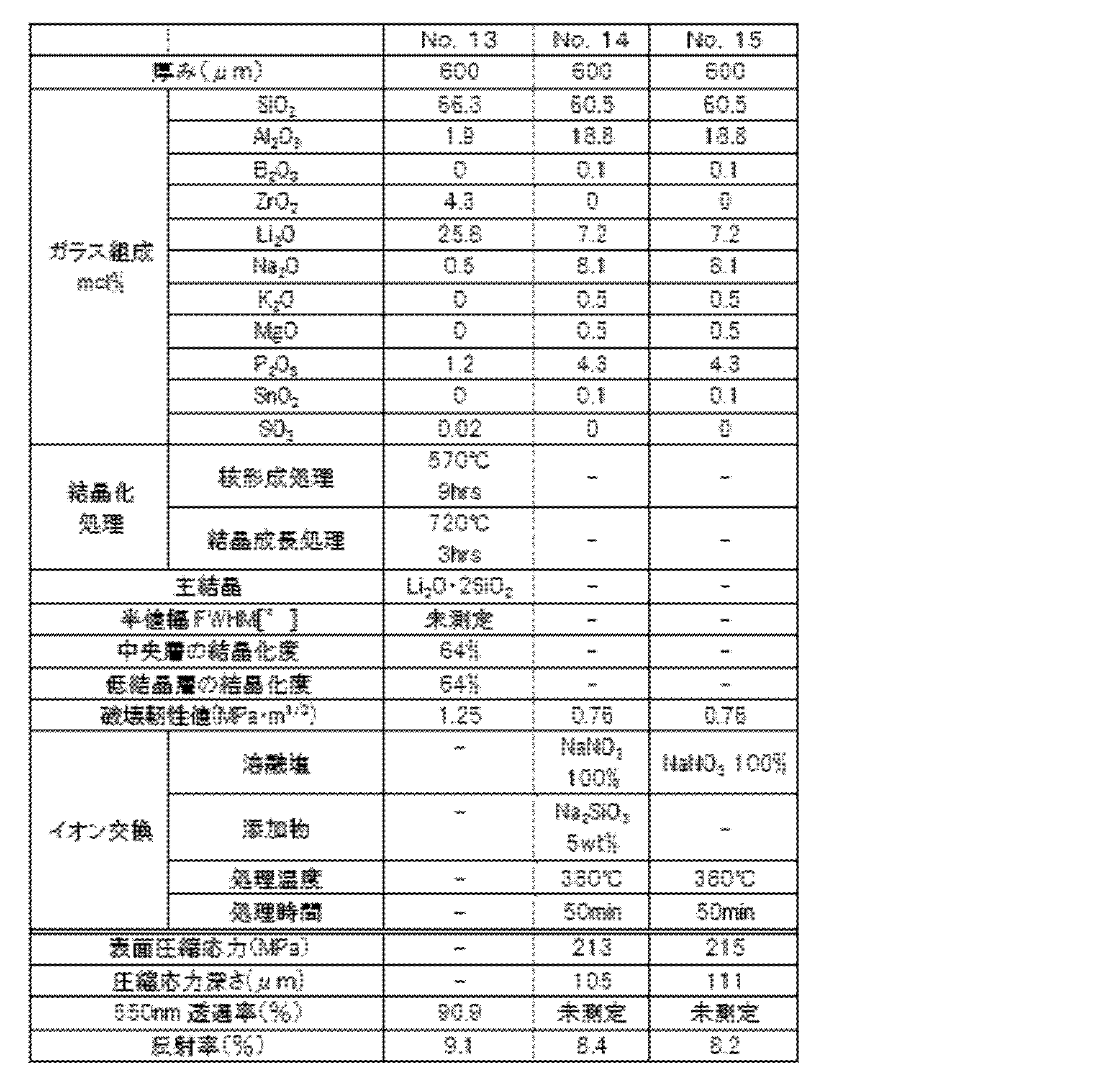
まず表1~3中のガラス組成になるように、ガラス原料を調合し、白金ポットを用いて1500℃で8時間溶融した。続いて、得られた溶融ガラスをカーボン板の上に流し出して、平板形状に成形することでガラス板を得た。得られたガラス板について、板厚が1000μm(1.0mm)又は600μm(0.6mm)になるように表面を光学研磨した。 First, glass raw materials were mixed to obtain the glass compositions shown in Tables 1 to 3, and melted at 1500°C for 8 hours using a platinum pot. The resulting molten glass was then poured onto a carbon plate and formed into a flat plate to obtain a glass plate. The surface of the resulting glass plate was optically polished to a plate thickness of 1000 μm (1.0 mm) or 600 μm (0.6 mm).
続いて、得られたガラス試料No.1~13について、電気炉により、表1~3中に示す熱処理条件で熱処理を施すことによりガラスマトリクス中に結晶を析出、成長させた。その後、常温まで冷却して、結晶化ガラス板を得た。非結晶性ガラス板(試料No.14、15)については、特段の熱処理を行わなかった。得られたガラス板について、下記の特性を評価した。 Then, the obtained glass samples No. 1 to 13 were heat-treated in an electric furnace under the heat treatment conditions shown in Tables 1 to 3 to precipitate and grow crystals in the glass matrix. They were then cooled to room temperature to obtain crystallized glass plates. No special heat treatment was performed on the non-crystalline glass plates (samples No. 14 and 15). The obtained glass plates were evaluated for the following properties.
主結晶は、X線回折装置(マルバーン・パナリティカル製 Aeris)を用いた粉末X線回折で評価したものである。なお、測定範囲を2θ=10~60°とした。また、得られたX線回折スペクトルから、バックグラウンドを除いた面積と、非晶質部(ハローピーク)を除いた面積の比率から、中央層の結晶化度を算出した。また、バックグラウンドおよび非晶質部(ハローピーク)を除き、最大強度を持つピークにおいてピークフィッティングを行って半値幅FWHMを導出した。 The main crystals were evaluated by powder X-ray diffraction using an X-ray diffractometer (Aeris, manufactured by Malvern Panalytical). The measurement range was 2θ = 10 to 60°. The crystallinity of the central layer was calculated from the ratio of the area excluding the background from the obtained X-ray diffraction spectrum to the area excluding the amorphous part (halo peak). The full width at half maximum (FWHM) was derived by peak fitting at the peak with the maximum intensity excluding the background and amorphous part (halo peak).
次に、試料No.1、2、4、5、7、8、10、11、12、14、15について、表1~3に記載の条件でイオン交換処理を行い、表面に圧縮応力層を形成することにより、強化結晶化ガラス(No.1、2、4、5、7、8、10、11、12)、強化非晶質ガラス(No.14、15)を得た。なお、試料No.1、4、7、10、11、14は、添加物として珪酸またはアルカリ金属珪酸塩を含むイオン交換用混合物を用いてイオン交換処理を行った。一方、試料No.2、5、8、12、15は、添加物を含まない溶融塩を用いてイオン交換処理を行った。なお、表1~3に示す添加物の添加量は、溶融塩を100質量部とした場合に添加したアルカリ金属珪酸塩の量を質量部で示したものである。 Next, samples No. 1, 2, 4, 5, 7, 8, 10, 11, 12, 14, and 15 were subjected to ion exchange treatment under the conditions shown in Tables 1 to 3 to form a compressive stress layer on the surface, thereby obtaining reinforced crystallized glass (No. 1, 2, 4, 5, 7, 8, 10, 11, and 12) and reinforced amorphous glass (No. 14 and 15). Samples No. 1, 4, 7, 10, 11, and 14 were subjected to ion exchange treatment using an ion exchange mixture containing silicic acid or an alkali metal silicate as an additive. On the other hand, samples No. 2, 5, 8, 12, and 15 were subjected to ion exchange treatment using a molten salt that did not contain an additive. The amount of additives shown in Tables 1 to 3 is the amount of alkali metal silicate added in parts by mass when the molten salt is taken as 100 parts by mass.
表面圧縮応力値と圧縮応力深さは、折原製作所の散乱光光弾性応力計SLP-2000により測定したものである。測定に際し、No.1、2、4、5、7、8、10、11、12の光弾性定数を27.0、屈折率を1.55とし、No.14、15の光弾性定数を30.5、屈折率を1.51とした。 The surface compressive stress value and compressive stress depth were measured using an Orihara Manufacturing Co., Ltd. scattered light photoelastic stress meter SLP-2000. For the measurements, the photoelastic constant of No. 1, 2, 4, 5, 7, 8, 10, 11, and 12 was set to 27.0 and the refractive index was set to 1.55, and the photoelastic constant of No. 14 and 15 was set to 30.5 and the refractive index was set to 1.51.
550nm透過率は、分光光度計(日本分光株式会社製V-670)を用いて、ガラスの厚み方向の波長550nmにおける透過率を測定した値を示す。 The 550 nm transmittance is the value measured at a wavelength of 550 nm in the thickness direction of the glass using a spectrophotometer (V-670 manufactured by JASCO Corporation).
反射率は、波長360~780nmの平均反射率を測定および算出した。各波長における反射率は、分光光度計(積分球使用、日本分光社製、V?670型)を使用して測定した。図2は、試料No.1~3の各波長における反射率の測定結果を示したものである。図2において、横軸は波長を示し、縦軸は各波長における反射率を示す。 Reflectance was measured and calculated as the average reflectance for wavelengths from 360 to 780 nm. Reflectance at each wavelength was measured using a spectrophotometer (using an integrating sphere, manufactured by JASCO Corporation, Model V-670). Figure 2 shows the measurement results of reflectance at each wavelength for samples No. 1 to 3. In Figure 2, the horizontal axis indicates wavelength, and the vertical axis indicates reflectance at each wavelength.
低結晶層の結晶化度は、X線回折装置(Rigaku製 SmarLab)を用いた平行ビーム法によるインプレーン測定により評価した。なお、X線入射角をθ=0.5°、測定範囲を2θ=5~60°とした。得られたX線回折スペクトルから、バックグラウンドを除いた面積と、非晶質部(ハローピーク)を除いた面積の比率から低結晶層の結晶化度を算出した。 The degree of crystallinity of the low crystallinity layer was evaluated by in-plane measurement using a parallel beam method with an X-ray diffraction device (SmarLab, manufactured by Rigaku). The X-ray incidence angle was θ = 0.5°, and the measurement range was 2θ = 5 to 60°. From the obtained X-ray diffraction spectrum, the degree of crystallinity of the low crystallinity layer was calculated from the ratio of the area excluding the background to the area excluding the amorphous portion (halo peak).
表1、3から明らかなように、実施例である試料No.1は、強化結晶化ガラスであることから比較例である試料No.14、15に比べ破壊靭性値が高く、耐衝撃性に優れる。これに加えて、試料No.1は、イオン交換処理において添加物としてナトリウムメタシリケートを含むイオン交換用混合物を用いたことにより、比較例である試料No.2、3に比べ反射率が好適に抑制されている。なお、実施例である試料No.1は、比較例である試料No.3のイオン交換処理後の強化結晶化ガラスに相当し、その波長360~780nmにおける平均反射率がイオン交換処理前に比べて低下している。 As is clear from Tables 1 and 3, sample No. 1, which is an embodiment, is a reinforced crystallized glass, and therefore has a higher fracture toughness value and better impact resistance than comparative samples Nos. 14 and 15. In addition, sample No. 1 uses an ion exchange mixture containing sodium metasilicate as an additive in the ion exchange treatment, and thus the reflectance is suitably suppressed compared to comparative samples Nos. 2 and 3. Sample No. 1, which is an embodiment, corresponds to the reinforced crystallized glass of comparative sample No. 3 after ion exchange treatment, and its average reflectance at wavelengths of 360 to 780 nm is lower than that before ion exchange treatment.
試料No.10、12の強化結晶化ガラスを収束イオンビーム法によって薄片化したものについて、透過型電子顕微鏡(TEM)を用いて観察した。図3は試料No.10(実施例)のTEM画像を、図4は試料No.12(比較例)のTEM像を各々示したものである。比較例である試料No.12は、ガラス表面1aからガラス内部まで、黒点の結晶で満たされた比較的均質で結晶化度の高い結晶化ガラスにより構成されていた。一方、実施例である試料No.10はガラス表面1aから2μm程度の深さ(図3中の破線部)まで黒点の結晶が少なく、結晶化度の低い低結晶層21がガラス表面に生じていることが分かる。なお、図3に示す試料No.10の画像によれば、表面から2μmより深い中央層22では、黒点の結晶が多く、表面の低結晶層21よりも結晶化度が相対的に高いことが見て取れる。
The reinforced crystallized glass of samples No. 10 and 12 were sliced by the focused ion beam method and observed using a transmission electron microscope (TEM). Figure 3 shows a TEM image of sample No. 10 (Example), and Figure 4 shows a TEM image of sample No. 12 (Comparative Example). Sample No. 12, which is a comparative example, was composed of relatively homogeneous crystallized glass with a high degree of crystallization filled with black dot crystals from the glass surface 1a to the inside of the glass. On the other hand, sample No. 10, which is an example, has few black dot crystals from the glass surface 1a to a depth of about 2 μm (broken line in Figure 3), and it can be seen that a
試料No.10は、イオン交換処理において添加物としてナトリウムメタシリケートを含むイオン交換用混合物を用いたことにより、このような低結晶層が表面に形成され、表面の屈折率が低下し、反射率が好適に抑制されている。このような低結晶層が形成された原理は定かではないが、同様の試料に対してエネルギー分散型X線分光法(EDX)の測定を行ったところ、Si,Al,P、Zr、Naなどのイオンが検出されたことから、イオン交換処理により、結晶化ガラスの結晶質の一部が非晶質に変化したと推定される。 In sample No. 10, an ion exchange mixture containing sodium metasilicate was used as an additive in the ion exchange process, which resulted in the formation of a low crystallinity layer on the surface, lowering the refractive index of the surface and effectively suppressing the reflectance. The principle by which this low crystallinity layer was formed is unclear, but when a similar sample was measured using energy dispersive X-ray spectroscopy (EDX), ions such as Si, Al, P, Zr, and Na were detected, suggesting that the ion exchange process changed part of the crystalline glass to amorphous.
1 強化結晶化ガラス
11 圧縮応力層
12 引張応力層
21 低結晶層
22 中央層
1 Reinforced crystallized
Claims (22)
前記イオン交換用混合物は、溶融塩と、添加物として珪酸または珪酸塩と、を含み、
前記イオン交換処理前の前記結晶化ガラスの波長360~780nmにおける平均反射率より、前記イオン交換処理後の前記強化結晶化ガラスの波長360~780nmにおける平均反射率を低下させる、ことを特徴とする強化結晶化ガラスの製造方法。 A method for producing strengthened crystallized glass, comprising the steps of immersing a part or whole of a crystallized glass containing an alkali metal component in an ion exchange mixture to obtain a strengthened crystallized glass, the method comprising the steps of:
The mixture for ion exchange contains a molten salt and, as an additive, silicic acid or a silicate;
The method for producing the strengthened crystallized glass is characterized in that the average reflectance of the strengthened crystallized glass after the ion exchange treatment in the wavelength range of 360 to 780 nm is lower than the average reflectance of the strengthened crystallized glass before the ion exchange treatment in the wavelength range of 360 to 780 nm.
前記添加物は、アルカリ金属珪酸塩であり、
前記アルカリ金属珪酸塩は、Na2SiO3、Na4SiO4、Na2Si2O5、およびNa2Si4O9から選ばれた少なくとも1種類以上を含む、請求項1に記載の強化結晶化ガラスの製造方法。 The molten salt comprises NaNO3 ,
the additive is an alkali metal silicate;
2. The method for producing strengthened crystallized glass according to claim 1 , wherein the alkali metal silicate contains at least one selected from the group consisting of Na2SiO3 , Na4SiO4 , Na2Si2O5 , and Na2Si4O9 .
前記イオン交換処理において、波長360~780nmにおける平均反射率を低下させるとともに、前記結晶化ガラスに圧縮応力層を形成する、
請求項2に記載の強化結晶化ガラスの製造方法。 The molten salt contains, in terms of mass %, 50 to 100% NaNO 3 and 0 to 50% KNO 3 + LiNO 3 ,
In the ion exchange treatment, the average reflectance in the wavelength range of 360 to 780 nm is reduced and a compressive stress layer is formed in the crystallized glass.
The method for producing the strengthened crystallized glass according to claim 2.
前記低結晶層の結晶化度が、当該低結晶層よりガラスの厚さ方向中央に位置する中央層の結晶化度より小さい、請求項1又は2に記載の強化結晶化ガラスの製造方法。 The method further comprises a step of reducing the crystallinity of the surface of the crystallized glass to form a low crystallinity layer,
3. The method for producing strengthened crystallized glass according to claim 1, wherein the degree of crystallization of the low crystallization layer is smaller than the degree of crystallization of a central layer located at a center of the low crystallization layer in the thickness direction of the glass.
波長360~780nmの平均反射率が9.5%以下である、強化結晶化ガラス。 A strengthened crystallized glass having a compressive stress layer on a surface thereof,
A reinforced crystallized glass having an average reflectance of 9.5% or less for wavelengths of 360 to 780 nm.
前記圧縮応力層の圧縮応力値が400MPa以上である、請求項9又は10に記載の強化結晶化ガラス。 The plate thickness is 1.5 mm or less,
11. The strengthened crystallized glass according to claim 9, wherein the compressive stress layer has a compressive stress value of 400 MPa or more.
厚さ方向の表面側に位置し前記中央層より結晶化度の低い低結晶層と、を備える、請求項9又は10に記載の強化結晶化ガラス。 a central layer located at the center in the thickness direction and containing a mixture of amorphous and crystalline materials;
11. The strengthened crystallized glass according to claim 9, further comprising a low crystallization layer located on a surface side in the thickness direction and having a crystallinity lower than that of the central layer.
厚さ方向の中央に位置し非晶質と結晶質が混在する中央層と、
厚さ方向の表面側に位置し前記中央層より結晶化度の低い表面層と、を備える、強化結晶化ガラス。 A strengthened crystallized glass having a compressive stress layer on a surface thereof,
a central layer located at the center in the thickness direction and containing a mixture of amorphous and crystalline materials;
A surface layer is located on a surface side in a thickness direction and has a lower crystallinity than the central layer.
前記結晶化ガラスの表面の結晶化度を低下させて低結晶層を形成する工程をさらに備え、
前記低結晶層の結晶化度が、当該低結晶層よりガラスの厚さ方向中央に位置する中央層の結晶化度より小さい、強化結晶化ガラスの製造方法。 A method for producing strengthened crystallized glass, comprising the steps of immersing a part or whole of a crystallized glass containing an alkali metal component in an ion exchange mixture to obtain a strengthened crystallized glass, the method comprising the steps of:
The method further comprises a step of reducing the crystallinity of the surface of the crystallized glass to form a low crystallinity layer,
A method for producing strengthened crystallized glass, wherein the degree of crystallization of the low crystallization layer is smaller than the degree of crystallization of a central layer located at the center of the glass thickness direction from the low crystallization layer.
前記イオン交換用混合物は、溶融塩と、添加物としてアルカリ金属珪酸塩と、を含み、
前記イオン交換処理前の前記結晶化ガラスの波長360~780nmにおける平均反射率より、前記イオン交換処理後の前記強化結晶化ガラスの波長360~780nmにおける平均反射率を低下させる、ことを特徴とする強化結晶化ガラスの製造方法。 A method for producing strengthened crystallized glass, comprising the steps of immersing a part or whole of a crystallized glass containing an alkali metal component in an ion exchange mixture to obtain a strengthened crystallized glass, the method comprising the steps of:
The ion exchange mixture includes a molten salt and an alkali metal silicate as an additive,
The method for producing the strengthened crystallized glass is characterized in that the average reflectance of the strengthened crystallized glass after the ion exchange treatment in the wavelength range of 360 to 780 nm is lower than the average reflectance of the strengthened crystallized glass before the ion exchange treatment in the wavelength range of 360 to 780 nm.
Priority Applications (3)
| Application Number | Priority Date | Filing Date | Title |
|---|---|---|---|
| KR1020257040761A KR20260006010A (en) | 2023-06-13 | 2024-06-11 | Reinforced crystal glass and method for producing the same |
| JP2025527938A JPWO2024257761A1 (en) | 2023-06-13 | 2024-06-11 | |
| CN202480039257.XA CN121311454A (en) | 2023-06-13 | 2024-06-11 | Strengthened crystallized glass and its manufacturing method |
Applications Claiming Priority (2)
| Application Number | Priority Date | Filing Date | Title |
|---|---|---|---|
| JP2023-096820 | 2023-06-13 | ||
| JP2023096820 | 2023-06-13 |
Publications (1)
| Publication Number | Publication Date |
|---|---|
| WO2024257761A1 true WO2024257761A1 (en) | 2024-12-19 |
Family
ID=93851973
Family Applications (1)
| Application Number | Title | Priority Date | Filing Date |
|---|---|---|---|
| PCT/JP2024/021191 Ceased WO2024257761A1 (en) | 2023-06-13 | 2024-06-11 | Strengthened crystallized glass and method for producing same |
Country Status (5)
| Country | Link |
|---|---|
| JP (1) | JPWO2024257761A1 (en) |
| KR (1) | KR20260006010A (en) |
| CN (1) | CN121311454A (en) |
| TW (1) | TW202506596A (en) |
| WO (1) | WO2024257761A1 (en) |
Citations (5)
| Publication number | Priority date | Publication date | Assignee | Title |
|---|---|---|---|---|
| WO2019167850A1 (en) * | 2018-02-27 | 2019-09-06 | Agc株式会社 | Crystallized glass of three-dimensional shape, chemically strengthened glass of three-dimensional shape, and method for producing crystallized glass of three-dimensional shape and chemically strengthened glass of three-dimensional shape |
| JP2021104915A (en) * | 2019-12-26 | 2021-07-26 | Agc株式会社 | Method for producing chemically strengthened glass and lithium ion adsorbent |
| JP2021187729A (en) * | 2020-05-25 | 2021-12-13 | 日本電気硝子株式会社 | Ion exchange glass production method, ion exchange mixture, and ion exchange glass production device |
| JP2022506640A (en) * | 2018-11-05 | 2022-01-17 | コーニング インコーポレイテッド | Manufacturing method of 3D glass ceramic articles |
| WO2022215575A1 (en) * | 2021-04-07 | 2022-10-13 | Agc株式会社 | Chemically-strengthened glass containing crystallized glass, and method for manufacturing same |
-
2024
- 2024-06-11 KR KR1020257040761A patent/KR20260006010A/en active Pending
- 2024-06-11 WO PCT/JP2024/021191 patent/WO2024257761A1/en not_active Ceased
- 2024-06-11 JP JP2025527938A patent/JPWO2024257761A1/ja active Pending
- 2024-06-11 CN CN202480039257.XA patent/CN121311454A/en active Pending
- 2024-06-13 TW TW113121921A patent/TW202506596A/en unknown
Patent Citations (5)
| Publication number | Priority date | Publication date | Assignee | Title |
|---|---|---|---|---|
| WO2019167850A1 (en) * | 2018-02-27 | 2019-09-06 | Agc株式会社 | Crystallized glass of three-dimensional shape, chemically strengthened glass of three-dimensional shape, and method for producing crystallized glass of three-dimensional shape and chemically strengthened glass of three-dimensional shape |
| JP2022506640A (en) * | 2018-11-05 | 2022-01-17 | コーニング インコーポレイテッド | Manufacturing method of 3D glass ceramic articles |
| JP2021104915A (en) * | 2019-12-26 | 2021-07-26 | Agc株式会社 | Method for producing chemically strengthened glass and lithium ion adsorbent |
| JP2021187729A (en) * | 2020-05-25 | 2021-12-13 | 日本電気硝子株式会社 | Ion exchange glass production method, ion exchange mixture, and ion exchange glass production device |
| WO2022215575A1 (en) * | 2021-04-07 | 2022-10-13 | Agc株式会社 | Chemically-strengthened glass containing crystallized glass, and method for manufacturing same |
Also Published As
| Publication number | Publication date |
|---|---|
| JPWO2024257761A1 (en) | 2024-12-19 |
| TW202506596A (en) | 2025-02-16 |
| CN121311454A (en) | 2026-01-09 |
| KR20260006010A (en) | 2026-01-12 |
Similar Documents
| Publication | Publication Date | Title |
|---|---|---|
| JP7498894B2 (en) | Tempered glass and tempered glass | |
| KR102609966B1 (en) | Microcrystalline glass product and microcrystalline glass for electronic equipment cover plate | |
| CN111268912B (en) | Ion exchangeable glasses, glass-ceramics and methods of making the same | |
| JP7602188B2 (en) | Glass-ceramics | |
| CN111268913A (en) | Microcrystalline glass product for electronic device cover plate and microcrystalline glass | |
| CN111670172A (en) | Glass for chemical strengthening | |
| WO2019167850A1 (en) | Crystallized glass of three-dimensional shape, chemically strengthened glass of three-dimensional shape, and method for producing crystallized glass of three-dimensional shape and chemically strengthened glass of three-dimensional shape | |
| CN111954647A (en) | Glass for chemical strengthening | |
| JP7722372B2 (en) | Glass and chemically strengthened glass | |
| US20250026680A1 (en) | Crystallized glass | |
| TW201630839A (en) | Glass and chemically strengthened glass | |
| US20260028269A1 (en) | Glass ceramic having excellent acid and alkali resistance, and preparation method therefor and use thereof | |
| US20230365456A1 (en) | Glass ceramic and chemically strengthened glass | |
| JP7800801B2 (en) | Glass-ceramics | |
| JP7745076B2 (en) | Tempered crystallized glass having high scratch resistance and its manufacturing method, chemically strengthened crystallized glass, glassware, and electronic device | |
| JP2021181388A (en) | Crystallized glass | |
| JP7721440B2 (en) | Reinforced glass-ceramics | |
| WO2024257761A1 (en) | Strengthened crystallized glass and method for producing same | |
| CN116813204A (en) | Crystallized glass, reinforced crystallized glass and preparation method thereof | |
| WO2023145956A1 (en) | Inorganic composition article | |
| WO2025254111A1 (en) | Chemically strengthened glass, crystallized glass, and glass | |
| WO2025254106A1 (en) | Crystallized glass, chemically strengthened glass, glass, and three-dimensionally shaped cover glass | |
| WO2025121292A1 (en) | Chemically strengthened glass, cover glass, display, and solar cell module | |
| WO2022255198A1 (en) | Crystallized glass manufacturing method | |
| WO2025245925A1 (en) | Crystallized glass and preparation method therefor |
Legal Events
| Date | Code | Title | Description |
|---|---|---|---|
| 121 | Ep: the epo has been informed by wipo that ep was designated in this application |
Ref document number: 24823376 Country of ref document: EP Kind code of ref document: A1 |
|
| WWE | Wipo information: entry into national phase |
Ref document number: 2025527938 Country of ref document: JP |
|
| ENP | Entry into the national phase |
Ref document number: 1020257040761 Country of ref document: KR Free format text: ST27 STATUS EVENT CODE: A-0-1-A10-A15-NAP-PA0105 (AS PROVIDED BY THE NATIONAL OFFICE) |
|
| WWE | Wipo information: entry into national phase |
Ref document number: 1020257040761 Country of ref document: KR |
|
| WWP | Wipo information: published in national office |
Ref document number: 1020257040761 Country of ref document: KR |
|
| NENP | Non-entry into the national phase |
Ref country code: DE |