WO2024257763A1 - Terminal portable - Google Patents
Terminal portable Download PDFInfo
- Publication number
- WO2024257763A1 WO2024257763A1 PCT/JP2024/021194 JP2024021194W WO2024257763A1 WO 2024257763 A1 WO2024257763 A1 WO 2024257763A1 JP 2024021194 W JP2024021194 W JP 2024021194W WO 2024257763 A1 WO2024257763 A1 WO 2024257763A1
- Authority
- WO
- WIPO (PCT)
- Prior art keywords
- mobile terminal
- posture
- user
- notification
- acquisition unit
- Prior art date
- Legal status (The legal status is an assumption and is not a legal conclusion. Google has not performed a legal analysis and makes no representation as to the accuracy of the status listed.)
- Ceased
Links
Images




Classifications
-
- G—PHYSICS
- G06—COMPUTING OR CALCULATING; COUNTING
- G06F—ELECTRIC DIGITAL DATA PROCESSING
- G06F3/00—Input arrangements for transferring data to be processed into a form capable of being handled by the computer; Output arrangements for transferring data from processing unit to output unit, e.g. interface arrangements
- G06F3/14—Digital output to display device ; Cooperation and interconnection of the display device with other functional units
-
- H—ELECTRICITY
- H04—ELECTRIC COMMUNICATION TECHNIQUE
- H04M—TELEPHONIC COMMUNICATION
- H04M1/00—Substation equipment, e.g. for use by subscribers
- H04M1/72—Mobile telephones; Cordless telephones, i.e. devices for establishing wireless links to base stations without route selection
- H04M1/724—User interfaces specially adapted for cordless or mobile telephones
Definitions
- Patent Document 1 discloses an invention in which a mobile device such as a smartphone issues a warning to a user when it is determined that the user is using the mobile device in an incorrect posture from the perspective of the user's health, such as with their head down.
- a mobile terminal is a mobile terminal and includes a first acquisition unit, a determination unit, and a notification unit as described below.
- the first acquisition unit acquires tilt data indicating the tilt of the mobile terminal.
- the determination unit determines whether or not the same posture of a user using the mobile terminal continues for a predetermined time based on the tilt data acquired by the first acquisition unit.
- the notification unit prompts the user to change the posture when the determination unit determines that the same posture has continued for the predetermined time.
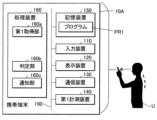
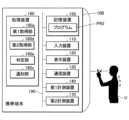
- FIG. 1 is a diagram illustrating a configuration example of a mobile terminal 10A according to a first embodiment of the present disclosure.
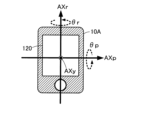
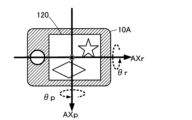
- 4A and 4B are diagrams for explaining a pitch angle ⁇ p and a roll angle ⁇ r that represent the inclination of the mobile terminal 10A.
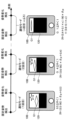
- 1 is a diagram showing an example of a user U holding a mobile terminal 10A in his/her hand and an example of the operation of a notification unit 160c.
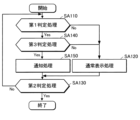
- 11 is a flowchart showing the flow of a notification control process executed by a processor 160 of the mobile terminal 10A according to a program PR1.
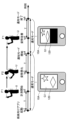
- 10A and 10B are diagrams for explaining an example of the operation of the mobile terminal 10A.
- FIG. 11 is a diagram illustrating an example of a configuration of a mobile terminal 10B according to a second embodiment of the present disclosure.
- 13 is a flowchart showing the flow of a notification control process executed by a processor 160 of a mobile terminal 10B according to a program PR2.
- 10A to 10C are diagrams for explaining an example of the operation of the mobile terminal 10B.
- FIG. 13 is a diagram for explaining a modified example (1).
- FIG. 13 is a diagram for explaining a modified example (2).
- FIG. 13 is a diagram for explaining modified example (3).
- FIG. 1 is a diagram illustrating a configuration example of a mobile terminal 10A according to an embodiment of the present disclosure.
- the mobile terminal 10A is, for example, a smartphone. As illustrated in FIG. 1, the mobile terminal 10A is used while being held in the hand of a user U.
- the mobile terminal 10A has a program execution function, and executes an entertainment application program and a business application program used by the user U when performing business, according to an instruction from the user U, by using this program execution function.
- Examples of the entertainment application program include a video game program or a video viewing program.
- Examples of the business application program include a word processing program.
- the mobile terminal 10A includes an input device 110, a display device 120, a communication device 130, a first measuring device 140, a storage device 150, a processing device 160, and a bus 190.
- the input device 110, the display device 120, the communication device 130, the first measuring device 140, and the storage device 150 are each connected to the processing device 160 by the bus 190 for communicating information.
- the bus 190 may be configured using a single bus, or may be configured using different buses between each device.
- the input device 110 includes a touch panel. In addition to the touch panel, the input device 110 may include a plurality of operation keys. The input device 110 accepts operations by the user U on the mobile terminal 10A.
- the display device 120 is, for example, a liquid crystal display. Although detailed illustration is omitted in FIG. 1, the display device 120 has a rectangular display surface.
- the touch panel of the input device 110 is layered on the display surface of the display device 120.
- the display device 120 displays various information on the display surface under the control of the processing device 160.
- the communication device 130 is hardware (transmitting/receiving device) for communicating with other devices via a communication line, either wired or wirelessly. In FIG. 1, the communication line and other devices are omitted from the illustration.
- the communication device 130 is also called, for example, a network device, a network controller, a network card, or a communication module.
- An example of another device that communicates with the communication device 130 via a communication line is a server device that distributes application programs.
- the communication device 130 transmits data provided by the processing device 160 to the communication line.
- the communication device 130 also supplies data received via the communication line to the processing device 160.
- the roll angle ⁇ r is the rotation angle of the mobile terminal 10A with the axis AXr as the rotation axis.
- the axis AXr is an axis that extends in a direction perpendicular to both the axis AXy and the axis AXp.
- the axis AXr is an axis that is perpendicular to the axis AXy and extends in the longitudinal direction of the display surface of the display device 120.
- the state in which the axis AXy is aligned with the vertical axis is the reference state, and in this reference state, the pitch angle ⁇ p is 0° and the roll angle ⁇ r is also 0°.
- the storage device 150 is a recording medium that can be read by the processing device 160.
- the storage device 150 includes, for example, a non-volatile memory and a volatile memory.
- the non-volatile memory is, for example, a ROM (Read Only Memory), an EPROM (Erasable Programmable Read Only Memory), or an EEPROM (Electrically Erasable Programmable Read Only Memory).
- the volatile memory is, for example, a RAM (Random Access Memory). Although detailed illustration is omitted in FIG. 1, the non-volatile memory of the storage device 150 stores the above-mentioned entertainment application program and business application program.
- the non-volatile memory of the storage device 150 stores a program PR1 that is associated with the entertainment application program and causes the processing device 160 to execute a notification control process, which is a process of notifying the user from the mobile terminal 10A by a notification method specific to the present disclosure.
- the volatile memory of storage device 150 is used as a work area when executing various application programs and program PR1.
- the processing device 160 includes one or more central processing units (CPUs).
- the one or more CPUs are an example of one or more processors.
- Each of the processors and CPUs is an example of a computer.
- the processing device 160 When the processing device 160 is instructed to execute an entertainment application program or a business application program by an operation on the input device 110, the processing device 160 reads the application program that has been instructed to be executed from the non-volatile memory to the volatile memory. The processing device 160 then executes the application program that has been read into the volatile memory.
- the processing device 160 operating in accordance with the application program, displays an image on the display surface of the display device 120, including an app image that allows the user U to use an application realized by the application program.
- the app image is an example of a display image in the present disclosure.
- the user U uses the application by making various inputs while looking at the app image.
- the processing device 160 reads the program PR1 associated with the entertainment application program from the non-volatile memory to the volatile memory, and executes the program PR1 in parallel with the execution of the entertainment application program.
- the processing device 160 operating according to the program PR1 functions as the first acquisition unit 160a, the determination unit 160b, and the notification unit 160c shown in FIG. 1.
- the first acquisition unit 160a, the determination unit 160b, and the notification unit 160c in FIG. 1 are software modules realized by operating the processing device 160 according to software.
- the functions of the first acquisition unit 160a, the determination unit 160b, and the notification unit 160c are as follows:
- the first acquisition unit 160a acquires tilt data representing the tilt of the mobile terminal 10A from the first measuring device 140. Details will be described later, but in this embodiment, the first acquisition unit 160a starts supplying operating power to the first measuring device 140 when a predetermined time T has elapsed since the start of execution of the entertainment application program (in other words, the start of execution of program PR1), and thereafter acquires tilt data output from the first measuring device 140.
- the posture of the user U holding the mobile terminal 10A in his/her hand there is a certain relationship between the posture of the user U holding the mobile terminal 10A in his/her hand and the inclination of the mobile terminal 10A.
- the pitch angle ⁇ p is approximately 60° to 90°.
- the pitch angle ⁇ p is approximately 0° to 60°.
- the determination unit 160b determines that the posture of the user U is correct.
- the determination unit 160b determines that the posture of the user U is incorrect. Then, when a state where 0° ⁇ pitch angle ⁇ p ⁇ 60° and the roll angle ⁇ r is in the range of -15° to 15° continues for a predetermined time T, the determination unit 160b determines that the incorrect posture of the user U has continued for the predetermined time T. Furthermore, when it is determined that the incorrect posture of the user U has continued for the predetermined time T, the determination unit 160b determines that the correct posture has been restored when a state where 60° ⁇ pitch angle ⁇ p ⁇ 90° continues for the predetermined time T.
- the notification unit 160c notifies the user U to change his/her posture when the determination unit 160b determines that an incorrect posture (as described above, in this embodiment, a bowed posture) has continued for a predetermined time T.
- the notification unit 160c notifies the user U to change his/her posture by controlling the area and position of the app image G1 on the display surface of the display device 120 according to the pitch angle ⁇ p, as shown in FIG. 3.
- the ratio R calculated according to formula 1 does not fall below 0.1, and even when the pitch angle ⁇ p is 0°, the app image G1 is not completely erased. Even when the pitch angle ⁇ p is 0°, the app image G1 is not completely erased, so that even when the user U's posture is the posture F3 in FIG. 3, the entertainment application corresponding to the app image G1 is not completely unavailable.
- Equation 1 and FIG. 3 the worse the degree to which the user U is bowed (i.e., the closer the pitch angle ⁇ p is to 0°), the more the app image G1 is displayed on the display surface of the display device 120 in a state in which it is narrowed from the bottom.
- the user U unconsciously moves his/her arm to stand up the mobile terminal 10A (i.e., the closer the pitch angle ⁇ p is to 90°), and in conjunction with this arm movement, the user U often straightens his/her back.
- the user U's posture returns to the correct posture such as posture F1 in FIG. 3.
- the notification unit 160c narrows the app image G1 from the bottom of the display surface of the display device 120 according to the pitch angle ⁇ p in order to prompt the user U to unconsciously change his/her posture.
- FIG. 4 is a flowchart showing the flow of the notification control process.
- the notification control process includes a first determination process SA110, a normal display process SA120, a second determination process SA130, a third determination process SA140, and a notification process SA150.
- the processing contents of each process of the first determination process SA110, the normal display process SA120, the second determination process SA130, the third determination process SA140, and the notification process SA150 are as follows:
- the processing device 160 determines whether a predetermined time T has elapsed since the start of execution of the entertainment application program. Until the predetermined time T has elapsed since the start of execution of the entertainment application program, the determination result of the first determination process SA110 is "No". In contrast, after the predetermined time T has elapsed since the start of execution of the entertainment application program, the determination result of the first determination process SA110 is "Yes”. As shown in FIG. 4, if the determination result of the first determination process SA110 is "No", the processing device 160 executes the normal display process SA120. In contrast, if the determination result of the first determination process SA110 is "Yes", the processing device 160 executes the third determination process SA140.
- the processing device 160 arranges the application image G1, which is displayed according to the entertainment application program, on the entire display surface of the display device 120.
- the operation mode in which the application image G1 is arranged on the entire display surface of the display device 120 is referred to as the normal mode.
- the processing device 160 determines whether or not an instruction to end the execution of the entertainment application program has been issued by an operation on the input device 110. If an instruction to end the execution of the entertainment application program has been issued, the determination result of the second determination process SA130 is "Yes".
- the processing device 160 ends the execution of the entertainment application program, ends the execution of the program PR1, and ends the notification control process. If an instruction to end the execution of the entertainment application program has not been issued, the determination result of the second determination process SA130 is "No". If the result of the second determination process SA130 is "No,” the processing device 160 executes the first determination process SA110 described above again.
- the processing device 160 functions as the first acquisition unit 160a and the determination unit 160b. More specifically, in the third determination process SA140, the processing device 160 operates the first measuring device 140 and acquires tilt data from the first measuring device 140. Then, based on the acquired tilt data, the processing device 160 judges whether or not an incorrect posture has continued for a predetermined time T for the user U using the mobile terminal 10A. More specifically, when a state in which 0° ⁇ pitch angle ⁇ p ⁇ 60° and the roll angle ⁇ r is in the range of -15° to 15° has continued for the predetermined time T, the processing device 160 judges that an incorrect posture has continued for the predetermined time T for the user U.
- the result of the third judgment process SA140 is "Yes”. If the state where 0° ⁇ pitch angle ⁇ p ⁇ 60° and the roll angle ⁇ r is in the range of -15° to 15° continues for less than the predetermined time T, or if 60° ⁇ pitch angle ⁇ p ⁇ 90°, the result of the third judgment process SA140 will be "No” in principle. However, if the previous result of the third judgment process SA140 was “Yes”, if the state where 60° ⁇ pitch angle ⁇ p ⁇ 90° continues for the predetermined time T, the result of the third judgment process SA140 will be "No".
- the processing device 160 executes the normal display process SA120 described above. On the other hand, if the determination result of the third determination process SA140 is "Yes”, the processing device 160 executes the notification process SA150 and then executes the second determination process SA130. In the notification process SA150, the processing device 160 functions as a notification unit 160c. In the notification process SA150, the processing device 160 notifies the user that the attitude will be changed by controlling the area and position occupied by the app image G1 on the display surface of the display device 120 according to the pitch angle ⁇ p.
- the notification mode in which the area and position occupied by the app image G1 on the display surface of the display device 120 according to the pitch angle ⁇ p is referred to as the notification mode.
- FIG. 5 is a diagram showing an example of the operation of the mobile terminal 10A.
- the user U starts using an entertainment application program, and uses the mobile terminal 10A in the correct posture F1 until time tb3.
- the judgment result of the first judgment process SA110 is "No"
- the normal display process SA120 is executed.
- the judgment result of the first judgment process SA110 is "Yes”.
- the judgment result of the third judgment process SA140 is "No" until a predetermined time T has elapsed since the user U's posture deteriorated from the correct posture F1 to the downward posture F2 at time ta3 (i.e., until time ta4 is reached), and the normal display process SA120 is executed. Therefore, in the example shown in FIG. 5, the mobile terminal 10A operates in normal mode from time ta1 to time ta4.
- the mobile terminal 10A operates in the notification mode from time ta4 to time ta6, and operates in the normal mode from time ta6 onwards.
- a notification is sent to user U urging him/her to change his/her posture. This means that such notifications are not sent frequently, reducing annoyance, compared to a mode in which a notification is sent to urge user U to change his/her posture every time user U's posture becomes incorrect.
- the processing device 160 activates the first measuring device 140 when a predetermined time T has elapsed since the execution of the entertainment application program was started, so battery consumption in the mobile terminal 10A can be reduced compared to a configuration in which the first measuring device 140 is constantly activated. Note that in this embodiment, the posture of the user U while using the entertainment application program is monitored, because entertainment application programs are expected to be used for long periods of time in incorrect postures compared to business application programs.
- the notification unit 160c narrows the app image G1 from the bottom of the display surface of the display device 120 according to the pitch angle ⁇ p, thereby encouraging the user U to unconsciously change his/her posture to the correct posture F1.
- the posture of the user U using a business application program is not monitored, so the mobile terminal 10A does not operate in notification mode while the business application program is being executed, and there is no disruption to the user U's use of the business application program.
- Fig. 6 is a diagram showing a configuration example of a mobile terminal 10B according to a second embodiment of the present disclosure.
- the same components as those in Fig. 1 are given the same reference numerals.
- the configuration of the mobile terminal 10B differs from the configuration of the mobile terminal 10A in the following two points.
- the first difference is that the mobile terminal 10B has a second measuring device 170.
- the second difference is that a program PR2 is stored in the storage device 150 provided in the mobile terminal 10B instead of the program PR1.
- the second measuring device 170 is, for example, a three-axis acceleration sensor.
- the second measuring device 170 measures the acceleration of the mobile terminal 10B in the vertical axis direction and in two axial directions that are perpendicular to the vertical axis and perpendicular to each other.
- the second measuring device 170 may measure the acceleration of the mobile terminal 10B in each axial direction in a three-axial Cartesian coordinate system fixed to the second measuring device 170.
- the second measuring device 170 is not constantly supplied with operating power from a battery (not shown in FIG. 6).
- the supply of operating power to the second measuring device 170 i.e., the start of operation of the second measuring device 170, is controlled by the processing device 160. Under the control of the processing device 160, the second measuring device 170 outputs acceleration data representing the acceleration in each axial direction that it has measured.
- the program PR2 is stored in the storage device 150 in association with the entertainment application program, similar to the program PR1 in the first embodiment.
- the processing device 160 of the mobile terminal 10B starts executing the program PR2 when the entertainment application program starts to be executed, similar to the first embodiment.
- the processing device 160 operating according to the program PR2 functions as the first acquisition unit 160a, the second acquisition unit 160d, the determination unit 160e, and the notification unit 160c shown in FIG. 6.
- the second acquisition unit 160d and the determination unit 160e which are different from the first embodiment, are software modules, similar to the first acquisition unit 160a and the notification unit 160c.
- the functions of the second acquisition unit 160d and the determination unit 160e are as follows:
- the second acquisition unit 160d acquires acceleration data representing the acceleration of the mobile terminal 10B in the vertical axis direction and in each of two axial directions that are perpendicular to the vertical axis and perpendicular to each other, from the second measurement device 170.
- the second acquisition unit 160d activates the second measurement device 170 and starts acquiring acceleration data when a predetermined time T has elapsed since the start of execution of the entertainment application program.
- the determination unit 160e determines whether or not the same posture has continued for a predetermined time T for the user U using the entertainment application program using the mobile terminal 10B, regardless of whether the posture is correct or not, based on the tilt data acquired by the first acquisition unit 160a and the acceleration data acquired by the second acquisition unit 160d.
- the determination unit 160e determines that the same posture has continued for a predetermined time T when the fluctuations of the pitch angle ⁇ p and the roll angle ⁇ r represented by the tilt data are within a predetermined range (for example, a range of -5° to 5°), and the fluctuations of the acceleration of the acceleration data in the vertical axis direction and in each of the two axial directions perpendicular to the vertical axis and perpendicular to each other are within a predetermined range (for example, a range of -0,1 ⁇ g to 0,1 ⁇ g, where g is the gravitational acceleration) continue for the predetermined time T.
- a predetermined range for example, a range of -5° to 5°
- the notification unit 160c issues a notification.
- a gyro sensor may be adopted as the first measuring device 140.
- the determination unit 160e may determine whether or not the same attitude has continued for a predetermined time T based on the output from the gyro sensor.
- the mobile terminal 10B may be configured without including the second measuring device 170.
- a three-axis acceleration sensor may be adopted as the first measuring device 140.
- the determination unit 160e may determine whether or not the same attitude has continued for a predetermined time T based on the output from the three-axis acceleration sensor.
- the mobile terminal 10B may be configured without including the second measuring device 170.
- the judgment unit 160e may determine whether or not an incorrect posture has continued for a predetermined time T for a user U who is using an entertainment application program using the mobile terminal 10B, based on the tilt data acquired by the first acquisition unit 160a and the acceleration data acquired by the second acquisition unit 160d.
- FIG. 7 is a flowchart showing the flow of the notification control process according to the second embodiment, which is executed by the processing device 160 of the mobile terminal 10B in accordance with the program PR2.
- the same processes as those in FIG. 4 are given the same reference numerals.
- the difference between the notification control process in this embodiment and the notification control process in the first embodiment is that a third determination process SB140 is provided instead of the third determination process SA140.
- the processing device 160 functions as a first acquisition unit 160a, a second acquisition unit 160d, and a determination unit 160e.
- the processing device 160 operates the first measuring device 140 to acquire tilt data from the first measuring device 140, and operates the second measuring device 170 to acquire acceleration data from the second measuring device 170. Then, based on the acquired tilt data and acceleration data, the processing device 160 determines whether the same posture has continued for a predetermined time T for the user U who is using an entertainment application program with the mobile terminal 10B.
- the judgment result of the third judgment process SB140 is "Yes”. If at least one of the pitch angle ⁇ p and roll angle ⁇ r has fluctuated beyond the predetermined range, or if at least one of the accelerations in each axial direction has fluctuated beyond the predetermined range, the judgment result of the third judgment process SB140 is "No".
- the processing device 160 executes the normal display process SA120. If the judgment result of the third judgment process SB140 is "Yes”, the processing device 160 executes the notification process SA150 and then executes the second judgment process SA130.
- FIG. 8 is a diagram for explaining an example of the operation of the mobile terminal 10B.
- the user U starts using an entertainment application program at time tb1, and the user U changes his/her posture from time to time tb3.
- the judgment result of the first judgment process SA110 is "No"
- the normal display process SA120 is executed.
- the judgment result of the first judgment process SA110 is "Yes"
- the judgment result of the third judgment process SB140 is "No”
- the normal display process SA120 is executed.
- the mobile terminal 10B operates in normal mode from time tb1 to time tb4.
- the processing device 160 activates the first measuring device 140 and the second measuring device 170 when a predetermined time T has elapsed since the execution of the entertainment application program was started, so that the battery consumption in the mobile terminal 10B can be reduced compared to a mode in which the first measuring device 140 and the second measuring device 170 are constantly activated.
- the posture of the user U while using the entertainment application program is also monitored, because entertainment application programs are expected to be used for longer periods of time than business application programs.
- the posture of the user U while using the business application program is not monitored, so the mobile terminal 10B does not operate in notification mode while the business application program is being executed, and there is no disruption to the use of the business application program.
- C Deformation
- the present disclosure is not limited to the first and second embodiments exemplified above. Specific modified aspects are as follows. Two or more aspects selected from the following examples may be combined.
- the mobile terminal 10A is held by the user U so that the axis AXr is an axis in the vertical direction.
- the mobile terminal 10A is held so that the axis AXp is an axis in the vertical direction, as shown in FIG.
- the determination unit 160b may determine whether the posture of the user U is good or bad based on the roll angle ⁇ r. Specifically, the determination unit 160b may determine that the posture of the user U is correct if 60° ⁇ roll angle ⁇ r, and determine that the posture of the user U is incorrect if 0° ⁇ roll angle ⁇ r ⁇ 60° and the pitch angle ⁇ p is an angle in the range of ⁇ 15° to 15°.
- the notification unit 160c narrows the area allocated to the app image on the display surface of the display device 120 from the bottom, thereby urging the user U to change his/her posture.
- the notification unit 160c may narrow the area allocated to the app image on the display surface of the display device 120 from either the top, right, or left, thereby urging the user U to change his/her posture, or may narrow the area from a plurality of directions among the top, bottom, left, and right.
- notification unit 160c may prompt the user to change the posture by controlling the area allocated to the app image without changing the position allocated to the app image on the display surface of display device 120.
- controlling the area allocated to the app image without changing the position allocated to the app image means, for example, "reducing the app image around the central position of the app image on the display surface without changing the central position of the app image.”
- notification unit 160c may prompt the user to change the posture by controlling the position allocated to the app image without changing the area allocated to the app image on the display surface of display device 120.
- controlling the area allocated to the app image without changing the area allocated to the app image means, for example, “sliding the position of the app image without changing the area of the app image on the display surface.”
- the notification unit 160c may prompt the user U to change his/her posture by controlling at least one of the luminosity (brightness) and saturation (color vividness) when displaying an app image on the display surface of the display device 120 in accordance with the pitch angle ⁇ p.
- the notification to encourage a posture change is not limited to a notification by controlling the display mode of the app image on the display surface of the display device 120, but may be a notification by displaying a message such as "Please stand up straight" or by outputting a voice representing the message.
- the notification unit 160c may control the display area of the application image by weighting according to the number of transitions from the normal mode to the notification mode.
- the minimum value of the ratio R is 0.4 (i.e., 40%), and even if the pitch angle ⁇ p is 0 degrees, the display area of the application image to the entire display surface of the display device 120 will not be less than 40%.
- the minimum value of the ratio R is 0.1 (i.e., 10%), and even if the pitch angle ⁇ p is 0 degrees, the display area of the application image to the entire display surface of the display device 120 will not be less than 10%.
- the minimum values of the ratio R in FIG. 11, 0.5, 0.4, and 0.1, are examples of predetermined threshold values in the present disclosure.
- the ratio R will not fall below 0.5 when transitioning to notification mode for the first time, and the app image will remain easily viewable. However, if the fixed posture continues to occur thereafter, the ratio R will gradually decrease, making it possible for the user U to be aware of posture changes while using the application program.
- the program PR1 is stored in the storage device 150 of the mobile terminal 10A, but the program PR1 may be manufactured or sold separately.
- the program PR1 may be provided to the purchaser by writing the program PR1 to a computer-readable recording medium such as a flash ROM and distributing the program PR1 thereto, or by downloading the program PR1 via a telecommunications line.
- the program PR2 may be manufactured or sold separately.
- the first acquisition unit 160a, the determination unit 160b, and the notification unit 160c in the above embodiment are software modules.
- any one, any two, or all of the first acquisition unit 160a, the determination unit 160b, and the notification unit 160c may be hardware modules.
- Specific examples of hardware modules include DSP (Digital Signal Processor), ASIC (Application Specific Integrated Circuit), PLD (Programmable Logic Device), and FPGA (Field Programmable Gate Array). Even if any one, any two, or all of the first acquisition unit 160a, the determination unit 160b, and the notification unit 160c are hardware modules, the same effect as the first embodiment is achieved.
- any one or all of the second acquisition unit 160d and the determination unit 160e may be hardware modules. Even if any one or all of the second acquisition unit 160d and the determination unit 160e are hardware modules, the same effect as the second embodiment is achieved.
- storage device 150 may also be a flexible disk, a magneto-optical disk (e.g., a compact disk, a digital versatile disk, a Blu-ray (registered trademark) disk), a smart card, a flash memory device (e.g., a card, a stick, a key drive), a CD-ROM (Compact Disc-ROM), a register, a removable disk, a hard disk, a floppy (registered trademark) disk, a magnetic strip, a database, a server, or other suitable storage medium.
- a magneto-optical disk e.g., a compact disk, a digital versatile disk, a Blu-ray (registered trademark) disk
- a smart card e.g., a flash memory device (e.g., a card, a stick, a key drive), a CD-ROM (Compact Disc-ROM), a register, a removable disk, a hard disk, a floppy (registered trademark) disk,
- the input and output information, etc. may be stored in a specific location (e.g., memory) or may be managed using a management table.
- the input and output information, etc. may be overwritten, updated, or added to.
- the output information, etc. may be deleted.
- the input information, etc. may be transmitted to another device.
- the determination may be made based on a value represented by one bit (0 or 1), a Boolean value (true or false), or a comparison of numerical values (e.g., a comparison with a predetermined value).
- each function illustrated in FIG. 1 or FIG. 6 is realized by any combination of at least one of hardware and software. Furthermore, there are no particular limitations on the method of realizing each functional block. That is, each functional block may be realized using one device that is physically or logically coupled, or may be realized using two or more devices that are physically or logically separated and connected directly or indirectly (e.g., using wires, wirelessly, etc.). A functional block may be realized by combining software with the one device or the multiple devices.
- software, instructions, information, etc. may be transmitted and received via a transmission medium.
- a transmission medium For example, if the software is transmitted from a website, server, or other remote source using at least one of wired technologies (such as coaxial cable, fiber optic cable, twisted pair, Digital Subscriber Line (DSL)), and/or wireless technologies (such as infrared, microwave, etc.), then at least one of these wired and wireless technologies is included within the definition of a transmission medium.
- wired technologies such as coaxial cable, fiber optic cable, twisted pair, Digital Subscriber Line (DSL)
- wireless technologies such as infrared, microwave, etc.
- the information, parameters, etc. described in this disclosure may be expressed using absolute values, may be expressed using relative values from a predetermined value, or may be expressed using other corresponding information.
- the mobile terminal may be a mobile station (MS).
- a mobile station may also be referred to by those skilled in the art as a subscriber station, mobile unit, subscriber unit, wireless unit, remote unit, mobile device, wireless device, wireless communication device, remote device, mobile subscriber station, access terminal, mobile terminal, wireless terminal, remote terminal, handset, user agent, mobile client, client, or some other suitable term.
- terms such as “mobile station,” “user terminal,” “user equipment (UE),” and “terminal” may be used interchangeably.
- connection refers to any direct or indirect connection or coupling between two or more elements, and may include the presence of one or more intermediate elements between two elements that are “connected” or “coupled” to each other.
- the coupling or connection between elements may be physical, logical, or a combination thereof.
- “connected” may be read as "access”.
- two elements may be considered to be “connected” or “coupled” to each other using at least one of one or more wires, cables, and printed electrical connections, as well as electromagnetic energy having wavelengths in the radio frequency range, microwave range, and light (both visible and invisible) range, as some non-limiting and non-exhaustive examples.
- determining and “determining” as used in this disclosure may encompass a wide variety of actions. “Determining” and “determining” may include, for example, judging, calculating, computing, processing, deriving, investigating, looking up, search, inquiry (e.g., searching in a table, database, or other data structure), ascertaining something as “judging” or “determining”, etc. Also, “determining” and “determining” may include receiving (e.g., receiving information), transmitting (e.g., sending information), input, output, accessing (e.g., accessing data in memory), etc.
- judgment and “decision” can include considering resolving, selecting, choosing, establishing, comparing, etc., to have been “judged” or “decided.” In other words, “judgment” and “decision” can include considering some action to have been “judged” or “decided.” Additionally, “judgment (decision)” can be interpreted as “assuming,” “expecting,” “considering,” etc.
- a mobile terminal is a mobile terminal and includes a first acquisition unit, a determination unit, and a notification unit as described below.
- the first acquisition unit acquires tilt data indicating the tilt of the mobile terminal.
- the determination unit determines whether or not the same posture has continued for a predetermined time for a user using the mobile terminal based on the tilt data acquired by the first acquisition unit.
- the notification unit prompts the user to change their posture when the determination unit determines that the same posture has continued for the predetermined time. According to this aspect, when the same posture has continued for a predetermined time for a user using a mobile terminal, the user can be prompted to change their posture.
- the notification unit in the mobile terminal according to the third aspect of the present disclosure may prompt the user to change his/her posture by controlling at least one of the area and position of a display image displayed according to an application program on the display surface of the display device.
- the user can be visually prompted to change his/her posture by controlling at least one of the area and position of the display image on the display surface of the display device.
- the notification unit in the mobile terminal according to the fourth aspect of the present disclosure may assign the display image to the upper side of the display surface. According to this aspect, it is possible to encourage the user to unconsciously make posture changes that improve posture.
- the notification unit in a mobile terminal may control the area occupied by the display image within a range in which the proportion of the area of the display surface occupied by the display image is equal to or greater than a predetermined threshold. According to this aspect, it is possible to prevent the display image from being completely hidden.
Landscapes
- Engineering & Computer Science (AREA)
- Human Computer Interaction (AREA)
- Theoretical Computer Science (AREA)
- Physics & Mathematics (AREA)
- General Engineering & Computer Science (AREA)
- General Physics & Mathematics (AREA)
- Computer Networks & Wireless Communication (AREA)
- Signal Processing (AREA)
- Telephone Function (AREA)
Abstract
L'invention concerne un terminal portable 10A qui comprend une première unité d'acquisition 160a, une unité de détermination 160b et une unité de notification 160c. La première unité d'acquisition 160a acquiert des données d'inclinaison indiquant l'angle de tangage θ et l'angle de roulis θr qui représentent l'inclinaison du terminal portable 10A. L'unité de détermination 160b détermine, sur la base des données d'inclinaison acquises par la première unité d'acquisition 160a, si une posture voûtée d'un utilisateur utilisant le terminal mobile 10A a ou non continué pendant une période prescrite. Lorsqu'il a été déterminé par l'unité de détermination 160b qu'une posture voûtée a continué pendant la période prescrite, l'unité de notification 160c invite l'utilisateur à changer de posture en commandant la zone et la position occupées par une image d'affichage sur la surface d'affichage d'un dispositif d'affichage 120 en fonction de l'inclinaison du terminal portable 10A.
Priority Applications (1)
| Application Number | Priority Date | Filing Date | Title |
|---|---|---|---|
| JP2025527940A JPWO2024257763A1 (fr) | 2023-06-15 | 2024-06-11 |
Applications Claiming Priority (2)
| Application Number | Priority Date | Filing Date | Title |
|---|---|---|---|
| JP2023098315 | 2023-06-15 | ||
| JP2023-098315 | 2023-06-15 |
Publications (1)
| Publication Number | Publication Date |
|---|---|
| WO2024257763A1 true WO2024257763A1 (fr) | 2024-12-19 |
Family
ID=93851982
Family Applications (1)
| Application Number | Title | Priority Date | Filing Date |
|---|---|---|---|
| PCT/JP2024/021194 Ceased WO2024257763A1 (fr) | 2023-06-15 | 2024-06-11 | Terminal portable |
Country Status (2)
| Country | Link |
|---|---|
| JP (1) | JPWO2024257763A1 (fr) |
| WO (1) | WO2024257763A1 (fr) |
Citations (3)
| Publication number | Priority date | Publication date | Assignee | Title |
|---|---|---|---|---|
| KR20130113687A (ko) * | 2012-04-06 | 2013-10-16 | 주식회사 네오위즈인터넷 | 휴대용 단말의 자세교정 기능 제공 방법 및 장치 |
| WO2019021356A1 (fr) * | 2017-07-25 | 2019-01-31 | 株式会社E3 | Dispositif de détection de posture induisant la rigidité |
| WO2022270646A1 (fr) * | 2021-06-22 | 2022-12-29 | 주식회사 다노 | Procédé et serveur de gestion du rachis cervical d'un utilisateur |
-
2024
- 2024-06-11 WO PCT/JP2024/021194 patent/WO2024257763A1/fr not_active Ceased
- 2024-06-11 JP JP2025527940A patent/JPWO2024257763A1/ja active Pending
Patent Citations (3)
| Publication number | Priority date | Publication date | Assignee | Title |
|---|---|---|---|---|
| KR20130113687A (ko) * | 2012-04-06 | 2013-10-16 | 주식회사 네오위즈인터넷 | 휴대용 단말의 자세교정 기능 제공 방법 및 장치 |
| WO2019021356A1 (fr) * | 2017-07-25 | 2019-01-31 | 株式会社E3 | Dispositif de détection de posture induisant la rigidité |
| WO2022270646A1 (fr) * | 2021-06-22 | 2022-12-29 | 주식회사 다노 | Procédé et serveur de gestion du rachis cervical d'un utilisateur |
Also Published As
| Publication number | Publication date |
|---|---|
| JPWO2024257763A1 (fr) | 2024-12-19 |
Similar Documents
| Publication | Publication Date | Title |
|---|---|---|
| CN105912091B (zh) | 电子装置以及减少其电力消耗的方法 | |
| US10579236B2 (en) | Responding to user input including providing user feedback | |
| US9626741B2 (en) | Systems and methods for configuring the display magnification of an electronic device based on distance and user presbyopia | |
| CN111937063B (zh) | 用于控制信号的输出定时的电子设备和方法 | |
| JP5419153B2 (ja) | タッチ検出装置、電子機器、および、プログラム | |
| CN106716225B (zh) | 电子设备、用于控制该电子设备的方法、和记录介质 | |
| US9842571B2 (en) | Context awareness-based screen scroll method, machine-readable storage medium and terminal therefor | |
| US20030234799A1 (en) | Method of adjusting an image size of a display apparatus in a computer system, system for the same, and medium for recording a computer program therefor | |
| US11004369B2 (en) | Screen flickering processing method and device, storage medium and electronic | |
| US20120001943A1 (en) | Electronic device, computer-readable medium storing control program, and control method | |
| KR20170077434A (ko) | 플렉서블 디스플레이를 포함하는 전자 장치 및 그 동작 방법 | |
| JPWO2017208552A1 (ja) | 携帯端末 | |
| WO2018227824A1 (fr) | Procédé et dispositif d'affichage | |
| US20040125099A1 (en) | Method, apparatus and article for display unit power management | |
| CN107111982A (zh) | 图像显示方法及装置 | |
| WO2024257763A1 (fr) | Terminal portable | |
| US6965369B2 (en) | Method and apparatus for smoothing cursor movement in relation to a refresh rate of a display | |
| CN107273017A (zh) | 一种显示控制方法及移动终端 | |
| US20210342062A1 (en) | Information processing apparatus and information processing method | |
| JP7346977B2 (ja) | 制御装置、電子機器、制御システム、制御方法、およびプログラム | |
| AU2012345046B2 (en) | Display control apparatus, display control system, display control method, and computer program product | |
| US20070057973A1 (en) | Information processing apparatus and display control method | |
| EP4202902A1 (fr) | Appareil d'affichage et procédé d'empêchement d'amorçage d'image de celui-ci | |
| US10466799B2 (en) | Information processing apparatus, information processing method, and program | |
| US20080030426A1 (en) | Information processing apparatus and display control method |
Legal Events
| Date | Code | Title | Description |
|---|---|---|---|
| 121 | Ep: the epo has been informed by wipo that ep was designated in this application |
Ref document number: 24823378 Country of ref document: EP Kind code of ref document: A1 |
|
| ENP | Entry into the national phase |
Ref document number: 2025527940 Country of ref document: JP Kind code of ref document: A |
|
| WWE | Wipo information: entry into national phase |
Ref document number: 2025527940 Country of ref document: JP |
|
| NENP | Non-entry into the national phase |
Ref country code: DE |