WO2024257791A1 - 芳香族化合物組成物およびポリマー - Google Patents
芳香族化合物組成物およびポリマー Download PDFInfo
- Publication number
- WO2024257791A1 WO2024257791A1 PCT/JP2024/021322 JP2024021322W WO2024257791A1 WO 2024257791 A1 WO2024257791 A1 WO 2024257791A1 JP 2024021322 W JP2024021322 W JP 2024021322W WO 2024257791 A1 WO2024257791 A1 WO 2024257791A1
- Authority
- WO
- WIPO (PCT)
- Prior art keywords
- aromatic compound
- less
- compound composition
- hydroxybenzoic acid
- transformant
- Prior art date
- Legal status (The legal status is an assumption and is not a legal conclusion. Google has not performed a legal analysis and makes no representation as to the accuracy of the status listed.)
- Ceased
Links
Classifications
-
- C—CHEMISTRY; METALLURGY
- C12—BIOCHEMISTRY; BEER; SPIRITS; WINE; VINEGAR; MICROBIOLOGY; ENZYMOLOGY; MUTATION OR GENETIC ENGINEERING
- C12N—MICROORGANISMS OR ENZYMES; COMPOSITIONS THEREOF; PROPAGATING, PRESERVING, OR MAINTAINING MICROORGANISMS; MUTATION OR GENETIC ENGINEERING; CULTURE MEDIA
- C12N15/00—Mutation or genetic engineering; DNA or RNA concerning genetic engineering, vectors, e.g. plasmids, or their isolation, preparation or purification; Use of hosts therefor
- C12N15/09—Recombinant DNA-technology
- C12N15/63—Introduction of foreign genetic material using vectors; Vectors; Use of hosts therefor; Regulation of expression
- C12N15/74—Vectors or expression systems specially adapted for prokaryotic hosts other than E. coli, e.g. Lactobacillus, Micromonospora
- C12N15/77—Vectors or expression systems specially adapted for prokaryotic hosts other than E. coli, e.g. Lactobacillus, Micromonospora for Corynebacterium; for Brevibacterium
-
- C—CHEMISTRY; METALLURGY
- C08—ORGANIC MACROMOLECULAR COMPOUNDS; THEIR PREPARATION OR CHEMICAL WORKING-UP; COMPOSITIONS BASED THEREON
- C08G—MACROMOLECULAR COMPOUNDS OBTAINED OTHERWISE THAN BY REACTIONS ONLY INVOLVING UNSATURATED CARBON-TO-CARBON BONDS
- C08G63/00—Macromolecular compounds obtained by reactions forming a carboxylic ester link in the main chain of the macromolecule
- C08G63/02—Polyesters derived from hydroxycarboxylic acids or from polycarboxylic acids and polyhydroxy compounds
- C08G63/60—Polyesters derived from hydroxycarboxylic acids or from polycarboxylic acids and polyhydroxy compounds derived from the reaction of a mixture of hydroxy carboxylic acids, polycarboxylic acids and polyhydroxy compounds
-
- C—CHEMISTRY; METALLURGY
- C08—ORGANIC MACROMOLECULAR COMPOUNDS; THEIR PREPARATION OR CHEMICAL WORKING-UP; COMPOSITIONS BASED THEREON
- C08G—MACROMOLECULAR COMPOUNDS OBTAINED OTHERWISE THAN BY REACTIONS ONLY INVOLVING UNSATURATED CARBON-TO-CARBON BONDS
- C08G8/00—Condensation polymers of aldehydes or ketones with phenols only
- C08G8/04—Condensation polymers of aldehydes or ketones with phenols only of aldehydes
- C08G8/08—Condensation polymers of aldehydes or ketones with phenols only of aldehydes of formaldehyde, e.g. of formaldehyde formed in situ
- C08G8/24—Condensation polymers of aldehydes or ketones with phenols only of aldehydes of formaldehyde, e.g. of formaldehyde formed in situ with mixtures of two or more phenols which are not covered by only one of the groups C08G8/10 - C08G8/20
-
- C—CHEMISTRY; METALLURGY
- C12—BIOCHEMISTRY; BEER; SPIRITS; WINE; VINEGAR; MICROBIOLOGY; ENZYMOLOGY; MUTATION OR GENETIC ENGINEERING
- C12P—FERMENTATION OR ENZYME-USING PROCESSES TO SYNTHESISE A DESIRED CHEMICAL COMPOUND OR COMPOSITION OR TO SEPARATE OPTICAL ISOMERS FROM A RACEMIC MIXTURE
- C12P7/00—Preparation of oxygen-containing organic compounds
- C12P7/02—Preparation of oxygen-containing organic compounds containing a hydroxy group
- C12P7/22—Preparation of oxygen-containing organic compounds containing a hydroxy group aromatic
-
- C—CHEMISTRY; METALLURGY
- C12—BIOCHEMISTRY; BEER; SPIRITS; WINE; VINEGAR; MICROBIOLOGY; ENZYMOLOGY; MUTATION OR GENETIC ENGINEERING
- C12P—FERMENTATION OR ENZYME-USING PROCESSES TO SYNTHESISE A DESIRED CHEMICAL COMPOUND OR COMPOSITION OR TO SEPARATE OPTICAL ISOMERS FROM A RACEMIC MIXTURE
- C12P7/00—Preparation of oxygen-containing organic compounds
- C12P7/40—Preparation of oxygen-containing organic compounds containing a carboxyl group including Peroxycarboxylic acids
- C12P7/42—Hydroxy-carboxylic acids
Definitions
- the present invention relates to aromatic compound compositions and polymers.
- Patent Document 1 describes a phenolic resin characterized by having a structure derived from specific plant-derived phenols, a structure derived from other phenols, a structure derived from aldehydes, and a structure derived from carbohydrates.
- 4-hydroxybenzoic acid (4-HBA) is a useful chemical substance that is used as a raw material for liquid crystal polymers and as a synthetic raw material for the preservative paraben.
- 4-hydroxybenzoic acid is chemically produced using crude oil as a raw material.
- chemical methods for producing 4-hydroxybenzoic acid include reacting phenol with potassium hydroxide and carbon dioxide under high pressure conditions.
- Non-Patent Documents 1 and 2 and Patent Documents 2 and 3 have demonstrated, using Escherichia coli, that 4-HBA is synthesized from chorismate, an intermediate in the shikimate pathway involved in the synthesis of aromatic amino acids, by chorismate-pyruvate lyase encoded by ubiC.
- the present invention was made in consideration of the above circumstances, and provides an aromatic compound composition that has an improved balance between environmental compatibility and color tone or polymerizability.
- the first embodiment of the present invention was made in consideration of the above circumstances, and provides a phenolic composition that has improved environmental compatibility and a good balance of the color tone of the resulting polymer.
- the second embodiment of the present invention was made in consideration of the above circumstances, and provides a 4-hydroxybenzoic acid composition and polymer that has an improved balance between environmental compatibility and polymerizability.
- the third embodiment of the present invention was made in consideration of the above circumstances, and provides a 4-hydroxybenzoic acid composition with an improved balance of environmental compatibility and color tone.
- An aromatic compound composition comprising at least an aromatic compound (A) having an actual bioconversion rate of 80% or more and 100% or less, the actual bioconversion rate being determined based on the concentration of radioactive carbon in circulating carbon in the 1950s as a standard, as measured in accordance with ASTM D6866-20, and indicating the proportion of radioactive carbon 14C derived from biomass resources, the actual bioconversion rate being determined based on the concentration of radioactive carbon in circulating carbon in the 1950s as a standard
- the aromatic compound (A) is phenol (A) or 4-hydroxybenzoic acid (A);
- the aromatic compound composition has an absorbance of 0.001 or more and 0.70 or less at a wavelength of 425 nm when dissolved in pure water to a concentration of 90 mass %
- the aromatic compound (A) is the 4-hydroxybenzoic acid (A)
- the aromatic compound composition has an absorbance of 0.015 or less at a wavelength of 425 nm when the aromatic compound composition
- the inventors also conducted extensive research to achieve the above object. As a result, they discovered that by setting the absorbance of light having a wavelength of 425 nm within a specific range, it is possible to improve the balance of environmental compatibility and the color tone of the resulting polymer, and thus completed the first embodiment of the present invention.
- the present invention comprises at least phenol (A) having an actual bio-based content rate of 80% or more and 100% or less, the actual bio-based content rate being determined based on the concentration of radioactive carbon in circulating carbon in the 1950s as a standard, as measured in accordance with ASTM D6866-20; A phenol composition having an absorbance of 0.001 or more and 0.70 or less at a wavelength of 425 nm when dissolved in pure water to a concentration of 90 mass %.
- a phenol composition wherein the content of the phenol (A) is 95% by mass or more and 100% by mass or less.
- the phenol (A) is A phenol composition comprising at least a structure derived from a benzene ring of a product of one or more transformants selected from transformant HBA-2 (accession number: NITE BP-01838) and transformant HBA-47 (accession number: NITE BP-01849).
- the phenol (A) is Transformant PHE7 (Accession No.: NITE BP-976), Transformant PHE18 (Accession No.: NITE BP-995), A phenol composition comprising at least a product of one or more transformants selected from transformant PHE21 (accession number: NITE BP-996) and transformant PHE31 (accession number: NITE BP-999).
- a polymer comprising at least a structural unit derived from the phenol (A) in the phenol composition according to any one of [1a] to [6a] above.
- the polymer according to the above [7a] which is a phenolic resin.
- the inventors also conducted extensive research to achieve the above-mentioned objective. As a result, they discovered that by reducing the amount of shikimic acid contained in the 4-hydroxybenzoic acid composition to a specific concentration or less, the balance between environmental compatibility and polymerizability is improved, and thus completed the second embodiment of the present invention.
- the present invention includes at least 4- hydroxybenzoic acid (A) having an actual bio-based content rate of 80% or more and 100% or less, the actual bio-based content rate being determined based on the concentration of radioactive carbon in circulating carbon in the 1950s as a standard, as measured in accordance with ASTM D6866-20; A 4-hydroxybenzoic acid composition having a shikimic acid content of 0.012% by mass or less when the entire 4-hydroxybenzoic acid composition is taken as 100% by mass.
- A 4- hydroxybenzoic acid having an actual bio-based content rate of 80% or more and 100% or less, the actual bio-based content rate being determined based on the concentration of radioactive carbon in circulating carbon in the 1950s as a standard, as measured in accordance with ASTM D6866-20
- a 4-hydroxybenzoic acid composition having a shikimic acid content of 0.012% by mass or less when the entire 4-hydroxybenzoic acid composition is taken as 100% by mass.
- the 4-hydroxybenzoic acid composition has a content of the 4-hydroxybenzoic acid (A) of 95% by mass or more and 100% by mass or less, when the entire 4-hydroxybenzoic acid composition is taken as 100% by mass.
- A the 4-hydroxybenzoic acid
- the 4-hydroxybenzoic acid composition has a shikimic acid content of 0.008% by mass or less when the entire 4-hydroxybenzoic acid composition is taken as 100% by mass.
- the 4-hydroxybenzoic acid (A) is a 4-hydroxybenzoic acid composition comprising at least a product of one or two transformants selected from the transformant HBA-2 (accession number: NITE BP-01838) and the transformant HBA-47 (accession number: NITE BP-01849).
- [6b] A polymer comprising at least the structure of the 4-hydroxybenzoic acid (A) derived from the 4-hydroxybenzoic acid composition according to any one of [1b] to [5b] above.
- [7b] The polymer according to the above item [6b], which is a liquid crystal polymer.
- the inventors also conducted extensive research to achieve the above object. As a result, they discovered that by setting the absorbance of light having a wavelength of 425 nm within a specific range, it is possible to improve the balance between the environmental compatibility and color tone of the 4-hydroxybenzoic acid composition, and thus completed the third embodiment of the present invention.
- the present invention includes at least 4- hydroxybenzoic acid (A) having an actual bio-based content rate of 80% or more and 100% or less, the actual bio-based content rate being determined based on the concentration of radioactive carbon in circulating carbon in the 1950s as a standard, as measured in accordance with ASTM D6866-20; A 4-hydroxybenzoic acid composition having an absorbance of 0.015 or less at a wavelength of 425 nm when dissolved in ethanol at a concentration of 20 g/L.
- A 4- hydroxybenzoic acid
- the 4-hydroxybenzoic acid composition has a content of the 4-hydroxybenzoic acid (A) of 95% by mass or more and 100% by mass or less, when the entire 4-hydroxybenzoic acid composition is taken as 100% by mass.
- A the 4-hydroxybenzoic acid
- the 4-hydroxybenzoic acid composition in which the measured bio-content rate of the 4-hydroxybenzoic acid (A) is 95% or more and 100% or less.
- the 4-hydroxybenzoic acid composition has an absorbance of 0.010 or less.
- the 4-hydroxybenzoic acid composition has an absorbance of 0.001 or more.
- the 4-hydroxybenzoic acid (A) is a 4-hydroxybenzoic acid composition comprising at least a product of one or two transformants selected from the transformant HBA-2 (accession number: NITE BP-01838) and the transformant HBA-47 (accession number: NITE BP-01849).
- the present invention can provide an aromatic compound composition that has an improved balance between environmental compatibility and color tone or polymerizability.
- pure water refers to water having a conductivity of 1 M ⁇ cm or more.
- liquid crystal polymer herein generally refers to a polymer that can have a rod-like structure that enables it to exhibit liquid crystalline behavior (e.g., a thermotropic nematic state) in its molten state.
- the aromatic compound composition of the present embodiment has a radioactive carbon -14 content derived from biomass resources, which is determined based on the radioactive carbon concentration in circulating carbon in the 1950s, as measured based on ASTM D6866-20.
- An aromatic compound composition comprising at least an aromatic compound (A) having a measured bio-based content rate indicating a proportion of C of 80% or more and 100% or less, wherein the aromatic compound (A) is phenol (A) or 4-hydroxybenzoic acid (A), and when the aromatic compound (A) is the phenol (A), the aromatic compound composition has an absorbance of 0.001 or more and 0.70 or less at a wavelength of 425 nm when dissolved in pure water to a concentration of 90 mass%, and when the aromatic compound (A) is the 4-hydroxybenzoic acid (A), the aromatic compound composition has an absorbance of 0.015 or less at a wavelength of 425 nm when dissolved in ethanol to a concentration of 20 g/L, or the content of shikimic acid in the aromatic compound composition is
- the phenol composition of the first embodiment contains at least phenol (A) having an actual bio-concentration rate of 80% or more and 100% or less, which indicates the proportion of radioactive carbon 14C derived from biomass resources, determined based on the concentration of radioactive carbon in circulating carbon in the 1950s as a reference, as measured based on ASTM D6866-20, and has an absorbance at a wavelength of 425 nm of 0.001 or more and 0.70 or less when dissolved in pure water to a concentration of 90 mass %.
- A phenol having an actual bio-concentration rate of 80% or more and 100% or less, which indicates the proportion of radioactive carbon 14C derived from biomass resources, determined based on the concentration of radioactive carbon in circulating carbon in the 1950s as a reference, as measured based on ASTM D6866-20, and has an absorbance at a wavelength of 425 nm of 0.001 or more and 0.70 or less when dissolved in pure water to a concentration of 90 mass %.
- the measured bio-content ratio indicates the amount of plant-derived carbon contained in the phenol (A), and the higher this value, the more the phenol composition is composed of naturally derived raw materials. Therefore, the higher the measured bio-content ratio, the better the environmental compatibility from the viewpoint of carbon neutrality. Furthermore, if the above absorbance is 0.001 or more and 0.70 or less, a phenol composition can be obtained in which the color tone of the polymer obtained using the phenol composition is more favorable, even when raw materials derived from plants are used.
- Such a phenolic composition can be produced by the production method described below, in particular by (i) producing a precursor from a plant-derived raw material compound using a first transformant, (ii) producing a phenolic composition from the precursor using a second transformant, and (iii) separating and concentrating the produced phenolic composition.
- the measured bio-based content ratio which indicates the proportion of radioactive carbon 14C derived from biomass resources and is determined based on the concentration of radioactive carbon in circulating carbon in the 1950s as a standard, measured based on ASTM D6866-20, is 80% or more and 100% or less, preferably 85% or more and 100% or less, more preferably 90% or more and 100% or less, and even more preferably 95% or more and 100% or less.
- the measured bio-based content ratio is within the above numerical range, environmental compatibility is improved from the viewpoint of carbon neutrality.
- the actual bio-based content rate which indicates the proportion of radioactive carbon 14C in the total carbon atoms of phenol (A) in the phenol composition, is calculated from the measurement result and the concentration of radioactive carbon 14C in circulating carbon as of 1950, based on the biobased content test standard ASTM D6866-20 defined by the American Society for Testing and Materials (ASTM).
- ASTM D6866-20 defined by the American Society for Testing and Materials (ASTM).
- ASTM D6866-20 defined by the American Society for Testing and Materials (ASTM).
- ASTM D6866-20 defined by the American Society for Testing and Materials
- ASTM D6866-20 defined by the American Society for Testing and Materials
- ASTM D6866-20 defined by the American Society for Testing and Materials
- ASTM D6866-20 defined by the American Society for Testing and Materials (ASTM).
- ASTM D6866-20 defined by the American Society for Testing and Materials (ASTM).
- ASTM D6866-20 defined by the American Society for Testing and Materials (ASTM).
- ASTM D6866-20 defined by the
- the lower limit of the absorbance at a wavelength of 425 nm is not particularly limited, but is, for example, 0.001 or more, and from the viewpoint of production efficiency, is preferably 0.005 or more, more preferably 0.01 or more, even more preferably 0.02 or more, even more preferably 0.03 or more, even more preferably 0.05 or more, and even more preferably 0.07 or more.
- the content of the phenol (A) is preferably 95% by mass or more and 100% by mass or less, more preferably 96% by mass or more and 100% by mass or less, even more preferably 97% by mass or more and 100% by mass or less, even more preferably 98% by mass or more and 100% by mass or less, and even more preferably 99% by mass or more and 100% by mass or less, when the entire phenol composition is taken as 100% by mass.
- the content of the phenol (A) within the above numerical range, environmental compatibility is improved from the viewpoint of carbon neutrality, and the color tone of the polymer obtained by using the phenol composition of the first embodiment is more suitable.
- the content of the phenol (A) is 100% by mass
- the content of the other components described below is 0.000% by mass, including the case where the content of the other components is below the detection limit and cannot be detected by quantitative analysis.
- the phenol (A) preferably contains at least a structure derived from a benzene ring of a product of one or more transformants selected from transformant HBA-2 (accession number: NITE BP-01838) and transformant HBA-47 (accession number: NITE BP-01849).
- transformant HBA-2 accession number: NITE BP-01838
- transformant HBA-47 accession number: NITE BP-01849
- the reason why the color tone of the obtained polymer becomes more favorable when phenol (A) contains at least a structure derived from a benzene ring of a product of one or more transformants selected from transformant HBA-2 and transformant HBA-47, or when phenol (A) contains at least a product of one or more transformants selected from transformant PHE7, transformant PHE18, transformant PHE21, and transformant PHE31, is presumably because the presence of trace amounts of components that may adversely affect the color tone is kept relatively low.
- the amount of extremely small components derived from the transformant is extremely large, and the content of the extremely small components is below the detection limit and cannot be analyzed.
- phenol (A) contains at least a structure derived from a benzene ring of one or more transformant products selected from transformant HBA-2 and transformant HBA-47, or at least one or more transformant products selected from transformant PHE7, transformant PHE18, transformant PHE21, and transformant PHE31, it is impossible to directly identify the characteristic portion of this embodiment by the structure or properties of the object, and it can be said that it is not practical at all, and it is considered that so-called "impossible/unpractical circumstances" exist.
- the phenol composition of the first embodiment may contain components other than the above-mentioned components as long as the balance between environmental compatibility and the color tone of the resulting polymer is not impaired.
- the other components include one or more compounds selected from the group consisting of the following compounds: Sugars such as monosaccharides such as glucose, fructose, mannose, arabinose, xylose, galactose, etc.; disaccharides such as cellobiose, sucrose, lactose, maltose, trehalose, xylobiose, etc.; polysaccharides such as dextrin or soluble starch, etc.
- salts include monopotassium phosphate, dipotassium phosphate, magnesium sulfate, sodium chloride, ferrous sulfate, ferrous nitrate, manganese sulfate, zinc sulfate, cobalt sulfate, and calcium carbonate.
- Solvent such as pure water.
- Methods for quantifying the content of such phenol (A) and other components include, for example, high performance liquid chromatography using a high performance liquid chromatograph equipped with a UV detector (manufactured by Hitachi High-Tech Science Corporation, Chromaster (registered trademark)), ion chromatography, gas chromatography mass spectrometry (GC/MS), inductively coupled plasma mass spectrometry (ICP-MS), etc.
- the method for producing a phenol composition of the first embodiment first involves (A) reacting a first transformant with at least one raw material compound selected from the group consisting of saccharides, compounds that the transformant can metabolize to produce chorismic acid, or chorismic acid and salts thereof, in a reaction intermediate solution to produce a precursor.
- the method for producing a phenol composition of the first embodiment first involves (A) reacting a first transformant with at least one raw material compound selected from the group consisting of saccharides, compounds that the transformant can metabolize to produce chorismic acid, or chorismic acid and salts thereof, in a reaction intermediate solution to produce a precursor.
- any transformant can be used as the first transformant as long as it is capable of producing a precursor from a saccharide by metabolism.
- the precursor can be, for example, 4-hydroxybenzoic acid.
- Examples of such a transformant include the coryneform bacteria transformant HBA-2 (accession number: NITE BP-01838) described in Japanese Patent No. 6327653 and the coryneform bacteria transformant HBA-47 (accession number: NITE BP-01849) described in Japanese Patent No. 6327654.
- the culture temperature and culture time are not particularly limited as long as the transformant can be cultured and a required amount or more of the transformant can be obtained.
- the culture temperature is, for example, 25°C or higher and 38°C or lower.
- the culture time is, for example, 12 hours or higher and 48 hours or lower.
- the medium used for aerobic cultivation of the first transformant prior to the reaction may be a natural medium or a synthetic medium containing a carbon source, a nitrogen source, inorganic salts, and other nutrients.
- carbon sources sugars (monosaccharides such as glucose, fructose, mannose, xylose, arabinose, and galactose; disaccharides such as sucrose, maltose, lactose, cellobiose, xylobiose, and trehalose; polysaccharides such as starch; molasses, etc.), sugar alcohols such as mannitol, sorbitol, xylitol, and glycerin; organic acids such as acetic acid, citric acid, lactic acid, fumaric acid, maleic acid, and gluconic acid; alcohols such as ethanol and propanol; and hydrocarbons such as normal paraffin can also be used.
- the carbon source may be used alone or in combination of two
- inorganic or organic ammonium compounds such as ammonium chloride, ammonium sulfate, ammonium nitrate, and ammonium acetate, urea, aqueous ammonia, sodium nitrate, potassium nitrate, etc.
- nitrogen-containing organic compounds such as corn steep liquor, meat extract, peptone, NZ-amine, protein hydrolysates, and amino acids can also be used.
- the nitrogen source can be used alone or in combination of two or more.
- the concentration of the nitrogen source in the medium varies depending on the nitrogen compound used, but may be, for example, 0.1 w/v% to 10 w/v%.
- inorganic salts examples include potassium dihydrogen phosphate, potassium dihydrogen phosphate, magnesium sulfate, sodium chloride, ferrous sulfate, ferrous nitrate, manganese sulfate, zinc sulfate, cobalt sulfate, calcium carbonate, etc.
- the inorganic salts can be used alone or in combination of two or more.
- the concentration of the inorganic salts in the medium varies depending on the inorganic salts used, but may be, for example, 0.01 w/v% to 1 w/v%.
- Specific preferred media include A medium [Inui, M. et al., Metabolic analysis of Corynebacterium glutamicum during lactate and succinate productions under oxygen deprivation conditions. J. Mol. Microbiol. Biotechnol. 7:182-196 (2004)], BT medium [Omumasaba, C. A. et al. , Corynebacterium glutamicum glyceraldehyde-3-phosphate dehydrogenase isoforms with opposites, ATP-dependent regulation. J. Mol. Microbiol. Biotechnol. 8: 91-103 (2004) and the like. In these media, the sugar concentration should be set within the above range.
- the raw material compound is preferably a compound that can be incorporated into cells of the first transformant, and more preferably a compound that is easily available industrially, for example, a compound that is abundant in plants.
- the saccharides are preferably saccharides capable of producing glucose by the metabolism of the first transformant, and more preferably glucose.
- Such saccharides include oligosaccharides and polysaccharides having glucose units.
- the oligosaccharides and polysaccharides include monosaccharides such as fructose, mannose, arabinose, xylose, and galactose; disaccharides such as cellobiose, sucrose, lactose, maltose, trehalose, and xylobiose; and polysaccharides such as dextrin or soluble starch.
- the use of glucose is preferable from the viewpoint of improving the production efficiency of the precursor and improving the production efficiency of the phenol composition of the first embodiment.
- examples of compounds that can be metabolized by the first transformant to produce chorismic acid include quinic acid and shikimic acid.
- raw materials derived from plants can be used as raw materials containing these raw material compounds.
- raw materials derived from plants include molasses, inedible agricultural waste such as straw (rice straw, barley straw, wheat straw, rye straw, oat straw, etc.), bagasse, corn stover, etc., energy crops such as switchgrass, napier grass, and miscanthus, wood chips, waste paper, etc., which are saccharified with a saccharifying enzyme or the like to produce a saccharified liquid containing multiple sugars such as glucose.
- glucose, chorismic acid, quinic acid, and shikimic acid are preferred as raw material compounds, and it is preferable to use raw materials of plant origin as raw materials containing these.
- reaction intermediate liquid a natural reaction liquid or a synthetic reaction liquid containing a carbon source, a nitrogen source, inorganic salts, etc.
- the carbon source may be the above-described raw material compound or molasses or saccharified liquid containing the raw material compound.
- other carbon sources that can be used include sugar alcohols such as mannitol, sorbitol, xylitol, and glycerin, organic acids such as acetic acid, citric acid, lactic acid, fumaric acid, maleic acid, and gluconic acid, alcohols such as ethanol and propanol, and hydrocarbons such as normal paraffin.
- the carbon sources can be used alone or in combination of two or more.
- the concentration of the raw material compound in the reaction intermediate is preferably 1 w/v % or more and 20 w/v % or less, more preferably 2 w/v % or more and 10 w/v % or less, and even more preferably 2 w/v % or more and 5 w/v % or less.
- the concentration of the total carbon source including the raw material compounds may be 2 w/v % or more and 5 w/v % or less.
- inorganic or organic ammonium compounds such as ammonium chloride, ammonium sulfate, ammonium nitrate, and ammonium acetate, urea, aqueous ammonia, sodium nitrate, potassium nitrate, etc.
- Nitrogen-containing organic compounds such as corn steep liquor, meat extract, peptone, NZ-amine, protein hydrolysates, and amino acids can also be used.
- the nitrogen source can be used alone or in combination of two or more.
- the concentration of the nitrogen source in the reaction intermediate solution varies depending on the nitrogen compound used, but may be, for example, 0.1 w/v % or more and 10 w/v % or less.
- inorganic salts examples include potassium dihydrogen phosphate, potassium dihydrogen phosphate, magnesium sulfate, sodium chloride, ferrous sulfate, ferrous nitrate, manganese sulfate, zinc sulfate, cobalt sulfate, calcium carbonate, etc.
- the inorganic salts can be used alone or in combination of two or more.
- the concentration of the inorganic salt in the reaction intermediate solution varies depending on the inorganic salt used, but may be, for example, 0.01 w/v% or more and 1 w/v% or less.
- the nutritional substance examples include meat extract, peptone, polypeptone, yeast extract, dry yeast, corn steep liquor, skim milk powder, defatted soybean hydrochloric acid hydrolysate, extracts of animals, plants or microbial cells, and decomposition products thereof, etc.
- concentration of the nutritional substance in the reaction intermediate solution varies depending on the nutritional substance used, but may be, for example, 0.1 w/v % or more and 10 w/v % or less.
- vitamins can be added as necessary, such as biotin, thiamine (vitamin B1), pyridoxine (vitamin B6), pantothenic acid, inositol, and nicotinic acid.
- the pH of the reaction intermediate is preferably 6 or more and 8 or less.
- reaction intermediate solutions include the above-mentioned A medium and BT medium. These reaction intermediate solutions may be used with the sugar concentration in the above range.
- the culture may be any of a batch system, a fed-batch system, and a continuous system, among which the batch system is preferred from the viewpoint of production efficiency of the phenol composition.
- the reaction may be carried out under aerobic conditions or reducing conditions.
- the productivity of the first transformant itself for the phenol composition is higher under aerobic conditions.
- the first transformant grows under aerobic conditions, the raw material compound is consumed for the growth, and the production efficiency of the phenol composition is accordingly reduced. Therefore, it is preferable to carry out the reaction under aerobic conditions in which the first transformant does not grow.
- "not growing" includes substantially no growth or almost no growth.
- the growth of the first transformant can be avoided or suppressed by using a reaction solution in which one or more of compounds essential for the growth of microorganisms, such as vitamins such as biotin and thiamine, and nitrogen sources, are deficient or limited.
- compounds essential for the growth of microorganisms such as vitamins such as biotin and thiamine, and nitrogen sources, are deficient or limited.
- the reduction conditions are determined by the redox potential of the reaction intermediate solution, which is preferably from ⁇ 500 mV to ⁇ 200 mV, more preferably from ⁇ 500 mV to ⁇ 150 mV.
- the reduction state of the reaction intermediate solution can be easily estimated using a resazurin indicator (when in a reduced state, the color changes from blue to colorless), but can be measured more accurately using an oxidation-reduction potentiometer (for example, ORP Electrodes, manufactured by Broadley James).
- the reaction intermediate solution under reducing conditions can be prepared by any known method without any limitation.
- an aqueous solution for the reaction intermediate may be used as the liquid medium for the reaction intermediate instead of distilled water
- the method for preparing the aqueous solution for the reaction intermediate may be, for example, a method for preparing a culture solution for an obligate anaerobic microorganism such as a sulfate-reducing microorganism (Pfenning, N. et al., (1981): The dissimilatory sulfate-reducing bacteria, In The Prokaryote, A Handbook on Habitats Isolation and Identification of Bacteria, Ed. by Starr, M.P.
- a sulfate-reducing microorganism such as a sulfate-reducing microorganism such as a sulfate-reducing microorganism such as a sulfate-reducing microorganism such as a sulfate-reducing microorganism such as a sulfate-reducing microorganism such as a sulfate-reducing microorganism such as a sulfate-reducing microorganism such as a sulfate-reducing microorganism such as a sulfate-reducing microorganism such as a sulfate-reducing microorganism such as a sulfate-reducing microorganism such as a sulfate-reducing microorganism such as a sulfate-reducing microorganism such as a sulfate-reducing microorganism such as a sulfate-reducing microorganism such as a sulfate-reducing microorganism such
- an aqueous solution for a reaction intermediate under reducing conditions can be obtained by removing dissolved gases by subjecting distilled water or the like to a heat treatment or a decompression treatment.
- distilled water or the like by treating distilled water or the like under a reduced pressure of preferably 10 mmHg or less, more preferably 5 mmHg or less, and even more preferably 3 mmHg or less, preferably for 1 minute or more and 60 minutes or less, more preferably 5 minutes or more and 40 minutes or less, dissolved gases, particularly dissolved oxygen, can be removed to prepare an aqueous solution for a reaction intermediate under reducing conditions.
- an appropriate reducing agent e.g., thioglycolic acid, ascorbic acid, cysteine hydrochloride, mercaptoacetic acid, thiolacetic acid, glutathione, sodium sulfide, etc.
- an appropriate reducing agent e.g., thioglycolic acid, ascorbic acid, cysteine hydrochloride, mercaptoacetic acid, thiolacetic acid, glutathione, sodium sulfide, etc.
- An appropriate combination of these methods is also an effective method for preparing an aqueous solution for the reaction intermediate under reducing conditions.
- reaction intermediate solution When the reaction is carried out under reducing conditions, it is preferable to maintain the reaction intermediate solution under reducing conditions even during the reaction. In order to maintain reducing conditions during the reaction, it is desirable to prevent oxygen from being mixed in from outside the reaction system as much as possible. Specifically, one example is to seal the reaction system with an inert gas such as nitrogen gas or carbon dioxide gas. As a method for more effectively preventing oxygen from being mixed in, it may be necessary to add a pH maintenance adjustment solution to the reaction system or various nutrient solutions appropriately to efficiently function the metabolic functions in the first transformant of the first embodiment during the reaction. In such cases, it is effective to remove oxygen from the added solution in advance.
- an inert gas such as nitrogen gas or carbon dioxide gas.
- a method for recovering a reaction solution exemplified in the step (C) of removing the transformant in the reaction solution described below can be used.
- the method for recovering a reaction solution By applying the method for recovering a reaction solution to the precursor, the first transformant can be removed from the precursor and the precursor can be recovered.
- (B) Producing a phenol composition from a precursor by the second transformant and obtaining a reaction solution containing the phenol composition]
- (B) a step of producing a phenol composition from the precursor by the second transformant and obtaining a reaction liquid containing the phenol composition is carried out.
- the precursor is produced in the reaction intermediate liquid.
- the second transformant By adding the second transformant to this reaction intermediate liquid, the phenol composition can be produced from the precursor, and a reaction liquid containing the phenol composition can be obtained.
- any transformant can be used as the second transformant as long as it is capable of producing a phenolic composition from a precursor.
- the precursor include 4-hydroxybenzoic acid.
- transformants include the coryneform bacteria transformant PHE7 (accession number: NITE BP-976) described in Japanese Patent No. 5,932,649, the coryneform bacteria transformant PHE18 (accession number: NITE BP-995) described in Japanese Patent No. 5,996,434, the coryneform bacteria transformant PHE21 (accession number: NITE BP-996) described in Japanese Patent No. 5,932,660, and the coryneform bacteria transformant PHE31 (accession number: NITE BP-999) described in Japanese Patent No. 5,887,277.
- the culture temperature and culture time are not particularly limited as long as the transformant can be cultured and a required amount or more of the transformant can be obtained.
- the culture temperature is, for example, 25°C or higher and 38°C or lower.
- the culture time is, for example, 12 hours or higher and 48 hours or lower.
- the medium used for aerobic cultivation of the second transformant prior to the reaction may be a natural medium or a synthetic medium containing a carbon source, a nitrogen source, inorganic salts, and other nutrients.
- carbon sources sugars (monosaccharides such as glucose, fructose, mannose, xylose, arabinose, and galactose; disaccharides such as sucrose, maltose, lactose, cellobiose, xylobiose, and trehalose; polysaccharides such as starch; molasses, etc.), sugar alcohols such as mannitol, sorbitol, xylitol, and glycerin; organic acids such as acetic acid, citric acid, lactic acid, fumaric acid, maleic acid, and gluconic acid; alcohols such as ethanol and propanol; and hydrocarbons such as normal paraffin can also be used.
- the carbon source may be used alone or in combination of two
- inorganic or organic ammonium compounds such as ammonium chloride, ammonium sulfate, ammonium nitrate, and ammonium acetate, urea, aqueous ammonia, sodium nitrate, potassium nitrate, etc.
- nitrogen-containing organic compounds such as corn steep liquor, meat extract, peptone, NZ-amine, protein hydrolysates, and amino acids can also be used.
- the nitrogen source can be used alone or in combination of two or more.
- the concentration of the nitrogen source in the medium varies depending on the nitrogen compound used, but may be, for example, 0.1 w/v% to 10 w/v%.
- inorganic salts examples include potassium dihydrogen phosphate, potassium dihydrogen phosphate, magnesium sulfate, sodium chloride, ferrous sulfate, ferrous nitrate, manganese sulfate, zinc sulfate, cobalt sulfate, calcium carbonate, etc.
- the inorganic salts can be used alone or in combination of two or more.
- the concentration of the inorganic salts in the medium varies depending on the inorganic salt used, but may be, for example, 0.01 w/v% to 1 w/v%.
- the nutrient substances include meat extract, peptone, polypeptone, yeast extract, dry yeast, corn steep liquor, skim milk powder, defatted soybean hydrochloric acid hydrolysate, extracts of animals, plants or microbial cells, and decomposition products thereof, etc.
- concentration of the nutrient substance in the medium varies depending on the nutrient substance used, but may be, for example, 0.1 w/v % or more and 10 w/v % or less.
- vitamins can be added as necessary, such as biotin, thiamine (vitamin B1), pyridoxine (vitamin B6), pantothenic acid, inositol, and nicotinic acid.
- the pH of the medium is preferably 6 or more and 8 or less.
- Specific preferred media include A medium [Inui, M. et al., Metabolic analysis of Corynebacterium glutamicum during lactate and succinate productions under oxygen deprivation conditions. J. Mol. Microbiol. Biotechnol. 7:182-196 (2004)], BT medium [Omumasaba, C. A. et al. , Corynebacterium glutamicum glyceraldehyde-3-phosphate dehydrogenase isoforms with opposites, ATP-dependent regulation. J. Mol. Microbiol. Biotechnol. 8: 91-103 (2004) and the like. In these media, the sugar concentration should be set within the above range.
- reaction solution in addition to the reaction intermediate liquid used in the above step (A), a buffer solution, an inorganic salt medium, etc. can also be used.
- the precursor may be a salt such as a sodium salt or a potassium salt; an ester with an alcohol having 1 to 4 carbon atoms, etc. Among them, a salt is preferable, and a sodium salt is more preferable.
- the precursor may be used alone or in combination of two or more kinds.
- the concentration of the precursor in the reaction solution is preferably 1 w/v% or more and 20 w/v% or less, more preferably 2 w/v% or more and 10 w/v% or less, and even more preferably 2 w/v% or more and 5 w/v% or less.
- the buffer solution examples include phosphate buffer, Tris buffer, and carbonate buffer. From the viewpoint of the production efficiency of the phenol composition, the concentration of the buffer solution is preferably 10 mM or more and 150 mM or less.
- inorganic salt media include media containing one or more of inorganic salts such as potassium dihydrogen phosphate, potassium dihydrogen phosphate, magnesium sulfate, sodium chloride, ferrous nitrate, manganese sulfate, zinc sulfate, cobalt sulfate, and calcium carbonate. Among these, a medium containing magnesium sulfate is preferred.
- Specific examples of inorganic salt media include A medium [Inui, M. et al., Metabolic analysis of Corynebacterium glutamicum during lactate and succinate productions under oxygen deprivation conditions. J. Mol. Microbiol. Biotechnol. 7:182-196 (2004)], BT medium [Omumasaba, C.
- the pH of the reaction solution is preferably 6 or more and 8 or less.
- a pH controller e.g., Able Co., Ltd., Model: DT-1023.
- the reaction temperature i.e., the survival temperature of the second transformant
- the reaction temperature is preferably 20° C. or higher, more preferably 23° C. or higher, and even more preferably 25° C. or higher, from the viewpoint of production efficiency of the phenol composition.
- the survival temperature is preferably 50° C. or lower, more preferably 48° C. or lower, and even more preferably 47° C. or lower.
- the reaction time is preferably 7 days or less, more preferably 5 days or less, and even more preferably 3 days or less.
- the reaction time is not particularly limited as long as the reaction proceeds sufficiently, but is, for example, 1 day or more.
- the culture may be any of a batch system, a fed-batch system, and a continuous system, among which the batch system is preferred from the viewpoint of production efficiency of the phenol composition.
- the reaction may be carried out under aerobic conditions, but is preferably carried out under reducing conditions. Under reducing conditions, the second transformant does not grow, thereby increasing the efficiency of production of the phenol composition. In this specification, "does not grow" includes substantially no growth or almost no growth.
- the reduction conditions are determined by the redox potential of the reaction solution. From the viewpoint of the production efficiency of the phenol composition, the redox potential of the reaction intermediate solution is preferably ⁇ 500 mV or more and ⁇ 200 mV or more, and more preferably ⁇ 500 mV or more and ⁇ 150 mV or less.
- the reduction state of the reaction solution can be easily estimated using a resazurin indicator (when in a reduced state, the color changes from blue to colorless), but can be measured more accurately using an oxidation-reduction potentiometer (for example, ORP Electrodes, manufactured by Broadley James).
- a resazurin indicator when in a reduced state, the color changes from blue to colorless
- an oxidation-reduction potentiometer for example, ORP Electrodes, manufactured by Broadley James.
- the reaction solution under reducing conditions can be prepared by any known method without any restrictions.
- an aqueous solution for the reaction solution may be used as the liquid medium for the reaction solution instead of distilled water
- the method for preparing the aqueous solution for the reaction solution may be, for example, a method for preparing a culture solution for obligate anaerobic microorganisms such as sulfate-reducing microorganisms (Pfenning, N. et al., (1981): The dissimilatory sulfate-reducing bacteria, In The Prokaryote, A Handbook on Habitats Isolation and Identification of Bacteria, Ed. by Starr, M.P.
- an aqueous solution for a reaction solution under reducing conditions can be obtained by removing dissolved gases by subjecting distilled water or the like to a heat treatment or a decompression treatment.
- dissolved gases particularly dissolved oxygen
- an appropriate reducing agent eg, thioglycolic acid, ascorbic acid, cysteine hydrochloride, mercaptoacetic acid, thiolacetic acid, glutathione, sodium sulfide, etc.
- an appropriate combination of these methods is also an effective method for adjusting an aqueous solution for a reaction liquid under reducing conditions.
- reaction solution When the reaction is carried out under reducing conditions, it is preferable to maintain the reaction solution under reducing conditions even during the reaction. In order to maintain reducing conditions during the reaction, it is desirable to prevent oxygen from being mixed in from outside the reaction system as much as possible. Specifically, one example is to seal the reaction system with an inert gas such as nitrogen gas or carbon dioxide gas. As a method for more effectively preventing oxygen from being mixed in, it may be necessary to add a pH maintenance adjustment solution to the reaction system or various nutrient solutions as appropriate to efficiently function the metabolic functions in the second transformant of the first embodiment during the reaction. In such cases, it is effective to remove oxygen from the added solution in advance.
- an inert gas such as nitrogen gas or carbon dioxide gas.
- the method for recovering the reaction solution includes separating the reaction solution from the transformant.
- the step of removing the first transformant from the (A)' precursor described above may be carried out, and the first transformant and the second transformant may be separated separately from the reaction solution, or the step of removing the first transformant from the (A)' precursor may not be carried out, and the first transformant and the second transformant may be simultaneously separated from the reaction solution.
- a known method can be used to separate the transformant. Examples of known methods include collection of the supernatant by leaving the transformant to stand, membrane filtration, centrifugation, etc. These methods can be used alone or in combination of two or more.
- the membrane pore size is preferably 0.01 ⁇ m or more, more preferably 0.03 ⁇ m or more, even more preferably 0.05 ⁇ m or more, even more preferably 0.07 ⁇ m or more, even more preferably 0.10 ⁇ m or more, even more preferably 0.15 ⁇ m or more, and even more preferably 0.20 ⁇ m or more. From the same viewpoint, it is preferably 3 ⁇ m or less, more preferably 2 ⁇ m or less, and even more preferably 1 ⁇ m or less.
- the membrane pore size can be measured by general measurement methods such as mercury porosimetry, bubble point test, and bacterial filtration method, but it is preferable to use the value obtained by the bubble point test.
- Examples of the material of the membrane used in membrane filtration include a polymer membrane, a ceramic membrane, and a stainless steel membrane.
- the centrifuge used for centrifugation general equipment such as a separation plate type, a cylindrical type, a decanter type, etc. can be used.
- the lower limit of the temperature during centrifugation is preferably 0°C or higher, more preferably 1°C or higher, and even more preferably 3°C or higher.
- the upper limit of the temperature during centrifugation is preferably 70°C or lower, more preferably 50°C or lower, even more preferably 30°C or lower, even more preferably 10°C or lower, and even more preferably 5°C or lower.
- the relative centrifugal force and the time can be appropriately set, but the lower limit of the relative centrifugal force is preferably 3000 g or more, more preferably 5000 g or more, even more preferably 7000 g or more, even more preferably 10000 g or more, and even more preferably 15000 g or more from the viewpoint of improving the polymerizability of the phenol composition.
- the upper limit of the relative centrifugal force is preferably 50000 g or less, more preferably 25000 g or less, and even more preferably 20000 g or less from the viewpoint of improving the production efficiency of the phenol composition.
- the lower limit of the time is preferably 0.2 minutes or more, more preferably 0.5 minutes or more, even more preferably 1 minute or more, and even more preferably 5 minutes or more, from the viewpoint of improving the color tone of the polymer obtained by using the phenol composition.
- the upper limit of the time is preferably 75 minutes or less, more preferably 60 minutes or less, even more preferably 30 minutes or less, even more preferably 15 minutes or less, and even more preferably 10 minutes or less, from the viewpoint of improving the production efficiency of the phenol composition.
- the phenol composition in the reaction solution can be recovered as described above, but in order to increase the phenol concentration in the phenol composition and further improve the color tone of the obtained polymer, the phenol composition is separated and concentrated from the reaction solution by a known method. Examples of such known methods include distillation, pervaporation, membrane permeation, and organic solvent extraction. These methods can be carried out by appropriately combining one or more of them.
- distillation method Any known distillation method can be used as the distillation method.
- Known distillation methods that can be used include, but are not limited to, atmospheric distillation using a distillation column, reduced pressure distillation using an evaporator, steam distillation, thin film distillation, etc.
- the pervaporation method is a method of obtaining a gaseous phenol composition by permeating the pervaporation membrane using a pervaporation membrane.
- the pervaporation membrane has the function of preferentially permeating phenol over water. Therefore, the phenol composition in the reaction liquid moves from the supply side space to the permeation side space through the pervaporation membrane preferentially over water. As a result, the phenol composition obtained in the permeation side space has a higher phenol concentration than the reaction liquid. In this way, by using the pervaporation method, it is possible to obtain a gaseous phenol composition from the reaction liquid and to have a higher phenol concentration in the obtained phenol composition than the reaction liquid.
- the shape of the pervaporation membrane is not particularly limited, and for example, a dense membrane such as a bag-shaped type, flat membrane type, hollow fiber type, tubular type, or spiral type can be used.
- the average thickness of such a pervaporation membrane is not particularly limited, but is preferably about 10 to 500 ⁇ m, and more preferably about 20 to 400 ⁇ m. By setting the average thickness of the pervaporation membrane within the above range, the supply side space and the permeation side space can be reliably separated, and the phenol composition in a vaporized state can be more reliably obtained from the reaction liquid.
- the material of the pervaporation membrane is not particularly limited, but examples include inorganic membranes such as DDR-type zeolite membranes, polymer membranes such as polyimide, polyamide, polysulfone, polyethersulfone, polyamideimide, and composite membranes of these. Among these, inorganic membranes are preferred, and DDR-type zeolite membranes are more preferred. This makes it possible to improve the mechanical properties of the pervaporation membrane while also improving the phenol separation performance.
- inorganic membranes such as DDR-type zeolite membranes
- polymer membranes such as polyimide, polyamide, polysulfone, polyethersulfone, polyamideimide, and composite membranes of these.
- inorganic membranes are preferred, and DDR-type zeolite membranes are more preferred. This makes it possible to improve the mechanical properties of the pervaporation membrane while also improving the phenol separation performance.
- the phenol composition in the first embodiment can be used for the same applications as those of phenol compositions synthesized by conventional petrochemical processes using fossil resources as raw materials, i.e., applications of the phenol composition in the first embodiment include a precursor of bisphenol A, a raw material for polymers, industrial chemicals, fibers, etc. Among these, it is preferable to use it for polymer applications. That is, a polymer using the phenol composition in the first embodiment is a polymer containing at least a structural unit derived from the phenol (A) in the phenol composition in the first embodiment.
- the polymer of the first embodiment may be any polymer that requires phenol for synthesis. Since the phenol composition of the first embodiment has improved environmental compatibility and improved color balance of the resulting polymer, the polymer of the first embodiment is preferably a phenolic resin.
- the 4-hydroxybenzoic acid composition of the second embodiment contains at least 4-hydroxybenzoic acid (A) having an actual bio-based content rate of 80% or more and 100% or less, which indicates the proportion of radioactive carbon 14C derived from biomass resources, as determined based on the concentration of radioactive carbon in circulating carbon in the 1950s as a standard, as measured based on ASTM D6866-20, and the shikimic acid content is 0.012% by mass or less, when the entire 4-hydroxybenzoic acid composition is taken as 100% by mass.
- A 4-hydroxybenzoic acid having an actual bio-based content rate of 80% or more and 100% or less
- the measured bio-based ratio indicates the amount of plant-derived carbon contained in the 4-hydroxybenzoic acid (A), and the higher this value, the more the 4-hydroxybenzoic acid composition is composed of naturally derived raw materials. Therefore, the higher the measured bio-based ratio, the better the environmental compatibility from the perspective of carbon neutrality. Furthermore, if the shikimic acid content is 0.012 mass% or less, a 4-hydroxybenzoic acid composition with more favorable polymerizability can be obtained.
- Such a 4-hydroxybenzoic acid composition can be produced by the manufacturing method described below, in particular by (i) using raw materials derived from specific plants as raw material compounds, (ii) removing impurities by adding an adsorbent to the reaction solution, and (iii) washing with pure water during recovery.
- the measured bio-based content ratio which indicates the proportion of radioactive carbon 14C derived from biomass resources and is determined based on the concentration of radioactive carbon in circulating carbon in the 1950s as a standard, measured based on ASTM D6866-20, is 80% or more and 100% or less, preferably 85% or more and 100% or less, more preferably 90% or more and 100% or less, and even more preferably 95% or more and 100% or less.
- the measured bio-based content ratio is within the above numerical range, environmental compatibility is improved from the viewpoint of carbon neutrality.
- the actual bio-based content ratio which indicates the proportion of radioactive carbon 14 C in the total carbon atoms of 4-hydroxybenzoic acid (A) in the 4-hydroxybenzoic acid composition, is calculated from the measurement result and the concentration of radioactive carbon 14 C in circulating carbon as of 1950, based on the biobased content test standard ASTM D6866-20 defined by the American Society for Testing and Materials (ASTM).
- ASTM D6866-20 defined by the American Society for Testing and Materials (ASTM).
- ASTM D6866-20 defined by the American Society for Testing and Materials
- ASTM D6866-20 defined by the American Society for Testing and Materials
- ASTM D6866-20 defined by the American Society for Testing and Materials
- ASTM D6866-20 defined by the American Society for Testing and Materials
- ASTM D6866-20 defined by the American Society for Testing and Materials
- ASTM D6866-20 defined by the American Society for Testing and Materials
- ASTM D6866-20 defined by the American Society for Testing and Materials
- ASTM D6866-20 defined by the American Society for Testing and Materials
- the upper limit of the content of shikimic acid is 0.012% by mass or less, preferably 0.008% by mass or less, more preferably 0.006% by mass or less, even more preferably 0.003% by mass or less, and even more preferably 0.001% by mass or less, when the entire 4-hydroxybenzoic acid composition is taken as 100% by mass.
- the lower limit of the shikimic acid content is not particularly limited, but is, for example, 0.000% by mass or more. In this case, 0.000% by mass includes the case where the shikimic acid content is below the lower detection limit and cannot be detected by quantitative analysis.
- the content of the 4-hydroxybenzoic acid (A) is preferably 95% by mass or more and 100% by mass or less, more preferably 96% by mass or more and 100% by mass or less, even more preferably 97% by mass or more and 100% by mass or less, even more preferably 98% by mass or more and 100% by mass or less, and even more preferably 99% by mass or more and 100% by mass or less, when the entire 4-hydroxybenzoic acid composition is taken as 100% by mass.
- the content of the 4-hydroxybenzoic acid (A) within the above numerical range, environmental compatibility is improved from the viewpoint of carbon neutrality, and the polymerizability of the 4-hydroxybenzoic acid composition of the second embodiment is more suitable.
- the content of the 4-hydroxybenzoic acid (A) is 100% by mass
- the content of the shikimic acid and the contents of the other components described below are 0.000% by mass, including the case where the contents of the shikimic acid and the other components are below the detection limit and cannot be detected by quantitative analysis.
- the 4-hydroxybenzoic acid (A) preferably contains at least the product of one or two transformants selected from transformant HBA-2 (accession number: NITE BP-01838) and transformant HBA-47 (accession number: NITE BP-01849).
- transformant HBA-2 accession number: NITE BP-01838
- transformant HBA-47 accession number: NITE BP-01849
- the polymerizability is more favorable because 4-hydroxybenzoic acid (A) contains at least the product of one or more transformants selected from the transformant HBA-2 and the transformant HBA-47. This is presumably because the presence of trace amounts of components that may adversely affect the polymerizability is kept relatively low.
- the number of extremely small components derived from the transformant is extremely large, and the contents of the extremely small components are below the detection limit and cannot be analyzed.
- 4-hydroxybenzoic acid composition of the second embodiment in the embodiment in which 4-hydroxybenzoic acid (A) contains at least one or more products of transformants selected from transformant HBA-2 and transformant HBA-47, it is impossible to directly identify the characteristic portion of this embodiment based on the structure or properties of the product, and it can be said to be almost impractical, and it is considered that so-called "impossible/impractical circumstances" exist.
- the 4-hydroxybenzoic acid composition of the second embodiment may contain components other than the above-mentioned components as long as the balance between environmental compatibility and polymerizability is not impaired.
- the other components include one or more compounds selected from the group consisting of the following compounds: Sugars such as monosaccharides such as glucose, fructose, mannose, arabinose, xylose, galactose, etc.; disaccharides such as cellobiose, sucrose, lactose, maltose, trehalose, xylobiose, etc.; polysaccharides such as dextrin or soluble starch, etc.
- Sugar alcohols such as mannitol, sorbitol, xylitol, and glycerin; organic acids such as acetic acid, citric acid, lactic acid, fumaric acid, maleic acid, and gluconic acid; alcohols such as ethanol and propanol; and hydrocarbons such as normal paraffin.
- Inorganic or organic ammonium compounds such as ammonium chloride, ammonium sulfate, ammonium nitrate, and ammonium acetate; urea, aqueous ammonia, sodium nitrate, potassium nitrate, corn steep liquor, meat extract, peptone, NZ-amine, protein hydrolysates, and nitrogen-containing organic compounds such as amino acids.
- salts include monopotassium phosphate, dipotassium phosphate, magnesium sulfate, sodium chloride, ferrous sulfate, ferrous nitrate, manganese sulfate, zinc sulfate, cobalt sulfate, and calcium carbonate.
- the content of the other components is preferably 5% by mass or less, more preferably 4% by mass or less, even more preferably 3% by mass or less, even more preferably 2% by mass or less, and even more preferably 1% by mass or less.
- the lower limit of the content of the other components is not particularly limited, but is, for example, 0.000% by mass or more. In this case, 0.000% by mass includes the case where the content of the other components is below the lower detection limit and cannot be detected by quantitative analysis.
- the total content of the other components may be equal to or less than the upper limit and equal to or more than the lower limit.
- Methods for quantifying the content of shikimic acid, 4-hydroxybenzoic acid (A) and other components include, for example, high performance liquid chromatography using a high performance liquid chromatograph equipped with a UV detector (manufactured by Hitachi High-Tech Science Corporation, Chromaster (registered trademark)), ion chromatography, gas chromatography mass spectrometry (GC/MS), inductively coupled plasma mass spectrometry (ICP-MS), etc.
- the 4-hydroxybenzoic acid composition of the third embodiment contains at least 4-hydroxybenzoic acid (A) having an actual bioconversion rate of 80% or more and 100% or less, which indicates the proportion of radioactive carbon 14C derived from biomass resources, determined based on the concentration of radioactive carbon in circulating carbon in the 1950s measured according to ASTM D6866-20, and has an absorbance of 0.015 or less at a wavelength of 425 nm when dissolved in ethanol at a concentration of 20 g/L.
- A 4-hydroxybenzoic acid
- the measured bio-based content rate indicates the amount of plant-derived carbon contained in 4-hydroxybenzoic acid (A), and the higher this value, the more the 4-hydroxybenzoic acid composition is composed of naturally derived raw materials. Therefore, the higher the measured bio-based content rate, the better the environmental compatibility from the perspective of carbon neutrality. Furthermore, if the above absorbance is 0.015 or less, a 4-hydroxybenzoic acid composition with a more suitable color tone can be obtained even when using raw materials derived from plants.
- Such a 4-hydroxybenzoic acid composition can be produced by the manufacturing method described below, in particular by (i) using raw materials derived from specific plants as raw material compounds, (ii) removing impurities by adding an adsorbent to the reaction solution, and (iii) washing with pure water during recovery.
- the measured bio-based content ratio which indicates the proportion of radioactive carbon 14C derived from biomass resources and is determined based on the concentration of radioactive carbon in circulating carbon in the 1950s as a standard, measured based on ASTM D6866-20, is 80% or more and 100% or less, preferably 85% or more and 100% or less, more preferably 90% or more and 100% or less, and even more preferably 95% or more and 100% or less.
- the measured bio-based content ratio is within the above numerical range, environmental compatibility is improved from the viewpoint of carbon neutrality.
- the actual bio-based content ratio which indicates the proportion of radioactive carbon 14C in the total carbon atoms of 4-hydroxybenzoic acid (A) in the 4-hydroxybenzoic acid composition, is calculated from the measurement result and the concentration of radioactive carbon 14C in circulating carbon as of 1950, based on the biobased content test standard ASTM D6866-20 defined by the American Society for Testing and Materials (ASTM).
- ASTM D6866-20 defined by the American Society for Testing and Materials (ASTM).
- ASTM D6866-20 defined by the American Society for Testing and Materials
- ASTM D6866-20 defined by the American Society for Testing and Materials
- ASTM D6866-20 defined by the American Society for Testing and Materials
- ASTM D6866-20 defined by the American Society for Testing and Materials
- ASTM D6866-20 defined by the American Society for Testing and Materials
- ASTM D6866-20 defined by the American Society for Testing and Materials
- ASTM D6866-20 defined by the American Society for Testing and Materials
- ASTM D6866-20 defined by the American Society for Testing and Materials
- the upper limit of the absorbance at a wavelength of 425 nm when dissolved in ethanol at a concentration of 20 g/L is 0.015 or less, preferably 0.013 or less, more preferably 0.010 or less, and even more preferably 0.006 or less.
- the absorbance at a wavelength of 425 nm be equal to or less than the upper limit, the color tone of the 4-hydroxybenzoic acid composition of the third embodiment becomes more suitable.
- the lower limit of the absorbance at a wavelength of 425 nm when dissolved in ethanol at a concentration of 20 g/L is not particularly limited, but is, for example, 0.000 or more, and from the viewpoint of environmental compatibility and production efficiency, is preferably 0.001 or more, and may be 0.003 or more.
- the absorbance of 0.000 includes the case where the absorbance at a wavelength of 425 nm is below the lower detection limit and cannot be detected by quantitative analysis.
- the content of the 4-hydroxybenzoic acid (A) is preferably 95% by mass or more and 100% by mass or less, more preferably 96% by mass or more and 100% by mass or less, even more preferably 97% by mass or more and 100% by mass or less, even more preferably 98% by mass or more and 100% by mass or less, and even more preferably 99% by mass or more and 100% by mass or less, when the entire 4-hydroxybenzoic acid composition is taken as 100% by mass.
- the content of the 4-hydroxybenzoic acid (A) within the above numerical range, environmental compatibility is improved from the viewpoint of carbon neutrality, and the color tone of the 4-hydroxybenzoic acid composition of the third embodiment becomes more suitable.
- the content of the 4-hydroxybenzoic acid (A) is 100% by mass
- the content of the other components described below is 0.000% by mass, including the case where the content of the other components is below the detection limit and cannot be detected by quantitative analysis.
- the 4-hydroxybenzoic acid (A) preferably contains at least the product of one or two transformants selected from transformant HBA-2 (accession number: NITE BP-01838) and transformant HBA-47 (accession number: NITE BP-01849).
- transformant HBA-2 accession number: NITE BP-01838
- transformant HBA-47 accession number: NITE BP-01849
- the reason why the color tone becomes more favorable when 4-hydroxybenzoic acid (A) contains at least the product of one or more transformants selected from the transformant HBA-2 and the transformant HBA-47 is presumably because the presence of trace amounts of components that may adversely affect the color tone is kept relatively low.
- the number of extremely small components derived from the transformant is extremely large, and the contents of the extremely small components are below the detection limit and cannot be analyzed.
- 4-hydroxybenzoic acid composition of the third embodiment in the embodiment in which 4-hydroxybenzoic acid (A) contains at least one or more products of transformants selected from transformant HBA-2 and transformant HBA-47, it is impossible to directly identify the characteristic portion of this embodiment based on the structure or properties of the product, and it can be said to be almost impractical, and it is considered that so-called "impossible/impractical circumstances" exist.
- Sugar alcohols such as mannitol, sorbitol, xylitol, and glycerin; organic acids such as acetic acid, citric acid, lactic acid, fumaric acid, maleic acid, and gluconic acid; alcohols such as ethanol and propanol; and hydrocarbons such as normal paraffin.
- Inorganic or organic ammonium compounds such as ammonium chloride, ammonium sulfate, ammonium nitrate, and ammonium acetate; urea, aqueous ammonia, sodium nitrate, potassium nitrate, corn steep liquor, meat extract, peptone, NZ-amine, protein hydrolysates, and nitrogen-containing organic compounds such as amino acids.
- salts include monopotassium phosphate, dipotassium phosphate, magnesium sulfate, sodium chloride, ferrous sulfate, ferrous nitrate, manganese sulfate, zinc sulfate, cobalt sulfate, and calcium carbonate.
- the content of the other components is preferably 5% by mass or less, more preferably 4% by mass or less, even more preferably 3% by mass or less, even more preferably 2% by mass or less, and even more preferably 1% by mass or less.
- the lower limit of the content of the other components is not particularly limited, but is, for example, 0.000% by mass or more. In this case, 0.000% by mass includes the case where the content of the other components is below the lower detection limit and cannot be detected by quantitative analysis.
- the total content of the other components may be equal to or less than the upper limit and equal to or more than the lower limit.
- Methods for quantifying the content of such 4-hydroxybenzoic acid (A) and other components include, for example, high performance liquid chromatography using a high performance liquid chromatograph equipped with a UV detector (manufactured by Hitachi High-Tech Science Corporation, Chromaster (registered trademark)), ion chromatography, gas chromatography mass spectrometry (GC/MS), inductively coupled plasma mass spectrometry (ICP-MS), etc.
- the method for producing the 4-hydroxybenzoic acid composition according to the second and third embodiments preferably includes the following steps (A) to (C).
- B A step of removing impurities from the reaction solution.
- C A step of recovering the 4-hydroxybenzoic acid composition from the reaction solution.
- the method for producing a 4-hydroxybenzoic acid composition first involves a step (A) of reacting a transformant with at least one raw material compound selected from the group consisting of saccharides, compounds which the transformant can metabolize to produce chorismic acid, or chorismic acid and salts thereof, in a reaction solution containing the transformant.
- any transformant can be used as long as it is capable of producing 4-hydroxybenzoic acid from sugars by metabolism.
- transformants include the coryneform bacteria transformant HBA-2 (accession number: NITE BP-01838) described in Japanese Patent No. 6327653 and the coryneform bacteria transformant HBA-47 (accession number: NITE BP-01849) described in Japanese Patent No. 6327654.
- the transformant Prior to the reaction, it is preferable to culture the transformant under aerobic conditions. There are no particular limitations on the culture temperature and culture time, so long as the transformant can be cultured and a required amount or more of the transformant can be obtained.
- the culture temperature is, for example, 25°C or higher and 38°C or lower.
- the culture time is, for example, 12 hours or higher and 48 hours or lower.
- the medium used for aerobic cultivation of the transformant prior to the reaction may be a natural medium or a synthetic medium containing a carbon source, a nitrogen source, inorganic salts, and other nutrients.
- carbon sources sugars (monosaccharides such as glucose, fructose, mannose, xylose, arabinose, and galactose; disaccharides such as sucrose, maltose, lactose, cellobiose, xylobiose, and trehalose; polysaccharides such as starch; molasses, etc.), sugar alcohols such as mannitol, sorbitol, xylitol, and glycerin; organic acids such as acetic acid, citric acid, lactic acid, fumaric acid, maleic acid, and gluconic acid; alcohols such as ethanol and propanol; and hydrocarbons such as normal paraffin can also be used.
- the carbon source may be used alone or in combination of two or
- inorganic or organic ammonium compounds such as ammonium chloride, ammonium sulfate, ammonium nitrate, and ammonium acetate, urea, aqueous ammonia, sodium nitrate, potassium nitrate, etc.
- nitrogen-containing organic compounds such as corn steep liquor, meat extract, peptone, NZ-amine, protein hydrolysates, and amino acids can also be used.
- the nitrogen source can be used alone or in combination of two or more.
- the concentration of the nitrogen source in the medium varies depending on the nitrogen compound used, but may be, for example, 0.1 w/v% to 10 w/v%.
- inorganic salts examples include potassium dihydrogen phosphate, potassium dihydrogen phosphate, magnesium sulfate, sodium chloride, ferrous sulfate, ferrous nitrate, manganese sulfate, zinc sulfate, cobalt sulfate, calcium carbonate, etc.
- the inorganic salts can be used alone or in combination of two or more.
- the concentration of the inorganic salts in the medium varies depending on the inorganic salts used, but may be, for example, 0.01 w/v% to 1 w/v%.
- Specific preferred media include A medium [Inui, M. et al., Metabolic analysis of Corynebacterium glutamicum during lactate and succinate productions under oxygen deprivation conditions. J. Mol. Microbiol. Biotechnol. 7:182-196 (2004)], BT medium [Omumasaba, C. A. et al. , Corynebacterium glutamicum glyceraldehyde-3-phosphate dehydrogenase isoforms with opposites, ATP-dependent regulation. J. Mol. Microbiol. Biotechnol. 8: 91-103 (2004) and the like. In these media, the sugar concentration should be set within the above range.
- the raw material compound is preferably a compound that can be incorporated into cells of the transformant, and more preferably a compound that is easily utilized industrially, for example, a compound that is abundant in plants.
- the saccharides are preferably saccharides capable of producing glucose by the metabolism of the transformant, and more preferably glucose.
- Such saccharides include oligosaccharides and polysaccharides having glucose units.
- oligosaccharides and polysaccharides examples include monosaccharides such as fructose, mannose, arabinose, xylose, and galactose; disaccharides such as cellobiose, sucrose, lactose, maltose, trehalose, and xylobiose; and polysaccharides such as dextrin or soluble starch.
- glucose is preferable from the viewpoint of improving the production efficiency of the 4-hydroxybenzoic acid composition of the second and third embodiments.
- examples of compounds that can be metabolized by the transformant to produce chorismic acid include quinic acid and shikimic acid.
- raw materials derived from plants can be used as raw materials containing these raw material compounds.
- raw materials derived from plants include molasses, inedible agricultural waste such as straw (rice straw, barley straw, wheat straw, rye straw, oat straw, etc.), bagasse, corn stover, etc., energy crops such as switchgrass, napier grass, and miscanthus, wood chips, waste paper, etc., which are saccharified with a saccharifying enzyme or the like to produce a saccharified liquid containing multiple sugars such as glucose.
- glucose, chorismic acid, quinic acid, and shikimic acid are preferred as raw material compounds, and it is preferable to use raw materials of plant origin as raw materials containing these.
- the reaction liquid may be a natural or synthetic reaction liquid containing a carbon source, a nitrogen source, inorganic salts, and the like.
- the carbon source may be the above-described raw material compound or molasses or saccharified liquid containing the raw material compound.
- other carbon sources include sugar alcohols such as mannitol, sorbitol, xylitol, and glycerin; organic acids such as acetic acid, citric acid, lactic acid, fumaric acid, maleic acid, and gluconic acid; alcohols such as ethanol and propanol; and hydrocarbons such as normal paraffin.
- the carbon sources can be used alone or in combination of two or more.
- the concentration of the raw material compound in the reaction solution is preferably 1 w/v % or more and 20 w/v % or less, more preferably 2 w/v % or more and 10 w/v % or less, and even more preferably 2 w/v % or more and 5 w/v % or less.
- the concentration of the total carbon source including the raw material compounds may be 2 w/v % or more and 5 w/v % or less.
- inorganic or organic ammonium compounds such as ammonium chloride, ammonium sulfate, ammonium nitrate, and ammonium acetate, urea, aqueous ammonia, sodium nitrate, potassium nitrate, etc.
- Nitrogen-containing organic compounds such as corn steep liquor, meat extract, peptone, NZ-amine, protein hydrolysates, and amino acids can also be used.
- the nitrogen source can be used alone or in combination of two or more.
- the concentration of the nitrogen source in the reaction solution varies depending on the nitrogen compound used, but may be, for example, 0.1 w/v % or more and 10 w/v % or less.
- inorganic salts examples include potassium dihydrogen phosphate, potassium dihydrogen phosphate, magnesium sulfate, sodium chloride, ferrous sulfate, ferrous nitrate, manganese sulfate, zinc sulfate, cobalt sulfate, calcium carbonate, etc.
- the inorganic salts can be used alone or in combination of two or more.
- the concentration of the inorganic salt in the reaction solution varies depending on the inorganic salt used, but may be, for example, 0.01 w/v% to 1 w/v%.
- the nutrient substances include meat extract, peptone, polypeptone, yeast extract, dry yeast, corn steep liquor, skim milk powder, defatted soybean hydrochloric acid hydrolysate, extracts of animals, plants or microbial cells, and decomposition products thereof, etc.
- concentration of the nutrient substance in the medium varies depending on the nutrient substance used, but may be, for example, 0.1 w/v % or more and 10 w/v % or less.
- vitamins can be added as necessary, such as biotin, thiamine (vitamin B1), pyridoxine (vitamin B6), pantothenic acid, inositol, and nicotinic acid.
- the pH of the reaction solution is preferably 6 or more and 8 or less.
- reaction solutions include the above-mentioned A medium and BT medium.
- sugar concentration may be set within the above range.
- reaction temperature i.e., the survival temperature of the transformant
- the survival temperature is preferably 50° C. or lower, more preferably 48° C. or lower, and even more preferably 47° C. or lower.
- reaction time is preferably 7 days or less, more preferably 5 days or less, and even more preferably 3 days or less. The reaction time is not particularly limited as long as the reaction proceeds sufficiently, but is, for example, 1 day or more.
- the culture may be any of a batch system, a fed-batch system, and a continuous system, among which the batch system is preferred from the viewpoint of production efficiency of the 4-hydroxybenzoic acid composition.
- the reaction may be carried out under aerobic conditions or reducing conditions.
- the productivity of the transformant itself for the 4-hydroxybenzoic acid composition is higher under aerobic conditions.
- the transformant grows under aerobic conditions, the raw material compounds are consumed for the growth, and the production efficiency of the 4-hydroxybenzoic acid composition is accordingly reduced. Therefore, it is preferable to carry out the reaction under aerobic conditions in which the transformant does not grow.
- "not growing" includes substantially no growth or almost no growth.
- the growth of the transformant can be avoided or suppressed by using a reaction solution in which one or more compounds essential for the growth of microorganisms, such as vitamins such as biotin and thiamine, and nitrogen sources, are deficient or limited.
- the reduction conditions are determined by the oxidation-reduction potential of the reaction solution, which is preferably from ⁇ 500 mV to ⁇ 200 mV, more preferably from ⁇ 500 mV to ⁇ 150 mV.
- the reduction state of the reaction solution can be easily estimated using a resazurin indicator (when in a reduced state, the color changes from blue to colorless), but can be measured more accurately using an oxidation-reduction potentiometer (for example, ORP Electrodes, manufactured by Broadley James).
- the reaction solution under reducing conditions can be prepared by any known method without any restrictions.
- an aqueous solution for the reaction solution may be used as the liquid medium for the reaction solution instead of distilled water
- the method for preparing the aqueous solution for the reaction solution may be, for example, a method for preparing a culture solution for obligate anaerobic microorganisms such as sulfate-reducing microorganisms (Pfenning, N. et al., (1981): The dissimilatory sulfate-reducing bacteria, In The Prokaryote, A Handbook on Habitats Isolation and Identification of Bacteria, Ed. by Starr, M.P.
- an aqueous solution for a reaction solution under reducing conditions can be obtained by removing dissolved gases by subjecting distilled water or the like to a heat treatment or a decompression treatment.
- dissolved gases particularly dissolved oxygen
- an appropriate reducing agent eg, thioglycolic acid, ascorbic acid, cysteine hydrochloride, mercaptoacetic acid, thiolacetic acid, glutathione, sodium sulfide, etc.
- an appropriate combination of these methods is also an effective method for adjusting an aqueous solution for a reaction liquid under reducing conditions.
- reaction solution When the reaction is carried out under reducing conditions, it is preferable to maintain the reaction solution under reducing conditions even during the reaction. In order to maintain reducing conditions during the reaction, it is desirable to prevent oxygen from being mixed in from outside the reaction system as much as possible. Specifically, one example is to seal the reaction system with an inert gas such as nitrogen gas or carbon dioxide gas. As a method for more effectively preventing oxygen from being mixed in, it may be necessary to add a pH maintenance adjustment solution to the reaction system or various nutrient dissolving solutions appropriately in order to efficiently function the metabolic functions within the transformants of the second and third embodiments during the reaction. In such cases, it is effective to remove oxygen from the added solution in advance.
- an inert gas such as nitrogen gas or carbon dioxide gas.
- (B) a step of removing impurities from the reaction solution is carried out.
- the 4-hydroxybenzoic acid composition can be recovered by recovering the reaction solution, but the reaction solution contains components that affect the polymerizability and color tone of the 4-hydroxybenzoic acid composition, such as the transformant, unreacted raw material compounds, by-products of the transformant, and components contained in the reaction solution itself. Therefore, by removing these components from the reaction solution, the polymerizability and color tone of the 4-hydroxybenzoic acid composition can be further improved.
- Components that affect the polymerizability and color tone of such a 4-hydroxybenzoic acid composition include various intermediate metabolic substances produced by the transformant, substances contained in the above-mentioned "other components” and "culture medium", and specific elements.
- the intermediate metabolic substances include, but are not limited to, shikimic acid, dehydroshikimic acid, quinic acid, protocatechuic acid, amino acids, etc.
- the specific elements include, but are not limited to, nitrogen, phosphorus, potassium, magnesium, sodium, iron, manganese, zinc, cobalt, etc.
- the method for removing impurities from the reaction solution when producing the 4-hydroxybenzoic acid composition of the second and third embodiments involves both isolating the transformant and adsorbing the chemical components. By carrying out both of these steps, it is possible to remove more impurities from the 4-hydroxybenzoic acid composition, and as a result, it is possible to further improve the polymerizability and color tone of the 4-hydroxybenzoic acid composition.
- the transformant can be separated by a known separation method, for example, collection of the supernatant after standing, membrane filtration, centrifugation, etc. These methods can be used alone or in combination of two or more.
- the membrane pore size is preferably 0.01 ⁇ m or more, more preferably 0.03 ⁇ m or more, even more preferably 0.05 ⁇ m or more, even more preferably 0.07 ⁇ m or more, even more preferably 0.10 ⁇ m or more, even more preferably 0.15 ⁇ m or more, and even more preferably 0.20 ⁇ m or more. From the same viewpoint, it is preferably 3 ⁇ m or less, more preferably 2 ⁇ m or less, and even more preferably 1 ⁇ m or less.
- the centrifuge used for centrifugation general equipment such as a separation plate type, a cylindrical type, or a decanter type can be used.
- the lower limit of the temperature during centrifugation is preferably 5°C or higher, more preferably 10°C or higher, and even more preferably 20°C or higher.
- the upper limit of the temperature during centrifugation is preferably 70°C or lower, more preferably 60°C or lower, and even more preferably 40°C or lower.
- the relative centrifugal force and time during centrifugation can be appropriately set, but the lower limit of the relative centrifugal force is preferably 3000 g or more, more preferably 5000 g or more, even more preferably 7000 g or more, even more preferably 10000 g or more, and even more preferably 15000 g or more, from the viewpoint of improving the polymerizability and color tone of the 4-hydroxybenzoic acid composition.
- the upper limit of the relative centrifugal force is preferably 50000 g or less, more preferably 25000 g or less, and even more preferably 20000 g or less, from the viewpoint of improving the production efficiency of the 4-hydroxybenzoic acid composition.
- the lower limit of the time is preferably 0.2 minutes or more, more preferably 0.5 minutes or more, and even more preferably 1 minute or more, from the viewpoint of improving the polymerizability and color tone of the 4-hydroxybenzoic acid composition
- the upper limit of the time is preferably 75 minutes or less, more preferably 60 minutes or less, and even more preferably 30 minutes or less, from the viewpoint of improving the production efficiency of the 4-hydroxybenzoic acid composition.
- an adsorbent that has no activity against 4-hydroxybenzoic acid may be added to the reaction solution after removing the transformant by the above-mentioned method.
- the adsorbent is not particularly limited as long as it is inactive against 4-hydroxybenzoic acid and can adsorb the unreacted raw material compounds and the components contained in the reaction solution itself.
- adsorbents examples include inorganic adsorbents such as natural adsorbents (natural zeolite, silver zeolite, acid clay, etc.) or synthetic adsorbents (synthetic zeolite, molecular sieve, bacteria-adsorbing polymer, hydroxyapatite, phosphate rock, titanium silicate, silica gel, silica alumina gel, porous glass, etc.); activated carbon such as powdered activated carbon, granular activated carbon, fibrous activated carbon, block-shaped activated carbon, extruded activated carbon, molded activated carbon, synthetic granular activated carbon, and synthetic fibrous activated carbon; and organic adsorbents such as molecular adsorption resins, ion exchange resins, ion exchange fibers, chelating resins, and chelating fibers. Among these, it is preferable to use activated carbon from the viewpoint of environmental compatibility.
- the amount of the adsorbent to be added is, from the viewpoint of further improving the color tone of the 4-hydroxybenzoic acid composition, preferably 0.1 g or more, more preferably 0.2 g or more, even more preferably 0.3 g or more, and even more preferably 0.4 g or more, relative to 100 g of the reaction solution.
- the upper limit of the amount of the adsorbent to be added is not particularly limited, but from the viewpoint of the work efficiency of the step (C) of recovering a 4-hydroxybenzoic acid composition in the reaction solution described later, the amount is preferably 5.0 g or less, more preferably 4.0 g or less, even more preferably 3.0 g or less, even more preferably 2.0 g or less, even more preferably 1.0 g or less, and even more preferably 0.5 g or less, relative to 100 g of the reaction solution.
- the amount of the adsorbent to be added is, from the viewpoint of further improving the color tone of the 4-hydroxybenzoic acid composition, preferably 0.3 g or more, more preferably 0.5 g or more, even more preferably 0.8 g or more, even more preferably 1.0 g or more, even more preferably 1.5 g or more, even more preferably 1.8 g or more, and even more preferably 2.0 g or more, relative to 100 g of the reaction solution.
- the upper limit of the amount of the adsorbent to be added is not particularly limited, but from the viewpoint of the work efficiency of the step (C) of recovering a 4-hydroxybenzoic acid composition in the reaction solution described later, the amount is preferably 5.0 g or less, more preferably 4.0 g or less, even more preferably 3.0 g or less, even more preferably 2.5 g or less, and even more preferably 2.1 g or less, relative to 100 g of the reaction solution.
- (C) Step of recovering 4-hydroxybenzoic acid composition from the reaction solution Then, (C) a step of recovering the 4-hydroxybenzoic acid composition in the reaction solution is carried out.
- a reaction solution containing a 4-hydroxybenzoic acid composition with a relatively high purity can be obtained, and further, the 4-hydroxybenzoic acid composition can be separated from the reaction solution by a known method.
- known methods include a crystallization method, a membrane separation method, an organic solvent extraction method, various adsorption methods (using ion exchange resins, synthetic adsorbents, etc.), and the like.
- the step of washing the 4-hydroxybenzoic acid composition can be carried out by a known washing method.
- known washing methods include ultrasonic washing, stirring washing, flow washing, immersion washing, etc. Among these, stirring washing is preferred.
- the washing solvent is preferably one that does not dissolve the 4-hydroxybenzoic acid composition but dissolves only impurities.
- pure water is preferable as such a washing solvent.
- pure water refers to water with a conductivity of 1 M ⁇ cm or more. Water that satisfies the above conductivity has high purity and contains very few impurities such as chlorine and salts.
- the amount of the washing solvent in the step of washing the 4-hydroxybenzoic acid composition is, from the viewpoint of further improving the polymerizability and color tone of the 4-hydroxybenzoic acid composition, preferably 7 times or more, more preferably 8 times or more, even more preferably 9 times or more, and even more preferably 10 times or more, the mass of the obtained 4-hydroxybenzoic acid composition.
- the amount of the washing solvent is preferably 50 times or less, more preferably 25 times or less, even more preferably 15 times or less, and still more preferably 12 times or less.
- the number of washings in the step of washing the 4-hydroxybenzoic acid composition is preferably one or more times, more preferably two or more times, and even more preferably three or more times, from the viewpoint of further improving the polymerizability and color tone of the 4-hydroxybenzoic acid composition. From the viewpoint of improving the production efficiency of the 4-hydroxybenzoic acid composition, the number of washings is preferably 10 times or less, more preferably 7 times or less, even more preferably 5 times or less, and even more preferably 4 times or less.
- the 4-hydroxybenzoic acid compositions in the second and third embodiments can be used for the same applications as those of 4-hydroxybenzoic acid compositions synthesized by conventional petrochemical processes using fossil resources as raw materials. That is, applications of the 4-hydroxybenzoic acid compositions in the second and third embodiments include polymer raw materials such as polyester, polyester resin, polyester fiber, liquid crystal polyester, liquid crystal polyester resin, and liquid crystal polyester fiber, raw materials for synthesizing paraben, which is a preservative, dyes, pigments, adhesive resins, and plasticizers. Among these, it is preferable to use it for polymer applications.
- the polymer using the 4-hydroxybenzoic acid composition in the second embodiment and the third embodiment is a polymer containing at least the structure of 4-hydroxybenzoic acid (A) derived from the 4-hydroxybenzoic acid composition in the second embodiment or the structure of 4-hydroxybenzoic acid (A) derived from the 4-hydroxybenzoic acid composition in the third embodiment.
- the 4-hydroxybenzoic acid compositions in the second and third embodiments have an improved balance between environmental compatibility and polymerizability, or between environmental compatibility and color tone, as described above. Therefore, they can be preferably used as polymers for biomass plastics (bio-based polymers) that achieve a high degree of compatibility between environmental compatibility and polymerizability, or between environmental compatibility and color tone.
- Examples of products using polymers using the 4-hydroxybenzoic acid compositions in the second and third embodiments include various power cords, electrical equipment, various parts, building materials, furniture, fishing tackle such as fishing lines, fishing nets, ropes, liquid crystal polymers, etc.
- the polymer of the second and third embodiments is preferably a liquid crystal polymer.
- the structure of 4-hydroxybenzoic acid (A) contained in the polymer of the second embodiment and 4-hydroxybenzoic acid (A) contained in the polymer of the third embodiment has a molecular shape that is elongated and flat, and has a molecular chain with high rigidity along the long chain of the molecule (this molecular chain with high rigidity is called, for example, a "mesogenic skeleton").
- the 4-hydroxybenzoic acid composition in the second and third embodiments has an improved balance between environmental compatibility and polymerizability or between environmental compatibility and color tone, as described above.
- the polymer of the second and third embodiments can be suitably used as a liquid crystal polymer with an improved balance of environmental compatibility, thermal conductivity, and mechanical strength, which is derived from the improved balance between environmental compatibility and polymerizability or between environmental compatibility and color tone of the 4-hydroxybenzoic acid composition.
- the liquid crystal polymer may contain, in addition to the polymer of the second embodiment and the third embodiment, additives such as reinforcing agents depending on the required characteristics, as long as the properties of downstream products obtained using the liquid crystal polymer are not significantly impaired.
- additives include fibrous reinforcing agents such as glass fibers, silica alumina fibers, alumina fibers, and carbon fibers; needle-shaped reinforcing agents such as aluminum borate whiskers and potassium titanate whiskers; inorganic fillers such as glass beads, talc, mica, graphite, wollastonite, and dolomite; release improvers such as fluororesins and metal soaps; colorants such as dyes and pigments; antioxidants; heat stabilizers; ultraviolet absorbers; antistatic agents; surfactants, etc. Two or more of these additives may be used in combination.
- Additives having an external lubricant effect such as higher fatty acids, higher fatty acid esters, higher fatty acid metal salts, and fluorocarbon surfactants, can also be used.
- thermoplastic resins e.g., polyamides, crystalline polyesters, polyphenylene sulfides, polyether ketones, polycarbonates, polyphenylene ethers and their modified products, polysulfones, polyether sulfones, polyether imides, etc.
- thermosetting resins e.g., phenolic resins, epoxy resins, etc.
- thermoplastic resins or thermosetting resins other than the polymers of the second and third embodiments, it is necessary to select the type and amount of addition so as not to impair the liquid crystallinity or moldability of the polymers of the second and third embodiments themselves.
- the ratio of the 4-hydroxybenzoic acid composition of the second embodiment or the third embodiment to the total amount of 4-hydroxybenzoic acid used as a raw material for a specific processed product (product) may be specified by each manufacturer.
- the ratio of the 4-hydroxybenzoic acid composition of the second and third embodiments for each manufacturer the actual bio-based content rate of the discharged or discarded product can be measured, thereby making it possible to identify the manufacturer who is required to collect the product.
- a manufacturer may specify the ratio of the 4-hydroxybenzoic acid composition of the second and third embodiments to the total amount of 4-hydroxybenzoic acid for each production lot of the manufacturer's product, which makes it possible to trace the production lot. While conventional traceability-imparting means (e.g., mixing of pigments, etc.) may reduce the strength of various products, the 4-hydroxybenzoic acid composition of the second and third embodiments can obtain the desired polymerizability and color tone, making it possible to identify the manufacturer while ensuring the strength of various products.
- traceability-imparting means e.g., mixing of pigments, etc.
- 4-hydroxybenzoic acid is given as an example of a chemical substance made from biomass resources, but the technical concept of this disclosure can be applied to a variety of substances produced from biomass resources, including phenol.
- Embodiments of the present invention will be described in detail based on examples and comparative examples.
- the present invention is not limited to the examples.
- examples and comparative examples related to the first embodiment of the present invention are Examples 1a to 3a and Comparative Examples 1a to 3a
- examples and comparative examples related to the second embodiment of the present invention are Examples 1b to 3b and Comparative Examples 1b to 3b
- examples and comparative examples related to the third embodiment of the present invention are Examples 1c to 3c and Comparative Examples 1c to 3c.
- Example 1a A liquid medium containing 50 ⁇ g/ml of kanamycin [(NH 2 ) 2 CO 2 g, (NH 4 ) 2 SO 4 7 g, KH 2 PO 4 0.5 g, K 2 HPO 4 0.5 g, MgSO 4.7H 2 O 0.5 g, 0.06% (w/v) FeSO 4.7H 2 O + 0.042% (w/v) MnSO 4.2H 2 O 1ml, 0.02% (w/v) biotin solution 1ml, 0.01% (w/v) thiamin solution 2ml, yeast extract 2g, vitamin assay casamino acid 7 g, glucose 40 g dissolved in 1 L of distilled water] 10 ml, further 2 mass% calcium carbonate was added to the test tube, and a platinum loop of the coryneform bacteria transformant HBA-47 (accession number: NITE BP-01849) described in Japanese Patent No.
- This cell suspension was placed in a 100 ml medium bottle, and sodium-4-hydroxybenzoate was added as a substrate to a concentration of 250 mM under reducing conditions (oxidation-reduction potential; -450 mV), and the reaction was allowed to proceed while stirring in a water bath maintained at 33 ° C. At this time, the reaction was allowed to proceed while controlling the pH of the reaction solution with a pH controller (manufactured by Able Co., Ltd., model: DT-1023) using 2.5 N ammonia water so that the pH of the reaction solution did not fall below 7.0.
- a pH controller manufactured by Able Co., Ltd., model: DT-1023
- the reaction solution was centrifuged (4 ° C., 15000 g, 10 minutes) to obtain a solution containing a phenol composition synthesized from glucose as a supernatant (phenol concentration: 0.8% by mass).
- This solution was concentrated to a phenol concentration of 4.3% by mass by continuous distillation, and then concentrated to a phenol concentration of 22% by mass by dehydration using a DDR-type zeolite membrane by pervaporation (60°C, 50 Torr).
- This concentrated solution was left to stand at room temperature to separate into two phases, a phenol phase and an aqueous phase, of which the phenol phase was recovered (phenol concentration: 72% by mass).
- This phenol phase was further concentrated to a concentration of 99% by mass by removing moisture using an evaporator (60°C/20hPa). Furthermore, the remaining moisture was evaporated using an evaporator (150°C/20hPa) to obtain a phenol composition.
- Example 2a A phenol composition was obtained in the same manner as in Example 1a, except that the pervaporation conditions using the DDR-type zeolite membrane were 85° C. and 250 Torr.
- Example 3a The product of Example 1a was stored in a transparent glass bottle at room temperature in the air for six months to obtain a phenol composition.
- Example 1a A phenol composition was obtained in the same manner as in Example 1a, except that the residual water was not evaporated using an evaporator (150° C., 20 hPa).
- Phenolic resins were prepared using the phenolic compositions prepared in Examples 1a to 3a and Comparative Examples 1a to 3a. In a reactor equipped with a stirrer, a reflux condenser, and a thermometer, 100 parts by mass of the phenolic compositions obtained in Examples 1a to 3a and Comparative Examples 1a to 3a, 2 parts by mass of oxalic acid dihydrate, and 82 parts by mass of a 37% aqueous formalin solution were reacted at 100°C for 3 hours.
- Phenol resins were obtained using the phenolic compositions of Examples 1a to 3a and Comparative Examples 1a to 3a.
- the radioactive carbon 14 C content in the total carbon atoms of phenol (A) in the phenol compositions of Examples 1a to 3a and Comparative Examples 1a to 3a was measured based on the biobased content test standard ASTM D6866-20 established by the American Society for Testing and Materials (ASTM). From the measurement results and the concentration of radioactive carbon 14 C in the circulating carbon in 1950, the concentration of radioactive carbon 14 C in the total carbon atoms was calculated as the measured bio-based content rate when the concentration of radioactive carbon 14 C in the circulating carbon in 1950 of phenol (A) in the phenol compositions of Examples 1a to 3a and Comparative Examples 1a to 3a was taken as 100%, and was evaluated as an index of environmental compatibility. The calculation results are shown in Table 1.
- iodine color number is 1 or more and less than 6
- iodine color number is 6 or more and less than 9
- C yellow brown
- iodine color number is 9 or more and less than 44
- D dark brown
- Example 1b A liquid medium containing 50 ⁇ g/ml of kanamycin [(NH 2 ) 2 CO 2 g, (NH 4 ) 2 SO 4 7 g, KH 2 PO 4 0.5 g, K 2 HPO 4 0.5 g, MgSO 4.7H 2 O 0.5 g, 0.06% (w/v) FeSO 4.7H 2 O + 0.042% (w/v) MnSO 4.2H 2 O 1ml, 0.02% (w/v) biotin solution 1ml, 0.01% (w/v) thiamin solution 2ml, yeast extract 2g, vitamin assay casamino acid
- HBA-47 Accession Number: NITE BP-01849
- 6327654 was inoculated into a test tube containing 10 ml of 100 ml of 100 ml of 100% ethanol and 2% by mass of calcium carbonate, and the resulting mixture was aerobically cultured at 33° C. for 24 hours with shaking at 200 rpm. This resulted in a test solution containing 4-hydroxybenzoic acid synthesized from glucose (4-hydroxybenzoic acid concentration: 7.3% by mass).
- the test liquid was subjected to vacuum filtration using a membrane filter (Merck Millipore, Steritop 0.22 ⁇ m ⁇ 33 mm) with a pore size of 0.22 ⁇ m, to separate the HBA-47 from the test liquid.
- powdered activated carbon was added to the test liquid, and the activated carbon treatment was performed.
- Example 2b A solid 4-hydroxybenzoic acid composition was obtained in the same manner as in Example 1b, except that the number of times the obtained precipitate was washed with pure water in an amount 10 times the mass of the precipitate was changed to two times.
- Example 3b A solid 4-hydroxybenzoic acid composition was obtained in the same manner as in Example 1b, except that the number of times the obtained precipitate was washed with pure water in an amount 10 times the mass of the precipitate was changed to one time.
- Example 2b A solid 4-hydroxybenzoic acid composition was obtained in the same manner as in Example 1b, except that the method for washing the obtained precipitate was changed as follows. The precipitate was dissolved in 10 times the amount of methanol, and the insoluble matter was removed by filtration. Then, the pressure was gradually reduced to 100 hPa or less at 40° C., and the methanol was evaporated until the liquid component of the methanol disappeared, thereby obtaining a solid 4-hydroxybenzoic acid composition.
- the concentration of radioactive carbon 14 C in the total carbon atoms was calculated as the measured bio-based content rate when the concentration of radioactive carbon 14 C in the circulating carbon in 1950 of 4-hydroxybenzoic acid (A) in the 4-hydroxybenzoic acid compositions of Examples 1b to 3b and Comparative Examples 1b to 3b was taken as 100%, and was evaluated as an index of environmental compatibility.
- the calculation results are shown in Table 2.
- the temperature was raised to 240°C and then to 300°C for 6 hours, and polymerization was continued until the contents solidified.
- the polymerized product (prepolymer) taken out was finely pulverized and then subjected to solid-phase polymerization at 300° C. in nitrogen.
- a predetermined stirring torque was reached, polycondensation was completed to obtain a liquid crystal polymer.
- the obtained liquid crystal polymer was injection molded under the conditions of a resin temperature of 340° C., a mold temperature of 150° C., and an injection pressure of 110 MPa to prepare a bending test piece having a length of 80 mm, a width of 10 mm, and a thickness of 4 mm.
- the bending strength of the prepared bending test piece was measured in accordance with ASTM D790.
- the polymerization property was evaluated based on the obtained bending strength as follows. The results are shown in Table 2.
- Example 1c A liquid medium containing 50 ⁇ g/ml of kanamycin [(NH 2 ) 2 CO 2 g, (NH 4 ) 2 SO 4 7 g, KH 2 PO 4 0.5 g, K 2 HPO 4 0.5 g, MgSO 4.7H 2 O 0.5 g, 0.06% (w/v) FeSO 4.7H 2 O + 0.042% (w/v) MnSO 4.2H 2 O 1ml, 0.02% (w/v) biotin solution 1ml, 0.01% (w/v) thiamin solution 2ml, yeast extract 2g, vitamin assay casamino acid
- HBA-47 Accession Number: NITE BP-01849
- 6327654 was inoculated into a test tube containing 10 ml of 100 ml of 100 ml of 100% ethanol and 2% by mass of calcium carbonate, and the resulting mixture was aerobically cultured at 33° C. for 24 hours with shaking at 200 rpm. This resulted in a test solution containing 4-hydroxybenzoic acid synthesized from glucose (4-hydroxybenzoic acid concentration: 7.3% by mass).
- the test liquid was subjected to vacuum filtration using a membrane filter (Merck Millipore, Steritop 0.22 ⁇ m ⁇ 33 mm) with a pore size of 0.22 ⁇ m, to separate the HBA-47 from the test liquid.
- powdered activated carbon was added to the test liquid, and the activated carbon treatment was performed.
- Example 2c A solid 4-hydroxybenzoic acid composition was obtained in the same manner as in Example 1c, except that the amount of powdered activated carbon added to the test liquid was changed to 1.0 g.
- Example 3c A solid 4-hydroxybenzoic acid composition was obtained in the same manner as in Example 1c, except that the amount of powdered activated carbon added to the test liquid was changed to 0.4 g.
- Example 1c A solid 4-hydroxybenzoic acid composition was obtained in the same manner as in Example 1c, except that the amount of powdered activated carbon added to the test liquid was changed to 0.2 g.
- Example 2c A solid 4-hydroxybenzoic acid composition was obtained in the same manner as in Example 1c, except that the amount of powdered activated carbon added to the test liquid was changed to 0.4 g, and the number of times that the obtained precipitate was stirred and washed with pure water in an amount 10 times the mass of the precipitate was changed to two times.
- the concentration of radioactive carbon 14 C in the total carbon atoms was calculated as the measured bio-based content rate when the concentration of radioactive carbon 14 C in the circulating carbon in 1950 of 4-hydroxybenzoic acid (A) in the 4 -hydroxybenzoic acid compositions of Examples 1c to 3c and Comparative Examples 1c to 3c was taken as 100%, and was evaluated as an index of environmental compatibility.
- the calculation results are shown in Table 3.
- Corynebacterium glutamicum PHE7 was deposited at the Patent Microorganisms Depositary Center of the National Institute of Technology and Evaluation, 2-5-8 Kazusa Kamatari, Kisarazu City, Chiba Prefecture, Japan (postal code 292-0818) (domestic deposit date: August 31, 2010, international deposit date under the Budapest Treaty: August 12, 2011, deposit number: NITE BP-976).
- Corynebacterium glutamicum PHE18 was deposited at the Patent Microorganisms Depositary Center of the National Institute of Technology and Evaluation, 2-5-8 Kazusa Kamatari, Kisarazu City, Chiba Prefecture, Japan (postal code 292-0818) (domestic deposit date: October 21, 2010, international deposit date under the Budapest Treaty: September 28, 2011, deposit number: NITE BP-995).
- Corynebacterium glutamicum PHE21 was deposited at the Patent Microorganisms Depositary of the National Institute of Technology and Evaluation, 2-5-8 Kazusa Kamatari, Kisarazu City, Chiba Prefecture, Japan (postal code 292-0818) (domestic deposit date: October 21, 2010, international deposit date under the Budapest Treaty: September 28, 2011, deposit number: NITE BP-996).
- Corynebacterium glutamicum PHE31 was deposited at the Patent Microorganisms Depositary of the National Institute of Technology and Evaluation, 2-5-8 Kazusa Kamatari, Kisarazu City, Chiba Prefecture, Japan (postal code 292-0818) (domestic deposit date: November 2, 2010, international deposit date under the Budapest Treaty: September 28, 2011, deposit number: NITE BP-999).
- Corynebacterium glutamicum HBA-47 was deposited at the National Institute of Technology and Evaluation, Patent Microorganisms Depositary, 2-5-8 Kazusa Kamatari, Kisarazu City, Chiba Prefecture, Japan (postal code 292-0818) (date of international deposit under the Budapest Treaty: April 25, 2014, deposit number: NITE BP-01849). These strains have been deposited internationally under the terms of the Budapest Treaty and are publicly available under the conditions set forth in 37 CFR 1.808.
Landscapes
- Chemical & Material Sciences (AREA)
- Organic Chemistry (AREA)
- Health & Medical Sciences (AREA)
- Life Sciences & Earth Sciences (AREA)
- Engineering & Computer Science (AREA)
- Genetics & Genomics (AREA)
- Zoology (AREA)
- Wood Science & Technology (AREA)
- Chemical Kinetics & Catalysis (AREA)
- Biotechnology (AREA)
- General Engineering & Computer Science (AREA)
- Bioinformatics & Cheminformatics (AREA)
- Microbiology (AREA)
- Biochemistry (AREA)
- General Health & Medical Sciences (AREA)
- Biomedical Technology (AREA)
- Medicinal Chemistry (AREA)
- Polymers & Plastics (AREA)
- General Chemical & Material Sciences (AREA)
- Plant Pathology (AREA)
- Molecular Biology (AREA)
- Biophysics (AREA)
- Physics & Mathematics (AREA)
- Organic Low-Molecular-Weight Compounds And Preparation Thereof (AREA)
Abstract
Description
現在、4-ヒドロキシ安息香酸は、原油を原料として化学的に生産されている。化学的な4-ヒドロキシ安息香酸の製造方法は、たとえばフェノールと水酸化カリウムと二酸化炭素を用いて高圧条件下で反応させる方法などがある。
このような背景を踏まえ、そのため、再生可能資源を原料として、省エネルギー、且つ、有害廃液を削減した、環境調和型のバイオ法による4-ヒドロキシ安息香酸の製造技術の確立が強く望まれている。
ASTM D6866-20に基づいて測定される、1950年代の循環炭素中の放射性炭素の濃度を基準として求まるバイオマス資源由来の放射性炭素14Cの割合を示す実測バイオ化率が、80%以上100%以下である芳香族化合物(A)を少なくとも含む芳香族化合物組成物であって、
前記芳香族化合物(A)がフェノール(A)または4-ヒドロキシ安息香酸(A)であり、
前記芳香族化合物(A)が前記フェノール(A)である場合、前記芳香族化合物組成物を90質量%の濃度となるように純水に溶解させた際の425nmの波長における吸光度が0.001以上0.70以下であり、
前記芳香族化合物(A)が前記4-ヒドロキシ安息香酸(A)である場合、前記芳香族化合物組成物を20g/Lの濃度でエタノールに溶解した際の425nmの波長における吸光度が0.015以下、または、前記芳香族化合物組成物中のシキミ酸の含有量が、前記芳香族化合物組成物全体を100質量%としたとき、0.012質量%以下である、芳香族化合物組成物が提供される。
ASTM D6866-20に基づいて測定される、1950年代の循環炭素中の放射性炭素の濃度を基準として求まるバイオマス資源由来の放射性炭素14Cの割合を示す実測バイオ化率が、80%以上100%以下であるフェノール(A)を少なくとも含み、
90質量%の濃度となるように純水に溶解させた際の425nmの波長における吸光度が0.001以上0.70以下である、フェノール組成物。
[2a]
上記[1a]に記載のフェノール組成物において、
上記フェノール(A)の含有量が95質量%以上100質量%以下である、フェノール組成物。
[3a]
上記[1a]または[2a]に記載のフェノール組成物において、
上記フェノール(A)の上記実測バイオ化率が95%以上100%以下である、フェノール組成物。
[4a]
上記[1a]~[3a]のいずれかに記載のフェノール組成物において、
上記吸光度が0.62以下である、フェノール組成物。
[5a]
上記[1a]~[4a]のいずれかに記載のフェノール組成物において、
上記フェノール(A)は、
形質転換体HBA-2(受託番号:NITE BP-01838)および
形質転換体HBA-47(受託番号:NITE BP-01849)から選択される1つまたは2つ以上の形質転換体の生成物のベンゼン環に由来する構造を少なくとも含む、フェノール組成物。
[6a]
上記[1a]~[5a]のいずれかに記載のフェノール組成物において、
上記フェノール(A)は、
形質転換体PHE7(受託番号:NITE BP-976)、
形質転換体PHE18(受託番号:NITE BP-995)、
形質転換体PHE21(受託番号:NITE BP-996)および
形質転換体PHE31(受託番号:NITE BP-999)から選択される1つまたは2つ以上の形質転換体の生成物を少なくとも含む、フェノール組成物。
[7a]
上記[1a]~[6a]のいずれかに記載のフェノール組成物中のフェノール(A)由来の構造単位を少なくとも含む、ポリマー。
[8a]
フェノール樹脂である、上記[7a]に記載のポリマー。
ASTM D6866-20に基づいて測定される、1950年代の循環炭素中の放射性炭素の濃度を基準として求まるバイオマス資源由来の放射性炭素14Cの割合を示す実測バイオ化率が、80%以上100%以下である4-ヒドロキシ安息香酸(A)を少なくとも含み、
シキミ酸の含有量が、4-ヒドロキシ安息香酸組成物全体を100質量%としたとき、0.012質量%以下である、4-ヒドロキシ安息香酸組成物。
[2b]
上記[1b]に記載の4-ヒドロキシ安息香酸組成物において、
上記4-ヒドロキシ安息香酸(A)の含有量が、上記4-ヒドロキシ安息香酸組成物全体を100質量%としたとき、95質量%以上100質量%以下である、4-ヒドロキシ安息香酸組成物。
[3b]
上記[1b]または[2b]に記載の4-ヒドロキシ安息香酸組成物において、
上記4-ヒドロキシ安息香酸(A)の上記実測バイオ化率が95%以上100%以下である、4-ヒドロキシ安息香酸組成物。
[4b]
上記[1b]~[3b]のいずれかに記載の4-ヒドロキシ安息香酸組成物において、
上記シキミ酸の含有量が、上記4-ヒドロキシ安息香酸組成物全体を100質量%としたとき、0.008質量%以下である、4-ヒドロキシ安息香酸組成物。
[5b]
上記[1b]~[4b]のいずれかに記載の4-ヒドロキシ安息香酸組成物において、
前記4-ヒドロキシ安息香酸(A)は、形質転換体HBA-2(受託番号:NITE BP-01838)および形質転換体HBA-47(受託番号:NITE BP-01849)から選択される1つまたは2つの形質転換体の生成物を少なくとも含む、4-ヒドロキシ安息香酸組成物。
[6b]
上記[1b]~[5b]のいずれかに記載の4-ヒドロキシ安息香酸組成物由来の上記4-ヒドロキシ安息香酸(A)の構造を少なくとも含む、ポリマー。
[7b]
液晶ポリマーである、上記[6b]に記載のポリマー。
ASTM D6866-20に基づいて測定される、1950年代の循環炭素中の放射性炭素の濃度を基準として求まるバイオマス資源由来の放射性炭素14Cの割合を示す実測バイオ化率が、80%以上100%以下である4-ヒドロキシ安息香酸(A)を少なくとも含み、
20g/Lの濃度でエタノールに溶解した際の425nmの波長における吸光度が0.015以下である、4-ヒドロキシ安息香酸組成物。
[2c]
上記[1c]に記載の4-ヒドロキシ安息香酸組成物において、
上記4-ヒドロキシ安息香酸(A)の含有量が、上記4-ヒドロキシ安息香酸組成物全体を100質量%としたとき、95質量%以上100質量%以下である、4-ヒドロキシ安息香酸組成物。
[3c]
上記[1c]または[2c]に記載の4-ヒドロキシ安息香酸組成物において、
上記4-ヒドロキシ安息香酸(A)の上記実測バイオ化率が95%以上100%以下である、4-ヒドロキシ安息香酸組成物。
[4c]
上記[1c]~[3c]のいずれかに記載の4-ヒドロキシ安息香酸組成物において、
上記吸光度が0.010以下である、4-ヒドロキシ安息香酸組成物。
[5c]
上記[1c]~[4c]のいずれかに記載の4-ヒドロキシ安息香酸組成物において、
上記吸光度が0.001以上である、4-ヒドロキシ安息香酸組成物。
[6c]
上記[1c]~[5c]のいずれかに記載の4-ヒドロキシ安息香酸組成物において、
前記4-ヒドロキシ安息香酸(A)は、形質転換体HBA-2(受託番号:NITE BP-01838)および形質転換体HBA-47(受託番号:NITE BP-01849)から選択される1つまたは2つの形質転換体の生成物を少なくとも含む、4-ヒドロキシ安息香酸組成物。
本実施形態の記載において、「純水」とは、導電率が1MΩ・cm以上の水を指す。
本明細書における「液晶ポリマー」という用語は、一般に、それがその溶融状態において液晶質の挙動(例えばサーモトロピックネマチック状態)を示すことを可能にする棒状の構造を有することができるポリマーを指す。
以下、本実施形態のより具体的な態様を、第一の実施形態~第三の実施形態として示す。
[フェノール組成物]
第一の実施形態のフェノール組成物は、ASTM D6866-20に基づいて測定される、1950年代の循環炭素中の放射性炭素の濃度を基準として求まるバイオマス資源由来の放射性炭素14Cの割合を示す実測バイオ化率が、80%以上100%以下であるフェノール(A)を少なくとも含み、90質量%の濃度となるように純水に溶解させた際の425nmの波長における吸光度が0.001以上0.70以下である。
また、425nmの波長における吸光度の下限値は特に限定されないが、例えば0.001以上であり、製造効率の観点からは、好ましくは0.005以上、より好ましくは0.01以上、さらに好ましくは0.02以上、さらに好ましくは0.03以上、さらに好ましくは0.05以上、さらに好ましくは0.07以上である。
なお、上記フェノール(A)の含有量が100質量%であるときは、後述するその他の成分の含有量は0.000質量%である。このとき、その他の成分の含有量が検出下限以下であり、定量によって検出できない場合も含む。
ここで、形質転換体由来の極微量の成分は極めて多数にのぼり、かつ、上記極微量の成分の含有量は検出限界未満であり分析することができない。そのため、第一の実施形態のフェノール組成物において、フェノール(A)が形質転換体HBA-2および形質転換体HBA-47から選択される1つまたは2つ以上の形質転換体の生成物のベンゼン環に由来する構造を少なくとも含む態様、または形質転換体PHE7、形質転換体PHE18、形質転換体PHE21および形質転換体PHE31から選択される1つまたは2つ以上の形質転換体の生成物を少なくとも含む態様は、本態様の特徴部分を物の構造又は特性により直接特定することは不可能であり、およそ実際的ではないといえ、いわゆる「不可能・非実際的事情」が存在すると考えられる。
第一の実施形態のフェノール組成物において、環境適合性と得られるポリマーの色調のバランスを低下させない範囲であれば、上述した成分以外のその他の成分を含んでもよい。
その他の成分としては、以下の化合物からなる群から選択される一種又は二種以上が挙げられる。
グルコース、フルクトース、マンノース、アラビノース、キシロース、ガラクトースなどの単糖類;セロビオース、ショ糖、ラクトース、マルトース、トレハロース、キシロビオースなどの二糖類;デキストリン又は可溶性澱粉などの多糖類などの糖類等。
マンニトール、ソルビトール、キシリトール、グリセリンのような糖アルコール;酢酸、クエン酸、乳酸、フマル酸、マレイン酸、グルコン酸のような有機酸;エタノール、プロパノールのようなアルコール;ノルマルパラフィンのような炭化水素等。
塩化アンモニウム、硫酸アンモニウム、硝酸アンモニウム、酢酸アンモニウムのような無機又は有機アンモニウム化合物、尿素、アンモニア水、硝酸ナトリウム、硝酸カリウム、コーンスティープリカー、肉エキス、ペプトン、NZ-アミン、蛋白質加水分解物、アミノ酸等の含窒素有機化合物等。
リン酸第一カリウム、リン酸第二カリウム、硫酸マグネシウム、塩化ナトリウム、硫酸第一鉄、硝酸第一鉄、硫酸マンガン、硫酸亜鉛、硫酸コバルト、炭酸カルシウム等。
純水等の溶媒。
また、その他の上記成分の含有量の下限値は特に限定されないが、例えば0.000質量%以上である。このとき、0.000質量%というのは、その他の上記成分の含有量が検出下限以下であり、定量によって検出できない場合も含む。
なお、第一の実施形態のフェノール組成物において、その他の上記成分を複数含む場合は、その他の上記成分を合計した含有量が上記上限値以下および上記下限値以上であればよい。
次に、第一の実施形態のフェノール組成物の製造方法を説明する。
(A)第1の形質転換体と、糖類、上記形質転換体が代謝によりコリスミ酸を生成し得る化合物またはコリスミ酸およびそれらの塩からなる群より選ばれる少なくとも1種の原料化合物と、を含有する反応中間液中で反応させ、前駆体を生成する工程。
(B)第2の形質転換体によって前駆体からフェノール組成物を生成し、フェノール組成物を含む反応液を得る工程。
(C)反応液中の形質転換体を除去する工程。
(D)反応液中のフェノール組成物を分離・濃縮する工程。
第一の実施形態のフェノール組成物の製造方法としては、まず(A)第1の形質転換体と、糖類、上記形質転換体が代謝によりコリスミ酸を生成し得る化合物またはコリスミ酸およびそれらの塩からなる群より選ばれる少なくとも1種の原料化合物と、を含有する反応中間液中で反応させ、前駆体を生成する工程を行う。
本工程にて用いる各化合物と、反応条件について以下に詳述する。
第一の実施形態のフェノール組成物の製造方法において、第1の形質転換体としては、糖類から代謝により前駆体を生成できる形質転換体であれば、いずれの形質転換体を用いることができる。このときの前駆体とは、例えば、4-ヒドロキシ安息香酸などが挙げられる。このような形質転換体としては、例えば、特許第6327653号に記載のコリネ型細菌形質転換体HBA-2(受託番号:NITE BP-01838)または特許第6327654号に記載のコリネ型細菌形質転換体HBA-47(受託番号:NITE BP-01849)等が挙げられる。
反応に先立つ第1の形質転換体の好気的培養に用いる培地は、炭素源、窒素源、無機塩類およびその他の栄養物質等を含有する天然培地または合成培地を用いることができる。
炭素源として、糖類(グルコース、フルクトース、マンノース、キシロース、アラビノース、ガラクトースのような単糖;スクロース、マルトース、ラクトース、セロビオース、キシロビオース、トレハロースのような二糖;澱粉のような多糖;糖蜜等)、マンニトール、ソルビトール、キシリトール、グリセリンのような糖アルコール;酢酸、クエン酸、乳酸、フマル酸、マレイン酸、グルコン酸のような有機酸;エタノール、プロパノールのようなアルコール;ノルマルパラフィンのような炭化水素等も用いることができる。
炭素源は、1種を単独で、又は2種以上を混合して使用できる。炭素源の培地中の濃度は、使用する化合物によっても異なるが、例えば、0.1w/v%以上20w/v%以下とすればよい。
無機塩類としては、リン酸第一カリウム、リン酸第二カリウム、硫酸マグネシウム、塩化ナトリウム、硫酸第一鉄、硝酸第一鉄、硫酸マンガン、硫酸亜鉛、硫酸コバルト、炭酸カルシウム等が挙げられる。無機塩類は、1種を単独で、又は2種以上を混合して使用できる。無機塩類の培地中の濃度は、使用する無機塩類によっても異なるが、例えば、0.01w/v%以上1w/v%以下とすればよい。
さらに、必要に応じて、ビタミン類を添加することもできる。ビタミン類としては、ビオチン、チアミン(ビタミンB1)、ピリドキシン(ビタミンB6)、パントテン酸、イノシトール、ニコチン酸等が挙げられる。
培地のpHは6以上8以下が好ましい。
原料化合物は第1の形質転換体が細胞内に取り込める化合物であることが好ましく、植物に多く含まれる等、工業的に利用し易いものであることがより好ましい。
上記原料化合物のうち、糖類としては、第1の形質転換体の代謝によりグルコースを生成し得る糖類が好ましく、グルコースがより好ましい。このような糖類にはグルコース単位を有するオリゴ糖および多糖類が含まれる。上記オリゴ糖および上記多糖類としては、フルクトース、マンノース、アラビノース、キシロース、ガラクトースなどの単糖類;セロビオース、ショ糖、ラクトース、マルトース、トレハロース、キシロビオースなどの二糖類;デキストリン又は可溶性澱粉などの多糖類などが挙げられる。また、グルコースを用いることにより、前駆体の生成効率を向上させ、第一の実施形態のフェノール組成物の製造効率を向上させることができる観点から好ましい。
また、上記原料化合物のうち、第1の形質転換体が代謝によりコリスミ酸を生成し得る化合物としては、キナ酸、シキミ酸などが挙げられる。
また、例えばこれらの原料化合物を含む原料として、植物由来の原料を用いることができる。植物由来の原料としては、例えば、糖蜜や、わら(稲わら、大麦わら、小麦わら、ライ麦わら、オート麦わら等)、バガス、コーンストーバー等の非可食農産廃棄物や、スイッチグラス、ネピアグラス、ミスキャンサス等のエネルギー作物や、木くず、古紙などを糖化酵素などで糖化した、グルコースなどの複数の糖を含む糖化液を用いることもできる。
中でも、原料化合物としては、グルコース、コリスミ酸、キナ酸、シキミ酸が好ましく、これらを含む原料として、植物由来の原料を用いることが好ましい。
反応中間液としては、炭素源、窒素源、及び無機塩類等を含有する天然反応液または合成反応液を用いることができる。
炭素源としては、上記説明した原料化合物又はそれを含む糖蜜や糖化液などを用いればよい。また、炭素源として、糖類の他に、マンニトール、ソルビトール、キシリトール、グリセリンのような糖アルコール;酢酸、クエン酸、乳酸、フマル酸、マレイン酸、グルコン酸のような有機酸;エタノール、プロパノールのようなアルコール;ノルマルパラフィンのような炭化水素等も用いることができる。
炭素源は、1種を単独で、又は2種以上を混合して使用できる。
反応中間液中の原料化合物の濃度は、1w/v%以上20w/v%以下が好ましく、2w/v%以上10w/v%以下がより好ましく、2w/v%以上5w/v%以下がさらに好ましい。
また、原料化合物を含む全炭素源の濃度は、2w/v%以上5w/v%以下とすればよい。
無機塩類としては、リン酸第一カリウム、リン酸第二カリウム、硫酸マグネシウム、塩化ナトリウム、硫酸第一鉄、硝酸第一鉄、硫酸マンガン、硫酸亜鉛、硫酸コバルト、炭酸カルシウム等が挙げられる。無機塩は、1種を単独で、又は2種以上を混合して使用できる。無機塩類の反応中間液中の濃度は、使用する無機塩によっても異なるが、例えば、0.01w/v%以上1w/v%以下とすればよい。
さらに、必要に応じて、ビタミン類を添加することもできる。ビタミン類としては、ビオチン、チアミン(ビタミンB1)、ピリドキシン(ビタミンB6)、パントテン酸、イノシトール、ニコチン酸等が挙げられる。
反応中間液のpHは6以上8以下が好ましい。
反応温度、即ち第1の形質転換体の生存温度は、フェノール組成物の製造効率の観点から、20℃以上が好ましく、23℃以上がより好ましく、25℃以上がさらに好ましい。また、上記生存温度は、同様の観点から、50℃以下が好ましく、48℃以下がより好ましく、47℃以下がさらに好ましい。
反応時間は、フェノール組成物の製造効率の観点から、7日間以下が好ましく、5日間以下がより好ましく、3日間以下がさらに好ましい。また、上記反応時間は、反応が十分に進行すれば特に限定されないが、例えば、1日間以上である。
培養は、バッチ式、流加式、連続式の何れでもよい。中でも、フェノール組成物の製造効率の観点から、バッチ式が好ましい。
反応は、好気的条件で行ってもよく、還元条件で行ってもよい。第1の形質転換体自体のフェノール組成物の生産能力は、好気的条件下の方が高い。しかし、好気的条件下では第1の形質転換体が増殖するため、原料化合物が増殖のために消費され、その分、フェノール組成物の製造効率が低下する。
従って、好気的、かつ第1の形質転換体が増殖しない条件下で反応を行うのが好ましい。本明細書において「増殖しない」ことには、実質的に増殖しないこと、又は殆ど増殖しないことが含まれる。例えば、微生物の増殖に必須の化合物であるビオチン、チアミンなどのビタミン類、窒素源などの1種以上を欠乏、或いは制限させた反応液を用いることにより、第1の形質転換体の増殖を回避または抑制できる。
還元条件は、反応中間液の酸化還元電位で規定される。反応中間液の酸化還元電位は、-500mV以上-200mV以下が好ましく、-500mV以上-150mV以下がより好ましい。
反応中間液の還元状態は簡便にはレサズリン指示薬(還元状態であれば、青色から無色への脱色)で推定できるが、正確には酸化還元電位差計(例えば、BROADLEY JAMES社製、ORP Electrodes)を用いて測定できる。
具体的には、蒸留水などを加熱処理や減圧処理して溶解ガスを除去することにより、還元条件の反応中間液用水溶液を得ることができる。この場合、好ましくは10mmHg以下、より好ましくは5mmHg以下、さらに好ましくは3mmHg以下の減圧下で、好ましくは1分以上60分以下、より好ましくは5分以上40分以下の条件で、蒸留水などを処理することにより、溶解ガス、特に溶解酸素を除去して還元条件下の反応中間液用水溶液を作成することができる。
これらの方法を適宜組み合わせることも有効な還元条件の反応中間液用水溶液の調整方法である。
また、第一の実施形態のフェノール組成物の製造方法において、フェノール組成物の収率の観点から、(A)第1の形質転換体と、糖類、上記形質転換体が代謝によりコリスミ酸を生成し得る化合物またはコリスミ酸およびそれらの塩からなる群より選ばれる少なくとも1種の原料化合物と、を含有する反応中間液中で反応させ、前駆体を生成する工程の後、かつ、後述の(B)第2の形質転換体によって前駆体からフェノール組成物を生成し、フェノール組成物を含む反応液を得る工程の前に、(A)'前駆体から第1の形質転換体を除去する工程が含まれていてもよい。
(A)'前駆体から第1の形質転換体を除去する工程においては、後述する(C)反応液中の形質転換体を除去する工程において例示されている、反応液の回収方法を用いることができる。反応液の回収方法を前駆体に適用することにより、前駆体から第1の形質転換体を除去して、前駆体を回収することができる。
次に、(B)第2の形質転換体によって前駆体からフェノール組成物を生成し、フェノール組成物を含む反応液を得る工程を行う。上記のようにして培養することにより、反応中間液中に前駆体が生産される。この反応中間液に第2の形質転換体を加えることにより、前駆体からフェノール組成物を生成でき、フェノール組成物を含む反応液を得ることができる。
本工程にて用いる各化合物と、反応条件について以下に詳述する。
第一の実施形態のフェノール組成物の製造方法において、第2の形質転換体としては、前駆体からフェノール組成物を生成できる形質転換体であれば、いずれの形質転換体を用いることができる。このときの前駆体とは、例えば、4-ヒドロキシ安息香酸などが挙げられる。このような形質転換体としては、例えば、特許第5932649号に記載のコリネ型細菌形質転換体PHE7(受託番号:NITE BP-976)、特許第5996434号に記載のコリネ型細菌形質転換体PHE18(受託番号:NITE BP-995)、特許第5932660号に記載のコリネ型細菌形質転換体PHE21(受託番号:NITE BP-996)または特許第5887277号に記載のコリネ型細菌形質転換体PHE31(受託番号:NITE BP-999)等が挙げられる。
反応に先立つ第2の形質転換体の好気的培養に用いる培地は、炭素源、窒素源、無機塩類およびその他の栄養物質等を含有する天然培地または合成培地を用いることができる。
炭素源として、糖類(グルコース、フルクトース、マンノース、キシロース、アラビノース、ガラクトースのような単糖;スクロース、マルトース、ラクトース、セロビオース、キシロビオース、トレハロースのような二糖;澱粉のような多糖;糖蜜等)、マンニトール、ソルビトール、キシリトール、グリセリンのような糖アルコール;酢酸、クエン酸、乳酸、フマル酸、マレイン酸、グルコン酸のような有機酸;エタノール、プロパノールのようなアルコール;ノルマルパラフィンのような炭化水素等も用いることができる。
炭素源は、1種を単独で、又は2種以上を混合して使用できる。炭素源の培地中の濃度は、使用する化合物によっても異なるが、例えば、0.1w/v%以上20w/v%以下とすればよい。
無機塩類としては、リン酸第一カリウム、リン酸第二カリウム、硫酸マグネシウム、塩化ナトリウム、硫酸第一鉄、硝酸第一鉄、硫酸マンガン、硫酸亜鉛、硫酸コバルト、炭酸カルシウム等が挙げられる。無機塩は、1種を単独で、又は2種以上を混合して使用できる。無機塩類の培地中の濃度は、使用する無機塩によっても異なるが、例えば、0.01w/v%以上1w/v%以下とすればよい。
さらに、必要に応じて、ビタミン類を添加することもできる。ビタミン類としては、ビオチン、チアミン(ビタミンB1)、ピリドキシン(ビタミンB6)、パントテン酸、イノシトール、ニコチン酸等が挙げられる。
培地のpHは6以上8以下が好ましい。
反応液としては、上記工程(A)で用いた反応中間液に加えて、さらに緩衝液、無機塩培地などを用いることができる。
反応液において、前駆体はナトリウム塩、カリウム塩のような塩;炭素数1~4のアルコールとのエステルなどであってもよい。中でも、塩が好ましく、ナトリウム塩がより好ましい。前駆体は、1種を単独で、又は2種以上を混合して使用できる。
反応液中の前駆体の濃度は、1w/v%以上20w/v%以下が好ましく、2w/v%以上10w/v%以下がより好ましく、2w/v%以上5w/v%以下がさらに好ましい。前駆体濃度が上記数値範囲内であることにより、フェノール組成物の製造効率がより向上する。
反応温度、即ち第2の形質転換体の生存温度は、フェノール組成物の製造効率の観点から、20℃以上が好ましく、23℃以上がより好ましく、25℃以上がさらに好ましい。また、上記生存温度は、同様の観点から、50℃以下が好ましく、48℃以下がより好ましく、47℃以下がさらに好ましい。
反応時間は、フェノール組成物の製造効率の観点から、7日間以下が好ましく、5日間以下がより好ましく、3日間以下がさらに好ましい。また、上記反応時間は、反応が十分に進行すれば特に限定されないが、例えば、1日間以上である。
培養は、バッチ式、流加式、連続式の何れでもよい。中でも、フェノール組成物の製造効率の観点から、バッチ式が好ましい。
還元条件は、反応液の酸化還元電位で規定される。反応中間液の酸化還元電位は、フェノール組成物の製造効率の観点から-500mV以上-200mV以上が好ましく、-500mV以上-150mV以下がより好ましい。
反応液の還元状態は簡便にはレサズリン指示薬(還元状態であれば、青色から無色への脱色)で推定できるが、正確には酸化還元電位差計(例えば、BROADLEY JAMES社製、ORP Electrodes)を用いて測定できる。
具体的には、蒸留水などを加熱処理や減圧処理して溶解ガスを除去することにより、還元条件の反応液用水溶液を得ることができる。この場合、好ましくは10mmHg以下、より好ましくは5mmHg以下、さらに好ましくは3mmHg以下の減圧下で、好ましくは1分以上60分以下、より好ましくは5分以上40分以下の条件で、蒸留水などを処理することにより、溶解ガス、特に溶解酸素を除去して還元条件下の反応液用水溶液を作成することができる。
これらの方法を適宜組み合わせることも有効な還元条件の反応液用水溶液の調整方法である。
そして、(C)反応液中の形質転換体を除去する工程を行う。上記のように培養することにより、反応液中にフェノールが生成されるが、反応液中には形質転換体が残存している。この形質転換体を除去することにより、フェノール組成物を含む反応液を回収できる。
形質転換体の分離方法としては、公知の分離方法を用いることができる。公知の分離方法としては、例えば、静置による上清液の採取、膜ろ過、遠心分離などが挙げられる。これらの方法は、1種又は2種以上を適宜組み合わせて行うことができる。
同様に、時間の下限値は、フェノール組成物を用いて得られるポリマーの色調を向上させる観点から、好ましくは0.2分以上であり、より好ましくは0.5分以上であり、さらに好ましくは1分以上であり、さらに好ましくは5分以上である。また、時間の上限値は、フェノール組成物の製造効率を向上させる観点から、好ましくは75分以下、より好ましくは60分以下、さらに好ましくは30分以下であり、さらに好ましくは15分以下であり、さらに好ましくは10分以下である。
最後に、(D)反応液中のフェノール組成物を分離・濃縮する工程を行う。第一の実施形態においては、上記のようにして反応液中のフェノール組成物を回収することができるが、フェノール組成物中のフェノール濃度を向上させ、得られるポリマーの色調をより向上させるために、公知の方法でフェノール組成物を反応液から分離・濃縮する。そのような公知の方法として、蒸留法、浸透気化法、膜透過法、有機溶媒抽出法等が挙げられる。これらの方法は、1種又は2種以上を適宜組み合わせて行うことができる。
第一の実施形態におけるフェノール組成物は、化石資源を原料とした従来の石油化学プロセスにより合成されたフェノール組成物と同様の用途に用いることができる。すなわち、第一の実施形態におけるフェノール組成物の用途としては、ビスフェノールAの前駆体、ポリマーの原料、工業薬品、繊維などが挙げられる。
これらのうち、ポリマー用途に用いることが好ましい。すなわち、第一の実施形態におけるフェノール組成物を用いたポリマーは、第一の実施形態におけるフェノール組成物中のフェノール(A)由来の構造単位を少なくとも含むポリマーである。
[4-ヒドロキシ安息香酸組成物]
第二の実施形態の4-ヒドロキシ安息香酸組成物は、ASTM D6866-20に基づいて測定される、1950年代の循環炭素中の放射性炭素の濃度を基準として求まるバイオマス資源由来の放射性炭素14Cの割合を示す実測バイオ化率が、80%以上100%以下である4-ヒドロキシ安息香酸(A)を少なくとも含み、シキミ酸の含有量が、上記4-ヒドロキシ安息香酸組成物全体を100質量%としたとき、0.012質量%以下である。
また、シキミ酸の含有量の下限値は特に限定されないが、例えば0.000質量%以上である。このとき、0.000質量%というのは、シキミ酸の含有量が検出下限以下であり、定量によって検出できない場合も含む。
なお、上記4-ヒドロキシ安息香酸(A)の含有量が100質量%であるときは、上述したシキミ酸の含有量および後述するその他の成分の含有量は0.000質量%である。このとき、シキミ酸およびその他の成分の含有量が検出下限以下であり、定量によって検出できない場合も含む。
ここで、形質転換体由来の極微量の成分は極めて多数にのぼり、かつ、上記極微量の成分の含有量は検出限界未満であり分析することができない。そのため、第二の実施形態の4-ヒドロキシ安息香酸組成物において、4-ヒドロキシ安息香酸(A)が形質転換体HBA-2および形質転換体HBA-47から選択される1つまたは2つ以上の形質転換体の生成物を少なくとも含む態様は、本態様の特徴部分を物の構造又は特性により直接特定することは不可能であり、およそ実際的ではないといえ、いわゆる「不可能・非実際的事情」が存在すると考えられる。
第二の実施形態の4-ヒドロキシ安息香酸組成物において、環境適合性と重合性のバランスを低下させない範囲であれば、上述した成分以外のその他の成分を含んでもよい。
その他の成分としては、以下の化合物からなる群から選択される一種又は二種以上が挙げられる。
グルコース、フルクトース、マンノース、アラビノース、キシロース、ガラクトースなどの単糖類;セロビオース、ショ糖、ラクトース、マルトース、トレハロース、キシロビオースなどの二糖類;デキストリン又は可溶性澱粉などの多糖類などの糖類等。
マンニトール、ソルビトール、キシリトール、グリセリンのような糖アルコール;酢酸、クエン酸、乳酸、フマル酸、マレイン酸、グルコン酸のような有機酸;エタノール、プロパノールのようなアルコール;ノルマルパラフィンのような炭化水素等。
塩化アンモニウム、硫酸アンモニウム、硝酸アンモニウム、酢酸アンモニウムのような無機又は有機アンモニウム化合物、尿素、アンモニア水、硝酸ナトリウム、硝酸カリウム、コーンスティープリカー、肉エキス、ペプトン、NZ-アミン、蛋白質加水分解物、アミノ酸等の含窒素有機化合物等。
リン酸第一カリウム、リン酸第二カリウム、硫酸マグネシウム、塩化ナトリウム、硫酸第一鉄、硝酸第一鉄、硫酸マンガン、硫酸亜鉛、硫酸コバルト、炭酸カルシウム等。
また、その他の上記成分の含有量の下限値は特に限定されないが、例えば0.000質量%以上である。このとき、0.000質量%というのは、その他の上記成分の含有量が検出下限以下であり、定量によって検出できない場合も含む。
なお、第二の実施形態の4-ヒドロキシ安息香酸組成物において、その他の上記成分を複数含む場合は、その他の上記成分を合計した含有量が上記上限値以下および上記下限値以上であればよい。
[4-ヒドロキシ安息香酸組成物]
第三の実施形態の4-ヒドロキシ安息香酸組成物は、ASTM D6866-20に基づいて測定される1950年代の循環炭素中の放射性炭素の濃度を基準として求まるバイオマス資源由来の放射性炭素14Cの割合を示す実測バイオ化率が、80%以上100%以下である4-ヒドロキシ安息香酸(A)を少なくとも含み、20g/Lの濃度でエタノールに溶解した際の425nmの波長における吸光度が0.015以下である。
また、20g/Lの濃度でエタノールに溶解した際の425nmの波長における吸光度の下限値は特に限定されないが、例えば0.000以上であり、環境適合性および製造効率の観点からは、好ましくは0.001以上であり、0.003以上であってもよい。このとき、吸光度が0.000というのは、425nmの波長における吸光度が検出下限以下であり、定量によって検出できない場合も含む。
なお、上記4-ヒドロキシ安息香酸(A)の含有量が100質量%であるときは、後述するその他の成分の含有量は0.000質量%である。このとき、その他の成分の含有量が検出下限以下であり、定量によって検出できない場合も含む。
ここで、形質転換体由来の極微量の成分は極めて多数にのぼり、かつ、上記極微量の成分の含有量は検出限界未満であり分析することができない。そのため、第三の実施形態の4-ヒドロキシ安息香酸組成物において、4-ヒドロキシ安息香酸(A)が形質転換体HBA-2および形質転換体HBA-47から選択される1つまたは2つ以上の形質転換体の生成物を少なくとも含む態様は、本態様の特徴部分を物の構造又は特性により直接特定することは不可能であり、およそ実際的ではないといえ、いわゆる「不可能・非実際的事情」が存在すると考えられる。
第三の実施形態の4-ヒドロキシ安息香酸組成物において、環境適合性と色調のバランスを低下させない範囲であれば、上述した成分以外のその他の成分を含んでもよい。
その他の成分としては、以下の化合物からなる群から選択される一種又は二種以上が挙げられる。
グルコース、フルクトース、マンノース、アラビノース、キシロース、ガラクトースなどの単糖類;セロビオース、ショ糖、ラクトース、マルトース、トレハロース、キシロビオースなどの二糖類;デキストリン又は可溶性澱粉などの多糖類などの糖類等。
マンニトール、ソルビトール、キシリトール、グリセリンのような糖アルコール;酢酸、クエン酸、乳酸、フマル酸、マレイン酸、グルコン酸のような有機酸;エタノール、プロパノールのようなアルコール;ノルマルパラフィンのような炭化水素等。
塩化アンモニウム、硫酸アンモニウム、硝酸アンモニウム、酢酸アンモニウムのような無機又は有機アンモニウム化合物、尿素、アンモニア水、硝酸ナトリウム、硝酸カリウム、コーンスティープリカー、肉エキス、ペプトン、NZ-アミン、蛋白質加水分解物、アミノ酸等の含窒素有機化合物等。
リン酸第一カリウム、リン酸第二カリウム、硫酸マグネシウム、塩化ナトリウム、硫酸第一鉄、硝酸第一鉄、硫酸マンガン、硫酸亜鉛、硫酸コバルト、炭酸カルシウム等。
また、その他の上記成分の含有量の下限値は特に限定されないが、例えば0.000質量%以上である。このとき、0.000質量%というのは、その他の上記成分の含有量が検出下限以下であり、定量によって検出できない場合も含む。
なお、第三の実施形態の4-ヒドロキシ安息香酸組成物において、その他の上記成分を複数含む場合は、その他の上記成分を合計した含有量が上記上限値以下および上記下限値以上であればよい。
次に、第二の実施形態および第三の実施形態の4-ヒドロキシ安息香酸組成物の製造方法を説明する。
(A)形質転換体と、糖類、上記形質転換体が代謝によりコリスミ酸を生成し得る化合物またはコリスミ酸およびそれらの塩からなる群より選ばれる少なくとも1種の原料化合物と、を含有する反応液中で反応させる工程。
(B)反応液の不純物を除去する工程。
(C)反応液中の4-ヒドロキシ安息香酸組成物を回収する工程。
第二の実施形態および第三の実施形態の4-ヒドロキシ安息香酸組成物の製造方法としては、まず(A)形質転換体と、糖類、上記形質転換体が代謝によりコリスミ酸を生成し得る化合物またはコリスミ酸およびそれらの塩からなる群より選ばれる少なくとも1種の原料化合物と、を含有する反応液中で反応させる工程を行う。
本工程にて用いる各化合物と、反応条件について以下に詳述する。
第二の実施形態および第三の実施形態の4-ヒドロキシ安息香酸組成物の製造方法において、形質転換体としては、糖類から代謝により4-ヒドロキシ安息香酸を生成できる形質転換体であれば、いずれの形質転換体を用いることができる。このような形質転換体としては、例えば、特許第6327653号に記載のコリネ型細菌形質転換体HBA-2(受託番号:NITE BP-01838)または特許第6327654号に記載のコリネ型細菌形質転換体HBA-47(受託番号:NITE BP-01849)等が挙げられる。
反応に先立つ形質転換体の好気的培養に用いる培地は、炭素源、窒素源、無機塩類およびその他の栄養物質等を含有する天然培地または合成培地を用いることができる。
炭素源として、糖類(グルコース、フルクトース、マンノース、キシロース、アラビノース、ガラクトースのような単糖;スクロース、マルトース、ラクトース、セロビオース、キシロビオース、トレハロースのような二糖;澱粉のような多糖;糖蜜等)、マンニトール、ソルビトール、キシリトール、グリセリンのような糖アルコール;酢酸、クエン酸、乳酸、フマル酸、マレイン酸、グルコン酸のような有機酸;エタノール、プロパノールのようなアルコール;ノルマルパラフィンのような炭化水素等も用いることができる。
炭素源は、1種を単独で、又は2種以上を混合して使用できる。炭素源の培地中の濃度は、使用する化合物によっても異なるが、例えば、0.1w/v%以上20w/v%以下とすればよい。
無機塩類としては、リン酸第一カリウム、リン酸第二カリウム、硫酸マグネシウム、塩化ナトリウム、硫酸第一鉄、硝酸第一鉄、硫酸マンガン、硫酸亜鉛、硫酸コバルト、炭酸カルシウム等が挙げられる。無機塩類は、1種を単独で、又は2種以上を混合して使用できる。無機塩類の培地中の濃度は、使用する無機塩類によっても異なるが、例えば、0.01w/v%以上1w/v%以下とすればよい。
さらに、必要に応じて、ビタミン類を添加することもできる。ビタミン類としては、ビオチン、チアミン(ビタミンB1)、ピリドキシン(ビタミンB6)、パントテン酸、イノシトール、ニコチン酸等が挙げられる。
培地のpHは6以上8以下が好ましい。
原料化合物は形質転換体が細胞内に取り込める化合物であることが好ましく、植物に多く含まれる等、工業的に利用し易いものであることがより好ましい。
上記原料化合物のうち、糖類としては、形質転換体の代謝によりグルコースを生成し得る糖類が好ましく、グルコースがより好ましい。このような糖類にはグルコース単位を有するオリゴ糖および多糖類が含まれる。上記オリゴ糖および上記多糖類としては、フルクトース、マンノース、アラビノース、キシロース、ガラクトースなどの単糖類;セロビオース、ショ糖、ラクトース、マルトース、トレハロース、キシロビオースなどの二糖類;デキストリン又は可溶性澱粉などの多糖類などが挙げられる。また、グルコースを用いることにより、第二の実施形態および第三の実施形態の4-ヒドロキシ安息香酸組成物の製造効率を向上させることができる観点から好ましい。
また、上記原料化合物のうち、形質転換体が代謝によりコリスミ酸を生成し得る化合物としては、キナ酸、シキミ酸などが挙げられる。
また、例えばこれらの原料化合物を含む原料として、植物由来の原料を用いることができる。植物由来の原料としては、例えば、糖蜜や、わら(稲わら、大麦わら、小麦わら、ライ麦わら、オート麦わら等)、バガス、コーンストーバー等の非可食農産廃棄物や、スイッチグラス、ネピアグラス、ミスキャンサス等のエネルギー作物や、木くず、古紙などを糖化酵素などで糖化した、グルコースなどの複数の糖を含む糖化液を用いることもできる。
中でも、原料化合物としては、グルコース、コリスミ酸、キナ酸、シキミ酸が好ましく、これらを含む原料として、植物由来の原料を用いることが好ましい。
反応液としては、炭素源、窒素源、及び無機塩類等を含有する天然反応液または合成反応液を用いることができる。
炭素源としては、上記説明した原料化合物又はそれを含む糖蜜や糖化液などを用いればよい。また、炭素源として、糖類の他に、マンニトール、ソルビトール、キシリトール、グリセリンのような糖アルコール;酢酸、クエン酸、乳酸、フマル酸、マレイン酸、グルコン酸のような有機酸;エタノール、プロパノールのようなアルコール;ノルマルパラフィンのような炭化水素等も用いることができる。
炭素源は、1種を単独で、又は2種以上を混合して使用できる。
反応液中の原料化合物の濃度は、1w/v%以上20w/v%以下が好ましく、2w/v%以上10w/v%以下がより好ましく、2w/v%以上5w/v%以下がさらに好ましい。
また、原料化合物を含む全炭素源の濃度は、2w/v%以上5w/v%以下とすればよい。
無機塩類としては、リン酸第一カリウム、リン酸第二カリウム、硫酸マグネシウム、塩化ナトリウム、硫酸第一鉄、硝酸第一鉄、硫酸マンガン、硫酸亜鉛、硫酸コバルト、炭酸カルシウム等が挙げられる。無機塩類は、1種を単独で、又は2種以上を混合して使用できる。無機塩類の反応液中の濃度は、使用する無機塩類によっても異なるが、例えば、0.01w/v%以上1w/v%以下とすればよい。
さらに、必要に応じて、ビタミン類を添加することもできる。ビタミン類としては、ビオチン、チアミン(ビタミンB1)、ピリドキシン(ビタミンB6)、パントテン酸、イノシトール、ニコチン酸等が挙げられる。
反応液のpHは6以上8以下が好ましい。
反応温度、即ち形質転換体の生存温度は、4-ヒドロキシ安息香酸組成物の製造効率の観点から、20℃以上が好ましく、23℃以上がより好ましく、25℃以上がさらに好ましい。また、上記生存温度は、同様の観点から、50℃以下が好ましく、48℃以下がより好ましく、47℃以下がさらに好ましい。
反応時間は、4-ヒドロキシ安息香酸組成物の製造効率の観点から、7日間以下が好ましく、5日間以下がより好ましく、3日間以下がさらに好ましい。また、上記反応時間は、反応が十分に進行すれば特に限定されないが、例えば、1日間以上である。
培養は、バッチ式、流加式、連続式の何れでもよい。中でも、4-ヒドロキシ安息香酸組成物の製造効率の観点から、バッチ式が好ましい。
反応は、好気的条件で行ってもよく、還元条件で行ってもよい。形質転換体自体の4-ヒドロキシ安息香酸組成物の生産能力は、好気的条件下の方が高い。しかし、好気的条件下では形質転換体が増殖するため、原料化合物が増殖のために消費され、その分、4-ヒドロキシ安息香酸組成物の製造効率が低下する。
従って、好気的、かつ形質転換体が増殖しない条件下で反応を行うのが好ましい。本明細書において「増殖しない」ことには、実質的に増殖しないこと、又は殆ど増殖しないことが含まれる。例えば、微生物の増殖に必須の化合物であるビオチン、チアミンなどのビタミン類、窒素源などの1種以上を欠乏、或いは制限させた反応液を用いることにより、形質転換体の増殖を回避または抑制できる。
還元条件は、反応液の酸化還元電位で規定される。反応液の酸化還元電位は、-500mV以上-200mV以下が好ましく、-500mV以上-150mV以下がより好ましい。
反応液の還元状態は簡便にはレサズリン指示薬(還元状態であれば、青色から無色への脱色)で推定できるが、正確には酸化還元電位差計(例えば、BROADLEY JAMES社製、ORP Electrodes)を用いて測定できる。
具体的には、蒸留水などを加熱処理や減圧処理して溶解ガスを除去することにより、還元条件の反応液用水溶液を得ることができる。この場合、好ましくは10mmHg以下、より好ましくは5mmHg以下、さらに好ましくは3mmHg以下の減圧下で、好ましくは1分以上60分以下、より好ましくは5分以上40分以下の条件で、蒸留水などを処理することにより、溶解ガス、特に溶解酸素を除去して還元条件下の反応液用水溶液を作成することができる。
これらの方法を適宜組み合わせることも有効な還元条件の反応液用水溶液の調整方法である。
次に、(B)反応液の不純物を除去する工程を行う。上記のようにして培養することにより、反応液中に4-ヒドロキシ安息香酸組成物が生産される。反応液を回収することにより4-ヒドロキシ安息香酸組成物を回収できるが、反応液中には形質転換体、未反応の原料化合物、形質転換体の副生物および反応液そのものに含まれる成分といった4-ヒドロキシ安息香酸組成物の重合性および色調に影響する成分が含まれている。そのため、反応液からこれらの成分を除去することによって、4-ヒドロキシ安息香酸組成物の重合性および色調をより向上させることができる。
このような4-ヒドロキシ安息香酸組成物の重合性および色調に影響する成分としては、形質転換体が生産する様々な中間代謝物質や、前述した「その他の成分」、「培地」などに含有される物質や、特定の元素等が挙げられる。
上記中間代謝物質としては、例えば、シキミ酸、デヒドロシキミ酸、キナ酸、プロトカテク酸、アミノ酸等が挙げられるが、これらに限定されない。また、上記特定の元素としては、例えば、窒素、リン、カリウム、マグネシウム、ナトリウム、鉄、マンガン、亜鉛、コバルト等が挙げられるが、これらに限定されない。
形質転換体の分離方法としては、公知の分離方法を用いることができるが、例えば、静置による上澄みの採取、膜ろ過、遠心分離などが挙げられる。これらの方法は、1種又は2種以上を適宜組み合わせて行うことができる。
同様に、時間の下限値は、4-ヒドロキシ安息香酸組成物の重合性および色調を向上させる観点から、好ましくは0.2分以上であり、より好ましくは0.5分以上であり、さらに好ましくは1分以上である。また、時間の上限値は、4-ヒドロキシ安息香酸組成物の製造効率を向上させる観点から、好ましくは75分以下、より好ましくは60分以下、さらに好ましくは30分以下である。
化学成分の吸着方法としては、例えば、上記の方法によって形質転換体を除去した後の反応液に対して、4-ヒドロキシ安息香酸に活性を持たない吸着材を添加することが挙げられる。
上記吸着材としては、4-ヒドロキシ安息香酸に活性を持たず、かつ未反応の原料化合物および反応液そのものに含まれる成分を吸着できるものであれば特に限定されない。このような吸着材としては、例えば、天然物系吸着材(天然ゼオライト、銀ゼオライト、酸性白土等)、又は合成物系吸着材(合成ゼオライト、モレキュラーシーブ、細菌吸着ポリマー、ヒドロキシアパタイト、リン鉱石、チタン珪酸塩、シリカゲル、シリカアルミナゲル、多孔質ガラス等)等の無機系吸着材;粉末状活性炭、粒状活性炭、繊維状活性炭、ブロック状活性炭、押出成形活性炭、成形活性炭、合成物系粒状活性炭、合成物系繊維状活性炭等の活性炭;例えば、分子吸着樹脂、イオン交換樹脂、イオン交換繊維、キレート樹脂、キレート繊維等の有機系吸着材が挙げられる。
これらの中でも、環境適合性の観点から、活性炭を用いることが好ましい。
また、第二の実施形態において、添加する吸着材の量の上限値は特に限定されないが、後述する(C)反応液中の4-ヒドロキシ安息香酸組成物を回収する工程の作業効率の観点から、反応液100gに対して、好ましくは5.0g以下であり、より好ましくは4.0g以下であり、さらに好ましくは3.0g以下であり、さらに好ましくは2.0g以下であり、さらに好ましくは1.0g以下であり、さらに好ましくは0.5g以下である。
また、第三の実施形態において、添加する吸着材の量の上限値は特に限定されないが、後述する(C)反応液中の4-ヒドロキシ安息香酸組成物を回収する工程の作業効率の観点から、反応液100gに対して、好ましくは5.0g以下であり、より好ましくは4.0g以下であり、さらに好ましくは3.0g以下であり、さらに好ましくは2.5g以下であり、さらに好ましくは2.1g以下である。
そして、(C)反応液中の4-ヒドロキシ安息香酸組成物を回収する工程を行う。上記のように不純物を除去することにより比較的純度の高い4-ヒドロキシ安息香酸組成物を含む反応液とすることができるが、さらに、公知の方法で4-ヒドロキシ安息香酸組成物を反応液から分離することもできる。そのような公知の方法として、晶析法、膜分離法、有機溶媒抽出法、各種吸着法(イオン交換樹脂、合成吸着材などを使用)等が挙げられる。
洗浄溶媒としては、4-ヒドロキシ安息香酸組成物を溶解させず、不純物のみを溶解させる洗浄溶媒が好ましい。そのような洗浄溶媒としては、例えば、純水が好ましい。ここで、純水とは導電率が1MΩ・cm以上の水を指す。上記導電率を満たす水は純度が高く、含有される塩素や塩類等の不純物が非常に少ない。
また、洗浄溶媒の量は、4-ヒドロキシ安息香酸組成物の製造効率を向上させる観点から、50倍量以下が好ましく、25倍量以下がより好ましく、15倍量以下がさらに好ましく、12倍量以下がさらに好ましい。
また、洗浄回数は、4-ヒドロキシ安息香酸組成物の製造効率を向上させる観点から、10回以下が好ましく、7回以下がより好ましく、5回以下がさらに好ましく、4回以下がさらに好ましい。
第二の実施形態および第三の実施形態における4-ヒドロキシ安息香酸組成物は、化石資源を原料とした従来の石油化学プロセスにより合成された4-ヒドロキシ安息香酸組成物と同様の用途に用いることができる。すなわち、第二の実施形態および第三の実施形態における4-ヒドロキシ安息香酸組成物の用途としては、ポリエステル、ポリエステル樹脂、ポリエステル繊維、液晶ポリエステル、液晶ポリエステル樹脂、液晶ポリエステル繊維等のポリマー原料、防腐剤であるパラベンの合成原料、染料、顔料、接着性樹脂、可塑剤などが挙げられる。
これらのうち、ポリマー用途に用いることが好ましい。すなわち、第二の実施形態および第三の実施形態における4-ヒドロキシ安息香酸組成物を用いたポリマーは、第二の実施形態における4-ヒドロキシ安息香酸組成物由来の4-ヒドロキシ安息香酸(A)または第三の実施形態における4-ヒドロキシ安息香酸組成物由来の4-ヒドロキシ安息香酸(A)の構造を少なくとも含むポリマーである。
ここで添加剤としては、例えばガラス繊維、シリカアルミナ繊維、アルミナ繊維、炭素繊維などの繊維状補強剤;ホウ酸アルミニウムウィスカー、チタン酸カリウムウィスカーなどの針状の補強剤;ガラスビーズ、タルク、マイカ、グラファイト、ウォラストナイト、ドロマイトなどの無機充填剤;フッ素樹脂、金属石鹸類などの離型改良剤;染料、顔料などの着色剤;酸化防止剤;熱安定剤;紫外線吸収剤;帯電防止剤;界面活性剤などが挙げられる。これらの添加剤は二種以上を併用してもよい。
第二の実施形態および第三の実施形態の4-ヒドロキシ安息香酸組成物の割合を、製造業者ごとに規定することにより、排出、廃棄された製品の実測バイオ化率を計測することで、かかる製品の回収義務が課せられる製造業者が特定可能となる。また、ある製造業者において、自社製品の製造ロットごとに、4-ヒドロキシ安息香酸全体に対する、第二の実施形態および第三の実施形態の4-ヒドロキシ安息香酸組成物の割合を規定してもよく、こうすれば、製造ロットをトレースできるようになる。従来のトレーサビリティ付与手段(例えば、顔料などの混合)では、各種製品の強度が低下するおそれがあったところ、第二の実施形態および第三の実施形態の4-ヒドロキシ安息香酸組成物によれば、所望の重合性および色調が得られるため、各種製品の強度が担保されつつ、製造業者を特定可能となる。
なお、上記中間代謝物質としては、例えば、シキミ酸、デヒドロシキミ酸、キナ酸、プロトカテク酸、アミノ酸等が挙げられるが、これらに限定されない。また、上記特定の元素としては、例えば、窒素、リン、カリウム、マグネシウム、ナトリウム、鉄、マンガン、亜鉛、コバルト等が挙げられるが、これらに限定されない。
(実施例1a)
カナマイシン50μg/mlを含むA液体培地[(NH2)2CO 2g、(NH4)2SO4 7g、KH2PO4 0.5g、K2HPO4 0.5g、MgSO4・7H2O 0.5g、0.06%(w/v) FeSO4・7H2O + 0.042%(w/v) MnSO4・2H2O 1ml、0.02%(w/v)biotin solution 1ml、0.01%(w/v) thiamin solution 2ml、yeast extract 2g、vitamin assay casamino acid 7g、glucose 40gを蒸留水1Lに溶解したもの]10mlに、更に2質量%の割合で炭酸カルシウムの入った試験管に、特許第6327654号に記載のコリネ型細菌形質転換体HBA-47(受託番号:NITE BP-01849)を一白金耳植菌し、33℃、24時間、200rpmの条件下にて好気的に振とう培養を行った。次いで、孔径0.22μmのメンブレンフィルター(メルクミリポア社製、ステリトップ 0.22μm×33mm)を用いた真空ろ過を行うことで、上記試験液から上記HBA-47を分離し、試験液を得た。
その後、特許第5932660号の実施例1aおよび段落[0135]に記載の方法で作製したコリネ型細菌形質転換体PHE21(受託番号:NITE BP-996)を、終菌体濃度10%となるように上記試験液に加え、菌体懸濁液とした。この菌体懸濁液を容量100mlメディウム瓶に入れ、還元条件下(酸化還元電位;-450mV)、基質としてソディウム-4-ヒドロキシベンゾエートを250mMとなるように添加し、33℃に保った水浴中で攪拌しながら反応させた。この時、反応液のpHが7.0を下回らないように2.5Nのアンモニア水を用いてpHコントローラー(エイブル株式会社製、型式:DT-1023)でコントロールしながら反応させた。この反応液を遠心分離(4℃、15000g、10分)することで、上清液としてグルコースから合成されたフェノール組成物を含む溶液を得た(フェノール濃度:0.8質量%)。
この溶液を連続蒸留によりフェノール濃度:4.3質量%まで濃縮した後、DDR型ゼオライト膜を使用した浸透気化(60℃、50Torr)での脱水でフェノール濃度:22質量%まで濃縮した。この濃縮液を室温で静置し、フェノール相と水相に2相分離させ、そのうちフェノール相を回収した(フェノール濃度:72質量%)。このフェノール相を、エバポレーター(60℃/20hPa)を用いてさらに水分を除去し、濃度99質量%まで濃縮した。さらに、エバポレーター(150℃/20hPa)で残留水分を気化させることにより、フェノール組成物を得た。
DDR型ゼオライト膜を使用した浸透気化の条件を85℃、250Torrにした以外は、実施例1aに記載の方法と同様の方法にてフェノール組成物を得た。
実施例1aのものを透明ガラス瓶中に室温・空気下で半年保管し、フェノール組成物を得た。
エバポレーター(150℃・20hPa)による残留水分の気化をおこなわなかった以外は、実施例1aに記載の方法と同様の方法にてフェノール組成物を得た。
市販のフェノール製品(富士フィルム和光純薬社製)を準備した。
比較例2aのフェノール製品を用いて、後述する(フェノール樹脂の製造)に記載の方法でフェノール樹脂を合成した際に発生した、フェノールを含む廃液(フェノール濃度:6.2質量%)を用意した。その溶液を連続蒸留によりフェノール濃度:7.0質量%まで濃縮した後、DDR型ゼオライト膜を使用した浸透気化(60℃、50Torr)での脱水でフェノール濃度:29質量%まで濃縮した。濃縮した液を室温で静置し、フェノール相と水相に2相分離させ、フェノール相を回収した(フェノール濃度:72質量%)。さらに、エバポレーター(60℃・20hPa)でさらに水分を除去し、フェノール濃度:99質量%まで濃縮することにより、フェノール組成物を得た。
実施例1a~3aおよび比較例1a~3aで作製したフェノール組成物を用いて、フェノール樹脂を作製した。
攪拌装置、還流冷却器及び温度計を備えた反応器に、実施例1a~3aおよび比較例1a~3aで得られたフェノール組成物100質量部、シュウ酸二水和物2質量部、37%ホルマリン水溶液82質量部を100℃にて3時間反応させた。その後真空度40torrで180℃まで90分で加熱昇温し水を蒸留除去し、180℃にて30分間水蒸気を吹き込みながら未反応のフェノール組成物を蒸留除去し、蒸留除去された水およびフェノール組成物を廃液とした。実施例1a~3aおよび比較例1a~3aのフェノール組成物を用いたフェノール樹脂を得た。
実施例1a~3aおよび比較例1a~3aで得られたフェノール組成物の各物性を、以下の方法で評価した。
実施例1a~3aおよび比較例1a~3aのフェノール組成物中のフェノールの定量は、JIS K2437に基づくガスクロマトグラフィーによって行った。
実施例1a~3aおよび比較例1a~3aのフェノール組成物を、90質量%の濃度となるように純水に溶解させ、分析サンプルとした。この分析サンプルを、フェノール組成物(富士フィルム和光純薬社製)を90質量%の濃度で純水に溶解させたものをブランクとしたガスクロマトグラフィーによって分析した。
ガスクロマトグラフィーの分析条件を以下の<分析条件>に示す。結果を表1に示す。
<分析条件>
・GC装置:GC-2030(株式会社島津製作所製)
・キャリアガス:N2
・検出器:水素炎イオン化(FID)検出器、FID温度:300℃
・カラム:SH-RXi-1HT、内径0.25、長さ30m、膜厚0.25μm(株式会社島津ジーエルシー製)
・気化室温度:210℃
・カラム流量:0.64mL/min
・カラム昇温条件:50℃5minホールド、20℃/minで300℃まで昇温、300℃10minホールド
実施例1a~3aおよび比較例1a~3aのフェノール組成物中のフェノール(A)について、米国試験材料協会(ASTM)が定めるバイオベース濃度試験規格ASTM D6866-20に基づき、全炭素原子中における放射性炭素14Cの含有量を測定した。そして、その測定結果と、1950年時点の循環炭素中の放射性炭素14Cの濃度とから、実施例1a~3aおよび比較例1a~3aのフェノール組成物中のフェノール(A)の1950年時点の循環炭素中の放射性炭素14Cの濃度を100%としたときの全炭素原子中における放射性炭素14Cの濃度を実測バイオ化率として算出し、環境適合性の指標として評価した。算出結果を表1に示す。
実施例1a~3aおよび比較例1a~3aのフェノール組成物をフェノール濃度が90質量%となるように純水に溶解させ、測定サンプルを調製した。この測定サンプルについて、紫外可視光分光光度計(島津製作所社製、UV-2400PC)を用いて、純水をブランクとした際の測定サンプルの425nmの波長における吸光度を測定した。結果を表1に示す。
上述した(フェノール樹脂の製造)に従い、実施例1a~3aおよび比較例1a~3aのフェノール組成物を用いて作製したフェノール樹脂を、130℃で10分間加熱し、溶融サンプルを作製した。その後、溶融サンプルの色をDIN6162に準拠して測定されたヨウ素色数に基づいて定量化して、以下の基準にて評価した。評価結果を表1に示す。
A(淡黄色):ヨウ素色数が1以上6未満
B(黄色):ヨウ素色数が6以上9未満
C(黄褐色):ヨウ素色数が9以上44未満
D(濃褐色):ヨウ素色数が44以上

カナマイシン50μg/mlを含むA液体培地[(NH2)2CO 2g、(NH4)2SO4 7g、KH2PO4 0.5g、K2HPO4 0.5g、MgSO4・7H2O 0.5g、0.06%(w/v) FeSO4・7H2O + 0.042%(w/v) MnSO4・2H2O 1ml、0.02%(w/v)biotin solution 1ml、0.01%(w/v) thiamin solution 2ml、yeast extract 2g、vitamin assay casamino acid 7g、glucose 40gを蒸留水1Lに溶解したもの]10mlに、更に2質量%の割合で炭酸カルシウムの入った試験管に、特許第6327654号に記載のコリネ型細菌形質転換体HBA-47(受託番号:NITE BP-01849)を一白金耳植菌し、33℃、24時間、200rpmの条件下にて好気的に振とう培養を行った。これにより、グルコースから合成された4-ヒドロキシ安息香酸を含む試験液を得た(4-ヒドロキシ安息香酸濃度:7.3質量%)。
上記試験液に対して孔径0.22μmのメンブレンフィルター(メルクミリポア社製、ステリトップ 0.22μm×33mm)を用いた真空ろ過を行うことで、上記試験液から上記HBA-47を分離した。次いで、上記試験液に粉末活性炭を添加し、活性炭処理を施した。なお、粉末活性炭は、試験液100gに対して0.4g使用した。次に、活性炭処理を施した試験液に硫酸25%を添加して、pHを8から3まで低下させることにより、溶質を析出させる晶析操作を行った。次に、析出した溶質をろ過分離し、固体の析出物を回収した。次に、得られた析出物を、上記析出物の質量に対して10倍量の純水で3回、撹拌子を用いて200rpmで撹拌洗浄した後、乾燥させ、固体の4-ヒドロキシ安息香酸組成物を得た。
得られた析出物を、上記析出物の質量に対して10倍量の純水で撹拌洗浄する回数を2回に変更した以外は、実施例1bに記載の方法と同様の方法にて固体の4-ヒドロキシ安息香酸組成物を得た。
得られた析出物を、上記析出物の質量に対して10倍量の純水で撹拌洗浄する回数を1回に変更した以外は、実施例1bに記載の方法と同様の方法にて固体の4-ヒドロキシ安息香酸組成物を得た。
得られた析出物の洗浄方法を5倍量の純水で1回撹拌洗浄する方法に変更した以外は、実施例1bに記載の方法と同様の方法にて固体の4-ヒドロキシ安息香酸組成物を得た。
得られた析出物の洗浄方法を次のように変更した以外は、実施例1bに記載の方法と同様の方法にて固体の4-ヒドロキシ安息香酸組成物を得た。
得られた析出物を10倍量のメタノールに溶解させ、不溶分をろ過により除去した。その後、40℃で100hPa以下まで徐々に減圧させ、メタノールの液体成分がなくなるまでメタノールを気化させることにより、固体の4-ヒドロキシ安息香酸組成物を得た。
市販の4-ヒドロキシ安息香酸(東京化成工業社製、製品コード:H0207)を準備した。
実施例1b~3bおよび比較例1b~3bで得られた4-ヒドロキシ安息香酸組成物の各物性を、以下の方法で評価した。
実施例1b~3bおよび比較例1b~3bの4-ヒドロキシ安息香酸組成物中の4-ヒドロキシ安息香酸とシキミ酸濃度の定量は、UV検出器を備えた高速液体クロマトグラフ(株式会社日立ハイテクサイエンス製、Chromaster(登録商標))を用いて、以下の<分析条件>にて高速液体クロマトグラフィーにて行った。結果を表2に示す。
<分析条件>
カラム:COSMOSIL 5C18-AR-II(φ4.6mm×250mm)ナカライテスク社製
移動相:水/メタノール/過塩素酸=4/1/0.0075(vol/vol/vol)イソクラティック溶出
流量:1mL/mmin
カラム温度:40℃
検出方法:フォトダイオードアレイ(PDA)検出器(210nm)
実施例1b~3bおよび比較例1b~3bの4-ヒドロキシ安息香酸組成物中の4-ヒドロキシ安息香酸(A)について、米国試験材料協会(ASTM)が定めるバイオベース濃度試験規格ASTM D6866-20に基づき、全炭素原子中における放射性炭素14Cの含有量を測定した。そして、その測定結果と、1950年時点の循環炭素中の放射性炭素14Cの濃度とから、実施例1b~3bおよび比較例1b~3bの4-ヒドロキシ安息香酸組成物中の4-ヒドロキシ安息香酸(A)の1950年時点の循環炭素中の放射性炭素14Cの濃度を100%としたときの全炭素原子中における放射性炭素14Cの濃度を実測バイオ化率として算出し、環境適合性の指標として評価した。算出結果を表2に示す。
蒸留装置、撹拌機、窒素導入管を装備した1L重合器に実施例1b~3bおよび比較例1b~3bの4-ヒドロキシ安息香酸組成物241.7g(4-ヒドロキシ安息香酸含有量:1.75mol)、ビフェノール(東京化成工業社製、製品コード:B0464)93.1g(0.5mol)、テレフタル酸(東京化成工業社製、製品コード:T0166)83.0g(0.5mol)、無水酢酸(東京化成工業社製、製品コード:A2036)326.4g(3.2mol)を仕込んだ。150℃で3時間アセトキシ化反応を行った後、240℃に昇温し6時間、さらに300℃まで昇温し、内容物が固化するまで重合を続けた。取り出した重合物(プレポリマー)を微粉砕後、窒素中、300℃で固相重合させ、所定の攪拌トルクに達した時点で重縮合を完結させ、液晶ポリマーを得た。
得られた液晶ポリマーを、樹脂温度340℃、金型温度150℃、射出圧力110MPaの条件で射出成形し、長さ80mm、幅10mm、厚さ4mmの曲げ試験片を作製した。作製した曲げ試験片を用いてASTM D790に準拠し、曲げ強度の測定をおこなった。
得られた曲げ強度から重合性を以下のように評価した。結果を表2に示す。
A:曲げ強度が100MPa以上
B:曲げ強度が90MPa以上100MPa未満
C:曲げ強度が90MPa未満

カナマイシン50μg/mlを含むA液体培地[(NH2)2CO 2g、(NH4)2SO4 7g、KH2PO4 0.5g、K2HPO4 0.5g、MgSO4・7H2O 0.5g、0.06%(w/v) FeSO4・7H2O + 0.042%(w/v) MnSO4・2H2O 1ml、0.02%(w/v)biotin solution 1ml、0.01%(w/v) thiamin solution 2ml、yeast extract 2g、vitamin assay casamino acid 7g、glucose 40gを蒸留水1Lに溶解したもの]10mlに、更に2質量%の割合で炭酸カルシウムの入った試験管に、特許第6327654号に記載のコリネ型細菌形質転換体HBA-47(受託番号:NITE BP-01849)を一白金耳植菌し、33℃、24時間、200rpmの条件下にて好気的に振とう培養を行った。これにより、グルコースから合成された4-ヒドロキシ安息香酸を含む試験液を得た(4-ヒドロキシ安息香酸濃度:7.3質量%)。
上記試験液に対して孔径0.22μmのメンブレンフィルター(メルクミリポア社製、ステリトップ 0.22μm×33mm)を用いた真空ろ過を行うことで、上記試験液から上記HBA-47を分離した。次いで、上記試験液に粉末活性炭を添加し、活性炭処理を施した。なお、粉末活性炭は、試験液100gに対して2.0g使用した。次に、活性炭処理を施した試験液に硫酸25%を添加して、pHを8から3まで低下させることにより、溶質を析出させる晶析操作を行った。次に、析出した溶質をろ過分離し、固体の析出物を回収した。次に、得られた析出物を、上記析出物の質量に対して10倍量の純水で3回、撹拌子を用いて200rpmで撹拌洗浄した後、乾燥させ、固体の4-ヒドロキシ安息香酸組成物を得た。
試験液への粉末活性炭の添加量を1.0gに変更した以外は、実施例1cに記載の方法と同様の方法にて固体の4-ヒドロキシ安息香酸組成物を得た。
試験液への粉末活性炭の添加量を0.4gに変更した以外は、実施例1cに記載の方法と同様の方法にて固体の4-ヒドロキシ安息香酸組成物を得た。
試験液への粉末活性炭の添加量を0.2gに変更した以外は、実施例1cに記載の方法と同様の方法にて固体の4-ヒドロキシ安息香酸組成物を得た。
試験液への粉末活性炭の添加量を0.4gに変更したほか、得られた析出物を、上記析出物の質量に対して10倍量の純水で撹拌洗浄する回数を2回に変更した以外は、実施例1cに記載の方法と同様の方法にて固体の4-ヒドロキシ安息香酸組成物を得た。
市販の4-ヒドロキシ安息香酸(東京化成工業社製、製品コード:H0207)を準備した。
実施例1c~3cおよび比較例1c~3cで得られた4-ヒドロキシ安息香酸組成物の各物性を、以下の方法で評価した。
実施例1c~3cおよび比較例1c~3cの4-ヒドロキシ安息香酸組成物中の4-ヒドロキシ安息香酸の定量は、上記UV検出器を備えた高速液体クロマトグラフ(株式会社日立ハイテクサイエンス製、Chromaster(登録商標))を用いて、以下の<分析条件>にて高速液体クロマトグラフィーにて行った。結果を表3に示す。
<分析条件>
カラム:COSMOSIL 5C18-AR-II(φ4.6mm×250mm)ナカライテスク社製
移動相:水/メタノール/過塩素酸=4/1/0.0075(vol/vol/vol)イソクラティック溶出
流量:1mL/mmin
カラム温度:40℃
検出方法:フォトダイオードアレイ(PDA)検出器(210nm)
実施例1c~3cおよび比較例1c~3cの4-ヒドロキシ安息香酸組成物中の4-ヒドロキシ安息香酸(A)について、米国試験材料協会(ASTM)が定めるバイオベース濃度試験規格ASTM D6866-20に基づき、全炭素原子中における放射性炭素14Cの含有量を測定した。そして、その測定結果と、1950年時点の循環炭素中の放射性炭素14Cの濃度とから、実施例1c~3cおよび比較例1c~3cの4-ヒドロキシ安息香酸組成物中の4-ヒドロキシ安息香酸(A)の1950年時点の循環炭素中の放射性炭素14Cの濃度を100%としたときの全炭素原子中における放射性炭素14Cの濃度を実測バイオ化率として算出し、環境適合性の指標として評価した。算出結果を表3に示す。
実施例1c~3cおよび比較例1c~3cの4-ヒドロキシ安息香酸組成物を20g/Lの濃度となるようにエタノールに溶解させ、測定サンプルを調製した。この測定サンプルについて、紫外可視光分光光度計(島津製作所社製、UV-2400PC)を用いて、純水をブランクとした際の測定サンプルの425nmの波長における吸光度を測定した。結果を表3に示す。
撹拌機、窒素導入管を装備した1L反応器に実施例1c~3cおよび比較例1c~3cの4-ヒドロキシ安息香酸組成物241.7g(4-ヒドロキシ安息香酸含有量:1.75mol)を仕込んだ。この反応器に窒素を1L導入したのち、240℃に昇温し、6時間窒素雰囲気下で加熱した。加熱後、反応器中の4-ヒドロキシ安息香酸組成物を、20質量%の濃度となるようにエタノールに溶解させ、溶解液の色をDIN6162に準拠して測定されたヨウ素色数に基づいて定量化して、以下の基準にて評価した。評価結果を表3に示す。
A:ヨウ素色数が1以上10以下
B:ヨウ素色数が10超過20以下
C:ヨウ素色数が20超過
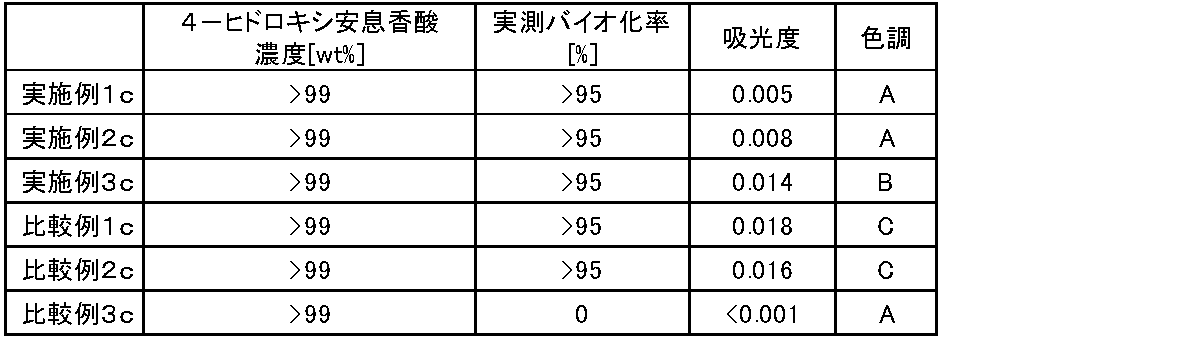
これらの株は、ブダペスト条約の下で国際寄託されており、37 CFR1.808に規定される条件の下で公に利用可能である。

Claims (19)
- ASTM D6866-20に基づいて測定される、1950年代の循環炭素中の放射性炭素の濃度を基準として求まるバイオマス資源由来の放射性炭素14Cの割合を示す実測バイオ化率が、80%以上100%以下である芳香族化合物(A)を少なくとも含む芳香族化合物組成物であって、
前記芳香族化合物(A)がフェノール(A)または4-ヒドロキシ安息香酸(A)であり、
前記芳香族化合物(A)が前記フェノール(A)である場合、前記芳香族化合物組成物を90質量%の濃度となるように純水に溶解させた際の425nmの波長における吸光度が0.001以上0.70以下であり、
前記芳香族化合物(A)が前記4-ヒドロキシ安息香酸(A)である場合、前記芳香族化合物組成物を20g/Lの濃度でエタノールに溶解した際の425nmの波長における吸光度が0.015以下、または、前記芳香族化合物組成物中のシキミ酸の含有量が、前記芳香族化合物組成物全体を100質量%としたとき、0.012質量%以下である、芳香族化合物組成物。 - 請求項1に記載の芳香族化合物組成物において、
前記芳香族化合物(A)がフェノール(A)である、芳香族化合物組成物。 - 請求項2に記載の芳香族化合物組成物において、
前記フェノール(A)の含有量が95質量%以上100質量%以下である、芳香族化合物組成物。 - 請求項2または3に記載の芳香族化合物組成物において、
前記フェノール(A)の前記実測バイオ化率が95%以上100%以下である、芳香族化合物組成物。 - 請求項2~4のいずれかに記載の芳香族化合物組成物において、
前記吸光度が0.62以下である、芳香族化合物組成物。 - 請求項2~5のいずれかに記載の芳香族化合物組成物において、
前記フェノール(A)は、
形質転換体HBA-2(受託番号:NITE BP-01838)および
形質転換体HBA-47(受託番号:NITE BP-01849)から選択される1つまたは2つ以上の形質転換体の生成物のベンゼン環に由来する構造を少なくとも含む、芳香族化合物組成物。 - 請求項2~6のいずれかに記載の芳香族化合物組成物において、
前記フェノール(A)は、
形質転換体PHE7(受託番号:NITE BP-976)、
形質転換体PHE18(受託番号:NITE BP-995)、
形質転換体PHE21(受託番号:NITE BP-996)および
形質転換体PHE31(受託番号:NITE BP-999)から選択される1つまたは2つ以上の形質転換体の生成物を少なくとも含む、芳香族化合物組成物。 - 請求項2~7のいずれかに記載の芳香族化合物組成物中のフェノール(A)由来の構造単位を少なくとも含む、ポリマー。
- フェノール樹脂である、請求項8に記載のポリマー。
- 請求項1に記載の芳香族化合物組成物において、
前記芳香族化合物(A)が4-ヒドロキシ安息香酸(A)であり、
前記芳香族化合物組成物中のシキミ酸の含有量が、前記芳香族化合物組成物全体を100質量%としたとき、0.012質量%以下である、芳香族化合物組成物。 - 請求項10に記載の芳香族化合物組成物において、
前記シキミ酸の含有量が、前記芳香族化合物組成物全体を100質量%としたとき、0.008質量%以下である、芳香族化合物組成物。 - 請求項1に記載の芳香族化合物組成物において、
前記芳香族化合物(A)が4-ヒドロキシ安息香酸(A)であり、
前記芳香族化合物組成物を20g/Lの濃度でエタノールに溶解した際の425nmの波長における吸光度が0.015以下である、芳香族化合物組成物。 - 請求項12に記載の芳香族化合物組成物において、
前記吸光度が0.010以下である、芳香族化合物組成物。 - 請求項12または13に記載の芳香族化合物組成物において、
前記吸光度が0.001以上である、芳香族化合物組成物。 - 請求項10~14のいずれかに記載の芳香族化合物組成物において、
前記4-ヒドロキシ安息香酸(A)の含有量が、前記芳香族化合物組成物全体を100質量%としたとき、95質量%以上100質量%以下である、芳香族化合物組成物。 - 請求項10~15のいずれかに記載の芳香族化合物組成物において、
前記4-ヒドロキシ安息香酸(A)の前記実測バイオ化率が95%以上100%以下である、芳香族化合物組成物。 - 請求項10~16のいずれかに記載の芳香族化合物組成物において、
前記4-ヒドロキシ安息香酸(A)は、形質転換体HBA-2(受託番号:NITE BP-01838)および形質転換体HBA-47(受託番号:NITE BP-01849)から選択される1つまたは2つの形質転換体の生成物を少なくとも含む、芳香族化合物組成物。 - 請求項10~17のいずれかに記載の芳香族化合物組成物由来の前記4-ヒドロキシ安息香酸(A)の構造を少なくとも含む、ポリマー。
- 液晶ポリマーである、請求項18に記載のポリマー。
Priority Applications (2)
| Application Number | Priority Date | Filing Date | Title |
|---|---|---|---|
| CN202480039702.2A CN121464220A (zh) | 2023-06-12 | 2024-06-12 | 芳香族化合物组合物及聚合物 |
| EP24823406.4A EP4726046A1 (en) | 2023-06-12 | 2024-06-12 | Aromatic compound composition and polymer |
Applications Claiming Priority (6)
| Application Number | Priority Date | Filing Date | Title |
|---|---|---|---|
| JP2023-096338 | 2023-06-12 | ||
| JP2023-096350 | 2023-06-12 | ||
| JP2023-096317 | 2023-06-12 | ||
| JP2023096338A JP2024177926A (ja) | 2023-06-12 | 2023-06-12 | 4-ヒドロキシ安息香酸組成物およびポリマー |
| JP2023096350A JP2024177933A (ja) | 2023-06-12 | 2023-06-12 | 4-ヒドロキシ安息香酸組成物 |
| JP2023096317A JP2024177915A (ja) | 2023-06-12 | 2023-06-12 | フェノール組成物およびポリマー |
Publications (1)
| Publication Number | Publication Date |
|---|---|
| WO2024257791A1 true WO2024257791A1 (ja) | 2024-12-19 |
Family
ID=93852254
Family Applications (1)
| Application Number | Title | Priority Date | Filing Date |
|---|---|---|---|
| PCT/JP2024/021322 Ceased WO2024257791A1 (ja) | 2023-06-12 | 2024-06-12 | 芳香族化合物組成物およびポリマー |
Country Status (3)
| Country | Link |
|---|---|
| EP (1) | EP4726046A1 (ja) |
| CN (1) | CN121464220A (ja) |
| WO (1) | WO2024257791A1 (ja) |
Citations (17)
| Publication number | Priority date | Publication date | Assignee | Title |
|---|---|---|---|---|
| JPH09135687A (ja) * | 1995-09-13 | 1997-05-27 | Takeda Chem Ind Ltd | D−パント酸、d−パントテン酸およびそれらの塩の製造法 |
| US6030819A (en) | 1998-09-28 | 2000-02-29 | General Electric Company | Genetically engineered microorganisms and method for producing 4-hydroxybenzoic acid |
| US6114157A (en) | 1998-09-25 | 2000-09-05 | General Electric Company | Method for increasing total production of 4-hydroxybenzoic acid by biofermentation |
| WO2006126654A1 (ja) * | 2005-05-26 | 2006-11-30 | Daiichi Sankyo Company, Limited | 新規化合物 コレト酸 |
| WO2006126626A1 (ja) * | 2005-05-27 | 2006-11-30 | Asahi Kasei Chemicals Corporation | グリコール酸の製造方法 |
| JP2014139236A (ja) * | 2011-03-07 | 2014-07-31 | Hayashibara Co Ltd | 2−O−α−D−グルコシル−L−アスコルビン酸無水結晶含有粉末の製造方法 |
| JP5887277B2 (ja) | 2010-11-18 | 2016-03-16 | グリーンフェノール開発株式会社 | コリネ型細菌形質転換体及びそれを用いるフェノールの製造方法 |
| JP5932649B2 (ja) | 2010-09-08 | 2016-06-08 | グリーンフェノール開発株式会社 | コリネ型細菌形質転換体及びそれを用いるフェノールの製造方法 |
| JP2016518821A (ja) * | 2013-03-15 | 2016-06-30 | カーギル・インコーポレイテッド | 3−ヒドロキシプロピオン酸の回収 |
| JP5932660B2 (ja) | 2010-11-10 | 2016-07-06 | グリーンフェノール開発株式会社 | コリネ型細菌形質転換体及びそれを用いるフェノールの製造方法 |
| JP5996434B2 (ja) | 2010-11-10 | 2016-09-21 | グリーンフェノール開発株式会社 | コリネ型細菌形質転換体及びそれを用いるフェノールの製造方法 |
| JP2017119765A (ja) | 2015-12-28 | 2017-07-06 | 株式会社ブリヂストン | フェノール樹脂、フェノール樹脂の製造方法、ゴム組成物及びタイヤ |
| JP6327653B2 (ja) | 2014-04-08 | 2018-05-23 | グリーンケミカルズ株式会社 | コリネ型細菌形質転換体及びそれを用いる4−ヒドロキシ安息香酸又はその塩の製造方法 |
| JP6327654B2 (ja) | 2014-05-14 | 2018-05-23 | グリーンケミカルズ株式会社 | 高活性変異型酵素を高発現させたコリネ型細菌形質転換体、及びそれを用いる4−ヒドロキシ安息香酸又はその塩の製造方法 |
| JP2023096338A (ja) | 2021-12-27 | 2023-07-07 | テルモ株式会社 | カテーテル |
| JP2023096350A (ja) | 2021-12-27 | 2023-07-07 | 株式会社オートネットワーク技術研究所 | コネクタ |
| JP2023096317A (ja) | 2021-12-27 | 2023-07-07 | グリー株式会社 | 情報処理装置、情報処理方法、及びプログラム |
-
2024
- 2024-06-12 WO PCT/JP2024/021322 patent/WO2024257791A1/ja not_active Ceased
- 2024-06-12 CN CN202480039702.2A patent/CN121464220A/zh active Pending
- 2024-06-12 EP EP24823406.4A patent/EP4726046A1/en active Pending
Patent Citations (17)
| Publication number | Priority date | Publication date | Assignee | Title |
|---|---|---|---|---|
| JPH09135687A (ja) * | 1995-09-13 | 1997-05-27 | Takeda Chem Ind Ltd | D−パント酸、d−パントテン酸およびそれらの塩の製造法 |
| US6114157A (en) | 1998-09-25 | 2000-09-05 | General Electric Company | Method for increasing total production of 4-hydroxybenzoic acid by biofermentation |
| US6030819A (en) | 1998-09-28 | 2000-02-29 | General Electric Company | Genetically engineered microorganisms and method for producing 4-hydroxybenzoic acid |
| WO2006126654A1 (ja) * | 2005-05-26 | 2006-11-30 | Daiichi Sankyo Company, Limited | 新規化合物 コレト酸 |
| WO2006126626A1 (ja) * | 2005-05-27 | 2006-11-30 | Asahi Kasei Chemicals Corporation | グリコール酸の製造方法 |
| JP5932649B2 (ja) | 2010-09-08 | 2016-06-08 | グリーンフェノール開発株式会社 | コリネ型細菌形質転換体及びそれを用いるフェノールの製造方法 |
| JP5996434B2 (ja) | 2010-11-10 | 2016-09-21 | グリーンフェノール開発株式会社 | コリネ型細菌形質転換体及びそれを用いるフェノールの製造方法 |
| JP5932660B2 (ja) | 2010-11-10 | 2016-07-06 | グリーンフェノール開発株式会社 | コリネ型細菌形質転換体及びそれを用いるフェノールの製造方法 |
| JP5887277B2 (ja) | 2010-11-18 | 2016-03-16 | グリーンフェノール開発株式会社 | コリネ型細菌形質転換体及びそれを用いるフェノールの製造方法 |
| JP2014139236A (ja) * | 2011-03-07 | 2014-07-31 | Hayashibara Co Ltd | 2−O−α−D−グルコシル−L−アスコルビン酸無水結晶含有粉末の製造方法 |
| JP2016518821A (ja) * | 2013-03-15 | 2016-06-30 | カーギル・インコーポレイテッド | 3−ヒドロキシプロピオン酸の回収 |
| JP6327653B2 (ja) | 2014-04-08 | 2018-05-23 | グリーンケミカルズ株式会社 | コリネ型細菌形質転換体及びそれを用いる4−ヒドロキシ安息香酸又はその塩の製造方法 |
| JP6327654B2 (ja) | 2014-05-14 | 2018-05-23 | グリーンケミカルズ株式会社 | 高活性変異型酵素を高発現させたコリネ型細菌形質転換体、及びそれを用いる4−ヒドロキシ安息香酸又はその塩の製造方法 |
| JP2017119765A (ja) | 2015-12-28 | 2017-07-06 | 株式会社ブリヂストン | フェノール樹脂、フェノール樹脂の製造方法、ゴム組成物及びタイヤ |
| JP2023096338A (ja) | 2021-12-27 | 2023-07-07 | テルモ株式会社 | カテーテル |
| JP2023096350A (ja) | 2021-12-27 | 2023-07-07 | 株式会社オートネットワーク技術研究所 | コネクタ |
| JP2023096317A (ja) | 2021-12-27 | 2023-07-07 | グリー株式会社 | 情報処理装置、情報処理方法、及びプログラム |
Non-Patent Citations (9)
Also Published As
| Publication number | Publication date |
|---|---|
| CN121464220A (zh) | 2026-02-03 |
| EP4726046A1 (en) | 2026-04-15 |
Similar Documents
| Publication | Publication Date | Title |
|---|---|---|
| Martínez et al. | Bioproduction of 2-phenylethanol and 2-phenethyl acetate by Kluyveromyces marxianus through the solid-state fermentation of sugarcane bagasse | |
| US8729298B2 (en) | Method for separation and purification of long-chain diacids | |
| Yang et al. | Extractive fermentation for the production of carboxylic acids | |
| US11753662B2 (en) | Method for producing 3-Oxoadipic acid | |
| US11060118B2 (en) | Production of vanillin by fermentation | |
| FR2925068A1 (fr) | Procedes de production d'acide succinique | |
| Sardari et al. | Biotransformation of glycerol to 3-hydroxypropionaldehyde: improved production by in situ complexation with bisulfite in a fed-batch mode and separation on anion exchanger | |
| KR20020037064A (ko) | 생물학적 혼합물로부터 1,3-프로판디올 또는 글리세롤,또는 그의 혼합물의 분리 방법 | |
| CN102321682B (zh) | 一种发酵丁二酸分离过程水循环利用的方法 | |
| Kumar et al. | A brief review on propionic acid: a renewal energy source | |
| CN113969295B (zh) | 一种降低β-苯乙醇发酵液中杂质含量的调控方法 | |
| JP2024177926A (ja) | 4-ヒドロキシ安息香酸組成物およびポリマー | |
| WO2014045299A4 (en) | Continuous biotransformation of substituted aromatic carboxylic acids to their selective aldehydes and alcohols | |
| JP2024177933A (ja) | 4-ヒドロキシ安息香酸組成物 | |
| CN121464220A (zh) | 芳香族化合物组合物及聚合物 | |
| JP2024177915A (ja) | フェノール組成物およびポリマー | |
| Cunha et al. | Yeast immobilization in LentiKats®: a new strategy for xylitol bioproduction from sugarcane bagasse | |
| KR101204971B1 (ko) | 젖산 암모늄을 포함하는 젖산 발효액으로부터 젖산을 정제하는 방법 | |
| Loman et al. | Arabitol production from glycerol by fermentation | |
| AU2017231506B2 (en) | Glucose composition, microbial fermentation raw material, and method for producing chemical product | |
| da Silva Bernardino | Flavor Production by Acinetobacter soli Using Industrial Byproducts | |
| Isar et al. | 1, 3‐Propanediol: From Waste to Wardrobe | |
| CN107841515B (zh) | 一种利用造纸废液生物合成丁二酸的方法 | |
| Singh et al. | Valorization of rice straw into high-purity lactic acid with reduced enzyme cost and waste footprint | |
| JP2024121817A (ja) | フェノールの製造方法 |
Legal Events
| Date | Code | Title | Description |
|---|---|---|---|
| 121 | Ep: the epo has been informed by wipo that ep was designated in this application |
Ref document number: 24823406 Country of ref document: EP Kind code of ref document: A1 |
|
| WWE | Wipo information: entry into national phase |
Ref document number: 2024823406 Country of ref document: EP |
|
| NENP | Non-entry into the national phase |
Ref country code: DE |
|
| ENP | Entry into the national phase |
Ref document number: 2024823406 Country of ref document: EP Effective date: 20260112 |
|
| ENP | Entry into the national phase |
Ref document number: 2024823406 Country of ref document: EP Effective date: 20260112 |
|
| ENP | Entry into the national phase |
Ref document number: 2024823406 Country of ref document: EP Effective date: 20260112 |
|
| WWP | Wipo information: published in national office |
Ref document number: 2024823406 Country of ref document: EP |