WO2024257822A1 - 偏光フィルム、偏光板および偏光板の製造方法 - Google Patents
偏光フィルム、偏光板および偏光板の製造方法 Download PDFInfo
- Publication number
- WO2024257822A1 WO2024257822A1 PCT/JP2024/021440 JP2024021440W WO2024257822A1 WO 2024257822 A1 WO2024257822 A1 WO 2024257822A1 JP 2024021440 W JP2024021440 W JP 2024021440W WO 2024257822 A1 WO2024257822 A1 WO 2024257822A1
- Authority
- WO
- WIPO (PCT)
- Prior art keywords
- film
- polarizing
- pva
- polarizing film
- polarizing plate
- Prior art date
- Legal status (The legal status is an assumption and is not a legal conclusion. Google has not performed a legal analysis and makes no representation as to the accuracy of the status listed.)
- Pending
Links
Images

Classifications
-
- G—PHYSICS
- G02—OPTICS
- G02B—OPTICAL ELEMENTS, SYSTEMS OR APPARATUS
- G02B5/00—Optical elements other than lenses
- G02B5/30—Polarising elements
-
- H—ELECTRICITY
- H10—SEMICONDUCTOR DEVICES; ELECTRIC SOLID-STATE DEVICES NOT OTHERWISE PROVIDED FOR
- H10K—ORGANIC ELECTRIC SOLID-STATE DEVICES
- H10K50/00—Organic light-emitting devices
- H10K50/80—Constructional details
- H10K50/86—Arrangements for improving contrast, e.g. preventing reflection of ambient light
-
- H—ELECTRICITY
- H10—SEMICONDUCTOR DEVICES; ELECTRIC SOLID-STATE DEVICES NOT OTHERWISE PROVIDED FOR
- H10K—ORGANIC ELECTRIC SOLID-STATE DEVICES
- H10K59/00—Integrated devices, or assemblies of multiple devices, comprising at least one organic light-emitting element covered by group H10K50/00
- H10K59/10—OLED displays
Definitions
- the present invention relates to a polarizing film, a polarizing plate, and a method for manufacturing a polarizing plate.
- Polarizing plates which have the function of transmitting and blocking light, are a basic component of liquid crystal displays (LCDs) along with liquid crystals, which change the polarization state of light.
- LCDs liquid crystal displays
- Many polarizing plates have a structure in which a protective film such as a triacetyl cellulose (TAC) film is laminated to the surface of a polarizing film.
- TAC triacetyl cellulose
- the mainstream polarizing film that constitutes a polarizing plate is a stretched film in which a dichroic dye such as an iodine-based dye or a dichroic organic dye is adsorbed onto a stretched film that is uniaxially stretched and oriented.
- Such polarizing films are manufactured by uniaxially stretching a PVA film that already contains a dichroic dye, by uniaxially stretching the PVA film and adsorbing the dichroic dye at the same time, or by uniaxially stretching the PVA film and then adsorbing the dichroic dye.
- LCDs are used in a wide range of applications, including small devices such as calculators and watches, laptops, LCD TVs, mobile phones, and tablet devices. In recent years, LCDs have also been used as in-vehicle image display devices such as car navigation systems and rearview monitors. As a result, LCDs are required to be more durable in harsh environments than ever before.
- Patent Document 1 describes that by using a protective film with low water absorption, a polarizing plate with excellent durability and little decrease in transmittance in high temperature environments can be obtained.
- Patent Document 2 describes that polyenation can be suppressed by adjusting the thickness of an adhesive layer provided between the polarizing plate and a transparent plate, etc.
- Patent Documents 1 and 2 tend to suppress the decrease in the light transmittance of the polarizing plate, they were unable to confirm a sufficient effect of suppressing polyenation in durability tests in high-temperature environments of 105°C or higher, which have become necessary in recent years.
- the present invention was made based on the above circumstances, and aims to provide a polarizing film, a polarizing plate, and a manufacturing method for a polarizing plate that can sufficiently suppress the decrease in the light transmittance of the polarizing plate during high-temperature durability tests.
- the present invention provides [1] A polarizing film containing polyvinyl alcohol and an iodine-based dye, wherein a peak top temperature of an endothermic peak appearing in a temperature range of 50°C to 150°C in differential scanning calorimetry of the polarizing film is 102°C or higher; [2] A polarizing plate comprising the polarizing film of [1] and a protective film laminated on at least one surface of the polarizing film, the protective film containing a cellulose ester resin; [3] A method for producing a polarizing plate, comprising the steps of: (1) laminating a protective film on at least one surface of a polarizing film containing polyvinyl alcohol and an iodine-based dye to obtain a laminate; (2) adjusting the moisture content of the laminate to 4.0% by mass or less; and (3) annealing the laminate by heating at 60° C. or more for 4 hours or more; [4] The method for producing a polarizing plate according to [3], wherein
- the present invention provides a polarizing film, a polarizing plate, and a method for manufacturing a polarizing plate that can sufficiently suppress the decrease in light transmittance of the polarizing plate during high-temperature durability tests.
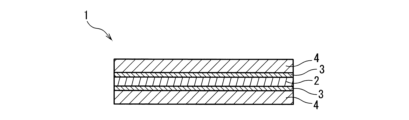
- FIG. 1 is a schematic cross-sectional view of a polarizing plate according to one embodiment of the present invention.
- FIG. 2 is a schematic cross-sectional view of a laminate (a sample for heat resistance test) prepared in a heat resistance test in the examples.
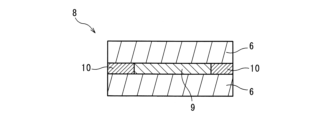
- FIG. 3 is a schematic cross-sectional view of a laminate subjected to an annealing treatment in the examples.
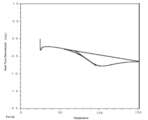
- FIG. 4 is a DSC curve obtained by differential scanning calorimetry for the polarizing film of Example 1.
- a polarizing film according to one embodiment of the present invention is a polarizing film containing PVA and an iodine-based dye, and in differential scanning calorimetry of the polarizing film, the peak top temperature of an endothermic peak appearing in the temperature range of 50°C to 150°C is 102°C or higher.
- This polarizing film can sufficiently suppress the decrease in the light transmittance of the polarizing plate in a high-temperature durability test.
- the reason for this is unclear, but the following is speculated.
- the polyenization of the PVA contained in the polarizing film is thought to occur due to a dehydration reaction with an iodine-based dye as one of the catalysts.
- the protective film of the polarizing plate contains a cellulose ester resin
- the cellulose ester resin is hydrolyzed when the polarizing plate is placed in a high-temperature environment for a long period of time, generating an acid.
- This acid also serves as a catalyst for the dehydration reaction of the PVA, so the polyenization of the PVA occurs particularly significantly.
- the endothermic peak that appears in the temperature range of 50°C to 150°C in the differential scanning calorimetry of the polarizing film is thought to originate from a structure that is presumed to occur due to the crosslinking of the PVA contained in the polarizing film with boric acid (hereinafter, the "structure presumed to occur due to the crosslinking of PVA with boric acid” may be referred to as the "BCC (Boric acid Cross-linked chain Crystallite) structure").
- BCC Boric acid Cross-linked chain Crystallite
- the peak top temperature of the endothermic peak is 102°C or higher, and the thermal stability of the BCC structure is high. For this reason, it is presumed that the polarizing film can sufficiently suppress the decrease in the light transmittance of the polarizing plate in high-temperature heat resistance tests.
- the lower limit of the peak top temperature is 102°C, preferably 103°C, more preferably 104°C, and even more preferably 105°C.
- the upper limit of the peak top temperature may be, for example, 120°C, 110°C, 107°C, or 105°C.
- the peak top temperature can be adjusted by the manufacturing conditions of the polarizing film (stretching temperature, drying temperature, moisture content before annealing treatment, annealing treatment conditions, etc.) as described later.
- the peak top temperature is a value measured by the method described in the examples described later.
- the endothermic peak at the lowest temperature side is taken as the peak top temperature.
- the polarizing film according to one embodiment of the present invention is typically a film in which an iodine-based dye is adsorbed onto a uniaxially stretched PVA film.
- an unstretched film containing PVA may be referred to as a "PVA film.”
- a polarizing film can be manufactured by stretching a PVA film that already contains an iodine-based dye, by adsorbing an iodine-based dye simultaneously with stretching the PVA film, or by adsorbing an iodine-based dye after stretching the PVA film to form a matrix.
- Each component of the polarizing film is described in detail below.
- PVA polyvinyl alcohol
- PVA polyvinyl alcohol
- the PVA may be one obtained by saponifying a polyvinyl ester obtained by polymerizing one or more vinyl esters.
- vinyl esters include vinyl acetate, vinyl formate, vinyl propionate, vinyl butyrate, vinyl pivalate, vinyl versatate, vinyl laurate, vinyl stearate, vinyl benzoate, and isopropenyl acetate.
- vinyl esters compounds having a vinyloxycarbonyl group (H 2 C ⁇ CH—O—CO—) in the molecule are preferred, and vinyl acetate is more preferred, in terms of ease of production, availability, cost, and the like.
- the polyvinyl ester is preferably one obtained by using only one or more vinyl esters as a monomer, and more preferably one obtained by using only one vinyl ester as a monomer.
- the polyvinyl ester may be a copolymer resin of one or more vinyl esters and other monomers copolymerizable therewith.
- the upper limit of the proportion of structural units derived from other copolymerizable monomers is preferably 15 mol%, more preferably 10 mol%, even more preferably 5 mol%, and even more preferably 1 mol%, based on the total structural units constituting the PVA.
- ⁇ -olefins having 2 to 30 carbon atoms such as ethylene, propylene, 1-butene, and isobutene
- (meth)acrylic acid or its salts such as methyl (meth)acrylate, ethyl (meth)acrylate, n-propyl (meth)acrylate, i-propyl (meth)acrylate, n-butyl (meth)acrylate, i-butyl (meth)acrylate, t-butyl (meth)acrylate, 2-ethylhexyl (meth)acrylate, dodecyl (meth)acrylate, and octadecyl (meth)acrylate; (meth)acrylamide; N-methyl (meth)acrylamide, N-ethyl (meth)acrylamide, N,N-dimethyl (meth)acrylamide, di
- the polyvinyl ester may have structural units derived from one or more of the other monomers.
- the PVA one that has not been graft-copolymerized can be preferably used.
- the PVA may be modified with one or more types of graft-copolymerizable monomers.
- Graft copolymerization can be performed on at least one of polyvinyl ester and PVA obtained by saponifying it.
- examples of graft-copolymerizable monomers include unsaturated carboxylic acids or derivatives thereof; unsaturated sulfonic acids or derivatives thereof; and ⁇ -olefins having 2 to 30 carbon atoms.
- the proportion of structural units derived from graft-copolymerizable monomers in polyvinyl ester or PVA is preferably 5 mol % or less of the total structural units constituting polyvinyl ester or PVA.
- the lower limit of the polymerization degree of PVA is preferably 1,000, more preferably 1,500, even more preferably 1,700, and even more preferably 2,000. By having the polymerization degree of PVA be equal to or greater than the lower limit, it is possible to improve the flexibility of the polarizing film.
- the upper limit of this polymerization degree is preferably 10,000, more preferably 8,000, even more preferably 5,000, and even more preferably 3,000. By having the polymerization degree of PVA be equal to or less than the upper limit, it is possible to suppress an increase in the manufacturing cost of PVA and the occurrence of defects during film formation.
- the polymerization degree of PVA means the average polymerization degree measured in accordance with the description of JIS K6726-1994.
- the lower limit of the saponification degree of PVA is preferably 90 mol%, more preferably 95 mol%, even more preferably 99 mol%, and even more preferably 99.5 mol%, because this improves the wet heat resistance of the polarizing film.
- the upper limit of this saponification degree is not particularly limited, and may be 100% or 99.99 mol%.
- the saponification degree of PVA refers to the ratio (mol %) of vinyl alcohol units to the total number of moles of vinyl ester units and vinyl alcohol units.
- the saponification degree can be measured in accordance with the description of JIS K6726-1994.
- the lower limit of the PVA content in the polarizing film is preferably 50% by mass, and may be 60% by mass or 70% by mass.
- the upper limit of the PVA content may be 95% by mass, and may be 90% by mass or 80% by mass.
- the iodine-based dye may be a dichroic dye containing an iodine element.
- the iodine-based dye include I 3 - , I 5 - , and salts containing these anions.
- Examples of counter cations for I 3 - , I 5 - , and the like include alkali metal ions such as potassium ions.
- the iodine-based dye can be obtained, for example, by contacting iodine (I 2 ) with potassium iodide.
- One or more types of iodine-based dyes can be used.
- the content of the iodine-based dye in the polarizing film is not particularly limited, and it is sufficient that an appropriate amount is contained so that the desired polarizing performance is exhibited.
- the polarizing film usually further contains a boron compound.
- the boron compound may be a component that functions as a crosslinking agent. A part or all of the boron compound may form a crosslinked structure with the PVA. Examples of the boron compound include boric acid and borate salts (such as borax), and boric acid is preferred. One or more types of boron compounds may be used.
- the lower limit of the content of the boron compound in the polarizing film is preferably 1 mass%, more preferably 5 mass%, even more preferably 10 mass%, even more preferably 15 mass%, and particularly preferably 20 mass%.
- the upper limit of the content of the boron compound is preferably 45 mass%, more preferably 40 mass%, even more preferably 35 mass%, and even more preferably 30 mass%.
- the polarizing film and the PVA film for producing the polarizing film may contain a plasticizer.
- a plasticizer By containing a plasticizer in the PVA film, the handling property and stretchability of the PVA film can be improved.
- the plasticizer may be released from the PVA film, for example, during swelling treatment, dyeing treatment, etc. Therefore, the plasticizer may not remain in the polarizing film.
- a polyhydric alcohol is preferably used.
- the polyhydric alcohol ethylene glycol, glycerin, propylene glycol, diethylene glycol, diglycerin, triethylene glycol, tetraethylene glycol, trimethylolpropane, etc. can be mentioned, and glycerin is preferable.
- One or more kinds of plasticizers can be used.
- the lower limit of the plasticizer content in the PVA film is preferably 2 parts by mass, more preferably 3 parts by mass, and even more preferably 4 parts by mass, per 100 parts by mass of PVA.
- the upper limit of this content is preferably 20 parts by mass, more preferably 17 parts by mass, and even more preferably 14 parts by mass, per 100 parts by mass of PVA.
- the polarizing film and the PVA film for producing the polarizing film may contain a surfactant.
- a surfactant When a PVA film is produced using a film-forming stock solution as described below, the film-forming property is improved and the occurrence of unevenness in the film thickness is suppressed by adding a surfactant to the film-forming stock solution.
- the PVA film is easily peeled off from the metal roll or belt.
- the PVA film and the polarizing film obtained from the PVA film may contain a surfactant.
- the type of surfactant to be added to the film-forming stock solution for producing a PVA film, and thus the surfactant to be contained in the PVA film and the polarizing film, is not particularly limited, but from the viewpoint of peelability from the metal roll or belt, anionic surfactants and nonionic surfactants are preferred, and nonionic surfactants are particularly preferred.
- anionic surfactants and nonionic surfactants are preferred, and nonionic surfactants are particularly preferred.
- One or more types of surfactants can be used.
- anionic surfactants include carboxylic acid types such as potassium laurate; sulfate ester types such as sodium polyoxyethylene lauryl ether sulfate and octyl sulfate; and sulfonic acid types such as dodecylbenzenesulfonate.
- Nonionic surfactants include, for example, alkyl ether types such as polyoxyethylene oleyl ether; alkyl phenyl ether types such as polyoxyethylene octylphenyl ether; alkyl ester types such as polyoxyethylene laurate; alkyl amine types such as polyoxyethylene lauryl amino ether; alkyl amide types such as polyoxyethylene lauric acid amide; polypropylene glycol ether types such as polyoxyethylene polyoxypropylene ether; alkanolamide types such as lauric acid diethanolamide and oleic acid diethanolamide; and allyl phenyl ether types such as polyoxyalkylene allyl phenyl ether.
- alkyl ether types such as polyoxyethylene oleyl ether
- alkyl phenyl ether types such as polyoxyethylene octylphenyl ether
- alkyl ester types such as polyoxyethylene laurate
- alkyl amine types such
- the lower limit of the surfactant content in the film-forming solution, and therefore the surfactant content in the PVA film or polarized film is preferably 0.01 parts by mass, more preferably 0.02 parts by mass, per 100 parts by mass of PVA contained in the film-forming solution, PVA film, or polarized film.
- the upper limit of the surfactant content is preferably 0.5 parts by mass, more preferably 0.1 parts by mass, per 100 parts by mass of PVA contained in the film-forming solution, PVA film, or polarized film.
- the polarizing film may contain other components other than the PVA, iodine-based pigment, boron compound, plasticizer, and surfactant, such as antioxidants, antifreeze agents, pH adjusters, masking agents, coloring inhibitors, and oils, as necessary.
- the content of other components other than the PVA, iodine-based pigment, boron compound, plasticizer, and surfactant in the polarizing film may be preferably 1% by mass or less, more preferably 0.1% by mass or less.
- the content of inorganic compounds other than the iodine-based pigment in the polarizing film may also be preferably 1% by mass or less, more preferably 0.1% by mass or less.
- the other components and inorganic compounds other than the iodine-based pigment may cause defects such as voids in the polarizing film. For this reason, by reducing the content of the other components and inorganic compounds other than the iodine-based pigment, the polarization performance of the polarizing film tends to be improved.
- the upper limit of the thickness of the polarizing film is, for example, 100 ⁇ m, preferably 50 ⁇ m, more preferably 30 ⁇ m, and even more preferably 20 ⁇ m.
- the lower limit of the thickness may be 1 ⁇ m, preferably 5 ⁇ m, and more preferably 8 ⁇ m.
- the polarizing film may be a single-layer film or a multi-layer film, but from the standpoint of the complexity of lamination work (coating, etc.), cost, etc., a single-layer film is preferable.
- the polarizing film is not particularly limited in its applications, and can be used in the same applications as conventional polarizing films.
- the polarizing film is suitable as a component of a polarizing plate used in image display devices and the like.
- the polarizing film is suitable for applications requiring high-temperature durability, particularly as a polarizing plate for in-vehicle image display devices.
- a polarizing plate according to one embodiment of the present invention includes a polarizing film according to one embodiment of the present invention and a protective film laminated directly or via another layer (e.g., an adhesive layer) on at least one surface of the polarizing film.
- a polarizing plate 1 shown in Fig. 1 includes a polarizing film 2 and a protective film 4 laminated on both surfaces of the polarizing film 2 via an adhesive layer 3. That is, the polarizing plate 1 shown in Fig. 1 has a structure in which a first protective film 4, a first adhesive layer 3, the polarizing film 2, a second adhesive layer 3, and a second protective film 4 are laminated in this order.
- the protective film laminated on at least one side of the polarizing film contains a cellulose ester resin.
- the protective film may be a cellulose ester film containing a cellulose ester resin as a main component.
- the content of the cellulose ester resin in the protective film is preferably 70% by mass or more, and more preferably 90% by mass or more.
- cellulose ester resins examples include cellulose triacetate (triacetyl cellulose: TAC), cellulose diacetate, cellulose acetate propionate, cellulose acetate butyrate, cellulose acetate benzoate, cellulose acetate propionate benzoate, cellulose propionate, cellulose butyrate, cellulose acetate biphenylate, cellulose acetate propionate biphenylate, etc., with cellulose triacetate being preferred.
- both of the two protective films may contain a cellulose ester resin.
- one of the two protective films may be a protective film that does not contain a cellulose ester resin.
- protective films include acrylic films, polyester films, and cycloolefin polymer films.
- the polarizing film and the protective film are usually attached together with an adhesive.
- this adhesive include PVA-based adhesives and UV-curable adhesives, with PVA-based adhesives being preferred.
- PVA-based adhesive an aqueous solution of PVA can be used.
- the solid or cured product of such an adhesive becomes the adhesive layer.
- the specific and preferred forms of the PVA used as the adhesive are the same as those described above as the specific and preferred forms of the PVA contained in the polarizing film.
- the polarizing plate may have a surface treatment such as an anti-reflection treatment, an anti-sticking treatment, an anti-glare treatment, or other coating treatment.
- the polarizing plate may also be used as an optical film with other optical layers further laminated thereon. Examples of other optical layers include a retardation plate and a viewing angle compensation film.
- the polarizing plate can be used in various image display devices such as liquid crystal display devices and organic EL display devices.
- a polarizing film provided in the method for producing a polarizing plate (a polarizing film not subjected to an annealing treatment) may be referred to as a polarizing film (X), and a polarizing film provided in a polarizing plate obtained through the method for producing a polarizing plate (a polarizing film subjected to an annealing treatment) may be referred to as a polarizing film (Y).
- the method for producing the PVA film is not particularly limited, and a method for producing the film with uniform thickness and width after film production can be preferably adopted.
- the PVA film can be produced using a film-forming stock solution in which the PVA constituting the PVA film, and one or more of a plasticizer, a surfactant, and other components as necessary are dissolved in a liquid medium, a film-forming stock solution containing PVA, and one or more of a plasticizer, a surfactant, other components, and a liquid medium as necessary, and in which the PVA is melted, etc.
- the film-forming stock solution contains at least one of a plasticizer, a surfactant, and other components, it is preferable that these components are uniformly mixed.
- Liquid media used to prepare the film-forming solution include, for example, water, dimethyl sulfoxide, dimethylformamide, dimethylacetamide, N-methylpyrrolidone, ethylene glycol, glycerin, propylene glycol, diethylene glycol, triethylene glycol, tetraethylene glycol, trimethylolpropane, ethylenediamine, diethylenetriamine, etc., with water being preferred.
- the volatile content of the film-forming solution (the content in the film-forming solution of volatile components such as liquid medium that are removed by volatilization during film formation) varies depending on the film-forming method and film-forming conditions, but the lower limit is preferably 50 mass%, more preferably 60 mass%, and even more preferably 70 mass%. On the other hand, the upper limit is preferably 96 mass%, and more preferably 92 mass%.
- the volatile content of the film-forming solution is equal to or higher than the lower limit, the viscosity of the film-forming solution does not become too high, and filtration and degassing during preparation of the film-forming solution are carried out smoothly, facilitating the production of PVA films with fewer foreign matter and defects.
- the volatile content of the film-forming solution is equal to or lower than the upper limit, the concentration of the film-forming solution does not become too low, and industrial production of PVA films is facilitated.
- the film-forming method for producing a PVA film using the film-forming solution includes, for example, the cast film-forming method, the extrusion film-forming method, the wet film-forming method, and the gel film-forming method, with the cast film-forming method and the extrusion film-forming method being preferred.
- the extrusion film-forming method is more preferred because it produces a PVA film that is uniform in thickness and width and has good physical properties.
- the PVA film can be dried or heat-treated as necessary.
- the heat treatment temperature there are no particular limitations on the heat treatment temperature, and it may be adjusted as appropriate depending on the degree of swelling of the PVA film, etc.
- the upper limit of the heat treatment temperature is preferably 200°C, more preferably 180°C, and even more preferably 150°C, from the viewpoint of suppressing discoloration and deterioration of the PVA film.
- the lower limit of the heat treatment temperature may be, for example, 80°C.
- heat treatment time there is no particular limit to the heat treatment time, and it may be adjusted appropriately depending on the swelling degree of the PVA film, etc., but from the viewpoint of efficiently producing the PVA film, 1 to 60 minutes is preferable, 2 to 40 minutes is more preferable, and 3 to 30 minutes is even more preferable.
- the method for producing the polarizing film (X) is not particularly limited, and any method that has been conventionally used may be used.
- the polarizing film (X) can be produced by subjecting a PVA film to a swelling treatment, a dyeing treatment, a uniaxial stretching treatment, and, if necessary, a crosslinking treatment, a fixing treatment, a drying treatment, a heat treatment, or the like.
- the order of each treatment such as the swelling treatment, the dyeing treatment, the uniaxial stretching treatment, and the fixing treatment is not particularly limited, and one or more treatments can be performed simultaneously. Also, one or more treatments can be performed twice or more.
- the swelling treatment can be carried out by immersing the PVA film in water.
- the lower limit of the water temperature when immersing in water is preferably 20°C, more preferably 22°C, and even more preferably 25°C. Meanwhile, the upper limit is preferably 40°C, more preferably 38°C, and even more preferably 35°C.
- the time for immersion in water is preferably, for example, 0.1 to 5 minutes.
- the water used when immersing in water is not limited to pure water, and may be an aqueous solution in which various components are dissolved, or a mixture of water and an aqueous medium.
- the dyeing process is carried out using an iodine-based dye.
- Dyeing may be carried out at any stage before, during, or after uniaxial stretching.
- Dyeing is generally carried out by immersing the PVA film in a solution (particularly an aqueous solution) containing iodine and potassium iodide as a dye bath.
- the iodine concentration in the dye bath is preferably 0.01 to 0.5% by mass, and the potassium iodide concentration is preferably 0.01 to 10% by mass.
- the temperature of the dye bath is preferably 20 to 60°C.
- the crosslinking treatment can be carried out by immersing the PVA film in an aqueous solution containing a crosslinking agent.
- a crosslinking agent that can be used include the boron compounds mentioned above.
- the concentration of the crosslinking agent in the aqueous solution containing the crosslinking agent is preferably 1 to 15% by mass, more preferably 2 to 7% by mass.
- the temperature of the aqueous solution containing the crosslinking agent is preferably 20 to 60°C.
- the uniaxial stretching process may be performed by either a wet stretching method or a dry stretching method.
- the wet stretching method it may be performed in an aqueous solution containing a crosslinking agent, or in the dye bath described above or in a fixing treatment bath described below.
- the dry stretching method it may be performed in air.
- the wet stretching method is preferred, and it is more preferred to perform uniaxial stretching in an aqueous solution containing boric acid.
- the concentration of boric acid in the aqueous boric acid solution is preferably 0.5 to 6.0% by mass, more preferably 1.0 to 5.0% by mass, and even more preferably 1.5 to 4.0% by mass.
- the aqueous boric acid solution may also contain potassium iodide, and the concentration is preferably 0.01 to 10% by mass.
- the upper limit of the stretching temperature is preferably 60°C, more preferably 55°C, and may be 50°C.
- the thermal stability of the BCC structure is higher, and therefore the BCC structure is likely to remain during a high-temperature heat resistance test, and polyenization of the PVA is more suppressed.
- the lower limit of the stretching temperature is, for example, preferably 20°C, more preferably 30°C.
- the lower limit of the stretching ratio in the uniaxial stretching process is preferably 5 times, more preferably 5.5 times, from the viewpoint of the polarizing performance of the resulting polarizing film. There is no particular upper limit to the stretching ratio, but 8 times is preferred.
- the fixation bath used for the fixation treatment can be an aqueous solution containing one or more boron compounds such as boric acid and borax. If necessary, iodine compounds, metal compounds, etc. may also be added to the fixation bath.
- the concentration of the boron compound in the fixation bath is generally 0.5 to 15 mass%, and preferably 1 to 10 mass%.
- the temperature of the fixation bath is preferably 15 to 60°C, and more preferably 20 to 40°C.
- the drying temperature for the polarizing film (X) is preferably 40°C or higher, and more preferably 80°C or higher. Drying at this temperature tends to increase the peak top temperature of the endothermic peak in the resulting polarizing film (Y) when the annealing process described below is carried out.
- the upper limit of the drying temperature is, for example, 100°C, or may be 90°C.
- the drying time may be, for example, 1 to 20 minutes, or 2 to 10 minutes.
- a method for producing a polarizing plate according to one embodiment of the present invention includes the steps of (1) obtaining a laminate by laminating a protective film on at least one surface of a polarizing film containing PVA and an iodine-based dye, (2) adjusting the moisture content of the laminate to 4.0 mass% or less, and (3) annealing the laminate by heating at 60°C or higher for 4 hours or more, in that order.
- a polarizing plate is obtained by annealing the laminate.
- the laminate is the polarizing plate before the annealing treatment
- the polarizing plate is the laminate after the annealing treatment.
- a laminate adjusted to a moisture content of 4.0 mass% or less is annealed by heating at 60°C or higher for 4 hours or more, thereby obtaining a polarizing plate in which the decrease in light transmittance is sufficiently suppressed in a high-temperature durability test. This is presumably because the thermal stability of the BBC structure in the polarizing film is increased by performing a predetermined annealing treatment.
- the polarizing film (Y) provided in the polarizing plate obtained by this manufacturing method is a polarizing film containing PVA and an iodine-based dye, and the peak top temperature of the endothermic peak appearing in the temperature range of 50°C to 150°C in differential scanning calorimetry of the polarizing film may be 102°C or higher.
- this manufacturing method includes a method for manufacturing a polarizing film according to one embodiment of the present invention.
- the polarizing film used in step (1) may be the polarizing film (X) obtained by the manufacturing method of the polarizing film (X) described above.
- the laminate can be obtained, for example, by bonding a protective film to at least one surface (preferably both surfaces) of the polarizing film (X) using an adhesive.
- the protective film used in step (1) may be a protective film containing a cellulose ester resin. When using a protective film containing a cellulose ester resin, it is preferable to use a film whose surface (the surface to be bonded to the polarizing film (X)) has been saponified in order to increase adhesion.
- the specific forms of the protective film and adhesive used in this manufacturing method are the same as those described in the description of the polarizing plate according to one embodiment of the present invention.
- step (2) the moisture content of the laminate obtained in step (1) is adjusted to 4.0% by mass or less.
- This step (2) can be performed, for example, by leaving the laminate in an environment adjusted to a predetermined temperature and humidity.
- the temperature at this time is preferably, for example, 5 to 50°C, more preferably 10 to 35°C.
- the humidity at this time may be, for example, 5 to 90% RH or 5 to 50% RH.
- the leaving time may be, for example, 1 to 30 days or 3 to 14 days.
- the moisture content of the polarizing film (X) and the protective film used in the laminate may be the same or different. Regardless of the moisture content values of the polarizing film (X) and the protective film used in the laminate, the moisture content of the laminate as a whole reaches equilibrium by the treatment in step (2), so that the moisture content of the laminate is adjusted to 4.0% by mass or less.
- step (3) the laminate with the moisture content adjusted to 4.0% by mass or less is annealed.
- the upper limit of the moisture content of the laminate to be annealed is preferably 3.8% by mass, more preferably 3.5% by mass, and even more preferably 3.3% by mass.
- the lower limit of the moisture content is preferably 2.0% by mass, and more preferably 2.5% by mass.
- the lower limit of the heating temperature in the annealing treatment is 60°C, preferably 65°C, and more preferably 70°C.
- the upper limit of the heating temperature is preferably 90°C, more preferably 85°C, even more preferably 80°C, and even more preferably 75°C.
- the lower limit of the heating time in the annealing treatment is 4 hours, preferably 6 hours, more preferably 10 hours, and even more preferably 16 hours.
- the heating time is preferably 48 hours, and more preferably 24 hours.
- the method for manufacturing a polarizing plate may further include other steps such as a surface treatment step in addition to the steps (1) to (3) described above.
- the polarizing film, polarizing plate, and polarizing plate manufacturing method of the present invention are not limited to the above-mentioned embodiment.
- the polarizing film of the present invention may be used for a polarizing plate having a protective film that does not contain a cellulose ester resin, for example.
- the polarizing film and polarizing plate of the present invention may be manufactured by a method other than the above-mentioned manufacturing method.
- the adhesive film, the test piece (polarizing plate), and the adhesive film were laminated one by one on the glass plate in this order using a laminator ("Lamyman IKO-360EII” manufactured by Yubon Co., Ltd.).
- a laminator (“Lamyman IKO-360EII” manufactured by Yubon Co., Ltd.).
- another glass plate was placed on the adhesive film to obtain a laminate 5 having a laminated structure of "glass plate 6/adhesive film 7/polarizing plate 1/adhesive film 7/glass plate 6" as shown in Fig. 2.
- the obtained laminate was evacuated at 50°C for 5 minutes, and then pressurized at 10 kPa for 5 minutes to obtain a sample for heat resistance testing.
- the heat resistance test sample was taken out of the metal cage, and the absorbance (Abs) of the heat resistance test sample at a wavelength of 450 nm was measured using an ultraviolet-visible spectrophotometer ("UV-2450" manufactured by Shimadzu Corporation).
- UV-2450 ultraviolet-visible spectrophotometer
- Example 1 Production of PVA film 100 parts by mass of PVA (polymerization degree 2,400, saponification degree 99.95 mol%), 10 parts by mass of glycerin as a plasticizer, 0.03 parts by mass of sodium polyoxyethylene lauryl ether sulfate as a surfactant, and water as a liquid medium were mixed, and then heated at 90 ° C for 4 hours to obtain a PVA aqueous solution with a volatile content of 90% by mass. The obtained aqueous solution was then kept at 85 ° C for 16 hours to degas, and used as a film-forming stock solution for PVA film. This film-forming stock solution was dried on a metal roll at 80 ° C, and then heat-treated for 10 minutes in a dryer at 110 ° C to obtain a PVA film (swelling degree 200%, thickness 30 ⁇ m).
- test piece after the swelling treatment was uniaxially stretched in the length direction to 3.3 times its original length at a stretching speed of 12 cm/min (dyeing treatment).
- test piece after the dyeing treatment was immersed in an aqueous solution (temperature 30° C.) containing 3% by mass of boric acid and 3% by mass of potassium iodide for about 20 seconds, while being uniaxially stretched in the length direction to 3.6 times the original length at a stretching speed of 12 cm/min (crosslinking treatment).
- test piece after the crosslinking treatment was immersed in an aqueous solution (temperature 53° C.) containing 4% by mass of boric acid and about 5% by mass of potassium iodide, while being uniaxially stretched in the length direction to 5.5 times the original length at a stretching speed of 12 cm/min (uniaxial stretching treatment).
- test piece after the uniaxial stretching treatment was immersed in an aqueous solution (temperature 22° C.) containing 1.5% by mass of boric acid and 3% by mass of potassium iodide for 10 seconds (fixing treatment). Finally, it was dried in a dryer at 80° C. for 4 minutes (drying treatment) to obtain a polarizing film (X) (thickness 13 ⁇ m) before annealing treatment.
- TAC film was laminated on each side of the above test piece (polarizing film (X)) via a PVA-based adhesive, and a laminated plate having a configuration of "TAC film / PVA-based adhesive / polarizing film / PVA-based adhesive / TAC film" was produced.
- the resulting laminate was then fixed in a metal frame and dried in a hot air dryer at 60° C. for 10 minutes.
- the boric acid content in the polarizing film (X) before annealing obtained in "(2) Production of polarizing film (X)" was measured by the method described above.
- the peak top temperature was measured by the method described above for the polarizing film (Y) after annealing obtained in "(3) Production of polarizing plate” above.
- a heat resistance test was performed by the method described above for the polarizing plate obtained in "(3) Production of polarizing plate” above. The results are shown in Table 1.
- the obtained DSC curve is shown in Figure 4.
- Examples 2 to 3, Comparative Example 2 A PVA film, a polarizing film, and a polarizing plate were produced and evaluated in the same manner as in Example 1, except that the temperature of the aqueous solution in the uniaxial stretching treatment and the temperature in the drying treatment in the "(2) Production of polarizing film (X)" above, and the moisture content of the laminate (polarizing plate before annealing treatment) in "(ii) Moisture content adjustment” in "(3) Production of polarizing plate” above were changed as shown in Table 1. The results are shown in Table 1.
- the polarizing plates equipped with the polarizing films (Y) of Examples 1 to 3 had low absorbance at a wavelength of 450 nm in the heat resistance test.
- the absorbance of the polarizing plates (heat resistance test samples) of Examples 1 to 3 and Comparative Examples 1 to 3 before the heat resistance test was all 0.3, and there was no difference in the absorbance before the heat resistance test.
- the polarizing films (Y) of Examples 1 to 3 were able to sufficiently suppress the decrease in light transmittance of the polarizing plate.
- the polarizing film and polarizing plate of the present invention can be used in image display devices, etc.
- Polarizing plate 1 Polarizing plate 2 Polarizing film 3 Adhesive layer 4 Protective film 5 Laminate (heat resistance test sample) 6 Glass plate 7 Adhesive film 8 Laminate to be subjected to annealing treatment 9 Laminate plate 10 Silicon-based sealant
Landscapes
- Physics & Mathematics (AREA)
- General Physics & Mathematics (AREA)
- Optics & Photonics (AREA)
- Polarising Elements (AREA)
- Processing And Handling Of Plastics And Other Materials For Molding In General (AREA)
Abstract
高温耐久試験において偏光板の光透過率の低下を十分に抑制できる偏光フィルム、偏光板および偏光板の製造方法を提供すること。ポリビニルアルコールおよびヨウ素系色素を含有する偏光フィルムであって、前記偏光フィルムに対する示差走査熱量測定において50℃から150℃の温度範囲に現れる吸熱ピークのピークトップ温度が102℃以上である、偏光フィルム。
Description
本発明は、偏光フィルム、偏光板および偏光板の製造方法に関する。
光の透過および遮蔽機能を有する偏光板は、光の偏光状態を変化させる液晶と共に、液晶ディスプレイ(LCD)の基本的な構成要素である。多くの偏光板は、偏光フィルムの表面にトリアセチルセルロース(TAC)フィルム等の保護フィルムが貼り合わされた構造を有している。偏光板を構成する偏光フィルムとしては、ポリビニルアルコールフィルム(以下、「ポリビニルアルコール」を「PVA」と略記することがある。)を一軸延伸して配向させた延伸フィルムに、ヨウ素系色素、二色性有機染料等の二色性色素が吸着しているものが主流である。このような偏光フィルムは、二色性色素を予め含有させたPVAフィルムを一軸延伸したり、PVAフィルムの一軸延伸と同時に二色性色素を吸着させたり、PVAフィルムを一軸延伸した後に二色性色素を吸着させたりするなどして製造される。
LCDは、電卓、腕時計等の小型機器、ノートパソコン、液晶テレビ、携帯電話、タブレット端末等、広範囲において用いられている。近年、LCDは、カーナビゲーション装置、バックモニター等の車載用の画像表示装置としても使用されている。これに伴い、LCDには、従来よりも過酷な環境下における高い耐久性が求められている。
偏光板を備える画像表示装置を、車載用ディスプレイで必要とされる長時間の高温耐久性試験に供した際に、偏光板の光透過率が低下することが知られている。これは、偏光フィルムを構成するPVAのポリエン化が原因の一つとされ、高温条件下であるほど偏光板の光透過率の低下が顕著になる。
このような偏光板のポリエン化の問題に関し、特許文献1には、吸水量の小さい保護フィルムを用いることにより、高温環境下での透過率の低下が小さく耐久性に優れる偏光板が得られることが記載されている。特許文献2には、偏光板と透明板等との間に設ける粘着剤層の厚さを調整することで、ポリエン化が抑制できることが記載されている。
しかしながら発明者らの検討によれば、特許文献1、2に記載されている方法では、偏光板の光透過率の低下は抑制される傾向にはあるものの、近年必要とされている105℃以上の高温環境下での耐久試験では、十分なポリエン化抑制効果を確認できなかった。
本発明は、以上のような事情に基づいてなされたものであり、高温耐久試験において偏光板の光透過率の低下を十分に抑制できる偏光フィルム、偏光板および偏光板の製造方法を提供することを目的とする。
本発明者らは前記の目的を達成すべく鋭意検討を重ねた結果、偏光フィルムに対する示差走査熱量測定において50℃から150℃の温度範囲に吸熱ピークとして現れる構造の熱安定性が、偏光板のポリエン化抑制に影響することを見出し、これらの知見に基づいてさらに検討を重ねて本発明を完成させた。
すなわち、本発明は、
[1]ポリビニルアルコールおよびヨウ素系色素を含有する偏光フィルムであって、前記偏光フィルムに対する示差走査熱量測定において50℃から150℃の温度範囲に現れる吸熱ピークのピークトップ温度が102℃以上である、偏光フィルム;
[2][1]の偏光フィルムと、前記偏光フィルムの少なくとも一方の面に積層された保護フィルムとを備え、前記保護フィルムがセルロースエステル系樹脂を含有する、偏光板;
[3]ポリビニルアルコールおよびヨウ素系色素を含有する偏光フィルムの少なくとも一方の面に保護フィルムを積層することにより、積層板を得る工程(1)、前記積層板の水分率を4.0質量%以下に調整する工程(2)、および前記積層板を60℃以上4時間以上の加熱によりアニーリング処理する工程(3)をこの順に備える、偏光板の製造方法;
[4]前記保護フィルムがセルロースエステル系樹脂を含有する、[3]の偏光板の製造方法;
に関する。
[1]ポリビニルアルコールおよびヨウ素系色素を含有する偏光フィルムであって、前記偏光フィルムに対する示差走査熱量測定において50℃から150℃の温度範囲に現れる吸熱ピークのピークトップ温度が102℃以上である、偏光フィルム;
[2][1]の偏光フィルムと、前記偏光フィルムの少なくとも一方の面に積層された保護フィルムとを備え、前記保護フィルムがセルロースエステル系樹脂を含有する、偏光板;
[3]ポリビニルアルコールおよびヨウ素系色素を含有する偏光フィルムの少なくとも一方の面に保護フィルムを積層することにより、積層板を得る工程(1)、前記積層板の水分率を4.0質量%以下に調整する工程(2)、および前記積層板を60℃以上4時間以上の加熱によりアニーリング処理する工程(3)をこの順に備える、偏光板の製造方法;
[4]前記保護フィルムがセルロースエステル系樹脂を含有する、[3]の偏光板の製造方法;
に関する。
本発明によれば、高温耐久試験において偏光板の光透過率の低下を十分に抑制できる偏光フィルム、偏光板および偏光板の製造方法を提供することができる。
以下に本発明の実施形態について詳細に説明する。
なお、本明細書において、「A~B」又は「AからB」として表された数値範囲は、AおよびBを下限値および上限値として含む意味である。
なお、本明細書において、「A~B」又は「AからB」として表された数値範囲は、AおよびBを下限値および上限値として含む意味である。
<偏光フィルム>
本発明の一実施形態に係る偏光フィルムは、PVAおよびヨウ素系色素を含有する偏光フィルムであって、前記偏光フィルムに対する示差走査熱量測定において50℃から150℃の温度範囲に現れる吸熱ピークのピークトップ温度が102℃以上である。
本発明の一実施形態に係る偏光フィルムは、PVAおよびヨウ素系色素を含有する偏光フィルムであって、前記偏光フィルムに対する示差走査熱量測定において50℃から150℃の温度範囲に現れる吸熱ピークのピークトップ温度が102℃以上である。
当該偏光フィルムは、高温耐久試験において偏光板の光透過率の低下を十分に抑制できる。この理由は定かではないが、以下が推測される。偏光フィルムに含まれるPVAのポリエン化は、ヨウ素系色素を触媒の一つとする脱水反応により生じると考えられる。また、偏光板の保護フィルムがセルロースエステル系樹脂を含む場合、偏光板が高温環境下に長期間置かれた際にセルロースエステル系樹脂が加水分解することにより酸が生成する。この酸もPVAの脱水反応の触媒となるため、PVAのポリエン化が特に顕著に生じる。一方、偏光フィルムに対する示差走査熱量測定において50℃から150℃の温度範囲に現れる吸熱ピークは、偏光フィルムに含まれるPVAとホウ酸との架橋で生じると推定される構造(以下、「PVAとホウ酸との架橋で生じると推定される構造」を「BCC(Boric acid Cross-linked chain Crystallite)構造」と称することがある。)に由来すると考えられる。偏光フィルム中に存在するBCC構造はPVAの脱水反応を阻害し、このBCC構造の熱安定性が高い場合、高温耐久試験においてもPVAのポリエン化が十分に抑制されると考えられる。本発明の偏光フィルムにおいては、前記吸熱ピークのピークトップ温度が102℃以上であり、BCC構造の熱安定性が高い。このため、当該偏光フィルムによれば、高温耐熱試験において偏光板の光透過率の低下を十分に抑制できると推測される。
前記ピークトップ温度の下限は、102℃であり、103℃が好ましく、104℃がより好ましく、105℃がさらに好ましい。前記ピークトップ温度が前記下限以上であることで、BCC構造の熱安定性が高まり、高温耐熱試験における偏光板の光透過率の低下を抑制することができる。前記ピークトップ温度の上限としては、例えば120℃であってもよく、110℃、107℃又は105℃であってもよい。前記ピークトップ温度は、後述するように、偏光フィルムの製造条件(延伸温度、乾燥温度、アニーリング処理を行う前の水分率、アニーリング処理条件等)等により調整することができる。前記ピークトップ温度は、後述する実施例に記載の方法により測定された値とする。なお、偏光フィルムに対する示差走査熱量測定において、50℃から150℃の温度範囲に複数の吸熱ピークが現れる場合、最も低温側の吸熱ピークをピークトップ温度とする。また、偏光フィルムに対する示差走査熱量測定において、50℃から150℃の温度範囲に現れる吸熱ピークは一つのみであることが好ましい。
本発明の一実施形態に係る偏光フィルムは、典型的には、一軸延伸されたPVAフィルムにヨウ素系色素が吸着しているフィルムである。なお、以下の説明等において、PVAを含む未延伸のフィルムを「PVAフィルム」と称することがある。偏光フィルムは、ヨウ素系色素を予め含有させたPVAフィルムを延伸したり、PVAフィルムの延伸と同時にヨウ素系色素を吸着させたり、PVAフィルムを延伸してマトリックスを形成した後にヨウ素系色素を吸着させたりするなどして製造することができる。以下、当該偏光フィルムの各成分等について詳説する。
(PVA)
PVA(ポリビニルアルコール)は、ビニルアルコール単位(-CH2-CH(OH)-)を主の構造単位として有する重合体である。PVAは、ビニルアルコール単位の他、ビニルエステル単位およびその他の単位を有していてもよい。
PVA(ポリビニルアルコール)は、ビニルアルコール単位(-CH2-CH(OH)-)を主の構造単位として有する重合体である。PVAは、ビニルアルコール単位の他、ビニルエステル単位およびその他の単位を有していてもよい。
PVAとしては、ビニルエステルの1種または2種以上を重合して得られるポリビニルエステルをけん化することにより得られるものを使用することができる。ビニルエステルとしては、酢酸ビニル、ギ酸ビニル、プロピオン酸ビニル、酪酸ビニル、ピバリン酸ビニル、バーサティック酸ビニル、ラウリン酸ビニル、ステアリン酸ビニル、安息香酸ビニル、酢酸イソプロペニル等が挙げられる。ビニルエステルの中でも、製造の容易性、入手の容易性、コスト等の点から、分子中にビニルオキシカルボニル基(H2C=CH-O-CO-)を有する化合物が好ましく、酢酸ビニルがより好ましい。
ポリビニルエステルは、単量体として1種または2種以上のビニルエステルのみを用いて得られたものが好ましく、単量体として1種のビニルエステルのみを用いて得られたポリビニルエステルがより好ましい。本発明の効果を大きく損なわない範囲内であれば、1種または2種以上のビニルエステルと、これと共重合可能な他の単量体との共重合樹脂であってもよい。
共重合可能な他の単量体に由来する構造単位の割合の上限は、PVAを構成する全構造単位に対して、15モル%が好ましく、10モル%がより好ましく、5モル%がさらに好ましく、1モル%がよりさらに好ましい。
ビニルエステルと共重合可能な他の単量体としては、例えばエチレン、プロピレン、1-ブテン、イソブテン等の炭素数2~30のα-オレフィン;(メタ)アクリル酸またはその塩;(メタ)アクリル酸メチル、(メタ)アクリル酸エチル、(メタ)アクリル酸n-プロピル、(メタ)アクリル酸i-プロピル、(メタ)アクリル酸n-ブチル、(メタ)アクリル酸i-ブチル、(メタ)アクリル酸t-ブチル、(メタ)アクリル酸2-エチルへキシル、(メタ)アクリル酸ドデシル、(メタ)アクリル酸オクタデシル等の(メタ)アクリル酸エステル;(メタ)アクリルアミド;N-メチル(メタ)アクリルアミド、N-エチル(メタ)アクリルアミド、N,N-ジメチル(メタ)アクリルアミド、ジアセトン(メタ)アクリルアミド、(メタ)アクリルアミドプロパンスルホン酸またはその塩、(メタ)アクリルアミドプロピルジメチルアミンまたはその塩、N-メチロール(メタ)アクリルアミドまたはその誘導体等の(メタ)アクリルアミド誘導体;N-ビニルホルムアミド、N-ビニルアセトアミド、N-ビニルピロリドン等のN-ビニルアミド;メチルビニルエーテル、エチルビニルエーテル、n-プロピルビニルエーテル、i-プロピルビニルエーテル、n-ブチルビニルエーテル、i-ブチルビニルエーテル、t-ブチルビニルエーテル、ドデシルビニルエーテル、ステアリルビニルエーテル等のビニルエーテル;(メタ)アクリロニトリル等のシアン化ビニル;塩化ビニル、塩化ビニリデン、フッ化ビニル、フッ化ビニリデン等のハロゲン化ビニル;酢酸アリル、塩化アリル等のアリル化合物;マレイン酸、またはその塩、エステルもしくは酸無水物;イタコン酸、またはその塩、エステルもしくは酸無水物;ビニルトリメトキシシラン等のビニルシリル化合物;不飽和スルホン酸またはその塩等が挙げられる。
ポリビニルエステルは、前記他の単量体の1種または2種以上に由来する構造単位を有することができる。
PVAとしては、グラフト共重合がされていないものを好ましく使用することができる。但し、PVAは1種または2種以上のグラフト共重合可能な単量体によって変性されたものであってもよい。グラフト共重合は、ポリビニルエステルおよびそれをけん化することにより得られるPVAのうちの少なくとも一方に対して行うことができる。グラフト共重合可能な単量体としては、例えば、不飽和カルボン酸またはその誘導体;不飽和スルホン酸またはその誘導体;炭素数2~30のα-オレフィンなどが挙げられる。ポリビニルエステルまたはPVAにおけるグラフト共重合可能な単量体に由来する構造単位の割合は、ポリビニルエステルまたはPVAを構成する全構造単位に対して、5モル%以下であることが好ましい。
PVAの重合度の下限としては、1,000が好ましく、1,500がより好ましく、1,700がさらに好ましく,2,000がよりさらに好ましい。PVAの重合度が前記下限以上であることにより、偏光フィルムの柔軟性を向上させること等ができる。一方、この重合度の上限としては、10,000が好ましく、8,000がより好ましく、5,000がさらに好ましく、3,000がよりさらに好ましい。PVAの重合度が前記上限以下であることにより、PVAの製造コストの上昇および製膜時における不良発生を抑制すること等ができる。PVAの重合度は、JIS K6726-1994の記載に準じて測定した平均重合度を意味する。
PVAのけん化度の下限は、偏光フィルムの耐湿熱性が良好になることなどから、90モル%が好ましく、95モル%がより好ましく、99モル%がさらに好ましく、99.5モル%がよりさらに好ましい。このけん化度の上限は特に限定されず、100%であってよく、99.99モル%であってもよい。PVAのけん化度とは、ビニルエステル単位とビニルアルコール単位との合計モル数に対するビニルアルコール単位の割合(モル%)をいう。けん化度は、JIS K6726-1994の記載に準じて測定することができる。
当該偏光フィルムにおけるPVAの含有量の下限としては、50質量%が好ましく、60質量%または70質量%であってもよい。PVAの含有量の上限としては、95質量%であってもよく、90質量%または80質量%であってもよい。
(ヨウ素系色素)
ヨウ素系色素は、ヨウ素元素を含む二色性色素であってよい。ヨウ素系色素としては、I3 -、I5 -、これらのアニオンを含む塩等が挙げられる。I3 -、I5 -等のカウンターカチオンとしては、例えば、カリウムイオン等のアルカリ金属イオンが挙げられる。ヨウ素系色素は、例えば、ヨウ素(I2)とヨウ化カリウムとを接触させることにより得ることができる。ヨウ素系色素は、1種または2種以上を使用することができる。当該偏光フィルムにおけるヨウ素系色素の含有量は特に限定されず、所望の偏光性能が発揮されるように適量が含有されていればよい。
ヨウ素系色素は、ヨウ素元素を含む二色性色素であってよい。ヨウ素系色素としては、I3 -、I5 -、これらのアニオンを含む塩等が挙げられる。I3 -、I5 -等のカウンターカチオンとしては、例えば、カリウムイオン等のアルカリ金属イオンが挙げられる。ヨウ素系色素は、例えば、ヨウ素(I2)とヨウ化カリウムとを接触させることにより得ることができる。ヨウ素系色素は、1種または2種以上を使用することができる。当該偏光フィルムにおけるヨウ素系色素の含有量は特に限定されず、所望の偏光性能が発揮されるように適量が含有されていればよい。
(ホウ素化合物)
当該偏光フィルムは、通常、ホウ素化合物をさらに含有する。ホウ素化合物は架橋剤として機能する成分であってよい。ホウ素化合物の一部または全部は、PVAとの架橋構造を形成していてもよい。ホウ素化合物としては、ホウ酸、ホウ酸塩(ホウ砂等)等が挙げられ、ホウ酸が好ましい。ホウ素化合物は、1種または2種以上を使用することができる。
当該偏光フィルムは、通常、ホウ素化合物をさらに含有する。ホウ素化合物は架橋剤として機能する成分であってよい。ホウ素化合物の一部または全部は、PVAとの架橋構造を形成していてもよい。ホウ素化合物としては、ホウ酸、ホウ酸塩(ホウ砂等)等が挙げられ、ホウ酸が好ましい。ホウ素化合物は、1種または2種以上を使用することができる。
当該偏光フィルムにおけるホウ素化合物の含有量の下限としては、1質量%が好ましく、5質量%がより好ましく、10質量%がさらに好ましく、15質量%がよりさらに好ましく、20質量%が特に好ましい。一方、このホウ素化合物の含有量の上限としては、45質量%が好ましく、40質量%がより好ましく、35質量%がさらに好ましく、30質量%がよりさらに好ましい。ホウ素化合物の含有量が上記範囲であることで、偏光性能、ポリエン化抑制性能等を高めることができる。ホウ素化合物の含有量は、ホウ酸換算の含有量であってよい。
(可塑剤)
偏光フィルムおよび偏光フィルムを製造するためのPVAフィルムは、可塑剤を含んでいてもよい。PVAフィルム等が可塑剤を含むことにより、PVAフィルム等の取り扱い性および延伸性の向上等を図ることができる。但し、PVAフィルムから偏光フィルムを製造する際、例えば膨潤処理、染色処理等に伴って、可塑剤はPVAフィルムから放出されることがある。そのため、偏光フィルム中には、可塑剤は残存していなくてもよい。可塑剤としては、多価アルコールが好ましく用いられる。多価アルコールとしては、エチレングリコール、グリセリン、プロピレングリコール、ジエチレングリコール、ジグリセリン、トリエチレングリコール、テトラエチレングリコール、トリメチロールプロパン等が挙げられ、グリセリンが好ましい。可塑剤は、1種または2種以上を用いることができる。
偏光フィルムおよび偏光フィルムを製造するためのPVAフィルムは、可塑剤を含んでいてもよい。PVAフィルム等が可塑剤を含むことにより、PVAフィルム等の取り扱い性および延伸性の向上等を図ることができる。但し、PVAフィルムから偏光フィルムを製造する際、例えば膨潤処理、染色処理等に伴って、可塑剤はPVAフィルムから放出されることがある。そのため、偏光フィルム中には、可塑剤は残存していなくてもよい。可塑剤としては、多価アルコールが好ましく用いられる。多価アルコールとしては、エチレングリコール、グリセリン、プロピレングリコール、ジエチレングリコール、ジグリセリン、トリエチレングリコール、テトラエチレングリコール、トリメチロールプロパン等が挙げられ、グリセリンが好ましい。可塑剤は、1種または2種以上を用いることができる。
PVAフィルムにおける可塑剤の含有量の下限は、PVA100質量部に対して2質量部が好ましく、3質量部がより好ましく、4質量部がさらに好ましい。一方、この含有量の上限は、PVA100質量部に対して20質量部が好ましく、17質量部がより好ましく、14質量部がさらに好ましい。PVAフィルムにおける可塑剤の含有量が前記下限以上であることによりPVAフィルムの延伸性が向上する。一方、PVAフィルムにおける可塑剤の含有量が前記上限以下であることにより、PVAフィルムの表面に可塑剤がブリードアウトしてPVAフィルムの取り扱い性が低下するのを抑制することができる。
(界面活性剤)
偏光フィルムおよび偏光フィルムを製造するためのPVAフィルムは、界面活性剤を含んでいてもよい。後述するような製膜原液を用いてPVAフィルムを製造する場合には、この製膜原液中に界面活性剤を配合することにより、製膜性が向上してフィルムの厚み斑の発生が抑制される。また、製膜に金属ロールまたはベルトを使用した際、これらの金属ロールまたはベルトからのPVAフィルムの剥離が容易になる。界面活性剤が配合された製膜原液からPVAフィルムを製造した場合には、PVAフィルムおよびこのPVAフィルムから得られる偏光フィルム中には界面活性剤が含有され得る。PVAフィルムを製造するための製膜原液に配合される界面活性剤、ひいてはPVAフィルムおよび偏光フィルム中に含有される界面活性剤の種類は特に限定されないが、金属ロールまたはベルトからの剥離性の観点から、アニオン性界面活性剤およびノニオン性界面活性剤が好ましく、ノニオン性界面活性剤が特に好ましい。界面活性剤は1種または2種以上を用いることができる。
偏光フィルムおよび偏光フィルムを製造するためのPVAフィルムは、界面活性剤を含んでいてもよい。後述するような製膜原液を用いてPVAフィルムを製造する場合には、この製膜原液中に界面活性剤を配合することにより、製膜性が向上してフィルムの厚み斑の発生が抑制される。また、製膜に金属ロールまたはベルトを使用した際、これらの金属ロールまたはベルトからのPVAフィルムの剥離が容易になる。界面活性剤が配合された製膜原液からPVAフィルムを製造した場合には、PVAフィルムおよびこのPVAフィルムから得られる偏光フィルム中には界面活性剤が含有され得る。PVAフィルムを製造するための製膜原液に配合される界面活性剤、ひいてはPVAフィルムおよび偏光フィルム中に含有される界面活性剤の種類は特に限定されないが、金属ロールまたはベルトからの剥離性の観点から、アニオン性界面活性剤およびノニオン性界面活性剤が好ましく、ノニオン性界面活性剤が特に好ましい。界面活性剤は1種または2種以上を用いることができる。
アニオン性界面活性剤としては、例えばラウリン酸カリウム等のカルボン酸型;ポリオキシエチレンラウリルエーテル硫酸ナトリウム、オクチルサルフェート等の硫酸エステル型;ドデシルベンゼンスルホネート等のスルホン酸型などが挙げられる。
ノニオン性界面活性剤としては、例えばポリオキシエチレンオレイルエーテル等のアルキルエーテル型;ポリオキシエチレンオクチルフェニルエーテル等のアルキルフェニルエーテル型;ポリオキシエチレンラウレート等のアルキルエステル型;ポリオキシエチレンラウリルアミノエーテル等のアルキルアミン型;ポリオキシエチレンラウリン酸アミド等のアルキルアミド型;ポリオキシエチレンポリオキシプロピレンエーテル等のポリプロピレングリコールエーテル型;ラウリン酸ジエタノールアミド、オレイン酸ジエタノールアミド等のアルカノールアミド型;ポリオキシアルキレンアリルフェニルエーテル等のアリルフェニルエーテル型などが挙げられる。
PVAフィルムを製造するための製膜原液中に界面活性剤を配合する場合、製膜原液中における界面活性剤の含有量、ひいてはPVAフィルムまたは偏光フィルム中における界面活性剤の含有量の下限は、製膜原液、PVAフィルムまたは偏光フィルムに含まれるPVA100質量部に対して、0.01質量部が好ましく、0.02質量部がより好ましい。一方、前記界面活性剤の含有量の上限は、製膜原液、PVAフィルムまたは偏光フィルムに含まれるPVA100質量部に対して、0.5質量部が好ましく、0.1質量部がより好ましい。界面活性剤の含有量が上記下限以上であることにより製膜性および剥離性を向上させることができる。一方、界面活性剤の含有量が上記上限以下であることにより、PVAフィルムの表面に界面活性剤がブリードアウトしてブロッキングが生じて取り扱い性が低下するのを抑制することができる。
(他の成分等)
当該偏光フィルムは、必要に応じて、酸化防止剤、凍結防止剤、pH調整剤、隠蔽剤、着色防止剤、油剤等、前記したPVA、ヨウ素系色素、ホウ素化合物、可塑剤および界面活性剤以外の他の成分を含有していてもよい。但し、偏光フィルムにおけるPVA、ヨウ素系色素、ホウ素化合物、可塑剤および界面活性剤以外の他の成分の含有量は、1質量%以下が好ましいこともあり、0.1質量%以下がより好ましいことがある。また、偏光フィルムにおけるヨウ素系色素以外の無機化合物の含有量も、1質量%以下が好ましいこともあり、0.1質量%以下がより好ましいことがある。前記他の成分およびヨウ素系色素以外の無機化合物は、偏光フィルムにおけるボイド等の欠陥の原因となる場合がある。このため、前記他の成分およびヨウ素系色素以外の無機化合物の含有量を少なくすることで、偏光フィルムの偏光性能等が向上する傾向にある。
当該偏光フィルムは、必要に応じて、酸化防止剤、凍結防止剤、pH調整剤、隠蔽剤、着色防止剤、油剤等、前記したPVA、ヨウ素系色素、ホウ素化合物、可塑剤および界面活性剤以外の他の成分を含有していてもよい。但し、偏光フィルムにおけるPVA、ヨウ素系色素、ホウ素化合物、可塑剤および界面活性剤以外の他の成分の含有量は、1質量%以下が好ましいこともあり、0.1質量%以下がより好ましいことがある。また、偏光フィルムにおけるヨウ素系色素以外の無機化合物の含有量も、1質量%以下が好ましいこともあり、0.1質量%以下がより好ましいことがある。前記他の成分およびヨウ素系色素以外の無機化合物は、偏光フィルムにおけるボイド等の欠陥の原因となる場合がある。このため、前記他の成分およびヨウ素系色素以外の無機化合物の含有量を少なくすることで、偏光フィルムの偏光性能等が向上する傾向にある。
当該偏光フィルムの厚さの上限としては、例えば100μmであり、50μmが好ましく、30μmがより好ましく、20μmがさらに好ましい。一方、この厚さの下限としては1μmであってよく、5μmが好ましく、8μmがより好ましい。偏光フィルムの厚さが前記範囲であることで、偏光性能、取り扱い性等を高めることができる。偏光フィルムの厚さは、5点で測定された値の平均値とする。
当該偏光フィルムは、単層フィルムであってもよく、多層フィルムであってもよいが、積層作業(コート等)の煩雑さ、コスト等の観点から、単層フィルムであることが好ましい。
当該偏光フィルムの用途は特に限定されず、従来の偏光フィルムと同様の用途に用いることができる。当該偏光フィルムは、画像表示装置等に用いられる偏光板の構成部材として好適である。中でも、当該偏光フィルムは、高温耐久性が要求される用途、特に車載用の画像表示装置の偏光板に好適に用いられる。
<偏光板>
本発明の一実施形態に係る偏光板は、本発明の一実施形態に係る偏光フィルムと、前記偏光フィルムの少なくとも一方の面に直接または他の層(例えば接着剤層)を介して積層された保護フィルムとを備える。例えば図1に示す偏光板1は、偏光フィルム2と、偏光フィルム2の両面に接着剤層3を介して積層された保護フィルム4を備える。すなわち、図1に示す偏光板1は、第1の保護フィルム4、第1の接着剤層3、偏光フィルム2、第2の接着剤層3および第2の保護フィルム4がこの順に積層された構造を有する。
本発明の一実施形態に係る偏光板は、本発明の一実施形態に係る偏光フィルムと、前記偏光フィルムの少なくとも一方の面に直接または他の層(例えば接着剤層)を介して積層された保護フィルムとを備える。例えば図1に示す偏光板1は、偏光フィルム2と、偏光フィルム2の両面に接着剤層3を介して積層された保護フィルム4を備える。すなわち、図1に示す偏光板1は、第1の保護フィルム4、第1の接着剤層3、偏光フィルム2、第2の接着剤層3および第2の保護フィルム4がこの順に積層された構造を有する。
本発明の一実施形態において、偏光フィルムの少なくとも一方の面側に積層された保護フィルムは、セルロースエステル系樹脂を含有する。保護フィルムは、セルロースエステル系樹脂を主成分とするセルロースエステルフィルムであってよい。保護フィルムにおけるセルロースエステル系樹脂の含有量としては、70質量%以上が好ましく、90質量%以上がより好ましい。セルロースエステル系樹脂としては、セルローストリアセテート(トリアセチルセルロース:TAC)、セルロースジアセテート、セルロースアセテートプロピオネート、セルロースアセテートブチレート、セルロースアセテートベンゾエート、セルロースアセテートプロピオネートベンゾエート、セルロースプロピオネート、セルロースブチレート、セルロースアセテートビフェニレート、セルロースアセテートプロピオネートビフェニレート等が挙げられ、セルローストリアセテートが好ましい。
偏光フィルムの両面に直接または他の層を介して積層された保護フィルムを備える偏光板においては、二つの保護フィルムが共にセルロースエステル系樹脂を含有するものであってもよい。また、二つの保護フィルムのうちの一方は、セルロースエステル系樹脂を含有しない保護フィルムであってもよい。このような保護フィルムとしては、アクリル系フィルム、ポリエステル系フィルム、シクロオレフィンポリマー系フィルム等が挙げられる。
偏光フィルムと保護フィルムとは、通常、接着剤により貼り合わせられる。この接着剤としては、PVA系接着剤、紫外線硬化型接着剤等が挙げられ、PVA系接着剤が好ましい。PVA系接着剤としては、PVAの水溶液等を用いることができる。このような接着剤の固形物または硬化物が、接着剤層となる。接着剤として用いられるPVAの具体的形態および好適形態は、偏光フィルムに含有されるPVAの具体的形態および好適形態として前記したものと同様である。
当該偏光板には、その表面に、反射防止処理、スティッキング防止処理、アンチグレア処理、その他のコーティング処理等の表面処理が施されていてもよい。偏光板は、他の光学層をさらに積層した光学フィルムとして用いることもできる。他の光学層としては、位相差板、視野角補償フィルム等が挙げられる。
当該偏光板は、液晶表示装置、有機EL表示装置等の各種画像表示装置等に用いることができる。
<偏光板等の製造方法>
以下、偏光フィルムを得るためのPVAフィルムの製造方法、PVAフィルムを用いた偏光フィルムの製造方法、および偏光フィルムを用いた偏光板の製造方法について、順に説明する。なお、以下、偏光板の製造方法に供される偏光フィルム(アニーリング処理が施されていない偏光フィルム)を偏光フィルム(X)、偏光板の製造方法を経て得られた偏光板に備えられている偏光フィルム(アニーリング処理が施された偏光フィルム)を偏光フィルム(Y)と区別する場合がある。
以下、偏光フィルムを得るためのPVAフィルムの製造方法、PVAフィルムを用いた偏光フィルムの製造方法、および偏光フィルムを用いた偏光板の製造方法について、順に説明する。なお、以下、偏光板の製造方法に供される偏光フィルム(アニーリング処理が施されていない偏光フィルム)を偏光フィルム(X)、偏光板の製造方法を経て得られた偏光板に備えられている偏光フィルム(アニーリング処理が施された偏光フィルム)を偏光フィルム(Y)と区別する場合がある。
(PVAフィルムの製造方法)
PVAフィルムの製造方法は特に限定されず、製膜後のフィルムの厚さおよび幅が均一になる製造方法を好ましく採用することができる。例えば、PVAフィルムを構成するPVA、ならびに必要に応じて更に可塑剤、界面活性剤および他の成分のうちの1種または2種以上が液体媒体中に溶解した製膜原液、PVA、ならびに必要に応じて更に可塑剤、界面活性剤、他の成分および液体媒体のうちの1種または2種以上を含み、PVAが溶融している製膜原液等を用いて製造することができる。製膜原液が可塑剤、界面活性剤および他の成分のうちの少なくとも1種を含有する場合には、それらの成分が均一に混合されていることが好ましい。
PVAフィルムの製造方法は特に限定されず、製膜後のフィルムの厚さおよび幅が均一になる製造方法を好ましく採用することができる。例えば、PVAフィルムを構成するPVA、ならびに必要に応じて更に可塑剤、界面活性剤および他の成分のうちの1種または2種以上が液体媒体中に溶解した製膜原液、PVA、ならびに必要に応じて更に可塑剤、界面活性剤、他の成分および液体媒体のうちの1種または2種以上を含み、PVAが溶融している製膜原液等を用いて製造することができる。製膜原液が可塑剤、界面活性剤および他の成分のうちの少なくとも1種を含有する場合には、それらの成分が均一に混合されていることが好ましい。
製膜原液の調製に使用される液体媒体としては、例えば水、ジメチルスルホキシド、ジメチルホルムアミド、ジメチルアセトアミド、N-メチルピロリドン、エチレングリコール、グリセリン、プロピレングリコール、ジエチレングリコール、トリエチレングリコール、テトラエチレングリコール、トリメチロールプロパン、エチレンジアミン、ジエチレントリアミン等が挙げられ、水が好ましい。
製膜原液の揮発分率(製膜時に揮発等によって除去される液体媒体等の揮発性成分の製膜原液中における含有割合)は製膜方法、製膜条件等によっても異なるが、その下限としては50質量%が好ましく、60質量%がより好ましく、70質量%がさらに好ましい。一方、この上限としては96質量%が好ましく、92質量%がより好ましい。製膜原液の揮発分率が前記下限以上であることにより、製膜原液の粘度が高くなり過ぎず、製膜原液調製時のろ過および脱泡が円滑に行われ、異物や欠点の少ないPVAフィルムの製造が容易になる。一方、製膜原液の揮発分率が前記上限以下であることにより、製膜原液の濃度が低くなり過ぎず、工業的なPVAフィルムの製造が容易になる。
製膜原液を用いてPVAフィルムを製膜する際の製膜方法としては、例えばキャスト製膜法、押出製膜法、湿式製膜法、ゲル製膜法等が挙げられ、キャスト製膜法および押出製膜法が好ましい。中でも、押出製膜法は、厚さおよび幅が均一で物性の良好なPVAフィルムが得られることからより好ましい。PVAフィルムには必要に応じて乾燥や熱処理を行うことができる。
熱処理温度に特に制限はなく、PVAフィルムの膨潤度等に応じて適宜調整すればよい。熱処理温度の上限としては、PVAフィルムの変色および劣化を抑制する観点から、200℃が好ましく、180℃がより好ましく、150℃が更に好ましい。熱処理温度の下限としては、例えば80℃とすることができる。
熱処理時間に特に制限はなく、PVAフィルムの膨潤度等に応じて適宜調整すればよいが、PVAフィルムを効率よく製造する観点から、1~60分が好ましく、2~40分がより好ましく、3~30分がさらに好ましい。
(偏光フィルム(X)の製造方法)
偏光フィルム(X)を製造する際の方法は特に制限されず、従来から採用されているいずれの方法を採用してもよい。例えば、PVAフィルムに対して、膨潤処理、染色処理、一軸延伸処理、および必要に応じてさらに、架橋処理、固定処理、乾燥処理、熱処理等を施すことにより偏光フィルム(X)を製造することができる。この場合、膨潤処理、染色処理、一軸延伸処理、固定処理等の各処理の順序は特に制限されず、一つまたは二つ以上の処理を同時に行うこともできる。また、各処理の一つまたは二つ以上を2回またはそれ以上行うこともできる。
偏光フィルム(X)を製造する際の方法は特に制限されず、従来から採用されているいずれの方法を採用してもよい。例えば、PVAフィルムに対して、膨潤処理、染色処理、一軸延伸処理、および必要に応じてさらに、架橋処理、固定処理、乾燥処理、熱処理等を施すことにより偏光フィルム(X)を製造することができる。この場合、膨潤処理、染色処理、一軸延伸処理、固定処理等の各処理の順序は特に制限されず、一つまたは二つ以上の処理を同時に行うこともできる。また、各処理の一つまたは二つ以上を2回またはそれ以上行うこともできる。
膨潤処理は、PVAフィルムを水中に浸漬することにより行うことができる。水中に浸漬する際の水の温度の下限としては20℃が好ましく、22℃がより好ましく、25℃がさらに好ましい。一方、この上限としては40℃が好ましく、38℃がより好ましく、35℃がさらに好ましい。また、水中に浸漬する時間としては、例えば0.1~5分間が好ましい。なお、水中に浸漬する際の水は純水に限定されず、各種成分が溶解した水溶液であってもよいし、水と水性媒体との混合液であってもよい。
染色処理は、ヨウ素系色素を用いて行われる。染色の時期としては、一軸延伸前、一軸延伸時、および一軸延伸後のいずれの段階であってもよい。染色はPVAフィルムを染色浴としてヨウ素-ヨウ化カリウムを含有する溶液(特に水溶液)中に浸漬させることにより行うのが一般的である。染色浴におけるヨウ素の濃度は0.01~0.5質量%が好ましく、ヨウ化カリウムの濃度は0.01~10質量%が好ましい。また、染色浴の温度は20~60℃とすることが好ましい。
架橋処理は、架橋剤を含む水溶液中にPVAフィルムを浸漬することにより行うことができる。架橋処理を行うと、PVAフィルムに架橋が導入され、比較的高い温度で一軸延伸を行うことができる。使用される架橋剤としては、前記したホウ素化合物が挙げられる。架橋剤を含む水溶液における架橋剤の濃度は1~15質量%が好ましく、2~7質量%がより好ましい。架橋剤を含む水溶液の温度は20~60℃が好ましい。
一軸延伸処理は、湿式延伸法または乾式延伸法のいずれで行ってもよい。湿式延伸法の場合は、架橋剤を含む水溶液中で行うこともできるし、前記した染色浴中または後述する固定処理浴中で行うこともできる。また乾式延伸法の場合は、空気中で行うことができる。これらの中でも、湿式延伸法が好ましく、ホウ酸を含む水溶液中で一軸延伸するのがより好ましい。ホウ酸水溶液中におけるホウ酸の濃度は0.5~6.0質量%が好ましく、1.0~5.0質量%がより好ましく、1.5~4.0質量%がさらに好ましい。また、ホウ酸水溶液はヨウ化カリウムを含有してもよく、その濃度は0.01~10質量%が好ましい。
延伸温度の上限は60℃が好ましく、55℃がさらに好ましく、50℃であってもよい。前記上限以下の温度で延伸することで、最終的に得られる偏光フィルム(Y)に対する示差走査熱量測定において50℃から150℃の温度範囲に現れる吸熱ピークのピークトップ温度が高くなりやすく、吸熱ピークの融解熱量が大きくなりやすい。なお、50℃から150℃の温度範囲に現れる吸熱ピークのピークトップ温度が高く、また吸熱ピークの融解熱量が大きい場合、BCC構造の熱安定性がより高いといえることから、高温耐熱試験の際にBCC構造が残存しやすく、PVAのポリエン化がより抑制されると考えられる。前記延伸温度の下限としては、例えば20℃が好ましく、30℃がより好ましい。
一軸延伸処理における延伸倍率の下限は、得られる偏光フィルムの偏光性能の点から5倍が好ましく、5.5倍がより好ましい。延伸倍率の上限は特に制限されないが、8倍が好ましい。
偏光フィルム(X)の製造にあたっては、PVAフィルムへのヨウ素系色素の吸着を強固にするために固定処理を行うことが好ましい。固定処理に使用する固定処理浴としては、ホウ酸、ホウ砂等のホウ素化合物の1種または2種以上を含む水溶液を使用することができる。また、必要に応じて、固定処理浴中にヨウ素化合物、金属化合物等を添加してもよい。固定処理浴におけるホウ素化合物の濃度は、一般に0.5~15質量%、特に1~10質量%程度が好ましい。固定処理浴の温度は、15~60℃、特に20~40℃が好ましい。
偏光フィルム(X)に対する乾燥温度は40℃以上で行うことが好ましく、80℃以上であることが更に好ましい。前記の温度で乾燥することで、後述するアニーリング処理を行った際に、得られる偏光フィルム(Y)における吸熱ピークのピークトップ温度が高くなりやすい。前記乾燥温度の上限としては、例えば100℃であり、90℃であってもよい。乾燥時間としては、例えば1~20分であってもよく、2~10分であってもよい。
(偏光板の製造方法)
本発明の一実施形態に係る偏光板の製造方法は、PVAおよびヨウ素系色素を含有する偏光フィルムの少なくとも一方の面に保護フィルムを積層することにより、積層板を得る工程(1)、前記積層板の水分率を4.0質量%以下に調整する工程(2)、および前記積層板を60℃以上4時間以上の加熱によりアニーリング処理する工程(3)をこの順に備える。
本発明の一実施形態に係る偏光板の製造方法は、PVAおよびヨウ素系色素を含有する偏光フィルムの少なくとも一方の面に保護フィルムを積層することにより、積層板を得る工程(1)、前記積層板の水分率を4.0質量%以下に調整する工程(2)、および前記積層板を60℃以上4時間以上の加熱によりアニーリング処理する工程(3)をこの順に備える。
当該製造方法においては、積層板をアニーリング処理することにより偏光板が得られる。換言すれば、積層板はアニーリング処理する前の偏光板であり、偏光板はアニーリング処理後の積層板である。当該製造方法によれば、水分率4.0質量%以下に調整された積層板に対して、60℃以上4時間以上の加熱によりアニーリング処理を行うことで、高温耐久試験において光透過率の低下が十分に抑制された偏光板を得ることができる。これは、所定のアニーリング処理を行うことで、偏光フィルムにおけるBBC構造の熱安定性が高まるためと推測される。当該製造方法により得られた偏光板に備わる偏光フィルム(Y)は、PVAおよびヨウ素系色素を含有する偏光フィルムであって、前記偏光フィルムに対する示差走査熱量測定において50℃から150℃の温度範囲に現れる吸熱ピークのピークトップ温度が102℃以上であってよい。すなわち、当該製造方法は、本発明の一実施形態に係る偏光フィルムの製造方法を含む。
工程(1)で用いられる偏光フィルムは、前記した偏光フィルム(X)の製造方法で得られる偏光フィルム(X)であってよい。積層板は、例えば偏光フィルム(X)の少なくとも一方の面(好ましくは両面)に接着剤を用いて保護フィルムを貼り合わせることにより得ることができる。工程(1)で用いられる保護フィルムは、セルロースエステル系樹脂を含有する保護フィルムであってもよい。セルロースエステル系樹脂を含有する保護フィルムを用いる場合、接着性を高めるため、表面(偏光フィルム(X)と貼り合わせる面)をけん化処理したものを好適に用いることができる。当該製造方法で用いられる保護フィルムおよび接着剤の具体的形態は、本発明の一実施形態に係る偏光板の説明で挙げたものと同様である。
工程(2)においては、工程(1)で得られた積層板の水分率を4.0質量%以下に調整する。この工程(2)は、例えば所定の温度および湿度に調整された環境下に積層板を放置すること等により行うことができる。このときの温度は、例えば5~50℃が好ましく、10~35℃がより好ましい。このときの湿度としては、例えば5~90%RHであってもよく、5~50%RHであってもよい。また、放置時間としては、例えば1~30日とすることができ、3~14日であってもよい。なお、積層板に用いる偏光フィルム(X)および保護フィルムの水分率は、同程度であっても差があってもよい。積層板に用いる偏光フィルム(X)および保護フィルムの水分率の値に関わらず、工程(2)の処理により積層板全体として水分率が平衡に達するため、積層板の水分率は4.0質量%以下に調整される。
工程(3)においては、水分率を4.0質量%以下に調整した積層板をアニーリング処理する。アニーリング処理に供せられる積層板の水分率の上限としては、3.8質量%が好ましく、3.5質量%がより好ましく、3.3質量%がさらに好ましい。アニーリング処理に供せられる積層板の水分率が4.0質量%以下であると、得られる偏光フィルム(Y)における吸熱ピークのピークトップ温度を102℃以上に調整しやすい。この理由は定かではないが、アニーリング処理時の水分率が高いと、BCC構造の一部が溶解して不安定化することが推測される。前記水分率の下限としては、2.0質量%が好ましく、2.5質量%がより好ましい。水分率を前記下限以上とすることで、吸熱ピークのピークトップ温度がより高くなりやすくなる。
アニーリング処理における加熱温度の下限は、60℃であり、65℃が好ましく、70℃がより好ましい。加熱温度を前記下限以上とすることで、得られる偏光フィルム(Y)における吸熱ピークのピークトップ温度を102℃以上に調整しやすくなる。加熱温度の上限としては、90℃が好ましく、85℃がより好ましく、80℃がさらに好ましく、75℃がよりさらに好ましい。加熱温度を上記上限以下とすることで、得られる偏光板の色相の悪化を抑制すること等ができる。
アニーリング処理における加熱時間の下限は、4時間であり、6時間が好ましく、10時間がより好ましく、16時間がさらに好ましい。加熱時間を前記下限以上とすることで、得られる偏光フィルム(Y)における吸熱ピークのピークトップ温度を102℃以上に調整しやすい。加熱時間の上限としては、生産効率等の観点から、48時間が好ましく、24時間がより好ましい。
偏光板の製造方法は、前記した工程(1)~(3)の他、表面処理工程等の他の工程をさらに備えていてもよい。
<他の実施形態>
本発明の偏光フィルム、偏光板および偏光板の製造方法は、前記した実施形態に限定されるものではない。本発明の偏光フィルムは、例えばセルロースエステル系樹脂を含有しない保護フィルムを備える偏光板に用いてもよい。また、本発明の偏光フィルムおよび偏光板は、前記した製造方法以外の方法により製造してもよい。
本発明の偏光フィルム、偏光板および偏光板の製造方法は、前記した実施形態に限定されるものではない。本発明の偏光フィルムは、例えばセルロースエステル系樹脂を含有しない保護フィルムを備える偏光板に用いてもよい。また、本発明の偏光フィルムおよび偏光板は、前記した製造方法以外の方法により製造してもよい。
本発明を以下の実施例により具体的に説明するが、本発明はこれらの実施例により何ら限定されるものではない。評価等は以下に示す方法に従って行った。なお、以下では偏光フィルム中のホウ酸によるPVAの脱水反応の影響を考慮して、偏光フィルム中のホウ酸含有量を23~25質量%に揃えて評価した。また、各実施例および比較例においては、それぞれの評価および測定に供するために必要な複数のサンプルを同一条件で作製した。
[PVAフィルムおよび偏光フィルム(X)の厚さ]
以下の実施例または比較例で得られたPVAフィルムおよびアニーリング処理前の偏光フィルム(X)について、膜厚計(株式会社小野測器製「DG-5100」)を用いて各フィルムの幅方向の中央部の厚さを測定した。なお、アニーリング処理の前後では、偏光フィルムの厚さは実質的に変わらないと考えられる。
以下の実施例または比較例で得られたPVAフィルムおよびアニーリング処理前の偏光フィルム(X)について、膜厚計(株式会社小野測器製「DG-5100」)を用いて各フィルムの幅方向の中央部の厚さを測定した。なお、アニーリング処理の前後では、偏光フィルムの厚さは実質的に変わらないと考えられる。
[PVAフィルムの膨潤度]
以下の実施例または比較例で得られたPVAフィルムから幅方向に50mm、長さ方向に100mmの長方形に切り出すことにより、短冊状の試験片を得た。この試験片を30℃の1,000gの純水中に浸漬し、30分間浸漬後にろ紙を用いて試験片の表面の水分をふき取り、サンプルの質量Wa(g)を測定した。続いて、この試験片を乾燥機で105℃にて16時間乾燥した後、質量Wb(g)を測定し、下記式により膨潤度を算出した。なお同様の測定を3回行い、その平均値を採用した。
膨潤度(質量%)=100×Wa/Wb
以下の実施例または比較例で得られたPVAフィルムから幅方向に50mm、長さ方向に100mmの長方形に切り出すことにより、短冊状の試験片を得た。この試験片を30℃の1,000gの純水中に浸漬し、30分間浸漬後にろ紙を用いて試験片の表面の水分をふき取り、サンプルの質量Wa(g)を測定した。続いて、この試験片を乾燥機で105℃にて16時間乾燥した後、質量Wb(g)を測定し、下記式により膨潤度を算出した。なお同様の測定を3回行い、その平均値を採用した。
膨潤度(質量%)=100×Wa/Wb
[偏光フィルム(X)中のホウ酸含有量]
以下の実施例または比較例で得られたアニーリング処理前の偏光フィルム(X)の質量a(g)を測定し、蒸留水で加熱溶解して、偏光フィルム(X)が約0.005質量%となるように測定溶液を作製した。次いで、得られた測定溶液の質量b(g)を測定し、マルチ形ICP発光分析装置(株式会社島津製作所製「ICPE-9000」)を用いて測定溶液のホウ素濃度c(ppm)を測定した。そして、以下の式により偏光フィルム(X)中のホウ酸含有量(質量%)を算出した。なお、当該式において「61.8」はホウ酸の分子量であり、「10.8」はホウ素の原子量である。なお、アニーリング処理の前後では、偏光フィルム中のホウ酸含有量は変わらないと考えられる。
偏光フィルム(X)中のホウ酸含有量(質量%)
=[(b×c/1,000,000)/a]×100×(61.8/10.8)
以下の実施例または比較例で得られたアニーリング処理前の偏光フィルム(X)の質量a(g)を測定し、蒸留水で加熱溶解して、偏光フィルム(X)が約0.005質量%となるように測定溶液を作製した。次いで、得られた測定溶液の質量b(g)を測定し、マルチ形ICP発光分析装置(株式会社島津製作所製「ICPE-9000」)を用いて測定溶液のホウ素濃度c(ppm)を測定した。そして、以下の式により偏光フィルム(X)中のホウ酸含有量(質量%)を算出した。なお、当該式において「61.8」はホウ酸の分子量であり、「10.8」はホウ素の原子量である。なお、アニーリング処理の前後では、偏光フィルム中のホウ酸含有量は変わらないと考えられる。
偏光フィルム(X)中のホウ酸含有量(質量%)
=[(b×c/1,000,000)/a]×100×(61.8/10.8)
[偏光フィルム(Y)のピークトップ温度]
以下の実施例または比較例で得られたアニーリング処理後の偏光フィルム(Y)を、23℃、50%RHで3日間調湿した後、約2mgの偏光フィルム(Y)を採取し、DSC(示差走査熱量測定)用のアルミニウムパン(TA Instruments製「Tzero低質量アルミニウムパン」)に設置した。その後、DSC装置(TA Instruments製「DSC250」)を用いて、以下の条件で測定を行った。そして、温度50℃から150℃の領域に現れる吸熱ピークにおける温度をピークトップ温度(℃)として求めた。なお、ピークトップ温度は、ベースラインを考慮せず、測定されたピークに対応する温度とした。
測定温度範囲:25℃~150℃
昇温温度:10℃/min
測定雰囲気:N2 50mL/min
以下の実施例または比較例で得られたアニーリング処理後の偏光フィルム(Y)を、23℃、50%RHで3日間調湿した後、約2mgの偏光フィルム(Y)を採取し、DSC(示差走査熱量測定)用のアルミニウムパン(TA Instruments製「Tzero低質量アルミニウムパン」)に設置した。その後、DSC装置(TA Instruments製「DSC250」)を用いて、以下の条件で測定を行った。そして、温度50℃から150℃の領域に現れる吸熱ピークにおける温度をピークトップ温度(℃)として求めた。なお、ピークトップ温度は、ベースラインを考慮せず、測定されたピークに対応する温度とした。
測定温度範囲:25℃~150℃
昇温温度:10℃/min
測定雰囲気:N2 50mL/min
[積層板(アニーリング処理前の偏光板)の水分率]
以下の実施例または比較例における積層板(アニーリング処理に供する偏光板)の質量d(g)を測定した。その後、積層板を105℃の熱風乾燥機で積層板を24時間乾燥した。次いで、乾燥後の積層板の質量e(g)を測定し、以下の計算式により、積層板の水分率(質量%)を算出した。
積層板の水分率(質量%)
=100-(e/d)×100
以下の実施例または比較例における積層板(アニーリング処理に供する偏光板)の質量d(g)を測定した。その後、積層板を105℃の熱風乾燥機で積層板を24時間乾燥した。次いで、乾燥後の積層板の質量e(g)を測定し、以下の計算式により、積層板の水分率(質量%)を算出した。
積層板の水分率(質量%)
=100-(e/d)×100
[耐熱性試験]
(i)サンプル作製
以下の実施例または比較例で得られた偏光板について、23℃、50%RH環境下で7日間調湿を行った。調湿後の偏光板から、長さ方向4cm、幅方向4cmの試験片を1枚採取した。次いで、厚さ1mm、長さ方向10cm、幅方向10cmのガラス板2枚、および厚さ0.25μm、長さ方向11cm、幅方向11cmの粘着フィルム(株式会社美舘イメージング製「MCS70」)2枚をそれぞれ準備した。ここで、前記の粘着フィルム2枚については、あらかじめ23℃、50%RHの環境下で7日間調湿を行った。次いで、23℃、50%RHの環境下で、ラミネーター(株式会社ユーボン製「ラミーマンIKO-360EII」)を用いて、前記のガラス板の上に粘着フィルム、試験片(偏光板)および粘着フィルムの順に1枚ずつ積層した。次いで、粘着フィルムの上にもう一枚のガラス板を配置し、図2に示す「ガラス板6/粘着フィルム7/偏光板1/粘着フィルム7/ガラス板6」の積層構造の積層体5を得た。最後に、真空ラミネーター(日清紡メカトロニクス株式会社製「1522N」)を用いて、得られた積層体に対して50℃で5分間の真空引きを行った後、10kPaで5分間加圧し、耐熱試験用サンプルとした。
(i)サンプル作製
以下の実施例または比較例で得られた偏光板について、23℃、50%RH環境下で7日間調湿を行った。調湿後の偏光板から、長さ方向4cm、幅方向4cmの試験片を1枚採取した。次いで、厚さ1mm、長さ方向10cm、幅方向10cmのガラス板2枚、および厚さ0.25μm、長さ方向11cm、幅方向11cmの粘着フィルム(株式会社美舘イメージング製「MCS70」)2枚をそれぞれ準備した。ここで、前記の粘着フィルム2枚については、あらかじめ23℃、50%RHの環境下で7日間調湿を行った。次いで、23℃、50%RHの環境下で、ラミネーター(株式会社ユーボン製「ラミーマンIKO-360EII」)を用いて、前記のガラス板の上に粘着フィルム、試験片(偏光板)および粘着フィルムの順に1枚ずつ積層した。次いで、粘着フィルムの上にもう一枚のガラス板を配置し、図2に示す「ガラス板6/粘着フィルム7/偏光板1/粘着フィルム7/ガラス板6」の積層構造の積層体5を得た。最後に、真空ラミネーター(日清紡メカトロニクス株式会社製「1522N」)を用いて、得られた積層体に対して50℃で5分間の真空引きを行った後、10kPaで5分間加圧し、耐熱試験用サンプルとした。
(ii)吸光度測定
以下の要領で、耐熱試験前後の耐熱試験用サンプルの吸光度を測定した。
前記「(i)サンプル作製」で得られた耐熱試験用サンプルについて、紫外可視分光光度計(株式会社島津製作所製「UV-2450」)を用いて、耐熱試験前の波長450nmにおける吸光度(Abs)を測定した。
次いで、耐熱試験用サンプルを、金属製のカゴの内側の側面と耐熱試験用サンプルとが接触しないように、立てた状態で金属製のカゴに入れた。次いで、この金属製のカゴを105℃の乾燥機(株式会社ADVANTEC製「DRS620A」)の中央部に設置して120時間加熱した。そして、金属製のカゴから耐熱試験用サンプルを取り出して、紫外可視分光光度計(株式会社島津製作所製「UV-2450」)を用いて、耐熱試験用サンプルの波長450nmにおける吸光度(Abs)を測定した。
以下の要領で、耐熱試験前後の耐熱試験用サンプルの吸光度を測定した。
前記「(i)サンプル作製」で得られた耐熱試験用サンプルについて、紫外可視分光光度計(株式会社島津製作所製「UV-2450」)を用いて、耐熱試験前の波長450nmにおける吸光度(Abs)を測定した。
次いで、耐熱試験用サンプルを、金属製のカゴの内側の側面と耐熱試験用サンプルとが接触しないように、立てた状態で金属製のカゴに入れた。次いで、この金属製のカゴを105℃の乾燥機(株式会社ADVANTEC製「DRS620A」)の中央部に設置して120時間加熱した。そして、金属製のカゴから耐熱試験用サンプルを取り出して、紫外可視分光光度計(株式会社島津製作所製「UV-2450」)を用いて、耐熱試験用サンプルの波長450nmにおける吸光度(Abs)を測定した。
[実施例1]
(1)PVAフィルムの製造
PVA(重合度2,400、けん化度99.95モル%)100質量部、可塑剤としてグリセリン10質量部、界面活性剤としてポリオキシエチレンラウリルエーテル硫酸ナトリウム0.03質量部および液体媒体として水とを混合した後、90℃で4時間加熱し、揮発分率が90質量%のPVA水溶液を得た。次いで、得られた水溶液を85℃で16時間保温して脱泡し、PVAフィルムの製膜原液とした。この製膜原液を80℃の金属ロール上で乾燥した後、110℃の乾燥機で10分間の熱処理を行い、PVAフィルム(膨潤度200%、厚さ30μm)を得た。
(1)PVAフィルムの製造
PVA(重合度2,400、けん化度99.95モル%)100質量部、可塑剤としてグリセリン10質量部、界面活性剤としてポリオキシエチレンラウリルエーテル硫酸ナトリウム0.03質量部および液体媒体として水とを混合した後、90℃で4時間加熱し、揮発分率が90質量%のPVA水溶液を得た。次いで、得られた水溶液を85℃で16時間保温して脱泡し、PVAフィルムの製膜原液とした。この製膜原液を80℃の金属ロール上で乾燥した後、110℃の乾燥機で10分間の熱処理を行い、PVAフィルム(膨潤度200%、厚さ30μm)を得た。
(2)偏光フィルム(X)の製造
前記「(1)PVAフィルムの製造」で得られたPVAフィルムから、長さ方向9cm×幅方向10cmの試験片を採取した。次いで、当該試験片の長さ方向の両端を、延伸部分のサイズが長さ方向5cm×幅方向10cmとなるように延伸治具に固定し、温度30℃の水中に38秒間浸漬している間に、12cm/分の延伸速度で元の長さの2.2倍に長さ方向に一軸延伸した(膨潤処理)。次いで、膨潤処理後の試験片を、ヨウ素0.03質量%およびヨウ化カリウム3質量%を含有する水溶液(温度30℃)中に60秒間浸漬している間に、12cm/分の延伸速度で元の長さの3.3倍まで長さ方向に一軸延伸した(染色処理)。次いで、染色処理後の試験片を、ホウ酸3質量%およびヨウ化カリウム3質量%を含有する水溶液(温度30℃)中に約20秒間浸漬している間に、12cm/分の延伸速度で元の長さの3.6倍まで長さ方向に一軸延伸した(架橋処理)。次いで、架橋処理後の試験片を、ホウ酸4質量%およびヨウ化カリウム約5質量%を含有する水溶液(温度53℃)に浸漬している間に、12cm/分の延伸速度で元の長さの5.5倍まで長さ方向に一軸延伸した(一軸延伸処理)。次いで、一軸延伸処理後の試験片を、ホウ酸1.5質量%およびヨウ化カリウム3質量%を含有する水溶液(温度22℃)中に10秒間浸漬した(固定処理)。最後に80℃の乾燥機で4分間乾燥して(乾燥処理)、アニーリング処理前の偏光フィルム(X)(厚さ13μm)を得た。
前記「(1)PVAフィルムの製造」で得られたPVAフィルムから、長さ方向9cm×幅方向10cmの試験片を採取した。次いで、当該試験片の長さ方向の両端を、延伸部分のサイズが長さ方向5cm×幅方向10cmとなるように延伸治具に固定し、温度30℃の水中に38秒間浸漬している間に、12cm/分の延伸速度で元の長さの2.2倍に長さ方向に一軸延伸した(膨潤処理)。次いで、膨潤処理後の試験片を、ヨウ素0.03質量%およびヨウ化カリウム3質量%を含有する水溶液(温度30℃)中に60秒間浸漬している間に、12cm/分の延伸速度で元の長さの3.3倍まで長さ方向に一軸延伸した(染色処理)。次いで、染色処理後の試験片を、ホウ酸3質量%およびヨウ化カリウム3質量%を含有する水溶液(温度30℃)中に約20秒間浸漬している間に、12cm/分の延伸速度で元の長さの3.6倍まで長さ方向に一軸延伸した(架橋処理)。次いで、架橋処理後の試験片を、ホウ酸4質量%およびヨウ化カリウム約5質量%を含有する水溶液(温度53℃)に浸漬している間に、12cm/分の延伸速度で元の長さの5.5倍まで長さ方向に一軸延伸した(一軸延伸処理)。次いで、一軸延伸処理後の試験片を、ホウ酸1.5質量%およびヨウ化カリウム3質量%を含有する水溶液(温度22℃)中に10秒間浸漬した(固定処理)。最後に80℃の乾燥機で4分間乾燥して(乾燥処理)、アニーリング処理前の偏光フィルム(X)(厚さ13μm)を得た。
(3)偏光板の製造
(i)積層板の製造
前記「(2)偏光フィルム(X)の製造」で得られた偏光フィルム(X)から、長さ方向10cm、幅方向5cmの試験片を1枚採取した。次いで、長さ方向10cm、幅方向5cmの表面がけん化処理されたTACフィルム(富士フイルム株式会社製「TG40UL」)を2枚準備した。また、PVA系接着剤として、PVA(重合度2,400、けん化度99.95モル%)3.5質量%を純水に溶解させたPVA水溶液を作製した。次いで、ラミネーター(株式会社ユーボン製「ラミーマンIKO-360EII」)を用いて、前記の試験片(偏光フィルム(X))の両面にPVA系接着剤を介してTACフィルムを1枚ずつ積層し、「TACフィルム/PVA系接着剤/偏光フィルム/PVA系接着剤/TACフィルム」の構成の積層板を製造した。次いで、得られた積層板を金枠で固定して、60℃の熱風乾燥機で10分間乾燥した。
(i)積層板の製造
前記「(2)偏光フィルム(X)の製造」で得られた偏光フィルム(X)から、長さ方向10cm、幅方向5cmの試験片を1枚採取した。次いで、長さ方向10cm、幅方向5cmの表面がけん化処理されたTACフィルム(富士フイルム株式会社製「TG40UL」)を2枚準備した。また、PVA系接着剤として、PVA(重合度2,400、けん化度99.95モル%)3.5質量%を純水に溶解させたPVA水溶液を作製した。次いで、ラミネーター(株式会社ユーボン製「ラミーマンIKO-360EII」)を用いて、前記の試験片(偏光フィルム(X))の両面にPVA系接着剤を介してTACフィルムを1枚ずつ積層し、「TACフィルム/PVA系接着剤/偏光フィルム/PVA系接着剤/TACフィルム」の構成の積層板を製造した。次いで、得られた積層板を金枠で固定して、60℃の熱風乾燥機で10分間乾燥した。
(ii)水分率調整
前記「(i)積層板の製造」で得られた積層板を、20℃、湿度10%RH~90%RHの範囲の任意の環境下に7日間静置することで、積層板(アニーリング処理前の偏光板)の水分率を3.0質量%に調整した。ここで、積層板の水分率は、前記の方法で求めた。
前記「(i)積層板の製造」で得られた積層板を、20℃、湿度10%RH~90%RHの範囲の任意の環境下に7日間静置することで、積層板(アニーリング処理前の偏光板)の水分率を3.0質量%に調整した。ここで、積層板の水分率は、前記の方法で求めた。
(iii)アニーリング処理
図3に示すように、前記「(ii)水分率調整」で得られた積層板9を、この積層板9よりも十分に大きい2枚のガラス板6の間に挟み、2枚のガラス板6の隙間を、積層板9を囲むようにシリコン系シーリング材10で埋めて、積層板9中の水分が揮発しないように密閉することで、アニーリング処理に供する積層体8を得た。この積層体を70℃の乾燥機(ヤマト科学株式会社製「DKN812」)に設置して、16時間のアニーリング処理を行った。そして、アニーリング処理後の積層体から、アニーリング処理を経て得られた偏光板(アニーリング処理後の積層板)を取り出した。また、得られた偏光板からTACフィルムをジクロロメタンで溶解除去し、アニーリング処理後の偏光フィルム(Y)を得た。
図3に示すように、前記「(ii)水分率調整」で得られた積層板9を、この積層板9よりも十分に大きい2枚のガラス板6の間に挟み、2枚のガラス板6の隙間を、積層板9を囲むようにシリコン系シーリング材10で埋めて、積層板9中の水分が揮発しないように密閉することで、アニーリング処理に供する積層体8を得た。この積層体を70℃の乾燥機(ヤマト科学株式会社製「DKN812」)に設置して、16時間のアニーリング処理を行った。そして、アニーリング処理後の積層体から、アニーリング処理を経て得られた偏光板(アニーリング処理後の積層板)を取り出した。また、得られた偏光板からTACフィルムをジクロロメタンで溶解除去し、アニーリング処理後の偏光フィルム(Y)を得た。
前記「(2)偏光フィルム(X)の製造」で得られたアニーリング処理前の偏光フィルム(X)について、前記した方法で偏光フィルム(X)中のホウ酸含有量を測定した。前記「(3)偏光板の製造」で得られたアニーリング処理後の偏光フィルム(Y)について、前記した方法でピークトップ温度を測定した。前記「(3)偏光板の製造」で得られた偏光板について、前記した方法で耐熱性試験を行った。結果を表1に示す。また、得られたDSC曲線を図4に示す。
[実施例2~3、比較例2]
前記「(2)偏光フィルム(X)の製造」の一軸延伸処理における水溶液の温度および乾燥処理における温度、ならびに前記「(3)偏光板の製造」の「(ii)水分率調整」における積層板(アニーリング処理前の偏光板)の水分率および「(iii)アニーリング処理」における処理条件(温度および時間)を、表1に示す通り変更したこと以外は実施例1と同様にして、PVAフィルム、偏光フィルムおよび偏光板を製造し、各評価を行った。結果を表1に示す。
前記「(2)偏光フィルム(X)の製造」の一軸延伸処理における水溶液の温度および乾燥処理における温度、ならびに前記「(3)偏光板の製造」の「(ii)水分率調整」における積層板(アニーリング処理前の偏光板)の水分率および「(iii)アニーリング処理」における処理条件(温度および時間)を、表1に示す通り変更したこと以外は実施例1と同様にして、PVAフィルム、偏光フィルムおよび偏光板を製造し、各評価を行った。結果を表1に示す。
[比較例1]
前記「(3)偏光板の製造」において「(iii)アニーリング処理」を実施しなかったこと以外は実施例1と同様にして、PVAフィルム、偏光フィルムおよび偏光板を製造し、各評価を行った。結果を表1に示す。
前記「(3)偏光板の製造」において「(iii)アニーリング処理」を実施しなかったこと以外は実施例1と同様にして、PVAフィルム、偏光フィルムおよび偏光板を製造し、各評価を行った。結果を表1に示す。
[比較例3]
前記「(3)偏光板の製造」において「(iii)アニーリング処理」を実施しなかったこと以外は実施例2と同様にして、PVAフィルム、偏光フィルムおよび偏光板を製造し、各評価を行った。結果を表1に示す。
前記「(3)偏光板の製造」において「(iii)アニーリング処理」を実施しなかったこと以外は実施例2と同様にして、PVAフィルム、偏光フィルムおよび偏光板を製造し、各評価を行った。結果を表1に示す。

表1に示す通り、実施例1~3の偏光フィルム(Y)を備える偏光板は、耐熱性試験において波長450nmにおける吸光度が小さかった。なお、実施例1~3および比較例1~3の偏光板(耐熱試験用サンプル)の耐熱試験前の吸光度は、いずれも0.3であり、耐熱試験前の吸光度に差異はなかった。すなわち、実施例1~3の偏光フィルム(Y)によれば、偏光板の光透過率の低下を十分に抑制できたことが分かる。
本発明の偏光フィルムおよび偏光板は、画像表示装置等に用いることができる。
1 偏光板
2 偏光フィルム
3 接着剤層
4 保護フィルム
5 積層体(耐熱試験用サンプル)
6 ガラス板
7 粘着フィルム
8 アニーリング処理に供する積層体
9 積層板
10 シリコン系シーリング材
2 偏光フィルム
3 接着剤層
4 保護フィルム
5 積層体(耐熱試験用サンプル)
6 ガラス板
7 粘着フィルム
8 アニーリング処理に供する積層体
9 積層板
10 シリコン系シーリング材
Claims (4)
- ポリビニルアルコールおよびヨウ素系色素を含有する偏光フィルムであって、
前記偏光フィルムに対する示差走査熱量測定において50℃から150℃の温度範囲に現れる吸熱ピークのピークトップ温度が102℃以上である、偏光フィルム。 - 請求項1に記載の偏光フィルムと、
前記偏光フィルムの少なくとも一方の面に積層された保護フィルムと
を備え、
前記保護フィルムがセルロースエステル系樹脂を含有する、偏光板。 - ポリビニルアルコールおよびヨウ素系色素を含有する偏光フィルムの少なくとも一方の面に保護フィルムを積層することにより、積層板を得る工程(1)、
前記積層板の水分率を4.0質量%以下に調整する工程(2)、および
前記積層板を60℃以上4時間以上の加熱によりアニーリング処理する工程(3)
をこの順に備える、偏光板の製造方法。 - 前記保護フィルムがセルロースエステル系樹脂を含有する、請求項3に記載の偏光板の製造方法。
Priority Applications (2)
| Application Number | Priority Date | Filing Date | Title |
|---|---|---|---|
| CN202480039208.6A CN121359058A (zh) | 2023-06-15 | 2024-06-13 | 偏振膜、偏振板和偏振板的制造方法 |
| JP2025527982A JPWO2024257822A1 (ja) | 2023-06-15 | 2024-06-13 |
Applications Claiming Priority (2)
| Application Number | Priority Date | Filing Date | Title |
|---|---|---|---|
| JP2023-098464 | 2023-06-15 | ||
| JP2023098464 | 2023-06-15 |
Publications (1)
| Publication Number | Publication Date |
|---|---|
| WO2024257822A1 true WO2024257822A1 (ja) | 2024-12-19 |
Family
ID=93852198
Family Applications (1)
| Application Number | Title | Priority Date | Filing Date |
|---|---|---|---|
| PCT/JP2024/021440 Pending WO2024257822A1 (ja) | 2023-06-15 | 2024-06-13 | 偏光フィルム、偏光板および偏光板の製造方法 |
Country Status (4)
| Country | Link |
|---|---|
| JP (1) | JPWO2024257822A1 (ja) |
| CN (1) | CN121359058A (ja) |
| TW (1) | TW202505230A (ja) |
| WO (1) | WO2024257822A1 (ja) |
Citations (3)
| Publication number | Priority date | Publication date | Assignee | Title |
|---|---|---|---|---|
| JP2017097048A (ja) * | 2015-11-19 | 2017-06-01 | 日本合成化学工業株式会社 | 偏光板用積層体および偏光板 |
| WO2019044741A1 (ja) * | 2017-08-31 | 2019-03-07 | 日本合成化学工業株式会社 | 偏光板、液晶表示装置およびその製造方法、ならびにポリビニルアルコール系偏光フィルム |
| JP2022140205A (ja) * | 2021-03-10 | 2022-09-26 | 長春石油化學股▲分▼有限公司 | ポリビニルアルコールフィルム、その製造方法及びそれを使用した光学フィルム |
-
2024
- 2024-06-13 WO PCT/JP2024/021440 patent/WO2024257822A1/ja active Pending
- 2024-06-13 JP JP2025527982A patent/JPWO2024257822A1/ja active Pending
- 2024-06-13 TW TW113121812A patent/TW202505230A/zh unknown
- 2024-06-13 CN CN202480039208.6A patent/CN121359058A/zh active Pending
Patent Citations (3)
| Publication number | Priority date | Publication date | Assignee | Title |
|---|---|---|---|---|
| JP2017097048A (ja) * | 2015-11-19 | 2017-06-01 | 日本合成化学工業株式会社 | 偏光板用積層体および偏光板 |
| WO2019044741A1 (ja) * | 2017-08-31 | 2019-03-07 | 日本合成化学工業株式会社 | 偏光板、液晶表示装置およびその製造方法、ならびにポリビニルアルコール系偏光フィルム |
| JP2022140205A (ja) * | 2021-03-10 | 2022-09-26 | 長春石油化學股▲分▼有限公司 | ポリビニルアルコールフィルム、その製造方法及びそれを使用した光学フィルム |
Non-Patent Citations (1)
| Title |
|---|
| TA INSTRUMENTS JAPAN: "TA Instruments DSC Basics 1 Glass Transition and Enthalpy Relaxation", XP093274123, Retrieved from the Internet <URL:https://www.youtube.com/watch?v=DbGpordpweg> [retrieved on 20240815] * |
Also Published As
| Publication number | Publication date |
|---|---|
| CN121359058A (zh) | 2026-01-16 |
| JPWO2024257822A1 (ja) | 2024-12-19 |
| TW202505230A (zh) | 2025-02-01 |
Similar Documents
| Publication | Publication Date | Title |
|---|---|---|
| JP7345541B2 (ja) | ポリビニルアルコールフィルム、偏光フィルム、及び偏光板 | |
| TWI762598B (zh) | 偏光薄膜、偏光板、及其製造方法 | |
| TWI710806B (zh) | 偏光膜及其製造方法 | |
| WO2010061706A1 (ja) | ヨウ素系偏光フィルム及びその製造方法 | |
| CN105874364B (zh) | 光学膜制造用初始膜 | |
| JP2010276815A (ja) | 偏光子の製造方法、それによって製造される偏光子、偏光板、及び画像表示装置 | |
| WO2020184657A1 (ja) | 接着剤及び偏光板 | |
| JP7199343B2 (ja) | 偏光フィルム、偏光板、及びそれらの製造方法 | |
| WO2019146678A1 (ja) | 偏光フィルム及びその製造方法 | |
| JP2023053968A (ja) | 偏光板、液晶表示装置およびその製造方法、ならびにポリビニルアルコール系偏光フィルム | |
| WO2018016542A1 (ja) | 偏光フィルムの製造方法 | |
| CN105518497A (zh) | 偏光膜 | |
| WO2024257822A1 (ja) | 偏光フィルム、偏光板および偏光板の製造方法 | |
| JP7583745B2 (ja) | ポリビニルアルコールフィルム及び偏光フィルム | |
| JP7610509B2 (ja) | 偏光フィルム及びその製造方法 | |
| WO2022113958A1 (ja) | 偏光フィルムの製造方法及び偏光フィルム | |
| JP7561262B2 (ja) | 偏光フィルム及びその製造方法 | |
| JP7627120B2 (ja) | 偏光子およびその製造方法 | |
| JP7839743B2 (ja) | 偏光フィルムの製造方法及び偏光フィルム | |
| CN109917506B (zh) | 偏振膜 |
Legal Events
| Date | Code | Title | Description |
|---|---|---|---|
| 121 | Ep: the epo has been informed by wipo that ep was designated in this application |
Ref document number: 24823437 Country of ref document: EP Kind code of ref document: A1 |
|
| ENP | Entry into the national phase |
Ref document number: 2025527982 Country of ref document: JP Kind code of ref document: A |
|
| WWE | Wipo information: entry into national phase |
Ref document number: 2025527982 Country of ref document: JP |
|
| NENP | Non-entry into the national phase |
Ref country code: DE |