WO2024257847A1 - Rps25遺伝子の発現及び/又はその機能を調節するアンチセンスオリゴヌクレオチド - Google Patents
Rps25遺伝子の発現及び/又はその機能を調節するアンチセンスオリゴヌクレオチド Download PDFInfo
- Publication number
- WO2024257847A1 WO2024257847A1 PCT/JP2024/021613 JP2024021613W WO2024257847A1 WO 2024257847 A1 WO2024257847 A1 WO 2024257847A1 JP 2024021613 W JP2024021613 W JP 2024021613W WO 2024257847 A1 WO2024257847 A1 WO 2024257847A1
- Authority
- WO
- WIPO (PCT)
- Prior art keywords
- antisense oligonucleotide
- stranded antisense
- nucleic acid
- pharma
- acceptable salt
- Prior art date
- Legal status (The legal status is an assumption and is not a legal conclusion. Google has not performed a legal analysis and makes no representation as to the accuracy of the status listed.)
- Ceased
Links
Images


Classifications
-
- A—HUMAN NECESSITIES
- A61—MEDICAL OR VETERINARY SCIENCE; HYGIENE
- A61P—SPECIFIC THERAPEUTIC ACTIVITY OF CHEMICAL COMPOUNDS OR MEDICINAL PREPARATIONS
- A61P21/00—Drugs for disorders of the muscular or neuromuscular system
-
- A—HUMAN NECESSITIES
- A61—MEDICAL OR VETERINARY SCIENCE; HYGIENE
- A61K—PREPARATIONS FOR MEDICAL, DENTAL OR TOILETRY PURPOSES
- A61K31/00—Medicinal preparations containing organic active ingredients
- A61K31/70—Carbohydrates; Sugars; Derivatives thereof
- A61K31/7088—Compounds having three or more nucleosides or nucleotides
-
- A—HUMAN NECESSITIES
- A61—MEDICAL OR VETERINARY SCIENCE; HYGIENE
- A61K—PREPARATIONS FOR MEDICAL, DENTAL OR TOILETRY PURPOSES
- A61K47/00—Medicinal preparations characterised by the non-active ingredients used, e.g. carriers or inert additives; Targeting or modifying agents chemically bound to the active ingredient
- A61K47/50—Medicinal preparations characterised by the non-active ingredients used, e.g. carriers or inert additives; Targeting or modifying agents chemically bound to the active ingredient the non-active ingredient being chemically bound to the active ingredient, e.g. polymer-drug conjugates
- A61K47/51—Medicinal preparations characterised by the non-active ingredients used, e.g. carriers or inert additives; Targeting or modifying agents chemically bound to the active ingredient the non-active ingredient being chemically bound to the active ingredient, e.g. polymer-drug conjugates the non-active ingredient being a modifying agent
- A61K47/54—Medicinal preparations characterised by the non-active ingredients used, e.g. carriers or inert additives; Targeting or modifying agents chemically bound to the active ingredient the non-active ingredient being chemically bound to the active ingredient, e.g. polymer-drug conjugates the non-active ingredient being a modifying agent the modifying agent being an organic compound
-
- A—HUMAN NECESSITIES
- A61—MEDICAL OR VETERINARY SCIENCE; HYGIENE
- A61K—PREPARATIONS FOR MEDICAL, DENTAL OR TOILETRY PURPOSES
- A61K47/00—Medicinal preparations characterised by the non-active ingredients used, e.g. carriers or inert additives; Targeting or modifying agents chemically bound to the active ingredient
- A61K47/50—Medicinal preparations characterised by the non-active ingredients used, e.g. carriers or inert additives; Targeting or modifying agents chemically bound to the active ingredient the non-active ingredient being chemically bound to the active ingredient, e.g. polymer-drug conjugates
- A61K47/51—Medicinal preparations characterised by the non-active ingredients used, e.g. carriers or inert additives; Targeting or modifying agents chemically bound to the active ingredient the non-active ingredient being chemically bound to the active ingredient, e.g. polymer-drug conjugates the non-active ingredient being a modifying agent
- A61K47/56—Medicinal preparations characterised by the non-active ingredients used, e.g. carriers or inert additives; Targeting or modifying agents chemically bound to the active ingredient the non-active ingredient being chemically bound to the active ingredient, e.g. polymer-drug conjugates the non-active ingredient being a modifying agent the modifying agent being an organic macromolecular compound, e.g. an oligomeric, polymeric or dendrimeric molecule
- A61K47/59—Medicinal preparations characterised by the non-active ingredients used, e.g. carriers or inert additives; Targeting or modifying agents chemically bound to the active ingredient the non-active ingredient being chemically bound to the active ingredient, e.g. polymer-drug conjugates the non-active ingredient being a modifying agent the modifying agent being an organic macromolecular compound, e.g. an oligomeric, polymeric or dendrimeric molecule obtained otherwise than by reactions only involving carbon-to-carbon unsaturated bonds, e.g. polyureas or polyurethanes
- A61K47/60—Medicinal preparations characterised by the non-active ingredients used, e.g. carriers or inert additives; Targeting or modifying agents chemically bound to the active ingredient the non-active ingredient being chemically bound to the active ingredient, e.g. polymer-drug conjugates the non-active ingredient being a modifying agent the modifying agent being an organic macromolecular compound, e.g. an oligomeric, polymeric or dendrimeric molecule obtained otherwise than by reactions only involving carbon-to-carbon unsaturated bonds, e.g. polyureas or polyurethanes the organic macromolecular compound being a polyoxyalkylene oligomer, polymer or dendrimer, e.g. PEG, PPG, PEO or polyglycerol
-
- A—HUMAN NECESSITIES
- A61—MEDICAL OR VETERINARY SCIENCE; HYGIENE
- A61K—PREPARATIONS FOR MEDICAL, DENTAL OR TOILETRY PURPOSES
- A61K47/00—Medicinal preparations characterised by the non-active ingredients used, e.g. carriers or inert additives; Targeting or modifying agents chemically bound to the active ingredient
- A61K47/50—Medicinal preparations characterised by the non-active ingredients used, e.g. carriers or inert additives; Targeting or modifying agents chemically bound to the active ingredient the non-active ingredient being chemically bound to the active ingredient, e.g. polymer-drug conjugates
- A61K47/51—Medicinal preparations characterised by the non-active ingredients used, e.g. carriers or inert additives; Targeting or modifying agents chemically bound to the active ingredient the non-active ingredient being chemically bound to the active ingredient, e.g. polymer-drug conjugates the non-active ingredient being a modifying agent
- A61K47/56—Medicinal preparations characterised by the non-active ingredients used, e.g. carriers or inert additives; Targeting or modifying agents chemically bound to the active ingredient the non-active ingredient being chemically bound to the active ingredient, e.g. polymer-drug conjugates the non-active ingredient being a modifying agent the modifying agent being an organic macromolecular compound, e.g. an oligomeric, polymeric or dendrimeric molecule
- A61K47/61—Medicinal preparations characterised by the non-active ingredients used, e.g. carriers or inert additives; Targeting or modifying agents chemically bound to the active ingredient the non-active ingredient being chemically bound to the active ingredient, e.g. polymer-drug conjugates the non-active ingredient being a modifying agent the modifying agent being an organic macromolecular compound, e.g. an oligomeric, polymeric or dendrimeric molecule the organic macromolecular compound being a polysaccharide or a derivative thereof
-
- A—HUMAN NECESSITIES
- A61—MEDICAL OR VETERINARY SCIENCE; HYGIENE
- A61K—PREPARATIONS FOR MEDICAL, DENTAL OR TOILETRY PURPOSES
- A61K47/00—Medicinal preparations characterised by the non-active ingredients used, e.g. carriers or inert additives; Targeting or modifying agents chemically bound to the active ingredient
- A61K47/50—Medicinal preparations characterised by the non-active ingredients used, e.g. carriers or inert additives; Targeting or modifying agents chemically bound to the active ingredient the non-active ingredient being chemically bound to the active ingredient, e.g. polymer-drug conjugates
- A61K47/51—Medicinal preparations characterised by the non-active ingredients used, e.g. carriers or inert additives; Targeting or modifying agents chemically bound to the active ingredient the non-active ingredient being chemically bound to the active ingredient, e.g. polymer-drug conjugates the non-active ingredient being a modifying agent
- A61K47/62—Medicinal preparations characterised by the non-active ingredients used, e.g. carriers or inert additives; Targeting or modifying agents chemically bound to the active ingredient the non-active ingredient being chemically bound to the active ingredient, e.g. polymer-drug conjugates the non-active ingredient being a modifying agent the modifying agent being a protein, peptide or polyamino acid
- A61K47/64—Drug-peptide, drug-protein or drug-polyamino acid conjugates, i.e. the modifying agent being a peptide, protein or polyamino acid which is covalently bonded or complexed to a therapeutically active agent
-
- A—HUMAN NECESSITIES
- A61—MEDICAL OR VETERINARY SCIENCE; HYGIENE
- A61K—PREPARATIONS FOR MEDICAL, DENTAL OR TOILETRY PURPOSES
- A61K47/00—Medicinal preparations characterised by the non-active ingredients used, e.g. carriers or inert additives; Targeting or modifying agents chemically bound to the active ingredient
- A61K47/50—Medicinal preparations characterised by the non-active ingredients used, e.g. carriers or inert additives; Targeting or modifying agents chemically bound to the active ingredient the non-active ingredient being chemically bound to the active ingredient, e.g. polymer-drug conjugates
- A61K47/51—Medicinal preparations characterised by the non-active ingredients used, e.g. carriers or inert additives; Targeting or modifying agents chemically bound to the active ingredient the non-active ingredient being chemically bound to the active ingredient, e.g. polymer-drug conjugates the non-active ingredient being a modifying agent
- A61K47/68—Medicinal preparations characterised by the non-active ingredients used, e.g. carriers or inert additives; Targeting or modifying agents chemically bound to the active ingredient the non-active ingredient being chemically bound to the active ingredient, e.g. polymer-drug conjugates the non-active ingredient being a modifying agent the modifying agent being an antibody, an immunoglobulin or a fragment thereof, e.g. an Fc-fragment
-
- A—HUMAN NECESSITIES
- A61—MEDICAL OR VETERINARY SCIENCE; HYGIENE
- A61P—SPECIFIC THERAPEUTIC ACTIVITY OF CHEMICAL COMPOUNDS OR MEDICINAL PREPARATIONS
- A61P25/00—Drugs for disorders of the nervous system
-
- A—HUMAN NECESSITIES
- A61—MEDICAL OR VETERINARY SCIENCE; HYGIENE
- A61P—SPECIFIC THERAPEUTIC ACTIVITY OF CHEMICAL COMPOUNDS OR MEDICINAL PREPARATIONS
- A61P25/00—Drugs for disorders of the nervous system
- A61P25/14—Drugs for disorders of the nervous system for treating abnormal movements, e.g. chorea, dyskinesia
-
- A—HUMAN NECESSITIES
- A61—MEDICAL OR VETERINARY SCIENCE; HYGIENE
- A61P—SPECIFIC THERAPEUTIC ACTIVITY OF CHEMICAL COMPOUNDS OR MEDICINAL PREPARATIONS
- A61P25/00—Drugs for disorders of the nervous system
- A61P25/18—Antipsychotics, i.e. neuroleptics; Drugs for mania or schizophrenia
-
- A—HUMAN NECESSITIES
- A61—MEDICAL OR VETERINARY SCIENCE; HYGIENE
- A61P—SPECIFIC THERAPEUTIC ACTIVITY OF CHEMICAL COMPOUNDS OR MEDICINAL PREPARATIONS
- A61P43/00—Drugs for specific purposes, not provided for in groups A61P1/00-A61P41/00
-
- C—CHEMISTRY; METALLURGY
- C12—BIOCHEMISTRY; BEER; SPIRITS; WINE; VINEGAR; MICROBIOLOGY; ENZYMOLOGY; MUTATION OR GENETIC ENGINEERING
- C12N—MICROORGANISMS OR ENZYMES; COMPOSITIONS THEREOF; PROPAGATING, PRESERVING, OR MAINTAINING MICROORGANISMS; MUTATION OR GENETIC ENGINEERING; CULTURE MEDIA
- C12N15/00—Mutation or genetic engineering; DNA or RNA concerning genetic engineering, vectors, e.g. plasmids, or their isolation, preparation or purification; Use of hosts therefor
- C12N15/09—Recombinant DNA-technology
- C12N15/11—DNA or RNA fragments; Modified forms thereof; Non-coding nucleic acids having a biological activity
- C12N15/113—Non-coding nucleic acids modulating the expression of genes, e.g. antisense oligonucleotides; Antisense DNA or RNA; Triplex- forming oligonucleotides; Catalytic nucleic acids, e.g. ribozymes; Nucleic acids used in co-suppression or gene silencing
Definitions
- the present invention relates to antisense oligonucleotides that regulate the expression and/or function of the RPS25 gene, and to agents that regulate the expression and/or function of the RPS25 gene, including the same.
- the Ribosomal Protein S25 (RPS25) gene is a gene that encodes one of the constituent proteins of the ribosomal 40S subunit.
- the three-dimensional structure of the constituent protein (RPS25 protein) encoded by the RPS25 gene in the ribosomal 40S subunit has also been elucidated.
- the RPS25 protein binds to an RNA element that enables the initiation of cap-independent translation as part of the protein synthesis process, and controls translation.
- the RNA element to which the RPS25 protein binds is called an internal ribosome entry site (IRES). IRES is one of the cap-independent translation mechanisms that is commonly found, especially in viruses. (Non-Patent Document 2)
- Non-Patent Document 3 Repeat associated non-ATG translation (RAN translation) was first identified in patients with spinocerebellar ataxia type 8 in 2011 (Non-Patent Document 3).
- RAN translation refers to a mechanism in which a specific sequence is repeated to be translated into a protein (dipeptide repeat (DPR) etc.) in an ATG-independent manner. Subsequently, the involvement of RAN translation has been reported in several repeat diseases (diseases caused by the repetition of a specific gene sequence) such as amyotrophic lateral sclerosis (ALS) with a mutation in the C9orf72 gene (hereinafter sometimes referred to as "C9orf72 ALS”), Huntington's disease, and myotonic dystrophy. Research has been conducted on the relationship between DPR produced by RAN translation and pathology, and it has been reported that removal of DPR is effective in improving pathology. (Non-Patent Document 4, Non-Patent Document 5)
- the RPS25 protein was reported as a molecule that contributes greatly to the production of dipeptide repeats by RAN translation. Knocking down the RPS25 gene suppressed the production of DPRs derived from GGGGCC repeat sequences or DPRs derived from CAG repeat sequences that are RAN translation-dependent.
- the GGGGCC repeat sequence is known as an abnormal elongation mutation of the C9orf72 gene, which is one of the familial mutations in amyotrophic lateral sclerosis.
- the CAG repeat sequence is known as an abnormal elongation mutation of the huntingtin gene and the ATXN2 gene.
- Non-Patent Document 6 It was revealed that knocking down the RPS25 gene suppressed the production of DPRs derived from GGGGCC repeat sequences and also suppressed motor neuron cell death in motor neuron cells derived from induced purulipotent stem cells (iPSCs) established from patients with C9orf72 gene mutations.
- iPSCs induced purulipotent stem cells
- the antisense oligonucleotide against the RPS25 gene disclosed in Non-Patent Document 6 is a gapmer in which the wing portions are modified with 2'-O-methylated RNA (2'-OMe nucleic acid) and the internucleoside space is phosphorothioated.
- the base sequence of the antisense oligonucleotide contains a portion of the base sequence of the sense strand of the RPS25 gene.
- Patent Document 7 a single-stranded antisense oligonucleotide or a pharma- ceutical acceptable salt thereof that binds to the RPS25 gene and effectively regulates the expression of the RPS25 gene.
- Antisense oligonucleotides are compounds that have a gap region made of deoxyribose and modified nucleic acids in the wing region that have been developed to improve nuclease resistance and improve binding affinity and specificity to target RNA. They act by hybridizing to the target RNA sequence and suppressing gene expression.
- modified nucleic acids have been developed for clinical application of gapmers, and many compounds (gapmers) that use these have been developed and marketed. Due to their nature, nucleic acid drugs, including gapmers, are known to accumulate in specific organs such as the liver when exposed to the whole body.
- toxicity of antisense oligonucleotides can be categorized into "toxicity caused by hybridization with non-target RNA (off-target toxicity in the narrow sense)” and “toxicity not caused by hybridization with RNA (off-target toxicity in the broad sense),” and various approaches have been adopted to avoid these toxicities.
- toxicity caused by hybridization with non-target RNA off-target toxicity in the narrow sense
- toxicity not caused by hybridization with RNA off-target toxicity in the broad sense
- Non-Patent Document 8 a document evaluating central toxicity due to phosphorothioate modifications in antisense oligonucleotides discloses that central toxicity is reduced in phosphorothioate-modified gapmers by replacing phosphorothioate bonds in the wing portions with phosphodiester bonds.
- delayed central toxicity In addition to acute central toxicity, it is also known that there is central toxicity that appears a certain time after administration (hereinafter sometimes referred to as “delayed central toxicity”; also referred to as “in vivo delayed neuroTox” in this specification), and from the day after exposure to the central nervous system, symptoms such as decreased spontaneous movement, abnormal gait and abnormal function of the hind limbs, tremors, weakness of the hind limbs or tail, loss of hind limb reflexes, and weight loss are observed. As far as the inventor knows, no specific solution to this delayed central toxicity has been reported.
- Patent Document 1 reports that inhibiting the RPS25 gene suppresses the production of DPR, it is unclear whether a similar effect can be achieved by an approach using nucleic acids such as antisense.
- the antisense oligonucleotide described in Non-Patent Document 5 suppresses the expression of the RPS25 gene, but the inhibitory effect is partial.
- Patent Document 7 we have reported a single-stranded antisense oligonucleotide or a pharma- ceutical acceptable salt thereof that effectively regulates the expression of the RPS25 gene, but there is a need to create an antisense oligonucleotide against the RPS25 gene that has reduced toxicity (e.g., delayed central nervous toxicity) for use as a pharmaceutical.
- toxicity e.g., delayed central nervous toxicity
- the present invention has been made in consideration of the above circumstances, and the problem that the present invention aims to solve is to provide a single-stranded antisense oligonucleotide that regulates the expression and/or function of the RPS25 gene with reduced delayed central nervous system toxicity, and an agent for regulating the expression and/or function of the RPS25 gene that contains the same.
- the present invention is as follows.
- the antisense oligonucleotide according to the first aspect of the present invention comprises: A single-stranded antisense oligonucleotide or a pharma- ceutical acceptable salt thereof that regulates the expression and/or function of the RPS25 gene,
- the single-stranded antisense oligonucleotide has each nucleoside linked by a phosphate group and/or a modified phosphate group;
- the single-stranded antisense oligonucleotide comprises a gap region, a 3' wing region attached to the 3' end of the gap region, and a 5' wing region attached to the 5' end of the gap region;
- the gap region is a nucleic acid composed of deoxyribose which may contain a nucleic acid whose sugar moiety is modified, the gap region comprises at least one 5'-CP nucleic acid;
- the 3' wing region and the 5' wing region are modified nucleic acids having a substitution at
- the antisense oligonucleotide according to the second aspect of the present invention comprises: A single-stranded antisense oligonucleotide or a pharma- ceutical acceptable salt thereof that regulates the expression and/or function of the RPS25 gene,
- the single-stranded antisense oligonucleotide has each nucleoside linked by a phosphate group and/or a modified phosphate group;
- the single-stranded antisense oligonucleotide comprises a gap region, a 3' wing region attached to the 3' end of the gap region, and a 5' wing region attached to the 5' end of the gap region;
- the gap region is a nucleic acid composed of deoxyribose which may contain a nucleic acid whose sugar moiety is modified, the gap region comprises at least one 5'-CP nucleic acid;
- the 3' wing region and the 5' wing region are modified nucleic acids having a substitution at
- the antisense oligonucleotide according to the third aspect of the present invention comprises: A single-stranded antisense oligonucleotide or a pharma- ceutical acceptable salt thereof that regulates the expression and/or function of the RPS25 gene,
- the single-stranded antisense oligonucleotide has each nucleoside linked by a phosphate group and/or a modified phosphate group;
- the single-stranded antisense oligonucleotide comprises a gap region, a 3' wing region attached to the 3' end of the gap region, and a 5' wing region attached to the 5' end of the gap region;
- the gap region is a nucleic acid composed of deoxyribose which may contain a nucleic acid whose sugar moiety is modified, the gap region comprises at least one 5'-CP nucleic acid;
- the 3' wing region and the 5' wing region are modified nucleic acids having a substitution at
- modified nucleic acids are located in the gap region, the 5' wing region and the 3' wing region.
- the gap region contains at least one 5'-CP nucleic acid (5'-cyclopropyl nucleic acid).
- Modified nucleic acids having a substituent at the 2'-position located in the 5'-wing region and the 3'-wing region include, as non-bridged modified nucleic acids, 2'-MOE nucleic acid (2'-O-methoxyethyl nucleic acid), 2'-OMe nucleic acid (2'-O-methyl nucleic acid), and MCE (2'-O-(2-N-methylcarbamoyl)ethyl nucleic acid), and as bridged modified nucleic acids, 2',4'-BNA/LNA (2',4'-Bridged Nucleic Acid/Locked Nucleic Acid, hereinafter sometimes referred to as "LNA"), AmNA (amide-bridged modified nucleic acid, Amido-bridged
- the antisense oligonucleotide of the present invention is preferably selected from the group consisting of 2'-O,4'-C-spirocyclopropylene bridged nucleic acid (scpBNA
- the antisense oligonucleotide of the present invention is expected to have high binding affinity to RPS25 mRNA or pre-mRNA while reducing delayed central nervous system toxicity.
- the antisense oligonucleotide of the present invention is a so-called gapmer type single-stranded antisense oligonucleotide, it functions as a catalyst in the decomposition reaction of the RPS25 gene by RNase, which will be described later, and is therefore considered to have a sustained desired effect even when administered in a small amount.
- the base sequence of the single-stranded antisense oligonucleotide has a sequence identity of 95% to 100% based on a base sequence complementary to at least one target region of the base sequence set forth in SEQ ID NO: 1, the base sequence having the same base length as the single-stranded antisense oligonucleotide.
- the base sequence of the single-stranded antisense oligonucleotide is a base sequence complementary to at least one target region in the base sequence set forth in SEQ ID NO: 1, the target region having the same base length as the single-stranded antisense oligonucleotide.
- the number of bases in the gap region is 5 to 20 mer; the 3' wing region is a 3-5 mer modified nucleic acid having a substituent at the 2' position, The 5' wing region is a 3-5 mer modified nucleic acid having a substituent at the 2' position.
- the 5'-CP nucleic acid is positioned at least at the second position counting from the 5' side of the gap region.
- the 5'-CP nucleic acid is arranged in a ninth or more position relative to the gap region.
- the 5'-CP nucleic acid is arranged in a position that is one-fifth or more of the gap region.
- the 5'-CP nucleic acid is arranged in a continuous 2-4 mer sequence at least at one location in the gap region.
- the 5'-CP nucleic acid is located on the 5' end side of the gap region.
- the 5'-CP nucleic acid is arranged on the 5'-end side and the 3'-end side of the gap region.
- the base length of the single-stranded antisense oligonucleotide is 15 to 20 mer.
- the single-stranded antisense oligonucleotide has a base length of 18 to 20 mer.
- the modified nucleic acid having a substituent at the 2'-position in the 3'-wing region comprises at least one selected from the group consisting of 2'-MOE nucleic acid, LNA, AmNA, GuNA, and scpBNA;
- the modified nucleic acid having a substituent at the 2'-position in the 5'-wing region comprises at least one selected from the group consisting of 2'-MOE nucleic acid, LNA, AmNA, GuNA, and scpBNA.
- the modified nucleic acid having a substituent at the 2'-position in the 3'-wing region is composed of a modified nucleic acid selected from the group consisting of 2'-MOE nucleic acid, LNA, AmNA, GuNA, and scpBNA;
- the modified nucleic acid having a substituent at the 2' position in the 5' wing region is comprised of a modified nucleic acid selected from the group consisting of 2'-MOE nucleic acid, LNA, AmNA, GuNA, and scpBNA.
- the modified nucleic acid having a substituent at the 2'-position in the 3'-wing region is composed of a modified nucleic acid selected from the group consisting of 2'-MOE nucleic acid, AmNA, GuNA, and scpBNA;
- the modified nucleic acid having a substituent at the 2' position in the 5' wing region is comprised of a modified nucleic acid selected from the group consisting of 2'-MOE nucleic acid, AmNA, GuNA, and scpBNA.
- At least one internucleoside bond in the single-stranded antisense oligonucleotide is a phosphorothioate bond.
- At least one internucleoside bond in the single-stranded antisense oligonucleotide is a phosphodiester bond.
- the ratio of phosphorothioate bonds in the internucleoside bonds constituting the single-stranded antisense oligonucleotide is 50% to 80%.
- the proportion of phosphorothioate bonds in the internucleoside bonds constituting the single-stranded antisense oligonucleotide is 50% to 70%.
- the bond between the 5'-CP nucleic acid and the nucleoside adjacent to the 3' side of the 5'-CP nucleic acid is a phosphorothioate bond (excluding the case where the 5'-CP nucleic acid is located at the 3' end of the gap region).
- the bond between the 5'-CP nucleic acid and the nucleoside adjacent to the 3' side of the 5'-CP nucleic acid is a phosphorothioate bond (excluding the case where the 5'-CP nucleic acid is located at the 3' end of the gap region and the case where the nucleoside adjacent to the 3' side of the 5'-CP nucleic acid is a 5'-CP nucleic acid).
- the bond between the 5'-CP nucleic acid and the adjacent nucleoside on the 5' side of the 5'-CP nucleic acid is a phosphodiester bond.
- the base sequence of the single-stranded antisense oligonucleotide is A base sequence having a sequence identity of 90% to 100% based on a base sequence complementary to a target region consisting of a continuous 14-22 mer from bases located at positions 123, 124, 185, 186, 263, 264, 324, 325, 442, 443, or 447 to 453 from the 5' end in the base sequence set forth in SEQ ID NO: 1; A base sequence complementary to a base sequence in which one or several bases are deleted, substituted, inserted or added in the target region; or It is a base sequence that hybridizes under stringent conditions to an oligonucleotide having the above-mentioned target region.
- the base sequence of the single-stranded antisense oligonucleotide is A base sequence having a sequence identity of 90% to 100% based on a base sequence complementary to a target region consisting of a continuous 14-22mer from the bases located at positions 324, 325, or 448 to 453 from the 5' end in the base sequence set forth in SEQ ID NO: 1; A base sequence complementary to a base sequence in which one or several bases are deleted, substituted, inserted or added in the target region; or It is a base sequence that hybridizes under stringent conditions to an oligonucleotide having the above-mentioned target region.
- the base sequence of the single-stranded antisense oligonucleotide has a sequence identity of 90% to 100% based on a base sequence complementary to a target region consisting of a continuous 18-22mer from the bases located at positions 448 to 453 from the 5' end in the base sequence set forth in SEQ ID NO: 1, the 3' wing region is a 3-5 mer, The 5' wing region is a 3-5 mer.
- the base sequence of the single-stranded antisense oligonucleotide is a base sequence that has 90% to 100% sequence identity with respect to a base sequence complementary to a target region consisting of 18 to 20 consecutive bases from the 450th to 451st or 453rd bases counting from the 5' end in the base sequence set forth in SEQ ID NO: 1.
- the base sequence of the single-stranded antisense oligonucleotide is a base sequence selected from the group consisting of the base sequences of SEQ ID NOs: 5 to 47 and 49 to 56.
- the base sequence of the single-stranded antisense oligonucleotide is a base sequence selected from the group consisting of the base sequences of SEQ ID NOs: 6, 9, 12, 15 to 18, 22, 24, 27 to 29, 31 to 36, 38, 40 to 42, 47, and 49 to 54.
- the base sequence of the single-stranded antisense oligonucleotide is a base sequence selected from the group consisting of the base sequences of SEQ ID NOs: 41, 47, 50, and 53 to 55.
- the antisense oligonucleotide complex according to the present invention comprises a single-stranded antisense oligonucleotide according to any one of [1] to [33] above or a pharma- ceutical acceptable salt thereof, and an additional substance bound to the single-stranded antisense oligonucleotide, or a pharma- ceutically acceptable salt thereof,
- the additional substance is selected from the group consisting of polyethylene glycol, peptides, alkyl chains, nucleic acids, ligand compounds, antibodies, proteins, and sugar chains.
- the pharmaceutical product according to the present invention contains, as an active ingredient, any one of the single-stranded antisense oligonucleotides [1] to [33] above or a pharma- ceutical acceptable salt thereof, or the antisense oligonucleotide complex [34] above or a pharma-ceutical acceptable salt thereof.
- the single-stranded antisense oligonucleotide or a pharma- ceutically acceptable salt thereof, or the antisense oligonucleotide complex or a pharma- ceutically acceptable salt thereof, is administered so as to be exposed to the central nervous system.
- the single-stranded antisense oligonucleotide or a pharma- ceutically acceptable salt thereof, or the antisense oligonucleotide complex or a pharma- ceutically acceptable salt thereof is administered to a subject susceptible to delayed central nervous system toxicity.
- the expression and/or function regulator of the RPS25 gene according to the present invention contains, as an active ingredient, any one of the single-stranded antisense oligonucleotides [1] to [33] above or a pharma- ceutical acceptable salt thereof, or the antisense oligonucleotide complex [34] above or a pharma-ceutical acceptable salt thereof.
- the inhibitor of dipeptide repeat production by RNA translation of the present invention contains, as an active ingredient, any one of the single-stranded antisense oligonucleotides [1] to [33] above or a pharma- ceutical acceptable salt thereof, or the antisense oligonucleotide complex [34] above or a pharma-ceutical acceptable salt thereof.
- the therapeutic agent for repeat disease according to the present invention contains, as an active ingredient, any one of the single-stranded antisense oligonucleotides [1] to [33] above or a pharma- ceutical acceptable salt thereof, or the antisense oligonucleotide complex [34] above or a pharma-ceutical acceptable salt thereof.
- the preventive agent for repeat disease according to the present invention contains, as an active ingredient, any one of the single-stranded antisense oligonucleotides [1] to [33] above or a pharma- ceutical acceptable salt thereof, or the antisense oligonucleotide complex [34] above or a pharma-ceutical acceptable salt thereof.
- the repeat disease is at least one selected from the group consisting of C9orf72 ALS, C9orf72 FTLD, Huntington's disease, spinocerebellar ataxia, dentatorubral-pallidoluysian atrophy, spinal-bulbar muscular atrophy, Friedreich ataxia, fragile X-associated tremor ataxia syndrome, and myotonic dystrophy.
- the method for treating or preventing a repeat disease comprises administering to an individual the single-stranded antisense oligonucleotide of any one of [1] to [33] above or a pharma- ceutical acceptable salt thereof, or the antisense oligonucleotide complex of [34] above or a pharma-ceutical acceptable salt thereof.
- the repeat disease is at least one selected from the group consisting of C9orf72 ALS, C9orf72 FTLD, Huntington's disease, spinocerebellar ataxia, dentatorubral-pallidoluysian atrophy, spinal-bulbar muscular atrophy, Friedreich ataxia, fragile X-associated tremor ataxia syndrome, and myotonic dystrophy.
- the present invention provides a single-stranded antisense oligonucleotide according to any one of [1] to [33] above or a pharma- ceutical acceptable salt thereof, or an antisense oligonucleotide conjugate according to [34] above or a pharma-ceutical acceptable salt thereof, for use in the treatment or prevention of C9orf72 ALS.
- the present invention provides a single-stranded antisense oligonucleotide according to any one of [1] to [33] above or a pharma- ceutical acceptable salt thereof, or an antisense oligonucleotide complex according to [34] above or a pharma-ceutical acceptable salt thereof, for use in producing a therapeutic or prophylactic agent for C9orf72 ALS.
- the present invention makes it possible to provide a single-stranded antisense oligonucleotide that regulates the expression and/or function of the RPS25 gene and has reduced delayed central nervous system toxicity, as well as an agent for regulating the expression and/or function of the RPS25 gene that contains the same.
- FIG. 1 is a schematic diagram showing an example of the configuration of a single-stranded antisense oligonucleotide according to this embodiment.
- FIG. 2 is a schematic diagram illustrating the mechanism by which the expression of the RPS25 gene is suppressed when the single-stranded antisense oligonucleotide according to this embodiment is used.
- the single-stranded antisense oligonucleotide of this embodiment is a single-stranded antisense oligonucleotide or a pharma- ceutical acceptable salt thereof that regulates the expression and/or function of the RPS25 gene,
- the single-stranded antisense oligonucleotide has each nucleoside linked by a phosphate group and/or a modified phosphate group;
- the single-stranded antisense oligonucleotide comprises a gap region, a 3' wing region attached to the 3' end of the gap region, and a 5' wing region attached to the 5' end of the gap region;
- the gap region is a nucleic acid composed of deoxyribose which may contain a nucleic acid whose sugar moiety is modified, the gap region comprises at least one 5'-CP nucleic acid;
- the "RPS25 gene” can be defined by Mol. Gen. Genet. (1979) 169: 1-6 (Non-Patent Document 9) and Curr. Opin. Struct. Biol. (2014) 24: 165-169 (Non-Patent Document 10). Synonyms of "RPS25” include 40S ribosomal protein S25, ribosomal protein S25, small ribosomal subunit protein eS25, Rps25, 2810009D21Rik, ribosomal protein s25, ribosomal protein S25, S25, eS25, and ribosomal protein.
- single-stranded antisense oligonucleotide or “antisense oligonucleotide” (hereinafter, sometimes referred to as "ASO") means an oligonucleotide complementary to the mRNA, pre-mRNA, or ncRNA (non-coding RNA) of a target gene (hereinafter, these three may be collectively referred to as "target RNA”), or a pharmacologically acceptable salt thereof.
- ASO antisense oligonucleotides
- Antisense oligonucleotides form a double strand with the target mRNA, pre-mRNA, or ncRNA, thereby suppressing the action of the target mRNA, pre-mRNA, or ncRNA.
- Antisense oligonucleotides include those having a completely complementary base sequence to the base sequence of the target mRNA, pre-mRNA, or ncRNA, those having a base sequence in which one or several bases are deleted, substituted, inserted, or added in the complementary base sequence, and those containing a base that forms a wobble base pair in the base sequence.
- the antisense oligonucleotide of the present invention may further contain modified nucleotides known in the art other than the "modified nucleic acid whose sugar moiety is a modified sugar" (sugar-modified modified nucleotides) described below.
- modified nucleotides known in the art include phosphate-modified modified nucleotides and nucleic acid base-modified modified nucleotides described below.
- both ends of the antisense oligonucleotide in this embodiment is not particularly limited, and may be, for example, -OH or -OR (wherein R represents an alkyl chain, a phosphate ester, or an additional substance described later).
- the single-stranded antisense oligonucleotide in this embodiment may be in the form of a single strand, or may hybridize with a second strand oligonucleotide described later to form a double strand.
- the double-stranded oligonucleotide consisting of the single-stranded antisense oligonucleotide and the second strand oligonucleotide hybridized to the single-stranded antisense oligonucleotide may be referred to as a "double-stranded antisense oligonucleotide".
- oligonucleotide refers to a polymer of nucleosides in which 2 to 30 identical or different nucleosides are linked together by phosphodiester bonds or other bonds.
- the oligonucleotide can also be understood to be composed of a nucleic acid base portion, a phosphate portion, and a sugar portion, as shown in the following structural formula:
- oligonucleotides are broadly classified into natural oligonucleotides and non-natural oligonucleotides.
- Natural oligonucleotides refers to oligonucleotides made of naturally occurring nucleotides.
- Non-natural oligonucleotides refers to oligonucleotides containing at least one modified nucleotide as a constituent unit, as described below.
- Non-natural oligonucleotides preferably include modified sugar derivatives in which the sugar portion is modified; phosphorothioate derivatives in which one non-bridging oxygen atom of the phosphodiester bond is replaced with a sulfur atom; phosphorodithioate derivatives in which two non-bridging oxygen atoms of the phosphodiester bond are replaced with sulfur atoms; ester derivatives in which the phosphodiester bond is tri-esterified; phosphoamide derivatives in which the phosphodiester bond is amidated; boranophosphate derivatives in which the phosphodiester bond is boronated; alkylphosphonate (e.g., methylphosphonate, methoxypropylphosphonate, etc.) derivatives in which the non-bridging oxygen atom of the phosphodiester bond is replaced with an alkyl group; amide derivatives in which the phosphodiester bond is replaced with an amide bond; and modified base derivatives in which the nucleic acid base is modified.
- the above-mentioned non-natural oligonucleotide includes a cross-linked modified sugar derivative in which the sugar portion is modified; a phosphorothioate derivative in which one non-bridging oxygen atom of the phosphodiester bond is replaced with a sulfur atom; an ester derivative in which the phosphodiester bond is esterified; and an alkylphosphonate derivative in which the sugar portion is modified with a modified sugar (e.g., a cross-linked sugar) described below and one non-bridging oxygen atom of the phosphodiester bond is replaced with a sulfur atom or the non-bridging oxygen atom of the phosphodiester bond is replaced with an alkyl group.
- a modified sugar e.g., a cross-linked sugar
- nucleoside refers to a compound in which a purine base or a pyrimidine base is bound to a sugar.
- a naturally occurring nucleoside may be referred to as a "natural nucleoside”.
- a modified nucleoside that does not exist in nature may be referred to as a "modified nucleoside”.
- a modified nucleoside in which the sugar moiety is particularly modified may be referred to as a "modified sugar nucleoside”.
- nucleotide refers to a compound in which a phosphate group is bound to the sugar of the nucleoside.
- a naturally occurring nucleotide may be referred to as a "natural nucleotide”.
- a modified nucleotide that does not exist in nature may be referred to as a "modified nucleotide” or "modified nucleic acid”.
- modified nucleotide or “modified nucleic acid” include a compound in which a phosphate group is bound to the sugar moiety of the modified nucleoside, a compound in which a modified phosphate group described below is bound to the sugar moiety of the modified nucleoside, and a compound in which a modified phosphate group described below is bound to the sugar moiety of a natural nucleoside.
- sugar modification means that the sugar moiety of the nucleotide is modified.
- the modified sugar moiety may be particularly referred to as a "modified sugar”.
- Modified nucleotides that have been sugar modified can be used as modified nucleic acids, and examples of such modified nucleotides include LNA, AmNA, GuNA, scpBNA, 2'-O-alkyl (e.g., 2'-O-methyl nucleic acid, 2'-MOE nucleic acid, etc.), 2'-F, 5'-methyl-DNA, ENA (2'-O,4'-C-Ethylene-Bridged Nucleic Acid), S-cEt (2',4'-constrained Ethyl Nucleic Acid), 5'-CP nucleic acid (5'-cyclopropyl Nucleic Acid), and the like.
- LNA examples include those containing structures represented by the symbols “A(L)”, “5(L)”, “G(L)”, and “T(L)” as described below.
- AmNA examples include those containing structures represented by the symbols “A(Y)”, “5(Y)”, “G(Y)”, and “T(Y)” as described below.
- GuNA examples include those containing structures represented by the symbols “A(Gx)”, “5(Gx)”, “G(Gx)”, and “T(Gx)” as described below.
- scpBNA examples include those containing structures represented by the symbols “A(S)”, “5(S)”, “G(S)”, and “T(S)” as described below.
- Examples of 2'-MOE nucleic acids include those containing structures represented by the symbols “A(m)”, “5(m)”, “G(m)”, and “T(m)” as described below.
- Examples of 5'-CP nucleic acids include those containing structures represented by the symbols “A(5'-CP)”, “5(5'-CP)”, “G(5'-CP)”, and “T(5'-CP)” as described below.
- Examples of 2'-OMe nucleic acids include those containing structures represented by the symbols “A(M)”, “5(M)”, “G(M)”, “U(M)", and “T(M)” as described below.
- Examples of MCE nucleic acids include those containing structures represented by the symbols “A(Mx)”, “5(Mx)”, “G(Mx)”, and "U(Mx)” as described below.
- modified nucleic acid having a substituent at the 2'-position refers to a modified nucleic acid having a substituent at the 2'-position of the sugar moiety of the above nucleotide.
- non-bridged modified nucleic acids include 2'-O-alkyl (e.g., 2'-O-methyl nucleic acid, 2'-MOE nucleic acid, MCE nucleic acid, etc.) and 2'-F, while bridged modified nucleic acids include LNA, AmNA, GuNA, scpBNA, ENA, S-cEt, etc.
- Nucleotide modifications known in the art other than sugar modifications can be used as modified nucleic acids for producing single-stranded antisense oligonucleotides of the present invention.
- nucleotide modifications phosphate group modifications and nucleic acid base modifications described below are known. Examples of such nucleotide modifications include nucleotide modifications described in W. Brad Wan et. Al. J. Med. Chem. (2016) 59: 9645-9667. (Non-Patent Document 11) and the like. These nucleotide modifications can be carried out based on methods known in the art described in the documents cited in the above documents.
- phosphate group refers to a nucleotide in which the bond at the phosphate moiety is a naturally occurring phosphodiester bond (a bond indicated by the symbol "-" as described below).
- phosphate group modification means that the phosphate moiety of the nucleotide is modified.
- the modified phosphate moiety may be specifically referred to as a "modified phosphate group.”
- nucleobase modification means that the nucleobase portion of the nucleotide is modified.
- the modified nucleobase portion may be specifically referred to as a "modified nucleobase.”
- modified nucleobases include 5-methylcytosine, 5-hydroxymethylcytosine, and 5-propynylcytosine.
- DNA or RNA analogues refer to molecules having a structure similar to that of DNA or RNA, such as peptide nucleic acid (pNA) and morpholino nucleic acid.
- pNA peptide nucleic acid
- morpholino nucleic acid morpholino nucleic acid
- ncRNA refers to a general term for RNA that is not involved in protein translation.
- examples of the ncRNA include ribosomal RNA, transfer RNA, miRNA, and Natural Antisense Transcript (NAT).
- nucleic acid base moiety of the oligonucleotide examples include thyminyl, cytosinyl, adeninyl, guaninyl, 5-methylcytosinyl, uracilyl, 2-oxo-4-hydroxy-5-methyl-1,2-dihydropyrimidin-1-yl, 2-oxo-4-amino-1,2-dihydropyrimidin-1-yl, 4-amino-5-methyl-2-oxo-1,2-dihydropyrimidin-1-yl, and 2-oxo-4-hydroxy-1,2-dihydropyrimidin-1-yl groups.
- examples of the nucleic acid base moiety include thyminyl, cytosinyl, adeninyl, guaninyl, 5-methylcytosinyl, and uracilyl groups.
- uracil (U) and thymine (T) are interchangeable. Both uracil (U) and thymine (T) can form base pairs with adenine (A) in a complementary strand.
- Cytosine (C) and 5-methylcytosine (5(x)) are interchangeable and can both form base pairs with guanine (G) in a complementary strand. The same is true for the nucleobase portion of antisense oligonucleotides.
- target RNA refers to an RNA whose function is inhibited by the binding of the single-stranded antisense oligonucleotide.
- target RNA refers to the mRNA and pre-mRNA of RPS25.
- Examples of the target RNA include human RPS25 mRNA having the base sequence set forth in SEQ ID NO: 1 (hereinafter, sometimes referred to as "hRPS25”), monkey RPS25 mRNA having the base sequence set forth in SEQ ID NO: 2 (hereinafter, sometimes referred to as “cRPS25”), mouse RPS25 mRNA having the base sequence set forth in SEQ ID NO: 3 (hereinafter, sometimes referred to as "mRPS25”), rat RPS25 mRNA having the base sequence set forth in SEQ ID NO: 4 (hereinafter, sometimes referred to as "rRPS25”), etc.
- hRPS25 human RPS25 mRNA having the base sequence set forth in SEQ ID NO: 1
- cRPS25 monkey RPS25 mRNA having the base sequence set forth in SEQ ID NO: 2
- mRPS25 mouse RPS25 mRNA having the base sequence set forth in SEQ ID NO: 3
- rRPS25 rat RPS25 mRNA
- binding to a target RNA means that the nucleic acid base of the single-stranded antisense oligonucleotide forms a double-stranded nucleic acid together with the nucleic acid base of the target RNA due to complementarity with the target RNA.
- the double-stranded nucleic acid may be formed in at least a part of the target RNA.
- the strength of the binding to the target RNA can be measured, for example, by an index of thermal stability.
- An example of the index of thermal stability is the melting temperature (Tm value) of the double-stranded nucleic acid.
- the Tm value is preferably 40 to 90°C, more preferably 50 to 70°C.
- the target region refers to a region in the mRNA and pre-mRNA of RPS25 to which the single-stranded antisense oligonucleotide binds, including the target region consisting of the indicated nucleotide sequence and a region on the pre-mRNA of RPS25.
- the pre-mRNA refers to a primary transcript of RNA transcribed from DNA. That is, the pre-mRNA is an RNA including an exon region, an intron region, and an untranslated region (UTR).
- the pre-mRNA can also be understood as an RNA before splicing after transcription. When the pre-mRNA is spliced, it becomes an mRNA.
- the binding to the target region means that the single-stranded antisense oligonucleotide of the present invention forms a double strand with the target region.
- the single-stranded antisense oligonucleotide of the present invention does not necessarily need to form a double strand with the entire target region, but can form a double strand with a part of the target region. That is, the single-stranded antisense oligonucleotide of the present invention is preferably one that has complete complementarity with the target region, but can be complementary to at least a part of the target region as long as it binds to the target RNA of RPS25.
- the part of the target region means a region of the target region having a length of 10 to 15 nucleotide bases.
- “Complementary to at least a portion of the target region” means complementary to the bases of at least a portion of the target region on the target RNA, including complementary to the bases of a region on an mRNA or pre-mRNA corresponding to the at least a portion of the region.
- the base sequence of the single-stranded antisense oligonucleotide according to this embodiment is: (A) a base sequence having a sequence identity of 90% to 100% based on a base sequence complementary to a target region consisting of a continuous 14-22 mer from bases located at positions 123, 124, 185, 186, 263, 264, 324, 325, 442, 443, or 447 to 453 from the 5' end in the base sequence set forth in SEQ ID NO: 1; (B) a base sequence complementary to a base sequence in which one or several bases are deleted, substituted, inserted or added in the target region; or (C) A base sequence that hybridizes under stringent conditions to an oligonucleotide having the above-mentioned target region is preferable.
- each base sequence shown in the sequence listing is used to indicate only the sequence information of the nucleic acid base portion.
- the structural information of the oligonucleotide including the sugar portion and the phosphate portion in addition to the nucleic acid base portion is shown in the format shown in Tables 2-1 to 2-4, 3-1, 3-2, and 4 described below.
- sequence identity refers to the percentage of identical bases in the total overlapping base sequence in the optimal alignment when two base sequences are aligned using a mathematical algorithm known in the art (preferably, the algorithm can take into account the introduction of gaps into one or both of the sequences for optimal alignment).
- sequence identity of base sequences can be easily confirmed by those skilled in the art. For example, NCBI BLAST (National Center for Biotechnology Information Basic Local Alignment Search Tool) can be used.
- the base sequence of the single-stranded antisense oligonucleotide according to this embodiment preferably has a sequence identity of 95% to 100% with the base sequence complementary to the above-mentioned specified target region in the base sequence set forth in SEQ ID NO:1, more preferably has a sequence identity of 98% to 100%, and even more preferably has a sequence identity of 100%.
- a base sequence in which one or several bases have been deleted, substituted, inserted or added can be, for example, a base sequence that has 80% or more, 85% or more, 90% or more, 95% or more, 97% or more, 98% or more, or 99% or more sequence identity due to the deletion, substitution, insertion or addition to the base sequence before the deletion, substitution, insertion or addition.
- the specific number of "one or several bases” may be one, two, three, four or five of the above-mentioned deletions, substitutions, insertions or additions, each independently, or a combination of multiple bases.
- stringent conditions refers to conditions in which the sample is incubated for 12 hours at room temperature in a solution containing 6xSSC (1xSSC composition: 0.15M NaCl, 0.015M sodium citrate, pH 7.0), 0.5% SDS, 5x Denhardt's solution, 100 ⁇ g/mL denatured salmon sperm DNA, and 50% (v/v) formamide, followed by washing with 0.5xSSC at a temperature of 50°C or higher.
- more stringent conditions such as incubation for 12 hours at 45°C or 60°C, washing with 0.2xSSC or 0.1xSSC, and washing at a temperature of 60°C or 65°C or higher, are also included.
- the target region is preferably a 14-22mer base sequence consisting of consecutive bases located at positions 123, 124, 185, 186, 263, 264, 324, 325, 442, 443, or 447-453 from the 5' end in the base sequence set forth in SEQ ID NO:1.
- the target region is preferably a base sequence consisting of a contiguous 14-22 mer starting from bases located at positions 324, 325, or 448 to 453 from the 5' end in the base sequence set forth in SEQ ID NO:1.
- the target region is preferably a base sequence consisting of a continuous 18-22 mer starting from bases 448 to 453 counting from the 5' end in the base sequence set forth in SEQ ID NO:1.
- the target region is preferably a base sequence consisting of 18 to 20 consecutive bases from the 450th to 451st or 453rd base counting from the 5' end in the base sequence set forth in SEQ ID NO:1.
- binding to the target region of RPS25 includes direct binding of the single-stranded antisense oligonucleotide of the present invention to the mRNA of RPS25 and direct binding to the mRNA precursor of RPS25.
- One embodiment of the single-stranded antisense oligonucleotide of the present invention is a single-stranded oligonucleotide that regulates the expression of the RPS25 gene, which has any of the base sequences shown in Table 1, and which is complementary to the target region in the mRNA of human RPS25 shown in Table 1.
- the single-stranded oligonucleotide may extend 1 to 5 bases on the 3' side and/or 5' side, respectively, as long as it contains the base sequence shown in Table 1.
- the target region can be said to be a region in the mRNA of human RPS25 that is particularly related to the regulation of the expression of the human RPS25 gene (for example, a region having a secondary structure of the mRNA to which antisense nucleotides are easily bound) in the mRNA of human RPS25.
- the 5'-end position is "451" and the 3'-end position is "465" in Table 1
- the base sequence from the 451st to the 465th bases counting from the 5'-end in the base sequence shown in SEQ ID NO: 1 is the target region in the mRNA of human RPS25 targeted by the corresponding single-stranded antisense oligonucleotide (sequence name "h451-465").
- the symbols "A'", “C'”, “G'” and “T'” are each selected from natural nucleosides (a, A, c, C, g, G, t, and U, as described below) or modified nucleosides (including modified sugar nucleosides).
- the symbol “A'” is selected from A(M), A(m), A(L), A(Y), A(Gx), A(5'-CP), A(Mx) or A(S) described below
- the symbol “C'” is selected from 5(x), C(M), 5(m), 5(L), 5(Y), 5(Gx), 5(5'-CP), C(Mx) or 5(S) described below
- the symbol “G'” is selected from G(M), G(m), G(L), G(Y), G(Gx), G(5'-CP), G(Mx) or G(S) described below
- the symbol “T'” is selected from U(M), T(m), T(L), T(Y), T(Gx), T(5'-CP), U(Mx) or T(S) described below.
- the base sequence of the single-stranded antisense oligonucleotide is preferably one base sequence selected from the group consisting of the base sequences of SEQ ID NOs: 5 to 47 and 49 to 56.
- the base sequence of the single-stranded antisense oligonucleotide is preferably one selected from the group consisting of SEQ ID NOs: 6, 9, 12, 15-18, 22, 24, 27-29, 31-36, 38, 40-42, 47, and 49-54.
- the base sequence of the single-stranded antisense oligonucleotide is one selected from the group consisting of the base sequences of SEQ ID NOs: 6, 9, 12, 15-18, 22, 24, 27-29, 31-32, 34-36, 38, 40-42, 47, and 49-54.
- the base sequence of the single-stranded antisense oligonucleotide is one selected from the group consisting of the base sequences of SEQ ID NOs: 41, 47, 50, and 53 to 55.
- the single-stranded antisense oligonucleotide according to this embodiment may be in the form of a pharmacologically acceptable salt.
- pharmaceutically acceptable salt refers to the salt of the single-stranded antisense oligonucleotide of the present invention, which is the physiologically acceptable salt of the single-stranded antisense oligonucleotide of the present invention, that is, the salt that retains the desired biological activity of the single-stranded antisense oligonucleotide and does not retain undesired toxicological effects.
- the double-stranded antisense oligonucleotide and antisense oligonucleotide complex described below.
- the single-stranded antisense oligonucleotide may be in the form of a pharma- ceutically acceptable salt.
- pharmaceutically acceptable salt refers to a salt that is the above-mentioned pharmacologically acceptable salt and is an acid addition salt or a base addition salt.
- acid addition salts include inorganic acid salts such as hydrochloride, hydrobromide, sulfate, hydroiodide, nitrate, and phosphate, and organic acid salts such as citrate, oxalate, phthalate, fumarate, maleate, succinate, malate, acetate, formate, propionate, benzoate, trifluoroacetate, methanesulfonate, benzenesulfonate, para-toluenesulfonate, and camphorsulfonate.
- inorganic acid salts such as hydrochloride, hydrobromide, sulfate, hydroiodide, nitrate, and phosphate
- organic acid salts such as citrate, oxalate, phthalate, fumarate, maleate, succinate, malate, acetate, formate, propionate, benzoate, trifluoroacetate, methanesulfonate, benzenesulf
- base addition salts include inorganic base salts such as sodium salts, potassium salts, calcium salts, magnesium salts, barium salts, and aluminum salts, as well as organic base salts such as trimethylamine, triethylamine, pyridine, picoline, 2,6-lutidine, ethanolamine, diethanolamine, triethanolamine, tromethamine [tris(hydroxymethyl)methylamine], tert-butylamine, cyclohexylamine, dicyclohexylamine, and N,N-dibenzylethylamine.
- inorganic base salts such as sodium salts, potassium salts, calcium salts, magnesium salts, barium salts, and aluminum salts
- organic base salts such as trimethylamine, triethylamine, pyridine, picoline, 2,6-lutidine, ethanolamine, diethanolamine, triethanolamine, tromethamine [tris(hydroxymethyl)methylamine], tert-butylamine, cyclohexy
- salts with basic or acidic amino acids such as arginine, lysine, ornithine, aspartic acid, or glutamic acid (amino acid salts).
- basic or acidic amino acids such as arginine, lysine, ornithine, aspartic acid, or glutamic acid (amino acid salts).
- the single-stranded antisense oligonucleotide includes a gap region, a 3' wing region bound to the 3' end of the gap region, and a 5' wing region bound to the 5' end of the gap region (see, for example, FIG. 1).
- the single-stranded antisense oligonucleotide is preferably in a single-stranded form.
- the single-stranded antisense oligonucleotide may hybridize with a second-stranded oligonucleotide described below to take a double-stranded form (double-stranded antisense oligonucleotide).
- the base sequence of the second-stranded oligonucleotide is preferably a base sequence having a sequence identity of 90% or more and 100% or less based on a base sequence complementary to the base sequence of the single-stranded antisense oligonucleotide.
- the single-stranded antisense oligonucleotide is a so-called gapmer type single-stranded antisense oligonucleotide.
- the gapmer type single-stranded antisense oligonucleotide inhibits the function of the target RNA by the following mechanism. First, the single-stranded antisense oligonucleotide binds to the target region of the target RNA (top to center of FIG. 2). Next, RNase H, an RNA degrading enzyme, recognizes and binds to the complex of the single-stranded antisense oligonucleotide and the target RNA (center of FIG. 2).
- the target RNA is then cleaved and degraded by an enzymatic degradation reaction by RNase H.
- the single-stranded antisense oligonucleotide is not affected by the enzymatic degradation by RNase H (lower part of FIG. 2). Therefore, the single-stranded antisense oligonucleotide can bind to another target RNA and cleave and degrade the RNA.
- the gapmer type single-stranded antisense oligonucleotide functions as a catalyst in the enzymatic degradation reaction by RNase H described above, and is therefore considered to have a predetermined effect even when administered in small amounts.
- the single-stranded antisense oligonucleotide can be suitably used to regulate the expression of the RPS25 gene by the mechanism described above (including the case where it acts through regulating the maturation of RPS25 mRNA precursors). Furthermore, according to this embodiment, the effect of regulating the expression of the RPS25 gene by the single-stranded antisense oligonucleotide can be exerted even by intrathecal administration, which is an administration route commonly used in clinical applications.
- regulating the expression of the RPS25 gene means at least suppressing the expression of the RPS25 gene, and as a result, at least suppressing the function of the RPS25 protein (such as RNA translation).
- the gap region includes at least one 5'-CP nucleic acid.
- the gap region is preferably a 5-20 mer nucleic acid composed of deoxyribose which may include a nucleic acid whose sugar portion is modified.
- the gap region can also be understood as a 5-20 mer nucleic acid containing deoxyribose which may include a nucleic acid whose sugar portion is modified.
- the gap region can also be understood as being composed of 5-20 mer natural nucleotides, non-natural nucleotides, or both, whose sugar portion is deoxyribose.
- the gap region can form a complex recognizable by RNase H together with the target RNA, such as the mRNA of RPS25, by having the sugar portion be deoxyribose or modified deoxyribose.
- the target RNA such as the mRNA of RPS25
- the sugar portion be deoxyribose or modified deoxyribose.
- an example of a nucleic acid containing modified deoxyribose is 5'-CP nucleic acid.
- the number of bases in the gap region is preferably 5-20 mer, more preferably 6-17 mer, even more preferably 7-13 mer, and even more preferably 9-13 mer.
- Examples of natural nucleotides in which the sugar moiety is deoxyribose include deoxyadenosine monophosphate, deoxyguanosine monophosphate, thymidine monophosphate, deoxycytidine monophosphate, and deoxy-5-methylcytidine monophosphate (also called 5-methyldeoxycytidine).
- examples of natural nucleotides that make up the gap region include those that contain structural formulas corresponding to the symbols a, g, t, and c, which will be described later.
- non-natural nucleotides in which the sugar moiety is deoxyribose or modified deoxyribose include 5'-CP nucleic acid, 2-thio-thymidine monophosphate, 2-aminoadenosine monophosphate, and 7-deazaguanosine monophosphate.
- the above gap region may be a nucleic acid in which some of the sugar moieties of a natural nucleotide, the sugar moiety of which is deoxyribose, are modified sugars, as long as the effects of the present invention are achieved. That is, in one aspect of this embodiment, the above gap region may be a nucleic acid in which some of the sugar moieties are deoxyribose and other sugar moieties are modified sugars (e.g., modified deoxyribose).
- the 5'-CP nucleic acid is located at least at the second position counting from the 5' side of the gap region.
- two or more of the 5'-CP nucleic acid are arranged in the gap region, and it is more preferable that two to five of the 5'-CP nucleic acid are arranged.
- "two or more are arranged” is a concept that includes an embodiment in which two or more of the target 5'-CP nucleic acid are arranged consecutively, and an embodiment in which two or more are arranged dispersedly in the cap region.
- the 5'-CP nucleic acid is arranged in a continuous 2-4 mer sequence at least at one location in the gap region.
- the 5'-CP nucleic acid is preferably located on the 5'-end side of the gap region. Also, the 5'-CP nucleic acid is preferably located on the 5'-end side and the 3'-end side of the gap region.
- located on the 5'-end side of the gap region means located on the 5'-end side of the center of the gap region.
- located on the 3'-end side of the gap region means located on the 3'-end side of the center of the gap region.
- the 5'-CP nucleic acid is preferably arranged in a ninth or more portion of the gap region, and more preferably in a fifth or more portion of the gap region.
- the upper limit may be, for example, half or less.
- the bond between the 5'-CP nucleic acid and the nucleoside adjacent to the 3' side of the 5'-CP nucleic acid is preferably a phosphorothioate bond (excluding the case where the 5'-CP nucleic acid is disposed at the 3' end of the gap region).
- the 5'-CP nucleic acid is disposed at the 3' end of the gap region
- the bond between the 5'-CP nucleic acid and the adjacent nucleoside on the 3' side of the 5'-CP nucleic acid is preferably a phosphorothioate bond (excluding the cases where the 5'-CP nucleic acid is positioned at the 3' end of the gap region and where the adjacent nucleoside on the 3' side of the 5'-CP nucleic acid is a 5'-CP nucleic acid).
- the bond between the 5'-CP nucleic acid and the adjacent nucleoside on the 5' side of the 5'-CP nucleic acid is preferably a phosphodiester bond.
- the 3' wing region is a modified nucleic acid having a substituent at the 2' position.
- the 3' wing region can be understood to be composed of modified nucleotides having a substituent at the 2' position.
- the modified nucleic acid having a substituent at the 2' position in the 3' wing region preferably includes at least one selected from the group consisting of 2'-O-methyl nucleic acid, 2'-MOE nucleic acid, and MCE nucleic acid as non-bridged 2'-position modified nucleic acids, and LNA, AmNA, GuNA, and scpBNA as bridged modified nucleic acids.
- the 3' wing region and the 5' wing region described below being composed of the predetermined modified nucleotides, high binding affinity to the target RNA can be expected, and the function of the target RNA can be effectively suppressed.
- the 3' wing region may be a modified nucleic acid in which the sugar moiety is a modified sugar.
- modified nucleic acids in which the sugar moiety is a modified sugar include those listed above (sugar modification, modified sugar).
- the modified nucleic acid having a substituent at the 2'-position in the 3'-wing region may be composed of only 2'-MOE nucleic acid. Note that, the modified nucleic acid in the 3'-wing region may be of multiple types contained in one single-stranded antisense oligonucleotide.
- the modified nucleic acid having a substituent at the 2' position in the 3' wing region preferably includes at least one selected from the group consisting of 2'-MOE nucleic acid, LNA, AmNA, GuNA, and scpBNA, and more preferably is composed of a modified nucleic acid selected from the group consisting of 2'-MOE nucleic acid, LNA, AmNA, GuNA, and scpBNA.
- the modified nucleic acid having a substituent at the 2' position in the 3' wing region preferably is composed of a modified nucleic acid selected from the group consisting of 2'-MOE nucleic acid, AmNA, GuNA, and scpBNA.
- the number of bases in the 3' wing region is preferably 3-5 mer, and more preferably 3-4 mer.
- the 5' wing region is a modified nucleic acid having a substituent at the 2' position.
- the 5' wing region can be understood to be composed of modified nucleotides having a substituent at the 2' position.
- the modified nucleic acid in the 5' wing region preferably includes, as a non-bridged 2'-position modified nucleic acid, 2'-O-methyl nucleic acid, 2'-MOE nucleic acid, and MCE nucleic acid, and as a bridged modified nucleic acid, at least one selected from the group consisting of LNA, AmNA, GuNA, and scpBNA.
- the 5' wing region may be a modified nucleic acid in which the sugar moiety is a modified sugar.
- modified nucleic acids in which the sugar moiety is a modified sugar include those listed above (sugar modification, modified sugar).
- the modified nucleic acid in the 5' wing region having a substituent at the 2' position may be composed only of 2'-MOE nucleic acid. Note that multiple types of modified nucleic acids in the 5' wing region may be included in one single-stranded antisense oligonucleotide.
- the modified nucleic acids in the 3' wing region and the 5' wing region may consist solely of 2'-MOE nucleic acids, or may consist solely of cross-linked modified nucleic acids.
- the modified nucleic acid having a substituent at the 2' position in the 5' wing region preferably includes at least one selected from the group consisting of 2'-MOE nucleic acid, LNA, AmNA, GuNA, and scpBNA, and more preferably is composed of a modified nucleic acid selected from the group consisting of 2'-MOE nucleic acid, LNA, AmNA, GuNA, and scpBNA.
- the modified nucleic acid having a substituent at the 2' position in the 5' wing region preferably is composed of a modified nucleic acid selected from the group consisting of 2'-MOE nucleic acid, AmNA, GuNA, and scpBNA.
- the modified nucleic acid having a substituent at the 2' position in the 3' wing region comprises at least one selected from the group consisting of 2'-MOE nucleic acid, LNA, AmNA, GuNA, and scpBNA;
- the modified nucleic acid having a substituent at the 2'-position in the 5'-wing region preferably comprises at least one selected from the group consisting of 2'-MOE nucleic acid, LNA, AmNA, GuNA, and scpBNA.
- the modified nucleic acid having a substituent at the 2'-position in the 3'-wing region is composed of a modified nucleic acid selected from the group consisting of 2'-MOE nucleic acid, LNA, AmNA, GuNA, and scpBNA, More preferably, the modified nucleic acid having a substituent at the 2'-position in the 5'-wing region is comprised of a modified nucleic acid selected from the group consisting of 2'-MOE nucleic acid, LNA, AmNA, GuNA, and scpBNA.
- the modified nucleic acid having a substituent at the 2' position in the 3' wing region is comprised of a modified nucleic acid selected from the group consisting of 2'-MOE nucleic acid, AmNA, GuNA, and scpBNA; More preferably, the modified nucleic acid having a substituent at the 2'-position in the 5'-wing region is comprised of a modified nucleic acid selected from the group consisting of 2'-MOE nucleic acid, AmNA, GuNA, and scpBNA.
- the number of bases in the 5' wing region is preferably 3-5mer, and more preferably 3-4mer.
- the number of bases in the gap region is 5-20 mer
- the number of bases in the 3' wing region is 3-5 mer
- the number of bases in the 5' wing region is 3-5 mer.
- the number of bases in the gap region is 7-13 mer
- the number of bases in the 3' wing region is 3-5 mer
- the number of bases in the 5' wing region is 3-5 mer.
- the number of bases in the gap region is 9-13 mer
- the number of bases in the 3' wing region is 3-4 mer
- the number of bases in the 5' wing region is 3-4 mer.
- the single-stranded antisense oligonucleotide of the present invention is a gapmer type.
- the notation method of "X-Y-Z” may be used. In the above notation method, "X” indicates the number of bases in the 5' wing region, “Y” indicates the number of bases in the gap region, and “Z” indicates the number of bases in the 3' wing region.
- X-Y-Z is 2-8-4, 2-8-3, 2-8-5, 2-9-2, 2-9-3, 2-9-4, 2-9-5, 2-10-3, 2-10-4, 2-10-5, 2-11-3, 2-11-4, 2-11-5, 2-12-3, 2-12-4, 2-12-5, 3-8-2, 3-8-3, 3-8-4, 3-8-5, 3-9-3, 3-9-4, 3-9-5, 3-10-3, 3-10-4, 3-10-5, 3-11-3, 3-11-4, 3-11-5, 3-12-3, 3-12-4, 3-12-5, 3-1 Examples include 3-3, 3-13-4, 4-8-2, 4-8-3, 4-8-4, 4-8-5, 4-9-3, 4-9-4, 4-9-5, 4-10-3, 4-10-4, 4-10-5, 4-11-2, 4-11-3, 4-11-4, 4-11-5, 4-12-4, 4-13-3, 5-8-2, 5-8-3, 5-8-4, 5-8-5, 5-9-2, 5-9-3, 5-9-4, 5-9-5, 5-10-2, 5-10-3, 5-10-4,
- “2-8-4" means that the 5' wing region is a 2-mer oligonucleotide, the gap region is an 8-mer oligonucleotide, and the 3' wing region is a 4-mer oligonucleotide.
- the base length of the single-stranded antisense oligonucleotide of the present invention is 12-30 mer, preferably 15-20 mer, and more preferably 18-20 mer.
- the base length of the single-stranded antisense oligonucleotide of the present invention is 15-20 mer or 18-20 mer, the binding to the mRNA of RPS25 is particularly strong, and the expression of the RPS25 gene can be regulated more effectively.
- the single-stranded antisense oligonucleotide has each nucleoside linked via a phosphate group and/or a modified phosphate group, and is preferably linked via a phosphodiester bond or a phosphorothioate bond.
- At least one internucleoside bond in the single-stranded antisense oligonucleotide is a phosphorothioate bond. In another aspect of this embodiment, it is preferred that at least one internucleoside bond in the single-stranded antisense oligonucleotide is a phosphodiester bond.
- the proportion of phosphorothioate bonds in the internucleoside bonds constituting the single-stranded antisense oligonucleotide is preferably 50% to 80%, and more preferably 50% to 70%.
- One embodiment of the single-stranded antisense oligonucleotide of the present invention is a gapmer-type single-stranded antisense oligonucleotide having a gap region consisting of 5 to 20 mer, a 5' wing region consisting of 3 to 5 mer, and a 3' wing region consisting of 3 to 5 mer.
- the gap region is positioned between the 5' wing region and the 3' wing region.
- the gap region contains at least one 5'-CP nucleic acid. It is preferable that the 5' wing region and the 3' wing region each contain at least one 2'-MOE nucleic acid, LNA, AmNA, GuNA, or scpBNA.
- the 5' wing region and the 3' wing region may contain 2'-O-alkylated or 2'-F-substituted nucleotides.
- a 2'-O-alkylated nucleotide e.g., 2'-O-methylated, etc.
- the above-mentioned gapmer-type single-stranded antisense oligonucleotide may form a double strand by hybridizing with a second strand oligonucleotide.
- the single-stranded antisense oligonucleotide is preferably at least one selected from the group consisting of Example 2, Example 5, Example 8, Example 11 to Example 14, Example 18, Example 20, Example 23 to Example 25, Example 27 to Example 32, Example 34, Example 36 to Example 38, Example 43, and Example 45 to Example 50 in Tables 2-1 to 2-4 described below.
- the single-stranded antisense oligonucleotide is more preferably at least one selected from the group consisting of Example 37, Example 43, Example 46, and Examples 49 to 51 in Tables 2-1 to 2-4 described below.
- the double-stranded antisense oligonucleotide comprises the single-stranded antisense oligonucleotide and and a second strand oligonucleotide hybridized to the single-stranded antisense oligonucleotide, or a pharma- ceutically acceptable salt thereof.
- the base sequence of the second strand oligonucleotide is preferably a base sequence having 90% to 100% sequence identity with respect to a base sequence complementary to the base sequence of the single-stranded antisense oligonucleotide.
- the double-stranded antisense oligonucleotide can be dissociated in solution and separated into the single-stranded antisense oligonucleotide and the second-stranded oligonucleotide.
- the separated single-stranded antisense oligonucleotide can bind to the target RNA.
- the single-stranded antisense oligonucleotide can also be understood as a "first-stranded oligonucleotide" in relation to the second-stranded oligonucleotide.
- the first-stranded oligonucleotide has an antisense strand to the target RNA, but for convenience, the double-stranded oligonucleotide consisting of the first-stranded oligonucleotide and the second-stranded oligonucleotide will be referred to as a "double-stranded antisense oligonucleotide.”
- the single-stranded antisense oligonucleotide of the present invention can be produced by solid-phase synthesis using the phosphoramidite method. For example, a single-stranded oligonucleotide having a predetermined base sequence is first synthesized on a solid-phase support using a commercially available automatic nucleic acid synthesizer. Next, the synthesized single-stranded oligonucleotide is cut out from the solid-phase support using a basic substance or the like, and deprotected to obtain a crude single-stranded oligonucleotide.
- the single-stranded antisense oligonucleotide of the present invention can be produced by appropriately changing the base sequence, modification site, etc. of the nucleic acid according to a method known to those skilled in the art.
- AmNA, GuNA, and scpBNA can be produced by the methods described in WO 2011/052436 (Patent Document 2), WO 2014/046212 (Patent Document 3), and WO 2015/125783 (Patent Document 4), respectively.
- 2'-MOE nucleic acids can be produced by using amidites that are commercially available as reagents.
- 5'-CP nucleic acids can be produced by the method described in International Publication No. 2020/158910 (Patent Document 5).
- LNA can be produced by the method described in International Publication No. 99/14226 (Patent Document 6).
- the double-stranded antisense oligonucleotide of the present invention can be produced by first producing an oligonucleotide (second strand oligonucleotide) having a predetermined sequence identity based on the base sequence complementary to the single-stranded antisense oligonucleotide using the same production method as the single-stranded antisense oligonucleotide, and then hybridizing the single-stranded antisense oligonucleotide and the second strand oligonucleotide.
- the antisense oligonucleotide complex comprises: the single-stranded antisense oligonucleotide or a pharma- ceutically acceptable salt thereof, or the double-stranded antisense oligonucleotide or a pharma- ceutically acceptable salt thereof; an additional substance bound to the single-stranded antisense oligonucleotide or the second-stranded oligonucleotide;
- the additional substance is selected from the group consisting of polyethylene glycol, peptides, alkyl chains (e.g., saturated aliphatic hydrocarbons, etc.), nucleic acids, ligand compounds, antibodies, proteins, and sugar chains (e.g., carbohydrates, polysaccharides, etc.).
- the antisense oligonucleotide conjugate comprises: The single-stranded antisense oligonucleotide or a pharma- ceutical acceptable salt thereof; and an additional substance bound to the single-stranded antisense oligonucleotide, the additional substance being selected from the group consisting of polyethylene glycol, peptides, alkyl chains (e.g., saturated aliphatic hydrocarbons, etc.), nucleic acids, ligand compounds, antibodies, proteins, and sugar chains (e.g., carbohydrates, polysaccharides, etc.).
- the antisense oligonucleotide conjugate comprises: The double-stranded antisense oligonucleotide or a pharma- ceutical acceptable salt thereof; and an additional substance bound to the single-stranded antisense oligonucleotide or the second strand oligonucleotide, the additional substance being selected from the group consisting of polyethylene glycol, peptides, alkyl chains (e.g., saturated aliphatic hydrocarbons, etc.), nucleic acids, ligand compounds, antibodies, proteins, and sugar chains (e.g., carbohydrates, polysaccharides, etc.).
- additive substance refers to a substance bound to the single-stranded antisense oligonucleotide or the second-stranded oligonucleotide, and used to impart a predetermined action.
- the additive substance may be bound to the 5' end, the 3' end, or both the 5' end and the 3' end of the single-stranded antisense oligonucleotide.
- the additive substance may be bound to the 5' end, the 3' end, or both the 5' end and the 3' end of the second-stranded oligonucleotide.
- the additive substance is preferably bound to either the 5' end or the 3' end of the single-stranded antisense oligonucleotide or the second-stranded oligonucleotide.
- the additive substance may be directly bound to the single-stranded antisense oligonucleotide or the second-stranded oligonucleotide by a covalent bond.
- the additive substance may be bound to the single-stranded antisense oligonucleotide or the second-stranded oligonucleotide via a linker substance.
- linker substance examples include linkers composed of alkyl, polyethylene glycol, peptide, disulfide, nucleic acid, etc., and/or combinations thereof.
- the method for binding the additional substance to the single-stranded antisense oligonucleotide or the second-stranded oligonucleotide can be, for example, the method described in the Examples below.
- Peptides used as the above-mentioned additional substances include, but are not limited to, the following: CPPs (Cell Penetrating Peptides), nuclear transport peptides, TAT (Trans-Activator of Transcription protein), polyarginine, glucagon-like peptide-1 analogue peptides, synthetic cyclic RGD peptides, and brain transport peptides.
- ligand compounds used as the above-mentioned additional substances include, but are not limited to, the following: N-acetylgalactosamine (GalNAc), sugars (glucose, mannose, etc.), lipids (cholesterol, palmitic acid, docosahexaenoic acid, etc.), vitamins (folic acid, vitamin A, vitamin E (tocopherol), etc.), amino acids, monoamine receptor ligands (indatraline, etc.)
- antibodies that can be used as the additional substance include, but are not limited to, the following: anti-insulin receptor antibody, anti-transferrin receptor antibody, anti-LDL receptor-related protein antibody, anti-CD22 antibody, anti-CD30 antibody, anti-HER2 antibody
- Proteins that can be used as the above-mentioned additional substances include, but are not limited to, the following: Albumin
- nucleic acids used as the additional substance include, but are not limited to, the following: natural nucleotides, aptamers.
- the nucleic acids used as the additional substance are not counted in the base length of the antisense oligonucleotide.
- the expression regulator of the RPS25 gene according to this embodiment contains the single-stranded antisense oligonucleotide of the present invention, the double-stranded antisense oligonucleotide, or the antisense oligonucleotide complex as an active ingredient.
- the expression regulator can also be understood as an expression inhibitor for the RPS25 gene.
- the expression regulator can also be understood as an inhibitor for RNA translation.
- the expression regulator can also be understood as an expression inhibitor for dipeptide repeats via inhibition of RNA translation.
- the single-stranded antisense oligonucleotide of the present invention inhibits the expression of the RPS25 gene by binding to the mRNA or pre-mRNA of RPS25, and inhibits the translation of RNA by the translation product.
- the administration method and formulation of the expression regulator of the RPS25 gene according to the present invention can be any administration method and formulation known in the art.
- the pharmaceutical composition according to this embodiment contains the single-stranded antisense oligonucleotide of the present invention or a pharma- ceutical acceptable salt thereof, the above-mentioned double-stranded antisense oligonucleotide or a pharma-ceutical acceptable salt thereof, or the above-mentioned antisense oligonucleotide complex or a pharma-ceutical acceptable salt thereof as an active ingredient.
- the administration method and formulation of the pharmaceutical composition according to this embodiment can be any administration method and formulation known in the art.
- the above-mentioned pharmaceutical composition may be referred to as "pharmaceutical composition of antisense oligonucleotide, etc.”
- the pharmaceutical composition is used for treating or preventing diseases related to the RPS25 gene, i.e., diseases that can be caused by dipeptide repeats produced by RNA translation.
- diseases related to the RPS25 gene i.e., diseases that can be caused by dipeptide repeats produced by RNA translation.
- the pharmaceutical composition can be used for treating or preventing diseases whose symptoms can be expected to improve by suppressing the expression of the RPS25 gene.
- repeat diseases include various psychiatric and neurological diseases and muscular diseases, including C9orf72 ALS, C9orf72 FTLD, Huntington's disease, spinocerebellar ataxia (types 1, 2, 3, 6, 7, 8, 12, and 17), dentatorubral-pallidoluysian atrophy, spinal-bulbar muscular atrophy, Friedreich ataxia, fragile X-associated tremor ataxia syndrome, and myotonic dystrophy.
- C9orf72 ALS C9orf72 FTLD
- Huntington's disease Huntington's disease
- spinocerebellar ataxia types 1, 2, 3, 6, 7, 8, 12, and 17
- dentatorubral-pallidoluysian atrophy spinal-bulbar muscular atrophy
- Friedreich ataxia fragile X-associated tremor ataxia syndrome
- myotonic dystrophy myotonic dystrophy.
- the therapeutic agent for repeat disease contains the above single-stranded antisense oligonucleotide or its pharma- ceutical acceptable salt, the above double-stranded antisense oligonucleotide or its pharma-ceutical acceptable salt, or the above antisense oligonucleotide complex or its pharma-ceutical acceptable salt as an active ingredient.
- the prophylactic agent for repeat disease contains the above single-stranded antisense oligonucleotide or its pharma-ceutical acceptable salt, the above double-stranded antisense oligonucleotide or its pharma-ceutical acceptable salt, or the above antisense oligonucleotide complex or its pharma-ceutical acceptable salt as an active ingredient.
- the above repeat disease is preferably at least one selected from the group consisting of C9orf72 ALS, C9orf72 FTLD, Huntington's disease, spinocerebellar ataxia, dentatorubral-pallidoluysian atrophy, spinal-bulbar muscular atrophy, Friedreich ataxia, fragile X-associated tremor ataxia syndrome, and myotonic dystrophy.
- the C9orf72 ALS refers to ALS having a mutation in which the GGGGCC sequence present in the intron region between the exon 1a and exon 1b regions of the C9orf72 gene is abnormally repeated and expanded.
- the C9orf72 gene is a causative gene for ALS.
- ALS is the most common type, accounting for approximately 6% of sporadic ALS cases and approximately 40% of familial ALS cases.
- ALS is a neurodegenerative disease in which motor neurons selectively die, causing muscle atrophy. It is diagnosed by combining clinical and/or electrophysiologic features of upper and lower motor neuropathy.
- a laboratory-based diagnosis is made. If it is in the second area, it is diagnosed as supported probable, if it is in the third area, it is diagnosed as probable, and if it is in the third area, it is diagnosed as definite.
- the C9orf72 FTLD refers to FTLD having a mutation in which the GGGGCC sequence present in the intron region between the exon 1a and exon 1b regions of the C9orf72 gene is abnormally repeated and expanded.
- the FTLD is characterized by progressive abnormal behavior.
- patients are observed to have three or more symptoms, such as disinhibited behavior, apathy, lethargy, fixation, stereotypy, or lip-smacking, and changes in eating habits.
- FTLD neurodegenerative disease
- the Huntington's disease refers to a hereditary neurodegenerative disease that is inherited in an autosomal dominant manner and is caused by the abnormal repetitive expansion of the CAG sequence present in the exon 1 region of the Huntington's gene.
- the Huntington's disease presents movement disorders characterized by involuntary movements, psychiatric symptoms, and cognitive symptoms. Huntington's disease is diagnosed when specific neurological findings are observed and abnormal expansion mutations of the CAG sequence are observed in genetic diagnosis, or when a progressive course is observed, a family history of autosomal dominant inheritance, specific neurological findings, and clinical test findings are observed, and similar diseases are denied in differential diagnosis.
- spinocerebellar ataxia types 1, 2, 3, 6, 7, 8, 12, and 17
- dentatorubral-pallidoluysian atrophy refers to hereditary neurodegenerative diseases that are inherited in an autosomal dominant manner and are caused by the abnormal repetition and expansion of a specific three-base sequence (CAG or CTG) present on the responsible gene in each disease.
- CAG or CTG three-base sequence
- spinocerebellar ataxia type 8 a repeat sequence of CTG is observed.
- the above-mentioned spinocerebellar ataxia and dentatorubral-pallidoluysian atrophy are diagnosed by combining genetic diagnosis, neuropathological diagnosis, etc., with cerebellar or posterior column ataxia or spastic paraplegia as the main symptoms and being slowly progressive.
- the above-mentioned spinal and bulbar muscular atrophy refers to a hereditary disease caused by abnormal repeated expansion of the CAG sequence present in the exon region of the androgen receptor gene.
- the above-mentioned spinal and bulbar muscular atrophy is diagnosed by combining neurological findings (bulbar symptoms, lower motor nerve symptoms, finger tremor, decreased tendon reflexes), clinical findings, laboratory findings, genetic diagnosis, etc.
- the Friedreich ataxia refers to a hereditary neurodegenerative disease that is autosomal recessive and occurs due to a mutation in the frataxin gene. In most cases of Friedreich ataxia, the GAA sequence in the first intron is abnormally repeated and expanded. By doing so.
- the fragile X-associated tremor and ataxia syndrome refers to a hereditary neurodegenerative disease caused by abnormal repeated expansion of the CGG sequence present in the 5'UTR of the FMP1 gene.
- the fragile X-associated tremor and ataxia syndrome is diagnosed by combining clinical symptoms (cerebellar ataxia, motor tremor, Parkinsonism, dementia, intellectual disability), middle cerebellar peduncle signs by MRI examination, genetic diagnosis, etc.
- the myotonic dystrophy refers to a hereditary muscle disease that is inherited in an autosomal dominant manner and is caused by an abnormal repeated expansion of the CUG sequence present in the 3'UTR of the DMPK gene.
- the above-mentioned individual means a mammal.
- the above-mentioned individual is preferably a human, a monkey, a marmoset, a dog, a pig, a rabbit, a guinea pig, a rat, or a mouse.
- the above-mentioned individual is more preferably a human.
- the single-stranded antisense oligonucleotide or pharmaceutical composition thereof may be administered to a subject (individual) sensitive to delayed central toxicity by a suitable administration route.
- delayed central toxicity refers to central toxicity that appears after a period during which acute central toxicity may appear has passed and recovery has occurred. Examples of symptoms observed due to delayed central toxicity include decreased spontaneous movement, abnormal gait and abnormal function of the hind limbs, tremors, weakness of the hind limbs or tail, loss of hind limb reflexes, weight loss, etc. This toxicity is scored based on the general condition findings observed on the observation day according to the following criteria, and the Clinical sign score is calculated by adding up the scores throughout the observation period.
- the score is added depending on the intensity of the toxicity findings, a single-stranded antisense oligonucleotide with a low Clinical sign score can be judged to be highly safe.
- the Pathological score is calculated by scoring the cases where abnormal findings were observed and those where they were not observed in the pathological examination of the brain. The average score for each group will be used.
- subjects (individuals) sensitive to delayed central nervous system toxicity refers to subjects selected using biomarkers, etc.
- Clinical sign score 0 points: no abnormality 1 point: abnormal hind leg function, tremor, decreased spontaneous movement 2 points: dragging of hind legs, weakness of tail or hind legs 3 points: complete hind leg dysfunction, paralysis of hind legs, recumbency, prone position 4 points: euthanasia Pathological score; 0 points: no abnormality 1 point: abnormality (single cell necrosis, vacuolation, etc.)
- nucleic acid drugs may hybridize to RNA (off-target candidate gene or off-target candidate RNA) having the same or similar base sequence as the target RNA, and may manifest toxicity due to affecting the off-target candidate gene (sometimes referred to as "narrow-sense off-target toxicity").
- RNA off-target candidate gene or off-target candidate RNA
- a search for similar base sequences using "high-speed base sequence search: GGGenome (https://gggenome.dbcls.jp/ja/)" or the like can be performed to estimate the narrow-sense off-target candidate gene.
- GGGenome https://gggenome.dbcls.jp/ja/
- the administration method and dosage form are not particularly limited.
- any administration method and formulation known in the art can be used as the administration method and formulation of the antisense oligonucleotide of the present invention.
- the administration method include oral administration and parenteral administration.
- parenteral administration include eye drop administration, intravaginal administration, intrarectal administration, intranasal administration, transdermal administration, intravenous injection, drip infusion, subcutaneous, intraperitoneal or intramuscular injection, pulmonary administration by aspiration or inhalation, intrathecal administration, and intraventricular administration.
- the single-stranded antisense oligonucleotide or pharmaceutical composition thereof is preferably administered so as to be exposed to the central nervous system.
- the administration method that exposes the central nervous system include intrathecal administration and intraventricular administration.
- the antisense oligonucleotides and other formulations of the present invention may be mixed with various pharmaceutical additives, such as excipients, binders, wetting agents, disintegrants, lubricants, diluents, flavoring agents, fragrances, solubilizing agents, suspending agents, emulsifiers, stabilizers, preservatives, and isotonicity agents, as necessary.
- various pharmaceutical additives such as excipients, binders, wetting agents, disintegrants, lubricants, diluents, flavoring agents, fragrances, solubilizing agents, suspending agents, emulsifiers, stabilizers, preservatives, and isotonicity agents, as necessary.
- formulations such as transdermal patches, ointments, lotions, creams, gels, drops, suppositories, sprays, liquids, powders, etc. can be used.
- the pharmaceutical composition of the present invention such as the antisense oligonucleotide
- it can be in the form of, for example, a powder, granules, a suspension or solution dissolved in water or a non-aqueous medium, capsules, powders, tablets, or other formulations.
- compositions such as the antisense oligonucleotides of the present invention parenterally, intrathecally, or intraventricularly
- formulations such as sterile aqueous solutions can be used.
- the effective dosage of the single-stranded antisense oligonucleotide of the present invention can be determined arbitrarily depending on the sex, age, weight, symptoms, etc. of the individual to be administered. Furthermore, it can also be determined arbitrarily depending on the method, route, frequency, etc. of administration. For example, the dosage can be 0.01 to 100 mg/kg, etc. Preferably, it is 0.1 to 50 mg/kg, and more preferably, it is 0.1 to 10 mg/kg.
- the method for regulating expression of the RPS25 gene comprises the step of administering, as an active ingredient, the single-stranded antisense oligonucleotide or a pharma- ceutical acceptable salt thereof, or the antisense oligonucleotide complex or a pharma- ceutical acceptable salt thereof to a cell, tissue, or individual expressing the RPS25 gene.
- the method of administering the single-stranded antisense oligonucleotide or the like to a cell, tissue, or individual may be performed in vitro or in vivo.
- the administration route is the administration route described above.
- examples of "cells expressing the RPS25 gene” include nerve cells that make up the central nervous system, nerve cells that make up the peripheral nervous system, and other cells that make up skin tissue.
- the method for treating or preventing a repeat disease in this embodiment includes a step of administering the above-mentioned single-stranded antisense oligonucleotide or a pharma- ceutical acceptable salt thereof, or the above-mentioned antisense oligonucleotide complex or a pharma-ceutical acceptable salt thereof, as an active ingredient, to an individual suffering from the repeat disease.
- the above-mentioned individual is preferably a subject (individual) sensitive to delayed central nervous system toxicity.
- the repeat disease may be the above-mentioned psychiatric and neurological disorders, muscular disorders, etc.
- the dosage form, administration route, and dosage when administered to an individual may be appropriately selected from those described above.
- the above describes the antisense oligonucleotide according to this embodiment.
- the single-stranded antisense oligonucleotide having the above-mentioned configuration can regulate the expression of the RPS25 gene.
- the inhibitory activity (knockdown activity) against the expression of the RPS25 gene can be measured by a known method. Examples of the method for measuring the knockdown activity include the methods described in Nature (2015) 518 (7539): 409-12 (Non-Patent Document 12) and WO 2022/097727 (Patent Document 7).
- the knockdown activity can also be measured by transfection of the antisense oligonucleotide into HEK293T cells, which will be described later.
- the single-stranded antisense oligonucleotide contains at least one 5'-CP nucleic acid in the gap region, thereby reducing delayed central nervous toxicity.
- the "cells expressing the RPS25 gene” are treated with the antisense oligonucleotide for 6 hours to 3 days using a method such as lipofection, electroporation, or introduction by direct addition.
- the cells used may be any cells expressing the RPS25 gene, such as HEK293T cells, more preferably nerve cells, and even more preferably human-derived nerve cells.
- the cells treated with the antisense oligonucleotide may be collected immediately after treatment, or the antisense oligonucleotide may be removed and the cells may be continuously cultured.
- RNA extracted from the collected cells is subjected to a reverse transcription reaction, and the amount of RPS25 mRNA is measured by carrying out real-time PCR or the like on the obtained complementary DNA using an RPS25 gene-specific probe.
- An example of a probe used in real-time PCR is a Taqman probe.
- reaction methods include a method in which the three steps of "(cDNA denaturation)-(annealing)-(extension reaction)" or the two steps of "(cDNA denaturation)-(annealing and extension reaction)" are repeated any number of times. The number of times the two or three steps are repeated is, for example, 25 to 45 times, preferably 35 to 40 times.
- the (cDNA denaturation) temperature is, for example, 90°C to 98°C, preferably 92°C to 95°C.
- the (annealing) temperature is, for example, 40°C to 70°C, preferably 50°C to 60°C.
- the (extension reaction) temperature is, for example, 65°C to 75°C, preferably the optimal temperature for the polymerase used in the reaction.
- the temperature (annealing and extension reaction) is, for example, 55°C to 70°C.
- the collected cells are lysed to obtain an extract.
- the amount of RPS25 protein contained in the extract is evaluated using immunochemical techniques such as Western blotting and ELISA (Enzyme-Linked Immunosorbent Assay).
- Western blotting any device can be used for each step of electrophoresis, transfer, and detection.
- the reaction time and reaction temperature of the membrane with the primary or secondary antibody can be set arbitrarily, for example, overnight at 4°C or 1 to 3 hours at room temperature.
- the present invention is not limited to the above-mentioned embodiments.
- the above-mentioned single-stranded antisense oligonucleotide includes the following embodiments.
- the antisense oligonucleotide according to the first aspect of the present invention comprises: A single-stranded antisense oligonucleotide or a pharma- ceutical acceptable salt thereof that regulates the expression and/or function of the RPS25 gene,
- the single-stranded antisense oligonucleotide has each nucleoside linked by a phosphate group and/or a modified phosphate group;
- the single-stranded antisense oligonucleotide comprises a gap region, a 3' wing region attached to the 3' end of the gap region, and a 5' wing region attached to the 5' end of the gap region;
- the gap region is a nucleic acid composed of deoxyribose which may contain a nucleic acid whose sugar moiety is modified, the gap region comprises at least one 5'-CP nucleic acid;
- the 3' wing region and the 5' wing region are modified nucleic acids having a substitution at
- the antisense oligonucleotide according to the second aspect of the present invention is A single-stranded antisense oligonucleotide or a pharma- ceutical acceptable salt thereof that regulates the expression and/or function of the RPS25 gene,
- the single-stranded antisense oligonucleotide has each nucleoside linked by a phosphate group and/or a modified phosphate group;
- the single-stranded antisense oligonucleotide comprises a gap region, a 3' wing region attached to the 3' end of the gap region, and a 5' wing region attached to the 5' end of the gap region;
- the gap region is a nucleic acid composed of deoxyribose which may contain a nucleic acid whose sugar moiety is modified, the gap region comprises at least one 5'-CP nucleic acid;
- the 3' wing region and the 5' wing region are modified nucleic acids having a substitution at the
- the antisense oligonucleotide according to the third aspect of the present invention is A single-stranded antisense oligonucleotide or a pharma- ceutical acceptable salt thereof that regulates the expression and/or function of the RPS25 gene,
- the single-stranded antisense oligonucleotide has each nucleoside linked by a phosphate group and/or a modified phosphate group;
- the single-stranded antisense oligonucleotide comprises a gap region, a 3' wing region attached to the 3' end of the gap region, and a 5' wing region attached to the 5' end of the gap region;
- the gap region is a nucleic acid composed of deoxyribose which may contain a nucleic acid whose sugar moiety is modified, the gap region comprises at least one 5'-CP nucleic acid;
- the 3' wing region and the 5' wing region are modified nucleic acids having a substitution at the
- the base sequence of the single-stranded antisense oligonucleotide has a sequence identity of 95% to 100% based on a base sequence complementary to at least one target region of the base sequence set forth in SEQ ID NO: 1, the base sequence being composed of the same base length as the single-stranded antisense oligonucleotide.
- the base sequence of the single-stranded antisense oligonucleotide is a base sequence complementary to at least one target region in the base sequence set forth in SEQ ID NO: 1, the target region having the same base length as the single-stranded antisense oligonucleotide.
- the number of bases in the gap region is 5 to 20 mer
- the 3' wing region is a 3-5 mer modified nucleic acid having a substituent at the 2' position
- the 5' wing region is preferably a 3- to 5-mer modified nucleic acid having a substituent at the 2' position.
- the 5'-CP nucleic acid is located at least at the second position counting from the 5' side of the gap region.
- two or more of the 5'-CP nucleic acid are arranged in the gap region.
- the 5'-CP nucleic acids it is preferable that 2 to 5 of the 5'-CP nucleic acids are arranged in the gap region.
- the 5'-CP nucleic acid is arranged in an amount of at least 1/9 of the gap region.
- the 5'-CP nucleic acid is arranged in a position that is at least one-fifth of the gap region.
- the 5'-CP nucleic acid is arranged in a continuous 2-4 mer sequence at least at one location in the gap region.
- the 5'-CP nucleic acid is located on the 5' end side of the gap region.
- the 5'-CP nucleic acid is preferably located at the 5' end and 3' end of the gap region.
- the base length of the single-stranded antisense oligonucleotide is preferably 15 to 20 mer.
- the base length of the single-stranded antisense oligonucleotide is preferably 18 to 20 mer.
- the modified nucleic acid having a substituent at the 2'-position in the 3'-wing region comprises at least one selected from the group consisting of 2'-MOE nucleic acid, LNA, AmNA, GuNA, and scpBNA;
- the modified nucleic acid having a substituent at the 2'-position in the 5'-wing region preferably comprises at least one selected from the group consisting of 2'-MOE nucleic acid, LNA, AmNA, GuNA, and scpBNA.
- the modified nucleic acid having a substituent at the 2' position in the 3' wing region is composed of a modified nucleic acid selected from the group consisting of 2'-MOE nucleic acid, LNA, AmNA, GuNA, and scpBNA
- the modified nucleic acid having a substituent at the 2'-position in the 5'-wing region is preferably comprised of a modified nucleic acid selected from the group consisting of 2'-MOE nucleic acid, LNA, AmNA, GuNA, and scpBNA.
- the modified nucleic acid having a substituent at the 2' position in the 3' wing region is composed of a modified nucleic acid selected from the group consisting of 2'-MOE nucleic acid, AmNA, GuNA, and scpBNA
- the modified nucleic acid having a substituent at the 2'-position in the 5'-wing region is preferably composed of a modified nucleic acid selected from the group consisting of 2'-MOE nucleic acid, AmNA, GuNA, and scpBNA.
- At least one internucleoside bond of the single-stranded antisense oligonucleotide is a phosphorothioate bond.
- At least one internucleoside bond in the single-stranded antisense oligonucleotide is a phosphodiester bond.
- the ratio of phosphorothioate bonds in the internucleoside bonds constituting the single-stranded antisense oligonucleotide is 50% to 80%.
- the ratio of phosphorothioate bonds in the internucleoside bonds constituting the single-stranded antisense oligonucleotide is 50% to 70%.
- the bond between the 5'-CP nucleic acid and the nucleoside adjacent to the 3' side of the 5'-CP nucleic acid is preferably a phosphorothioate bond (except when the 5'-CP nucleic acid is located at the 3' end of the gap region).
- the bond between the 5'-CP nucleic acid and the adjacent nucleoside on the 3' side of the 5'-CP nucleic acid is preferably a phosphorothioate bond (excluding cases where the 5'-CP nucleic acid is located at the 3' end of the gap region and where the adjacent nucleoside on the 3' side of the 5'-CP nucleic acid is a 5'-CP nucleic acid).
- the bond between the 5'-CP nucleic acid and the adjacent nucleoside on the 5' side of the 5'-CP nucleic acid is preferably a phosphodiester bond.
- the base sequence of the single-stranded antisense oligonucleotide is A base sequence having a sequence identity of 90% to 100% based on a base sequence complementary to a target region consisting of a continuous 14-22 mer from bases located at positions 123, 124, 185, 186, 263, 264, 324, 325, 442, 443, or 447 to 453 from the 5' end in the base sequence set forth in SEQ ID NO: 1; A base sequence complementary to a base sequence in which one or several bases are deleted, substituted, inserted or added in the target region; or It is preferable that the base sequence hybridizes under stringent conditions to the oligonucleotide having the above-mentioned target region.
- the base sequence of the single-stranded antisense oligonucleotide is A base sequence having a sequence identity of 90% to 100% based on a base sequence complementary to a target region consisting of a continuous 14-22mer from the bases located at positions 324, 325, or 448 to 453 from the 5' end in the base sequence set forth in SEQ ID NO: 1; A base sequence complementary to a base sequence in which one or several bases are deleted, substituted, inserted or added in the target region; or It is preferable that the base sequence hybridizes under stringent conditions to the oligonucleotide having the above-mentioned target region.
- the base sequence of the single-stranded antisense oligonucleotide has a sequence identity of 90% to 100% based on a base sequence complementary to a target region consisting of a continuous 18-22mer from bases 448 to 453 counting from the 5' end in the base sequence set forth in SEQ ID NO: 1, the 3' wing region is a 3-5 mer, The 5' wing region is preferably a 3-5 mer.
- the base sequence of the single-stranded antisense oligonucleotide is preferably a base sequence that has 90% to 100% sequence identity with respect to a base sequence complementary to a target region consisting of 18 to 20 consecutive bases from the 450th to 451st or 453rd bases counting from the 5' end in the base sequence set forth in SEQ ID NO: 1.
- the base sequence of the single-stranded antisense oligonucleotide is preferably one selected from the group consisting of the base sequences of SEQ ID NOs: 5 to 47 and 49 to 56.
- the base sequence of the single-stranded antisense oligonucleotide is preferably one selected from the group consisting of the base sequences of SEQ ID NOs: 6, 9, 12, 15-18, 22, 24, 27-29, 31-36, 38, 40-42, 47, and 49-54.
- the base sequence of the single-stranded antisense oligonucleotide is preferably one selected from the group consisting of the base sequences of SEQ ID NOs: 41, 47, 50, and 53 to 55.
- An antisense oligonucleotide complex according to one embodiment of the present invention comprises the single-stranded antisense oligonucleotide or a pharma- ceutical acceptable salt thereof, and an additional substance bound to the single-stranded antisense oligonucleotide, or a pharma- ceutically acceptable salt thereof,
- the additional substance is selected from the group consisting of polyethylene glycol, peptides, alkyl chains, nucleic acids, ligand compounds, antibodies, proteins, and sugar chains.
- a pharmaceutical product according to one aspect of the present invention contains the above-mentioned single-stranded antisense oligonucleotide or a pharma- ceutical acceptable salt thereof, or the above-mentioned antisense oligonucleotide complex or a pharma-ceutical acceptable salt thereof, as an active ingredient.
- the single-stranded antisense oligonucleotide or a pharma- ceutically acceptable salt thereof, or the antisense oligonucleotide complex or a pharma- ceutically acceptable salt thereof is preferably administered so as to be exposed to the central nervous system.
- the single-stranded antisense oligonucleotide or a pharma- ceutically acceptable salt thereof, or the antisense oligonucleotide complex or a pharma- ceutically acceptable salt thereof is preferably administered to a subject susceptible to delayed central nervous system toxicity.
- an agent for regulating the expression and/or function of the RPS25 gene contains the above-mentioned single-stranded antisense oligonucleotide or a pharma- ceutical acceptable salt thereof, or the above-mentioned antisense oligonucleotide complex or a pharma-ceutical acceptable salt thereof, as an active ingredient.
- An inhibitor of dipeptide repeat production by RNA translation contains the above-mentioned single-stranded antisense oligonucleotide or a pharma- ceutical acceptable salt thereof, or the above-mentioned antisense oligonucleotide complex or a pharma-ceutical acceptable salt thereof, as an active ingredient.
- a therapeutic agent for repeat disease contains the above-mentioned single-stranded antisense oligonucleotide or a pharma- ceutical acceptable salt thereof, or the above-mentioned antisense oligonucleotide complex or a pharma-ceutical acceptable salt thereof, as an active ingredient.
- a preventive agent for repeat disease contains the above-mentioned single-stranded antisense oligonucleotide or a pharma- ceutical acceptable salt thereof, or the above-mentioned antisense oligonucleotide complex or a pharma-ceutical acceptable salt thereof, as an active ingredient.
- the repeat disease is preferably at least one selected from the group consisting of C9orf72 ALS, C9orf72 FTLD, Huntington's disease, spinocerebellar ataxia, dentatorubral-pallidoluysian atrophy, spinal-bulbar muscular atrophy, Friedreich ataxia, fragile X-associated tremor ataxia syndrome, and myotonic dystrophy.
- a method for treating or preventing a repeat disease comprises administering to an individual the single-stranded antisense oligonucleotide or a pharma- ceutical acceptable salt thereof, or the antisense oligonucleotide complex or a pharma-ceutical acceptable salt thereof.
- the repeat disease is preferably at least one selected from the group consisting of C9orf72 ALS, C9orf72 FTLD, Huntington's disease, spinocerebellar ataxia, dentatorubral-pallidoluysian atrophy, spinal-bulbar muscular atrophy, Friedreich ataxia, fragile X-associated tremor ataxia syndrome, and myotonic dystrophy.
- One aspect of the present invention provides the above-mentioned single-stranded antisense oligonucleotide or a pharma- ceutical acceptable salt thereof, or the above-mentioned antisense oligonucleotide complex or a pharma-ceutical acceptable salt thereof, for use in the treatment or prevention of C9orf72 ALS.
- One aspect of the present invention provides the above-mentioned single-stranded antisense oligonucleotide or a pharma- ceutical acceptable salt thereof, or the above-mentioned antisense oligonucleotide complex or a pharma-ceutical acceptable salt thereof, for use in producing a therapeutic or preventive agent for C9orf72 ALS.
- Single-stranded antisense oligonucleotides containing modified nucleic acids such as 2'-O-methyl nucleic acid, 2'-MOE nucleic acid, AmNA, scpBNA, 5'-CP nucleic acid, and/or GuNA, and/or nucleic acid whose nucleic acid base is 5-methylcytosine, were synthesized on a 0.2 ⁇ mol scale using an automatic nucleic acid synthesizer (nS-8 type, manufactured by Gene Design Co., Ltd.). Chain length was extended using a standard phosphoramidite protocol.
- modified nucleic acids such as 2'-O-methyl nucleic acid, 2'-MOE nucleic acid, AmNA, scpBNA, 5'-CP nucleic acid, and/or GuNA
- nS-8 type automatic nucleic acid synthesizer
- the solid support was deprotected by treating it with 0.5 M hydrazine hydrate in pyridine-acetic acid (1:1 v/v) at room temperature for 1 hour outside the synthesizer, and then the solid support was attached to the synthesizer and synthesis was resumed.
- CPG resin was used as the solid support.
- DDTT ((Dimethylamino-methylidene)amino)-3H-1,2,4-dithiazaoline-3-thione) or the like was used.
- Single-stranded antisense oligonucleotides containing 2'-MOE nucleic acid, AmNA and/or scpBNA were obtained in which the hydroxyl group at the terminal 5' position was not protected with a DMTr (4,4'-dimethoxytrityl) group and the 3' position was supported on a solid phase.
- the single-stranded antisense oligonucleotide was subsequently cut out from the solid phase support by alkali treatment and recovered in the form of a solution. Thereafter, the solvent was distilled off from the recovered solution to obtain a crude product.
- the crude product obtained was purified by reverse phase HPLC to obtain a purified single-stranded antisense oligonucleotide. The purity and structure of each single-stranded antisense oligonucleotide obtained were confirmed by LC-MS (Waters).
- Tables 2-1 to 2-4, 3-1, and 3-2 below list the single-stranded antisense oligonucleotides produced by the above-mentioned method.
- the single-stranded antisense oligonucleotides shown in Tables 2-1 to 2-4, 3-1, and 3-2 are single-stranded antisense oligonucleotides against human RPS25 mRNA (SEQ ID NO: 1).
- R 1 and R 2 each independently represent a hydrogen atom or a linear or branched alkyl group having 1 to 3 carbon atoms.
- R 3 , R 4 , and R 5 each independently represent a hydrogen atom, a linear or branched alkyl group having 1 to 7 carbon atoms, or a cycloalkyl group having 3 to 7 carbon atoms.
- R 3 and R 5 in the GuNA shown by “Gx” above are both hydrogen atoms and R 4 is a methyl group, it is represented as “Gm”
- R 3 is a hydrogen atom and R 4 and R 5 are both methyl groups
- Gdm when R 3 and R 5 are hydrogen atoms and R 4 is a tert-butyl group, it is represented as "GtB”.
- the expression evaluation of the RPS25 gene was performed by expression evaluation using human fetal kidney cells according to the single-stranded antisense oligonucleotide produced.
- the expression evaluation of the RPS25 gene can also be performed using human iPS cell-derived nerve cells.
- gene expression evaluation means evaluating the amount of mRNA by measuring the amount of complementary DNA (cDNA) obtained by reverse transcription reaction. The specific procedures for each expression evaluation are described below.
- Human embryonic kidney cells HEK293T (ATCC® CRL-3216TM) were cultured in a culture medium at 37° C. and 5% CO 2.
- the culture medium for HEK293T cells had the following composition:
- DMEM Dulbecco's modified Eagle's medium
- FBS fetal bovine serum
- S1820 100-fold diluted penicillin-streptomycin mixed solution: Nacalai Tesque Cat#09367-34 (penicillin 10,000 units/ml, streptomycin 10,000 ⁇ g/ml, stabilizer included)
- HEK293T cells (12,000 cells/well) were seeded in a 96-well plate and cultured overnight at 37°C and 5% CO2 . Then, each single-stranded antisense oligonucleotide (final concentration 0.5 nM, 5 nM, 15 nM, or 50 nM) diluted with phosphate-buffered saline (PBS) was transfected into the above-mentioned cells by lipofection. As a negative control, cells transfected with PBS in which the single-stranded antisense oligonucleotide was not dissolved were used.
- PBS phosphate-buffered saline
- the transfected cells were cultured in growth medium at 37°C and 5% CO2 for 48 hours.
- the growth medium was then removed, and the extracted total RNA was subjected to reverse transcription using the Taqman Fast Cells-to-CT Kit (Thermo Fisher Scientific, Cat#4399003).
- the complementary DNA (cDNA) obtained from this reverse transcription reaction was used to perform real-time PCR using pre-designed gene-specific probes (see below) in Taqman gene expression assays (Applied Biosystems) (40 cycles of 95°C for 3 seconds and 60°C for 30 seconds).
- the expression ratio of human RPS25 mRNA in each single-stranded antisense oligonucleotide relative to human RPS25 mRNA, determined by the above-mentioned method, is shown in Tables 5-1 to 5-3 and Tables 6-1 to 6-2 (column "hRPS25 expression ratio"). At this time, the expression ratio of human RPS25 mRNA determined in the negative control group was set to 1.00. Those with an expression ratio of 0.80 or less were determined to be single-stranded antisense oligonucleotides capable of suppressing the expression of human RPS25 mRNA. In the tables, "-" indicates that no measurement was performed.
- those with the above expression ratio of 0.80 or less can be determined to be single-stranded antisense oligonucleotides capable of regulating the function of the human RPS25 gene.
- Mouse primary cultured nerve cells are cultured in a culture medium at 37° C. and 5% CO 2.
- the culture medium for mouse primary cultured nerve cells has the following composition.
- mouse primary cultured nerve cells (derived from mouse fetal cerebrum) are seeded in a 96-well plate with each cell (40,000 cells/well) and cultured for 5 days under conditions of 37 ° C and 5% CO 2. Then, each single-stranded antisense oligonucleotide (final concentration 0.01 ⁇ M, 0.1 ⁇ M, or 1 ⁇ M) diluted with phosphate-buffered saline (PBS) is added to the culture medium. As a negative control group, PBS in which the single-stranded antisense oligonucleotide is not dissolved is added to the culture medium. The cells are cultured in the culture medium for 48 hours under conditions of 37 ° C and 5% CO 2.
- PBS phosphate-buffered saline
- RNA is subjected to reverse transcription reaction using Taqman Fast Cells-to-CT Kit (manufactured by Thermo Fisher Scientific, Cat # 4399003).
- the complementary DNA (cDNA) obtained from this reverse transcription reaction is used to perform real-time PCR using predesigned gene-specific probes (see below) in Taqman gene expression assays (Applied Biosystems) (40 cycles of 95°C for 3 seconds and 60°C for 30 seconds).
- Motor neuron cells are differentiated from human iPS cells and used for evaluation. Cell maintenance and differentiation induction are performed in the medium described below at 37°C and 5% CO2 .
- Mitomycin treatment of feeder cells As feeder cells for seeding human iPS cells, mitomycin-treated SNL cells (Cell Bio Labs, Cat# CBA-316) are prepared. Mitomycin treatment of SNL cells is performed as follows. First, 0.1% gelatin (FUJIFILM Wako Pure Chemical Industries, Cat# 190-15805) is added to a 10 cm petri dish (Iwaki, Cat# 3020-100), and the petri dish is left to stand for 1 hour or more in an incubator under conditions of 37°C and 5% CO2 (hereinafter, this operation may be referred to as "gelatin treatment").
- 0.1% gelatin (FUJIFILM Wako Pure Chemical Industries, Cat# 190-15805) is added to a 10 cm petri dish (Iwaki, Cat# 3020-100), and the petri dish is left to stand for 1 hour or more in an incubator under conditions of 37°C and 5% CO2 (hereinafter, this operation may be referred to as "gelatin treatment").
- SNL cells are seeded using SNL cell medium so that 1 to 2 x 10⁶ cells are seeded per petri dish.
- the cells are diluted 8 to 16 times every 3 to 4 days and passaged to grow to the required number of cells.
- 2-4 x 10⁶ SNL cells are seeded per dish in a 15 cm dish (Iwaki, Cat#3030-150) that has been treated with 0.1% gelatin.
- mitomycin C (Kyowa Kirin, YJ code 4231400D1031) diluted to 0.4 mg/mL with SNL cell medium is added to the dish to a final concentration of 6.2 ⁇ g/mL.
- the dish is left to stand for 2 hours and 15 minutes in an incubator under conditions of 37°C and 5% CO2 . Thereafter, the medium is removed from the dish, and the SNL cells are washed once with PBS. 2.5% trypsin/EDTA (ThermoFisher Scientific, Cat#15090-046) was diluted with PBS (final concentration 0.25%) and added to the SNL cells and allowed to stand at room temperature for 1 minute.
- the SNL cells were then collected in a tube and centrifuged, suspended in Cellbanker® (ZENOAQ Resources, Cat#CB011), and frozen for storage.
- human iPS cells (201B7 strain, obtained from iPS Academia Japan, Inc., AJ-H1-01) suspended in iPS cell medium containing 1/1000 amount of Y-27632 (manufactured by Tocris, Cat#1254) are seeded in the petri dish. The medium is replaced every day from the day after seeding until differentiation induction begins.
- ⁇ Induction of differentiation of human iPS cells into motor neurons The iPS cells are exposed to the Y-27632 for 1 hour or more by adding Y-27632 (final concentration 10 ⁇ M) to the cell culture solution of human iPS cells. After removing the culture supernatant and washing the cells with PBS, Cell dissociation solution (CTK solution) (REPROCELL, Cat# RCHETP002) is added and reacted at room temperature for 1 minute. After removing the CTK solution and washing the cells twice with PBS, 1 mL of iPS cell medium is added.
- CTK solution Cell dissociation solution
- the cells are detached with a cell scraper, and the cell clumps are dispersed through a cell strainer (Becton Dickinson, Cat# 352350) to obtain a cell suspension.
- the obtained suspension is transferred to a 6-well plate (Corning, Cat# 3471).
- Mixed medium A was replaced with a medium supplemented with LDN193189 (Stemgent, Cat#04-0074) (final concentration 0.3 ⁇ M), SB431542 (Tocris, Cat#1614) (final concentration 2 ⁇ M), CHIR-99021 (Stemgent, Cat#04-0004-10) (final concentration 3 ⁇ M), and Y-27632 (final concentration 10 ⁇ M), and the cells were cultured in an incubator at 37° C. and 5% CO 2 (culture day 0).
- the culture medium was removed with a pipette and replaced with fresh medium containing mixed medium A supplemented with LDN193189 (final concentration 0.3 ⁇ M), SB431542 (final concentration 2 ⁇ M), and CHIR-99021 (final concentration 3 ⁇ M).
- the culture medium was removed with a pipette and replaced with fresh medium containing mixed medium A supplemented with LDN193189 (final concentration 0.3 ⁇ M), SB431542 (final concentration 2 ⁇ M), CHIR-99021 (final concentration 3 ⁇ M), Purmorphamine (FUJIFILM Wako Pure Chemical Industries, Ltd., Cat#166-23991) (final concentration 0.5 ⁇ M), and Retinoic Acid (Sigma-Aldrich, Cat#R2625) (final concentration 0.1 ⁇ M).
- the culture medium was removed with a pipette and replaced with a fresh medium containing mixed medium A supplemented with Purmorphamine (final concentration: 0.5 ⁇ M), Retinoic Acid (final concentration: 0.1 ⁇ M), Human BDNF (final concentration: 10 ng/mL), and Ascorbic Acid (Sigma-Aldrich, Cat#A5960) (final concentration: 200 ⁇ M).
- Purmorphamine final concentration: 0.5 ⁇ M
- Retinoic Acid final concentration: 0.1 ⁇ M
- Human BDNF final concentration: 10 ng/mL
- Ascorbic Acid Sigma-Aldrich, Cat#A5960
- mixed medium B was replaced with a fresh medium supplemented with Purmorphamine (final concentration 0.5 ⁇ M), Retinoic Acid (final concentration 0.1 ⁇ M), and Compound E (Calbiochem, Cat#565790) (final concentration 0.1 ⁇ M).
- Purmorphamine final concentration 0.5 ⁇ M
- Retinoic Acid final concentration 0.1 ⁇ M
- Compound E Calbiochem, Cat#565790
- the cell masses are washed with PBS, centrifuged, and the supernatant is removed.
- Accutase Innovative Cell Technologies, Cat#AT104
- Y27632 final concentration 10 ⁇ M
- the human iPS cell-derived motor neurons frozen and stored in the previous section are thawed and suspended in a neuronal medium.
- the supernatant is then removed by centrifugation, and the cells are resuspended in a neuronal medium containing 1/100 of the amount of Culture One Supplement (ThermoFisher Scientific, A3320201) and Compound E (final concentration 0.1 ⁇ M).
- the cells are seeded on a coated 96-well plate at 30,000 cells/well and cultured for 28 days in an incubator at 37°C and 5% CO2 .
- Half of the neuronal medium is replaced every 2 to 3 days. From the start of culture until the 7th day, a medium containing Culture One Supplement and Compound E is used as the neuronal medium.
- each single-stranded antisense oligonucleotide diluted with PBS (final concentrations 0.01 ⁇ M, 0.1 ⁇ M, and 1 ⁇ M) is added to the culture medium.
- PBS final concentrations 0.01 ⁇ M, 0.1 ⁇ M, and 1 ⁇ M
- cells in which PBS in which the single-stranded antisense oligonucleotide is not dissolved is added to the culture medium are used. After culturing the cells in the culture medium at 37° C.
- the medium containing the single-stranded antisense nucleotide is removed, and the cells are continuously cultured in a neuronal medium (half the medium is replaced once every 2 to 3 days). Thereafter, the culture medium is removed, and the extracted total RNA is subjected to a reverse transcription reaction using Taqman Fast Cells-to-CT Kit (Thermo Fisher Scientific, Cat#4399003).
- the complementary DNA (cDNA) obtained from this reverse transcription reaction is used to perform real-time PCR using a predesigned gene-specific probe (see below) in Taqman gene expression assays (Applied Biosystems) (95°C; 3 seconds, 60°C; 30 seconds, 40 cycles).
- the expression evaluation of RPS25 protein is performed using human fetal kidney cells according to the single-stranded antisense oligonucleotide produced.
- the protein expression level evaluation means evaluating the amount of protein translated from mRNA. The specific procedure for expression evaluation is described below.
- Human embryonic kidney cells HEK293T (ATCC® CRL-3216TM) are cultured in a culture medium at 37° C. and 5% CO 2.
- the culture medium for HEK293T cells has the following composition.
- DMEM Dulbecco's modified Eagle's medium
- FBS fetal bovine serum
- S1820 100-fold diluted penicillin-streptomycin mixed solution: Nacalai Tesque Cat#09367-34 (penicillin 10,000 units/ml, streptomycin 10,000 ⁇ g/ml, stabilizer included)
- HEK293T cells (500,000 cells/well) are seeded in a 6-well plate and cultured overnight at 37°C and 5% CO2 . Then, each single-stranded antisense oligonucleotide (final concentration 50 nM) diluted with phosphate-buffered saline (PBS) is transfected into the above cells using the lipofection method. As a negative control group, cells transfected with PBS in which the single-stranded antisense oligonucleotide is not dissolved are used. The transfected cells are cultured in a growth medium at 37°C and 5% CO2 for 48 hours.
- PBS phosphate-buffered saline
- the growth medium is removed, washed with PBS, and the cells are collected with a cell scraper.
- the collected solution is centrifuged at 2700 x g, 5 minutes, and 4°C to precipitate the cells.
- 1 mL of RIPA Lysis and Extraction buffer (ThermoFisher Scientific, Cat # 89900) containing 1/100 of Protease Inhibitor (ThermoFisher Scientific, Cat # 1860932) is added, and the cells are disrupted by an ultrasonic disrupter. Then, the cells are centrifuged under conditions of 15000 ⁇ g, 10 minutes, and 4 ° C., and the supernatant is used as a sample.
- the collected sample is subjected to protein quantification using Pierce (trademark) BCA Protein Assay kit (ThermoScientific, Cat # 23225). After adjusting the concentration of each sample to a constant level, PierceTM Lane Marker Reducing Sample Buffer (ThermoFisher Scientifier, Cat#39000) is added and heated at 95°C for 5 minutes. The prepared samples are layered so that the protein amount is 10 ⁇ g to 20 ⁇ g/lane, and electrophoresis is performed. Electrophoresis is performed for 30 minutes at a constant voltage of 200V using CriterionTM TDXTM Precast Gel 4-15% (BIO-RAD, Cat#5671085J10). The electrophoresis buffer used is Running Buffer Solution (10x) for SDS-PAGE (Nacalai Tesque, Cat#30329-61) diluted to 1x concentration.
- a Trans-Blot Turbo Transfer Pack (manufactured by BIO-RAD, Cat#1704157) is used as the membrane, and the Standard protocol (30 minutes) of the BIO-RAD Trans-Blot Turbo Transfer System is used as the transfer device.
- the membrane is washed with TBST.
- the composition of TBST is Tris-buffered saline (pH 7.4) (manufactured by Nacalai Tesque, Cat#35438-81) diluted to 1x concentration containing 0.06% polyoxyethylene sorbitan monolaurate (Tween-20) (manufactured by Nacalai Tesque, Cat#28353-85).
- ⁇ RPS25 Antibody Anti-RPS25 antibody (Abcam, Cat# ab102940)
- Solvent Canget signal Solution 1 (manufactured by Toyobo Co., Ltd., Cat#NKB-101)
- ⁇ -actin Antibody ⁇ -Actin (13E5)
- Rabbit mAb HRP conjugate
- Solvent Blocking One
- the secondary antibody and dilution solvent were as follows: ⁇ RPS25 Antibody: Rabbit IgG (H+L) Cross-Adsorbed Secondary Antibody (manufactured by Invitrogen, Cat#A24537) Solvent: Canget Signal Solution 2 (manufactured by Toyobo Co., Ltd., Cat#NKB-101) After shaking with the secondary antibody, the plate is washed with TBST and then detected using ECL prime (Amersham, Cat#RPN2232). Amersham Imager 680 is used for detection and analysis.
- the expression ratio of human RPS25 protein for each single-stranded antisense oligonucleotide determined by the above method is calculated. At this time, the expression ratio of human RPS25 protein determined in the negative control group is set to 1.00. When the protein expression ratio is below 0.80, it can be determined that the single-stranded antisense oligonucleotide is capable of regulating the function of the RPS25 gene.
- HeLa-S3 cells which are human cervical cancer cells, were cultured in a growth medium at 37° C. and 5% CO 2.
- the growth medium used had the following composition:
- composition of growth medium used for cytotoxicity evaluation 10% fetal bovine serum (FBS): GIBCO, CAT# 10437028 1%
- the above cells (1.0 x 10 4 cells/well) were seeded on a 96-well plate the day before the experiment. After culturing the seeded cells overnight at 37°C and 5% CO 2 , each single-stranded antisense oligonucleotide (final concentration: 1 to 200 nM) complexed with Lipofectamine 3000 (Thermo Fisher Scientific, Cat#L3000-015) in Opti-Minimum Essential Medium (Thermo Fisher Scientific, Cat#31985070) was added, and the above cells were cultured for 24 hours at 37°C and 5% CO 2 .
- Lipofectamine 3000 Thermo Fisher Scientific, Cat#L3000-015
- Opti-Minimum Essential Medium Thermo Fisher Scientific, Cat#31985070
- the solution After adding ultrapure water (10 ⁇ L), the solution is separated by centrifugation into an aqueous layer containing the single-stranded antisense oligonucleotide and a mineral oil layer, and the aqueous layer is analyzed by LC-MS (Waters), and the remaining single-stranded antisense oligonucleotide is calculated from the area intensity of the UV-chromatogram of the obtained single-stranded antisense oligonucleotide.
- LC-MS Waters
- Remaining oligonucleotide (%) indicates the remaining rate of undegraded single-stranded antisense oligonucleotide after 72 hours relative to the undegraded single-stranded antisense oligonucleotide at the time of analysis immediately after mixing with serum.
- Those that have a remaining rate of 50% or more after 72 hours are determined to be stable single-stranded antisense oligonucleotides.
- the expression evaluation of the RPS25 gene was performed by administering the gene intracerebroventricularly to mice and measuring the amount of mRNA in each area of the prefrontal cortex.
- the gene expression evaluation means evaluating the amount of mRNA by measuring the amount of complementary DNA (cDNA) obtained by reverse transcription reaction. The specific procedures for each expression evaluation are described below.
- FVB mice (CLEA Japan) were anesthetized with isoflurane (Pfizer, Cat#114133403).
- antisense oligonucleotides dissolved in artificial cerebrospinal fluid (Tocris Bioscience, Cat#3525/25mL) were administered to the anesthetized FVB mice at 10 ⁇ L/individual using a two-stage needle (Top, Medical Device Approval Number 15800BZZ01460000) attached to a 50 ⁇ L Hamilton syringe (Hamilton, Cat#705LT).
- Mice in the negative control group were administered only artificial cerebrospinal fluid at 10 ⁇ L/individual.
- RNA extraction from the stored tissue samples was performed using RNeasy Mini Kit (QIAGEN, Cat# 74106).
- Reverse transcription reaction from the extracted mRNA was performed using High Capacity cDNA Reverse Transcription Kit (Applied Biosystem, Cat# 4368814). For the reverse transcription reaction, 1 ⁇ g of mRNA was diluted to 20 ⁇ L and used.
- cDNA complementary DNA obtained from this reverse transcription reaction
- real-time PCR was performed using pre-designed gene-specific probes (see below) in Taqman expression assays (Applied Biosystems) (95°C; 3 seconds, 60°C; 30 seconds, 40 cycles).
- the expression ratio of mouse RPS25 mRNA for each single-stranded antisense oligonucleotide determined by the above method is shown in Tables 8-1 to 8-2.
- the expression ratio of mouse RPS25 RNA determined in the negative control group was set to 1.00. Since it is generally believed that when mRNA expression is suppressed, subsequent translation into protein is also suppressed, when the expression ratio is 0.80 or less, it can be determined that the single-stranded antisense oligonucleotide is capable of regulating the function of the mouse RPS25 gene.
- the target regions to which the single-stranded antisense oligonucleotides listed in Tables 8-1 to 8-2 bind are regions whose sequences are conserved between the human RPS25 gene and the mouse RPS25 gene.
- Ptosis eye closure, decreased locomotor activity (disappearance) (1 point) 3.
- Staggering (1 point), ataxic gait (2 points) 4.
- Abnormal posture/irregular breathing (1 point), lying on the side/prone (2 points), slow/abnormal breathing (4 points) 5.
- the “score” column in "in vivo delayed neuroTox” was calculated based on the following evaluation criteria. Each score was the average value for each group.
- ICR means Crl:CD1 mice
- FVB means FVB/NJcl mice.
- the evaluation items were 1) posture, 2) abnormal appearance, 3) stereotypic behavior, 4) reactivity to stimuli, 5) grip strength, 6) respiration, and 7) trembling/convulsions, and each was scored as 0 for normal, 1 for slightly abnormal, and 2 for extremely abnormal.
- the total score obtained for each item was entered in the "score" column of "in vivo acute neuroTox” in Tables 9-1 and 9-2.
- the evaluation items were 1) posture, 2) external abnormality, 3) stereotypic behavior, 4) reactivity to stimuli, 5) grip strength, 6) respiration, and 7) tremors/convulsions, and were scored as 0 for normal, 1 for slightly abnormal, and 2 for extremely abnormal.
- the total score obtained for each item was entered in the "Clinical Sign Score” column in "in vivo delayed neuroTox” in Tables 9-1 and 9-2.
- GGGenome high-speed base sequence search system
- the sequence information of each single-stranded antisense oligonucleotide was entered into GGGenome, and the number of narrow off-target RNAs was counted from the number of hybridization mismatches for human spliced RNA and human pre-spliced RNA registered in the database. If there was a mismatch, deletion, or insertion during hybridization, the number of mismatches was calculated by summing the number of corresponding bases.
- the base sequence of the target RNA from the base sequence of the single-stranded antisense oligonucleotide is "AGCTGTAC”
- the RNA having the base sequence of " ATCTGTAC” has a mismatch (underlined base) of "1”
- the number of mismatches is calculated as "1”.
- the base sequence of the target RNA is "AGCTGTAC”
- the RNA having the base sequence " ATCTG ⁇ G>TAC” has a mismatch (underlined base) of "1” and a deletion (base surrounded by angle brackets) of "1”
- the number of mismatches is calculated as "2".
- the base sequence of the target RNA is "AGCTGTAC”
- the RNA having the base sequence " ATCTG *AC” has a mismatch (underlined base) of "1” and an insertion (a portion marked with *) of "1”
- the number of mismatches is calculated as "2".
- the number of mismatches during hybridization to RNA other than the target (off-target RNA) is counted, and the number of RNAs that perfectly match, the number of RNAs with a number of mismatches of 1 or less, and the number of RNAs with a number of mismatches of 2 or less are calculated for each single-stranded antisense oligonucleotide.
- RNAs with a mismatch number of 0, 1 or less, or 2 or less The fewer the number of RNAs with a mismatch number of 0, 1 or less, or 2 or less, the lower the narrowly defined off-target toxicity risk; conversely, the greater the number of RNAs with a mismatch number of 0, 1 or less, or 2 or less, the higher the narrowly defined off-target toxicity risk.
- Tables 10-1 to 10-4 When the base length is 18 or more, the number of RNAs that hybridize with 1 or less mismatches is 10 or less, which is considered to be a low narrowly defined off-target risk, and is a more preferred single-stranded antisense oligonucleotide.
Landscapes
- Health & Medical Sciences (AREA)
- Life Sciences & Earth Sciences (AREA)
- Engineering & Computer Science (AREA)
- Bioinformatics & Cheminformatics (AREA)
- Chemical & Material Sciences (AREA)
- General Health & Medical Sciences (AREA)
- Pharmacology & Pharmacy (AREA)
- Animal Behavior & Ethology (AREA)
- Public Health (AREA)
- Medicinal Chemistry (AREA)
- Veterinary Medicine (AREA)
- Organic Chemistry (AREA)
- Epidemiology (AREA)
- Biomedical Technology (AREA)
- Chemical Kinetics & Catalysis (AREA)
- Nuclear Medicine, Radiotherapy & Molecular Imaging (AREA)
- General Chemical & Material Sciences (AREA)
- Neurology (AREA)
- Genetics & Genomics (AREA)
- Molecular Biology (AREA)
- Neurosurgery (AREA)
- Proteomics, Peptides & Aminoacids (AREA)
- Wood Science & Technology (AREA)
- Zoology (AREA)
- General Engineering & Computer Science (AREA)
- Biotechnology (AREA)
- Plant Pathology (AREA)
- Physics & Mathematics (AREA)
- Biophysics (AREA)
- Immunology (AREA)
- Psychiatry (AREA)
- Microbiology (AREA)
- Biochemistry (AREA)
- Psychology (AREA)
- Orthopedic Medicine & Surgery (AREA)
- Physical Education & Sports Medicine (AREA)
- Pharmaceuticals Containing Other Organic And Inorganic Compounds (AREA)
Abstract
Description
RPS25遺伝子の発現及び/又は機能を調節する一本鎖アンチセンスオリゴヌクレオチド又はその製薬学的に許容される塩であって、
上記一本鎖アンチセンスオリゴヌクレオチドは、各ヌクレオシドがリン酸基及び/又は修飾リン酸基で結合されており、
上記一本鎖アンチセンスオリゴヌクレオチドは、ギャップ領域と、上記ギャップ領域の3’末端に結合している3’ウイング領域と、上記ギャップ領域の5’末端に結合している5’ウイング領域と、を含み、
上記ギャップ領域は、糖部が修飾された核酸を含んでいてもよいデオキシリボースから構成される核酸であり、
上記ギャップ領域は、少なくとも1つの5’-CP核酸を含み、
上記3’ウイング領域及び上記5’ウイング領域は2’位に置換基を有する修飾核酸であり、
上記一本鎖アンチセンスオリゴヌクレオチドの塩基長は、12~30merであり、
上記一本鎖アンチセンスオリゴヌクレオチドの塩基配列は、
配列番号1に記載の塩基配列における、上記一本鎖アンチセンスオリゴヌクレオチドと同じ塩基長で構成された少なくとも1つの標的領域に対して相補的な塩基配列を基準として、90%以上100%以下の配列同一性を有する塩基配列、
上記標的領域において1若しくは数個の塩基が欠失、置換、挿入若しくは付加された塩基配列に対して、相補的な塩基配列、又は、
上記標的領域を有するオリゴヌクレオチドに対して、ストリンジェントな条件でハイブリダイズする塩基配列、である、一本鎖アンチセンスオリゴヌクレオチド又はその製薬学的に許容される塩である。
RPS25遺伝子の発現及び/又は機能を調節する一本鎖アンチセンスオリゴヌクレオチド又はその製薬学的に許容される塩であって、
上記一本鎖アンチセンスオリゴヌクレオチドは、各ヌクレオシドがリン酸基及び/又は修飾リン酸基で結合されており、
上記一本鎖アンチセンスオリゴヌクレオチドは、ギャップ領域と、上記ギャップ領域の3’末端に結合している3’ウイング領域と、上記ギャップ領域の5’末端に結合している5’ウイング領域と、を含み、
上記ギャップ領域は、糖部が修飾された核酸を含んでいてもよいデオキシリボースから構成される核酸であり、
上記ギャップ領域は、少なくとも1つの5’-CP核酸を含み、
上記3’ウイング領域及び上記5’ウイング領域は2’位に置換基を有する修飾核酸であり、
上記一本鎖アンチセンスオリゴヌクレオチドの塩基長は、12~30merであり、
上記一本鎖アンチセンスオリゴヌクレオチドの塩基配列は、
配列番号1に記載の塩基配列における、上記一本鎖アンチセンスオリゴヌクレオチドと同じ塩基長で構成された少なくとも1つの標的領域に対して相補的な塩基配列を基準として、90%以上100%以下の配列同一性を有する塩基配列、
上記標的領域において1若しくは数個の塩基が欠失、置換、挿入若しくは付加された塩基配列に対して、相補的な塩基配列、又は、
上記標的領域を有するオリゴヌクレオチドに対して、ストリンジェントな条件でハイブリダイズする塩基配列、である、一本鎖アンチセンスオリゴヌクレオチド又はその製薬学的に許容される塩である(ただし、参考例1~31に係る一本鎖アンチセンスオリゴヌクレオチドを除く。)。
RPS25遺伝子の発現及び/又は機能を調節する一本鎖アンチセンスオリゴヌクレオチド又はその製薬学的に許容される塩であって、
上記一本鎖アンチセンスオリゴヌクレオチドは、各ヌクレオシドがリン酸基及び/又は修飾リン酸基で結合されており、
上記一本鎖アンチセンスオリゴヌクレオチドは、ギャップ領域と、上記ギャップ領域の3’末端に結合している3’ウイング領域と、上記ギャップ領域の5’末端に結合している5’ウイング領域と、を含み、
上記ギャップ領域は、糖部が修飾された核酸を含んでいてもよいデオキシリボースから構成される核酸であり、
上記ギャップ領域は、少なくとも1つの5’-CP核酸を含み、
上記3’ウイング領域及び上記5’ウイング領域は2’位に置換基を有する修飾核酸であり、
上記一本鎖アンチセンスオリゴヌクレオチドの塩基長は、12~30merであり、
上記一本鎖アンチセンスオリゴヌクレオチドの塩基配列は、
配列番号1に記載の塩基配列における、上記一本鎖アンチセンスオリゴヌクレオチドと同じ塩基長で構成された少なくとも1つの標的領域に対して相補的な塩基配列を基準として、90%以上100%以下の配列同一性を有する塩基配列、
上記標的領域において1若しくは数個の塩基が欠失、置換、挿入若しくは付加された塩基配列に対して、相補的な塩基配列、又は、
上記標的領域を有するオリゴヌクレオチドに対して、ストリンジェントな条件でハイブリダイズする塩基配列、である、一本鎖アンチセンスオリゴヌクレオチド又はその製薬学的に許容される塩である(ただし、参考例1~31、設計例1~18係る一本鎖アンチセンスオリゴヌクレオチドを除く。)。
また、本発明のアンチセンスオリゴヌクレオチドは、いわゆるギャップマー型の一本鎖アンチセンスオリゴヌクレオチドであるため、後述するRNA分解酵素によるRPS25遺伝子の分解反応において触媒として機能する。そのため、少量の投与であっても持続的に所定の効果が奏されると考えられる。
上記3’ウイング領域が、3~5merの、2’位に置換基を有する修飾核酸であり、
上記5’ウイング領域が、3~5merの、2’位に置換基を有する修飾核酸である。
上記5’ウイング領域における上記2’位に置換基を有する修飾核酸が、2’-MOE核酸、LNA、AmNA、GuNA、及びscpBNAからなる群より選ばれる少なくとも1つを含む。
上記5’ウイング領域における上記2’位に置換基を有する修飾核酸が、2’-MOE核酸、LNA、AmNA、GuNA、及びscpBNAからなる群より選ばれる修飾核酸で構成されている。
上記5’ウイング領域における上記2’位に置換基を有する修飾核酸が、2’-MOE核酸、AmNA、GuNA、及びscpBNAからなる群より選ばれる修飾核酸で構成されている。
配列番号1に記載の塩基配列において、5’末端から数えて123番、124番、185番、186番、263番、264番、324番、325番、442番、443番、又は447番~453番に位置する塩基から連続した14~22merで構成された標的領域に対して相補的な塩基配列を基準として、90%以上100%以下の配列同一性を有する塩基配列、
上記標的領域において、1若しくは数個の塩基が欠失、置換、挿入若しくは付加された塩基配列に対して相補的な塩基配列、又は、
上記標的領域を有するオリゴヌクレオチドに対して、ストリンジェントな条件でハイブリダイズする塩基配列である。
配列番号1に記載の塩基配列において、5’末端から数えて324番、325番、又は448番~453番に位置する塩基から連続した14~22merで構成された標的領域に対して相補的な塩基配列を基準として、90%以上100%以下の配列同一性を有する塩基配列、
上記標的領域において、1若しくは数個の塩基が欠失、置換、挿入若しくは付加された塩基配列に対して相補的な塩基配列、又は、
上記標的領域を有するオリゴヌクレオチドに対して、ストリンジェントな条件でハイブリダイズする塩基配列である。
上記3’ウイング領域は、3~5merであり、
上記5’ウイング領域は、3~5merである。
上記一本鎖アンチセンスオリゴヌクレオチドに結合している付加物質と、を有する、アンチセンスオリゴヌクレオチド複合体又はその製薬学的に許容される塩であって、
上記付加物質は、ポリエチレングリコール、ペプチド、アルキル鎖、核酸、リガンド化合物、抗体、タンパク質、及び糖鎖からなる群より選ばれる。
本実施形態の一本鎖アンチセンスオリゴヌクレオチドは、RPS25遺伝子の発現及び/又は機能を調節する一本鎖アンチセンスオリゴヌクレオチド又はその製薬学的に許容される塩であって、
上記一本鎖アンチセンスオリゴヌクレオチドは、各ヌクレオシドがリン酸基及び/又は修飾リン酸基で結合されており、
上記一本鎖アンチセンスオリゴヌクレオチドは、ギャップ領域と、上記ギャップ領域の3’末端に結合している3’ウイング領域と、上記ギャップ領域の5’末端に結合している5’ウイング領域と、を含み、
上記ギャップ領域は、糖部が修飾された核酸を含んでいてもよいデオキシリボースから構成される核酸であり、
上記ギャップ領域は、少なくとも1つの5’-CP核酸を含み、
上記3’ウイング領域及び上記5’ウイング領域は2’位に置換基を有する修飾核酸であり、
上記一本鎖アンチセンスオリゴヌクレオチドの塩基長は、12~30merであり、
上記一本鎖アンチセンスオリゴヌクレオチドの塩基配列は、
配列番号1に記載の塩基配列における、上記一本鎖アンチセンスオリゴヌクレオチドと同じ塩基長で構成された少なくとも1つの標的領域に対して相補的な塩基配列を基準として、90%以上100%以下の配列同一性を有する塩基配列、
上記標的領域において1若しくは数個の塩基が欠失、置換、挿入若しくは付加された塩基配列に対して、相補的な塩基配列、又は、
上記標的領域を有するオリゴヌクレオチドに対して、ストリンジェントな条件でハイブリダイズする塩基配列、である、一本鎖アンチセンスオリゴヌクレオチド又はその製薬学的に許容される塩である。以下詳細に説明する。
まず、本明細書において用いられる用語の定義等について以下に説明する。
本実施形態において「RPS25遺伝子」は、Mol. Gen. Genet.(1979)169:1-6(非特許文献9)、Curr. Opin. Struct. Biol.(2014)24:165-169(非特許文献10)により定義することができる。「RPS25」の同義語としては、40S ribosomal protein S25、ribosomal protein S25、Small ribosomal subunit protein eS25、Rps25、2810009D21Rik、ribosomal protein s25、Ribosomal Protein S25、S25、eS25、及びリボソームタンパク質等が挙げられる。
本実施形態において「一本鎖アンチセンスオリゴヌクレオチド」又は「アンチセンスオリゴヌクレオチド」(以下、「ASO」と称することがある。)とは、標的遺伝子のmRNA、mRNA前駆体、又はncRNA(ノンコ-ディングRNA)(以下、これら三者をまとめて「標的RNA」と称することがある。)に対して相補的なオリゴヌクレオチド又はその薬理学上許容される塩を意味する。アンチセンスオリゴヌクレオチドは、DNA、RNA及び/又はそれらの類似体から構成される。アンチセンスオリゴヌクレオチドは、標的とするmRNA、mRNA前駆体、又はncRNAと二本鎖を形成することにより、標的とするmRNA、mRNA前駆体又はncRNAの働きを抑制する。アンチセンスオリゴヌクレオチドには、標的となるmRNA、mRNA前駆体、又はncRNAの塩基配列に対して、完全に相補的な塩基配列を有するもの、当該相補的な塩基配列において1個又は数個の塩基が欠失、置換、挿入又は付加された塩基配列を有するもの、及びゆらぎ塩基対を形成する塩基をその塩基配列中に含むものが含まれる。
また、本発明のアンチセンスオリゴヌクレオチドは、後述する「糖部が修飾糖である修飾核酸」(糖修飾されている修飾ヌクレオチド)以外の、当該分野で公知の修飾ヌクレオチドを更に含んでいてもよい。当該分野で公知の修飾ヌクレオチドとしては、糖修飾されている修飾ヌクレオチドに加えて、例えば、後述するリン酸基修飾されている修飾ヌクレオチド、核酸塩基修飾されている修飾ヌクレオチド等が挙げられる。
なお、本実施形態におけるアンチセンスオリゴヌクレオチドは、その両末端の構造は特に制限されず、例えば、-OHであってもよいし、-OR(ただし、Rはアルキル鎖、リン酸エステル体、又は後述する付加物質を示す。)であってもよい。
また、本実施形態における一本鎖アンチセンスオリゴヌクレオチドは、一本鎖の形態であってもよいし、後述する第二鎖オリゴヌクレオチドとハイブリダイズして二本鎖の形態をとってもよい。上記一本鎖アンチセンスオリゴヌクレオチドと、上記一本鎖アンチセンスオリゴヌクレオチドに対してハイブリダイズしている第二鎖オリゴヌクレオチドとからなる二本鎖オリゴヌクレオチドを、「二本鎖アンチセンスオリゴヌクレオチド」と称することがある。
本実施形態において「オリゴヌクレオチド」とは、同一又は異なるヌクレオシドが、リン酸ジエステル結合又はその他の結合で2~30個連結されたヌクレオシドのポリマーを意味する。上記オリゴヌクレオチドは、以下の構造式で示すように核酸塩基部、リン酸部、及び糖部から構成されていると把握することもできる。

本実施形態において「ヌクレオシド」とは、プリン塩基又はピリミジン塩基と糖とが結合した化合物を意味する。天然に存在しているヌクレオシドを「天然ヌクレオシド」という場合がある。天然に存在していない修飾されたヌクレオシドを「修飾ヌクレオシド」という場合がある。特に糖部分が修飾された修飾ヌクレオシドを「修飾糖ヌクレオシド」という場合がある。
本実施形態において「ヌクレオチド」とは、上記ヌクレオシドの糖にリン酸基が結合した化合物を意味する。天然に存在しているヌクレオチドを「天然ヌクレオチド」という場合がある。天然に存在していない修飾されたヌクレオチドを「修飾ヌクレオチド」又は「修飾核酸」という場合がある。「修飾ヌクレオチド」又は「修飾核酸」としては、上記修飾ヌクレオシドの糖部にリン酸基が結合した化合物、上記修飾ヌクレオシドの糖部に後述する修飾リン酸基が結合した化合物、及び、天然ヌクレオシドの糖部に後述する修飾リン酸基が結合した化合物等が挙げられる。
本実施形態において「糖修飾」とは、上記ヌクレオチドの糖部が修飾されていることを意味する。修飾された糖部を特に「修飾糖」という場合がある。糖修飾が施されている修飾ヌクレオチドは修飾核酸として利用可能であり、例えば、LNA、AmNA、GuNA、scpBNA、2’-O-アルキル(例えば、2’-O-メチル核酸、2’-MOE核酸など)、2’-F、5’-メチル-DNA、ENA(2’-O,4’-C-Ethylene-Bridged Nucleic Acid)、S-cEt(2’,4’-constrained Ethyl Nucleic Acid)、5’-CP核酸(5’-cyclopropyl Nucleic Acid)等が挙げられる。
LNAとしては、例えば、後述する記号「A(L)」、「5(L)」、「G(L)」、「T(L)」で示される構造を含むものが挙げられる。AmNAとしては、例えば、後述する記号「A(Y)」、「5(Y)」、「G(Y)」、「T(Y)」で示される構造を含むものが挙げられる。GuNAとしては、例えば、後述する記号「A(Gx)」、「5(Gx)」、「G(Gx)」、「T(Gx)」で示される構造を含むものが挙げられる。scpBNAとしては、例えば、後述する記号「A(S)」、「5(S)」、「G(S)」、「T(S)」で示される構造を含むものが挙げられる。2’-MOE核酸としては、例えば、後述する記号「A(m)」、「5(m)」、「G(m)」、「T(m)」で示される構造を含むものが挙げられる。5’-CP核酸としては、例えば、後述する記号「A(5’-CP)」、「5(5’-CP)」、「G(5’-CP)」、「T(5’-CP)」で示される構造を含むものが挙げられる。2’-OMe核酸としては、例えば、後述する記号「A(M)」、「5(M)」、「G(M)」、「U(M)」、「T(M)」で示される構造を含むものが挙げられる。MCE核酸としては、例えば、後述する「A(Mx)」、「5(Mx)」、「G(Mx)」、「U(Mx)」で示される構造を含むものが挙げられる。
本実施形態において「2’位に置換基を有する修飾核酸」とは、上記ヌクレオチドの糖部2’位に置換基を有する修飾核酸を意味する。例えば、非架橋型修飾核酸として、2’-O-アルキル(例えば、2’-O-メチル核酸、2’-MOE核酸、MCE核酸など)、2’-F等が挙げられ、架橋型修飾核酸として、LNA、AmNA、GuNA、scpBNA、ENA、S-cEt等が挙げられる。
上記糖修飾以外の当該分野で公知のヌクレオチドの修飾は、本発明の一本鎖アンチセンスオリゴヌクレオチドを製造するための修飾核酸として利用可能である。ヌクレオチドの修飾としては、後述するリン酸基修飾、核酸塩基修飾が知られている。このようなヌクレオチドの修飾は、例えば、W.Brad Wan et.Al.J.Med.Chem.(2016)59:9645-9667.(非特許文献11)等に記載されているヌクレオチドの修飾が挙げられる。これらのヌクレオチドの修飾は、上記文献で引用されている文献において述べられている当該分野で公知の方法に基づいて行うことができる。
本実施形態において「リン酸基」とは、上記ヌクレオチドのリン酸部の結合様式が天然に存在するホスホジエステル結合(後述する記号「-」で示される結合)であるものを意味する。
本実施形態において「リン酸基修飾」とは、上記ヌクレオチドのリン酸部が修飾されていることを意味する。修飾されたリン酸部を特に「修飾リン酸基」という場合がある。上記修飾リン酸基を含む結合様式としては、例えば、ホスホロチオエート結合(後述する記号「∧」で示される結合)、ホスホロジチオエート結合、ホスホアミダート結合(後述する記号「=」で示される結合)、又はボラノホスフェート結合(後述する記号「×」で示される結合)、アルキルホスホネート等が挙げられる。
本実施形態において「核酸塩基修飾」とは、上記ヌクレオチドの核酸塩基部が修飾されていることを意味する。修飾された核酸塩基部を特に「修飾核酸塩基」という場合がある。修飾核酸塩基としては、例えば、5-メチルシトシン、5-ヒドロキシメチルシトシン、5-プロピニルシトシン等が挙げられる。
上記DNA又はRNAの類似体とは、DNA又はRNAに類似の構造を持つ分子を意味する。例えば、ペプチド核酸(pNA)、モルホリノ核酸等が挙げられる。
本実施形態において「ncRNA」とは、タンパク質の翻訳には関わらないRNAの総称を意味する。上記ncRNAとしては、例えば、リボソ-ムRNA、転移RNA、miRNA、Natural Antisense Transcript(NAT)等が挙げられる。
上記オリゴヌクレオチドの核酸塩基部としては、チミニル基、シトシニル基、アデニニル基、グアニニル基、5-メチルシトシニル基、ウラシリル基、2-オキソ-4-ヒドロキシ-5-メチル-1,2-ジヒドロピリミジン-1-イル基、2-オキソ-4-アミノ-1,2-ジヒドロピリミジン-1-イル基、4-アミノ-5-メチル-2-オキソ-1,2-ジヒドロピリミジン-1-イル基、及び2-オキソ-4-ヒドロキシ-1,2-ジヒドロピリミジン-1-イル基等が挙げられる。好ましくは、上記核酸塩基部としては、チミニル基、シトシニル基、アデニニル基、グアニニル基、5-メチルシトシニル基、及びウラシリル基等が挙げられる。当該核酸塩基のうち、ウラシル(U)とチミン(T)は、互換性がある。ウラシル(U)とチミン(T)のどちらも、相補鎖のアデニン(A)との塩基対を形成することができる。また、シトシン(C)と5-メチルシトシン(5(x))とは互換性があり、どちらも相補鎖のグアニン(G)との塩基対を形成することができる。アンチセンスオリゴヌクレオチドの核酸塩基部においても同様である。
本実施形態において「標的RNA」とは、上記一本鎖アンチセンスオリゴヌクレオチドが結合することによって、その機能が抑制されるRNAを意味する。言い換えると本実施形態において標的RNAとはRPS25のmRNA及びmRNA前駆体を意味する。上記標的RNAとしては、例えば、配列番号1に記載の塩基配列を有するヒトRPS25のmRNA(以下、「hRPS25」と称することがある。)、配列番号2に記載の塩基配列を有するサルRPS25のmRNA(以下、「cRPS25」と称することがある。)、配列番号3に記載の塩基配列を有するマウスRPS25のmRNA(以下、「mRPS25」と称することがある。)、配列番号4に記載の塩基配列を有するラットRPS25のmRNA(「rRPS25」と称することがある。)等が挙げられる。
本実施形態において「標的RNAとの結合」とは、一本鎖アンチセンスオリゴヌクレオチドの核酸塩基が、標的RNAとの相補性によって、当該標的RNAの核酸塩基と共に二本鎖核酸を形成することを意味する。上記二本鎖核酸は、上記標的RNAの少なくとも一部において形成されていればよい。なお、上記標的RNAとの結合の強さは、例えば、熱安定性の指標により測定することができる。上記熱安定性の指標としては、例えば、上記二本鎖核酸の融解温度(Tm値)等が挙げられる。上記Tm値としては、好ましくは40~90°Cであり、より好ましくは50~70°Cである。
上記標的領域とは、RPS25のmRNA、およびmRNA前駆体における、上記一本鎖アンチセンスオリゴヌクレオチドと結合する領域を意味する。上記標的領域には、示された塩基配列からなる標的領域、及びRPS25のmRNA前駆体上の領域を含む。
上記mRNA前駆体とは、DNAから転写されたRNAの一次転写物を意味する。すなわち、上記mRNA前駆体は、エクソン領域、イントロン領域及び非翻訳領域(Untranslated region:UTR)を含むRNAである。上記mRNA前駆体は、転写後スプライシングが行われる前のRNAと把握することもできる。上記mRNA前駆体がスプライシングされるとmRNAとなる。
上記標的領域との結合とは、本発明の一本鎖アンチセンスオリゴヌクレオチドが標的領域と二本鎖を形成することを意味する。ただし、本発明の一本鎖アンチセンスオリゴヌクレオチドは、必ずしも標的領域全体と二本鎖を形成する必要はなく、標的領域の一部の領域と二本鎖形成するものであればよい。すなわち、本発明の一本鎖アンチセンスオリゴヌクレオチドは、標的領域と完全な相補性を有しているものであることが好ましいが、RPS25の標的RNAと結合する限りにおいて、標的領域の少なくとも一部の領域と相補的であればよい。
上記標的領域の一部とは、標的領域のうち10~15ヌクレオチド塩基長の領域を意味する。
上記標的領域の少なくとも一部と相補的とは、標的RNA上の標的領域の少なくとも一部の領域の塩基と相補的であることを意味する。ここにおいて、少なくとも一部の領域に対応するmRNA又はmRNA前駆体上の領域の塩基と相補的であることも含む。
本実施形態に係る一本鎖アンチセンスオリゴヌクレオチドの塩基配列は、
(A)配列番号1に記載の塩基配列において、5’末端から数えて123番、124番、185番、186番、263番、264番、324番、325番、442番、443番、又は447番~453番に位置する塩基から連続した14~22merで構成された標的領域に対して相補的な塩基配列を基準として、90%以上100%以下の配列同一性を有する塩基配列、
(B)上記標的領域において、1若しくは数個の塩基が欠失、置換、挿入若しくは付加された塩基配列に対して、相補的な塩基配列、又は、
(C)上記標的領域を有するオリゴヌクレオチドに対して、ストリンジェントな条件でハイブリダイズする塩基配列、であることが好ましい。
また、本実施形態において、配列表に示されている各塩基配列は核酸塩基部の配列情報のみを示すために用いるものとする。上記核酸塩基部に加えて糖部及びリン酸部を含めたオリゴヌクレオチドの構造情報は、後述する表2-1~表2-4、表3-1、表3-2及び表4に示される記載形式で示すものとする。
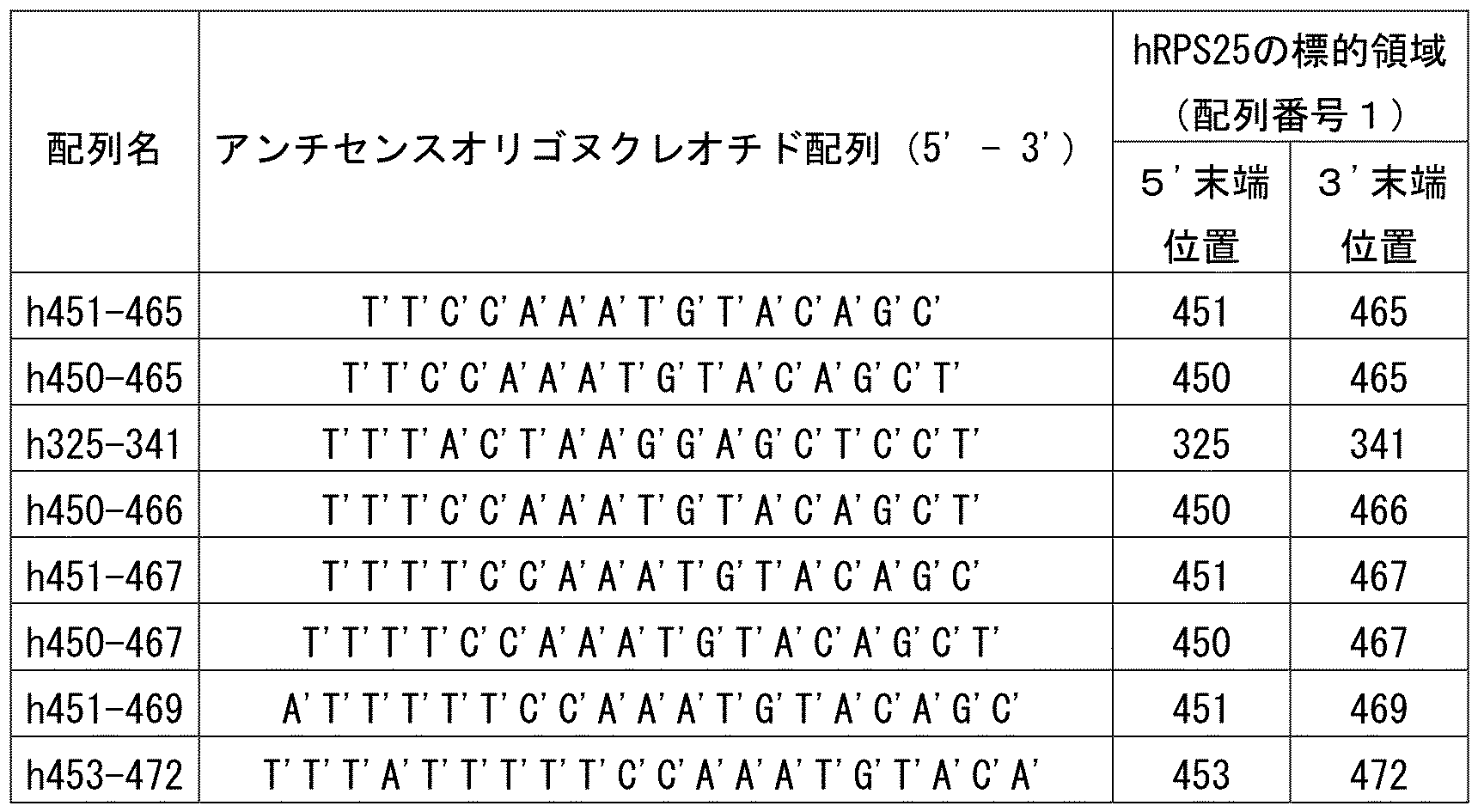
本実施形態に係る一本鎖アンチセンスオリゴヌクレオチドは、薬理学上許容される塩の形態であってもよい。ここで、「薬理学上許容される塩」とは、本発明の一本鎖アンチセンスオリゴヌクレオチドの塩であって、本発明の一本鎖アンチセンスオリゴヌクレオチドの生理学的に許容される塩、すなわち、当該一本鎖アンチセンスオリゴヌクレオチドの所望される生物学的な活性を保持し、かつ望まれない毒物学的効果を保持しない塩を意味する。なお、後述する二本鎖アンチセンスオリゴヌクレオチド及びアンチセンスオリゴヌクレオチド複合体についても同様である。
本実施形態の一側面において、上記一本鎖アンチセンスオリゴヌクレオチドは、製薬学的に許容される塩の形態であってもよい。ここで「製薬学的に許容される塩」とは、上述の薬理学上許容される塩であってかつ酸付加塩又は塩基付加塩であるものを意味する。酸付加塩としては、例えば、塩酸塩、臭化水素酸塩、硫酸塩、ヨウ化水素酸塩、硝酸塩及びリン酸塩等の無機酸塩、並びに、クエン酸塩、シュウ酸塩、フタル酸塩、フマル酸塩、マレイン酸塩、コハク酸塩、リンゴ酸塩、酢酸塩、ギ酸塩、プロピオン酸塩、安息香酸塩、トリフルオロ酢酸塩、メタンスルホン酸塩、ベンゼンスルホン酸塩、para-トルエンスルホン酸塩及びカンファースルホン酸塩等の有機酸塩が挙げられる。また、塩基付加塩としては、例えば、ナトリウム塩、カリウム塩、カルシウム塩、マグネシウム塩、バリウム塩及びアルミニウム塩等の無機塩基塩、並びに、トリメチルアミン、トリエチルアミン、ピリジン、ピコリン、2,6-ルチジン、エタノールアミン、ジエタノールアミン、トリエタノールアミン、トロメタミン[トリス(ヒドロキシメチル)メチルアミン]、tert-ブチルアミン、シクロヘキシルアミン、ジシクロヘキシルアミン及びN,N-ジベンジルエチルアミン等の有機塩基塩等が挙げられる。更には、アルギニン、リジン、オルニチン、アスパラギン酸又はグルタミン酸等の塩基性アミノ酸又は酸性アミノ酸との塩(アミノ酸塩)が挙げられる。なお、後述する二本鎖アンチセンスオリゴヌクレオチド及びアンチセンスオリゴヌクレオチド複合体についても同様である。
本実施形態に係る一本鎖アンチセンスオリゴヌクレオチドは、ギャップ領域と、上記ギャップ領域の3’末端に結合している3’ウイング領域と、上記ギャップ領域の5’末端に結合している5’ウイング領域と、を含む(例えば、図1参照)。上記一本鎖アンチセンスオリゴヌクレオチドは、一本鎖の形態であることが好ましい。本実施形態の一側面において、上記一本鎖アンチセンスオリゴヌクレオチドは、後述する第二鎖オリゴヌクレオチドとハイブリダイズして二本鎖の形態(二本鎖アンチセンスオリゴヌクレオチド)をとってもよい。上記第二鎖オリゴヌクレオチドの塩基配列は、上記一本鎖アンチセンスオリゴヌクレオチドの塩基配列に対して相補的な塩基配列を基準として、90%以上100%以下の配列同一性を有する塩基配列であることが好ましい。
上記ギャップ領域は、少なくとも1つの5’-CP核酸を含む。上記ギャップ領域は、5~20merの、糖部が修飾された核酸を含んでいてもよいデオキシリボースから構成される核酸であることが好ましい。言い換えると、上記ギャップ領域は、5~20merの、糖部が修飾されていてもよいデオキシリボースを含む核酸であると把握することもできる。また、上記ギャップ領域は、5~20merの、糖部がデオキシリボースである天然ヌクレオチド、非天然ヌクレオチド又はこれらの両方から構成されていると把握することもできる。上記ギャップ領域は、糖部がデオキシリボース又は修飾されたデオキシリボースであることによって、RNaseHが認識可能な複合体を、標的RNAであるRPS25のmRNA等と共に形成することが可能になる。ここで、修飾されたデオキシリボースを含む核酸としては、例えば、5’-CP核酸が挙げられる。
本実施形態の一側面において、上記ギャップ領域において、上記5’-CP核酸と、上記5’-CP核酸の3’側で隣接しているヌクレオシドとの結合が、ホスホロチオエート結合であることが好ましい(ただし、上記5’-CP核酸がギャップ領域の3’末端に配置されている場合と上記5’-CP核酸の3’側で隣接しているヌクレオシドが5’-CP核酸である場合を除く)。
上記3’ウイング領域は、2’位に置換基を有する修飾核酸である。言い換えると、上記3’ウイング領域は、2’位に置換基を有する修飾ヌクレオチドから構成されていると把握することもできる。上記3’ウイング領域における上記2’位に置換基を有する修飾核酸は、非架橋型の2’位修飾核酸として、2’-O-メチル核酸、2’-MOE核酸及びMCE核酸、架橋型修飾核酸として、LNA、AmNA、GuNA、及びscpBNAからなる群より選ばれる少なくとも1つを含むことが好ましい。上記3’ウイング領域及び後述する上記5’ウイング領域が、上記所定の修飾ヌクレオチドから構成されることによって、標的RNAに対して高い結合親和性が期待でき、ひいては標的RNAの機能を効果的に抑制できると考えられる。本実施形態の一側面において、上記3’ウイング領域は、糖部が修飾糖である修飾核酸であってもよい。糖部が修飾糖である修飾核酸としては、上記(糖修飾、修飾糖)で挙げられたものが例示される。本実施形態の一側面において、3’ウイング領域における上記2’位に置換基を有する修飾核酸は、2’-MOE核酸のみで構成されていてもよい。なお、上記3’ウイング領域における修飾核酸は、1つの一本鎖アンチセンスオリゴヌクレオチドの中に複数種類含まれていてもよい。
上記5’ウイング領域は、2’位に置換基を有する修飾核酸である。言い換えると、上記5’ウイング領域は、2’位に置換基を有する修飾ヌクレオチドから構成されていると把握することもできる。上記5’ウイング領域における上記修飾核酸は、非架橋型の2’位修飾核酸として、2’-O-メチル核酸、2’-MOE核酸及びMCE核酸、架橋型修飾核酸として、LNA、AmNA、GuNA、及びscpBNAからなる群より選ばれる少なくとも1つを含むことが好ましい。本実施形態の一側面において、上記5’ウイング領域は、糖部が修飾糖である修飾核酸であってもよい。糖部が修飾糖である修飾核酸としては、上記(糖修飾、修飾糖)で挙げられたものが例示される。本実施形態の一側面において、5’ウイング領域における上記2’位に置換基を有する修飾核酸は、2’-MOE核酸のみで構成されていてもよい。なお、上記5’ウイング領域における修飾核酸は、1つの一本鎖アンチセンスオリゴヌクレオチドの中に複数種類含まれていてもよい。本実施形態の他の側面において、3’ウイング領域及び5’ウイング領域における上記修飾核酸は、2’-MOE核酸のみで構成されていてもよく、また、架橋型修飾核酸のみで構成されていてもよい。
上記5’ウイング領域における上記2’位に置換基を有する修飾核酸が、2’-MOE核酸、LNA、AmNA、GuNA、及びscpBNAからなる群より選ばれる少なくとも1つを含むことが好ましい。
また、上記3’ウイング領域における上記2’位に置換基を有する修飾核酸が、2’-MOE核酸、LNA、AmNA、GuNA、及びscpBNAからなる群より選ばれる修飾核酸で構成されていて、
上記5’ウイング領域における上記2’位に置換基を有する修飾核酸が、2’-MOE核酸、LNA、AmNA、GuNA、及びscpBNAからなる群より選ばれる修飾核酸で構成されていることがより好ましい。
上記5’ウイング領域における上記2’位に置換基を有する修飾核酸が、2’-MOE核酸、AmNA、GuNA、及びscpBNAからなる群より選ばれる修飾核酸で構成されていることがより好ましい。
本発明の一本鎖アンチセンスオリゴヌクレオチドはギャップマー型である。ギャップマー型の構造を表記するにあたっては、「X-Y-Z」の表記方法を用いることがある。上述の表記方法において、「X」は5’ウイング領域の塩基数を示し、「Y」はギャップ領域の塩基数を示し、「Z」は3’ウイング領域の塩基数を示す。
本実施形態に係る二本鎖アンチセンスオリゴヌクレオチドは、上記一本鎖アンチセンスオリゴヌクレオチドと、
上記一本鎖アンチセンスオリゴヌクレオチドに対してハイブリダイズしている第二鎖オリゴヌクレオチドと、を含む二本鎖アンチセンスオリゴヌクレオチド又はその製薬学的に許容される塩である。上記第二鎖オリゴヌクレオチドの塩基配列は、上記一本鎖アンチセンスオリゴヌクレオチドの塩基配列に対して相補的な塩基配列を基準として、90%以上100%以下の配列同一性を有する塩基配列であることが好ましい。
本発明の一本鎖アンチセンスオリゴヌクレオチドは、ホスホロアミダイト法による固相合成により製造することができる。例えば、市販の核酸自動合成機を使用して固相担体上で所定の塩基配列を有する一本鎖オリゴヌクレオチドをまず合成する。次に、塩基性物質等を用いて固相担体から合成した一本鎖オリゴヌクレオチドを切出し、脱保護を行ない、粗体の一本鎖オリゴヌクレオチドを得る。その後、得られた粗体の一本鎖オリゴヌクレオチドを、HPLC等を用いて精製する。上述の製造法に限らず、本発明の一本鎖アンチセンスオリゴヌクレオチドは、当業者に公知の方法に準じて、核酸の塩基配列、修飾部位等を適宜変更することにより製造できる。また、AmNA、GuNA、及びscpBNAについては、それぞれ国際公開第2011/052436号(特許文献2)、国際公開第2014/046212号(特許文献3)、及び国際公開第2015/125783号(特許文献4)に記載の方法により製造することができる。2’-MOE核酸については、試薬として購入可能なアミダイトを用いることにより製造することができる。5’-CP核酸については、国際公開第2020/158910号(特許文献5)に記載の方法により製造することができる。LNAについては、国際公開第99/14226号(特許文献6)に記載の方法により製造することができる。
本発明の二本鎖アンチセンスオリゴヌクレオチドは、まず、上記一本鎖アンチセンスオリゴヌクレオチドと同様の製造方法を用いて、該一本鎖アンチセンスオリゴヌクレオチドに相補的な塩基配列を基準として所定の配列同一性を有するオリゴヌクレオチド(第二鎖オリゴヌクレオチド)を製造する。その後、上記一本鎖アンチセンスオリゴヌクレオチドおよび上記第二鎖オリゴヌクレオチドをハイブリダイズさせることにより製造することができる。
本実施形態に係るアンチセンスオリゴヌクレオチド複合体は、
上記一本鎖アンチセンスオリゴヌクレオチド若しくはその製薬学的に許容される塩、又は上記二本鎖アンチセンスオリゴヌクレオチド若しくはその製薬学的に許容される塩と、
上記一本鎖アンチセンスオリゴヌクレオチド又は上記第二鎖オリゴヌクレオチドに結合している付加物質と、
を有する。上記付加物質は、ポリエチレングリコール、ペプチド、アルキル鎖(例えば、飽和脂肪族炭化水素等)、核酸、リガンド化合物、抗体、タンパク質、及び糖鎖(例えば、炭水化物、多糖等)からなる群より選ばれる。
上記一本鎖アンチセンスオリゴヌクレオチド又はその製薬学的に許容される塩と、
上記一本鎖アンチセンスオリゴヌクレオチドに結合している付加物質と、を有し、上記付加物質は、ポリエチレングリコール、ペプチド、アルキル鎖(例えば、飽和脂肪族炭化水素等)、核酸、リガンド化合物、抗体、タンパク質、及び糖鎖(例えば、炭水化物、多糖等)からなる群より選ばれる。
上記二本鎖アンチセンスオリゴヌクレオチド又はその製薬学的に許容される塩と、
上記一本鎖アンチセンスオリゴヌクレオチド又は上記第二鎖オリゴヌクレオチドに結合している付加物質と、を有し、上記付加物質は、ポリエチレングリコール、ペプチド、アルキル鎖(例えば、飽和脂肪族炭化水素等)、核酸、リガンド化合物、抗体、タンパク質、及び糖鎖(例えば、炭水化物、多糖等)からなる群より選ばれる。
なお、上記付加物質として用いられる核酸は、上記アンチセンスオリゴヌクレオチドの塩基長にはカウントしないものとする。
本実施形態に係るRPS25遺伝子の発現調節剤は、本発明の一本鎖アンチセンスオリゴヌクレオチド、上記二本鎖アンチセンスオリゴヌクレオチド又は上記アンチセンスオリゴヌクレオチド複合体を有効成分として含む。本実施形態の一側面において、上記発現調節剤は、RPS25遺伝子に対する発現抑制剤と把握することもできる。本実施形態の他の側面において、上記発現調節剤は、RAN翻訳に対する抑制剤と把握することもできる。本実施形態の他の側面において、上記発現調節剤は、RAN翻訳の抑制を介したジペプチドリピートの発現抑制剤と把握することもできる。本発明の一本鎖アンチセンスオリゴヌクレオチドは、RPS25のmRNA又はmRNA前駆体に結合することで、RPS25遺伝子の発現を抑制し、その翻訳産物によるRAN翻訳を抑制する。本発明のRPS25遺伝子の発現調節剤の投与方法及び製剤は、当該分野で公知の投与方法及び製剤であれば、いずれも利用可能である。
本実施形態に係る医薬組成物は、本発明の一本鎖アンチセンスオリゴヌクレオチド若しくはその製薬学的に許容される塩、上記二本鎖アンチセンスオリゴヌクレオチド若しくはその製薬学的に許容される塩、又は上記アンチセンスオリゴヌクレオチド複合体若しくはその製薬学的に許容される塩を有効成分として含む。本実施形態の医薬組成物の投与方法及び製剤は、当該分野で公知の投与方法及び製剤であれば、いずれも利用可能である。以下、上記医薬組成物を、「アンチセンスオリゴヌクレオチド等の医薬組成物」と表記することがある。
本実施形態に係るリピート病に対する治療剤は、上記一本鎖アンチセンスオリゴヌクレオチド若しくはその製薬学的に許容される塩、上記二本鎖アンチセンスオリゴヌクレオチド若しくはその製薬学的に許容される塩、又は上記アンチセンスオリゴヌクレオチド複合体若しくはその製薬学的に許容される塩を有効成分として含む。本実施形態に係るリピート病に対する予防剤は、上記一本鎖アンチセンスオリゴヌクレオチド若しくはその製薬学的に許容される塩、上記二本鎖アンチセンスオリゴヌクレオチド若しくはその製薬学的に許容される塩、又は上記アンチセンスオリゴヌクレオチド複合体若しくはその製薬学的に許容される塩を有効成分として含む。上記リピート病は、C9orf72 ALS、C9orf72 FTLD、ハンチントン病、脊髄小脳失調症、歯状核赤核淡蒼球ルイ体萎縮症、球脊髄性筋萎縮症、Friedreich失調症、脆弱X随伴振戦失調症候群、及び筋強直性ジストロフィーからなる群より選ばれる少なくとも1つであることが好ましい。
上記C9orf72 ALSとは、C9orf72遺伝子のエクソン1a領域とエクソン1b領域との間のイントロン領域に存在するGGGGCC配列が異常に反復伸長する変異を有するALSを意味する。C9orf72遺伝子は、ALSの原因遺伝子としては最も高頻度であり孤発性ALSの約6%、家族性ALSの約40%を占める。ALSは、運動神経細胞が選択的に死滅することで筋肉が萎縮する神経変性疾患である。ALSは、上位・下位運動神経障害の臨床的特徴又は電気生理学的特徴を組み合わせることで診断される。具体的には脳幹、頚髄、胸髄、腰仙髄の4領域のうち上位・下位運動神経障害を示す所見が1領域にあり、かつ他の領域に筋電図所見が認められればlaboratory-supported probable、2領域にあればprobable、3領域にあればdefiniteと診断される。
上記C9orf72 FTLDとは、C9orf72遺伝子のエクソン1a領域とエクソン1b領域との間のイントロン領域に存在するGGGGCC配列が異常に反復伸長する変異を有するFTLDを意味する。上記FTLDは、進行性の異常行動や認知機能障害を認めそれらにより日常生活が阻害されていることに加え、脱抑制行動又は無関心・無気力又は固執・常同性又は口唇傾向と食習慣の変化等から3項目以上の症状が見られる。上記FTLDは、画像検査所見において前頭葉や側頭葉前部の萎縮か代謝や血流の低下が見られ、特定の疾患と鑑別される場合に行動異常型FTLDと診断される。上記FTLDは、物品呼称の障害、単語理解の障害が認められることに加え、対象物に対する知識の障害又は表層性失読・失書等の症状が認められ、前方優位の側頭葉に萎縮がみられ、特定の疾患を鑑別できる場合に意味性認知症FTLDと診断される。
上記ハンチントン病とは、ハンチンチン遺伝子のエクソン1領域に存在するCAG配列が異常に反復伸長することによって発症する常染色体優性遺伝形式を示す遺伝性の神経変性疾患を意味する。上記ハンチントン病は、不随意運動を特徴とする運動障害、精神症状、及び認知症状を呈する。特定の神経所見が認められ、かつ遺伝子診断でCAG配列の異常伸長変異が認められる場合、又は、進行性の経過を示し常染色体優性遺伝の家族歴、特定の神経所見、及び臨床検査所見が認められ、鑑別診断で類似疾患が否定される場合にハンチントン病と診断される。
上記脊髄小脳失調症(1、2、3、6、7、8、12、17型)、及び歯状核赤核淡蒼球ルイ体萎縮症とは各疾患における責任遺伝子上に存在する特定の3塩基配列(CAGまたはCTG)が異常に反復伸長することによって発症する常染色体優性遺伝形式を示す遺伝性の神経変性疾患を意味する。脊髄小脳失調症1、2、3、6,7,12及び17型並びに歯状核赤核淡蒼球ルイ体萎縮症においては、CAGの繰り返し配列が認められる。脊髄小脳失調症8型ではCTGの繰り返し配列が認められる。上記脊髄小脳失調症及び歯状核赤核淡蒼球ルイ体萎縮症は、小脳性または後索性の運動失調又は痙性対麻痺を主要症候とし、緩徐進行性であることを基本とし、遺伝子診断または神経病理学的診断等を組み合わせて診断される。
上記球脊髄性筋萎縮症とはアンドロゲン受容体遺伝子のエクソン領域に存在するCAG配列が異常に反復伸長することによって発症する遺伝性疾患を意味する。上記球脊髄性筋萎縮症は、神経所見(球症状、下位運動神経徴候、手指振戦、四肢腱反射低下)、臨床所見・検査所見、遺伝子診断等を組み合わせて診断される。
上記Friedreich失調症とはフラタキシン遺伝子の変異によって発症する常染色体劣性形式を示す遺伝性の神経変性疾患を意味する。上記Friedreich失調症の多くは、第1イントロンに存在するGAA配列が異常に反復伸長することによる。
上記脆弱X随伴振戦失調症候群とはFMP1遺伝子の5’UTRに存在するCGG配列が異常に反復伸長することによって発症する遺伝性の神経変性疾患を意味する。上記脆弱X随伴振戦失調症候群は、臨床症状(小脳失調、運動時振戦、パーキソニズム、認知症、知的障害)、MRI検査による中小脳脚兆候、遺伝子診断等を組み合わせて診断される。
上記筋強直性ジストロフィーとはDMPK遺伝子の3’UTRに存在するCUG配列が異常に反復伸長することによって発症する常染色体優性遺伝形式をとる遺伝性の筋疾患を意味する。
上記個体とは、哺乳動物を意味する。上記個体は、好ましくは、ヒト、サル、マーモセット、イヌ、ブタ、ウサギ、モルモット、ラット及びマウスである。上記個体は、より好ましくはヒトである。
Clinical sign score;
0点:異常なし
1点:後肢機能異常、振戦、自発運動減少
2点:後肢のひきずり、尾部又は後肢の脱力
3点:完全な後肢機能不全、後肢の麻痺、横臥、腹臥
4点:安楽殺
Pathological score;
0点:異常なし
1点:異常あり(単細胞壊死、空胞化等)
本実施形態におけるRPS25遺伝子の発現を調節する方法は、上記一本鎖アンチセンスオリゴヌクレオチド若しくはその製薬学的に許容される塩、又は上記アンチセンスオリゴヌクレオチド複合体若しくはその製薬学的に許容される塩を有効成分として、上記RPS25遺伝子を発現している細胞、組織又は個体に投与する工程を含む。
<細胞へのアンチセンスオリゴヌクレオチドの導入>
「RPS25遺伝子を発現している細胞」にリポフェクション法、エレクトロポレーション法又は直接添加による導入等の方法を用いてアンチセンスオリゴヌクレオチドを6時間から3日間処置する。使用する細胞はRPS25遺伝子が発現している細胞であればよく、例えばHEK293T細胞、より好ましくは神経細胞、更に好ましくはヒト由来神経細胞が挙げられる。アンチセンスオリゴヌクレオチドを処置した細胞は、処置後すぐに回収してもよいし、アンチセンスオリゴヌクレオチドを除去して継続培養してもよい。
回収した細胞から抽出した全RNAに対して逆転写反応を実施し、得られた相補的DNAに対してRPS25遺伝子特異的プローブを用いてリアルタイムPCR法等を実施することでRPS25mRNAの量を測定する。リアルタイムPCRに用いるプローブとしては、例えばTaqmanプローブが挙げられる。反応方法としては例えば「(cDNAの変性)―(アニーリング)―(伸長反応)」の3ステップ又は「(cDNAの変性)―(アニーリングと伸長反応)」の2ステップを任意の回数繰り返す方法が挙げられる。2または3ステップの繰り返し回数は例えば25~45回であり、好ましくは35~40回である。(cDNAの変性)温度は例えば90°C~98°Cであり、好ましくは92°C~95°Cである。(アニーリング)温度は例えば40°C~70°Cであり、好ましくは50°C~60°Cである。(伸長反応)温度は例えば、65°C~75°Cであり、好ましくは反応に用いるポリメラーゼの最適温度である。(アニーリングと伸長反応)温度は、例えば55°C~70°Cである。
回収した細胞を溶解し、抽出物を得る。ウェスタンブロッティング法、ELISA(Enzyme-Linked Immuno Sorbent Assay)等の免疫化学的手法を用いて上記抽出物中に含まれるRPS25タンパク質の量を評価する。ウェスタンブロッティング法において、泳動、転写、検出の各ステップは任意の機器を使用することができる。メンブレンと一次抗体又は二次抗体の反応時間及び反応温度は任意に設定可能であり、例えば4°Cで一晩又は室温で1~3時間である。
RPS25遺伝子の発現及び/又は機能を調節する一本鎖アンチセンスオリゴヌクレオチド又はその製薬学的に許容される塩であって、
上記一本鎖アンチセンスオリゴヌクレオチドは、各ヌクレオシドがリン酸基及び/又は修飾リン酸基で結合されており、
上記一本鎖アンチセンスオリゴヌクレオチドは、ギャップ領域と、上記ギャップ領域の3’末端に結合している3’ウイング領域と、上記ギャップ領域の5’末端に結合している5’ウイング領域と、を含み、
上記ギャップ領域は、糖部が修飾された核酸を含んでいてもよいデオキシリボースから構成される核酸であり、
上記ギャップ領域は、少なくとも1つの5’-CP核酸を含み、
上記3’ウイング領域及び上記5’ウイング領域は2’位に置換基を有する修飾核酸であり、
上記一本鎖アンチセンスオリゴヌクレオチドの塩基長は、12~30merであり、
上記一本鎖アンチセンスオリゴヌクレオチドの塩基配列は、
配列番号1に記載の塩基配列における、上記一本鎖アンチセンスオリゴヌクレオチドと同じ塩基長で構成された少なくとも1つの標的領域に対して相補的な塩基配列を基準として、90%以上100%以下の配列同一性を有する塩基配列、
上記標的領域において1若しくは数個の塩基が欠失、置換、挿入若しくは付加された塩基配列に対して、相補的な塩基配列、又は、
上記標的領域を有するオリゴヌクレオチドに対して、ストリンジェントな条件でハイブリダイズする塩基配列、である、一本鎖アンチセンスオリゴヌクレオチド又はその製薬学的に許容される塩である。
RPS25遺伝子の発現及び/又は機能を調節する一本鎖アンチセンスオリゴヌクレオチド又はその製薬学的に許容される塩であって、
上記一本鎖アンチセンスオリゴヌクレオチドは、各ヌクレオシドがリン酸基及び/又は修飾リン酸基で結合されており、
上記一本鎖アンチセンスオリゴヌクレオチドは、ギャップ領域と、上記ギャップ領域の3’末端に結合している3’ウイング領域と、上記ギャップ領域の5’末端に結合している5’ウイング領域と、を含み、
上記ギャップ領域は、糖部が修飾された核酸を含んでいてもよいデオキシリボースから構成される核酸であり、
上記ギャップ領域は、少なくとも1つの5’-CP核酸を含み、
上記3’ウイング領域及び上記5’ウイング領域は2’位に置換基を有する修飾核酸であり、
上記一本鎖アンチセンスオリゴヌクレオチドの塩基長は、12~30merであり、
上記一本鎖アンチセンスオリゴヌクレオチドの塩基配列は、
配列番号1に記載の塩基配列における、上記一本鎖アンチセンスオリゴヌクレオチドと同じ塩基長で構成された少なくとも1つの標的領域に対して相補的な塩基配列を基準として、90%以上100%以下の配列同一性を有する塩基配列、
上記標的領域において1若しくは数個の塩基が欠失、置換、挿入若しくは付加された塩基配列に対して、相補的な塩基配列、又は、
上記標的領域を有するオリゴヌクレオチドに対して、ストリンジェントな条件でハイブリダイズする塩基配列、である、一本鎖アンチセンスオリゴヌクレオチド又はその製薬学的に許容される塩である(ただし、参考例1~31に係る一本鎖アンチセンスオリゴヌクレオチドを除く。)。
RPS25遺伝子の発現及び/又は機能を調節する一本鎖アンチセンスオリゴヌクレオチド又はその製薬学的に許容される塩であって、
上記一本鎖アンチセンスオリゴヌクレオチドは、各ヌクレオシドがリン酸基及び/又は修飾リン酸基で結合されており、
上記一本鎖アンチセンスオリゴヌクレオチドは、ギャップ領域と、上記ギャップ領域の3’末端に結合している3’ウイング領域と、上記ギャップ領域の5’末端に結合している5’ウイング領域と、を含み、
上記ギャップ領域は、糖部が修飾された核酸を含んでいてもよいデオキシリボースから構成される核酸であり、
上記ギャップ領域は、少なくとも1つの5’-CP核酸を含み、
上記3’ウイング領域及び上記5’ウイング領域は2’位に置換基を有する修飾核酸であり、
上記一本鎖アンチセンスオリゴヌクレオチドの塩基長は、12~30merであり、
上記一本鎖アンチセンスオリゴヌクレオチドの塩基配列は、
配列番号1に記載の塩基配列における、上記一本鎖アンチセンスオリゴヌクレオチドと同じ塩基長で構成された少なくとも1つの標的領域に対して相補的な塩基配列を基準として、90%以上100%以下の配列同一性を有する塩基配列、
上記標的領域において1若しくは数個の塩基が欠失、置換、挿入若しくは付加された塩基配列に対して、相補的な塩基配列、又は、
上記標的領域を有するオリゴヌクレオチドに対して、ストリンジェントな条件でハイブリダイズする塩基配列、である、一本鎖アンチセンスオリゴヌクレオチド又はその製薬学的に許容される塩である(ただし、参考例1~31、設計例1~18係る一本鎖アンチセンスオリゴヌクレオチドを除く。)。
上記3’ウイング領域が、3~5merの、2’位に置換基を有する修飾核酸であり、
上記5’ウイング領域が、3~5merの、2’位に置換基を有する修飾核酸であることが好ましい。
上記5’ウイング領域における上記2’位に置換基を有する修飾核酸が、2’-MOE核酸、LNA、AmNA、GuNA、及びscpBNAからなる群より選ばれる少なくとも1つを含むことが好ましい。
上記5’ウイング領域における上記2’位に置換基を有する修飾核酸が、2’-MOE核酸、LNA、AmNA、GuNA、及びscpBNAからなる群より選ばれる修飾核酸で構成されていることが好ましい。
上記5’ウイング領域における上記2’位に置換基を有する修飾核酸が、2’-MOE核酸、AmNA、GuNA、及びscpBNAからなる群より選ばれる修飾核酸で構成されていることが好ましい。
配列番号1に記載の塩基配列において、5’末端から数えて123番、124番、185番、186番、263番、264番、324番、325番、442番、443番、又は447番~453番に位置する塩基から連続した14~22merで構成された標的領域に対して相補的な塩基配列を基準として、90%以上100%以下の配列同一性を有する塩基配列、
上記標的領域において、1若しくは数個の塩基が欠失、置換、挿入若しくは付加された塩基配列に対して相補的な塩基配列、又は、
上記標的領域を有するオリゴヌクレオチドに対して、ストリンジェントな条件でハイブリダイズする塩基配列であることが好ましい。
配列番号1に記載の塩基配列において、5’末端から数えて324番、325番、又は448番~453番に位置する塩基から連続した14~22merで構成された標的領域に対して相補的な塩基配列を基準として、90%以上100%以下の配列同一性を有する塩基配列、
上記標的領域において、1若しくは数個の塩基が欠失、置換、挿入若しくは付加された塩基配列に対して相補的な塩基配列、又は、
上記標的領域を有するオリゴヌクレオチドに対して、ストリンジェントな条件でハイブリダイズする塩基配列であることが好ましい。
上記3’ウイング領域は、3~5merであり、
上記5’ウイング領域は、3~5merであることが好ましい。
上記一本鎖アンチセンスオリゴヌクレオチドに結合している付加物質と、を有する、アンチセンスオリゴヌクレオチド複合体又はその製薬学的に許容される塩であって、
上記付加物質は、ポリエチレングリコール、ペプチド、アルキル鎖、核酸、リガンド化合物、抗体、タンパク質、及び糖鎖からなる群より選ばれる。
まず、表2-1~表2-4、表3-1、表3-2及び表4に示される一本鎖アンチセンスオリゴヌクレオチドを設計した。設計したものの一部について、以下の手順でRPS25遺伝子に対する一本鎖アンチセンスオリゴヌクレオチドを作製した。


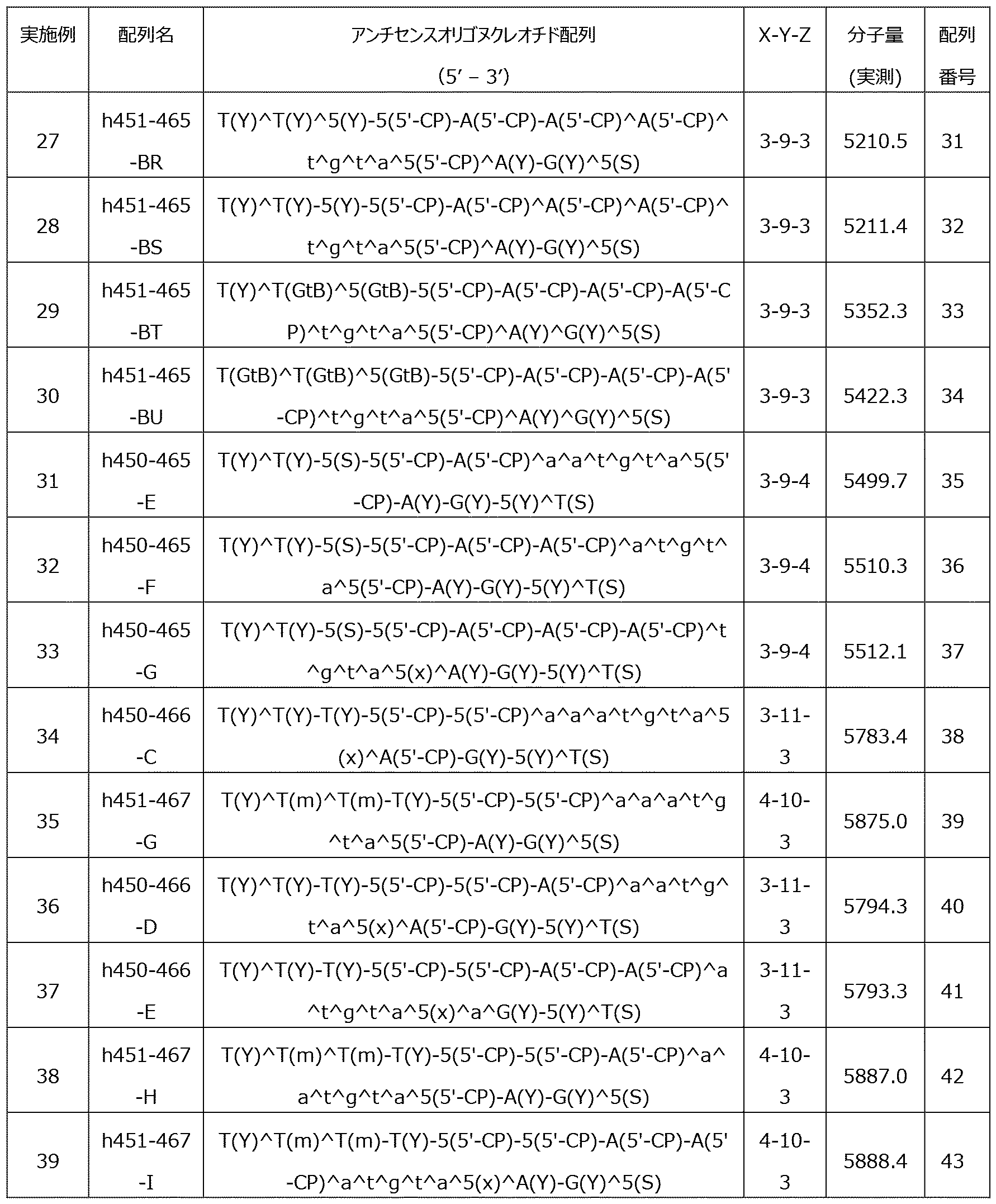
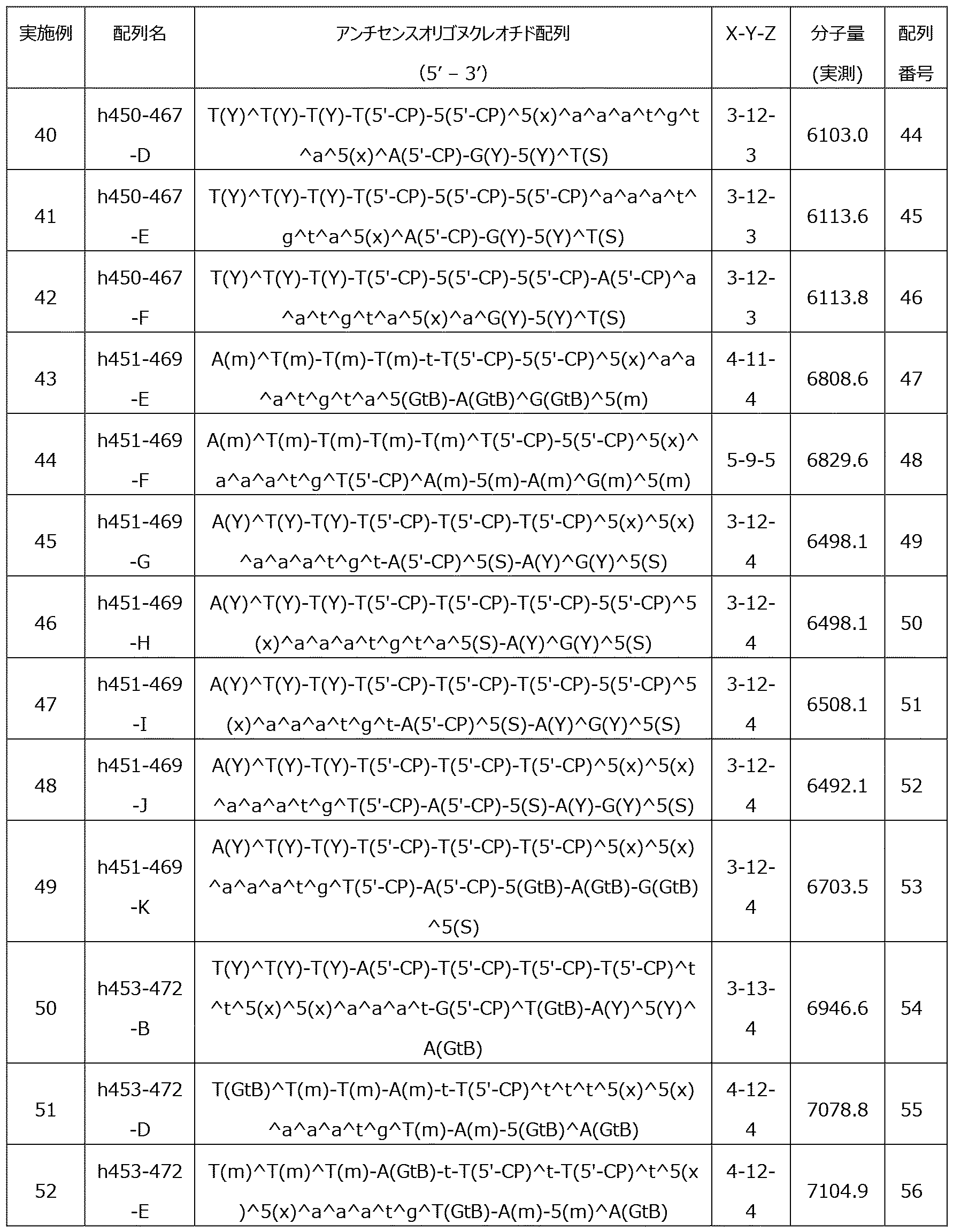
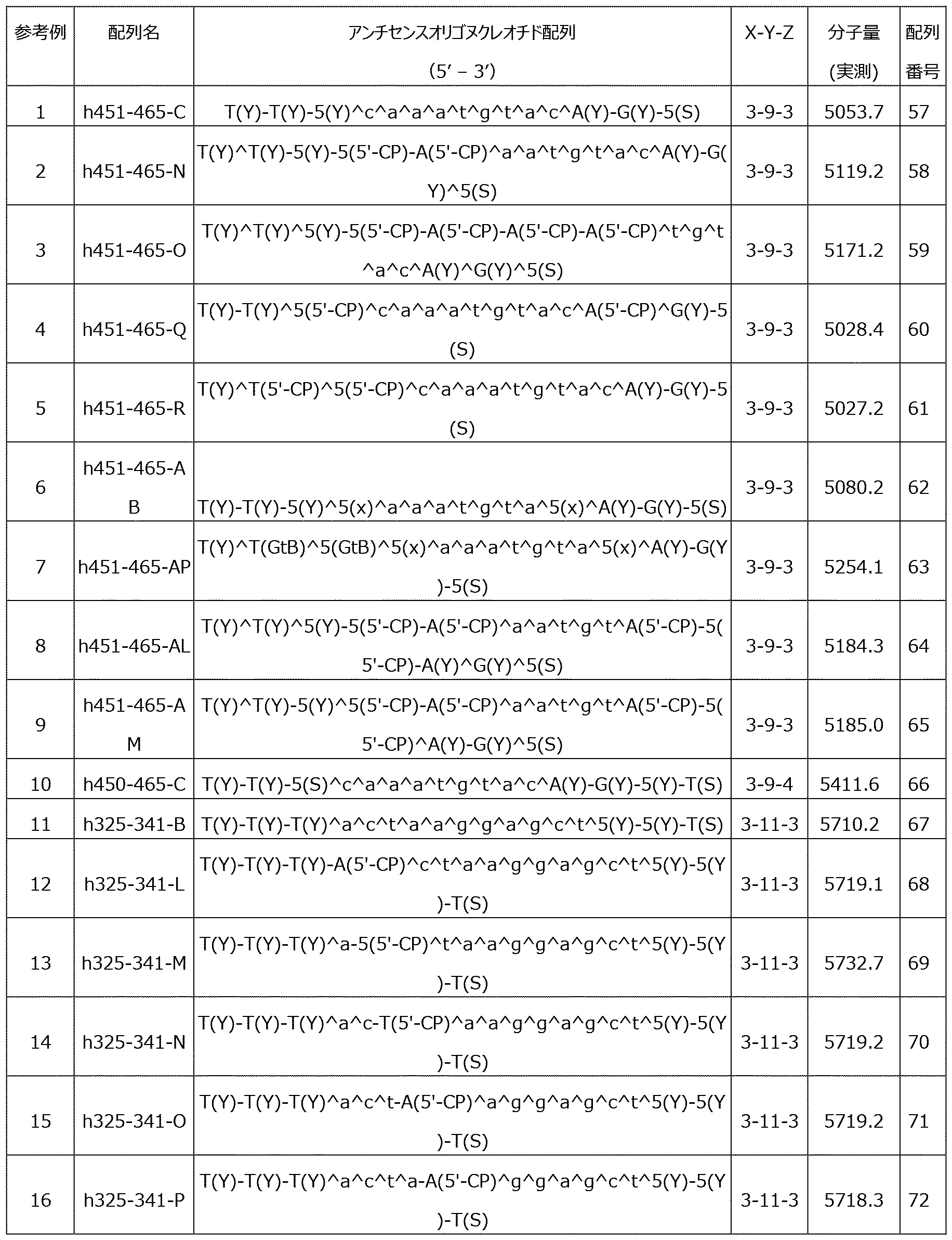
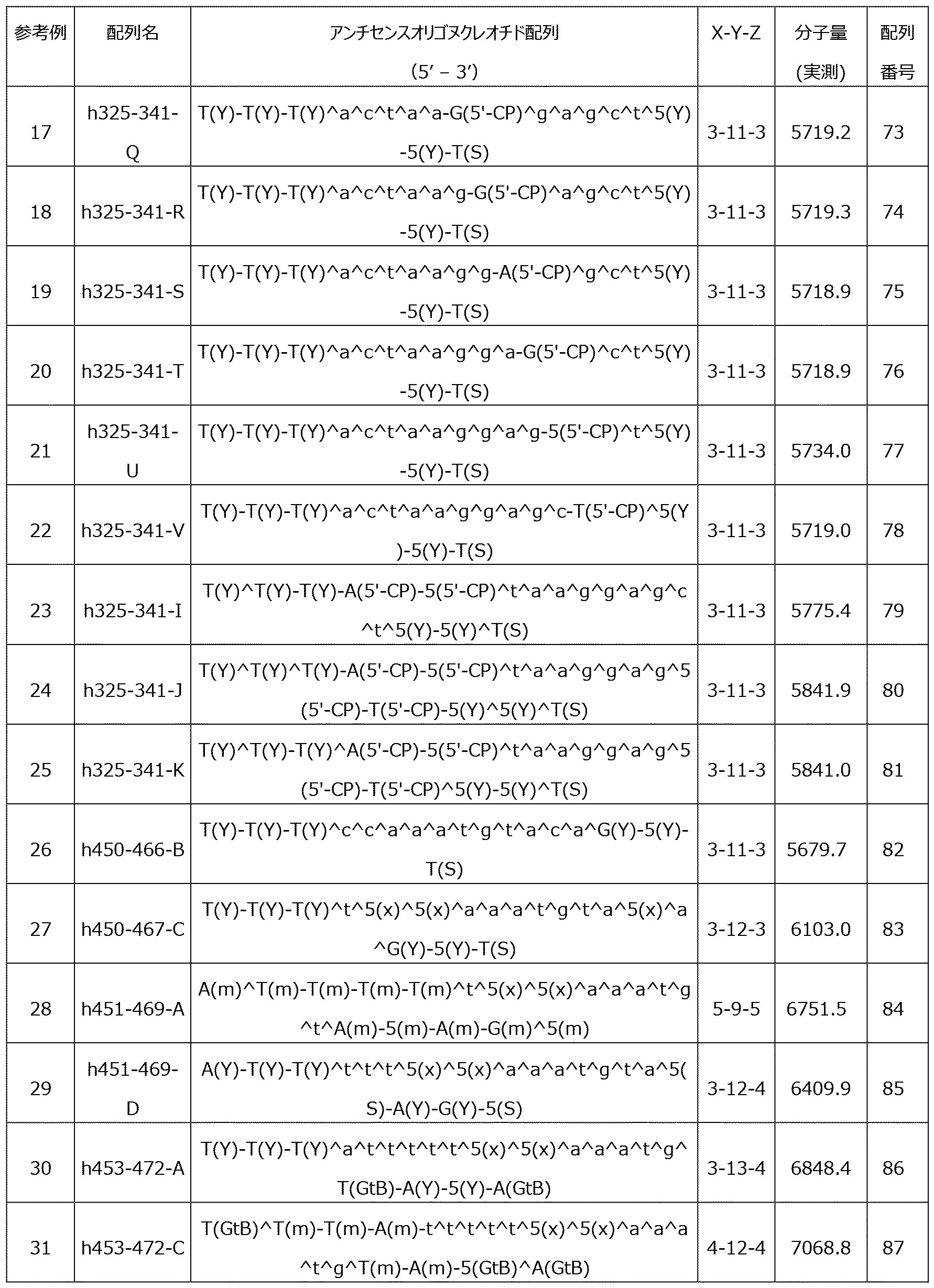
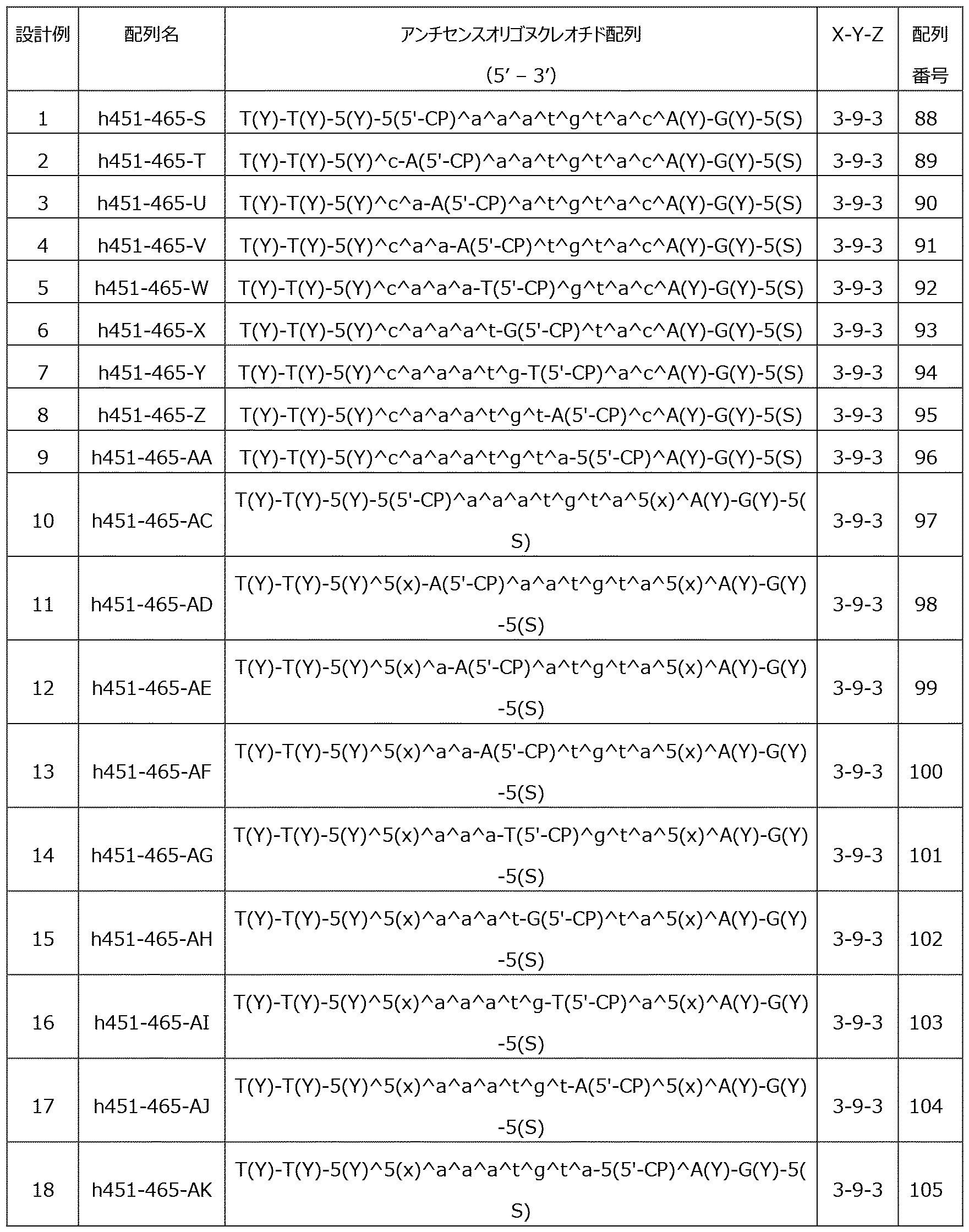
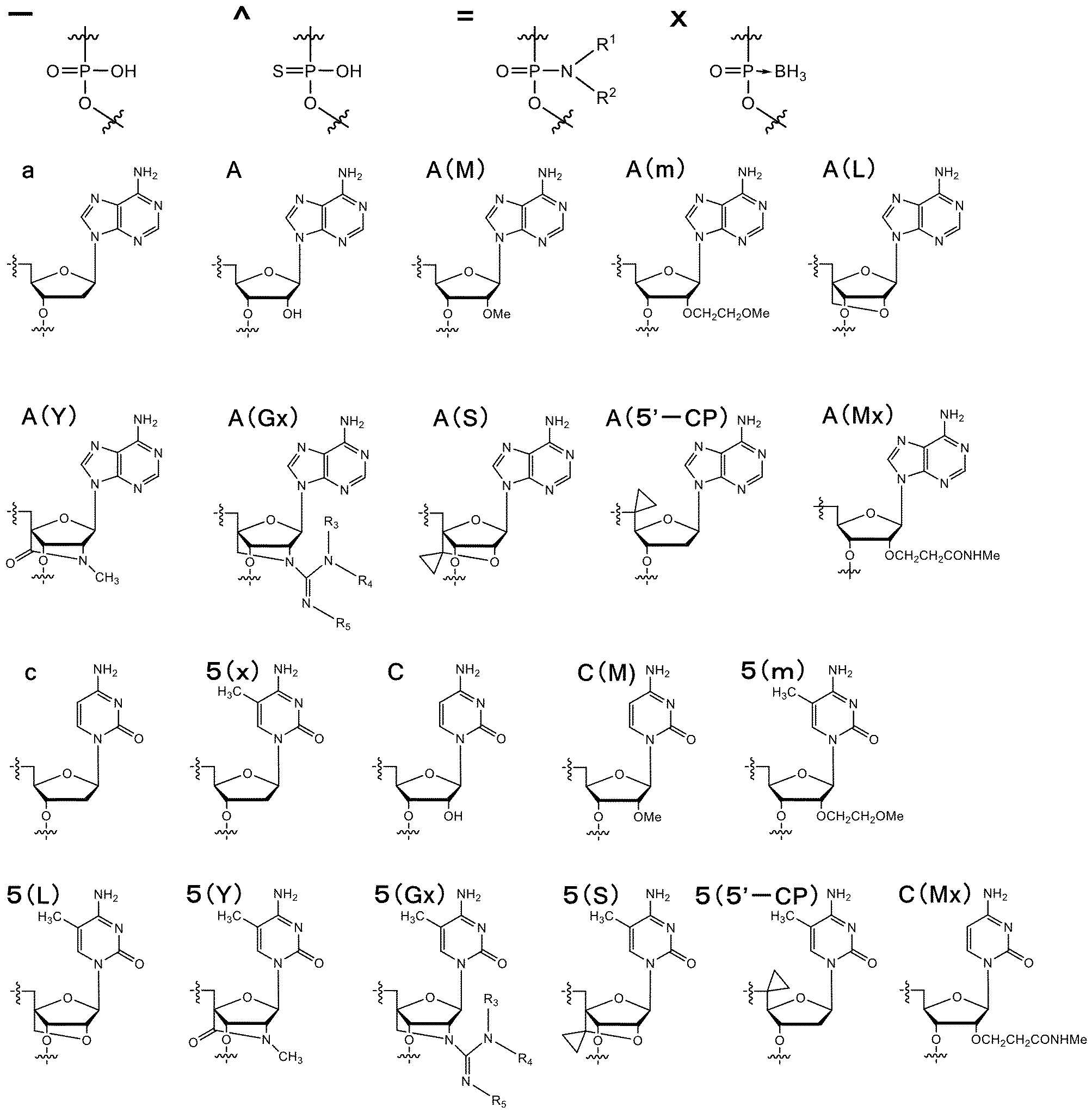

RPS25遺伝子の発現評価は、製造した一本鎖アンチセンスオリゴヌクレオチドに応じて、ヒト胎児腎細胞を用いた発現評価で行った。また上記RPS25遺伝子の発現評価は、ヒトiPS細胞由来神経細胞を用いても行うことができる。本実施例における遺伝子発現評価とは、逆転写反応によって得られた相補的DNA(cDNA)量を測定することでmRNA量を評価することを意味する。以下、各発現評価の具体的手順について説明する。
ヒト胎児腎細胞HEK293T(ATCC(登録商標)CRL-3216 (商標))を、培養培地中、37°C、5%CO2の条件で培養した。HEK293T細胞の培養培地としては、以下の組成のものを用いた。
ダルベッコ改変イーグル培地(DMEM):SIGMA社製、Cat#D6429
10% ウシ胎児血清(FBS):biowest社製、Cat#S1820
100倍希釈ペニシリン-ストレプトマイシン混合溶液:ナカライテスク社製 Cat#09367-34(ペニシリン 10000ユニット/ml, ストレプトマイシン 10000μg/ml、安定剤含有)
human RPS25: Hs01568661_g1
human GAPDH: 4326317E(インターナルコントロール)

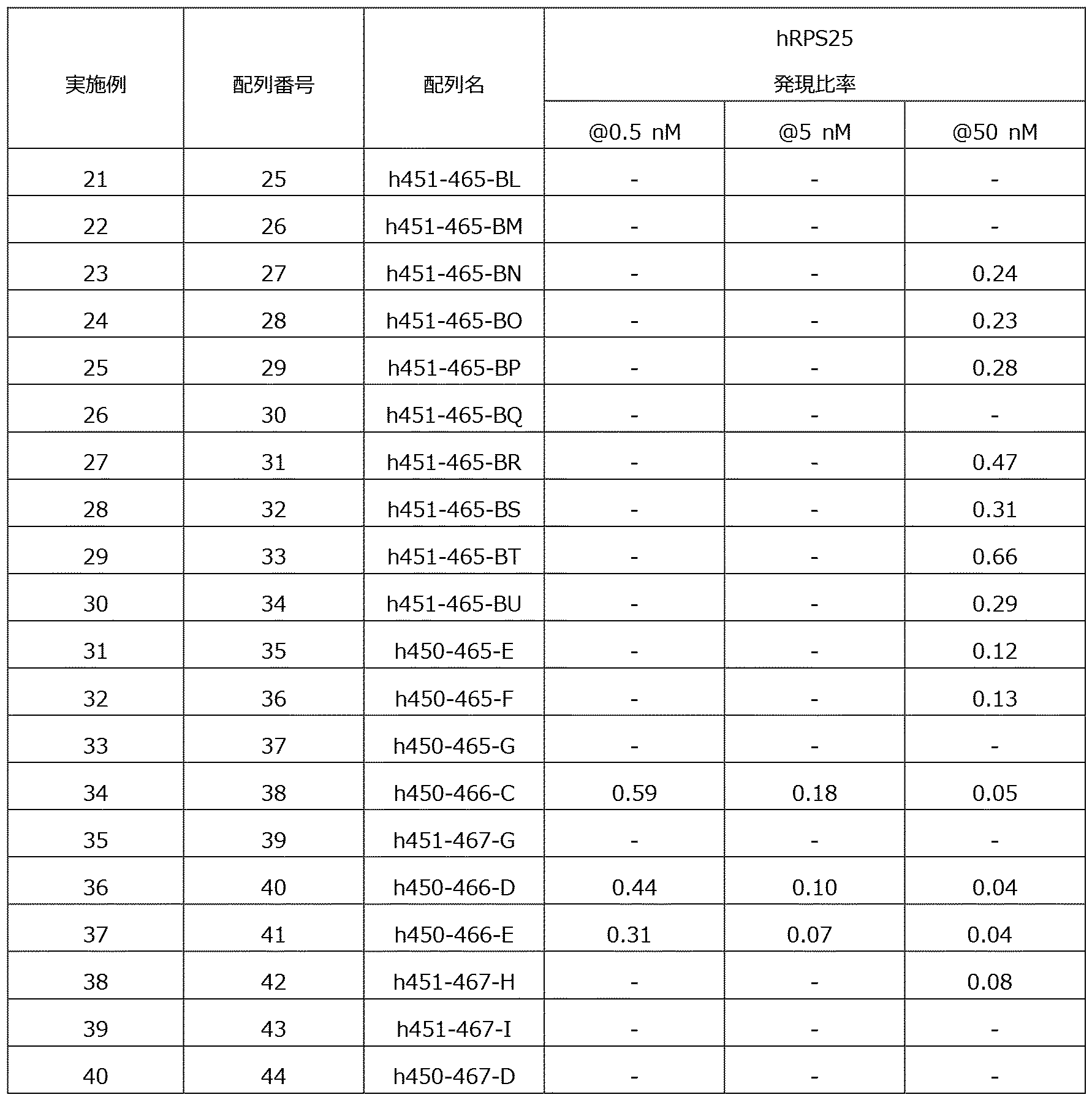
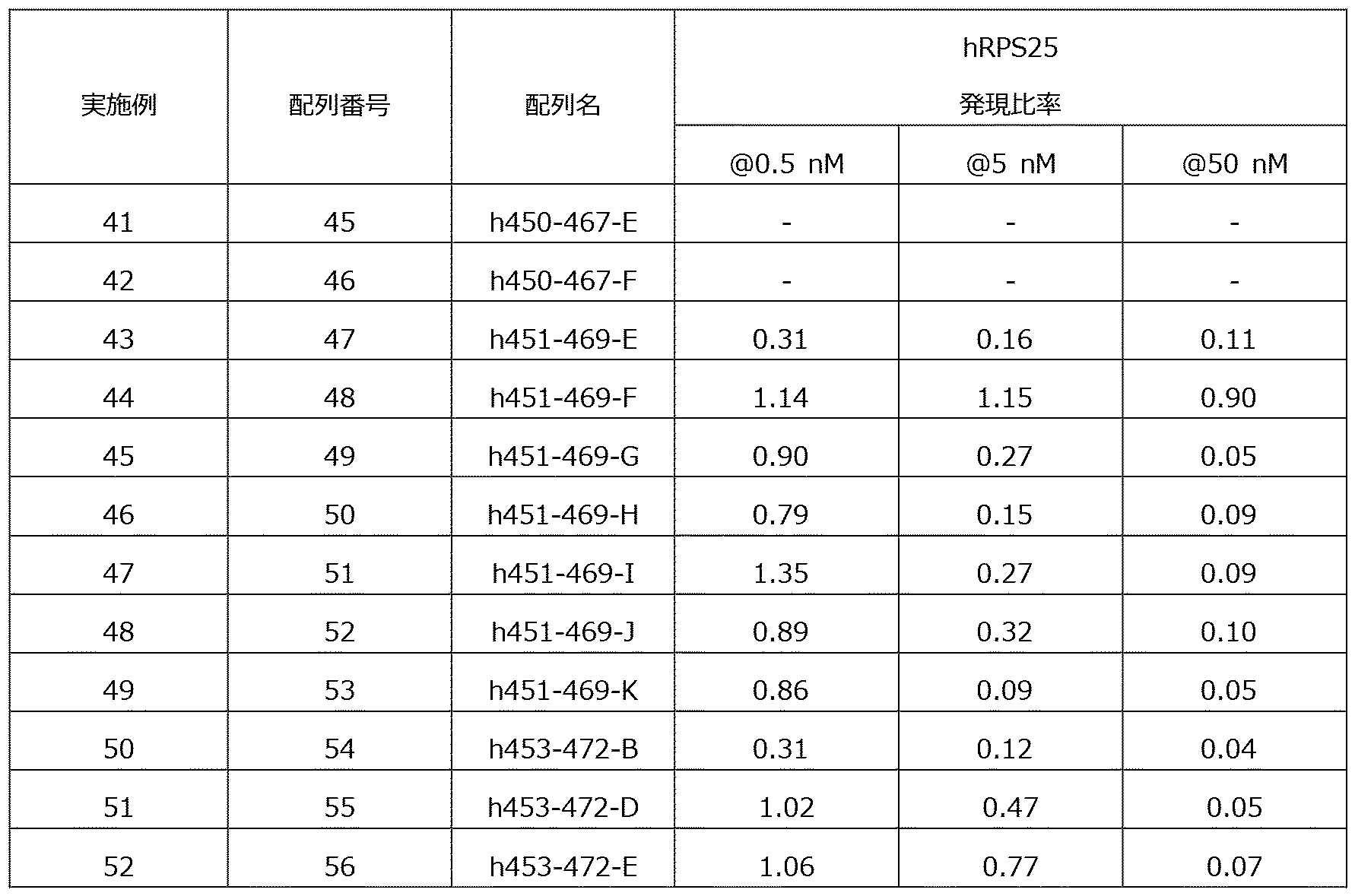


マウス初代培養神経細胞を、培養培地中、37°C、5%CO2の条件で培養する。マウス初代培養神経細胞の培養培地としては、以下の組成のものを用いる。
B-27 Electrophysiology Kit:gibco社製、Cat#A1413701
100倍希釈200mM-L-グルタミン溶液:ナカライテスク社製:Cat#16948-04
100倍希釈ペニシリン-ストレプトマイシン混合溶液:ナカライテスク社製 Cat#09367-34(ペニシリン 10000ユニット/ml, ストレプトマイシン 10000μg/ml、安定剤含有)
mouse Rps25: Mm02342783_g1
mouse GAPDH: 4352339E(インターナルコントロール)
ヒトiPS細胞から運動神経細胞を分化誘導し評価に用いる。細胞の維持、分化誘導は以下に記載の培地中、37°C、5%CO2の条件で行う。
(SNL細胞用培地)
DMEM(Sigma-Aldrich社製,Cat#D6429)、
100倍希釈ペニシリン・ストレプトマイシン混合溶液(ThermoFisher Scientific社製、Cat#15140-122)
10倍希釈ウシ胎児血清(ThermoFisher Scientific社製、Cat#10437-028)
(iPS細胞用培地)
霊長類ES/iPS細胞用培地(REPROCELL社製、Cat#RCHEMD001B)
100倍希釈ペニシリン・ストレプトマイシン混合溶液(ThermoFisher Scientific社製、cat#15140-122)
(混合培地A)
DMEM/Ham’sF12 GlutaMAX(ThermoFisher Scientific社製、Cat#10565-018)
2mM L-glutamine(ThermoFisher Scientific社製、Cat#25030-081)
Non-Essential Amino Acid(NEAA)(ThermoFisher Scientific社製、Cat#11140-050)
100倍希釈ペニシリン・ストレプトマイシン混合溶液(ThermoFisher Scientific社製,cat#15140-122)
2μg/mL Heparin(Sigma-Aldrich社製、H-4784)
N2 supplement(ThermoFisher Scientific社製、Cat#17502-048)
(混合培地B)
Neurobasal medium (ThermoFisher Scientific社製、cat#21103-049)
2mM L-glutamine(ThermoFisher Scientific社製、Cat#25030-081)
Non-Essential Amino Acid(NEAA)(ThermoFisher Scientific社製、Cat#11140-050)
Antibiotic-Antimycotic(ThermoFisher Scientific社製、cat#15240-062)
2μg/mL Heparin(Sigma-Aldrich社製、H-4784)
N2 supplement(ThermoFisher Scientific社製、Cat#17502-048)
10ng/mL IGF-1(PeproTech社製,cat#100-11)
10ng/mL Human CNTF(PeproTech社製,cat#450-13)10ng/mL Human GDNF(R&Dシステム社製,cat#212-GD-050)
B27 supplement(ThermoFisher Scientific社製、cat#12587010)
200μM Ascorbic acidSigma-Aldrich社製、Cat#A5960)
10ng/mL Human BDNF(Peprotech社製、Cat#450-02)
(神経細胞用培地)
Neurobasal medium Electro(ThermoFisher Scientific社製、cat#A14098-01)
2mM L-glutamine(ThermoFisher Scientific社製、Cat#25030-081)
Non-Essential Amino Acid(NEAA)(ThermoFisher Scientific社製、Cat#11140-050)
Antibiotic-Antimycotic(ThermoFisher Scientific社製、cat#15240-062)
2μg/mL Heparin(Sigma-Aldrich社製、H-4784)
N2 supplement(ThermoFisher Scientific社製、Cat#17502-048)
10ng/mL IGF-1(PeproTech社製,cat#100-11)
10ng/mL Human CNTF(PeproTech社製,cat#450-13)
10ng/mL Human GDNF(R&Dシステム社製,cat#212-GD-050)
B27 supplement, Electro(ThermoFisher Scientific社製、cat#A14097-01)
200μM Ascorbic acidSigma-Aldrich社製、Cat#A5960)
10ng/mL Human BDNF(Peprotech社製、Cat#450-02)
25μM 2-mercaptoethanol(ThermoFisher Scientific社製、cat#21985-0123)
0.1% ウシ血清アルブミン(Sigma-Aldrich社製、cat#A9576)
ヒトiPS細胞を播種するためのフィーダー細胞として、マイトマイシン処理したSNL細胞(セルバイオラボ社製、Cat#CBA-316)を調製する。SNL細胞のマイトマイシン処理は、次のように行う。まず、10cmシャーレ(イワキ社製、Cat#3020-100)に0.1%ゼラチン(富士フイルム和光純薬社製、Cat#190-15805)を加えて、37°C、5%CO2条件下のインキュベーターにて上記シャーレを1時間以上静置する(以下、この操作を「ゼラチン処理」という場合がある。)。その後、上記シャーレから余分なゼラチンを吸引除去し、SNL細胞用培地を用いて、解凍したSNL細胞をシャーレ1枚辺り1~2×10⁶個となるように播種する。3~4日間毎に8~16倍に細胞を希釈して継代し、必要な細胞数まで増殖させる。次に0.1%ゼラチン処理を行った15cmシャーレ(イワキ社製、Cat#3030-150)にシャーレ1枚辺り2~4×10⁶個のSNL細胞を播種する。80~90%コンフルエントになるまで上記細胞を培養した後、SNL細胞用培地で0.4mg/mLに希釈したマイトマイシンC(協和キリン社製、YJコード4231400D1031)を終濃度6.2μg/mLになるように上記シャーレに添加する。37°C、5%CO2条件下のインキュベーターにて上記シャーレを2時間15分静置する。その後、上記シャーレから培地を除去し、PBSで上記SNL細胞を1回洗浄する。2.5%トリプシン/EDTA(ThermoFisher Scientific社製、Cat#15090-046)をPBSで希釈したのち(終濃度0.25%)、上記SNL細胞に添加して室温で1分間静置した。その後、上記SNL細胞をチューブに回収して遠心し、セルバンカー(R)(ZENOAQ Resource社製、Cat#CB011)で懸濁し凍結保存する。
10cmシャーレに0.1%ゼラチンを添加して、37°C、5%CO2条件下のインキュベーターにて1時間以上静置する。SNL細胞用培地を用いてマイトマイシン処理済みのSNL細胞を懸濁する。その後、1.5×10⁶個の上記SNL細胞を10cmシャーレに播種し、2~3日培養する。続いてSNL細胞用培地を上記シャーレから除去しPBSにて上記SNL細胞を洗浄する。その後、1/1000量のY―27632(トクリス社製、Cat#1254)を含むiPS細胞用培地で懸濁したヒトiPS細胞(201B7株、iPSアカデミアジャパン株式会社より入手、AJ-H1-01)を上記シャーレに播種する。培地交換は播種した日の翌々日以降、分化誘導開始まで毎日実施する。
ヒトiPS細胞の細胞培養液にY-27632(終濃度10μM)を添加することで、上記Y-27632に上記iPS細胞を1時間以上曝露する。培養上清を除きPBSで上記細胞を洗浄したのち、Cell dissociation solution(CTK溶液)(REPROCELL社製、Cat#RCHETP002)を添加して室温にて1分間反応させる。CTK溶液を除去し、PBSで上記細胞を2回洗浄したのち、iPS細胞用培地を1mL添加する。セルスクレイパーで上記細胞を剥離し、セルストレイナー(ベクトン・ディッキンソン社製、Cat#352350)を通して細胞塊を分散し、細胞の懸濁液を得る。得られた懸濁液を6ウェルプレート(Corning社製、Cat#3471)に移す。混合培地Aに、LDN193189(ステムジェント社製、Cat#04-0074)(終濃度0.3μM)、SB431542(トクリス社製、Cat#1614)(終濃度2μM)、CHIR-99021(ステムジェント社製、Cat#04-0004-10)(終濃度3μM)、及びY-27632(終濃度10μM)を添加した培地に交換して、37°C、5%CO2の条件下、インキュベーターにて細胞を培養する(培養0日目)。
培養7日目、9日目及び11日目にピペットで培養液を除去し混合培地AにLDN193189(終濃度0.3μM)、SB431542(終濃度2μM)、CHIR-99021(終濃度3μM)、Purmorphamine(富士フイルム和光純薬社製、Cat#166-23991)(終濃度0.5μM)、及びRetinoic Acid(Sigma-Aldrich社製、Cat#R2625)(終濃度0.1μM)を添加した新鮮な培地に交換する。
培養14日目及び16日目にピペットで培養液を除去し、混合培地Aに、Purmorphamine(終濃度0.5μM)、Retinoic Acid(終濃度0.1μM)、Human BDNF(終濃度10ng/mL)、Ascorbic Acid(Sigma-Aldrich社製、Cat#A5960)(終濃度200μM)、を添加した新鮮な培地に交換する。
培養21日目に、細胞塊をPBSで洗浄後、遠心分離して上清を除去する。Accutase(イノベーティブセルテクノロジーズ社製、Cat#AT104)、Y27632(終濃度10μM)を上記細胞塊に添加して37°Cにて10分間インキュベートする。上記細胞塊を氷冷したのち、上記細胞塊をピペッティング操作によって分散させる。遠心(300×g、5分間、4°C)後、沈殿した細胞を回収し混合培地Bに懸濁する操作を2回繰り返す。以上の操作によって、iPS細胞に由来する運動神経細胞を得た。得られた運動神経細胞はセルバンカー(R)に懸濁し、分注して冷凍保存する。
96 Well Optical Btm Plt Polybase Black w/ Lid Cell Culture Sterile PS(ThermoFisher Scientific社製、Cat#165305)に、PBSにて6.66倍希釈したPoly-L-Ornitine Solution(PLO)溶液(Sigma―Aldrich社製、Cat#P4957)を添加し、室温で2時間以上静置する。PBSで3回洗浄後、PBSで希釈したiMatrixを0.5μg/cm2になるようプレートに添加し、4°Cで一晩静置する。次に前項で凍結保存したヒトiPS細胞由来運動神経細胞を解凍し、神経細胞用培地に懸濁する。その後、遠心分離にて上清を除去し、1/100量のCulture One Supplement(ThermoFisher Scientific社製,A3320201)、Compound E(終濃度0.1μM)を含む神経細胞用培地に上記細胞を再懸濁する。この細胞をコーティングした96ウェルプレート上に30000個/ウェルになるよう播種し、37°C、5%CO2条件下のインキュベーターにて28日間培養する。2~3日に1回の頻度で神経細胞培地を半量交換する。培養開始から7日目までは神経細胞用培地にCulture One Supplement、Compound Eを含む培地を使用する。
(発現抑制率)=1-(発現比率) (式1)
上記発現抑制率の値が大きい値であるほど、ヒトRPS25mRNAの発現を抑制することが可能な一本鎖アンチセンスオリゴヌクレオチドであると判断する。
human RPS25: Hs01568661_g1
human GAPDH: 4326317E(インターナルコントロール)
RPS25タンパク質の発現評価は、製造した一本鎖アンチセンスオリゴヌクレオチドに応じて、ヒト胎児腎細胞を用いて発現評価を行う。本実施例におけるタンパク質発現量評価とは、mRNAから翻訳されたタンパク質量を評価することを意味する。以下、発現評価の具体的手順について説明する。
ヒト胎児腎細胞HEK293T(ATCC(登録商標)CRL-3216 (商標))を、培養培地中、37°C、5%CO2の条件で培養する。HEK293T細胞の培養培地としては、以下の組成のものを用いる。
ダルベッコ改変イーグル培地(DMEM):SIGMA社製、Cat#D6429
10% ウシ胎児血清(FBS):biowest社製、Cat#S1820
100倍希釈ペニシリン-ストレプトマイシン混合溶液:ナカライテスク社製 Cat#09367-34(ペニシリン 10000ユニット/ml, ストレプトマイシン 10000μg/ml、安定剤含有)
まず、6穴プレートにHEK293T細胞(500000 cells/well)を播種し、37°C、5%CO2の条件で一晩培養する。その後、リン酸緩衝生理食塩水(PBS)で希釈した各一本鎖アンチセンスオリゴヌクレオチド(終濃度50nM)をリポフェクション法を用いて、上述の細胞にトランスフェクションする。陰性対照群としては、一本鎖アンチセンスオリゴヌクレオチドが溶解していないPBSをトランスフェクションした細胞を用いる。トランスフェクションした細胞を増殖培地中で37°C、5%CO2の条件で48時間培養する。その後、上記増殖培地を除去し、PBSで洗浄後、セルスクレイパーで細胞を回収する。回収液を2700×g、5分、4°Cの条件下で遠心し細胞を沈殿させる。上清を除去後、Protease Inhibitor (ThermoFisher Scientific社製、Cat#1860932)を1/100量含む1mLのRIPA Lysis and Extraction buffer(ThemoFisher Scientific社製、Cat#89900)を添加し、超音波破砕機によって細胞を破砕する。その後15000×g、10分、4°Cの条件下で遠心し、上清をサンプルとする。回収したサンプルはPierce(商標)BCA Protein Assay kit(ThermoScientific社製、Cat#23225)を用いてタンパク質定量を行う。各サンプルの濃度が一定になるように調整したのち、Pierce(商標)Lane Marker Reducing Sample Buffer(ThermoFisher Scientifier社製、Cat#39000)を添加し、95°Cで5分加熱処理を行う。調製したサンプルをタンパク質量が10μg~20μg/レーンになるように重層し、電気泳動を行う。電気泳動はCriterion(商標) TDX(商標)プレキャストゲル 4~15%(BIO-RAD社製、Cat#5671085J10)を使用し、200V定電圧条件で30分間行う。泳動バッファーには1×濃度に希釈したRunning Buffer Solution(10×)for SDS-PAGE(ナカライテスク社製、Cat#30329-61)を使用する。
・RPS25
抗体:Anti-RPS25 antibody(アブカム社製、Cat#ab102940)
溶媒:Canget signal Solution 1(東洋紡株式会社製、Cat#NKB-101)
・β-actin
抗体:β―Actin (13E5) Rabbit mAb(HRP conjugate)(Cell Signaling社製、Cat#5125)
溶媒:Blocking One
・RPS25
抗体:Rabbit IgG(H+L)Cross-Adsorbed Secondary Antibody(Invitrogen社製、Cat#A24537)
溶媒:Canget Signal Solution2(東洋紡株式会社製、Cat#NKB-101)
二次抗体振盪後、TBSTで洗浄し、ECL prime(Amersham社製、Cat#RPN2232)を用いて検出を行う。なお、検出ならびに解析にはAmersham Imager680を使用する。
回っているときRPS25遺伝子の機能を調節することが可能な一本鎖アンチセンスオリゴヌクレオチドであると判断できる。
ヒト子宮頸がん細胞としてHeLa-S3細胞を、増殖培地中、37°C、5%CO2条件で培養した。増殖培地としては、以下の組成のものを用いた。
10% ウシ胎児血清(FBS):GIBCO社製、CAT#10437028
1% 非必須アミノ酸(NEAA):GIBCO社製、Cat#11140050
Dulbecco’s Modified Eagle Medium 低グルコース (L-グルタミン、フェノールレッド含有) (富士フイルム和光純薬社製、Cat#041-29775))


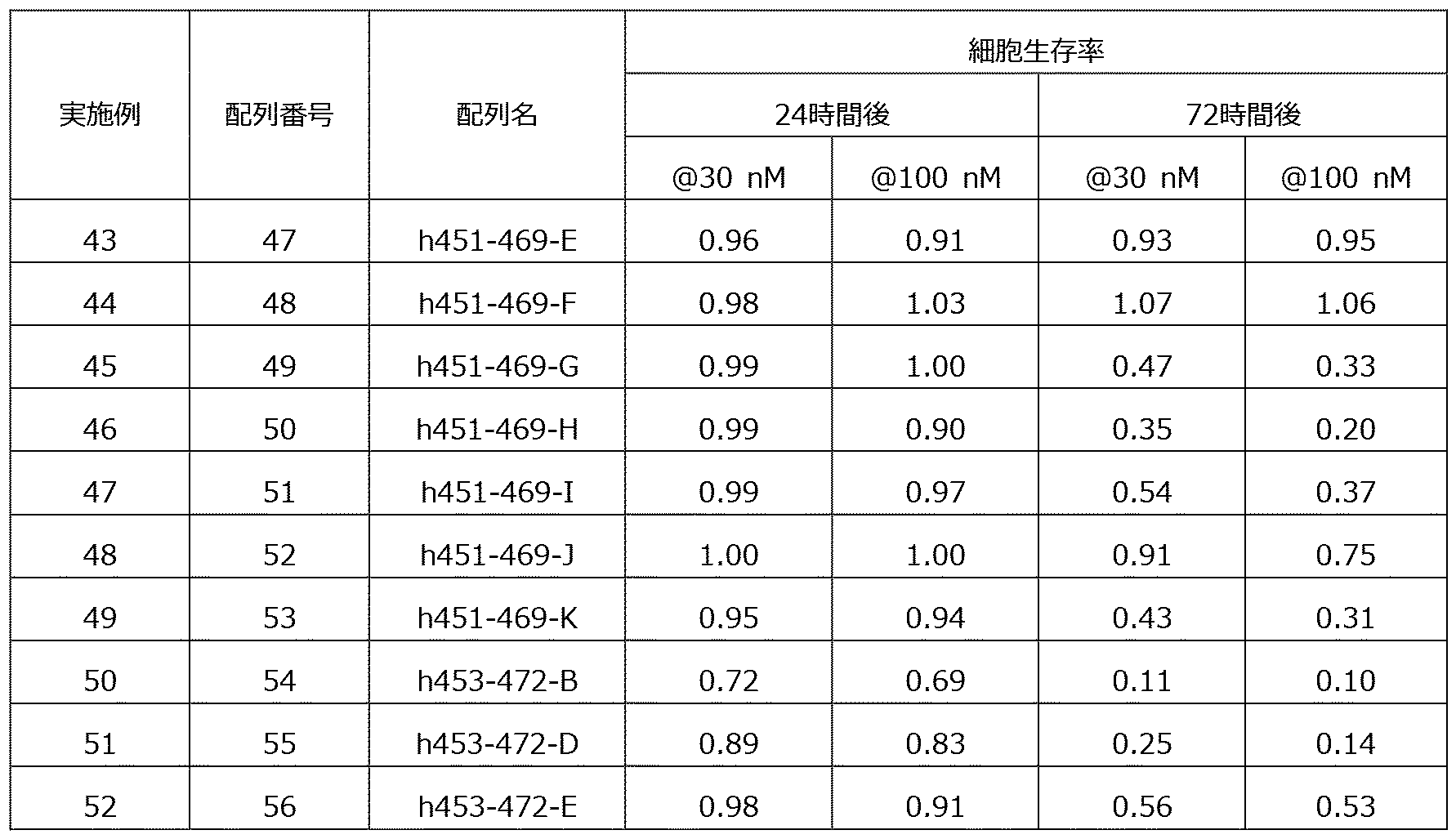
400pmolの一本鎖アンチセンスオリゴヌクレオチドを含むTris-EDTAバッファー(pH=8.0)溶液(4μL)に対して、マウス血清(20μL)又はヒト血清(20μL)を混合させた後、ミネラルオイル(15μL)を添加する。この溶液を37°Cにてインキュベートした後、8mol/L 尿素溶液(10μL)を混合させて血清中の核酸分解酵素を失活させる。超純水(10μL)を添加後に遠心分離により一本鎖アンチセンスオリゴヌクレオチドを含む水層とミネラルオイル層に分離し、水層をLC-MS(Waters社製)によって分析し、得られた一本鎖アンチセンスオリゴヌクレオチドのUV-クロマトグラムの面積強度より残存する一本鎖アンチセンスオリゴヌクレオチドを算出する。「残存オリゴヌクレオチド(%)」とは、血清との混合直後に分析した時点における未分解の一本鎖アンチセンスオリゴヌクレオチドに対する、72時間後における未分解の一本鎖アンチセンスオリゴヌクレオチドの残存率を示す。
RPS25遺伝子の発現評価は、マウス脳室内投与を実施し前頭前皮質のそれぞれの部位のmRNA量を測定することによって行った。本実施例における遺伝子発現評価とは、逆転写反応によって得られた相補的DNA(cDNA)量を測定することでmRNA量を評価することを意味する。以下、各発現評価の具体的手順について説明する。
mouse Rps25: Mm02342783_g1
mouse GAPDH: 4352339E(インターナルコントロール)
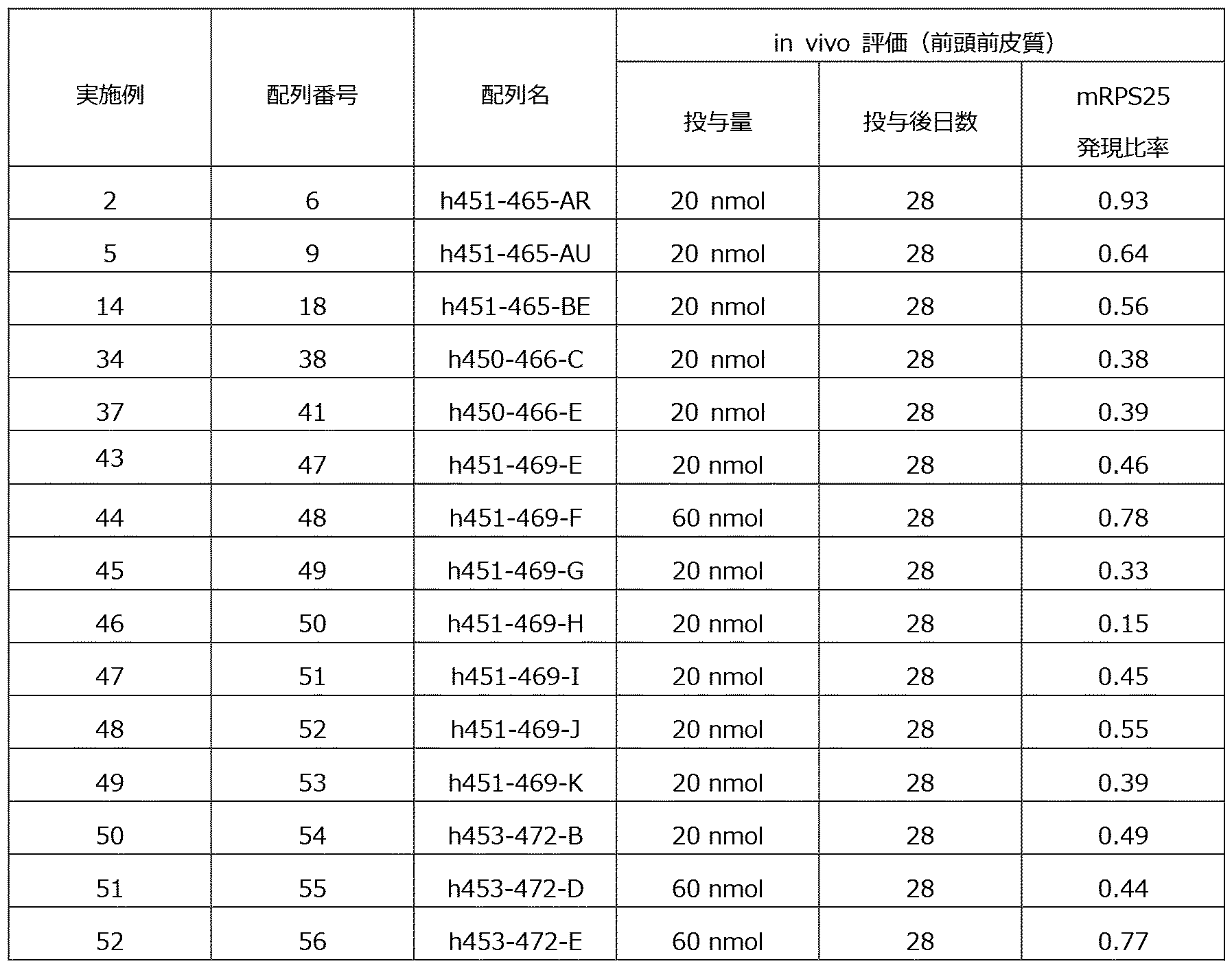
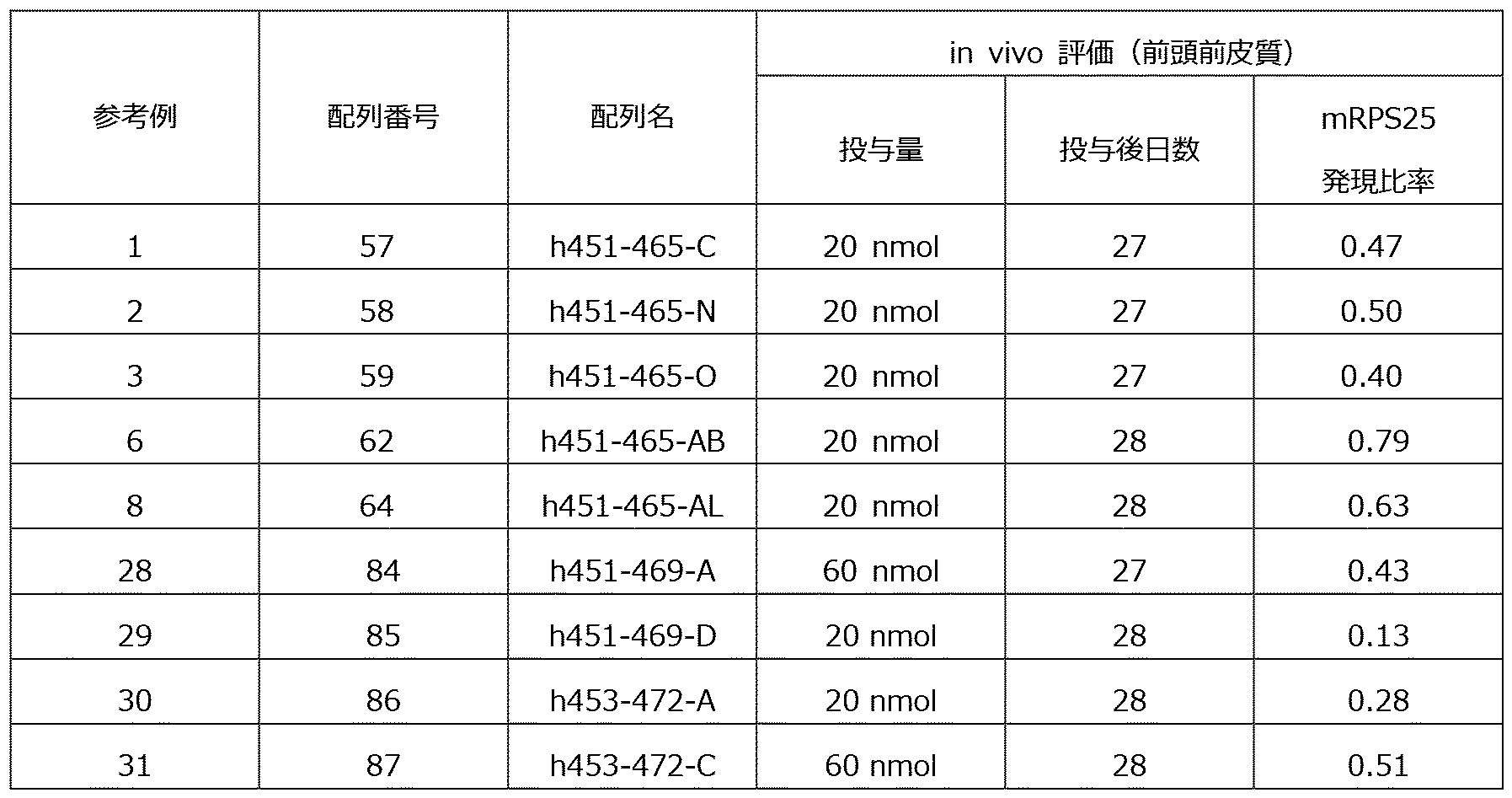
各一本鎖アンチセンスオリゴヌクレオチドにおける中枢毒性は、マウス脳室内投与を実施し、投与直後~1時間後及び投与後最大28日まで飼育し、一般状態・体重の観察及び組織サンプルの採材時点での病理学的検査(ヘマトキシリン・エオシン染色)を行うことで評価した。
結果を表9-1~表9-2に示す。表9-1~表9-2の「in vivo acute neuroTox」における「score」の欄は、以下の評価基準に基づき算出した。項目1-5について、認められた所見のうち最大点数を個体ごとに記録し、各項目の点数を合計する。例えば、1個体において、眼瞼下垂、側臥、呼吸緩徐、痙攣が認められた場合、合計点数は1+4+4=9となる。点数は高いほど重篤な所見であることを示すため、合計点数が高いほど急性中枢毒性所見が重篤であると判断できる。なお、scoreは、群ごとに平均値を採用した。なお、表中、「-」で示されているものは測定を行っていないことを意味する。
1. 多動(1点)、常同行動(グルーミング、旋回)(1点) 、立ち上がり行動(1点)、発声
(1点)、過敏・挙尾(1点)
2. 眼瞼下垂、閉眼、自発運動減少(消失) (1点)
3. よろめき (1点)、失調性歩行(2点)
4. 異常姿勢・呼吸不規則 (1点)、側臥/腹臥 (2点) 、呼吸緩徐 /異常(4点)
5. 跳躍、振戦 、筋攣縮(2点)、痙攣 (4点)
Clinical sign score;
0点:異常なし
1点:後肢機能異常、振戦、自発運動減少
2点:後肢のひきずり、尾部又は後肢の脱力
3点:完全な後肢機能不全、後肢の麻痺、横臥、腹臥
4点:安楽殺
Pathological score;
0点:異常なし
1点:異常あり(単細胞壊死、空胞化等)
なお、表9-1の実施例51及び表9-2の参考例31については、下記方法により中枢毒性評価を行った。
表9-1の実施例51及び表9-2の参考例31の一本鎖アンチセンスオリゴヌクレオチドにおける急性中枢毒性(in vivo acute neuroTox)については、ICRマウスに脳室内投与を実施し、投与1日後に評価することによって行った。評価項目は行動評価であり、マウスの行動評価は、Functional observational battery(FOB)によって行った。評価項目として、1)姿勢、2)外見上の異常、3)常同行動、4)刺激に対する反応性、5)グリップ力、6)呼吸、7)身震い・痙攣についてそれぞれ正常を0、やや異常ありを1、極度に異常ありを2とスコア化した。各項目で得られたスコアの合計値を、表9-1及び表9-2の「in vivo acute neuroTox」における「score」の欄に記入した。
表9-1の実施例51及び表9-2の参考例31の一本鎖アンチセンスオリゴヌクレオチドにおける遅発性中枢毒性(in vivo delayed neuroToxのClinical Sign Score)は、ICRマウスに脳室内投与を実施し、投与後28日まで評価することによって行った。評価項目は行動評価であり、マウスの行動評価は、Functional observational battery(FOB)によって行った。評価項目として、1)姿勢、2)外見上の異常、3)常同行動、4)刺激に対する反応性、5)グリップ力、6)呼吸、7)身震い・痙攣についてそれぞれ正常を0、やや異常ありを1、極度に異常ありを2とスコア化した。各項目で得られたスコアの合計値を、表9-1及び表9-2の「in vivo delayed neuroTox」における「Clinical Sign Score」の欄に記入した。
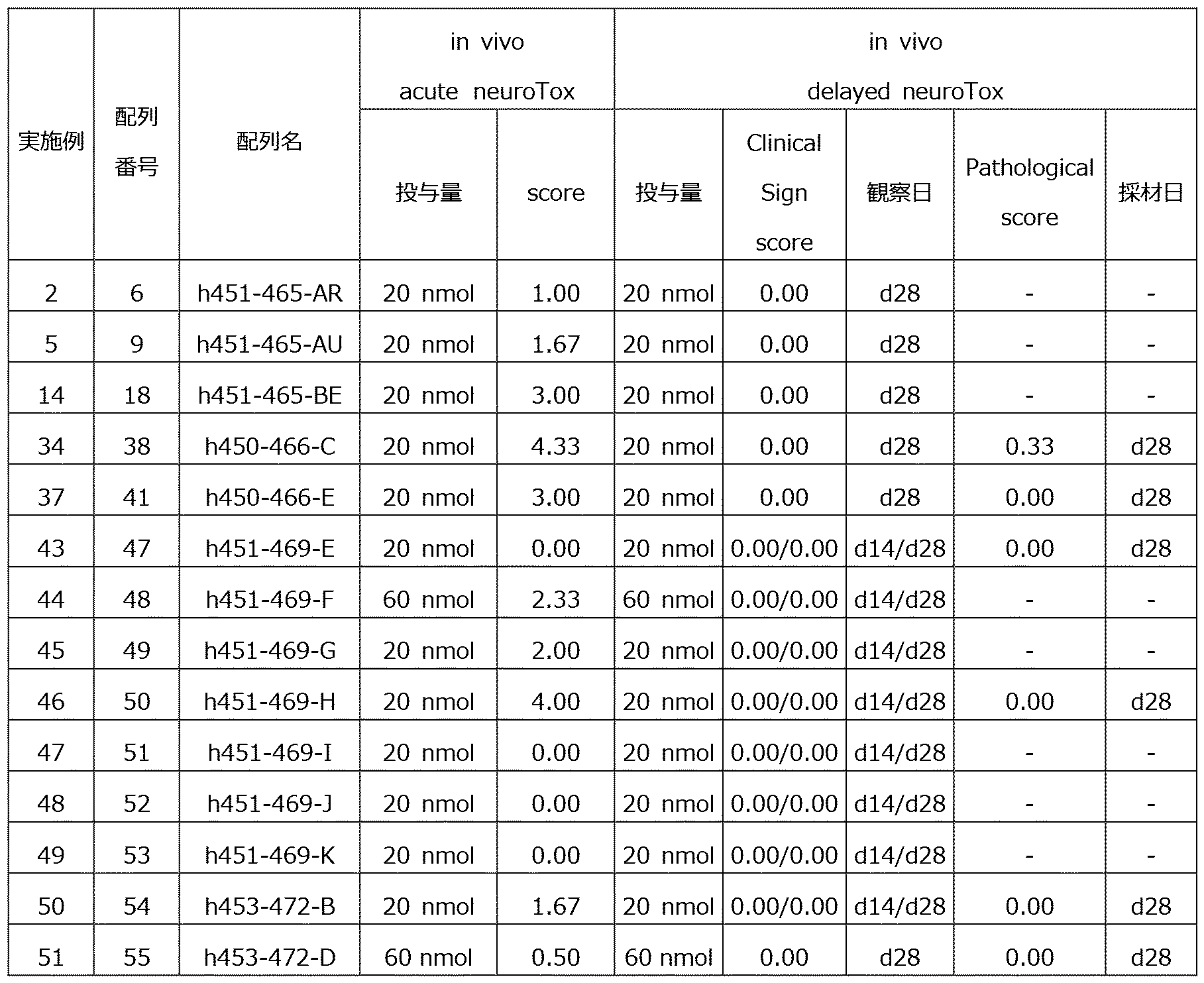
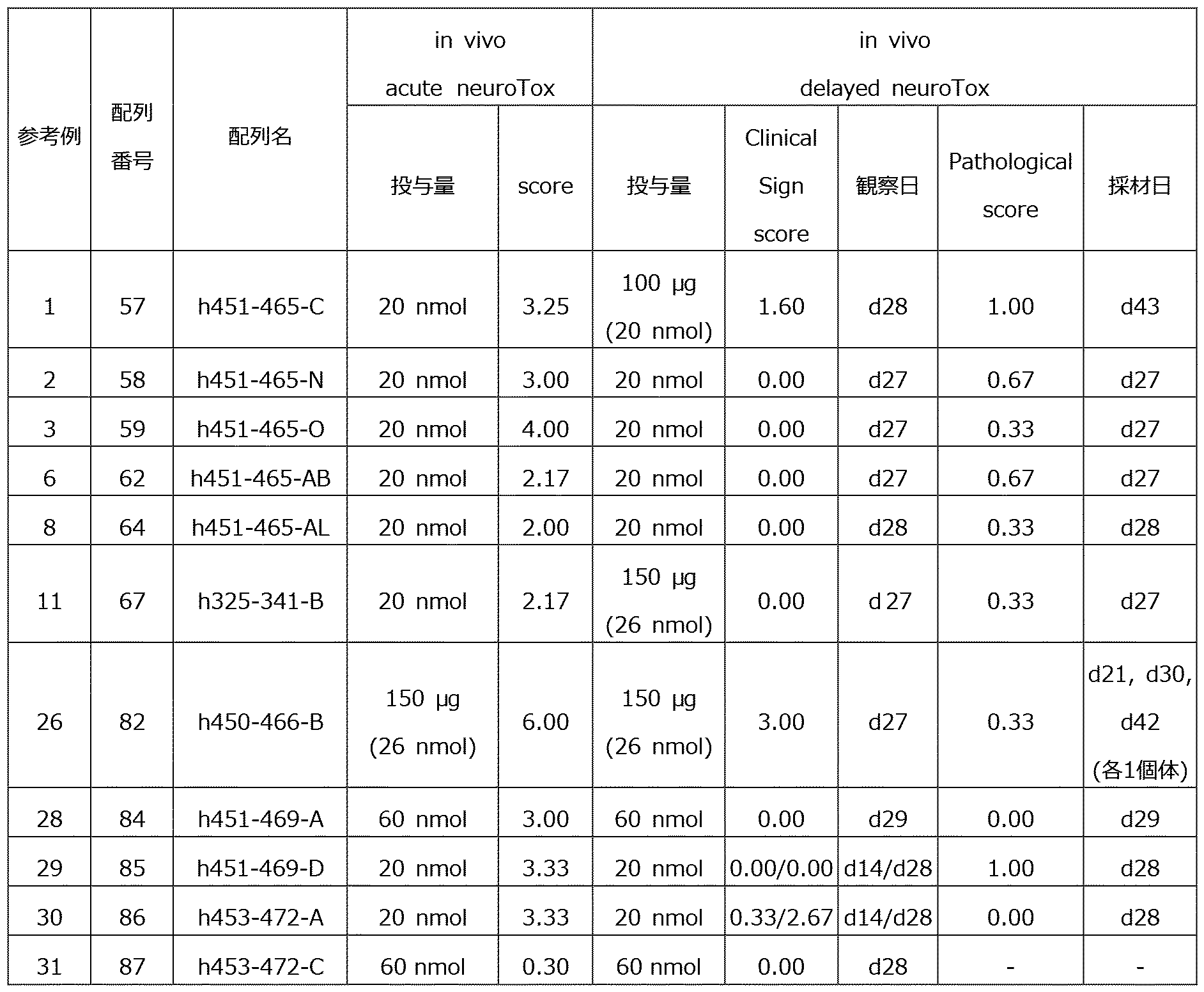
各一本鎖アンチセンスオリゴヌクレオチドにおける狭義のオフターゲット毒性評価を、上述の高速塩基配列検索システム(GGGenome)を用いて行った。各一本鎖アンチセンスオリゴヌクレオチドの配列情報をGGGenomeに入力し、データベースに登録されたhuman spliced RNA及びhuman pre-spliced RNAを対象に、ハイブリダイズの不一致数から狭義のオフターゲットRNA数をカウントした。ハイブリダイズした際、ミスマッチ、デリーション、インサーションがあれば、それぞれの該当塩基数を合計することで不一致数を算出した。例えば、一本鎖アンチセンスオリゴヌクレオチドの塩基配列から標的となるRNAの塩基配列が「AGCTGTAC」の場合、「ATCTGTAC」の塩基配列を持つRNAはミスマッチ(下線の塩基)が「1」となり、不一致数は「1」と算出される。また、標的となるRNAの塩基配列が「AGCTGTAC」の場合、「ATCTG<G>TAC」の塩基配列を持つRNAはミスマッチ(下線の塩基)が「1」、デリーション(山括弧で囲まれている塩基)が「1」となり、不一致数は「2」と算出される。また、標的となるRNAの塩基配列が「AGCTGTAC」の場合、「ATCTG*AC」の塩基配列を持つRNAはミスマッチ(下線の塩基)が「1」、インサーション(*で表記された箇所)が「1」となり、不一致数は「2」と算出される。このように標的以外のRNA(オフターゲットRNA)に対するハイブリダイズの際の不一致数をカウントし、完全一致するRNA数、不一致数が1以下のRNA数、不一致数が2以下のRNA数を各一本鎖アンチセンスオリゴヌクレオチドについて計算する。不一致数が0、1以下、2以下のRNA数が少ないほど狭義のオフターゲット毒性リスクは低いことを意味し、逆に、不一致数が0、1以下、2以下のRNA数が多いほど狭義のオフターゲット毒性リスクが高いことを意味する。結果を表10-1~表10-4に示す。塩基長が18以上となると、不一致数が1以下でハイブリダイズするRNA数は10以下となり、狭義のオフターゲットリスクが低いと考えられ、より好ましい一本鎖アンチセンスオリゴヌクレオチドといえる。
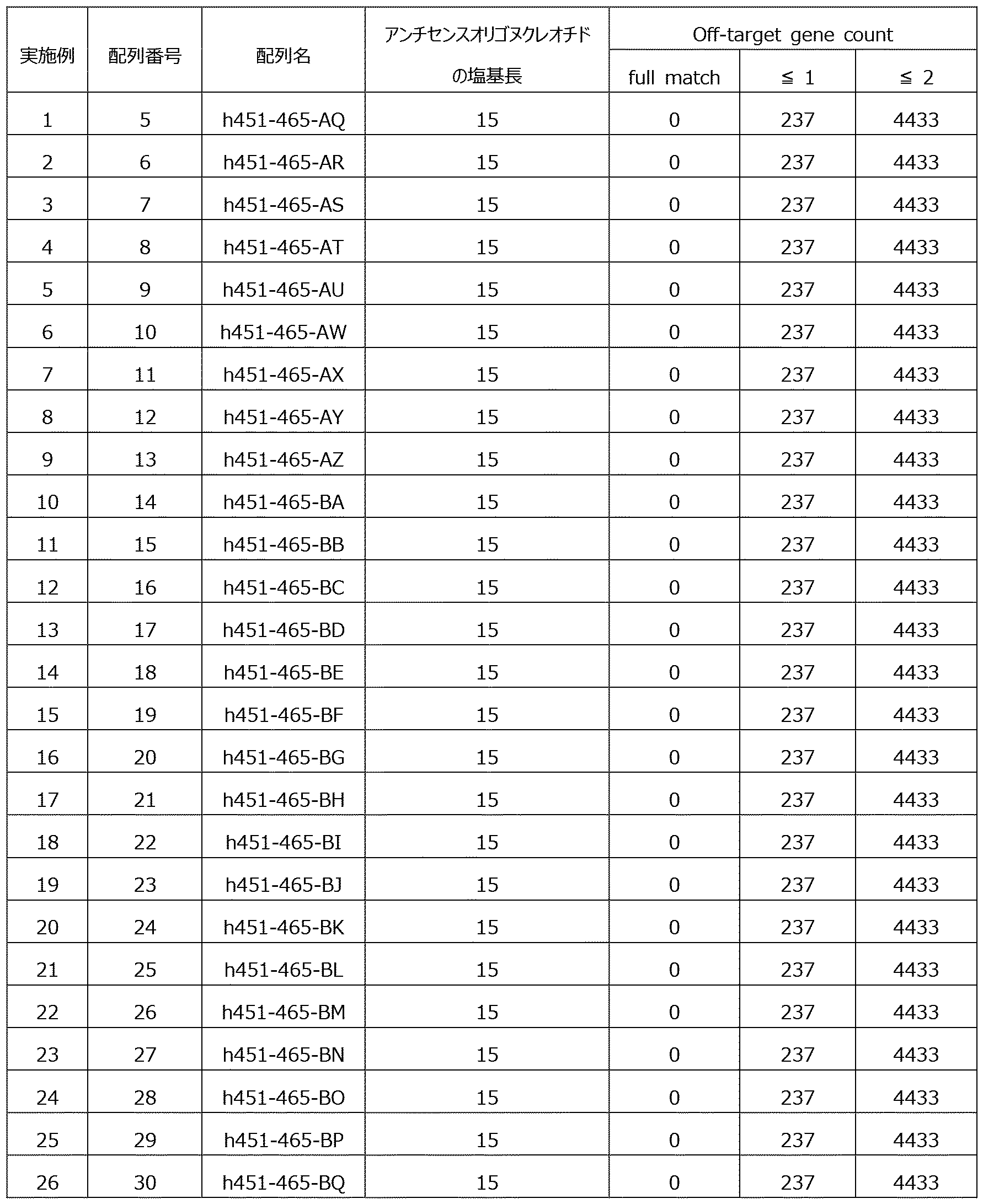


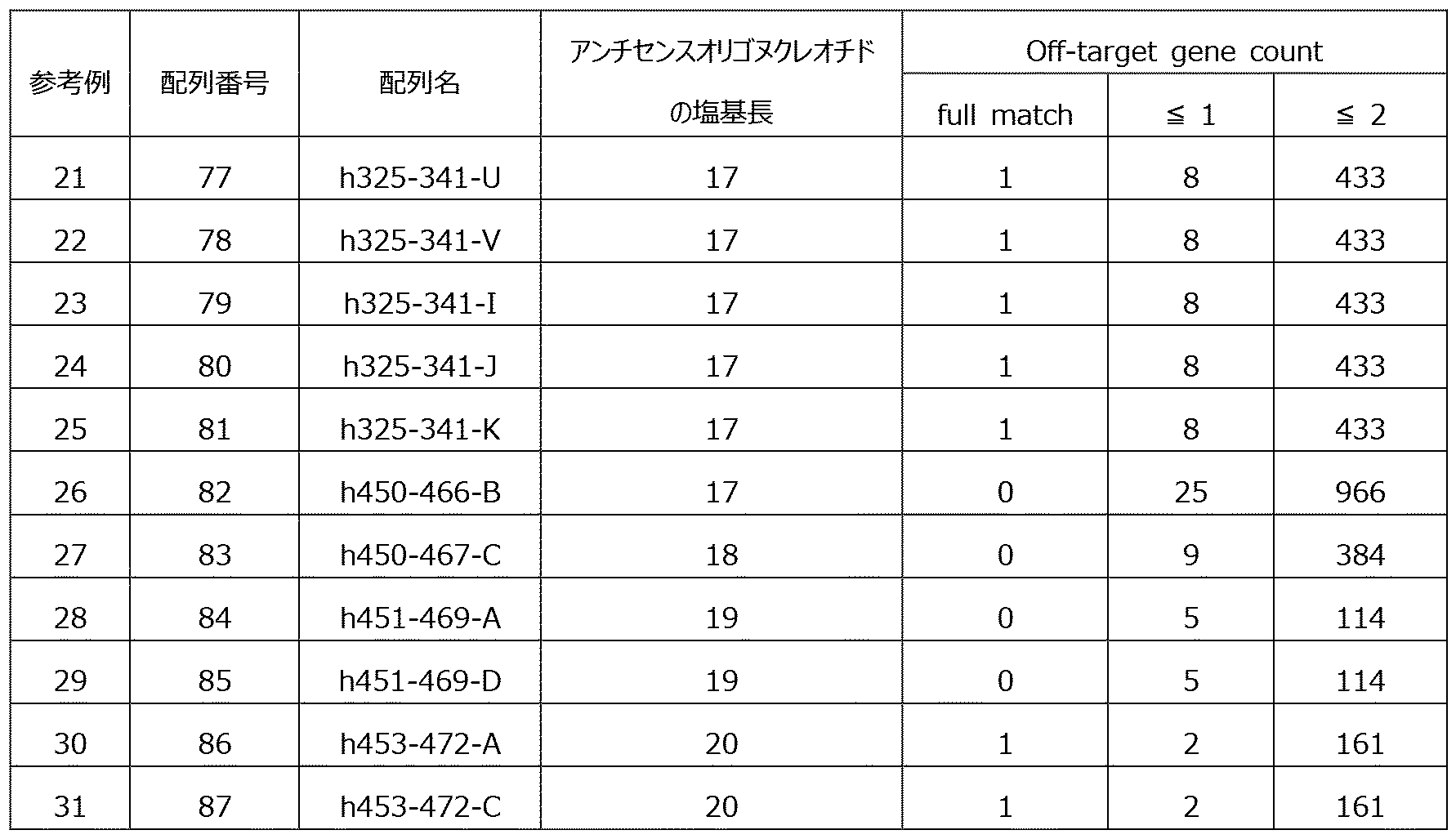
Claims (46)
- RPS25遺伝子の発現及び/又は機能を調節する一本鎖アンチセンスオリゴヌクレオチド又はその製薬学的に許容される塩であって、
前記一本鎖アンチセンスオリゴヌクレオチドは、各ヌクレオシドがリン酸基及び/又は修飾リン酸基で結合されており、
前記一本鎖アンチセンスオリゴヌクレオチドは、ギャップ領域と、前記ギャップ領域の3’末端に結合している3’ウイング領域と、前記ギャップ領域の5’末端に結合している5’ウイング領域と、を含み、
前記ギャップ領域は、糖部が修飾された核酸を含んでいてもよいデオキシリボースから構成される核酸であり、
前記ギャップ領域は、少なくとも1つの5’-CP核酸を含み、
前記3’ウイング領域及び前記5’ウイング領域は2’位に置換基を有する修飾核酸であり、
前記一本鎖アンチセンスオリゴヌクレオチドの塩基長は、12~30merであり、
前記一本鎖アンチセンスオリゴヌクレオチドの塩基配列は、
配列番号1に記載の塩基配列における、前記一本鎖アンチセンスオリゴヌクレオチドと同じ塩基長で構成された少なくとも1つの標的領域に対して相補的な塩基配列を基準として、90%以上100%以下の配列同一性を有する塩基配列、
前記標的領域において1若しくは数個の塩基が欠失、置換、挿入若しくは付加された塩基配列に対して、相補的な塩基配列、又は、
前記標的領域を有するオリゴヌクレオチドに対して、ストリンジェントな条件でハイブリダイズする塩基配列、である、一本鎖アンチセンスオリゴヌクレオチド又はその製薬学的に許容される塩。 - RPS25遺伝子の発現及び/又は機能を調節する一本鎖アンチセンスオリゴヌクレオチド又はその製薬学的に許容される塩であって、
前記一本鎖アンチセンスオリゴヌクレオチドは、各ヌクレオシドがリン酸基及び/又は修飾リン酸基で結合されており、
前記一本鎖アンチセンスオリゴヌクレオチドは、ギャップ領域と、前記ギャップ領域の3’末端に結合している3’ウイング領域と、前記ギャップ領域の5’末端に結合している5’ウイング領域と、を含み、
前記ギャップ領域は、糖部が修飾された核酸を含んでいてもよいデオキシリボースから構成される核酸であり、
前記ギャップ領域は、少なくとも1つの5’-CP核酸を含み、
前記3’ウイング領域及び前記5’ウイング領域は2’位に置換基を有する修飾核酸であり、
前記一本鎖アンチセンスオリゴヌクレオチドの塩基長は、12~30merであり、
前記一本鎖アンチセンスオリゴヌクレオチドの塩基配列は、
配列番号1に記載の塩基配列における、前記一本鎖アンチセンスオリゴヌクレオチドと同じ塩基長で構成された少なくとも1つの標的領域に対して相補的な塩基配列を基準として、90%以上100%以下の配列同一性を有する塩基配列、
前記標的領域において1若しくは数個の塩基が欠失、置換、挿入若しくは付加された塩基配列に対して、相補的な塩基配列、又は、
前記標的領域を有するオリゴヌクレオチドに対して、ストリンジェントな条件でハイブリダイズする塩基配列、である、一本鎖アンチセンスオリゴヌクレオチド又はその製薬学的に許容される塩(ただし、参考例1~31に係る一本鎖アンチセンスオリゴヌクレオチドを除く。)。 - RPS25遺伝子の発現及び/又は機能を調節する一本鎖アンチセンスオリゴヌクレオチド又はその製薬学的に許容される塩であって、
前記一本鎖アンチセンスオリゴヌクレオチドは、各ヌクレオシドがリン酸基及び/又は修飾リン酸基で結合されており、
前記一本鎖アンチセンスオリゴヌクレオチドは、ギャップ領域と、前記ギャップ領域の3’末端に結合している3’ウイング領域と、前記ギャップ領域の5’末端に結合している5’ウイング領域と、を含み、
前記ギャップ領域は、糖部が修飾された核酸を含んでいてもよいデオキシリボースから構成される核酸であり、
前記ギャップ領域は、少なくとも1つの5’-CP核酸を含み、
前記3’ウイング領域及び前記5’ウイング領域は2’位に置換基を有する修飾核酸であり、
前記一本鎖アンチセンスオリゴヌクレオチドの塩基長は、12~30merであり、
前記一本鎖アンチセンスオリゴヌクレオチドの塩基配列は、
配列番号1に記載の塩基配列における、前記一本鎖アンチセンスオリゴヌクレオチドと同じ塩基長で構成された少なくとも1つの標的領域に対して相補的な塩基配列を基準として、90%以上100%以下の配列同一性を有する塩基配列、
前記標的領域において1若しくは数個の塩基が欠失、置換、挿入若しくは付加された塩基配列に対して、相補的な塩基配列、又は、
前記標的領域を有するオリゴヌクレオチドに対して、ストリンジェントな条件でハイブリダイズする塩基配列、である、一本鎖アンチセンスオリゴヌクレオチド又はその製薬学的に許容される塩(ただし、参考例1~31、設計例1~18に係る一本鎖アンチセンスオリゴヌクレオチドを除く。)。 - 前記一本鎖アンチセンスオリゴヌクレオチドの塩基配列が、
配列番号1に記載の塩基配列における、前記一本鎖アンチセンスオリゴヌクレオチドと同じ塩基長で構成された少なくとも1つの標的領域に対して相補的な塩基配列を基準として、95%以上100%以下の配列同一性を有する塩基配列である、請求項1~請求項3のいずれか一項に記載の一本鎖アンチセンスオリゴヌクレオチド又はその製薬学的に許容される塩。 - 前記一本鎖アンチセンスオリゴヌクレオチドの塩基配列が、
配列番号1に記載の塩基配列における、前記一本鎖アンチセンスオリゴヌクレオチドと同じ塩基長で構成された少なくとも1つの標的領域に対して相補的な塩基配列である、請求項1~請求項4のいずれか一項に記載の一本鎖アンチセンスオリゴヌクレオチド又はその製薬学的に許容される塩。 - 前記ギャップ領域の塩基数が、5~20merであり、
前記3’ウイング領域が、3~5merの、2’位に置換基を有する修飾核酸であり、
前記5’ウイング領域が、3~5merの、2’位に置換基を有する修飾核酸である、請求項1~請求項5のいずれか一項に記載の一本鎖アンチセンスオリゴヌクレオチド又はその製薬学的に許容される塩。 - 前記5’-CP核酸が、前記ギャップ領域の5’側から数えて2番目に少なくとも配置されている、請求項1~請求項6のいずれか一項に記載の一本鎖アンチセンスオリゴヌクレオチド又はその製薬学的に許容される塩。
- 前記5’-CP核酸が、前記ギャップ領域において2個以上配置されている、請求項1~請求項7のいずれか一項に記載の一本鎖アンチセンスオリゴヌクレオチド又はその製薬学的に許容される塩。
- 前記5’-CP核酸が、前記ギャップ領域において2~5個配置されている、請求項1~請求項8のいずれか一項に記載の一本鎖アンチセンスオリゴヌクレオチド又はその製薬学的に許容される塩。
- 前記5’-CP核酸が、前記ギャップ領域に対して9分の1以上配置されている、請求項1~請求項7のいずれか一項に記載の一本鎖アンチセンスオリゴヌクレオチド又はその製薬学的に許容される塩。
- 前記5’-CP核酸が、前記ギャップ領域に対して5分の1以上配置されている、請求項10に記載の一本鎖アンチセンスオリゴヌクレオチド又はその製薬学的に許容される塩。
- 前記5’-CP核酸が、前記ギャップ領域の少なくとも1か所において連続して2~4mer配置されている、請求項1~請求項11のいずれか一項に記載の一本鎖アンチセンスオリゴヌクレオチド又はその製薬学的に許容される塩。
- 前記5’-CP核酸が、前記ギャップ領域における5’末端側に配置されている、請求項1~請求項12のいずれか一項に記載の一本鎖アンチセンスオリゴヌクレオチド又はその製薬学的に許容される塩。
- 前記5’-CP核酸が、前記ギャップ領域における5’末端側及び3’末端側に配置されている、請求項1~請求項13のいずれか一項に記載の一本鎖アンチセンスオリゴヌクレオチド又はその製薬学的に許容される塩。
- 前記一本鎖アンチセンスオリゴヌクレオチドの塩基長が、15~20merである、請求項1~請求項14のいずれか一項に記載の一本鎖アンチセンスオリゴヌクレオチド又はその製薬学的に許容される塩。
- 前記一本鎖アンチセンスオリゴヌクレオチドの塩基長が、18~20merである、請求項1~請求項15のいずれか一項に記載の一本鎖アンチセンスオリゴヌクレオチド又はその製薬学的に許容される塩。
- 前記3’ウイング領域における前記2’位に置換基を有する修飾核酸が、2’-MOE核酸、LNA、AmNA、GuNA、及びscpBNAからなる群より選ばれる少なくとも1つを含み、
前記5’ウイング領域における前記2’位に置換基を有する修飾核酸が、2’-MOE核酸、LNA、AmNA、GuNA、及びscpBNAからなる群より選ばれる少なくとも1つを含む、請求項1~請求項16のいずれか一項に記載の一本鎖アンチセンスオリゴヌクレオチド又はその製薬学的に許容される塩。 - 前記3’ウイング領域における前記2’位に置換基を有する修飾核酸が、2’-MOE核酸、LNA、AmNA、GuNA、及びscpBNAからなる群より選ばれる修飾核酸で構成されていて、
前記5’ウイング領域における前記2’位に置換基を有する修飾核酸が、2’-MOE核酸、LNA、AmNA、GuNA、及びscpBNAからなる群より選ばれる修飾核酸で構成されている、請求項1~請求項17のいずれか一項に記載の一本鎖アンチセンスオリゴヌクレオチド又はその製薬学的に許容される塩。 - 前記3’ウイング領域における前記2’位に置換基を有する修飾核酸が、2’-MOE核酸、AmNA、GuNA、及びscpBNAからなる群より選ばれる修飾核酸で構成されていて、
前記5’ウイング領域における前記2’位に置換基を有する修飾核酸が、2’-MOE核酸、AmNA、GuNA、及びscpBNAからなる群より選ばれる修飾核酸で構成されている、請求項1~請求項18のいずれか一項に記載の一本鎖アンチセンスオリゴヌクレオチド又はその製薬学的に許容される塩。 - 前記一本鎖アンチセンスオリゴヌクレオチドの少なくとも1つのヌクレオシド間結合がホスホロチオエート結合である、請求項1~請求項19のいずれか一項に記載の一本鎖アンチセンスオリゴヌクレオチド又はその製薬学的に許容される塩。
- 前記一本鎖アンチセンスオリゴヌクレオチドの少なくとも1つのヌクレオシド間結合がホスホジエステル結合である、請求項1~請求項20のいずれか一項に記載の一本鎖アンチセンスオリゴヌクレオチド又はその製薬学的に許容される塩。
- 前記一本鎖アンチセンスオリゴヌクレオチドを構成するヌクレオシド間結合において、ホスホロチオエート結合の割合が50%~80%である、請求項1~請求項21のいずれか一項に記載の一本鎖アンチセンスオリゴヌクレオチド又はその製薬学的に許容される塩。
- 前記一本鎖アンチセンスオリゴヌクレオチドを構成するヌクレオシド間結合において、ホスホロチオエート結合の割合が50%~70%である、請求項22に記載の一本鎖アンチセンスオリゴヌクレオチド又はその製薬学的に許容される塩。
- 前記ギャップ領域において、前記5’-CP核酸と、前記5’-CP核酸の3’側で隣接しているヌクレオシドとの結合が、ホスホロチオエート結合である(ただし、前記5’-CP核酸がギャップ領域の3’末端に配置されている場合を除く)、請求項1~請求項23のいずれか一項に記載の一本鎖アンチセンスオリゴヌクレオチド又はその製薬学的に許容される塩。
- 前記ギャップ領域において、前記5’-CP核酸と、前記5’-CP核酸の3’側で隣接しているヌクレオシドとの結合が、ホスホロチオエート結合である(ただし、前記5’-CP核酸がギャップ領域の3’末端に配置されている場合と前記5’-CP核酸の3’側で隣接しているヌクレオシドが5’-CP核酸である場合を除く)、請求項1~請求項24のいずれか一項に記載の一本鎖アンチセンスオリゴヌクレオチド又はその製薬学的に許容される塩。
- 前記ギャップ領域において、前記5’-CP核酸と、前記5’-CP核酸の5’側で隣接しているヌクレオシドとの結合が、ホスホジエステル結合である、請求項1~請求項25のいずれか一項に記載の一本鎖アンチセンスオリゴヌクレオチド又はその製薬学的に許容される塩。
- 前記一本鎖アンチセンスオリゴヌクレオチドの塩基配列は、
配列番号1に記載の塩基配列において、5’末端から数えて123番、124番、185番、186番、263番、264番、324番、325番、442番、443番、又は447番~453番に位置する塩基から連続した14~22merで構成された標的領域に対して相補的な塩基配列を基準として、90%以上100%以下の配列同一性を有する塩基配列、
前記標的領域において、1若しくは数個の塩基が欠失、置換、挿入若しくは付加された塩基配列に対して相補的な塩基配列、又は、
前記標的領域を有するオリゴヌクレオチドに対して、ストリンジェントな条件でハイブリダイズする塩基配列である、請求項1~請求項26のいずれか一項に記載の一本鎖アンチセンスオリゴヌクレオチド又はその製薬学的に許容される塩。 - 前記一本鎖アンチセンスオリゴヌクレオチドの塩基配列は、
配列番号1に記載の塩基配列において、5’末端から数えて324番、325番、又は448番~453番に位置する塩基から連続した14~22merで構成された標的領域に対して相補的な塩基配列を基準として、90%以上100%以下の配列同一性を有する塩基配列、
前記標的領域において、1若しくは数個の塩基が欠失、置換、挿入若しくは付加された塩基配列に対して相補的な塩基配列、又は、
前記標的領域を有するオリゴヌクレオチドに対して、ストリンジェントな条件でハイブリダイズする塩基配列である、請求項1~請求項27のいずれか一項に記載の一本鎖アンチセンスオリゴヌクレオチド又はその製薬学的に許容される塩。 - 前記一本鎖アンチセンスオリゴヌクレオチドの塩基配列は、配列番号1に記載の塩基配列において、5’末端から数えて448番~453番に位置する塩基から連続した18~22merで構成された標的領域に対して相補的な塩基配列を基準として、90%以上100%以下の配列同一性を有する塩基配列であり、
前記3’ウイング領域は、3~5merであり、
前記5’ウイング領域は、3~5merである、請求項1~請求項28のいずれか一項に記載の一本鎖アンチセンスオリゴヌクレオチド又はその製薬学的に許容される塩。 - 前記一本鎖アンチセンスオリゴヌクレオチドの塩基配列は、配列番号1に記載の塩基配列において、5’末端から数えて450番~451番、若しくは453番に位置する塩基から連続した18~20merで構成された標的領域に対して相補的な塩基配列を基準として、90%以上100%以下の配列同一性を有する塩基配列である、請求項1~請求項29のいずれか一項に記載の一本鎖アンチセンスオリゴヌクレオチド又はその製薬学的に許容される塩。
- 前記一本鎖アンチセンスオリゴヌクレオチドの塩基配列は、配列番号5~47、及び49~56の塩基配列からなる群より選ばれる1つの塩基配列である、請求項1~請求項30のいずれか一項に記載の一本鎖アンチセンスオリゴヌクレオチド又はその製薬学的に許容される塩。
- 前記一本鎖アンチセンスオリゴヌクレオチドの塩基配列は、配列番号6、9、12、15~18、22、24、27~29、31~36、38、40~42、47、及び49~54の塩基配列からなる群より選ばれる1つの塩基配列である、請求項1~請求項31のいずれか一項に記載の一本鎖アンチセンスオリゴヌクレオチド又はその製薬学的に許容される塩。
- 前記一本鎖アンチセンスオリゴヌクレオチドの塩基配列は、配列番号41、47、50、及び53~55の塩基配列からなる群より選ばれる1つの塩基配列である、請求項1~請求項32のいずれか一項に記載の一本鎖アンチセンスオリゴヌクレオチド又はその製薬学的に許容される塩。
- 請求項1~請求項33のいずれか一項に記載の一本鎖アンチセンスオリゴヌクレオチド若しくはその製薬学的に許容される塩と、
前記一本鎖アンチセンスオリゴヌクレオチドに結合している付加物質と、を有する、アンチセンスオリゴヌクレオチド複合体又はその製薬学的に許容される塩であって、
前記付加物質は、ポリエチレングリコール、ペプチド、アルキル鎖、核酸、リガンド化合物、抗体、タンパク質、及び糖鎖からなる群より選ばれる、アンチセンスオリゴヌクレオチド複合体又はその製薬学的に許容される塩。 - 請求項1~請求項33のいずれか一項に記載の一本鎖アンチセンスオリゴヌクレオチド若しくはその製薬学的に許容される塩又は請求項34に記載のアンチセンスオリゴヌクレオチド複合体若しくはその製薬学的に許容される塩を有効成分として含む医薬品。
- 前記一本鎖アンチセンスオリゴヌクレオチド若しくはその製薬学的に許容される塩、又は前記アンチセンスオリゴヌクレオチド複合体若しくはその製薬学的に許容される塩が、中枢神経系に曝露されるように投与される、請求項35に記載の医薬品。
- 前記一本鎖アンチセンスオリゴヌクレオチド若しくはその製薬学的に許容される塩、又は前記アンチセンスオリゴヌクレオチド複合体若しくはその製薬学的に許容される塩が、遅発性中枢毒性に敏感な対象に投与される、請求項35又は請求項36に記載の医薬品。
- 請求項1~請求項33のいずれか一項に記載の一本鎖アンチセンスオリゴヌクレオチド若しくはその製薬学的に許容される塩又は請求項34に記載のアンチセンスオリゴヌクレオチド複合体若しくはその製薬学的に許容される塩を有効成分として含む、RPS25遺伝子の発現及び/又は機能調節剤。
- 請求項1~請求項33のいずれか一項に記載の一本鎖アンチセンスオリゴヌクレオチド若しくはその製薬学的に許容される塩又は請求項34に記載のアンチセンスオリゴヌクレオチド複合体若しくはその製薬学的に許容される塩を有効成分として含む、RAN翻訳によるジペプチドリピートの産生阻害剤。
- 請求項1~請求項33のいずれか一項に記載の一本鎖アンチセンスオリゴヌクレオチド若しくはその製薬学的に許容される塩又は請求項34に記載のアンチセンスオリゴヌクレオチド複合体若しくはその製薬学的に許容される塩を有効成分として含む、リピート病に対する治療剤。
- 請求項1~請求項33のいずれか一項に記載の一本鎖アンチセンスオリゴヌクレオチド若しくはその製薬学的に許容される塩又は請求項34に記載のアンチセンスオリゴヌクレオチド複合体若しくはその製薬学的に許容される塩を有効成分として含む、リピート病に対する予防剤。
- 前記リピート病は、C9orf72 ALS、C9orf72 FTLD、ハンチントン病、脊髄小脳失調症、歯状核赤核淡蒼球ルイ体萎縮症、球脊髄性筋萎縮症、Friedreich失調症、脆弱X随伴振戦失調症候群、及び筋強直性ジストロフィーからなる群より選ばれる少なくとも1つである、請求項40に記載のリピート病に対する治療剤、又は請求項41に記載のリピート病に対する予防剤。
- 請求項1~請求項33のいずれか一項に記載の一本鎖アンチセンスオリゴヌクレオチド若しくはその製薬学的に許容される塩又は請求項34に記載のアンチセンスオリゴヌクレオチド複合体若しくはその製薬学的に許容される塩を個体に投与することを含む、リピート病の治療方法又は予防方法。
- 前記リピート病は、C9orf72 ALS、C9orf72 FTLD、ハンチントン病、脊髄小脳失調症、歯状核赤核淡蒼球ルイ体萎縮症、球脊髄性筋萎縮症、Friedreich失調症、脆弱X随伴振戦失調症候群、及び筋強直性ジストロフィーからなる群より選ばれる少なくとも1つである、請求項43に記載のリピート病の治療方法又は予防方法。
- C9orf72 ALSの治療又は予防に使用するための、請求項1~請求項33のいずれか一項に記載の一本鎖アンチセンスオリゴヌクレオチド若しくはその製薬学的に許容される塩又は請求項34に記載のアンチセンスオリゴヌクレオチド複合体若しくはその製薬学的に許容される塩。
- C9orf72 ALSの治療剤又は予防剤を製造するために使用する、請求項1~請求項33のいずれか一項に記載の一本鎖アンチセンスオリゴヌクレオチド若しくはその製薬学的に許容される塩又は請求項34に記載のアンチセンスオリゴヌクレオチド複合体若しくはその製薬学的に許容される塩。
Priority Applications (3)
| Application Number | Priority Date | Filing Date | Title |
|---|---|---|---|
| JP2025528002A JPWO2024257847A1 (ja) | 2023-06-16 | 2024-06-14 | |
| CN202480039651.3A CN121311591A (zh) | 2023-06-16 | 2024-06-14 | 调节rps25基因的表达和/或其功能的反义寡核苷酸 |
| EP24823460.1A EP4729616A1 (en) | 2023-06-16 | 2024-06-14 | Antisense oligonucleotide capable of regulating expression and/or function of rps25 gene |
Applications Claiming Priority (2)
| Application Number | Priority Date | Filing Date | Title |
|---|---|---|---|
| JP2023099439 | 2023-06-16 | ||
| JP2023-099439 | 2023-06-16 |
Publications (1)
| Publication Number | Publication Date |
|---|---|
| WO2024257847A1 true WO2024257847A1 (ja) | 2024-12-19 |
Family
ID=93852230
Family Applications (1)
| Application Number | Title | Priority Date | Filing Date |
|---|---|---|---|
| PCT/JP2024/021613 Ceased WO2024257847A1 (ja) | 2023-06-16 | 2024-06-14 | Rps25遺伝子の発現及び/又はその機能を調節するアンチセンスオリゴヌクレオチド |
Country Status (5)
| Country | Link |
|---|---|
| EP (1) | EP4729616A1 (ja) |
| JP (1) | JPWO2024257847A1 (ja) |
| CN (1) | CN121311591A (ja) |
| TW (1) | TW202511485A (ja) |
| WO (1) | WO2024257847A1 (ja) |
Citations (9)
| Publication number | Priority date | Publication date | Assignee | Title |
|---|---|---|---|---|
| WO1999014226A2 (en) | 1997-09-12 | 1999-03-25 | Exiqon A/S | Bi- and tri-cyclic nucleoside, nucleotide and oligonucleotide analogues |
| WO2011052436A1 (ja) | 2009-10-29 | 2011-05-05 | 国立大学法人大阪大学 | 架橋型人工ヌクレオシドおよびヌクレオチド |
| WO2014046212A1 (ja) | 2012-09-21 | 2014-03-27 | 国立大学法人大阪大学 | グアニジン架橋を有する人工ヌクレオシドおよびオリゴヌクレオチド |
| WO2015125783A1 (ja) | 2014-02-18 | 2015-08-27 | 国立大学法人大阪大学 | 架橋型ヌクレオシドおよびヌクレオチド |
| WO2016127000A1 (en) | 2015-02-04 | 2016-08-11 | Bristol-Myers Squibb Company | Methods of selecting therapeutic molecules |
| WO2019084068A1 (en) | 2017-10-23 | 2019-05-02 | Prevail Therapeutics, Inc. | GENE THERAPIES FOR NEURODEGENERATIVE DISEASE |
| WO2020158910A1 (ja) | 2019-02-01 | 2020-08-06 | 国立大学法人大阪大学 | 5'位修飾ヌクレオシドおよびそれを用いたヌクレオチド |
| WO2022097727A1 (ja) | 2020-11-06 | 2022-05-12 | 住友ファーマ株式会社 | Rps25遺伝子の発現及び/又は機能調節剤 |
| WO2022234855A1 (ja) | 2021-05-06 | 2022-11-10 | ルクサナバイオテク株式会社 | 中枢毒性が低減したオリゴヌクレオチドの設計方法 |
-
2024
- 2024-06-14 TW TW113122108A patent/TW202511485A/zh unknown
- 2024-06-14 JP JP2025528002A patent/JPWO2024257847A1/ja active Pending
- 2024-06-14 WO PCT/JP2024/021613 patent/WO2024257847A1/ja not_active Ceased
- 2024-06-14 EP EP24823460.1A patent/EP4729616A1/en active Pending
- 2024-06-14 CN CN202480039651.3A patent/CN121311591A/zh active Pending
Patent Citations (9)
| Publication number | Priority date | Publication date | Assignee | Title |
|---|---|---|---|---|
| WO1999014226A2 (en) | 1997-09-12 | 1999-03-25 | Exiqon A/S | Bi- and tri-cyclic nucleoside, nucleotide and oligonucleotide analogues |
| WO2011052436A1 (ja) | 2009-10-29 | 2011-05-05 | 国立大学法人大阪大学 | 架橋型人工ヌクレオシドおよびヌクレオチド |
| WO2014046212A1 (ja) | 2012-09-21 | 2014-03-27 | 国立大学法人大阪大学 | グアニジン架橋を有する人工ヌクレオシドおよびオリゴヌクレオチド |
| WO2015125783A1 (ja) | 2014-02-18 | 2015-08-27 | 国立大学法人大阪大学 | 架橋型ヌクレオシドおよびヌクレオチド |
| WO2016127000A1 (en) | 2015-02-04 | 2016-08-11 | Bristol-Myers Squibb Company | Methods of selecting therapeutic molecules |
| WO2019084068A1 (en) | 2017-10-23 | 2019-05-02 | Prevail Therapeutics, Inc. | GENE THERAPIES FOR NEURODEGENERATIVE DISEASE |
| WO2020158910A1 (ja) | 2019-02-01 | 2020-08-06 | 国立大学法人大阪大学 | 5'位修飾ヌクレオシドおよびそれを用いたヌクレオチド |
| WO2022097727A1 (ja) | 2020-11-06 | 2022-05-12 | 住友ファーマ株式会社 | Rps25遺伝子の発現及び/又は機能調節剤 |
| WO2022234855A1 (ja) | 2021-05-06 | 2022-11-10 | ルクサナバイオテク株式会社 | 中枢毒性が低減したオリゴヌクレオチドの設計方法 |
Non-Patent Citations (13)
| Title |
|---|
| BIORXIV, 2021 |
| CURR. OPIN. STRUCT. BIOL., vol. 24, 2014, pages 165 - 169 |
| GENES DEV, vol. 23, no. 23, 2009, pages 2753 - 2764 |
| MOL. GEN. GENET., vol. 169, 1979, pages 1 - 6 |
| MOL. THER. NUCLEIC ACIDS, vol. 31, 2023, pages 182 - 196 |
| NAT. NEUROSCI., vol. 22, no. 9, 2019, pages 1383 - 1388 |
| NATURE, vol. 518, no. 7539, 2015, pages 409 - 412 |
| NEURON, vol. 105, 2020, pages 645 - 662 |
| NEURON, vol. 88, 2015, pages 667 - 677 |
| PROC. NATL. ACAD. SCI. USA, vol. 108, no. 1, 2011, pages 260 - 265 |
| SCIENCE, vol. 331, no. 6018, 2011, pages 730 - 736 |
| W. BRAD WAN, J. MED. CHEM., vol. 59, 2016, pages 9645 - 9667 |
| YAMADA, S. ET AL.: "RPS25 is required for efficient RAN translation of C9orf72 and other neurodegenerative disease-associated nucleotide repeats", NATURE NEUROSCIENCE., vol. 22, no. 9, 2019, pages 1383 - 1388, XP036871448, DOI: 10.1038/s41593-019-0455-7 * |
Also Published As
| Publication number | Publication date |
|---|---|
| CN121311591A (zh) | 2026-01-09 |
| EP4729616A1 (en) | 2026-04-22 |
| JPWO2024257847A1 (ja) | 2024-12-19 |
| TW202511485A (zh) | 2025-03-16 |
Similar Documents
| Publication | Publication Date | Title |
|---|---|---|
| CN108291226B (zh) | 用于诱导父本ube3a表达的寡核苷酸 | |
| JP7416852B2 (ja) | Htra1の発現を調節するためのアンチセンスオリゴヌクレオチド | |
| CN112912500A (zh) | 用于调节atxn2表达的寡核苷酸 | |
| CN111433361A (zh) | 天使综合征反义治疗 | |
| TWI910261B (zh) | Rps25基因之表現及/或功能調節劑 | |
| JP7281474B2 (ja) | Tmem106b発現を調節するためのオリゴヌクレオチド | |
| WO2023102242A9 (en) | Splice switcher antisense oligonucleotides with modified backbone chemistries | |
| CN113785060A (zh) | 用于调节atxn2表达的寡核苷酸 | |
| EP4349987A1 (en) | Antisense nucleic acid | |
| JP7859631B2 (ja) | Rps25遺伝子の発現及び/又は機能調節剤 | |
| EP4729616A1 (en) | Antisense oligonucleotide capable of regulating expression and/or function of rps25 gene | |
| WO2020038968A1 (en) | Microrna-134 biomarker | |
| WO2026048784A1 (ja) | Atxn7遺伝子の発現及び/又はその機能を調節するアンチセンス核酸 | |
| WO2021187540A1 (ja) | Scn1a遺伝子の発現及び/又は機能調節剤 | |
| HK40131699A (zh) | 调节rps25基因的表达和/或其功能的反义寡核苷酸 | |
| HK40097491A (en) | Regulator for expression and/or function of rps25 gene | |
| WO2024257848A1 (ja) | 遅発性中枢毒性が低減されているアンチセンスオリゴヌクレオチドの設計方法、及びその製造方法 | |
| US20250136990A1 (en) | Antisense oligonucleotides targeting adenosine kinase | |
| JP2024079633A (ja) | アンチセンス核酸からなる医薬 | |
| HK40106720A (en) | Antisense nucleic acid | |
| HK40043583A (en) | Oligonucleotides for modulating atxn2 expression | |
| HK40060810A (en) | Oligonucleotides for modulating atxn2 expression | |
| HK40090600A (zh) | 用於诱导父本ube3a表达的寡核苷酸 | |
| HK40090602A (zh) | 用於诱导父本ube3a表达的寡核苷酸 | |
| HK40035591B (zh) | 用於调节tmem106b表达的寡核苷酸 |
Legal Events
| Date | Code | Title | Description |
|---|---|---|---|
| 121 | Ep: the epo has been informed by wipo that ep was designated in this application |
Ref document number: 24823460 Country of ref document: EP Kind code of ref document: A1 |
|
| ENP | Entry into the national phase |
Ref document number: 2025528002 Country of ref document: JP Kind code of ref document: A |
|
| WWE | Wipo information: entry into national phase |
Ref document number: 2024823460 Country of ref document: EP |
|
| NENP | Non-entry into the national phase |
Ref country code: DE |
|
| ENP | Entry into the national phase |
Ref document number: 2024823460 Country of ref document: EP Effective date: 20260116 |
|
| ENP | Entry into the national phase |
Ref document number: 2024823460 Country of ref document: EP Effective date: 20260116 |
|
| ENP | Entry into the national phase |
Ref document number: 2024823460 Country of ref document: EP Effective date: 20260116 |
|
| ENP | Entry into the national phase |
Ref document number: 2024823460 Country of ref document: EP Effective date: 20260116 |
|
| WWP | Wipo information: published in national office |
Ref document number: 2024823460 Country of ref document: EP |