WO2024257848A1 - 遅発性中枢毒性が低減されているアンチセンスオリゴヌクレオチドの設計方法、及びその製造方法 - Google Patents
遅発性中枢毒性が低減されているアンチセンスオリゴヌクレオチドの設計方法、及びその製造方法 Download PDFInfo
- Publication number
- WO2024257848A1 WO2024257848A1 PCT/JP2024/021614 JP2024021614W WO2024257848A1 WO 2024257848 A1 WO2024257848 A1 WO 2024257848A1 JP 2024021614 W JP2024021614 W JP 2024021614W WO 2024257848 A1 WO2024257848 A1 WO 2024257848A1
- Authority
- WO
- WIPO (PCT)
- Prior art keywords
- antisense oligonucleotide
- nucleic acid
- gap region
- designing
- region
- Prior art date
- Legal status (The legal status is an assumption and is not a legal conclusion. Google has not performed a legal analysis and makes no representation as to the accuracy of the status listed.)
- Ceased
Links
Images


Classifications
-
- A—HUMAN NECESSITIES
- A61—MEDICAL OR VETERINARY SCIENCE; HYGIENE
- A61K—PREPARATIONS FOR MEDICAL, DENTAL OR TOILETRY PURPOSES
- A61K31/00—Medicinal preparations containing organic active ingredients
- A61K31/70—Carbohydrates; Sugars; Derivatives thereof
- A61K31/7088—Compounds having three or more nucleosides or nucleotides
- A61K31/711—Natural deoxyribonucleic acids, i.e. containing only 2'-deoxyriboses attached to adenine, guanine, cytosine or thymine and having 3'-5' phosphodiester links
-
- A—HUMAN NECESSITIES
- A61—MEDICAL OR VETERINARY SCIENCE; HYGIENE
- A61P—SPECIFIC THERAPEUTIC ACTIVITY OF CHEMICAL COMPOUNDS OR MEDICINAL PREPARATIONS
- A61P25/00—Drugs for disorders of the nervous system
-
- C—CHEMISTRY; METALLURGY
- C12—BIOCHEMISTRY; BEER; SPIRITS; WINE; VINEGAR; MICROBIOLOGY; ENZYMOLOGY; MUTATION OR GENETIC ENGINEERING
- C12N—MICROORGANISMS OR ENZYMES; COMPOSITIONS THEREOF; PROPAGATING, PRESERVING, OR MAINTAINING MICROORGANISMS; MUTATION OR GENETIC ENGINEERING; CULTURE MEDIA
- C12N15/00—Mutation or genetic engineering; DNA or RNA concerning genetic engineering, vectors, e.g. plasmids, or their isolation, preparation or purification; Use of hosts therefor
- C12N15/09—Recombinant DNA-technology
- C12N15/11—DNA or RNA fragments; Modified forms thereof; Non-coding nucleic acids having a biological activity
- C12N15/113—Non-coding nucleic acids modulating the expression of genes, e.g. antisense oligonucleotides; Antisense DNA or RNA; Triplex- forming oligonucleotides; Catalytic nucleic acids, e.g. ribozymes; Nucleic acids used in co-suppression or gene silencing
Definitions
- the present invention relates to a method for designing and producing an antisense oligonucleotide with reduced delayed central nervous system toxicity.
- Antisense oligonucleotides exert their effects by hybridizing to the target nucleic acid sequence and suppressing gene expression itself.
- a variety of modified nucleic acids have been developed and introduced with the aim of improving the nuclease resistance of antisense oligonucleotides and improving their binding affinity and specificity to the target nucleic acid, and various formulations have been brought to the market.
- a new problem that has recently emerged is how to avoid the potential toxicity of modified nucleic acids.
- toxicity of antisense oligonucleotides can be categorized into "toxicity caused by hybridization with non-target RNA (off-target toxicity in the narrow sense)” and “toxicity not caused by hybridization with RNA (off-target toxicity in the broad sense)” caused by binding to proteins and metal ions inside and outside the cell. Various approaches are being adopted to avoid these toxicities.
- Patent Document 1 discloses that broad off-target toxicity can be avoided by performing appropriate chemical modifications on the base and sugar portions of nucleic acids.
- Patent Document 2 discloses that narrow off-target toxicity can be avoided by modifying the 2' carbonyl group of the base portion (thymine) and bridging the 2'-4' positions of the sugar portion to suppress the formation of non-Watson-Crick base pairs in hybridization with off-target RNA.
- Non-Patent Document 1 discloses that phosphorothioate modifications between nucleosides are the cause of liver toxicity
- Patent Document 3 discloses that liver toxicity can be reduced while maintaining activity by replacing phosphorothioate nucleic acids, which are of concern due to accumulation in specific organs (e.g., the liver), with modified nucleic acids having a cyclopropane structure at the 5' position.
- toxicity assessments of antisense oligonucleotide toxicity reduction technologies have been conducted mainly using hepatotoxicity as an indicator, taking into account that the organ most likely to accumulate after systemic exposure is the liver, and no in-depth knowledge has been gained about toxicity assessments in other tissues.
- central toxicity acute central toxicity, delayed central toxicity, etc.
- central toxicity is an important evaluation item in pharmaceutical safety testing, but while there has been active development of antisense oligonucleotides targeting central nervous system disorders in recent years, there is almost no knowledge about the central toxicity of antisense oligonucleotides.
- Patent Document 4 discloses a correlation between the sequence of antisense oligonucleotides and central toxicity (oscillation of intracellular free calcium concentration in nerve cells).
- Non-Patent Document 2 discloses that central toxicity can be reduced by replacing phosphorothioate bonds in the wing portions of phosphorothioate-modified gapmer oligonucleotides with phosphodiester bonds.
- Non-Patent Document 2 discloses that antisense oligonucleotides (hereinafter sometimes referred to as "ASO") from which some phosphorothioate modifications have been removed and from which a modification that contributes to stability has been added to the 2' position of the sugar moiety may have reduced antisense activity compared to ASOs from which the phosphorothioate modifications have not been removed.
- ASO antisense oligonucleotides
- the present invention was made in consideration of the above circumstances, and aims to provide a method for designing and producing an antisense oligonucleotide that has reduced delayed central nervous system toxicity while retaining antisense activity.
- an antisense oligonucleotide or a pharma- ceutical acceptable salt thereof (hereinafter sometimes referred to as the "antisense oligonucleotide of the present invention") so that the gap region contains a 5'-CP nucleic acid, delayed central nervous system toxicity can be reduced while maintaining antisense activity, and thus completed the present invention. That is, the present invention is as follows.
- the method for designing an antisense oligonucleotide of the present invention comprises: Designing a second antisense oligonucleotide based on the first antisense oligonucleotide;
- a method for designing an antisense oligonucleotide having reduced delayed central toxicity comprising the steps of:
- the first antisense oligonucleotide is each nucleoside is linked by a phosphate group and/or a modified phosphate group; a gap region, a 3' wing region attached to the 3' end of the gap region, and a 5' wing region attached to the 5' end of the gap region;
- the gap region is a nucleic acid composed of deoxyribose which may contain a nucleic acid whose sugar moiety is modified, the 3' wing region and the 5' wing region are modified nucleic acids having a substitution at the 2'position;
- the base length is 12 to 30 mer.
- the second antisense oligonucleotide is the base sequences of the gap region, the 3' wing region and the 5' wing region are identical to those of the first antisense oligonucleotide; the sugar moieties of the nucleic acids in the 3' wing region and the 5' wing region have the same structures as those of the first antisense oligonucleotide; comprising at least one 5'-CP nucleic acid in the gap region; Compared to the first antisense oligonucleotide, delayed central toxicity is reduced.
- the gap region does not contain a 5'-CP nucleic acid;
- the structure of the sugar moiety other than the 5'-CP nucleic acid in the gap region is preferably the same as that of the first antisense oligonucleotide.
- the first antisense oligonucleotide and the second antisense oligonucleotide are The number of bases in the gap region is 5 to 20 mer, the 3' wing region is a 3-5 mer modified nucleic acid having a substituent at the 2' position, The 5' wing region is preferably a 3- to 5-mer modified nucleic acid having a substituent at the 2' position.
- the base length is preferably 15 to 30 mer.
- the cytosine placed in the gap region is preferably 5-methylcytosine.
- the modified nucleic acid having a substituent at the 2'-position in the 3'-wing region comprises at least one selected from the group consisting of 2'-MOE nucleic acid, LNA, AmNA, GuNA, and scpBNA;
- the modified nucleic acid having a substituent at the 2'-position in the 5'-wing region preferably comprises at least one selected from the group consisting of 2'-MOE nucleic acid, LNA, AmNA, GuNA, and scpBNA.
- the GC ratio in the base sequence is preferably 0.2 to 0.6.
- the first antisense oligonucleotide and the second antisense oligonucleotide are single-stranded antisense oligonucleotides.
- the 5'-CP nucleic acid is preferably located at least at the second position counting from the 5' side of the gap region.
- the 5'-CP nucleic acid is preferably arranged in succession in 2- to 4-mer sequences at least at one site in the gap region.
- the 5'-CP nucleic acid is located at a position 1/9 or more relative to the gap region.
- the 5'-CP nucleic acid is arranged in a position that is one-fifth or more of the gap region.
- the 5'-CP nucleic acid is preferably located on the 5'-end side of the gap region.
- the 5'-CP nucleic acid is preferably located on the 5'-terminal side and the 3'-terminal side of the gap region.
- the percentage of phosphorothioate bonds is preferably 50% to 80%.
- the percentage of phosphorothioate bonds is preferably 50% to 70%.
- the bond between the 5'-CP nucleic acid and the nucleoside adjacent to the 3' side of the 5'-CP nucleic acid is preferably a phosphorothioate bond (except when the 5'-CP nucleic acid is positioned at the 3' end of the gap region).
- the bond between the 5'-CP nucleic acid and the adjacent nucleoside on the 3' side of the 5'-CP nucleic acid is preferably a phosphorothioate bond (excluding the cases where the 5'-CP nucleic acid is positioned at the 3' end of the gap region and where the adjacent nucleoside on the 3' side of the 5'-CP nucleic acid is a 5'-CP nucleic acid).
- the bond between the 5'-CP nucleic acid and the adjacent nucleoside on the 5' side of the 5'-CP nucleic acid is preferably a phosphodiester bond.
- the number of bases composed of deoxyribose (but excluding 5'-CP nucleic acid) which may contain nucleic acid with a modified sugar moiety is preferably 5 or more.
- the number of bases composed of deoxyribose (but excluding 5'-CP nucleic acid) which may contain nucleic acid with a modified sugar moiety is preferably 5 to 10.
- a method for producing the antisense oligonucleotide or a pharma- ceutical acceptable salt thereof of the present invention comprises the steps of: A method for producing an antisense oligonucleotide or a pharma- ceutical acceptable salt thereof having reduced delayed central toxicity, comprising the steps of: Designing the second antisense oligonucleotide by the method for designing an antisense oligonucleotide according to any one of [1] to [24] above; and synthesizing the second antisense oligonucleotide.
- the antisense oligonucleotide of the present invention comprises: An antisense oligonucleotide or a pharma- ceutical acceptable salt thereof, which has reduced delayed central toxicity,
- the antisense oligonucleotide has each nucleoside linked by a phosphate group and/or a modified phosphate group;
- the antisense oligonucleotide comprises a gap region, a 3' wing region attached to the 3' end of the gap region, and a 5' wing region attached to the 5' end of the gap region;
- the gap region is a nucleic acid composed of deoxyribose which may contain a nucleic acid whose sugar moiety is modified, the gap region comprises at least one 5'-CP nucleic acid;
- the 3' wing region and the 5' wing region are modified nucleic acids having a substitution at the 2'position;
- the base length of the antisense oligonucleotide is 12 to 30
- the antisense oligonucleotide complex of the present invention or a pharma- ceutical acceptable salt thereof comprises: The antisense oligonucleotide according to [26] or a pharma- ceutical acceptable salt thereof; and an additional substance bound to the antisense oligonucleotide, or a pharma- ceutically acceptable salt thereof,
- the additional substance is selected from the group consisting of polyethylene glycol, peptides, alkyl chains, nucleic acids, ligand compounds, antibodies, proteins, and sugar chains.
- the therapeutic agent for a disease comprises A therapeutic agent for a disease, comprising the antisense oligonucleotide of [26] above or a pharma- ceutical acceptable salt thereof, or the antisense oligonucleotide complex of [27] above or a pharma-ceutical acceptable salt thereof,
- the therapeutic agent is adapted to be administered so as to be exposed to the central nervous system.
- the therapeutic agent for a disease comprises A therapeutic agent for a disease, comprising the antisense oligonucleotide of [26] above or a pharma- ceutical acceptable salt thereof, or the antisense oligonucleotide complex of [27] above or a pharma-ceutical acceptable salt thereof,
- the therapeutic agent is administered to a subject susceptible to delayed central toxicity.
- the therapeutic agent for a disease comprises A therapeutic agent for a disease, comprising the antisense oligonucleotide of [26] above or a pharma- ceutical acceptable salt thereof, or the antisense oligonucleotide complex of [27] above or a pharma-ceutical acceptable salt thereof,
- the therapeutic agent for the above disease is a disease of the central nervous system.
- the present invention makes it possible to provide a method for designing and producing an antisense oligonucleotide that has reduced delayed central nervous system toxicity while retaining antisense activity.
- FIG. 1 is a schematic diagram showing an example of the configuration of an antisense oligonucleotide according to this embodiment.
- FIG. 2 is a schematic diagram illustrating the mechanism by which the expression of a target RNA is suppressed when the antisense oligonucleotide according to this embodiment is used.
- this embodiment is not limited to this.
- the notation in the form "I to J” means the upper and lower limits of a range (i.e., I or more and J or less).
- the method for designing an antisense oligonucleotide having reduced delayed central toxicity includes the steps of: Designing a second antisense oligonucleotide based on the first antisense oligonucleotide; A method for designing an antisense oligonucleotide having reduced delayed central toxicity, comprising the steps of:
- the first antisense oligonucleotide is each nucleoside is linked by a phosphate group and/or a modified phosphate group; a gap region, a 3' wing region attached to the 3' end of the gap region, and a 5' wing region attached to the 5' end of the gap region;
- the gap region is a nucleic acid composed of deoxyribose which may contain a nucleic acid whose sugar moiety is modified, the 3' wing region and the 5' wing region are modified nucle
- the second antisense oligonucleotide is the base sequences of the gap region, the 3' wing region and the 5' wing region are identical to those of the first antisense oligonucleotide; the sugar moieties of the nucleic acids in the 3' wing region and the 5' wing region have the same structures as those of the first antisense oligonucleotide; comprising at least one 5'-CP nucleic acid in the gap region; Compared to the first antisense oligonucleotide, delayed central toxicity is reduced.
- single-stranded antisense oligonucleotide refers to an oligonucleotide or a pharmacologically acceptable salt thereof that is complementary to the mRNA, pre-mRNA, or ncRNA (non-coding RNA) of a target gene (hereinafter, these three may be collectively referred to as "target RNA”).
- target RNA refers to an oligonucleotide or a pharmacologically acceptable salt thereof that is complementary to the mRNA, pre-mRNA, or ncRNA (non-coding RNA) of a target gene (hereinafter, these three may be collectively referred to as "target RNA”).
- Antisense oligonucleotides are composed of DNA, RNA, and/or analogs thereof.
- Antisense oligonucleotides form a double strand with the target mRNA, pre-mRNA, or ncRNA to suppress the action of the target mRNA, pre-mRNA, or ncRNA.
- Antisense oligonucleotides include those that have a completely complementary base sequence to the base sequence of the target mRNA, pre-mRNA, or ncRNA, those that have a base sequence in which one or several bases are deleted, substituted, inserted, or added in the complementary base sequence, and those that contain a base that forms a wobble base pair in their base sequence.
- the antisense oligonucleotide of the present invention may further contain modified nucleotides known in the art other than the "modified nucleic acid whose sugar moiety is a modified sugar" (sugar-modified modified nucleotides) described below.
- modified nucleotides known in the art include phosphate-modified modified nucleotides and nucleic acid base-modified modified nucleotides described below.
- both ends of the antisense oligonucleotide in this embodiment is not particularly limited, and may be, for example, -OH or -OR (wherein R represents an alkyl chain, a phosphate ester, or an additional substance described later).
- the single-stranded antisense oligonucleotide in this embodiment may be in the form of a single strand, or may hybridize with a second strand oligonucleotide described below to form a double strand.
- the double-stranded oligonucleotide consisting of the single-stranded antisense oligonucleotide and the second strand oligonucleotide hybridized to the single-stranded antisense oligonucleotide may be referred to as a "double-stranded antisense oligonucleotide".
- oligonucleotide refers to a polymer of nucleotides in which 2 to 30 identical or different nucleosides are linked together by phosphodiester bonds or other bonds.
- the oligonucleotide can also be understood to be composed of a nucleic acid base portion, a phosphate portion, and a sugar portion, as shown in the following structural formula:
- oligonucleotides are broadly classified into natural oligonucleotides and non-natural oligonucleotides.
- Natural oligonucleotides refers to oligonucleotides made of naturally occurring nucleotides.
- Non-natural oligonucleotides refers to oligonucleotides containing at least one modified nucleotide as a constituent unit, as described below.
- Non-natural oligonucleotides preferably include modified sugar derivatives in which the sugar portion is modified; phosphorothioate derivatives in which one non-bridging oxygen atom of the phosphodiester bond is replaced with a sulfur atom; phosphorodithioate derivatives in which two non-bridging oxygen atoms of the phosphodiester bond are replaced with sulfur atoms; ester derivatives in which the phosphodiester bond is tri-esterified; phosphoamide derivatives in which the phosphodiester bond is amidated; boranophosphate derivatives in which the phosphodiester bond is boronated; alkylphosphonate (e.g., methylphosphonate, methoxypropylphosphonate, etc.) derivatives in which the non-bridging oxygen atom of the phosphodiester bond is replaced with an alkyl group; amide derivatives in which the phosphodiester bond is replaced with an amide bond; and modified base derivatives in which the nucleic acid base is modified.
- the above-mentioned non-natural oligonucleotide includes a cross-linked modified sugar derivative in which the sugar portion is modified; a phosphorothioate derivative in which one non-bridging oxygen atom of the phosphodiester bond is replaced with a sulfur atom; an ester derivative in which the phosphodiester bond is esterified; and an alkylphosphonate derivative in which the sugar portion is modified with a modified sugar (e.g., a cross-linked sugar) described below and one non-bridging oxygen atom of the phosphodiester bond is replaced with a sulfur atom or the non-bridging oxygen atom of the phosphodiester bond is replaced with an alkyl group.
- a modified sugar e.g., a cross-linked sugar
- nucleoside refers to a compound in which a purine base or a pyrimidine base is bound to a sugar.
- a naturally occurring nucleoside may be referred to as a "natural nucleoside”.
- a modified nucleoside that does not exist in nature may be referred to as a "modified nucleoside”.
- a modified nucleoside in which the sugar moiety is modified may be referred to as a "modified sugar nucleoside”.
- nucleotide refers to a compound in which a phosphate group is bound to the sugar of the nucleoside.
- a naturally occurring nucleotide may be referred to as a "natural nucleotide”.
- a modified nucleotide that does not exist in nature may be referred to as a "modified nucleotide” or "modified nucleic acid”.
- modified nucleotide or “modified nucleic acid” include a compound in which a phosphate group is bound to the sugar moiety of the modified nucleoside, a compound in which a modified phosphate group described below is bound to the sugar moiety of the modified nucleoside, and a compound in which a modified phosphate group described below is bound to the sugar moiety of a natural nucleoside.
- sugar modification means that the sugar moiety of the nucleotide is modified.
- the modified sugar moiety may be specifically referred to as a "modified sugar”.
- Modified nucleotides with sugar modifications can be used as modified nucleic acids, and examples of such modified nucleic acids include AmNA (amide-bridged nucleic acid), GuNA (guanidine-bridged nucleic acid), scpBNA (2'-O,4'-C-spirocyclopropylene bridged nucleic acid), 2'-O-alkyl (e.g., 2'-O-methyl nucleic acid, 2'-MOE nucleic acid, etc.), 2'-F, 5'-methyl-DNA, and LNA (2',4'-Bridged Nucleic Acid/Locked Nucleic Acid).
- nucleic acids examples include 2'-O,4'-C-Ethylene-Bridged Nucleic Acid (ENA), 2',4'-constrained Ethyl Nucleic Acid (S-cEt), and 5'-CP nucleic acid (5'-cyclopropyl Nucleic Acid).
- LNA examples include those containing structures represented by the symbols “A(L)”, “5(L)”, “G(L)”, and “T(L)” as described below.
- AmNA examples include those containing structures represented by the symbols "A(Y)”, “5(Y)", “G(Y)", and "T(Y)” as described below.
- Examples of GuNA include those containing structures represented by the symbols “A(Gx)”, “5(Gx)”, “G(Gx)”, and “T(Gx)” as described below.
- Examples of scpBNA include those containing structures represented by the symbols “A(S)”, “5(S)”, “G(S)”, and “T(S)” as described below.
- Examples of 2'-MOE nucleic acids include those containing structures represented by the symbols “A(m)”, “5(m)”, “G(m)”, and “T(m)” as described below.
- Examples of 5'-CP nucleic acids include those containing structures represented by the symbols “A(5'-CP)”, “5(5'-CP)”, “G(5'-CP)”, and “T(5'-CP)” as described below.
- Examples of 2'-OMe nucleic acids include those containing structures represented by the symbols “A(M)”, “C(M)”, “G(M)”, “U(M)”, and “T(M)” as described below.
- Examples of MCE nucleic acids include those containing structures represented by the symbols “A(Mx)”, “C(Mx)", “G(Mx)", and "U(Mx)” as described below.
- modified nucleic acid having a substituent at the 2'-position refers to a modified nucleic acid having a substituent at the 2'-position of the sugar moiety of the above nucleotide.
- non-bridged modified nucleic acids include 2'-O-alkyl (e.g., 2'-O-methyl nucleic acid, 2'-MOE nucleic acid, MCE nucleic acid, etc.) and 2'-F, while bridged modified nucleic acids include LNA, AmNA, GuNA, scpBNA, ENA, S-cEt, etc.
- Nucleotide modifications known in the art other than sugar modifications can be used as modified nucleic acids for producing the antisense oligonucleotides of the present invention.
- nucleotide modifications phosphate group modifications and nucleic acid base modifications described below are known. Examples of such nucleotide modifications include nucleotide modifications described in W. Brad Wan et. Al. J. Med. Chem. (2016) 59: 9645-9667. (Non-Patent Document 3) and the like. These nucleotide modifications can be carried out based on methods known in the art described in the documents cited in the above documents.
- phosphate group refers to a nucleotide in which the bond at the phosphate moiety is a naturally occurring phosphodiester bond (a bond indicated by the symbol "-" as described below).
- phosphate group modification means that the phosphate moiety of the nucleotide is modified.
- the modified phosphate moiety may be specifically referred to as a "modified phosphate group.”
- nucleobase modification means that the nucleobase portion of the nucleotide is modified.
- the modified nucleobase portion may be specifically referred to as a "modified nucleobase.”
- modified nucleobases include 5-methylcytosine, 5-hydroxymethylcytosine, and 5-propynylcytosine.
- DNA or RNA analogues means a molecule having a structure similar to that of DNA or RNA, such as peptide nucleic acid (pNA) and morpholino nucleic acid.
- pNA peptide nucleic acid
- ncRNA refers to a general term for RNA that is not involved in protein translation.
- examples of the ncRNA include ribosomal RNA, transfer RNA, miRNA, and Natural Antisense Transcript (NAT).
- nucleic acid base moiety of the oligonucleotide examples include thyminyl, cytosinyl, adeninyl, guaninyl, 5-methylcytosinyl, uracilyl, 2-oxo-4-hydroxy-5-methyl-1,2-dihydropyrimidin-1-yl, 2-oxo-4-amino-1,2-dihydropyrimidin-1-yl, 4-amino-5-methyl-2-oxo-1,2-dihydropyrimidin-1-yl, and 2-oxo-4-hydroxy-1,2-dihydropyrimidin-1-yl groups.
- examples of the nucleic acid base moiety include thyminyl, cytosinyl, adeninyl, guaninyl, 5-methylcytosinyl, and uracilyl groups.
- uracil (U) and thymine (T) are interchangeable, and both can form a base pair with adenine (A) of a complementary strand.
- Cytosine (C) and 5-methylcytosine (5(x)) are interchangeable and can form base pairs with guanine (G) in a complementary strand.
- the same is true for the nucleic acid base portion of an antisense oligonucleotide.
- Target RNA refers to an RNA whose function is controlled by binding to the antisense oligonucleotide.
- binding to a target RNA means that the nucleic acid base of the antisense oligonucleotide forms a double-stranded nucleic acid together with the nucleic acid base of the target RNA due to complementarity with the target RNA.
- the double-stranded nucleic acid may be formed in at least a part of the target RNA.
- the strength of the binding to the target RNA can be measured, for example, by an index of thermal stability.
- An example of the index of thermal stability is the melting temperature (Tm value) of the double-stranded nucleic acid.
- the Tm value is preferably 40 to 90°C, more preferably 50 to 70°C.
- the target region refers to a region in the target RNA that binds to the antisense oligonucleotide.
- the binding with the above-mentioned target region means that the antisense oligonucleotide of the present invention forms a double strand with the target region.
- the antisense oligonucleotide of the present invention does not necessarily need to form a double strand with the whole target region, and can be formed double strand with a part of the target region.
- the antisense oligonucleotide of the present invention is preferably one that has complete complementarity with the target region, but can be complementary with at least a part of the target region as long as it binds with the target RNA.
- the part of the target region means a region of the target region having a base length of 10 to 15 mer.
- “Complementary to at least a portion of the target region” means complementary to the bases of at least a portion of the target region on the target RNA, including complementary to the bases of a region on an mRNA or pre-mRNA corresponding to the at least a portion of the region.
- design of antisense oligonucleotides does not require the antisense oligonucleotide to be actually synthesized, but it is sufficient to imagine it in one's mind.
- the imaged antisense oligonucleotide is embodied on a program (e.g., oligonucleotide design software, graphic design tool, office software, etc.) that operates on a computer or on paper.
- a program e.g., oligonucleotide design software, graphic design tool, office software, etc.
- designing an antisense oligonucleotide that is expected to reduce delayed central toxicity and summarizing the antisense oligonucleotide in the form of a table also corresponds to the implementation of the design method of the present invention.
- central toxicity is also called “central neurotoxicity” and refers to a toxicological finding derived from the central nervous system identified by general condition changes and brain histopathological changes in rodents, non-human primates, and humans. The central toxicity is classified into acute central toxicity and delayed central toxicity. Toxicological findings derived from the central nervous system include, for example, in rodents, general condition changes including reversible and minor symptoms such as irritability, decreased spontaneous movement, ataxic gait, and ptosis, to severe symptoms such as convulsions and death. Specifically, "central toxicity” can be evaluated by a behavioral score performed by the modified Irwin method (Irwin S., Psychopharmacologia. 1968; 13(3): 222-257).
- delayed central nervous system toxicity refers to central toxicity that appears after recovery from the period during which acute central toxicity may appear. Examples of symptoms observed due to delayed central toxicity include decreased spontaneous movement, abnormal gait and hind limb function, tremors, weakness of the hind limbs or tail, loss of hind limb reflexes, weight loss, etc.
- delayed central toxicity is reduced means that the delayed central toxicity of the second antisense oligonucleotide is low or is expected to be low compared to the delayed central toxicity of the first antisense oligonucleotide described later.
- This toxicity is calculated by scoring the general condition findings observed on the observation date according to the following criteria, and adding up the scores throughout the observation period to calculate a clinical sign score, but the criteria for scoring are not limited to these. Since the score is added depending on the intensity of the toxic findings, an antisense oligonucleotide with a low clinical sign score can be judged to be highly safe.
- the pathological score is calculated by scoring the cases where abnormal findings were observed and those where they were not observed in the pathological examination of the brain, but the criteria for scoring are not limited to these.
- subjects (individuals) sensitive to delayed central toxicity refers to subjects selected by biomarkers, etc.
- Clinical sign score 0 points: no abnormality 1 point: abnormal hind leg function, tremor, decreased spontaneous movement 2 points: dragging of hind legs, weakness of tail or hind legs 3 points: complete hind leg dysfunction, paralysis of hind legs, recumbency, prone position 4 points: euthanasia Pathological score; 0 points: no abnormality 1 point: abnormality (single cell necrosis, vacuolation, etc.)
- the first antisense oligonucleotide is each nucleoside is linked by a phosphate group and/or a modified phosphate group; a gap region, a 3' wing region attached to the 3' end of the gap region, and a 5' wing region attached to the 5' end of the gap region; the gap region is a nucleic acid composed of deoxyribose which may contain a nucleic acid whose sugar moiety is modified, the 3' wing region and the 5' wing region are modified nucleic acids having a substitution at the 2'position;
- the base length is 12 to 30 mer, and the antisense oligonucleotide is an antisense oligonucleotide.
- the first antisense oligonucleotide can also be understood as the "base antisense oligonucleotide” or the "antisense oligonucleotide before improvement" in the design method
- the second antisense oligonucleotide is the base sequences of the gap region, the 3' wing region and the 5' wing region are identical to those of the first antisense oligonucleotide; the sugar moieties of the nucleic acids in the 3' wing region and the 5' wing region have the same structures as those of the first antisense oligonucleotide; comprising at least one 5'-CP nucleic acid in the gap region; Compared to the first antisense oligonucleotide, delayed central toxicity is reduced.
- the second antisense oligonucleotide can also be understood as the "improved antisense oligonucleotide" in the design method according to this embodiment.
- "having the same base sequence” does not only mean that when two oligonucleotides are compared, their base sequences are completely identical, but also includes cases in which the corresponding nucleic acid bases are replaced with modified versions of the nucleic acid bases (e.g., modified versions with the same base structure but different substituents). For example, cytosine and 5-methylcytosine can be considered to be identical.
- the sugar moieties of the nucleic acids have the same structure
- “the sugar moieties of the nucleic acids have the same structure” means that when two oligonucleotides are compared, the sugar moieties of the nucleotides located at the same positions in both oligonucleotides have the same structure.
- the base sequence of the antisense oligonucleotide of this embodiment is not particularly limited as long as it is identical between the first antisense oligonucleotide and the second antisense oligonucleotide, and examples thereof include the base sequences described in the examples below.
- sequence identity refers to the percentage of identical bases in the total overlapping base sequence in the optimal alignment when two base sequences are aligned using a mathematical algorithm known in the art (preferably, the algorithm can take into account the introduction of gaps into one or both of the sequences for optimal alignment).
- sequence identity of base sequences can be easily confirmed by those skilled in the art. For example, NCBI BLAST (National Center for Biotechnology Information Basic Local Alignment Search Tool) can be used.
- the base sequence of the single-stranded antisense oligonucleotide according to this embodiment preferably has 95% to 100% sequence identity to the base sequence set forth in any one of SEQ ID NOs: 1 to 27, more preferably 98% to 100% sequence identity, and even more preferably 100% sequence identity.
- a base sequence in which one or several bases have been deleted, substituted, inserted or added can be, for example, a base sequence that has 80% or more, 85% or more, 90% or more, 95% or more, 97% or more, 98% or more, or 99% or more sequence identity due to the deletion, substitution, insertion or addition to the base sequence before the deletion, substitution, insertion or addition.
- the specific number of "one or several bases” may be one, two, three, four or five of the above-mentioned deletions, substitutions, insertions or additions, each independently, or a combination of multiple bases.
- stringent conditions refers to conditions such as, for example, incubation for 12 hours at room temperature in a solution containing 6xSSC (1xSSC composition: 0.15M NaCl, 0.015M sodium citrate, pH 7.0), 0.5% SDS, 5x Denhardt's, 100 ⁇ g/mL denatured salmon sperm DNA, and 50% (v/v) formamide, followed by washing with 0.5xSSC at a temperature of 50°C or higher.
- more stringent conditions such as incubation for 12 hours at 45°C or 60°C, washing with 0.2xSSC or 0.1xSSC, and washing at temperatures of 60°C or 65°C or higher are also included.
- the antisense oligonucleotide according to this embodiment may be in the form of a pharmacologically acceptable salt.
- pharmaceutically acceptable salt refers to the salt of the single-stranded antisense oligonucleotide of the present invention, which is the physiologically acceptable salt of the antisense oligonucleotide of the present invention, that is, the salt that retains the desired biological activity of the antisense oligonucleotide and does not retain undesired toxicological effects.
- the antisense oligonucleotide may be in the form of a pharma- ceutically acceptable salt.
- pharmaceutically acceptable salt refers to a salt that is the pharmacologically acceptable salt described above and is an acid addition salt or a base addition salt.
- acid addition salts include inorganic acid salts such as hydrochloride, hydrobromide, sulfate, hydroiodide, nitrate, and phosphate, and organic acid salts such as citrate, oxalate, phthalate, fumarate, maleate, succinate, malate, acetate, formate, propionate, benzoate, trifluoroacetate, methanesulfonate, benzenesulfonate, para-toluenesulfonate, and camphorsulfonate.
- inorganic acid salts such as hydrochloride, hydrobromide, sulfate, hydroiodide, nitrate, and phosphate
- organic acid salts such as citrate, oxalate, phthalate, fumarate, maleate, succinate, malate, acetate, formate, propionate, benzoate, trifluoroacetate, methanesulfonate, benzenesulf
- base addition salts include inorganic base salts such as sodium salts, potassium salts, calcium salts, magnesium salts, barium salts, and aluminum salts, as well as organic base salts such as trimethylamine, triethylamine, pyridine, picoline, 2,6-lutidine, ethanolamine, diethanolamine, triethanolamine, tromethamine [tris(hydroxymethyl)methylamine], tert-butylamine, cyclohexylamine, dicyclohexylamine, and N,N-dibenzylethylamine.
- inorganic base salts such as sodium salts, potassium salts, calcium salts, magnesium salts, barium salts, and aluminum salts
- organic base salts such as trimethylamine, triethylamine, pyridine, picoline, 2,6-lutidine, ethanolamine, diethanolamine, triethanolamine, tromethamine [tris(hydroxymethyl)methylamine], tert-butylamine, cyclohexy
- salts with basic or acidic amino acids such as arginine, lysine, ornithine, aspartic acid, or glutamic acid (amino acid salts).
- basic or acidic amino acids such as arginine, lysine, ornithine, aspartic acid, or glutamic acid (amino acid salts).
- the antisense oligonucleotide includes a gap region, a 3' wing region bound to the 3' end of the gap region, and a 5' wing region bound to the 5' end of the gap region (see, for example, FIG. 1).
- the antisense oligonucleotide is preferably in a single-stranded form (single-stranded antisense oligonucleotide).
- the single-stranded antisense oligonucleotide may hybridize with a second-stranded oligonucleotide described below to form a double-stranded form (double-stranded antisense oligonucleotide).
- the base sequence of the second-stranded oligonucleotide is preferably a base sequence having a sequence identity of 90% or more and 100% or less based on a base sequence complementary to the base sequence of the single-stranded antisense oligonucleotide.
- the single-stranded antisense oligonucleotide is a so-called gapmer type single-stranded antisense oligonucleotide.
- the gapmer type single-stranded antisense oligonucleotide inhibits the function of the target RNA by the following mechanism. First, the single-stranded antisense oligonucleotide binds to the target region of the target RNA (top to center of FIG. 2). Next, RNase H, an RNA degrading enzyme, recognizes and binds to the complex of the single-stranded antisense oligonucleotide and the target RNA (center of FIG. 2).
- the target RNA is then cleaved and degraded by an enzymatic degradation reaction by RNase H.
- the single-stranded antisense oligonucleotide is not affected by the enzymatic degradation by RNase H (lower part of FIG. 2). Therefore, the single-stranded antisense oligonucleotide can bind to another target RNA and cleave and degrade the RNA.
- the gapmer type single-stranded antisense oligonucleotide functions as a catalyst in the enzymatic degradation reaction by RNase H described above, and is therefore considered to have a predetermined effect even when administered in small amounts.
- the gap region comprises at least one 5'-CP nucleic acid.
- the gap region is preferably a 5-20 mer nucleic acid composed of deoxyribose, which may contain a nucleic acid whose sugar moiety is modified.
- the gap region can also be understood as a 5-20 mer nucleic acid containing deoxyribose, which may contain a nucleic acid whose sugar moiety is modified.
- the number of bases in the gap region is preferably 5-20 mer, more preferably 6-17 mer, even more preferably 7-13 mer, and even more preferably 9-13 mer.
- Examples of natural nucleotides in which the sugar moiety is deoxyribose include deoxyadenosine monophosphate, deoxyguanosine monophosphate, thymidine monophosphate, deoxycytidine monophosphate, and deoxy-5-methylcytidine monophosphate (also called 5-methyldeoxycytidine).
- examples of natural nucleotides that make up the gap region include those that contain structural formulas corresponding to the symbols a, g, t, and c, which will be described later.
- non-natural nucleotides in which the sugar moiety is deoxyribose or modified deoxyribose include 5'-CP nucleic acid, 2-thio-thymidine monophosphate, 2-aminoadenosine monophosphate, and 7-deazaguanosine monophosphate.
- the above gap region may be a nucleic acid in which some of the sugar moieties of a natural nucleotide, the sugar moiety of which is deoxyribose, are modified sugars, as long as the effects of the present invention are achieved. That is, in one aspect of this embodiment, the above gap region may be a nucleic acid in which some of the sugar moieties are deoxyribose and other sugar moieties are modified sugars (e.g., modified deoxyribose).
- the 5'-CP nucleic acid is located at least at the second position counting from the 5' side of the gap region.
- the 5'-CP nucleic acid is arranged in a continuous 2-4 mer sequence at least at one location in the gap region.
- the 5'-CP nucleic acid is preferably located on the 5'-end side of the gap region. Also, the 5'-CP nucleic acid is preferably located on the 5'-end side and the 3'-end side of the gap region.
- “located on the 5'-end side of the gap region” means located on the 5'-end side of the center of the gap region.
- “located on the 3'-end side of the gap region” means located on the 3'-end side of the center of the gap region.
- the 5'-CP nucleic acid is preferably arranged in a ninth or more portion of the gap region, and more preferably in a fifth or more portion of the gap region.
- the upper limit may be, for example, half or less.
- the 5'-CP nucleic acid may be located at least at the second position counting from the 5' side of the gap region, and may be located two or more times. In the second antisense oligonucleotide, the 5'-CP nucleic acid may be located at least at the second position counting from the 5' side of the gap region, and may be located at least one position in a continuous 2-4 mer arrangement. In the second antisense oligonucleotide, the 5'-CP nucleic acid may be located at the 5' end side of the gap region, and may be located at least one position in a continuous 2-4 mer arrangement. In the second antisense oligonucleotide, the 5'-CP nucleic acid may be located at the 5' end side and 3' end side of the gap region, and may be located at least one position in a continuous 2-4 mer arrangement.
- the bond between the 5'-CP nucleic acid and the nucleoside adjacent to the 3' side of the 5'-CP nucleic acid is preferably a phosphorothioate bond (excluding the case where the 5'-CP nucleic acid is located at the 3' end of the gap region).
- the 5'-CP nucleic acid is located at the 3' end of the gap region
- the bond between the 5'-CP nucleic acid and the adjacent nucleoside on the 3' side of the 5'-CP nucleic acid is preferably a phosphorothioate bond (excluding the cases where the 5'-CP nucleic acid is positioned at the 3' end of the gap region and where the adjacent nucleoside on the 3' side of the 5'-CP nucleic acid is a 5'-CP nucleic acid).
- the bond between the 5'-CP nucleic acid and the adjacent nucleoside on the 5' side of the 5'-CP nucleic acid is preferably a phosphodiester bond.
- the number of bases composed of deoxyribose (but excluding 5'-CP nucleic acid) which may contain nucleic acid whose sugar moiety is modified is preferably 5 or more, and more preferably 5 to 10.
- the gap region constituting the second antisense oligonucleotide two or more of the 5'-CP nucleic acids may be arranged, and the number of bases composed of deoxyribose (but not including 5'-CP nucleic acid) which may contain a nucleic acid whose sugar portion is modified may be five or more.
- 2 to 5 of the 5'-CP nucleic acid may be arranged, and the number of bases composed of deoxyribose (but not including 5'-CP nucleic acid) which may contain a nucleic acid whose sugar portion is modified may be five to ten.
- the gap region does not include a 5'-CP nucleic acid
- the structure of the sugar moiety other than the 5'-CP nucleic acid in the gap region is preferably the same as that of the first antisense oligonucleotide.
- the cytosine located in the gap region in the first antisense oligonucleotide and the second antisense oligonucleotide may be 5-methylcytosine.
- the 3' wing region is a modified nucleic acid having a substituent at the 2' position.
- the 3' wing region can be understood to be composed of modified nucleotides having a substituent at the 2' position.
- the modified nucleic acid having a substituent at the 2' position in the 3' wing region preferably includes at least one selected from the group consisting of 2'-O-methyl nucleic acid, 2'-MOE nucleic acid, and MCE nucleic acid as non-bridged 2'-position modified nucleic acids, and LNA, AmNA, GuNA, and scpBNA as bridged modified nucleic acids.
- the 3' wing region may be a modified nucleic acid in which the sugar moiety is a modified sugar.
- modified nucleic acids in which the sugar moiety is a modified sugar include those listed above (sugar modification, modified sugar).
- the modified nucleic acid having a substituent at the 2'-position in the 3'-wing region may be composed of only 2'-MOE nucleic acid. Note that, the modified nucleic acid in the 3'-wing region may be of multiple types contained in one single-stranded antisense oligonucleotide.
- the modified nucleic acid having a substituent at the 2' position in the 3' wing region preferably includes at least one selected from the group consisting of 2'-MOE nucleic acid, LNA, AmNA, GuNA, and scpBNA, and more preferably is composed of a modified nucleic acid selected from the group consisting of 2'-MOE nucleic acid, LNA, AmNA, GuNA, and scpBNA.
- the number of bases in the 3' wing region is preferably 3 to 5 mer.
- the 5' wing region is a modified nucleic acid having a substituent at the 2' position.
- the 5' wing region can be understood to be composed of modified nucleotides having a substituent at the 2' position.
- the modified nucleic acid in the 5' wing region preferably includes at least one selected from the group consisting of 2'-O-methyl nucleic acid, 2'-MOE nucleic acid, and MCE nucleic acid as non-bridged 2'-position modified nucleic acids, and LNA, AmNA, GuNA, and scpBNA as bridged modified nucleic acids.
- the 5' wing region may be a modified nucleic acid in which the sugar moiety is a modified sugar.
- modified nucleic acids in which the sugar moiety is a modified sugar include those listed above (sugar modification, modified sugar).
- the modified nucleic acid in the 5' wing region having a substituent at the 2' position may be composed only of 2'-MOE nucleic acid. Note that multiple types of modified nucleic acids in the 5' wing region may be included in one single-stranded antisense oligonucleotide.
- the modified nucleic acids in the 3' and 5' wing regions may consist solely of 2'-MOE nucleic acids.
- the modified nucleic acid having a substituent at the 2' position in the 5' wing region preferably includes at least one selected from the group consisting of 2'-MOE nucleic acid, LNA, AmNA, GuNA, and scpBNA, and more preferably is composed of a modified nucleic acid selected from the group consisting of 2'-MOE nucleic acid, LNA, AmNA, GuNA, and scpBNA.
- the modified nucleic acid having a substituent at the 2'-position in the 3'-wing region comprises at least one selected from the group consisting of 2'-MOE nucleic acid, LNA, AmNA, GuNA, and scpBNA;
- the modified nucleic acid having a substituent at the 2'-position in the 5'-wing region preferably comprises at least one selected from the group consisting of 2'-MOE nucleic acid, LNA, AmNA, GuNA, and scpBNA.
- the modified nucleic acid having a substituent at the 2'-position in the 3'-wing region is composed of a modified nucleic acid selected from the group consisting of 2'-MOE nucleic acid, LNA, AmNA, GuNA, and scpBNA, More preferably, the modified nucleic acid having a substituent at the 2'-position in the 5'-wing region is comprised of a modified nucleic acid selected from the group consisting of 2'-MOE nucleic acid, LNA, AmNA, GuNA, and scpBNA.
- the number of bases in the 5' wing region is preferably 3 to 5 mer.
- the number of bases in the gap region is 5-20 mer
- the number of bases in the 3' wing region is 3-5 mer
- the number of bases in the 5' wing region is 3-5 mer.
- the number of bases in the gap region is 7-13 mer
- the number of bases in the 3' wing region is 3-5 mer
- the number of bases in the 5' wing region is 3-5 mer.
- the number of bases in the gap region is 9-13 mer
- the number of bases in the 3' wing region is 3-5 mer
- the number of bases in the 5' wing region is 3-5 mer.
- the structure of the sugar moiety of the nucleic acid is not particularly limited as long as it is one of the configurations described above in the (gap region), (3' wing region), and (5' wing region) columns, and examples include those shown in the following Table 1.
- Table 1 structural examples 1, 5, 9, 12, 15, 20, 22, and 25 correspond to the structures of the sugar moiety in the first antisense oligonucleotide, and the rest correspond to the structures of the sugar moiety in the second antisense oligonucleotide.
- the single-stranded antisense oligonucleotide may further comprise a natural nucleotide bound to the 3' end of the 3' wing region.
- the number of bases of the natural nucleotide bound to the 3' end of the 3' wing region may be one or several, or may be one.
- the single-stranded antisense oligonucleotide of the present invention is a gapmer type.
- the notation method of "X-Y-Z” may be used. In the above notation method, "X” indicates the number of bases in the 5' wing region, “Y” indicates the number of bases in the gap region, and “Z” indicates the number of bases in the 3' wing region.
- X-Y-Z is 2-8-4, 2-8-3, 2-8-5, 2-9-2, 2-9-3, 2-9-4, 2-9-5, 2-10-3, 2-10-4, 2-10-5, 2-11-3, 2-11-4, 2-11-5, 2-12-3, 2-12-4, 2-12-5, 3-8-2, 3-8-3, 3-8-4, 3-8-5, 3-9-3, 3-9-4, 3-9-5, 3-10-3, 3-10-4, 3-10-5, 3-11-3, 3-11-4, 3-11-5, 3-12-3, 3-12-4, 3-12-5, 3-1 Examples include 3-3, 3-13-4, 4-8-2, 4-8-3, 4-8-4, 4-8-5, 4-9-3, 4-9-4, 4-9-5, 4-10-3, 4-10-4, 4-10-5, 4-11-2, 4-11-3, 4-11-4, 4-11-5, 4-12-4, 4-13-3, 5-8-2, 5-8-3, 5-8-4, 5-8-5, 5-9-2, 5-9-3, 5-9-4, 5-9-5, 5-10-2, 5-10-3, 5-10-4,
- “2-8-4" means that the 5' wing region is a 2-mer oligonucleotide, the gap region is an 8-mer oligonucleotide, and the 3' wing region is a 4-mer oligonucleotide.
- the base length of the antisense oligonucleotide is 15-30 mer, preferably 15-20 mer, and more preferably 18-20 mer.
- the base length of the single-stranded antisense oligonucleotide of the present invention is 15-20 mer or 18-20 mer, it has particularly strong binding to the target RNA and can regulate the expression of the target RNA more effectively.
- the single-stranded antisense oligonucleotide has each nucleoside linked via a phosphate group and/or a modified phosphate group, and is preferably linked via a phosphodiester bond or a phosphorothioate bond.
- At least one internucleoside bond in the single-stranded antisense oligonucleotide is a phosphorothioate bond. In another aspect of this embodiment, it is preferred that at least one internucleoside bond in the single-stranded antisense oligonucleotide is a phosphodiester bond.
- the proportion of phosphorothioate bonds is preferably 50% to 80%, and more preferably 50% to 70%.
- the GC ratio in the base sequence is preferably 0.2 to 0.6.
- the "GC ratio" refers to the ratio of the numbers of guanine and cytosine (including 5-methylcytosine) to the entire base sequence of the antisense oligonucleotide.
- the single-stranded antisense oligonucleotide of the present invention is a gapmer type single-stranded antisense oligonucleotide having a gap region of 5 to 20 mer, a 5' wing region of 3 to 5 mer, and a 3' wing region of 3 to 5 mer.
- the gap region is positioned between the 5' wing region and the 3' wing region.
- the gap region contains at least one 5'-CP nucleic acid. It is preferable that the 5' wing region and the 3' wing region each contain at least one 2'-MOE nucleic acid, LNA, AmNA, GuNA, or scpBNA.
- the 5' wing region and the 3' wing region may contain 2'-O-alkylated or 2'-F-substituted nucleotides.
- a 2'-O-alkylated nucleotide e.g., 2'-O-methylated, etc.
- the above-mentioned gapmer-type single-stranded antisense oligonucleotide may form a double strand by hybridizing with a second strand oligonucleotide.
- the antisense oligonucleotide comprises: An antisense oligonucleotide or a pharma- ceutical acceptable salt thereof, which has reduced delayed central toxicity, the antisense oligonucleotide, each nucleotide of which is linked via a phosphate group and/or a modified phosphate group; the antisense oligonucleotide comprises a gap region, a 3' wing region attached to the 3' end of the gap region, and a 5' wing region attached to the 5' end of the gap region; the gap region is a nucleic acid composed of deoxyribose which may contain a nucleic acid whose sugar moiety is modified, the gap region comprises at least one 5'-CP nucleic acid; the 3' wing region and the 5' wing region are modified nucleic acids having a substitution at the 2'position; The base length of the antisense oligonucleotide is 12 to 30 mer.
- the single-stranded antisense oligonucleotide (the second antisense oligonucleotide) is preferably at least one selected from the group consisting of SEQ ID NOs: 2, 3, 4, 5, 7, 8, 10, 12, 13, 15, 16, 18, 19, 20, 21, 23, 24, 26, and 27 in Tables 2-1 to 2-8 described below.
- “single-stranded antisense oligonucleotide of SEQ ID NO: 2 in Table 2-1” means a single-stranded antisense oligonucleotide whose sequence name in Table 2-1 is "h451-465-N". The same applies to other cases.
- the double-stranded antisense oligonucleotide comprises the single-stranded antisense oligonucleotide (the second antisense oligonucleotide) and and a second strand oligonucleotide hybridized to the single-stranded antisense oligonucleotide, or a pharma- ceutically acceptable salt thereof.
- the base sequence of the second strand oligonucleotide is preferably a base sequence having 90% to 100% sequence identity with respect to a base sequence complementary to the base sequence of the single-stranded antisense oligonucleotide.
- the double-stranded antisense oligonucleotide can be dissociated in solution and separated into the single-stranded antisense oligonucleotide and the second-stranded oligonucleotide.
- the separated single-stranded antisense oligonucleotide can bind to the target RNA.
- the single-stranded antisense oligonucleotide can also be understood as a "first-stranded oligonucleotide" in relation to the second-stranded oligonucleotide.
- the first-stranded oligonucleotide has an antisense strand to the target RNA, but for convenience, the double-stranded oligonucleotide consisting of the first-stranded oligonucleotide and the second-stranded oligonucleotide will be referred to as a "double-stranded antisense oligonucleotide.”
- the method for producing the antisense oligonucleotide or a pharma- ceutical acceptable salt thereof includes the steps of: A method for producing an antisense oligonucleotide or a pharma- ceutical acceptable salt thereof having reduced delayed central toxicity, comprising the steps of: designing the second antisense oligonucleotide by the method for designing an antisense oligonucleotide; and synthesizing the second antisense oligonucleotide.
- the single-stranded antisense oligonucleotide (second antisense oligonucleotide) of the present invention can be produced by solid-phase synthesis using the phosphoramidite method. For example, a single-stranded oligonucleotide having a predetermined base sequence is first synthesized on a solid-phase support using a commercially available automatic nucleic acid synthesizer. Next, the synthesized single-stranded oligonucleotide is cut out from the solid-phase support using a basic substance or the like, and deprotected to obtain a crude single-stranded oligonucleotide.
- the crude single-stranded oligonucleotide obtained is then purified using HPLC or the like.
- the single-stranded antisense oligonucleotide of the present invention can be produced by appropriately changing the base sequence, modification site, etc. of the nucleic acid according to a method known to those skilled in the art, without being limited to the above-mentioned production method.
- AmNA, GuNA, and scpBNA can be produced by the methods described in WO 2011/052436 (Patent Document 5), WO 2014/046212 (Patent Document 6), and WO 2015/125783 (Patent Document 7), respectively.
- 2'-MOE nucleic acids can be produced by using amidites that are commercially available as reagents.
- 5'-CP nucleic acids can be produced by the method described in WO 2020/158910 (Patent Document 3).
- LNAs can be produced by the method described in WO 99/14226 (Patent Document 8).
- the double-stranded antisense oligonucleotide of the present invention can be produced by first producing an oligonucleotide (second strand oligonucleotide) having a predetermined sequence identity based on the base sequence complementary to the single-stranded antisense oligonucleotide using the same production method as the single-stranded antisense oligonucleotide, and then hybridizing the single-stranded antisense oligonucleotide and the second strand oligonucleotide.
- the antisense oligonucleotide complex comprises: the single-stranded antisense oligonucleotide (second antisense oligonucleotide) or a pharma- ceutically acceptable salt thereof, or the double-stranded antisense oligonucleotide or a pharma- ceutically acceptable salt thereof; an additional substance bound to the single-stranded antisense oligonucleotide or the second-stranded oligonucleotide;
- the additional substance is selected from the group consisting of polyethylene glycol, peptides, alkyl chains (e.g., saturated aliphatic hydrocarbons, etc.), nucleic acids, ligand compounds, antibodies, proteins, and sugar chains (e.g., carbohydrates, polysaccharides, etc.).
- the antisense oligonucleotide conjugate comprises: The single-stranded antisense oligonucleotide or a pharma- ceutical acceptable salt thereof; and an additional substance bound to the single-stranded antisense oligonucleotide, the additional substance being selected from the group consisting of polyethylene glycol, peptides, alkyl chains (e.g., saturated aliphatic hydrocarbons, etc.), nucleic acids, ligand compounds, antibodies, proteins, and sugar chains (e.g., carbohydrates, polysaccharides, etc.).
- the antisense oligonucleotide conjugate comprises: The double-stranded antisense oligonucleotide or a pharma- ceutical acceptable salt thereof; and an additional substance bound to the single-stranded antisense oligonucleotide or the second strand oligonucleotide, the additional substance being selected from the group consisting of polyethylene glycol, peptides, alkyl chains (e.g., saturated aliphatic hydrocarbons, etc.), nucleic acids, ligand compounds, antibodies, proteins, and sugar chains (e.g., carbohydrates, polysaccharides, etc.).
- additive substance refers to a substance bound to the single-stranded antisense oligonucleotide or the second-stranded oligonucleotide, and used to impart a predetermined action.
- the additive substance may be bound to the 5' end, the 3' end, or both the 5' end and the 3' end of the single-stranded antisense oligonucleotide.
- the additive substance may be bound to the 5' end, the 3' end, or both the 5' end and the 3' end of the second-stranded oligonucleotide.
- the additive substance is preferably bound to either the 5' end or the 3' end of the single-stranded antisense oligonucleotide or the second-stranded oligonucleotide.
- the additive substance may be directly bound to the single-stranded antisense oligonucleotide or the second-stranded oligonucleotide by a covalent bond.
- the additive substance may be bound to the single-stranded antisense oligonucleotide or the second-stranded oligonucleotide via a linker substance.
- linker substance examples include linkers composed of alkyl, polyethylene glycol, peptide, disulfide, nucleic acid, etc., and/or combinations thereof.
- the method for binding the additional substance to the single-stranded antisense oligonucleotide or the second-stranded oligonucleotide can be, for example, the method described in the Examples below.
- Peptides used as the above-mentioned additional substances include, but are not limited to, the following: CPPs (Cell Penetrating Peptides), nuclear transport peptides, TAT (Trans-Activator of Transcription protein), polyarginine, glucagon-like peptide-1 analogue peptides, synthetic cyclic RGD peptides, and brain transport peptides.
- ligand compounds used as the above-mentioned additional substances include, but are not limited to, the following: N-acetylgalactosamine (GalNAc), sugars (glucose, mannose, etc.), lipids (cholesterol, palmitic acid, docosahexaenoic acid, etc.), vitamins (folic acid, vitamin A, vitamin E (tocopherol), etc.), amino acids, monoamine receptor ligands (indatraline, etc.)
- antibodies that can be used as the additional substance include, but are not limited to, the following: anti-insulin receptor antibody, anti-transferrin receptor antibody, anti-LDL receptor-related protein antibody, anti-CD22 antibody, anti-CD30 antibody, anti-HER2 antibody
- Proteins that can be used as the above-mentioned additional substances include, but are not limited to, the following: Albumin
- nucleic acid used as the additional substance examples include the following: natural nucleotides, aptamers
- the nucleic acid used as the additional substance is not counted in the base length of the antisense oligonucleotide.
- the pharmaceutical composition according to this embodiment contains the single-stranded antisense oligonucleotide (second antisense oligonucleotide) of the present invention or a pharma- ceutical acceptable salt thereof, the above-mentioned double-stranded antisense oligonucleotide or a pharma-ceutical acceptable salt thereof, or the above-mentioned antisense oligonucleotide complex or a pharma-ceutical acceptable salt thereof as an active ingredient.
- the pharmaceutical composition include a disease treatment agent, a disease prevention agent, and the like.
- the administration method and formulation of the pharmaceutical composition according to this embodiment can be any administration method and formulation known in the art.
- the pharmaceutical composition may be referred to as a "pharmaceutical composition of antisense oligonucleotide, etc.”
- the pharmaceutical compositions are used for treating or preventing diseases of the central nervous system.
- diseases of the central nervous system include diseases related to the RPS25 gene, i.e., diseases that can be caused by dipeptide repeats produced by RNA translation (sometimes referred to as "repeat diseases").
- repeat diseases include various psychiatric and neurological diseases and muscular diseases, including C9orf72 ALS, C9orf72 FTLD, Huntington's disease, spinocerebellar ataxia (types 1, 2, 3, 6, 7, 8, 12, and 17), dentatorubral-pallidoluysian atrophy, spinal-bulbar muscular atrophy, Friedreich ataxia, fragile X-associated tremor ataxia syndrome, and myotonic dystrophy.
- C9orf72 ALS C9orf72 FTLD
- Huntington's disease Huntington's disease
- spinocerebellar ataxia types 1, 2, 3, 6, 7, 8, 12, and 17
- dentatorubral-pallidoluysian atrophy spinal-bulbar muscular atrophy
- Friedreich ataxia fragile X-associated tremor ataxia syndrome
- myotonic dystrophy myotonic dystrophy.
- the above-mentioned individual means a mammal.
- the above-mentioned individual is preferably a human, a monkey, a marmoset, a dog, a pig, a rabbit, a guinea pig, a rat, or a mouse.
- the above-mentioned individual is more preferably a human.
- the single-stranded antisense oligonucleotide (second antisense oligonucleotide) or a pharmaceutical composition thereof can be administered by a suitable administration route to a subject (individual) sensitive to delayed central toxicity.
- delayed central toxicity refers to central toxicity that appears after a period during which acute central toxicity may appear has passed and recovery has occurred. Symptoms observed due to delayed central toxicity include, for example, decreased spontaneous movement, abnormal gait and abnormal hind limb function, tremors, weakness of the hind limbs or tail, loss of hind limb reflexes, weight loss, etc.
- the administration method and dosage form are not particularly limited.
- any administration method and formulation known in the art can be used as the administration method and formulation of the antisense oligonucleotide of the present invention.
- the administration method include oral administration and parenteral administration.
- parenteral administration include ophthalmic administration, intravaginal administration, intrarectal administration, intranasal administration, transdermal administration, intravenous injection, drip infusion, subcutaneous, intraperitoneal or intramuscular injection, pulmonary administration by aspiration or inhalation, intrathecal administration, and intraventricular administration.
- the single-stranded antisense oligonucleotide or pharmaceutical composition thereof is preferably administered so as to be exposed to the central nervous system.
- the administration method that exposes the central nervous system include intrathecal administration and intraventricular administration.
- the antisense oligonucleotides and other formulations of the present invention may be mixed with various pharmaceutical additives, such as excipients, binders, wetting agents, disintegrants, lubricants, diluents, flavoring agents, fragrances, solubilizing agents, suspending agents, emulsifiers, stabilizers, preservatives, and isotonicity agents, as necessary.
- various pharmaceutical additives such as excipients, binders, wetting agents, disintegrants, lubricants, diluents, flavoring agents, fragrances, solubilizing agents, suspending agents, emulsifiers, stabilizers, preservatives, and isotonicity agents, as necessary.
- formulations such as transdermal patches, ointments, lotions, creams, gels, drops, suppositories, sprays, liquids, powders, etc. can be used.
- the pharmaceutical composition of the present invention such as the antisense oligonucleotide
- it can be in the form of, for example, a powder, granules, a suspension or solution dissolved in water or a non-aqueous medium, capsules, powders, tablets, or other formulations.
- compositions such as the antisense oligonucleotides of the present invention parenterally, intrathecally, or intraventricularly
- formulations such as sterile aqueous solutions can be used.
- the effective dosage of the single-stranded antisense oligonucleotide of the present invention can be determined arbitrarily depending on the sex, age, weight, symptoms, etc. of the individual to be administered. Furthermore, it can also be determined arbitrarily depending on the method, route, frequency, etc. of administration. For example, the dosage can be 0.01 to 100 mg/kg, etc. Preferably, it is 0.1 to 50 mg/kg, and more preferably, it is 0.1 to 10 mg/kg.
- the above describes the design method and manufacturing method of the antisense oligonucleotide according to this embodiment.
- the single-stranded antisense oligonucleotide obtained by the above-mentioned design method and manufacturing method contains at least one 5'-CP nucleic acid in the gap region, and therefore has reduced delayed central nervous toxicity.
- R 1 and R 2 each independently represent a hydrogen atom or a linear or branched alkyl group having 1 to 3 carbon atoms.
- R 3 , R 4 , and R 5 each independently represent a hydrogen atom, a linear or branched alkyl group having 1 to 7 carbon atoms, or a cycloalkyl group having 3 to 7 carbon atoms.
- R 3 and R 5 in the GuNA shown by “Gx” above are both hydrogen atoms and R 4 is a methyl group, it is represented as “Gm”
- R 3 is a hydrogen atom and R 4 and R 5 are both methyl groups
- Gdm when R 3 and R 5 are hydrogen atoms and R 4 is a tert-butyl group, it is represented as "GtB”.
- single-stranded antisense oligonucleotides were prepared by the following procedure.
- modified nucleic acids single-stranded antisense oligonucleotides containing 2'-O-methyl nucleic acid, 2'-MOE nucleic acid, AmNA, scpBNA, 5'-CP nucleic acid, and/or GuNA, and/or a nucleic acid whose nucleic acid base is 5-methylcytosine, were synthesized on a 0.2 ⁇ mol scale using an automatic nucleic acid synthesizer (nS-8 type, manufactured by Gene Design Co., Ltd.).
- Single-stranded antisense oligonucleotides containing 2'-MOE nucleic acid, AmNA and/or scpBNA were obtained in which the terminal 5'-position hydroxyl group was not protected with a DMTr (4,4'-dimethoxytrityl) group and the 3'-position was supported on a solid phase.
- the single-stranded antisense oligonucleotide was cut out from the solid phase support by alkali treatment and recovered in the form of a solution. Thereafter, the solvent was distilled off from the recovered solution to obtain a crude product.
- the obtained crude product was purified by reverse phase HPLC to obtain a purified single-stranded antisense oligonucleotide.
- the purity and structure of each of the obtained single-stranded antisense oligonucleotides were confirmed by LC-MS (Waters Corporation). The measurement results are shown in Tables 2-1 to 2-8.
- Clinical sign score 0 points: no abnormality 1 point: abnormal hind leg function, tremor, decreased spontaneous movement 2 points: dragging of hind legs, weakness of tail or hind legs 3 points: complete hind leg dysfunction, paralysis of hind legs, recumbency, prone position 4 points: euthanasia Pathological score; 0 points: no abnormality 1 point: abnormality (single cell necrosis, vacuolation, etc.)
- Tables 3-1 to 3-7 the evaluation results of delayed central nervous system toxicity of the single-stranded antisense oligonucleotides described in Tables 2-1 to 2-7 are shown in Tables 3-1 to 3-7.
- Tables 3-1 to 3-8 the items marked with “-” indicate that no measurement evaluation was performed.
- the "Observation date” and “Clinical sign score” columns in Table 3-7 are the evaluation results obtained from the experiment described in "Evaluation of central nervous system toxicity of antisense oligonucleotides (2)" described below.
- Evaluation items were 1) posture, 2) external abnormality, 3) stereotypic behavior, 4) reactivity to stimuli, 5) grip strength, 6) respiration, and 7) tremors/convulsions, each of which was scored as 0 for normal, 1 for slightly abnormal, and 2 for extremely abnormal (Clinical sign score column in Table 3-7).
- Each histopathological finding was scored according to the degree of 1) single-cell necrosis, 2) vacuolization, or 3) foam cell transformation of neurons in two locations on the cerebral cortex, with 0 representing no findings, 1 representing mild findings, 2 representing moderate findings, and 3 representing severe findings (the column for histopathological findings in Table 3-8).
- Tables 3-7 to 3-8 the evaluation results of delayed central toxicity of the single-stranded antisense oligonucleotides described in Tables 2-7 to 2-8 are shown in Tables 3-7 to 3-8.
- the "Sample Date” and “Pathological score” columns in Table 3-7 are the evaluation results obtained from the experiment described in "Evaluation of Central Toxicity of Antisense Oligonucleotides (1)" above.
- the expression evaluation of the RPS25 gene was performed by expression evaluation using human fetal kidney cells according to the single-stranded antisense oligonucleotide produced.
- the expression evaluation of the RPS25 gene can also be performed using human iPS cell-derived nerve cells.
- gene expression evaluation means evaluating the amount of mRNA by measuring the amount of complementary DNA (cDNA) obtained by reverse transcription reaction. The specific procedures for each expression evaluation are described below.
- Human embryonic kidney cells HEK293T (ATCC® CRL-3216TM) were cultured in a culture medium at 37° C. and 5% CO 2.
- the culture medium for HEK293T cells had the following composition:
- DMEM Dulbecco's modified Eagle's medium
- FBS fetal bovine serum
- S1820 100-fold diluted penicillin-streptomycin mixed solution: Nacalai Tesque Cat#09367-34 (penicillin 10,000 units/ml, streptomycin 10,000 ⁇ g/ml, stabilizer included)
- HEK293T cells (12,000 cells/well) were seeded in a 96-well plate and cultured overnight at 37°C and 5% CO2 . Then, each single-stranded antisense oligonucleotide (final concentration 0.5 nM, 5 nM, 15 nM, or 50 nM) diluted with phosphate-buffered saline (PBS) was transfected into the above-mentioned cells by lipofection. As a negative control, cells transfected with PBS in which the single-stranded antisense oligonucleotide was not dissolved were used.
- PBS phosphate-buffered saline
- the transfected cells were cultured in growth medium at 37°C and 5% CO2 for 48 hours.
- the growth medium was then removed, and the extracted total RNA was subjected to reverse transcription using the Taqman Fast Cells-to-CT Kit (Thermo Fisher Scientific, Cat#4399003).
- the complementary DNA (cDNA) obtained from this reverse transcription reaction was used to perform real-time PCR using pre-designed gene-specific probes (see below) in Taqman gene expression assays (Applied Biosystems) (40 cycles of 95°C for 3 seconds and 60°C for 30 seconds).
- the expression ratio of human RPS25 mRNA in each single-stranded antisense oligonucleotide relative to human RPS25 mRNA, determined by the above-mentioned method, is shown in Tables 4-1 to 4-7 (column "In vitro evaluation"). At this time, the expression ratio of human RPS25 mRNA determined in the negative control group was set to 1.00. Those with an expression ratio of 0.80 or less were determined to be single-stranded antisense oligonucleotides capable of suppressing the expression of human RPS25 mRNA. In the table, "-" indicates that no measurement was performed. In general, it is believed that when mRNA expression is suppressed, the subsequent translation into protein, etc. is also suppressed. Therefore, those with the above expression ratio of 0.80 or less can be determined to be single-stranded antisense oligonucleotides capable of regulating the function of the human RPS25 gene.
- the expression evaluation of the RPS25 gene was performed by administering the gene intracerebroventricularly to mice and measuring the amount of mRNA in each area of the prefrontal cortex.
- the gene expression evaluation means evaluating the amount of mRNA by measuring the amount of complementary DNA (cDNA) obtained by reverse transcription reaction. The specific procedures for each expression evaluation are described below.
- FVB mice (CLEA Japan) were anesthetized with isoflurane (Pfizer, Cat#114133403).
- antisense oligonucleotides dissolved in artificial cerebrospinal fluid (Tocris Bioscience, Cat#3525/25mL) were administered to the anesthetized FVB mice at 10 ⁇ L/individual using a two-stage needle (Top, Medical Device Approval Number 15800BZZ01460000) attached to a 50 ⁇ L Hamilton syringe (Hamilton, Cat#705LT).
- Mice in the negative control group were administered only artificial cerebrospinal fluid at 10 ⁇ L/individual.
- RNA extraction from the stored tissue samples was performed using RNeasy Mini Kit (QIAGEN, Cat#74106).
- Reverse transcription reaction from the extracted mRNA was performed using High Capacity cDNA Reverse Transcription Kit (Applied Biosystem, Cat#4368814). For the reverse transcription reaction, 1 ⁇ g of mRNA was diluted to 20 ⁇ L and used.
- cDNA complementary DNA obtained from this reverse transcription reaction
- real-time PCR was performed using pre-designed gene-specific probes (see below) in Taqman expression assays (Applied Biosystems) (95°C; 3 seconds, 60°C; 30 seconds, 40 cycles).
- Tables 4-1 to 4-7 show the expression ratios of mouse RPS25 mRNA obtained by the above-mentioned method for the single-stranded antisense oligonucleotides listed in Tables 2-1 to 2-7 (column "In vivo evaluation"). At this time, the expression ratio of mouse RPS25 RNA obtained in the negative control group was set to 1.00. "Sampling date" in Tables 4-1 to 4-7 indicates the number of days from administration of the single-stranded antisense oligonucleotide to collection of the specified tissue. Since it is generally believed that when mRNA expression is suppressed, subsequent translation into protein, etc.
- the target regions to which the single-stranded antisense oligonucleotides listed in Tables 4-1 to 4-7 bind are regions whose sequences are conserved between the human RPS25 gene and the mouse RPS25 gene.
- a cell line not treated with antisense oligo was used as a control.
- KELLY cells (ECACC, EC92110411-F0) were used as human neuroblastoma lines.
- Each antisense oligonucleotide was introduced into KELLY cells using a commercially available transfection reagent (ThermoFisher Scientific, Lipofectamine 3000), and the expression level of mRNA was measured by qRT-PCR to examine knockdown activity (suppression of mRNA expression). The specific procedure is shown below.
- KELLY cells were seeded at 2.0 x 10⁴ cells/well in wells of a 96-well plate (Roswell Park Memorial Institute medium (RPMI-1640) containing 10% fetal bovine serum (FBS)). After 24 hours, each antisense oligonucleotide was added to the wells and incubated for 24 hours (final concentration of antisense oligonucleotide in the medium: 1 nM or 10 nM).
- RNA extraction reagent MagMAX mirVana Total RNA Isolation Kit, ThermoFisher Scientific.
- RNA extraction reagent MagMAX mirVana Total RNA Isolation Kit, ThermoFisher Scientific.
- reverse transcription and PCR amplification reactions were performed using a nucleic acid amplification reaction reagent (QIAGEN, QuantiNova Probe RT-PCR kit).
- the nucleic acid amplification reaction was performed with temperature cycling of 45°C, 10 minutes ⁇ 95°C, 5 minutes ⁇ [(95°C, 5 seconds ⁇ 60°C, 30 seconds) x 40 cycles].
- the amount of mRNA of the housekeeping gene ⁇ -actin (ACTB) was also quantified at the same time, and the amount of UBE3A-ATS mRNA relative to the amount of ACTB mRNA was evaluated by the ⁇ Ct method.
- the amount of mRNA produced by each antisense oligonucleotide is shown as a relative value, with the amount of mRNA in cells not treated with the oligonucleotide set at 1.
- the primer sets used are as follows: (Primer set for PTEN detection) TaqMan Gene Expression Assay Hs01372957_m1 (ThermoFisher Scientific) (Primer set for ACTB detection) TaqMan Gene Expression Assay Hs99999903_m1 (ThermoFisher Scientific)
- caspase 3/7 activity by antisense nucleotides in human cervical cancer-derived HelaS3 cell line was evaluated by the following procedure.
- HelaS3 cells ATCC, CCL-2.2
- Each antisense oligonucleotide was introduced into HelaS3 cells using a commercially available transfection reagent (ThermoFisher Scientific, Lipofectamine 3000), and caspase 3/7 activity was examined using the Caspase-Glo 3/7 Assay System (Promega). The specific procedure is shown below.
- logarithmic growth phase HelaS3 cells were seeded at 2.0 x 10⁴ cells/well in wells of a 96-well plate (Dulbecco's modified Eagle medium (DMEM) containing 10% fetal bovine serum (FBS). After 24 hours, each antisense oligonucleotide was added to the wells (final concentration of antisense oligonucleotide in the medium: 3, 10, 30, 100, or 300 nM) and incubated for 24 hours. After incubation, the cells were harvested and caspase 3/7 activity was examined using a kit. The activity value of each antisense oligonucleotide was shown as a relative value when the activity value of cells that did not incorporate the antisense oligonucleotide (untreated cells, "control”) was set at 100.
- DMEM Dulbecco's modified Eagle medium
- FBS fetal bovine serum
- results are shown in Table 5.
- the results in Table 5 confirm that, compared to the single-stranded antisense oligonucleotide of the parent sequence (first antisense oligonucleotide), the single-stranded antisense oligonucleotide of the sequence into which 5'-CP was introduced (second antisense oligonucleotide) suppressed the increase in caspase 3/7 activity and reduced cytotoxicity.
Landscapes
- Health & Medical Sciences (AREA)
- Life Sciences & Earth Sciences (AREA)
- Engineering & Computer Science (AREA)
- Chemical & Material Sciences (AREA)
- Biomedical Technology (AREA)
- Genetics & Genomics (AREA)
- Organic Chemistry (AREA)
- Bioinformatics & Cheminformatics (AREA)
- Molecular Biology (AREA)
- General Health & Medical Sciences (AREA)
- Animal Behavior & Ethology (AREA)
- Biotechnology (AREA)
- Pharmacology & Pharmacy (AREA)
- Medicinal Chemistry (AREA)
- Zoology (AREA)
- Wood Science & Technology (AREA)
- Public Health (AREA)
- Veterinary Medicine (AREA)
- Biochemistry (AREA)
- General Engineering & Computer Science (AREA)
- Neurology (AREA)
- Nuclear Medicine, Radiotherapy & Molecular Imaging (AREA)
- Physics & Mathematics (AREA)
- Biophysics (AREA)
- Epidemiology (AREA)
- Neurosurgery (AREA)
- Plant Pathology (AREA)
- Microbiology (AREA)
- Chemical Kinetics & Catalysis (AREA)
- General Chemical & Material Sciences (AREA)
- Pharmaceuticals Containing Other Organic And Inorganic Compounds (AREA)
Abstract
第一のアンチセンスオリゴヌクレオチドに基づいて、第二のアンチセンスオリゴヌクレオチドを設計する工程を含む、遅発性中枢毒性が低減されているアンチセンスオリゴヌクレオチドの設計方法であって、 前記第一のアンチセンスオリゴヌクレオチドは、各ヌクレオシドがリン酸基及び/又は修飾リン酸基で結合されており、ギャップ領域と、前記ギャップ領域の3'末端に結合している3'ウイング領域と、前記ギャップ領域の5'末端に結合している5'ウイング領域とを含み、前記ギャップ領域は、糖部が修飾された核酸を含んでいてもよいデオキシリボースから構成される核酸であり、前記3'ウイング領域及び前記5'ウイング領域は2'位に置換基を有する修飾核酸であり、塩基長は、12~30merである、アンチセンスオリゴヌクレオチドであり、 前記第二のアンチセンスオリゴヌクレオチドは、ギャップ領域、3'ウイング領域及び5'ウイング領域の塩基配列が、前記第一のアンチセンスオリゴヌクレオチドと同一であり、3'ウイング領域及び5'ウイング領域の核酸の糖部の構造が、前記第一のアンチセンスオリゴヌクレオチドと同一であり、前記ギャップ領域に少なくとも1つの5'-CP核酸を含み、前記第一のアンチセンスオリゴヌクレオチドと比較して、遅発性中枢毒性が低減されている、アンチセンスオリゴヌクレオチドの設計方法。
Description
本発明は、遅発性中枢毒性が低減されているアンチセンスオリゴヌクレオチドの設計方法、及びその製造方法に関する。
アンチセンスオリゴヌクレオチドは、標的となる核酸配列にハイブリダイズして遺伝子発現自体を抑制することで作用を発現する。アンチセンスオリゴヌクレオチドのヌクレアーゼ耐性の向上や、標的核酸への結合親和性、特異性などの改善を目的として様々な修飾核酸が開発及び導入され、様々な製剤が上市されるようになったが、昨今新たな問題として浮上したのが、修飾核酸が潜在的に有する毒性をどう回避するかという問題である。
アンチセンスオリゴヌクレオチドの毒性は、いわゆる「標的外RNAとのハイブリダイゼーションに起因する毒性(狭義のオフターゲット毒性)」と細胞内外のタンパク質や金属イオン等との結合に起因する等の「RNAとのハイブリダイゼーションに起因しない毒性(広義のオフターゲット毒性)」にカテゴライズすることができる。そしてこれらの毒性を回避するために様々なアプローチが採用されている。
例えば広義のオフターゲット毒性については、特許文献1において、核酸の塩基部や糖部に適切な化学修飾を行うことで回避できることが開示されている。また、狭義のオフターゲット毒性については、特許文献2において、塩基部(チミン)の2’位カルボニル基を修飾することと糖部2’位-4’位を架橋することで、標的外RNAとのハイブリダイゼーションにおける非ワトソンクリック型塩基対の形成を抑制することによって回避できることが開示されている。さらに、一般的にヌクレオシド間のホスホロチオエート修飾が肝毒性発現の原因であることが知られているところ(例えば、非特許文献1)、特許文献3には、特定の臓器(例えば、肝臓)への集積などが懸念されるホスホロチオエート型核酸を5’位にシクロプロパン構造を有する修飾核酸に置換することで、活性を維持したまま肝毒性を低減できることが開示されている。
Migawa M.T. et al., Nucleic Acids Res, 20;47(11):5465-5479 (2019)
Moazami M.P. et al., bioRxiv, doi: https://doi.org/10.1101/2021.02.14.431096 (2021)
W.Brad Wan et.Al.J.Med.Chem.(2016)59:9645-9667.
Peter H.Hagedorn et.Al.Nucleic Acid Ther.(2022)32:151-162.
これまでのアンチセンスオリゴヌクレオチドの毒性低減技術に係る毒性評価は、全身曝露した後に集積しやすい臓器が肝臓であることを考慮して主に肝毒性を指標になされ、それ以外の組織における毒性評価について深い知見は得られていない。例えば、中枢毒性(急性期の中枢毒性、遅発性中枢毒性等)は医薬品の安全性試験において重要な評価項目であるが、近年、中枢神経疾患を対象疾患としたアンチセンスオリゴヌクレオチドの開発が盛んに進められている中、アンチセンスオリゴヌクレオチドの中枢毒性に関してはほとんど知見がない。
アンチセンスオリゴヌクレオチドと中枢毒性の関係、特に中枢毒性の低減に着目した知見としては、特許文献4にアンチセンスオリゴ核酸の配列と中枢毒性(神経細胞における細胞内遊離カルシウム濃度の振動)の相関関係が開示されている。また、アンチセンスオリゴヌクレオチドにおけるホスホロチオエート修飾による中枢毒性を評価した文献は、本発明者らが知る限りにおいて、2件しか存在しない(非特許文献2、非特許文献4)。非特許文献2において、ホスホロチオエート修飾を有するギャップマー型オリゴヌクレオチドにおいて、ウイング部分のホスホロチオエート結合をホスホジエステル結合に置換することで、中枢毒性を低減できることが開示されている。
しかしながら、非特許文献2には、一部のホスホロチオエート修飾を除去し、かつ糖部の2’位に安定性に関与する修飾を付したアンチセンスオリゴヌクレオチド(以下、「ASO」と称することがある。)では、ホスホロチオエート修飾が除去されていないASOと比較して、アンチセンス活性が低下し得ることが開示されている。前記アンチセンス活性の低下は、ホスホロチオエート修飾の除去に起因するASOの安定性の低下によるものと考えられる。
本発明は上記事情に鑑みてなされたものであり、アンチセンス活性を保持したまま遅発性中枢毒性が低減されているアンチセンスオリゴヌクレオチドの設計方法及びその製造方法を提供することを目的とする。
本発明者らは、上記課題を解決するため鋭意研究を進めた結果、アンチセンスオリゴヌクレオチド又はその製薬学的に許容される塩(以下、「本発明のアンチセンスオリゴヌクレオチド」と称することがある。)において、ギャップ領域に5’-CP核酸が含まれるように設計、製造することによって、アンチセンス活性を保持したまま遅発性中枢毒性が低減されることを見出し、本発明を完成させた。すなわち、本発明は以下の通りである。
[1]本発明のアンチセンスオリゴヌクレオチドの設計方法は、
第一のアンチセンスオリゴヌクレオチドに基づいて、第二のアンチセンスオリゴヌクレオチドを設計する工程を含む、
遅発性中枢毒性が低減されているアンチセンスオリゴヌクレオチドの設計方法であって、
上記第一のアンチセンスオリゴヌクレオチドは、
各ヌクレオシドがリン酸基及び/又は修飾リン酸基で結合されており、
ギャップ領域と、上記ギャップ領域の3’末端に結合している3’ウイング領域と、上記ギャップ領域の5’末端に結合している5’ウイング領域とを含み、
上記ギャップ領域は、糖部が修飾された核酸を含んでいてもよいデオキシリボースから構成される核酸であり、
上記3’ウイング領域及び上記5’ウイング領域は2’位に置換基を有する修飾核酸であり、
塩基長は、12~30merである、
アンチセンスオリゴヌクレオチドであり、
上記第二のアンチセンスオリゴヌクレオチドは、
ギャップ領域、3’ウイング領域及び5’ウイング領域の塩基配列が、上記第一のアンチセンスオリゴヌクレオチドと同一であり、
3’ウイング領域及び5’ウイング領域の核酸の糖部の構造が、上記第一のアンチセンスオリゴヌクレオチドと同一であり、
上記ギャップ領域に少なくとも1つの5’-CP核酸を含み、
上記第一のアンチセンスオリゴヌクレオチドと比較して、遅発性中枢毒性が低減されている。
第一のアンチセンスオリゴヌクレオチドに基づいて、第二のアンチセンスオリゴヌクレオチドを設計する工程を含む、
遅発性中枢毒性が低減されているアンチセンスオリゴヌクレオチドの設計方法であって、
上記第一のアンチセンスオリゴヌクレオチドは、
各ヌクレオシドがリン酸基及び/又は修飾リン酸基で結合されており、
ギャップ領域と、上記ギャップ領域の3’末端に結合している3’ウイング領域と、上記ギャップ領域の5’末端に結合している5’ウイング領域とを含み、
上記ギャップ領域は、糖部が修飾された核酸を含んでいてもよいデオキシリボースから構成される核酸であり、
上記3’ウイング領域及び上記5’ウイング領域は2’位に置換基を有する修飾核酸であり、
塩基長は、12~30merである、
アンチセンスオリゴヌクレオチドであり、
上記第二のアンチセンスオリゴヌクレオチドは、
ギャップ領域、3’ウイング領域及び5’ウイング領域の塩基配列が、上記第一のアンチセンスオリゴヌクレオチドと同一であり、
3’ウイング領域及び5’ウイング領域の核酸の糖部の構造が、上記第一のアンチセンスオリゴヌクレオチドと同一であり、
上記ギャップ領域に少なくとも1つの5’-CP核酸を含み、
上記第一のアンチセンスオリゴヌクレオチドと比較して、遅発性中枢毒性が低減されている。
[2]上記[1]において、上記第一のアンチセンスオリゴヌクレオチドにおいて、上記ギャップ領域は、5’-CP核酸を含まず、
上記第二のアンチセンスオリゴヌクレオチドにおいて、上記ギャップ領域の5’-CP核酸以外の糖部の構造が上記第一のアンチセンスオリゴヌクレオチドと同一であることが好ましい。
上記第二のアンチセンスオリゴヌクレオチドにおいて、上記ギャップ領域の5’-CP核酸以外の糖部の構造が上記第一のアンチセンスオリゴヌクレオチドと同一であることが好ましい。
[3]上記[1]又は[2]において、上記第一のアンチセンスオリゴヌクレオチド及び上記第二のアンチセンスオリゴヌクレオチドにおいて、
上記ギャップ領域の塩基数は、5~20merであり、
上記3’ウイング領域は、3~5merの、2’位に置換基を有する修飾核酸であり、
上記5’ウイング領域は、3~5merの、2’位に置換基を有する修飾核酸であることが好ましい。
上記ギャップ領域の塩基数は、5~20merであり、
上記3’ウイング領域は、3~5merの、2’位に置換基を有する修飾核酸であり、
上記5’ウイング領域は、3~5merの、2’位に置換基を有する修飾核酸であることが好ましい。
[4]上記[1]~[3]のいずれかにおいて、上記第一のアンチセンスオリゴヌクレオチド及び上記第二のアンチセンスオリゴヌクレオチドにおいて、
塩基長は、15~30merであることが好ましい。
塩基長は、15~30merであることが好ましい。
[5]上記[1]~[4]のいずれかにおいて、上記第一のアンチセンスオリゴヌクレオチド及び上記第二のアンチセンスオリゴヌクレオチドにおいて、
上記ギャップ領域に配置されるシトシンが、5-メチルシトシンであることが好ましい。
上記ギャップ領域に配置されるシトシンが、5-メチルシトシンであることが好ましい。
[6]上記[1]~[5]のいずれかにおいて、上記第一のアンチセンスオリゴヌクレオチド及び上記第二のアンチセンスオリゴヌクレオチドにおいて、
上記3’ウイング領域における上記2’位に置換基を有する修飾核酸は、2’-MOE核酸、LNA、AmNA、GuNA、及びscpBNAからなる群より選ばれる少なくとも1つを含み、
上記5’ウイング領域における上記2’位に置換基を有する修飾核酸は、2’-MOE核酸、LNA、AmNA、GuNA、及びscpBNAからなる群より選ばれる少なくとも1つを含むことが好ましい。
上記3’ウイング領域における上記2’位に置換基を有する修飾核酸は、2’-MOE核酸、LNA、AmNA、GuNA、及びscpBNAからなる群より選ばれる少なくとも1つを含み、
上記5’ウイング領域における上記2’位に置換基を有する修飾核酸は、2’-MOE核酸、LNA、AmNA、GuNA、及びscpBNAからなる群より選ばれる少なくとも1つを含むことが好ましい。
[7]上記[1]~[6]のいずれかにおいて、上記第一のアンチセンスオリゴヌクレオチド及び上記第二のアンチセンスオリゴヌクレオチドにおいて、
塩基配列におけるGCの比率が0.2~0.6であることが好ましい。
塩基配列におけるGCの比率が0.2~0.6であることが好ましい。
[8]上記[1]~[7]のいずれかにおいて、上記第一のアンチセンスオリゴヌクレオチド及び上記第二のアンチセンスオリゴヌクレオチドが一本鎖アンチセンスオリゴヌクレオチドであることが好ましい。
[9]上記[1]~[8]のいずれかにおいて、上記第二のアンチセンスオリゴヌクレオチドにおいて、
上記5’-CP核酸は、上記ギャップ領域の5’側から数えて2番目に少なくとも配置されていることが好ましい。
上記5’-CP核酸は、上記ギャップ領域の5’側から数えて2番目に少なくとも配置されていることが好ましい。
[10]上記[1]~[9]のいずれかにおいて、上記第二のアンチセンスオリゴヌクレオチドにおいて、
上記5’-CP核酸は、上記ギャップ領域に2個以上配置されていることが好ましい。
上記5’-CP核酸は、上記ギャップ領域に2個以上配置されていることが好ましい。
[11]上記[1]~[10]のいずれかにおいて、上記第二のアンチセンスオリゴヌクレオチドにおいて、
上記5’-CP核酸は、上記ギャップ領域に2~5個配置されていることが好ましい。
上記5’-CP核酸は、上記ギャップ領域に2~5個配置されていることが好ましい。
[12]上記[1]~[11]のいずれかにおいて、上記第二のアンチセンスオリゴヌクレオチドにおいて、
上記5’-CP核酸は、上記ギャップ領域の少なくとも1か所において連続して2~4mer配置されていることが好ましい。
上記5’-CP核酸は、上記ギャップ領域の少なくとも1か所において連続して2~4mer配置されていることが好ましい。
[13]上記[1]~[12]のいずれかにおいて、上記第二のアンチセンスオリゴヌクレオチドにおいて、
上記5’-CP核酸が、上記ギャップ領域に対して9分の1以上配置されていることが好ましい。
上記5’-CP核酸が、上記ギャップ領域に対して9分の1以上配置されていることが好ましい。
[14]上記[1]~[13]のいずれかにおいて、上記第二のアンチセンスオリゴヌクレオチドにおいて、
上記5’-CP核酸が、上記ギャップ領域に対して5分の1以上配置されていることが好ましい。
上記5’-CP核酸が、上記ギャップ領域に対して5分の1以上配置されていることが好ましい。
[15]上記[1]~[14]のいずれかにおいて、上記第二のアンチセンスオリゴヌクレオチドにおいて、
上記5’-CP核酸は、上記ギャップ領域における5’末端側に配置されていることが好ましい。
上記5’-CP核酸は、上記ギャップ領域における5’末端側に配置されていることが好ましい。
[16]上記[1]~[15]のいずれかにおいて、上記第二のアンチセンスオリゴヌクレオチドにおいて、
上記5’-CP核酸は、上記ギャップ領域における5’末端側及び3’末端側に配置されていることが好ましい。
上記5’-CP核酸は、上記ギャップ領域における5’末端側及び3’末端側に配置されていることが好ましい。
[17]上記[1]~[16]のいずれかにおいて、上記第二のアンチセンスオリゴヌクレオチドを構成するヌクレオシド間結合において、
ホスホロチオエート結合の割合が50%~80%であることが好ましい。
ホスホロチオエート結合の割合が50%~80%であることが好ましい。
[18]上記[1]~[17]のいずれかにおいて、上記第二のアンチセンスオリゴヌクレオチドを構成するヌクレオシド間結合において、
ホスホロチオエート結合の割合が50%~70%であることが好ましい。
ホスホロチオエート結合の割合が50%~70%であることが好ましい。
[19]上記[1]~[18]のいずれかにおいて、上記第二のアンチセンスオリゴヌクレオチドを構成するギャップ領域において、
上記5’-CP核酸と、上記5’-CP核酸の3’側に隣接しているヌクレオシドとの結合が、ホスホロチオエート結合であることが好ましい(ただし、上記5’-CP核酸がギャップ領域の3’末端に配置されている場合を除く)。
上記5’-CP核酸と、上記5’-CP核酸の3’側に隣接しているヌクレオシドとの結合が、ホスホロチオエート結合であることが好ましい(ただし、上記5’-CP核酸がギャップ領域の3’末端に配置されている場合を除く)。
[20]上記[1]~[19]のいずれかにおいて、上記第二のアンチセンスオリゴヌクレオチドを構成するギャップ領域において、
上記5’-CP核酸と、上記5’-CP核酸の3’側で隣接しているヌクレオシドとの結合が、ホスホロチオエート結合であることが好ましい(ただし、上記5’-CP核酸がギャップ領域の3’末端に配置されている場合と上記5’-CP核酸の3’側で隣接しているヌクレオシドが5’-CP核酸である場合を除く)。
上記5’-CP核酸と、上記5’-CP核酸の3’側で隣接しているヌクレオシドとの結合が、ホスホロチオエート結合であることが好ましい(ただし、上記5’-CP核酸がギャップ領域の3’末端に配置されている場合と上記5’-CP核酸の3’側で隣接しているヌクレオシドが5’-CP核酸である場合を除く)。
[21]上記[1]~[20]のいずれかにおいて、上記第二のアンチセンスオリゴヌクレオチドを構成するギャップ領域において、
上記5’-CP核酸と、上記5’-CP核酸の5’側で隣接しているヌクレオシドとの結合が、ホスホジエステル結合であることが好ましい。
上記5’-CP核酸と、上記5’-CP核酸の5’側で隣接しているヌクレオシドとの結合が、ホスホジエステル結合であることが好ましい。
[22]上記[1]~[21]のいずれかにおいて、上記第二のアンチセンスオリゴヌクレオチドを構成するギャップ領域において、
糖部が修飾された核酸を含んでいてもよいデオキシリボース(ただし、5’-CP核酸は含まない)で構成される塩基の数が5個以上であることが好ましい。
糖部が修飾された核酸を含んでいてもよいデオキシリボース(ただし、5’-CP核酸は含まない)で構成される塩基の数が5個以上であることが好ましい。
[23]上記[1]~[22]のいずれかにおいて、上記第二のアンチセンスオリゴヌクレオチドを構成するギャップ領域において、
糖部が修飾された核酸を含んでいてもよいデオキシリボース(ただし、5’-CP核酸は含まない)で構成される塩基の数は、5~10個であることが好ましい。
糖部が修飾された核酸を含んでいてもよいデオキシリボース(ただし、5’-CP核酸は含まない)で構成される塩基の数は、5~10個であることが好ましい。
[24]上記[1]~[23]のいずれかにおいて、上記第二のアンチセンスオリゴヌクレオチドを構成するギャップ領域において、
糖部が修飾された核酸を含んでいてもよいデオキシリボース(ただし、5’-CP核酸は含まない)で構成される塩基は、5~10個連続して配置されていることが好ましい。
糖部が修飾された核酸を含んでいてもよいデオキシリボース(ただし、5’-CP核酸は含まない)で構成される塩基は、5~10個連続して配置されていることが好ましい。
[25]本発明のアンチセンスオリゴヌクレオチド又はその製薬学的に許容される塩の製造方法は、
遅発性中枢毒性が低減されているアンチセンスオリゴヌクレオチド又はその製薬学的に許容される塩の製造方法であって、
上記[1]~[24]のいずれかにおけるアンチセンスオリゴヌクレオチドの設計方法によって、上記第二のアンチセンスオリゴヌクレオチドを設計する工程と、
上記第二のアンチセンスオリゴヌクレオチドを合成する工程とを含む。
遅発性中枢毒性が低減されているアンチセンスオリゴヌクレオチド又はその製薬学的に許容される塩の製造方法であって、
上記[1]~[24]のいずれかにおけるアンチセンスオリゴヌクレオチドの設計方法によって、上記第二のアンチセンスオリゴヌクレオチドを設計する工程と、
上記第二のアンチセンスオリゴヌクレオチドを合成する工程とを含む。
[26]本発明のアンチセンスオリゴヌクレオチドは、
遅発性中枢毒性が低減されているアンチセンスオリゴヌクレオチド又はその製薬学的に許容される塩であって、
上記アンチセンスオリゴヌクレオチドは、各ヌクレオシドがリン酸基及び/又は修飾リン酸基で結合されており、
上記アンチセンスオリゴヌクレオチドは、ギャップ領域と、上記ギャップ領域の3’末端に結合している3’ウイング領域と、上記ギャップ領域の5’末端に結合している5’ウイング領域と、を含み、
上記ギャップ領域は、糖部が修飾された核酸を含んでいてもよいデオキシリボースから構成される核酸であり、
上記ギャップ領域は、少なくとも1つの5’-CP核酸を含み、
上記3’ウイング領域及び上記5’ウイング領域は2’位に置換基を有する修飾核酸であり、
上記アンチセンスオリゴヌクレオチドの塩基長は、12~30merである。
遅発性中枢毒性が低減されているアンチセンスオリゴヌクレオチド又はその製薬学的に許容される塩であって、
上記アンチセンスオリゴヌクレオチドは、各ヌクレオシドがリン酸基及び/又は修飾リン酸基で結合されており、
上記アンチセンスオリゴヌクレオチドは、ギャップ領域と、上記ギャップ領域の3’末端に結合している3’ウイング領域と、上記ギャップ領域の5’末端に結合している5’ウイング領域と、を含み、
上記ギャップ領域は、糖部が修飾された核酸を含んでいてもよいデオキシリボースから構成される核酸であり、
上記ギャップ領域は、少なくとも1つの5’-CP核酸を含み、
上記3’ウイング領域及び上記5’ウイング領域は2’位に置換基を有する修飾核酸であり、
上記アンチセンスオリゴヌクレオチドの塩基長は、12~30merである。
[27]本発明のアンチセンスオリゴヌクレオチド複合体又はその製薬学的に許容される塩は、
上記[26]のアンチセンスオリゴヌクレオチド若しくはその製薬学的に許容される塩と、
上記アンチセンスオリゴヌクレオチドに結合している付加物質と、を有する、アンチセンスオリゴヌクレオチド複合体又はその製薬学的に許容される塩であって、
上記付加物質は、ポリエチレングリコール、ペプチド、アルキル鎖、核酸、リガンド化合物、抗体、タンパク質、及び糖鎖からなる群より選ばれる。
上記[26]のアンチセンスオリゴヌクレオチド若しくはその製薬学的に許容される塩と、
上記アンチセンスオリゴヌクレオチドに結合している付加物質と、を有する、アンチセンスオリゴヌクレオチド複合体又はその製薬学的に許容される塩であって、
上記付加物質は、ポリエチレングリコール、ペプチド、アルキル鎖、核酸、リガンド化合物、抗体、タンパク質、及び糖鎖からなる群より選ばれる。
[28]本発明の第一の態様における疾患の治療剤は、
上記[26]のアンチセンスオリゴヌクレオチド若しくはその製薬学的に許容される塩、又は、上記[27]のアンチセンスオリゴヌクレオチド複合体若しくはその製薬学的に許容される塩を含む、疾患の治療剤であって、
上記治療剤は、中枢神経系に曝露されるように投与するように用いられる。
上記[26]のアンチセンスオリゴヌクレオチド若しくはその製薬学的に許容される塩、又は、上記[27]のアンチセンスオリゴヌクレオチド複合体若しくはその製薬学的に許容される塩を含む、疾患の治療剤であって、
上記治療剤は、中枢神経系に曝露されるように投与するように用いられる。
[29]本発明の第二の態様における疾患の治療剤は、
上記[26]のアンチセンスオリゴヌクレオチド若しくはその製薬学的に許容される塩、又は、上記[27]アンチセンスオリゴヌクレオチド複合体若しくはその製薬学的に許容される塩を含む、疾患の治療剤であって、
上記治療剤は、遅発性中枢毒性に敏感な対象に投与される。
上記[26]のアンチセンスオリゴヌクレオチド若しくはその製薬学的に許容される塩、又は、上記[27]アンチセンスオリゴヌクレオチド複合体若しくはその製薬学的に許容される塩を含む、疾患の治療剤であって、
上記治療剤は、遅発性中枢毒性に敏感な対象に投与される。
[30]本発明の第三の態様における疾患の治療剤は、
上記[26]のアンチセンスオリゴヌクレオチド若しくはその製薬学的に許容される塩、又は、上記[27]のアンチセンスオリゴヌクレオチド複合体若しくはその製薬学的に許容される塩を含む、疾患の治療剤であって、
上記疾患は、中枢神経系の疾患である、治療剤。
上記[26]のアンチセンスオリゴヌクレオチド若しくはその製薬学的に許容される塩、又は、上記[27]のアンチセンスオリゴヌクレオチド複合体若しくはその製薬学的に許容される塩を含む、疾患の治療剤であって、
上記疾患は、中枢神経系の疾患である、治療剤。
本発明によれば、アンチセンス活性を保持したまま遅発性中枢毒性が低減されているアンチセンスオリゴヌクレオチドの設計方法及びその製造方法を提供することが可能になる。
以下、本発明の一実施形態(以下「本実施形態」と記す。)について説明する。ただし、本実施形態はこれに限定されるものではない。本明細書において「I~J」という形式の表記は、範囲の上限下限(すなわちI以上J以下)を意味し、Iにおいて単位の記載がなく、Jにおいてのみ単位が記載されている場合、Iの単位とJの単位とは同じである。
≪遅発性中枢毒性が低減されているアンチセンスオリゴヌクレオチドの設計方法≫
本実施形態の遅発性中枢毒性が低減されているアンチセンスオリゴヌクレオチドの設計方法は、
第一のアンチセンスオリゴヌクレオチドに基づいて、第二のアンチセンスオリゴヌクレオチドを設計する工程を含む、
遅発性中枢毒性が低減されているアンチセンスオリゴヌクレオチドの設計方法であって、
上記第一のアンチセンスオリゴヌクレオチドは、
各ヌクレオシドがリン酸基及び/又は修飾リン酸基で結合されており、
ギャップ領域と、上記ギャップ領域の3’末端に結合している3’ウイング領域と、上記ギャップ領域の5’末端に結合している5’ウイング領域とを含み、
上記ギャップ領域は、糖部が修飾された核酸を含んでいてもよいデオキシリボースから構成される核酸であり、
上記3’ウイング領域及び上記5’ウイング領域は2’位に置換基を有する修飾核酸であり、
塩基長は、12~30merである、
アンチセンスオリゴヌクレオチドであり、
上記第二のアンチセンスオリゴヌクレオチドは、
ギャップ領域、3’ウイング領域及び5’ウイング領域の塩基配列が、上記第一のアンチセンスオリゴヌクレオチドと同一であり、
3’ウイング領域及び5’ウイング領域の核酸の糖部の構造が、上記第一のアンチセンスオリゴヌクレオチドと同一であり、
上記ギャップ領域に少なくとも1つの5’-CP核酸を含み、
上記第一のアンチセンスオリゴヌクレオチドと比較して、遅発性中枢毒性が低減されている。
本実施形態の遅発性中枢毒性が低減されているアンチセンスオリゴヌクレオチドの設計方法は、
第一のアンチセンスオリゴヌクレオチドに基づいて、第二のアンチセンスオリゴヌクレオチドを設計する工程を含む、
遅発性中枢毒性が低減されているアンチセンスオリゴヌクレオチドの設計方法であって、
上記第一のアンチセンスオリゴヌクレオチドは、
各ヌクレオシドがリン酸基及び/又は修飾リン酸基で結合されており、
ギャップ領域と、上記ギャップ領域の3’末端に結合している3’ウイング領域と、上記ギャップ領域の5’末端に結合している5’ウイング領域とを含み、
上記ギャップ領域は、糖部が修飾された核酸を含んでいてもよいデオキシリボースから構成される核酸であり、
上記3’ウイング領域及び上記5’ウイング領域は2’位に置換基を有する修飾核酸であり、
塩基長は、12~30merである、
アンチセンスオリゴヌクレオチドであり、
上記第二のアンチセンスオリゴヌクレオチドは、
ギャップ領域、3’ウイング領域及び5’ウイング領域の塩基配列が、上記第一のアンチセンスオリゴヌクレオチドと同一であり、
3’ウイング領域及び5’ウイング領域の核酸の糖部の構造が、上記第一のアンチセンスオリゴヌクレオチドと同一であり、
上記ギャップ領域に少なくとも1つの5’-CP核酸を含み、
上記第一のアンチセンスオリゴヌクレオチドと比較して、遅発性中枢毒性が低減されている。
<用語の定義等>
まず、本明細書において用いられる用語の定義等について以下に説明する。
まず、本明細書において用いられる用語の定義等について以下に説明する。
(一本鎖アンチセンスオリゴヌクレオチド)
本実施形態において「一本鎖アンチセンスオリゴヌクレオチド」、「アンチセンスオリゴヌクレオチド」、又は「ASO」とは、標的遺伝子のmRNA、mRNA前駆体、又はncRNA(ノンコーディングRNA)(以下、これら三者をまとめて「標的RNA」と称することがある。)に対して相補的なオリゴヌクレオチド又はその薬理学上許容される塩を意味する。アンチセンスオリゴヌクレオチドは、DNA、RNA及び/又はそれらの類似体から構成される。アンチセンスオリゴヌクレオチドは、標的とするmRNA、mRNA前駆体、又はncRNAと二本鎖を形成することにより、標的とするmRNA、mRNA前駆体又はncRNAの働きを抑制する。アンチセンスオリゴヌクレオチドには、標的となるmRNA、mRNA前駆体、又はncRNAの塩基配列に対して、完全に相補的な塩基配列を有するもの、当該相補的な塩基配列において1個又は数個の塩基が欠失、置換、挿入又は付加された塩基配列を有するもの、及びゆらぎ塩基対を形成する塩基をその塩基配列中に含むものが含まれる。
また、本発明のアンチセンスオリゴヌクレオチドは、後述する「糖部が修飾糖である修飾核酸」(糖修飾されている修飾ヌクレオチド)以外の、当該分野で公知の修飾ヌクレオチドを更に含んでいてもよい。当該分野で公知の修飾ヌクレオチドとしては、糖修飾されている修飾ヌクレオチドに加えて、例えば、後述するリン酸基修飾されている修飾ヌクレオチド、核酸塩基修飾されている修飾ヌクレオチド等が挙げられる。
なお、本実施形態におけるアンチセンスオリゴヌクレオチドは、その両末端の構造は特に制限されず、例えば、-OHであってもよいし、-OR(ただし、Rはアルキル鎖、リン酸エステル体、又は後述する付加物質を示す。)であってもよい。
また、本実施形態における一本鎖アンチセンスオリゴヌクレオチドは、一本鎖の形態であってもよいし、後述する第二鎖オリゴヌクレオチドとハイブリダイズして二本鎖の形態をとってもよい。上記一本鎖アンチセンスオリゴヌクレオチドと、上記一本鎖アンチセンスオリゴヌクレオチドに対してハイブリダイズしている第二鎖オリゴヌクレオチドとからなる二本鎖オリゴヌクレオチドを、「二本鎖アンチセンスオリゴヌクレオチド」と称することがある。
本実施形態において「一本鎖アンチセンスオリゴヌクレオチド」、「アンチセンスオリゴヌクレオチド」、又は「ASO」とは、標的遺伝子のmRNA、mRNA前駆体、又はncRNA(ノンコーディングRNA)(以下、これら三者をまとめて「標的RNA」と称することがある。)に対して相補的なオリゴヌクレオチド又はその薬理学上許容される塩を意味する。アンチセンスオリゴヌクレオチドは、DNA、RNA及び/又はそれらの類似体から構成される。アンチセンスオリゴヌクレオチドは、標的とするmRNA、mRNA前駆体、又はncRNAと二本鎖を形成することにより、標的とするmRNA、mRNA前駆体又はncRNAの働きを抑制する。アンチセンスオリゴヌクレオチドには、標的となるmRNA、mRNA前駆体、又はncRNAの塩基配列に対して、完全に相補的な塩基配列を有するもの、当該相補的な塩基配列において1個又は数個の塩基が欠失、置換、挿入又は付加された塩基配列を有するもの、及びゆらぎ塩基対を形成する塩基をその塩基配列中に含むものが含まれる。
また、本発明のアンチセンスオリゴヌクレオチドは、後述する「糖部が修飾糖である修飾核酸」(糖修飾されている修飾ヌクレオチド)以外の、当該分野で公知の修飾ヌクレオチドを更に含んでいてもよい。当該分野で公知の修飾ヌクレオチドとしては、糖修飾されている修飾ヌクレオチドに加えて、例えば、後述するリン酸基修飾されている修飾ヌクレオチド、核酸塩基修飾されている修飾ヌクレオチド等が挙げられる。
なお、本実施形態におけるアンチセンスオリゴヌクレオチドは、その両末端の構造は特に制限されず、例えば、-OHであってもよいし、-OR(ただし、Rはアルキル鎖、リン酸エステル体、又は後述する付加物質を示す。)であってもよい。
また、本実施形態における一本鎖アンチセンスオリゴヌクレオチドは、一本鎖の形態であってもよいし、後述する第二鎖オリゴヌクレオチドとハイブリダイズして二本鎖の形態をとってもよい。上記一本鎖アンチセンスオリゴヌクレオチドと、上記一本鎖アンチセンスオリゴヌクレオチドに対してハイブリダイズしている第二鎖オリゴヌクレオチドとからなる二本鎖オリゴヌクレオチドを、「二本鎖アンチセンスオリゴヌクレオチド」と称することがある。
(オリゴヌクレオチド)
本実施形態において「オリゴヌクレオチド」とは、同一又は異なるヌクレオシドが、リン酸ジエステル結合又はその他の結合で2~30個連結されたヌクレオチドのポリマーを意味する。上記オリゴヌクレオチドは、以下の構造式で示すように核酸塩基部、リン酸部、及び糖部から構成されていると把握することもできる。
本実施形態において「オリゴヌクレオチド」とは、同一又は異なるヌクレオシドが、リン酸ジエステル結合又はその他の結合で2~30個連結されたヌクレオチドのポリマーを意味する。上記オリゴヌクレオチドは、以下の構造式で示すように核酸塩基部、リン酸部、及び糖部から構成されていると把握することもできる。

上記オリゴヌクレオチドは、天然型のオリゴヌクレオチドと非天然型のオリゴヌクレオチドとに大別される。「天然のオリゴヌクレオチド」とは天然に存在しているヌクレオチドからなるオリゴヌクレオチドを意味する。「非天然のオリゴヌクレオチド」とは、後述する修飾ヌクレオチドを構成単位として少なくとも1つ含むオリゴヌクレオチドを意味する。「非天然型のオリゴヌクレオチド」としては、好ましくは、糖部が修飾された修飾糖誘導体;リン酸ジエステル結合の非架橋酸素原子が硫黄原子で1つ置き換えられたホスホロチオエート誘導体;リン酸ジエステル結合の非架橋酸素原子が硫黄原子で2つ置き換えられたホスホロジチオエート誘導体;リン酸ジエステル結合がトリエステル化されたエステル誘導体;リン酸ジエステル結合がアミド化されたホスホアミド誘導体;リン酸ジエステル結合がボロン酸エステル化されたボラノホスフェート誘導体;リン酸ジエステル結合の非架橋酸素原子がアルキル基に置換されたアルキルホスホネート(例えば、メチルホスホネート、メトキシプロピルホスホネート等)誘導体;リン酸ジエステル結合がアミド結合に置換されたアミド誘導体;核酸塩基が修飾された修飾塩基誘導体が挙げられる。更に好ましくは、上記非天然のオリゴヌクレオチドは、糖部が修飾された架橋型修飾糖誘導体;リン酸ジエステル結合の非架橋酸素原子が硫黄原子で1つ置き換えられたホスホロチオエート誘導体;リン酸ジエステル結合がエステル化されたエステル誘導体;及び、糖部が後述する修飾糖(例えば、架橋型糖)で修飾され、かつリン酸ジエステル結合の非架橋酸素原子が硫黄原子で1つ置き換えられているか、又はリン酸ジエステル結合の非架橋酸素原子がアルキル基に置換されたアルキルホスホネート化されている誘導体等が挙げられる。
(ヌクレオシド)
本実施形態において「ヌクレオシド」とは、プリン塩基又はピリミジン塩基と糖とが結合した化合物を意味する。天然に存在しているヌクレオシドを「天然ヌクレオシド」という場合がある。天然に存在していない修飾されたヌクレオシドを「修飾ヌクレオシド」という場合がある。特に糖部分が修飾された修飾ヌクレオシドを「修飾糖ヌクレオシド」という場合がある。
本実施形態において「ヌクレオシド」とは、プリン塩基又はピリミジン塩基と糖とが結合した化合物を意味する。天然に存在しているヌクレオシドを「天然ヌクレオシド」という場合がある。天然に存在していない修飾されたヌクレオシドを「修飾ヌクレオシド」という場合がある。特に糖部分が修飾された修飾ヌクレオシドを「修飾糖ヌクレオシド」という場合がある。
(ヌクレオチド)
本実施形態において「ヌクレオチド」とは、上記ヌクレオシドの糖にリン酸基が結合した化合物を意味する。天然に存在しているヌクレオチドを「天然ヌクレオチド」という場合がある。天然に存在していない修飾されたヌクレオチドを「修飾ヌクレオチド」又は「修飾核酸」という場合がある。「修飾ヌクレオチド」又は「修飾核酸」としては、上記修飾ヌクレオシドの糖部にリン酸基が結合した化合物、上記修飾ヌクレオシドの糖部に後述する修飾リン酸基が結合した化合物、及び、天然ヌクレオシドの糖部に後述する修飾リン酸基が結合した化合物等が挙げられる。
本実施形態において「ヌクレオチド」とは、上記ヌクレオシドの糖にリン酸基が結合した化合物を意味する。天然に存在しているヌクレオチドを「天然ヌクレオチド」という場合がある。天然に存在していない修飾されたヌクレオチドを「修飾ヌクレオチド」又は「修飾核酸」という場合がある。「修飾ヌクレオチド」又は「修飾核酸」としては、上記修飾ヌクレオシドの糖部にリン酸基が結合した化合物、上記修飾ヌクレオシドの糖部に後述する修飾リン酸基が結合した化合物、及び、天然ヌクレオシドの糖部に後述する修飾リン酸基が結合した化合物等が挙げられる。
(糖修飾、修飾糖)
本実施形態において「糖修飾」とは、上記ヌクレオチドの糖部が修飾されていることを意味する。修飾された糖部を特に「修飾糖」という場合がある。糖修飾が施されている修飾ヌクレオチドは修飾核酸として利用可能であり、例えば、AmNA(アミド架橋型修飾核酸、Amido-bridged nucleic acid)、GuNA(グアニジン架橋型修飾核酸、Guanidino-bridged nucleic acid)、scpBNA(2’-O,4’-C-Spirocyclopropylene bridged nucleic acid)、2’-O-アルキル(例えば、2’-O-メチル核酸、2’-MOE核酸など)、2’-F、5’-メチル-DNA、LNA(2’,4’-Bridged Nucleic Acid/Locked Nucleic acid)、ENA(2’-O,4’-C-Ethylene-Bridged Nucleic Acid)、S-cEt(2’,4’-constrained Ethyl Nucleic Acid)、5’-CP核酸(5’-cyclopropyl Nucleic Acid)等が挙げられる。
LNAとしては、例えば、後述する記号「A(L)」、「5(L)」、「G(L)」、「T(L)」で示される構造を含むものが挙げられる。AmNAとしては、例えば、後述する記号「A(Y)」、「5(Y)」、「G(Y)」、「T(Y)」で示される構造を含むものが挙げられる。GuNAとしては、例えば、後述する記号「A(Gx)」、「5(Gx)」、「G(Gx)」、「T(Gx)」で示される構造を含むものが挙げられる。scpBNAとしては、例えば、後述する記号「A(S)」、「5(S)」、「G(S)」、「T(S)」で示される構造を含むものが挙げられる。2’-MOE核酸としては、例えば、後述する記号「A(m)」、「5(m)」、「G(m)」、「T(m)」で示される構造を含むものが挙げられる。5’-CP核酸としては、例えば、後述する記号「A(5’-CP)」、「5(5’-CP)」、「G(5’-CP)」、「T(5’-CP)」で示される構造を含むものが挙げられる。2’-OMe核酸としては、例えば、後述する記号「A(M)」、「C(M)」、「G(M)」、「U(M)」、「T(M)」で示される構造を含むものが挙げられる。MCE核酸としては、例えば、後述する「A(Mx)」、「C(Mx)」、「G(Mx)」、「U(Mx)」で示される構造を含むものが挙げられる。
本実施形態において「糖修飾」とは、上記ヌクレオチドの糖部が修飾されていることを意味する。修飾された糖部を特に「修飾糖」という場合がある。糖修飾が施されている修飾ヌクレオチドは修飾核酸として利用可能であり、例えば、AmNA(アミド架橋型修飾核酸、Amido-bridged nucleic acid)、GuNA(グアニジン架橋型修飾核酸、Guanidino-bridged nucleic acid)、scpBNA(2’-O,4’-C-Spirocyclopropylene bridged nucleic acid)、2’-O-アルキル(例えば、2’-O-メチル核酸、2’-MOE核酸など)、2’-F、5’-メチル-DNA、LNA(2’,4’-Bridged Nucleic Acid/Locked Nucleic acid)、ENA(2’-O,4’-C-Ethylene-Bridged Nucleic Acid)、S-cEt(2’,4’-constrained Ethyl Nucleic Acid)、5’-CP核酸(5’-cyclopropyl Nucleic Acid)等が挙げられる。
LNAとしては、例えば、後述する記号「A(L)」、「5(L)」、「G(L)」、「T(L)」で示される構造を含むものが挙げられる。AmNAとしては、例えば、後述する記号「A(Y)」、「5(Y)」、「G(Y)」、「T(Y)」で示される構造を含むものが挙げられる。GuNAとしては、例えば、後述する記号「A(Gx)」、「5(Gx)」、「G(Gx)」、「T(Gx)」で示される構造を含むものが挙げられる。scpBNAとしては、例えば、後述する記号「A(S)」、「5(S)」、「G(S)」、「T(S)」で示される構造を含むものが挙げられる。2’-MOE核酸としては、例えば、後述する記号「A(m)」、「5(m)」、「G(m)」、「T(m)」で示される構造を含むものが挙げられる。5’-CP核酸としては、例えば、後述する記号「A(5’-CP)」、「5(5’-CP)」、「G(5’-CP)」、「T(5’-CP)」で示される構造を含むものが挙げられる。2’-OMe核酸としては、例えば、後述する記号「A(M)」、「C(M)」、「G(M)」、「U(M)」、「T(M)」で示される構造を含むものが挙げられる。MCE核酸としては、例えば、後述する「A(Mx)」、「C(Mx)」、「G(Mx)」、「U(Mx)」で示される構造を含むものが挙げられる。
(2’位に置換基を有する修飾核酸)
本実施形態において「2’位に置換基を有する修飾核酸」とは、上記ヌクレオチドの糖部2’位に置換基を有する修飾核酸を意味する。例えば、非架橋型修飾核酸として、2’-O-アルキル(例えば、2’-O-メチル核酸、2’-MOE核酸、MCE核酸など)、2’-F等が挙げられ、架橋型修飾核酸として、LNA、AmNA、GuNA、scpBNA、ENA、S-cEt等が挙げられる。
本実施形態において「2’位に置換基を有する修飾核酸」とは、上記ヌクレオチドの糖部2’位に置換基を有する修飾核酸を意味する。例えば、非架橋型修飾核酸として、2’-O-アルキル(例えば、2’-O-メチル核酸、2’-MOE核酸、MCE核酸など)、2’-F等が挙げられ、架橋型修飾核酸として、LNA、AmNA、GuNA、scpBNA、ENA、S-cEt等が挙げられる。
(糖修飾以外の当該分野で公知のヌクレオチドの修飾)
上記糖修飾以外の当該分野で公知のヌクレオチドの修飾は、本発明のアンチセンスオリゴヌクレオチドを製造するための修飾核酸として利用可能である。ヌクレオチドの修飾としては、後述するリン酸基修飾、核酸塩基修飾が知られている。このようなヌクレオチドの修飾は、例えば、W.Brad Wan et.Al.J.Med.Chem.(2016)59:9645-9667.(非特許文献3)等に記載されているヌクレオチドの修飾が挙げられる。これらのヌクレオチドの修飾は、上記文献で引用されている文献において述べられている当該分野で公知の方法に基づいて行うことができる。
上記糖修飾以外の当該分野で公知のヌクレオチドの修飾は、本発明のアンチセンスオリゴヌクレオチドを製造するための修飾核酸として利用可能である。ヌクレオチドの修飾としては、後述するリン酸基修飾、核酸塩基修飾が知られている。このようなヌクレオチドの修飾は、例えば、W.Brad Wan et.Al.J.Med.Chem.(2016)59:9645-9667.(非特許文献3)等に記載されているヌクレオチドの修飾が挙げられる。これらのヌクレオチドの修飾は、上記文献で引用されている文献において述べられている当該分野で公知の方法に基づいて行うことができる。
(リン酸基)
本実施形態において「リン酸基」とは、上記ヌクレオチドのリン酸部の結合様式が天然に存在するホスホジエステル結合(後述する記号「-」で示される結合)であるものを意味する。
本実施形態において「リン酸基」とは、上記ヌクレオチドのリン酸部の結合様式が天然に存在するホスホジエステル結合(後述する記号「-」で示される結合)であるものを意味する。
(リン酸基修飾、修飾リン酸基)
本実施形態において「リン酸基修飾」とは、上記ヌクレオチドのリン酸部が修飾されていることを意味する。修飾されたリン酸部を特に「修飾リン酸基」という場合がある。上記修飾リン酸基を含む結合様式としては、例えば、ホスホロチオエート結合(後述する記号「∧」で示される結合)、ホスホロジチオエート結合、ホスホアミダート結合(後述する記号「=」で示される結合)、又はボラノホスフェート結合(後述する記号「×」で示される結合)、アルキルホスホネート等が挙げられる。
本実施形態において「リン酸基修飾」とは、上記ヌクレオチドのリン酸部が修飾されていることを意味する。修飾されたリン酸部を特に「修飾リン酸基」という場合がある。上記修飾リン酸基を含む結合様式としては、例えば、ホスホロチオエート結合(後述する記号「∧」で示される結合)、ホスホロジチオエート結合、ホスホアミダート結合(後述する記号「=」で示される結合)、又はボラノホスフェート結合(後述する記号「×」で示される結合)、アルキルホスホネート等が挙げられる。
(核酸塩基修飾、修飾核酸塩基)
本実施形態において「核酸塩基修飾」とは、上記ヌクレオチドの核酸塩基部が修飾されていることを意味する。修飾された核酸塩基部を特に「修飾核酸塩基」という場合がある。修飾核酸塩基としては、例えば、5-メチルシトシン、5-ヒドロキシメチルシトシン、5-プロピニルシトシン等が挙げられる。
本実施形態において「核酸塩基修飾」とは、上記ヌクレオチドの核酸塩基部が修飾されていることを意味する。修飾された核酸塩基部を特に「修飾核酸塩基」という場合がある。修飾核酸塩基としては、例えば、5-メチルシトシン、5-ヒドロキシメチルシトシン、5-プロピニルシトシン等が挙げられる。
(DNA又はRNAの類似体)
上記DNA又はRNAの類似体とは、DNA又はRNAに類似の構造を持つ分子を意味する。例えば、ペプチド核酸(pNA)、モルホリノ核酸等が挙げられる。
上記DNA又はRNAの類似体とは、DNA又はRNAに類似の構造を持つ分子を意味する。例えば、ペプチド核酸(pNA)、モルホリノ核酸等が挙げられる。
(ncRNA)
本実施形態において「ncRNA」とは、タンパク質の翻訳には関わらないRNAの総称を意味する。上記ncRNAとしては、例えば、リボソームRNA、転移RNA、miRNA、Natural Antisense Transcript(NAT)等が挙げられる。
本実施形態において「ncRNA」とは、タンパク質の翻訳には関わらないRNAの総称を意味する。上記ncRNAとしては、例えば、リボソームRNA、転移RNA、miRNA、Natural Antisense Transcript(NAT)等が挙げられる。
(オリゴヌクレオチドの核酸塩基部)
上記オリゴヌクレオチドの核酸塩基部としては、チミニル基、シトシニル基、アデニニル基、グアニニル基、5-メチルシトシニル基、ウラシリル基、2-オキソ-4-ヒドロキシ-5-メチル-1,2-ジヒドロピリミジン-1-イル基、2-オキソ-4-アミノ-1,2-ジヒドロピリミジン-1-イル基、4-アミノ-5-メチル-2-オキソ-1,2-ジヒドロピリミジン-1-イル基、及び2-オキソ-4-ヒドロキシ-1,2-ジヒドロピリミジン-1-イル基等が挙げられる。好ましくは、上記核酸塩基部としては、チミニル基、シトシニル基、アデニニル基、グアニニル基、5-メチルシトシニル基、及びウラシリル基等が挙げられる。当該核酸塩基のうち、ウラシル(U)とチミン(T)とは互換性があり、どちらも、相補鎖のアデニン(A)との塩基対を形成することができる。また、シトシン(C)と5-メチルシトシン(5(x))とは互換性があり、どちらも相補鎖のグアニン(G)との塩基対を形成することができる。アンチセンスオリゴヌクレオチドの核酸塩基部においても同様である。
上記オリゴヌクレオチドの核酸塩基部としては、チミニル基、シトシニル基、アデニニル基、グアニニル基、5-メチルシトシニル基、ウラシリル基、2-オキソ-4-ヒドロキシ-5-メチル-1,2-ジヒドロピリミジン-1-イル基、2-オキソ-4-アミノ-1,2-ジヒドロピリミジン-1-イル基、4-アミノ-5-メチル-2-オキソ-1,2-ジヒドロピリミジン-1-イル基、及び2-オキソ-4-ヒドロキシ-1,2-ジヒドロピリミジン-1-イル基等が挙げられる。好ましくは、上記核酸塩基部としては、チミニル基、シトシニル基、アデニニル基、グアニニル基、5-メチルシトシニル基、及びウラシリル基等が挙げられる。当該核酸塩基のうち、ウラシル(U)とチミン(T)とは互換性があり、どちらも、相補鎖のアデニン(A)との塩基対を形成することができる。また、シトシン(C)と5-メチルシトシン(5(x))とは互換性があり、どちらも相補鎖のグアニン(G)との塩基対を形成することができる。アンチセンスオリゴヌクレオチドの核酸塩基部においても同様である。
(標的RNA)
本実施形態において「標的RNA」とは、上記アンチセンスオリゴヌクレオチドが結合することによって、その機能が制御されるRNAを意味する。
本実施形態において「標的RNA」とは、上記アンチセンスオリゴヌクレオチドが結合することによって、その機能が制御されるRNAを意味する。
(標的RNAとの結合)
本実施形態において「標的RNAとの結合」とは、アンチセンスオリゴヌクレオチドの核酸塩基が、標的RNAとの相補性によって、当該標的RNAの核酸塩基と共に二本鎖核酸を形成することを意味する。上記二本鎖核酸は、上記標的RNAの少なくとも一部において形成されていればよい。なお、上記標的RNAとの結合の強さは、例えば、熱安定性の指標により測定することができる。上記熱安定性の指標としては、例えば、上記二本鎖核酸の融解温度(Tm値)等が挙げられる。上記Tm値としては、好ましくは40~90°Cであり、より好ましくは50~70°Cである。
本実施形態において「標的RNAとの結合」とは、アンチセンスオリゴヌクレオチドの核酸塩基が、標的RNAとの相補性によって、当該標的RNAの核酸塩基と共に二本鎖核酸を形成することを意味する。上記二本鎖核酸は、上記標的RNAの少なくとも一部において形成されていればよい。なお、上記標的RNAとの結合の強さは、例えば、熱安定性の指標により測定することができる。上記熱安定性の指標としては、例えば、上記二本鎖核酸の融解温度(Tm値)等が挙げられる。上記Tm値としては、好ましくは40~90°Cであり、より好ましくは50~70°Cである。
(標的領域)
上記標的領域とは、標的RNAにおける、上記アンチセンスオリゴヌクレオチドと結合する領域を意味する。
上記標的領域とは、標的RNAにおける、上記アンチセンスオリゴヌクレオチドと結合する領域を意味する。
(標的領域との結合)
上記標的領域との結合とは、本発明のアンチセンスオリゴヌクレオチドが標的領域と二本鎖を形成することを意味する。ただし、本発明のアンチセンスオリゴヌクレオチドは、必ずしも標的領域全体と二本鎖を形成する必要はなく、標的領域の一部の領域と二本鎖形成するものであればよい。すなわち、本発明のアンチセンスオリゴヌクレオチドは、標的領域と完全な相補性を有しているものであることが好ましいが、標的RNAと結合する限りにおいて、標的領域の少なくとも一部の領域と相補的であればよい。
上記標的領域との結合とは、本発明のアンチセンスオリゴヌクレオチドが標的領域と二本鎖を形成することを意味する。ただし、本発明のアンチセンスオリゴヌクレオチドは、必ずしも標的領域全体と二本鎖を形成する必要はなく、標的領域の一部の領域と二本鎖形成するものであればよい。すなわち、本発明のアンチセンスオリゴヌクレオチドは、標的領域と完全な相補性を有しているものであることが好ましいが、標的RNAと結合する限りにおいて、標的領域の少なくとも一部の領域と相補的であればよい。
(標的領域の一部)
上記標的領域の一部とは、標的領域のうち10~15merの塩基長の領域を意味する。
上記標的領域の一部とは、標的領域のうち10~15merの塩基長の領域を意味する。
(標的領域の少なくとも一部と相補的)
上記標的領域の少なくとも一部と相補的とは、標的RNA上の標的領域の少なくとも一部の領域の塩基と相補的であることを意味する。ここにおいて、少なくとも一部の領域に対応するmRNA又はmRNA前駆体上の領域の塩基と相補的であることも含む。
上記標的領域の少なくとも一部と相補的とは、標的RNA上の標的領域の少なくとも一部の領域の塩基と相補的であることを意味する。ここにおいて、少なくとも一部の領域に対応するmRNA又はmRNA前駆体上の領域の塩基と相補的であることも含む。
(アンチセンスオリゴヌクレオチドの設計)
本実施形態において、「アンチセンスオリゴヌクレオチドを設計する」とは、アンチセンスオリゴヌクレオチドを実際に合成することまでは要さず、頭の中でイメージすることで十分である。しかしながら、典型的には、該イメージされたアンチセンスオリゴヌクレオチドは、電子計算機上で機能するプログラム(例:オリゴヌクレオチド設計用ソフトフェア、グラフィックデザインツール、オフィスソフト等)上や紙面上で具体化される。したがって、例えば後述の実施例に記載されるように、遅発性中枢毒性が低減されると予想されるアンチセンスオリゴヌクレオチドを設計し、該アンチセンスオリゴヌクレオチドを表の形式でまとめる行為も、本発明の設計方法の実施に該当する。
本実施形態において、「アンチセンスオリゴヌクレオチドを設計する」とは、アンチセンスオリゴヌクレオチドを実際に合成することまでは要さず、頭の中でイメージすることで十分である。しかしながら、典型的には、該イメージされたアンチセンスオリゴヌクレオチドは、電子計算機上で機能するプログラム(例:オリゴヌクレオチド設計用ソフトフェア、グラフィックデザインツール、オフィスソフト等)上や紙面上で具体化される。したがって、例えば後述の実施例に記載されるように、遅発性中枢毒性が低減されると予想されるアンチセンスオリゴヌクレオチドを設計し、該アンチセンスオリゴヌクレオチドを表の形式でまとめる行為も、本発明の設計方法の実施に該当する。
(中枢毒性)
本実施形態において、「中枢毒性」は、「中枢神経毒性」ともいい、げっ歯類から非ヒト霊長類やヒトにおける一般状態変化や脳病理組織学的変化により同定される中枢神経系に由来する毒性所見を指す。上記中枢毒性には、急性期の中枢毒性と遅発性中枢毒性とに分類される。中枢神経系に由来する毒性所見としては、例えば、げっ歯類においては、易刺激性・自発運動減少・失調性歩行及び眼瞼下垂の可逆的で軽微な症状から痙攣や死亡等の重篤な症状を含む一般状態変化が挙げられる。具体的には、「中枢毒性」は、Irwinの変法(Irwin S., Psychopharmacologia. 1968; 13(3): 222-257)により行う行動スコアにより評価することができる。
本実施形態において、「中枢毒性」は、「中枢神経毒性」ともいい、げっ歯類から非ヒト霊長類やヒトにおける一般状態変化や脳病理組織学的変化により同定される中枢神経系に由来する毒性所見を指す。上記中枢毒性には、急性期の中枢毒性と遅発性中枢毒性とに分類される。中枢神経系に由来する毒性所見としては、例えば、げっ歯類においては、易刺激性・自発運動減少・失調性歩行及び眼瞼下垂の可逆的で軽微な症状から痙攣や死亡等の重篤な症状を含む一般状態変化が挙げられる。具体的には、「中枢毒性」は、Irwinの変法(Irwin S., Psychopharmacologia. 1968; 13(3): 222-257)により行う行動スコアにより評価することができる。
(遅発性中枢毒性)
本実施形態において「遅発性中枢毒性」とは、急性期の中枢毒性が現れ得る期間が経過し、回復した後に現れる中枢毒性を意味する。遅発性中枢毒性によって認められる症状としては、例えば、自発運動減少、歩行異常及び後肢の機能異常、振戦、後肢又は尾部の脱力、後肢の反射の消失、体重減少等が挙げられる。
本実施形態において「遅発性中枢毒性」とは、急性期の中枢毒性が現れ得る期間が経過し、回復した後に現れる中枢毒性を意味する。遅発性中枢毒性によって認められる症状としては、例えば、自発運動減少、歩行異常及び後肢の機能異常、振戦、後肢又は尾部の脱力、後肢の反射の消失、体重減少等が挙げられる。
(遅発性中枢毒性の低減)
本実施形態において、「遅発性中枢毒性が低減した」とは、後述する第一のアンチセンスオリゴヌクレオチドが有する遅発性中枢毒性と比較して、第二のアンチセンスオリゴヌクレオチドが有する遅発性中枢毒性が低いこと、あるいは低いと予想されることを意味する。本毒性は観察日に認められた一般状態所見を以下に例示する基準でスコア化し、観察期間を通してスコアを合算することでClinical sign scoreを算出するが、スコア化する基準についてはこれに限らない。毒性所見の強度によってスコアが加算されるため、低いClinical sign scoreが算出されたアンチセンスオリゴヌクレオチドは、安全性が高いと判断することができる。また、脳の病理検査において、異常所見が認められた場合と認められなかった場合をスコア化することでPathological scoreを算出するが、スコア化する基準についてはこれに限らない。各スコアは群ごとに平均値を採用する。例えば、一群3匹を用いて実施した場合、採材時点において1匹のみに病理学的所見が認められた時のPathological scoreは1÷3=0.33と算出される。また、「遅発性中枢毒性に敏感な対象(個体)」とは、バイオマーカー等で選別される対象を指す。
Clinical sign score;
0点:異常なし
1点:後肢機能異常、振戦、自発運動減少
2点:後肢のひきずり、尾部又は後肢の脱力
3点:完全な後肢機能不全、後肢の麻痺、横臥、腹臥
4点:安楽殺
Pathological score;
0点:異常なし
1点:異常あり(単細胞壊死、空胞化等)
本実施形態において、「遅発性中枢毒性が低減した」とは、後述する第一のアンチセンスオリゴヌクレオチドが有する遅発性中枢毒性と比較して、第二のアンチセンスオリゴヌクレオチドが有する遅発性中枢毒性が低いこと、あるいは低いと予想されることを意味する。本毒性は観察日に認められた一般状態所見を以下に例示する基準でスコア化し、観察期間を通してスコアを合算することでClinical sign scoreを算出するが、スコア化する基準についてはこれに限らない。毒性所見の強度によってスコアが加算されるため、低いClinical sign scoreが算出されたアンチセンスオリゴヌクレオチドは、安全性が高いと判断することができる。また、脳の病理検査において、異常所見が認められた場合と認められなかった場合をスコア化することでPathological scoreを算出するが、スコア化する基準についてはこれに限らない。各スコアは群ごとに平均値を採用する。例えば、一群3匹を用いて実施した場合、採材時点において1匹のみに病理学的所見が認められた時のPathological scoreは1÷3=0.33と算出される。また、「遅発性中枢毒性に敏感な対象(個体)」とは、バイオマーカー等で選別される対象を指す。
Clinical sign score;
0点:異常なし
1点:後肢機能異常、振戦、自発運動減少
2点:後肢のひきずり、尾部又は後肢の脱力
3点:完全な後肢機能不全、後肢の麻痺、横臥、腹臥
4点:安楽殺
Pathological score;
0点:異常なし
1点:異常あり(単細胞壊死、空胞化等)
<第一のアンチセンスオリゴヌクレオチド>
本実施形態において第一のアンチセンスオリゴヌクレオチドは、
各ヌクレオシドがリン酸基及び/又は修飾リン酸基で結合されており、
ギャップ領域と、上記ギャップ領域の3’末端に結合している3’ウイング領域と、上記ギャップ領域の5’末端に結合している5’ウイング領域とを含み、
上記ギャップ領域は、糖部が修飾された核酸を含んでいてもよいデオキシリボースから構成される核酸であり、
上記3’ウイング領域及び上記5’ウイング領域は2’位に置換基を有する修飾核酸であり、
塩基長は、12~30merである、アンチセンスオリゴヌクレオチドである。
上記第一のアンチセンスオリゴヌクレオチドは、本実施形態に係る設計方法における「ベースとなるアンチセンスオリゴヌクレオチド」、「改良前のアンチセンスオリゴヌクレオチド」と把握することもできる。
本実施形態において第一のアンチセンスオリゴヌクレオチドは、
各ヌクレオシドがリン酸基及び/又は修飾リン酸基で結合されており、
ギャップ領域と、上記ギャップ領域の3’末端に結合している3’ウイング領域と、上記ギャップ領域の5’末端に結合している5’ウイング領域とを含み、
上記ギャップ領域は、糖部が修飾された核酸を含んでいてもよいデオキシリボースから構成される核酸であり、
上記3’ウイング領域及び上記5’ウイング領域は2’位に置換基を有する修飾核酸であり、
塩基長は、12~30merである、アンチセンスオリゴヌクレオチドである。
上記第一のアンチセンスオリゴヌクレオチドは、本実施形態に係る設計方法における「ベースとなるアンチセンスオリゴヌクレオチド」、「改良前のアンチセンスオリゴヌクレオチド」と把握することもできる。
<第二のアンチセンスオリゴヌクレオチド>
本実施形態において第二のアンチセンスオリゴヌクレオチドは、
ギャップ領域、3’ウイング領域及び5’ウイング領域の塩基配列が、上記第一のアンチセンスオリゴヌクレオチドと同一であり、
3’ウイング領域及び5’ウイング領域の核酸の糖部の構造が、上記第一のアンチセンスオリゴヌクレオチドと同一であり、
上記ギャップ領域に少なくとも1つの5’-CP核酸を含み、
上記第一のアンチセンスオリゴヌクレオチドと比較して、遅発性中枢毒性が低減されている。
上記第二のアンチセンスオリゴヌクレオチドは、本実施形態に係る設計方法における「改良後のアンチセンスオリゴヌクレオチド」と把握することもできる。
本実施形態において第二のアンチセンスオリゴヌクレオチドは、
ギャップ領域、3’ウイング領域及び5’ウイング領域の塩基配列が、上記第一のアンチセンスオリゴヌクレオチドと同一であり、
3’ウイング領域及び5’ウイング領域の核酸の糖部の構造が、上記第一のアンチセンスオリゴヌクレオチドと同一であり、
上記ギャップ領域に少なくとも1つの5’-CP核酸を含み、
上記第一のアンチセンスオリゴヌクレオチドと比較して、遅発性中枢毒性が低減されている。
上記第二のアンチセンスオリゴヌクレオチドは、本実施形態に係る設計方法における「改良後のアンチセンスオリゴヌクレオチド」と把握することもできる。
本実施形態において、「塩基配列が同一である」とは、2つのオリゴヌクレオチドを比較したとき、両者の塩基配列が完全に同一である場合のみならず、対応する核酸塩基がその核酸塩基の修飾体(例えば、母核の構造が同一で、置換基が異なる修飾体)に置き換わっている場合も含まれる。例えば、シトシンと5-メチルシトシンとは同一とみなすことができる。
本実施形態において、「核酸の糖部の構造が同一である」とは、2つのオリゴヌクレオチドを比較したとき、両者の同じ位置に配置されているヌクレオチドの糖部の構造それぞれが同一であることを意味する。
<アンチセンスオリゴヌクレオチドの塩基配列>
本実施形態に係るアンチセンスオリゴヌクレオチドの塩基配列は、上記第一のアンチセンスオリゴヌクレオチドと、上記第二のアンチセンスオリゴヌクレオチドとで同一であれば、特に制限されないが例えば、後述する実施例に記載の塩基配列が挙げられる。
本実施形態の一側面において、上記アンチセンスオリゴヌクレオチドの塩基配列は、
(A)配列番号1~27のいずれかに記載の塩基配列を基準として、90%以上100%以下の配列同一性を有する塩基配列、
(B)配列番号1~27のいずれかに記載の塩基配列において、1若しくは数個の塩基が欠失、置換、挿入若しくは付加された塩基配列、又は、
(C)配列番号1~27のいずれかに記載の塩基配列を有するオリゴヌクレオチドに対して、ストリンジェントな条件でハイブリダイズする塩基配列、であることが好ましい。
また、本実施形態において、配列表に示されている各塩基配列は核酸塩基部の配列情報のみを示すために用いるものとする。上記核酸塩基部に加えて糖部及びリン酸部を含めたオリゴヌクレオチドの構造情報は、後述する実施例における表1に示される記載形式で示すものとする。
本実施形態に係るアンチセンスオリゴヌクレオチドの塩基配列は、上記第一のアンチセンスオリゴヌクレオチドと、上記第二のアンチセンスオリゴヌクレオチドとで同一であれば、特に制限されないが例えば、後述する実施例に記載の塩基配列が挙げられる。
本実施形態の一側面において、上記アンチセンスオリゴヌクレオチドの塩基配列は、
(A)配列番号1~27のいずれかに記載の塩基配列を基準として、90%以上100%以下の配列同一性を有する塩基配列、
(B)配列番号1~27のいずれかに記載の塩基配列において、1若しくは数個の塩基が欠失、置換、挿入若しくは付加された塩基配列、又は、
(C)配列番号1~27のいずれかに記載の塩基配列を有するオリゴヌクレオチドに対して、ストリンジェントな条件でハイブリダイズする塩基配列、であることが好ましい。
また、本実施形態において、配列表に示されている各塩基配列は核酸塩基部の配列情報のみを示すために用いるものとする。上記核酸塩基部に加えて糖部及びリン酸部を含めたオリゴヌクレオチドの構造情報は、後述する実施例における表1に示される記載形式で示すものとする。
本実施形態において「配列同一性」とは、当該技術分野において公知の数学的アルゴリズムを用いて2つの塩基配列をアラインさせた場合の最適なアラインメント(好ましくは、該アルゴリズムは最適なアラインメントのために配列の一方又は両方へのギャップの導入を考慮し得るものである。)における、オーバーラップする全塩基配列に対する同一塩基の割合(%)を意味する。塩基配列の「配列同一性」は、当業者であれば容易に確認することができる。例えば、NCBI BLAST(National Center for Biotechnology Information Basic Local Alignment Search Tool)を用いることができる。
本実施形態に係る一本鎖アンチセンスオリゴヌクレオチドの塩基配列は、配列番号1~27のいずれかに記載の塩基配列に対して95%以上100%以下の配列同一性を有することが好ましく、98%以上100%以下の配列同一性を有することがより好ましく、100%の配列同一性を有することが更に好ましい。
本実施形態において、「1又は数個の塩基が欠失、置換、挿入又は付加された塩基配列」としては、例えば、欠失、置換、挿入又は付加によって、欠失、置換、挿入又は付加される前の塩基配列に対して80%以上、85%以上、90%以上、95%以上、97%以上、98%以上、又は99%以上の配列同一性を有する塩基配列を挙げることができる。「1又は数個の塩基」の具体的な数としては、上述の欠失、置換、挿入又は付加が、それぞれ独立して、1カ所、2カ所、3カ所、4カ所、又は5カ所に存在してもよいし、複数が組み合わさっておこっていてもよい。
本実施形態において「ストリンジェントな条件」とは、例えば、6×SSC(1×SSCの組成:0.15MのNaCl、0.015Mのクエン酸ナトリウム、pH7.0)と0.5%SDSと5×デンハルトと100μg/mLの変性サケ精子DNAと50%(v/v)ホルムアミドとを含む溶液中、室温にて12時間インキュベートし、更に0.5×SSCで50°C以上の温度で洗浄する条件をいう。更に、よりストリンジェントな条件、例えば、45°C又は60°Cにて12時間インキュベートすること、0.2×SSC又は0.1×SSCで洗浄すること、洗浄に際し60°C又は65°C以上の温度条件で洗浄すること等の、より厳しい条件も含む。
<薬理学上許容される塩>
本実施形態に係るアンチセンスオリゴヌクレオチドは、薬理学上許容される塩の形態であってもよい。ここで、「薬理学上許容される塩」とは、本発明の一本鎖アンチセンスオリゴヌクレオチドの塩であって、本発明のアンチセンスオリゴヌクレオチドの生理学的に許容される塩、すなわち、当該アンチセンスオリゴヌクレオチドの所望される生物学的な活性を保持し、かつ望まれない毒物学的効果を保持しない塩を意味する。なお、後述する二本鎖アンチセンスオリゴヌクレオチド及びアンチセンスオリゴヌクレオチド複合体についても同様である。
本実施形態に係るアンチセンスオリゴヌクレオチドは、薬理学上許容される塩の形態であってもよい。ここで、「薬理学上許容される塩」とは、本発明の一本鎖アンチセンスオリゴヌクレオチドの塩であって、本発明のアンチセンスオリゴヌクレオチドの生理学的に許容される塩、すなわち、当該アンチセンスオリゴヌクレオチドの所望される生物学的な活性を保持し、かつ望まれない毒物学的効果を保持しない塩を意味する。なお、後述する二本鎖アンチセンスオリゴヌクレオチド及びアンチセンスオリゴヌクレオチド複合体についても同様である。
<製薬学的に許容される塩>
本実施形態の一側面において、上記アンチセンスオリゴヌクレオチドは、製薬学的に許容される塩の形態であってもよい。ここで「製薬学的に許容される塩」とは、上述の薬理学上許容される塩であってかつ酸付加塩又は塩基付加塩であるものを意味する。酸付加塩としては、例えば、塩酸塩、臭化水素酸塩、硫酸塩、ヨウ化水素酸塩、硝酸塩及びリン酸塩等の無機酸塩、並びに、クエン酸塩、シュウ酸塩、フタル酸塩、フマル酸塩、マレイン酸塩、コハク酸塩、リンゴ酸塩、酢酸塩、ギ酸塩、プロピオン酸塩、安息香酸塩、トリフルオロ酢酸塩、メタンスルホン酸塩、ベンゼンスルホン酸塩、para-トルエンスルホン酸塩及びカンファースルホン酸塩等の有機酸塩が挙げられる。また、塩基付加塩としては、例えば、ナトリウム塩、カリウム塩、カルシウム塩、マグネシウム塩、バリウム塩及びアルミニウム塩等の無機塩基塩、並びに、トリメチルアミン、トリエチルアミン、ピリジン、ピコリン、2,6-ルチジン、エタノールアミン、ジエタノールアミン、トリエタノールアミン、トロメタミン[トリス(ヒドロキシメチル)メチルアミン]、tert-ブチルアミン、シクロヘキシルアミン、ジシクロヘキシルアミン及びN,N-ジベンジルエチルアミン等の有機塩基塩等が挙げられる。更には、アルギニン、リジン、オルニチン、アスパラギン酸又はグルタミン酸等の塩基性アミノ酸又は酸性アミノ酸との塩(アミノ酸塩)が挙げられる。なお、後述する二本鎖アンチセンスオリゴヌクレオチド及びアンチセンスオリゴヌクレオチド複合体についても同様である。
本実施形態の一側面において、上記アンチセンスオリゴヌクレオチドは、製薬学的に許容される塩の形態であってもよい。ここで「製薬学的に許容される塩」とは、上述の薬理学上許容される塩であってかつ酸付加塩又は塩基付加塩であるものを意味する。酸付加塩としては、例えば、塩酸塩、臭化水素酸塩、硫酸塩、ヨウ化水素酸塩、硝酸塩及びリン酸塩等の無機酸塩、並びに、クエン酸塩、シュウ酸塩、フタル酸塩、フマル酸塩、マレイン酸塩、コハク酸塩、リンゴ酸塩、酢酸塩、ギ酸塩、プロピオン酸塩、安息香酸塩、トリフルオロ酢酸塩、メタンスルホン酸塩、ベンゼンスルホン酸塩、para-トルエンスルホン酸塩及びカンファースルホン酸塩等の有機酸塩が挙げられる。また、塩基付加塩としては、例えば、ナトリウム塩、カリウム塩、カルシウム塩、マグネシウム塩、バリウム塩及びアルミニウム塩等の無機塩基塩、並びに、トリメチルアミン、トリエチルアミン、ピリジン、ピコリン、2,6-ルチジン、エタノールアミン、ジエタノールアミン、トリエタノールアミン、トロメタミン[トリス(ヒドロキシメチル)メチルアミン]、tert-ブチルアミン、シクロヘキシルアミン、ジシクロヘキシルアミン及びN,N-ジベンジルエチルアミン等の有機塩基塩等が挙げられる。更には、アルギニン、リジン、オルニチン、アスパラギン酸又はグルタミン酸等の塩基性アミノ酸又は酸性アミノ酸との塩(アミノ酸塩)が挙げられる。なお、後述する二本鎖アンチセンスオリゴヌクレオチド及びアンチセンスオリゴヌクレオチド複合体についても同様である。
<アンチセンスオリゴヌクレオチドの構造>
本実施形態に係るアンチセンスオリゴヌクレオチドは、ギャップ領域と、上記ギャップ領域の3’末端に結合している3’ウイング領域と、上記ギャップ領域の5’末端に結合している5’ウイング領域と、を含む(例えば、図1参照)。上記アンチセンスオリゴヌクレオチドは、一本鎖の形態(一本鎖アンチセンスオリゴヌクレオチド)であることが好ましい。本実施形態の一側面において、上記一本鎖アンチセンスオリゴヌクレオチドは、後述する第二鎖オリゴヌクレオチドとハイブリダイズして二本鎖の形態(二本鎖アンチセンスオリゴヌクレオチド)をとってもよい。上記第二鎖オリゴヌクレオチドの塩基配列は、上記一本鎖アンチセンスオリゴヌクレオチドの塩基配列に対して相補的な塩基配列を基準として、90%以上100%以下の配列同一性を有する塩基配列であることが好ましい。
本実施形態に係るアンチセンスオリゴヌクレオチドは、ギャップ領域と、上記ギャップ領域の3’末端に結合している3’ウイング領域と、上記ギャップ領域の5’末端に結合している5’ウイング領域と、を含む(例えば、図1参照)。上記アンチセンスオリゴヌクレオチドは、一本鎖の形態(一本鎖アンチセンスオリゴヌクレオチド)であることが好ましい。本実施形態の一側面において、上記一本鎖アンチセンスオリゴヌクレオチドは、後述する第二鎖オリゴヌクレオチドとハイブリダイズして二本鎖の形態(二本鎖アンチセンスオリゴヌクレオチド)をとってもよい。上記第二鎖オリゴヌクレオチドの塩基配列は、上記一本鎖アンチセンスオリゴヌクレオチドの塩基配列に対して相補的な塩基配列を基準として、90%以上100%以下の配列同一性を有する塩基配列であることが好ましい。
上記一本鎖アンチセンスオリゴヌクレオチドは、いわゆるギャップマー型の一本鎖アンチセンスオリゴヌクレオチドである。ギャップマー型の一本鎖アンチセンスオリゴヌクレオチドは、以下のメカニズムで、標的RNAの機能を阻害する。まず、当該一本鎖アンチセンスオリゴヌクレオチドが標的RNAの標的領域に結合する(図2の上部から中央部)。次に、RNA分解酵素であるRNaseHが、当該一本鎖アンチセンスオリゴヌクレオチドと標的RNAの複合体を認識し結合する(図2の中央部)。その後、RNaseHによる酵素分解反応により標的RNAが切断、分解される。このとき、上記一本鎖アンチセンスオリゴヌクレオチドは、RNaseHによる酵素分解の影響を受けない(図2の下部)。そのため、上記一本鎖アンチセンスオリゴヌクレオチドは、別の標的RNAに結合して当該RNAを切断、分解することが可能になる。このようにギャップマー型の一本鎖アンチセンスオリゴヌクレオチドは、上述のRNaseHによる酵素分解反応において触媒として機能するため、少量の投与であっても持続的に所定の効果を奏すと考えられる。
(ギャップ領域)
上記第二のアンチセンスオリゴヌクレオチドにおいて、ギャップ領域は、少なくとも1つの5’-CP核酸を含む。
また、第一のアンチセンスオリゴヌクレオチド及び第二のアンチセンスオリゴヌクレオチドにおいて、上記ギャップ領域は、5~20merの、糖部が修飾された核酸を含んでいてもよいデオキシリボースから構成される核酸であることが好ましい。言い換えると、上記ギャップ領域は、5~20merの、糖部が修飾されていてもよいデオキシリボースを含む核酸であると把握することもできる。また、上記ギャップ領域は、5~20merの、糖部がデオキシリボースである天然ヌクレオチド、非天然ヌクレオチド又はこれらの両方から構成されていると把握することもできる。上記ギャップ領域は、糖部がデオキシリボース又は修飾されたデオキシリボースであることによって、RNaseHが認識可能な複合体を、標的RNAと共に形成することが可能になる。ここで、修飾されたデオキシリボースを含む核酸としては、例えば、5’-CP核酸が挙げられる。
上記第二のアンチセンスオリゴヌクレオチドにおいて、ギャップ領域は、少なくとも1つの5’-CP核酸を含む。
また、第一のアンチセンスオリゴヌクレオチド及び第二のアンチセンスオリゴヌクレオチドにおいて、上記ギャップ領域は、5~20merの、糖部が修飾された核酸を含んでいてもよいデオキシリボースから構成される核酸であることが好ましい。言い換えると、上記ギャップ領域は、5~20merの、糖部が修飾されていてもよいデオキシリボースを含む核酸であると把握することもできる。また、上記ギャップ領域は、5~20merの、糖部がデオキシリボースである天然ヌクレオチド、非天然ヌクレオチド又はこれらの両方から構成されていると把握することもできる。上記ギャップ領域は、糖部がデオキシリボース又は修飾されたデオキシリボースであることによって、RNaseHが認識可能な複合体を、標的RNAと共に形成することが可能になる。ここで、修飾されたデオキシリボースを含む核酸としては、例えば、5’-CP核酸が挙げられる。
上記ギャップ領域の塩基数は、5~20merであることが好ましく、6~17merであることがより好ましく、7~13merであることが更に好ましく、9~13merが更により好ましい。
糖部がデオキシリボースである天然ヌクレオチドとしては、例えば、デオキシアデノシン一リン酸、デオキシグアノシン一リン酸、チミジン一リン酸、デオキシシチジン一リン酸、デオキシ-5-メチルシチジン一リン酸(5-メチルデオキシシチジンとも言う。)等が挙げられる。言い換えると、上記ギャップ領域を構成する天然ヌクレオチドとしては、後述する記号a、g、t及びcそれぞれに対応する構造式を含むものが挙げられる。
糖部がデオキシリボース又は修飾されたデオキシリボースである非天然ヌクレオチドとしては、例えば、5’-CP核酸、2-チオ-チミジン一リン酸、2-アミノアデノシン一リン酸、7-デアザグアノシン一リン酸等が挙げられる。
なお、上記ギャップ領域は、本発明の効果が奏する限りにおいて、糖部がデオキシリボースである天然ヌクレオチドの一部の糖部が修飾糖であってもよい。すなわち、本実施形態の一側面において、上記ギャップ領域は、一部の糖部がデオキシリボースであり、且つ他の一部の糖部が修飾糖(例えば、修飾されたデオキシリボース)である核酸であってもよい。
上記第二のアンチセンスオリゴヌクレオチドにおいて、上記5’-CP核酸が、上記ギャップ領域の5’側から数えて2番目に少なくとも配置されていることが好ましい。
上記第二のアンチセンスオリゴヌクレオチドにおいて、上記5’-CP核酸が、上記ギャップ領域において2個以上配置されていることが好ましく、2~5個配置されていることがより好ましい。ここで、「2個以上配置されている」とは、対象の5’-CP核酸が連続して2個以上配置されている態様と、上記キャップ領域において分散して2個以上配置されている態様が含まれる概念である。
上記第二のアンチセンスオリゴヌクレオチドにおいて、上記5’-CP核酸が、上記ギャップ領域の少なくとも1か所において連続して2~4mer配置されていることが好ましい。
上記第二のアンチセンスオリゴヌクレオチドにおいて、上記5’-CP核酸が、上記ギャップ領域における5’末端側に配置されていることが好ましい。また、上記5’-CP核酸が、上記ギャップ領域における5’末端側及び3’末端側に配置されていることが好ましい。ここで、「ギャップ領域における5’末端側に配置されている」とは、ギャップ領域の中心よりも5’末端側に配置されていることを意味する。「ギャップ領域における3’末端側に配置されている」とは、ギャップ領域の中心よりも3’末端側に配置されていることを意味する。
上記第二のアンチセンスオリゴヌクレオチドにおいて、上記5’-CP核酸が、上記ギャップ領域に対して9分の1以上配置されていることが好ましく、5分の1以上配置されていることがより好ましい。このとき、上限値は、例えば、2分の1以下であってもよい。
上記第二のアンチセンスオリゴヌクレオチドは、上記5’-CP核酸が、上記ギャップ領域の5’側から数えて2番目に少なくとも配置されており、かつ2個以上配置されていてもよい。また、上記第二のアンチセンスオリゴヌクレオチドは、上記5’-CP核酸が、上記ギャップ領域の5’側から数えて2番目に少なくとも配置されており、かつ少なくとも1か所において連続して2~4mer配置されていてもよい。また、上記第二のアンチセンスオリゴヌクレオチドは、上記5’-CP核酸が、上記ギャップ領域における5’末端側に配置されており、かつ少なくとも1か所において連続して2~4mer配置されていてもよい。また、上記第二のアンチセンスオリゴヌクレオチドは、上記第二のアンチセンスオリゴヌクレオチドは、上記5’-CP核酸が、上記ギャップ領域における5’末端側及び3’末端側に配置されており、かつ少なくとも1か所において連続して2~4mer配置されていてもよい。
上記第二のアンチセンスオリゴヌクレオチドを構成するギャップ領域において、上記5’-CP核酸と、上記5’-CP核酸の3’側で隣接しているヌクレオシドとの結合が、ホスホロチオエート結合であることが好ましい(ただし、上記5’-CP核酸がギャップ領域の3’末端に配置されている場合を除く)。ここで、「5’-CP核酸がギャップ領域の3’末端に配置されている」とは、「当該5’-CP核酸が3’ウイング領域のヌクレオシドと結合している」と把握することもできる。
本実施形態の一側面において、上記ギャップ領域において、上記5’-CP核酸と、上記5’-CP核酸の3’側で隣接しているヌクレオシドとの結合が、ホスホロチオエート結合であることが好ましい(ただし、上記5’-CP核酸がギャップ領域の3’末端に配置されている場合と上記5’-CP核酸の3’側で隣接しているヌクレオシドが5’-CP核酸である場合を除く)。
本実施形態の一側面において、上記ギャップ領域において、上記5’-CP核酸と、上記5’-CP核酸の3’側で隣接しているヌクレオシドとの結合が、ホスホロチオエート結合であることが好ましい(ただし、上記5’-CP核酸がギャップ領域の3’末端に配置されている場合と上記5’-CP核酸の3’側で隣接しているヌクレオシドが5’-CP核酸である場合を除く)。
上記第二のアンチセンスオリゴヌクレオチドを構成するギャップ領域において、上記5’-CP核酸と、上記5’-CP核酸の5’側で隣接しているヌクレオシドとの結合が、ホスホジエステル結合であることが好ましい。
上記第二のアンチセンスオリゴヌクレオチドを構成するギャップ領域において、
糖部が修飾された核酸を含んでいてもよいデオキシリボース(ただし、5’-CP核酸は含まない)で構成される塩基の数が5個以上であることが好ましく、5~10個であることがより好ましい。
糖部が修飾された核酸を含んでいてもよいデオキシリボース(ただし、5’-CP核酸は含まない)で構成される塩基の数が5個以上であることが好ましく、5~10個であることがより好ましい。
上記第二のアンチセンスオリゴヌクレオチドを構成するギャップ領域において、上記5’-CP核酸が2個以上配置されており、かつ糖部が修飾された核酸を含んでいてもよいデオキシリボース(ただし、5’-CP核酸は含まない)で構成される塩基の数が5個以上であってもよい。また、上記第二のアンチセンスオリゴヌクレオチドを構成するギャップ領域において、上記5’-CP核酸が2~5個配置されており、かつ糖部が修飾された核酸を含んでいてもよいデオキシリボース(ただし、5’-CP核酸は含まない)で構成される塩基の数が5~10個であってもよい。
本実施形態の一側面において、上記第一のアンチセンスオリゴヌクレオチドにおいて、上記ギャップ領域は、5’-CP核酸を含まず、
上記第二のアンチセンスオリゴヌクレオチドにおいて、上記ギャップ領域の5’-CP核酸以外の糖部の構造が上記第一のアンチセンスオリゴヌクレオチドと同一であることが好ましい。
上記第二のアンチセンスオリゴヌクレオチドにおいて、上記ギャップ領域の5’-CP核酸以外の糖部の構造が上記第一のアンチセンスオリゴヌクレオチドと同一であることが好ましい。
本実施形態の他の側面において、上記第一のアンチセンスオリゴヌクレオチド及び上記第二のアンチセンスオリゴヌクレオチドにおいて、上記ギャップ領域に配置されるシトシンは、5-メチルシトシンであってもよい。
(3’ウイング領域)
上記第一のアンチセンスオリゴヌクレオチド及び第二のアンチセンスオリゴヌクレオチドにおいて、上記3’ウイング領域は、2’位に置換基を有する修飾核酸である。言い換えると、上記3’ウイング領域は、2’位に置換基を有する修飾ヌクレオチドから構成されていると把握することもできる。上記3’ウイング領域における上記2’位に置換基を有する修飾核酸は、非架橋型の2’位修飾核酸として、2’-O-メチル核酸、2’-MOE核酸及びMCE核酸、架橋型修飾核酸として、LNA、AmNA、GuNA、及びscpBNAからなる群より選ばれる少なくとも1つを含むことが好ましい。上記3’ウイング領域及び後述する上記5’ウイング領域が、上記所定の修飾ヌクレオチドから構成されることによって、標的RNAに対して高い結合親和性が期待でき、ひいては標的RNAの機能を効果的に制御できると考えられる。本実施形態の一側面において、上記3’ウイング領域は、糖部が修飾糖である修飾核酸であってもよい。糖部が修飾糖である修飾核酸としては、上記(糖修飾、修飾糖)で挙げられたものが例示される。本実施形態の一側面において、3’ウイング領域における上記2’位に置換基を有する修飾核酸は、2’-MOE核酸のみで構成されていてもよい。なお、上記3’ウイング領域における修飾核酸は、1つの一本鎖アンチセンスオリゴヌクレオチドの中に複数種類含まれていてもよい。
上記第一のアンチセンスオリゴヌクレオチド及び第二のアンチセンスオリゴヌクレオチドにおいて、上記3’ウイング領域は、2’位に置換基を有する修飾核酸である。言い換えると、上記3’ウイング領域は、2’位に置換基を有する修飾ヌクレオチドから構成されていると把握することもできる。上記3’ウイング領域における上記2’位に置換基を有する修飾核酸は、非架橋型の2’位修飾核酸として、2’-O-メチル核酸、2’-MOE核酸及びMCE核酸、架橋型修飾核酸として、LNA、AmNA、GuNA、及びscpBNAからなる群より選ばれる少なくとも1つを含むことが好ましい。上記3’ウイング領域及び後述する上記5’ウイング領域が、上記所定の修飾ヌクレオチドから構成されることによって、標的RNAに対して高い結合親和性が期待でき、ひいては標的RNAの機能を効果的に制御できると考えられる。本実施形態の一側面において、上記3’ウイング領域は、糖部が修飾糖である修飾核酸であってもよい。糖部が修飾糖である修飾核酸としては、上記(糖修飾、修飾糖)で挙げられたものが例示される。本実施形態の一側面において、3’ウイング領域における上記2’位に置換基を有する修飾核酸は、2’-MOE核酸のみで構成されていてもよい。なお、上記3’ウイング領域における修飾核酸は、1つの一本鎖アンチセンスオリゴヌクレオチドの中に複数種類含まれていてもよい。
上記第一のアンチセンスオリゴヌクレオチド及び第二のアンチセンスオリゴヌクレオチドにおいて、上記3’ウイング領域における上記2’位に置換基を有する修飾核酸が、2’-MOE核酸、LNA、AmNA、GuNA、及びscpBNAからなる群より選ばれる少なくとも1つを含むことが好ましく、2’-MOE核酸、LNA、AmNA、GuNA、及びscpBNAからなる群より選ばれる修飾核酸で構成されていることがより好ましい。
上記第一のアンチセンスオリゴヌクレオチド及び第二のアンチセンスオリゴヌクレオチドにおいて、上記3’ウイング領域の塩基数は、3~5merであることが好ましい。
(5’ウイング領域)
上記第一のアンチセンスオリゴヌクレオチド及び第二のアンチセンスオリゴヌクレオチドにおいて、上記5’ウイング領域は、2’位に置換基を有する修飾核酸である。言い換えると、上記5’ウイング領域は、2’位に置換基を有する修飾ヌクレオチドから構成されていると把握することもできる。上記5’ウイング領域における上記修飾核酸は、非架橋型の2’位修飾核酸として、2’-O-メチル核酸、2’-MOE核酸及びMCE核酸、架橋型修飾核酸として、LNA、AmNA、GuNA、及びscpBNAからなる群より選ばれる少なくとも1つを含むことが好ましい。本実施形態の一側面において、上記5’ウイング領域は、糖部が修飾糖である修飾核酸であってもよい。糖部が修飾糖である修飾核酸としては、上記(糖修飾、修飾糖)で挙げられたものが例示される。本実施形態の一側面において、5’ウイング領域における上記2’位に置換基を有する修飾核酸は、2’-MOE核酸のみで構成されていてもよい。なお、上記5’ウイング領域における修飾核酸は、1つの一本鎖アンチセンスオリゴヌクレオチドの中に複数種類含まれていてもよい。本実施形態の他の側面において、3’ウイング領域及び5’ウイング領域における上記修飾核酸は、2’-MOE核酸のみで構成されていてもよい。
上記第一のアンチセンスオリゴヌクレオチド及び第二のアンチセンスオリゴヌクレオチドにおいて、上記5’ウイング領域は、2’位に置換基を有する修飾核酸である。言い換えると、上記5’ウイング領域は、2’位に置換基を有する修飾ヌクレオチドから構成されていると把握することもできる。上記5’ウイング領域における上記修飾核酸は、非架橋型の2’位修飾核酸として、2’-O-メチル核酸、2’-MOE核酸及びMCE核酸、架橋型修飾核酸として、LNA、AmNA、GuNA、及びscpBNAからなる群より選ばれる少なくとも1つを含むことが好ましい。本実施形態の一側面において、上記5’ウイング領域は、糖部が修飾糖である修飾核酸であってもよい。糖部が修飾糖である修飾核酸としては、上記(糖修飾、修飾糖)で挙げられたものが例示される。本実施形態の一側面において、5’ウイング領域における上記2’位に置換基を有する修飾核酸は、2’-MOE核酸のみで構成されていてもよい。なお、上記5’ウイング領域における修飾核酸は、1つの一本鎖アンチセンスオリゴヌクレオチドの中に複数種類含まれていてもよい。本実施形態の他の側面において、3’ウイング領域及び5’ウイング領域における上記修飾核酸は、2’-MOE核酸のみで構成されていてもよい。
上記第一のアンチセンスオリゴヌクレオチド及び第二のアンチセンスオリゴヌクレオチドにおいて、上記5’ウイング領域における上記2’位に置換基を有する修飾核酸が、2’-MOE核酸、LNA、AmNA、GuNA、及びscpBNAからなる群より選ばれる少なくとも1つを含むことが好ましく、2’-MOE核酸、LNA、AmNA、GuNA、及びscpBNAからなる群より選ばれる修飾核酸で構成されていることがより好ましい。
上記第一のアンチセンスオリゴヌクレオチド及び第二のアンチセンスオリゴヌクレオチドにおいて、上記3’ウイング領域における上記2’位に置換基を有する修飾核酸が、2’-MOE核酸、LNA、AmNA、GuNA、及びscpBNAからなる群より選ばれる少なくとも1つを含み、
上記5’ウイング領域における上記2’位に置換基を有する修飾核酸が、2’-MOE核酸、LNA、AmNA、GuNA、及びscpBNAからなる群より選ばれる少なくとも1つを含むことが好ましい。
また、上記3’ウイング領域における上記2’位に置換基を有する修飾核酸が、2’-MOE核酸、LNA、AmNA、GuNA、及びscpBNAからなる群より選ばれる修飾核酸で構成されていて、
上記5’ウイング領域における上記2’位に置換基を有する修飾核酸が、2’-MOE核酸、LNA、AmNA、GuNA、及びscpBNAからなる群より選ばれる修飾核酸で構成されていることがより好ましい。
上記5’ウイング領域における上記2’位に置換基を有する修飾核酸が、2’-MOE核酸、LNA、AmNA、GuNA、及びscpBNAからなる群より選ばれる少なくとも1つを含むことが好ましい。
また、上記3’ウイング領域における上記2’位に置換基を有する修飾核酸が、2’-MOE核酸、LNA、AmNA、GuNA、及びscpBNAからなる群より選ばれる修飾核酸で構成されていて、
上記5’ウイング領域における上記2’位に置換基を有する修飾核酸が、2’-MOE核酸、LNA、AmNA、GuNA、及びscpBNAからなる群より選ばれる修飾核酸で構成されていることがより好ましい。
上記第一のアンチセンスオリゴヌクレオチド及び第二のアンチセンスオリゴヌクレオチドにおいて、上記5’ウイング領域の塩基数は、3~5merであることが好ましい。
上記第一のアンチセンスオリゴヌクレオチド及び第二のアンチセンスオリゴヌクレオチドにおいて、上記ギャップ領域の塩基数は5~20merであり、上記3’ウイング領域の塩基数は3~5merであり、上記5’ウイング領域の塩基数は3~5merであることが好ましい。
上記第一のアンチセンスオリゴヌクレオチド及び第二のアンチセンスオリゴヌクレオチドにおいて、上記ギャップ領域の塩基数は7~13merであり、上記3’ウイング領域の塩基数は3~5merであり、上記5’ウイング領域の塩基数は3~5merであることがより好ましい。
上記第一のアンチセンスオリゴヌクレオチド及び第二のアンチセンスオリゴヌクレオチドにおいて、上記ギャップ領域の塩基数は9~13merであり、上記3’ウイング領域の塩基数は3~5merであり、上記5’ウイング領域の塩基数は3~5merであることが更に好ましい。
(核酸の糖部の構造)
核酸の糖部の構造は、上記(ギャップ領域)、(3’ウイング領域)、及び(5’ウイング領域)の欄において述べた構成であれば特に制限されないが、例えば、以下の表1に示すものが挙げられる。表1において、構造例1、5、9、12、15、20,22、及び25は、上記第一のアンチセンスオリゴヌクレオチドにおける糖部の構造に対応し、それら以外は、上記第二のアンチセンスオリゴヌクレオチドにおける糖部の構造に対応する。
核酸の糖部の構造は、上記(ギャップ領域)、(3’ウイング領域)、及び(5’ウイング領域)の欄において述べた構成であれば特に制限されないが、例えば、以下の表1に示すものが挙げられる。表1において、構造例1、5、9、12、15、20,22、及び25は、上記第一のアンチセンスオリゴヌクレオチドにおける糖部の構造に対応し、それら以外は、上記第二のアンチセンスオリゴヌクレオチドにおける糖部の構造に対応する。
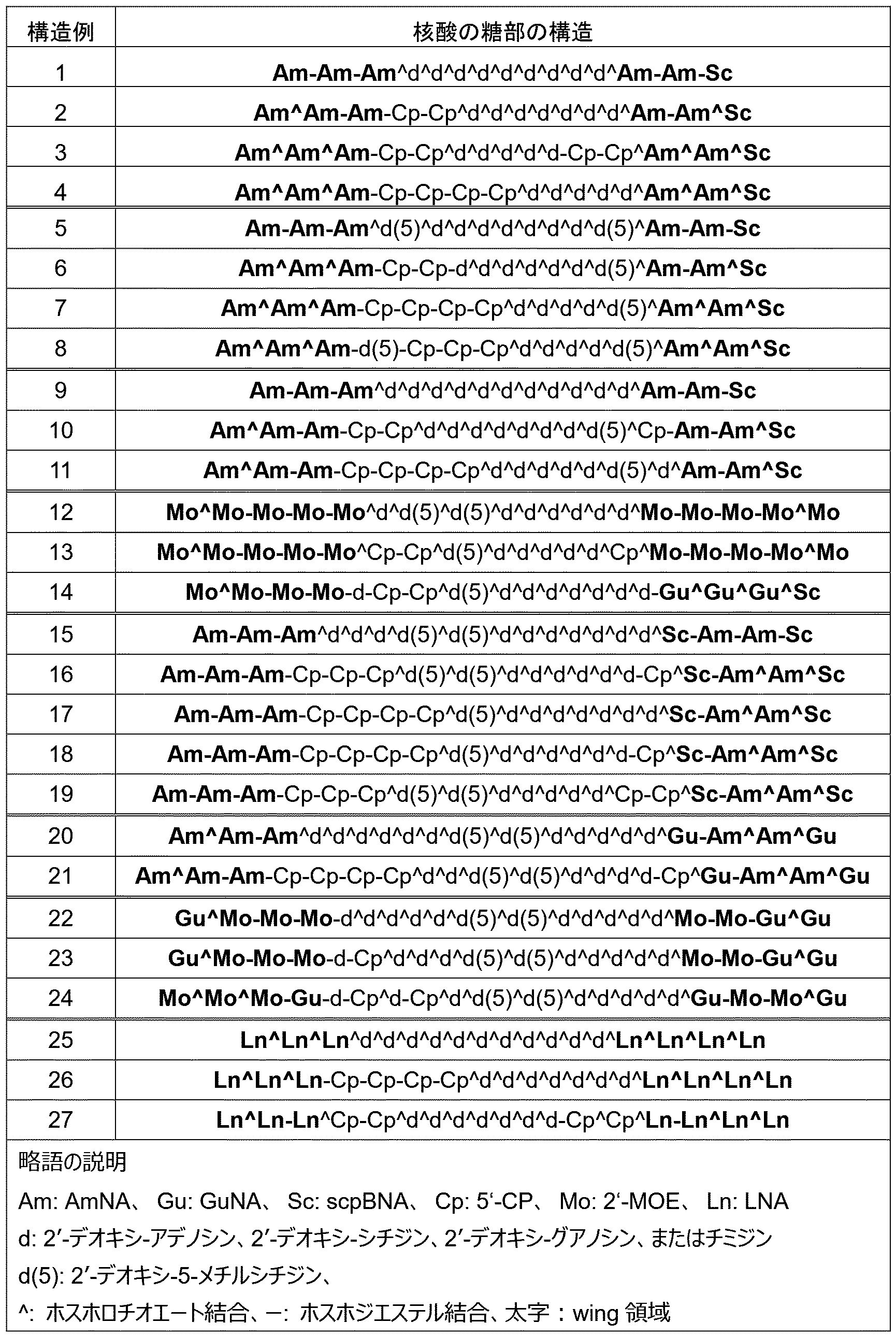
(その他の構成)
本実施形態の一側面において、一本鎖アンチセンスオリゴヌクレオチドは、上記3’ウイング領域の3’末端に結合している天然ヌクレオチドを更に含んでいてもよい。上記3’ウイング領域の3’末端に結合している天然ヌクレオチドの塩基数は、1又は数個であってもよく、1個であってもよい。
本実施形態の一側面において、一本鎖アンチセンスオリゴヌクレオチドは、上記3’ウイング領域の3’末端に結合している天然ヌクレオチドを更に含んでいてもよい。上記3’ウイング領域の3’末端に結合している天然ヌクレオチドの塩基数は、1又は数個であってもよく、1個であってもよい。
(ギャップマー型の構造の表記方法)
本発明の一本鎖アンチセンスオリゴヌクレオチドはギャップマー型である。ギャップマー型の構造を表記するにあたっては、「X-Y-Z」の表記方法を用いることがある。上述の表記方法において、「X」は5’ウイング領域の塩基数を示し、「Y」はギャップ領域の塩基数を示し、「Z」は3’ウイング領域の塩基数を示す。
本発明の一本鎖アンチセンスオリゴヌクレオチドはギャップマー型である。ギャップマー型の構造を表記するにあたっては、「X-Y-Z」の表記方法を用いることがある。上述の表記方法において、「X」は5’ウイング領域の塩基数を示し、「Y」はギャップ領域の塩基数を示し、「Z」は3’ウイング領域の塩基数を示す。
「X-Y-Z」としては、2-8-4、2-8-3、2-8-5、2-9-2、2-9-3、2-9-4、2-9-5、2-10-3、2-10-4、2-10-5、2-11-3、2-11-4、2-11-5、2-12-3、2-12-4、2-12-5、3-8-2、3-8-3、3-8-4、3-8-5、3-9-3、3-9-4、3-9-5、3-10-3、3-10-4、3-10-5、3-11-3、3-11-4、3-11-5、3-12-3、3-12-4、3-12-5、3-13-3、3-13-4、4-8-2、4-8-3、4-8-4、4-8-5、4-9-3、4-9-4、4-9-5、4-10-3、4-10-4、4-10-5、4-11-2、4-11-3、4-11-4、4-11-5、4-12-4、4-13-3、5-8-2、5-8-3、5-8-4、5-8-5、5-9-2、5-9-3、5-9-4、5-9-5、5-10-2、5-10-3、5-10-4、5-10-5、5-11-2、5-11-3、5-11-4、5-11-5等が挙げられる。例えば、「2-8-4」と表記した場合、5’ウイング領域は2merのオリゴヌクレオチドであり、ギャップ領域は8merのオリゴヌクレオチドであり、3’ウイング領域は4merのオリゴヌクレオチドであることを意味する。
上記第一のアンチセンスオリゴヌクレオチド及び第二のアンチセンスオリゴヌクレオチドにおいて、当該アンチセンスオリゴヌクレオチドの塩基長は、15~30merであり、好ましくは15~20merであり、より好ましくは18~20merである。本発明の一本鎖アンチセンスオリゴヌクレオチドの塩基長が、15~20mer、18~20merである場合、特に、標的RNAへの結合が強く、標的RNAの発現の調節をより効果的に行うことができる。
本実施形態において、上記一本鎖アンチセンスオリゴヌクレオチドは、各ヌクレオシドがリン酸基及び/又は修飾リン酸基で結合されており、ホスホジエステル結合又はホスホロチオエート結合で結合されていることが好ましい。
本実施形態の一側面において、上記一本鎖アンチセンスオリゴヌクレオチドの少なくとも1つのヌクレオシド間結合がホスホロチオエート結合であることが好ましい。本実施形態の他の側面において、上記一本鎖アンチセンスオリゴヌクレオチドの少なくとも1つのヌクレオシド間結合がホスホジエステル結合であることが好ましい。
上記第二のアンチセンスオリゴヌクレオチドを構成するヌクレオシド間結合において、ホスホロチオエート結合の割合が50%~80%であることが好ましく、50%~70%であることがより好ましい。
上記第一のアンチセンスオリゴヌクレオチド及び上記第二のアンチセンスオリゴヌクレオチドにおいて、
塩基配列におけるGCの比率が0.2~0.6であることが好ましい。「GCの比率」とは、上記アンチセンスオリゴヌクレオチドの塩基配列の全体に対する、グアニン及びシトシン(5-メチルシトシンも含む)の個数の割合を意味する。
塩基配列におけるGCの比率が0.2~0.6であることが好ましい。「GCの比率」とは、上記アンチセンスオリゴヌクレオチドの塩基配列の全体に対する、グアニン及びシトシン(5-メチルシトシンも含む)の個数の割合を意味する。
本発明の一本鎖アンチセンスオリゴヌクレオチド(上記第二のアンチセンスオリゴヌクレオチド)の一態様としては、5~20merからなるギャップ領域、3~5merからなる5’ウイング領域、及び3~5merからなる3’ウイング領域を有するギャップマー型の一本鎖アンチセンスオリゴヌクレオチドである。ここにおいて、該ギャップ領域は、該5’ウイング領域と該3’ウイング領域の間に位置付けられる。該ギャップ領域は、少なくとも1つの5’-CP核酸を含む。そして、該5’ウイング領域及び該3’ウイング領域には、それぞれ少なくとも1つの2’-MOE核酸、LNA、AmNA、GuNA、又はscpBNAが含まれることが好ましい。該5’ウイング領域及び該3’ウイング領域には、2’-O-アルキル化若しくは2’-F化されたヌクレオチドが含まれていてもよい。2’-O-アルキル化ヌクレオチドとしては、D-リボフラノースの2’-O-アルキル化(例えば、2’-O-メチル化等)ヌクレオチドを用いてもよい。また、上記ギャップマー型の一本鎖アンチセンスオリゴヌクレオチドは、第二鎖オリゴヌクレオチドとのハイブリダイズによって二本鎖を形成していてもよい。
本実施形態の一側面において、上記アンチセンスオリゴヌクレオチドは、
遅発性中枢毒性が低減されているアンチセンスオリゴヌクレオチド又はその製薬学的に許容される塩であって、
上記アンチセンスオリゴヌクレオチドは、各ヌクレオチドがリン酸基及び/又は修飾リン酸基で結合されており、
上記アンチセンスオリゴヌクレオチドは、ギャップ領域と、上記ギャップ領域の3’末端に結合している3’ウイング領域と、上記ギャップ領域の5’末端に結合している5’ウイング領域と、を含み、
上記ギャップ領域は、糖部が修飾された核酸を含んでいてもよいデオキシリボースから構成される核酸であり、
上記ギャップ領域は、少なくとも1つの5’-CP核酸を含み、
上記3’ウイング領域及び上記5’ウイング領域は2’位に置換基を有する修飾核酸であり、
上記アンチセンスオリゴヌクレオチドの塩基長は、12~30merである。
遅発性中枢毒性が低減されているアンチセンスオリゴヌクレオチド又はその製薬学的に許容される塩であって、
上記アンチセンスオリゴヌクレオチドは、各ヌクレオチドがリン酸基及び/又は修飾リン酸基で結合されており、
上記アンチセンスオリゴヌクレオチドは、ギャップ領域と、上記ギャップ領域の3’末端に結合している3’ウイング領域と、上記ギャップ領域の5’末端に結合している5’ウイング領域と、を含み、
上記ギャップ領域は、糖部が修飾された核酸を含んでいてもよいデオキシリボースから構成される核酸であり、
上記ギャップ領域は、少なくとも1つの5’-CP核酸を含み、
上記3’ウイング領域及び上記5’ウイング領域は2’位に置換基を有する修飾核酸であり、
上記アンチセンスオリゴヌクレオチドの塩基長は、12~30merである。
本実施形態の一側面において、上記一本鎖アンチセンスオリゴヌクレオチド(上記第二のアンチセンスオリゴヌクレオチド)は、後述する表2-1~2-8における、配列番号2,3,4,5,7,8,10,12,13,15,16,18,19,20,21,23,24,26,及び27からなる群より選ばれる少なくとも1つであることが好ましい。ここで、「表2-1における配列番号2の一本鎖アンチセンスオリゴヌクレオチド」とは、表2-1における配列名が「h451-465-N」である一本鎖アンチセンスオリゴヌクレオチドを意味する。他の場合も同様である。
<二本鎖アンチセンスオリゴヌクレオチド>
本実施形態に係る二本鎖アンチセンスオリゴヌクレオチドは、上記一本鎖アンチセンスオリゴヌクレオチド(上記第二のアンチセンスオリゴヌクレオチド)と、
上記一本鎖アンチセンスオリゴヌクレオチドに対してハイブリダイズしている第二鎖オリゴヌクレオチドと、を含む二本鎖アンチセンスオリゴヌクレオチド又はその製薬学的に許容される塩である。上記第二鎖オリゴヌクレオチドの塩基配列は、上記一本鎖アンチセンスオリゴヌクレオチドの塩基配列に対して相補的な塩基配列を基準として、90%以上100%以下の配列同一性を有する塩基配列であることが好ましい。
本実施形態に係る二本鎖アンチセンスオリゴヌクレオチドは、上記一本鎖アンチセンスオリゴヌクレオチド(上記第二のアンチセンスオリゴヌクレオチド)と、
上記一本鎖アンチセンスオリゴヌクレオチドに対してハイブリダイズしている第二鎖オリゴヌクレオチドと、を含む二本鎖アンチセンスオリゴヌクレオチド又はその製薬学的に許容される塩である。上記第二鎖オリゴヌクレオチドの塩基配列は、上記一本鎖アンチセンスオリゴヌクレオチドの塩基配列に対して相補的な塩基配列を基準として、90%以上100%以下の配列同一性を有する塩基配列であることが好ましい。
上記二本鎖アンチセンスオリゴヌクレオチドは、溶液中で解離して、上記一本鎖アンチセンスオリゴヌクレオチドと、上記第二鎖オリゴヌクレオチドとに分離することができる。分離した上記一本鎖アンチセンスオリゴヌクレオチドは、上述した標的RNAに結合することができる。なお、上記一本鎖アンチセンスオリゴヌクレオチドは、上記第二鎖オリゴヌクレオチドとの関係において、「第一鎖オリゴヌクレオチド」と把握することもできる。なお、上記二本鎖アンチセンスオリゴヌクレオチドを構成するオリゴヌクレオチドのうち上記第一鎖オリゴヌクレオチドが上述した標的RNAに対するアンチセンス鎖を有しているが、上記第一鎖オリゴヌクレオチドと上記第二鎖オリゴヌクレオチドからなる二本鎖オリゴヌクレオチドを便宜上「二本鎖アンチセンスオリゴヌクレオチド」と呼ぶことにする。
≪一本鎖アンチセンスオリゴヌクレオチドの製造方法≫
本実施形態に係るアンチセンスオリゴヌクレオチド又はその製薬学的に許容される塩の製造方法は、
遅発性中枢毒性が低減されているアンチセンスオリゴヌクレオチド又はその製薬学的に許容される塩の製造方法であって、
上記アンチセンスオリゴヌクレオチドの設計方法によって、上記第二のアンチセンスオリゴヌクレオチドを設計する工程と、
上記第二のアンチセンスオリゴヌクレオチドを合成する工程とを含む。
本実施形態に係るアンチセンスオリゴヌクレオチド又はその製薬学的に許容される塩の製造方法は、
遅発性中枢毒性が低減されているアンチセンスオリゴヌクレオチド又はその製薬学的に許容される塩の製造方法であって、
上記アンチセンスオリゴヌクレオチドの設計方法によって、上記第二のアンチセンスオリゴヌクレオチドを設計する工程と、
上記第二のアンチセンスオリゴヌクレオチドを合成する工程とを含む。
本発明の一本鎖アンチセンスオリゴヌクレオチド(第二のアンチセンスオリゴヌクレオチド)は、ホスホロアミダイト法による固相合成により製造することができる。例えば、市販の核酸自動合成機を使用して固相担体上で所定の塩基配列を有する一本鎖オリゴヌクレオチドをまず合成する。次に、塩基性物質等を用いて固相担体から合成した一本鎖オリゴヌクレオチドを切出し、脱保護を行ない、粗体の一本鎖オリゴヌクレオチドを得る。その後、得られた粗体の一本鎖オリゴヌクレオチドを、HPLC等を用いて精製する。上述の製造法に限らず、本発明の一本鎖アンチセンスオリゴヌクレオチドは、当業者に公知の方法に準じて、核酸の塩基配列、修飾部位等を適宜変更することにより製造できる。また、AmNA、GuNA、及びscpBNAについては、それぞれ国際公開第2011/052436号(特許文献5)、国際公開第2014/046212号(特許文献6)、及び国際公開第2015/125783号(特許文献7)に記載の方法により製造することができる。2’-MOE核酸については、試薬として購入可能なアミダイトを用いることにより製造することができる。5’-CP核酸については、国際公開第2020/158910号(特許文献3)に記載の方法により製造することができる。LNAについては、国際公開第99/14226号(特許文献8)に記載の方法により製造することができる。
≪二本鎖アンチセンスオリゴヌクレオチドの製造方法≫
本発明の二本鎖アンチセンスオリゴヌクレオチドは、まず、上記一本鎖アンチセンスオリゴヌクレオチドと同様の製造方法を用いて、該一本鎖アンチセンスオリゴヌクレオチドに相補的な塩基配列を基準として所定の配列同一性を有するオリゴヌクレオチド(第二鎖オリゴヌクレオチド)を製造する。その後、上記一本鎖アンチセンスオリゴヌクレオチドおよび上記第二鎖オリゴヌクレオチドをハイブリダイズさせることにより製造することができる。
本発明の二本鎖アンチセンスオリゴヌクレオチドは、まず、上記一本鎖アンチセンスオリゴヌクレオチドと同様の製造方法を用いて、該一本鎖アンチセンスオリゴヌクレオチドに相補的な塩基配列を基準として所定の配列同一性を有するオリゴヌクレオチド(第二鎖オリゴヌクレオチド)を製造する。その後、上記一本鎖アンチセンスオリゴヌクレオチドおよび上記第二鎖オリゴヌクレオチドをハイブリダイズさせることにより製造することができる。
≪アンチセンスオリゴヌクレオチド複合体≫
本実施形態に係るアンチセンスオリゴヌクレオチド複合体は、
上記一本鎖アンチセンスオリゴヌクレオチド(第二のアンチセンスオリゴヌクレオチド)若しくはその製薬学的に許容される塩、又は上記二本鎖アンチセンスオリゴヌクレオチド若しくはその製薬学的に許容される塩と、
上記一本鎖アンチセンスオリゴヌクレオチド又は上記第二鎖オリゴヌクレオチドに結合している付加物質と、
を有する。上記付加物質は、ポリエチレングリコール、ペプチド、アルキル鎖(例えば、飽和脂肪族炭化水素等)、核酸、リガンド化合物、抗体、タンパク質、及び糖鎖(例えば、炭水化物、多糖等)からなる群より選ばれる。
本実施形態に係るアンチセンスオリゴヌクレオチド複合体は、
上記一本鎖アンチセンスオリゴヌクレオチド(第二のアンチセンスオリゴヌクレオチド)若しくはその製薬学的に許容される塩、又は上記二本鎖アンチセンスオリゴヌクレオチド若しくはその製薬学的に許容される塩と、
上記一本鎖アンチセンスオリゴヌクレオチド又は上記第二鎖オリゴヌクレオチドに結合している付加物質と、
を有する。上記付加物質は、ポリエチレングリコール、ペプチド、アルキル鎖(例えば、飽和脂肪族炭化水素等)、核酸、リガンド化合物、抗体、タンパク質、及び糖鎖(例えば、炭水化物、多糖等)からなる群より選ばれる。
本実施形態の一側面において、上記アンチセンスオリゴヌクレオチド複合体は、
上記一本鎖アンチセンスオリゴヌクレオチド又はその製薬学的に許容される塩と、
上記一本鎖アンチセンスオリゴヌクレオチドに結合している付加物質と、を有し、上記付加物質は、ポリエチレングリコール、ペプチド、アルキル鎖(例えば、飽和脂肪族炭化水素等)、核酸、リガンド化合物、抗体、タンパク質、及び糖鎖(例えば、炭水化物、多糖等)からなる群より選ばれる。
上記一本鎖アンチセンスオリゴヌクレオチド又はその製薬学的に許容される塩と、
上記一本鎖アンチセンスオリゴヌクレオチドに結合している付加物質と、を有し、上記付加物質は、ポリエチレングリコール、ペプチド、アルキル鎖(例えば、飽和脂肪族炭化水素等)、核酸、リガンド化合物、抗体、タンパク質、及び糖鎖(例えば、炭水化物、多糖等)からなる群より選ばれる。
本実施形態の他の側面において、上記アンチセンスオリゴヌクレオチド複合体は、
上記二本鎖アンチセンスオリゴヌクレオチド又はその製薬学的に許容される塩と、
上記一本鎖アンチセンスオリゴヌクレオチド又は上記第二鎖オリゴヌクレオチドに結合している付加物質と、を有し、上記付加物質は、ポリエチレングリコール、ペプチド、アルキル鎖(例えば、飽和脂肪族炭化水素等)、核酸、リガンド化合物、抗体、タンパク質、及び糖鎖(例えば、炭水化物、多糖等)からなる群より選ばれる。
上記二本鎖アンチセンスオリゴヌクレオチド又はその製薬学的に許容される塩と、
上記一本鎖アンチセンスオリゴヌクレオチド又は上記第二鎖オリゴヌクレオチドに結合している付加物質と、を有し、上記付加物質は、ポリエチレングリコール、ペプチド、アルキル鎖(例えば、飽和脂肪族炭化水素等)、核酸、リガンド化合物、抗体、タンパク質、及び糖鎖(例えば、炭水化物、多糖等)からなる群より選ばれる。
本実施形態において「付加物質」とは、上記一本鎖アンチセンスオリゴヌクレオチド又は上記第二鎖オリゴヌクレオチドに結合している物質であって、所定の作用を付与するために用いられる物質を意味する。上記付加物質は、上記一本鎖アンチセンスオリゴヌクレオチドの5’末端に結合していてもよいし、3’末端に結合していてもよいし、5’末端及び3’末端の両方に結合していてもよい。また、上記付加物質は、上記第二鎖オリゴヌクレオチドの5’末端に結合していてもよいし、3’末端に結合していてもよいし、5’末端及び3’末端の両方に結合していてもよい。本実施形態の一側面において、上記付加物質は、上記一本鎖アンチセンスオリゴヌクレオチド又は上記第二鎖オリゴヌクレオチドの5’末端又は3’末端のいずれか一方に結合していることが好ましい。また、上記付加物質は、上記一本鎖アンチセンスオリゴヌクレオチド又は上記第二鎖オリゴヌクレオチドと直接、共有結合で結合していてもよい。上記付加物質は、上記一本鎖アンチセンスオリゴヌクレオチド又は上記第二鎖オリゴヌクレオチドと、リンカー物質を介して結合していてもよい。上記リンカー物質としては例えば、アルキル、ポリエチレングリコール、ペプチド、ジスルフィド、核酸等及び/又はこれらの組み合わせで構成されたリンカーが挙げられる。上記付加物質を上記一本鎖アンチセンスオリゴヌクレオチド又は上記第二鎖オリゴヌクレオチドに結合させる方法は、例えば後述する実施例に記載の方法が挙げられる。
上記付加物質として用いられるペプチドとしては、例えば、以下のようなものが挙げられるが、これらに限らない。CPPs(Cell Penetrating Peptides:細胞膜透過性ペプチド)、核移行性ペプチド、TAT(Trans-Activator of Transcription protein)、ポリアルギニン、グルカゴン様ペプチド-1 類縁ペプチド、合成環状RGDペプチド、脳移行性ペプチド
上記付加物質として用いられるリガンド化合物としては、例えば、以下のようなものが挙げられるが、これらに限らない。N-アセチルガラクトサミン(GalNAc)、糖類(グルコース、マンノース等)、脂質類(コレステロール、パルミチン酸、ドコサヘキサエン酸等)、ビタミン類(葉酸、ビタミンA、ビタミンE(トコフェロール)等)、アミノ酸、モノアミン受容体リガンド(インダトラリン等)
上記付加物質として用いられる抗体としては、例えば、以下のようなものが挙げられるが、これらに限らない。抗インスリン受容体抗体、抗トランスフェリン受容体抗体、抗LDL受容体関連タンパク質抗体、抗CD22抗体、抗CD30抗体、抗HER2抗体
上記付加物質として用いられるタンパク質としては、例えば、以下のようなものが挙げられるが、これに限らない。アルブミン
上記付加物質として用いられる核酸としては、例えば、以下のようなものが挙げられる。天然ヌクレオチド、アプタマー
なお、上記付加物質として用いられる核酸は、上記アンチセンスオリゴヌクレオチドの塩基長にはカウントしないものとする。
なお、上記付加物質として用いられる核酸は、上記アンチセンスオリゴヌクレオチドの塩基長にはカウントしないものとする。
≪一本鎖アンチセンスオリゴヌクレオチド等を有効成分として含有する医薬組成物≫
本実施形態に係る医薬組成物は、本発明の一本鎖アンチセンスオリゴヌクレオチド(第二のアンチセンスオリゴヌクレオチド)若しくはその製薬学的に許容される塩、上記二本鎖アンチセンスオリゴヌクレオチド若しくはその製薬学的に許容される塩、又は上記アンチセンスオリゴヌクレオチド複合体若しくはその製薬学的に許容される塩を有効成分として含む。上記医薬組成物としては、例えば、疾患の治療剤、疾患の予防剤等が挙げられる。本実施形態の医薬組成物の投与方法及び製剤は、当該分野で公知の投与方法及び製剤であれば、いずれも利用可能である。以下、上記医薬組成物を、「アンチセンスオリゴヌクレオチド等の医薬組成物」と表記することがある。
本実施形態に係る医薬組成物は、本発明の一本鎖アンチセンスオリゴヌクレオチド(第二のアンチセンスオリゴヌクレオチド)若しくはその製薬学的に許容される塩、上記二本鎖アンチセンスオリゴヌクレオチド若しくはその製薬学的に許容される塩、又は上記アンチセンスオリゴヌクレオチド複合体若しくはその製薬学的に許容される塩を有効成分として含む。上記医薬組成物としては、例えば、疾患の治療剤、疾患の予防剤等が挙げられる。本実施形態の医薬組成物の投与方法及び製剤は、当該分野で公知の投与方法及び製剤であれば、いずれも利用可能である。以下、上記医薬組成物を、「アンチセンスオリゴヌクレオチド等の医薬組成物」と表記することがある。
上記医薬組成物(治療剤、予防剤等)は、中枢神経系の疾患の治療又は予防に用いられる。上記中枢神経系の疾患としては、例えば、RPS25遺伝子に関連した疾患、すなわちRAN翻訳によって産生したジペプチドリピートによって引き起こされうる疾患(「リピート病」と表記する場合がある。)が挙げられる。リピート病の具体例としては、例えば、C9orf72 ALS、C9orf72 FTLD、ハンチントン病、脊髄小脳失調症(1、2、3、6、7、8、12、17型)、歯状核赤核淡蒼球ルイ体萎縮症、球脊髄性筋萎縮症、Friedreich失調症、脆弱X随伴振戦失調症候群、筋強直性ジストロフィー等をはじめとする種々の精神神経疾患及び筋疾患等が挙げられる。
<個体>
上記個体とは、哺乳動物を意味する。上記個体は、好ましくは、ヒト、サル、マーモセット、イヌ、ブタ、ウサギ、モルモット、ラット及びマウスである。上記個体は、より好ましくはヒトである。
上記個体とは、哺乳動物を意味する。上記個体は、好ましくは、ヒト、サル、マーモセット、イヌ、ブタ、ウサギ、モルモット、ラット及びマウスである。上記個体は、より好ましくはヒトである。
本実施形態の一側面において、上記一本鎖アンチセンスオリゴヌクレオチド(第二のアンチセンスオリゴヌクレオチド)又はその医薬組成物は、遅発性中枢毒性に敏感な対象(個体)に好適な投与経路で投与されうる。ここで、「遅発性中枢毒性」とは、急性期の中枢毒性が現れ得る期間が経過し、回復した後に現れる中枢毒性を意味する。遅発性中枢毒性によって認められる症状としては、例えば、自発運動減少、歩行異常及び後肢の機能異常、振戦、後肢又は尾部の脱力、後肢の反射の消失、体重減少等が挙げられる。
本発明の一本鎖アンチセンスオリゴヌクレオチド又はその医薬組成物を投与するに当たっては、その投与方法及び剤型は特に限定されない。すなわち、当該分野における公知の投与方法及び製剤であれば、いずれも本発明のアンチセンスオリゴヌクレオチド等の投与方法及び製剤として用いることができる。投与方法としては、例えば、経口投与、非経口投与等が挙げられる。非経口投与としては、点眼投与、腟内投与、直腸内投与、鼻腔内投与、経皮投与、静脈内注射、点滴、皮下、腹腔内若しくは筋肉内注入、吸引若しくは吸入による肺投与、髄腔内投与、脳室内投与等が挙げられる。本実施形態の一側面において、上記一本鎖アンチセンスオリゴヌクレオチド又はその医薬組成物は、中枢神経系に曝露されるように投与されることが好ましい。中枢神経系に曝露されるような投与方法としては、例えば、髄腔内投与、脳室内投与等が挙げられる。
本発明のアンチセンスオリゴヌクレオチド等の製剤には、賦形剤、結合剤、湿潤剤、崩壊剤、滑沢剤、希釈剤、嬌味剤、芳香剤、溶解補助剤、懸濁化剤、乳化剤、安定化剤、保存剤、等張剤等の各種医薬用添加剤を必要に応じて混合することができる。
本発明のアンチセンスオリゴヌクレオチド等の医薬組成物を局所投与する場合、例えば、経皮パッチ、軟膏、ローション、クリーム、ゲル、滴下剤、坐剤、噴霧剤、液剤、散剤等の製剤を用いることができる。
本発明のアンチセンスオリゴヌクレオチド等の医薬組成物を経口投与する場合、例えば、散剤、顆粒剤、水若しくは非水性媒体に溶解させた懸濁液又は溶液、カプセル、粉末剤、錠剤等の製剤を用いることができる。
本発明のアンチセンスオリゴヌクレオチド等の医薬組成物を非経口、髄腔内、又は脳室内投与する場合、例えば、無菌水溶液等の製剤を用いることができる。
本発明の一本鎖アンチセンスオリゴヌクレオチドの有効投与量は、投与される個体の性別、年齢、体重、症状等により、任意に定めることができる。更に、投与の方法、経路、頻度等に応じても任意に定めることができる。例えば、投与量として0.01~100mg/kg等が挙げられる。好ましくは0.1~50mg/kgであり、更に好ましくは0.1~10mg/kgである。
以上、本実施形態に係るアンチセンスオリゴヌクレオチドの設計方法、及び製造方法について説明した。上述の設計方法及び製造方法によって得られる上記一本鎖アンチセンスオリゴヌクレオチドは、ギャップ領域に少なくとも1つの5’-CP核酸が含まれているため、遅発性中枢毒性が低減される。
以下、実施例を挙げて本発明をより詳細に説明するが、本発明はこれらに限定されるものではない。
≪一本鎖アンチセンスオリゴヌクレオチドの設計≫
まず、表2-1~表2-8に示される一本鎖アンチセンスオリゴヌクレオチドを設計した。それぞれの表の中で、最初の行に記載した配列が親配列(第一のアンチセンスオリゴヌクレオチドに対応する配列)、2行目以下はその親配列に基づいて5’-CP核酸を導入した配列(第二のアンチセンスオリゴヌクレオチドに対応する配列)である。
まず、表2-1~表2-8に示される一本鎖アンチセンスオリゴヌクレオチドを設計した。それぞれの表の中で、最初の行に記載した配列が親配列(第一のアンチセンスオリゴヌクレオチドに対応する配列)、2行目以下はその親配列に基づいて5’-CP核酸を導入した配列(第二のアンチセンスオリゴヌクレオチドに対応する配列)である。
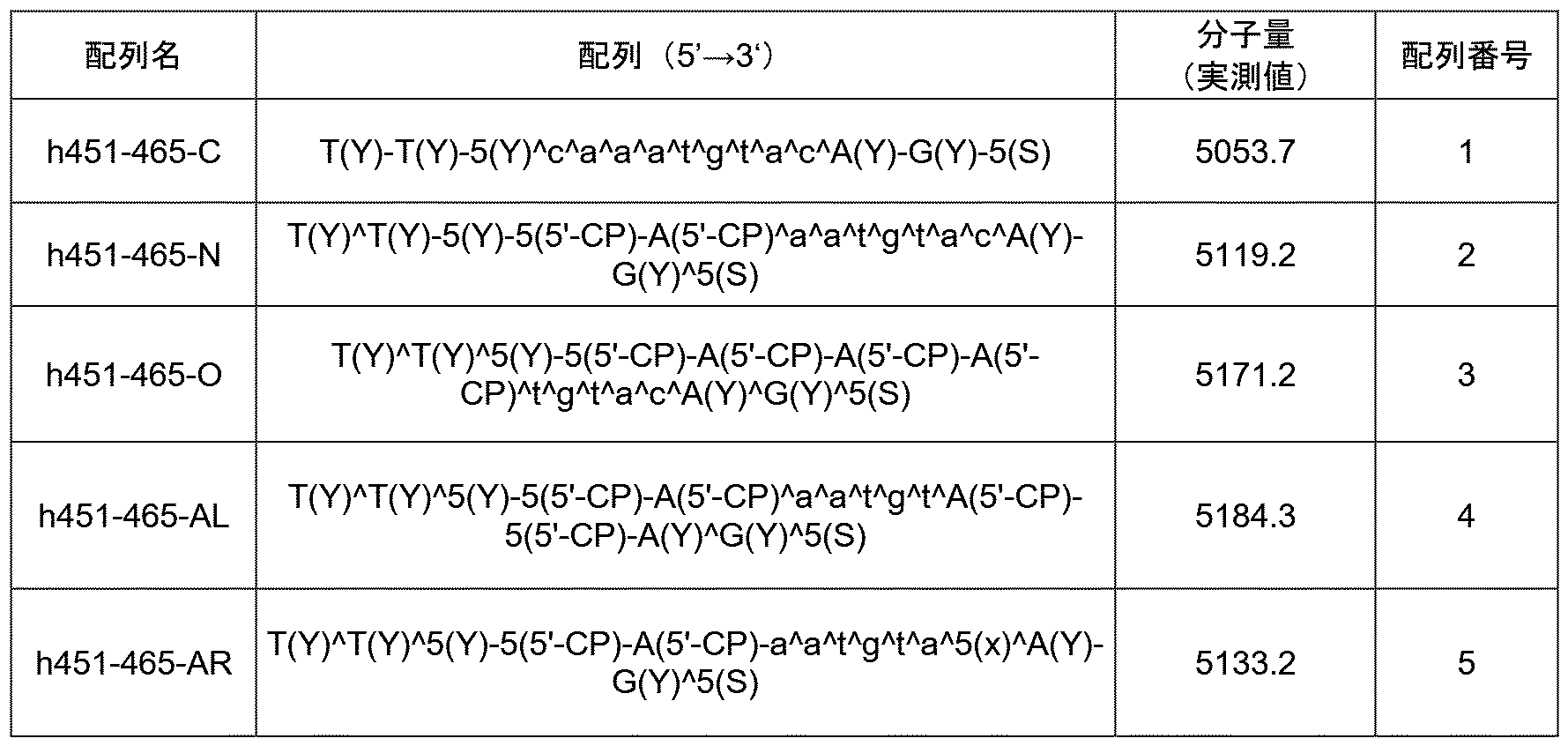
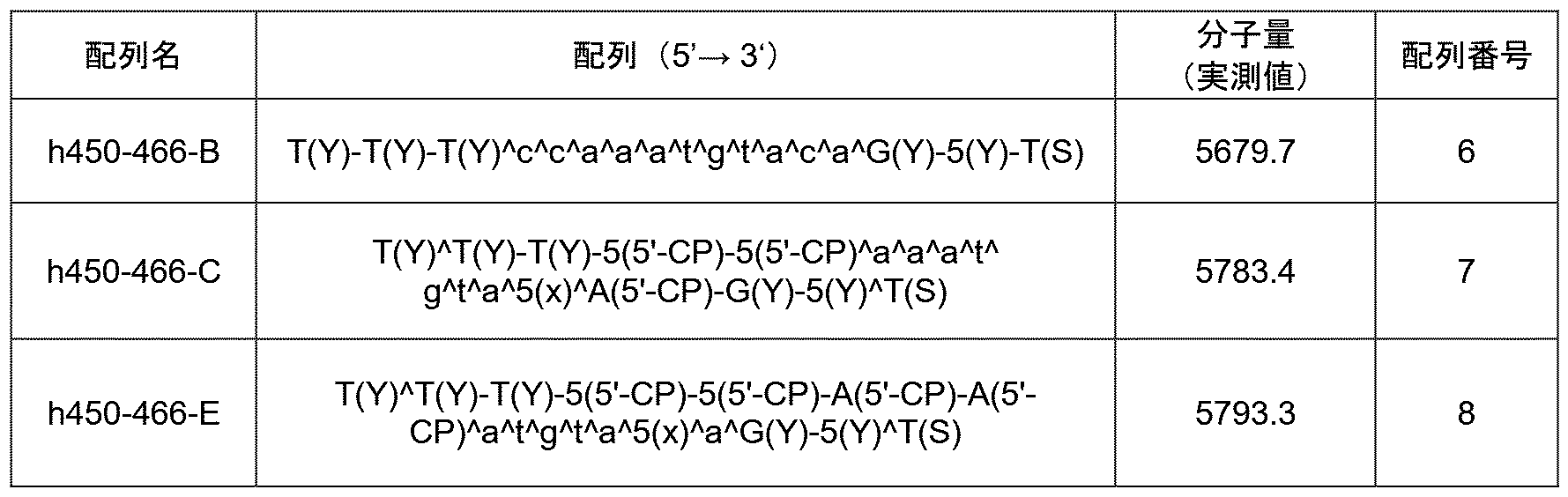
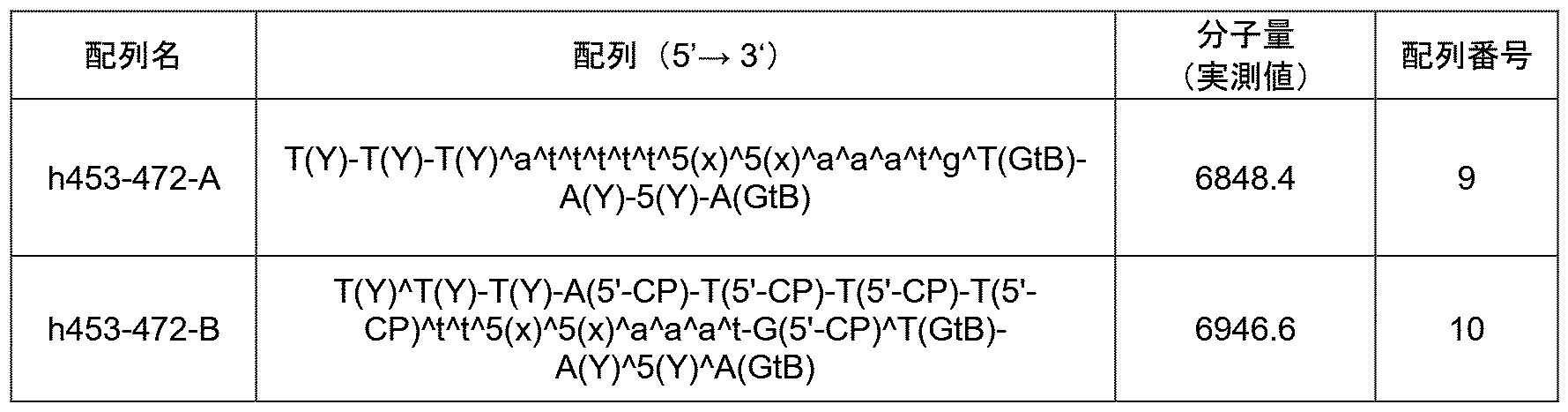
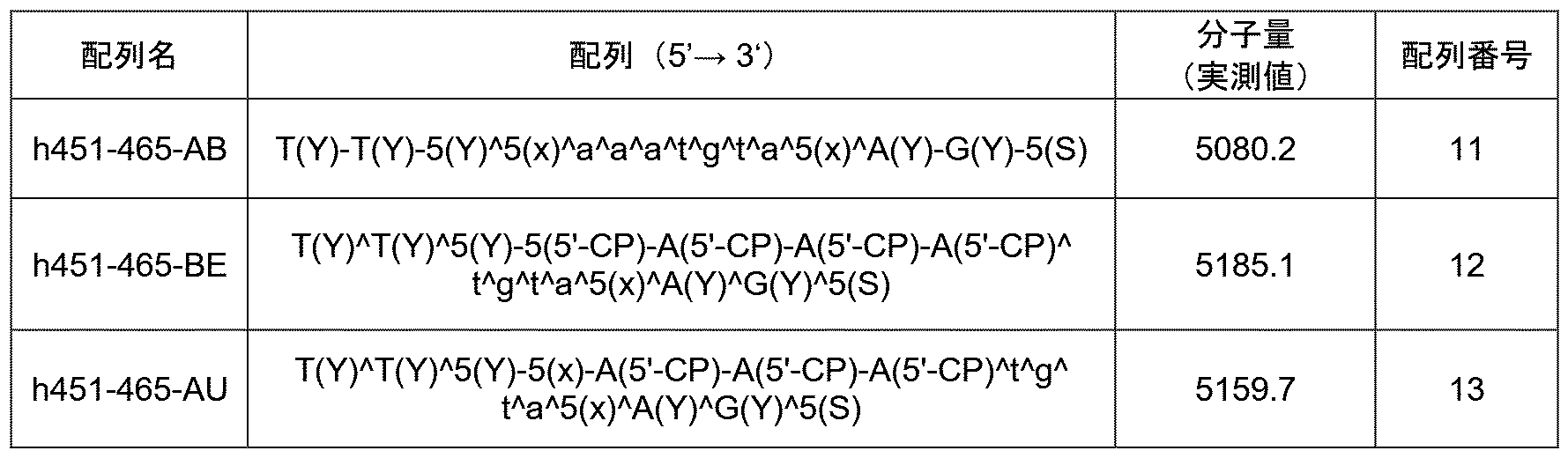
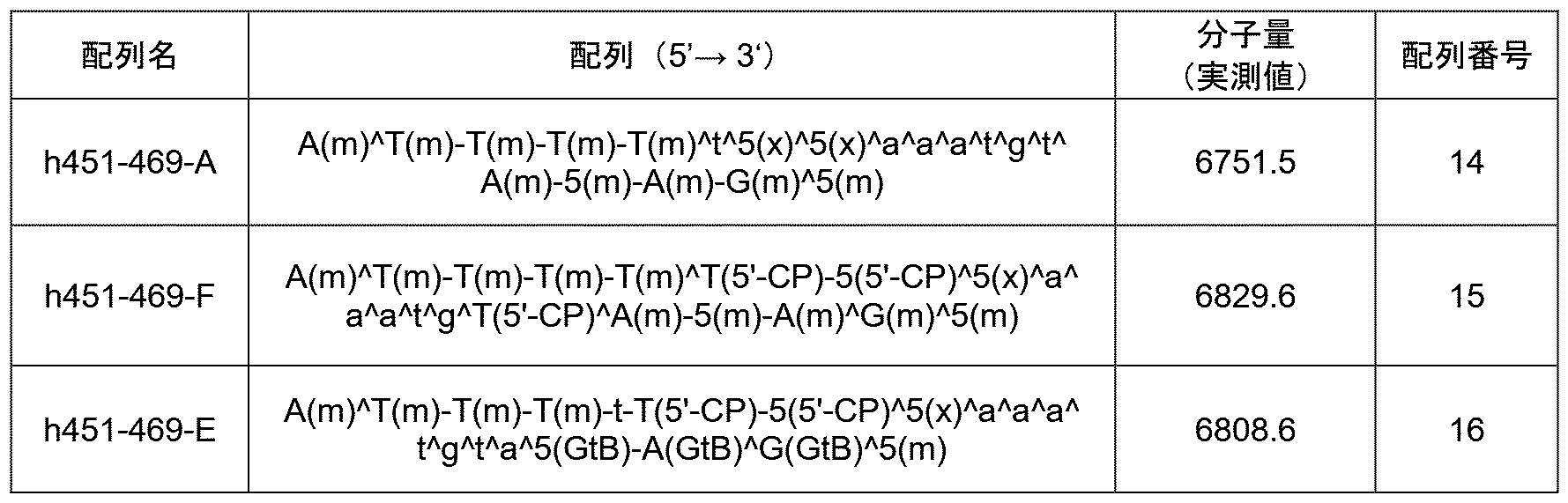


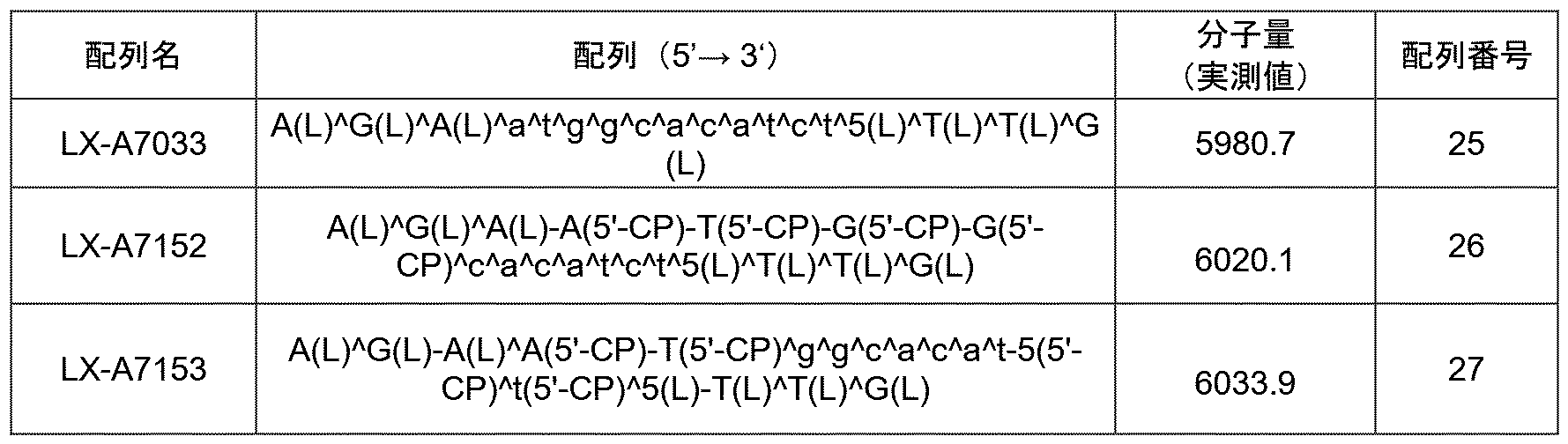
本明細書において、下記記号又は表記を用いて、対応する構造を表すことがある。
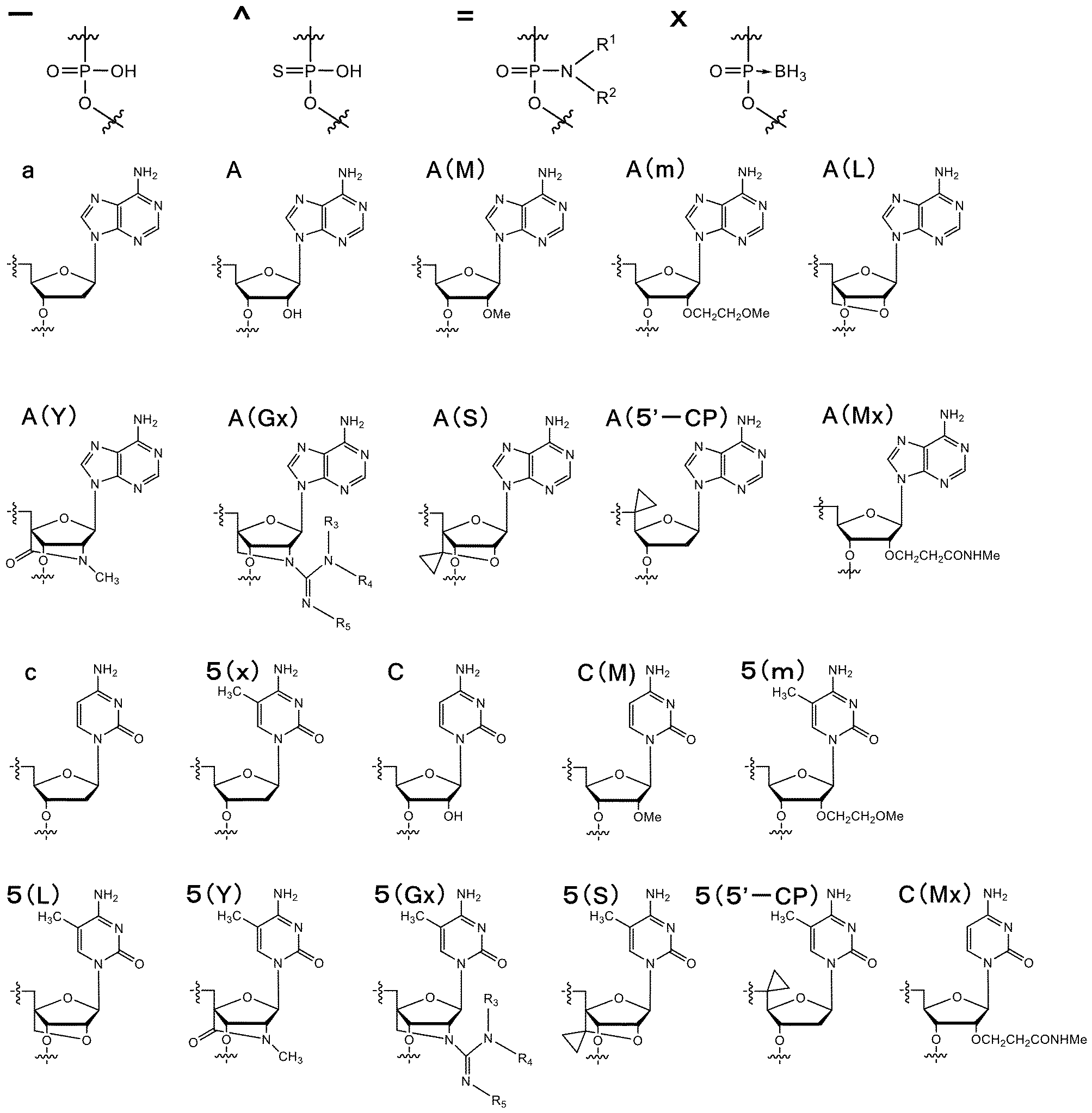
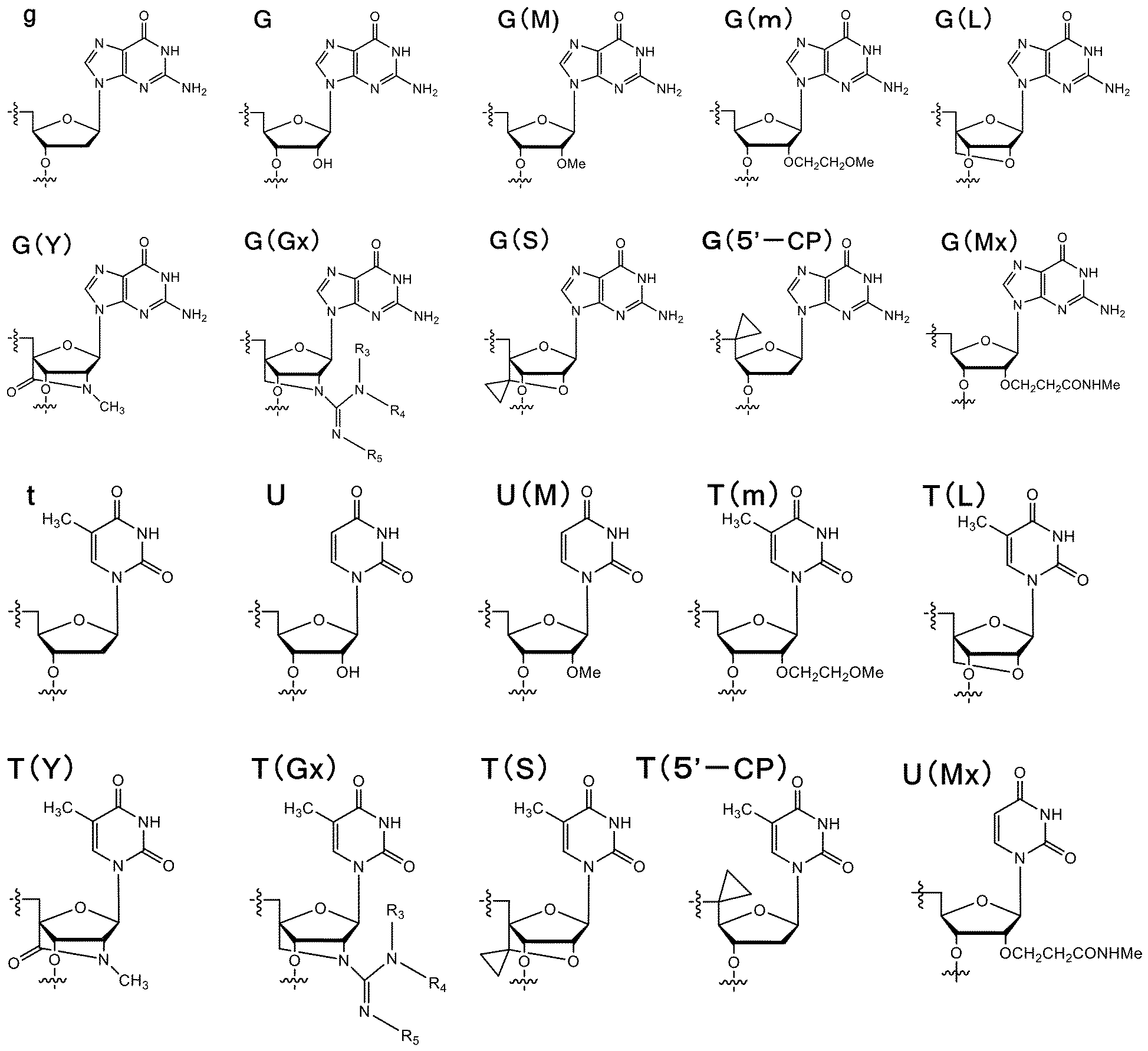
上に示す構造式において、R1及びR2は、それぞれ独立して、水素原子、又は、直鎖若しくは分岐の炭素数1から3のアルキル基を示す。ここで、上述の「=」で示される結合におけるR1及びR2は、共にメチル基を示す。R3、R4、及びR5は、それぞれ独立して、水素原子、直鎖若しくは分岐の炭素数1から7のアルキル基、又は炭素数3から7のシクロアルキル基を示す。ここにおいて、上述の「Gx」で示されるGuNAにおけるR3及びR5が共に水素原子で、かつ、R4がメチル基の場合は、「Gm」と示し、R3が水素原子で、かつ、R4及びR5が共にメチル基の場合は、「Gdm」と示し、R3及びR5が水素原子で、かつ、R4がtert-ブチル基の場合は、「GtB」と示す。
≪一本鎖アンチセンスオリゴヌクレオチドの製造≫
設計したものの一部について、以下の手順で一本鎖アンチセンスオリゴヌクレオチドを作製した。
修飾核酸として、2’-O-メチル核酸、2’-MOE核酸、AmNA、scpBNA、5’-CP核酸、及び/又はGuNA、並びに/或いは、核酸塩基部が5-メチルシトシンである核酸を含む一本鎖アンチセンスオリゴヌクレオチドは、核酸自動合成機(nS-8型、株式会社ジーンデザイン製)を用いて、0.2μmolスケールで合成した。鎖長の伸長は、標準的なホスホロアミダイトプロトコールにて実施した。ただし、5’位にレブニリル保護基を有するモノマーを付加する場合は、固相担体をピリジン-酢酸(1:1 v/v)中の0.5Mヒドラジン水和物で1時間、合成器の外で室温処理することによって脱保護を行い、その後、固相担体を合成装置に取り付け、合成を再開した。固相担体は、CPGレジンを使用した。また、ホスホロチオエート化(PS)骨格形成のための硫化はDDTT(((Dimethylamino-methylidene)amino)-3H-1,2,4-dithiazaoline-3-thione)等を使用した。2’-MOE核酸、AmNA及び/又はscpBNAを含む一本鎖アンチセンスオリゴヌクレオチドは、末端の5’位の水酸基がDMTr(4,4’-ジメトキシトリチル)基で保護されておらず、かつ3’位が固相に担持されたものとして得た。続いてアルカリ処理することにより、上記一本鎖アンチセンスオリゴヌクレオチドを固相担体から切り出し、溶液の状態で回収した。その後、回収した溶液から溶媒を留去することで粗生成物を得た。得られた粗生成物を逆相HPLCにて精製することにより精製された一本鎖アンチセンスオリゴヌクレオチドを得た。得られた各一本鎖アンチセンスオリゴヌクレオチドの純度及び構造をLC-MS(Waters社製)により確認した。測定結果は、表2-1~表2-8に記載した。
設計したものの一部について、以下の手順で一本鎖アンチセンスオリゴヌクレオチドを作製した。
修飾核酸として、2’-O-メチル核酸、2’-MOE核酸、AmNA、scpBNA、5’-CP核酸、及び/又はGuNA、並びに/或いは、核酸塩基部が5-メチルシトシンである核酸を含む一本鎖アンチセンスオリゴヌクレオチドは、核酸自動合成機(nS-8型、株式会社ジーンデザイン製)を用いて、0.2μmolスケールで合成した。鎖長の伸長は、標準的なホスホロアミダイトプロトコールにて実施した。ただし、5’位にレブニリル保護基を有するモノマーを付加する場合は、固相担体をピリジン-酢酸(1:1 v/v)中の0.5Mヒドラジン水和物で1時間、合成器の外で室温処理することによって脱保護を行い、その後、固相担体を合成装置に取り付け、合成を再開した。固相担体は、CPGレジンを使用した。また、ホスホロチオエート化(PS)骨格形成のための硫化はDDTT(((Dimethylamino-methylidene)amino)-3H-1,2,4-dithiazaoline-3-thione)等を使用した。2’-MOE核酸、AmNA及び/又はscpBNAを含む一本鎖アンチセンスオリゴヌクレオチドは、末端の5’位の水酸基がDMTr(4,4’-ジメトキシトリチル)基で保護されておらず、かつ3’位が固相に担持されたものとして得た。続いてアルカリ処理することにより、上記一本鎖アンチセンスオリゴヌクレオチドを固相担体から切り出し、溶液の状態で回収した。その後、回収した溶液から溶媒を留去することで粗生成物を得た。得られた粗生成物を逆相HPLCにて精製することにより精製された一本鎖アンチセンスオリゴヌクレオチドを得た。得られた各一本鎖アンチセンスオリゴヌクレオチドの純度及び構造をLC-MS(Waters社製)により確認した。測定結果は、表2-1~表2-8に記載した。
≪アンチセンスオリゴヌクレオチドの中枢毒性評価(1)≫
一本鎖アンチセンスオリゴヌクレオチドにおける遅発性中枢毒性は、FVB/NJclマウス又はICRマウスに脳室内投与を実施し、投与後最大28日まで飼育し、一般状態・体重の観察及び組織サンプルの採材時点での病理学的検査(ヘマトキシリン・エオシン染色)を行うことで評価した。「score」の欄は、以下の評価基準に基づき算出した。各scoreは、群ごとの平均値を採用した。
Clinical sign score;
0点:異常なし
1点:後肢機能異常、振戦、自発運動減少
2点:後肢のひきずり、尾部又は後肢の脱力
3点:完全な後肢機能不全、後肢の麻痺、横臥、腹臥
4点:安楽殺
Pathological score;
0点:異常なし
1点:異常あり(単細胞壊死、空胞化等)
一本鎖アンチセンスオリゴヌクレオチドにおける遅発性中枢毒性は、FVB/NJclマウス又はICRマウスに脳室内投与を実施し、投与後最大28日まで飼育し、一般状態・体重の観察及び組織サンプルの採材時点での病理学的検査(ヘマトキシリン・エオシン染色)を行うことで評価した。「score」の欄は、以下の評価基準に基づき算出した。各scoreは、群ごとの平均値を採用した。
Clinical sign score;
0点:異常なし
1点:後肢機能異常、振戦、自発運動減少
2点:後肢のひきずり、尾部又は後肢の脱力
3点:完全な後肢機能不全、後肢の麻痺、横臥、腹臥
4点:安楽殺
Pathological score;
0点:異常なし
1点:異常あり(単細胞壊死、空胞化等)
代表例として、表2―1~表2-7に記載の一本鎖アンチセンスオリゴヌクレオチドの遅発性中枢毒性の評価結果を表3-1~表3-7に示す。なお、表3-1~表3-8において、「-」で示されているもの箇所は測定評価を行っていないことを意味する。また、表3-7における「観察日」及び「Clinical sign score」の欄は、後述する「アンチセンスオリゴヌクレオチドの中枢毒性評価(2)」に記載されている実験によって得られた評価結果である。表3-1~表3-7の結果から、親配列の一本鎖アンチセンスオリゴヌクレオチド(第一のアンチセンスオリゴヌクレオチド)に比べて、5’-CPを導入した配列の一本鎖アンチセンスオリゴヌクレオチド(第二のアンチセンスオリゴヌクレオチド)において、遅発性中枢毒性が低減していることが確認された。

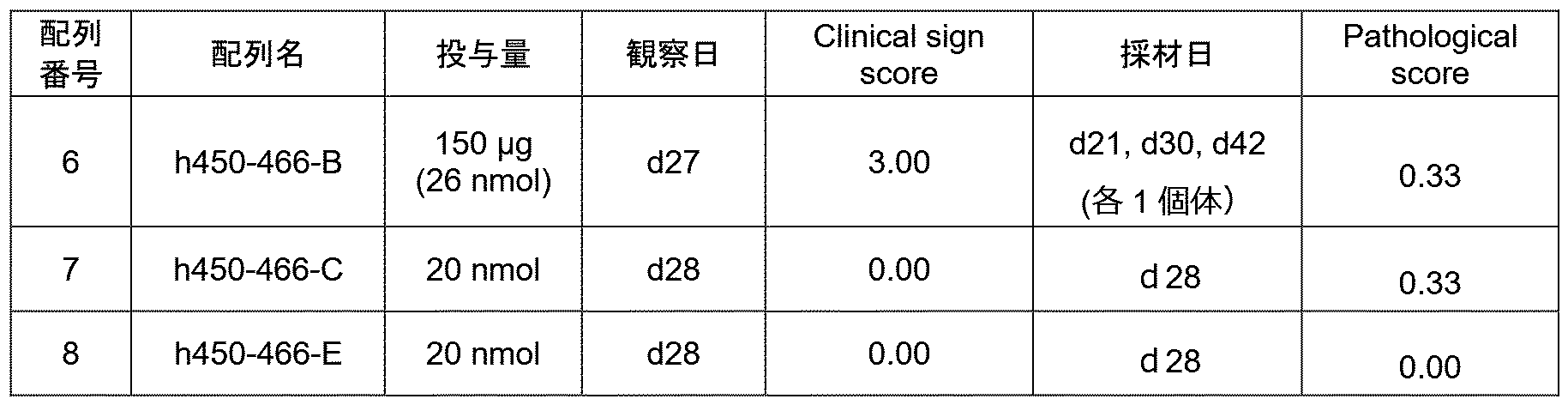


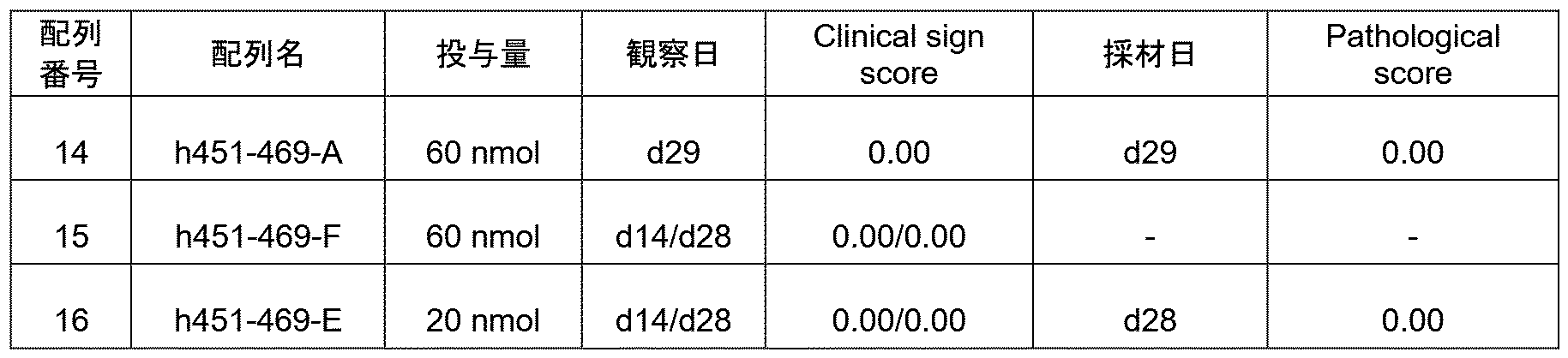

≪アンチセンスオリゴヌクレオチドの中枢毒性評価(2)≫
表2-7~表2-8に記載の一本鎖アンチセンスオリゴヌクレオチドにおける遅発性中枢毒性は、FVB/NJclマウスまたはICRマウスに脳室内投与を実施し、投与後最大28日まで評価することによって行った。評価項目は行動評価、一般状態及び体重の観察、及び採材時点の脳の病理学的検査(ヘマトキシリン・エオシン染色)である。マウスの行動評価は、Functional observational battery(FOB)によって行った。評価項目として、1)姿勢、2)外見上の異常、3)常同行動、4)刺激に対する反応性、5)グリップ力、6)呼吸、7)身震い・痙攣についてそれぞれ正常を0、やや異常ありを1、極度に異常ありを2とスコア化した(表3-7におけるClinical sign scoreの欄)。各病理組織所見は大脳皮質上の2か所における神経細胞の1)単細胞壊死、2)空胞化、3)泡沫化の程度に応じてスコア化を行い、所見なしは0、軽度は1、中等度は2、重度は3とした(表3-8における病理組織所見スコアの欄)。
表2-7~表2-8に記載の一本鎖アンチセンスオリゴヌクレオチドにおける遅発性中枢毒性は、FVB/NJclマウスまたはICRマウスに脳室内投与を実施し、投与後最大28日まで評価することによって行った。評価項目は行動評価、一般状態及び体重の観察、及び採材時点の脳の病理学的検査(ヘマトキシリン・エオシン染色)である。マウスの行動評価は、Functional observational battery(FOB)によって行った。評価項目として、1)姿勢、2)外見上の異常、3)常同行動、4)刺激に対する反応性、5)グリップ力、6)呼吸、7)身震い・痙攣についてそれぞれ正常を0、やや異常ありを1、極度に異常ありを2とスコア化した(表3-7におけるClinical sign scoreの欄)。各病理組織所見は大脳皮質上の2か所における神経細胞の1)単細胞壊死、2)空胞化、3)泡沫化の程度に応じてスコア化を行い、所見なしは0、軽度は1、中等度は2、重度は3とした(表3-8における病理組織所見スコアの欄)。
代表例として、表2-7~表2―8に記載の一本鎖アンチセンスオリゴヌクレオチドの遅発性中枢毒性の評価結果を表3-7~3-8に示す。なお、表3-7における「採材日」及び「Pathological score」の欄は、上述の「アンチセンスオリゴヌクレオチドの中枢毒性評価(1)」に記載されている実験によって得られた評価結果である。表3-7~3-8の結果から、親配列の一本鎖アンチセンスオリゴヌクレオチド(第一のアンチセンスオリゴヌクレオチド)に比べて、5’-CPを導入した配列の一本鎖アンチセンスオリゴヌクレオチド(第二のアンチセンスオリゴヌクレオチド)において、遅発性中枢毒性が低減していることが確認された。


≪RPS25遺伝子の発現評価(in vitro評価)≫
RPS25遺伝子の発現評価は、製造した一本鎖アンチセンスオリゴヌクレオチドに応じて、ヒト胎児腎細胞を用いた発現評価で行った。また上記RPS25遺伝子の発現評価は、ヒトiPS細胞由来神経細胞を用いても行うことができる。本実施例における遺伝子発現評価とは、逆転写反応によって得られた相補的DNA(cDNA)量を測定することでmRNA量を評価することを意味する。以下、各発現評価の具体的手順について説明する。
RPS25遺伝子の発現評価は、製造した一本鎖アンチセンスオリゴヌクレオチドに応じて、ヒト胎児腎細胞を用いた発現評価で行った。また上記RPS25遺伝子の発現評価は、ヒトiPS細胞由来神経細胞を用いても行うことができる。本実施例における遺伝子発現評価とは、逆転写反応によって得られた相補的DNA(cDNA)量を測定することでmRNA量を評価することを意味する。以下、各発現評価の具体的手順について説明する。
<ヒト胎児腎細胞を用いた発現評価>
ヒト胎児腎細胞HEK293T(ATCC(登録商標)CRL-3216 (商標))を、培養培地中、37°C、5%CO2の条件で培養した。HEK293T細胞の培養培地としては、以下の組成のものを用いた。
ヒト胎児腎細胞HEK293T(ATCC(登録商標)CRL-3216 (商標))を、培養培地中、37°C、5%CO2の条件で培養した。HEK293T細胞の培養培地としては、以下の組成のものを用いた。
HEK293T細胞の培養培地組成
ダルベッコ改変イーグル培地(DMEM):SIGMA社製、Cat#D6429
10% ウシ胎児血清(FBS):biowest社製、Cat#S1820
100倍希釈ペニシリン-ストレプトマイシン混合溶液:ナカライテスク社製 Cat#09367-34(ペニシリン 10000ユニット/ml, ストレプトマイシン 10000μg/ml、安定剤含有)
ダルベッコ改変イーグル培地(DMEM):SIGMA社製、Cat#D6429
10% ウシ胎児血清(FBS):biowest社製、Cat#S1820
100倍希釈ペニシリン-ストレプトマイシン混合溶液:ナカライテスク社製 Cat#09367-34(ペニシリン 10000ユニット/ml, ストレプトマイシン 10000μg/ml、安定剤含有)
まず、ヒトRPS25遺伝子の発現量測定を行う前日に、96穴プレートにHEK293T細胞(12000 cells/well)を播種し、37°C、5%CO2の条件で一晩培養した。その後、リン酸緩衝生理食塩水(PBS)で希釈した各一本鎖アンチセンスオリゴヌクレオチド(終濃度0.5nM、5nM、15nM、又は50nM)をリポフェクション法にて、上述の細胞にトランスフェクションした。陰性対照群としては、一本鎖アンチセンスオリゴヌクレオチドが溶解していないPBSをトランスフェクションした細胞を用いた。トランスフェクションした細胞を増殖培地中で37°C、5%CO2の条件で48時間培養した。その後、上記増殖培地を除去し、Taqman Fast Cells-to-CT Kit(Thermo Fisher Scientific社製、Cat#4399003)を用いて、抽出した全RNAに対して逆転写反応を実施した。この逆転写反応から得られた相補的DNA(cDNA)を利用して、Taqman gene expression assays(Applied Biosystems社製)で、予め設計された遺伝子特異的プローブ(下記参照)を用いてリアルタイムPCRを実施した(95°C;3秒間、60°C;30秒間を40サイクル)。
ヒトRPS25遺伝子の発現評価で用いた遺伝子特異的プローブ一覧
human RPS25: Hs01568661_g1
human GAPDH: 4326317E(インターナルコントロール)
human RPS25: Hs01568661_g1
human GAPDH: 4326317E(インターナルコントロール)
上述の方法で求められた、ヒトRPS25mRNAに対する各一本鎖アンチセンスオリゴヌクレオチドにおけるヒトRPS25mRNAの発現比率を表4-1~表4-7に示す(「in vitro評価」の欄)。このとき、陰性対照群において求められたヒトRPS25mRNAの発現比率を1.00とした。発現比率が0.80以下であるものを、ヒトRPS25mRNAの発現を抑制することが可能な一本鎖アンチセンスオリゴヌクレオチドであると判断した。なお、表中、「-」で示されているものは測定を行っていないことを意味する。一般にmRNAの発現が抑制されるとその後のタンパク質への翻訳等も抑制されると考えられる。そのため、上記発現比率が0.80以下であるものは、ヒトRPS25遺伝子の機能を調節することが可能な一本鎖アンチセンスオリゴヌクレオチドであると判断できる。
≪RPS25遺伝子のin vivo発現評価≫
RPS25遺伝子の発現評価は、マウス脳室内投与を実施し前頭前皮質のそれぞれの部位のmRNA量を測定することによって行った。本実施例における遺伝子発現評価とは、逆転写反応によって得られた相補的DNA(cDNA)量を測定することでmRNA量を評価することを意味する。以下、各発現評価の具体的手順について説明する。
RPS25遺伝子の発現評価は、マウス脳室内投与を実施し前頭前皮質のそれぞれの部位のmRNA量を測定することによって行った。本実施例における遺伝子発現評価とは、逆転写反応によって得られた相補的DNA(cDNA)量を測定することでmRNA量を評価することを意味する。以下、各発現評価の具体的手順について説明する。
イソフルラン(ファイザー社製、Cat#114133403)を用いてFVBマウス(日本クレア)に麻酔をかけた。次に、50μLハミルトンシリンジ(ハミルトン社製、Cat#705LT)に装着した2段針(トップ社製、医療機器承認番号15800BZZ01460000)を用いて、人工脳脊髄液(Tocris Bioscience社製、Cat#3525/25mL)に溶解したアンチセンスオリゴヌクレオチドを10μL/個体で麻酔したFVBマウスに投与した。陰性対照群のマウスには人工脳脊髄液のみを10μL/個体で投与した。
投与後一定の飼育期間を設けたのち、上記FVBマウスを安楽死させ、脳、頚髄、腰髄の3部位を採取した。採取した組織は、RNA later(Applied Biosystems社製、Cat#AM7024)に漬けて一晩静置したのち―80℃にて保管した。保管した組織サンプルからのRNA抽出は、RNeasy Mini Kit(QIAGEN社製、Cat#74106)を用いて実施した。抽出したmRNAからの逆転写反応は、High Capacity cDNA Reverse Transcription Kit(Applied Biosystem社製、Cat#4368814)を用いて実施した。逆転写反応には、1μgのmRNAを20μLに希釈して使用した。この逆転写反応から得られた相補的DNA(cDNA)を利用して、Taqmanexpression assays(Applied Biosystems社製)で、予め設計された遺伝子特異的プローブ(下記参照)を用いて、リアルタイムPCRを実施した(95°C;3秒間、60°C;30秒間を40サイクル)。
マウスRPS25遺伝子の発現評価で用いた遺伝子特異的プローブ一覧
mouse Rps25: Mm02342783_g1
mouse GAPDH: 4352339E(インターナルコントロール)
mouse Rps25: Mm02342783_g1
mouse GAPDH: 4352339E(インターナルコントロール)
代表例として、表2-1~表2-7に記載の一本鎖アンチセンスオリゴヌクレオチドについて、上述の方法で求められたマウスRPS25mRNAの発現比率を表4-1~表4-7に示す(「in vivo評価」の欄)。この時、陰性対象群において求められたマウスRPS25、RNAの発現比率を1.00とした。表4-1~表4-7における「採材日」は、一本鎖アンチセンスオリゴヌクレオチドを投与してから所定の組織を採取するまでの日数を示している。一般にmRNAの発現が抑制されるとその後のタンパク質への翻訳等も抑制されると考えられるため、上記発現比率が0.80以下の場合、マウスRPS25遺伝子の機能を調節することが可能な一本鎖アンチセンスオリゴヌクレオチドであると判断できる。なお、表4-1~表4-7に列挙されている一本鎖アンチセンスオリゴヌクレオチドが結合する標的領域は、ヒトRPS25遺伝子とマウスRPS25遺伝子との間で配列が保存されている領域である。

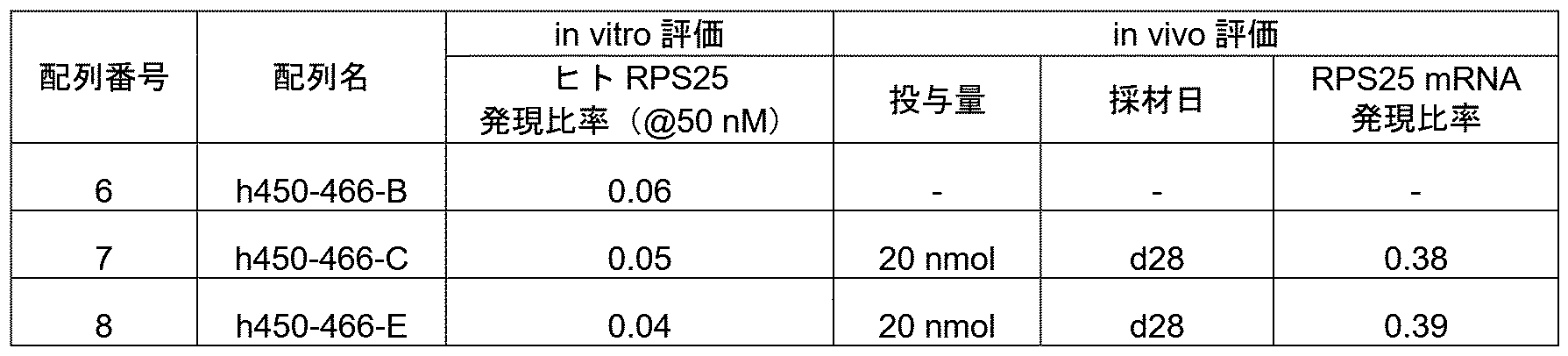

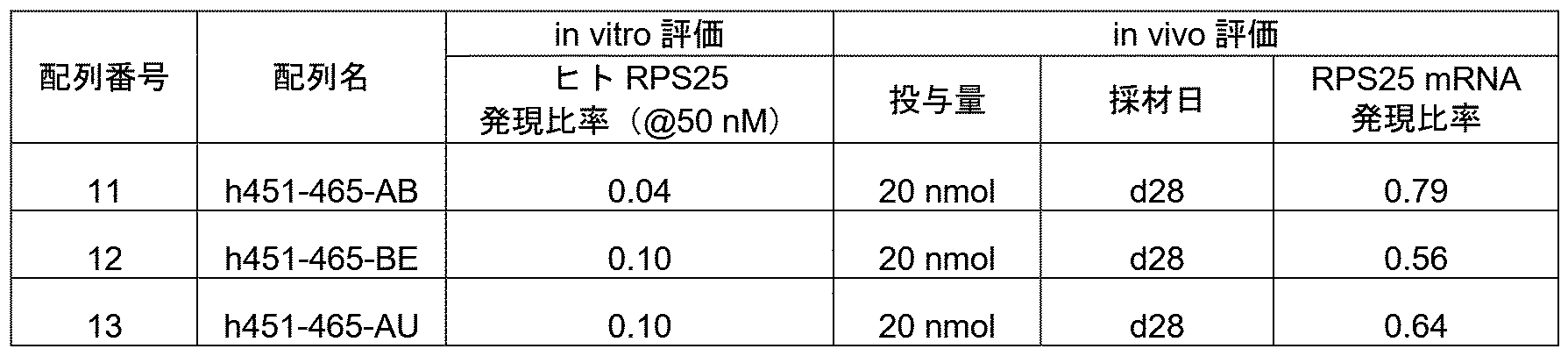
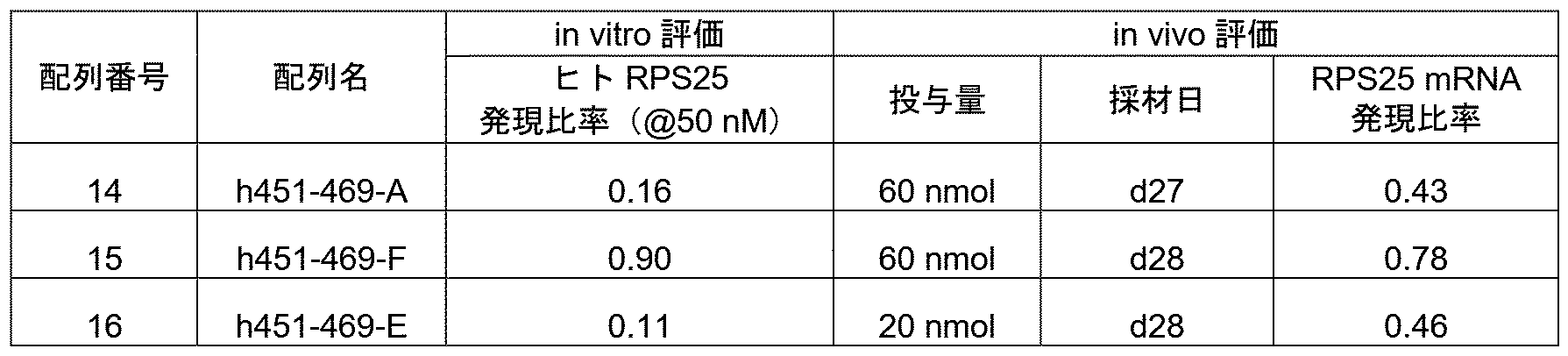
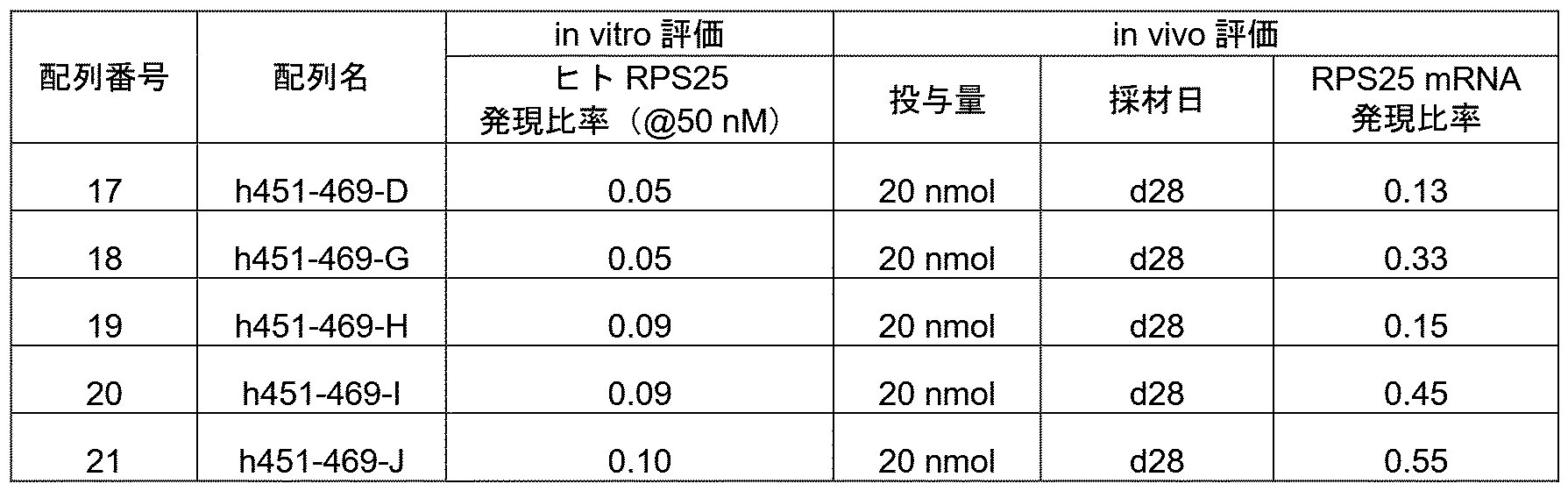
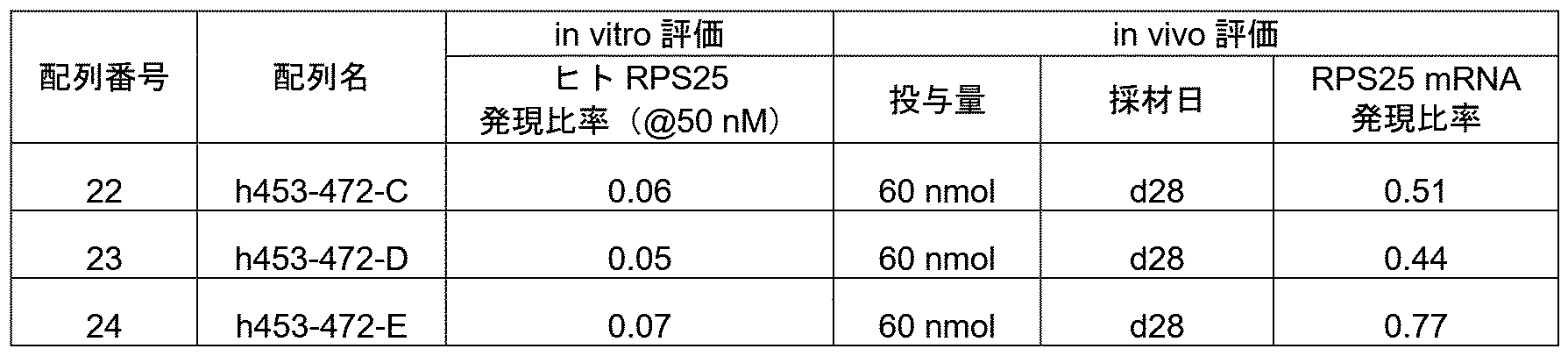
≪ヒト神経芽細胞腫株におけるアンチセンスオリゴヌクレオチドのmRNA発現抑制≫
アンチセンスオリゴヌクレオチドを用いて、ヒト神経芽細胞腫株におけるUBE3A-ATS mRNA発現抑制効果を評価した。アンチセンスオリゴで処理しない細胞株をコントロールとした。ヒト神経芽細胞腫株として、KELLY細胞(ECACC社、EC92110411-F0)を用いた。各アンチセンスオリゴヌクレオチドを市販のトランスフェクション試薬(ThermoFisher Scientific社、リポフェクトアミン3000)を用いてKELLY細胞に取り込ませ、qRT-PCR法にてmRNAの発現量を測定し、ノックダウン活性(mRNAの発現抑制)を調べた。以下に具体的な手順を示す。
アンチセンスオリゴヌクレオチドを用いて、ヒト神経芽細胞腫株におけるUBE3A-ATS mRNA発現抑制効果を評価した。アンチセンスオリゴで処理しない細胞株をコントロールとした。ヒト神経芽細胞腫株として、KELLY細胞(ECACC社、EC92110411-F0)を用いた。各アンチセンスオリゴヌクレオチドを市販のトランスフェクション試薬(ThermoFisher Scientific社、リポフェクトアミン3000)を用いてKELLY細胞に取り込ませ、qRT-PCR法にてmRNAの発現量を測定し、ノックダウン活性(mRNAの発現抑制)を調べた。以下に具体的な手順を示す。
対数増殖期のKELLY細胞を2.0×10⁴個/ウェルにて、96ウェルプレートのウェル(10%ウシ胎児血清(FBS)を含むロズウェルパーク記念研究所培地(RPMI-1640))中に播種した。24時間後、各アンチセンスオリゴヌクレオチドをウェル内に添加し、24時間インキュベートした(培地中でのアンチセンスオリゴヌクレオチドの終濃度:1nM又は10nM)。
インキュベート後、細胞を回収し、RNA抽出試薬(ThermoFisher Scientific社、MagMAX mirVana Total RNA Isolation Kit)を用いて、total RNAを抽出した。当該total RNAを鋳型として、核酸増幅反応用試薬(QIAGEN社、QuantiNova Probe RT-PCR kit)を用いて逆転写反応とPCR増幅反応を行った。核酸増幅反応は、45℃、10分→95℃、5分→[(95℃、5秒→60℃、30秒)×40サイクル]の温度サイクリングで行った。リアルタイムPCRでは、ハウスキーピング遺伝子のβアクチン(ACTB)のmRNA量も同時に定量し、ACTBのmRNA量に対するUBE3A-ATSのmRNA量をΔΔCt法によって評価した。各アンチセンスオリゴヌクレオチドによるmRNA量は、オリゴヌクレオチド無処理細胞のmRNA量を1とした場合の相対値にて示した。
用いたプライマーセットは、下記のとおりである:(PTEN検出用プライマーセット)TaqMan Gene Expression Assay Hs01372957_m1(ThermoFisher Scientific社)(ACTB検出用プライマーセット)TaqMan Gene Expression Assay Hs99999903_m1(ThermoFisher Scientific社)
結果を表4-8に示す。アンチセンスオリゴヌクレオチドを取り込んでいない細胞(無処理細胞、「コントロール」)を1としたときに、アンチセンスオリゴヌクレオチド処理細胞ではUBE3A-ATS遺伝子のノックダウン(mRNAの発現抑制)を示すことが確認された。
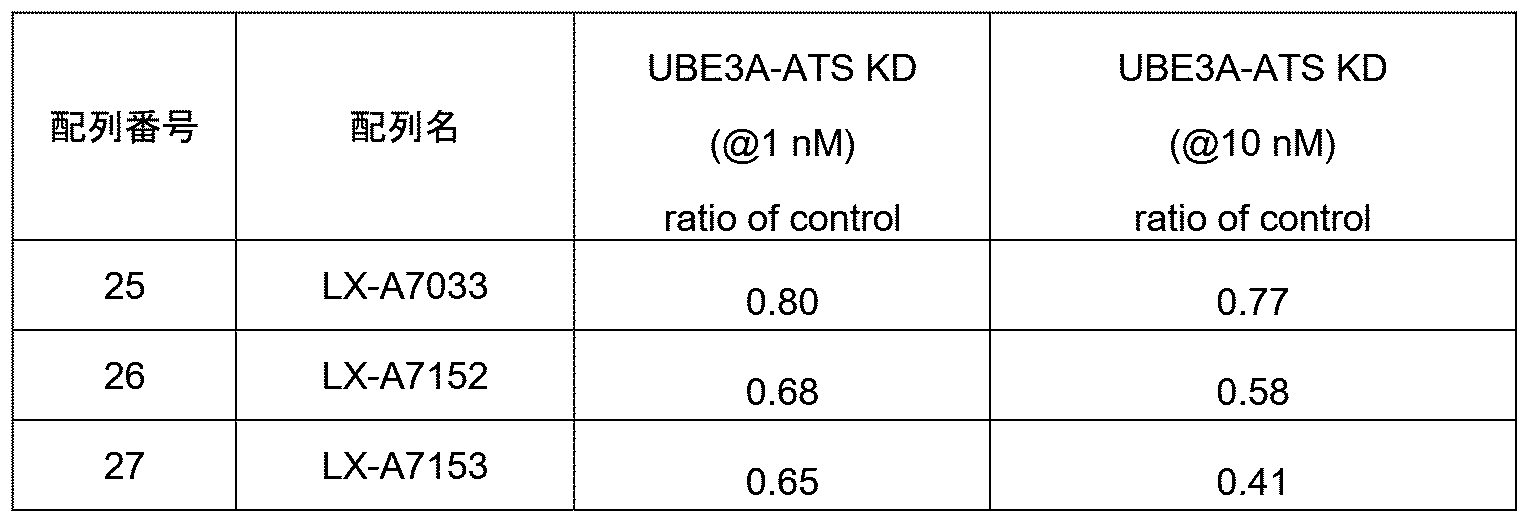
≪ヒト子宮頸癌由来HelaS3細胞株におけるアンチセンスヌクレオチドによるカスパーゼ3/7活性評価≫
以下の手順で、カスパーゼ3/7の活性を評価した。ヒト子宮頸癌由来Hela細胞株として、HelaS3細胞(ATCC社、CCL-2.2)を用いた。各アンチセンスオリゴヌクレオチドを市販のトランスフェクション試薬(ThermoFisher Scientific社、リポフェクトアミン3000)を用いてHelaS3細胞に取り込ませ、Caspase-Glo 3/7 Assay System(Promega社)を用いてカスパーゼ3/7活性を調べた。以下により具体的な手順を示す。
以下の手順で、カスパーゼ3/7の活性を評価した。ヒト子宮頸癌由来Hela細胞株として、HelaS3細胞(ATCC社、CCL-2.2)を用いた。各アンチセンスオリゴヌクレオチドを市販のトランスフェクション試薬(ThermoFisher Scientific社、リポフェクトアミン3000)を用いてHelaS3細胞に取り込ませ、Caspase-Glo 3/7 Assay System(Promega社)を用いてカスパーゼ3/7活性を調べた。以下により具体的な手順を示す。
まず、対数増殖期のHelaS3細胞を2.0×10⁴個/ウェルにて、96ウェルプレートのウェル(10%ウシ胎児血清(FBS)を含むダルベッコ改変イーグル培地(DMEM)中に播種した。24時間後、各アンチセンスオリゴヌクレオチドをウェル内に添加し(培地中でのアンチセンスオリゴヌクレオチドの終濃度:3、10、30、100、または300nM)、24時間インキュベートした。インキュベート後、細胞を回収し、キットを用いてカスパーゼ3/7活性を調べた。各アンチセンスオリゴヌクレオチドによる活性値は、アンチセンスオリゴヌクレオチドを取り込んでいない細胞(無処理細胞、「コントロール」)の活性値を100とした場合の相対値にて示した。
結果を表5に示す。表5の結果から、親配列の一本鎖アンチセンスオリゴヌクレオチド(第一のアンチセンスオリゴヌクレオチド)に比べて、5’-CPを導入した配列の一本鎖アンチセンスオリゴヌクレオチド(第二のアンチセンスオリゴヌクレオチド)においてカスパーゼ3/7活性の上昇が抑制されており、細胞毒性が低減していることが確認された。

以上のように本発明の実施形態及び実施例について説明を行なったが、上述の各実施形態及び各実施例の構成を適宜組み合わせることも当初から予定している。
今回開示された実施の形態及び実施例はすべての点で例示であって、制限的なものではないと考えられるべきである。本発明の範囲は上記した実施の形態及び実施例ではなく請求の範囲によって示され、請求の範囲と均等の意味、および範囲内でのすべての変更が含まれることが意図される。
Claims (30)
- 第一のアンチセンスオリゴヌクレオチドに基づいて、第二のアンチセンスオリゴヌクレオチドを設計する工程を含む、
遅発性中枢毒性が低減されているアンチセンスオリゴヌクレオチドの設計方法であって、
前記第一のアンチセンスオリゴヌクレオチドは、
各ヌクレオシドがリン酸基及び/又は修飾リン酸基で結合されており、
ギャップ領域と、前記ギャップ領域の3’末端に結合している3’ウイング領域と、前記ギャップ領域の5’末端に結合している5’ウイング領域とを含み、
前記ギャップ領域は、糖部が修飾された核酸を含んでいてもよいデオキシリボースから構成される核酸であり、
前記3’ウイング領域及び前記5’ウイング領域は2’位に置換基を有する修飾核酸であり、
塩基長は、12~30merである、
アンチセンスオリゴヌクレオチドであり、
前記第二のアンチセンスオリゴヌクレオチドは、
ギャップ領域、3’ウイング領域及び5’ウイング領域の塩基配列が、前記第一のアンチセンスオリゴヌクレオチドと同一であり、
3’ウイング領域及び5’ウイング領域の核酸の糖部の構造が、前記第一のアンチセンスオリゴヌクレオチドと同一であり、
前記ギャップ領域に少なくとも1つの5’-CP核酸を含み、
前記第一のアンチセンスオリゴヌクレオチドと比較して、遅発性中枢毒性が低減されている、
アンチセンスオリゴヌクレオチドの設計方法。 - 前記第一のアンチセンスオリゴヌクレオチドにおいて、前記ギャップ領域は、5’-CP核酸を含まず、
前記第二のアンチセンスオリゴヌクレオチドにおいて、前記ギャップ領域の5’-CP核酸以外の糖部の構造が前記第一のアンチセンスオリゴヌクレオチドと同一である、請求項1に記載のアンチセンスオリゴヌクレオチドの設計方法。 - 前記第一のアンチセンスオリゴヌクレオチド及び前記第二のアンチセンスオリゴヌクレオチドにおいて、
前記ギャップ領域の塩基数は、5~20merであり、
前記3’ウイング領域は、3~5merの、2’位に置換基を有する修飾核酸であり、
前記5’ウイング領域は、3~5merの、2’位に置換基を有する修飾核酸である、請求項1又は請求項2に記載のアンチセンスオリゴヌクレオチドの設計方法。 - 前記第一のアンチセンスオリゴヌクレオチド及び前記第二のアンチセンスオリゴヌクレオチドにおいて、
塩基長は、15~30merである、請求項1~請求項3のいずれか一項に記載のアンチセンスオリゴヌクレオチドの設計方法。 - 前記第一のアンチセンスオリゴヌクレオチド及び前記第二のアンチセンスオリゴヌクレオチドにおいて、
前記ギャップ領域に配置されるシトシンが、5-メチルシトシンである、請求項1~請求項4のいずれか一項に記載のアンチセンスオリゴヌクレオチドの設計方法。 - 前記第一のアンチセンスオリゴヌクレオチド及び前記第二のアンチセンスオリゴヌクレオチドにおいて、
前記3’ウイング領域における前記2’位に置換基を有する修飾核酸は、2’-MOE核酸、LNA、AmNA、GuNA、及びscpBNAからなる群より選ばれる少なくとも1つを含み、
前記5’ウイング領域における前記2’位に置換基を有する修飾核酸は、2’-MOE核酸、LNA、AmNA、GuNA、及びscpBNAからなる群より選ばれる少なくとも1つを含む、請求項1~請求項5のいずれか一項に記載のアンチセンスオリゴヌクレオチドの設計方法。 - 前記第一のアンチセンスオリゴヌクレオチド及び前記第二のアンチセンスオリゴヌクレオチドにおいて、
塩基配列におけるGCの比率が0.2~0.6である、請求項1~請求項6のいずれか一項に記載のアンチセンスオリゴヌクレオチドの設計方法。 - 前記第一のアンチセンスオリゴヌクレオチド及び前記第二のアンチセンスオリゴヌクレオチドが一本鎖アンチセンスオリゴヌクレオチドである、請求項1~請求項7のいずれか一項に記載のアンチセンスオリゴヌクレオチドの設計方法。
- 前記第二のアンチセンスオリゴヌクレオチドにおいて、
前記5’-CP核酸は、前記ギャップ領域の5’側から数えて2番目に少なくとも配置されている、請求項1~請求項8のいずれか一項に記載のアンチセンスオリゴヌクレオチドの設計方法。 - 前記第二のアンチセンスオリゴヌクレオチドにおいて、
前記5’-CP核酸は、前記ギャップ領域に2個以上配置されている、請求項1~請求項9のいずれか一項に記載のアンチセンスオリゴヌクレオチドの設計方法。 - 前記第二のアンチセンスオリゴヌクレオチドにおいて、
前記5’-CP核酸は、前記ギャップ領域に2~5個配置されている、請求項1~請求項10のいずれか一項に記載のアンチセンスオリゴヌクレオチドの設計方法。 - 前記第二のアンチセンスオリゴヌクレオチドにおいて、
前記5’-CP核酸は、前記ギャップ領域の少なくとも1か所において連続して2~4mer配置されている、請求項1~請求項11のいずれか一項に記載のアンチセンスオリゴヌクレオチドの設計方法。 - 前記第二のアンチセンスオリゴヌクレオチドにおいて、
前記5’-CP核酸が、前記ギャップ領域に対して9分の1以上配置されている、請求項1~請求項12のいずれか一項に記載のアンチセンスオリゴヌクレオチドの設計方法。 - 前記第二のアンチセンスオリゴヌクレオチドにおいて、
前記5’-CP核酸が、前記ギャップ領域に対して5分の1以上配置されている、請求項1~請求項13のいずれか一項に記載のアンチセンスオリゴヌクレオチドの設計方法。 - 前記第二のアンチセンスオリゴヌクレオチドにおいて、
前記5’-CP核酸は、前記ギャップ領域における5’末端側に配置されている、請求項1~請求項14のいずれか一項に記載のアンチセンスオリゴヌクレオチドの設計方法。 - 前記第二のアンチセンスオリゴヌクレオチドにおいて、
前記5’-CP核酸は、前記ギャップ領域における5’末端側及び3’末端側に配置されている、請求項1~請求項15のいずれか一項に記載のアンチセンスオリゴヌクレオチドの設計方法。 - 前記第二のアンチセンスオリゴヌクレオチドを構成するヌクレオシド間結合において、
ホスホロチオエート結合の割合が50%~80%である、請求項1~請求項16のいずれか一項に記載のアンチセンスオリゴヌクレオチドの設計方法。 - 前記第二のアンチセンスオリゴヌクレオチドを構成するヌクレオシド間結合において、
ホスホロチオエート結合の割合が50%~70%である、請求項1~請求項17のいずれか一項に記載のアンチセンスオリゴヌクレオチドの設計方法。 - 前記第二のアンチセンスオリゴヌクレオチドを構成するギャップ領域において、
前記5’-CP核酸と、前記5’-CP核酸の3’側に隣接しているヌクレオシドとの結合が、ホスホロチオエート結合である(ただし、前記5’-CP核酸がギャップ領域の3’末端に配置されている場合を除く)、請求項1~請求項18のいずれか一項に記載のアンチセンスオリゴヌクレオチドの設計方法。 - 前記第二のアンチセンスオリゴヌクレオチドを構成するギャップ領域において、
前記5’-CP核酸と、前記5’-CP核酸の3’側で隣接しているヌクレオシドとの結合が、ホスホロチオエート結合である(ただし、前記5’-CP核酸がギャップ領域の3’末端に配置されている場合と前記5’-CP核酸の3’側で隣接しているヌクレオシドが5’-CP核酸である場合を除く)、請求項1~請求項19のいずれか一項に記載のアンチセンスオリゴヌクレオチドの設計方法。 - 前記第二のアンチセンスオリゴヌクレオチドを構成するギャップ領域において、
前記5’-CP核酸と、前記5’-CP核酸の5’側で隣接しているヌクレオシドとの結合が、ホスホジエステル結合である、請求項1~請求項20のいずれか一項に記載のアンチセンスオリゴヌクレオチドの設計方法。 - 前記第二のアンチセンスオリゴヌクレオチドを構成するギャップ領域において、
糖部が修飾された核酸を含んでいてもよいデオキシリボース(ただし、5’-CP核酸は含まない)で構成される塩基の数が5個以上である、請求項1~請求項21のいずれか一項に記載のアンチセンスオリゴヌクレオチドの設計方法。 - 前記第二のアンチセンスオリゴヌクレオチドを構成するギャップ領域において、
糖部が修飾された核酸を含んでいてもよいデオキシリボース(ただし、5’-CP核酸は含まない)で構成される塩基の数は、5~10個である、請求項1~請求項22のいずれか一項に記載のアンチセンスオリゴヌクレオチドの設計方法。 - 前記第二のアンチセンスオリゴヌクレオチドを構成するギャップ領域において、
糖部が修飾された核酸を含んでいてもよいデオキシリボース(ただし、5’-CP核酸は含まない)で構成される塩基は、5~10個連続して配置されている、請求項1~請求項23のいずれか一項に記載のアンチセンスオリゴヌクレオチドの設計方法。 - 遅発性中枢毒性が低減されているアンチセンスオリゴヌクレオチド又はその製薬学的に許容される塩の製造方法であって、
請求項1~請求項24のいずれか一項に記載のアンチセンスオリゴヌクレオチドの設計方法によって、前記第二のアンチセンスオリゴヌクレオチドを設計する工程と、
前記第二のアンチセンスオリゴヌクレオチドを合成する工程とを含む、アンチセンスオリゴヌクレオチド又はその製薬学的に許容される塩の製造方法。 - 遅発性中枢毒性が低減されているアンチセンスオリゴヌクレオチド又はその製薬学的に許容される塩であって、
前記アンチセンスオリゴヌクレオチドは、各ヌクレオシドがリン酸基及び/又は修飾リン酸基で結合されており、
前記アンチセンスオリゴヌクレオチドは、ギャップ領域と、前記ギャップ領域の3’末端に結合している3’ウイング領域と、前記ギャップ領域の5’末端に結合している5’ウイング領域と、を含み、
前記ギャップ領域は、糖部が修飾された核酸を含んでいてもよいデオキシリボースから構成される核酸であり、
前記ギャップ領域は、少なくとも1つの5’-CP核酸を含み、
前記3’ウイング領域及び前記5’ウイング領域は2’位に置換基を有する修飾核酸であり、
前記アンチセンスオリゴヌクレオチドの塩基長は、12~30merである、アンチセンスオリゴヌクレオチド又はその製薬学的に許容される塩。 - 請求項26に記載のアンチセンスオリゴヌクレオチド若しくはその製薬学的に許容される塩と、
前記アンチセンスオリゴヌクレオチドに結合している付加物質と、を有する、アンチセンスオリゴヌクレオチド複合体又はその製薬学的に許容される塩であって、
前記付加物質は、ポリエチレングリコール、ペプチド、アルキル鎖、核酸、リガンド化合物、抗体、タンパク質、及び糖鎖からなる群より選ばれる、アンチセンスオリゴヌクレオチド複合体又はその製薬学的に許容される塩。 - 請求項26に記載のアンチセンスオリゴヌクレオチド若しくはその製薬学的に許容される塩、又は、請求項27に記載のアンチセンスオリゴヌクレオチド複合体若しくはその製薬学的に許容される塩を含む、疾患の治療剤であって、
前記治療剤は、中枢神経系に曝露されるように投与するように用いられる、治療剤。 - 請求項26に記載のアンチセンスオリゴヌクレオチド若しくはその製薬学的に許容される塩、又は、請求項27に記載のアンチセンスオリゴヌクレオチド複合体若しくはその製薬学的に許容される塩を含む、疾患の治療剤であって、
前記治療剤は、遅発性中枢毒性に敏感な対象に投与される、治療剤。 - 請求項26に記載のアンチセンスオリゴヌクレオチド若しくはその製薬学的に許容される塩、又は、請求項27に記載のアンチセンスオリゴヌクレオチド複合体若しくはその製薬学的に許容される塩を含む、疾患の治療剤であって、
前記疾患は、中枢神経系の疾患である、治療剤。
Priority Applications (1)
| Application Number | Priority Date | Filing Date | Title |
|---|---|---|---|
| JP2025528003A JPWO2024257848A1 (ja) | 2023-06-16 | 2024-06-14 |
Applications Claiming Priority (2)
| Application Number | Priority Date | Filing Date | Title |
|---|---|---|---|
| JP2023-099440 | 2023-06-16 | ||
| JP2023099440 | 2023-06-16 |
Publications (1)
| Publication Number | Publication Date |
|---|---|
| WO2024257848A1 true WO2024257848A1 (ja) | 2024-12-19 |
Family
ID=93852241
Family Applications (1)
| Application Number | Title | Priority Date | Filing Date |
|---|---|---|---|
| PCT/JP2024/021614 Ceased WO2024257848A1 (ja) | 2023-06-16 | 2024-06-14 | 遅発性中枢毒性が低減されているアンチセンスオリゴヌクレオチドの設計方法、及びその製造方法 |
Country Status (2)
| Country | Link |
|---|---|
| JP (1) | JPWO2024257848A1 (ja) |
| WO (1) | WO2024257848A1 (ja) |
Citations (4)
| Publication number | Priority date | Publication date | Assignee | Title |
|---|---|---|---|---|
| WO2022147209A1 (en) * | 2020-12-31 | 2022-07-07 | Dyne Therapeutics, Inc. | Muscle targeting complexes and uses thereof for treating myotonic dystrophy |
| WO2022234855A1 (ja) * | 2021-05-06 | 2022-11-10 | ルクサナバイオテク株式会社 | 中枢毒性が低減したオリゴヌクレオチドの設計方法 |
| JP2023509793A (ja) * | 2020-01-10 | 2023-03-09 | ダイン セラピューティクス,インコーポレーテッド | 筋緊張性ジストロフィーを処置するための筋標的化複合体およびその使用 |
| WO2024071099A1 (ja) * | 2022-09-29 | 2024-04-04 | 国立大学法人東京医科歯科大学 | 5'-シクロプロピレン修飾を含む核酸分子 |
-
2024
- 2024-06-14 WO PCT/JP2024/021614 patent/WO2024257848A1/ja not_active Ceased
- 2024-06-14 JP JP2025528003A patent/JPWO2024257848A1/ja active Pending
Patent Citations (4)
| Publication number | Priority date | Publication date | Assignee | Title |
|---|---|---|---|---|
| JP2023509793A (ja) * | 2020-01-10 | 2023-03-09 | ダイン セラピューティクス,インコーポレーテッド | 筋緊張性ジストロフィーを処置するための筋標的化複合体およびその使用 |
| WO2022147209A1 (en) * | 2020-12-31 | 2022-07-07 | Dyne Therapeutics, Inc. | Muscle targeting complexes and uses thereof for treating myotonic dystrophy |
| WO2022234855A1 (ja) * | 2021-05-06 | 2022-11-10 | ルクサナバイオテク株式会社 | 中枢毒性が低減したオリゴヌクレオチドの設計方法 |
| WO2024071099A1 (ja) * | 2022-09-29 | 2024-04-04 | 国立大学法人東京医科歯科大学 | 5'-シクロプロピレン修飾を含む核酸分子 |
Also Published As
| Publication number | Publication date |
|---|---|
| JPWO2024257848A1 (ja) | 2024-12-19 |
Similar Documents
| Publication | Publication Date | Title |
|---|---|---|
| CN113164509B (zh) | 用于抑制17β-HSD 13型(HSD17B13)表达的RNAi试剂、其组合物和使用方法 | |
| JP7416852B2 (ja) | Htra1の発現を調節するためのアンチセンスオリゴヌクレオチド | |
| JP7043078B2 (ja) | 血液脳関門通過型ヘテロ2本鎖核酸 | |
| KR102079284B1 (ko) | 올리고뉴클레오티드 유사체의 보론산 접합체 | |
| DK2898887T3 (en) | Combination of telomerase inhibitor and gemcitabine for the treatment of cancer | |
| CN112912500A (zh) | 用于调节atxn2表达的寡核苷酸 | |
| IL264216B2 (en) | Compounds and methods for modulation of smn2 | |
| JP2023536994A (ja) | Scn2aを調節する化合物および方法 | |
| KR20240129626A (ko) | 변형된 백본 화학을 갖는 스플라이스 스위처 안티센스 올리고뉴클레오티드 | |
| WO2021153747A1 (ja) | Atn1のアンチセンスオリゴヌクレオチド | |
| JP7737667B2 (ja) | 核酸複合体 | |
| CN113785060A (zh) | 用于调节atxn2表达的寡核苷酸 | |
| JP2002523335A (ja) | Vegf発現の抑制のためのアンチセンスオリゴヌクレオチド | |
| US20230054720A1 (en) | Antisense Oligonucleotides Targeting ATXN3 | |
| WO2022211129A1 (ja) | Atn1のアンチセンスオリゴヌクレオチド誘導体 | |
| WO2021157730A1 (ja) | 核酸医薬とその使用 | |
| US20240336920A1 (en) | Threose nucleic acid antisense oligonucleotides and methods thereof | |
| WO2024257848A1 (ja) | 遅発性中枢毒性が低減されているアンチセンスオリゴヌクレオチドの設計方法、及びその製造方法 | |
| JP2025528464A (ja) | トレオース核酸アンチセンスオリゴヌクレオチドおよびその方法 | |
| JP2025536808A (ja) | 遺伝性hfeヘモクロマトーシスの治療のためのアンチセンスオリゴヌクレオチド | |
| JP6934695B2 (ja) | 核酸医薬とその使用 | |
| JP6826984B2 (ja) | アシル−アミノ−lnaオリゴヌクレオチドおよび/またはヒドロカルビル−アミノ−lnaオリゴヌクレオチド | |
| WO2022250155A1 (ja) | アンチセンス核酸 | |
| US20220177883A1 (en) | Antisense Oligonucleotides Targeting ATXN3 | |
| WO2021187540A1 (ja) | Scn1a遺伝子の発現及び/又は機能調節剤 |
Legal Events
| Date | Code | Title | Description |
|---|---|---|---|
| 121 | Ep: the epo has been informed by wipo that ep was designated in this application |
Ref document number: 24823461 Country of ref document: EP Kind code of ref document: A1 |
|
| ENP | Entry into the national phase |
Ref document number: 2025528003 Country of ref document: JP Kind code of ref document: A |
|
| NENP | Non-entry into the national phase |
Ref country code: DE |