WO2024257869A1 - Copolymer, composition, and molded article - Google Patents
Copolymer, composition, and molded article Download PDFInfo
- Publication number
- WO2024257869A1 WO2024257869A1 PCT/JP2024/021742 JP2024021742W WO2024257869A1 WO 2024257869 A1 WO2024257869 A1 WO 2024257869A1 JP 2024021742 W JP2024021742 W JP 2024021742W WO 2024257869 A1 WO2024257869 A1 WO 2024257869A1
- Authority
- WO
- WIPO (PCT)
- Prior art keywords
- copolymer
- units
- mol
- formula
- amount
- Prior art date
- Legal status (The legal status is an assumption and is not a legal conclusion. Google has not performed a legal analysis and makes no representation as to the accuracy of the status listed.)
- Ceased
Links
Classifications
-
- C—CHEMISTRY; METALLURGY
- C08—ORGANIC MACROMOLECULAR COMPOUNDS; THEIR PREPARATION OR CHEMICAL WORKING-UP; COMPOSITIONS BASED THEREON
- C08F—MACROMOLECULAR COMPOUNDS OBTAINED BY REACTIONS ONLY INVOLVING CARBON-TO-CARBON UNSATURATED BONDS
- C08F210/00—Copolymers of unsaturated aliphatic hydrocarbons having only one carbon-to-carbon double bond
- C08F210/02—Ethene
-
- C—CHEMISTRY; METALLURGY
- C08—ORGANIC MACROMOLECULAR COMPOUNDS; THEIR PREPARATION OR CHEMICAL WORKING-UP; COMPOSITIONS BASED THEREON
- C08F—MACROMOLECULAR COMPOUNDS OBTAINED BY REACTIONS ONLY INVOLVING CARBON-TO-CARBON UNSATURATED BONDS
- C08F214/00—Copolymers of compounds having one or more unsaturated aliphatic radicals, each having only one carbon-to-carbon double bond, and at least one being terminated by a halogen
- C08F214/18—Monomers containing fluorine
-
- C—CHEMISTRY; METALLURGY
- C08—ORGANIC MACROMOLECULAR COMPOUNDS; THEIR PREPARATION OR CHEMICAL WORKING-UP; COMPOSITIONS BASED THEREON
- C08F—MACROMOLECULAR COMPOUNDS OBTAINED BY REACTIONS ONLY INVOLVING CARBON-TO-CARBON UNSATURATED BONDS
- C08F214/00—Copolymers of compounds having one or more unsaturated aliphatic radicals, each having only one carbon-to-carbon double bond, and at least one being terminated by a halogen
- C08F214/18—Monomers containing fluorine
- C08F214/26—Tetrafluoroethene
-
- C—CHEMISTRY; METALLURGY
- C08—ORGANIC MACROMOLECULAR COMPOUNDS; THEIR PREPARATION OR CHEMICAL WORKING-UP; COMPOSITIONS BASED THEREON
- C08F—MACROMOLECULAR COMPOUNDS OBTAINED BY REACTIONS ONLY INVOLVING CARBON-TO-CARBON UNSATURATED BONDS
- C08F216/00—Copolymers of compounds having one or more unsaturated aliphatic radicals, each having only one carbon-to-carbon double bond, and at least one being terminated by an alcohol, ether, aldehydo, ketonic, acetal or ketal radical
- C08F216/12—Copolymers of compounds having one or more unsaturated aliphatic radicals, each having only one carbon-to-carbon double bond, and at least one being terminated by an alcohol, ether, aldehydo, ketonic, acetal or ketal radical by an ether radical
- C08F216/14—Monomers containing only one unsaturated aliphatic radical
-
- C—CHEMISTRY; METALLURGY
- C08—ORGANIC MACROMOLECULAR COMPOUNDS; THEIR PREPARATION OR CHEMICAL WORKING-UP; COMPOSITIONS BASED THEREON
- C08L—COMPOSITIONS OF MACROMOLECULAR COMPOUNDS
- C08L27/00—Compositions of homopolymers or copolymers of compounds having one or more unsaturated aliphatic radicals, each having only one carbon-to-carbon double bond, and at least one being terminated by a halogen; Compositions of derivatives of such polymers
- C08L27/02—Compositions of homopolymers or copolymers of compounds having one or more unsaturated aliphatic radicals, each having only one carbon-to-carbon double bond, and at least one being terminated by a halogen; Compositions of derivatives of such polymers not modified by chemical after-treatment
- C08L27/12—Compositions of homopolymers or copolymers of compounds having one or more unsaturated aliphatic radicals, each having only one carbon-to-carbon double bond, and at least one being terminated by a halogen; Compositions of derivatives of such polymers not modified by chemical after-treatment containing fluorine atoms
- C08L27/18—Homopolymers or copolymers or tetrafluoroethene
Definitions
- the present invention relates to a copolymer, a composition, and a molded article.
- Ethylene/tetrafluoroethylene copolymer (hereinafter also referred to as "ETFE") is excellent in heat resistance, weather resistance, electrical insulation, non-adhesiveness, water repellency, oil repellency, etc., and is characterized by high moldability and mechanical strength among fluororesins. Therefore, a variety of molded products such as electric wire coverings, tubes, sheets, films, filaments, pump casings, joints, packings, linings, coatings, etc. are manufactured by melt molding methods such as extrusion molding, blow molding, injection molding, and rotational molding.
- Patent Document 1 discloses an ethylene/tetrafluoroethylene copolymer including a copolymer having polymerized units based on tetrafluoroethylene, polymerized units based on ethylene, and polymerized units based on (perfluorobutyl)ethylene.
- ETFE When ETFE is used as a constituent material of a molded article, it is required that the article be excellent in various performances. Specifically, the molded article is required to have low nitrogen permeability and low yellowness and excellent surface properties.
- the present inventors have evaluated a molded article formed using the ETFE described in Patent Document 1 and have found that there is room for improvement at least in terms of nitrogen permeability.
- the present invention aims to provide a copolymer that can form a molded article having low nitrogen permeability and yellowness and excellent surface properties. It also aims to provide a composition containing the copolymer, and a molded article obtained by molding the copolymer.
- a copolymer comprising a unit based on tetrafluoroethylene, a unit based on ethylene, and either or both of a unit based on a compound represented by formula (1) and a unit based on a compound represented by formula (2), the total content of the units based on tetrafluoroethylene and the units based on ethylene is 80.0 to 99.7 mol % based on all units contained in the copolymer, the content of the units based on tetrafluoroethylene is 49.0 mol % or more and less than 56.0 mol % based on the total content of the units based on tetrafluoroethylene and the units based on ethylene, the content of units based on the compound represented by formula (1) or the compound represented by formula (2) is 0.3 to 1.3 mol % based on all units contained in the copolymer, A copolymer having a melt flow rate of 33
- CZ 2 CX(CF 2 ) m Y Formula (1)
- CF 2 CF-O-(CF 2 ) n F Formula (2)
- X, Y and Z each independently represent a hydrogen atom or a fluorine atom
- m represents an integer of 2 to 6.
- n represents an integer of 1 to 6.
- a copolymer comprising the above-mentioned tetrafluoroethylene-based units, the above-mentioned ethylene-based units, and units based on the compound represented by formula (1), The copolymer according to [1], wherein the content of units based on the compound represented by formula (1) is 0.3 to 1.3 mol % based on all units contained in the copolymer.
- a composition comprising the copolymer according to [1] or [2].
- a solid composition comprising the copolymer according to [1] or [2] and having a water content of 0.02 to 0.8% by mass.
- the present invention provides a copolymer that can form a molded article having low nitrogen permeability and yellowness and excellent surface properties.
- the present invention also provides a composition containing the copolymer, and a molded article obtained by molding the copolymer.
- a numerical range expressed using “to” means a range that includes the numerical values before and after “to” as the lower and upper limits.
- unit refers collectively to an atomic group derived from one molecule of the above-mentioned monomer that is formed directly by polymerization of the monomer, and an atomic group obtained by chemically converting a part of the above-mentioned atomic group.
- a unit derived from an individual monomer will be referred to by the name of the monomer with "unit” added.
- the "TFE unit” is a unit based on tetrafluoroethylene in the copolymer
- the "E unit” is a unit based on ethylene in the copolymer
- the "A unit” is a unit based on a compound represented by formula (1) or (2) described below.
- the copolymer of the present invention (hereinafter also referred to as "the present copolymer") contains E units, TFE units, and A units within respective predetermined ranges.
- the present copolymer has a melt flow rate of 33 to 50 g/10 min measured under conditions of a temperature of 297° C. and a load of 49 N in accordance with ASTM D3159.
- the copolymer can form a molded article having low nitrogen permeability and yellowness and excellent surface properties, and although the details of the reason for this are not yet clear, it is believed that the content of A units, which are either or both of units based on a compound represented by formula (1) and units based on a compound represented by formula (2) described below, is 0.3 to 1.3 mol % relative to the total units contained in the copolymer, and the copolymer has a melt flow rate of 33 to 50 g/10 min.
- a molded product with excellent surface properties means a molded product with excellent surface smoothness and in which the occurrence of flow marks (flow marks of the copolymer) is suppressed.
- the nitrogen permeation of the obtained molded body is suppressed because the content of A units is 1.3 mol % or less based on the total units contained in the copolymer, and therefore the free volume of the polymer chains of the copolymer is reduced.
- the melt flow rate of 33 g/10 min or more leads to shorter molecular chains and a lower refractive index, which contributes to the lower yellowness of the resulting molded article.
- the melt flow rate of 50 g/10 min or less suppresses the inclusion of air bubbles in the copolymer during molding (particularly injection molding), resulting in a molded product with excellent surface properties.
- This copolymer contains TFE units based on tetrafluoroethylene, E units based on ethylene, and A units based on a compound represented by formula (1) or a compound represented by formula (2).
- CZ 2 CX(CF 2 ) m Y Formula (1)
- CF 2 CF-O-(CF 2 ) n F Formula (2)
- X, Y and Z each independently represent a hydrogen atom or a fluorine atom
- m represents an integer of 2 to 6.
- n represents an integer of 1 to 6.
- X and Z are preferably a hydrogen atom in terms of polymerizability.
- Y is preferably a fluorine atom.
- m is preferably an integer of 2 to 6, and more preferably an integer of 4.
- Specific examples of the compound represented by formula (2) include CF 2 ⁇ CF-O-(CF 2 ) F, CF 2 ⁇ CF-O-(CF 2 ) 2 F, CF 2 ⁇ CF-O-(CF 2 ) 3 F, CF 2 ⁇ CF-O-(CF 2 ) 4 F, CF 2 ⁇ CF-O-(CF 2 ) 5 F, and CF 2 ⁇ CF-O-(CF 2 ) 6 F.
- CF 2 ⁇ CF-O-(CF 2 ) 3 F which corresponds to the compound in which n is 3, is preferred.
- the present copolymer may contain, as A units, either a unit based on a compound represented by formula (1) (hereinafter also referred to as "A1 units”) or a unit based on a compound represented by formula (2) (hereinafter also referred to as “A2 units”), or may contain both A1 units and A2 units. That is, when the present copolymer contains both A1 units and A2 units, the "content of A units” means the total content of A1 units and the content of A2 units.
- the content of A units is 0.3 to 1.3 mol % based on the total units contained in the copolymer.
- the content of A units is 0.3 mol % or more based on the total units contained in the copolymer, a molded article having excellent surface properties can be formed.
- the content of A units is preferably 0.5 to 1.3 mol % based on the total units contained in the copolymer, in view of a well-balanced and excellent suppression of nitrogen permeation and surface properties.
- the present copolymer a copolymer containing TFE units, E units and A1 units, or a copolymer containing TFE units, E units and A2 units is preferred, and from the viewpoint of excellent long-term folding resistance, a copolymer having E units, TFE units and A1 units is more preferred.
- the present copolymer is a copolymer containing TFE units, E units, and A1 units
- the content of the A1 units is 0.3 to 1.3 mol% based on the total units contained in the present copolymer, and from the above-mentioned viewpoints, it is preferably 0.5 to 1.3 mol%.
- the content of the A2 units is 0.3 to 1.3 mol% based on the total units contained in the present copolymer, and from the above-mentioned viewpoints, it is preferably 0.6 to 1.3 mol%.
- the total content of TFE units and E units is 80.0 to 99.7 mol % based on all units contained in the present copolymer.
- the total content of TFE unit and E unit is preferably 85.0 mol% or more, more preferably 88.0 mol% or more, from the viewpoint of excellent long-term heat resistance.
- the total content of TFE unit and E unit is preferably 99.5 mol% or less, from the viewpoint of excellent durability against repeated load.
- the content of the TFE units is 49.0 mol % or more and less than 56.0 mol % based on the total content of the TFE units and the E units.
- the content of the TFE units is preferably from 50.0 to 56.0 mol %, more preferably from 52.0 to 56.0 mol %, based on the total content of the TFE units and the E units, from the viewpoint of excellent heat resistance.
- the content of TFE units is preferably 40.0 to 54.9 mol%, more preferably 45.0 to 54.5 mol%, and particularly preferably 50.0 to 54.5 mol%, based on the total units contained in the copolymer. If the content is equal to or greater than the lower limit, the heat resistance of the molded article will be superior, and if the content is equal to or less than the upper limit, the mechanical properties of the molded article will be superior.
- the content of E units is preferably 36.0 to 50.0 mol%, more preferably 40.0 to 48.0 mol%, and particularly preferably 42.0 to 47.0 mol%, based on the total units contained in the copolymer. If it is equal to or greater than the lower limit, the mechanical properties of the molded article will be superior, and if it is equal to or less than the upper limit, the heat resistance of the molded article will be superior.
- the present copolymer may contain units based on other monomers than tetrafluoroethylene, ethylene, the compound represented by formula (1) and the compound represented by formula (2).
- the other monomers include fluoroolefins (e.g., vinyl fluoride, vinylidene fluoride, trifluoroethylene, hexafluoropropylene, hexafluoroisobutylene, etc., excluding the compounds represented by formula (1) and formula (2)), CF 2 ⁇ CFORf 1 SO 2 X 1 (wherein Rf 1 is a perfluoroalkylene group having 1 to 10 carbon atoms which may contain an oxygen atom between the carbon atoms, and X 1 is a halogen atom or a hydroxyl group), CF 2 ⁇ CFORf 2 CO 2 X 2 (wherein Rf 2 is a perfluoroalkylene group having 1 to 10 carbon atoms which may contain an oxygen atom between the carbon atoms, and X 2 is a hydrogen
- the content of the units based on the other monomers is preferably 2.0 mol % or less, more preferably 1.0 mol % or less, based on all units contained in the present copolymer.
- the present copolymer is preferably one comprising TFE units, E units and A units, and more preferably one comprising TFE units, E units and A1 units.
- the melt flow rate (hereinafter, also referred to as "MFR") of the present copolymer is 33 to 50 g/10 min.
- MFR melt flow rate
- the MFR of the present copolymer is preferably from 33 to 45 g/10 min in view of achieving a good balance between yellowness and surface properties.
- a specific example of a method for controlling the MFR of the present copolymer within the above range is a method for adjusting the molecular weight of the present copolymer.
- the MFR of the present copolymer means the mass of the present copolymer flowing out of an orifice having a diameter of 2 mm and a length of 8 mm in 10 minutes, measured under conditions of a temperature of 297° C. and a load of 49 N in accordance with ASTM D3159.
- the melting point of the present copolymer is preferably 245° C. or higher, more preferably 248° C. or higher, and particularly preferably 249° C. or higher, in terms of superior crack resistance.
- the upper limit of the melting point of the present copolymer is preferably 290° C. or lower, more preferably 280° C. or lower, and particularly preferably 270° C. or lower, in view of excellent moldability of the present copolymer.
- Specific examples of the method for adjusting the melting point of the present copolymer to fall within the above range include a method of lowering the polymerization temperature during the production of the present copolymer, and a method of adjusting the content of A units in the present copolymer.
- the melting point of the present copolymer is the temperature corresponding to the endothermic peak when the present copolymer is heated at a rate of 10° C./min in an air atmosphere using a differential scanning calorimeter.
- the present copolymer can be produced by using the above-mentioned monomers (ethylene, tetrafluoroethylene, and one or both of the compound represented by formula (1) and the compound represented by formula (2)) by a known method such as bulk polymerization, solution polymerization, suspension polymerization, emulsion polymerization, etc., among which, it is preferably produced by solution polymerization.
- a polymerization initiator, a polymerization medium, a chain transfer agent, etc. can be used.
- the polymerization initiator is preferably a radical polymerization initiator having a half-life of 10 hours at a temperature of 0 to 100° C., and particularly preferably a radical polymerization initiator having a temperature of 20 to 90° C.
- Specific examples of the polymerization initiator include various polymerization initiators exemplified in WO 2013/015202.
- the polymerization initiator may be used alone or in combination of two or more kinds.
- the amount of the polymerization initiator used is preferably 0.01 to 0.9 parts by mass, particularly preferably 0.05 to 0.5 parts by mass, based on 100 parts by mass of the monomer used.
- the polymerization medium may be a perfluorocarbon, a hydrofluorocarbon, a hydrofluoroether, etc. Specific examples of the polymerization medium include the polymerization media exemplified in WO 2013/015202.
- the polymerization medium may be used alone or in combination of two or more kinds.
- the amount of the polymerization medium used is preferably 5 times or more, more preferably 7 times or more, by mass ratio to the amount of the monomers used, and is preferably 20 times or less, more preferably 17 times or less.
- alcohols such as methanol, ethanol, 2,2,2-trifluoroethanol, 2,2,3,3-tetrafluoropropanol, 1,1,1,3,3,3-hexafluoroisopropanol, 2,2,3,3,3-pentafluoropropanol, etc.
- hydrocarbons such as n-pentane, n-hexane, cyclohexane, etc.; hydrofluorocarbons such as CF 2 H 2, etc.
- ketones such as acetone, etc.
- mercaptans such as methyl mercaptan, etc.
- esters such as methyl acetate, ethyl acetate, etc.
- ethers such as diethyl ether, methyl ethyl ether, etc.
- At least one selected from the group consisting of alcohols, hydrocarbons and hydrofluorocarbons is preferred from the viewpoint of higher chain transfer constant and higher stability of the end group of the copolymer, at least one selected from the group consisting of alcohols and hydrocarbons is more preferred, and alcohols are particularly preferred.
- the alcohols methanol or ethanol is particularly preferred.
- methanol is particularly preferred from the viewpoint of reactivity and availability.
- Two or more chain transfer agents may be used.
- the amount of the chain transfer agent used is preferably 0.001 times or more, more preferably 0.005 times or more, based on the amount of the monomer used, in terms of mass ratio, and is preferably 5 times or less, more preferably 4 times or less.
- the polymerization temperature is preferably 15 to 60° C., more preferably 20 to 58° C., and particularly preferably 25 to 55° C. If the polymerization temperature is 15° C. or higher, the polymerizability is excellent. If the polymerization temperature is 60° C. or lower, the melting point of the present copolymer can be improved.
- the polymerization pressure is preferably from 0.5 to 3.0 MPa, particularly preferably from 0.9 to 2.5 MPa.
- the polymerization time is preferably from 1 to 12 hours.
- composition of the present invention contains the above-mentioned present copolymer. Since the present composition contains the present copolymer, by using the present composition, a molded article having low nitrogen permeability and yellowness and excellent surface properties can be formed.
- the content of the present copolymer is preferably from 50% by mass to less than 100% by mass, more preferably from 70% by mass to less than 100% by mass, and particularly preferably from 90% by mass to less than 100% by mass, based on the total mass of the present composition.
- the solid composition of the present invention (hereinafter also referred to as “the present solid composition”) contains the present copolymer, and the TOC (total organic carbon) elution amount relative to the surface area of the present solid composition is 1,000 to 63,000 ⁇ g/ cm2 . Since the adhesive strength after a hot water resistance test is high, the TOC elution amount is preferably 50,000 or less, and more preferably 30,000 or less. Since the tensile strength after a heat aging test is high, the TOC elution amount is preferably 2,000 or more, and more preferably 5,000 or more. Specific examples of methods for controlling the TOC elution amount of the present solid composition within the above range include methods of adjusting the purity of water used in granulating the present copolymer or the water content of the copolymer.
- the solid composition contains the copolymer, and the water content relative to the mass of the solid composition is preferably 0.02 to 0.8% by mass.
- the water content is preferably 0.5% by mass or less, and more preferably 0.3% by mass or less, since the amount of TOC eluted is reduced.
- the water content is preferably 0.03% by mass or more, and more preferably 0.04% by mass or more, since the tensile strength after a heat aging test is increased.
- a specific example of a method for controlling the water content of the present solid composition to fall within the above range is to extend the time for which the present copolymer is kept at 100° C. or higher during drying after granulation.
- the present composition may contain other components in addition to those described above.
- specific examples of such other components include resins other than the present copolymer, heat stabilizers, antioxidants, colorants, ultraviolet absorbers, fillers, crosslinking agents, crosslinking assistants, and organic peroxides.
- the content of the other components is preferably 0.0000001 to 70 parts by mass, more preferably 0.0000005 to 60 parts by mass, and particularly preferably 0.000001 to 50 parts by mass, per 100 parts by mass of the present copolymer in the present composition.
- the method for producing this composition includes melt-kneading this copolymer with the above-mentioned components, which are used as necessary, by a known method.
- the molded article of the present invention is obtained by molding the present copolymer or the present composition. Since the present molded article contains the present copolymer, the present molded article has low nitrogen permeability and yellowness and also has excellent surface properties. Specific examples of molding methods include injection molding, extrusion molding, blow molding, press molding, rotational molding, and electrostatic coating.
- the molded product is preferably molded by press molding. Injection molding is also preferred because it is possible to obtain an injection molded product with a beautiful appearance without corroding the mold used for molding.
- molded articles of the present invention include nuts, bolts, joints, films, bottles, gaskets, wire coatings, tubes, hoses, pipes, valves, sheets, seals, packing, tanks, rollers, containers, cocks, connectors, filter housings, filter cages, flow meters, pumps, wafer carriers, and wafer boxes.
- the present copolymer, the present composition or the above-mentioned molded article can be used for the following applications.
- Fuel transfer components such as O-rings, square rings, tubes, packing, valve core materials, hoses, and seals used in automobile fuel systems and peripheral devices, as well as hoses and seals used in automobile AT devices; Carburetor flange gaskets, shaft seals, valve stem seals, sealing materials, hoses, etc.
- Examples 1 to 11 are working examples, and Examples 12 to 17 are comparative examples. However, the present invention is not limited to these examples.
- the various measurement and evaluation methods are as follows.
- MFR Melt Flow Rate
- the melting point (°C) of the copolymer was determined from the endothermic peak observed when the copolymer was heated to 300°C at a rate of 10°C/min in an air atmosphere using a differential scanning calorimeter (product name "DSC7020", manufactured by Hitachi High-Tech Science Corporation).
- the copolymer obtained in each example was press molded in the range of the melting point of the copolymer + 50 ° C ⁇ 20 ° C (for example, 280 ° C to 320 ° C when the melting point of the copolymer is 250 ° C) to obtain a film having a thickness of 200 ⁇ m and a film having a thickness of 0.1 mm.
- the press molding was performed using a hot press machine (Tester Sangyo Co., Ltd. "SA-301").
- SA-301 Hot press machine
- a dumbbell-shaped test piece as defined in JIS K6301 No. 3 was cut out from the obtained film having a thickness of 1 mm.
- the tensile elongation (unit: %) of this test piece was measured in accordance with the method of ASTM D-3159 using a Strograph (manufactured by Toyo Seiki Seisakusho Co., Ltd.) by setting the distance between the gripping jigs to 35 mm and pulling the test piece at a pulling speed of 200 mm/min in a room temperature (temperature 23 ⁇ 2° C.) environment.
- the test piece was placed in a gear oven (forced circulation air heating aging tester) (manufactured by Toyo Seiki Seisakusho Co., Ltd.) and subjected to a heat exposure treatment.
- the temperature was set to 250°C for 24 hours after placement.
- the tensile elongation of the test piece after the heat treatment was measured in the same manner as above.
- the tensile elongation ratio after the heat treatment was calculated based on the tensile elongation ratio before the heat treatment being 100%, and the evaluation was performed according to the following criteria.
- YI Yellow Index
- YI value YI value is less than 4.3.
- ⁇ YI value is 4.3 or more.
- oxygen permeability was measured using a differential pressure gas permeability meter (L100-5000 type gas permeability meter, manufactured by Systech Illinois) in accordance with JIS K7126-1:2006.
- the oxygen permeability values were obtained at a permeation area of 50.24 cm 2 , a test temperature of 70° C., and a test humidity of 0% RH.
- the oxygen permeability coefficient was calculated according to the following formula. A larger oxygen permeability coefficient value indicates higher oxygen permeability.
- Oxygen permeability coefficient ( cm3 mm/( m2 24h atm)) GTR x d
- GTR Oxygen permeability ( cm3 /( m2 ⁇ 24h ⁇ atm))
- d film thickness (mm) (Evaluation Criteria)
- ⁇ Oxygen permeability coefficient is 2.6 or less.
- ⁇ Oxygen permeability coefficient exceeds 2.6.
- Nitrogen permeability was measured using a 0.1 mm thick film in accordance with JIS K7126-1:2006 using a differential pressure gas permeability meter (L100-5000 type gas permeability meter, manufactured by Sytech Illinois). The nitrogen permeability was measured at a permeation area of 50.24 cm 2 , a test temperature of 70° C., and a test humidity of 0% RH.
- TOC elution amount The amount of TOC (total organic carbon) eluted was measured in accordance with SEMI F57 "Specification for polymeric materials and components for use in ultrapure water and chemical supply systems.” 30 g of a sample (solid composition obtained in the Example) and a PFA container to be used were pre-washed with ultrapure water in accordance with SEMI F40. 30 g of the pre-washed sample was placed in a pre-washed PFA container, 100 mL of ultrapure water was poured into it to completely immerse it, and the container was sealed and subjected to elution at 85° C. ⁇ 3° C. for 7 days. The concentration of each component in the eluate was measured using a TOC-L CPH (manufactured by Shimadzu Corporation) to determine the amount of elution relative to the surface area.
- TOC-L CPH manufactured by Shimadzu Corporation
- the moisture content was measured by the following procedure. Using an infrared moisture meter "FD610" (Kett Electric Laboratory), the moisture content was measured from the mass loss rate before and after the test under conditions of a drying temperature of 140°C, a time static mode of 10 minutes, and a sample (solid composition obtained in the Examples) mass of 100 g.
- FD610 infrared moisture meter
- the coating process and the baking process were each performed four times, and a coated article was obtained in which a coating layer made of powder with a thickness of about 250 ⁇ m was formed on the substrate.
- ⁇ Hot water resistance test (PCT peel test)> The coating film formed on the coating test piece was cut with a cutter knife in a lateral direction at intervals of 10 mm. At one end of the coating test piece where there was no primer layer, the outermost layer and the topcoat layer were peeled off from the substrate to obtain a gripping area.
- the gripping area was fixed to the chuck of a tensile tester, and the 90° peel strength (unit: N/cm) was measured at a pulling speed of 50 mm/min. Based on the measured value, the adhesive strength was evaluated according to the following criteria.
- ASAHIKLIN registered trademark
- AE-3000 fluorine-based organic solvent
- the MFR of copolymer 1 was 33g/10min, and the melting point was 259°C. Pure water was added to the obtained copolymer 1, and the mixture was heated with stirring to remove the solvent. Next, water was removed from the mixture of pure water and copolymer 1, and drying was carried out by maintaining a drying temperature of 100° C. or higher for 1.9 hours to obtain solid composition 1. After drying, the TOC elution amount of solid composition 1 was 13,300 ⁇ g/cm 2 , and the water content was 0.14 mass%.
- Example 2 Copolymer 2 of Example 2 was obtained in the same manner as in Example 1, except that the amount of PFBE and the amount of methanol initially charged into the polymerization tank were changed to 4.7 g and 7.1 g, respectively, the amount of the polymerization initiator solution initially charged was changed to 1.3 mL, and the amount of PFBE continuously charged during polymerization was changed to an amount equivalent to 0.4 mol % based on the total moles of TFE and ethylene.
- the MFR of copolymer 2 was 33 g/10 min, and the melting point was 266° C.
- Example 2 Drying was carried out in the same manner as in Example 1, except that the drying was carried out so as to maintain a state of 100° C. or higher for 4.6 hours, to obtain Solid Composition 2.
- the TOC elution amount of the solid composition after drying was 5,900 ⁇ g/cm 2 , and the water content was 0.03 mass %.
- Example 3 Copolymer 3 of Example 3 was obtained in the same manner as in Example 1, except that the amount of PFBE and the amount of methanol initially charged into the polymerization tank were changed to 2.9 g and 6.0 g, respectively, the amount of the polymerization initiator solution initially charged was changed to 3.1 mL, and the amount of PFBE continuously charged during polymerization was changed to an amount equivalent to 1.0 mol % relative to the total moles of TFE and ethylene.
- the MFR of copolymer 3 was 35 g/10 min and the melting point was 260° C.
- Example 3 Drying was carried out in the same manner as in Example 1, except that the drying was carried out so as to maintain a state of 100° C. or higher for 4.6 hours, to obtain Solid Composition 3.
- the TOC elution amount of the solid composition after drying was 11,600 ⁇ g/cm 2 , and the water content was 0.12 mass %.
- Example 4 Copolymer 4 of Example 4 was obtained in the same manner as in Example 1, except that the amount of PFBE and the amount of methanol initially charged into the polymerization tank were changed to 1.5 g and 6.7 g, respectively, the amount of the polymerization initiator solution initially charged was changed to 2.2 mL, and the amount of PFBE continuously charged during polymerization was changed to an amount equivalent to 0.7 mol % relative to the total moles of TFE and ethylene.
- the MFR of copolymer 4 was 37 g/10 min, and the melting point was 263° C.
- Example 4 Drying was carried out in the same manner as in Example 1, except that the drying was carried out so as to maintain a state of 100° C. or higher for 3.0 hours, to obtain Solid Composition 4.
- the TOC elution amount of the solid composition after drying was 9,100 ⁇ g/cm 2 , and the water content was 0.08 mass %.
- Example 5 Copolymer 5 of Example 5 was obtained in the same manner as in Example 1, except that the amount of PFBE and the amount of methanol initially charged into the polymerization tank were changed to 3.9 g and 5.7 g, respectively, the amount of the polymerization initiator solution initially charged was changed to 3.8 mL, and the amount of PFBE continuously charged during polymerization was changed to an amount equivalent to 1.2 mol % based on the total moles of TFE and ethylene.
- the MFR of copolymer 5 was 39 g/10 min and the melting point was 259° C. Drying was carried out in the same manner as in Example 1 to obtain Solid Composition 5.
- the TOC elution amount of the solid composition after drying was 13,400 ⁇ g/cm 2 , and the water content was 0.14 mass %.
- Example 6 Copolymer 6 of Example 6 was obtained in the same manner as in Example 1, except that the amount of PFBE and the amount of methanol initially charged into the polymerization tank were changed to 0.6 g and 7.2 g, respectively, the amount of the polymerization initiator solution initially charged was changed to 1.6 mL, and the amount of PFBE continuously charged during polymerization was changed to an amount equivalent to 0.5 mol % based on the total moles of TFE and ethylene.
- the MFR of copolymer 6 was 40 g/10 min and the melting point was 265° C.
- Example 6 Drying was carried out in the same manner as in Example 1, except that the drying was carried out so as to maintain a state of 100° C. or higher for 1.3 hours, to obtain Solid Composition 6.
- the TOC elution amount of the solid composition after drying was 6,000 ⁇ g/cm 2 , and the water content was 0.20 mass %.
- Example 7 Copolymer 7 of Example 7 was obtained in the same manner as in Example 1, except that the amount of PFBE and the amount of methanol initially charged into the polymerization tank were changed to 2.0 g and 6.6 g, respectively, the amount of the polymerization initiator solution initially charged was changed to 2.5 mL, and the amount of PFBE continuously charged during polymerization was changed to an amount equivalent to 0.8 mol % based on the total moles of TFE and ethylene.
- the MFR of copolymer 7 was 42 g/10 min, and the melting point was 262° C.
- Example 7 Drying was carried out in the same manner as in Example 1, except that the drying was carried out by maintaining a state of 100° C. or higher for 2.7 hours, to obtain Solid Composition 7.
- the TOC elution amount of the solid composition after drying was 9,900 ⁇ g/cm 2 , and the water content was 0.09 mass %.
- Example 8 Copolymer 8 of Example 8 was obtained in the same manner as in Example 1, except that the amount of PFBE and the amount of methanol initially charged into the polymerization tank were changed to 3.5 g and 6.1 g, respectively, the amount of the polymerization initiator solution initially charged was changed to 3.4 mL, and the amount of PFBE continuously charged during polymerization was changed to an amount equivalent to 1.1 mol % relative to the total moles of TFE and ethylene.
- the MFR of copolymer 8 was 44 g/10 min and the melting point was 260° C.
- Example 8 Drying was carried out in the same manner as in Example 1, except that the drying was carried out so as to maintain a state of 100° C. or higher for 2.1 hours, to obtain a solid composition 8.
- the TOC elution amount of the solid composition after drying was 12,500 ⁇ g/cm 2 , and the water content was 0.13 mass %.
- Example 9 Copolymer 9 of Example 9 was obtained in the same manner as in Example 1, except that the amount of PFBE and the amount of methanol initially charged into the polymerization tank were changed to 0.6 g and 7.4 g, respectively, the amount of the polymerization initiator solution initially charged was changed to 1.6 mL, and the amount of PFBE continuously charged during polymerization was changed to an amount equivalent to 0.5 mol % based on the total moles of TFE and ethylene.
- the MFR of copolymer 9 was 50 g/10 min and the melting point was 265° C.
- Example 9 Drying was carried out in the same manner as in Example 1, except that the drying was carried out by maintaining a state of 100° C. or higher for 3.7 hours, to obtain Solid Composition 9.
- the TOC elution amount of the solid composition after drying was 7,400 ⁇ g/cm 2 , and the water content was 0.06 mass %.
- ASAHIKLIN registered trademark
- the MFR of copolymer 12 was 35g/10min, and the melting point was 271°C. Pure water was added to the obtained copolymer 10, and the mixture was heated with stirring to remove the solvent in the same manner as in Example 1. Next, water was removed from the mixture of pure water and copolymer 10, and drying was performed by maintaining a drying temperature of 100° C. or higher for 2.3 hours.
- the TOC elution amount of solid composition 10 after drying was 11,500 ⁇ g/cm 2 , and the water content was 0.12 mass%.
- Example 11 Copolymer 11 of Example 11 was obtained in the same manner as in Example 10, except that the amount of PPVE and the amount of methanol initially charged into the polymerization vessel were changed to 25.3 g and 16.8 g, respectively, and the amount of PPVE continuously charged during the polymerization was changed to an amount equivalent to 0.6 mol % based on the total moles of TFE and ethylene.
- the MFR of copolymer 11 was 36 g/10 min, and the melting point was 275° C.
- Example 11 Drying was carried out in the same manner as in Example 1, except that the drying was carried out so as to maintain a state of 100° C. or higher for 3.3 hours, to obtain a solid composition 11.
- the TOC elution amount of the solid composition after drying was 8,250 ⁇ g/cm 2 , and the water content was 0.07 mass %.
- Example 12 Copolymer 12 of Example 12 was obtained in the same manner as in Example 1, except that the amount of PFBE and the amount of methanol initially charged into the polymerization tank were changed to 2.5 g and 6.6 g, respectively, the amount of the polymerization initiator solution initially charged was changed to 2.8 mL, and the amount of PFBE continuously charged during polymerization was changed to an amount equivalent to 0.9 mol % relative to the total moles of TFE and ethylene.
- the MFR of copolymer 12 was 29 g/10 min, and the melting point was 261° C.
- Example 12 Drying was carried out in the same manner as in Example 1, except that the drying was carried out so as to maintain a state of 100° C. or higher for 3.3 hours, to obtain a solid composition 12.
- the TOC elution amount of the solid composition after drying was 11,400 ⁇ g/cm 2 , and the water content was 0.11 mass %.
- Example 13 Copolymer 13 of Example 13 was obtained in the same manner as in Example 1, except that the amount of PFBE and the amount of methanol initially charged into the polymerization tank were changed to 4.9 g and 5.4 g, respectively, the amount of the polymerization initiator solution initially charged was changed to 4.4 mL, and the amount of PFBE continuously charged during polymerization was changed to an amount equivalent to 1.4 mol % based on the total moles of TFE and ethylene.
- the MFR of copolymer 13 was 41 g/10 min, and the melting point was 257° C.
- Example 13 Drying was carried out in the same manner as in Example 1, except that the drying was carried out so as to maintain a state of 100° C. or higher for 1.6 hours, to obtain a solid composition 13.
- the TOC elution amount of the solid composition after drying was 15,000 ⁇ g/cm 2 , and the water content was 0.17 mass %.
- Example 14 Copolymer 14 of Example 14 was obtained in the same manner as in Example 1, except that the amount of PFBE and the amount of methanol initially charged into the polymerization tank were changed to 3.5 g and 6.6 g, respectively, the amount of the polymerization initiator solution initially charged was changed to 3.4 mL, and the amount of PFBE continuously charged during polymerization was changed to an amount equivalent to 1.1 mol % relative to the total moles of TFE and ethylene.
- the MFR of copolymer 14 was 64 g/10 min, and the melting point was 260° C.
- Example 14 Drying was carried out in the same manner as in Example 1, except that the drying was carried out so as to maintain a state of 100° C. or higher for 2.1 hours, to obtain a solid composition 14.
- the TOC elution amount of the solid composition after drying was 12,700 ⁇ g/cm 2 , and the water content was 0.13 mass %.
- Example 15 Copolymer 15 of Example 15 was obtained in the same manner as in Example 1, except that the amount of PFBE and the amount of methanol initially charged into the polymerization tank were changed to 0.66 g and 9.9 g, respectively, the amount of the polymerization initiator solution initially charged was changed to 1.0 mL, and the amount of PFBE continuously charged during polymerization was changed to an amount equivalent to 0.2 mol % based on the total moles of TFE and ethylene.
- the MFR of copolymer 15 was 40 g/10 min, and the melting point was 268° C. Drying was carried out in the same manner as in Example 1 to obtain Solid Composition 15.
- the TOC elution amount of the solid composition after drying was 15,000 ⁇ g/cm 2 , and the water content was 0.14 mass %.
- Example 16 Copolymer 16 of Example 16 was obtained in the same manner as in Example 1, except that the amount of PFBE and the amount of methanol initially charged into the polymerization tank were changed to 3.9 g and 5.7 g, respectively, the amount of the polymerization initiator solution initially charged was changed to 3.8 mL, and the amount of PFBE continuously charged during polymerization was changed to an amount equivalent to 1.2 mol % based on the total moles of TFE and ethylene.
- the MFR of copolymer 16 was 39 g/10 min, and the melting point was 259° C.
- Example 16 Drying was carried out in the same manner as in Example 1, except that the drying was carried out so as to maintain a state of 100° C. or higher for 0.5 hours, to obtain a solid composition 16.
- the TOC elution amount of the solid composition after drying was 64,000 ⁇ g/cm 2 , and the water content was 0.89 mass %.
- Example 17 Copolymer 17 of Example 17 was obtained in the same manner as in Example 1, except that the amount of PFBE and the amount of methanol initially charged into the polymerization tank were changed to 3.9 g and 5.7 g, respectively, the amount of the polymerization initiator solution initially charged was changed to 3.8 mL, and the amount of PFBE continuously charged during polymerization was changed to an amount equivalent to 1.2 mol % based on the total moles of TFE and ethylene.
- the MFR of copolymer 17 was 39 g/10 min, and the melting point was 259° C.
- Drying was also carried out in the same manner as in Example 1, except that drying was carried out so as to maintain a state of 100° C. or higher for 6.8 hours, to obtain Solid Composition 17.
- the TOC elution amount of the solid composition after drying was 980 ⁇ g/cm 2 , and the water content was 0.01 mass %.
- Table 1 shows the composition of the copolymer in each example, as well as the measurement and evaluation results of the copolymer.
- TFE units (mol %) indicates the content (unit: mol %) of TFE units relative to all units contained in the copolymer.
- E units (mol %) indicates the content (unit: mol %) of E units relative to all units contained in the copolymer.
- TFE/(TFE+E) (mol %) indicates the content of TFE units relative to the total content of TFE units and E units (unit: mol %).
- the column “A units (mol %)” indicates the content (unit: mol %) of A units relative to all units contained in the copolymer.
- the total content of TFE units and E units is 80.0 to 99.7 mol% based on the total content of all units contained in the copolymer
- the content of TFE units is 49.0 mol% or more and less than 56.0 mol% based on the total content of TFE units and E units
- the content of A units is 0.3 to 1.3 mol% based on the total units contained in the copolymer
- the MFR is 33 to 50 g/10 min
- Table 2 shows the measurement results and evaluation results of the solid compositions of each example.
- TFE units (mol %) indicates the content (unit: mol %) of TFE units relative to all units contained in the copolymer.
- E units (mol %) indicates the content (unit: mol %) of E units relative to all units contained in the copolymer.
- TFE/(TFE+E) (mol %) indicates the content of TFE units relative to the total content of TFE units and E units (unit: mol %).
- the column “A units (mol %)” indicates the content (unit: mol %) of A units relative to all units contained in the copolymer.
Landscapes
- Chemical & Material Sciences (AREA)
- Health & Medical Sciences (AREA)
- Chemical Kinetics & Catalysis (AREA)
- Medicinal Chemistry (AREA)
- Polymers & Plastics (AREA)
- Organic Chemistry (AREA)
- Addition Polymer Or Copolymer, Post-Treatments, Or Chemical Modifications (AREA)
Abstract
Description
本発明は、共重合体、組成物および成形体に関する。 The present invention relates to a copolymer, a composition, and a molded article.
エチレン/テトラフルオロエチレン共重合体(以下、「ETFE」ともいう。)は、耐熱性、耐候性、電気絶縁性、非粘着性、撥水撥油性等に優れているとともに、フッ素樹脂の中では成形性および機械的強度が高いという特徴を有する。そのため、押出成形、ブロー成形、射出成形、回転成形などの溶融成形方法により、電線の被覆、チューブ、シート、フィルム、フィラメント、ポンプケーシング、継ぎ手類、パッキング、ライニング、コーティング等の多様な成形体が製造されている。
例えば、特許文献1には、テトラフルオロエチレンに基づく重合単位、エチレンに基づく重合単位、および、(パーフルオロブチル)エチレンに基づく重合単位を有する共重合体を含むエチレン/テトラフルオロエチレン共重合体が開示されている。
Ethylene/tetrafluoroethylene copolymer (hereinafter also referred to as "ETFE") is excellent in heat resistance, weather resistance, electrical insulation, non-adhesiveness, water repellency, oil repellency, etc., and is characterized by high moldability and mechanical strength among fluororesins. Therefore, a variety of molded products such as electric wire coverings, tubes, sheets, films, filaments, pump casings, joints, packings, linings, coatings, etc. are manufactured by melt molding methods such as extrusion molding, blow molding, injection molding, and rotational molding.
For example, Patent Document 1 discloses an ethylene/tetrafluoroethylene copolymer including a copolymer having polymerized units based on tetrafluoroethylene, polymerized units based on ethylene, and polymerized units based on (perfluorobutyl)ethylene.
ETFEを成形体の構成材料として利用する場合、種々の性能に優れることが求められており、具体的には、窒素透過性および黄色度が低く、表面性状にも優れる成形体等が求められる。
本発明者らが、特許文献1に記載されているETFEを用いて形成された成形体を評価したところ、少なくとも窒素透過性に関して、改善の余地があることを知見した。
When ETFE is used as a constituent material of a molded article, it is required that the article be excellent in various performances. Specifically, the molded article is required to have low nitrogen permeability and low yellowness and excellent surface properties.
The present inventors have evaluated a molded article formed using the ETFE described in Patent Document 1 and have found that there is room for improvement at least in terms of nitrogen permeability.
そこで、本発明は、窒素透過性および黄色度が低く、かつ、表面性状にも優れる成形体を形成できる共重合体の提供を課題とする。また、本発明は、上記共重合体を含む組成物、および、上記共重合体を成形して得られる成形体の提供を課題とする。 The present invention aims to provide a copolymer that can form a molded article having low nitrogen permeability and yellowness and excellent surface properties. It also aims to provide a composition containing the copolymer, and a molded article obtained by molding the copolymer.
本発明者らは、上記課題について鋭意検討した結果、テトラフルオロエチレンに基づく単位と、エチレンに基づく単位と、後述の式(1)で表される化合物または式(2)で表される化合物に基づく単位と、を含む共重合体であって、各単位の含有量が所定の範囲内であり、メルトフローレートが33~50g/10分である共重合体を用いることにより、窒素透過性および黄色度が低く、かつ、表面性状にも優れる成形体を形成できることを見出し、本発明に至った。 As a result of extensive research into the above-mentioned problems, the present inventors discovered that by using a copolymer containing units based on tetrafluoroethylene, units based on ethylene, and units based on a compound represented by formula (1) or a compound represented by formula (2) described below, in which the content of each unit is within a specified range and the melt flow rate is 33 to 50 g/10 min, a molded article with low nitrogen permeability and yellowness and excellent surface properties can be formed, leading to the present invention.
すなわち、発明者らは、以下の構成により上記課題が解決できることを見出した。
[1] テトラフルオロエチレンに基づく単位と、エチレンに基づく単位と、式(1)で表される化合物および式(2)で表される化合物に基づく単位のいずれか一方または両方と、を含む共重合体であって、
上記テトラフルオロエチレンに基づく単位と上記エチレンに基づく単位との合計含有量が、上記共重合体に含まれる全単位に対して80.0~99.7モル%であり、
上記テトラフルオロエチレンに基づく単位の含有量が、上記テトラフルオロエチレンに基づく単位と上記エチレンに基づく単位との合計含有量に対して49.0モル%以上56.0モル%未満であり、
式(1)で表される化合物または式(2)で表される化合物に基づく単位の含有量が、上記共重合体に含まれる全単位に対して0.3~1.3モル%であり、
ASTM D3159に準拠して、温度297℃、荷重49Nの条件下で測定されるメルトフローレートが33~50g/10分であることを特徴とする、共重合体。
CZ2=CX(CF2)mY 式(1)
CF2=CF-O-(CF2)nF 式(2)
式(1)中、X、YおよびZは、それぞれ独立に、水素原子またはフッ素原子を表し、mは、2~6の整数を表す。
式(2)中、nは、1~6の整数を表す。
[2] 上記テトラフルオロエチレンに基づく単位と、上記エチレンに基づく単位と、上記式(1)で表される化合物に基づく単位と、を含む共重合体であって、
上記式(1)で表される化合物に基づく単位の含有量が、上記共重合体に含まれる全単位に対して0.3~1.3モル%である、[1]に記載の共重合体。
[3] [1]または[2]に記載の共重合体を含むことを特徴とする、組成物。
[4] [1]または[2]に記載の共重合体を成形して得られることを特徴とする、成形体。
[5]
[1]または[2]に記載の共重合体を含み、含水率が0.02~0.8質量%であることを特徴とする固体組成物。
[6]
[1]または[2]に記載の共重合体を成形して得られることを特徴とする、成形体。
[7〕
[3]に記載の組成物を成形して得られることを特徴とする、成形体。
[8]
[4]に記載の固体組成物を成形して得られることを特徴とする、成形体。
That is, the inventors discovered that the above problems can be solved by the following configuration.
[1] A copolymer comprising a unit based on tetrafluoroethylene, a unit based on ethylene, and either or both of a unit based on a compound represented by formula (1) and a unit based on a compound represented by formula (2),
the total content of the units based on tetrafluoroethylene and the units based on ethylene is 80.0 to 99.7 mol % based on all units contained in the copolymer,
the content of the units based on tetrafluoroethylene is 49.0 mol % or more and less than 56.0 mol % based on the total content of the units based on tetrafluoroethylene and the units based on ethylene,
the content of units based on the compound represented by formula (1) or the compound represented by formula (2) is 0.3 to 1.3 mol % based on all units contained in the copolymer,
A copolymer having a melt flow rate of 33 to 50 g/10 min, as measured in accordance with ASTM D3159 under conditions of a temperature of 297° C. and a load of 49 N.
CZ 2 =CX(CF 2 ) m Y Formula (1)
CF 2 =CF-O-(CF 2 ) n F Formula (2)
In formula (1), X, Y and Z each independently represent a hydrogen atom or a fluorine atom, and m represents an integer of 2 to 6.
In formula (2), n represents an integer of 1 to 6.
[2] A copolymer comprising the above-mentioned tetrafluoroethylene-based units, the above-mentioned ethylene-based units, and units based on the compound represented by formula (1),
The copolymer according to [1], wherein the content of units based on the compound represented by formula (1) is 0.3 to 1.3 mol % based on all units contained in the copolymer.
[3] A composition comprising the copolymer according to [1] or [2].
[4] A molded article obtained by molding the copolymer according to [1] or [2].
[5]
A solid composition comprising the copolymer according to [1] or [2] and having a water content of 0.02 to 0.8% by mass.
[6]
A molded article obtained by molding the copolymer according to [1] or [2].
[7]
A molded article obtained by molding the composition according to [3].
[8]
A molded article obtained by molding the solid composition according to [4].
本発明によれば、窒素透過性および黄色度が低く、かつ、表面性状にも優れる成形体を形成できる共重合体を提供できる。また、本発明によれば、上記共重合体を含む組成物、および、上記共重合体を成形して得られる成形体を提供できる。 The present invention provides a copolymer that can form a molded article having low nitrogen permeability and yellowness and excellent surface properties. The present invention also provides a composition containing the copolymer, and a molded article obtained by molding the copolymer.
本発明における用語の意味は以下の通りである。
「~」を用いて表される数値範囲は、「~」の前後に記載される数値を下限値および上限値として含む範囲を意味する。
The terms used in the present invention have the following meanings.
A numerical range expressed using "to" means a range that includes the numerical values before and after "to" as the lower and upper limits.
「単位」とは、単量体が重合して直接形成された、上記単量体1分子に由来する原子団と、上記原子団の一部を化学変換して得られる原子団との総称である。なお、以下において、場合により、個々の単量体に由来する単位をその単量体名に「単位」を付した名称で記す。
「TFE単位」とは、共重合体のテトラフルオロエチレンに基づく単位であり、「E単位」とは、共重合体のエチレンに基づく単位である。また、「A単位」とは、後述の式(1)で表される化合物または式(2)で表される化合物に基づく単位である。
The term "unit" refers collectively to an atomic group derived from one molecule of the above-mentioned monomer that is formed directly by polymerization of the monomer, and an atomic group obtained by chemically converting a part of the above-mentioned atomic group. In the following, in some cases, a unit derived from an individual monomer will be referred to by the name of the monomer with "unit" added.
The "TFE unit" is a unit based on tetrafluoroethylene in the copolymer, the "E unit" is a unit based on ethylene in the copolymer, and the "A unit" is a unit based on a compound represented by formula (1) or (2) described below.
[共重合体]
本発明の共重合体(以下、「本共重合体」ともいう。)は、E単位と、TFE単位と、A単位とを、それぞれ所定の範囲内で含む。また、本共重合体は、ASTM D3159に準拠して、温度297℃、荷重49Nの条件下で測定されるメルトフローレートが33~50g/10分である。
[Copolymer]
The copolymer of the present invention (hereinafter also referred to as "the present copolymer") contains E units, TFE units, and A units within respective predetermined ranges. The present copolymer has a melt flow rate of 33 to 50 g/10 min measured under conditions of a temperature of 297° C. and a load of 49 N in accordance with ASTM D3159.
本共重合体は、窒素透過性および黄色度が低く、かつ、表面性状にも優れる成形体を形成できる。この理由の詳細は未だ明らかになっていないが、この理由の詳細は未だ明らかになっていないが、後述の式(1)で表される化合物に基づく単位および式(2)で表される化合物に基づく単位のいずれか一方または両方であるA単位の含有量が、共重合体に含まれる全単位に対して0.3~1.3モル%であり、かつ、メルトフローレートが33~50g/10分である共重合体を用いたためと考えられる。
すなわち、A単位の含有量が共重合体に含まれる全単位に対して0.3モル%以上であることにより、成形時(特に射出成形時)に共重合体の粘度が高くなり過ぎることが抑制され、共重合体が型に追従しやすくなった結果、表面性状に優れた成形体が得られたと推測される。ここで、表面性状に優れた成形体とは、表面平滑性に優れ、かつ、フローマーク(共重合体の流動痕)の発生が抑制された成形体を意味する。
また、A単位の含有量が共重合体に含まれる全単位に対して1.3モル%以下であることにより、共重合体のポリマー鎖の自由体積が小さくなるという理由によって、得られる成形体の窒素の透過が抑制されたと推測される。
また、メルトフローレートが33g/10分以上であることにより、分子鎖がより短くなり、屈折率が低くなるという理由によって、得られる成形体の黄色度を低くできたと推測される。
また、メルトフローレートが50g/10分以下であることにより、成形時(特に射出成形時)において共重合体への気泡の混入が抑制された結果、表面性状に優れた成形体が得られたと推測される。
The copolymer can form a molded article having low nitrogen permeability and yellowness and excellent surface properties, and although the details of the reason for this are not yet clear, it is believed that the content of A units, which are either or both of units based on a compound represented by formula (1) and units based on a compound represented by formula (2) described below, is 0.3 to 1.3 mol % relative to the total units contained in the copolymer, and the copolymer has a melt flow rate of 33 to 50 g/10 min.
That is, it is presumed that by making the content of A units 0.3 mol% or more based on the total units contained in the copolymer, the viscosity of the copolymer is prevented from becoming too high during molding (particularly during injection molding), and the copolymer is easily conformed to the mold, resulting in a molded product with excellent surface properties. Here, a molded product with excellent surface properties means a molded product with excellent surface smoothness and in which the occurrence of flow marks (flow marks of the copolymer) is suppressed.
In addition, it is presumed that the nitrogen permeation of the obtained molded body is suppressed because the content of A units is 1.3 mol % or less based on the total units contained in the copolymer, and therefore the free volume of the polymer chains of the copolymer is reduced.
It is also presumed that the melt flow rate of 33 g/10 min or more leads to shorter molecular chains and a lower refractive index, which contributes to the lower yellowness of the resulting molded article.
In addition, it is presumed that the melt flow rate of 50 g/10 min or less suppresses the inclusion of air bubbles in the copolymer during molding (particularly injection molding), resulting in a molded product with excellent surface properties.
本共重合体は、テトラフルオロエチレンに基づくTFE単位と、エチレンに基づくE単位と、式(1)で表される化合物または式(2)で表される化合物に基づくA単位と、を含む共重合体である。 This copolymer contains TFE units based on tetrafluoroethylene, E units based on ethylene, and A units based on a compound represented by formula (1) or a compound represented by formula (2).
CZ2=CX(CF2)mY 式(1)
CF2=CF-O-(CF2)nF 式(2)
式(1)中、X、YおよびZは、それぞれ独立に、水素原子またはフッ素原子を表し、mは、2~6の整数を表す。
式(2)中、nは、1~6の整数を表す。
CZ 2 =CX(CF 2 ) m Y Formula (1)
CF 2 =CF-O-(CF 2 ) n F Formula (2)
In formula (1), X, Y and Z each independently represent a hydrogen atom or a fluorine atom, and m represents an integer of 2 to 6.
In formula (2), n represents an integer of 1 to 6.
式(1)で表される化合物において、XおよびZは、重合性の点から、水素原子が好ましい。
Yは、耐熱性の点から、フッ素原子が好ましい。
mは、2~6が好ましく、4がより好ましい。
In the compound represented by formula (1), X and Z are preferably a hydrogen atom in terms of polymerizability.
From the viewpoint of heat resistance, Y is preferably a fluorine atom.
m is preferably an integer of 2 to 6, and more preferably an integer of 4.
式(1)で表される化合物としては、CH2=CH(CF2)2F、CH2=CH(CF2)4F、CH2=CH(CF2)6F、CH2=CF(CF2)4F、または、CH2=CF(CF2)3Hが好ましく、CH2=CH(CF2)4F(以下、「PFBE」ともいう。)がより好ましい。 The compound represented by formula (1) is preferably CH2 =CH( CF2 ) 2F , CH2 =CH( CF2 ) 4F , CH2 =CH( CF2 ) 6F , CH2 =CF( CF2 ) 4F , or CH2 =CF( CF2 ) 3H , and more preferably CH2 =CH( CF2 ) 4F (hereinafter also referred to as "PFBE").
式(2)で表される化合物の具体例としては、CF2=CF-O-(CF2)F、CF2=CF-O-(CF2)2F、CF2=CF-O-(CF2)3F、CF2=CF-O-(CF2)4F、CF2=CF-O-(CF2)5F、および、CF2=CF-O-(CF2)6Fのいずれかである。中でも、nが3である化合物に相当するCF2=CF-O-(CF2)3Fが好ましい。 Specific examples of the compound represented by formula (2) include CF 2 ═CF-O-(CF 2 ) F, CF 2 ═CF-O-(CF 2 ) 2 F, CF 2 ═CF-O-(CF 2 ) 3 F, CF 2 ═CF-O-(CF 2 ) 4 F, CF 2 ═CF-O-(CF 2 ) 5 F, and CF 2 ═CF-O-(CF 2 ) 6 F. Among these, CF 2 ═CF-O-(CF 2 ) 3 F, which corresponds to the compound in which n is 3, is preferred.
本共重合体は、A単位として、式(1)で表される化合物に基づく単位(以下、「A1単位」ともいう。)、および、式(2)で表される化合物に基づく単位(以下、「A2単位」ともいう。)の一方を含んでいてもよく、A1単位およびA2単位の両者を含んでいてもよい。
すなわち、本共重合体がA1単位およびA2単位の両者を含む場合、「A単位の含有量」は、A1単位の含有量とA2単位の含有量の合計を意味する。
The present copolymer may contain, as A units, either a unit based on a compound represented by formula (1) (hereinafter also referred to as "A1 units") or a unit based on a compound represented by formula (2) (hereinafter also referred to as "A2 units"), or may contain both A1 units and A2 units.
That is, when the present copolymer contains both A1 units and A2 units, the "content of A units" means the total content of A1 units and the content of A2 units.
A単位の含有量は、本共重合体に含まれる全単位に対して0.3~1.3モル%である。
A単位の含有量が共重合体に含まれる全単位に対して0.3モル%以上であることにより、表面性状に優れた成形体を形成できる。
また、A単位の含有量が共重合体に含まれる全単位に対して1.3モル%以下であることにより、窒素透過が抑制され、かつ、酸素透過も抑制された成形体を形成できる。
A単位の含有量は、窒素透過の抑制および表面性状がバランス良く優れる点から、共重合体に含まれる全単位に対して0.5~1.3モル%が好ましい。
The content of A units is 0.3 to 1.3 mol % based on the total units contained in the copolymer.
When the content of A units is 0.3 mol % or more based on the total units contained in the copolymer, a molded article having excellent surface properties can be formed.
Furthermore, by controlling the content of A units to 1.3 mol % or less based on all units contained in the copolymer, a molded article in which nitrogen permeation is suppressed and oxygen permeation is also suppressed can be formed.
The content of A units is preferably 0.5 to 1.3 mol % based on the total units contained in the copolymer, in view of a well-balanced and excellent suppression of nitrogen permeation and surface properties.
本共重合体としては、TFE単位と、E単位と、A1単位とを含む共重合体、または、TFE単位と、E単位と、A2単位とを含む共重合体が好ましく、長期間の耐折性に優れる点から、E単位と、TFE単位と、A1単位とを有する共重合体がより好ましい。
本共重合体がTFE単位と、E単位と、A1単位とを含む共重合体である場合、A1単位の含有量は、本共重合体に含まれる全単位に対して、0.3~1.3モル%であり、上記の点から、0.5~1.3モル%が好ましい。
本共重合体がTFE単位と、E単位と、A2単位とを含む共重合体である場合、A2単位の含有量は、本共重合体に含まれる全単位に対して、0.3~1.3モル%であり、上記の点から、0.6~1.3モル%が好ましい。
As the present copolymer, a copolymer containing TFE units, E units and A1 units, or a copolymer containing TFE units, E units and A2 units is preferred, and from the viewpoint of excellent long-term folding resistance, a copolymer having E units, TFE units and A1 units is more preferred.
When the present copolymer is a copolymer containing TFE units, E units, and A1 units, the content of the A1 units is 0.3 to 1.3 mol% based on the total units contained in the present copolymer, and from the above-mentioned viewpoints, it is preferably 0.5 to 1.3 mol%.
When the present copolymer is a copolymer containing TFE units, E units, and A2 units, the content of the A2 units is 0.3 to 1.3 mol% based on the total units contained in the present copolymer, and from the above-mentioned viewpoints, it is preferably 0.6 to 1.3 mol%.
本共重合体において、TFE単位とE単位との合計含有量は、本共重合体に含まれる全単位に対して、80.0~99.7モル%である。
TFE単位とE単位との合計含有量は、長期間の耐熱性に優れる点から、85.0モル%以上が好ましく、88.0モル%以上がより好ましい。また、TFE単位とE単位との合計含有量は、繰り返し加重に対する耐久性に優れる点から、99.5モル%以下が好ましい。
In the present copolymer, the total content of TFE units and E units is 80.0 to 99.7 mol % based on all units contained in the present copolymer.
The total content of TFE unit and E unit is preferably 85.0 mol% or more, more preferably 88.0 mol% or more, from the viewpoint of excellent long-term heat resistance. Also, the total content of TFE unit and E unit is preferably 99.5 mol% or less, from the viewpoint of excellent durability against repeated load.
本共重合体において、TFE単位の含有量は、TFE単位とE単位の合計含有量に対して、49.0モル%以上56.0モル%未満である。
TFE単位の含有量は、耐熱性に優れる点から、TFE単位とE単位の合計含有量に対して、50.0~56.0モル%が好ましく、52.0~56.0モル%がより好ましい。
In the present copolymer, the content of the TFE units is 49.0 mol % or more and less than 56.0 mol % based on the total content of the TFE units and the E units.
The content of the TFE units is preferably from 50.0 to 56.0 mol %, more preferably from 52.0 to 56.0 mol %, based on the total content of the TFE units and the E units, from the viewpoint of excellent heat resistance.
TFE単位の含有量は、本共重合体に含まれる全単位に対して、40.0~54.9モル%が好ましく、45.0~54.5モル%がより好ましく、50.0~54.5モル%が特に好ましい。上記下限値以上であれば、成形体の耐熱性がより優れ、上記上限値以下であれば、成形体の機械特性がより優れる。 The content of TFE units is preferably 40.0 to 54.9 mol%, more preferably 45.0 to 54.5 mol%, and particularly preferably 50.0 to 54.5 mol%, based on the total units contained in the copolymer. If the content is equal to or greater than the lower limit, the heat resistance of the molded article will be superior, and if the content is equal to or less than the upper limit, the mechanical properties of the molded article will be superior.
E単位の含有量は、本共重合体に含まれる全単位に対して、36.0~50.0モル%が好ましく、40.0~48.0モル%がより好ましく、42.0~47.0モル%が特に好ましい。上記下限値以上であれば、成形体の機械特性がより優れ、上記上限値以下であれば、成形体の耐熱性がより優れる。 The content of E units is preferably 36.0 to 50.0 mol%, more preferably 40.0 to 48.0 mol%, and particularly preferably 42.0 to 47.0 mol%, based on the total units contained in the copolymer. If it is equal to or greater than the lower limit, the mechanical properties of the molded article will be superior, and if it is equal to or less than the upper limit, the heat resistance of the molded article will be superior.
本共重合体は、テトラフルオロエチレン、エチレン、式(1)で表される化合物および式(2)で表される化合物以外の他の単量体に基づく単位を含んでいてもよい。
他の単量体の具体例としては、フルオロオレフィン(例えば、フッ化ビニル、フッ化ビニリデン、トリフルオロエチレン、ヘキサフルオロプロピレン、ヘキサフルオロイソブチレン等。ただし、式(1)で表される化合物および式(2)で表される化合物を除く。)、CF2=CFORf1SO2X1(ただし、Rf1は炭素数1~10で炭素原子間に酸素原子を含んでもよいペルフルオロアルキレン基であり、X1はハロゲン原子又は水酸基である。)、CF2=CFORf2CO2X2(ただし、Rf2は炭素数1~10で炭素原子間に酸素原子を含んでもよいペルフルオロアルキレン基であり、X2は水素原子又は炭素数1~3のアルキル基である。)、CF2=CF(CF2)pOCF=CF2(ただし、pは1又は2である。)、環構造を有する含フッ素単量体(例えば、ペルフルオロ(2,2-ジメチル-1,3-ジオキソール)、2,2,4-トリフルオロ-5-トリフルオロメトキシ-1,3-ジオキソール、ペルフルオロ(2-メチレン-4-メチル-1,3-ジオキソラン)等)、イタコン酸、無水イタコン酸、シトラコン酸及び無水シトラコン酸が挙げられる。
本共重合体が他の単量体に基づく単位を含む場合、他の単量体に基づく単位の含有量は、本共重合体に含まれる全単位に対して、2.0モル%以下が好ましく、1.0モル%以下がより好ましい。
本共重合体としては、TFE単位、E単位およびA単位からなる態様が好ましく、TFE単位、E単位およびA1単位からなる態様がより好ましい。
The present copolymer may contain units based on other monomers than tetrafluoroethylene, ethylene, the compound represented by formula (1) and the compound represented by formula (2).
Specific examples of the other monomers include fluoroolefins (e.g., vinyl fluoride, vinylidene fluoride, trifluoroethylene, hexafluoropropylene, hexafluoroisobutylene, etc., excluding the compounds represented by formula (1) and formula (2)), CF 2 ═CFORf 1 SO 2 X 1 (wherein Rf 1 is a perfluoroalkylene group having 1 to 10 carbon atoms which may contain an oxygen atom between the carbon atoms, and X 1 is a halogen atom or a hydroxyl group), CF 2 ═CFORf 2 CO 2 X 2 (wherein Rf 2 is a perfluoroalkylene group having 1 to 10 carbon atoms which may contain an oxygen atom between the carbon atoms, and X 2 is a hydrogen atom or an alkyl group having 1 to 3 carbon atoms), and CF 2 ═CF(CF 2 )pOCF═CF 2 (wherein p is 1 or 2), fluorine-containing monomers having a ring structure (for example, perfluoro(2,2-dimethyl-1,3-dioxole), 2,2,4-trifluoro-5-trifluoromethoxy-1,3-dioxole, perfluoro(2-methylene-4-methyl-1,3-dioxolane) etc.), itaconic acid, itaconic anhydride, citraconic acid and citraconic anhydride.
When the present copolymer contains units based on other monomers, the content of the units based on the other monomers is preferably 2.0 mol % or less, more preferably 1.0 mol % or less, based on all units contained in the present copolymer.
The present copolymer is preferably one comprising TFE units, E units and A units, and more preferably one comprising TFE units, E units and A1 units.
<メルトフローレート>
本共重合体のメルトフローレート(以下、「MFR」ともいう。)は、33~50g/10分である。
本共重合体のMFRが33g/10分以上であることにより、黄色度が低い成形体を形成できる。
また、本共重合体のMFRが50g/10分以下であることにより、表面性状に優れた成形体を形成できる。
本共重合体のMFRは、黄色度および表面性状がバランス良く優れる点から、33~45g/10分が好ましい。
本共重合体のMFRを上記範囲内にする方法の具体例としては、本共重合体の分子量を調節する方法が挙げられる。本共重合体の分子量が大きいほど、MFRは小さくなる。
本共重合体のMFRは、ASTM D3159に準拠して、温度297℃、荷重49Nの条件下で測定した、直径2mm、長さ8mmのオリフィスから10分間に流れ出す本共重合体の質量を意味する。
<Melt flow rate>
The melt flow rate (hereinafter, also referred to as "MFR") of the present copolymer is 33 to 50 g/10 min.
When the present copolymer has an MFR of 33 g/10 min or more, a molded article having low yellowness can be formed.
Furthermore, since the present copolymer has an MFR of 50 g/10 min or less, a molded article having excellent surface properties can be formed.
The MFR of the present copolymer is preferably from 33 to 45 g/10 min in view of achieving a good balance between yellowness and surface properties.
A specific example of a method for controlling the MFR of the present copolymer within the above range is a method for adjusting the molecular weight of the present copolymer. The higher the molecular weight of the present copolymer, the smaller the MFR.
The MFR of the present copolymer means the mass of the present copolymer flowing out of an orifice having a diameter of 2 mm and a length of 8 mm in 10 minutes, measured under conditions of a temperature of 297° C. and a load of 49 N in accordance with ASTM D3159.
<融点>
本共重合体の融点は、耐クラック性がより優れる点から、245℃以上が好ましく、248℃以上がより好ましく、249℃以上が特に好ましい。
本共重合体の融点の上限は、本共重合体の成形性が優れる点から、290℃以下が好ましく、280℃以下がより好ましく、270℃以下が特に好ましい。
本共重合体の融点を上記範囲内にする方法の具体例としては、本共重合体の製造時の重合温度を低くする方法や、本共重合体中のA単位の含有量を調節する方法が挙げられる。
本共重合体の融点は、走査型示差熱分析器を用いて、空気雰囲気下、10℃/分で昇温し、本共重合体を加熱した際の吸熱ピークに対応する温度である。
<Melting Point>
The melting point of the present copolymer is preferably 245° C. or higher, more preferably 248° C. or higher, and particularly preferably 249° C. or higher, in terms of superior crack resistance.
The upper limit of the melting point of the present copolymer is preferably 290° C. or lower, more preferably 280° C. or lower, and particularly preferably 270° C. or lower, in view of excellent moldability of the present copolymer.
Specific examples of the method for adjusting the melting point of the present copolymer to fall within the above range include a method of lowering the polymerization temperature during the production of the present copolymer, and a method of adjusting the content of A units in the present copolymer.
The melting point of the present copolymer is the temperature corresponding to the endothermic peak when the present copolymer is heated at a rate of 10° C./min in an air atmosphere using a differential scanning calorimeter.
<製造方法>
本共重合体は、上記の単量体(エチレンと、テトラフルオロエチレンと、式(1)で表される化合物および式(2)で表される化合物の一方または両方)を用いて、塊状重合、溶液重合、懸濁重合、乳化重合等の公知の方法で製造でき、中でも、溶液重合で製造されるのが好ましい。
本共重合体の製造では、上記の単量体の他に、重合開始剤、重合媒体、連鎖移動剤等を使用できる。
<Production Method>
The present copolymer can be produced by using the above-mentioned monomers (ethylene, tetrafluoroethylene, and one or both of the compound represented by formula (1) and the compound represented by formula (2)) by a known method such as bulk polymerization, solution polymerization, suspension polymerization, emulsion polymerization, etc., among which, it is preferably produced by solution polymerization.
In the production of the present copolymer, in addition to the above-mentioned monomers, a polymerization initiator, a polymerization medium, a chain transfer agent, etc. can be used.
重合開始剤は、半減期が10時間である温度が0~100℃であるラジカル重合開始剤が好ましく、該温度が20~90℃であるラジカル重合開始剤が特に好ましい。重合開始剤の具体例としては、国際公開第2013/015202号に例示されている各種重合開始剤が挙げられる。
重合開始剤は、1種単独で用いても2種以上を併用してもよい。
重合開始剤の使用量は、単量体の使用量100質量部に対して、0.01~0.9質量部が好ましく、0.05~0.5質量部が特に好ましい。
The polymerization initiator is preferably a radical polymerization initiator having a half-life of 10 hours at a temperature of 0 to 100° C., and particularly preferably a radical polymerization initiator having a temperature of 20 to 90° C. Specific examples of the polymerization initiator include various polymerization initiators exemplified in WO 2013/015202.
The polymerization initiator may be used alone or in combination of two or more kinds.
The amount of the polymerization initiator used is preferably 0.01 to 0.9 parts by mass, particularly preferably 0.05 to 0.5 parts by mass, based on 100 parts by mass of the monomer used.
重合媒体は、ペルフルオロカーボン、ハイドロフルオロカーボン、ハイドロフルオロエーテル等を使用できる。重合媒体の具体例としては、国際公開第2013/015202号に例示されている重合媒体が挙げられる。
重合媒体は、1種単独で用いても2種以上を併用してもよい。
重合媒体の使用量は、単量体の使用量に対して、質量比で5倍以上が好ましく、7倍以上がより好ましい。また、20倍以下が好ましく、17倍以下がより好ましい。
The polymerization medium may be a perfluorocarbon, a hydrofluorocarbon, a hydrofluoroether, etc. Specific examples of the polymerization medium include the polymerization media exemplified in WO 2013/015202.
The polymerization medium may be used alone or in combination of two or more kinds.
The amount of the polymerization medium used is preferably 5 times or more, more preferably 7 times or more, by mass ratio to the amount of the monomers used, and is preferably 20 times or less, more preferably 17 times or less.
連鎖移動剤は、連鎖移動定数が大きく、添加量が少なくてすむ点から、メタノール、エタノール、2,2,2-トリフルオロエタノール、2,2,3,3-テトラフルオロプロパノール、1,1,1,3,3,3-ヘキサフルオロイソプロパノール、2,2,3,3,3-ペンタフルオロプロパノール等のアルコール類;n-ペンタン、n-ヘキサン、シクロヘキサン等のハイドロカーボン類;CF2H2等のハイドロフルオロカーボン類;アセトン等のケトン類;メチルメルカプタン等のメルカプタン類;酢酸メチル、酢酸エチル等のエステル類;ジエチルエーテル、メチルエチルエーテル等のエーテル類;等が好ましい。
中でも、連鎖移動定数がより高く、本共重合体の末端基の安定性が高い点から、アルコール類、ハイドロカーボン類およびハイドロフルオロカーボン類からなる群から選択される少なくとも1種が好ましく、アルコール類およびハイドロカーボン類からなる群から選択される少なくとも1種がより好ましく、アルコール類が特に好ましい。アルコール類の中では、メタノールまたはエタノールが特に好ましい。中でも、反応性および入手容易性から、メタノールが特に好ましい。連鎖移動剤は、2種以上を用いてもよい。
連鎖移動剤の使用量は、単量体の使用量に対して、質量比で0.001倍以上が好ましく、0.005倍以上がより好ましい。また、5倍以下が好ましく、4倍以下がより好ましい。
As the chain transfer agent, from the viewpoint of a large chain transfer constant and a small amount to be added, preferred are alcohols such as methanol, ethanol, 2,2,2-trifluoroethanol, 2,2,3,3-tetrafluoropropanol, 1,1,1,3,3,3-hexafluoroisopropanol, 2,2,3,3,3-pentafluoropropanol, etc.; hydrocarbons such as n-pentane, n-hexane, cyclohexane, etc.; hydrofluorocarbons such as CF 2 H 2, etc.; ketones such as acetone, etc.; mercaptans such as methyl mercaptan, etc.; esters such as methyl acetate, ethyl acetate, etc.; ethers such as diethyl ether, methyl ethyl ether, etc.
Among them, at least one selected from the group consisting of alcohols, hydrocarbons and hydrofluorocarbons is preferred from the viewpoint of higher chain transfer constant and higher stability of the end group of the copolymer, at least one selected from the group consisting of alcohols and hydrocarbons is more preferred, and alcohols are particularly preferred. Among the alcohols, methanol or ethanol is particularly preferred. Among them, methanol is particularly preferred from the viewpoint of reactivity and availability. Two or more chain transfer agents may be used.
The amount of the chain transfer agent used is preferably 0.001 times or more, more preferably 0.005 times or more, based on the amount of the monomer used, in terms of mass ratio, and is preferably 5 times or less, more preferably 4 times or less.
重合温度は、15~60℃が好ましく、20~58℃がより好ましく、25~55℃が特に好ましい。重合温度が15℃以上であれば、重合性が優れる。重合温度が60℃以下であれば、本共重合体の融点を向上できる。
重合圧力は、0.5~3.0MPaが好ましく、0.9~2.5MPaが特に好ましい。
重合時間は、1~12時間が好ましい。
The polymerization temperature is preferably 15 to 60° C., more preferably 20 to 58° C., and particularly preferably 25 to 55° C. If the polymerization temperature is 15° C. or higher, the polymerizability is excellent. If the polymerization temperature is 60° C. or lower, the melting point of the present copolymer can be improved.
The polymerization pressure is preferably from 0.5 to 3.0 MPa, particularly preferably from 0.9 to 2.5 MPa.
The polymerization time is preferably from 1 to 12 hours.
[組成物]
本発明の組成物(以下、「本組成物」ともいう。)は、上記の本共重合体を含む。本組成物は、本共重合体を含むので、本組成物を用いることにより、窒素透過性および黄色度が低く、かつ、表面性状に優れる成形体を形成できる。
本共重合体の含有量は、本組成物の全質量に対して、50質量%以上100質量%未満が好ましく、70質量%以上100質量%未満がより好ましく、90質量%以上100質量%未満が特に好ましい。
[Composition]
The composition of the present invention (hereinafter, also referred to as "the present composition") contains the above-mentioned present copolymer. Since the present composition contains the present copolymer, by using the present composition, a molded article having low nitrogen permeability and yellowness and excellent surface properties can be formed.
The content of the present copolymer is preferably from 50% by mass to less than 100% by mass, more preferably from 70% by mass to less than 100% by mass, and particularly preferably from 90% by mass to less than 100% by mass, based on the total mass of the present composition.
[固体組成物]
本発明の固体組成物(以下、「本固体組成物」ともいう。)は本共重合体を含み、本固体組成物の表面積に対するTOC(全有機炭素)溶出量が1,000~63,000μg/cm2である。耐熱水性試験後の接着強度が高くなることから、TOC溶出量は50,000以下が好ましく、30,000以下がより好ましい。耐熱老化試験後の引張強度が高くなることから、TOC溶出量は2,000以上が好ましく、5,000以上がより好ましい。
本固体組成物のTOC溶出量を上記範囲内にする方法の具体例としては本共重合体の造粒時に使用する水の純度や、共重合体の含水率を調整する方法が挙げられる。
[Solid Composition]
The solid composition of the present invention (hereinafter also referred to as "the present solid composition") contains the present copolymer, and the TOC (total organic carbon) elution amount relative to the surface area of the present solid composition is 1,000 to 63,000 μg/ cm2 . Since the adhesive strength after a hot water resistance test is high, the TOC elution amount is preferably 50,000 or less, and more preferably 30,000 or less. Since the tensile strength after a heat aging test is high, the TOC elution amount is preferably 2,000 or more, and more preferably 5,000 or more.
Specific examples of methods for controlling the TOC elution amount of the present solid composition within the above range include methods of adjusting the purity of water used in granulating the present copolymer or the water content of the copolymer.
本固体組成物は本共重合体を含み、本固体組成物の質量に対する含水率は0.02~0.8質量%が好ましい。TOC溶出量が低くなることから含水率は0.5質量%以下が好ましく、0.3質量%以下がより好ましい。耐熱老化試験後の引張強度が高くなることから、含水率は0.03質量%以上が好ましく、0.04質量%以上がより好ましい。
本固体組成物の含水率を上記範囲内にする方法の具体例としては、本共重合体の造粒後の乾燥時に100℃以上の状態を保つ時間を長くするなど調整する方法が挙げられる。
The solid composition contains the copolymer, and the water content relative to the mass of the solid composition is preferably 0.02 to 0.8% by mass. The water content is preferably 0.5% by mass or less, and more preferably 0.3% by mass or less, since the amount of TOC eluted is reduced. The water content is preferably 0.03% by mass or more, and more preferably 0.04% by mass or more, since the tensile strength after a heat aging test is increased.
A specific example of a method for controlling the water content of the present solid composition to fall within the above range is to extend the time for which the present copolymer is kept at 100° C. or higher during drying after granulation.
<他の成分>
本組成物は、上記以外の他の成分を含んでいてもよい。このような他の成分の具体例としては、本共重合体以外の他の樹脂、熱安定剤、酸化防止剤、着色剤、紫外線吸収剤、充填剤、架橋剤、架橋助剤、有機過酸化物が挙げられる。
本組成物が他の成分を含む場合、他の成分の含有量は、本組成物中の本共重合体の100質量部に対して、0.0000001~70質量部が好ましく、0.0000005~60質量部がより好ましく、0.000001~50質量部が特に好ましい。
<Other Ingredients>
The present composition may contain other components in addition to those described above. Specific examples of such other components include resins other than the present copolymer, heat stabilizers, antioxidants, colorants, ultraviolet absorbers, fillers, crosslinking agents, crosslinking assistants, and organic peroxides.
When the present composition contains other components, the content of the other components is preferably 0.0000001 to 70 parts by mass, more preferably 0.0000005 to 60 parts by mass, and particularly preferably 0.000001 to 50 parts by mass, per 100 parts by mass of the present copolymer in the present composition.
本組成物の製造方法としては、本共重合体と、必要に応じて使用する上記成分とを公知の方法で溶融混錬する方法が挙げられる。 The method for producing this composition includes melt-kneading this copolymer with the above-mentioned components, which are used as necessary, by a known method.
[成形体]
本発明の成形体は、上記の本共重合体、または、上記の本組成物を成形して得られる。本成形体は、本共重合体を含むので、窒素透過性および黄色度が低く、かつ、表面性状にも優れる。
成形方法の具体例としては、射出成形、押出成形、ブロー成形、プレス成形、回転成形および静電塗装が挙げられる。成形体は、プレス成形により成形することが好ましい。また、成形に用いる金型を腐食させることなく、外観が美麗な射出成形体を得ることができる点から、射出成形も好ましい。
[Molded body]
The molded article of the present invention is obtained by molding the present copolymer or the present composition. Since the present molded article contains the present copolymer, the present molded article has low nitrogen permeability and yellowness and also has excellent surface properties.
Specific examples of molding methods include injection molding, extrusion molding, blow molding, press molding, rotational molding, and electrostatic coating. The molded product is preferably molded by press molding. Injection molding is also preferred because it is possible to obtain an injection molded product with a beautiful appearance without corroding the mold used for molding.
本発明の成形体の具体例としては、ナット、ボルト、継手、フィルム、ボトル、ガスケット、電線被覆、チューブ、ホース、パイプ、バルブ、シート、シール、パッキン、タンク、ローラー、容器、コック、コネクタ、フィルターハウジング、フィルターケージ、流量計、ポンプ、ウェハーキャリア、および、ウェハーボックスが挙げられる。 Specific examples of molded articles of the present invention include nuts, bolts, joints, films, bottles, gaskets, wire coatings, tubes, hoses, pipes, valves, sheets, seals, packing, tanks, rollers, containers, cocks, connectors, filter housings, filter cages, flow meters, pumps, wafer carriers, and wafer boxes.
本共重合体、本組成物または上記の成形体は、次の用途に使用できる。
食品包装用フィルム、食品製造工程で使用する流体移送ラインのライニング材、パッキン、シール材、および、シート等の食品製造装置用流体移送部材;
薬品用の薬栓、包装フィルム、薬品製造工程で使用される流体移送ラインのライニング材、パッキン、シール材、および、シート等の薬液移送部材;
化学プラントまたは半導体工場の薬液タンクおよび配管の内面ライニング部材;
自動車の燃料系統および周辺装置に用いられるOリング、角リング、チューブ、パッキン、バルブ芯材、ホースおよびシール材等、並びに、自動車のAT装置に用いられるホースおよびシール材等の燃料移送部材;
自動車のエンジンおよび周辺装置に用いられるキャブレターのフランジガスケット、シャフトシール、バルブステムシール、シール材およびホース等、並びに、自動車のブレーキホース、エアコンホース、ラジエーターホースおよび電線被覆材等のその他の自動車部材;
半導体製造装置のOリング、角リング、チューブ、パッキン、バルブ芯材、ホース、シール材、ロール、ガスケット、ダイヤフラム、および、継手等の半導体装置用薬液移送部材;
塗装設備用の塗装ロール、ホース、チューブ、および、インク用容器等の塗装およびインク用部材;
飲食物用のチューブまたは飲食物用ホース等のチューブ、ホース、ベルト、パッキン、および、継手等の飲食物移送部材、食品包装材、並びに、ガラス調理機器;
廃液輸送用のチューブおよびホース等の廃液輸送用部材;
高温液体輸送用のチューブおよびホース等の高温液体輸送用部材;
スチーム配管用のチューブおよびホース等のスチーム配管用部材;
船舶のデッキ等の配管に巻き付けるテープ等の配管用防食テープ;
電線被覆材、光ファイバー被覆材、太陽電池の光起電素子の光入射側表面に設ける透明な表面被覆材および裏面剤等の各種被覆材;
ダイヤフラムポンプのダイヤフラムおよび各種パッキン類等の摺動部材;
農業用フィルム、並びに、各種屋根材および側壁等の耐侯性カバー;
建築分野で使用される内装材、および、不燃性防火安全ガラス等のガラス類の被覆材;
家電分野等で使用されるラミネート鋼板等のライニング材;
燃料電池用キャリアフィルム。
中でも、本成形体は窒素透過性および黄色度が低く、かつ、表面性状にも優れる点から、半導体装置用薬液移送部材、被覆材に特に好適である。
The present copolymer, the present composition or the above-mentioned molded article can be used for the following applications.
Food packaging films, lining materials for fluid transfer lines used in food manufacturing processes, packing materials, sealing materials, and fluid transfer components for food manufacturing equipment such as sheets;
Drug stoppers, packaging films, lining materials for fluid transfer lines used in drug manufacturing processes, packing materials, sealing materials, and drug transfer components such as sheets;
Inner lining components for chemical tanks and piping in chemical plants or semiconductor factories;
Fuel transfer components such as O-rings, square rings, tubes, packing, valve core materials, hoses, and seals used in automobile fuel systems and peripheral devices, as well as hoses and seals used in automobile AT devices;
Carburetor flange gaskets, shaft seals, valve stem seals, sealing materials, hoses, etc. used in automobile engines and peripheral devices, as well as other automobile parts such as automobile brake hoses, air conditioner hoses, radiator hoses, and electric wire covering materials;
Chemical liquid transfer components for semiconductor manufacturing equipment, such as O-rings, square rings, tubes, packings, valve core materials, hoses, seal materials, rolls, gaskets, diaphragms, and joints;
Paint and ink components such as paint rolls, hoses, tubes, and ink containers for painting equipment;
Tubes for food and beverages, hoses for food and beverages, and other tubes, hoses, belts, packings, and food and beverage transport components such as joints, food packaging materials, and glass cooking equipment;
Waste liquid transport components such as tubes and hoses for transporting waste liquid;
Components for transporting high-temperature liquids, such as tubes and hoses for transporting high-temperature liquids;
Steam piping components such as steam piping tubes and hoses;
Anticorrosive tapes for piping, such as tapes wrapped around piping on ship decks, etc.;
Various coating materials such as electric wire coating materials, optical fiber coating materials, transparent front coating materials and back coating materials provided on the light incident surface of photovoltaic elements of solar cells;
Sliding members such as diaphragms of diaphragm pumps and various packings;
Agricultural films and weather-resistant coverings for various roofing materials and sidewalls;
Interior materials used in the building industry, and glass covering materials such as non-combustible fire-resistant safety glass;
Lining materials such as laminated steel sheets used in the home appliance sector, etc.;
Carrier film for fuel cells.
Among these, the present molded article is particularly suitable for use as a chemical liquid transport member and a coating material for semiconductor devices, since it has low nitrogen permeability and low yellowness and also has excellent surface properties.
以下、例を挙げて本発明を詳細に説明する。例1~例11は実施例であり、例12~例17は比較例である。ただし本発明はこれらの例に限定されない。
各種測定方法および評価方法は下記のとおりである。
The present invention will be described in detail below with reference to examples. Examples 1 to 11 are working examples, and Examples 12 to 17 are comparative examples. However, the present invention is not limited to these examples.
The various measurement and evaluation methods are as follows.
[各単位の割合]
共重合体中の各単位の含有量(モル%)は、19F-NMR測定により算出した。ただし、共重合体中のE単位の含有量については、1H-NMR測定および13C-NMR測定により算出した。
[Proportion of each unit]
The content (mol %) of each unit in the copolymer was calculated by 19 F-NMR measurement, except for the content of E units in the copolymer, which was calculated by 1 H-NMR measurement and 13 C-NMR measurement.
[MFR(メルトフローレート)]
メルトインデクサー(テクノセブン社製)を用い、ASTM D3159に準拠し、温度297℃、荷重49Nの条件下で、直径2mm、長さ8mmのオリフィスから10分間に流れ出す共重合体の質量(g)を測定し、MFR(g/10分)とした。
[MFR (Melt Flow Rate)]
Using a melt indexer (manufactured by Technoseven Co., Ltd.), the mass (g) of the copolymer flowing out from an orifice having a diameter of 2 mm and a length of 8 mm in 10 minutes was measured under conditions of a temperature of 297° C. and a load of 49 N in accordance with ASTM D3159, and this was taken as MFR (g/10 min).
[融点]
共重合体の融点(℃)は、走査型示差熱分析装置(商品名「DSC7020」、日立ハイテクサイエンス社製)を用いて、空気雰囲気下、10℃/分で300℃まで昇温し、共重合体を加熱した際の吸熱ピークから求めた。
[Melting point]
The melting point (°C) of the copolymer was determined from the endothermic peak observed when the copolymer was heated to 300°C at a rate of 10°C/min in an air atmosphere using a differential scanning calorimeter (product name "DSC7020", manufactured by Hitachi High-Tech Science Corporation).
<フィルムの成形>
各例で得られた共重合体を、共重合体の融点+50℃±20℃の範囲(たとえば、共重合体の融点が250℃である場合は280℃~320℃)でプレス成形して、厚さ200μmのフィルムと、0.1mmのフィルムとを得た。プレス成形は、加熱プレス機(テスター産業社製「SA-301」)を用いて行った。
得られたフィルムを用いて、以下の評価試験を実施した。
<Film Forming>
The copolymer obtained in each example was press molded in the range of the melting point of the copolymer + 50 ° C ± 20 ° C (for example, 280 ° C to 320 ° C when the melting point of the copolymer is 250 ° C) to obtain a film having a thickness of 200 μm and a film having a thickness of 0.1 mm. The press molding was performed using a hot press machine (Tester Sangyo Co., Ltd. "SA-301").
The obtained films were subjected to the following evaluation tests.
<耐熱性>
得られた厚さ1mmのフィルムから、JIS K6301の3号に規定するダンベル形状の試験片を切り出した。この試験片について、ASTM D-3159の方法に準拠し、ストログラフ(株式会社東洋精機製作所製)を用いて、掴み治具間の距離を35mmに設定し、室温(温度23±2℃)環境下、200mm/分の引張速度で引っ張ることにより試験片の引張伸度(単位:%)を測定した。
この試験片をギヤオーブン(強制循環形空気加熱老化試験機)(株式会社東洋精機製作所製)に投入し、熱曝露処理を実施した。熱曝露処理として、温度設定は250℃とし、投入後24時間の熱処理を実施した。熱処理後の試験片について上記と同様に、引張伸度を測定した。熱処理前の引張伸度を100%とした場合に、熱処理後の引張伸度の割合を算出し、以下の基準で評価を行った。
<Heat resistance>
A dumbbell-shaped test piece as defined in JIS K6301 No. 3 was cut out from the obtained film having a thickness of 1 mm. The tensile elongation (unit: %) of this test piece was measured in accordance with the method of ASTM D-3159 using a Strograph (manufactured by Toyo Seiki Seisakusho Co., Ltd.) by setting the distance between the gripping jigs to 35 mm and pulling the test piece at a pulling speed of 200 mm/min in a room temperature (temperature 23±2° C.) environment.
The test piece was placed in a gear oven (forced circulation air heating aging tester) (manufactured by Toyo Seiki Seisakusho Co., Ltd.) and subjected to a heat exposure treatment. The temperature was set to 250°C for 24 hours after placement. The tensile elongation of the test piece after the heat treatment was measured in the same manner as above. The tensile elongation ratio after the heat treatment was calculated based on the tensile elongation ratio before the heat treatment being 100%, and the evaluation was performed according to the following criteria.
(引張伸度の評価基準)
○:耐熱老化試験後の引張伸度が50%以上
△:耐熱老化試験後の引張伸度が15%以上50%未満
×:耐熱老化試験後の引張伸度が15%未満
(Evaluation Criteria for Tensile Elongation)
○: Tensile elongation after heat aging test is 50% or more △: Tensile elongation after heat aging test is 15% or more and less than 50% ×: Tensile elongation after heat aging test is less than 15%
<黄色度>
色差計(日本電色工業株式会社製「ZE-2000」)を用いて、厚さ200μmのフィルムのYI(Yellow Index)値を測定した。
測定されたYI値から、下記評価基準に基づいて各フィルムの黄色度を評価した。YI値が大きいほどフィルムの黄色度が高いことを示す。
(評価基準)
○:YI値が4.3未満。
×:YI値が4.3以上。
<Yellowness>
The YI (Yellow Index) value of a film having a thickness of 200 μm was measured using a color difference meter (ZE-2000 manufactured by Nippon Denshoku Industries Co., Ltd.).
From the measured YI value, the yellowness of each film was evaluated according to the following evaluation criteria: A larger YI value indicates a higher yellowness of the film.
(Evaluation Criteria)
◯: YI value is less than 4.3.
×: YI value is 4.3 or more.
<酸素透過性>
厚さ0.1mmのフィルムを用いて、JIS K7126-1:2006に準拠して、差圧式ガス透過度計(L100-5000型ガス透過度計、Systech illinois社製)を用いて、酸素透過度の測定を行った。透過面積50.24cm2、試験温度70℃、試験湿度0%RHでの酸素透過度の数値を得た。得られた酸素透過度とフィルムの厚さを用いて、次式より酸素透過係数を算出した。酸素透過係数の値が大きいほど、酸素透過性が高いことを示す。
酸素透過係数(cm3・mm/(m2・24h・atm))=GTR×d
GTR:酸素透過度(cm3/(m2・24h・atm))
d:フィルムの厚さ(mm)
(評価基準)
○:酸素透過係数が2.6以下。
×:酸素透過係数が2.6超。
<Oxygen permeability>
Using a film with a thickness of 0.1 mm, oxygen permeability was measured using a differential pressure gas permeability meter (L100-5000 type gas permeability meter, manufactured by Systech Illinois) in accordance with JIS K7126-1:2006. The oxygen permeability values were obtained at a permeation area of 50.24 cm 2 , a test temperature of 70° C., and a test humidity of 0% RH. Using the obtained oxygen permeability and the thickness of the film, the oxygen permeability coefficient was calculated according to the following formula. A larger oxygen permeability coefficient value indicates higher oxygen permeability.
Oxygen permeability coefficient ( cm3 mm/( m2 24h atm)) = GTR x d
GTR: Oxygen permeability ( cm3 /( m2 ·24h·atm))
d: film thickness (mm)
(Evaluation Criteria)
◯: Oxygen permeability coefficient is 2.6 or less.
×: Oxygen permeability coefficient exceeds 2.6.
<窒素透過性>
厚さ0.1mmのフィルムを用いて、JIS K7126-1:2006に準拠して、差圧式ガス透過度計(L100-5000型ガス透過度計、Systech illinois社製)を用いて、窒素透過度の測定を行った。透過面積50.24cm2、試験温度70℃、試験湿度0%RHでの窒素透過度の数値を得た。得られた窒素透過度とフィルムの厚さを用いて、次式より窒素透過係数を算出した
窒素透過係数(cm3・mm/(m2・24h・atm))=GTR×d
GTR:窒素透過度(cm3/(m2・24h・atm))
d:フィルムの厚さ(mm)
測定された窒素透過度の値から、下記評価基準に基づいて各フィルムの窒素透過性を評価した。窒素透過係数の値が大きいほど、窒素透過性が高いことを示す。
(評価基準)
○:窒素透過係数が0.90未満。
×:窒素透過係数が0.90以上。
<Nitrogen permeability>
Nitrogen permeability was measured using a 0.1 mm thick film in accordance with JIS K7126-1:2006 using a differential pressure gas permeability meter (L100-5000 type gas permeability meter, manufactured by Sytech Illinois). The nitrogen permeability was measured at a permeation area of 50.24 cm 2 , a test temperature of 70° C., and a test humidity of 0% RH. The nitrogen permeability coefficient was calculated from the obtained nitrogen permeability and the thickness of the film according to the following formula: Nitrogen permeability coefficient (cm 3 ·mm/(m 2 ·24h ·atm))=GTR×d
GTR: Nitrogen permeability ( cm3 /( m2 ·24h·atm))
d: film thickness (mm)
From the measured nitrogen permeability values, the nitrogen permeability of each film was evaluated based on the following evaluation criteria: A larger value of the nitrogen permeability coefficient indicates higher nitrogen permeability.
(Evaluation Criteria)
◯: Nitrogen permeability coefficient is less than 0.90.
×: Nitrogen permeability coefficient is 0.90 or more.
<表面性状>
射出成形機(ROBOSHOT α-50C、ファナック社製)を用い、金型は設計寸法が幅12mm、長さ120mmおよび厚さ3mmである成形体が得られるように彫り込まれたものを、ゲートはゲート先端径1.0mmのトンネルゲートを、使用した。
シリンダ温度は310℃、金型温度は150℃、射出速度は20mm/sec、保圧力は78.4MPa、保圧時間は3sec、冷却時間は30sec、の成形条件で、各例で得られた共重合体の成形を行い、成形体を得た。得られた射出成形体を観察し、以下の基準により評価した。表面の荒れの有無は、射出成形体の表面を指で触ることにより、確認した。
(評価基準)
3:表面全体が平滑であり、成形体全体にフローマークも観られない。
2:金型のゲートが位置していた箇所から10mmの範囲内の表面に荒れが確認されるが、それ以外の範囲は、表面全体が平滑であり、成形体全体にフローマークも観られない。
1:金型のゲートが位置していた箇所から10mmの範囲内の表面に荒れが確認され、かつ、金型のゲートが位置していた箇所から10mmの範囲内にフローマークが観られるが、それ以外の範囲は、表面全体が平滑であり、フローマークも観られない。
0:金型のゲートが位置していた箇所から40mmの範囲内の表面に荒れが確認され、かつ、金型のゲートが位置していた箇所から40mmの範囲内にフローマークが観られる。
<Surface properties>
An injection molding machine (ROBOSHOT α-50C, manufactured by FANUC Corporation) was used, and the mold was engraved so as to obtain a molded body with design dimensions of 12 mm in width, 120 mm in length, and 3 mm in thickness, and a tunnel gate with a gate tip diameter of 1.0 mm was used.
The copolymers obtained in each example were molded to obtain molded bodies under the molding conditions of cylinder temperature 310°C, mold temperature 150°C, injection speed 20 mm/sec, dwell pressure 78.4 MPa, dwell time 3 sec, and cooling time 30 sec. The obtained injection molded bodies were observed and evaluated according to the following criteria. The presence or absence of surface roughness was confirmed by touching the surface of the injection molded body with a finger.
(Evaluation Criteria)
3: The entire surface is smooth, and no flow marks are observed over the entire molded article.
2: Roughness was observed on the surface within a 10 mm range from where the mold gate was located, but in other areas the entire surface was smooth and no flow marks were observed on the entire molded product.
1: Roughness is confirmed on the surface within a 10 mm range from where the mold gate was located, and flow marks are observed within a 10 mm range from where the mold gate was located, but in other areas the entire surface is smooth and no flow marks are observed.
0: Roughness is observed on the surface within 40 mm from the location where the mold gate was located, and flow marks are observed within 40 mm from the location where the mold gate was located.
<TOC溶出量>
SEMI F57「超純水および薬液供給システム内に使用するポリマー製材料および部品の仕様」準拠して、TOC(全有機炭素)の溶出量を測定を行った。
試料(実施例で得られた固体組成物)30gおよび使用するPFA容器をSEMI F40に従い、超純水で予備洗浄した。
予備洗浄した試料30gを予備洗浄したPFA容器に入れ、超純水100mLを注いで全浸漬し、密閉して85℃±3℃で7日間溶出を実施した。
溶出液中の各成分の濃度をTOC-L CPH(SHIMADZU社製)で測定し、表面積に対する溶出量を求めた。
<TOC elution amount>
The amount of TOC (total organic carbon) eluted was measured in accordance with SEMI F57 "Specification for polymeric materials and components for use in ultrapure water and chemical supply systems."
30 g of a sample (solid composition obtained in the Example) and a PFA container to be used were pre-washed with ultrapure water in accordance with SEMI F40.
30 g of the pre-washed sample was placed in a pre-washed PFA container, 100 mL of ultrapure water was poured into it to completely immerse it, and the container was sealed and subjected to elution at 85° C.±3° C. for 7 days.
The concentration of each component in the eluate was measured using a TOC-L CPH (manufactured by Shimadzu Corporation) to determine the amount of elution relative to the surface area.
<含水率>
含水率は、以下の手順で測定した。
赤外線水分計「FD610」(株式会社ケツト科学研究所社製)を用いて、乾燥温度140℃、時間静止モード10分、試料(実施例で得られた固体組成物)質量100gの条件にて、試験前後の質量減少率から含水率を測定した。
<Moisture content>
The moisture content was measured by the following procedure.
Using an infrared moisture meter "FD610" (Kett Electric Laboratory), the moisture content was measured from the mass loss rate before and after the test under conditions of a drying temperature of 140°C, a time static mode of 10 minutes, and a sample (solid composition obtained in the Examples) mass of 100 g.
[評価試験]
<塗装試験片の製造>
縦50mm、横150mm、厚さ2mmのSUS304ステンレス鋼板を400℃で1時間焼成後、その表面をアルミナ粒子(太平洋ランダム株式会社製「白色電融アルミナ50A(商品名)」)を用いてサンドブラスト処理し、エアーガンでブラスト粉を除去し、基材を得た。実施例で得られた共重合体を平均粒子径80~120μmになるように粉砕したものを、基材に静電塗装し、オーブンに275℃で15分焼成した。塗装工程と焼成工程をそれぞれ4回行い、粉体からなる厚み250μm程度の塗膜層が基材上に形成された塗装物品を得た。
<耐熱水性試験(PCT剥離試験)>
塗装試験片上に形成された塗膜に、カッターナイフを用いて、横方向に平行な切り込みを10mm間隔で入れた。塗装試験片の一端部のプライマー層が無い部分で、最外層とトップコート層を基材から剥離して掴みしろとした。プレッシャークッカー(高温蒸気圧力釜)により130℃で24時間処理した後、該掴みしろを、引張り試験機のチャックに固定し、引張り速度50mm/分で90度剥離強度(単位:N/cm)を測定した。
その値に基づき、以下基準により接着強度を評価した。
[Evaluation test]
<Production of Painted Test Pieces>
A SUS304 stainless steel plate measuring 50 mm in length, 150 mm in width and 2 mm in thickness was baked at 400°C for 1 hour, and then its surface was sandblasted with alumina particles ("White Fused Alumina 50A (product name)" manufactured by Pacific Random Co., Ltd.) and the blasted powder was removed with an air gun to obtain a substrate. The copolymer obtained in the examples was pulverized to an average particle size of 80 to 120 μm, electrostatically coated on the substrate, and baked in an oven at 275°C for 15 minutes. The coating process and the baking process were each performed four times, and a coated article was obtained in which a coating layer made of powder with a thickness of about 250 μm was formed on the substrate.
<Hot water resistance test (PCT peel test)>
The coating film formed on the coating test piece was cut with a cutter knife in a lateral direction at intervals of 10 mm. At one end of the coating test piece where there was no primer layer, the outermost layer and the topcoat layer were peeled off from the substrate to obtain a gripping area. After treating for 24 hours at 130°C in a pressure cooker (high-temperature steam pressure cooker), the gripping area was fixed to the chuck of a tensile tester, and the 90° peel strength (unit: N/cm) was measured at a pulling speed of 50 mm/min.
Based on the measured value, the adhesive strength was evaluated according to the following criteria.
(接着強度評価基準)
○:1.5N/cm以上
×:1.5N/cm未満
(Adhesive Strength Evaluation Criteria)
○: 1.5 N/cm or more ×: less than 1.5 N/cm
[例1]
フッ素系有機溶媒(AGC株式会社製「アサヒクリン(登録商標)AE-3000」、CF3CH2OCF2CF2H)の1167gと、CH2=CH(CF2)4F(PFBE)の3.9gとメタノール5.8gとを、予め脱気された内容積1.2Lの撹拌機付き重合槽に仕込んだ。この重合槽内を加熱して72℃(重合温度)に昇温し、さらにTFE/エチレン=88/12(モル比)のモノマー混合ガスの180gを仕込んだ後、重合槽内の圧力を1.5MPa[gauge]まで昇圧した。
tert-ブチルペルオキシピバレートを1質量%の濃度でAE-3000に溶解した重合開始剤溶液を初期に3.8mL仕込み、重合を行った。また、重合反応中における重合槽内の圧力が1.5MPa[gauge]で保持されるように、TFE/エチレン=54/46のモノマー混合ガスを連続的に仕込んだ。また、重合中に仕込むTFEとエチレンの合計モル数に対して1.2モル%に相当する量のPFBEを連続的に仕込んだ。
TFE/エチレンの導入量が110gになった時点で重合を終了させ、例1の共重合体1を得た。
共重合1の組成は、TFE単位/E単位/PFBE単位(モル比)=54.3/44.5/1.2であった。なお、「PFBE単位」とは、各共重合体のCH2=CH(CF2)4Fに基づく単位である。また、共重合体1のMFRは33g/10分、融点は259℃であった。
得られた共重合体1に純水を加えて撹拌しながら加熱をして溶媒を除去した。次に、純水と共重合体1の混合物から水を除去し、乾燥温度が100℃以上の状態を1.9時間保つように乾燥を行い固体組成物1を得た。乾燥後の固体組成物1のTOC溶出量は13,300μg/cm2、含水率は0.14質量%であった。
[Example 1]
1,167 g of a fluorine-based organic solvent (ASAHIKLIN (registered trademark) AE-3000, manufactured by AGC Corporation, CF 3 CH 2 OCF 2 CF 2 H), 3.9 g of CH 2 ═CH(CF 2 ) 4 F (PFBE), and 5.8 g of methanol were charged into a previously degassed polymerization tank equipped with a stirrer and having an internal volume of 1.2 L. The inside of this polymerization tank was heated to 72° C. (polymerization temperature), and 180 g of a monomer mixed gas of TFE/ethylene=88/12 (molar ratio) was charged, and the pressure inside the polymerization tank was then increased to 1.5 MPa [gauge].
3.8 mL of a polymerization initiator solution in which tert-butyl peroxypivalate was dissolved in AE-3000 at a concentration of 1% by mass was initially charged, and polymerization was carried out. In addition, a monomer mixed gas of TFE/ethylene=54/46 was continuously charged so that the pressure in the polymerization tank during the polymerization reaction was maintained at 1.5 MPa [gauge]. In addition, PFBE was continuously charged in an amount equivalent to 1.2 mol % relative to the total mole number of TFE and ethylene charged during the polymerization.
When the amount of TFE/ethylene introduced reached 110 g, the polymerization was terminated to obtain Copolymer 1 of Example 1.
The composition of copolymer 1 was TFE unit/E unit/PFBE unit (molar ratio) = 54.3/44.5/1.2. The "PFBE unit" is a unit based on CH2 =CH( CF2 ) 4F of each copolymer. The MFR of copolymer 1 was 33g/10min, and the melting point was 259°C.
Pure water was added to the obtained copolymer 1, and the mixture was heated with stirring to remove the solvent. Next, water was removed from the mixture of pure water and copolymer 1, and drying was carried out by maintaining a drying temperature of 100° C. or higher for 1.9 hours to obtain solid composition 1. After drying, the TOC elution amount of solid composition 1 was 13,300 μg/cm 2 , and the water content was 0.14 mass%.
[例2]
最初に重合槽に仕込む際のPFBEの量を4.7gに、メタノールの量を7.1gにそれぞれ変更し、初期に仕込む重合開始剤溶液の量を1.3mLに変更し、重合中に連続的に仕込むPFBEの量を、TFEとエチレンの合計モル数に対して0.4モル%に相当する量に変更した以外は、例1と同様にして例2の共重合体2を得た。
共重合体2の組成は、TFE単位/E単位/PFBE単位(モル比)=54.8/44.8/0.4であった。また、共重合体2のMFRは33g/10分であり、融点は266℃であった。
また、100℃以上の状態を4.6時間保つように乾燥を行った以外は、例1と同様にして乾燥を行い、固体組成物2を得た。乾燥後の固体組成物のTOC溶出量は5,900μg/cm2、含水率は0.03質量%であった。
[Example 2]
Copolymer 2 of Example 2 was obtained in the same manner as in Example 1, except that the amount of PFBE and the amount of methanol initially charged into the polymerization tank were changed to 4.7 g and 7.1 g, respectively, the amount of the polymerization initiator solution initially charged was changed to 1.3 mL, and the amount of PFBE continuously charged during polymerization was changed to an amount equivalent to 0.4 mol % based on the total moles of TFE and ethylene.
The composition of copolymer 2 was TFE unit/E unit/PFBE unit (molar ratio)=54.8/44.8/0.4. The MFR of copolymer 2 was 33 g/10 min, and the melting point was 266° C.
Drying was carried out in the same manner as in Example 1, except that the drying was carried out so as to maintain a state of 100° C. or higher for 4.6 hours, to obtain Solid Composition 2. The TOC elution amount of the solid composition after drying was 5,900 μg/cm 2 , and the water content was 0.03 mass %.
[例3]
最初に重合槽に仕込む際のPFBEの量を2.9gに、メタノールの量を6.0gにそれぞれ変更し、初期に仕込む重合開始剤溶液の量を3.1mLに変更し、重合中に連続的に仕込むPFBEの量を、TFEとエチレンの合計モル数に対して1.0モル%に相当する量に変更した以外は、例1と同様にして例3の共重合体3を得た。
共重合体3の組成は、TFE単位/E単位/PFBE単位(モル比)=54.5/44.5/1.0であった。また、共重合体3のMFRは35g/10分であり、融点は260℃であった。
また、100℃以上の状態を4.6時間保つように乾燥を行った以外は、例1と同様にして乾燥を行い、固体組成物3を得た。乾燥後の固体組成物のTOC溶出量は11,600μg/cm2、含水率は0.12質量%であった。
[Example 3]
Copolymer 3 of Example 3 was obtained in the same manner as in Example 1, except that the amount of PFBE and the amount of methanol initially charged into the polymerization tank were changed to 2.9 g and 6.0 g, respectively, the amount of the polymerization initiator solution initially charged was changed to 3.1 mL, and the amount of PFBE continuously charged during polymerization was changed to an amount equivalent to 1.0 mol % relative to the total moles of TFE and ethylene.
The composition of copolymer 3 was TFE unit/E unit/PFBE unit (molar ratio)=54.5/44.5/1.0. The MFR of copolymer 3 was 35 g/10 min and the melting point was 260° C.
Drying was carried out in the same manner as in Example 1, except that the drying was carried out so as to maintain a state of 100° C. or higher for 4.6 hours, to obtain Solid Composition 3. The TOC elution amount of the solid composition after drying was 11,600 μg/cm 2 , and the water content was 0.12 mass %.
[例4]
最初に重合槽に仕込む際のPFBEの量を1.5gに、メタノールの量を6.7gにそれぞれ変更し、初期に仕込む重合開始剤溶液の量を2.2mLに変更し、重合中に連続的に仕込むPFBEの量を、TFEとエチレンの合計モル数に対して0.7モル%に相当する量に変更した以外は、例1と同様にして例4の共重合体4を得た。
共重合体4の組成は、TFE単位/E単位/PFBE単位(モル比)=54.6/44.7/0.7であった。また、共重合体4のMFRは37g/10分、融点は263℃であった。
また、100℃以上の状態を3.0時間保つように乾燥を行った以外は、例1と同様にして乾燥を行い、固体組成物4を得た。乾燥後の固体組成物のTOC溶出量は9,100μg/cm2、含水率は0.08質量%であった。
[Example 4]
Copolymer 4 of Example 4 was obtained in the same manner as in Example 1, except that the amount of PFBE and the amount of methanol initially charged into the polymerization tank were changed to 1.5 g and 6.7 g, respectively, the amount of the polymerization initiator solution initially charged was changed to 2.2 mL, and the amount of PFBE continuously charged during polymerization was changed to an amount equivalent to 0.7 mol % relative to the total moles of TFE and ethylene.
The composition of copolymer 4 was TFE unit/E unit/PFBE unit (molar ratio)=54.6/44.7/0.7. The MFR of copolymer 4 was 37 g/10 min, and the melting point was 263° C.
Drying was carried out in the same manner as in Example 1, except that the drying was carried out so as to maintain a state of 100° C. or higher for 3.0 hours, to obtain Solid Composition 4. The TOC elution amount of the solid composition after drying was 9,100 μg/cm 2 , and the water content was 0.08 mass %.
[例5]
最初に重合槽に仕込む際のPFBEの量を3.9gに、メタノールの量を5.7gにそれぞれ変更し、初期に仕込む重合開始剤溶液の量を3.8mLに変更し、重合中に連続的に仕込むPFBEの量を、TFEとエチレンの合計モル数に対して1.2モル%に相当する量に変更した以外は、例1と同様にして例5の共重合体5を得た。
共重合体5の組成は、TFE単位/E単位/PFBE単位(モル比)=54.1/44.7/1.2であった。また、共重合体5のMFRは39g/10分、融点は259℃であった。
また、例1と同様にして乾燥を行い、固体組成物5を得た。乾燥後の固体組成物のTOC溶出量は13,400μg/cm2、含水率は0.14質量%であった。
[Example 5]
Copolymer 5 of Example 5 was obtained in the same manner as in Example 1, except that the amount of PFBE and the amount of methanol initially charged into the polymerization tank were changed to 3.9 g and 5.7 g, respectively, the amount of the polymerization initiator solution initially charged was changed to 3.8 mL, and the amount of PFBE continuously charged during polymerization was changed to an amount equivalent to 1.2 mol % based on the total moles of TFE and ethylene.
The composition of copolymer 5 was TFE unit/E unit/PFBE unit (molar ratio)=54.1/44.7/1.2. The MFR of copolymer 5 was 39 g/10 min and the melting point was 259° C.
Drying was carried out in the same manner as in Example 1 to obtain Solid Composition 5. The TOC elution amount of the solid composition after drying was 13,400 μg/cm 2 , and the water content was 0.14 mass %.
[例6]
最初に重合槽に仕込む際のPFBEの量を0.6gに、メタノールの量を7.2gにそれぞれ変更し、初期に仕込む重合開始剤溶液の量を1.6mLに変更し、重合中に連続的に仕込むPFBEの量を、TFEとエチレンの合計モル数に対して0.5モル%に相当する量に変更した以外は、例1と同様にして例6の共重合体6を得た。
共重合体6の組成は、TFE単位/E単位/PFBE単位(モル比)=54.5/45.0/0.5であった。また、共重合体6のMFRは40g/10分、融点は265℃であった。
また、100℃以上の状態を1.3時間保つように乾燥を行った以外は、例1と同様にして乾燥を行い、固体組成物6を得た。乾燥後の固体組成物のTOC溶出量は6,000μg/cm2、含水率は0.20質量%であった。
[Example 6]
Copolymer 6 of Example 6 was obtained in the same manner as in Example 1, except that the amount of PFBE and the amount of methanol initially charged into the polymerization tank were changed to 0.6 g and 7.2 g, respectively, the amount of the polymerization initiator solution initially charged was changed to 1.6 mL, and the amount of PFBE continuously charged during polymerization was changed to an amount equivalent to 0.5 mol % based on the total moles of TFE and ethylene.
The composition of copolymer 6 was TFE unit/E unit/PFBE unit (molar ratio)=54.5/45.0/0.5. The MFR of copolymer 6 was 40 g/10 min and the melting point was 265° C.
Drying was carried out in the same manner as in Example 1, except that the drying was carried out so as to maintain a state of 100° C. or higher for 1.3 hours, to obtain Solid Composition 6. The TOC elution amount of the solid composition after drying was 6,000 μg/cm 2 , and the water content was 0.20 mass %.
[例7]
最初に重合槽に仕込む際のPFBEの量を2.0gに、メタノールの量を6.6gにそれぞれ変更し、初期に仕込む重合開始剤溶液の量を2.5mLに変更し、重合中に連続的に仕込むPFBEの量を、TFEとエチレンの合計モル数に対して0.8モル%に相当する量に変更した以外は、例1と同様にして例7の共重合体7を得た。
共重合体7の組成は、TFE単位/E単位/PFBE単位(モル比)=54.6/44.6/0.8であった。また、共重合体7のMFRは42g/10分、融点は262℃であった。
また、100℃以上の状態を2.7時間保つように乾燥を行った以外は、例1と同様にして乾燥を行い、固体組成物7を得た。乾燥後の固体組成物のTOC溶出量は9,900μg/cm2、含水率は0.09質量%であった。
[Example 7]
Copolymer 7 of Example 7 was obtained in the same manner as in Example 1, except that the amount of PFBE and the amount of methanol initially charged into the polymerization tank were changed to 2.0 g and 6.6 g, respectively, the amount of the polymerization initiator solution initially charged was changed to 2.5 mL, and the amount of PFBE continuously charged during polymerization was changed to an amount equivalent to 0.8 mol % based on the total moles of TFE and ethylene.
The composition of copolymer 7 was TFE unit/E unit/PFBE unit (molar ratio)=54.6/44.6/0.8. The MFR of copolymer 7 was 42 g/10 min, and the melting point was 262° C.
Drying was carried out in the same manner as in Example 1, except that the drying was carried out by maintaining a state of 100° C. or higher for 2.7 hours, to obtain Solid Composition 7. The TOC elution amount of the solid composition after drying was 9,900 μg/cm 2 , and the water content was 0.09 mass %.
[例8]
最初に重合槽に仕込む際のPFBEの量を3.5gに、メタノールの量を6.1gにそれぞれ変更し、初期に仕込む重合開始剤溶液の量を3.4mLに変更し、重合中に連続的に仕込むPFBEの量を、TFEとエチレンの合計モル数に対して1.1モル%に相当する量に変更した以外は、例1と同様にして例8の共重合体8を得た。
共重合体8の組成は、TFE単位/E単位/PFBE単位(モル比)=54.4/44.5/1.1であった。また、共重合体8のMFRは44g/10分、融点は260℃であった。
また、100℃以上の状態を2.1時間保つように乾燥を行った以外は、例1と同様にして乾燥を行い、固体組成物8を得た。乾燥後の固体組成物のTOC溶出量は12,500μg/cm2、含水率は0.13質量%であった。
[Example 8]
Copolymer 8 of Example 8 was obtained in the same manner as in Example 1, except that the amount of PFBE and the amount of methanol initially charged into the polymerization tank were changed to 3.5 g and 6.1 g, respectively, the amount of the polymerization initiator solution initially charged was changed to 3.4 mL, and the amount of PFBE continuously charged during polymerization was changed to an amount equivalent to 1.1 mol % relative to the total moles of TFE and ethylene.
The composition of copolymer 8 was TFE unit/E unit/PFBE unit (molar ratio)=54.4/44.5/1.1. The MFR of copolymer 8 was 44 g/10 min and the melting point was 260° C.
Drying was carried out in the same manner as in Example 1, except that the drying was carried out so as to maintain a state of 100° C. or higher for 2.1 hours, to obtain a solid composition 8. The TOC elution amount of the solid composition after drying was 12,500 μg/cm 2 , and the water content was 0.13 mass %.
[例9]
最初に重合槽に仕込む際のPFBEの量を0.6gに、メタノールの量を7.4gにそれぞれ変更し、初期に仕込む重合開始剤溶液の量を1.6mLに変更し、重合中に連続的に仕込むPFBEの量を、TFEとエチレンの合計モル数に対して0.5モル%に相当する量に変更した以外は、例1と同様にして例9の共重合体9を得た。
共重合体9の組成は、TFE単位/E単位/PFBE単位(モル比)=54.5/45.0/0.5であった。また、共重合体9のMFRは50g/10分、融点は265℃であった。
また、100℃以上の状態を3.7時間保つように乾燥を行った以外は、例1と同様にして乾燥を行い、固体組成物9を得た。乾燥後の固体組成物のTOC溶出量は7,400μg/cm2、含水率は0.06質量%であった。
[Example 9]
Copolymer 9 of Example 9 was obtained in the same manner as in Example 1, except that the amount of PFBE and the amount of methanol initially charged into the polymerization tank were changed to 0.6 g and 7.4 g, respectively, the amount of the polymerization initiator solution initially charged was changed to 1.6 mL, and the amount of PFBE continuously charged during polymerization was changed to an amount equivalent to 0.5 mol % based on the total moles of TFE and ethylene.
The composition of copolymer 9 was TFE unit/E unit/PFBE unit (molar ratio)=54.5/45.0/0.5. The MFR of copolymer 9 was 50 g/10 min and the melting point was 265° C.
Drying was carried out in the same manner as in Example 1, except that the drying was carried out by maintaining a state of 100° C. or higher for 3.7 hours, to obtain Solid Composition 9. The TOC elution amount of the solid composition after drying was 7,400 μg/cm 2 , and the water content was 0.06 mass %.
[例10]
フッ素系有機溶媒(AGC株式会社製「アサヒクリン(登録商標)AE-3000」、CF3CH2OCF2CF2H)の1167gと、CF2=CFO(CF2)2F(PPVE)の41.6gと、メタノール15.2gとを、予め脱気された内容積1.2Lの撹拌機付き重合槽に仕込んだ。この重合槽内の溶液を加熱して66℃(重合温度)に昇温し、さらにTFE/エチレン=76/24(モル比)を重合槽内の圧力が1.5MPa[gauge]になるまで添加した。
tert-ブチルペルオキシピバレートを1質量%の濃度でAE-3000に溶解した重合開始剤溶液を初期に3.0mL仕込み、重合を行った。また、重合反応中における重合槽内の圧力が1.5MPa[gauge]で保持されるように、TFE/エチレン=54/46(モル比)の混合ガスを連続的に仕込んだ。また、重合中に仕込むTFEとエチレンの合計モル数に対して1.0モル%に相当する量のPPVEを連続的に仕込んだ。
TFE/エチレンの導入量が110gになった時点で重合を終了させ、例10の共重合体10を得た。
共重合体10の組成は、TFE単位/E単位/PPVE単位(モル比)=53.4/45.6/1.0であった。なお、「PPVE単位」とは、各共重合体のCF2=CFO(CF2)2Fに基づく単位である。また、共重合体12のMFRは35g/10分であり、融点は271℃であった。
得られた共重合体10に純水を加えて撹拌しながら例1と同様に加熱をして溶媒を除去した。次に、純水と共重合体10の混合物から水を除去し、乾燥温度が100℃以上の状態を2.3時間保つように乾燥を行った。乾燥後の固体組成物10のTOC溶出量は11,500μg/cm2、含水率は0.12質量%であった。
[Example 10]
1,167 g of a fluorinated organic solvent (ASAHIKLIN (registered trademark) AE-3000, manufactured by AGC Corporation, CF 3 CH 2 OCF 2 CF 2 H), 41.6 g of CF 2 ═CFO(CF 2 ) 2 F (PPVE), and 15.2 g of methanol were charged into a previously degassed polymerization tank equipped with a stirrer and having an internal volume of 1.2 L. The solution in the polymerization tank was heated to 66° C. (polymerization temperature), and TFE/ethylene=76/24 (molar ratio) was added until the pressure in the polymerization tank reached 1.5 MPa [gauge].
3.0 mL of a polymerization initiator solution in which tert-butyl peroxypivalate was dissolved in AE-3000 at a concentration of 1% by mass was initially charged, and polymerization was carried out. In addition, a mixed gas of TFE/ethylene = 54/46 (molar ratio) was continuously charged so that the pressure in the polymerization tank during the polymerization reaction was maintained at 1.5 MPa [gauge]. In addition, PPVE was continuously charged in an amount equivalent to 1.0 mol% relative to the total mole number of TFE and ethylene charged during the polymerization.
When the amount of TFE/ethylene introduced reached 110 g, the polymerization was terminated to obtain Copolymer 10 of Example 10.
The composition of copolymer 10 was TFE unit/E unit/PPVE unit (molar ratio) = 53.4/45.6/1.0. The "PPVE unit" is a unit based on CF2 =CFO( CF2 ) 2F of each copolymer. The MFR of copolymer 12 was 35g/10min, and the melting point was 271°C.
Pure water was added to the obtained copolymer 10, and the mixture was heated with stirring to remove the solvent in the same manner as in Example 1. Next, water was removed from the mixture of pure water and copolymer 10, and drying was performed by maintaining a drying temperature of 100° C. or higher for 2.3 hours. The TOC elution amount of solid composition 10 after drying was 11,500 μg/cm 2 , and the water content was 0.12 mass%.
[例11]
最初に重合槽に仕込む際のPPVEの量を25.3gに、メタノールの量を16.8gにそれぞれ変更し、重合中に連続的に仕込むPPVEの量を、TFEとエチレンの合計モル数に対して0.6モル%に相当する量に変更した以外は、例10と同様にして例11の共重合体11を得た。
共重合体11の組成は、TFE単位/E単位/PPVE単位(モル比)=53.3/46.1/0.6であった。また、共重合体11のMFRは36g/10分、融点は275℃であった。
また、100℃以上の状態を3.3時間保つように乾燥を行った以外は、例1と同様にして乾燥を行い、固体組成物11を得た。乾燥後の固体組成物のTOC溶出量は8,250μg/cm2、含水率は0.07質量%であった。
[Example 11]
Copolymer 11 of Example 11 was obtained in the same manner as in Example 10, except that the amount of PPVE and the amount of methanol initially charged into the polymerization vessel were changed to 25.3 g and 16.8 g, respectively, and the amount of PPVE continuously charged during the polymerization was changed to an amount equivalent to 0.6 mol % based on the total moles of TFE and ethylene.
The composition of copolymer 11 was TFE unit/E unit/PPVE unit (molar ratio)=53.3/46.1/0.6. The MFR of copolymer 11 was 36 g/10 min, and the melting point was 275° C.
Drying was carried out in the same manner as in Example 1, except that the drying was carried out so as to maintain a state of 100° C. or higher for 3.3 hours, to obtain a solid composition 11. The TOC elution amount of the solid composition after drying was 8,250 μg/cm 2 , and the water content was 0.07 mass %.
[例12]
最初に重合槽に仕込む際のPFBEの量を2.5gに、メタノールの量を6.6gにそれぞれ変更し、初期に仕込む重合開始剤溶液の量を2.8mLに変更し、重合中に連続的に仕込むPFBEの量を、TFEとエチレンの合計モル数に対して0.9モル%に相当する量に変更した以外は、例1と同様にして例12の共重合体12を得た。
共重合体12の組成は、TFE単位/E単位/PFBE単位(モル比)=54.4/44.7/0.9であった。また、共重合体12のMFRは29g/10分、融点は261℃であった。
また、100℃以上の状態を3.3時間保つように乾燥を行った以外は、例1と同様にして乾燥を行い、固体組成物12を得た。乾燥後の固体組成物のTOC溶出量は11,400μg/cm2、含水率は0.11質量%であった。
[Example 12]
Copolymer 12 of Example 12 was obtained in the same manner as in Example 1, except that the amount of PFBE and the amount of methanol initially charged into the polymerization tank were changed to 2.5 g and 6.6 g, respectively, the amount of the polymerization initiator solution initially charged was changed to 2.8 mL, and the amount of PFBE continuously charged during polymerization was changed to an amount equivalent to 0.9 mol % relative to the total moles of TFE and ethylene.
The composition of copolymer 12 was TFE unit/E unit/PFBE unit (molar ratio)=54.4/44.7/0.9. The MFR of copolymer 12 was 29 g/10 min, and the melting point was 261° C.
Drying was carried out in the same manner as in Example 1, except that the drying was carried out so as to maintain a state of 100° C. or higher for 3.3 hours, to obtain a solid composition 12. The TOC elution amount of the solid composition after drying was 11,400 μg/cm 2 , and the water content was 0.11 mass %.
[例13]
最初に重合槽に仕込む際のPFBEの量を4.9gに、メタノールの量を5.4gにそれぞれ変更し、初期に仕込む重合開始剤溶液の量を4.4mLに変更し、重合中に連続的に仕込むPFBEの量を、TFEとエチレンの合計モル数に対して1.4モル%に相当する量に変更した以外は、例1と同様にして例13の共重合体13を得た。
共重合体13の組成は、TFE単位/E単位/PFBE単位(モル比)=54.2/44.4/1.4であった。また、共重合体13のMFRは41g/10分、融点は257℃であった。
また、100℃以上の状態を1.6時間保つように乾燥を行った以外は、例1と同様にして乾燥を行い、固体組成物13を得た。乾燥後の固体組成物のTOC溶出量は15,000μg/cm2、含水率は0.17質量%であった。
[Example 13]
Copolymer 13 of Example 13 was obtained in the same manner as in Example 1, except that the amount of PFBE and the amount of methanol initially charged into the polymerization tank were changed to 4.9 g and 5.4 g, respectively, the amount of the polymerization initiator solution initially charged was changed to 4.4 mL, and the amount of PFBE continuously charged during polymerization was changed to an amount equivalent to 1.4 mol % based on the total moles of TFE and ethylene.
The composition of copolymer 13 was TFE unit/E unit/PFBE unit (molar ratio)=54.2/44.4/1.4. The MFR of copolymer 13 was 41 g/10 min, and the melting point was 257° C.
Drying was carried out in the same manner as in Example 1, except that the drying was carried out so as to maintain a state of 100° C. or higher for 1.6 hours, to obtain a solid composition 13. The TOC elution amount of the solid composition after drying was 15,000 μg/cm 2 , and the water content was 0.17 mass %.
[例14]
最初に重合槽に仕込む際のPFBEの量を3.5gに、メタノールの量を6.6gにそれぞれ変更し、初期に仕込む重合開始剤溶液の量を3.4mLに変更し、重合中に連続的に仕込むPFBEの量を、TFEとエチレンの合計モル数に対して1.1モル%に相当する量に変更した以外は、例1と同様にして例14の共重合体14を得た。
共重合体14の組成は、TFE単位/E単位/PFBE単位(モル比)=54.4/44.5/1.1であった。また、共重合体14のMFRは64g/10分、融点は260℃であった。
また、100℃以上の状態を2.1時間保つように乾燥を行った以外は、例1と同様にして乾燥を行い、固体組成物14を得た。乾燥後の固体組成物のTOC溶出量は12,700μg/cm2、含水率は0.13質量%であった。
[Example 14]
Copolymer 14 of Example 14 was obtained in the same manner as in Example 1, except that the amount of PFBE and the amount of methanol initially charged into the polymerization tank were changed to 3.5 g and 6.6 g, respectively, the amount of the polymerization initiator solution initially charged was changed to 3.4 mL, and the amount of PFBE continuously charged during polymerization was changed to an amount equivalent to 1.1 mol % relative to the total moles of TFE and ethylene.
The composition of copolymer 14 was TFE unit/E unit/PFBE unit (molar ratio)=54.4/44.5/1.1. The MFR of copolymer 14 was 64 g/10 min, and the melting point was 260° C.
Drying was carried out in the same manner as in Example 1, except that the drying was carried out so as to maintain a state of 100° C. or higher for 2.1 hours, to obtain a solid composition 14. The TOC elution amount of the solid composition after drying was 12,700 μg/cm 2 , and the water content was 0.13 mass %.
[例15]
最初に重合槽に仕込む際のPFBEの量を0.66gに、メタノールの量を9.9gにそれぞれ変更し、初期に仕込む重合開始剤溶液の量を1.0mLに変更し、重合中に連続的に仕込むPFBEの量を、TFEとエチレンの合計モル数に対して0.2モル%に相当する量に変更した以外は、例1と同様にして例15の共重合体15を得た。
共重合体15の組成は、TFE単位/E単位/PFBE単位(モル比)=54.5/45.3/0.2であった。また、共重合体15のMFRは40g/10分、融点は268℃であった。
また、例1と同様にして乾燥を行い、固体組成物15を得た。乾燥後の固体組成物のTOC溶出量は15,000μg/cm2、含水率は0.14質量%であった。
[Example 15]
Copolymer 15 of Example 15 was obtained in the same manner as in Example 1, except that the amount of PFBE and the amount of methanol initially charged into the polymerization tank were changed to 0.66 g and 9.9 g, respectively, the amount of the polymerization initiator solution initially charged was changed to 1.0 mL, and the amount of PFBE continuously charged during polymerization was changed to an amount equivalent to 0.2 mol % based on the total moles of TFE and ethylene.
The composition of copolymer 15 was TFE unit/E unit/PFBE unit (molar ratio)=54.5/45.3/0.2. The MFR of copolymer 15 was 40 g/10 min, and the melting point was 268° C.
Drying was carried out in the same manner as in Example 1 to obtain Solid Composition 15. The TOC elution amount of the solid composition after drying was 15,000 μg/cm 2 , and the water content was 0.14 mass %.
[例16]
最初に重合槽に仕込む際のPFBEの量を3.9gに、メタノールの量を5.7gにそれぞれ変更し、初期に仕込む重合開始剤溶液の量を3.8mLに変更し、重合中に連続的に仕込むPFBEの量を、TFEとエチレンの合計モル数に対して1.2モル%に相当する量に変更した以外は、例1と同様にして例16の共重合体16を得た。
共重合体16の組成は、TFE単位/E単位/PFBE単位(モル比)=54.0/44.8/1.2であった。また、共重合体16のMFRは39g/10分、融点は259℃であった。
また、100℃以上の状態を0.5時間保つように乾燥を行った以外は、例1と同様にして乾燥を行い、固体組成物16を得た。乾燥後の固体組成物のTOC溶出量は64,000μg/cm2、含水率は0.89質量%であった。
[Example 16]
Copolymer 16 of Example 16 was obtained in the same manner as in Example 1, except that the amount of PFBE and the amount of methanol initially charged into the polymerization tank were changed to 3.9 g and 5.7 g, respectively, the amount of the polymerization initiator solution initially charged was changed to 3.8 mL, and the amount of PFBE continuously charged during polymerization was changed to an amount equivalent to 1.2 mol % based on the total moles of TFE and ethylene.
The composition of copolymer 16 was TFE unit/E unit/PFBE unit (molar ratio)=54.0/44.8/1.2. The MFR of copolymer 16 was 39 g/10 min, and the melting point was 259° C.
Drying was carried out in the same manner as in Example 1, except that the drying was carried out so as to maintain a state of 100° C. or higher for 0.5 hours, to obtain a solid composition 16. The TOC elution amount of the solid composition after drying was 64,000 μg/cm 2 , and the water content was 0.89 mass %.
[例17]
最初に重合槽に仕込む際のPFBEの量を3.9gに、メタノールの量を5.7gにそれぞれ変更し、初期に仕込む重合開始剤溶液の量を3.8mLに変更し、重合中に連続的に仕込むPFBEの量を、TFEとエチレンの合計モル数に対して1.2モル%に相当する量に変更した以外は、例1と同様にして例17の共重合体17を得た。
共重合体17の組成は、TFE単位/E単位/PFBE単位(モル比)=54.2/44.6/1.2であった。また、共重合体17のMFRは39g/10分、融点は259℃であった。
また、100℃以上の状態を6.8時間保つように乾燥を行った以外は、例1と同様にして乾燥を行い、固体組成物17を得た。乾燥後の固体組成物のTOC溶出量は980μg/cm2、含水率は0.01質量%であった。
[Example 17]
Copolymer 17 of Example 17 was obtained in the same manner as in Example 1, except that the amount of PFBE and the amount of methanol initially charged into the polymerization tank were changed to 3.9 g and 5.7 g, respectively, the amount of the polymerization initiator solution initially charged was changed to 3.8 mL, and the amount of PFBE continuously charged during polymerization was changed to an amount equivalent to 1.2 mol % based on the total moles of TFE and ethylene.
The composition of copolymer 17 was TFE unit/E unit/PFBE unit (molar ratio)=54.2/44.6/1.2. The MFR of copolymer 17 was 39 g/10 min, and the melting point was 259° C.
Drying was also carried out in the same manner as in Example 1, except that drying was carried out so as to maintain a state of 100° C. or higher for 6.8 hours, to obtain Solid Composition 17. The TOC elution amount of the solid composition after drying was 980 μg/cm 2 , and the water content was 0.01 mass %.
表1に、各例の共重合体の組成、並びに、共重合体の測定結果および評価結果を示す。
表中、「TFE単位(モル%)」欄は、本共重合体に含まれる全単位に対するTFE単位の含有量(単位:モル%)を示す。
「E単位(モル%)」欄は、本共重合体に含まれる全単位に対するE単位の含有量(単位:モル%)を示す。
「TFE/(TFE+E)(モル%)」欄は、TFE単位とE単位の合計含有量に対するTFE単位の含有量(単位:モル%)を示す。
「A単位(モル%)」欄は、本共重合体に含まれる全単位に対するA単位の含有量(単位:モル%)を示す。
Table 1 shows the composition of the copolymer in each example, as well as the measurement and evaluation results of the copolymer.
In the table, the column "TFE units (mol %)" indicates the content (unit: mol %) of TFE units relative to all units contained in the copolymer.
The column "E units (mol %)" indicates the content (unit: mol %) of E units relative to all units contained in the copolymer.
The column "TFE/(TFE+E) (mol %)" indicates the content of TFE units relative to the total content of TFE units and E units (unit: mol %).
The column "A units (mol %)" indicates the content (unit: mol %) of A units relative to all units contained in the copolymer.

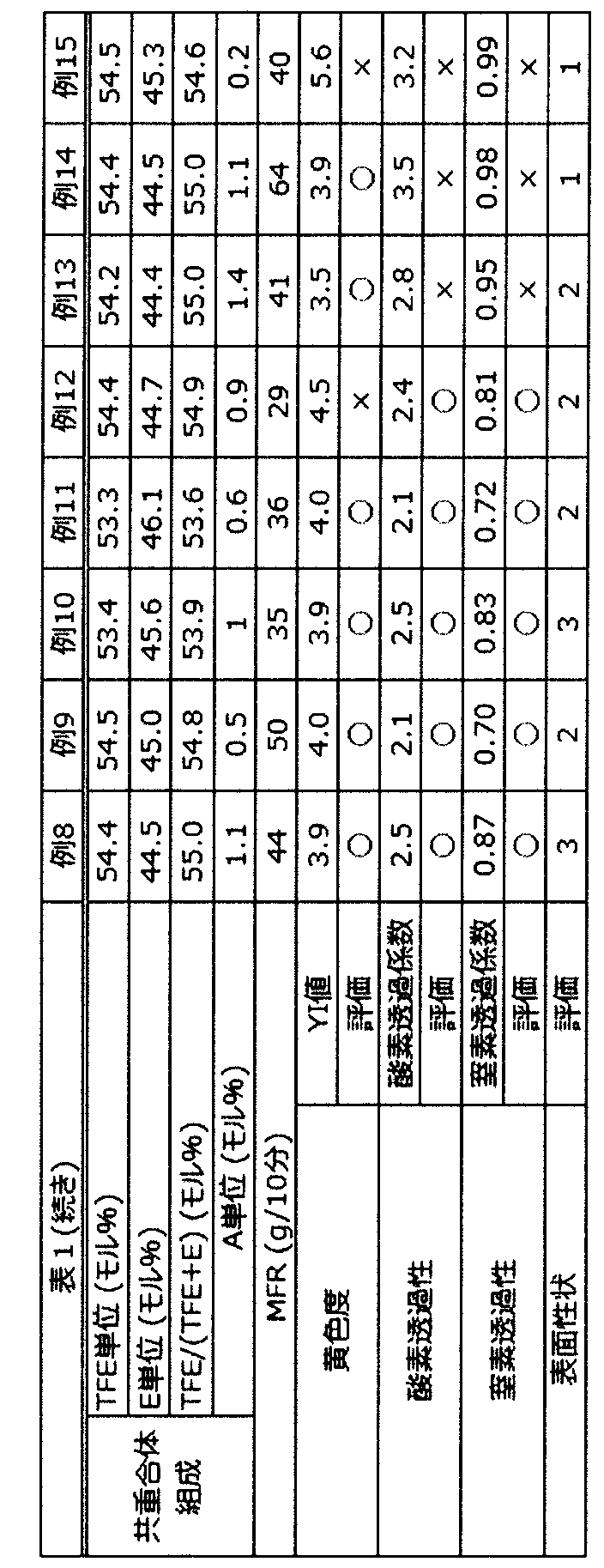
表1に示す通り、TFE単位と、E単位と、A単位と、を含み、TFE単位とE単位との合計含有量が共重合体に含まれる全単位に対して80.0~99.7モル%であり、TFE単位の含有量がTFE単位とE単位との合計含有量に対して49.0モル%以上56.0モル%未満であり、A単位の含有量が共重合体に含まれる全単位に対して0.3~1.3モル%であり、MFRが33~50g/10分である共重合体の使用により、窒素透過性および黄色度が低く、かつ、表面性状にも優れる成形体を形成できることが確認できた(例1~例11)。 As shown in Table 1, it was confirmed that by using a copolymer that contains TFE units, E units, and A units, the total content of TFE units and E units is 80.0 to 99.7 mol% based on the total content of all units contained in the copolymer, the content of TFE units is 49.0 mol% or more and less than 56.0 mol% based on the total content of TFE units and E units, the content of A units is 0.3 to 1.3 mol% based on the total units contained in the copolymer, and the MFR is 33 to 50 g/10 min, it is possible to form a molded article with low nitrogen permeability and yellowness and excellent surface properties (Examples 1 to 11).
表2に、各例の固体組成物の測定結果および評価結果を示す。
表中、「TFE単位(モル%)」欄は、本共重合体に含まれる全単位に対するTFE単位の含有量(単位:モル%)を示す。
「E単位(モル%)」欄は、本共重合体に含まれる全単位に対するE単位の含有量(単位:モル%)を示す。
「TFE/(TFE+E)(モル%)」欄は、TFE単位とE単位の合計含有量に対するTFE単位の含有量(単位:モル%)を示す。
「A単位(モル%)」欄は、本共重合体に含まれる全単位に対するA単位の含有量(単位:モル%)を示す。
Table 2 shows the measurement results and evaluation results of the solid compositions of each example.
In the table, the column "TFE units (mol %)" indicates the content (unit: mol %) of TFE units relative to all units contained in the copolymer.
The column "E units (mol %)" indicates the content (unit: mol %) of E units relative to all units contained in the copolymer.
The column "TFE/(TFE+E) (mol %)" indicates the content of TFE units relative to the total content of TFE units and E units (unit: mol %).
The column "A units (mol %)" indicates the content (unit: mol %) of A units relative to all units contained in the copolymer.
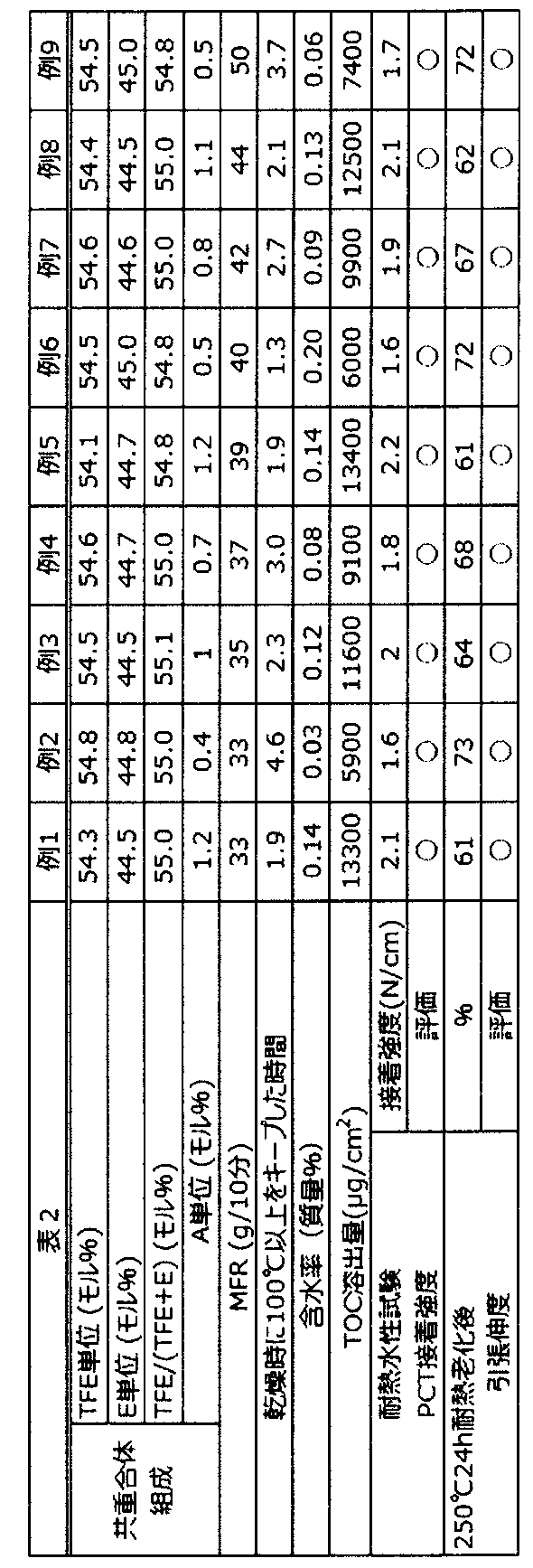
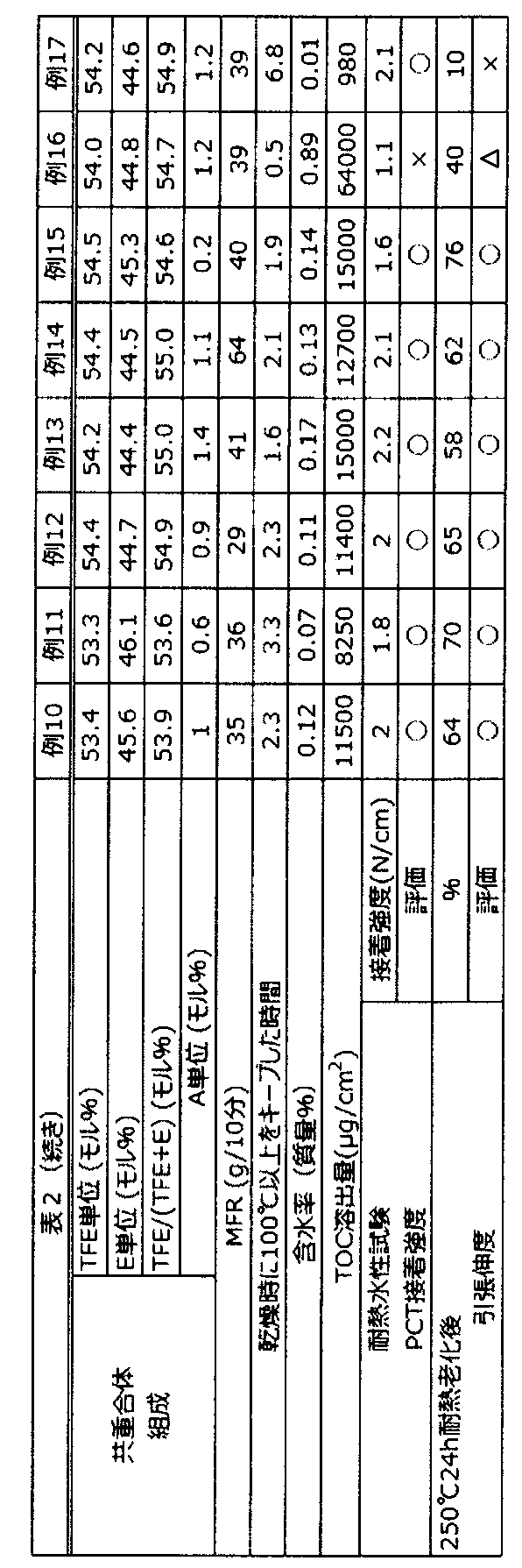
なお、2023年6月16日に出願された日本特許出願2023-099108号の明細書、特許請求の範囲および要約書の全内容をここに引用し、本発明の開示として取り入れるものである。 The entire contents of the specification, claims and abstract of Japanese Patent Application No. 2023-099108, filed on June 16, 2023, are hereby incorporated by reference as the disclosure of the present invention.
Claims (8)
前記テトラフルオロエチレンに基づく単位と前記エチレンに基づく単位との合計含有量が、前記共重合体に含まれる全単位に対して80.0~99.7モル%であり、
前記テトラフルオロエチレンに基づく単位の含有量が、前記テトラフルオロエチレンに基づく単位と前記エチレンに基づく単位との合計含有量に対して49.0モル%以上56.0モル%未満であり、
式(1)で表される化合物または式(2)で表される化合物に基づく単位の含有量が、前記共重合体に含まれる全単位に対して0.3~1.3モル%であり、
ASTM D3159に準拠して、温度297℃、荷重49Nの条件下で測定されるメルトフローレートが33~50g/10分であることを特徴とする、共重合体。
CZ2=CX(CF2)mY 式(1)
CF2=CF-O-(CF2)nF 式(2)
式(1)中、X、YおよびZは、それぞれ独立に、水素原子またはフッ素原子を表し、mは、2~6の整数を表す。
式(2)中、nは、1~6の整数を表す。 A copolymer comprising a unit based on tetrafluoroethylene, a unit based on ethylene, and either or both of a unit based on a compound represented by formula (1) and a unit based on a compound represented by formula (2),
the total content of the units based on tetrafluoroethylene and the units based on ethylene is 80.0 to 99.7 mol % based on all units contained in the copolymer,
the content of the units based on tetrafluoroethylene is 49.0 mol % or more and less than 56.0 mol % with respect to the total content of the units based on tetrafluoroethylene and the units based on ethylene,
the content of units based on the compound represented by formula (1) or the compound represented by formula (2) is 0.3 to 1.3 mol % based on all units contained in the copolymer,
A copolymer having a melt flow rate of 33 to 50 g/10 min, as measured in accordance with ASTM D3159 under conditions of a temperature of 297° C. and a load of 49 N.
CZ 2 =CX(CF 2 ) m Y Formula (1)
CF 2 =CF-O-(CF 2 ) n F Formula (2)
In formula (1), X, Y and Z each independently represent a hydrogen atom or a fluorine atom, and m represents an integer of 2 to 6.
In formula (2), n represents an integer of 1 to 6.
前記式(1)で表される化合物に基づく単位の含有量が、前記共重合体に含まれる全単位に対して0.3~1.3モル%である、請求項1に記載の共重合体。 A copolymer comprising a unit based on the tetrafluoroethylene, a unit based on the ethylene, and a unit based on the compound represented by formula (1),
The copolymer according to claim 1, wherein the content of the units based on the compound represented by formula (1) is 0.3 to 1.3 mol % based on all units contained in the copolymer.
Priority Applications (2)
| Application Number | Priority Date | Filing Date | Title |
|---|---|---|---|
| CN202480039121.9A CN121311515A (en) | 2023-06-16 | 2024-06-14 | copolymers, compositions and molded articles |
| JP2025528024A JPWO2024257869A1 (en) | 2023-06-16 | 2024-06-14 |
Applications Claiming Priority (2)
| Application Number | Priority Date | Filing Date | Title |
|---|---|---|---|
| JP2023099108 | 2023-06-16 | ||
| JP2023-099108 | 2023-06-16 |
Publications (1)
| Publication Number | Publication Date |
|---|---|
| WO2024257869A1 true WO2024257869A1 (en) | 2024-12-19 |
Family
ID=93852205
Family Applications (1)
| Application Number | Title | Priority Date | Filing Date |
|---|---|---|---|
| PCT/JP2024/021742 Ceased WO2024257869A1 (en) | 2023-06-16 | 2024-06-14 | Copolymer, composition, and molded article |
Country Status (3)
| Country | Link |
|---|---|
| JP (1) | JPWO2024257869A1 (en) |
| CN (1) | CN121311515A (en) |
| WO (1) | WO2024257869A1 (en) |
Citations (10)
| Publication number | Priority date | Publication date | Assignee | Title |
|---|---|---|---|---|
| JPS4919709B1 (en) * | 1970-01-20 | 1974-05-20 | ||
| DE4131746A1 (en) * | 1991-09-24 | 1993-03-25 | Hoechst Ag | FIBERS FROM TETRAFLUORETHYLENE COPOLYMERS, METHOD FOR THE PRODUCTION AND USE THEREOF |
| WO2010123002A1 (en) * | 2009-04-21 | 2010-10-28 | ダイキン工業株式会社 | Ethylene/tetrafluoroethylene copolymer, electrical wire, and fluorine resin powder for rotational molding |
| WO2013146704A1 (en) * | 2012-03-26 | 2013-10-03 | 旭硝子株式会社 | Fluorine-containing elastomer composition, method for producing same, molded body, crosslinked product, and covered wire |
| WO2017018353A1 (en) * | 2015-07-28 | 2017-02-02 | 旭硝子株式会社 | Copolymer, method for producing same, resin material for electric wire sheathing, and electric wire |
| WO2017082417A1 (en) * | 2015-11-13 | 2017-05-18 | 旭硝子株式会社 | Copolymer and composition containing same |
| WO2018008562A1 (en) * | 2016-07-04 | 2018-01-11 | 旭硝子株式会社 | Ethylene-tetrafluoroethylene copolymer film and method for producing same |
| WO2018008563A1 (en) * | 2016-07-04 | 2018-01-11 | 旭硝子株式会社 | Film and method for producing same |
| JP2021067338A (en) * | 2019-10-25 | 2021-04-30 | Agc株式会社 | Lamination hose |
| WO2022138768A1 (en) * | 2020-12-24 | 2022-06-30 | ダイキン工業株式会社 | Method for producing fluoropolymer |
-
2024
- 2024-06-14 CN CN202480039121.9A patent/CN121311515A/en active Pending
- 2024-06-14 WO PCT/JP2024/021742 patent/WO2024257869A1/en not_active Ceased
- 2024-06-14 JP JP2025528024A patent/JPWO2024257869A1/ja active Pending
Patent Citations (10)
| Publication number | Priority date | Publication date | Assignee | Title |
|---|---|---|---|---|
| JPS4919709B1 (en) * | 1970-01-20 | 1974-05-20 | ||
| DE4131746A1 (en) * | 1991-09-24 | 1993-03-25 | Hoechst Ag | FIBERS FROM TETRAFLUORETHYLENE COPOLYMERS, METHOD FOR THE PRODUCTION AND USE THEREOF |
| WO2010123002A1 (en) * | 2009-04-21 | 2010-10-28 | ダイキン工業株式会社 | Ethylene/tetrafluoroethylene copolymer, electrical wire, and fluorine resin powder for rotational molding |
| WO2013146704A1 (en) * | 2012-03-26 | 2013-10-03 | 旭硝子株式会社 | Fluorine-containing elastomer composition, method for producing same, molded body, crosslinked product, and covered wire |
| WO2017018353A1 (en) * | 2015-07-28 | 2017-02-02 | 旭硝子株式会社 | Copolymer, method for producing same, resin material for electric wire sheathing, and electric wire |
| WO2017082417A1 (en) * | 2015-11-13 | 2017-05-18 | 旭硝子株式会社 | Copolymer and composition containing same |
| WO2018008562A1 (en) * | 2016-07-04 | 2018-01-11 | 旭硝子株式会社 | Ethylene-tetrafluoroethylene copolymer film and method for producing same |
| WO2018008563A1 (en) * | 2016-07-04 | 2018-01-11 | 旭硝子株式会社 | Film and method for producing same |
| JP2021067338A (en) * | 2019-10-25 | 2021-04-30 | Agc株式会社 | Lamination hose |
| WO2022138768A1 (en) * | 2020-12-24 | 2022-06-30 | ダイキン工業株式会社 | Method for producing fluoropolymer |
Also Published As
| Publication number | Publication date |
|---|---|
| CN121311515A (en) | 2026-01-09 |
| JPWO2024257869A1 (en) | 2024-12-19 |
Similar Documents
| Publication | Publication Date | Title |
|---|---|---|
| EP2940049B1 (en) | Production method for polyvinylidene fluoride aqueous dispersion liquid, and polyvinylidene fluoride aqueous dispersion liquid | |
| WO2017082417A1 (en) | Copolymer and composition containing same | |
| JP7236012B2 (en) | fluorine-containing copolymer | |
| WO2024257865A1 (en) | Copolymer, composition, and molded body | |
| JPWO2001034666A1 (en) | Vulcanizable fluorine-containing elastomer composition | |
| WO2024257869A1 (en) | Copolymer, composition, and molded article | |
| JP5211497B2 (en) | Fluororesin composition and fluororesin molded body | |
| WO2024257868A1 (en) | Copolymer, composition, and molded article | |
| JP5338307B2 (en) | Method for producing fluorine-containing copolymer film | |
| WO2026048681A1 (en) | Solid composition, method for producing solid composition, and molded body | |
| WO2026048678A1 (en) | Method for producing copolymer and method for producing molded body | |
| WO2025142862A1 (en) | Solid matter, composition, and molded body | |
| JP6870794B1 (en) | Copolymer | |
| WO2025142865A1 (en) | Solid material, composition, and molded body | |
| RU2789215C1 (en) | Fluorine-containing copolymer | |
| WO2025239449A1 (en) | Copolymer, composition, and molded body | |
| WO2025047749A1 (en) | Copolymer, composition, extrusion-molded object, blow-molded object, transfer-molded object, coated electrical wire, and molded object | |
| WO2026048680A1 (en) | Pellet, method for producing pellet, and molded body | |
| TW202511318A (en) | Copolymer, composition, extrusion molded article, blow molded article, transfer molded article, coated wire and molded article | |
| TW202511317A (en) | Copolymer, composition, extrusion molded article, blow molded article, transfer molded article, coated wire and molded article | |
| JP2017020014A (en) | Fluorine resin | |
| WO2025254138A1 (en) | Solid composition, extrusion molded article, blow molded article, transfer molded article, press molded article, injection molded article, coated electric wire, and molded article | |
| WO2025192516A1 (en) | Production method for solid product | |
| WO2025254137A1 (en) | Solid composition, extrusion molded article, blow molded article, transfer molded article, press molded article, injection molded article, coated electric wire, and molded article | |
| WO2025173746A1 (en) | Method for producing fluoropolymer |
Legal Events
| Date | Code | Title | Description |
|---|---|---|---|
| 121 | Ep: the epo has been informed by wipo that ep was designated in this application |
Ref document number: 24823482 Country of ref document: EP Kind code of ref document: A1 |
|
| WWE | Wipo information: entry into national phase |
Ref document number: 202517111146 Country of ref document: IN |
|
| ENP | Entry into the national phase |
Ref document number: 2025528024 Country of ref document: JP Kind code of ref document: A |
|
| WWP | Wipo information: published in national office |
Ref document number: 202517111146 Country of ref document: IN |
|
| NENP | Non-entry into the national phase |
Ref country code: DE |