WO2025075183A1 - Pansement pour orifice vc - Google Patents
Pansement pour orifice vc Download PDFInfo
- Publication number
- WO2025075183A1 WO2025075183A1 PCT/JP2024/035704 JP2024035704W WO2025075183A1 WO 2025075183 A1 WO2025075183 A1 WO 2025075183A1 JP 2024035704 W JP2024035704 W JP 2024035704W WO 2025075183 A1 WO2025075183 A1 WO 2025075183A1
- Authority
- WO
- WIPO (PCT)
- Prior art keywords
- nonwoven fabric
- port
- base layer
- width
- dressing
- Prior art date
- Legal status (The legal status is an assumption and is not a legal conclusion. Google has not performed a legal analysis and makes no representation as to the accuracy of the status listed.)
- Pending
Links
Images



Classifications
-
- A—HUMAN NECESSITIES
- A61—MEDICAL OR VETERINARY SCIENCE; HYGIENE
- A61F—FILTERS IMPLANTABLE INTO BLOOD VESSELS; PROSTHESES; DEVICES PROVIDING PATENCY TO, OR PREVENTING COLLAPSING OF, TUBULAR STRUCTURES OF THE BODY, e.g. STENTS; ORTHOPAEDIC, NURSING OR CONTRACEPTIVE DEVICES; FOMENTATION; TREATMENT OR PROTECTION OF EYES OR EARS; BANDAGES, DRESSINGS OR ABSORBENT PADS; FIRST-AID KITS
- A61F13/00—Bandages or dressings; Absorbent pads
- A61F13/02—Adhesive bandages or dressings
Definitions
- the present invention relates to a dressing for a CV port.
- CV ports are known to be implanted in the human body to administer medicines into the central vein or to administer necessary nutrients intravenously.
- CV port refers to a subcutaneously implanted central venous access port, and consists of a roughly circular container with a diameter of 2 to 3 cm when viewed from above, and a septum made of silicone rubber that functions as a lid for the container. A specially designed Huber needle is inserted into the septum, and the specified medication is poured into the container. The container is further connected to a catheter, and the medication is supplied to the body via this catheter.
- Patent documents 1 and 2 disclose examples of conventional film dressings.
- the present invention was made in consideration of the above circumstances, and aims to provide a CV port dressing that can effectively fix a Huber needle for CV port users.
- the CV port dressing of the present invention is a CV port dressing having a base layer having a first adhesive layer on one side of the film, a release sheet releasably laminated covering the surface of the first adhesive layer, and a nonwoven fabric sheet laminated on the side of the base layer opposite the first adhesive layer, wherein the nonwoven fabric sheet is attached to the film by providing a second adhesive layer on one side of the nonwoven fabric having a perforated shape, a window portion is formed by the perforated portion of the nonwoven fabric sheet, the release sheet is capable of dividing the release sheet into a first portion, a second portion, and a third portion, the second portion is in the shape of a strip that crosses the perforated portion of the nonwoven fabric, the first portion and the third portion are arranged on both sides of the second portion so that the second portion is in the center, the width of the second portion is 20 to 80 mm excluding the width of the portion that overlaps with the first portion or the third portion, the size of the window portion consisting of the perforated portion is
- the base layer is preferably a urethane film or a polyethylene film.
- the substrate layer is preferably circular or elliptical in shape.
- the nonwoven fabric is preferably a PET nonwoven fabric or a urethane nonwoven fabric.
- the base material layer and the nonwoven fabric sheet may be of the same circular shape, the diameter of which is 70 to 170 mm, and the diameter of the perforated portion may be 60 mm or more.
- the base material layer and the nonwoven fabric sheet may have the same elliptical shape, the lengths of the major axis and minor axis of the ellipse are 70 to 170 mm, and the lengths of the major axis and minor axis of the perforated portion may be 60 mm or more.
- the first adhesive layer may be a urethane adhesive or an acrylic adhesive.
- the bulge of the Huber needle and the flexibility of the film allow the dressing to be naturally applied up to the tube of the Huber needle, resulting in a natural ⁇ -application. This keeps the Huber needle safety device and tube in a straight line at a constant height, reducing the wobbling of the Huber needle, which is an issue when securing a CV port.
- FIG. 2 is a plan view of a CV port dressing according to the first embodiment.
- 1 is a cross-sectional view of a CV port dressing according to a first embodiment.
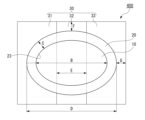
- FIG. FIG. 11 is a plan view of a CV port dressing according to a second embodiment. 1 is a cross-sectional view of a CV port dressing according to a second embodiment.
- FIG. FIG. 11 is a plan view of a CV port dressing according to a third embodiment.
- FIG. 11 is a cross-sectional view of a CV port dressing according to a third embodiment.
- FIG. 13 is a plan view of a CV port dressing according to a fourth embodiment.
- FIG. 1 and 2 show a CV port dressing 100 according to a first embodiment.
- 3 and 4 show a CV port dressing 200 according to a second embodiment.
- 5 and 6 show a CV port dressing 300 according to a third embodiment.
- 7 and 8 show a CV port dressing 400 according to a fourth embodiment.
- the nonwoven fabric sheet 20 is attached to the film 11 by providing a second adhesive layer 22 on one side of the perforated nonwoven fabric 21.
- the perforated portion 23 of the nonwoven fabric 21 penetrates the nonwoven fabric sheet 20, including the thickness region of the second adhesive layer 22.
- the perforated portion 23 forms a single through hole in the center of the planar shape of the base material layer 10, excluding the outer edge, and a window portion is formed by the perforated portion 23.
- the nonwoven fabric sheet 20 is laminated only to the outer edge of the base material layer 10 on surface 11b, reinforcing the outer edge of the base material layer 10.
- the planar shape of the base layer 10 is circular.
- the planar shape of the base layer 10 is elliptical (horizontally elongated when facing the screen in Figs. 5 and 6).
- the planar shape of the base layer 10 may be a quadrangle such as a square or a rectangle, other polygons, an oval, or the like.
- the planar shape is a polygon such as a quadrangle, the portions corresponding to the vertices of the polygon may be rounded.
- a circular or elliptical shape is preferable.
- a circular shape refers to a planar shape in which all distances from the center to the periphery are equal.
- the term "elliptical shape” includes a planar shape formed by a curve made up of a set of points where the sum of the distances from two fixed points on a plane is constant, a planar shape formed by an ellipse formed by connecting two semicircles of the same radius with two parallel tangents, and a shape that is slightly deformed from a true ellipse (almost elliptical shape).
- the planar shape of the inner periphery side of the base layer 10 may be similar or dissimilar to the planar shape of the outer periphery side of the base layer 10, but as in the illustrated example of the base layer 10, it is preferable that the planar shapes of the outer periphery side and the inner periphery side are concentric circular shapes (Figs. 1 and 3) or concentric elliptical shapes (Figs. 5 and 7). Furthermore, the planar shape of the inner periphery side may be concentric with the planar shape of the outer periphery side, or may be eccentric.
- the center of the planar shape may be determined, for example, by the position of the center of gravity.
- the length of the second portion 32 extends along the diameter direction of the circular base layer 10 of the first and second embodiments (FIGS. 2 and 4), and extends along the minor axis direction of the elliptical base layer 10 of the third and fourth embodiments (FIGS. 6 and 8).
- the width of the second portion 32 (horizontal direction in each figure) is approximately constant along the diameter direction of the circular base layer 10 or the minor axis direction of the elliptical base layer 10 in the illustrated example, but the width may vary within the above-mentioned range. For example, the width may gradually increase or decrease from one end to the other end in the diameter direction. The width may gradually increase and then decrease beyond the center.
- the width of the first portion 31 and the width of the third portion 33 may be the same as each other or may differ from each other.
- the material of the release sheet 30 is not particularly limited as long as it has a certain degree of stiffness (thickness) for ease of handling, and release sheets and release films commonly used in the field of adhesive materials can be used.
- release sheets and release films commonly used in the field of adhesive materials can be used.
- paper base materials such as high-quality paper and glassine paper that have been treated with silicone release, and polyester films can be used.
- the thickness of the release sheet 30 can be set to 20 to 300 ⁇ m, and is preferably 30 to 200 ⁇ m.
- the film 11 of the base layer 10 is preferably a transparent or semi-transparent film that allows the user to visually check the state of the Huber needle retention after the dressing is placed, and is preferably a urethane film or a polyethylene film that has appropriate flexibility and stretchability so that it can conform to the skin surface. These films are flexible and have excellent deformability and conformability required for the CV port dressings 100, 200, 300, and 400.
- the thickness of the film 11 of the base layer 10 is preferably 5 to 100 g/ m2 , more preferably 10 to 80 g/ m2 .
- nonwoven fabric 21 Various types of fibers can be used for the nonwoven fabric 21, such as natural fibers, synthetic fibers, regenerated fibers, or an appropriate combination of these.
- acrylic nonwoven fabric, polyamide nonwoven fabric, PET nonwoven fabric, polyurethane nonwoven fabric, etc. can be used, and the use of PET nonwoven fabric and polyurethane nonwoven fabric is often preferable in terms of moderate extensibility and compatibility with the skin surface.
- the basis weight of the nonwoven fabric is not particularly limited as long as it is within the range of basis weights of nonwoven fabrics generally used as substrates for pressure-sensitive adhesive tapes, but it is often preferable to set it to about 30 to 150 g/ m2 , and more preferably 40 to 100 g/ m2 .
- PET means polyethylene terephthalate.
- first adhesive layer 12 A variety of adhesives can be used for the base layer 10 (first adhesive layer 12), including natural rubber, synthetic rubber, acrylic, urethane, vinyl ether, and silicone.
- first adhesive layer 12 As the base layer 10 provided with this first adhesive layer 12 is to be attached to the skin as described below, it is preferable for the adhesive to have sufficient adhesion to the skin surface, be minimally irritating to the skin, and have a certain degree of moisture permeability. For these reasons, it is often preferable to use a urethane-based adhesive or an acrylic-based adhesive.
- the polyol is not particularly limited, but examples thereof include hydroxy compounds, amine compounds, carboxylic acid compounds, thiol compounds, polyether polyols having hydroxy groups, etc.
- hydroxy compounds include ethylene glycol, diethylene glycol, propylene glycol, dipropylene glycol, tripropylene glycol, 1,3-propanediol, 1,3-butanediol, 1,4-butanediol, 2,3-butanediol, 1,6-hexanediol, 1,9-nonanediol, 2,5-hexanediol, 1,3-cyclohexanediol, 2-methylpentane-2,4-diol, 2,5-dimethyl-2,5-hexanediol, glycerin, trimethylolpropane, hexanetriol, pentaerythritol, diglycerin, sorbitol, sucrose
- Examples of amine compounds include ethylenediamine, 1,3-propylenediamine, 1,4-butylenediamine, and 1,2-butylenediamine.
- Examples of carboxylic acid compounds include phthalic acid and adipic acid.
- Examples of thiol compounds include ethanedithiol and butanedithiol.
- Examples of polyether polyols having hydroxyl groups include polyether polyols having a molecular weight of 200 or more and 10,000 or less.
- polyisocyanate a compound having at least two isocyanate groups can be used, but there is no particular limitation.
- isocyanate-containing urethane prepolymers obtained by reacting these with polyols include isocyanate-containing urethane prepoly
- any adhesive that has sufficient adhesion to the base layer 10 can be used, so various types of adhesives can be used, including natural rubber, synthetic rubber, acrylic, urethane, vinyl ether, and silicone.
- first portion 31 and third portion 33 can be peeled off and attached to the installation surface of the CV port (such as the surface of the skin) or around the Huber needle. It is preferable to first peel off either first portion 31 or third portion 33 (either the left or right side of second portion 32) and attach the exposed adhesive surface to a Huber needle, etc., and then peel off the remaining other portion of first portion 31 and third portion 33 and attach the exposed adhesive surface to a Huber needle, etc.
- the film 11 of the base layer 10 is thin and soft, and the nonwoven fabric sheet 20 is laminated around the base layer 10. Furthermore, the release sheet 30 can be divided into three pieces, so that when the adhesive surface is applied, an ⁇ -type application is naturally achieved, preventing the tube portion from touching the skin for a long period of time.
- the ⁇ -type application allows the tube to be at the same height as the installation surface of the CV port, and furthermore, the Huber needle tube is maintained at the same height as the top of the CV port implantation site, reducing the needle wobble that is an issue with fixing the Huber needle.
- the planar shape of the release sheet 30 is the same as the planar shape of the base layer 10.
- the outer periphery may be punched out all at once while the base layer 10, the nonwoven fabric sheet 20, and the release sheet 30 are overlapped.
- the first part 31 and the third part 33 have folded parts 31a, 33a, and the second part 32 has an overlapping part 32a that is overlapped on the first part 31 or the third part 33.
- the overlapping part 32a By pinching the overlapping part 32a, the second part 32 can be easily peeled off.
- the folded parts 31a, 33a the first part 31 and the third part 33 can be easily peeled off.
- the product size (e.g., dimension D in Figs. 1 and 3 and Figs. 5 and 7) is preferably 70 mm or more and 170 mm or less, and more preferably 80 mm or more and 150 mm or less. If the product size is less than the lower limit, the size of the window portion (i.e., perforated portion 23) (e.g., dimension B in Figs. 1 to 4 and dimension B in Figs. 5 to 7) will be smaller than that of a Huber needle, which is not preferred. If the product size exceeds the upper limit, for example when a CV port is placed in the anterior chest, the product size will be so large that it will cover the clavicle and chest, which is not preferred.
- the window portion i.e., perforated portion 23
- the product size exceeds the upper limit, for example when a CV port is placed in the anterior chest, the product size will be so large that it will cover the clavicle and chest, which is not preferred.
- the nonwoven fabric constituting the support of the nonwoven fabric sheet was a PET nonwoven fabric (85% polyethylene short fiber, 15% polyester fiber) with a basis weight of 42.5 g/ m2 or a thermoplastic polyurethane nonwoven fabric (100%, polyester-based polyurethane) with a basis weight of 98 g/ m2 , and an acrylic adhesive was used as the adhesive for the nonwoven fabric sheet.
- the release sheets (3 sheets) were made of silicone-treated polyethylene laminated fine paper. A cutting line was provided on one release sheet to create a 3-sheet structure.
- the outer periphery of the base layer was a circle with a diameter of 120 mm
- the inner periphery (perforated portion) of the base layer was a circle with a diameter of 95 mm.
- the width of the nonwoven fabric sheet around the perforated portion was 12.5 mm.
- the major axis of the outer periphery of the base layer was 120 mm long and the minor axis was 85 mm long
- the inner periphery (perforated portion) of the base layer was 90 mm long and 60 mm long.
- the width of the nonwoven fabric sheet around the perforated portion was 12.5 mm.
- the thickness in Table 1 indicates the thickness of the base film, except for commercial product A, which shows the thickness including the adhesive.
- Table 2 also shows the ease of ⁇ attachment and the degree of wobbling when the product size (e.g., dimension D in Figures 1 and 3), window size (e.g., dimension B in Figures 1 and 3), and window width (e.g., dimension C in Figures 1 and 3) are changed when the release sheet width is 40 mm (product shape: circular; similar results were obtained regardless of the planar shape of the release sheet, whether the planar shape of the release sheet is the same as the planar shape of the base layer (e.g., the first embodiment) or larger than the planar shape of the base layer (e.g., the second embodiment)).
- product size e.g., dimension D in Figures 1 and 3
- window size e.g., dimension B in Figures 1 and 3
- window width e.g., dimension C in Figures 1 and 3
- the CV port dressing of the present invention can be used to fix a CV port.
- the CV port can be used in methods of surgery, treatment, or diagnosis of humans.
Landscapes
- Health & Medical Sciences (AREA)
- Engineering & Computer Science (AREA)
- Biomedical Technology (AREA)
- Heart & Thoracic Surgery (AREA)
- Vascular Medicine (AREA)
- Life Sciences & Earth Sciences (AREA)
- Animal Behavior & Ethology (AREA)
- General Health & Medical Sciences (AREA)
- Public Health (AREA)
- Veterinary Medicine (AREA)
- Materials For Medical Uses (AREA)
Abstract
La présente invention comprend : une couche de matériau de base (10) dans laquelle une première couche adhésive est disposée sur une surface d'un film ; une feuille de libération (30) qui est stratifiée de manière amovible pour recouvrir la surface de la première couche adhésive ; et une feuille de tissu non tissé (20) qui est stratifiée sur le côté de surface de la couche de matériau de base qui est opposée à la première couche adhésive. La feuille de tissu non tissé (20) est fixée au film en fournissant une seconde couche adhésive sur une surface d'un tissu non tissé ayant un creux formé à l'intérieur de celle-ci, et une section fenêtre est formée par une section creuse (23) de la feuille de tissu non tissé. La feuille de libération (30) peut être séparée en une première partie (31), une deuxième partie (32) et une troisième partie (33), et la deuxième partie (32) se présente sous la forme d'une bande qui croise la section creuse (23). La première partie (31) et la troisième partie (33) sont disposées des deux côtés de la deuxième partie (32), et la largeur (E) de la deuxième partie est de 20 à 80 mm, sans inclure la largeur d'une partie chevauchant la première partie ou la troisième partie. La taille (B) de la section fenêtre formée par la section creuse (23) est de 60 mm ou plus, et la largeur (C) de la feuille de tissu non tissé autour de la section creuse (23) est de 10 mm ou plus.
Priority Applications (1)
| Application Number | Priority Date | Filing Date | Title |
|---|---|---|---|
| CN202480063344.9A CN121969342A (zh) | 2023-10-04 | 2024-10-04 | Cv港用敷料 |
Applications Claiming Priority (2)
| Application Number | Priority Date | Filing Date | Title |
|---|---|---|---|
| PCT/JP2023/036278 WO2025074551A1 (fr) | 2023-10-04 | 2023-10-04 | Pansement pour orifices cv |
| JPPCT/JP2023/036278 | 2023-10-04 |
Publications (1)
| Publication Number | Publication Date |
|---|---|
| WO2025075183A1 true WO2025075183A1 (fr) | 2025-04-10 |
Family
ID=95282917
Family Applications (2)
| Application Number | Title | Priority Date | Filing Date |
|---|---|---|---|
| PCT/JP2023/036278 Pending WO2025074551A1 (fr) | 2023-10-04 | 2023-10-04 | Pansement pour orifices cv |
| PCT/JP2024/035704 Pending WO2025075183A1 (fr) | 2023-10-04 | 2024-10-04 | Pansement pour orifice vc |
Family Applications Before (1)
| Application Number | Title | Priority Date | Filing Date |
|---|---|---|---|
| PCT/JP2023/036278 Pending WO2025074551A1 (fr) | 2023-10-04 | 2023-10-04 | Pansement pour orifices cv |
Country Status (2)
| Country | Link |
|---|---|
| CN (1) | CN121969342A (fr) |
| WO (2) | WO2025074551A1 (fr) |
Families Citing this family (1)
| Publication number | Priority date | Publication date | Assignee | Title |
|---|---|---|---|---|
| CN120308414B (zh) * | 2025-06-16 | 2025-11-18 | 山东华滋自动化技术股份有限公司 | 敷料贴生产设备及其生产工艺 |
Citations (5)
| Publication number | Priority date | Publication date | Assignee | Title |
|---|---|---|---|---|
| US20040077984A1 (en) * | 2002-10-22 | 2004-04-22 | George Worthley | Dressing and a method for making and applying a dressing |
| JP2008183244A (ja) * | 2007-01-30 | 2008-08-14 | Alcare Co Ltd | カテーテル固定具 |
| JP2012143654A (ja) * | 2012-05-11 | 2012-08-02 | Alcare Co Ltd | カテーテル固定用皮膚貼付体 |
| JP2019165881A (ja) * | 2018-03-22 | 2019-10-03 | テルモ株式会社 | 医療用物品固定具 |
| JP2021168904A (ja) * | 2020-04-15 | 2021-10-28 | 学校法人福岡大学 | 皮膚貼付材 |
Family Cites Families (1)
| Publication number | Priority date | Publication date | Assignee | Title |
|---|---|---|---|---|
| JP6034637B2 (ja) * | 2012-09-28 | 2016-11-30 | ニチバン株式会社 | 窓付きカテーテル固定用貼付材 |
-
2023
- 2023-10-04 WO PCT/JP2023/036278 patent/WO2025074551A1/fr active Pending
-
2024
- 2024-10-04 CN CN202480063344.9A patent/CN121969342A/zh active Pending
- 2024-10-04 WO PCT/JP2024/035704 patent/WO2025075183A1/fr active Pending
Patent Citations (5)
| Publication number | Priority date | Publication date | Assignee | Title |
|---|---|---|---|---|
| US20040077984A1 (en) * | 2002-10-22 | 2004-04-22 | George Worthley | Dressing and a method for making and applying a dressing |
| JP2008183244A (ja) * | 2007-01-30 | 2008-08-14 | Alcare Co Ltd | カテーテル固定具 |
| JP2012143654A (ja) * | 2012-05-11 | 2012-08-02 | Alcare Co Ltd | カテーテル固定用皮膚貼付体 |
| JP2019165881A (ja) * | 2018-03-22 | 2019-10-03 | テルモ株式会社 | 医療用物品固定具 |
| JP2021168904A (ja) * | 2020-04-15 | 2021-10-28 | 学校法人福岡大学 | 皮膚貼付材 |
Also Published As
| Publication number | Publication date |
|---|---|
| WO2025074551A1 (fr) | 2025-04-10 |
| CN121969342A (zh) | 2026-05-01 |
Similar Documents
| Publication | Publication Date | Title |
|---|---|---|
| US5599289A (en) | Medical dressing with semi-peripheral delivery system | |
| US11247025B2 (en) | Medical dressing comprising a flap | |
| ES2398668T3 (es) | Apósito de película delgada | |
| US4753232A (en) | Adhesive wound dressings | |
| EP3694457A1 (fr) | Pansement de fixation à bordure conformable | |
| EP3337547B1 (fr) | Systèmes de fixation d'un tube nasogastrique | |
| US20250143929A1 (en) | Medical dressings with stiffening systems | |
| AU716270B2 (en) | Wound dressing | |
| EP3624742B1 (fr) | Dispositif de fixation d'article médical comprenant un polymère viscoélastique | |
| US5087248A (en) | Device for anchoring an intravenous needle | |
| WO2025074551A1 (fr) | Pansement pour orifices cv | |
| WO2015130608A1 (fr) | Pansement | |
| US20080312574A1 (en) | Dressing Provided With a Thin Film Applicator | |
| JP5282834B2 (ja) | カテーテル固定用皮膚貼付体 | |
| US20210346650A1 (en) | Protective Dressing | |
| CN116137810A (zh) | 适形的医用敷料 | |
| US20250144370A1 (en) | Cannula stabilization device | |
| JP7672606B2 (ja) | カテーテル固定具 | |
| EP4041158B1 (fr) | Pansement | |
| KR20250132908A (ko) | 의료용 테이프 | |
| HK1124795B (zh) | 薄膜敷料 |
Legal Events
| Date | Code | Title | Description |
|---|---|---|---|
| 121 | Ep: the epo has been informed by wipo that ep was designated in this application |
Ref document number: 24874782 Country of ref document: EP Kind code of ref document: A1 |
|
| ENP | Entry into the national phase |
Ref document number: 2025550386 Country of ref document: JP Kind code of ref document: A |
|
| WWE | Wipo information: entry into national phase |
Ref document number: 2025550386 Country of ref document: JP |
|
| WWE | Wipo information: entry into national phase |
Ref document number: 2601002377 Country of ref document: TH |