DE69729290T2 - Sternförmig-gepfropfte siloxanpolymere, damit beschichtete keramikpulver, sowie ein verfahren zu deren herstellung - Google Patents
Sternförmig-gepfropfte siloxanpolymere, damit beschichtete keramikpulver, sowie ein verfahren zu deren herstellung Download PDFInfo
- Publication number
- DE69729290T2 DE69729290T2 DE69729290T DE69729290T DE69729290T2 DE 69729290 T2 DE69729290 T2 DE 69729290T2 DE 69729290 T DE69729290 T DE 69729290T DE 69729290 T DE69729290 T DE 69729290T DE 69729290 T2 DE69729290 T2 DE 69729290T2
- Authority
- DE
- Germany
- Prior art keywords
- ceramic
- ceramic powder
- siloxane
- coated
- group
- Prior art date
- Legal status (The legal status is an assumption and is not a legal conclusion. Google has not performed a legal analysis and makes no representation as to the accuracy of the status listed.)
- Expired - Lifetime
Links
Classifications
-
- C—CHEMISTRY; METALLURGY
- C04—CEMENTS; CONCRETE; ARTIFICIAL STONE; CERAMICS; REFRACTORIES
- C04B—LIME, MAGNESIA; SLAG; CEMENTS; COMPOSITIONS THEREOF, e.g. MORTARS, CONCRETE OR LIKE BUILDING MATERIALS; ARTIFICIAL STONE; CERAMICS; REFRACTORIES; TREATMENT OF NATURAL STONE
- C04B35/00—Shaped ceramic products characterised by their composition; Ceramics compositions; Processing powders of inorganic compounds preparatory to the manufacturing of ceramic products
- C04B35/622—Forming processes; Processing powders of inorganic compounds preparatory to the manufacturing of ceramic products
- C04B35/626—Preparing or treating the powders individually or as batches ; preparing or treating macroscopic reinforcing agents for ceramic products, e.g. fibres; mechanical aspects section B
- C04B35/628—Coating the powders or the macroscopic reinforcing agents
- C04B35/62802—Powder coating materials
- C04B35/62805—Oxide ceramics
- C04B35/62807—Silica or silicates
-
- C—CHEMISTRY; METALLURGY
- C04—CEMENTS; CONCRETE; ARTIFICIAL STONE; CERAMICS; REFRACTORIES
- C04B—LIME, MAGNESIA; SLAG; CEMENTS; COMPOSITIONS THEREOF, e.g. MORTARS, CONCRETE OR LIKE BUILDING MATERIALS; ARTIFICIAL STONE; CERAMICS; REFRACTORIES; TREATMENT OF NATURAL STONE
- C04B35/00—Shaped ceramic products characterised by their composition; Ceramics compositions; Processing powders of inorganic compounds preparatory to the manufacturing of ceramic products
- C04B35/622—Forming processes; Processing powders of inorganic compounds preparatory to the manufacturing of ceramic products
- C04B35/626—Preparing or treating the powders individually or as batches ; preparing or treating macroscopic reinforcing agents for ceramic products, e.g. fibres; mechanical aspects section B
- C04B35/628—Coating the powders or the macroscopic reinforcing agents
-
- C—CHEMISTRY; METALLURGY
- C04—CEMENTS; CONCRETE; ARTIFICIAL STONE; CERAMICS; REFRACTORIES
- C04B—LIME, MAGNESIA; SLAG; CEMENTS; COMPOSITIONS THEREOF, e.g. MORTARS, CONCRETE OR LIKE BUILDING MATERIALS; ARTIFICIAL STONE; CERAMICS; REFRACTORIES; TREATMENT OF NATURAL STONE
- C04B35/00—Shaped ceramic products characterised by their composition; Ceramics compositions; Processing powders of inorganic compounds preparatory to the manufacturing of ceramic products
- C04B35/622—Forming processes; Processing powders of inorganic compounds preparatory to the manufacturing of ceramic products
- C04B35/626—Preparing or treating the powders individually or as batches ; preparing or treating macroscopic reinforcing agents for ceramic products, e.g. fibres; mechanical aspects section B
- C04B35/628—Coating the powders or the macroscopic reinforcing agents
- C04B35/62886—Coating the powders or the macroscopic reinforcing agents by wet chemical techniques
-
- C—CHEMISTRY; METALLURGY
- C08—ORGANIC MACROMOLECULAR COMPOUNDS; THEIR PREPARATION OR CHEMICAL WORKING-UP; COMPOSITIONS BASED THEREON
- C08G—MACROMOLECULAR COMPOUNDS OBTAINED OTHERWISE THAN BY REACTIONS ONLY INVOLVING UNSATURATED CARBON-TO-CARBON BONDS
- C08G77/00—Macromolecular compounds obtained by reactions forming a linkage containing silicon with or without sulfur, nitrogen, oxygen or carbon in the main chain of the macromolecule
- C08G77/04—Polysiloxanes
-
- C—CHEMISTRY; METALLURGY
- C08—ORGANIC MACROMOLECULAR COMPOUNDS; THEIR PREPARATION OR CHEMICAL WORKING-UP; COMPOSITIONS BASED THEREON
- C08K—Use of inorganic or non-macromolecular organic substances as compounding ingredients
- C08K9/00—Use of pretreated ingredients
- C08K9/08—Ingredients agglomerated by treatment with a binding agent
-
- C—CHEMISTRY; METALLURGY
- C09—DYES; PAINTS; POLISHES; NATURAL RESINS; ADHESIVES; COMPOSITIONS NOT OTHERWISE PROVIDED FOR; APPLICATIONS OF MATERIALS NOT OTHERWISE PROVIDED FOR
- C09C—TREATMENT OF INORGANIC MATERIALS, OTHER THAN FIBROUS FILLERS, TO ENHANCE THEIR PIGMENTING OR FILLING PROPERTIES ; PREPARATION OF CARBON BLACK ; PREPARATION OF INORGANIC MATERIALS WHICH ARE NO SINGLE CHEMICAL COMPOUNDS AND WHICH ARE MAINLY USED AS PIGMENTS OR FILLERS
- C09C1/00—Treatment of specific inorganic materials other than fibrous fillers; Preparation of carbon black
- C09C1/28—Compounds of silicon
- C09C1/30—Silicic acid
- C09C1/3081—Treatment with organo-silicon compounds
-
- C—CHEMISTRY; METALLURGY
- C09—DYES; PAINTS; POLISHES; NATURAL RESINS; ADHESIVES; COMPOSITIONS NOT OTHERWISE PROVIDED FOR; APPLICATIONS OF MATERIALS NOT OTHERWISE PROVIDED FOR
- C09C—TREATMENT OF INORGANIC MATERIALS, OTHER THAN FIBROUS FILLERS, TO ENHANCE THEIR PIGMENTING OR FILLING PROPERTIES ; PREPARATION OF CARBON BLACK ; PREPARATION OF INORGANIC MATERIALS WHICH ARE NO SINGLE CHEMICAL COMPOUNDS AND WHICH ARE MAINLY USED AS PIGMENTS OR FILLERS
- C09C1/00—Treatment of specific inorganic materials other than fibrous fillers; Preparation of carbon black
- C09C1/36—Compounds of titanium
- C09C1/3607—Titanium dioxide
- C09C1/3684—Treatment with organo-silicon compounds
-
- C—CHEMISTRY; METALLURGY
- C09—DYES; PAINTS; POLISHES; NATURAL RESINS; ADHESIVES; COMPOSITIONS NOT OTHERWISE PROVIDED FOR; APPLICATIONS OF MATERIALS NOT OTHERWISE PROVIDED FOR
- C09C—TREATMENT OF INORGANIC MATERIALS, OTHER THAN FIBROUS FILLERS, TO ENHANCE THEIR PIGMENTING OR FILLING PROPERTIES ; PREPARATION OF CARBON BLACK ; PREPARATION OF INORGANIC MATERIALS WHICH ARE NO SINGLE CHEMICAL COMPOUNDS AND WHICH ARE MAINLY USED AS PIGMENTS OR FILLERS
- C09C3/00—Treatment in general of inorganic materials, other than fibrous fillers, to enhance their pigmenting or filling properties
- C09C3/12—Treatment with organosilicon compounds
-
- C—CHEMISTRY; METALLURGY
- C01—INORGANIC CHEMISTRY
- C01P—INDEXING SCHEME RELATING TO STRUCTURAL AND PHYSICAL ASPECTS OF SOLID INORGANIC COMPOUNDS
- C01P2004/00—Particle morphology
- C01P2004/80—Particles consisting of a mixture of two or more inorganic phases
-
- C—CHEMISTRY; METALLURGY
- C01—INORGANIC CHEMISTRY
- C01P—INDEXING SCHEME RELATING TO STRUCTURAL AND PHYSICAL ASPECTS OF SOLID INORGANIC COMPOUNDS
- C01P2004/00—Particle morphology
- C01P2004/80—Particles consisting of a mixture of two or more inorganic phases
- C01P2004/82—Particles consisting of a mixture of two or more inorganic phases two phases having the same anion, e.g. both oxidic phases
- C01P2004/84—Particles consisting of a mixture of two or more inorganic phases two phases having the same anion, e.g. both oxidic phases one phase coated with the other
-
- C—CHEMISTRY; METALLURGY
- C04—CEMENTS; CONCRETE; ARTIFICIAL STONE; CERAMICS; REFRACTORIES
- C04B—LIME, MAGNESIA; SLAG; CEMENTS; COMPOSITIONS THEREOF, e.g. MORTARS, CONCRETE OR LIKE BUILDING MATERIALS; ARTIFICIAL STONE; CERAMICS; REFRACTORIES; TREATMENT OF NATURAL STONE
- C04B2235/00—Aspects relating to ceramic starting mixtures or sintered ceramic products
- C04B2235/02—Composition of constituents of the starting material or of secondary phases of the final product
- C04B2235/30—Constituents and secondary phases not being of a fibrous nature
- C04B2235/32—Metal oxides, mixed metal oxides, or oxide-forming salts thereof, e.g. carbonates, nitrates, (oxy)hydroxides, chlorides
- C04B2235/3217—Aluminum oxide or oxide forming salts thereof, e.g. bauxite, alpha-alumina
-
- C—CHEMISTRY; METALLURGY
- C04—CEMENTS; CONCRETE; ARTIFICIAL STONE; CERAMICS; REFRACTORIES
- C04B—LIME, MAGNESIA; SLAG; CEMENTS; COMPOSITIONS THEREOF, e.g. MORTARS, CONCRETE OR LIKE BUILDING MATERIALS; ARTIFICIAL STONE; CERAMICS; REFRACTORIES; TREATMENT OF NATURAL STONE
- C04B2235/00—Aspects relating to ceramic starting mixtures or sintered ceramic products
- C04B2235/02—Composition of constituents of the starting material or of secondary phases of the final product
- C04B2235/30—Constituents and secondary phases not being of a fibrous nature
- C04B2235/32—Metal oxides, mixed metal oxides, or oxide-forming salts thereof, e.g. carbonates, nitrates, (oxy)hydroxides, chlorides
- C04B2235/3231—Refractory metal oxides, their mixed metal oxides, or oxide-forming salts thereof
- C04B2235/3232—Titanium oxides or titanates, e.g. rutile or anatase
-
- C—CHEMISTRY; METALLURGY
- C04—CEMENTS; CONCRETE; ARTIFICIAL STONE; CERAMICS; REFRACTORIES
- C04B—LIME, MAGNESIA; SLAG; CEMENTS; COMPOSITIONS THEREOF, e.g. MORTARS, CONCRETE OR LIKE BUILDING MATERIALS; ARTIFICIAL STONE; CERAMICS; REFRACTORIES; TREATMENT OF NATURAL STONE
- C04B2235/00—Aspects relating to ceramic starting mixtures or sintered ceramic products
- C04B2235/02—Composition of constituents of the starting material or of secondary phases of the final product
- C04B2235/30—Constituents and secondary phases not being of a fibrous nature
- C04B2235/32—Metal oxides, mixed metal oxides, or oxide-forming salts thereof, e.g. carbonates, nitrates, (oxy)hydroxides, chlorides
- C04B2235/327—Iron group oxides, their mixed metal oxides, or oxide-forming salts thereof
- C04B2235/3272—Iron oxides or oxide forming salts thereof, e.g. hematite, magnetite
-
- C—CHEMISTRY; METALLURGY
- C04—CEMENTS; CONCRETE; ARTIFICIAL STONE; CERAMICS; REFRACTORIES
- C04B—LIME, MAGNESIA; SLAG; CEMENTS; COMPOSITIONS THEREOF, e.g. MORTARS, CONCRETE OR LIKE BUILDING MATERIALS; ARTIFICIAL STONE; CERAMICS; REFRACTORIES; TREATMENT OF NATURAL STONE
- C04B2235/00—Aspects relating to ceramic starting mixtures or sintered ceramic products
- C04B2235/02—Composition of constituents of the starting material or of secondary phases of the final product
- C04B2235/30—Constituents and secondary phases not being of a fibrous nature
- C04B2235/32—Metal oxides, mixed metal oxides, or oxide-forming salts thereof, e.g. carbonates, nitrates, (oxy)hydroxides, chlorides
- C04B2235/3284—Zinc oxides, zincates, cadmium oxides, cadmiates, mercury oxides, mercurates or oxide forming salts thereof
-
- C—CHEMISTRY; METALLURGY
- C04—CEMENTS; CONCRETE; ARTIFICIAL STONE; CERAMICS; REFRACTORIES
- C04B—LIME, MAGNESIA; SLAG; CEMENTS; COMPOSITIONS THEREOF, e.g. MORTARS, CONCRETE OR LIKE BUILDING MATERIALS; ARTIFICIAL STONE; CERAMICS; REFRACTORIES; TREATMENT OF NATURAL STONE
- C04B2235/00—Aspects relating to ceramic starting mixtures or sintered ceramic products
- C04B2235/02—Composition of constituents of the starting material or of secondary phases of the final product
- C04B2235/30—Constituents and secondary phases not being of a fibrous nature
- C04B2235/34—Non-metal oxides, non-metal mixed oxides, or salts thereof that form the non-metal oxides upon heating, e.g. carbonates, nitrates, (oxy)hydroxides, chlorides
- C04B2235/3418—Silicon oxide, silicic acids or oxide forming salts thereof, e.g. silica sol, fused silica, silica fume, cristobalite, quartz or flint
-
- C—CHEMISTRY; METALLURGY
- C04—CEMENTS; CONCRETE; ARTIFICIAL STONE; CERAMICS; REFRACTORIES
- C04B—LIME, MAGNESIA; SLAG; CEMENTS; COMPOSITIONS THEREOF, e.g. MORTARS, CONCRETE OR LIKE BUILDING MATERIALS; ARTIFICIAL STONE; CERAMICS; REFRACTORIES; TREATMENT OF NATURAL STONE
- C04B2235/00—Aspects relating to ceramic starting mixtures or sintered ceramic products
- C04B2235/02—Composition of constituents of the starting material or of secondary phases of the final product
- C04B2235/30—Constituents and secondary phases not being of a fibrous nature
- C04B2235/48—Organic compounds becoming part of a ceramic after heat treatment, e.g. carbonising phenol resins
- C04B2235/483—Si-containing organic compounds, e.g. silicone resins, (poly)silanes, (poly)siloxanes or (poly)silazanes
-
- Y—GENERAL TAGGING OF NEW TECHNOLOGICAL DEVELOPMENTS; GENERAL TAGGING OF CROSS-SECTIONAL TECHNOLOGIES SPANNING OVER SEVERAL SECTIONS OF THE IPC; TECHNICAL SUBJECTS COVERED BY FORMER USPC CROSS-REFERENCE ART COLLECTIONS [XRACs] AND DIGESTS
- Y10—TECHNICAL SUBJECTS COVERED BY FORMER USPC
- Y10T—TECHNICAL SUBJECTS COVERED BY FORMER US CLASSIFICATION
- Y10T428/00—Stock material or miscellaneous articles
- Y10T428/29—Coated or structually defined flake, particle, cell, strand, strand portion, rod, filament, macroscopic fiber or mass thereof
- Y10T428/2982—Particulate matter [e.g., sphere, flake, etc.]
- Y10T428/2991—Coated
- Y10T428/2993—Silicic or refractory material containing [e.g., tungsten oxide, glass, cement, etc.]
- Y10T428/2995—Silane, siloxane or silicone coating
-
- Y—GENERAL TAGGING OF NEW TECHNOLOGICAL DEVELOPMENTS; GENERAL TAGGING OF CROSS-SECTIONAL TECHNOLOGIES SPANNING OVER SEVERAL SECTIONS OF THE IPC; TECHNICAL SUBJECTS COVERED BY FORMER USPC CROSS-REFERENCE ART COLLECTIONS [XRACs] AND DIGESTS
- Y10—TECHNICAL SUBJECTS COVERED BY FORMER USPC
- Y10T—TECHNICAL SUBJECTS COVERED BY FORMER US CLASSIFICATION
- Y10T428/00—Stock material or miscellaneous articles
- Y10T428/29—Coated or structually defined flake, particle, cell, strand, strand portion, rod, filament, macroscopic fiber or mass thereof
- Y10T428/2982—Particulate matter [e.g., sphere, flake, etc.]
- Y10T428/2991—Coated
- Y10T428/2998—Coated including synthetic resin or polymer
Landscapes
- Chemical & Material Sciences (AREA)
- Engineering & Computer Science (AREA)
- Organic Chemistry (AREA)
- Manufacturing & Machinery (AREA)
- Ceramic Engineering (AREA)
- Structural Engineering (AREA)
- Chemical Kinetics & Catalysis (AREA)
- Inorganic Chemistry (AREA)
- Materials Engineering (AREA)
- Health & Medical Sciences (AREA)
- Medicinal Chemistry (AREA)
- Polymers & Plastics (AREA)
- General Chemical & Material Sciences (AREA)
- Silicon Polymers (AREA)
- Pigments, Carbon Blacks, Or Wood Stains (AREA)
- Glanulating (AREA)
- Compositions Of Macromolecular Compounds (AREA)
- Other Resins Obtained By Reactions Not Involving Carbon-To-Carbon Unsaturated Bonds (AREA)
- Oxygen, Ozone, And Oxides In General (AREA)
- Processes Of Treating Macromolecular Substances (AREA)
- Compounds Of Iron (AREA)
- Inorganic Compounds Of Heavy Metals (AREA)
- Silicon Compounds (AREA)
- Compounds Of Alkaline-Earth Elements, Aluminum Or Rare-Earth Metals (AREA)
Description
- Gebiet der Erfindung
- Die vorliegende Erfindung betrifft keramische Pulverbeschichtungen. Insbesondere betrifft diese Erfindung sternförmig gepfropfte Siloxanpolymere zur Beschichtung keramischer Pulver, um so die Dispergierung derartiger Pulver in Ölen, Polymeren und Wasser zu ermöglichen.
- Hintergrund der Erfindung
- Keramische Pulver sind anorganische Zusammensetzungen, die natürlicherweise hydrophil sind und eine Beschichtung erfordern, um ihnen ein oder mehrere der folgenden Eigenschaften zu verleihen:
- 1) Eine Beschichtung ist notwenig, um zu ermöglichen, dass die Oberfläche durch organische Materialien wie Lösungsmittel benetzt wird oder damit kompatibel ist. Eine Oberflächenbenetzung ist zur Herstellung einer intensiven Dispersion keramisches Pulver/organischer Bestandteil erforderlich.
- 2) Eine Beschichtung ist notwendig, um die Oberfläche des keramischen Pulvers zu passivieren.
- 3) Eine Beschichtung ist notwenig, um Anatase-Titaniumdioxid (TiO2) nicht-photoaktiv zu machen.
- 4) Eine Beschichtung ist notwendig, wenn bestimmte Funktionalitäten auf der Keramikpulveroberfläche benötigt werden, wie beispielsweise Epoxygruppen, Carboxylgruppen und dergleichen.
- 5) Eine Beschichtung ist erforderlich, um dispersphasige, wässrige ionische Gele zu bilden, die keiner Phasentrennung unterliegen.
- Der hier verwendete Begriff „Keramik" bezieht sich auf Metalloxide, einschließlich Titaniumdioxid (TiO2) (manchmal als „Titanoxid", Englisch: titania, bezeichnet), Aluminiumoxid (Al2O3), Zinkoxid (ZnO) und Eisenoxide, einschließlich γ-Fe2O3 (braune Farbe), α-Fe2O3 (rote Farbe) und Eisenoxid (Fe3O4; schwarze Farbe; manchmal als „Magnetit" bezeichnet), ist aber nicht hierauf beschränkt, und Nichtmetalloxide, einschließlich Siliciumdioxid (SiO2; manchmal als „Silica" bezeichnet), ist jedoch nicht hierauf beschränkt.
- Anorganische Oberflächen sind herkömmlicherweise durch Absorption, Ionenaustausch und kovalente Bindung modifiziert worden. Die Oberflächenmodifikation durch Absorption und Ionenaustausch erfordert, dass die Oberfläche geeignete chemische Eigenschaften aufweist. Reaktionen, die eine kovalente Bindung an anorganische Oberflächen ermöglichen, sind im Allgemeinen mit Reaktionen an hydroxylischen Oberflächen verbunden.
- Anorganische Oberflächen können auch durch Pfropfpolymerisation und Verkapselung beschichtet werden. Anorganische Pulver können durch Ausfällung von Pulvern in Gegenwart suspendierter Pulver oder durch Sprühtrocknen von das Pulver enthaltenden Polymerlösungen beschichtet werden. Diese herkömmlichen Verfahren führen jedoch zu ungleichmäßigen Beschichtungen und zur Bildung beschichteter Agglomerate. Eine Pfropfpolymerisation, die durch adsorbierte Spezies initiiert wird oder deren Copolymerisation beinhaltet, begünstigt gleichmäßige Polymerbeschichtungen.
- EP-A-0 665 004 offenbart die Beschichtung von Pigmenten zur Verwendung in Kosmetika mit einer Metalloxidschicht durch Zugabe des Pigments entweder zu einer Natriumsilikatlösung oder durch ein Sol-Gel-Verfahren. US-A-5,328,683 betrifft wasserabweisendes pulverförmiges Material, das durch Vermischen des pulverförmigen Materials mit einer Lösung einer Triorganosiloxykieselsäure in einem organischen Lösungsmittel gebildet wird. Weiterhin lehrt die US-A-5,411,761 die Verwendung von Hydrolysaten von Trialkoxysilanen, um Titaniumdioxid hydrophob zu machen. US-A-5,348,760 lehrt die Verwendung Polysiloxanolen, welches oligomere hydrolysierte Produkte von Trialkoxysilanen sind, um die Oberflächen keramischer Teilchen zu behandeln. US-A-4,644,077 lehrt die Verwendung von Hydrolysaten von Trialkoxysilanen, wahlweise zusammen mit Di- oder Monoalkoxysilanen bei der Behandlung von Siliciumdioxidteilchen, um diese organophil zu machen. Weiterhin ist in US-A-5,070,175 ein Verfahren zur Herstellung von Organopolysiloxanen vorgeschlagen, umfassend die Verwendung von tetrafunktionalen Siloxaneinheiten und monofunktionalen Siloxaneinheiten. US-A-3,816,152 offenbart Kopplungsmittel, umfassend Copolymere eines organofunktionellen Hydroxysilans und Kieselsäure oder Polykieselsäure, um Füllstoffmaterialien zu verstärken.
- Weiterhin lehrt die US-A-4,243,692 ein Verfahren zur Herstellung von Kieselsäureheteropolykondensaten unter Verwendung eines substituierten Silans, funktioneller Silane und hydrolysierbarer Kieselsäurederivate zusammen mit mindestens einem nicht flüchtigen Oxid zur Verwendung bei der Herstellung von Beschichtungen für Substrate als Träger für die Kultivierung lebender Zellen. Schließlich lehrt EP-A-0 389 138 ein Verfahren zur Herstellung flüssiger Organosiloxanharze, bestehend aus monofunktionalen, trifunktionalen und tetrafunktionalen Siloxaneinheiten, die als Füllstoffe in Elastomer-bildenden Zusammensetzungen oder als Vorläufer für eine weitere Reaktion mit anderen Verbindungen geeignet sind.
- Die vorliegenden sternförmig gepfropften Siloxanpolymerbeschichtungen sind aus den in Sol-Gel Science, C. J. Brinker und G. W. Scherer, Academic Press, 1990. Kapitel 3 und 4 diskutierten Säure-katalysierten Silicatsolen abgeleitet. Solche Säure-katalysierten Silicatsole sind fraktale Polymere auf Siliciumbasis, deren Struktur in zwei Dimensionen in
1 gezeigt ist. Die vorliegenden sternförmig gepfropften Siloxanpolymere wenden diese Polymermorphologie in drei Dimensionen als Ausgangspunkt an, wobei sie spezifische Reste an das fraktale Gerüst binden, und bilden so ein fraktales, sternförmig gepfropftes Copolymer unter Ausnutzung molekular konstruierter Wechselwirkungen anorganische Oberfläche/Verdünnungsmittel. Dem vorliegenden Verfahren zur Herstellung solcher sternförmig gepfropfter Siloxanpolymere ist die Kontrolle der fraktalen Natur des Gerüsts, indem nur erlaubt wird, dass die gewünschten Verzweigungswahrscheinlichkeiten auftreten, inhärent. Eine solche Kontrolle wird durch Selektion von Monomeren mit gewünschter Funktionalität und Reaktivität realisiert. - Polymere auf Silicium-Basis werden hier durch Verwendung der folgenden Nomenklatur bezeichnet:
- Zusammenfassung der Erfindung
- Die vorliegenden sternförmig gepfropften Siloxanpolymerbeschichtungen werden durch Umsetzen bestimmter Monomere in Lösung zur Bildung eines Polymers auf Siloxan-Basis gebildet. Die Beschichtung umhüllt bzw. verkapselt das Nanoteilchen.
- Ein beschichtetes Keramikpulver umfasst eine Vielzahl oder Mehrzahl keramischer Teilchen sowie ein sternförmig gepfropftes Siloxanbeschichtungspolymer, welches mindestens einen Teil der Teilchen verkapselt. Das Beschichtungspolymer umfasst Monomereinheiten, sich ableiten von:
- In dem bevorzugten beschichteten Keramikpulver ist die Keramik TiO2, Al2O3, ZnO, Eisenoxid oder SiO2. Das Eisenoxid ist γ-Fe2O3, α-Fe2O3 oder Fe3O4.
- Wenn die Keramik TiO2 ist, umfasst das beschichtete Keramikpulver bevorzugt Al3+-Zentren, um Oberflächendefekte in das TiO2-Pulver einzuführen und so das beschichtete TiO2-Pulver nicht-photoaktiv zu machen.
- In dem erfindungsgemäßen beschichteten Pulver:
ist w Tetraethylorthosilicat;
ist x aus der Gruppe ausgewählt, bestehend aus γ-Glycidoxypropyltrimethoxysilan, n-Hexyltrimethoxysilan, Isobutyltrimethoxysilan, γ-Methacryloxypropyltrimethoxysilan, n-Octadecyltrimethoxysilan und n-Propyltrimethoxysilan;
ist y aus der Gruppe ausgewählt, bestehend aus Dicyclohexyldimethoxysilan, Diethyldiethoxysilan, Dimethyldichlorsilan, Dimethyldiethoxysilan, Dimethyldimethoxysilan, Diphenyldiethoxysilan, Diphenyldimethoxysilan, Di-n-hexyldichlorsilan, n-Hexylmethyldichlorsilan, Methyldodecyldiethoxysilan, Neophylmethyldimethoxysilan und n-Octylmethyldimethoxysilan; und
z ist aus der Gruppe ausgewählt, bestehend aus n-Octadecyldimethylmethoxysilan, Triethylsilanol, Trimethylethoxysilan und Trimethylmethoxysilan. - Ein Verfahren zur Herstellung des obigen beschichteten Keramikpulvers umfasst die Schritte:
- (a) Polymerisieren eines tetrafunktionalen Siloxanmonomers und mindestens eines von einem trifunktionalen Siloxanmonomer, einem difunktionalen Siloxanmonomer und einem monofunktionalen Siloxanmonomer;
- (b) Zugabe einer Menge des keramischen Pulvers zu einem gespülten Reaktionsgefäß;
- (c) Schervermischen bzw. Mischen unter Scherung des keramischen Pulvers für eine ausreichende Zeit, um im Wesentlichen die gesamte Pulveroberfläche zu benetzen;
- (d) Zugabe des in Schritt (a) hergestellten Siloxanpolymers in das das schervermischte Keramikpulver enthaltende Reaktionsgefäß;
- (e) Schervermischen des unter Scherung vermischten Keramikpulvers und des Siloxanpolymers für eine ausreichende Zeit, um ein Siloxanpolymer-beschichtetes Keramikpulver zu bilden;
- (f) Abtrennen des beschichteten Keramikpulvers von den in dem Reaktionsgefäß verbleiben Bestandteilen.
- In dem bevorzugten Verfahren ist die Keramik TiO2, Al2O3, ZnO, Fe2O3 oder SiO2.
- Wenn die Keramik TiO2 ist, wird wahlweise in Schritt (b) eine weitere Menge Aluminium-tri-6-butoxid in das Reaktionsgefäß gegeben, um Oberflächendefekte in das TiO2 einzuführen, und so das beschichtete TiO2-Pulver nicht-photoaktiv zu machen. In dem Verfahren der vorliegenden Erfindung ist:
das tetrafunktionale Siloxanmonomer Tetraethylorthosilicat;
das trifunktionale Siloxanmonomer aus der Gruppe ausgewählt, bestehend aus γ-Glycidoxypropyltrimethoxysilan, n-Hexyltrimethoxysilan, Isobutyltrimethoxysilan, γ-Methacryloxypropyltrimethoxysilan, n-Octadecyltrimethoxysilan und n-Propyltrimethoxysilan;
das difunktionale Siloxane Monomer aus der Gruppe ausgewählt, bestehend aus Dicyclohexyldimethoxysilan, Diethyldiethoxysilan, Dimethyldichlorsilan, Dimethyldiethoxysilan, Dimethyldimethoxysilan, Diphenyldiethoxysilan, Diphenyldimethoxysilan, Di-n-hexyldichlorsilan, n-Hexylmethyldichlorsilan, Methyldodecyldiethoxysilan, Neophylmethyldimethoxysilan und n-Octylmethyldimethoxysilan; und
das monofunktionale Siloxanmonomer aus der Gruppe ausgewählt, bestehend aus n-Octadecyldimethylmethoxysilan, Triethylsilanol, Trimethylethoxysilan und Trimethylmethoxysilan. - Ein sternförmig gepfropftes Siloxanpolymer zur Beschichtung und Umhüllung von Keramikteilchen umfasst Monomereinheiten, die abgeleitet sind aus:
- In dem sternförmig gepfropften Beschichtungspolymer ist:
w Tetraethylorthosilicat;
x aus der Gruppe ausgewählt, bestehend aus γ-Glycidoxypropyltrimethoxysilan, n-Hexyltrimethoxysilan, Isobutyltrimethoxysilan, γ-Methacryloxypropyltrimethoxysilan, n-Octadecyltrimethoxysilan und n-Propyltrimethoxysilan;
y aus der Gruppe ausgewählt, bestehend aus Dicyclohexyldimethoxysilan, Diethyldiethoxysilan, Dimethyldichlorsilan, Dimethyldiethoxysilan, Dimethyldimethoxysilan, Diphenyldiethoxysilan, Diphenyldimethoxysilan, Di-n-hexyldichlorsilan, n-Hexylmethyldichlorsilan, Methyldodecyldiethoxysilan, Neophylmethyldimethoxysilan und n-Octylmethyldimethoxysilan; und
z ist aus der Gruppe ausgewählt, bestehend aus n-Octadecyl-dimethylmethoxysilan, Triethylsilanol, Trimethylethoxysilan und Trimethylmethoxysilan. - Kurze Beschreibung der Zeichnungen
-
1 ist eine schematische Abbildung eines fraktalen Polymers auf Siliciumbasis, wobei die Struktur in zwei Dimensionen gezeigt ist. - Ausführliche Beschreibung der bevorzugten Ausführungsformen
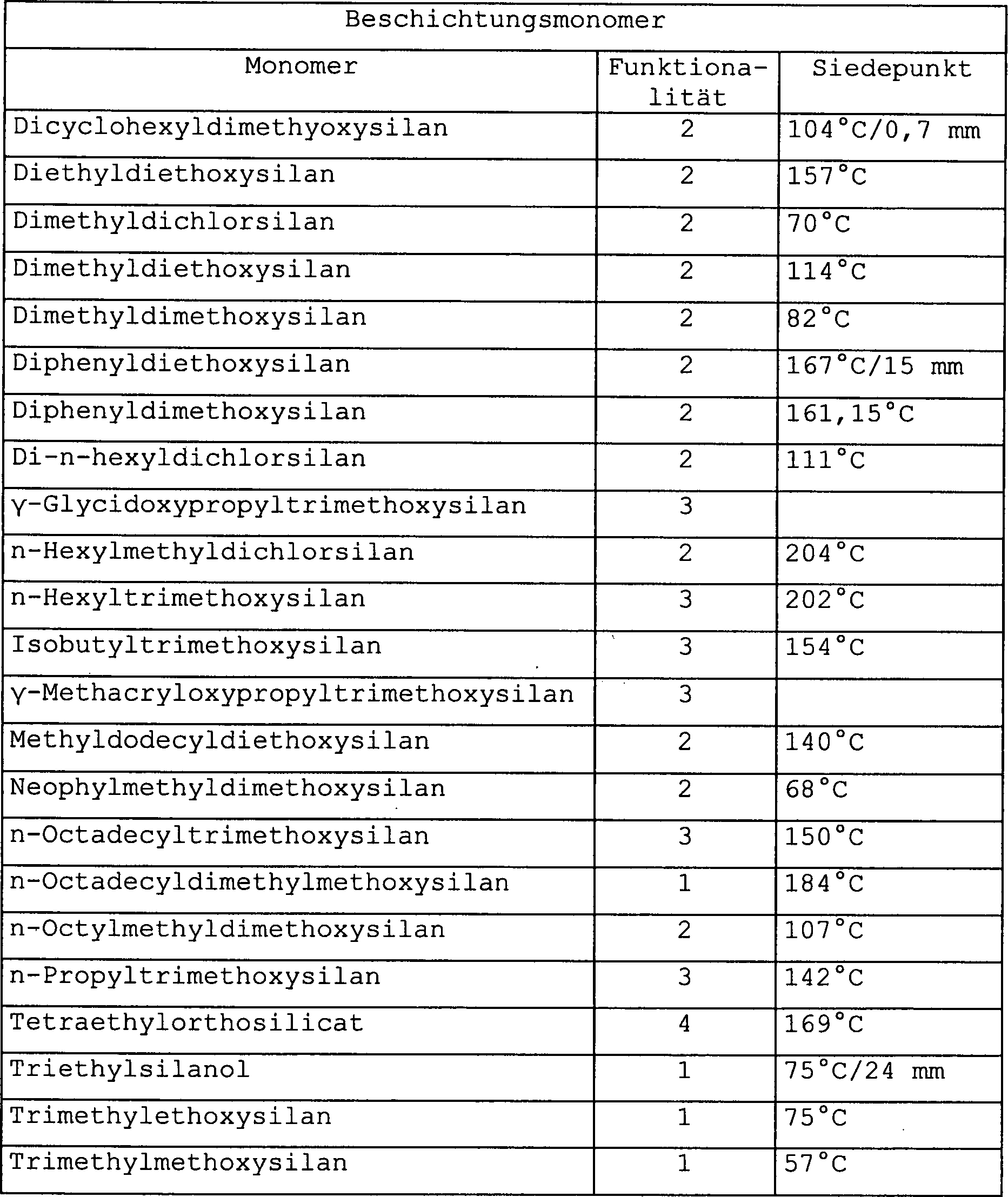
- Die Werte von w, x, y und z in den obigen Polymeren auf Siliciumbasis reichten von mindestens 20, 0–30, 0–50 und 0–10. Verschiedene Kombinationen werden eingesetzt, um die fraktale Natur des Siloxangerüsts und dessen chemische Natur zu steuern, d. h. den Grad der thermodynamischen Kompatibilität mit einem spezifischen Verdünnungsmittel des Beschichtungsmoleküls. Die chemische Identität der Gruppen kann auch in weitem Umfang variiert werden. Ähnlich wurde R von 1 bis 6 variiert, und der Säurecharakter des Reaktionsmediums wurde in breitem Umfang variiert. Beispiele von Monomeren, die in die Beschichtung einbezogen werden können, schließen die in Tabelle 1 angegebenen ein, sind aber nicht darauf beschränkt.
- Tabelle 1
- A. Allgemeines Verfahren zur Herstellung eines Beschichtungspolymers
- Des Folgende ist ein allgemeines Verfahren zur Herstellung eines Beschichtungspolymers, das mit Si(70, 13,275, 10, 5) und R = 1,12 bezeichnet ist:
- (1) Zugabe der folgenden Chemikalien in ein Reaktionsgefäß, das mit trockenem Stickstoff gespült wurde und Verrühren:
- (a) 61 ml wasserfreies Ethanol (Aldrich Nr. 27764.9 oder Äquivalent);
- (b) 43,04 ml Tetraethylorthosilicat (TEOS FW 208,33, Aldrich Nr. 33385-9 oder Äquivalent);
- (c) 15,45 ml of n-Octyldecyltrimethyloxysilan (n-ODTMS FW 374,68, Petrach Nr. 09780 oder Äquivalent);
- (d) 3,84 ml Diphenyldimethoxysilan (DPDMS FW 244,36, Petrach Nr. D6010 oder Äquivalent);
- (e) 2,15 ml Trimethylethoxysilan (TMES FW 118,25, Petrach Nr. T2970 oder Äquivalent);
- (f) 3,67 ml of entionisiertes Wasser;
- (g) 2,0 ml 0.1 N Chlorwasserstoffsäure (VWR Katalog Nr. VW3200-l oder Äquivalent).
- (2) Erhitzen des Gemischs bei 60°C für 1,5 Stunden.
- (3) Lagern des hergestellten Sols bei 5°C.
- B. Batch-Verfahren für beschichtete Keramikpolymere
- Das Folgende ist eine Verfahrensbeschreibung zur Herstellung beschichteter Keramikpulver in Ansätzen (Batches) von 44,04884 l (10 Gallonen), optimiert unter starkem Schervermischen.
- (1) Herstellung des Beschichtungspolymers
-
- (a) Spülen eines 10 l-Reaktionsgefäßes mit trockenem Stickstoff und Rühren.
- (b) Zugabe von:
- – 1527 ml wasserfreiem Ethanol;
- – 1039 Tetraethylorthosilicat;
- – 387 ml n-Octyldecyltrimethoxysilan;
- – 156 ml Diphenyldimethoxysilan;
- – 81 ml Trimethylethoysilan
- – 93 ml entionisiertem Wasser
- – 50 ml 0,1 Chlorwasserstoffsäure.
- (c) Erhitzen bei 60°C für 1,5 Stunden.
- (d) Lagern bei 5°C.
- Das durch das obige Batch-Verfahren hergestellte Produkt enthält etwa 15 Gewichtsprozent (Gew.-%) Beschichtungspolymer.
- (2) Herstellung des beschichteten TiO2-Polymers
-
- (a) Benetzen von Pulver, Zugabe von Al-Unterschichtung:
- – Spülen eines passivierten 50 l-Gefäßes mit Argon und Rühren.
- – Zugabe von 20 l eines geeigneten Reaktionslösungsmittels (wie beispielsweise wasserfreies Ethanol, Ethanol und/oder Isopropanol) + 5 kg TiO2-Pulver.
- – Vermischen von 555 ml eines geeigneten Reaktionslösungsmittels (wie beispielsweise wasserfreies Ethanol, Ethanol und/oder Isopropanol), Aluminium-tri-6-butoxid („ASTB") + ungefähr 500 ml Isopropanol.
- – Zugabe einer ASTB-Lösung in einem kleinen Strom über eine Kanüle durch Argondruckverdrängung. Die Zugabe von ASTB führt Al3+-zentrierte Oberflächendefekte in das TiO2-Pulver ein, und macht das Pulver so nicht-photoaktiv.
- (b) Verdünnen; Beschichten des Pulvers:
- – Zugabe von 4 l des Reaktionslösungsmittels.
- – Starkes Schervermischen bei 7000 UpM für 30 Minuten. Die Temperatur nimmt mit dem Fortschreiten der Beschichtungsreaktion zu; es kann sein, dass Reaktionen im großen Maßstab gekühlt werden müssen, wenn die Temperaturerhöhung 50°C überschreitet.
- – Zugabe von 3333 ml des 15 Gew.-% Beschichtungspolymers.
- – Starkes Schervermischen bei 7000 UpM für 30 Minuten.
- (c) Abtrennen und Reinigen:
- – Zugabe von 6 l entionisiertem Wasser
- – Starkes Schervermischen bei 7000 UpM für 20 Minuten.
- – Gewinnen durch Zentrifugation.
- (d) Wahlweise Waschen durch Wiederholen von Verfahrensschritt (c).
- (e) Wahlweise Trocknen des nassen Kuchens.
- (3) Herstellung der Dispersion
-
- – Zugabe von trockenem Pulver oder nassem Kuchen zu einem organischen Trägerfluid, wie beispielsweise Finsolv®.
- – Entfernung der Reaktionslösungsmittel, wenn nötig.
- – Gutes Vermischen.
- C. Spezifische Beschichtungsbeispiele
-
- (1) Sonnenschutz – Si(67,5, 13,275, 10, 7,5)/Tetraethylorthosilicat, n-Octadecyltri-methoxysilan, Diphenyldimethoxysilan, Trimethylethoxysilan; R = 1,12, Δ60°C 1,5 h.
- (2) Wasserlöslich – Si(70, 20, 5, 5)/Tetraethylorthosilicat, γ-Glycidoxypropyltrimethoxysilan, Diphenyldimethoxysilan, Trimethylethoxysilan; R = 1,12, Δ60°C 1,5 h, Umsetzen freier funktionaler Epoxygruppe mit einem der Folgenden: einer Aminosäure, wie beispielsweise β-Alanin; einem Diamin, wie beispielsweise Ethylendiamin; oder einer anderen geeigneten Funktionalität wie beispielsweise Natriumsulfit oder einem anionischen, kationischen oder zwitterionischen funktionalen Rest.
- (3) Acrylatpolymere – Si(60, 20, 15, 5)/Tetraethylorthosilicat, γ-Methacryloxypropyltrimethoxysilan, Diphenyldimethoxysilan, Trimethylethoxysilan; R = 1,12, Δ60°C 1,5 h.
- (4) Epoxypolymere – Si(60, 20, 15, 5)/Tetraethylorthosilicat, γ-Glycidoxypropyltrimethoxysilan, Diphenyldimethoxysilan, Trimethylethoxysilan; R = 1,12, Δ60°C 1,5 h.
- (5) Hydrophobe Öle – Si(45, 13,275, 34,275, 7,5)/Tetraethylorthosilicat, n-Octadecyltrimethoxysilan, Diphenyldimethoxysilan, Trimethylethoxysilan; R = 1,12, Δ60°C 1,5 h.; oder Si(45, 6,64, 40,91, 7,5)/Tetraethylorthosilicat, n-Octadecyltrimethoxysilan, Diphenyldimethoxysilan, Trimethlethoxysilan; R = 1,12, Δ60°C 1,5 h.
Claims (22)
- Beschichtetes Keramikpulver, umfassend eine Mehrzahl an Keramikpartikeln und ein Beschichtungspolymer auf Siloxanbasis, welches mindestens einen Teil dieser Partikel umhüllt, wobei das Beschichtungspolymer Monomereinheiten umfasst, die sich ableiten von:
- Beschichtetes Keramikpulver nach Anspruch 1, wobei die Keramik TiO2 ist.
- Beschichtetes Keramikpulver nach Anspruch 2, welches weiterhin Al3+-Zentren umfasst, um Oberflächendefekte in das TiO2-Pulver einzuführen, wodurch das beschichtete TiO2-Pulver nicht-photoaktiv gemacht wird.
- Beschichtetes Keramikpulver nach Anspruch 1, wobei die Keramik Al2O3 ist.
- Beschichtetes Keramikpulver nach Anspruch 1, wobei die Keramik ZnO ist.
- Beschichtetes Keramikpulver nach Anspruch 1, wobei die Keramik ein Eisenoxid ist.
- Beschichtetes Keramikpulver nach Anspruch 6, wobei das Eisenoxid γ-Fe2O3 ist.
- Beschichtetes Keramikpulver nach Anspruch 6, wobei das Eisenoxid α-Fe2O3 ist.
- Beschichtetes Keramikpulver nach Anspruch 6, wobei das Eisenoxid Fe3O4 ist.
- Beschichtetes Keramikpulver nach Anspruch 1, wobei die Keramik SiO2 ist.
- Verfahren zu Herstellung eines beschichteten Keramikpulvers, welches eine Mehrzahl von Keramikpartikeln und ein Beschichtungspolymer auf Siloxanbasis, welches mindestens einen Teil dieser Partikel umhüllt, mit den Schritten: (a) Polymerisieren eines tetrafunktionalen Siloxanmonomers und mindestens eines trifunktionalen Siloxanmonomers, eines difunktionalen Siloxanmonomers oder eines monofunktionalen Siloxanmonomers, um ein Siloxanpolymer zu bilden; (b) Zugabe einer Menge eines Keramikpulvers zu einem gespülten Reaktionsgefäß; (c) Schervermischen des keramischen Pulvers für eine ausreichende Zeit, um im Wesentlichen die gesamte Pulveroberfläche zu benetzen; (d) Zugabe des in Schritt (a) hergestellten Siloxanpolymers in das das schervermischte Keramikpulver enthaltende Reaktionsgefäß; (e) Schervermischen des unter Scherung vermischten Keramikpulvers und des Siloxanpolymers für eine ausreichende Zeit, um ein Siloxanpolymer-beschichtetes Keramikpulver zu bilden; (f) Abtrennen des beschichteten Keramikpulvers von den in dem Reaktionsgefäß verbleiben Bestandteilen; wobei das tetrafunktionale Siloxanmonomer Tetraethylorthosilicat ist; das trifunktionale Siloxanmonomer aus der Gruppe ausgewählt ist, bestehend aus γ-Glycidoxypropyltrimethoxysilan, n-Hexyltrimethoxysilan, Isobutyltrimethoxysilan, γ-Methacryloxypropyltrimethoxysilan, n-Octadecyltrimethoxysilan und n-Propyltrimethoxysilan; das difunktionale Siloxane Monomer aus der Gruppe ausgewählt ist, bestehend aus Dicyclohexyldimethoxysilan, Diethyldiethoxysilan, Dimethyldichlorsilan, Dimethyldiethoxysilan, Dimethyldimethoxysilan, Diphenyldiethoxysilan, Diphenyldimethoxysilan, Di-n-hexyldichlorsilan, n-Hexylmethyldichlorsilan, Methyldodecyldiethoxysilan, Neophylmethyldimethoxysilan und n-Octylmethyldimethoxysilan; und das monofunktionale Siloxanmonomer aus der Gruppe ausgewählt ist, bestehend aus n-Octadecyldimethylmethoxysilan, Triethylsilanol, Trimethylethoxysilan und Trimethylmethoxysilan.
- Verfahren nach Anspruch 11, wobei die Keramik TiO2 ist.
- Verfahren nach Anspruch 12, wobei in Schritt (b) Aluminium-tri-sec-butoxid zu dem Reaktionsgefäß gegeben wird, um Oberflächendefekte in das TiO2-Pulver einzuführen, um so das beschichtete TiO2-Pulver nicht-photoaktiv zu machen
- Verfahren nach Anspruch 11, wobei die Keramik Al2O3 ist.
- Verfahren nach Anspruch 11, wobei die Keramik ZnO ist.
- Verfahren nach Anspruch 11, wobei die Keramik ein Eisenoxid ist.
- Verfahren nach Anspruch 16, wobei das Eisenoxid γ-Fe2O3 ist.
- Verfahren nach Anspruch 16, wobei das Eisenoxid α-Fe2O3 ist.
- Verfahren nach Anspruch 16, wobei das Eisenoxid Fe3O4 ist.
- Verfahren nach Anspruch 11, wobei die Keramik SiO2 ist.
- Beschichtetes Keramikpulver, hergestellt nach dem Verfahren nach einem der Ansprüche 11–20.
- Polymer auf Siloxanbasis zum Beschichten und Umhüllen von Keramikpartikeln, wobei das Beschichtungspolymer Monomereinheiten umfasst, die sich ableiten von:
Applications Claiming Priority (3)
| Application Number | Priority Date | Filing Date | Title |
|---|---|---|---|
| US1483896P | 1996-04-04 | 1996-04-04 | |
| PCT/US1997/005179 WO1997038041A1 (en) | 1996-04-04 | 1997-03-28 | Siloxane star-graft polymers, ceramic powders coated therewith and method of preparing coated ceramic powders |
| US14838 | 1998-01-28 |
Publications (2)
| Publication Number | Publication Date |
|---|---|
| DE69729290D1 DE69729290D1 (de) | 2004-07-01 |
| DE69729290T2 true DE69729290T2 (de) | 2005-06-02 |
Family
ID=21768045
Family Applications (1)
| Application Number | Title | Priority Date | Filing Date |
|---|---|---|---|
| DE69729290T Expired - Lifetime DE69729290T2 (de) | 1996-04-04 | 1997-03-28 | Sternförmig-gepfropfte siloxanpolymere, damit beschichtete keramikpulver, sowie ein verfahren zu deren herstellung |
Country Status (7)
| Country | Link |
|---|---|
| US (1) | US6033781A (de) |
| EP (1) | EP0891387B1 (de) |
| JP (2) | JP2000508684A (de) |
| AU (1) | AU715859B2 (de) |
| CA (1) | CA2250962C (de) |
| DE (1) | DE69729290T2 (de) |
| WO (1) | WO1997038041A1 (de) |
Cited By (1)
| Publication number | Priority date | Publication date | Assignee | Title |
|---|---|---|---|---|
| DE102005051587A1 (de) * | 2005-10-27 | 2007-05-03 | Consortium für elektrochemische Industrie GmbH | Zwitterionische Strukturelemente aufweisende Partikel |
Families Citing this family (56)
| Publication number | Priority date | Publication date | Assignee | Title |
|---|---|---|---|---|
| WO1997001595A1 (en) * | 1995-06-27 | 1997-01-16 | Hitachi Chemical Company, Ltd. | Prepreg for printed wiring boards, resin varnish, resin composition, and laminate for printed wiring boards produced by using these substances |
| US5922403A (en) | 1996-03-12 | 1999-07-13 | Tecle; Berhan | Method for isolating ultrafine and fine particles |
| US5993967A (en) * | 1997-03-28 | 1999-11-30 | Nanophase Technologies Corporation | Siloxane star-graft polymers, ceramic powders coated therewith and method of preparing coated ceramic powders |
| DE19857316A1 (de) * | 1998-12-11 | 2000-06-15 | Inst Neue Mat Gemein Gmbh | Pulverlackierte Substrate mit einem Decklack auf Basis epoxidgruppenhaltiger Silane |
| US6972115B1 (en) | 1999-09-03 | 2005-12-06 | American Inter-Metallics, Inc. | Apparatus and methods for the production of powders |
| CA2413744C (en) * | 2000-06-29 | 2012-01-03 | Neuftec Limited | A fuel additive |
| JP4938168B2 (ja) * | 2000-10-31 | 2012-05-23 | チタン工業株式会社 | 低磁性黒色顔料粉末及びその製造方法並びにその用途 |
| US6896958B1 (en) * | 2000-11-29 | 2005-05-24 | Nanophase Technologies Corporation | Substantially transparent, abrasion-resistant films containing surface-treated nanocrystalline particles |
| ATE472511T1 (de) | 2001-08-16 | 2010-07-15 | Essilor Int | Verfahren zur herstellung stabiler dispersionen metallischer nanopartikel, stabile dispersion hergestellt auf basis dieses verfahrens und beschichtungszusammensetzungen enthaltend diese dispersionen |
| US20030064086A1 (en) * | 2001-08-31 | 2003-04-03 | Danuvio Carrion | Cosmetic compositions comprising nanoparticles and processes for using the same |
| US6824763B2 (en) | 2002-05-30 | 2004-11-30 | Kimberly-Clark Worldwide, Inc. | Anti-fungal powder having enhanced excipient properties |
| GB0224044D0 (en) * | 2002-10-16 | 2002-11-27 | Dow Corning | Silicone resins |
| CN100363251C (zh) * | 2003-02-18 | 2008-01-23 | 财团法人理工学振兴会 | 聚合物包覆金属氧化物及其制造方法 |
| US7015260B2 (en) * | 2003-06-04 | 2006-03-21 | E.I. Du Pont De Nemours And Company | High temperature polymeric materials containing corona resistant composite filler, and methods relating thereto |
| US7081234B1 (en) | 2004-04-05 | 2006-07-25 | Xerox Corporation | Process of making hydrophobic metal oxide nanoparticles |
| US7303819B2 (en) * | 2004-04-06 | 2007-12-04 | Nanophase Technologies Corporation | Surface treatment of nanoparticles to control interfacial properties and method of manufacture |
| US20080057130A1 (en) * | 2004-04-06 | 2008-03-06 | Nanophase Technologies Corporation | The surface treatment of nanoparticles to control interfacial properties and method of manufacture |
| BRPI0509712A (pt) * | 2004-04-06 | 2007-09-18 | Basf Ag | método de proteger a pele humana ou o cabelo humano da radiação ultravioleta, formulação para cuidados pessoais contendo protetor solar para proteger a pele humana ou cabelo humano da radiação ultravioleta, e, partìcula tratada na superfìcie |
| US20050233380A1 (en) * | 2004-04-19 | 2005-10-20 | Sdc Materials, Llc. | High throughput discovery of materials through vapor phase synthesis |
| CN101076716B (zh) * | 2004-10-08 | 2011-04-13 | Sdc材料有限责任公司 | 采样和收集在气流中流动的粉末的装置和方法 |
| TWI295632B (en) * | 2005-01-21 | 2008-04-11 | Canon Kk | Ink jet recording head, producing method therefor and composition for ink jet recording head |
| KR101130404B1 (ko) * | 2005-02-16 | 2012-03-27 | 삼성전자주식회사 | 고차가지형 고분자에 분산된 고유전율 절연체를 포함하는유기 절연체 조성물 및 이를 이용한 유기박막 트랜지스터 |
| WO2006099630A1 (en) | 2005-03-17 | 2006-09-21 | Lubrizol Advanced Materials, Inc. | Nanoparticle/vinyl polymer composites |
| JP2007277072A (ja) * | 2006-03-16 | 2007-10-25 | Jsr Corp | 酸化物微粒子分散体およびその製造方法 |
| JP2007277073A (ja) * | 2006-03-16 | 2007-10-25 | Jsr Corp | 酸化物微粒子分散体およびその製造方法 |
| JP2007277505A (ja) * | 2006-03-16 | 2007-10-25 | Jsr Corp | 酸化物微粒子分散体およびその製造方法 |
| WO2008017663A2 (en) * | 2006-08-08 | 2008-02-14 | Essilor International (Compagnie Generale D'optique) | Surface modification of nanoparticles by phosphorus-containing compounds in the vapor phase |
| DE102006061057A1 (de) * | 2006-12-22 | 2008-06-26 | Wacker Chemie Ag | Organofunktionelle Silikonharzschichten auf Metalloxiden |
| US9173967B1 (en) * | 2007-05-11 | 2015-11-03 | SDCmaterials, Inc. | System for and method of processing soft tissue and skin with fluids using temperature and pressure changes |
| US8507401B1 (en) | 2007-10-15 | 2013-08-13 | SDCmaterials, Inc. | Method and system for forming plug and play metal catalysts |
| JP5398134B2 (ja) * | 2007-11-15 | 2014-01-29 | 住友金属鉱山株式会社 | 表面処理酸化亜鉛微粒子の製造方法、表面処理酸化亜鉛微粒子、その分散液体および分散固体、並びに酸化亜鉛微粒子被覆基材 |
| USD627900S1 (en) | 2008-05-07 | 2010-11-23 | SDCmaterials, Inc. | Glove box |
| US8545652B1 (en) | 2009-12-15 | 2013-10-01 | SDCmaterials, Inc. | Impact resistant material |
| US8557727B2 (en) | 2009-12-15 | 2013-10-15 | SDCmaterials, Inc. | Method of forming a catalyst with inhibited mobility of nano-active material |
| US8652992B2 (en) | 2009-12-15 | 2014-02-18 | SDCmaterials, Inc. | Pinning and affixing nano-active material |
| US9039916B1 (en) | 2009-12-15 | 2015-05-26 | SDCmaterials, Inc. | In situ oxide removal, dispersal and drying for copper copper-oxide |
| US9149797B2 (en) * | 2009-12-15 | 2015-10-06 | SDCmaterials, Inc. | Catalyst production method and system |
| US8803025B2 (en) | 2009-12-15 | 2014-08-12 | SDCmaterials, Inc. | Non-plugging D.C. plasma gun |
| US9126191B2 (en) | 2009-12-15 | 2015-09-08 | SDCmaterials, Inc. | Advanced catalysts for automotive applications |
| EP2512656A4 (de) * | 2009-12-15 | 2014-05-28 | Sdcmaterails Inc | Fortschrittliche katalysatoren für feinchemie- und pharmazieanwendungen |
| US8470112B1 (en) | 2009-12-15 | 2013-06-25 | SDCmaterials, Inc. | Workflow for novel composite materials |
| US8669202B2 (en) | 2011-02-23 | 2014-03-11 | SDCmaterials, Inc. | Wet chemical and plasma methods of forming stable PtPd catalysts |
| BR112014003781A2 (pt) | 2011-08-19 | 2017-03-21 | Sdcmaterials Inc | substratos revestidos para uso em catalisadores e conversores catalíticos e métodos para revestir substratos com composições de revestimento por imersão |
| US9139737B1 (en) | 2011-11-21 | 2015-09-22 | Nanophase Technologies Corporation | Multifunctional coated powders and high solids dispersions |
| US9156025B2 (en) | 2012-11-21 | 2015-10-13 | SDCmaterials, Inc. | Three-way catalytic converter using nanoparticles |
| US9511352B2 (en) | 2012-11-21 | 2016-12-06 | SDCmaterials, Inc. | Three-way catalytic converter using nanoparticles |
| US9586179B2 (en) | 2013-07-25 | 2017-03-07 | SDCmaterials, Inc. | Washcoats and coated substrates for catalytic converters and methods of making and using same |
| US9409148B2 (en) | 2013-08-08 | 2016-08-09 | Uchicago Argonne, Llc | Compositions and methods for direct capture of organic materials from process streams |
| CN106061600A (zh) | 2013-10-22 | 2016-10-26 | Sdc材料公司 | 用于重型柴油机的催化剂设计 |
| MX2016004759A (es) | 2013-10-22 | 2016-07-26 | Sdcmaterials Inc | Composiciones para trampas de oxidos de nitrogeno (nox) pobres. |
| US9687811B2 (en) | 2014-03-21 | 2017-06-27 | SDCmaterials, Inc. | Compositions for passive NOx adsorption (PNA) systems and methods of making and using same |
| US10351729B2 (en) | 2016-03-03 | 2019-07-16 | Motorola Mobility Llc | Polysiloxane films and methods of making polysiloxane films |
| US10212825B2 (en) | 2016-03-03 | 2019-02-19 | Motorola Mobility Llc | Polysiloxane films and methods of making polysiloxane films |
| US10555892B1 (en) | 2017-03-09 | 2020-02-11 | Nanophase Technologies Corporation | Functionalized siloxane or polysiloxane coated particles with enhanced light filtering properties |
| US10590278B2 (en) * | 2017-04-10 | 2020-03-17 | Nanophase Technologies Corporation | Coated powders having high photostability |
| US11672744B2 (en) | 2020-07-02 | 2023-06-13 | Nanophase Technologies Corporation | Zinc oxide particles, photostable UV filters, and methods of use thereof |
Family Cites Families (34)
| Publication number | Priority date | Publication date | Assignee | Title |
|---|---|---|---|---|
| BE556585A (de) * | 1956-04-11 | |||
| US2885366A (en) * | 1956-06-28 | 1959-05-05 | Du Pont | Product comprising a skin of dense, hydrated amorphous silica bound upon a core of another solid material and process of making same |
| US3437502A (en) * | 1968-03-28 | 1969-04-08 | Du Pont | Titanium dioxide pigment coated with silica and alumina |
| US3635743A (en) * | 1969-01-06 | 1972-01-18 | Gen Electric | Reinforcing silica filler |
| GB1317902A (en) * | 1969-07-23 | 1973-05-23 | Dow Corning Ltd | Organopolysiloxane coating compositions |
| US3816152A (en) * | 1970-02-16 | 1974-06-11 | Du Pont | Coupling agent copolymer dispersions of silicic acids and organofunctional silanes |
| AU5942573A (en) * | 1972-08-25 | 1975-02-20 | Commw Scient Ind Res Org | Coating particulates |
| US3849152A (en) * | 1972-11-06 | 1974-11-19 | Ferro Corp | Polysiloxane encapsulation of pigments |
| DE2543962A1 (de) * | 1975-10-02 | 1977-04-14 | Dynamit Nobel Ag | Verbesserte eisenoxid-magnetpigmente fuer die herstellung von magnetschichten |
| US4151154A (en) * | 1976-09-29 | 1979-04-24 | Union Carbide Corporation | Silicon treated surfaces |
| DE2758414A1 (de) * | 1977-12-28 | 1979-07-12 | Fraunhofer Ges Forschung | Kieselsaeureheteropolykondensate, verfahren zu deren herstellung und deren verwendung bei der zuechtung lebender zellen |
| US4574082A (en) * | 1983-07-29 | 1986-03-04 | Revlon, Inc. | One-phase silicone-based cosmetic products containing wax |
| US4644077A (en) * | 1984-07-11 | 1987-02-17 | The Sherwin-Williams Company | Process for producing organophilic silica |
| US4818614A (en) * | 1985-07-29 | 1989-04-04 | Shiseido Company Ltd. | Modified powder |
| EP0212870B1 (de) * | 1985-07-29 | 1992-04-15 | Shiseido Company Limited | Mit Silikonpolymer überzogenes Pulver oder Teilchenförmiges Material |
| US5143722B1 (en) * | 1986-12-19 | 1999-08-24 | Revlon Consumer Prod Corp | Cosmetic makeup compositions comprising water-in-oil emulsions containing pigment |
| GB8712752D0 (en) * | 1987-05-30 | 1987-07-01 | Tioxide Group Plc | Particulate material |
| GB8717662D0 (en) * | 1987-07-24 | 1987-09-03 | Boots Co Plc | Sunscreen composition |
| US4877604A (en) * | 1987-09-04 | 1989-10-31 | Schlossman Mitchell L | Method of incorporating cosmetic pigments and bases into products containing oil and water phases |
| US5063254A (en) * | 1988-04-04 | 1991-11-05 | Loctite Corporation | MTQ/polysiloxane hybrid resins, method of making the same, and coating/potting compositions containing the same |
| GB8827968D0 (en) * | 1988-11-30 | 1989-01-05 | Boots Co Plc | Sunscreen compositions |
| GB8829402D0 (en) * | 1988-12-16 | 1989-02-01 | Tioxide Group Plc | Dispersion |
| US5035803A (en) * | 1989-02-14 | 1991-07-30 | The Regents Of The University Of California | High yield water-soluble polymer silica separation resins |
| GB8904490D0 (en) * | 1989-02-28 | 1989-04-12 | Boots Co Plc | Sunscreen compositions |
| GB8906626D0 (en) * | 1989-03-22 | 1989-05-04 | Dow Corning | Method of making organosiloxane resins |
| DE69115535T2 (de) * | 1990-03-23 | 1996-06-13 | Ici Plc | Polymere |
| JPH0633335B2 (ja) * | 1990-05-29 | 1994-05-02 | 信越化学工業株式会社 | オルガノポリシロキサンの製造方法 |
| US5310578A (en) * | 1990-09-17 | 1994-05-10 | Merck Patent Gesellschaft | Deposition of cosmetically functional material onto pigments and fillers |
| DE69130280T2 (de) * | 1990-10-16 | 1999-04-08 | Mitsui Chemicals, Inc., Tokio/Tokyo | Verwendung eines hochlichtdurchlässigen staubschützenden Films, Verfahren zu dessen Herstellung und staubschützendes Element |
| JP2844405B2 (ja) * | 1992-02-17 | 1999-01-06 | 信越化学工業株式会社 | 疎水性酸化チタン微粒子の製造方法 |
| JP3378590B2 (ja) * | 1992-02-28 | 2003-02-17 | 東レ・ダウコーニング・シリコーン株式会社 | 化粧料用撥水性粉体およびその製造方法 |
| US5292787A (en) * | 1992-07-30 | 1994-03-08 | General Electric Company | Epoxysilicone controlled release composition |
| US5348760A (en) * | 1993-10-12 | 1994-09-20 | Aluminum Company Of America | Surface treated ceramic powders |
| KR970000745B1 (ko) * | 1993-11-19 | 1997-01-18 | 주식회사 엘지화학 | 항균성 화장료용 안료와 그 제조방법 및 이를 함유하는 화장료 조성물 |
-
1997
- 1997-03-28 AU AU24271/97A patent/AU715859B2/en not_active Expired
- 1997-03-28 CA CA002250962A patent/CA2250962C/en not_active Expired - Lifetime
- 1997-03-28 US US08/827,229 patent/US6033781A/en not_active Expired - Lifetime
- 1997-03-28 EP EP97919963A patent/EP0891387B1/de not_active Expired - Lifetime
- 1997-03-28 JP JP9536259A patent/JP2000508684A/ja not_active Withdrawn
- 1997-03-28 WO PCT/US1997/005179 patent/WO1997038041A1/en not_active Ceased
- 1997-03-28 DE DE69729290T patent/DE69729290T2/de not_active Expired - Lifetime
-
2006
- 2006-09-13 JP JP2006248645A patent/JP2007092063A/ja active Pending
Cited By (1)
| Publication number | Priority date | Publication date | Assignee | Title |
|---|---|---|---|---|
| DE102005051587A1 (de) * | 2005-10-27 | 2007-05-03 | Consortium für elektrochemische Industrie GmbH | Zwitterionische Strukturelemente aufweisende Partikel |
Also Published As
| Publication number | Publication date |
|---|---|
| WO1997038041A1 (en) | 1997-10-16 |
| JP2007092063A (ja) | 2007-04-12 |
| CA2250962A1 (en) | 1997-10-16 |
| EP0891387B1 (de) | 2004-05-26 |
| DE69729290D1 (de) | 2004-07-01 |
| EP0891387A2 (de) | 1999-01-20 |
| CA2250962C (en) | 2003-06-03 |
| US6033781A (en) | 2000-03-07 |
| AU2427197A (en) | 1997-10-29 |
| AU715859B2 (en) | 2000-02-10 |
| JP2000508684A (ja) | 2000-07-11 |
Similar Documents
| Publication | Publication Date | Title |
|---|---|---|
| DE69729290T2 (de) | Sternförmig-gepfropfte siloxanpolymere, damit beschichtete keramikpulver, sowie ein verfahren zu deren herstellung | |
| US5993967A (en) | Siloxane star-graft polymers, ceramic powders coated therewith and method of preparing coated ceramic powders | |
| AU2002239359B2 (en) | Substantially transparent, abrasion-resistant films containing surface-treated nanocrystalline particles | |
| Bourgeat-Lami et al. | Encapsulation of inorganic particles by dispersion polymerization in polar media: 1. Silica nanoparticles encapsulated by polystyrene | |
| TWI300432B (en) | Coating With Improved Hiding, Compositions Prepared Therewith, and Processes for the Preparation Thereof | |
| EP1690902B1 (de) | Oberflächenmodifizierte Nanopartikel, Verfahren zu ihrer Herstellung und ihrer Verwendung | |
| JP2918092B2 (ja) | 微細な無機酸化物のシリル化法 | |
| EP2049603B1 (de) | Mit polysiloxan oberflächenmodifizierte partikel und herstellungsverfahren | |
| AU2002239359A1 (en) | Substantially transparent, abrasion-resistant films containing surface-treated nanocrystalline particles | |
| JP2011174067A (ja) | 酸化マンガンナノ粒子層を含む金色の金属顔料 | |
| EP2070993A1 (de) | Verfahren zur Dispergierung von feinteiligen anorganischen Pulvern in flüssigen Medien unter Verwendung von reaktiven Siloxanan | |
| CN115304934B (zh) | 一种高性能环保彩色复合颜料的制备方法 | |
| JP2005509658A (ja) | 有機ケイ素処理化粧粉末、その製造及び使用 | |
| WO2012025105A1 (de) | Funktionalisierte partikel und deren verwendung | |
| US20160168388A1 (en) | Metallic pigments and method of coating a metallic substrate | |
| JP2010519355A (ja) | 結合剤 | |
| KR20220142928A (ko) | 복합 금속 안료 조성물 및 그 제조 방법 | |
| AU2008337532A1 (en) | Sol-gel process with an encapsulated catalyst | |
| DE102006061057A1 (de) | Organofunktionelle Silikonharzschichten auf Metalloxiden | |
| JPS60240769A (ja) | 表面疎水性無機材料の製造法 | |
| JP3493109B2 (ja) | 有機基含有シリカ微粒子分散ゾルの製造方法 | |
| JPH0525912B2 (de) | ||
| DE19924644A1 (de) | Verfahren zum Herstellen eines Nanopartikel enthaltenden Mediums, insbesondere Lackes | |
| JP7775341B2 (ja) | コーティングされた金属エフェクト顔料、その製造方法及び使用 | |
| JPS63113080A (ja) | 被覆顔料の製造方法 |
Legal Events
| Date | Code | Title | Description |
|---|---|---|---|
| 8364 | No opposition during term of opposition |