EP0000538A1 - 6,7-Dihydro-5H,13H-chinazolino(3,2-a)(1,4)benzodiazepin-5,13-dione, Verfahren zu ihrer Herstellung sowie ihre Verwendung als Arzneimittel - Google Patents
6,7-Dihydro-5H,13H-chinazolino(3,2-a)(1,4)benzodiazepin-5,13-dione, Verfahren zu ihrer Herstellung sowie ihre Verwendung als Arzneimittel Download PDFInfo
- Publication number
- EP0000538A1 EP0000538A1 EP78100425A EP78100425A EP0000538A1 EP 0000538 A1 EP0000538 A1 EP 0000538A1 EP 78100425 A EP78100425 A EP 78100425A EP 78100425 A EP78100425 A EP 78100425A EP 0000538 A1 EP0000538 A1 EP 0000538A1
- Authority
- EP
- European Patent Office
- Prior art keywords
- alkyl
- aryl
- groups
- phenyl
- alkoxy
- Prior art date
- Legal status (The legal status is an assumption and is not a legal conclusion. Google has not performed a legal analysis and makes no representation as to the accuracy of the status listed.)
- Withdrawn
Links
- NGYKOTTXJAPLPC-UHFFFAOYSA-N 6,7-dihydroquinazolino[3,2-a][1,4]benzodiazepine-5,13-dione Chemical class O=C1NCC2=NC3=CC=CC=C3C(=O)N2C2=CC=CC=C12 NGYKOTTXJAPLPC-UHFFFAOYSA-N 0.000 title claims abstract description 10
- 239000003814 drug Substances 0.000 title claims abstract description 9
- 238000000034 method Methods 0.000 title claims description 7
- 238000002360 preparation method Methods 0.000 title claims description 4
- -1 Alkoxycarbonylamino Halogen Chemical class 0.000 claims abstract description 77
- 125000000217 alkyl group Chemical group 0.000 claims abstract description 43
- 229910052736 halogen Inorganic materials 0.000 claims abstract description 24
- 239000001257 hydrogen Substances 0.000 claims abstract description 24
- 229910052739 hydrogen Inorganic materials 0.000 claims abstract description 24
- 125000003118 aryl group Chemical group 0.000 claims abstract description 23
- 125000004453 alkoxycarbonyl group Chemical group 0.000 claims abstract description 22
- 125000003710 aryl alkyl group Chemical group 0.000 claims abstract description 22
- 150000002431 hydrogen Chemical class 0.000 claims abstract description 21
- 125000001424 substituent group Chemical group 0.000 claims abstract description 18
- UFHFLCQGNIYNRP-UHFFFAOYSA-N Hydrogen Chemical compound [H][H] UFHFLCQGNIYNRP-UHFFFAOYSA-N 0.000 claims abstract description 16
- 125000004663 dialkyl amino group Chemical group 0.000 claims abstract description 16
- 125000002023 trifluoromethyl group Chemical group FC(F)(F)* 0.000 claims abstract description 16
- 125000004442 acylamino group Chemical group 0.000 claims abstract description 13
- 125000002887 hydroxy group Chemical group [H]O* 0.000 claims abstract description 12
- 150000001875 compounds Chemical class 0.000 claims abstract description 10
- 125000004473 dialkylaminocarbonyl group Chemical group 0.000 claims abstract description 10
- 125000004397 aminosulfonyl group Chemical group NS(=O)(=O)* 0.000 claims abstract description 9
- 125000003917 carbamoyl group Chemical group [H]N([H])C(*)=O 0.000 claims abstract description 9
- 125000004472 dialkylaminosulfonyl group Chemical group 0.000 claims abstract description 9
- 125000001072 heteroaryl group Chemical group 0.000 claims abstract description 9
- 125000004423 acyloxy group Chemical group 0.000 claims abstract description 8
- 125000004949 alkyl amino carbonyl amino group Chemical group 0.000 claims abstract description 8
- 125000004457 alkyl amino carbonyl group Chemical group 0.000 claims abstract description 8
- 125000004471 alkyl aminosulfonyl group Chemical group 0.000 claims abstract description 8
- 125000003178 carboxy group Chemical group [H]OC(*)=O 0.000 claims abstract description 8
- 125000000592 heterocycloalkyl group Chemical group 0.000 claims abstract description 8
- 125000000547 substituted alkyl group Chemical group 0.000 claims abstract description 8
- 125000003282 alkyl amino group Chemical group 0.000 claims abstract description 7
- 125000002252 acyl group Chemical group 0.000 claims abstract description 5
- 210000003169 central nervous system Anatomy 0.000 claims abstract description 4
- 125000003107 substituted aryl group Chemical group 0.000 claims abstract description 3
- QGZKDVFQNNGYKY-UHFFFAOYSA-N Ammonia Chemical compound N QGZKDVFQNNGYKY-UHFFFAOYSA-N 0.000 claims description 36
- 150000002367 halogens Chemical class 0.000 claims description 22
- 125000004432 carbon atom Chemical group C* 0.000 claims description 21
- 125000003545 alkoxy group Chemical group 0.000 claims description 20
- 238000006243 chemical reaction Methods 0.000 claims description 17
- 125000001997 phenyl group Chemical group [H]C1=C([H])C([H])=C(*)C([H])=C1[H] 0.000 claims description 13
- 239000002904 solvent Substances 0.000 claims description 12
- 229910021529 ammonia Inorganic materials 0.000 claims description 11
- 125000000449 nitro group Chemical group [O-][N+](*)=O 0.000 claims description 11
- 150000003839 salts Chemical class 0.000 claims description 9
- 125000004466 alkoxycarbonylamino group Chemical group 0.000 claims description 8
- 239000002253 acid Substances 0.000 claims description 7
- 125000004093 cyano group Chemical group *C#N 0.000 claims description 7
- 239000011230 binding agent Substances 0.000 claims description 6
- 150000007522 mineralic acids Chemical class 0.000 claims description 5
- 150000007524 organic acids Chemical class 0.000 claims description 5
- 235000005985 organic acids Nutrition 0.000 claims description 5
- 125000002924 primary amino group Chemical class [H]N([H])* 0.000 claims description 5
- 125000003277 amino group Chemical group 0.000 claims description 4
- 239000000969 carrier Substances 0.000 claims description 4
- 125000004076 pyridyl group Chemical group 0.000 claims description 3
- 150000001244 carboxylic acid anhydrides Chemical class 0.000 claims description 2
- 150000001732 carboxylic acid derivatives Chemical class 0.000 claims description 2
- LSNNMFCWUKXFEE-UHFFFAOYSA-M Bisulfite Chemical compound OS([O-])=O LSNNMFCWUKXFEE-UHFFFAOYSA-M 0.000 claims 1
- 239000000126 substance Substances 0.000 abstract description 4
- 230000000202 analgesic effect Effects 0.000 abstract description 3
- 230000001754 anti-pyretic effect Effects 0.000 abstract description 3
- 229940079593 drug Drugs 0.000 abstract description 3
- 230000002936 tranquilizing effect Effects 0.000 abstract description 3
- 239000013543 active substance Substances 0.000 abstract description 2
- 239000002221 antipyretic Substances 0.000 abstract description 2
- LFQSCWFLJHTTHZ-UHFFFAOYSA-N Ethanol Chemical compound CCO LFQSCWFLJHTTHZ-UHFFFAOYSA-N 0.000 description 81
- 235000019441 ethanol Nutrition 0.000 description 36
- ZMXDDKWLCZADIW-UHFFFAOYSA-N N,N-Dimethylformamide Chemical compound CN(C)C=O ZMXDDKWLCZADIW-UHFFFAOYSA-N 0.000 description 28
- OKKJLVBELUTLKV-UHFFFAOYSA-N Methanol Chemical compound OC OKKJLVBELUTLKV-UHFFFAOYSA-N 0.000 description 24
- LYCAIKOWRPUZTN-UHFFFAOYSA-N Ethylene glycol Chemical compound OCCO LYCAIKOWRPUZTN-UHFFFAOYSA-N 0.000 description 23
- 238000002844 melting Methods 0.000 description 18
- 230000008018 melting Effects 0.000 description 18
- YXFVVABEGXRONW-UHFFFAOYSA-N Toluene Chemical compound CC1=CC=CC=C1 YXFVVABEGXRONW-UHFFFAOYSA-N 0.000 description 17
- XNWFRZJHXBZDAG-UHFFFAOYSA-N 2-METHOXYETHANOL Chemical compound COCCO XNWFRZJHXBZDAG-UHFFFAOYSA-N 0.000 description 15
- XLYOFNOQVPJJNP-UHFFFAOYSA-N water Substances O XLYOFNOQVPJJNP-UHFFFAOYSA-N 0.000 description 12
- LRHPLDYGYMQRHN-UHFFFAOYSA-N N-Butanol Chemical compound CCCCO LRHPLDYGYMQRHN-UHFFFAOYSA-N 0.000 description 10
- 239000007795 chemical reaction product Substances 0.000 description 10
- JSFNEPCZXMELFR-UHFFFAOYSA-N methyl 2-[2-(chloromethyl)-4-oxoquinazolin-3-yl]benzoate Chemical compound COC(=O)C1=CC=CC=C1N1C(=O)C2=CC=CC=C2N=C1CCl JSFNEPCZXMELFR-UHFFFAOYSA-N 0.000 description 10
- 239000000243 solution Substances 0.000 description 10
- RTZKZFJDLAIYFH-UHFFFAOYSA-N Diethyl ether Chemical compound CCOCC RTZKZFJDLAIYFH-UHFFFAOYSA-N 0.000 description 9
- DNIAPMSPPWPWGF-UHFFFAOYSA-N Propylene glycol Chemical compound CC(O)CO DNIAPMSPPWPWGF-UHFFFAOYSA-N 0.000 description 9
- HEMHJVSKTPXQMS-UHFFFAOYSA-M Sodium hydroxide Chemical compound [OH-].[Na+] HEMHJVSKTPXQMS-UHFFFAOYSA-M 0.000 description 9
- WGCNASOHLSPBMP-UHFFFAOYSA-N hydroxyacetaldehyde Natural products OCC=O WGCNASOHLSPBMP-UHFFFAOYSA-N 0.000 description 9
- HEDRZPFGACZZDS-UHFFFAOYSA-N Chloroform Chemical compound ClC(Cl)Cl HEDRZPFGACZZDS-UHFFFAOYSA-N 0.000 description 8
- 239000008096 xylene Substances 0.000 description 8
- CTQNGGLPUBDAKN-UHFFFAOYSA-N O-Xylene Chemical compound CC1=CC=CC=C1C CTQNGGLPUBDAKN-UHFFFAOYSA-N 0.000 description 7
- 238000001816 cooling Methods 0.000 description 7
- 239000013078 crystal Substances 0.000 description 7
- HZAXFHJVJLSVMW-UHFFFAOYSA-N 2-Aminoethan-1-ol Chemical compound NCCO HZAXFHJVJLSVMW-UHFFFAOYSA-N 0.000 description 6
- WKBOTKDWSSQWDR-UHFFFAOYSA-N Bromine atom Chemical compound [Br] WKBOTKDWSSQWDR-UHFFFAOYSA-N 0.000 description 6
- ZAMOUSCENKQFHK-UHFFFAOYSA-N Chlorine atom Chemical compound [Cl] ZAMOUSCENKQFHK-UHFFFAOYSA-N 0.000 description 6
- KWYUFKZDYYNOTN-UHFFFAOYSA-M Potassium hydroxide Chemical compound [OH-].[K+] KWYUFKZDYYNOTN-UHFFFAOYSA-M 0.000 description 6
- JUJWROOIHBZHMG-UHFFFAOYSA-N Pyridine Chemical compound C1=CC=NC=C1 JUJWROOIHBZHMG-UHFFFAOYSA-N 0.000 description 6
- 125000001797 benzyl group Chemical group [H]C1=C([H])C([H])=C(C([H])=C1[H])C([H])([H])* 0.000 description 6
- MTHSVFCYNBDYFN-UHFFFAOYSA-N diethylene glycol Chemical compound OCCOCCO MTHSVFCYNBDYFN-UHFFFAOYSA-N 0.000 description 6
- 150000003141 primary amines Chemical class 0.000 description 6
- IJGRMHOSHXDMSA-UHFFFAOYSA-N Atomic nitrogen Chemical compound N#N IJGRMHOSHXDMSA-UHFFFAOYSA-N 0.000 description 5
- 239000000203 mixture Substances 0.000 description 5
- 229910052760 oxygen Inorganic materials 0.000 description 5
- VVJKKWFAADXIJK-UHFFFAOYSA-N Allylamine Chemical compound NCC=C VVJKKWFAADXIJK-UHFFFAOYSA-N 0.000 description 4
- 0 CC1=C(C(N(C)C(*2)=NC(CCCC3)C3C2O)O)C=CCC1 Chemical compound CC1=C(C(N(C)C(*2)=NC(CCCC3)C3C2O)O)C=CCC1 0.000 description 4
- VTYYLEPIZMXCLO-UHFFFAOYSA-L Calcium carbonate Chemical compound [Ca+2].[O-]C([O-])=O VTYYLEPIZMXCLO-UHFFFAOYSA-L 0.000 description 4
- KFZMGEQAYNKOFK-UHFFFAOYSA-N Isopropanol Chemical compound CC(C)O KFZMGEQAYNKOFK-UHFFFAOYSA-N 0.000 description 4
- BAVYZALUXZFZLV-UHFFFAOYSA-N Methylamine Chemical compound NC BAVYZALUXZFZLV-UHFFFAOYSA-N 0.000 description 4
- SMWDFEZZVXVKRB-UHFFFAOYSA-N Quinoline Chemical compound N1=CC=CC2=CC=CC=C21 SMWDFEZZVXVKRB-UHFFFAOYSA-N 0.000 description 4
- NINIDFKCEFEMDL-UHFFFAOYSA-N Sulfur Chemical compound [S] NINIDFKCEFEMDL-UHFFFAOYSA-N 0.000 description 4
- 239000004480 active ingredient Substances 0.000 description 4
- GDTBXPJZTBHREO-UHFFFAOYSA-N bromine Substances BrBr GDTBXPJZTBHREO-UHFFFAOYSA-N 0.000 description 4
- 229910052794 bromium Inorganic materials 0.000 description 4
- 239000000460 chlorine Substances 0.000 description 4
- 229910052801 chlorine Inorganic materials 0.000 description 4
- 125000005842 heteroatom Chemical group 0.000 description 4
- AWJUIBRHMBBTKR-UHFFFAOYSA-N isoquinoline Chemical compound C1=NC=CC2=CC=CC=C21 AWJUIBRHMBBTKR-UHFFFAOYSA-N 0.000 description 4
- HQKMJHAJHXVSDF-UHFFFAOYSA-L magnesium stearate Chemical compound [Mg+2].CCCCCCCCCCCCCCCCCC([O-])=O.CCCCCCCCCCCCCCCCCC([O-])=O HQKMJHAJHXVSDF-UHFFFAOYSA-L 0.000 description 4
- YWFFNMADFNONRH-UHFFFAOYSA-N methyl 2-[2-(chloromethyl)-8-methyl-4-oxoquinazolin-3-yl]benzoate Chemical compound COC(=O)C1=CC=CC=C1N1C(=O)C2=CC=CC(C)=C2N=C1CCl YWFFNMADFNONRH-UHFFFAOYSA-N 0.000 description 4
- 239000003921 oil Substances 0.000 description 4
- 235000019198 oils Nutrition 0.000 description 4
- 239000001301 oxygen Substances 0.000 description 4
- 229910052717 sulfur Inorganic materials 0.000 description 4
- ZNQVEEAIQZEUHB-UHFFFAOYSA-N 2-ethoxyethanol Chemical compound CCOCCO ZNQVEEAIQZEUHB-UHFFFAOYSA-N 0.000 description 3
- WFDIJRYMOXRFFG-UHFFFAOYSA-N Acetic anhydride Chemical compound CC(=O)OC(C)=O WFDIJRYMOXRFFG-UHFFFAOYSA-N 0.000 description 3
- WEVYAHXRMPXWCK-UHFFFAOYSA-N Acetonitrile Chemical compound CC#N WEVYAHXRMPXWCK-UHFFFAOYSA-N 0.000 description 3
- YLQBMQCUIZJEEH-UHFFFAOYSA-N Furan Chemical compound C=1C=COC=1 YLQBMQCUIZJEEH-UHFFFAOYSA-N 0.000 description 3
- ZMANZCXQSJIPKH-UHFFFAOYSA-N Triethylamine Chemical compound CCN(CC)CC ZMANZCXQSJIPKH-UHFFFAOYSA-N 0.000 description 3
- QVGXLLKOCUKJST-UHFFFAOYSA-N atomic oxygen Chemical compound [O] QVGXLLKOCUKJST-UHFFFAOYSA-N 0.000 description 3
- 230000037396 body weight Effects 0.000 description 3
- FFYPMLJYZAEMQB-UHFFFAOYSA-N diethyl pyrocarbonate Chemical compound CCOC(=O)OC(=O)OCC FFYPMLJYZAEMQB-UHFFFAOYSA-N 0.000 description 3
- 239000003995 emulsifying agent Substances 0.000 description 3
- SIRMZKSYCFHIGC-UHFFFAOYSA-N ethyl 2-[6-chloro-2-(chloromethyl)-4-oxoquinazolin-3-yl]benzoate Chemical compound CCOC(=O)C1=CC=CC=C1N1C(=O)C2=CC(Cl)=CC=C2N=C1CCl SIRMZKSYCFHIGC-UHFFFAOYSA-N 0.000 description 3
- 238000009472 formulation Methods 0.000 description 3
- 229940093915 gynecological organic acid Drugs 0.000 description 3
- RAXXELZNTBOGNW-UHFFFAOYSA-N imidazole Natural products C1=CNC=N1 RAXXELZNTBOGNW-UHFFFAOYSA-N 0.000 description 3
- 239000007788 liquid Substances 0.000 description 3
- MENFSOYHEJBJQB-UHFFFAOYSA-N methyl 2-[2-(chloromethyl)-8-methoxy-4-oxoquinazolin-3-yl]benzoate Chemical compound COC(=O)C1=CC=CC=C1N1C(=O)C2=CC=CC(OC)=C2N=C1CCl MENFSOYHEJBJQB-UHFFFAOYSA-N 0.000 description 3
- AHXCDKNOGXNPPT-UHFFFAOYSA-N methyl 4-chloro-2-[2-(chloromethyl)-4-oxoquinazolin-3-yl]benzoate Chemical compound COC(=O)C1=CC=C(Cl)C=C1N1C(=O)C2=CC=CC=C2N=C1CCl AHXCDKNOGXNPPT-UHFFFAOYSA-N 0.000 description 3
- 229910052757 nitrogen Inorganic materials 0.000 description 3
- 231100000252 nontoxic Toxicity 0.000 description 3
- 230000003000 nontoxic effect Effects 0.000 description 3
- 239000003960 organic solvent Substances 0.000 description 3
- UMJSCPRVCHMLSP-UHFFFAOYSA-N pyridine Natural products COC1=CC=CN=C1 UMJSCPRVCHMLSP-UHFFFAOYSA-N 0.000 description 3
- 235000011121 sodium hydroxide Nutrition 0.000 description 3
- 239000007787 solid Substances 0.000 description 3
- 239000007858 starting material Substances 0.000 description 3
- 239000011593 sulfur Substances 0.000 description 3
- 239000000454 talc Substances 0.000 description 3
- 235000012222 talc Nutrition 0.000 description 3
- 229910052623 talc Inorganic materials 0.000 description 3
- CXWXQJXEFPUFDZ-UHFFFAOYSA-N tetralin Chemical compound C1=CC=C2CCCCC2=C1 CXWXQJXEFPUFDZ-UHFFFAOYSA-N 0.000 description 3
- RFFLAFLAYFXFSW-UHFFFAOYSA-N 1,2-dichlorobenzene Chemical compound ClC1=CC=CC=C1Cl RFFLAFLAYFXFSW-UHFFFAOYSA-N 0.000 description 2
- RYHBNJHYFVUHQT-UHFFFAOYSA-N 1,4-Dioxane Chemical compound C1COCCO1 RYHBNJHYFVUHQT-UHFFFAOYSA-N 0.000 description 2
- OKAPEGBSNZHDIW-UHFFFAOYSA-N 2-[(2-chloroacetyl)amino]benzoic acid Chemical compound OC(=O)C1=CC=CC=C1NC(=O)CCl OKAPEGBSNZHDIW-UHFFFAOYSA-N 0.000 description 2
- KDSNLYIMUZNERS-UHFFFAOYSA-N 2-methylpropanamine Chemical compound CC(C)CN KDSNLYIMUZNERS-UHFFFAOYSA-N 0.000 description 2
- 125000000094 2-phenylethyl group Chemical group [H]C1=C([H])C([H])=C(C([H])=C1[H])C([H])([H])C([H])([H])* 0.000 description 2
- QTBSBXVTEAMEQO-UHFFFAOYSA-N Acetic acid Chemical compound CC(O)=O QTBSBXVTEAMEQO-UHFFFAOYSA-N 0.000 description 2
- XTHFKEDIFFGKHM-UHFFFAOYSA-N Dimethoxyethane Chemical compound COCCOC XTHFKEDIFFGKHM-UHFFFAOYSA-N 0.000 description 2
- PEDCQBHIVMGVHV-UHFFFAOYSA-N Glycerine Chemical compound OCC(O)CO PEDCQBHIVMGVHV-UHFFFAOYSA-N 0.000 description 2
- SIKJAQJRHWYJAI-UHFFFAOYSA-N Indole Chemical compound C1=CC=C2NC=CC2=C1 SIKJAQJRHWYJAI-UHFFFAOYSA-N 0.000 description 2
- 241001465754 Metazoa Species 0.000 description 2
- JLTDJTHDQAWBAV-UHFFFAOYSA-N N,N-dimethylaniline Chemical compound CN(C)C1=CC=CC=C1 JLTDJTHDQAWBAV-UHFFFAOYSA-N 0.000 description 2
- BHHGXPLMPWCGHP-UHFFFAOYSA-N Phenethylamine Chemical compound NCCC1=CC=CC=C1 BHHGXPLMPWCGHP-UHFFFAOYSA-N 0.000 description 2
- KAESVJOAVNADME-UHFFFAOYSA-N Pyrrole Chemical compound C=1C=CNC=1 KAESVJOAVNADME-UHFFFAOYSA-N 0.000 description 2
- VYPSYNLAJGMNEJ-UHFFFAOYSA-N Silicium dioxide Chemical compound O=[Si]=O VYPSYNLAJGMNEJ-UHFFFAOYSA-N 0.000 description 2
- CDBYLPFSWZWCQE-UHFFFAOYSA-L Sodium Carbonate Chemical compound [Na+].[Na+].[O-]C([O-])=O CDBYLPFSWZWCQE-UHFFFAOYSA-L 0.000 description 2
- UIIMBOGNXHQVGW-UHFFFAOYSA-M Sodium bicarbonate Chemical compound [Na+].OC([O-])=O UIIMBOGNXHQVGW-UHFFFAOYSA-M 0.000 description 2
- DBMJMQXJHONAFJ-UHFFFAOYSA-M Sodium laurylsulphate Chemical compound [Na+].CCCCCCCCCCCCOS([O-])(=O)=O DBMJMQXJHONAFJ-UHFFFAOYSA-M 0.000 description 2
- 229920002472 Starch Polymers 0.000 description 2
- WYURNTSHIVDZCO-UHFFFAOYSA-N Tetrahydrofuran Chemical compound C1CCOC1 WYURNTSHIVDZCO-UHFFFAOYSA-N 0.000 description 2
- YTPLMLYBLZKORZ-UHFFFAOYSA-N Thiophene Chemical compound C=1C=CSC=1 YTPLMLYBLZKORZ-UHFFFAOYSA-N 0.000 description 2
- 239000000654 additive Substances 0.000 description 2
- 239000003513 alkali Substances 0.000 description 2
- 230000002253 anti-ischaemic effect Effects 0.000 description 2
- 239000002585 base Substances 0.000 description 2
- IOJUPLGTWVMSFF-UHFFFAOYSA-N benzothiazole Chemical compound C1=CC=C2SC=NC2=C1 IOJUPLGTWVMSFF-UHFFFAOYSA-N 0.000 description 2
- WGQKYBSKWIADBV-UHFFFAOYSA-N benzylamine Chemical compound NCC1=CC=CC=C1 WGQKYBSKWIADBV-UHFFFAOYSA-N 0.000 description 2
- JEPPYVOSGKWVSJ-UHFFFAOYSA-N bicyclo[2.2.1]heptan-3-amine Chemical compound C1CC2C(N)CC1C2 JEPPYVOSGKWVSJ-UHFFFAOYSA-N 0.000 description 2
- 229910000019 calcium carbonate Inorganic materials 0.000 description 2
- 235000010216 calcium carbonate Nutrition 0.000 description 2
- ZFTFAPZRGNKQPU-UHFFFAOYSA-L carboxylato carbonate Chemical compound [O-]C(=O)OC([O-])=O ZFTFAPZRGNKQPU-UHFFFAOYSA-L 0.000 description 2
- 230000002490 cerebral effect Effects 0.000 description 2
- MVPPADPHJFYWMZ-UHFFFAOYSA-N chlorobenzene Chemical compound ClC1=CC=CC=C1 MVPPADPHJFYWMZ-UHFFFAOYSA-N 0.000 description 2
- PAFZNILMFXTMIY-UHFFFAOYSA-N cyclohexylamine Chemical compound NC1CCCCC1 PAFZNILMFXTMIY-UHFFFAOYSA-N 0.000 description 2
- 150000002170 ethers Chemical class 0.000 description 2
- LMFPKPCDTDXJMK-UHFFFAOYSA-N ethyl 2-[2-(chloromethyl)-4-oxoquinazolin-3-yl]benzoate Chemical compound CCOC(=O)C1=CC=CC=C1N1C(=O)C2=CC=CC=C2N=C1CCl LMFPKPCDTDXJMK-UHFFFAOYSA-N 0.000 description 2
- 150000002334 glycols Chemical class 0.000 description 2
- 150000007529 inorganic bases Chemical class 0.000 description 2
- 229910052500 inorganic mineral Inorganic materials 0.000 description 2
- 239000000314 lubricant Substances 0.000 description 2
- 235000019359 magnesium stearate Nutrition 0.000 description 2
- UFCVMBRLLODINS-UHFFFAOYSA-N methyl 2-[2-(bromomethyl)-4-oxoquinazolin-3-yl]benzoate Chemical compound COC(=O)C1=CC=CC=C1N1C(=O)C2=CC=CC=C2N=C1CBr UFCVMBRLLODINS-UHFFFAOYSA-N 0.000 description 2
- XPZYYXBBGLZVRB-UHFFFAOYSA-N methyl 2-[6-bromo-2-(chloromethyl)-4-oxoquinazolin-3-yl]benzoate Chemical compound COC(=O)C1=CC=CC=C1N1C(=O)C2=CC(Br)=CC=C2N=C1CCl XPZYYXBBGLZVRB-UHFFFAOYSA-N 0.000 description 2
- VAMXMNNIEUEQDV-UHFFFAOYSA-N methyl anthranilate Chemical compound COC(=O)C1=CC=CC=C1N VAMXMNNIEUEQDV-UHFFFAOYSA-N 0.000 description 2
- 235000010755 mineral Nutrition 0.000 description 2
- 239000011707 mineral Substances 0.000 description 2
- 150000007530 organic bases Chemical class 0.000 description 2
- 239000003208 petroleum Substances 0.000 description 2
- 125000000286 phenylethyl group Chemical group [H]C1=C([H])C([H])=C(C([H])=C1[H])C([H])([H])C([H])([H])* 0.000 description 2
- BWHMMNNQKKPAPP-UHFFFAOYSA-L potassium carbonate Chemical compound [K+].[K+].[O-]C([O-])=O BWHMMNNQKKPAPP-UHFFFAOYSA-L 0.000 description 2
- 235000011118 potassium hydroxide Nutrition 0.000 description 2
- RYDNDUMRRATEBU-UHFFFAOYSA-N quinazolino[3,2-a][1,4]benzodiazepine-5,13-dione Chemical compound C1=NC(=O)C2=CC=CC=C2N2C(=O)C3=CC=CC=C3N=C21 RYDNDUMRRATEBU-UHFFFAOYSA-N 0.000 description 2
- 239000000376 reactant Substances 0.000 description 2
- 235000019333 sodium laurylsulphate Nutrition 0.000 description 2
- 239000008107 starch Substances 0.000 description 2
- 235000019698 starch Nutrition 0.000 description 2
- 125000000020 sulfo group Chemical group O=S(=O)([*])O[H] 0.000 description 2
- 239000003826 tablet Substances 0.000 description 2
- VZGDMQKNWNREIO-UHFFFAOYSA-N tetrachloromethane Chemical compound ClC(Cl)(Cl)Cl VZGDMQKNWNREIO-UHFFFAOYSA-N 0.000 description 2
- 238000005406 washing Methods 0.000 description 2
- SJUKJZSTBBSGHF-UHFFFAOYSA-N (2,4-dichlorophenyl)methanamine Chemical compound NCC1=CC=C(Cl)C=C1Cl SJUKJZSTBBSGHF-UHFFFAOYSA-N 0.000 description 1
- LDDMACCNBZAMSG-BDVNFPICSA-N (2r,3r,4s,5r)-3,4,5,6-tetrahydroxy-2-(methylamino)hexanal Chemical compound CN[C@@H](C=O)[C@@H](O)[C@H](O)[C@H](O)CO LDDMACCNBZAMSG-BDVNFPICSA-N 0.000 description 1
- 125000006569 (C5-C6) heterocyclic group Chemical class 0.000 description 1
- OWQPOVKKUWUEKE-UHFFFAOYSA-N 1,2,3-benzotriazine Chemical compound N1=NN=CC2=CC=CC=C21 OWQPOVKKUWUEKE-UHFFFAOYSA-N 0.000 description 1
- LZDKZFUFMNSQCJ-UHFFFAOYSA-N 1,2-diethoxyethane Chemical compound CCOCCOCC LZDKZFUFMNSQCJ-UHFFFAOYSA-N 0.000 description 1
- BCMCBBGGLRIHSE-UHFFFAOYSA-N 1,3-benzoxazole Chemical compound C1=CC=C2OC=NC2=C1 BCMCBBGGLRIHSE-UHFFFAOYSA-N 0.000 description 1
- ARLLSPNVJUYTLK-UHFFFAOYSA-N 1-(2h-triazol-4-yl)propan-1-amine Chemical compound CCC(N)C1=CNN=N1 ARLLSPNVJUYTLK-UHFFFAOYSA-N 0.000 description 1
- AZUYLZMQTIKGSC-UHFFFAOYSA-N 1-[6-[4-(5-chloro-6-methyl-1H-indazol-4-yl)-5-methyl-3-(1-methylindazol-5-yl)pyrazol-1-yl]-2-azaspiro[3.3]heptan-2-yl]prop-2-en-1-one Chemical compound ClC=1C(=C2C=NNC2=CC=1C)C=1C(=NN(C=1C)C1CC2(CN(C2)C(C=C)=O)C1)C=1C=C2C=NN(C2=CC=1)C AZUYLZMQTIKGSC-UHFFFAOYSA-N 0.000 description 1
- DURPTKYDGMDSBL-UHFFFAOYSA-N 1-butoxybutane Chemical compound CCCCOCCCC DURPTKYDGMDSBL-UHFFFAOYSA-N 0.000 description 1
- BMVXCPBXGZKUPN-UHFFFAOYSA-N 1-hexanamine Chemical compound CCCCCCN BMVXCPBXGZKUPN-UHFFFAOYSA-N 0.000 description 1
- ZYVYEJXMYBUCMN-UHFFFAOYSA-N 1-methoxy-2-methylpropane Chemical compound COCC(C)C ZYVYEJXMYBUCMN-UHFFFAOYSA-N 0.000 description 1
- HYZJCKYKOHLVJF-UHFFFAOYSA-N 1H-benzimidazole Chemical compound C1=CC=C2NC=NC2=C1 HYZJCKYKOHLVJF-UHFFFAOYSA-N 0.000 description 1
- BAXOFTOLAUCFNW-UHFFFAOYSA-N 1H-indazole Chemical compound C1=CC=C2C=NNC2=C1 BAXOFTOLAUCFNW-UHFFFAOYSA-N 0.000 description 1
- 125000004201 2,4-dichlorophenyl group Chemical group [H]C1=C([H])C(*)=C(Cl)C([H])=C1Cl 0.000 description 1
- SRXFXCKTIGELTI-UHFFFAOYSA-N 2-(4-chlorophenyl)ethanamine Chemical compound NCCC1=CC=C(Cl)C=C1 SRXFXCKTIGELTI-UHFFFAOYSA-N 0.000 description 1
- GOWUDHPKGOIDIX-UHFFFAOYSA-N 2-(4-methyl-1-piperazinyl)ethanamine Chemical compound CN1CCN(CCN)CC1 GOWUDHPKGOIDIX-UHFFFAOYSA-N 0.000 description 1
- WOXFMYVTSLAQMO-UHFFFAOYSA-N 2-Pyridinemethanamine Chemical compound NCC1=CC=CC=N1 WOXFMYVTSLAQMO-UHFFFAOYSA-N 0.000 description 1
- LSGBTUXKUUVUOK-UHFFFAOYSA-N 2-[2-[bromo(phenyl)methyl]-7-chloro-4-oxo-6-sulfamoylquinazolin-3-yl]benzoic acid Chemical compound C1=C(Cl)C(S(=O)(=O)N)=CC(C(N2C=3C(=CC=CC=3)C(O)=O)=O)=C1N=C2C(Br)C1=CC=CC=C1 LSGBTUXKUUVUOK-UHFFFAOYSA-N 0.000 description 1
- MSWZFWKMSRAUBD-IVMDWMLBSA-N 2-amino-2-deoxy-D-glucopyranose Chemical compound N[C@H]1C(O)O[C@H](CO)[C@@H](O)[C@@H]1O MSWZFWKMSRAUBD-IVMDWMLBSA-N 0.000 description 1
- GOJUJUVQIVIZAV-UHFFFAOYSA-N 2-amino-4,6-dichloropyrimidine-5-carbaldehyde Chemical group NC1=NC(Cl)=C(C=O)C(Cl)=N1 GOJUJUVQIVIZAV-UHFFFAOYSA-N 0.000 description 1
- 125000004182 2-chlorophenyl group Chemical group [H]C1=C([H])C(Cl)=C(*)C([H])=C1[H] 0.000 description 1
- LTHNHFOGQMKPOV-UHFFFAOYSA-N 2-ethylhexan-1-amine Chemical compound CCCCC(CC)CN LTHNHFOGQMKPOV-UHFFFAOYSA-N 0.000 description 1
- 125000002927 2-methoxybenzyl group Chemical group [H]C1=C([H])C([H])=C(C(OC([H])([H])[H])=C1[H])C([H])([H])* 0.000 description 1
- ASUDFOJKTJLAIK-UHFFFAOYSA-N 2-methoxyethanamine Chemical compound COCCN ASUDFOJKTJLAIK-UHFFFAOYSA-N 0.000 description 1
- 125000004204 2-methoxyphenyl group Chemical group [H]C1=C([H])C(*)=C(OC([H])([H])[H])C([H])=C1[H] 0.000 description 1
- BSKHPKMHTQYZBB-UHFFFAOYSA-N 2-methylpyridine Chemical compound CC1=CC=CC=N1 BSKHPKMHTQYZBB-UHFFFAOYSA-N 0.000 description 1
- 125000006325 2-propenyl amino group Chemical group [H]C([H])=C([H])C([H])([H])N([H])* 0.000 description 1
- 125000003903 2-propenyl group Chemical group [H]C([*])([H])C([H])=C([H])[H] 0.000 description 1
- 125000001494 2-propynyl group Chemical group [H]C#CC([H])([H])* 0.000 description 1
- AGIJRRREJXSQJR-UHFFFAOYSA-N 2h-thiazine Chemical compound N1SC=CC=C1 AGIJRRREJXSQJR-UHFFFAOYSA-N 0.000 description 1
- 125000006279 3-bromobenzyl group Chemical group [H]C1=C([H])C(=C([H])C(Br)=C1[H])C([H])([H])* 0.000 description 1
- XBGMQNTURACSJI-UHFFFAOYSA-N 3-chloro-6,7-dihydroquinazolino[3,2-a][1,4]benzodiazepine-5,13-dione Chemical compound O=C1NCC2=NC3=CC=CC=C3C(=O)N2C2=CC=C(Cl)C=C21 XBGMQNTURACSJI-UHFFFAOYSA-N 0.000 description 1
- 229940105325 3-dimethylaminopropylamine Drugs 0.000 description 1
- WEZAHYDFZNTGKE-UHFFFAOYSA-N 3-ethoxyaniline Chemical compound CCOC1=CC=CC(N)=C1 WEZAHYDFZNTGKE-UHFFFAOYSA-N 0.000 description 1
- 125000006291 3-hydroxybenzyl group Chemical group [H]OC1=C([H])C([H])=C([H])C(=C1[H])C([H])([H])* 0.000 description 1
- 125000004208 3-hydroxyphenyl group Chemical group [H]OC1=C([H])C([H])=C([H])C(*)=C1[H] 0.000 description 1
- BVVTYDNCGSBYET-UHFFFAOYSA-N 4-(1,1-dioxo-1,4-thiazinan-4-yl)butan-1-amine Chemical compound NCCCCN1CCS(=O)(=O)CC1 BVVTYDNCGSBYET-UHFFFAOYSA-N 0.000 description 1
- KSMVBYPXNKCPAJ-UHFFFAOYSA-N 4-Methylcyclohexylamine Chemical compound CC1CCC(N)CC1 KSMVBYPXNKCPAJ-UHFFFAOYSA-N 0.000 description 1
- 125000006283 4-chlorobenzyl group Chemical group [H]C1=C([H])C(=C([H])C([H])=C1Cl)C([H])([H])* 0.000 description 1
- QNGVNLMMEQUVQK-UHFFFAOYSA-N 4-n,4-n-diethylbenzene-1,4-diamine Chemical compound CCN(CC)C1=CC=C(N)C=C1 QNGVNLMMEQUVQK-UHFFFAOYSA-N 0.000 description 1
- XVMSFILGAMDHEY-UHFFFAOYSA-N 6-(4-aminophenyl)sulfonylpyridin-3-amine Chemical compound C1=CC(N)=CC=C1S(=O)(=O)C1=CC=C(N)C=N1 XVMSFILGAMDHEY-UHFFFAOYSA-N 0.000 description 1
- QJZTZVUIQMECJN-UHFFFAOYSA-N 6-[2-(diethylamino)ethyl]-7H-quinazolino[3,2-a][1,4]benzodiazepine-5,13-dione Chemical compound O=C1N(CCN(CC)CC)CC2=NC3=CC=CC=C3C(=O)N2C2=CC=CC=C21 QJZTZVUIQMECJN-UHFFFAOYSA-N 0.000 description 1
- KYRBHQIEDQEHIR-UHFFFAOYSA-N 6-[3-(diethylamino)propyl]-7H-quinazolino[3,2-a][1,4]benzodiazepine-5,13-dione hydrochloride Chemical compound Cl.O=C1N(CCCN(CC)CC)CC2=NC3=CC=CC=C3C(=O)N2C2=CC=CC=C21 KYRBHQIEDQEHIR-UHFFFAOYSA-N 0.000 description 1
- MRXBHGOCNHBKLO-UHFFFAOYSA-N 6-butyl-7H-quinazolino[3,2-a][1,4]benzodiazepine-5,13-dione Chemical compound O=C1N(CCCC)CC2=NC3=CC=CC=C3C(=O)N2C2=CC=CC=C21 MRXBHGOCNHBKLO-UHFFFAOYSA-N 0.000 description 1
- WBKRIDMWPBJXHY-UHFFFAOYSA-N 6-methyl-7h-quinazolino[3,2-a][1,4]benzodiazepine-5,13-dione Chemical compound O=C1N(C)CC2=NC3=CC=CC=C3C(=O)N2C2=CC=CC=C21 WBKRIDMWPBJXHY-UHFFFAOYSA-N 0.000 description 1
- GUBGYTABKSRVRQ-XLOQQCSPSA-N Alpha-Lactose Chemical compound O[C@@H]1[C@@H](O)[C@@H](O)[C@@H](CO)O[C@H]1O[C@@H]1[C@@H](CO)O[C@H](O)[C@H](O)[C@H]1O GUBGYTABKSRVRQ-XLOQQCSPSA-N 0.000 description 1
- 240000002470 Amphicarpaea bracteata Species 0.000 description 1
- HNXXTJDRGWSVLJ-RCCKNPSSSA-N CC(C(C=C(C)CC1)=C1/N=C(\Cc1c2cccc1)/CNC2O)O Chemical compound CC(C(C=C(C)CC1)=C1/N=C(\Cc1c2cccc1)/CNC2O)O HNXXTJDRGWSVLJ-RCCKNPSSSA-N 0.000 description 1
- PTAUKNSTGUKXOS-UHFFFAOYSA-N CC(C)=Nc(c(C)ccc1)c1C(C)=O Chemical compound CC(C)=Nc(c(C)ccc1)c1C(C)=O PTAUKNSTGUKXOS-UHFFFAOYSA-N 0.000 description 1
- YPLJXAWEQWLMAA-UHFFFAOYSA-N ClC1=CC2=C(C(NCC=3N2C(C=2C=CC=CC2N3)=O)=O)C=C1 Chemical compound ClC1=CC2=C(C(NCC=3N2C(C=2C=CC=CC2N3)=O)=O)C=C1 YPLJXAWEQWLMAA-UHFFFAOYSA-N 0.000 description 1
- MYMOFIZGZYHOMD-UHFFFAOYSA-N Dioxygen Chemical compound O=O MYMOFIZGZYHOMD-UHFFFAOYSA-N 0.000 description 1
- 239000004097 EU approved flavor enhancer Substances 0.000 description 1
- TWLLPUMZVVGILS-UHFFFAOYSA-N Ethyl 2-aminobenzoate Chemical compound CCOC(=O)C1=CC=CC=C1N TWLLPUMZVVGILS-UHFFFAOYSA-N 0.000 description 1
- 108010010803 Gelatin Proteins 0.000 description 1
- WQZGKKKJIJFFOK-GASJEMHNSA-N Glucose Natural products OC[C@H]1OC(O)[C@H](O)[C@@H](O)[C@@H]1O WQZGKKKJIJFFOK-GASJEMHNSA-N 0.000 description 1
- VEXZGXHMUGYJMC-UHFFFAOYSA-N Hydrochloric acid Chemical compound Cl VEXZGXHMUGYJMC-UHFFFAOYSA-N 0.000 description 1
- GUBGYTABKSRVRQ-QKKXKWKRSA-N Lactose Natural products OC[C@H]1O[C@@H](O[C@H]2[C@H](O)[C@@H](O)C(O)O[C@@H]2CO)[C@H](O)[C@@H](O)[C@H]1O GUBGYTABKSRVRQ-QKKXKWKRSA-N 0.000 description 1
- FXHOOIRPVKKKFG-UHFFFAOYSA-N N,N-Dimethylacetamide Chemical compound CN(C)C(C)=O FXHOOIRPVKKKFG-UHFFFAOYSA-N 0.000 description 1
- ZCQWOFVYLHDMMC-UHFFFAOYSA-N Oxazole Chemical compound C1=COC=N1 ZCQWOFVYLHDMMC-UHFFFAOYSA-N 0.000 description 1
- 229920003171 Poly (ethylene oxide) Polymers 0.000 description 1
- 239000004698 Polyethylene Substances 0.000 description 1
- 239000002202 Polyethylene glycol Substances 0.000 description 1
- WTKZEGDFNFYCGP-UHFFFAOYSA-N Pyrazole Chemical compound C=1C=NNC=1 WTKZEGDFNFYCGP-UHFFFAOYSA-N 0.000 description 1
- CZPWVGJYEJSRLH-UHFFFAOYSA-N Pyrimidine Chemical compound C1=CN=CN=C1 CZPWVGJYEJSRLH-UHFFFAOYSA-N 0.000 description 1
- 239000007868 Raney catalyst Substances 0.000 description 1
- NPXOKRUENSOPAO-UHFFFAOYSA-N Raney nickel Chemical compound [Al].[Ni] NPXOKRUENSOPAO-UHFFFAOYSA-N 0.000 description 1
- 229910000564 Raney nickel Inorganic materials 0.000 description 1
- PMZURENOXWZQFD-UHFFFAOYSA-L Sodium Sulfate Chemical compound [Na+].[Na+].[O-]S([O-])(=O)=O PMZURENOXWZQFD-UHFFFAOYSA-L 0.000 description 1
- 235000021355 Stearic acid Nutrition 0.000 description 1
- CZMRCDWAGMRECN-UGDNZRGBSA-N Sucrose Chemical compound O[C@H]1[C@H](O)[C@@H](CO)O[C@@]1(CO)O[C@@H]1[C@H](O)[C@@H](O)[C@H](O)[C@@H](CO)O1 CZMRCDWAGMRECN-UGDNZRGBSA-N 0.000 description 1
- 229930006000 Sucrose Natural products 0.000 description 1
- FZWLAAWBMGSTSO-UHFFFAOYSA-N Thiazole Chemical compound C1=CSC=N1 FZWLAAWBMGSTSO-UHFFFAOYSA-N 0.000 description 1
- GSEJCLTVZPLZKY-UHFFFAOYSA-N Triethanolamine Chemical compound OCCN(CCO)CCO GSEJCLTVZPLZKY-UHFFFAOYSA-N 0.000 description 1
- FZNCGRZWXLXZSZ-CIQUZCHMSA-N Voglibose Chemical compound OCC(CO)N[C@H]1C[C@](O)(CO)[C@@H](O)[C@H](O)[C@H]1O FZNCGRZWXLXZSZ-CIQUZCHMSA-N 0.000 description 1
- WSAZNPIWJYFJMY-UHFFFAOYSA-N [3-(2-ethoxycarbonylphenyl)-2-methyl-4-oxo-6-(trifluoromethyl)quinazolin-5-yl]methanesulfonic acid Chemical compound CCOC(=O)C1=CC=CC=C1N1C(=O)C2=C(CS(O)(=O)=O)C(C(F)(F)F)=CC=C2N=C1C WSAZNPIWJYFJMY-UHFFFAOYSA-N 0.000 description 1
- SYDVWINZBUAMDH-UHFFFAOYSA-N [8-methoxy-3-(2-methoxycarbonylphenyl)-4-oxo-2-phenylquinazolin-5-yl]methanesulfonic acid Chemical compound COC(=O)C1=CC=CC=C1N1C(=O)C2=C(CS(O)(=O)=O)C=CC(OC)=C2N=C1C1=CC=CC=C1 SYDVWINZBUAMDH-UHFFFAOYSA-N 0.000 description 1
- CIUQDSCDWFSTQR-UHFFFAOYSA-N [C]1=CC=CC=C1 Chemical compound [C]1=CC=CC=C1 CIUQDSCDWFSTQR-UHFFFAOYSA-N 0.000 description 1
- 238000010521 absorption reaction Methods 0.000 description 1
- 229960000583 acetic acid Drugs 0.000 description 1
- 150000007513 acids Chemical class 0.000 description 1
- 150000001298 alcohols Chemical class 0.000 description 1
- 150000001338 aliphatic hydrocarbons Chemical class 0.000 description 1
- 229940045714 alkyl sulfonate alkylating agent Drugs 0.000 description 1
- 150000008052 alkyl sulfonates Chemical class 0.000 description 1
- 125000005336 allyloxy group Chemical group 0.000 description 1
- AZDRQVAHHNSJOQ-UHFFFAOYSA-N alumane Chemical class [AlH3] AZDRQVAHHNSJOQ-UHFFFAOYSA-N 0.000 description 1
- 235000012211 aluminium silicate Nutrition 0.000 description 1
- DKNWSYNQZKUICI-UHFFFAOYSA-N amantadine Chemical compound C1C(C2)CC3CC2CC1(N)C3 DKNWSYNQZKUICI-UHFFFAOYSA-N 0.000 description 1
- 150000001408 amides Chemical class 0.000 description 1
- 125000000129 anionic group Chemical group 0.000 description 1
- 229940111121 antirheumatic drug quinolines Drugs 0.000 description 1
- 239000007900 aqueous suspension Substances 0.000 description 1
- RQPZNWPYLFFXCP-UHFFFAOYSA-L barium dihydroxide Chemical compound [OH-].[OH-].[Ba+2] RQPZNWPYLFFXCP-UHFFFAOYSA-L 0.000 description 1
- 229910001863 barium hydroxide Inorganic materials 0.000 description 1
- 230000006399 behavior Effects 0.000 description 1
- 229940053197 benzodiazepine derivative antiepileptics Drugs 0.000 description 1
- 150000001557 benzodiazepines Chemical class 0.000 description 1
- XSCHRSMBECNVNS-UHFFFAOYSA-N benzopyrazine Natural products N1=CC=NC2=CC=CC=C21 XSCHRSMBECNVNS-UHFFFAOYSA-N 0.000 description 1
- MSWZFWKMSRAUBD-UHFFFAOYSA-N beta-D-galactosamine Natural products NC1C(O)OC(CO)C(O)C1O MSWZFWKMSRAUBD-UHFFFAOYSA-N 0.000 description 1
- WQZGKKKJIJFFOK-VFUOTHLCSA-N beta-D-glucose Chemical compound OC[C@H]1O[C@@H](O)[C@H](O)[C@@H](O)[C@@H]1O WQZGKKKJIJFFOK-VFUOTHLCSA-N 0.000 description 1
- AGSPXMVUFBBBMO-UHFFFAOYSA-N beta-aminopropionitrile Chemical compound NCCC#N AGSPXMVUFBBBMO-UHFFFAOYSA-N 0.000 description 1
- 230000015572 biosynthetic process Effects 0.000 description 1
- 238000009835 boiling Methods 0.000 description 1
- HQABUPZFAYXKJW-UHFFFAOYSA-N butan-1-amine Chemical compound CCCCN HQABUPZFAYXKJW-UHFFFAOYSA-N 0.000 description 1
- YAXMDTOWLMLTMW-UHFFFAOYSA-N butyl 2-[2-(bromomethyl)-6,7,8-trichloro-4-oxoquinazolin-3-yl]benzoate Chemical compound CCCCOC(=O)C1=CC=CC=C1N1C(=O)C2=CC(Cl)=C(Cl)C(Cl)=C2N=C1CBr YAXMDTOWLMLTMW-UHFFFAOYSA-N 0.000 description 1
- AXCZMVOFGPJBDE-UHFFFAOYSA-L calcium dihydroxide Chemical compound [OH-].[OH-].[Ca+2] AXCZMVOFGPJBDE-UHFFFAOYSA-L 0.000 description 1
- 239000000920 calcium hydroxide Substances 0.000 description 1
- 229910001861 calcium hydroxide Inorganic materials 0.000 description 1
- 235000011116 calcium hydroxide Nutrition 0.000 description 1
- 239000001506 calcium phosphate Substances 0.000 description 1
- 229910000389 calcium phosphate Inorganic materials 0.000 description 1
- 235000011010 calcium phosphates Nutrition 0.000 description 1
- 159000000007 calcium salts Chemical class 0.000 description 1
- 239000002775 capsule Substances 0.000 description 1
- 150000004649 carbonic acid derivatives Chemical class 0.000 description 1
- 150000003857 carboxamides Chemical class 0.000 description 1
- 239000012876 carrier material Substances 0.000 description 1
- 239000003054 catalyst Substances 0.000 description 1
- 239000003086 colorant Substances 0.000 description 1
- 125000001352 cyclobutyloxy group Chemical group C1(CCC1)O* 0.000 description 1
- 125000000113 cyclohexyl group Chemical group [H]C1([H])C([H])([H])C([H])([H])C([H])(*)C([H])([H])C1([H])[H] 0.000 description 1
- 125000002704 decyl group Chemical group [H]C([H])([H])C([H])([H])C([H])([H])C([H])([H])C([H])([H])C([H])([H])C([H])([H])C([H])([H])C([H])([H])C([H])([H])* 0.000 description 1
- 230000008021 deposition Effects 0.000 description 1
- 150000004816 dichlorobenzenes Chemical class 0.000 description 1
- 235000014113 dietary fatty acids Nutrition 0.000 description 1
- ZBCBWPMODOFKDW-UHFFFAOYSA-N diethanolamine Chemical compound OCCNCCO ZBCBWPMODOFKDW-UHFFFAOYSA-N 0.000 description 1
- 239000003085 diluting agent Substances 0.000 description 1
- IUNMPGNGSSIWFP-UHFFFAOYSA-N dimethylaminopropylamine Chemical compound CN(C)CCCN IUNMPGNGSSIWFP-UHFFFAOYSA-N 0.000 description 1
- 239000002270 dispersing agent Substances 0.000 description 1
- 239000008298 dragée Substances 0.000 description 1
- 230000000694 effects Effects 0.000 description 1
- 239000000839 emulsion Substances 0.000 description 1
- 125000003754 ethoxycarbonyl group Chemical group C(=O)(OCC)* 0.000 description 1
- ANIIJYKAKHWVHI-UHFFFAOYSA-N ethyl 2-[2-(chloromethyl)-6,7-dimethoxy-4-oxoquinazolin-3-yl]benzoate Chemical compound CCOC(=O)C1=CC=CC=C1N1C(=O)C2=CC(OC)=C(OC)C=C2N=C1CCl ANIIJYKAKHWVHI-UHFFFAOYSA-N 0.000 description 1
- NTNZTEQNFHNYBC-UHFFFAOYSA-N ethyl 2-aminoacetate Chemical compound CCOC(=O)CN NTNZTEQNFHNYBC-UHFFFAOYSA-N 0.000 description 1
- GVKBCHURTSCVEH-UHFFFAOYSA-N ethyl 5,13-dioxo-7h-quinazolino[3,2-a][1,4]benzodiazepine-6-carboxylate Chemical compound O=C1N(C(=O)OCC)CC2=NC3=CC=CC=C3C(=O)N2C2=CC=CC=C21 GVKBCHURTSCVEH-UHFFFAOYSA-N 0.000 description 1
- 125000001495 ethyl group Chemical group [H]C([H])([H])C([H])([H])* 0.000 description 1
- 239000000194 fatty acid Substances 0.000 description 1
- 229930195729 fatty acid Natural products 0.000 description 1
- 238000001914 filtration Methods 0.000 description 1
- 229910052731 fluorine Inorganic materials 0.000 description 1
- 239000011737 fluorine Substances 0.000 description 1
- 125000001153 fluoro group Chemical group F* 0.000 description 1
- 235000019264 food flavour enhancer Nutrition 0.000 description 1
- DDRPCXLAQZKBJP-UHFFFAOYSA-N furfurylamine Chemical compound NCC1=CC=CO1 DDRPCXLAQZKBJP-UHFFFAOYSA-N 0.000 description 1
- 229920000159 gelatin Polymers 0.000 description 1
- 239000008273 gelatin Substances 0.000 description 1
- 235000019322 gelatine Nutrition 0.000 description 1
- 235000011852 gelatine desserts Nutrition 0.000 description 1
- 239000012362 glacial acetic acid Substances 0.000 description 1
- 229960002442 glucosamine Drugs 0.000 description 1
- 239000008103 glucose Substances 0.000 description 1
- 235000011187 glycerol Nutrition 0.000 description 1
- 239000008187 granular material Substances 0.000 description 1
- 125000000623 heterocyclic group Chemical group 0.000 description 1
- IXCSERBJSXMMFS-UHFFFAOYSA-N hydrogen chloride Substances Cl.Cl IXCSERBJSXMMFS-UHFFFAOYSA-N 0.000 description 1
- 229910000041 hydrogen chloride Inorganic materials 0.000 description 1
- 150000004679 hydroxides Chemical class 0.000 description 1
- 125000004356 hydroxy functional group Chemical group O* 0.000 description 1
- PZOUSPYUWWUPPK-UHFFFAOYSA-N indole Natural products CC1=CC=CC2=C1C=CN2 PZOUSPYUWWUPPK-UHFFFAOYSA-N 0.000 description 1
- RKJUIXBNRJVNHR-UHFFFAOYSA-N indolenine Natural products C1=CC=C2CC=NC2=C1 RKJUIXBNRJVNHR-UHFFFAOYSA-N 0.000 description 1
- 239000000543 intermediate Substances 0.000 description 1
- 159000000014 iron salts Chemical class 0.000 description 1
- 125000006316 iso-butyl amino group Chemical group [H]N(*)C([H])([H])C([H])(C([H])([H])[H])C([H])([H])[H] 0.000 description 1
- 125000002510 isobutoxy group Chemical group [H]C([H])([H])C([H])(C([H])([H])[H])C([H])([H])O* 0.000 description 1
- 125000005929 isobutyloxycarbonyl group Chemical group [H]C([H])([H])C([H])(C([H])([H])[H])C([H])([H])OC(*)=O 0.000 description 1
- 125000004491 isohexyl group Chemical group C(CCC(C)C)* 0.000 description 1
- 125000003253 isopropoxy group Chemical group [H]C([H])([H])C([H])(O*)C([H])([H])[H] 0.000 description 1
- 125000001449 isopropyl group Chemical group [H]C([H])([H])C([H])(*)C([H])([H])[H] 0.000 description 1
- JJWLVOIRVHMVIS-UHFFFAOYSA-N isopropylamine Chemical compound CC(C)N JJWLVOIRVHMVIS-UHFFFAOYSA-N 0.000 description 1
- 125000005928 isopropyloxycarbonyl group Chemical group [H]C([H])([H])C([H])(OC(*)=O)C([H])([H])[H] 0.000 description 1
- FEWQWMKPPJZYCQ-UHFFFAOYSA-N isoquinolin-1-ylmethanamine Chemical compound C1=CC=C2C(CN)=NC=CC2=C1 FEWQWMKPPJZYCQ-UHFFFAOYSA-N 0.000 description 1
- 150000002537 isoquinolines Chemical class 0.000 description 1
- CTAPFRYPJLPFDF-UHFFFAOYSA-N isoxazole Chemical compound C=1C=NOC=1 CTAPFRYPJLPFDF-UHFFFAOYSA-N 0.000 description 1
- 239000008101 lactose Substances 0.000 description 1
- 229920005610 lignin Polymers 0.000 description 1
- 159000000003 magnesium salts Chemical class 0.000 description 1
- 238000004519 manufacturing process Methods 0.000 description 1
- 125000001160 methoxycarbonyl group Chemical group [H]C([H])([H])OC(*)=O 0.000 description 1
- YQZDLDCLRPNAKI-UHFFFAOYSA-N methyl 2-(4-oxo-1h-quinazolin-2-yl)benzoate Chemical compound COC(=O)C1=CC=CC=C1C1=NC(=O)C2=CC=CC=C2N1 YQZDLDCLRPNAKI-UHFFFAOYSA-N 0.000 description 1
- FEJDXVFHMWDMIY-UHFFFAOYSA-N methyl 2-[2-(1-chloroethyl)-6-(dimethylamino)-4-oxoquinazolin-3-yl]benzoate Chemical compound COC(=O)C1=CC=CC=C1N1C(=O)C2=CC(N(C)C)=CC=C2N=C1C(C)Cl FEJDXVFHMWDMIY-UHFFFAOYSA-N 0.000 description 1
- ZEXDPOGBZMPUFS-UHFFFAOYSA-N methyl 2-[2-(2-bromopropyl)-6-nitro-4-oxoquinazolin-3-yl]-5-(trifluoromethyl)benzoate Chemical compound COC(=O)C1=CC(C(F)(F)F)=CC=C1N1C(=O)C2=CC([N+]([O-])=O)=CC=C2N=C1CC(C)Br ZEXDPOGBZMPUFS-UHFFFAOYSA-N 0.000 description 1
- QNANLHWBAKVRFL-UHFFFAOYSA-N methyl 2-[2-(chloromethyl)-4-oxo-1,3-dihydroquinazolin-2-yl]benzoate Chemical compound ClCC1(NC2=CC=CC=C2C(N1)=O)C1=C(C=CC=C1)C(=O)OC QNANLHWBAKVRFL-UHFFFAOYSA-N 0.000 description 1
- DQMOUVRTVPSNII-UHFFFAOYSA-N methyl 2-[2-(chloromethyl)-4-oxo-6-(trifluoromethyl)quinazolin-3-yl]benzoate Chemical compound COC(=O)C1=CC=CC=C1N1C(=O)C2=CC(C(F)(F)F)=CC=C2N=C1CCl DQMOUVRTVPSNII-UHFFFAOYSA-N 0.000 description 1
- NJSUSGITABWYFC-UHFFFAOYSA-N methyl 2-[2-(chloromethyl)-4-oxoquinazolin-3-yl]-4-nitrobenzoate Chemical compound COC(=O)C1=CC=C([N+]([O-])=O)C=C1N1C(=O)C2=CC=CC=C2N=C1CCl NJSUSGITABWYFC-UHFFFAOYSA-N 0.000 description 1
- YMLAABPIXMOWAY-UHFFFAOYSA-N methyl 2-[2-(chloromethyl)-6-fluoro-4-oxoquinazolin-3-yl]benzoate Chemical compound COC(=O)C1=CC=CC=C1N1C(=O)C2=CC(F)=CC=C2N=C1CCl YMLAABPIXMOWAY-UHFFFAOYSA-N 0.000 description 1
- MOIOMBZEDWQAGD-UHFFFAOYSA-N methyl 2-[5-chloro-2-(chloromethyl)-4-oxoquinazolin-3-yl]benzoate Chemical compound COC(=O)C1=CC=CC=C1N1C(=O)C2=C(Cl)C=CC=C2N=C1CCl MOIOMBZEDWQAGD-UHFFFAOYSA-N 0.000 description 1
- NCTIAJXMLHSHFY-UHFFFAOYSA-N methyl 2-[6-fluoro-2-(fluoromethyl)-4-oxoquinazolin-3-yl]benzoate Chemical compound COC(=O)C1=CC=CC=C1N1C(=O)C2=CC(F)=CC=C2N=C1CF NCTIAJXMLHSHFY-UHFFFAOYSA-N 0.000 description 1
- APCBXQJFJVFWLJ-UHFFFAOYSA-N methyl 2-[7-chloro-2-(chloromethyl)-4-oxoquinazolin-3-yl]benzoate Chemical compound COC(=O)C1=CC=CC=C1N1C(=O)C2=CC=C(Cl)C=C2N=C1CCl APCBXQJFJVFWLJ-UHFFFAOYSA-N 0.000 description 1
- YXOHHOFEJDXNEX-UHFFFAOYSA-N methyl 2-[8-chloro-2-(chloromethyl)-4-oxoquinazolin-3-yl]benzoate Chemical compound COC(=O)C1=CC=CC=C1N1C(=O)C2=CC=CC(Cl)=C2N=C1CCl YXOHHOFEJDXNEX-UHFFFAOYSA-N 0.000 description 1
- BSHKTCWYIBZTMF-UHFFFAOYSA-N methyl 4-chloro-2-[7-chloro-2-(chloromethyl)-4-oxoquinazolin-3-yl]benzoate Chemical compound COC(=O)C1=CC=C(Cl)C=C1N1C(=O)C2=CC=C(Cl)C=C2N=C1CCl BSHKTCWYIBZTMF-UHFFFAOYSA-N 0.000 description 1
- QTJSUVMVZMGGIY-UHFFFAOYSA-N methyl 5-chloro-2-[2-(chloromethyl)-4-oxoquinazolin-3-yl]benzoate Chemical compound COC(=O)C1=CC(Cl)=CC=C1N1C(=O)C2=CC=CC=C2N=C1CCl QTJSUVMVZMGGIY-UHFFFAOYSA-N 0.000 description 1
- 229920000609 methyl cellulose Polymers 0.000 description 1
- 125000002496 methyl group Chemical group [H]C([H])([H])* 0.000 description 1
- 239000001923 methylcellulose Substances 0.000 description 1
- 235000010981 methylcellulose Nutrition 0.000 description 1
- UDGSVBYJWHOHNN-UHFFFAOYSA-N n',n'-diethylethane-1,2-diamine Chemical compound CCN(CC)CCN UDGSVBYJWHOHNN-UHFFFAOYSA-N 0.000 description 1
- QOHMWDJIBGVPIF-UHFFFAOYSA-N n',n'-diethylpropane-1,3-diamine Chemical compound CCN(CC)CCCN QOHMWDJIBGVPIF-UHFFFAOYSA-N 0.000 description 1
- DILRJUIACXKSQE-UHFFFAOYSA-N n',n'-dimethylethane-1,2-diamine Chemical compound CN(C)CCN DILRJUIACXKSQE-UHFFFAOYSA-N 0.000 description 1
- FUSJFDKVZJCPOQ-UHFFFAOYSA-N n'-(aminomethyl)propane-1,3-diamine Chemical compound NCCCNCN FUSJFDKVZJCPOQ-UHFFFAOYSA-N 0.000 description 1
- 125000006606 n-butoxy group Chemical group 0.000 description 1
- 125000004108 n-butyl group Chemical group [H]C([H])([H])C([H])([H])C([H])([H])C([H])([H])* 0.000 description 1
- 125000002004 n-butylamino group Chemical group [H]N(*)C([H])([H])C([H])([H])C([H])([H])C([H])([H])[H] 0.000 description 1
- 125000004123 n-propyl group Chemical group [H]C([H])([H])C([H])([H])C([H])([H])* 0.000 description 1
- 150000002825 nitriles Chemical class 0.000 description 1
- QJGQUHMNIGDVPM-UHFFFAOYSA-N nitrogen group Chemical group [N] QJGQUHMNIGDVPM-UHFFFAOYSA-N 0.000 description 1
- 125000003261 o-tolyl group Chemical group [H]C1=C([H])C(*)=C(C([H])=C1[H])C([H])([H])[H] 0.000 description 1
- QIQXTHQIDYTFRH-UHFFFAOYSA-N octadecanoic acid Chemical compound CCCCCCCCCCCCCCCCCC(O)=O QIQXTHQIDYTFRH-UHFFFAOYSA-N 0.000 description 1
- OQCDKBAXFALNLD-UHFFFAOYSA-N octadecanoic acid Natural products CCCCCCCC(C)CCCCCCCCC(O)=O OQCDKBAXFALNLD-UHFFFAOYSA-N 0.000 description 1
- 125000000913 palmityl group Chemical group [H]C([*])([H])C([H])([H])C([H])([H])C([H])([H])C([H])([H])C([H])([H])C([H])([H])C([H])([H])C([H])([H])C([H])([H])C([H])([H])C([H])([H])C([H])([H])C([H])([H])C([H])([H])C([H])([H])[H] 0.000 description 1
- 238000007911 parenteral administration Methods 0.000 description 1
- 239000000546 pharmaceutical excipient Substances 0.000 description 1
- 125000004344 phenylpropyl group Chemical group 0.000 description 1
- LFSXCDWNBUNEEM-UHFFFAOYSA-N phthalazine Chemical compound C1=NN=CC2=CC=CC=C21 LFSXCDWNBUNEEM-UHFFFAOYSA-N 0.000 description 1
- 239000006187 pill Substances 0.000 description 1
- 229920000573 polyethylene Polymers 0.000 description 1
- 229920001223 polyethylene glycol Polymers 0.000 description 1
- 239000001267 polyvinylpyrrolidone Substances 0.000 description 1
- 235000013855 polyvinylpyrrolidone Nutrition 0.000 description 1
- 229920000036 polyvinylpyrrolidone Polymers 0.000 description 1
- 229910052700 potassium Inorganic materials 0.000 description 1
- 239000011736 potassium bicarbonate Substances 0.000 description 1
- 235000015497 potassium bicarbonate Nutrition 0.000 description 1
- 229910000028 potassium bicarbonate Inorganic materials 0.000 description 1
- 229910000027 potassium carbonate Inorganic materials 0.000 description 1
- 235000011181 potassium carbonates Nutrition 0.000 description 1
- TYJJADVDDVDEDZ-UHFFFAOYSA-M potassium hydrogencarbonate Chemical compound [K+].OC([O-])=O TYJJADVDDVDEDZ-UHFFFAOYSA-M 0.000 description 1
- 229940086066 potassium hydrogencarbonate Drugs 0.000 description 1
- 229920001592 potato starch Polymers 0.000 description 1
- 239000000843 powder Substances 0.000 description 1
- JKANAVGODYYCQF-UHFFFAOYSA-N prop-2-yn-1-amine Chemical compound NCC#C JKANAVGODYYCQF-UHFFFAOYSA-N 0.000 description 1
- FVSKHRXBFJPNKK-UHFFFAOYSA-N propionitrile Chemical compound CCC#N FVSKHRXBFJPNKK-UHFFFAOYSA-N 0.000 description 1
- AOHJOMMDDJHIJH-UHFFFAOYSA-N propylenediamine Chemical compound CC(N)CN AOHJOMMDDJHIJH-UHFFFAOYSA-N 0.000 description 1
- TXQWFIVRZNOPCK-UHFFFAOYSA-N pyridin-4-ylmethanamine Chemical compound NCC1=CC=NC=C1 TXQWFIVRZNOPCK-UHFFFAOYSA-N 0.000 description 1
- 150000003222 pyridines Chemical class 0.000 description 1
- JWVCLYRUEFBMGU-UHFFFAOYSA-N quinazoline Chemical compound N1=CN=CC2=CC=CC=C21 JWVCLYRUEFBMGU-UHFFFAOYSA-N 0.000 description 1
- 150000003248 quinolines Chemical class 0.000 description 1
- 239000011435 rock Substances 0.000 description 1
- XMVJITFPVVRMHC-UHFFFAOYSA-N roxarsone Chemical group OC1=CC=C([As](O)(O)=O)C=C1[N+]([O-])=O XMVJITFPVVRMHC-UHFFFAOYSA-N 0.000 description 1
- 229920006395 saturated elastomer Polymers 0.000 description 1
- 239000008159 sesame oil Substances 0.000 description 1
- 235000011803 sesame oil Nutrition 0.000 description 1
- 150000004760 silicates Chemical class 0.000 description 1
- 239000000377 silicon dioxide Substances 0.000 description 1
- ODZPKZBBUMBTMG-UHFFFAOYSA-N sodium amide Chemical compound [NH2-].[Na+] ODZPKZBBUMBTMG-UHFFFAOYSA-N 0.000 description 1
- 235000017557 sodium bicarbonate Nutrition 0.000 description 1
- 229910000030 sodium bicarbonate Inorganic materials 0.000 description 1
- 229910000029 sodium carbonate Inorganic materials 0.000 description 1
- 235000017550 sodium carbonate Nutrition 0.000 description 1
- 239000001509 sodium citrate Substances 0.000 description 1
- NLJMYIDDQXHKNR-UHFFFAOYSA-K sodium citrate Chemical compound O.O.[Na+].[Na+].[Na+].[O-]C(=O)CC(O)(CC([O-])=O)C([O-])=O NLJMYIDDQXHKNR-UHFFFAOYSA-K 0.000 description 1
- 229910052938 sodium sulfate Inorganic materials 0.000 description 1
- 235000011152 sodium sulphate Nutrition 0.000 description 1
- 235000015096 spirit Nutrition 0.000 description 1
- 239000008117 stearic acid Substances 0.000 description 1
- 239000005720 sucrose Substances 0.000 description 1
- 238000000967 suction filtration Methods 0.000 description 1
- 235000000346 sugar Nutrition 0.000 description 1
- 150000008163 sugars Chemical class 0.000 description 1
- 239000000725 suspension Substances 0.000 description 1
- 238000003786 synthesis reaction Methods 0.000 description 1
- 239000006188 syrup Substances 0.000 description 1
- 235000020357 syrup Nutrition 0.000 description 1
- 125000004213 tert-butoxy group Chemical group [H]C([H])([H])C(O*)(C([H])([H])[H])C([H])([H])[H] 0.000 description 1
- 125000006318 tert-butyl amino group Chemical group [H]N(*)C(C([H])([H])[H])(C([H])([H])[H])C([H])([H])[H] 0.000 description 1
- 125000000999 tert-butyl group Chemical group [H]C([H])([H])C(*)(C([H])([H])[H])C([H])([H])[H] 0.000 description 1
- 125000005931 tert-butyloxycarbonyl group Chemical group [H]C([H])([H])C(OC(*)=O)(C([H])([H])[H])C([H])([H])[H] 0.000 description 1
- 150000003512 tertiary amines Chemical class 0.000 description 1
- 229930192474 thiophene Natural products 0.000 description 1
- 150000003852 triazoles Chemical class 0.000 description 1
- QORWJWZARLRLPR-UHFFFAOYSA-H tricalcium bis(phosphate) Chemical compound [Ca+2].[Ca+2].[Ca+2].[O-]P([O-])([O-])=O.[O-]P([O-])([O-])=O QORWJWZARLRLPR-UHFFFAOYSA-H 0.000 description 1
- LENZDBCJOHFCAS-UHFFFAOYSA-N tris Chemical compound OCC(N)(CO)CO LENZDBCJOHFCAS-UHFFFAOYSA-N 0.000 description 1
- 235000015112 vegetable and seed oil Nutrition 0.000 description 1
- 239000008158 vegetable oil Substances 0.000 description 1
Classifications
-
- C—CHEMISTRY; METALLURGY
- C07—ORGANIC CHEMISTRY
- C07D—HETEROCYCLIC COMPOUNDS
- C07D487/00—Heterocyclic compounds containing nitrogen atoms as the only ring hetero atoms in the condensed system, not provided for by groups C07D451/00 - C07D477/00
- C07D487/02—Heterocyclic compounds containing nitrogen atoms as the only ring hetero atoms in the condensed system, not provided for by groups C07D451/00 - C07D477/00 in which the condensed system contains two hetero rings
- C07D487/04—Ortho-condensed systems
-
- A—HUMAN NECESSITIES
- A61—MEDICAL OR VETERINARY SCIENCE; HYGIENE
- A61P—SPECIFIC THERAPEUTIC ACTIVITY OF CHEMICAL COMPOUNDS OR MEDICINAL PREPARATIONS
- A61P25/00—Drugs for disorders of the nervous system
- A61P25/04—Centrally acting analgesics, e.g. opioids
-
- A—HUMAN NECESSITIES
- A61—MEDICAL OR VETERINARY SCIENCE; HYGIENE
- A61P—SPECIFIC THERAPEUTIC ACTIVITY OF CHEMICAL COMPOUNDS OR MEDICINAL PREPARATIONS
- A61P25/00—Drugs for disorders of the nervous system
- A61P25/20—Hypnotics; Sedatives
-
- A—HUMAN NECESSITIES
- A61—MEDICAL OR VETERINARY SCIENCE; HYGIENE
- A61P—SPECIFIC THERAPEUTIC ACTIVITY OF CHEMICAL COMPOUNDS OR MEDICINAL PREPARATIONS
- A61P25/00—Drugs for disorders of the nervous system
- A61P25/28—Drugs for disorders of the nervous system for treating neurodegenerative disorders of the central nervous system, e.g. nootropic agents, cognition enhancers, drugs for treating Alzheimer's disease or other forms of dementia
-
- A—HUMAN NECESSITIES
- A61—MEDICAL OR VETERINARY SCIENCE; HYGIENE
- A61P—SPECIFIC THERAPEUTIC ACTIVITY OF CHEMICAL COMPOUNDS OR MEDICINAL PREPARATIONS
- A61P29/00—Non-central analgesic, antipyretic or antiinflammatory agents, e.g. antirheumatic agents; Non-steroidal antiinflammatory drugs [NSAID]
-
- C—CHEMISTRY; METALLURGY
- C07—ORGANIC CHEMISTRY
- C07D—HETEROCYCLIC COMPOUNDS
- C07D239/00—Heterocyclic compounds containing 1,3-diazine or hydrogenated 1,3-diazine rings
- C07D239/70—Heterocyclic compounds containing 1,3-diazine or hydrogenated 1,3-diazine rings condensed with carbocyclic rings or ring systems
- C07D239/72—Quinazolines; Hydrogenated quinazolines
- C07D239/86—Quinazolines; Hydrogenated quinazolines with hetero atoms directly attached in position 4
- C07D239/88—Oxygen atoms
- C07D239/91—Oxygen atoms with aryl or aralkyl radicals attached in position 2 or 3
Definitions
- the present invention relates to new 6,7-dihydro-5H, 13H-quinazolino [3,2-a] [1,4] benzodiazepin-5,13-dione, a process for their preparation and their use as a medicament, preferably as substances that act on the central nervous system, in particular as cerebral anti-ischemic, antiamnetic, learning, performance and memory-improving, tranquilizing, analgesic and antipyretic active substances.
- the benzodiazepine derivatives of the formula (I) according to the invention surprisingly show very strong effects on the central nervous system, in particular very good cerebral anti-ischemic, antiamnetic, learning, performance and memory-improving, tranquilizing, analgesic and antipyretic properties and thus represent an enrichment of the pharmaceutical industry.
- reaction scheme shows examples of reactions of individual reaction partners that can be used according to the invention: Examples of subsequent reaction steps which may follow:
- R 1 and R 5 preferably represent one or two substituents from the group hydrogen, alkyl, hydroxy, alkoxy, nitro, amino, dialkylamino, acylamino, alkoxycarbonylamino, halogen, trifluoromethyl, carboxy, alkoxycarbonyl , Aminocarbonyl, dialkylaminocarbonyl, aminosulfonyl, dialkylaminosulfonyl, where halogen in particular represents fluorine, chlorine and bromine and the alkyl, alkoxy and acyl radicals mentioned contain 1 to 4 carbon atoms, in particular 1 or 2 carbon atoms.
- the 2-alkyl-3-aryl-4H-quinazolin-4-ones of the formula II to be used as starting materials are known or can be prepared by known processes (cf. J.Amer.Chem. Soc. 68 (1946), 542 / J.org.Chem. 14 (1949), 967 / J.Gen. Chem. (Engl. Trans.) 30 (1960), 2333 and 34 (1964), 848 / Chem.Abstr. 52 (1958), 9147 / J.pr.Chem. (4) 14 (1961), 84 / drug research 13 (1963) 688 / J.Med.Chem. 20 (1977), 379 / Synthesis 1977, 309).
- R 2 preferably represents an optionally substituted alkyl radical having 1 to 10, in particular 1 to 6, carbon atoms, an optionally substituted aralkyl radical having 1 to 6 carbon atoms in the alkyl part, in particular benzyl or phenethyl, an optionally substituted one Phenyl radical, a heterocycloalkyl radical with 1 to 6 carbon atoms in the alkyl part and 4 to 8 ring members and 1 to 3 heteroatoms from the group consisting of nitrogen, oxygen and / or sulfur in the heteroaryl part, to which a phenyl ring can also be fused.
- R 2 alkyl are hydroxy, alkoxy, amino, alkylamino, dialkylamino, acylamino, alkoxycarbonylamino, trifluoromethyl, cyano, carboxy, alkoxycarbonyl, aminocarbonyl, alkylaminocarbonyl, dialkylaminocarbonyl, Alkylaminocarbonylamino and sulfo groups, where carboxy and sulfo groups can also be present in the form of salts with inorganic and organic acids.
- alkyl radicals in dialkylamino groups can also be closed in themselves or via a hetero atom from the group consisting of oxygen, sulfur or via an NH, N-alkyl, N-acyl or N- alkoxycarbonyl group to form a 4- to 8-membered ring.
- Alkyl, alkoxy and acyl radicals mentioned in the possible substituents preferably contain 1 to 4, in particular 1 to 2, carbon atoms.
- R 2 aralkyl and phenyl are in respective aryl part halogen, in particular chlorine and bromine, trifluoromethyl, hydroxy, alkoxy, nitro and alkyl.
- the primary amines of Fornel (III) to be used as starting materials are known or can be prepared by known processes.
- Methylamine isobutylamine, 2-ethylhexylamine, 4-methylcyclohexylamine, 2-norbornylamine, allylamine, propargylamine, propylenediamine, 1-amino - 2-diethylaminoethane, ethanolamine, 3-atoxypropylamine, aminoacetic acid ethyl ester, aminopropionitrylamine, aminopropyl aminomethylamine, aminopropionitrylamine, 2,4-dichlorobenzylamine, 4-chlorophenylethylamine, 3-ethoxyaniline, 4-diethylaminoaniline, 2-aminomethylfuran, 4-aminomethylpyridine, N-aminoethyl-N'-methylpiperazine, N-aminobutylthiomorpholine-1,1-dioxide, 1 Aminomethylisoquinoline, 1-aminopropyl-1,2,3-triazole.
- alkyl represents, for example, methyl, ethyl, n- and isopropyl, n-, iso- and tert-butyl, h- and iso-hexyl, decyl, hexadecyl, allyl, propargyl, cyclohexyl.
- Alkoxy stands for example for methoxy, ethoxy, n- and iso - propoxy, n-, iso- and tert-butoxy, allyloxy, cyclobutyloxy.
- Alkylamino and dialkylamino are, for example, methylamino, dimethylamino, ethylamino, diethylamino, methylethylamino, n- and iso-propylamino, n-, iso- and tert-butylamino, n- and iso-dipropylamino, n-, iso- and tert-dibutylamino, allylamino, diallylamino - dialkylamino also for pyrrolidino, piperidino, cyclohexylimino, morpholino, thiomorpholino, piperazino, N-methylpiperazino, tetrahydroquinolino,.
- Acylamino stands for example for formylamino, acetylamino, propionylamino, n- and iso-butyrylamino, valeroylamino, iso-valeroylamino, pivaloylamino.
- Alkoxycarbonyl stands for example for methoxycarbonyl, ethoxycarbonyl, n- and iso-propoxycarbonyl, n-, iso- and tert-butoxycarbonyl, allyloxycarbonyl, cyclohexyloxycarbonyl.
- Aralkyl stands for example for benzyl, 4-chlorobenzyl, 2,6-dichlorobenzyl, 3-bromobenzyl, 2-methoxybenzyl, 3-hydroxybenzyl, 2,4,6-trimethylbenzyl, phenylethyl, 4-chlorophenylethyl, phenylpropyl, phenylbutyl.
- Aryl stands for example for phenyl, 2-chlorophenyl, 2,4-dichlorophenyl, 3-nitrophenyl, 3-trifluoromethylphenyl, 2-trifluoromethyl-4-chlorophenyl, 2-methylphenyl, 4-xthylphenyl, 3,4-dimethylphenyl, 3-hydroxyphenyl , 2-methoxyphenyl,; 4-ethoxyphenyl, 2-methoxy-5-chlorophenyl, 2,5-diethoxyphenyl, 4-aminosulfonylphenyl, 3-dimethylaminophenyl, 3-xthylaminophenyl, 3-ethylamino-4-methylphenyl.
- Heteroaryl stands for example for furan, thiophene, pyrrole, oxazole, isoxazole, thiazole, pyrazole, imidazole, triazole, pyridine, pyrimidine, thiazine, indole, benzimidazole, benzoxazole, benz thiazole, indazole, quinoline, isoquinoline, quinazoline, cninoxaline, benzotriazine, phthalazine.
- All organic solvents which are inert to the respective reactants are suitable as solubilizers.
- These preferably include aliphatic alcohols such as methanol, ethanol, isopropanol or butanol, ethers such as tetrahydrofuran, dioxane, ethylene glycol monomethyl ether, ethylene glycol diethyl ether, glycols such as ethylene glycol, propylene glycol, diethylene glycol and corresponding ethers with aliphatic alcohols such as diethylene glycol, xylene alcohol, tolylene glycol, xylene alcohol, tolylene glycol, xylene alcohol, tolylene alcohol, tolylene glycol, xylene glycol, xylene glycol, ethyl ether, tolylene alcohol, tolylene alcohol, tolylene glycol, xylene alcohol, tolylene glycol, xylene glycol, xylene glycol, xylene glycol Halogenated hydrocarbons such
- the reaction can be carried out at normal pressure but also at elevated pressure.
- increased pressure may be required for the reaction.
- reaction temperatures can be varied within a wide range. In general, temperatures between 20 and 250 ° C, preferably between 20 and 18 0 o C , especially between 40 and 150 ° C.
- All customary acid binders can be used as acid binders. These include inorganic bases such as alkali and alkaline earth hydroxides, e.g. Sodium hydroxide, potassium hydroxide, calcium hydroxide, barium hydroxide, alkali or alkaline earth carbonates such as sodium carbonate, potassium carbonate, calcium carbonate, sodium hydrogen carbonate, potassium hydrogen carbonate, amides such as sodium amide and organic bases such as tertiary amines, e.g. Triethylamine, N, N-dimethylaniline, pyridines, quinolines and isoquinolines.
- an excess of the reactant ammonia or primary amine can also advantageously be used in the reaction.
- 1 mol of 2-alkyl-3-aryl-4H-quinazolin-4-one of the formula (II) is at least 1 mol of ammonia or primary amine of the formula (III) and at least 1 mol of one of the acid binders mentioned.
- the starting materials generally go completely or partially into solution, while the end products crystallize out.
- the deposition of the end products can be accelerated by cooling and / or by adding precipitants such as water, lower aliphatic ethers such as diethyl ether or dibutyl ether or lower aliphatic hydrocarbons such as petroleum ether or mineral spirits.
- the new compounds according to the invention are substances which can be used as medicaments. You can use it be administered, for example intravenously, intramuscularly, subcutaneously, orally or intravaginally.
- the new active compounds can be converted in a known manner into the customary formulations, such as tablets, capsules, dragées, pills, granules, syrups, emulsions, suspensions and solutions, using inert, non-toxic, pharmaceutically suitable excipients or solvents.
- the therapeutically active compound should in each case be present in a concentration of approximately 0.5 to 90% by weight of the total mixture, i.e. in amounts sufficient to achieve the dosage range indicated.
- the formulations are prepared, for example, by stretching the active ingredients with solvents and / or carriers, optionally using emulsifiers and / or dispersants, e.g. if water is used as the diluent, organic solvents can optionally be used as auxiliary solvents.
- auxiliary substances are:
- Non-toxic organic solvents such as paraffins (e.g. petroleum fractions), vegetable oils (e.g. peanut / sesame oil), alcohols (e.g. ethyl alcohol, glycerin), glycols (e.g. propylene glycol, polyethylene glycol), solid carriers such as natural rock powder (e.g. kaolins, clays, talc, chalk), ground synthetic minerals (for example highly disperse silica, silicates), sugars (for example sucrose, lactose and glucose), emulsifiers such as nonionic and anionic emulsifiers (for example, polyethylene fatty acid ester, polyoxyethylene.
- paraffins e.g. petroleum fractions
- vegetable oils e.g. peanut / sesame oil
- alcohols e.g. ethyl alcohol, glycerin
- glycols e.g. propylene glycol, polyethylene glycol
- solid carriers such as natural rock powder (e.g.
- ettalkoholtechnik F alkylsulfonates and Arylaulfonate
- Dis Pergierstoff eg lignin, methyl cellulose, starch and polyvinylpyrrolidone
- lubricants eg magnesium stearate, talc, stearic acid and sodium lauryl sulfate.
- the application is carried out in the usual way, preferably orally or parenterally.
- tablets can of course also contain additives such as sodium citrate, calcium carbonate and calcium phosphate together with various additives such as starch, preferably potato starch, gelatin and the like, in addition to the carriers mentioned.
- Lubricants such as magnesium stearate, sodium lauryl sulfate and talc can also be used for tableting.
- the active ingredients can be mixed with various flavor enhancers or colorants in addition to the abovementioned auxiliaries.
- solutions of the active ingredients can be used using suitable liquid carrier materials.
- suitable liquid carrier materials include: caustic soda, potash lye, ethanolamine, diethanolamine, triethanolamine, aminotris hydroxymethyl methane, glucosamine, N-methylglucosamine.
- Such salts can also be of greater importance for the oral use of the compounds according to the invention, in that they accelerate or delay the absorption as desired.
- examples may be mentioned: magnesium salts, calcium salts, aluminum salts and iron salts.
- Example 1 a Analogously to Example 1 a) are obtained from 0.05 mole of 2-chloromethyl-3- (2-methoxycarbonyl-phenyl) -6-trifluoromethyl-4H-quinazolin-4-one (m.p. 169 -. 170 0) and 50 ml of liquid ammonia in 150 ml dioxane in 3 hours at 50 ° 36 th. 11-trifluoromethyl-A. Mp 190-192 ° (from toluene).
- Example 1 a Analogously to Example 1 a) are obtained from 0.05 mole of 2-chloromethyl-3- (2-methoxycarbonyl-5-nitro-phenyl) -4H-quinazolin-4-one (mp 158 -. 159 0) and 50 ml of liquid ammonia in 150 ml of o-dichlorobenzene in 3 hours at 60 ° 35% of theory Th. 2-nitro-A. Mp 276 - 277 ° dec. (from glacial acetic acid).
- Example 13 Analogously to Example 13, from 0.05 mol of the reaction product from Example 5 and 60 ml of pyrocarbonate in 20 minutes at 120-130 0 80% d. Th. 6-Athoxycarbonyl-3-chloro-A. M.p. 189-191 0 (also ethanol).
Landscapes
- Chemical & Material Sciences (AREA)
- Organic Chemistry (AREA)
- Health & Medical Sciences (AREA)
- Nuclear Medicine, Radiotherapy & Molecular Imaging (AREA)
- Life Sciences & Earth Sciences (AREA)
- Bioinformatics & Cheminformatics (AREA)
- Biomedical Technology (AREA)
- Neurology (AREA)
- Neurosurgery (AREA)
- Chemical Kinetics & Catalysis (AREA)
- General Chemical & Material Sciences (AREA)
- Medicinal Chemistry (AREA)
- Veterinary Medicine (AREA)
- Pharmacology & Pharmacy (AREA)
- Engineering & Computer Science (AREA)
- Animal Behavior & Ethology (AREA)
- General Health & Medical Sciences (AREA)
- Public Health (AREA)
- Pain & Pain Management (AREA)
- Hospice & Palliative Care (AREA)
- Psychiatry (AREA)
- Rheumatology (AREA)
- Anesthesiology (AREA)
- Pharmaceuticals Containing Other Organic And Inorganic Compounds (AREA)
- Nitrogen Condensed Heterocyclic Rings (AREA)
Abstract
6,7-Dihydro-5H,13H- chinazolino (3,2-a)(1,4) benzodiazepin- 5,13-dione der allgemeinen Formel (I)

in welcher
- R1 und R5 für 1,2,3 oder 4 Substituenten aus der Gruppe Wasserstoff, Alkyl, Hydroxy, Acyloxy. Alkoxy Nitro, Amino, Alkylamino, Dialkylamino, Acylamino, Acylalkylamino, Alkoxycarbonylamino Halogen, Trifluoromethyl, Cyan, Carboxy, Alkoxy carbonyl, Aminocarbonyl, Alkylaminocarbonyl. Dialkylaminocarbonyl, Aminosulfonyl, Alkylami nosulfonyl, Dialkylaminosulfonyl, Alkylaminocarbonylamino und Dialkylaminocarbonylamino steht,
- R2 für Wasserstoff, gegebenenfalls substituiertes Alkyl, Aralkyl, Aryl oder für Heterocycloalkyl, Acyl oder Alkoxycarbonyl steht und
- R' und R4 für gleiche oder verschiedene Substituenten aus der Gruppe Wasserstoff, gegebenenfalls substituiertes Alkyl, gegebenenfalls im Arylteil substituiertes Aralkyl, gegebenenfalls substituiertes Aryl oder Heteroaryl steht
sowie ihre Verwendung als Arzneimittel, vorzugsweise als auf das Zentralnervensystem wirkende Stoffe, insbesondere als cerebralatiischemische, antiamnetische, lern-, leistungsund gedächtnisverbessernde, tranquillisierende, analgetische und antipyretische Wirkstoffe.
Die Verbindungen werden durch Umsetzung eines 2-Alkyl-3- aryl-4H- chinazolin-4-one mit H2N-R2 oder NH, hergestellt
Description
- Die vorliegende Erfindung betrifft neue 6,7-Dihydro-5H,13H-chinazolino[3,2-a][1,4]benzodiazepin-5,13-dione, ein Verfahren zu ihrer Herstellung sowie ihre Verwendung als Arzneimittel, vorzugsweise als auf das Zentralnervensystem wirkende Stoffe, insbesondere als cerebralantiischämische, antiamnetische, lern-, leistungs- und gedächnisverbessernde, tranquillisierende, analgetische und antipyretische Wirkstoffe.
- Die Erfindung betrifft neue 6,7-Dihydro-5H,13H-chinazolino [3,2-a][1,4]benzodiazepin-5,13-dione der allgemeinen Formel (I)

- R1 und R5 für 1, 2, 3 oder 4 Substituenten aus der Gruppe Wasserstoff, Alkyl, Hydroxy, Acyloxy, Alkoxy, Nitro, Amino, Aikylamino, Dialkylamino, Acylamino, Acylalkylamino, Alkoxycarbonylamino, Halogen, Trifluormethyl, Cyan, Carboxy, Alkoxycarbonyl, Aminocarbonyl, Alkylaminocarbonyl, Dialkylaminocarbonyl, Aminosulfonyl, Alkylaminosulfonyl, Dialkylaminosulfonyl, Alkylaminocarbonylamino und Dialkylaminocarbonylamino steht,
- R 2 für Wasserstoff, gegebenenfalls substituiertes Alkyl, Aralkyl, Aryl oder für Heterocycloalkyl, Acyl oder Alkoxycarbonyl steht und
- R 3 und R 4 für gleiche oder verschiedene Substituenten aus der Gruppe Wasserstoff, gegebenenfalls substituiertes Alkyl, gegebenenfalls im Arylteil substituiertes Aralkyl, gegebenenfalls substituiertes Aryl oder Heteroaryl steht,
- Es wurde gefunden, daß man 6,7-Dihydro-5H,13H-chinazolino[3,2-a][1,4] benzodiazepin-5,13-dione der Formel (1) erhält, wenn man 2-Alkyl-3-aryl-4H-chinazolin-4-one der allgemeinen Formel (II)

- R 3 und R 4 die oben angegebene Bedeutung haben,
- R1 und R5 für 1, 2, 3 oder 4 Stubstituenten aus der Gruppe Wasserstoff, Alkyl, Hydroxy, Acyloxy, Alkoxy, Nitro, Dialkylamino, Acylamino, Acylalkylamino, Alkoxycarbonylamino, Halogen, Trifluormethyl, Cyan, Alkoxycarbonyl, Dialkylaminocarbonyl, Aminosulfonyl, Alkylaminosulfonyl, Dialkylaminosulfonyl und Dialkylaminocarbonylamino steht,
- R6 für Wasserstoff, Alkyl, Aralkyl oder Aryl steht und
- X für eine leicht nucleophil substituierbare Abgangsgruppe wie Halogen oder Alkylsulfo, Aralkylsulfo oder Arylsulfo steht,
- R 2 für gegebenenfalls substituiertes Alkyl, Aralkyl, Heterocycloalkyl oder Aryl steht,
- oder mit deren Salzen mit anorganischen oder organischen Säuren oder Basen
- in Gegenwart von inerten organischen Lösungsvermittlern und gegebenenfalls in Gegenwart von Säurebindern bei Temperaturen zwischen 20 und 250°C umsetzt
- und gegebenenfalls anschließend in an sich bekannter Weise in einem weiteren Reaktionsschritt Nitrogruppen oder Acylaminogruppen als Substituenten R1 und/oder R in Aminogruppen oder
- Acylalkylaminogruppen in Alkylaminogruppen oder Alkoxycarbonylgruppen in Carboxygruppen oder Alkoxycarbonylgruppen und/oder Cyangruppen in Aminocarbonyl-oder Alkylaminocarbonylgruppen oder Aminogruppen in Alkylaminocarbonylaminogruppen überführt, oder
im Falle der Umsetzung mit Ammoniak (R2 = Wasserstoff) die NH-Gruppe mit Carbonsäure-, Sulfonsäurechloriden oder Kohlensäureesterchloriden oder mit Carbonsäureanhydriden oder mit Pyrokohlensäureestern nachträglich acyliert. - Die Umsetzung der 2-Alkyl-3-aryl-4H-chinazolin-4-one der Formel (II) mit Ammoniak oder primären Aminen der Formel (III) zu den 6,7-Dihydro-5H,13H-chinazolino[3,2-a] [1,4]benzodiazepin-5,13-dionen der Formel (I) verläuft in 2 Reaktionsschritten über die Zwischenstufen IV und/oder V, welche gegebenenfalls isoliert werden können:

- Die erfindungsgemäßen Benzodiazepinderivate der Formel (I) zeigen überraschenderweise sehr starke Wirkungen auf das Zentralnervensystem, insbesondere sehr gute cerebralantiischämische, antiamnetische, lern-, leistungs- und gedächnisverbessernde, tranquillisierende, analgetische und antipyretische Eigenschaften und stellen somit eine Bereicherung der Pharmazie dar.
- In dem folgenden Reaktionsschema werden exemplarisch Umsetzungen einzelner erfindungsgemäß verwendbarer Reak- tionspartner gezeigt:


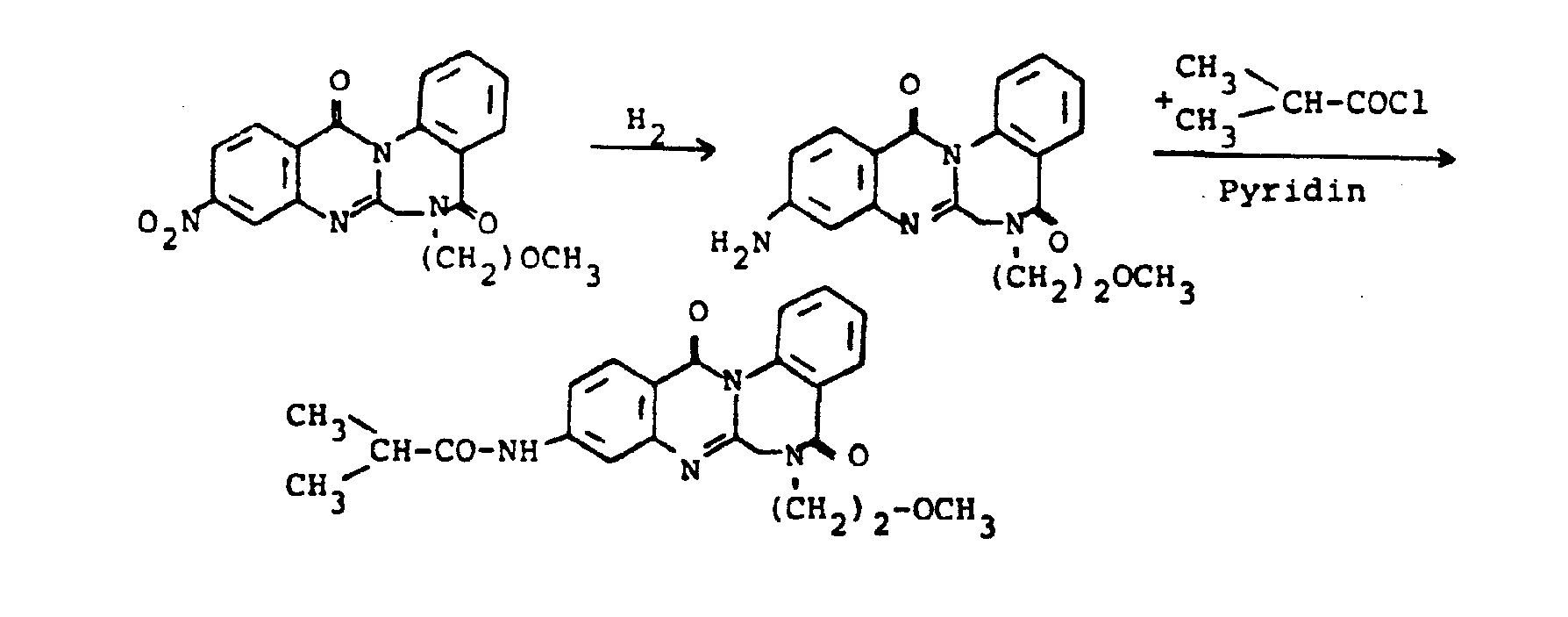


- In den Formeln (I) und (II) steht R1 und R5 vorzugsweise für ein oder zwei Substituenten aus der Gruppe Wasserstoff, Alkyl, Hydroxy, Alkoxy, Nitro, Amino, Dialkylamino, Acylamino, Alkoxycarbonylamino, Halogen, Trifluormethyl, Carboxy, Alkoxycarbonyl, Aminocarbonyl, Dialkylaminocarbonyl, Aminosulfonyl, Dialkylaminosulfonyl, wobei Halogen insbesondere für Fluor, Chlor und Brom steht und die genannten Alkyl-, Alkoxy- und Acylreste 1 bis 4 Kohlenstoffatome, insbesondere 1 oder 2 Kohlenstoffatome enthalten.
- Die Alkylreste in Dialkylamino können auch in sich oder über ein Heteroatom aus der Gruppe O, S oder über eine NH- oder K-Alkylgruppe zu einem 4- bis 7-gliedrigen Ring geschlossen sein.
- R3 steht vorzugsweise für Wasserstoff und R4 vorzugsweise für Wasserstoff, Alkyl mit 1 bis 16, insbesondere 1 bis 8, Kohlenstoffatomen, Aralkyl mit 1 bis 6 Kohlenstoffatomen im Alkylteil, insbesondere Benzyl oder Phenyläthyl, Aryl in Form von Phenyl und Heteroaryl in Form eines 5- bis 6-gliedrigen heterocyclischen Systems mit 1 bis 3 Heteroatomen aus der Gruppe Stickstoff, Sauerstoff und/oder Schwefel. Mögliche Substituenten im Arylteil von Aralkyl und von Aryl sind Halogen, insbesondere Brom und Chlor, Trifluormethyl, Hydroxy, Alkoxy und Nitro.
- R 6 steht vorzugsweise für Alkyl mit 1 bis 2 Kohlenstoffatomen, für Benzyl und Phenyl und
- X steht vorzugsweise für Halogen, insbesondere Brom und Chlor und für Methylsulfo, Phenylsulfo und 4-Methylphenylsulfo.
- Die als Ausgangsstoffe zu verwendenden 2-Alkyl-3-aryl-4H-chinazolin-4-one der Formel II sind bekannt oder lassen sich nach bekannten Verfahren herstellen (vgl. J.Amer.Chem. Soc. 68 (1946), 542 / J.org.Chem. 14 (1949), 967 / J.Gen. Chem. (engl.Trans.) 30 (1960), 2333 und 34 (1964), 848 / Chem.Abstr. 52 (1958), 9147 / J.pr.Chem. (4) 14 (1961), 84 / Arzneimittelforschung 13 (1963) 688 / J.Med.Chem. 20 (1977), 379 / Synthesis 1977, 309).
- Als Beispiele seien im einzelnen genannt:
- 2-Chlormethyl-3-(2-methoxycarbonyl-phenyl)-4H-chinazolin-4-on, 2-Brommethyl-3-(2-methoxycarbonyl-phenyl)-4H-chinazolin-4-on, 2-Chlormethyl-3-(2-äthoxycarbonyl-phenyl)-6-chlor-4H-chinazolin-4-on,
- 2-Bromnethyl-3-(2-carboxy-phenyl)-4H-thinazolin-4-on, 2-Chlormethyl-3-(2-methoxycarbonyl-5-bhlor-phenyl)-7-chlor-4H-chinazolin-4-on,
- 2-Methylsulfomethyl-3-(2-äthoxycarbonyl-phenyl)-6-trifluormethyl-4H-chinazolin-4-on,
- 2-Phenylsulfomethyl-3-(2-methoxycarbonyl-phenyl)-8-methoxy-4H-chinazolin-4-on,
- 2-Fluormethyl-3-(2-methoxycarbonyl-phenyl)-6-fluor-4H-chinazolin-4-on,
- 2-Chlormethyl-3-(2-äthoxycarbonyl-phenyl)-6,7-dimethoxy-4H-chinazolin-4-on,
- 2-Brommethyl-3-(2-butoxycarbonyl-phenyl)-6,7,8-trichlor-4H-chinazolin-4-on,
- 2-(1-Chloräthyl )-3-(2-methoxycarbonyl-phenyl)-6-dimethylamino-4H-chinazolin-4-on,
- 2-(α-Brombenzyl)-3-(2-carboxy-phenyl)-6-aminosulfonyl-7-chlor-4H-chinazolin-4-on,
- 2- (α.-Bromfurfuryl) -3- (2-benzyloxycarbonyl-4,6-dichlor-phenyl)-4H-chinazolin-4-on,
- 2-(2-Brompropyl)-3-(2-methoxycarbonyl-4-trifluormethyl-phenyl)-6-nitro-4H-chinazolin-4-on.
- In den Formeln (I) und (III) steht R 2 vorzugsweise für einen gegebenenfalls substituierten Alkylrest mit 1 bis 10, insbesondere 1 bis 6 Kohlenstoffatomen, einen gegebenenfalls substituierten Aralkylrest mit 1 bis 6 Kohlenstoffatomen im Alkylteil, insbesondere Benzyl oder Phenäthyl, einen gegebenenfalls substituierten Phenylrest, einen Heterocycloalkylrest mit 1 bis 6 Kohlenstoffatomen im Alkylteil und 4 bis 8 Ringgliedern sowie 1 bis 3 Heteroatome aus der Gruppe Stickstoff, Sauerstoff und/oder Schwefel im Heteroarylteil, dem auch ein Phenylring anelliert sein kann.
- Mögliche Substituenten in R2 = Alkyl sind Hydroxy-, Alkoxy-, Amino-, Alkylamino-, Dialkylamino-, Acylamino-, Alkoxycarbonylamino-, Trifluormethyl-, Cyan-, Carboxy-, Alkoxycarbonyl-, Aminocarbonyl-, Alkylaminocarbonyl-, Dialkylaminocarbonyl-, Alkylaminocarbonylamino-und Sulfogruppen, wobei Carboxy-und Sulfogruppen auch in Form von Salzen mit anorganischen und organischen Säuren vorliegen können. Die Alkylreste in Dialkylaminogruppen können auch in sich oder Ober ein Heteroatom aus der Gruppe Sauerstoff, Schwefel oder über eine NH-, N-Alkyl-,N-Acyl- oder N-Alkoxycarbonylgruppe zu einem 4- bis 8- gliedrigen Ring geschlossen sein. In den möglichen Substituenten erwähnte Alkyl-, Alkoxy- und Acylreste enthalten vorzugsweise 1 bis 4, insbesondere 1 bis 2 Kohlenstoffatome.
- Mögliche Substituenten in R2 = Aralkyl und Phenyl sind im jeweiligen Arylteil Halogen, insbesondere Chlor und Brom, Trifluormethyl, Hydroxy, Alkoxy, Nitro und Alkyl.
- Die als Ausgangsstoffe zu verwendenden primären Amine der Fornel (III) sind bekannt oder lassen sich nach bekannten Verfahren herstellen.
- Als Beispiele seien im einzelnen genannt:
- Methylamin, Isobutylamin, 2-Äthylhexylamin, 4-Methylcyclohexylamin, 2-Norbornylamin, Allylamin, Propargylamin, Propylendiamin, 1-Amino-2-diäthylaminoäthan, Äthanolamin, 3-Athoxypropylamin, Aminoessigsäureäthylester, Aminopropionitril, Aminoäthansulfonsäure-Natrium-Salz, Trifluormethyl- äthylamin, 2,4-Dichlorbenzylamin, 4-Chlorphenyläthylamin, 3-Äthoxyanilin, 4-Diäthylaminoanilin, 2-Aminomethylfuran, 4-Aminomethylpyridin, N-Aminoäthyl-N'-methyl-piperazin, N-Aminobutyl-thiomorpholin-1,1-dioxid, 1-Aminomethylisochinolin, 1-Aminopropyl-1,2,3-triazol.
- In den Formeln (I), (II) und (III) und entsprechend auch (IV) und (V) steht Alkyl beispielsweise für Methyl, Äthyl, n- und iso-Propyl, n-, iso- und tert.-Butyl, h- und isoHexyl, Decyl, Hexadecyl, Allyl, Propargyl, Cyclohexyl.
- Alkoxy steht beispielsweise für Methoxy, Äthoxy, n- und iso-Propoxy, n-, iso- und tert.-Butoxy, Allyloxy, Cyclobutyloxy.
- Alkylamino und Dialkylamino steht beispielsweise für Methylamino, Dimethylamino, Äthylamino, Diäthylamino, Methyläthylamino, n- und iso-Propylamino, n-, iso- und tert.-Butylamino, n- und iso-Dipropylamino, n-, iso- und tert.-Dibutylamino, Allylamino, Diallylamino - Dialkylamino auch für Pyrrolidino, Piperidino, Cyclohexylimino, Morpholino, Thiomorpholino, Piperazino, N-Methylpiperazino, Tetrahydrochinolino, 2-Methylindolino.
- Acylamino steht beispielsweise für Formylamino, Acetylamino, Propionylamino, n- und iso-Butyrylamino, Valeroylamino, iso-Valeroylamino, Pivaloylamino.
- Alkoxycarbonyl steht beispielsweise für Methoxycarbonyl, Äthoxycarbonyl, n- und iso-Propoxycarbonyl, n-, iso- und tert.-Butoxycarbonyl, Allyloxycarbonyl, Cyclohexyloxycarbonyl.
- Aralkyl steht beispielsweise für Benzyl, 4-Chlorbenzyl, 2,6-Dichlorbenzyl, 3-Brombenzyl, 2-Methoxybenzyl, 3-Hydroxybenzyl, 2,4,6-Trimethylbenzyl, Phenyläthyl, 4-Chlorphenyläthyl, Phenylpropyl, Phenylbutyl.
- Aryl steht beispielsweise für Phenyl, 2-Chlorphenyl, 2,4-Dichlorphenyl, 3-Nitrophenyl, 3-Trifluormethylphenyl, 2-Trifluormethyl-4-chlorphenyl, 2-Methylphenyl, 4-Xthylphej nyl, 3,4-Dimethylphenyl, 3-Hydroxyphenyl, 2-Methoxyphenyl, ; 4-Äthoxyphenyl, 2-Methoxy-5-chlorphenyl, 2,5-Diäthoxyphenyl, 4-Aminosulfonylphenyl, 3-Dimethylaminophenyl, 3-Xthylaminophenyl, 3-Äthylamino-4-methylphenyl.
- Heteroaryl steht beispielsweise für Furan, Thiophen, Pyrrol, Oxazol, Isoxazol, Thiazol, Pyrazol, Imidazol, Triazol, Pyridin, Pyrimidin, Thiazin, Indol, Benzimidazol, Benzoxazol, Benzthiazol, Indazol, Chinolin, Isochinolin, Chinazolin, cninoxalin, Benzotriazin, Phthalazin.
- Als Lösungsvermittler kommen alle organischen Lösemittel in Frage, die gegenüber den jeweiligen Reaktionspartnern inert sind. Hierzu gehören vorzugsweise aliphatische Alkohole wie Methanol, Äthanol, Isopropanol oder Butanol, Äther wie Tetrahydrofuran, Dioxan, Äthylenglykolmonomethyläther, Äthylenglykoldiäthyläther, Glykole wie Äthylenglykol, Propylenglykol, Diäthylenglykol und entsprechende Äther mit aliphatischen Alkoholen wie Diäthylenglykoldimethyläther, Kohlenwasserstoffe wie Ligroin, Toluol, Xylol, Tetralin, Halogenkohlenwasserstoffe wie Chloroform, Tetrachlorkohlenstoff, Chlorbenzol, Dichlorbenzole, Nitrile wie Acetonitril, Propionitril, Carbonsäureamide wie Dimethylformamid, Dimethylacetamid, heterocyclische Basen wie Pyridin, Picoline, Kollidine, Chinolin oder Isochinolin, ferner handelsübliche technische Gemische dieser Lösemittel.
- Die Umsetzung kann bei Normaldruck aber auch bei erhöhtem Druck durchgeführt werden. Insbesondere bei der Verwendung von Ammoniak oder niedrig siedenden primären Aminen als Rekationspartner kann erhöhter Druck für die Umsetzung erforderlich sein.
- Die Reaktionstemperaturen können in einem größeren Bereich variiert werden. Im allgemeinen arbeitet man bei Temperaturen zwischen 20 und 250°C, vorzugswiese zwischen 20 un 180 o C, insbesondere zwischen 40 und 150°C.
- Als Säurebindemittel können alle üblichen Säurebinder eingesetzt werden, Hierzu gehören anorganische Basen wie Alkali-und Erdalkalihydroxide, z.B. Natriumhydroxid, Kaliumhydroxid, Calciumhydroxid, Bariumhydroxid, Alkali- oder Erdalkalicarbonate wie Natriumcarbonat, Kaliumcarbonat, Calciumcarbonat, Natriumhydrogencarbonat, Kaliumhydrogencarbonat, Amide wie Natriumamid sowie organische Basen wie tertiäre Amine, z.B. Triäthylamin, N,N-Dimethylanilin, Pyridine, Chinoline und Isochinoline. Anstelle eines der üblichen Säurebindemittel kann man bei der Umsetzung auch in vorteilhafter Weise einen Überschuß des Reaktionspartners Ammoniak bzw. primäres Amin verwenden.
- Bei der Durchführung des erfindungsgemäßen Verfahrens setzt man auf 1 Mol des 2-Alkyl-3-aryl-4H-chinazolin-4-ons der Formel (II) mindestens 1 Mol Ammoniak bzw. primäres Amin der Formel (III) und mindestens 1 Mol eines der genannten Säurebindemittel ein.
- Im Verlauf der erfindungsgemäßen Umsetzung gehen die Ausgangsstoffe in der Regel ganz oder teilweise in Lösung, während die Endprodukte auskristallisieren. Die Abscheidung der Endprodukte kann durch Abkühlen und/oder durch Zugabe von Fällungsmitteln wie Wasser, niedere aliphatische Äther wie Diäthyläther oder Dibutyläther oder niedere aliphatische Kohlenwasserstoffe wie Petroläther oder Leichtbenzin beschleunigt werden.
- Von besonderem Interesse sind 6,7-Dihydro-5H,13H-chinazolino[3,2-a][1,4] benzodiazepin-5,13-dione der Formel (I), in welcher
- Rund R gleich oder verschieden sind und jeweils für 1 oder 2 Substituenten aus der Gruppe Wasserstoff, Halogen, Nitro, Cyano, Trifluormethyl, Amino, Alkyl mit 1 bis 4 Kohlenstoffatomen oder Alkoxy mit 1 bis 4 Kohlenstoffatomen stehen,
- R 2 für Wasserstoff, Alkyl mit 1 bis 6 Kohlenstoffatomen, wobei die Alkylgruppe gegebenenfalls durch Phenyl, Pyridyl, Halogen, Alkoxy oder Dialkylamino substituiert sein kann und wobei die Alkyl- und Alkoxysubstituenten 1 bis 4 Kohlenstoffatome enthalten, oder für eine Alkoxycarbonylgruppe mit 1 bis 4 Kohlenstoffatomen im Alkoxyrest, steht und
- R und R 4 gleich oder verschieden sind und für Wasserstoff, Alkyl mit 1 bis 4 Kohlenstoffatomen oder Phenyl stehen.
- Als neue Wirkstoffe seien im einzelnen genannt: 6,7-Dihydro-5H,13H-chinazolino[3,2-a][1,4]benzodiazepin-5,13-dion, 1-Chlor-6,7-dihydro-, 2-Chlor- ..., 3-Chlor-, 4-Chlor-, 9-Chlor-, 10-Chlor-, 11-Chlor-, 12-Chlor-, 1,3-Dichlor-, 1,4-Dichlor-, 9,11-Dichlor, 9,12-Dichlor-,1,2,3-Trichlor-, 9,10, 11-Trichlor-, 1,2,3,4-Tetrachlor-, 9,10,11,12-Tetrachlor-, 3-Brom-, 11-Brom-, 1,3-Dibrom-, 9,11-Dibrom-, 3-Fluor-, 11-Fluor-, 1,3-Dijod-, 9,11-Dijod-, 1-Trifluormethyl-, 2-Trifluormethyl-, 3-Trifluormethyl-, 4-Trifluormethyl-, 9-Trifluormethyl-, 10-Trifluormethyl-, 11-Trifluormethyl-, 12-Trifluormethyl-, 1-Methyl-, 2-Methyl-, 3-Methyl-, 9-Methyl-, 10-Methyl-, 11-Methyl-, 2,4-Dimethyl-, 10,12-Dimethyl-, 1- Äthyl-, 9-Äthyl-, 1-Methoxy-, 3-Methoxy-, 4-Methoxy-, 9-Methoxy-, 11-Methoxy-, 12-Methoxy-, 2,3-Dimethoxy-, 10,11-Dimethoxy-, 2-Xthoxy-, 10-Äthoxy-, 1-Hydroxy-, 2-Hydroxy-, 9-Hydroxy-, 10-Hydroxy-, 1-Nitro-, 2-Nitro-, 3-Nitro-, 4-Nitro-, 9-Nitro-, 10-Nitro-, 11-Nitro-, 12-Nitro-, 1,3-Dinitro-, 9,11-Dinitro-, 1-Nitro-3-chlor-, 9-Nitro-11-chlor-, 9,11-Dinitro-12-Chlor-, 1-Brom-3-nitro-, 9-Brom-11-nitro-, 1-Amino-, 2-Amino-, 3-Amino-, 4-Amino-, 9-Amino-, 10-Amino-, 11-Amino-, 12-Amino-, 1,3-Diamino-, 9,11-Diamino-, 10-Acetylamino-, 11-Acetylamino-, 2-Äthoxycarbonylamino-, 3-Äthoxycarbonylamino-, 11-Äthoxycarbonylamino-, 10-Dimethylamino-, 10-N-Äthyl-N-formyl-amino-, 10-Pyrrolidino-, 10-Piperidino-, 10-Morpholino-, 10-N-Methyl-piperazino-, 10-Äthylamino-, 10-Isopropoxycarbonylamino-, 2-Carboxy-, 3-Carboxy-, 4-Carboxy-, 2-Methoxycarbonyl-, 3-Athoxycarbonyl-, 4-Butoxycarbonyl-, 2-Aminocarbonyl-, 3-Butylaminocarbonyl-, 4-Morpholinocarbonyl-, 10-Aminosulfonyl-, 11-Aminosulfonyl-, 10-Chlor-11-aminosulfonyl-, 11-Methylaminosulfonyl-, 11-Diäthylaminosulfonyl-, 9-Methoxy-11-chlor-12-methyl-, 9-Chlor-12-äthyl-, 3,10-Dichlor-, 3,11-Dichlor-, 2-Chlor-11-trifluormethyl-, 4-Chlor-10-trifluormethyl-, 3,11-Bistrifluormethyl-, 6-Methyl-, 6-Butyl-, 6-(2-Äthoxymethyl)-, 6-(3-Dimethylaminoäthyl)-, 6-(2-Diäthylaminoäthyl)-, 6-(2-Diäthylaminopropyl)-, 6-Äthoxycarbonylmethyl-, 6-Piperidino- äthyl-, 6-(4-Methylpiperidinoäthyl)-, 6-(N-Methylpiperazino- propyl)-, 6-Morpholinoäthyl-, 6-Benzyl-, 6-(4-Chlorbenzyl)-, 6-(2,4-Dichlorbenzyl)-, 6-(3-Hydroxybenzyl)-, 6-Phenyläthyl-, 6-(4-Methoxyphenyläthyl)-, 6-Acetyl-, 6-Äthoxycarbonyl-, 6-(Picolyl-2)-, 6-(Picolyl-4)-, 7-Methyl-, 7-Phenyl-, 7-(3-Chlorphenyl)-, 7-Thienyl-, 7-Methyl-7-(4-chlorphenyl)-, 7-(Furyl-2)-10-chlor-, 3-Chlor-6-benzyl-7-methyl-, 4-Chlor-6-äthyl-7-phenyl-11-trifluormethyl-6,7-dihydro-6H,13H-chinazolino[3, 2-a][1, 4]-benzodiazepin-5,13-dion.
- Die neuen erfindungsgemäßen Verbindungen sind als Arzneimittel verwendbare Substanzen. Sie können je nach Verwendungsart verabreicht werden, beispielsweise intravenös, intramuskulär, subkutan, oral oder intravaginal.
- Die neuen Wirkstoffe können in bekannter Weise in die üblichen Formulierungen übergeführt werden wie Tabletten, Kapseln, Dragees, Pillen, Granulate, Sirupe, Emulsionen, Suspensionen und Lösungen, unter Verwendung inerter, nichttoxischer, pharmazeutisch geeigneter Trägersubstanzen oder Lösungsmittel. Hierbei soll die therapeutisch wirksame Verbindung jeweils in einer Konzentration von etwa O,5 bis 90 Gew.-% der Gesamtmischung vorhanden sein, d.h. in Mengen, die ausreichend sind, um den angegebenen Dosierungsspielraum zu erreichen.
- Die Formulierungen werden beispielsweise hergestellt durch Verstrecken der Wirkstoffe mit Lösungsmitteln und/oder Trägerstoffen, gegebenenfalls unter Verwendung von Emulgiermitteln und/oder Dispergiermitteln, wobei z.B. im Fall der Benutzung von Wasser als Verdünnungsmittel gegebenenfalls organische Lösungsmittel als Hilfslösungsmittel verwendet werden können.
- Als Hilfsstoffe seien beispielhaft aufgeführt:
- Wasser, nichttoxische organische Lösungsmittel wie Paraffine (z.B. Erdölfraktionen), pflanzliche öle (z.B. Erdnuß-/Sesamöl), Alkohole (z.B. Äthylalkohol, Glycerin), Glykole (z.B. Propylenglykol, Polyäthylenglykol), feste Tägerstoffe wie z.B. natürliche Gesteinsmehle (z.B. Kaoline, Tonerden, Talkum, Kreide), synthetische Gesteinsmehle (z.B. hochdisperse Kieselsäure, Silikate), Zucker (z.B. Rohr-, Milch- und Traubenzucker), Emulgiermittel wie nichtionogene und anionische Emulgatoren (z.B. POlyäthylen-Fettsäureester, Polyoxyäthylen- . Fettalkoholäther, Alkylsulfonate und Arylaulfonate), Dispergiermittel (z.B. Lignin, Methylcellulose, Stärke und Polyvinylpyrrolidon) und Gleitmittel (z.B. Magnesiumstearat, Talkum, Stearinsäure und Natriumlaurylsulfat).
- Die Applikation erfolgt in üblicher Weise, vorzugsweise oral oder parenteral.
- Im Falle der oralen Anwendung können Tabletten selbstverständlich außer den genannten Trägerstoffen auch Zusätze wie Natriumcitrat, Calciumcarbonat und Calciumphosphat zusammen mit verschiedenen Zuschlagstoffen wie Stärke, vorzugsweise Kartoffelstärke, Gelatine und dergleichen, enthalten. Weiterhin können Gleitmittel wie Magnesiumstearat, Natriumlaurylsulfat und Talkum zum Tablettieren mitverwendet werden. Im Falle wäßriger Suspensionen und/oder Elixieren, die für orale Anwendungen gedacht sind, können die Wirkstoffe außer mit den obengenannten Hilfsstoffen mit verschiedenen Geschmacksaufbesserern oder Farbstoffen versetzt werden.
- Für den Fall der parenteralen Anwendung können Lösungen der Wirkstoffe unter Verwendung geeigneter flüssiger Trägermaterialien eingesetzt werden. Als besonders vorteilhaft für den Fall der parenteralen Anwendung hat sich die Tatsache herausgestellt, daß die erfindungsgemäßen Verbindungen in Wasser gut lösliche Salze zu bilden vermögen. Diese Salze werden erhalten, wenn man die erfindungsgemäßen Verbindungen in einem geeigneten Lösungsmittel mit der äquimolaren Menge einer nichttoxischen anorganischen oder organischen Base vereinigt. Als Beispiele seien genannt: Natronlauge, Kalilauge, Äthanolamin, Diäthanolamin, Triäthanolamin, Aminotris-hydroxymethyl-methan, Glucosamin, N-Methylglucosamin. Derartige Salze können auch für die orale Anwendung der erfindungsgemäßen Verbindungen eine erhöhte Bedeutung besitzen, indem sie die Resorption je nach Wunsch beschleunigen oder verzögern. Als Beispiele seien außer den oben bereits erwähnten Salzen genannt: Magnesiumsalze, Calciumsalze, Aluminiumsalze und Eisensalze.
- Im allgemeinen hat es sich als vorteilhaft erwiesen, bei parenteraler Applikation Mengen von etwa 0,05 bis 200 mg/kg, vorzugsweise etwa 0,1 bis 50 mg/kg Körpergewicht pro Tag zur Erzielung wirksamer Ergebnisse zu verabreichen, und bei oraler Applikation beträgt die Dosierung etwa 0,1 bis 500 mg/kg, vorzugsweise 0,5 bis 100 mg/kg Körpergewicht pro Tag.
- Trotzdem kann es gegebenenfalls erforderlich sein, von den genanntenMengen abzuweichen, und zwar in Abhängigkeit vom Körßergewicht des Versuchstieres bzw. der Art des Applikationsweges, aber auch aufgrund der Tierart und deren individuellem Verhalten gegenüber dem Medikament bzw. der Art von dessen Formulierung und dem Zeitpunkt bzw. Intervall, zu welchem die Verabreichung erfolgt. So kann es in wenigen Fällen ausreichend sein, mit weniger als der vorgenannten Mindestmenge auszukommen, während in anderen Fällen die genannte obere Grenze überschritten werden muß. Im Fall der Applikation größerer Mengen kann es empfehlenswert sein, diese in mehrere Einzelgaben über den Tag zu verteilen.
- Diese Angaben gelten sowohl für die Anwendung der erfindungsgemäßen Verbindungen in der Veterinär- als auch in der Humanmedizin. :
-

- 14,7 g (0,05 Mol) 2-Brommethyl-3-(2(methoxycarbonyl-phenyl)-4H-chinazolin-4-on und 25 Ammoniaks in 100 ml Äthylenglykolmonomethyläther werden in einem Autoklaven 5 Stunden auf 100°C erhitzt. Nach dem Erkalten saugt man die farblosen Kristalle ab und wäscht mehrfach mit Methanol. Man erhält 6,1 g (44 der Dihydro-5H, 13H-chinazolino[3, 2-a][1, 4] benzodiazepin-5,13-dion. Schmelzpunkt: 313-315°C (aus Dimethylformamid).
- a) Das Reaktionsprodukt des Beispiels 1' erhält man auch bei der Umsetzung von 32,9 g (0,6 Mol) 2-Chlormethyl-3-(2-methoxycarbonyl-phenyl)-4H-chinazolin-4-on und 80 ml flüssigen Ammoniaks in 200 ml Athylenglykolmonomethyl- äther in einem Autoklaven in 5 Stunden bei 120°C in 69 %- iger Ausbeute.
2-Chlormethyl-3-(2-methoxycarbonyl-phenyl)-4H-chinazolin-4-on (Schmelzpunkt: 197-199°C, umkristallisiert aus Toluol) wurde analog J. Chem. (4) 14 (1961), 84 aus N-Chloracetyl-anthranilsäure und Anthranilsäuremethylester hergestellt. - b) Das Reaktionsprodukt des Beispiels 1 erhält man auch durch 2 stündiges Einleiten von gasförmigem Ammoniak in eine Lösung von 0,05 Mol 2-Chlormethyl-2-(2-methoxycarbonyl-phenyl)-4H-chinazolin-4-on in 250 ml Dimethylformamid bei 20-25° und 12 stündiges Stehenlassen des Ansatzes in 81 %iger Ausbeute.
-

- 2-Chlormethyl-3-(2-äthoxycarbonyl-phenyl)-6-chlor-4H-chinazolin-4-on (Schmelzpunkt: 195-197°C, umkristallisert aus Toluol) wurde analog J.Amer.Chem.Soc. 68 (1946), 542 aus N-Chloracetyl-5-chloranthranlsäuren und Anthranilsäureäthylester hergestellt.
-

- Stunden bei 80°C 10 g (65 der Theorie) 10-Chlor-6,7-dihydro-5H,13H-chinazolino [3, 2-a],[1,4] benzodiazepin-5,13-dioz. Schmelzpunkt: 290-292°C (aus Dimethylformamid).
-

- Analog Beispiel 1 a) erhält man aus 18 g (0,05 Mcl) 2-Chlormethyl-3-(2-methoxycarbonyl-5-chlor-phenyl)-4H-chinazolin-4-on (Schmelzpunkt: 151-152°C aus Äthanol) und 50 ml flüssigen Ammoniaks in 150 ml Äthylenglykolmonomethyläther in 5 Stunden bei 80°C 9,5 g (61% der Theorie) 2-Chlor-6,7-di- hydro-5H-13H-chinazolino[3,2-a] [1,4]benzodiazepin-5,13-dion. Schmelzpunkt: 330-333°C (aus Dimethylformamid).
-

- Analog Beispiel 1 a) erhält man aus 13 g (0,05 Mol) 2-Chlormethyl-3-(2-methoxycarbonyl-4-chlor--phenyl)-4H-chinazolin-4-on (Schmelzpunkt: 135-136°C aus Toluol) und 50 ml flüssigen Ammoniaks in 150 ml Äthylenglykolmonomethyläther in 5 Stunden bei 80°C 13 g (84 der Theorie) 3-Chlor-6,7-dihy- dro-5H,13H-chinazolino[3,2-a][1,4]benzodiazepin-5,13-dion. Schmelzpunkt 294-296°C (aus Dimethylformamid)
-

- 16,4 g (0,05 Mol) 2-Chlormethyl-3-(2-methoxycarbonyl-phenyl)-4H-chinazolin-4-on und 10 ml flüssigen Methylamins in 100 ml Äthylenglykolmonomethyläther werden in einem Autoklaven 2 Stunden auf 40°C erhitzt. Nach dem Erkalten saugt man die farblosen Kristalle ab und wäscht mehrfach mit Äthanol. Man erhält 12 g (82,3 g den Theorie) 6-Methyl-6,7-dihydro-5H, 13H-chinazolino [3,2-a][1,4] benzodiazepin-5,13-dion. Schmelzpunkt: 204-206°C (aus Äthanol).
-

- Analog Beispiel 6 erhält man aus 32,9 g (0,1 Mol) 2-Chlormethyl-3-(2-methoxycarbonyl-phenyl)-4H-chinazolin-4-on und 75 ml n-Butylamin in 200 ml Äthylenglykolmonomethyläther in 5 Stunden bei 120°C 7 g (21 % der Theorie) 6-n-Butyl-6,7-di- hydro-5H, 13H-chinazolino[3,2-a] [1,4] benzodiazepin-5,13-dion. Schmelzpunkt: 125-127°C (aus Äthanol).
-

- 16,4 g (0,05 Mol) 2-Chlormethyl-3-(2-methoxycarbonyl-phenyl)-4H-chinazolin-4-on und 12,8 g (0,11 Mol) 1-Amino-2-dimethylamino-äthan in 100 ml Äthylenglykolmonomethyläther werden 5 Stunden auf 120°C erhitzt. Man verdampft das Lösungsmittel am Rotavapor und versetzt den ölrUckstand mit 50 ml Äthanol. Es entsteht eine klare Lösung und nach kurzer Zeit scheiden sich farblose Kristalle ab. Durch Absaugen und Waschen mit Äthanol und Wasser erhält man 12,4 g (66 % der Theorie) analysenreines 6-Diäthylaminoäthyl-6,7-dihydro-5H,13H-chinazolino[3,2-a] [1,4] benzodiazepin-5,13-dion. Schmelzpunkt: 117-119°C.
-

- 16.4 g (0,05 Mol) 2-Chlormethyl-3-(2-methoxycarbonyl-phenyl)-4H-chinazolin-4-on und 14,3 g (0,11 Mol) 1-Amino-3-diäthylamino-propan in 100 ml Äthylenqlykolmonomethyläther werden 5 Stunden auf 120°C erhitzt. Man verdampft das Lösungsmittel am Rotavapor und versetzt den ölrückstand mit 50 ml Wasser und 100 ml Chloroform. Nach Abtrennen der Chloroformphase im Scheidetrichter schüttelt man diese mit Wasser, verdünnter Natronlauge und nochmals mit Wasser aus, trocknet über Natriumsulfat und verdampft das Chloroform am Rotavapor. Den ölrückstand löst man in Äthanol und leitet bis zur Sättigung Chlorwasserstoff ein. Dabei kristallisiert analysenreines 6-Diäthylaminopropyl-6,7-dihydro-5H,13H-chinazolino [3,2-a] [1,4] benzodiazepin-5,13-dion-hydrochlorid aus (15,1 g, 71 % der Theorie). Schmelzpunkt: 237-2380C.
-

- Analog Beispiel 1 a) erhält man aus 30 g (0,091 Mol) 2-Chlormethyl-3-(2-methoxycarbonyl-phenyl)-4H-chinazolin-4-on und 50 ml Benzylamin in 200 ml Äthylenglykolmonomethyläther in 5 Stunden bei 120°C 29,5 g (88 % der Theorie) 6-Benzyl-6,7-dihydro-5H,13H-chinazolino[3,2-a) [1,4]benzodiazepin-5,13-dion. Schmelzpunkt: 171-173°C.
-
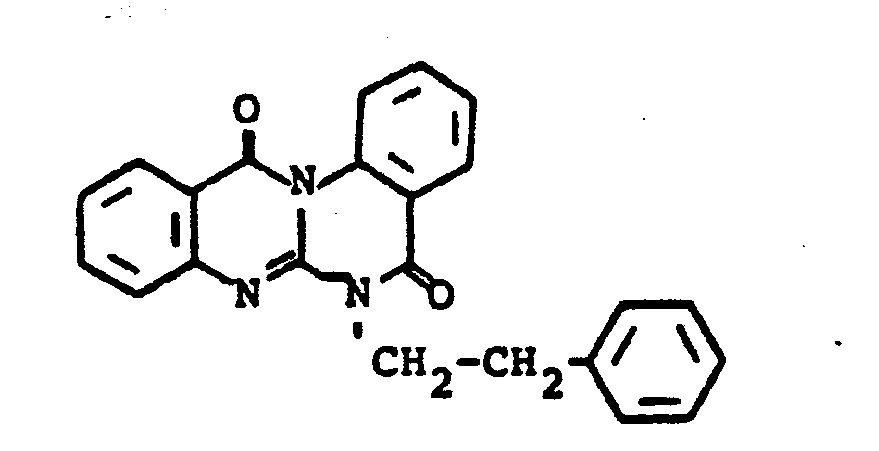
- 16,4 g (0,05 Mol) 2-Chlormethyl-3-(2-methoxycarbonyl-phenyl)-4H-chinazolin-4-on und 12,1 g (0,1 Mol) 2-Phenyläthylamin werden in 100 ml Äthylenglykolmonomethyläther. 5 Stunden auf 100°C erhitzt. Man verdampft das Lösungsmittel am Rotavapor und versetzt den halbfesten Rückstand mit 100 ml Wasser. Die farblosen Kristalle werden abgesaugt und mit heißem Methanol gewaschen. Man erhält 5,8 g (30,5 % der Theorie) 6-(2-Phenyläthyl)-6,7-dihydro-5H,13H-chinazolino[3,2-a][1,4) benzodiazepin-5,13-dion. Schmelzpunkt:208-210°C.
-
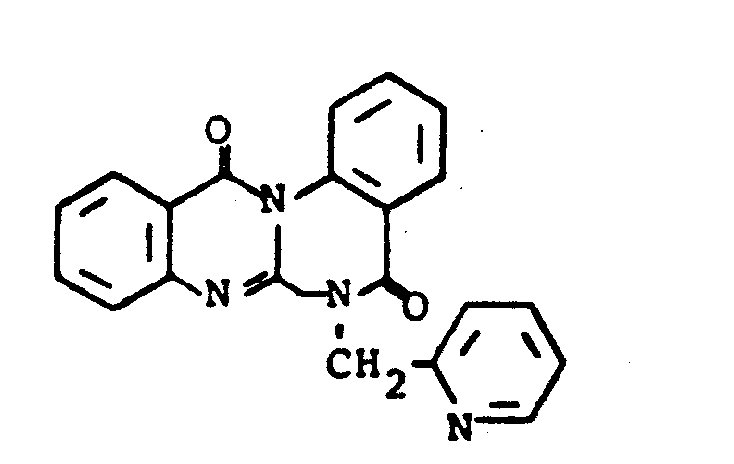
- 16,4 g (0,05 Mol) 2-Chlormethyl-3-(2-methoxycarbonyl-phenyl)-4H-chinazolin-4-on und 12 g (0,11 Mol) 2-Aminomethylpyridin in 100 ml Äthylenglykolmonomethyläther werden 5 Stunden auf 120°C erhitzt. Man verdampft das Lösungsmittel am Rotavapor und kristallisiert den festen Rückstand aus Methanol um. Nach dem Absaugen wäscht man mit Methanol und Wasser, wobei 10 g (54,5 % der Theorie) 6-(Pyridyl-(2)-methyl)-6,7-dihydro-5H,13H-chinazolino[3,2-a][1,4]benzodiazepin-5,13-dion erhalten werden. Schmelzpunkt: 202-203°C.
-

- 8 g (0,029 Mol) des Reaktionsproduktes aus Beispiel 1 werden in 30 ml Pyrokohlensäure-diäthylester 15 Minuten auf 120 °C erhitzte wobei man das sich bildende Äthanol laufend Über einen absteigenden Kühler abdestilliert. Man verdampft Äthanol und überschüssiges Diäthylpyrocarbonat am Rotavapor Und fügt zu dem ölrückstand erneut 50 ml Äthanol. Es bilden sich farblose Kristalle, die nach dem Absaugen mit Äthanol gewaschen werden. Man erhält 6,4 g (63,5 % der Theorie) 6- Äthoxycarbonyl-6,7-dihydro-5H,13H-chinazolino[3,2-a][1,4] benzodiazepin-5,13-dion. Schmelzpunkt: 185-187°C.
-

- Analog Beispiel 1 a) erhält man aus 0,05 Mol 2-Chlormethyl-3-(2-methoxycarbonyl-phenyl)-8-methyl-4H-chinazolin-4-on (Schmp. 206 - 208°) und 50 ml flüssigen Ammoniaks in 150 ml Äthylenglykoldiäthyläther in 3 Stunden bei 600 76 % d. Th. 9-Methyl-A.*) Schmp. 273 - 274° (aus n-Butanol).
-

- Analog Beispiel 1 a) erhält man aus 0,05 Mol 2-Chlormethyl-3-(2-methoxycarbonyl-phenyl)-8-methoxy-4H-chinazolin-4-on (Schmp. 208 - 210°) und 50 ml flüssigen Ammoniaks in 150 ml n-Butanol in 3 Stunden bei 60° 52 % d. Th. 9-Methoxy-A.* Schmp. 290 - 2920 (aus n-Butanol).
-

- Analog Beispiel 1 a) erhält man aus 0,135 Mol 2-Chlormethyl-3-(2-methoxycarbonyl-phenyl)-6-fluor-4H-chinazolin-4-on (Schmp. 213 - 215°) in 400 ml Äthylenglykol und 140 ml flüssigen Ammoniaks in 3 Stunden bei 60° 85 % d. Th. 11-Fluor-A. Schmp. 275 - 277° (aus Äthylenglykolmonomethyläther).
-

- Analog Beispiel 1 a) erhält man aus 0,05 Mol 2-Chlormethyl-3-(2-methoxycarbonyl-phenyl)-6-brom-4H-chinazolin-4-on (Schmp. 235 - 237°) und 50 ml flüssigen Ammoniaks in 150 ml Pyridin in 5 Stunden bei 60° 88 % d. Th. 11-Brom-A. Schmp. 300 - 303°.
-

- Analog Beispiel 1 a) erhält man aus 0,025 Mol 2-Chlormethyl-3-(2-methoxycarbonyl-phenyl)-8-chlor-4H-chinazolin-4-on (Schmp. 205 - 208°) und 20 ml flüssigen Ammoniaks in 50 ml Äthylenglykolmonoäthyläther in 3 Stunden bei 500 71 % d. Th. 9-Chlor-A. Schmp. 255 - 258°.
-
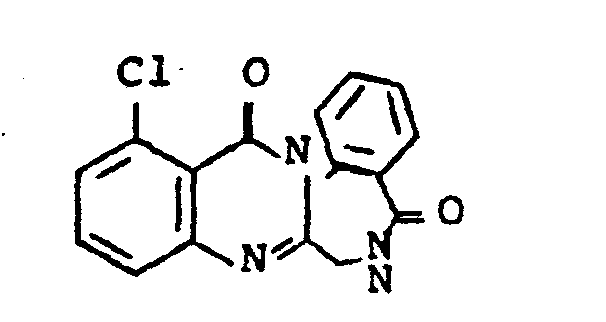
- Analog Beispiel 1 a) erhält man aus 0,05 Mol 2-Chlormethyl-3-(2-methoxycarbonyl-phenyl)-5-chlor-4H-chinazolin-4-on (Schmp. 177 - 178°) und 50 ml flüssigen Ammoniaks in 150 ml Äthylenglykoldimethyläther in 3 Stunden bei 60° 60 % d. Th. 12-Chlor-A. Schmp. 308 - 310° (aus Dimethylformamid).
-

- Analog Beispiel 1 a) erhält man aus 0,05 Mol 2-Chlormethyl-3-(2-methoxycarbonyl-phenyl)-6-trifluormethyl-4H-chinazolin-4-on (Schmp. 169 - 1700) und 50 ml flüssigen Ammoniaks in 150 ml Dioxan in 3 Stunden bei 50° 36 d.Th. 11-Trifluormethyl-A. Schmp. 190 - 192° (aus Toluol).
-

- Analog Beispiel 1 a) erhält man aus 0,05 Mol 2-Chlormethyl-3-(2-methoxycarbonyl-5-nitro-phenyl)-4H-chinazolin-4-on (Schmp. 158 - 1590) und 50 ml flüssigen Ammoniaks in 150 ml o-Dichlorbenzol in 3 Stunden bei 60° 35 % d. Th. 2-Nitro-A. Schmp. 276 - 277° Zers. (aus Eisessig).
-

- Analog Beispiel 8 erhält man aus 0,05 Mol 2-Methoxymethyl-3-(2-methoxycarbonyl-phenyl)-4H-chinasolin-4-on (Schmp. 134-137°, hergestellt aus 2-Brommethyl-3-(2-methoxycarbonyl-phenyl)-4H-chinazolin-4-on und Methanol analog J. Med. Chem. 20, 379 (1977)) und 20 ml 2-Methoxyäthylamin in 100 ml Xthanol in 3 Stunden bei 50° 40 % d.Th. 6-Methoxyäthyl-A.Schmp. 127 - 130° (aus Äthanol).
-

- Analog Beispiel 9 erhält man aus 0,05 Mol 2-Chlormethyl-3-(2-äthoxycarbonyl-phenyl)-4H-chinazolin-4-on und 10 g 3-Dimethylaminopropylamin in 100 ml Äthylenglykolmonoäthyläther in 5 Stunden bei 120° 67 % d. Th. 6-Dimethylaminopropyl-A-dihydrochlorid. Schmp. 198 - 200° (aus Äthanol).
-

- Analog Beispiel 9 erhält man aus 0,05 Mol 2-Chlormethyl-3-(2-äthoxycarbonyl-phenyl)-4H-chinazolin-4-on und 17 g N-Aminopropyl-4-methyl-1,2,5,6-tetrahydro-pyridin in 100 ml Tetralin in 5 Stunden bei 1200 45 % d. T. 6-(4-Methyl-1,2,4,6-tetrahydro-pyridino-propyl)-A-dihydrochlorid. Schmp. 112-115° (aus Äthanol).
-
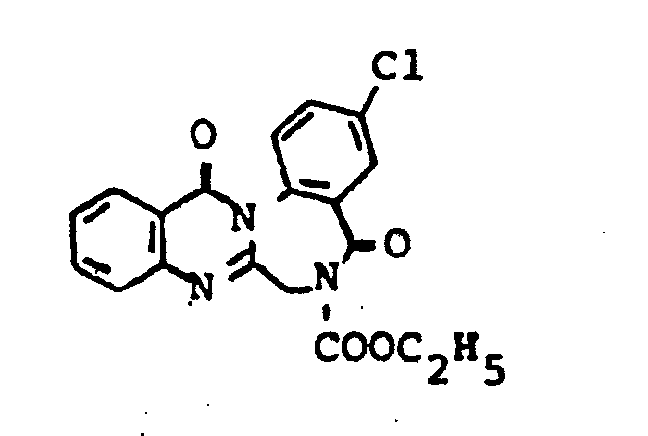
- Analog Beispiel 13 erhält man aus 0,05 Mol des Reaktionsproduktes aus Beispiel 5 und 60 ml Pyrokohlensäurediathylester in 20 Minuten bei 120-1300 80 % d. Th. 6-Athoxy- carbonyl-3-chlor-A. Schmp. 189 - 1910 (aua Äthanol).
-

- Analog Beispiel 13 erhält man aus 0,015 Mol des Reaktionsproduktes aus Beispiel 2 und 20 ml Pyrokohlensäurediäthylester in 30 Minuten bei 130 - 135° 94 % d, Th. 6-Äthoxycarbonyl-11-chlor-A. Schmp. 258 - 260° (aus Äthanol).
-

- 0,05 Mol des Reaktionsproduktes aus Beispiel 1 werden in 100 ml Essigsäureanhydrid und 10 ml Pyridin 8 Stunden auf 120° erhitzt. Nach dem Erkalten gießt man die klare Lösung auf Wasser und saugt die ausgefallenen Kristalle ab. Man erhält 44 % d. Th. 6-Acetyl-A. Schmp. 189 - 191° (aus Äthanol).
-

- Analog Beispiel 1 a) erhält man aus 0,03 Mol 2-Chlormethyl-3-(2-methoxycarbonyl-5-chlor-phenyl)-4H-chinazolin-4-on .und 25 ml Isopropylamin (65 %ige Lösung in Wasser) in 100 ml Isopropanol in 3 Stunden bei 500 48 % d.Th. 2-Chlor-6-isopropyl-A. (Schmp. 193 - 195° (aus Äthanol).
-

- Analog Beispiel 1a) erhält man aus 0,03 Mol 2-Chlormethyl-3-(2-methoxycarbonyl-5-chlor-phenyl)-4H-chinazolin-4-on und 15 ml Allylamin in 100 ml Toluol in 3 Stunden bei 50° 89 % der Theorie 6-Allyl-2-chlor-A. Schmp. 155-157°.
-

- Analog Beispiel 8 erhält man aus 0,035 Mol 2-Chlormethyl-3-(2-methoxycarbonyl-phenyl)-8-methoxy-4H-chinazolin-4-on und 15 ml Äthanolamin in 100 ml Propylenglykol in 5 Stunden bei 80° 80,5 % d.Th. 6-Hydroxyäthyl-9-methoxy-A. Schmp. 233-235°.
-

- Analog Beispiel 8 erhält man aus 0,035 Mol 2-Chlormethyl-3-(2-methoxycarbonyl-phenyl)-8-methoxy-4H-chinazolin-4-on und 15 ml Cyanäthylamin in 100 ml Äthanol in 5 Stunden bei 80° 51 % d.Th. 6-Cyanäthyl-9-methoxy-A. Schmp. 198-200° (aus Äthanol).
-

- Analog Beispiel 8 erhält man aus 0,03 Mol 2-Chlormethyl-3-(2-methoxycarbonyl-phenyl)-8-methyl-4H-chinazolin-4-on und 15 ml 2-Norbornylamin in 100 ml Äthylenglykolmonomethyläther in 5 Stunden bei 80° 62 % d.Th. 6-Norbornyl-(2)-9-methyl-A. Schmp. 168-1690 (aus Methanol).
-

- Analog Beispiel 8 erhält man aus 0,03 Mol 2-Chlormethyl-3-(2-methoxycarbonyl-phenyl)-8-methyl-4H-chinazolin-4-on und 0,07 Mol 1-Aminoadamantan in 100 ml Äthylenglykolmonoäthyläther in 5 Stunden bei 125-130° 90 % d.Th. 6-Adamantyl-(1 9-methyl-A. Schmp. 204-206°.
-

- Analog Beispiel 8 erhält man aus 0,03 Mol 2-Chlormethyl-3-(2-methoxycarbonyl-phenyl)-8-methyl-4H-chinazolin-4-on und 15 ml n-Hexylamin in 100 ml n-Butanol in 5 Stunden bei 80° 88,5 % d.Th. 6-Hexyl-9-methyl-A. Schmp. 138-139°.
-

- Analog Beispiel 8 erhält man aus 0,05 Mol 2-Chlormethyl-3-(2-methoxycarbonyl-phenyl)-6-brom-4H-chinazolin-4-on und 20 ml Cyclohexylamin in 100 ml Äthylenglykol in 5 Stunden bei 125° 43 % d.Th. 11-Brom-6-cyclohexyl-A. Schmp. 276-279°.
-

- 0,06 Mol des Reaktionsproduktes aus Beispiel 21 werden in 150 ml Dimethylformamid in Gegenwart von 5 g Raney-Nickel bei 60° hydriert. Nach dem Abfiltrieren des Katalysators wird die Lösung eingedampft (Rotavapor) und der Rückstand mit Äthylenglykolmonomethyläther heiß extrahiert. Beim Abkühlen kristallisiert analysenreines 2-Amino-A aus. Ausbeute 50 % d.Th., Schmp. > 340°.
-

- 0,015 Mol des Reaktionsproduktes aus Beispiel 36 werden in 100 ml Äthanol mit 10 g Pyrokohlensäurediäthylester 12 Stunden auf 80° erhitzt. Nach Abkühlen, Absaugen und Waschen mit Äthanol erhält man 89 % d.Th. 2-Äthoxycarbonylamino-A. Schmp. 3350 Zers.
sowie ihre pharmakologisch unbedenklichen Salze mit anorganischen oder organischen Säuren.
mit Ammoniak oder primären Aminen der allgemeinen Formel (III)

Claims (6)
1) 6,7-Dihydro-5H,13H-chinazolino[3,2-a][1,4]benzodiazepin-5,13-dione der allgemeinen Formel (I)

in welcher
sowie ihre pharmakologisch unbedenklichen Salze mit anorganischen oder organischen Säuren.
R und R5 für 1, 2, 3 oder 4 Substituenten aus der Gruppe Wasserstoff, Alkyl, Hydroxy, Acyloxy, Alkoxy, Nitro, Amino, Alkylamino, Dialkylamino, Acylamino, Acylalkylamino, Alkoxycarbonylamino, Halogen, Trifluormethyl, Cyan, Carboxy, Alkoxycarbonyl, Aminocarbonyl, Alkylaminocarbonyl, Dialkylaminocarbonyl, Aminosulfonyl, Alkylaminosulfonyl, Dialkylaminosulfonyl, Alkylaminocarbonylamino und Dialkylaminocarbonylamino steht,
R für Wasserstoff, gegebenenfalls substituiertes Alkyl, Aralkyl, Aryl oder für Heterocycloalkyl, Acyl oder Alkoxycarbonyl steht und
R3 und R4 für gleiche oder verschiedene Substituenten aus der Gruppe wasserstoff, gegebenenfalls substituiertes Alkyl, gegebenenfalls im Arylteil substituiertes Aralkyl, gegebenenfalls substituiertes Aryl oder Heteroaryl steht,
sowie ihre pharmakologisch unbedenklichen Salze mit anorganischen oder organischen Säuren.
2) Verfahren zur Herstellung von 6,7-Dihydro-5H,13H-chinazolino[3,2-a,][1,4]benzodiazepin-5,13-dionen der allgemeinen Formel (I), dadurch gekennzeichnet, daß man 2-Alkyl-3-aryl-4H-chinazolin-4-one der allgemeinen Formel (II)

in welcher
mit Ammoniak oder primären Aminen der allgemeinen Formel (III) 
in welcher
oder mit deren Salzen mit anorganischen oder organischen Säuren oder Basen
R 3 und R 4 die oben angegebene Bedeutung haben,
R 1 und R5 für 1, 2, 3 oder 4 Stubstituenten aus der druppe Wasserstoff, Alkyl, Hydroxy, Acyloxy, Alkoxy, Nitro, Dialkylamino, Acylamino, Acylalkylamino, Alkoxycarbonylamino, Halogen, Trifluormethyl, Cyan, Alkoxycarbonyl, Dialkylaminocarbonyl) Aminosulfonyl, Alkylaminosulfonyl, Dialkylaminosulfonyl und Dialkylaminocarbonylamino steht,
R6 für Wasserstoff, Alkyl, Aralkyl oder Aryl steht und
X für eine leicht nucleophil substituierbare Abgangsgruppe wie Halogen oder Alkylsulfo, Aralkylsulfo oder Arylsulfo steht,
mit Ammoniak oder primären Aminen der allgemeinen Formel (III)
R für gegebenenfalls substituiertes Alkyl, Aralkyl, Heterocycloalkyl oder Aryl steht,
oder mit deren Salzen mit anorganischen oder organischen Säuren oder Basen
in Gegenwart von inerten organischen Lösungsvermittlern und gegebenenfalls in Gegenwart von Säurebindern bei Temperaturen zwischen 20 und 250°C umsetzt
und gegebenenfalls anschließend in an sich bekannter Weise in einem weiteren Reaktionsschritt Nitrogruppen oder Acylaminogruppen als Substituenten R1 und/oder R5 in Aminogruppen oder
Acylalkylaminogruppen in Alkylaminogruppen oder
Alkoxycarbonylgruppen in Carboxygruppen oder
Alkoxycarbonylgruppen und/oder Cyangruppen in Aminocarbonyl-oder Alkylaminocarbonylgruppen oder
Aminogruppen in Alkylaminocarbonylaminogruppen überführt, oder
im Falle der Umsetzung mit Ammoniak (R2 = Wasserstoff) die NH-Gruppe mit Carbonsäure-, Sulfonsäure- oder Kohlensäureesterchloriden oder mit Carbonsäureanhydriden oder mit Pyrokohlensäureestern nachträglich acyliert.
3) Verbindungen gemäß Formel (I) in Anspruch 1, in welcher die Substituenten
R 1 und R 5 gleich oder verschieden sind und jeweils für 1 oder 2 Substituenten aus der Gruppe Wasserstoff, Halogen, Nitro, Cyano, Trifluormethyl, Amino, Alkyl mit 1 bis 4 Kohlenstoffatomen oder Alkoxy mit 1 bis 4 Kohlenstoffatomen stehen,
R2 für Wasserstoff, Alkyl mit 1 bis 6 Kohlenstoffatomen, wobei die Alkylgruppe gegebenenfalls durch Phenyl, Pyridyl, Halogen, Alkoxy oder Dialkylamino substituiert sein kann und wobei die Alkyl- und Alkoxysubstituenten 1 bis 4 Kohlenstoffatome enthalten, oder für eine Alkoxycarbonylgruppe mit 1 bis 4 Kohlenstoffatomen im Alkoxyrest, steht und
R3 und R4 gleich oder verschieden sind und für Wasserstoff, Alkyl mit 1 bis 4 Kohlenstoffatomen . oder Phenyl stdhen.
4) Arzneimittel enthaltend Verbindungen gemäß Anspruch 1.
5) Verfahren zur Herstellung von Arzneimitteln, dadurch gekennzeichnet, daß man mindestens ein 6,7-Dihydro-5H,13H-chinazolino[3,2-a][1,4]benzodazepin-5,13-dion gemäß Anspruch 1 mit üblichen Hilfs- und Trägerstoffen vermischt.
6) Verwendung von 6,7-Dihydro-5H,13H-chinazolino[3,2-a][1,4] benzodiazepin-5,13-dionen gemäß Anspruch 1 zur Behandlung des Zentralnervensystems.
Applications Claiming Priority (4)
| Application Number | Priority Date | Filing Date | Title |
|---|---|---|---|
| DE2733681 | 1977-07-26 | ||
| DE19772733681 DE2733681A1 (de) | 1977-07-26 | 1977-07-26 | 6,7-dihydro-5h, 13h-chinazolino eckige klammer auf 3,2-a eckige klammer zu eckige klammer auf 1,4 eckige klammer zu benzodiazepin-5,13-dione, verfahren zu ihrer herstellung sowie ihre verwendung als arzneimittel |
| DE19772758875 DE2758875A1 (de) | 1977-12-30 | 1977-12-30 | 6,7-dihydro-5h,13h-chinazolino eckige klammer auf 3,2-a eckige klammer zu eckige klammer auf 1,4 eckige klammer zu benzodiazepin-5,13-dione, verfahren zu ihrer herstellung sowie ihre verwendung als arzneimittel |
| DE2758875 | 1977-12-30 |
Publications (1)
| Publication Number | Publication Date |
|---|---|
| EP0000538A1 true EP0000538A1 (de) | 1979-02-07 |
Family
ID=25772398
Family Applications (1)
| Application Number | Title | Priority Date | Filing Date |
|---|---|---|---|
| EP78100425A Withdrawn EP0000538A1 (de) | 1977-07-26 | 1978-07-18 | 6,7-Dihydro-5H,13H-chinazolino(3,2-a)(1,4)benzodiazepin-5,13-dione, Verfahren zu ihrer Herstellung sowie ihre Verwendung als Arzneimittel |
Country Status (9)
| Country | Link |
|---|---|
| US (1) | US4187306A (de) |
| EP (1) | EP0000538A1 (de) |
| JP (1) | JPS5424896A (de) |
| AU (1) | AU3828478A (de) |
| DK (1) | DK330378A (de) |
| ES (1) | ES471985A1 (de) |
| FI (1) | FI782318A7 (de) |
| IL (1) | IL55207A0 (de) |
| IT (1) | IT7826042A0 (de) |
Cited By (2)
| Publication number | Priority date | Publication date | Assignee | Title |
|---|---|---|---|---|
| EP0190588A1 (de) * | 1985-01-25 | 1986-08-13 | Merck & Co. Inc. | Chinazolino-1,4-benzodiazepin-6,9-dione, Verfahren zu ihrer Herstellung und diese enthaltende pharmazeutische Zubereitungen |
| RU2815382C2 (ru) * | 2019-03-05 | 2024-03-13 | Эйсай Ар Энд Ди Менеджмент Ко., Лтд. | Пентациклическое гетероциклическое соединение |
Families Citing this family (9)
| Publication number | Priority date | Publication date | Assignee | Title |
|---|---|---|---|---|
| US4530790A (en) * | 1982-12-27 | 1985-07-23 | Merck & Co., Inc. | Cholecystokinin antagonists |
| US4563451A (en) * | 1985-01-25 | 1986-01-07 | Merck & Co., Inc. | Quinazolino-1,4-benzodiazepin-5,13-diones |
| US4559338A (en) * | 1985-01-25 | 1985-12-17 | Merck & Co., Inc. | Soluble quinazolino-1,4-benzodiazepin-5,13-dione derivatives |
| US4735941A (en) * | 1986-12-23 | 1988-04-05 | Merck & Co., Inc. | 1,4-benzodiazepines with 5- and 6-membered heterocyclic rings, useful as gastrointestinal and CNS agents |
| EP0272868A1 (de) * | 1986-12-23 | 1988-06-29 | Merck & Co. Inc. | 1,4-Benzodiazepine mit 6-gliedrigen heterozyklischen Ringen |
| US5670640A (en) * | 1996-02-02 | 1997-09-23 | Hoffmann-La Roche Inc. | Process for the manufacture of imidazodiazepine derivatives |
| TWI707859B (zh) * | 2017-09-07 | 2020-10-21 | 日商衛材R&D企管股份有限公司 | 五環化合物 |
| MX2021009685A (es) * | 2019-03-05 | 2021-09-10 | Eisai R&D Man Co Ltd | Compuesto heterociclo pentaciclico. |
| TWI870286B (zh) * | 2019-03-05 | 2025-01-11 | 日商衛材R&D企管股份有限公司 | 五環化合物之鹽及其等之結晶 |
Citations (1)
| Publication number | Priority date | Publication date | Assignee | Title |
|---|---|---|---|---|
| US3280117A (en) * | 1964-04-20 | 1966-10-18 | Sandoz Ag | Tricyclic quinazolinones |
Family Cites Families (1)
| Publication number | Priority date | Publication date | Assignee | Title |
|---|---|---|---|---|
| US3651046A (en) * | 1969-01-30 | 1972-03-21 | Hoffmann La Roche | Quinazolino-benzodiazepines and methods for the preparation thereof |
-
1978
- 1978-07-06 US US05/922,419 patent/US4187306A/en not_active Expired - Lifetime
- 1978-07-18 EP EP78100425A patent/EP0000538A1/de not_active Withdrawn
- 1978-07-24 FI FI782318A patent/FI782318A7/fi not_active Application Discontinuation
- 1978-07-24 IL IL55207A patent/IL55207A0/xx unknown
- 1978-07-24 JP JP8953778A patent/JPS5424896A/ja active Pending
- 1978-07-24 IT IT7826042A patent/IT7826042A0/it unknown
- 1978-07-24 ES ES471985A patent/ES471985A1/es not_active Expired
- 1978-07-24 AU AU38284/78A patent/AU3828478A/en active Pending
- 1978-07-25 DK DK330378A patent/DK330378A/da unknown
Patent Citations (1)
| Publication number | Priority date | Publication date | Assignee | Title |
|---|---|---|---|---|
| US3280117A (en) * | 1964-04-20 | 1966-10-18 | Sandoz Ag | Tricyclic quinazolinones |
Cited By (2)
| Publication number | Priority date | Publication date | Assignee | Title |
|---|---|---|---|---|
| EP0190588A1 (de) * | 1985-01-25 | 1986-08-13 | Merck & Co. Inc. | Chinazolino-1,4-benzodiazepin-6,9-dione, Verfahren zu ihrer Herstellung und diese enthaltende pharmazeutische Zubereitungen |
| RU2815382C2 (ru) * | 2019-03-05 | 2024-03-13 | Эйсай Ар Энд Ди Менеджмент Ко., Лтд. | Пентациклическое гетероциклическое соединение |
Also Published As
| Publication number | Publication date |
|---|---|
| FI782318A7 (fi) | 1979-01-27 |
| JPS5424896A (en) | 1979-02-24 |
| US4187306A (en) | 1980-02-05 |
| IT7826042A0 (it) | 1978-07-24 |
| AU3828478A (en) | 1980-01-31 |
| DK330378A (da) | 1979-01-27 |
| ES471985A1 (es) | 1979-10-01 |
| IL55207A0 (en) | 1978-09-29 |
Similar Documents
| Publication | Publication Date | Title |
|---|---|---|
| DE69609602T2 (de) | Pyrazolderivate und verfahren zu deren herstellung | |
| DE60124577T2 (de) | Aza- und polyaza-naphthalenylcarbonsäureamide als hiv-integrase-hemmer | |
| EP1177178B1 (de) | Heterozyklisch substituierte benzimidazole, deren herstellung und anwendung | |
| EP0980362B1 (de) | Substituierte heterocyclen und deren verwendung in arzneimitteln | |
| CH635586A5 (de) | Verfahren zur herstellung von 1,3-dihydroimidazo(4,5-b)pyridin-2-onen. | |
| EP0516588B1 (de) | Substituierte Diaminophthalimide und Analoga | |
| EP0053767A1 (de) | Tricyclische Cytosinderivate zur Verwendung in Arzneimitteln und Verfahren zu ihrer Herstellung | |
| DE69619259T2 (de) | Amidin- und isothioharnstoffderivate als inhibitoren der stickstoffoxid-synthase | |
| EP0662960A1 (de) | Neue asymmetrisch substituierte bis-naphthalimide | |
| US4187306A (en) | Benzodiazepine-diones, a process for their production and their use as medicaments | |
| DE69824195T2 (de) | Dipyridoimidazolderivate zur behandlung von störungen des zentralen nervensystems | |
| DE60301725T2 (de) | Dibenzodiazepin derivate, deren herstellung und verwendung | |
| EP0288431A1 (de) | 3H-1,2,3-Triazolo[4,5-d]pyrimidine | |
| EP0173933B1 (de) | 1,6-Naphthyridin-Derivate, Verfahren zu deren Herstellung und diese enthaltende Arzneimittel | |
| DE2159242A1 (de) | Neue Triazolbenzodiazepinderivate und Verfahren zu ihrer Herstellung | |
| DE19629378A1 (de) | Neue Triazolopurine, Verfahren zu ihrer Herstellung und ihre Verwendung als Arzneimittel | |
| DE602004004550T2 (de) | Substituierte heterocyclische verbindungen und anwendungsverfahren | |
| DE3752373T2 (de) | Pyridin-derivate | |
| EP0273239B1 (de) | Neue kondensierte Diazepinone, Verfahren zu ihrer Herstellung und diese Verbindungen enthaltende Arzneimittel | |
| DE102006029446A1 (de) | Neue 3-substituierte-Chinoline als Kinase-Inhibitoren | |
| EP0121490A1 (de) | Substituierte 6-Aryl-1,2,4-triazolo[4,3-b]pyridazine, ihre Herstellung und Verwendung | |
| EP0135770A2 (de) | Imidazobenzodiazepinderivate, Verfahren zu deren Herstellung und Arzneimittel enthaltend diese Verbindungen | |
| EP0190563A1 (de) | Neue 12-Amino-pyridazino[4',5':3,4]pyrrolo-[2,1-a]isochinoline, Verfahren zu ihrer Herstellung und ihre Verwendung | |
| EP1115708B1 (de) | Aminoalkyl-3,4-dihydrochinolin-derivate als no synthase inhibitoren | |
| DE2758875A1 (de) | 6,7-dihydro-5h,13h-chinazolino eckige klammer auf 3,2-a eckige klammer zu eckige klammer auf 1,4 eckige klammer zu benzodiazepin-5,13-dione, verfahren zu ihrer herstellung sowie ihre verwendung als arzneimittel |
Legal Events
| Date | Code | Title | Description |
|---|---|---|---|
| PUAI | Public reference made under article 153(3) epc to a published international application that has entered the european phase |
Free format text: ORIGINAL CODE: 0009012 |
|
| 17P | Request for examination filed | ||
| AK | Designated contracting states |
Designated state(s): BE CH DE FR GB LU NL SE |
|
| STAA | Information on the status of an ep patent application or granted ep patent |
Free format text: STATUS: THE APPLICATION HAS BEEN WITHDRAWN |
|
| 18W | Application withdrawn | ||
| RIN1 | Information on inventor provided before grant (corrected) |
Inventor name: HOFFMEISTER, FRIEDRICH, PROF.DR. Inventor name: KAZDA, STANISLAV, DR. Inventor name: MAYER, KARL HEINRICH, DR. Inventor name: HEITZER, HELMUT, DR. Inventor name: HEISE, AREND, DR |