EP0004255A2 - 4-Hydroxy-naphthopyridin-2(1H)-on-3-carbonsäuren und deren Ester, Verfahren zu ihrer Herstellung und diese enthaltende pharmazeutische Zusammensetzungen - Google Patents
4-Hydroxy-naphthopyridin-2(1H)-on-3-carbonsäuren und deren Ester, Verfahren zu ihrer Herstellung und diese enthaltende pharmazeutische Zusammensetzungen Download PDFInfo
- Publication number
- EP0004255A2 EP0004255A2 EP79810024A EP79810024A EP0004255A2 EP 0004255 A2 EP0004255 A2 EP 0004255A2 EP 79810024 A EP79810024 A EP 79810024A EP 79810024 A EP79810024 A EP 79810024A EP 0004255 A2 EP0004255 A2 EP 0004255A2
- Authority
- EP
- European Patent Office
- Prior art keywords
- alkyl
- hydrogen
- formula
- compounds
- compound
- Prior art date
- Legal status (The legal status is an assumption and is not a legal conclusion. Google has not performed a legal analysis and makes no representation as to the accuracy of the status listed.)
- Granted
Links
- 238000000034 method Methods 0.000 title claims abstract description 10
- 238000002360 preparation method Methods 0.000 title claims description 6
- 239000008194 pharmaceutical composition Substances 0.000 title claims description 3
- 150000002148 esters Chemical class 0.000 title description 3
- 150000001735 carboxylic acids Chemical class 0.000 title 1
- 150000001875 compounds Chemical class 0.000 claims abstract description 59
- 229910052739 hydrogen Inorganic materials 0.000 claims abstract description 27
- 239000001257 hydrogen Substances 0.000 claims abstract description 25
- 125000000217 alkyl group Chemical group 0.000 claims abstract description 14
- 239000002585 base Substances 0.000 claims abstract description 13
- 238000006243 chemical reaction Methods 0.000 claims abstract description 11
- 125000003342 alkenyl group Chemical group 0.000 claims abstract description 10
- 125000003545 alkoxy group Chemical group 0.000 claims abstract description 10
- 125000000304 alkynyl group Chemical group 0.000 claims abstract description 10
- 229910052794 bromium Inorganic materials 0.000 claims abstract description 10
- 229910052801 chlorine Inorganic materials 0.000 claims abstract description 9
- 229910052731 fluorine Inorganic materials 0.000 claims abstract description 8
- 125000000753 cycloalkyl group Chemical group 0.000 claims abstract description 6
- 239000003377 acid catalyst Substances 0.000 claims abstract description 3
- 230000003266 anti-allergic effect Effects 0.000 claims abstract description 3
- 125000004435 hydrogen atom Chemical class [H]* 0.000 claims abstract 3
- UFHFLCQGNIYNRP-UHFFFAOYSA-N Hydrogen Chemical compound [H][H] UFHFLCQGNIYNRP-UHFFFAOYSA-N 0.000 claims description 19
- -1 n is 0 or 1 Inorganic materials 0.000 claims description 10
- 125000004178 (C1-C4) alkyl group Chemical group 0.000 claims description 10
- 150000002431 hydrogen Chemical class 0.000 claims description 9
- WKBOTKDWSSQWDR-UHFFFAOYSA-N Bromine atom Chemical compound [Br] WKBOTKDWSSQWDR-UHFFFAOYSA-N 0.000 claims description 8
- PXGOKWXKJXAPGV-UHFFFAOYSA-N Fluorine Chemical compound FF PXGOKWXKJXAPGV-UHFFFAOYSA-N 0.000 claims description 8
- GDTBXPJZTBHREO-UHFFFAOYSA-N bromine Substances BrBr GDTBXPJZTBHREO-UHFFFAOYSA-N 0.000 claims description 8
- 239000000460 chlorine Substances 0.000 claims description 7
- ZAMOUSCENKQFHK-UHFFFAOYSA-N Chlorine atom Chemical compound [Cl] ZAMOUSCENKQFHK-UHFFFAOYSA-N 0.000 claims description 6
- 229910052783 alkali metal Inorganic materials 0.000 claims description 6
- 150000001768 cations Chemical class 0.000 claims description 6
- 239000011737 fluorine Substances 0.000 claims description 6
- 125000006273 (C1-C3) alkyl group Chemical group 0.000 claims description 4
- 125000004169 (C1-C6) alkyl group Chemical group 0.000 claims description 4
- 150000001340 alkali metals Chemical group 0.000 claims description 4
- 125000002023 trifluoromethyl group Chemical group FC(F)(F)* 0.000 claims description 4
- 229910052799 carbon Inorganic materials 0.000 claims description 3
- 239000003937 drug carrier Substances 0.000 claims description 3
- SYSHFWGKTMCJOP-UHFFFAOYSA-N ethyl 4-hydroxy-1-methyl-2-oxo-1,3-dihydrobenzo[f]quinoline-3-carboxylate Chemical compound C(C)OC(=O)C1N(C2=C(C(C1=O)C)C1=CC=CC=C1C=C2)O SYSHFWGKTMCJOP-UHFFFAOYSA-N 0.000 claims description 2
- 239000003513 alkali Substances 0.000 abstract description 2
- 125000001316 cycloalkyl alkyl group Chemical group 0.000 abstract 2
- SLRMQYXOBQWXCR-UHFFFAOYSA-N 2154-56-5 Chemical compound [CH2]C1=CC=CC=C1 SLRMQYXOBQWXCR-UHFFFAOYSA-N 0.000 abstract 1
- 125000001997 phenyl group Chemical group [H]C1=C([H])C([H])=C(*)C([H])=C1[H] 0.000 abstract 1
- 150000003254 radicals Chemical class 0.000 abstract 1
- NTYJJOPFIAHURM-UHFFFAOYSA-N Histamine Chemical compound NCCC1=CN=CN1 NTYJJOPFIAHURM-UHFFFAOYSA-N 0.000 description 30
- 229960001340 histamine Drugs 0.000 description 15
- 239000002253 acid Substances 0.000 description 13
- 239000000203 mixture Substances 0.000 description 12
- BCHZICNRHXRCHY-UHFFFAOYSA-N 2h-oxazine Chemical compound N1OC=CC=C1 BCHZICNRHXRCHY-UHFFFAOYSA-N 0.000 description 11
- YMWUJEATGCHHMB-UHFFFAOYSA-N Dichloromethane Chemical compound ClCCl YMWUJEATGCHHMB-UHFFFAOYSA-N 0.000 description 10
- HEMHJVSKTPXQMS-UHFFFAOYSA-M Sodium hydroxide Chemical compound [OH-].[Na+] HEMHJVSKTPXQMS-UHFFFAOYSA-M 0.000 description 9
- RTZKZFJDLAIYFH-UHFFFAOYSA-N Diethyl ether Chemical compound CCOCC RTZKZFJDLAIYFH-UHFFFAOYSA-N 0.000 description 8
- 241000700159 Rattus Species 0.000 description 8
- 230000000694 effects Effects 0.000 description 8
- 239000012981 Hank's balanced salt solution Substances 0.000 description 7
- FXHOOIRPVKKKFG-UHFFFAOYSA-N N,N-Dimethylacetamide Chemical compound CN(C)C(C)=O FXHOOIRPVKKKFG-UHFFFAOYSA-N 0.000 description 7
- 239000000725 suspension Substances 0.000 description 7
- WEVYAHXRMPXWCK-UHFFFAOYSA-N Acetonitrile Chemical compound CC#N WEVYAHXRMPXWCK-UHFFFAOYSA-N 0.000 description 6
- LFQSCWFLJHTTHZ-UHFFFAOYSA-N Ethanol Chemical compound CCO LFQSCWFLJHTTHZ-UHFFFAOYSA-N 0.000 description 6
- 238000011282 treatment Methods 0.000 description 6
- 241001465754 Metazoa Species 0.000 description 5
- 239000007787 solid Substances 0.000 description 5
- 239000002904 solvent Substances 0.000 description 5
- 239000007858 starting material Substances 0.000 description 5
- XLYOFNOQVPJJNP-UHFFFAOYSA-N water Substances O XLYOFNOQVPJJNP-UHFFFAOYSA-N 0.000 description 5
- 108010058846 Ovalbumin Proteins 0.000 description 4
- OFBQJSOFQDEBGM-UHFFFAOYSA-N Pentane Chemical compound CCCCC OFBQJSOFQDEBGM-UHFFFAOYSA-N 0.000 description 4
- KEAYESYHFKHZAL-UHFFFAOYSA-N Sodium Chemical compound [Na] KEAYESYHFKHZAL-UHFFFAOYSA-N 0.000 description 4
- 230000005764 inhibitory process Effects 0.000 description 4
- 239000003960 organic solvent Substances 0.000 description 4
- VLTRZXGMWDSKGL-UHFFFAOYSA-N perchloric acid Chemical compound OCl(=O)(=O)=O VLTRZXGMWDSKGL-UHFFFAOYSA-N 0.000 description 4
- 150000003839 salts Chemical class 0.000 description 4
- 229910000104 sodium hydride Inorganic materials 0.000 description 4
- 239000012312 sodium hydride Substances 0.000 description 4
- XEKOWRVHYACXOJ-UHFFFAOYSA-N Ethyl acetate Chemical compound CCOC(C)=O XEKOWRVHYACXOJ-UHFFFAOYSA-N 0.000 description 3
- VEXZGXHMUGYJMC-UHFFFAOYSA-N Hydrochloric acid Chemical compound Cl VEXZGXHMUGYJMC-UHFFFAOYSA-N 0.000 description 3
- KWYUFKZDYYNOTN-UHFFFAOYSA-M Potassium hydroxide Chemical compound [OH-].[K+] KWYUFKZDYYNOTN-UHFFFAOYSA-M 0.000 description 3
- 150000007513 acids Chemical class 0.000 description 3
- 239000004480 active ingredient Substances 0.000 description 3
- 150000008044 alkali metal hydroxides Chemical class 0.000 description 3
- 230000000172 allergic effect Effects 0.000 description 3
- 208000010668 atopic eczema Diseases 0.000 description 3
- 239000002775 capsule Substances 0.000 description 3
- 210000003630 histaminocyte Anatomy 0.000 description 3
- 210000003491 skin Anatomy 0.000 description 3
- 239000000243 solution Substances 0.000 description 3
- 230000002269 spontaneous effect Effects 0.000 description 3
- 208000024891 symptom Diseases 0.000 description 3
- 125000004176 4-fluorobenzyl group Chemical group [H]C1=C([H])C(=C([H])C([H])=C1F)C([H])([H])* 0.000 description 2
- OKTJSMMVPCPJKN-UHFFFAOYSA-N Carbon Chemical compound [C] OKTJSMMVPCPJKN-UHFFFAOYSA-N 0.000 description 2
- DGAQECJNVWCQMB-PUAWFVPOSA-M Ilexoside XXIX Chemical compound C[C@@H]1CC[C@@]2(CC[C@@]3(C(=CC[C@H]4[C@]3(CC[C@@H]5[C@@]4(CC[C@@H](C5(C)C)OS(=O)(=O)[O-])C)C)[C@@H]2[C@]1(C)O)C)C(=O)O[C@H]6[C@@H]([C@H]([C@@H]([C@H](O6)CO)O)O)O.[Na+] DGAQECJNVWCQMB-PUAWFVPOSA-M 0.000 description 2
- ZLMJMSJWJFRBEC-UHFFFAOYSA-N Potassium Chemical compound [K] ZLMJMSJWJFRBEC-UHFFFAOYSA-N 0.000 description 2
- QAOWNCQODCNURD-UHFFFAOYSA-N Sulfuric acid Chemical compound OS(O)(=O)=O QAOWNCQODCNURD-UHFFFAOYSA-N 0.000 description 2
- WYURNTSHIVDZCO-UHFFFAOYSA-N Tetrahydrofuran Chemical compound C1CCOC1 WYURNTSHIVDZCO-UHFFFAOYSA-N 0.000 description 2
- 201000009961 allergic asthma Diseases 0.000 description 2
- 239000000043 antiallergic agent Substances 0.000 description 2
- 208000006673 asthma Diseases 0.000 description 2
- CODNYICXDISAEA-UHFFFAOYSA-N bromine monochloride Chemical compound BrCl CODNYICXDISAEA-UHFFFAOYSA-N 0.000 description 2
- 239000000543 intermediate Substances 0.000 description 2
- 239000007788 liquid Substances 0.000 description 2
- 229910052751 metal Inorganic materials 0.000 description 2
- 239000002184 metal Substances 0.000 description 2
- 239000002504 physiological saline solution Substances 0.000 description 2
- 229910052700 potassium Inorganic materials 0.000 description 2
- 239000011591 potassium Substances 0.000 description 2
- 239000002244 precipitate Substances 0.000 description 2
- 238000011321 prophylaxis Methods 0.000 description 2
- 210000002966 serum Anatomy 0.000 description 2
- 229910052708 sodium Inorganic materials 0.000 description 2
- 239000011734 sodium Substances 0.000 description 2
- 239000003826 tablet Substances 0.000 description 2
- LTMRRSWNXVJMBA-UHFFFAOYSA-L 2,2-diethylpropanedioate Chemical compound CCC(CC)(C([O-])=O)C([O-])=O LTMRRSWNXVJMBA-UHFFFAOYSA-L 0.000 description 1
- XFXOLBNQYFRSLQ-UHFFFAOYSA-N 3-amino-2-naphthoic acid Chemical compound C1=CC=C2C=C(C(O)=O)C(N)=CC2=C1 XFXOLBNQYFRSLQ-UHFFFAOYSA-N 0.000 description 1
- QGZKDVFQNNGYKY-UHFFFAOYSA-O Ammonium Chemical compound [NH4+] QGZKDVFQNNGYKY-UHFFFAOYSA-O 0.000 description 1
- 206010002198 Anaphylactic reaction Diseases 0.000 description 1
- 241000588832 Bordetella pertussis Species 0.000 description 1
- JGLMVXWAHNTPRF-CMDGGOBGSA-N CCN1N=C(C)C=C1C(=O)NC1=NC2=CC(=CC(OC)=C2N1C\C=C\CN1C(NC(=O)C2=CC(C)=NN2CC)=NC2=CC(=CC(OCCCN3CCOCC3)=C12)C(N)=O)C(N)=O Chemical compound CCN1N=C(C)C=C1C(=O)NC1=NC2=CC(=CC(OC)=C2N1C\C=C\CN1C(NC(=O)C2=CC(C)=NN2CC)=NC2=CC(=CC(OCCCN3CCOCC3)=C12)C(N)=O)C(N)=O JGLMVXWAHNTPRF-CMDGGOBGSA-N 0.000 description 1
- 208000034656 Contusions Diseases 0.000 description 1
- QXNVGIXVLWOKEQ-UHFFFAOYSA-N Disodium Chemical compound [Na][Na] QXNVGIXVLWOKEQ-UHFFFAOYSA-N 0.000 description 1
- 241000124008 Mammalia Species 0.000 description 1
- 235000001188 Peltandra virginica Nutrition 0.000 description 1
- 244000197580 Poria cocos Species 0.000 description 1
- 235000008599 Poria cocos Nutrition 0.000 description 1
- 206010040914 Skin reaction Diseases 0.000 description 1
- 241000906446 Theraps Species 0.000 description 1
- 238000005903 acid hydrolysis reaction Methods 0.000 description 1
- 239000013543 active substance Substances 0.000 description 1
- 239000000654 additive Substances 0.000 description 1
- 229910000102 alkali metal hydride Inorganic materials 0.000 description 1
- 150000008046 alkali metal hydrides Chemical class 0.000 description 1
- 229910001860 alkaline earth metal hydroxide Inorganic materials 0.000 description 1
- BHELZAPQIKSEDF-UHFFFAOYSA-N allyl bromide Chemical compound BrCC=C BHELZAPQIKSEDF-UHFFFAOYSA-N 0.000 description 1
- 230000002052 anaphylactic effect Effects 0.000 description 1
- 230000036783 anaphylactic response Effects 0.000 description 1
- 208000003455 anaphylaxis Diseases 0.000 description 1
- 239000012736 aqueous medium Substances 0.000 description 1
- 239000007900 aqueous suspension Substances 0.000 description 1
- 125000004429 atom Chemical group 0.000 description 1
- 210000004369 blood Anatomy 0.000 description 1
- 239000008280 blood Substances 0.000 description 1
- 230000037396 body weight Effects 0.000 description 1
- 238000005119 centrifugation Methods 0.000 description 1
- 125000001309 chloro group Chemical group Cl* 0.000 description 1
- 238000003776 cleavage reaction Methods 0.000 description 1
- 229920002055 compound 48/80 Polymers 0.000 description 1
- 239000012059 conventional drug carrier Substances 0.000 description 1
- 238000006114 decarboxylation reaction Methods 0.000 description 1
- 230000003111 delayed effect Effects 0.000 description 1
- 238000009792 diffusion process Methods 0.000 description 1
- RIFGWPKJUGCATF-UHFFFAOYSA-N ethyl chloroformate Chemical compound CCOC(Cl)=O RIFGWPKJUGCATF-UHFFFAOYSA-N 0.000 description 1
- 238000000605 extraction Methods 0.000 description 1
- LFEOOBLUOBPNOE-UHFFFAOYSA-N formaldehyde;2-(4-methoxyphenyl)-n-methylethanamine Chemical compound O=C.CNCCC1=CC=C(OC)C=C1 LFEOOBLUOBPNOE-UHFFFAOYSA-N 0.000 description 1
- 238000009472 formulation Methods 0.000 description 1
- 239000008187 granular material Substances 0.000 description 1
- XLYOFNOQVPJJNP-UHFFFAOYSA-M hydroxide Chemical compound [OH-] XLYOFNOQVPJJNP-UHFFFAOYSA-M 0.000 description 1
- 125000002887 hydroxy group Chemical group [H]O* 0.000 description 1
- PNDPGZBMCMUPRI-UHFFFAOYSA-N iodine Chemical group II PNDPGZBMCMUPRI-UHFFFAOYSA-N 0.000 description 1
- 229910052740 iodine Inorganic materials 0.000 description 1
- 150000002690 malonic acid derivatives Chemical class 0.000 description 1
- 238000004519 manufacturing process Methods 0.000 description 1
- 239000000463 material Substances 0.000 description 1
- 230000007935 neutral effect Effects 0.000 description 1
- 239000012044 organic layer Substances 0.000 description 1
- 230000020477 pH reduction Effects 0.000 description 1
- 229940066827 pertussis vaccine Drugs 0.000 description 1
- 239000000843 powder Substances 0.000 description 1
- 239000000047 product Substances 0.000 description 1
- 238000010992 reflux Methods 0.000 description 1
- 230000007017 scission Effects 0.000 description 1
- 239000013049 sediment Substances 0.000 description 1
- 238000004062 sedimentation Methods 0.000 description 1
- 230000035483 skin reaction Effects 0.000 description 1
- 231100000430 skin reaction Toxicity 0.000 description 1
- 239000007909 solid dosage form Substances 0.000 description 1
- 239000008174 sterile solution Substances 0.000 description 1
- 125000001424 substituent group Chemical group 0.000 description 1
- 235000020357 syrup Nutrition 0.000 description 1
- 239000006188 syrup Substances 0.000 description 1
- 238000003419 tautomerization reaction Methods 0.000 description 1
- LMBFAGIMSUYTBN-MPZNNTNKSA-N teixobactin Chemical compound C([C@H](C(=O)N[C@@H]([C@@H](C)CC)C(=O)N[C@@H](CO)C(=O)N[C@H](CCC(N)=O)C(=O)N[C@H]([C@@H](C)CC)C(=O)N[C@@H]([C@@H](C)CC)C(=O)N[C@@H](CO)C(=O)N[C@H]1C(N[C@@H](C)C(=O)N[C@@H](C[C@@H]2NC(=N)NC2)C(=O)N[C@H](C(=O)O[C@H]1C)[C@@H](C)CC)=O)NC)C1=CC=CC=C1 LMBFAGIMSUYTBN-MPZNNTNKSA-N 0.000 description 1
- 125000000999 tert-butyl group Chemical group [H]C([H])([H])C(*)(C([H])([H])[H])C([H])([H])[H] 0.000 description 1
- 150000005622 tetraalkylammonium hydroxides Chemical class 0.000 description 1
- YLQBMQCUIZJEEH-UHFFFAOYSA-N tetrahydrofuran Natural products C=1C=COC=1 YLQBMQCUIZJEEH-UHFFFAOYSA-N 0.000 description 1
Classifications
-
- C—CHEMISTRY; METALLURGY
- C07—ORGANIC CHEMISTRY
- C07D—HETEROCYCLIC COMPOUNDS
- C07D221/00—Heterocyclic compounds containing six-membered rings having one nitrogen atom as the only ring hetero atom, not provided for by groups C07D211/00 - C07D219/00
- C07D221/02—Heterocyclic compounds containing six-membered rings having one nitrogen atom as the only ring hetero atom, not provided for by groups C07D211/00 - C07D219/00 condensed with carbocyclic rings or ring systems
- C07D221/04—Ortho- or peri-condensed ring systems
- C07D221/06—Ring systems of three rings
- C07D221/08—Aza-anthracenes
-
- A—HUMAN NECESSITIES
- A61—MEDICAL OR VETERINARY SCIENCE; HYGIENE
- A61P—SPECIFIC THERAPEUTIC ACTIVITY OF CHEMICAL COMPOUNDS OR MEDICINAL PREPARATIONS
- A61P37/00—Drugs for immunological or allergic disorders
- A61P37/08—Antiallergic agents
-
- C—CHEMISTRY; METALLURGY
- C07—ORGANIC CHEMISTRY
- C07D—HETEROCYCLIC COMPOUNDS
- C07D265/00—Heterocyclic compounds containing six-membered rings having one nitrogen atom and one oxygen atom as the only ring hetero atoms
- C07D265/04—1,3-Oxazines; Hydrogenated 1,3-oxazines
- C07D265/12—1,3-Oxazines; Hydrogenated 1,3-oxazines condensed with carbocyclic rings or ring systems
Definitions
- the invention relates to 4-hydroxy-naphthpyridine-2- (1H) -one-3-carboxylic acids and their esters, their preparation and their use as pharmacologically active substances, in particular as anti-allergic agents, and relates to intermediate compounds which are useful for their preparation .
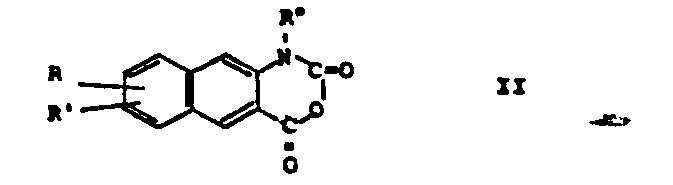
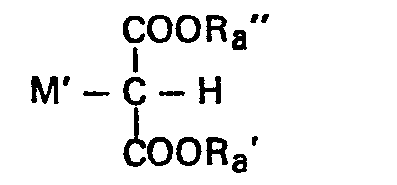
- R "is alkyl can be prepared by using a compound of the formula II in which R, R ° and R 'have the meanings mentioned above, with a compound of the formula III is implemented in which R "is (C 1 -C 4 ) alkyl and M 'is an alkali metal atom.
- the compounds of formula III can be prepared from the corresponding known dialkyl malonates. For this purpose, these are mixed with an alkali base, e.g. Sodium hydride in an inert organic solvent, e.g. Dimethylacetamide, treated.
- an alkali base e.g. Sodium hydride
- an inert organic solvent e.g. Dimethylacetamide
- R "denotes alkyl and whose acids neutralize 4-hydroxy radicals and are therefore present as mono salt are preferably prepared from free acids of the formula I in which R" denotes alkyl by known methods, for example by reaction with a Base, such as dilute sodium hydroxide, in a water-miscible solvent.
- the cleavage is advantageously carried out in solvent systems conventional for such reactions, for example in a water-miscible organic solvent which contains no hydroxyl groups, such as tetrahydrofuran or preferably acetonitrile, the system preferably containing a very small amount of water.
- solvent systems conventional for such reactions, for example in a water-miscible organic solvent which contains no hydroxyl groups, such as tetrahydrofuran or preferably acetonitrile, the system preferably containing a very small amount of water.
- the extraction can also be carried out by known methods, wherein acidification is to be avoided, so that there is no decarboxylation.
- the starting compound I is present in free acid form, are less least 2 moles of base, generally 2 moles or more, in which case the substituent in position 4 is also influenced and a base cation is introduced in this position if the starting compound is in the form of a free acid, or other compounds I are converted into disalted form, the two salt-forming compounds Cations are the same or, if the starting compound is present as 4-mono salt, can be different, with known factors, how the base and its amount have an important influence.
- bases such as alkali metal hydroxides, alkaline earth metal hydroxides and ammonium and tetraalkylammonium hydroxides.
- the base is preferably an alkali metal hydroxide and the starting compound preferably a free acid, so that the two cations in the di-salt originate from the same alkali metal, preferably sodium or potassium.
- the compounds of the formula I can also be treated in their free acid form with 1 mol of any desired base, preferably an alkali metal hydroxide, such as sodium hydroxide or potassium hydroxide. This is done in a suitable solvent such as water or aqueous ethanol, at a temperature ranging at least up to about 150 ° C, but preferably between 0 ° and 60 0 C is located.
- a suitable solvent such as water or aqueous ethanol
- the compound of formula II in which R °, R and R 'are hydrogen is known.
- the other compounds in which R ° is hydrogen can be prepared from known starting materials by known methods.
- Compounds of the formula II in which R ° has a meaning other than hydrogen are not known and are valuable new intermediates in this respect.
- Such compounds II can be prepared from corresponding compounds in which R ° is hydrogen or a metal radical, for example from a compound of formula IIA in which R and R 'have the meanings mentioned above and M ° is hydrogen or a monovalent metal atom such as sodium or potassium, by reaction with a compound of the formula IV wherein R ° has the same meaning as R °, with the exception of n hydrogen, and X is chlorine, bromine or iodine, preferably bromine.
- Be carried out from compounds IIA and IV can be prepared by known methods at temperatures of from 0 ° to 100 ° C, preferably from 20 ° to 50 0 C.
- the reaction is appropriately carried out in an inert organic solvent of a known type, for example dimethylacetamide.
- the reaction is preferably carried out with a compound IIA, in which M ° represents an alkali metal atom.
- M ° represents an alkali metal atom.
- Such a compound is produced in a known manner by reacting a compound in which M ° is hydrogen with a strong base, such as an alkali metal hydride, for example sodium hydride. If the compound IIA in which M ° is hydrogen, the reaction is carried out in the presence of a strong base, for example an alkali metal alkoxide or hydroxide.
- the compounds of the formula I either as esters, free acids or as mono- or di-salts, show a disodium Chromoglycat (DSCG) -like effect, especially an effect that inhibits the release of histamine. Due to this effect, they can be used as antiallergics, for example for the treatment of allergic asthma.
- DSCG-like effect can be demonstrated in the passive cutaneous anaphylaxis test in the rat.
- Female rats (180-200 g) are subcutaneously with 1 mg egg albumin (Merck No.
- the rats are administered 0.1 to 5.6 mg / kg iv or 0.1 to 100 mg / kg po of the test compound and either directly or after 5 to 30 min, if intravenously, or 15 to 60 min, if administered orally, egg albumin (5 mg / ml) in physiological saline solution containing 0.25% Evans Blue as dye (Merck No. 3169) is injected intravenously.
- egg albumin triggers an anaphylactic skin reaction, the intensity of which is proportional to the extent of dye diffusion into the tissue surrounding the four sensitized sites.
- the rats are killed with ether 30 min after administration of the egg albumin.
- the back skin of the animals is removed and the diameter of the bruises is measured from the underside of the skin.
- Each dose of the test compound is examined in four to six rats and the average diameter compared to the mean determined in four solvent-treated rats. The percentage of inhibition becomes the percentage of the average equal diameter in the test animals, based on the mean value in the control animals.
- the DSCG-like activity can be confirmed by the inhibition of the histamine release in the test of the rat peritoneal mast cells, which is basically described by Kusner et al in Pharmacol.Exp.Therap. 184 41-46 (1973) and which was carried out with the following change: After sedimentation of the mast cells by centrifugation at 350 ⁇ g and 4 ° C., the sediments are dissolved in 1 ml HBSS (Hanks balanced salt solution) at pH 6.9 was buffered, recorded and pooled. The suspension obtained is centrifuged, washed again with HBSS and sedimented. The mast cells cleaned in this way are prepared as 2 ml suspensions in HBSS.
- HBSS Hors balanced salt solution
- 2 ml of HBSS are added to each of these suspensions in order to determine the spontaneous release of the histamine, or 2 ml of HBSS and 2.24 mg of the compound 48/80 (N-methylhomoanisylamine formaldehyde condensate), a histamine releaser. from Burroughs WWellcome and Co. Ind., Tuckahoe, NY USA to determine 48/80 induced histamine release, or 2 ml HBSS with 2.24 mg 48/80 and 18 to 180 mg / ml test compound to determine 48 / 80 induced histamine release in the presence of the test compound.
- the 48/80 induced histamine release minus the spontaneous histamine release is taken as 100% histamine release.
- the 48/80 induced histamine release in the presence of the test compound minus the spontaneous histamine release is then compared to the 100% value and from this the percentage of inhibition by the test compound can be calculated.
- the histamine determination is carried out in a known manner, for example as in the previous one mentioned publication by Kusner or according to Kusner and Herzig in Advances in Automated Analysis, 429 (1971).
- the dose is determined by the compound to be used, the mode of administration and the treatment. It is between 0.3 to 100 mg / kg of animal body weight and is expediently administered in portions two to four times a day or in a delayed release form. For larger mammals, the total daily dose is about 20 to 400 mg of the active ingredient. It is mixed with a solid or liquid conventional pharmaceutical carrier. Quantities contain 5 to 200 mg of the active ingredient, mixed with a solid or liquid pharmaceutical carrier.
- the treatment of the allergic symptoms according to the invention is based on the inhibition of histamine release and is therefore in principle symptomatic.
- the DSCG-like activity includes that the compounds can be used for the prophylactic treatment of allergic symptoms, the good oral activity with regard to DSCG also being advantageous.
- compositions of the invention useful for the treatment of allergic symptoms resulting from the release of histamine contain a compound of formula I (as a free acid or as a salt) as an active ingredient and one or more conventional pharmaceutically acceptable carriers and, if appropriate, other conventional additives.
- Such compositions can be conventional orally administrable forms, such as tablets, capsules, granules, dispersible powders, elixirs, syrups Suspensions, or conventional parenterally administrable. Forms such as injectable sterile solutions, suspensions, for example a sterile injectable aqueous suspension.
- Such compositions can be prepared by known pharmaceutical manufacturing methods.
- the compounds can also be administered by inhalation in suitable compositions. In general, compositions for oral or parenteral use or for inhalation contain 1 to 90% and mostly 3 to 70% of the material in combination with the carrier. Solid dosage forms for oral use, such as tablets or capsules, are preferred.
- a representative formulation that is suitable for the prophylactic treatment of allergic asthma two to four times a day is a capsule that is produced according to known methods and has the following composition:
Landscapes
- Chemical & Material Sciences (AREA)
- Organic Chemistry (AREA)
- Health & Medical Sciences (AREA)
- Pulmonology (AREA)
- Engineering & Computer Science (AREA)
- Bioinformatics & Cheminformatics (AREA)
- Immunology (AREA)
- Chemical Kinetics & Catalysis (AREA)
- General Chemical & Material Sciences (AREA)
- Medicinal Chemistry (AREA)
- Nuclear Medicine, Radiotherapy & Molecular Imaging (AREA)
- Pharmacology & Pharmacy (AREA)
- Life Sciences & Earth Sciences (AREA)
- Animal Behavior & Ethology (AREA)
- General Health & Medical Sciences (AREA)
- Public Health (AREA)
- Veterinary Medicine (AREA)
- Pharmaceuticals Containing Other Organic And Inorganic Compounds (AREA)
Abstract

- in der R H, Alkyl, Alkenyl, Alkynyl, Cycloalkyl oder Cycloalkylalkyl oder einen gegebenenfalls substituierten Phenyl- oder Benzylrest bedeutet,
- R" H oder Alkyl ist und
- R und R' jeweils H, F, Cl, Br, Alkyl oder Alkoxy bedeuten und deren Mono- und Di-salze mit antiallergischer Wirkung.
Description
- Die Erfindung betrifft 4-Hydroxy-naphthpyridin-2-(lH)-on-3-carbonsäuren und deren Ester, ihre Herstellung und ihre Verwendung als pharmakologische Wirkstoffe, besonders als anti-allergische Mittel, und betrifft Zwischenverbindungen, die für deren Herstellung brauchbar sind.
- Gegenstand der Erfindung sind Verbindungen der Formel I

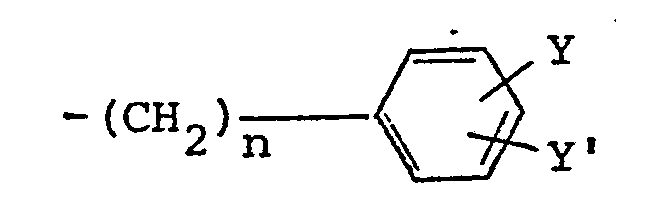
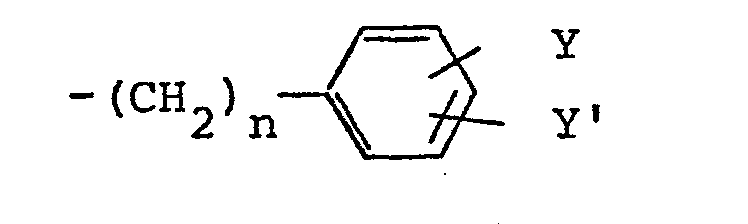
- in der R° Wasserstoff, (C1-C6)Alkyl, (C3-C6)Alkenyl, Alkynyl oder Cycloalkyl ist oder

- R' Wasserstoff oder (C1-C4)Alkyl bedeutet,
- n O oder 1 ist,
- Y un Y' unabhängig voneinander Wasserstoff, Fluor, Chlor, Brom, (C1-C3)Alkyl oder Alkoxy oder Trifluormethyl sind, und R und R' jeweils Wasserstoff, Fluor, Chlor, Brom, (C1-C4)Alkyl oder Alkoxy bedeuten, und deren Mono- und Di-salze, welche pharmazeutisch akzeptable Kationen enthalten.
- Erfindungsgemässe Verbindungen, in denen R" Alkyl ist, können hergestellt werden indem eine Verbindung der Formel II


in der R" (C1-C4)Alkyl und M' ein Alkalimetallatom ist. - Die Herstellung der Verbindungen I, in denen R" Alkyl (Ra") bedeutet, wird in einem inerten organischen Lösungsmittel, z.B. Dimethylacetamid und bei einer Temperatur von 0° bis 150 ° C, vorzugsweise von 60 bis 130 ° C, ausgeführt. Wenn das erhaltene Produkt als 4-Alkalimetallsalz vorliegt, kann daraus durch neutrale oder saure Hydrolyse die freie Säure der Formel I gebildet werden.
- Die Verbindungen der Formel III können aus den entsprechenden bekannten Dialkylmalonaten hergestellt werden. Diese werden dazu mit einer Alkalibase, z.B. Natriumhydrid in einem inerten organischen Lösungsmittel, z.B. Dimethylacetamid, behandelt.
- Die erfindungsgemässen Verbindungen, in welchen R" Alkyl bedeutet und deren säuren 4-Hydroxyreste neutralisiert und daher als Monosalz vorhanden sind, werden vorzugsweise aus freien Säuren der Formel I, in der R" Alkyl bedeutet, nach bekannten Methoden hergestellt, z.B. durch Umsetzung mit einer Base, wie verdünntes Natriumhydroxid, in einem mit Wasser mischbaren Lösungsmittel.
- Die Verbindungen der Formel I, in der R" Wasserstoff bedeutet und die auch sonst in freier Säureform vorhanden sind, werden aus entsprechenden Verbindungen I, in denen R" einen sehr labilen Alkylrest, vorzugsweise t-Butyl, darstellt und die als 4-Monosalz oder vorzugsweise als freie Säure vorliegen, durch eine konventionelle Behandlung mit einem Säurekatalysator bei milder Temperatur hergestellt. Die Temperatur wird dabei zwischen -20 ° und+60 °C, vorzugsweise zwischen -10 ° und +35 ° C gehalten, damit die Verbindungen I nicht decarboxyliert werden. Für die Behandlung mit Säure können die dafür konventionellen Typen verwendet werden, wie Schwefelsäure, Chlorwasserstoffsäure und vorzugsweise Perchlorsäure. Die Spaltung wird zweckmässig in für solchen Umsetzungen konventionellen Lösungsmittelsystemen ausgeführt, z.B. in einem mit Wasser mischbaren organischen Lösungsmittel, das keine Hydroxylgruppen enthält, wie Tetrahydrofuran oder vorzugsweise Acetonitril, wobei das System vorzugsweise einer sehr geringe Menge wasser enthält.
- Die Verbindungen der Formel I können in Disalzform hergestellt werden, indem eine Verbindung I, worin R"=Alkyl, z.B. Alkyl, ist, mit einer Base mit verseifender Wirkung, z.B. Natriumhydroxid, in wässrigem Medium, z.B. Wasser oder wässrigem Aethanol, bei Tempreaturen von 40 ° bis 150 1 C, vorzugsweise bei 80 ° bis 120 0 C, behandelt wird. Die Gewinnung kann ebenfalls nach bekanntenMethoden erfolgen, wobei Ansäuren vermieden werden soll, damit keine Decarboxylierung stattfindet. Fals die Ausgangsverbindung I in freier Säureform vorliegt, werden minder stens 2 Mol Base, im allgemeinen 2 Mol oder mehr verwendet. Dabei wird auch der Substituent in Stellung 4 beeinflusst und ein Basekation in dieser Stellung eingeführt, falls die Ausgangsverbindung als freie Säure vorliegt, oder werden andere Verbindungen I in Disalzform übergeführt, wobei die beiden salzbildenden Kationen die gleiche sind oder, wenn die Ausgangsverbindung als 4-Monosalz vorliegt, verschieden sein können, wobei bekannte Faktoren, wie die Base und deren Menge, einen wichtigen Einfluss ausüben. Viele und verschiedene Basen können dabei verwendet werden, wie Alkalimetallhydroxide, Erdalkalimetallhydroxide und Ammonium- und Tetraalkylammonium-hydroxide. Die Base ist jedoch vorzugsweise ein Alkalimetallhydroxid und die Ausgangsverbindung vorzugsweise eine freie Säure, damit die beide Kationen im Di-salz vom gleichen Alkalimetall, vorzugsweise Natrium oder Kalium, stammen.
- Die Verbindungen der Formel I können in ihrer freien Säureform ebenfalls mit 1 Mol jeder gewünschten Base, vorzugsweise ein Alkalimetallhydroxid, wie Natriumhydroxid oder Kaliümhydroxid, behandelt werden. Das geschieht in einem geeigneten Lösungsmittel, wie Wasser oder wässrigem Aethanol, bei einer Temperatur die mindestens bis etwa 150 ° C reicht, jedoch vorzugsweise zwischen 0 ° und 60 0 C liegt. Dabei werden die erfindungsgemässen Verbindungen als Monosalz erhalten in dem, durch Tautomerie zwischen den nebeneinander liegenden säuren Gruppen 4-Hydroxy und 3-Carboxyl, das salzbildende Kation ionisch mit beiden Gruppen verbunden und in bekannter Weise damit in einen sechsgliedrigeren Ring aufgenommen ist.
- Die Verbindung der Formel II, in der R°, R und R' Wasserstoff bedeuten, is bekannt. Die anderen Verbindungen in denen R° Wasserstoff ist, können nach bekannten Methodenaus bekannten Ausgangsmaterialien hergestellt werden. Verbindungen der Formel II, in denen R° eine andere Bedeutung als Wasserstoff hat, sind nicht bekannt und stellen in dieser Beziehung wertvolle neue Zwischenprodukte dar. Solche Verbindungen II können hergestellt werden aus entsprechenden Verbindungen, in denen R° Wasserstoff oder ein Metallrest ist, z.B. aus einer Verbindung der Formel IIA


- Die Verbindungen der Formel I, entweder als Ester, freie Säure oder als Mono- oder Di-salz zeigen eine Di-natriumchromoglycat (DSCG)-ähnliche Wirkung, besonders eine Wirkung die die Freisetzung des Histamins hemmt.-Aufgrund dieser Wirkung können sie als Antiallergika, beispielsweise zur Behandlung von allergischem Asthma,angewendet werden. Die DSCG-ähnliche Wirkung kann mit dem passiven cutanen Anaphylaxietest in der Ratte nachgewiesen werden. Weibliche Ratten (180-200 g) werden mit 1 mg Eialbumin (Merck Nr. 967) und 200 mg Al(OH)3 in 1 ml einer physiologischen Salzlösung sübcutan und mit 0,5 ml Haemophiluspertussis-Impfstoff(4 x 10¹⁰ organismen/ml)intraperitoneal sensibilisiert. 14 Tage später werden die Tiere dekapitiert, das Blut zentrifugiert und das Serum gesammelt und tiefgefroren. An vier Stellen der Rückenhaut von nicht vorbehandelten weiblichen Ratten wird 0,1 ml des 1:200 verdünnten obigen Serums (Antiserum) injiziert. 24 Stunden später wird den Ratten je 0,1 bis 5,6 mg/kg i.v. oder o,l bis 100 mg/kg p.o. der Testverbindung verabreicht und entweder direkt oder nach 5 bis 30 min, falls intravenös, oder 15 bis 60 min, falls oral verabreicht, Eialbumin (5 mg/ml) in physiologischer Salzlösung, die 0,25 % Evans Blue als Farbstoff (Merck Nr. 3169) enthält, intravenös eingespritzt. Das Eialbumin löst eine anaphylaktische Hautreaktion aus, deren Intensität dem Ausmass der Farbstoffdiffusion in das die vier sensibilisierten Stellen umringende Gewebe proportional ist. 30 min nach Verabreichen des Eialbumins werden die Ratten mit Aether getötet. Die Rückenhaut der Tiere wird abgelöst und die Durchmesser der blauen Flecken von der Hautunterseite her gemessen. Jede Dosis der Testverbindung wird in vier bis sechs Ratten untersucht und der durchschnittliche Durchmesser mit dem Mittelwert, der in vier mit Lösungsmittel behandelten Ratten bestimmt wurde, verglichen. Die Prozentsatz der Hemmung wird dem Prozentsatz des durchschnittlichen Durchmessers in den Versuchstieren, bezogen auf der Mittelwert in den Kontrolltieren, gleichgestellt.
- Die DSCG-ähnliche Aktivität, besonders die Wirkung,die die Freisetzung des Histamins hemmt, kann an der Hemmung der Histaminfreisetzung im Test der peritonealen Rattemastzellen bestätigt werden, welcher grundsätzlich von Kusner et al in Pharmacol.Exp.Therap. 184 41-46 (1973) beschrieben und der mit der folgenden Aenderung durchgeführt wurde: Nach Sedimentieren der Mastzellen durch Zentrifugieren bei 350 x g und 4 ° C, werden die Sedimente in 1 ml HBSS (Hanks balanced salt solution)die bei pH 6,9 gepuffert wurde, aufgenommen und gepoolt. Die erhaltene Suspension wird zentrifugiert, erneut mit HBSS gewaschen und sedimentiert. Die so gereinigten Mastzellen werden als 2 ml Suspensionen in HBSS zubereitet. An diese Suspensionen werden jeweils 2 ml HBSS zugefugt um die spontane Freisetzung des Histamins zu bestimmen, oder 2 ml HBSS und 2,24 Mg der Verbindung 48/80 (N-Methylhomoanisylaminformaldehydkondensat), ein Histaminfreisetzer. von Burroughs WWellcome and Co. Ind., Tuckahoe, N.Y. USA, um die 48/80 induzierte Histaminfreisetzung zu bestimmen, oder 2 ml HBSS mit 2,24 Mg 48/80 und 18 bis 180 Mg/ml der Testverbindung, zur Bestimmung der 48/80 induzierte Histaminfreisetzung in Anwesenheit der Testverbindung. Die 48/80 induzierte Histaminfreisetzung minus die spontane Histaminfreisetzung wird als 100 %-ige Histaminfreisetzung genommen. Die 48/80 induzierte Histaminefreisetzung in Anwesenheit der Testverbindung minus die spontane Histaminfreisetzung wird sodann mit dem 100 % Wert verglichen, und daraus kann der Prozentsatz der Hemmung durch die Testverbindung berechnet werden. Die Histaminbestimmung wird in bekannter Weise ausgeführt, z.B. wie in der vorher erwähnten Publikation von Kusner oder gemäss Kusner und Herzig in Advances in Automated Analysis, 429 (1971) beschrieben wurde.
- Für den obengenannten Gebrauch wird die Dosis durch die zu verwendende Verbindung, die Verabreichungsweise und die Behandlung bestimmt. Sie liegt zwischen 0,3 bis 100 mg/kg tierlichen Körpergewichts und wird zweckmässig in Teilmengen zwei bis vier mal pro Tag oder in verzögerter Abgabeform verabreicht. Für grössere Saugetiere beträgt die tägliche Gesamtdosis etwa 20 bis 400 mg des Wirkstoffs. Sie wird mit einem festen oder flüssigen pharmazeutischen konventionellen Träger vermischt. Teilmengen enthalten 5 bis 200 mg des Wirkstoffs, vermischt mit einem festen oder flüssigen pharmazeutischen Träger. Die erfindungsgemässe Behandlung der allergischen Symptone basiert auf die Hemmung der Histaminfreisetzung und ist daher prinzipiell symptomatisch. Die DSCG-ähnliche Aktivität schliesst ein, dass die Verbindungen zur prophylaktische Behandlung von allergischen Symptomen eingesetzt können, wobei auch die gute orale Aktivität bezüglich DSCG von Vorteil ist.
- Erfindungsgemässe pharmazeutische Zusammensetzungen brauchbar für die Behandlung von allergischen Symptomen, die aus der Freisetzung von Histamin hervorgehen, enthalten eine Verbindung der Formel I (als freie Säure oder als Salz) als Wirkstoff und einen oder mehrere konventionelle pharmazeutisch akzeptable Träger und gegebenenfalls noch andere konventionelle Zusätze. Solche Zusammensetzungen können konventionelle oral verabreichbare Formen sein, wie Tabletten, Kapseln, Granulate, dispergierbare Puder, Elixiere, Sirupe Suspensionen, oder konventionelle parenteral verabreichbare. Formen wie injizierbare sterile Lösungen, Suspensionen, z.B. eine sterile injizierbare wässrige Suspension. Solche Zusammensetzungen können nach bekannten pharmazeutischen Herstellungsmethodenzubereitet werden. Die Verbindungen können auch durch Inhalation in dazu geeigneten Zusammensetzungen verabreicht werden. In allgemeinen enthalten Zusammensetzungen zur oralen oder parenteralen Anwendung oder zur Inhalation 1 bis 90 % und meistens 3 bis 70 % des Werkstoffes in Kombination mit dem Trägerstoff. Feste Dosierungsformen für orale Anwendung, z.B. Tabletten oder Kapseln,werden bevorzugt.
- Eine representative Formulierung, die sich zwei bis vier mal pro Tag zur prophylaktischen Behandlung von allergischem Asthma eignet, ist eine Kapsel, die nach bekannten Methoden hergestellt wird und folgende Zusammensetzung aufweist:

- Die folgenden Beispiele illustrieren die Erfindung:
- Eine Suspension von 21 g 3-Amino-2-naphtocsäure in 125 ml Aethylchlorformat wird 24 Stunden unter Rückfluss gekocht und filtriert. Der gebildete Niederschlag wird zweimal mit Aethanol und einmal mit Aether gewaschen und liefert die Titelverbindung unter a) mit Smp>300°C.
- An eine Suspension von 13.1 g l,3-dioxo-naphth[4,5-b]oxazin in 200 ml. Dimethylacetamid wird portionenweise 3g 50%-iges, mit Pentan gewaschenes Natriumhydrid zugefügt, wonach zuerst 30 Min. bei Zimmertemperatur gerührt, dann 8.0 g Allylbromid zugefügt und schliesslich noch 24 Stunden bei Zimmertemperatur gerührt wird. Das Lösungsmittel wird im Vakuum entfernt, wonach Wasser hinzugefügt wird. Der erhaltene ölige Feststoff wird mit Aethylacetat extrahiert, getrocknet, mit Aktivkohle behandelt und im Vakuum konzentriert,wodurch ein öliger Feststoff entsteht, die in Methylendichlorid gelöst wird. Das Methylendichlorid wird durch Aether ersetzt, wonach die Titelverbindung unter b) mit Smp. 170-173°C erhalten wird.
- An eine Lösung von 1,9 g Diäthylmalonat in 50 ml. Dimethylacetamid wird portionenweise 600 mg. 50%-iges, mit Pentan gewaschenes Natriumhydrid zugefügt, wonach bei 25°C und dann noch kurz bei 120°C gerührt wird. An die erhaltene Lösung wird 3.0 g 1-Allyl-1,3-dioxo-naphth[4,5b]-oxazin in 40 ml Dimethylacetamid zugefügt, wonach 3 Stunden bei 120°C gerührt wird. Das Dimethylacetamid wird im Vakuum entfernt und Wasser wird zugefügt. Das Gemisch wird mit Methylendichlorid gewaschen und mit 2N HCl angesäuert. Das Gemisch wird mit Methylendichlorid extrahiert. Die organische Schicht wird getrocknet und im Vakuum eingedampft. Der feste Rückstand wird in Methylendichlorid rekristallisiert durch Zugabe von Aether und liefert die Titelverbindung unter c) mit Smp. 149-152°C.
- Gemäss dem Verfahrensschritt b) im Beispiel 1 werden die folgenden Verbindungen hergestellt:
- a) 1-Methyl-1,3-dioxo-naphth[4,5-b]oxazin,
- b) 1-(p-Fluorbenzyl)-1,3-dioxo-naphth[4,5-b]oxazin,
- c) 1-Phenyl-1,3-dioxo-naphth[4,5-b]oxazin, und
- d) 1-Cyclopropylmethyl-1,3-dioxo-napth[4,5-b]oxazin.
- Die folgenden Verbindungen werden gemäss Verfahrensschritt c) des Beispiels 1 hergestellt:
- a) 1-Methyl-4-hydroxy-naphthpyridin-2(1H)-on-3-carbonsäure Aethylester,
- b) 1-(p-Fluorbenzyl)-4-hydroxy-3-nitro-napth-pyridin-2-(1H)-on-3-carbonsäure Aethylester,
- c) 1-Phenyl-4-hydroxy-3-nitro-naphthpyridin-2(1H)-on-3-carbonsäure Aethylester,
- d) 1-Cyclopropylmethyl-4-hydroxy-3-nitro-naphthpyridin-2(1H)-on-3-carbonsäure Aethylester,
- e) l-Allyl-4-hydroxy-naphthpyridin-2(lH)-on-3-carbonsäure t-Butylester mit Smp. 104-107°C.
- Eine Lösung von 2.2 g 1-Allyl-4-hydroxy-naphth-pyridin-2(1H)-on-3-carbonsäure t-Butylester in 25 ml Acetonitrilwird mit 0.75 ml 60%-iger Perchlorsäure bei 0°C behandelt. Der erhaltene Niederschlag wird filtriert und gekühlt und enthält die 1-Allyl-4-hydroxy-naphth-pyridin-2(1H)-on-3-carbonsäure mit Semp. 191°-193°C (Zers.).
Claims (11)

und deren Mono- und Di-salze, welche pharmazeutisch akzeptable Kationen enthalten.


zur Bildung von Verbindungen I in denen R" Wasserstoff bedeutet, der Rest Ra" durch Reaktion mit einem Säurekatalysator durch ein a Wasserstoffatom ersetzt und zur Bildung der Mono- und Di-salze diese durch Umsetzung mit einer Base erhalten werden.
Applications Claiming Priority (2)
| Application Number | Priority Date | Filing Date | Title |
|---|---|---|---|
| US05/885,628 US4169893A (en) | 1978-03-13 | 1978-03-13 | 4-hydroxy-naphthpyridine-2(1h)-one-3-carboxylic acids and esters |
| US885628 | 1978-03-13 |
Publications (3)
| Publication Number | Publication Date |
|---|---|
| EP0004255A2 true EP0004255A2 (de) | 1979-09-19 |
| EP0004255A3 EP0004255A3 (en) | 1979-10-17 |
| EP0004255B1 EP0004255B1 (de) | 1982-01-13 |
Family
ID=25387345
Family Applications (1)
| Application Number | Title | Priority Date | Filing Date |
|---|---|---|---|
| EP79810024A Expired EP0004255B1 (de) | 1978-03-13 | 1979-03-12 | 4-Hydroxy-naphthopyridin-2(1H)-on-3-carbonsäuren und deren Ester, Verfahren zu ihrer Herstellung und diese enthaltende pharmazeutische Zusammensetzungen |
Country Status (10)
| Country | Link |
|---|---|
| US (1) | US4169893A (de) |
| EP (1) | EP0004255B1 (de) |
| JP (1) | JPS54130578A (de) |
| AU (1) | AU529434B2 (de) |
| DE (1) | DE2961800D1 (de) |
| DK (1) | DK102879A (de) |
| FI (1) | FI790841A7 (de) |
| IL (1) | IL56864A (de) |
| PH (1) | PH15105A (de) |
| ZA (1) | ZA791140B (de) |
Cited By (1)
| Publication number | Priority date | Publication date | Assignee | Title |
|---|---|---|---|---|
| EP0077754A3 (en) * | 1981-10-16 | 1985-05-22 | Sandoz Ag | Novel pharmaceutically active 1,2,3,4,4a,5,10,10a-octahydrobenzo(g)quinoline derivatives |
Families Citing this family (1)
| Publication number | Priority date | Publication date | Assignee | Title |
|---|---|---|---|---|
| AU623475B2 (en) * | 1989-01-16 | 1992-05-14 | Laboratoire Roger Bellon | New benzo(1,8)naphthyridine derivatives, their preparation and compositions containing them |
Family Cites Families (4)
| Publication number | Priority date | Publication date | Assignee | Title |
|---|---|---|---|---|
| US3966743A (en) * | 1968-07-23 | 1976-06-29 | Boehringer Mannheim G.M.B.H. | Ortho fused cycloalkano-4-quinolone-3-carboxylic acid derivatives |
| BE806848A (fr) | 1972-11-02 | 1974-04-30 | Sandoz Sa | Medicament a base d'un derive de la quinoleine |
| CA1034124A (en) * | 1973-05-11 | 1978-07-04 | Ciba-Geigy Ag | Process for the manufacture of new quinolines |
| US4065457A (en) * | 1973-05-19 | 1977-12-27 | Beecham Group Limited | 4-Hydroxy-3-nitro-carbostyril compounds |
-
1978
- 1978-03-13 US US05/885,628 patent/US4169893A/en not_active Expired - Lifetime
-
1979
- 1979-03-12 FI FI790841A patent/FI790841A7/fi not_active Application Discontinuation
- 1979-03-12 DE DE7979810024T patent/DE2961800D1/de not_active Expired
- 1979-03-12 ZA ZA791140A patent/ZA791140B/xx unknown
- 1979-03-12 EP EP79810024A patent/EP0004255B1/de not_active Expired
- 1979-03-12 DK DK102879A patent/DK102879A/da not_active Application Discontinuation
- 1979-03-13 IL IL56864A patent/IL56864A/xx unknown
- 1979-03-13 PH PH22282A patent/PH15105A/en unknown
- 1979-03-13 AU AU45082/79A patent/AU529434B2/en not_active Expired - Fee Related
- 1979-03-13 JP JP2831779A patent/JPS54130578A/ja active Pending
Non-Patent Citations (1)
| Title |
|---|
| Keine Entgegenhaltungen. * |
Cited By (1)
| Publication number | Priority date | Publication date | Assignee | Title |
|---|---|---|---|---|
| EP0077754A3 (en) * | 1981-10-16 | 1985-05-22 | Sandoz Ag | Novel pharmaceutically active 1,2,3,4,4a,5,10,10a-octahydrobenzo(g)quinoline derivatives |
Also Published As
| Publication number | Publication date |
|---|---|
| EP0004255B1 (de) | 1982-01-13 |
| DK102879A (da) | 1979-09-14 |
| AU529434B2 (en) | 1983-06-09 |
| DE2961800D1 (en) | 1982-02-25 |
| US4169893A (en) | 1979-10-02 |
| PH15105A (en) | 1982-08-10 |
| ZA791140B (en) | 1980-10-29 |
| JPS54130578A (en) | 1979-10-09 |
| IL56864A0 (en) | 1979-05-31 |
| IL56864A (en) | 1983-07-31 |
| EP0004255A3 (en) | 1979-10-17 |
| AU4508279A (en) | 1979-09-20 |
| FI790841A7 (fi) | 1979-09-14 |
Similar Documents
| Publication | Publication Date | Title |
|---|---|---|
| EP0013376B1 (de) | Ein Isoxazolderivat, Verfahren zu seiner Herstellung und diese Verbindung enthaltende Mittel | |
| DE1445154C3 (de) | 1,4-Dihydro-1,8-naphthyridinderi vate und ein Verfahren zu ihrer Herstellung | |
| AT390257B (de) | Verfahren zur herstellung neuer imidazo(4,5-b)chinolin-derivate | |
| DE1802961C3 (de) | Chromonverbindungen und deren pharmazeutisch vertragliche Salze und Verfahren zu deren Herstellung sowie diese Verbindungen enthaltende Arzneimittel | |
| DE2618694A1 (de) | Azapurinone | |
| DE2634288B2 (de) | ||
| DE3026201A1 (de) | Aminoaetheroxide, verfahren zu ihrer herstellung sowie ihre therapeutische verwendung | |
| DE2236987A1 (de) | Pyrazolo eckige klammer auf 1,5a eckige klammer zu -pyrimidine und verfahren zu ihrer herstellung | |
| DE1645971B2 (de) | (Indazol-3-y l)-oxy essigsäurederivate, Verfahren zu ihrer Herstellung und Mittel mit entzündungshemmender Wirkung | |
| DE2846931C2 (de) | ||
| DE3038593C2 (de) | ||
| EP0004255B1 (de) | 4-Hydroxy-naphthopyridin-2(1H)-on-3-carbonsäuren und deren Ester, Verfahren zu ihrer Herstellung und diese enthaltende pharmazeutische Zusammensetzungen | |
| DE1593096A1 (de) | 2-Alkylidenessigsaeure-Derivate und Verfahren zu deren Herstellung | |
| DE2463023C2 (de) | S-Triazolo-[5,1-a]-isochinolinderivate, deren Salze und Verfahren zu deren Herstellung | |
| DE2929760C2 (de) | ||
| DE2253914C3 (de) | Chromon-3-acrylsaeuren, verfahren zu ihrer herstellung sowie diese verbindung enthaltende arzneimittel | |
| CH440292A (de) | Verfahren zur Herstellung neuer Aminopyrazole | |
| EP0088323B1 (de) | Imidazothiadiazolalkencarbonsäureamide, neue Zwischenprodukte zu ihrer Herstellung, ihre Herstellung und ihre Verwendung in Arzneimitteln | |
| DE3142559A1 (de) | "pyrimidin-derivate" | |
| DE2151487A1 (de) | Pharmazeutische Massen | |
| DE2322073A1 (de) | Neue aminoderivate von pyridopyridazincarbonsaeureestern und -carbonsaeuren mit ihren salzen | |
| DE1804328A1 (de) | 3-substituierte Chinoxalinone und Verfahren zur Herstellung von 3-substituierten Chinoxalin-2-Onen | |
| DE2814798C2 (de) | ||
| DE2025819A1 (de) | alpha-Aminopenicillinverbindungen und Verfahren zu ihrer Herstellung | |
| DE1000387C2 (de) | Verfahren zur Herstellung von neuen, in 9-Stellung substituierten 1, 10-Diazaanthracenen |
Legal Events
| Date | Code | Title | Description |
|---|---|---|---|
| PUAI | Public reference made under article 153(3) epc to a published international application that has entered the european phase |
Free format text: ORIGINAL CODE: 0009012 |
|
| PUAL | Search report despatched |
Free format text: ORIGINAL CODE: 0009013 |
|
| 17P | Request for examination filed | ||
| AK | Designated contracting states |
Designated state(s): BE CH DE FR GB IT LU NL SE |
|
| AK | Designated contracting states |
Designated state(s): BE CH DE FR GB IT LU NL SE |
|
| ITF | It: translation for a ep patent filed | ||
| GRAA | (expected) grant |
Free format text: ORIGINAL CODE: 0009210 |
|
| AK | Designated contracting states |
Designated state(s): BE CH DE FR GB IT LU NL SE |
|
| REF | Corresponds to: |
Ref document number: 2961800 Country of ref document: DE Date of ref document: 19820225 |
|
| PG25 | Lapsed in a contracting state [announced via postgrant information from national office to epo] |
Ref country code: LU Free format text: LAPSE BECAUSE OF NON-PAYMENT OF DUE FEES Effective date: 19820331 |
|
| PGFP | Annual fee paid to national office [announced via postgrant information from national office to epo] |
Ref country code: SE Payment date: 19830228 Year of fee payment: 5 |
|
| PGFP | Annual fee paid to national office [announced via postgrant information from national office to epo] |
Ref country code: NL Payment date: 19830308 Year of fee payment: 5 |
|
| PGFP | Annual fee paid to national office [announced via postgrant information from national office to epo] |
Ref country code: FR Payment date: 19830309 Year of fee payment: 5 |
|
| PGFP | Annual fee paid to national office [announced via postgrant information from national office to epo] |
Ref country code: DE Payment date: 19830321 Year of fee payment: 5 |
|
| PGFP | Annual fee paid to national office [announced via postgrant information from national office to epo] |
Ref country code: LU Payment date: 19830324 Year of fee payment: 5 |
|
| PGFP | Annual fee paid to national office [announced via postgrant information from national office to epo] |
Ref country code: BE Payment date: 19830331 Year of fee payment: 5 |
|
| PGFP | Annual fee paid to national office [announced via postgrant information from national office to epo] |
Ref country code: CH Payment date: 19830622 Year of fee payment: 5 |
|
| PG25 | Lapsed in a contracting state [announced via postgrant information from national office to epo] |
Ref country code: SE Effective date: 19840313 |
|
| PG25 | Lapsed in a contracting state [announced via postgrant information from national office to epo] |
Ref country code: CH Effective date: 19840331 Ref country code: BE Effective date: 19840331 |
|
| BERE | Be: lapsed |
Owner name: SANDOZ A.G. Effective date: 19840312 |
|
| PG25 | Lapsed in a contracting state [announced via postgrant information from national office to epo] |
Ref country code: NL Effective date: 19841001 |
|
| GBPC | Gb: european patent ceased through non-payment of renewal fee | ||
| NLV4 | Nl: lapsed or anulled due to non-payment of the annual fee | ||
| GBPC | Gb: european patent ceased through non-payment of renewal fee | ||
| PG25 | Lapsed in a contracting state [announced via postgrant information from national office to epo] |
Ref country code: FR Free format text: LAPSE BECAUSE OF NON-PAYMENT OF DUE FEES Effective date: 19841130 |
|
| REG | Reference to a national code |
Ref country code: CH Ref legal event code: PL |
|
| PG25 | Lapsed in a contracting state [announced via postgrant information from national office to epo] |
Ref country code: DE Effective date: 19841201 |
|
| REG | Reference to a national code |
Ref country code: FR Ref legal event code: ST |
|
| PG25 | Lapsed in a contracting state [announced via postgrant information from national office to epo] |
Ref country code: GB Effective date: 19881117 |
|
| EUG | Se: european patent has lapsed |
Ref document number: 79810024.4 Effective date: 19850529 |
|
| PLBE | No opposition filed within time limit |
Free format text: ORIGINAL CODE: 0009261 |
|
| STAA | Information on the status of an ep patent application or granted ep patent |
Free format text: STATUS: NO OPPOSITION FILED WITHIN TIME LIMIT |