EP0007563B1 - Florteppichgarn, ein aus dem Garn hergestellter geschnittener Florteppich, und ein Herstellungsverfahren für das Garn - Google Patents
Florteppichgarn, ein aus dem Garn hergestellter geschnittener Florteppich, und ein Herstellungsverfahren für das Garn Download PDFInfo
- Publication number
- EP0007563B1 EP0007563B1 EP79102506A EP79102506A EP0007563B1 EP 0007563 B1 EP0007563 B1 EP 0007563B1 EP 79102506 A EP79102506 A EP 79102506A EP 79102506 A EP79102506 A EP 79102506A EP 0007563 B1 EP0007563 B1 EP 0007563B1
- Authority
- EP
- European Patent Office
- Prior art keywords
- yarn
- carpet
- bulky
- twists
- pile
- Prior art date
- Legal status (The legal status is an assumption and is not a legal conclusion. Google has not performed a legal analysis and makes no representation as to the accuracy of the status listed.)
- Expired
Links
- 238000000034 method Methods 0.000 title claims description 39
- 239000004952 Polyamide Substances 0.000 claims description 23
- 229920002647 polyamide Polymers 0.000 claims description 23
- 238000009732 tufting Methods 0.000 claims description 22
- 230000001427 coherent effect Effects 0.000 claims description 21
- 238000009998 heat setting Methods 0.000 claims description 19
- XLYOFNOQVPJJNP-UHFFFAOYSA-N water Substances O XLYOFNOQVPJJNP-UHFFFAOYSA-N 0.000 claims description 15
- 230000001464 adherent effect Effects 0.000 claims description 13
- 238000004519 manufacturing process Methods 0.000 claims description 12
- 239000000758 substrate Substances 0.000 claims description 10
- 229920006395 saturated elastomer Polymers 0.000 claims description 5
- 238000005520 cutting process Methods 0.000 claims description 2
- 229920002292 Nylon 6 Polymers 0.000 description 10
- 239000012530 fluid Substances 0.000 description 9
- 230000000694 effects Effects 0.000 description 8
- 230000002093 peripheral effect Effects 0.000 description 7
- 238000009835 boiling Methods 0.000 description 6
- 238000002788 crimping Methods 0.000 description 4
- 238000004043 dyeing Methods 0.000 description 4
- 238000012986 modification Methods 0.000 description 4
- 230000004048 modification Effects 0.000 description 4
- 238000010276 construction Methods 0.000 description 3
- 238000010438 heat treatment Methods 0.000 description 3
- 238000004804 winding Methods 0.000 description 3
- 240000000491 Corchorus aestuans Species 0.000 description 2
- 235000011777 Corchorus aestuans Nutrition 0.000 description 2
- 235000010862 Corchorus capsularis Nutrition 0.000 description 2
- 239000000470 constituent Substances 0.000 description 2
- 239000004744 fabric Substances 0.000 description 2
- 238000009987 spinning Methods 0.000 description 2
- 238000010998 test method Methods 0.000 description 2
- 239000004743 Polypropylene Substances 0.000 description 1
- 239000006229 carbon black Substances 0.000 description 1
- 235000013351 cheese Nutrition 0.000 description 1
- 238000007796 conventional method Methods 0.000 description 1
- 238000001816 cooling Methods 0.000 description 1
- 230000003247 decreasing effect Effects 0.000 description 1
- 230000007547 defect Effects 0.000 description 1
- 230000005611 electricity Effects 0.000 description 1
- 239000005357 flat glass Substances 0.000 description 1
- 239000011521 glass Substances 0.000 description 1
- 229920000642 polymer Polymers 0.000 description 1
- -1 polypropylene Polymers 0.000 description 1
- 229920001155 polypropylene Polymers 0.000 description 1
- 238000009991 scouring Methods 0.000 description 1
- 238000009751 slip forming Methods 0.000 description 1
- 230000002269 spontaneous effect Effects 0.000 description 1
- 239000000725 suspension Substances 0.000 description 1
- 230000007306 turnover Effects 0.000 description 1
- 238000011144 upstream manufacturing Methods 0.000 description 1
Images



Classifications
-
- D—TEXTILES; PAPER
- D02—YARNS; MECHANICAL FINISHING OF YARNS OR ROPES; WARPING OR BEAMING
- D02G—CRIMPING OR CURLING FIBRES, FILAMENTS, THREADS, OR YARNS; YARNS OR THREADS
- D02G1/00—Producing crimped or curled fibres, filaments, yarns, or threads, giving them latent characteristics
- D02G1/20—Combinations of two or more of the above-mentioned operations or devices; After-treatments for fixing crimp or curl
-
- D—TEXTILES; PAPER
- D02—YARNS; MECHANICAL FINISHING OF YARNS OR ROPES; WARPING OR BEAMING
- D02G—CRIMPING OR CURLING FIBRES, FILAMENTS, THREADS, OR YARNS; YARNS OR THREADS
- D02G3/00—Yarns or threads, e.g. fancy yarns; Processes or apparatus for the production thereof, not otherwise provided for
- D02G3/44—Yarns or threads characterised by the purpose for which they are designed
- D02G3/445—Yarns or threads for use in floor fabrics
Definitions
- the present invention relates to a pile yarn for use in a carpet comprising a cohesive bulky yarn of polyamide continuous multifilament having a total yarn titre between 660 dtex (600 denier) and 6600 dtex (6000 denier) and each filament of the yarn having a thickness of between 6.6 dtex (6 denier) and 33 dtex (3 denier).
- a pile yarn of this type is disclosed in US-A-3 968 638.
- This bulky pile yarn is also false twisted by means of a fluid jet after it is interlaced so that latent twists are imparted therein.
- highly entangled portions have an excessive coherency, and non-uniformity of dyeability or dyeing specks may occur. As a result, there is caused an additional problem in that the quality of a carpet is remarkably degraded.
- the pile yarn is maintained in a non-twisted situation.
- the yarn may split and filaments composing the yarn may be slack. Since the whole yarn does not have sufficient coherency, the operabilities, especially tufting operability, of the yarn are low.
- the yarn disclosed in the above-mentioned US-A-3968638 is not wholly as cohered as a true twisted yarn, and opened and entangled portions are alternately distributed along the yarn.
- splitting of the yarn and slacking may occur, and problems occur in that the yarn becomes entanged with machine parts or another yarn and the yarn is split by means of tufting needles while the yarn is being tufted.
- a bulky polyamide continuous multi-filament yarn has been utilized in a tufted carpet, especially a cut pile carpet.
- the bulky polyamide continuous multifilament yarn which is obtained after a multifilament yarn received a turbulent jet of heated fluid or a stuffing operation of fluid, generally receives additional twists between 30 T/m and 250 T/m, and then it is heat set by means of saturated steam, dry heat or the like so that the twists therein are set. Thereafter, the bulky yarn is utilized in a carpet as a pile yarn.
- Such a bulky yarn obtained after twisting and heat setting has both preferably bulkiness adjusted by heat setting and suitable coherency caused by twisting.
- the filaments of each cut pile gather together to form a slendered shape like a pencil (this will be called a pin-point effect hereinafter), and the carpet has a good quality.
- the cohesive bulky yarn obtained after twisting and heat setting has some problems.
- One of the problems is that the manufacturing cost of the yarn is high because the yarn requires two additional separate operations, i.e., twisting and heat setting.
- Another problem is that the yarn loses the above-mentioned pin-point effect and the hand and appearance thereof becomes felt like after the cut pile carpet with pile yarns of the above-mentioned bulky yarn is utilized for a long duration because the coherency lowers gradually.
- the inventors of the present invention have studied various bulky cohesive polyamide multifilament yarns which can be utilized in a cut pile carpet as a pile yarn so that a bulky yarn can be provided which does not have any of the above-mentioned problems and which can form a cut pile carpet with a high quality.
- the inventors have accomplished the present invention after they found that a novel bulky polyamide multifilament yarn which is distinguished from the known bulky yarns and can be obtained when a false twisting and thermal and partial adhering operation is introduced.
- the step of thermally and partially adhering the filaments, in a multifilament yarn while applying false twist, to provide a yam suitable for the manufacture of garments was known from FR-A-1 565 922. This step has, however, never before been carried out in the field of carpet yarns, or with yarns possessing latent torque.
- a cohesive bulky carpet yarn of a polyamide continuous multifilament according to the present invention is characterized in that the total crimp of said yarn is between 3% and 15%, that the filaments composing said yarn are partially and thermally adhered to each other, that said yarn has alternate twists so that S twist portions and Z twist portions are distributed randomly along the lengthwise direction of the yarn, that said yarn has a coherent factor between 5 and 100 and a latent torque index between 20 T/m and 300 T/m, that the adherent ratio is between 5% and 40%.
- the inventive yarn is characterized in that it includes loops and that the number of said loops is between 2 and 100 per 1 cm.
- a cut pile carpet wherein the pile is manufactured from an inventive yarn, further preferably is characterized in that said cut piles tufted on the substrate of said carpet have a total crimp between 3% and 15%.
- a cut pile carpet wherein the pile is manufactured from the inventive yarn, further preferably is characterized in that at least 50% of the filaments composing said yarn are modified cross-sectioned filaments, each of which filaments has at least three projections in its cross section and that said yarn has a latent torque therein.
- such carpet is further characterized in that the thermal and partial adhesions of said filaments therebetween are located mainly at some of said projections of the cross sectional area of said filaments
- the inventive method for manufacturing an inventive yarn comprises:
- said false twists are imparted to said yarn by means of a circulated air flow, and that said twists are heat set by means of saturated or superheated steam.
- the inventive method comprises a step of manufacturing said bulky yarn of polyamide multifilaments, said feeding step taking place just after said manufacturing process.
- the inventive method is further characterized in that it comprises a step of tufting said cohesive bulky multifilament yarn as a pile yarn on a substrate, a step of cutting the loops of said pile yarn so as to create cut piles and a step of heat treating said cut piles by means of steam, dry heat of hot water so that true twists between 20 T/m and 200 T/m are spontaneously developed in each of said cut piles.
- said heat treating step for developing said true twists is carried out in steam, the temperature of which is between 70°C and 100°C.
- said heat treating step for developing said true twists is carried out in dry heat, the temperature of which is between 100°C and 160°C.
- said heat treating step for developing said true twists is carried out in hot water, the temperature of which is between 40°C and 100°C.
- An inventive cut pile carpet preferably comprises an inventive yarn, wherein at least 50% of the filaments are modified cross sectioned filaments, each of which has at least three projections in its cross section.
- each filament may be a regular circular shape, or a non-circular shape, such as triangular, square, cross or trilobal shape.
- the filament may have one or more hollows continuously formed therewithin along the lengthwise direction thereof.
- the multifilament yarn with more than two kinds of filaments.
- the yarn may be composed of two or more kinds of filaments which are different from each other in the polymers, the cross sectional shapes of the filaments, the thicknesses of the filaments, the thermal properties, the mechanical properties, the dyeabilities and the like.
- a part of the filaments may be a filament having an electric conductivity. These filaments may be doubled or blended.
- the bulky yarn of the present invention may have crimps of any shape; however, it is preferable that the yarn has non-helical crimps imparted by the turbulent jet of heated fluid, stuffing by fluid or mechanical stuffing.
- the yarn has non-helical crimps
- the total crimp is selected between 3% and 15%, more desirably between 5% and 10%, by varying the draft ratio while the yarn is being false twisted. This is because, if the total crimp exceeds 15%, the obtained carpet may be felt-like; and if the total crimp is less than 3%, the quality of the carpet may be low because the carpet is not voluminous.
- the above-mentioned bulky yarn is fed to a false twisting and heat setting device so that false twists are imparted in the yarn and so that filaments composing the yarn become thermally and partially adhered to each other at a temperature higher than that where adhesion begins. Subsequently, the yarn is detwisted and taken up without removing the partial adhesion.
- the operating speed of the yarn is usually selected between 100 m/niin and 2000 m/min. However, if the above-mentioned false twisting and heat setting operation is carried out together with spin-draw operation, the operating speed in the false twisting operation selected is between 1000 m/min and 5000 m/min.
- the bulky yarn includes a latent torque which was imparted through the false twisting and thermal adhering operation; in other words the yarn has a latent torque index, which is measured in accordance with the test method explained hereinafter, of between 20 T/m and 300 T/m.
- thermal and partial adhesion in the present specification means a situation wherein a plurality of filaments are incompletely adhered to each other due to thermal adhesion.
- the degree of adhesion is not so high that the entire multifilament yarn is integrated in one body. Since the filaments are partially adhered, so that only the cohesion of the yarn can be maintained, the filaments can easily be separated from each other when a separating force is exerted on the yarn.
- alternate twists means that S and Z twist portions are randomly distributed along the lengthwise direction of the bulky yarn. Since the partial and thermal adhesion is created while the yarn is twisted due to the false twisting and thermal adhering operation, the adhered portions remain randomly in the bulky yarn as tight spots. As a result, when the yarn is detwisted, twists in an opposite direction are created to compensate for the tight spots, as if the yarn is overly detwisted. Accordingly, when the yarn is observed in its entirety, the yarn has a cohesion, as uniform as a true twisted yarn has, along the lengthwise direction thereof and has a substantially circular cross section.
- the coherency imparted to the bulky yarn by means of partial and thermal adhesion is between 5 and 100 in the coherent factor, which is measured in accordance with the test method explained hereinafter. If the coherent factor is smaller than 5, the coherency of the yarn is not sufficient so that the operabilities, especially tufting operability, are degraded, and the obtained cut pile carpet may be felt-like; in other words, the carpet may not have a good pin point effect. On the other hand, if the coherent factor exceeds 100, the coherency of the yarn is too high and the carpet is not voluminous. In addition, the hand of the carpet may be hard, and therefore such a high coherent factor is not desired.
- the coherent factor can be selected at a desired amount by varying the condition explained hereinafter, wherein the heat set takes place during the false twisting and thermal adhering operation.
- the coherent factor be between 10 and 50.
- the coherent factor between the above-mentioned range
- the bulky yarn is suitably voluminous and has a coherency
- the cut pile carpet obtained will be the best in quality.
- the coherency is low and the handling operability is poor if a relatively low coherency is imparted to the yarn; for example, if the coherent factor is not more than 15.
- the cohesive bulky multifilament yarn according to the present invention can maintain good coherency even if the coherent factor is between 5 and 15, because the yarn has alternate twists therein and maintains a circular cross section.
- the yarn has a good handling operability such as that of the yarn produced according to the known twisting and heat setting method.
- the degree of partial and thermal adhesion is expressed by an adherent ratio which is defined as a percentage of the number of adhered portions to the number of whole filaments. It is preferable that the adherent ratio be between 0.5% and 40%. More specifically, if the degree of adhesion is too large, i.e., the adherent ratio exceeds 40%, the bulky yarn has a hard hand, and a carpet having a good quality cannot be obtained. On the other hand, if the degree of adhesion is too small, i.e., the adherent ratio is smaller than 0.5%, the effect of the false twisting and thermal adhesion cannot be fully achieved, and in many cases, the yarn does not have either the desired coherent factor or the desired latent torque index.
- a cohesive bulky multifilament carpet yarn according to the present invention is required to have a latent torque between 20 T/m and 300 T/m.
- the latent torque is measured in a method explained hereinafter and means the property by which true twists are developed in the bulky yarn when the bulky yarn is treated in steam or hot water while one end thereof is free and the bulky yarn is rotated about its axis. Accordingly, when the bulky yarn of the present invention is utilized to manufacture a carpet and when the carpet thus obtained is treated by means of steam or hot water, true twists are naturally developed in the pile yarn which has been cut, and therefore, each cut pile yarn stably coheres.
- the latent torque index is less than 20 T/m, the bulky yarn does not have such a self-twisting effect, and therefore, the cut pile yarns do not cohere.
- the latent torque index exceeds 300 T/m, the cut pile yarns cohere excessively, and therefore the hand of the carpet is degraded, and the quality of the carpet is low.
- the degree of the latent torque is between 20 T/m and 200 T/m measured in the latent torque index. If a velour-like carpet is desired, a latent torque index between 20 T/m and 80 T/m is preferable. A latent torque index between 60 T/m and 200 T/m is preferable, when a hard twist like carpet is desired.
- the cohesive bulky yarn of a polyamide continuous multifilament according to the present invention has a sufficient amount of coherency due to the existence of both the partial and thermal adhesion and the alternate twists, and at the same time it has a substantially circular cross section which is similar to that of a true twisted yarn.
- good handling operabilities, especially tufting operability can be obtained, and the productivity of a carpet can be increased. Since the yarn does not have strongly entangled portions due to the interlacing, the dyeability thereof is good.
- the bulky yarn of the present invention can provide a desired pile yarn having the desired appearance and hand by selecting the degree of the partial and thermal adhesion and the latent torque index. For example, when both the degree of the partial and thermal adhesion and the latent torque index selected are "large”, the pile yarn becomes like a hard twist and the hand thereof becomes stiff. When the degree of the partial and thermal adhesion or the latent torque index selected is "small”, the hand of the pile yarn becomes soft.
- the partial adhesion of the bulky yarn according to the present invention can be mechanically separated, if the pile yarns are mechanically treated after the bulky yarn is tufted on a carpet, a part of or all of the partial adhesion can be separated so that a carpet having a soft hand can be obtained.
- a cut pile carpet wherein a bulky cohesive multifilament yarn is manufactured in accordance with the conventionally known method, gradually loses its cohesive property due to the decrease of twists in the pile yarn after it is used for a long duration.
- a carpet wherein the bulky carpet yarn according to the present invention is utilized, will not lose the twists in the pile yarn even after it is used for a long duration. If the twists are lost, the carpet can recover its twists by being treated with steam or hot water because the pile yarn has latent torque therein.
- the above-mentioned bulky cohesive yarn of a polyamide multifilament can be productively and economically manufactured by feeding a bulky yarn of a polyamide multifilament to a false twisting and heat setting device, wherein false twists between 100 T/m and 1000 T/m are imparted to the yarn and the yarn is heat set so that the filaments are thermally and partially adhered to each other, and subsequently by taking up the yarn while the partial and thermal adhesion is left therein.
- the fed bulky yarn is a polyamide multifilament, and yarn and crimps can be imparted therein in the known manner.
- bulky yarns having non-helical crimps imparted by a heated air jet, a gear crimping or a stuffer box crimping are suitable.
- a bulky yarn can be utilized which is obtained after a polyamide multifilament yarn is fed into a heated fluid, so that loops or slacks are created in the filaments and is then opened under a predetermined draft ratio, such as disclosed in JP-A's 24699/70 and 33430/71.
- the draft ratio is low, and the loops and slacks are left in the bulky yarn, a spun-like and voluminous yarn having soft hand can be obtained. It is also possible in the present invention that two or more kinds of bulky yarns are simultaneously utilized, and in some cases the bulky yarns may be different from each other in the shapes of the crimp, the thicknesses, the modification ratios or the degree of crimp, and the dyeabilities.
- the total crimp of the bulky carpet yarn can be varied by changing the draft ratio while the yarn is being false twisted and thermally adhered. According to the present invention, if the total crimp of the bulky carpet yarn, i.e., the pile yarn, after it is false twisted and thermally adhered, is in a range between 3% and 15%, a cut pile carpet with a good quality can be obtained.
- the above-mentioned bulky cohesive multifilament yarn which is obtained after the false twisting and thermal adhering operation, is utilized.
- the yarn is tufted on a substrate, e.g. fabrics of jute or split yarn, in a conventionally known manner, after it is dyed, if required.
- the density of the tufting may be changed in accordance with the thickness of the pile yarn. In general, it is preferable that the density be between 4 and 25 per one cm z. Thereafter, the loops of the pile yarn which have been formed by the tufting are cut, so that cut piles are formed.
- the cut piles are treated in steam, the temperature of which is between 70°C and 100°C; dry heat, the temperature of which is between 100°C and 160°C; or hot water, the temperature of which is between 40°C and 100°, so that torque latently included in the pile yarn is developed and so that the cut piles are rotated so as to create true twists between 20 T/m and 200 T/m.
- the coherency of each cut pile depends on the number of the true twists therein. If the true twists are less than 20 T/m, the coherency of the cut pile is not sufficient and the surface of the carpet becomes felt-like. On the other hand, if the true twists are more than 200 T/m, the coherency is excessive and the hand thereof becomes stiff.
- the operation for developing the spontaneous true twist may take place together with the scouring operation or the dyeing operation. In some cases, the developing operation may take place separately. Before or after the operation for developing true twists, a mechanical operation, such as rubbing operation or a raising operation, may be applied to the yarn so that adhesion between the filaments may be removed.
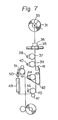
- a bulky yarn 1 withdrawn from a package P is wound around a feed roller 2 several times and is fed at a predetermined constant speed. It is preferable that a separate roller 3 disposed in parallel with the feed roller is grooved around the peripheral surface thereof so that the passage of the yarn 1 can be stable. A roller 4 which is freely rotatable is pressed on the surface of the feed roller 2 so as to nip the yarn 1 therebetween so that twists running back from the downstream thereof are prevented from running back to the upstream. Thereafter, the bulky yarn 1 is fed to a heater 5 where it is heated to a temperature higher than the softening point of the yarn. It is preferable that the heater 5 is of a non-contact type pipe heater as illustrated in Fig.
- the yarn 1 leaves the heater 5 then enters in a false twist nozzle (air torque jet) 6 wherein a circulated gas flow is utilized where false twists are imparted to the yarn 1.
- the false twists run back along the yarn 1 in the heater 5 and reach the nip line between the feed roller 2 and the press roller 4.
- the number of the false twists imparted by the false twist nozzle 6 is required to be between 100 T/m and 1000 T/m. If the number of the twists is less than that range, the self-twisting effect due to the latent torque is low. On the other hand if the number of the twists is more than 1000 T/m, it is very difficult to stably impart twists to the yarn 1.
- the heater 5 and the false twist nozzle 6 are connected to each other and the single and same heated gas supplied to both of the parts. However, in this case, since the yarn will be wound while it is hot, the quality of the obtained yarn may be degraded. It is preferable that the heater 5 and the false twist nozzle 6 are separately disposed as illustrated in Fig. 1 and that in the twist nozzle 6 the false twists are imparted while the yarn is cold by means of air at a normal temperature.
- the inner diameter d in mm of the inlet and outlet thereof satisfy the following equation: wherein De is the thickness in denier of a yarn to be heat treated.
- the diameter d selected is in the range mentioned above, the filaments in the yarn can be thermally and partially adhered because the steam introduced into the heater does not escape freely through the inlet and outlet, so that the pressure in the heater is maintained high, and the yarn may not be damaged while it passes through the inlet and outlet because the inner diameter d of the inlet and outlet is larger than the diameter of the yarn.
- the means for imparting false twists to the yarn may be not only a false twist nozzle 6 explained above, but also any other false twisting means, such as a friction false twisting means.
- the partially adhered portions in the bulky yarn, i.e., the tight spots, created within the heater 5 are not detwisted, so that they easily remain in the bulky yarn as alternate twists, i.e., S and Z twists; as a result, the nozzle 6 is preferable because the coherency of the bulky yarn is increased.
- the yarn thus false twisted is wound around a take up roller 7 several times and is advanced to a winder 10 where it is formed into a package.
- a separate roller 8, disposed rotatably and in parallel with the take up roller 7 is grooved around the peripheral surface thereof so that the yarn is stably advanced on the take up roller 7. It is preferable that a rotatable roller 9 is pressed against the take up roller 7 so as to nip the yarn therebetween so that the false twists are prevented from running into the winding means.
- the heating conditions of the heater 5 i.e., the temperature and the pressure of steam
- the number of false twists, the tension in the yarn while it is treated are varied, the total crimp, the coherent factor, the latent torque index of the bulky carpet yarn thus obtained can be changed to the desired values.
- the total crimp of the obtained carpet yarn is a little bit smaller than that of the feed yarn. Accordingly, the total crimp of the producted yarn is in a range between 3% and 15%, which range is preferable for a pile yarn of a cut pile carpet.
- a bulky multifilament yarn which has been previously manufactured through an operation for imparting crimps is fed to a false twisting and heat setting operation. It is possible that the operation for imparting crimps and the operation for false twisting and heat setting are continuously carried out as illustrated in Fig. 7. Furthermore, the operations for imparting crimps and for false twisting and heat setting may be carried out together with the operation for spinning and drawing as illustrated in Fig. 8.
- a bulky cohesive polyamide multifilament yarn which has suitable bulkiness, coherency and latent torque and which is preferable as a pile yarn for a cut pile carpet can be manufactured. Accordingly, the method is superior in productivity to the conventional method, wherein additional twisting and heat setting are carried out. Since the construction of the equipment is simple, the manufacturing cost according to the present invention can be lowered. When the method is compared with a method wherein a yarn is entangled by means of interlacing, no special nozzle for imparting entanglement to the yarn is required, and the produced yarn is free from dyeing specks.
- FIGs. 2 and 3 cut pile carpet yarns are illustrated wherein the bulky carpet yarn manufactured in accordance with the above-mentioned method is utilized.
- the reference numerals 11 and 12 designate a pile and a substrate, respectively.
- alternate twists comprising S and Z twist portions are in the piles 11.
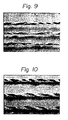
- the alternate twists are also illustrated in Fig. 9.
- true twists i.e.
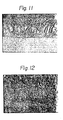
- S twists the direction of which is the same as that of the false twists, i.e., S twists, are developed as illustrated in Figs. 3, 6, 10 and 11.
- the length of the pile 11 is somewhat shortened from L, to L 2 , and that on the other hand, the thickness of the pile 11 is somewhat increased from D 1 to D 2 . If the thermal shrinkage ratio, the coherency and the latent torque index of the bulky yarn utilized for a pile yarn are adequately selected, the changes in size during the operation can be minimized.
- Fig. 12 which is a plan view of Fig. 11, the carpet thus obtained has a very excellent pin-point effect.
- the conditions for treating i.e., temperature and time duration
- the coherency of the pile whose treating conditions are varied can be changed. Accordingly, even if the same bulky carpet yarn is tufted on a carpet as a pile yarn, a pattern can be applied to the carpet by locally changing the heat treating conditions.
- the total crimp indicates the degree of crimp of a yarn.
- a bulky yarn of one meter length is withdrawn from a package, and after it is loaded under 0.1 g/1.1 dtex for one minute.
- the test piece is dehydrated, and then it is dried for one day and night under a normal condition.
- the test piece is loaded for one minute under 0.1 g/1.1 dtex and the length thereof 1 1 is measured.
- the test piece is maintained in a free condition for three minutes, while it is loaded for one minute under 2 mg/1.1 dtex the length of the test piece 1 2 is measured.
- the total crimp (TC) is calculated in accordance with the following equation.
- the coherent factor indicates the degree of coherency of a yarn.
- a yarn, ends of which are free, is located horizontally, and then the yarn is vertically separated into two portions along the axis thereof.
- the upper half portion of the yarn is picked up by a hook, and the remaining lower half portion of the yarn is vertically loaded under 0.2 g/1.1 dtex, the amount being calculated for the total thickness of the yarn.
- the width W in cm between the upper and lower half portions is measured.
- the coherent factor (CF) is calculated in accordance with the following equation.
- the length of the test piece is equal to or more than 50 cm and the test piece is randomly sampled. If the coherent factor is large, the coherency of the yarn is high.
- a bulky yarn of 30 cm length is sampled from a cheese, and a mark is put at one end of the yarn by means of an oily ink.
- the yarn is hung in saturated steam (about at 100°C) for five minutes while one end thereof is free, and the number of twists which are created by rotation of the yarn is counted.
- the number of the twists is converted into the number of the twists per meter which is called the latent torque index. If the index is large, the torque latently included in the yarn is high.
- a microscopic photograph of the cross section of a yarn is taken, and the number of the portions where the boundary between the adjacent filaments is not clearly observed, which portions are considered as adhered portions, is counted (Since the adhesion is caused by a point contact, if two or more portions of the yarn are not clear, two or more portions are counted individually).
- the counting operation utilizing the cross sectional microscopic photograph is carried out over ten times with respect to the test pieces which are randomly sampled along the lengthwise direction of the yarn.
- the arithmetical average of the obtained numbers is calculated and is called the number of adhesions.
- the adherent ratio is calculated in accordance with the following equation.
- a bulky continuous multifilament yarn is wound to form a skein, and after the skein is heat treated in boiling water for 30 minutes, while it is in a free condition, it is dehydrated and dried for one day and night under normal conditions, i.e., at the temperature of 20°C and the relative humidity of 65%.
- the yarn after it is subjected to an operation for developing twists, is wound 100 times around a reel having a width of 10 cm, under a tension of 4 mg/1.1 dtex.
- V in cm 3 which is calculated based on the thickness of the wound yarn layer and the width of the reel, and the weight of the yarn W in g, the bulkiness is calculated by the following equation.
- a bulky continuous multifilament yarn 10 cm long is placed on a black mount and is sandwiched between the mount and a transparent plate glass.
- the term "loop" is defined as a yarn portion projecting more than 0.5 mm high upwards or downwards from the periphery of the yarn while the yarn is sandwiched between the mount and the glass as mentioned above. The loops are counted and, then, the number of loops per cm is obtained.
- the tufting operability is judged on the number of the defects of the tuft, i.e., stitch damages caused by the fallen piles. If the number is less than 0.01 per one m l , the tufting operability is expressed with 0. If the number is between 0.01 and 0.1 per one m l , the tufting operability is expressed with A. If the number is more than 0.1 per one m l , the tufting operability is expressed with X. The appearance of a carpet is judged on the subjective tests effected by an expert.
- a bulky continuous multifilament yarn of nylon 6 having the following properties is manufactured, and it is fed to the false twisting and heat setting device, illustrated in Fig. 1, so that it is false twisted and heat set.
- the heater 5 was a pipe heater and had a length of 300 mm and an inner diameter of 5 mm.
- the inlet and outlet ends of the heater 5 were choked like an orifice, the inner diameter of which was 1.5 mm.
- superheated steam the temperature of which was 200°C and the pressure of which was between 2.0 bar and 3.0 bar, was introduced.
- the false twisting nozzle 6 was provided with a yarn passage of a pipe-shape having an inner diameter of 3 mm.
- An air inlet of a slit shape having a depth of 0.5 mm and a width of 3 mm was disposed tangentially to the yarn passage, so that a circulated air flow was created within the yarn passage.
- the treating speed was selected as 500 m/min, the overfeed ratio of the yarn while it was treated was selected as 5%.
- the pressure of the air at room temperature fed to the false twisting nozzle was variously changed and the tests were repeated.
- Example 2 Using the method of Example 1, the pressure of the air supplied to the false twisting nozzle 6 is selected at 5.0 bar, and the pressure of the steam supplied to the heater 5 was changed variously. The results are described in Table 2.
- a bulky cohesive multifilament yarn having an adherent ratio of 5%, a total crimp of 8% and a latent torque index of 50 T/m, and comprising alternate twists, i.e., S and Z twists, was obtained.
- the obtained bulky yarn was utilized as a pile yarn, and a cut pile carpet was manufactured in accordance with a tufting method.
- the conditions of the tufting machine were the same as those of the tufting machines utilized in Example 1.
- the obtained cut pile carpet was placed on a busy corridor, and one month after the carpet was placed there, the coherency of the piles was observed and it was found that the piles maintained coherency which was almost the same as that when it was initially placed there.
- a continuous undrawn yarn of nylon 6 multifilament yarn 31 melt spun and wound around a bobbin 33 was prepared.
- the yarn was of 5280 dtex/136 fil, and each filament had a trilobal cross section, the modification ratio was 3.5.
- the yarn 31 was withdrawn from the bobbin 33 and was slightly prestretched between a feed roller 35 with a press roller 36 and a prestretch roller 37 with a rotatable separate roller 38. After the yarn 31 was wound around the prestretch and separate rollers 27 and 38 several times, it was advanced to draw roller 39 with a rotatable roller 40 and wound therearound several times.
- the draw roller 39 was heated at a temperature of 185°C and had a peripheral speed of 1000 m/min.
- the yarn was subject to a texturing operation by means of a heated fluid jet nozzle 41 which had a construction similar to that disclosed in Fig. 2 of JP-A-31848/78 and which utilized steam, the temperature of which was 210°C and the pressure of which was 6.0 bar.
- the yarn 31 was overfed to a roller 43 with a rotatable feed roller 44 via a guide 42, the overfeed ratio of the yarn between the draw roller 39 and the roller 43 was 60%.
- the yarn 31 was drafted between the roller 43 and a draft roller 45 under various tensions in the yarn between 0 and 10.00 N.
- the draft roller 45 had a rotatable separate roller 46 and a press roller 47.
- the characteristics of the yarn thus obtained under a draft tension of 300 N are as follows.
- a pipe heater 49 had a length of 400 mm and an inner diameter of 10 mm.
- the inner diameter of the inlet and outlet of the heater was 1.1 mm, and the heater was supplied with superheated steam, the temperature of which was 200°C and the pressure of which was 2.3 bar.
- a false twisting nozzle 50 was the same as that utilized in Example 1.
- the overfeed ratio while the yarn was false twisted was 3.0%.
- the pressure of the compressed air fed to the false twisting nozzle 50 was 4.0 bar.
- the various properties of the bulky yarns obtained were measured and, at the same time, the yarns were tufted to substrates of a plain weave of polypropylene split yarn as pile yarns, and cut pile carpets were manufactured.
- the tufting machines were selected to be of a gauge of 2.54 mm, a pile stitch of 3.5 per cm and a pile height of 15 mm.
- the obtained carpets were dyed in boiling water, and the appearances and hands thereof were judged based on the above-mentioned criteria.
- the tests resulting in Data Nos. 14 through 18, the tufting operability was good. The results are described in Table 3.
- the total crimp of the bulky cohesive continuous multifilament yarn obtained be between 3% and 12%, and that the number of loops of the yarn be between 2 and 100.
- a pair of nylon 6 multifilament yarns wherein each filament had a trilobal cross section, were melt spun from a spinning nozzle 61 and cooled while they advanced within cooling chambers 62.
- the yarn 60 was subjected to a finishing operation by means of a pair of finishing rollers 63, which were driven at a relatively low speed, the yarn 60 was turned by a turn-over roller 64 and taken up by means of a goddet roller 65.
- the peripheral speed of the goddet roller 65 was about 770 m/min.
- a multifilament nylon 6 undrawn yarn of SB 3300 dtex/68 fil was obtained.
- a nozzle 66 for entangling filaments in a yarn was disposed between the goddet roller 65 and a feed roller 67 so that the finish imparted to the yarn 60 at the finishing rollers 63 was uniformly distributed between the filaments.
- the feed roller was heated at a temperature of 50°C.
- the yarn was drawn between the feed roller 67 and a pair of draw rollers 68 and 69, which were heated at a temperature of 195°C, and the peripheral speed of which was 2500 m/min.
- the draw ratio was 3.43 and a drawn yarn having thickness of 962 dtex/68 fil was obtained.
- the obtained drawn yarn which was preheated on the draw rollers 68 and 69, was then subjected to a crimping operation by means of an air stuffing device 70, which had a construction similar to that disclosed in JP-A-45420/78 and wherein superheated steam, the temperature of which was 190°C and the pressure of which was 5 bar, was utilized.
- the above-mentioned crimping operation was effected while the yarn was overfed from the draw rollers 68 and 69 to a delivery roller 74, since the peripheral speed of the delivery roller 74 was 2000 m/min.
- the over feed ratio was 25%.
- the bulky multifilament yarn thus obtained was then supplied into a pipe heater 71 for thermally and partially adhering the false twists imparted to the yarn by means of a false twisting air nozzle 72 and run back along the yarn.
- the pipe heater 71 had a length of 600 mm and an inner diameter of 10 mm.
- the inner diameter of both the inlet and outlet of the heater 71 was 1.2 mm; and the heater was supplied with superheated steam, the temperature of which was 195°C and the pressure of which was 3 bar.
- the false twisting air nozzle 72 was supplied with compressed air, the pressure of which was 4.0 bar.
- the bulky cohesive multifilament yarn thus obtained was taken up by means of a winding apparatus 73 disclosed in US-A-4,033,519. The winding speed of the apparatus 73 was 1950 m/min.
- a bulky polyamide multifilament yarn of 1760 dtex/136 fil which was composed of a nylon 6 filament having a Y shaped cross section, the modification ratio of which was two and which had a total crimp of 16%, was false twisted at a speed of 500 m/min by means of an air false twisting nozzle, so that false twists of 600 T/m were imparted to the yarn.
- the false twists were heat set and thermally and partially adhered by means of a pipe heater, having a length of 40 cm.
- the inner diameter of the inlet and outlet of the heater was 1.2 mm.
- the industrial pressure of which was 2.0 bar and the temperature of which was 220°C was utilized.
- a pile yarn of an alternate twisted yarn type, having an adherent ratio of 30%, a total crimp of 7% and a latent torque index of 150 T/m was obtained.
- the pile yarn was tufted on a substrate by means of a tufting machine, the gauge of which was 2.54 mm, so that a cut pile carpet of hard twist having a pile stitch of 3.94 per cm and a pile height of 20 mm was obtained.
- the tufting operatibility was very good, and the suspension ratio of the operation was decreased to that of one fifth of non-twisted pile yarn.
- the obtained cut pile carpet was placed on a busy corridor, and one month after the carpet was placed there, the coherency of the piles was observed and it was found that the piles maintained coherency which was almost the same as that of when it was initially placed there.
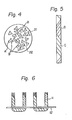
- the polyamide cohesive bulky synthetic multifilament yarn which is utilized as a pile yarn, is composed of filaments, at least 50%, preferably more than 80%, of which are trilobal cros sectioned filaments, each of which has three projections A, and the filaments are thermally and partially adhered to each other.
- the cohesive bulky synthetic multifilament yarn since almost all the filaments are modified cross sectioned filaments having a trilobal cross section and three projections in its cross section, almost all the adhered portions B are located at the projections A, and the filaments are adhered to each other in point contact.
- the whole yarn has a suitable coherency due to the adhesion, the hand of the yarn is not so stiff as the usual adhered yarn, but is very soft.
- the degree of adhesion should be determined based on the degree of coherency and hand which are required of a pile yarn. If a velour-like carpet is desired, it is preferable that the adherent ratio be between 0.5% and 20%. If a hard twist like carpet is desired, it is preferable that the adherent ratio be between 20% and 40%.
- the pile yarn illustrated in Fig. 4 includes not only modified cross sectioned filaments 21 but also electrically conductive conjugate filaments 22 comprising a non-conductive constituent of Nylon 6 and an electrically conductive constituent of Nylon 6 and carbon black so that the yarn can prevent electricity.
- the pile yarn utilized in a cut pile carpet has filaments partially and thermally adhered to each other as mentioned above.
- the yarn has alternate twists, i.e., S and Z twist portions (designated by the reference C and D in Fig. 5, respectively) distributed randomly along the lengthwise direction thereof.
- the whole yarn has a circular cross section, as a true twist yarn has, and is coherent.
- the yarn has a latent torque, i.e., the property to rotate by itself when it is heat treated while its one end is held and the other end is free.
- the true twists are developed and the filaments in each pile yarn cohere as illustrated in Fig. 6.
Landscapes
- Engineering & Computer Science (AREA)
- Mechanical Engineering (AREA)
- Textile Engineering (AREA)
- Yarns And Mechanical Finishing Of Yarns Or Ropes (AREA)
Claims (12)
Applications Claiming Priority (6)
| Application Number | Priority Date | Filing Date | Title |
|---|---|---|---|
| JP87141/78 | 1978-07-19 | ||
| JP8714178A JPS5920011B2 (ja) | 1978-07-19 | 1978-07-19 | 集束性ポリアミド捲縮糸 |
| JP9882878U JPS5713912Y2 (de) | 1978-07-20 | 1978-07-20 | |
| JP98828/78U | 1978-07-20 | ||
| JP90376/78 | 1978-07-26 | ||
| JP9037678A JPS5522007A (en) | 1978-07-26 | 1978-07-26 | Production of cut pile carpet |
Publications (2)
| Publication Number | Publication Date |
|---|---|
| EP0007563A1 EP0007563A1 (de) | 1980-02-06 |
| EP0007563B1 true EP0007563B1 (de) | 1983-06-08 |
Family
ID=27305420
Family Applications (1)
| Application Number | Title | Priority Date | Filing Date |
|---|---|---|---|
| EP79102506A Expired EP0007563B1 (de) | 1978-07-19 | 1979-07-18 | Florteppichgarn, ein aus dem Garn hergestellter geschnittener Florteppich, und ein Herstellungsverfahren für das Garn |
Country Status (4)
| Country | Link |
|---|---|
| US (1) | US4355592A (de) |
| EP (1) | EP0007563B1 (de) |
| CA (1) | CA1107488A (de) |
| DE (1) | DE2965614D1 (de) |
Families Citing this family (19)
| Publication number | Priority date | Publication date | Assignee | Title |
|---|---|---|---|---|
| US4452160A (en) * | 1978-07-19 | 1984-06-05 | Teijin Limited | Method of manufacturing a cut pile carpet |
| US4704856A (en) * | 1986-01-09 | 1987-11-10 | E. I. Du Pont De Nemours And Company | False twisted differential tension yarn |
| AU593876B2 (en) * | 1986-01-09 | 1990-02-22 | E.I. Du Pont De Nemours And Company | False twisted differential tension yarn |
| US4790132A (en) * | 1986-04-30 | 1988-12-13 | E. I. Du Pont De Nemours And Company | Process for making a false twisted differential tension yarn |
| US6682618B1 (en) | 1986-11-24 | 2004-01-27 | Alliedsignal Inc. | Yarn with heat-activated binder material and process of making |
| US6969437B1 (en) | 1997-01-30 | 2005-11-29 | Alliedsignal Inc. | Yarn with heat-activated binder material and process of making |
| US4870813A (en) * | 1987-06-04 | 1989-10-03 | E. I. Du Pont De Nemours And Company | Ply-twist heat set carpet yarns |
| US4779408A (en) * | 1987-06-04 | 1988-10-25 | E. I. Du Pont De Nemours And Company | Low-tension quenching of ply twist/heatset yarn |
| US5179827A (en) * | 1988-04-15 | 1993-01-19 | E. I. Du Pont De Nemours And Company | Alternate twist plied yarn |
| US5445860A (en) * | 1992-12-29 | 1995-08-29 | Gff Holding Company | Tufted product having an improved backing |
| US5593751A (en) * | 1995-06-02 | 1997-01-14 | Monsanto Company | Nylon fiber blends for saxony carpets |
| US6023926A (en) * | 1997-09-08 | 2000-02-15 | E. I. Du Pont De Nemours And Company | Carpet styling yarn and process for making |
| WO2002006574A2 (en) * | 2000-07-13 | 2002-01-24 | Prisma Fibers, Inc. | Apparent twist yarn system and apparatus and method for producing same |
| US6658835B1 (en) * | 2000-11-28 | 2003-12-09 | Honeywell International Inc. | Untwisted wrapped singles yarns and carpets manufactured therefrom |
| TWI242612B (en) * | 2001-10-29 | 2005-11-01 | Ind Tech Res Inst | Method of fabricating a non-hollow fiber having a regular polygonal cross-section |
| US6832419B1 (en) * | 2003-07-03 | 2004-12-21 | Milliken & Company | Method of making pile fabric |
| JP4343014B2 (ja) * | 2004-04-13 | 2009-10-14 | 帝人ファイバー株式会社 | 緻密超短立毛布帛およびその製造方法およびカーシート部材 |
| US20070077840A1 (en) * | 2005-09-30 | 2007-04-05 | Industrial Technology Research Institute | Novel fibers, high airtightness fabrics and a fabrication method thereof |
| CN103764887A (zh) * | 2011-09-07 | 2014-04-30 | 英威达技术有限公司 | 包括膨化和交缠纱的耐用织物 |
Family Cites Families (13)
| Publication number | Priority date | Publication date | Assignee | Title |
|---|---|---|---|---|
| US2815559A (en) * | 1953-08-03 | 1957-12-10 | Robinson Thread Company | Cellular synthetic fibre thread and a method of making the same |
| US2961010A (en) * | 1955-11-03 | 1960-11-22 | Lees & Sons Co James | Pile fabric |
| US3058291A (en) * | 1956-02-15 | 1962-10-16 | Heberlein Patent Corp | Permanently crimped synthetic textile products and method for producing the same |
| FR1565922A (de) * | 1967-05-18 | 1969-05-02 | ||
| US3553953A (en) * | 1968-09-03 | 1971-01-12 | Monsanto Co | Bulked bonded yarn |
| GB1317444A (en) * | 1969-11-13 | 1973-05-16 | Monsanto Textiles Ltd | Carpet manufacture |
| US3611698A (en) * | 1970-03-04 | 1971-10-12 | Du Pont | Heavy denier crimped and entangled yarn |
| FR2114216A5 (de) * | 1970-11-18 | 1972-06-30 | Rhodiaceta | |
| JPS5713645B2 (de) * | 1973-04-28 | 1982-03-18 | ||
| US3971200A (en) * | 1974-03-06 | 1976-07-27 | Leesona Corporation | Process and apparatus for continuous heat setting of carpet yarns |
| US3968638A (en) * | 1975-06-09 | 1976-07-13 | E. I. Du Pont De Nemours And Company | Product and process |
| JPS5920007B2 (ja) * | 1976-02-16 | 1984-05-10 | 帝人株式会社 | 部分融着糸の製造方法 |
| US4114549A (en) * | 1977-06-07 | 1978-09-19 | Champion International Corporation | Pile fabric |
-
1979
- 1979-07-12 US US06/056,843 patent/US4355592A/en not_active Expired - Lifetime
- 1979-07-13 CA CA331,784A patent/CA1107488A/en not_active Expired
- 1979-07-18 EP EP79102506A patent/EP0007563B1/de not_active Expired
- 1979-07-18 DE DE7979102506T patent/DE2965614D1/de not_active Expired
Also Published As
| Publication number | Publication date |
|---|---|
| EP0007563A1 (de) | 1980-02-06 |
| DE2965614D1 (en) | 1983-07-14 |
| CA1107488A (en) | 1981-08-25 |
| US4355592A (en) | 1982-10-26 |
Similar Documents
| Publication | Publication Date | Title |
|---|---|---|
| EP0007563B1 (de) | Florteppichgarn, ein aus dem Garn hergestellter geschnittener Florteppich, und ein Herstellungsverfahren für das Garn | |
| US3186155A (en) | Textile product of synthetic organic filaments having randomly varying twist along each filament | |
| US7013628B2 (en) | Process for making poly(trimethyleneterephthalate) bulked continuous filaments, the filaments thereof and carpets made therefrom | |
| US4452160A (en) | Method of manufacturing a cut pile carpet | |
| US5945215A (en) | Propylene polymer fibers and yarns | |
| US6129879A (en) | Propylene polymer fibers and yarns | |
| CN1063241C (zh) | 割绒织物及其制造工艺 | |
| US3854177A (en) | Process and apparatus for texturing yarn | |
| US4307565A (en) | Spun yarn-like textured composite yarn and a process for manufacturing the same | |
| US3968638A (en) | Product and process | |
| US3543358A (en) | Process for increasing the bulk of multifilament yarn | |
| CA1057143A (en) | Simulated spun-like bulked yarn | |
| US6503622B1 (en) | Texturized, combined polyester multifilament yarn and process for producing same | |
| JPH03180529A (ja) | 捲縮糸 | |
| US4167847A (en) | Bulky yarn and method for producing the same | |
| JPS60259646A (ja) | 嵩高混繊糸 | |
| JP4073578B2 (ja) | ポリエステル複合仮撚糸の製造方法 | |
| JPS6142011B2 (de) | ||
| JPS6113013B2 (de) | ||
| JPH03176005A (ja) | カットパイルカーペット | |
| JPS60252739A (ja) | 混繊嵩高捲縮糸 | |
| JPS595688B2 (ja) | スパンライクカ−ペツトヤ−ン及びその製造法 | |
| JPS596929B2 (ja) | ハイアンドロ−・カ−ペット用に適した「ケン」縮糸 | |
| JPS5920011B2 (ja) | 集束性ポリアミド捲縮糸 | |
| JPS6120660B2 (de) |
Legal Events
| Date | Code | Title | Description |
|---|---|---|---|
| PUAI | Public reference made under article 153(3) epc to a published international application that has entered the european phase |
Free format text: ORIGINAL CODE: 0009012 |
|
| AK | Designated contracting states |
Designated state(s): DE FR GB IT NL |
|
| 17P | Request for examination filed | ||
| GRAA | (expected) grant |
Free format text: ORIGINAL CODE: 0009210 |
|
| AK | Designated contracting states |
Designated state(s): DE GB |
|
| RBV | Designated contracting states (corrected) |
Designated state(s): DE GB |
|
| REF | Corresponds to: |
Ref document number: 2965614 Country of ref document: DE Date of ref document: 19830714 |
|
| EN | Fr: translation not filed | ||
| PLBE | No opposition filed within time limit |
Free format text: ORIGINAL CODE: 0009261 |
|
| STAA | Information on the status of an ep patent application or granted ep patent |
Free format text: STATUS: NO OPPOSITION FILED WITHIN TIME LIMIT |
|
| 26N | No opposition filed | ||
| PGFP | Annual fee paid to national office [announced via postgrant information from national office to epo] |
Ref country code: DE Payment date: 19900929 Year of fee payment: 12 |
|
| PGFP | Annual fee paid to national office [announced via postgrant information from national office to epo] |
Ref country code: GB Payment date: 19910624 Year of fee payment: 13 |
|
| PG25 | Lapsed in a contracting state [announced via postgrant information from national office to epo] |
Ref country code: DE Effective date: 19920401 |
|
| PG25 | Lapsed in a contracting state [announced via postgrant information from national office to epo] |
Ref country code: GB Effective date: 19920718 |
|
| GBPC | Gb: european patent ceased through non-payment of renewal fee |
Effective date: 19920718 |