EP0008435A2 - Substituierte N-Phenyl-N'-benzoyl-thioharnstoffe, Verfahren zu ihrer Herstellung und ihre Verwendung als Schädlingsbekämpfungsmittel - Google Patents
Substituierte N-Phenyl-N'-benzoyl-thioharnstoffe, Verfahren zu ihrer Herstellung und ihre Verwendung als Schädlingsbekämpfungsmittel Download PDFInfo
- Publication number
- EP0008435A2 EP0008435A2 EP79102966A EP79102966A EP0008435A2 EP 0008435 A2 EP0008435 A2 EP 0008435A2 EP 79102966 A EP79102966 A EP 79102966A EP 79102966 A EP79102966 A EP 79102966A EP 0008435 A2 EP0008435 A2 EP 0008435A2
- Authority
- EP
- European Patent Office
- Prior art keywords
- spp
- benzoyl
- halogen
- formula
- phenyl
- Prior art date
- Legal status (The legal status is an assumption and is not a legal conclusion. Google has not performed a legal analysis and makes no representation as to the accuracy of the status listed.)
- Granted
Links
Classifications
-
- C—CHEMISTRY; METALLURGY
- C07—ORGANIC CHEMISTRY
- C07C—ACYCLIC OR CARBOCYCLIC COMPOUNDS
- C07C335/00—Thioureas, i.e. compounds containing any of the groups, the nitrogen atoms not being part of nitro or nitroso groups
- C07C335/04—Derivatives of thiourea
- C07C335/24—Derivatives of thiourea containing any of the groups, X being a hetero atom, Y being any atom
- C07C335/26—Y being a hydrogen or a carbon atom, e.g. benzoylthioureas
-
- A—HUMAN NECESSITIES
- A01—AGRICULTURE; FORESTRY; ANIMAL HUSBANDRY; HUNTING; TRAPPING; FISHING
- A01N—PRESERVATION OF BODIES OF HUMANS OR ANIMALS OR PLANTS OR PARTS THEREOF; BIOCIDES, e.g. AS DISINFECTANTS, AS PESTICIDES OR AS HERBICIDES; PEST REPELLANTS OR ATTRACTANTS; PLANT GROWTH REGULATORS
- A01N47/00—Biocides, pest repellants or attractants, or plant growth regulators containing organic compounds containing a carbon atom not being member of a ring and having no bond to a carbon or hydrogen atom, e.g. derivatives of carbonic acid
- A01N47/08—Biocides, pest repellants or attractants, or plant growth regulators containing organic compounds containing a carbon atom not being member of a ring and having no bond to a carbon or hydrogen atom, e.g. derivatives of carbonic acid the carbon atom having one or more single bonds to nitrogen atoms
- A01N47/28—Ureas or thioureas containing the groups >N—CO—N< or >N—CS—N<
- A01N47/34—Ureas or thioureas containing the groups >N—CO—N< or >N—CS—N< containing the groups, e.g. biuret; Thio analogues thereof; Urea-aldehyde condensation products
Definitions
- the invention relates to new substituted N-phenyl-N'-benzoyl-thioureas, a process for their preparation and their use as pesticides.
- the new compounds show very good effects as pesticides; in particular, they are characterized by excellent insecticidal activity and are also fungicidal and bactericidal.
- the new N-phenyl-N'-benzoyl-thioureas according to the invention show a significantly better activity than pesticides, in particular a significantly higher insecticidal activity than the closest known benzoyl-thioureas and a significantly better bactericidal activity than the known copper oxychloride.
- the products according to the present invention thus represent a valuable addition to the technology.
- the starting materials to be used are defined by formulas (II) and (III).
- R to R 5 preferably represent those radicals which were mentioned as preferred in the definition of the radicals R 1 to R 5 in formula (I).
- benzoyl isothiocyanates of the formula (II) to be used as starting compounds are known or can be prepared by processes known from the literature (see Houben-Weyl, Methods of Organic Chemistry, 4th Edition, Volume 9, pp. 878-879, Georg Thieme Verlag, Stuttgart 1955 ). They are obtained in particular in high purity by reacting Trimethylsilanylsenföl with the corresponding substituted benzoyl halides at temperatures between loo and 25o o C (see DE-AS 1,215,144).
- anilines of formula (III) are also known or can be prepared by known methods. (See for example, J. Org. 29 (1964), 1-11 and US-PS 3 387 0 37).
- the process for the preparation of the N-phenyl-N'-benzoyl-thioureas according to the invention is preferably carried out using suitable solvents or diluents.
- suitable solvents or diluents Practically all inert organic solvents can be considered as such.
- These include in particular aliphatic and aromatic, optionally chlorinated hydrocarbons, such as gasoline, benzene, toluene, xylene, methylene chloride, chloroform, carbon tetrachloride, chlorobenzene and o-dichlorobenzene, ethers such as diethyl and dibutyl ether, tetrahydrofuran and dioxane, ketones such as acetone, methyl ethyl, Methyl isopropyl and methyl isobutyl ketone and nitriles such as acetonitrile and propionitrile.
- the reaction temperature can be varied within a wide range. In general, one works between 0 and 150 ° C, preferably at 20 to 100 ° C.
- the process according to the invention is generally carried out at normal pressure.
- the starting materials are usually used in equimolar amounts. An excess of one or the other reaction component has no significant advantages.
- the reaction is generally carried out in a suitable diluent and the reaction mixture is stirred for one or more hours at the required temperature. The reaction mixture is then allowed to cool to room temperature and the product which has crystallized out is filtered off with suction. The melting point is used for characterization.
- N-phenyl-N'-benzoyl-thioureas according to the invention are notable for excellent insecticidal activity. They also show a very good effectiveness against phytopathogenic bacteria and fungal diseases.
- the active ingredients can be converted into the customary formulations, such as solutions, emulsions, suspensions, powders, foams, pastes, granules, aerosols, active ingredient-impregnated natural and synthetic substances, very fine encapsulations in polymeric substances and in coating compositions for seeds, and also in formulations with Bringhs such as smoking cartridges, cans, spirals, etc., as well as ULV cold and warm mist formulations.
- customary formulations such as solutions, emulsions, suspensions, powders, foams, pastes, granules, aerosols, active ingredient-impregnated natural and synthetic substances, very fine encapsulations in polymeric substances and in coating compositions for seeds, and also in formulations with Bringhs such as smoking cartridges, cans, spirals, etc., as well as ULV cold and warm mist formulations.
- formulations are prepared in a known manner, for example by mixing the active ingredients with extenders, that is to say liquid solvents, pressurized liquefied gases and / or solid carriers, optionally using surface-active agents, that is to say emulsifiers and / or dispersants and / or foam-generating agents. If water is used as an extender, organic solvents can, for example, also be used as auxiliary solvents.
- extenders that is to say liquid solvents, pressurized liquefied gases and / or solid carriers, optionally using surface-active agents, that is to say emulsifiers and / or dispersants and / or foam-generating agents.
- surface-active agents that is to say emulsifiers and / or dispersants and / or foam-generating agents.
- organic solvents can, for example, also be used as auxiliary solvents.
- liquid solvents aromatics, such as xylene, toluene, or alkylnaphthalenes, chlorinated aromatics or chlorinated aliphatic hydrocarbons, such as chlorobenzenes, chloroethylene or methylene chloride, aliphatic hydrocarbons, such as cyclohexane or paraffins, for example petroleum fractions, alcohols, such as butanol or glycol as well as their ethers and esters, ketones, such as acetone, methyl ethyl ketone, methyl isobutyl ketone or cyclohexanone, strongly polar solvents such as dimathylformamide and dimethyl sulfoxide, and water;
- Liquefied gaseous extenders or carriers mean liquids which are gaseous at normal temperature and under normal pressure, for example aerosol propellant, such as halogenated hydrocarbons and butane, propane, nitrogen and carbon dioxide;
- Solid carrier materials are suitable: for example natural rock
- Adhesives such as carboxymethyl cellulose and natural and synthetic polymers in the form of powders, granules or latices, such as gum arabic, polyvinyl alcohol and polyvinyl acetate, can be used in the formulations.
- Dyes such as inorganic pigments, e.g. Iron oxide, titanium oxide, ferrocyan blue and organic dyes such as alizarin, azole-metal phthalocyanine dyes and trace nutrients such as salts of iron, manganese, boron, copper, cobalt, molybdenum and zinc can be used.
- the formulations generally contain between 0.1 and 95 percent by weight of active compound, preferably between 0.5 and 90%.
- the active compounds according to the invention are used in the form of their commercially available formulations and / or the use forms prepared from these formulations.
- the active substance content of the use forms prepared from the commercially available formulations can vary within wide ranges.
- the active substance concentration of the use forms can be from 0.0000001 to 100% by weight of active substance, preferably between 0.01 and 10% by weight.
- the application takes place in a customary manner adapted to the application forms.
- the active ingredients When used against hygiene pests and pests of stored products, the active ingredients are distinguished by an excellent residual action on wood and clay and by a good stability to alkali on limed substrates.
- the active compounds according to the invention are used in the veterinary sector in a known manner, such as by oral use in the form of, for example, tablets, capsules, drinkers, granules, by dermal use in the form of, for example, diving (dipping), spraying (spraying), pouring-on at spot-on) and powdering as well as by parenteral application in the form of, for example, injection
- active compound 1 part by weight of active compound is mixed with the stated amount of solvent and the stated amount of emulsifier, and the concentrate is diluted with water to the desired concentration.
- Cabbage leaves (Brassica oleracea) are treated by being dipped into the preparation of active ingredient of the desired concentration and populated with caterpillars of the cockroach (Plutella maculipennis) while the leaves are still moist.
- the kill is determined after the desired time.
- active compound 1 part by weight of active compound is mixed with the stated amount of solvent and the stated amount of emulsifier, and the concentrate is diluted with water to the desired concentration.
- Cabbage leaves (Brassica oleracea) are treated by being dipped into the preparation of active compound of the desired concentration and populated with caterpillars of the owl butterfly (Laphygma frugiperda) while the leaves are still moist.
- the kill is determined after the desired time.
- aqueous active substance preparations of the desired concentration are poured into glasses and then about 25 mosquito larvae are inserted into each glass.
- the degree of destruction is determined after 24 hours.
- Emulsifier 80 parts by weight of alkylaryl polyglycol ether
- a suitable preparation of active compound 20 parts by weight of the active substance in question are mixed with the stated amount of the emulsifier and the mixture thus obtained is diluted with water to the desired concentration.
- About 20 fly larvae (Lucilia cuprina) are placed in a test tube filled with cotton plugs of the appropriate size, which contains approx. 3 ml of a 20% egg yolk powder suspension in water.
- 0.5 ml of the active ingredient preparation is added to this egg yolk powder suspension. The degree of destruction is determined after 24 hours.
- the amount of active ingredient required for the desired active ingredient concentration in the spray liquid is mixed with the stated amount of solvent and dispersant and the concentrate is diluted with the stated amount of water.
- the spray liquid is used to spray 30 rice plants about 40 days old to the point of dripping wet.
- the plants remain in a greenhouse at temperatures of 22 to 24 ° C. and a relative humidity of about 70% until they dry off.
- needles are immersed in an aqueous bacterial suspension of Xanthomonas eryzae and the plants are inoculated by pricking the leaves.
- the plants stand at 100% relative humidity for 24 hours and then in a room at 26 to 28 ° C. and 80% relative humidity. 10 days after the inoculation, the infestation of all inoculated leaves injured by prick from plants previously treated with preparation is increased.
- the yield is 61 g (54% of theory) of N- (2-chlorobenzoyl) -N '- (4-trifluoromethoxyphenyl) thiourea.
- a solution of 5.8 g of 4-trifluoromethylmercaptoaniline (0.03 mol) in 60 ml of toluene is mixed with a solution of 6 g of 2,6-difluorobenzoylsenfol (Rp. 1 98 ° C., : 1.5872) in 20 ml of toluene and stirred at 80 ° C. for one hour.
- the product precipitates when it cools down. It is suctioned off and washed with petroleum ether.
- the substance melts at 207 ° C.
Landscapes
- Life Sciences & Earth Sciences (AREA)
- Organic Chemistry (AREA)
- Chemical & Material Sciences (AREA)
- Health & Medical Sciences (AREA)
- Plant Pathology (AREA)
- Engineering & Computer Science (AREA)
- Dentistry (AREA)
- General Health & Medical Sciences (AREA)
- Wood Science & Technology (AREA)
- Zoology (AREA)
- Environmental Sciences (AREA)
- Pest Control & Pesticides (AREA)
- Agronomy & Crop Science (AREA)
- Organic Low-Molecular-Weight Compounds And Preparation Thereof (AREA)
- Agricultural Chemicals And Associated Chemicals (AREA)
- Cosmetics (AREA)
Abstract
Description
- Die Erfindung betrifft neue substituierte N-Phenyl-N'-benzoyl-thioharnstoffe, ein Verfahren zu ihrer Herstellung sowie ihre Verwendung als Schädlingsbekämpfungamittel.
- Es ist bereits bekannt, daß bestimmte substituierte Benzoyl-thioharnstoffe, wie z.B. N-(2,6-Dichlorbenzoyl)-N'-(3,4-dichlorphenyl)-thioharnstoff, insektizid wirksam sind (vergleiche US-PS 3 933 908).
- Weiter ist bekannt, daß bestimmte Kupferverbindungen, wie z.B. Kupferoxychlorid, fungizide und bakterizide Eigenschaften aufweisen.
- Es wurden nun die neuen N-Phenyl-N'-benzoyl-thioharnstoffe der Formel (I)

- R1 für Halogen steht,
- R2 für Wasserstoff oder Halogen steht,
- R3 für Wasserstoff, Halogen oder Halogenalkyl steht,
- R4 für Halogen, Halogenalkyl, Halogenalkoxy, Halogenalkylthio oder Halogenalkylsulfonyl steht mit der Maßgabe, daß R3 für Halogenalkyl steht, wenn R4 für Halogen steht, und
- R5 für Wasserstoff oder Halogen steht,
- Die neuen Verbindungen zeigen sehr gute Wirkungen als Schädlingsbekämpfungsmittel; insbesondere zeichnen sie sich durch eine hervorragende insektizide Wirksamkeit aus und sind außerdem fungizid und bakterizid wirksam.
- Weiter wurde gefunden, daß man die neuen N-Phenyl-N'- benzoyl-thioharnstoffe der Formel (I) erhält, wenn man Benzoylisothiocyanate (Benzoylsenföle) der Formel II

- R1 und R2 die oben angegebene Bedeutung haben, mit substituierten Anilinen der Formel III

- R3, R4 und R5 die oben angegebene Bedeutung haben, gegebenenfalls unter Verwendung inerter Verdünnungsmittel, umsetzt.
- Überraschenderweise zeigen die erfindungsgemäßen neuen N-Phenyl-N'-benzoyl-thioharnstoffe eine wesentlich, bessere Wirksamkeit als Schädlingsbekämpfungsmittel, insbesondere eine wesentlich höhere insektizide Wirkung als die nächstliegenden bekannten Benzoyl-thioharnstoffe und eine wesentlich bessere bakterizide Wirkung als das bekannte Kupferoxychlorid. Die Produkte gemäß vorliegender Erfindung stellm somit eine wertvolle Bereicherung der Technik dar.
- Gegenstand der Erfindung sind vorzugsweise N-Phenyl-N'-benzoyl-thioharnstoffe der Formel (I), worin
- R1 für Fluor, Chlor, Brom oder Jod steht,
- R2 für Wasserstoff, Fluor, Chlor, Brom oder Jod steht,
- R3 für Wasserstoff, Chlor oder Trifluormethyl steht,
- R4 für Chlor, Fluor- oder Chlorfluor-alkyl, Fluor- oder Chlorfluor-alkoxy, Fluor- oder Chlorfluor-alkylthio oder für Fluoralkylsulfonyl steht - wobei die Halogenalkylgruppen jeweils 1 oder 2 Kohlenstoffatome enthalten - mit der Maßgabe, daß R3 für Trifluormethyl steht, wenn R4 für Chlor steht, und
- R5 für Wasserstoff oder Chlor steht.
- Verwendet man beispielsweise 2,6-Dichlorbenzoyl-isothiocyanat und 4-Trifluormethoxy-anilin als Ausgangsstoffe, so kann die Reaktion dieser Verbindungen durch folgendes Formelschema skizziert werden:

- Die zu verwendenden Ausgangsstoffe sind durch die Formeln (II) und (III) definiert.
- Vorzugsweise stehen darin R bis R5 für diejenigen Reste, welche bei der Definition der Reste R1 bis R5 in Formel (I) als bevorzugt genannt wurden.
- Die als Ausgangsverbindungen zu verwendenden Benzoyl- isothiocyanate der Formel (II) sind bekannt oder nach literaturbekannten Verfahren herstellbar (vergleiche Houben-Weyl, Methoden der organischen Chemie, 4.Aufl. Band 9, S. 878-879, Georg Thieme Verlag, Stuttgart 1955). Man erhält sie insbesondere in hoher Reinheit durch Umsetzung von Trimethylsilanylsenföl mit den entsprechenden substituierten Benzoylhalogeniden bei Temperaturen zwischen loo und 25ooC (vergleiche DE-AS 1 215 144).
- Als Beispiele für die Benzoyl-isothiocyanate der Formel (II) seien genannt:
- 2-Fluor-, 2-Chlor-, 2-Brom- und 2-Jod-benzoyl-isothiocyanat,
- 2,6-Difluor- und 2,6-Dichlor-benzoyl-isothiocyanat sowie 2-Chlor-6-fluor-benzoyl-isothiocyanat.
- Die als weitere Ausgangsstoffe zu verwendenden substituierten Aniline der Formel (III) sind ebenfalls bekannt oder nach bekannten Verfahren herstellbar.(vergleiche z.B. J.Org.Chem. 29 (1964), 1-11 und US-PS 3 387 037).
- Als Beispiele für die substituierten Aniline der Formel (III) seien genannt:
- 4-Trifluormethylanilin, 3,4-Bis-trifluormethyl-anilin, 2-Chlor-4-tritluormethyl-anilin, 3-Chlor-4-trifluormethylanilin, 4-Chlor-3-trifluormethyl-anilin, 4-Difluormethoxyanilin, 4-Trifluormethoxy- und 4-Trifluormethylthio-anilin, 2-Chlor- und 3-Chlor-4-trifluormethoxy-anilin, 2-Chlor- und 3-Chlor-4-trifluormethyl- thio-anilin, 4-Chlordifluormethoxy- und 4-Chlordifluormethylthio-anilin, 2-Chlor- und 3-Chlor-4-chlordifluormethoxy-anilin, 2-Chlor- und 3-Chlor-4-chlordifluor- methylthio-anilin, 4-(2-Chlor-1,1,2-trifluor-äthoxy)-und 4-(2-Chlor-1,2,2-trifluoräthylthio)-anilin, 2-Chlor-und 3-Chlor-4-(2-chlor-1,1,2-trifluor-äthoxy)-anilin, 2-Chlor- und 3-Chlor-4-(2-chlor-1,1,2-trifluor-äthyl- thio)-anilin, 4-Trifluormethylsulfonyl-anilin sowie 2-Chlor- und 3-Chlor-4-trifluormethylsulfonyl-anilin.
- Das Verfahren zur Herstellung der erfindungsgemäßen N-Phenyl-N'-benzoyl-thioharnstoffe wird bevorzugt unter Verwendung geeigneter Lösungs- oder Verdünnungsmittel durchgeführt. Als solche kommen praktisch alle inerten organischen Solventien infrage. Hierzu gehören insbesondere aliphatische und aromatische, gegebenenfalls chlorierte Kohlenwasserstoffe, wie Benzin, Benzol, Toluol, Xylol, Methylenchlorid, Chloroform, Tetrachlorkohlenstoff, Chlorbenzol und o-Dichlorbenzol, Äther wie Diäthyl- und Dibutyläther, Tetrahydrofuran und Dioxan, Ketone wie Aceton, Methyläthyl-, Methylisopropyl- und Methylisobutylketon sowie Nitrile wie Acetonitril und Propionitril.
- Die Reaktionstemperatur kann innerhalb eines größeren Bereichs variiert werden. Im allgemeinen arbeitet man zwischen 0 und 150°C, vorzugsweise bei 2o bis loo°C. Das erfindungsgemäße Verfahren wird im allgemeinen bei Normaldruck durchgeführt.
- Zur Durchführung des erfindungsgemäßen Verfahrens werden die Ausgangsstoffe gewöhnlich in äquimolaren Mengen eingesetzt. Ein Überschuß der einen oder anderen Reaktionskomponente bringt keine wesentlichen Vorteile. Die Umsetzung wird im allgemeinen in einem geeigneten Verdünnungsmittel durchgeführt und das Reaktionsgemisch wird eine oder mehrere Stunden bei der erforderlichen Temperatur gerührt. Danach läßt man das Reaktionsgemisch auf Raumtemperatur abkühlen und saugt vom auskristallisierten Produkt ab. Zur Charakterisierung dient der Schmelzpunkt.
- Die erfindungsgemäßen N-Phenyl-N'-benzoyl-thioharnstoffe .zeichnen sich durch eine hervorragende insektizide Wirksamkeit aus. Sie zeigen ferner eine sehr gute Wirksamkeit gegen phytopathogene Bakterien und Pilzkrankheiten.
- Die Wirkstoffe eignen sich bei guter Pflanzenverträglichkeit und günstiger Warmblütertoxizität zur Bekämpfung von tierischen Schädlingen, insbesondere Insekten und Spinnentieren, die in der Landwirtschaft, in Porsten, im Vorrats-und Materialschutz sowie auf dem Hyginesektor vorkommen. Sie sind gegen normal sensible und resistente Arten sowie gegen alle oder einzelne Entwicklungsstadien wirksam. Zu den oben erwähnten Schädlingen gehören:
- Aus der Ordnung der Isopoda z.B. Oniscus asellus, Armadillidium vulgare, Porcellio scaber.
- Aus der Ordnung der Diplopoda z.B. Blaniulus guttulatus.
- Aus der Ordnung der Chilopoda z.B. Geophilus carpophagus, Scutigera spec.
- Aus der Ordnung der Symphyla z.B. Scutigerella immaculata.
- Aus der Ordnung der Thysanura z.B. Lepisma saccharina.
- Aus der Ordnung der Collembola z.B. Onychiurus.armatus.
- Aus der Ordnung der Orthoptera z.B. Blatta orientalis, Periplaneta americana, Leucophaea maderae, Blattella germanica, Acheta domesticus, Gryllotalpa spp., Locusta migratoria migratorioides, Melanoplus differentialis, Schistocerca gregaria.
- Aus der Ordnung der Dermaptera z.B. Forficula auricularia.
- Aus der Ordnung der Isoptera z.B. Reticulitermes spp..
- Aus der Ordnung der Anoplura z.B. Phylloxera vastatrix, Pemphigus spp., Pediculus humanus corporis, Haematopinus spp., Linognathus spp.
- Aus der Ordnung der Mallophaga z.B. Trichodectes spp., Damalinea spp.
- Aus der Ordnung der Thysanoptera z.B. Hercinothrips femoralis, Thrips tabaci.
- Aus der Ordnung der Heteroptera z.B. Eurygaster app., Dysdercus intermedius, Piesma quadrata, Cimex lectularius, Rhodnius prolixus, Triatoma spp.
- Aus der Ordnung der Homoptera z.B. Aleurodes brassicae, Bemisia tabaci, Trialeurodes vaporariorum, Aphis gossypii, Brevicoryne brassicae, Cryptomyzus ribis, Doralis fabae, Doralis pomi, Eriosoma lanigerum, Hyalopterus arundinis, Macrosiphum avenae, Myzus spp.,Phorodon humull, Rhopalosiphum padi, Empoasca spp., Euscelis bilobatus, Nephotettix cincticeps, Lecanium corni, Saissetia oleae, Laodelphax striatellus, Nilaparvata lugens, Aonidiella aurantii, Aspidiotus hederae, Pseudococcus spp. Psylla spp. Aus der Ordnung der Lepidoptera z.B. Pectinophora gossypiella, Bupalus piniarius, Cheimatobia brumata, Lithocolletis blancardella, Hyponomeuta padella, Plutella maculipennis, Malacosoma neustria, Euproctis chrysorrhoea, Lymantria spp. Bucculatrix thurberiella, Phyllocnistis citrella, Agrotis spp., Euxoa spp., Feltia spp. Earias insulana, Heliothis spp., Laphygma exigua, Mamestra brassicae, Panolis flammea, Prodenia litura, Spodoptera spp., Trichoplusia ni, Carpocapsa pomonella, Pieris spp., Chilo spp., Pyrausta nubilalis, Ephestia kuehniella, Galleria mellonella, Cacoecia podana, Capua reticulana, Choristoneura fumiferana, Clysia ambiguella, Homona magnanima, Tortrix viridana.
- Aus der Ordnung der Coleoptera z.B. Anobium punctatum, Rhizopertha dominica, Bruchidius obtectus, Acanthoscelides obtectus, Hylotrupes bajulus, Agelastica alni, Leptinotarsa decemlineata, Phaedon cochleariae, Diabrotica spp., Psylliodes chrysocephala, Epilachna varivestis, Atomaria spp.,Oryzaephilus surinamensis, Anthonomus spp., Sitophilus spp., Otiorrhynchus sulcatus, Cosmopolites sordidus, Ceuthorrhynchus assimilis, Hypera postica, Dermestes spp.,
- Trogoderma spp., Anthrenus spp., Attagenus spp., Lyctus spp., Meligethes aeneus, Ptinus spp., Niptus hololeucus, Gibbium psylloides, Tribolium spp., Tenebrio molitor, Agriotes spp., Conoderus spp., Melolontha melolontha, Amphimallon solstitialis, Costelytra zealandica. Aus der Ordnung der Hymenoptera z.B. Diprion spp., Hoplocampa spp., Lasius spp., Monomorium pharaonis, Vespa spp. Aus der Ordnung der Diptera z.B. Aedes spp., Anopheles spp., Culex spp., Drosophila melanogaster, Musca spp., Fannia spp., Calliphora erythrocephala, Lucilia spp., Chrysomyia spp., Cuterebra spp., Gastrophilus spp., Hyppobosca spp., Stomoxys spp., Oestrus spp., Hypoderma spp., Tabanus spp., Tannia spp., Bibio hortulanus, Oscinella frit, Phorbia spp., Pegomyia hyoscyami, Ceratitis capitata, Dacus oleae, Tipula paludosa.
- Aus der Ordnung der Siphonaptera z.B. Xenopsylla cheopis, Ceratophyllus spp..
- Aus der Ordnung der Arachnida z.B. Scorpio maurus, Latrodectus mactans.
- Aus der Ordnung der Acarina z.B. Acarus siro, Argas spp., Ornithodoros spp., Dermanyssus gallinae, Eriophyes ribis, Phyllocoptruta oleivora, Boophilus spp., Rhipicephalus spp.,
- Amblyomma spp., Hyalomma spp., Ixodes spp., Psoroptes spp., Chorioptes spp., Sarcoptes spp., Tarsonemus spp., Bryobia praetiosa, Panonychus spp., Tetranychus spp..
- Die Wirkstoffe können in die üblichen Formulierungen übergeführt werden, wie Lösungen, Emulsionen, Suspensionen, Pulver, Schäume, Pasten, Granulate, Aerosole, Wirkstoff-imprägnierte Natur- und synthetische Stoffe, Feinstverkapselungen in polymeren Stoffen und in Hüllmassen für Saatgut, ferner in Formulierungen mit Brenhsätzen, wie Räucherpatronen, -dosen, -spiralen u.ä.,sowie ULV-Kalt- und Warmnebel-Formulierungen.
- Diese Formulierungen werden in bekannter Weise hergestellt, z.B. durch Vermischen der Wirkstoffe mit Streckmitteln, also flüssigen Lösungsmitteln, unter Druck stehenden verflüssigten Gasen und/oder festen Trägerstoffen, gegebenenfalls unter Verwendung von oberflächenaktiven Mitteln, also Emulgiermitteln und/oder Dispergiermitteln und/oder schaumerzeugenden Mitteln. Im Falle der Benutzung von Wasser als Streckmittel können z.B. auch organische Lösungsmittel als Hilfslösungsmittel verwendet werden. Als flüssige Lösungsmittel kommen im wesentlichen in Frage: Aromaten, wie Xylol, Toluol, oder Alkylnaphthaline, chlorierte Aromaten oder chlorierte aliphatische Kohlenwasserstoffe, wie Chlorbenzole, Chloräthylene oder Methylenchlorid, aliphatische Kohlenwasserstoffe, wie Cyclohexan oder Paraffine, z.B. Erdölfraktionen, Alkohole, wie Butanol oder Glycol sowie deren Äther und Ester, Ketone, wie Aceton, Methyläthylketon, Methylisobutylketon oder Cyclohexanon, stark polare Lösungsmittel, wie Dimathylformamid und Dimethylsulfoxid, sowie Wasser; mit verflüssigten gasförmigen Streckmitteln oder Trägerstoffen sind solche Flüssigkeiten gemeint, welche bei normaler Temperatur und unter Normaldruck gasförmig sind, z.B. Aerosol-Treibgas, wie Halogenkohlenwasserstoffe sowie Butan, Propan, Stickstoff und Kohlendioxid; als feste Trägerstoffe kommen in Frage: z.B. natürliche Gesteinsmehle, wie Kaoline, Tonerden, Talkum, Kreide, Quarz, Attapulgit, Montmorillonit oder Diatomeenerde und synthetische Gesteinsmehle, wie hochdisperse Kieselsäure, Aluminiumoxid und Silikate; als feste Trägerstoffe für Granulate kommen in Frage: z.B. gebrochene und fraktionierte natürliche Gesteine wie Calcit, Marmor, Bims, Sepiolith, Dolomit sowie synthetische Granulate aus anorganischen und organischen Mehlen sowie Granulate aus organischem Material wie Sägemehl, Kokosnußschalen, Maiskolben und Tabakstengel; als Emulgier- und/oder schaumerzeugende Mittel kommen in Frage: z.B. nichtionogene und anionische Emulgatoren, wie Polyoxyäthylen-FettsäureEster, Polyoxyäthylen-Fettalkohol-Äther, z.B. Alkylarylpolyglykol-äther, Alkylsulfonate, Alkylsulfate, Arylsulfonate sowie Eiweißhydrolysate; als Dispergiermittel kommen in Frage: z.B. Lignin-Sulfitablaugen und Methylcellulose.
- Es können in den Formulierungen Haftmittel wie Carboxymethylcellulose, natürliche und synthetische pulverige, körnige oder latexförmige Polymere verwendet werden, wie Gummiarabicum, Polyvinylalkohol, Polyvinylacetat.
- Es können Farbstoffe wie anorganische Pigmente, z.B. Eisenoxid, Titanoxid, Ferrocyanblau und organische Farbstoffe, wie Alizarin-, Azol-Metallphthalocyaninfarbstoffe und Spurennährstoffe wie Salze von Eisen, Mangan, Bor, Kupfer, Kobalt, Molybdän und Zink verwendet werden.
- Die Formulierungen enthalten im allgemeinen zwischen 0,1 und 95 Gewichtsprozent Wirkstoff, vorzugsweise zwischen 0,5 und 90 %.
- Die Anwendung der erfindungsgemäßen Wirkstoffe erfolgt in Form ihrer handelsüblichen Formulierungen und/oder den aus diesen Formulierungen bereiteten Anwendungsformen.
- Der Wirkstoffgehalt der aus den handelsüblichen Formulierungen bereiteten Anwendungsformen kann in weiten Bereichen variieren. Die Wirkstoffkonzentration der Anwendungsformen kann von 0,0000001 bis zu 100 Gew.-% Wirkstoff, vorzugsweise zwischen 0,01 und 10 Gew.-% liegen.
- Die Anwendung geschieht in einer den Anwendungsformen angepaßten üblichen Weise.
- Bei der Anwendung gegen Hygiene- und Vorratsschädlinge zeichnen sich die Wirkstoffe durch eine hervorragende Residualwirkung auf Holz und Ton sowie durch eine gute Alkalistabilität auf gekälkten Unterlagen aus.
- Die Anwendung der erfindungsgemäßen Wirkstoffe geschieht im Veterinärsektor in bekannter Weise, wie durch orale Anwendung in Form von beispielsweise Tabletten, Kapseln, Tränken, Granulaten, durch dermale Anwendung in Form beispielsweise des Tauchens (Dippen), Sprühens (Sprayen), Aufgießens (pour-on an spot-on) und das Einpudern sowie durch parenterale Anwendung in Form beispielsweise der Injektion.
- Plutella-Test
- Lösungsmittel: 3 Gewichtsteile Dimethylformamid
- Emulgator: 1 Gewichtsteil Alkylarylpolyglykoläther
- Zur Herstellung einer zweckmäßigen Wirkstoffzubereitung vermischt man 1 Gewichtsteil Wirkstoff mit der angegebenen Menge Lösungsmittel und der angegebenen Menge Emulgator und verdünnt das Konzentrat mit Wasser auf die gewünschte Konzentration.
- Kohlblätter (Brassica oleracea) werden durch Tauchen in die Wirkstoffzubereitung der gewünschten Konzentration behandelt und mit Raupen der Kohlschabe (Plutella maculipennis) besetzt, solange die Blätter noch feucht sind.
- Nach der gewünschten Zeit wird die Abtötung bestimmt.
- Bei diesem Test zeigen z.B. die folgenden Verbindungen der Herstellungsbeispiele überlegene Wirksamkeit gegenüber dem Stand der Technik:
- 11, 51, 16, 6, 39, 50, 2, 13, 23, 8,
- 30, 40, 22, 5, 46, 3, 9, 7, 28,
- 18,10, 21
- Laphygma-Test
- Lösungsmittel: 3 Gewichtsteile Dimethylformamid
- Emulgator: 1 Gewichtsteil Alkylarylpolyglykoläther
- Zur Herstellung einer zweckmäßigen Wirkstoffzubereitung vermischt man 1 Gewichtsteil Wirkstoff mit der angegebenen Menge Lösungsmittel und der angegebenen Menge Emulgator und verdünnt das Konzentrat mit Wasser auf die gewünschte Konzentration.
- Kohlblätter (Brassica oleracea) werden durch Tauchen in die Wirkstoffzubereitung der gewünschten Konzentration behandelt und mit Raupen des Eulenfalters (Laphygma frugiperda) besetzt, solange die Blätter noch feucht sind.
- Nach der gewünschten Zeit wird die Abtötung bestimmt.
- Bei diesem Test zeigen z.B. die folgenden Verbindungen der Herstellungsbeispiele überlegene Wirksamkeit gegenüber dem Stand der Technik:
- 4, 38, 52, 1. 53, 43, 54, 41
- MUckenlarven-Test
- Testtiere: Aedes aegypti 2. Larvenstadium
- Lösungsmittel: 99 Gewichtsteile Aceton
- Emulgator:. 1 Gewichtsteil Benzylhydroxydiphenylether
- Zur Herstellung einer zweckmäßigen Wirkstoffzubereitung löst man 2 Gewichtsteile Wirkstoff in 1000 Volumenteilen Lösungsmittel, das Emulgator in der oben angegebenen Menge enthält. Die so erhaltene Lösung wird mit Wasser auf die gewünschten geringeren Konzentrationen verdünnt.
- Man füllt die wäßrigen Wirkstoffzubereitungen der gewünschten Konzentration in Gläser und setzt anschließend etwa 25 Mückenlarven in jedes Glas ein.
- Nach 24 Stunden wird der Abtötungsgrad bestimmt.
- Bei diesem Test zeigen z.B. die folgenden Verbindungen der Herstellungsbeispiele überlegene Wirkung gegenüber dem Stand der Technik:
- 30, 4, 1, 6. 7, 5, 36, 37, 53, 13, 8,
- 24, 9, 10, 29, 11, 44, 45, 19, 20, 22,
- 23, 3, 16,
- Test mit parasitierenden Fliegenlarven (Lucilia cuprina res.)
- Emulgator: 80 Gewichtsteile Alkylarylpolyglykoläther
- Zur Herstellung einer zweckmäßigen Wirkstoffzubereitung vermischt man 20 Gew.-Teile der betreffenden aktiven Substanz mit der angegebenen Menge des Emulgators und verdünnt das so erhaltene Gemisch mit Wasser auf die gewünschte Konzentration. Etwa 20 Fliegenlarven (Lucilia cuprina) werden in ein mit Wattestopfen entsprechender Größe beschicktes Teströhrchen gebracht, welches ca. 3 ml einer 20 %igen Eigelbpulver-Suspension in Wasser enthält. Auf diese Eigelbpulver-Suspension werden 0,5 ml der Wirkstoffzubereitung gebracht. Nach 24 Stunden wird der Abtötungsgrad bestimmt.
- Bei diesem Test zeigen z.B. die folgenden Verbindungen der Herstellungsbeispiele überlegene Wirkung gegenüber dem Stand der Technik:
- 37, 53. 8, 11, 41, 42, 40, 19, 39, 52.
- 2, 46
- Bakterien-Test/Xanthomonas oryzae
- Lösungsmittel: 11,75 Gewichtsteile Aceton
- Dispergiermittel: 0,75 Gewichtsteile Alkylarylpoly-glykoläther
- Wasser: 987,50 Gewichtsteile
- andere Zusätze: - Gewichtsteile -
- Man vermischt die für die gewünschte Wirkstoffkonzentration in der Spritzflüssigkeit nötige Wirkstoffmenge mit der angegebenen Menge des Lösungsmittels und des Dispergiermittels und verdünnt das Konzentrat mit der angegebenen Menge Wasser.
- Mit der Spritzflüssigkeit bespritzt man 30 etwa 40 Tage alte Reispflanzen bis zur Tropfnässe. Die Pflanzen verbleiben bis zum Abtrocknen in einem Gewächshaus bei Temperaturen von 22 bis 24°C und einer relativen Luftfeuchtigkeit von etwa 70 % . Danach werden Nadeln in eine wässrige Bakteriensuspension von Xanthomonas eryzae getaucht und die Pflanzen durch Anstechen der Blätter inokuliert. Die Pflanzen stehen nach der Inokulation 24 Stunden bei 100 % relativer Luftfeuchtigkeit und danach in einem Raum bei 26 bis 28°C und 80 % relativer Luftfeuchtigkeit. 10 Tage nach der Inokulation wird der Befall bei allen durch Stich verletzten, inokulierten Blätter von vorher mit Präparat behandelten Pflanzen.
- Bei diesem Test zeigen z.B. die folgenden Verbindungen der Herstellungsbeispiele überlegene Wirkung gegenüber dem Stand der Technik:
- 27. 4. 38. 14, 29
- Herstellungsbeispiele

- Zu einer Lösung von 5,4 g (0.03 Mol) 4-Trifluormethoxy-anilin in 5o ml Toluol werden bei 60°C 6 g 2-Chlorbenzoylsenföl (Kp. 2 105-106°C,


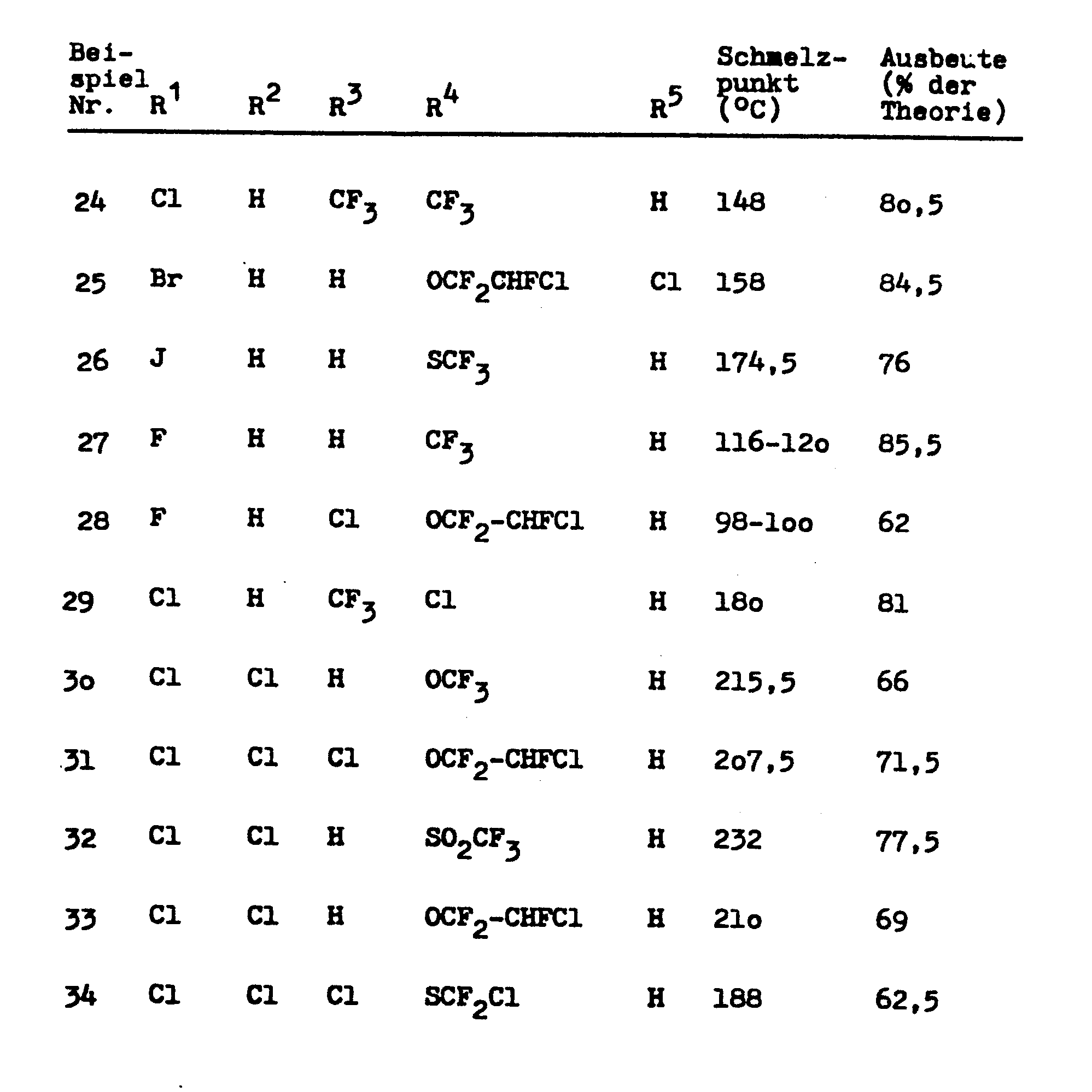
- Analog wurden folgende Verbindungen der allgemeinen Formel




- Die nachstehend aufgeführten als Ausgangsverbindungen verwendeten Benzoyl-isothiocyanate der Formel II


Claims (6)


Priority Applications (1)
| Application Number | Priority Date | Filing Date | Title |
|---|---|---|---|
| AT79102966T ATE1007T1 (de) | 1978-08-24 | 1979-08-16 | Substituierte n-phenyl-n'-benzoyl-thioharnstoffe, verfahren zu ihrer herstellung und ihre verwendung als schaedlingsbekaempfungsmittel. |
Applications Claiming Priority (2)
| Application Number | Priority Date | Filing Date | Title |
|---|---|---|---|
| DE2837086 | 1978-08-24 | ||
| DE19782837086 DE2837086A1 (de) | 1978-08-24 | 1978-08-24 | Substituierte n-phenyl-n'-benzoyl- thioharnstoffe, verfahren zu ihrer herstellung und ihre verwendung als schaedlingsbekaempfungsmittel |
Publications (3)
| Publication Number | Publication Date |
|---|---|
| EP0008435A2 true EP0008435A2 (de) | 1980-03-05 |
| EP0008435A3 EP0008435A3 (en) | 1980-03-19 |
| EP0008435B1 EP0008435B1 (de) | 1982-05-12 |
Family
ID=6047867
Family Applications (1)
| Application Number | Title | Priority Date | Filing Date |
|---|---|---|---|
| EP79102966A Expired EP0008435B1 (de) | 1978-08-24 | 1979-08-16 | Substituierte N-Phenyl-N'-benzoyl-thioharnstoffe, Verfahren zu ihrer Herstellung und ihre Verwendung als Schädlingsbekämpfungsmittel |
Country Status (22)
| Country | Link |
|---|---|
| US (1) | US4276310A (de) |
| EP (1) | EP0008435B1 (de) |
| JP (1) | JPS5531092A (de) |
| AT (1) | ATE1007T1 (de) |
| AU (1) | AU524135B2 (de) |
| BR (1) | BR7905430A (de) |
| CA (1) | CA1110658A (de) |
| CS (1) | CS214803B2 (de) |
| DD (1) | DD145693A5 (de) |
| DE (2) | DE2837086A1 (de) |
| DK (1) | DK352279A (de) |
| EG (1) | EG13795A (de) |
| ES (1) | ES483585A1 (de) |
| HU (1) | HU182453B (de) |
| IL (1) | IL58083A0 (de) |
| MA (1) | MA18568A1 (de) |
| NZ (1) | NZ191362A (de) |
| PH (1) | PH16166A (de) |
| PL (1) | PL118628B1 (de) |
| PT (1) | PT70079A (de) |
| TR (1) | TR20630A (de) |
| ZA (1) | ZA794457B (de) |
Cited By (8)
| Publication number | Priority date | Publication date | Assignee | Title |
|---|---|---|---|---|
| EP0071279A1 (de) * | 1981-07-30 | 1983-02-09 | The Dow Chemical Company | Substituierte N Aroyl N' Phenylharnstoffe |
| EP0093977A1 (de) * | 1982-05-11 | 1983-11-16 | Bayer Ag | 2,5-Dihalogenbenzoyl-(thio)harnstoffe, Verfahren zu ihrer Herstellung und ihre Verwendung als Schädlingsbekämpfungsmittel |
| EP0093976A1 (de) * | 1982-05-11 | 1983-11-16 | Bayer Ag | 2,4-Dihalogenbenzoyl-(thio)harnstoffe, Verfahren zu ihrer Herstellung und ihre Verwendung als Schädlingsbekämpfungsmittel |
| EP0098158A1 (de) * | 1982-06-30 | 1984-01-11 | Union Carbide Corporation | 1-(Alkylphenoxyaryl)-3-Benzoylharnstoffe mit pestizider Wirkung und Verfahren zu deren Herstellung |
| EP0175416A1 (de) * | 1984-09-20 | 1986-03-26 | Nippon Soda Co., Ltd. | Benzoylharnstoffderivate |
| EP0154507A3 (de) * | 1984-02-27 | 1986-06-11 | Takeda Chemical Industries, Ltd. | Benzoylharnstoffe, Herstellungsverfahren und Verwendung |
| FR2576018A1 (fr) * | 1984-12-21 | 1986-07-18 | Nippon Kayaku Kk | Nouveau derive de benzoylphenyluree, et son emploi comme insecticide |
| EP0246061A3 (en) * | 1986-05-13 | 1989-02-08 | Sumitomo Chemical Company, Limited | A benzoylurea derivative and its production and use |
Families Citing this family (15)
| Publication number | Priority date | Publication date | Assignee | Title |
|---|---|---|---|---|
| US5245071A (en) * | 1970-05-15 | 1993-09-14 | Duphar International Research B.V. | Organic compounds derived from urea or thiourea |
| NL160809C (nl) * | 1970-05-15 | 1979-12-17 | Duphar Int Res | Werkwijze ter bereiding van benzoylureumverbindingen, alsmede werkwijze ter bereiding van insekticide prepara- ten op basis van benzoylureumverbindingen. |
| US5342958A (en) * | 1970-05-15 | 1994-08-30 | Solvay Duphar International Research B.V. | Organic compounds derived from urea or thiourea |
| DE3161657D1 (en) * | 1980-11-22 | 1984-01-19 | Celamerck Gmbh & Co Kg | Urea derivatives, preparation and use |
| US4468405A (en) * | 1981-07-30 | 1984-08-28 | The Dow Chemical Company | Substituted N-aroyl N'-phenyl urea compounds |
| CA1238650A (en) * | 1982-03-01 | 1988-06-28 | Hiroshi Nagase | Urea derivatives, their production and use |
| US4868215A (en) * | 1982-07-26 | 1989-09-19 | The Dow Chemical Company | Substituted N-aroyl N'-phenyl urea compounds |
| US4602109A (en) * | 1982-12-30 | 1986-07-22 | Union Carbide Corporation | Novel pesticidal phenoxyphenyl and phenoxypyridyl benzoyl ureas and process for preparation |
| US4665097A (en) * | 1983-03-31 | 1987-05-12 | Union Carbide Corporation | Novel bicyclooxyaryl thioureas and process for preparation |
| JPS60181067A (ja) * | 1984-02-27 | 1985-09-14 | Takeda Chem Ind Ltd | ベンゾイル尿素誘導体,その製造法及び殺虫剤 |
| US5153224A (en) * | 1984-10-18 | 1992-10-06 | Ciba-Geigy Corporation | Benzoylphenylureas |
| EP0179022B1 (de) * | 1984-10-18 | 1990-11-07 | Ciba-Geigy Ag | Benzoylphenylharnstoffe |
| US4638088A (en) * | 1984-11-15 | 1987-01-20 | Union Carbide Corporation | Pesticidal biphenylyloxy and biphenylylalkoxy aryl acyl urea compounds |
| US5288756A (en) * | 1985-10-14 | 1994-02-22 | Ciba-Geigy Corporation | Benzoylphenylureas |
| US11999684B1 (en) | 2023-10-09 | 2024-06-04 | King Faisal University | Ethyl {[N'-(3-chlorophenyl)-N-(2,4-dichlorobenzoyl) carbamimidoyl]sulfanyl}acetate as an eco-friendly insecticidal agent against Spodoptera littoralis (boisd.) |
Family Cites Families (7)
| Publication number | Priority date | Publication date | Assignee | Title |
|---|---|---|---|---|
| US3406192A (en) * | 1962-09-04 | 1968-10-15 | Monsanto Co | N-(aroyl) carbamates and thio carbamates |
| US4013717A (en) * | 1970-05-15 | 1977-03-22 | U.S. Philips Corporation | Benzoyl phenyl urea derivatives having insecticidal activities |
| DE2531279C2 (de) * | 1975-07-12 | 1983-07-14 | Bayer Ag, 5090 Leverkusen | N-(3-Trifluormethyl-4-halogen-phenyl)- N'-benzoyl-harnstoffe, Verfahren zu ihrer Herstellung und ihre Verwendung als Insektizide |
| US4170657A (en) * | 1977-05-13 | 1979-10-09 | The Dow Chemical Company | Substituted(((phenyl)amino)carbonyl)-benzamides |
| US4089975A (en) * | 1977-05-13 | 1978-05-16 | The Dow Chemical Company | Method of controlling manure-breeding insects |
| DE2860137D1 (en) * | 1977-07-28 | 1980-12-11 | Ciba Geigy Ag | N-phenyl-n'-benzoyl ureas, process for their preparation, substances containing them, and their use as pesticides |
| US4160037A (en) * | 1977-09-30 | 1979-07-03 | The Upjohn Company | Compounds, compositions and methods of combatting pest employing thioureas |
-
1978
- 1978-08-24 DE DE19782837086 patent/DE2837086A1/de not_active Withdrawn
-
1979
- 1979-08-10 AU AU49787/79A patent/AU524135B2/en not_active Ceased
- 1979-08-16 PH PH22917A patent/PH16166A/en unknown
- 1979-08-16 DE DE7979102966T patent/DE2962816D1/de not_active Expired
- 1979-08-16 AT AT79102966T patent/ATE1007T1/de not_active IP Right Cessation
- 1979-08-16 EP EP79102966A patent/EP0008435B1/de not_active Expired
- 1979-08-16 US US06/067,246 patent/US4276310A/en not_active Expired - Lifetime
- 1979-08-17 TR TR20630A patent/TR20630A/xx unknown
- 1979-08-17 PT PT70079A patent/PT70079A/pt unknown
- 1979-08-21 IL IL58083A patent/IL58083A0/xx unknown
- 1979-08-21 EG EG511/79A patent/EG13795A/xx active
- 1979-08-21 NZ NZ191362A patent/NZ191362A/xx unknown
- 1979-08-22 DD DD79215124A patent/DD145693A5/de unknown
- 1979-08-22 PL PL1979217895A patent/PL118628B1/pl unknown
- 1979-08-22 JP JP10615579A patent/JPS5531092A/ja active Granted
- 1979-08-22 MA MA18767A patent/MA18568A1/fr unknown
- 1979-08-23 ZA ZA00794457A patent/ZA794457B/xx unknown
- 1979-08-23 CS CS795736A patent/CS214803B2/cs unknown
- 1979-08-23 CA CA334,349A patent/CA1110658A/en not_active Expired
- 1979-08-23 DK DK352279A patent/DK352279A/da unknown
- 1979-08-23 ES ES483585A patent/ES483585A1/es not_active Expired
- 1979-08-23 HU HU79BA3836A patent/HU182453B/hu unknown
- 1979-08-23 BR BR7905430A patent/BR7905430A/pt unknown
Non-Patent Citations (1)
| Title |
|---|
| JOURNAL OF AGRICULTURAI AND FOOD CHEMISTRY, Band 24, Nr. 5, September-Oktober 1976, Seiten 1065-1068 J.E. OLIVER et al.: "Insect Growth Regulators. Analoques of TH-6038 and TH-6040. * |
Cited By (10)
| Publication number | Priority date | Publication date | Assignee | Title |
|---|---|---|---|---|
| EP0071279A1 (de) * | 1981-07-30 | 1983-02-09 | The Dow Chemical Company | Substituierte N Aroyl N' Phenylharnstoffe |
| EP0093977A1 (de) * | 1982-05-11 | 1983-11-16 | Bayer Ag | 2,5-Dihalogenbenzoyl-(thio)harnstoffe, Verfahren zu ihrer Herstellung und ihre Verwendung als Schädlingsbekämpfungsmittel |
| EP0093976A1 (de) * | 1982-05-11 | 1983-11-16 | Bayer Ag | 2,4-Dihalogenbenzoyl-(thio)harnstoffe, Verfahren zu ihrer Herstellung und ihre Verwendung als Schädlingsbekämpfungsmittel |
| US4533676A (en) * | 1982-05-11 | 1985-08-06 | Bayer Aktiengesellschaft | 2,5-Dihalogenobenzoyl-(thio)urea insecticides |
| EP0098158A1 (de) * | 1982-06-30 | 1984-01-11 | Union Carbide Corporation | 1-(Alkylphenoxyaryl)-3-Benzoylharnstoffe mit pestizider Wirkung und Verfahren zu deren Herstellung |
| EP0154507A3 (de) * | 1984-02-27 | 1986-06-11 | Takeda Chemical Industries, Ltd. | Benzoylharnstoffe, Herstellungsverfahren und Verwendung |
| EP0175416A1 (de) * | 1984-09-20 | 1986-03-26 | Nippon Soda Co., Ltd. | Benzoylharnstoffderivate |
| FR2576018A1 (fr) * | 1984-12-21 | 1986-07-18 | Nippon Kayaku Kk | Nouveau derive de benzoylphenyluree, et son emploi comme insecticide |
| US4734436A (en) * | 1984-12-21 | 1988-03-29 | Nippon Kayaku Kabushiki Kaisha | Benzoylphenylurea derivative and its use as an insecticide |
| EP0246061A3 (en) * | 1986-05-13 | 1989-02-08 | Sumitomo Chemical Company, Limited | A benzoylurea derivative and its production and use |
Also Published As
| Publication number | Publication date |
|---|---|
| PL118628B1 (en) | 1981-10-31 |
| BR7905430A (pt) | 1980-04-29 |
| ZA794457B (en) | 1980-09-24 |
| HU182453B (en) | 1984-01-30 |
| CA1110658A (en) | 1981-10-13 |
| DE2837086A1 (de) | 1980-03-06 |
| NZ191362A (en) | 1981-05-01 |
| ATE1007T1 (de) | 1982-05-15 |
| CS214803B2 (en) | 1982-06-25 |
| PH16166A (en) | 1983-07-21 |
| US4276310A (en) | 1981-06-30 |
| DK352279A (da) | 1980-02-25 |
| DE2962816D1 (en) | 1982-07-01 |
| PL217895A1 (de) | 1980-05-05 |
| EG13795A (en) | 1982-06-30 |
| EP0008435A3 (en) | 1980-03-19 |
| ES483585A1 (es) | 1980-05-16 |
| MA18568A1 (fr) | 1979-08-22 |
| IL58083A0 (en) | 1979-12-30 |
| PT70079A (en) | 1979-09-01 |
| JPS6344139B2 (de) | 1988-09-02 |
| AU4978779A (en) | 1980-02-28 |
| JPS5531092A (en) | 1980-03-05 |
| AU524135B2 (en) | 1982-09-02 |
| EP0008435B1 (de) | 1982-05-12 |
| DD145693A5 (de) | 1981-01-07 |
| TR20630A (tr) | 1982-03-12 |
Similar Documents
| Publication | Publication Date | Title |
|---|---|---|
| EP0008435B1 (de) | Substituierte N-Phenyl-N'-benzoyl-thioharnstoffe, Verfahren zu ihrer Herstellung und ihre Verwendung als Schädlingsbekämpfungsmittel | |
| EP0093976B1 (de) | 2,4-Dihalogenbenzoyl-(thio)harnstoffe, Verfahren zu ihrer Herstellung und ihre Verwendung als Schädlingsbekämpfungsmittel | |
| EP0003099A2 (de) | Substituierte N-Phenyl-N'-(2-chlor-6-fluor-benzoyl)-harnstoffe, Verfahren zu ihrer Herstellung und ihre Verwendung als Insektizide | |
| EP0007541B1 (de) | Substituierte 5-Phenylcarbamoyl-barbitursäuren, Verfahren zu ihrer Herstellung und ihre Verwendung als Insektizide | |
| EP0128350B1 (de) | Pyrimidylphosphorsäure-Derivate und ihre Verwendung als Schädlingsbekämpfungsmittel | |
| DE2637947A1 (de) | Substituierte benzoylharnstoffe, verfahren zu ihrer herstellung und ihre verwendung als insektizide | |
| CH634303A5 (de) | Phenylcarbamoyl-2-pyrazoline, verfahren zu deren herstellung sowie diese verbindungen enthaltende insektizide. | |
| EP0014881B1 (de) | Oxadiazinderivate, Verfahren zu ihrer Herstellung und ihre Verwendung als Schädlingsbekämpfungsmittel | |
| CH627445A5 (de) | Verfahren zur herstellung neuer substituierter benzoylureidodiphenylaether und ihre verwendung zur bekaempfung von insekten sowie insektizide mittel. | |
| EP0122449B1 (de) | Benzoylharnstoffe | |
| EP0123861A2 (de) | Harnstoffderivate | |
| EP0007466B1 (de) | 2-Cyclopropyl-pyrimidin(4)yl-thionophosphonsäureester, Verfahren zu ihrer Herstellung, ihre Verwendung als Insektizide und Akarizide, diese enthaltende Schädlingsbekämpfungsmittel und Verfahren zu deren Herstellung | |
| EP0189043B1 (de) | Substituierte Furazane | |
| EP0038427A1 (de) | 3-Carbamoyl-4-hydroxy-cumarine, Verfahren zu ihrer Herstellung und ihre Verwendung als Schädlingsbekämpfungsmittel | |
| EP0051196B1 (de) | 4-Benzyloxy-alpha-trichlormethyl-benzylamine, ein Verfahren zu ihrer Herstellung, sie enthaltende Schädlingsbekämpfungsmittel, ihre Herstellung und Verwendung | |
| EP0009103B1 (de) | N-(O-Äthyl-S-n-propyl-(di)thiophosphoryloxy)-naphtalimide, Verfahren zu ihrer Herstellung, diese Verbindungen enthaltende Schädlingsbekämpfungsmittel, ihre Herstellung und Verwendung | |
| EP0000934B1 (de) | Indan-5-yl-N-alkyl-carbaminsäureester, Verfahren zu ihrer Herstellung sowie ihre Verwendung als Pflanzenschutzmittel | |
| EP0197280B1 (de) | Benzoylharnstoffe | |
| EP0005756A2 (de) | 5-Arylamino-2,2-difluor-benzodioxole, Verfahren zu ihrer Herstellung und ihre Verwendung zur Schädlingsbekämpfung | |
| EP0069881A1 (de) | S-Azolyl-methyl-di(tri)-thiophosphorsäureester, Verfahren zu ihrer Herstellung und ihre Verwendung als Schädlingsbekämpfungsmittel | |
| EP0004642A1 (de) | Neue Diarylamine, Verfahren zu ihrer Herstellung und ihre Verwendung | |
| CH638375A5 (de) | Insektizide mittel. | |
| EP0561250B1 (de) | Furazanylharnstoffe | |
| EP0316734B1 (de) | Furazanylharnstoffe | |
| EP0172510B1 (de) | Benzoylharnstoffe |
Legal Events
| Date | Code | Title | Description |
|---|---|---|---|
| PUAI | Public reference made under article 153(3) epc to a published international application that has entered the european phase |
Free format text: ORIGINAL CODE: 0009012 |
|
| PUAL | Search report despatched |
Free format text: ORIGINAL CODE: 0009013 |
|
| AK | Designated contracting states |
Designated state(s): AT BE CH DE FR GB IT NL SE |
|
| AK | Designated contracting states |
Designated state(s): AT BE CH DE FR GB IT NL SE |
|
| 17P | Request for examination filed |
Effective date: 19800816 |
|
| ITF | It: translation for a ep patent filed | ||
| GRAA | (expected) grant |
Free format text: ORIGINAL CODE: 0009210 |
|
| AK | Designated contracting states |
Designated state(s): AT BE CH DE FR GB IT NL SE |
|
| REF | Corresponds to: |
Ref document number: 1007 Country of ref document: AT Date of ref document: 19820515 Kind code of ref document: T |
|
| REF | Corresponds to: |
Ref document number: 2962816 Country of ref document: DE Date of ref document: 19820701 |
|
| PGFP | Annual fee paid to national office [announced via postgrant information from national office to epo] |
Ref country code: AT Payment date: 19820802 Year of fee payment: 4 |
|
| PGFP | Annual fee paid to national office [announced via postgrant information from national office to epo] |
Ref country code: SE Payment date: 19820930 Year of fee payment: 4 |
|
| PG25 | Lapsed in a contracting state [announced via postgrant information from national office to epo] |
Ref country code: AT Effective date: 19830816 |
|
| PG25 | Lapsed in a contracting state [announced via postgrant information from national office to epo] |
Ref country code: SE Effective date: 19830817 |
|
| PGFP | Annual fee paid to national office [announced via postgrant information from national office to epo] |
Ref country code: DE Payment date: 19840724 Year of fee payment: 6 |
|
| PGFP | Annual fee paid to national office [announced via postgrant information from national office to epo] |
Ref country code: FR Payment date: 19840803 Year of fee payment: 6 |
|
| PGFP | Annual fee paid to national office [announced via postgrant information from national office to epo] |
Ref country code: BE Payment date: 19840930 Year of fee payment: 6 |
|
| PGFP | Annual fee paid to national office [announced via postgrant information from national office to epo] |
Ref country code: CH Payment date: 19841019 Year of fee payment: 6 |
|
| PGFP | Annual fee paid to national office [announced via postgrant information from national office to epo] |
Ref country code: NL Payment date: 19870831 Year of fee payment: 9 |
|
| PG25 | Lapsed in a contracting state [announced via postgrant information from national office to epo] |
Ref country code: GB Free format text: LAPSE BECAUSE OF NON-PAYMENT OF DUE FEES Effective date: 19880816 |
|
| PG25 | Lapsed in a contracting state [announced via postgrant information from national office to epo] |
Ref country code: CH Effective date: 19880831 Ref country code: BE Effective date: 19880831 |
|
| BERE | Be: lapsed |
Owner name: BAYER A.G. Effective date: 19880831 |
|
| PG25 | Lapsed in a contracting state [announced via postgrant information from national office to epo] |
Ref country code: NL Effective date: 19890301 |
|
| NLV4 | Nl: lapsed or anulled due to non-payment of the annual fee | ||
| PG25 | Lapsed in a contracting state [announced via postgrant information from national office to epo] |
Ref country code: FR Free format text: LAPSE BECAUSE OF NON-PAYMENT OF DUE FEES Effective date: 19890428 |
|
| REG | Reference to a national code |
Ref country code: CH Ref legal event code: PL |
|
| PG25 | Lapsed in a contracting state [announced via postgrant information from national office to epo] |
Ref country code: DE Effective date: 19890503 |
|
| GBPC | Gb: european patent ceased through non-payment of renewal fee | ||
| REG | Reference to a national code |
Ref country code: FR Ref legal event code: ST |
|
| EUG | Se: european patent has lapsed |
Ref document number: 79102966.3 Effective date: 19850610 |
|
| PLBE | No opposition filed within time limit |
Free format text: ORIGINAL CODE: 0009261 |
|
| STAA | Information on the status of an ep patent application or granted ep patent |
Free format text: STATUS: NO OPPOSITION FILED WITHIN TIME LIMIT |