EP0009657A1 - Mittel mit diuretischer Wirkung enthaltend 2,4-Diamino-5-(4-amino-3,5-dimethoxybenzyl)-pyrimidin und ein Kalium-ausschwemmendes Diuretikum und deren Herstellung - Google Patents
Mittel mit diuretischer Wirkung enthaltend 2,4-Diamino-5-(4-amino-3,5-dimethoxybenzyl)-pyrimidin und ein Kalium-ausschwemmendes Diuretikum und deren Herstellung Download PDFInfo
- Publication number
- EP0009657A1 EP0009657A1 EP79103328A EP79103328A EP0009657A1 EP 0009657 A1 EP0009657 A1 EP 0009657A1 EP 79103328 A EP79103328 A EP 79103328A EP 79103328 A EP79103328 A EP 79103328A EP 0009657 A1 EP0009657 A1 EP 0009657A1
- Authority
- EP
- European Patent Office
- Prior art keywords
- potassium
- diuretic
- compound
- acid
- alkyl
- Prior art date
- Legal status (The legal status is an assumption and is not a legal conclusion. Google has not performed a legal analysis and makes no representation as to the accuracy of the status listed.)
- Granted
Links
Classifications
-
- A—HUMAN NECESSITIES
- A61—MEDICAL OR VETERINARY SCIENCE; HYGIENE
- A61K—PREPARATIONS FOR MEDICAL, DENTAL OR TOILETRY PURPOSES
- A61K31/00—Medicinal preparations containing organic active ingredients
- A61K31/33—Heterocyclic compounds
- A61K31/395—Heterocyclic compounds having nitrogen as a ring hetero atom, e.g. guanethidine or rifamycins
- A61K31/54—Heterocyclic compounds having nitrogen as a ring hetero atom, e.g. guanethidine or rifamycins having six-membered rings with at least one nitrogen and one sulfur as the ring hetero atoms, e.g. sulthiame
-
- A—HUMAN NECESSITIES
- A61—MEDICAL OR VETERINARY SCIENCE; HYGIENE
- A61P—SPECIFIC THERAPEUTIC ACTIVITY OF CHEMICAL COMPOUNDS OR MEDICINAL PREPARATIONS
- A61P7/00—Drugs for disorders of the blood or the extracellular fluid
- A61P7/10—Antioedematous agents; Diuretics
Definitions
- diuretics include the group of orally active sulfonamides of the thiazide type (benzothiadiazine derivatives), such as hydrochlorothiazide and hydrofluomethiazide, and thiazide analogues, such as quinethazone, chlorothalidone and mefruside.
- thiazide analogues such as quinethazone, chlorothalidone and mefruside.
- these diuretics are not free from undesirable side effects, which can be attributed to an increased potassium excretion in the patient and which can manifest themselves, for example, as anorexia, nausea, weakness or fatigue. This loss of potassium is particularly pronounced at the start of therapy, especially if the diuresis is strong and a strict diet is followed.
- a potassium salt preferably potassium chloride
- a potassium salt is prescribed to the patient in order to compensate for the loss of potassium.
- potassium salts preferably potassium chloride
- Spironolactone and the triamterene are mainly administered in combination with thiazides or other diuretics (FH Meyers et al., Textbook of Pharmacology, Springer-Verlag, 1975, pp. 178-189 and 768).
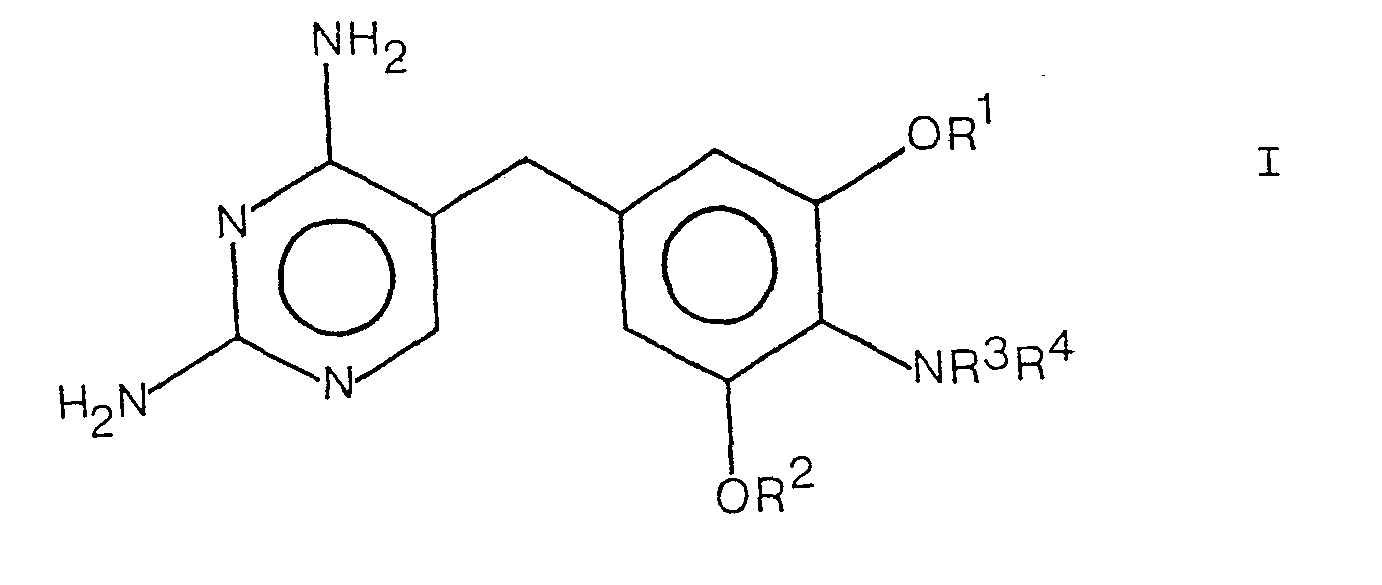
- the present invention therefore relates to agents (pharmaceutical preparations) with a diuretic effect, containing a potassium-flushing diuretic and a potassium-retaining compound, which are characterized in that the potassium-retaining compound is a p-aminobenzylpyrimidine of the formula I or a physiologically tolerable salt of such a connection. It also relates to the use of p-aminobenzylpyrimidines of the formula I and their physiologically tolerable salts for reducing potassium excretion, in particular in combination with potassium-flushing diuretics.
- C 1-6 alkyl radicals are methyl, ethyl, propyl, n-butyl, isobutyl, tert-butyl and hexyl;
- Examples of C 2-6 alkenyl radicals are vinyl and allyl.
- C 1-6 acyl radicals are preferably derived from aliphatic carboxylic acids, such as formic acid, acetic acid, propionic acid, butyric acid and ethoxyacetic acid.
- Possible residues -NR 3 R 4 which represent an optionally unsaturated 5-, 6- or 7-membered heterocycle, are, for example: pyrrolo, pyrrolino, pyrrolidino, piperidino and azepino.
- Preferred subgroups of compounds of the formula I are those in which R 1 and R 2 are a C 1-3 alkyl radical and R 3 and R 4 are hydrogen, a C 1-3 alkyl radical or together with the N atom to which they are attached are a 5- to 7-membered saturated heterocycle and further those in which R 1 and R 2 are methyl and R 3 and R 4 are hydrogen, methyl, ethyl, formyl or together with the N atom to which they are attached are represent pyrrolidino.
- a particularly preferred compound of formula I is 2,4-diamino-5- (4-amino-3,5-dimethoxybenzyl) pyrimidine.
- physiologically acceptable salts of the compounds I are all customary and familiar to those skilled in the art, those with organic or inorganic acids such as hydrochloric acid, sulfuric acid, phosphoric acid, formic acid, acetic acid, oxalic acid, tartaric acid, maleic acid, benzoic acid, succinic acid, fumaric acid, levulinic acid, salicylic acid, citric acid, isocitric acid, adipic acid, adipic acid Lactic acid, a-ketoglutaric acid, malic acid, malonic acid, glyceric acid, mevalonic acid, glucuronic acid, neuraminic acid, glutaric acid, glucaric acid, aspartic acid, gluconic acid, mandelic acid, ascorbic acid, lactobionic acid, glucoheptonic acid, glutamic acid, nicotinic acid, gerothenic acid, folic acid and acidic acid, folothenic acid, formed in will.
- the compounds of the formula I can be combined with all those diuretics which have a potassium-flushing effect.
- the preparations according to the invention contain the customary inert organic or inorganic carrier materials suitable for oral or parenteral administration, in particular those customary for tablets, dragées, capsules or injection solutions, and, if appropriate, further auxiliaries , such as preservatives, stabilizers, wetting agents or emulsifiers, agents for improving the taste, salts for changing the osmotic pressure or buffer substances.
- the pharmaceutical preparations can be prepared in the manner familiar to any person skilled in the art, by mixing the active components with the suitable inert organic or inorganic carrier materials and for oral or parenteral administration Appropriate galenic shape.
- a very high, in some cases up to 90%, maximum potassium retention can be achieved with the compounds of the formula I, which allows a relatively low daily dose, which is expediently between 1 and 20 mg, preferably 5-10 mg.
- Their dosage in pharmaceutical preparations is primarily determined by the amount of potassium loss caused by the diuretic component. It can also be 1-20 mg per application unit. As with any diuretic treatment, the dosage of the preparations should be adjusted to the degree of weight loss and the serum electrolyte levels of the patient and monitored and determined by the doctor. The optimal dosage depends on the serum potassium level.
- Components 1-3 and 80% of component 4 were sieved and mixed and processed with a sufficient amount of fine fuel and water as well as component 5 and granulated. The granules were dried and sieved and, after mixing with the remaining components, pressed into tablets with a breaking groove of 160.0 mg.
Landscapes
- Health & Medical Sciences (AREA)
- Pharmacology & Pharmacy (AREA)
- Veterinary Medicine (AREA)
- Public Health (AREA)
- General Health & Medical Sciences (AREA)
- Chemical & Material Sciences (AREA)
- Animal Behavior & Ethology (AREA)
- Medicinal Chemistry (AREA)
- Life Sciences & Earth Sciences (AREA)
- Epidemiology (AREA)
- Chemical Kinetics & Catalysis (AREA)
- Engineering & Computer Science (AREA)
- Nuclear Medicine, Radiotherapy & Molecular Imaging (AREA)
- General Chemical & Material Sciences (AREA)
- Hematology (AREA)
- Diabetes (AREA)
- Bioinformatics & Cheminformatics (AREA)
- Organic Chemistry (AREA)
- Pharmaceuticals Containing Other Organic And Inorganic Compounds (AREA)
- Medicines Containing Material From Animals Or Micro-Organisms (AREA)
- Confectionery (AREA)
- Coloring Foods And Improving Nutritive Qualities (AREA)
- Medicines Containing Plant Substances (AREA)
- Plural Heterocyclic Compounds (AREA)
- Steroid Compounds (AREA)
Abstract
Description
- Zu den heutzutage am häufigsten verwendeten Diuretica gehören die Gruppe der oral wirksamen Sulfonamide vom Thiazidtyp (Benzothiadiazinderivate), wie Hydrochlorothiazid und Hydrofluomethiazid,.und Thiazidanaloga, wie Quinethazon, Chlorthalidon und Mefrusid. Diese Diuretica sind jedoch nicht frei von unerwünschten Nebenwirkungen, die auf eine erhöhte Kaliumausscheidung beim Patienten zurückzuführen sind und sich z.B. als Anorexie, Uebelkeit, Schwäche oder Müdigkeit äussern können. Dieser Kaliumverlust ist besonders zu Beginn der Therapie ausgeprägt, vor allem wenn die Diurese stark ist und eine strikte Diät eingehalten wird. In der Regel wird dem Patienten zusätzlich ein Kaliumsalz, vorzugsweise Kaliumchlorid, verordnet, um den Kaliumverlust zu kompensieren. Andererseits sind bereits Kalium-retinierende Diuretica bekannt, die als Aldosteronantagonisten (Spironolacton) oder Pseudo-Aldosteronantagonisten (Triamteren) wirken und damit die Retention von Kalium verursachen. Spironolacton und das Triamteren werden vorwiegend in Kombination mit Thiaziden oder anderen Diuretica verabreicht (F.H. Meyers et al., Lehrbuch der Pharmakologie, Springer-Verlag, 1975, S. 178-189 und 768).
- Es wurde nun überraschenderweise gefunden, dass auch bestimmte p-Aminobenzylpyrimidine eine ausgesprochene Kalium-retinierende Wirkung aufweisen. Es handelt sich dabei um Verbindungen der allgemeinen Formel
-

- wobei R1 und R2 einen C1-6-Alkyl- oder C2-6-Alkenylrest und
- R 3 und R 4 unabhängig voneinander Wasserstoff, einen C1-6-Alkyl-, C2-6-Alkenyl- oder C1-6-Acylrest oder gemeinsam mit dem N-Atom, an das sie gebunden sind, einen ggf. ungesättigten 5-, 6- oder 7-gliedrigen Heterocyclus darstellen,
- und ihre physiologisch verträglichen Salze.
- Von diesen Verbindungen wusste man bisher nur, dass sie antibakterielle Aktivität aufweisen und die Wirkung antibakteriell wirksamer Sulfonamide potenzieren (z.B. deutsche Offenlegungsschrift No. 2,443,682). Es hat sich gezeigt, dass die Verbindungen der Formel I und ihre physiologisch verträglichen Salze gegenüber bereits bekann ten Kalium-retinierenden Diuretica Vorteile besitzen und sie daher als Kalium-retinierende Mittel in Kombination mit Diuretica, die eine erhöhte Kaliumausscheidung verursachen, verwendet werden können.
- Die vorliegende Erfindung betrifft daher Mittel (pharmazeutische Präparate) mit diuretischer Wirkung, enthaltend ein Kalium-ausschwemmendes Diureticum und eine Kalium-retinierende Verbindung, die dadurch gekennzeichnet sind, dass die Kalium-retinierende Verbindung ein p-Aminobenzylpyrimidin der Formel I oder ein physiologisch verträgliches Salz einer solchen Verbindung ist. Sie betrifft ferner die Verwendung von p-Aminobenzylpyrimidinen der Formel I und ihrer physiologisch verträglichen Salze zur Verminderung der Kaliumausscheidung, insbesondere in Kombination mit Kalium-ausschwemmenden Diuretica.
- Beispiele von C1-6-Alkylresten sind Methyl, Aethyl, Propyl, n-Butyl, iso-Butyl, tert.-Butyl und Hexyl; Beispiele von C2-6-Alkenylresten sind Vinyl und Allyl. C1-6-Acylreste leiten sich vorzugsweise von aliphatischen Carbonsäuren ab, wie der Ameisensäure, Essigsäure, Propionsäure, Buttersäure und Aethoxyessigsäure. Als Reste -NR3R4, die einen ggf. ungesättigten 5-, 6- oder 7-gliedrigen Heterocyclus darstellen, kommen z.B. in Frage: Pyrrolo, Pyrrolino, Pyrrolidino, Piperidino und Azepino.
- Bevorzugte Untergruppen von Verbindungen der Formel I sind solche, in denen R1 und R 2 einen Cl-3-Alkylrest und R3 und R4 Wasserstoff, einen C1-3-Alkylrest oder gemeinsam mit dem N-Atom, an das sie gebunden sind, einen 5- bis 7- gliedrigen gesättigten Heterocyclus darstellen und weiter solche, in denen R1 und R2 Methyl und R3 und R4 Wasserstoff, Methyl, Aethyl, Formyl oder gemeinsam mit dem N-Atom, an das sie gebunden sind, Pyrrolidino darstellen. Eine besonders bevorzugte Verbindung der Formel I ist 2,4-Diamino-5-(4-amino-3,5-dimethoxybenzyl)-pyrimidin.
- Als physiologisch verträgliche Salze der Verbindungen I kommen alle üblichen und dem Fachmann geläufigen in Frage, die mit organischen oder anorganischen Säuren wie Salzsäure, Schwefelsäure, Phosphorsäure, Ameisensäure, Essigsäure, Oxalsäure, Weinsäure, Maleinsäure, Benzoesäure, Bernsteinsäure, Fumarsäure, Lävulinsäure, Salicylsäure, Citronensäure, Isocitronensäure, Adipinsäure, Milchsäure, a-Ketoglutarsäure, Aepfelsäure, Malonsäure, Glycerinsäure, Mevalonsäure, Glucuronsäure, Neuraminsäure, Glutarsäure, Glucarsäure, Asparaginsäure, Gluconsäure, Mandelsäure, Ascorbinsäure, Lactobionsäure, Glucoheptonsäure, Glutaminsäure, Nicotinsäure, Pantothensäure, Folsäure, Adenylsäure, Geranylsäure, Cytidinsäure und Inosinsäure gebildet werden.
- In den erfindungsgemässen pharmazeutischen Präparaten können die Verbindungen der Formel I mit all jenen Diuretica kombiniert werden, die Kalium-ausschwemmend wirken. Dies sind vor allem stark wirksame Diuretica vom Thiazidtyp und Analoga, wie Hydrochlorothiazid, Hydrofluomethazid, Trichlormethiazid, Thiabuzid, Polythiazid, Cyclopenthiazid, Quinethazon, jedoch kommen auch nicht dem Thiazidtyp zugehörige Diuretica mit der genannten Nebenwirkung, wie z.B. Ethacrynsäure, in Betracht.
- Die erfindungsgemässen Präparate enthalten neben den Wirkstoffen - die direkt oder verzögert-freigegeben werden können - die üblichen, für die orale oder parenterale Applikation geeigneten inerten organischen oder anorganischen Trägermaterialien, insbesondere die für Tabletten, Dragees, Kapseln oder Injektionslösungen üblichen, sowie ggf. weitere Hilfsstoffe, wie Konservierungs-, Stabilisierungs-, Netz- oder Emulgiermittel, Mittel zur geschmacklichen Verbesserung, Salze zur Veränderung des osmotischen Druckes oder Puffersubstanzen. Die Herstellung der pharmazeutischen Präparate kann in der jedem Fachmann geläufigen Weise erfolgen, durch Vermischen der aktiven Komponenten mit den geeigneten inerten organischen oder anorganischen Trägermaterialien und für die orale oder parenterale Verabreichung zweckmässige galenische Formgebung.
- Mit den Verbindungen der Formel I ist eine sehr hohe, teilweise bis zu 90% gehende, maximale Kaliumretention erreichbar, was eine relativ geringe Tagesdosis erlaubt, die zweckmässigerweise zwischen 1 und 20 mg, vorzugsweise bei 5-10 mg liegt. Ihre Dosierung in den pharmazeutischen Präparaten wird aber vor allem von der Höhe des durch die diuretisch wirkende Komponente verursachten Kaliumverlustes bestimmt. Pro Applikationseinheit kann sie ebenfalls 1-20 mg betragen. Wie bei jeder diuretischen Behandlung ist die Dosierung der Präparate dem Grad des Gewichtsverlustes und den Serumelektrolyttitern des Patienten anzupassen und durch den Arzt zu überwachen und festzusetzen. Die optimale Dosierung richtet sich nach dem Serumkaliumspiegel.
- Es wurden Tabletten der folgenden Zusammensetzung hergestellt:

- Die Komponenten 1-3 und 80% der Komponente 4 wurden gesiebt und gemischt und mit einer ausreichenden Menge Feinsprit und Wasser sowie der Komponente 5 verarbeitet und granuliert. Das Granulat wurde getrocknet und gesiebt und nach Vermischen mit den restlichen Komponenten zu Tabletten mit Bruchrille a 160,0 mg verpresst.
Claims (9)
Priority Applications (1)
| Application Number | Priority Date | Filing Date | Title |
|---|---|---|---|
| AT79103328T ATE1216T1 (de) | 1978-09-12 | 1979-09-07 | Mittel mit diuretischer wirkung enthaltend 2,4-diamino-5-(4-amino-3, 5-dimethoxybenzyl)-pyrimidin und ein kalium-ausschwemmendes diuretikum und deren herstellung. |
Applications Claiming Priority (2)
| Application Number | Priority Date | Filing Date | Title |
|---|---|---|---|
| CH954778A CH639273A5 (de) | 1978-09-12 | 1978-09-12 | Diuretische mittel. |
| CH9547/78 | 1978-09-12 |
Publications (2)
| Publication Number | Publication Date |
|---|---|
| EP0009657A1 true EP0009657A1 (de) | 1980-04-16 |
| EP0009657B1 EP0009657B1 (de) | 1982-06-23 |
Family
ID=4353125
Family Applications (1)
| Application Number | Title | Priority Date | Filing Date |
|---|---|---|---|
| EP79103328A Expired EP0009657B1 (de) | 1978-09-12 | 1979-09-07 | Mittel mit diuretischer Wirkung enthaltend 2,4-Diamino-5-(4-amino-3,5-dimethoxybenzyl)-pyrimidin und ein Kalium-ausschwemmendes Diuretikum und deren Herstellung |
Country Status (25)
| Country | Link |
|---|---|
| US (1) | US4265893A (de) |
| EP (1) | EP0009657B1 (de) |
| JP (1) | JPS5538397A (de) |
| AT (1) | ATE1216T1 (de) |
| AU (1) | AU525735B2 (de) |
| CA (1) | CA1108537A (de) |
| CH (1) | CH639273A5 (de) |
| CU (1) | CU35124A (de) |
| DE (2) | DE2963170D1 (de) |
| DK (1) | DK379579A (de) |
| ES (1) | ES484060A1 (de) |
| FR (1) | FR2435946A1 (de) |
| GB (1) | GB2032275A (de) |
| GR (1) | GR73090B (de) |
| HU (1) | HU183090B (de) |
| IE (1) | IE48687B1 (de) |
| IL (1) | IL58178A (de) |
| IT (1) | IT1122376B (de) |
| LU (1) | LU81664A1 (de) |
| MC (1) | MC1281A1 (de) |
| NL (1) | NL7906766A (de) |
| NZ (1) | NZ191485A (de) |
| PH (1) | PH14733A (de) |
| SE (1) | SE7907540L (de) |
| ZA (1) | ZA794692B (de) |
Families Citing this family (3)
| Publication number | Priority date | Publication date | Assignee | Title |
|---|---|---|---|---|
| DE3143471A1 (de) * | 1981-11-03 | 1983-05-19 | Beiersdorf Ag, 2000 Hamburg | "neue pharmazeutische zusammensetzung" |
| CH658246A5 (de) * | 1981-11-09 | 1986-10-31 | Wellcome Found | Verfahren zur herstellung von substituierten 2,4-diamino-5-benzylpyrimidinen. |
| US4898729A (en) * | 1983-12-09 | 1990-02-06 | Euroceltique, S.A. | Treatment of hypertension, compounds and compositions for antihypertension and diuresis |
Citations (1)
| Publication number | Priority date | Publication date | Assignee | Title |
|---|---|---|---|---|
| DE2443682A1 (de) * | 1973-09-12 | 1975-03-20 | Hoffmann La Roche | Neue benzylpyrimidine |
-
1978
- 1978-09-12 CH CH954778A patent/CH639273A5/de not_active IP Right Cessation
-
1979
- 1979-07-31 CA CA332,930A patent/CA1108537A/en not_active Expired
- 1979-07-31 IT IT24808/79A patent/IT1122376B/it active
- 1979-08-16 CU CU7935124A patent/CU35124A/es unknown
- 1979-09-05 ZA ZA00794692A patent/ZA794692B/xx unknown
- 1979-09-05 IL IL58178A patent/IL58178A/xx unknown
- 1979-09-05 US US06/072,771 patent/US4265893A/en not_active Expired - Lifetime
- 1979-09-05 AU AU50606/79A patent/AU525735B2/en not_active Ceased
- 1979-09-05 NZ NZ191485A patent/NZ191485A/en unknown
- 1979-09-06 MC MC791405A patent/MC1281A1/fr unknown
- 1979-09-07 PH PH23012A patent/PH14733A/en unknown
- 1979-09-07 EP EP79103328A patent/EP0009657B1/de not_active Expired
- 1979-09-07 DE DE7979103328T patent/DE2963170D1/de not_active Expired
- 1979-09-07 AT AT79103328T patent/ATE1216T1/de not_active IP Right Cessation
- 1979-09-07 DE DE19792936244 patent/DE2936244A1/de not_active Withdrawn
- 1979-09-10 HU HU79HO2177A patent/HU183090B/hu unknown
- 1979-09-10 FR FR7922542A patent/FR2435946A1/fr active Granted
- 1979-09-10 LU LU81664A patent/LU81664A1/de unknown
- 1979-09-10 GR GR60001A patent/GR73090B/el unknown
- 1979-09-11 IE IE1722/79A patent/IE48687B1/en unknown
- 1979-09-11 DK DK379579A patent/DK379579A/da not_active Application Discontinuation
- 1979-09-11 SE SE7907540A patent/SE7907540L/xx not_active Application Discontinuation
- 1979-09-11 GB GB7931487A patent/GB2032275A/en not_active Withdrawn
- 1979-09-11 NL NL7906766A patent/NL7906766A/nl not_active Application Discontinuation
- 1979-09-11 ES ES484060A patent/ES484060A1/es not_active Expired
- 1979-09-12 JP JP11626579A patent/JPS5538397A/ja active Pending
Patent Citations (1)
| Publication number | Priority date | Publication date | Assignee | Title |
|---|---|---|---|---|
| DE2443682A1 (de) * | 1973-09-12 | 1975-03-20 | Hoffmann La Roche | Neue benzylpyrimidine |
Also Published As
| Publication number | Publication date |
|---|---|
| ZA794692B (en) | 1980-08-27 |
| SE7907540L (sv) | 1980-03-13 |
| CH639273A5 (de) | 1983-11-15 |
| ES484060A1 (es) | 1980-10-01 |
| DE2963170D1 (en) | 1982-08-12 |
| CU35124A (en) | 1982-08-24 |
| IT1122376B (it) | 1986-04-23 |
| NL7906766A (nl) | 1980-03-14 |
| ATE1216T1 (de) | 1982-07-15 |
| NZ191485A (en) | 1984-07-06 |
| DK379579A (da) | 1980-03-13 |
| GR73090B (de) | 1984-02-01 |
| LU81664A1 (de) | 1981-04-17 |
| JPS5538397A (en) | 1980-03-17 |
| FR2435946A1 (fr) | 1980-04-11 |
| GB2032275A (en) | 1980-05-08 |
| FR2435946B1 (de) | 1983-03-18 |
| HU183090B (en) | 1984-04-28 |
| US4265893A (en) | 1981-05-05 |
| IL58178A (en) | 1982-09-30 |
| AU525735B2 (en) | 1982-11-25 |
| IL58178A0 (en) | 1979-12-30 |
| IT7924808A0 (it) | 1979-07-31 |
| PH14733A (en) | 1981-11-19 |
| IE48687B1 (en) | 1985-04-17 |
| MC1281A1 (fr) | 1980-07-22 |
| EP0009657B1 (de) | 1982-06-23 |
| CA1108537A (en) | 1981-09-08 |
| DE2936244A1 (de) | 1980-03-20 |
| IE791722L (en) | 1980-03-12 |
| AU5060679A (en) | 1980-03-20 |
Similar Documents
| Publication | Publication Date | Title |
|---|---|---|
| DE2043933B2 (de) | N-(beta-naphthylaminomethyl)-aminocarbonsaeuren sowie diese enthaltende arzneimittel | |
| DE2710047C2 (de) | Sulfonamid-Derivate, deren Herstellung und diese enthaltende pharmazeutische oder veterinär-medizinische Mittel | |
| DE60107272T2 (de) | Eisenverbindungen | |
| EP0224810B1 (de) | Antihypertensives Kombinationspräparat | |
| EP0009657B1 (de) | Mittel mit diuretischer Wirkung enthaltend 2,4-Diamino-5-(4-amino-3,5-dimethoxybenzyl)-pyrimidin und ein Kalium-ausschwemmendes Diuretikum und deren Herstellung | |
| DE2042323A1 (de) | Blutbildendes Präparat | |
| EP0317855A2 (de) | Pharmazeutische Präparate | |
| EP0274590B1 (de) | Konservierte Augentropfen mit einem Gehalt an Cromoglycinsäure | |
| CH629780A5 (de) | Verfahren zur herstellung von benzolsulfonylharnstoffen. | |
| DE69735892T2 (de) | Heil-und vorbeugungsmittel für stomatitis | |
| EP0043548B1 (de) | Salz aus Furosemid oder Piretanid als Säurekomponente und Penbutolol als Basenkomponente sowie Arzneimittel, das beide Komponenten enthält | |
| EP0013252B1 (de) | Mittel zur Senkung der Herzfrequenz | |
| DE69600714T2 (de) | Antiallergische Zusammensetzung enthaltend eine Phosphorsäurediester-Verbindung | |
| DE2236876B2 (de) | N-Substituierte Aminocarbonsäuren und diese Verbindungen enthaltende Arzneimittel | |
| EP0098475A2 (de) | Pharmazeutische Zusammensetzung, ihre Herstellung und Verwendung | |
| DE3213579A1 (de) | Arzneimittel mit blutdrucksenkender wirkung | |
| DE2603890A1 (de) | Diuretika | |
| DE2338901C2 (de) | Pharmazeutisches Präparat mit analgetischer Wirkung | |
| DE1941217C3 (de) | Alpha- eckige Klamer auf 2-(p-Chlorphenoxy)-isobutyryril eckige Klammer zu-beta-nicotinoylglykolester und Verfahren zu seiner Herstellung | |
| DE2760327C2 (de) | ||
| EP0078469B1 (de) | Neue pharmazeutische Zusammensetzung | |
| AT259574B (de) | Verfahren zur Herstellung der neuen 7-(Picolylamino-alkyl)-theophylline und deren Säureadditionssalzen | |
| DE2533806B2 (de) | Choleretisches Mittel | |
| DE3147959A1 (de) | Pharmazeutische zusammensetzung, die 1- 2-(3'-caroxypropionyl)oxyethyl -2-methyl-5-nitroimidazol als therapeutischen wirkstoff gegen erkrankungen enthaelt, die von anaeroben bakterien verursacht sind | |
| DE2707103A1 (de) | Arzneimittel mit saluretischer wirkung |
Legal Events
| Date | Code | Title | Description |
|---|---|---|---|
| PUAI | Public reference made under article 153(3) epc to a published international application that has entered the european phase |
Free format text: ORIGINAL CODE: 0009012 |
|
| 17P | Request for examination filed | ||
| AK | Designated contracting states |
Designated state(s): AT BE CH DE FR GB IT LU NL SE |
|
| R17P | Request for examination filed (corrected) | ||
| R17P | Request for examination filed (corrected) | ||
| ITF | It: translation for a ep patent filed | ||
| GRAA | (expected) grant |
Free format text: ORIGINAL CODE: 0009210 |
|
| AK | Designated contracting states |
Designated state(s): AT BE CH DE FR GB IT LU NL SE |
|
| REF | Corresponds to: |
Ref document number: 1216 Country of ref document: AT Date of ref document: 19820715 Kind code of ref document: T |
|
| REF | Corresponds to: |
Ref document number: 2963170 Country of ref document: DE Date of ref document: 19820812 |
|
| PG25 | Lapsed in a contracting state [announced via postgrant information from national office to epo] |
Ref country code: LU Free format text: LAPSE BECAUSE OF NON-PAYMENT OF DUE FEES Effective date: 19820930 |
|
| PGFP | Annual fee paid to national office [announced via postgrant information from national office to epo] |
Ref country code: LU Payment date: 19830628 Year of fee payment: 5 |
|
| PGFP | Annual fee paid to national office [announced via postgrant information from national office to epo] |
Ref country code: FR Payment date: 19840704 Year of fee payment: 6 |
|
| PGFP | Annual fee paid to national office [announced via postgrant information from national office to epo] |
Ref country code: DE Payment date: 19840709 Year of fee payment: 6 |
|
| PGFP | Annual fee paid to national office [announced via postgrant information from national office to epo] |
Ref country code: CH Payment date: 19840928 Year of fee payment: 6 Ref country code: AT Payment date: 19840928 Year of fee payment: 6 |
|
| PGFP | Annual fee paid to national office [announced via postgrant information from national office to epo] |
Ref country code: SE Payment date: 19840930 Year of fee payment: 6 Ref country code: NL Payment date: 19840930 Year of fee payment: 6 Ref country code: BE Payment date: 19840930 Year of fee payment: 6 |
|
| PG25 | Lapsed in a contracting state [announced via postgrant information from national office to epo] |
Ref country code: AT Effective date: 19850907 |
|
| PG25 | Lapsed in a contracting state [announced via postgrant information from national office to epo] |
Ref country code: SE Effective date: 19850908 |
|
| PG25 | Lapsed in a contracting state [announced via postgrant information from national office to epo] |
Ref country code: CH Effective date: 19850930 Ref country code: BE Effective date: 19850930 |
|
| BERE | Be: lapsed |
Owner name: F. HOFFMANN-LA ROCHE & CO. A.G. Effective date: 19850907 |
|
| PG25 | Lapsed in a contracting state [announced via postgrant information from national office to epo] |
Ref country code: NL Effective date: 19860401 |
|
| GBPC | Gb: european patent ceased through non-payment of renewal fee | ||
| NLV4 | Nl: lapsed or anulled due to non-payment of the annual fee | ||
| PG25 | Lapsed in a contracting state [announced via postgrant information from national office to epo] |
Ref country code: FR Free format text: LAPSE BECAUSE OF NON-PAYMENT OF DUE FEES Effective date: 19860530 |
|
| REG | Reference to a national code |
Ref country code: CH Ref legal event code: PL |
|
| PG25 | Lapsed in a contracting state [announced via postgrant information from national office to epo] |
Ref country code: DE Effective date: 19860603 |
|
| REG | Reference to a national code |
Ref country code: FR Ref legal event code: ST |
|
| PG25 | Lapsed in a contracting state [announced via postgrant information from national office to epo] |
Ref country code: GB Effective date: 19881118 |
|
| EUG | Se: european patent has lapsed |
Ref document number: 79103328.5 Effective date: 19860729 |
|
| PLBE | No opposition filed within time limit |
Free format text: ORIGINAL CODE: 0009261 |
|
| STAA | Information on the status of an ep patent application or granted ep patent |
Free format text: STATUS: NO OPPOSITION FILED WITHIN TIME LIMIT |