EP0010769A2 - Procédé et appareil de séparation par adsorption - Google Patents
Procédé et appareil de séparation par adsorption Download PDFInfo
- Publication number
- EP0010769A2 EP0010769A2 EP79104283A EP79104283A EP0010769A2 EP 0010769 A2 EP0010769 A2 EP 0010769A2 EP 79104283 A EP79104283 A EP 79104283A EP 79104283 A EP79104283 A EP 79104283A EP 0010769 A2 EP0010769 A2 EP 0010769A2
- Authority
- EP
- European Patent Office
- Prior art keywords
- section
- fluid
- separator
- rear end
- feed
- Prior art date
- Legal status (The legal status is an assumption and is not a legal conclusion. Google has not performed a legal analysis and makes no representation as to the accuracy of the status listed.)
- Granted
Links
- 238000001179 sorption measurement Methods 0.000 title claims abstract description 58
- 238000000926 separation method Methods 0.000 title description 11
- 239000012530 fluid Substances 0.000 claims abstract description 236
- 238000000034 method Methods 0.000 claims abstract description 48
- 239000003463 adsorbent Substances 0.000 claims description 36
- XLYOFNOQVPJJNP-UHFFFAOYSA-N water Substances O XLYOFNOQVPJJNP-UHFFFAOYSA-N 0.000 claims description 32
- 239000000203 mixture Substances 0.000 claims description 22
- WQZGKKKJIJFFOK-GASJEMHNSA-N Glucose Natural products OC[C@H]1OC(O)[C@H](O)[C@@H](O)[C@@H]1O WQZGKKKJIJFFOK-GASJEMHNSA-N 0.000 claims description 20
- 239000008103 glucose Substances 0.000 claims description 20
- 229930091371 Fructose Natural products 0.000 claims description 15
- 239000005715 Fructose Substances 0.000 claims description 15
- RFSUNEUAIZKAJO-ARQDHWQXSA-N Fructose Chemical compound OC[C@H]1O[C@](O)(CO)[C@@H](O)[C@@H]1O RFSUNEUAIZKAJO-ARQDHWQXSA-N 0.000 claims description 15
- 229930006000 Sucrose Natural products 0.000 claims description 11
- CZMRCDWAGMRECN-UGDNZRGBSA-N Sucrose Chemical compound O[C@H]1[C@H](O)[C@@H](CO)O[C@@]1(CO)O[C@@H]1[C@H](O)[C@@H](O)[C@H](O)[C@@H](CO)O1 CZMRCDWAGMRECN-UGDNZRGBSA-N 0.000 claims description 11
- 239000007864 aqueous solution Substances 0.000 claims description 11
- 239000005720 sucrose Substances 0.000 claims description 11
- 235000013379 molasses Nutrition 0.000 claims description 10
- 230000002378 acidificating effect Effects 0.000 claims description 8
- WQZGKKKJIJFFOK-VFUOTHLCSA-N beta-D-glucose Chemical compound OC[C@H]1O[C@@H](O)[C@H](O)[C@@H](O)[C@@H]1O WQZGKKKJIJFFOK-VFUOTHLCSA-N 0.000 claims description 6
- 238000011144 upstream manufacturing Methods 0.000 claims description 5
- 239000003729 cation exchange resin Substances 0.000 claims description 4
- 229910052783 alkali metal Inorganic materials 0.000 claims description 2
- 230000002401 inhibitory effect Effects 0.000 claims description 2
- 238000007599 discharging Methods 0.000 claims 28
- NWUYHJFMYQTDRP-UHFFFAOYSA-N 1,2-bis(ethenyl)benzene;1-ethenyl-2-ethylbenzene;styrene Chemical compound C=CC1=CC=CC=C1.CCC1=CC=CC=C1C=C.C=CC1=CC=CC=C1C=C NWUYHJFMYQTDRP-UHFFFAOYSA-N 0.000 claims 2
- 235000002918 Fraxinus excelsior Nutrition 0.000 claims 2
- 239000002956 ash Substances 0.000 claims 2
- -1 alkali metal salt Chemical class 0.000 claims 1
- 159000000007 calcium salts Chemical group 0.000 claims 1
- 238000010521 absorption reaction Methods 0.000 abstract description 4
- 239000000243 solution Substances 0.000 description 65
- 239000000306 component Substances 0.000 description 60
- 235000019534 high fructose corn syrup Nutrition 0.000 description 8
- OYPRJOBELJOOCE-UHFFFAOYSA-N Calcium Chemical class [Ca] OYPRJOBELJOOCE-UHFFFAOYSA-N 0.000 description 6
- 229910052791 calcium Inorganic materials 0.000 description 6
- 239000011575 calcium Substances 0.000 description 6
- 150000001720 carbohydrates Chemical class 0.000 description 5
- 125000002091 cationic group Chemical group 0.000 description 4
- 238000003795 desorption Methods 0.000 description 4
- 230000004048 modification Effects 0.000 description 4
- 238000012986 modification Methods 0.000 description 4
- 239000011347 resin Substances 0.000 description 4
- 229920005989 resin Polymers 0.000 description 4
- 239000000126 substance Substances 0.000 description 4
- DGAQECJNVWCQMB-PUAWFVPOSA-M Ilexoside XXIX Chemical compound C[C@@H]1CC[C@@]2(CC[C@@]3(C(=CC[C@H]4[C@]3(CC[C@@H]5[C@@]4(CC[C@@H](C5(C)C)OS(=O)(=O)[O-])C)C)[C@@H]2[C@]1(C)O)C)C(=O)O[C@H]6[C@@H]([C@H]([C@@H]([C@H](O6)CO)O)O)O.[Na+] DGAQECJNVWCQMB-PUAWFVPOSA-M 0.000 description 2
- 229940023913 cation exchange resins Drugs 0.000 description 2
- 229910052708 sodium Inorganic materials 0.000 description 2
- 239000011734 sodium Substances 0.000 description 2
- 239000007787 solid Substances 0.000 description 2
- QGZKDVFQNNGYKY-UHFFFAOYSA-O Ammonium Chemical compound [NH4+] QGZKDVFQNNGYKY-UHFFFAOYSA-O 0.000 description 1
- WQZGKKKJIJFFOK-QTVWNMPRSA-N D-mannopyranose Chemical compound OC[C@H]1OC(O)[C@@H](O)[C@@H](O)[C@@H]1O WQZGKKKJIJFFOK-QTVWNMPRSA-N 0.000 description 1
- ZLMJMSJWJFRBEC-UHFFFAOYSA-N Potassium Chemical compound [K] ZLMJMSJWJFRBEC-UHFFFAOYSA-N 0.000 description 1
- 229910021536 Zeolite Inorganic materials 0.000 description 1
- 150000001340 alkali metals Chemical class 0.000 description 1
- 229910052784 alkaline earth metal Inorganic materials 0.000 description 1
- 150000001342 alkaline earth metals Chemical class 0.000 description 1
- 229910052788 barium Inorganic materials 0.000 description 1
- DSAJWYNOEDNPEQ-UHFFFAOYSA-N barium atom Chemical compound [Ba] DSAJWYNOEDNPEQ-UHFFFAOYSA-N 0.000 description 1
- 150000001768 cations Chemical class 0.000 description 1
- 238000004440 column chromatography Methods 0.000 description 1
- 230000001419 dependent effect Effects 0.000 description 1
- HNPSIPDUKPIQMN-UHFFFAOYSA-N dioxosilane;oxo(oxoalumanyloxy)alumane Chemical compound O=[Si]=O.O=[Al]O[Al]=O HNPSIPDUKPIQMN-UHFFFAOYSA-N 0.000 description 1
- 229960004903 invert sugar Drugs 0.000 description 1
- 238000005342 ion exchange Methods 0.000 description 1
- 239000011259 mixed solution Substances 0.000 description 1
- 229910052700 potassium Inorganic materials 0.000 description 1
- 239000011591 potassium Substances 0.000 description 1
- 238000002336 sorption--desorption measurement Methods 0.000 description 1
- 229910052712 strontium Inorganic materials 0.000 description 1
- CIOAGBVUUVVLOB-UHFFFAOYSA-N strontium atom Chemical compound [Sr] CIOAGBVUUVVLOB-UHFFFAOYSA-N 0.000 description 1
- 239000010457 zeolite Substances 0.000 description 1
Images



Classifications
-
- C—CHEMISTRY; METALLURGY
- C13—SUGAR INDUSTRY
- C13B—PRODUCTION OF SUCROSE; APPARATUS SPECIALLY ADAPTED THEREFOR
- C13B35/00—Extraction of sucrose from molasses
- C13B35/02—Extraction of sucrose from molasses by chemical means
- C13B35/06—Extraction of sucrose from molasses by chemical means using ion exchange
-
- B—PERFORMING OPERATIONS; TRANSPORTING
- B01—PHYSICAL OR CHEMICAL PROCESSES OR APPARATUS IN GENERAL
- B01D—SEPARATION
- B01D15/00—Separating processes involving the treatment of liquids with solid sorbents; Apparatus therefor
- B01D15/08—Selective adsorption, e.g. chromatography
- B01D15/10—Selective adsorption, e.g. chromatography characterised by constructional or operational features
- B01D15/18—Selective adsorption, e.g. chromatography characterised by constructional or operational features relating to flow patterns
- B01D15/1864—Selective adsorption, e.g. chromatography characterised by constructional or operational features relating to flow patterns using two or more columns
- B01D15/1871—Selective adsorption, e.g. chromatography characterised by constructional or operational features relating to flow patterns using two or more columns placed in series
-
- B—PERFORMING OPERATIONS; TRANSPORTING
- B01—PHYSICAL OR CHEMICAL PROCESSES OR APPARATUS IN GENERAL
- B01D—SEPARATION
- B01D15/00—Separating processes involving the treatment of liquids with solid sorbents; Apparatus therefor
- B01D15/08—Selective adsorption, e.g. chromatography
- B01D15/26—Selective adsorption, e.g. chromatography characterised by the separation mechanism
- B01D15/36—Selective adsorption, e.g. chromatography characterised by the separation mechanism involving ionic interaction, e.g. ion-exchange, ion-pair, ion-suppression or ion-exclusion
- B01D15/361—Ion-exchange
- B01D15/362—Cation-exchange
-
- B—PERFORMING OPERATIONS; TRANSPORTING
- B01—PHYSICAL OR CHEMICAL PROCESSES OR APPARATUS IN GENERAL
- B01J—CHEMICAL OR PHYSICAL PROCESSES, e.g. CATALYSIS OR COLLOID CHEMISTRY; THEIR RELEVANT APPARATUS
- B01J39/00—Cation exchange; Use of material as cation exchangers; Treatment of material for improving the cation exchange properties
- B01J39/26—Cation exchangers for chromatographic processes
-
- C—CHEMISTRY; METALLURGY
- C13—SUGAR INDUSTRY
- C13K—SACCHARIDES OBTAINED FROM NATURAL SOURCES OR BY HYDROLYSIS OF NATURALLY OCCURRING DISACCHARIDES, OLIGOSACCHARIDES OR POLYSACCHARIDES
- C13K13/00—Sugars not otherwise provided for in this class
- C13K13/007—Separation of sugars provided for in subclass C13K
-
- Y—GENERAL TAGGING OF NEW TECHNOLOGICAL DEVELOPMENTS; GENERAL TAGGING OF CROSS-SECTIONAL TECHNOLOGIES SPANNING OVER SEVERAL SECTIONS OF THE IPC; TECHNICAL SUBJECTS COVERED BY FORMER USPC CROSS-REFERENCE ART COLLECTIONS [XRACs] AND DIGESTS
- Y10—TECHNICAL SUBJECTS COVERED BY FORMER USPC
- Y10S—TECHNICAL SUBJECTS COVERED BY FORMER USPC CROSS-REFERENCE ART COLLECTIONS [XRACs] AND DIGESTS
- Y10S210/00—Liquid purification or separation
- Y10S210/918—Miscellaneous specific techniques
Definitions
- This invention relates to a method and apparatus for separating a mixture by absorption.
- absorption used herein refers to the phenomenon of retaining the components of a fluid on a solid regardless of the retaining mechanism, such as by adsorption, absorption, sorption, combination, ion exchange or the like. More particularly, the present invention relates to a method and apparatus for separating, by column chromatography, a solution containing two or more components into at least two fractions, i.e. a fraction rich in a component susceptible to adsorption by an adsorbent and a fraction enriched with a component which is hard to be adsorbed by an adsorbent.
- the separation of mixtures by adsorption using various types of adsorbents has been known and widely applied industrially.
- the simplest adsorption separator is a single column packed with adsorbents.
- a starting solution containing both a component which is susceptible to adsorption by adsorbents and a component which is difficult to adsorb is first fed from the top of the column followed by feeding a desorbent.
- Typical in the procedure using such column there are first discharged from the bottom a solution enriched with the hard-to-adsorb component, then a solution rich in both the hard-to-adsorb component and the easy-to-adsorb component, and finally a solution rich in the easy-to-adsorb component.
- the solution containing the two components which is discharged at the intermediate stage of the procedure is recycled to the top of the column after being mixed with the starting solution.
- This separation procedure can be conducted using a simple apparatus, and it is simple in operation, but the efficiency of separation is poor.
- the procedure generally requires large quantities of desorbents, so that the concentration of the hard-to-adsorb component or the easy-to-adsorb component in a solution obtained as a product becomes diluted.
- Japanese Laid-open Patent Application No. 53-149870 des- cribes a method in which fractions other than a product are directly recycled to the top of a column without use of any storage tank. In this method, however, the product fractions are withdrawn only from the bottom of the column. A modification is also described in which two columns are combined and fractions useful as product are withdrawn from the bottom of the respective columns. In either method, two fractions are recycled every cycle of the operation.
- a method for efficiently separating, into the respective components, two types of components in a starting fluid i.e. at least one component which is susceptible or easy to adsorb by an adsorbent and at least one component which is hard to adsorb
- the method comprising, in this order, the first step of feeding the starting fluid to an intermediate portion of a packed bed of an adsorption separator, in which the adsorbent-packed bed is connected with fluid passages at the front and rear ends thereof to allow the fluid to be recycled, while withdrawing a fluid which is rich in either of the components downstream of the feed port, the second step of stopping the feed of fluid to and the withdrawal of fluid from the separator and moving the fluid left in the separator in the downward direction, and the third step of feeding a desorbent fluid to the separator simul- taneously with the withdrawal of a fluid rich in either of the components from downstream of the desorbent-feed port, the withdrawal of the fluid from the separator being conducted from at least two
- an adsorption separator for suitably carrying out the above method, the separator comprising three packed sections to 3 in which an adsorbent is packed and which are connected in series, the front end of the first packed section being connected with the rear end of the third packed section through a fluid passage so that a fluid is capable of being circulated through the respective packed sections, at least one pump mounted in the circulating system, an inlet port for a starting fluid which is located between the rear end of the second packed section and the front end of the third section, a port for introducing a desorbent fluid into the separator which port is located at an intermediate point at
- the separation of sub- stances is conducted by the use of an apparatus provided with a bed packed with an adsorbent.
- the packed bed is connected through a fluid passage at its front and rear ends and is provided with at least two fluid feed ports in stream direction and also with at least two fluid with- drawal ports, respectively.
- the packed bed is divided into three sections by means of these fluid feed and withdrawal ports. In other word, the packed bed is divided into three sections in its stream direction and the fluid feed ports and/or the fluid withdrawal ports are provided between the respective sections.
- Each section may be further divided into sub-sections.
- sub-sections they are generally provided with fluid feed ports and/or fluid withdrawal ports between them.
- At least one circulating pump to circulate the fluid through the separator.
- the ; fluid is moved in one direction, that is in only a downward direction.
- the first step is to feed the starting fluid from one of the fluid feed ports into one section of the apparatus.
- the fed starting fluid is moved downwards through the bed, upon which the respective components contained in the starting fluid are adsorbed on an adsorbent depending on ! their degrees of affinity for the adsorbent, with the result that a dense adsorption band is formed in the downward direction from the feed port.
- the fluid present in the bed downstream of the feed port is moved in a more downward direction by the action of a fresh starting fluid.
- the adsorption band of at least one component of the starting fluid which is present downward of the feed port is desorbed, and the desorbed component-containing fluid is withdrawn from a fluid withdrawal port provided between one section and the next section.
- the amount of the withdrawn solution is made equal to the feed of the starting fluid.
- the feed of the starting fluid reaches a predetermined amount, it is stopped.
- the amount of the starting fluid by one operation cycle is usually less than that left in the section to which the starting fluid is fed.
- the feed of the fluid to the bed and the withdrawal from the bed are stopped, after which the circulation pump is operated to move the fluid in the bed toward the downward direction.
- the movement involves an adsorption-desorption phenomenon which takes place between ; the adsorbent and the respective components in the starting, fluid. Accordingly, a component or components which are hard to adsorb move at greater speed whereas a component or components which are easy to adsorb move at slower speed, so that the adsorption bands of the hard-to-adsorb components and the easy-to-adsorb components are gradually but distinctly separated from each other. The degree of separation is dependent on the difference in adsorptivity of ! the respective components towards the adsorbent used and the distance of movement.
- the fluid is passed through the circulating system and if the operating time of the circulating pump is too long, the tip of the adsorption band of the hard-to-adsorb components moving at greater speed reaches the rear end of the ad- sorption band of the easy-to-adsorb components moving at slower speed so that both adsorption bands overlap each other. Accordingly, when both adsorption bands separate from each other, the circulation pump is stopped.
- a desorbent fluid is fed into the separator, which fluid flows downwards to permit the adsorbed components to be desorbed while the fluid left in the bed is forced downwards. Accordingly, simultaneously with the feed of the desorbent fluid, the fluid in the bed is withdrawn from a withdrawal port provided at an appropriate portion downward of the feed port.
- the positions of feeding the desorbent fluid and withdrawing the fluid are so selected that the withdrawn fluid is rich in desired components. For instance, a method is possible in which a section or a sub-section absorbing one certain component alone is selected, to which the desorbent fluid is fed from upstream of the section while withdrawing the fluid in the bed from downstream of the section.
- this third step the desorption is conducted so that part of the adsorption bands remain in the bed. This is because the adsorption bands of the respective components formed in the bed in the second step are generally partially superimposed. If these superimposed portions are removed by desorption, the composition of the product ob- tained deteriorates. Another reason is, that the adsorptiont band present in the section into which the starting fluid is fed, is desorbed in the first step, requiring no desorption in the third step.
- the portion not desorbed during the first step of a subsequent cycle forms one adsorption band together with the adsorption band of the starting fluid which is fed in the first step.
- the method of the present invention fundamentally comprises the first, second and third step but may be modified in various forms.
- an auxiliary step in which, when the feeding of the starting fluid is stopped, a desorbent fluid is fed from the feed port for the starting fluid or from a position upstream of the feed port, and simultaneously the fluid running downwards through the bed is withdrawn from a position downstream of the feed port.
- This auxiliary step is effective, when the starting fluid contains a component which is much harder to adsorb than other components, in withdrawing such component from the bed prior to its movement through the bed in the second step.
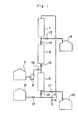
- Fig. 1 shows a fundamental arrangement of an adsorption separator for suitably carrying out the method of the invention.
- the separator is arranged to include a circulating system which has three unit packed beds (1) to (3) and a circulating pump (5). Each unit packed bed is packed with an adsorbent.
- the unit packed beds may be of the same or different size.
- valves (14), (15) and (18), respectively to arbitrarily control the passage of the fluid through the respective unit packed beds.
- (7) is a starting fluid tank
- (8) is a tank for the desorbent fluid
- (9) and (10) are tanks for the withdrawn fluids
- (6) is a pump for feeding the starting fluid.
- the valve (14) inhibits the fluid from being discharged into the unit packed bed (2) when said fluid from the unit packed bed (1) is withdrawn from the withdrawal : pipe having the valve (13).
- the valve (15) prevents the passage of the fluid between the unit packed beds (2) and (3) after introduction of the starting fluid into the unit packed bed (3).
- the valve (18) is provided to prevent the fluid from passing into the unit packed bed (1) when said fluid is withdrawn from the unit packed bed (3) through the withdrawal pipe having the valve (17) and also prevents the passage of the fluid between the unit packed beds (3) and (1) after introduction of the desorbent fluid into unit packed bed (1). Therefore, some of these valves may be omitted depending on the manner of arranging the connecting these unit packed beds and the manner of connecting the fluid introduction pipes and the fluid withdrawal pipes to the bed-connecting pipes. It is preferred to provide at the upper portion of each bed a means for dispersing the fluid to be introduced into the bed uniformly over the cross section of the bed.
- Fig. 2 is another embodiment of the adsorption separator useful in the method of the invention.
- the unit packed bed (3) of the separator of Fig. 1 is divided into two unit packed beds (3) and (4).
- Two withdrawal pipes are provided for the unit packed bed (4) including the withdrawal pipe having the valve (17) and a withdrawal pipe having a valve (19) which communicates with a reservoir (11) for the fluid withdrawn from this withdrawal pipe.
- a pipe connecting the unit packed beds (4) and (1) is provided with a valve (21) and is connected with a pipe provided between the unit packed beds (2) and (3) through a pipe having a valve (20). Accordingly, the separator of Fig. 2 allows the fluid passed from the unit packed bed (4) to be withdrawn in two different ways and the desorbent fluid to be directly charged into the unit packed bed (3).
- Fig. 3 is a further embodiment of an adsorption separator for carrying out the method of the invention.
- the unit packed bed (3) of the separator of Fig.1 is divided into unit packed beds (3) and (4), between which a valve (22) and two fluid withdrawal pipes are provided, i.e. a pipe having a valve (23) and a pipe having a valve (24).
- a valve (22) and two fluid withdrawal pipes are provided, i.e. a pipe having a valve (23) and a pipe having a valve (24).
- the fluid discharged from the unit packed bed (4) can be withdrawn, the withdrawing pipe having the valve (17) as well as from the pipe having the valve (19).
- the first step is carried out as follows.
- Valve (16) is opened to feed the starting fluid from the starting fluid reservoir to pass through the unit packed bed (3), and simultaneously valve (17) is opened to withdraw the fluid from the withdrawal pipe in an amount corresponding to the feed.
- This withdrawn fluid is rich in a component which is hard to adsorb.
- the feed and withdrawal of the fluid is stopped and the valves (14), (15) and (18) are opened, whereupon the circulating pump (5) is operated to permit the fluid in the apparatus to move from the bed (1) through the bed (2) toward the bed (3).
- the respective com- ponents in the starting fluid are separated from each other to form the respective adsorption bands in predetermined positions of the bed.
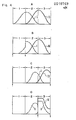
- FIG. 4A An example of the adsorption bands is shown in Fig. 4A.
- valve (12) is opened to feed the desorbent fluid from the desorbent reservoir to pass through the unit packed bed (1), and simultaneously valve (13) is opened to withdraw the fluid from the withdrawal pipe in an amount corresponding to the feed.
- valve (13) is closed and valves (14), (15) and (17) are opened, after which, when feeding in the desorbent fluid, the fluid withdrawn from the unit packed bed (3) is rich in the component which is hard to adsorb.
- adsorption bands in the separator after completion of the third step is shown in Fig. 4C.
- adsorption bands of the easy-to-adsorb component and the hard-to-adsorb component are left behind.
- the hard-to-adsorb component present in the latter part of the bed (3) is desorbed and discharged from the withdrawal pipe.
- the adsorption bands in the apparatus after completion of the first step are as shown in Fig. 4D.
- the third step may be modified in various ways depending on the form of the adsorption bands in the second step. Especially with the apparatus of Figs.2 and 3, such modification is easy. However, the adsorption bands in the bed should not be completely washed out in either modification for reasons described hereinbefore.
- the present invention may be applied to the separation of various types of mixtures.
- a mixture of two components i.e. a substance showing strong affinity for the adsorbent and a substance showing weak affinity for the adsorbent
- the present invention is also applicable to a multi-component mixture, i.e. the just-mentioned two-component mixture into which a third component is incorporated which shows an affinity for the adsorbent different from the two other components.
- the third component may be withdrawn from the apparatus in the form of a mixture with either or both of the two components, or may be withdrawn from the bed as a fluid rich in the third component.
- the present invention is suitable for separating an aqueous solution containing fructose and glucose (as HFCS (high fructose corn syrups), invert sugar and the like) into fructose and glucose with using water as desorbent.
- adsorbent there are used as the adsorbent.alkaline earth metal salt-type, particularly calcium salt-type, strongly acidic, cationic exchange resins, or alternatively; zeolite Y, whose exchanging cations are substituted by those of ammonium, sodium, potassium, calcium, strontium, barium or the like.
- the present invention is preferably applicable to the separation of molasses into sucrose and reducing sugar using alkali metal salt-type, strongly acidic, cation exchange resins as the adsorbent and water as the desorbent .
- the ash present in molasses may be withdrawn from the apparatus while incorporating it into both the sucrose and reducing sugar solution, or may be withdrawn as an aqueous solution rich in the ash separately from aqueous solutions rich in sucrose or reducing sugar.
- the molasses should preferably be refined, prior to the separation, to reduce the calcium content.
- the present invention is suitable to separate a mixture of glucose and mannose into the respective components using calcium salt-type, strongly acidic, cation exchange resins as the adsorbent and water as the desorbent,
- aqueous molasses solution solid content 6 0 % with its composition of 41.3 % of sucrose, 38.0 % of reducing sugar, 9.2 % of ash and 11.5 % of organic, nonsaccharides, into an aqueous sucrose solution, an aqueous reducing sugar solution and an aqueous ash solution.
- adsorbent a sodium salt-type, strongly acidic, cationic exchange resin (Diaion ® FRK-11, of Mitsubishi Chemical Industries Limited) and as a desorbent water, resp.
- each unit packed bed is a cylinder having an inner diameter of 5.35 cm and a height of 380 cm into which 8.5 l of the adsorbent is packed.
- the unit packed beds are connected by pipes with an inner diameter of 3 mm and the (non-packed) volume between the lower end of the packed layer of one unit packed bed and the upper end of the packed layer of a subsequent packed bed is 450 ml.
- the whole apparatus is held at 60°C.
- First Stage Molasses is fed from reservoir (7) of the aqueous molasses solution to the unit packed bed (3) and simultaneously an aqueous sucrose solution is withdrawn from the unit packed bed (4) into the reservoir (11) for said aqueous sucrose solution.
- Second Stage Water is fed from the water reservoir (8) to the unit packed bed (1), simultaneously with an aqueous ash solution being withdrawn from the unit packed bed (4) into the reservoir (10) for said aqueous ash solution.
- Third Stage The feed of the solution to the apparatus and the withdrawal of the solution from it are stopped and the solution in the apparatus is moved from the unit packed bed (1) through (2) and (3) to bed (4).
- Fourth Stage Water is fed from the water reservoir (8) to the unit packed bed (1), simultaneously with an aqueous reducing sugar solution being withdrawn from bed (1) into the reservoir (9) for said aqueous reducing sugar solution.
- Fifth Stage Water is fed from the water reservoir (8) to the unit packed bed (3) while the aqueous ash solution is withdrawn from the unit packed bed (4) into the reservoir (10) for said aqueous ash solution.
- the apparatus shown in Fig. 3 was used to separate HFCS into an aqueous fructose solution and an aqueous glucose solution.
- adsorbent a calcium salt-type, strongly acidic, cationic exchange resin (Diaion FRK-01) and as the desorbent water, resp.
- each unit packed bed is a cylinder having an inner diameter of 7.7 cm and a height of 60 cm, into which 2.8t of the adsorbent is packed.
- the whole apparatus is held at 60°C. ;
- First Stage HFCS is fed from reservoir (7) of HFCS to the unit packed bed (3) simultaneously with an aqueous glucose solution being withdrawn from the unit packed bed (3) or (4) into the reservoir (10) for said aqueous glucose solution.
- Second Stage The feed and withdrawal of solutions are stopped and the solution in the apparatus is moved from the unit packed bed (1) through (2) and (3) toward the unit packed bed (4).
- Third Stage Water is fed from the water reservoir (8) to the unit packed bed (1) while withdrawing an aqueous fructose solution from the same bed into the reservoir (9) for said aqueous fructose solution.
- Fourth Stage Water is fed from the water reservoir (8) to the unit packed bed (1) while withdrawing the aqueous glucose solution from bed (3) or (4) into the reservoir (11) for said aqueous glucose solution.
- the apparatus shown in Fig. 3 was used to separate an aqueous mixed solution of fructose and glucose into an aqueous fructose solution and an aqueous glucose solution.
- a calcium salt-type, strongly acidic, cationic exchange resin (Diaion FRK-01) and as a desorbent water.
- Each unit packed bed is a cylinder having an inner diameter of 5.35 cm and a height of 380 cm into which 8.5 1 of adsorbent is packed.
- the whole apparatus is held at 60°C.
- First Stage The aqueous sugar solution is fed from the reservoir (7) of the aqueous sugar solution to the unit packed bed (3) while withdrawing an aqueous glucose solut- ion from bed (3) into the reservoir (10) for said aqueous glucose solution.
- Second Stage The feed and withdrawal of the solutions are stopped and the solution in the apparatus is moved from the' bed (1) through (2) and (3) to (4).
- Second Stage Water is fed from the water reservoir (8) to bed (1) simultaneously with an aqueous fructose solution being withdrawn from said bed into the reservoir (9) for said aqueous fructose solution.
- Example 5 The apparatus of Example 5 was used to separate HFCS into fructose and glucose.
- the operation procedure for Example 6 is conducted as in Example 5 and for Example 7 as in Example 5, the third and fourth stages being reversed.
- Example 7 The operation times and operation of valves at the respec- tive stages are shown in Table 7; the compositions of the starting HFCS and of the aqueous fructose solution and the glucose solution under stationary state are shown in Table 8.
- the flow rate at the respective stages is held constant at 14.0 1/hr. It will be noted that the aqueous glucose solution of Example 6 is a combination of thos withdrawn from the first and fourth stages while the aqueous glucose solution of Example 7 is a combination of those withdrawn from the first and third stages.
- the other saccharides content in the aqueous fructose solution of Example 7 is less than that of Example 6.
- Figs. 4A-D are schematical views showing the adsorption bands in the packed beds upon completion of the respective steps when carrying out the method of the invention using the apparatus of Fig. 1 (provided that the step of introducing the desorbent involves a change in operation of the valve during the course of this step and the operations prior to and after the change from one state to another are dealt with as two different steps), in which, indicated at 1 to 3, are the respective unit packed beds; I is an adsorption curve for a component easy-to-adsorb and II is an adsorption curve for a component hard-to-adsorb, in which the arrows show positions where fluids are fed or withdrawn; and
- Fig. 5 is a schematical curve showing adsorption bands in the packed beds after completion of the second stage in Examples 6 and 7, in which, indicated at 1 to 4, are the respective unit packed beds, I is the adsorption curve for fructose, II is the adsorption curve for glucose and III is the adsorption curve for other saccharides.
Landscapes
- Chemical & Material Sciences (AREA)
- Chemical Kinetics & Catalysis (AREA)
- Analytical Chemistry (AREA)
- Organic Chemistry (AREA)
- Life Sciences & Earth Sciences (AREA)
- Biochemistry (AREA)
- General Chemical & Material Sciences (AREA)
- Treatment Of Liquids With Adsorbents In General (AREA)
Applications Claiming Priority (8)
| Application Number | Priority Date | Filing Date | Title |
|---|---|---|---|
| JP135312/78 | 1978-11-02 | ||
| JP13531278A JPS5561903A (en) | 1978-11-02 | 1978-11-02 | Component separating method |
| JP163720/78 | 1978-12-28 | ||
| JP16372078A JPS5592700A (en) | 1978-12-28 | 1978-12-28 | Preparation of fructose with less oligosaccharide |
| JP29126/79 | 1979-03-13 | ||
| JP2912679A JPS55121805A (en) | 1979-03-13 | 1979-03-13 | Adsorption separator |
| JP11264279A JPS5637008A (en) | 1979-09-03 | 1979-09-03 | Separation of mixtures by adsorption |
| JP112642/79 | 1979-09-03 |
Publications (3)
| Publication Number | Publication Date |
|---|---|
| EP0010769A2 true EP0010769A2 (fr) | 1980-05-14 |
| EP0010769A3 EP0010769A3 (en) | 1980-05-28 |
| EP0010769B1 EP0010769B1 (fr) | 1983-10-19 |
Family
ID=27459005
Family Applications (1)
| Application Number | Title | Priority Date | Filing Date |
|---|---|---|---|
| EP79104283A Expired EP0010769B1 (fr) | 1978-11-02 | 1979-11-02 | Procédé et appareil de séparation par adsorption |
Country Status (5)
| Country | Link |
|---|---|
| US (1) | US4332623A (fr) |
| EP (1) | EP0010769B1 (fr) |
| AU (1) | AU540231B2 (fr) |
| DE (1) | DE2966337D1 (fr) |
| FI (1) | FI68526C (fr) |
Cited By (12)
| Publication number | Priority date | Publication date | Assignee | Title |
|---|---|---|---|---|
| EP0054969A1 (fr) * | 1980-12-24 | 1982-06-30 | Asahi Kasei Kogyo Kabushiki Kaisha | Procédé de séparation de substances par la chromatographie |
| EP0075611A1 (fr) * | 1981-09-29 | 1983-04-06 | Uop Inc. | Procédé de sorption à contre-courant simulé utilisant des résines échangeuses d'ions avec courant en retour |
| DE3643757A1 (de) * | 1985-12-21 | 1987-06-25 | Eisenmann Maschinenbau Gmbh | Verfahren und anlage zur rueckgewinnung von loesungsmitteln |
| EP0342629A1 (fr) * | 1988-05-17 | 1989-11-23 | Mitsubishi Kasei Engineering Company | Méthode de séparation chromatographique |
| EP0279946A3 (en) * | 1986-12-23 | 1990-05-30 | Mitsubishi-Kasei Technoengineers Ltd. | Method of chromatographic separation |
| EP0345511A3 (fr) * | 1988-06-09 | 1991-04-03 | Cultor Ltd. | Procédé d'obtention de bétaine à partir de mélasses |
| DE4041414A1 (de) * | 1989-12-26 | 1991-06-27 | Organo Kk | Verfahren zur fraktionierten trennung eines mehrkomponenten-fluidgemisches und vorrichtung zur verwendung bei der fraktionierten trennung eines mehrkomponenten-fluidgemisches |
| FR2677555A1 (fr) * | 1991-06-12 | 1992-12-18 | Organo Kk | Procede pour la separation fractionnee d'une multitude de constituants de leur melange. |
| EP0663224A1 (fr) * | 1993-12-27 | 1995-07-19 | Mitsubishi Kasei Engineering Company | Méthode de séparation en trois composants utilisant un lit mobile simulé |
| US5795398A (en) * | 1994-09-30 | 1998-08-18 | Cultor Ltd. | Fractionation method of sucrose-containing solutions |
| US6875349B2 (en) | 1996-05-24 | 2005-04-05 | Cultor Corporation | Method for fractionating a solution |
| US6896811B2 (en) | 2001-05-09 | 2005-05-24 | Danisco Sweeteners Oy | Chromatographic separation method |
Families Citing this family (24)
| Publication number | Priority date | Publication date | Assignee | Title |
|---|---|---|---|---|
| US4475954A (en) * | 1981-12-09 | 1984-10-09 | Uop Inc. | Separation of sucrose from thick juice |
| US4402832A (en) * | 1982-08-12 | 1983-09-06 | Uop Inc. | High efficiency continuous separation process |
| US4404037A (en) * | 1982-08-12 | 1983-09-13 | Uop Inc. | Sucrose extraction from aqueous solutions featuring simulated moving bed |
| US4478721A (en) * | 1982-08-12 | 1984-10-23 | Uop Inc. | High efficiency continuous separation process |
| JPS6041507A (ja) * | 1983-08-12 | 1985-03-05 | Mitsubishi Kasei Techno Engineers Kk | クロマト分離装置の制御方法 |
| US4498991A (en) * | 1984-06-18 | 1985-02-12 | Uop Inc. | Serial flow continuous separation process |
| US5122275A (en) * | 1986-05-08 | 1992-06-16 | A. E. Staley Manufacturing Company | Simulated moving bed chromatographic separation |
| FI88933C (fi) * | 1990-10-15 | 1993-07-26 | Xyrofin Oy | Foerfarande foer produktion av glukos och fruktos av sackaros |
| FR2694019B1 (fr) * | 1992-07-22 | 1994-10-14 | Roquette Freres | Procédé de fabrication de mannitol. |
| FR2697023B1 (fr) | 1992-10-16 | 1994-12-30 | Roquette Freres | Polymère soluble hypocalorique du glucose et procédé de préparation de ce polymère . |
| FI96225C (fi) | 1993-01-26 | 1996-05-27 | Cultor Oy | Menetelmä melassin fraktioimiseksi |
| US6663780B2 (en) | 1993-01-26 | 2003-12-16 | Danisco Finland Oy | Method for the fractionation of molasses |
| BR9807521A (fr) | 1997-01-29 | 2000-03-21 | Amalgamated Res Inc | |
| FI20020936L (fi) * | 2002-05-17 | 2003-11-18 | Finnfeeds Finland Oy | Kromatografinen erottelu |
| CA2528171C (fr) * | 2003-07-16 | 2011-12-06 | Amalgamated Research Llc | Methode d'extraction d'acides a partir de solutions de procedes hydrometallurgiques |
| GB2524906B8 (en) | 2011-04-07 | 2016-12-07 | Virdia Ltd | Lignocellulose conversion processes and products |
| US9493851B2 (en) | 2012-05-03 | 2016-11-15 | Virdia, Inc. | Methods for treating lignocellulosic materials |
| EP2878349B1 (fr) | 2012-05-03 | 2022-07-06 | Virdia, LLC | Fractionnement d'un mélange par chromatographie en lits mobiles simulés séquentielle |
| MX2017003774A (es) | 2014-09-29 | 2017-05-12 | Rennovia Inc | Preparacion y separacion de una mezcla que contiene acido dicarboxilico usando una forma dicarboxilada de una resina para cromatografia de intercambio anionico. |
| SE538899C2 (en) | 2015-02-03 | 2017-01-31 | Stora Enso Oyj | Method for treating lignocellulosic materials |
| CA3029993A1 (fr) | 2016-07-06 | 2018-01-11 | Virdia, Inc. | Procedes de raffinage d'un hydrolysat lignocellulosique |
| FR3077959B1 (fr) | 2018-02-22 | 2021-09-24 | Roquette Freres | Procede de fabrication de dextrine de pois resistante |
| WO2020028198A1 (fr) | 2018-08-03 | 2020-02-06 | Biomass Oil Separation Solutions, Llc | Procédés et appareil d'extraction de substances et d'extraits enrichis à partir d'une matière végétale |
| US10799546B1 (en) | 2019-07-26 | 2020-10-13 | Biomass Oil Separation Solutions, Llc | Modular, integrated process and apparatus for extracting, refining and remediating active substances from plant material |
Family Cites Families (13)
| Publication number | Priority date | Publication date | Assignee | Title |
|---|---|---|---|---|
| US3214293A (en) * | 1961-10-20 | 1965-10-26 | Colonial Sugar Refining Co | Process and apparatus for purifying solutions containing sugars |
| US3416961A (en) * | 1964-01-07 | 1968-12-17 | Colonial Sugar Refining Co | Process for the separation of fructose and glucose |
| US3785864A (en) * | 1970-07-23 | 1974-01-15 | Boehringer Mannheim Gmbh | Process for the chromatographic separation of multi-component mixtures containing glucose |
| US3692582A (en) * | 1970-07-31 | 1972-09-19 | Suomen Sokeri Oy | Procedure for the separation of fructose from the glucose of invert sugar |
| US3884714A (en) * | 1973-07-09 | 1975-05-20 | Pfeiffer & Langen | Process for making sugar from molasses by ion removal |
| DE2362211C3 (de) * | 1973-12-14 | 1978-05-11 | Sueddeutsche Zucker Ag, 6800 Mannheim | Verfahren zur Aufarbeitung von Melassen |
| US4022637A (en) * | 1976-02-23 | 1977-05-10 | Standard Brands Incorporated | Method for separation of water soluble carbohydrates |
| US4109075A (en) * | 1976-06-09 | 1978-08-22 | Cpc International Inc. | Separation of saccharides by exclusion chromatography |
| JPS5326336A (en) * | 1976-08-24 | 1978-03-11 | Toray Industries | Method of fractional absorption for saccharides |
| FI69248C (fi) * | 1976-12-21 | 1986-01-10 | Mitsubishi Chem Ind | Foerfarande foer reglering av operationsprocessen av en simulerad roerlig baedd |
| MX6742E (es) * | 1977-01-24 | 1986-06-18 | Staley Mfg Co A E | Mejoras en metodo para la separacion cromatografica de fructuosa y dextrosa |
| FR2380805A1 (fr) * | 1977-02-18 | 1978-09-15 | Anvar | Procede de fractionnement ou d'extraction de solutes contenus dans un solvant, a l'aide d'un solide adsorbant ou echangeur d'ions |
| JPS6055162B2 (ja) * | 1977-05-26 | 1985-12-04 | 参松工業株式会社 | カラムクロマト分離法 |
-
1979
- 1979-10-31 AU AU52361/79A patent/AU540231B2/en not_active Ceased
- 1979-11-01 US US06/090,133 patent/US4332623A/en not_active Expired - Lifetime
- 1979-11-01 FI FI793422A patent/FI68526C/fi not_active IP Right Cessation
- 1979-11-02 DE DE7979104283T patent/DE2966337D1/de not_active Expired
- 1979-11-02 EP EP79104283A patent/EP0010769B1/fr not_active Expired
Cited By (19)
| Publication number | Priority date | Publication date | Assignee | Title |
|---|---|---|---|---|
| EP0054969A1 (fr) * | 1980-12-24 | 1982-06-30 | Asahi Kasei Kogyo Kabushiki Kaisha | Procédé de séparation de substances par la chromatographie |
| EP0075611A1 (fr) * | 1981-09-29 | 1983-04-06 | Uop Inc. | Procédé de sorption à contre-courant simulé utilisant des résines échangeuses d'ions avec courant en retour |
| DE3643757A1 (de) * | 1985-12-21 | 1987-06-25 | Eisenmann Maschinenbau Gmbh | Verfahren und anlage zur rueckgewinnung von loesungsmitteln |
| EP0279946A3 (en) * | 1986-12-23 | 1990-05-30 | Mitsubishi-Kasei Technoengineers Ltd. | Method of chromatographic separation |
| EP0342629A1 (fr) * | 1988-05-17 | 1989-11-23 | Mitsubishi Kasei Engineering Company | Méthode de séparation chromatographique |
| US5064539A (en) * | 1988-05-17 | 1991-11-12 | Ryoka Techno Engineering & Construction Co. | Method of chromatographic separation |
| EP0345511A3 (fr) * | 1988-06-09 | 1991-04-03 | Cultor Ltd. | Procédé d'obtention de bétaine à partir de mélasses |
| GB2240053A (en) * | 1989-12-26 | 1991-07-24 | Organo Kk | Chromatographic apparatus and method |
| FR2656231A1 (fr) * | 1989-12-26 | 1991-06-28 | Organo Kk | Procede et equipement pour la separation fractionnaire chromatographique d'un fluide. |
| DE4041414A1 (de) * | 1989-12-26 | 1991-06-27 | Organo Kk | Verfahren zur fraktionierten trennung eines mehrkomponenten-fluidgemisches und vorrichtung zur verwendung bei der fraktionierten trennung eines mehrkomponenten-fluidgemisches |
| US5198120A (en) * | 1989-12-26 | 1993-03-30 | Japan Organo Co., Ltd. | Process for fractional separation of multi-component fluid mixture |
| GB2240053B (en) * | 1989-12-26 | 1994-08-31 | Organo Kk | Process for fractional separation of multi-component fluid mixture and equipment for use in fractional separation of multi-component fluid mixture |
| FR2677555A1 (fr) * | 1991-06-12 | 1992-12-18 | Organo Kk | Procede pour la separation fractionnee d'une multitude de constituants de leur melange. |
| EP0663224A1 (fr) * | 1993-12-27 | 1995-07-19 | Mitsubishi Kasei Engineering Company | Méthode de séparation en trois composants utilisant un lit mobile simulé |
| US5556546A (en) * | 1993-12-27 | 1996-09-17 | Mitsubishi Kasei Engineering Company | Method of separation into three components using a simulated moving bed |
| US5795398A (en) * | 1994-09-30 | 1998-08-18 | Cultor Ltd. | Fractionation method of sucrose-containing solutions |
| US6875349B2 (en) | 1996-05-24 | 2005-04-05 | Cultor Corporation | Method for fractionating a solution |
| US6896811B2 (en) | 2001-05-09 | 2005-05-24 | Danisco Sweeteners Oy | Chromatographic separation method |
| US7229558B2 (en) | 2001-05-09 | 2007-06-12 | Danisco Sweeteners Oy | Chromatographic separation method |
Also Published As
| Publication number | Publication date |
|---|---|
| AU540231B2 (en) | 1984-11-08 |
| EP0010769B1 (fr) | 1983-10-19 |
| EP0010769A3 (en) | 1980-05-28 |
| FI68526B (fi) | 1985-06-28 |
| AU5236179A (en) | 1980-05-08 |
| FI68526C (fi) | 1985-10-10 |
| US4332623A (en) | 1982-06-01 |
| DE2966337D1 (en) | 1983-11-24 |
| FI793422A7 (fi) | 1980-05-03 |
Similar Documents
| Publication | Publication Date | Title |
|---|---|---|
| US4332623A (en) | Adsorption separation method and apparatus thereof | |
| US4405455A (en) | Adsorption separation apparatus | |
| KR960000648B1 (ko) | 크로마토그라피 분리방법 | |
| US5198120A (en) | Process for fractional separation of multi-component fluid mixture | |
| US4157267A (en) | Continuous separation of fructose from a mixture of sugars | |
| KR960010366B1 (ko) | 크로마토 그래픽 분리 방법 | |
| EP0115631B1 (fr) | Séparation de mannose par adsorption sélective sur des tamis moléculaires zéolitiques | |
| US4482761A (en) | Bulk separation of inositol and sorbitol by selective adsorption on zeolitic molecular sieves | |
| GB1596911A (en) | Method of chromatographic separation | |
| Gorshkov | Ion exchange in countercurrent columns | |
| DE1917526A1 (de) | Verfahren zur Trennung von Olefinen | |
| DE60104073T2 (de) | Verfahren zur chromatographischen Trennung | |
| WO1999015251A1 (fr) | Procede et equipement de separation chromatographique | |
| US6409922B1 (en) | Chromatographic separation process and chromatographic separator | |
| US7407586B2 (en) | Chromatographic separation | |
| JP3277575B2 (ja) | クロマト分離法 | |
| DE69302067T2 (de) | Trennung einer Multikomponentenmischung in ihre Komponenten | |
| KR820001512B1 (ko) | 흡착 분리 방법 | |
| JP2740780B2 (ja) | 擬似移動層装置 | |
| KR820001513B1 (ko) | 흡착 분리 장치 | |
| CA1141674A (fr) | Installation et methode de separation par adsorption | |
| US4456774A (en) | Bulk separation of polyhydric alcohols by selective adsorption on zeolitic molecular sieves | |
| US4544778A (en) | Bulk separation of sorbitol by selective adsorption on zeolitic molecular sieves | |
| USRE33105E (en) | Separation of mannose by selective adsorption on zeolitic molecular sieves | |
| EP0137063B1 (fr) | Séparation industrielle de polyalcools par adsorption sélective sur des tamis moléculaires de zéolites |
Legal Events
| Date | Code | Title | Description |
|---|---|---|---|
| PUAI | Public reference made under article 153(3) epc to a published international application that has entered the european phase |
Free format text: ORIGINAL CODE: 0009012 |
|
| PUAL | Search report despatched |
Free format text: ORIGINAL CODE: 0009013 |
|
| AK | Designated contracting states |
Designated state(s): BE CH DE FR GB IT NL |
|
| AK | Designated contracting states |
Designated state(s): BE CH DE FR GB IT NL |
|
| 17P | Request for examination filed |
Effective date: 19800919 |
|
| ITF | It: translation for a ep patent filed | ||
| GRAA | (expected) grant |
Free format text: ORIGINAL CODE: 0009210 |
|
| AK | Designated contracting states |
Designated state(s): BE CH DE FR GB IT NL |
|
| REF | Corresponds to: |
Ref document number: 2966337 Country of ref document: DE Date of ref document: 19831124 |
|
| ET | Fr: translation filed | ||
| PLBE | No opposition filed within time limit |
Free format text: ORIGINAL CODE: 0009261 |
|
| STAA | Information on the status of an ep patent application or granted ep patent |
Free format text: STATUS: NO OPPOSITION FILED WITHIN TIME LIMIT |
|
| 26N | No opposition filed | ||
| ITPR | It: changes in ownership of a european patent |
Owner name: CAMBIO RAGIONE SOCIALE;MITSUBISHI KASEI CORPORATIO |
|
| REG | Reference to a national code |
Ref country code: CH Ref legal event code: PFA Free format text: MITSUBISHI KASEI CORPORATION |
|
| NLT1 | Nl: modifications of names registered in virtue of documents presented to the patent office pursuant to art. 16 a, paragraph 1 |
Owner name: MITSUBISHI KASEI CORPORATION TE TOKIO, JAPAN. |
|
| REG | Reference to a national code |
Ref country code: FR Ref legal event code: CD |
|
| PGFP | Annual fee paid to national office [announced via postgrant information from national office to epo] |
Ref country code: NL Payment date: 19901130 Year of fee payment: 12 |
|
| PGFP | Annual fee paid to national office [announced via postgrant information from national office to epo] |
Ref country code: CH Payment date: 19901219 Year of fee payment: 12 |
|
| ITTA | It: last paid annual fee | ||
| PG25 | Lapsed in a contracting state [announced via postgrant information from national office to epo] |
Ref country code: CH Effective date: 19911130 |
|
| PG25 | Lapsed in a contracting state [announced via postgrant information from national office to epo] |
Ref country code: NL Effective date: 19920601 |
|
| NLV4 | Nl: lapsed or anulled due to non-payment of the annual fee | ||
| REG | Reference to a national code |
Ref country code: CH Ref legal event code: PL |
|
| PGFP | Annual fee paid to national office [announced via postgrant information from national office to epo] |
Ref country code: FR Payment date: 19920918 Year of fee payment: 14 |
|
| PGFP | Annual fee paid to national office [announced via postgrant information from national office to epo] |
Ref country code: GB Payment date: 19920923 Year of fee payment: 14 |
|
| PGFP | Annual fee paid to national office [announced via postgrant information from national office to epo] |
Ref country code: BE Payment date: 19921012 Year of fee payment: 14 |
|
| PGFP | Annual fee paid to national office [announced via postgrant information from national office to epo] |
Ref country code: DE Payment date: 19921231 Year of fee payment: 14 |
|
| PG25 | Lapsed in a contracting state [announced via postgrant information from national office to epo] |
Ref country code: GB Effective date: 19931102 |
|
| PG25 | Lapsed in a contracting state [announced via postgrant information from national office to epo] |
Ref country code: BE Effective date: 19931130 |
|
| BERE | Be: lapsed |
Owner name: MITSUBISHI KASEI CORP. Effective date: 19931130 |
|
| GBPC | Gb: european patent ceased through non-payment of renewal fee |
Effective date: 19931102 |
|
| PG25 | Lapsed in a contracting state [announced via postgrant information from national office to epo] |
Ref country code: FR Effective date: 19940729 |
|
| PG25 | Lapsed in a contracting state [announced via postgrant information from national office to epo] |
Ref country code: DE Effective date: 19940802 |
|
| REG | Reference to a national code |
Ref country code: FR Ref legal event code: ST |