EP0013257A2 - Verfahren zur Erhöhung der Lichtechtheit, Fluoreszenzpolarisation und Fluoreszenzquantenausbeute von Cyaninfarbstoffen, stabilisierte Cyaninfarbstoffzubereitung, Verfahren zu ihrer Herstellung und ihre Verwendung - Google Patents
Verfahren zur Erhöhung der Lichtechtheit, Fluoreszenzpolarisation und Fluoreszenzquantenausbeute von Cyaninfarbstoffen, stabilisierte Cyaninfarbstoffzubereitung, Verfahren zu ihrer Herstellung und ihre Verwendung Download PDFInfo
- Publication number
- EP0013257A2 EP0013257A2 EP79810174A EP79810174A EP0013257A2 EP 0013257 A2 EP0013257 A2 EP 0013257A2 EP 79810174 A EP79810174 A EP 79810174A EP 79810174 A EP79810174 A EP 79810174A EP 0013257 A2 EP0013257 A2 EP 0013257A2
- Authority
- EP
- European Patent Office
- Prior art keywords
- cyanine
- surfactant
- cyanine dyes
- stabilized
- dyes
- Prior art date
- Legal status (The legal status is an assumption and is not a legal conclusion. Google has not performed a legal analysis and makes no representation as to the accuracy of the status listed.)
- Granted
Links
- 239000000975 dye Substances 0.000 title claims abstract description 112
- 238000000034 method Methods 0.000 title claims abstract description 29
- 230000008569 process Effects 0.000 title claims abstract description 14
- 238000002875 fluorescence polarization Methods 0.000 title claims abstract description 5
- ANRHNWWPFJCPAZ-UHFFFAOYSA-M thionine Chemical compound [Cl-].C1=CC(N)=CC2=[S+]C3=CC(N)=CC=C3N=C21 ANRHNWWPFJCPAZ-UHFFFAOYSA-M 0.000 title claims abstract 21
- 238000002360 preparation method Methods 0.000 title claims description 12
- 239000000463 material Substances 0.000 claims abstract description 27
- 238000006862 quantum yield reaction Methods 0.000 claims abstract description 6
- 230000000087 stabilizing effect Effects 0.000 claims abstract description 4
- -1 polycyclic heterocyclic radical Chemical class 0.000 claims description 80
- 239000004094 surface-active agent Substances 0.000 claims description 47
- 125000004432 carbon atom Chemical group C* 0.000 claims description 44
- 125000000217 alkyl group Chemical group 0.000 claims description 25
- 239000000693 micelle Substances 0.000 claims description 16
- 239000000203 mixture Substances 0.000 claims description 15
- 150000001875 compounds Chemical class 0.000 claims description 13
- 229910052757 nitrogen Inorganic materials 0.000 claims description 13
- 150000003983 crown ethers Chemical class 0.000 claims description 11
- 125000004433 nitrogen atom Chemical group N* 0.000 claims description 10
- 125000002091 cationic group Chemical group 0.000 claims description 9
- 125000002496 methyl group Chemical group [H]C([H])([H])* 0.000 claims description 9
- 125000001997 phenyl group Chemical group [H]C1=C([H])C([H])=C(*)C([H])=C1[H] 0.000 claims description 9
- 125000000129 anionic group Chemical group 0.000 claims description 8
- 239000007864 aqueous solution Substances 0.000 claims description 8
- 125000001434 methanylylidene group Chemical group [H]C#[*] 0.000 claims description 7
- 229910052723 transition metal Inorganic materials 0.000 claims description 7
- 125000003342 alkenyl group Chemical group 0.000 claims description 6
- 150000001450 anions Chemical group 0.000 claims description 6
- 229910052739 hydrogen Inorganic materials 0.000 claims description 6
- 239000001257 hydrogen Substances 0.000 claims description 6
- 230000007935 neutral effect Effects 0.000 claims description 6
- IJGRMHOSHXDMSA-UHFFFAOYSA-N nitrogen Substances N#N IJGRMHOSHXDMSA-UHFFFAOYSA-N 0.000 claims description 6
- QJGQUHMNIGDVPM-UHFFFAOYSA-N nitrogen group Chemical group [N] QJGQUHMNIGDVPM-UHFFFAOYSA-N 0.000 claims description 6
- 150000001768 cations Chemical class 0.000 claims description 5
- 125000001495 ethyl group Chemical group [H]C([H])([H])C([H])([H])* 0.000 claims description 5
- 125000004429 atom Chemical group 0.000 claims description 4
- QVGXLLKOCUKJST-UHFFFAOYSA-N atomic oxygen Chemical compound [O] QVGXLLKOCUKJST-UHFFFAOYSA-N 0.000 claims description 4
- 239000003795 chemical substances by application Substances 0.000 claims description 4
- 229910052760 oxygen Inorganic materials 0.000 claims description 4
- 239000001301 oxygen Substances 0.000 claims description 4
- IOJUPLGTWVMSFF-UHFFFAOYSA-N benzothiazole Chemical class C1=CC=C2SC=NC2=C1 IOJUPLGTWVMSFF-UHFFFAOYSA-N 0.000 claims description 3
- 125000002950 monocyclic group Chemical group 0.000 claims description 3
- 125000000547 substituted alkyl group Chemical group 0.000 claims description 3
- AIGNCQCMONAWOL-UHFFFAOYSA-N 1,3-benzoselenazole Chemical class C1=CC=C2[se]C=NC2=C1 AIGNCQCMONAWOL-UHFFFAOYSA-N 0.000 claims description 2
- BCMCBBGGLRIHSE-UHFFFAOYSA-N 1,3-benzoxazole Chemical class C1=CC=C2OC=NC2=C1 BCMCBBGGLRIHSE-UHFFFAOYSA-N 0.000 claims description 2
- HYZJCKYKOHLVJF-UHFFFAOYSA-N 1H-benzimidazole Chemical class C1=CC=C2NC=NC2=C1 HYZJCKYKOHLVJF-UHFFFAOYSA-N 0.000 claims description 2
- 125000001041 indolyl group Chemical class 0.000 claims description 2
- 125000000449 nitro group Chemical group [O-][N+](*)=O 0.000 claims description 2
- 230000006641 stabilisation Effects 0.000 claims description 2
- 238000011105 stabilization Methods 0.000 claims description 2
- 125000005504 styryl group Chemical group 0.000 claims description 2
- IGHOZKDBCCFNNC-UHFFFAOYSA-N 1h-imidazole;quinoxaline Chemical class C1=CNC=N1.N1=CC=NC2=CC=CC=C21 IGHOZKDBCCFNNC-UHFFFAOYSA-N 0.000 claims 1
- 229920006318 anionic polymer Polymers 0.000 claims 1
- 229920006317 cationic polymer Polymers 0.000 claims 1
- 125000004435 hydrogen atom Chemical class [H]* 0.000 claims 1
- YMTSXFQUCHMJOS-UHFFFAOYSA-N pyrazine;1h-pyrrole Chemical class C=1C=CNC=1.C1=CN=CC=N1 YMTSXFQUCHMJOS-UHFFFAOYSA-N 0.000 claims 1
- QGKMIGUHVLGJBR-UHFFFAOYSA-M (4z)-1-(3-methylbutyl)-4-[[1-(3-methylbutyl)quinolin-1-ium-4-yl]methylidene]quinoline;iodide Chemical compound [I-].C12=CC=CC=C2N(CCC(C)C)C=CC1=CC1=CC=[N+](CCC(C)C)C2=CC=CC=C12 QGKMIGUHVLGJBR-UHFFFAOYSA-M 0.000 description 54
- 239000010410 layer Substances 0.000 description 34
- 229910052709 silver Inorganic materials 0.000 description 28
- 239000004332 silver Substances 0.000 description 27
- 238000004061 bleaching Methods 0.000 description 22
- 229920000159 gelatin Polymers 0.000 description 20
- 235000019322 gelatine Nutrition 0.000 description 20
- BQCADISMDOOEFD-UHFFFAOYSA-N Silver Chemical compound [Ag] BQCADISMDOOEFD-UHFFFAOYSA-N 0.000 description 18
- IAYPIBMASNFSPL-UHFFFAOYSA-N Ethylene oxide Chemical group C1CO1 IAYPIBMASNFSPL-UHFFFAOYSA-N 0.000 description 17
- 239000000839 emulsion Substances 0.000 description 16
- 108010010803 Gelatin Proteins 0.000 description 15
- 239000008273 gelatin Substances 0.000 description 15
- 235000011852 gelatine desserts Nutrition 0.000 description 15
- 239000000243 solution Substances 0.000 description 15
- 150000001412 amines Chemical class 0.000 description 13
- 239000002253 acid Substances 0.000 description 12
- 238000010521 absorption reaction Methods 0.000 description 10
- PEDCQBHIVMGVHV-UHFFFAOYSA-N Glycerine Chemical compound OCC(O)CO PEDCQBHIVMGVHV-UHFFFAOYSA-N 0.000 description 9
- 239000011734 sodium Substances 0.000 description 8
- GOOHAUXETOMSMM-UHFFFAOYSA-N Propylene oxide Chemical compound CC1CO1 GOOHAUXETOMSMM-UHFFFAOYSA-N 0.000 description 7
- DBMJMQXJHONAFJ-UHFFFAOYSA-M Sodium laurylsulphate Chemical compound [Na+].CCCCCCCCCCCCOS([O-])(=O)=O DBMJMQXJHONAFJ-UHFFFAOYSA-M 0.000 description 7
- 229910052783 alkali metal Inorganic materials 0.000 description 7
- LYCAIKOWRPUZTN-UHFFFAOYSA-N ethylene glycol Natural products OCCO LYCAIKOWRPUZTN-UHFFFAOYSA-N 0.000 description 7
- 150000003254 radicals Chemical class 0.000 description 7
- 150000003839 salts Chemical class 0.000 description 7
- QAOWNCQODCNURD-UHFFFAOYSA-N Sulfuric acid Chemical compound OS(O)(=O)=O QAOWNCQODCNURD-UHFFFAOYSA-N 0.000 description 6
- 239000003945 anionic surfactant Substances 0.000 description 6
- 239000011575 calcium Substances 0.000 description 6
- 235000014113 dietary fatty acids Nutrition 0.000 description 6
- 230000005284 excitation Effects 0.000 description 6
- 239000003925 fat Substances 0.000 description 6
- 235000019197 fats Nutrition 0.000 description 6
- 239000000194 fatty acid Chemical class 0.000 description 6
- 229930195729 fatty acid Chemical class 0.000 description 6
- 150000004665 fatty acids Chemical class 0.000 description 6
- 230000003287 optical effect Effects 0.000 description 6
- 239000000344 soap Substances 0.000 description 6
- 235000019333 sodium laurylsulphate Nutrition 0.000 description 6
- QGZKDVFQNNGYKY-UHFFFAOYSA-O Ammonium Chemical compound [NH4+] QGZKDVFQNNGYKY-UHFFFAOYSA-O 0.000 description 5
- 0 CC(*1*)NC(C)C1=N[C@]1C=CC=CC1N Chemical compound CC(*1*)NC(C)C1=N[C@]1C=CC=CC1N 0.000 description 5
- 239000001828 Gelatine Substances 0.000 description 5
- OFOBLEOULBTSOW-UHFFFAOYSA-N Malonic acid Chemical compound OC(=O)CC(O)=O OFOBLEOULBTSOW-UHFFFAOYSA-N 0.000 description 5
- 150000001298 alcohols Chemical class 0.000 description 5
- 125000001931 aliphatic group Chemical group 0.000 description 5
- 150000001340 alkali metals Chemical class 0.000 description 5
- 239000006185 dispersion Substances 0.000 description 5
- XMBWDFGMSWQBCA-UHFFFAOYSA-N hydrogen iodide Chemical compound I XMBWDFGMSWQBCA-UHFFFAOYSA-N 0.000 description 5
- 229920000642 polymer Polymers 0.000 description 5
- 238000001228 spectrum Methods 0.000 description 5
- 238000012360 testing method Methods 0.000 description 5
- IGFHQQFPSIBGKE-UHFFFAOYSA-N 4-nonylphenol Chemical compound CCCCCCCCCC1=CC=C(O)C=C1 IGFHQQFPSIBGKE-UHFFFAOYSA-N 0.000 description 4
- CPELXLSAUQHCOX-UHFFFAOYSA-M Bromide Chemical compound [Br-] CPELXLSAUQHCOX-UHFFFAOYSA-M 0.000 description 4
- 239000004215 Carbon black (E152) Substances 0.000 description 4
- 229920002284 Cellulose triacetate Polymers 0.000 description 4
- VEXZGXHMUGYJMC-UHFFFAOYSA-M Chloride anion Chemical compound [Cl-] VEXZGXHMUGYJMC-UHFFFAOYSA-M 0.000 description 4
- DGAQECJNVWCQMB-PUAWFVPOSA-M Ilexoside XXIX Chemical compound C[C@@H]1CC[C@@]2(CC[C@@]3(C(=CC[C@H]4[C@]3(CC[C@@H]5[C@@]4(CC[C@@H](C5(C)C)OS(=O)(=O)[O-])C)C)[C@@H]2[C@]1(C)O)C)C(=O)O[C@H]6[C@@H]([C@H]([C@@H]([C@H](O6)CO)O)O)O.[Na+] DGAQECJNVWCQMB-PUAWFVPOSA-M 0.000 description 4
- NBIIXXVUZAFLBC-UHFFFAOYSA-N Phosphoric acid Chemical compound OP(O)(O)=O NBIIXXVUZAFLBC-UHFFFAOYSA-N 0.000 description 4
- AWMVMTVKBNGEAK-UHFFFAOYSA-N Styrene oxide Chemical compound C1OC1C1=CC=CC=C1 AWMVMTVKBNGEAK-UHFFFAOYSA-N 0.000 description 4
- HCHKCACWOHOZIP-UHFFFAOYSA-N Zinc Chemical compound [Zn] HCHKCACWOHOZIP-UHFFFAOYSA-N 0.000 description 4
- NNLVGZFZQQXQNW-ADJNRHBOSA-N [(2r,3r,4s,5r,6s)-4,5-diacetyloxy-3-[(2s,3r,4s,5r,6r)-3,4,5-triacetyloxy-6-(acetyloxymethyl)oxan-2-yl]oxy-6-[(2r,3r,4s,5r,6s)-4,5,6-triacetyloxy-2-(acetyloxymethyl)oxan-3-yl]oxyoxan-2-yl]methyl acetate Chemical compound O([C@@H]1O[C@@H]([C@H]([C@H](OC(C)=O)[C@H]1OC(C)=O)O[C@H]1[C@@H]([C@@H](OC(C)=O)[C@H](OC(C)=O)[C@@H](COC(C)=O)O1)OC(C)=O)COC(=O)C)[C@@H]1[C@@H](COC(C)=O)O[C@@H](OC(C)=O)[C@H](OC(C)=O)[C@H]1OC(C)=O NNLVGZFZQQXQNW-ADJNRHBOSA-N 0.000 description 4
- 238000000862 absorption spectrum Methods 0.000 description 4
- 229910052784 alkaline earth metal Inorganic materials 0.000 description 4
- 125000002947 alkylene group Chemical group 0.000 description 4
- 150000003863 ammonium salts Chemical class 0.000 description 4
- 230000015572 biosynthetic process Effects 0.000 description 4
- 125000003178 carboxy group Chemical group [H]OC(*)=O 0.000 description 4
- 230000008859 change Effects 0.000 description 4
- 150000002170 ethers Chemical class 0.000 description 4
- 229930195733 hydrocarbon Natural products 0.000 description 4
- 125000002768 hydroxyalkyl group Chemical group 0.000 description 4
- 239000007788 liquid Substances 0.000 description 4
- XSCHRSMBECNVNS-UHFFFAOYSA-N quinoxaline Chemical class N1=CC=NC2=CC=CC=C21 XSCHRSMBECNVNS-UHFFFAOYSA-N 0.000 description 4
- 229910052708 sodium Inorganic materials 0.000 description 4
- 230000003595 spectral effect Effects 0.000 description 4
- 125000001424 substituent group Chemical group 0.000 description 4
- OKKJLVBELUTLKV-UHFFFAOYSA-N Methanol Chemical compound OC OKKJLVBELUTLKV-UHFFFAOYSA-N 0.000 description 3
- ZLMJMSJWJFRBEC-UHFFFAOYSA-N Potassium Chemical compound [K] ZLMJMSJWJFRBEC-UHFFFAOYSA-N 0.000 description 3
- 229910021607 Silver chloride Inorganic materials 0.000 description 3
- QAOWNCQODCNURD-UHFFFAOYSA-L Sulfate Chemical compound [O-]S([O-])(=O)=O QAOWNCQODCNURD-UHFFFAOYSA-L 0.000 description 3
- 230000002378 acidificating effect Effects 0.000 description 3
- 150000001338 aliphatic hydrocarbons Chemical group 0.000 description 3
- 125000003545 alkoxy group Chemical group 0.000 description 3
- 230000008901 benefit Effects 0.000 description 3
- LLEMOWNGBBNAJR-UHFFFAOYSA-N biphenyl-2-ol Chemical class OC1=CC=CC=C1C1=CC=CC=C1 LLEMOWNGBBNAJR-UHFFFAOYSA-N 0.000 description 3
- 239000003054 catalyst Substances 0.000 description 3
- 230000000694 effects Effects 0.000 description 3
- 230000005281 excited state Effects 0.000 description 3
- 229910052736 halogen Inorganic materials 0.000 description 3
- 150000002367 halogens Chemical group 0.000 description 3
- 125000000623 heterocyclic group Chemical group 0.000 description 3
- 150000002430 hydrocarbons Chemical group 0.000 description 3
- 150000002431 hydrogen Chemical class 0.000 description 3
- 125000002887 hydroxy group Chemical group [H]O* 0.000 description 3
- RAXXELZNTBOGNW-UHFFFAOYSA-N imidazole Chemical class C1=CNC=N1 RAXXELZNTBOGNW-UHFFFAOYSA-N 0.000 description 3
- 125000001421 myristyl group Chemical group [H]C([*])([H])C([H])([H])C([H])([H])C([H])([H])C([H])([H])C([H])([H])C([H])([H])C([H])([H])C([H])([H])C([H])([H])C([H])([H])C([H])([H])C([H])([H])C([H])([H])[H] 0.000 description 3
- 239000002736 nonionic surfactant Substances 0.000 description 3
- 239000003921 oil Substances 0.000 description 3
- 235000019198 oils Nutrition 0.000 description 3
- 125000001117 oleyl group Chemical group [H]C([*])([H])C([H])([H])C([H])([H])C([H])([H])C([H])([H])C([H])([H])C([H])([H])C([H])([H])/C([H])=C([H])\C([H])([H])C([H])([H])C([H])([H])C([H])([H])C([H])([H])C([H])([H])C([H])([H])C([H])([H])[H] 0.000 description 3
- 229910052700 potassium Inorganic materials 0.000 description 3
- 239000011591 potassium Substances 0.000 description 3
- NLKNQRATVPKPDG-UHFFFAOYSA-M potassium iodide Chemical compound [K+].[I-] NLKNQRATVPKPDG-UHFFFAOYSA-M 0.000 description 3
- 238000012545 processing Methods 0.000 description 3
- 229920006395 saturated elastomer Polymers 0.000 description 3
- ADZWSOLPGZMUMY-UHFFFAOYSA-M silver bromide Chemical compound [Ag]Br ADZWSOLPGZMUMY-UHFFFAOYSA-M 0.000 description 3
- HKZLPVFGJNLROG-UHFFFAOYSA-M silver monochloride Chemical compound [Cl-].[Ag+] HKZLPVFGJNLROG-UHFFFAOYSA-M 0.000 description 3
- FVAUCKIRQBBSSJ-UHFFFAOYSA-M sodium iodide Chemical compound [Na+].[I-] FVAUCKIRQBBSSJ-UHFFFAOYSA-M 0.000 description 3
- 239000000126 substance Substances 0.000 description 3
- KDYFGRWQOYBRFD-UHFFFAOYSA-N succinic acid Chemical compound OC(=O)CCC(O)=O KDYFGRWQOYBRFD-UHFFFAOYSA-N 0.000 description 3
- BDHFUVZGWQCTTF-UHFFFAOYSA-M sulfonate Chemical compound [O-]S(=O)=O BDHFUVZGWQCTTF-UHFFFAOYSA-M 0.000 description 3
- 150000003871 sulfonates Chemical class 0.000 description 3
- 150000003462 sulfoxides Chemical class 0.000 description 3
- 238000003786 synthesis reaction Methods 0.000 description 3
- 239000003760 tallow Substances 0.000 description 3
- XLYOFNOQVPJJNP-UHFFFAOYSA-N water Substances O XLYOFNOQVPJJNP-UHFFFAOYSA-N 0.000 description 3
- XFRVVPUIAFSTFO-UHFFFAOYSA-N 1-Tridecanol Chemical compound CCCCCCCCCCCCCO XFRVVPUIAFSTFO-UHFFFAOYSA-N 0.000 description 2
- JAXNXAGNWJBENQ-UHFFFAOYSA-N 1-dimethylphosphoryldodecan-2-ol Chemical compound CCCCCCCCCCC(O)CP(C)(C)=O JAXNXAGNWJBENQ-UHFFFAOYSA-N 0.000 description 2
- SIDULKZCBGMXJL-UHFFFAOYSA-N 1-dimethylphosphoryldodecane Chemical compound CCCCCCCCCCCCP(C)(C)=O SIDULKZCBGMXJL-UHFFFAOYSA-N 0.000 description 2
- ZFZIAYPKDVEXDG-UHFFFAOYSA-N 1-dimethylphosphoryloctadecane Chemical compound CCCCCCCCCCCCCCCCCCP(C)(C)=O ZFZIAYPKDVEXDG-UHFFFAOYSA-N 0.000 description 2
- ZSGCBBCGHYYEGU-UHFFFAOYSA-N 1-dimethylphosphoryltetradecane Chemical compound CCCCCCCCCCCCCCP(C)(C)=O ZSGCBBCGHYYEGU-UHFFFAOYSA-N 0.000 description 2
- MRXVVGMYMYOILB-UHFFFAOYSA-N 1-dipropylphosphoryldodecane Chemical compound CCCCCCCCCCCCP(=O)(CCC)CCC MRXVVGMYMYOILB-UHFFFAOYSA-N 0.000 description 2
- CJPDBKNETSCHCH-UHFFFAOYSA-N 1-methylsulfinyldodecane Chemical compound CCCCCCCCCCCCS(C)=O CJPDBKNETSCHCH-UHFFFAOYSA-N 0.000 description 2
- QYRXERZWYVOCEQ-UHFFFAOYSA-N 1-methylsulfinyloctadecane Chemical compound CCCCCCCCCCCCCCCCCCS(C)=O QYRXERZWYVOCEQ-UHFFFAOYSA-N 0.000 description 2
- KRUABTDBQQLWLS-UHFFFAOYSA-N 1-methylsulfinyltetradecane Chemical compound CCCCCCCCCCCCCCS(C)=O KRUABTDBQQLWLS-UHFFFAOYSA-N 0.000 description 2
- QFEFGCRDGSKDEI-UHFFFAOYSA-N 1-methylsulfinyltridecan-2-one Chemical compound CCCCCCCCCCCC(=O)CS(C)=O QFEFGCRDGSKDEI-UHFFFAOYSA-N 0.000 description 2
- HYTOZULGKGUFII-UHFFFAOYSA-N 1-methylsulfinyltridecan-3-ol Chemical compound CCCCCCCCCCC(O)CCS(C)=O HYTOZULGKGUFII-UHFFFAOYSA-N 0.000 description 2
- HZAXFHJVJLSVMW-UHFFFAOYSA-N 2-Aminoethan-1-ol Chemical compound NCCO HZAXFHJVJLSVMW-UHFFFAOYSA-N 0.000 description 2
- MNMLTWNKYZNOQA-UHFFFAOYSA-N 3-methoxy-1-methylsulfinyltridecane Chemical compound CCCCCCCCCCC(OC)CCS(C)=O MNMLTWNKYZNOQA-UHFFFAOYSA-N 0.000 description 2
- XKRFYHLGVUSROY-UHFFFAOYSA-N Argon Chemical compound [Ar] XKRFYHLGVUSROY-UHFFFAOYSA-N 0.000 description 2
- CIWBSHSKHKDKBQ-JLAZNSOCSA-N Ascorbic acid Chemical compound OC[C@H](O)[C@H]1OC(=O)C(O)=C1O CIWBSHSKHKDKBQ-JLAZNSOCSA-N 0.000 description 2
- GAWIXWVDTYZWAW-UHFFFAOYSA-N C[CH]O Chemical group C[CH]O GAWIXWVDTYZWAW-UHFFFAOYSA-N 0.000 description 2
- OKTJSMMVPCPJKN-UHFFFAOYSA-N Carbon Chemical compound [C] OKTJSMMVPCPJKN-UHFFFAOYSA-N 0.000 description 2
- LZZYPRNAOMGNLH-UHFFFAOYSA-M Cetrimonium bromide Chemical compound [Br-].CCCCCCCCCCCCCCCC[N+](C)(C)C LZZYPRNAOMGNLH-UHFFFAOYSA-M 0.000 description 2
- 244000060011 Cocos nucifera Species 0.000 description 2
- 235000013162 Cocos nucifera Nutrition 0.000 description 2
- VEXZGXHMUGYJMC-UHFFFAOYSA-N Hydrochloric acid Chemical compound Cl VEXZGXHMUGYJMC-UHFFFAOYSA-N 0.000 description 2
- UFHFLCQGNIYNRP-UHFFFAOYSA-N Hydrogen Chemical compound [H][H] UFHFLCQGNIYNRP-UHFFFAOYSA-N 0.000 description 2
- QIGBRXMKCJKVMJ-UHFFFAOYSA-N Hydroquinone Chemical compound OC1=CC=C(O)C=C1 QIGBRXMKCJKVMJ-UHFFFAOYSA-N 0.000 description 2
- PCNDJXKNXGMECE-UHFFFAOYSA-N Phenazine Chemical class C1=CC=CC2=NC3=CC=CC=C3N=C21 PCNDJXKNXGMECE-UHFFFAOYSA-N 0.000 description 2
- 239000004698 Polyethylene Substances 0.000 description 2
- 239000004372 Polyvinyl alcohol Substances 0.000 description 2
- KYQCOXFCLRTKLS-UHFFFAOYSA-N Pyrazine Chemical class C1=CN=CC=N1 KYQCOXFCLRTKLS-UHFFFAOYSA-N 0.000 description 2
- KAESVJOAVNADME-UHFFFAOYSA-N Pyrrole Chemical class C=1C=CNC=1 KAESVJOAVNADME-UHFFFAOYSA-N 0.000 description 2
- 150000007513 acids Chemical class 0.000 description 2
- 239000000654 additive Substances 0.000 description 2
- 150000001342 alkaline earth metals Chemical class 0.000 description 2
- 150000003868 ammonium compounds Chemical class 0.000 description 2
- 239000002280 amphoteric surfactant Substances 0.000 description 2
- 239000003963 antioxidant agent Substances 0.000 description 2
- 235000006708 antioxidants Nutrition 0.000 description 2
- 239000012736 aqueous medium Substances 0.000 description 2
- 125000003118 aryl group Chemical group 0.000 description 2
- 230000008033 biological extinction Effects 0.000 description 2
- 125000000484 butyl group Chemical group [H]C([*])([H])C([H])([H])C([H])([H])C([H])([H])[H] 0.000 description 2
- 229910052799 carbon Inorganic materials 0.000 description 2
- 239000003240 coconut oil Substances 0.000 description 2
- 235000019864 coconut oil Nutrition 0.000 description 2
- 125000004093 cyano group Chemical group *C#N 0.000 description 2
- 150000004292 cyclic ethers Chemical class 0.000 description 2
- 125000002704 decyl group Chemical group [H]C([H])([H])C([H])([H])C([H])([H])C([H])([H])C([H])([H])C([H])([H])C([H])([H])C([H])([H])C([H])([H])C([H])([H])* 0.000 description 2
- 238000011161 development Methods 0.000 description 2
- 238000009792 diffusion process Methods 0.000 description 2
- NOPFSRXAKWQILS-UHFFFAOYSA-N docosan-1-ol Chemical compound CCCCCCCCCCCCCCCCCCCCCCO NOPFSRXAKWQILS-UHFFFAOYSA-N 0.000 description 2
- 125000003438 dodecyl group Chemical group [H]C([H])([H])C([H])([H])C([H])([H])C([H])([H])C([H])([H])C([H])([H])C([H])([H])C([H])([H])C([H])([H])C([H])([H])C([H])([H])C([H])([H])* 0.000 description 2
- 238000005516 engineering process Methods 0.000 description 2
- 150000002148 esters Chemical class 0.000 description 2
- 150000002191 fatty alcohols Chemical class 0.000 description 2
- 238000001914 filtration Methods 0.000 description 2
- 239000011976 maleic acid Substances 0.000 description 2
- 239000002609 medium Substances 0.000 description 2
- 150000007522 mineralic acids Chemical class 0.000 description 2
- WWZKQHOCKIZLMA-UHFFFAOYSA-N octanoic acid Chemical compound CCCCCCCC(O)=O WWZKQHOCKIZLMA-UHFFFAOYSA-N 0.000 description 2
- 150000007524 organic acids Chemical class 0.000 description 2
- 239000007800 oxidant agent Substances 0.000 description 2
- MPQXHAGKBWFSNV-UHFFFAOYSA-N oxidophosphanium Chemical group [PH3]=O MPQXHAGKBWFSNV-UHFFFAOYSA-N 0.000 description 2
- VLTRZXGMWDSKGL-UHFFFAOYSA-M perchlorate Inorganic materials [O-]Cl(=O)(=O)=O VLTRZXGMWDSKGL-UHFFFAOYSA-M 0.000 description 2
- VLTRZXGMWDSKGL-UHFFFAOYSA-N perchloric acid Chemical compound OCl(=O)(=O)=O VLTRZXGMWDSKGL-UHFFFAOYSA-N 0.000 description 2
- 235000011007 phosphoric acid Nutrition 0.000 description 2
- 229910052698 phosphorus Inorganic materials 0.000 description 2
- 230000010287 polarization Effects 0.000 description 2
- 229920000573 polyethylene Polymers 0.000 description 2
- 229920000151 polyglycol Polymers 0.000 description 2
- 239000010695 polyglycol Substances 0.000 description 2
- 229920001451 polypropylene glycol Polymers 0.000 description 2
- 229920002451 polyvinyl alcohol Polymers 0.000 description 2
- 230000005588 protonation Effects 0.000 description 2
- 230000005855 radiation Effects 0.000 description 2
- 230000035945 sensitivity Effects 0.000 description 2
- 159000000000 sodium salts Chemical class 0.000 description 2
- 239000002904 solvent Substances 0.000 description 2
- 239000003549 soybean oil Substances 0.000 description 2
- 235000012424 soybean oil Nutrition 0.000 description 2
- 229910052717 sulfur Inorganic materials 0.000 description 2
- 150000003512 tertiary amines Chemical class 0.000 description 2
- 239000004753 textile Substances 0.000 description 2
- JOXIMZWYDAKGHI-UHFFFAOYSA-N toluene-4-sulfonic acid Chemical compound CC1=CC=C(S(O)(=O)=O)C=C1 JOXIMZWYDAKGHI-UHFFFAOYSA-N 0.000 description 2
- VZCYOOQTPOCHFL-UHFFFAOYSA-N trans-butenedioic acid Natural products OC(=O)C=CC(O)=O VZCYOOQTPOCHFL-UHFFFAOYSA-N 0.000 description 2
- 238000012546 transfer Methods 0.000 description 2
- GETQZCLCWQTVFV-UHFFFAOYSA-N trimethylamine Chemical compound CN(C)C GETQZCLCWQTVFV-UHFFFAOYSA-N 0.000 description 2
- 229910052724 xenon Inorganic materials 0.000 description 2
- FHNFHKCVQCLJFQ-UHFFFAOYSA-N xenon atom Chemical compound [Xe] FHNFHKCVQCLJFQ-UHFFFAOYSA-N 0.000 description 2
- QGLWBTPVKHMVHM-KTKRTIGZSA-N (z)-octadec-9-en-1-amine Chemical compound CCCCCCCC\C=C/CCCCCCCCN QGLWBTPVKHMVHM-KTKRTIGZSA-N 0.000 description 1
- RMMFBFFGGLOIKT-UHFFFAOYSA-N 1,2,5,8-tetrazecane Chemical group C1CNCCNNCCN1 RMMFBFFGGLOIKT-UHFFFAOYSA-N 0.000 description 1
- FJLUATLTXUNBOT-UHFFFAOYSA-N 1-Hexadecylamine Chemical compound CCCCCCCCCCCCCCCCN FJLUATLTXUNBOT-UHFFFAOYSA-N 0.000 description 1
- NYEOFIBTYDEESJ-UHFFFAOYSA-N 1-[2-[2-(2-dimethylphosphorylethoxy)ethoxy]ethoxy]nonane Chemical compound CCCCCCCCCOCCOCCOCCP(C)(C)=O NYEOFIBTYDEESJ-UHFFFAOYSA-N 0.000 description 1
- AFHUTYOKXAUZOH-UHFFFAOYSA-N 1-[bis(2-hydroxyethyl)phosphoryl]-3-dodecoxypropan-2-ol Chemical compound CCCCCCCCCCCCOCC(O)CP(=O)(CCO)CCO AFHUTYOKXAUZOH-UHFFFAOYSA-N 0.000 description 1
- MNLXVEGUYZHTJQ-UHFFFAOYSA-N 1-[ethyl(methyl)phosphoryl]tetradecane Chemical compound CCCCCCCCCCCCCCP(C)(=O)CC MNLXVEGUYZHTJQ-UHFFFAOYSA-N 0.000 description 1
- AOSFMYBATFLTAQ-UHFFFAOYSA-N 1-amino-3-(benzimidazol-1-yl)propan-2-ol Chemical compound C1=CC=C2N(CC(O)CN)C=NC2=C1 AOSFMYBATFLTAQ-UHFFFAOYSA-N 0.000 description 1
- AZHQPELMXZAPIA-UHFFFAOYSA-N 1-dimethylphosphoryloxyheptadecane Chemical compound O(CCCCCCCCCCCCCCCCC)P(C)(C)=O AZHQPELMXZAPIA-UHFFFAOYSA-N 0.000 description 1
- VBICKXHEKHSIBG-UHFFFAOYSA-N 1-monostearoylglycerol Chemical compound CCCCCCCCCCCCCCCCCC(=O)OCC(O)CO VBICKXHEKHSIBG-UHFFFAOYSA-N 0.000 description 1
- NGSULTPMGQCSHK-UHFFFAOYSA-N 2,3-Dihydroxy-acrylaldehyd Natural products OC=C(O)C=O NGSULTPMGQCSHK-UHFFFAOYSA-N 0.000 description 1
- VEPOHXYIFQMVHW-XOZOLZJESA-N 2,3-dihydroxybutanedioic acid (2S,3S)-3,4-dimethyl-2-phenylmorpholine Chemical compound OC(C(O)C(O)=O)C(O)=O.C[C@H]1[C@@H](OCCN1C)c1ccccc1 VEPOHXYIFQMVHW-XOZOLZJESA-N 0.000 description 1
- IORISFYTXJVNFE-UHFFFAOYSA-N 2,3-dinitrobenzenesulfonic acid Chemical class OS(=O)(=O)C1=CC=CC([N+]([O-])=O)=C1[N+]([O-])=O IORISFYTXJVNFE-UHFFFAOYSA-N 0.000 description 1
- JDSQBDGCMUXRBM-UHFFFAOYSA-N 2-[2-(2-butoxypropoxy)propoxy]propan-1-ol Chemical group CCCCOC(C)COC(C)COC(C)CO JDSQBDGCMUXRBM-UHFFFAOYSA-N 0.000 description 1
- CGEGSCDKJJXMSB-UHFFFAOYSA-N 2-[dodecyl(2-hydroxyethyl)phosphoryl]ethanol Chemical compound CCCCCCCCCCCCP(=O)(CCO)CCO CGEGSCDKJJXMSB-UHFFFAOYSA-N 0.000 description 1
- JKFYKCYQEWQPTM-UHFFFAOYSA-N 2-azaniumyl-2-(4-fluorophenyl)acetate Chemical compound OC(=O)C(N)C1=CC=C(F)C=C1 JKFYKCYQEWQPTM-UHFFFAOYSA-N 0.000 description 1
- HMWIHOZPGQRZLR-UHFFFAOYSA-N 2-hexadecylphenol Chemical compound CCCCCCCCCCCCCCCCC1=CC=CC=C1O HMWIHOZPGQRZLR-UHFFFAOYSA-N 0.000 description 1
- 125000000954 2-hydroxyethyl group Chemical group [H]C([*])([H])C([H])([H])O[H] 0.000 description 1
- 125000003903 2-propenyl group Chemical group [H]C([*])([H])C([H])=C([H])[H] 0.000 description 1
- QTSNQHKBVAHGSG-UHFFFAOYSA-N 2-tetradecyl-1,4,10,13-tetraoxa-7,16-diazacyclooctadecane Chemical compound CCCCCCCCCCCCCCC1COCCNCCOCCOCCNCCO1 QTSNQHKBVAHGSG-UHFFFAOYSA-N 0.000 description 1
- CXMYWOCYTPKBPP-UHFFFAOYSA-N 3-(3-hydroxypropylamino)propan-1-ol Chemical compound OCCCNCCCO CXMYWOCYTPKBPP-UHFFFAOYSA-N 0.000 description 1
- GHLHLZZJCJNMIG-UHFFFAOYSA-N 3-tetradecyl-1,2,5,8-tetrazecane Chemical compound CCCCCCCCCCCCCCC1CNCCNCCNN1 GHLHLZZJCJNMIG-UHFFFAOYSA-N 0.000 description 1
- PIFPCDRPHCQLSJ-WYIJOVFWSA-N 4,8,12,15,19-Docosapentaenoic acid Chemical compound CC\C=C\CC\C=C\C\C=C\CC\C=C\CC\C=C\CCC(O)=O PIFPCDRPHCQLSJ-WYIJOVFWSA-N 0.000 description 1
- ONMOULMPIIOVTQ-UHFFFAOYSA-N 98-47-5 Chemical compound OS(=O)(=O)C1=CC=CC([N+]([O-])=O)=C1 ONMOULMPIIOVTQ-UHFFFAOYSA-N 0.000 description 1
- QTBSBXVTEAMEQO-UHFFFAOYSA-M Acetate Chemical compound CC([O-])=O QTBSBXVTEAMEQO-UHFFFAOYSA-M 0.000 description 1
- 240000001889 Brahea edulis Species 0.000 description 1
- BPDFNZBHRUGQNJ-UHFFFAOYSA-N CCCCCCCCCCCC(C)(C)NO Chemical compound CCCCCCCCCCCC(C)(C)NO BPDFNZBHRUGQNJ-UHFFFAOYSA-N 0.000 description 1
- OYPRJOBELJOOCE-UHFFFAOYSA-N Calcium Chemical compound [Ca] OYPRJOBELJOOCE-UHFFFAOYSA-N 0.000 description 1
- 241000283153 Cetacea Species 0.000 description 1
- PIFPCDRPHCQLSJ-UHFFFAOYSA-N Clupanodonic acid Natural products CCC=CCCC=CCC=CCCC=CCCC=CCCC(O)=O PIFPCDRPHCQLSJ-UHFFFAOYSA-N 0.000 description 1
- FBPFZTCFMRRESA-FSIIMWSLSA-N D-Glucitol Natural products OC[C@H](O)[C@H](O)[C@@H](O)[C@H](O)CO FBPFZTCFMRRESA-FSIIMWSLSA-N 0.000 description 1
- FBPFZTCFMRRESA-JGWLITMVSA-N D-glucitol Chemical compound OC[C@H](O)[C@@H](O)[C@H](O)[C@H](O)CO FBPFZTCFMRRESA-JGWLITMVSA-N 0.000 description 1
- SNRUBQQJIBEYMU-UHFFFAOYSA-N Dodecane Natural products CCCCCCCCCCCC SNRUBQQJIBEYMU-UHFFFAOYSA-N 0.000 description 1
- KCXVZYZYPLLWCC-UHFFFAOYSA-N EDTA Chemical compound OC(=O)CN(CC(O)=O)CCN(CC(O)=O)CC(O)=O KCXVZYZYPLLWCC-UHFFFAOYSA-N 0.000 description 1
- LFQSCWFLJHTTHZ-UHFFFAOYSA-N Ethanol Chemical compound CCO LFQSCWFLJHTTHZ-UHFFFAOYSA-N 0.000 description 1
- VGGSQFUCUMXWEO-UHFFFAOYSA-N Ethene Chemical compound C=C VGGSQFUCUMXWEO-UHFFFAOYSA-N 0.000 description 1
- KIWBPDUYBMNFTB-UHFFFAOYSA-N Ethyl hydrogen sulfate Chemical compound CCOS(O)(=O)=O KIWBPDUYBMNFTB-UHFFFAOYSA-N 0.000 description 1
- 239000005977 Ethylene Substances 0.000 description 1
- 206010073306 Exposure to radiation Diseases 0.000 description 1
- NVXLIZQNSVLKPO-UHFFFAOYSA-N Glucosereductone Chemical compound O=CC(O)C=O NVXLIZQNSVLKPO-UHFFFAOYSA-N 0.000 description 1
- DCXXMTOCNZCJGO-UHFFFAOYSA-N Glycerol trioctadecanoate Natural products CCCCCCCCCCCCCCCCCC(=O)OCC(OC(=O)CCCCCCCCCCCCCCCCC)COC(=O)CCCCCCCCCCCCCCCCC DCXXMTOCNZCJGO-UHFFFAOYSA-N 0.000 description 1
- 241001465754 Metazoa Species 0.000 description 1
- CMEWLCATCRTSGF-UHFFFAOYSA-N N,N-dimethyl-4-nitrosoaniline Chemical compound CN(C)C1=CC=C(N=O)C=C1 CMEWLCATCRTSGF-UHFFFAOYSA-N 0.000 description 1
- BACSFNBRIPFVDW-UHFFFAOYSA-N N-(2-methylheptadecan-2-yl)hydroxylamine Chemical compound CCCCCCCCCCCCCCCC(C)(C)NO BACSFNBRIPFVDW-UHFFFAOYSA-N 0.000 description 1
- HSOKJTAWWUMYPV-UHFFFAOYSA-N N-(2-methylpentadecan-2-yl)hydroxylamine Chemical compound CCCCCCCCCCCCCC(C)(C)NO HSOKJTAWWUMYPV-UHFFFAOYSA-N 0.000 description 1
- 229910002651 NO3 Inorganic materials 0.000 description 1
- NHNBFGGVMKEFGY-UHFFFAOYSA-N Nitrate Chemical compound [O-][N+]([O-])=O NHNBFGGVMKEFGY-UHFFFAOYSA-N 0.000 description 1
- MDBVZFGSKMWJFD-UHFFFAOYSA-N OP(O)=O.OP(O)(O)=O Chemical group OP(O)=O.OP(O)(O)=O MDBVZFGSKMWJFD-UHFFFAOYSA-N 0.000 description 1
- REYJJPSVUYRZGE-UHFFFAOYSA-N Octadecylamine Chemical compound CCCCCCCCCCCCCCCCCCN REYJJPSVUYRZGE-UHFFFAOYSA-N 0.000 description 1
- 229910019142 PO4 Inorganic materials 0.000 description 1
- 235000019482 Palm oil Nutrition 0.000 description 1
- OAICVXFJPJFONN-UHFFFAOYSA-N Phosphorus Chemical compound [P] OAICVXFJPJFONN-UHFFFAOYSA-N 0.000 description 1
- 206010034960 Photophobia Diseases 0.000 description 1
- LGRFSURHDFAFJT-UHFFFAOYSA-N Phthalic anhydride Natural products C1=CC=C2C(=O)OC(=O)C2=C1 LGRFSURHDFAFJT-UHFFFAOYSA-N 0.000 description 1
- 229920003171 Poly (ethylene oxide) Polymers 0.000 description 1
- 239000002202 Polyethylene glycol Substances 0.000 description 1
- NPYPAHLBTDXSSS-UHFFFAOYSA-N Potassium ion Chemical compound [K+] NPYPAHLBTDXSSS-UHFFFAOYSA-N 0.000 description 1
- DNIAPMSPPWPWGF-UHFFFAOYSA-N Propylene glycol Chemical group CC(O)CO DNIAPMSPPWPWGF-UHFFFAOYSA-N 0.000 description 1
- 229910021612 Silver iodide Inorganic materials 0.000 description 1
- DWAQJAXMDSEUJJ-UHFFFAOYSA-M Sodium bisulfite Chemical compound [Na+].OS([O-])=O DWAQJAXMDSEUJJ-UHFFFAOYSA-M 0.000 description 1
- 239000004141 Sodium laurylsulphate Substances 0.000 description 1
- NINIDFKCEFEMDL-UHFFFAOYSA-N Sulfur Chemical compound [S] NINIDFKCEFEMDL-UHFFFAOYSA-N 0.000 description 1
- HVWGGPRWKSHASF-UHFFFAOYSA-N Sulfuric acid, monooctadecyl ester Chemical compound CCCCCCCCCCCCCCCCCCOS(O)(=O)=O HVWGGPRWKSHASF-UHFFFAOYSA-N 0.000 description 1
- GSEJCLTVZPLZKY-UHFFFAOYSA-N Triethanolamine Chemical class OCCN(CCO)CCO GSEJCLTVZPLZKY-UHFFFAOYSA-N 0.000 description 1
- 230000006750 UV protection Effects 0.000 description 1
- KBAYQFWFCOOCIC-GNVSMLMZSA-N [(1s,4ar,4bs,7s,8ar,10ar)-1,4a-dimethyl-7-propan-2-yl-2,3,4,4b,5,6,7,8,8a,9,10,10a-dodecahydrophenanthren-1-yl]methanol Chemical compound OC[C@@]1(C)CCC[C@]2(C)[C@H]3CC[C@H](C(C)C)C[C@H]3CC[C@H]21 KBAYQFWFCOOCIC-GNVSMLMZSA-N 0.000 description 1
- ZUBJEHHGZYTRPH-KTKRTIGZSA-N [(z)-octadec-9-enyl] hydrogen sulfate Chemical compound CCCCCCCC\C=C/CCCCCCCCOS(O)(=O)=O ZUBJEHHGZYTRPH-KTKRTIGZSA-N 0.000 description 1
- ODVVJJLXXQKTBW-UHFFFAOYSA-N [dodecyl(hydroxymethyl)phosphoryl]methanol Chemical compound CCCCCCCCCCCCP(=O)(CO)CO ODVVJJLXXQKTBW-UHFFFAOYSA-N 0.000 description 1
- 230000002776 aggregation Effects 0.000 description 1
- 238000004220 aggregation Methods 0.000 description 1
- 239000003513 alkali Substances 0.000 description 1
- 125000005037 alkyl phenyl group Chemical group 0.000 description 1
- 150000008051 alkyl sulfates Chemical class 0.000 description 1
- 229940045714 alkyl sulfonate alkylating agent Drugs 0.000 description 1
- 150000008052 alkyl sulfonates Chemical class 0.000 description 1
- 229910052782 aluminium Inorganic materials 0.000 description 1
- XAGFODPZIPBFFR-UHFFFAOYSA-N aluminium Chemical compound [Al] XAGFODPZIPBFFR-UHFFFAOYSA-N 0.000 description 1
- 229910000147 aluminium phosphate Inorganic materials 0.000 description 1
- 125000003368 amide group Chemical group 0.000 description 1
- XYXNTHIYBIDHGM-UHFFFAOYSA-N ammonium thiosulfate Chemical compound [NH4+].[NH4+].[O-]S([O-])(=O)=S XYXNTHIYBIDHGM-UHFFFAOYSA-N 0.000 description 1
- 229920001448 anionic polyelectrolyte Polymers 0.000 description 1
- 230000003078 antioxidant effect Effects 0.000 description 1
- 125000001204 arachidyl group Chemical group [H]C([*])([H])C([H])([H])C([H])([H])C([H])([H])C([H])([H])C([H])([H])C([H])([H])C([H])([H])C([H])([H])C([H])([H])C([H])([H])C([H])([H])C([H])([H])C([H])([H])C([H])([H])C([H])([H])C([H])([H])C([H])([H])C([H])([H])C([H])([H])[H] 0.000 description 1
- 229910052786 argon Inorganic materials 0.000 description 1
- 235000010323 ascorbic acid Nutrition 0.000 description 1
- 229960005070 ascorbic acid Drugs 0.000 description 1
- 239000011668 ascorbic acid Substances 0.000 description 1
- 125000002511 behenyl group Chemical group [H]C([*])([H])C([H])([H])C([H])([H])C([H])([H])C([H])([H])C([H])([H])C([H])([H])C([H])([H])C([H])([H])C([H])([H])C([H])([H])C([H])([H])C([H])([H])C([H])([H])C([H])([H])C([H])([H])C([H])([H])C([H])([H])C([H])([H])C([H])([H])C([H])([H])C([H])([H])[H] 0.000 description 1
- SRSXLGNVWSONIS-UHFFFAOYSA-M benzenesulfonate Chemical compound [O-]S(=O)(=O)C1=CC=CC=C1 SRSXLGNVWSONIS-UHFFFAOYSA-M 0.000 description 1
- 229940077388 benzenesulfonate Drugs 0.000 description 1
- 125000001797 benzyl group Chemical group [H]C1=C([H])C([H])=C(C([H])=C1[H])C([H])([H])* 0.000 description 1
- 239000011230 binding agent Substances 0.000 description 1
- 230000005540 biological transmission Effects 0.000 description 1
- 229920001222 biopolymer Polymers 0.000 description 1
- 239000007844 bleaching agent Substances 0.000 description 1
- 229910052794 bromium Inorganic materials 0.000 description 1
- ZEUDGVUWMXAXEF-UHFFFAOYSA-L bromo(chloro)silver Chemical compound Cl[Ag]Br ZEUDGVUWMXAXEF-UHFFFAOYSA-L 0.000 description 1
- KDYFGRWQOYBRFD-NUQCWPJISA-N butanedioic acid Chemical compound O[14C](=O)CC[14C](O)=O KDYFGRWQOYBRFD-NUQCWPJISA-N 0.000 description 1
- JHIWVOJDXOSYLW-UHFFFAOYSA-N butyl 2,2-difluorocyclopropane-1-carboxylate Chemical group CCCCOC(=O)C1CC1(F)F JHIWVOJDXOSYLW-UHFFFAOYSA-N 0.000 description 1
- WLZRMCYVCSSEQC-UHFFFAOYSA-N cadmium(2+) Chemical compound [Cd+2] WLZRMCYVCSSEQC-UHFFFAOYSA-N 0.000 description 1
- 229910052791 calcium Inorganic materials 0.000 description 1
- ZFXVRMSLJDYJCH-UHFFFAOYSA-N calcium magnesium Chemical compound [Mg].[Ca] ZFXVRMSLJDYJCH-UHFFFAOYSA-N 0.000 description 1
- 239000000298 carbocyanine Substances 0.000 description 1
- 239000006229 carbon black Substances 0.000 description 1
- 150000007942 carboxylates Chemical class 0.000 description 1
- 125000002057 carboxymethyl group Chemical group [H]OC(=O)C([H])([H])[*] 0.000 description 1
- 238000005266 casting Methods 0.000 description 1
- 239000004359 castor oil Substances 0.000 description 1
- 235000019438 castor oil Nutrition 0.000 description 1
- 239000003093 cationic surfactant Substances 0.000 description 1
- 229940080284 cetyl sulfate Drugs 0.000 description 1
- 229960001927 cetylpyridinium chloride Drugs 0.000 description 1
- YMKDRGPMQRFJGP-UHFFFAOYSA-M cetylpyridinium chloride Chemical compound [Cl-].CCCCCCCCCCCCCCCC[N+]1=CC=CC=C1 YMKDRGPMQRFJGP-UHFFFAOYSA-M 0.000 description 1
- 238000006243 chemical reaction Methods 0.000 description 1
- 229910052801 chlorine Inorganic materials 0.000 description 1
- FOCAUTSVDIKZOP-UHFFFAOYSA-N chloroacetic acid Chemical compound OC(=O)CCl FOCAUTSVDIKZOP-UHFFFAOYSA-N 0.000 description 1
- 229940106681 chloroacetic acid Drugs 0.000 description 1
- 238000003776 cleavage reaction Methods 0.000 description 1
- 239000011248 coating agent Substances 0.000 description 1
- 238000000576 coating method Methods 0.000 description 1
- 230000001427 coherent effect Effects 0.000 description 1
- 239000000084 colloidal system Substances 0.000 description 1
- 239000008139 complexing agent Substances 0.000 description 1
- 238000007796 conventional method Methods 0.000 description 1
- 239000010949 copper Substances 0.000 description 1
- 150000004699 copper complex Chemical class 0.000 description 1
- XLJMAIOERFSOGZ-UHFFFAOYSA-M cyanate Chemical compound [O-]C#N XLJMAIOERFSOGZ-UHFFFAOYSA-M 0.000 description 1
- 230000006378 damage Effects 0.000 description 1
- 238000000354 decomposition reaction Methods 0.000 description 1
- 230000003247 decreasing effect Effects 0.000 description 1
- ZRKZFNZPJKEWPC-UHFFFAOYSA-N decylamine-N,N-dimethyl-N-oxide Chemical compound CCCCCCCCCC[N+](C)(C)[O-] ZRKZFNZPJKEWPC-UHFFFAOYSA-N 0.000 description 1
- 230000005595 deprotonation Effects 0.000 description 1
- 238000010537 deprotonation reaction Methods 0.000 description 1
- 150000004891 diazines Chemical class 0.000 description 1
- 150000001991 dicarboxylic acids Chemical class 0.000 description 1
- ZBCBWPMODOFKDW-UHFFFAOYSA-N diethanolamine Chemical compound OCCNCCO ZBCBWPMODOFKDW-UHFFFAOYSA-N 0.000 description 1
- MTHSVFCYNBDYFN-UHFFFAOYSA-N diethylene glycol Chemical compound OCCOCCO MTHSVFCYNBDYFN-UHFFFAOYSA-N 0.000 description 1
- REZZEXDLIUJMMS-UHFFFAOYSA-M dimethyldioctadecylammonium chloride Chemical compound [Cl-].CCCCCCCCCCCCCCCCCC[N+](C)(C)CCCCCCCCCCCCCCCCCC REZZEXDLIUJMMS-UHFFFAOYSA-M 0.000 description 1
- 239000004664 distearyldimethylammonium chloride (DHTDMAC) Substances 0.000 description 1
- VPNOHCYAOXWMAR-UHFFFAOYSA-N docosan-1-amine Chemical compound CCCCCCCCCCCCCCCCCCCCCCN VPNOHCYAOXWMAR-UHFFFAOYSA-N 0.000 description 1
- 229960000735 docosanol Drugs 0.000 description 1
- 125000005066 dodecenyl group Chemical group C(=CCCCCCCCCCC)* 0.000 description 1
- YRIUSKIDOIARQF-UHFFFAOYSA-N dodecyl benzenesulfonate Chemical compound CCCCCCCCCCCCOS(=O)(=O)C1=CC=CC=C1 YRIUSKIDOIARQF-UHFFFAOYSA-N 0.000 description 1
- MOTZDAYCYVMXPC-UHFFFAOYSA-N dodecyl hydrogen sulfate Chemical compound CCCCCCCCCCCCOS(O)(=O)=O MOTZDAYCYVMXPC-UHFFFAOYSA-N 0.000 description 1
- 229940043264 dodecyl sulfate Drugs 0.000 description 1
- JRBPAEWTRLWTQC-UHFFFAOYSA-N dodecylamine Chemical compound CCCCCCCCCCCCN JRBPAEWTRLWTQC-UHFFFAOYSA-N 0.000 description 1
- 229940071161 dodecylbenzenesulfonate Drugs 0.000 description 1
- SYELZBGXAIXKHU-UHFFFAOYSA-N dodecyldimethylamine N-oxide Chemical compound CCCCCCCCCCCC[N+](C)(C)[O-] SYELZBGXAIXKHU-UHFFFAOYSA-N 0.000 description 1
- 238000000295 emission spectrum Methods 0.000 description 1
- 125000004185 ester group Chemical group 0.000 description 1
- 125000001033 ether group Chemical group 0.000 description 1
- 125000005448 ethoxyethyl group Chemical group [H]C([H])([H])C([H])([H])OC([H])([H])C([H])([H])* 0.000 description 1
- 238000002474 experimental method Methods 0.000 description 1
- 235000021323 fish oil Nutrition 0.000 description 1
- 239000000834 fixative Substances 0.000 description 1
- 229910052731 fluorine Inorganic materials 0.000 description 1
- 239000012634 fragment Substances 0.000 description 1
- 229940083124 ganglion-blocking antiadrenergic secondary and tertiary amines Drugs 0.000 description 1
- 239000008246 gaseous mixture Substances 0.000 description 1
- ZEMPKEQAKRGZGQ-XOQCFJPHSA-N glycerol triricinoleate Natural products CCCCCC[C@@H](O)CC=CCCCCCCCC(=O)OC[C@@H](COC(=O)CCCCCCCC=CC[C@@H](O)CCCCCC)OC(=O)CCCCCCCC=CC[C@H](O)CCCCCC ZEMPKEQAKRGZGQ-XOQCFJPHSA-N 0.000 description 1
- 239000001046 green dye Substances 0.000 description 1
- 230000005283 ground state Effects 0.000 description 1
- 229940093915 gynecological organic acid Drugs 0.000 description 1
- 150000004820 halides Chemical class 0.000 description 1
- 125000001188 haloalkyl group Chemical group 0.000 description 1
- KAJZYANLDWUIES-UHFFFAOYSA-N heptadecan-1-amine Chemical compound CCCCCCCCCCCCCCCCCN KAJZYANLDWUIES-UHFFFAOYSA-N 0.000 description 1
- KGIBGHABTNQVJX-UHFFFAOYSA-N heptadecyl hydrogen sulfate Chemical compound CCCCCCCCCCCCCCCCCOS(O)(=O)=O KGIBGHABTNQVJX-UHFFFAOYSA-N 0.000 description 1
- 150000002391 heterocyclic compounds Chemical class 0.000 description 1
- LPTIRUACFKQDHZ-UHFFFAOYSA-N hexadecyl sulfate;hydron Chemical compound CCCCCCCCCCCCCCCCOS(O)(=O)=O LPTIRUACFKQDHZ-UHFFFAOYSA-N 0.000 description 1
- 125000004051 hexyl group Chemical group [H]C([H])([H])C([H])([H])C([H])([H])C([H])([H])C([H])([H])C([H])([H])* 0.000 description 1
- 125000001165 hydrophobic group Chemical group 0.000 description 1
- WGCNASOHLSPBMP-UHFFFAOYSA-N hydroxyacetaldehyde Natural products OCC=O WGCNASOHLSPBMP-UHFFFAOYSA-N 0.000 description 1
- BUHXFUSLEBPCEB-UHFFFAOYSA-N icosan-1-amine Chemical compound CCCCCCCCCCCCCCCCCCCCN BUHXFUSLEBPCEB-UHFFFAOYSA-N 0.000 description 1
- 150000002462 imidazolines Chemical class 0.000 description 1
- 150000004694 iodide salts Chemical class 0.000 description 1
- 150000002500 ions Chemical class 0.000 description 1
- 230000002427 irreversible effect Effects 0.000 description 1
- 239000000990 laser dye Substances 0.000 description 1
- 230000031700 light absorption Effects 0.000 description 1
- 208000013469 light sensitivity Diseases 0.000 description 1
- VZCYOOQTPOCHFL-UPHRSURJSA-N maleic acid Chemical compound OC(=O)\C=C/C(O)=O VZCYOOQTPOCHFL-UPHRSURJSA-N 0.000 description 1
- 238000004519 manufacturing process Methods 0.000 description 1
- 238000005259 measurement Methods 0.000 description 1
- 125000005394 methallyl group Chemical group 0.000 description 1
- 125000000956 methoxy group Chemical group [H]C([H])([H])O* 0.000 description 1
- JZMJDSHXVKJFKW-UHFFFAOYSA-M methyl sulfate(1-) Chemical compound COS([O-])(=O)=O JZMJDSHXVKJFKW-UHFFFAOYSA-M 0.000 description 1
- 238000002156 mixing Methods 0.000 description 1
- ONHFWHCMZAJCFB-UHFFFAOYSA-N myristamine oxide Chemical compound CCCCCCCCCCCCCC[N+](C)(C)[O-] ONHFWHCMZAJCFB-UHFFFAOYSA-N 0.000 description 1
- LNOPIUAQISRISI-UHFFFAOYSA-N n'-hydroxy-2-propan-2-ylsulfonylethanimidamide Chemical compound CC(C)S(=O)(=O)CC(N)=NO LNOPIUAQISRISI-UHFFFAOYSA-N 0.000 description 1
- JEJSGFPNNFSSNI-UHFFFAOYSA-N n,n-bis(2-hydroxyethyl)tetradecan-1-amine oxide Chemical compound CCCCCCCCCCCCCC[N+]([O-])(CCO)CCO JEJSGFPNNFSSNI-UHFFFAOYSA-N 0.000 description 1
- HUQYGHSBSCVCQT-UHFFFAOYSA-N n,n-diethyl-2-[2-(2-octoxyethoxy)ethoxy]ethanamine oxide Chemical compound CCCCCCCCOCCOCCOCC[N+]([O-])(CC)CC HUQYGHSBSCVCQT-UHFFFAOYSA-N 0.000 description 1
- NHLUVTZJQOJKCC-UHFFFAOYSA-N n,n-dimethylhexadecan-1-amine Chemical compound CCCCCCCCCCCCCCCCN(C)C NHLUVTZJQOJKCC-UHFFFAOYSA-N 0.000 description 1
- RSVIRMFSJVHWJV-UHFFFAOYSA-N n,n-dimethyloctan-1-amine oxide Chemical compound CCCCCCCC[N+](C)(C)[O-] RSVIRMFSJVHWJV-UHFFFAOYSA-N 0.000 description 1
- AJDUTMFFZHIJEM-UHFFFAOYSA-N n-(9,10-dioxoanthracen-1-yl)-4-[4-[[4-[4-[(9,10-dioxoanthracen-1-yl)carbamoyl]phenyl]phenyl]diazenyl]phenyl]benzamide Chemical compound O=C1C2=CC=CC=C2C(=O)C2=C1C=CC=C2NC(=O)C(C=C1)=CC=C1C(C=C1)=CC=C1N=NC(C=C1)=CC=C1C(C=C1)=CC=C1C(=O)NC1=CC=CC2=C1C(=O)C1=CC=CC=C1C2=O AJDUTMFFZHIJEM-UHFFFAOYSA-N 0.000 description 1
- 235000021290 n-3 DPA Nutrition 0.000 description 1
- AFFLGGQVNFXPEV-UHFFFAOYSA-N n-decene Natural products CCCCCCCCC=C AFFLGGQVNFXPEV-UHFFFAOYSA-N 0.000 description 1
- 125000000740 n-pentyl group Chemical group [H]C([H])([H])C([H])([H])C([H])([H])C([H])([H])C([H])([H])* 0.000 description 1
- 125000004123 n-propyl group Chemical group [H]C([H])([H])C([H])([H])C([H])([H])* 0.000 description 1
- 230000003472 neutralizing effect Effects 0.000 description 1
- 150000002828 nitro derivatives Chemical class 0.000 description 1
- 150000002832 nitroso derivatives Chemical class 0.000 description 1
- 125000001400 nonyl group Chemical group [H]C([*])([H])C([H])([H])C([H])([H])C([H])([H])C([H])([H])C([H])([H])C([H])([H])C([H])([H])C([H])([H])[H] 0.000 description 1
- 125000005064 octadecenyl group Chemical group C(=CCCCCCCCCCCCCCCCC)* 0.000 description 1
- 125000002347 octyl group Chemical group [H]C([*])([H])C([H])([H])C([H])([H])C([H])([H])C([H])([H])C([H])([H])C([H])([H])C([H])([H])[H] 0.000 description 1
- 235000005985 organic acids Nutrition 0.000 description 1
- 150000002894 organic compounds Chemical class 0.000 description 1
- 235000010292 orthophenyl phenol Nutrition 0.000 description 1
- 230000003647 oxidation Effects 0.000 description 1
- 238000007254 oxidation reaction Methods 0.000 description 1
- AUONHKJOIZSQGR-UHFFFAOYSA-N oxophosphane Chemical compound P=O AUONHKJOIZSQGR-UHFFFAOYSA-N 0.000 description 1
- 150000002926 oxygen Chemical class 0.000 description 1
- 239000002540 palm oil Substances 0.000 description 1
- 125000000913 palmityl group Chemical group [H]C([*])([H])C([H])([H])C([H])([H])C([H])([H])C([H])([H])C([H])([H])C([H])([H])C([H])([H])C([H])([H])C([H])([H])C([H])([H])C([H])([H])C([H])([H])C([H])([H])C([H])([H])C([H])([H])[H] 0.000 description 1
- 230000036961 partial effect Effects 0.000 description 1
- COUMKTRLCGRAAA-UHFFFAOYSA-M pentadecyl sulfate Chemical compound CCCCCCCCCCCCCCCOS([O-])(=O)=O COUMKTRLCGRAAA-UHFFFAOYSA-M 0.000 description 1
- 229940083254 peripheral vasodilators imidazoline derivative Drugs 0.000 description 1
- CMCWWLVWPDLCRM-UHFFFAOYSA-N phenidone Chemical compound N1C(=O)CCN1C1=CC=CC=C1 CMCWWLVWPDLCRM-UHFFFAOYSA-N 0.000 description 1
- 150000002989 phenols Chemical class 0.000 description 1
- 125000000286 phenylethyl group Chemical group [H]C1=C([H])C([H])=C(C([H])=C1[H])C([H])([H])C([H])([H])* 0.000 description 1
- NBIIXXVUZAFLBC-UHFFFAOYSA-K phosphate Chemical compound [O-]P([O-])([O-])=O NBIIXXVUZAFLBC-UHFFFAOYSA-K 0.000 description 1
- 239000010452 phosphate Substances 0.000 description 1
- 125000004437 phosphorous atom Chemical group 0.000 description 1
- 239000011574 phosphorus Substances 0.000 description 1
- 239000004014 plasticizer Substances 0.000 description 1
- 229920000728 polyester Polymers 0.000 description 1
- 229920000570 polyether Polymers 0.000 description 1
- 229920001223 polyethylene glycol Polymers 0.000 description 1
- 239000002243 precursor Substances 0.000 description 1
- 230000002028 premature Effects 0.000 description 1
- 150000003138 primary alcohols Chemical class 0.000 description 1
- 125000002924 primary amino group Chemical group [H]N([H])* 0.000 description 1
- 230000002035 prolonged effect Effects 0.000 description 1
- 125000001436 propyl group Chemical group [H]C([*])([H])C([H])([H])C([H])([H])[H] 0.000 description 1
- 239000011814 protection agent Substances 0.000 description 1
- 239000011241 protective layer Substances 0.000 description 1
- 238000005086 pumping Methods 0.000 description 1
- 239000001047 purple dye Substances 0.000 description 1
- 150000003216 pyrazines Chemical class 0.000 description 1
- 230000009467 reduction Effects 0.000 description 1
- 230000002829 reductive effect Effects 0.000 description 1
- 230000002441 reversible effect Effects 0.000 description 1
- 239000010979 ruby Substances 0.000 description 1
- 229910001750 ruby Inorganic materials 0.000 description 1
- 238000007127 saponification reaction Methods 0.000 description 1
- 150000004671 saturated fatty acids Chemical class 0.000 description 1
- 235000003441 saturated fatty acids Nutrition 0.000 description 1
- 230000007017 scission Effects 0.000 description 1
- 229940045105 silver iodide Drugs 0.000 description 1
- HRZFUMHJMZEROT-UHFFFAOYSA-L sodium disulfite Chemical compound [Na+].[Na+].[O-]S(=O)S([O-])(=O)=O HRZFUMHJMZEROT-UHFFFAOYSA-L 0.000 description 1
- 235000010267 sodium hydrogen sulphite Nutrition 0.000 description 1
- 235000009518 sodium iodide Nutrition 0.000 description 1
- 229940001584 sodium metabisulfite Drugs 0.000 description 1
- 235000010262 sodium metabisulphite Nutrition 0.000 description 1
- URLJMZWTXZTZRR-UHFFFAOYSA-N sodium myristyl sulfate Chemical compound CCCCCCCCCCCCCCOS(O)(=O)=O URLJMZWTXZTZRR-UHFFFAOYSA-N 0.000 description 1
- 229950005425 sodium myristyl sulfate Drugs 0.000 description 1
- AKHNMLFCWUSKQB-UHFFFAOYSA-L sodium thiosulfate Chemical compound [Na+].[Na+].[O-]S([O-])(=O)=S AKHNMLFCWUSKQB-UHFFFAOYSA-L 0.000 description 1
- 235000019345 sodium thiosulphate Nutrition 0.000 description 1
- PDEFQWNXOUGDJR-UHFFFAOYSA-M sodium;2,2-dichloropropanoate Chemical compound [Na+].CC(Cl)(Cl)C([O-])=O PDEFQWNXOUGDJR-UHFFFAOYSA-M 0.000 description 1
- 239000004071 soot Substances 0.000 description 1
- 239000000600 sorbitol Substances 0.000 description 1
- 238000001179 sorption measurement Methods 0.000 description 1
- 241000894007 species Species 0.000 description 1
- 239000003381 stabilizer Substances 0.000 description 1
- 239000007858 starting material Substances 0.000 description 1
- SFVFIFLLYFPGHH-UHFFFAOYSA-M stearalkonium chloride Chemical compound [Cl-].CCCCCCCCCCCCCCCCCC[N+](C)(C)CC1=CC=CC=C1 SFVFIFLLYFPGHH-UHFFFAOYSA-M 0.000 description 1
- 125000004079 stearyl group Chemical group [H]C([*])([H])C([H])([H])C([H])([H])C([H])([H])C([H])([H])C([H])([H])C([H])([H])C([H])([H])C([H])([H])C([H])([H])C([H])([H])C([H])([H])C([H])([H])C([H])([H])C([H])([H])C([H])([H])C([H])([H])C([H])([H])[H] 0.000 description 1
- 238000003756 stirring Methods 0.000 description 1
- 125000003107 substituted aryl group Chemical group 0.000 description 1
- 239000001384 succinic acid Substances 0.000 description 1
- 150000005846 sugar alcohols Polymers 0.000 description 1
- 239000011593 sulfur Substances 0.000 description 1
- 125000004434 sulfur atom Chemical group 0.000 description 1
- 229940087291 tridecyl alcohol Drugs 0.000 description 1
- 125000002889 tridecyl group Chemical group [H]C([*])([H])C([H])([H])C([H])([H])C([H])([H])C([H])([H])C([H])([H])C([H])([H])C([H])([H])C([H])([H])C([H])([H])C([H])([H])C([H])([H])C([H])([H])[H] 0.000 description 1
- QTUIJRIDZOSXHJ-UHFFFAOYSA-M tridecyl sulfate Chemical compound CCCCCCCCCCCCCOS([O-])(=O)=O QTUIJRIDZOSXHJ-UHFFFAOYSA-M 0.000 description 1
- 238000002604 ultrasonography Methods 0.000 description 1
- 235000021122 unsaturated fatty acids Nutrition 0.000 description 1
- 150000004670 unsaturated fatty acids Chemical class 0.000 description 1
- 238000011144 upstream manufacturing Methods 0.000 description 1
- 235000013311 vegetables Nutrition 0.000 description 1
- 239000000080 wetting agent Substances 0.000 description 1
- 239000001043 yellow dye Substances 0.000 description 1
- 229910052725 zinc Inorganic materials 0.000 description 1
- 239000011701 zinc Substances 0.000 description 1
- 239000002888 zwitterionic surfactant Substances 0.000 description 1
Images

Classifications
-
- H—ELECTRICITY
- H01—ELECTRIC ELEMENTS
- H01S—DEVICES USING THE PROCESS OF LIGHT AMPLIFICATION BY STIMULATED EMISSION OF RADIATION [LASER] TO AMPLIFY OR GENERATE LIGHT; DEVICES USING STIMULATED EMISSION OF ELECTROMAGNETIC RADIATION IN WAVE RANGES OTHER THAN OPTICAL
- H01S3/00—Lasers, i.e. devices using stimulated emission of electromagnetic radiation in the infrared, visible or ultraviolet wave range
- H01S3/14—Lasers, i.e. devices using stimulated emission of electromagnetic radiation in the infrared, visible or ultraviolet wave range characterised by the material used as the active medium
- H01S3/20—Liquids
- H01S3/213—Liquids including an organic dye
-
- C—CHEMISTRY; METALLURGY
- C09—DYES; PAINTS; POLISHES; NATURAL RESINS; ADHESIVES; COMPOSITIONS NOT OTHERWISE PROVIDED FOR; APPLICATIONS OF MATERIALS NOT OTHERWISE PROVIDED FOR
- C09B—ORGANIC DYES OR CLOSELY-RELATED COMPOUNDS FOR PRODUCING DYES, e.g. PIGMENTS; MORDANTS; LAKES
- C09B23/00—Methine or polymethine dyes, e.g. cyanine dyes
- C09B23/02—Methine or polymethine dyes, e.g. cyanine dyes the polymethine chain containing an odd number of >CH- or >C[alkyl]- groups
-
- C—CHEMISTRY; METALLURGY
- C09—DYES; PAINTS; POLISHES; NATURAL RESINS; ADHESIVES; COMPOSITIONS NOT OTHERWISE PROVIDED FOR; APPLICATIONS OF MATERIALS NOT OTHERWISE PROVIDED FOR
- C09B—ORGANIC DYES OR CLOSELY-RELATED COMPOUNDS FOR PRODUCING DYES, e.g. PIGMENTS; MORDANTS; LAKES
- C09B67/00—Influencing the physical, e.g. the dyeing or printing properties of dyestuffs without chemical reactions, e.g. by treating with solvents grinding or grinding assistants, coating of pigments or dyes; Process features in the making of dyestuff preparations; Dyestuff preparations of a special physical nature, e.g. tablets, films
- C09B67/0071—Process features in the making of dyestuff preparations; Dehydrating agents; Dispersing agents; Dustfree compositions
-
- C—CHEMISTRY; METALLURGY
- C09—DYES; PAINTS; POLISHES; NATURAL RESINS; ADHESIVES; COMPOSITIONS NOT OTHERWISE PROVIDED FOR; APPLICATIONS OF MATERIALS NOT OTHERWISE PROVIDED FOR
- C09B—ORGANIC DYES OR CLOSELY-RELATED COMPOUNDS FOR PRODUCING DYES, e.g. PIGMENTS; MORDANTS; LAKES
- C09B67/00—Influencing the physical, e.g. the dyeing or printing properties of dyestuffs without chemical reactions, e.g. by treating with solvents grinding or grinding assistants, coating of pigments or dyes; Process features in the making of dyestuff preparations; Dyestuff preparations of a special physical nature, e.g. tablets, films
- C09B67/0071—Process features in the making of dyestuff preparations; Dehydrating agents; Dispersing agents; Dustfree compositions
- C09B67/0084—Dispersions of dyes
-
- G—PHYSICS
- G03—PHOTOGRAPHY; CINEMATOGRAPHY; ANALOGOUS TECHNIQUES USING WAVES OTHER THAN OPTICAL WAVES; ELECTROGRAPHY; HOLOGRAPHY
- G03C—PHOTOSENSITIVE MATERIALS FOR PHOTOGRAPHIC PURPOSES; PHOTOGRAPHIC PROCESSES, e.g. CINE, X-RAY, COLOUR, STEREO-PHOTOGRAPHIC PROCESSES; AUXILIARY PROCESSES IN PHOTOGRAPHY
- G03C1/00—Photosensitive materials
- G03C1/005—Silver halide emulsions; Preparation thereof; Physical treatment thereof; Incorporation of additives therein
- G03C1/06—Silver halide emulsions; Preparation thereof; Physical treatment thereof; Incorporation of additives therein with non-macromolecular additives
- G03C1/08—Sensitivity-increasing substances
- G03C1/10—Organic substances
- G03C1/12—Methine and polymethine dyes
-
- G—PHYSICS
- G03—PHOTOGRAPHY; CINEMATOGRAPHY; ANALOGOUS TECHNIQUES USING WAVES OTHER THAN OPTICAL WAVES; ELECTROGRAPHY; HOLOGRAPHY
- G03C—PHOTOSENSITIVE MATERIALS FOR PHOTOGRAPHIC PURPOSES; PHOTOGRAPHIC PROCESSES, e.g. CINE, X-RAY, COLOUR, STEREO-PHOTOGRAPHIC PROCESSES; AUXILIARY PROCESSES IN PHOTOGRAPHY
- G03C1/00—Photosensitive materials
- G03C1/76—Photosensitive materials characterised by the base or auxiliary layers
- G03C1/825—Photosensitive materials characterised by the base or auxiliary layers characterised by antireflection means or visible-light filtering means, e.g. antihalation
- G03C1/83—Organic dyestuffs therefor
- G03C1/832—Methine or polymethine dyes
-
- G—PHYSICS
- G03—PHOTOGRAPHY; CINEMATOGRAPHY; ANALOGOUS TECHNIQUES USING WAVES OTHER THAN OPTICAL WAVES; ELECTROGRAPHY; HOLOGRAPHY
- G03C—PHOTOSENSITIVE MATERIALS FOR PHOTOGRAPHIC PURPOSES; PHOTOGRAPHIC PROCESSES, e.g. CINE, X-RAY, COLOUR, STEREO-PHOTOGRAPHIC PROCESSES; AUXILIARY PROCESSES IN PHOTOGRAPHY
- G03C7/00—Multicolour photographic processes or agents therefor; Regeneration of such processing agents; Photosensitive materials for multicolour processes
- G03C7/28—Silver dye bleach processes; Materials therefor; Preparing or processing such materials
-
- G—PHYSICS
- G03—PHOTOGRAPHY; CINEMATOGRAPHY; ANALOGOUS TECHNIQUES USING WAVES OTHER THAN OPTICAL WAVES; ELECTROGRAPHY; HOLOGRAPHY
- G03C—PHOTOSENSITIVE MATERIALS FOR PHOTOGRAPHIC PURPOSES; PHOTOGRAPHIC PROCESSES, e.g. CINE, X-RAY, COLOUR, STEREO-PHOTOGRAPHIC PROCESSES; AUXILIARY PROCESSES IN PHOTOGRAPHY
- G03C8/00—Diffusion transfer processes or agents therefor; Photosensitive materials for such processes
- G03C8/02—Photosensitive materials characterised by the image-forming section
Definitions
- the present invention relates to cyanine dyes which are stabilized by association with micellar structures and have improved optical properties, processes for their preparation and their use in various photographic materials and processes and as a dye laser.
- Cyanine dyes and their use as sensitizers in photographic materials are e.g. described in detail by C.E.K. Mees et al. in "The Theory of the Photographic Process", 3rd Edition, pp. 198 ff. (1966), Mac Millan, New York or by FMHamer “The Cyanine Dyes and related compounds (1964), Interscience Publishers, John Wiley and Sons. It is also known that these cyanines (usually polymethine dyes) are relatively unstable photochemically (when irradiated) and, for example, are subject to changes in conformation or can even be broken down into fragments.
- the cyanine dyes In laser technology, the cyanine dyes always come up because it is desirable to have lasers available that can be operated at the most varied wavelengths in the spectrum (from the ultraviolet to the infrared range). Cyanine dyes have the desired high extinction coefficients, absorption in a wide spectral range (350 to 1200 nm) and, at the same time, narrow absorption bands. On the other hand, it has the disadvantage that, in particular, the open-chain carbocyanine dyes can exist in different stereoisomeric configurations and are therefore subject to the most varied types of rotational and translational vibrations, so that e.g. the stability and the fluorescence ability of the cyanines, which is so important in laser technology, is restricted.
- the cyanine dyes mentioned high extinction coefficient, absorption in a wider spectral range, narrow absorption bands
- their further advantages e.g. show in the reversible protonation and irreversible (reductive) cleavage (color change) and good adsorption (preferably on silver halides)
- the cyanine dyes continue to be interesting for many photographic applications. Up to now, such applications have been prevented (except when used as sensitizers) by their extremely low light stability.
- the problem is solved by stabilizing cyanines with the help of micellar structures and thus increasing their light fastness, fluorescence polarization and fluorescence quantum yield.
- the present invention therefore provides a method for increasing the light fastness, and F Fluoreszenzplarisation luoreszenzquantenausbeute of cyanines, characterized in that it stabilizes this micellar using Stukturen of surfactants or surfactant, optionally in combination with other non-surface-active compounds.
- the invention also relates to stabilized cyanines (stabilized cyanine dye preparations), processes for their preparation and their use in various photographic materials and processes and as a dye laser.
- Micelles of surfactants form in surfactant solutions as ordered aggregations of molecules and / or ions above a certain concentration, the so-called critical micelle concentration (Kirk-Othmer 19, 573-575).
- Suitable cyanine dyes are the customary mono- or polymethine (azomethine) dyes, such as acidic or basic cyanines, hemicyanines, streptocyanines, merocyanines, azacyanines, oxonols, hemioxonols, styryl dyes or other trinuclear or multinuclear methine dyes, for example Rhodancyanine or Neocyanine. These cyanines are known from the literature already given.
- azomethine azomethine
- A is an optionally substituted methine group or at most one A is a nitrogen atom
- R 1 and R 2 are each an optionally substituted alkyl or alkenyl having up to 18 carbon atoms
- Y 1 and Y 2 are each the atoms necessary to form an optionally substituted benzoxazole or benzothiazole -, Benzselenazole, benzimidazole, quinoxaline, imidazole, pyrazine, pyrrole or indole ring systems
- X ⁇ is an anion
- M ⁇ is a cation
- m is an integer from 1 to 6, preferably 1 to 4, and n 1 or is 2.
- the alkyl and alkenyl substituents R 1 and R 2 which can be identical or different, preferably contain 1 to 5 carbon atoms and can be branched and in particular straight-chain, such as, for example, methyl, ethyl, n-propyl, butyl, amyl, allyl or methallyl.
- hydroxyl, alkoxy with 1 to 5 carbon atoms, optionally substituted with halogen, alkyl ((C 1 -C 4 ) or -S0 3 H, phenyl, carboxyl, carbalkoxy with 1 to 5 carbon atoms in the alkoxy part or -SO 3 H (SO 3 ⁇ ) come into question, so that for R 1 and R 2 there are, for example, the following meanings: hydroxyethyl, hydroxypropyl, methoxyethyl, ethoxyethyl, benzyl, phenylethyl, carboxymethyl, a or ß-carboxyethyl, carboxypropyl, carboxybutyl, sulfoethyl, sulfopropyl, sulfobutyl, p-sulfobenzyl, carbomethoxymethyl, carbomethoxyethyl, carbäthoxymethyl or carbäthoxyäthyl.
- heterocyclic ring systems (Y 1 and Y 2 ), which may be the same or different from one another, optionally contain as substituents alkyl or alkoxy having 1 to 4 carbon atoms, in particular methyl or methoxy, furthermore phenyl, cyano, nitro, sulfo (-S0 3 H ) or halogen (F, Cl, Br).
- X ⁇ is the acid residue of an inorganic or organic acid, especially chloride, bromide, iodide, methyl sulfate, ethyl sulfate, p-toluenesulfonate, benzenesulfonate, acetate, propinate, cyanate or perchlorate.
- M ⁇ can be an alkali metal or alkaline earth metal cation such as Li ⁇ , Na ⁇ , K ⁇ or Ca 2 ⁇ .
- cyanines are the merocyanines of the formula wherein A, R 1 , Y 1 and m have the meanings given and R 4 is hydrogen, alkyl having 1 to 4 carbon atoms, in particular methyl or ethyl, and also phenyl and nitro.
- Trinuclear - cyanines of the formula are also suitable wherein Z 1 is a mono- or polycyclic heterocyclic radical which is bonded to the adjacent methine group by a double bond, Z is a residue which is mesomeric to Z 1 and is bonded to the adjacent methine group by single bond, X 1 ⁇ is a monovalent and Y 2 ⁇ is a divalent anion.
- Suitable mono- or polycyclic heterocyclic radicals Z are, for example, the radicals of the following formulas in which R 5 and R 6 are optionally substituted alkyl, preferably having 1 to 20, in particular having 1 to 4, carbon atoms or optionally substituted aryl, in particular phenyl.
- Halogen, hydroxyl, cyano, -SO3 ⁇ or -COO ⁇ can be used as substituents on the alkyl radical and alkyl, hydroxyalkyl, haloalkyl, each with 1 to 4 carbon atoms, and also -NH 2 , -CONH 2 , - as substituents on the phenyl.
- S0 2 NH 2 come into question, where the latter two can also be substituted on the nitrogen atom with alkyl (C 1 -C 4 ): or - in particular further suitable heterocycles correspond to the following formulas:
- heterocylenes suitable for the production of cyanine dyes are e.g. from D.M. Sturmer, Syntheses and Properties of Cyanic and related Dyes in Chemistry of Heterocyclic Compounds, Vol. 30, (1977), edited by A. Weissberger and E.C. Taylor known.
- Suitable monovalent X "or divalent Y 2 ⁇ anions in the compounds of the formula (1) are, in particular, the halides, such as chloride, bromide or iodide, also nitrate, tetrafluoroborate, perchlorate, rhodamide and p-toluenesulfonate, and sulfate and as Cations M ⁇ in the compounds of formula (2) alkali metal and alkaline earth metal cations such as Li ⁇ , Na ⁇ , K ⁇ and Ca 2 ⁇ .
- the halides such as chloride, bromide or iodide, also nitrate, tetrafluoroborate, perchlorate, rhodamide and p-toluenesulfonate, and sulfate and as Cations M ⁇ in the compounds of formula (2) alkali metal and alkaline earth metal cations such as Li ⁇ , Na ⁇ , K ⁇ and Ca 2 ⁇ .
- Trinuclear cyanine dyes according to the present invention are also described in US Patent 2,282,115 and in British Patent 549,203 and 549 204.
- the surfactants which are suitable for micelle formation can be nonionic, anionic, cationic, zwitterionic or amphoteric; it can be a question of monomeric or polymeric compounds (nonionic polymers, cationic and anionic polyelectrolytes, poly soaps).
- Surfactant crown ether complexes of transition metal cations which are substituted with long-chain alkyl chains can also form micelles.
- the surfactants are known, e.g. from Speel and Schwarz, Textile Chemicals and Auxiliaries, 301 ff (1957); H. Rath, Textbook of Textile Chemistry, 2nd edition, 648 ff. (1963); DE-AS 1 792 618, 1 936 843 and DE-AS 1 287 556.
- the nonionic surfactants primarily used are polyglycol ether derivatives of alcohols, fatty acids, fatty amines or alkylphenols, which contain 3 to 80 ethyleneoxy and propyleneoxy units and 8 to 22 carbon atoms in the hydrocarbon radical.
- Polyglycol ether derivatives in which the number of ethylene glycol ether groups is 5 to 25 and the hydrocarbon radicals of which are derived from straight-chain, primary or branched alcohols having 12 to 18 carbon atoms or from alkylphenols with 6 to 14 carbon atoms in the alkyl part are particularly suitable. If necessary, the latter polyethylene glycol ether can be further modified by addition of propylene oxide, for example 3 to 25 mol.
- nonionic surfactants are the water-soluble polyethers containing 20 to 250 A ethylene glycol ether groups and 10 to 100 propylene glycol ether groups.
- ethylene oxide adducts with polypropylene glycol, ethylene diaminopolypropylene glycol and alkyl polypropylene glycol with 1 to 10 carbon atoms in the alkyl chain.
- the compounds mentioned usually contain 1 to 5 ethylene glycol units per propylene glycol unit.
- Nonionic compounds of the long-chain, tertiary amine oxide, phosphine oxide and sulfoxide type, which can optionally also be ethoxylated, can also be used.
- Suitable dialkyl sulfoxides generally contain a short-chain alkyl or hydroxyalkyl having 1 to about 3 carbon atoms, preferably methyl, and an alkyl, alkenyl, hydroxyalkyl or ketoalkyl residue with 8 to 20 carbon atoms.
- Suitable anionic surfactants are e.g. Soaps of fatty acids with preferably 8 to 22 carbon atoms. These salts are obtained by saponification of naturally occurring vegetable or animal fats and oils, e.g. Palm oil, coconut oil, castor oil, soybean oil, tallow, whale or fish oil are obtained. Examples of suitable soaps are the alkali metal (sodium, potassium), ammonium and alkylolammonium salts of the saturated or unsaturated fatty acids derived from the fats and oils mentioned.
- Fatty alcohol sulfates and alkyl (alkenyl) sulfonates are also suitable, it being possible for the fatty alcohols (saturated or unsaturated) and the alkyl radicals of the sulfonates to contain 8 to 22, preferably 12 to 18, carbon atoms.
- Examples are lauryl sulfate, tridecyl sulfate, myristyl sulfate, pentadecyl sulfate, cetyl sulfate, heptadecyl sulfate, stearyl sulfate and oleyl sulfate; the cations in these salts are, in particular, alkali metal cations (sodium, potassium), magnesium-calcium, zinc and cadmium ions.
- Alkyl sulfonates are, for example, caprylic, capric, lauric, myristic, palmitrine, stearin, arachine, behen sulfonate; further surfactants are alkylbenzenesulfonates with 4 to 12 carbon atoms in the alkyl part, it being possible for the alkyl radical to be straight-chain or branched. Examples are octyl and dodecylbenzenesulfonate. Also alkyl (C 4 -C 12 ) naphtahlin sulfonates.
- alkylene oxide adducts such as addition products of alkylene oxides containing, in particular, acid groups, ether groups or preferably ester groups of inorganic or organic acids, in particular ethylene oxide and / or propylene oxide, or styrene oxide on aliphatic hydrocarbon radicals with a total of at least 8 carbon atoms, organic hydroxyl, carboxyl -, Amino or Amido compounds or mixtures of these substances.
- acidic ethers or esters can be present as free acids or as salts, for example alkali metal, alkaline earth metal, ammonium or amine salts.
- anionic surfactants are prepared by known methods by adding at least 1 mole, preferably more than 1 mole, for example 2 to 60 moles of ethylene oxide or alternately in any order to ethylene oxide and propylene oxide, and then etherifying or esterifying the addition products and, if appropriate, to the organic compounds mentioned the ethers or the esters are converted into their salts.
- the basic materials are higher fatty alcohols, ie alkanols or alkenols with 8 to 22 carbon atoms, cycloaliphatic alcohols, phenylphenols, alkyl phenols with one or more alkyl substituents, which together have at least 8 carbon atoms, fatty acids with 8 to 22 carbon atoms, amines which have aliphatic and / or cycloaliphatic hydrocarbon radicals. of at least 8 carbon atoms, especially fatty amines, hydroxyalkylamines, hydroxyalkylamides and such radicals Amino alkyl esters of fatty acids or dicarboxylic acids and higher alkylated aryloxy carboxylic acids.
- R 10 R 11 -o-, R 12 -CO-O- or R 11 is an aliphatic hydrocarbon residue with 8 to 22 carbon atoms, a cycloaliphatic hydrocarbon residue with 10 to 22 carbon atoms, o-phenylphenyl or alkylphenyl with 4 to 16 carbon atoms in the alkyl part
- R 12 is an aliphatic hydrocarbon residue with 7 to 21 carbon atoms
- R 13 is an aliphatic hydrocarbon residue with 12 to 22, in particular 12 to 18 carbon atoms, of Y 1 and Y 2 of a hydrogen, methyl or phenyl and the other hydrogen
- X 1 is the acid residue of an inorganic, oxygen-containing acid or a dicarboxylic acid or the residue -OH 2 COOH, m 1 to 30 and q 1 or, if Q for is 2, where the 2 substituents on the nitrogen atom are the same or different from one another.
- Suitable anionic surfactants of this type preferably correspond to the formula or wherein R 11 , P 12 , R 13 , Y 1 ' Y 2' X 1 and m have the meaning given and r and s are integers, the sum of which is 2 to 15.
- Anionic surfactants of formula (31) are preferred.
- the radical R 11-0 can be derived, for example, from alcohols having preferably 10 to 24 carbon atoms, for example. Decyl, lauryl, tridecyl, myristyl, cetyl, stearyl, oleyl, arachidyl, behenyl alcohol, as well as hydroabietyl alcohol, alfolene or o-phenylphenol or alkylphenols such as butyl, hexyl, n-octyl -, n-nonyl, p-tert-octyl, p-tert. Nonyl, decyl, dodecyl, tetradecyl or hexadecylphenol.
- the Alfolen are linear primary alcohols. The number after the name indicates the average carbon number of the alcohol. Some representatives of these alfoles are Alfol (8-10), (10-14), (12), (16), (18), (20-22).
- the radical R 12 - COO - is derived, for example, from fatty acids with 8 to 22 hydrocarbon atoms such as, for example, caprylic, lauric, capric, myristic, stearic, arachine, behen, coconut fat, decene, linoleic, Linolenic, oleyl, eicotonic, docosonic or clupanodonic acid.
- R 13 preferably denotes an alkyl or alkenyl radical having 12 to 22, in particular 16 to 22, carbon atoms.
- Y 1 and Y 2 are preferably hydrogen. The sum of r + s is advantageously 6 to 8. Y 1 and Y 2 can each have different meanings in the same molecule.
- R 13 is alkyl
- Suitable alkenyl radicals for R 3 are, for example, dodecenyl, hexadecenyl, oleyl or octadecenyl.
- the aliphatic amines which are required as starting materials for the preparation of the preferred addition products of the formula (31) can have saturated or unsaturated, branched or unbranched hydrocarbon radicals. These hydrocarbon residues preferably contain 16 to 22 carbon atoms.
- the amines can be chemically uniform or can be considered in the form of mixtures.
- the amine mixtures used are preferably those such as those used for the transfer of natural fats or oils, e.g. Tallow fat, soybean oil, or coconut oil are formed in the corresponding amines.
- Dodecylamine, hexadecylamine, heptadecylamine, octadecylamine, tallow fatty amine, arachidylamine, behenylamine and octadecenylamine (oleylamine) may be mentioned as amines.
- Ethylene oxide or to introduce the methyl or phenyl group into the ethyleneoxy groups can also be added to the amines
- Propylene oxide and / or styrene oxide can be added.
- Propylene oxide is preferably used in mixtures with ethylene oxide. It is advantageous to use 5 to 15 mol of propylene oxide and at least 10 mol of ethylene oxide per 1 mol of amine.
- Styrene oxide is suitably added before ethylene oxide. In this case, 1 mol of amine, 1 mol of styrene oxide and 15 to 30 mol of ethylene oxide are preferably used.
- the acid residue X 1 can be derived from organic, preferably aliphatic dicarboxylic acids having 2 to 6 carbon atoms, such as, for example, maleic acid, malonic acid, succinic acid or especially sulfonic succinic acid, or can be introduced by reaction with a haloacetic acid, for example chloroacetic acid.
- X 1 is derived from inorganic polybasic oxygen acids, such as orthophosphoric acid or sulfuric acid.
- the acid residue X 1 is preferably in salt form, ie, for example, as an alkali metal, alkaline earth metal, ammonium or amine salt.
- salts are sodium, potassium, calcium, ammonium, trimethylamine, ethanolamine, diethanolamine or triethanolamine salts.
- Sodium salts and ammonium salts are preferred.
- alkylene oxide units it is generally ethylene oxide or 1,2-propylene oxide units, the latter are preferably in a mixture with ethylene oxide units in the compounds of the formulas (31) to (33).
- anionic surfactants are the ethylene oxide adducts of partial fatty acid esters, e.g. 3- to 6-valent alcohols.
- the fatty acid residues can contain about 8 to 22 carbon atoms, while the polyhydric alcohols preferably contain 3 to 6 carbon atoms (glycerol, sorbitol).
- Suitable cationic surfactants are usually ammonium compounds which have at least one quaternized nitrogen atom with at least one long-chain, e.g. Aliphatic, especially alkyl, radical containing 8 to 22 carbon atoms.
- Such surfactants are e.g. Distearyldimethylammonium chloride, stearyldimethylbenzylammonium chloride, coconut alkyldimethylbenzylammonium chloride, dicoconut alkyldimethylammonium chloride, cetylpyridinium chloride and cetyltrimethylammonium bromide.
- surfactant-containing nitrogen-containing or nitrogen-containing and oxygen-containing crown ethers which contain single or double-positively charged transition metal cations, in particular Cu 2 ⁇ .
- the surfactant crown ethers generally contain aliphatic, in particular alkyl radicals having, for example, 8 to 24, in particular 12 to 18, carbon atoms.
- Examples of the cyclic ethers mentioned are 2-tetradecyl-1,4,10,13-tetraoxa-7,16-diazacyclooctadecane and 2-tetradecyl-1,4,7,10-tetraaza-cyclodecane. They are described by JMLehn, JP Sauvage and B. Dietrich in J.Am. Chem. Soc.
- Non-surfactant crown ether complexes in combination with surfactants are also suitable.
- An example of a cyclic ether is 1,4,7,10-tetraaza-cyclodecane, which e.g. B. Can be combined with sodium lauryl sulfate as a surfactant.
- Suitable amphoteric surfactants are e.g. Derivatives of aliphatic secondary and tertiary amines, which have at least one long-chain aliphatic substituent (alkyl substituent) with 8 to 22 carbon atoms and an anionic, water-solubilizing group (carboxyl, sulfate, sulfonate, phosphate).
- amphoteric surfactants are alkyl- ⁇ -iminodipropionate, R 17 N (C 2 H 2 COOH) 2 ; Alkyl-ß-aminopropionate, R 17 N (H) C 2 H 4 COOM and long-chain imidazoline derivatives of the general formula
- R 17 represents a hydrophobic group, for example alkyl, which has 8 to 22 carbon atoms, and M a cation for neutralizing the charge of the anion, for example an alkali metal cation such as the sodium and potassium cation, the ammonium cation or substituted ammonium cations.
- M a cation for neutralizing the charge of the anion, for example an alkali metal cation such as the sodium and potassium cation, the ammonium cation or substituted ammonium cations.
- Suitable surfactants which are usually neutral, cationic or anionic, are the so-called poly soaps, which contain long-chain (C a -C 22 ) side chains or heterocyclic ring systems on a polymer backbone, e.g. polyethylene or polyvinyl alcohol, which end or in the ring positively charged (e.g. quaternized nitrogen atoms such as in N-dodecyl-4-polyvinylpyridinium bromide, ammonium compounds) or negatively charged (e.g.
- Surfactants can be used both individually and in combination with surfactant or non-surfactant nitrogen-containing or nitrogen-containing and oxygen-containing crown ether complexes of mono- or divalent transition metal cations.
- the cyanine dyes can, for example, be brought into the micellar form by mixing them in arbitrary concentrations (larger, equal or smaller concentrations in comparison with the micelle concentration of the surfactants) with the surfactant-containing solutions at room temperature and dissolving them therein.
- the critical micelle concentration (which must be exceeded in order to form micelles) depends on the structure of the respective surfactant, the solvent and the temperature, but a concentration of about 10 can be used for surfactants (anionic, nonionic, cationic) in an aqueous medium Accept -2 to 10 -6 mol / l.
- nonionic surfactants for example polyethylene oxide adducts
- a critical micelle concentration of about 10 -4 mol / 1 can be assumed in an aqueous medium.
- the concentration of the cyanine dyes that can be absorbed into the micelles can be up to about 10 times greater (on a molar basis) but also up to about 10 6 times less than the micelle concentration.
- the concentrations are therefore approximately in the range of 10 -2 to 10 -8 mol / l, preferably up to 10 -6 M ol /. 1
- micellated cyanine dyes can be used in various photographic materials and processes as well as in dye lasers.
- the excellent light stability of the micellated cyanine dyes enables the liquid dye laser to be used in addition to the significantly improved fluorescence polarization and fluorescence quantum yield.
- the advantage of liquid lasers that contain cyanine dyes lies. 'based on the fact that they can cause an excitation emission, ie the emission of coherent light, over a wide range of the electromagnetic spectrum.
- They are also selectively tunable, i.e. they can be tuned by interposing a motion grating or prism in such a way that they emit at wavelengths that are within practically the entire fluorescence band of the dye.
- the laser effect is based on the phenomenon that excited atoms or molecules are able to emit a photon or light quantum, this photon or light quantum itself in turn being able to trigger the premature emission of the photon from another excited atom or molecule. This process is called excitation emission.
- excitation of dyes takes place according to known methods with the help of energy sources, e.g. those that send out electrons.
- Irradiation which is referred to as optical pumping, is generally used to excite liquid laser media.
- suitable pump or excitation sources are e.g. Giant pulse lasers, xenon and argon arc flash tubes, and arc tubes that contain only air or other gaseous mixtures.
- the dye laser medium is pumped to the higher excited states by intensive energy supply. If the number of molecules in the excited state exceeds the molecules in the ground state, the energy-rich molecules spontaneously emit and the reflected light is radiated back and forth in the optical resonator. This stimulated resonance emission stimulates even more molecules into the higher energy state. If one of the reflective cavity boundaries is partially transparent, which is usually the case, part of the intensely reflected light pulses emerge at this point of the cavity resonator in the form of the laser light pulses or the laser beam.
- micellated cyanine dyes of the present invention can be used to produce dye lasers which have a significantly improved efficiency in comparison with known laser dyes (US Pat. Nos. 3,288,788, 3,521,187 or 3,541,470).
- micellated (microemulsified) cyanine dyes Another application of the micellated (microemulsified) cyanine dyes relates to that in selective photographic filtering.
- Micellated cyanine dyes as filter dyes can extend the life of photographic absorption filters due to their good stability.
- micellated (microemulsified) cyanine dyes also makes it possible to use them in this form as image dyes in silver color bleaching materials, provided that they are irreversibly reductively cleavable.
- the cyanines suitable for this purpose generally have a low cathodic half-wave potential.
- Micellated cyanine dyes that have a high pK a (> 4) and are irreversibly reductively cleavable can also be used in silver color bleaching (film) materials.
- corresponding photographic materials which contain at least one cyanine dye in protonated (colorless) form in at least one layer can be exposed imagewise and then developed in a conventional manner in an alkaline medium (the dye as such regressing through deprotonation), and the material through Complete color and silver bleaching and fixation in a known manner (see, for example, DE-OS 2 448 433, 2 530 469, 2 547 720).
- the pH range for conventional photographic emulsions is about 4 to 9
- the cyanine dyes used in this range should be stable in protonated form, ie should have the highest possible pK a values.
- the previously described silver color bleaching material can also contain cyanine dyes (the same or different) in a non-micellated form as sensitizers (adsorbed on silver halide) in the same or an adjacent layer.
- cyanine dyes the same or different
- sensitizers adsorbed on silver halide
- micellated (stabilized) cyanine dyes relates to the color diffusion transfer photographic process.
- micellated surfactants into the dye-receiving layers, they can stabilize the dyes (cyanine dyes) after the diffusion of the dyes (or the dye precursors) into these layers (and the dye formation) and thus use them as image dyes in photographic materials.
- the receiving layer also contains a mordant for the dye.
- cyanine dyes with a long methine chain e.g. undecacyanine
- the stabilization in the form of micellated species brings considerable advantages, since their light and heat stability can be significantly improved.
- micellated cyanine dyes are incorporated into binder (gelatin) emulsions, as are customary in photographic materials, by conventional methods, e.g. by stirring the micellated cyanine dyes into gelatin emulsions and then homogenizing e.g. by ultrasound.
- the amount of micellated cyanine dyes can be about 10 to 200 mg / m of the layer in which they are incorporated.
- the emulsions which may contain silver chloride, silver bromide and / or silver iodide, can be chemically sensitized, they can also contain conventional organic stabilizers and antifoggants, and also Contain customary plasticizers, such as glycerol.
- the emulsions can furthermore be hardened with the hardening agents customary for gelatin.
- the emulsions can also be hardened conventionally
- Casting aids included.
- the emulsions can be applied to conventional supports for photographic recording material.
- a mixture of several colloids can be used to disperse the silver halides.
- a transparent, metallic reflecting, or preferably white opaque material can be used as the silver color bleaching material, the carrier of which cannot absorb any liquid from the baths.
- the carrier can consist, for example, of pigmented cellulose triacetate or polyester. If it is made of paper felt, it must be coated on both sides or coated with polyethylene.
- the light-sensitive layers are located on at least one side of this support, preferably in the known arrangement, ie at the bottom a red-sensitized silver halide emulsion layer which contains a blue-green dye, and above that a green-sensitized silver halide emulsion layer. contains a purple dye and on top a blue sensitive silver halide emulsion layer containing a yellow dye.
- the material can also contain sub-layers, intermediate layers, filter layers and protective layers.
- the silver halide emulsion and the associated bleachable dye can also be contained in two or three separate layers which are adjacent to one another, but the entire thickness of the When dry, layers generally do not exceed 20 ⁇ .
- the exposed silver color bleaching materials are processed in the usual way and include (1) silver development, (2) color bleaching, (3) silver bleaching and (4) fixation (see e.g. DE-OS 2 448 443). Color bleaching (2) and silver bleaching (3) can be combined in a single treatment step.
- Baths of conventional composition can be used for silver development, e.g. those which contain hydroquinone as the developer substance and, if desired, additionally contain 1-phenyl-3-pyrazolidinone.
- the silver developing bath as described in Swiss Patent 405 929, additionally contains a color bleaching catalyst.
- color bleaching baths provided that the color bleaching is carried out as a separate treatment step - those are advantageously used which, in addition to a strong acid, a water-soluble iodide and an antioxidant for the iodide, contain a color bleaching catalyst.
- Combined color and silver color bleaching baths usually contain a water-soluble oxidizing agent in addition to the specified components.
- Suitable color bleach catalysts are primarily diazine compounds, e.g. Derivatives of pyrazine, quinoxaline or phenazine. They are e.g. in DT-AS 2 O10 280, 2 144 298 and 2 144 297, in French Patent 1,489,460, in US Patent 2,270,118 and in DT-OS 2,448,443.
- Strong acids are to be understood here as those which give the color bleaching bath or the co-aminated color and silver bleaching bath a pH of at most 2.
- hydrochloric acid, phosphoric acid and especially sulfuric acid or sulfamic acid can be used.
- Alkali iodides such as potassium iodide or sodium iodide can be used as the water-soluble iodide.
- Suitable oxidizing agents are nitroso compounds, e.g. p-nitrosodimethylaniline, nitro compounds such as e.g. aromatic nitro compounds and preferably aromatic mono- or dinitrobenzenesulfonic acids, e.g. m-nitrobenzenesulfonic acid.
- Reductones or water-soluble mercapto compounds are advantageously used as antioxidants.
- Suitable reductones are in particular aci-reductones with a 3-carbonyl-endiol (1,2) grouping such as reductin, triose reductone or preferably ascorbic acid.
- Suitable mercapto compounds are those of the formula HSA (B) m , in which A is an aliphatic, cycloaliphatic, araliphatic, aromatic or heterocyclic bridge member, B is a water-solubilizing radical and m is an integer of at most 4.
- the silver fixing bath can be composed in a known and customary manner.
- Suitable as a fixative is e.g. Sodium thiosulfate or advantageously ammonium thiosulfate, if desired with additives such as sodium bisulfite, sodium metabisulfite and / or ammonium bisulfite and optionally complexing agents such as ethylenediaminetetraacetic acid.
- All treatment baths can contain other common additives such as Contain hardening agents, wetting agents, optical brighteners or UV protection agents.
- This solution is irradiated with a xenon lamp (XBO-450 watt lamp), with a water filter upstream, in order to filter out light components in the infrared and in the far ultraviolet.
- the spectrum is measured after every hour. No change in the absorption properties was found after an irradiation time of 24 hours.
- An aqueous solution of the cyanine dye in the absence of surfactant micelles, on the other hand, shows a complete change in the absorption spectrum after one hour of exposure, as the absorption maximum has practically disappeared (destruction of the molecule).
- FIG. 1 shows the absorption and emission spectrum of an aqueous solution which contains 10-6 mol of the cyanine of the formula (101) and 10 -2 mol of sodium lauryl sulfate.
- Figure 2 shows the polarization spectrum of the fluorescence of the same solution.
- J 2 and J 1 are the emission values measured behind parallel or crossed polarizers.
- Figure 2 shows that the values for P for most of the spectrum lie within the values from 0.3 to 0.4, which - with an upper theoretical limit of 0.5 for P - shows that during the excitation time ( ⁇ 1 nanosecond) there is practically no rotational vibration of the dye.
- micellated cyanine dyes of the formulas below are also obtained with the micellated cyanine dyes of the formulas below
- the solution of the cyanine dye according to Example 1 is exposed to laser radiation.
- the pulse from a 347.1 nm frequency double ruby laser with a pulse width of 25 nanoseconds (drop in laser intensity to 1 / e after 25 nanoseconds) and an energy of 300 to 400 mJoules per pulse serves as the excitation source.
- the absorption spectrum of the cyanine dye shows no change. This unexpected stability of the cyanines in micellar form enables them to be used in dye lasers.
- An integral energy output of approximately 30 mJoules is achieved with a half-value width of 15 namoseconds.
- micellated cyanines in silver color bleaching materials.
- a hardened gelatin layer which is on a cellulose triacetate support and 50 mg / m 2 of the micellated cyanine dye of the formula contains, is brought into contact with an aluminum support on which a bleaching solution of the following composition is applied:
- micellated cyanines if they can be reductively bleached, can be used as image dyes in silver color bleaching materials.
- the cyanine dyes of the formulas (8), (9), (13), (14) and (16) can also be used with good results.
- the material After exposure behind a gray wedge, the material is processed in the dark by bringing the emulsion side together with an aluminized support on which a processing composition of the following formula is applied:
- the aluminized carrier is removed.
- the processing solution softened the gelatin layer modified with phthalic anhydride, and when the aluminized carrier was peeled off, the silver halide layer and the top layer were removed with it, with a blue-green image of the wedge present on the carrier. This image has a sufficiently dark color density as a finished image.
- the material After exposure to X-rays behind a lead wedge, the material is processed by immersing it in a solution of the following composition:
- a solution of 0.02 mol of sodium lauryl sulfate (NaLS) in water is mixed with 2.10 mol of the copper complex of the formula transferred. This is represented by adding a stoichiometric amount of CuS0 4 to a solution of the tetraaza crown ether (analogous to the above formula).
- 10 -6 mold of the cyanine dye of the formula (101) are added. According to Example 1, the mixture is stirred at 30 ° C. until the dye has dissolved.
- the solution is irradiated with an Xe lamp (XBO 450 watts), with UV light components being filtered out.
- the preferred surfactant for these tests is calcium monooxyethylene dodecyl sulfate [(C 12 H 55 -O-CH 2 -CH 2 -O-SO 3 ) 2 Ca] (Ca (DOS) 2 ). This forms micelles with a critical micelle concentration of 2.10 -4 mol.
- the Kraffts point is 15 ° C.
- an aqueous solution with a Content of 5.10 3 moles of Ca [DOS] 2 and 10 -6 moles of cyanine dye of the formula (101) prepared.
- the fluorescence quantum yield is 0.7 and is close to the value of 0.8 determined for glycerol.
- the test results show that no decomposition of the dye of the formula (101) has taken place, which shows the stabilizing effect of this micellar surfactant structure on cyanine dyes.
- the cyanine dye of the formula (101) is micellated in the poly soap N -dodecyl-4-polyvinylpyridinium bromide (III).
- III poly soap N -dodecyl-4-polyvinylpyridinium bromide
- the cyanine dye of the formula (23) is micellated according to Example 8 and examined for its light fastness.
- the test results are summarized in the table.
- the cyanine dye (23) was dissolved in a 10 -6 molar concentration in an aqueous, 10 -2 molar solution of cetyltrimethylammonium bromide and irradiated according to Example 1.
- the photochemical effects were followed by measuring the absorption spectrum of the solution.
- the optical density decrease in the cyanine maximum was 10-15% after 70 hours of irradiation.
- a significant increase in light stability was achieved by adding complex (112). After the same irradiation time at a 5-10 -4 molar concentration of the complex, no significant bleaching ( ⁇ 3%) can be observed.
Landscapes
- Chemical & Material Sciences (AREA)
- Physics & Mathematics (AREA)
- General Physics & Mathematics (AREA)
- Chemical Kinetics & Catalysis (AREA)
- Organic Chemistry (AREA)
- Engineering & Computer Science (AREA)
- Materials Engineering (AREA)
- Electromagnetism (AREA)
- Dispersion Chemistry (AREA)
- Optics & Photonics (AREA)
- Plasma & Fusion (AREA)
- Spectroscopy & Molecular Physics (AREA)
- Silver Salt Photography Or Processing Solution Therefor (AREA)
- Indole Compounds (AREA)
Abstract
Description
- Die vorliegende Erfindung betrifft Cyaninfarbstoffe, die durch Assoziierung mit micellären Strukturen stabilisiert sind und verbesserte optische Eigenschaften aufweisen, Verfahren zu ihrer Herstellung und ihre Verwendung in verschiedenen photographischen Materialien und Verfahren sowie als Farbstofflaser.
- Cyaninfarbstoffe und ihre Verwendung als Sensibilisatoren in photographischen Materialien sind z.B. ausführlich beschrieben von C.E.K. Mees et al. in "The Theory of the Photographic Process", 3rd Edition, S. 198 ff. (1966), Mac Millan, New York oder von F.M.Hamer "The Cyanine Dyes and related compounds (1964), Interscience Publishers, John Wiley and Sons. Es ist ferner bekannt, dass diese Cyanine (in der Regel Polymethinfarbstoffe) photochemisch (bei Bestrahlung) relativ instabil sind und z.B. Konformationsänderungen unterliegen bzw. sogar in Bruchstücke aufgespalten werden können. Diese Nachteile behindern einen Einsatz z.B. als Farbstofflaser oder als Bildfarbstoffe in photographischen Materialien.
- In der Lasertechnik bieten sich die Cyaninfarbstoffe immer wieder an, da es wünschenswert ist, Laser zur Verfügung zu haben, die bei den verschiedensten Wellenlängen des Spektrums (vom ultravioletten bis zum infraroten _Bereich) betrieben werden können. Cyaninfarbstoffe weisen die gewünschten hohen Extinktionskoeffizienten, eine Absorption in einem weiten Spektralbereich (350 bis 1200nm) und gleichzeitig schmale Absorptionsbanden auf. Nachteilig wirkt sich hingegen aus, dass insbesondere die offenkettigen Carbocyaninfarbstoffe in verschiedenen stereoisomeren Konfigurationen existieren können und damit den verschiedensten Arten von Rotations- und Translationsschwingungen unterliegen, wodurch z.B. die Stabilität und die in der Lasertechnik so wichtige Fluoreszenzfähigkeit der Cyanine eingeschränkt wird. Die genannten Eigenschaften der Cyaninfarbstoffe(hoher Extinktionskoeffizient, Absorption in einem weiteren Spektralbereich, schmale Absorptionsbanden) dazu ihre weiteren Vorteile, die sich z.B. in der reversiblen Protonierung und der irrevesiblen (reduktiven) Spaltung (Farbänderung) sowie der guten Adsorption (vorzugsweise an Silberhalogenide) zeigen, machen die Cyaninfarbstoffe weiterhin für viele photographische Anwendungen interessant. Solchen Anwendungen stand bisher (ausser bei ihrer Verwendung als Sensibilisatoren) jedoch ihre äusserst geringe Lichtstabilität entgegen.
- Aufgabe der vorliegenden Erfindung ist es nun, Cyanine (Cyaninfarbstoffe) mit verbesserter Stabilität bereitzustellen, um sie in den genannten Anwendungsbereichen unter Erzielung verbesserter Ergebnisse einsetzen zu können. Die Aufgabe wird dadurch gelöst, dass man Cyanine mit Hilfe von micellären Strukturen stabilisiert und so eine Erhöhung ihrer Lichtechtheit, Fluoreszenzpolarisation und Fluoreszenzquantenausbeute erreicht.
- Gegenstand der vorliegenden Erfindung ist daher ein Verfahren zur Erhöhung der Lichtechtheit, Fluoreszenzplarisation und Fluoreszenzquantenausbeute von Cyaninen, dadurch gekennzeichnet, dass man diese mit Hilfe micellärer Stukturen von Tensiden oder Tensidmischungen, gegebenenfalls in Kombination mit weiteren nicht-tensidischen Verbindungen stabilisiert.
- Weitere Gegenstände der Erfindung sind auch die stabilisierten Cyanine (stabilisierte Cyaninfarbstoffzubereitungen), Verfahren zu ihrer Herstellung sowie ihre Verwendung in verschiedenen photographischen Materialien und Verfahren sowie als Farbstofflaser.
- Micelien von Tensiden bilden sich in Tensidlösungen als geordnete Aggregationen von Molekülen und/oder Ionen oberhalb einer gewissen Konzentration, der sogenannten kritischen Micell-Konzentration (Kirk-Othmer 19, 573-575).
- Als Cyaninfarbstoffe (Cyanine)können die üblichen Mono-oder Polymethin (azomethin)-farbstoffe in Frage kommen, wie saure oder basische Cyanine, Hemicyanine, Streptocyanine, Merocyanine, Azacyanine, Oxonole, Hemioxonole, Styrylfarbstoffe oder andere auch drei- oder mehrkernige Methinfarbstoffe, beispielsweise Rhodancyanine oder Neocyanine. Diese Cyanine sind aus der bereits angegebenen Literatur bekannt.
- Bevorzugt sind nun kationische, neutrale, zwitterionische oder anionische Cyanine mit dem Grundgerüst der Formeln


- Die bevorzugte Bedeutung von A ist -CH= oder -C(R3)=, worin R3 Alkyl mit 1 bis 4 Kohlenstoffatomen, insbesondere Methyl oder Aethyl und ferner Phenyl ist. Bei den Azacyaninen ist (̵A=A)̵ z.B. -N=CH- oder -N=C-, worin R die angegebene Bedeutung hat. Die Alkyl und Alkenylsubstituenten R1 und R2,die gleich oder voneinander verschieden sein können, enthalten vorzugsweise 1 bis 5 Kohlenstoffatome und können verzweigt und insbesondere geradkettig sein, wie z.B. Methyl, Aethyl, n-Propyl, Butyl, Amyl, Allyl oder Methallyl. Als Substituenten können Hydroxyl, Alkoxy mit 1 bis 5 Kohlenstoffatomen, gegebenenfalls mit Halogen, Alkyl((C1-C4) oder -S03H substituiertes Phenyl, Carboxyl, Carbalkoxy mit 1 bis 5 Kohlenstoffatomen im Alkoxyteil oder -SO3H(SO3 ⊖) infrage kommen, sodass sich für R1 und R2 z.B. die folgenden Bedeutungen ergeben: Hydroxyäthyl, Hydroxypropyl, Methoxyäthyl, Aethoxyäthyl, Benzyl, Phenyläthyl, Carboxymethyl, a oder ß-Carboxyäthyl, Carboxypropyl, Carboxybutyl, Sulfoäthyl, Sulfopropyl, Sulfobutyl, p-Sulfobenzyl, Carbomethoxymethyl, Carbomethoxyäthyl, Carbäthoxymethyl oder Carbäthoxyäthyl.
- Die heterocyclischen Ringsysteme (Y1 und Y2), die gleich oder voneinander verschieden sein können, enthalten gegebenenfalls als Substituenten Alkyl oder Alkoxy mit 1 bis 4 Kohlenstoffatomen, insbesondere Methyl oder Methoxy, ferner Phenyl, Cyan, Nitro, Sulfo (-S03H) oder Halogen (F, Cl, Br).
- X⊖ ist der Säurerest einer anorganischen oder organischen Säure, insbesondere Chlorid, Bromid, Jodid, Methylsulfat, Aethylsulfat, p-Toluolsulfonat, Benzolsulfonat, Acetat, Propinat, Cyanat oder Perchlorat.
M⊕ kann ein Alkalimetall- oder Erdalkalimetallkation sein wie z.B. Li⊕, Na⊕, K⊕ oder Ca2⊕. - Die Verbindungen der Formel (1) und (2) sind beispielsweise in der US-PS 3 354 170 beschrieben.
- Eine weitere bevorzugte Klasse von Cyaninen sind die Merocyanine der Formel

- Geeignet sind auch trinukleare - Cyanine der Formel


- Geeignet sind ferner auch trinukleare Cyanine der Formeln


- Als mono- oder polycyclische heterocyclische Reste Z sind z.B. bevorzugt die Reste der folgenden Formeln geeignet, worin R5 und R6 gegebenenfalls substituiertes Alkyl vorzugsweise mit 1 bis 20, insbesondere mit 1 bis 4 Kohlenstoffatomen oder gegebenenfalls substituiertes Aryl, insbesondere Phenyl ist.
- Als Substituenten am Alkylrest können z.B. Halogen, Hydroxyl, Cyan, -SO3⊖ oder -COO⊖ und als Substituenten am Phenyl neben den genannten auch Alkyl, Hydroxyalkyl, Halogenalkyl mit je 1 bis 4 Kohlenstoffatomen sowie ferner -NH2, -CONH2, -S02NH2 infrage kommen, wobei die beiden letzteren am Stickstoffatom auch mit Alkyl (C1-C4) substituiert sein können:

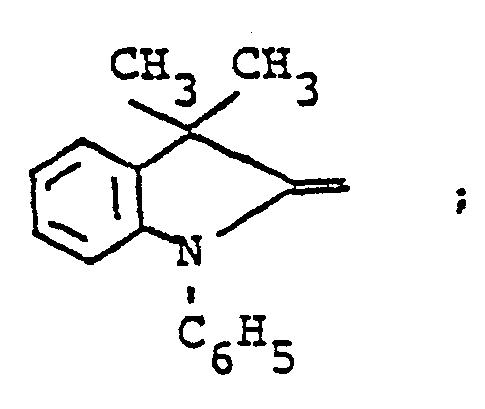


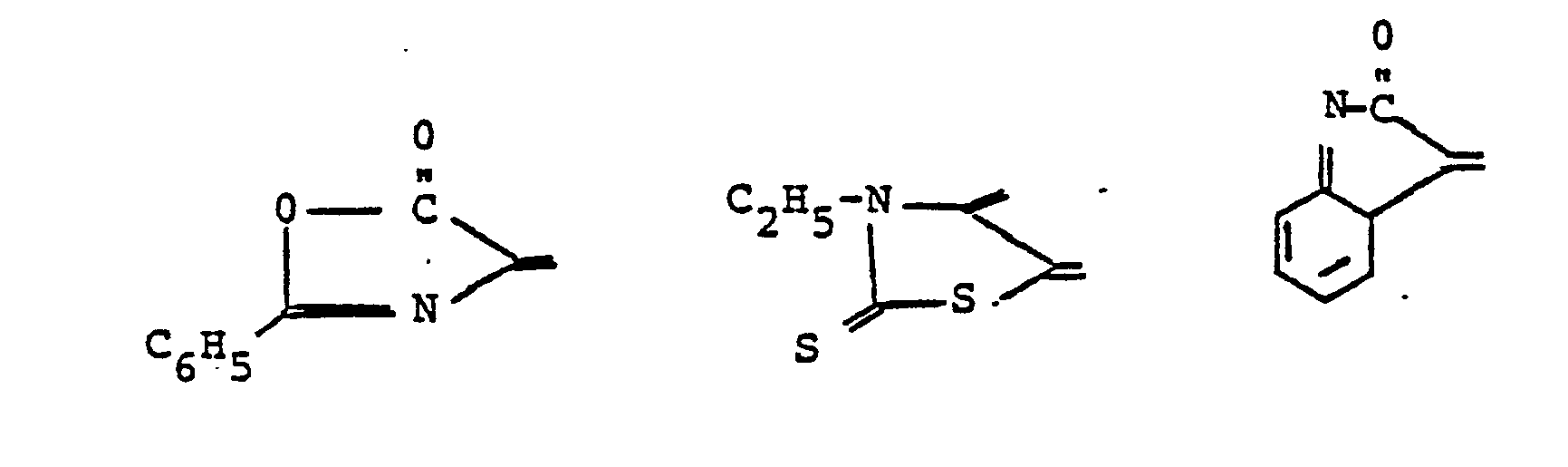


- Die für die Herstellung von Cyaninfarbstoffen geeigneten Heterocylen sind z.B. aus D.M. Sturmer, Syntheses and Properties of Cyanic and related Dyes in Chemistry of Heterocyclic Compounds, Vol. 30, (1977), herausgegeben von A. Weissbergerund E.C. Taylor bekannt.
- Als einwertige X" bzw. zweiwertige Y 2 ⊖ Anionen in den Verbindungen der Formel (1) kommen insbesondere die Halogenide, wie Chlorid, Bromid oder Jodid, ferner Nitrat, Tetrafluorborat, Perchlorat, Rhodamid und p-Toluolsulfonat, sowie Sulfat in Betracht und als Kationen M⊕ in den Verbindungen der Formel (2) Alkalimetall- und Erdalkalimetallkationen wie z.B.Li⊕, Na⊕, K⊕ und Ca 2 ⊕.
- Synthese und Eigenschaften von trinuklearen Cyaninfarbstoffen sind beschrieben in C. Reichhardt und W. Mormann, Chem. Ber. 105, 1815 (1972); C. Reichhardt und K. Halbritter, Chem. Ber. 104, 822 (1971); F. Baer und H.Oehling, Org. Magnet. Resonance 6, 421 (1974); C. Reichhardt, Tetrahedrom Letters 1967, 4327.
- Trinukleare Cyaninfarbstoffe gemäss der vorliegenden Erfindung sind ferner in der amerikanischen Patentschrift 2 282 115 sowie in den englischen Patentschriften 549 203 und 549 204 beschrieben.
- Nachfolgend werden einige für das erfindungsgemässe Verfahren und die erfindungsgemässen Anwendungen besonders geeignete Cyaninfarbstoffe aufgeführt.
- (Ered Reduktionspotential, Eox = Oxydationspotential für den Einelektronenschritt in Volt, gegen die Normalwasserstoffelektrode; pKa = negativer Logarithmus der Protonierungsgleichgewichtskonstante; λ = Absorptionsmaximum). (R.F.Lange in Phot.Sensitivity, Seite 241, ff., R.J.Cox, Butterworth, London 1973; Phot.Science Engineering 18,197 (1974)).


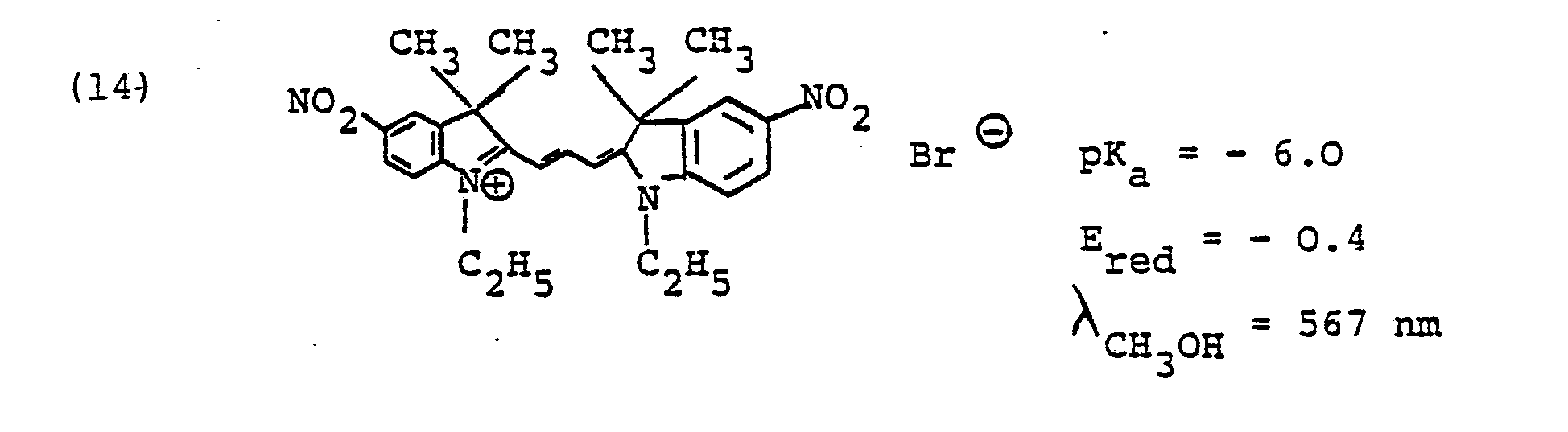


- Die Tenside, die zur Micellbildung geeignet sind, können nichtionisch, anionisch, kationisch, zwitterionisch oder amphoter sein; es kann sich um momomere oder polymere Verbindungen (nichtionische Polymere, kationische und anionische Polyelektrolyte, Polyseifen) hendeln. Auch tensidische Kronenätherkomplexe von Uebergangsmetallkationen, welche mit langkettigen Alkylketten substituiert sind, können Micellen bilden. Die Tenside sind bekannt, z.B. aus Speel and Schwarz, Textile Chemicals and Auxiliaries, 301 ff (1957); H. Rath, Lehrbuch der Textilchemie, 2. Auflage, 648 ff. (1963); DE-AS 1 792 618, 1 936 843 und DE-AS 1 287 556.
- Als nichtionische Tenside kommen in erster Linie Polyglykolätherderivate von Alkoholen, Fettsäuren, Fettaminen oder Alkylphenolen infrage, die 3 bis 80 Aethylenoxy- und Propylenoxyeinheiten und 8 bis 22. Kohlenstoffatome im Kohlenwasserstoffrest enthalten. Besonders geeignet sind Polyglykolätherderivate, in denen die Zahl der Aethylenglykoläthergruppen 5 bis 25 beträgt und deren Kohlenwasserstoffreste sich von geradkettigen, primären oder verzweigten Alkoholen mit 12 bis 18 Kohlenstoffatomen oder von Alkylphenolen mit 6 bis 14 Kohlenstoffatomen im Alkylteil ableiten. Gegebenenfalls kann man die letztgenannten Poly- äthylenglykoläther durch Anlagerung von Propylenoxyd, z.B. 3 bis 25 Mol weiter modifizieren. Weitere geeignete nichtionische Tenside sind die wasserlöslichen, 20 bis 250 Aethylenglykoläthergruppen und 10 bis 100 Propylenglykoläthergruppen enthaltende Poly- äthylenoxidaddukte an Polypropylenglykol, Aethylendiaminopolypropylenglykol und Alkylpolypropylenglykol mit 1 bis 10 Kohlenstoffatomen in der Alkylkette. Die genannten Verbindungen enthalten üblicherweise pro Pro--pylenglykol-Einheit 1 bis 5 Aethylenglykoleinheiten. Auch nichtionische Verbindungen vom Typ der langkettigen, tertiären Aminoxide, Phosphinoxide und Sulfoxide, die gegebenenfalls auch äthoxyliert sein können, sind verwendbar.
- Langkettige tertiäre Aminoxide entsprechen z.B. der Formel

- Dimethyldodecylaminoxid, Oleyldi-(2-hydroxyäthyl)-aminoxid, Dimethyloctylaminoxid, Dimethyldecylaminoxid, Dimethyltetradecylaminoxid, 3,6,9-Trioxaheptadecyldiäthylaminoxid, Di-(2-hydroxyäthyl)-tetradecylaminoxid, 2-Dodecoxy- äthyldimethylaminoxid, 3-Dodecoxy-2-hydroxypropyl-di-(3-hydroxypropyl)-aminoxid und Dimethylhexadecylaminoxid.
- Langkettige tertiäre Phosphinoxyde entsprechen z.B. der Formel

- Dodecyldimethylphosphinoxid, Tetradecyldimethylphosphinoxid, Tetradecylmethyläthylphosphinoxid, 3,6,9-Trioxaoctadecyldimethylphosphinoxid, Cetyldimethylphosphinoxid, 3-Dodecoxy-2-hydroxypropyl-di-(2-hydroxyäthyl)-phosphinoxid, Stearyldimethylphosphinoxid, Cetyläthylpropylphosphinoxid, Oleyldiäthylphosphinoxid,Dodecyldi--äthylphosphinoxid, Tetradecyldiäthylphosphinoxid, Dodecyldipropylphosphinoxid, Dodecyl-di-(hydroxymethyl)-phos- phinoxid, Dodecyl-di-(2-hydroxyäthyl)-phosphinoxid, Tetra- decylmethyl-2-hydroxypropylphosphinoxid, Oleyldimethyl--phosphinoxid und 2-Hydroxydodecyldimethylphosphinoxid.
- Geeignete Dialkylsulfoxide enthalten in der Regel eine kurzkettige Alkyl- oder Hydroxyalkyl mit 1 bis etwa 3 Kohlenstoffatomen, vorzugsweise Methyl, und einen Alkyl-, Alkenyl-, Hydroxyalkyl- oder Ketoalkylreste mit 8 bis 20 Kohlenstoffatomen.
- Beispiele für solche Sulfoxide sind:
- Octadecylmethylsulfoxid, 2-Ketotridecylmethylsulfoxid, Dodecylmethylsulfoxid, Oleyl-3-hydroxypropylsulfoxid, Tetradecylmethylsulfoxid, 3-Methoxytridecylmethylsulfoxid, und 3-Hydroxytridecylmethylsulfoxid.
- Als anionische Tenside eignen sich z.B. Seifen von Fettsäuren mit vorzugsweise 8 bis 22 Kohlenstoffatomen. Diese Salze werden durch Verseifung natürlich vorkommender pflanzlicher oder tierischer Fette und Oele, wie z.B. Palmöl, Kokosöl, Rizinusöl, Sojabohnenöl, Talg, Wal- oder Fischöl erhalten.Beispiele geeigneter Seifen sind die Alkalimetall- (Natrium-, Kalium-),Ammonium- und Alkylolammoniumsalze der von den genannten Fetten und Oelen abgeleiteten gesättigten oder ungesättigten Fettsäuren.
- Ebenfalls geeignet sind Fettalkoholsulfate und Alkyl-(Alkenyl)-sulfonate, wobei die Fettalkohole (gesättigt oder ungesättigt) und die Alkylreste der Sulfonate 8 bis 22, vorzugsweise 12 bis 18 Kohlenstoffatome enthalten können. Beispiele sind Laurylsulfat, Tridecylsulfat, Myristylsulfat, Pentadecylsulfat, Cetylsulfat, Heptadecylsulfat, Stearylsulfat und Oleylsulfat; die Kationen in diesen Salzen sind insbesondere Alkalimetallkationen (Natrium, Kalium), Magnesium-Calcium-, Zink- und Cadmiumionen. Alkylsulfonate sind z.B. Capryl-, Caprin- Laurin-, Myristin-, Palmitrin-, Stearin-, Arachin-, Behensulfonat; weitere Tenside sind Alkylbenzolsulfonate mit 4 bis 12 Kohlenstoffatomen im Alkylteil, wobei der Alkylrest geradkettig oder verzweigt sein kann. Beispiele sind Octyl- und Dodecylbenzolsulfonat. Ferner Alkyl(C4-C12) naphtahlin-sulfonate.
- Weitere geeignete anionische Tenside sind beispielsweise Alkylenoxydaddukte, wie z.B. saure, Aethergruppen oder vorzugsweise Estergruppen von anorganischen oder organischen Säuren enthaltende Anlagerungsprodukte von Alkylenoxyden, besonders Aethylenoxyd und/oder Propylenoxyd,oder auch Styroloxyd an aliphatische Kohlenwasserstoffreste mit insgesamt mindestens 8 Kohlenstoffatome aufweisende organische Hydroxyl-, Carboxyl-, Amino- oder Amidoverbindungen bzw. Mischungen dieser Stoffe. Diese sauren Aether oder Ester können als freie Säuren oder als Salze z.B. Alkalimetall-, Erdalkalimetall-, Ammonium- oder Aminsalze vorliegen.
Die Herstellung dieser anionischen Tenside erfolgt nach bekannten Methoden, indem man an die genannten organischen Verbindungen mindestens 1 Mol vorzugsweise mehr als 1 Mol z.B. 2 bis 60 Mol Aethylenoxyd oder alternierend in beliebiger Reihenfolge Aethylenoxyd und Propylenoxyd anlagert und anschliessend die Anlagerungsprodukte veräthert bzw. verestert und gegebenenfalls die Aether bzw. die Ester in ihre Salze überführt. Als Grundstoffe kommen höhere Fettalkohole d.h. Alkanole oder Alkenole mit 8 bis 22 Kohlen- seoffacomen,cycloaliphatische Alkohole, Phenylphenole,Alkylphenole mit einem oder mehreren Alkylsubstituenten, der bzw. die zusammen mindestens 8 Kohlenstoffatome aufweisen, Fettsäuren mit 8 bis 22 Kohlenstoffatomen, Amine, die aliphatische und/oder cycloaliphatische Kohlenwasserstoffreste .von mindestens 8 Kohlenstoffatomen aufweisen, besonders derartige Reste aufweisende Fettamine, Hydroxyalkylamine, Hydroxyalkylamide und Aminoalkylester von Fettsäuren oder Dicarbonsäuren und höher alkylierter Aryloxycarbonsäuren in Betracht. - Vorzugsweise handelt es sich um Verbindungen der Formel


- Gut geeignete anionische Tenside dieses Typs entsprechen vorzugsweise der Formel


- Der Rest R11 - 0- kann sich z.B. ableiten von Alkoholen mit vorzugsweise 10 bis 24 Kohlenstoffatomen wie z.B.. Decyl-, Lauryl-, Tridecyl-, Myristyl-, Cetyl-, Stearyl-, Oleyl-, Arachidyl-, Behenylalkohol, sowie von Hydroabietylalkohol, den Alfolen oder von o-Phenylphenol oder Alkylphenolen wie z.B. Butyl-, Hexyl-, n-Octyl-, n-Nonyl-, p-tert-Octyl-, p-tert. Nonyl-, Decyl-, Dodecyl-, Tetradecyl-oder Hexadecylphenol.
- Bei den Alfolen handelt es sich um lineare primäre Alkohole. Die Nummer hinter den Namen gibt die durchschnittliche Kohlenstoffzahl des Alkohols an. Einige Vertreter dieser Alfole sind Alfol (8-10), (10-14), (12), (16), (18), (20-22).
- Der Rest R12 - COO - leitet sich z.B. ab von Fettsäuren mit 8 bis 22 Kohlenwasserstoffatomen wie z.B. Capryl-, Laurin-, Caprin-, Myristin-, Stearin-, Arachin-, Behen-, Kokosfett-, Decen-, Linol-, Linolen-, Oleyl-, Eikosen-, Dokosen- oder Clupanodonsäure.
- R13 bedeutet vorzugsweise einen Alkyl- oder Alkenylrest mit 12 bis 22, besonders 16 bis 22 Kohlenstoffatomen. Y1 und Y2 sind vorzugsweise Wasserstoff. Die Summe von r + s ist vorteilhafterweise 6 bis 8. Y1 und Y2 können im gleichen Molekül je verschiedene Bedeutungen haben.
- Bedeutet R 13 Alkyl, so handelt es sich um Reste wie z.B. n-Dodecyl, Myristyl, n-Hexadecyl, n-Heptadecyl, n-Occadecyl, Arachidyl- oder Behenyl. Als Alkenylreste für R3 kommen z.B. Dodecenyl, Hexadecenyl, Oleyl oder Octadecenyl in Betracht.
- Die aliphatischen Amine, die als Ausgangsstoffe für die Herstellung der bevorzugten Anlagerungsprodukte der Formel (31) benötigt werden, können gesättigte oder ungesättigte, verzweigte oder unverzweigte Kohlenwasserstoffreste aufweisen. Diese Kohlenwasserstoffreste enthalten vorzugsweise 16 bis 22 Kohlenstoffatome. Die Amine können chemisch einheitlich sein oder in Form von Gemischen in Betracht kommen. Als Amingemische werden vorzugsweise solche herangezogen, wie sie bie der UeberfUhrung von natürlichen Fetten oder Oelen z.B. Talgfett, Sojaöl, oder Kokosöl in die entsprechenden-Amine entstehen. Als Amine seien im einzelnen Dodecylamin, Hexadecylamin, Heptadecylamin, Octadecylamin, Talgfettamin, Arachidylamin, Behenylamin und Octadecenylamin (Oleylamin) genannt.
- An die Amine kann Aethylenoxid oder zur Einführung der Methyl- oder Phenylgruppe in die Aethylenoxygruppen auch Propylenoxid und/oder Styroloxid angelagert werden. Propylenoxid wird vorzugsweise in Gemischen mit Aethylenoxid eingesetzt. Man verwendet zweckmässig je 1 Mol Amin 5 bis 15 Mol Propylenoxid und mindestens 10 Mol Aethylenoxid. Styroloxid wird zweckmässig vor Aethylenoxid.angelagert. In diesem Falle werden vorzugsweise je 1 Mol Amin, 1 Mol Styroloxid und 15 bis 30 Mol Aethylenoxid verwendet.
- Der Säurerest X1 kann sich von organischen, vorzugsweise aliphatischen Dicarbonsäuren mit 2 bis 6 Kohlenstoffatomen ableiten, wie z.B. Maleinsäure, Malonsäure, Bernsteinsäure oder besonders Sulfonbernsteinsäure oder kann durch Umsetzung mit einer Halogenessigsäure z.B. Chloressigsäure eingeführt werden.
- Insbesondere leitet sich X1 jedoch von anorganischen mehrbasischen Sauerstoffsäuren, wie z.B. Orthophosphorsäure oder Schwefelsäure ab.
- Der Säurerest X1liegt vorzugsweise in Salzform, d.h. z.B. als Alkalimetall-, Erdalkalimetall-, Ammonium- oder Aminsalz vor. Beispiele für solche Salze sind Natrium-, Kalium-, Calcium-, Ammonium-, Trimethylamin-, Aethanolamin-, Diäthanolamin oder Triäthanolaminsalze. Natriumsalze und Ammoniumsalze sind bevorzugt.
Bei den Alkylenoxideinheiten
- Weitere geeignete anionische Tenside sind die Aethylenoxydaddukte von partiellen Fettsäureestern mehrwertiger, z.B. 3- bis 6-wertiger Alkohole.
- Die Fettsäurereste können dabei etwa 8 bis 22 Kohlenstoffatome enthalten, während die mehrwertigen Alkohole vorzugsweise 3 bis 6 Kohlenstoffatome enthalten (Glyzerin, Sorbit).
- Geeignete kationische Tenside sind in der Regel Ammoniumverbindungen,die mindestens ein quaterniertes Stickstoffatom mit mindestens einem langkettigen, z.B. 8 bis 22 Kohlenstoffatome enthaltenden aliphatischen, insbesondere Alkylrest. Solche Tenside sind z.B. Distearyldimethylammoniumchlorid, Stearyldimethylbenzylammoniumchlorid, Kokosnussalkyldimethylbenzylammoniumchlorid,Dikokosnuss- alkyldimethylammoniumchlorid, Cetylpyridiniumchlorid und Cetyltrimethylammoniumbromid.
- Ferner eignen sich tensidische stickstoffhaltige oder stickstoff-und sauerstoffhaltige Kronenäther, welche einfach- oder zweifach-positiv geladene Uebergangsmetallkationen, besonders Cu2⊕, enthalten. Die tensidischen Kronenäther enthalten in der Regel aliphatische, insbesondere Alkylreste mit z.B. 8 bis 24, insbesondere 12 bis 18, Kohlenstoffatomen. Beispiele für die genannten cyclischen Aether sind 2-Tetradecyl-1,4,10,13-tetraoxa-7,16-diazacyclooctadecan und 2-Tetradecyl-l,4,7,lO- tetraaza-cyclodecan. Sie sind beschrieben von J.M.Lehn, J.P. Sauvage und B. Dietrich in J.Am. Chem. Soc.92,2916(1970). Geeignet sind auch nichttensidische Kronenätherkomplexe in Kombination mit Tensiden. Ein Beispiel eines cyclischen Aethers ist 1,4,7,10-tetraaza-cyclodecan, welches z.B.mit Natriumlaurylsulfat als Tensid kombiniert werden kann.
- Zwitterionische Tenside können z.B. durch die Formel

- Beispiele für solche Tenside sind:
- 4-[N,N-Di-(2-hydroxyäthyl)-N-octadecyl-ammonium]-butan-l-carboxylat,
- 5-[S-3-Hydroxypropyl-S-hexadecylsulfonium]-3-hydroxypentan-1-sulfat,
- 3-[N,N-Dipropyl-N-3-dodecoxy-2-hydroxypropylammonium]-propan-l-phosphonat,
- 3-(N,N-Dimethyl-N-hexadecylammonium)-propan-1-sulfonat,
- 3-(N,N-Dimethyl-N-hexadecylainmonium)-2-hydroxypropan-1-sulfonat,
- 4-[N,N-Di-(2-hydroxyäthyl)-N-(2-hydroxydodecyl)-ammonium]-butan-l-carboxylat.
- Geeignete amphotere Tenside sind z.B. Derivate aliphatischer sekundärer und tertiärer Amine, die mindestens einen langkettigen aliphatischen Substituenten (Alkylsubstituenten) mit 8 bis 22 Kohlenstoffatomen und eine anionische, wasserlöslichmachende Gruppe aufweisen (Carboxyl, Sulfat, Sulfonat, Phosphat).
- Beispiele für amphotere Tenside sind Alkyl-ß-iminodi- propionate,R17N(C2H2COOH)2; Alkyl-ß-aminopropionate, R17N(H)C2H4COOM und langkettige Imidazolinderivate der allgemeinen Formel

- In jeder der obigen Formeln bedeutet R17 eine hydrophobe Gruppe, z.B. Alkyl, die 8 bis 22 Kohlenstoffatome aufweist, und M ein Kation zur Neutralisation der Ladung des Anions, z.B. ein Alkalimetallkation wie das Natrium- und Kaliumkation, das Ammoniumkation oder substituierte Ammoniumkationen.
- Eine weitere Gruppe geeigneter Tenside, die in der Regel neutral, kationisch oder anionisch sind, sind die sogenannten Polyseifen, die an einem Polymergerüst, z.B. Polyäthylen oder Polyvinylalkohol langkettige (Ca-C22) Seitenketten oder heterocyclische Ringsysteme enthalten, die an den Enden bzw. im Ring positiv geladene (z.B. quaternierte Stickstoffatome wie im N-dodecyl-4-polyvinylpyridiniumbromid, Ammoniumverbindungen) oder negativ geladene (z.B. -COO⊖ oder -SO3⊖ oder -COO⊕ und -SO3⊕ wie in CH3-(CH2)x-CH-(CH2)yCOO⊖Na⊕ SO3⊖Na⊕ mit x + y = 11 ) Gruppen enthalten. Ferner wird auf die Bisquaternären Ammoniumsalze von Polymeren (z.B. Polyvinylalkohol) der US-Patentschrift 3 309 376 verwiesen.
- Tenside können sowohl einzeln als auch in Kombination mit tensidischen oder nicht-tensidischen stickstoffhaltigen oder stickstoff- und sauerstoffhaltigen Kronenätherkomplexen ein- oder zweiwertiger Uebergangsmetallkationen eingesetzt werden.
- Die Cyaninfarbstoffe können z.B. in die micelläre Form gebracht werden, indem man sie in beliebigen Konzentrationen (grössere, gleiche oder kleinere Konzentrationen im Vergleich zur Micellkonzentration der Tenside) mit den tensid- 'haltigen Lösungen in der Regel bei Raumtemperatur vermischt und darin auflöst. Die kritische Micellkonzentration (die überschritten werden muss, um Micellen zu bilden) hängt zwar von der Struktur des jeweiligen Tensids, des Lösungsmittels und der Temperatur ab, doch kann man für Tenside (anionische, nichtionische, kationische) in wässrigem Medium eine Konzentration von etwa 10-2 bis 10-6 Mol/l .annehmen.
- Für langkettige Fettalkylsulfate kann man in Abhängigkeit von der Kohlenstoffzahl des Fettrestes folgende kritische Micellkonzentrationen angeben.

- Für nichtionische Tenside,z.B. Polyäthylenoxydaddukte, kann in wässrigem Medium eine kritische Micellkonzentration von etwa 10-4 Mol/1 angenommen werden.
- Die Konzentration der Cyaninfarbstoffe,die in die Micellen aufgenommen werden kann, kann bis zu etwa 10 mal grösser (auf molarer Basis) aber auch bis zu etwa 10 6 mal kleiner sein als die Micellkonzentration. Die Konzentrationen liegen also etwa im Bereich von 10-2 bis 10-8 Mol/l, vorzugsweise bis 10-6 Mol/1.
- Die micellierten Cyaninfarbstoffe können in verschiedenen photographischen Materialien und Verfahren sowie in Farbstofflasern eingesetzt werden.
Die hervorragende Lichtstabilität der micellierten Cyaninfarbstoffe ermöglicht neben der deutlich verbesserten Flüoreszenzpolarisation und Fluoreszenzquantenausbeute einen Einsatz als flüssige Farbstofflaser. Der Vorteil von flüssigen Lasern, die Cyaninfarbstoffe enthalten, liegt. 'darin gegründet, dass sie'eine Anregungsemission, d.h. die Aussendung kohärenten Lichts, über ein breiten Bereich des elektromagnetischen Spektrums zu bewirken vermögen. - Ferner sind sie selektiv abstimmbar, d.h. sie können durch Zwischenschaltung eines Bewegungsgitters oder Prismas in solcher Weise abgestimmt werden, dass sie bei innerhalb praktisch der gesamten Fluoreszenzbande des Farbstoffs gelegenen Wellenlängen emittieren.
- Die Laserwirkung beruht bekanntlich auf dem Phänomen, das angeregte Atome oder Moleküle ein Photon oder Lichtquant auszustrahlen vermögen, wobei dieses Photon oder Lichtquant selbst wiederum die vorzeitige Emission des Photons eines weiteren angeregten Atoms oder Moleküls auszulösen vermag. Dieser Vorgang wird als Anregungsemission bezeichnet.
- Die Anregung von Farbstoffen erfolgt nach bekannten Methoden mit Hilfe von Energiequellen, z.B. solchen, die Elektronen aussenden. Zur Anregung flüssiger Lasermedien wird in der Regel eine Bestrahlung verwendet, die als optisches Pumpen bezeichnet wird. Typische geeignete Pump- oder Anregungsquellen sind z.B. Riesenimpulslaser, Xenon- und Argon-Bogenblitzlichtröhren sowie Bogenentladungsröhren, die nur Luft oder andere gasförmige Gemische enthalten.
- Während des Betriebs wird das Farbstofflasermedium durch intensive Energiezufuhr auf die höheren angeregten Zustände gepumpt. Uebertrifft die Zahl der in angeregtem Zustand befindlichen Moleküle die im Grundzustand be--findlichen Moleküle, so erfolgt ein spontaner emittierender Uebergang der energiereichen Moleküle und das reflektierte Licht wird im optischen Resonator hin- und hergestrahlt. Durch diese stimulierte Resonanzemission werden noch weitere- Moleküle in den höheren Energiezustand angeregt. Ist eine der reflektierenden Hohlraumbegrenzungen partiell durchlässig, was in der Regel der Fall ist, so tritt ein Teil der intensiv reflektierten Lichtimpulse an dieser Stelle des Hohlraumresonators in Form der Laser-Lichtimpulse oder des Laserstrahls aus.
- Mit den micellierten Cyaninfarbstoffen der vorliegenden Erfindung kann man Farbstofflaser herstellen, die im Vergleich mit bekannten Laserfarbstoffen (US-PS 3 288 788, 3 521 187 oder 3 541 470) einen deutlich verbesserten Wirkungsgrad aufweisen.
- Eine weitere Anwendung der micellierten(mikroemulgierten) Cyaninfarbstoffe betrifft diejenige im selektiven photographischen Filtern.
- Die meisten in der Fotographie verwendeten Filter sind Absorptionsfilter. Ihre Filterwirkung beruht darauf, dass sie eine bestimmte Wellenlänge (Lichtfarbe) durchlassen. Die Durchlassfarbe entspricht dabei der Eigenfarbe des Filters. Abgesehen von einem geringen Anteil an reflektierter Strahlung werden alle nicht durchgelassenen Strahlen vom Filter verschluckt. Ihre Energie heizt das Filter auf. Längere Zeit einwirkende Strahlenbelastung führt dazu, dass die Filterfarbe heller wird - die Filter bleichen aus (thermisch und photochemisch).
- Micellierte Cyaninfarbstoffe können als Filterfarbstoffe aufgrund ihrer guten Stabilität die Lebensdauer von photographischen Absorptionsfilter verlängern.
- Die grosse Lichtstabilität der micellierten (microemulgierten) Cyaninfarbstoffe ermöglicht es ferner, sie in diese Form als Bildfarbstoffe in Silberfarbbleichmaterialien einzusetzen, sofern sie irreversibel reduktiv spaltbar sind. Die für diesen Zweck geeigneten Cyanine weisen in der Regel ein niedriges kathodisches Halbwellenpotential auf. Micellierte Cyaninfarbstoffe, die einen hohen pKa-wert (>4) aufweisen und irreversibel reduktiv spaltbar sind, können ferner in Silberfarbbleichaufnahme (Film)materialien eingesetzt werden. So kann man z.B. entsprechende photographische Materialien, die in mindestens einer Schicht mindestens einen Cyaninfarbstoff in protonierter(farbloser) Form enthalten bildweise belichten und dann in üblicher Weise im alkalischen Medium entwickeln (wobei sich der Farbstoff als solcher durch Deprotonierung zurückbildet), sowie das Material durch Farb- und Silberbleichung und Fixierung in bekannter Weise fertigstellen (vgl. z.B. DE-OS 2 448 433, 2 530 469, 2 547 720).
- Da der pH-Wertbereich für übliche photographische Emulsionen etwa 4 bis 9 beträgt, sollten die eingesetzten Cyaninfarbstoffe in diesem Bereich in protonierter Form stabil sein, d.h. möglichst hohe pKa-Werte aufweisen.
- Zusätzlich zu den micellierten Cyaninfarbstoffen kann das zuvor beschriebene Silberfarbbleichmaterial auch Cyaninfarbstoffe (die gleichen oder andere) in nicht-micellierter Form als Sensibilisatoren (adsorbiert an Silberhalogenid) in der gleichen oder einer benachbarten Schicht enthalten. Man erreicht so z.B. dass die Lichtabsorption der Farbstoffe und die spektrale Empfindlichkeit der photographischen Emulsionen während der Belichtung in verschiedenen Spektralbereichen liegen und erst bei der anschliessenden Verarbeitung zur Deckung gebracht werden. Durch diese Massnahme kann die Lichtempfindlichkeit eines photographischen Farbmaterials in hohem Masse gesteigert- werden.
- Eine andere Anwendung--des Systems der micellierten (stabilisierten) Cyaninfarbstoffe betrifft das photographische Farbdiffusionsübertragungsverfahren. Arbeitet man z.B. micellierte Tenside in die Farbstoffempfangsschichten ein, so können sie nach der Diffusion der Farbstoffe (bzw. der Farbstoffvorläufer) in diese Schichten (und der Farbstoffbildung) die Farbstoffe (Cyaninfarbstoffe) stabilisieren und sie damit als Bildfarbstoffe in photographischen Materialien anwenden. In der Regel enthält die Empfangsschicht noch ein Beizmittel für den Farbstoff.
- Für Cyaninfarbstoffe mit einer langen Methinkette (z.B. Undecacyanine), die z.B. aufgrund ihre Absorptionseigenschaften in infrarotempfindliche (photographische) Materialien eingearbeitet werden können, bringt die Stabilisierung in Form von micellierten Species erhebliche Vorteile, da so ihre Licht- und Wärmestabilität bedeutend verbessert werden kann.
- Die Einarbeitung der micellierten Cyaninfarbstoffe in Binder (Gelatine)-emulsionen, wie sie in photographischen Materialien üblich sind, erfolgt nach üblichen Methoden, z.B. durch Einrühren der micellierten Cyaninfarbstoffe in Gelatineemulsionen und anschliessende Homogenisierung z.B. durch Ultraschall. Die Menge der micellierten Cyaninfarbstoffe kann etwa 10 bis 200 mg/m der Schicht, in die sie eingearbeitet werden, betragen.
- Die Emulsionen,die gegebenenfalls Silberchlorid-, Silberbromid und/oder Silberjodid enthalten können chemisch sensibilisiert werden, sie können ferner übliche organische Stabilisatoren und Antischleiermittel sowie auch übliche Weichmacher, wie z.B. Glycerin enthalten. Die Emulsionen können ferner mit den für Gelatine üblichen Härtungsmitteln gehärtet werden.Ferner können die Emulsionen übliche
- Giesshilfsmittel enthalten. Die Emulsionen können auf übliche Schichtträger für photographisches Aufzeichnungsmaterial aufgebracht werden. Gegebenenfalls kann ein Gemisch von mehreren Kolloiden zum Dispergieren der Silberhalogenide verwendet werden.
- Als Silberfarbbleichmaterial kann ein transparentes, metallischreflektierendes, oder vorzugsweise weissopakes Material verwendet werden, dessen Träger keine Flüssigkeit aus den Bädern aufzusaugen vermag.
- Der Träger kann beispielsweise aus gegebenenfalls pigmentiertem Cellulosetriacetat oder Polyester bestehen. Wenn er aus Papierfilz besteht, muss dieser beidseitig lackiert oder mit Polyäthylen beschichtet sein. Auf mindestens einer Seite dieses Trägers befinden sich die lichtempfindlichen Schichten, vorzugsweise in der bekannten Anordnung, d.h. zu unterst eine rot sensibilisierte Silberhalogenidemulsionsschicht, die einen blaugrünen Farbstoff enthält, darüber eine grün sensibilisierte Silberhalogenidemulsionsschicht, die . einen purpurnen Farbstoff enthält und zu oberst eine blauempfindliche Silberhaldgenidemulsionsschicht, die einen gelben Farbstoff enthält. Das Material kann auch Unterschichten, Zwischenschichten, Filterschichten und Schutzschichten enthalten. Insbesondere können auch, wie dies in den Deutschen Offenlegungsschriften 2 036 918, 2 132 835 und 2 132 836 beschrieben wurde, die Silberhalogenidemulsion und der zugeordnete bleichbare Farbstoff in zwei oder drei getrennten, unter sich benachbarten Schichten enthalten sein, doch soll die gesamte Dicke der Schichten im trockenen Zustand in der Regel 20 µ nicht übersteigen.
- Die Verarbeitung der belichteten Silberfarbbleichmaterialien erfolgt in üblicher Weise und umfasst (1) die Silberentwicklung, (2) die Farbbleichung,.(3) die Silberbleichung und (4) die Fixierung (vg. z.B..DE-OS 2 448 443). Die Farbbleichung (2) und die Silberbleichung (3) können in einer einzigen Behandlungsstufe zusammengefasst werden.
- Zur Silberentwicklung können Bäder üblicher Zusammensetzung verwendet werden, z.B. solche, die als Entwicklersubstanz Hydrochinon und gewünschtenfalls zusätzlich noch l-Phenyl-3-pyrazolidinon enthalten. Ausserdem kann es günstig sein, wenn das Silberentwicklungsbad, wie in der Schweizer Patentschrift 405 929 beschrieben, noch zusätzlich einen Farbbleichkatalysator enthält.
- Als-Farbbleichbäder - sofern die Farbbleichung als getrennte Behandlungsstufe durchgeführt wird - werden mit Vorteil solche verwendet, die neben einer starken Säure, einem wasserlöslichen Jodid und einem Oxydationsschutzmittel für das Jodid einen Farbbleichkatalysator enthalten. Kombinierte Farb- und Silberfarbbleichbäder enthalten neben den angegebenen Komponenten in der Regel noch ein wasserlösliches Oxydationsmittel. Geeignete Farbbleichkatalysatoren sind in erster Linie Diazinverbindungen, z.B. Derivate des Pyrazins, Chinoxalins oder Phenazins. Sie sind z.B. in den DT-AS 2 O10 280, 2 144 298 und 2 144 297, in der französichen Patentschrift 1 489 460, in der US-Patentschrift 2 270 118, sowie in der DT-OS 2 448 443 beschrieben.
- Unter starken Säuren sind hier solche zu verstehen, welche dem Farbbleichbad bzw. dem koiabinierten Farb- und Silberbleichbad einen pH-Wert von höchstens 2 verleihen. Es können also z.B. Salzsäure, Phosphorsäure und insbesondere Schwefelsäure oder Sulfaminsäure verwendet werden.
- Als wasserlösliches Jodid kann man Alkalijodide verwenden, wie beispielsweise Kaliumjodid oder Natriumjodid.
- Geeignete Oxidationsmittel- sind Nitrosoverbindungen, wie z.B. p-Nitrosodimethylanilin, Nitroverbindungen, wie z.B. aromatische Nitroverbindungen und vorzugsweise aromatische Mono- oder Dinitrobenzolsulfonsäuren,z.B. m-Nitrobenzolsulfonsäure .
- Als Oxydationsschutzmittel verwendet man mit Vorteil Reduktone oder wasserlösliche Mercaptoverbindungen. Geeignete Reduktone sind insbesondere aci-Reduktone mit einer 3-Carbonyl-endiol-(1,2)-Gruppierung wie Reduktin, Triose-Redukton oder vorzugsweise Ascorbinsäure.
- Als Mercaptoverbindungen kommen solche der Formel HSA(B)m infrage, worin A ein aliphatisches, cycloaliphatisches, araliphatisches, aromatisches oder heterocyclisches Brückenglied, B einen wasserlöslichmachenden Rest und m eine ganze Zahl von höchstens 4 ist. (DE-OS 2 258 076, DE-OS 2423819)
- Das Silberfixierbad kann in bekannter und üblicher Weise zusammengesetzt sein. Als Fixiermittel geeigent ist z.B. Natriumthiosulfat oder mit Vorteil Ammoniumthiosulfat, gewünschtenfalls mit Zusätzen wie Natriumbisulfit, Natriummetabisulfit und/oder Ammoniumbisulfit sowie gegebenenfalls Komplexierungsmittel, wie Aethylendiamintetraessigsäure.
- Alle Behandlungsbäder können weitere übliche Zusätze wie z.B. Härtungsmittel, Netzmittel, optische Aufheller oder UV-Schutzmittel enthalten.
- In den nachfolgenden Beispielen beziehen sich Teile und Prozente auf das Gewicht, sofern nicht anders angegeben.
- 5 10-2 Mol Natriumlaurylsulfat werden in Wasser gelöst. 1-10-5 Mol des Cyaninfarbstoffs der Formel

- Diese Lösung wird mit einer Xenonlampe (XBO-450 Watt Lampe) bestrahlt, wobei ein Wasserfilter vorgeschaltet wurde, um Lichtanteile im Infrarot und im fernen Ultraviolett herauszufiltern. Nach jeder Stunde wird das Spektrum gemessen. Nach einer Bestrahlungszeit von 24 Stunden konnte keine Veränderung der Absorptionseigenschaften festgestellt werden. Eine wässrige Lösung des Cyaninfarbstoffs (in Abwesenheit von Tensidmicellen) zeigt dagegen nach einstündiger Betrahlung eine völlige Veränderung des Absorptionsspektrums, indem das Absorptionsmaxiumum praktisch verschwunden ist (Zerstörung des Moleküls).
- Figur 1 zeigt das Absorptions- und Emissionsspektrum einer wässrigen Lösung, die 10-6 Mol des Cyanins der Formel (101) und 10-2 Mol Natriumlaurylsulfat enthält.
- Figur 2 zeigt das Polarisationsspektrum der Fluoreszenz der gleichen Lösung.
- Der Polarisationsgrad der Fluoreszenz wird wie folgt definiert:

- Figur 2 zeigt, dass die Werte für P für den grössten Teil des Spektrums innerhalb der Werte von 0,3 bis 0,4 liegen, was - bei einem oberen theoretischen Grenzwert von 0,5 für P - zeigt, dass während der Anregungszeit (~1 Nanosekunde) praktisch keine Rotationsschwingung des Farbstoffs stattfindet.

- Analoge Ergebnisse erhält man auch mit den micellierten Cyaninfarbstoffen der nachfolgenden Formeln


- Als weitere Tenside können eingesetzt werden:
- Ammoniumsalz des sauren Schwefelsäureesters des Anlagerungsproduktes von 2 Mol Aethylenoxyd und 1 Mol p-tert.Nonylphenol;
- Ammoniumsalz des sauren Schwefelsäureesters des Anlagerungsproduktes von 3 Mol Aethylenoxyd und 1 Mol Tridecylalkohol;
- Natriumsalz des sauren Maleinsäureesters des Anlagerungsproduktes von 2 Mol Aethylenoxyd und 1 Mol p-Nonylphenol.
- Die Lösung des Cyaninfarbstoffs gemäss Beispiel 1 wird einer Laserstrahlung ausgesetzt. Als Anregungsquelle dient der Impuls aus einem 347,1 nm -Frequenz-Doppel-Rubinlaser mit einer Impulsbreite von 25 Nanosekunden (Abfall der Laserintensität auf 1/e nach 25 Nanosekunden) und einer Energie von 300 bis 400 mJoule pro Impuls. Nach der Einstrahlung von 50 bis 100 Impulsen zeigt das Absorptionsspektrum des Cyaninfarbstoffs keine Veränderung. Diese unerwartete Stabilität der in micellärer Form vorliegenden Cyanine ermöglicht eine Verwendung in Farbstofflasern. Man erreicht einen integralen Engergieoutput von etwa 30 mJoule bei einer Halbwertsbreite von 15 Namosekunden.
- Anwendung von micellierten Cyaninen in Silberfarbbleichmaterialien.
- Eine gehärtete Gelatineschicht, die sich auf einem Cellulosetriazetatträger befindet und 50 mg/m2 des micellierten Cyaninfarbstoffs der Formel


- Nach einer Kontaktzeit von 2 Minuten ist die Farbstoffschicht von einer optischen Dichte D600nm = 0,33 auf D600nm - 0,04 gebleicht.
- Das gleiche Resultat erhält man eine auf einen Träger aufgebrachte belichtete und entwickelte Silberhalogenidgelatineemulsion verwendet.
- Das Beispiel zeigt, dass micellierte Cyanine, sofern sie reduktiv bleichbar sind, als Bildfarbstoffe in Silberfarbbleichmaterialien eingesetzt werden können.
- Anstelle des Cyaninfarbstoffs der Formel (109) kann man mit ebenfalls guten Ergebnissen die Cyaninfarbstoffe der Formeln (8), (9), (13), (14) und (16) einsetzen.
- Man stellt ein photographisches Material dadurch her, dass man die folgenden Schichten nacheinander auf einen 0,1 mm starken, weisspigmentierten Cellulosetriacetätträger giesst.
- l. Eine Gelatineschicht, die 0,2 g m-2 des Farbstoffs der Formel (109) in micellierten (mikroemulgierter) Form (Tensid, Natriumlaurylsulfat) in 4,0 g m2 Gelatine enthält.
- 2. Eine aus mit Phthalsäureanhydrid modifizierter Gelatine bestehende Trennschicht mit einem Gelatineauftragsgewicht von 1,0 g m-2.
- 3. Eine lichtempfindliche Silberhalogenid/Gelatineemulsionsschicht, die 1,2 g m-2 Silber in Form von Silberchloridbromid (70 Mol-% AgCl und 30 Mol-% AgBr) enthält.
- 4. Eine 1,0 g m-2 Gelatine enthaltende Oberschicht.
- Nach Belichtung hinter einem Graukeil verarbeitet man das Material im Dunkeln, indem man die Emulsionsseite mit einem aluminierten Träger zusammenbringt, auf dem eine Verarbeitungszusammensetzung der folgenden Formel aufgebracht ist.:

- Nach fünf Minuten entfernt man den aluminierten Träger. Während dieser Zeit hat die Verarbeitungslösung die mit Phthalsäureanhydrid modifizierte Gelatineschicht aufgeweicht, und beim Abziehen des aluminierten Trägers werden die Silberhalogenidschicht und die Oberschicht damit entfernt, wobei eine blaugrüne Abbildung des vorhandenen Keils auf dem Träger erscheint. Diese Abbildung besitzt eine als fertiges Bild ausreichend dunkle Farbdichte.
- Ein photographisches Material stellt man dadurch her, dass man die folgenden Schichten nacheinander auf einen 0,1 mm starken, ungefärbten transparenten Cellulosetriacetatträger aufbringt:
- 1. Eine Gelatineschicht, die denselben micellierten Farbstoff wie in Beispiel 4 enthält.
- 2. Eine weissreflektierende Schicht.
- 3. Eine schwarzopak-machende Schicht.
- 4. Eine Emulsionsschicht wie in Beispiel 4 verwendet.
- 5. Zinkpulver mit einer schwarzopak-machenden Russschicht.
- 6. Eine 1,0 g m -2 Gelatine enthaltende Oberschicht.
- -Nach Belichtung mit Röntgenstrahlen hinter einem Bleikeil verarbeitet man das Material durch Eintauchen in eine Lösung der folgenden Zusammensetzung:

- Nach drei Minuten erhält man eine negative blaugrüne Abbildung des Keils, welche man durch den Träger hindurch betrachten kann.
- Die in diesem Beispiel verwendete Zinkpulver/opakmachende Schicht wird wie folgt hergestellt:
- Man stellt eine Dispersion von Zinkpulver in Gelatine nach folgender Formel her:

- Man gibt 20 ml der obigen Dispersion zur wie oben beschriebenen Russdispersion.
- Verbesserung der Lichtechtheit von Cyaninfarbstoffen mit Hilfe makrocyclischer Quencher.
- Eine Lösung von 0,02 Mol Natriumlaurylsulfat (NaLS) in Wasser wird mit 2.10 Mol des Kupferkomplexes der Formel

- Verwendung eines weiteren oberflächenaktiven Systems zur Verbesserung der Lichtechtheit des Cyaninfarbstoffes. Bevorzugtes Tensid für diese Untersuchungen ist das Calcium-Monooxyäthylendodecylsulfat [(C12H55-O-CH2-CH2-O-SO3)2Ca] (Ca(DOS)2).Dieses bildet Micellen mit einer kritischen Micellenkonzentration von 2.10-4 Mol. Der Kraffts-Punkt liegt bei 15°C. Nach Beispiel 1 wird eine wässrige Lösung mit einem Gehalt von 5.10 3 Mol Ca [DOS]2 und 10-6 Mol Cyaninfarbstoff der Formel (101) hergestellt. Die Fluoreszenzquantenausbeute beträgt 0,7 und liegt nahe dem für Glycerin ermittelten Wert von 0.8. Die Versuchsergebnisse zeigen, dass keine Zersetzung des Farbstoffes der Formel (101) stattgefunden hat, womit die stabilisierende Wirkung dieser micellären Tensidstruktur auf-Cyaninfarbstoffe gezeigt ist.
- Der Cyaninfarbstoff der Formel (101) wird in der Polyseife N-dodecyl-4-polyvinylpyridiniumbromid (lll) micelliert. Zur Synthese und Beschreibung von Verbindung (111) siehe U.P. Strauss, J. Polymer Sci. 9 (No. 6), 509 (1952), T. Kunitake, Biopolymers 15, 1145 (1976) und U.P. Strauss et al., J. Phys. Chem. 58, 747 (1954).
- Neben der reinen Verbindung (111) werden auch Tensidkombinationen zur Micellierung des Farbstoffes herangezogen. Sowohl NaLS als auch Verbindung (111) werden zusammen mit dem Kronen- ätherkomplex der Formel

Die Ergebnisse der Versuchstests, welche die Stabilitätssteigerung von Farbstoff (101) in Abhängigkeit vom eingesetzten Tensid bzw. von der verwendeten Tensidkombination zeigen, sind der folgenden Tabelle zu entnehmen. Der Stabilitätsfaktor der wässrigen Lösung von (lol) ist willkürlich mit 1 festgesetzt worden.
- Der Cyaninfarbstoff der Formel (23) wird nach Beispiel 8 micelliert und bezüglich seiner Lichtechtheit untersucht. Die Versuchsergebnisse sind in Tabelle zusammengestellt.

- Der Cyaninfarbstoff (23) wurde in 10-6 molarer Konzentration in einer wässrigen, 10-2 molaren Lösung von Cetyltrimethylammoniumbromid gelöst und gemäss Beispiel 1 bestrahlt. Die photochemischen Effekte wurden durch Messung des Absorptionsspektrums der Lösung verfolgt. Die optische Dichteabnahme im Cyaninmaximum betrug nach 70stündiger Bestrahlung 10-15 %. Eine wesentliche Zunahme der Lichtstabilität wurde durch Zugabe von Komplex (112) erzielt. Hier ist nach gleicher Bestrahlungszeit bei einer 5-10-4 molaren Konzentration des Komplexes keine nennenswerte Ausbleichung (< 3 %) mehr zu beobachten.
Claims (18)


Applications Claiming Priority (2)
| Application Number | Priority Date | Filing Date | Title |
|---|---|---|---|
| CH13109/78 | 1978-12-22 | ||
| CH1310978 | 1978-12-22 |
Publications (3)
| Publication Number | Publication Date |
|---|---|
| EP0013257A2 true EP0013257A2 (de) | 1980-07-09 |
| EP0013257A3 EP0013257A3 (en) | 1981-06-03 |
| EP0013257B1 EP0013257B1 (de) | 1983-06-22 |
Family
ID=4389401
Family Applications (1)
| Application Number | Title | Priority Date | Filing Date |
|---|---|---|---|
| EP79810174A Expired EP0013257B1 (de) | 1978-12-22 | 1979-12-04 | Verfahren zur Erhöhung der Lichtechtheit, Fluoreszenzpolarisation und Fluoreszenzquantenausbeute von Cyaninfarbstoffen, stabilisierte Cyaninfarbstoffzubereitung, Verfahren zu ihrer Herstellung und ihre Verwendung |
Country Status (3)
| Country | Link |
|---|---|
| EP (1) | EP0013257B1 (de) |
| JP (1) | JPS5589359A (de) |
| DE (1) | DE2965772D1 (de) |
Cited By (5)
| Publication number | Priority date | Publication date | Assignee | Title |
|---|---|---|---|---|
| US4889410A (en) * | 1988-09-06 | 1989-12-26 | Eastman Kodak Company | Magenta filters |
| EP0308955A3 (de) * | 1987-09-25 | 1990-01-10 | Fuji Photo Film Co., Ltd. | Photographisches Silberhalogenidmaterial |
| GB2247028A (en) * | 1990-08-15 | 1992-02-19 | Albright & Wilson | Suspension of dyes and optical brighteners in structured surfactants |
| US5382354A (en) * | 1990-09-03 | 1995-01-17 | Total Raffinage Distribution S.A. | Process for the fixed-bed sweetening of sour petroleum distillates with fraction temperatures of from about 125 to about 350 degrees C. |
| WO2001047477A3 (de) * | 1999-12-24 | 2002-02-07 | Henkel Kgaa | Mittel zum färben von keratinhaltigen fasern |
Families Citing this family (1)
| Publication number | Priority date | Publication date | Assignee | Title |
|---|---|---|---|---|
| JP4666828B2 (ja) * | 2001-07-25 | 2011-04-06 | 株式会社Adeka | 光学フィルター |
Family Cites Families (5)
| Publication number | Priority date | Publication date | Assignee | Title |
|---|---|---|---|---|
| CA960453A (en) * | 1970-03-30 | 1975-01-07 | Eastman Kodak Company | Organic dye lasing compositions |
| JPS4944895B1 (de) * | 1970-12-10 | 1974-11-30 | Fuji Photo Film Co Ltd | |
| US3893855A (en) * | 1973-01-29 | 1975-07-08 | Polaroid Corp | Photographic ligand for inducing disproportionation of silver {30 1 and processes of use thereof |
| JPS5722094B2 (de) * | 1974-12-24 | 1982-05-11 | ||
| US4006025A (en) * | 1975-06-06 | 1977-02-01 | Polaroid Corporation | Process for dispersing sensitizing dyes |
-
1979
- 1979-12-04 EP EP79810174A patent/EP0013257B1/de not_active Expired
- 1979-12-04 DE DE7979810174T patent/DE2965772D1/de not_active Expired
- 1979-12-19 JP JP16417579A patent/JPS5589359A/ja active Pending
Cited By (9)
| Publication number | Priority date | Publication date | Assignee | Title |
|---|---|---|---|---|
| EP0308955A3 (de) * | 1987-09-25 | 1990-01-10 | Fuji Photo Film Co., Ltd. | Photographisches Silberhalogenidmaterial |
| US4889410A (en) * | 1988-09-06 | 1989-12-26 | Eastman Kodak Company | Magenta filters |
| EP0358439A1 (de) * | 1988-09-06 | 1990-03-14 | Eastman Kodak Company | Magenta-Filter für Filterreihen |
| GB2247028A (en) * | 1990-08-15 | 1992-02-19 | Albright & Wilson | Suspension of dyes and optical brighteners in structured surfactants |
| GB2247028B (en) * | 1990-08-15 | 1994-06-08 | Albright & Wilson | Dye suspensions |
| US5476519A (en) * | 1990-08-15 | 1995-12-19 | Albright & Wilson, Limited | Dye suspensions |
| US5382354A (en) * | 1990-09-03 | 1995-01-17 | Total Raffinage Distribution S.A. | Process for the fixed-bed sweetening of sour petroleum distillates with fraction temperatures of from about 125 to about 350 degrees C. |
| WO2001047477A3 (de) * | 1999-12-24 | 2002-02-07 | Henkel Kgaa | Mittel zum färben von keratinhaltigen fasern |
| US6863698B1 (en) | 1999-12-24 | 2005-03-08 | Henkel Kommanditgesellschaft Auf Aktien | Agent for dyeing keratin containing fibers |
Also Published As
| Publication number | Publication date |
|---|---|
| EP0013257B1 (de) | 1983-06-22 |
| JPS5589359A (en) | 1980-07-05 |
| DE2965772D1 (en) | 1983-07-28 |
| EP0013257A3 (en) | 1981-06-03 |
Similar Documents
| Publication | Publication Date | Title |
|---|---|---|
| DE3017500C2 (de) | Blaugrünkuppler, Verwendung derselben zum Herstellen blaugrüner Farbstoffbilder und diese enthaltendes photographisches Aufzeichnungsmaterial | |
| DE1286900B (de) | Gruenempfindliche supersensibilisierte Silberhalogenidemulsion | |
| CH633892A5 (de) | Herstellung photographischen materials. | |
| DE1925559A1 (de) | Methinfarbstoffe,Verfahren zu ihrer Herstellung und ihre Verwendung in der Fotografie | |
| DE827900C (de) | Entwickler fuer Schwarz-Weiss- und insbesondere fuer Farbenfotografie | |
| DE1643988B2 (de) | Verwendung eines maskierenden cyankupplers zum herstellen von maskierten farbbildern in farbphotographischen silberhalogenidemulsionen | |
| DE2521994A1 (de) | Lichtempfindliches photographisches silberhalogenidmaterial | |
| DE2502820B2 (de) | Farbfotografisches Verfahren zur Herstellung von Cyanbildern | |
| EP0013257B1 (de) | Verfahren zur Erhöhung der Lichtechtheit, Fluoreszenzpolarisation und Fluoreszenzquantenausbeute von Cyaninfarbstoffen, stabilisierte Cyaninfarbstoffzubereitung, Verfahren zu ihrer Herstellung und ihre Verwendung | |
| DE2720982A1 (de) | Methinfarbstoffe, verfahren zu ihrer herstellung und sie enthaltende lichtempfindliche photographische materialien | |
| DE2344155C2 (de) | ||
| DE1522373C3 (de) | Verfahren zur Herstellung photographischer direktpositiver Bilder | |
| DE2806690A1 (de) | Herstellung photographischen materials | |
| EP0131970A1 (de) | Verfahren zur Herstellung von Schwefelsäureaddukten des Harnstoffs | |
| DE2136492A1 (de) | Verfahren zum Einverleiben von Zu satzen in photographischen Gießzusammen Setzungen | |
| DE1285882B (de) | Verfahren zum Schutze von photographischem Material vor der Einwirkung ultravioletter Strahlung | |
| DE1547775A1 (de) | Verfahren zum spektralen Sensibilisieren von photographischem S?lberhalogenid | |
| DE2634694C2 (de) | Farbphotographisches Aufzeichnungsmaterial und Farbentwickler zum Entwickeln eines belichteten farbphotographischen Aufzeichnungsmaterial | |
| DE2515771A1 (de) | Verfahren zur erzeugung eines farbphotographischen bildes | |
| DE2318807A1 (de) | Fotografischer gelbkuppler | |
| DE2731676A1 (de) | Photographische silberhalogenidemulsion | |
| DE2733950A1 (de) | Verfahren zur herstellung von photographischem silberhalogenidmaterial | |
| DE1472870A1 (de) | Photographisches Material | |
| DE3403825A1 (de) | Fotografische, fotoempfindliche silberhalogenidmaterialien | |
| DE1161137B (de) | Photographisches lichtempfindliches oder entwickeltes und fertiggestelltes Material |
Legal Events
| Date | Code | Title | Description |
|---|---|---|---|
| PUAI | Public reference made under article 153(3) epc to a published international application that has entered the european phase |
Free format text: ORIGINAL CODE: 0009012 |
|
| 17P | Request for examination filed | ||
| AK | Designated contracting states |
Designated state(s): BE CH DE FR GB IT |
|
| PUAL | Search report despatched |
Free format text: ORIGINAL CODE: 0009013 |
|
| AK | Designated contracting states |
Designated state(s): BE CH DE FR GB IT |
|
| ITF | It: translation for a ep patent filed | ||
| GRAA | (expected) grant |
Free format text: ORIGINAL CODE: 0009210 |
|
| AK | Designated contracting states |
Designated state(s): BE CH DE FR GB IT |
|
| REF | Corresponds to: |
Ref document number: 2965772 Country of ref document: DE Date of ref document: 19830728 |
|
| ET | Fr: translation filed | ||
| PGFP | Annual fee paid to national office [announced via postgrant information from national office to epo] |
Ref country code: DE Payment date: 19831104 Year of fee payment: 5 Ref country code: CH Payment date: 19831104 Year of fee payment: 5 |
|
| PGFP | Annual fee paid to national office [announced via postgrant information from national office to epo] |
Ref country code: FR Payment date: 19831124 Year of fee payment: 5 |
|
| PGFP | Annual fee paid to national office [announced via postgrant information from national office to epo] |
Ref country code: BE Payment date: 19831231 Year of fee payment: 5 |
|
| PLBE | No opposition filed within time limit |
Free format text: ORIGINAL CODE: 0009261 |
|
| STAA | Information on the status of an ep patent application or granted ep patent |
Free format text: STATUS: NO OPPOSITION FILED WITHIN TIME LIMIT |
|
| 26N | No opposition filed | ||
| PG25 | Lapsed in a contracting state [announced via postgrant information from national office to epo] |
Ref country code: CH Effective date: 19841231 Ref country code: BE Effective date: 19841231 |
|
| BERE | Be: lapsed |
Owner name: CIBA-GEIGY A.G. Effective date: 19841204 |
|
| GBPC | Gb: european patent ceased through non-payment of renewal fee | ||
| PG25 | Lapsed in a contracting state [announced via postgrant information from national office to epo] |
Ref country code: FR Free format text: LAPSE BECAUSE OF NON-PAYMENT OF DUE FEES Effective date: 19850830 |
|
| REG | Reference to a national code |
Ref country code: CH Ref legal event code: PL |
|
| PG25 | Lapsed in a contracting state [announced via postgrant information from national office to epo] |
Ref country code: DE Effective date: 19850903 |
|
| REG | Reference to a national code |
Ref country code: FR Ref legal event code: ST |
|
| PG25 | Lapsed in a contracting state [announced via postgrant information from national office to epo] |
Ref country code: GB Effective date: 19881118 |