EP0014263A2 - Verfahren zur Verbesserung der Löslichkeit biologisch aktiver Wirkstoffe in Wasser und niederen aliphatischen Alkoholen sowie neue Verbindungen mit verbesserter Löslichkeit - Google Patents
Verfahren zur Verbesserung der Löslichkeit biologisch aktiver Wirkstoffe in Wasser und niederen aliphatischen Alkoholen sowie neue Verbindungen mit verbesserter Löslichkeit Download PDFInfo
- Publication number
- EP0014263A2 EP0014263A2 EP79105407A EP79105407A EP0014263A2 EP 0014263 A2 EP0014263 A2 EP 0014263A2 EP 79105407 A EP79105407 A EP 79105407A EP 79105407 A EP79105407 A EP 79105407A EP 0014263 A2 EP0014263 A2 EP 0014263A2
- Authority
- EP
- European Patent Office
- Prior art keywords
- mol
- zerewitinoff
- water
- polyether
- active ingredient
- Prior art date
- Legal status (The legal status is an assumption and is not a legal conclusion. Google has not performed a legal analysis and makes no representation as to the accuracy of the status listed.)
- Granted
Links
- 238000000034 method Methods 0.000 title claims abstract description 36
- 239000013543 active substance Substances 0.000 title claims abstract description 31
- 150000001875 compounds Chemical class 0.000 title claims description 191
- XLYOFNOQVPJJNP-UHFFFAOYSA-N water Substances O XLYOFNOQVPJJNP-UHFFFAOYSA-N 0.000 title claims description 177
- -1 aliphatic alcohols Chemical class 0.000 title claims description 101
- 229920000570 polyether Polymers 0.000 claims abstract description 109
- 125000004435 hydrogen atom Chemical group [H]* 0.000 claims abstract description 62
- 230000008569 process Effects 0.000 claims abstract description 23
- 150000002894 organic compounds Chemical class 0.000 claims abstract description 11
- 239000004721 Polyphenylene oxide Substances 0.000 claims description 90
- 238000010521 absorption reaction Methods 0.000 claims description 17
- 238000002360 preparation method Methods 0.000 claims description 5
- 239000004480 active ingredient Substances 0.000 description 169
- 238000003756 stirring Methods 0.000 description 145
- OKKJLVBELUTLKV-UHFFFAOYSA-N Methanol Chemical compound OC OKKJLVBELUTLKV-UHFFFAOYSA-N 0.000 description 129
- 150000001298 alcohols Chemical class 0.000 description 117
- 239000007787 solid Substances 0.000 description 94
- LFQSCWFLJHTTHZ-UHFFFAOYSA-N Ethanol Chemical compound CCO LFQSCWFLJHTTHZ-UHFFFAOYSA-N 0.000 description 54
- IJGRMHOSHXDMSA-UHFFFAOYSA-N nitrogen Substances N#N IJGRMHOSHXDMSA-UHFFFAOYSA-N 0.000 description 49
- CSCPPACGZOOCGX-UHFFFAOYSA-N Acetone Chemical compound CC(C)=O CSCPPACGZOOCGX-UHFFFAOYSA-N 0.000 description 45
- 239000000047 product Substances 0.000 description 45
- AZUYLZMQTIKGSC-UHFFFAOYSA-N 1-[6-[4-(5-chloro-6-methyl-1H-indazol-4-yl)-5-methyl-3-(1-methylindazol-5-yl)pyrazol-1-yl]-2-azaspiro[3.3]heptan-2-yl]prop-2-en-1-one Chemical compound ClC=1C(=C2C=NNC2=CC=1C)C=1C(=NN(C=1C)C1CC2(CN(C2)C(C=C)=O)C1)C=1C=C2C=NN(C2=CC=1)C AZUYLZMQTIKGSC-UHFFFAOYSA-N 0.000 description 38
- LRHPLDYGYMQRHN-UHFFFAOYSA-N N-Butanol Chemical compound CCCCO LRHPLDYGYMQRHN-UHFFFAOYSA-N 0.000 description 36
- 239000000203 mixture Substances 0.000 description 36
- YXFVVABEGXRONW-UHFFFAOYSA-N Toluene Chemical compound CC1=CC=CC=C1 YXFVVABEGXRONW-UHFFFAOYSA-N 0.000 description 33
- IAYPIBMASNFSPL-UHFFFAOYSA-N Ethylene oxide Chemical group C1CO1 IAYPIBMASNFSPL-UHFFFAOYSA-N 0.000 description 30
- 229910052757 nitrogen Inorganic materials 0.000 description 29
- 238000006243 chemical reaction Methods 0.000 description 26
- 239000007788 liquid Substances 0.000 description 19
- 125000004432 carbon atom Chemical group C* 0.000 description 17
- 239000002904 solvent Substances 0.000 description 15
- FFRBMBIXVSCUFS-UHFFFAOYSA-N 2,4-dinitro-1-naphthol Chemical compound C1=CC=C2C(O)=C([N+]([O-])=O)C=C([N+]([O-])=O)C2=C1 FFRBMBIXVSCUFS-UHFFFAOYSA-N 0.000 description 14
- 125000003118 aryl group Chemical group 0.000 description 14
- FOXFZRUHNHCZPX-UHFFFAOYSA-N metribuzin Chemical compound CSC1=NN=C(C(C)(C)C)C(=O)N1N FOXFZRUHNHCZPX-UHFFFAOYSA-N 0.000 description 13
- XSQUKJJJFZCRTK-UHFFFAOYSA-N Urea Chemical compound NC(N)=O XSQUKJJJFZCRTK-UHFFFAOYSA-N 0.000 description 12
- PASDCCFISLVPSO-UHFFFAOYSA-N benzoyl chloride Chemical compound ClC(=O)C1=CC=CC=C1 PASDCCFISLVPSO-UHFFFAOYSA-N 0.000 description 12
- 239000012948 isocyanate Substances 0.000 description 12
- 125000002887 hydroxy group Chemical group [H]O* 0.000 description 11
- 125000004453 alkoxycarbonyl group Chemical group 0.000 description 10
- 150000002148 esters Chemical class 0.000 description 10
- 229910052736 halogen Inorganic materials 0.000 description 10
- 150000002367 halogens Chemical group 0.000 description 10
- XEKOWRVHYACXOJ-UHFFFAOYSA-N Ethyl acetate Chemical compound CCOC(C)=O XEKOWRVHYACXOJ-UHFFFAOYSA-N 0.000 description 9
- 125000004093 cyano group Chemical group *C#N 0.000 description 9
- 150000002513 isocyanates Chemical class 0.000 description 9
- 125000000449 nitro group Chemical group [O-][N+](*)=O 0.000 description 9
- 239000002253 acid Substances 0.000 description 8
- 125000005138 alkoxysulfonyl group Chemical group 0.000 description 8
- 125000005161 aryl oxy carbonyl group Chemical group 0.000 description 8
- 125000005142 aryl oxy sulfonyl group Chemical group 0.000 description 8
- 125000004104 aryloxy group Chemical group 0.000 description 8
- 239000004202 carbamide Substances 0.000 description 8
- RRAMGCGOFNQTLD-UHFFFAOYSA-N hexamethylene diisocyanate Chemical compound O=C=NCCCCCCN=C=O RRAMGCGOFNQTLD-UHFFFAOYSA-N 0.000 description 8
- 238000000746 purification Methods 0.000 description 8
- 239000005057 Hexamethylene diisocyanate Chemical group 0.000 description 7
- VEXZGXHMUGYJMC-UHFFFAOYSA-N Hydrochloric acid Chemical compound Cl VEXZGXHMUGYJMC-UHFFFAOYSA-N 0.000 description 7
- 125000000217 alkyl group Chemical group 0.000 description 7
- 125000004997 halocarbonyl group Chemical group 0.000 description 7
- QRXWMOHMRWLFEY-UHFFFAOYSA-N isoniazide Chemical compound NNC(=O)C1=CC=NC=C1 QRXWMOHMRWLFEY-UHFFFAOYSA-N 0.000 description 7
- RXJVFTRMHMVYRH-UHFFFAOYSA-N methyl-(2-propan-2-yloxyphenyl)carbamic acid Chemical compound CC(C)OC1=CC=CC=C1N(C)C(O)=O RXJVFTRMHMVYRH-UHFFFAOYSA-N 0.000 description 7
- AJUAJYUOPRGZPK-UHFFFAOYSA-N 1-[5-acetyl-2,6-dimethyl-4-(2-nitrophenyl)-1,4-dihydropyridin-3-yl]ethanone Chemical compound CC(=O)C1=C(C)NC(C)=C(C(C)=O)C1C1=CC=CC=C1[N+]([O-])=O AJUAJYUOPRGZPK-UHFFFAOYSA-N 0.000 description 6
- CWVKCIXZGRRFBM-UHFFFAOYSA-N 5-bromo-3-butan-2-yl-6-methyl-2,4-dihydropyrimidin-1-amine Chemical compound NN1CN(CC(=C1C)Br)C(CC)C CWVKCIXZGRRFBM-UHFFFAOYSA-N 0.000 description 6
- VZCYOOQTPOCHFL-OWOJBTEDSA-N Fumaric acid Chemical compound OC(=O)\C=C\C(O)=O VZCYOOQTPOCHFL-OWOJBTEDSA-N 0.000 description 6
- RRVIAQKBTUQODI-UHFFFAOYSA-N Methabenzthiazuron Chemical compound C1=CC=C2SC(N(C)C(=O)NC)=NC2=C1 RRVIAQKBTUQODI-UHFFFAOYSA-N 0.000 description 6
- 125000004414 alkyl thio group Chemical group 0.000 description 6
- 239000003814 drug Substances 0.000 description 6
- 230000007717 exclusion Effects 0.000 description 6
- 239000011261 inert gas Substances 0.000 description 6
- 239000012263 liquid product Substances 0.000 description 6
- 125000001997 phenyl group Chemical class [H]C1=C([H])C([H])=C(*)C([H])=C1[H] 0.000 description 6
- 150000003254 radicals Chemical class 0.000 description 6
- 239000000126 substance Substances 0.000 description 6
- 0 *C1CCCC1 Chemical compound *C1CCCC1 0.000 description 5
- DFPAKSUCGFBDDF-UHFFFAOYSA-N Nicotinamide Chemical compound NC(=O)C1=CC=CN=C1 DFPAKSUCGFBDDF-UHFFFAOYSA-N 0.000 description 5
- 125000003545 alkoxy group Chemical group 0.000 description 5
- WERYXYBDKMZEQL-UHFFFAOYSA-N butane-1,4-diol Chemical compound OCCCCO WERYXYBDKMZEQL-UHFFFAOYSA-N 0.000 description 5
- 230000000694 effects Effects 0.000 description 5
- MTNDZQHUAFNZQY-UHFFFAOYSA-N imidazoline Chemical compound C1CN=CN1 MTNDZQHUAFNZQY-UHFFFAOYSA-N 0.000 description 5
- 238000002329 infrared spectrum Methods 0.000 description 5
- VHCNQEUWZYOAEV-UHFFFAOYSA-N metamitron Chemical compound O=C1N(N)C(C)=NN=C1C1=CC=CC=C1 VHCNQEUWZYOAEV-UHFFFAOYSA-N 0.000 description 5
- 150000004702 methyl esters Chemical class 0.000 description 5
- 125000002496 methyl group Chemical group [H]C([H])([H])* 0.000 description 5
- 239000003960 organic solvent Substances 0.000 description 5
- 125000005415 substituted alkoxy group Chemical group 0.000 description 5
- ZFXYFBGIUFBOJW-UHFFFAOYSA-N theophylline Chemical compound O=C1N(C)C(=O)N(C)C2=C1NC=N2 ZFXYFBGIUFBOJW-UHFFFAOYSA-N 0.000 description 5
- 229960000278 theophylline Drugs 0.000 description 5
- ZDPIZPXVHVYTOK-UHFFFAOYSA-N 1,3-bis(3,4-dichlorophenyl)urea Chemical compound C1=C(Cl)C(Cl)=CC=C1NC(=O)NC1=CC=C(Cl)C(Cl)=C1 ZDPIZPXVHVYTOK-UHFFFAOYSA-N 0.000 description 4
- 239000004215 Carbon black (E152) Substances 0.000 description 4
- KFZMGEQAYNKOFK-UHFFFAOYSA-N Isopropanol Chemical compound CC(C)O KFZMGEQAYNKOFK-UHFFFAOYSA-N 0.000 description 4
- OFOBLEOULBTSOW-UHFFFAOYSA-N Propanedioic acid Natural products OC(=O)CC(O)=O OFOBLEOULBTSOW-UHFFFAOYSA-N 0.000 description 4
- 125000001931 aliphatic group Chemical group 0.000 description 4
- 230000008878 coupling Effects 0.000 description 4
- 238000010168 coupling process Methods 0.000 description 4
- 238000005859 coupling reaction Methods 0.000 description 4
- JGFBRKRYDCGYKD-UHFFFAOYSA-N dibutyl(oxo)tin Chemical compound CCCC[Sn](=O)CCCC JGFBRKRYDCGYKD-UHFFFAOYSA-N 0.000 description 4
- 239000004744 fabric Substances 0.000 description 4
- 229930195733 hydrocarbon Natural products 0.000 description 4
- YFBPRJGDJKVWAH-UHFFFAOYSA-N methiocarb Chemical compound CNC(=O)OC1=CC(C)=C(SC)C(C)=C1 YFBPRJGDJKVWAH-UHFFFAOYSA-N 0.000 description 4
- GTCAXTIRRLKXRU-UHFFFAOYSA-N methyl carbamate Chemical compound COC(N)=O GTCAXTIRRLKXRU-UHFFFAOYSA-N 0.000 description 4
- 239000011541 reaction mixture Substances 0.000 description 4
- 239000000523 sample Substances 0.000 description 4
- JNMRHUJNCSQMMB-UHFFFAOYSA-N sulfathiazole Chemical compound C1=CC(N)=CC=C1S(=O)(=O)NC1=NC=CS1 JNMRHUJNCSQMMB-UHFFFAOYSA-N 0.000 description 4
- VZCYOOQTPOCHFL-UHFFFAOYSA-N trans-butenedioic acid Natural products OC(=O)C=CC(O)=O VZCYOOQTPOCHFL-UHFFFAOYSA-N 0.000 description 4
- RECCURWJDVZHIH-UHFFFAOYSA-N (4-chlorophenyl)urea Chemical compound NC(=O)NC1=CC=C(Cl)C=C1 RECCURWJDVZHIH-UHFFFAOYSA-N 0.000 description 3
- ZWEHNKRNPOVVGH-UHFFFAOYSA-N 2-Butanone Chemical compound CCC(C)=O ZWEHNKRNPOVVGH-UHFFFAOYSA-N 0.000 description 3
- 125000004189 3,4-dichlorophenyl group Chemical group [H]C1=C([H])C(Cl)=C(Cl)C([H])=C1* 0.000 description 3
- BYHQTRFJOGIQAO-GOSISDBHSA-N 3-(4-bromophenyl)-8-[(2R)-2-hydroxypropyl]-1-[(3-methoxyphenyl)methyl]-1,3,8-triazaspiro[4.5]decan-2-one Chemical compound C[C@H](CN1CCC2(CC1)CN(C(=O)N2CC3=CC(=CC=C3)OC)C4=CC=C(C=C4)Br)O BYHQTRFJOGIQAO-GOSISDBHSA-N 0.000 description 3
- FTOAOBMCPZCFFF-UHFFFAOYSA-N 5,5-diethylbarbituric acid Chemical compound CCC1(CC)C(=O)NC(=O)NC1=O FTOAOBMCPZCFFF-UHFFFAOYSA-N 0.000 description 3
- WEVYAHXRMPXWCK-UHFFFAOYSA-N Acetonitrile Chemical compound CC#N WEVYAHXRMPXWCK-UHFFFAOYSA-N 0.000 description 3
- UHOVQNZJYSORNB-UHFFFAOYSA-N Benzene Chemical compound C1=CC=CC=C1 UHOVQNZJYSORNB-UHFFFAOYSA-N 0.000 description 3
- HSSBORCLYSCBJR-UHFFFAOYSA-N Chloramben Chemical compound NC1=CC(Cl)=CC(C(O)=O)=C1Cl HSSBORCLYSCBJR-UHFFFAOYSA-N 0.000 description 3
- ULSLJYXHZDTLQK-UHFFFAOYSA-N Coumatetralyl Chemical compound C1=CC=CC2=C1OC(=O)C(C1C3=CC=CC=C3CCC1)=C2O ULSLJYXHZDTLQK-UHFFFAOYSA-N 0.000 description 3
- YMWUJEATGCHHMB-UHFFFAOYSA-N Dichloromethane Chemical compound ClCCl YMWUJEATGCHHMB-UHFFFAOYSA-N 0.000 description 3
- RTZKZFJDLAIYFH-UHFFFAOYSA-N Diethyl ether Chemical compound CCOCC RTZKZFJDLAIYFH-UHFFFAOYSA-N 0.000 description 3
- UDSFAEKRVUSQDD-UHFFFAOYSA-N Dimethyl adipate Chemical compound COC(=O)CCCCC(=O)OC UDSFAEKRVUSQDD-UHFFFAOYSA-N 0.000 description 3
- 238000004566 IR spectroscopy Methods 0.000 description 3
- NPPQSCRMBWNHMW-UHFFFAOYSA-N Meprobamate Chemical compound NC(=O)OCC(C)(CCC)COC(N)=O NPPQSCRMBWNHMW-UHFFFAOYSA-N 0.000 description 3
- YGYAWVDWMABLBF-UHFFFAOYSA-N Phosgene Chemical compound ClC(Cl)=O YGYAWVDWMABLBF-UHFFFAOYSA-N 0.000 description 3
- NBIIXXVUZAFLBC-UHFFFAOYSA-N Phosphoric acid Chemical compound OP(O)(O)=O NBIIXXVUZAFLBC-UHFFFAOYSA-N 0.000 description 3
- RWRDLPDLKQPQOW-UHFFFAOYSA-N Pyrrolidine Chemical compound C1CCNC1 RWRDLPDLKQPQOW-UHFFFAOYSA-N 0.000 description 3
- ISAKRJDGNUQOIC-UHFFFAOYSA-N Uracil Chemical compound O=C1C=CNC(=O)N1 ISAKRJDGNUQOIC-UHFFFAOYSA-N 0.000 description 3
- BZKPWHYZMXOIDC-UHFFFAOYSA-N acetazolamide Chemical compound CC(=O)NC1=NN=C(S(N)(=O)=O)S1 BZKPWHYZMXOIDC-UHFFFAOYSA-N 0.000 description 3
- CJCSPKMFHVPWAR-JTQLQIEISA-N alpha-methyl-L-dopa Chemical compound OC(=O)[C@](N)(C)CC1=CC=C(O)C(O)=C1 CJCSPKMFHVPWAR-JTQLQIEISA-N 0.000 description 3
- BTANRVKWQNVYAZ-UHFFFAOYSA-N butan-2-ol Chemical compound CCC(C)O BTANRVKWQNVYAZ-UHFFFAOYSA-N 0.000 description 3
- CRYQWLUTHXLOEC-UHFFFAOYSA-N carbonic acid;carbonochloridic acid Chemical compound OC(O)=O.OC(Cl)=O CRYQWLUTHXLOEC-UHFFFAOYSA-N 0.000 description 3
- 125000003178 carboxy group Chemical group [H]OC(*)=O 0.000 description 3
- 150000001732 carboxylic acid derivatives Chemical class 0.000 description 3
- 150000001733 carboxylic acid esters Chemical class 0.000 description 3
- 238000001816 cooling Methods 0.000 description 3
- 125000005442 diisocyanate group Chemical group 0.000 description 3
- 239000001530 fumaric acid Substances 0.000 description 3
- RAXXELZNTBOGNW-UHFFFAOYSA-N imidazole Natural products C1=CNC=N1 RAXXELZNTBOGNW-UHFFFAOYSA-N 0.000 description 3
- 125000003854 p-chlorophenyl group Chemical group [H]C1=C([H])C(*)=C([H])C([H])=C1Cl 0.000 description 3
- BDERNNFJNOPAEC-UHFFFAOYSA-N propan-1-ol Chemical compound CCCO BDERNNFJNOPAEC-UHFFFAOYSA-N 0.000 description 3
- 229910001112 rose gold Inorganic materials 0.000 description 3
- QZAYGJVTTNCVMB-UHFFFAOYSA-N serotonin Chemical compound C1=C(O)C=C2C(CCN)=CNC2=C1 QZAYGJVTTNCVMB-UHFFFAOYSA-N 0.000 description 3
- 239000007858 starting material Substances 0.000 description 3
- GPTONYMQFTZPKC-UHFFFAOYSA-N sulfamethoxydiazine Chemical compound N1=CC(OC)=CN=C1NS(=O)(=O)C1=CC=C(N)C=C1 GPTONYMQFTZPKC-UHFFFAOYSA-N 0.000 description 3
- JYEUMXHLPRZUAT-UHFFFAOYSA-N 1,2,3-triazine Chemical compound C1=CN=NN=C1 JYEUMXHLPRZUAT-UHFFFAOYSA-N 0.000 description 2
- KBPLFHHGFOOTCA-UHFFFAOYSA-N 1-Octanol Chemical compound CCCCCCCCO KBPLFHHGFOOTCA-UHFFFAOYSA-N 0.000 description 2
- LUBJCRLGQSPQNN-UHFFFAOYSA-N 1-Phenylurea Chemical compound NC(=O)NC1=CC=CC=C1 LUBJCRLGQSPQNN-UHFFFAOYSA-N 0.000 description 2
- BOTUVXISJHKZKJ-UHFFFAOYSA-N 1-benzothiophen-4-yl n-methylcarbamate Chemical compound CNC(=O)OC1=CC=CC2=C1C=CS2 BOTUVXISJHKZKJ-UHFFFAOYSA-N 0.000 description 2
- GFNKTLQTQSALEJ-UHFFFAOYSA-N 1-isocyanato-4-nitrobenzene Chemical compound [O-][N+](=O)C1=CC=C(N=C=O)C=C1 GFNKTLQTQSALEJ-UHFFFAOYSA-N 0.000 description 2
- OGRAOKJKVGDSFR-UHFFFAOYSA-N 2,3,5-trimethylphenol Chemical compound CC1=CC(C)=C(C)C(O)=C1 OGRAOKJKVGDSFR-UHFFFAOYSA-N 0.000 description 2
- KECNKXBERUHDIA-UHFFFAOYSA-N 2,3-dihydro-1,3,4-thiadiazole-5-sulfonamide Chemical compound NS(=O)(=O)C1=NNCS1 KECNKXBERUHDIA-UHFFFAOYSA-N 0.000 description 2
- QWBBPBRQALCEIZ-UHFFFAOYSA-N 2,3-dimethylphenol Chemical compound CC1=CC=CC(O)=C1C QWBBPBRQALCEIZ-UHFFFAOYSA-N 0.000 description 2
- SBASXUCJHJRPEV-UHFFFAOYSA-N 2-(2-methoxyethoxy)ethanol Chemical compound COCCOCCO SBASXUCJHJRPEV-UHFFFAOYSA-N 0.000 description 2
- KRQZRRUFIAOSQO-UHFFFAOYSA-N 2-(3,4-dichlorophenyl)-n-phenylpropanamide Chemical compound C=1C=C(Cl)C(Cl)=CC=1C(C)C(=O)NC1=CC=CC=C1 KRQZRRUFIAOSQO-UHFFFAOYSA-N 0.000 description 2
- IXQGCWUGDFDQMF-UHFFFAOYSA-N 2-Ethylphenol Chemical compound CCC1=CC=CC=C1O IXQGCWUGDFDQMF-UHFFFAOYSA-N 0.000 description 2
- CRBJBYGJVIBWIY-UHFFFAOYSA-N 2-isopropylphenol Chemical compound CC(C)C1=CC=CC=C1O CRBJBYGJVIBWIY-UHFFFAOYSA-N 0.000 description 2
- WRMNZCZEMHIOCP-UHFFFAOYSA-N 2-phenylethanol Chemical compound OCCC1=CC=CC=C1 WRMNZCZEMHIOCP-UHFFFAOYSA-N 0.000 description 2
- YCOXTKKNXUZSKD-UHFFFAOYSA-N 3,4-xylenol Chemical compound CC1=CC=C(O)C=C1C YCOXTKKNXUZSKD-UHFFFAOYSA-N 0.000 description 2
- XTCHLXABLZQNNN-UHFFFAOYSA-N 3-ethyl-5-methylphenol Chemical compound CCC1=CC(C)=CC(O)=C1 XTCHLXABLZQNNN-UHFFFAOYSA-N 0.000 description 2
- MSHFRERJPWKJFX-UHFFFAOYSA-N 4-Methoxybenzyl alcohol Chemical compound COC1=CC=C(CO)C=C1 MSHFRERJPWKJFX-UHFFFAOYSA-N 0.000 description 2
- QETZSBPGZSLIBG-UHFFFAOYSA-N 4-amino-2-methylpyrimidine-5-carbohydrazide Chemical compound CC1=NC=C(C(=O)NN)C(N)=N1 QETZSBPGZSLIBG-UHFFFAOYSA-N 0.000 description 2
- WUVDISMUKXOSPH-UHFFFAOYSA-N 4-aminooxazinan-3-one Chemical compound NC1CCONC1=O WUVDISMUKXOSPH-UHFFFAOYSA-N 0.000 description 2
- XYCDHXSQODHSLG-UHFFFAOYSA-N 4-chloro-2-[(2-chloro-4-nitrophenyl)carbamoyl]phenolate;2-hydroxyethylazanium Chemical compound NCCO.OC1=CC=C(Cl)C=C1C(=O)NC1=CC=C([N+]([O-])=O)C=C1Cl XYCDHXSQODHSLG-UHFFFAOYSA-N 0.000 description 2
- HKBSUNZHTGPQNV-UHFFFAOYSA-N 5-methyl-1,3,4-thiadiazole-2-sulfonamide Chemical compound CC1=NN=C(S(N)(=O)=O)S1 HKBSUNZHTGPQNV-UHFFFAOYSA-N 0.000 description 2
- AVKUERGKIZMTKX-UHFFFAOYSA-N 6-[(2-amino-1-oxo-2-phenylethyl)amino]-3,3-dimethyl-7-oxo-4-thia-1-azabicyclo[3.2.0]heptane-2-carboxylic acid Chemical compound O=C1N2C(C(O)=O)C(C)(C)SC2C1NC(=O)C(N)C1=CC=CC=C1 AVKUERGKIZMTKX-UHFFFAOYSA-N 0.000 description 2
- MIFYHUACUWQUKT-UHFFFAOYSA-N 6-[(5-amino-5-carboxypentanoyl)amino]-3,3-dimethyl-7-oxo-4-thia-1-azabicyclo[3.2.0]heptane-2-carboxylic acid Chemical compound OC(=O)C1C(C)(C)SC2C(NC(=O)CCCC(N)C(O)=O)C(=O)N21 MIFYHUACUWQUKT-UHFFFAOYSA-N 0.000 description 2
- BHVOFCPOXNYVCE-UHFFFAOYSA-N 6-amino-7,9-dihydropurine-8-thione Chemical compound NC1=NC=NC2=C1NC(=S)N2 BHVOFCPOXNYVCE-UHFFFAOYSA-N 0.000 description 2
- ZAIPMKNFIOOWCQ-RWWNRMGGSA-N 7-[[(2r)-2-amino-2-phenylacetyl]amino]-3-methyl-8-oxo-5-thia-1-azabicyclo[4.2.0]oct-2-ene-2-carboxylic acid Chemical compound C1([C@@H](N)C(=O)NC2C3N(C2=O)C(=C(CS3)C)C(O)=O)=CC=CC=C1 ZAIPMKNFIOOWCQ-RWWNRMGGSA-N 0.000 description 2
- UJOBWOGCFQCDNV-UHFFFAOYSA-N 9H-carbazole Chemical compound C1=CC=C2C3=CC=CC=C3NC2=C1 UJOBWOGCFQCDNV-UHFFFAOYSA-N 0.000 description 2
- DTCJYIIKPVRVDD-UHFFFAOYSA-N Benzthiazuron Chemical compound C1=CC=C2SC(NC(=O)NC)=NC2=C1 DTCJYIIKPVRVDD-UHFFFAOYSA-N 0.000 description 2
- NLYNUTMZTCLNOO-UHFFFAOYSA-N Chlorbromuron Chemical compound CON(C)C(=O)NC1=CC=C(Br)C(Cl)=C1 NLYNUTMZTCLNOO-UHFFFAOYSA-N 0.000 description 2
- HEDRZPFGACZZDS-UHFFFAOYSA-N Chloroform Chemical compound ClC(Cl)Cl HEDRZPFGACZZDS-UHFFFAOYSA-N 0.000 description 2
- ROSDSFDQCJNGOL-UHFFFAOYSA-N Dimethylamine Chemical compound CNC ROSDSFDQCJNGOL-UHFFFAOYSA-N 0.000 description 2
- 241000196324 Embryophyta Species 0.000 description 2
- DGAQECJNVWCQMB-PUAWFVPOSA-M Ilexoside XXIX Chemical compound C[C@@H]1CC[C@@]2(CC[C@@]3(C(=CC[C@H]4[C@]3(CC[C@@H]5[C@@]4(CC[C@@H](C5(C)C)OS(=O)(=O)[O-])C)C)[C@@H]2[C@]1(C)O)C)C(=O)O[C@H]6[C@@H]([C@H]([C@@H]([C@H](O6)CO)O)O)O.[Na+] DGAQECJNVWCQMB-PUAWFVPOSA-M 0.000 description 2
- SIKJAQJRHWYJAI-UHFFFAOYSA-N Indole Chemical compound C1=CC=C2NC=CC2=C1 SIKJAQJRHWYJAI-UHFFFAOYSA-N 0.000 description 2
- TYMRLRRVMHJFTF-UHFFFAOYSA-N Mafenide Chemical compound NCC1=CC=C(S(N)(=O)=O)C=C1 TYMRLRRVMHJFTF-UHFFFAOYSA-N 0.000 description 2
- SMNOERSLNYGGOU-UHFFFAOYSA-N Mefruside Chemical compound C=1C=C(Cl)C(S(N)(=O)=O)=CC=1S(=O)(=O)N(C)CC1(C)CCCO1 SMNOERSLNYGGOU-UHFFFAOYSA-N 0.000 description 2
- OJGMBLNIHDZDGS-UHFFFAOYSA-N N-Ethylaniline Chemical compound CCNC1=CC=CC=C1 OJGMBLNIHDZDGS-UHFFFAOYSA-N 0.000 description 2
- AFBPFSWMIHJQDM-UHFFFAOYSA-N N-methylaniline Chemical compound CNC1=CC=CC=C1 AFBPFSWMIHJQDM-UHFFFAOYSA-N 0.000 description 2
- FULZLIGZKMKICU-UHFFFAOYSA-N N-phenylthiourea Chemical compound NC(=S)NC1=CC=CC=C1 FULZLIGZKMKICU-UHFFFAOYSA-N 0.000 description 2
- WGVWLKXZBUVUAM-UHFFFAOYSA-N Pentanochlor Chemical compound CCCC(C)C(=O)NC1=CC=C(C)C(Cl)=C1 WGVWLKXZBUVUAM-UHFFFAOYSA-N 0.000 description 2
- PCNDJXKNXGMECE-UHFFFAOYSA-N Phenazine Natural products C1=CC=CC2=NC3=CC=CC=C3N=C21 PCNDJXKNXGMECE-UHFFFAOYSA-N 0.000 description 2
- ISWSIDIOOBJBQZ-UHFFFAOYSA-N Phenol Chemical compound OC1=CC=CC=C1 ISWSIDIOOBJBQZ-UHFFFAOYSA-N 0.000 description 2
- NQRYJNQNLNOLGT-UHFFFAOYSA-N Piperidine Chemical compound C1CCNCC1 NQRYJNQNLNOLGT-UHFFFAOYSA-N 0.000 description 2
- GOOHAUXETOMSMM-UHFFFAOYSA-N Propylene oxide Chemical group CC1CO1 GOOHAUXETOMSMM-UHFFFAOYSA-N 0.000 description 2
- KYQCOXFCLRTKLS-UHFFFAOYSA-N Pyrazine Chemical compound C1=CN=CC=N1 KYQCOXFCLRTKLS-UHFFFAOYSA-N 0.000 description 2
- JUJWROOIHBZHMG-UHFFFAOYSA-N Pyridine Chemical compound C1=CC=NC=C1 JUJWROOIHBZHMG-UHFFFAOYSA-N 0.000 description 2
- CZPWVGJYEJSRLH-UHFFFAOYSA-N Pyrimidine Chemical compound C1=CN=CN=C1 CZPWVGJYEJSRLH-UHFFFAOYSA-N 0.000 description 2
- KAESVJOAVNADME-UHFFFAOYSA-N Pyrrole Chemical compound C=1C=CNC=1 KAESVJOAVNADME-UHFFFAOYSA-N 0.000 description 2
- SMWDFEZZVXVKRB-UHFFFAOYSA-N Quinoline Chemical compound N1=CC=CC2=CC=CC=C21 SMWDFEZZVXVKRB-UHFFFAOYSA-N 0.000 description 2
- KEAYESYHFKHZAL-UHFFFAOYSA-N Sodium Chemical compound [Na] KEAYESYHFKHZAL-UHFFFAOYSA-N 0.000 description 2
- WNLRTRBMVRJNCN-UHFFFAOYSA-N adipic acid Chemical compound OC(=O)CCCCC(O)=O WNLRTRBMVRJNCN-UHFFFAOYSA-N 0.000 description 2
- MLFKVJCWGUZWNV-REOHCLBHSA-N alanosine Chemical compound OC(=O)[C@@H](N)CN(O)N=O MLFKVJCWGUZWNV-REOHCLBHSA-N 0.000 description 2
- 229910052783 alkali metal Inorganic materials 0.000 description 2
- 150000001340 alkali metals Chemical class 0.000 description 2
- HTKFORQRBXIQHD-UHFFFAOYSA-N allylthiourea Chemical compound NC(=S)NCC=C HTKFORQRBXIQHD-UHFFFAOYSA-N 0.000 description 2
- 229960001748 allylthiourea Drugs 0.000 description 2
- 229910000147 aluminium phosphate Inorganic materials 0.000 description 2
- 150000001408 amides Chemical class 0.000 description 2
- 230000008901 benefit Effects 0.000 description 2
- 150000004657 carbamic acid derivatives Chemical class 0.000 description 2
- CVXBEEMKQHEXEN-UHFFFAOYSA-N carbaryl Chemical compound C1=CC=C2C(OC(=O)NC)=CC=CC2=C1 CVXBEEMKQHEXEN-UHFFFAOYSA-N 0.000 description 2
- 229910052799 carbon Inorganic materials 0.000 description 2
- QQLUJESBMQVJQH-UHFFFAOYSA-N carbonic acid;methyl hydrogen carbonate Chemical compound OC(O)=O.COC(O)=O QQLUJESBMQVJQH-UHFFFAOYSA-N 0.000 description 2
- 150000001244 carboxylic acid anhydrides Chemical class 0.000 description 2
- 239000003054 catalyst Substances 0.000 description 2
- 230000003197 catalytic effect Effects 0.000 description 2
- 239000003795 chemical substances by application Substances 0.000 description 2
- MVPPADPHJFYWMZ-UHFFFAOYSA-N chlorobenzene Chemical compound ClC1=CC=CC=C1 MVPPADPHJFYWMZ-UHFFFAOYSA-N 0.000 description 2
- MWKFXSUHUHTGQN-UHFFFAOYSA-N decan-1-ol Chemical compound CCCCCCCCCCO MWKFXSUHUHTGQN-UHFFFAOYSA-N 0.000 description 2
- JQVDAXLFBXTEQA-UHFFFAOYSA-N dibutylamine Chemical compound CCCCNCCCC JQVDAXLFBXTEQA-UHFFFAOYSA-N 0.000 description 2
- DMBHHRLKUKUOEG-UHFFFAOYSA-N diphenylamine Chemical compound C=1C=CC=CC=1NC1=CC=CC=C1 DMBHHRLKUKUOEG-UHFFFAOYSA-N 0.000 description 2
- 238000004821 distillation Methods 0.000 description 2
- LQZZUXJYWNFBMV-UHFFFAOYSA-N dodecan-1-ol Chemical compound CCCCCCCCCCCCO LQZZUXJYWNFBMV-UHFFFAOYSA-N 0.000 description 2
- 229940079593 drug Drugs 0.000 description 2
- 230000032050 esterification Effects 0.000 description 2
- 238000005886 esterification reaction Methods 0.000 description 2
- AEOCXXJPGCBFJA-UHFFFAOYSA-N ethionamide Chemical compound CCC1=CC(C(N)=S)=CC=N1 AEOCXXJPGCBFJA-UHFFFAOYSA-N 0.000 description 2
- 239000000706 filtrate Substances 0.000 description 2
- RZILCCPWPBTYDO-UHFFFAOYSA-N fluometuron Chemical compound CN(C)C(=O)NC1=CC=CC(C(F)(F)F)=C1 RZILCCPWPBTYDO-UHFFFAOYSA-N 0.000 description 2
- 125000000524 functional group Chemical group 0.000 description 2
- 125000001188 haloalkyl group Chemical group 0.000 description 2
- ZSIAUFGUXNUGDI-UHFFFAOYSA-N hexan-1-ol Chemical compound CCCCCCO ZSIAUFGUXNUGDI-UHFFFAOYSA-N 0.000 description 2
- WVDDGKGOMKODPV-UHFFFAOYSA-N hydroxymethyl benzene Natural products OCC1=CC=CC=C1 WVDDGKGOMKODPV-UHFFFAOYSA-N 0.000 description 2
- PHTQWCKDNZKARW-UHFFFAOYSA-N isoamylol Chemical compound CC(C)CCO PHTQWCKDNZKARW-UHFFFAOYSA-N 0.000 description 2
- NIMLQBUJDJZYEJ-UHFFFAOYSA-N isophorone diisocyanate Chemical compound CC1(C)CC(N=C=O)CC(C)(CN=C=O)C1 NIMLQBUJDJZYEJ-UHFFFAOYSA-N 0.000 description 2
- QQVIHTHCMHWDBS-UHFFFAOYSA-N isophthalic acid Chemical compound OC(=O)C1=CC=CC(C(O)=O)=C1 QQVIHTHCMHWDBS-UHFFFAOYSA-N 0.000 description 2
- AWJUIBRHMBBTKR-UHFFFAOYSA-N isoquinoline Chemical compound C1=NC=CC2=CC=CC=C21 AWJUIBRHMBBTKR-UHFFFAOYSA-N 0.000 description 2
- 150000002540 isothiocyanates Chemical class 0.000 description 2
- RLSSMJSEOOYNOY-UHFFFAOYSA-N m-cresol Chemical compound CC1=CC=CC(O)=C1 RLSSMJSEOOYNOY-UHFFFAOYSA-N 0.000 description 2
- GLVAUDGFNGKCSF-UHFFFAOYSA-N mercaptopurine Chemical compound S=C1NC=NC2=C1NC=N2 GLVAUDGFNGKCSF-UHFFFAOYSA-N 0.000 description 2
- 230000004048 modification Effects 0.000 description 2
- 238000012986 modification Methods 0.000 description 2
- AASABFUMCBTXRL-UHFFFAOYSA-N n-ethyl-4-methylaniline Chemical compound CCNC1=CC=C(C)C=C1 AASABFUMCBTXRL-UHFFFAOYSA-N 0.000 description 2
- AGVKXDPPPSLISR-UHFFFAOYSA-N n-ethylcyclohexanamine Chemical compound CCNC1CCCCC1 AGVKXDPPPSLISR-UHFFFAOYSA-N 0.000 description 2
- 125000001624 naphthyl group Chemical class 0.000 description 2
- RJMUSRYZPJIFPJ-UHFFFAOYSA-N niclosamide Chemical compound OC1=CC=C(Cl)C=C1C(=O)NC1=CC=C([N+]([O-])=O)C=C1Cl RJMUSRYZPJIFPJ-UHFFFAOYSA-N 0.000 description 2
- 235000005152 nicotinamide Nutrition 0.000 description 2
- 239000011570 nicotinamide Substances 0.000 description 2
- ZWRUINPWMLAQRD-UHFFFAOYSA-N nonan-1-ol Chemical compound CCCCCCCCCO ZWRUINPWMLAQRD-UHFFFAOYSA-N 0.000 description 2
- BDJRBEYXGGNYIS-UHFFFAOYSA-N nonanedioic acid Chemical compound OC(=O)CCCCCCCC(O)=O BDJRBEYXGGNYIS-UHFFFAOYSA-N 0.000 description 2
- QWVGKYWNOKOFNN-UHFFFAOYSA-N o-cresol Chemical compound CC1=CC=CC=C1O QWVGKYWNOKOFNN-UHFFFAOYSA-N 0.000 description 2
- GLDOVTGHNKAZLK-UHFFFAOYSA-N octadecan-1-ol Chemical compound CCCCCCCCCCCCCCCCCCO GLDOVTGHNKAZLK-UHFFFAOYSA-N 0.000 description 2
- IWDCLRJOBJJRNH-UHFFFAOYSA-N p-cresol Chemical compound CC1=CC=C(O)C=C1 IWDCLRJOBJJRNH-UHFFFAOYSA-N 0.000 description 2
- NWVVVBRKAWDGAB-UHFFFAOYSA-N p-methoxyphenol Chemical compound COC1=CC=C(O)C=C1 NWVVVBRKAWDGAB-UHFFFAOYSA-N 0.000 description 2
- AZCVBVRUYHKWHU-UHFFFAOYSA-N penicillin X Natural products O=C1N2C(C(O)=O)C(C)(C)SC2C1NC(=O)CC1=CC=C(O)C=C1 AZCVBVRUYHKWHU-UHFFFAOYSA-N 0.000 description 2
- XNGIFLGASWRNHJ-UHFFFAOYSA-N phthalic acid Chemical compound OC(=O)C1=CC=CC=C1C(O)=O XNGIFLGASWRNHJ-UHFFFAOYSA-N 0.000 description 2
- IPEHBUMCGVEMRF-UHFFFAOYSA-N pyrazinecarboxamide Chemical compound NC(=O)C1=CN=CC=N1 IPEHBUMCGVEMRF-UHFFFAOYSA-N 0.000 description 2
- DVLHGMFTRAFHPR-UHFFFAOYSA-N pyrazole-1-carboxamide Chemical compound NC(=O)N1C=CC=N1 DVLHGMFTRAFHPR-UHFFFAOYSA-N 0.000 description 2
- 230000035484 reaction time Effects 0.000 description 2
- 230000009257 reactivity Effects 0.000 description 2
- 230000009467 reduction Effects 0.000 description 2
- CXMXRPHRNRROMY-UHFFFAOYSA-N sebacic acid Chemical compound OC(=O)CCCCCCCCC(O)=O CXMXRPHRNRROMY-UHFFFAOYSA-N 0.000 description 2
- 229910052708 sodium Inorganic materials 0.000 description 2
- 239000011734 sodium Substances 0.000 description 2
- TYFQFVWCELRYAO-UHFFFAOYSA-N suberic acid Chemical compound OC(=O)CCCCCCC(O)=O TYFQFVWCELRYAO-UHFFFAOYSA-N 0.000 description 2
- 125000001424 substituent group Chemical group 0.000 description 2
- XRVJPLDTMUSSDE-UHFFFAOYSA-N sulfadicramide Chemical compound CC(C)=CC(=O)NS(=O)(=O)C1=CC=C(N)C=C1 XRVJPLDTMUSSDE-UHFFFAOYSA-N 0.000 description 2
- FDDDEECHVMSUSB-UHFFFAOYSA-N sulfanilamide Chemical compound NC1=CC=C(S(N)(=O)=O)C=C1 FDDDEECHVMSUSB-UHFFFAOYSA-N 0.000 description 2
- QWCJHSGMANYXCW-UHFFFAOYSA-N sulfaphenazole Chemical compound C1=CC(N)=CC=C1S(=O)(=O)NC1=CC=NN1C1=CC=CC=C1 QWCJHSGMANYXCW-UHFFFAOYSA-N 0.000 description 2
- GKCBAIGFKIBETG-UHFFFAOYSA-N tetracaine Chemical compound CCCCNC1=CC=C(C(=O)OCCN(C)C)C=C1 GKCBAIGFKIBETG-UHFFFAOYSA-N 0.000 description 2
- UMGDCJDMYOKAJW-UHFFFAOYSA-N thiourea Chemical compound NC(N)=S UMGDCJDMYOKAJW-UHFFFAOYSA-N 0.000 description 2
- MGSRCZKZVOBKFT-UHFFFAOYSA-N thymol Chemical compound CC(C)C1=CC=C(C)C=C1O MGSRCZKZVOBKFT-UHFFFAOYSA-N 0.000 description 2
- 238000005809 transesterification reaction Methods 0.000 description 2
- ARCGXLSVLAOJQL-UHFFFAOYSA-N trimellitic acid Chemical compound OC(=O)C1=CC=C(C(O)=O)C(C(O)=O)=C1 ARCGXLSVLAOJQL-UHFFFAOYSA-N 0.000 description 2
- 150000003672 ureas Chemical class 0.000 description 2
- VCGRFBXVSFAGGA-UHFFFAOYSA-N (1,1-dioxo-1,4-thiazinan-4-yl)-[6-[[3-(4-fluorophenyl)-5-methyl-1,2-oxazol-4-yl]methoxy]pyridin-3-yl]methanone Chemical compound CC=1ON=C(C=2C=CC(F)=CC=2)C=1COC(N=C1)=CC=C1C(=O)N1CCS(=O)(=O)CC1 VCGRFBXVSFAGGA-UHFFFAOYSA-N 0.000 description 1
- MQCFAOJKSDAZCP-UHFFFAOYSA-N (1,4-dichlorocyclohexa-2,4-dien-1-yl)urea Chemical compound ClC1(CC=C(C=C1)Cl)NC(=O)N MQCFAOJKSDAZCP-UHFFFAOYSA-N 0.000 description 1
- ROXYPGKYHVNSKA-UHFFFAOYSA-N (1,5-dichlorocyclohexa-2,4-dien-1-yl)urea Chemical compound ClC1(CC(=CC=C1)Cl)NC(=O)N ROXYPGKYHVNSKA-UHFFFAOYSA-N 0.000 description 1
- ZAGNMMRDHSEOPE-UHFFFAOYSA-N (2-chlorophenyl) n-methylcarbamate Chemical compound CNC(=O)OC1=CC=CC=C1Cl ZAGNMMRDHSEOPE-UHFFFAOYSA-N 0.000 description 1
- OWCAKKIRPJUQFO-UHFFFAOYSA-N (2-methyl-2-nonyl-1,3-dioxolan-4-yl)methyl carbamate Chemical compound CCCCCCCCCC1(C)OCC(COC(N)=O)O1 OWCAKKIRPJUQFO-UHFFFAOYSA-N 0.000 description 1
- AQWRXTQESBVJPN-UHFFFAOYSA-N (3,5-dimethyl-4-methylsulfanylphenyl)-methylcarbamic acid Chemical compound CSC1=C(C)C=C(N(C)C(O)=O)C=C1C AQWRXTQESBVJPN-UHFFFAOYSA-N 0.000 description 1
- RYKPTJYXTMBLRD-UHFFFAOYSA-N (3,5-ditert-butyl-4-methylphenyl)-methylcarbamic acid Chemical compound CC1=C(C=C(C=C1C(C)(C)C)N(C)C(=O)O)C(C)(C)C RYKPTJYXTMBLRD-UHFFFAOYSA-N 0.000 description 1
- SJYJXMPQTDWKTD-UHFFFAOYSA-N (3-carbamimidoylphenyl)urea Chemical compound NC(=O)NC1=CC=CC(C(N)=N)=C1 SJYJXMPQTDWKTD-UHFFFAOYSA-N 0.000 description 1
- KMOUUZVZFBCRAM-OLQVQODUSA-N (3as,7ar)-3a,4,7,7a-tetrahydro-2-benzofuran-1,3-dione Chemical compound C1C=CC[C@@H]2C(=O)OC(=O)[C@@H]21 KMOUUZVZFBCRAM-OLQVQODUSA-N 0.000 description 1
- MAYZWDRUFKUGGP-VIFPVBQESA-N (3s)-1-[5-tert-butyl-3-[(1-methyltetrazol-5-yl)methyl]triazolo[4,5-d]pyrimidin-7-yl]pyrrolidin-3-ol Chemical compound CN1N=NN=C1CN1C2=NC(C(C)(C)C)=NC(N3C[C@@H](O)CC3)=C2N=N1 MAYZWDRUFKUGGP-VIFPVBQESA-N 0.000 description 1
- ZHWINBDIOPHDKL-UHFFFAOYSA-N (4-chlorophenyl)-(2,6-difluorobenzoyl)carbamic acid Chemical compound C=1C=C(Cl)C=CC=1N(C(=O)O)C(=O)C1=C(F)C=CC=C1F ZHWINBDIOPHDKL-UHFFFAOYSA-N 0.000 description 1
- DNIAPMSPPWPWGF-GSVOUGTGSA-N (R)-(-)-Propylene glycol Chemical compound C[C@@H](O)CO DNIAPMSPPWPWGF-GSVOUGTGSA-N 0.000 description 1
- SWXXKWPYNMZFTE-UHFFFAOYSA-N (c-ethylsulfanylcarbonimidoyl)azanium;bromide Chemical compound Br.CCSC(N)=N SWXXKWPYNMZFTE-UHFFFAOYSA-N 0.000 description 1
- VFFRUKUWPLKEKE-OWOJBTEDSA-N (e)-but-2-enedioyl diisocyanate Chemical compound O=C=NC(=O)\C=C\C(=O)N=C=O VFFRUKUWPLKEKE-OWOJBTEDSA-N 0.000 description 1
- MOWXJLUYGFNTAL-DEOSSOPVSA-N (s)-[2-chloro-4-fluoro-5-(7-morpholin-4-ylquinazolin-4-yl)phenyl]-(6-methoxypyridazin-3-yl)methanol Chemical compound N1=NC(OC)=CC=C1[C@@H](O)C1=CC(C=2C3=CC=C(C=C3N=CN=2)N2CCOCC2)=C(F)C=C1Cl MOWXJLUYGFNTAL-DEOSSOPVSA-N 0.000 description 1
- JUMFQCKSVYYQJC-UHFFFAOYSA-N 1,1-dimethyl-3-(3-methylphenyl)urea Chemical compound CN(C)C(=O)NC1=CC=CC(C)=C1 JUMFQCKSVYYQJC-UHFFFAOYSA-N 0.000 description 1
- DTOUUUZOYKYHEP-UHFFFAOYSA-N 1,3-bis(2-ethylhexyl)-5-methyl-1,3-diazinan-5-amine Chemical compound CCCCC(CC)CN1CN(CC(CC)CCCC)CC(C)(N)C1 DTOUUUZOYKYHEP-UHFFFAOYSA-N 0.000 description 1
- YKMXGFZNLYWTLA-UHFFFAOYSA-N 1,3-bis(3,4-dichlorophenyl)-1,3,5-triazinane-2,4-dione Chemical compound C1=C(Cl)C(Cl)=CC=C1N1C(=O)N(C=2C=C(Cl)C(Cl)=CC=2)C(=O)NC1 YKMXGFZNLYWTLA-UHFFFAOYSA-N 0.000 description 1
- AUDXRNCKLJDHDS-UHFFFAOYSA-N 1,3-di(propan-2-yl)-1,3,5-triazinane-2,4-dione Chemical compound CC(C)N1CNC(=O)N(C(C)C)C1=O AUDXRNCKLJDHDS-UHFFFAOYSA-N 0.000 description 1
- WIHIUTUAHOZVLE-UHFFFAOYSA-N 1,3-diethoxypropan-2-ol Chemical compound CCOCC(O)COCC WIHIUTUAHOZVLE-UHFFFAOYSA-N 0.000 description 1
- ZTGXWQGLOJXXLI-UHFFFAOYSA-N 1,3-dimethyl-1,3,5-triazinane-2,4-dione Chemical compound CN1CNC(=O)N(C)C1=O ZTGXWQGLOJXXLI-UHFFFAOYSA-N 0.000 description 1
- RYHBNJHYFVUHQT-UHFFFAOYSA-N 1,4-Dioxane Chemical compound C1COCCO1 RYHBNJHYFVUHQT-UHFFFAOYSA-N 0.000 description 1
- ALQLPWJFHRMHIU-UHFFFAOYSA-N 1,4-diisocyanatobenzene Chemical compound O=C=NC1=CC=C(N=C=O)C=C1 ALQLPWJFHRMHIU-UHFFFAOYSA-N 0.000 description 1
- CDMDQYCEEKCBGR-UHFFFAOYSA-N 1,4-diisocyanatocyclohexane Chemical compound O=C=NC1CCC(N=C=O)CC1 CDMDQYCEEKCBGR-UHFFFAOYSA-N 0.000 description 1
- KASPPLQOOHZAID-UHFFFAOYSA-N 1-(2-chlorophenyl)-3-(4-chlorophenyl)urea Chemical compound C1=CC(Cl)=CC=C1NC(=O)NC1=CC=CC=C1Cl KASPPLQOOHZAID-UHFFFAOYSA-N 0.000 description 1
- HHHHZFJQWPRLML-UHFFFAOYSA-N 1-(2-chlorophenyl)-7-nitro-3H-1,4-benzodiazepin-2-one Chemical compound O=C1CN=CC2=CC([N+](=O)[O-])=CC=C2N1C1=CC=CC=C1Cl HHHHZFJQWPRLML-UHFFFAOYSA-N 0.000 description 1
- OLZGSQLKPOBDOZ-UHFFFAOYSA-N 1-(4-chlorophenyl)-3-(2,5-dichlorophenyl)urea Chemical compound C1=CC(Cl)=CC=C1NC(=O)NC1=CC(Cl)=CC=C1Cl OLZGSQLKPOBDOZ-UHFFFAOYSA-N 0.000 description 1
- 239000005968 1-Decanol Substances 0.000 description 1
- ABDDQTDRAHXHOC-QMMMGPOBSA-N 1-[(7s)-5,7-dihydro-4h-thieno[2,3-c]pyran-7-yl]-n-methylmethanamine Chemical compound CNC[C@@H]1OCCC2=C1SC=C2 ABDDQTDRAHXHOC-QMMMGPOBSA-N 0.000 description 1
- WZYAYAIEPXKVAN-UHFFFAOYSA-N 1-[4-[(carbamothioylhydrazinylidene)methyl]phenyl]-3-ethylurea Chemical compound CCNC(=O)NC1=CC=C(C=NNC(N)=S)C=C1 WZYAYAIEPXKVAN-UHFFFAOYSA-N 0.000 description 1
- DURPTKYDGMDSBL-UHFFFAOYSA-N 1-butoxybutane Chemical compound CCCCOCCCC DURPTKYDGMDSBL-UHFFFAOYSA-N 0.000 description 1
- QWJRGNMSAAHHJP-UHFFFAOYSA-N 1-phenylpropan-2-yl carbamate Chemical compound NC(=O)OC(C)CC1=CC=CC=C1 QWJRGNMSAAHHJP-UHFFFAOYSA-N 0.000 description 1
- WJFKNYWRSNBZNX-UHFFFAOYSA-N 10H-phenothiazine Chemical compound C1=CC=C2NC3=CC=CC=C3SC2=C1 WJFKNYWRSNBZNX-UHFFFAOYSA-N 0.000 description 1
- HYZJCKYKOHLVJF-UHFFFAOYSA-N 1H-benzimidazole Chemical compound C1=CC=C2NC=NC2=C1 HYZJCKYKOHLVJF-UHFFFAOYSA-N 0.000 description 1
- MGAXHFMCFLLMNG-UHFFFAOYSA-N 1h-pyrimidine-6-thione Chemical compound SC1=CC=NC=N1 MGAXHFMCFLLMNG-UHFFFAOYSA-N 0.000 description 1
- KYWMWUUMCDZISK-UHFFFAOYSA-N 2,2,5,5-tetrakis(trifluoromethyl)-1h-imidazol-4-amine Chemical compound NC1=NC(C(F)(F)F)(C(F)(F)F)NC1(C(F)(F)F)C(F)(F)F KYWMWUUMCDZISK-UHFFFAOYSA-N 0.000 description 1
- VEPOHXYIFQMVHW-XOZOLZJESA-N 2,3-dihydroxybutanedioic acid (2S,3S)-3,4-dimethyl-2-phenylmorpholine Chemical compound OC(C(O)C(O)=O)C(O)=O.C[C@H]1[C@@H](OCCN1C)c1ccccc1 VEPOHXYIFQMVHW-XOZOLZJESA-N 0.000 description 1
- KUFFULVDNCHOFZ-UHFFFAOYSA-N 2,4-xylenol Chemical compound CC1=CC=C(O)C(C)=C1 KUFFULVDNCHOFZ-UHFFFAOYSA-N 0.000 description 1
- IVOHRXZUGYYJIZ-UHFFFAOYSA-N 2-(2,2-dicyclohexylethenyl)piperidine Chemical compound C1CCCCC1C(C1CCCCC1)=CC1NCCCC1 IVOHRXZUGYYJIZ-UHFFFAOYSA-N 0.000 description 1
- OAYXUHPQHDHDDZ-UHFFFAOYSA-N 2-(2-butoxyethoxy)ethanol Chemical compound CCCCOCCOCCO OAYXUHPQHDHDDZ-UHFFFAOYSA-N 0.000 description 1
- SXZZHGJWUBJKHH-UHFFFAOYSA-N 2-Amino-5-(5-nitro-2-furyl)-1,3,4-thiadiazole Chemical compound S1C(N)=NN=C1C1=CC=C([N+]([O-])=O)O1 SXZZHGJWUBJKHH-UHFFFAOYSA-N 0.000 description 1
- MIHADVKEHAFNPG-UHFFFAOYSA-N 2-Amino-5-nitrothiazole Chemical compound NC1=NC=C([N+]([O-])=O)S1 MIHADVKEHAFNPG-UHFFFAOYSA-N 0.000 description 1
- 229940018167 2-amino-5-nitrothiazole Drugs 0.000 description 1
- VTPFBKSJLIUDRD-UHFFFAOYSA-N 2-amino-n-(3-methylphenyl)-1,3-thiazole-5-carboxamide Chemical compound CC1=CC=CC(NC(=O)C=2SC(N)=NC=2)=C1 VTPFBKSJLIUDRD-UHFFFAOYSA-N 0.000 description 1
- NWPCXGGYSQHQGM-UHFFFAOYSA-N 2-aminoethyl carbamimidothioate Chemical compound NCCSC(N)=N NWPCXGGYSQHQGM-UHFFFAOYSA-N 0.000 description 1
- CDAWCLOXVUBKRW-UHFFFAOYSA-N 2-aminophenol Chemical class NC1=CC=CC=C1O CDAWCLOXVUBKRW-UHFFFAOYSA-N 0.000 description 1
- 125000001340 2-chloroethyl group Chemical group [H]C([H])(Cl)C([H])([H])* 0.000 description 1
- TZYRSLHNPKPEFV-UHFFFAOYSA-N 2-ethyl-1-butanol Chemical compound CCC(CC)CO TZYRSLHNPKPEFV-UHFFFAOYSA-N 0.000 description 1
- YRCQSPCQYCXBJK-UHFFFAOYSA-N 2-ethylisonicotinic acid Chemical compound CCC1=CC(C(O)=O)=CC=N1 YRCQSPCQYCXBJK-UHFFFAOYSA-N 0.000 description 1
- FEUISMYEFPANSS-UHFFFAOYSA-N 2-methylcyclohexan-1-amine Chemical compound CC1CCCCC1N FEUISMYEFPANSS-UHFFFAOYSA-N 0.000 description 1
- SCNWTQPZTZMXBG-UHFFFAOYSA-N 2-methyloct-2-enoic acid Chemical compound CCCCCC=C(C)C(O)=O SCNWTQPZTZMXBG-UHFFFAOYSA-N 0.000 description 1
- YZEUHQHUFTYLPH-UHFFFAOYSA-N 2-nitroimidazole Chemical compound [O-][N+](=O)C1=NC=CN1 YZEUHQHUFTYLPH-UHFFFAOYSA-N 0.000 description 1
- 125000004105 2-pyridyl group Chemical group N1=C([*])C([H])=C([H])C([H])=C1[H] 0.000 description 1
- NGFPWHGISWUQOI-UHFFFAOYSA-N 2-sec-butylphenol Chemical compound CCC(C)C1=CC=CC=C1O NGFPWHGISWUQOI-UHFFFAOYSA-N 0.000 description 1
- WJQOZHYUIDYNHM-UHFFFAOYSA-N 2-tert-Butylphenol Chemical compound CC(C)(C)C1=CC=CC=C1O WJQOZHYUIDYNHM-UHFFFAOYSA-N 0.000 description 1
- RVBUGGBMJDPOST-UHFFFAOYSA-N 2-thiobarbituric acid Chemical compound O=C1CC(=O)NC(=S)N1 RVBUGGBMJDPOST-UHFFFAOYSA-N 0.000 description 1
- QQOMQLYQAXGHSU-UHFFFAOYSA-N 236TMPh Natural products CC1=CC=C(C)C(O)=C1C QQOMQLYQAXGHSU-UHFFFAOYSA-N 0.000 description 1
- BCHZICNRHXRCHY-UHFFFAOYSA-N 2h-oxazine Chemical compound N1OC=CC=C1 BCHZICNRHXRCHY-UHFFFAOYSA-N 0.000 description 1
- AGIJRRREJXSQJR-UHFFFAOYSA-N 2h-thiazine Chemical compound N1SC=CC=C1 AGIJRRREJXSQJR-UHFFFAOYSA-N 0.000 description 1
- BRRVXFOKWJKTGG-UHFFFAOYSA-N 3,3,5-trimethylcyclohexanol Chemical compound CC1CC(O)CC(C)(C)C1 BRRVXFOKWJKTGG-UHFFFAOYSA-N 0.000 description 1
- NZASCBIBXNPDMH-UHFFFAOYSA-N 3,3-diethyl-1H-pyridine-2,4-dione Chemical compound CCC1(CC)C(=O)NC=CC1=O NZASCBIBXNPDMH-UHFFFAOYSA-N 0.000 description 1
- YRUNCQNKZIQTEO-UHFFFAOYSA-N 3,4,5-trifluorobenzoyl chloride Chemical compound FC1=CC(C(Cl)=O)=CC(F)=C1F YRUNCQNKZIQTEO-UHFFFAOYSA-N 0.000 description 1
- FRPFEVLOFNAKBS-UHFFFAOYSA-N 3,5-diiodo-1h-pyridin-4-one Chemical compound IC1=CNC=C(I)C1=O FRPFEVLOFNAKBS-UHFFFAOYSA-N 0.000 description 1
- HCDMJFOHIXMBOV-UHFFFAOYSA-N 3-(2,6-difluoro-3,5-dimethoxyphenyl)-1-ethyl-8-(morpholin-4-ylmethyl)-4,7-dihydropyrrolo[4,5]pyrido[1,2-d]pyrimidin-2-one Chemical compound C=1C2=C3N(CC)C(=O)N(C=4C(=C(OC)C=C(OC)C=4F)F)CC3=CN=C2NC=1CN1CCOCC1 HCDMJFOHIXMBOV-UHFFFAOYSA-N 0.000 description 1
- XMTQQYYKAHVGBJ-UHFFFAOYSA-N 3-(3,4-DICHLOROPHENYL)-1,1-DIMETHYLUREA Chemical compound CN(C)C(=O)NC1=CC=C(Cl)C(Cl)=C1 XMTQQYYKAHVGBJ-UHFFFAOYSA-N 0.000 description 1
- XCFNVOSYXPYRBG-UHFFFAOYSA-N 3-(4-chloro-2-phenoxyphenyl)-1,1-dimethylurea Chemical compound CN(C)C(=O)NC1=CC=C(Cl)C=C1OC1=CC=CC=C1 XCFNVOSYXPYRBG-UHFFFAOYSA-N 0.000 description 1
- FWVHWDSCPKXMDB-UHFFFAOYSA-N 3-[3-(3-hydroxypiperidin-2-yl)-2-oxopropyl]quinazolin-4-one Chemical compound OC1CCCNC1CC(=O)CN1C(=O)C2=CC=CC=C2N=C1 FWVHWDSCPKXMDB-UHFFFAOYSA-N 0.000 description 1
- DVPSHIVINYRAOR-UHFFFAOYSA-N 4-(2,5-dimethyl-4-nitroso-3h-pyrazol-1-yl)benzenesulfonamide Chemical compound CN1CC(N=O)=C(C)N1C1=CC=C(S(N)(=O)=O)C=C1 DVPSHIVINYRAOR-UHFFFAOYSA-N 0.000 description 1
- SKLUWKYNZNXSLX-UHFFFAOYSA-N 4-Acetamidobenzaldehyde Chemical compound CC(=O)NC1=CC=C(C=O)C=C1 SKLUWKYNZNXSLX-UHFFFAOYSA-N 0.000 description 1
- KSMVBYPXNKCPAJ-UHFFFAOYSA-N 4-Methylcyclohexylamine Chemical compound CC1CCC(N)CC1 KSMVBYPXNKCPAJ-UHFFFAOYSA-N 0.000 description 1
- DNVVZWSVACQWJE-UHFFFAOYSA-N 4-amino-2-hydroxybenzoic acid phenyl ester Chemical compound OC1=CC(N)=CC=C1C(=O)OC1=CC=CC=C1 DNVVZWSVACQWJE-UHFFFAOYSA-N 0.000 description 1
- HCODCRHNVCTCTR-UHFFFAOYSA-N 4-amino-3-iodobenzenesulfonamide Chemical compound NC1=CC=C(S(N)(=O)=O)C=C1I HCODCRHNVCTCTR-UHFFFAOYSA-N 0.000 description 1
- HARUKDOMEBNBIV-UHFFFAOYSA-N 4-amino-6-methyl-2-phenylpyridazin-3-one Chemical compound N1=C(C)C=C(N)C(=O)N1C1=CC=CC=C1 HARUKDOMEBNBIV-UHFFFAOYSA-N 0.000 description 1
- RLFOZIQVSNFYSK-UHFFFAOYSA-N 4-amino-n-(2,6-dimethylpiperidin-4-yl)benzenesulfonamide Chemical compound C1C(C)NC(C)CC1NS(=O)(=O)C1=CC=C(N)C=C1 RLFOZIQVSNFYSK-UHFFFAOYSA-N 0.000 description 1
- KVCQTKNUUQOELD-UHFFFAOYSA-N 4-amino-n-[1-(3-chloro-2-fluoroanilino)-6-methylisoquinolin-5-yl]thieno[3,2-d]pyrimidine-7-carboxamide Chemical compound N=1C=CC2=C(NC(=O)C=3C4=NC=NC(N)=C4SC=3)C(C)=CC=C2C=1NC1=CC=CC(Cl)=C1F KVCQTKNUUQOELD-UHFFFAOYSA-N 0.000 description 1
- MNVMYTVDDOXZLS-UHFFFAOYSA-N 4-methoxyguaiacol Natural products COC1=CC=C(O)C(OC)=C1 MNVMYTVDDOXZLS-UHFFFAOYSA-N 0.000 description 1
- OUQMXTJYCAJLGO-UHFFFAOYSA-N 4-methyl-1,3-thiazol-2-amine Chemical compound CC1=CSC(N)=N1 OUQMXTJYCAJLGO-UHFFFAOYSA-N 0.000 description 1
- WVYWICLMDOOCFB-UHFFFAOYSA-N 4-methyl-2-pentanol Chemical compound CC(C)CC(C)O WVYWICLMDOOCFB-UHFFFAOYSA-N 0.000 description 1
- CCOQPGVQAWPUPE-UHFFFAOYSA-N 4-tert-butylcyclohexan-1-ol Chemical compound CC(C)(C)C1CCC(O)CC1 CCOQPGVQAWPUPE-UHFFFAOYSA-N 0.000 description 1
- 229940091886 4-tert-butylcyclohexanol Drugs 0.000 description 1
- QHPQWRBYOIRBIT-UHFFFAOYSA-N 4-tert-butylphenol Chemical compound CC(C)(C)C1=CC=C(O)C=C1 QHPQWRBYOIRBIT-UHFFFAOYSA-N 0.000 description 1
- IODUMQSUUADSTG-UHFFFAOYSA-N 5-Hydroxytryptamin Natural products C1=C(O)C=C2C(CN)CNC2=C1 IODUMQSUUADSTG-UHFFFAOYSA-N 0.000 description 1
- SSHFCFRJYJIJDV-UHFFFAOYSA-N 5-nitropyrimidin-2-amine Chemical compound NC1=NC=C([N+]([O-])=O)C=N1 SSHFCFRJYJIJDV-UHFFFAOYSA-N 0.000 description 1
- IIKFQIHMFOGDRY-UHFFFAOYSA-N 6,6-dichloro-n-[[4-(trifluoromethoxy)phenyl]carbamoyl]cyclohexa-2,4-diene-1-carboxamide Chemical compound C1=CC(OC(F)(F)F)=CC=C1NC(=O)NC(=O)C1C(Cl)(Cl)C=CC=C1 IIKFQIHMFOGDRY-UHFFFAOYSA-N 0.000 description 1
- BZHPYPFORGVCJF-UHFFFAOYSA-N 6-(3-methoxypropylimino)-4-methyl-N-propan-2-yl-3-sulfanyl-1,2-dihydro-1,3,5-triazin-2-amine Chemical compound C(C)(C)NC1N(C(=NC(=N1)NCCCOC)C)S BZHPYPFORGVCJF-UHFFFAOYSA-N 0.000 description 1
- KCBWAFJCKVKYHO-UHFFFAOYSA-N 6-(4-cyclopropyl-6-methoxypyrimidin-5-yl)-1-[[4-[1-propan-2-yl-4-(trifluoromethyl)imidazol-2-yl]phenyl]methyl]pyrazolo[3,4-d]pyrimidine Chemical compound C1(CC1)C1=NC=NC(=C1C1=NC=C2C(=N1)N(N=C2)CC1=CC=C(C=C1)C=1N(C=C(N=1)C(F)(F)F)C(C)C)OC KCBWAFJCKVKYHO-UHFFFAOYSA-N 0.000 description 1
- NGHVIOIJCVXTGV-ALEPSDHESA-N 6-aminopenicillanic acid Chemical compound [O-]C(=O)[C@H]1C(C)(C)S[C@@H]2[C@H]([NH3+])C(=O)N21 NGHVIOIJCVXTGV-ALEPSDHESA-N 0.000 description 1
- SSPYSWLZOPCOLO-UHFFFAOYSA-N 6-azauracil Chemical compound O=C1C=NNC(=O)N1 SSPYSWLZOPCOLO-UHFFFAOYSA-N 0.000 description 1
- AJEODBPLRMZUGT-UHFFFAOYSA-N 6-methyl-2-n,4-n-di(propan-2-yl)-1-sulfanyl-2h-1,3,5-triazine-2,4-diamine Chemical compound CC(C)NC1N=C(NC(C)C)N=C(C)N1S AJEODBPLRMZUGT-UHFFFAOYSA-N 0.000 description 1
- NMKIWDGUSGQUQO-UHFFFAOYSA-N 6-tert-butyl-3-methylsulfanyl-3h-1,2,4-triazin-4-amine Chemical compound CSC1N=NC(C(C)(C)C)=CN1N NMKIWDGUSGQUQO-UHFFFAOYSA-N 0.000 description 1
- NGHVIOIJCVXTGV-UHFFFAOYSA-N 6beta-amino-penicillanic acid Natural products OC(=O)C1C(C)(C)SC2C(N)C(=O)N21 NGHVIOIJCVXTGV-UHFFFAOYSA-N 0.000 description 1
- DMKBGLSCDYFSGG-UHFFFAOYSA-N 7-chloro-2,2-dihydroxy-5-phenyl-1,3-dihydro-1,4-benzodiazepine-3-carboxylic acid Chemical compound C12=CC(Cl)=CC=C2NC(O)(O)C(C(=O)O)N=C1C1=CC=CC=C1 DMKBGLSCDYFSGG-UHFFFAOYSA-N 0.000 description 1
- BUCORZSTKDOEKQ-UHFFFAOYSA-N 7-chloro-4-hydroxy-N-methyl-5-phenyl-3H-1,4-benzodiazepin-2-imine Chemical compound C=12C=C(Cl)C=CC2=NC(=NC)CN(O)C=1C1=CC=CC=C1 BUCORZSTKDOEKQ-UHFFFAOYSA-N 0.000 description 1
- CYJRNFFLTBEQSQ-UHFFFAOYSA-N 8-(3-methyl-1-benzothiophen-5-yl)-N-(4-methylsulfonylpyridin-3-yl)quinoxalin-6-amine Chemical compound CS(=O)(=O)C1=C(C=NC=C1)NC=1C=C2N=CC=NC2=C(C=1)C=1C=CC2=C(C(=CS2)C)C=1 CYJRNFFLTBEQSQ-UHFFFAOYSA-N 0.000 description 1
- KNDQHSIWLOJIGP-UHFFFAOYSA-N 826-62-0 Chemical compound C1C2C3C(=O)OC(=O)C3C1C=C2 KNDQHSIWLOJIGP-UHFFFAOYSA-N 0.000 description 1
- PIVQQUNOTICCSA-UHFFFAOYSA-N ANTU Chemical compound C1=CC=C2C(NC(=S)N)=CC=CC2=C1 PIVQQUNOTICCSA-UHFFFAOYSA-N 0.000 description 1
- GFFGJBXGBJISGV-UHFFFAOYSA-N Adenine Chemical compound NC1=NC=NC2=C1N=CN2 GFFGJBXGBJISGV-UHFFFAOYSA-N 0.000 description 1
- 229930024421 Adenine Natural products 0.000 description 1
- JBMKAUGHUNFTOL-UHFFFAOYSA-N Aldoclor Chemical compound C1=C(Cl)C(S(=O)(=O)N)=CC2=C1NC=NS2(=O)=O JBMKAUGHUNFTOL-UHFFFAOYSA-N 0.000 description 1
- XKJMBINCVNINCA-UHFFFAOYSA-N Alfalone Chemical compound CON(C)C(=O)NC1=CC=C(Cl)C(Cl)=C1 XKJMBINCVNINCA-UHFFFAOYSA-N 0.000 description 1
- FDQGNLOWMMVRQL-UHFFFAOYSA-N Allobarbital Chemical compound C=CCC1(CC=C)C(=O)NC(=O)NC1=O FDQGNLOWMMVRQL-UHFFFAOYSA-N 0.000 description 1
- KLSJWNVTNUYHDU-UHFFFAOYSA-N Amitrole Chemical compound NC1=NC=NN1 KLSJWNVTNUYHDU-UHFFFAOYSA-N 0.000 description 1
- QTGIAADRBBLJGA-UHFFFAOYSA-N Articaine Chemical compound CCCNC(C)C(=O)NC=1C(C)=CSC=1C(=O)OC QTGIAADRBBLJGA-UHFFFAOYSA-N 0.000 description 1
- SAIKULLUBZKPDA-UHFFFAOYSA-N Bis(2-ethylhexyl) amine Chemical compound CCCCC(CC)CNCC(CC)CCCC SAIKULLUBZKPDA-UHFFFAOYSA-N 0.000 description 1
- LSNNMFCWUKXFEE-UHFFFAOYSA-M Bisulfite Chemical compound OS([O-])=O LSNNMFCWUKXFEE-UHFFFAOYSA-M 0.000 description 1
- YQVBEQXEWVBXQI-UHFFFAOYSA-N C(CC(=O)N)(=O)NC=1C=C2C(=CC(=NC2=CC=1)C)N Chemical compound C(CC(=O)N)(=O)NC=1C=C2C(=CC(=NC2=CC=1)C)N YQVBEQXEWVBXQI-UHFFFAOYSA-N 0.000 description 1
- XAVWKHGQDXAIOH-UHFFFAOYSA-N C1=CC([N+](=O)[O-])=CC=C1NC(=O)NC(=O)C1C(F)(F)C=CC=C1 Chemical compound C1=CC([N+](=O)[O-])=CC=C1NC(=O)NC(=O)C1C(F)(F)C=CC=C1 XAVWKHGQDXAIOH-UHFFFAOYSA-N 0.000 description 1
- FMTDIUIBLCQGJB-UHFFFAOYSA-N C1C2C(O)C3=C(Cl)C=CC(O)=C3C(=O)C2=C(O)C2(O)C1C(N(C)C)C(O)=C(C(N)=O)C2=O Chemical compound C1C2C(O)C3=C(Cl)C=CC(O)=C3C(=O)C2=C(O)C2(O)C1C(N(C)C)C(O)=C(C(N)=O)C2=O FMTDIUIBLCQGJB-UHFFFAOYSA-N 0.000 description 1
- XDTMQSROBMDMFD-UHFFFAOYSA-N C1CCCCC1 Chemical compound C1CCCCC1 XDTMQSROBMDMFD-UHFFFAOYSA-N 0.000 description 1
- RDOXTESZEPMUJZ-UHFFFAOYSA-N COc1ccccc1 Chemical compound COc1ccccc1 RDOXTESZEPMUJZ-UHFFFAOYSA-N 0.000 description 1
- KXDHJXZQYSOELW-UHFFFAOYSA-M Carbamate Chemical compound NC([O-])=O KXDHJXZQYSOELW-UHFFFAOYSA-M 0.000 description 1
- KXDHJXZQYSOELW-UHFFFAOYSA-N Carbamic acid Chemical class NC(O)=O KXDHJXZQYSOELW-UHFFFAOYSA-N 0.000 description 1
- DQZCVNGCTZLGAQ-UHFFFAOYSA-N Cycluron Chemical compound CN(C)C(=O)NC1CCCCCCC1 DQZCVNGCTZLGAQ-UHFFFAOYSA-N 0.000 description 1
- DYDCUQKUCUHJBH-UWTATZPHSA-N D-Cycloserine Chemical compound N[C@@H]1CONC1=O DYDCUQKUCUHJBH-UWTATZPHSA-N 0.000 description 1
- DYDCUQKUCUHJBH-UHFFFAOYSA-N D-Cycloserine Natural products NC1CONC1=O DYDCUQKUCUHJBH-UHFFFAOYSA-N 0.000 description 1
- HCYAFALTSJYZDH-UHFFFAOYSA-N Desimpramine Chemical compound C1CC2=CC=CC=C2N(CCCNC)C2=CC=CC=C21 HCYAFALTSJYZDH-UHFFFAOYSA-N 0.000 description 1
- HCRWJJJUKUVORR-UHFFFAOYSA-N Desmetryn Chemical compound CNC1=NC(NC(C)C)=NC(SC)=N1 HCRWJJJUKUVORR-UHFFFAOYSA-N 0.000 description 1
- RWSOTUBLDIXVET-UHFFFAOYSA-N Dihydrogen sulfide Chemical class S RWSOTUBLDIXVET-UHFFFAOYSA-N 0.000 description 1
- GGLIEWRLXDLBBF-UHFFFAOYSA-N Dulcin Chemical compound CCOC1=CC=C(NC(N)=O)C=C1 GGLIEWRLXDLBBF-UHFFFAOYSA-N 0.000 description 1
- VNBXWKKFEWERSA-UHFFFAOYSA-N FC1(F)C=CC=CC1C(=O)NC(=O)NC1=CC=C(Cl)C=C1 Chemical compound FC1(F)C=CC=CC1C(=O)NC(=O)NC1=CC=C(Cl)C=C1 VNBXWKKFEWERSA-UHFFFAOYSA-N 0.000 description 1
- MNFYROJANGBYOG-UHFFFAOYSA-N FC1=CC=CC(F)=C1C(=O)N(C(S)=O)C1=CC=C(Cl)C=C1 Chemical compound FC1=CC=CC(F)=C1C(=O)N(C(S)=O)C1=CC=C(Cl)C=C1 MNFYROJANGBYOG-UHFFFAOYSA-N 0.000 description 1
- GHASVSINZRGABV-UHFFFAOYSA-N Fluorouracil Chemical compound FC1=CNC(=O)NC1=O GHASVSINZRGABV-UHFFFAOYSA-N 0.000 description 1
- UFHFLCQGNIYNRP-UHFFFAOYSA-N Hydrogen Chemical group [H][H] UFHFLCQGNIYNRP-UHFFFAOYSA-N 0.000 description 1
- 239000005058 Isophorone diisocyanate Substances 0.000 description 1
- GENAHGKEFJLNJB-UHFFFAOYSA-N Lysergsaeure-amid Natural products C1=CC(C2=CC(CN(C2C2)C)C(N)=O)=C3C2=CNC3=C1 GENAHGKEFJLNJB-UHFFFAOYSA-N 0.000 description 1
- KDXKERNSBIXSRK-UHFFFAOYSA-N Lysine Natural products NCCCCC(N)C(O)=O KDXKERNSBIXSRK-UHFFFAOYSA-N 0.000 description 1
- 239000004472 Lysine Substances 0.000 description 1
- SUYHYHLFUHHVJQ-UHFFFAOYSA-N Menazon Chemical compound COP(=S)(OC)SCC1=NC(N)=NC(N)=N1 SUYHYHLFUHHVJQ-UHFFFAOYSA-N 0.000 description 1
- 241001465754 Metazoa Species 0.000 description 1
- MMCJEAKINANSOL-UHFFFAOYSA-N Methiuron Chemical compound CN(C)C(=S)NC1=CC=CC(C)=C1 MMCJEAKINANSOL-UHFFFAOYSA-N 0.000 description 1
- WLFDQEVORAMCIM-UHFFFAOYSA-N Metobromuron Chemical compound CON(C)C(=O)NC1=CC=C(Br)C=C1 WLFDQEVORAMCIM-UHFFFAOYSA-N 0.000 description 1
- LKJPSUCKSLORMF-UHFFFAOYSA-N Monolinuron Chemical compound CON(C)C(=O)NC1=CC=C(Cl)C=C1 LKJPSUCKSLORMF-UHFFFAOYSA-N 0.000 description 1
- AYCPARAPKDAOEN-LJQANCHMSA-N N-[(1S)-2-(dimethylamino)-1-phenylethyl]-6,6-dimethyl-3-[(2-methyl-4-thieno[3,2-d]pyrimidinyl)amino]-1,4-dihydropyrrolo[3,4-c]pyrazole-5-carboxamide Chemical compound C1([C@H](NC(=O)N2C(C=3NN=C(NC=4C=5SC=CC=5N=C(C)N=4)C=3C2)(C)C)CN(C)C)=CC=CC=C1 AYCPARAPKDAOEN-LJQANCHMSA-N 0.000 description 1
- QSZCDOSHHXGCEK-UHFFFAOYSA-N N-[[4-[2-chloro-4-(trifluoromethyl)phenoxy]phenyl]carbamoyl]-6,6-difluorocyclohexa-2,4-diene-1-carboxamide Chemical compound ClC1=C(OC2=CC=C(C=C2)NC(NC(C2C(C=CC=C2)(F)F)=O)=O)C=CC(=C1)C(F)(F)F QSZCDOSHHXGCEK-UHFFFAOYSA-N 0.000 description 1
- ZAIPMKNFIOOWCQ-MKOUYDOKSA-N N[C@@H](C(=O)NC1[C@@H]2N(C(=C(CS2)C)C(=O)O)C1=O)C1=CC=CC=C1 Chemical compound N[C@@H](C(=O)NC1[C@@H]2N(C(=C(CS2)C)C(=O)O)C1=O)C1=CC=CC=C1 ZAIPMKNFIOOWCQ-MKOUYDOKSA-N 0.000 description 1
- CCGPUGMWYLICGL-UHFFFAOYSA-N Neburon Chemical compound CCCCN(C)C(=O)NC1=CC=C(Cl)C(Cl)=C1 CCGPUGMWYLICGL-UHFFFAOYSA-N 0.000 description 1
- CTQNGGLPUBDAKN-UHFFFAOYSA-N O-Xylene Chemical compound CC1=CC=CC=C1C CTQNGGLPUBDAKN-UHFFFAOYSA-N 0.000 description 1
- ZCQWOFVYLHDMMC-UHFFFAOYSA-N Oxazole Chemical compound C1=COC=N1 ZCQWOFVYLHDMMC-UHFFFAOYSA-N 0.000 description 1
- AJOQSQHYDOFIOX-UHFFFAOYSA-N Pheneturide Chemical compound NC(=O)NC(=O)C(CC)C1=CC=CC=C1 AJOQSQHYDOFIOX-UHFFFAOYSA-N 0.000 description 1
- KCLANYCVBBTKTO-UHFFFAOYSA-N Proparacaine Chemical compound CCCOC1=CC=C(C(=O)OCCN(CC)CC)C=C1N KCLANYCVBBTKTO-UHFFFAOYSA-N 0.000 description 1
- WTKZEGDFNFYCGP-UHFFFAOYSA-N Pyrazole Chemical compound C=1C=NNC=1 WTKZEGDFNFYCGP-UHFFFAOYSA-N 0.000 description 1
- ISRUGXGCCGIOQO-UHFFFAOYSA-N Rhoden Chemical compound CNC(=O)OC1=CC=CC=C1OC(C)C ISRUGXGCCGIOQO-UHFFFAOYSA-N 0.000 description 1
- JXVIIQLNUPXOII-UHFFFAOYSA-N Siduron Chemical compound CC1CCCCC1NC(=O)NC1=CC=CC=C1 JXVIIQLNUPXOII-UHFFFAOYSA-N 0.000 description 1
- KDYFGRWQOYBRFD-UHFFFAOYSA-N Succinic acid Natural products OC(=O)CCC(O)=O KDYFGRWQOYBRFD-UHFFFAOYSA-N 0.000 description 1
- NHUHCSRWZMLRLA-UHFFFAOYSA-N Sulfisoxazole Chemical compound CC1=NOC(NS(=O)(=O)C=2C=CC(N)=CC=2)=C1C NHUHCSRWZMLRLA-UHFFFAOYSA-N 0.000 description 1
- HMHVCUVYZFYAJI-UHFFFAOYSA-N Sultiame Chemical compound C1=CC(S(=O)(=O)N)=CC=C1N1S(=O)(=O)CCCC1 HMHVCUVYZFYAJI-UHFFFAOYSA-N 0.000 description 1
- DKGAVHZHDRPRBM-UHFFFAOYSA-N Tert-Butanol Chemical compound CC(C)(C)O DKGAVHZHDRPRBM-UHFFFAOYSA-N 0.000 description 1
- JZFICWYCTCCINF-UHFFFAOYSA-N Thiadiazin Chemical compound S=C1SC(C)NC(C)N1CCN1C(=S)SC(C)NC1C JZFICWYCTCCINF-UHFFFAOYSA-N 0.000 description 1
- ATJFFYVFTNAWJD-UHFFFAOYSA-N Tin Chemical class [Sn] ATJFFYVFTNAWJD-UHFFFAOYSA-N 0.000 description 1
- BABJTMNVJXLAEX-UHFFFAOYSA-N Triamiphos Chemical compound N1=C(N)N(P(=O)(N(C)C)N(C)C)N=C1C1=CC=CC=C1 BABJTMNVJXLAEX-UHFFFAOYSA-N 0.000 description 1
- LXRZVMYMQHNYJB-UNXOBOICSA-N [(1R,2S,4R)-4-[[5-[4-[(1R)-7-chloro-1,2,3,4-tetrahydroisoquinolin-1-yl]-5-methylthiophene-2-carbonyl]pyrimidin-4-yl]amino]-2-hydroxycyclopentyl]methyl sulfamate Chemical compound CC1=C(C=C(S1)C(=O)C1=C(N[C@H]2C[C@H](O)[C@@H](COS(N)(=O)=O)C2)N=CN=C1)[C@@H]1NCCC2=C1C=C(Cl)C=C2 LXRZVMYMQHNYJB-UNXOBOICSA-N 0.000 description 1
- OWNAXTAAAQTBSP-UHFFFAOYSA-N [3-(dimethylcarbamoylamino)phenyl] n-tert-butylcarbamate Chemical compound CN(C)C(=O)NC1=CC=CC(OC(=O)NC(C)(C)C)=C1 OWNAXTAAAQTBSP-UHFFFAOYSA-N 0.000 description 1
- YVPVJILEKSSIKI-UHFFFAOYSA-N [4-(carbamoylamino)phenyl] 3-phenylprop-2-enoate Chemical compound C1=CC(NC(=O)N)=CC=C1OC(=O)C=CC1=CC=CC=C1 YVPVJILEKSSIKI-UHFFFAOYSA-N 0.000 description 1
- USDJGQLNFPZEON-UHFFFAOYSA-N [[4,6-bis(hydroxymethylamino)-1,3,5-triazin-2-yl]amino]methanol Chemical compound OCNC1=NC(NCO)=NC(NCO)=N1 USDJGQLNFPZEON-UHFFFAOYSA-N 0.000 description 1
- 230000000895 acaricidal effect Effects 0.000 description 1
- 239000000642 acaricide Substances 0.000 description 1
- SAZUGELZHZOXHB-UHFFFAOYSA-N acecarbromal Chemical compound CCC(Br)(CC)C(=O)NC(=O)NC(C)=O SAZUGELZHZOXHB-UHFFFAOYSA-N 0.000 description 1
- 230000009471 action Effects 0.000 description 1
- JIMXXGFJRDUSRO-UHFFFAOYSA-M adamantane-1-carboxylate Chemical compound C1C(C2)CC3CC2CC1(C(=O)[O-])C3 JIMXXGFJRDUSRO-UHFFFAOYSA-M 0.000 description 1
- 239000001361 adipic acid Substances 0.000 description 1
- 235000011037 adipic acid Nutrition 0.000 description 1
- QSQQQURBVYWZKJ-UHFFFAOYSA-N alpha-methyltryptamine Chemical compound C1=CC=C2C(CC(N)C)=CNC2=C1 QSQQQURBVYWZKJ-UHFFFAOYSA-N 0.000 description 1
- RQVYBGPQFYCBGX-UHFFFAOYSA-N ametryn Chemical compound CCNC1=NC(NC(C)C)=NC(SC)=N1 RQVYBGPQFYCBGX-UHFFFAOYSA-N 0.000 description 1
- 150000001409 amidines Chemical class 0.000 description 1
- 229940024606 amino acid Drugs 0.000 description 1
- 235000001014 amino acid Nutrition 0.000 description 1
- 150000001413 amino acids Chemical class 0.000 description 1
- 150000001414 amino alcohols Chemical class 0.000 description 1
- 125000003277 amino group Chemical group 0.000 description 1
- ZVSGUZQJNXHNIL-UHFFFAOYSA-N amphenidone Chemical compound NC1=CC=CC(N2C(C=CC=C2)=O)=C1 ZVSGUZQJNXHNIL-UHFFFAOYSA-N 0.000 description 1
- 239000002269 analeptic agent Substances 0.000 description 1
- 230000003555 analeptic effect Effects 0.000 description 1
- 230000000507 anthelmentic effect Effects 0.000 description 1
- 239000000921 anthelmintic agent Substances 0.000 description 1
- 239000003242 anti bacterial agent Substances 0.000 description 1
- 230000000844 anti-bacterial effect Effects 0.000 description 1
- 230000002686 anti-diuretic effect Effects 0.000 description 1
- 230000001741 anti-phlogistic effect Effects 0.000 description 1
- 229940124538 antidiuretic agent Drugs 0.000 description 1
- 229940121375 antifungal agent Drugs 0.000 description 1
- 229940125715 antihistaminic agent Drugs 0.000 description 1
- 239000000739 antihistaminic agent Substances 0.000 description 1
- 239000002830 appetite depressant Substances 0.000 description 1
- KSUUMAWCGDNLFK-UHFFFAOYSA-N apronal Chemical compound C=CCC(C(C)C)C(=O)NC(N)=O KSUUMAWCGDNLFK-UHFFFAOYSA-N 0.000 description 1
- 150000004945 aromatic hydrocarbons Chemical class 0.000 description 1
- PXWUKZGIHQRDHL-UHFFFAOYSA-N atraton Chemical compound CCNC1=NC(NC(C)C)=NC(OC)=N1 PXWUKZGIHQRDHL-UHFFFAOYSA-N 0.000 description 1
- QQOBRRFOVWGIMD-OJAKKHQRSA-N azaribine Chemical compound CC(=O)O[C@@H]1[C@H](OC(C)=O)[C@@H](COC(=O)C)O[C@H]1N1C(=O)NC(=O)C=N1 QQOBRRFOVWGIMD-OJAKKHQRSA-N 0.000 description 1
- 229950010054 azaribine Drugs 0.000 description 1
- 239000003899 bactericide agent Substances 0.000 description 1
- 229960002319 barbital Drugs 0.000 description 1
- HNYOPLTXPVRDBG-UHFFFAOYSA-N barbituric acid Chemical compound O=C1CC(=O)NC(=O)N1 HNYOPLTXPVRDBG-UHFFFAOYSA-N 0.000 description 1
- 239000002585 base Substances 0.000 description 1
- 235000019445 benzyl alcohol Nutrition 0.000 description 1
- 230000001588 bifunctional effect Effects 0.000 description 1
- 230000004071 biological effect Effects 0.000 description 1
- 239000008280 blood Substances 0.000 description 1
- 210000004369 blood Anatomy 0.000 description 1
- YFLRYAVDPKONNX-UHFFFAOYSA-N buramate Chemical compound OCCOC(=O)NCC1=CC=CC=C1 YFLRYAVDPKONNX-UHFFFAOYSA-N 0.000 description 1
- KDYFGRWQOYBRFD-NUQCWPJISA-N butanedioic acid Chemical compound O[14C](=O)CC[14C](O)=O KDYFGRWQOYBRFD-NUQCWPJISA-N 0.000 description 1
- QHJOIAXHOQIPJT-UHFFFAOYSA-N buthalital Chemical compound CC(C)CC1(CC=C)C(=O)NC(=S)NC1=O QHJOIAXHOQIPJT-UHFFFAOYSA-N 0.000 description 1
- DUEPRVBVGDRKAG-UHFFFAOYSA-N carbofuran Chemical compound CNC(=O)OC1=CC=CC2=C1OC(C)(C)C2 DUEPRVBVGDRKAG-UHFFFAOYSA-N 0.000 description 1
- 150000001720 carbohydrates Chemical class 0.000 description 1
- 235000014633 carbohydrates Nutrition 0.000 description 1
- 150000001721 carbon Chemical class 0.000 description 1
- BVKZGUZCCUSVTD-UHFFFAOYSA-N carbonic acid Chemical compound OC(O)=O BVKZGUZCCUSVTD-UHFFFAOYSA-N 0.000 description 1
- 150000001735 carboxylic acids Chemical class 0.000 description 1
- OPNPQXLQERQBBV-UHFFFAOYSA-N carbromal Chemical compound CCC(Br)(CC)C(=O)NC(N)=O OPNPQXLQERQBBV-UHFFFAOYSA-N 0.000 description 1
- VDTNNGKXZGSZIP-UHFFFAOYSA-N carbutamide Chemical compound CCCCNC(=O)NS(=O)(=O)C1=CC=C(N)C=C1 VDTNNGKXZGSZIP-UHFFFAOYSA-N 0.000 description 1
- MTTYXGPMZKRTCI-UHFFFAOYSA-N carfimate Chemical compound NC(=O)OC(C#C)C1=CC=CC=C1 MTTYXGPMZKRTCI-UHFFFAOYSA-N 0.000 description 1
- FJQYXPHDGKUTQE-VZUCSPMQSA-N chembl242104 Chemical compound COC1=CC(\C=N\NC(N)=S)=CC=C1O FJQYXPHDGKUTQE-VZUCSPMQSA-N 0.000 description 1
- WHTVZRBIWZFKQO-UHFFFAOYSA-N chloroquine Chemical compound ClC1=CC=C2C(NC(C)CCCN(CC)CC)=CC=NC2=C1 WHTVZRBIWZFKQO-UHFFFAOYSA-N 0.000 description 1
- IVUXTESCPZUGJC-UHFFFAOYSA-N chloroxuron Chemical compound C1=CC(NC(=O)N(C)C)=CC=C1OC1=CC=C(Cl)C=C1 IVUXTESCPZUGJC-UHFFFAOYSA-N 0.000 description 1
- SKPLBLUECSEIFO-UHFFFAOYSA-N chlorphenesin carbamate Chemical compound NC(=O)OCC(O)COC1=CC=C(Cl)C=C1 SKPLBLUECSEIFO-UHFFFAOYSA-N 0.000 description 1
- CWJSHJJYOPWUGX-UHFFFAOYSA-N chlorpropham Chemical compound CC(C)OC(=O)NC1=CC=CC(Cl)=C1 CWJSHJJYOPWUGX-UHFFFAOYSA-N 0.000 description 1
- HAHOPPGVHWVBRR-UHFFFAOYSA-N clominorex Chemical compound O1C(N)=NCC1C1=CC=C(Cl)C=C1 HAHOPPGVHWVBRR-UHFFFAOYSA-N 0.000 description 1
- KCZCIYZKSLLNNH-FBPKJDBXSA-N clostebol Chemical compound O=C1CC[C@]2(C)[C@H]3CC[C@](C)([C@H](CC4)O)[C@@H]4[C@@H]3CCC2=C1Cl KCZCIYZKSLLNNH-FBPKJDBXSA-N 0.000 description 1
- XLJMAIOERFSOGZ-UHFFFAOYSA-N cyanic acid Chemical class OC#N XLJMAIOERFSOGZ-UHFFFAOYSA-N 0.000 description 1
- 125000000753 cycloalkyl group Chemical group 0.000 description 1
- WTYGAUXICFETTC-UHFFFAOYSA-N cyclobarbital Chemical compound C=1CCCCC=1C1(CC)C(=O)NC(=O)NC1=O WTYGAUXICFETTC-UHFFFAOYSA-N 0.000 description 1
- HPXRVTGHNJAIIH-UHFFFAOYSA-N cyclohexanol Chemical compound OC1CCCCC1 HPXRVTGHNJAIIH-UHFFFAOYSA-N 0.000 description 1
- 150000001990 dicarboxylic acid derivatives Chemical class 0.000 description 1
- PPJXIHLNYDVTDI-UHFFFAOYSA-N dicloralurea Chemical compound ClC(Cl)(Cl)C(O)NC(=O)NC(O)C(Cl)(Cl)Cl PPJXIHLNYDVTDI-UHFFFAOYSA-N 0.000 description 1
- HPNMFZURTQLUMO-UHFFFAOYSA-N diethylamine Chemical compound CCNCC HPNMFZURTQLUMO-UHFFFAOYSA-N 0.000 description 1
- XXJWXESWEXIICW-UHFFFAOYSA-N diethylene glycol monoethyl ether Chemical compound CCOCCOCCO XXJWXESWEXIICW-UHFFFAOYSA-N 0.000 description 1
- UAOMVDZJSHZZME-UHFFFAOYSA-N diisopropylamine Chemical compound CC(C)NC(C)C UAOMVDZJSHZZME-UHFFFAOYSA-N 0.000 description 1
- 239000003085 diluting agent Substances 0.000 description 1
- 125000000118 dimethyl group Chemical group [H]C([H])([H])* 0.000 description 1
- WEHWNAOGRSTTBQ-UHFFFAOYSA-N dipropylamine Chemical compound CCCNCCC WEHWNAOGRSTTBQ-UHFFFAOYSA-N 0.000 description 1
- 201000010099 disease Diseases 0.000 description 1
- 208000037265 diseases, disorders, signs and symptoms Diseases 0.000 description 1
- 239000002934 diuretic Substances 0.000 description 1
- 229940030606 diuretics Drugs 0.000 description 1
- CYESCLHCWJKRKM-UHFFFAOYSA-N diuron-desdimethyl Chemical compound NC(=O)NC1=CC=C(Cl)C(Cl)=C1 CYESCLHCWJKRKM-UHFFFAOYSA-N 0.000 description 1
- PDZXBFPQVCLONP-UHFFFAOYSA-N dodecane;hydroiodide Chemical compound I.CCCCCCCCCCCC PDZXBFPQVCLONP-UHFFFAOYSA-N 0.000 description 1
- KSCFJBIXMNOVSH-UHFFFAOYSA-N dyphylline Chemical compound O=C1N(C)C(=O)N(C)C2=C1N(CC(O)CO)C=N2 KSCFJBIXMNOVSH-UHFFFAOYSA-N 0.000 description 1
- SLWGJZPKHAXZQL-UHFFFAOYSA-N emylcamate Chemical compound CCC(C)(CC)OC(N)=O SLWGJZPKHAXZQL-UHFFFAOYSA-N 0.000 description 1
- GXRZIMHKGDIBEW-UHFFFAOYSA-N ethinamate Chemical compound NC(=O)OC1(C#C)CCCCC1 GXRZIMHKGDIBEW-UHFFFAOYSA-N 0.000 description 1
- 229960002209 ethinamate Drugs 0.000 description 1
- 125000001495 ethyl group Chemical group [H]C([H])([H])C([H])([H])* 0.000 description 1
- PTUNHHNULFPESO-UHFFFAOYSA-N ethyl n-(2-isocyanatophenyl)carbamate Chemical group CCOC(=O)NC1=CC=CC=C1N=C=O PTUNHHNULFPESO-UHFFFAOYSA-N 0.000 description 1
- WOJPKCLHZYLNGK-UHFFFAOYSA-N ethyl n-(4-isocyanatophenyl)carbamate Chemical group CCOC(=O)NC1=CC=C(N=C=O)C=C1 WOJPKCLHZYLNGK-UHFFFAOYSA-N 0.000 description 1
- 229950006194 fenamisal Drugs 0.000 description 1
- XXOYNJXVWVNOOJ-UHFFFAOYSA-N fenuron Chemical compound CN(C)C(=O)NC1=CC=CC=C1 XXOYNJXVWVNOOJ-UHFFFAOYSA-N 0.000 description 1
- UYJUZNLFJAWNEZ-UHFFFAOYSA-N fuberidazole Chemical compound C1=COC(C=2NC3=CC=CC=C3N=2)=C1 UYJUZNLFJAWNEZ-UHFFFAOYSA-N 0.000 description 1
- 239000000417 fungicide Substances 0.000 description 1
- 230000002496 gastric effect Effects 0.000 description 1
- 210000001035 gastrointestinal tract Anatomy 0.000 description 1
- VANNPISTIUFMLH-UHFFFAOYSA-N glutaric anhydride Chemical compound O=C1CCCC(=O)O1 VANNPISTIUFMLH-UHFFFAOYSA-N 0.000 description 1
- PCHJSUWPFVWCPO-UHFFFAOYSA-N gold Chemical compound [Au] PCHJSUWPFVWCPO-UHFFFAOYSA-N 0.000 description 1
- 239000010931 gold Substances 0.000 description 1
- 229910052737 gold Inorganic materials 0.000 description 1
- 150000002357 guanidines Chemical class 0.000 description 1
- 229940083094 guanine derivative acting on arteriolar smooth muscle Drugs 0.000 description 1
- 230000002363 herbicidal effect Effects 0.000 description 1
- 239000004009 herbicide Substances 0.000 description 1
- 125000004836 hexamethylene group Chemical group [H]C([H])([*:2])C([H])([H])C([H])([H])C([H])([H])C([H])([H])C([H])([H])[*:1] 0.000 description 1
- UYXAWHWODHRRMR-UHFFFAOYSA-N hexobarbital Chemical compound O=C1N(C)C(=O)NC(=O)C1(C)C1=CCCCC1 UYXAWHWODHRRMR-UHFFFAOYSA-N 0.000 description 1
- WJRBRSLFGCUECM-UHFFFAOYSA-N hydantoin Chemical compound O=C1CNC(=O)N1 WJRBRSLFGCUECM-UHFFFAOYSA-N 0.000 description 1
- 229940091173 hydantoin Drugs 0.000 description 1
- 229940042795 hydrazides for tuberculosis treatment Drugs 0.000 description 1
- 150000002430 hydrocarbons Chemical class 0.000 description 1
- 229910052739 hydrogen Inorganic materials 0.000 description 1
- 239000001257 hydrogen Substances 0.000 description 1
- 150000002443 hydroxylamines Chemical class 0.000 description 1
- 125000004029 hydroxymethyl group Chemical group [H]OC([H])([H])* 0.000 description 1
- 239000003326 hypnotic agent Substances 0.000 description 1
- 230000000147 hypnotic effect Effects 0.000 description 1
- 150000002460 imidazoles Chemical class 0.000 description 1
- PZOUSPYUWWUPPK-UHFFFAOYSA-N indole Natural products CC1=CC=CC2=C1C=CN2 PZOUSPYUWWUPPK-UHFFFAOYSA-N 0.000 description 1
- RKJUIXBNRJVNHR-UHFFFAOYSA-N indolenine Natural products C1=CC=C2CC=NC2=C1 RKJUIXBNRJVNHR-UHFFFAOYSA-N 0.000 description 1
- 239000012442 inert solvent Substances 0.000 description 1
- 150000007529 inorganic bases Chemical class 0.000 description 1
- 229910052500 inorganic mineral Inorganic materials 0.000 description 1
- 230000000749 insecticidal effect Effects 0.000 description 1
- 239000002917 insecticide Substances 0.000 description 1
- 239000002198 insoluble material Substances 0.000 description 1
- 229940079865 intestinal antiinfectives imidazole derivative Drugs 0.000 description 1
- QBSJMKIUCUGGNG-UHFFFAOYSA-N isoprocarb Chemical compound CNC(=O)OC1=CC=CC=C1C(C)C QBSJMKIUCUGGNG-UHFFFAOYSA-N 0.000 description 1
- 125000001449 isopropyl group Chemical group [H]C([H])([H])C([H])(*)C([H])([H])[H] 0.000 description 1
- CTAPFRYPJLPFDF-UHFFFAOYSA-N isoxazole Chemical compound C=1C=NOC=1 CTAPFRYPJLPFDF-UHFFFAOYSA-N 0.000 description 1
- ZTMKADLOSYKWCA-UHFFFAOYSA-N lenacil Chemical compound O=C1NC=2CCCC=2C(=O)N1C1CCCCC1 ZTMKADLOSYKWCA-UHFFFAOYSA-N 0.000 description 1
- 150000002632 lipids Chemical class 0.000 description 1
- GYKXQTKSWLAUIT-UHFFFAOYSA-N m-cumenyl methylcarbamate Chemical compound CNC(=O)OC1=CC=CC(C(C)C)=C1 GYKXQTKSWLAUIT-UHFFFAOYSA-N 0.000 description 1
- VZCYOOQTPOCHFL-UPHRSURJSA-N maleic acid Chemical compound OC(=O)\C=C/C(O)=O VZCYOOQTPOCHFL-UPHRSURJSA-N 0.000 description 1
- 239000011976 maleic acid Substances 0.000 description 1
- FPYJFEHAWHCUMM-UHFFFAOYSA-N maleic anhydride Chemical compound O=C1OC(=O)C=C1 FPYJFEHAWHCUMM-UHFFFAOYSA-N 0.000 description 1
- 238000004519 manufacturing process Methods 0.000 description 1
- 229960001428 mercaptopurine Drugs 0.000 description 1
- XZWYZXLIPXDOLR-UHFFFAOYSA-N metformin Chemical compound CN(C)C(=N)NC(N)=N XZWYZXLIPXDOLR-UHFFFAOYSA-N 0.000 description 1
- PMRYVIKBURPHAH-UHFFFAOYSA-N methimazole Chemical compound CN1C=CNC1=S PMRYVIKBURPHAH-UHFFFAOYSA-N 0.000 description 1
- OJURWUUOVGOHJZ-UHFFFAOYSA-N methyl 2-[(2-acetyloxyphenyl)methyl-[2-[(2-acetyloxyphenyl)methyl-(2-methoxy-2-oxoethyl)amino]ethyl]amino]acetate Chemical compound C=1C=CC=C(OC(C)=O)C=1CN(CC(=O)OC)CCN(CC(=O)OC)CC1=CC=CC=C1OC(C)=O OJURWUUOVGOHJZ-UHFFFAOYSA-N 0.000 description 1
- QEVVONBLBYIIJV-UHFFFAOYSA-N methyl-(1-methyl-5-nitropyrrol-2-yl)carbamic acid Chemical compound OC(=O)N(C)C1=CC=C([N+]([O-])=O)N1C QEVVONBLBYIIJV-UHFFFAOYSA-N 0.000 description 1
- VOEYXMAFNDNNED-UHFFFAOYSA-N metolcarb Chemical compound CNC(=O)OC1=CC=CC(C)=C1 VOEYXMAFNDNNED-UHFFFAOYSA-N 0.000 description 1
- 230000003641 microbiacidal effect Effects 0.000 description 1
- 229940124561 microbicide Drugs 0.000 description 1
- 239000011707 mineral Substances 0.000 description 1
- GUAWMXYQZKVRCW-UHFFFAOYSA-N n,2-dimethylaniline Chemical compound CNC1=CC=CC=C1C GUAWMXYQZKVRCW-UHFFFAOYSA-N 0.000 description 1
- GGARKJIWYNVMBF-UHFFFAOYSA-N n-(2-methylpropyl)aniline Chemical compound CC(C)CNC1=CC=CC=C1 GGARKJIWYNVMBF-UHFFFAOYSA-N 0.000 description 1
- AWFHCMIESWXMBA-UHFFFAOYSA-N n-benzyl-5-methyl-1,2-oxazole-3-carbohydrazide Chemical compound O1C(C)=CC(C(=O)N(N)CC=2C=CC=CC=2)=N1 AWFHCMIESWXMBA-UHFFFAOYSA-N 0.000 description 1
- GTWJETSWSUWSEJ-UHFFFAOYSA-N n-benzylaniline Chemical compound C=1C=CC=CC=1CNC1=CC=CC=C1 GTWJETSWSUWSEJ-UHFFFAOYSA-N 0.000 description 1
- 125000004108 n-butyl group Chemical group [H]C([H])([H])C([H])([H])C([H])([H])C([H])([H])* 0.000 description 1
- LEJPVKTZROTWBE-UHFFFAOYSA-N n-carbamoyl-2-chloro-2-phenylacetamide Chemical compound NC(=O)NC(=O)C(Cl)C1=CC=CC=C1 LEJPVKTZROTWBE-UHFFFAOYSA-N 0.000 description 1
- GUYMMHOQXYZMJQ-UHFFFAOYSA-N n-ethyl-3-methylaniline Chemical compound CCNC1=CC=CC(C)=C1 GUYMMHOQXYZMJQ-UHFFFAOYSA-N 0.000 description 1
- RIWRFSMVIUAEBX-UHFFFAOYSA-N n-methyl-1-phenylmethanamine Chemical compound CNCC1=CC=CC=C1 RIWRFSMVIUAEBX-UHFFFAOYSA-N 0.000 description 1
- CDZOGLJOFWFVOZ-UHFFFAOYSA-N n-propylaniline Chemical compound CCCNC1=CC=CC=C1 CDZOGLJOFWFVOZ-UHFFFAOYSA-N 0.000 description 1
- 239000005445 natural material Substances 0.000 description 1
- 229930014626 natural product Natural products 0.000 description 1
- 239000005645 nematicide Substances 0.000 description 1
- KPSSIOMAKSHJJG-UHFFFAOYSA-N neopentyl alcohol Chemical compound CC(C)(C)CO KPSSIOMAKSHJJG-UHFFFAOYSA-N 0.000 description 1
- 239000002547 new drug Substances 0.000 description 1
- 229960003966 nicotinamide Drugs 0.000 description 1
- IAIWVQXQOWNYOU-UHFFFAOYSA-N nitrofurazone Chemical compound NC(=O)NN=CC1=CC=C([N+]([O-])=O)O1 IAIWVQXQOWNYOU-UHFFFAOYSA-N 0.000 description 1
- XXPANQJNYNUNES-UHFFFAOYSA-N nomifensine Chemical compound C12=CC=CC(N)=C2CN(C)CC1C1=CC=CC=C1 XXPANQJNYNUNES-UHFFFAOYSA-N 0.000 description 1
- JLMHZVYLAQPMOZ-UHFFFAOYSA-N noxytiolin Chemical compound CNC(=S)NCO JLMHZVYLAQPMOZ-UHFFFAOYSA-N 0.000 description 1
- 150000007523 nucleic acids Chemical class 0.000 description 1
- 102000039446 nucleic acids Human genes 0.000 description 1
- 108020004707 nucleic acids Proteins 0.000 description 1
- WWZKQHOCKIZLMA-UHFFFAOYSA-N octanoic acid Chemical compound CCCCCCCC(O)=O WWZKQHOCKIZLMA-UHFFFAOYSA-N 0.000 description 1
- 150000007530 organic bases Chemical class 0.000 description 1
- WCPAKWJPBJAGKN-UHFFFAOYSA-N oxadiazole Chemical compound C1=CON=N1 WCPAKWJPBJAGKN-UHFFFAOYSA-N 0.000 description 1
- 125000000636 p-nitrophenyl group Chemical group [H]C1=C([H])C(=C([H])C([H])=C1*)[N+]([O-])=O 0.000 description 1
- XAIVVICFVUFHEP-UHFFFAOYSA-N pentabamate Chemical compound NC(=O)OC(C)C(C)C(C)OC(N)=O XAIVVICFVUFHEP-UHFFFAOYSA-N 0.000 description 1
- CYXKNKQEMFBLER-UHFFFAOYSA-N perhexiline Chemical compound C1CCCNC1CC(C1CCCCC1)C1CCCCC1 CYXKNKQEMFBLER-UHFFFAOYSA-N 0.000 description 1
- DDBREPKUVSBGFI-UHFFFAOYSA-N phenobarbital Chemical compound C=1C=CC=CC=1C1(CC)C(=O)NC(=O)NC1=O DDBREPKUVSBGFI-UHFFFAOYSA-N 0.000 description 1
- 150000002989 phenols Chemical class 0.000 description 1
- MNWPSRGVEDHBCF-UHFFFAOYSA-N phenoxy(propan-2-yl)carbamic acid Chemical compound C1(=CC=CC=C1)ON(C(O)=O)C(C)C MNWPSRGVEDHBCF-UHFFFAOYSA-N 0.000 description 1
- WVDDGKGOMKODPV-ZQBYOMGUSA-N phenyl(114C)methanol Chemical compound O[14CH2]C1=CC=CC=C1 WVDDGKGOMKODPV-ZQBYOMGUSA-N 0.000 description 1
- 150000003009 phosphonic acids Chemical class 0.000 description 1
- 150000003013 phosphoric acid derivatives Chemical class 0.000 description 1
- 150000003015 phosphoric acid halides Chemical class 0.000 description 1
- 150000003016 phosphoric acids Chemical class 0.000 description 1
- JZQKKSLKJUAGIC-UHFFFAOYSA-N pindolol Chemical compound CC(C)NCC(O)COC1=CC=CC2=C1C=CN2 JZQKKSLKJUAGIC-UHFFFAOYSA-N 0.000 description 1
- 239000005648 plant growth regulator Substances 0.000 description 1
- 239000005056 polyisocyanate Substances 0.000 description 1
- 229920001228 polyisocyanate Polymers 0.000 description 1
- 125000002924 primary amino group Chemical group [H]N([H])* 0.000 description 1
- HHLXJTDUHFBYAU-UHFFFAOYSA-N probarbital Chemical compound CCC1(C(C)C)C(=O)NC(=O)NC1=O HHLXJTDUHFBYAU-UHFFFAOYSA-N 0.000 description 1
- MFDFERRIHVXMIY-UHFFFAOYSA-N procaine Chemical compound CCN(CC)CCOC(=O)C1=CC=C(N)C=C1 MFDFERRIHVXMIY-UHFFFAOYSA-N 0.000 description 1
- 102000004196 processed proteins & peptides Human genes 0.000 description 1
- 108090000765 processed proteins & peptides Proteins 0.000 description 1
- IGISNRIWPJVXDB-UHFFFAOYSA-N procymate Chemical compound NC(=O)OC(CC)C1CCCCC1 IGISNRIWPJVXDB-UHFFFAOYSA-N 0.000 description 1
- ISEUFVQQFVOBCY-UHFFFAOYSA-N prometon Chemical compound COC1=NC(NC(C)C)=NC(NC(C)C)=N1 ISEUFVQQFVOBCY-UHFFFAOYSA-N 0.000 description 1
- 125000001436 propyl group Chemical group [H]C([*])([H])C([H])([H])C([H])([H])[H] 0.000 description 1
- CPNGPNLZQNNVQM-UHFFFAOYSA-N pteridine Chemical compound N1=CN=CC2=NC=CN=C21 CPNGPNLZQNNVQM-UHFFFAOYSA-N 0.000 description 1
- 229960005206 pyrazinamide Drugs 0.000 description 1
- PBMFSQRYOILNGV-UHFFFAOYSA-N pyridazine Chemical compound C1=CC=NN=C1 PBMFSQRYOILNGV-UHFFFAOYSA-N 0.000 description 1
- UMJSCPRVCHMLSP-UHFFFAOYSA-N pyridine Natural products COC1=CC=CN=C1 UMJSCPRVCHMLSP-UHFFFAOYSA-N 0.000 description 1
- 229940083082 pyrimidine derivative acting on arteriolar smooth muscle Drugs 0.000 description 1
- 150000003230 pyrimidines Chemical class 0.000 description 1
- QJBZDBLBQWFTPZ-UHFFFAOYSA-N pyrrolnitrin Chemical compound [O-][N+](=O)C1=C(Cl)C=CC=C1C1=CNC=C1Cl QJBZDBLBQWFTPZ-UHFFFAOYSA-N 0.000 description 1
- JWVCLYRUEFBMGU-UHFFFAOYSA-N quinazoline Chemical compound N1=CN=CC2=CC=CC=C21 JWVCLYRUEFBMGU-UHFFFAOYSA-N 0.000 description 1
- 239000012429 reaction media Substances 0.000 description 1
- 238000001953 recrystallisation Methods 0.000 description 1
- 210000002345 respiratory system Anatomy 0.000 description 1
- 230000004044 response Effects 0.000 description 1
- 239000003128 rodenticide Substances 0.000 description 1
- 239000010939 rose gold Substances 0.000 description 1
- 150000003335 secondary amines Chemical class 0.000 description 1
- ODCWYMIRDDJXKW-UHFFFAOYSA-N simazine Chemical compound CCNC1=NC(Cl)=NC(NCC)=N1 ODCWYMIRDDJXKW-UHFFFAOYSA-N 0.000 description 1
- XGVXKJKTISMIOW-ZDUSSCGKSA-N simurosertib Chemical compound N1N=CC(C=2SC=3C(=O)NC(=NC=3C=2)[C@H]2N3CCC(CC3)C2)=C1C XGVXKJKTISMIOW-ZDUSSCGKSA-N 0.000 description 1
- COEZWFYORILMOM-UHFFFAOYSA-M sodium 4-[(2,4-dihydroxyphenyl)diazenyl]benzenesulfonate Chemical compound [Na+].OC1=CC(O)=CC=C1N=NC1=CC=C(S([O-])(=O)=O)C=C1 COEZWFYORILMOM-UHFFFAOYSA-M 0.000 description 1
- 125000000547 substituted alkyl group Chemical group 0.000 description 1
- SEEPANYCNGTZFQ-UHFFFAOYSA-N sulfadiazine Chemical compound C1=CC(N)=CC=C1S(=O)(=O)NC1=NC=CC=N1 SEEPANYCNGTZFQ-UHFFFAOYSA-N 0.000 description 1
- ZZORFUFYDOWNEF-UHFFFAOYSA-N sulfadimethoxine Chemical compound COC1=NC(OC)=CC(NS(=O)(=O)C=2C=CC(N)=CC=2)=N1 ZZORFUFYDOWNEF-UHFFFAOYSA-N 0.000 description 1
- QPPBRPIAZZHUNT-UHFFFAOYSA-N sulfamerazine Chemical compound CC1=CC=NC(NS(=O)(=O)C=2C=CC(N)=CC=2)=N1 QPPBRPIAZZHUNT-UHFFFAOYSA-N 0.000 description 1
- ASWVTGNCAZCNNR-UHFFFAOYSA-N sulfamethazine Chemical compound CC1=CC(C)=NC(NS(=O)(=O)C=2C=CC(N)=CC=2)=N1 ASWVTGNCAZCNNR-UHFFFAOYSA-N 0.000 description 1
- CYFLXLSBHQBMFT-UHFFFAOYSA-N sulfamoxole Chemical compound O1C(C)=C(C)N=C1NS(=O)(=O)C1=CC=C(N)C=C1 CYFLXLSBHQBMFT-UHFFFAOYSA-N 0.000 description 1
- 150000003450 sulfenic acids Chemical class 0.000 description 1
- 150000003455 sulfinic acids Chemical class 0.000 description 1
- YZMCKZRAOLZXAZ-UHFFFAOYSA-N sulfisomidine Chemical compound CC1=NC(C)=CC(NS(=O)(=O)C=2C=CC(N)=CC=2)=N1 YZMCKZRAOLZXAZ-UHFFFAOYSA-N 0.000 description 1
- 150000003458 sulfonic acid derivatives Chemical class 0.000 description 1
- 150000003460 sulfonic acids Chemical class 0.000 description 1
- JLKIGFTWXXRPMT-UHFFFAOYSA-N sulphamethoxazole Chemical compound O1C(C)=CC(NS(=O)(=O)C=2C=CC(N)=CC=2)=N1 JLKIGFTWXXRPMT-UHFFFAOYSA-N 0.000 description 1
- 229940042055 systemic antimycotics triazole derivative Drugs 0.000 description 1
- 150000003536 tetrazoles Chemical class 0.000 description 1
- WJCNZQLZVWNLKY-UHFFFAOYSA-N thiabendazole Chemical compound S1C=NC(C=2NC3=CC=CC=C3N=2)=C1 WJCNZQLZVWNLKY-UHFFFAOYSA-N 0.000 description 1
- 150000007979 thiazole derivatives Chemical class 0.000 description 1
- RYYWUUFWQRZTIU-UHFFFAOYSA-K thiophosphate Chemical compound [O-]P([O-])([O-])=S RYYWUUFWQRZTIU-UHFFFAOYSA-K 0.000 description 1
- 229950000329 thiouracil Drugs 0.000 description 1
- 150000003585 thioureas Chemical class 0.000 description 1
- 150000003606 tin compounds Chemical class 0.000 description 1
- 150000003608 titanium Chemical class 0.000 description 1
- DVKJHBMWWAPEIU-UHFFFAOYSA-N toluene 2,4-diisocyanate Chemical compound CC1=CC=C(N=C=O)C=C1N=C=O DVKJHBMWWAPEIU-UHFFFAOYSA-N 0.000 description 1
- RUELTTOHQODFPA-UHFFFAOYSA-N toluene 2,6-diisocyanate Chemical compound CC1=C(N=C=O)C=CC=C1N=C=O RUELTTOHQODFPA-UHFFFAOYSA-N 0.000 description 1
- UDKICLZCJWQTLS-UHFFFAOYSA-N tolycaine Chemical compound CCN(CC)CC(=O)NC1=C(C)C=CC=C1C(=O)OC UDKICLZCJWQTLS-UHFFFAOYSA-N 0.000 description 1
- BFGQTWYXWNCTSX-UHFFFAOYSA-N triazine-4,5-dione Chemical compound O=C1C=NN=NC1=O BFGQTWYXWNCTSX-UHFFFAOYSA-N 0.000 description 1
- 150000003918 triazines Chemical class 0.000 description 1
- 150000003852 triazoles Chemical class 0.000 description 1
- XAIPTRIXGHTTNT-UHFFFAOYSA-N triflumuron Chemical compound C1=CC(OC(F)(F)F)=CC=C1NC(=O)NC(=O)C1=CC=CC=C1Cl XAIPTRIXGHTTNT-UHFFFAOYSA-N 0.000 description 1
- 229940035893 uracil Drugs 0.000 description 1
- PJVWKTKQMONHTI-UHFFFAOYSA-N warfarin Chemical compound OC=1C2=CC=CC=C2OC(=O)C=1C(CC(=O)C)C1=CC=CC=C1 PJVWKTKQMONHTI-UHFFFAOYSA-N 0.000 description 1
- MTZBBNMLMNBNJL-UHFFFAOYSA-N xipamide Chemical compound CC1=CC=CC(C)=C1NC(=O)C1=CC(S(N)(=O)=O)=C(Cl)C=C1O MTZBBNMLMNBNJL-UHFFFAOYSA-N 0.000 description 1
- BPICBUSOMSTKRF-UHFFFAOYSA-N xylazine Chemical compound CC1=CC=CC(C)=C1NC1=NCCCS1 BPICBUSOMSTKRF-UHFFFAOYSA-N 0.000 description 1
- 239000008096 xylene Substances 0.000 description 1
- WCJYTPVNMWIZCG-UHFFFAOYSA-N xylylcarb Chemical compound CNC(=O)OC1=CC=C(C)C(C)=C1 WCJYTPVNMWIZCG-UHFFFAOYSA-N 0.000 description 1
Classifications
-
- C—CHEMISTRY; METALLURGY
- C08—ORGANIC MACROMOLECULAR COMPOUNDS; THEIR PREPARATION OR CHEMICAL WORKING-UP; COMPOSITIONS BASED THEREON
- C08G—MACROMOLECULAR COMPOUNDS OBTAINED OTHERWISE THAN BY REACTIONS ONLY INVOLVING UNSATURATED CARBON-TO-CARBON BONDS
- C08G65/00—Macromolecular compounds obtained by reactions forming an ether link in the main chain of the macromolecule
- C08G65/02—Macromolecular compounds obtained by reactions forming an ether link in the main chain of the macromolecule from cyclic ethers by opening of the heterocyclic ring
- C08G65/32—Polymers modified by chemical after-treatment
- C08G65/329—Polymers modified by chemical after-treatment with organic compounds
- C08G65/334—Polymers modified by chemical after-treatment with organic compounds containing sulfur
- C08G65/3348—Polymers modified by chemical after-treatment with organic compounds containing sulfur containing nitrogen in addition to sulfur
-
- A—HUMAN NECESSITIES
- A01—AGRICULTURE; FORESTRY; ANIMAL HUSBANDRY; HUNTING; TRAPPING; FISHING
- A01N—PRESERVATION OF BODIES OF HUMANS OR ANIMALS OR PLANTS OR PARTS THEREOF; BIOCIDES, e.g. AS DISINFECTANTS, AS PESTICIDES OR AS HERBICIDES; PEST REPELLANTS OR ATTRACTANTS; PLANT GROWTH REGULATORS
- A01N25/00—Biocides, pest repellants or attractants, or plant growth regulators, characterised by their forms, or by their non-active ingredients or by their methods of application, e.g. seed treatment or sequential application; Substances for reducing the noxious effect of the active ingredients to organisms other than pests
- A01N25/02—Biocides, pest repellants or attractants, or plant growth regulators, characterised by their forms, or by their non-active ingredients or by their methods of application, e.g. seed treatment or sequential application; Substances for reducing the noxious effect of the active ingredients to organisms other than pests containing liquids as carriers, diluents or solvents
-
- A—HUMAN NECESSITIES
- A01—AGRICULTURE; FORESTRY; ANIMAL HUSBANDRY; HUNTING; TRAPPING; FISHING
- A01N—PRESERVATION OF BODIES OF HUMANS OR ANIMALS OR PLANTS OR PARTS THEREOF; BIOCIDES, e.g. AS DISINFECTANTS, AS PESTICIDES OR AS HERBICIDES; PEST REPELLANTS OR ATTRACTANTS; PLANT GROWTH REGULATORS
- A01N25/00—Biocides, pest repellants or attractants, or plant growth regulators, characterised by their forms, or by their non-active ingredients or by their methods of application, e.g. seed treatment or sequential application; Substances for reducing the noxious effect of the active ingredients to organisms other than pests
- A01N25/08—Biocides, pest repellants or attractants, or plant growth regulators, characterised by their forms, or by their non-active ingredients or by their methods of application, e.g. seed treatment or sequential application; Substances for reducing the noxious effect of the active ingredients to organisms other than pests containing solids as carriers or diluents
- A01N25/10—Macromolecular compounds
-
- A—HUMAN NECESSITIES
- A01—AGRICULTURE; FORESTRY; ANIMAL HUSBANDRY; HUNTING; TRAPPING; FISHING
- A01N—PRESERVATION OF BODIES OF HUMANS OR ANIMALS OR PLANTS OR PARTS THEREOF; BIOCIDES, e.g. AS DISINFECTANTS, AS PESTICIDES OR AS HERBICIDES; PEST REPELLANTS OR ATTRACTANTS; PLANT GROWTH REGULATORS
- A01N47/00—Biocides, pest repellants or attractants, or plant growth regulators containing organic compounds containing a carbon atom not being member of a ring and having no bond to a carbon or hydrogen atom, e.g. derivatives of carbonic acid
- A01N47/08—Biocides, pest repellants or attractants, or plant growth regulators containing organic compounds containing a carbon atom not being member of a ring and having no bond to a carbon or hydrogen atom, e.g. derivatives of carbonic acid the carbon atom having one or more single bonds to nitrogen atoms
- A01N47/28—Ureas or thioureas containing the groups >N—CO—N< or >N—CS—N<
- A01N47/34—Ureas or thioureas containing the groups >N—CO—N< or >N—CS—N< containing the groups, e.g. biuret; Thio analogues thereof; Urea-aldehyde condensation products
-
- A—HUMAN NECESSITIES
- A01—AGRICULTURE; FORESTRY; ANIMAL HUSBANDRY; HUNTING; TRAPPING; FISHING
- A01N—PRESERVATION OF BODIES OF HUMANS OR ANIMALS OR PLANTS OR PARTS THEREOF; BIOCIDES, e.g. AS DISINFECTANTS, AS PESTICIDES OR AS HERBICIDES; PEST REPELLANTS OR ATTRACTANTS; PLANT GROWTH REGULATORS
- A01N47/00—Biocides, pest repellants or attractants, or plant growth regulators containing organic compounds containing a carbon atom not being member of a ring and having no bond to a carbon or hydrogen atom, e.g. derivatives of carbonic acid
- A01N47/08—Biocides, pest repellants or attractants, or plant growth regulators containing organic compounds containing a carbon atom not being member of a ring and having no bond to a carbon or hydrogen atom, e.g. derivatives of carbonic acid the carbon atom having one or more single bonds to nitrogen atoms
- A01N47/28—Ureas or thioureas containing the groups >N—CO—N< or >N—CS—N<
- A01N47/36—Ureas or thioureas containing the groups >N—CO—N< or >N—CS—N< containing the group >N—CO—N< directly attached to at least one heterocyclic ring; Thio analogues thereof
-
- A—HUMAN NECESSITIES
- A01—AGRICULTURE; FORESTRY; ANIMAL HUSBANDRY; HUNTING; TRAPPING; FISHING
- A01N—PRESERVATION OF BODIES OF HUMANS OR ANIMALS OR PLANTS OR PARTS THEREOF; BIOCIDES, e.g. AS DISINFECTANTS, AS PESTICIDES OR AS HERBICIDES; PEST REPELLANTS OR ATTRACTANTS; PLANT GROWTH REGULATORS
- A01N47/00—Biocides, pest repellants or attractants, or plant growth regulators containing organic compounds containing a carbon atom not being member of a ring and having no bond to a carbon or hydrogen atom, e.g. derivatives of carbonic acid
- A01N47/08—Biocides, pest repellants or attractants, or plant growth regulators containing organic compounds containing a carbon atom not being member of a ring and having no bond to a carbon or hydrogen atom, e.g. derivatives of carbonic acid the carbon atom having one or more single bonds to nitrogen atoms
- A01N47/28—Ureas or thioureas containing the groups >N—CO—N< or >N—CS—N<
- A01N47/38—Ureas or thioureas containing the groups >N—CO—N< or >N—CS—N< containing the group >N—CO—N< where at least one nitrogen atom is part of a heterocyclic ring; Thio analogues thereof
-
- A—HUMAN NECESSITIES
- A61—MEDICAL OR VETERINARY SCIENCE; HYGIENE
- A61K—PREPARATIONS FOR MEDICAL, DENTAL OR TOILETRY PURPOSES
- A61K47/00—Medicinal preparations characterised by the non-active ingredients used, e.g. carriers or inert additives; Targeting or modifying agents chemically bound to the active ingredient
- A61K47/50—Medicinal preparations characterised by the non-active ingredients used, e.g. carriers or inert additives; Targeting or modifying agents chemically bound to the active ingredient the non-active ingredient being chemically bound to the active ingredient, e.g. polymer-drug conjugates
- A61K47/51—Medicinal preparations characterised by the non-active ingredients used, e.g. carriers or inert additives; Targeting or modifying agents chemically bound to the active ingredient the non-active ingredient being chemically bound to the active ingredient, e.g. polymer-drug conjugates the non-active ingredient being a modifying agent
- A61K47/56—Medicinal preparations characterised by the non-active ingredients used, e.g. carriers or inert additives; Targeting or modifying agents chemically bound to the active ingredient the non-active ingredient being chemically bound to the active ingredient, e.g. polymer-drug conjugates the non-active ingredient being a modifying agent the modifying agent being an organic macromolecular compound, e.g. an oligomeric, polymeric or dendrimeric molecule
- A61K47/59—Medicinal preparations characterised by the non-active ingredients used, e.g. carriers or inert additives; Targeting or modifying agents chemically bound to the active ingredient the non-active ingredient being chemically bound to the active ingredient, e.g. polymer-drug conjugates the non-active ingredient being a modifying agent the modifying agent being an organic macromolecular compound, e.g. an oligomeric, polymeric or dendrimeric molecule obtained otherwise than by reactions only involving carbon-to-carbon unsaturated bonds, e.g. polyureas or polyurethanes
- A61K47/60—Medicinal preparations characterised by the non-active ingredients used, e.g. carriers or inert additives; Targeting or modifying agents chemically bound to the active ingredient the non-active ingredient being chemically bound to the active ingredient, e.g. polymer-drug conjugates the non-active ingredient being a modifying agent the modifying agent being an organic macromolecular compound, e.g. an oligomeric, polymeric or dendrimeric molecule obtained otherwise than by reactions only involving carbon-to-carbon unsaturated bonds, e.g. polyureas or polyurethanes the organic macromolecular compound being a polyoxyalkylene oligomer, polymer or dendrimer, e.g. PEG, PPG, PEO or polyglycerol
-
- C—CHEMISTRY; METALLURGY
- C08—ORGANIC MACROMOLECULAR COMPOUNDS; THEIR PREPARATION OR CHEMICAL WORKING-UP; COMPOSITIONS BASED THEREON
- C08G—MACROMOLECULAR COMPOUNDS OBTAINED OTHERWISE THAN BY REACTIONS ONLY INVOLVING UNSATURATED CARBON-TO-CARBON BONDS
- C08G65/00—Macromolecular compounds obtained by reactions forming an ether link in the main chain of the macromolecule
- C08G65/02—Macromolecular compounds obtained by reactions forming an ether link in the main chain of the macromolecule from cyclic ethers by opening of the heterocyclic ring
- C08G65/32—Polymers modified by chemical after-treatment
- C08G65/329—Polymers modified by chemical after-treatment with organic compounds
Definitions
- the present invention relates to a new process for improving the solubility of biologically active substances having at least one Zerewitinoff-active hydrogen atom in water and lower aliphatic alcohols, new compounds prepared by this process and their use.
- biologically active substances is understood to mean organic chemical compounds which are effective in the crop protection area and in human and veterinary medicine. Many of these active ingredients are poorly soluble in water and in lower aliphatic alcohols. They can therefore be used in liquid form with the help of solubilizers. To use To reduce such substances as far as possible when using the biologically active substances, it is desirable to improve the solubility of these substances in water or lower aliphatic alcohols.
- Zerewitinoff-active hydrogen atom means a hydrogen atom which is bound in an organic compound to a center which, compared to a carbon atom of a hydrocarbon, has a strong electron-withdrawing effect: In the narrower sense, Zerewitinoff-active means one in the sense the reaction: CH 3 MgJ + HX ⁇ CH 4 + JMgX active H atom. (See also Beyer Textbook of Organic Chemistry (1968) page. 147).
- the new compounds obtained in this way surprisingly have a substantially improved solubility in water and lower aliphatic alcohols compared to the starting active ingredients, with the biological activity remaining the same and in some cases improved or expanded.
- the active compounds obtained by the process according to the invention can be due to the fact that in the organism of the animal or the plant the polyether part which serves to solubilize and which di- or multifunctional coupling member which is reactive towards Zerewitinoff-active hydrogen atoms is bound to the active substance and can be split off again.
- the coupling of the coupling member to the active ingredient appears to be easier than the binding of the Coupling member to the polyether, which can be explained in the case of the use of lysine ester diisocyanate by the different reactivity of the two functional groups.
- the polyether For the polyether to have a water absorption capacity of at least 15%, based on the weight of the polyether, the ratio (p + r): q ⁇ 0.5.
- starter molecules used are monohydric alcohols, phenols or secondary amines, preferably for methanol, ethanol, 1-propanol, 2-propanol, 1-butcaol, 2-butanol, 2-methyl-2-propanol, 1-peatanol, 3-methyl 1-butanol, 2,2-dimethyl propanol, 1-hexanol, 4-methyl-2-pentanol, 2-ethyl-1-butanol, 1-octanol, 2-ethyl-1-hcxanol, 1-nonanol, 1-decanol, 1-dodecanol, 1-tetracecanol, 1-hexadecaaol, 1-octadecanol, 1,2-dietlioxy-2-propanol, cyclohexanol, 2-methylcydohexanol, 3-methylcyclohcxanol, 4-methylcyelohexanol, cycloaexan
- Polyethers in which R 1 is n-butyl and n is an integer between 1 and 90 are very particularly preferred.
- the polyethers or mixed block polyethers to be used in the process according to the invention must have a water absorption capacity of at least 15% based on the weight of the polyether or mixed block polyether.
- R 2 preferably stands for divalent aliphatic hydrocarbon radicals with 2-40 C atoms, in particular with 2-18 C atoms, which are optionally substituted by halogen, cyano, nitro, optionally substituted alkyl or aryl mercapto, alkoxycarbonyl, alkoxysulfonyl, alkoxyphosphoryl, halocarbonyl, Amidoyl, alkoxy, aryloxy, aryloxycarbonyl, aryloxysulfonyl, aryloxyphosphoryl are substituted, wherein aryl is optionally substituted by C 1-6 alkyl. Halogen, cyano, nitro, optionally substituted alkoxy, alkylmercapto aryloxy, arylmercapto, haloalkyl-substituted phenyl or naphthyl.
- R 2 preferably represents cycloaliphatic hydrocarbon radicals with 4-15 C atoms or for aromatic hydrocarbon radicals with 6-15 C atoms which are each optionally mono- or polysubstituted by alkyl having 1 to 20 C atoms, which may be mono- or alkyl mercapto, aryl (where aryl is phenyl or naphthyl, which is optionally substituted one or more times by alkyl having 1-6 C atoms, halogen, cyano, optionally substituted alkoxy, alkylmercapto, arylmercapto, haloalkyl), which is substituted by halogen, cyano, nitro, optionally substituted is substituted), alkoxycarbonyl, alkoxysulfonyl, alkoxyphosphoryl, halocarbonyl, amidoyl, alkoxy, aryloxy, arylmercapto, aryloxycarbonyl, aryloxysulfonyl, aryl
- stent R 2 is preferred for araliphatic hydrocarbon radicals having 7-15 carbon atoms, one of the radicals X or Y being bound to the aliphatic part and the other radical X or-Y being bound to the aromatic part, or both radicals X and Y being bound to the aliphatic part Part are bound. Both the aliphatic and the aromatic part can be substituted by the substituents given above for the aromatic hydrocarbons.
- X or Y stand for the same or different functional groups which are reactive towards Zerewitinoff-active hydrogen atoms, such as, for example, halocarbonyl, alkoxycarbonyl, carboxyl, carboxylic acid anhydride, sulfonic acid, sulfonic acid halide, sulfonic acid alkyl ester, phosphoric acid, phosphoric acid halide, phosphoric acid alkyl ester, isothiocyanate, isocyanide halide or isocyanate halide or isocyanate halide.
- R 2 particularly preferably represents divalent aliphatic hydrocarbon radicals having 2-18 C atoms which are optionally substituted by halogen, cyano, nitro, alkoxycarbonyl, alkoxysulfonyl, alkoxyphosphoryl, alkoxy, aryloxy, aryloxycarbonyl, aryloxysulfonyl, aryloxyphosphoryl, aryl having the meaning given above are.
- R 2 particularly preferably represents divalent cycloaliphatic hydrocarbon radicals having 5-10 C atoms, aromatic hydrocarbon radicals having 6-13 C atoms which are each optionally mono- or polysubstituted by alkyl having 1-4 C atoms, which is optionally as above indicated substituted and / or by halogen, cyano, nitro, alkoxycarbonyl, alkoxysulfonyl, alkoxyphosphoryl, alkoxy, aryloxy, aryloxycarbonyl, aryloxysulfonyl, aryloxyphosphoryl, where aryl has the meaning given above.
- R 2 particularly preferably represents divalent araliphatic radicals having 8-13 C atoms, each of which is optionally mono- or polysubstituted by halogen, cyano, nitro, alkoxycarbonyl, alkoxysulfonyl, alkoxyphosphoryl, optionally substituted alkoxy, alkylmercapto, aryloxy, arylmercapto, Aryloxycarbonyl, aryloxysulfonyl, aryloxyphosphoryl where aryl has the meaning given above.
- the aromatic part of the araliphatic radical can be substituted by C 1-4 alkyl or haloalkyl.
- X or Y particularly preferably represent identical or different radicals such as halocarbonyl, alkoxycarbonyl, carboxyl, carboxylic anhydride or isocyanate.
- R 2 represents a divalent aliphatic hydrocarbon radical having 2-8 C atoms, which is optionally mono- or polysubstituted by C1-4-alkoxycarbonyl, and X and Y are isocyanate stands.
- Hexamethylene are particularly preferred diisocyanate, tetrarrethyler diisocyanate, isophcondiisccyanate, tolylene diisocyanate and 1,6-diisocyarjato-hexanoic acid methyl ester.
- Active substances in the field of human medicine and veterinary medicine include the following: medicines for pain relief, hypnotics, psychopharmaceuticals, analeptics, appetite suppressants, antiphlogistics, antihistamines, hemologics, diuretics, antidiuretics, medicines with an effect on the heart and vessels, vessel walls and blood lipids, gastric Intestinal tract and on the respiratory tract, antifungals, antihelmintics, antibacterial agents, agents against protozoan diseases.
- the prerequisite is that these active ingredients have at least one Zerewitinoff-active hydrogen atom.
- active substances which have one or more NH groups in the molecule: These include derivatives of nitrogen-containing heterocycles such as pyrrole, indole, carbazole, pyrazole, imidazole, benzimidazole, hydantoin, oxazole, isoxazole, triazole, oxadiazole, tetrazole, pyridine, quinoline, isoquinoline, pyridazine, pyrimidine, uracil, barbituric acid, P yrin, quinazoline, pyrazine, pteridine, Phenazine, oxazine (1,2 and 1,3 and 1,4) triazine (v, as, s), thiazine (1,2 and 1,3 and 1,4), thiadiazine or urea derivatives, carbamates, hydroxylamine derivatives, amino alcohols, Aminophenols, amino carboxylic acids, carboxylic
- biologically active alcohols carboxylic acids, sulfonic acids, sulfenic acids, sulfinic acids, mercaptans, carbonic acid or phosphoric or phosphonic acids or their derivatives.
- Examples of compounds with a nitrogen heterocycle group in the molecule are: triazole derivatives, thiazole derivatives, imidazole derivatives, pyrimidine derivatives, uracil derivatives and triazine derivatives.
- triazole derivatives 2-amino-4-methyl-5-carboxanilido-thiazole, 3-amino-1,2,4-triazole, 2-methoxy-4-ethylamino-6-isopropylamino s-triazine, 5-bromo-3-sec.-butyl-6-methyluracil, 4-0-chlorophenylhydrazinyl-3-methylisaxazol-5-one, 2,4- Dichloro-6- (0-chloroaniline) -s-triazine, 5-amino-1-bis (dimethylamido) phosphoryl-3-phenyl-1,2,4-triazole, 2,4-dimethyl-5-carboxanilidothiazole, O , O-Dimethyl-
- Active ingredients from the series of urea derivatives are: 1- (1-naphthyl) -2-thiourea, 3- (p-bromophenyl) -1-methyl-1-methoxyurea, 3- (p-chlorophenyl) -1.1 -dimethl urea, 3 - [(p-chlorophenoxy phenyl)] - 1,1-dimethyl urea, 1,3-bis (1-hydroxy-2,2,2-trichloroethyl) urea, 1,1-dimethyl-3- ( 3- (N-tert-butyl-carbamyloxy) phenyl) urea, 3- (3,4-dichlorophenyl) -1,1-dimethyl urea, 3-phenyl-1,1-dimethyl urea.
- herbicidal active ingredient 4-amino-6-tert-butyl-3-methylthio-1,2,4-triazin-5- (4H) -one, which after modification according to the present invention additionally has an insecticidal action.
- This polyether isocyanate is reacted with the active ingredient in a second stage of the process immediately following the first at a temperature of 25-150 ° C., preferably 80-140 ° C. and with exclusion of moisture, the active ingredient being able to be dissolved in an inert solvent.
- the reaction is complete when isocyanate can no longer be detected in the reaction mixture by IR spectroscopy.
- the modified active ingredient has the general idealized formula V: in which n has the meaning given above.
- Another possibility for the preparation of the substances according to the invention consists in the use of a polyether having a hydroxyl end group and a dicarboxylic acid or a dicarboxylic acid derivative, preferably a dicarboxylic acid anhydride or a dicarboxylic acid dimethyl ester, as starting components and an active ingredient having at least one Zerewitinoff active hydrogen atom, for example a triazine 2,4-dions.
- the polyether esters required for the reaction taking place in the second stage can be prepared in a manner known per se and customarily. The following two methods are particularly suitable for this.
- the reaction components are after the addition of 0.05 to 0.5 wt .-%, preferably 0.05 to 0.2 wt .-%, of a catalyst, for example a tin compound such as di-n-butyltin oxide, di-n-butyltin diester Others, particularly T or Titanester etraisopropyltitanat, heated in a suitable apparatus while passing an inert gas, for example nitrogen.
- a catalyst for example a tin compound such as di-n-butyltin oxide, di-n-butyltin diester Others, particularly T or Titanester etraisopropyltitanat, heated in a suitable apparatus while passing an inert gas, for example nitrogen.
- the first water splitting occurs at about 180 ° C.
- the water is removed from the reaction mixture by distillation.
- the reaction temperature is raised to 240 ° C. within a few hours.
- the reaction medium remains inhomogeneous until shortly before the esterification
- the second process starts with dimethyl dicarboxylate as the starting component and esters while passing an inert gas stream, e.g. Nitrogen, with the desired polyether alcohol.
- an inert gas stream e.g. Nitrogen
- Titanium esters, dialkyl tin esters or di-n-butyl tin oxide can again be used as transesterification catalysts in concentrations of 0.005 to 0.5% by weight.
- the first methanol is split off. The temperature is increased to 220 to 230 ° C within several hours. Depending on the approach chosen, the transesterification is completed after 2 to 24 hours.
- the further reaction of the polyether carboxylic acid, formed according to the first variant or of the polyether carboxylic acid ester, formed according to the second variant, with the active ingredient to be used, preferably an NH-functional compound, is carried out according to methods known per se.
- the reaction is carried out in the presence of a suitable organic solvent with a lower aliphatic alcohol, preferably methanol, to give the polyether carboxylic acid ester.
- the polyether carboxylic acid ester is then reacted in a suitable organic solvent at a temperature which is sufficient to allow methanol formed to be distilled off, preferably between 80 and 140 ° C., in the case of an NH-functional compound to give the corresponding amide.
- reaction is complete when methanol can no longer be distilled off, usually after 1 to 24 hours.
- the mixture is then allowed to cool, the solvent is removed and the resulting active compound modified according to the invention is recrystallized, if appropriate.
- Another possibility for the preparation of the substances according to the invention consists in the use of a polyether having a hydroxyl end group, a di-carbonic acid ester chloride and an active substance having at least one Zerewitin offactive hydrogen atom, for example a triazinedione.
- the for those in the The second-stage reaction of the necessary polyether carbonic acid ester chlorides can be prepared in a conventional manner known per se (cf. Houben-Weyl methods of organic chemistry VIII, pp. 101-105). The following procedure is particularly useful.
- the starting point is a bifunctional compound with two terminal OH groups, for example 1,4-butanediol.
- This compound is dissolved in a suitable organic solvent and reacted with phosgene at room temperature.
- phosgene is passed through the solution between 1/2 to 10 hours, while at the same time the mixture is kept at room temperature (max. 40 ° C.) by external cooling.
- the mixture is then heated to 80-150 ° C, preferably 100-120 ° C, whereby the reaction is completed and excess phosgene is removed.
- 1,4-butanediol raw butane-1,4-bis-chlorocarbonic acid ester is present in the respective solvent at this time.
- the bis-chlorocarbonic acid ester is then reacted with the monofunctional polyether to form the monochlorocarbonic acid-monocarbonic acid polyether ester.
- the procedure is expediently such that the bis-chlorocarbonic acid ester is initially taken in a suitable solvent, together with sufficient amounts of an organic and / or inorganic base to bind the hydrochloric acid and the hydroxyl-functional polyether formed in the reaction are metered in very slowly, with two equivalents of chloroco, lens acid ester end groups being added to one equivalent of hydroxyl groups.
- the mixture is then left to react for 1/2 to 12 hours, preferably 1 to 4 hours, at a temperature of 10 to 100 ° C., preferably 30 to 70 ° C.
- the base hydrochloride is separated off in a manner known per se.
- the resulting monochlorocarbonate mono-carbonic acid polyether ester is pure enough for the subsequent reaction with the active ingredient to be modified.
- This reaction with the active ingredient, in particular an NH-functional compound, is preferably carried out in the manner described below.
- the monochlorocarbonic acid monocarbonic acid polyether ester is reacted with equivalent amounts of methanol to form carbonic acid methyl ester carbonate polyether ester or, in the case of butanediol 1,4, to butane-1,4-carbonic acid methyl ester carbonate polyether ester.
- Such esterifications with methanol as the alcohol component are known.
- the carbonic acid methyl ester-carbonic acid polyether ester is distilled in a suitable organic solvent at a temperature which is sufficient to allow methanol formed to be distilled off, preferably between 80 and 140 ° C., with the active ingredient component, in the case of an NH function nellen connection to the corresponding amide, implemented. It is often of particular advantage to add catalytic amounts of an alkali metal, in particular sodium, to the reaction, since this can considerably shorten the reaction times.
- the reaction is complete when methanol can no longer be distilled off, usually after 1 to 24 hours.
- the mixture is then allowed to cool, the solvent is removed and, if appropriate, the active ingredient formed and modified by the process according to the invention is recrystallized.
- inert organic solvents can be used as diluents or solvents in the process according to the invention. These preferably include benzene, toluene, xylene, methylene chloride, chloroform, chlorobenzene, diethyl ether, dibutyl ether, dioxane, as well as acetone, methyl ethyl ketone, ethyl acetate and acetonitrile.
- the amount of the ethylene oxide polyether corresponding to one equivalent of OH groups is dewatered for 10 minutes to 2 hours, preferably 20 minutes to 60 minutes, in vacuo at 10 to 200 torr at a temperature of 60-160 ° C., preferably 80-120 ° C and then performs an equalization with the external pressure using an inert gas.
- 0.01 to 1% by weight, based on the remaining amount of ethylene oxide polyether, of an organic carboxylic acid halide, preferably benzoyl chloride, are added and the mixture is stirred at 60-160 ° C., preferably 70-120 ° C., for 1 to 30 minutes. preferably 5 - 10 minutes after.
- the remaining amount of OH equivalent is determined titrimetrically on a sample.
- the mixture is stirred 10 Min.bis 48 hours at 40 to 160 o C, preferably 60-120 ° C, and then returns then add the entire amount of dewatered polyether.
- the reaction has proceeded to completion when isocyanate can no longer be detected in the reaction mixture by IR spectroscopy.
- the modified active ingredient has the idealized formula V. in which (V) n has the meaning given above.
- the amount of the polyether corresponding to one equivalent of OH groups is dewatered for 5 minutes to 1 hour; preferably 10 minutes to 30 minutes in a vacuum at 10 to 200 torr, at a temperature of 60-160 ° C., preferably 8-120 ° C., and then carries out the compensation with the external pressure using an inert gas.
- the remaining amount of OH equivalent is determined titrimetrically on a sample.
- the required amount of active ingredient if appropriate dissolved in a suitable solvent, is added.
- the mixture is stirred at 60-120 ° C. with exclusion of moisture for 10 minutes to 48 hours to. If necessary, the solvent is then removed in vacuo.
- the modified active ingredient has the idealized formula VIII in the p, q and r have the meaning given above.
- Another possibility for the preparation of the active compounds according to the invention is to use a polyether with a terminal N- (isocyanatophenyl) urethane group, which, according to known processes, consists of a polyether with a terminal hydroxyl group by reaction with p-nitrophenyl isocyanate, followed by reduction of the nitro group to the amino group and subsequent phosgenation is obtained, and an active ingredient with a Zerewitinoff active hydrogen atom.
- the active ingredients modified by the process according to the invention are more soluble in water or lower aliphatic alcohols than the unmodified active ingredients. They are therefore easier and cheaper to use, since no or fewer solubilizers are required to produce the ready-to-use agents.
- the improved solubility in water also means that active substances which cannot be used systemically until then can also be used systemically, since they can now be transported by the sap flow of the plant.
- the NCO content has dropped to the calculated value of 1.9% by weight.
- the mixture is cooled and 662 g of a whitish-yellow product of the idealized formula are obtained which can be reacted with compounds which are reactive toward the remaining NCO group without further purification.
- Example 7 6.6 g (0.02 mol) of the compound obtained according to Example 7 are analogous to Example 13 with 6.7 g (0.02 mol) of 1,3-di-p-chlorophenyl- (1H, 2H, 3H, 4H , 5H, 6H) -triazine-2,4-dione. Stirring time: 110 min at 80 ° C.
- Example 8 7.2 g (0.02 mol) of the compound obtained in Example 8 are analogous to Example 13 with 6.7 g (0.02 mol) of 1,3-di-p-chlorophenyl- (1H, 2H, 3H, 4H , 5H, 6H) -triazine-2,4-dione. Stirring time: 120 min at 75 ° C.
- Example 4 7.3 g (0.01 mol) of the compound obtained in Example 4 are analogous to Example 12 with 1.43 g (0.01 mol) of 1,3-dimethyl- (1H, 2H, 3H, 4H, 5H, 6H ) -Triazine-2,4-dione implemented. Stirring time: 70 min. at 70 ° C.
- This new active ingredient modified according to the invention is readily soluble in water and / or lower alcohols and has the idealized formula
- This new active ingredient modified according to the invention is readily soluble in water and / or methanol and has the idealized formula
- Example 8 18.0 g (0.05 mol) of the compound obtained in Example 8 are analogous to Example 13 with 10.7 g (0.05 mol) of 4-amino-6-tert-butyl-3- (methylthio) -1 , 2,4-triazin-5- (4H) -one implemented.
- Example 4 7.3 g (0.01 mol) of the compound obtained in Example 4 are reacted analogously to Example 12 with 1.5 g (0.01 mol) of phenylthiourea.
- Example 22.1 g (0.01 mol) of the compound obtained in Example 1a are reacted analogously to Example 9 with 2.3 g (0.01 mol) of N- (3-trifluoromethylphenyl) -N ', N'-dimethylurea.
- This new active ingredient modified according to the invention is good at Water and / or lower alcohols soluble and has the idealized formula
- Example 22.1 g (0.01 mol) of the compound obtained in Example 1a are reacted analogously to Example 9 with 2.1 g (0.01 mol) of 4-benzothienyl-N-methylcarbamate.
- Example 12 12.2 g (0.01 mol) of the compound obtained in Example 1a are reacted analogously to Example 9 with 3.1 g (0.01 mol) of N - (2,6-difluorobenzoyl) -p-chlorophenylcarbamate. Stirring time: 16 hours at 110 ° C.
- Example 2a 12.1 g (0.01 mol) of the compound obtained in Example 2a are reacted analogously to Example 10 with 2.1 g (0.01 mol) of 2-isopropyloxyphenyl-N-methylcarbamate. Stirring time: 7 hours at 95 ° C.
- Example 3a 9.9 g (0.01 mol) of the compound obtained in Example 3a are reacted analogously to Example 11 with 2.25 g (0.01 mol) of 3,5-dimethyl-4-methylmercapto-phenyl-N-methylcarbamate.
- Active ingredient is readily soluble in water and lower alcohols and has the idealized formula
- Example 2a 12.1 g (0.01 mol) of the compound obtained according to Example 2a are analogous to Example 10 with 2.4 g (0.01 mol) of 4-Amlno-1-ribofuranosyl-1,3,5-triazine-2 ( 1H) -on implemented.
- Example 44.2 g (0.02 mol) of the compound obtained in Example 1a are reacted analogously to Example 9 with 2.2 g (0.01 mol) of 2-methyl-2-n-propyl-trimethylene dicarbamate. Stirring time: 17 hours at. 110 ° C.
- This new active ingredient modified according to the invention is excellently soluble in water and / or lower alcohols and has the idealized formula
- Example 2a 12.1 g (0.01 mol) of the compound obtained according to Example 2a are analogous to Example 10 with 3.5 g (0.01 mol) of 2,6-dimethyl-3,5-diacetyl-4-o-nitrophenyl 1,4-dihydropyridine implemented.
- Example 2b 58.4 g (0.05 mol) of the compound obtained according to Example 2b are analogous to Example 26 with 10.7 g (0.05 mol) of 4-amino-6-tert-butyl-3- (methylthio) -1 , 2,4-triazin-5 (4H) -one implemented.
- Example 3b 47.6 g (0.05 mol) of the compound obtained according to Example 3b are analogous to Example 27 with 10.7 g (0.05 mol) of 4-amino-6-tert-butyl-3- (methylthio) -1 , 2,4-triazin-5 (4H) -one implemented.
- Example 2b 11.7 g (0.01 mol) of the compound described in Example 2b are analogously to Example 52 with 2.6 g (0.01 mol) of 1-amino-3- (1-methyl-propyl) -5-bromo 6-methyl-1,3-diazine (5H) -2,4-dione reacted.
- Example 3b 21.7 g (0.01 mol) of Example 3b after the compound obtained are reacted analogously to Example 76 with 3.1 g (0.01 mol) of 3- (1'-phenyl-2 1-acetylethyl) -4-hydroxycoumarin .
- Example 3b 9.5 g (0.01 mol) of the compound obtained according to Example 3b are analogously to Example 96 with 3.8 g (0.01 mol) of D - (-) -7- (2-amino-2-phenylacetamido) - 3-methyl-8-oxo-5-thia-1-azabicyclo [4,2,0] oct-2-ene-2-carboxylic acid.
- Example 2b 11.7 g (0.01 mol) of the compound obtained in Example 2b are reacted analogously to Example 100 with 1.7 g (0.01 mol) of 6-aminopurine-8-thiol. Stirring time: 15 minutes at 45 ° C.
- Example 2b 11.7 g (0.01 mol) of the compound obtained according to Example 2b are analogously to Example 101 with 2.2 g (0.01 mol) of 6-amino-3,3-dimethyl-7-oxo-4-thia 1-azabicyclo [2,2,0] heptane carboxylic acid reacted.
- Example 2b 11.7 g (0.01 mol) of the compound obtained according to Example 2b are analogously to Example 105 with 3.5 g (0.01 mol) of 2,6-dimethyl-3,5-diacatyl-do-nitraphenyl-1, 4-dihydropyridine implemented.
- Example 3b 9.5 g (0.01 mol) of the compound obtained according to Example 3b are analogous to Example 106 with 3.5 g (0.01 mol) of 2,6-dimethyl-3,5-diacetyl-4-o-aitrophenyl- 1,4-dihydropyridine implemented.
- Example 21.4 g (0.01 mol) of the compound obtained according to Example 1c are analogously to Example 141 with 2.0 g (0.01 mol) of 3-methyl-4-amino-6-phenyl-1,2,4- triazin-5 (4H) -one implemented.
- Example 21.4 g (0.01 mol) of the compound obtained according to Example 1c are analogous to Example 139 with 2.2 g (0.01 mol) of D (-) - threo-1- (p-nitrophenyl) -2-dichloroacetamido 1,3-propanediol implemented.
Landscapes
- Life Sciences & Earth Sciences (AREA)
- Health & Medical Sciences (AREA)
- General Health & Medical Sciences (AREA)
- Chemical & Material Sciences (AREA)
- Engineering & Computer Science (AREA)
- Dentistry (AREA)
- Plant Pathology (AREA)
- Wood Science & Technology (AREA)
- Zoology (AREA)
- Environmental Sciences (AREA)
- Pest Control & Pesticides (AREA)
- Agronomy & Crop Science (AREA)
- Medicinal Chemistry (AREA)
- Chemical Kinetics & Catalysis (AREA)
- Toxicology (AREA)
- Organic Chemistry (AREA)
- Polymers & Plastics (AREA)
- General Chemical & Material Sciences (AREA)
- Veterinary Medicine (AREA)
- Pharmacology & Pharmacy (AREA)
- Public Health (AREA)
- Bioinformatics & Cheminformatics (AREA)
- Animal Behavior & Ethology (AREA)
- Epidemiology (AREA)
- Organic Low-Molecular-Weight Compounds And Preparation Thereof (AREA)
- Pharmaceuticals Containing Other Organic And Inorganic Compounds (AREA)
- Pyridine Compounds (AREA)
- Heterocyclic Carbon Compounds Containing A Hetero Ring Having Nitrogen And Oxygen As The Only Ring Hetero Atoms (AREA)
- Saccharide Compounds (AREA)
- Hydrogenated Pyridines (AREA)
Abstract
Description
- Die vorliegende Erfindung betrifft ein neues Verfahren zur Verbesserung der Löslichkeit biologisch aktiver Wirkstoffe mit mindestens einem Zerewitinoff-aktiven Wasserstoffatom in Wasser und niederen aliphatischen Alkoholen, neue nach diesem Verfahren hergestellte Verbindungen und ihre Verwendung.
- Unter dem Begriff biologisch aktive Wirkstoffe werden organisch chemische Verbindungen verstanden, die auf dem Pflanzenschutzgebiet sowie in der Human- und Tiermedizin wirksam sind. Viele dieser Wirkstoffe sind in Wasser und in niederen aliphatischen Alkoholen schwer löslich. Sie lassen sich daher in flüssiger Form our unter Zurilfenahme von Lösungsvermittlern anwenden. Um die Verwendung solcher Stoffe bei den Anwendungsformen der biologisch aktiven Wirkstoffe so weit als möglich zu reduzieren ist es wünschenswert die Löslichkeit dieser Wirkstoffe in Wasser oder niederen aliphatischen Alkoholen zu verbessern.
- Es wurde nun gefunden, daß die Löslichkeit biologisch aktiver Wirkstoffe mit mindestens einem Zerewitinoff-aktiven Wasserstoffatom in Wasser und niederen aliphatischen Alkoholen dadurch verbessert wird, daß man
- a) biologisch aktive Wirkstoffe mit mindestens einem Zerewitinoff-aktiven Wasserstoffatom im Äquivalentverhältnis von etwa 1:1 mit Verbindungen umsetzt, die erhalten we den indem man einen OH-,NH-oder NH2-monoz--unktionel- len hydrophilen Polyether mit einem Wasseraufnahmevermögen von mindestens 15 % bezogen auf das Gewicht des Polyethers mit einer Verbindung mit mindestens zweigegenüber Zerewitinoff-aktiven Wasserstoffatomen reaktiven Gruppen im Verhältnis der Anzahl der OH-, NH-, NH2-Äquivalente des Polyethers zur Anzahl der Äquivalenten der gegenüber Zerewitinoff-aktiven Wasserstoffatomen reaktiven Gruppen der organischen Verbindungen mit mindestens zwei gegenüber Zerewitinoff-aktiven Wasserstoffatomen reaktiven Gruppen wie (m-1) : m (wobei m die Zahl der gegenüber Zerewitinoff-aktiven Wasserstoffatomen reaktiven Gruppen ist) umsetzt,
oder daß man - b) biologisch aktive Wirkstoffe mit mindestens einem Zerewitinoff-aktiven wasserstoffacome im Mol-Verhältnis 1:1 mit Verbindungen umsetzt, die m gegenüber Zerewitinoff-aktiven Wasserstoffatomen reaktive Gruppen besitzen, wobei m mindestens zwei ist, und die erhaltenen Verbindungen anschließend mit einem OH-, NH- oder NH2-monofunktionellen hydrophilen Polyether mit einem Wasseraufnahmevermögen von mindestens 15 %,. bezogen auf das Gewicht des Polyethers im Äquivalentverhältnis m:m-1 umsetzt
- c) biologisch aktive Wirkstoffe mit mindestens einem Zerewitinoff-aktiven Wasserstoffatom und
- Verbindungen mit m gegenüber Zerewitinoff-aktiven Wasserstoffatomen reaktiven Gruppen (wobei m mindestens zwei ist) und
- OH-, NH-oder NHf monofunktionelle hydrophile Polyäther mit einem Wasseraufnahmevermögen von mindestens 15 %, bezogen auf das Gewicht des Polyethers,
im Äquivalentverhältnis 1:m:(m-1) umsetzt. - Es wurden ferner neue Verbindungen gefunden, die dadurch gekennzeichnet sind, daß sie hergestellt werden, indem man
- a) biologisch aktive Wirkstoffe mit mindestens einem Zerewitinoff-aktiven Wasserstoffatom im Molverhältnis 1:1 mit Verbindungen umsetzt, die erhalten werden indem man einen OH-, NH-oder NH2-monofunktionellen hydrophilen Polyäther mit einem Wasseraufnahmevermögen von mindestens 15 % bezogen auf das Gewicht des Polyäthers mit einer organischen Verbindung mit mindestens zwei gegenüber Zerewitinoff-aktiven Wasserstoffatomen reaktiven Gruppen im Verhältnis der Anzahl der OH:NH;NH2-Äquivalente des Polyäthers. zu Anzahl der Äquivalente der gegenüber Zerewitinoff-aktiven. Wasserstoffatomen reaktiven Gruppen der organischen Verbindungen mit mindestens zwei gegenüber Zerewitinoff-aktiven Wasserstoffatomen reaktiven Gruppen d.h. wie (m-1):m (wobei m die Zahl der gegenüber Zerewitinoff-aktiven Wasserstoffatomen reaktiven Gruppen ist) umsetzt,
- b) biologisch aktive Wirkstoffe mit mindestens einem Zerewitinoff-aktiven Wasserstoffatom im Molverhältnis 1:1 mit Verbindungen umsetzt, die m gegenüber Zerewitinoff-aktiven Wasserstoffatomen reaktive Gruppen besitzen (wobei m mindestens zwei ist), und die erhaltenen Verbindungen anschließend mit einem OH-, NH- oder NH2-monofunktionellen hydrophilen Polyether mit einem Wasseraufnahmevermögen von mindestens 15 %, bezogen auf das Gewicht des Polyethers im Äquivalentverhältnis m:.(m-1), umsetzt,
- c) biologisch aktive Wirkstoffe mit mindestens einem Zerewitinoff-aktiven Wasserstoffatom und
- Verbindungen mit m gegebüber Zerewitinoff-aktiven Wasserstoffatomen reaktiven Gruppen (wobei m mindestens zwei ist) und . OH-. NH- oder NH2-monofunktionelle hydrophile Polyether mit einem Wasseraufnahmevermögen von mindestens 15 %,. bezogen auf das Gewicht des Polyethers,
im Äquivalentverhältnis 1:m:(m-1) umsetzt. - Unter dem Begriff Zerewitinoff-aktives Wasserstoffatom versteht man ein Wasserstoffatom, welches in einer organischen Verbindung an ein Zentrum gebunden ist, welches, verglichen mit einen C-Atom eines Kohlenwasserstoffs, eine stark elektronenabziehende Wirkung ausübt: Im engeren Sinne bedeutet Zerewitinoff-aktiv ein im Sinne der Reaktion: CH3MgJ + H-X → CH4 + JMgX aktives H-Atom. (s.a. Beyer Lehrbuch der organischen Chemie (1968) Seite. 147) .
- Die so erhaltenen neuen Verbindungen weisen überraschenderweise bei gleichbleibender und zum Teil verbesserter oder erweiterter biologischer Aktivität verglichen mit den Ausgangswirkstoffen eine wesentlich verbesserte Löslichkeit in Wasser und niederen aliphatischen Alkoholen auf.
- Die Tatsache, daß die nach dem erfindungsgemäßen Verfahren erhaltenen Wirkstoffe, trotz einer das Molekulargewicht verändernden Modifizierung eine, verglichen mit den Ausgangswirkstoffen gleichbleibende Wirkung aufweisen, kann darauf zurückzuführen sein, daß im Organismus des Tieres oder der Pflanze der zur Löslichmachung dienende Polyetherteil, welcher über das di- oder mehrfunktionelle, gegenuber Zerewitinoff-aktiven Wasserstoffatomen reaktive Koppelglied an den Wirkstoff gebunden ist, wieder abgespalten werden kann. Dabei geht offenbar die Bindung des Koppelgliedes an den Wirkstoff leichter auf als die Bindung des Koppelgliedes an den Polyether, was sich im Falle der Verwendung von Lysinesterdiisocyanat durch die unterschiedliche Reaktivität der beiden ftznktionellen Gruppen erklären läßt.
- Als OH-, NH-oder NH2 monofunktionelle hydrophile Polyether kommen prinzipiell alle Polyether mit einer -OH-, -NH-oder -NH2-Endgruppe und mit mindestens zwei bis höchstens vierhundert Ethylenoxideinheiten sowie Mischblockpolyether mit zusätzlichen Propylenoxideinheiten in Frage. Bevorzugt verwendet man Polyether der allgemeinen Formel (I)

- R1 für Reste von Startermolekülen, die ein im Sinne der Alkoxylierungsreaktion aktives Wasserstoffatom aufweisen steht und
- p, q und r für ganze Zahlen zwischen 0 und 400 stehen, wobei mindestens einer der Indizes p, oder r für eine ganze Zahl größer als 2 stehen muß.
- Damit der Polyether ein Wasseraufnahmevermögen von mindestens 15 %, bezogen auf das Gewicht des Polyethers erhält muß des Verhältnis (p+r) :q ≥ 0,5 sein.
- Als Startermoleküle dienen z.B. einwertige Alkohole, Phenole oder sekundäre Amine, bevorzugt für Methanol, Äthanol, 1-Propanol, 2-Propanol, 1-Butcaol, 2-Butanol, 2-Methyl-2-Propanol, 1-Peatanol, 3-Methyl-1-butanol, 2,2-Dimcthylpropanol, 1-Hexanol, 4-Methyl-2-pentanol, 2-Äthyl-l-butanol, 1-Octanol, 2-Äthyl-1-hcxanol, 1-Nonanol, 1-Decanol, 1-Dodecanol, 1-Tetracecanol, 1-Hexadecaaol, 1-Octadecanol, 1,2-Diätlioxy-2-propanol, Cyclohexanol, 2-Metnylcydohexanol, 3-Methylcyclohcxanol, 4-Methylcyelohexanol, Cycloaexanoeihanol, 5,3,5-Trimethylcyclohexanol, 4-tert.-Butylcyclohexanol, 2-Methylphenol, 3-Methylphenol, 4-Methylphenol, Benzylalkohol, 2-Äthylphenol, 1-Phoayläthanol, 2-Phenyläthanol, 2,3-Dimethylphenol, 3,4-Dimethylphenol, 2,6-Diaethylphenol, 2,4-Dimethylphenol, 3,5-Dimethylphenal, 3-Phenyl-1-propaaol, 2-Isopropylphenol, 3-Äthyl-5-Methylphenol, 2,3,5-Trimethylphenol, 2-(1-Methyl-propyl)-phenol, 2-(1,1-Di- methyläthyl)-phenol,. 4-(1,1-Dimetbyläthyl)-phenol, 3-Methyl-5-(1-methyltLthyl)-phenol, 5-Methyl-2-(1-me- thyläthyl)-phenol, 4-Methoxyphenol, 4-Methoxy-benzylalkohol, Dimethylamin, Diäthylamin, Di-n-propylamin, Di-iso-propylammin, Di-n-butylamin, Di-iso-butylania, Bis-(2-äthylhexyl)amin, Methyloetadecylamin, N-Hethylcyclohexylamin, N-Äthylcyclohexylamin, 2-Methyl-cyclohexylamin, 3-Methylcyelohexylamin, 4-Methylcyclohexylamin, N-Methylanilin, N-Äthylanilin, N-Propylanilin, N-Butylanilia, N-Isobutylanilin, Diphenylamin, N,2-Dimethylanilin, N-Äthyl-2-methylanilan, N-Äthyl-3-methylanilin, N-Butyl-3-methylaullin, N,4-Dimethylannin, N-Äthyl-4-Methylanilin, Methylbenzylamin, Phenylbenzylamin,
- Besonders bevorzugt verwendet man Polyether der allgemeinen Formel (Ia)

- R1 für Reste von Monoalkoholen mit 1-6 C-Atomen steht und
- n eine ganze Zahl zwischen 1 und 160 ist.
- Ganz besonders bevorzugt sind Polyäther, in denen R1 für n-Butyl steht und n eine ganze Zahl zwischen 1 und 90 ist. Die beim erfindungsgemäßen Verfahren einzusetzenden Polyether bzw. Mischblockpolyether müssen ein Wasseraufnahmevermögen von mindestens 15 % bezogen auf das Gewicht des Polyethers bzw. Mischblockpolyethers besitzen.
- Als Verbindungen mit mindestens zwei gegenüber Zerewitinoff-aktiven Wasserstoffatomen reaktiven Gruppen ver- wendet man bevorzugt Verbindungen der allgemeinen Formel (II)

- R2 für substituierte oder unsubstituierte zweiwertige aliphatische, cycloaliphatische, araliphatische oder aromatische Kohlenwasserstoffreste steht.
- Bevorzugt steht dabei R2 für zweiwertige aliphatische Kohlenwasserstoffreste mit 2-40 C-Atomen, insbesondere mit 2-18 C-Atomen, die gegebenenfalls durch Halogen, Cyan, Nitro, gegebenenfalls substituiertes Alkyl- oder Arylmercapto, Alkoxycarbonyl, Alkoxysulfonyl, Alkoxyphosphoryl, Halogencarbonyl, Amidoyl, Alkoxy, Aryloxy, Aryloxycarbonyl, Aryloxysulfonyl, Aryloxyphosphoryl substituiert sind, wobei Aryl für gegebenenfalls durch C1-6-Alkyl. Halogen, Cyano, Nitro, gegebenenfalls substituiertes Alkoxy, Alkylmercapto Aryloxy, Arylmercapto, Halogenalkyl substituiertes Phenyl oder Naphthyl steht.
- Ferner steht R2 bevorzugt für cycloaliphatische Kohlenwasserstoffreste mit 4-15 C-Atomen oder für aromatische Kohlenwasserstoffreste mit 6-15 C-Atomen die jeweils gegebenenfalls ein- oder mehrfach substituiert sind durch Alkyl mit 1 bis 20 C-Atomen, welches gegebenenfalls ein-oder mehrfach durch Halogen, Cyano, Nitro, gegebenenfalls substituiertes Alkylmercapto, Aryl (wobei Aryl bedeutet Phenyl oder Naphthyl, welches gegebenenfalls ein- oder mehrfach durch Alkyl mit 1-6 C-Atomen, Halogen, Cyano, gegebenenfalls substituiertes Alkoxy, Alkylmercapto, Arylmercapto, Halogenalkyl substituiert ist), Alkoxycarbonyl, Alkoxysulfonyl, Alkoxyphosphoryl, Halogencarbonyl, Amidoyl, Alkoxy, Aryloxy, Arylmercapto, Aryloxycarbonyl, Aryloxysulfonyl, Aryloxyphosphoryl, wobei Aryl jeweils die oben angegebene Bedeutung besitzt, substituiert ist , durch Cycloalkyl mit 5-20 C-Atomen, welches gegebenenfalls ein- oder mehrfach durch Alkyl mit 1-6 C-Atome, Halogen, Cyano, Nitro, gegebenenfalls substituiertes Alkylmercapto, Alkoxycarbonyl, Alkoxysulfonyl, Alkoxyphosphoryl, Halogencarbonyl, Amidoyl, Alkoxy, Aryl, Aryloxy, Arylmercapto, Aryloxycarbonyl, Aryloxysulfonyl, Aryloxyphosphoryl, wobei Aryl jeweils die oben angegebene Bedeutung besitzt, substituiert ist, durch Phenyl oder Naphthyl, welches gegebenenfalls ein- oder mehrfach durch Alkyl, Halogen, CN, gegebenenfalls substituiertes Alkoxy, Alkylmercapto, Alkoxycarbonyl, Alkoxysulfonyl, Alkoxyphosphoryl, Halogencarbonyl, Amidoyl, Aryloxy, Arylmercapto, Aryloxycarbonyl, Aryloxysulfonyl, Aryloxyphosphoryl, wobei Aryl die oben angegebene Bedeutung besitzt, substituiert ist, durch Halogen, Cyano, Nitro,. Alkoxycarbonyl, Alkoxysulfonyl, Alkoxyphosphoryl, Halogencarbonyl, Amidoyl, gegebenenfalls substituiertes Alkoxy, Alkylmercapto, Aryloxy, Arylmercapto, Aryloxycarbonyl, Aryloxysulfonyl, Aryloxyphosphoryl, wobei Aryl jeweils die oben angegebene Bedeutung besitzt. Ferner stent R2 bevorzugt für araliphatiscite Kohlenwasserstoffreste mit 7-15 C-Atomen wobei einer der Reste X oder Y an den aliphatischen Teil und der andere Rest X oder-Y an den aromatischen Teil gebunden ist, oder beide Reste X und Y an den aliphatischen Teil gebunden sind. Sowohl der aliphatische als auch der aromatische Teil können durch die bei den aromatischen Kohlenwasserstoffen weiter oben angegebenen Substituenten substituiert sein.
- X oder Y stehen für gleiche oder verschiedene, gegenüber Zerewitinoff-aktiven Wasserstoffatomen reaktive funktionelle Gruppen wie beispielsweise Halogencarbonyl, Alkoxycarbonyl, Carboxyl, Carbonsäureanhydrid, Sulfonsäure, Sulfonsäurehalogenid, Sulfonsäurealkylester, Phosphorsäure, Phosporsäurehalogenid, Phosphorsäurealkylester, Isothiocyanat, Isocyanat, oder Isocyaniddihalogenid.
- Besonders bevorzugt steht R2 für zweiwertige aliphatische Kohlenwasserstoffreste mit 2-18 C-Atomen die gegebenenfalls durch Halogen,- Cyano, Nitro, Alkoxycarbonyl, Alkoxysulfonyl, Alkoxyphosphoryl, Alkoxy, Aryloxy, Aryloxycarbonyl, Aryloxysulfonyl, Aryloxyphosphoryl wobei Aryl die oben angegebene Bedeutung besitzt, substituiert sind.
- Ferner steht R2 besonders bevorzugt für zweiwertige cycloaliphatische Kohlenwasserstoffreste mit 5-10 C-Atomen, aromatische Kohlenwasserstoffreste mit 6-13 C-Atomen die jeweils gegebenenfalls ein- oder mehrfach substituiert sind durch Alkyl mit 1-4 C-Atomen, welches gegebenenfalls wie oben angegeben substituiert ist und/oder durch Halogen, Cyano, Nitro, Alkoxycarbonyl, Alkoxysulfonyl, Alkoxyphosphoryl, Alkoxy, Aryloxy, Aryloxycarbonyl, Aryloxysulfonyl, Aryloxyphosphoryl, wobei Aryl die oben angegebene Bedeutung besitzt.
- Ferner steht R2 besonders bevorzugt für zweiwertige araliphatische Reste mit 8-13 C-Atomen, die jeweils gegebenenfalls ein- oder mehrfach substituiert sind durch Halogen, Cyano, Nitro, Alkoxycarbonyl, Alkoxysulfonyl, Alkoxyphosphoryl, gegebenenfalls substituiertes Alkoxy, Alkylmercapto, Aryloxy, Arylmercapto, Aryloxycarbonyl, Aryloxysulfonyl, Aryloxyphosphoryl wobei Aryl die oben angegebene Bedeutung besitzt. Zusätzlich zu den angegebenen Substituenten kann der aromatische Teil des araliphatischen Restes durch C1-4-Alkyl oder Halogenalkyl substituiert sein.
- X oder Y stehen besonders bevorzugt für gleiche oder verschiedene Reste wie Halogencarbonyl, Alkoxycarbonyl, Carboxyl, Carbonsäureanhydrid oder Isocyanat.
- Ganz besonders bevorzugt sind Verbindungen der allgemeinen Formel (II) in welcher R2 für einen zweiwertigen aliphatischen Kohlenwasserstoffrest mit 2 - 8 C-Atomen steht, der gegebenenfalls ein- oder mehrfach substituiert ist durch C1-4-Alkoxycarbonyl, und X und Y für Isocyanat steht.
- In diesem Zusammenhang seien genannt, z.B. Bernsteinsäure, Adipinsäure, Korksäure, Azelainsäure, Sebacinsäure, Phthalsäure, Isophthalsäure, Trimellitsäure, Tetrahydrophthalsäureanhydrid, Endomethylentetrahydrophthalsäureanhydrid, Glutarsäureanhydrid, Maleinsäure, Maleinsäureanhydrid, Fumarsäure, ölsäure sowie Äthylendiisocyanat, 1,12-Dodecandiisocyanat, Cyclobutan-1,3-diisocyanat, Cyclohexan-1,4-diisocyanat, 1-Isocyanato-3,3,5-trimethyl-5-isocyanatomethylcyclohexan (DE-Auslegeschrift 1 202 785, US-Patentschrift 3 401 190), 2,4- und 2,6-Hexahydrotoluylendiisocyanat, Hexahydro-1,3- und/oder -1,4-phenylendiisocyanat, Perhydro-2,4'-und/oder -4,4'-diphenylmethandiisocyanat, 1,3- und 1,4-Phenylendiisocyanat, 2,4- und 2,6-Toluylendiisocyanat, Diphenylmethan-2,4- und -4,4'-diisocyanat, Naphthylen-1,5-diisocyanat. Besonders bevorzugt sind Hexamethylendiisocyanat, Tetrarrethylerdiisocyanat, Isophccondiisccyanat, TOluylendiisocyanat und 1,6-Diisocyarjato-hexansäursnethylester.
- Als biologisch aktive Wirkstoffe mit mindestens einem Zerewitinoff-aktiven Wasserstoffatom werden Verbindungen eingesetzt, die auf dem Gebiet des Pflanzenschutzes sowie der Human- und Tiermedizin wirksam sind. Als Wirkstoffe auf dem Gebiet des Pflanzenschutzes seien unter anderem genannt: Insektizide, Akarizide, Fungizide, Bakterizide, Mikrobizide, Herbizide, Pflanzenwachstumsregulatoren, Rodentizide,- Nematizide.
- Als Wirkstoffe auf dem Gebiet der Humanmedizin und Tiermedizin seien unter anderem genannt: Arzneimittel zur Schmerzbekämpfung, Hypnotica, Psychopharmaka, Analeptika, Appetitzügler, Antiphlogistica, Antihistaminica, Hämologica, Diuretica, Antidiuretica, Arzneimittel mit Wirkung auf Herz und Gefäße, Gefäßwände und Blutlipide, Magen-Darm Trakt und auf den Respirationstrakt, Antimykotica, Antihelmintika, Antibakterielle Mittel, Mittel gegen Protozoenerkrankungen. Voraussetzung ist, daß diese Wirkstoffe mindestens ein Zerewitinoff-aktives Wasserstoffatom besitzen.
- Besonders erwähnt seien in diesem Zusammenhang Wirkstoffe, die eine oder mehrere N-H Gruppen im Molekül aufweisen: Dazu gehören unter anderem Derivate von stickstoffhaltigen Heterocyclen wie Pyrrol, Indol, Carbazol, Pyrazol, Imidazol, Benzimidazol, Hydantoin, Oxazol, Isoxazol, Triazol, Oxadiazol, Tetrazol, Pyridin, Chinolin, Isochinolin, Pyridazin, Pyrimidin, Uracil, Barbitursäure, Pyrin, Chinazolin, Pyrazin, Pteridin, Phenazin, Oxazin (1,2 und 1,3 und 1,4) Triazin (v, as, s), Thiazin (1,2 und 1,3 und 1,4), Thiadiazin oder Harnstoffderivate, Carbamate, Hydroxylaminderivate, Aminoalkohole, Aminophenole, Aminocarbonsäuren, Carbonsäurehydrazide, Amidine, Thioharnstoffderivate, Guanidinderivate, Cyansäurederivate, oder Naturstoffe (natürlich, halbsynthetisch oder synthetisch hergestellt) wie beispielweise Aminosäuren, Peptide, Kohlenhydrate, Nucleinsäurenmit freier NH-Valenz.
- Ferner seien in diesem Zusammenhanq erwähnt bioloqisch aktive Alkohole, Carbonsäuren, Sulfonsäuren, Sulfensäuren, Sulfinsäuren, Mercaptane, Kohlensäure oder Phosphor- bzw. Phosphonsäuren bzw. deren Derivate.
- Als Verbindungen mit einer Stickstoffheterocyclengruppierung im Molekül seien insbesondere genannt: Triazolderivate, Thiazolderivate, Imidazolderivate, Pyrimidinderivate, Uracilderivate und Triazinderivate. Besonders hervorzuheben sind dabei die nachfolgend aufgeführten Verbindungen: 2-Atnino-4--methyl-5-carboxanilido-thiazol, 3-Amino-1,2,4-triazol, 2-Methoxy-4-ethylamino-6-iso- propylamino-s-triazin, 5-Brom-3-sec.-butyl-6-methyluracil, 4-0-Chlorphenylhydrazinyl-3-methylisaxazol-5-on, 2,4-Dichloro-6-(0-chloranilin)-s-triazin, 5-Amino-1-bis (dimethylamido)-phosphoryl-3-phenyl-1,2,4-triazol, 2,4-Dimethyl-5-carboxanilidothiazol, O,O-Dimethyl-S-(4,6-diamino-1,3,5-triazin-2-yl)methyl-phosphordi- thioat, 4-(2-Chlorphenylhydrazonyl)-3-methylisoxazol-5-on, 3,3'-Ethylen-bis(tetrahydro-4,6-dimethyl-2H-, 1,3 ,-5-thiadiazin-2-thion), 2-(2'-Furyl)-benzimidazol, S-(4,6-Diamino-1,3,5-triazinyl)-methyl)-dimethylphos- phor-dithioat, 3-Methvl-5-carboxvmethvi-tetrahvdro-1,3,5-thiazin-2-thion, 2,4-Bis-isopropylamino-6-methyl- mercapto-s-triazin, 2-Methylamino-4-isopropylamino-6-methylmercapto-s-triazin, 2-Isopropylamino-4-ethyl- amino-6-methylmercapto-s-triazin, 2-Ethylamino-4-tert.-butylamino-6-methyimercapto-s-triazin, 2-Isopropyl- amino-4-methoxypropylamino-6-methyl mercapto-s-triazin, 1-2-(3'-Pyridyl)pyrrolidin, Dibenzo-1,4-thiazin , 2-Methoxy-4,6-bis(isopropylamino)-s-triazin , 2-Chlor-4,6- bis(isapropylamino)-s-triazin , 5-Amino-4-chlor-2-phenyl-3(2H)-pyridazinon, 2-Chlor -4,6-bis-ethylamino-s-triazin, 1-(p-Sulfamylphenyl)-2,5-dimethyl-4-nitroso-pyrazol, 3-Cyclohexyl-5,6-trimethylenuracil, 4-Amino-6-tert.-butyl-3-(methylthio)-1,2,4-triazin-5-(4H)-on, 3-Methyl-4-amino-6-phenyl-1,2,4-triazin-5-(4H)-on, 1,3-Di-p-chlorphenyl-(1H,2H,3H,4H,5H,6H)-1,3,5-triazin-2,4-dion, 7-Chlor-2,3-dihydro-2,2-dihydroxy-5-phenyl-(1H)-benzo(f)-1,4-diazepin-3-carbonsäure, 3,5-Dioxo-2,3,4,5-tetrahydro-1,2,4-triazin, 2-Nitroimidazol, 2-Amino-5-nitrothiazol, D-4-Amino-3-isoxa- zolidinon, 1,3-Dimethyl-(1H,2H,3H,4H,5H,6H)-1,3,5-triazin-2,4-dion, 1,3-Diisopropyl-(1H,2H,3H,4H,5H,6H)-1,3,5-triazin-2,4-dion, 5,5-Dibrom-hexahydromyrimidin-2,4,6-trion, 5-Fluor- pyrimidin-2,4-diol, 4-Amino-5-fluorpyrimidin-2-(1H)-on, 2-Thioxo-hexahydropyrimidin-4,6-dion, 1,3-Di-p-fluorphenyl-(1H,2H,3H,4H,5H,6H)-1,3,5-triazin-2,4-dion, 2-Amino-5-nitro- pyrimidin, 5-Amino-(1H)-vic.triazolo(d)-pyrimidin-7-ol, 1,3-Bis-4-Trifluormethylphenyl- (1H,2H,3H,4H,5H,6H)-1,3,5-triazin-2,4-dion, 1-Methyl-2-mErcapto-imidazol, 2-Amino-4-methyl- thiazol, 4-Aminoperhydro-1,2-oxazin-3-on, 3,5-Dijod-4(1H)-pyridon, 1H-Pyrazolo-(3,4,d)-pyrimidin-4-ol, 1H-Pyrazolo (3,4,d)pyrimidin-4-thiol, 6-Mercaptopurin, 6-Aminopurin, 6-Aminopyrin-8-(9H)-on, 4-Methyl-3-thiouracil, 1,3-Bis-4-Chlor-3-trifluormethylphenyl-(1H,2H,3H,4H,5H,6H)-1,3,5-triazin-2,4-dion, 6-Carbamoyl-3-hydarzino-pyridazin, 2-(5-Nitro-2-furyl)-5-amino-1,3,4-thiadiazol, Trimethylolmelamin, N-Guanidinoformidoyl-morpholin, 4-Amino-2,2,5,5-tetrakis(trifluormethyl)-3-imidazolin, 6-Chlor-7-sulfamoyl-(2H)-1,2,4-benzothiadiazin-1,1-dioxid, 1,3-Bis-3-Chlor-4-trifluonnethylphenyl-(1H,2H,3H,4H,5H,6H)-1,3,5-triazin-2,4-dion, 1,3-Dimethylpurin-2,6(1H,3H)-dion, 4-Amino-1- ribofuranosyl-1,3,5-triazin-2-(1H)-on, 2-Amino-5-p-Chlorphenyl-2-oxazolin, 2-Sulfanilamidothiazol, 3,3-Diethyl- pyridin-2,4(1H,3H)-dion, 3-Ethyl-1-allyl-6-aminouracil, 3(5)-Ribofuranosyl-4-hydroxy-pyrazol-5(3)-carboxamid, 5-Ethyl-5-isopropyl-hexahydropyrimidin-2,4,6-trion, 3-Chlor-4-(3-Chlor-2-nitrophenyl)-pyrrol, 5,7-Dichlor-2-methylehinolin-8-ol, Z-Amino-5-(4-trifluormethylphenyl)-2-oxazolin, 2-Sulfanilamidopyrimidin, 1,3-Bis-(3,4-Dichlorphenyl)-(1H,2H,3H,4H,5H,6H)-1,3,5-triazin-2,4-dion, 1-(3-Aminophenyl)-2(1H)-pyridon, 4-Benzyl-2-thiouracil, 4-Amino-6-methyl-2-phenyl-3(2H)-pyridazinon, 2-(p-Amino- benzolsulfonamido)-4-methylpyrimidin, 2-(p-Aminobenzolsulfon- amido)-5-methylpyrimidin, 3-(p-Aminobenzolsulfonamido)-6-methoxy-pyridazin, 2-(p-Aminobenzolsulfonamido)-5-methoxy- pyrimidin, 4-(p-Aminobenzolsulfonamido)-6-methoxypyrimidin, 2-(p-Aminohenzolsulfonamido)-3-methoxypyrazin, 2-(p-Amino- benzolsulfonamido)-4,5-dimethyloxazol, 5-(p-Aminobenzol- sulfonamido)-3,4-dimethylisoxazol, 2-Sulfonanilamid-4,6-di- methoxy-1,3,5-triazin, 1,3-Bis-(p-Chlor-4-phenoxyphenyl)-(1H,2H,3H,4M,5H,6H)-1,3,5-triazin-2,4-dion, 4,6-Diamino-1-(p-Chlorphenyl)-1,2-dihydro-2,2-dimethyl-1,3,5-triazin, 5-Allyl-5-isobutyl-2-thiobarbitursäure, 4,6-Dimethyl-2-sulfanilamido-pyrimidin, 2,4-Dimethyl-6-sulfanilamidopyrimidin, 5,5-Diallylbarbitursäure, 4-Hydraxy-1H-pyrazolo (3,4,d)pyrimidin, 6-(t-Methyl-4-nitro-imidazolyl-5-thio)-purin, 5,5-Diethylbarbitursäure, 4-Methyl-4-ethyl-piperidin-2,6-dion, 3-Benzyl-6-trifluormethyl-7-sulfamoyl-3,4-dihydro-3,4-dihydro-2H-1,2,4-benzothiadiazin-1,1-dioxld, 1- {1-[3-(4-Fluorbenzoyl)-proopyl]-4-piperidyl} -benzimidazolon, 2-(2-Methylaminoethyl)-piperidin, 7-Brom-2-oxo-5-(2-pyridyl)-2,3-dihydro-1H-1,4-benzodiazepin 3-Hydroxyl- methyl-6-oxo-5-semicarbazono-2,3,5,6-tetrahydro-indol, 7-Chlor-2-methylamino-5-phenyl-3H-1,4-benzodiazepin-4-oxid, 7-Chlor-4[4-Diethylamino-1-methyl-butyl)-amino]-chinolin, S-Chlor-1,3-benzoxazolon, 5-(2-Chlorphenyl-7-nitro-2-oxo-2,3-dihydro-1H-1,4-benzodiazepin, 2-(2,6-Dichloranilino)-Δ2 -imidazolin, 5-(3-Methylaminopropyl)-10,11-dihydro-5H-dibenzo(b,f)azepin, 5-Amino-1,3-bis-(2-ethylhexyl)-5-methyl-hexahydropyrimidin, 5-Methylisoxazol-3-carbonsäure-(N -benzylhydrazid), Pyridin-4-carbonsäurehydrazid, 2-(1-Naphthylmethyl)-Δ2 -imidazolin, 8-Amino-2-methyl-4-phenyl-1,2,3,4-tetrahydroisochinolin, 2-(4-tert.-Butyl-3-hydroxy-2,6-dimethyl-benzyl)- Δ2 -imidazolin, 2-(2,2-Dicyclohexyl- ethyl)-piperidin, 4-(2-Hydroxy-3-isopropylaminopropyloxy)-indol, 6-Chlor-2-methyl-7-sulfamoyl-3-(2,2,2-trifluorethyl- mercaptomethyl)-3,4-dihydro-2H-1,2,4-benzothiadiazin-l,1-dioxid, 4-Aminobenzolsulfonsäure-(4,5-dimethyl-1,3-oxazol-2-yl-guanid), 3-(4-Aminobenzolsulfonamido)-5-methylisoxazol, 4-(4-Aminobenzolsulfonamido)-2,6-dimethylpiperidin, 2-(4-1,3-Thiazolyl)-benzimidazol. 2-(5-Tetralylamino)-Δ2- imidazolin, 2-(4-tert.-Hutyl-2,6-dimethylbenzyl)-Δ2- imidazolin, 2,4-Dimethoxy-6-sulfanilamido-pyrimidin, 5,6- Dihydro-2-(2,6-xylidino)-4H-1,3-thiazin, Triacetyl-6- azauridin, 1-(4-Chlor-3-sulfantoylbenzamido)-2,6-dimethyl- piperidin, 1-Phenyl-5-sulfanilamidopyrazol, 4-(m-Hydroxyphenyl)-1-methyl-4-progionylpiperidin, 3-[3-(3-Hydroxy-2-piperidyl)-acetonyl]-4-(3H)-chinazolon. 4-(4-Diethylamino-1-methylbutylamino)-7-chlor-chinolin, 2-(2,2-Dicyclohexyl- vinyl)-piperidin, 1-Methyl-2-(ß-hydroxy-ß-phenylethyl)-6-phenacylpiperidin, Diethylbarbitursäure, Ethylcyclohexenylbarbitursäure, Methyl-cyclohexenyl-methylbarbitursäure, 2,6-Dimethyl-3,5-diacetyl-4-o-nitrophenyl-1,4-di- hydropyridin, N-(4'-Chlor-3'-suLfamoyl-benzolsulfonyl)-N-methyl-2-aminomethyl-2-methyltetrahydrofuran, 2- (4-Sulfam Oylphenyl)-tetrahydro-2H-1,2-thiazin-1,1-dioxid, 5-Acetamido-2-sulfamoyl-1,3,4-thiadiazol.
- Als Wirkstoffe aus der Reihe der Harnstoffderivate seien genannt: 1-(1-Naphthyl)-2-thioharnstoff, 3-(p-Bromphenyl)-1-methyl-1-methoxy harnstoff, 3-(p-Chlorphenyl)-1,1-dimethlharnstoff, 3- [(p-Chlorphenoxy Phenyl)]-1,1-dimethylharnstoff, 1,3-Bis-(1-hydroxy-2,2,2-trichlorethyl)harnstoff, 1,1-Dimethyl-3-(3-(N-tert.-butyl- carbamyloxy)-phenyl)-harnstoff, 3-(3,4-Dichlorphenyl)-1,1-dimethylharnstoff, 3-Phenyl-1,1-dimethylharnstoff. 1,1-Dimethyl-3-(m-trifluormethylphenyl)-harnstoff, 3-(3,4-Dichlorphenyl)-1-methoxy-1-methylharnstoff, 3-(4-Chlorphenyll-1-methoxy-1-methylharnstoff, 3-(3,4-Dichlorphenyl)-1-n-butyl-1-methylharnstoff, 1-(2-Methylcyclohexyl)-3-phenylharnstoff, 3-(2-Benzothiazolyl)-1-methylharnstoff, 3-(4-Brom-3-chlorphenyl)-1-methoxy -1-methylharnstoff, 3-Cyclooctyl-1,1-dimethylharnstoff, 3-(3-Methylphenyl )-1,1-dimethylthiohamstoff, 3-[5-(3a, 4, 5, 6, 7, 7a-hexahydro-4,7-methanindanyl)]-1,1-dimethylharnstoff, 1,3-Dimethyl-3-(2-benzthiazolyl)-harnstoff, 3-[3-Chlor-4-(2'-chlor-4'-nitrophenoxy)phenyl]-1-(2,2'-dichlorbenzoyl)-harnstoff, 3-[4-(2-Chlor-4-tri- fluormethylphenoxy)phenyl]-1-(2,2'-difluorbenzoyl)-harnstoff, 3-[4-(2-Chlor-4-trifluormethylphenoxy)phenyl]-1-o-chlorbenzoyiharnstoff, 3-(4-Chlorphenyl)-1-(2,2'- difluorbenzoyl)-harnstoff, 3-(4-Nitrophenyl)-1-(2,2'- difluorbenzoyl)-harnstoff, 3-(4-Trifluonnethoxyphenyl)-1-o- chlorbenzcylhamstoff, 3-(4-Trifluormethoxyphenyl)-1-(2,2-dichlorbenzoyl)-harnstoff, 1,3-Bis-(3,4-Dichlorphenyl)-harnstoff, Phenylthioharnstoff, 1,3-Bis-(4-Dichlorphenyl)-harnstoff, 1-p-Chlorphenyl-3-o-chlorphenyl- harnstoff, 1-p-Chlorphenyl-3-o,m-dichlorphenylharnstoff, 1-p-Chlorphenyl-3-o,p-dichlorphenylharnstoff, 1-p-Chlorphenyl-3-(2,5-dichlorphenyl)-harnstoff, 1-Hydroxymethyl-3-methyl-2-thioharnstoff, 2-Ethylisothioharnstoff, Allylthioharnstoff, N,N-Dimethylbiguanid, 5-Nitro-2-furaldehyd- semicarbazon, 1-Ethyl-3-(5-nltro-2-thiazolyl)-harnstoff, 2-Ethyl-cis-crotonoylharnstoff, α-Ethyl-α-brombutyrylharnstoff, α-Chlorphenylacetyl-harnstoff, p-Ethoxyphenylharnstoff, Vanillinthiosemicarbazon, N-Acetyl-N'-diethyl- bromacetylharnstoff, 2-Isopropyl-4-pentenoyl-harnstoff, p-Acetamidobenzaldehydthiosemicarbazon, 1-(p-Chlorphenylsulfonyl)-3-propyl-harnstoff, 2-Phenylbutyryl-harnstoff, p-(3-Ethylureido)-benzaldehydthiosemicarbazon, 1-Butyl-3-sulfanilylharnstoff, Phenylethylmalonylharnstoff, N,N'-(m-Amidinophenyl)-harnstoff, p-Cinnamoyloxyphenyl-harnstoff, 1-(Hexahydro-1H-azepin-1-yl)-3-{p[5-(methyl-3-isoxazol- carboxamido)-ethy17-phenylsulfonyl }-harnstoff, N-Acetyl-N'-(2,2-Diethyl-2-brom)-acetyl-harnstaff, α-Broin-isovaleroyl-harnstoff, 2-ß-Aminoethyl-isothioharnstoff.
- Als Wirkstoffe aus der Reihe der Carbamate seien genannt: 4-Benzothienyl-N-methylcarbamat, 1-Naphthyl-N-methylcarbamat, 2-Chiorphenyl-N-methylcarbamat, Isopropyl-N-(m-chlorphenyl)-carbamat, 3,4-Dimethyl-N-methylcarbamat , 4-Dimethylaatino-3,5-xylyl-N-methylcarbamat. 2,6-Di-tert.-butyl-p-tolyl-N-methylcarbamat, 3-(1-Methylbutyl)-phenyl-N-methylcarbamat, 3-Isopropyl-phenyl-N-methylcarbamat, 4-(Methylthio)-3,5-xylyl-N-methylcarbamat, N-3,4-Dichlorphenyl-O-methylcarbamat, N-Phenyl-O-isopropylcarbamat, 2-Isopropoxyphenyl-N-methylcarbamat, m-Tolyl-N-methylcarbamat, 3,4-Xylyl-6-Chlor-4-methylcarbamat, O-Methyl-N-4-aminobenzolsulfonylcarbamat, 1-Methylprop-2-inyl-N-(3- chlorphenyl)-carbamat, 2,3-Dihydro-2,2-dimethyl-7-benzo- furanyl-N-methylcarbamat, 2-Isopropylphenyl-N-methylcarbamat, 3,5-Dimethyl-4-methylmercaptophenyl-N-methylcarbamat 2-Chlorphenyl-H-o,o'-difluorbenzoyicarbamat, 4-Chlorphenyl-N-o,o'-difluorbenzoylcarbamat, Methyl-N-o,o'- difluorbenzoylcarbamat, Isopropyl-N-o,o'-difluorbenzoyl- carbamat, 2,6-Dichlorphenyl-N-o,o'-difluorbenzoylcarbamat, 2,6-Dichlorphenyl-N-o,o'-dichlorbenzoylcarbamat, 2-Nitrophenyl-N-o,o'-difluorbenzoylcarbamat, 4-Nitrophenyl-N-o,o'-difluorbenzoylcarbamat, 2-Nitro-4-chlorphenyl-N-o,o'-difluorbenzoylcarbamat, 2-Chlor-4-nitrophenyl-N-o,o'-difluorbenzoylcarbamat, N-o,o'-Difluorbenzoyl-S-p-chlorphenyl-carbaminicacidthioester, 1-Methyl-5-nitro- azol-2-yl-methylcarbamat, 1-Ethyl-1-methylpropylcarbamat, 3-Methyl-2,4-pentandioldicarbamat, 1-Äthinylcyclohexylcarbamat, 2-Methyl-2.n-propyl-1,3-propandioldicarbamat, α-Äthinylbenzylcarbamat, 3-(p-Chlorphenoxy)-2-hydroxy- propylcarbamat, α-Methylphenylethylcarbamat, 2-Hydroxyethyl-N-benzylcarbamat, 1-Cyclohexyl-propylcarbamat, α-Isopropyl-benzylcarbamat, (2-Methyl-2-nonyl-1,3-dioxolan-4-yl-)-methylcarbamat, 2-Methyl-2-propylpropan-1,3-diol- dicarbamat.
- Als Wirkstoffe aus der Reihe der Carbon-, Sulfon- und Phosphorsäurederivate seien genannt:
- N-[2-Mercaptoethyl-benzoisulfonamiso-S(0,0'-diisopropyl- phosphordithioat)]-4-Tert.-butyl-2-chlorphenyl-O,N-di- methylphosphorimiciat, 3-Amino-2,5-dichlorbenzoesäure, N-(3-Chlor-4-methylphenyl)-2-methylpentanamid , 0,0-Dimethyl-(2,2,2-trichlor-hydroxyethyl)phosphonat, 5,2'-Dichlor-4'-nitro-salicylanilid-ethanolamin, 0,0-Dimethyl-S-(N-methylcarbamoylmethyl)-thiophosphat, 0-Ethyl-0-(3-methyl-4-methylthiophenyl)-isopropylamido-phosphat, 3,4-Dichlorphenylpropionanilid, 5-Methyl-1,3,4-thiadiazol-2-sulfonamid, L-2-Amino-3- (N-nitroso-hydr OXyamino)-propionsäure, Pyrazol-1-carboxamid, Pyrazol-1-thioearboxamid, 2-Acetylamino-1,3,4-thiadiazol-5-sulfonamid, Pyrazincarboxamid, 5-Acetylimino-4-methyl- Δ2 -1,3,4-thiadiazolin-2-sulfonamid, Pyridin-3-carboxamid, 4-Amino-3-jodbenzol- sulfonamid, Pyridin-4-carbonsäurehydrazid, p-Aminobenzolsulfonamid, 2-Methyl-4-aminopyrimidin-5-carbonsäure- hydrazid, α-Aminotoluol-p-sulfonamid, 2-Ethyl-isonicotinsäurethioamid, α,α-Dichlor-N-[β-(hydroxymethyl)-p-nitro- phenacyl]-acetamid, D(-)-threo-N-(ß-Hydroxy-d-hydroxymethyl-p-nitrophenylethyl)-dichloracetamid, D(-)-threo-N-(β-Hydroxy-α-hydroxymethyl-p-nitrophenylethyl)-azido- acetamid, N-Sulfanilyl-3-methyl-2-butenamid, N-(2-Chlor-4-nitrophenyl)-5-chlorsalicylamid, p-Aminosalicylsäurephenylester, 4-Chlor-N1-methyl-N1-(2-methyltetrahydrofur- furyl)-m-benzoldisulfonamid, 2-Diethylaminoethyl-p-2mino- benzoat, 2-(Diethylaminoacetylamino)-3-methylbenzoesäure- methylester, 2-Sthyl-6-methyl-α -diethylaminoacetanilid, β-Dimethylaminoethyl-p-butylaminobenzoat, D-7-(2-Amino-2-phenylacetamido)-3-methyl-8-oxo-5-thia-1-azabicyclo(4.2.0)-oct-2-en-2-carbonsäure, ß-Diethylaminoethyl-3-amino-4-propoxybenzoat, 7-Chlor-4-dimethylamino-1,4,4a,5,5a,6,11,12a-oktahydro-3,6,10,12,12a-pentahydroxy-1,11-dioxo-2-naphthacencarboxamid, 2,2-Diallyl-N,N'-bis-(4-Amino-2-methyl-6-chinolyl)-malonamid, 4-Methyl-3-(2-propylamino-propionyl- amino)-thiophen-2-carbonsäuremethylester, 4-Chlor-5-sulfamoyl-salicylsäure-2,6-dimethylanilid.
- Aus Wirkstoffe aus der Reihe der Naturstoffe seien insbesondere genannt:
- 2-Ethyl-isonicotinthioamid, 5-Hydroxytryptamin, (-)-3-(3,4-Dihydroxyphenyl)-2-methylalanin, 7-(2,3-Dihydroxypropyl)-theophyllin, α-1-(Methylaminoethyl)-benzylalkohol, DL-α-Methyltryptamin, 4- (2,2'-Dichlo rethylamino) -prolinethylester, p-[Bis-(2-Chlorethyl)-amino]-L-phenylalanin, D-4-Amino-4-carboxybutylpenicillin, 2',4-Epoxy-3-(4'-hydroxyphenyl)-7-hydroxycumarin, 4-Hydroxybenzylpenicillin, b-[D(-)-α-Aminophenylacetamido)]-penicillansäure, 7-(5-Amino-5-carboxyvaleramido)-cephalosporansäure, 6-(3-Amino-2-phenylpropionamido)-penicillansäure, 6-(α-Phenoxy- butyramido)-penicillansäure, 7-(2-(α-Methylphenethyl- amino)-ethyl)-theophyllin, N-(2-Hydroxy-l-methylethyl)-D-(+)-lysergamid, 4-Chlor-17ß-hydroxyandrost-4-en-3-on, N2-{p-[-(2-Amino-4-hydroxy-6-pteridinyl)-ethyl-methyl- amino]-benzoyl]-glutamin, 1,4-Pregnadien-17 α-21-diol-3,11,20-trion, 7-Chlor-4-dimethylamino-1,4,4a,5,5a,6,11,12a-oktahydro-3,6,10,12,12a-pentahydroxy-6-methyl-1,11-dloxo-2-naphthacencarboxamid, 9-Acetyl-7,8,9,10-tetrahydro-6,7,9,11-tetrahydroxy-4-methoxy-5,12-naphthacenchinon-7-(3-amino-5-methyl-2,3-didesoxy-L-lyxopyranosid, 2α,11-Dimethoxy-3-(3,4,5-trimethoxybenzoyloxy)-yohimbln-1-carbonsäuremethylester, o-[2,6-Diamino-2,3,4,6-tetradesoxy-D-glycerohex-4-enpyranosyl(1 → 4)]-0-[3-desoxy-4-C-methyl-3-methyl- amino-B-L-arabinopyranasyl-(1→ 6)]-2-desaxy-D-strept- amin, 1-ß-D-Arabinofuranosylcytosin-5'-(1-adamantan- carboxylat), 6-Aminopenicillansäure, D-α-Aminobenzoylaminopenicillansäure, L-3-(3,4-Dihydroxyphenyl)-2-methyl- alanin, 6-[(R)-2-(2-Oxo-imidazolidin-1-carboxamido)-2-phenylacetamidc]-penicillansäure, 7-(D-α-Amino-phenyl- acetamido)-3-methyl-3-cephem-4-carbonsäure, 7-[2-(1-Methyl-2-phenylethylamino)-ethyl]-theophyllin.
- Besonders zu erwähnen ist der herbizide Wirkstoff 4-Amino-6-tert.-butyl-3-methylthio-1,2,4-triazin-5-(4H)-on welcher nach Modifizierung gemäß vorliegender Erfindung zusätzlich insektizide Wirkung aufweist.
- Bei der Durchführung der erfindungsgemäßen Verfahrensvariante a) geht man vorteilhaft in der nachstehend beschriebenen Weise vor.
- Verwendet man beispielsweise einen auf n-Butanol gestarteten Ethylenoxidpolyether mit einer endständigen OH-Gruppe und Hexamethylendiisocyanat sowie 4-Amino-6-tert.-butyl-3-(methylthio)-1,2,4-triazin-5-(4H)-on als Wirkstoff, so ist das erfindungsgemäße Verfahren wie folgt durchzuführen:
- Man entwässert die einem Äquivalent OH-Gruppen entsprechende Menge des Ethylenoxidpolyethers während 10 min. bis 2 Stdn., vorzugsweise 20 min. bis 60 min. im Vakuum bei 10 bis 200 Torr bei einer Temperatur von 60-160°C, vorzugsweise 80 -120 C, und führt anschließend mit einem Inertgas den Ausgleich mit dem Aussendruck durch. Man gibt 0,01 bis 1 Gew.-%, bezogen auf die verbliebene Menge an Ethylenoxidpolyether eines organischen Carbonsäurehalogenids, vorzugsweise Benzoylchlorid,zu und rührt bei 60-160°C, vorzugsweise 70-120°C 1 bis 30 min., vorzugsweise 5-10 min. nach. Man bestimmt die verbliebene OH-Äquivalentmenge titrimetrisch an einer Probe. Anschließend gibt man eine der verbliebene OH-Menge äquivalente Menge an Hexamethylendiisocyanat hinzu, so daß ein Äquivalentverhältnis von OH : NCO = 1:2 eingehalten wird. Man rührt nach bei einer Temperatur von 60-160°C, bevorzugt 80-100°C, wobei darauf geachtet wird, daß keine Feuchtigkeit in die Apparatur gelangt, bis der berechnete Rest-Isocyanatgehalt erreicht ist. Man kühlt ab und erhält ein Polyetherisocyanat der idealisierten Formel (IV) :

- Dieses Polyetherisocyanat wird in einer zweiten, sich an die erste unmittelbar anschließenden Stufe des Verfahrens bei einer Temperatur von 25-150 C, bevorzugt 80-140°C und unter Feuchtigkeitsausschluß mit dem Wirkstoff umgesetzt, wobei der Wirkstoff in einem inerten Lösungsmittel gelöst sein kann. Die Reaktion ist vollständig abgelaufen, wenn in der Reaktionsmischung IR-spektroskopisch kein Isocyanat mehr nachgewiesen werden kann. Der modifizierte Wirkstoff hat die allgemeine idealisierte Formel V:

- In analoger Weise können selbstverständlich auch Umsetzungen anderer Polyether mit Hydroxylendgruppe mit anderen Di- oder Polyisocyanaten oder Di- bzw. Polyisothiocyanaten und anderen mindestens ein Zerewitinoff-aktives Wasserstoffatom pro Molekül aufweisenden Wirkstoffen durchgeführt werden.
- Eine weitere Möglichkeit zur Herstellung der erfindungsgemäßen Substanzen besteht in der Verwendung eines Polyethers mit einer Hydroxylendgruppe und einer Dicarbonsäure bzw. eines Dicarbonsäurederivates, bevorzugt eines Dicarbonsäureanhydrids oder eines Dicarbonsäuredimethylesters, als Ausgangskomponenten und eines, mindestens ein Zerewitinoff-aktives Wasserstoffatom aufweisenden Wirkstoffes, beispielsweise eines Triazin-2,4-dions.
- Die für die in der zweiten Stufe ablaufende Umsetzung notwendigen Polyetherester können in an sich bekannter und üblicher Weise hergestellt werden. Dazu bieten sich insbesondere die beiden nachstehenden Verfahren an.
- Im ersten Fall geht man von einer mineralsäurefreien Di-carbonsäure aus, die gegebenenfalls durch Umkristallisieren zu reinigen ist. Als zweite Ausgangskomponente wird der gewünschte Polyetheralkohol zugegeben, wobei das Äquivalentverhältnis -OH : -COOH = 1:2 ist. Die Reaktionskomponenten werden nach Zugabe von 0,05 bis 0,5 Gew.-%, vorzugsweise 0,05 bis 0,2 Gew.-%, eines Katalysators, z.B. einer Zinnverbindung, wie Di-n-butylzinnoxid, Di-n-butylzinndiester u.a., oder Titanester insbesondere Tetraisopropyltitanat, in einer geeigneten Apparatur unter Durchleiten eines Inertgases, z.B. Stickstoff, erhitzt. Bei etwa 180°C kommt es zur ersten Wasserahspaltung. Das Wasser wird destillativ aus dem Reaktionsgemisch entfernt. Innerhalb von mehreren Stunden wird die Reaktionstemperatur bis auf 240°C erhöht. Das Reaktionsmedium bleibt bis kurz vor Ende der vollständigen Veresterung inhomogen. Nach etwa 24 Stunden ist die Reaktion abgeschlossen.
- Bei dem zweiten Verfahren geht man von Dicarbonsäuredimethylester als Ausgangskomponente aus und estert unter Durchleiten eines Inertgasstromes, z.B. Stickstoff, mit dem gewünschten Polyetheralkohol um. Als Umesterungskatalysatoren können wieder Titanester, Dialkylzinnester oder Di-n-butylzinnoxid in Konzentrationen von 0,005 bis 0,5 Gew.-% eingesetzt werden. Nach dem Erreichen von etwa 120°C kommt es zur ersten Methanolabspaltung. Innerhalb von mehreren Stunden wird die Temperatur auf 220 bis 230°C gesteigert. Je nach gewähltem Ansatz ist die Umesterung nach 2 bis 24 Stunden abgeschlossen.
- Die weitere Reaktion der Polyethercarbonsäure, entstanden nach der ersten Variante bzw. des Polyethercarbonsäureester, entstanden nach der zweiten Variante mit dem einzusetzenden Wirkstoff, bevorzugt einer NH-funktionellen Verbindung, erfolgt nach an sich bekannten Methoden.
- Im Falle der Polyethercarbonsäure als Ausgangsverbindung setzt man gegebenenfalls in Gegenwart eines geeigneten organischen Lösungsmittels mit einem niederen aliphatischen Alkohol, bevorzugt Methanol, zum Polyethercarbonsäureester um.
- In beiden Fällen wird dann der Polyethercarbonsäureester in einem geeigneten organischen Lösungsmittel bei einer Temperatur, welche ausreicht, entstehendes Methanol abdestillieren zu lassen, bevorzugt zwischen 80 und 140°C, mit der Wirkstoffkomponente, im Falle einer NH-funktionellen Verbindung zum entsprechenden Amid, umgesetzt.
- Dabei ist es häufig von besonderem Vorteil, bei der Reaktion katalytische Mengen eines Alkalimetalls, insbesondere Natrium, zuzugeben, da hierdurch die Reaktionszeiten erheblich verkürzt werden können.
- Die Reaktion ist beendet, wenn kein Methanol mehr abdestilliert werden kann, üblicherweise nach 1 bis 24 Stunden. Man läßt dann abkühlen, entfernt das Lösungsmittel und kristallisiert den entstandenen, erfindungsgemäß modifizierten Wirkstoff gegebenenfalls um.
- Im Falle der Verwendung eines auf Butanol gestarteten Polyethers und Tetramethylendicarbonsäuredimethylesters und des 1,3-Di-p-chlorphenyl-(1H, 2H, 3H, 4H, 5H, 6H)-triazin-2,4-dion als Wirkstoff läßt sich die Verfahrensweise formelhaft in nachstehender Weise darstellen:


n die oben angegebene Bedeutung hat. - Eine weitere Möglichkeit zur Herstellung der erfindungsgemäßen Substanzen besteht in der Verwendung eines Polyethers mit einer Hydroxylendgruppe, eines Di-Kohlensäureesterchlorids und eines, mindestens ein Zerewitin Offaktives Wasserstoffatom aufweisenden Wirkstoffes, beispielsweise eines Triazindions. Die für die in der zweiten Stufe ablaufende Umsetzung notwendigen Polyetherkohlensäureesterchloride können in an sich bekannter und üblicher Weise (vgl. Houben-Weyl-Methoden der organischen Chemie VIII, S. 101-105) hergestellt werden. Besonders bietet sich nachstehendes Verfahren an.
- Man geht aus von einer bifunktionellen Verbindung mit zwei endständigen OH-Gruppen, beispielsweise Butandiol-1,4. Diese Verbindung wird in einem geeigneten organischen Lösungsmittel gelöst und bei Raumtemperatur mit Phosgen umgesetzt. Dazu wird zwischen 1/2 bis 10 Stunden Phosgen durch die Lösung geleitet, während gleichzeitig die Mischung durch externe: Kühlung auf Raumtemperatur (max. 40°C) gehalten wird. Anschließend wird auf 80-150°C, bevorzugt 100-120°C erhitzt, wodurch die Umsetzung vervollständigt und überschüssiges Phosgen entfernt wird. Wird beispielsweise Butandiol-1,4 verwendet, so liegt zu diesem Zeitpunkt Butan-1,4-bis-chlorkohlensäureester im jeweiligen Lösungsmittel in roher Form vor. Der Bis-chlorkohlensäureester wird dann mit dem monofunktionellen Polyether zum Monochlorkohlensäure-monokohlensäurepolyetherester umgesetzt.
- Dabei geht man zweckmäßigerweise so vor, daß man den Bis-chlorkohlensäureester in einem geeigneten Lösungsmittel vorlegt, zusammen mit ausreichenden Mengen einer organischen und/oder anorganischen Base zum Binden der bei der Reaktion entstehenden Salzsäure und den hydroxylfunktionellen Polyether sehr langsam zudosiert, wobei auf ein-Äquivalent Hydroxylgruppen zwei Äquivalente Chlorko,lensäureesterendgruppen kommen. Man läßt das Gemisch dann 1/2 bis 12 Stunden, bevorzugt 1 bis 4 Stunden ausreagieren bei einer Temperatur von 10 bis 100°C, bevorzugt 30 bis 70°C. Das Basenhydrochlorid wird in an sich bekannter Weise abgetrennt. Der resultierende Monochlorkohlensäureester-mono-kohlensäurepolyetherester ist für die nachfolgende Umsetzung mit dem zu modifizierenden Wirkstoff rein genug.
- Bei dieser Umsetzung mit dem Wirkstoff, insbesondere einer NH-funktionellen Verbindung, geht man vorzugsweise in nachstehend beschriebener Art vor. In einer Vorstufe wird der Mono-chlorkohlensäure-monokohlensäurepolyetherester mit äquivalenten Mengen Methanol zum Köhlensäuremethylesterkohlensäurepolyetherester bzw. im Falle des Butandiol-1,4 zum Butan-1,4-kohlensäuremethylester-kohlensäurepolyetherester umgesetzt. Derartige Veresterungen mit Methanol als Alkoholkomponente sind bekannt.
- In der dieser Vorreaktion unmittelbar folgenden Reaktion wird der Kohlensäuremethylester-kohlensäurepolyetherester in einem geeigneten organischen Lösungsmittel bei einer Temperatur, welche ausreicht, entstehendes Methanol abdestillieren zu lassen, bevorzugt zwischen 80 und 140°C, mit der Wirkstoffkomponente, im Falle einer NH-funktionellen Verbindung zum entsprechenden Amid, umgesetzt. Dabei ist es häufig von besonderem Vorteil, bei der Reaktion katalytische Mengen eines Alkalimetalls, insbesondere Natrium, zuzugeben, da hierdurch die Reaktionszeiten erheblich verkürzt werden können. Die Reaktion ist beendet, wenn kein Methanol mehr abdestilliert werden kann, üblicherweise nach 1 bis 24 Stdn. Man läßt dann abkühlen, entfernt das Lösungsmittel und kristallisiert gegebenenfalls den entstandenen, nach dem erfindungsgemäßen Verfahren modifizierten Wirkstoff um.
- Im Falle der Verwendung eines auf Butanol gestarteten Polyethers und Butan-1,4-bischlorkohlensäureester als Ausgangskomponenten und des 1,3-Dimethyl-(1H, 2H, 3H, 4H, 5H, 6H)-triazin-2,4-dion als Wirkstoff läßt sich die oben angegebene Verfahrensweise formelhaft in nachstehender Weise darstellen.


n die oben angegebene Bedeutung hat. - Als Verdünnungs- bzw. Lösungsmittel können bei dem erfindungsgemäßen Verfahren alle inerten organischen Lösungsmittel in Frage kommen. Hierzu gehören vorzugsweise Benzol, Toluol, Xylol, Methylenchlorid, Chloroform, Chlorbenzol, Diethylether, Dibutylether, Dioxan sowie Aceton, Methylethylketon, Essigsäureethylester und Acetonitril.
- Bei der Durchführung der erfindungsgemäßen Verfahrensvariante b) geht man vorteilhaft in der nachstehend beschriebenen Weise vor.
- Verwendet man beispielsweise einen auf n-Butanol gestarteten Ethylenoxidpolyether mit einer endständigen OH-Gruppe, Hexamethylendiisocyanat sowie 4-Amino-6-tert.-butyl-3-(methylthio)-1,2,4-triazin-5-(4H)-on so ist das erfindungsgemäße Verfahren wie folgt durchzuführen.
- Man entwässert die einem Äquivalent OH-Gruppen entsprechende Menge des Ethylenoxidpolyethers während 10 Min. bis 2 Stunden, vorzugsweise 20 Min. bis 60 Min. im Vakuum bei 10 bis 200 Torr bei einer Temperatur von 60 - 160°C, vorzugsweise 80 - 120°C und führt anschließend mit einem Inertgas den Ausgleich mit dem Außendruck durch. Man gibt 0,01 bis 1 Gew.-%, bezogen auf die verbliebene Menge an Ethylenoxidpolyether, eines organischen Carbonsäurehalogenids,vorzugsweise Benzoylchlorid, zu und rührt bei 60 - 160°C, vorzugsweise 70 - 120°C, 1 bis 30 Min., vorzugsweise 5 - 10 Min. nach. Man bestimmt die verbliebene OH-Äquivalentmenge titrimetrisch an einer Probe. In einem zweiten Reaktionsgefäß wird dann eine solche Menge an Hexamethylendiisocyanat vorgelegt, daß bezogen auf verbliebene OH-Äquivalente des Polyethers ein Äquivalentverhältnis von OH:NCO = 1:2 eingehalten wird. Hierzu wird unter starkem Rühren eine solche Menge an Wirkstoff, eventuell gelöst in einem geeigneten Lösungsmittel, zudosiert, daß ein Äquivalentverhältnis NCO-Gruppen:Zerewitinoff-aktive H-Atome = 2:1 eingehalten wird. Man rührt 10 Min.bis 48 Stunden bei 40 - 160oC, bevorzugt 60 - 120°C nach und gibt dann die gesamte Menge an entwässertem Polyether hinzu. Die Reaktion ist vollständig abgelaufen, wenn in der Reaktionsmischung IR-spektroskpisch kein Isocyanat mehr nachgewiesen werden kann. Der modifizi.erte Wirkstoff hat die idealisierte Formel V.

n die oben angegebene Bedeutung hat. - Es sei in diesem Zusammenhang darauf hingewiesen, daß nur bei symmetrisch aufgebauten Verbindungen X-R2-Y die sowohl nach Verfahrensvariante a) wie nach Verfahrensvariante b) erhältlichen Produkte dieselbe idealisierte Formel besitzen. Wird hingegen als Verbindung X-R2-Y eine Verbindung gewählt, die nicht symmetrisch aufgebaut ist, und deren Endgruppen X und Y zwar strukturell gleich (z.B. beide NCO) aber von, bedingt durch die chemische Nachbarschaft, unterschiedlicher Reaktivität sind, so erhält man stets bevorzugt das Produkt, bei dem die reaktionsfähigere Endgruppe X oder Y mit der zuerst eingesetzten Verbindung, welche ein Zerewitinoff-aktiven Wasserstoffatom aufweist, reagiert hat.
- So erhält man beispielsweise beim Einsatz eines auf n-Butanol gestarteten Ethylenoxidpolyethers, von Isophorondiisocyanat und von 3-Methyl-4-amino-6-phenyl-1,2,4-triazin-5-(4H)-on nach der Verfahrensvariante a) ein Produkt der idealisierten Formel VI

n die oben angegebene Bedeutung hat, nach der Verfahrensvariante b) hingegen ein Produkt der idealisierten Formel VII
n die oben angegebene Bedeutung hat. - Bei der Durchführung der erfindungsgemäßen Verfahrensvariante c), geht man vorteilhaft in der nachstehend beschriebenen Weise vor.
- Verwendet manbeispielsweise einen auf n-Butanol gestarteten Ethylenoxid-Propylenoxidmischblockpolyether mit endständiger Hydroxyethyl gruppe, 1,6-Diisocyanatohexansäuremethylester und 2,6-Dimethyl-3,5- diacetyl-4-o-nitrophenyl-1,4-dihydropyridin so ist das erfindungsgemäße Verfahren wie folgt durchzuführen.
- Man entwässert die einem Äquivalent OH-Gruppen entsprechende Menge des Polyethers während 5 Min. bis 1 Stunde; vorzugsweise 10 Min. bis 30 Min. im Vakuum bei 10 bis 200 Torr, bei einer Temperatur von 60 - 160°C, vorzugsweise 8C - 120°C und führt anschließend mit einem Inertgas den Ausgleich mit dem Außendruck durch. Man gibt dann 0,01 bis 1 Gew.-%, bezogen auf die verbliebene Menge an Polyether, eines organischen Carbonsäurehalogenids, vorzugsweise Benzoylchlorid, zu und rührt bei 60 - 160oC, vorzugsweise 70 - 120°C, 1 bis 30 Min., vorzugsweise 5 - 10 Min. nach. Man bestimmt die verbliebene OH-Äquivalentmenge titrimetrisch an einer Probe. Anschließend gibt man im Verhältnis OH-Äquivalente des Polyethers:Zerewitinoff- aktive H-Äquivalente des Wirkstoffes = 1:1 die benötigte Menge Wirkstoff, gegebenenfalls gelöst in einem geeigneten Lösungsmittel, zu. Die Mischung wird homogenisiert und danach mit der benötigten Menge Diisocyanat im Äquivalentverhältnis: Summe Zerewitinoffaktive H-Äquivalente : Summe aller NCO-Äquivalente = 1:1 tropfenweise versetzt. Man rührt bei 60 - 120°C unter Feuchtigkeitsausschluß 10 Min. bis 48 Stunden nach. Gegebenenfalls zieht man anschließend das Lösungsmittel im Vakuum ab. Der modifizierte Wirkstoff hat die idealisierte Formel VIII

p, q und r die oben angegebene Bedeutung haben. - Eine weitere Möglichkeit zur Herstellung der erfindungsgemäßen Wirkstoffe besteht in der Verwendung eines Polyethers mit endständiger N-(Isocyanatophenyl)-urethan-Gruppe, der, nach bekannten Verfahren aus einem Polyether mit endständiger Hydroxylgruppe durch Umsetzung mit p-Nitrophenylisocyanat, anschließender Reduktion der Nitrogruppe zur Aminogruppe und anschließender Phosgenierung erhalten wird, und eines Wirkstoffes mit einem Zerewitinoff-aktiven Wasserstoffatom.
- Bei der Durchführung dieses Verfahrens geht man zweckmäßig in analoger Weise wie vorstehend beschrieben bei der Verwendung von Polyetherisocyanaten vor.
- Verwendet man beispielsweise einen auf n-Butanol gestarteten Ethylenoxidpolyether, welcher durch Umsetzung mit p-Nitrophenylisocyanat und weiter durch Reduktion und Phosgenierung zum Polyetherisocyanat abgewandelt wurde, und 2-Isopropyloxyphenyl-N-methylcarbamat so hat der neue modifizierte Wirkstoff, welcher nach dem erfindungsgemäßen Verfahren entsteht, die allgemeine idealisierte Formel

n die oben angegebene Bedeutung hat. - Wie bereits erwähnt, sind die nach dem erfindungsgemäßen Verfahren modifizierten-Wirkstoffe besser in Wasser oder niederen aliphatischen Alkoholen löslich als die unmodifizierten Wirkstoffe. Sie lassen sich daher einfacher und preiswerter einsetzen, da keine oder weniger Lösungsvermittler zur Herstellung der anwendungsfertigen Mittel erforderlich sind.
- Die verbesserte Wasserlöslichkeit bewirkt außerdem, daß auch bis dahin nicht-systemisch einsetzbare Wirkstoffe systemisch eingesetzt werden können, da sie nun durch den Saftstrom der Pflanze transportiert werden können.
- Die folgenden Herstellungsbeispiele erläutern das erfindungsgemäße Verfahren anhand von Beispielen, bei denen als Ausgangskomponente auf Butanol gestartete Ethylenoxidpolyether.eingesetzt wurden, ohne jedoch den Erfindungsgegenstand auf diese Beispiele und Verfahrensweisen zu beschränken.
- 600 g (0,3 mol) eines auf n-Butanol gestarteten monofunktionellen Ethylenoxidpolyethers vom mittleren Molgewicht 2000 (mittlere Anzahl an Ethylenoxideinheiten n = 43) und der OH-Zahl 27,6 werden während 30 min. bei 20 mbar und 120°C gerührt wodurch evtl. vorhandene Wasserspuren entfernt werden. Man belüftet dann mit trockenem Stickstoff und gibt 3 ml Benzoylchlorid zu. Noch einmal wird auf 20 mbar evakuiert und anschließend wieder mit Stickstoff belüftet. Man läßt auf 90°C abkühlen und gibt dann 63,7 g (0,3 mol) 1,6-Diisocyanatohexansäuremethylester zu. Nach 25 min. ist der NCO-Gehalt auf den berechneten Wert von 1,9 Gew.-% gesunken. Man kühlt ab und erhält 662 g eines weißlichgelben Produktes der idealisierten Formel

- 600 g (0,3 Mol) eines auf n-Butanol gestarteten monofunktionellen Ethylenoxidpolyethers von mittleren Molgewicht 2000 (mittlere Anzahl an Ethylenoxideinheiten n = 43) und der OH-Zahl 27,6 werden analog zu Beispiel 1a) mit 50,5 g (0,3 Mol) Hexamethylendiisocyanat umgesetzt. Nach 18 min. ist der NCO-Gehalt auf den berechneten Wert von T,9 Gew.-% abgesunken. Man erhält 648 g eines graugelben Produktes der idealisierten Formel

- 600 g (0,3 mol) eines auf n-Butanol gestarteten monofunktionellen Ethylenoxidpolyethers vom mittleren Molgewicht 2000 (mittlere Anzahl an Ethylenoxideinheiten n = 43) und der OH-Zahl 27,6 werden zusammen mit 0,033 g (0,005 Gew.-%) Di-n-butylzinnoxid und 52,2 g (0,3 mol) Adipinsäuredimethylester auf 130°C erhitzt. Innerhalb von 2 Stdn. bei dieser Temperatur gehen ca. 4 g Methanol über. Man steigert die Temperatur innerhalb von 2 Stdn. auf 2250 C. Nach Erreichen dieser Temperatur rührt man nach, bis kein Methanol mehr übergeht (20 min.) und läßt dann abkühlen. Man erhält 641 g eines dunkelgelben Produktes der idealisierten Formel
-

- 600 g (0,6 mol) eines auf n-Butanol gestarteten monofunktionellen Ethylenoxidpolyethers vom mittleren Molgewicht 1002 (mittlere Anzahl an Ethylenoxideinheiten n = 21) und der OH-Zahl 56 werden während 30 min. bei 20 mbar und 120°C gerührt, wodurch evtl. vorhandene Wasserspuren entfernt werden. Man belüftet dann mit trockenem Stickstoff und gibt 3 ml Benzoylchlorid zu. Noch einmal wird auf 20 mbar evakuiert und anschließend wieder mit Stickstoff belüftet. Man läßt auf 90°C abkühlen und gibt dann 127,3 g (0,6 mol) 1,6-Diisocyanatohexansäuremethylester zu. Nach 18 min. ist der NCC-Gehalt auf den berechneten Wert von 3,5 Gew.-% gesunken. Man kühlt ab und erhält 721 g eines gelben Produktes der idealisierten Formel

- welches mit gegenüber der verbliebenen NCO-Gruppe reaktiven Verbindungen ohne weitere Reinigung umgesetzt werden kann.
- 600 g (0,6 mol) eines auf n-Butanol gestarteten monofunktionellen Ethylenoxidpolyethers vom mittleren Molgewicht 1002 (mittlere Anzahl an Ethylenoxideinheiten n = 21) und der OH-Zahl 56 werden analog zu Beispiel 2a) mit 101 g (0,6 mol) Hexamethylendiisocyanat umgesetzt. Nach 16 min. ist der NCO-Gehalt auf den berechneten Wert von 3,6 Gew.-% abgesunken. Man erhält 694 g eines graugelben seifenartigen Produktes der idealisierten Formel

- 470 g (0,6 mol) eines auf n-Butanol gestarteten monofunktionellen Ethylenoxidpolye thers von mittleren Molgewicht 784 (mittlere Anzahl an Ethylenoxideinheiten n = 16) und der OH-Zahl 71,6 werden während '30 min. bei 20 mbar und 120 C gerührt, wodurch evtl. vorhandene Wasserspuren entfernt werden. Man belüftet dann mit trockenem Stickstoff und gibt 3 ml Benzoylchlorid zu. Noch einmal wird auf 20 mbar evakuiert und anschließend wieder mit Stickstoff belüftet. Man läßt auf 85°C abkühlen und gibt dann 127,3 g (0,6 mol) 1,6-Diisocyanatohexansäuremethylester zu. Nach 17 min. ist der NCO-Gehalt auf den berechneten Wert von 4,2 Gew.-% gesunken. Man kühlt ab und erhält 593 g eines weißen Produktes der idealisierten Formel
-

- welches mit gegenüber der verbliebenen NCO-Gruppe reaktiven Verbindungen ohne weitere Reinigung umgesetzt werden kann.
- 470 g (0,6 Mol) eines auf n-Butanol gestarteten monofunktionellen Ethylenoxidpolyethers vom mittleren Molgewicht 784 (mittlere Anzahl an Ethylenoxideinheiten n = 16) und der OH-Zahl 71,6 werden analog zu Beispiel 3 a mit 101 g (0,6 mol) Hexamethylendiisocyanat umgesetzt. Nach 12 min. ist der NCO-Gehalt auf den berechneten Wert von 4,4 Gew.-% abgesunken. Man erhält 564 g eines fahlgelben seifenartigen Produktes der idealisierten Formel
-

- 470 g (0,6 mol) eines auf n-Butanol gestarteten monofunktionellen Ethylenoxidpolyethers vom mittleren Molgewicht 784 (mittlere Anzahl an Ethylenoxideinheiten n = 16) und der OH-Zahl 71,6 werden analog zu Beispiel 1 c mit 52,2 g (0,3 mol) Adipinsäuredimethylester in Gegenwart von 0,05 g Di-n-Butylzinnoxid umgesetzt. Gesamtreaktionszeit: 2 1/2 Stunden.
- Man erhält 521 g eines hochviskosen, rotgelben flüssigen Produktes der idealisierten Formel

- 312 g (0,6 mol) eines auf n-Butanol gestarteten monofunktionellen Ethylenoxidpolyethers von mittleren Molgewicht 519 (mittlere Anzahl an Ethylenoxideinheiten n = 10) und der OH-Zahl 108 werden während 30 min. bei 20 mbar und 120°C gerührt, wodurch evtl. vorhandene Wasserspuren entfernt werden. Man belüftet dann mit trockenem Stickstoff und gibt 2. ml Benzoylchlorid zu. Noch einmal wird auf 20 mbar evakuiert und anschließend wieder mit Stickstoff belüftet. Man läßt auf 80°C abkühlen und gibt dann 127,3 g (0,6 mol) 1,6-Diisocyanatohexansäuremethylester zu. Nach 9 min. ist der NCO-Gehalt auf den berechneten Wert von 5,74 Gew.-% gefallen. Man kühlt ab und erhält 431 g eines gelblichen, flüssigen Produktes der idealisierten Formel.

- welches mit gegenüber der verbliebenen NCO-Gruppe reaktiven Verbindungen ohne weitere Reinigung umgesetzt werden kann.
- 162,2 g (1,0 mol) 2-(2-Butoxyethoxy)ethanol werden während 30 min. bei 20 mbar und 80°C gerührt, wodurch evtl. vorhandene Feuchtigkaitsspuren entfernt werden. Man belüftet dann mit trockenem Stickstoff und gibt 1 ml Benzoylchlorid zu. Noch einmal wird auf 20 mbar evakuiert und anschließend wieder mit Stickstoff belüftet. Man läßt auf 75°C abkühlen und gibt dann 212,2 g (1,0 mol) 1,6-Diisocyanatohexansäuremethylester zu. Nach 8 min. ist der NCO-Gehalt auf den berechneten Wert von 11,2 Gew.-% gefallen. Man kühlt ab und erhält 3.71 g eines farblosen, flüssigen Produktes der idealisierte Formel

- 134,2 g (1,0 mol) 2-(2-Ethoxyethoxy)ethanol werden während 30 min. bei 20 mbar und 80 C gerührt, wodurch evtl. vorhandene Feuchtigkeitsspuren entfernt werden. Man belüftet dann mit trockenem Stickstoff und gibt 1 ml Benzoylchlorid zu. Noch einmal wird auf 20 mbar evakuiert und anschließend wieder mit Stickstoff belüftet. Man läßt auf 70°C abkühlen und gibt dann 212,2 g (1,0 mol) 1,6-Diisocyanatohexansäuremethylester zu. Nach 12 min. ist der NCO-Gehalt auf den berechneten Wert von 12,1 Gew.-% gesunken. Man kühlt ab und erhält 339 g eines farblosen, flüssigen Produktes der idealisierte Formel

- 120,1 g (1,0 mol) 2-(2-Methoxyethoxy)ethanol werden während 30 min. bei 20 mbar und 80°C gerührt, wodurch evtl. vorhandene Feuchtigkeitsspuren entfernt werden. Man belüftet dann mit trockenem Stickstoff und gibt 1 ml Benzoylchlorid zu. Noch einmal wird auf 20 mbar evakuiert und anschließend wieder mit Stickstoff belüftet. Man läßt auf 70°C abkühlen und gibt dann 212,2 g (1,0 mol) 1,6-Diisocyanatohexansäuremethylester zu. Nach 10 min. ist der NCO-Gehalt auf den berechneten Wert von 12,6 Gew.-% gesunken. Man kühlt ab und erhält 227 g eines farblosen, flüssigen Produktes der idealisierten Formel

- 148,2 g (1,0 mol) 1,3-Diethoxy-2-propanol werden während 20 min. bei 20 mbar und 90°C. gerührt, wodurch evtl. vorhandene Feuchtigkeitsspuren entfernt werden. Man belüftet dann mit trockenem Stickstoff und gibt 1 ml Benzoylchlorid zu. Noch einmal wird auf 20 mbar evakuiert und anschließend wieder mit Stickstoff belüftet. Man läßt auf 65°C abkühlen und gibt dann 212,2 g (1,0 mol) 1,6-Diisocyanatohexansäuremethylester zu. Nach 20 min. ist der NCO-Gehalt auf den berechneten Wert von 11,7 Gew.-% gesunken. Man kühlt ab und erhält 351 g eines gelblichen, flüssigen Produktes der idealisierten.Formel

- 22,1 g (0,01 mol) der nach Beispiel laerhaltenen Verbindung werden in 50 ml absolutem Toluol gelöst (Lösung 1) 3,4 g (0,01 mol) 1,3-Di-p-chlorphenyl-(1H, 2H, 3H, 4H, 5H, 6H)-triazin-2,4-dion werden in 50 ml absolutem Aceton gelöst (Lösung 2). Man legt Lösung 1 bei 40°C vor und tropft dann Lösung 2 sehr langsam zu, wobei schnell gerührt wird. Anschließend wird bei 40°C und 200-300 mbar das Aceton abgezogen. Man belüftet mit trockenem Stickstoff. Anschließend werden weitere 200 ml absolutes Toluol zugegeben und unter Feuchtigkeitsausschluß solange am Rückfluß gekocht, bis im IR-Spektrum die zur NCO-Gruppe gehörige Bande bei 2270 cm-1 vernachlässigbar klein ist (1 Stunde). Anschließend destilliert man das Toluol zuerst bei Normaldruck und danach im Wasserstrahlvakuum ab.
- Als Rückstand erhält man 25,5 g eines Feststoffes einer Erweichungstemperatur von 46-50°C. Dieser erfindungsgemäß modifizierte neue Wirkstoff ist sehr gut in Wasser und/oder niederen Alkoholen löslich und besitzt die idealisierte Formel

- Als Rückstand erhält man 15,4 g eines bei Raumtemperatur wachsartigen Feststoffes. Dieser erfindungsgemäß modifizierte neue Wirkstoff ist gut in Wasser und/oder niederen Alkoholen löslich und besitzt die idealisierte Formel

- 9,9 g (0,01 mol) der nach Beispiel 3a erhaltenen Verbindung werden geschmolzen bei 50°C vorgelegt. 3,4 g (0,01 mol) 1,3-Di-p-chlorphenyl-dH, 2H, 3H, 4H, 5H, 6H)-triazin-2,4-dion werden in 150 ml absolutem Aceton gelöst und anschließend unter starkem Rühren zu der Vorlage zugetropft. Man zieht das Aceton bei 200-300 mbar ab und belüftet danach mit trockenem Stickstoff. Die Mischung wird solange bei 90°C gerührt, bis im IR-Spektrum die zur NCO-Gruppe gehörige Bande bei 2270 cm-1 vernachlässigbar klein geworden ist (50 min.). Man erhält 13,3 g einer goldgelb gefärbten Flüssigkeit. Dieser erfindungsgemäß modifizierte neue Wirkstoff ist gut in Wasser, und/oder niederen Alkoholen löslich und besitzt die idealisierte Formel

- 7,3 g (0,01 mol) der nach Beispiel 4. erhaltenen Verbindung werden bei 40°C vorgelegt. Dazu tropft man unter starkem Rühren 3,4 g (0,01 mol) 1,3-Di-p-chlorphenyl-(1H, 2H, 3H, 4H, 5H, 6H)-triazin-2,4-dion gelöst in 150 ml absolutem Aceton. Das Aceton wird dann bei 200-300 mbar wieder abgezogen und der Kolben mit trockenem Stickstoff belüftet. Die Mischung wird 2 1/2 Stunden bei 70°C unter Feuchtigkeitsausschluß gerührt. Nach dieser Zeit ist die zur NCO-Gruppe gehörige Bande im IR-Spektrum bei 2270 cm-1 vernaehlässigbar klein geworden.
- Man erhält 10,7 g einer goldgelb gefärbten Flüssigkeit. Dieser erfindungsgemäß modifizierte neue Wirkstoff ist gut in Wasser und/oderniederen Alkoholen löslich und besitzt die idealisierte Formel

- 7,5 g (0,02 mol) der nach Beispiel 5 erhaltenen Verbindung werden bei 50°C vorgelegt. Dazu tropft man unter starkem Rühren 6-,7 g (0.02 mol) 1,3-Di-p-chlorphenyl-(1H, 2H, 3H, 4H, 5H, 6H)-triazin-2,4-dion gelöst in 150 ml absolutem Aceton- Man zieht dann das Aceton bei 200-300 mbar wieder ab und belüftet mit trockenem Stickstoff. Die Mischung wird 120 min. bei 75°C unter Feuchtigkeitsausschluß gerührt; danach ist die zur NCO-Gruppe gehörige Bande im IR-Spektrum bei 2270 cm-1 vernachlässigbar klein geworden.
- Man erhält 14,2 g einer gelb gefärbten viskosen Flüssigkeit. Dieser erfindungsgemäß modifizierte neue Wirkstoff ist gut in Wasser und/oder niederen Alkoholen löslich und besitzt die idealisierte Formel

- 6,9 g (0,02 mol) der nach Beispiel 6 erhaltenen Verbindung werden analog zu Beispiel 13 mit 6,7 g (0,02 mol) 1,3-Di-p-chlorphenyl-(1H, 2H, 3H, 4H, 5H, 6H)-triazin-2,4-dion umgesetzt. Nachrührzeit: 140 min. bei 70°C.
- Man erhält 13,6 g einer gelb gefärbten viskosen Flüssigkeit. Dieser erfindungsgemäß modifizierte neue Wirkstoff ist in Wasser mäßig gut; jedoch in niederen Alkoholen löslich und besitzt die idealisierte Formel

- 6,6 g (0,02 mol) der nach Beispiel 7 erhaltenen Verbindung werden analog zu Beispiel 13 mit 6,7 g (0,02 mol) 1,3-Di- p-chlorphenyl-(1H, 2H, 3H, 4H, 5H, 6H)-triazin-2,4-dion umgesetzt. Nachrührzeit: 110 min bei 80°C.
- Man erhält 13,3 g einer dunkelgelben viskosen Flüssigkeit. Dieser erfindungsgemäß modifizierte neue Wirkstoff ist in Wasser mäßig gut: jedoch in niederen Alkoholen löslich und besitzt die idealisierte Formel

- 7,2 g (0,02 mol) der nach Beispiel 8 erhaltenen Verbindung werden analog zu Beispiel 13 mit 6,7 g (0,02 mol) 1,3-Di- p-chlorphenyl-(1H, 2H, 3H, 4H, 5H, 6H)-triazin-2,4-dion umgesetzt. Nachrührzeit: 120 min bei 75°C.
- Man erhält 13,9 g einer gelbroten viskosen Flüssigkeit. Dieser erfindungsgemäB modifizierte neue Wirkstoff ist in Wasser wie auch Methanol gut löslich und besitzt die idealisierte Formel

- 100 g (0,045 mol) der nach 3eispiel 1a erhaltenen Verbindung werden analog zu Beispiel 9 mit 12,0 g (0,045 mol) 1,3-Diphenyl-(1H, 2H, 3H, 4H, 5H, 6H)-triazin-2,4-dion umgesetzte. Nachrührzeit: 110 min. bei 110°C.
- Man erhält 112 g eines wachsartigen Feststoffes. Dieser erfindungsgemäß modifizierte neue Wirkstoff ist sehr gut in Wasser und/oder niederen Alkoholen löslich und besitzt die idealisierte Formel

- 12,0 g (0,01 mol) der nach Beispiel 2a erhaltenen Verbindung werden analog zu Beispiel 10 mit 2,7 g (0,01 mol) 1,3-Diphenyl-(1H, 2H, 3H, 4H, 5H, 6H)-triazin-2,4-dion umgesetzt. Nachrührzeit: 110 min. bei 110°C.
- Man erhält 14,7 g eines wachsartigen Feststoffes. Dieser erfindungsgemäß modifizierte neue Wirkstoff ist sehr gut in Wasser und/oder niederen Alkoholen löslich und besitzt die idealisierte Formel
-

- 9,9 g (0,01 mol) der nach Beispiel 3a erhaltenen Verbindung werden analog zu Beispiel 11 mit 2,7 g (0,01 mol) 1,3-Diphenyl-(1H, 2H, 3H, 4H, 5H, 6H)-triazin-2,4-dion umgesetzt. Nachrührzeit: 100 min. bei 90°C.
- Man erhält 12,6 g eines wachsartigen Feststoffes. Dieser erfindungsgemäß modifizierte neue Wirkstoff ist sehr gut in Wasser und/oder niederen Alkoholen löslich und besitzt die idealisierte Formel

- 7,3 g (0,01 moll der nach Beispiel 4 erhaltenen Verbindung werden analog zu Beispiel 12 mit 2,7 g (0,01 mol) 1,3-Diphenyl-(1H, 2H, 3H, 4H, 5H, 6H)-triazin-2,4-dion umgesetzt- Nachrührzeit: 120 min. bei 70°C.
- Man erhält 10,0 g einer goldgelben viskosen Flüssigkeit. Dieser erfindungsgemäß modifizierte neue Wirkstoff ist sehr gut in Wasser und/oder niederen Alkoholen löslich und besitzt die idealisierte Formel

- 110,6 g (0,05 mol) der nach Beispiel 1a erhaltenen Verbindung werden analog zu Beispiel 9 mit 7,2 g (0,05 mol) 1,3-Dimethyl-(1H, 2H, 3H, 4H, 5H, 6H)-triazin-2,6-dion umgesetzt. Nachrührzeit: 140 min. bei 110°C.
- Man erhält 117 g eines weißlichgelben, wachsartigen Feststoffes. Dieser erfindungsgemäß modifizierte neue Wirkstoff ist sehr gut in Wasser und/oder niederen Alkoholen löslich und besitzt die idealisierte Formel

- 12,0 g (0,01 mol) der nach.Beispiel 2a erhaltenen Verbindung werden analog zu Beispiel 10 mit 1,43 g (0,01 mol) 1,3-Dimethyl-(1H, 2H, 3H, 4H, 5H, 6H)-triazin-2,4-dion umgesetzt. Nachrührzeit: 110 min. bei 110°C.
- Man erhält 13,4 g einer gelben wachsartigen Substanz. Dieser erfindungsgemäß modifizierte neue Wirkstoff ist sehr gut in Wasser und/oder niederen Alkoholen löslich und besitzt die idealisierte Formel

- 9,9 g (0,01 mol) der nach Beispiel 3a erhaltenen Verbindung werden analog zu Beispiel 11 mit 1,43 g (0,01 mol) 1,3-Dimethyl-(1 H, 2H, 3H, 4H, 5H, 6H)-triazin-2,4-dion umgesetzt. Nachrührzeit: 60 min. bei 90°C.
- Man erhält 11,3 g einer gelben viskosen Flüssigkeit. Dieser erfindungsgemäß modifizierte neue Wirkstoff ist sehr gut in Wasser und/oder niederen Alkoholen löslich und besitzt die idealisierte Formel

- 7,3 g (0,01 mol) der nach Beispiel 4 erhaltenen Verbindung werden analog zu Beispiel 12 mit 1,43 g (0,01 mol) 1,3-Dimethyl-(1H, 2H, 3H, 4H, 5H, 6H)-triazin-2,4-dion umgesetzt. Nachrührzeit: 70 min. bei 70°C.
- Man erhält 8,7 g einer goldgelben viskosen Flüssigkeit.
- Dieser erfindungsgemäß modifizierte neue Wirkstoff ist gut in Wasser und/oder niederen Alkoholen löslich und besitzt die idealisierte Formel

- 100 g (0,045 mol) der nach Beispiel 1a erhaltenen Verbindung werden analog zu Beispiel 9 mit 9,6 g (0,045 mol) 4-Amino-6-tert.-butyl-3-(methylthio)-1,2,4-triazin-5-(4H)-on umgesetzt. Nachrührzeit: 180 min. bei 110°C.
- Man erhält 109,6 g eines gelben Feststoffes. Dieser erfindungsgemäß modifizierte neue Wirkstoff ist sehr gut in Wasser und/oder niederen Alkoholen löslich und besitzt die idealisierte Formel

- 60,6 g (0,05 mol) der nach Beispiel 2a erhaltenen Verbindung werden analog zu Beispiel 10 mit 10,7 g (0,05 mol) 4-Amino-6-tert.-butyl-3-(methylthio)-1,2,4-triazin-5-(4H)-on umgesetzt. Nachrührzeit: 105 min. bei 110°C.
- Man erhält 71,3 g eines gelben, zerfließlichen Produktes. Dieser erfindungsgemäß modifizierte neue Wirkstoff ist sehr gut in Wasser und/oder niederen Alkoholen löslich und besitzt die idealisierte Formel

- 49,6 g (0,05 mol) der nach Beispiel 3a erhaltenen Verbindung werden analog zu Beispiel 11 mit 10,7 g (0,05 mol) 4-Amino-6-tert.-butyl-3-(methylthio)-1,2,4-triazin-5-(4H)-on umgesetzt. Nachrührzeit: 115 min. bei 90°C.
- Man erhält 60,3 g einer dunkelgelben hochviskosen Flüssigkeit. Dieser erfindungsgemäß modifizierte neue Wirkstoff ist gut in Wasser und/oder niederen Alkoholen löslich und besitzt die idealisierte Formel
-

- 36,6 g (0,05 mol) der nach Beispiel 4 erhaltenen Verbindung werden analog zu Beispiel 12 mit 10,7 g (0,05 mol) 4-Amino-6-tert.-butyl-3-(methylthio)-1,2,4-triazin-5-(4H)-on umgesetzt. Nachrührzeit: 140 min. bei 70°C.
- Man erhält 47,3 g einer rotgelben viskosen Flüssigkeit. Dieser erfindungsgemäß modifizierte neue Wirkstoff ist gut in Wasser und/oder niederen Alkoholen löslich und besitzt die idealisierte Formel

- 18,7 g (0,05 mol) der nach Beispiel 5 erhaltenen Verbindung werden analog zu Beispiel 13 mit 10,7 g (0,05 mol) 4-Amino-6-tert.-butyl-3-(methylthio)-1,2,4-triazin-5-(4H)-on umgesetzt. Nachrührzeit: 12 Stunden bei 75°C.
- Man erhält 29,2 g einer dunkelgelben, hochviskosen Flüssigkeit. Dieser erfindungsgemäß modifizierte neue Wirkstoff ist gut in Wasser und/oder den niederen Alkoholen löslich und besitzt die idealisierte Formel

- 17,3 g (0,05 mol) der nach Beispiel 6 erhaltenen Verbindung werden analog zu Beispiel 13 mit 10,7 g (0,05 mol) 4-Amina-6-tert.-bwtyl-3-(methylthio)-1,2,4etriazin-5-(4H)-on umgesetzt.
- Nachrührzeit: 16 Stunden bei 75°C.
- Man erhält 27,4 g einer blaßgelben, viskosen Flüssigkeit. Dieser erfindungsgemäß modifizierte neue Wirkstoff ist gut in Wasser und Methanol löslich und besitzt die idealisierte Formel.

- 16,6 g (0,05 mol) der nach Beispiel 7 erhaltenen Verbindung werden analog zu Beispiel 13 mit 10,7 g (0,05 mol) 4-Amino-6-tert.-butyl-3-(methylthio)-1,2,4-triazin-5-(4H)-on umgesetzt.
- Nachrührzeit: 21 Stunden bei 75°C.
- Man erhält 26 g einer gelben, viskosen Flüssigkeit.
- Dieser erfindungsgemäß modifizierte neue Wirkstoff ist gut in Wasser und/oder Methanol löslich und besitzt die idealisierte Formel

- 18,0 g (0,05 mol) der nach Beispiel 8 erhaltenen Verbindung werden analog zu Beispiel 13 mit 10,7 g (0,05 mol) 4-Amino-6-tert.-butyl-3-(methylthio)-1,2,4-triazin-5-(4H)-on umgesetzt.
- Nachrührzeit: 3 Stunden bei 80°C.
- Man erhält 27,4 g einer goldgelben, viskosen Flüssigkeit. Dieser erfindungsgemäß modifizierte neue Wirkstoff ist gut in Wasser und/oder Methanol bzw. Ethanol löslich und besitzt die idealisierte Formel

- 22,1 g (0,01 mol) der nach Beispiel 1a erhaltenen Verbindung werden analog zu Beispiel 9 mit 3,5 g (0,01 mol) M,N'-bis[3,4-dichlorphenyl]-harnstoff umgesetzt. Nachrührzeit: 22 Stunden bei 110°C.
- Man erhält 24,9 g eines blaßgelben Feststoffes. Dieser erfindungsgemäß modifizierte neue Wirkstoff ist gut in Wasser und niederen Alkoholen löslich und besitzt die idealisierte Formel

- 12,1 g (0,01 mol) der nach Beispiel 2a erhaltenen Verbindung werden analog zu Beispiel 10 mit 3,5 g (0,01 mol) N,N'-Bis[3,4-dichlorphenyl]-harnstoff umgesetzt. Nachrührzeit: 95 Minuten bei 110°C.
- Man erhält 14 g eines fahlgelben Feststoffes. Dieser er-findungsgemäß modifizierte neue Wirkstoff ist gut in Wasser und Methanol löslich und besitzt die idealisierte Formel
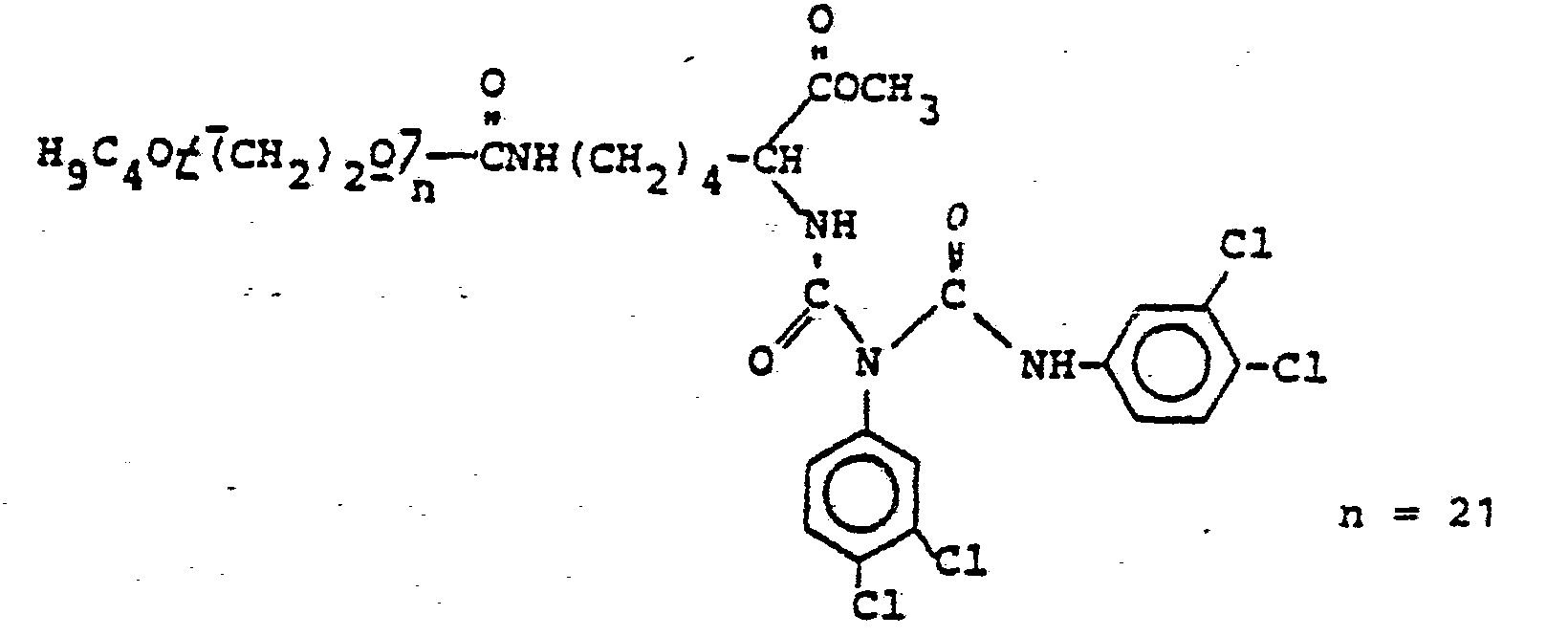
- 9,9 g (0,01 mol) der nach Beispiel 3a erhaltenen Verbindung werden analog zu Beispiel 11 mit 3,5 g (0,01 mol) N,N'-Bis-(3,4-dichlorphenyl)-harnstoff umgesetzt. Nachrührzeit: 5 Stunden bei 90°C.
- Man erhält 12,1 g eines gelben, seifenartigen Feststoffes. Dieser erfindungsgemäß modifizierte neue Wirkstoff ist gut in Wasser und Methanol löslich und besitzt die idealisierte Formel

- 7,3 g (0,01 mol)- der nach Beispiel 4 erhaltenen Verbindung werden analog zu Beispiel 12 mit 3,5 g (0,01 mol) N,N'-Bis[3,4-dichlorphenyl]-harnstoff umgesetzt. Nachrührzeit: 6 Stunden bei 70°C.
- Man erhält 10r2 g einer dunkelgelben, viskosen Flüssigkeit. Dieser erfindungsgemäß modifizierte neue Wirkstoff ist gut in Wasser und/oder Methanol bzw. Ethanol löslich und besitzt die idealisierte Formel

- Nachrührzeit: 14 Stunden bei 70°C.
- Man erhält 9,8 g einer hellbraunen, viskosen Flüssigkeit. Dieser erfindungsgemäß modifizierte neue Wirkstoff ist gut in Wasser und Methanol löslich und besitzt die idealisierte Formel
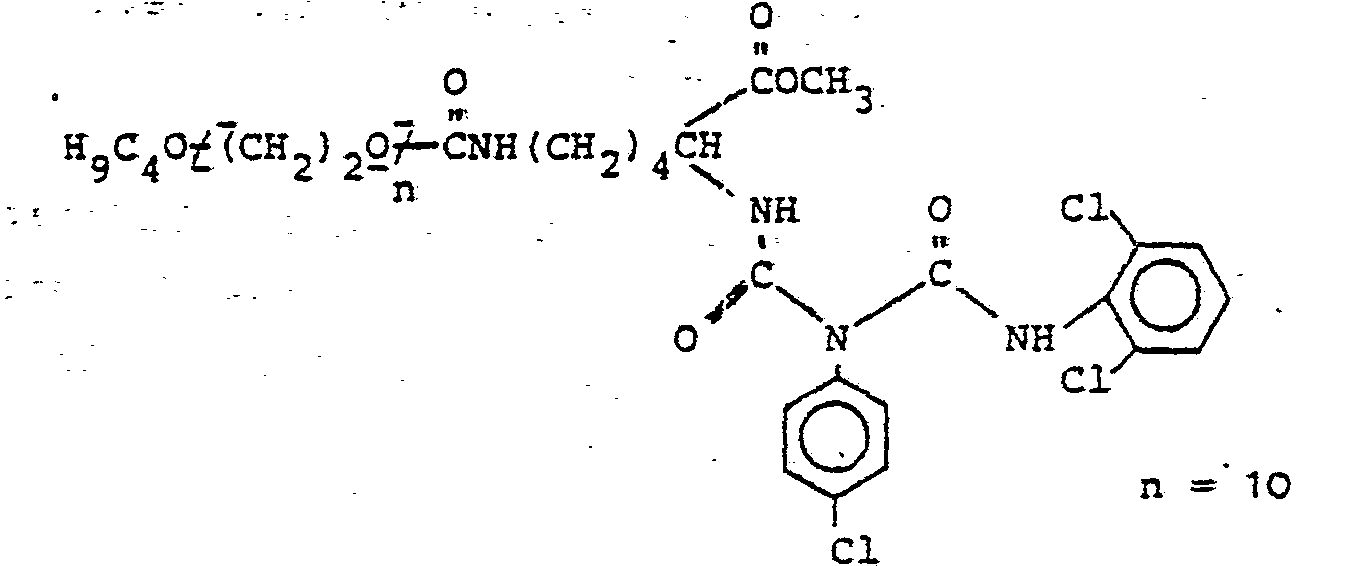
- 7,3 g (0,01 mol) der nach Beispiel 4 erhaltenen Verbindung werden analog zu Beispiel 12 mit 1,5 g (0,01 mol) Phenylthioharnstoff umgesetzt.
- Nachrührzeit: 2 Stunden bei 75°C.
- Man erhält 7,8 g einer rötlich gelben, viskosen Flüssigkeit. Dieser erfindungsgemäß modifizierte neue Wirkstoff ist gut in Wasser und/oder niederen Alkoholen löslich und besitzt die idealisierte Formel

- 22,1 g (0,01 mol) der nach Beispiel 1a erhaltenen Verbindung werden analog zu Beispiel 9 mit 2,0 g (0,01 mol) α-Naphthhlthioharnstoff umgesetzt.
- Nachrührzeit: 3 Stunden bei 110°C.
- Man erhält 23,4 g eines gelbbraunen Feststoffes. Dieser erfindungsgemäß modifizierte neue Wirkstoff ist gut in Wasser und Methanol löslich und besitzt die iedalisierte Formel

- 22,1 g (0,01 mol) der nach Beispiel 1a erhaltenen Verbindung werden analog zu Beispiel 9 mit 2,9 g (0,01 mol) N,N-Dimethyl-N'-[p-(p-Chlorphenoxy)phenyl]-harnstoff umgesetzt.
- Nachrührzeit: 6 Stunden bei 110°C.
- Man erhält 23,8 g eines dunkelgelben Feststoffes. Dieser erfindungsgemäß modifizierte neue Wirkstoff ist gut in
- Wasser und Methanol löslich und besitzt die idealisierte Formel

- 22,1 g (0,01 mol) der nach Beispiel 1a erhaltenen Verbindung werden analog zu Beispiel 9 mit 2,3 g (0,01 mol) N-(3-Trifluormethylphenyl)-N',N'-dimethylharnstoff umgesetzt.
- Nachrührzeit: 8 Stunden bei 110°C.
- Man erhält 23,9 g eines dunkelgelben Feststoffes. Dieser erfindungsgemäß modifizierte neue Wirkstoff ist gut in Wasser und/oder niederen Alkoholen löslich und besitzt die idealisierte Formel

- 22,1 g (0,01 mol) der nach Beispiel 1a erhaltenen Verbindung werden analog zu Beispiel 9 mit 2,1 g (0,01 mol) N-(4-Chlorphenyl)-N'-methoxy-N'-methylharnstoff umgesetzt.
- Nachrührzeit: 5 Stunden bei 1150 C.
- Man erhält 23,7 g eines blaßgelben Feststoffes. Dieser erfindungsgemäß modifizierte neue Wirkstoff ist gut in Wasser und/oder Methanol bzw. Ethanol löslich und besitzt die idealisierte Formel

- Man erhält 24,0 g eines goldgelben Feststoffes. Dieser erfindungsgemäß modifizierte neue Wirkstoff ist gut in Wasser und/oder Methanol löslich und besitzt die idealisierte Formel

- 14,6 g (0,02 mol) der nach Beispiel 4 erhaltenen Verbindung werden analog zu Beispiel 12 mit 2,8 g (0,02 mol) Phenylharnstoff umgesetzt. Nachrührzeit: 14 Stunden bei 70°C.
- Man erhält 15,2 g eines braungelben Feststoffes. Dieser erfindungsgemäß modifizierte neue Wirkstoff ist gut in Wasser und/oder niederen Alkoholen löslich und besitzt die idealisierte Formel

- 12,1 g (0,01 mol) der nach Beispiel 2a erhaltenen Verbindung werden analog zu Beispiel 10 mit 2,9 g (0,01 mol) N-(4-Brom-3-chlorphenyl)-N'-methoxy-N'-methylharnstoff umgesetzt.
- Nachrührzeit: 16 Stunden bei 95°C.
- Man erhält 14,7 g eines dunkelbraunen Feststoffes. Dieser erfindungsgemäß modifizierte neue Wirkstoff ist gut in Wasser und niederen Alkoholen löslich und besitzt die idealisierte Formel

- 12,1 g (0,01 mol) der nach Beispiel 2a erhaltenen Verbindung werden analog zu Beispiel 10 mit 1,9 g (0,01 mol) N-3-Tolyl-N',N'-dimethylharnstoff umgesetzt. Nachrührzeit: 12 Stunden bei 105°C.
- Man erhält 13,8 g eines gelben Feststoffes. Dieser erfindungsgemäß modifizierte neue Wirkstoff ist gut in Wasser und niederen Alkoholen löslich und besitzt die idealisierte Formel:

- 22,1 g (0,01 mol) der nach Beispiel 1a erhaltenen Verbindung werden analog zu Beispiel 9 mit 2,2 g (0,01 mol) N-(2-Benzothiazolyl)-N-Methyl-N'-Methyl-harnstoff umgesetzt.
- Nachrührzeit: 34 Stunden bei 80°C.
- Man erhält 23,7 g eines goldgelben Feststoffes. Dieser erfindungsgemäß modifizierte neue Wirkstoff ist gut in Wasser und/oder niederen Alkoholen löslich und besitzt die idealisierte Formel

- 12,1 g (0,01 mcl) der nach Beispiel 2a erhaltenen Verbindung werden analog zu Beispiel 10 mit 2,2 g (0,01 mol) N-(2-Benzcthiazolyl)-N,N'-Dimethylharnstoff umgesetzt. Nachrührzeit: 38 Stunden bei 85°C.
- Man erhält.14,0 g eines hellgelben Feststoffes. Dieser erfindungsgemäß modifizierte neue Wirkstoff ist gut in Wasser und niederen Alkoholen löslich und besitzt die idealisierte Formel

- 9,9 g (0,01 mol) der nach Beispiel 3a erhaltenen Verbindung werden analog zu Beispiel 11 mit 2,2 g (0,01 mol) N-(2-Benzothiazolyl)-N,N'-Dimethylharnstoff umgesetzt.
- Nachrührzeit: 32 Stunden bei 75°C.
- Man erhält 11,7 g eines fahlgelben, hochviskosen Produktes. Dieser erfindungsgemäß modifizierte neue Wirkstoff ist gut in Wasser und niederen Alkoholen löslich und besitzt die idealisierte Formel

- 22,1 g (0,01 mol) der nach Beispiel 1a erhaltenen Verbindung werden analog zu Beispiel 9 mit 2,0 g (0,01 mol) 3-Methyl-4-Amino-6-Phenyl-1,2,4-triazin-5(4H)-on umgesetzt.
- Nachrührzeit: 8 Stunden bei 105°C.
- Man erhält 23,7 g eines graugelben Feststoffes. Dieser erfindungsgemäß modifizierte Wirkstoff ist gut in Wasser und/oder niederen Alkoholen löslich und besitzt die idealisierte Formel

- 9,9 g (0,01 mol) der nach Beispiel 3a erhaltenen Verbindung werden analog zu Beispiel 11 mit 2,0 g (0,01 mol) 3-Methyl-4-amino-6-phenyl-1,2,4-triazin-5(4H)-on umgesetzt.
- Nachrührzeit: 12 Stunden bei 35°C.
- Man erhält 11,6 g eines graugoldfarbigen, hochviskosen Produktes. Dieser erfindungsgemäß modifizierte neue Wirkstoff ist gut in Wasser und/oder niederen Alkoholen löslich und besitzt die idealisierte Formel

- 22,1 g (0,01 mol) der nach Beispiel 1a erhaltenen Verbindung werden analog zu Beispiel 9 mit 2,6 g (0,01 mol) 1-Amino-3-(1-Methylpropyl)-5-Brom-6-methyl-1,3-diazin-(5H)-2,4-dion umgesetzt.
- Nachrührzeit: 16 Stunden bei 100°C.
- Man erhält 24,4 g eines dunkelgelben Feststoffes. Dieser erfindungsgemäß modifizierte neue Wirkstoff ist gut in Wasser und/oder niederen Alkoholen löslich-und besitzt die idealisierte Formel

- 9,9 g (0,01 mol) der nach Beispiel 3a erhaltenen Verbindung werden analog zu Beispiel 11 mit 2,6 g (0,01 mol) 1-Amino-3-(1-Methyl-propyl)-5-Brom-6-methyl-1,3-diazin-(5H)-2,4-dion umgesetzt.
- Nachrührzeit: 14 Stunden, bei 110°C.
- Man erhält 12,1 g eines dunkelgelben, hochviskosen Produktes. Dieser erfindungsgemäß modifizierte neue Wirkstoff ist gut in Wasser und niederen Alkoholen löslich und besitzt die idealisierte Formel

- 22,1 g (0,0-1 mol) der nach Beispiel 1a erhaltenen Verbindung werden analog zu Beispiel 9 mit 3,1 g (0,01 mol) N-o,o'-Difluorbenzoyl-N'-p-Chlorphenylharnstoff umgesetzt. Nachrührzeit: 6 Stunden bei 110°C.
- Man erhält 24,6 g eines dunkelbraunen Feststoffes. Dieser erfindungsgemäß modifizierte neue Wirkstoff ist gut in Wasser und/oder niederen Alkoholen löslich und besitzt die idealisierte Formel

- 22,1 g (0,01 mol) der nach Beispiel 1a erhaltenen Verbindung werden analog zu Beispiel 9 mit 3,7 g (0,01 mol) 3-(3,4-Di-chlorphenyl)-6-(2,6-difluorphenyl)-1-oxa-3,5-diaZin (3H,5H)-2,4-dion umgesetzt.
- Nachrührzeit: 8 Stunden bei 1000 C.
- Man erhält 25,1 g eines grünlichgelben Feststoffes. Dieser erfindungsgemäß modifizierte neue Wirkstoff ist gut in Wasser und/oder niederen Alkoholen löslich und besitzt die idealisierte Formel
-

- 12,1 g (0,01 mol) der nach Beispiel 2a erhaltenen Verbindung werden analog zu Beispiel 10 mit 3,7 g (0,01 mol) 3-(3,4-Dichlorphenyl)-6-(2,6-Difluorphenyl)-1-oxa-3,5-diazin-(3H,4H)-2,4-dion umgesetzt. Nachrührzeit: 10 Stunden bei 95°C.
- Man erhält 15,2 g eines grünbraunen Feststoffes. Dieser erfindungsgemäß modifizierte neue Wirkstoff ist gut in Wasser und/oder niederen Alkoholen löslich und besitzt die idealisierte Formel:
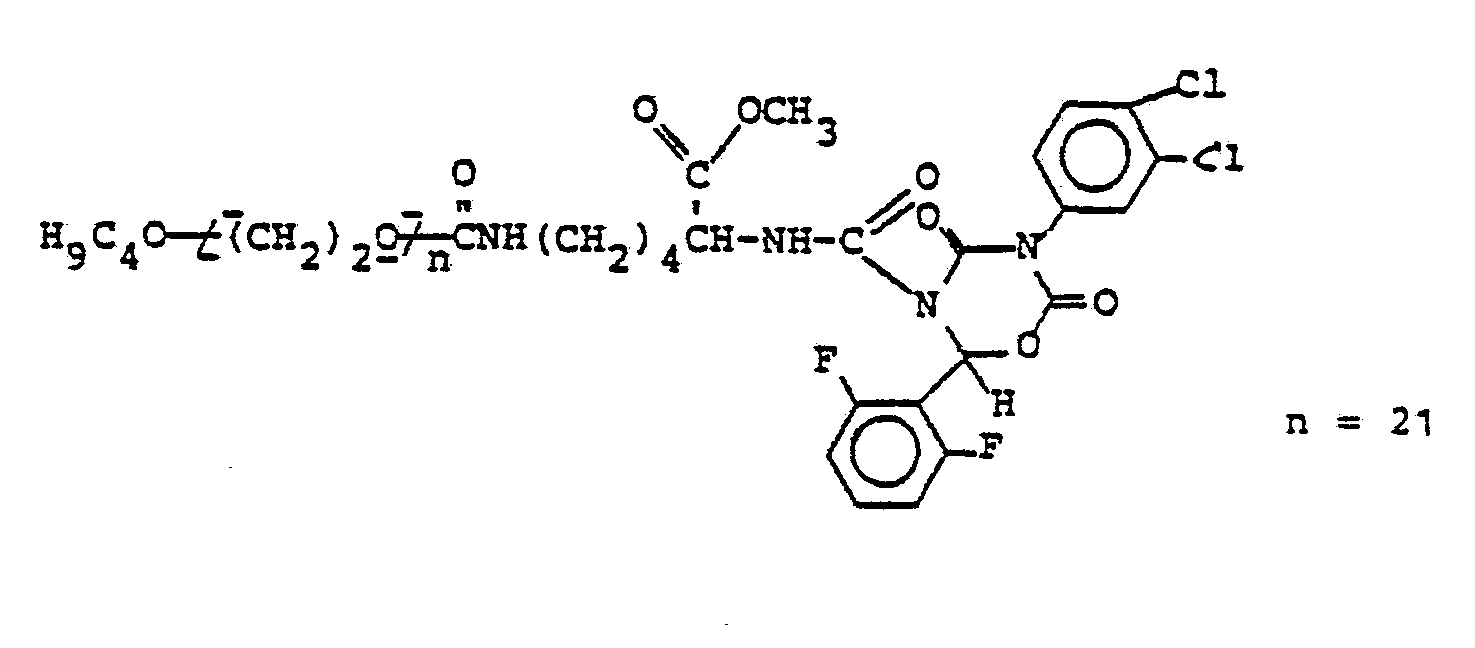
- 22,1 g (0,01 mol) der nach Beispiel 1a erhaltenen Verbindung werden analog zu Beispiel 9 mit 3,4 g N-(2-Chlorbenzoyl)-N'-(4-Trifluormethoxyphenyl)-harnstoff umgesetzt. Nachrührzeit: 10 Stunden bei 105°C.
- Man erhält 25,1 g eines goldgelben Feststoffes. Dieser erfindungsgemäß modifizierte neue Wirkstoff ist gut in Wasser und/oder niederen Alkoholen löslich und besitzt die idealisierte Formel

- 22,1 g (0,01 mol) der nach Beispiel 1a erhaltenen Verbindung werden analog zu Beispiel 9 mit 2,1 g (0,01 mol) 4-Benzothienyl-N-methylcarbamat umgesetzt.
- Nachrührzeit: 8 Stunden bei 90°C.
- Man erhält 23,6 g eines gelben Festtoffes. Dieser erfindungsgemäß modifizierte neue Wirkstoff ist gut in Wasser und niederen Alkoholen löslich und besitzt die idealisierte Formel

- 12,1 g (0,01 mol) der nach Beispiel 2a erhaltenen Verbindung werden analog zu Beispiel 10 mit 2,0 g (0,01 mol) N-Methyl-1-naphthylcarbamat umgesetzt. Nachrührzeit: 9 Stunden bei 90°C.
- Man erhält 13,8 g eines goldgelben Feststoffes. Dieser erfindungsgemäß modifizierte neue Wirkstoff ist gut in Wasser und niederen Alkoholen löslich und besitzt die idealisierte Formel

- 9,9 g (0,01 mol) der nach Beispiel 3a erhaltenen Verbindung werden analog zm Beispiel 11 mit 1,8 g (0,01 mol) 3,4-Dimethylphenyl-N-methylcarbamat umgesetzt. Nachrührzeit: 7 Stunden bei 95°C.
- Man erhält 10,2 g eines blaßgelben, hochviskosen Produktes. Dieser erfindungsgemäß modifizierte neue Wirkstoff ist gut in Wasser und niederen Alkoholen löslich und besitzt die idealisierte Formel

- 12,2 g (0,01 mol) der nach Beispiel 1a erhaltenen Verbindung werden analog zu Beispiel 9 mit 3,1 g (0,01 mol) N-(2,6-Difluorbenzoyl)-p-chlorphenylcarbamat umgesetzt. Nachrührzeit: 16 Stunden bei 110°C.
- Man erhält 24,7 g eines gelblich braunen Feststoffes. Dieser erfindungsgemäß modifizierte neue Wirkstoff ist gut in Wasser und niederen Alkoholen löslich und besitzt die idealisierte Formel

- 9,9 g (0,01 mol) der nach Beispiel 3a erhaltenen Verbindung werden analog zu Beispiel 11 mit 3,5 g (0,01 mol) N-(2,6-Difluorbenzoyl)-o,o'-Dichlorphenylcarbamat. umgesetzt.
- Nachrührzeit: 20 Stunden bei 95°C.
- Man erhält 11,5 g eines dunkelbraunen, hochviskosen Produktes. Dieser erfindungsgemäß modifizierte neue Wirkstoff ist gut in Wasser und niederen Alkoholen löslich und besitzt die idealisierte Formel

- 22,1 g (0,01 mol) der nach Beispiel 1a erhaltenen Verbindung werden analog zu Beispiel 9 mit 3,2.g (0,01 mol) N-(2,6-Difluorbenzoyl)-7-Nitrophenylcarbamat umgesetzt.
- Nachrührzeit: 12 Stunden bei 100°C.
- Man erhält 25,1 g eines gelben Feststoffes. Dieser erfindungsgemäß modifizierte neue Wirkstoff ist gut in Wasser und niederen Alkoholen löslich und besitzt die idealisierte Formel
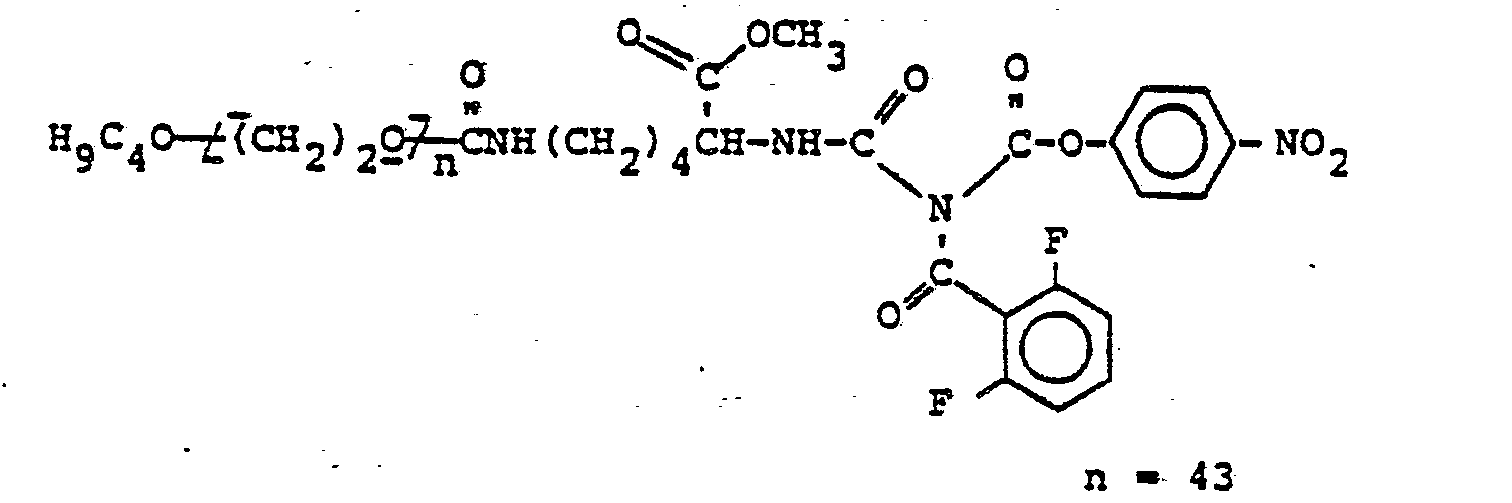
- 9,9 g (0,01 mol) der nach Beispiel 3a erhaltenen Verbindung werden analog zu Beispiel 11 mit 3,6 g (0,01 mol) N-(2,6-Difluorbenzoyl)-2-chlor-4-nitrophenylcar- bamat umgesetzt.
- Nachrührzeit: 16 Stunden bei 80°C.
- Man erhält 12,7 g eines dunkelbraunen, viskosen Produktes. Dieser erfindungsgemäß modifizierte neue Wirkstoff ist gut in Wasser und Methanol sowie Ethanol löslich und besitzt die idealisierte Formel

- 22,1 g (0,01 mol) der nach Beispiel 1a erhaltenen Verbindung werden analog zu Beispiel 9 mit 3,3 g (0,01 mol) N-(2,6-Difluorbenzoyl)-p-chlorphenylthiocarbamat umgesetzt.
- Nachrührzeit: 8 Stunden bei 90°C.
- Man erhält 25,3 g eines hellbraunen Feststoffes. Dieser erfindungsgemäß modifizierte neue Wirkstoff ist gut in Wasser und/oder niederen Alkoholen löslich und besitzt die idealisierte Formel

- 22,1 g (0,01 mol) der nach Beispiel 1a erhaltenen Verbindung werden analog zu Beispiel 9 mit 2,1 g (0,01 mol) 2-Isopropyloxyphenyl-N-methylcarbamat umgesetzt. Nachrührzeit: 6 Stunden bei 110°C.
- Man erhält 24,0 g eines goldgelben Feststoffes. Dieser erfindungsgemäß modifizierte neue Wirkstoff ist gut in Wasser und:oder niederen Alkoholen löslich und besitzt die idealisierte Formel
-

- 12,1 g (0,01 mol) der nach Beispiel 2a erhaltenen Verbindung werden analog zu Beispiel 10 mit 2,1 g (0,01 mol) 2-Isopropyloxyphenyl-N-methylcarbamat umgesetzt. Nachrührzeit: 7 Stunden bei 95°C.
- Man erhält 13,7 g eines dunkelgelben Feststoffes von wachsartiger Konsistenz. Dieser erfindungsgemäß modifizierte neue Wirkstoff ist gut in Wasser und niederen Alkoholen löslich und besitzt die idealisierte Formel

- 9.9 g (0,01 mol) der nach Beispiel 3a erhaltenen Verbindung werden analog zu Beispiel 11 mit 2,1 g (0,01 mol) 2-Isopropyloxyphenyl-N-methylcarbamat umgesetzt. Nachrühr zeit: 8 Stunden bei 80°C.
- Man erhält 11,6 g eines graugelben, viskosen Produktes. Dieser erfindungsgemäß modifizierte neue Wirkstoff ist gut in Wasser und niederen Alkoholen löslich und besitzt die idealisierte Formel

- 22,1 g (0,01 mol) der nach Beispiel 1a erhaltenen Verbindung werden analog zu Beispiel 3 mit 2,2 g (0,01 mol) 2,3-Dihydro-2,2-dimethyl-7-benzofuranyl-N-methylcarbamat umgesetzt.
- Nachrührzeit: 6 Stunden bei 110°C. Man erhält 23,7 g eines fahlgelben Feststoffes. Dieser erfindungsgemäß modifiziert.e neue Wirkstoff ist gut in Wasser und/oder niederen Alkoholen löslich und besitzt die idealisierte Formel
-

- 12,1 g (0,01 mol) der nach Beispiel 2a erhaltenen Verbindung werden analog zu Beispiel 10 mit 2,2 g (0,01 mol) 2,3-Dihydro-2,2-dimethyl-7-benzofuranyl-N-methylcarbamat umgesetzt.
- Nachrührzeit: 8 Stunden bei 90°C.
- Man erhält 13,5 g eines gelben Feststoffes. Dieser erfindungsgemäß modifizierte neue Wirkstoff ist gut in Wasser und/oder niederen Alkoholen löslich und besitzt die idealisierte Formel
-

- 12,1 g (0,01 mol) der nach Beispiel 2a erhaltenen Verbindung werden analog zu Beispiel 10 mit 2,25 g (0,01 mol) 3,5-Dimethyl-4-methylmercapto-phenyl-N-methylcarbamat umgesetzt.
- Nachrührzeit: 11 Stunden bei 105°C.
- Man erhält 13,9 g eines bräunlichen Feststoffes. Dieser erfindungsgemäß modifizierte neue Wirkstoff ist gut in Wasser und/oder niederen Alkoholen löslich und besitzt die idealisierte Formel

- 9,9 g (0,01 mol) der nach Beispiel 3a erhaltenen Verbindung werden analog zu Beispiel 11 mit 2,25 g (0,01 mol) 3,5-Dimethyl-4-methylmercapto-phenyl-N-methylcarbamat umgesetzt.
- Nachrührzeit: 16 Stunden bei 80°C
- Man erhält 11,7 g eines dunkelgelben, viskosen Produktes. Dieser erfindungsgemäß modifizierte neue Wirkstoff ist gut in Wasser und/oder niederen Alkoholen löslich und besitzt die idealisierte Formel

- 22,1 g (0,01 mol) der nach Beispiel 1a erhaltenen Verbindung werden analog zu Beispiel 9 mit 2,1 g (0,01 mol) 3-Amino-2,5-dichlorbenzoesäure umgesetzt. Nachrührzeit: 1 Stunde bei 80°C.
- Man erhält 23,8 g eines farblosen Feststoffes. Dieser erfindungsgemäß modifizierte neue Wirkstoff ist gut in Wasser löslich und besitzt die idealisierte Formel

- 22,1 g (0,01 mol) der nach Beispiel 1a erhaltenen Verbindung werden analog zu Beispiel 10 mit 2,9 g (0,01 mol) 3-(d-Tetralyl)-4-hydroxycumarin umgesetzt. Nachrührzeit: 4 Stunden bei 80°C.
- Man erhält 24,6 g eines dunkelgelben Feststoffes. Dieser erfindungsgemäß modifizierte neue Wirkstoff ist gut in Wasser und niederen Alkoholen löslich und besitzt die idealisierte Formel
-

- 9,9 g (0,01 mol) der nach Beispiel 3a erhaltenen Verbindung werden analog zu Beispiel 11 mit 2,9 g (0,01 mol) 3-(d-Tetralyl)-4-Hydroxycumarin umgesetzt. Nachrührzeit: 2 Stunden bei 110°C.
- Man erhält 13,4 g eines dunkelgelbenbraunen, vikosen Produktes. Dieser erfindungsgemäß modifizierte neue
- Wirkstoff ist gut in Wasser und niederen Alkoholen löslich und besitzt die idealisierte Formel
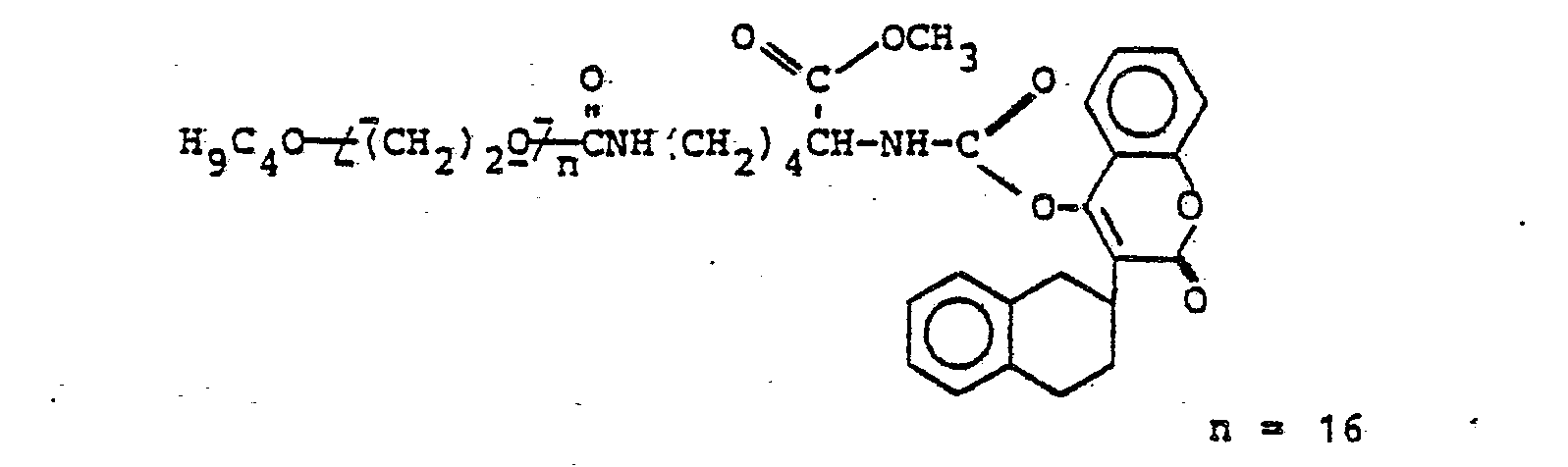
- 12,1 g (0,01 mol) der nach Beispiel 2a erhaltenen Verbindung werden analog zu Beispiel 10 mit 3,1 g (0,01 mol) 3-(1'-Phenyl-2'-acetylethyl)-4-hydroxycumarin umgesetzt.
- Nachrührzeit: 3 Stunden bei 105°C.
- Man erhält 14,7 g eines braunrose Feststoffes von wachsartiger Konsistenz. Dieser erfindungsgemäß modifizierte neue Wirkstoff ist gut in Wasser und niederen Alkoholen löslich und besitzt die idealisierte Formel

- 22,1 g (0,01 mol) der nach Beispiel 1a erhaltenen Verbindung werden analog zu Beispiel 9 mit 1,2 g (0,01 mol) 4-Aminoperhydro-1,2-oxazin-3-on umgesetzt. Nachrührzeit: 30 Minuten bei 90°C.
- Man erhält 22,9 g eines gelben Feststoffes. Dieser erfindungsgemäß modifizierte neue Wirkstoff ist gut in Wasser und/oder niederen.Alkoholen löslich und besitzt die idealisierte Formel

- 12,1 g (0,01 mol) der nach Beispiel 2a erhaltenen Verbindung werden analog zu Beispiel 10 mit 1,2 g (0,01 mol) Allylthioharnstoff umgesetzt. Nachrührzeit: 36 Stunden bei 70°C.
- Man erhält 22,7 g eines goldgelben Feststoffes. Dieser erfindungsgemäß modifizierte Wirkstoff ist gut in Wasser und niederen Alkoholen löslich und besitzt die idealisierte Formel

- 9,9 g (0,01 mol) der nach Beispiel 3a erhaltenen Verbindung werden analog zu Beispiel 11 mit 1,2 g (0,01 mol) Nicotinsäureamid umgesetzt. Nachrührzeit: 20 Stunden bei 105°C.
- Man erhält 10,4 g eines dunkelgelbroten, viskosen Produktes. Dieser erfindungsgemäß modifizierte neue Wirkstoff ist gut in Wasser und Methanol sowie Ethanol löslich und besitzt die idealisierte Formel

- 22,1 g (0,01 mol) der nach Beispiel 1a erhaltenen Verbindung werden analog zu Beispiel 9 mit 1,3 g (0,01 mol) Isonicotinsäurehydrazid umgesetzt. Nachrührzeit: 2 Stunden bei 95°C.
- Man erhält 22,8 g eines hellgelblichweißen Feststoffes. Dieser erfindungsgemäß modifizierte neue Wirkstoff ist gut in Wasser und/oder niederen Alkoholen löslich und besitzt die idealisierte Formel

- 12,1 g (0,01 mol) der nach Beispiel 2a erhaltenen Verbindung werden analog zu Beispiel 10 mit 1,3 g (0,01 mol) Isonicotinsäurehydrazid umgesetzt. Nachrührzeit: 2 Stunden bei 95°C.
- Man erhält 12,9 g eines gelbweißen Feststoffes. Dieser erfindungsgemäß modifizierte neue Wirkstoff ist gut in Wasser und/oder niederen Alkoholen löslich und besitzt die idealisierte Formel

- 9.9 g (0,01 mol) der nach Beispiel 3a erhaltenen Verbindung werden analog zu Beispiel 11 mit 1,3 g (0,01 mol) Isonicotinsäurehydrazid umgesetzt. Nachrührzeit: 2 Stunden bei 95°C.
- Man erhält 10,9 g eines goldgelben, viskosen Produktes. Dieser erfindungsgemäß modifizierte neue Wirkstoff ist gut in Wasser und Methanol sowie Ethanol löslich und besitzt die idealisierte Formel

- 22,1 g (0,01 mol) der nach Beispiel 1a erhaltenen Verbindung werden analog zu Beispiel 9 mit 1,8 g (0,01 mol) 1,3-Dimethylpurin-2,6-(1H,3H)-dion umgesetzt. Nachrührzeit: 1 Stunde bei 80°C.
- Man erhält 23,6 g eines dunkelgelben Feststoffes. Dieser erfindungsgemäß modifizierte neue Wirkstoff ist gut in Wasser und/oder niederen Alkoholen löslich und besitzt die idealisierte Formel

- 12,1 g (0,01 mol) der nach Beispiel 2a erhaltenen Verbindung werden analog zu Beispiel 10 mit 2,4 g (0,01 mol) 4-Amlno-1-ribofuranosyl-1,3,5-triazin-2(1H)-on umgesetzt.
- Nachrührzeit: 2 Stunden bei 55°C.
- Man erhält 14,2 g eines fast farblosen Feststoffes. Dieser erfindungsgemäß modifizierte neue Wirkstoff zeigt eine hervorragende Wasserlöslichkeit und besitzt die idealisierte

- 22,1 g (0,01 mol) der nach Beispiel 1a erhaltenen Verbindung werden analog zu Beispiel 9 mit 2,6 g (0,01 mol) 2-Sulfanilamidothiazol umgesetzt. ,
- Nachrührzeit: 30 Minuten bei 70°C.
- Man erhält 24,3 g eines gelben Feststoffes. Dieser erfindungsgemäß modifizierte neue Wirkstoff ist gut in Wasser und/oder niederen Alkoholen löslich und besitzt die idealisierte Formel

- 22,1 g (0,01 mol) der nach Beispiel 1a erhaltenen Verbindung werden analog zu Beispiel 9 mit 2,6 g (0,01 mol) 3(5)-Ribofuranosyl-4-hydroxypyrazol-6(3)-carboxamid umgesetzt.
- Nachrührzeit: 9 Stunden bei 50°C.
- Man erhält 24,2 g eines dunkelgelbroten Feststoffes. Dieser erfindungsgemäß modifizierte neue Wirkstoff ist gut in Wasser und/oder niederen Alkoholen löslich und besitzt die idealisierte Formel

- 44,2 g (0,02 mol) der nach Beispiel 1a erhaltenen Verbindung werden analog zu Beispiel 9 mit 2,2 g (0,01 mol) 2-Methyl-2-n-propyL-trimethylendicarbamat umgesetzt. Nachrührzeit: 17 Stunden bei. 110°C.
- Man erhält 45,7 g eines braungelben Feststoffes. Dieser erfindungsgemäß modifizierte neue Wirkstoff ist ausgezeichnet in Wasser und/oder niederen Alkoholen löslich und besitzt die idealisierte Formel

- 19,8 g (0,02 mol) der nach Beispiel 3a erhaltenen Verbindung werden analog zu Beispiel 11 mit 2,2 g (0,01 mol) 2-Methyl-2-n-propyl-trimethylendicarbamat umgesetzt. Nachrührzeit: 17 Stunden bei 110°C.
- Man erhält 21,6 g eines braunroten, viskosen Produktes. Dieser erfindungsgemäß modifizierte neue Wirkstoff ist gut in Wasser und/oder niederen Alkoholen löslich und besitzt die idealisierte Formel

- 22,1 g (0,01 mol) der nach Beispiel 1a erhaltenen Verbindung werden analog zu Beispiel 9 mit 2,2 g (0,01 mol) D(-)-threo-1-(p-Nitrophenyl)-2-dichloracetamido-1,3-propandiol umgesetzt.
- Nachrührzeit: 6 Stunden bei 95°C.
- Man erhält 24,0 g eines goldgelben Feststoffes. Dieser erfindungsgemäB modifizierte neue Wirkstoff ist gut in Wasser und/oder niederen Alkoholen löslich und besitzt die idealisierte Formel

- 9.9 g (0,01 mol) der nach Beispiel 3a erhaltenen Verbindung werden analog zu Beispiel 11 mit 2,2 g (0,01 mol) D(-)threo-1-(p-Nitrophenyl)-2-dichloracetamido-T,3-propandiol umgesetzt.
- Nachrührzeit: 5 Stunden bei 85°C.
- Man erhält 11,7 g eines rosegelben, viskosen Produktes. Dieser erfindungsgemäß modifizierte neue Wirkstoff ist gut in Wasser und/oder niederen Alkoholen löslich und besitzt die idealisierte Formel

- 12,1 g (0,01 mol) der nach Beispiel 2a erhaltenen Verbindung werden analog zu Beispiel 10 mit 2,2 g (0,01 mol) 5,6-Dihydro-2-(2,6-xylidino)-4H-1,3-thiazin umgesetzt. Nachrührzeit: 1 Stunde bei 75°C.
- Man erhält 14,0 g eines dunkelgelben Feststoffes. Dieser erfindungsgemäß modifizierte neue Wirkstoff ist gut in Wasser und niederen Alkcholen löslich und besitzt die idealisierte Formel

- 22,1 g (0,01 mol) der nach Beispiel 1a erhaltenen Verbindung werden analog zu Beispiel 9 mit 3,9 g (0,01 mol) N-(4-Chlor-3-sulfamoylbenzolsulfonyl)-N-methyl-2-aminomethyl-2-methyltetrahydrofuran umgesetzt. Nachrührzeit: 18 Stunden bei 95°C.
- Man erhält 25 g eines braungelben Feststoffes. Dieser erfindungsgemäß modifizierte neue Wirkstoff ist gut in Wasser und niederen Alkoholen löslich und besitzt die idealisierte Formel

- 12,1 g (0,01 mol) der nach Beispiel 2a erhaltenen Verbindung werden analog zu Beispiel 10 mit 2,4 g (0,01 mol) 2-Diethylaminoethyl-p-aminobenzoat umgesetzt. Nachrührzeit: 30 Minuten bei 70°C.
- Man erhält 14,2 g eines farblosen Feststoffes von wachsartiger Konsistenz. Dieser erfindungsgemäß modifizierte neue Wirkstoff ist gut in Wasser und/oder niederen Alkoholen löslich und besitzt die idealisierte Formel

- 22,1 g (0,01 mol) der nach Beispiel 1a erhaltenen Verbindung werden analog zu Beispiel 9 mit 3,6 g (0,01 mol) D(+)-6-(5-Amino-5-carboxyvaleramido)-3,3-dimethyl-7-oxo-4-thia-1-azabicyclo-[3,2,0]-heptan-2-carbonsäure umgesetzt.
- Nachrührzeit: 2 Stunden bei 55°C
- Man erhält 25,3 g eines blaßgelben Feststoffes. Dieser erfindungsgemäß modifizierte neue Wirkstoff ist gut in Wasser und/oder niederen Alkoholen löslich und besitzt die idealisierte Formel

- 9,9 g (0,01 mol) der nach Beispiel 3a erhaltenen Verbindung werden analog zu Beispiel 11 mit 3,2 g (0,01 mol) 1-Phenyl-5-sulfanilamidopyrazol umgesetzt Nachrührzeit: 45 Minuten bei 85°C.
- Man erhält 12,8 g eines rosegelben, viskosen Produktes. Dieser erfindungsgemäß modifizierte neue Wirkstoff ist gut in Wasser und/oder Methanol sowie Ethanol löslich und besitzt die idealisierte Formel

- 22,1 g (0,01 mol) der nach Beispiel 1a erhaltenen Verbindung werden analog zu Beispiel 9 mit 3,8 g (0,01 mol) D-7-(2-Amino-2-phenylacetamido)-3-methyl-8-oxo-5-thia-1-oxobieyclo[4,2,0]oct-2-en-2-carbonsäure umgesetzt. Nachrührzeit: 3 Stunden bei 55°C.
- Man erhält 25,6 g eines blaßgelben Feststoffes. Dieser erfindungsgemäß modifizierte neue Wirkstoff ist gut in Wasser und/oder niederen Alkoholen löslich und besitzt die idealisierte Formel

- 12,1 g (0,01 mol) der nach Beispiel 2a erhaltenen Verbindung werden analog zu Beispiel 10 mit 3,5 g (0,01 mol) D (-) -6- (α-Aminophenylacetamido) -3,3-dimethyl-7-oxo-4-thia-1-azabicyclo-[3,2,0]-heptan-2-carbonsäure umgesetzt.
- Nachrührzeit: 45 Minuten bei 60°C.
- Man erhält 15,3 g eines blaßgelben Feststoffes. Dieser erfindungsgemäß modifizierte neue Wirkstoff ist gut in Wasser und/oder niederen Alkoholen löslich und besitzt die idealisierte Formel

- 9,9 g (0,01 mol) der nach Beispiel 3a erhaltenen Verbindung werden analog zu Beispiel 11 mit 3,3 g (0,01 mol) D(+)lysergsäure-β-hydroxyisopropylamid umgesetzt. Nachrührzeit: 1 Stunde bei 70°C
- Man erhält 13,1 g eines gelbroten viskosen Produktes. Dieser erfindungsgemäß modifizierte neue Wirkstoff ist gut in Wasser und/oder Ethanol löslich und besitzt die idealisierte Formel

- 22,1 g (0,01 mol) der nach Beispiel 1a erhaltenen Verbindung werden analog zu Beispiel 9 mit 5,3 g (0,01 mol) 9-Acetyl-7,8,9,10-tetrahydro-6,7,9,11 -tetrahydroxy-4-methoxy-5,12-naphthacenchinon-7-(3-Amino-5-methyl-2,3-didesoxy- α-lyxopyranosid) umgesetzt.
- Nachrührzeit: 2 Stunden bei 55°C.
- Man erhält 27,0 g eines blaßgelben Feststoffes. Dieser erfindungsgemäß modifizierte neue Wirkstoff ist gut in Wasser und/oder niederen Alkoholen löslich und besitzt die idealisierte Formel

- 22,1 g (0,01 mol) der nach Beispiel 1a erhaltenen Verbindung werden analog zu Beispiel 9 mit 1,7 g (0,01 mol) 6-Aminopurin-8-thiol umgesetzt.
- Nachrührzeit: 15 Minuten bei 45°C.
- Man erhält 23,4 g eines rotgelben Feststoffes. Dieser erfindungsgemäß modifizierte neue Wirkstoff ist gut in Wasser und/oder niederen Alkoholen löslich und besitzt die idealisierte Formel
-

- 22,1 g (0,01 mol) der nach Beispiel 1a erhalten Verbindung werden analog zu Beispiel 9 mit 2,2 g (0,01 mol) 6-Amino-3,3-dimethyl-7-oxo-4-thia-1-azabicyclo-[3,2,0]-heptan-carbonsäure umgesetzt. Nachrührzeit: 30 Minuten bei 60°C.
- Man erhält 24,0 g eines weißlichgelben Feststoffes. Dieser erfindungsgemäß modifizierte neue Wirkstoff ist gut in Wasser und/oder niederen Alkoholen sowie Essigester und Aceton löslich und besitzt die idealisierte Formel
-

- 9,9 g (0,01 mol) der nach Beispiel 3a erhaltenen Verbindung werden analog zu Beispiel 11 mit 2,4 g (0,01 mol) 2-Ethyl-2-brombutyryl-harnstoff umgesetzt. Nachrührzeit: 36 Stunden bei 95°C.
- Man erhält 12 g eines rotbraunen, viskosen Produktes. Dieser erfindungsgemäß modifizierte neue Wirkstoff ist gut in Wasser und Methanol sowie Ethanol löslich und besitzt die idealisierte Formel

- 12,1 g (0,01 mol) der nach Beispiel 2a erhaltenen Verbindung werden analog zu Beispiel 10 mit 2,3 g (0,01 mol) 4-Aminobenzolsulfothiocarbamid umgesetzt. Nachrührzeit: 20 Minuten bei 85°C.
- Man erhält 14,1 g eines rotgoldenen, wachsartigen Feststoffes. Dieser erfindungsgemäß modifizierte neue Wirkstoff ist gut in Wasser und/oder niederen Alkoholen löslich und besitzt die idealisierte Formel

- 22,1 g (0,01 mol) der nach Beispiel 1a erhaltenen Verbindung werden analog zu Beispiel 9 mit 3,5 g (0,01 mol) 2,6-Dimethyl-3,5-diacetyl-4-o-nitrophenyl-1,4-dihydropyridin umgesetzt.
- Nachrührzeit: 1 Stunde bei 70°C.
- Man erhält 25,3 g eines dunkelgelben Feststoffes. Dieser erfindungsgemäß modifizierte neue Wirkstoff ist gut in Wasser und/oder niederen Alkoholen löslich und besitzt die idealisierte Formel

- 12,1 g (0,01 mol) der nach Beispiel 2a erhaltenen Verbindung werden analog zu Eeispiel 10 mit 3,5 g (0,01 mol) 2,6-Dimethyl--3,5-Diacetyl-4-o-nitrophenyl-1,4-dihydropyridin umgesetzt.
- Nachrührzeit: 1 Stunde bei 70°C.
- Man erhält 15,1 g eines dunkelgelben, wachsartigen Feststoffes. Dieser erfindungsgemäß modifizierte neue Wirkstoff ist gut in Wasser und/oder niederen Alkoholen löslich und besitzt die idealisierte Formel

- 9,9 g (0,01 mol) der nach Beispiel 3a erhaltenen Verbindung werden analog zu Beispiel 11 mit 3,5 g (0,01 mol) 2,6-Dimethyl-3,5-Diacetyl-4-o-nitrophenyl-1,4-dihydropyridin umgesetzt.
- Nachrührzeit: 1 Stunde bei 70°C.
- Man erhält 13,0 g eines rötlichgelben, viskosen Produktes. Dieser erfindungsgemäß modifizierte neue Wirkstoff ist gut in Wasser und/oder niederen Alkoholen löslich und besitzt die idealisierte Formel

- 22,1 g (0,01 mol) der nach Beispiel 1a erhaltenen Verbindung werden analog zu Beispiel 9 mit 2,8 g (0,01 mol) 2-Sulfanilamido-5-methoxypyrimidin umgesetzt. Nachrührzeit: 30 Minuten bei 75°C.
- Man erhält 24,7 g eines hellgelben Feststoffes. Dieser erfindungegemäß modifizierte neue Wirkstoff ist gut in Wasser und /oder niederen Alkoholen löslich und besitzt die idealisierte Formel
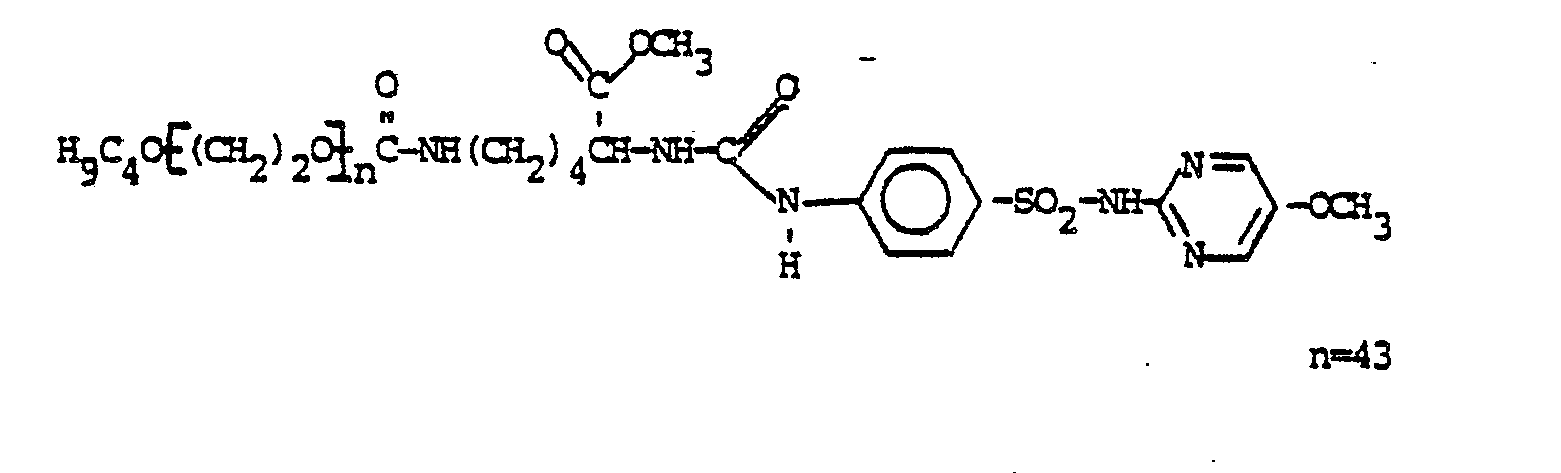
- 108,4 g (0,05 mol) der nach Beispiel 1b erhaltenen Verbindung werden analog zu Beispiel 25 mit 10,7 g (0,05 mol) 4-Amino-6-tert.-butyl-3-(methylthio)-1,2,4-triazin-5(4H)-on umgesetzt. Nachrührzeit: 3 Stunden bei 105°C.
- Man erhält 117,4 g eines gelben Feststoffes. Dieser erfindungsgemäß modifizierte neue Wirkstoff ist sehr gut in Wasser und/oder niederen Alkoholen löslich und besitzt die idealisierte Formel

- 58,4 g (0,05 mol) der nach Beispiel 2b erhaltenen Verbindung werden analog zu Beispiel 26 mit 10,7 g (0,05 mol) 4-Amino-6-tert.-butyl-3-(methylthio)-1,2,4-triazin-5 (4H)-on umgesetzt.
- Nachrührzeit: 2 Stunden bei 100°C.
- Man erhält 68,3 g eines dunkelgelben, wachsartigen Feststoffes. Dieser erfindungsgemäß modifizierte neue Wirkstoff ist gut in Wasser und/oder niederen Alkoholen löslich und besitzt die idealisierte Formel:

- 47,6 g (0,05 mol) der nach Beispiel 3b erhaltenen Verbindung werden analog zu Beispiel 27 mit 10,7 g (0,05 mol) 4-Amino-6-tert.-butyl-3-(methylthio)-1,2,4-triazin-5(4H)-on umgesetzt.
- Nachrührzeit: 115 Minuten bei 115°C.
- Man erhält 58,1 g eines dunkel gelbroten, viskosen Produktes. Dieser erfindungsgemäß modifizierte neue Wirkstoff ist sehr gut in Wasser und/oder niederen Alkoholen löslich und besitzt die idealisierte Formel

- 21,7 g (0,01 mol) der nach Beispiel 1b erhaltenen Verbindung werden analog zu Beispiel 47 mit 2,2 g (0,01 mol) N-(2-Benzothiazolyl)-N,N'-dimethyl-harnstoff umgesetzt.
- Nachrührzeit: 27 Stunden bei 95°C.
- Man erhält 23,5. g eines dunkelgraugelben, wachsartigen Feststoffes. Dieser erfindungsgemäß modifizierte neue Wirkstoff ist gut in Wasser und/oder niederenglkoholen löslich und besitzt die idealisierte Formel
-

- 11,7 g (0,01 mol) der nach Beispiel 2b erhaltenen Verbindung werden analog zu Beispiel 48 mit 2,2 g (0,61 mol) N-(2-Benzothiazolyl)-N,N'-dimethylharnstoff umgesetzt.
- Nachrührzeit: 31 Stunden bei 85°C.
- Man erhält 13,4 g eines dunkelgelbbraunen, wachsartigen Feststoffes. Dieser erfindungsgemäß modifizierte neue Wirkstoff ist gut in Wasser und/oder niederen Alkoholen löslich und besitzt die idealisierte Formel
-

- 9,5 g (0,01 mol) der nach Beispiel 3b erhaltenen Verbindung werden analog zu Beispiel 49 mit 2,2 g (0,01 mol) N-(2-Benzothiazolyl)-N,N'-dimethylharnstoff umgesetzt.
- Nachrührzeit: 32 Stunden bei 75°C.
- Man erhält 11,4 g eines braungelben, viskosen Produktes. Dieser erfindungsgemäß modifizierte neue Wirkstoff ist gut in Wasser und Methanol sowie Ethanol löslich und besitzt die idealisierte Formel

- 11,7 g (0,01 mol) der nach Beispiel 2b beschriebenen Verbindung werden analog zu Beispiel 52 mit 2,6 g (0,01 mol) 1-Amino-3-(1-methyl-propyl)-5-Brom-6-methyl-1,3-diazin-(5H)-2,4-dion umgesetzt.
- Nachrührzeit: 17 Stunden bei 100°C.
- Man erhält 13,9 g eines dunkelgelbgrauen Feststoffes. Dieser erfindungsgemäß modifizierte neue Wirkstoff ist gut in Wasser und/oder niederen Alkoholen löslich und besitzt die idealisierte Formel

- 11,7 g (0,01 mol) der nach Beispiel 2b erhaltenen Verbindung werden analog zu Beispiel 54 mit 3,1 g (0,01 mol) N-(0,0'-Difluorbenzoyl)-N'-(p-Chlorphenyl)-harnstoff umgesetzt.
- Nachrührzeit: 18 Stunden bei 110°C.
- Man erhält 14,5 g eines dunkelbraunen, wachsartigen Feststoffes. Dieser erfindungsgemäß modifizierte Wirkstoff ist gut in Wasser und/oder niederen Alkoholen löslich und besitzt die idealisierte Formel
-

- 9,5 g (0,01 mol) der nach Beispiel 3b erhaltenen Verbindung werden analog zu Beispiel 55 mit 3,7 g (0,01 mol) 3-(3,4-Dichlorphenyl)-6-(2,6-Difluorphenyl)-1-oxa-3,5-diazin-(3H,5H)-2,4-dion umgesetzt. Nachrührzeit 12 Stunden bei 95°C.
- Man erhält 12,7 g eines graugrünbraunen, viskosen Produktes. Dieser erfindungsgemäß modifizierte neue Wirkstoff ist gut in Wasser und Methanol sowie Ethanol und Essigester löslich und besitzt die idealisierte Formel

- 21,7 g (0,01 mol) der nach Beispiel 1b erhaltenen Verbindung werden analog zu Beispiel 66 mit 2,1 g (0,01 mol) 2-Isopropyloxyphenyl-N-methylcarbamat umgesetzt. Nachrührzeit: 7 Stunden bei 105°C.
- Man erhält 23,6 g eines goldgelben Feststoffes. Dieser erfindungsgemäß modifizierte neue Wirkstoff ist gut in Wasser und/oder niederen Alkoholen löslich und besitzt die idealisierte Formel

- 11,7 g (0,01 mol) der nach Beispiel 2b erhaltenen Verbindung werden analog zu Beispiel 67 mit 2,1 g (0,01 mol) 2-Isopropyloxyphenyl-N-methylcarbamat umgesetzt. Nachrührzelt: 6 Stunden bei 100°C.
- Man erhält 13,3 g eines dunkelgelbgrauen Feststoffes von wachsartiger Konsistenz. Dieser erfindungsgemäß modifizierte neue Wirkstoff ist gut in Wasser und/oder niederen Alkoholen löslich und besitzt die idealisierte Formel

- 9,5 g (0,01 mol) der nach Beispiel 3b erhaltenen Verbindung werden analog zu Beispiel 68 mit 2,1 g (0,01 mol) 2-Isopropyloxyphenyl-N-methylcarbamat umgesetzt. Nachrührzeit: 9 Stunden bei 75°C.
- Man erhält 11,2 g eines graugelben, viskosen Produktes. Dieser erfindungsgemäß modifizierte neue Wirkstoff ist gut in Wasser und niederen Alkoholen löslich und besitzt die idealisierte Formel

- 21,7 g (0,01 mol) der nach Beispiel 1b erhaltenen Verbindung werden analog zu Beispiel 71 mit 2,25 g (0,01 mol) 3,5-Dimethyl-4-methyl-mercapto-phenyl-N-methylcarbamat umgesetzt.
- Nachrührzeit: 12 Stunden bei 95°C.
- Man erhält 23,7 g eines braungrauen Feststoffes. Dieser erfindungsgemäß modifizierte neue Wirkstoff ist gut in Wasser und/oder niederen Alkoholen löslich und besitzt die idealisierte Formel

- 11,7 g (0,01 mol) der nach Beispiel 2b erhaltenen Verbindung werden analog zu Beispiel 74 mit 2,9 g (0,01
- mol) 3-(d-Tetralyl)-4-hydroxycumarin umgesetzt. Nachrührzeit: 3 Stunden bei 90°C.
- Man erhält 14,1 g eines dunkelrosagelben Feststoffes. Dieser erfindungsgemäß modifizierte Wirkstoff ist gut in Wasser und/oder niederen Alkoholen löslich und besitzt die idealisierte Formel
-

- 21,7 g (0,01 mol) der nach Beispiel 3b erhaltenen Verbindung werden analog zu Beispiel 76 mit 3,1 g (0,01 mol) 3-(1'-Phenyl-21-acetylethyl)-4-hydroxycoumarin umgesetzt.
- Nachrührzeit: 3 Stunden bei 105°C.
- Man erhält 24,3 g eines rotbraunen Feststoffes. Dieser erfindungsgemäß modifizierte neue Wirkstoff ist sehr gut in Wasser und/oder niederen Alkoholen löslich und besitzt die idealisierte Formel

- 21,7 g (0,01 mol) der nach Beispiel 1b erhaltenen Verbindung werden analog zu Beispiel 80 mit 1,3 g (0,01 mol) Isonicotinsäurehydrazid umgesetzt. Nachrührzeit: 3 Stunden bei 90°C.
- Man erhält 22,7 g eines grauweißen Feststoffes. Dieser erfindungsgemäß modifizierte neue Wirkstoff ist gut in Wasser und/oder niederen Alkoholen löslich und besitzt die idealisierte Formel
-
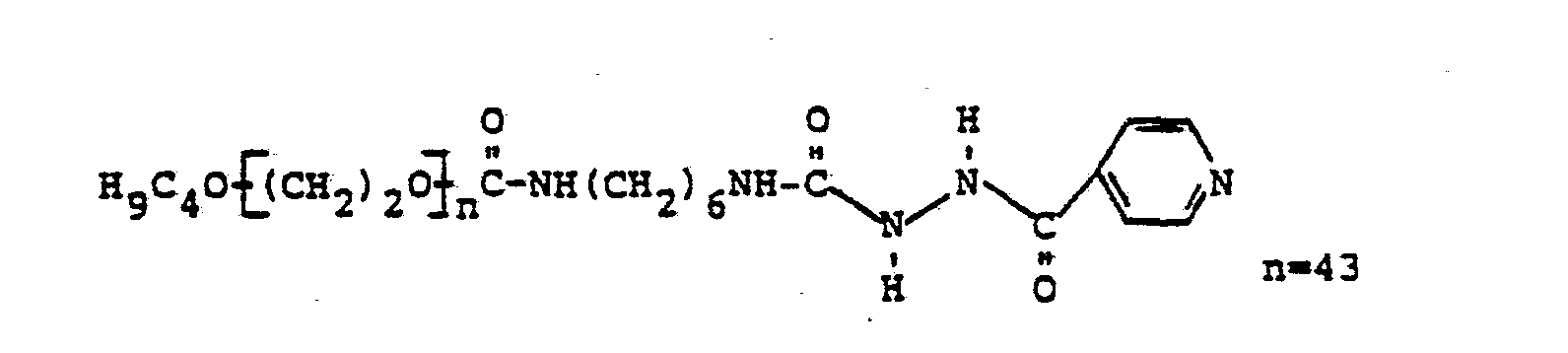
- 11,7 g (0,01 mol) der nach Beispiel 2b erhaltenen Verbindung werden analog zu Beispiel 85 mit 2,6 g (0,01 mol) 2-Sulfanilamidothiazol umgesetzt.
- Nachrührzeit: 30 Minuten bei 70°C.
- Man erhält 13,0 g eines graugelben Feststoffes. Dieser erfindungsgemäß modifizierte neue Wirkstoff ist gut in Wasser und/oder niederen Alkoholen löslich und besitzt die idealisierte Formel

- 11,7 g (0,01 mol) der nach Beispiel 2b erhaltenen Verbindungen werden analog zu Beispiel 89 mit 2,2 g (0,01 mol) D(-)-threo-1-(p-Nitrophenyl)-2-dichloracetamido-1,3-propandiol umgesetzt.
- Nachrührzeit: 7 Stunden bei 85°C.
- Man erhält 13,5 g eines rotgoldfarbenen Feststoffes von wachsartiger Konsistenz. Dieser erfindungsgemäß modifizierte neue Wirkstoff ist gut in Wasser und/oder niederen Alkoholen löslich und besitzt die idealisierte Formel

- 11,7 g (0,01 mol) der nach Beispiel 2b erhaltenen Verbindung werden analog zu Beispiel 92 mit 3,9 g (0,01 mol) N-(4-Chlor-3-sulfamoylbenzolsulfonyl)-N-methyl-2- amincmethyl-2-methyltetrahydrofuran umgesetzt. Nachrührzeit: 16 Stunden bei 100°C.
- Man erhält 15,5 g eines braungelben Feststoffes von wachsartiger Konsistenz. Dieser erfindungsgemäß modifizierte neue Wirkstoff ist gut in Wasser und/oder niederen Alkoholen löslich und besitzt die idealisierte Formel
-

- 11,7 g (0,01 mol) der nach Beispiel 2 erhaltenen Verbindung werden analog zu Beispiel 94 mit 3,6 g (0,01 mol) D(+)-6-(5-Amino-5-carboxyvaleramido)-3,3-dimethyl-7-oxo-4-thia-1-azabicyclo-[3,2,0]-heptan-2-carbonsäure umgesetzt.
- Nachrührzeit: 90 Minuten bei 60°C.
- Man erhält 14,8 g eines graugelben Feststoffes. Dieser erfindungsgemäß modifizierte neue Wirkstoff ist gut in Wasser und/oder niederen Alkoholen löslich und besitzt die idealisierte Formel

- 21,7 g (0,01 mol) der nach Beispiel 1b erhaltenen Verbindung werden analog zu Beispiel 95 mit 3,2 g (0,01 mol) 1-Phenyl-5-sulfonilamidopyrazol umgesetzt. Nachrührzeit: 30 Minuten bei 80°C.
- Man erhält 24,5 g eines graurosafarbenen Produktes. Dieser erfindungsgemäß modifizierte neue Wirkstoff ist gut in Wasser und/oder niederen Alkoholen löslich und besitzt die idealisierte Formel

- 9,5 g (0,01 mol) der nach Beispiel 3b erhaltenen Verbindung werden analog zu Beispiel 96 mit 3,8 g (0,01 mol) D-(-) -7-(2-Amino-2-phenylacetamido)-3-methyl-8-oxo-5-thia-1-azabicyclo-[4,2,0]-oct-2-en-2-carbonsäure umgesetzt.
- Nachrührzeit: 4 Stunden bei 50°C.
- Man erhält 12,9 g eines blaßgelben, viskosen Produktes. Dieser erfindungsgemäß modifizierte neue Wirkstoff ist gut in Wasser und/oder niederen Alkoholen löslich und besitzt die idealisierte Formel

- 21,7 g (0,01 mol) der nach Beispiel 1b erhaltenen Verbindung werden analog zu Beispiel 97 mit 3,5 g (0,01 mol) D(-)-6-( α-Aminophenylacetamido)-3,3-dimethyl-7-oxo-4-thia-1-azabicyclo-[3,2,0]-heptan-2-carbonsäure umgesetzt.
- Nachrührzeit: 35 Minuten bei 60°C.
- man erhält 24,7 g eines blaßgelben Feststoffes. Dieser erfindungsgemäß modifizierte neue Wirkstoff ist gut in Wasser und/oder niederen Alkoholen löslich und besitzt die idealisierte Formel

- 11,7 g (0,01 mol) der nach Beispiel 2b erhaltenen Verbindung werden analog zu Beispiel 99 mit 5,3 g (0,01 mol) 9-Acetyl-7,8,9,1O-tetrahydro-6,7,9,11-tetrahydroxy-4-methoxy-5,12-naphthacenchinon-7-(3-amino-5-methyl-2,3- didesoxy- d -lyxopyranosid) umgesetzt. Nachrührzeit: 105 Minuten bei 55°C.
- Man erhält 16,6 g eines blaßgraugelben Feststoffes. Dieser erfindungsgemäß modifizierte neue Wirkstoff ist gut in Wasser und/oder niederen Alkoholen löslich und besitzt die idealisierte Formel

- 11,7 g (0,01 mol) der nach Beispiel 2b erhaltenen Verbindung werden analog zu Beispiel 100 mit 1,7 g (0,01 mol) 6-Aminopurin-8-thiol umgesetzt. Nachrührzeit: 15 Minuten bei 45°C.
- Man erhält 13,0 g eines rotgelben, wachsartigen Feststoffes. Dieser erfindungsgemäß modifizierte neue Wirkstoff ist gut in Wasser und/oder niederen Alkoholen löslich und besitzt die idealisierte Formel

- 11,7 g (0,01 mol) der nach Beispiel 2b erhaltenen Verbindung werden analog zu Beispiel 101 mit 2,2 g (0,01 mol) 6-Amino-3,3-dimethyl-7-oxo-4-thia-1-azabicyclo [2,2,0]heptan-carbonsäure umgesetzt.
- Nachrührzeit: 20 Minuten bei 60°C.
- Man erhält 13,6 g eines weiBlichgelben, wachsartigen Feststoffes. Dieser erfindungsgemäß modifizierte neue Wirkstoff ist gut in Wasse:c und/oder niederen Alkoholen löslich und besitzt die idealisierte Formel

- 21,7 g (0,01 mol) der nach Beispiel 1b erhaltenen Verbindung werden analog zu Beispiel 103 mit 2,3 g (0,01 mol) 4-Aminobenzolsulfothiocarbamid umgesetzt. Nachrührzeit: 15 Minuten bei 85°C.
- Man erhält 23,6 g eines rötlichgelben Feststoffes. Dieser erfindungsgemäß modifizierte neue Wirkstoff ist gut in Wasser und/oder niederen Alkoholen löslich und besitzt die idealisierte Formel

- 21,7 g (0,01 mol) der nach Beispiel 1b erhaltenen Verbindung werden analog zu Beispiel 104 mit 3,5 g (0,01 mol) 2,6-Dimethyl-3,5-Diacetyl-4-o-nitrophenyl-1,4-dihydropyridin umgesetzt.
- Nachrührzeit: 45 Minuten bei 75°C.
- Man erhält 24,7 g eines graugelben Feststoffes. Dieser erfindungsgemäß modifizierte neue Wirkstoff ist gut in Wasser und/oder niederen Alkoholen lösiich und besitzt die idealisierte Formel

- 11,7 g (0,01 mol) der nach Beispiel 2b erhaltenen Verbindung werden analog zu Beispiel 105 mit 3,5 g (0,01 mol) 2,6-Dimethyl-3,5-diacatyl-d-o-nitraphenyl-1,4-dihydropyridin umgesetzt.
- Nachrührzeit: 55 Minuten bei 75°C.
- Man erhält 14,8 g eines dunkelgelben, wachsartigen Feststoffes. Dieser erfindungsgemäß modifizierte neue Wirkstoff ist gut in Wasser und niederen Alkoholen löslich und besitzt die idealisierte Formel

- 9,5 g (0,01 mol) der nach Beispiel 3b erhaltenen Verbindung werden analog zu Beispiel 106 mit 3,5 g (0,01 mol) 2,6-Dimethyl-3,5-diacetyl-4-o-aitrophenyl-1,4-dihydropyridin umgesetzt.
- Nachrührzeit: 80 Minuten bei 65°C.
- Man erhält 12,6 g eines rötlichgraugelben, viskosen Produktes. Dieser erfindungsgemäß modifizierte neue Wirkstoff ist gut in Wasser und Methanol sowie Ethanol löslich und besitzt die idealisierte Formel

- 11,7 g (0,01 mol) der nach Beispiel 2b erhaltenen Verbindung werden analog zu Beispiel 107 mit 2,8 g (0,01 mol) 2-Sulfanilamido-5-methoxypyrimidin umgesetzt. Nachrührzeit: 20 Minuten bei 65°C.
- Man erhält 13,1 g eines graugelben Feststoffes, von wachsartiger Konsistenz. Dieser erfindungsgemäß modifizierte neue Wirkstoff ist gut in Wasser und/oder niederer Alkoholen löslich und besitzt die idealisierte Formel

- 21,4 g (0,01 mol) des nach Beispiel 1c erhaltenen Produktes werden in 100 ml absolutem Toluol gelöst. Zu dieser Lösung läßt man innerhalb einer halben Stunde eine Lösung von 2,14 g (0,01 mol) 4-Amino-6-tert.-butyl-3-(methylthio)-1,2,4-triazln-5(4H)-on in 50 ml Toluol bei 105°C zutropfen. Entstehendes Methanol wird während des Zutropfens und nachher bis zum Ende der Reaktion über einen Claisenaufsatz abdestilliert. Anschließend wird die Temperatur auf 120°C im Bad erhöht und das Lösungsmittel abdestilliert.
- Nachrührzeit: 8 Stunden bei 120°C im Bad.
- Anschließend läßt man auf 80°C abkühlen und evakuiert auf 25 mbar, wodurch letzte Spuren an Methanol und Lösungsmittel entfernt werden- Man kühlt auf Raumtemperatur ab, belüftet mit Stickstoff und erhält 23,3 g eines braunroten Feststoffes. Dieser erfindungsgemäß modifizierte neue Wirkstoff ist gut in Wasser und/oder niederen Alkoholen löslich und besitzt die idealisierte Formel

- 9,2 g (0,01 mol) des nach Beispiel 3c erhaltenen Produktes werden in 50 ml absolutem Toluol gelöst. Zu dieser Lösung läßt man innerhalb 1 Stunde eine Lösung von 3,4 g (0,01 mol) 1,3-Di-p-Chlorphenyl-(1H,2H,3H,4H, 5H,6H)-1,3,5-trlazin-2,4-dion in 50 ml absolutem Aceton unter starkem Rühren bei 80°C zutropfen, wobei der größte Teil des Acetons während des Zutropfens über einen Claisenaufsatz abdestilliert. Man erhöht die Temperatur auf 120°C im Bad und destilliert über eine Vigraux-Kolonne bei der Reaktion entstehendes Methanol ab.
- Nachrührzeit: 24 Stunden bei 120°C im Bad.
- Anschließend wird das Lösungsmittel abdestilliert und danach der Rückstand im Vakuum (25 mbar) von Resten an Methanol und Lösungsmittel befreit.
- Man erhält 12,2 g eines dunkelbraunen, viskosen Produktes. Dieser erfindungsgemäß modifizierte neue Wirkstoff ist gut in Wasser und Methanol sowie Ethanol löslich und besitzt die idealisierte Formel

- 21,4 g (0,01 mol) des nach Beispiel 1c erhaltenen Produktes werden analog zu Beispiel 139 mit 2,14 g (0,01 mol) 4-Amino-6-tert.-butyl-3-(methylthio)-1,2, 4-triazin-5(4H)-on umgesetzt. Zusätzlich gibt man jedoch nach Ende des Zutropfens 0,1 g Natriummetall zu. Die weitere Bearbeitung erfolgt wie in Beispiel 139 angegeben. Nachrührzeit: 2 Stunden bei 120°C im Bad.
- Nach dem Abkühlen wird der Rückstand mit 50 ml Methanol und mit 0,5 ml konzentrierter Salzsäure versetzt. Man saugt vom unlöslichen ab und entfernt anschließend das Methanol aus dem Filtrat durch Einengen im Vakuum (200 mbar).
- Man erhält 23,2 g eines braungelben Feststoffes. Dieser erfindungsgemäß modifizierte neue Wirkstoff ist gut in Wasser und/oder niederen Alkoholen löslich und besitzt die idealisierte Formel
-
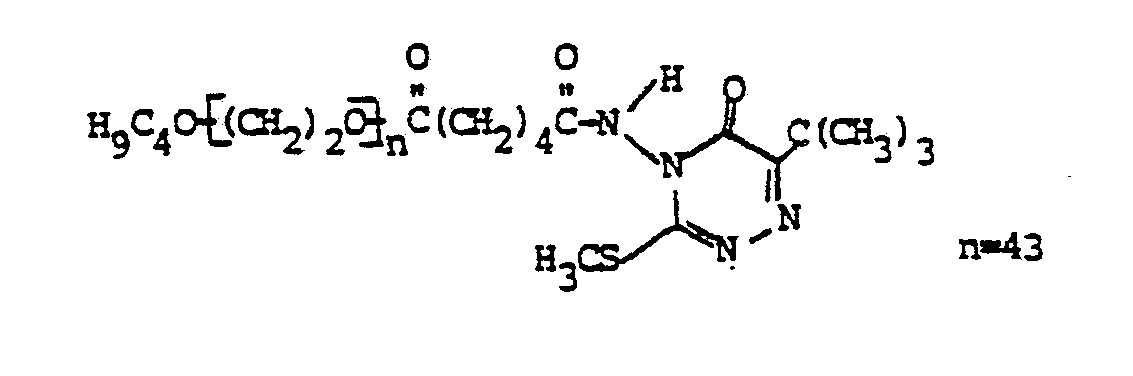
- 9,2 g (0,01 mol) des nach Beispiel 3c erhaltenen Produktes werden analog zu Beispiel 140 mit 3,4 g (0,01 mol) 1,3-Di-p-Chlorphenyl-(1H,2H,3H,4H,5H,6H)-1,3,5-triazin-2,4-dion umgesetzt. Zusätzlich gibt man jedoch nach Ende des Abdestillierens des Acetons vor Beginn der Temperaturerhöhung auf 130°C 0,1 g Natriummetall zu. Die weitere Bearbeitung erfolgt wie bei Beispiel 140 angegeben.
- Nachrührzeit: 40 Stunden bei 120°C im Bad.
- Nach dem Abkühlen wird der Rückstand mit 50 ml Methanol und 0,5 ml konzentrierter Salzsäure versetzt. Man saugt ab von Unlöslichen und entfernt aus dem Filtrat das Methanol durch Einengen im Vakuum.
- Man erhält 12,1 g eines rotbraunen, viskosen Produktes. Dieser erfindungsgemäß modifizierte neue Wirkstoff ist gut in Wasser und/oder Methanol sowie Ethanol löslich und besitzt die idealisierte Formel

- 21,4 g (0,01 mol) der nach Beispiel 1c erhaltenen Verbindung werden analog zu Beispiel 141 mit 2,0 g (0,01 mol) 3-Methyl-4-amino-6-phenyl-1,2,4-triazin-5(4H)-on umgesetzt.
- Nachrührzeit: 2 Stunden bei 120°C.
- Man erhält 22,8 g eines dunkelgelben Feststoffes. Dieser erfindungsgemäß modifizierte neue Wirkstoff ist gut in Wasser und/oder niederen Alkoholen löslich und besitzt die idealisierte Formel

- Nachrührzeit: 36 Stunden bei 120°C.
- Man erhält 11,6 g eines dunkelbraunen, viskosen Produktes. Dieser erfindungsgemäß modifizierte neue Wirkstoff ist gut in Wasser und/oder niederen Alkoholen löslich und besitzt die idealisierte Formel
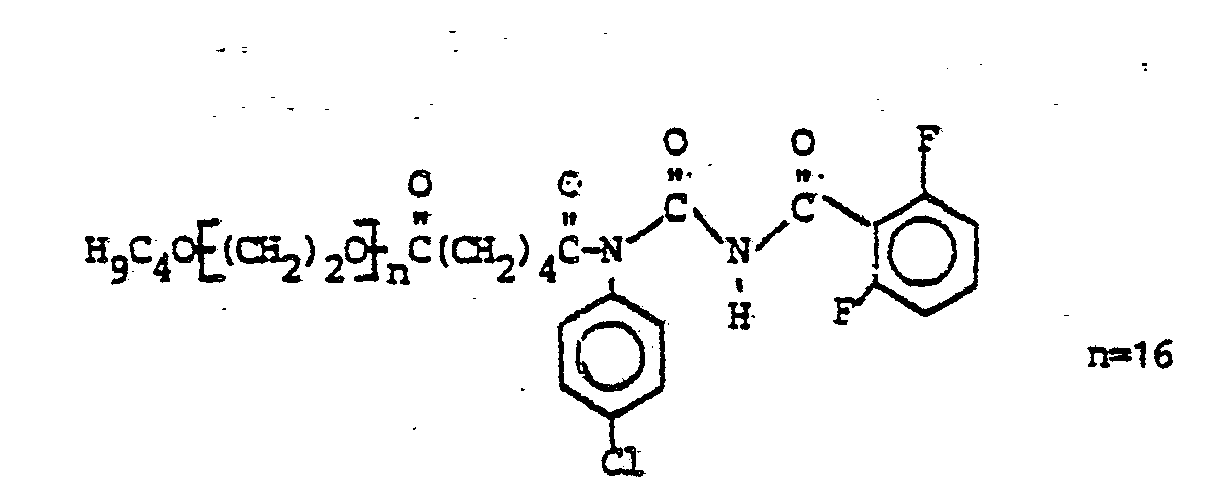
- 21,4 g (0,01 mol) der nach Beispiel 1c erhaltenen Verbindung werden analog zu Beispiel 141 mit 3,7 g (0,01 mol) 3-(3,4-Dichlorphenyl)-6-(2,6-Difluorphenyl)-1-oxa-3,5-diazin-(3H,SH)-2,4-dion umgesetzt.
- Nachrührzeit: 22 Stunden bei 120°C.
- Man erhält 24,6 g eines dunklen, grünlichbraunen Feststoffes. Dieser erfindungsgemäß modifizierte neue Wirkstoff ist gut in Wasser und/oder niederen Alkoholen löslich und besitzt die idealisierte Formel

- 21,4 g (0,01 mol) der nach Beispiel 1c erhaltenen Verbindung werden analog zu Beispiel 141 mit 2,1 g (0,01 mol) 2-Isopropyloxyphenyl-N-methylcarbamat umgesetzt. Nachrührzeit: 48 Stunden bei 120°C.
- Man erhält 23,1 g eines dunkelbraunen Feststoffes. Dieser erfindungsgemäß modifizierte neue Wirkstoff ist gut in Wasser und/oder niederen Alkoholen löslich und besitzt die idealisierte Formel

- Nachrührzeit: 2 Stunden bei 120°C.
- Man erhält 11,3 g eines goldgelben, viskosen Produktes. Dieser erfindungsgemäß modifizierte neue Wirkstoff ist gut in Wasser und Methanol sowie Ethanol löslich und besitzt die idealisierte Formel

- 21,4 g (0,01 mol) der nach Beispiel 1c erhaltenen Verbindung werden analog zu Beispiel 139 mit 2,2 g (0,01 mol) D(-)-threo-1-(p-Nitrophenyl)-2-dichloracetamido-1,3-propandiol umgesetzt.
- Nachrührzeit:17 Stunden bei 105°C.
- Man erhält 23,0 g eines rotgoldfarbenen, wachsartigen . Feststoffes. Dieser erfindungsgemäß modifizierte neue Wirkstoff ist gut in Wasser und/oder niederen Alkoholen löslich und besitzt die idealisierte Formel

- Man erhält 11,1 g eines rotgelben, viskosen Produktes. Dieser erfindungsgemäß modifizierte neue Wirkstoff ist gut in Wasser und Methanol sowie Ethanol löslich und besitzt die idealisierte Fcrmel

- 21,4 g (0,01 mol) der nach Beispiel 1c erhaltenen Verbindung werden analog zu Beispiel 141 mit 2,8 g (0,01 mol) 2-Sulfanilamido-5-methoxypyrimidin umgesetzt. Nachrührzeit: 155 Minuten bei 120°C.
- Man erhält 23,5 g eines dunkelgelben Feststoffes. Dieser erfindungsgemäß modifizierte neue Wirkstoff ist gut in Wasser und/oder niederen Alkoholen löslich und besitzt die idealisierte Formel

- 864 g (0,4 Mol) eines auf n-Butanol gestarteten Ethylenoxidpolyethers vom mittleren Molgewicht 2160 (mittlere Anzahl an Ethylenoxideinheiten n = 42) mit endständiger p-Isocyanatophenylurethangruppe (NCO-Gehalt: 1,94 Gew.-%) werden bei 40°C vorgelegt. Unter schnellem Rühren werden innerhalb von 2 Stunden 85,2 g (0,4 Mol) 4-Amino-6-tert.-butyl-3-(methylthio)-1,2,4-triazin-5-(4H)-on, welches in 300 ml abs. Toluol gelöst ist, zugetropft. Nach Ende des Zutropfens wird 10 Min. bei 40°C nachgerührt. Danach ist IR-spektroskopisch kein NCO in der Reaktionsmischung mehr nachweisbar. Anschließend wird im Vakuum das Lösungsmittel abdestilliert.
- Man erhält 946 g eines hellgelben Feststoffs. Dieser erfindungsgemäß modifizierte neue Wirkstoff ist sehr gut in Wasser und/oder niederen Alkoholen löslich" und besitzt die idealisierte Formel:

oder- daß man
oder daß man
oder daß man
n die oben angegebene Bedeutung hat.
Claims (3)
oder daß man
oder daß man
OH-, NH- oder NH2- monofunktionelle hydrophile Polyether mit einem Wasseraufnahmevermögen von mindestens 15 %, bezogen auf das Gewicht des Polyethers, und Verbindungen mit m gegenüber Zerewitinoff-aktiven Wasserstoffatomen reaktiven Gruppen
wobei m mindestens zwei ist
im Äquivalentverhältnis 1:m:(m-1) umsetzt.
oder daß man
oder daß man
im Äquivalentverhältnis 1 cm(m-1) umsetzt.
oder daß man
Verbindungen mit m gegenüber Zerewitinoff-aktiven Wasserstoffatomen reaktiven Gruppen (wobei m mindestens zwei ist) und OH-, NH- oder NH2-monofunktionelle hydrophile Polyether mit einem Wasseraufnahmevermögen von mindestens 15 %, bezogen auf das Gewicht des Polyethers, im Äquivalentverhältnis 1:m :(m-1) umsetzt.
Applications Claiming Priority (4)
| Application Number | Priority Date | Filing Date | Title |
|---|---|---|---|
| DE19792901060 DE2901060A1 (de) | 1979-01-12 | 1979-01-12 | Verfahren zur verbesserung der loeslichkeit biologisch aktiver wirkstoffe in wasser und niederen aliphatischen alkoholen sowie neue verbindungen mit verbesserter loeslichkeit |
| DE2901060 | 1979-01-12 | ||
| DE2910356 | 1979-03-16 | ||
| DE19792910356 DE2910356A1 (de) | 1979-03-16 | 1979-03-16 | Verfahren zur verbesserung der loeslichkeit biologisch aktiver wirkstoffe in wasser und niederen aliphatischen alkoholen sowie neue verbindungen mit verbesserter loeslichkeit |
Publications (3)
| Publication Number | Publication Date |
|---|---|
| EP0014263A2 true EP0014263A2 (de) | 1980-08-20 |
| EP0014263A3 EP0014263A3 (en) | 1980-09-17 |
| EP0014263B1 EP0014263B1 (de) | 1982-05-05 |
Family
ID=25777372
Family Applications (1)
| Application Number | Title | Priority Date | Filing Date |
|---|---|---|---|
| EP79105407A Expired EP0014263B1 (de) | 1979-01-12 | 1979-12-31 | Verfahren zur Verbesserung der Löslichkeit biologisch aktiver Wirkstoffe in Wasser und niederen aliphatischen Alkoholen sowie neue Verbindungen mit verbesserter Löslichkeit |
Country Status (7)
| Country | Link |
|---|---|
| US (1) | US4684728A (de) |
| EP (1) | EP0014263B1 (de) |
| JP (1) | JPS5594337A (de) |
| BR (1) | BR8000192A (de) |
| DE (1) | DE2962754D1 (de) |
| DK (1) | DK13580A (de) |
| IL (1) | IL59099A (de) |
Cited By (5)
| Publication number | Priority date | Publication date | Assignee | Title |
|---|---|---|---|---|
| EP0576589A4 (en) * | 1991-03-18 | 1994-07-27 | Enzon Inc | Hydrazine containing conjugates of polypeptides and glycopolypeptides with polymers |
| EP0781776A3 (de) * | 1995-12-27 | 1998-04-01 | American Home Products Corporation | Wasserlösliche Rapamycineester |
| EP1379257A4 (de) * | 2001-03-23 | 2005-02-02 | Enzon Inc | Prodrugs von krebsmitteln mit substituierten aromatischen säuren |
| WO2005113011A2 (en) | 2004-04-01 | 2005-12-01 | Cardiome Pharma Corp. | Prodrugs of ion channel modulating compounds and uses thereof |
| WO2005094897A3 (en) * | 2004-04-01 | 2006-06-22 | Cardiome Pharma Corp | Pegylated ion channel modulating compounds |
Families Citing this family (31)
| Publication number | Priority date | Publication date | Assignee | Title |
|---|---|---|---|---|
| US4581434A (en) * | 1982-09-04 | 1986-04-08 | Bayer Aktiengesellschaft | Process for increasing the duration of action of agents for combating pests |
| DE4017439C2 (de) * | 1990-05-30 | 1994-06-23 | Deutsches Krebsforsch | Polyethersubstituierte Tumormittel |
| JPH0653222U (ja) * | 1992-10-23 | 1994-07-19 | 節子 相野谷 | トランク・ルームの保冷装置 |
| GB9312853D0 (en) * | 1993-06-22 | 1993-08-04 | Euro Celtique Sa | Chemical compounds |
| US5591776A (en) * | 1994-06-24 | 1997-01-07 | Euro-Celtique, S.A. | Pheynl or benzyl-substituted rolipram-based compounds for and method of inhibiting phosphodiesterase IV |
| US5922751A (en) * | 1994-06-24 | 1999-07-13 | Euro-Celtique, S.A. | Aryl pyrazole compound for inhibiting phosphodiesterase IV and methods of using same |
| DE69531506T2 (de) * | 1994-12-13 | 2004-06-24 | Euroceltique S.A. | Arylthioxanthine |
| US6025361A (en) * | 1994-12-13 | 2000-02-15 | Euro-Celtique, S.A. | Trisubstituted thioxanthines |
| EP0799040B1 (de) * | 1994-12-13 | 2003-08-20 | Euroceltique S.A. | Dreifachsubstituierte thioxanthine |
| US6166041A (en) * | 1995-10-11 | 2000-12-26 | Euro-Celtique, S.A. | 2-heteroaryl and 2-heterocyclic benzoxazoles as PDE IV inhibitors for the treatment of asthma |
| US6075016A (en) * | 1996-04-10 | 2000-06-13 | Euro-Celtique S.A. | 6,5-fused aromatic ring systems having enhanced phosphodiesterase IV inhibitory activity |
| JP2003507382A (ja) * | 1999-08-18 | 2003-02-25 | ワイス | 水溶性sdz−radエステル |
| US6331547B1 (en) | 1999-08-18 | 2001-12-18 | American Home Products Corporation | Water soluble SDZ RAD esters |
| WO2005042641A1 (en) * | 2003-11-04 | 2005-05-12 | Suprapolix B.V. | Preparation of supramolecular polymers containing quadruple hydrogen bonding units in the polymer backbone |
| US7705036B2 (en) * | 2004-04-01 | 2010-04-27 | Cardiome Pharma Corp. | Deuterated aminocyclohexyl ether compounds and processes for preparing same |
| JP5183198B2 (ja) * | 2004-07-12 | 2013-04-17 | スープラポリックス ビー.ブイ. | 超分子イオノマー |
| US8692002B2 (en) * | 2004-11-18 | 2014-04-08 | Cardiome Pharma Corp. | Synthetic process for aminocyclohexyl ether compounds |
| JP5130201B2 (ja) * | 2005-05-04 | 2013-01-30 | スープラポリックス ビー.ブイ. | モジュール式生体吸収性又は生物医学用生物活性超分子材料 |
| DE102005023588A1 (de) | 2005-05-18 | 2006-11-23 | Grünenthal GmbH | Salze substituierter Allophansäureester und deren Verwendung in Arzneimitteln |
| MX2007016248A (es) | 2005-06-15 | 2008-03-07 | Cardiome Pharma Corp | Procedimiento sintetico para la preparacion de compuestos de eter aminociclohexilico. |
| WO2008063057A2 (en) | 2006-11-20 | 2008-05-29 | Suprapolix B.V. | Supramolecular polymers from low-melting, easily processable building blocks |
| US8628789B2 (en) * | 2007-03-23 | 2014-01-14 | Suprapolix, B.V. | Strong reversible hydrogels |
| EP2310376B1 (de) * | 2008-07-04 | 2014-11-05 | SupraPolix B.V. | Supramolekulare verbindungen mit hohem durchfluss |
| WO2011054795A1 (de) * | 2009-11-03 | 2011-05-12 | Bayer Materialscience Ag | Fluorurethane als additive in einer photopolymer-formulierung |
| JP5745540B2 (ja) | 2009-12-30 | 2015-07-08 | スリーエム イノベイティブ プロパティズ カンパニー | オキサリルアミノ基を有するペルフルオロポリエーテル含有化合物 |
| JP6196775B2 (ja) | 2009-12-30 | 2017-09-13 | スリーエム イノベイティブ プロパティズ カンパニー | ペルフルオロポリエーテルセグメント及びポリジオルガノシロキサンセグメントを有するコポリマー |
| WO2011082069A1 (en) | 2009-12-30 | 2011-07-07 | 3M Innovative Properties Company | Methods of making polydiorganosiloxane polyoxamide copolymers |
| CN102770478B (zh) | 2009-12-30 | 2014-03-12 | 3M创新有限公司 | 具有全氟聚醚链段和多个氨基乙二酰胺基的共聚物 |
| EP2450394B1 (de) | 2010-11-05 | 2017-06-07 | SupraPolix B.V. | Verfahren zur Herstellung eines supramolekularen Polymers |
| EP4090374A4 (de) * | 2020-01-17 | 2024-10-09 | Children's Medical Center Corporation | Makromolekulare prodrugs für leuchtdioden und deren verwendungen |
| CN119306953A (zh) * | 2023-07-14 | 2025-01-14 | 宁德时代新能源科技股份有限公司 | 聚合物、制备方法、分散剂、正极浆料、正极极片、二次电池和用电装置 |
Family Cites Families (9)
| Publication number | Priority date | Publication date | Assignee | Title |
|---|---|---|---|---|
| US2857261A (en) * | 1954-04-27 | 1958-10-21 | Monsanto Chemicals | Herbicidal sulfoalkyl esters of phenoxyacetates |
| US4039576A (en) * | 1972-03-28 | 1977-08-02 | Ciba-Geigy Corporation | Process for the manufacture of alkoxylated N-methylol ureas |
| CA1023376A (en) * | 1972-08-04 | 1977-12-27 | Hermann O. Wirth | Hydrophilic and difficultly volatile biocidal triorganometallic compounds |
| CS179484B1 (en) * | 1972-08-18 | 1977-11-30 | Otto Wichterle | Method of producing polymeric acrylated or methacrylated carriers of biological active compounds |
| FR2264522A1 (en) * | 1974-03-22 | 1975-10-17 | Rouchy Maurice | Vitamin F cpds having surface active properties - comprise linoleic, linolenic and arachidonic acid radical joined via O or N to polyalcohols |
| US4178427A (en) * | 1976-05-05 | 1979-12-11 | Texaco Development Corp. | Polyether urea epoxy curing agent |
| US4154724A (en) * | 1976-06-28 | 1979-05-15 | Texaco Development Corp. | Polyether polyureides and resinous compositions therefrom |
| DE2645079A1 (de) * | 1976-10-06 | 1978-04-13 | Bayer Ernst | Polymere sauerstofftraeger und verfahren zu ihrer herstellung |
| DE2723248A1 (de) * | 1977-05-24 | 1978-11-30 | Bayer Ag | Insektizide mittel |
-
1979
- 1979-12-28 US US06/107,976 patent/US4684728A/en not_active Expired - Lifetime
- 1979-12-31 EP EP79105407A patent/EP0014263B1/de not_active Expired
- 1979-12-31 DE DE7979105407T patent/DE2962754D1/de not_active Expired
-
1980
- 1980-01-09 IL IL59099A patent/IL59099A/xx unknown
- 1980-01-11 JP JP145280A patent/JPS5594337A/ja active Pending
- 1980-01-11 DK DK13580A patent/DK13580A/da not_active Application Discontinuation
- 1980-01-11 BR BR8000192A patent/BR8000192A/pt unknown
Cited By (7)
| Publication number | Priority date | Publication date | Assignee | Title |
|---|---|---|---|---|
| EP0576589A4 (en) * | 1991-03-18 | 1994-07-27 | Enzon Inc | Hydrazine containing conjugates of polypeptides and glycopolypeptides with polymers |
| EP0781776A3 (de) * | 1995-12-27 | 1998-04-01 | American Home Products Corporation | Wasserlösliche Rapamycineester |
| CN1088710C (zh) * | 1995-12-27 | 2002-08-07 | 美国家用产品公司 | 水溶性的雷帕霉素酯 |
| EP1379257A4 (de) * | 2001-03-23 | 2005-02-02 | Enzon Inc | Prodrugs von krebsmitteln mit substituierten aromatischen säuren |
| WO2005113011A2 (en) | 2004-04-01 | 2005-12-01 | Cardiome Pharma Corp. | Prodrugs of ion channel modulating compounds and uses thereof |
| WO2005094897A3 (en) * | 2004-04-01 | 2006-06-22 | Cardiome Pharma Corp | Pegylated ion channel modulating compounds |
| WO2005113011A3 (en) * | 2004-04-01 | 2006-08-03 | Cardiome Pharma Corp | Prodrugs of ion channel modulating compounds and uses thereof |
Also Published As
| Publication number | Publication date |
|---|---|
| EP0014263B1 (de) | 1982-05-05 |
| DE2962754D1 (en) | 1982-06-24 |
| EP0014263A3 (en) | 1980-09-17 |
| DK13580A (da) | 1980-07-13 |
| JPS5594337A (en) | 1980-07-17 |
| US4684728A (en) | 1987-08-04 |
| IL59099A0 (en) | 1980-05-30 |
| IL59099A (en) | 1984-03-30 |
| BR8000192A (pt) | 1980-10-21 |
Similar Documents
| Publication | Publication Date | Title |
|---|---|---|
| EP0014263B1 (de) | Verfahren zur Verbesserung der Löslichkeit biologisch aktiver Wirkstoffe in Wasser und niederen aliphatischen Alkoholen sowie neue Verbindungen mit verbesserter Löslichkeit | |
| EP0314615B1 (de) | Schädlingsbekämpfungsmittel | |
| EP0249938B1 (de) | Imidazolsulfonamid-Derivate, Herbizide und Verfahren zur Bekämpfung von Schadpflanzen | |
| US3755582A (en) | Quinazolinone fungicides | |
| EP0124282B1 (de) | Bicyclooxyarylthioharnstoffe und Herstellungsverfahren | |
| EP0180115A2 (de) | 1,2,4-Triazolo-carbamate und ihre Säureadditionssalze, Verfahren zu ihrer Herstellung und Arzneimittel | |
| EP0347788A2 (de) | Substituierte Sulfonyldiamide, Verfahren zu ihrer Herstellung und ihre Verwendung als Herbizide und Pflanzenwachstumsregulatoren | |
| EP0017772B1 (de) | Verfahren zur Verbesserung der Löslichkeit biologisch aktiver Wirkstoffe in Wasser und niederen aliphatischen Alkoholen sowie neue Verbindungen mit verbesserter Löslichkeit | |
| DE2910356A1 (de) | Verfahren zur verbesserung der loeslichkeit biologisch aktiver wirkstoffe in wasser und niederen aliphatischen alkoholen sowie neue verbindungen mit verbesserter loeslichkeit | |
| DE2229248C3 (de) | 5-Iminomethyl-2-nitroimidazoI-Derivate und Verfahren zu deren Herstellung | |
| DE2901060A1 (de) | Verfahren zur verbesserung der loeslichkeit biologisch aktiver wirkstoffe in wasser und niederen aliphatischen alkoholen sowie neue verbindungen mit verbesserter loeslichkeit | |
| EP0374757A1 (de) | Imidazolinderivate enthaltende Mittel zur wirtstiersystemischen Bekämpfung von Ektoparasiten sowie neue Imidazolinderivate | |
| EP0023964A1 (de) | Phenyliminothiazolinderivate, ihre Herstellung und Zwischenprodukte dafür, sie enthaltende pharmazeutische Präparate und deren Herstellung | |
| CH628887A5 (de) | Verfahren zur herstellung von benzolsulfonylharnstoffen. | |
| DE3151450A1 (de) | N-phenoxysulfonylharnstoffe, ihre herstellung und verwendung | |
| EP0152596A1 (de) | Neue 1,3-Dioxolanylderivate, Verfahren zu ihrer Herstellung, ihre Verwendung und diese Verbindungen enthaltendes Arzneimittel | |
| DE2932305C2 (de) | ||
| US4560738A (en) | Pest-combating agent having increased duration of action | |
| AU699802B2 (en) | Novel imidazoline-2,4-diones having anticonvulsive activity, which contain an ortho-substituted ar(alk)yl radical in the 1-position, and processes for their preperation | |
| EP0044266B1 (de) | Neue substituierte 3,5-Diamino-1,2,4-oxadiazole und 3,5-Diamino-1,2,4-thiadiazole, Verfahren zu ihrer Herstellung und sie enthaltende pharmazeutische Präparate | |
| EP0089597A2 (de) | Sulfonylharnstoffe, Verfahren zu ihrer Herstellung, pharmazeutische Präparate auf Basis dieser Verbindungen und ihre Verwendung | |
| CH633546A5 (en) | Tetrahydro-1,3,5-thiadiazin-4-one compounds | |
| DE3311753A1 (de) | Substituierte 6-aryl-1,2,4-triazolo(4,3-b)pyridazine - ihre herstellung und verwendung - | |
| EP0268295B1 (de) | N-Arylsulfonyl-N'-pyrimidyl-(triazinyl)-harnstoffe | |
| DD243930A1 (de) | Verfahren zur herstellung von neuen 5,5-disubstituierten 4-carbamoyl-4,5-dihydro-1,3,4-thiadiazol-2-yl-harnstoffen |
Legal Events
| Date | Code | Title | Description |
|---|---|---|---|
| PUAI | Public reference made under article 153(3) epc to a published international application that has entered the european phase |
Free format text: ORIGINAL CODE: 0009012 |
|
| PUAL | Search report despatched |
Free format text: ORIGINAL CODE: 0009013 |
|
| 17P | Request for examination filed | ||
| AK | Designated contracting states |
Designated state(s): BE CH DE FR GB IT NL |
|
| AK | Designated contracting states |
Designated state(s): BE CH DE FR GB IT NL |
|
| ITF | It: translation for a ep patent filed | ||
| GRAA | (expected) grant |
Free format text: ORIGINAL CODE: 0009210 |
|
| AK | Designated contracting states |
Designated state(s): BE CH DE FR GB IT NL |
|
| REF | Corresponds to: |
Ref document number: 2962754 Country of ref document: DE Date of ref document: 19820624 |
|
| PGFP | Annual fee paid to national office [announced via postgrant information from national office to epo] |
Ref country code: CH Payment date: 19831222 Year of fee payment: 5 |
|
| PGFP | Annual fee paid to national office [announced via postgrant information from national office to epo] |
Ref country code: FR Payment date: 19841129 Year of fee payment: 6 |
|
| PGFP | Annual fee paid to national office [announced via postgrant information from national office to epo] |
Ref country code: DE Payment date: 19841130 Year of fee payment: 6 |
|
| PGFP | Annual fee paid to national office [announced via postgrant information from national office to epo] |
Ref country code: BE Payment date: 19841231 Year of fee payment: 6 |
|
| PGFP | Annual fee paid to national office [announced via postgrant information from national office to epo] |
Ref country code: NL Payment date: 19871231 Year of fee payment: 9 |
|
| PG25 | Lapsed in a contracting state [announced via postgrant information from national office to epo] |
Ref country code: GB Effective date: 19881231 Ref country code: CH Effective date: 19881231 Ref country code: BE Effective date: 19881231 |
|
| BERE | Be: lapsed |
Owner name: BAYER A.G. Effective date: 19881231 |
|
| PG25 | Lapsed in a contracting state [announced via postgrant information from national office to epo] |
Ref country code: NL Effective date: 19890701 |
|
| NLV4 | Nl: lapsed or anulled due to non-payment of the annual fee | ||
| GBPC | Gb: european patent ceased through non-payment of renewal fee | ||
| PG25 | Lapsed in a contracting state [announced via postgrant information from national office to epo] |
Ref country code: FR Free format text: LAPSE BECAUSE OF NON-PAYMENT OF DUE FEES Effective date: 19890831 |
|
| REG | Reference to a national code |
Ref country code: CH Ref legal event code: PL |
|
| PG25 | Lapsed in a contracting state [announced via postgrant information from national office to epo] |
Ref country code: DE Effective date: 19890901 |
|
| REG | Reference to a national code |
Ref country code: FR Ref legal event code: ST |
|
| PLBE | No opposition filed within time limit |
Free format text: ORIGINAL CODE: 0009261 |
|
| STAA | Information on the status of an ep patent application or granted ep patent |
Free format text: STATUS: NO OPPOSITION FILED WITHIN TIME LIMIT |