EP0024334B1 - Neue Morpholinderivate, Verfahren zu deren Herstellung, diese Derivate enthaltende pharmazeutische Präparate - Google Patents
Neue Morpholinderivate, Verfahren zu deren Herstellung, diese Derivate enthaltende pharmazeutische Präparate Download PDFInfo
- Publication number
- EP0024334B1 EP0024334B1 EP80104656A EP80104656A EP0024334B1 EP 0024334 B1 EP0024334 B1 EP 0024334B1 EP 80104656 A EP80104656 A EP 80104656A EP 80104656 A EP80104656 A EP 80104656A EP 0024334 B1 EP0024334 B1 EP 0024334B1
- Authority
- EP
- European Patent Office
- Prior art keywords
- formula
- compound
- compounds
- phenyl
- dimethyl
- Prior art date
- Legal status (The legal status is an assumption and is not a legal conclusion. Google has not performed a legal analysis and makes no representation as to the accuracy of the status listed.)
- Expired
Links
- 0 CC(Cc1ccc(C(C)(C)*)cc1)CN1C[C@@](C)O[C@](C)C1 Chemical compound CC(Cc1ccc(C(C)(C)*)cc1)CN1C[C@@](C)O[C@](C)C1 0.000 description 4
Classifications
-
- C—CHEMISTRY; METALLURGY
- C07—ORGANIC CHEMISTRY
- C07D—HETEROCYCLIC COMPOUNDS
- C07D295/00—Heterocyclic compounds containing polymethylene-imine rings with at least five ring members, 3-azabicyclo [3.2.2] nonane, piperazine, morpholine or thiomorpholine rings, having only hydrogen atoms directly attached to the ring carbon atoms
- C07D295/02—Heterocyclic compounds containing polymethylene-imine rings with at least five ring members, 3-azabicyclo [3.2.2] nonane, piperazine, morpholine or thiomorpholine rings, having only hydrogen atoms directly attached to the ring carbon atoms containing only hydrogen and carbon atoms in addition to the ring hetero elements
- C07D295/027—Heterocyclic compounds containing polymethylene-imine rings with at least five ring members, 3-azabicyclo [3.2.2] nonane, piperazine, morpholine or thiomorpholine rings, having only hydrogen atoms directly attached to the ring carbon atoms containing only hydrogen and carbon atoms in addition to the ring hetero elements containing only one hetero ring
- C07D295/03—Heterocyclic compounds containing polymethylene-imine rings with at least five ring members, 3-azabicyclo [3.2.2] nonane, piperazine, morpholine or thiomorpholine rings, having only hydrogen atoms directly attached to the ring carbon atoms containing only hydrogen and carbon atoms in addition to the ring hetero elements containing only one hetero ring with the ring nitrogen atoms directly attached to acyclic carbon atoms
Definitions
- the invention relates to heterocyclic compounds of the general formula where R is ethyl or phenyl, and salts and N-oxides of these compounds.
- the invention further relates to a process for the preparation of compounds of the formula and their salts and N-oxides, fungicidal compositions which contain these compounds, processes for the preparation of these compositions and the use of these compositions.
- DE-A-2 752 096 discloses compounds from which the compounds of the formula 1 according to the invention differ in that they are cis isomers.
- a halide of formula 11 with an amine of formula 111 expediently in an inert solvent, for example in an ether such as diethyl ether, tetrahydrofuran or dioxane, or in dimethyl sulfoxide, preferably in a higher-boiling alcohol such as ethylene glycol or glycerol Presence of a base, such as triethylamine or an excess of amine of the formula III implemented.
- the mixture is preferably reacted in a temperature range between 50 and 150 ° C. Ethylene glycol and a temperature of 100-110 ° C. are particularly preferred as solvents.
- a compound of formula IV is reduced. If a compound is used as the starting material of the formula IV in which the double bond is in the ⁇ -position to the morpholine residue, the reduction can be carried out catalytically or with formic acid.
- catalysts are noble metal catalysts such as, for example, platinum, palladium — optionally deposited on carbon — and Raney nickel. Palladium on carbon is preferred.
- Solvents suitable for the catalytic reduction are hydrocarbons such as benzene, Toluene or xylene, and alcohols such as methanol or ethanol. Toluene is preferred.
- An interval between 0 and 50 ° C., preferably room temperature, is advantageously selected as the reaction temperature.
- the reduction of the enamine with formic acid is preferably carried out in the absence of a solvent; the formic acid is added dropwise to the enamine at a temperature of 0-100 ° C., preferably 50-70 ° C., if necessary with cooling.
- the reduction can be carried out catalytically.
- Platinum or palladium is preferably used as the catalyst, water or alcohol being used as the solvent.
- at least one equivalent of acid, preferably hydrochloric acid is added to the reaction mixture.
- the alkylation of the compound of the general formula V according to process variant c) takes place in the presence of a suitable amount of a Friedel-Crafts catalyst.
- a Friedel-Crafts catalyst such as e.g. Aluminum chloride, iron chloride, zinc chloride, boron trifluoride, tin chloride, hydrogen fluoride, sulfuric acid and phosphoric acid. Sulfuric acid is particularly preferred for the purposes of the present invention.
- inert organic solvent is not mandatory here, but is preferred.
- Inert organic solvents are particularly suitable as alkanes such as hexane, cyclohexane, chlorinated hydrocarbons such as chloroform, ethylene dichloride and methylene chloride, with methylene chloride being particularly preferred.
- the temperature of the alkylation reaction is not critical, but is usually between 0-50 ° C, preferably between 18-20 ° C.
- the product obtained is salted with an inert organic solvent such as e.g. Extracted methylene chloride.
- an inert organic solvent such as e.g. Extracted methylene chloride.
- the free amine can be obtained with a suitable base such as sodium hydroxide solution, potassium hydroxide solution, soda ash, potash or calcium hydroxide.
- Preferred compounds which provide the carbonium ions of the general formula VI are the corresponding tert.
- Alcohols such as 2-methyl-2-butanol or tert.
- Chlorides such as 2-chloro-2-methylbutane.
- the reaction of the substituted cinnamaldehyde of the formula VII with the cis-2,6-dimethylmorpholine of the formula III takes place under hydrogenating conditions, for example using a palladium catalyst, e.g. in methanol.
- a compound of formula I is treated with hydrogen peroxide or a peracid.
- hydrogen peroxide as the oxidizing agent
- alcohols such as methanol, ethanol or isopropanol are used as solvents, the latter being preferred.
- Preferred reaction temperatures are between 0 and 50 ° C, particularly preferably 40 ° C.
- Peracetic acid, perbenzoic acid, metachloroperbenzoic acid, peradipic acid can be used as peracids.
- Halogenated hydrocarbons such as methylene chloride, chloroform or ethylene chloride are preferably used as solvents for the peracids.
- the reaction temperatures are the same as described above for the reaction with hydrogen peroxide.
- Compounds of formula 1 form salts with organic and inorganic acids.
- Particularly suitable salts for the compounds of formula 1 are salts with physiologically tolerated acids. These preferably include the hydrohalic acids, e.g. hydrochloric acid and hydrobromic acid, also phosphoric acid, nitric acid, also mono- and bifunctional carboxylic acids and hydroxycarboxylic acids, e.g. Acetic acid, maleic acid, succinic acid, fumaric acid, tartaric acid, citric acid, salicylic acid, sorbic acid and lactic acid, and finally sulfonic acids, such as 1,5-naphthalene disulfonic acid.
- Such salts are prepared in a manner known per se.
- the starting materials of formulas II and VI are known compounds.
- the starting materials 111 and IV are known as cis / trans mixtures.
- the cis starting materials III and IV can be obtained analogously to the processes for the preparation of the cis / trans mixtures.
- the starting materials of the formula IV in which the double bond is in the ⁇ -position to the morpholine residue, can be obtained, for example, by reacting an appropriately substituted phenyl-2-methyl-propionaldehyde with cis-2,6-dimethylmorpholine.
- the hydrogenation of the compounds of formula IV thus obtained is conveniently carried out in situ.
- the starting materials of the formula IV, in which the double bond is in the ot position to the phenyl radical can, for example, by reacting a halide which corresponds to the formula II, but which has a double bond in the ⁇ position to the phenyl radical, with cis-2,6- Dimethylmorpholine can be obtained.
- the compounds of general formula V can be prepared by using a compound of general formula mixed with a compound of general formula III and catalytically hydrogenated.
- An organic solvent e.g. an alcohol such as methanol is used.
- the temperature is not critical, but is usually between 0-50 ° C.
- the usual hydrogenation catalysts such as e.g. Platinum, Raney nickel or palladium, with 5% palladium carbon being particularly preferred.
- the compounds according to the invention contain the morpholine residue with the p-substituted one Phenyl radical connecting propylene chain have an asymmetric carbon atom and can therefore occur in the form of the racemates and in the form of the optical antipodes.
- the latter can be obtained from the resulting racemates by cleavage with optically active acids, for example with (+) - camphoric acid, (+) - camphor - 10-sulfonic acid, O, O'-dibenzoyl tartaric acid (L or D form), L (+) - tartaric acid, D (-) - tartaric acid, L (+) - glutamic acid 4-sulfonate, L (-) - malic acid or D (+) - malic acid.
- This cleavage can be carried out using customary cleavage methods.
- the compounds according to the invention have a fungicidal action and can accordingly be used to combat fungi in agriculture and horticulture.
- the compounds are particularly suitable for combating powdery mildew fungi such as, for example, Erysiphe graminis (powdery mildew), Erysiphe cichoracearum (cucumber powdery mildew), Podosphaera leucotricha (powdery mildew), Sphaerotheca pannosa (powdery mildew), Oidium tuckerta (powdery mildew) Rust diseases such as those of the genera Puccinia, Uromyces and Hemileia, in particular Puccinia graminis (black cereal rust), Puccinia coronata (oat crown grate), Puccinia sorghi (corn grate), Puccinia striiformia (cereal gel rust), Puccinia recondita (cereal brown
- compounds of formula I also act against phytopathogenic bacteria such as, for example, Xanthomonas vesicatoria, Xanthomonas oryzae and other xanthomonads, and also against various types of Erwinia, e.g. Erwinia tracheiphila.
- the active compounds according to the invention are suitable for combating infections caused by fungi and yeasts, for example the genera candida, trichophytes or histoplasma. They are particularly effective against Candida species such as Candida albicans and are preferably suitable for the local therapy of superficial infections of the skin and mucous membranes, in particular of the genital tract, for example vaginitis, especially caused by Candida.
- the application form of choice is the local one, so that the active ingredients can be used as therapeutically active preparations in the form of ointments, suppositories, suppositories, ovules or other suitable forms.
- the pharmaceutical preparations can be prepared in a manner known per se by mixing the active ingredients with customary organic or inorganic inert carrier materials and / or auxiliaries, such as water, gelatin, milk sugar, starch, magnesium stearate, talc, vegetable oils, polyalkylene glycols, petroleum jelly, preservatives, Stabilizing, wetting or emulsifying agents, salts for changing the osmotic pressure or buffers are carried out.
- customary organic or inorganic inert carrier materials and / or auxiliaries such as water, gelatin, milk sugar, starch, magnesium stearate, talc, vegetable oils, polyalkylene glycols, petroleum jelly, preservatives, Stabilizing, wetting or emulsifying agents, salts for changing the osmotic pressure or buffers are carried out.
- the dosage is made according to individual requirements, but an application of 1-2 tablets daily containing 50-100 mg of active ingredient should be a preferred dosage for a few days.
- the ointments appropriately contain 0.3-5%, preferably 0.5-2%, particularly preferably 0.5-1% of active ingredient.
- the following test report and the results given in the table also give the person skilled in the art the necessary information for the dosage of the active compounds.
- the compounds of the invention were tested for their activity against Candida albicans in the path. Microbiol. 23: 62-68 (1960) tested vaginal candidiasis test on the rat, yielding the following results:
- hydrochloride of cis-4- [3- (p-tert-amyl - -phenyl) -2-methyl-propyll-2,6-dimethyl-morpholine is obtained as white, slightly hygroscopic crystals with mp. 204-206 ° C.
- a solution of 60 ml of 30% hydrogen peroxide is added to 21 g of cis-4- [3- (p-tert-amylphenyl) -2-methylpropyl] -2,6-dimethyl-morpholine with acetone dry ice cooling added dropwise in 60 ml of glacial acetic anhydride in such a way that the reaction temperature does not exceed 50 ° C. and then allowed to continue reacting at room temperature for 16 hours.
- the batch is checked by means of thin layer chromatography (hexane ether 1: 1). In order to destroy the excess peroxide, the reaction solution is cooled to -10 ° C. and 200 ml of 40% potassium hydroxide solution are added.
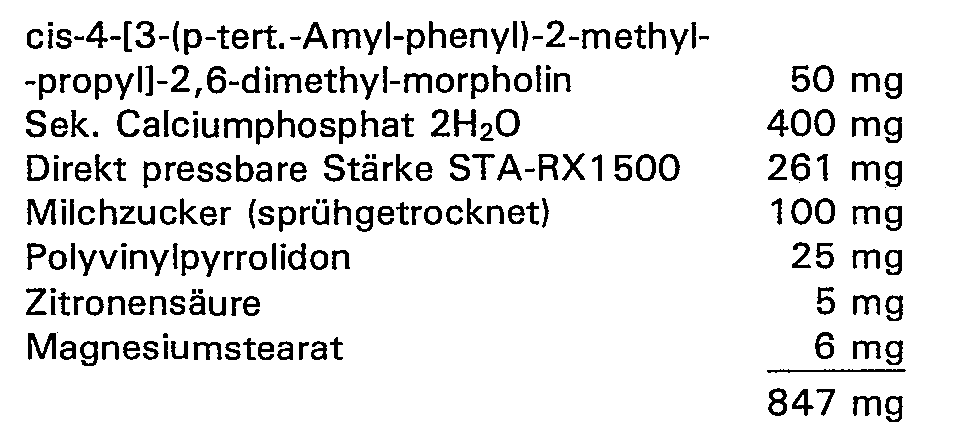
- Vaginal tablets of the following composition are produced in the usual way:
- a cream with the following composition is produced:
Landscapes
- Chemical & Material Sciences (AREA)
- Organic Chemistry (AREA)
- Heterocyclic Carbon Compounds Containing A Hetero Ring Having Nitrogen And Oxygen As The Only Ring Hetero Atoms (AREA)
- Pharmaceuticals Containing Other Organic And Inorganic Compounds (AREA)
- Organic Low-Molecular-Weight Compounds And Preparation Thereof (AREA)
Description
- Die Erfindung betrifft heterocyclische Verbindungen der allgemeinen Formel

und Salze sowie N-Oxyde dieser Verbindungen. - Die Erfindung betrifft ferner ein Verfahren zur Herstellung von Verbindungen der Formel und von deren Salzen und N-Oxyden, fungizide Mittel, welche diese Verbindungen enthalten, Verfahren zur Herstellung dieser Mittel sowie die Verwendung dieser Mittel.
- Aus der DE-A-2 752 096 sind Verbindungen bekannt, von welchen sich die erfindungsgemässen Verbindungen der Formel 1 dadurch unterscheiden, dass sie cis-Isomere darstellen.
- Das Verfahren zur Herstellung der erfindungsgemässen Verbindungen ist dadurch gekennzeichnet, dass man
- a) ein Halogenid der Formel

mit einer Verbindung der Formel
- b) eine Verbindung der Formel

reduziert, oder - c) eine Verbindung der allgemeinen Formel


- d) eine Verbindung der Formel

unter hydrierenden Bedingungen mit einer Verbindung der Formel III umsetzt, oder dass man, zwecks Herstellung eines N-Oxyds, eine Verbindung der Formel mit Wasserstoffperoxid oder Persäuren behandelt, oder dass man, zwecks Herstellung eines Salzes, eine Base der Formel mit einer Säure in an sich bekannter Weise in ein Salz überführt. - Gemäss Verfahrensvariante a) wird ein Halogenid der Formel 11 mit einem Amin der Formel 111, zweckmässig in einem inerten Lösungsmittel, beispielsweise in einem Äther wie Diäthyläther, Tetrahydrofuran oder Dioxan, oder in Dimethylsulfoxid, vorzugsweise in einem höhersiedenden Alkohol, wie Äthylenglykol oder Glycerin, in Gegenwart einer Base, wie beispielsweise Triäthylamin oder einem Überschuss an Amin der Formel III umgesetzt. Das Gemisch wird vorzugsweise in einem Temperaturbereich zwischen 50 und 150°C zur Reaktion gebracht. Besonders bevorzugt ist als Lösungsmittel Äthylenglykol und eine Temperatur von 100-110°C.
- Gemäss Verfahrensvariante b) wird eine Verbindung der Formel IV reduziert. Wenn als Ausgangsmaterial der Formel IV eine Verbindung verwendet wird, worin sich die Doppelbindung in α-Stellung zum Morpholinrest befindet, so kann die Reduktion katalytisch oder mit Ameisensäure erfolgen.
- Als Katalysatoren eignen sich besonders Edelmetallkatalysatoren wie beispielsweise Platin, Palladium - gegebenenfalls auf Kohle niedergeschlagen - sowie Raney-Nickel. Bevorzugt ist Palladium auf Kohle. Für die katalytische Reduktion geeignete Lösungsmittel sind Kohlenwasserstoffe wie Benzol, Toluol oder Xylol, sowie Alkohole wie Methanol oder Äthanol. Bevorzugt ist Toluol. Als Reaktionstemperatur wird vorteilhaft ein Intervall zwischen 0 und 50°C, bevorzugt Raumtemperatur gewählt. Die Reduktion des Enamins mit Ameisensäure wird vorzugsweise in Abwesenheit eines Lösungsmittels durchgeführt, zum Enamin wird bei einer Temperatur von 0-100°C, vorzugsweise 50-70°C, die Ameisensäure, notwendigenfalls unter Kühlung, zugetropft.
- Bei Verwendung eines Ausgangsmaterials der Formel lV, worin sich die Doppelbindung in α-Stellung zum Phenylrest befindet, kann die Reduktion katalytisch erfolgen. Als Katalysator dient hierbei vorzugsweise Platin oder Palladium, wobei als Lösungsmittel Wasser oder Alkohol zur Verwendung gelangt. Um eine mögliche Hydrogenolyse zu vermeiden, wird dem Reaktionsgemisch mindestens ein Äquivalent Säure, vorzugsweise Salzsäure, zugesetzt.
- Die Alkylierung der Verbindung der allgemeinen Formel V gemäss Verfahrensvariante c) erfolgt in Anwesenheit einer geeigneten Menge eines Friedel-Crafts-Katalysators. Als Katalysator eignen sich die bekannten Friedel-Crafts-Katalysatoren wie z.B. Aluminiumchlorid, Eisenchlorid, Zinkchlorid, Bortrifluorid, Zinnchlorid, Fluorwasserstoff, Schwefelsäure und Phosphorsäure. Für die Zwecke der vorliegenden Erfindung ist Schwefelsäure besonders bevorzugt.
- Die Verwendung eines inerten organischen Lösungsmittels ist hierbei nicht zwingend, wird jedoch bevorzugt. Als inerte organische Lösungsmittel eignen sich besonders Alkane wie Hexan, Cyclohexan, chlorierte Kohlenwasserstoffe wie Chloroform, Äthylendichlorid und Methylenchlorid, wobei Methylenchlorid besonders bevorzugt wird. Die Temperatur der Alkylierungsreaktion ist nicht kritisch, liegt jedoch in der Regel zwischen 0-50°C, vorzugsweise zwischen 18-20°C.
- Vorzugsweise und insbesondere im Falle der Verwendung von Schwefelsäure wird nach Beendigung der Reaktion das erhaltene Produkt in der Salzform mit einem inerten organischen Lösungsmittel wie z.B. Methylenchlorid extrahiert. Falls erwünscht kann das freie Amin mit einer geeigneten Base wie Natronlauge, Kalilauge, Soda, Pottasche oder Calciumhydroxid erhalten werden.
- Bevorzugte Verbindungen, welche die Carboniumionen der allgemeinen Formel VI liefern, sind die entsprechenden tert. Alkohole, wie 2-Methyl-2-butanol oder tert. Chloride, wie 2-Chlor-2-methyl-butan.
- Die Umsetzung des substituierten Zimtaldehyds der Formel VII mit dem cis-2,6-Dimethylmorpholin der Formel III erfolgt unter hydrierenden Bedingungen, beispielsweise unter Verwendung eines Palladiumkatalysators, z.B. in Methanol.
- Zwecks Herstellung der N-Oxyde der Verbindungen der Formel 1 wird eine Verbindung der Formel I mit Wasserstoffperoxyd oder einer Persäure behandelt. Als Lösungsmittel dienen, im Falle der Verwendung von Wasserstoffperoxyd als Oxydationsmittel, Alkohole wie Methanol, Äthanol oder Isopropanol, wobei letzterer bevorzugt ist. Bevorzugte Reaktionstemperaturen liegen zwischen 0 und 50°C, besonders bevorzugt bei 40°C. Als Persäuren können beispielsweise Peressigsäure, Perbenzoesäure, Metachlorperbenzoesäure, Peradipinsäure verwendet werden. Als Lösungsmittel für die Persäuren dienen vorzugsweise halogenierte Kohlenwasserstoffe wie Methylenchlorid, Chloroform oder Äthylenchlorid. Als Reaktionstemperaturen eigenen sich die gleichen wie vorstehend für die Reaktion mit Wasserstoffperoxyd beschrieben.
- Verbindungen der Formel 1 bilden Salze mit organischen und anorganischen Säuren. Als Salze für die Verbindungen der Formel 1 kommen insbesondere Salze mit physiologisch verträglichen Säuren in Frage. Hierzu gehören vorzugsweise die Halogenwasserstoffsäuren, wie z.B. die Chlorwasserstoffsäure und die Bromwasserstoffsäure, ferner Phosphorsäure, Salpetersäure, ausserdem mono- und bifunktionelle Carbonsäuren und Hydroxycarbonsäuren, wie z.B. Essigsäure, Maleinsäure, Bernsteinsäure, Fumarsäure, Weinsäure, Zitronensäure, Salicylsäure, Sorbinsäure und Milchsäure, und schliesslich Sulfonsäuren, wie die 1,5-Naphthalin-disulfonsäure. Die Herstellung von derartigen Salzen erfolgt in an sich bekannter Weise.
- Die Ausgangsmaterialien der Formeln II und VI sind bekannte Verbindungen. Die Ausgangsmaterialien 111 und IV sind als cis/trans-Gemische bekannt. Die cis-Ausgangsmaterialien III und IV sind analog den Verfahren für die Herstellung der cis/trans-Gemische erhältlich.
- Die Ausgangsmaterialien der Formel lV, worin sich die Doppelbindung in α-Stellung zum Morpholinrest befindet, können beispielsweise erhalten werden durch Umsetzung eines entsprechend substituierten Phenyl-2-methyl-propionaldehyds mit cis-2,6-Dime- thylmorpholin. Die Hydrierung der so erhaltenen Verbindungen der Formel IV erfolgt zweckmässigerweise in situ.
- Die Ausgangsmaterialien der Formel IV, worin sich die Doppelbindung in ot-Stellung zum Phenylrest befindet, können beispielsweise durch Umsetzung eines Halogenids, welches der Formel II entspricht, welches jedoch in α-Stellung zum Phenylrest eine Doppelbindung aufweist, mit cis-2,6-Dimethylmor- pholin erhalten werden.
- Die Verbindungen der allgemeinen Formel V können hergestellt werden, indem man eine Verbindung der allgemeinen Formel

- Als Lösungsmittel wird vorzugsweise ein organisches Lösungsmittel z.B. ein Alkohol, wie Methanol verwendet. Die Temperatur ist nicht kritisch, liegt jedoch in der Regel zwischen 0-50°C.
- Bei der katalytischen Hydrierung dienen die üblichen Hydrierungskatalysatoren wie z.B. Platin, Raney-Nickel oder Palladium, wobei 5% Palladiumkohle besonders bevorzugt wird.
- Die erfindungsgemässen Verbindungen enthalten in der den Morpholinrest mit dem p-substituierten Phenylrest verbindenden Propylenkette ein asymmetrisches C-Atom und können daher in Form der Racemate und in Form der optischem Antipoden auftreten. Letztere können aus den anfallenden Racematen durch Spaltung mit optisch aktiven Säuren erhalten werden, z.B. mit (+)-Camphersäure, (+)-Campher--10-sulfonsäure, O,O'-Dibenzoylweinsäure (L- oder D-Form), L(+)-Weinsäure, D(-)-Weinsäure, L(+)-Glutaminsäure-4-sulfonat, L(-)-Äpfelsäure oder D(+)-Äpfelsäure. Diese Spaltung kann nach üblichen Spaltungsmethoden erfolgen.
- Die erfindungsgemässen Verbindungen besitzen fungizide Wirkung und können dementsprechend zur Bekämpfung von Fungi in der Landwirtschaft und im Gartenbau Verwendung finden. Die Verbindungen eignen sich besonders zur Bekämpfung von echten Mehltaupilzen wie beispielsweise Erysiphe graminis (Getreidemehltau), Erysiphe cichoracearum (Gurkenmehltau), Podosphaera leucotricha (Apfelmehltau), Sphaerotheca pannosa (Rosenmehltau), Oidium tuckeri (echter Rebmehltau); Rostkrankheiten wie beispielsweise solche der Gattungen Puccinia, Uromyces und Hemileia, insbesondere Puccinia graminis (Getreideschwarzrost), Puccinia coronata (Haferkronenrost), Puccinia sorghi (Maisrost), Puccinia striiformia (Getreidegelbrost), Puccinia recondita (Getreidebraunrost), Uromyces fabae und appendiculatus (Buschbohnenroste) sowie gegen Hemileia vastatrix (Kaffeerost) und Phragmidium mucronatum (Rosenrost).
- Ferner wirken diese Verbindungen auch gegen folgende phytopathogenen Pilze:
- Ustilago avenae (Flugbrand), Venturia inaequalis (Apfelschorf), Cercospora arachidicola (Erdnuss-Blattfleckenkrankheit), Ophiobolus graminis (Getreide-Fusskrankheit), Septoria nodorum (Getreideblatt-und Spelzbräune) oder Marssonina rosae (Rosen-Sternrusstau). Einzelne Substanzen aus dieser Verbindungsklasse besitzen ausgeprägte Nebenwirkungen gegen verschiedene Species folgender Gattungen: Rhizoctonia, Tilletia, Helminthosporium sowie auch teilweise gegen Peronospora, Coniophora, Lenzites, Corticium, Thielaviopsis und Fusarium.
- Ausserdem wirken Verbindungen der Formel I auch gegen phytopathogene Bakterien wie beispielsweise Xanthomonas vesicatoria, Xanthomonas oryzae und andere Xanthomonaden sowie auch gegen verschiedene Arten von Erwinia, z.B. Erwinia tracheiphila.
- Vor allem aber sind die erfindungsgemässen Wirkstoffe aufgrund ihrer fungistatischen und fungiziden Wirkung geeignet zur Bekämpfung von Infektionen, die durch Pilze und Hefen hervorgerufen werden, beispielsweise der Genera Candida, Trichophyten oder Histoplasma. Sie sind insbesondere wirksam gegen Candida-Arten wie Candida albicans und eignen sich vorzugsweise zur lokalen Therapie oberflächlicher Infektionen der Haut und der Schleimhäute, insbesondere des Genitaltraktes, beispielsweise Vaginitis, speziell verursacht durch Candida. Die Applikationsform der Wahl ist die lokale, so dass die Wirkstoffe als therapeutisch aktive Präparate in Form von Salben, Zäpfchen, Suppositorien, Ovula oder anderen geeigneten Formen zur Anwendung kommen können.
- Die Herstellung der pharmazeutischen Präparate kann in an sich bekannter Weise durch Vermischen der Wirkstoffe mit üblichen organischen oder anorganischen inerten Trägermaterialien und/oder Hilfsstoffen, wie Wasser, Gelatine, Milchzucker, Stärke, Magnesiumstearat, Talk, pflanzliche Öle, Polyalkylenglykole, Vaseline, Konservierungs-, Stabilisierungs-, Netz- oder Emulgiermittel, Salze zur Veränderung des osmotischen Druckes oder Puffer, erfolgen.
- Die Dosierung erfolgt nach individuellen Erfordernissen, jedoch dürfte eine Applikation von täglich 1 -2 Tabletten, die 50-100 mg Wirkstoff enthalten, während weniger Tage eine bevorzugte Dosierung darstellen. Die Salben enthalten zweckmässigerweise 0,3-5 %, vorzugsweise 0,5-2%, besonders bevorzugt 0,5-1 % an Wirkstoff. Der nachstehende Versuchsbericht und die in der Tabelle angegebenen Resultate geben dem Fachmann ebenfalls die notwendige Information für die Dosierung der Wirkstoffe.
- Die erfindungsgemässen Verbindungen wurden auf ihre Wirksamkeit gegen Candida albicans in dem in Path. Microbiol. 23: 62-68 (1960) beschriebenen Vaginai-Candidiasis-Test an der Ratte geprüft, wobei die folgenden Resultate erhalten wurden:

- 230 g 3-(p-tert.-Amyl-phenyl)-2-methyl-propionaldehyd und 137 g cis-2,6-Dimethyl-morpholin werden in 1000 ml Toluol in einem Wasserabscheider unterStickstoffbegasung 16 Stunden bis zur Beendigung der Wasserabspaltung am Rückfluss erhitzt. Bei Raumtemperatur werden unter Stickstoffbegasung 17,5 g 5% Palladium auf Kohle zugegeben und anschliessend bis zur Beendigung der Wasserstoffaufnahme hydriert, vom Katalysator abfiltriert und das Toluol am Vakuum abgedampft. Durch Destillation des Rückstandes wird reines cis-4-[3-(p-tert.--Amyl-phenyl)-2-methyl-propyl]-2,6-dimethyl-morpholin vom Siedepunkt 120°C/0,1 Torr erhalten.
- In zu Beispiel 1 analoger Weise erhält man durch Umsetzung von 3-[p-(M,o(-Dimethyl-benzyl)-phenyl]-2-methyl-propionaldehyd mit cis-2,6-Dimethyl--morpholin und Hydrierung des cis-4-/3-[p-(α,α-Dimethyl-benzyl)-phenyl]-2-methyl-propyl/-2,6-dimethyl-morpholin mit einem Siedepunkt von 162°C/ 0,04 Torr.
- Zu 1223 g cis-4-(2-Methyl-3-phenyl-propyl)-2,6--dimethyl-morpholin in 4 1 Methylenchlorid werden bei -5°C innerhalb 45 Minuten 4941 g konz. Schwefelsäure und anschliessend innerhalb 60 Minuten 520 g 2-Methyl-2-butanol getropft. Die Reaktionslösung wird unter Eiskühlung mit Wasser versetzt und die wässerige Phase mehrmals mit Methylenchlorid extrahiert. Die organischen Extrakte werden mit Natronlauge und anschliessend mit Wasser gewaschen, getrocknet, eingedampft und das ölige cis-4-[3-(p-tert-Amyl-phenyl)-2-methylpropyl]-2,6--dimethyl-morpholin im Vakuum destilliert, Siedepunkt 120°C/0,1 Torr.
- Das hierbei als Ausgangsprodukt verwendete cis--4-(2-Methyl-3-phenyl-propyl)-2,6-dimethyl-morpholin kann wie folgt erhalten werden:
- 1000g α-Methyl-zimtaldehyd, 10 1 Methanol und 789 g cis-2,6-Dimethyl-morpholin werden unter einer Stickstoffatmosphäre mit 50 g 5%iger Palladium-Kohle versetzt. Anschliessend wird unter Wasserkühlung bei 30°C bis zur Beendigung der Wasserstoffaufnahme hydriert, vom Katalysator abfiltriert, das Methanol unter vermindertem Druck abdestilliert und dann das rohe cis-4-(2-Methyl-3-phenyl-propyl)--2,6-dimethyl-morpholin destilliert. Das 99% reine Produkt siedet bei 109°C/0,055 Torr.
- 20,0 g p-(α, α-Dimethyl-benzyl)- ot'-methyl-zimt- aldehyd und 9,6 g cis-2,6-Dimethyl-morpholin werden in 60 ml Methanol unter Argonbegasung mit 1 g 5% Palladium auf Kohle versetzt und anschliessend bis zur Beendigung der Wasserstoffaufnahme hydriert. Die vom Katalysator befreite Reaktionslösung wird unter vermindertem Druck eingedampft, mit Chloroform an Aluminiumoxyd (Aktivitätsstufe 11) chromatographiert und anschliessend im Hochvakuum destilliert. Man erhält cis-4-/3-[p-( α, α-Dimethyl-benzyl)-phenyll-2-methyl-propyl/-2,6-dimethyl-morpholin mit einem Siedepunkt von 162°C/ 0,04 Torr.
- In Analogie zu den Angaben in Beispiel 4 erhält man, ausgehend von p-(tert.-Amyl-phenyl)-α'-methyl-zimtaldehyd und cis-2,6-Dimethyl-morpholin, das cis-4-[3-(p-tert.-Amyl-phenyl)-2-methyl-propyl]-2,6-dimethyl-morpholin.
- Zu einer Lösung von 22,7 g 2,6-cis-Dimethyl-morpholin in 70 ml Äthylenglykol werden bei 125°C langsam 44,3 g 3-(p-tert.-Amyl-phenyl)-2-methyl--propylbromid zugetropft und 48 Stunden bei dieser Temperatur gerührt. Nach dem Abkühlen wird mit 2n Salzsäure versetzt und es werden mit Äther die Neutralteile extrahiert. Anschliessend wird die salzsaure Lösung mit 5n Natronlaugelösung alkalisch gestellt, mit Äther extrahiert, der Ätherextrakt mit Wasser gewaschen, über Natriumsulfat getrocknet und eingedampft. Durch Destillation wird reines cis-4-[3-(p--tert-Amyl-phenyl)-2-methyl-propyl]-2,6-dimethyl--morpholin, Siedepunkt 120°C/0,1 Torr, erhalten.
- Zu einer Lösung von 22,7 g 2,6-cis-Dimethyl-morpholin in 80 ml Äthylenglykol werden bei 125°C langsam 51,8 g 3-[p-(α,α-Dimethyl-benzyl)-phenyl]-2-methyl-propylbromid zugetropft und 48 Stunden bei dieser Temperatur gerührt. Die Aufarbeitung erfolgt in Analogie zu Beispiel 6. Durch Destillation wird reines cis-4-/3-[p-(α,α-Dimethyl-benzyl)-phenyl]-2-methyl-propyl/-2,6-dimethyl-morpholin, Siedepunkt 162°C/0,04 Torr, erhalten.
- 266 g cis-4-[3-(p-tert.-Amyl-phenyl)-2-methyl--propyll-2,6-dimethyl-motpholin werden in 500 ml absolutem Äthanol gelöst und bei Raumtemperatur 500 ml einer 28%-Chlorwasserstoff-Äthanollösung zugetropft. Die homogene Lösung wird am Rotationsverdampfer zur Trockne eingeengt und der Rückstand aus 100 ml Wasser umkristallisiert. Das Kristallisat wird mit Wasser gewaschen und im Vakuumtrockenschrank bei 55°C getrocknet. Man erhält das Hydrochlorid von cis-4-[3-(p-tert.-Amyl- -phenyl)-2-methyl-propyll-2,6-dimethyl-morpholin als weisse, leicht hygroskopische Kristalle mit Smp. 204-206°C.
- Zu 21 g cis-4-[3-(p-tert.-Amyl-phenyl)-2-methyl--propyl]-2,6-dimethyl-morpholin wird unter Aceton-Trockeneiskühlung eine Lösung von 60 ml 30%-Wasserstoffperoxid in 60 ml Eissigsäureanhydrid so zugetropft, dass die Reaktionstemperatur 50°C nicht übersteigt und anschliessend 16 Stunden bei Raumtemperatur weiterreagieren gelassen. Der Ansatz wird mittels Dünnschichtchromatographie (Hexan-Äther 1:1) überprüft. Zwecks Zerstörung des überschüssigen Peroxids wird die Reaktionslösung auf -10°C abgekühlt und mit 200 ml 40%-Kalilauge versetzt. Nach 20stündigem Nachrühren wird mit 500 ml Wasser verdünnt und mit Chloroform erschöpfend extrahiert. Die vereinigten Chloroformextrakte werden neutralgewaschen, getrocknet und eingedampft. Durch Umkristallisation des Rückstandes aus 100 ml Pentan wird reines cis-4-[3-(p-tert.--Amyl-phenyl)-2-methyl-propyll-2,6-dimethyl-morpholin-4-oxid erhalten.
- Die folgenden Beispiele beschreiben die Herstellung pharmazeutischer Präparate:
- Es werden in üblicher Weise Vaginaltabletten folgender Zusammensetzung hergestellt:
- Es wird eine Salbe folgender Zusammensetzung hergestellt:
- cis-4-/3-[p-(α,α-Dimethyl-benzyl)-phenyl]-

- Es wird eine Creme folgender Zusammensetzung hergestellt:

Claims (12)

und Salze sowie N-Oxyde dieser Verbindungen.

und von Salzen und N-Oxyden hiervon, dadurch gekennzeichnet, dass man

mit einer Verbindung der Formel


unter hydrierenden Bedingungen mit einer Verbindung der Formel III umsetzt, oder dass man, zwecks Herstellung eines N-Oxyds, eine Verbindung der Formel mit Wasserstoffperoxid oder Persäuren behandelt, oder dass man zwecks Herstellung eines Salzes eine Base der Formel mit einer Säure in an sich bekannter Weise in ein Salz überführt.
Priority Applications (1)
| Application Number | Priority Date | Filing Date | Title |
|---|---|---|---|
| AT80104656T ATE4206T1 (de) | 1979-08-17 | 1980-08-07 | Neue morpholinderivate, verfahren zu deren herstellung, diese derivate enthaltende pharmazeutische praeparate. |
Applications Claiming Priority (4)
| Application Number | Priority Date | Filing Date | Title |
|---|---|---|---|
| CH756079A CH644113A5 (en) | 1979-08-17 | 1979-08-17 | N-substituted 2,6-dimethylmorpholine compounds |
| CH7560/79 | 1979-08-17 | ||
| CH418780 | 1980-05-29 | ||
| CH4187/80 | 1980-05-29 |
Publications (2)
| Publication Number | Publication Date |
|---|---|
| EP0024334A1 EP0024334A1 (de) | 1981-03-04 |
| EP0024334B1 true EP0024334B1 (de) | 1983-07-20 |
Family
ID=25694874
Family Applications (1)
| Application Number | Title | Priority Date | Filing Date |
|---|---|---|---|
| EP80104656A Expired EP0024334B1 (de) | 1979-08-17 | 1980-08-07 | Neue Morpholinderivate, Verfahren zu deren Herstellung, diese Derivate enthaltende pharmazeutische Präparate |
Country Status (31)
| Country | Link |
|---|---|
| EP (1) | EP0024334B1 (de) |
| AR (1) | AR225318A1 (de) |
| AT (1) | ATE4206T1 (de) |
| AU (1) | AU530398B2 (de) |
| BG (1) | BG60798B2 (de) |
| CA (1) | CA1128943A (de) |
| CS (1) | CS402091A3 (de) |
| CU (1) | CU35298A (de) |
| DE (3) | DE3064267D1 (de) |
| DK (1) | DK150509C (de) |
| ES (2) | ES8200355A1 (de) |
| FI (1) | FI69455C (de) |
| FR (1) | FR2463767B1 (de) |
| GB (1) | GB2056454B (de) |
| HR (1) | HRP930340B1 (de) |
| HU (1) | HU182189B (de) |
| IE (1) | IE52642B1 (de) |
| IL (1) | IL60813A (de) |
| IT (1) | IT1220970B (de) |
| LU (1) | LU82713A1 (de) |
| MC (1) | MC1345A1 (de) |
| MY (1) | MY8500272A (de) |
| NL (1) | NL8004537A (de) |
| NO (1) | NO153176C (de) |
| NZ (1) | NZ194628A (de) |
| PH (1) | PH15480A (de) |
| PT (1) | PT71708B (de) |
| SE (1) | SE447730B (de) |
| SI (1) | SI8011754A8 (de) |
| YU (1) | YU43475B (de) |
| ZW (1) | ZW15780A1 (de) |
Cited By (1)
| Publication number | Priority date | Publication date | Assignee | Title |
|---|---|---|---|---|
| WO2010094739A1 (en) | 2009-02-20 | 2010-08-26 | Synteco S.P.A. - Prodotti Di Sintesi Per L'industria Chimica E Farmaceutica | Process for the purification of amorolfine hydrochloride |
Families Citing this family (7)
| Publication number | Priority date | Publication date | Assignee | Title |
|---|---|---|---|---|
| DE3421810A1 (de) * | 1984-06-12 | 1985-12-12 | Basf Ag, 6700 Ludwigshafen | Phenylalkylamine - bioregulatoren |
| CA2008775C (en) * | 1989-02-24 | 1998-12-22 | Alberto Ferro | Nail lacquer |
| EP0446585A1 (de) * | 1990-03-12 | 1991-09-18 | F. Hoffmann-La Roche Ag | Bekämpfung von Pilzinfektionen in der Aquakultur |
| EP1749826A1 (de) | 2005-07-28 | 2007-02-07 | Galderma S.A. | Prozess für die Produktion von Bepromolin |
| EP1749825A1 (de) * | 2005-07-28 | 2007-02-07 | Galderma S.A. | Prozess für die Produktion von Amorolfine |
| EP1842848A1 (de) * | 2006-04-03 | 2007-10-10 | Galderma S.A. | Verfahren zur Herstellung von 3-[4-(1,1-Dimethyl-propyl)-phenyl]2-methyl-propionaldehyde und cis-4{3-[4-(1,1-Dimethyl-propyl)-phenyl]2-methyl-propyl}-2,6-dimethyl-morpholine (Amorolfine) |
| EP1935889A1 (de) * | 2006-12-21 | 2008-06-25 | Galderma S.A. | Prozess für die Produktion von Amorolfine |
Citations (1)
| Publication number | Priority date | Publication date | Assignee | Title |
|---|---|---|---|---|
| DE2752096A1 (de) * | 1976-11-22 | 1978-06-01 | Hoffmann La Roche | Heterocyclische verbindungen |
Family Cites Families (6)
| Publication number | Priority date | Publication date | Assignee | Title |
|---|---|---|---|---|
| DE2656747C2 (de) * | 1976-12-15 | 1984-07-05 | Basf Ag, 6700 Ludwigshafen | Morpholinderivate |
| AU4690979A (en) * | 1978-05-16 | 1979-11-29 | F. Hoffmann-La Roche Ag | Heterocyclic compounds |
| DE2830127A1 (de) * | 1978-07-08 | 1980-01-17 | Basf Ag | N-arylpropyl-substituierte cyclische amine |
| DE2830999A1 (de) * | 1978-07-14 | 1980-01-31 | Basf Ag | Verfahren zur herstellung von stereoisomeren n-aralkyl-2,6-dimethylmorpholinen |
| DE2965247D1 (en) * | 1978-08-08 | 1983-05-26 | Hoffmann La Roche | Synthesis of phenyl-propyl morpholine and piperidine derivatives |
| DE2907614A1 (de) * | 1979-02-27 | 1980-09-04 | Basf Ag | Optische aktive formen des 1- eckige klammer auf 3-(p-tert.-buthylphenyl)-2- methylpropyl eckige klammer zu -cis-3,5- dimethylmorpholins |
-
1980
- 1980-07-07 IT IT23283/80A patent/IT1220970B/it active
- 1980-07-07 ZW ZW157/80A patent/ZW15780A1/xx unknown
- 1980-07-08 YU YU1754/80A patent/YU43475B/xx unknown
- 1980-07-08 SI SI8011754A patent/SI8011754A8/sl unknown
- 1980-07-11 CA CA356,038A patent/CA1128943A/en not_active Expired
- 1980-07-25 AR AR281915A patent/AR225318A1/es active
- 1980-07-30 CU CU8035298A patent/CU35298A/es unknown
- 1980-08-01 FI FI802418A patent/FI69455C/fi not_active IP Right Cessation
- 1980-08-05 PH PH24406A patent/PH15480A/en unknown
- 1980-08-07 DE DE8080104656T patent/DE3064267D1/de not_active Expired
- 1980-08-07 EP EP80104656A patent/EP0024334B1/de not_active Expired
- 1980-08-07 AT AT80104656T patent/ATE4206T1/de active
- 1980-08-07 DE DE19803029966 patent/DE3029966A1/de not_active Withdrawn
- 1980-08-07 DE DE1993175077 patent/DE19375077I2/de active Active
- 1980-08-08 NL NL8004537A patent/NL8004537A/nl not_active Application Discontinuation
- 1980-08-11 NZ NZ194628A patent/NZ194628A/en unknown
- 1980-08-11 IL IL60813A patent/IL60813A/xx unknown
- 1980-08-11 AU AU61321/80A patent/AU530398B2/en not_active Expired
- 1980-08-14 FR FR8017977A patent/FR2463767B1/fr not_active Expired
- 1980-08-14 MC MC801466A patent/MC1345A1/fr unknown
- 1980-08-14 LU LU82713A patent/LU82713A1/de unknown
- 1980-08-14 PT PT71708A patent/PT71708B/pt unknown
- 1980-08-15 IE IE1729/80A patent/IE52642B1/en not_active IP Right Cessation
- 1980-08-15 HU HU802034A patent/HU182189B/hu unknown
- 1980-08-15 GB GB8026709A patent/GB2056454B/en not_active Expired
- 1980-08-15 DK DK355180A patent/DK150509C/da not_active IP Right Cessation
- 1980-08-15 SE SE8005784A patent/SE447730B/sv not_active IP Right Cessation
- 1980-08-15 NO NO802453A patent/NO153176C/no unknown
- 1980-08-16 ES ES494314A patent/ES8200355A1/es not_active Expired
-
1981
- 1981-03-02 ES ES499957A patent/ES8201563A1/es not_active Expired
-
1985
- 1985-12-30 MY MY272/85A patent/MY8500272A/xx unknown
-
1991
- 1991-12-23 CS CS914020A patent/CS402091A3/cs unknown
-
1993
- 1993-03-12 HR HRP-1754/80A patent/HRP930340B1/xx not_active IP Right Cessation
-
1994
- 1994-02-25 BG BG098580A patent/BG60798B2/bg unknown
Patent Citations (1)
| Publication number | Priority date | Publication date | Assignee | Title |
|---|---|---|---|---|
| DE2752096A1 (de) * | 1976-11-22 | 1978-06-01 | Hoffmann La Roche | Heterocyclische verbindungen |
Cited By (1)
| Publication number | Priority date | Publication date | Assignee | Title |
|---|---|---|---|---|
| WO2010094739A1 (en) | 2009-02-20 | 2010-08-26 | Synteco S.P.A. - Prodotti Di Sintesi Per L'industria Chimica E Farmaceutica | Process for the purification of amorolfine hydrochloride |
Also Published As
Similar Documents
| Publication | Publication Date | Title |
|---|---|---|
| DE2752135C2 (de) | Heterocyclische Verbindungen | |
| EP0041673B1 (de) | Imidazolderivate, deren Herstellung sowie diese enthaltende Präparate | |
| EP0224163A2 (de) | Propylamine, Verfahren zu ihrer Herstellung und ihre Verwendung als Fungizide | |
| EP0024334A1 (de) | Neue Morpholinderivate, Verfahren zu deren Herstellung, diese Derivate enthaltende pharmazeutische Präparate | |
| EP0005541A2 (de) | Substituierte Piperidin-, Morpholin- oder Piperidonderivate, fungizide Mittel, die diese Verbindungen enthalten, Verfahren zu deren Herstellung und Verwendung sowie die Verwendung dieser Verbindungen als Fungizide | |
| EP0008686A2 (de) | Verfahren zur Herstellung von Phenyl-propyl-morpholin- und -piperidin-Derivaten | |
| EP0057362B1 (de) | Dibenzofuranderivate, Verfahren zu ihrer Herstellung und ihre Verwendung zur Bekämpfung von Pilzen | |
| DE3803860A1 (de) | N,n'-disubstituierte piperazine | |
| DE3042844A1 (de) | 2-(1h-imidazol-1-yl)-aethoxyderivate von chinolin-2- und 4-methanolen, verfahren zu ihrer herstellung, arzneimittel und ihre verwendung | |
| EP0309913B1 (de) | Fungizide N-substituierte 3-Aryl-pyrrolidin-Derivate | |
| DE2833892C2 (de) | 12H-Dibenzo[d,g][1,3,6]dioxazocinderivate, solche enthaltende Arzneimittel und Verfahren zur Herstellung derselben | |
| EP0401798B1 (de) | Substituierte Aminoalkylbenzolderivate | |
| EP0243940B1 (de) | Phenyl-und Cyclohexyl-Isobutylpyrrolidinderivate | |
| EP0033501A2 (de) | Beta-Imidazolylalkohole, Verfahren zu ihrer Herstellung, diese enthaltende Fungizide und Verfahren zur Bekämpfung von Pilzen mit ihnen | |
| DE3876546T2 (de) | Ethanon-oxime. | |
| EP0309914A2 (de) | Fungizide N-substituierte 3-Alkyl-4-aryl-pyrrolidin-Derivate | |
| EP0244641B1 (de) | 1,4-Cyclohexandiamine, Verfahren zu ihrer Herstellung und ihre Verwendung als Fungizide | |
| CH644113A5 (en) | N-substituted 2,6-dimethylmorpholine compounds | |
| DE2146676A1 (de) | Cyclopropano- eckige Klammer auf b eckige Klammer zu -tetrahydronaphthaline, Verfahren zu ihrer Herstellung und ihre Verwendung | |
| AT242125B (de) | Verfahren zur Herstellung neuer basischer Äther, ihrer Säureadditionssalze, N-Oxyde und quaternären Ammoniumverbindungen | |
| DE2207212A1 (de) | Neue Amine und Verfahren zu ihrer Herstellung | |
| DE2220250A1 (de) | N hoch 1 -Acetoxymethylindazole, Verfahren zu ihrer Herstellung und ihre Verwendung als Herbizide und Fungizide | |
| DE1092019B (de) | Verfahren zur N-Monoalkylierung des Piperazins | |
| CH501611A (de) | Verfahren zur Herstellung von Dibenzocycloheptenen | |
| CH330317A (de) | Verfahren zur Herstellung von neuen 3-Amino-indanen |
Legal Events
| Date | Code | Title | Description |
|---|---|---|---|
| PUAI | Public reference made under article 153(3) epc to a published international application that has entered the european phase |
Free format text: ORIGINAL CODE: 0009012 |
|
| 17P | Request for examination filed |
Effective date: 19800807 |
|
| AK | Designated contracting states |
Designated state(s): AT BE CH DE FR GB IT LU NL SE |
|
| ITF | It: translation for a ep patent filed | ||
| GRAA | (expected) grant |
Free format text: ORIGINAL CODE: 0009210 |
|
| AK | Designated contracting states |
Designated state(s): AT BE CH DE FR GB IT LI LU NL SE |
|
| REF | Corresponds to: |
Ref document number: 4206 Country of ref document: AT Date of ref document: 19830815 Kind code of ref document: T |
|
| REF | Corresponds to: |
Ref document number: 3064267 Country of ref document: DE Date of ref document: 19830825 |
|
| ET | Fr: translation filed | ||
| PLBE | No opposition filed within time limit |
Free format text: ORIGINAL CODE: 0009261 |
|
| STAA | Information on the status of an ep patent application or granted ep patent |
Free format text: STATUS: NO OPPOSITION FILED WITHIN TIME LIMIT |
|
| 26N | No opposition filed | ||
| PG25 | Lapsed in a contracting state [announced via postgrant information from national office to epo] |
Ref country code: GB Free format text: LAPSE BECAUSE OF NON-PAYMENT OF DUE FEES Effective date: 19880807 |
|
| GBPC | Gb: european patent ceased through non-payment of renewal fee | ||
| ITPR | It: changes in ownership of a european patent |
Owner name: CESSIONE;F. HOFFMANN - LA ROCHE AG |
|
| NLS | Nl: assignments of ep-patents |
Owner name: F. HOFFMANN-LA ROCHE AG TE BAZEL, ZWITSERLAND. |
|
| REG | Reference to a national code |
Ref country code: FR Ref legal event code: TP |
|
| REG | Reference to a national code |
Ref country code: CH Ref legal event code: PUE Owner name: F. HOFFMANN-LA ROCHE AG |
|
| ITTA | It: last paid annual fee | ||
| REG | Reference to a national code |
Ref country code: FR Ref legal event code: CC Free format text: FRCC 92C0116, 920430 |
|
| REG | Reference to a national code |
Ref country code: FR Ref legal event code: CB Free format text: FRCB 92C0116, 800807 |
|
| REG | Reference to a national code |
Ref country code: FR Ref legal event code: CL |
|
| EPTA | Lu: last paid annual fee | ||
| REG | Reference to a national code |
Ref country code: SE Ref legal event code: SPCF Free format text: 80104656 |
|
| CCPA | Be: application for a complementary protection certificate |
Free format text: 094C0013 |
|
| EAL | Se: european patent in force in sweden |
Ref document number: 80104656.6 |
|
| REG | Reference to a national code |
Ref country code: AT Ref legal event code: ESZA Spc suppl protection certif: SZ 124/1994 Filing date: 19941222 |
|
| CCPV | Be: grant of a complementary protection certificate |
Free format text: 094C0013, EXPIRES 20050807 |
|
| REG | Reference to a national code |
Ref country code: SE Ref legal event code: SPCG Free format text: 9490041, 931022, EXPIRES: 20050807 |
|
| REG | Reference to a national code |
Ref country code: CH Ref legal event code: SPCF Free format text: CHSPCFIKS 51280,51281/911218, 951103 |
|
| REG | Reference to a national code |
Ref country code: CH Ref legal event code: SPCF Free format text: CHSPCFIKS 51280,51281/911218, 951103 |
|
| REG | Reference to a national code |
Ref country code: CH Ref legal event code: SPCG Free format text: IKS 51280,51281/911218, 951103, EXPIRES:20050806 |
|
| PGFP | Annual fee paid to national office [announced via postgrant information from national office to epo] |
Ref country code: SE Payment date: 19990804 Year of fee payment: 20 Ref country code: LU Payment date: 19990804 Year of fee payment: 20 |
|
| PGFP | Annual fee paid to national office [announced via postgrant information from national office to epo] |
Ref country code: DE Payment date: 19990809 Year of fee payment: 20 |
|
| PGFP | Annual fee paid to national office [announced via postgrant information from national office to epo] |
Ref country code: FR Payment date: 19990810 Year of fee payment: 20 |
|
| PGFP | Annual fee paid to national office [announced via postgrant information from national office to epo] |
Ref country code: CH Payment date: 19990811 Year of fee payment: 20 |
|
| PGFP | Annual fee paid to national office [announced via postgrant information from national office to epo] |
Ref country code: AT Payment date: 19990812 Year of fee payment: 20 |
|
| PGFP | Annual fee paid to national office [announced via postgrant information from national office to epo] |
Ref country code: NL Payment date: 19990830 Year of fee payment: 20 |
|
| PGFP | Annual fee paid to national office [announced via postgrant information from national office to epo] |
Ref country code: BE Payment date: 19991013 Year of fee payment: 20 |
|
| BE20 | Be: patent expired |
Free format text: 20000807 F. *HOFFMANN-LA ROCHE A.G. |
|
| REG | Reference to a national code |
Ref country code: AT Ref legal event code: EEZF Free format text: PRODUCT NAME: AMOROLFINE UND SEINE SALZE Spc suppl protection certif: SZ 124/1994 Filing date: 19941222 Expiry date: 20000807 Extension date: 20050807 |
|
| PG25 | Lapsed in a contracting state [announced via postgrant information from national office to epo] |
Ref country code: LI Free format text: LAPSE BECAUSE OF EXPIRATION OF PROTECTION Effective date: 20000806 Ref country code: CH Free format text: LAPSE BECAUSE OF EXPIRATION OF PROTECTION Effective date: 20000806 |
|
| PG25 | Lapsed in a contracting state [announced via postgrant information from national office to epo] |
Ref country code: NL Free format text: LAPSE BECAUSE OF EXPIRATION OF PROTECTION Effective date: 20000807 Ref country code: LU Free format text: LAPSE BECAUSE OF EXPIRATION OF PROTECTION Effective date: 20000807 Ref country code: AT Free format text: LAPSE BECAUSE OF EXPIRATION OF PROTECTION Effective date: 20000807 |
|
| PG25 | Lapsed in a contracting state [announced via postgrant information from national office to epo] |
Ref country code: SE Free format text: THE PATENT HAS BEEN ANNULLED BY A DECISION OF A NATIONAL AUTHORITY Effective date: 20000830 |
|
| REG | Reference to a national code |
Ref country code: CH Ref legal event code: SPCM Free format text: F. HOFFMANN-LA ROCHE AG GRENZACHERSTRASSE 124 4070 BASEL TRANSFER- GALDERMA S.A. ZUGERSTRASSE 8 6330 CHAM Ref country code: CH Ref legal event code: PUE Owner name: F. HOFFMANN-LA ROCHE AG TRANSFER- GALDERMA S.A. Ref country code: CH Ref legal event code: PL Ref country code: CH Ref legal event code: NV Representative=s name: KIRKER & CIE SA |
|
| NLV7 | Nl: ceased due to reaching the maximum lifetime of a patent |
Effective date: 20000807 |
|
| EUG | Se: european patent has lapsed |
Ref document number: 80104656.6 |
|
| REG | Reference to a national code |
Ref country code: FR Ref legal event code: TP |
|
| REG | Reference to a national code |
Ref country code: AT Ref legal event code: EELA Ref document number: 4206 Country of ref document: AT Kind code of ref document: T |
|
| REG | Reference to a national code |
Ref country code: BE Ref legal event code: CCRE Free format text: PRODUCT NAME: CHLORHYDRATE D AMOROLFINE; NAT REG.: 218 IS 15 F 11 19940729, FIRST REG.: GB 0031/0286 19910610 Spc suppl protection certif: 94C0013 Filing date: 19940927 Expiry date: 20000807 Extension date: 20050807 |