EP0030372A2 - Elktrophotographisches Kopiergerät - Google Patents
Elktrophotographisches Kopiergerät Download PDFInfo
- Publication number
- EP0030372A2 EP0030372A2 EP80107615A EP80107615A EP0030372A2 EP 0030372 A2 EP0030372 A2 EP 0030372A2 EP 80107615 A EP80107615 A EP 80107615A EP 80107615 A EP80107615 A EP 80107615A EP 0030372 A2 EP0030372 A2 EP 0030372A2
- Authority
- EP
- European Patent Office
- Prior art keywords
- cycle
- numbers
- fuser
- temperature
- cycles
- Prior art date
- Legal status (The legal status is an assumption and is not a legal conclusion. Google has not performed a legal analysis and makes no representation as to the accuracy of the status listed.)
- Granted
Links
- 238000010438 heat treatment Methods 0.000 claims description 3
- 238000012545 processing Methods 0.000 description 19
- 238000001514 detection method Methods 0.000 description 9
- 238000000034 method Methods 0.000 description 7
- 238000010586 diagram Methods 0.000 description 6
- 238000013459 approach Methods 0.000 description 5
- 230000006870 function Effects 0.000 description 5
- 230000001351 cycling effect Effects 0.000 description 2
- 230000000694 effects Effects 0.000 description 2
- 238000005070 sampling Methods 0.000 description 2
- PEDCQBHIVMGVHV-UHFFFAOYSA-N Glycerine Chemical compound OCC(O)CO PEDCQBHIVMGVHV-UHFFFAOYSA-N 0.000 description 1
- 238000006243 chemical reaction Methods 0.000 description 1
- 238000004891 communication Methods 0.000 description 1
- 238000010276 construction Methods 0.000 description 1
- 238000001816 cooling Methods 0.000 description 1
- 230000003247 decreasing effect Effects 0.000 description 1
- 238000013461 design Methods 0.000 description 1
- 230000005670 electromagnetic radiation Effects 0.000 description 1
- 230000007613 environmental effect Effects 0.000 description 1
- 238000004519 manufacturing process Methods 0.000 description 1
- 239000000463 material Substances 0.000 description 1
- 238000012544 monitoring process Methods 0.000 description 1
- 230000021715 photosynthesis, light harvesting Effects 0.000 description 1
- 230000005855 radiation Effects 0.000 description 1
- 239000007787 solid Substances 0.000 description 1
- 238000001228 spectrum Methods 0.000 description 1
- 238000012360 testing method Methods 0.000 description 1
- 238000012546 transfer Methods 0.000 description 1
- 230000003936 working memory Effects 0.000 description 1
Images


Classifications
-
- G—PHYSICS
- G03—PHOTOGRAPHY; CINEMATOGRAPHY; ANALOGOUS TECHNIQUES USING WAVES OTHER THAN OPTICAL WAVES; ELECTROGRAPHY; HOLOGRAPHY
- G03G—ELECTROGRAPHY; ELECTROPHOTOGRAPHY; MAGNETOGRAPHY
- G03G15/00—Apparatus for electrographic processes using a charge pattern
- G03G15/20—Apparatus for electrographic processes using a charge pattern for fixing, e.g. by using heat
- G03G15/2003—Apparatus for electrographic processes using a charge pattern for fixing, e.g. by using heat using heat
-
- G—PHYSICS
- G05—CONTROLLING; REGULATING
- G05D—SYSTEMS FOR CONTROLLING OR REGULATING NON-ELECTRIC VARIABLES
- G05D23/00—Control of temperature
- G05D23/19—Control of temperature characterised by the use of electric means
- G05D23/1917—Control of temperature characterised by the use of electric means using digital means
-
- G—PHYSICS
- G05—CONTROLLING; REGULATING
- G05D—SYSTEMS FOR CONTROLLING OR REGULATING NON-ELECTRIC VARIABLES
- G05D23/00—Control of temperature
- G05D23/19—Control of temperature characterised by the use of electric means
- G05D23/20—Control of temperature characterised by the use of electric means with sensing elements having variation of electric or magnetic properties with change of temperature
Definitions
- the invention relates to apparatus for generating a variable number of pulses per cycle. It can be applied in particular to automatically controlling the amount of electrical energy supplied to a fuser of an electrophotographic copier.
- an electrophotographic apparatus for example a xerographic copier
- a pattern of toner is placed on paper in accordance with an image on an original document.
- the toner is fixed on the paper to form a permanent copy of the original image by applying a combination of heat and pressure to the toner and paper.
- the paper carrying loosely adhering toner is passed between a heated fuser roll and a backup roll to essentially melt the toner into the paper.
- the quality of the result depends upon the temperature to which the paper is brought during the fusing operation. At the extremes, too high a temperature will undesirably remove toner from the paper, while too low a temperature will fail to properly bond the toner to the paper. In practical systems, a major problem is non-uniformity of heat application over the duration of a "copy run" i.e., during the copying of one or more originals in a single continuous operator-initiated job. Successive sheets of paper may reach different temperatures, not all within the acceptable range, and different sizes of paper may reach different temperatures at different times.
- a physically massive fuser roll will eventually reach a stable surface temperature which is substantially independent of external factors such as the size and quantity of paper placed in contact with it or the rate at which the paper is fed past the roller.
- copier size, energy availability and time-to- first-copy restrictions dictate that a fuser roll be as physically small as possible.
- Commercial copiers acceptable in an office environment ideally must be physically small, cannot generate excessive quantities of heat and must be connectable to a conventional electrical power outlet.
- the fuser heater is often a major source of heat and user of electrical energy, and the size of the fuser is a significant factor in the size of the copier.
- a small fuser is desirable at least because it generates less heat, uses less power, takes up less space.
- the prior art discloses a number of approaches to the problem of accurately controlling fuser temperature.
- the simplest prior art approach provides an on-off thermostat in series with the fuser heater. While this provides control of fuser temperature, on-off cycling does not give the accuracy required by compact and fast copiers, even where the thermostat is extremely accurate.
- the primary disadvantage of on-off cycling is that the peak power requirements are significantly greater than the average power used for heating.
- a copier -with an on-off thermostat may need to be connected to an undesirably large current source.
- a typical commercial copier with an on-off thermostat may require a dedicated power circuit capable of supplying as much as 3-5 kilowatts. This large power requirement is determined in part by "worst case" fuser conditions, such as the age of the heating element, original manufacturing tolerances and line voltage variations.
- Another prior art approach is to supply only a portion of each power cycle of an alternating supply to heat the fuser.
- the portions are selected as a function of the fuser temperature sensed by a thermostat.
- Shortcomings of this approach are that, since it requires electronic switching of substantial load currents, physically large electrical parts are required, energy may be wasted and undesirable electromagnetic radiation occurs.
- a lamp dimmer disclosed in U.S. Patent No. 3,691,404 selects groups of alternating current cycles in accordance with digital quantities chosen by manually adjusting a switch. The cycles are switched at zero-crossings.
- U.S. Patent No. 3,259,825 shows a servo drive wherein varying numbers of positive half-cycles are selected at zero-crossings as a function of a control voltage. Power to a heat source is controlled in U.S. Patent No. 3,878,358 by removing full cycles from a succession of alternating current cycles, as a function of the output from a heat sensor.
- U.S. Patent No. 3,456,095 selects the frequency at which positive half-cycles of power are supplied to a heater as a function of signals from a heat sensor.
- Typical problems of prior art approaches are that high instantaneous or average currents are switched, special electric supply sources are required, electromagnetic noise is generated, fuser temperature is not sensed, undesirable direct current components are present (when the difference between the numbers of positive and negative half-cycles is not zero), large physical size is necessary, finely graduated adjustments are not possible, manual intervention is required, etc.
- apparatus for generating a variable number of pulses per cycle according to a respective input value (D) for that cycle comprising means for providing during each cycle a predetermined sequence of numbers (B numbers), one number following the preceding number through the cycle, determining means for determining whether a predetermined mathematical relationship (B>,D) is satisfied between the input value relevant for that cycle and each succeeding number of the sequence, and means for generating a pulse as not, for each said succeeding number, according to the determination by the determining means.
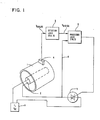
- FIG. 1 there is shown an overall view of a fuser temperature control system for a copier utilizing the invention described herein.
- a fuser roll 1 of conventional metallic construction is heated by a heater 2.
- the heater 2 is conventionally a source such as a lamp, or a series of high temperature wires, supplied by a power supply 3 providing an alternating voltage V .
- the power supply is selectively connectable to the heater 2 by operation of a switching triac 7.
- the temperature of the fuser roll is sensed by a sensor 4 which supplies analog signals to the detection logic 5.
- Detection logic 5 serves to eliminate noise and convert the analog voltage to digital data representations utilizable by processing logic 6, which gates the triac 7.
- Control signals received by the processing logic 6 are digital data representations from the detection logic 5, representing fuser roll 1 temperature, and signals on line 8 indicating the alternating line voltage from the power supply 3.
- the purpose of the system shown in Figure 1 is to control the temperature of the fuser roll 1, with a selective degree of control.
- the degree of control required during normal copy runs is more stringent than that required during "standby" operations when the copier is awaiting use.
- the processing logic 6 operates the triac 7 to supply to the heater 2 selected ones of the half-cycles from the power supply 3.
- the processing logic 6 selects those half-cycles necessary to maintain the fuser roll 1 at a temperature within a tolerance range depending on the current mode of operation of the copier, while minimizing the difference between the number of positive and negative half-cycles selected to: (a) provide as small a DC component to the heater 2 as possible and (b) to keep the average current over short periods close to the average current over longer periods.
- the processing logic may operate the triac 7 to supply between 0 percent and 100 percent of the maximum power available from the power supply 3 to the heater 2, the supply being incremented in steps ranging from a few percent to greater than 50 percent. During copying operations, however, the supply is incremented in steps never exceeding a few percent.
- the amount of power utilized by the heater 2 has been empirically determined for a typical gas-filled lamp. For such a lamp, the power radiated out of the lamp is approximately shown by the following relationship based on Moon's equations: where:
- the lamp will be operated to radiate 58.58 percent of its full power.
- the processing logic 6 is adjusted in accordance with temperature of the fuser roll 1 as sensed by the sensor 4, the number of half-cycles during which the lamp is operated can be changed to maintain the fuser roll 1 temperature within a desired range. For example, if detection logic 5 supplies digital signals to the processing logic 6 indicating that the temperature of the fuser roll 1 has dropped, the processing logic 6 can switch the triac 7 an increased number of times to cause the lamp to be turned on for a larger number of half-cycles.
- the processing logic 6 can cause the triac 7 to turn the lamp 2 on, for example 24 out of 32 half-cycles, causing the lamp to supply 80.09 percent of its full power. If this increased radiation from the lamp 2 causes the fuser roll temperature to rise, the sensor 4 will signal the detection logic 5 of the change and the processing logic 6 will cause the number of half-cycles to decrease. For example, if the temperature rises, the processing logic 6 may signal the triac 7 to pass to the lamp 2 10 out of 32 half-cycles causing the lamp to operate at 40.76 percent of its full power. The processing logic 6 may change the proportion of "on" half-cycles after any full set (M) of 32 half-cycles has been completed.
- M full set
- processing logic 6 to select the number of cycles of operation of a lamp 2 to maintain the temperature of a fuser roll 1 within a tolerance range. Still to be described in detail are the techniques of operation of the processing logic 6, the technique for minimizing imbalance between the number of positive and negative half-cycles (causing undesirable DC current components), the technique for avoiding noise generation by switching the triac 7 only at voltage zero-crossings, and the technique for selectively providing different operation for different modes of copier operation.
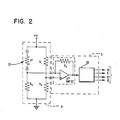
- the detection logic 5 comprises the sensor 4 configured as a bridge circuit where in a thermistor 21 is provided in one arm of a bridge also containing three resistors, Rl, R2 and R3.
- the thermistor 21 changes its resistance in accordance with the temperature to which it is subjected. The degree of imbalance of the bridge determines an output temperature signal. It will be understood that other temperature sensing techniques can be used, preferably utilizing solid state sensors.
- Detection logic 5 includes an error voltage generator comprising a resistor R4 and an operational amplifier 22, and an analog-to-digital converter 23 which supplies binary digital data in parallel on lines DO-D3 to processing logic 6 in Figure 3.
- the digital data representation DO-D3 from detection logic 5 in Figure 2 is latched in a gated buffer 31 and made available during the period of latching to a comparator 32. It is not essential that DO-D3, available from the latch to the comparator 32, digitally corresponds to the actual temperature sensed on the fuser roll on any particular temperature scale. For example, for simplicity, it may be useful to view DO-D3 as representing the number 15 when the fuser roll 1 is for example at 100 degrees Celsius, and the number 0 when the fuser roll is at 85 0 C.
- the comparator 32 also receives bits on four additional lines BO-B3 representing another digital number according to any convenient code.
- the comparator 32 detects a predetermined mathematical relationship between DO-D3 and BO-B3 e.g., when the number represented by BO-B3 is greater than or equal to that represented by DO-D3, a signal occurs on its output line connected to operational amplifier 41.
- Other mathematical relationships are however possible in other embodiments e.g., the reverse relationship to the one given, or an equality relationship only. Broadly the information supplied to the comparator should be selected with the ultimate objective in mind.
- the signal at the output of the comparator 32 passes through the operational amplifier 41 and an operational amplifier 42 to a pulse transformer 43 before gating the triac 7 in Figure 1.
- the operational amplifier 41 may be selectively supplied with an override signal for test purposes.
- the operational amplifier 42 is modulated by a high frequency signal to permit the use of a relatively small pulse transformer 43.
- the triac 7 is operated for one cycle of the current from the source 3 for each signal from the comparator 32, in accordance with the normal mode of operation of triacs.
- the number represented by BO-B3 is determined by the number of the current half-cycle in the set of half-cycles M. For example, where M equals 32, each half-cycle in the sequence of 32 half-cycles is numbered in sequence from 1 through 32. The current number is compared to the temperature value DO-D3 currently in latch 31.
- the address entered in register 38 provides an argument for a table in one of the read-only stores 35 and 36, which argument causes BO-B3 to be supplied to the data-out register 34.
- the same BO-B3 will always be found for a particular argument, and two or more different arguments may give the same BO-B3.
- the necessary accessing operations required to perform the table look - up are performed by a central processing unit 37.
- the address supplied to the address register 38 is provided by a counter 39 which is stepped by a zero-crossing detector 40 connected by line 8 to the power supply 3 in Figure 1.
- the zero-crossing detector 40 supplies a signal whenever the power supply voltage from the power supply circuit 3 goes through O. This not only identifies the beginning of each half-cycle, but also enables all switching operations to occur when the power supply voltage is at or near 0; this reduces noise generation and reduces the necessary size of switching components.
- the pulses from the zero-crossing detector 40 step the counter 39 to indicate to the address register 38 the sequential number of the half-cycle. For example the first one of 32 half-cycles will cause the number 1 to be entered in the register 38, the second will cause the number 2 to be entered therein, etc.
- a different address is entered into the address register 38, which causes the same or a different number, depending on the table in read-only storage 35 or 36, to be placed in the data-out register 34.
- the triac 7 is gated to pass one half-cycle of current to the heater 2.
- the counter 39 has an output connected to the buffer latch 31 which signals the occurrence of the end of a cycle of operation; that is, when M half-cycles of the power supply 3 have occurred, -the buffer latch 31 is gated to enter a new digital data representation DO-D3 of the temperature sensed by the sensor 4.
- the processing logic 6 has an input for indicating to the central processing unit 37 whether the copier is in standby or run mode.
- One use of this information is to control the selection of the particular read-only store 35 or 36 which is used effectively for converting the data in the address register 38 to the data in the data-out register 34.
- read-only storage 35 may be used for standby operations, and a different table in read-only storage 36 may be used when the copier is in a run mode.
- the half-cycles are shown sequentially numbered across the top from 0 through 31, with their alternating polarities indicated by the signs "+" and "-".
- the half-cycle numbers 0-31 are the numbers supplied by the counter 39 to the address register 38.
- the particular mode of copier operation shown by Table II . is a copy run operation where accurate temperature control is essential.
- the read-only store 36 in the processor 33 is assumed to be selected for this operation.
- the read-only store 36 stores a table containing as arguments the half-cycle numbers shown in Table II, and the corresponding B numbers (each represented by a particular BO-B3 in Figure 3) shown below them in Table II.
- the B numbers are shown in Table II for positive half-cycles in one row, and for negative half-cycles in a second row.
- the number 14 will be supplied by the read-only store 36 to the data out register 34.
- the data out register 34 will receive the number 15.
- the comparator 32 will give an output signal whenever the B number is geater than or equal to the digital number (DO-D3 in Figure 3) representing the temperature supplied by the buffer latch 31.
- the digital number representing the temperature supplied to the comparator 32 is chosen to be in the range of 0-15 as shown in the column to the left of Table II.
- a temperature value of 0 indicates that the temperature of the fuser roll 1 is considerably below the desired temperature, whereas a temperature value of 15 indicates that the difference from the desired temperature is either nonexistent or very small.
- the comparator 32 sends a signal to the triac 7 causing it to conduct the one-half cycle as shown by a 1 digit in the Table II.
- the B number 14 is greater than or equal to the temperature value in fifteen of the possible sixteen values shown. The only time that this is not true is if the temperature value is 15; that is, the fuser temperature is at or above its desired value 15.
- the B number is 8, which will cause the triac 7 to be gated in nine of the sixteen possible temperature cases.
- the number of half-cycles during which the triac 7 is operated is predetermined. That is, if the temperature value is 15, the first line of "l's" shows that seventeen out of thirty-two of the half-cycles will be selected.
- the two right hand columns in Table II indicate the DC component of the current supplied to the heater 2, and the percentage of total power supplied to the heater 2.
- the number of negative half-cycles exceeds the number of positive half-cycles by one, and the total average power supplied is 61.39 percent of the full power of the lamp.
- the row numbered 0 indicates that all thirty-two of the available thirty-two half-cycles will be supplied to the lamp, giving 100 percent of the lamp's full power and a DC component of 0. It will be seen that the B numbers are such that the number of half-cycles supplied to the lamp per set of 32 half-cycles i.e., per cycle of operation of the apparatus, varies inversely with the magnitude of the temperature value. In Table II, the difference between the number of positive and negative half-cycles is never more than one. Also the half-cycles supplied to the lamp are spread throughout the apparatus cycle.
- Table III is organised in the same manner as Table 11.
- the difference between standby operation of a copier and a copy run operation mode of a copier is that, in the former, it is not essential that the temperature of the fuser roll 1 be maintained as accurately. Therefore, when the temperature value D is 15, it is permissible to shut off the fuser; this is shown in the first line of Table III. Thus when the temperature value is 15, no half-cycles of the available thirty-two are selected and the power supplied to the heater is 0 percent. When the temperature of the fuser 1 drops to give a temperature value, for example to a value of 14 as shown in the second row, there will be a change from providing zero half-cycles to providing eighteen half-cycles.
- the power supplied to the heater 2 may vary between 0 percent and 64.15 percent of the full power for a small temperature change. This should be contrasted with the copy run mode of operation shown in Table II where a similar temperature variation will give a much smaller percentage change, i.e., from 61.39 percent to 64.15 percent.
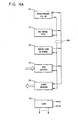
- Figures 4A and 4B show a block diagram of a programmable machine controller described in detail in our U.S. Patent No. 4, 086,658.
- the processor 33 ( Figure 3) includes a microprocessor 170 which is detailed in Figure 4B.
- the microprocessor 170 is attached to a bus to which is attached read-only store 171, a working memory 172 and input and output registers 173 and 174 useful for communications with external devices such as a temperature sensor 4.
- a clock 176 provides timing signals.
- the microprocessor 170 of Figure 4B comprises the circuits necessary to perform instructions in accordance with a program of instructions supplied in binary machine code derived from commands in assembly language as detailed in the referenced patent.
- the instructions which determine the movement of data among the registers shown, define operations in the particular processor described in the referenced patent. It is within the scope of the invention to utilise discrete logic design techniques or to substitute another processor for the one shown and to utilise an appropriate instruction language therefor, such as BASIC.
- the triac 7 is turned on for one half-cycle. If the value is less than the present fuser temperature value, the triac 7 is turned off for a half-cycle. The routine then fetches another B number and, for every 64 fetches, it causes another temperature value sampling.
- the invention broadly relates to apparatus for generating a variable number of pulses per cycle.
- the invention is applied in the closed loop servo control of the temperature of a body heated by the pulses i.e., the energy of the pulses is converted to heat by an electric device to heat the body.
- the invention may also be utilized in other devices requiring energy control, and the result of the energy controlled may be characterised in terms other than temperature.
- thermoelectric cold junction with, or without, a separate heat source.
- the invention may also be applied to open loop control systems.
Landscapes
- Physics & Mathematics (AREA)
- General Physics & Mathematics (AREA)
- Engineering & Computer Science (AREA)
- Automation & Control Theory (AREA)
- Fixing For Electrophotography (AREA)
- Control Of Temperature (AREA)
Applications Claiming Priority (2)
| Application Number | Priority Date | Filing Date | Title |
|---|---|---|---|
| US10250879A | 1979-12-11 | 1979-12-11 | |
| US102508 | 1979-12-11 |
Publications (3)
| Publication Number | Publication Date |
|---|---|
| EP0030372A2 true EP0030372A2 (de) | 1981-06-17 |
| EP0030372A3 EP0030372A3 (en) | 1982-03-24 |
| EP0030372B1 EP0030372B1 (de) | 1985-10-16 |
Family
ID=22290231
Family Applications (1)
| Application Number | Title | Priority Date | Filing Date |
|---|---|---|---|
| EP80107615A Expired EP0030372B1 (de) | 1979-12-11 | 1980-12-04 | Elktrophotographisches Kopiergerät |
Country Status (2)
| Country | Link |
|---|---|
| EP (1) | EP0030372B1 (de) |
| DE (1) | DE3071191D1 (de) |
Cited By (3)
| Publication number | Priority date | Publication date | Assignee | Title |
|---|---|---|---|---|
| EP0085950A1 (de) * | 1982-02-08 | 1983-08-17 | Hitachi, Ltd. | Temperatursteuervorrichtung für eine Fixierheizquelle in einem Kopiergerät |
| EP0415752A3 (en) * | 1989-09-01 | 1992-02-05 | Canon Kabushiki Kaisha | Image forming apparatus |
| US5681494A (en) * | 1993-10-15 | 1997-10-28 | Seiko Epson Corporation | Temperature control method for fixing device and fixing device and image forming apparatus using same temperature control method |
Family Cites Families (6)
| Publication number | Priority date | Publication date | Assignee | Title |
|---|---|---|---|---|
| GB1135269A (en) * | 1966-07-20 | 1968-12-04 | Rosemount Eng Co Ltd | Improvements in or relating to systems for controlling electrical power |
| US3878358A (en) * | 1972-11-16 | 1975-04-15 | Xerox Corp | Digital power control |
| US3961236A (en) * | 1975-02-07 | 1976-06-01 | Xerox Corporation | Constant power regulator for xerographic fusing system |
| JPS5339136A (en) * | 1976-09-22 | 1978-04-10 | Ricoh Co Ltd | Fixing temperature controlling method |
| EP0006553A1 (de) * | 1978-07-03 | 1980-01-09 | International Business Machines Corporation | Verfahren und Vorrichtung zum Betrieb einer Heizquelle in einem Kopiergerät |
| EP0011863B1 (de) * | 1978-12-04 | 1985-01-16 | GENICOM Corporation | Stromsteuergerät für eine elektrische Last |
-
1980
- 1980-12-04 DE DE8080107615T patent/DE3071191D1/de not_active Expired
- 1980-12-04 EP EP80107615A patent/EP0030372B1/de not_active Expired
Cited By (4)
| Publication number | Priority date | Publication date | Assignee | Title |
|---|---|---|---|---|
| EP0085950A1 (de) * | 1982-02-08 | 1983-08-17 | Hitachi, Ltd. | Temperatursteuervorrichtung für eine Fixierheizquelle in einem Kopiergerät |
| EP0415752A3 (en) * | 1989-09-01 | 1992-02-05 | Canon Kabushiki Kaisha | Image forming apparatus |
| US5377321A (en) * | 1989-09-01 | 1994-12-27 | Canon Kabushiki Kaisha | Image forming apparatus having settable inference rules |
| US5681494A (en) * | 1993-10-15 | 1997-10-28 | Seiko Epson Corporation | Temperature control method for fixing device and fixing device and image forming apparatus using same temperature control method |
Also Published As
| Publication number | Publication date |
|---|---|
| EP0030372A3 (en) | 1982-03-24 |
| DE3071191D1 (en) | 1985-11-21 |
| EP0030372B1 (de) | 1985-10-16 |
Similar Documents
| Publication | Publication Date | Title |
|---|---|---|
| US4374321A (en) | Automatic temperature controller for an electrophotographic apparatus fuser and method therefor | |
| US3878358A (en) | Digital power control | |
| US4435677A (en) | Rms voltage controller | |
| EP0651307B1 (de) | Steuersystem und -verfahren für mit einer innerhalb eines grossen Bereichs veränderlichen Versorgungsspannung arbeitenden Widerstandheizung | |
| US3961236A (en) | Constant power regulator for xerographic fusing system | |
| US4868368A (en) | Heated roller temperature control system | |
| GB2067319A (en) | Controlling fuser in electrostatic reproduction apparatus | |
| KR960702124A (ko) | 디지탈 신호처리를 사용하는 정전기 집진기 제어 장치(system for controlling an electrostatic precipitator using digital signal processing) | |
| EP0111075A2 (de) | Verfahren und Vorrichtung zur Steuerung des Ausganges eines Systems | |
| EP0836123B1 (de) | Bilderwärmungsgerät | |
| US5946526A (en) | Method and device for controlling temperature of heating source of image forming apparatus | |
| EP0030372B1 (de) | Elktrophotographisches Kopiergerät | |
| US8521051B2 (en) | Apparatus and method of controlling power supply to heating roller and phase control circuit corresponding to the apparatus and method | |
| JPH09103366A (ja) | 電気炊飯器の制御回路 | |
| US20060097758A1 (en) | Power control using at least 540 degrees of phase | |
| GB2108730A (en) | Power control unit | |
| JPS6348349B2 (de) | ||
| JP2000268939A (ja) | ヒータ装置、及びこれを備えた熱定着装置 | |
| JP3487925B2 (ja) | 負荷電流制御装置 | |
| RU1154U1 (ru) | Устройство для регулирования температуры | |
| GB2222278A (en) | Control of electric heating | |
| JPH01186781A (ja) | ヒータの電力制御装置 | |
| JPH1173230A (ja) | 再生装置の負荷、特に固定ユニットへの電源制御装置 | |
| JPH0611999A (ja) | 定着装置 | |
| US5365040A (en) | Fixing device having a temperature control system |
Legal Events
| Date | Code | Title | Description |
|---|---|---|---|
| PUAI | Public reference made under article 153(3) epc to a published international application that has entered the european phase |
Free format text: ORIGINAL CODE: 0009012 |
|
| AK | Designated contracting states |
Kind code of ref document: A2 Designated state(s): DE FR GB |
|
| PUAL | Search report despatched |
Free format text: ORIGINAL CODE: 0009013 |
|
| AK | Designated contracting states |
Kind code of ref document: A3 Designated state(s): DE FR GB |
|
| 17P | Request for examination filed |
Effective date: 19820415 |
|
| GRAA | (expected) grant |
Free format text: ORIGINAL CODE: 0009210 |
|
| AK | Designated contracting states |
Kind code of ref document: B1 Designated state(s): DE FR GB |
|
| REF | Corresponds to: |
Ref document number: 3071191 Country of ref document: DE Date of ref document: 19851121 |
|
| ET | Fr: translation filed | ||
| PLBE | No opposition filed within time limit |
Free format text: ORIGINAL CODE: 0009261 |
|
| STAA | Information on the status of an ep patent application or granted ep patent |
Free format text: STATUS: NO OPPOSITION FILED WITHIN TIME LIMIT |
|
| 26N | No opposition filed | ||
| PGFP | Annual fee paid to national office [announced via postgrant information from national office to epo] |
Ref country code: GB Payment date: 19901119 Year of fee payment: 11 |
|
| PGFP | Annual fee paid to national office [announced via postgrant information from national office to epo] |
Ref country code: FR Payment date: 19901122 Year of fee payment: 11 |
|
| PGFP | Annual fee paid to national office [announced via postgrant information from national office to epo] |
Ref country code: DE Payment date: 19901231 Year of fee payment: 11 |
|
| PG25 | Lapsed in a contracting state [announced via postgrant information from national office to epo] |
Ref country code: GB Effective date: 19911204 |
|
| GBPC | Gb: european patent ceased through non-payment of renewal fee | ||
| PG25 | Lapsed in a contracting state [announced via postgrant information from national office to epo] |
Ref country code: FR Effective date: 19920831 |
|
| PG25 | Lapsed in a contracting state [announced via postgrant information from national office to epo] |
Ref country code: DE Effective date: 19920901 |
|
| REG | Reference to a national code |
Ref country code: FR Ref legal event code: ST |