EP0031771A1 - Ethers de 1-(2-propynyloxy)-2-amino-3-propanol, leur préparation et une composition pharmaceutique les contenant - Google Patents
Ethers de 1-(2-propynyloxy)-2-amino-3-propanol, leur préparation et une composition pharmaceutique les contenant Download PDFInfo
- Publication number
- EP0031771A1 EP0031771A1 EP80401829A EP80401829A EP0031771A1 EP 0031771 A1 EP0031771 A1 EP 0031771A1 EP 80401829 A EP80401829 A EP 80401829A EP 80401829 A EP80401829 A EP 80401829A EP 0031771 A1 EP0031771 A1 EP 0031771A1
- Authority
- EP
- European Patent Office
- Prior art keywords
- radical
- compounds
- lower alkyl
- phenyl
- pyrrolidinyl
- Prior art date
- Legal status (The legal status is an assumption and is not a legal conclusion. Google has not performed a legal analysis and makes no representation as to the accuracy of the status listed.)
- Granted
Links
- -1 1-(2-Propynyloxy)-2-amino-3-propanol ethers Chemical class 0.000 title claims abstract description 37
- 239000008194 pharmaceutical composition Substances 0.000 title claims description 3
- 238000002360 preparation method Methods 0.000 title description 3
- 150000001875 compounds Chemical class 0.000 claims abstract description 37
- CIUQDSCDWFSTQR-UHFFFAOYSA-N [C]1=CC=CC=C1 Chemical compound [C]1=CC=CC=C1 CIUQDSCDWFSTQR-UHFFFAOYSA-N 0.000 claims abstract description 10
- 229910052799 carbon Inorganic materials 0.000 claims abstract description 7
- 239000001257 hydrogen Substances 0.000 claims abstract description 5
- 229910052739 hydrogen Inorganic materials 0.000 claims abstract description 5
- 150000003839 salts Chemical class 0.000 claims abstract description 5
- MDFFNEOEWAXZRQ-UHFFFAOYSA-N aminyl Chemical compound [NH2] MDFFNEOEWAXZRQ-UHFFFAOYSA-N 0.000 claims abstract description 4
- 125000000623 heterocyclic group Chemical group 0.000 claims abstract description 4
- 125000004435 hydrogen atom Chemical group [H]* 0.000 claims abstract description 4
- 229910052757 nitrogen Inorganic materials 0.000 claims abstract description 4
- SLRMQYXOBQWXCR-UHFFFAOYSA-N 2154-56-5 Chemical compound [CH2]C1=CC=CC=C1 SLRMQYXOBQWXCR-UHFFFAOYSA-N 0.000 claims abstract description 3
- 206010002383 Angina Pectoris Diseases 0.000 claims abstract description 3
- 125000004433 nitrogen atom Chemical group N* 0.000 claims abstract description 3
- 125000000719 pyrrolidinyl group Chemical group 0.000 claims abstract description 3
- 238000000034 method Methods 0.000 claims description 7
- 238000006243 chemical reaction Methods 0.000 claims description 4
- 239000000546 pharmaceutical excipient Substances 0.000 claims description 4
- KTOQRRDVVIDEAA-UHFFFAOYSA-N 2-methylpropane Chemical compound [CH2]C(C)C KTOQRRDVVIDEAA-UHFFFAOYSA-N 0.000 claims description 3
- OKTJSMMVPCPJKN-UHFFFAOYSA-N Carbon Chemical compound [C] OKTJSMMVPCPJKN-UHFFFAOYSA-N 0.000 claims description 3
- 150000001721 carbon Chemical group 0.000 claims description 3
- 208000020446 Cardiac disease Diseases 0.000 claims description 2
- YUDRVAHLXDBKSR-UHFFFAOYSA-N [CH]1CCCCC1 Chemical compound [CH]1CCCCC1 YUDRVAHLXDBKSR-UHFFFAOYSA-N 0.000 claims description 2
- 125000004429 atom Chemical group 0.000 claims description 2
- 239000000460 chlorine Substances 0.000 claims description 2
- 229910052801 chlorine Inorganic materials 0.000 claims description 2
- 229910052736 halogen Inorganic materials 0.000 claims description 2
- 150000002367 halogens Chemical class 0.000 claims description 2
- 208000019622 heart disease Diseases 0.000 claims description 2
- 229940124531 pharmaceutical excipient Drugs 0.000 claims description 2
- WCYWZMWISLQXQU-UHFFFAOYSA-N methyl Chemical compound [CH3] WCYWZMWISLQXQU-UHFFFAOYSA-N 0.000 claims 2
- 125000001309 chloro group Chemical group Cl* 0.000 claims 1
- 238000004519 manufacturing process Methods 0.000 claims 1
- 125000005905 mesyloxy group Chemical group 0.000 claims 1
- 125000004432 carbon atom Chemical group C* 0.000 abstract description 3
- RTZKZFJDLAIYFH-UHFFFAOYSA-N Diethyl ether Chemical compound CCOCC RTZKZFJDLAIYFH-UHFFFAOYSA-N 0.000 description 18
- HEMHJVSKTPXQMS-UHFFFAOYSA-M Sodium hydroxide Chemical compound [OH-].[Na+] HEMHJVSKTPXQMS-UHFFFAOYSA-M 0.000 description 15
- 239000000047 product Substances 0.000 description 11
- UHOVQNZJYSORNB-UHFFFAOYSA-N Benzene Chemical compound C1=CC=CC=C1 UHOVQNZJYSORNB-UHFFFAOYSA-N 0.000 description 6
- 238000010992 reflux Methods 0.000 description 6
- VEXZGXHMUGYJMC-UHFFFAOYSA-M Chloride anion Chemical compound [Cl-] VEXZGXHMUGYJMC-UHFFFAOYSA-M 0.000 description 5
- XLYOFNOQVPJJNP-UHFFFAOYSA-N water Substances O XLYOFNOQVPJJNP-UHFFFAOYSA-N 0.000 description 5
- 125000001797 benzyl group Chemical group [H]C1=C([H])C([H])=C(C([H])=C1[H])C([H])([H])* 0.000 description 4
- 239000000203 mixture Substances 0.000 description 4
- 230000008569 process Effects 0.000 description 4
- 239000012429 reaction media Substances 0.000 description 4
- 238000003756 stirring Methods 0.000 description 4
- YMWUJEATGCHHMB-UHFFFAOYSA-N Dichloromethane Chemical compound ClCCl YMWUJEATGCHHMB-UHFFFAOYSA-N 0.000 description 3
- 238000009835 boiling Methods 0.000 description 3
- 238000004821 distillation Methods 0.000 description 3
- 230000000694 effects Effects 0.000 description 3
- 239000007788 liquid Substances 0.000 description 3
- 125000002496 methyl group Chemical group [H]C([H])([H])* 0.000 description 3
- AQHHHDLHHXJYJD-UHFFFAOYSA-N propranolol Chemical compound C1=CC=C2C(OCC(O)CNC(C)C)=CC=CC2=C1 AQHHHDLHHXJYJD-UHFFFAOYSA-N 0.000 description 3
- 150000003254 radicals Chemical class 0.000 description 3
- KSLSOBUAIFEGLT-UHFFFAOYSA-N 2-phenylbut-3-yn-2-ol Chemical compound C#CC(O)(C)C1=CC=CC=C1 KSLSOBUAIFEGLT-UHFFFAOYSA-N 0.000 description 2
- YYROPELSRYBVMQ-UHFFFAOYSA-N 4-toluenesulfonyl chloride Chemical compound CC1=CC=C(S(Cl)(=O)=O)C=C1 YYROPELSRYBVMQ-UHFFFAOYSA-N 0.000 description 2
- HBAQYPYDRFILMT-UHFFFAOYSA-N 8-[3-(1-cyclopropylpyrazol-4-yl)-1H-pyrazolo[4,3-d]pyrimidin-5-yl]-3-methyl-3,8-diazabicyclo[3.2.1]octan-2-one Chemical class C1(CC1)N1N=CC(=C1)C1=NNC2=C1N=C(N=C2)N1C2C(N(CC1CC2)C)=O HBAQYPYDRFILMT-UHFFFAOYSA-N 0.000 description 2
- IJGRMHOSHXDMSA-UHFFFAOYSA-N Atomic nitrogen Chemical compound N#N IJGRMHOSHXDMSA-UHFFFAOYSA-N 0.000 description 2
- HEDRZPFGACZZDS-UHFFFAOYSA-N Chloroform Chemical compound ClC(Cl)Cl HEDRZPFGACZZDS-UHFFFAOYSA-N 0.000 description 2
- LFQSCWFLJHTTHZ-UHFFFAOYSA-N Ethanol Chemical compound CCO LFQSCWFLJHTTHZ-UHFFFAOYSA-N 0.000 description 2
- 241001465754 Metazoa Species 0.000 description 2
- AFVFQIVMOAPDHO-UHFFFAOYSA-N Methanesulfonic acid Chemical compound CS(O)(=O)=O AFVFQIVMOAPDHO-UHFFFAOYSA-N 0.000 description 2
- 239000012359 Methanesulfonyl chloride Substances 0.000 description 2
- JUJWROOIHBZHMG-UHFFFAOYSA-N Pyridine Chemical compound C1=CC=NC=C1 JUJWROOIHBZHMG-UHFFFAOYSA-N 0.000 description 2
- 210000003169 central nervous system Anatomy 0.000 description 2
- OJYGBLRPYBAHRT-IPQSZEQASA-N chloralose Chemical compound O1[C@H](C(Cl)(Cl)Cl)O[C@@H]2[C@@H](O)[C@@H]([C@H](O)CO)O[C@@H]21 OJYGBLRPYBAHRT-IPQSZEQASA-N 0.000 description 2
- 229950009941 chloralose Drugs 0.000 description 2
- 238000001816 cooling Methods 0.000 description 2
- 150000002170 ethers Chemical class 0.000 description 2
- 230000003601 intercostal effect Effects 0.000 description 2
- QARBMVPHQWIHKH-UHFFFAOYSA-N methanesulfonyl chloride Chemical compound CS(Cl)(=O)=O QARBMVPHQWIHKH-UHFFFAOYSA-N 0.000 description 2
- 230000003287 optical effect Effects 0.000 description 2
- 239000000243 solution Substances 0.000 description 2
- 238000002560 therapeutic procedure Methods 0.000 description 2
- JWZZKOKVBUJMES-UHFFFAOYSA-N (+-)-Isoprenaline Chemical compound CC(C)NCC(O)C1=CC=C(O)C(O)=C1 JWZZKOKVBUJMES-UHFFFAOYSA-N 0.000 description 1
- BPWQZVXIARGHIS-UHFFFAOYSA-N 1-(1-ethynylcyclohexyl)oxy-3-pyrrolidin-1-ylpropan-2-ol Chemical compound C1CCCN1CC(O)COC1(C#C)CCCCC1 BPWQZVXIARGHIS-UHFFFAOYSA-N 0.000 description 1
- AUGPFUKHHHPALE-UHFFFAOYSA-N 1-(2-chloro-3-phenoxypropyl)pyrrolidine Chemical compound C1CCCN1CC(Cl)COC1=CC=CC=C1 AUGPFUKHHHPALE-UHFFFAOYSA-N 0.000 description 1
- QWBRUZYLJQZHGC-UHFFFAOYSA-N 1-[1-(1-ethynylcyclohexyl)oxy-3-(2-phenylbut-3-yn-2-yloxy)propan-2-yl]pyrrolidine Chemical compound C=1C=CC=CC=1C(C)(C#C)OCC(N1CCCC1)COC1(C#C)CCCCC1 QWBRUZYLJQZHGC-UHFFFAOYSA-N 0.000 description 1
- FITWYAUFKJXWPL-UHFFFAOYSA-N 1-[1-(2-methylpropoxy)-3-(1-prop-1-ynylcyclohexyl)oxypropan-2-yl]pyrrolidine Chemical compound C1CCCN1C(COCC(C)C)COC1(C#CC)CCCCC1 FITWYAUFKJXWPL-UHFFFAOYSA-N 0.000 description 1
- BFXRCMJRKTUNIQ-UHFFFAOYSA-N 1-[1-(2-methylpropoxy)-3-(2-phenylbut-3-yn-2-yloxy)propan-2-yl]pyrrolidine Chemical compound C1CCCN1C(COCC(C)C)COC(C)(C#C)C1=CC=CC=C1 BFXRCMJRKTUNIQ-UHFFFAOYSA-N 0.000 description 1
- MOFBXBIYUVXLFH-UHFFFAOYSA-N 1-[1-phenoxy-3-(2-phenylbut-3-yn-2-yloxy)propan-2-yl]pyrrolidine Chemical compound C=1C=CC=CC=1C(C)(C#C)OCC(N1CCCC1)COC1=CC=CC=C1 MOFBXBIYUVXLFH-UHFFFAOYSA-N 0.000 description 1
- HOUFSDUTCAUBHL-UHFFFAOYSA-N 1-[2-chloro-3-(2-methylpropoxy)propyl]pyrrolidine Chemical compound CC(C)COCC(Cl)CN1CCCC1 HOUFSDUTCAUBHL-UHFFFAOYSA-N 0.000 description 1
- UTISCLIDFORRJP-UHFFFAOYSA-N 1-prop-1-ynylcyclohexan-1-ol Chemical compound CC#CC1(O)CCCCC1 UTISCLIDFORRJP-UHFFFAOYSA-N 0.000 description 1
- MXZROAOUCUVNHX-UHFFFAOYSA-N 2-Aminopropanol Chemical group CCC(N)O MXZROAOUCUVNHX-UHFFFAOYSA-N 0.000 description 1
- ZLTRGJLBUGKEDQ-UHFFFAOYSA-N 3-amino-2-chloropropan-1-ol Chemical class NCC(Cl)CO ZLTRGJLBUGKEDQ-UHFFFAOYSA-N 0.000 description 1
- QCHHRTIQDOHXPB-UHFFFAOYSA-N 3-naphthalen-1-yloxy-2-(propan-2-ylamino)propan-1-ol Chemical compound C1=CC=C2C(OCC(CO)NC(C)C)=CC=CC2=C1 QCHHRTIQDOHXPB-UHFFFAOYSA-N 0.000 description 1
- 241000282472 Canis lupus familiaris Species 0.000 description 1
- ZAMOUSCENKQFHK-UHFFFAOYSA-N Chlorine atom Chemical compound [Cl] ZAMOUSCENKQFHK-UHFFFAOYSA-N 0.000 description 1
- VEXZGXHMUGYJMC-UHFFFAOYSA-N Hydrochloric acid Chemical compound Cl VEXZGXHMUGYJMC-UHFFFAOYSA-N 0.000 description 1
- UFHFLCQGNIYNRP-UHFFFAOYSA-N Hydrogen Chemical compound [H][H] UFHFLCQGNIYNRP-UHFFFAOYSA-N 0.000 description 1
- 241000699670 Mus sp. Species 0.000 description 1
- PMZURENOXWZQFD-UHFFFAOYSA-L Sodium Sulfate Chemical compound [Na+].[Na+].[O-]S([O-])(=O)=O PMZURENOXWZQFD-UHFFFAOYSA-L 0.000 description 1
- 208000001871 Tachycardia Diseases 0.000 description 1
- 239000004480 active ingredient Substances 0.000 description 1
- 150000001414 amino alcohols Chemical class 0.000 description 1
- 230000015572 biosynthetic process Effects 0.000 description 1
- 230000037396 body weight Effects 0.000 description 1
- 239000002775 capsule Substances 0.000 description 1
- 239000002327 cardiovascular agent Substances 0.000 description 1
- 229940125692 cardiovascular agent Drugs 0.000 description 1
- 239000003795 chemical substances by application Substances 0.000 description 1
- 230000008602 contraction Effects 0.000 description 1
- HXCKCCRKGXHOBK-UHFFFAOYSA-N cycloheptane Chemical compound [CH]1CCCCCC1 HXCKCCRKGXHOBK-UHFFFAOYSA-N 0.000 description 1
- 230000002526 effect on cardiovascular system Effects 0.000 description 1
- 230000008030 elimination Effects 0.000 description 1
- 238000003379 elimination reaction Methods 0.000 description 1
- 239000000839 emulsion Substances 0.000 description 1
- 238000006266 etherification reaction Methods 0.000 description 1
- 125000001495 ethyl group Chemical group [H]C([H])([H])C([H])([H])* 0.000 description 1
- 210000001105 femoral artery Anatomy 0.000 description 1
- 150000004820 halides Chemical class 0.000 description 1
- 230000002140 halogenating effect Effects 0.000 description 1
- 230000010247 heart contraction Effects 0.000 description 1
- 238000010438 heat treatment Methods 0.000 description 1
- 125000005842 heteroatom Chemical group 0.000 description 1
- 125000004051 hexyl group Chemical group [H]C([H])([H])C([H])([H])C([H])([H])C([H])([H])C([H])([H])C([H])([H])* 0.000 description 1
- 230000005764 inhibitory process Effects 0.000 description 1
- 238000002347 injection Methods 0.000 description 1
- 239000007924 injection Substances 0.000 description 1
- 150000002500 ions Chemical class 0.000 description 1
- 125000000959 isobutyl group Chemical group [H]C([H])([H])C([H])(C([H])([H])[H])C([H])([H])* 0.000 description 1
- 238000006317 isomerization reaction Methods 0.000 description 1
- 229960001317 isoprenaline Drugs 0.000 description 1
- 125000001449 isopropyl group Chemical group [H]C([H])([H])C([H])(*)C([H])([H])[H] 0.000 description 1
- 239000012263 liquid product Substances 0.000 description 1
- 238000005259 measurement Methods 0.000 description 1
- 238000002844 melting Methods 0.000 description 1
- 230000008018 melting Effects 0.000 description 1
- 238000012986 modification Methods 0.000 description 1
- 230000004048 modification Effects 0.000 description 1
- 125000004573 morpholin-4-yl group Chemical group N1(CCOCC1)* 0.000 description 1
- 210000000056 organ Anatomy 0.000 description 1
- 125000001147 pentyl group Chemical group C(CCCC)* 0.000 description 1
- 230000000144 pharmacologic effect Effects 0.000 description 1
- 239000003444 phase transfer catalyst Substances 0.000 description 1
- 125000001997 phenyl group Chemical group [H]C1=C([H])C([H])=C(*)C([H])=C1[H] 0.000 description 1
- 239000006187 pill Substances 0.000 description 1
- 125000002924 primary amino group Chemical group [H]N([H])* 0.000 description 1
- SWWHCQCMVCPLEQ-UHFFFAOYSA-N propan-2-yl methanesulfonate Chemical compound CC(C)OS(C)(=O)=O SWWHCQCMVCPLEQ-UHFFFAOYSA-N 0.000 description 1
- 239000001294 propane Substances 0.000 description 1
- 125000001436 propyl group Chemical group [H]C([*])([H])C([H])([H])C([H])([H])[H] 0.000 description 1
- WGYKZJWCGVVSQN-UHFFFAOYSA-N propylamine Chemical group CCCN WGYKZJWCGVVSQN-UHFFFAOYSA-N 0.000 description 1
- 238000000746 purification Methods 0.000 description 1
- UMJSCPRVCHMLSP-UHFFFAOYSA-N pyridine Natural products COC1=CC=CN=C1 UMJSCPRVCHMLSP-UHFFFAOYSA-N 0.000 description 1
- 239000002994 raw material Substances 0.000 description 1
- 230000009257 reactivity Effects 0.000 description 1
- 230000008707 rearrangement Effects 0.000 description 1
- 239000000523 sample Substances 0.000 description 1
- 238000000926 separation method Methods 0.000 description 1
- 229910052938 sodium sulfate Inorganic materials 0.000 description 1
- 235000011152 sodium sulphate Nutrition 0.000 description 1
- 239000002904 solvent Substances 0.000 description 1
- 125000001424 substituent group Chemical group 0.000 description 1
- 238000006467 substitution reaction Methods 0.000 description 1
- BDHFUVZGWQCTTF-UHFFFAOYSA-M sulfonate Chemical compound [O-]S(=O)=O BDHFUVZGWQCTTF-UHFFFAOYSA-M 0.000 description 1
- 125000000472 sulfonyl group Chemical group *S(*)(=O)=O 0.000 description 1
- 239000000725 suspension Substances 0.000 description 1
- 230000002889 sympathetic effect Effects 0.000 description 1
- 238000003786 synthesis reaction Methods 0.000 description 1
- 230000006794 tachycardia Effects 0.000 description 1
- 230000001988 toxicity Effects 0.000 description 1
- 231100000419 toxicity Toxicity 0.000 description 1
- 238000006276 transfer reaction Methods 0.000 description 1
- 230000002861 ventricular Effects 0.000 description 1
Classifications
-
- C—CHEMISTRY; METALLURGY
- C07—ORGANIC CHEMISTRY
- C07D—HETEROCYCLIC COMPOUNDS
- C07D295/00—Heterocyclic compounds containing polymethylene-imine rings with at least five ring members, 3-azabicyclo [3.2.2] nonane, piperazine, morpholine or thiomorpholine rings, having only hydrogen atoms directly attached to the ring carbon atoms
- C07D295/04—Heterocyclic compounds containing polymethylene-imine rings with at least five ring members, 3-azabicyclo [3.2.2] nonane, piperazine, morpholine or thiomorpholine rings, having only hydrogen atoms directly attached to the ring carbon atoms with substituted hydrocarbon radicals attached to ring nitrogen atoms
- C07D295/08—Heterocyclic compounds containing polymethylene-imine rings with at least five ring members, 3-azabicyclo [3.2.2] nonane, piperazine, morpholine or thiomorpholine rings, having only hydrogen atoms directly attached to the ring carbon atoms with substituted hydrocarbon radicals attached to ring nitrogen atoms substituted by singly bound oxygen or sulfur atoms
- C07D295/084—Heterocyclic compounds containing polymethylene-imine rings with at least five ring members, 3-azabicyclo [3.2.2] nonane, piperazine, morpholine or thiomorpholine rings, having only hydrogen atoms directly attached to the ring carbon atoms with substituted hydrocarbon radicals attached to ring nitrogen atoms substituted by singly bound oxygen or sulfur atoms with the ring nitrogen atoms and the oxygen or sulfur atoms attached to the same carbon chain, which is not interrupted by carbocyclic rings
- C07D295/088—Heterocyclic compounds containing polymethylene-imine rings with at least five ring members, 3-azabicyclo [3.2.2] nonane, piperazine, morpholine or thiomorpholine rings, having only hydrogen atoms directly attached to the ring carbon atoms with substituted hydrocarbon radicals attached to ring nitrogen atoms substituted by singly bound oxygen or sulfur atoms with the ring nitrogen atoms and the oxygen or sulfur atoms attached to the same carbon chain, which is not interrupted by carbocyclic rings to an acyclic saturated chain
-
- A—HUMAN NECESSITIES
- A61—MEDICAL OR VETERINARY SCIENCE; HYGIENE
- A61P—SPECIFIC THERAPEUTIC ACTIVITY OF CHEMICAL COMPOUNDS OR MEDICINAL PREPARATIONS
- A61P9/00—Drugs for disorders of the cardiovascular system
Definitions
- the present invention relates to new 1- (2-propynyloxy) -2-amino-3-propanol ethers, processes for their preparation, and a pharmaceutical composition containing said ethers as active ingredient.
- the present invention more particularly relates to compounds corresponding to the following general formula: in which R 1 and R 2 each represent, independently of one another, a lower alkyl radical or a phenyl radical, or, together with the carbon atom to which they are linked, a cycloalkyl radical having at most 7 atoms of carbon ; R 3 represents hydrogen, a lower alkyl radical or the phenyl radical; R 4 and R 5 , identical or different, each represent a lower alkyl radical, or, together with the nitrogen atom to which they are linked, a heterocyclic amino radical, such as the pyrrolidinyl or morpholino radicals; R 6 represents a lower alkyl radical, a phenyl radical, a benzyl radical or the 1-ethyl-cyclohexyl radical, as well as the pharmaceutically acceptable salts of these compounds.
- the invention also relates to a process for obtaining said compounds from a suitably substituted 2-chloro 3-amino propanol ether and an acetylenic alcohol, preferably by phase transfer.
- the invention also relates to the application of these compounds, and of their pharmaceutically acceptable salts, in human therapy, in particular in the treatment of cardiac disorders.
- the compounds obtained retain a / 3-blocking activity; this is the case, for example, for 2,3-Cis 1,2,3,4, -tetrahydro-5- (2-hydroxy-3-terbutyl-aminopropoxy) -2,3 naphthalenediol (patent DE 2,258,995).
- halogenated derivative used in this synthesis is prepared according to the known means indicated, for example, in US patent 3,663,566.
- phase transfer reaction is carried out by adding small amounts of halogenated derivative to a solution consisting of an appropriate acetylenic alcohol, an amount substantially equal, or in slight excess of base, preferably 50-70% sodium hydroxide and a phase transfer catalyst such as benzyltriethylamonium chloride.
- a solvent such as benzene or methylene chloride, before bringing to reflux.
- the compound obtained is then extracted by the usual methods, for example with ether.
- the halogenated derivative can be replaced by a corresponding sulfonate, prepared by the usual means from the amino alcohol N (R4R5) -CH2-CH (OH) -CH20R6 and a halide of sulfonyl such as mesyl chloride or tosyl chloride.
- This variant is preferably to be used when the substituent R 6 comprises functions which risk being degraded by the halogenating agents used to obtain the halogenated derivative.
- This set of properties makes it possible to recommend the application of the compounds according to the invention, as cardiovascular drugs, intended in particular for the treatment of angina pectoris.
- the products can be administered orally or parenterally at a daily dose of between 1 and 10 mg per kg of body weight. In human therapy, doses between 100 and 600 mg per day are preferably used.
- the compounds of formula I can be compressed in unit dosages such as pills, tablets, coated tablets or be transformed into capsules. Using appropriate liquids, the compounds can also be administered as an injectable or drinkable preparation such as solutions, suspensions or emulsions.
- lower alkyl radical includes alkyl radicals having 1 to 6 carbon atoms such as methyl, ethyl, propyl, isopropyl, butyl radicals, isobutyl, ter-butyl, pentyl, hexyl.
- the cycloalkyl radical is preferably the cyclohexyl radical or the cycloheptyl radical.
- heterocyclic amino radical as used in the definition of R 4 and R 5 , we understand a 5 or 6-membered ring including nitrogen and possibly containing another hetero atom such as morpholino or preferably pyrrolidinyl radicals.
- R 1 and R 2 we will preferably take the methyl, phenyl or cyclohexyl radicals.
- R 3 the preferred meaning corresponds to hydrogen and to the methyl and phenyl radicals.
- the most suitable radical for the definition of R 6 is the isobutyl radical.
- the compounds of formula I have an asymmetric carbon when R 1 and R 2 are different radicals.
- the racemic mixture and the separate optical enantiomers are both part of the compounds of the invention.
- Said optical enantiomers can be prepared in the usual way by separation of the racemic mixture or directly from an optically active raw material.
- Example 2 By proceeding as in Example 1, 6 g of the title product were obtained by heating at reflux for 5 hours a mixture consisting of 14.6 g of 2-phenyl-3 ⁇ butyne-2-ol, 10 g of sodium hydroxide in 10 ml of water, 1.1 g of benzyl triethylamonium chloride and 11 g of 1-pyrrolidinyl-2-chloro-3-isobutoxy propane.
- the mesylate was prepared beforehand by adding 23 ml of mesyl chloride dropwise to 56 g of 1- (1-ethynyl cyclohexyloxy) -3- (N-pyrrolidinyl) propane-2-ol in 135 ml of pyridine. temperature of the reaction medium being maintained between 0 ° and - 5 ° C. When the reaction was complete, the mesylate formed was extracted with chloroform, then with ether.
Landscapes
- Organic Chemistry (AREA)
- Chemical & Material Sciences (AREA)
- Health & Medical Sciences (AREA)
- Pharmacology & Pharmacy (AREA)
- Bioinformatics & Cheminformatics (AREA)
- Cardiology (AREA)
- Chemical Kinetics & Catalysis (AREA)
- General Chemical & Material Sciences (AREA)
- Medicinal Chemistry (AREA)
- Nuclear Medicine, Radiotherapy & Molecular Imaging (AREA)
- Engineering & Computer Science (AREA)
- Life Sciences & Earth Sciences (AREA)
- Heart & Thoracic Surgery (AREA)
- Animal Behavior & Ethology (AREA)
- General Health & Medical Sciences (AREA)
- Public Health (AREA)
- Veterinary Medicine (AREA)
- Pharmaceuticals Containing Other Organic And Inorganic Compounds (AREA)
- Organic Low-Molecular-Weight Compounds And Preparation Thereof (AREA)
- Acyclic And Carbocyclic Compounds In Medicinal Compositions (AREA)
- Pyrrole Compounds (AREA)
Abstract
Description
- La présente invention concerne de nouveaux éthers de 1-(2-propynyloxy)-2-amino-3-propanol, des procédés pour leur préparation, et une composition pharmaceutique contenant lesdits éthers comme principe actif.
- La présente invention a plus particulièrement pour objet des composés répondant à la formule générale suivante :

- L'invention concerne également un procédé d'obtention desdits composés à partir d'un éther de 2-chloro 3-amino propanol convenablement substitué et d'un alcool acétylénique, de préférence par transfert de phase.
- L'invention concerne aussi l'application de ces composés, et de leurs sels pharmaceutiquement acceptables, en thérapeutique humaine, notamment dans le traitement des troubles cardiaques.
- On connaît déjà de nombreux aryloxyaminopropanols dérivant de la structure du 1-isopropylamino-3-(1-naphthyloxy)-2-propanol (propanolol), composé connu pour ses propriétés /3-bloquantes. Les modifications apportées à cette structure concernent soit le radical naphtyle (par substitution et/ou introduction d'une insaturation), soit la chaîne aminopropanol elle-même (par étherification et/ou isomérisation).
- Dans certains cas, les composés obtenus conservent une activité /3-bloquante ; c'est le cas par exemple du 2,3-Cis 1,2,3,4,-tétrahydro-5-(2-hydroxy-3-terbutyl- aminopropoxy)-2,3 naphtalènediol (brevet DE 2.258.995).
- Dans d'autres cas, l'activité β-bloquante attendue ne peut être mise en évidence et les composés possèdent une activité sur le système nerveux central ; cela se produit par exemple avec le 2-isopropylamino-3-(1-naphthyloxy ) -1-propanol, isomère de position du propanolol [J. Med. Chem. 13, 398 (1970)]. Des composés dont la structure générale correspond à des éthers du composé précité sont également dépourvus de propriétés β-bloquantes, mais sont actifs sur le système nerveux central (brevet US 4.060.613).
- Au contraire, on a maintenant découvert que des composés dont la structure générale peut être rapprochée de celle des composés décrits dans le brevet US 4.060.613, mais dans lesquels la chaîne aminopropane n'est plus substituée par un radical aryloxy, possèdent d'intéressantes propriétés β-bloquantes.
- Ces composés, qui correspondent à la formule générale (I), sont préparés selon le schéma réactionnel suivant,de préférence par transfert de phase :

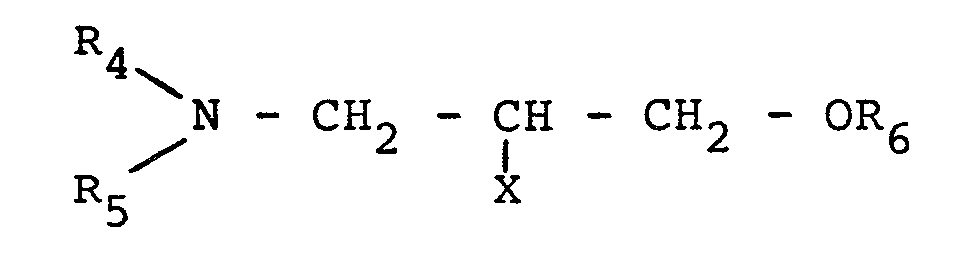
- Le dérivé halogéné utilisé dans cette synthèse est préparé selon les moyens connus indiqués, par exemple, dans le brevet US 3.663.566.
- La réaction en transfert de phase s'effectue par addition de petites quantités de dérivé halogéné à une solution constituée par un alcool acétylénique approprié, une quantité sensiblement égale, ou en léger excès de base, de préférence la soude à 50 - 70 % et un catalyseur de transfert de phase tel que le chlorure de benzyltriéthylamonium.
- Si la trop grande viscosité de milieu réactionnel l'exige, on ajoute un solvant, tel que le benzène ou le chlorure de méthylène, avant de porter à reflux. Le composé obtenu est ensuite extrait par les méthodes habituelles, par exemple à l'éther.
- Selon une variante de ce procédé, on peut remplacer le dérivé halogéné par un sulfonate correspondant, préparé par les moyens habituels à partir de l'amino- alcool N(R4R5)-CH2-CH(OH)-CH20R6 et d'un halogénure de sulfonyl tels le chlorure de mésyl ou le chlorure de tosyl. Cette variante est à utiliser de préférence lorsque le substituant R6 comporte des fonctions risquant d'être dégradées par les agents d'halogénation utilisés pour l'obtention du dérivé halogéné.
- L'activité pharmacologique des composés de l'invention dans le domaine cardiovasculaire a été démontrée chez le chien, conformément au protocole suivant :
- Sur l'animal anesthésié au chloralose, on a enregistré :
- - la fréquence artérielle au niveau d'une artère fémorale par l'intermédiaire d'une sonde reliée à une cellule de pression BELLET ET HOWEL,
- - l'amplitude des contractions cardiaques (Force contractile) au moyen d'une jauge de contrainte fixée par quatre points de suture sur l'épicarde ventriculaire gauche dans le grand axe de l'organe, après thoracotomie pratiquée au niveau du Sème espace intercostal gauche.
- On a également recherché la réactivité sympathique β en enregistrant l'inhibition de la tachycardie induite par une injection d'isoprénaline (0,5 µg.kg-1 I.V.) avant administration du produit testé, puis 5 minutes après, et ensuite toutes les 15 minutes.
- Le tableau A ci-après regroupe les mesures effectuées sur ces différents paramètres, les résultats étant exprimés en pourcentage de variation maximale par rapport aux valeurs avant traitement. Tous les composés de l'invention ont été administrés à la dose de 5 mg.kg-1 I.V., à l'exception du composé n° 3 qui a été administré à la dose de 1 mg.kg I.V.
-

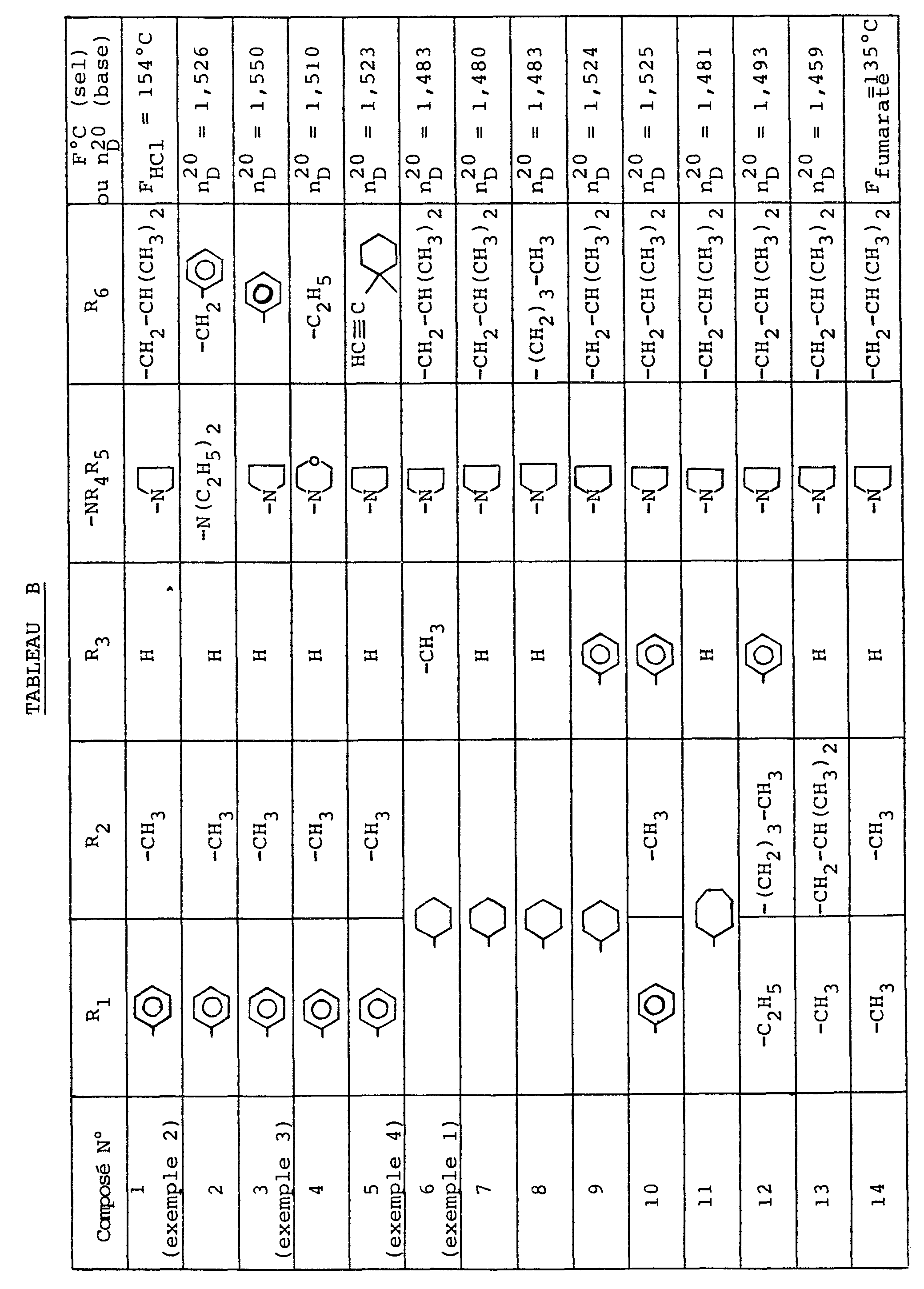
- La structure de ces composés est précisée dans le tableau B, page 11.
- Ces produits se sont en outre révélés posséder une toxicité réduite, par exemple une DL 50 par voie orale chez la souris supérieure à 600 mg.kg pour les composés 6 et 7.
- Cet ensemble de propriétés permet de préconiser l'application des composés selon l'invention, comme médicaments cardiovasculaires, destinés notamment au traitement de l'angine de poitrine.
- Associés aux excipients pharmaceutiques habituels, les produits peuvent être administrés par voie orale ou parenthérale à une dose journalière comprise entre 1 et 10 mg par kg de poids corporel. En thérapeutique humaine on utilisera de préférence des doses comprises entre 100 et 600 mg par jour.
- Mélangés avec des excipients convenables, les composés de formule I peuvent être comprimés en dosages unitaires tels les pillules, les comprimés, les comprimés enrobés ou être transformés en gélules. En utilisant des liquides appropriés, les composés peuvent aussi être administrés sous forme de préparation injectable ou buvable tels des solutions, suspensions ou émulsions.
- Dans la définition de R1, R2, R3, R 4, R 51 l'expression " radical alkyl inférieur " comprend les radicaux alkyl ayant 1 à 6 atomes de carbone tels les radicaux methyl, ethyl, propyl, isopropyl, butyl, isobutyl, ter-butyl, pentyl, hexyl.
- Dans la définition de R1 et R2, le radical cycloalkyl est de préférence le radical cyclohexyl ou le radical cycloheptyl.
- Par radical aminé hétérocyclique tel qu'utilisé dans la définition de R4 et R5, on comprend un cycle à 5 ou 6 chaînons incluant l'azote et pouvant éventuellement contenir un autre hétéro atome tels les radicaux morpholino ou de préférence pyrrolidinyl.
- Concernant la définition de R1 et R2, on prendra de préférence les radicaux methyl, phenyl ou cyclohexyl. Pour le radical R3, la signification préférée correspond à l'hydrogène et aux radicaux methyl et phenyl.
- Le radical le plus approprié pour la définition de R6 est le radical isobutyl.
- Les composés les plus représentatifs de l'invention sont les composés n°s 1 et 6 du tableau B page 11.
- Les composés de formule I possèdent un carbone asymétrique lorsque R1 et R2 sont des radicaux différents. Dans un tel cas, le mélange racémique et les énantiomères optiques séparés font à la fois parties des composés de l'invention.
- Lesdits énantiomères optiques peuvent être préparés de manière habituelle par séparation du mélange racémique ou directement à partir d'une matière première optique- ment active.
-
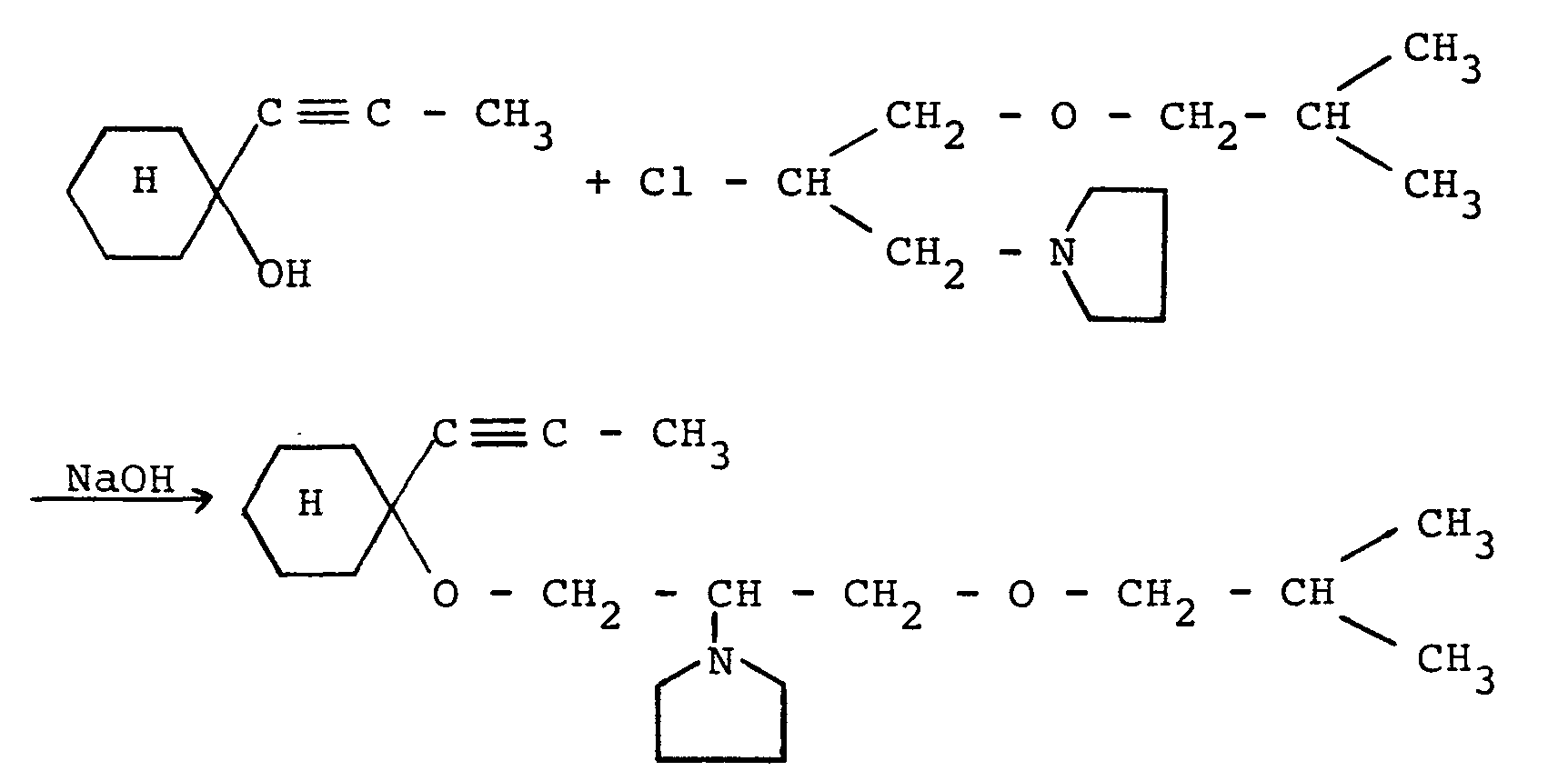
- Dans un réacteur contenant 41,4 g de 1-propynyl cyclohexanol, 30 g de soude préalablement dissous dans 30 ml d'eau et 3,1 g de chlorure de benzyl triéthylamonium, on a introduit progressivement, sous bonne agitation, 33 g de 1-pyrrolidinyl-2-chloro-3-isobutoxy-propane. Lorsque l'addition était terminée, on a porté le mélange à reflux pendant 4 heures en maintenant l'agitation. Après refroidissement, on a extrait le produit formé à l'éther ; on a filtré, décanté et lavé à l'eau la phase éther ; on a séché sur sulfate de sodium, puis on a évaporé l'éther. Après distillation, on a obtenu 22 g de produit du titre, sous forme d'un liquide jaune clair ayant pour point d'ébullition E0,5 = 130-135°C et pour indice de réfraction nD0=1,483.
- En procédant comme pour l'exemple 1, on a obtenu 6 g de produit du titre en chauffant à reflux pendant 5 heures un mélange constitué par 14,6 g de 2-phényl-3~butyne-2-ol, 10 g de soude dans 10 ml d'eau, 1,1 g de chlorure de benzyl triéthylamonium et 11 g de 1-pyrrolidinyl-2-chloro-3-isobutoxy propane. Le produit liquide obtenu avait pour point d'ébullition E0,05 = 143-145°C et pour indice de réfraction n20 D = 1,502.
- La base liquide ainsi obtenue a pu être cristallisée sous forme de chlorhydrate ayant pour point de fusion F = 154°C et pour analyse élémentaire :

- Dans un réacteur contenant 29,2 g de 2-phényl-3-butyne-2-ol, 20 g de soude dans 20 ml d'eau et 2,27 g de chlorure de benzyl triéthylamonium, on a introduit progressivement, sous bonne agitation, 27,5 g de 1-pyrrolidinyl-2-chloro-3-phénoxy propane. Lorsque l'addition était terminée, le milieu réactionnel était très épais et on a ajouté 20 ml de benzène avant de porter à reflux pendant 5 heures. On a extrait ensuite le produit à l'éther, filtré, lavé et séché comme indiqué dans l'exemple 1.
- Après distillation, on a recueilli 21 de produit du titre ayant pour point d'ébullition E0,05 = 190°C et pour indice de réfraction n 20 = 1,550.
- On a préparé au préalable le mésylate en ajoutant goutte à goutte 23 ml de chlorure de mésyle à 56 g de 1-(1-éthynyl cyclohexyloxy)-3-(N-pyrrolidinyl) propane-2-ol dans 135 ml de pyridine, la température du milieu réactionnel étant maintenue entre 0° et - 5°C. Lorsque la réaction était terminée, on a extrait le mésylate formé au chloroforme, puis à l'éther.
- Après purification et élimination de l'éther, le produit obtenu a été utilisé dans l'étape suivante.
- Dans un réacteur contenant 10 g de 2-phényl-3-butyne-2-ol, 10 g de soude dans 10 ml d'eau et 1,1 g de chlorure de benzyl triéthylamonium, on a ajouté goutte à goutte, à température ambiante, 16 g de mésylate de l-(l-éthynyl cyclohexyloxy)-3-(N-pyrrilidinyl) propane -2-ol. Lorsque l'addition était terminée, le milieu réactionnel était assez épais ; on a porté alors doucement à reflux, sous agitation modérée. On a maintenu le reflux pendant environ 14 heures, puis, après refroidissement, on a extrait le produit du titre à l'éther, comme indiqué dans l'exemple 1. On a recueilli après distillation 24 g de produit ayant pour indice de réfraction

- Selon le même procédé, on a également préparé les composés dont les caractéristiques sont résumées dans le tableau B ci-après.
Claims (8)


Priority Applications (1)
| Application Number | Priority Date | Filing Date | Title |
|---|---|---|---|
| AT80401829T ATE2786T1 (de) | 1979-12-28 | 1980-12-19 | 1-(2-propynyloxy)-2-amino-3-propanol-aether, ihre herstellung und sie enthaltende pharmazeutische zusammensetzung. |
Applications Claiming Priority (2)
| Application Number | Priority Date | Filing Date | Title |
|---|---|---|---|
| FR7932008A FR2472567A1 (fr) | 1979-12-28 | 1979-12-28 | Ethers de 1- (2-propynyloxy)-2-amino-3-propanol, leur preparation et leur application en therapeutique |
| FR7932008 | 1979-12-28 |
Publications (2)
| Publication Number | Publication Date |
|---|---|
| EP0031771A1 true EP0031771A1 (fr) | 1981-07-08 |
| EP0031771B1 EP0031771B1 (fr) | 1983-03-16 |
Family
ID=9233299
Family Applications (1)
| Application Number | Title | Priority Date | Filing Date |
|---|---|---|---|
| EP80401829A Expired EP0031771B1 (fr) | 1979-12-28 | 1980-12-19 | Ethers de 1-(2-propynyloxy)-2-amino-3-propanol, leur préparation et une composition pharmaceutique les contenant |
Country Status (17)
| Country | Link |
|---|---|
| US (1) | US4430332A (fr) |
| EP (1) | EP0031771B1 (fr) |
| JP (1) | JPS56103140A (fr) |
| AT (1) | ATE2786T1 (fr) |
| AU (1) | AU531550B2 (fr) |
| CA (1) | CA1142926A (fr) |
| DE (1) | DE3062375D1 (fr) |
| DK (1) | DK155519C (fr) |
| ES (1) | ES498150A0 (fr) |
| FI (1) | FI71137C (fr) |
| FR (1) | FR2472567A1 (fr) |
| GR (1) | GR72514B (fr) |
| HU (1) | HU180644B (fr) |
| IE (1) | IE50639B1 (fr) |
| PT (1) | PT72244B (fr) |
| YU (1) | YU327980A (fr) |
| ZA (1) | ZA807711B (fr) |
Families Citing this family (1)
| Publication number | Priority date | Publication date | Assignee | Title |
|---|---|---|---|---|
| EP0100189B1 (fr) * | 1982-07-22 | 1986-05-28 | Pfizer Limited | Agents anti-ischémiques et antihypertensifs dihydropyridines |
Citations (1)
| Publication number | Priority date | Publication date | Assignee | Title |
|---|---|---|---|---|
| FR2351971A1 (fr) * | 1976-05-19 | 1977-12-16 | Ayerst Mckenna & Harrison | Aryloxy-propylamines, procede de preparation de celles-ci et usages |
Family Cites Families (3)
| Publication number | Priority date | Publication date | Assignee | Title |
|---|---|---|---|---|
| BE795735A (fr) | 1972-03-06 | 1973-06-18 | Cerm Cent Europ Rech Mauvernay | Nouvelles ethylenediamines substituees a activite cardiovasculaire |
| FR2173869B1 (fr) | 1972-04-13 | 1975-12-26 | Cerm Cent Europ Rech Mauvernay | |
| US4060613A (en) | 1976-05-19 | 1977-11-29 | Ayerst Mckenna And Harrison Ltd. | 3-Aryloxy-2(4-loweralkyl-1-piperazinyl)propanols, their alkylethers, and use thereof |
-
1979
- 1979-12-28 FR FR7932008A patent/FR2472567A1/fr active Granted
-
1980
- 1980-12-09 ZA ZA00807711A patent/ZA807711B/xx unknown
- 1980-12-15 AU AU65394/80A patent/AU531550B2/en not_active Ceased
- 1980-12-19 PT PT72244A patent/PT72244B/pt not_active IP Right Cessation
- 1980-12-19 US US06/218,176 patent/US4430332A/en not_active Expired - Fee Related
- 1980-12-19 AT AT80401829T patent/ATE2786T1/de not_active IP Right Cessation
- 1980-12-19 EP EP80401829A patent/EP0031771B1/fr not_active Expired
- 1980-12-19 DE DE8080401829T patent/DE3062375D1/de not_active Expired
- 1980-12-19 DK DK544480A patent/DK155519C/da not_active IP Right Cessation
- 1980-12-22 FI FI803996A patent/FI71137C/fi not_active IP Right Cessation
- 1980-12-23 CA CA000367499A patent/CA1142926A/fr not_active Expired
- 1980-12-23 IE IE2727/80A patent/IE50639B1/en not_active IP Right Cessation
- 1980-12-24 GR GR63760A patent/GR72514B/el unknown
- 1980-12-24 ES ES498150A patent/ES498150A0/es active Granted
- 1980-12-25 YU YU03279/80A patent/YU327980A/xx unknown
- 1980-12-26 JP JP18932180A patent/JPS56103140A/ja active Granted
- 1980-12-28 HU HU80803126A patent/HU180644B/hu unknown
Patent Citations (1)
| Publication number | Priority date | Publication date | Assignee | Title |
|---|---|---|---|---|
| FR2351971A1 (fr) * | 1976-05-19 | 1977-12-16 | Ayerst Mckenna & Harrison | Aryloxy-propylamines, procede de preparation de celles-ci et usages |
Also Published As
| Publication number | Publication date |
|---|---|
| JPS56103140A (en) | 1981-08-18 |
| YU327980A (en) | 1983-02-28 |
| CA1142926A (fr) | 1983-03-15 |
| FI803996L (fi) | 1981-06-29 |
| FI71137B (fi) | 1986-08-14 |
| PT72244A (en) | 1981-01-01 |
| ATE2786T1 (de) | 1983-04-15 |
| DK155519C (da) | 1989-09-04 |
| FR2472567A1 (fr) | 1981-07-03 |
| HU180644B (en) | 1983-03-28 |
| IE802727L (en) | 1981-06-28 |
| ES8203869A1 (es) | 1982-04-16 |
| US4430332A (en) | 1984-02-07 |
| PT72244B (en) | 1981-11-05 |
| AU6539480A (en) | 1981-07-02 |
| DE3062375D1 (en) | 1983-04-21 |
| FI71137C (fi) | 1986-11-24 |
| ES498150A0 (es) | 1982-04-16 |
| GR72514B (fr) | 1983-11-16 |
| EP0031771B1 (fr) | 1983-03-16 |
| JPS6313426B2 (fr) | 1988-03-25 |
| AU531550B2 (en) | 1983-08-25 |
| DK544480A (da) | 1981-06-29 |
| ZA807711B (en) | 1981-12-30 |
| DK155519B (da) | 1989-04-17 |
| FR2472567B1 (fr) | 1983-03-11 |
| IE50639B1 (en) | 1986-05-28 |
Similar Documents
| Publication | Publication Date | Title |
|---|---|---|
| EP0289380A1 (fr) | Dérivés d'aryl-hétéroaryl carbinols avec activité analgésique | |
| FR2498188A1 (fr) | Nouveaux derives de l'indole, leur preparation et leur application comme medicaments | |
| EP0354094A1 (fr) | Dérivés d'indolone, leur préparation et leur application en thérapeutique | |
| EP0010460A1 (fr) | Nouveaux dérivés de pyrrolidine-2-méthanol, procédé pour leur préparation et médicaments les contenant | |
| US4395559A (en) | 2,3-Indoledione derivatives | |
| EP0364350B1 (fr) | Dérivés de méthyl-4[(phényl-4 pipérazinyl-1)-2 éthyl]-5 thiazole, leur procédé de préparation et les compositions pharmaceutiques en contenant | |
| EP0074873B1 (fr) | Dérivés de phénoxy-3 propanol-2, leur préparation et leur application en thérapeutique | |
| FR2662442A1 (fr) | Trifluoromethylphenyltetrahydropyridines n-substituees procede pour leur preparation, intermediaires du procede et compositions pharmaceutiques les contenant. | |
| EP0031771B1 (fr) | Ethers de 1-(2-propynyloxy)-2-amino-3-propanol, leur préparation et une composition pharmaceutique les contenant | |
| EP0122827A1 (fr) | (Carbéthoxy-2 benzalkylamido-4 phénoxy)-1 amino-3 propanols-2, leurs préparations et leurs utilisations en thérapeutique | |
| EP0143016B1 (fr) | Dérivés de 4-(3-alkynyloxy-2-hydroxy-propyl)-piperazin-1-yl-N-phényl acétamide, leur préparation et leur application en thérapeutique | |
| EP0327455A1 (fr) | Ethers alkyliques ou benzyliques du phénol, leurs procédés de préparation et leur application en thérapeutique | |
| EP0112252B1 (fr) | Enantiomères lévogyres des dérivés de la tétrahydro-5,6,13,13a 8H-dibenzo(a, g)quinolizine, procédés d'obtention, compositions pharmaceutiques les contenant et application | |
| EP0008269B1 (fr) | Nouveaux médicaments contenant, à titre de substance active, des composés de type benzènesulfone, nouveaux composés de ce type et procédé pour leur préparation | |
| EP0382636B1 (fr) | Dérivés de pyrimidine, 2-[4-(alpha-heteroaryl-alpha aryl-(alpha-alkyl)-methoxy)-butyl)-1-piperazinyl], avec activité serotoninergique | |
| EP0041233A1 (fr) | Dérivés substitués de phénoxy-aminopropanol, procédés pour leur préparation et intermédiaires ainsi que préparations pharmaceutiques les contenant | |
| EP0061379B1 (fr) | Dérivés de pyridine, leur préparation et leur application en thérapeutique | |
| CH646411A5 (fr) | Esters de l'acide farnesylacetique. | |
| EP0275759B1 (fr) | 3-pipéridineamines ou 3-azépineamines substituées, leur préparation et leurs applications en thérapeutique | |
| EP0151052B1 (fr) | Aminoéthylimidazole, composition pharmaceutique en contenant et procédé de préparation | |
| EP0259228B1 (fr) | Dérivés 5-aminoéthylés de l'oxazolidinone-2, leur procédé de préparation et leur application en thérapeutique | |
| EP0027412A1 (fr) | Dérivés de la pyridine, procédé pour leur préparation et médicaments les contenant | |
| EP0007880B1 (fr) | Nouveaux médicaments contenant, à titre de substance active, des composés de type benzènesulfone, nouveaux composés de ce type et procédé pour leur préparation | |
| EP0275760B1 (fr) | Pipéridines, ou azépines substituées, leur préparation et leur application en thérapeutique | |
| FR2514352A1 (fr) |
Legal Events
| Date | Code | Title | Description |
|---|---|---|---|
| PUAI | Public reference made under article 153(3) epc to a published international application that has entered the european phase |
Free format text: ORIGINAL CODE: 0009012 |
|
| AK | Designated contracting states |
Designated state(s): AT BE CH DE FR GB IT LU NL SE |
|
| 17P | Request for examination filed |
Effective date: 19811023 |
|
| ITF | It: translation for a ep patent filed | ||
| GRAA | (expected) grant |
Free format text: ORIGINAL CODE: 0009210 |
|
| AK | Designated contracting states |
Designated state(s): AT BE CH DE FR GB IT LI LU NL SE |
|
| REF | Corresponds to: |
Ref document number: 2786 Country of ref document: AT Date of ref document: 19830415 Kind code of ref document: T |
|
| REF | Corresponds to: |
Ref document number: 3062375 Country of ref document: DE Date of ref document: 19830421 |
|
| PGFP | Annual fee paid to national office [announced via postgrant information from national office to epo] |
Ref country code: LU Payment date: 19831017 Year of fee payment: 4 |
|
| PG25 | Lapsed in a contracting state [announced via postgrant information from national office to epo] |
Ref country code: LU Free format text: LAPSE BECAUSE OF NON-PAYMENT OF DUE FEES Effective date: 19831231 |
|
| ITTA | It: last paid annual fee | ||
| PGFP | Annual fee paid to national office [announced via postgrant information from national office to epo] |
Ref country code: GB Payment date: 19931115 Year of fee payment: 14 Ref country code: DE Payment date: 19931115 Year of fee payment: 14 Ref country code: CH Payment date: 19931115 Year of fee payment: 14 |
|
| PGFP | Annual fee paid to national office [announced via postgrant information from national office to epo] |
Ref country code: SE Payment date: 19931116 Year of fee payment: 14 |
|
| PGFP | Annual fee paid to national office [announced via postgrant information from national office to epo] |
Ref country code: FR Payment date: 19931119 Year of fee payment: 14 Ref country code: AT Payment date: 19931119 Year of fee payment: 14 |
|
| PGFP | Annual fee paid to national office [announced via postgrant information from national office to epo] |
Ref country code: BE Payment date: 19931122 Year of fee payment: 14 |
|
| PG25 | Lapsed in a contracting state [announced via postgrant information from national office to epo] |
Ref country code: GB Effective date: 19941219 Ref country code: AT Effective date: 19941219 |
|
| PG25 | Lapsed in a contracting state [announced via postgrant information from national office to epo] |
Ref country code: SE Effective date: 19941220 |
|
| PG25 | Lapsed in a contracting state [announced via postgrant information from national office to epo] |
Ref country code: LI Effective date: 19941231 Ref country code: CH Effective date: 19941231 Ref country code: BE Effective date: 19941231 |
|
| PGFP | Annual fee paid to national office [announced via postgrant information from national office to epo] |
Ref country code: NL Payment date: 19941231 Year of fee payment: 15 |
|
| EAL | Se: european patent in force in sweden |
Ref document number: 80401829.9 |
|
| BERE | Be: lapsed |
Owner name: RIOM LABORATOIRES - CERM (S.A.) Effective date: 19941231 |
|
| GBPC | Gb: european patent ceased through non-payment of renewal fee |
Effective date: 19941219 |
|
| PG25 | Lapsed in a contracting state [announced via postgrant information from national office to epo] |
Ref country code: FR Effective date: 19950831 |
|
| REG | Reference to a national code |
Ref country code: CH Ref legal event code: PL |
|
| PG25 | Lapsed in a contracting state [announced via postgrant information from national office to epo] |
Ref country code: DE Effective date: 19950901 |
|
| EUG | Se: european patent has lapsed |
Ref document number: 80401829.9 |
|
| REG | Reference to a national code |
Ref country code: FR Ref legal event code: ST |
|
| PG25 | Lapsed in a contracting state [announced via postgrant information from national office to epo] |
Ref country code: NL Effective date: 19960701 |
|
| NLV4 | Nl: lapsed or anulled due to non-payment of the annual fee |
Effective date: 19960701 |
|
| PLBE | No opposition filed within time limit |
Free format text: ORIGINAL CODE: 0009261 |
|
| STAA | Information on the status of an ep patent application or granted ep patent |
Free format text: STATUS: NO OPPOSITION FILED WITHIN TIME LIMIT |