EP0031880A2 - Procédé pour la fabrication d'un produit renforcé - Google Patents
Procédé pour la fabrication d'un produit renforcé Download PDFInfo
- Publication number
- EP0031880A2 EP0031880A2 EP80106661A EP80106661A EP0031880A2 EP 0031880 A2 EP0031880 A2 EP 0031880A2 EP 80106661 A EP80106661 A EP 80106661A EP 80106661 A EP80106661 A EP 80106661A EP 0031880 A2 EP0031880 A2 EP 0031880A2
- Authority
- EP
- European Patent Office
- Prior art keywords
- fiber composite
- glass mold
- separating layer
- reinforcing fibers
- composite component
- Prior art date
- Legal status (The legal status is an assumption and is not a legal conclusion. Google has not performed a legal analysis and makes no representation as to the accuracy of the status listed.)
- Granted
Links
- 238000004519 manufacturing process Methods 0.000 title claims abstract description 7
- 239000000835 fiber Substances 0.000 claims abstract description 52
- 239000002131 composite material Substances 0.000 claims abstract description 41
- 239000011521 glass Substances 0.000 claims abstract description 30
- 238000000034 method Methods 0.000 claims abstract description 20
- 239000012783 reinforcing fiber Substances 0.000 claims description 15
- PCHJSUWPFVWCPO-UHFFFAOYSA-N gold Chemical compound [Au] PCHJSUWPFVWCPO-UHFFFAOYSA-N 0.000 claims description 11
- 239000010931 gold Substances 0.000 claims description 11
- 229910052737 gold Inorganic materials 0.000 claims description 11
- 229920003002 synthetic resin Polymers 0.000 claims description 11
- 239000000057 synthetic resin Substances 0.000 claims description 11
- OKTJSMMVPCPJKN-UHFFFAOYSA-N Carbon Chemical compound [C] OKTJSMMVPCPJKN-UHFFFAOYSA-N 0.000 claims description 5
- 229920000049 Carbon (fiber) Polymers 0.000 claims description 5
- 239000004917 carbon fiber Substances 0.000 claims description 5
- 239000002904 solvent Substances 0.000 claims description 5
- 238000004544 sputter deposition Methods 0.000 claims description 5
- 239000002241 glass-ceramic Substances 0.000 claims description 4
- 229910002804 graphite Inorganic materials 0.000 claims description 3
- 239000010439 graphite Substances 0.000 claims description 3
- 239000000203 mixture Substances 0.000 claims description 3
- 230000003746 surface roughness Effects 0.000 claims description 3
- 229910000510 noble metal Inorganic materials 0.000 claims description 2
- 238000007789 sealing Methods 0.000 claims 1
- 229920005989 resin Polymers 0.000 description 7
- 239000011347 resin Substances 0.000 description 7
- 235000019592 roughness Nutrition 0.000 description 7
- 239000003795 chemical substances by application Substances 0.000 description 4
- 229910052751 metal Inorganic materials 0.000 description 4
- 239000002184 metal Substances 0.000 description 4
- 238000000889 atomisation Methods 0.000 description 3
- 239000003822 epoxy resin Substances 0.000 description 3
- 238000000465 moulding Methods 0.000 description 3
- 229920000647 polyepoxide Polymers 0.000 description 3
- CSCPPACGZOOCGX-UHFFFAOYSA-N Acetone Chemical compound CC(C)=O CSCPPACGZOOCGX-UHFFFAOYSA-N 0.000 description 2
- 239000000470 constituent Substances 0.000 description 2
- 238000010276 construction Methods 0.000 description 2
- 230000007547 defect Effects 0.000 description 2
- 239000012528 membrane Substances 0.000 description 2
- 239000000758 substrate Substances 0.000 description 2
- 239000000956 alloy Substances 0.000 description 1
- 229910045601 alloy Inorganic materials 0.000 description 1
- 238000007664 blowing Methods 0.000 description 1
- 238000004140 cleaning Methods 0.000 description 1
- 239000011248 coating agent Substances 0.000 description 1
- 238000000576 coating method Methods 0.000 description 1
- 238000001816 cooling Methods 0.000 description 1
- 230000000694 effects Effects 0.000 description 1
- 238000001704 evaporation Methods 0.000 description 1
- 230000008020 evaporation Effects 0.000 description 1
- 239000007789 gas Substances 0.000 description 1
- 238000000227 grinding Methods 0.000 description 1
- 238000010438 heat treatment Methods 0.000 description 1
- 239000011261 inert gas Substances 0.000 description 1
- 239000007788 liquid Substances 0.000 description 1
- 239000000463 material Substances 0.000 description 1
- 230000003287 optical effect Effects 0.000 description 1
- 235000011837 pasties Nutrition 0.000 description 1
- 238000005498 polishing Methods 0.000 description 1
- 238000012805 post-processing Methods 0.000 description 1
- 230000005855 radiation Effects 0.000 description 1
- 238000000926 separation method Methods 0.000 description 1
- 229920002545 silicone oil Polymers 0.000 description 1
- 239000001993 wax Substances 0.000 description 1
Images

Classifications
-
- B—PERFORMING OPERATIONS; TRANSPORTING
- B29—WORKING OF PLASTICS; WORKING OF SUBSTANCES IN A PLASTIC STATE IN GENERAL
- B29C—SHAPING OR JOINING OF PLASTICS; SHAPING OF MATERIAL IN A PLASTIC STATE, NOT OTHERWISE PROVIDED FOR; AFTER-TREATMENT OF THE SHAPED PRODUCTS, e.g. REPAIRING
- B29C33/00—Moulds or cores; Details thereof or accessories therefor
- B29C33/42—Moulds or cores; Details thereof or accessories therefor characterised by the shape of the moulding surface, e.g. ribs or grooves
-
- B—PERFORMING OPERATIONS; TRANSPORTING
- B29—WORKING OF PLASTICS; WORKING OF SUBSTANCES IN A PLASTIC STATE IN GENERAL
- B29C—SHAPING OR JOINING OF PLASTICS; SHAPING OF MATERIAL IN A PLASTIC STATE, NOT OTHERWISE PROVIDED FOR; AFTER-TREATMENT OF THE SHAPED PRODUCTS, e.g. REPAIRING
- B29C33/00—Moulds or cores; Details thereof or accessories therefor
- B29C33/56—Coatings, e.g. enameled or galvanised; Releasing, lubricating or separating agents
- B29C33/60—Releasing, lubricating or separating agents
-
- B—PERFORMING OPERATIONS; TRANSPORTING
- B29—WORKING OF PLASTICS; WORKING OF SUBSTANCES IN A PLASTIC STATE IN GENERAL
- B29C—SHAPING OR JOINING OF PLASTICS; SHAPING OF MATERIAL IN A PLASTIC STATE, NOT OTHERWISE PROVIDED FOR; AFTER-TREATMENT OF THE SHAPED PRODUCTS, e.g. REPAIRING
- B29C70/00—Shaping composites, i.e. plastics material comprising reinforcements, fillers or preformed parts, e.g. inserts
- B29C70/04—Shaping composites, i.e. plastics material comprising reinforcements, fillers or preformed parts, e.g. inserts comprising reinforcements only, e.g. self-reinforcing plastics
- B29C70/28—Shaping operations therefor
- B29C70/40—Shaping or impregnating by compression not applied
- B29C70/42—Shaping or impregnating by compression not applied for producing articles of definite length, i.e. discrete articles
- B29C70/44—Shaping or impregnating by compression not applied for producing articles of definite length, i.e. discrete articles using isostatic pressure, e.g. pressure difference-moulding, vacuum bag-moulding, autoclave-moulding or expanding rubber-moulding
-
- B—PERFORMING OPERATIONS; TRANSPORTING
- B29—WORKING OF PLASTICS; WORKING OF SUBSTANCES IN A PLASTIC STATE IN GENERAL
- B29C—SHAPING OR JOINING OF PLASTICS; SHAPING OF MATERIAL IN A PLASTIC STATE, NOT OTHERWISE PROVIDED FOR; AFTER-TREATMENT OF THE SHAPED PRODUCTS, e.g. REPAIRING
- B29C35/00—Heating, cooling or curing, e.g. crosslinking or vulcanising; Apparatus therefor
- B29C35/02—Heating or curing, e.g. crosslinking or vulcanizing during moulding, e.g. in a mould
- B29C35/0227—Heating or curing, e.g. crosslinking or vulcanizing during moulding, e.g. in a mould using pressure vessels, e.g. autoclaves, vulcanising pans
-
- B—PERFORMING OPERATIONS; TRANSPORTING
- B29—WORKING OF PLASTICS; WORKING OF SUBSTANCES IN A PLASTIC STATE IN GENERAL
- B29C—SHAPING OR JOINING OF PLASTICS; SHAPING OF MATERIAL IN A PLASTIC STATE, NOT OTHERWISE PROVIDED FOR; AFTER-TREATMENT OF THE SHAPED PRODUCTS, e.g. REPAIRING
- B29C43/00—Compression moulding, i.e. applying external pressure to flow the moulding material; Apparatus therefor
- B29C43/02—Compression moulding, i.e. applying external pressure to flow the moulding material; Apparatus therefor of articles of definite length, i.e. discrete articles
- B29C43/10—Isostatic pressing, i.e. using non-rigid pressure-exerting members against rigid parts or dies
- B29C43/12—Isostatic pressing, i.e. using non-rigid pressure-exerting members against rigid parts or dies using bags surrounding the moulding material or using membranes contacting the moulding material
-
- B—PERFORMING OPERATIONS; TRANSPORTING
- B29—WORKING OF PLASTICS; WORKING OF SUBSTANCES IN A PLASTIC STATE IN GENERAL
- B29K—INDEXING SCHEME ASSOCIATED WITH SUBCLASSES B29B, B29C OR B29D, RELATING TO MOULDING MATERIALS OR TO MATERIALS FOR MOULDS, REINFORCEMENTS, FILLERS OR PREFORMED PARTS, e.g. INSERTS
- B29K2909/00—Use of inorganic materials not provided for in groups B29K2803/00 - B29K2807/00, as mould material
- B29K2909/08—Glass
-
- B—PERFORMING OPERATIONS; TRANSPORTING
- B29—WORKING OF PLASTICS; WORKING OF SUBSTANCES IN A PLASTIC STATE IN GENERAL
- B29L—INDEXING SCHEME ASSOCIATED WITH SUBCLASS B29C, RELATING TO PARTICULAR ARTICLES
- B29L2009/00—Layered products
-
- B—PERFORMING OPERATIONS; TRANSPORTING
- B32—LAYERED PRODUCTS
- B32B—LAYERED PRODUCTS, i.e. PRODUCTS BUILT-UP OF STRATA OF FLAT OR NON-FLAT, e.g. CELLULAR OR HONEYCOMB, FORM
- B32B38/00—Ancillary operations in connection with laminating processes
- B32B2038/0052—Other operations not otherwise provided for
- B32B2038/0064—Smoothing, polishing, making a glossy surface
-
- Y—GENERAL TAGGING OF NEW TECHNOLOGICAL DEVELOPMENTS; GENERAL TAGGING OF CROSS-SECTIONAL TECHNOLOGIES SPANNING OVER SEVERAL SECTIONS OF THE IPC; TECHNICAL SUBJECTS COVERED BY FORMER USPC CROSS-REFERENCE ART COLLECTIONS [XRACs] AND DIGESTS
- Y10—TECHNICAL SUBJECTS COVERED BY FORMER USPC
- Y10T—TECHNICAL SUBJECTS COVERED BY FORMER US CLASSIFICATION
- Y10T428/00—Stock material or miscellaneous articles
- Y10T428/30—Self-sustaining carbon mass or layer with impregnant or other layer
Definitions
- the invention relates to a method for producing a fiber composite component with a high surface quality.
- the main difficulty is to find a shape of minimal waviness and roughness, from which the fiber composite material can be removed after curing without damaging its surface.
- metal molds are usually used, on their mold surfaces to prevent adhesion between the metal surface and on this hardening fiber composite material liquid or pasty release agents, for. B. dissolved waxes or silicone oils or -pastes, baked and then polished.
- the object of the invention is to provide a method with which fiber composite components of optical surface quality, ie. H. Those for which the maximum approved roughness depth is significantly less than 1 ⁇ m and can even be below 0.2 ⁇ m can be produced without any problems.
- this object is achieved by the method characterized in claim 1.
- the use of a glass mold, the surface quality of which far exceeds that of a metal mold (roughness depths of less than 0.01 ⁇ m can be achieved), and the special, uniformly thin, continuous coating of the glass mold surface with a release agent free of volatile constituents, according to the invention Obtain fiber composite component which can be easily separated from the molded part after curing and which has a surface which is highly precise in terms of ripple and roughness in the region of visible radiation and which reflects almost without distortion.
- the fiber composite component produced according to the invention is particularly suitable for applications, for example in satellite construction, where in addition to an extremely low construction weight, high rigidity and low thermal expansion coefficient, an optically high-quality, mirror-smooth surface finish is required.
- the separating layer can be evaporated, but is preferably applied by sputtering onto the glass mold surface (sputtering), as a result of which an extremely uniform layer thickness can be achieved and post-processing of the separating layer, which would impair the surface accuracy of the fiber composite component, is omitted .
- sputtering sputtering
- it is expediently not or not substantially thicker than the maximum permitted roughness depth of the fiber composite component and has a preferred layer thickness of approximately 200-400 ⁇ .
- any material that can be vapor-deposited or sputtered onto glass can be used as a release agent, which does not adhere more strongly to the glass mold than to the fiber composite material, but expediently, however, the separating layer according to claim 2 consists of gold or a similar noble metal, which is then removed from the mold after demolding. collar component is removed according to claim 5 by a suitable solvent.
- the fiber arrangement according to claim 8 is expediently chosen.
- a very thin, pure synthetic resin layer is preferably first applied to the separating layer, and only after this synthetic resin layer has hardened are the reinforcing fibers applied, graphite also being admixed with the synthetic resin for reasons of low shrinkage.
- the hardening of the fiber composite material on the glass mold is expediently carried out in an autoclave according to claims 14 and 15, with evacuation of the mold space in order to remove possible air pockets, the autoclave pressure being kept substantially lower than usual so that the reinforcing fibers do not press through into the separating layer and Mark on the surface of the fiber composite component.
- the glass mold After the demolding of the fiber composite component together with the separating layer, the glass mold can be used again, but is expediently freed of any residues beforehand according to claim 16.
- a glass mold is produced in the form of a glass ceramic plate 2, which is brought to a surface roughness of approximately 0.008 ⁇ m by grinding and polishing. Then the polished glass mold surface is continuously coated with a closed, uniformly thin separating layer 4 made of gold, namely the gold layer 4 is either vapor-deposited or - as preferred - applied by sputtering in the atomization chamber 6 shown schematically in FIG.
- a gas tank 16 is introduced into the chamber 6 via a micrometer valve 18 and an electrical voltage is applied between the substrate holder 8 and the gold target 12 until the glass mold surface is sputtered with a gold separating layer 4 in the desired thickness - approximately 200-400 A.
- the glass mold 2 is then placed with the gold separating layer 4 upwards on a heating plate and heated to approximately 100-120 ° C.
- An intermediate layer 20 of fiber-free synthetic resin is now applied in an amount of approximately 0.1 g resin per cm 2 of separating layer area.
- the intermediate layer 20 consists of an epoxy resin mixture which contains about 20% intensely mixed graphite powder in order to keep the shrinkage coefficient small.
- the graphite resin system is distributed from the center to the edges of the gold separating layer 4, and any air bubbles which may be formed are removed by blowing the intermediate layer 20 with hot air.
- the carbon fibers pre-impregnated with resin are placed in the form of a fiber composite material layer 22 consisting of unidirectional fiber bundles, depending on the desired layer structure and layer thickness, and covered with a multi-layer tear-off film 24.
- This arrangement is then closed in a pressure-tight manner by a flexible membrane 26 and cured in an autoclave 28 (FIG. 2) at approximately 150 ° C. and with evacuation of the interior delimited by the membrane 26.
- an autoclave pressure p of about 0.5-1.0 bar is used. Vakeum and pressure should also be maintained during the cooling phase.
- the fiber composite component including the gold separating layer 4 is pressed off from the glass molding plate 2, and the gold layer 4 can be effortlessly removed by a solvent, e.g. B. acetone, remove.
- the finished fiber composite component then has almost the same surface quality as the glass molding plate 2. This can be reused after cleaning with a solvent, for example 1-methylpyrolidone- (2).
- thermal expansion coefficients of the same size are chosen for the glass molding plate 2, the reinforcing fibers and the synthetic resin.
- This interference caused by different thermal expansion can, if desired, be selected by choosing a suitable type or mixture of fibers, the thermal expansion coefficient of which is closer to that of the epoxy resin component, or possibly also by keeping the operating temperature of the fiber composite component at or near the curing temperature .
- resin shrinkage Another disruptive factor affecting the surface quality of the fiber composite component is resin shrinkage, which is approximately 3%.
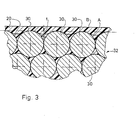
- the intermediate layer 20 is applied somewhat thicker, and the reinforcing fibers 30 are only placed on the intermediate layer 20 after it has hardened, so that the component surface designated by B in FIG. 3 is formed.
- the fiber composite component surfaces obtained with the described method are optically reflective and have surface roughnesses of less than 0.2 ⁇ m.
Landscapes
- Engineering & Computer Science (AREA)
- Mechanical Engineering (AREA)
- Chemical & Material Sciences (AREA)
- Composite Materials (AREA)
- Moulds For Moulding Plastics Or The Like (AREA)
- Moulding By Coating Moulds (AREA)
- Laminated Bodies (AREA)
- Casting Or Compression Moulding Of Plastics Or The Like (AREA)
Applications Claiming Priority (2)
| Application Number | Priority Date | Filing Date | Title |
|---|---|---|---|
| DE3000216 | 1980-01-04 | ||
| DE19803000216 DE3000216A1 (de) | 1980-01-04 | 1980-01-04 | Verfahren zum herstellen eines faserverbundbauteils |
Publications (3)
| Publication Number | Publication Date |
|---|---|
| EP0031880A2 true EP0031880A2 (fr) | 1981-07-15 |
| EP0031880A3 EP0031880A3 (en) | 1983-03-09 |
| EP0031880B1 EP0031880B1 (fr) | 1985-07-10 |
Family
ID=6091549
Family Applications (1)
| Application Number | Title | Priority Date | Filing Date |
|---|---|---|---|
| EP80106661A Expired EP0031880B1 (fr) | 1980-01-04 | 1980-10-30 | Procédé pour la fabrication d'un produit renforcé |
Country Status (4)
| Country | Link |
|---|---|
| US (1) | US4353964A (fr) |
| EP (1) | EP0031880B1 (fr) |
| JP (1) | JPS56101830A (fr) |
| DE (1) | DE3000216A1 (fr) |
Cited By (2)
| Publication number | Priority date | Publication date | Assignee | Title |
|---|---|---|---|---|
| FR2707427A1 (fr) * | 1993-07-07 | 1995-01-13 | Deutsche Forsch Luft Raumfahrt | Procédé de réalisation d'un moule négatif pour réflecteurs d'antennes paraboliques réflecteur obtenu et dispositif de presse pour réaliser des corps composites pour ces réflecteurs. |
| EP0716118A3 (fr) * | 1994-08-05 | 1997-04-09 | Sasib Spa | Composition de résine époxyde chargée et procédé pour mouler des éléments statiques de machines |
Families Citing this family (21)
| Publication number | Priority date | Publication date | Assignee | Title |
|---|---|---|---|---|
| US4489027A (en) * | 1982-08-11 | 1984-12-18 | The United States Of America As Represented By The Administrator Of The National Aeronautics And Space Administration | Process for preparing solvent resistant, thermoplastic aromatic poly(imidesulfone) |
| JPS61263716A (ja) * | 1985-05-09 | 1986-11-21 | Mitsubishi Electric Corp | 繊維強化プラスチツク製反射鏡の製造方法 |
| JPS61255838A (ja) * | 1985-05-09 | 1986-11-13 | Mitsubishi Electric Corp | 繊維強化プラスチツク製反射鏡の製造方法 |
| US5484498A (en) * | 1987-05-07 | 1996-01-16 | Hogarth; Harold P. | Molded article and method and apparatus for making same |
| US5122226A (en) * | 1987-08-12 | 1992-06-16 | United Technologies Corporation | Method of making hybrid composite structures of fiber reinforced glass and resin matrices |
| US5071506A (en) * | 1987-10-09 | 1991-12-10 | Thiokol Corporation | Equipment for making composite tubes including an inflatable heated bladder and a composite mold having a negative coefficient of thermal expansion |
| FR2655364B1 (fr) * | 1989-12-01 | 1992-04-10 | Europ Propulsion | Procede de fabrication d'une piece en materiau composite, notamment a texture fibres de carbone ou refractaires et matrice carbone ou ceramique. |
| US5217729A (en) * | 1990-03-22 | 1993-06-08 | Toppan Printing Co., Ltd. | Mold for plastic bottles |
| FR2659949B1 (fr) * | 1990-03-26 | 1992-12-04 | Europ Propulsion | Procede de conformation d'une texture fibreuse de renfort pour la fabrication d'une piece en materiau composite. |
| FR2670427B1 (fr) * | 1990-12-18 | 1994-07-08 | Francois Savigny | Procede de moulage sous vide d'un panneau en materiau plastique et panneau obtenu selon le procede. |
| US5320700A (en) * | 1991-04-15 | 1994-06-14 | Phillips Petroleum Company | Process for molding utilizing compression sleeve |
| US5322653A (en) * | 1992-06-05 | 1994-06-21 | Mueller Hans | Method of repairing buried sewage pipes |
| US5433165A (en) * | 1994-03-30 | 1995-07-18 | Outboard Marine Corporation | Method of manufacturing a boat hull |
| US5588392A (en) * | 1995-04-18 | 1996-12-31 | Outboard Marine Corporation | Resin transfer molding process |
| US6017484A (en) * | 1997-01-21 | 2000-01-25 | Harold P. Hale | Method for manufacture of minimum porosity, wrinkle free composite parts |
| US6367406B1 (en) * | 1999-09-24 | 2002-04-09 | Larson/Glastron Boats, Inc. | Boat and method for manufacturing using resin transfer molding |
| JP5044220B2 (ja) * | 2004-01-20 | 2012-10-10 | タッチストーン リサーチ ラボラトリー, リミテッド | 炭素発泡体複合ツールおよび炭素発泡体複合ツールを使用するための方法 |
| US20060057335A1 (en) * | 2004-09-14 | 2006-03-16 | Chen-Shih Wang | Molded fiber panel having reduced surface fiber readout and method of molding thereof |
| NL1029471C2 (nl) * | 2005-07-08 | 2007-01-09 | Crehabo Belgium N V | Werkwijze en inrichting voor het vervaardigen van een vormdeel uit een kunststof. |
| WO2008089334A2 (fr) | 2007-01-19 | 2008-07-24 | Vec Industries, L.L.C. | Procédé et appareil de moulage d'articles composites |
| FR2962680B1 (fr) * | 2010-07-15 | 2012-08-10 | Airbus Operations Sas | Procede de fabrication de pieces en materiau composite et pieces ainsi obtenues |
Family Cites Families (10)
| Publication number | Priority date | Publication date | Assignee | Title |
|---|---|---|---|---|
| US2464157A (en) * | 1944-06-28 | 1949-03-08 | Rca Corp | Mold |
| GB643022A (en) * | 1947-04-08 | 1950-09-15 | Archibald & Company Ltd J | An improved metal-coated sheet material for sequins and a process for making the same |
| US2992956A (en) * | 1958-02-14 | 1961-07-18 | American Optical Corp | Method for making fiber optical devices |
| GB1081911A (en) * | 1964-02-19 | 1967-09-06 | English Electric Co Ltd | Improvements in or relating to reinforced plastics |
| US3629388A (en) * | 1970-01-12 | 1971-12-21 | Rosanne A Levitsky | Casting procedure for high quality epoxy layers |
| US3681483A (en) * | 1970-07-13 | 1972-08-01 | Richard E Moore | Pressure polishing of extruded polycarbonate or polysulfone sheet |
| JPS518990B1 (fr) * | 1971-02-01 | 1976-03-23 | ||
| JPS5149259A (ja) * | 1974-10-11 | 1976-04-28 | Teijin Chemicals Ltd | Goseijushichukeiseikeihinno seizoho |
| US4017238A (en) * | 1975-04-21 | 1977-04-12 | American Optical Corporation | Mold for casting contact lenses utilizing and electron beam to polymerize the resin lens |
| CA1110026A (fr) * | 1977-11-09 | 1981-10-06 | Benzion Landa | Rouleau essuyeur, et methode de fabrication connexe |
-
1980
- 1980-01-04 DE DE19803000216 patent/DE3000216A1/de not_active Ceased
- 1980-10-30 EP EP80106661A patent/EP0031880B1/fr not_active Expired
- 1980-12-18 JP JP17965480A patent/JPS56101830A/ja active Pending
-
1981
- 1981-01-12 US US06/223,940 patent/US4353964A/en not_active Expired - Fee Related
Cited By (2)
| Publication number | Priority date | Publication date | Assignee | Title |
|---|---|---|---|---|
| FR2707427A1 (fr) * | 1993-07-07 | 1995-01-13 | Deutsche Forsch Luft Raumfahrt | Procédé de réalisation d'un moule négatif pour réflecteurs d'antennes paraboliques réflecteur obtenu et dispositif de presse pour réaliser des corps composites pour ces réflecteurs. |
| EP0716118A3 (fr) * | 1994-08-05 | 1997-04-09 | Sasib Spa | Composition de résine époxyde chargée et procédé pour mouler des éléments statiques de machines |
Also Published As
| Publication number | Publication date |
|---|---|
| JPS56101830A (en) | 1981-08-14 |
| DE3000216A1 (de) | 1981-07-09 |
| EP0031880A3 (en) | 1983-03-09 |
| EP0031880B1 (fr) | 1985-07-10 |
| US4353964A (en) | 1982-10-12 |
Similar Documents
| Publication | Publication Date | Title |
|---|---|---|
| EP0031880A2 (fr) | Procédé pour la fabrication d'un produit renforcé | |
| DE1758845C3 (de) | Verfahren zur Herstellung von Prazisions gießformen fur reaktionsfähige Metalle | |
| DE69311840T2 (de) | Pressform zur Herstellung eines mikro-optischen Elementes, zugehöriges Herstellungsverfahren, mikro-optisches Element und Herstellungsverfahren | |
| DE69723173T2 (de) | Herstellungsverfahren für einen keramischen Kern einer Zahnprothese | |
| EP0034329B1 (fr) | Blindage | |
| DE2937417A1 (de) | Schaum-enthaltende strukturen | |
| DE10340863A1 (de) | Verfahren zur Herstellung einer Dünnschicht aus Al-SiC-Verbundmaterial | |
| EP1600798B1 (fr) | Réflecteur tout-céramique ultra-légèr et ultra-rigide | |
| DE2743911B2 (fr) | ||
| DE2751221A1 (de) | Verfahren zur aufbringung eines reflexionsvermindernden belages auf unterlagen aus organischem material | |
| EP0658967B1 (fr) | Pompe de circulation magnétique pour fluides agressifs | |
| DE3612325C2 (fr) | ||
| DE2315797A1 (de) | Verfahren zur herstellung von keramiksubstraten fuer duennschichtschaltungen | |
| EP1752227B1 (fr) | Revêtement antiadhérent, méthode de production et substrats revêtus | |
| DE69606520T2 (de) | Verfahren zur herstellung einer walze, walze, und beschichtung für eine walze, zur anwendung in der papierherstellung | |
| DE2432536A1 (de) | Verfahren zur herstellung einer schleifund polierscheibe | |
| DE2355091A1 (de) | Verfahren zur herstellung optischer elemente | |
| EP0001286B1 (fr) | Procédé pour l'imprégnation de fibres de renforcement, de tissus de renforcement, de feuilles de renforcement ou d'éléments analogues | |
| DE69223378T2 (de) | Verfahren zur Herstellung von faserverstärkten Verbundwerkstoffen mit Metallmatrix und Vorformen dafür | |
| DE69512438T2 (de) | Vorform zur herstellung eines faserverstärkten kompositmaterials | |
| DE2634794A1 (de) | Verschleissfestes bauteil fuer papiermaschinen und verfahren zum herstellen solcher bauteile | |
| EP0483199A1 (fr) | Procede de fabrication de corps moules en ceramique oxydee par pistolage thermique. | |
| DE69703750T2 (de) | Verfahren zur herstellung einer sinternplatte/substrat und seiner anwendung zum heissen von keramischen artikeln | |
| DE3810851C2 (de) | Verfahren zur Herstellung von Formteilen | |
| DE3842984C1 (fr) |
Legal Events
| Date | Code | Title | Description |
|---|---|---|---|
| PUAI | Public reference made under article 153(3) epc to a published international application that has entered the european phase |
Free format text: ORIGINAL CODE: 0009012 |
|
| AK | Designated contracting states |
Designated state(s): FR GB IT |
|
| PUAL | Search report despatched |
Free format text: ORIGINAL CODE: 0009013 |
|
| AK | Designated contracting states |
Designated state(s): FR GB IT |
|
| 17P | Request for examination filed |
Effective date: 19830316 |
|
| ITF | It: translation for a ep patent filed | ||
| GRAA | (expected) grant |
Free format text: ORIGINAL CODE: 0009210 |
|
| AK | Designated contracting states |
Designated state(s): FR GB IT |
|
| ET | Fr: translation filed | ||
| PLBI | Opposition filed |
Free format text: ORIGINAL CODE: 0009260 |
|
| 26 | Opposition filed |
Opponent name: M A N TECHNOLOGIE GMBH Effective date: 19860408 |
|
| RDAG | Patent revoked |
Free format text: ORIGINAL CODE: 0009271 |
|
| STAA | Information on the status of an ep patent application or granted ep patent |
Free format text: STATUS: PATENT REVOKED |
|
| GBPR | Gb: patent revoked under art. 102 of the ep convention designating the uk as contracting state | ||
| 27W | Patent revoked |
Effective date: 19880728 |