EP0032180A2 - Amorphe, wenigstens Kobalt und Titan enthaltende, magnetische Legierung - Google Patents
Amorphe, wenigstens Kobalt und Titan enthaltende, magnetische Legierung Download PDFInfo
- Publication number
- EP0032180A2 EP0032180A2 EP80107220A EP80107220A EP0032180A2 EP 0032180 A2 EP0032180 A2 EP 0032180A2 EP 80107220 A EP80107220 A EP 80107220A EP 80107220 A EP80107220 A EP 80107220A EP 0032180 A2 EP0032180 A2 EP 0032180A2
- Authority
- EP
- European Patent Office
- Prior art keywords
- alloy
- alloys
- magnetic
- amorphous
- cobalt
- Prior art date
- Legal status (The legal status is an assumption and is not a legal conclusion. Google has not performed a legal analysis and makes no representation as to the accuracy of the status listed.)
- Granted
Links
Images



Classifications
-
- H—ELECTRICITY
- H01—ELECTRIC ELEMENTS
- H01F—MAGNETS; INDUCTANCES; TRANSFORMERS; SELECTION OF MATERIALS FOR THEIR MAGNETIC PROPERTIES
- H01F10/00—Thin magnetic films, e.g. of one-domain structure
- H01F10/08—Thin magnetic films, e.g. of one-domain structure characterised by magnetic layers
- H01F10/10—Thin magnetic films, e.g. of one-domain structure characterised by magnetic layers characterised by the composition
- H01F10/12—Thin magnetic films, e.g. of one-domain structure characterised by magnetic layers characterised by the composition being metals or alloys
- H01F10/13—Amorphous metallic alloys, e.g. glassy metals
- H01F10/132—Amorphous metallic alloys, e.g. glassy metals containing cobalt
-
- C—CHEMISTRY; METALLURGY
- C22—METALLURGY; FERROUS OR NON-FERROUS ALLOYS; TREATMENT OF ALLOYS OR NON-FERROUS METALS
- C22C—ALLOYS
- C22C45/00—Amorphous alloys
- C22C45/04—Amorphous alloys with nickel or cobalt as the major constituent
-
- G—PHYSICS
- G11—INFORMATION STORAGE
- G11B—INFORMATION STORAGE BASED ON RELATIVE MOVEMENT BETWEEN RECORD CARRIER AND TRANSDUCER
- G11B5/00—Recording by magnetisation or demagnetisation of a record carrier; Reproducing by magnetic means; Record carriers therefor
- G11B5/127—Structure or manufacture of heads, e.g. inductive
- G11B5/31—Structure or manufacture of heads, e.g. inductive using thin films
-
- H—ELECTRICITY
- H01—ELECTRIC ELEMENTS
- H01F—MAGNETS; INDUCTANCES; TRANSFORMERS; SELECTION OF MATERIALS FOR THEIR MAGNETIC PROPERTIES
- H01F1/00—Magnets or magnetic bodies characterised by the magnetic materials therefor; Selection of materials for their magnetic properties
- H01F1/01—Magnets or magnetic bodies characterised by the magnetic materials therefor; Selection of materials for their magnetic properties of inorganic materials
- H01F1/03—Magnets or magnetic bodies characterised by the magnetic materials therefor; Selection of materials for their magnetic properties of inorganic materials characterised by their coercivity
- H01F1/032—Magnets or magnetic bodies characterised by the magnetic materials therefor; Selection of materials for their magnetic properties of inorganic materials characterised by their coercivity of hard-magnetic materials
- H01F1/04—Magnets or magnetic bodies characterised by the magnetic materials therefor; Selection of materials for their magnetic properties of inorganic materials characterised by their coercivity of hard-magnetic materials metals or alloys
Definitions
- This invention relates to an amorphous magnetic alloy containing cobalt and titanium and in particular to memory devices using said alloy.
- Magnetic glasses in ribbon form consisting of one or more transition elements alloyed with metalloids such as B, P and C have attractive magnetic as well as mechanical properties and were reviewed recently by F. E. Luborsky, J. of Magnetism and Magnetic Materials, 7, 143 (1978).
- Amorphous magnetic thin films have been deposited by vapor deposition techniques and their properties found to be similar to those of bulk glassy ribbons, see R. J. Kobliska, J. A. Aboaf, A. Gangulee, J. J. Cuomo and E. Klokholm, Appl. Phys. Letters, 33(5), 1 (1978). They have soft magnetic properties and high resistivity. The magnetostriction of FeB amorphous films is high, see J. A.
- FIG. 1 is a photograph of a Lorentz microscope projection of a domain structure of an amorphous film of CoTi in accordance with this. invention.
- the alloys oF this invention are amorphous and for many compositions, the alloys are magnetic.
- the alloys have been prepared by means of r.f. sputter deposition of alloys of cobalt, titanium and selected compositions of nickel and iron. Unlike other cobalt titanium alloys, the content of the titanium in all of the alloys of this invention is less than about 30% which is generally where the upper limit exists, above which the alloy is no longer magnetic.
- the films of this invention adhere very well to a substrate such as silicon or glass slides even after annealing in argon at 450°C.
- the stress in the films is compressive, -2 x 10 9 dynes/cm 2 and becomes slightly tensile upon annealing at 300°C in argon for CoTi alloys produced by the process described below.
- X-ray diffraction analysis shows that CoTi films are generally amorphous when the films have a titanium content in excess of about 14 atomic percent.
- FIG. 1 is a photograph showing a typical domain structure of a 1000 Angstrom thick CO 82.7 Ti 17.3 film deposited upon a NaCl single crystal and studied by Lorentz microscopy.
- the domain structure of this amorphous CoTi film is essentially identical to that of permalloy (Ni:Fe 80:20).
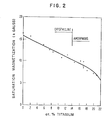
- FIG. 2 shows the variation of saturation magnetization (4 ⁇ M) as a function of titanium concentration in the alloy.
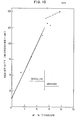
- FIG. 3 shows the saturation magnetostriction for the same CoTi crystalline and amorphous alloys which shows a discontinuity in the crystalline to amorphous transformation range about the 14% Ti level of the alloy. The measurements were made at room temperature. 'The magnetostriction of all amorphous CoTi films was found to be about +1 x 10 -6 . Thus, it appears that the magnetostriction of amorphous CoTi is not sensitive to the chemical composition of the films. Such a small value of magnetostriction is advantageous for use in magnetic recording to reduce noise caused by mechanical forces which cause changes in anisotropy, as well as increases in coercivity through reorientation of magnetic ions in the films.
- the saturation magnetostriction varies between -51 x 10 -6 (pure cobalt) to -5 x 10 -6 for the crystalline CoTi alloys.
- the magnetostriction of amorphous CoTi alloys is positive ( ⁇ + 1 x 10 -6 )- and docs not change with composition from 14 to 22 atomic percent.
- FIG. 4 shows the resistivity of the CoTi alloys as a function of Ti concentration.
- the resistivity of the amorphous film is on the order of 130-micro-ohms-cm. This is much higher than the resistivity of permalloy films (80:20 Ni:Fe) which have a value on the order of 15 micro-ohms-cm. They provide high permeability films at high frequencies through the reduction of eddy current losses.
- FIGS... 5.1 and 5.2 The B-H loops of the as-deposited amorphous (2500 A thick film) Co 81.8 Ti 18.2 film are shown in FIGS... 5.1 and 5.2.
- FIG. 5.1 shows an in-plane anisotropy where the nonsquare hard axis loop saturates at about 15 Oe.
- FIG. 5.2 the easy axis loop is shown with less saturation than in FIG. 5.1 and the distance along the H axis from the origin is 0.3 for a coercivity of 0.3 Oe.
- Annealing the film at 250°C for one hour under the influence of a field in the easy axis direction yields an anisotropy of 12 Oe in FIG. 6.1 and a coercivity of 0.3 Oe in FIG. 6.2.
- the stability of the magnetic characteristics of the amorphous films was checked by annealing the films in argon for 30 minutes at successively increasing temperatures in 50°C increments form 200 to 450°C. The results show that the films are thermally stable up to about 400-450°C.
- Table I shows that the coercivity of the films tested increased rapidly within that range, most probably because of crystallization.
- Table I shows the coercivity and saturated anisotropy field of two alloys of CoTi as indicated compared to sputtered permalloy.
- the coercivity of the CoTi amorphous alloys is stable up to 400°C while that of permalloy is stable up to 350°C.
- the corrosion resistance of CoTi films is dependent upon the titanium concentration and its structure as shown in Table II.
- the corrosion rate (weight increase) in the atmosphere (described by Rice, Suits and Lewis in the Journal of Applied Physics 47 1158 (1976)) varies from 0.13 to 0.03 microgram/cm 2 /hour for titanium concentrations ranging from 14 to 22 atomic percent.
- the amorphous films are shown to be at least 2.5 times more corrosion resistant than permalloy plated films. In the same conditions, the increase in weight for plated permalloy films is 0.24 micrograms/cm 2 /hour.
- Alternative alloy compositions which provide the desirable amorphous alloys include from about 14 to about 30 percent of Ti with Co which can be no less than a 50% concentration with at least one other element selected from the group consisting of Fe and Ni.
- the alloy can include (Co 40+ Fe x Ni y ) 100-z Ti where z is less than or equal to about 30 and greater than or equal to about 14 and x + y is less than or equal to about 60.
- the symbol.1 refers to the perpendicular anisotropy (see Appl. Phys. Lett. 33(5), 1 (1978), supra).
- the B-H loop shows. an in-plane anisotropy.
- ⁇ a e.g., 1 600 where "a" equals 600
- the value "a” refers to the field necessary to saturate the specimen in Oersteds, i.e., 600, 700, 120, 25 and 70 Oersteds, which are the values in Table III.
- Cobalt and cobalt alloy films have been deposited by r.f. sputtering using a system previously described, A boaf, Klokholm and Kobliska, supra.
- the water cooled 6" diameter cathode target is made of a copper plate on which a 70 micron thick pure plate of cobalt has been mounted. Triangular shaped segments made of 20 mils thick are positioned on the cobalt plate, their base held by springs on the outer circumference of the plate and their apex under a cobalt screw mounted in the center of the plate.
- the anode is water cooled and can be rotated. The anode can also be heated. Metal alloy films were sputtered on 1" diameter thermally oxidized silicon wafers.
- the chamber is typically evacuated to 1 x 10 -6 torr. High purity argon is introduced in the system and the pressure controlled at 20 millitorr.
- the segmented target is pre-sputtered for an hour to clean its surface and help getter the system of background impurities.
- the substrates are then exposed to the incident flux. Both pre-sputtering and sputtering are done for the same predetermined conditions:
- the thickness of the films was measured in the center of the wafer using a mechanical surface profile meter. The accuracy is limited by the thickness uniformity of the sample which can be in one case as large as 30% from one edge of the sample to the other.
- the chemical composition of alloy films typically 3000 A thick, was measured by electron microprobe.
- the magnetic properties were measured using an inductive loop tracer which displayed the B vs. H curve directly on an oscilloscope.
- the saturation magnetization at room temperature was measured at high fields from the B-H loop.
- the instrument was calibrated by measuring the saturation magnetization of several samples using a force balance magnetometer.
- the coercivity H c was obtained from the easy axis hysteresis loop; the saturation anisotropy field H kr by extrapolating the hard axis loop at small drive fields to the saturation magnetization value.
- the resistivity measurements were made at room temperature using a four point probe. Magnetostriction measurements were made at room temperature using the apparatus developed by E. Klokholm, IEEE Trans., MAG-12 6 (1976).
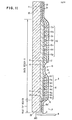
- a thin film transducer head embodying the invention comprises, briefly, flat conductor coils 10, having a plurality of bifilar turns l0a-h plated in a spiral pattern between two layers 11, 12 of insulating material, forming two electrically separate four-turn windings. This allows for a more balanced electrical center tap than would a single eight-turn spiral provided with a tap at the fourth turn.
- a magnetic yoke structure 14, 15 consists of a pole tip region P and a back region B and comprises two magnetic leg layers 14, 15 of a magnetic material, such as amorphous CoTi, CoFeTi, CoNiTi or CoNiFeTi in their magnetic form. Layers 14 and 15 are separated by insulating layers 11 and 12 except (a) at the pole tip region P where they are spaced by a thin conductor layer. (turn l0a) of nonmagnetic material (preferably copper) to form a transducing gap.
- Layer 10a' is formed as a thinner portion of the layer 10a forming the spiral turns.
- the end of trans.ducing gap G coincides with an air bearing surface (ABS) formed on a nonmagnetic slider 20 ' serving as a substrate upon which the above- described layers are deposited.
- Transducer gap G interacts in air bearing relation with a magnetic recording medium M, such as a rotatable magnetic disk, when the latter rotates and flies closely adjacent the ABS.
- Medium M is spaced by a distance less than the gap width from the gap G.
- the transducer further comprises conductors 21 that reach from electrical contact pads 22, to the central termination pads of coils 10.
- the outermost turns 10aand 10b of coils 10 terminate in enlarged pad areas 23 which constitute electrical contacts.
- Members 22 and 23 are connected to external circuitry (not shown) for processing data signals during recording and reading.
- Yoke structure 14, 15 can be fabricated as described in the above copending application.
- Such a material should be suitable for use in a magnetic core structure, should.be more corrosion resistant than permalloy and should have a coercivity comparable to that of permalloy.
- the material should also have a low magnetostriction similar to that of permalloy.
- the amorphous Co-Ti alloys of this invention meet all of the above requirements.
Landscapes
- Engineering & Computer Science (AREA)
- Power Engineering (AREA)
- Chemical & Material Sciences (AREA)
- Materials Engineering (AREA)
- Mechanical Engineering (AREA)
- Metallurgy (AREA)
- Organic Chemistry (AREA)
- Manufacturing & Machinery (AREA)
- Thin Magnetic Films (AREA)
Applications Claiming Priority (2)
| Application Number | Priority Date | Filing Date | Title |
|---|---|---|---|
| US108113 | 1979-12-28 | ||
| US06/108,113 US4325733A (en) | 1979-12-28 | 1979-12-28 | Amorphous Co-Ti alloys |
Publications (3)
| Publication Number | Publication Date |
|---|---|
| EP0032180A2 true EP0032180A2 (de) | 1981-07-22 |
| EP0032180A3 EP0032180A3 (en) | 1981-08-05 |
| EP0032180B1 EP0032180B1 (de) | 1984-06-27 |
Family
ID=22320390
Family Applications (1)
| Application Number | Title | Priority Date | Filing Date |
|---|---|---|---|
| EP80107220A Expired EP0032180B1 (de) | 1979-12-28 | 1980-11-20 | Amorphe, wenigstens Kobalt und Titan enthaltende, magnetische Legierung |
Country Status (3)
| Country | Link |
|---|---|
| US (1) | US4325733A (de) |
| EP (1) | EP0032180B1 (de) |
| DE (1) | DE3068380D1 (de) |
Cited By (1)
| Publication number | Priority date | Publication date | Assignee | Title |
|---|---|---|---|---|
| EP0081239A3 (en) * | 1981-12-09 | 1985-09-25 | Matsushita Electric Industrial Co., Ltd. | Magnetic head |
Families Citing this family (11)
| Publication number | Priority date | Publication date | Assignee | Title |
|---|---|---|---|---|
| DE3049906A1 (en) * | 1979-09-21 | 1982-03-18 | Hitachi Ltd | Amorphous alloys |
| DE3152307A1 (de) * | 1980-08-28 | 1982-11-04 | Wisconsin Alumni Res Found | Use of metallic glasses for fabrication of structures with submicron dimensions |
| JPH0622170B2 (ja) * | 1983-12-16 | 1994-03-23 | 株式会社日立製作所 | 磁気ヘッド |
| JPH0775062B2 (ja) * | 1986-06-06 | 1995-08-09 | 日本電気株式会社 | 磁気記録媒体 |
| JP3151155B2 (ja) * | 1996-09-10 | 2001-04-03 | アルプス電気株式会社 | 薄膜磁気ヘッド |
| JPH1083517A (ja) * | 1996-09-10 | 1998-03-31 | Alps Electric Co Ltd | 薄膜磁気ヘッド及びその製造方法 |
| US6093262A (en) * | 1998-06-23 | 2000-07-25 | Pes, Inc. | Corrosion resistant solenoid valve |
| FI109520B (fi) | 2000-06-29 | 2002-08-30 | Polar Electro Oy | EKG-elektrodirakenne ja menetelmä EKG-signaalin mittaamiseksi vedessä olevalta ihmiseltä |
| KR100767719B1 (ko) | 2006-08-29 | 2007-10-17 | 한국과학기술연구원 | Ti 비정질 나노 분말과 그 제조방법 |
| US20110143168A1 (en) * | 2008-11-05 | 2011-06-16 | Hitachi Metals, Ltd. | Co-fe alloy for soft magnetic films, soft magnetic film, and perpendicular magnetic recording medium |
| US10043607B2 (en) | 2016-05-02 | 2018-08-07 | International Business Machines Corporation | Electrolessly formed high resistivity magnetic materials |
Family Cites Families (11)
| Publication number | Priority date | Publication date | Assignee | Title |
|---|---|---|---|---|
| CH177314A (de) * | 1933-05-01 | 1935-05-31 | Kinzoku Zairyo Kenkyusho The R | Legierung für Dauermagnete. |
| DE1244417B (de) * | 1964-11-05 | 1967-07-13 | Magnetfab Bonn Gmbh | Metallischer Dauermagnetwerkstoff |
| US3358369A (en) * | 1966-03-21 | 1967-12-19 | Eversharp Inc | Adjustable double edge razor |
| US4011075A (en) * | 1971-07-16 | 1977-03-08 | The Furukawa Electric Co., Ltd. | Materials for tamping battery mix |
| SE7511398L (sv) * | 1974-10-21 | 1976-04-22 | Western Electric Co | Magnetisk anordning |
| US4056411A (en) * | 1976-05-14 | 1977-11-01 | Ho Sou Chen | Method of making magnetic devices including amorphous alloys |
| US4116682A (en) * | 1976-12-27 | 1978-09-26 | Polk Donald E | Amorphous metal alloys and products thereof |
| US4152144A (en) * | 1976-12-29 | 1979-05-01 | Allied Chemical Corporation | Metallic glasses having a combination of high permeability, low magnetostriction, low ac core loss and high thermal stability |
| US4225339A (en) * | 1977-12-28 | 1980-09-30 | Tokyo Shibaura Denki Kabushiki Kaisha | Amorphous alloy of high magnetic permeability |
| US4187128A (en) * | 1978-09-26 | 1980-02-05 | Bell Telephone Laboratories, Incorporated | Magnetic devices including amorphous alloys |
| US4255189A (en) * | 1979-09-25 | 1981-03-10 | Allied Chemical Corporation | Low metalloid containing amorphous metal alloys |
-
1979
- 1979-12-28 US US06/108,113 patent/US4325733A/en not_active Expired - Lifetime
-
1980
- 1980-11-20 EP EP80107220A patent/EP0032180B1/de not_active Expired
- 1980-11-20 DE DE8080107220T patent/DE3068380D1/de not_active Expired
Cited By (1)
| Publication number | Priority date | Publication date | Assignee | Title |
|---|---|---|---|---|
| EP0081239A3 (en) * | 1981-12-09 | 1985-09-25 | Matsushita Electric Industrial Co., Ltd. | Magnetic head |
Also Published As
| Publication number | Publication date |
|---|---|
| EP0032180B1 (de) | 1984-06-27 |
| DE3068380D1 (en) | 1984-08-02 |
| US4325733A (en) | 1982-04-20 |
| EP0032180A3 (en) | 1981-08-05 |
Similar Documents
| Publication | Publication Date | Title |
|---|---|---|
| US4236946A (en) | Amorphous magnetic thin films with highly stable easy axis | |
| EP0068131B1 (de) | Magnetisches Aufzeichnungsmedium | |
| EP0013883B1 (de) | Köpfe mit dünnen magnetischen Schichten | |
| US4325733A (en) | Amorphous Co-Ti alloys | |
| KR960006055B1 (ko) | 연자성 박막 | |
| JPH0426105A (ja) | 軟磁性薄膜 | |
| CA1094360A (en) | Palladium alloys | |
| JPS6240363A (ja) | 雰囲気変動に対する薄膜磁気特性の安定度の高いタ−ゲツト材 | |
| US4396575A (en) | Zero magnetostriction Fe-Co-Cr magnetic recording media | |
| JPH01124108A (ja) | 薄膜磁気ヘツド | |
| Aboaf et al. | Magnetic properties of thin films of 3d transition metals alloyed with Cr | |
| US5411813A (en) | Ferhgasi soft magnetic materials for inductive magnetic heads | |
| JPH0418023B2 (de) | ||
| JPH03265104A (ja) | 軟磁性合金膜 | |
| Mayer | Sputtered thin magnetic films | |
| Brunsch | Non‐magnetostrictive amorphous soft magnetic thin film material of high magnetization | |
| JP2884599B2 (ja) | 軟磁性非晶質膜 | |
| Jones Jr | Fabrication of film heads with high moment materials | |
| JP3087265B2 (ja) | 磁性合金 | |
| JP3019400B2 (ja) | 非晶質軟磁性材料 | |
| JP2774702B2 (ja) | 軟磁性薄膜およびそれを用いた薄膜磁気ヘッド | |
| JP2727274B2 (ja) | 軟磁性薄膜 | |
| JPS6252907A (ja) | 軟磁性薄膜 | |
| JP3036891B2 (ja) | 薄膜磁気ヘッド | |
| JP2574901B2 (ja) | 薄膜磁気ヘッド及びその製造方法 |
Legal Events
| Date | Code | Title | Description |
|---|---|---|---|
| PUAI | Public reference made under article 153(3) epc to a published international application that has entered the european phase |
Free format text: ORIGINAL CODE: 0009012 |
|
| PUAL | Search report despatched |
Free format text: ORIGINAL CODE: 0009013 |
|
| AK | Designated contracting states |
Designated state(s): DE FR GB |
|
| AK | Designated contracting states |
Designated state(s): DE FR GB |
|
| 17P | Request for examination filed |
Effective date: 19811005 |
|
| GRAA | (expected) grant |
Free format text: ORIGINAL CODE: 0009210 |
|
| AK | Designated contracting states |
Designated state(s): DE FR GB |
|
| REF | Corresponds to: |
Ref document number: 3068380 Country of ref document: DE Date of ref document: 19840802 |
|
| ET | Fr: translation filed | ||
| PLBE | No opposition filed within time limit |
Free format text: ORIGINAL CODE: 0009261 |
|
| STAA | Information on the status of an ep patent application or granted ep patent |
Free format text: STATUS: NO OPPOSITION FILED WITHIN TIME LIMIT |
|
| 26N | No opposition filed | ||
| PGFP | Annual fee paid to national office [announced via postgrant information from national office to epo] |
Ref country code: GB Payment date: 19901012 Year of fee payment: 11 |
|
| PGFP | Annual fee paid to national office [announced via postgrant information from national office to epo] |
Ref country code: FR Payment date: 19901020 Year of fee payment: 11 |
|
| PGFP | Annual fee paid to national office [announced via postgrant information from national office to epo] |
Ref country code: DE Payment date: 19901124 Year of fee payment: 11 |
|
| PG25 | Lapsed in a contracting state [announced via postgrant information from national office to epo] |
Ref country code: GB Effective date: 19911120 |
|
| GBPC | Gb: european patent ceased through non-payment of renewal fee | ||
| PG25 | Lapsed in a contracting state [announced via postgrant information from national office to epo] |
Ref country code: FR Effective date: 19920731 |
|
| PG25 | Lapsed in a contracting state [announced via postgrant information from national office to epo] |
Ref country code: DE Effective date: 19920801 |
|
| REG | Reference to a national code |
Ref country code: FR Ref legal event code: ST |