EP0033361A2 - Flammschutzmittel auf der Basis von Ammoniumpolyphosphaten - Google Patents
Flammschutzmittel auf der Basis von Ammoniumpolyphosphaten Download PDFInfo
- Publication number
- EP0033361A2 EP0033361A2 EP80106518A EP80106518A EP0033361A2 EP 0033361 A2 EP0033361 A2 EP 0033361A2 EP 80106518 A EP80106518 A EP 80106518A EP 80106518 A EP80106518 A EP 80106518A EP 0033361 A2 EP0033361 A2 EP 0033361A2
- Authority
- EP
- European Patent Office
- Prior art keywords
- weight
- ammonium polyphosphate
- product
- agent according
- polycondensation product
- Prior art date
- Legal status (The legal status is an assumption and is not a legal conclusion. Google has not performed a legal analysis and makes no representation as to the accuracy of the status listed.)
- Granted
Links
- 235000019826 ammonium polyphosphate Nutrition 0.000 title claims abstract description 32
- 229920001276 ammonium polyphosphate Polymers 0.000 title claims abstract description 32
- 239000000203 mixture Substances 0.000 title claims description 4
- 239000003063 flame retardant Substances 0.000 title description 8
- RNFJDJUURJAICM-UHFFFAOYSA-N 2,2,4,4,6,6-hexaphenoxy-1,3,5-triaza-2$l^{5},4$l^{5},6$l^{5}-triphosphacyclohexa-1,3,5-triene Chemical compound N=1P(OC=2C=CC=CC=2)(OC=2C=CC=CC=2)=NP(OC=2C=CC=CC=2)(OC=2C=CC=CC=2)=NP=1(OC=1C=CC=CC=1)OC1=CC=CC=C1 RNFJDJUURJAICM-UHFFFAOYSA-N 0.000 title description 7
- 239000004114 Ammonium polyphosphate Substances 0.000 claims abstract description 22
- 239000003795 chemical substances by application Substances 0.000 claims abstract description 16
- 238000006068 polycondensation reaction Methods 0.000 claims abstract description 9
- 239000002245 particle Substances 0.000 claims abstract description 8
- JDSHMPZPIAZGSV-UHFFFAOYSA-N melamine Chemical compound NC1=NC(N)=NC(N)=N1 JDSHMPZPIAZGSV-UHFFFAOYSA-N 0.000 claims abstract description 6
- 239000000126 substance Substances 0.000 claims abstract description 4
- 229920000877 Melamine resin Polymers 0.000 claims abstract description 3
- WSFSSNUMVMOOMR-NJFSPNSNSA-N methanone Chemical compound O=[14CH2] WSFSSNUMVMOOMR-NJFSPNSNSA-N 0.000 claims abstract description 3
- 239000004814 polyurethane Substances 0.000 claims description 7
- 229920002635 polyurethane Polymers 0.000 claims description 7
- 229920005830 Polyurethane Foam Polymers 0.000 claims description 5
- 239000007864 aqueous solution Substances 0.000 claims description 5
- 239000011496 polyurethane foam Substances 0.000 claims description 5
- 230000001476 alcoholic effect Effects 0.000 claims description 2
- 239000000843 powder Substances 0.000 claims description 2
- 230000000979 retarding effect Effects 0.000 claims description 2
- WSFSSNUMVMOOMR-UHFFFAOYSA-N Formaldehyde Chemical compound O=C WSFSSNUMVMOOMR-UHFFFAOYSA-N 0.000 abstract description 4
- 229940056960 melamin Drugs 0.000 abstract description 3
- 239000000047 product Substances 0.000 description 24
- OKKJLVBELUTLKV-UHFFFAOYSA-N Methanol Chemical compound OC OKKJLVBELUTLKV-UHFFFAOYSA-N 0.000 description 12
- JMHCCAYJTTWMCX-QWPJCUCISA-M sodium;(2s)-2-amino-3-[4-(4-hydroxy-3,5-diiodophenoxy)-3,5-diiodophenyl]propanoate;pentahydrate Chemical compound O.O.O.O.O.[Na+].IC1=CC(C[C@H](N)C([O-])=O)=CC(I)=C1OC1=CC(I)=C(O)C(I)=C1 JMHCCAYJTTWMCX-QWPJCUCISA-M 0.000 description 11
- XLYOFNOQVPJJNP-UHFFFAOYSA-N water Substances O XLYOFNOQVPJJNP-UHFFFAOYSA-N 0.000 description 11
- 229920005989 resin Polymers 0.000 description 7
- 239000011347 resin Substances 0.000 description 7
- 238000000034 method Methods 0.000 description 5
- 239000000725 suspension Substances 0.000 description 5
- IJGRMHOSHXDMSA-UHFFFAOYSA-N Atomic nitrogen Chemical compound N#N IJGRMHOSHXDMSA-UHFFFAOYSA-N 0.000 description 4
- 229920003023 plastic Polymers 0.000 description 4
- 239000004033 plastic Substances 0.000 description 4
- 239000007795 chemical reaction product Substances 0.000 description 3
- 238000010992 reflux Methods 0.000 description 3
- 239000000243 solution Substances 0.000 description 3
- 238000006243 chemical reaction Methods 0.000 description 2
- 239000011248 coating agent Substances 0.000 description 2
- 238000000576 coating method Methods 0.000 description 2
- 238000009833 condensation Methods 0.000 description 2
- 230000005494 condensation Effects 0.000 description 2
- 230000007423 decrease Effects 0.000 description 2
- 238000001035 drying Methods 0.000 description 2
- 229910052757 nitrogen Inorganic materials 0.000 description 2
- 229910019142 PO4 Inorganic materials 0.000 description 1
- 239000000654 additive Substances 0.000 description 1
- 230000000996 additive effect Effects 0.000 description 1
- XAGFODPZIPBFFR-UHFFFAOYSA-N aluminium Chemical compound [Al] XAGFODPZIPBFFR-UHFFFAOYSA-N 0.000 description 1
- 229910052782 aluminium Inorganic materials 0.000 description 1
- 239000003054 catalyst Substances 0.000 description 1
- 230000000052 comparative effect Effects 0.000 description 1
- 150000001875 compounds Chemical class 0.000 description 1
- 230000000694 effects Effects 0.000 description 1
- 238000005538 encapsulation Methods 0.000 description 1
- 125000001495 ethyl group Chemical group [H]C([H])([H])C([H])([H])* 0.000 description 1
- 239000011521 glass Substances 0.000 description 1
- 238000010438 heat treatment Methods 0.000 description 1
- 238000004519 manufacturing process Methods 0.000 description 1
- 125000002496 methyl group Chemical group [H]C([H])([H])* 0.000 description 1
- GUSFEBGYPWJUSS-UHFFFAOYSA-N pentaazanium;[oxido(phosphonatooxy)phosphoryl] phosphate Chemical compound [NH4+].[NH4+].[NH4+].[NH4+].[NH4+].[O-]P([O-])(=O)OP([O-])(=O)OP([O-])([O-])=O GUSFEBGYPWJUSS-UHFFFAOYSA-N 0.000 description 1
- NBIIXXVUZAFLBC-UHFFFAOYSA-K phosphate Chemical compound [O-]P([O-])([O-])=O NBIIXXVUZAFLBC-UHFFFAOYSA-K 0.000 description 1
- 239000010452 phosphate Substances 0.000 description 1
- 229920001228 polyisocyanate Polymers 0.000 description 1
- 239000005056 polyisocyanate Substances 0.000 description 1
- 239000002904 solvent Substances 0.000 description 1
- 238000003756 stirring Methods 0.000 description 1
- 238000004448 titration Methods 0.000 description 1
- 238000005406 washing Methods 0.000 description 1
Classifications
-
- C—CHEMISTRY; METALLURGY
- C08—ORGANIC MACROMOLECULAR COMPOUNDS; THEIR PREPARATION OR CHEMICAL WORKING-UP; COMPOSITIONS BASED THEREON
- C08J—WORKING-UP; GENERAL PROCESSES OF COMPOUNDING; AFTER-TREATMENT NOT COVERED BY SUBCLASSES C08B, C08C, C08F, C08G or C08H
- C08J9/00—Working-up of macromolecular substances to porous or cellular articles or materials; After-treatment thereof
- C08J9/009—Use of pretreated compounding ingredients
-
- C—CHEMISTRY; METALLURGY
- C08—ORGANIC MACROMOLECULAR COMPOUNDS; THEIR PREPARATION OR CHEMICAL WORKING-UP; COMPOSITIONS BASED THEREON
- C08K—Use of inorganic or non-macromolecular organic substances as compounding ingredients
- C08K9/00—Use of pretreated ingredients
- C08K9/10—Encapsulated ingredients
-
- C—CHEMISTRY; METALLURGY
- C09—DYES; PAINTS; POLISHES; NATURAL RESINS; ADHESIVES; COMPOSITIONS NOT OTHERWISE PROVIDED FOR; APPLICATIONS OF MATERIALS NOT OTHERWISE PROVIDED FOR
- C09K—MATERIALS FOR MISCELLANEOUS APPLICATIONS, NOT PROVIDED FOR ELSEWHERE
- C09K21/00—Fireproofing materials
- C09K21/06—Organic materials
- C09K21/12—Organic materials containing phosphorus
-
- C—CHEMISTRY; METALLURGY
- C09—DYES; PAINTS; POLISHES; NATURAL RESINS; ADHESIVES; COMPOSITIONS NOT OTHERWISE PROVIDED FOR; APPLICATIONS OF MATERIALS NOT OTHERWISE PROVIDED FOR
- C09K—MATERIALS FOR MISCELLANEOUS APPLICATIONS, NOT PROVIDED FOR ELSEWHERE
- C09K21/00—Fireproofing materials
- C09K21/14—Macromolecular materials
-
- C—CHEMISTRY; METALLURGY
- C08—ORGANIC MACROMOLECULAR COMPOUNDS; THEIR PREPARATION OR CHEMICAL WORKING-UP; COMPOSITIONS BASED THEREON
- C08J—WORKING-UP; GENERAL PROCESSES OF COMPOUNDING; AFTER-TREATMENT NOT COVERED BY SUBCLASSES C08B, C08C, C08F, C08G or C08H
- C08J2375/00—Characterised by the use of polyureas or polyurethanes; Derivatives of such polymers
- C08J2375/04—Polyurethanes
-
- Y—GENERAL TAGGING OF NEW TECHNOLOGICAL DEVELOPMENTS; GENERAL TAGGING OF CROSS-SECTIONAL TECHNOLOGIES SPANNING OVER SEVERAL SECTIONS OF THE IPC; TECHNICAL SUBJECTS COVERED BY FORMER USPC CROSS-REFERENCE ART COLLECTIONS [XRACs] AND DIGESTS
- Y10—TECHNICAL SUBJECTS COVERED BY FORMER USPC
- Y10S—TECHNICAL SUBJECTS COVERED BY FORMER USPC CROSS-REFERENCE ART COLLECTIONS [XRACs] AND DIGESTS
- Y10S521/00—Synthetic resins or natural rubbers -- part of the class 520 series
- Y10S521/907—Nonurethane flameproofed cellular product
Definitions
- the invention relates to a particulate agent based on free-flowing, powdery ammonium polyphosphates to prevent the combustibility of combustible substances.
- German Auslegeschrift 12 83 532 describes a process for the production of flame-retardant polyurethanes from high molecular weight polyhydroxyl compounds, polyisocyanates and catalysts, an ammonium polyphosphate of the general formula H (nm) +2 (NH 4 ) m P n O 3n + 1 , in which n is an integer with an average value above 10, m is an integer up to a maximum of n + 2 and m / n is between approximately 0.7 and 1.1, as a flame retardant additive is proposed.
- ammonium polyphosphates of the abovementioned general formula give the latter good flame retardancy when used in polyurethanes, they have the disadvantage that they are not sufficiently insoluble in water and are therefore washed out of the plastic over time by the effects of weather.
- the ammonium polyphosphates described there as practically water-insoluble nevertheless have a considerable solubility in water by slurrying 10 g of the ammonium polyphosphate in 100 m 3 of water at 25 ° C. up to 5 g of the ammonium polyphosphate are dissolved, ie that the soluble proportions of the ammonium polyphosphate are up to 50% of the amount used.
- the present invention shows a suitable way of solving the problem mentioned.
- the agent of the invention generally has an average particle size of about 0.01 to 0.05 mm and the degree of condensation n of the ammonium polyphosphate is preferably an integer with an average value of 100 to 500, determined by the end group titration method (from Wazer), Griffiter and Mc Cullough, Anal.Chem. 26, page 1755 (1954)).
- the proportion of the polycondensation product is on average 2.5 to 10% by weight.
- the polycondensation product can also be a partially etherified product, for example a methyl or ethyl etherified product.
- a polycondensation product proved to be suitable which, in the uncured state, is a powder whose 50% strength by weight aqueous solution has a dynamic viscosity of 20 cP (mPas), a pH at 20 ° C. from 8.8 to 9.8 and has a density at 20 ° C of 1.21 to 1.225 (g / ml) and is commercially available as ®Madurit MW 390 from Cassella Aktiengesellschaft, Frankfurt / Main.
- the invention also relates to the use of the above-described agent for flame retarding polyurethanes or polyurethane foams, the content of the agent in the polyurethane foam being about 5 to 50% by weight, based on the amount of the alcoholic components of the polyurethane.
- the melamine / formaldehyde resin can be applied to the ammonium polyphosphate particles, for example, by first suspending the ammonium polyphosphate in methanol, heating the suspension to a slight reflux of the methanol and then adding a methanolic / aqueous solution of the melamine / Formaldehyde resin drops. After a post-reaction time of, for example, 0.5 to 2 hours, the suspension is filtered and the filter residue is dried in a stream of nitrogen at 100 ° C. for 150 to 180 minutes. During the drying process, the resin coating applied to the ammonium polyphosphate particles is simultaneously cured.
- ammonium polyphosphate encapsulated in this way has the advantage that it is practically insoluble in water and is predestined in this form, for example, for use as a flame retardant in polyurethane foams.
- the differences in solubility of the agent according to the invention and conventional ammonium polyphosphates are documented in the examples below.
- ammonium polyphosphate does not in any way impair its known original effectiveness as a flame retardant for plastics, in particular for polyurethanes, so that the use of the agent according to the invention as a flame retardant is an enrichment of the prior art.
- the procedure was analogous to Example 2, but 10 g of the melamine / formaldehyde resin were used.
- the product yield was 203 g, the product having a resin content of 4.9% by weight.
- the procedure was analogous to Example 2, but 20 g of the melamine / formaldehyde resin were used.
- the product yield was 211 g, the product having a resin content of 9.5% by weight.
- the table shows that with increasing melamine / formaldehyde resin content in the end product, the water-soluble content of ammonium polyphosphate decreases. Compared to the untreated ammonium polyphosphate according to Example 6, the products according to the invention have a considerably lower solubility in water.
Landscapes
- Chemical & Material Sciences (AREA)
- Organic Chemistry (AREA)
- Engineering & Computer Science (AREA)
- Materials Engineering (AREA)
- Medicinal Chemistry (AREA)
- Chemical Kinetics & Catalysis (AREA)
- Health & Medical Sciences (AREA)
- Polymers & Plastics (AREA)
- Fireproofing Substances (AREA)
- Compositions Of Macromolecular Compounds (AREA)
- Medicinal Preparation (AREA)
- Detergent Compositions (AREA)
- Disintegrating Or Milling (AREA)
- Solid Fuels And Fuel-Associated Substances (AREA)
- Fats And Perfumes (AREA)
Abstract

- a) etwa 75 bis 99 Gew% Ammoniumpolyphosphat und
- b) etwa 1 bis 25 Gew% eines gehärteten, wasserunlöslichen Polykondensationsproduktes aus Melamin und Formaldehyd, welches die einzelnen Ammoniumpolyphosphat- teilchen umhüllt, besteht.
Description
- Gegenstand der Erfindung ist ein teilchenförmiges Mittel auf der Basis von freifließenden, pulverförmigen Ammoniumpolyphosphaten zur Verhinderung der Brennbarkeit von brennbaren Stoffen.
- Es ist generell bekannt, Ammoniumpolyphosphate als Flammschutzmittel für Kunststoffe zu verwenden. Beispielsweise beschreibt die Deutsche Auslegeschrift 12 83 532 ein Verfahren zur Herstellung von flammwidrigen Polyurethanen aus hochmolekularen Polyhydroxylverbindungen, Polyisocyanaten und Katalysatoren, wobei ein Ammoniumpolyphosphat der allgemeinen Formel H (n-m)+2(NH4)mPnO3n+1, in der n eine ganze Zahl mit einem über 10 liegenden Durchschnittswert ist, m eine ganze Zahl bis maximal n+2 bedeutet und m/n zwischen etwa 0,7 und 1,1 liegt, als Flammschutzmittel -Zusatz vorgeschlagen wird.
- Obgleich Ammoniumpolyphosphate der vorgenannten allgemeinen Formel beim Einsatz in Polyurethanen letzteren einen guten Flammschutz verleihen, sind sie mit dem Nachteil behaftet, daß sie nicht ausreichend wasserunlöslich sind und deshalb im Laufe der Zeit durch Witterungseinflüsse aus dem Kunststoff ausgewaschen werden. Wie aus Spalte 3 der DE-AS 12 83 532 ersichtlich, besitzen die dort als praktisch wasserunlöslich bezeichneten Ammoniumpolyphosphate dennoch eine beachtliche Löslichkeit in Wasser, indem beim Aufschlämmen von 10 g des Ammoniumpolyphosphats in 100 m3 Wasser bei 25° C bis zu 5 g des Ammoniumpolyphosphates gelöst werden, d. h. daß die löslichen Anteile des Ammoniumpolyphosphates bis zu 50 % der eingesetzten Menge betragen.
- Es bestand somit die Aufgabe, Mittel und Wege zur Verminderung der Löslichkeit von Ammoniumpolyphosphaten in Wasser zu finden, so daß die Gefahr des Auswaschens des Ammoniumpolyphosphates beim Einsatz als Flammschutzmittel in Kunststoffen durch Witterungseinflüsse möglichst weitgehend vermieden wird. Mit vorliegender Erfindung wird ein geeigneter Weg zur Lösung des genannten Problems aufgezeigt.
- Gegenstand der Erfindung ist ein teilchenförmiges Mittel auf der Basis von freifließenden, pulverförmigen Ammoniumpolyphosphaten der allgemeinen Formel H(n-m)+2(NH4)mPnO3n+1, in welcher n eine ganze Zahl mit einem Durchschnittswert von etwa 20 bis 800 bedeutet und das Verhältnis von m zu n etwa 1 beträgt, zur Verhinderung der Brennbarkeit von brennbaren Stoffen, welches dadurch gekennzeichnet ist, daß es aus
- a) etwa 75 bis 99 Gew% Ammoniumpolyphosphat und
- b) etwa 1 bis 25 Gew% eines gehärteten, wasserunlöslichen Polykondensationsproduktes aus Melamin und Formaldehyd, welches die einzelnen Ammoniumpolyphosphatteilchen umhüllt, besteht.
- Das Mittel der Erfindung besitzt im allgemeinen eine mittlere Teilchengröße von etwa 0,01 bis 0,05 mm und der Kondensationsgrad n des Ammoniumpolyphosphates ist vorzugsweise eine ganze Zahl mit einem Durchschnittswert von 100 bis 500, bestimmt nach dem Endgruppen-Titrationsverfahren (von Wazer), Griffiter und Mc Cullough, Anal.Chem. 26, Seite 1755 (1954)).
- Entsprechend einer weiteren bevorzugten Ausführungsform des erfindungsgemäßen Mittels beträgt der Anteil des Polykondensationsproduktes im Mittel 2,5 bis 10 Gew%. Das Polykondensationsprodukt kann auch ein teilver- äthertes, beispielsweise ein methyl- oder äthylver- äthertes Produkt sein. Insbesondere erwies sich ein Polykondensationsprodukt als geeigent, das im ungehärteten Zustand ein Pulver darstellt, dessen 50 gew%ige wässerige Lösung eine dynamische Viskosität von 20 cP (mPas), einen pH-Wert bei 20° C von 8,8 bis 9,8 und eine Dichte bei 20° C von 1,21 bis 1,225 (g/ml) besitzt und im Handel als ®Madurit MW 390 der Firma Cassella Aktiengesellschaft, Frankfurt/Main erhältlich ist.
- Schließlich betrifft die Erfindung auch die Verwendung des vorbeschriebenen Mittels zum Flammfestmachen von Polyurethanen bzw. Polyurethanschäumen, wobei der Gehalt des Mittels im Polyurethanschaum etwa 5 bis 50 Gew%, bezogen auf die Menge der alkoholischen Komponete des Polyurethans, beträgt.
- Das Aufbringen des Melamin/Formaldehyd-Harzes auf die Ammoniumpolyphosphat-Teilchen kann beispielsweise derart erfolgen, daß man zunächst das Ammoniumpolyphosphat in Methanol suspendiert, die Suspension bis zu einem schwachen Rückfluß des Methanols erhitzt und anschließend in die Suspension eine methanolisch/wäßrige Lösung des Melamin/Formaldehyd-Harzes eintropft. Nach Ablauf einer Nachreaktionszeit von beispielsweise 0,5 bis 2 Stunden wird die Suspension filtriert und der Filterrückstand im Stickstoffstrom bei 100° C während 150 bis 180 Minuten getrocknet, Während der Trocknung erfolgt gleichzeitig die Aushärtung des auf die Ammoniumpolyphosphat-Teilchen aufgebrachten Harzüberzuges.
- Das derart verkapselte Ammoniumpolyphosphat besitzt den Vorteil, daß es praktisch wasserunlöslich ist und in dieser Form beispielsweise für den Einsatz als Flammschutzmittel in Polyurethanschäumen prädestiniert ist. Die Löslichkeitsunterschiede von erfindungsgemäßem Mittel und herkömmlichen Ammoniumpolyphosphaten werden in den nachfolgenden Beispielen dokumentiert.
- Durch die Verkapselung des Ammoniumpolyphosphates wird dessen bekannte ursprüngliche Wirksamkeit als Flammschutzmittel für Kunststoffe, insbesondere für Polyurethane, in keiner Weise beehträchtigt, so daß die Verwendung des erfindungsgemäßen Mittels als Flammschutzmittel eine Bereicherung des Standes der Technik darstellt..
- In einem mit Rührer und Rückflußkühler ausgestatteten Glasgefäß wurden 150 g Ammoniumpolyphosphat mit einem Kondensationsgrad n~700 (®Exolit 263, Hoechst Aktiengesälschaft, Frankfurt/Main) in 600 ml Methanol suspendiert und die Suspension erhitzt, bis ein schwacher Rückfluß des Methanols erkennbar war. Anschließend wurden in die Suspension unter Rühren 100 ml einer methanolisch/wäßrigen Lösung von 7,5 g eines Melamin/Formaldehyd-Harzes (®Madurit MW 390, Cassella Aktiengesellschaft, Frankfurt/Main) im Verlauf von 15 Minuten eingetropft. Nach einer weiteren Nachreaktionszeit von 2 Stunden wurde filtriert und der Filterrückstand im Stickstoffstrom bei 100° C 120 Minuten getrocknet, wobei der Harzüberzug auf den Phosphat-Teilchen aushärtete. Es wurden 149,9 g Produkt mit einem Melamin/Formaldehyd-Harzanteil von 5 Gew% erhalten.
- Zur Bestimmung der wasserlöslichen Anteile des erhaltenen Produktes wurde eine Probe von 10 g entnommen, letztere in 100 ml Wasser suspendiert und die Suspension 20 Minuten bei 25° C gerührt. Anschließend wurde der im Wasser ungelöste Anteil des Produktes innerhalb von 40 Minuten sedimentiert und die Lösung dekantiert. 50 ml der noch trüben Lösung wurden in eine Zentrifugenglas gegeben und 40 Minuten bei 15 000 Upm zentrifugiert. Dann wurden 5 ml der zentrifugierten klaren Lösung in eine gewogene Aluminiumschale pipettiert und bei 120° C im Trockenschrank eingedampft. Aus der Menge des Trockenrückstandes wurde die Löslichkeit des hergestellten Produktes im Wasser berechnet. Der Wert für die Löslichkeit ist in der Tabelle dargestellt.
- 200 g des Ammoniumpolyphosphates entsprechend Beispiel 1 wurden in einem beheizten Kneter auf 100° C erwärmt und anschließend im Verlauf von 15 Minuten mit 100 ml einer methanolisch/wäßrigen Lösung, welche 5 g des in Beispiel 1 genannten Melamin/Formaldehyd-Harzes enthielt, versetzt. Das Gemisch wurde 2 Stunden bei 100° - 150° C geknetet, wobei das Lösungsmittel verdampfte und das Harz aushärtete. Es wurden 200 g verkapseltes Ammoniumpolyphosphat mit einem Harzanteil von 2,5 Gew% erhalten.
- Das Ergebnis des Löslichkeitstestes nach Beispiel 1 für dieses Produkt ist in der Tabelle dargestellt.
- Es wurde analog Beispiel 2 verfahren, wobei jedoch 10 g des Melamin/Formaldehyd-Harzes eingesetzt wurden. Die Produktausbeute betrug 203 g, wobei das Produkt einen Harzanteil von 4,9 Gew% auswies.
- Das Ergebnis des Löslichkeitstestes nach Beispiel 1 für dieses Produkt ist in der Tabelle dargestellt.
- Es wurde analog Beispiel 2 verfahren, wobei jedoch 20 g des Melamin/Formaldehyd-Harzes eingesetzt wurden. Die Produktausbeute betrug 211 g, wobei das Produkt einen Harzanteil von 9,5 Gew% auswies.
- Das Ergebnis des Löslichkeitstestes nach Beispiel 1 für dieses Produkt ist in der Tabelle dargestellt.
- Es wurde analog Beispiel 2 verfahren, wobei jedoch 40 g des Melamin/Formaldehyd-Harzes eingesetzt wurden. Die Produktausbeute betrug 225 g, wobei das Produkt einen Harzanteil von 17,8 Gew% auswies.
- Das Ergebnis des Löslichkeitstestes nach Beispiel 1 für dieses Produkt ist in der Tabelle dargestellt.
- Es wurde analog Beispiel 2 verfahren, wobei jedoch kein Melamin/Formaldehyd-Harz zugesetzt wurde.
- Das Ergebnis des Löslichkeitstestes nach Beispiel 1 für dieses Produkt ist in der Tabelle dargestellt:
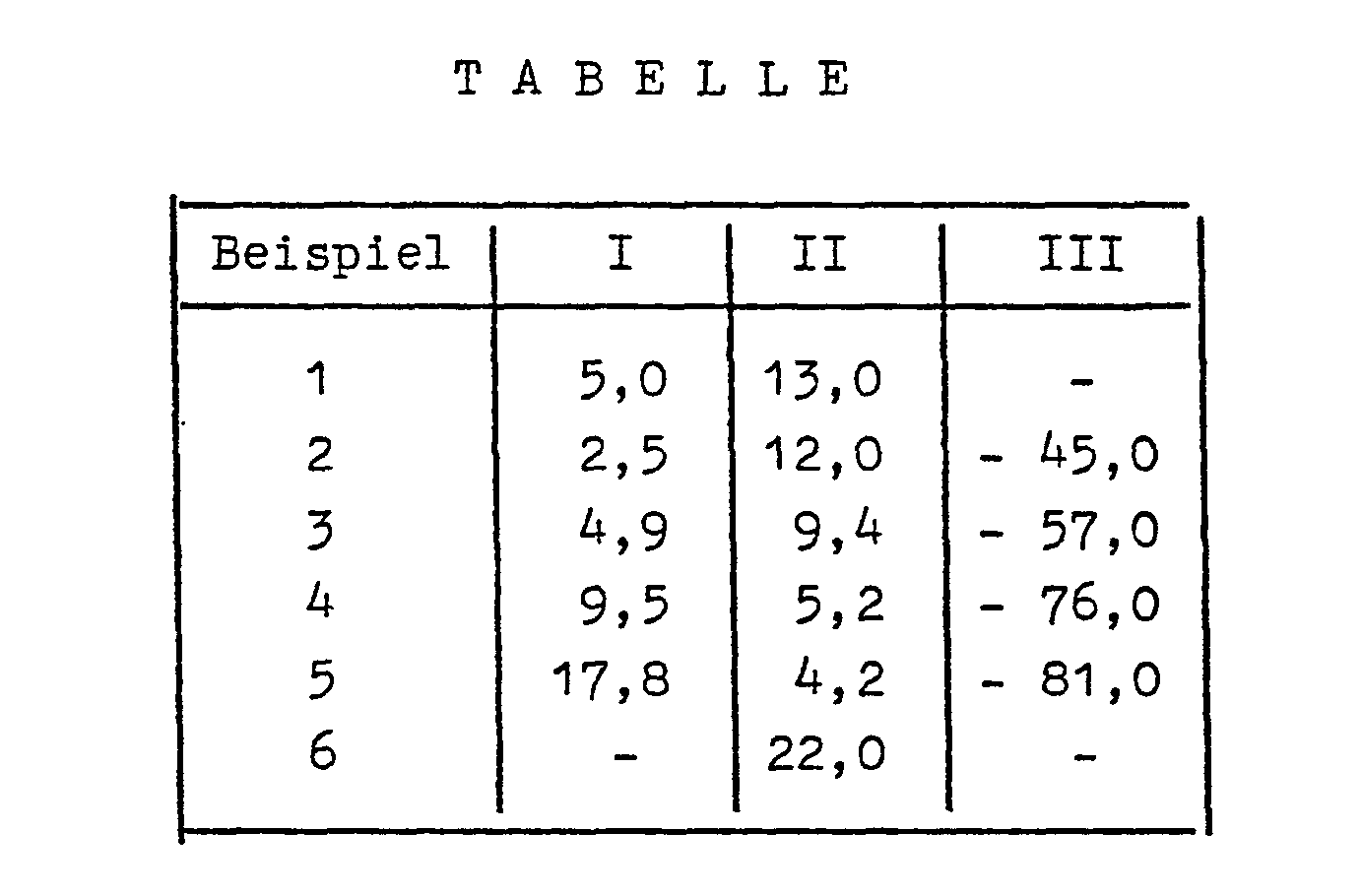
- Spalte I: Anteil des Melamin/Formaldehyd-Harzes im Endprodukt (Gew%)
- Spalte II: Lösliche Anteile des Endproduktes in Wasser (Gew%) gemäß Löslichkeitstest nach Beispiel 1
- Spalte III: Prozentuale Abnahme der wasserlöslichen Anteile der erfindungsgemäßen Produkte nach Beispielen 1-5 im Vergleich zur Wasserlöslichkeit des Vergleichsproduktes nach Beispiel 6.
- Aus der Tabelle geht hervor, daß mit zunehmendem Melamin/ Formaldehyd-Harzanteil im Endprodukt der wasserlösliche Anteil des Ammoniumpolyphosphates abnimmt. Im Vergleich zu dem unbehandelten Ammoniumpolyphosphat gemäß Beispiel 6 besitzen die erfindungsgemäßen Produkte eine erheblich geringere Wasserlöslichkeit.
Claims (7)

Priority Applications (1)
| Application Number | Priority Date | Filing Date | Title |
|---|---|---|---|
| AT80106518T ATE5889T1 (de) | 1979-12-08 | 1980-10-24 | Flammschutzmittel auf der basis von ammoniumpolyphosphaten. |
Applications Claiming Priority (2)
| Application Number | Priority Date | Filing Date | Title |
|---|---|---|---|
| DE19792949537 DE2949537A1 (de) | 1979-12-08 | 1979-12-08 | Teilchenfoermiges mittel zur verhinderung der brennbarkeit von brennenbaren stoffen |
| DE2949537 | 1979-12-08 |
Publications (3)
| Publication Number | Publication Date |
|---|---|
| EP0033361A2 true EP0033361A2 (de) | 1981-08-12 |
| EP0033361A3 EP0033361A3 (en) | 1982-01-27 |
| EP0033361B1 EP0033361B1 (de) | 1984-01-18 |
Family
ID=6087996
Family Applications (1)
| Application Number | Title | Priority Date | Filing Date |
|---|---|---|---|
| EP80106518A Expired EP0033361B1 (de) | 1979-12-08 | 1980-10-24 | Flammschutzmittel auf der Basis von Ammoniumpolyphosphaten |
Country Status (7)
| Country | Link |
|---|---|
| US (1) | US4467056A (de) |
| EP (1) | EP0033361B1 (de) |
| AT (1) | ATE5889T1 (de) |
| CA (1) | CA1154194A (de) |
| DE (2) | DE2949537A1 (de) |
| DK (1) | DK520780A (de) |
| ES (1) | ES497408A0 (de) |
Cited By (1)
| Publication number | Priority date | Publication date | Assignee | Title |
|---|---|---|---|---|
| WO2004007603A3 (en) * | 2002-07-13 | 2004-10-07 | Chance & Hunt Ltd | Flame retardant products |
Families Citing this family (50)
| Publication number | Priority date | Publication date | Assignee | Title |
|---|---|---|---|---|
| DE3217816A1 (de) * | 1982-05-12 | 1983-11-17 | Hoechst Ag, 6230 Frankfurt | Teilchenfoermiges mittel zur verminderung der entzuendlichkeit von brennbaren stoffen |
| US4871477A (en) * | 1983-02-15 | 1989-10-03 | Firestop Chemical Corporation | Fire protected foamed polymeric materials |
| DE3311770A1 (de) * | 1983-03-31 | 1985-01-17 | Hoechst Ag, 6230 Frankfurt | Flammwidriges papier und ein verfahren zu seiner herstellung |
| DE3316880A1 (de) * | 1983-05-07 | 1984-11-08 | Hoechst Ag, 6230 Frankfurt | Verfahren zur herstellung von hydrolysestabilen pulverfoermigen ammoniumpolyphosphaten |
| US4551483A (en) * | 1983-09-23 | 1985-11-05 | Hamilton Hicks | Fire-retardant polyurethane foam containing finely ground dry fire-retardant particles containing a volatile active fire-retardant componet |
| DE3478208D1 (en) * | 1983-11-05 | 1989-06-22 | Hoechst Ag | Process for the manufacture of products made of wood particles |
| DE3416662A1 (de) * | 1983-11-05 | 1985-05-15 | Hoechst Ag, 6230 Frankfurt | Schwerentflammbare strangpresskoerper, insbesondere strangpressplatten, sowie schwerentflammbare furnierte oder beschichtete strangpressplatten, ein verfahren zu ihrer herstellung und ihre verwendung |
| EP0164555B1 (de) * | 1984-05-05 | 1989-03-22 | Hoechst Aktiengesellschaft | Nach dem Strangpressverfahren aus Holzspänen und/oder Holzfasern unter Zusatz von Bindemitteln hergestellte Formkörper und Verfahren zu ihrer Herstellung |
| DE3528034A1 (de) * | 1984-10-18 | 1986-04-24 | Hoechst Ag, 6230 Frankfurt | Hydrolysestabiles flammschutzmittel auf der basis von ammoniumpolyphosphat |
| DE3526006A1 (de) * | 1984-10-18 | 1986-04-24 | Hoechst Ag, 6230 Frankfurt | Hydrolysestabiles flammschutzmittel auf der basis von ammoniumpolyphosphat |
| DE3528737A1 (de) * | 1984-10-18 | 1986-12-18 | Hoechst Ag, 6230 Frankfurt | Hydrolysestabiles flammschutzmittel auf der basis von ammoniumpolyphosphat |
| DE3526965A1 (de) * | 1984-10-18 | 1986-04-24 | Hoechst Ag, 6230 Frankfurt | Hydrolysestabiles flammschutzmittel auf der basis von ammoniumpolyphosphat |
| DE3531500A1 (de) * | 1984-10-26 | 1986-05-07 | Hoechst Ag, 6230 Frankfurt | Verfahren zur herstellung von hydrolysestabilen, feinteiligen flammschutzmitteln auf der basis von ammoniumpolyphosphat |
| DE3507562A1 (de) * | 1985-03-04 | 1986-09-04 | Hoechst Ag, 6230 Frankfurt | Selbstverloeschende polymere massen |
| IT1201424B (it) * | 1985-06-26 | 1989-02-02 | Capsalarm Sarl | Ritardanti di fiamma microincapsulati |
| US4670483A (en) * | 1985-11-04 | 1987-06-02 | The Bf Goodrich Company | Flame retardant polyurethane compositions |
| US5312853A (en) * | 1986-08-25 | 1994-05-17 | Hoechst Celanese Corporation | Flame retardant polymeric compositions |
| DE3713730A1 (de) * | 1987-04-24 | 1988-11-10 | Union Rheinische Braunkohlen | Verbessertes verfahren zur aufarbeitung von kohlenstoff enthaltenden abfaellen und biomasse |
| US4818775A (en) * | 1987-05-21 | 1989-04-04 | Reeves Brothers, Inc. | Rapid cure of polyurethane foam with ammonium containing materials |
| DE3728629A1 (de) * | 1987-08-27 | 1989-03-09 | Hoechst Ag | Flammwidrige polymere massen |
| DE4003230A1 (de) * | 1990-02-03 | 1991-08-08 | Hoechst Ag | Selbstverloeschende polyurethane |
| US5286775A (en) * | 1992-12-29 | 1994-02-15 | Minnesota Mining And Manufacturing Company | Halogen-free flame retardant compositions |
| JP2598742B2 (ja) * | 1993-03-09 | 1997-04-09 | チッソ株式会社 | メラミン被覆ポリリン酸アンモニウム及びその製造法 |
| US5700575A (en) * | 1993-12-27 | 1997-12-23 | Chisso Corporation | Water-insoluble ammonium polyphosphate particles |
| KR0158978B1 (ko) * | 1993-12-28 | 1999-01-15 | 고토 순기치 | 난연성 열가소성 중합체 조성물, 이의 성분으로서의 수불용성 폴리인산암모늄 분말 및 이의 제조방법 |
| US6015510A (en) * | 1996-08-29 | 2000-01-18 | E. I. Du Pont De Nemours And Company | Polymer flame retardant |
| KR100386056B1 (ko) * | 1997-06-26 | 2003-06-09 | 부덴하임 이베리카 에스.엘. 소시에다드 안 콤만디타 | 열가소성 수지로 피복된 암모늄 폴리포스페이트, 이의 제조방법 및 이를 포함하는 난연제 |
| DE19959288C2 (de) | 1999-12-09 | 2002-01-24 | Clariant Gmbh | Sicherheitstechnisch verbesserte Pigmentzubereitungen |
| US6559207B1 (en) * | 2000-03-14 | 2003-05-06 | Si Corporation | Flame resistant polymer composition and method for rendering polymers flame resistant |
| US6652633B2 (en) * | 2001-03-01 | 2003-11-25 | Arch Wood Protection, Inc. | Fire retardant |
| CN101376811B (zh) * | 2008-09-28 | 2012-07-04 | 中国科学技术大学 | 一种聚氨酯微胶囊化无机含磷阻燃剂及其制备方法 |
| US8097658B2 (en) * | 2009-11-18 | 2012-01-17 | Bayer Materialscience Llc | Process for the production of medium density decorative molded foams having good fire retardant properties with reduced mold times, fire retardant compositions and foams produced by this process |
| WO2012116884A1 (en) | 2011-03-02 | 2012-09-07 | Huntsman International Llc | Formulation suitable to provide polyurethane |
| EP2681266B1 (de) | 2011-03-02 | 2016-11-02 | Huntsman International LLC | Flammhemmende zusammensetzung für thermoplastische polyurethanpolymere |
| WO2013007509A1 (en) | 2011-07-12 | 2013-01-17 | Huntsman International Llc | Formulation suitable to provide polyurethane |
| CN102936429B (zh) * | 2012-10-26 | 2014-04-30 | 清远市普塞呋磷化学有限公司 | 密胺-甲醛树脂微胶囊包裹聚磷酸铵的制备方法 |
| CN103172908A (zh) * | 2013-03-05 | 2013-06-26 | 云南磷化集团有限公司 | 一种二元复合包覆剂包覆聚磷酸铵的方法 |
| CN103483873B (zh) * | 2013-09-27 | 2015-06-17 | 清远市普塞呋磷化学有限公司 | 一种低粘度微胶囊包裹聚磷酸铵的制备方法 |
| CA3093194A1 (en) | 2018-03-08 | 2019-09-12 | Zephyros, Inc. | Honeycomb core splice adhesive with improved fire retardancy |
| CA3138009A1 (en) * | 2019-04-29 | 2020-11-05 | Akzo Nobel Coatings International B.V. | Halogen-free, non-intumescent, fire retardant coating composition |
| KR20220061164A (ko) | 2019-09-05 | 2022-05-12 | 바스프 에스이 | 가요성 폴리우레탄 발포체, 그의 제조 방법 및 그의 용도 |
| CN114981386A (zh) | 2019-11-13 | 2022-08-30 | 泽费罗斯股份有限公司 | 蜂窝增强用封装膏 |
| WO2021165304A1 (en) | 2020-02-18 | 2021-08-26 | Zephyros, Inc. | Low density flame retardant two-component composition for structural void filling |
| US20230365783A1 (en) | 2020-09-18 | 2023-11-16 | Basf Se | Flame-retarded thermoplastic polyurethane |
| EP4381528A1 (de) | 2021-08-03 | 2024-06-12 | Basf Se | Sammelschiene, die mindestens teilweise mit einer thermoplastischen polyurethanzusammensetzung bedeckt ist |
| US20240327612A1 (en) | 2021-08-03 | 2024-10-03 | Base Se | Flame retardant thermoplastic polyurethane composition with improved mechanical properties |
| EP4147847A1 (de) | 2021-09-08 | 2023-03-15 | Basf Se | Permeabler formkörper mit polyurethanperlen |
| CN119452006A (zh) | 2022-06-27 | 2025-02-14 | 巴斯夫欧洲公司 | 具有改进特性的热塑性聚氨酯(tpu)组合物 |
| CN115850799B (zh) * | 2022-12-23 | 2025-01-03 | 山东省海洋化工科学研究院 | 一种管状高岭土改性聚磷酸铵功能单体及其制备方法 |
| CN117777548B (zh) * | 2023-12-04 | 2024-05-31 | 科迈特新材料有限公司 | 一种用于高分子材料的改性阻燃剂及其制备方法 |
Family Cites Families (4)
| Publication number | Priority date | Publication date | Assignee | Title |
|---|---|---|---|---|
| BE603736A (de) * | 1960-05-17 | |||
| US3423343A (en) * | 1964-12-22 | 1969-01-21 | Monsanto Co | Flame retardant polyurethane materials |
| US3513114A (en) * | 1966-01-07 | 1970-05-19 | Monsanto Co | Intumescent coating compositions |
| US4097400A (en) * | 1973-11-30 | 1978-06-27 | Hoechst Aktiengesellschaft | Flameproof polyurethanes |
-
1979
- 1979-12-08 DE DE19792949537 patent/DE2949537A1/de not_active Withdrawn
-
1980
- 1980-10-24 AT AT80106518T patent/ATE5889T1/de active
- 1980-10-24 EP EP80106518A patent/EP0033361B1/de not_active Expired
- 1980-10-24 DE DE8080106518T patent/DE3066201D1/de not_active Expired
- 1980-12-03 ES ES497408A patent/ES497408A0/es active Granted
- 1980-12-05 DK DK527080A patent/DK520780A/da unknown
- 1980-12-08 US US06/213,869 patent/US4467056A/en not_active Expired - Lifetime
- 1980-12-08 CA CA000366335A patent/CA1154194A/en not_active Expired
Cited By (1)
| Publication number | Priority date | Publication date | Assignee | Title |
|---|---|---|---|---|
| WO2004007603A3 (en) * | 2002-07-13 | 2004-10-07 | Chance & Hunt Ltd | Flame retardant products |
Also Published As
| Publication number | Publication date |
|---|---|
| EP0033361B1 (de) | 1984-01-18 |
| EP0033361A3 (en) | 1982-01-27 |
| DE3066201D1 (en) | 1984-02-23 |
| DK520780A (da) | 1981-06-09 |
| ES8200711A1 (es) | 1981-12-01 |
| ATE5889T1 (de) | 1984-02-15 |
| US4467056A (en) | 1984-08-21 |
| DE2949537A1 (de) | 1981-06-11 |
| CA1154194A (en) | 1983-09-20 |
| ES497408A0 (es) | 1981-12-01 |
Similar Documents
| Publication | Publication Date | Title |
|---|---|---|
| EP0033361B1 (de) | Flammschutzmittel auf der Basis von Ammoniumpolyphosphaten | |
| EP0035094B1 (de) | Teilchenförmiges Mittel zur Verhinderung der Brennbarkeit von brennbaren Stoffen | |
| EP0093993B1 (de) | Teilchenförmiges Mittel zur Verminderung der Entzündlichkeit von brennbaren Stoffen | |
| EP0180795B1 (de) | Verfahren zur Herstellung von hydrolysestabilen, feinteiligen Flammschutzmitteln auf der Basis von Ammoniumpolyphosphat | |
| EP0408947A2 (de) | Formkörper aus Melaminharzen mit erhöhter Elastizität | |
| DE69206376T2 (de) | Flammschutzmittel und Verfahren zu ihrer Herstellung. | |
| EP0162974A1 (de) | Verfahren zur Herstellung von Holzformkörpern | |
| EP0037878B1 (de) | Herstellung von Holzwerkstoffen mit sehr geringer Formaldehydabgabe | |
| DE2318258A1 (de) | Kautschukmodifizierte aminoplastformmassen | |
| DD239215A5 (de) | Verfahren zur herstellung von hydrolysestabilen, feinteiligen flammschutzmitteln auf der basis von ammoniumpolyphosphat | |
| DE2946821C2 (de) | Bindemittel auf der Basis von kaltaushärtenden Aminoplast-Furanharzen | |
| DE3526006A1 (de) | Hydrolysestabiles flammschutzmittel auf der basis von ammoniumpolyphosphat | |
| DE3708739A1 (de) | Alkalisch kondensierte harnstoff-phenol-formaldehyd-harzloesung, verfahren zu ihrer herstellung und ihre verwendung bei der herstellung von spanplatten | |
| DD239802A5 (de) | Flammschutzmittel auf der basis von ammoniumpolyphosphate | |
| EP0121162B1 (de) | Flammwidriges Papier und ein Verfahren zu seiner Herstellung | |
| DE3526965A1 (de) | Hydrolysestabiles flammschutzmittel auf der basis von ammoniumpolyphosphat | |
| DD234252A5 (de) | Schwerentflammbare strangpresskoerper, insbesondere strang-pressplatten, sowie schwerentflammbare furnierte oder beschichtete strangpressplatten, ein verfahren zu ihrer herstellung und ihre verwendung | |
| EP0094634A2 (de) | Diethanolaminsalz der Amidosulfonsäure als Härtungsbeschleuniger für Aminoplastharze | |
| DD239800A5 (de) | Flammschutzmittel auf der basis von ammoniumpolyphosphat | |
| DD239801A5 (de) | Flammschutz auf der basis von ammoniumpolyphosphat | |
| EP0052212A1 (de) | Verfahren zur Herstellung von Aminoplastkondensaten | |
| EP0805830A1 (de) | Wässerige aminoplastharze mit verbesserter waschbarkeit für die herstellung von holzwerkstoffen | |
| EP0461555B1 (de) | Verfahren zur Herstellung von Imprägnierharzen auf Phenol-Formaldehyd-Basis | |
| DE3515849C2 (de) | Formmassen und Verfahren zu ihrer Herstellung | |
| DE1121331B (de) | Verfahren zur Herstellung rasch haertender, gegebenenfalls durch Weichmachung haertungsverzoegerter Resole |
Legal Events
| Date | Code | Title | Description |
|---|---|---|---|
| PUAI | Public reference made under article 153(3) epc to a published international application that has entered the european phase |
Free format text: ORIGINAL CODE: 0009012 |
|
| AK | Designated contracting states |
Designated state(s): AT BE CH DE FR GB IT NL SE |
|
| PUAL | Search report despatched |
Free format text: ORIGINAL CODE: 0009013 |
|
| AK | Designated contracting states |
Designated state(s): AT BE CH DE FR GB IT NL SE |
|
| 17P | Request for examination filed |
Effective date: 19811029 |
|
| ITF | It: translation for a ep patent filed | ||
| GRAA | (expected) grant |
Free format text: ORIGINAL CODE: 0009210 |
|
| AK | Designated contracting states |
Designated state(s): AT BE CH DE FR GB IT LI NL SE |
|
| REF | Corresponds to: |
Ref document number: 5889 Country of ref document: AT Date of ref document: 19840215 Kind code of ref document: T |
|
| REF | Corresponds to: |
Ref document number: 3066201 Country of ref document: DE Date of ref document: 19840223 |
|
| ET | Fr: translation filed | ||
| PLBE | No opposition filed within time limit |
Free format text: ORIGINAL CODE: 0009261 |
|
| STAA | Information on the status of an ep patent application or granted ep patent |
Free format text: STATUS: NO OPPOSITION FILED WITHIN TIME LIMIT |
|
| 26N | No opposition filed | ||
| PGFP | Annual fee paid to national office [announced via postgrant information from national office to epo] |
Ref country code: CH Payment date: 19920917 Year of fee payment: 13 |
|
| PGFP | Annual fee paid to national office [announced via postgrant information from national office to epo] |
Ref country code: SE Payment date: 19920921 Year of fee payment: 13 |
|
| PGFP | Annual fee paid to national office [announced via postgrant information from national office to epo] |
Ref country code: AT Payment date: 19920928 Year of fee payment: 13 |
|
| ITTA | It: last paid annual fee | ||
| PGFP | Annual fee paid to national office [announced via postgrant information from national office to epo] |
Ref country code: NL Payment date: 19921031 Year of fee payment: 13 |
|
| PG25 | Lapsed in a contracting state [announced via postgrant information from national office to epo] |
Ref country code: AT Effective date: 19931024 |
|
| PG25 | Lapsed in a contracting state [announced via postgrant information from national office to epo] |
Ref country code: SE Effective date: 19931025 |
|
| PG25 | Lapsed in a contracting state [announced via postgrant information from national office to epo] |
Ref country code: LI Effective date: 19931031 Ref country code: CH Effective date: 19931031 |
|
| PG25 | Lapsed in a contracting state [announced via postgrant information from national office to epo] |
Ref country code: NL Effective date: 19940501 |
|
| NLV4 | Nl: lapsed or anulled due to non-payment of the annual fee | ||
| REG | Reference to a national code |
Ref country code: CH Ref legal event code: PL |
|
| EUG | Se: european patent has lapsed |
Ref document number: 80106518.6 Effective date: 19940510 |
|
| PGFP | Annual fee paid to national office [announced via postgrant information from national office to epo] |
Ref country code: DE Payment date: 19990514 Year of fee payment: 19 |
|
| PGFP | Annual fee paid to national office [announced via postgrant information from national office to epo] |
Ref country code: FR Payment date: 19990923 Year of fee payment: 20 |
|
| PGFP | Annual fee paid to national office [announced via postgrant information from national office to epo] |
Ref country code: GB Payment date: 19990924 Year of fee payment: 20 |
|
| PGFP | Annual fee paid to national office [announced via postgrant information from national office to epo] |
Ref country code: BE Payment date: 19990928 Year of fee payment: 20 |
|
| BE20 | Be: patent expired |
Free format text: 20001024 *HOECHST A.G. |
|
| PG25 | Lapsed in a contracting state [announced via postgrant information from national office to epo] |
Ref country code: DE Free format text: LAPSE BECAUSE OF NON-PAYMENT OF DUE FEES Effective date: 20000801 |
|
| PG25 | Lapsed in a contracting state [announced via postgrant information from national office to epo] |
Ref country code: GB Free format text: LAPSE BECAUSE OF EXPIRATION OF PROTECTION Effective date: 20001023 |
|
| REG | Reference to a national code |
Ref country code: GB Ref legal event code: PE20 Effective date: 20001023 |