EP0034334B1 - Esters de 1,3-diméthyl-but-3-ène-1-yle, leur utilisation en tant qu'ingrédients parfumants ou aromatisants, composition parfumante ou aromatisante contenant au moins l'un desdits esters - Google Patents
Esters de 1,3-diméthyl-but-3-ène-1-yle, leur utilisation en tant qu'ingrédients parfumants ou aromatisants, composition parfumante ou aromatisante contenant au moins l'un desdits esters Download PDFInfo
- Publication number
- EP0034334B1 EP0034334B1 EP81100969A EP81100969A EP0034334B1 EP 0034334 B1 EP0034334 B1 EP 0034334B1 EP 81100969 A EP81100969 A EP 81100969A EP 81100969 A EP81100969 A EP 81100969A EP 0034334 B1 EP0034334 B1 EP 0034334B1
- Authority
- EP
- European Patent Office
- Prior art keywords
- dimethyl
- esters
- perfuming
- ene
- aromatizing
- Prior art date
- Legal status (The legal status is an assumption and is not a legal conclusion. Google has not performed a legal analysis and makes no representation as to the accuracy of the status listed.)
- Expired
Links
Classifications
-
- C—CHEMISTRY; METALLURGY
- C11—ANIMAL OR VEGETABLE OILS, FATS, FATTY SUBSTANCES OR WAXES; FATTY ACIDS THEREFROM; DETERGENTS; CANDLES
- C11B—PRODUCING, e.g. BY PRESSING RAW MATERIALS OR BY EXTRACTION FROM WASTE MATERIALS, REFINING OR PRESERVING FATS, FATTY SUBSTANCES, e.g. LANOLIN, FATTY OILS OR WAXES; ESSENTIAL OILS; PERFUMES
- C11B9/00—Essential oils; Perfumes
- C11B9/0007—Aliphatic compounds
- C11B9/0015—Aliphatic compounds containing oxygen as the only heteroatom
-
- A—HUMAN NECESSITIES
- A23—FOODS OR FOODSTUFFS; TREATMENT THEREOF, NOT COVERED BY OTHER CLASSES
- A23L—FOODS, FOODSTUFFS OR NON-ALCOHOLIC BEVERAGES, NOT OTHERWISE PROVIDED FOR; PREPARATION OR TREATMENT THEREOF
- A23L27/00—Spices; Flavouring agents or condiments; Artificial sweetening agents; Table salts; Dietetic salt substitutes; Preparation or treatment thereof
- A23L27/20—Synthetic spices, flavouring agents or condiments
- A23L27/29—Fruit flavours
-
- C—CHEMISTRY; METALLURGY
- C07—ORGANIC CHEMISTRY
- C07C—ACYCLIC OR CARBOCYCLIC COMPOUNDS
- C07C69/00—Esters of carboxylic acids; Esters of carbonic or haloformic acids
- C07C69/02—Esters of acyclic saturated monocarboxylic acids having the carboxyl group bound to an acyclic carbon atom or to hydrogen
- C07C69/04—Formic acid esters
- C07C69/06—Formic acid esters of monohydroxylic compounds
- C07C69/07—Formic acid esters of monohydroxylic compounds of unsaturated alcohols
-
- C—CHEMISTRY; METALLURGY
- C07—ORGANIC CHEMISTRY
- C07C—ACYCLIC OR CARBOCYCLIC COMPOUNDS
- C07C69/00—Esters of carboxylic acids; Esters of carbonic or haloformic acids
- C07C69/02—Esters of acyclic saturated monocarboxylic acids having the carboxyl group bound to an acyclic carbon atom or to hydrogen
- C07C69/12—Acetic acid esters
- C07C69/14—Acetic acid esters of monohydroxylic compounds
- C07C69/145—Acetic acid esters of monohydroxylic compounds of unsaturated alcohols
-
- C—CHEMISTRY; METALLURGY
- C07—ORGANIC CHEMISTRY
- C07C—ACYCLIC OR CARBOCYCLIC COMPOUNDS
- C07C69/00—Esters of carboxylic acids; Esters of carbonic or haloformic acids
- C07C69/02—Esters of acyclic saturated monocarboxylic acids having the carboxyl group bound to an acyclic carbon atom or to hydrogen
- C07C69/22—Esters of acyclic saturated monocarboxylic acids having the carboxyl group bound to an acyclic carbon atom or to hydrogen having three or more carbon atoms in the acid moiety
- C07C69/24—Esters of acyclic saturated monocarboxylic acids having the carboxyl group bound to an acyclic carbon atom or to hydrogen having three or more carbon atoms in the acid moiety esterified with monohydroxylic compounds
-
- C—CHEMISTRY; METALLURGY
- C07—ORGANIC CHEMISTRY
- C07C—ACYCLIC OR CARBOCYCLIC COMPOUNDS
- C07C69/00—Esters of carboxylic acids; Esters of carbonic or haloformic acids
- C07C69/52—Esters of acyclic unsaturated carboxylic acids having the esterified carboxyl group bound to an acyclic carbon atom
- C07C69/533—Monocarboxylic acid esters having only one carbon-to-carbon double bond
-
- C—CHEMISTRY; METALLURGY
- C07—ORGANIC CHEMISTRY
- C07C—ACYCLIC OR CARBOCYCLIC COMPOUNDS
- C07C69/00—Esters of carboxylic acids; Esters of carbonic or haloformic acids
- C07C69/76—Esters of carboxylic acids having a carboxyl group bound to a carbon atom of a six-membered aromatic ring
- C07C69/78—Benzoic acid esters
-
- C—CHEMISTRY; METALLURGY
- C07—ORGANIC CHEMISTRY
- C07C—ACYCLIC OR CARBOCYCLIC COMPOUNDS
- C07C69/00—Esters of carboxylic acids; Esters of carbonic or haloformic acids
- C07C69/76—Esters of carboxylic acids having a carboxyl group bound to a carbon atom of a six-membered aromatic ring
- C07C69/84—Esters of carboxylic acids having a carboxyl group bound to a carbon atom of a six-membered aromatic ring of monocyclic hydroxy carboxylic acids, the hydroxy groups and the carboxyl groups of which are bound to carbon atoms of a six-membered aromatic ring
-
- C—CHEMISTRY; METALLURGY
- C11—ANIMAL OR VEGETABLE OILS, FATS, FATTY SUBSTANCES OR WAXES; FATTY ACIDS THEREFROM; DETERGENTS; CANDLES
- C11B—PRODUCING, e.g. BY PRESSING RAW MATERIALS OR BY EXTRACTION FROM WASTE MATERIALS, REFINING OR PRESERVING FATS, FATTY SUBSTANCES, e.g. LANOLIN, FATTY OILS OR WAXES; ESSENTIAL OILS; PERFUMES
- C11B9/00—Essential oils; Perfumes
- C11B9/0061—Essential oils; Perfumes compounds containing a six-membered aromatic ring not condensed with another ring
Definitions
- the present invention relates to the field of perfumery and aromas, in particular it relates to certain 1,3-dimethyl-but-3-ene-1-yl esters as well as a process for improving, modifying or reinforcing the odorous properties. of perfumes and perfumed products as well as the gustatory properties of food or drinks, which process is characterized in that one of the mentioned esters is added to said perfumes, perfumed products, food or drinks.
- the invention also relates to a perfume or flavoring composition containing as active ingredient at least one of said esters.
- esters derived from aliphatic carboxylic acids and lower aliphatic alcohols are several esters derived from aliphatic carboxylic acids and lower aliphatic alcohols.
- Such compounds are of particular interest for the perfumery and flavoring industries; they indeed develop various notes of the green, flowery, or sometimes fruity type. The smell developed by some of them is pronounced of that possessed by chamomile, especially in its top notes.
- the esters of the invention can be used in a good number of perfume compositions or bases of varied nature, their characteristics easily marrying with current perfume ingredients; their field of use is therefore quite extensive.
- perfumery the proportions in which said compounds of the invention can produce interesting effects vary over a wide range of values.
- proportions of the order of 5 to 20% by weight, relative to the weight of the composition in which they are incorporated have been judged to be satisfactory in most of the applications considered.
- concentrations can vary and have values falling within or beyond the limits indicated. This is the case, for example, in applications intended for the perfuming of cleaning products, detergents, cosmetics or soaps, where concentrations of the order of 0.1 to 0.5% by weight can already produce interesting odor effects.
- the compounds of the invention develop herbal, floral, rosy, resinous, fruity gustatory notes which can recall chamomile.
- the compounds of the invention can be used at variable concentrations. Proportions of the order of 1 to 50 ppm, more particularly 10 ppm (parts per million) relative to the total weight of the flavored product can be suitably used.
- the 1,3-dimethyl-but-3-ene-1-yl salicylate resulted from a very particular potency; it can therefore be used at concentrations lower than those indicated above, for example of the order of 0.1 to 0.5 ppm.
- esters of the invention can be used alone or, more frequently, in combination with other perfuming ingredients, respectively flavoring of natural or synthetic origin, with solvents or carriers.
- Said esters can be prepared from 1,3-dimethyl-but-3-ene-1-ol according to conventional methods. The methods followed are detailed below.
- reaction mixture was kept stirring at room temperature for 2 h while adding 50 ml of isopropyl ether and then 0.04 moles of the appropriate acid chloride in order to complete the reaction.
- the mixture is then heated for 2 h at 40-50 ° and left stirring overnight at room temperature, then cooled to about 5 °. 50 ml of 5% sulfuric acid were then added to the mixture and the organic phase was washed 1 time with water, 2 times with a 10% sodium carbonate solution and finally 2 times with an aqueous solution. concentrated NaCI. The organic phase was dried over Na 2 S0 4 , concentrated and distilled to provide the desired ester.
- esters namely the 1,3-dimethyl-butyl esters also exhibit interesting organoleptic properties, although less pronounced.
- Said esters are prepared from 1,3-dimethyl-butanol according to the usual esterification methods.
- 1,3-Dimethyl-but-3-ene-1-ol used as starting material in the preparation methods described above, can be obtained according to known methods, for example according to Japanese application no. 76 70708 [see Chem. Abstr. 85,123,338 d (1976)].
- the compounds referred to in the present invention were subjected to an olfactory evaluation by a group of experts.
- the following table summarizes the results of such an assessment.
- a basic perfume composition of the flowery and fruity type was prepared by mixing the following ingredients (parts by weight):
- a perfuming composition is obtained having a chamomile type note.
- Such a composition is perfectly suited for perfuming products intended for hair care, shampoos for example.
- the compounds referred to in the present invention were subjected to a taste assessment by a group of experts.
- the following table summarizes the results of such an assessment:
- the compounds examined were evaluated in spring water at an average concentration of 10 ppm (parts per million) with the exception of salicylate which was evaluated at 0.3 ppm.
Landscapes
- Chemical & Material Sciences (AREA)
- Organic Chemistry (AREA)
- Engineering & Computer Science (AREA)
- Life Sciences & Earth Sciences (AREA)
- Chemical Kinetics & Catalysis (AREA)
- Wood Science & Technology (AREA)
- Oil, Petroleum & Natural Gas (AREA)
- Health & Medical Sciences (AREA)
- Nutrition Science (AREA)
- Food Science & Technology (AREA)
- Polymers & Plastics (AREA)
- Organic Low-Molecular-Weight Compounds And Preparation Thereof (AREA)
- Fats And Perfumes (AREA)
- Cosmetics (AREA)
- Seasonings (AREA)
Description
- La présente invention a trait au domaine de la parfumerie et des arômes, en pariculier elle concerne certains esters de 1,3-diméthyl-but-3-ène-1-yle ainsi qu'un procédé pour améliorer, modifier ou renforcer les propriétés odorantes de parfums et produits parfumés ainsi que les propriétés gustatives d'aliments ou boissons, lequel procédé est caractérisé en ce qu'on ajoute auxdits parfums, produits parfumés, aliments ou boissons l'un des esters mentionnés. L'invention a également trait à une composition parfumante ou aromatisante contenant en tant qu'ingrédient actif au moins un desdits esters.
- Parmi la variété de corps synthétiques mis à la disposition du parfumeur ou de l'aromatiseur figurent plusieurs esters dérivés d'acides aliphatiques carboxyliques et d'alcools aliphatiques inférieurs.
- Dans le but d'élargir encore davantage l'éventail des ingrédients offerts dans cette classe de composés de façon à pouvoir permettre la création de compositions nouvelles aux nuance odorantes inédites, nous avons réalisé la synthèse d'une série de composés nouveaux. Il s'agit en l'occurence d'esters dérivés du 1,3-diméthy-but-3-éne-1-ol, en particulier des composés que voici:
- - formiate de 1,3-diméthyl-but-3-ène-1-yle,
- - propionate de 1,3-diméthyl-but-3-ène-1-yle,
- - butyrate de 1,3-diméthyl-but-3-ène-1-yle,
- - isobutyrate de 1,3-diméthyl-but-3-ène-1-yle,
- - isovalérianate de 1,3-diméthyl-but-3-ène-1-yle,
- - tiglate de 1,3-diméthyl-but-3-ène-1-yle, et
- - salicylatedel,3-dimsthyl-but-3-ène-1-yle.
- De tels composés présentent un intérêt tout particulier pour l'industrie de la parfumerie et celle des arômes; ils développent en effet des notes variées de type vert, fleuri, ou parfois fruité. L'odeur développée par certains d'entre eux rappelle celle possédée par la camomille, notamment dans ses notes de tête.
- De par la variété de leurs propriétés olfactives, les esters de l'invention peuvent être utilisés dans bon nombre de compositions ou bases parfumantes de nature variée, leurs caractères se mariant aisément avec les ingrédients parfumants courants; leur domaine d'utilisation est donc assez étendu. Dans la parfumerie, les proportions dans lesquelles lesdits composés de l'invention peuvent produire des effets intéressants varient dans une large gamme de valeurs. C'est ainsi que des proportions de l'ordre de 5 à 20% en poids, par rapport au poids de la composition dans laquelle ils sont incorporés, ont été jugées comme satisfaisantes dans la plupart des applications considérées. Bien entendu, de telles concentrations peuvent varier et avoir des valeurs se situant en deçà ou au delà des limites indiquées. Tel est le cas, par exemple, dans les applications destinées au parfumage des produits d'entretien, des détergents, des cosmétiques ou des savons, où des concentrations de l'ordre de 0,1 à 0,5% en poids peuvent déjà produire des effets odorants intéressants.
- Dans le domaine des arômes, les composés de l'invention développent des notes gustatives herbales, fleuries, rosées, résineuses, fruitées pouvant rappeler la camomille.
- Un intérêt particulier est présenté par les esters propionique, isobutyrique et tiglique.
- Dans le domaine des arômes, les composés de l'invention peuvent être utilisés à des concentrations variables. Des proportions de l'ordre de 1 à 50 ppm, plus particulièrement de 10 ppm (parties par million) par rapport au poids total du produit aromatisé peuvent convenablement être utilisées. Parmi les esters définis plus haut, le salicylate de 1,3-diméthyl-but-3-ène-1-yle est résulté d'une puissance très particulière; il peut dont être utilisé à des concentrations inférieures à celles indiquées ci-dessus, par exemple de l'ordre de 0,1 à 0,5 ppm.
- Les esters de l'invention peuvent être utilisés isolément ou, plus fré quemment, en combinaison avec d'autres ingrédients parfumants, respectivement aromatisants d'origine naturelle ou synthétique, avec des solvants ou des supports.
- Un intérêt particulier est représenté par l'isobutyrate, le tiglate, et le salicylate.
- Lesdits esters peuvent être préparés à partir du 1,3-diméthyl-but-3-ène-1-ol conformément à des procédés usuels. Les méthodes suivies sont indiquées ci-après par le détail.
- 0,2 Moles du chlorure d'acide approprié (chlorure de propionyle, butyryle ou isobutyryle) ont été ajoutées goutte à goutte à un mélange maintenu à 0/+5° de 1,3-diméthyl-but-3-ène-1-ol (0,2 mole) et diéthylaniline (0,22 mole).
- Après l'introduction, le mélange réactionnel a été maintenu sous agitation à température ambiante pendant 2 h tout en y ajoutant 50 ml d'éther isopropylique, puis 0,04 moles du chlorure d'acide approprié afin de compléter la réaction.
- Le mélange est ensuite chauffé pendant 2 h à 40-50° et laissé sous agitation pendant la nuit à température ambiante, puis refroidi à environ 5°. 50 ml d'acide sulfurique à 5% ont ensuite été ajoutés au mélange et la phase organique a été lavée 1 fois avec de l'eau, 2 fois avec une solution de carbonate de sodium à 10% et enfin 2 fois avec une solution aqueuse concentrée de NaCI. La phase organique a été séchée sur du Na2S04, concentrée et distillée pour fournir l'ester désiré.
- ester propionique:
- rendement 70%; Eb.59°/1,73 103 Pascal SM: m/e=57, 82, 29, 67,41, 101, 112, 141, 119.
- ester butyrique:
- rendement 70% environ; Eb. 75°/1,73 · 103 Pascal
- SM: m/e = 71, 43, 82, 55, 27, 115, 89, 126, 141, 155, 105.
- ester isobutyrique:
- rendement 70% environ; Eb.60°/1,33 · 103Pascal
- SM: m/e=71, 43, 82, 55, 27, 115, 126, 155.
- 46g (1 mole). d'acide formique ont été ajoutés goutte à goutte à 50g (0,5 mole) de 1,3-diméthyl-but-3-éne-1-ol sous vigoureuse agitation et le mélange a été laissé au repos pendant 2 h à température ambiante, puis il a été maintenu 4 h à 60°. Le mélange a été ensuite dilué au pentane et la phase organique a été lavée deux fois à l'eau, au bicarbonate de sodium et enfin à l'eau jusqu'à neutralité. Après filtration sur une colonne de SiO2 et évaporation, on a distillé sous pression réduite à l'aide d'un appareil de type Widmer pour fournir 17,7 g du produit désiré:
- EL.110°/9.71 · 104 Pascal
- RMN: 1,22 et 1,33 (3H, 2s); 1,78 (3H, s); 2,3 (2H, q); 4,78-5,25 (3H, m); 8,0 (1H, s) δ ppm.
- 20,9 g de chlorure d'isovalérianyle (0,2 mole) ont été ajoutés sous agitation en 45 minutes à une solution de 20 g (0,2 mole) de 1,3-diméthyl-but-3-ène-1-ol dans 60 mi d'éther absolu et 23,7 g (0,3 mole) de pyridine absolue. Le mélange est ensuite maintenu au reflux pendant 1 h, puis refroidi à température ambiante. Après addition de 100 ml d'eau glacée, extraction à l'éther sulfurique (2x) et traitement habituel d'acidification, lavage et neutralisation des extraits organiques, on a obtenu par évaporation et distillation l'ester désiré ayant Eb. 71°/1,33 · 103 Pascal (rendement 66,8%).
- SM: m/e =129, 103, 85, 82, 67, 57, 41, 29
- RMN: 0,83 et 0,95 (6H, 2s); 1,10 et 1,21 (3H, 2s); 1,70 (3H, 1s); 2,12 (5H, m); 4,70 (2H, m); 5,05 (1H, q) δ ppm.
- 13,5 g (0,113 mole) de chlorure de 3-méthyl-trans-but-2-énoyle ont été ajoutés en 5 minutes à une solution de 10 g (0,1 mole) de 1,3-diméthyl-but-3-ène-1-ol dans 115 ml de toluène anhydre. Le mélange de réaction a été ensuite chauffé au reflux pendant 3½ h et, après refroidissement, il a été mélangé avec 45 ml d'une solution aqueuse saturée de NaHC03, puis agité à température ambiante pendant 30 minutes.
- La phase organique séparée a été soumise aux traitements habituels de lavage et neutralisation. Après évaporation des parties volatiles, on soumet le résidu obtenu à deux distillations fractionnées successives à l'aide d'une colonne Vigreux et d'une colonne de type Fischer, respectivement, pour fournir le produit désiré ayant Eb.85°/1,33 · 103 Pascal; rendement 44%.
- SM: m/e =127, 101, 83, 82, 67, 55, 39, 29
- RMN: 1,18 et 1,28 (3H, d); 1,72-1,80 (9H); 2,20-2,36 (2H); 4,70 (2H, s); 4,92-5,25 (1H, q); 6,80 (1H, m) δ PPm.
- Cet ester a été préparé comme indiqué plus haut pour l'ester isovalérianique en utilisant 1,0 kg (10 moles) de 1,3-diméthyl-but-3-ène-1-ol et du chlorure de salicycle obtenu par chloruration de 1,380 kg (10 moles) d'acide salicylique par 1,190 kg (10 moles) de chlorure de thionyle en présence de pyridine. Le salicylate de 1,3-diméthyl-but-3-ène-1-yle obtenu montrait Eb. 110°/1,33 Pascal; 1,520 kg; rendement 69%.
- RMN: 1,3 et 1,4 (4H, 2s); 1,60 (1H, 1d); 1,76 (3H, 1s); 2,37 (2H, q); 3,78 (2H, s); 5,35 (1H, q); 6,8-7,87 (4H, m) δ ppm.
- Nous avons observé que les esters saturés correspondants, à savoir les esters de 1,3-diméthyl-butyle présentent également des propriétés organoleptiques intéressantes, quoique moins prononcées. Lesdits esters sont préparés à partir de 1,3-diméthyl-butanol selon les méthodes d'estérification usuelles.
- Le 1,3-diméthyl-but-3-ène-1-ol, utilisé comme produit de départ dans les méthodes de préparation décrites ci-dessus, peut être obtenu conformément à des méthodes connues, par exemple suivant la demande japonaise no. 76 70708 [voir Chem. Abstr. 85,123 338 d (1976)].
- Les températures indiquées plus haut sont données en degrés centigrades et les abréviations ont le sens usuel dans l'art.
- Les composés dont il est question dans la présente invention ont été soumis à une évaluation olfactive de la part d'un groupe d'experts. Le tableau suivant résume les résultats d'une telle évaluation.

- On a préparé une composition parfumante de base de type fleuri et fruité en mélangeant les ingrédients suivants (parties en poids):
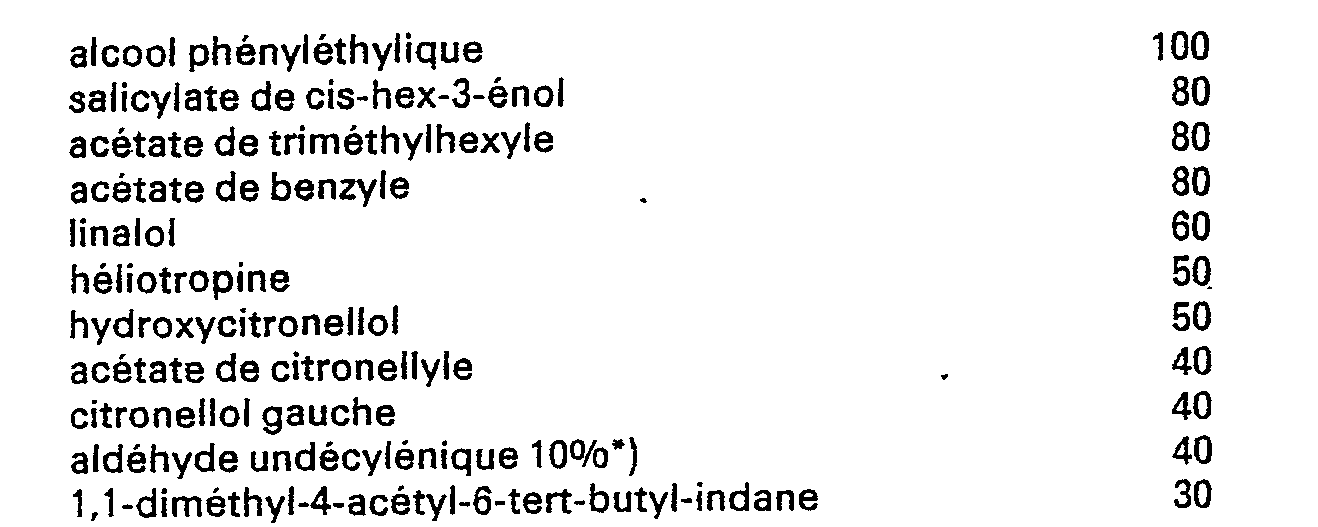

- En ajoutant à la nouvelle composition ainsi obtenue 10 g d'isobutyrate de 1,3-diméthyl-but-3-ène-1- yle, on obtient une composition parfumante possédant une note de type camomille. Une telle composition est parfaitement adaptée au parfumage de produits destinés aux soins capillaires, des shampoings par exemple.
- Les composés dont il est question dans la présente invention ont été soumis à une évaluation gustative de la part d'un groupe d'experts. Le tableau suivant résume les résultats d'une telle évaluation:

- Les composés examinés ont été évalués dans de l'eau de source à une concentration moyenne de 10 ppm (parties par million) à l'exception du salicylate qui a été évalué à 0,3 ppm.
- Certains esters de 1,3-diméthyl-but-3-ène-1-yle, à savoir le
- - formiate de 1,3-diméthyi-but-3-ène-1-yle,
- - propionate de 1,3-diméthyl-but-3-ène-1-yle,
- - butyrate de 1,3-diméthyl-but-3-ène-1-yle,
- - isobutyrate de 1,3-diméthyl-but-3-ène-1-yle,
- - isovalérianate de 1,3-diméthyl-but-3-ène-1-yle,
- - tiglate de 1,3-diméthyl-but-3-ène-1-yle, et le
- - salicylate de 1,3-diméthyl-but-3-éne-1-yle
- possèdent des propriétés organoleptiques intéressantes et peuvent de ce fait être utilisés dans l'industrie des arômes et, plus particulièrement celle de la parfumerie. Ils servent à développer des notes de type fleuri, fruité, vert, dans les produits dans lesquels ils sont incorporés.
Claims (8)
Applications Claiming Priority (2)
| Application Number | Priority Date | Filing Date | Title |
|---|---|---|---|
| CH1162/80 | 1980-02-13 | ||
| CH116280 | 1980-02-13 |
Publications (3)
| Publication Number | Publication Date |
|---|---|
| EP0034334A2 EP0034334A2 (fr) | 1981-08-26 |
| EP0034334A3 EP0034334A3 (en) | 1981-10-14 |
| EP0034334B1 true EP0034334B1 (fr) | 1983-02-09 |
Family
ID=4203923
Family Applications (1)
| Application Number | Title | Priority Date | Filing Date |
|---|---|---|---|
| EP81100969A Expired EP0034334B1 (fr) | 1980-02-13 | 1981-02-11 | Esters de 1,3-diméthyl-but-3-ène-1-yle, leur utilisation en tant qu'ingrédients parfumants ou aromatisants, composition parfumante ou aromatisante contenant au moins l'un desdits esters |
Country Status (4)
| Country | Link |
|---|---|
| US (1) | US4387047A (fr) |
| EP (1) | EP0034334B1 (fr) |
| JP (1) | JPS56128732A (fr) |
| DE (1) | DE3160051D1 (fr) |
Families Citing this family (12)
| Publication number | Priority date | Publication date | Assignee | Title |
|---|---|---|---|---|
| US4510319A (en) * | 1982-07-01 | 1985-04-09 | Fritzsche Dodge & Olcott Inc. | Functionalization of terminal trisubstituted alkenes and derivatives thereof |
| DE3306560A1 (de) * | 1983-02-25 | 1984-08-30 | Henkel KGaA, 4000 Düsseldorf | Neue 2-methylpentansaeureester, deren herstellung und verwendung als riechstoffe sowie diese enthaltende riechstoff-kompositionen |
| US4629586A (en) * | 1984-12-07 | 1986-12-16 | International Flavors & Fragrances Inc. | Hexynyl alkanoates and organoleptic uses thereof |
| US4539209A (en) * | 1984-12-07 | 1985-09-03 | International Flavors & Fragrances Inc. | Food flavoring use of hexynyl alkanoates |
| WO1995021606A1 (fr) * | 1994-02-08 | 1995-08-17 | Union Camp Corporation | Composes de 2,2,4-trimethylpentene-1-yle, et compositions d'aromes et de parfums |
| FR2740450B1 (fr) * | 1995-10-27 | 2001-09-28 | Rhone Poulenc Chimie | Procede d'obtention de compositions parfumantes et de produits parfumes et produits ainsi obtenus |
| ES2219717T3 (es) * | 1996-10-23 | 2004-12-01 | Firmenich Sa | Utilizacion de esteres alifaticos insaturados en perfumeria. |
| ATE220057T1 (de) * | 1998-04-13 | 2002-07-15 | Kuraray Co | Ungesättigte ester mit cis-struktur,verfahren zu ihrer herstellung, und diese enthaltende riechstoffkompositionen |
| GB0416428D0 (en) * | 2004-07-23 | 2004-08-25 | Givaudan Sa | Organic compound |
| EP2072083B1 (fr) * | 2007-12-19 | 2012-02-15 | Symrise AG | Utilisation de 2,4'-diméthyl-propiophénone en tant que parfum |
| JP6150945B2 (ja) * | 2013-07-01 | 2017-06-21 | エルジー・ケム・リミテッド | ポリオルガノシロキサン化合物、製造方法およびこれを含むコーポリカーボネート樹脂 |
| WO2022250166A1 (fr) * | 2021-05-28 | 2022-12-01 | 三菱瓦斯化学株式会社 | ESTER D'ACIDE ISOBUTYRIQUE COMPRENANT UN GROUPE ALCÉNOYLOXY EN POSITION α, COMPOSITION DE PARFUM ET UTILISATION EN TANT QUE PARFUM |
Family Cites Families (5)
| Publication number | Priority date | Publication date | Assignee | Title |
|---|---|---|---|---|
| GB566497A (en) * | 1942-07-24 | 1945-01-02 | Wingfoot Corp | Copolymerization |
| US3959396A (en) * | 1966-08-03 | 1976-05-25 | Givaudan Corporation | Unsaturated alcohols and perfume compositions containing same |
| DE1643709B1 (de) * | 1967-12-08 | 1971-07-08 | Basf Ag | Verfahren zur Herstellung von 3-Methyl-2-buten-1-ol und 3-Methyl-2-buten-1-ylacetat |
| CH576406A5 (fr) * | 1973-05-18 | 1976-06-15 | Givaudan & Cie Sa | |
| CH641143A5 (fr) * | 1978-02-06 | 1984-02-15 | Firmenich & Cie | Esters aliphatiques polyinsatures et leur utilisation en tant qu'ingredients aromatisants et parfumants. |
-
1981
- 1981-01-06 US US06/223,013 patent/US4387047A/en not_active Expired - Lifetime
- 1981-02-11 DE DE8181100969T patent/DE3160051D1/de not_active Expired
- 1981-02-11 EP EP81100969A patent/EP0034334B1/fr not_active Expired
- 1981-02-13 JP JP1913481A patent/JPS56128732A/ja active Granted
Also Published As
| Publication number | Publication date |
|---|---|
| JPS6212779B2 (fr) | 1987-03-20 |
| JPS56128732A (en) | 1981-10-08 |
| US4387047A (en) | 1983-06-07 |
| EP0034334A2 (fr) | 1981-08-26 |
| EP0034334A3 (en) | 1981-10-14 |
| DE3160051D1 (en) | 1983-03-17 |
Similar Documents
| Publication | Publication Date | Title |
|---|---|---|
| EP0155591A2 (fr) | Dérivés hydroxylés de l'aldéhyde campholénique, leur utilisation à titre d'ingrédients parfumants et composition parfumante les contenant | |
| EP0034334A2 (fr) | Esters de 1,3-diméthyl-but-3-ène-1-yle, leur utilisation en tant qu'ingrédients parfumants ou aromatisants, composition parfumante ou aromatisante contenant au moins l'un desdits esters | |
| EP0470391B1 (fr) | Utilisation de pyridines à titre d'ingrédients parfumants et aromatisants | |
| EP0694605A2 (fr) | Diesters cycliques et leur utilisation à titre d'ingrédients parfumants | |
| EP2203417B1 (fr) | Octane(ène) nitriles substitués, leurs procédés de synthèses et leurs utilisations en parfumerie | |
| EP0482385A1 (fr) | (2E,4Z,7Z)-Décatriénoate d'éthyle et son utilisation à titre d'ingrédient parfumant ou aromatisant | |
| EP0501031B1 (fr) | Ingrédient parfumant | |
| US4311852A (en) | Oxygen containing derivatives of tricyclo[6.2.1.02,7 ]undecane | |
| EP0017604B1 (fr) | Procédé d'obtention de compositions parfumantes et de produits parfumés et compositions et produits ainsi obtenus | |
| CH618344A5 (fr) | ||
| EP0033959B1 (fr) | Composé spirannique insaturé, son utilisation dans les parfums et les aromes et procédé pour sa préparation | |
| US5368876A (en) | Flavoring and perfume compositions and flavored and perfumed products which contain one or more substituted thiophenes | |
| CH543584A (fr) | Utilisation de cétone-thiols cycliques comme agents parfumants | |
| US4055506A (en) | Novel fragrance compositions and perfumed articles containing alpha-substituted acetaldehyde | |
| EP0457022B1 (fr) | Alcools aliphatiques optiquement actifs nouveaux et leur utilisation à titre d'ingrédients parfumants | |
| US5196224A (en) | Substituted thiophenes, and flavoring and perfume compositions and flavored and perfumed products which contain one or more substituted thiophenes | |
| CH641143A5 (fr) | Esters aliphatiques polyinsatures et leur utilisation en tant qu'ingredients aromatisants et parfumants. | |
| EP0009632B1 (fr) | Esters aliphatiques polyinsaturés, procédé pour la préparation de ces esters et leur utilisation en tant qu'ingrédients aromatisants et parfumants | |
| FR2490961A1 (fr) | Procede d'obtention de compositions parfumantes et de produits parfumes et compositions et produits ainsi obtenus | |
| EP0052115B1 (fr) | Composes bicycliques et leur utilisation en tant qu'agents parfumants | |
| CH620361A5 (fr) | ||
| CH639084A5 (fr) | Composes tricycliques oxygenes et leur utilisation a titre d'ingredients parfumants ou aromatisants. | |
| EP0081699A1 (fr) | Nouveaux composés alicycliques, leur utilisation à titre d'ingrédients parfumants ou aromatisants, procédé pour leur préparation | |
| CH640232A5 (fr) | Compose tricyclique oxygene et son utilisation a titre d'ingredient parfumant. | |
| CH685390A5 (fr) | Composés furaniques et leur utilisation à titre d'ingrédients parfumants. |
Legal Events
| Date | Code | Title | Description |
|---|---|---|---|
| PUAI | Public reference made under article 153(3) epc to a published international application that has entered the european phase |
Free format text: ORIGINAL CODE: 0009012 |
|
| PUAL | Search report despatched |
Free format text: ORIGINAL CODE: 0009013 |
|
| AK | Designated contracting states |
Designated state(s): CH DE FR GB NL |
|
| AK | Designated contracting states |
Designated state(s): CH DE FR GB NL |
|
| 17P | Request for examination filed |
Effective date: 19810923 |
|
| GRAA | (expected) grant |
Free format text: ORIGINAL CODE: 0009210 |
|
| AK | Designated contracting states |
Designated state(s): CH DE FR GB LI NL |
|
| REF | Corresponds to: |
Ref document number: 3160051 Country of ref document: DE Date of ref document: 19830317 |
|
| PGFP | Annual fee paid to national office [announced via postgrant information from national office to epo] |
Ref country code: NL Payment date: 19890228 Year of fee payment: 9 |
|
| PG25 | Lapsed in a contracting state [announced via postgrant information from national office to epo] |
Ref country code: NL Effective date: 19900901 |
|
| NLV4 | Nl: lapsed or anulled due to non-payment of the annual fee | ||
| PGFP | Annual fee paid to national office [announced via postgrant information from national office to epo] |
Ref country code: CH Payment date: 19940113 Year of fee payment: 14 |
|
| PGFP | Annual fee paid to national office [announced via postgrant information from national office to epo] |
Ref country code: DE Payment date: 19940119 Year of fee payment: 14 |
|
| PG25 | Lapsed in a contracting state [announced via postgrant information from national office to epo] |
Ref country code: LI Effective date: 19950228 Ref country code: CH Effective date: 19950228 |
|
| PG25 | Lapsed in a contracting state [announced via postgrant information from national office to epo] |
Ref country code: DE Effective date: 19951101 |
|
| PGFP | Annual fee paid to national office [announced via postgrant information from national office to epo] |
Ref country code: FR Payment date: 20000112 Year of fee payment: 20 |
|
| PGFP | Annual fee paid to national office [announced via postgrant information from national office to epo] |
Ref country code: GB Payment date: 20000120 Year of fee payment: 20 |
|
| PG25 | Lapsed in a contracting state [announced via postgrant information from national office to epo] |
Ref country code: GB Free format text: LAPSE BECAUSE OF EXPIRATION OF PROTECTION Effective date: 20010210 |
|
| REG | Reference to a national code |
Ref country code: GB Ref legal event code: PE20 Effective date: 20010210 |
|
| PLBE | No opposition filed within time limit |
Free format text: ORIGINAL CODE: 0009261 |
|
| STAA | Information on the status of an ep patent application or granted ep patent |
Free format text: STATUS: NO OPPOSITION FILED WITHIN TIME LIMIT |