EP0038211A2 - Isoliertes Kaminrohr - Google Patents
Isoliertes Kaminrohr Download PDFInfo
- Publication number
- EP0038211A2 EP0038211A2 EP81301641A EP81301641A EP0038211A2 EP 0038211 A2 EP0038211 A2 EP 0038211A2 EP 81301641 A EP81301641 A EP 81301641A EP 81301641 A EP81301641 A EP 81301641A EP 0038211 A2 EP0038211 A2 EP 0038211A2
- Authority
- EP
- European Patent Office
- Prior art keywords
- chimney
- wall
- fibres
- chimney pipe
- pipe
- Prior art date
- Legal status (The legal status is an assumption and is not a legal conclusion. Google has not performed a legal analysis and makes no representation as to the accuracy of the status listed.)
- Granted
Links
- 229910000323 aluminium silicate Inorganic materials 0.000 claims abstract description 15
- HNPSIPDUKPIQMN-UHFFFAOYSA-N dioxosilane;oxo(oxoalumanyloxy)alumane Chemical compound O=[Si]=O.O=[Al]O[Al]=O HNPSIPDUKPIQMN-UHFFFAOYSA-N 0.000 claims abstract description 15
- 239000007767 bonding agent Substances 0.000 claims abstract description 7
- VYPSYNLAJGMNEJ-UHFFFAOYSA-N Silicium dioxide Chemical compound O=[Si]=O VYPSYNLAJGMNEJ-UHFFFAOYSA-N 0.000 claims description 17
- 239000000919 ceramic Substances 0.000 claims description 12
- PNEYBMLMFCGWSK-UHFFFAOYSA-N aluminium oxide Inorganic materials [O-2].[O-2].[O-2].[Al+3].[Al+3] PNEYBMLMFCGWSK-UHFFFAOYSA-N 0.000 claims description 10
- 238000010276 construction Methods 0.000 claims description 7
- 239000000377 silicon dioxide Substances 0.000 claims description 7
- 238000000465 moulding Methods 0.000 claims description 5
- 238000000034 method Methods 0.000 claims description 3
- 238000009987 spinning Methods 0.000 claims description 3
- 239000000126 substance Substances 0.000 claims description 3
- 238000005299 abrasion Methods 0.000 claims description 2
- 230000001419 dependent effect Effects 0.000 claims description 2
- 239000002184 metal Substances 0.000 claims description 2
- 229910052751 metal Inorganic materials 0.000 claims description 2
- 229910000831 Steel Inorganic materials 0.000 abstract description 5
- 239000010959 steel Substances 0.000 abstract description 5
- 239000011819 refractory material Substances 0.000 abstract 1
- 239000000835 fiber Substances 0.000 description 6
- 229910001220 stainless steel Inorganic materials 0.000 description 6
- 239000010935 stainless steel Substances 0.000 description 6
- 229920002472 Starch Polymers 0.000 description 5
- 235000019698 starch Nutrition 0.000 description 5
- 239000008107 starch Substances 0.000 description 5
- 239000000463 material Substances 0.000 description 4
- 239000002002 slurry Substances 0.000 description 4
- 230000015572 biosynthetic process Effects 0.000 description 3
- 238000005755 formation reaction Methods 0.000 description 3
- 230000035939 shock Effects 0.000 description 3
- XLYOFNOQVPJJNP-UHFFFAOYSA-N water Substances O XLYOFNOQVPJJNP-UHFFFAOYSA-N 0.000 description 3
- 239000002023 wood Substances 0.000 description 3
- XEEYBQQBJWHFJM-UHFFFAOYSA-N Iron Chemical compound [Fe] XEEYBQQBJWHFJM-UHFFFAOYSA-N 0.000 description 2
- NINIDFKCEFEMDL-UHFFFAOYSA-N Sulfur Chemical compound [S] NINIDFKCEFEMDL-UHFFFAOYSA-N 0.000 description 2
- 239000005864 Sulphur Substances 0.000 description 2
- 239000002253 acid Substances 0.000 description 2
- 150000007513 acids Chemical class 0.000 description 2
- 239000011449 brick Substances 0.000 description 2
- 239000004927 clay Substances 0.000 description 2
- 239000008119 colloidal silica Substances 0.000 description 2
- 238000002485 combustion reaction Methods 0.000 description 2
- 230000000295 complement effect Effects 0.000 description 2
- 230000007797 corrosion Effects 0.000 description 2
- 238000005260 corrosion Methods 0.000 description 2
- 238000005336 cracking Methods 0.000 description 2
- 239000007789 gas Substances 0.000 description 2
- 238000010438 heat treatment Methods 0.000 description 2
- 239000011810 insulating material Substances 0.000 description 2
- 239000011490 mineral wool Substances 0.000 description 2
- 239000000203 mixture Substances 0.000 description 2
- 239000003921 oil Substances 0.000 description 2
- 125000000391 vinyl group Chemical group [H]C([*])=C([H])[H] 0.000 description 2
- 229920002554 vinyl polymer Polymers 0.000 description 2
- 239000005995 Aluminium silicate Substances 0.000 description 1
- ZOXJGFHDIHLPTG-UHFFFAOYSA-N Boron Chemical compound [B] ZOXJGFHDIHLPTG-UHFFFAOYSA-N 0.000 description 1
- DGAQECJNVWCQMB-PUAWFVPOSA-M Ilexoside XXIX Chemical compound C[C@@H]1CC[C@@]2(CC[C@@]3(C(=CC[C@H]4[C@]3(CC[C@@H]5[C@@]4(CC[C@@H](C5(C)C)OS(=O)(=O)[O-])C)C)[C@@H]2[C@]1(C)O)C)C(=O)O[C@H]6[C@@H]([C@H]([C@@H]([C@H](O6)CO)O)O)O.[Na+] DGAQECJNVWCQMB-PUAWFVPOSA-M 0.000 description 1
- QAOWNCQODCNURD-UHFFFAOYSA-N Sulfuric acid Chemical compound OS(O)(=O)=O QAOWNCQODCNURD-UHFFFAOYSA-N 0.000 description 1
- 230000002411 adverse Effects 0.000 description 1
- 235000012211 aluminium silicate Nutrition 0.000 description 1
- 230000003466 anti-cipated effect Effects 0.000 description 1
- 238000007664 blowing Methods 0.000 description 1
- 229910052796 boron Inorganic materials 0.000 description 1
- 239000003518 caustics Substances 0.000 description 1
- 239000003245 coal Substances 0.000 description 1
- 238000009833 condensation Methods 0.000 description 1
- 230000005494 condensation Effects 0.000 description 1
- 239000000470 constituent Substances 0.000 description 1
- 238000001816 cooling Methods 0.000 description 1
- 238000002788 crimping Methods 0.000 description 1
- 230000001186 cumulative effect Effects 0.000 description 1
- 238000005520 cutting process Methods 0.000 description 1
- 230000006378 damage Effects 0.000 description 1
- 230000000694 effects Effects 0.000 description 1
- 239000000295 fuel oil Substances 0.000 description 1
- 239000008187 granular material Substances 0.000 description 1
- 230000005484 gravity Effects 0.000 description 1
- 239000012535 impurity Substances 0.000 description 1
- 238000009434 installation Methods 0.000 description 1
- 238000009413 insulation Methods 0.000 description 1
- 229910052742 iron Inorganic materials 0.000 description 1
- NLYAJNPCOHFWQQ-UHFFFAOYSA-N kaolin Chemical compound O.O.O=[Al]O[Si](=O)O[Si](=O)O[Al]=O NLYAJNPCOHFWQQ-UHFFFAOYSA-N 0.000 description 1
- 238000004519 manufacturing process Methods 0.000 description 1
- 239000000155 melt Substances 0.000 description 1
- 238000002844 melting Methods 0.000 description 1
- 230000008018 melting Effects 0.000 description 1
- 230000002093 peripheral effect Effects 0.000 description 1
- 230000000717 retained effect Effects 0.000 description 1
- 239000011435 rock Substances 0.000 description 1
- 238000007789 sealing Methods 0.000 description 1
- 229910052708 sodium Inorganic materials 0.000 description 1
- 239000011734 sodium Substances 0.000 description 1
- 239000004449 solid propellant Substances 0.000 description 1
- 238000005507 spraying Methods 0.000 description 1
- 239000001117 sulphuric acid Substances 0.000 description 1
- 235000011149 sulphuric acid Nutrition 0.000 description 1
- 239000000725 suspension Substances 0.000 description 1
- 238000005382 thermal cycling Methods 0.000 description 1
- 239000002912 waste gas Substances 0.000 description 1
Images


Classifications
-
- F—MECHANICAL ENGINEERING; LIGHTING; HEATING; WEAPONS; BLASTING
- F23—COMBUSTION APPARATUS; COMBUSTION PROCESSES
- F23J—REMOVAL OR TREATMENT OF COMBUSTION PRODUCTS OR COMBUSTION RESIDUES; FLUES
- F23J13/00—Fittings for chimneys or flues
- F23J13/02—Linings; Jackets; Casings
- F23J13/025—Linings; Jackets; Casings composed of concentric elements, e.g. double walled
-
- E—FIXED CONSTRUCTIONS
- E04—BUILDING
- E04F—FINISHING WORK ON BUILDINGS, e.g. STAIRS, FLOORS
- E04F17/00—Vertical ducts; Channels, e.g. for drainage
- E04F17/02—Vertical ducts; Channels, e.g. for drainage for carrying away waste gases, e.g. flue gases; Building elements specially designed therefor, e.g. shaped bricks or sets thereof
-
- F—MECHANICAL ENGINEERING; LIGHTING; HEATING; WEAPONS; BLASTING
- F23—COMBUSTION APPARATUS; COMBUSTION PROCESSES
- F23J—REMOVAL OR TREATMENT OF COMBUSTION PRODUCTS OR COMBUSTION RESIDUES; FLUES
- F23J2213/00—Chimneys or flues
- F23J2213/20—Joints; Connections
- F23J2213/202—Joints; Connections between duct or stack sections
-
- F—MECHANICAL ENGINEERING; LIGHTING; HEATING; WEAPONS; BLASTING
- F23—COMBUSTION APPARATUS; COMBUSTION PROCESSES
- F23J—REMOVAL OR TREATMENT OF COMBUSTION PRODUCTS OR COMBUSTION RESIDUES; FLUES
- F23J2213/00—Chimneys or flues
- F23J2213/30—Specific materials
- F23J2213/304—Specific materials ceramic
Definitions
- the present invention relates to insulated chimney pipes of the type comprising an outer wall within and spaced from which is an inner wall and an end cap at each end of the chimney pipe, the end caps engaging the inner and outer walls and maintaining a predetermined spacing between them.
- Such chimneys are commonly used to conduct hot waste gases from a domestic solid fuel burner, oil or gas central heating boiler or the like to the atmosphere in place of traditional brick chimneys.
- chimney pipes must satisfy stringent British Standards tests administered by the Agrkment Board to ensure that they satisfy requirements as to ease of installation and access, adequate service life and low thermal conductivity.
- Chimney pipes frequently pass through floors and lofts and may thus pass very close to combustible material. It is therefore important that the external temperature of chimney pipes can not rise above a predetermined level, and in order to satisfy the relevant British Standard on this criterion most insulated chimney pipes are of a double wall construction.
- the inner wall is invariably of stainless steel whilst the outer wall may be of galvanised or vinyl coated steel and spaced from the inner wall by a layer, typically about.40 mm thick, of thermally insulating material such as mineral wool, fire-clay or rock granules.
- Such conventional two or three wall chimneys with a stainless steel inner wall are intended to have a service life of about 20 years. In practice this service life is not always achieved because of the highly corrosive atmosphere to which the stainless steel is exposed. In particular the action of water formed by condensation and sulphuric acid formed by the combination of this water with sulphur containing gases liberated by the combustion of sulphur containing fuel oils or the like together with the cumulative corrosive effect of thermal shock or stress can lead to a substantial reduction in the service life and in extreme cases the total collapse of the stainless steel wall.
- the recent increase in the burning of wood in domestic boilers and open fires has exacerbated these problems since the combustion of wood produces wood acids and other particularly corrosive substances which over time attack and ultimately destroy the stainless steel inner wall of the lining.
- the inner wall is of refractory one-piece moulded construction comprising bonded ceramic fibres.
- Different types- of fibre may be used such as polycrystalline alumina fibres, e.g. those sold by ICI under the Trade Mark SAFFIL.
- SAFFIL trade Mark
- such fibres are expensive and preferably therefore aluminosilicate fibres are used.
- thermal condutivity of such an inner wall can be very low indeed, and whilst this will vary with temperature is preferably between 0.01 and 0.3 W/mK, e.g. between 0.03 and 0.2 and preferably between 0.04 and 0.06 W/mK at 200°C.
- the outer wall which may be of conventional type, e.g. of galvanised or vinyl covered steel, is preferably spaced from the inner wall whose width is preferably between 6 and 30 mm merely by an air gap whose width is preferably between 6 and 30 mm.
- the air gap contributes substantially to the insulating qualities of the chimney pipe but in addition there is preferably air within the material of the inner wall. This not only enhances the insulating qualities.of the inner wall but also reduces its weight without adversely affecting its strength.
- the density of the material of the inner wall is between 100 and 600 and more particularly between 200 and 400 Kg/ m 3 .
- the alumino-silicate fibres preferably have a specific gravity of between 1 and 5, more particularly 2 to 4 and a fibre diameter of between 1 and 10p and more preferably 5 and 10 ⁇ .
- the fibres are preferably bonded together by an inorganic bonding agent, such as alumina or silica and the composition of the material will vary according to the required refractoriness but is preferably between 30 and 80% by weight A1 2 0 3 and 70 and 20% Si0 2 together with minor proportions of various inorganic constituents.
- the fibres contain between 30 and 40% alumina and between 70 and 60% silica.
- Such fibres are manufactured by heating either kaolin clay having the required proportions of alumina and silica or alumina and silica in the desired proportions, e.g. in an electric furnace, to a temperature of about 2000°C to melt them and then blowing or spinning the melt to form the fibres. After cooling, the fibres are made into a slurry suitable for moulding into the desired shape and this may be effected either by adding the fibres to a suspension of starch or to an aqueous bonding agent.
- a suitable bonding agent is that sold by Monsanto under the Trade Mark SYTON which is colloidal silica. If starch is used there is a problem with gel formation resulting in the fibres agglomerating into gelled balls.
- the moulding process comprises a vacuum moulding process in which the slurry is placed into. forming tanks and a layer of it is then drawn onto a hollow cylindrical porous mandrel or former comprising a tubular foraminous screen by applying a vacuum to its interior. The mandrel is then withdrawn from the slurry, and the damp formed fibres are slid off the mandrel, if necessary after a little predrying has been effected, and the formed chimney pipe is then thoroughly dried.
- the mechanical integrity of the chimney pipe that is to say its ability to resist cracking and to retain its moulded shape, particularly when it is withdrawn damp from the mandrel but also when it is dry, is dependent not only on the strength of individual ceramic fibres (which is very high) but also on the length of the fibres since the greater the length of the fibres the less will be the tendency of the chimney pipe to crack or even fall apart under its own weight, particularly when damp or under thermal cycling when dry. For this reason it is preferred that the fibres are formed by spinning since this produces longer fibres of e.g. up to 200 mm and typically of 100 mm lenght.
- the slurry is formed with an aqueous bonding _agent, such as colloidal silica referred to above, rather than starch, since this renders cutting up the fibres unnecessary which is both an additional manufacturing step and of course results in shorter fibres.
- an aqueous bonding _agent such as colloidal silica referred to above, rather than starch, since this renders cutting up the fibres unnecessary which is both an additional manufacturing step and of course results in shorter fibres.
- the'fibres thus have an average length of about 100 mm, and in any case preferably greater than 30 mm which is about three times greater than when using starch as a bonding agent.
- a pipe formed of such alumino silicate fibres is extremely refractory and capable of operating indefinitely at a temperature of 1200°C and above up to about 1600°C, depending on the proportion of alumina. If it is desired that the chimney should be able to operate at the upper end of this range it may be desirable to add a proportion of high temperature ceramic fibres, e.g.. polycrystalline alumina fibres such as those sold under the Trade Mark SAFFIL referred to above.
- SAFFIL Trade Mark
- Such a pipe has a high resistance to thermal shock, largely due to the fact that its coefficient of expansion is effectively zero and extremely low thermal conductivity. Its thermal conductivity is in fact about one third of that of rock wool and about one tenth that of fire brick. Chemically it is inert, except to strong alkalis and to hydrofluoric and like strong acids, and it is unaffected by steam, oil or water. It is not subject to cracking or shrinkage and is extremely dimensionally stable.
- a domestic chimney pipe in accordance with the invention preferably comprises two or more interconnected sections.
- Each end of each section, with the exception of the upper end of the upper section and the lower end of the lower section are preferably of either male or female configuration to engage the end of an adjacent section.
- the inner and outer walls of each section are preferably connected by an end cap which may be of metal or bonded aluminosilicate fibres which affords the male or female profile.
- FIG. 1 shows a domestic coal burning fire 2 having a chimney in accordance with the invention comprising a number of interconnected sections 4.
- the chimney is shown as passing through two floors, where it is retained in position by a conventional fire stop 6, and through the roof of the house where it is provided with a conventional flashing 8 and storm collar 10 and is capped by a terminal cap 12.
- Figures 2 and 3 show a typical chimney section 4 which comprises an outer wall 14 of galvanised steel about 0.5 mm thick coaxially disposed within which is an inner wall 16 of bonded alumino-silicate fibres.
- the internal diameter of the chimney is between 12 and 20 cms, and the thickness of the inner wall and the thickness of the air gap between the inner and outer walls are both about 20 mm.
- the inner wall composition is 34.5% alumina and 64.7% silica, with the balance being inorganic impurities such as oxides of iron, sodium and boron.
- the wall is formed of alumino-silicate fibres as described above and has a maximum continuous working temperature of 1260°C. Its melting temperature is 1760°C and its density is 240 Kg/m 3 . This working temperature should be adequate for most purposes, but if desired more alumina may be used, in which case the maximum working temperature may be increased to 1600°C.
- the inner wall 16 is provided at its upper end with an internal 45 0 bevel 18 to form a female end and a complementary external 45° bevel 20 at its lower end to form a male end.
- the chimney section is provided with a stainless steel end cap 22 which has a lip 24 which extends a short distance along the inner surface of the inner wall, a portion which lies against the bevelled sections 18 and 20 and is crimped to the outer wall to secure it to the inner wall.
- the two end caps have complementary formations, such as short screw threads (not shown) to enable adjacent sections to be connected together.
- the connection is then completed by a jubilee clip which passes around the joint in the conventional manner and which engages in the two peripheral grooves 26 formed in the outer wall.
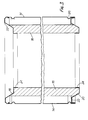
- FIG. 4 shows a modified'embodiment and the same reference numerals are used to designate similar items.
- the metallic end caps 22 are replaced by 40 board end caps 30 of bonded alumino silicate fibres. These have a shape which corresponds to that of the metallic end caps and may be moulded integrally with the inner wall 16 of the chimney or, as in this embodiment, are moulded and then subsequently bonded to it.
- the outer metallic wall 14 is connected to these end caps 30 by bonding or by crimping or otherwise deforming it over or into the end caps as at 32.
- This construction has the advantage that heat loss to the exterior is still further reduced since the metallic conductive path constituted by the end caps is replaced by low conductivity ceramic fibres.
- the one component which is possibly subject to corrosion is replaced by a corrosion free component.
- Ceramic fibre end caps are not suitable for having a screw thread formed in them, so adjacent chimney sections are merely connected by the jubilee clip or a toggle clip.
- the outer surface of the inner wall 16 is covered by a galvanised steel liner 34.
- This liner facilitates the moulding of the inner wall and gives the finished wall greater mechanical strength.
- the gap between the inner and outer walls is filled with insulating material, in this case an aluminosilicate fibre blanket 36, to further increase the thermal insulation property of the chimney.
- the interior surface of the ceramic fibre inner wall may be relatively soft, and this can be disadvantageous under certain circumstances, e.g. if it is desired to sweep the chimney.
- the interior surface of the inner wall is coated, e.g. by spraying, with a heat resistant substance, based for example on silica, which improves its'heat and abrasion resistance.
Landscapes
- Engineering & Computer Science (AREA)
- Architecture (AREA)
- Mechanical Engineering (AREA)
- General Engineering & Computer Science (AREA)
- Civil Engineering (AREA)
- Structural Engineering (AREA)
- Thermal Insulation (AREA)
- Rigid Pipes And Flexible Pipes (AREA)
- Building Environments (AREA)
- Working Measures On Existing Buildindgs (AREA)
- Eye Examination Apparatus (AREA)
- Element Separation (AREA)
- Sanitary Thin Papers (AREA)
- Catching Or Destruction (AREA)
- Lubricants (AREA)
Priority Applications (1)
| Application Number | Priority Date | Filing Date | Title |
|---|---|---|---|
| AT81301641T ATE33161T1 (de) | 1980-04-16 | 1981-04-14 | Isoliertes kaminrohr. |
Applications Claiming Priority (2)
| Application Number | Priority Date | Filing Date | Title |
|---|---|---|---|
| GB8012578 | 1980-04-16 | ||
| GB8012578A GB2073841B (en) | 1980-04-16 | 1980-04-16 | Insulated chimney pipes |
Publications (3)
| Publication Number | Publication Date |
|---|---|
| EP0038211A2 true EP0038211A2 (de) | 1981-10-21 |
| EP0038211A3 EP0038211A3 (en) | 1982-04-21 |
| EP0038211B1 EP0038211B1 (de) | 1988-03-23 |
Family
ID=10512831
Family Applications (1)
| Application Number | Title | Priority Date | Filing Date |
|---|---|---|---|
| EP81301641A Expired EP0038211B1 (de) | 1980-04-16 | 1981-04-14 | Isoliertes Kaminrohr |
Country Status (9)
| Country | Link |
|---|---|
| US (1) | US4573400A (de) |
| EP (1) | EP0038211B1 (de) |
| AT (1) | ATE33161T1 (de) |
| CA (1) | CA1141933A (de) |
| DE (1) | DE3176691D1 (de) |
| DK (1) | DK172781A (de) |
| GB (1) | GB2073841B (de) |
| IE (1) | IE52042B1 (de) |
| NO (1) | NO159743C (de) |
Cited By (3)
| Publication number | Priority date | Publication date | Assignee | Title |
|---|---|---|---|---|
| EP0085455A1 (de) * | 1982-01-28 | 1983-08-10 | Amgas B.V. | Wärmedämmendes Rohrstück |
| EP0098086B1 (de) * | 1982-06-24 | 1987-01-21 | Household Manufacturing Limited | Vorgefertigtes Schornsteinelement |
| EP0341523A1 (de) * | 1988-05-09 | 1989-11-15 | RMB-Handels AG | Kaminrohrelement |
Families Citing this family (17)
| Publication number | Priority date | Publication date | Assignee | Title |
|---|---|---|---|---|
| NL8203647A (nl) * | 1982-09-21 | 1984-04-16 | Amgas Bv | Werkwijze voor het vervaardigen van een vezelachtige warmte-isolerende laag met een samenhangende structuur alsmede op een met deze werkwijze vervaardigde laag en een warmte-isolerend element voorzien van een dergelijke laag. |
| US4607665A (en) * | 1985-05-20 | 1986-08-26 | Marco Manufacturing, Inc. | Pipe spacer |
| US4929000A (en) * | 1988-12-02 | 1990-05-29 | American Metal Products Company | Multiple walled chimney |
| FR2649470B1 (fr) * | 1989-07-05 | 1991-10-18 | Hutchinson Sa | Revetement de protection contre la chaleur et le feu pour tuyaux et structures analogues de forme allongee |
| DE4106835C2 (de) * | 1991-03-04 | 1994-10-06 | Karl Heinz Vahlbrauk | Fertigschornstein |
| US6068027A (en) * | 1996-03-06 | 2000-05-30 | Seamark Systems Limited | Pipeline insulation |
| FR2756606B1 (fr) * | 1996-12-04 | 1999-01-22 | Const Metalliques Mecaniques B | Conduit metallique modulaire a emboitement, notamment pour l'evacuation des fumees |
| FR2803896A1 (fr) * | 2000-01-17 | 2001-07-20 | Pomel Ets | Conduit, notamment conduit de fumee, avec conduit de ventilation concentrique |
| DE10010692C1 (de) * | 2000-03-04 | 2001-07-19 | Willi Skoberne | Schornstein |
| FI108316B (fi) * | 2000-04-12 | 2001-12-31 | Flaekt Oy | Ilmastointikanavisto |
| CA2432703A1 (en) * | 2003-06-18 | 2004-12-18 | Cheminee Lining.E Inc. | Joint assembly for chimney components |
| US7322378B2 (en) * | 2004-10-28 | 2008-01-29 | Winbond Electronics Corp. | Semiconductor apparatuses and pipe supports thereof |
| CA2621526A1 (en) * | 2007-02-12 | 2008-08-12 | John E. Meredith | Materials and methods for lining a chimney |
| US10280639B2 (en) * | 2007-02-12 | 2019-05-07 | John E. Meredith | Materials and methods for lining a chimney |
| CN105465809A (zh) * | 2016-01-14 | 2016-04-06 | 北京金大华中环保技术有限公司 | 玻璃钢花瓣体及使用该玻璃钢花瓣体的烟囱防腐内衬体 |
| RU168208U1 (ru) * | 2016-08-25 | 2017-01-24 | Акционерное общество "Авангард" | Дымовая труба |
| CN111101688A (zh) * | 2020-01-13 | 2020-05-05 | 杭州磐程室内环境技术有限公司 | 一种用于厨卫的排气道 |
Family Cites Families (20)
| Publication number | Priority date | Publication date | Assignee | Title |
|---|---|---|---|---|
| US285112A (en) * | 1883-09-18 | Portable chimney | ||
| US425601A (en) * | 1890-04-15 | Hot-air pipe | ||
| US2101270A (en) * | 1935-03-14 | 1937-12-07 | Freyn Engineering Co | Blowpipe |
| US2120309A (en) * | 1935-11-11 | 1938-06-14 | American Concrete And Steel Pi | Method of applying noncorrosive surfaces to pipe and the like |
| CH221376A (de) * | 1941-04-01 | 1942-05-31 | Sulzer Ag | Aus einzelnen Abschnitten bestehende, doppelwandige Rohrleitung für Flüssigkeiten oder Gase hoher Temperatur. |
| US2457470A (en) * | 1945-12-05 | 1948-12-28 | Ernest O Howle | Insulated chimney |
| US2759491A (en) * | 1953-10-27 | 1956-08-21 | Nat Clay Pipe Res Corp | Coaxial conduit construction |
| GB894056A (en) * | 1958-02-03 | 1962-04-18 | Carborundum Co | Ceramic fibre products and compositions and methods of making same |
| DE1268812B (de) * | 1958-07-28 | 1968-05-22 | Hein Ruck | Metallschornstein |
| US3170544A (en) * | 1962-03-01 | 1965-02-23 | William Wallace Corp | Prefabricated metal chimney |
| GB1032469A (en) * | 1963-12-23 | 1966-06-08 | Max Beaumont | Improvements in or relating to insulated chimneys and flues |
| GB1156972A (en) * | 1966-05-19 | 1969-07-02 | Grateheat Ltd | Insulated Chimneys |
| DE1922581C3 (de) * | 1968-05-02 | 1980-01-17 | Betonwerk Muenchen, Schiedel-Kamin, 8000 Muenchen | Kamin aus Fertigteilen |
| GB1328493A (en) * | 1969-08-21 | 1973-08-30 | Morganite Ceramics Fibres Ltd | Refractory insulating compositions |
| US3628572A (en) * | 1969-12-29 | 1971-12-21 | Owens Corning Fiberglass Corp | Pipe insulation and method of installing same |
| US3768523A (en) * | 1971-06-09 | 1973-10-30 | C Schroeder | Ducting |
| JPS49111254A (de) * | 1973-02-24 | 1974-10-23 | ||
| JPS49111255A (de) * | 1973-02-26 | 1974-10-23 | ||
| GB1506152A (en) * | 1975-03-27 | 1978-04-05 | Morganite Ceramic Fibres Ltd | Aluminio-silicate refractory fibre mix |
| DE2736655C2 (de) * | 1977-08-13 | 1982-09-09 | Lenz & Dörrenberg, 5000 Köln | Formstück für Schornsteine u.dgl. |
-
1980
- 1980-04-16 GB GB8012578A patent/GB2073841B/en not_active Expired
- 1980-10-31 CA CA000363723A patent/CA1141933A/en not_active Expired
-
1981
- 1981-04-14 EP EP81301641A patent/EP0038211B1/de not_active Expired
- 1981-04-14 AT AT81301641T patent/ATE33161T1/de not_active IP Right Cessation
- 1981-04-14 DE DE8181301641T patent/DE3176691D1/de not_active Expired
- 1981-04-15 IE IE860/81A patent/IE52042B1/en not_active IP Right Cessation
- 1981-04-15 DK DK172781A patent/DK172781A/da active IP Right Grant
- 1981-04-15 NO NO811319A patent/NO159743C/no unknown
-
1983
- 1983-07-19 US US06/514,859 patent/US4573400A/en not_active Expired - Fee Related
Cited By (3)
| Publication number | Priority date | Publication date | Assignee | Title |
|---|---|---|---|---|
| EP0085455A1 (de) * | 1982-01-28 | 1983-08-10 | Amgas B.V. | Wärmedämmendes Rohrstück |
| EP0098086B1 (de) * | 1982-06-24 | 1987-01-21 | Household Manufacturing Limited | Vorgefertigtes Schornsteinelement |
| EP0341523A1 (de) * | 1988-05-09 | 1989-11-15 | RMB-Handels AG | Kaminrohrelement |
Also Published As
| Publication number | Publication date |
|---|---|
| EP0038211A3 (en) | 1982-04-21 |
| NO811319L (no) | 1981-10-19 |
| GB2073841A (en) | 1981-10-21 |
| IE810860L (en) | 1981-10-16 |
| DE3176691D1 (en) | 1988-04-28 |
| NO159743C (no) | 1989-02-01 |
| EP0038211B1 (de) | 1988-03-23 |
| IE52042B1 (en) | 1987-05-27 |
| US4573400A (en) | 1986-03-04 |
| NO159743B (no) | 1988-10-24 |
| ATE33161T1 (de) | 1988-04-15 |
| DK172781A (da) | 1981-10-17 |
| CA1141933A (en) | 1983-03-01 |
| GB2073841B (en) | 1985-04-17 |
Similar Documents
| Publication | Publication Date | Title |
|---|---|---|
| EP0038211B1 (de) | Isoliertes Kaminrohr | |
| CA2145563C (en) | Nonhazardous pumpable refractory insulating composition | |
| CN112430056B (zh) | 一种保温涂料及其制备方法和保温涂层 | |
| US4664712A (en) | Thermal insulating material and method of production thereof | |
| CN212584959U (zh) | 一种防止低温腐蚀的焚烧炉炉墙结构 | |
| US4579592A (en) | Insulator | |
| CN208846432U (zh) | 一种焚烧炉保温层耐火内衬结构 | |
| KR100491986B1 (ko) | 용융금속 프로브용 내열보호관 및 그 제조방법 | |
| US3269857A (en) | Combustion chamber liner and method for making same | |
| CN219624484U (zh) | 一种点火炉炉衬及点火炉 | |
| CN216432504U (zh) | 一种环保节能耐火砖 | |
| ATE84342T1 (de) | Kaminrohrelement. | |
| CN112459270A (zh) | 一种复合保温砖 | |
| CN209445796U (zh) | 一种回转窖耐高温结构 | |
| US3560282A (en) | Protective tube for electrical elements and its method of manufacture | |
| CA1197659A (en) | High temperature chimney | |
| KR100402022B1 (ko) | 고로 열풍로의 혼냉실 및 연락관 연와축조방법 | |
| CN109579540A (zh) | 一种隔热耐火砖 | |
| JPH0133631Y2 (de) | ||
| CN111998380B (zh) | 一种用于天然气硫磺回收装置锅炉的耐火层收口结构 | |
| KR900005280B1 (ko) | 온수통 표면과 연도내벽에 내산내열 코팅재가 피막된 내부식성 온수 보일러 | |
| JPS5832126Y2 (ja) | 高温用ガスシ−ル材 | |
| CN208398621U (zh) | 一种耐高温回转窑窑体 | |
| KR200300558Y1 (ko) | 용융금속 프로브용 내열보호관 | |
| CN209069130U (zh) | 一种高温炮孔导爆索保护装置 |
Legal Events
| Date | Code | Title | Description |
|---|---|---|---|
| PUAI | Public reference made under article 153(3) epc to a published international application that has entered the european phase |
Free format text: ORIGINAL CODE: 0009012 |
|
| AK | Designated contracting states |
Designated state(s): AT BE CH DE FR GB IT LU NL SE |
|
| RAP1 | Party data changed (applicant data changed or rights of an application transferred) |
Owner name: MCKECHNIE REFRACTORY FIBRES LIMITED Owner name: INSULATED CHIMNEYS LIMITED |
|
| PUAL | Search report despatched |
Free format text: ORIGINAL CODE: 0009013 |
|
| AK | Designated contracting states |
Designated state(s): AT BE CH DE FR GB IT LU NL SE |
|
| 17P | Request for examination filed |
Effective date: 19820309 |
|
| ITF | It: translation for a ep patent filed | ||
| RAP1 | Party data changed (applicant data changed or rights of an application transferred) |
Owner name: INSULATED CHIMNEYS (TRIM) LIMITED Owner name: MORGANITE CERAMIC FIBRES LIMITED |
|
| GRAA | (expected) grant |
Free format text: ORIGINAL CODE: 0009210 |
|
| RAP1 | Party data changed (applicant data changed or rights of an application transferred) |
Owner name: INSULATED CHIMNEYS (TRIM) LIMITED |
|
| AK | Designated contracting states |
Kind code of ref document: B1 Designated state(s): AT BE CH DE FR GB IT LI LU NL SE |
|
| REF | Corresponds to: |
Ref document number: 33161 Country of ref document: AT Date of ref document: 19880415 Kind code of ref document: T |
|
| REF | Corresponds to: |
Ref document number: 3176691 Country of ref document: DE Date of ref document: 19880428 |
|
| ET | Fr: translation filed | ||
| PLBI | Opposition filed |
Free format text: ORIGINAL CODE: 0009260 |
|
| 26 | Opposition filed |
Opponent name: RMB-HANDELS AG Effective date: 19881215 |
|
| NLR1 | Nl: opposition has been filed with the epo |
Opponent name: RMB-HANDELS AG |
|
| ITTA | It: last paid annual fee | ||
| PGFP | Annual fee paid to national office [announced via postgrant information from national office to epo] |
Ref country code: NL Payment date: 19920430 Year of fee payment: 12 |
|
| PGFP | Annual fee paid to national office [announced via postgrant information from national office to epo] |
Ref country code: GB Payment date: 19920713 Year of fee payment: 12 |
|
| PGFP | Annual fee paid to national office [announced via postgrant information from national office to epo] |
Ref country code: FR Payment date: 19920724 Year of fee payment: 12 |
|
| PGFP | Annual fee paid to national office [announced via postgrant information from national office to epo] |
Ref country code: SE Payment date: 19920727 Year of fee payment: 12 Ref country code: CH Payment date: 19920727 Year of fee payment: 12 Ref country code: DE Payment date: 19920727 Year of fee payment: 12 |
|
| PGFP | Annual fee paid to national office [announced via postgrant information from national office to epo] |
Ref country code: AT Payment date: 19920728 Year of fee payment: 12 |
|
| PGFP | Annual fee paid to national office [announced via postgrant information from national office to epo] |
Ref country code: LU Payment date: 19920811 Year of fee payment: 12 |
|
| PGFP | Annual fee paid to national office [announced via postgrant information from national office to epo] |
Ref country code: BE Payment date: 19920903 Year of fee payment: 12 |
|
| RDAG | Patent revoked |
Free format text: ORIGINAL CODE: 0009271 |
|
| STAA | Information on the status of an ep patent application or granted ep patent |
Free format text: STATUS: PATENT REVOKED |
|
| REG | Reference to a national code |
Ref country code: CH Ref legal event code: PL |
|
| 27W | Patent revoked |
Effective date: 19921024 |
|
| GBPR | Gb: patent revoked under art. 102 of the ep convention designating the uk as contracting state | ||
| EPTA | Lu: last paid annual fee | ||
| NLR2 | Nl: decision of opposition | ||
| EUG | Se: european patent has lapsed |
Ref document number: 81301641.7 Effective date: 19921216 |
|
| APAH | Appeal reference modified |
Free format text: ORIGINAL CODE: EPIDOSCREFNO |