EP0039155A1 - Masse à mouler à base de polyester, sa production et ses produits moulés - Google Patents
Masse à mouler à base de polyester, sa production et ses produits moulés Download PDFInfo
- Publication number
- EP0039155A1 EP0039155A1 EP19810301533 EP81301533A EP0039155A1 EP 0039155 A1 EP0039155 A1 EP 0039155A1 EP 19810301533 EP19810301533 EP 19810301533 EP 81301533 A EP81301533 A EP 81301533A EP 0039155 A1 EP0039155 A1 EP 0039155A1
- Authority
- EP
- European Patent Office
- Prior art keywords
- component
- composition
- polyethylene terephthalate
- group
- divalent
- Prior art date
- Legal status (The legal status is an assumption and is not a legal conclusion. Google has not performed a legal analysis and makes no representation as to the accuracy of the status listed.)
- Granted
Links
- 239000000203 mixture Substances 0.000 title claims abstract description 178
- 238000000465 moulding Methods 0.000 title claims abstract description 76
- 229920000728 polyester Polymers 0.000 title claims abstract description 38
- 238000004519 manufacturing process Methods 0.000 title claims description 3
- -1 polyethylene Polymers 0.000 claims abstract description 190
- 229910052751 metal Inorganic materials 0.000 claims abstract description 56
- 239000002184 metal Substances 0.000 claims abstract description 56
- 239000004952 Polyamide Substances 0.000 claims abstract description 45
- 229920002647 polyamide Polymers 0.000 claims abstract description 45
- 239000002904 solvent Substances 0.000 claims abstract description 34
- 229920000139 polyethylene terephthalate Polymers 0.000 claims description 148
- 239000005020 polyethylene terephthalate Substances 0.000 claims description 148
- 239000002244 precipitate Substances 0.000 claims description 53
- 238000001816 cooling Methods 0.000 claims description 50
- 238000002425 crystallisation Methods 0.000 claims description 37
- 230000008025 crystallization Effects 0.000 claims description 37
- 229920000642 polymer Polymers 0.000 claims description 34
- 239000003365 glass fiber Substances 0.000 claims description 30
- 125000003368 amide group Chemical group 0.000 claims description 20
- 125000003118 aryl group Chemical group 0.000 claims description 17
- 238000002156 mixing Methods 0.000 claims description 14
- 125000000753 cycloalkyl group Chemical group 0.000 claims description 12
- 239000004793 Polystyrene Substances 0.000 claims description 11
- 229920002223 polystyrene Polymers 0.000 claims description 11
- 150000001875 compounds Chemical class 0.000 claims description 10
- 238000002844 melting Methods 0.000 claims description 10
- 230000008018 melting Effects 0.000 claims description 9
- 125000000217 alkyl group Chemical group 0.000 claims description 7
- 125000003710 aryl alkyl group Chemical group 0.000 claims description 7
- 125000004432 carbon atom Chemical group C* 0.000 claims description 6
- 125000000816 ethylene group Chemical group [H]C([H])([*:1])C([H])([H])[*:2] 0.000 claims description 6
- 125000001570 methylene group Chemical group [H]C([H])([*:1])[*:2] 0.000 claims description 6
- 238000000975 co-precipitation Methods 0.000 claims description 5
- 229920000193 polymethacrylate Polymers 0.000 claims description 5
- 239000012763 reinforcing filler Substances 0.000 claims description 5
- 229920002678 cellulose Polymers 0.000 claims description 4
- 239000001913 cellulose Substances 0.000 claims description 4
- UFHFLCQGNIYNRP-UHFFFAOYSA-N Hydrogen Chemical compound [H][H] UFHFLCQGNIYNRP-UHFFFAOYSA-N 0.000 claims description 2
- 239000001257 hydrogen Substances 0.000 claims description 2
- 229910052739 hydrogen Inorganic materials 0.000 claims description 2
- 125000002496 methyl group Chemical group [H]C([H])([H])* 0.000 claims description 2
- 239000002667 nucleating agent Substances 0.000 abstract description 11
- 239000004698 Polyethylene Substances 0.000 abstract description 4
- 239000003795 chemical substances by application Substances 0.000 abstract description 4
- 229920000573 polyethylene Polymers 0.000 abstract description 4
- OKKJLVBELUTLKV-UHFFFAOYSA-N Methanol Chemical compound OC OKKJLVBELUTLKV-UHFFFAOYSA-N 0.000 description 117
- 239000000243 solution Substances 0.000 description 67
- 238000005259 measurement Methods 0.000 description 45
- XLYOFNOQVPJJNP-UHFFFAOYSA-N water Substances O XLYOFNOQVPJJNP-UHFFFAOYSA-N 0.000 description 43
- 238000000034 method Methods 0.000 description 42
- 238000006243 chemical reaction Methods 0.000 description 40
- ZMANZCXQSJIPKH-UHFFFAOYSA-N Triethylamine Chemical compound CCN(CC)CC ZMANZCXQSJIPKH-UHFFFAOYSA-N 0.000 description 33
- KWGKDLIKAYFUFQ-UHFFFAOYSA-M lithium chloride Chemical compound [Li+].[Cl-] KWGKDLIKAYFUFQ-UHFFFAOYSA-M 0.000 description 30
- 239000000047 product Substances 0.000 description 30
- LYCAIKOWRPUZTN-UHFFFAOYSA-N Ethylene glycol Chemical compound OCCO LYCAIKOWRPUZTN-UHFFFAOYSA-N 0.000 description 27
- LXEJRKJRKIFVNY-UHFFFAOYSA-N terephthaloyl chloride Chemical compound ClC(=O)C1=CC=C(C(Cl)=O)C=C1 LXEJRKJRKIFVNY-UHFFFAOYSA-N 0.000 description 27
- SECXISVLQFMRJM-UHFFFAOYSA-N N-Methylpyrrolidone Chemical compound CN1CCCC1=O SECXISVLQFMRJM-UHFFFAOYSA-N 0.000 description 26
- KKEYFWRCBNTPAC-UHFFFAOYSA-N Terephthalic acid Chemical compound OC(=O)C1=CC=C(C(O)=O)C=C1 KKEYFWRCBNTPAC-UHFFFAOYSA-N 0.000 description 26
- 238000003756 stirring Methods 0.000 description 25
- ISPYQTSUDJAMAB-UHFFFAOYSA-N 2-chlorophenol Chemical compound OC1=CC=CC=C1Cl ISPYQTSUDJAMAB-UHFFFAOYSA-N 0.000 description 24
- 239000011347 resin Substances 0.000 description 24
- 229920005989 resin Polymers 0.000 description 24
- 238000001914 filtration Methods 0.000 description 19
- 238000004898 kneading Methods 0.000 description 18
- LQNUZADURLCDLV-UHFFFAOYSA-N nitrobenzene Chemical compound [O-][N+](=O)C1=CC=CC=C1 LQNUZADURLCDLV-UHFFFAOYSA-N 0.000 description 18
- 229920001577 copolymer Polymers 0.000 description 17
- 239000011541 reaction mixture Substances 0.000 description 17
- WNLRTRBMVRJNCN-UHFFFAOYSA-N adipic acid Chemical compound OC(=O)CCCCC(O)=O WNLRTRBMVRJNCN-UHFFFAOYSA-N 0.000 description 16
- CSCPPACGZOOCGX-UHFFFAOYSA-N Acetone Chemical compound CC(C)=O CSCPPACGZOOCGX-UHFFFAOYSA-N 0.000 description 15
- FXHOOIRPVKKKFG-UHFFFAOYSA-N N,N-Dimethylacetamide Chemical compound CN(C)C(C)=O FXHOOIRPVKKKFG-UHFFFAOYSA-N 0.000 description 14
- 239000004760 aramid Substances 0.000 description 14
- 229920003235 aromatic polyamide Polymers 0.000 description 14
- GNOIPBMMFNIUFM-UHFFFAOYSA-N hexamethylphosphoric triamide Chemical compound CN(C)P(=O)(N(C)C)N(C)C GNOIPBMMFNIUFM-UHFFFAOYSA-N 0.000 description 14
- 230000008569 process Effects 0.000 description 14
- QAOWNCQODCNURD-UHFFFAOYSA-N sulfuric acid Substances OS(O)(=O)=O QAOWNCQODCNURD-UHFFFAOYSA-N 0.000 description 13
- LFQSCWFLJHTTHZ-UHFFFAOYSA-N Ethanol Chemical compound CCO LFQSCWFLJHTTHZ-UHFFFAOYSA-N 0.000 description 12
- 238000006116 polymerization reaction Methods 0.000 description 12
- CBCKQZAAMUWICA-UHFFFAOYSA-N 1,4-phenylenediamine Chemical compound NC1=CC=C(N)C=C1 CBCKQZAAMUWICA-UHFFFAOYSA-N 0.000 description 11
- QPKOBORKPHRBPS-UHFFFAOYSA-N bis(2-hydroxyethyl) terephthalate Chemical compound OCCOC(=O)C1=CC=C(C(=O)OCCO)C=C1 QPKOBORKPHRBPS-UHFFFAOYSA-N 0.000 description 11
- 239000006185 dispersion Substances 0.000 description 11
- 238000010438 heat treatment Methods 0.000 description 11
- WRDNCFQZLUCIRH-UHFFFAOYSA-N 4-(7-azabicyclo[2.2.1]hepta-1,3,5-triene-7-carbonyl)benzamide Chemical compound C1=CC(C(=O)N)=CC=C1C(=O)N1C2=CC=C1C=C2 WRDNCFQZLUCIRH-UHFFFAOYSA-N 0.000 description 10
- OFOBLEOULBTSOW-UHFFFAOYSA-N Malonic acid Chemical compound OC(=O)CC(O)=O OFOBLEOULBTSOW-UHFFFAOYSA-N 0.000 description 9
- 229920001400 block copolymer Polymers 0.000 description 9
- 239000007795 chemical reaction product Substances 0.000 description 9
- 150000004985 diamines Chemical class 0.000 description 9
- OZAIFHULBGXAKX-UHFFFAOYSA-N 2-(2-cyanopropan-2-yldiazenyl)-2-methylpropanenitrile Chemical compound N#CC(C)(C)N=NC(C)(C)C#N OZAIFHULBGXAKX-UHFFFAOYSA-N 0.000 description 8
- 0 Cc(cc1)cc2c1-c1ccc(C)cc1*2 Chemical compound Cc(cc1)cc2c1-c1ccc(C)cc1*2 0.000 description 8
- PIICEJLVQHRZGT-UHFFFAOYSA-N Ethylenediamine Chemical compound NCCN PIICEJLVQHRZGT-UHFFFAOYSA-N 0.000 description 8
- ISWSIDIOOBJBQZ-UHFFFAOYSA-N Phenol Chemical compound OC1=CC=CC=C1 ISWSIDIOOBJBQZ-UHFFFAOYSA-N 0.000 description 8
- PPBRXRYQALVLMV-UHFFFAOYSA-N Styrene Chemical compound C=CC1=CC=CC=C1 PPBRXRYQALVLMV-UHFFFAOYSA-N 0.000 description 8
- 239000001361 adipic acid Substances 0.000 description 8
- 235000011037 adipic acid Nutrition 0.000 description 8
- 229920000921 polyethylene adipate Polymers 0.000 description 8
- CXMXRPHRNRROMY-UHFFFAOYSA-N sebacic acid Chemical compound OC(=O)CCCCCCCCC(O)=O CXMXRPHRNRROMY-UHFFFAOYSA-N 0.000 description 8
- VSCADKGMBQAGNC-UHFFFAOYSA-N 4-aminobenzoyl chloride;hydrochloride Chemical compound Cl.NC1=CC=C(C(Cl)=O)C=C1 VSCADKGMBQAGNC-UHFFFAOYSA-N 0.000 description 7
- KEAYESYHFKHZAL-UHFFFAOYSA-N Sodium Chemical compound [Na] KEAYESYHFKHZAL-UHFFFAOYSA-N 0.000 description 7
- WNLRTRBMVRJNCN-UHFFFAOYSA-L adipate(2-) Chemical compound [O-]C(=O)CCCCC([O-])=O WNLRTRBMVRJNCN-UHFFFAOYSA-L 0.000 description 7
- 239000000835 fiber Substances 0.000 description 7
- 239000004014 plasticizer Substances 0.000 description 7
- 239000012312 sodium hydride Substances 0.000 description 7
- 229910000104 sodium hydride Inorganic materials 0.000 description 7
- DYJIIMFHSZKBDY-UHFFFAOYSA-N (3-benzoyloxy-2,2-dimethylpropyl) benzoate Chemical compound C=1C=CC=CC=1C(=O)OCC(C)(C)COC(=O)C1=CC=CC=C1 DYJIIMFHSZKBDY-UHFFFAOYSA-N 0.000 description 6
- QPFMBZIOSGYJDE-UHFFFAOYSA-N 1,1,2,2-tetrachloroethane Chemical compound ClC(Cl)C(Cl)Cl QPFMBZIOSGYJDE-UHFFFAOYSA-N 0.000 description 6
- IJGRMHOSHXDMSA-UHFFFAOYSA-N Atomic nitrogen Chemical compound N#N IJGRMHOSHXDMSA-UHFFFAOYSA-N 0.000 description 6
- SOGAXMICEFXMKE-UHFFFAOYSA-N Butylmethacrylate Chemical compound CCCCOC(=O)C(C)=C SOGAXMICEFXMKE-UHFFFAOYSA-N 0.000 description 6
- 229920001747 Cellulose diacetate Polymers 0.000 description 6
- YMWUJEATGCHHMB-UHFFFAOYSA-N Dichloromethane Chemical compound ClCCl YMWUJEATGCHHMB-UHFFFAOYSA-N 0.000 description 6
- 229910001873 dinitrogen Inorganic materials 0.000 description 6
- 230000000694 effects Effects 0.000 description 6
- WGCNASOHLSPBMP-UHFFFAOYSA-N hydroxyacetaldehyde Natural products OCC=O WGCNASOHLSPBMP-UHFFFAOYSA-N 0.000 description 6
- 239000002245 particle Substances 0.000 description 6
- HVLLSGMXQDNUAL-UHFFFAOYSA-N triphenyl phosphite Chemical compound C=1C=CC=CC=1OP(OC=1C=CC=CC=1)OC1=CC=CC=C1 HVLLSGMXQDNUAL-UHFFFAOYSA-N 0.000 description 6
- XFDQLDNQZFOAFK-UHFFFAOYSA-N 2-benzoyloxyethyl benzoate Chemical compound C=1C=CC=CC=1C(=O)OCCOC(=O)C1=CC=CC=C1 XFDQLDNQZFOAFK-UHFFFAOYSA-N 0.000 description 5
- 229920001634 Copolyester Polymers 0.000 description 5
- DOIRQSBPFJWKBE-UHFFFAOYSA-N dibutyl phthalate Chemical compound CCCCOC(=O)C1=CC=CC=C1C(=O)OCCCC DOIRQSBPFJWKBE-UHFFFAOYSA-N 0.000 description 5
- 238000000921 elemental analysis Methods 0.000 description 5
- 230000000704 physical effect Effects 0.000 description 5
- 229940116351 sebacate Drugs 0.000 description 5
- CXMXRPHRNRROMY-UHFFFAOYSA-L sebacate(2-) Chemical compound [O-]C(=O)CCCCCCCCC([O-])=O CXMXRPHRNRROMY-UHFFFAOYSA-L 0.000 description 5
- 239000007787 solid Substances 0.000 description 5
- 239000000126 substance Substances 0.000 description 5
- 239000000454 talc Substances 0.000 description 5
- 229910052623 talc Inorganic materials 0.000 description 5
- UDJZPTXIRFULJE-UHFFFAOYSA-N 3-aminobenzoyl chloride;hydrochloride Chemical compound Cl.NC1=CC=CC(C(Cl)=O)=C1 UDJZPTXIRFULJE-UHFFFAOYSA-N 0.000 description 4
- IAZDPXIOMUYVGZ-UHFFFAOYSA-N Dimethylsulphoxide Chemical compound CS(C)=O IAZDPXIOMUYVGZ-UHFFFAOYSA-N 0.000 description 4
- 239000004593 Epoxy Chemical class 0.000 description 4
- VVQNEPGJFQJSBK-UHFFFAOYSA-N Methyl methacrylate Chemical compound COC(=O)C(C)=C VVQNEPGJFQJSBK-UHFFFAOYSA-N 0.000 description 4
- VYPSYNLAJGMNEJ-UHFFFAOYSA-N Silicium dioxide Chemical compound O=[Si]=O VYPSYNLAJGMNEJ-UHFFFAOYSA-N 0.000 description 4
- 125000003277 amino group Chemical group 0.000 description 4
- 239000012298 atmosphere Substances 0.000 description 4
- 238000013329 compounding Methods 0.000 description 4
- NAQMVNRVTILPCV-UHFFFAOYSA-N hexane-1,6-diamine Chemical compound NCCCCCCN NAQMVNRVTILPCV-UHFFFAOYSA-N 0.000 description 4
- 125000002887 hydroxy group Chemical group [H]O* 0.000 description 4
- VNWKTOKETHGBQD-UHFFFAOYSA-N methane Chemical compound C VNWKTOKETHGBQD-UHFFFAOYSA-N 0.000 description 4
- QJGQUHMNIGDVPM-UHFFFAOYSA-N nitrogen group Chemical group [N] QJGQUHMNIGDVPM-UHFFFAOYSA-N 0.000 description 4
- 229920003229 poly(methyl methacrylate) Polymers 0.000 description 4
- 229920002285 poly(styrene-co-acrylonitrile) Polymers 0.000 description 4
- 239000004926 polymethyl methacrylate Substances 0.000 description 4
- KKEYFWRCBNTPAC-UHFFFAOYSA-L terephthalate(2-) Chemical compound [O-]C(=O)C1=CC=C(C([O-])=O)C=C1 KKEYFWRCBNTPAC-UHFFFAOYSA-L 0.000 description 4
- UXVMQQNJUSDDNG-UHFFFAOYSA-L Calcium chloride Chemical compound [Cl-].[Cl-].[Ca+2] UXVMQQNJUSDDNG-UHFFFAOYSA-L 0.000 description 3
- RTZKZFJDLAIYFH-UHFFFAOYSA-N Diethyl ether Chemical compound CCOCC RTZKZFJDLAIYFH-UHFFFAOYSA-N 0.000 description 3
- BRLQWZUYTZBJKN-UHFFFAOYSA-N Epichlorohydrin Chemical class ClCC1CO1 BRLQWZUYTZBJKN-UHFFFAOYSA-N 0.000 description 3
- XEKOWRVHYACXOJ-UHFFFAOYSA-N Ethyl acetate Chemical compound CCOC(C)=O XEKOWRVHYACXOJ-UHFFFAOYSA-N 0.000 description 3
- ZZSNKZQZMQGXPY-UHFFFAOYSA-N Ethyl cellulose Chemical compound CCOCC1OC(OC)C(OCC)C(OCC)C1OC1C(O)C(O)C(OC)C(CO)O1 ZZSNKZQZMQGXPY-UHFFFAOYSA-N 0.000 description 3
- 239000001856 Ethyl cellulose Substances 0.000 description 3
- ZMXDDKWLCZADIW-UHFFFAOYSA-N N,N-Dimethylformamide Chemical compound CN(C)C=O ZMXDDKWLCZADIW-UHFFFAOYSA-N 0.000 description 3
- HEMHJVSKTPXQMS-UHFFFAOYSA-M Sodium hydroxide Chemical compound [OH-].[Na+] HEMHJVSKTPXQMS-UHFFFAOYSA-M 0.000 description 3
- 239000000654 additive Substances 0.000 description 3
- PWAXUOGZOSVGBO-UHFFFAOYSA-N adipoyl chloride Chemical compound ClC(=O)CCCCC(Cl)=O PWAXUOGZOSVGBO-UHFFFAOYSA-N 0.000 description 3
- FDQSRULYDNDXQB-UHFFFAOYSA-N benzene-1,3-dicarbonyl chloride Chemical compound ClC(=O)C1=CC=CC(C(Cl)=O)=C1 FDQSRULYDNDXQB-UHFFFAOYSA-N 0.000 description 3
- 239000001110 calcium chloride Substances 0.000 description 3
- 229910001628 calcium chloride Inorganic materials 0.000 description 3
- 229910052799 carbon Inorganic materials 0.000 description 3
- 150000001732 carboxylic acid derivatives Chemical class 0.000 description 3
- MTHSVFCYNBDYFN-UHFFFAOYSA-N diethylene glycol Chemical compound OCCOCCO MTHSVFCYNBDYFN-UHFFFAOYSA-N 0.000 description 3
- 150000002148 esters Chemical class 0.000 description 3
- 235000019325 ethyl cellulose Nutrition 0.000 description 3
- 229920001249 ethyl cellulose Polymers 0.000 description 3
- 238000002474 experimental method Methods 0.000 description 3
- 239000011521 glass Substances 0.000 description 3
- 239000000314 lubricant Substances 0.000 description 3
- 239000000463 material Substances 0.000 description 3
- 210000001724 microfibril Anatomy 0.000 description 3
- KVKFRMCSXWQSNT-UHFFFAOYSA-N n,n'-dimethylethane-1,2-diamine Chemical compound CNCCNC KVKFRMCSXWQSNT-UHFFFAOYSA-N 0.000 description 3
- VLKZOEOYAKHREP-UHFFFAOYSA-N n-Hexane Chemical compound CCCCCC VLKZOEOYAKHREP-UHFFFAOYSA-N 0.000 description 3
- 239000008188 pellet Substances 0.000 description 3
- 150000002989 phenols Chemical class 0.000 description 3
- 229920001451 polypropylene glycol Polymers 0.000 description 3
- 125000002924 primary amino group Chemical class [H]N([H])* 0.000 description 3
- 150000003839 salts Chemical class 0.000 description 3
- XZZNDPSIHUTMOC-UHFFFAOYSA-N triphenyl phosphate Chemical compound C=1C=CC=CC=1OP(OC=1C=CC=CC=1)(=O)OC1=CC=CC=C1 XZZNDPSIHUTMOC-UHFFFAOYSA-N 0.000 description 3
- KBCPMQUSOLSAQO-UHFFFAOYSA-N (4-carboxyphenyl)azanium;chloride Chemical compound Cl.NC1=CC=C(C(O)=O)C=C1 KBCPMQUSOLSAQO-UHFFFAOYSA-N 0.000 description 2
- WZCQRUWWHSTZEM-UHFFFAOYSA-N 1,3-phenylenediamine Chemical compound NC1=CC=CC(N)=C1 WZCQRUWWHSTZEM-UHFFFAOYSA-N 0.000 description 2
- VBICKXHEKHSIBG-UHFFFAOYSA-N 1-monostearoylglycerol Chemical compound CCCCCCCCCCCCCCCCCC(=O)OCC(O)CO VBICKXHEKHSIBG-UHFFFAOYSA-N 0.000 description 2
- NXQMCAOPTPLPRL-UHFFFAOYSA-N 2-(2-benzoyloxyethoxy)ethyl benzoate Chemical compound C=1C=CC=CC=1C(=O)OCCOCCOC(=O)C1=CC=CC=C1 NXQMCAOPTPLPRL-UHFFFAOYSA-N 0.000 description 2
- AHSGHEXYEABOKT-UHFFFAOYSA-N 2-[2-(2-benzoyloxyethoxy)ethoxy]ethyl benzoate Chemical compound C=1C=CC=CC=1C(=O)OCCOCCOCCOC(=O)C1=CC=CC=C1 AHSGHEXYEABOKT-UHFFFAOYSA-N 0.000 description 2
- YBRVSVVVWCFQMG-UHFFFAOYSA-N 4,4'-diaminodiphenylmethane Chemical compound C1=CC(N)=CC=C1CC1=CC=C(N)C=C1 YBRVSVVVWCFQMG-UHFFFAOYSA-N 0.000 description 2
- ALYNCZNDIQEVRV-UHFFFAOYSA-N 4-aminobenzoic acid Chemical compound NC1=CC=C(C(O)=O)C=C1 ALYNCZNDIQEVRV-UHFFFAOYSA-N 0.000 description 2
- RNMDNPCBIKJCQP-UHFFFAOYSA-N 5-nonyl-7-oxabicyclo[4.1.0]hepta-1,3,5-trien-2-ol Chemical compound C(CCCCCCCC)C1=C2C(=C(C=C1)O)O2 RNMDNPCBIKJCQP-UHFFFAOYSA-N 0.000 description 2
- NLHHRLWOUZZQLW-UHFFFAOYSA-N Acrylonitrile Chemical compound C=CC#N NLHHRLWOUZZQLW-UHFFFAOYSA-N 0.000 description 2
- 229920000049 Carbon (fiber) Polymers 0.000 description 2
- HEDRZPFGACZZDS-UHFFFAOYSA-N Chloroform Chemical compound ClC(Cl)Cl HEDRZPFGACZZDS-UHFFFAOYSA-N 0.000 description 2
- NIQCNGHVCWTJSM-UHFFFAOYSA-N Dimethyl phthalate Chemical compound COC(=O)C1=CC=CC=C1C(=O)OC NIQCNGHVCWTJSM-UHFFFAOYSA-N 0.000 description 2
- PEDCQBHIVMGVHV-UHFFFAOYSA-N Glycerine Chemical compound OCC(O)CO PEDCQBHIVMGVHV-UHFFFAOYSA-N 0.000 description 2
- MHAJPDPJQMAIIY-UHFFFAOYSA-N Hydrogen peroxide Chemical compound OO MHAJPDPJQMAIIY-UHFFFAOYSA-N 0.000 description 2
- QIGBRXMKCJKVMJ-UHFFFAOYSA-N Hydroquinone Chemical compound OC1=CC=C(O)C=C1 QIGBRXMKCJKVMJ-UHFFFAOYSA-N 0.000 description 2
- XEEYBQQBJWHFJM-UHFFFAOYSA-N Iron Chemical compound [Fe] XEEYBQQBJWHFJM-UHFFFAOYSA-N 0.000 description 2
- JHWNWJKBPDFINM-UHFFFAOYSA-N Laurolactam Chemical compound O=C1CCCCCCCCCCCN1 JHWNWJKBPDFINM-UHFFFAOYSA-N 0.000 description 2
- 239000004594 Masterbatch (MB) Substances 0.000 description 2
- 229920000299 Nylon 12 Polymers 0.000 description 2
- 229920003171 Poly (ethylene oxide) Polymers 0.000 description 2
- 239000002202 Polyethylene glycol Substances 0.000 description 2
- JUJWROOIHBZHMG-UHFFFAOYSA-N Pyridine Chemical compound C1=CC=NC=C1 JUJWROOIHBZHMG-UHFFFAOYSA-N 0.000 description 2
- CDBYLPFSWZWCQE-UHFFFAOYSA-L Sodium Carbonate Chemical compound [Na+].[Na+].[O-]C([O-])=O CDBYLPFSWZWCQE-UHFFFAOYSA-L 0.000 description 2
- DBMJMQXJHONAFJ-UHFFFAOYSA-M Sodium laurylsulphate Chemical compound [Na+].CCCCCCCCCCCCOS([O-])(=O)=O DBMJMQXJHONAFJ-UHFFFAOYSA-M 0.000 description 2
- YSMRWXYRXBRSND-UHFFFAOYSA-N TOTP Chemical compound CC1=CC=CC=C1OP(=O)(OC=1C(=CC=CC=1)C)OC1=CC=CC=C1C YSMRWXYRXBRSND-UHFFFAOYSA-N 0.000 description 2
- WYURNTSHIVDZCO-UHFFFAOYSA-N Tetrahydrofuran Chemical compound C1CCOC1 WYURNTSHIVDZCO-UHFFFAOYSA-N 0.000 description 2
- 238000004220 aggregation Methods 0.000 description 2
- 230000002776 aggregation Effects 0.000 description 2
- 150000001298 alcohols Chemical class 0.000 description 2
- 229910000410 antimony oxide Inorganic materials 0.000 description 2
- 239000003963 antioxidant agent Substances 0.000 description 2
- HFACYLZERDEVSX-UHFFFAOYSA-N benzidine Chemical group C1=CC(N)=CC=C1C1=CC=C(N)C=C1 HFACYLZERDEVSX-UHFFFAOYSA-N 0.000 description 2
- 239000012965 benzophenone Substances 0.000 description 2
- WERYXYBDKMZEQL-UHFFFAOYSA-N butane-1,4-diol Chemical compound OCCCCO WERYXYBDKMZEQL-UHFFFAOYSA-N 0.000 description 2
- 239000004917 carbon fiber Substances 0.000 description 2
- 229920002301 cellulose acetate Polymers 0.000 description 2
- 239000002131 composite material Substances 0.000 description 2
- 230000007547 defect Effects 0.000 description 2
- WOZVHXUHUFLZGK-UHFFFAOYSA-N dimethyl terephthalate Chemical compound COC(=O)C1=CC=C(C(=O)OC)C=C1 WOZVHXUHUFLZGK-UHFFFAOYSA-N 0.000 description 2
- KZTYYGOKRVBIMI-UHFFFAOYSA-N diphenyl sulfone Chemical compound C=1C=CC=CC=1S(=O)(=O)C1=CC=CC=C1 KZTYYGOKRVBIMI-UHFFFAOYSA-N 0.000 description 2
- NJLLQSBAHIKGKF-UHFFFAOYSA-N dipotassium dioxido(oxo)titanium Chemical compound [K+].[K+].[O-][Ti]([O-])=O NJLLQSBAHIKGKF-UHFFFAOYSA-N 0.000 description 2
- GXJPKIGCMGAHTL-UHFFFAOYSA-N dipropyl benzene-1,4-dicarboxylate Chemical compound CCCOC(=O)C1=CC=C(C(=O)OCCC)C=C1 GXJPKIGCMGAHTL-UHFFFAOYSA-N 0.000 description 2
- 238000001035 drying Methods 0.000 description 2
- 239000003822 epoxy resin Substances 0.000 description 2
- 239000003063 flame retardant Substances 0.000 description 2
- 125000005843 halogen group Chemical group 0.000 description 2
- 229920001519 homopolymer Polymers 0.000 description 2
- 238000001746 injection moulding Methods 0.000 description 2
- QQVIHTHCMHWDBS-UHFFFAOYSA-N isophthalic acid Chemical compound OC(=O)C1=CC=CC(C(O)=O)=C1 QQVIHTHCMHWDBS-UHFFFAOYSA-N 0.000 description 2
- RLSSMJSEOOYNOY-UHFFFAOYSA-N m-cresol Chemical compound CC1=CC=CC(O)=C1 RLSSMJSEOOYNOY-UHFFFAOYSA-N 0.000 description 2
- 229940018564 m-phenylenediamine Drugs 0.000 description 2
- VHRYZQNGTZXDNX-UHFFFAOYSA-N methacryloyl chloride Chemical compound CC(=C)C(Cl)=O VHRYZQNGTZXDNX-UHFFFAOYSA-N 0.000 description 2
- BDAGIHXWWSANSR-UHFFFAOYSA-N methanoic acid Natural products OC=O BDAGIHXWWSANSR-UHFFFAOYSA-N 0.000 description 2
- GLDOVTGHNKAZLK-UHFFFAOYSA-N octadecan-1-ol Chemical compound CCCCCCCCCCCCCCCCCCO GLDOVTGHNKAZLK-UHFFFAOYSA-N 0.000 description 2
- 150000002895 organic esters Chemical class 0.000 description 2
- VTRUBDSFZJNXHI-UHFFFAOYSA-N oxoantimony Chemical compound [Sb]=O VTRUBDSFZJNXHI-UHFFFAOYSA-N 0.000 description 2
- 239000013618 particulate matter Substances 0.000 description 2
- 229920002492 poly(sulfone) Polymers 0.000 description 2
- 229920000058 polyacrylate Polymers 0.000 description 2
- 229920001610 polycaprolactone Polymers 0.000 description 2
- 229920000515 polycarbonate Polymers 0.000 description 2
- 239000004417 polycarbonate Substances 0.000 description 2
- 229920000647 polyepoxide Polymers 0.000 description 2
- 229920001223 polyethylene glycol Polymers 0.000 description 2
- KIDHWZJUCRJVML-UHFFFAOYSA-N putrescine Chemical compound NCCCCN KIDHWZJUCRJVML-UHFFFAOYSA-N 0.000 description 2
- WQGWDDDVZFFDIG-UHFFFAOYSA-N pyrogallol Chemical compound OC1=CC=CC(O)=C1O WQGWDDDVZFFDIG-UHFFFAOYSA-N 0.000 description 2
- 239000000377 silicon dioxide Substances 0.000 description 2
- 239000002002 slurry Substances 0.000 description 2
- 235000019333 sodium laurylsulphate Nutrition 0.000 description 2
- 159000000000 sodium salts Chemical class 0.000 description 2
- 239000007858 starting material Substances 0.000 description 2
- 125000001424 substituent group Chemical group 0.000 description 2
- 239000004094 surface-active agent Substances 0.000 description 2
- UMGDCJDMYOKAJW-UHFFFAOYSA-N thiourea Chemical compound NC(N)=S UMGDCJDMYOKAJW-UHFFFAOYSA-N 0.000 description 2
- 229920002554 vinyl polymer Polymers 0.000 description 2
- 238000005406 washing Methods 0.000 description 2
- OGTSHGYHILFRHD-UHFFFAOYSA-N (4-fluorophenyl)-phenylmethanone Chemical compound C1=CC(F)=CC=C1C(=O)C1=CC=CC=C1 OGTSHGYHILFRHD-UHFFFAOYSA-N 0.000 description 1
- OMWSZDODENFLSV-UHFFFAOYSA-N (5-chloro-2-hydroxyphenyl)-phenylmethanone Chemical compound OC1=CC=C(Cl)C=C1C(=O)C1=CC=CC=C1 OMWSZDODENFLSV-UHFFFAOYSA-N 0.000 description 1
- AVQQQNCBBIEMEU-UHFFFAOYSA-N 1,1,3,3-tetramethylurea Chemical compound CN(C)C(=O)N(C)C AVQQQNCBBIEMEU-UHFFFAOYSA-N 0.000 description 1
- HGRZLIGHKHRTRE-UHFFFAOYSA-N 1,2,3,4-tetrabromobutane Chemical compound BrCC(Br)C(Br)CBr HGRZLIGHKHRTRE-UHFFFAOYSA-N 0.000 description 1
- RYHBNJHYFVUHQT-UHFFFAOYSA-N 1,4-Dioxane Chemical compound C1COCCO1 RYHBNJHYFVUHQT-UHFFFAOYSA-N 0.000 description 1
- PAALZGOZEUHCET-UHFFFAOYSA-N 1,4-dioxecane-5,10-dione Chemical compound O=C1CCCCC(=O)OCCO1 PAALZGOZEUHCET-UHFFFAOYSA-N 0.000 description 1
- 125000004958 1,4-naphthylene group Chemical group 0.000 description 1
- KGRVJHAUYBGFFP-UHFFFAOYSA-N 2,2'-Methylenebis(4-methyl-6-tert-butylphenol) Chemical compound CC(C)(C)C1=CC(C)=CC(CC=2C(=C(C=C(C)C=2)C(C)(C)C)O)=C1O KGRVJHAUYBGFFP-UHFFFAOYSA-N 0.000 description 1
- CMQUQOHNANGDOR-UHFFFAOYSA-N 2,3-dibromo-4-(2,4-dibromo-5-hydroxyphenyl)phenol Chemical compound BrC1=C(Br)C(O)=CC=C1C1=CC(O)=C(Br)C=C1Br CMQUQOHNANGDOR-UHFFFAOYSA-N 0.000 description 1
- 125000004959 2,6-naphthylene group Chemical group [H]C1=C([H])C2=C([H])C([*:1])=C([H])C([H])=C2C([H])=C1[*:2] 0.000 description 1
- LUNMJRJMSXZSLC-UHFFFAOYSA-N 2-cyclopropylethanol Chemical compound OCCC1CC1 LUNMJRJMSXZSLC-UHFFFAOYSA-N 0.000 description 1
- WBIQQQGBSDOWNP-UHFFFAOYSA-N 2-dodecylbenzenesulfonic acid Chemical compound CCCCCCCCCCCCC1=CC=CC=C1S(O)(=O)=O WBIQQQGBSDOWNP-UHFFFAOYSA-N 0.000 description 1
- VGHCVSPDKSEROA-UHFFFAOYSA-N 2-methyl-1,4-dioxecane-5,10-dione Chemical compound CC1COC(=O)CCCCC(=O)O1 VGHCVSPDKSEROA-UHFFFAOYSA-N 0.000 description 1
- KOCIUBBLLVSTEX-UHFFFAOYSA-N 3-aminocyclohexane-1-carbonyl chloride;hydrochloride Chemical compound Cl.NC1CCCC(C(Cl)=O)C1 KOCIUBBLLVSTEX-UHFFFAOYSA-N 0.000 description 1
- OSWFIVFLDKOXQC-UHFFFAOYSA-N 4-(3-methoxyphenyl)aniline Chemical compound COC1=CC=CC(C=2C=CC(N)=CC=2)=C1 OSWFIVFLDKOXQC-UHFFFAOYSA-N 0.000 description 1
- NWZCFEGPNLNDDL-UHFFFAOYSA-N 4-(aminomethyl)benzoyl chloride;hydrochloride Chemical compound Cl.NCC1=CC=C(C(Cl)=O)C=C1 NWZCFEGPNLNDDL-UHFFFAOYSA-N 0.000 description 1
- XMLXOJAZWBXQJO-UHFFFAOYSA-N 4-aminocyclohexane-1-carbonyl chloride;hydrochloride Chemical compound Cl.NC1CCC(C(Cl)=O)CC1 XMLXOJAZWBXQJO-UHFFFAOYSA-N 0.000 description 1
- LLLVZDVNHNWSDS-UHFFFAOYSA-N 4-methylidene-3,5-dioxabicyclo[5.2.2]undeca-1(9),7,10-triene-2,6-dione Chemical compound C1(C2=CC=C(C(=O)OC(=C)O1)C=C2)=O LLLVZDVNHNWSDS-UHFFFAOYSA-N 0.000 description 1
- 229930185605 Bisphenol Natural products 0.000 description 1
- GOJCZVPJCKEBQV-UHFFFAOYSA-N Butyl phthalyl butylglycolate Chemical compound CCCCOC(=O)COC(=O)C1=CC=CC=C1C(=O)OCCCC GOJCZVPJCKEBQV-UHFFFAOYSA-N 0.000 description 1
- NLZUEZXRPGMBCV-UHFFFAOYSA-N Butylhydroxytoluene Chemical compound CC1=CC(C(C)(C)C)=C(O)C(C(C)(C)C)=C1 NLZUEZXRPGMBCV-UHFFFAOYSA-N 0.000 description 1
- OYPRJOBELJOOCE-UHFFFAOYSA-N Calcium Chemical compound [Ca] OYPRJOBELJOOCE-UHFFFAOYSA-N 0.000 description 1
- KXDHJXZQYSOELW-UHFFFAOYSA-N Carbamic acid Chemical compound NC(O)=O KXDHJXZQYSOELW-UHFFFAOYSA-N 0.000 description 1
- 229920002284 Cellulose triacetate Polymers 0.000 description 1
- MQJKPEGWNLWLTK-UHFFFAOYSA-N Dapsone Chemical compound C1=CC(N)=CC=C1S(=O)(=O)C1=CC=C(N)C=C1 MQJKPEGWNLWLTK-UHFFFAOYSA-N 0.000 description 1
- MQIUGAXCHLFZKX-UHFFFAOYSA-N Di-n-octyl phthalate Natural products CCCCCCCCOC(=O)C1=CC=CC=C1C(=O)OCCCCCCCC MQIUGAXCHLFZKX-UHFFFAOYSA-N 0.000 description 1
- LQLQDKBJAIILIQ-UHFFFAOYSA-N Dibutyl terephthalate Chemical compound CCCCOC(=O)C1=CC=C(C(=O)OCCCC)C=C1 LQLQDKBJAIILIQ-UHFFFAOYSA-N 0.000 description 1
- ZVFDTKUVRCTHQE-UHFFFAOYSA-N Diisodecyl phthalate Chemical compound CC(C)CCCCCCCOC(=O)C1=CC=CC=C1C(=O)OCCCCCCCC(C)C ZVFDTKUVRCTHQE-UHFFFAOYSA-N 0.000 description 1
- VGGSQFUCUMXWEO-UHFFFAOYSA-N Ethene Chemical compound C=C VGGSQFUCUMXWEO-UHFFFAOYSA-N 0.000 description 1
- 239000005977 Ethylene Substances 0.000 description 1
- 239000004606 Fillers/Extenders Substances 0.000 description 1
- HIZCTWCPHWUPFU-UHFFFAOYSA-N Glycerol tribenzoate Chemical compound C=1C=CC=CC=1C(=O)OCC(OC(=O)C=1C=CC=CC=1)COC(=O)C1=CC=CC=C1 HIZCTWCPHWUPFU-UHFFFAOYSA-N 0.000 description 1
- DGAQECJNVWCQMB-PUAWFVPOSA-M Ilexoside XXIX Chemical group C[C@@H]1CC[C@@]2(CC[C@@]3(C(=CC[C@H]4[C@]3(CC[C@@H]5[C@@]4(CC[C@@H](C5(C)C)OS(=O)(=O)[O-])C)C)[C@@H]2[C@]1(C)O)C)C(=O)O[C@H]6[C@@H]([C@H]([C@@H]([C@H](O6)CO)O)O)O.[Na+] DGAQECJNVWCQMB-PUAWFVPOSA-M 0.000 description 1
- ZWXPDGCFMMFNRW-UHFFFAOYSA-N N-methylcaprolactam Chemical compound CN1CCCCCC1=O ZWXPDGCFMMFNRW-UHFFFAOYSA-N 0.000 description 1
- 239000000020 Nitrocellulose Substances 0.000 description 1
- 229920002292 Nylon 6 Polymers 0.000 description 1
- 229920002302 Nylon 6,6 Polymers 0.000 description 1
- 229910019142 PO4 Inorganic materials 0.000 description 1
- ABLZXFCXXLZCGV-UHFFFAOYSA-N Phosphorous acid Chemical class OP(O)=O ABLZXFCXXLZCGV-UHFFFAOYSA-N 0.000 description 1
- ZLMJMSJWJFRBEC-UHFFFAOYSA-N Potassium Chemical group [K] ZLMJMSJWJFRBEC-UHFFFAOYSA-N 0.000 description 1
- XUIMIQQOPSSXEZ-UHFFFAOYSA-N Silicon Chemical compound [Si] XUIMIQQOPSSXEZ-UHFFFAOYSA-N 0.000 description 1
- KDYFGRWQOYBRFD-UHFFFAOYSA-N Succinic acid Natural products OC(=O)CCC(O)=O KDYFGRWQOYBRFD-UHFFFAOYSA-N 0.000 description 1
- GWEVSGVZZGPLCZ-UHFFFAOYSA-N Titan oxide Chemical compound O=[Ti]=O GWEVSGVZZGPLCZ-UHFFFAOYSA-N 0.000 description 1
- PQYJRMFWJJONBO-UHFFFAOYSA-N Tris(2,3-dibromopropyl) phosphate Chemical compound BrCC(Br)COP(=O)(OCC(Br)CBr)OCC(Br)CBr PQYJRMFWJJONBO-UHFFFAOYSA-N 0.000 description 1
- XSQUKJJJFZCRTK-UHFFFAOYSA-N Urea Natural products NC(N)=O XSQUKJJJFZCRTK-UHFFFAOYSA-N 0.000 description 1
- NNLVGZFZQQXQNW-ADJNRHBOSA-N [(2r,3r,4s,5r,6s)-4,5-diacetyloxy-3-[(2s,3r,4s,5r,6r)-3,4,5-triacetyloxy-6-(acetyloxymethyl)oxan-2-yl]oxy-6-[(2r,3r,4s,5r,6s)-4,5,6-triacetyloxy-2-(acetyloxymethyl)oxan-3-yl]oxyoxan-2-yl]methyl acetate Chemical compound O([C@@H]1O[C@@H]([C@H]([C@H](OC(C)=O)[C@H]1OC(C)=O)O[C@H]1[C@@H]([C@@H](OC(C)=O)[C@H](OC(C)=O)[C@@H](COC(C)=O)O1)OC(C)=O)COC(=O)C)[C@@H]1[C@@H](COC(C)=O)O[C@@H](OC(C)=O)[C@H](OC(C)=O)[C@H]1OC(C)=O NNLVGZFZQQXQNW-ADJNRHBOSA-N 0.000 description 1
- FJWGYAHXMCUOOM-QHOUIDNNSA-N [(2s,3r,4s,5r,6r)-2-[(2r,3r,4s,5r,6s)-4,5-dinitrooxy-2-(nitrooxymethyl)-6-[(2r,3r,4s,5r,6s)-4,5,6-trinitrooxy-2-(nitrooxymethyl)oxan-3-yl]oxyoxan-3-yl]oxy-3,5-dinitrooxy-6-(nitrooxymethyl)oxan-4-yl] nitrate Chemical compound O([C@@H]1O[C@@H]([C@H]([C@H](O[N+]([O-])=O)[C@H]1O[N+]([O-])=O)O[C@H]1[C@@H]([C@@H](O[N+]([O-])=O)[C@H](O[N+]([O-])=O)[C@@H](CO[N+]([O-])=O)O1)O[N+]([O-])=O)CO[N+](=O)[O-])[C@@H]1[C@@H](CO[N+]([O-])=O)O[C@@H](O[N+]([O-])=O)[C@H](O[N+]([O-])=O)[C@H]1O[N+]([O-])=O FJWGYAHXMCUOOM-QHOUIDNNSA-N 0.000 description 1
- PJLLCGNQPWXWGL-UHFFFAOYSA-N [3-benzoyloxy-2-(benzoyloxymethyl)-2-methylpropyl] benzoate Chemical compound C=1C=CC=CC=1C(=O)OCC(COC(=O)C=1C=CC=CC=1)(C)COC(=O)C1=CC=CC=C1 PJLLCGNQPWXWGL-UHFFFAOYSA-N 0.000 description 1
- ISKQADXMHQSTHK-UHFFFAOYSA-N [4-(aminomethyl)phenyl]methanamine Chemical compound NCC1=CC=C(CN)C=C1 ISKQADXMHQSTHK-UHFFFAOYSA-N 0.000 description 1
- YKTSYUJCYHOUJP-UHFFFAOYSA-N [O--].[Al+3].[Al+3].[O-][Si]([O-])([O-])[O-] Chemical compound [O--].[Al+3].[Al+3].[O-][Si]([O-])([O-])[O-] YKTSYUJCYHOUJP-UHFFFAOYSA-N 0.000 description 1
- 239000006096 absorbing agent Substances 0.000 description 1
- 239000002253 acid Substances 0.000 description 1
- HFBMWMNUJJDEQZ-UHFFFAOYSA-N acryloyl chloride Chemical compound ClC(=O)C=C HFBMWMNUJJDEQZ-UHFFFAOYSA-N 0.000 description 1
- 230000002411 adverse Effects 0.000 description 1
- 230000004931 aggregating effect Effects 0.000 description 1
- 229910052783 alkali metal Inorganic materials 0.000 description 1
- 125000003545 alkoxy group Chemical group 0.000 description 1
- 150000001408 amides Chemical group 0.000 description 1
- 229960004050 aminobenzoic acid Drugs 0.000 description 1
- 238000013459 approach Methods 0.000 description 1
- 239000007864 aqueous solution Substances 0.000 description 1
- 239000010425 asbestos Substances 0.000 description 1
- 229940067597 azelate Drugs 0.000 description 1
- QBLDFAIABQKINO-UHFFFAOYSA-N barium borate Chemical compound [Ba+2].[O-]B=O.[O-]B=O QBLDFAIABQKINO-UHFFFAOYSA-N 0.000 description 1
- 239000002585 base Substances 0.000 description 1
- 239000011324 bead Substances 0.000 description 1
- UTTHLMXOSUFZCQ-UHFFFAOYSA-N benzene-1,3-dicarbohydrazide Chemical compound NNC(=O)C1=CC=CC(C(=O)NN)=C1 UTTHLMXOSUFZCQ-UHFFFAOYSA-N 0.000 description 1
- WPYMKLBDIGXBTP-UHFFFAOYSA-N benzoic acid group Chemical group C(C1=CC=CC=C1)(=O)O WPYMKLBDIGXBTP-UHFFFAOYSA-N 0.000 description 1
- RWCCWEUUXYIKHB-UHFFFAOYSA-N benzophenone Chemical compound C=1C=CC=CC=1C(=O)C1=CC=CC=C1 RWCCWEUUXYIKHB-UHFFFAOYSA-N 0.000 description 1
- 150000008366 benzophenones Chemical class 0.000 description 1
- PASDCCFISLVPSO-UHFFFAOYSA-N benzoyl chloride Chemical compound ClC(=O)C1=CC=CC=C1 PASDCCFISLVPSO-UHFFFAOYSA-N 0.000 description 1
- 125000001797 benzyl group Chemical group [H]C1=C([H])C([H])=C(C([H])=C1[H])C([H])([H])* 0.000 description 1
- 230000015572 biosynthetic process Effects 0.000 description 1
- 235000010290 biphenyl Nutrition 0.000 description 1
- 239000004305 biphenyl Substances 0.000 description 1
- WXZOXVVKILCOPG-UHFFFAOYSA-N bis(2-ethylhexyl) benzene-1,3-dicarboxylate Chemical compound CCCCC(CC)COC(=O)C1=CC=CC(C(=O)OCC(CC)CCCC)=C1 WXZOXVVKILCOPG-UHFFFAOYSA-N 0.000 description 1
- BJQHLKABXJIVAM-UHFFFAOYSA-N bis(2-ethylhexyl) phthalate Chemical compound CCCCC(CC)COC(=O)C1=CC=CC=C1C(=O)OCC(CC)CCCC BJQHLKABXJIVAM-UHFFFAOYSA-N 0.000 description 1
- IISBACLAFKSPIT-UHFFFAOYSA-N bisphenol A Chemical compound C=1C=C(O)C=CC=1C(C)(C)C1=CC=C(O)C=C1 IISBACLAFKSPIT-UHFFFAOYSA-N 0.000 description 1
- 238000007664 blowing Methods 0.000 description 1
- KDYFGRWQOYBRFD-NUQCWPJISA-N butanedioic acid Chemical compound O[14C](=O)CC[14C](O)=O KDYFGRWQOYBRFD-NUQCWPJISA-N 0.000 description 1
- 125000000484 butyl group Chemical group [H]C([*])([H])C([H])([H])C([H])([H])C([H])([H])[H] 0.000 description 1
- 235000010354 butylated hydroxytoluene Nutrition 0.000 description 1
- GWOWVOYJLHSRJJ-UHFFFAOYSA-L cadmium stearate Chemical compound [Cd+2].CCCCCCCCCCCCCCCCCC([O-])=O.CCCCCCCCCCCCCCCCCC([O-])=O GWOWVOYJLHSRJJ-UHFFFAOYSA-L 0.000 description 1
- 229910052791 calcium Inorganic materials 0.000 description 1
- 239000011575 calcium Substances 0.000 description 1
- 125000003178 carboxy group Chemical group [H]OC(*)=O 0.000 description 1
- 150000001244 carboxylic acid anhydrides Chemical group 0.000 description 1
- 150000001735 carboxylic acids Chemical class 0.000 description 1
- 238000005119 centrifugation Methods 0.000 description 1
- 239000003086 colorant Substances 0.000 description 1
- 238000006482 condensation reaction Methods 0.000 description 1
- 238000007334 copolymerization reaction Methods 0.000 description 1
- 239000006059 cover glass Substances 0.000 description 1
- 125000004093 cyano group Chemical group *C#N 0.000 description 1
- 238000000354 decomposition reaction Methods 0.000 description 1
- 230000003247 decreasing effect Effects 0.000 description 1
- 230000000881 depressing effect Effects 0.000 description 1
- 230000006866 deterioration Effects 0.000 description 1
- 229940100539 dibutyl adipate Drugs 0.000 description 1
- AYOHIQLKSOJJQH-UHFFFAOYSA-N dibutyltin Chemical compound CCCC[Sn]CCCC AYOHIQLKSOJJQH-UHFFFAOYSA-N 0.000 description 1
- 238000007865 diluting Methods 0.000 description 1
- FBSAITBEAPNWJG-UHFFFAOYSA-N dimethyl phthalate Natural products CC(=O)OC1=CC=CC=C1OC(C)=O FBSAITBEAPNWJG-UHFFFAOYSA-N 0.000 description 1
- HAXBLJDZJKJLHZ-UHFFFAOYSA-N dimethylphosphoryloxymethane Chemical compound COP(C)(C)=O HAXBLJDZJKJLHZ-UHFFFAOYSA-N 0.000 description 1
- 229960001826 dimethylphthalate Drugs 0.000 description 1
- MIMDHDXOBDPUQW-UHFFFAOYSA-N dioctyl decanedioate Chemical compound CCCCCCCCOC(=O)CCCCCCCCC(=O)OCCCCCCCC MIMDHDXOBDPUQW-UHFFFAOYSA-N 0.000 description 1
- QQJKLNZDWULQGR-UHFFFAOYSA-N dipropan-2-yl benzene-1,3-dicarboxylate Chemical compound CC(C)OC(=O)C1=CC=CC(C(=O)OC(C)C)=C1 QQJKLNZDWULQGR-UHFFFAOYSA-N 0.000 description 1
- 239000012153 distilled water Substances 0.000 description 1
- 229940060296 dodecylbenzenesulfonic acid Drugs 0.000 description 1
- 125000003700 epoxy group Chemical group 0.000 description 1
- SUPCQIBBMFXVTL-UHFFFAOYSA-N ethyl 2-methylprop-2-enoate Chemical compound CCOC(=O)C(C)=C SUPCQIBBMFXVTL-UHFFFAOYSA-N 0.000 description 1
- 239000005038 ethylene vinyl acetate Substances 0.000 description 1
- 238000011156 evaluation Methods 0.000 description 1
- 238000001125 extrusion Methods 0.000 description 1
- 238000010101 extrusion blow moulding Methods 0.000 description 1
- 239000002657 fibrous material Substances 0.000 description 1
- 239000000706 filtrate Substances 0.000 description 1
- 235000019253 formic acid Nutrition 0.000 description 1
- YQEMORVAKMFKLG-UHFFFAOYSA-N glycerine monostearate Natural products CCCCCCCCCCCCCCCCCC(=O)OC(CO)CO YQEMORVAKMFKLG-UHFFFAOYSA-N 0.000 description 1
- 235000011187 glycerol Nutrition 0.000 description 1
- SVUQHVRAGMNPLW-UHFFFAOYSA-N glycerol monostearate Natural products CCCCCCCCCCCCCCCCC(=O)OCC(O)CO SVUQHVRAGMNPLW-UHFFFAOYSA-N 0.000 description 1
- 229920000578 graft copolymer Polymers 0.000 description 1
- 150000004820 halides Chemical class 0.000 description 1
- LNEPOXFFQSENCJ-UHFFFAOYSA-N haloperidol Chemical compound C1CC(O)(C=2C=CC(Cl)=CC=2)CCN1CCCC(=O)C1=CC=C(F)C=C1 LNEPOXFFQSENCJ-UHFFFAOYSA-N 0.000 description 1
- 230000020169 heat generation Effects 0.000 description 1
- CAYGQBVSOZLICD-UHFFFAOYSA-N hexabromobenzene Chemical compound BrC1=C(Br)C(Br)=C(Br)C(Br)=C1Br CAYGQBVSOZLICD-UHFFFAOYSA-N 0.000 description 1
- XXMIOPMDWAUFGU-UHFFFAOYSA-N hexane-1,6-diol Chemical compound OCCCCCCO XXMIOPMDWAUFGU-UHFFFAOYSA-N 0.000 description 1
- 229960004337 hydroquinone Drugs 0.000 description 1
- 230000006872 improvement Effects 0.000 description 1
- 239000012784 inorganic fiber Substances 0.000 description 1
- 239000011256 inorganic filler Substances 0.000 description 1
- 229910003475 inorganic filler Inorganic materials 0.000 description 1
- 229910010272 inorganic material Inorganic materials 0.000 description 1
- 239000011147 inorganic material Substances 0.000 description 1
- 239000010954 inorganic particle Substances 0.000 description 1
- 238000011835 investigation Methods 0.000 description 1
- 229920000554 ionomer Polymers 0.000 description 1
- 229910052742 iron Inorganic materials 0.000 description 1
- 230000001678 irradiating effect Effects 0.000 description 1
- 239000012948 isocyanate Substances 0.000 description 1
- 125000001261 isocyanato group Chemical group *N=C=O 0.000 description 1
- 238000002955 isolation Methods 0.000 description 1
- VZCYOOQTPOCHFL-UPHRSURJSA-N maleic acid Chemical compound OC(=O)\C=C/C(O)=O VZCYOOQTPOCHFL-UPHRSURJSA-N 0.000 description 1
- 239000010445 mica Substances 0.000 description 1
- 229910052618 mica group Inorganic materials 0.000 description 1
- 238000003801 milling Methods 0.000 description 1
- 238000012986 modification Methods 0.000 description 1
- 230000004048 modification Effects 0.000 description 1
- 239000002991 molded plastic Substances 0.000 description 1
- 239000012778 molding material Substances 0.000 description 1
- 239000004570 mortar (masonry) Substances 0.000 description 1
- GOQYKNQRPGWPLP-UHFFFAOYSA-N n-heptadecyl alcohol Natural products CCCCCCCCCCCCCCCCCO GOQYKNQRPGWPLP-UHFFFAOYSA-N 0.000 description 1
- 125000000449 nitro group Chemical group [O-][N+](*)=O 0.000 description 1
- 229920001220 nitrocellulos Polymers 0.000 description 1
- YAFOVCNAQTZDQB-UHFFFAOYSA-N octyl diphenyl phosphate Chemical compound C=1C=CC=CC=1OP(=O)(OCCCCCCCC)OC1=CC=CC=C1 YAFOVCNAQTZDQB-UHFFFAOYSA-N 0.000 description 1
- DXGLGDHPHMLXJC-UHFFFAOYSA-N oxybenzone Chemical compound OC1=CC(OC)=CC=C1C(=O)C1=CC=CC=C1 DXGLGDHPHMLXJC-UHFFFAOYSA-N 0.000 description 1
- NFHFRUOZVGFOOS-UHFFFAOYSA-N palladium;triphenylphosphane Chemical compound [Pd].C1=CC=CC=C1P(C=1C=CC=CC=1)C1=CC=CC=C1.C1=CC=CC=C1P(C=1C=CC=CC=1)C1=CC=CC=C1.C1=CC=CC=C1P(C=1C=CC=CC=1)C1=CC=CC=C1.C1=CC=CC=C1P(C=1C=CC=CC=1)C1=CC=CC=C1 NFHFRUOZVGFOOS-UHFFFAOYSA-N 0.000 description 1
- 239000012188 paraffin wax Substances 0.000 description 1
- WXZMFSXDPGVJKK-UHFFFAOYSA-N pentaerythritol Chemical compound OCC(CO)(CO)CO WXZMFSXDPGVJKK-UHFFFAOYSA-N 0.000 description 1
- MSVORCUEJCHPKS-UHFFFAOYSA-N phenoxy(phenyl)phosphinic acid Chemical compound C=1C=CC=CC=1P(=O)(O)OC1=CC=CC=C1 MSVORCUEJCHPKS-UHFFFAOYSA-N 0.000 description 1
- FCJSHPDYVMKCHI-UHFFFAOYSA-N phenyl benzoate Chemical compound C=1C=CC=CC=1C(=O)OC1=CC=CC=C1 FCJSHPDYVMKCHI-UHFFFAOYSA-N 0.000 description 1
- ZUOUZKKEUPVFJK-UHFFFAOYSA-N phenylbenzene Natural products C1=CC=CC=C1C1=CC=CC=C1 ZUOUZKKEUPVFJK-UHFFFAOYSA-N 0.000 description 1
- MLCHBQKMVKNBOV-UHFFFAOYSA-N phenylphosphinic acid Chemical compound OP(=O)C1=CC=CC=C1 MLCHBQKMVKNBOV-UHFFFAOYSA-N 0.000 description 1
- 235000021317 phosphate Nutrition 0.000 description 1
- 150000003003 phosphines Chemical class 0.000 description 1
- AQSJGOWTSHOLKH-UHFFFAOYSA-N phosphite(3-) Chemical class [O-]P([O-])[O-] AQSJGOWTSHOLKH-UHFFFAOYSA-N 0.000 description 1
- 150000003013 phosphoric acid derivatives Chemical class 0.000 description 1
- 229920001200 poly(ethylene-vinyl acetate) Polymers 0.000 description 1
- 229920001707 polybutylene terephthalate Polymers 0.000 description 1
- 239000004632 polycaprolactone Substances 0.000 description 1
- 238000006068 polycondensation reaction Methods 0.000 description 1
- 229920000570 polyether Polymers 0.000 description 1
- 229920002959 polymer blend Polymers 0.000 description 1
- 229920001296 polysiloxane Polymers 0.000 description 1
- 239000005077 polysulfide Substances 0.000 description 1
- 229920001021 polysulfide Polymers 0.000 description 1
- 150000008117 polysulfides Polymers 0.000 description 1
- 229920002635 polyurethane Polymers 0.000 description 1
- 239000004814 polyurethane Substances 0.000 description 1
- 239000011118 polyvinyl acetate Substances 0.000 description 1
- 229920002689 polyvinyl acetate Polymers 0.000 description 1
- 229910052700 potassium Chemical group 0.000 description 1
- 239000011591 potassium Chemical group 0.000 description 1
- 229940114930 potassium stearate Drugs 0.000 description 1
- ANBFRLKBEIFNQU-UHFFFAOYSA-M potassium;octadecanoate Chemical compound [K+].CCCCCCCCCCCCCCCCCC([O-])=O ANBFRLKBEIFNQU-UHFFFAOYSA-M 0.000 description 1
- 239000000843 powder Substances 0.000 description 1
- 238000001556 precipitation Methods 0.000 description 1
- 238000010298 pulverizing process Methods 0.000 description 1
- UMJSCPRVCHMLSP-UHFFFAOYSA-N pyridine Natural products COC1=CC=CN=C1 UMJSCPRVCHMLSP-UHFFFAOYSA-N 0.000 description 1
- 229940079877 pyrogallol Drugs 0.000 description 1
- 229920005604 random copolymer Polymers 0.000 description 1
- 230000035484 reaction time Effects 0.000 description 1
- 230000009467 reduction Effects 0.000 description 1
- 239000012744 reinforcing agent Substances 0.000 description 1
- 239000012783 reinforcing fiber Substances 0.000 description 1
- GHMLBKRAJCXXBS-UHFFFAOYSA-N resorcinol Chemical compound OC1=CC=CC(O)=C1 GHMLBKRAJCXXBS-UHFFFAOYSA-N 0.000 description 1
- 229960001755 resorcinol Drugs 0.000 description 1
- 229910052895 riebeckite Inorganic materials 0.000 description 1
- 229910052710 silicon Inorganic materials 0.000 description 1
- 239000010703 silicon Substances 0.000 description 1
- 229920002545 silicone oil Polymers 0.000 description 1
- 229910052708 sodium Inorganic materials 0.000 description 1
- 239000011734 sodium Substances 0.000 description 1
- 229910000029 sodium carbonate Inorganic materials 0.000 description 1
- BTURAGWYSMTVOW-UHFFFAOYSA-M sodium dodecanoate Chemical compound [Na+].CCCCCCCCCCCC([O-])=O BTURAGWYSMTVOW-UHFFFAOYSA-M 0.000 description 1
- 229940082004 sodium laurate Drugs 0.000 description 1
- 238000007711 solidification Methods 0.000 description 1
- 230000008023 solidification Effects 0.000 description 1
- 238000010183 spectrum analysis Methods 0.000 description 1
- 239000007921 spray Substances 0.000 description 1
- 239000003381 stabilizer Substances 0.000 description 1
- HIFJUMGIHIZEPX-UHFFFAOYSA-N sulfuric acid;sulfur trioxide Chemical compound O=S(=O)=O.OS(O)(=O)=O HIFJUMGIHIZEPX-UHFFFAOYSA-N 0.000 description 1
- 239000000725 suspension Substances 0.000 description 1
- PZTAGFCBNDBBFZ-UHFFFAOYSA-N tert-butyl 2-(hydroxymethyl)piperidine-1-carboxylate Chemical compound CC(C)(C)OC(=O)N1CCCCC1CO PZTAGFCBNDBBFZ-UHFFFAOYSA-N 0.000 description 1
- 238000012360 testing method Methods 0.000 description 1
- YLQBMQCUIZJEEH-UHFFFAOYSA-N tetrahydrofuran Natural products C=1C=COC=1 YLQBMQCUIZJEEH-UHFFFAOYSA-N 0.000 description 1
- OGIDPMRJRNCKJF-UHFFFAOYSA-N titanium oxide Inorganic materials [Ti]=O OGIDPMRJRNCKJF-UHFFFAOYSA-N 0.000 description 1
- VZCYOOQTPOCHFL-UHFFFAOYSA-N trans-butenedioic acid Natural products OC(=O)C=CC(O)=O VZCYOOQTPOCHFL-UHFFFAOYSA-N 0.000 description 1
- STCOOQWBFONSKY-UHFFFAOYSA-N tributyl phosphate Chemical compound CCCCOP(=O)(OCCCC)OCCCC STCOOQWBFONSKY-UHFFFAOYSA-N 0.000 description 1
- XTTGYFREQJCEML-UHFFFAOYSA-N tributyl phosphite Chemical compound CCCCOP(OCCCC)OCCCC XTTGYFREQJCEML-UHFFFAOYSA-N 0.000 description 1
- IELLVVGAXDLVSW-UHFFFAOYSA-N tricyclohexyl phosphate Chemical compound C1CCCCC1OP(OC1CCCCC1)(=O)OC1CCCCC1 IELLVVGAXDLVSW-UHFFFAOYSA-N 0.000 description 1
- DQWPFSLDHJDLRL-UHFFFAOYSA-N triethyl phosphate Chemical compound CCOP(=O)(OCC)OCC DQWPFSLDHJDLRL-UHFFFAOYSA-N 0.000 description 1
- CYTQBVOFDCPGCX-UHFFFAOYSA-N trimethyl phosphite Chemical compound COP(OC)OC CYTQBVOFDCPGCX-UHFFFAOYSA-N 0.000 description 1
- OXFUXNFMHFCELM-UHFFFAOYSA-N tripropan-2-yl phosphate Chemical compound CC(C)OP(=O)(OC(C)C)OC(C)C OXFUXNFMHFCELM-UHFFFAOYSA-N 0.000 description 1
- BIKXLKXABVUSMH-UHFFFAOYSA-N trizinc;diborate Chemical compound [Zn+2].[Zn+2].[Zn+2].[O-]B([O-])[O-].[O-]B([O-])[O-] BIKXLKXABVUSMH-UHFFFAOYSA-N 0.000 description 1
- 229920006163 vinyl copolymer Polymers 0.000 description 1
- 238000005303 weighing Methods 0.000 description 1
Images
Classifications
-
- C—CHEMISTRY; METALLURGY
- C08—ORGANIC MACROMOLECULAR COMPOUNDS; THEIR PREPARATION OR CHEMICAL WORKING-UP; COMPOSITIONS BASED THEREON
- C08L—COMPOSITIONS OF MACROMOLECULAR COMPOUNDS
- C08L67/00—Compositions of polyesters obtained by reactions forming a carboxylic ester link in the main chain; Compositions of derivatives of such polymers
- C08L67/02—Polyesters derived from dicarboxylic acids and dihydroxy compounds
Definitions
- This invention relates to a polyester composition for molding having improved molding properties, and, more particularly, to a polyester composition having an improved polyethylene terephthalate-crystallizing rate and which is capable of providing moldings having an excellent surface and excellent physical properties even at a low mold temperature.
- Polyethylene terephthalate has been used for various products such as fibers and films, due to its excellent heat . resistance, chemical resistance, electric characteristics, etc.
- the molding work involves many limitations due to its peculiar crystallization behavior.
- polyethylene terephthalate is an essentially crystalline polymer with a slow crystallizing rate.
- polyethylene terephthalate shows a broad crystallization exothermic peak measured by means of a differential scanning calorimeter ( DSC ) under cooling conditions with a half width of the exothermic peak in a crystallization temperature range being about 20°C even when cooled at a slow rate of 10°C/min, and more than 30°C when cooled at a considerably rapid cooling rate. Therefore, in the case of molding it using an ordinary metal mold at 70 - 110°C employed for ordinary molding, once-molded polyethylene terephthalate is cooled at a rate as fast as 300 - 400°C/min in portions in contact with the metal mold surface, and hence it is. cooled and solidified almost without crystallization, thus not providing homogeneous moldings having good physical properties. For example, there result moldings having seriously poor form stability and having pock marks on the surface thereof.
- DSC differential scanning calorimeter
- Japanese Patent Publication No. 7542/69 discloses a process of accelerating the crystallization by compounding about. 0.2 to 2 wt % of a nucleating agent comprising inorganic particles of, typically, talc.
- Japanese Patent Publication No. 4097/73 discloses a process of compounding an alkali metal salt of organic carboxylic acid.
- these nucleating agents to be compounded in these processes scarcely accelerate crystallization of polyethylene terephthalate at a low temperature though it accelerates the crystallization to some extent at around 200°C and, as a result, the metal mold temperature for molding the composition still must be maintained at a level as high as 140°C or higher.
- Japanese Patent Application (OPI) No. 158,452/79 discloses a composition wherein polyethylene terephthalate is compounded with glass fiber, a sodium salt of an organic carboxylic acid, and a low-molecular weight organic ester type plasticizer.
- This composition accelerates crystallization of polyethylene terephthalate at a low temperature.
- it forms deposits on a metal mold cavity, so-called “mold deposits” and, when the temperature of molten resin is raised to 275°C or higher, there results resin scorch.
- the present invention provides a moldable polyester composition comprising:
- polyester of component (A) comprising mainly polyethylene terephthalate
- conventionally known polyesters comprising mainly polyethylene terephthalate, e.g., polyethylene terephthalate homopolymer, copolymers containing at least 70 mol % ethylene terephthalate repeating units, and polyester mixtures containing at least 70 mol % of polyethylene terephthalate can be selected. It is usually preferable to select the polyester from those having a reduced specific viscosity (n sp/c) of at least 0.3, depending on the intended end-use.
- Component (B) of the present invention functions as a nucleating agent for component (A) and includes polyamides or polyhydrazides which include their homopolymers, random copolymers, block copolymers, and block or graft copolymers with other polymers.
- polyamides, polyhydrazides or copolymers the polyamides themselves, polyamido moieties thereof, polyamidohydrazides themselves, polyamidohydrazido moieties, polyhydrazides themselves or polyhydrazido moieties preferably have a melting (or decomposition) point of not lower than 210°C, and particularly preferably, not lower than 300°C.
- polyamides, polyhydrazides, and copolymers thereof formed by at least one of the amido unit represented by the formula (I) wherein Ar 1 and Ar 2 represent a divalent aromatic group; the amide unit represented by the formula (II) wherein Ar 3 represents a divalent aromatic group; the amido unit represented by the formula (III) wherein Ar4 represents a divalent aromatic group, a divalent aralkyl group, a divalent cycloalkyl group, a methylene group or an ethylene group, and R 1 represents a divalent alkyl group having up to 8 carbon atoms or a divalent cycloalkyl group; the amido unit represented by the formula (IV) wherein Ar 5 represents a divalent aromatic group, a divalent aralkyl group, a divalent cycloalkyl group, a methylene group or an ethylene group, and R 2 represents a divalent alkyl group having up to
- Ar 6 represents a divalent aromatic group, a divalent cycloalkyl group or a divalent alkyl group having up to 4 carbon atoms; and the amido unit represented by the formula ( V II) wherein Ar 7 represents a divalent aromatic group, and R 4 and R s each represents hydrogen or a methyl group.
- Examples of divalent aromatic group represented by Ar 1 , Ar 2 , Ar 3 or Ar 7 in general formula ( I ), ( I I) or (VII) and Ar4, Ar 5 or Ar 6 in formula (III), (IV) or (VI), include p-phenylene, m-phenylene, 4,4'-biphenylene, 3,4'-biphenylene, 1,3-naphthylene, 1,4-naphthylene, 1,5-naphthylene, 1,6-naphthylene, 1,7-naphthylene, 2,6-naphthylene, 2,5-pyridylene, 2,4-pyridylene (wherein X represents -CH 2 -, -0-, -NH-, -CO-, -SO 2 -, etc.),
- Y represents -SO 2 -, -CO-, or -CH 2 -
- the aromatic moiety thereof may have one or more inert substituents such as a halogen atom, an alkyl group, an alkoxy group, a nitro group, and a cyano group as nuclear substituents.
- Examples of divalent aralkyl group represented by Ar 4 , Ar 5 or R3 in general formula (III), (IV) or (V) include etc.
- amido unit represented by the formula (I) examples include:
- amido unit represented by formula (II) examples include etc.
- amido unit represented by formula (III) examples include:
- amido unit represented by formula (IV) examples include:
- amido unit represented by formula (V) examples include:
- hydrazido unit represented by formula (VI) examples include:
- amido unit represented by formula (VII) examples include:
- amido units or hydrazido units may also be used, provided that they do not interfere with the nucleating function of component (B).
- polyamido moieties permit reduction in the degree of polymerization thereof while not decreasing the melting point below 270°C, and particularly preferably not below 300°C.
- the number of the amido units and the hydrazido units are at least 2, and preferably not less than 5, in terms of sum of the number of amido bonds and hydrazido bonds contained therein.
- the polyamides or polyhydrazides, component (B) may be blocked at its terminal end with a monofunctional compound or another polymer.
- polycondensation polymers or copolymers e.g., polyesters, polyamides, polyethers, polysiloxanes, polyurethanes, polycarbonates, polysulfones , etc.
- vinyl polymers e.g., polystyrene and the copolymers thereof, polyacrylates and the copolymers thereof, polymethacrylates and the copolymers thereof, polyvinyl acetate and the copolymers thereof, etc.
- cellulose polymers e.g., cellulose diacetate, ethyl cellulose, etc.
- Formation of-bonds between the polyamides or polyhydrazides functioning as nucleating agents and polymers other than these polymers is attained by utilizing the amino group, carboxyl group or chlorocarbonyl group contained in the polyamides or polyhydrazides functioning as nucleating agents or by converting the amino group or amido group thereof to a metal salt (N + M + wherein M represents sodium or potassium), and causing reaction between these groups and reactive groups such as an amino group, a hydroxy gorup, ancarboxyl group, a carboxylic anhydride group; a halogenocarbonyl group, an epoxy group, an isocyanato group, a halogen atom, etc. introduced in the polymers to be bonded with the polyamides.or polyhydrazides.
- polyamides or polyhydrazides to be used as component (B) in the present invention contain polyamido moiety, polyamidohydrazide moiety or polyhydrazido moiety functioning as a nucleating agent in a state of being bound blockwise or graftwise to other polymers which serve to prevent more aggregation than is necessary to form too- large aggregates due to the strong aggregating force of the polyamido moiety, polyamidohydrazido moiety or polyhydrazido moiety.
- component (B) can be suitably dispersed in component (A) of polyester comprising mainly polyethylene terephthalate.
- the other polyemr to be bounds to the polyamides or polyhydrazides those which have an excellent kneadability with component (A) are most desirable. Therefore, particularly preferable examples of the other polymers include polyesters, polymethacrylates, polystyrene, cellulose derivatives, etc.
- the polyester composition of the present invention can be prepared by dispersing component (B) in component (A) by conventional means so that a half width of an exothermic peak measured in a polyethylene terephthalate-crystallizing temperature range by means of a DSC at a gradual cooling rate of 10°C/min becomes 15°C or less.
- component (B) is used as a nucleating agent for component (A).
- the DSC measurement can be conducted in a conventional manner by using a commercially available apparatus of, for example, model DSC II made by Perkin Elmer Co.
- a sample weighing 8 mg as to component (A) is heated' to a temperature higher than the melting point of component (A) in a nitrogenous atmosphere to completely melt the polyester sample comprising mainly polyethylene terephthalate, then cooled at a. given rate to record an exothermic peak accompanied by the crystallization.
- Such differential measurement of polyethylene terephthalate shows that the exothermic peak resulting from crystallization appears'in the range of from 180°C to 210°C when cooling is conducted at a rate of 10°C/min.
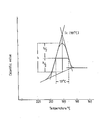
- this exothermic peak is usually so broad that "the half width of the peak” (that is, the width at a height one-half the distance from a base line to the top of the peak) is about 20°C as shown in Figure.
- the exothermic peak based on the crystallization will further shift to the low temperature side, with the half width becoming broader and, at a cooling rate of 80°C/min, the exothermic peak generally shifts to from 150°C to 160°C with a half width of more than 30°C.
- Polyethylene terephthalate which shows such a broad half width of exothermic peak based on the crystallization even in the above-described gradual cooling, will be cooled and solidified almost without crystallization in the portions brought into contact with a metal mold surface in molding using an ordinary metal mold, because the cooling rate of molten polyethylene terephthalate at the metal mold surface is as fast as 300 - 400°C/min.
- the composition of the present invention shows an exothermic.peak at from 200°C to 220°C based on crystallization in the course of cooling to conduct DSC measurement when cooled at a rate of 10°C/min, that is, it has a crystallizing temperature shifted to the higher temperature side.
- the exothermic peak is extremely sharp.
- the half width of this peak is at least not more than 15°C, preferably not more than 10°C.
- Compositions showing a half width of 8°C or less have particularly excellent properties.
- the composition of the present invention shows an exothermic peak between 170°C and 210°C based on the crystallization, with a half width of 22°C or less, preferably 20°C or less, and particularly preferably 18°C or less.
- composition of the present invention undergoes rapid crystallization even when rapidly cooled in a metal mold, thus providing well crystallized homogeneous moldings having good physical properties.
- the composition of the present invention requires individual components constituting the composition to be uniformly dispersed therein.
- a method for dispersing component (B) in component (A) in a highly fine-dispersed state there is, for example, a method of first mechanically crushing, pulverizing or milling the solid polyamide, component (B), having been prepared by various known processes to form a super-fine or micro- fibril state, then mixing them with a solution of, or molten state, polyester comprising mainly polyethylene terephthalate.
- component (B) In the case of crushing component (B) by mechanical means until it exhibits sufficient effects as a nucleating agent, it is also possible to use a nonsolvent for depressing heat generation or for aiding to attain uniform dispersion of component (B), or to crush in the presence of additives (e.g., plastilizers, inorganic fillers, lubricants, etc.) or polymers which have been conventionally used for polyethylene terephthalate.
- additives e.g., plastilizers, inorganic fillers, lubricants, etc.
- composition of the present invention can be also prepared by adding, to a solution in a solvent of component (B) prepared by known processes. or a component (B) solution or suspension as produced in the production step, a poor solvent therefor to form a finely dispersed precipitate, isolating it by filtration or centrifugation, and mixing them with a solution of component (A) or in molten component (A) or, without isolation, by replacing the solvent by a solvent for polyethylene terephthalate and dissolving therein component (A) followed by causing co-precipitation in a poor solvent for polyethylene terephthalate.
- Solvents that can be used in the step for dissolving or producing component [B] include high polar non-reactive solvents, for example, dimethylformamide, dimethylacetamide, tetramethylurea, hexamethylphosphoramide, N-methylpyrrolidone, N-methylcaprolactam, dimethyl sulfoxide, and the mixtures thereof. If necessary, mixtures with other solvents such as nitrobenzene, tetrahydrofuran, dioxane, tetrachloroethane, chloroform, phenol, etc., may also be used. Further inorganic salts such as calcium chloride or lithium chloride may be added to raise the solubility thereof.
- the solvent for dissolving component (B) formic acid, concentrated sulfuric acid or fuming sulfuric acid may also be used.
- various solvents can be used, such as water, methanol, ethanol, acetone, ethylene glycol, hexane, o-chlorophenol, nitrobenzene, tetrachloroethane, phenol, etc., and the mixtures thereof, with water and methanol being preferable.
- dispersing component (B) in a finely dispersed state using the above-described solvents and poor solvents desired size and form can be attained by properly selecting the concentration of the solution, combination of said solvent and poor solvent, and mechanical dispersing force upon mixing.
- the mechanical dispersing method include a method of using a high-speed stirrer, mixer, homogenizer or the like, a method of irradiating with ultrasonic waves, and a method of blowing component (B) into a poor solvent in a spray form.
- composition of the present invention can be prepared by mixing the solution or dispersion of component (B), which is mixed with a poor solvent in the aforesaid process, with a dispersing aid, and mixing the resulting mixture with a poor solvent to cause co-precipitation of component (B) and the dispersing aid, or by dissolving in, or mixing with, a poor solvent a dispersing aid and mixing it with a solution or dispersion of component (B) to cause co-precipitation of component (B) and the dispersing aid, followed by mixing or kneading the co-precipitate as produced, or after filtration or washing, with component (A) in a dissolved or molten state.
- Ther dispersing aid serves to prevent unnecessary aggregation to form large aggregates and solidification where only component (B) exists, and serves to facilitate dispersion of component (B) in polyethylene terephthalate in a finely dispersed state.
- dispersing aids which are advantageous in surface property and physical properties of the resulting moldings when incorporated in component (A) are preferable, although those which cause no or only slight adverse effects can be used.
- dispersing aid examples include polyethylene terephthalate (and a copolymer thereof, starting material thereof and oligomers thereof), other polymers, plasticizers, surfactants, flame-retardants, antioxidants, stabilizing agents against heat or light, lubricants, reinforcing agents, extenders, etc.
- the dispersing aid include phosphoric esters (e.g., tricresyl phosphate, tris(2,3-dibromopropyl) phosphate, triphenyl phosphate, tributyl phosphate, etc.), esters (e.g., dibutyl phthalate, dimethyl terephthalate, dibutyl terephthalate, , dipropyl terephthalate, dimethyl phthalate, di-Z-ethylhexyl.phthalate, dibutyl adipate, 2-ethylbutyl azelate, dioctyl sebacate, ethylene glycol dibenzoate, neopentyl glycol dibenzoate, triethylene glycol dibenzoate, butylphthalylbutyl glycolate, butyl p-acetyibenzoate, etc.), halides (e.g., chlorinated paraffin, tetrabromo- butan
- tetrabromobisphenol etc.
- phenols e.g., 2,6-di-tert butyl-p-cresol, 2,2'-methylene-bis[4-methyl-6-tert-butylphenol), tetrakis(methylene-3-(3',5'-di-tert-butyl-4'-hydroxyphenyl)propionato)methane,p-octylphenyl salicylate, etc.
- benzophenones e.g., 2-hydroxy-4-methoxybenzophenone, 5-chloro-2-hydroxybenzophenone, etc.
- metal salts e.g., sodium laurate, potassium stearate, cadmium stearate, dibutyltin, lead maleate, calcium alkylbenzene- sulfonate, etc.
- alcohols e.g., stearyl alcohol, polyoxyethylene nonylphenol ether, polyoxyethylene monocetyl ether,
- polymethacrylates polyacrylates, ethylene-vinyl acetate copolymer, polystyrenes,etc.
- polyoxytetramethylene polyoxypropylene
- polyoxyethylene polyoxyethylene
- polyphosphazens epoxy resins
- cellulose polymers or oligomers e.g., cellulose acetate, ethyl cellulose, nitrocellulose, etc.
- inorganic fibers and inorganic powders e.g., glass fiber, carbon fiber, potassium titanate fiber, zinc borate, barium metaborate, silica, talc, titanium oxide, antimony oxide, etc.
- particularly preferable dispersing aids are polymers (e.g., polyesters and the oligomers thereof, polymethacrylates, polystyrenes, cellulose acetate, etc.) and surfactants.
- the dispersing aid is used in an amount of from 0.5 to 10 parts by weight per part by weight of component (B).
- composition of the present invention can also be prepared by dispersing component [B] having been finely dispersed according to the aforesaid process, in a starting material for component (A) or an intermediate for the final polymer, and subjecting the resulting mixture to the first or intermediate step of polymerization to prepare component (A).
- a process of using a composite of component (A) and component (B), obtained by the above-described process, as a master batch, and further blending or kneading it with component (A) to adjust the content of component (B) to a predetermined level is industrially advantageous.
- Component (B) is extremely finely dispersed in the thus-obtained composite of components (A) and (B) of the present invention in the form of branched or intertwined microfibrils, complete fine microfibrils, needle-like or particulate state fundamentally having a size (diameter or length) of not more than 50 pm.
- Compositions providing preferable effects contain component (B) particles ranging from about several ⁇ m to about several ten A in size.
- component (A) and component (B) of the present invention are to be compounded so that the effect of accelerating crystallization of polyester comprising mainly polyethylene terephthalate is obtained, or that the half width of exothermic peak based on crystallization by gradual cooling and measured by a DSC at a cooling rate of 10°C/min becomes 15°C or less per 8 mg of said component (A).
- component (B) The weight ratio range of component (B) described above varies depending upon the properties of components (A) and (B) and the dispersed state (e.g., size, shape, etc.) of component (B), and hence it is difficult to show the blending ratio of component (A) to component (B) by weight, but, in general, from 0.05 to 10 parts by weight, and preferably from 0.1 to 5 parts by weight, of component (B) is compounded with 100 parts by weight of component (A).
- component (A) e.g., polyethylene terephthalate
- component (B) is blended in the above amount based on 100 parts by weight of the total component (A) in the resulting polyester composition.
- component (B) When component (B) is incorporated -in component (A) in a homogeneous, finely dispersed state, the amount of component (B) may be not more than 3 parts by weight, with 0.1 to 3 parts by weight being the most preferable.
- composition of the present invention containing components (A) and (B) as necessary components may further contain various additives such as reinforcing fillers, plasticizers, antioxidants, UV ray-absorbing agents, lubricants, parting agents, flame-retardants, antistatistics, colorants, etc., according to the end-use.
- additives such as reinforcing fillers, plasticizers, antioxidants, UV ray-absorbing agents, lubricants, parting agents, flame-retardants, antistatistics, colorants, etc.
- the thus-obtained composition of the present invention is suited as a molding material, showing good molding properties in molding in a low-temperature (not higher than 120°C, preferably around 100°C) metal mold as well as in molding in a high-temperature metal mold.
- reinforcing filler In molding, combined use of the composition of the present invention and a reinforcing filler is extremely effective for improving shape stability, heat resistance, and mechanical characteristics of resulting moldings, with maintaining the original merits of the composition of the present invention, thus being particularly preferable.
- fibrous materials such as glass fiber, potassium titanate fiber, asbestos fiber, poly-p-phenyleneterephthalamide fiber, carbon fiber, etc.
- non-fibrous inorganic materials such as mica,.aluminum silicate, glass beads, glass flake, silica, talc, etc.
- glass fiber is particularly preferable.
- the amount of the reinforcing fiber to be compounded varies depending upon the desired end-use, but, in general, it ranges from 2 to 200 parts by weight, and preferably 4 to 100 parts by weight, per 100 parts by weight of component (A). If the amount is less than 2 parts by weight, sufficient effects of improving form stability or physical properties are not obtained, whereas if it is more than.200 parts by weight, deterioration results, such as in increased fragility and deteriorated molding properties.
- plasticizer for improving molding properties and surface lubricity of the resulting moldings (that is, molded articles formed from the polyester composition of the invention).
- plasticizers appropriate plasticizers may be selected from various known compounds.
- Examples thereof include phosphates (e.g., triphenyl phosphate, tricresyl phosphate, tricyclohexyl phosphate, triisopropyl phosphate, octyldiphenyl phosphate, triethyl phosphate, etc.), phosphites (e.g., triphenyl phosphite, tributyl phosphite, trimethyl phosphite, etc.), phosphonates (e.g., phenyl phenylphosphonate, diphenyl phenylphosphate, etc.), phosphines (e.g., phenylphosphinic acid, methyl dimethyl-phosphinate, phenyl methyl phosphinate, etc.), benzoic esters (e.g., polyethylene glycol dibenzoate, polypropylene glycol dibenzoate, polytetramethylene glycol dibenzoate, diethylene glyco
- carboxylic acids e.g., adipic acid, succinic acid, isophthalic acid, terephthalic acid,
- composition of the present invention contains component (A) and component (B) as necessary components, with component (B) showing a nucleating effect of accelerating crystallization of component (A).
- the composition of the present invention enables the conducting of molding, and particularly injection-molding, at a metal mold temperature of less than 120°C, and particularly at about 100°C, which has been impossible with conventional polyethylene terephthalate, as well as to conduct molding in a high-temperature metal mold.
- a metal mold temperature of less than 120°C, and particularly at about 100°C, which has been impossible with conventional polyethylene terephthalate, as well as to conduct molding in a high-temperature metal mold.
- it has the great signifi- . cance of expanding the application range of polyethylene terephthalate as an industrially useful resin, in cooperation with its desirable heat resistance and chemical resistance properties.
- composition can find applica- .tion as a material for film, fiber, or like molding obtained by extrusion molding or blow molding.
- Samples containing 8 mg of component (A) were used: for example, even in the case of compounding glass fiber, samples containing 8 mg as component (A) were weighed out for use.
- Model DSC-II manufactured by Perkin Elmer Co. was used as a measuring apparatus. Measurement was conducted in a nitrogenous atmosphere as follows. Samples were heated to 290°C, and, after maintaining at that temperature for 5 minutes, cooled at a definite rate of 10°C/min. Exothermic peak temperature (Tc) and half width ( ⁇ T) of the peak were determined from the exothermic peak obtained based on crystallization of component (A), as shown in Figure.
- Components (A) and (B) and, if necessary, other additives were blended in given proportions in a rotary drum blender.
- the resulting blend was pelletized by extruding at from 260°C to 270°C using a 30-mm biaxial screw extruder.
- the thus-obtained pellets were vacuum-dried at 130°C for 5 hours.
- Samples with a predominant compounding ratio were blended in a rotary drum blender and pelletized by extruding at 260°C to 270°C using a uniaxial screw extruder. The resulting pellets were vacuum-dried at 130°C for 5 hours.
- the pellets obtained in (2) or (3) described above were molded using model KC-20 made by Kawaguchi Tekko K.K. under molding conditions of 270°C to 280°C in cylinder temperature, a given temperature in metal mold temperature, and a molding cycle of 25 seconds.
- Parting properties were evaluated based on the ease with which the molding was taken out of the cavity and with which a sprue was removed. Appearance was evaluated based on the surface gloss and presence or absence of pock marks, as follows:
- Dumbbell specimens (dumbbell type-1 of ASTM) were molded according to process (4), and tensile strength was measured according to ASTM-D-638 using . them. Observation of component (B) in the composition:
- A'slight amount of the composition obtained in each Example was sandwiched between cover glasses, placed on a hot plate, heated to from 270°C.to 300°C to melt, and pressed while in a molten state to reduce the thickness.
- Results obtained are as follows: In observation (2), component (B) was not melted in every Example, and the size and shape of particles thereof were recognized in both the case of heating the composition from 270°C to 300°C after melting component (A) of polyethylene terephthalate and the case of heating to higher than 300°C (to about 31.0°C).
- Polyethylene terephthalate having a reduced specific viscosity ( ⁇ sp/c) of 0.61 was dried to measure the exothermic peak temperature and half width of the peak based on crystallization thereof by DSC measurement. Particularly, when 8 mg of the polyethylene terephthalate was heated at a heating rate of 10°C/min, an endothermic peak of melting point (Tm) was observed at 255°C. Heating was further continued to 290°C and, after maintaining this temperature for 5 minutes, the polymer was cooled at a rate of 10°C/min. The relation between the temperature and calorific value is generally shown by the curve of Figure.
- Half width of the exothermic peak was determined from the graph as follows.
- the exothermic peak temperature (Tc) based on crystallization was read 181°C. Width of the peak was measured as the width between two points corresponding to 1/2 of the height of the peak (h). This width was regarded as the half width ( ⁇ T) of the exothermic peak. As a result, AT was found to be 19°C.
- Tc was shifted to 150°C and AT expanded to as broad as 36°C.
- a 1-liter reactor equipped with a high-speed stirrer was well dried by introducing hot dry nitrogen gas thereinto, and then cooled.
- 100 ml of dry, purified hexamethylphosphoramide, 150 ml of N-methyl-2-pyrrolidone, and 8 g of anhydrous lithium chloride were charged therein, and 2.25 g of p-phenylenediamine was added thereto and completely dissolved therein.
- this solution was cooled to 5°C to 10°C, and, under vigorous stirring, 4.27 g of terephthalic acid dichloride was added thereto. After reacting for about 1 hour, the temperature of the solution was raised to 30°C to 40°C, reaction being continued for another 1 hour.
- the thus-obtained kneaded material contained about 0.96% poly-p-phenyleneterephthalamide insoluble in o-chlorophenol.
- This composition had a Tc of 221°C measured by DSC at a-cooling rate of 10°C/min. The exothermic peak in this temperature range was as sharp as 5.7°C in ⁇ T. Also, DSC measurement of the product at a cooling rate of 80°C/min gave a Tc of 196°C and AT of 14.5°C.
- the product was molded in a 110°C metal mold, there were obtained moldings with good parting properties and good appearance (both evaluated as A).
- Tc and AT of this composition measured at a cooling rate of 10°C/min were 212°C and 5.4°C, respectively, and Tc and ⁇ T measured at a cooling rate of 80°C/min were 192°C and 13.4°C, respectively.
- Tc and AT of this composition measured at a cooling rate of 10°C/min were 212°C and 5.4°C, respectively, and Tc and ⁇ T measured at a cooling rate of 80°C/min were 192°C and 13.4°C, respectively.
- Poly-p-phenyleneterephthalamide was spun from a concentrated sulfuric acid solution according to.a known process.
- the resulting filaments (6 to 8 ⁇ m in diameter) were cut into 0.1 to 0.15-mm long pieces, beaten in an iron mortar, mixed with an about 3-fold amount of glass fiber, crushed in a finely crushing hammer mill, and milled for 5 days and 5 nights in a ball mill in the presence of N-methylpyrrolidone.
- the thus-milled product was dispersed in chlorophenol, and SO g of polyethylene terephthalate used in Reference Example 1 was dissolved therein followed by co-precipitation in methanol.
- composition obtained by washing with methanol and drying contained about 2.8% aromatic polyamide component (about 11.2% as o-chlorophenol insolubles).
- Example 6 The same procedures as in Example 6 were conducted except for changing the diamine component, dicarboxylic acid component, and dispersing aid. Results thus-obtained are tabulated in Table 3.
- Polyethylene terephthalate in this composition had a viscosity (nsp/c) of 0.66.
- nsp/c viscosity
- polyethylene terephthalate in the composition was dissolved in o-chlorophenol to isolate insolubles, the insolubles were identified as polybenzamide, which were contained in an amount of 1.75%.
- DSC measurement revealed that Tc and AT of this composition measured at a cooling rate of 10°C/min were 216°C and 7.4°C, respectively.
- the thus-obtained precipitate was washed with successive, methanol and water, then dried.
- the dried precipitate was kneaded with 460 g of polyethylene terephthalate used in Reference Example 1.
- the resulting composition contained about 1.0% polybenzamide (insoluble in o-chlorophenol and ethyl acetate).
- DSC measurement of this composition revealed that Tc and AT measured at a cooling rate of 10°C/min were 214°C and 5.9°C, respectively.
- this composition was molded in a.110°C metal mold, there were obtained moldings with good parting properties and good appearance (both evaluated as A).
- a 1-liter reactor equipped with a high-speed stirrer was well dried by introducing hot dry nitrogen gas thereinto, and then cooled.
- 100 ml of dry, purified hexamethylphosphoramid 150 ml of N-methyl-2-pyrrolidone, and 8 g of anhydrous lithium chloride were charged therein, and 2.25 g of p-phenylenediamine was added thereto and completely dissolved therein..
- this solution was cooled to 5 - 10°C and, under vigorous stirring, 4.27 g of terephthalic acid dichloride was added thereto. After reacting for about one hour, the temperature of the solution was raised to 30 - 40°C, reaction being continued for another one hour.
- the polymer precipitate was collected by filtration, repeatedly washed with methanol, and dried to obtain a mixture of polyethylene terephthalate and block copolymer.
- This mixture contained about 1 wt % poly-p-phenyleneterephthalamido block component.
- DSC measurement of the thus obtained blend revealed that the temperature corresponding to exothermic peak based on crystallization of polyethylene terephthalate, Tc, was 215°C, and the half width of the peak (6T) was 5.3°C.
- Example 18-(1) 1.1 g of the reaction product (corresponding to about 0.37 g of o-chlorophenol-insoluble block copolymer) obtained in the same manner as in Example 18-(1) was kneaded with 50 g of polyethylene terephthalate used in Reference Example 1 in a nitrogenous atmosphere at 260 - 280°C using a small-sized kneading tester, taken out, and cooled.
- DSC measurement of this blend in the same manner as in Reference Example 1 revealed that the temperature of the exothermic peak based on the crystallization was 213°C, and that the peak had a half width of 5.5°C. Additionally, the content of poly-p-phenyleneterephthalamido block component based on polyethylene terephthalate was about 0.5 wt %.
- Example 19 2.2 g of the reaction product obtained in the same manner as in Example 18-(1) was kneaded with 50 g of the same polyethylene terephthalate as used in Reference Example land 10 g of glass fiber as in Example 19. DSC measurement of the thus obtained blend revealed that the temperature for the exothermic peak based on the crystallization was 215°C and the half width of the peak 5.3°C. Additionally, the content of poly-p-phenyleneterephthalamido component based on polyethylene terephthalate was about 1 wt%.
- compositions respectively contained about 1.5 % and about 3 % of poly-p-phenyleneterephthalamido block component.
- DSC measurement thereof revealed that the temperatures for the exothermic peak based on the crystallization were 210°C and 208°C, respectively, with the half widths of the peaks being 5.7°C and 6.5°C, respectively.
- Example 18- (1) The same procedures as in Example 18- (1) were repeated on a 10-fold scale.
- the resulting product contained 24 % poly-p-phenyleneterephthalamido component.
- the thus obtained resin was molded in a metal mold of a particular temperature as shown in Table 5 below.
- Example 2 1 -(1) and -(2) were repeated on a 5-fold scale except for additionally using 500 g of nitrobenzene as a solvent for bishydroxyethyl terephthalate oligomer.
- the resulting product contained about 20 % p-phenyleneterephthalamido component.
- Example 22-(1) The same experiment as described in Example 22-(1) was repeated on-a 20-fold scale.
- the resulting product contained 22 % poly-p-phenyleneterephthalamido, component.
- Results obtained by molding the thus obtained resin are shown in Table 5. Additionally, when the blend kneaded in the biaxial screw extruder was directly molded in a 110°C metal mold, moldings were obtained with good parting properties and good appearance (both evaluated as A).
- Example 28 The same procedures as described in Example 28 were conducted except for changing diamine, dicarboxylic acid, and polyester for copolymerization. Results thus obtained are shown in Table 6 below.
- Example 28 The same reaction as in Example 28 was carried out except for using 38.21 g of p-aminobenzoyl chloride hydrochloride as an aminocarboxylic acid component in place of the reaction product between the diamine component and the dicarboxylic acid component. Results thus obtained are shown in Table 5.
- Example 34 The same procedures as in Example 34 were conducted except for using a mixture of 19.11 g of p-aminobenzoyl chloride hydrochloride and 19.11 g of m-aminobenzoyl chloride hydrochloride in place of p-aminobenzoyl chloride hydrochloride. Results thus obtained are shown in Table 5.
- a 1-liter reactor equipped with a high-speed stirrer was well dried by introducing hot dry nitrogen gas thereinto, and then cooled.
- 100 ml of dry, purified hexamethylphosphoramide, 150 ml of N-methyl-2-pyrrolidone, and 8 g of anhydrous lithium chloride were charged therein, and 2.25 g of p-phenylenediamine was added thereto and completely dissolved therein.
- this solution was cooled to 5 - 10°C and, under vigorous stirring, 4.70 g of terephthalic acid dichloride was added thereto. After reacting for about one hour, the temperature of the solution was raised to 30 - 40°C, reaction being continued for another one hour.
- An aromatic polyamide solution was synthesized from 2.25 g of p-phenylenediamine and 4.6 g of terephthalic acid dichloride using the same reactor and solvents as used in Example 36. To the reaction mixture were added 8.1 g of adipic acid dichloride, 5.6 g of hexamethylenediamine, and 30 ml of triethylamine, and reaction was conducted for 5 hours. Then, 30 g of bishydroxyethyl terephthalate (polyethylene terephthalate oligomer) was added thereto and, after well mixing,.the resulting mixture was poured into water.
- Example 38 The same procedures as in Example 38 were conducted on a 5-fold scale, provided that polyethylene terephthalate of 0.76 in n sp/c was used. After kneading in a biaxial screw extruder, the resulting blend was kneaded with a 30 % amount of glass fiber in uniaxial screw extruder. Results obtained by molding the thus obtained resin in a 110°C metal mold are shown in Table 7.
- Example 39 The same procedures as in Example 39 were conducted on a 10-fold scale, provided that polyethylene terephthalate of 0.72 in n sp/c was used. After kneading in a biaxial screw extruder, the resulting blend was kneaded with a 25% amount of glass fiber in a uniaxial screw extruder. Results obtained by molding the thus obtained resin in a 110°C metal mold are shown in Table 7.
- Example 49 The same procedures as in Examples 45 - 48 were conducted except for using 38.20 g of p-aminobenzoic acid chloride hydrochloride in place of reacting the diamine component with the dicarboxylic acid component [Example 49]. Also, the procedures were conducted using 19.10 g of p-amino benzoic acid chloride hydrochloride and 19.10 g of m-aminobenzoic acid chloride hydrochloride [Example 50]. Results thus obtained are shown in Table 8.
- Example 51 and 52 The same procedures as in Examples 4.0 and 41 were repeated on a 3-fold scale [Examples 51 and 52, respectively].
- polyethylene terephthalate polyethylene terephthalate of 0.72 in ⁇ sp/c was used. After kneading in a biaxial screw extruder, the resulting blend was kneaded with a 30% amount of glass fiber using a uniaxial screw extruder. Results obtained by molding the thus obtained resin in a 110°C metal mold are shown in Table 7 .
- Example 52 The same procedures as in Example 52 were conducted except for omitting butyl methacrylate and increasing the amount of methyl methacrylate to make up the amount of omitted butyl methacrylate.
- a 1-liter reactor equipped with a high-speed stirrer was well dried by introducing thereinto a hot dry nitrogen gas, and cooled.
- 100 ml of dry, purified hexamethylphosphoramide, 150 ml of N-methyl-2-pyrrolidone, and 8 g of anhydrous lithium chloride were charged therein and, after dissolving therein 9.7 g of isophthalic acid dihydrazide, the mixture was cooled to 5-10°C. Then, 10.2 g of terephthalic acid dichloride was added thereto under vigorous stirring.
- the resulting blend contained about 1.9 % o-chlorophenol-insoluble polyamidohydrazide.
- DSC measurement revealed that Tc of this composition measured at a cooling rate of 10°C/min was 210°C, and that a sharp exothermic peak was shown in this temperature range with AT of 7.4°C.
- this resin was molded in a 110°C metal mold, moldings were obtained with good parting properties and good appearance (both evaluated as A).
- the precipitate thus formed was washed, dried, and kneaded with 200 g of polyethylene terephthalate.
- Polyamide content of the composition obtained from polyamide (57-I) was measured to be 2.1 %, and that from polyamide ( 57 -II) 2.1 %.
- DSC measurement revealed that Tc and ⁇ T of the composition-from polyamide (S7-I) measured at a cooling rate of 10°C/min were 216°C and 6.2°C, re - spectively, and that Tc and ⁇ T of the composition from polyamide (57-II) were 213°C and 6.5°C, respectively.
- these resins were molded in a 110°C metal mold, moldings were obtained with good parting properties and good appearance (both evaluated as A).
- Example 55 The same reactor and the same solvents as used in Example 55 were used. 40 g of 3-aminocyclohexanecarbonylchloride hydrochloride was charged therein, and 10 ml of triethylamine was added thereto. After about 2 hours, the mixture was thrown into a large amount of water, and the precipitate thus formed was collected by filtration, washed, dried. 15 g of the resulting polyamide was dissolved in a solution of 400 ml of dimethylacetamide and 20 g of lithium chloride.
- a polyamide was prepared from 6.2 g of tetramethylenediamine and 14.2 g of terephthalic acid dichloride in the same manner as in Example 55.
- a polyamide was prepared in the same manner as in Example 55 except for using 5.8 g of hexamethylenediamine and 10.2 g of terephthalic acid dichloride. 40 g of polymethyl methacrylate and 5 g of triphenyl phosphate were dissolved in the resulting polyamide solution as dispersing aids, and this solution was mixed with water under vigorous stirring. The precipitate thus formed was washed, dried, and kneaded with 960 g of polyethylene terephthalate. The resulting composition contained about 1.2% polyamide. DSC measurement revealed that Tc and AT of the composition measured at a cooling rate of 10°C/min were 213°C and 6.0°C, respectively. When this was molded in a 110°C metal mold, moldings were obtained with good parting properties and good appearance (both evaluated as A).
- Example 55 The same reactor and the same solvents as used in Example 55 were used. 3 g of ethylenediamine was dissolved therein, and 10.6 g of terephthalic acid chloride was added thereto to react for 1 hour. Then, 20 g of polycarprolactone (as a copolymerizable polymer) and 5 ml of triethylamine were added thereto, and block polymer-forming reaction was conducted at 100°C for 24 hours. 40 g of styrene-acrylonitrile copolymer was added to the resulting solution as a dispersing aid followed by pouring the solution into water.
- polycarprolactone as a copolymerizable polymer
- triethylamine triethylamine
- the precipitate thus formed was collected by filtration, washed, dried, and kneaded with 950 g of polyethylene terephthalate.
- DSC measurement revealed that Tc and AT of the thus obtained composition measured at a cooling rate of 10°C/min were 213°C and 6.8°C, respectively.
- m ol dings were obtained with good parting properties and good appearance .(both evaluated as A).
- Ethylenediamine' was reacted with terephthalic acid chloride in the same manner as in Example 61, and 12.4 g of ethylene glycol and 8.5 g of a sodium hydride dispersion were added thereto. After one hour, 42.2 g of terephthalic acid dichloride was added thereto, and the reaction was continued for 4 hours. Then, 5 g of phenol was added thereto and, after reacting for 2 hours, the reaction mixture was poured into a large amount of methanol to form a precipitate. The precipitate was washed, dried, and kneaded with 600 g of polyethylene terephthalate.
- Ethylenediamine was reacted with terephthalic acid chloride in the same manner as in Example 61, and 8.8 g of N,N'-dimethylethylenediamine, 9.9 g of terephthalic acid dichloride, and 9.9 g of isophthalic acid dichloride to prepare a block copolymer between polyethylene terephthalamide and low-melting N-methylated polyamide. After conducting the reaction for 2 hours, the reaction mixture was poured. into a large amount of water. The precipitate thus formed was washed, dried, mixed with 200 g of bishydroxyethyl terephthalate (polyethylene terephthalate oligomer), and charged in a 1-liter reactor..
- Ethylenediamine was reacted with terephthalic acid dichloride in the same manner as in Example 61. Then, 0.2 g of terephthalic acid dichloride was added, and 40 g of polytetramethylene glycol and 4 ml of triethylamine were added thereto to react at 50°C for one day and one night. 30 g of cellulose diacetate was added thereto as a dispersing aid, and the resulting mixture was poured into methanol. The precipitate thus formed was washed, dried, and kneaded with 500 g of polyethylene terephthalate.
- 0.2 g of azobisisobutyronitrile was added to a mixture solution of 50 g of methyl methacrylate, 24 g of ethyl methacrylate, and 1 g of acrylic acid chloride, and reaction was conducted at 50°C for 4 hours.
- the reaction product was crushed in a dry box, charged in the same reactor as in Example 55 , and dissolved in 500 ml of dimethylacetamide.
- 20 g of p-aminomethylbenzoyl chloride hydrochloride was added thereto, and 10 ml of triethylamine was further added thereto followed by reacting for 4 hours to graft the polyamide to the methacrylateacryloyl chloride copolymer.
- polyethylene terephthalate/ adipate used as a dispersing aid was a copolyester of 60/40 in a molar ratio of terephthalic acid to adipic acid, polyethylene terephthalate/sebacate a copolyester of 60/40 in a molar ratio of terephthalic acid to sebacic acid, and copolyester of polyethylene terephthalate/adipate and polytetramethylene glycol a polyester of 70/30 in a molar ratio of terephthalic acid to adipic acid and 20 % in a content of polytetramethylene glycol (abbreviated as PET/AD/PTG).
- PET/AD/PTG polytetramethylene glycol
- azobisisobutyronitrile was added to a mixture solution of 100 g of styrene, 25 g of methyl methacrylate, and 2 g of methacrylic acid chloride, and reaction was conducted at 50°C for 4 hours.
- the reaction product was pulverized in a dry box and dissolved in a 1.5 liters of dimethylacetamide. 6.01 g of ethylenediamine was added thereto, then 17.76 g of terephthalic acid dichloride was added thereto to conduct reaction at 10°C for 4 hours. Finally, 1.5 g of benzoic acid chloride was added thereto, and reaction was conducted for 2 hours.
Landscapes
- Chemical & Material Sciences (AREA)
- Health & Medical Sciences (AREA)
- Chemical Kinetics & Catalysis (AREA)
- Medicinal Chemistry (AREA)
- Polymers & Plastics (AREA)
- Organic Chemistry (AREA)
- Compositions Of Macromolecular Compounds (AREA)
Priority Applications (1)
| Application Number | Priority Date | Filing Date | Title |
|---|---|---|---|
| AT81301533T ATE16019T1 (de) | 1980-04-08 | 1981-04-08 | Formmasse aus polyestern, ihre herstellung und daraus geformte gegenstaende. |
Applications Claiming Priority (10)
| Application Number | Priority Date | Filing Date | Title |
|---|---|---|---|
| JP4595480A JPS56141351A (en) | 1980-04-08 | 1980-04-08 | Aromatic polyamide-polyester type composition |
| JP45954/80 | 1980-04-08 | ||
| JP13604880A JPS5761046A (en) | 1980-09-30 | 1980-09-30 | Aromatic polyamide-polyester resin composition |
| JP136048/80 | 1980-09-30 | ||
| JP16477580A JPS5790037A (en) | 1980-11-22 | 1980-11-22 | Polyester resin molding composition |
| JP16477780A JPS5790039A (en) | 1980-11-22 | 1980-11-22 | Polyester molding composition |
| JP164775/80 | 1980-11-22 | ||
| JP164777/80 | 1980-11-22 | ||
| JP164776/80 | 1980-11-22 | ||
| JP16477680A JPS5790038A (en) | 1980-11-22 | 1980-11-22 | Polyester resin composition for molding compound |
Publications (2)
| Publication Number | Publication Date |
|---|---|
| EP0039155A1 true EP0039155A1 (fr) | 1981-11-04 |
| EP0039155B1 EP0039155B1 (fr) | 1985-10-09 |
Family
ID=27522515
Family Applications (1)
| Application Number | Title | Priority Date | Filing Date |
|---|---|---|---|
| EP19810301533 Expired EP0039155B1 (fr) | 1980-04-08 | 1981-04-08 | Masse à mouler à base de polyester, sa production et ses produits moulés |
Country Status (2)
| Country | Link |
|---|---|
| EP (1) | EP0039155B1 (fr) |
| DE (1) | DE3172576D1 (fr) |
Cited By (2)
| Publication number | Priority date | Publication date | Assignee | Title |
|---|---|---|---|---|
| WO1999020452A1 (fr) * | 1997-10-17 | 1999-04-29 | Basf Aktiengesellschaft | Utilisation de matieres de moulage en polyester de poids moleculaire eleve |
| USRE42925E1 (en) | 1998-06-11 | 2011-11-15 | Cobarr S.P.A | Polyester resin blends with high-level gas barrier properties |
Citations (2)
| Publication number | Priority date | Publication date | Assignee | Title |
|---|---|---|---|---|
| FR2280680A1 (fr) * | 1974-07-31 | 1976-02-27 | Basf Ag | Matieres a mouler a base de terephtalate de polybutylene traitees anti-electrostatiquement |
| US4066587A (en) * | 1976-09-07 | 1978-01-03 | Emery Industries, Inc. | Thermoplastic polyester compositions containing polyamide additives |
-
1981
- 1981-04-08 DE DE8181301533T patent/DE3172576D1/de not_active Expired
- 1981-04-08 EP EP19810301533 patent/EP0039155B1/fr not_active Expired
Patent Citations (2)
| Publication number | Priority date | Publication date | Assignee | Title |
|---|---|---|---|---|
| FR2280680A1 (fr) * | 1974-07-31 | 1976-02-27 | Basf Ag | Matieres a mouler a base de terephtalate de polybutylene traitees anti-electrostatiquement |
| US4066587A (en) * | 1976-09-07 | 1978-01-03 | Emery Industries, Inc. | Thermoplastic polyester compositions containing polyamide additives |
Cited By (2)
| Publication number | Priority date | Publication date | Assignee | Title |
|---|---|---|---|---|
| WO1999020452A1 (fr) * | 1997-10-17 | 1999-04-29 | Basf Aktiengesellschaft | Utilisation de matieres de moulage en polyester de poids moleculaire eleve |
| USRE42925E1 (en) | 1998-06-11 | 2011-11-15 | Cobarr S.P.A | Polyester resin blends with high-level gas barrier properties |
Also Published As
| Publication number | Publication date |
|---|---|
| DE3172576D1 (en) | 1985-11-14 |
| EP0039155B1 (fr) | 1985-10-09 |
Similar Documents
| Publication | Publication Date | Title |
|---|---|---|
| Brode et al. | Lactone polymerization and polymer properties | |
| CA1142685A (fr) | Copolyester aromatique | |
| EP0362872A2 (fr) | Matières à mouler de polytérephthalate de butylène avec écoulement amélioré | |
| EP0398624B1 (fr) | Composition ignifugée de cristaux liquides à base de polyester, procédé de préparation et materiau de moulage par injection ainsi obtenue | |
| US4524191A (en) | Polyester composition and production thereof | |
| US4417021A (en) | Polyester composition and production thereof | |
| US3830771A (en) | Phosphorus-containing polyesters | |
| US5321099A (en) | Blends of semi-crystalline polyamides and polyesteramides | |
| Abu‐Isa et al. | High‐impact‐strength poly (ethylene terephthalate)(PET) from virgin and recycled resins | |
| EP0609538A1 (fr) | Mélange de polymères et articles formés à partir de celui-ci | |
| EP0039155B1 (fr) | Masse à mouler à base de polyester, sa production et ses produits moulés | |
| US5686522A (en) | Fluoromodified polyesters having improved processability | |
| DE2744617A1 (de) | Thermoplastische kopolyester | |
| GB1569296A (en) | Polymer compositions and their preparation | |
| EP0533792B1 (fr) | Composition de polymere d'hydroxyalcanoate | |
| JPS6332099B2 (fr) | ||
| US5017657A (en) | Rapidly-crystallizing polyester compositions | |
| EP0331086B1 (fr) | Composition de polyesters cristallisant rapidement | |
| JP2533328B2 (ja) | 芳香族ポリエステル | |
| JP3432279B2 (ja) | ポリエチレンサクシネート樹脂組成物 | |
| JP2581242B2 (ja) | 共重合ポリエステルおよびその組成物 | |
| KR20070071592A (ko) | 공중합 폴리에스테르/폴리카보네이트 수지 조성물 및 이의제품 | |
| JPH11323106A (ja) | ポリエステル樹脂組成物および製造方法 | |
| KR930000777B1 (ko) | 폴리에스테르 수지조성물 | |
| JP3406695B2 (ja) | ポリアミドエーテルエステルの製造方法 |
Legal Events
| Date | Code | Title | Description |
|---|---|---|---|
| PUAI | Public reference made under article 153(3) epc to a published international application that has entered the european phase |
Free format text: ORIGINAL CODE: 0009012 |
|
| AK | Designated contracting states |
Designated state(s): AT BE CH DE FR GB IT LU NL SE |
|
| 17P | Request for examination filed |
Effective date: 19811231 |
|
| GRAA | (expected) grant |
Free format text: ORIGINAL CODE: 0009210 |
|
| AK | Designated contracting states |
Designated state(s): AT BE CH DE FR GB IT LI LU NL SE |
|
| PG25 | Lapsed in a contracting state [announced via postgrant information from national office to epo] |
Ref country code: NL Effective date: 19851009 Ref country code: LI Effective date: 19851009 Ref country code: IT Free format text: LAPSE BECAUSE OF FAILURE TO SUBMIT A TRANSLATION OF THE DESCRIPTION OR TO PAY THE FEE WITHIN THE PRESCRIBED TIME-LIMIT;WARNING: LAPSES OF ITALIAN PATENTS WITH EFFECTIVE DATE BEFORE 2007 MAY HAVE OCCURRED AT ANY TIME BEFORE 2007. THE CORRECT EFFECTIVE DATE MAY BE DIFFERENT FROM THE ONE RECORDED. Effective date: 19851009 Ref country code: CH Effective date: 19851009 Ref country code: BE Effective date: 19851009 Ref country code: AT Effective date: 19851009 |
|
| REF | Corresponds to: |
Ref document number: 16019 Country of ref document: AT Date of ref document: 19851015 Kind code of ref document: T |
|
| PG25 | Lapsed in a contracting state [announced via postgrant information from national office to epo] |
Ref country code: SE Effective date: 19851030 |
|
| REF | Corresponds to: |
Ref document number: 3172576 Country of ref document: DE Date of ref document: 19851114 |
|
| ET | Fr: translation filed | ||
| REG | Reference to a national code |
Ref country code: CH Ref legal event code: PL |
|
| NLV1 | Nl: lapsed or annulled due to failure to fulfill the requirements of art. 29p and 29m of the patents act | ||
| PG25 | Lapsed in a contracting state [announced via postgrant information from national office to epo] |
Ref country code: LU Free format text: LAPSE BECAUSE OF NON-PAYMENT OF DUE FEES Effective date: 19860430 |
|
| PLBE | No opposition filed within time limit |
Free format text: ORIGINAL CODE: 0009261 |
|
| STAA | Information on the status of an ep patent application or granted ep patent |
Free format text: STATUS: NO OPPOSITION FILED WITHIN TIME LIMIT |
|
| 26N | No opposition filed | ||
| PGFP | Annual fee paid to national office [announced via postgrant information from national office to epo] |
Ref country code: GB Payment date: 19910403 Year of fee payment: 11 |
|
| PGFP | Annual fee paid to national office [announced via postgrant information from national office to epo] |
Ref country code: FR Payment date: 19910426 Year of fee payment: 11 |
|
| PGFP | Annual fee paid to national office [announced via postgrant information from national office to epo] |
Ref country code: DE Payment date: 19910430 Year of fee payment: 11 |
|
| PG25 | Lapsed in a contracting state [announced via postgrant information from national office to epo] |
Ref country code: GB Effective date: 19920408 |
|
| GBPC | Gb: european patent ceased through non-payment of renewal fee | ||
| PG25 | Lapsed in a contracting state [announced via postgrant information from national office to epo] |
Ref country code: FR Effective date: 19921230 |
|
| PG25 | Lapsed in a contracting state [announced via postgrant information from national office to epo] |
Ref country code: DE Effective date: 19930101 |
|
| REG | Reference to a national code |
Ref country code: FR Ref legal event code: ST |