EP0042181A2 - Diphenylderivate - Google Patents
Diphenylderivate Download PDFInfo
- Publication number
- EP0042181A2 EP0042181A2 EP81105610A EP81105610A EP0042181A2 EP 0042181 A2 EP0042181 A2 EP 0042181A2 EP 81105610 A EP81105610 A EP 81105610A EP 81105610 A EP81105610 A EP 81105610A EP 0042181 A2 EP0042181 A2 EP 0042181A2
- Authority
- EP
- European Patent Office
- Prior art keywords
- alkyl
- oder
- die
- aralkyl
- aldehyde
- Prior art date
- Legal status (The legal status is an assumption and is not a legal conclusion. Google has not performed a legal analysis and makes no representation as to the accuracy of the status listed.)
- Withdrawn
Links
Classifications
-
- C—CHEMISTRY; METALLURGY
- C07—ORGANIC CHEMISTRY
- C07C—ACYCLIC OR CARBOCYCLIC COMPOUNDS
- C07C309/00—Sulfonic acids; Halides, esters, or anhydrides thereof
-
- C—CHEMISTRY; METALLURGY
- C07—ORGANIC CHEMISTRY
- C07F—ACYCLIC, CARBOCYCLIC OR HETEROCYCLIC COMPOUNDS CONTAINING ELEMENTS OTHER THAN CARBON, HYDROGEN, HALOGEN, OXYGEN, NITROGEN, SULFUR, SELENIUM OR TELLURIUM
- C07F9/00—Compounds containing elements of Groups 5 or 15 of the Periodic Table
- C07F9/02—Phosphorus compounds
- C07F9/28—Phosphorus compounds with one or more P—C bonds
- C07F9/38—Phosphonic acids [RP(=O)(OH)2]; Thiophosphonic acids ; [RP(=X1)(X2H)2(X1, X2 are each independently O, S or Se)]
- C07F9/40—Esters thereof
- C07F9/4003—Esters thereof the acid moiety containing a substituent or a structure which is considered as characteristic
- C07F9/4056—Esters of arylalkanephosphonic acids
-
- H—ELECTRICITY
- H01—ELECTRIC ELEMENTS
- H01S—DEVICES USING THE PROCESS OF LIGHT AMPLIFICATION BY STIMULATED EMISSION OF RADIATION [LASER] TO AMPLIFY OR GENERATE LIGHT; DEVICES USING STIMULATED EMISSION OF ELECTROMAGNETIC RADIATION IN WAVE RANGES OTHER THAN OPTICAL
- H01S3/00—Lasers, i.e. devices using stimulated emission of electromagnetic radiation in the infrared, visible or ultraviolet wave range
- H01S3/14—Lasers, i.e. devices using stimulated emission of electromagnetic radiation in the infrared, visible or ultraviolet wave range characterised by the material used as the active medium
- H01S3/20—Liquids
-
- H—ELECTRICITY
- H01—ELECTRIC ELEMENTS
- H01S—DEVICES USING THE PROCESS OF LIGHT AMPLIFICATION BY STIMULATED EMISSION OF RADIATION [LASER] TO AMPLIFY OR GENERATE LIGHT; DEVICES USING STIMULATED EMISSION OF ELECTROMAGNETIC RADIATION IN WAVE RANGES OTHER THAN OPTICAL
- H01S3/00—Lasers, i.e. devices using stimulated emission of electromagnetic radiation in the infrared, visible or ultraviolet wave range
- H01S3/14—Lasers, i.e. devices using stimulated emission of electromagnetic radiation in the infrared, visible or ultraviolet wave range characterised by the material used as the active medium
- H01S3/20—Liquids
- H01S3/213—Liquids including an organic dye
Definitions
- Possible salt-forming cations are mono- or divalent metals, such as sodium, potassium, lithium, magnesium, calcium, barium, manganese and zinc; and ammonium salts and their substitution products, which can be obtained by Implementation of the underlying acids with mono-, di- and trimethylamine, mono-, di- and triethylamine; Mono-, di- and triethanolamine, methyldiethanolamine, ethyldiethanolamine, dimethylethanolamine, diethylethanolamine, mono-, di- and triisopropanolamine, methyldiisopropanolamine, ethyldiisopropanolamine, dimethylisopropanolamine, n-butylamine, sec. Butylamine, dibutylamine, diisobutylamine, triethoxyethanolamine, pyridine, morpholine or piperidine.
- the diphenyl derivatives according to the invention serve as starting products for the production of stilbene compounds, which in turn are used as whiteners and laser dyes.
- condensing a compound of formula (I), in which Z denotes 1 ', the aldehyde group denotes a direction indicated by a compound of formula (I) in which Z 1 P-containing radicals, in the presence of a strongly basic alkali metal compound and Presence of a preferably hydrophilic, highly polar solvent.
- Suitable solvents are, for example, toluene; Xylene; Chlorobenzene; Alcohol such as ethanol; Ethylene glycol monomethyl ether; but preferably N-methylpyrrolidone; Dimethylformamide; Diethylformamide; Dimethylacetamide or dimethyl sulfoxide.
- reaction temperatures 10 to 180 ° C are also possible.
- alkali compounds are the hydroxides, amides and alcoholates (preferably those of primary alcohols containing 1 to 4 carbon atoms) of the alkali metals, those of lithium, sodium and potassium being predominantly of economic interest for economic reasons.
- alkali sulfides and carbonates arylalkali compounds, such as phenyl-lithium or strongly basic amines (including ammonium bases, e.g. trialkylammonium hydroxides) can also be used successfully.
- the halomethyl compounds of the formula II can be prepared from the corresponding methyl compound in accordance with the procedure described in DE-PS 234 913 by reaction with phosphorus pentachloride and chlorine and subsequent saponification of the sulfochlorides or by bromination with N-bromosuccinide according to the details in DE-OS 2 262 340.
- the bromomethyl group can also be introduced by reacting the corresponding diphenyl derivative with paraformaldehyde and sodium bromide in a sulfuric acid / glacial acetic acid mixture according to the procedure described in DE-OS 2 262 340.
- Another way of producing the halomethyl compounds of the formula II is to reduce the biphenylaldehyde sulfonic acids with sodium borohydride to the hydroxymethylbiphenylsulfonic acids, convert them to the halomethylbiphenylsulfochlorides with thionyl chloride or phosphorus pentachloride and then. Esterification of the sulfochlorides to the sulfonic acid esters.
- Suitable halomethyl compounds of the formula II are: 4-chloromethylbiphenyl-4'-sulfonic acid ethyl ester, 4-bromomethylbiphenyl-4'-sulfonic acid methyl ester, 4-chloromethylbiphenyl-3-sulfonic acid ethyl ester, 4-chloromethylbiphenyl-3,4'-disulfonic acid diethyl ester, Bromomethyl-4'-methylbiphenyl-3,3'-disulfonic acid diethyl ester, 4-bromomethyl-4'-bromobiphenyl, 4-bromomethyl-4'-phenylsulfonylbiphenyl, 4-bromomethyl-4'-cyanbiphenyl, 4-bromomethyl-3'- methyl 4'-bromobiphenyl.
- Suitable biphenyl aldehydes of the formula I are: biphenyl-4-aldehyde-4'-sulfonic acid, biphenyl-4-aldehyde-3-sulfonic acid, biphenyl-4-aldehyde-3,4'-disulfonic acid, biphenyl-4-aldehyde, 3,4 -Dichlorobiphenyl-4'-aldehyde, 4-methylbiphenyl-4'-aldehyde-3,3'-disulfonic acid, 3-chlorobiphenyl-4'-aldehyde-4-sulfonic acid, 4-bromobiphenyl-4'-aldehyde, 4-cyanobiphenyl- 4'-aldehyde, 3-methyl-4-bromobiphenyl-4'-aldehyde.
- the potassium salt is heated with a semi-concentrated ammonia solution, with triethanolamine or with tris-2-hydroxyethoxyethylamine.
- the 4-diethoxyphosphonomethylbiphenyl-4'-sulfonic acid ethyl ester used as starting material was prepared in the following manner:
- biphenyl-4-aldehyde-4'-sulfonic acid potassium (80%) are suspended in 600 ml of water and mixed with 100 ml of 10% sodium hydroxide solution.
- the residue is extracted hot with 900 ml of methylcyclohexane, leaving salts and unreacted sulfonic acid as a residue, while the sulfochloride separates from methylcyclohexane on cooling as a colorless crystalline compound.
Landscapes
- Chemical & Material Sciences (AREA)
- Organic Chemistry (AREA)
- Physics & Mathematics (AREA)
- Electromagnetism (AREA)
- Optics & Photonics (AREA)
- Plasma & Fusion (AREA)
- Engineering & Computer Science (AREA)
- Life Sciences & Earth Sciences (AREA)
- Molecular Biology (AREA)
- General Health & Medical Sciences (AREA)
- Biochemistry (AREA)
- Health & Medical Sciences (AREA)
- Organic Low-Molecular-Weight Compounds And Preparation Thereof (AREA)
- Nitrogen And Oxygen Or Sulfur-Condensed Heterocyclic Ring Systems (AREA)
Abstract

- R für Wasserstoff, ein salzbildendes Kation, einen Alkylrest mit 1 bis 8 Kohlenstoffatomen oder einen gegebenenfalls durch nicht chromophore Gruppen substituierten Aralkylrest,
- R2, R3 unabhängig voneinander für Wasserstoff, Alkyl, Trifluormethyl, Alkoxy, Aralkoxy, Alkenyloxy, Halogen, die Carboxyl-, Cyan-, Alkylsulfon-, Arylsulfon-, Carbonamid-, Sulfonamid- oder die Carbonsäureestergruppe stehen,
- m 1 oder 2 bedeutet,
- o, p unabhängig voneinander für 0, 1 oder 2 stehen und
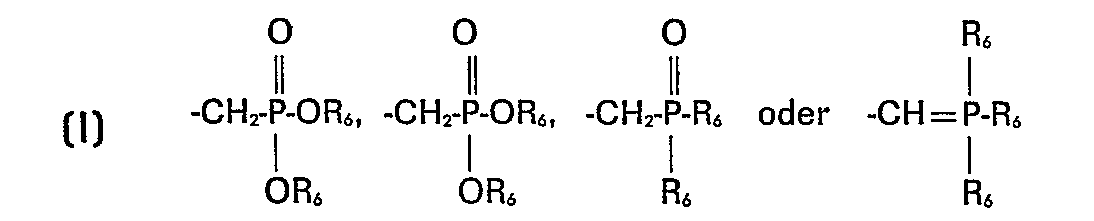
- Z, die Aldehydgruppe oder einen Rest der Formeln
Description
- Die Erfindung betrifft Diphenylderivate der Formel

- R für Wasserstoff, ein salzbildendes Kation, einen Alkylrest mit 1 bis 8 Kohlenstoffatomen oder einen gegebenenfalls durch nicht chromophore Gruppen substituierten Aralkylrest,
- R2 R3 unabhängig voneinander für Wasserstoff, Alkyl, Trifluormethyl, Alkoxy, Aralkoxy, Alkenyloxy, Halogen, die Carboxyl-, Cyan-, Alkylsulfon-, Arylsulfon-, Carbonamid-, Sulfonamid- oder die Carbonsäureestergruppe stehen,
- m 1 oder 2 bedeutet,
- o, p unabhängig voneinander für 0, 1 oder 2 stehen, und
- Z1 die Aldehydgruppe oder einen Rest der Formeln

- Als Substituenten seien beispielsweise genannt:
- C1- bis C5-Alkylreste, die durch Hydroxy, Cyan, Halogen oder Phenyl weiter substituiert sein können, wie Methyl, Ethyl, Cyanethyl, tert. Butyl; Benzyl; Halogenatome, wie Chlor, Brom oder Fluor, vorzugsweise Chlor; C bis C5-Alkoxyreste, wie Methoxy, Ethoxy, Butoxy und Isopropoxy; Allyloxy; Benzyloxy; gegebenenfalls durch Hydroxy substituierte C1 bis C5-Alkylsulfonylreste, wie Methylsulfonyl, Ethylsulfonyl, n-Butylsulfonyl, ß-Hydroxyethylsulfonyl; der Benzylsulfonylrest; der Phenylsulfonylrest; gegebenenfalls durch C1- bis C4-Alkylreste mono- oder disubstituierte Carbonamid- oder Sulfonamidgruppen; sowie Carbonsäure-C1- bis C4-alkyl- estergruppen.
- Als salzbildende Kationen kommen ein- oder zweiwertige Metalle, wie Natrium, Kalium, Lithium, Magnesium, Calcium, Barium, Mangan und Zink in Frage; sowie Ammoniumsalze und deren Substitutionsprodukte, die man durch Umsetzung der zugrunde liegenden Säuren mit Mono-, Di-und Trimethylamin, Mono-, Di- und Triethylamin; Mono-, Di- und Triethanolamin, Methyldiethanolamin, Ethyldiethanolamin, Dimethylethanolamin, Diethylethanolamin, Mono-, Di- und Triisopropanolamin, Methyldiisopropanolamin, Ethyldiisopropanolamin, Dimethylisopropanolamin, n-Butylamin, sek. Butylamin, Dibutylamin, Diisobutylamin, Triethoxyethanolamin, Pyridin, Morpholin oder Piperidin erhält.
- Die erfindungsgemäßen Diphenylderivate dienen als Ausgangsprodukte zur Herstellung von Stilbenverbindungen, die ihrerseits als Weißtöner und Laserfarbstoffe Verwendung finden. Dabei kondensiert man eine Verbindung der Formel (I), in der Z1' die Aldehydgruppe bezeichnet, mit einer Verbindung der Formel (I), in der Z1 einen der angegebenen P-haltigen Reste bezeichnet, in Gegenwart einer stark basischen Alkaliverbindung und in Gegenwart eines vorzugsweise hydrophilen stark polaren Lösungsmittels.
- Geeignete Lösungsmittel sind beispielsweise Toluol; Xylol; Chlorbenzol; Alkohohle, wie Ethanol; Ethylenglykolmonomethylether; vorzugsweise jedoch N-Methylpyrrolidon; Dimethylformamid; Diethylformamid; Dimethylacetamid oder Dimethylsulfoxid.
- Die Temperatur, bei welcher die Umsetzung durchgeführt wird, kann in weiten Grenzen schwanken. Sie wird bestimmt:
- a) durch die Beständigkeit des verwendeten Lösungsmittels gegenüber den Reaktionsteilnehmern, insbe- sondere gegenüber den stark basischen Alkaliverbindungen,
- b) durch die Reaktivität der Kondensationspartner und
- c) durch die Wirksamkeit der Kombination Lösungsmittel/ Base als Kondensationsmittel.
- Vorzugsweise liegt sie etwa im Bereich von 30°C bis 60°C, doch können in vielen Fällen schon befriedigende Resultate bei Raumtemperatur (ca. 20°C) einerseits oder andererseits bei Temperaturen von 100°C, ja.sogar bei der Siedetemperatur des Lösungsmittels erreicht werden, wenn dies aus Gründen der Zeitersparnis oder dadurch erwünscht ist, ein weniger aktives, aber billigeres Kondensationsmittel einzusetzen. Grundsätzlich sind somit auch Reaktionstemperaturen von 10 bis 180°C möglich.
- Als stark basische Alkaliverbindungen kommen vor allem die Hydroxide, Amide und Alkoholate (vorzugsweise solche primärer 1 bis 4 Kohlenstoffatome enthaltender Alkohole) der Alkalimetalle in Betracht, wobei aus ökonomischen Gründen solche des Lithiums, Natriums und Kaliums von vorwiegendem Intersse sind. Es können jedoch grundsätzlich und in besonderen Fällen auch Alkalisulfide und -carbonate, Arylalkaliverbindungen, wie Phenyl-Lithium oder stark basische Amine (einschließlich Ammoniumbasen, z.B. Trialkylammoniumhydroxide) mit Erfolg verwendet werden.
- Die als Ausgangsstoffe benötigten Phosphorverbindungen der Formel I werden in an sich bekannter Weise erhalten, indem man Halogenmethylverbindungen, vorzugsweise Chlormethyl- oder Brommethylverbindungen der Formel

- die Reste R, R2, R3 und die Indizes m, o und p die gleiche Bedeutung wie in Formel I haben und
- Hal für Chlor oder Brom steht,
- mit Phosphorverbindungen der Formeln

- R6 die oben angegebene Bedeutung hat, und wobei an Sauerstoff gebundene Reste R6 vorzugsweise niedrige Alkylgruppen, unmittelbar an Phosphor gebundene Reste R6 dagegen vorzugsweise Arylreste sind,
- Die Halogenmethylverbindungen der Formel II lassen sich aus der entsprechenden Methylverbindung gemäß der in der DE-PS 234 913 beschriebenen Arbeitsweise durch Umsetzung mit Phosphorpentachlorid und Chlor und anschließende Verseifung der Sulfochloride herstellen oder durch Bromierung mit N-Bromsuccinid gemäß den Angaben der DE-OS 2 262 340. Die Brommethylgruppe läßt sich auch durch Umsetzung des entsprechenden Diphenylderivates mit Paraformaldehyd und Natriumbromid in Schwefelsäure-Eisessig-Mischung nach der in der DE-OS 2 262 340 beschriebenen Arbeitsweise einführen. Ein weiterer Weg zur Herstellung der Halogenmethylverbindungen der Formel II besteht in der Reduktion der Biphenylaldehydsulfonsäuren mit Natriumborhydrid zu den Hydroxymethylbiphenylsulfonsäuren, der Überführung in die Halogenmethylbiphenylsulfochloride mit Thionylchlorid oder Phosphorpentachlorid und der anschließenden. Veresterung der Sulfochloride zu den Sulfonsäureestern.
- Geeignete Halogenmethylverbindungen der Formel II sind: 4-Chlormethylbiphenyl-4'-sulfonsäureethylester, 4-Brom- methylbiphenyl-4'-sulfonsäuremethylester, 4-Chlormethyl- biphenyl-3-sulfonsäureethylester, 4-Chlormethylbiphenyl-3,4'-disulfonsäurediethylester, 4-Brommethyl-4'-methylbiphenyl-3,3'-disulfonsäurediethylester, 4-Brommethyl-4'-brombiphenyl, 4-Brommethyl-4'-phenylsulfonyl- biphenyl, 4-Brommethyl-4'-cyanbiphenyl, 4-Brommethyl-3'-methyl-4'-brombiphenyl.
- Die Aldehyde der Formel I (Z1 bzw. Z2 = CHO) lassen sich aus den Halogenmethylverbindungen durch Umsetzung mit Hexamethylentetramin in Essigsäure (Sommelet-Reaktion) herstellen. Man erhält sich auch durch Nachsulfierung von Biphenylaldehyden mit Oleum gemäß der in der DE-OS 2 525 681 beschriebenen Arbeitsweise. Ein weiterer Weg zu den Biphenylaldehydsulfonsäuren besteht in der Umsetzung von halogenierten Biphenylaldehyden mit Natriumsulfit.
- Geeignete Biphenylaldehyde der Formel I sind: Biphenyl-4-aldehyd-4'-sulfonsäure, Biphenyl-4-aldehyd-3-sulfonsäure, Biphenyl-4-aldehyd-3,4'-disulfonsäure, Biphenyl-4-aldehyd, 3,4-Dichlorbiphenyl-4'-aldehyd, 4-Methylbiphenyl-4'-aldehyd-3,3'-disulfonsäure, 3-Chlorbiphenyl-4'-aldehyd-4-sulfonsäure, 4-Brombiphenyl-4'-aldehyd, 4-Cyanbiphenyl-4'-aldehyd, 3-Methyl-4- brombiphenyl-4'-aldehyd.
-

- In einem Reaktionsgefäß werden unter Ausschluß von Feuchtigkeit und Luftsauerstoff 40,0 g Kalium-tert.-butylat (ca. 90%ig) in 300 ml Dimethylformamid (wasserfrei) suspendiert. Bei einer Reaktionstemperatur von 40-50°C wird innerhalb von 1 Std. eine filtrierte Lösung aus 40 g biphenyl-4-aldehyd-4'-sulfonsaurem Kalium (ca. 80%ig) in 1.100 ml Dimethylformamid, die mit einer Lösung aus 68 g 4-Diethoxyphosphonmethylbiphenyl-4'-sulfonsäureethylester in 100 ml Dimethylformamid verrührt wurde, zugetropft. Es wird 2 Stdn. bei 40-50°C gerührt, bis im Dünnschichtchromatogramm keine der Ausgangsverbindungen nachgewiesen werden kann. Unter Zusatz von 300 ml Wasser wird ca. 2 Stdn. bis zur Entfärbung der Reaktionsmischung auf 80-90°C erhitzt. Nach Abkühlen, Absaugen, Waschen mit wenig Wasser und Trocknen im Vakuum bei 80°C wird die Verbindung der oben angegebenen Formel als farbloses kristallines Produkt erhalten. Ausbeute: 56,8 g = 62,5 % der Theorie.
- Zur Überführung in die leichter löslichen Ammoniumsalze erhitzt man das Kaliumsalz mit halbkonzentrierter Ammoniaklösung, mit Triethanolamin oder mit Tris-2-hydroxy- ethoxyethylamin.
- Das als Ausgangsmaterial verwendete biphenyl-4-aldehyd-4'-sulfonsaure Kalium wurde in folgender Weise gewonnen:
- 182 g Biphenyl-4-aldehyd wurden portionsweise in 400 g 20%ig. Oleium so eingetragen, daß die Temperatur langsam von 25°C auf 50°C ansteigt. Die Temperatur.wird 3 Stdn. bei 50°C gehalten und die Reaktionsmischung dann auf. 1.000 g Eis und 30 g Kaliumchlorid ausgetragen. Das biphenyl-4-aldehyd-4'-sulfonsaure Kalium fällt als flockiger Niederschlag aus. Das Rohprodukt wird unter Zusatz von A-Kohle aus Wasser umkristallisiert. Ausbeute; 258,3 g = 85 % der Theorie.
- Der als Ausgangsmaterial verwendete 4-Diethoxyphosphon- methylbiphenyl-4'-sulfonsäureethylester wurde in folgender Weise hergestellt:
- 166 g biphenyl-4-aldehyd-4'-sulfonsaures Kalium (80%ig) werden in 600 ml Wasser suspendiert und mit 100 ml 10%iger Natronlauge versetzt. Unter Stickstoff wird eine Lösung aus 6,2 g Natriumborhydrid in 300 ml Wasser und 30 ml 10%iger Natronlauge portionsweise zugesetzt. Unter starker Wasserstoffentwicklung steigt die Temperatur auf 30°C. Es wird 14 Stdn. bei Raumtemperatur gerührt. Nach vollständiger Reduktion wird vorsichtig mit konz. Salzsäure angesäuert und die Suspension zur Zerstörung des Borkomplexes und zur Bildung der Säure 3 Stdn. auf 80°C erhitzt. Nach Abkühlen saugt man die 4-Hydroxy- methylbiphenyl-4'-sulfonsäure ab, wäscht sie mit wenig Wasser und trocknet sie im Vakuum bei 100°C. Ausbeute: 113 g = 93 % der Theorie.
- 113 g 4-Hydroxymethylbiphenyl-4'-sulfonsäure werden in 800 ml Chlorbenzol suspendiert und zur vollständigen Entfernung von Wasser 250 ml Chlorbenzol abdestilliert. Dann wird auf 80-90°C abgekühlt und nach Zusatz von 3 ml Dimethylformamid und 1 g Phosphorpentachlorid werden innerhalb von 2 Stdn. 150 ml Thionylchlorid zugetropft. Die Temperatur wird 14 Stdn. bei 85-90°C gehalten. Das Lösungsmittel und überschüssiges Thionylchlorid werden im Vakuum fast bis zur Trockne abdestilliert. Der Rückstand wird mit 900 ml Methylcyclohexan heiß extrahiert, wobei Salze und nicht umgesetzte Sulfonsäure als Rückstand verbleiben, während das Sulfochlorid sich aus Methylcyclohexan beim Abkühlen als farblose kristalline Verbindung abscheidet.
- Ausbeute: 100,6 g = 78 % der Theorie,
- Schmelzpunkt: 110-112°C.
- 98 g 4-Chlormethylbiphenyl-4'-sulfonsäurechlorid werden unter Feuchtigkeits- und Sauerstoffausschluß in 400 ml Tetrahydrofuran (wasserfrei) gelöst und mit einem 10%igen Überschuß an Natriumalkoholat, hergestellt aus 8 g Natrium und 1.000 ml absoluten Alkohol, portionsweise versetzt, so daß die Reaktionstemperatur unter Eiskühlung bei 10-15°C gehalten wird. Nach einstündigem Rühren bei Raumtemperatur wird das Lösungsmittelgemisch im V kuum bei 50°C'abgezogen. Der Rückstand wird mit 1.200 ml Di-sek.-butylether (wasserfrei) heiß extrahiert. Nach Abkühlen, Absaugen und Trocknen im Vakuum bei 50°C erhält man 68,5 g 4-Chlormethylbiphenyl-4'-sulfonsäure- ethylester.
- Ausbeute: 68 % der Theorie,
- Schmelzpunkt: 112 - 116°C.
- 48,5 g 4-Chlormethylbipheny-1-4'-sulfonsäureethylester werden unter Feuchtigkeits- und Sauerstoffausschluß in 100 ml wasserfreiem Xylol suspendiert. Innerhalb von 2 Stdn. werden bei 130-140°C beginnend 75 g Triethylphosphit unter gleichzeitiger Abdestillation des entstehenden Ethylchlorids und von Xylol und Triethylphosphit zugetropft, so daß die Innentemperatur langsam auf 165-170°C ansteigt. Die Reaktionsmischung wird 7 Stdn. bei dieser Temperatur gehalten. überschüssiges Triethylphosphit wird bei 160° und 20 mbar abdestilliert. Das als Rückstand verbleibende Rohöl (68 g) wird in 100 ml Dimethylformamid aufgenommen und in dieser Form mit biphenyl-4-aldehyd-4'-sulfonsaurem Kalium umgesetzt.
-

- In ähnlicher Weise wie in den vorstehenden Beispielen beschrieben, können die in der nachfolgenden Tabelle aufgeführten Diphenylstilbensulfonsäuren der Formel


umsetzt.
Claims (3)


Priority Applications (1)
| Application Number | Priority Date | Filing Date | Title |
|---|---|---|---|
| DE7979103409T DE2962573D1 (en) | 1978-09-23 | 1979-09-12 | Fluorescent dyestuffs of the stilbene series, process for their preparation and their use in the whitening of organic materials and as laser dyestuffs |
Applications Claiming Priority (2)
| Application Number | Priority Date | Filing Date | Title |
|---|---|---|---|
| DE19782841519 DE2841519A1 (de) | 1978-09-23 | 1978-09-23 | Fluoreszenzfarbstoffe |
| DE2841519 | 1978-09-23 |
Related Parent Applications (2)
| Application Number | Title | Priority Date | Filing Date |
|---|---|---|---|
| EP79103409.3 Division | 1979-09-12 | ||
| EP79103409A Division EP0009679B1 (de) | 1978-09-23 | 1979-09-12 | Fluoreszenzfarbstoffe der Stilbenreihe, Verfahren zu deren Herstellung und ihre Verwendung zum Weisstönen organischer Materialien sowie als Laserfarbstoffe |
Publications (2)
| Publication Number | Publication Date |
|---|---|
| EP0042181A2 true EP0042181A2 (de) | 1981-12-23 |
| EP0042181A3 EP0042181A3 (de) | 1981-12-30 |
Family
ID=6050279
Family Applications (2)
| Application Number | Title | Priority Date | Filing Date |
|---|---|---|---|
| EP79103409A Expired EP0009679B1 (de) | 1978-09-23 | 1979-09-12 | Fluoreszenzfarbstoffe der Stilbenreihe, Verfahren zu deren Herstellung und ihre Verwendung zum Weisstönen organischer Materialien sowie als Laserfarbstoffe |
| EP81105610A Withdrawn EP0042181A3 (de) | 1978-09-23 | 1979-09-12 | Diphenylderivate |
Family Applications Before (1)
| Application Number | Title | Priority Date | Filing Date |
|---|---|---|---|
| EP79103409A Expired EP0009679B1 (de) | 1978-09-23 | 1979-09-12 | Fluoreszenzfarbstoffe der Stilbenreihe, Verfahren zu deren Herstellung und ihre Verwendung zum Weisstönen organischer Materialien sowie als Laserfarbstoffe |
Country Status (4)
| Country | Link |
|---|---|
| US (1) | US4301091A (de) |
| EP (2) | EP0009679B1 (de) |
| JP (1) | JPS5594961A (de) |
| DE (2) | DE2841519A1 (de) |
Families Citing this family (16)
| Publication number | Priority date | Publication date | Assignee | Title |
|---|---|---|---|---|
| DE3001876A1 (de) * | 1980-01-19 | 1981-07-23 | Bayer Ag, 5090 Leverkusen | Verfahren zur herstellung von styrylsulfonsaeurederivaten |
| DE3003539A1 (de) * | 1980-01-31 | 1981-08-06 | Bayer Ag, 5090 Leverkusen | 4-phenylbenzaldehyd-2-sulfonsaeuren sowie deren herstellung |
| US4366079A (en) * | 1981-02-26 | 1982-12-28 | American Cyanamid Company | Sulfonated rubrene and aqueous chemiluminescent compositions containing the same |
| DE4039825A1 (de) * | 1990-12-13 | 1992-06-17 | Klaus Dipl Chem Dr Franke | Neue inden-verbindungen, insbesondere fluoreszenzfarbstoffe und verfahren zu ihrer herstellung |
| US7063264B2 (en) | 2001-12-24 | 2006-06-20 | Digimarc Corporation | Covert variable information on identification documents and methods of making same |
| AU2002353174A1 (en) | 2001-12-24 | 2003-07-15 | Digimarc Id Systems, Llc | Laser engraving methods and compositions |
| US7207494B2 (en) | 2001-12-24 | 2007-04-24 | Digimarc Corporation | Laser etched security features for identification documents and methods of making same |
| US7694887B2 (en) | 2001-12-24 | 2010-04-13 | L-1 Secure Credentialing, Inc. | Optically variable personalized indicia for identification documents |
| US7728048B2 (en) | 2002-12-20 | 2010-06-01 | L-1 Secure Credentialing, Inc. | Increasing thermal conductivity of host polymer used with laser engraving methods and compositions |
| US7815124B2 (en) | 2002-04-09 | 2010-10-19 | L-1 Secure Credentialing, Inc. | Image processing techniques for printing identification cards and documents |
| ATE555911T1 (de) | 2001-12-24 | 2012-05-15 | L 1 Secure Credentialing Inc | Verfahren zur vollfarb-markierung von id- dokumenten |
| US7824029B2 (en) | 2002-05-10 | 2010-11-02 | L-1 Secure Credentialing, Inc. | Identification card printer-assembler for over the counter card issuing |
| US7804982B2 (en) | 2002-11-26 | 2010-09-28 | L-1 Secure Credentialing, Inc. | Systems and methods for managing and detecting fraud in image databases used with identification documents |
| US7763179B2 (en) | 2003-03-21 | 2010-07-27 | Digimarc Corporation | Color laser engraving and digital watermarking |
| CA2522551C (en) | 2003-04-16 | 2009-12-22 | Digimarc Corporation | Three dimensional data storage |
| JP2007170593A (ja) * | 2005-12-26 | 2007-07-05 | Uchiyama Mfg Corp | ガスケット |
Family Cites Families (5)
| Publication number | Priority date | Publication date | Assignee | Title |
|---|---|---|---|---|
| CH500145A (de) * | 1967-07-14 | 1970-12-15 | Ciba Geigy Ag | Verfahren zur Herstellung aromatischer, Äthylendoppelbindungen enthaltender Verbindungen |
| DE2060228A1 (de) * | 1970-12-08 | 1972-06-15 | Hoechst Ag | Monostyryl-naphthalin-Derivate,Verfahren zu deren Herstellung und ihre Verwendung als optische Aufhellungsmittel |
| US4013713A (en) * | 1971-12-30 | 1977-03-22 | Ciba-Geigy Corporation | Diarylvinyl-dihydrophenanthrene compounds |
| DE2525683A1 (de) * | 1974-06-12 | 1976-01-02 | Ciba Geigy Ag | Sulfogruppenhaltige heterocyclen |
| DE2636424A1 (de) * | 1976-08-13 | 1978-02-16 | Hoechst Ag | Sulfogruppenhaltige beta-naphthyl- derivate, deren herstellung und verwendung als optische aufheller |
-
1978
- 1978-09-23 DE DE19782841519 patent/DE2841519A1/de not_active Withdrawn
-
1979
- 1979-09-10 US US06/073,773 patent/US4301091A/en not_active Expired - Lifetime
- 1979-09-12 EP EP79103409A patent/EP0009679B1/de not_active Expired
- 1979-09-12 EP EP81105610A patent/EP0042181A3/de not_active Withdrawn
- 1979-09-12 DE DE7979103409T patent/DE2962573D1/de not_active Expired
- 1979-09-21 JP JP12091479A patent/JPS5594961A/ja active Pending
Also Published As
| Publication number | Publication date |
|---|---|
| EP0009679A1 (de) | 1980-04-16 |
| DE2962573D1 (en) | 1982-06-03 |
| DE2841519A1 (de) | 1980-04-03 |
| EP0042181A3 (de) | 1981-12-30 |
| JPS5594961A (en) | 1980-07-18 |
| US4301091A (en) | 1981-11-17 |
| EP0009679B1 (de) | 1982-04-21 |
Similar Documents
| Publication | Publication Date | Title |
|---|---|---|
| AT291228B (de) | Verfahren zur Herstellung neuer α,α-Dimethyl-ω-phenoxyalkansäuren, ihrer Salze oder Alkylester | |
| CH554821A (de) | Verfahren zur herstellung von bis-stilbenverbindungen. | |
| CH496678A (de) | Verfahren zur Herstellung von Sulfonsäureestern und deren Verwendung | |
| CH630883A5 (en) | Process for the preparation of phenoxyalkanoic acid derivatives, and their use as herbicides | |
| DE19857765A1 (de) | Verfahren zur Herstellung von para-Oxadiazolyl-phenyl-boronsäuren | |
| EP0123187A2 (de) | Verfahren zur Herstellung von fluorierten Phenylessigsäureestern und neue fluorierte Trichlorethylbenzole | |
| EP0176026A1 (de) | Verfahren zur Herstellung von 2,4-Dichlor-5-fluor-benzoesäure | |
| EP1001929B1 (de) | Verfahren zur herstellung von 3-cyano-2,4-dihalogen-5-fluor-benzoesäuren | |
| DE3820176A1 (de) | Verfahren zur herstellung von phosphorsaeurederivaten und zwischenprodukten | |
| EP0064953B1 (de) | Stilbenverbindungen | |
| CH636332A5 (en) | Process for preparing monoalkylated dihydroxybenzenes | |
| EP0001991B1 (de) | Phosphoniumverbindungen, Verfahren zu deren Herstellung und Verfahren zur Herstellung von unsymmetrisch substituierten Stilbenaufhellern | |
| EP0026737A1 (de) | Verfahren zur Herstellung von 2,3,5,6-Tetrachlorpyridin | |
| US4147881A (en) | Tetrabromoxylylene diacrylates and substituted acrylates | |
| PL87251B1 (de) | ||
| DE3130628A1 (de) | Substituierte 1-phenyl-vinyl-1-phosphonsaeuren und ihre verwendung | |
| EP0022546A2 (de) | Verfahren zur Herstellung von 1-Oxophospholan-chlorhydrinen sowie einige spezielle dieser Verbindungen | |
| DD222315A5 (de) | Verfahren zur herstellung von halogenmethyl-1,1-dioxopenicillan-oyloxymethyl-carbonaten | |
| EP0069066A1 (de) | Resorcinole und deren Herstellung | |
| EP0271695B1 (de) | Verfahren zur Herstellung von Phosphin- oder Phosphonsäurechloriden | |
| EP0032661A1 (de) | Verfahren zur Herstellung von Styrylsulfonsäurederivaten | |
| CH625806A5 (en) | Process for the preparation of pyrophosphorus compounds | |
| EP0021114A1 (de) | Verfahren zur Herstellung von 2-Cyano-3,3-dimethyl-cyclopropan-1-carbonsäureestern, Zwischenprodukte hierfür und deren Herstellung | |
| DD200795A5 (de) | Verfahren zur herstellung von diphenylaether-derivaten | |
| DE2912052A1 (de) | Verfahren zur herstellung von 2eckige klammer auf 4-(thienylcarbonyl)phenyl eckige klammer zu -propionsaeure |
Legal Events
| Date | Code | Title | Description |
|---|---|---|---|
| PUAI | Public reference made under article 153(3) epc to a published international application that has entered the european phase |
Free format text: ORIGINAL CODE: 0009012 |
|
| PUAL | Search report despatched |
Free format text: ORIGINAL CODE: 0009013 |
|
| 17P | Request for examination filed |
Effective date: 19810717 |
|
| AC | Divisional application: reference to earlier application |
Ref document number: 9679 Country of ref document: EP |
|
| AK | Designated contracting states |
Designated state(s): CH DE FR GB |
|
| AK | Designated contracting states |
Designated state(s): CH DE FR GB |
|
| STAA | Information on the status of an ep patent application or granted ep patent |
Free format text: STATUS: THE APPLICATION HAS BEEN WITHDRAWN |
|
| 18W | Application withdrawn |
Withdrawal date: 19830516 |
|
| RIN1 | Information on inventor provided before grant (corrected) |
Inventor name: BRINKWERTH, WOLFGANG, DR. Inventor name: RAUE, RODERICH, DR. Inventor name: TELLE, HELMUT Inventor name: SCHIEDER, RUDOLF, DR. |