EP0176026A1 - Verfahren zur Herstellung von 2,4-Dichlor-5-fluor-benzoesäure - Google Patents
Verfahren zur Herstellung von 2,4-Dichlor-5-fluor-benzoesäure Download PDFInfo
- Publication number
- EP0176026A1 EP0176026A1 EP85111789A EP85111789A EP0176026A1 EP 0176026 A1 EP0176026 A1 EP 0176026A1 EP 85111789 A EP85111789 A EP 85111789A EP 85111789 A EP85111789 A EP 85111789A EP 0176026 A1 EP0176026 A1 EP 0176026A1
- Authority
- EP
- European Patent Office
- Prior art keywords
- dichloro
- fluoro
- formula
- preparation
- temperatures
- Prior art date
- Legal status (The legal status is an assumption and is not a legal conclusion. Google has not performed a legal analysis and makes no representation as to the accuracy of the status listed.)
- Granted
Links
- KZCWJHUTTSVCRO-UHFFFAOYSA-N 2,4-dichloro-5-fluorobenzoic acid Chemical compound OC(=O)C1=CC(F)=C(Cl)C=C1Cl KZCWJHUTTSVCRO-UHFFFAOYSA-N 0.000 title claims abstract description 10
- 238000002360 preparation method Methods 0.000 title claims abstract description 6
- 238000000034 method Methods 0.000 title claims description 18
- BDJZCCWUSOZUQG-UHFFFAOYSA-N 2,4-dichloro-1-fluorobenzene Chemical compound FC1=CC=C(Cl)C=C1Cl BDJZCCWUSOZUQG-UHFFFAOYSA-N 0.000 claims abstract description 10
- 230000010933 acylation Effects 0.000 claims abstract description 10
- 238000005917 acylation reaction Methods 0.000 claims abstract description 10
- WETWJCDKMRHUPV-UHFFFAOYSA-N acetyl chloride Chemical compound CC(Cl)=O WETWJCDKMRHUPV-UHFFFAOYSA-N 0.000 claims abstract description 7
- 239000012346 acetyl chloride Substances 0.000 claims abstract description 7
- 239000005708 Sodium hypochlorite Substances 0.000 claims abstract description 6
- 239000003054 catalyst Substances 0.000 claims abstract description 6
- 239000003085 diluting agent Substances 0.000 claims abstract description 6
- SUKJFIGYRHOWBL-UHFFFAOYSA-N sodium hypochlorite Chemical compound [Na+].Cl[O-] SUKJFIGYRHOWBL-UHFFFAOYSA-N 0.000 claims abstract description 6
- FAKJFAMIABOKBW-UHFFFAOYSA-N 1-(2,4-dichloro-5-fluorophenyl)ethanone Chemical compound CC(=O)C1=CC(F)=C(Cl)C=C1Cl FAKJFAMIABOKBW-UHFFFAOYSA-N 0.000 claims abstract description 5
- 239000007795 chemical reaction product Substances 0.000 claims abstract description 5
- 150000001875 compounds Chemical class 0.000 claims abstract description 4
- 238000002955 isolation Methods 0.000 claims abstract description 4
- VSCWAEJMTAWNJL-UHFFFAOYSA-K aluminium trichloride Chemical compound Cl[Al](Cl)Cl VSCWAEJMTAWNJL-UHFFFAOYSA-K 0.000 claims description 12
- ZAMOUSCENKQFHK-UHFFFAOYSA-N Chlorine atom Chemical compound [Cl] ZAMOUSCENKQFHK-UHFFFAOYSA-N 0.000 claims description 11
- 239000000460 chlorine Substances 0.000 claims description 11
- 229910052801 chlorine Inorganic materials 0.000 claims description 11
- 238000006243 chemical reaction Methods 0.000 claims description 6
- CDBYLPFSWZWCQE-UHFFFAOYSA-L Sodium Carbonate Chemical class [Na+].[Na+].[O-]C([O-])=O CDBYLPFSWZWCQE-UHFFFAOYSA-L 0.000 abstract 1
- 238000007796 conventional method Methods 0.000 abstract 1
- WFDIJRYMOXRFFG-UHFFFAOYSA-N Acetic anhydride Chemical compound CC(=O)OC(C)=O WFDIJRYMOXRFFG-UHFFFAOYSA-N 0.000 description 6
- YMWUJEATGCHHMB-UHFFFAOYSA-N Dichloromethane Chemical compound ClCCl YMWUJEATGCHHMB-UHFFFAOYSA-N 0.000 description 6
- HEDRZPFGACZZDS-UHFFFAOYSA-N Chloroform Chemical compound ClC(Cl)Cl HEDRZPFGACZZDS-UHFFFAOYSA-N 0.000 description 4
- VEXZGXHMUGYJMC-UHFFFAOYSA-N Hydrochloric acid Chemical compound Cl VEXZGXHMUGYJMC-UHFFFAOYSA-N 0.000 description 4
- 239000000203 mixture Substances 0.000 description 4
- 0 *C=C(*)*C(CC(C(C1)Cl)F)[C@@]1Cl Chemical compound *C=C(*)*C(CC(C(C1)Cl)F)[C@@]1Cl 0.000 description 3
- 239000002253 acid Substances 0.000 description 3
- NDBIFEJDDYXFGA-UHFFFAOYSA-N 3,5-dichloro-2-fluoro-5-(trichloromethyl)cyclohexa-1,3-diene Chemical compound ClC1(CC=C(C(=C1)Cl)F)C(Cl)(Cl)Cl NDBIFEJDDYXFGA-UHFFFAOYSA-N 0.000 description 2
- -1 aliphatic carboxylic acid halides Chemical class 0.000 description 2
- 239000003242 anti bacterial agent Substances 0.000 description 2
- 229910052736 halogen Inorganic materials 0.000 description 2
- 150000002367 halogens Chemical class 0.000 description 2
- RBTARNINKXHZNM-UHFFFAOYSA-K iron trichloride Chemical compound Cl[Fe](Cl)Cl RBTARNINKXHZNM-UHFFFAOYSA-K 0.000 description 2
- 238000004519 manufacturing process Methods 0.000 description 2
- 238000007127 saponification reaction Methods 0.000 description 2
- XLYOFNOQVPJJNP-UHFFFAOYSA-N water Substances O XLYOFNOQVPJJNP-UHFFFAOYSA-N 0.000 description 2
- JIAARYAFYJHUJI-UHFFFAOYSA-L zinc dichloride Chemical compound [Cl-].[Cl-].[Zn+2] JIAARYAFYJHUJI-UHFFFAOYSA-L 0.000 description 2
- ODIGIKRIUKFKHP-UHFFFAOYSA-N (n-propan-2-yloxycarbonylanilino) acetate Chemical compound CC(C)OC(=O)N(OC(C)=O)C1=CC=CC=C1 ODIGIKRIUKFKHP-UHFFFAOYSA-N 0.000 description 1
- DGVXHRCJCNUDLA-QXUHLLMWSA-N C=C(C(C[C@H]1Cl)C2C=C1F)C=C(C(O)=O)C2=O Chemical compound C=C(C(C[C@H]1Cl)C2C=C1F)C=C(C(O)=O)C2=O DGVXHRCJCNUDLA-QXUHLLMWSA-N 0.000 description 1
- 229910021578 Iron(III) chloride Inorganic materials 0.000 description 1
- DWAQJAXMDSEUJJ-UHFFFAOYSA-M Sodium bisulfite Chemical compound [Na+].OS([O-])=O DWAQJAXMDSEUJJ-UHFFFAOYSA-M 0.000 description 1
- 150000007513 acids Chemical class 0.000 description 1
- 230000000844 anti-bacterial effect Effects 0.000 description 1
- UHOVQNZJYSORNB-UHFFFAOYSA-N benzene Substances C1=CC=CC=C1 UHOVQNZJYSORNB-UHFFFAOYSA-N 0.000 description 1
- 230000015572 biosynthetic process Effects 0.000 description 1
- 150000001244 carboxylic acid anhydrides Chemical class 0.000 description 1
- 150000001732 carboxylic acid derivatives Chemical class 0.000 description 1
- 238000010438 heat treatment Methods 0.000 description 1
- 229910052500 inorganic mineral Inorganic materials 0.000 description 1
- 239000013067 intermediate product Substances 0.000 description 1
- 238000002844 melting Methods 0.000 description 1
- 230000008018 melting Effects 0.000 description 1
- 239000011707 mineral Substances 0.000 description 1
- 235000010755 mineral Nutrition 0.000 description 1
- 239000007800 oxidant agent Substances 0.000 description 1
- 230000003647 oxidation Effects 0.000 description 1
- 238000007254 oxidation reaction Methods 0.000 description 1
- 230000001766 physiological effect Effects 0.000 description 1
- 239000000843 powder Substances 0.000 description 1
- 239000000047 product Substances 0.000 description 1
- 239000011541 reaction mixture Substances 0.000 description 1
- 238000010992 reflux Methods 0.000 description 1
- 229940079827 sodium hydrogen sulfite Drugs 0.000 description 1
- 235000010267 sodium hydrogen sulphite Nutrition 0.000 description 1
- 239000002904 solvent Substances 0.000 description 1
- 239000007858 starting material Substances 0.000 description 1
- 238000003786 synthesis reaction Methods 0.000 description 1
- AYNNSCRYTDRFCP-UHFFFAOYSA-N triazene Chemical compound NN=N AYNNSCRYTDRFCP-UHFFFAOYSA-N 0.000 description 1
- 239000011592 zinc chloride Substances 0.000 description 1
- 235000005074 zinc chloride Nutrition 0.000 description 1
Classifications
-
- C—CHEMISTRY; METALLURGY
- C07—ORGANIC CHEMISTRY
- C07C—ACYCLIC OR CARBOCYCLIC COMPOUNDS
- C07C63/00—Compounds having carboxyl groups bound to a carbon atoms of six-membered aromatic rings
-
- C—CHEMISTRY; METALLURGY
- C07—ORGANIC CHEMISTRY
- C07C—ACYCLIC OR CARBOCYCLIC COMPOUNDS
- C07C45/00—Preparation of compounds having >C = O groups bound only to carbon or hydrogen atoms; Preparation of chelates of such compounds
- C07C45/45—Preparation of compounds having >C = O groups bound only to carbon or hydrogen atoms; Preparation of chelates of such compounds by condensation
- C07C45/46—Friedel-Crafts reactions
-
- C—CHEMISTRY; METALLURGY
- C07—ORGANIC CHEMISTRY
- C07C—ACYCLIC OR CARBOCYCLIC COMPOUNDS
- C07C51/00—Preparation of carboxylic acids or their salts, halides or anhydrides
- C07C51/16—Preparation of carboxylic acids or their salts, halides or anhydrides by oxidation
- C07C51/29—Preparation of carboxylic acids or their salts, halides or anhydrides by oxidation with halogen-containing compounds which may be formed in situ
Definitions
- the present invention relates to a new process for the preparation of 2,4-dichloro-5-fluoro-benzoic acid, an intermediate for the preparation of antibacterial agents.
- trihalobenzoic acids can be prepared by saponification of trihalogen-trihalogenmeth y l-benzene.
- 2,4-dichloro-5-fluorobenzoic acid is formed in the saponification of 2,4-dichloro-5-fluoro-trichloromethylbenzene (EP-OS 78 362).
- the process according to the invention can be used to acylate 2,4-dichlorofluorobenzene with a carboxylic acid chloride in the meta position perform more electronegative halogen in high yield and selectivity.
- This is all the more surprising since, according to the prior art, the acylation in the ortho or para position of the more electronegative halogen should have been expected in the acylation of halogenobenzenes (cf. Methods of Organic Chemistry (Houben-Weyl-Müller) Volume 7 / 2a 43 (1973), Thieme-Verlag, Stuttgart).
- 2,4-dichlorofluorobenzene and acetyl chloride are used as starting materials, aluminum chloride as catalyst and chlorine liquor, the course of the reaction can be represented by the following formula: 2,4-dichlorofluorobenzene is a well-known compound in organic chemistry.
- the reaction temperature can be varied within a wide range.
- acylation is generally carried out at temperatures between 10 ° C. and 150 ° C., preferably between 20 ° C. and 130 ° C., in particular between 80 ° C. and 130 ° C.
- the subsequent oxidation with the so-called chlorine liquor is generally carried out at temperatures between 0 ° C. and 140 ° C., preferably between 20 ° C. and 120 ° C.
- the reaction is generally carried out at normal pressure.
- the process according to the invention is preferably carried out without a diluent.
- Acylation catalysts such as e.g. Iron (III) chloride, zinc chloride or aluminum chloride, preferably aluminum chloride.
- chlorine lye a sodium hypochlorite solution in water
- oxidizing agent for the process according to the invention.
- the 2,4-dichloro-5-fluoro-benzoic acid which is easily accessible by the process according to the invention can be used, for example, for the synthesis of antibacterial agents.
- the substituted oxoquinoline carboxylic acids, compounds with high bactericidal potency can be prepared from this acid, for example according to the following equations (see, for example, EP-OS 78 362):
- a mixture of 33 g (0.2 mol) of 2,4-dichlorofluorobenzene and 66.8 g (0.5 mol) of aluminum chloride is mixed at 23.6 g (0.3 mol) at 20 ° C. to 40 ° C.
- Acetyl chloride was added and the mixture was then stirred at 120 ° C. for 2 hours.
- the still hot mixture is poured onto 250 g of ice and the oil which separates is taken up in methylene chloride.
- the solvent is evaporated off and 450 ml of chlorine solution (150 g of active chlorine / l) are added to the residue and the mixture is stirred for 1 hour without heating and then boiled under reflux for 2 hours.
- 300 ml of water are added, 10 ml of 40% sodium hydrogen sulfite solution are added and then concentrated hydrochloric acid until a pH of 1 is reached.
Landscapes
- Chemical & Material Sciences (AREA)
- Organic Chemistry (AREA)
- Engineering & Computer Science (AREA)
- Oil, Petroleum & Natural Gas (AREA)
- Chemical Kinetics & Catalysis (AREA)
- Organic Low-Molecular-Weight Compounds And Preparation Thereof (AREA)
Abstract

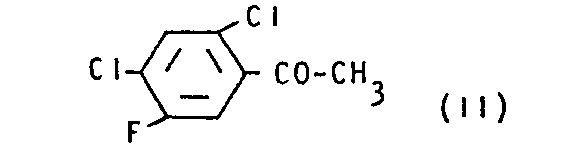
welches dadurch gekennzeichnet ist, daß man 2,4-Dichlorfluorbenzol mit Acetylchlorid, in Gegenwart von Acylierungskatalysatoren und gegebenenfalls in Gegenwart von Verdünnungsmitteln, bei Temperaturen zwischen 10°C und 150°C umsetzt und das auf diese Weise entstandene Reaktionsprodukt 2,4-Dichlor-5-fluor-acetophenon der Formel (II)
gegebenenfalls nach Isolierung, mit einer Natriumhypochloritlösung (in Form der sogenannten Chlorlauge), bei einer Temperatur zwischen 0°C und 140°C umsetzt.
Description
- Die vorliegende Erfindung betrifft ein neues Verfahren zur Herstellung von 2,4-Dichlor-5-fluor-benzoesäure, einem Zwischenprodukt für die Herstellung von antibakteriellen Mitteln.
- Es ist bereits bekannt, daß Trihalogenbenzoesäuren durch Verseifung von Trihalogen-trihalogenmethyl-benzol hergestellt werden können. So wird bei der Verseifung von 2,4-Dichlor-5-fluor-trichlormethylbenzol, 2,4-Dichlor-5-fluorbenzoesäure gebildet (EP-OS 78 362).
- Weiterhin ist bekannt, daß die Acylierung mit aliphatischen Carbonsäurehalogeniden bei Dihalogenbenzolen sehr schwierig ist und bei Trihalogenbenzolen nicht stattfinden soll (vgl. Methoden der organischen Chemie (Houben-Weyl-Müller) Band 7/2a, 43 (1973), Thieme-Verlag, Stuttgart).
- Außerdem ist bekannt, daß bei der Acylierung mit Carbonsäureanhydriden, wie z.B. Essigsäureanhydrid, aus 2,4-Dichlorfluorbenzol, in Gegenwart von Aluminiumtrichlorid, in schlechter Ausbeute 2,4-Dichlor-5-fluor-acetophenon erhalten wird (vgl. CA 58, 11243 g).
- Überraschenderweise wurde nun gefunden, daß man 2,4-Dichlor-5-fluorbenzoesäure der Formel (I)

in sehr guter Ausbeute und hoher Reinheit erhält, wenn man 2,4-Dichlor-fluorbenzol mit Acetylchlorid, in Gegenwart von Acylierungskatalysatoren und gegebenenfalls in Gegenwart von Verdünnungsmitteln, bei Temperaturen zwischen 10°C und 150°C umsetzt und das auf diese Weise entstandene Reaktionsprodukt 2,4-Dichlor-5-fluor- acetophenon der Formel (II) -

- Überraschenderweise gelingt es, mit Hilfe des erfindungsgemäßen Verfahrens eine Acylierung von 2,4-Dichlorfluorbenzol mit einem Carbonsäurechlorid in meta-Stellung zum elektronegativeren Halogen in hoher Ausbeute und Selektivität durchzuführen. Dies ist umso überraschender, als nach dem Stand der Technik bei der Acylierung von Halogenbenzolen die Acylierung in ortho- oder para-Stellung vom elektronegativeren Halogen hätte erwartet werden müssen (vergl. Methoden der organischen Chemie (Houben-Weyl-Müller) Band 7/2a 43 (1973), Thieme-Verlag, Stuttgart).
- Die oben genannten bekannten Verfahren besitzen eine Reihe von Nachteilen. So wird bei der Herstellung von 2,4-Dichlor-5-fluor-trichlormethylbenzol als Zwischenprodukt ein Triazen hergestellt, das sich wegen seiner ungünstigen physiologischen Eigenschaften nur schwierig handhaben läßt.
- Weiterhin sind nach diesem Verfahren für die Herstellung von 2,4-Dichlor-5-fluor-benzoesäure mehrere Stufen erforderlich.
- Bei der in der Literatur beschriebenen Acylierung von 2,4-Dichlor-5-fluorbenzol in Gegenwart von Essigsäureanhydrid ist die Ausbeute an Reaktionsprodukt sehr gering.
- Verwendet man 2,4-Dichlor-fluorbenzol und Acetylchlorid als Ausgangsstoffe, Aluminiumchlorid als Katalysator und Chlorlauge, so kann der Reaktionsverlauf durch das folgende Formelschema wiedergegeben werden:

2,4-Dichlor-fluorbenzol ist eine bekannte Verbindung der organischen Chemie. - Die Reaktionstemperatur kann in einem größeren Bereich variiert werden. So arbeitet man bei der Acylierung im allgemeinen bei Temperaturen zwischen 10°C und 150°C, vorzugsweise zwischen 20°C und 130°C, insbesondere zwischen 80°C und 130°C. Die anschließende Oxidation mit der sogenannten Chlorlauge wird im allgemeinen bei Temperaturen zwischen 0°C und 140°C, vorzugsweise zwischen 20°C und 120°C durchgeführt. Die Reaktion wird im allgemeinen bei Normaldruck durchgeführt.
- Das erfindungsgemäße Verfahren wird vorzugsweise ohne Verdünnungsmittel durchgeführt.
- Als Katalysator kommen für das erfindungsgemäße Verfahren Acylierungskatalysatoren in Frage wie z.B. Eisen-(III)-chlorid, Zinkchlorid oder Aluminiumchlorid, vorzugsweise Aluminiumchlorid.
- Als Oxidationsmittel kommt für das erfindungsgemäße Verfahren die sogenannte Chlorlauge, eine Natriumhypochloritlösung in Wasser in Betracht.
- Bei der Durchführung des erfindungsgemäßen Verfahrens setzt man im allgemeinen auf 1 Mol 2,4-Dichlor-fluorbenzol, 1 bis 3 Mol Acetylchlorid und 1 bis.3 Mol Aluminiumchlorid ein. Nach beendeter Reaktion wird das Reaktionsgemisch auf Eis gegeben und in einem mit Wasser nicht mischbaren Verdünnungsmittel, wie z.B. Methylenchlorid oder Chloroform, aufgenommen. Das Reaktionsprodukt kann aber auch ohne Verwendung von Verdünnungsmitteln abgetrennt werden. Gegebenenfalls nach Entfernen des Extraktionsmittel wird der Rückstand in Gegenwart von 2 bis 4 1, vorzugsweise 2,1 bis 3,3 1 Chlorlauge (150 g aktives Chlor/l) pro Mol Ausgangsprodukt oxidiert. Anschließend wird die 2,4-Dichlor-5-fluor-benzolsäure mit einer Mineralsäure, wie z.B. Salzsäure, ausgefällt und dann abgesaugt.
- Die nach dem erfindungsgemäßen Verfahren leicht zugängliche 2,4-Dichlor-5-fluor-benzoesäure läßt sich beispielsweise zur Synthese von antibakteriellen Mitteln einsetzen. So lassen sich aus dieser Säure z.B. gemäß folgenden Gleichungen, die substituierten Oxochinolincarbonsäuren, Verbindungen mit hoher bakteriziden Potenz, herstellen (vgl. z.B. EP-OS 78 362):


-

- Man erhält auf diese Weise 33,5 g (80 % der Theorie) 2,4-Dichlor-5-fluor-benzoesäure als farbloses Pulver vom Schmelzpunkt 139°C.
Claims (3)

dadurch gekennzeichnet, daß man 2,4-Dichlor-fluorbenzol mit Acetylchlorid, in Gegenwart von Acylierungskatalysatoren und gegebenenfalls in Gegenwart von Verdünnungsmitteln, bei Temperaturen zwischen 10°C und 150°C umsetzt und das auf diese Weise entstandene Reaktionsprodukt 2,4-Dichlor-5-fluor-acetophenon der Formel (II)

gegebenenfalls nach Isolierung, mit einer Natriumhypochloritlösung (in Form der sogenannten Chlorlauge), bei einer Temperatur zwischen 0°C und 140°C umsetzt und die Verbindung der Formel (I) nach üblichen Methoden isoliert.
Applications Claiming Priority (2)
| Application Number | Priority Date | Filing Date | Title |
|---|---|---|---|
| DE19843435392 DE3435392A1 (de) | 1984-09-27 | 1984-09-27 | Verfahren zur herstellung von 2,4-dichlor-5-fluor-benzoesaeure |
| DE3435392 | 1984-09-27 |
Publications (2)
| Publication Number | Publication Date |
|---|---|
| EP0176026A1 true EP0176026A1 (de) | 1986-04-02 |
| EP0176026B1 EP0176026B1 (de) | 1987-11-25 |
Family
ID=6246450
Family Applications (1)
| Application Number | Title | Priority Date | Filing Date |
|---|---|---|---|
| EP85111789A Expired EP0176026B1 (de) | 1984-09-27 | 1985-09-18 | Verfahren zur Herstellung von 2,4-Dichlor-5-fluor-benzoesäure |
Country Status (21)
| Country | Link |
|---|---|
| EP (1) | EP0176026B1 (de) |
| JP (1) | JPH0647568B2 (de) |
| KR (1) | KR910008936B1 (de) |
| AU (1) | AU569176B2 (de) |
| CA (1) | CA1255330A (de) |
| DD (1) | DD239591A5 (de) |
| DE (2) | DE3435392A1 (de) |
| DK (1) | DK166411B1 (de) |
| ES (1) | ES8605462A1 (de) |
| FI (1) | FI86413C (de) |
| GR (1) | GR852346B (de) |
| HU (1) | HU193345B (de) |
| IE (1) | IE72493B1 (de) |
| IL (1) | IL76466A (de) |
| NO (1) | NO159080C (de) |
| NZ (1) | NZ213599A (de) |
| PH (1) | PH24252A (de) |
| PT (1) | PT81144B (de) |
| SU (1) | SU1470175A3 (de) |
| UA (1) | UA8020A1 (de) |
| ZA (1) | ZA857432B (de) |
Cited By (4)
| Publication number | Priority date | Publication date | Assignee | Title |
|---|---|---|---|---|
| EP0272501A1 (de) * | 1986-12-02 | 1988-06-29 | Hoechst Aktiengesellschaft | Verfahren zur Herstellung von 4-(2'Chlorethyl) benzoesäure |
| WO1990012780A1 (en) * | 1989-04-14 | 1990-11-01 | Mallinckrodt, Inc. | Intermediates for the production of 2,4,5-trifluorbenzoyl fluoride |
| EP0411252A1 (de) * | 1989-07-28 | 1991-02-06 | Riedel-De Haen Aktiengesellschaft | Verfahren zur Herstellung von fluorierten Benzoesäuren |
| EP0805140A1 (de) * | 1996-05-02 | 1997-11-05 | Hoechst Aktiengesellschaft | Verfahren zur Herstellung von 4,5-Dichlor-2-methylbenzoesäure |
Families Citing this family (5)
| Publication number | Priority date | Publication date | Assignee | Title |
|---|---|---|---|---|
| US4791225A (en) * | 1986-01-20 | 1988-12-13 | Kyorin Pharmaceutical Co., Ltd. | Halogenobenzoic acid derivatives and their preparation |
| DE3840371A1 (de) * | 1988-11-30 | 1990-05-31 | Lentia Gmbh | Verfahren zur herstellung von 2,4,5-trifluorbenzoesaeure |
| GB9107684D0 (en) * | 1991-04-11 | 1991-05-29 | Berge Richard | Panel system |
| DE19733243A1 (de) | 1997-08-01 | 1999-02-04 | Bayer Ag | Verfahren zur Herstellung von 3-Cyano-2,4-dihalogen-5-fluor-benzoesäure |
| RU2155185C1 (ru) * | 1999-03-24 | 2000-08-27 | Новосибирский институт органической химии им. Н.Н. Ворожцова СО РАН | Способ получения частично фторированных бензойных кислот |
Citations (2)
| Publication number | Priority date | Publication date | Assignee | Title |
|---|---|---|---|---|
| DE2412855A1 (de) * | 1974-03-18 | 1975-10-02 | Basf Ag | Verfahren zur herstellung von carbonsaeuren |
| EP0048375A1 (de) * | 1980-09-19 | 1982-03-31 | Bayer Ag | Verfahren zur Herstellung von 3-Brom-4-fluor-benzoesäure |
Family Cites Families (2)
| Publication number | Priority date | Publication date | Assignee | Title |
|---|---|---|---|---|
| DE3248506A1 (de) * | 1982-12-29 | 1984-07-05 | Bayer Ag, 5090 Leverkusen | 1-cyclopropyl-6-fluor-1,4-dihydro-4-oxo-7(alkyl-1-piperazinyl)-3-chinolincarbonsaeuren, verfahren zu ihrer herstellung sowie diese enthaltende antibakterielle mittel |
| DE3248505A1 (de) * | 1982-12-29 | 1984-07-05 | Bayer Ag, 5090 Leverkusen | 1-cyclopropyl-6-fluor-1,4-dihydro-4-oxo-7(4- (oxoalkyl)-1-piperazinyl/-3-chinolincarbonsaeuren und ihre derivate, verfahren zu ihrer herstellung sowie diese enthaltende antibakterielle mittel |
-
1984
- 1984-09-27 DE DE19843435392 patent/DE3435392A1/de not_active Withdrawn
-
1985
- 1985-09-11 UA UA3950798A patent/UA8020A1/uk unknown
- 1985-09-11 SU SU853950798A patent/SU1470175A3/ru active
- 1985-09-13 NO NO853605A patent/NO159080C/no not_active IP Right Cessation
- 1985-09-17 PT PT81144A patent/PT81144B/pt not_active IP Right Cessation
- 1985-09-18 DE DE8585111789T patent/DE3561054D1/de not_active Expired
- 1985-09-18 EP EP85111789A patent/EP0176026B1/de not_active Expired
- 1985-09-23 IL IL76466A patent/IL76466A/xx not_active IP Right Cessation
- 1985-09-24 NZ NZ213599A patent/NZ213599A/en unknown
- 1985-09-24 KR KR1019850006988A patent/KR910008936B1/ko not_active Expired
- 1985-09-24 JP JP60209034A patent/JPH0647568B2/ja not_active Expired - Lifetime
- 1985-09-25 AU AU47924/85A patent/AU569176B2/en not_active Ceased
- 1985-09-25 FI FI853686A patent/FI86413C/fi not_active IP Right Cessation
- 1985-09-25 CA CA000491506A patent/CA1255330A/en not_active Expired
- 1985-09-26 DK DK436685A patent/DK166411B1/da not_active IP Right Cessation
- 1985-09-26 PH PH32852A patent/PH24252A/en unknown
- 1985-09-26 GR GR852346A patent/GR852346B/el unknown
- 1985-09-26 HU HU853691A patent/HU193345B/hu not_active IP Right Cessation
- 1985-09-26 ZA ZA857432A patent/ZA857432B/xx unknown
- 1985-09-26 DD DD85281050A patent/DD239591A5/de not_active IP Right Cessation
- 1985-09-26 IE IE238085A patent/IE72493B1/en not_active IP Right Cessation
- 1985-09-26 ES ES547345A patent/ES8605462A1/es not_active Expired
Patent Citations (2)
| Publication number | Priority date | Publication date | Assignee | Title |
|---|---|---|---|---|
| DE2412855A1 (de) * | 1974-03-18 | 1975-10-02 | Basf Ag | Verfahren zur herstellung von carbonsaeuren |
| EP0048375A1 (de) * | 1980-09-19 | 1982-03-31 | Bayer Ag | Verfahren zur Herstellung von 3-Brom-4-fluor-benzoesäure |
Non-Patent Citations (1)
| Title |
|---|
| INTERSCIENCE PUBLISHERS, New York-London-Sydney, III Acylation and Related Reactions, Part 1 G.A. OLAH "Friedel-Crafts and related reactions" Seite 166 * |
Cited By (5)
| Publication number | Priority date | Publication date | Assignee | Title |
|---|---|---|---|---|
| EP0272501A1 (de) * | 1986-12-02 | 1988-06-29 | Hoechst Aktiengesellschaft | Verfahren zur Herstellung von 4-(2'Chlorethyl) benzoesäure |
| WO1990012780A1 (en) * | 1989-04-14 | 1990-11-01 | Mallinckrodt, Inc. | Intermediates for the production of 2,4,5-trifluorbenzoyl fluoride |
| EP0411252A1 (de) * | 1989-07-28 | 1991-02-06 | Riedel-De Haen Aktiengesellschaft | Verfahren zur Herstellung von fluorierten Benzoesäuren |
| EP0805140A1 (de) * | 1996-05-02 | 1997-11-05 | Hoechst Aktiengesellschaft | Verfahren zur Herstellung von 4,5-Dichlor-2-methylbenzoesäure |
| US5886218A (en) * | 1996-05-02 | 1999-03-23 | Hoechst Aktiengesellschaft | Process for preparing 4, 5-dichloro-2-methylbenzoic acid |
Also Published As
Similar Documents
| Publication | Publication Date | Title |
|---|---|---|
| EP0176026B1 (de) | Verfahren zur Herstellung von 2,4-Dichlor-5-fluor-benzoesäure | |
| EP0034741B1 (de) | Verfahren zur Herstellung eines substituierten Bromfluorbenzols und 3-Brom-4-fluorbenzonitril | |
| DE3038636C2 (de) | ||
| EP0048373B1 (de) | Verfahren zur Herstellung von Pyrazol | |
| EP0053247B1 (de) | Verfahren zur Herstellung von 6-Fluor-anthranilsäurenitril oder 6-Fluor-anthranilsäure und 6-Fluor-anthranilsäurenitril | |
| EP0048375B1 (de) | Verfahren zur Herstellung von 3-Brom-4-fluor-benzoesäure | |
| EP0015503B1 (de) | Verfahren zur Herstellung von Diazinon | |
| DE2112778C3 (de) | Verfahren zur Herstellung von 2-Cyan-3,4r5>6-tetrachlor- bzw. brombenzoesäurealkylestern | |
| DE3104388A1 (de) | Verfahren zur herstellung von 1-alkyl-2-chlor-5-nitro-4-benzol-sulfonsaeuren | |
| EP0081459B1 (de) | Verfahren zur Herstellung von N-Phosphonomethylglycin | |
| EP0157225B1 (de) | Verfahren zur Herstellung von Benzimidazolyl,-Benzoxazolyl- und Benzthiazolyloxyphenoxypropionsäurederivaten | |
| WO1991006524A1 (de) | Verfahren zur herstellung von 1,4-bis-(4-hydroxybenzoyl)-benzol | |
| DD200795A5 (de) | Verfahren zur herstellung von diphenylaether-derivaten | |
| EP0423595B1 (de) | Verfahren zur Herstellung von 3-Trichlormethyl-pyridin | |
| DE2535337C2 (de) | Verfahren zur Herstellung von 1-Amino-naphthalin-7-sulfonsäure | |
| DE3813452A1 (de) | Verfahren zur herstellung von trifluormethylbenzoesaeure aus hexafluorxylol | |
| DE2065698A1 (de) | Verfahren zur herstellung von 2isopropyl-6-methyl-4(3h)-pyrimidon | |
| DE174496C (de) | ||
| AT326638B (de) | Verfahren zur herstellung von n(beta-diäthylaminoäthyl) -4-amino-5-chlor-2-methoxybenzamid | |
| DE2316292C3 (de) | Verfahren zur Herstellung von weitgehend reinem 3-Isopropyl-2,13benzothiadiazin-4-on-2,2-dioxid oder seinen Salzen | |
| DE3242433C2 (de) | ||
| DE1620495C (de) | Verfahren zur Herstellung des iso mernfreien Bis (4 hydroxyphenyl) (chinolyl 2) methans und seiner Salze mit Sauren | |
| DE19832146B4 (de) | Verfahren zur Herstellung von 3-Methylpyrazol bzw. dessen Salze | |
| DE69227890T2 (de) | Verfahren zur herstellung von 5-amino-3-methylpyrazol | |
| EP0206293A2 (de) | Verfahren zur Herstellung von 3,5-Dichlor-2-pyridon |
Legal Events
| Date | Code | Title | Description |
|---|---|---|---|
| PUAI | Public reference made under article 153(3) epc to a published international application that has entered the european phase |
Free format text: ORIGINAL CODE: 0009012 |
|
| 17P | Request for examination filed |
Effective date: 19850918 |
|
| AK | Designated contracting states |
Kind code of ref document: A1 Designated state(s): BE CH DE FR GB IT LI NL |
|
| 17Q | First examination report despatched |
Effective date: 19870109 |
|
| GRAA | (expected) grant |
Free format text: ORIGINAL CODE: 0009210 |
|
| AK | Designated contracting states |
Kind code of ref document: B1 Designated state(s): BE CH DE FR GB IT LI NL |
|
| ITF | It: translation for a ep patent filed | ||
| GBT | Gb: translation of ep patent filed (gb section 77(6)(a)/1977) | ||
| REF | Corresponds to: |
Ref document number: 3561054 Country of ref document: DE Date of ref document: 19880107 |
|
| EN | Fr: translation not filed | ||
| PLBE | No opposition filed within time limit |
Free format text: ORIGINAL CODE: 0009261 |
|
| STAA | Information on the status of an ep patent application or granted ep patent |
Free format text: STATUS: NO OPPOSITION FILED WITHIN TIME LIMIT |
|
| ET | Fr: translation filed |
Free format text: BO15/88 PAGE 176: ANNULATION |
|
| 26N | No opposition filed | ||
| ET | Fr: translation filed | ||
| ITTA | It: last paid annual fee | ||
| PGFP | Annual fee paid to national office [announced via postgrant information from national office to epo] |
Ref country code: DE Payment date: 20010817 Year of fee payment: 17 |
|
| PGFP | Annual fee paid to national office [announced via postgrant information from national office to epo] |
Ref country code: FR Payment date: 20010829 Year of fee payment: 17 |
|
| PGFP | Annual fee paid to national office [announced via postgrant information from national office to epo] |
Ref country code: GB Payment date: 20010919 Year of fee payment: 17 |
|
| PGFP | Annual fee paid to national office [announced via postgrant information from national office to epo] |
Ref country code: CH Payment date: 20010921 Year of fee payment: 17 |
|
| PGFP | Annual fee paid to national office [announced via postgrant information from national office to epo] |
Ref country code: NL Payment date: 20010930 Year of fee payment: 17 |
|
| PGFP | Annual fee paid to national office [announced via postgrant information from national office to epo] |
Ref country code: BE Payment date: 20011010 Year of fee payment: 17 |
|
| REG | Reference to a national code |
Ref country code: GB Ref legal event code: IF02 |
|
| PG25 | Lapsed in a contracting state [announced via postgrant information from national office to epo] |
Ref country code: GB Free format text: LAPSE BECAUSE OF NON-PAYMENT OF DUE FEES Effective date: 20020918 |
|
| PG25 | Lapsed in a contracting state [announced via postgrant information from national office to epo] |
Ref country code: LI Free format text: LAPSE BECAUSE OF NON-PAYMENT OF DUE FEES Effective date: 20020930 Ref country code: CH Free format text: LAPSE BECAUSE OF NON-PAYMENT OF DUE FEES Effective date: 20020930 Ref country code: BE Free format text: LAPSE BECAUSE OF NON-PAYMENT OF DUE FEES Effective date: 20020930 |
|
| BERE | Be: lapsed |
Owner name: *BAYER A.G. Effective date: 20020930 |
|
| PG25 | Lapsed in a contracting state [announced via postgrant information from national office to epo] |
Ref country code: NL Free format text: LAPSE BECAUSE OF NON-PAYMENT OF DUE FEES Effective date: 20030401 Ref country code: DE Free format text: LAPSE BECAUSE OF NON-PAYMENT OF DUE FEES Effective date: 20030401 |
|
| GBPC | Gb: european patent ceased through non-payment of renewal fee |
Effective date: 20020918 |
|
| REG | Reference to a national code |
Ref country code: CH Ref legal event code: PL |
|
| PG25 | Lapsed in a contracting state [announced via postgrant information from national office to epo] |
Ref country code: FR Free format text: LAPSE BECAUSE OF NON-PAYMENT OF DUE FEES Effective date: 20030603 |
|
| REG | Reference to a national code |
Ref country code: FR Ref legal event code: ST |