EP0042206A2 - Elektronischer Drucker und Verfahren zum Wiederprogrammieren eines elektronischen Druckers - Google Patents
Elektronischer Drucker und Verfahren zum Wiederprogrammieren eines elektronischen Druckers Download PDFInfo
- Publication number
- EP0042206A2 EP0042206A2 EP81301702A EP81301702A EP0042206A2 EP 0042206 A2 EP0042206 A2 EP 0042206A2 EP 81301702 A EP81301702 A EP 81301702A EP 81301702 A EP81301702 A EP 81301702A EP 0042206 A2 EP0042206 A2 EP 0042206A2
- Authority
- EP
- European Patent Office
- Prior art keywords
- component
- printer
- character
- read
- data
- Prior art date
- Legal status (The legal status is an assumption and is not a legal conclusion. Google has not performed a legal analysis and makes no representation as to the accuracy of the status listed.)
- Withdrawn
Links
Images


Classifications
-
- G—PHYSICS
- G06—COMPUTING OR CALCULATING; COUNTING
- G06K—GRAPHICAL DATA READING; PRESENTATION OF DATA; RECORD CARRIERS; HANDLING RECORD CARRIERS
- G06K15/00—Arrangements for producing a permanent visual presentation of the output data, e.g. computer output printers
- G06K15/02—Arrangements for producing a permanent visual presentation of the output data, e.g. computer output printers using printers
-
- B—PERFORMING OPERATIONS; TRANSPORTING
- B41—PRINTING; LINING MACHINES; TYPEWRITERS; STAMPS
- B41J—TYPEWRITERS; SELECTIVE PRINTING MECHANISMS, i.e. MECHANISMS PRINTING OTHERWISE THAN FROM A FORME; CORRECTION OF TYPOGRAPHICAL ERRORS
- B41J1/00—Typewriters or selective printing mechanisms characterised by the mounting, arrangement or disposition of the types or dies
- B41J1/22—Typewriters or selective printing mechanisms characterised by the mounting, arrangement or disposition of the types or dies with types or dies mounted on carriers rotatable for selection
-
- B—PERFORMING OPERATIONS; TRANSPORTING
- B41—PRINTING; LINING MACHINES; TYPEWRITERS; STAMPS
- B41J—TYPEWRITERS; SELECTIVE PRINTING MECHANISMS, i.e. MECHANISMS PRINTING OTHERWISE THAN FROM A FORME; CORRECTION OF TYPOGRAPHICAL ERRORS
- B41J25/00—Actions or mechanisms not otherwise provided for
- B41J25/24—Case-shift mechanisms; Fount-change arrangements
-
- G—PHYSICS
- G06—COMPUTING OR CALCULATING; COUNTING
- G06K—GRAPHICAL DATA READING; PRESENTATION OF DATA; RECORD CARRIERS; HANDLING RECORD CARRIERS
- G06K2215/00—Arrangements for producing a permanent visual presentation of the output data
- G06K2215/0002—Handling the output data
- G06K2215/002—Generic data access
- G06K2215/0022—Generic data access characterised by the storage means used
- G06K2215/0025—Removable memories, e.g. cartridges
-
- G—PHYSICS
- G06—COMPUTING OR CALCULATING; COUNTING
- G06K—GRAPHICAL DATA READING; PRESENTATION OF DATA; RECORD CARRIERS; HANDLING RECORD CARRIERS
- G06K2215/00—Arrangements for producing a permanent visual presentation of the output data
- G06K2215/0082—Architecture adapted for a particular function
Definitions
- the present invention relates in general to electronic data printers and/or electronic typing systems and, more particularly, to means for controlling the printing operation in accordance with changes in supply items, such as the type character carrying element, the ribbon or like replaceable components.
- U.S. Patents 4,124,312 and 4,127,335 disclose an impact printer with an easy load print wheel mechanism. This allows the operator to easily and quickly change print wheels so typing can be accomplished with different type fonts.
- U.S. Patent 3,858,509 discloses a high-speed printer, which includes a read-only memory wired into the printer, containing identification words related to the sequential character position of a rotary printing wheel.
- the identification words in read-only memory contain an additional binary bit, which provides information to a hammer logic unit as to whether the specific character is to be hit hard or lightly.
- U.S. Patent 4,138,719 discloses an electronic typing system including a central processor and a plurality of peripherals including a keyboard means, printer means, buffer means and means for recording data on record media.
- the central processor includes a read-only memory wired into the system to provide information regarding such things as character- versus-spoke correspondence information, character width, hammer force, etc.
- U.S. Patent 4,130,882 discloses language translating apparatus, which acts under program control to enable an automatic writing system to be adapted to operate with keyboard input peripherals, which are standard outside the United States.
- the language translator peripheral which includes a plurality of translator read-only memories wired into the system, is active to translate the resulting input codes into recordable system codes to which the automatic writing system may respond.
- U.S. Patent 4,074,798 discloses apparatus for providing variable print hammer energy information and variable character spacing information for the characters of each font used in an electronic typing system having interchangeable print wheels, wherein the individual print wheels carry self-descriptive information in coded form on a passive read-only memory. The data on the print wheelareread by a single-track optical sensing apparatus.
- read-only memories are wired into the system to provide the necessary data, such as character-to-spoke correspondence information, character width, hammer energy, paper-feed line spacings, language translation data, etc., whereby the electronic typing system may perform the desired functions.
- the above noted data must be determined at the time the read-only memories (ROM) are designed and manufactured for incorporation into the system. This requirement limits the versatility of the system by limiting changes/updates in print wheel layout and design, hammer energy, etc., which may be introduced after the system has been marketed.
- a read-only memory wired into the system is still required.
- there is always the question of reliability of the method and apparatus for reading the information from the passive read-only memory on the print wheel into the system is always the question of reliability of the method and apparatus for reading the information from the passive read-
- the invention as claimed is intended to provide a solution for various prior art deficiencies including the problem of how to easily and ⁇ economically introduce changes to a system presently marketed and being used by the customer; such changes as a new type style, which varies in character location or character widths or impact energy requirements and perhaps a new type of ribbon, which requires a change in the amount of advancement of ribbon for each character printed or a reduction in impact force during printing, etc. It might also be desirable to increase the number of countries and languages the system could handle subsequent to the introduction of the system.
- a new print wheel could be designed, which has different characters and has some of the old characters located on different spokes; the width or overall size of the characters could be changed; the impact energy associated with various characters could be changed; a new language print wheel could be introduced; and a new ribbon could be introduced without having any impact on the system or any need for modifications.
- an automatic typing system 10 comprising a printer 12 and a control console 14, which are interconnected by a multi-conductor cable 16.
- the automatic typing system 10 is selectively operable in a record mode and in a playback mode with fixed (i.e., ten or twelve pitch) or proportional character spacing.
- the printer 12 has a reasonably standard typewriter- like appearance.
- knobs 18 (only one being shown) coupled to opposite ends of a platen 20 so that an operator may load and manually advance paper or other suitable copy carrier into and through the printer 12.
- keyboard 22 including a customary complement of alphanumeric keys, together with several special function keys and levers.
- paper is loaded into the printer 12, and one or more magnetic recording media are loaded into receptacles 24 and 26 on the control console 14 in preparation for operation of the typing system 10 in its record or playback mode.
- appropriately coded alphanumeric characters and control commands are entered by the operator via the keyboard 22 at the printer 12 and then transferred through the cable 16 to the control console 14.
- the control console 14 serially responds to those coded data signals under program control to feed coded control signals and timing signals back through the cable 16 to the printer 12 so that a "rough draft" of what the operator is entering is generated in hard copy form.
- the coded alphanumeric characters and control commands are stored within the control console 14 on one of the magnetic recording media.
- the operator may then make any changes, corrections, etc., in the rough draft.
- the control console 14 which, again, supplies coded control signals and timing signals for the printer 12 under program control. Those signals are fed through the cable 16 to the printer 12 thereby causing the printer 12 to produce a "final" edited hard copy.
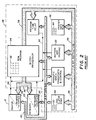
- the various peripherals are each controlled by instructions issued in this manner on the common instruction word bus 36 while the addressing of the read-only memory 32, which contains a fixed program to control the automatic typing system 10, is controlled in response to conditions placed on the common status bus by the various peripherals and various data gated onto the common data bus 40 and loaded into registers within the microprocessor 34 for subsequent inspection and classification.
- the automatic typing system 10 when engaged, would go through an initialization routine where the read-only memory 32 would be sequentially incremented to cause 16-bit instructions to be issued in sequence to power up and initialize the system. Thereafter, the microprocessor 34 would enter a monitoring routine wherein the condition of the various peripherals is monitored on the common status bus 38 on a sequential basis, which is continued until something occurs that causes a branch routine to be initiated relative to the microprocessor 34.
- the data supplied to the printer 12 from the printer data ROM 44 include such things as character-to-spoke correspondence information, character width/carriage escapement/ribbon feed, hammer energy, line index information, etc.
- index information as read in the form of a constant from the printer data ROM 44, which is generated as a function of the indexing set by the appropriate lever at the keyboard 22, is forwarded to the printer 12 so that appropriate indexing of the paper at the end of the line of printing will occur.
- the microprocessor 34 issues instructions from ROM 32 through the common instruction bus 36 to cause an initialization of the automatic typing system 10 and thereafter causes instructions to be issued to cause the appropriate processing of information entered into the automatic typing system 10 as a function of the nature of the information as entered on the common data bus 40 and the pertinent status of individual conditions within the peripherals as sensed on the common status bus 38.
- the operation of the system is described in great detail in commonly assigned U.S. Patent 4,138,719.
- a language translator peripheral 48 including language translator ROM's 50 wired into the system, is included in the automatic typing system 10.
- the presence of the language translator peripheral is indicated to the controller 28, and a small portion of the memory of the language translator peripheral 48 is devoted to the native language corresponding to the market version of the automatic typing system 10 to which the key caps and print font would correspond.
- the language translator peripheral 48 is active to translate the resulting input codes into recordable system codes to which the automatic typing system 10 as a whole may respond, and which represent the alphanumeric information entered at the keyboard 22 even though the resulting codes may not correspond to those generated at the keyboard 22. This is done, in effect, through the functions of the language translator peripheral 48, which treats input codes from the keyboard 22 as key position codes and translates the key position codes into character codes corresponding to the characters that reside at those key positions for the native country assigned or another elected country as defined by the appropriate coded signal entered by the operator.
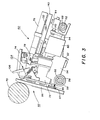
- a carriage assembly 60 is shown for use in a serial printer, such as printer 12 (see Figure 1), and includes a main frame 52 having opposing sidewalls 54 (only one visible).
- the main frame 52 has a pair of aligned openings 56 formed in the respective sidewalls 54 adjacent the front end of carriage assembly 60.
- the openings 56 are adapted to receive in locked relation a bearing assembly 58.
- a similar bearing assembly 62 is attached by a bracket assembly 64 to the sidewalls 54 thereby enabling .
- the carriage assembly 60 to be transported along a pair of parallel rails 66 and 68, engaged through the pair of linear bearing assemblies 58 and 62 and thus move past a platen 70 included in printer 12.
- the carriage assembly 60 is adapted to transport and includes a print wheel element drive motor 72 for controlling the direction and speed of rotation of a print wheel 84 (see Figure 4) engaged with the motor drive shaft 88 (see Figure 4). Attached to the rear of drive motor 72 is a conven-. tional inductive transducer assembly 73 to generate a position signal that . can be sensed to keep track of the rotational position of the motor drive shaft 88 and thus that of the print wheel 84.
- a hammer assembly 74 for impacting an aligned character element on the print wheel 84 (see Figure 4) against the adjacent platen 70
- a ribbon cartridge 76 for supplying inked ribbon 78 between the hammer assembly 74 and the platen 70 (this portion of the ribbon 78 has been omitted for clarity of other items)
- a ribbon drive motor 80 for advancing the ribbon 78 during operation of the printer 12.
- the carriage assembly 60 includes a print wheel cartridge loading apparatus 82 for loading a print wheel 84 contained in a print wheel cartridge 86 onto the drive shaft 88 of the print wheel drive motor 72.
- the loading apparatus 82 includes a support member in the form of a plate 90, which is attached by suitable means (not shown) to the main frame 52 of the carriage assembly 60.
- the plate 90 has an opening 92 therein through which the drive shaft 88 of the drive motor 72 is adapted to be disposed.
- Hinged to the front of the support plate 90 is a guide member 94, which is pivotable relative to the support plate 90 by hinges 96 and 98.
- the guide member 94 has a pair of edge sleeves 100 for accommodating complementary edge guide members 102 on the rear side of the print wheel cartridge 86 (see Figure 5).
- a pivot control assembly 104 normally maintains the guide member 94 in a first or unloaded position (pivoted away from the support plate 90) until a print wheel cartridge 86 is received by the guide member 94 and guided in a downward direction due to the cooperation of the edge sleeves 100 on the guide member 94 and the edge guide members 102 on the cartridge 86.
- the operator will actuate the pivot control assembly 104 by pivoting lever 106 back away from support plate 90, and the guide member 94 will be released from its first or unloaded position and will'be allowed to move or pivot toward the support plate 90 under the biasing action of spring 85 (see Figure 3).
- the guide member 94 will then come to rest at its second or loaded position against projection 87 (see Figure 3) with opening 108 of print wheel 84 positioned over shaft 88 of the print wheel drive motor 72.
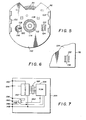
- the rear cover 110 of the print wheel cartridge 86 includes a circular opening 112 for accommodating hub portion 114 of the print wheel 84 in a manner enabling the free rotation of the print wheel 84 within the print wheel cartridge 86. Opening 92 within hub portion 114 accommodates shaft 88 of the print wheel drive motor 72. A further opening 116 is provided to expose radial stiffening ribs 118 formed on the rear side of the print wheel 84 as the print wheel 84 is rotated.
- One of the ribs 118 preferably contains magnetically or optically sensorable indicia 120.
- a suitable magnetic or optical sensor (not shown) mounted on carriage assembly 60 in alignment with the opening 116 may be employed to detect the passage of the indicia 120.
- Such detection may be used to sense the "home" position of the print wheel 84, i.e., the print wheel 84 is brought to rest a predetermined number of character spaces following detection of the home indicia 120. It is thus apparent that the print wheel 84 may be in any rotational position within the print wheel cartridge 86 when the print wheel cartridge 86 is loaded into the print wheel cartridge loading apparatus 82 as the print wheel 84 can be rotated one revolution to align the print wheel 84 to the home position.
- an active read-only memory (ROM) chip 122 is secured to the rear cover 110 of the print wheel cartridge 86 at a predetermined location.
- ROM 122 is secured by well-known means, such as adhesives, etc., with the input/output contacts 124 (flat pad type contacts) facing outwardly from the rear cover 110.
- the input/output contacts 124 align with and make contact with spring-type contacts 126 of socket 128 installed in a predetermined location in guide member 94.
- Spring-type contacts 126 are connected via cable 130 to controller 28.
- ROM 122 contains such information as character-to-spoke correspondence information, character width/carriage escapement/ribbon feed, hammer energy, language translation information, etc., which is relative to the particular print wheel 84 contained in the print wheel cartridge 86.
- print wheel 84 and print wheel cartridge 86 having its own ROM 122, print wheels developed in the future, which vary from the present print wheels, can be compatible with the typing system since each print wheel will carry information unique to that particular print wheel.
- an active ROM chip 132 is secured in a predetermined location to the bottom cover portion 134 of ribbon cartridge 76 with the input/output contacts 136 facing outwardly from said bottom cover portion 134.
- input/output contacts 136 align with and make contact with spring-type contacts (not shown) of socket 138 installed in a predetermined location in the ribbon cartridge mounting plate 140.
- the spring-type contacts (not shown) of socket 138 are connected via cable 142 to controller 28.
- the spring contacts of socket 138 are the same as or similar to those of socket 128.
- ROM 132 contains such information as ribbon feed, hammer energy, etc., which is relative to the particular ribbon 78 contained in the ribbon cartridge 76. With each ribbon cartridge having its own ROM 132, ribbons developed in the future, which vary from the present ribbons, can be compatible with the typing system since each ribbon cartridge will carry information unique to the characteristics of that particular ribbon.
- the read-only memory 32 would be programmed to interrogate ROM 122 and ROM 132 (if included in the system) during the initialization routine and transfer all the data from ROM's 122 and 132 to memory locations (not shown) in microprocessor 34 and/or memory in buffers and storage 33 where it would then be readily available when needed during the operation of the system.
- the present invention takes some of the program storage away from the typing system 10 and/or the printer 12 and provides that storage with the supply items, i.e., the print wheel, ribbon, etc. In this manner, allowance for unique characteristics of each supply item could be optimized.
- the input/output contacts 124 and 136 could comprise a total of 16 to 18 pins if off-the-shelf ROM's were used for ROM's 122 and 132 or could vary in number if the ROM chip was a custom designed ROM chip.
- Figure 7 discloses a ROM chip designed to reduce the number of external connections to be made to the chip. As disclosed, the number of external connections to ROM chip 144 has been reduced to six. Power and ground are brought into the ROM chip 144 on lines or connections 146 and 148, respectively. The reset or clear function is brought in on line or connection 150 and is connected to counter 152. The count signal is brought in on line or connection 154 and is also connected to counter 152. The read signal is brought in on line or connection 156 and is connected to one input of AND gate 158. The data line is connected to line or connection 160 and to the output of AND gate 158. The other input 162 to AND gate 158 is connected to ROM 164. Appropriate address lines 166 are connected between counter 152 and ROM 164.
- ROM 164 As AND gate is enabled via line 156, the resulting data from ROM 164 will be entered in microprocessor 34; and the microprocessor 34 would pulse the counter, read the data, pulse the counter, read the data, etc., until all the information contained in ROM 164 was transferred to memory in microprocessor 34 where the data could then be readily accessible when required.
- AND gate 158 could be moved into microprocessor 34 and then there would only be five lines or connections to ROM chip 144.
- Another embodiment includes having the counter 152 free running, and have the reset pulse on line 150 release counter 152, and then the counter would automatically address ROM 164, and all the data would be read out automatically to microprocessor 34.
- ROM 164 is a 2048 x 1 bit memory, which has sufficient capacity for most uses. Today, of course, a 4096 x 8 bit chip is available if such capacity was required. The use of such a chip would increase the size of the internal counter 152 and require a ROM output bit select circuit to be added to the chip 144 but would not necessarily increase the number of external connections to the ROM chip.
Landscapes
- Engineering & Computer Science (AREA)
- General Engineering & Computer Science (AREA)
- Physics & Mathematics (AREA)
- General Physics & Mathematics (AREA)
- Theoretical Computer Science (AREA)
- Accessory Devices And Overall Control Thereof (AREA)
- Record Information Processing For Printing (AREA)
Applications Claiming Priority (2)
| Application Number | Priority Date | Filing Date | Title |
|---|---|---|---|
| US14471680A | 1980-04-28 | 1980-04-28 | |
| US144716 | 1980-04-28 |
Publications (2)
| Publication Number | Publication Date |
|---|---|
| EP0042206A2 true EP0042206A2 (de) | 1981-12-23 |
| EP0042206A3 EP0042206A3 (de) | 1983-01-05 |
Family
ID=22509813
Family Applications (1)
| Application Number | Title | Priority Date | Filing Date |
|---|---|---|---|
| EP81301702A Withdrawn EP0042206A3 (de) | 1980-04-28 | 1981-04-16 | Elektronischer Drucker und Verfahren zum Wiederprogrammieren eines elektronischen Druckers |
Country Status (4)
| Country | Link |
|---|---|
| EP (1) | EP0042206A3 (de) |
| JP (1) | JPS56168292A (de) |
| BR (1) | BR8102504A (de) |
| CA (1) | CA1162317A (de) |
Cited By (12)
| Publication number | Priority date | Publication date | Assignee | Title |
|---|---|---|---|---|
| WO1983003692A1 (en) * | 1982-04-14 | 1983-10-27 | Beindorff, Christoph | Security system |
| EP0110632A1 (de) * | 1982-11-18 | 1984-06-13 | Ing. C. Olivetti & C., S.p.A. | Zusatzspeicherbaustein für eine elektronische Schreibmaschine |
| US4632584A (en) * | 1983-03-30 | 1986-12-30 | Ing. C. Olivetti & C., S.P.A. | Serial printer |
| US4660999A (en) * | 1984-08-31 | 1987-04-28 | Kabushiki Kaisha Toshiba | Dot-matrix printer with font cartridge unit |
| US4687356A (en) * | 1984-07-02 | 1987-08-18 | Sharp Kabushiki Kaisha | Electronic printer with interleaved storage of print wheel position, hammer intensity, and carriage position data in read only memory |
| GB2193162A (en) * | 1986-08-01 | 1988-02-03 | Alps Electric Co Ltd | Dot printers |
| US4826332A (en) * | 1984-06-25 | 1989-05-02 | Seiko Epson Kabushiki Kaisha | Printer including cartridge mounted interchangeable read only memory |
| WO1989003768A3 (en) * | 1987-10-30 | 1989-06-15 | Linx Printing Tech | Ink jet printer |
| EP0255867A3 (en) * | 1986-07-04 | 1989-07-26 | Siemens Aktiengesellschaft Berlin Und Munchen | Ink jet printer with an exchangeable print head |
| US5085528A (en) * | 1989-05-31 | 1992-02-04 | Seikosha Co., Ltd. | Data card and serial printer using same |
| FR2671784A1 (fr) * | 1991-01-23 | 1992-07-24 | Pontegnier Laurent | Dispositif de protection pour cartouches de polices de caracteres pour imprimante a laser. |
| US5200763A (en) * | 1988-09-21 | 1993-04-06 | Oki Electric Co., Ltd. | Printer with an led print head having means for setting data about the print head |
Families Citing this family (3)
| Publication number | Priority date | Publication date | Assignee | Title |
|---|---|---|---|---|
| JPS5861114A (ja) * | 1981-10-06 | 1983-04-12 | Hitachi Chem Co Ltd | 積層板用フエノ−ルホルムアルデヒド樹脂の製造法 |
| JPS593594A (ja) * | 1982-06-30 | 1984-01-10 | Fujitsu Ltd | トレ−ンカ−トリツジの属性判別方式 |
| JPS61154864A (ja) * | 1984-12-27 | 1986-07-14 | Sharp Corp | プリンタにおける印字圧制御方法 |
Family Cites Families (8)
| Publication number | Priority date | Publication date | Assignee | Title |
|---|---|---|---|---|
| US3858509A (en) * | 1972-07-10 | 1975-01-07 | Xerox Corp | Control logic for print wheel and hammer of high speed printing apparatus |
| GB1530444A (en) * | 1974-11-11 | 1978-11-01 | Xerox Corp | Automatic writing system and methods of word processing therefor |
| GB1561975A (en) * | 1975-07-29 | 1980-03-05 | Xerox Corp | Word processing apparatus |
| US4074798A (en) * | 1976-09-01 | 1978-02-21 | Xerox Corporation | Encoded print wheel system |
| US4124312A (en) * | 1977-02-10 | 1978-11-07 | Xerox Corporation | Impact printer with print wheel cartridge |
| US4127335A (en) * | 1977-02-10 | 1978-11-28 | Xerox Corporation | Impact printer with cartridge print wheel |
| DD142827C2 (de) * | 1977-06-08 | 1981-02-25 | Ernst Kutschbach | Programmspeicher fuer elektronische buchungsmaschinen |
| JPS5552564A (en) * | 1978-10-13 | 1980-04-17 | Sony Corp | Check unit for suitability of stuck label of tape cassette |
-
1981
- 1981-03-26 CA CA000373937A patent/CA1162317A/en not_active Expired
- 1981-04-16 EP EP81301702A patent/EP0042206A3/de not_active Withdrawn
- 1981-04-21 JP JP6055181A patent/JPS56168292A/ja active Pending
- 1981-04-24 BR BR8102504A patent/BR8102504A/pt unknown
Cited By (15)
| Publication number | Priority date | Publication date | Assignee | Title |
|---|---|---|---|---|
| WO1983003692A1 (en) * | 1982-04-14 | 1983-10-27 | Beindorff, Christoph | Security system |
| EP0110632A1 (de) * | 1982-11-18 | 1984-06-13 | Ing. C. Olivetti & C., S.p.A. | Zusatzspeicherbaustein für eine elektronische Schreibmaschine |
| US4632584A (en) * | 1983-03-30 | 1986-12-30 | Ing. C. Olivetti & C., S.P.A. | Serial printer |
| US4826332A (en) * | 1984-06-25 | 1989-05-02 | Seiko Epson Kabushiki Kaisha | Printer including cartridge mounted interchangeable read only memory |
| US5137379A (en) * | 1984-06-25 | 1992-08-11 | Seiko Epson Corporation | Printer including cartridge mounted read only memory |
| US4687356A (en) * | 1984-07-02 | 1987-08-18 | Sharp Kabushiki Kaisha | Electronic printer with interleaved storage of print wheel position, hammer intensity, and carriage position data in read only memory |
| US4660999A (en) * | 1984-08-31 | 1987-04-28 | Kabushiki Kaisha Toshiba | Dot-matrix printer with font cartridge unit |
| EP0255867A3 (en) * | 1986-07-04 | 1989-07-26 | Siemens Aktiengesellschaft Berlin Und Munchen | Ink jet printer with an exchangeable print head |
| GB2193162A (en) * | 1986-08-01 | 1988-02-03 | Alps Electric Co Ltd | Dot printers |
| WO1989003768A3 (en) * | 1987-10-30 | 1989-06-15 | Linx Printing Tech | Ink jet printer |
| GB2236713A (en) * | 1987-10-30 | 1991-04-17 | Linx Printing Tech | Ink jet printer |
| GB2236713B (en) * | 1987-10-30 | 1992-08-12 | Linx Printing Tech | Ink jet printer |
| US5200763A (en) * | 1988-09-21 | 1993-04-06 | Oki Electric Co., Ltd. | Printer with an led print head having means for setting data about the print head |
| US5085528A (en) * | 1989-05-31 | 1992-02-04 | Seikosha Co., Ltd. | Data card and serial printer using same |
| FR2671784A1 (fr) * | 1991-01-23 | 1992-07-24 | Pontegnier Laurent | Dispositif de protection pour cartouches de polices de caracteres pour imprimante a laser. |
Also Published As
| Publication number | Publication date |
|---|---|
| CA1162317A (en) | 1984-02-14 |
| EP0042206A3 (de) | 1983-01-05 |
| JPS56168292A (en) | 1981-12-24 |
| BR8102504A (pt) | 1982-01-05 |
Similar Documents
| Publication | Publication Date | Title |
|---|---|---|
| CA1162317A (en) | Read only memory coded print wheel cartridge | |
| US4660999A (en) | Dot-matrix printer with font cartridge unit | |
| JP2795988B2 (ja) | 郵便料金を印刷するためのプリンタの制御方法 | |
| US4032946A (en) | Apparatus for selling betting tickets | |
| EP0063939B1 (de) | Schreibanordnung | |
| US4051459A (en) | Stored program controlled typewriting/editing system | |
| US4513393A (en) | Document handling terminal computer | |
| EP0029886A2 (de) | Druckwerk mit automatischem Typensatzwechsel | |
| EP0026286B1 (de) | Bindestrichkode-Umsetzerverfahren für ein Textverarbeitungssystem | |
| US4028680A (en) | System for automatically processing and printing the contents and the format of a text | |
| US5290109A (en) | Electronic typewriter for printing of documents having a fixed format | |
| US4894798A (en) | Automatic stop code insertion feature for a word processing apparatus | |
| EP0580321B1 (de) | Druckvorrichtung | |
| US4782339A (en) | Method and apparatus for displaying text on a single-line display of a text station | |
| US4952082A (en) | Text processing system for cyclically shifting format memory | |
| US3517165A (en) | Arrangement for handling printable character bit codes | |
| JPS60159073A (ja) | バ−コ−ド印字読取り装置を具備する印字装置 | |
| EP0543291B1 (de) | Drucker für Sparbücher | |
| GB2072388A (en) | Printing apparatus | |
| JPH0696322B2 (ja) | プリンタ | |
| KR940005148B1 (ko) | 휠교환식 메모리 타자기의 인자방법 | |
| JPS5859883A (ja) | プリンタ | |
| AU607258B2 (en) | Automatic function control for an electronic typewriter | |
| Hilton | Problems in identifying work from print wheel typewriters | |
| Falk | Making printer choices |
Legal Events
| Date | Code | Title | Description |
|---|---|---|---|
| PUAI | Public reference made under article 153(3) epc to a published international application that has entered the european phase |
Free format text: ORIGINAL CODE: 0009012 |
|
| AK | Designated contracting states |
Designated state(s): CH DE FR GB IT LI NL SE |
|
| 17P | Request for examination filed |
Effective date: 19820503 |
|
| PUAL | Search report despatched |
Free format text: ORIGINAL CODE: 0009013 |
|
| AK | Designated contracting states |
Designated state(s): CH DE FR GB IT LI NL SE |
|
| STAA | Information on the status of an ep patent application or granted ep patent |
Free format text: STATUS: THE APPLICATION HAS BEEN WITHDRAWN |
|
| 18W | Application withdrawn |
Withdrawal date: 19850823 |
|
| RIN1 | Information on inventor provided before grant (corrected) |
Inventor name: SOHL, GORDON |