EP0043211B1 - Procédé de préparation de tryptophanes optiquement actifs - Google Patents
Procédé de préparation de tryptophanes optiquement actifs Download PDFInfo
- Publication number
- EP0043211B1 EP0043211B1 EP81302751A EP81302751A EP0043211B1 EP 0043211 B1 EP0043211 B1 EP 0043211B1 EP 81302751 A EP81302751 A EP 81302751A EP 81302751 A EP81302751 A EP 81302751A EP 0043211 B1 EP0043211 B1 EP 0043211B1
- Authority
- EP
- European Patent Office
- Prior art keywords
- tryptophane
- amides
- tryptophanes
- asymmetric hydrolysis
- microorganism
- Prior art date
- Legal status (The legal status is an assumption and is not a legal conclusion. Google has not performed a legal analysis and makes no representation as to the accuracy of the status listed.)
- Expired
Links
- 0 **(C=C1)C=Cc2c1*(*)c[n]2 Chemical compound **(C=C1)C=Cc2c1*(*)c[n]2 0.000 description 2
Classifications
-
- C—CHEMISTRY; METALLURGY
- C12—BIOCHEMISTRY; BEER; SPIRITS; WINE; VINEGAR; MICROBIOLOGY; ENZYMOLOGY; MUTATION OR GENETIC ENGINEERING
- C12N—MICROORGANISMS OR ENZYMES; COMPOSITIONS THEREOF; PROPAGATING, PRESERVING, OR MAINTAINING MICROORGANISMS; MUTATION OR GENETIC ENGINEERING; CULTURE MEDIA
- C12N9/00—Enzymes; Proenzymes; Compositions thereof; Processes for preparing, activating, inhibiting, separating or purifying enzymes
- C12N9/14—Hydrolases (3)
- C12N9/78—Hydrolases (3) acting on carbon to nitrogen bonds other than peptide bonds (3.5)
- C12N9/80—Hydrolases (3) acting on carbon to nitrogen bonds other than peptide bonds (3.5) acting on amide bonds in linear amides (3.5.1)
-
- C—CHEMISTRY; METALLURGY
- C12—BIOCHEMISTRY; BEER; SPIRITS; WINE; VINEGAR; MICROBIOLOGY; ENZYMOLOGY; MUTATION OR GENETIC ENGINEERING
- C12P—FERMENTATION OR ENZYME-USING PROCESSES TO SYNTHESISE A DESIRED CHEMICAL COMPOUND OR COMPOSITION OR TO SEPARATE OPTICAL ISOMERS FROM A RACEMIC MIXTURE
- C12P13/00—Preparation of nitrogen-containing organic compounds
- C12P13/04—Alpha- or beta- amino acids
-
- C—CHEMISTRY; METALLURGY
- C12—BIOCHEMISTRY; BEER; SPIRITS; WINE; VINEGAR; MICROBIOLOGY; ENZYMOLOGY; MUTATION OR GENETIC ENGINEERING
- C12P—FERMENTATION OR ENZYME-USING PROCESSES TO SYNTHESISE A DESIRED CHEMICAL COMPOUND OR COMPOSITION OR TO SEPARATE OPTICAL ISOMERS FROM A RACEMIC MIXTURE
- C12P13/00—Preparation of nitrogen-containing organic compounds
- C12P13/04—Alpha- or beta- amino acids
- C12P13/22—Tryptophan; Tyrosine; Phenylalanine; 3,4-Dihydroxyphenylalanine
- C12P13/227—Tryptophan
Definitions
- the present invention relates to a process for preparing optical active tryptophanes by biochemical asymmetric hydrolysis of DL-tryptophane amides, in which an amidase derived from a microorganism is utilized.
- L-tryptophanes and D-tryptophanes are optically active and have different properties and uses.
- L-tryptophane is an important compound as an essential amino acid and is suitable for use in an amino acid infusion solution, animal food stuff additives, hypnotizing agent and the like.
- D-tryptophane is useful as, for example dentifrice additives.
- tryptophanes Many organic synthesis methods for preparing tryptophanes have been heretofore proposed. However, when the tryptophanes are prepared by organic synthesis methods, the products are obtained in the form of mixtures of D-tryptophanes and L-tryptophanes, i.e. racemic mixtures. Therefore, the effective optical resolution of DL-tryptophanes is an extremely important problem to be solved in the art.
- Proposed optical resolution methods of DL-tryptophanes are only those in which hydantoin or N-acyl derivatives of DL-tryptophanes are used as a substrate and in which microorganisms capable of producing hydantoinase or acylase are interacted with the substrate.
- the development of the substrate and the microorganisms used in the field of the biochemical optical resolution of DL-tryptophanes are extremely limited.
- an object of the present invention is to obviate the afore-mentioned problems in the prior arts and to provide a novel biochemical optical resolution of DL-tryptophanes in which L-tryptophanes and D-tryptophanes can be separated from each other at a high yield.
- Another object of the present invention is to selectively hydrolyze L-tryptophane amides, whereby optical active L-tryptophanes are prepared at a high yield. L-tryptophanes are prepared at a high yield.
- a further object of the present invention is to hydrolyze D-tryptophane amides after the separation of L-tryptophanes from DL-tryptophane amides, whereby optical active D-tryptophanes are prepared at a high yield.
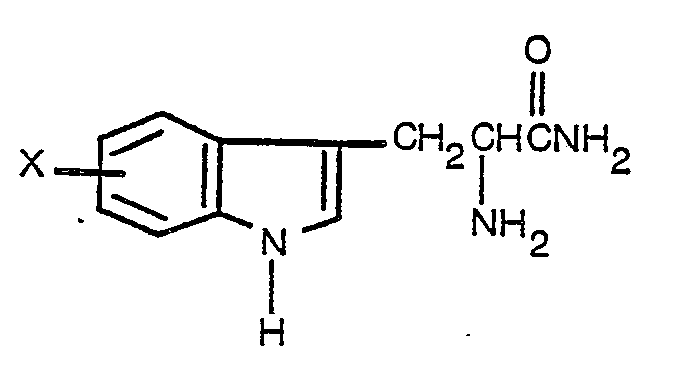
- a process for preparing optically active L-tryptophanes having a general formula wherein X represents hydrogen, hydroxyl group, halogen atoms such as fluorine, chlorine, bromine and iodine, lower alkyl groups, preferably having 1 to 4 carbon atoms, or lower alkoxy groups, preferably having 1 to 4 carbon atoms, comprising the step of interacting DL-tryptophane amides having a general formula.
- X is as defined above with the culture product of a microorganism capable of producing amidase or the treated product thereof, whereby the asymmetric hydrolysis of L-tryptophane amides is effected.
- Biochemical asymmetric hydrolysis of DL-tryptophane amides in which an enzyme derived from animal visceral organs is employed is reported [see: Bull. Agr. Chem. Soc. Japan, Vo. 21, No. 1, P.62-66 (1975)].
- biochemical asymmetric hydrolysis of DL-tryptophane amides in which there is employed an enzyme derived from microorganisms has not been reported.
- new substrates are provided in the biochemical optical resolution of DL-tryptophanes in which an enzyme derived from microorganisms is employed and the variety of the microorganisms which can be utilized in the optical resolution is widened.
- the present invention is industrially very valuable in this field.
- the DL-tryptophane amides employed as a substrate in the practice of the present invention can be readily synthesized by, for example, reacting the esters of DL-tryptophanes with ammonia in a conventional manner.
- microorganisms which can produce the amidase used in the practice of the present invention are those which belong to any systematic group, so long as they have the capability of selectively hydrolyzing only L-tryptophane amides in the racemix mixtures of DL-tryptophane amides.
- Examples of the genus names of these microorganisms are listed in the following Table, in which the typical species name of the microorganism belonging to each genus is also listed.
- the microorganisms which can be employed in the practice of the present invention are not limited to these specific examples.
- JFCC Japanese Federation of Culture Cellections of Microorganisms
- IFO Institute for Fermentation, Osaka, Japan
- IAM Institute of Applied Microbiology, University of Tokyo, Tokyo, Japan
- microorganisms belonging to genera Trichoderma, Rhodotorula, Nocardia, Mycobacterium, Bacillus, Rhizopus, Candida, Hansenula, Streptomyces, Aerobacter, Arthrobacter, Pseudomonas, Gibberella, Torulopsis and Enterobacter are especially useful in the practice of the present invention.
- the above mentioned microorganisms can be interacted with the DL-tryptophane amides in the form of either the culture products obtained from the cultivation of cells in liquid culture media or the treated products thereof.
- the treated prodcuts are the cells isolated from the culture solutions, the enzyme (i.e. amidase) isolated from the culture products or the strains according to any conventional enzyme isolating technique (e.g. the crude enzyme, the purified enzyme, the enzyme-containing extracts or the concentrated solutions thereof).
- the cells or enzymes can be immobilized on carriers in the practice of the present invention.
- the carriers are natural products such as alginic acid, carrageenan, collagen, cellulose, acetyl-cellulose, agar-agar, cellophane, collodion and the like, and synthetic polymer substances such as polyacrylamide, polystyrene, polyethylene glycol, polypropylene glycol, polyurethane, polybutadiene and the like.
- the immobilization of the cells or enzymes on the carrier can be carried out in a conventional manner under moderate conditions so that the activity of amidase is not impaired.
- the suitable reaction temperature of the asymmetric hydolysis according to the present invention can be within the range of from 20 to 50°C. However, in order to minimize the decrease in the enzymatic activity, the use of the reaction temperature of from 25 to 40°C is economically advantageous.
- the suitable reaction time of the asymmetric hydrolysis according to the present invention can be within the range of from 5 to 50 hours. However, the reaction time can be shortened by raising the reaction temperature or by increasing the amount of the enzymes used. Furthermore, the reaction can be generally carried out under a pH of 5 through 10, more preferably 7 through 9.
- the amount of the microorganisms employed in the practice of the present invention is preferably in a weight ratio of from 0.01 to 2, in terms of the freeze dried cells, based on the weight of the DL-tryptophane amides.
- the amount thereof can be determined in terms of the amount of the freeze dried cells.
- the suitable concentration of the substrate, i.e. DL-tryptophane amides in the reaction mixture is generally within the range of from 1 to 40% by weight, more preferably 5 to 30% by weight.
- the asymmetric hydrolysis reaction is stopped after the hydrolysis of L-tryptophane amide proceeds at the conversion rate of almost 100%, and, then, L-trypto-- phanes and D-tryptophane amides are separately isolated from the reaction mixture.
- This separation can be readily carried out by using any conventional separation techniques, such as fractional crystallization and solvent extraction.
- D-tryptophane amides are not affected by the action of the microorganisms in the above mentioned asymmetric hydrolysis and, therefore, almost all D-tryptophane amides can be recovered from the racemic mixture.
- the D-tryptophane amides thus recovered can be readily hydrolyzed by using any conventional technique, for example, by heating in the presence of an aqueous acid or alkaline solution. Thus, optically active D-tryptophane can be obtained at a high yield.
- the D-tryptophane amides recovered above can also be subjected to a racemization and reused as a substrate in the asymmetric hydrolysis of the present invention.
- optical purity and yield of he L-tryptophanes as well as the D-tryptophanes are equal to or more than those obtained from known biochemical optical resolution.
- the inorganic salt mixture was prepared by dissolving 20 g of MgSO 4 .7H 2 O, 5 g of FeSO 4 .7H 2 O, 2 g of CaCl 2' 0.2 g of MnCl 2 .4H 2 O, 0.1 g of NaM00 4 .2H 2 O and 0.1 g of NaCI in 1000 ml of distilled water.
- Rhodotorula glutinis var. rebescens prepared in a manner as described in Example 4, the cells was collected by centrifugation and, then, washed twice with distilled water.
- the washed cells were added to 100 ml of a 0.1 M phosphate buffer solution having a pH of 7.0 and containing 2 g of DL-tryptophane amide and the mixture was incubated for 20 hours at a temperature of 30°C.
- the reaction mixture thus obtained was analyzed by high speed liquid chromatography.
- the resultant reaction mixture contained 983 mg of L-tryptophane (yield: 98%) and 1010 mg of D-tryptophane amide. From this reaction mixture the unreacted D-tryptophane amide was extracted by using ethyl acetate.
- Rhodotolua glutinis var. rebescens prepared in a manner as described in Example 16 were washed with cold acetone. Thus, acetone dried cells were obtained.
- DL-tryptophan amide was dissolved in distilled water and substrate solutions having various concentrations listed in Table 2 below and having a pH of 7.0 were prepared.
- the above mentioned acetone dried cells were added to 10 ml of the substrate solution in such an amount that a weight ratio of the dried cells to the substrate were 0.2. Then, the reaction was carried out at a temperature of 30°C for 20 hours. The resultant reaction mixture was analyzed to determine the yield of L-tryptophane by using high speed liquid chromatography.
- Rhodotorula glutinis var. rebescens prepared in a manner as described in Example 16 were freeze dried.
- the reaction mixture was analyzed to determine the yield of L-tryptophane by high speed liquid chromatography.
- Example 18 50 mg of the freeze dried cells of Rhodotorula glutinis var. rebescens prepared in a manner as described in Example 18 were suspended in 5 ml of 0.2 M phosphate acid buffer solution and, then, the cells were disrupted under cooling by using a French press (20,000 psi). The resultant mixture was centrifuged under 20,000 x g for 30 mins. To 5 ml of the supernatant solution thus obtained, 250 mg of DL-tryphophane amides was added and the pH of the mixture was adjusted to 7.5. Thereafter, the mixture was incubated at a temperature of 30°C for 20 hours.
- the reaction mixture was analyzed by a high speed liquid chromatography. L-tryptophane was obtained at a yield of 95%.
- the reaction mixture was analyzed by high speed liquid chromatography. L-tryptophane was obtained at a yield of 63%.
- the reaction mixture was analyzed by high speed liquid chromatography. L-tryptophane was obtained at a yield of 56%.
- Rhodotorula glutinis var. rebescens prepared in a manner as described in Example 16 were suspended in 15 ml of 0.1 M phosphate buffer solution having a pH of 7.0 and, then, 3.75 g of acrylamide monomer, 0.2 g of N,N'- methylene bisacrylamide (i.e. crosslinking agent), 2.5 ml of a 5% aqueous 3-dimethylamino propionitrile solution (i.e polymerization promotor) and 2.5 ml of 2.5% aqueous potassium persulfate solution (i.e. polymerization initiator) were added and mixed with one another. The mixture was allowed to stand at a temperature of 25°C for 1 hour, whereby the gellation of the mixture was complete.
- acrylamide monomer 0.2 g of N,N'- methylene bisacrylamide (i.e. crosslinking agent)
- the resultant immobilized product (i.e., gel particles, having a particle diameter of 0.2 to 0.5 mm) was packed into a column having a diameter of 2 cm and a length of 50 cm. Thereafter, distilled water containing 10% by weight of DL-tryptophane amide and having a pH of 7.5 was passed through the column at a temperature of 30°C from the top of the column at a space velocity (SV) of 0.2.
- SV space velocity
- Example 4 was repeated except that 2.0 g of DL-5-hydroxytryptophane amide was used as a substrate. As a result, L-5-hydroxytryptophane was obtained at a yield of 43%.
- Example 15 was repeated except that 2.0 g of DL-6-methoxytryptophane amide was used as a substrate. As a result, L-6-methoxytryptophane was obtained at a yield of 27%.
- Example 1 was repeated except that Candida kurusei (IFO-001 3) was used as a microorganism and DL-5-methyltryptophane amide was used as a substrate. As a result, L-5-methyltryptophane was obtained at a yield of 24%.
- Example 24 was repeated except that 2.0 g of DL-6-chlorotryptophane amide was used as a substrate. As a result, L-6-chlorotryptophane was obtained at a yield of 34%.
Landscapes
- Chemical & Material Sciences (AREA)
- Organic Chemistry (AREA)
- Life Sciences & Earth Sciences (AREA)
- Zoology (AREA)
- Engineering & Computer Science (AREA)
- Wood Science & Technology (AREA)
- Health & Medical Sciences (AREA)
- Genetics & Genomics (AREA)
- Bioinformatics & Cheminformatics (AREA)
- Microbiology (AREA)
- Biotechnology (AREA)
- Biochemistry (AREA)
- General Engineering & Computer Science (AREA)
- General Health & Medical Sciences (AREA)
- Chemical Kinetics & Catalysis (AREA)
- General Chemical & Material Sciences (AREA)
- Biomedical Technology (AREA)
- Molecular Biology (AREA)
- Medicinal Chemistry (AREA)
- Preparation Of Compounds By Using Micro-Organisms (AREA)
Claims (11)


Applications Claiming Priority (2)
| Application Number | Priority Date | Filing Date | Title |
|---|---|---|---|
| JP8461880A JPS5713000A (en) | 1980-06-24 | 1980-06-24 | Preparation of optical active tryptophane |
| JP84618/80 | 1980-06-24 |
Publications (3)
| Publication Number | Publication Date |
|---|---|
| EP0043211A2 EP0043211A2 (fr) | 1982-01-06 |
| EP0043211A3 EP0043211A3 (en) | 1982-06-30 |
| EP0043211B1 true EP0043211B1 (fr) | 1984-05-09 |
Family
ID=13835670
Family Applications (1)
| Application Number | Title | Priority Date | Filing Date |
|---|---|---|---|
| EP81302751A Expired EP0043211B1 (fr) | 1980-06-24 | 1981-06-18 | Procédé de préparation de tryptophanes optiquement actifs |
Country Status (4)
| Country | Link |
|---|---|
| US (2) | US4497957A (fr) |
| EP (1) | EP0043211B1 (fr) |
| JP (1) | JPS5713000A (fr) |
| DE (1) | DE3163488D1 (fr) |
Cited By (2)
| Publication number | Priority date | Publication date | Assignee | Title |
|---|---|---|---|---|
| CN103333098A (zh) * | 2013-07-24 | 2013-10-02 | 马鞍山德鸿生物技术有限公司 | 一种d-色氨酸 |
| CN103342676A (zh) * | 2013-07-24 | 2013-10-09 | 马鞍山德鸿生物技术有限公司 | 一种d-色氨酸的合成方法 |
Families Citing this family (18)
| Publication number | Priority date | Publication date | Assignee | Title |
|---|---|---|---|---|
| JPS58209989A (ja) * | 1982-05-28 | 1983-12-07 | Ube Ind Ltd | 光学活性トリプトフアン類の製法 |
| JPS5931693A (ja) * | 1982-08-13 | 1984-02-20 | Kanegafuchi Chem Ind Co Ltd | 光学活性オキサゾリジノン誘導体の製造方法 |
| JPS59159789A (ja) * | 1983-03-01 | 1984-09-10 | Mitsubishi Gas Chem Co Inc | L−α−アミノ酸の製造方法 |
| NL8400312A (nl) * | 1984-02-02 | 1985-09-02 | Stamicarbon | Optisch aktief gesubstitueerd boterzuuramide alsmede werkwijze voor de optische scheiding van gesubstitueerd boterzuuramide. |
| US5215897A (en) * | 1985-09-04 | 1993-06-01 | Nitto Chemical Industries Co., Ltd. | Process for producing L-amino acids |
| JPS6255097A (ja) * | 1985-09-04 | 1987-03-10 | Nitto Chem Ind Co Ltd | L−アミノ酸の製造法 |
| US4912042A (en) * | 1989-08-17 | 1990-03-27 | Eastman Kodak Company | Preparation of D-malic acid or derivative |
| US5078886A (en) * | 1989-10-18 | 1992-01-07 | Lehigh University | Separation of mixtures by two-phase systems |
| US4980065A (en) * | 1989-10-18 | 1990-12-25 | Lehigh University | Separation of mixtures by aqueous two-phase systems |
| FR2655660B1 (fr) * | 1989-12-11 | 1992-03-20 | Rhone Poulenc Sante | Nouveaux polypeptides, sequences d'adn permettant leur expression, procede de preparation et leur utilisation. |
| US5872100A (en) * | 1990-05-11 | 1999-02-16 | Deghenghi; Romano | Peptides containing D-2-Alkyl-Tryptophan |
| US5668254A (en) * | 1990-05-11 | 1997-09-16 | Romano Deghenghi | D-2-alkyl-tryptophan and peptides containing same |
| NL9100038A (nl) * | 1991-01-11 | 1992-08-03 | Stamicarbon | Enzym-gekatalyseerde bereiding van optisch aktieve carbonzuren. |
| KR100377289B1 (ko) * | 1995-09-06 | 2003-08-09 | 씨제이 주식회사 | 신규피리돈카르복실산유도체의중간체합성에관한새로운광학분할방법 |
| JPH1142097A (ja) * | 1997-01-09 | 1999-02-16 | Daicel Chem Ind Ltd | D−トリプトファンの製造方法 |
| US5866379A (en) * | 1997-01-28 | 1999-02-02 | Novus International | Enzymatic conversion of α-hydroxynitriles to the corresponding .alpha. |
| US6015698A (en) * | 1997-02-14 | 2000-01-18 | Daicel Chemical Industries, Ltd. | Method of producing D-amino acid and method of producing amine |
| GB0413322D0 (en) * | 2004-06-15 | 2004-07-14 | Avecia Ltd | Process |
Family Cites Families (5)
| Publication number | Priority date | Publication date | Assignee | Title |
|---|---|---|---|---|
| CH268326A (de) * | 1948-02-13 | 1950-05-15 | Max Dr Brenner | Verfahren zur Zerlegung von dl-Tryptophan. |
| NL181508C (nl) * | 1974-06-14 | 1987-09-01 | Stamicarbon | Werkwijze voor de bereiding van een d-aminozuuramide en een l-aminozuur en werkwijze voor de bereiding van d-fenylglycine. |
| LU74142A1 (fr) * | 1976-01-08 | 1977-07-22 | ||
| GB1577087A (en) * | 1977-01-07 | 1980-10-15 | Novo Industri As | Enzyme preparation having l-amino acyl amidase activity |
| FR2447359A1 (fr) * | 1979-01-24 | 1980-08-22 | Anvar | Procede de preparation d'acides a-amines optiquement actifs par hydrolyse biologique de nitriles ou d'amides a-amines |
-
1980
- 1980-06-24 JP JP8461880A patent/JPS5713000A/ja active Pending
-
1981
- 1981-06-18 DE DE8181302751T patent/DE3163488D1/de not_active Expired
- 1981-06-18 EP EP81302751A patent/EP0043211B1/fr not_active Expired
-
1982
- 1982-06-25 US US06/391,997 patent/US4497957A/en not_active Expired - Fee Related
-
1983
- 1983-05-17 US US06/494,692 patent/US4481362A/en not_active Expired - Lifetime
Cited By (4)
| Publication number | Priority date | Publication date | Assignee | Title |
|---|---|---|---|---|
| CN103333098A (zh) * | 2013-07-24 | 2013-10-02 | 马鞍山德鸿生物技术有限公司 | 一种d-色氨酸 |
| CN103342676A (zh) * | 2013-07-24 | 2013-10-09 | 马鞍山德鸿生物技术有限公司 | 一种d-色氨酸的合成方法 |
| CN103342676B (zh) * | 2013-07-24 | 2015-08-12 | 马鞍山德鸿生物技术有限公司 | 一种d-色氨酸的合成方法 |
| CN103333098B (zh) * | 2013-07-24 | 2017-04-26 | 马鞍山德鸿生物技术有限公司 | 一种d‑色氨酸的制备方法 |
Also Published As
| Publication number | Publication date |
|---|---|
| EP0043211A3 (en) | 1982-06-30 |
| US4481362A (en) | 1984-11-06 |
| US4497957A (en) | 1985-02-05 |
| JPS5713000A (en) | 1982-01-22 |
| DE3163488D1 (en) | 1984-06-14 |
| EP0043211A2 (fr) | 1982-01-06 |
Similar Documents
| Publication | Publication Date | Title |
|---|---|---|
| EP0043211B1 (fr) | Procédé de préparation de tryptophanes optiquement actifs | |
| US5223416A (en) | Process for producing r(-)-mandelic acid and derivatives thereof | |
| JPH10229891A (ja) | マロン酸誘導体の製造法 | |
| WO1986007386A1 (fr) | Procede de preparation de composes organiques optiquement actifs | |
| US4111749A (en) | Method of converting racemic hydantoins into optically active aminoacids | |
| EP0193113B1 (fr) | Procédé d'isomérisation optique d'amides d'amino-acides optiquement actifs et procédé pour la production d'amino-acides optiquement actifs | |
| EP0264457A1 (fr) | Procede pour preparer des acides cyclopropanecarboxyliques optiquement actifs | |
| US4443548A (en) | Process for preparing L-α-methylphenyl alanines | |
| EP0417785B1 (fr) | Procédé de préparation d'esters de l'acide 3-phénylglycidique optiquement actifs | |
| US4237227A (en) | Process for preparing D-N-carbamoyl-α-amino acids | |
| US4588694A (en) | Process for production of optically active oxazolidinone derivative | |
| EP0150854B1 (fr) | Procédé pour la séparation optique de butyramide substitué | |
| JP2696424B2 (ja) | R(‐)―マンデル酸の製造法 | |
| US5457051A (en) | Enantioselective hydrolysis of ketoprofen esters by beauveria bassiana and enzymes derived therefrom | |
| US4857469A (en) | Process for preparing optically active mercapto compound | |
| EP0309310B1 (fr) | Nouveau système enzymatique, son procédé de préparation et son application notamment dans la préparation de la D-parahydroxyphénylglycine | |
| EP0380689B1 (fr) | Procede de preparation de l'acide 2-hydroxy-4-phenyl-3-butenoique optiquement actif | |
| US5723321A (en) | Process for preparing D-lysine | |
| JP2674078B2 (ja) | D−α−アミノ酸の製造法 | |
| US5238828A (en) | Method for the preparation of an optically active 2-substituted carboxylic acid | |
| JP2639651B2 (ja) | 光学活性カルボン酸及びその対掌体エステルの製造法 | |
| EP0352846B1 (fr) | Procédé de préparation de biocatalyseurs auparavant dépourvus d'activité enzymatique stéréoselective | |
| JP2002034593A (ja) | 光学活性α−アミノ酸の製造方法 | |
| JP3960667B2 (ja) | β−カルバモイルイソ酪酸類及びその製造方法 | |
| JPS63157990A (ja) | L−α−メチルフエニルアラニン類の製造法 |
Legal Events
| Date | Code | Title | Description |
|---|---|---|---|
| PUAI | Public reference made under article 153(3) epc to a published international application that has entered the european phase |
Free format text: ORIGINAL CODE: 0009012 |
|
| AK | Designated contracting states |
Designated state(s): DE FR GB IT SE |
|
| PUAL | Search report despatched |
Free format text: ORIGINAL CODE: 0009013 |
|
| AK | Designated contracting states |
Designated state(s): DE FR GB IT SE |
|
| 17P | Request for examination filed |
Effective date: 19821103 |
|
| ITF | It: translation for a ep patent filed | ||
| EL | Fr: translation of claims filed | ||
| GRAA | (expected) grant |
Free format text: ORIGINAL CODE: 0009210 |
|
| AK | Designated contracting states |
Designated state(s): DE FR GB IT SE |
|
| REF | Corresponds to: |
Ref document number: 3163488 Country of ref document: DE Date of ref document: 19840614 |
|
| ET | Fr: translation filed | ||
| PLBE | No opposition filed within time limit |
Free format text: ORIGINAL CODE: 0009261 |
|
| STAA | Information on the status of an ep patent application or granted ep patent |
Free format text: STATUS: NO OPPOSITION FILED WITHIN TIME LIMIT |
|
| 26N | No opposition filed | ||
| ITTA | It: last paid annual fee | ||
| PGFP | Annual fee paid to national office [announced via postgrant information from national office to epo] |
Ref country code: FR Payment date: 19920609 Year of fee payment: 12 |
|
| PGFP | Annual fee paid to national office [announced via postgrant information from national office to epo] |
Ref country code: SE Payment date: 19920615 Year of fee payment: 12 |
|
| PGFP | Annual fee paid to national office [announced via postgrant information from national office to epo] |
Ref country code: GB Payment date: 19930604 Year of fee payment: 13 |
|
| PG25 | Lapsed in a contracting state [announced via postgrant information from national office to epo] |
Ref country code: SE Effective date: 19930619 |
|
| PGFP | Annual fee paid to national office [announced via postgrant information from national office to epo] |
Ref country code: DE Payment date: 19930630 Year of fee payment: 13 |
|
| PG25 | Lapsed in a contracting state [announced via postgrant information from national office to epo] |
Ref country code: FR Effective date: 19940228 |
|
| REG | Reference to a national code |
Ref country code: FR Ref legal event code: ST |
|
| PG25 | Lapsed in a contracting state [announced via postgrant information from national office to epo] |
Ref country code: GB Effective date: 19940618 |
|
| EUG | Se: european patent has lapsed |
Ref document number: 81302751.3 Effective date: 19940110 |
|
| GBPC | Gb: european patent ceased through non-payment of renewal fee |
Effective date: 19940618 |
|
| PG25 | Lapsed in a contracting state [announced via postgrant information from national office to epo] |
Ref country code: DE Effective date: 19950301 |