EP0044422A1 - Neue Glycidyl-1,2,4-triazolidin-3,5-dione und ein Verfahren zu ihrer Herstellung - Google Patents
Neue Glycidyl-1,2,4-triazolidin-3,5-dione und ein Verfahren zu ihrer Herstellung Download PDFInfo
- Publication number
- EP0044422A1 EP0044422A1 EP81104775A EP81104775A EP0044422A1 EP 0044422 A1 EP0044422 A1 EP 0044422A1 EP 81104775 A EP81104775 A EP 81104775A EP 81104775 A EP81104775 A EP 81104775A EP 0044422 A1 EP0044422 A1 EP 0044422A1
- Authority
- EP
- European Patent Office
- Prior art keywords
- triazolidine
- diones
- formula
- glycidyl
- dione
- Prior art date
- Legal status (The legal status is an assumption and is not a legal conclusion. Google has not performed a legal analysis and makes no representation as to the accuracy of the status listed.)
- Granted
Links
- FCWPYNQXXSPACI-UHFFFAOYSA-N 1-(oxiran-2-ylmethyl)-1,2,4-triazolidine-3,5-dione Chemical class O=C1NC(=O)NN1CC1OC1 FCWPYNQXXSPACI-UHFFFAOYSA-N 0.000 title claims abstract description 11
- 238000002360 preparation method Methods 0.000 title claims abstract description 8
- 238000000034 method Methods 0.000 title claims description 10
- 239000012433 hydrogen halide Substances 0.000 claims abstract description 18
- 229910000039 hydrogen halide Inorganic materials 0.000 claims abstract description 18
- 125000004435 hydrogen atom Chemical group [H]* 0.000 claims abstract description 4
- 125000002496 methyl group Chemical group [H]C([H])([H])* 0.000 claims abstract description 4
- UDATXMIGEVPXTR-UHFFFAOYSA-N 1,2,4-triazolidine-3,5-dione Chemical compound O=C1NNC(=O)N1 UDATXMIGEVPXTR-UHFFFAOYSA-N 0.000 claims description 26
- BRLQWZUYTZBJKN-UHFFFAOYSA-N Epichlorohydrin Chemical compound ClCC1CO1 BRLQWZUYTZBJKN-UHFFFAOYSA-N 0.000 claims description 25
- 239000004593 Epoxy Substances 0.000 claims description 16
- 239000003054 catalyst Substances 0.000 claims description 8
- 125000004432 carbon atom Chemical group C* 0.000 claims description 7
- 125000002947 alkylene group Chemical group 0.000 claims description 6
- 150000003944 halohydrins Chemical class 0.000 claims description 4
- 229910052757 nitrogen Inorganic materials 0.000 claims description 4
- 125000004433 nitrogen atom Chemical group N* 0.000 claims description 4
- UFHFLCQGNIYNRP-UHFFFAOYSA-N Hydrogen Chemical compound [H][H] UFHFLCQGNIYNRP-UHFFFAOYSA-N 0.000 claims description 3
- 125000001931 aliphatic group Chemical group 0.000 claims description 3
- 239000001257 hydrogen Substances 0.000 claims description 3
- 229910052739 hydrogen Inorganic materials 0.000 claims description 3
- 125000003118 aryl group Chemical group 0.000 claims description 2
- QVGXLLKOCUKJST-UHFFFAOYSA-N atomic oxygen Chemical compound [O] QVGXLLKOCUKJST-UHFFFAOYSA-N 0.000 claims description 2
- 239000001301 oxygen Substances 0.000 claims description 2
- 229910052760 oxygen Inorganic materials 0.000 claims description 2
- 125000004430 oxygen atom Chemical group O* 0.000 claims description 2
- 125000000472 sulfonyl group Chemical group *S(*)(=O)=O 0.000 claims description 2
- 150000001875 compounds Chemical class 0.000 abstract description 12
- 239000003795 chemical substances by application Substances 0.000 abstract description 6
- 125000005842 heteroatom Chemical group 0.000 abstract 2
- XLYOFNOQVPJJNP-UHFFFAOYSA-N water Substances O XLYOFNOQVPJJNP-UHFFFAOYSA-N 0.000 description 37
- HEMHJVSKTPXQMS-UHFFFAOYSA-M sodium hydroxide Inorganic materials [OH-].[Na+] HEMHJVSKTPXQMS-UHFFFAOYSA-M 0.000 description 36
- ZMANZCXQSJIPKH-UHFFFAOYSA-N Triethylamine Chemical compound CCN(CC)CC ZMANZCXQSJIPKH-UHFFFAOYSA-N 0.000 description 24
- ZAMOUSCENKQFHK-UHFFFAOYSA-N Chlorine atom Chemical compound [Cl] ZAMOUSCENKQFHK-UHFFFAOYSA-N 0.000 description 21
- 238000006243 chemical reaction Methods 0.000 description 21
- 239000000460 chlorine Substances 0.000 description 21
- 229910052801 chlorine Inorganic materials 0.000 description 21
- 239000000243 solution Substances 0.000 description 19
- 239000007858 starting material Substances 0.000 description 16
- 238000001816 cooling Methods 0.000 description 12
- KWYUFKZDYYNOTN-UHFFFAOYSA-M Potassium hydroxide Chemical compound [OH-].[K+] KWYUFKZDYYNOTN-UHFFFAOYSA-M 0.000 description 11
- FAPWRFPIFSIZLT-UHFFFAOYSA-M Sodium chloride Chemical compound [Na+].[Cl-] FAPWRFPIFSIZLT-UHFFFAOYSA-M 0.000 description 11
- 235000011121 sodium hydroxide Nutrition 0.000 description 11
- LFQSCWFLJHTTHZ-UHFFFAOYSA-N Ethanol Chemical compound CCO LFQSCWFLJHTTHZ-UHFFFAOYSA-N 0.000 description 10
- 239000003822 epoxy resin Substances 0.000 description 10
- 229920000647 polyepoxide Polymers 0.000 description 10
- 239000002244 precipitate Substances 0.000 description 10
- 239000002904 solvent Substances 0.000 description 10
- YMWUJEATGCHHMB-UHFFFAOYSA-N Dichloromethane Chemical compound ClCCl YMWUJEATGCHHMB-UHFFFAOYSA-N 0.000 description 9
- 239000003513 alkali Substances 0.000 description 9
- 235000002639 sodium chloride Nutrition 0.000 description 9
- SECXISVLQFMRJM-UHFFFAOYSA-N N-Methylpyrrolidone Chemical compound CN1CCCC1=O SECXISVLQFMRJM-UHFFFAOYSA-N 0.000 description 8
- QGZKDVFQNNGYKY-UHFFFAOYSA-N Ammonia Chemical compound N QGZKDVFQNNGYKY-UHFFFAOYSA-N 0.000 description 7
- PMZURENOXWZQFD-UHFFFAOYSA-L Sodium Sulfate Chemical compound [Na+].[Na+].[O-]S([O-])(=O)=O PMZURENOXWZQFD-UHFFFAOYSA-L 0.000 description 7
- 239000013078 crystal Substances 0.000 description 7
- -1 halohydrin compound Chemical class 0.000 description 7
- 238000010992 reflux Methods 0.000 description 7
- ULUZGMIUTMRARO-UHFFFAOYSA-N (carbamoylamino)urea Chemical compound NC(=O)NNC(N)=O ULUZGMIUTMRARO-UHFFFAOYSA-N 0.000 description 6
- WEVYAHXRMPXWCK-UHFFFAOYSA-N Acetonitrile Chemical compound CC#N WEVYAHXRMPXWCK-UHFFFAOYSA-N 0.000 description 6
- OKKJLVBELUTLKV-UHFFFAOYSA-N Methanol Chemical compound OC OKKJLVBELUTLKV-UHFFFAOYSA-N 0.000 description 6
- ATUOYWHBWRKTHZ-UHFFFAOYSA-N Propane Chemical compound CCC ATUOYWHBWRKTHZ-UHFFFAOYSA-N 0.000 description 6
- 239000011780 sodium chloride Substances 0.000 description 6
- 229910052938 sodium sulfate Inorganic materials 0.000 description 6
- 235000011152 sodium sulphate Nutrition 0.000 description 6
- 230000008030 elimination Effects 0.000 description 5
- 238000003379 elimination reaction Methods 0.000 description 5
- 238000003756 stirring Methods 0.000 description 5
- 238000005406 washing Methods 0.000 description 5
- RWSOTUBLDIXVET-UHFFFAOYSA-N Dihydrogen sulfide Chemical class S RWSOTUBLDIXVET-UHFFFAOYSA-N 0.000 description 4
- CDBYLPFSWZWCQE-UHFFFAOYSA-L Sodium Carbonate Chemical compound [Na+].[Na+].[O-]C([O-])=O CDBYLPFSWZWCQE-UHFFFAOYSA-L 0.000 description 4
- 238000001035 drying Methods 0.000 description 4
- 239000000203 mixture Substances 0.000 description 4
- 239000011541 reaction mixture Substances 0.000 description 4
- 229910052783 alkali metal Inorganic materials 0.000 description 3
- 229910001860 alkaline earth metal hydroxide Inorganic materials 0.000 description 3
- 125000000217 alkyl group Chemical group 0.000 description 3
- 150000001412 amines Chemical class 0.000 description 3
- 229910021529 ammonia Inorganic materials 0.000 description 3
- 239000000470 constituent Substances 0.000 description 3
- 238000001914 filtration Methods 0.000 description 3
- 239000012074 organic phase Substances 0.000 description 3
- 239000001294 propane Substances 0.000 description 3
- 230000035484 reaction time Effects 0.000 description 3
- 239000007787 solid Substances 0.000 description 3
- DEWLEGDTCGBNGU-UHFFFAOYSA-N 1,3-dichloropropan-2-ol Chemical compound ClCC(O)CCl DEWLEGDTCGBNGU-UHFFFAOYSA-N 0.000 description 2
- VILCJCGEZXAXTO-UHFFFAOYSA-N 2,2,2-tetramine Chemical compound NCCNCCNCCN VILCJCGEZXAXTO-UHFFFAOYSA-N 0.000 description 2
- ZWEHNKRNPOVVGH-UHFFFAOYSA-N 2-Butanone Chemical compound CCC(C)=O ZWEHNKRNPOVVGH-UHFFFAOYSA-N 0.000 description 2
- XJOOWWMZMXBLAO-UHFFFAOYSA-N 4-methyl-1,2,4-triazolidine-3,5-dione Chemical compound CN1C(=O)NNC1=O XJOOWWMZMXBLAO-UHFFFAOYSA-N 0.000 description 2
- GOSUFRDROXZXLN-UHFFFAOYSA-N 4-phenyl-1,2,4-triazolidine-3,5-dione Chemical compound O=C1NNC(=O)N1C1=CC=CC=C1 GOSUFRDROXZXLN-UHFFFAOYSA-N 0.000 description 2
- UJTTUOLQLCQZEA-UHFFFAOYSA-N 9h-fluoren-9-ylmethyl n-(4-hydroxybutyl)carbamate Chemical compound C1=CC=C2C(COC(=O)NCCCCO)C3=CC=CC=C3C2=C1 UJTTUOLQLCQZEA-UHFFFAOYSA-N 0.000 description 2
- CSCPPACGZOOCGX-UHFFFAOYSA-N Acetone Chemical compound CC(C)=O CSCPPACGZOOCGX-UHFFFAOYSA-N 0.000 description 2
- WKBOTKDWSSQWDR-UHFFFAOYSA-N Bromine atom Chemical compound [Br] WKBOTKDWSSQWDR-UHFFFAOYSA-N 0.000 description 2
- VTYYLEPIZMXCLO-UHFFFAOYSA-L Calcium carbonate Chemical compound [Ca+2].[O-]C([O-])=O VTYYLEPIZMXCLO-UHFFFAOYSA-L 0.000 description 2
- HEDRZPFGACZZDS-UHFFFAOYSA-N Chloroform Chemical compound ClC(Cl)Cl HEDRZPFGACZZDS-UHFFFAOYSA-N 0.000 description 2
- LYCAIKOWRPUZTN-UHFFFAOYSA-N Ethylene glycol Chemical compound OCCO LYCAIKOWRPUZTN-UHFFFAOYSA-N 0.000 description 2
- MHAJPDPJQMAIIY-UHFFFAOYSA-N Hydrogen peroxide Chemical compound OO MHAJPDPJQMAIIY-UHFFFAOYSA-N 0.000 description 2
- DGAQECJNVWCQMB-PUAWFVPOSA-M Ilexoside XXIX Chemical compound C[C@@H]1CC[C@@]2(CC[C@@]3(C(=CC[C@H]4[C@]3(CC[C@@H]5[C@@]4(CC[C@@H](C5(C)C)OS(=O)(=O)[O-])C)C)[C@@H]2[C@]1(C)O)C)C(=O)O[C@H]6[C@@H]([C@H]([C@@H]([C@H](O6)CO)O)O)O.[Na+] DGAQECJNVWCQMB-PUAWFVPOSA-M 0.000 description 2
- LRHPLDYGYMQRHN-UHFFFAOYSA-N N-Butanol Chemical compound CCCCO LRHPLDYGYMQRHN-UHFFFAOYSA-N 0.000 description 2
- 230000002378 acidificating effect Effects 0.000 description 2
- 229910001854 alkali hydroxide Inorganic materials 0.000 description 2
- 229910000288 alkali metal carbonate Inorganic materials 0.000 description 2
- 150000008041 alkali metal carbonates Chemical class 0.000 description 2
- 150000001340 alkali metals Chemical class 0.000 description 2
- 239000007864 aqueous solution Substances 0.000 description 2
- 238000010533 azeotropic distillation Methods 0.000 description 2
- GDTBXPJZTBHREO-UHFFFAOYSA-N bromine Substances BrBr GDTBXPJZTBHREO-UHFFFAOYSA-N 0.000 description 2
- 229910052794 bromium Inorganic materials 0.000 description 2
- WERYXYBDKMZEQL-UHFFFAOYSA-N butane-1,4-diol Chemical compound OCCCCO WERYXYBDKMZEQL-UHFFFAOYSA-N 0.000 description 2
- 150000004649 carbonic acid derivatives Chemical class 0.000 description 2
- LJSQFQKUNVCTIA-UHFFFAOYSA-N diethyl sulfide Chemical compound CCSCC LJSQFQKUNVCTIA-UHFFFAOYSA-N 0.000 description 2
- GKIPXFAANLTWBM-UHFFFAOYSA-N epibromohydrin Chemical compound BrCC1CO1 GKIPXFAANLTWBM-UHFFFAOYSA-N 0.000 description 2
- XLLIQLLCWZCATF-UHFFFAOYSA-N ethylene glycol monomethyl ether acetate Natural products COCCOC(C)=O XLLIQLLCWZCATF-UHFFFAOYSA-N 0.000 description 2
- 229910052736 halogen Inorganic materials 0.000 description 2
- 150000002367 halogens Chemical class 0.000 description 2
- KWGKDLIKAYFUFQ-UHFFFAOYSA-M lithium chloride Chemical compound [Li+].[Cl-] KWGKDLIKAYFUFQ-UHFFFAOYSA-M 0.000 description 2
- 238000000465 moulding Methods 0.000 description 2
- BWHMMNNQKKPAPP-UHFFFAOYSA-L potassium carbonate Chemical compound [K+].[K+].[O-]C([O-])=O BWHMMNNQKKPAPP-UHFFFAOYSA-L 0.000 description 2
- 150000003242 quaternary ammonium salts Chemical class 0.000 description 2
- 229920005989 resin Polymers 0.000 description 2
- 239000011347 resin Substances 0.000 description 2
- 150000003839 salts Chemical group 0.000 description 2
- 239000011734 sodium Substances 0.000 description 2
- 239000000126 substance Substances 0.000 description 2
- 125000001424 substituent group Chemical group 0.000 description 2
- HXJUTPCZVOIRIF-UHFFFAOYSA-N sulfolane Chemical compound O=S1(=O)CCCC1 HXJUTPCZVOIRIF-UHFFFAOYSA-N 0.000 description 2
- 150000003512 tertiary amines Chemical class 0.000 description 2
- YMBCJWGVCUEGHA-UHFFFAOYSA-M tetraethylammonium chloride Chemical compound [Cl-].CC[N+](CC)(CC)CC YMBCJWGVCUEGHA-UHFFFAOYSA-M 0.000 description 2
- 150000003568 thioethers Chemical class 0.000 description 2
- MUTGBJKUEZFXGO-OLQVQODUSA-N (3as,7ar)-3a,4,5,6,7,7a-hexahydro-2-benzofuran-1,3-dione Chemical compound C1CCC[C@@H]2C(=O)OC(=O)[C@@H]21 MUTGBJKUEZFXGO-OLQVQODUSA-N 0.000 description 1
- WSLDOOZREJYCGB-UHFFFAOYSA-N 1,2-Dichloroethane Chemical compound ClCCCl WSLDOOZREJYCGB-UHFFFAOYSA-N 0.000 description 1
- RYHBNJHYFVUHQT-UHFFFAOYSA-N 1,4-Dioxane Chemical compound C1COCCO1 RYHBNJHYFVUHQT-UHFFFAOYSA-N 0.000 description 1
- XNWFRZJHXBZDAG-UHFFFAOYSA-N 2-METHOXYETHANOL Chemical compound COCCO XNWFRZJHXBZDAG-UHFFFAOYSA-N 0.000 description 1
- LNRIEBFNWGMXKP-UHFFFAOYSA-N 2-ethylsulfanylethanol Chemical compound CCSCCO LNRIEBFNWGMXKP-UHFFFAOYSA-N 0.000 description 1
- KRPRVQWGKLEFKN-UHFFFAOYSA-N 3-(3-aminopropoxy)propan-1-amine Chemical compound NCCCOCCCN KRPRVQWGKLEFKN-UHFFFAOYSA-N 0.000 description 1
- SYTUTTQODNOPCY-UHFFFAOYSA-N 4-(dicyclohexylmethyl)-1,2,4-triazolidine-3,5-dione Chemical compound O=C1NNC(=O)N1C(C1CCCCC1)C1CCCCC1 SYTUTTQODNOPCY-UHFFFAOYSA-N 0.000 description 1
- DZIHTWJGPDVSGE-UHFFFAOYSA-N 4-[(4-aminocyclohexyl)methyl]cyclohexan-1-amine Chemical compound C1CC(N)CCC1CC1CCC(N)CC1 DZIHTWJGPDVSGE-UHFFFAOYSA-N 0.000 description 1
- SZJJDASHSUBSJO-UHFFFAOYSA-N 4-methyl-1,2-bis(oxiran-2-ylmethyl)-1,2,4-triazolidine-3,5-dione Chemical compound C1OC1CN1C(=O)N(C)C(=O)N1CC1CO1 SZJJDASHSUBSJO-UHFFFAOYSA-N 0.000 description 1
- OYPRJOBELJOOCE-UHFFFAOYSA-N Calcium Chemical compound [Ca] OYPRJOBELJOOCE-UHFFFAOYSA-N 0.000 description 1
- IAYPIBMASNFSPL-UHFFFAOYSA-N Ethylene oxide Chemical compound C1CO1 IAYPIBMASNFSPL-UHFFFAOYSA-N 0.000 description 1
- PIICEJLVQHRZGT-UHFFFAOYSA-N Ethylenediamine Chemical compound NCCN PIICEJLVQHRZGT-UHFFFAOYSA-N 0.000 description 1
- PXGOKWXKJXAPGV-UHFFFAOYSA-N Fluorine Chemical compound FF PXGOKWXKJXAPGV-UHFFFAOYSA-N 0.000 description 1
- 241000428199 Mustelinae Species 0.000 description 1
- FPDOFKZRBFVOGQ-UHFFFAOYSA-N NNC1=CC=CC=C1.NNC1=CC=CC=C1 Chemical compound NNC1=CC=CC=C1.NNC1=CC=CC=C1 FPDOFKZRBFVOGQ-UHFFFAOYSA-N 0.000 description 1
- DFPAKSUCGFBDDF-UHFFFAOYSA-N Nicotinamide Chemical group NC(=O)C1=CC=CN=C1 DFPAKSUCGFBDDF-UHFFFAOYSA-N 0.000 description 1
- UCKMPCXJQFINFW-UHFFFAOYSA-N Sulphide Chemical compound [S-2] UCKMPCXJQFINFW-UHFFFAOYSA-N 0.000 description 1
- ZMZDMBWJUHKJPS-UHFFFAOYSA-M Thiocyanate anion Chemical compound [S-]C#N ZMZDMBWJUHKJPS-UHFFFAOYSA-M 0.000 description 1
- XSTXAVWGXDQKEL-UHFFFAOYSA-N Trichloroethylene Chemical group ClC=C(Cl)Cl XSTXAVWGXDQKEL-UHFFFAOYSA-N 0.000 description 1
- GSEJCLTVZPLZKY-UHFFFAOYSA-N Triethanolamine Chemical compound OCCN(CCO)CCO GSEJCLTVZPLZKY-UHFFFAOYSA-N 0.000 description 1
- 239000000370 acceptor Substances 0.000 description 1
- 150000001242 acetic acid derivatives Chemical class 0.000 description 1
- 239000002253 acid Substances 0.000 description 1
- 239000000853 adhesive Substances 0.000 description 1
- 238000004026 adhesive bonding Methods 0.000 description 1
- 230000001070 adhesive effect Effects 0.000 description 1
- 229910000318 alkali metal phosphate Inorganic materials 0.000 description 1
- 229910052910 alkali metal silicate Inorganic materials 0.000 description 1
- 229910052784 alkaline earth metal Inorganic materials 0.000 description 1
- 125000003545 alkoxy group Chemical group 0.000 description 1
- 125000004453 alkoxycarbonyl group Chemical group 0.000 description 1
- 125000004414 alkyl thio group Chemical group 0.000 description 1
- 125000003277 amino group Chemical group 0.000 description 1
- RQPZNWPYLFFXCP-UHFFFAOYSA-L barium dihydroxide Chemical compound [OH-].[OH-].[Ba+2] RQPZNWPYLFFXCP-UHFFFAOYSA-L 0.000 description 1
- 229910001863 barium hydroxide Inorganic materials 0.000 description 1
- 239000002585 base Substances 0.000 description 1
- FFBHFFJDDLITSX-UHFFFAOYSA-N benzyl N-[2-hydroxy-4-(3-oxomorpholin-4-yl)phenyl]carbamate Chemical compound OC1=C(NC(=O)OCC2=CC=CC=C2)C=CC(=C1)N1CCOCC1=O FFBHFFJDDLITSX-UHFFFAOYSA-N 0.000 description 1
- KXHPPCXNWTUNSB-UHFFFAOYSA-M benzyl(trimethyl)azanium;chloride Chemical compound [Cl-].C[N+](C)(C)CC1=CC=CC=C1 KXHPPCXNWTUNSB-UHFFFAOYSA-M 0.000 description 1
- LUFPJJNWMYZRQE-UHFFFAOYSA-N benzylsulfanylmethylbenzene Chemical compound C=1C=CC=CC=1CSCC1=CC=CC=C1 LUFPJJNWMYZRQE-UHFFFAOYSA-N 0.000 description 1
- NDKBVBUGCNGSJJ-UHFFFAOYSA-M benzyltrimethylammonium hydroxide Chemical compound [OH-].C[N+](C)(C)CC1=CC=CC=C1 NDKBVBUGCNGSJJ-UHFFFAOYSA-M 0.000 description 1
- 238000009835 boiling Methods 0.000 description 1
- 239000006227 byproduct Substances 0.000 description 1
- 229910052791 calcium Inorganic materials 0.000 description 1
- 239000011575 calcium Substances 0.000 description 1
- 229910000019 calcium carbonate Inorganic materials 0.000 description 1
- AXCZMVOFGPJBDE-UHFFFAOYSA-L calcium dihydroxide Chemical compound [OH-].[OH-].[Ca+2] AXCZMVOFGPJBDE-UHFFFAOYSA-L 0.000 description 1
- 239000000920 calcium hydroxide Substances 0.000 description 1
- 229910001861 calcium hydroxide Inorganic materials 0.000 description 1
- 238000005266 casting Methods 0.000 description 1
- 239000007795 chemical reaction product Substances 0.000 description 1
- 150000008280 chlorinated hydrocarbons Chemical class 0.000 description 1
- 238000004140 cleaning Methods 0.000 description 1
- VKIRRGRTJUUZHS-UHFFFAOYSA-N cyclohexane-1,4-diamine Chemical compound NC1CCC(N)CC1 VKIRRGRTJUUZHS-UHFFFAOYSA-N 0.000 description 1
- 238000000354 decomposition reaction Methods 0.000 description 1
- 238000006704 dehydrohalogenation reaction Methods 0.000 description 1
- 239000002274 desiccant Substances 0.000 description 1
- 125000004663 dialkyl amino group Chemical group 0.000 description 1
- MTHSVFCYNBDYFN-UHFFFAOYSA-N diethylene glycol Chemical compound OCCOCCO MTHSVFCYNBDYFN-UHFFFAOYSA-N 0.000 description 1
- XXJWXESWEXIICW-UHFFFAOYSA-N diethylene glycol monoethyl ether Chemical compound CCOCCOCCO XXJWXESWEXIICW-UHFFFAOYSA-N 0.000 description 1
- 229940075557 diethylene glycol monoethyl ether Drugs 0.000 description 1
- 239000012971 dimethylpiperazine Substances 0.000 description 1
- QFTYSVGGYOXFRQ-UHFFFAOYSA-N dodecane-1,12-diamine Chemical compound NCCCCCCCCCCCCN QFTYSVGGYOXFRQ-UHFFFAOYSA-N 0.000 description 1
- 125000003700 epoxy group Chemical group 0.000 description 1
- 239000000835 fiber Substances 0.000 description 1
- 229910052731 fluorine Inorganic materials 0.000 description 1
- 239000011737 fluorine Substances 0.000 description 1
- 125000000524 functional group Chemical group 0.000 description 1
- 239000007789 gas Substances 0.000 description 1
- 239000011521 glass Substances 0.000 description 1
- 125000003055 glycidyl group Chemical group C(C1CO1)* 0.000 description 1
- NAQMVNRVTILPCV-UHFFFAOYSA-N hexane-1,6-diamine Chemical compound NCCCCCCN NAQMVNRVTILPCV-UHFFFAOYSA-N 0.000 description 1
- WGCNASOHLSPBMP-UHFFFAOYSA-N hydroxyacetaldehyde Natural products OCC=O WGCNASOHLSPBMP-UHFFFAOYSA-N 0.000 description 1
- 238000002329 infrared spectrum Methods 0.000 description 1
- 239000003456 ion exchange resin Substances 0.000 description 1
- 229920003303 ion-exchange polymer Polymers 0.000 description 1
- 239000012948 isocyanate Substances 0.000 description 1
- 150000002513 isocyanates Chemical class 0.000 description 1
- 150000002576 ketones Chemical class 0.000 description 1
- 238000004519 manufacturing process Methods 0.000 description 1
- 229910052751 metal Inorganic materials 0.000 description 1
- 239000002184 metal Substances 0.000 description 1
- 150000002739 metals Chemical class 0.000 description 1
- HAMGRBXTJNITHG-UHFFFAOYSA-N methyl isocyanate Chemical compound CN=C=O HAMGRBXTJNITHG-UHFFFAOYSA-N 0.000 description 1
- ITDNSZOCEVCKBQ-UHFFFAOYSA-N methylsulfanium;bromide Chemical compound [Br-].[SH2+]C ITDNSZOCEVCKBQ-UHFFFAOYSA-N 0.000 description 1
- 230000007935 neutral effect Effects 0.000 description 1
- 238000000655 nuclear magnetic resonance spectrum Methods 0.000 description 1
- 239000003960 organic solvent Substances 0.000 description 1
- 238000010422 painting Methods 0.000 description 1
- 238000005502 peroxidation Methods 0.000 description 1
- 150000004965 peroxy acids Chemical class 0.000 description 1
- DGTNSSLYPYDJGL-UHFFFAOYSA-N phenyl isocyanate Chemical compound O=C=NC1=CC=CC=C1 DGTNSSLYPYDJGL-UHFFFAOYSA-N 0.000 description 1
- 239000004033 plastic Substances 0.000 description 1
- 229920003023 plastic Polymers 0.000 description 1
- 229920000728 polyester Polymers 0.000 description 1
- 229910000027 potassium carbonate Inorganic materials 0.000 description 1
- 239000000047 product Substances 0.000 description 1
- 238000000746 purification Methods 0.000 description 1
- 125000001453 quaternary ammonium group Chemical group 0.000 description 1
- 239000002516 radical scavenger Substances 0.000 description 1
- 238000001953 recrystallisation Methods 0.000 description 1
- DUIOPKIIICUYRZ-UHFFFAOYSA-N semicarbazide Chemical compound NNC(N)=O DUIOPKIIICUYRZ-UHFFFAOYSA-N 0.000 description 1
- 239000011877 solvent mixture Substances 0.000 description 1
- 239000004753 textile Substances 0.000 description 1
- YODZTKMDCQEPHD-UHFFFAOYSA-N thiodiglycol Chemical compound OCCSCCO YODZTKMDCQEPHD-UHFFFAOYSA-N 0.000 description 1
- 229950006389 thiodiglycol Drugs 0.000 description 1
- IMFACGCPASFAPR-UHFFFAOYSA-N tributylamine Chemical compound CCCCN(CCCC)CCCC IMFACGCPASFAPR-UHFFFAOYSA-N 0.000 description 1
- MQAYPFVXSPHGJM-UHFFFAOYSA-M trimethyl(phenyl)azanium;chloride Chemical compound [Cl-].C[N+](C)(C)C1=CC=CC=C1 MQAYPFVXSPHGJM-UHFFFAOYSA-M 0.000 description 1
- 238000001665 trituration Methods 0.000 description 1
- ORGHESHFQPYLAO-UHFFFAOYSA-N vinyl radical Chemical group C=[CH] ORGHESHFQPYLAO-UHFFFAOYSA-N 0.000 description 1
- 239000002023 wood Substances 0.000 description 1
- DGVVWUTYPXICAM-UHFFFAOYSA-N β‐Mercaptoethanol Chemical compound OCCS DGVVWUTYPXICAM-UHFFFAOYSA-N 0.000 description 1
Classifications
-
- C—CHEMISTRY; METALLURGY
- C07—ORGANIC CHEMISTRY
- C07D—HETEROCYCLIC COMPOUNDS
- C07D249/00—Heterocyclic compounds containing five-membered rings having three nitrogen atoms as the only ring hetero atoms
- C07D249/02—Heterocyclic compounds containing five-membered rings having three nitrogen atoms as the only ring hetero atoms not condensed with other rings
- C07D249/08—1,2,4-Triazoles; Hydrogenated 1,2,4-triazoles
- C07D249/10—1,2,4-Triazoles; Hydrogenated 1,2,4-triazoles with hetero atoms or with carbon atoms having three bonds to hetero atoms with at the most one bond to halogen, e.g. ester or nitrile radicals, directly attached to ring carbon atoms
- C07D249/12—Oxygen or sulfur atoms
-
- Y—GENERAL TAGGING OF NEW TECHNOLOGICAL DEVELOPMENTS; GENERAL TAGGING OF CROSS-SECTIONAL TECHNOLOGIES SPANNING OVER SEVERAL SECTIONS OF THE IPC; TECHNICAL SUBJECTS COVERED BY FORMER USPC CROSS-REFERENCE ART COLLECTIONS [XRACs] AND DIGESTS
- Y10—TECHNICAL SUBJECTS COVERED BY FORMER USPC
- Y10T—TECHNICAL SUBJECTS COVERED BY FORMER US CLASSIFICATION
- Y10T428/00—Stock material or miscellaneous articles
- Y10T428/31504—Composite [nonstructural laminate]
- Y10T428/31511—Of epoxy ether
- Y10T428/31515—As intermediate layer
-
- Y—GENERAL TAGGING OF NEW TECHNOLOGICAL DEVELOPMENTS; GENERAL TAGGING OF CROSS-SECTIONAL TECHNOLOGIES SPANNING OVER SEVERAL SECTIONS OF THE IPC; TECHNICAL SUBJECTS COVERED BY FORMER USPC CROSS-REFERENCE ART COLLECTIONS [XRACs] AND DIGESTS
- Y10—TECHNICAL SUBJECTS COVERED BY FORMER USPC
- Y10T—TECHNICAL SUBJECTS COVERED BY FORMER US CLASSIFICATION
- Y10T428/00—Stock material or miscellaneous articles
- Y10T428/31504—Composite [nonstructural laminate]
- Y10T428/31511—Of epoxy ether
- Y10T428/31515—As intermediate layer
- Y10T428/31518—Next to glass or quartz
-
- Y—GENERAL TAGGING OF NEW TECHNOLOGICAL DEVELOPMENTS; GENERAL TAGGING OF CROSS-SECTIONAL TECHNOLOGIES SPANNING OVER SEVERAL SECTIONS OF THE IPC; TECHNICAL SUBJECTS COVERED BY FORMER USPC CROSS-REFERENCE ART COLLECTIONS [XRACs] AND DIGESTS
- Y10—TECHNICAL SUBJECTS COVERED BY FORMER USPC
- Y10T—TECHNICAL SUBJECTS COVERED BY FORMER US CLASSIFICATION
- Y10T428/00—Stock material or miscellaneous articles
- Y10T428/31504—Composite [nonstructural laminate]
- Y10T428/31511—Of epoxy ether
- Y10T428/31525—Next to glass or quartz
-
- Y—GENERAL TAGGING OF NEW TECHNOLOGICAL DEVELOPMENTS; GENERAL TAGGING OF CROSS-SECTIONAL TECHNOLOGIES SPANNING OVER SEVERAL SECTIONS OF THE IPC; TECHNICAL SUBJECTS COVERED BY FORMER USPC CROSS-REFERENCE ART COLLECTIONS [XRACs] AND DIGESTS
- Y10—TECHNICAL SUBJECTS COVERED BY FORMER USPC
- Y10T—TECHNICAL SUBJECTS COVERED BY FORMER US CLASSIFICATION
- Y10T428/00—Stock material or miscellaneous articles
- Y10T428/31504—Composite [nonstructural laminate]
- Y10T428/31511—Of epoxy ether
- Y10T428/31529—Next to metal
Definitions
- Preferred substituents on R 1 are: alkoxycarbonyl groups with preferably C 1 -C 4 in the alkoxy group, CN, NO 2 , alkyl mercapto groups with C 1 -C 4 in the alkyl group, dialkylamino groups with preferably C 1 -C 6 in each alkyl group, Halogens (preferably fluorine, chlorine, bromine) and, in the case of the aromatic radicals, in addition to the abovementioned substituents, also lower alkyl groups with preferably C 1 -C 4 .
- the starting triazolidine-3,5-diones necessary for the preparation of the glycidyl-1,2,4-triazolidine-3,5-diones of the formula I according to the invention can be obtained by various processes.
- 1,2,4-triazolidine-3,5-diones are used in a first stage
- Such a radical R which can be converted into a 1,2-epoxyethyl radical, is above all a hydroxyhalogenethyl radical carrying functional groups on different carbon atoms, such as the 2-chloro-1-hydroxy or 2-methyl-2-chloro-1-hydroxyethyl radicals.
- tertiary amines and / or quaternary ammonium salts such as trimethylbenzylammonium hydroxide, tetraethylammonium chloride, trimethylbenzylammonium chloride and trimethylphenylammonium chloride, triethylamine, trin-butylamine, triethanolamine, N, N'-dimethyldimethylaminiline aminophenylamine aminophenylamine , N'-dimethylpiperazine.
- Low molecular weight thioethers and / or their sulfonium salts such as diethyl sulfide, dibenzyl sulfide, ⁇ -hydroxyethyl ethyl sulfide, thiodiglycol and d ibenzyl methylsulfonium bromide or compounds which can be converted into thioether or their sulfonium compounds with epihalohydrin, such as sodium sulfate, are also catalysts or to use mercaptans.
- alkali metal and alkaline earth metal salts such as lithium chloride and calcium rhodanide can also be used.
- the amount of catalyst is preferably between 0.01 and 5 mol%, based on the 1,2,4-triazolidin-3,5-dione of the formula V used.
- the halohydrin compound of the general formula (VI) can also be prepared by reacting 1,2,4-triazolidin-3,5-dione of the formula V with dihalohydrin propane such as 1,3-dichloropropanol-2 or 2-methyl-1,3 -dichloropropanol-2 in the presence of hydrogen halide-releasing agents such as alkali or alkaline earth metal hydroxides, for example Sodium and barium hydroxide, alkali or alkaline earth carbonates, e.g. Soda and calcium carbonate and tertiary amines such as triethylamine.
- dihalohydrin propane such as 1,3-dichloropropanol-2 or 2-methyl-1,3 -dichloropropanol-2
- hydrogen halide-releasing agents such as alkali or alkaline earth metal hydroxides, for example Sodium and barium hydroxide, alkali or alkaline earth carbonates, e.g. Soda and calcium carbonate and
- the reaction of the 1,2,4-triazolidine-3,5-diones of the formula V with the epihalohydrin is carried out with at least equivalent amounts of epihalohydrin, ie an NH Group of 1,2,4-triazolidine-3,5-diones of the formula V is reacted with at least one mole of epihalohydrin.
- epihalohydrin ie an NH Group of 1,2,4-triazolidine-3,5-diones of the formula V is reacted with at least one mole of epihalohydrin.
- an excess of epihalohydrin is preferably used, namely 1.2 to 20 mol, particularly preferably 3 to 10 mol, of epihalohydrin per NH group.
- the amount of epihalohydrin will of course be kept as low as possible.
- the reaction between the 1,2,4-triazolidine-3,5-diones of the formula V and epihalohydrin is carried out at 20 to 200 ° C., preferably at 50 to 160 ° C., optionally under elevated pressure.
- reaction times are generally between 30 minutes and several days, but in special cases can also be above or below.
- reaction conditions e.g. Pressure, shorter response times are achieved.
- reaction of the 1,2,4-triazolidin-3,5-diones of the formula V with the epihalohydrin or ⁇ -methylhalohydrin can also be carried out without the addition of catalysts, but then higher temperatures and / or longer reaction times than indicated above are then required.
- the halohydrin compound which, depending on the epihalohydrin or ⁇ -methylhalohydrin excess, is already certain May contain amounts of glycidyl compounds, by means of hydrogen halide compounds to dehydrohalogenated to glycidyl-1,2,4-triazolidine-3,5-diones of the formula I.
- alkaline compounds used for the elimination of hydrogen halide are, in particular, alkali or alkaline earth metal hydroxides, such as sodium hydroxide, potassium hydroxide, calcium hydroxide, preferably sodium hydroxide. This can be used in solid form or in solution, preferably in 20-50% solutions.
- alkali metal carbonates in particular soda and potassium carbonate in solid or dissolved form
- alkali metal silicates alkali metal phosphates and alkali metal aluminates and excess epihalohydrin
- 1,2-alkylene oxides such as ethylene oxide
- the pH should expediently not rise above 13, preferably not above pH 11.
- the alkali is gradually added or the solution is gradually added dropwise and the pH of the reaction mixture is checked in the process.
- the release of hydrogen halide can be in the temperature range range from 5 ° C to 120 ° C. If the hydrogen halide is split off with alkali, for example potassium hydroxide solution, a reaction temperature of 70 ° C. should not be exceeded in order to achieve optimum yields. The best results are obtained at temperatures around 30 to 35 ° C. When using alkali carbonates, however, the reaction temperature should be above 70 ° C, the maximum limit being generally determined by the boiling temperature of the excess epihalohydrin.
- alkali for example potassium hydroxide solution
- an organic solvent which is not miscible with water, in order to be able to azeotropically remove the water formed during the reaction or the water added dropwise via the alkali solution.
- the amount of solvent added is not critical. Suitable solvents are chlorinated hydrocarbons such as methylene chloride, chloroform, ethylene chloride or trichlorethylene. If a large excess of epihalohydrin has been used to form the 1,2,4-triazolidine-3,5-dione-chlorohydrin compounds of the formula VI, the excess epihalohydrin can act as a water-immiscible solvent.
- a particularly preferred embodiment is that 1,2,4-triazolidin-3,5-diones of the formula V with epihalohydrin, preferably epichlorohydrin, in the presence of a catalyst, preferably a tert.
- a catalyst preferably a tert.
- Sulfonium salt, implemented in a first stage and ent standing 1,2,4-triazolidin-3,5-dione containing halohydrin groups are treated in a second stage with compounds which release hydrogen halide, in particular alkali metal, alkaline earth metal hydroxides or alkali metal carbonates in solid or dissolved form.
- the 1,2,4-glycidyl-triazolidin-3,5-diones of the formula I are generally worked up in such a way that the by-product formed in the elimination of hydrogen halide, for example sodium chloride when sodium hydroxide solution is used as an acid scavenger, is removed by suction. Any remaining salt and alkali residues are removed by washing with water. Of course, however, all of the common salt and any alkali residues that are present can also be removed by washing with water without prior suction: The remaining solution is then, if necessary after drying over a suitable drying agent such as anhydrous sodium sulfate, the solvent, e.g.
- a suitable drying agent such as anhydrous sodium sulfate
- the light yellow to yellow colored viscous oil obtained is optionally dissolved in suitable solvents such as C 1 -C 4 -alkanols, preferably methanol, ketones such as butanone, glycol or diglycol monoethers or their acetates such as ethylene glycol monomethyl ether, diethylene glycol monoethyl ether and ethylene glycol monomethyl ether acetate and subsequent cooling to crystallize.
- suitable solvents such as C 1 -C 4 -alkanols, preferably methanol, ketones such as butanone, glycol or diglycol monoethers or their acetates such as ethylene glycol monomethyl ether, diethylene glycol monoethyl ether and ethylene glycol monomethyl ether acetate and subsequent cooling to crystallize.
- the crystalline compounds obtained can be suctioned off and, if necessary, cleaned again by recrystallization, for example from methanol. However, cleaning is often not necessary and the raw product can be processed immediately. Depending on the constitution of the radical R 1 , however, thin-bodied to highly viscous resins often arise, which can then be reacted further without further purification.
- the 1,2,4-glycidyl-triazolidin-3,5-diones of the formula I according to the invention have epoxy values of 0.2 to 0.91, preferably 0.64 to 0.91.
- Epoxy value is understood to mean the number of epoxy equivalents contained in 100 g of substance.
- the epoxy equivalent is defined as the grams of substance containing a 1,2-epoxy group.
- a 1,2-epoxy group is equivalent to one mole of hydrogen halide.
- the polyglycidyl compounds of 1,2,4-triazolidin-3,5-dione can still contain saponifiable halogen (up to about 5% by weight of chlorine or about 13% by weight of bromine), which by further treatment with agents which release hydrogen halide, if desired, can be removed virtually completely and at least partially increases the content of epoxy groups.
- the 1,2,4-glycidyl-triazolidine-3,5-diones of the formula I, polyglycidyl compounds according to the invention, alone or together with customary curing agents, can be used as impregnating agents for textiles, e.g. Polyester fibers, as a covering, e.g. for painting on glass, metals and wood, as an adhesive for all kinds of plastics, e.g. for gluing non-woven textile-like structures, as well as for the production of moldings, e.g. Castings, compacts and laminates can be used.
- textiles e.g. Polyester fibers
- a covering e.g. for painting on glass, metals and wood
- an adhesive for all kinds of plastics e.g. for gluing non-woven textile-like structures
- moldings e.g. Castings, compacts and laminates
- Soda is added in small portions to a solution of 111.5 g of semicarbazide hydrochloride in 700 g of water until gas evolution is no longer observed.
- the combined epichlorohydrin solutions are washed twice with 30 ml of water and dried over sodium sulfate.
- the epichlorohydrin is then distilled off in vacuo.
- the at 70 ° C and 0.2 mbar to the residue dried to constant weight weighs 107 g. It has an epoxy value of 0.66 and a chlorine content of 1.3% total chlorine.
- the epichlorohydrin solution is then dried over sodium sulfate and concentrated in vacuo. After drying at 60 ° C. and 0.25 mbar to constant weight, 95 g of a viscous, yellowish colored epoxy resin with an epoxy value of 0.73 and a chlorine content of 1.6% total chlorine are obtained.
- the epoxy solution dried over sodium sulfate is concentrated in vacuo, lastly at 60 ° C. and 0.3 mbar. 187 g of a viscous epoxy resin with an epoxy value of 0.71 and a chlorine content of 1.1% total chlorine are obtained.
Landscapes
- Chemical & Material Sciences (AREA)
- Organic Chemistry (AREA)
- Heterocyclic Carbon Compounds Containing A Hetero Ring Having Nitrogen And Oxygen As The Only Ring Hetero Atoms (AREA)
- Epoxy Compounds (AREA)
- Epoxy Resins (AREA)
- Plural Heterocyclic Compounds (AREA)
Abstract
Description
- Gegenstand der vorliegenden Erfindung sind neue Glycidyl-1,2,4-triazolidin-3,5-dione der allgemeinen Formel I

- R1 einen ein- bis fünfwertigen unsubstituierten oder substituierten, linearen oder verzweigten aliphatischen C1-C30 vorzugsweise C1-C12 , einen einbis fünfwertigen unsubstituierten oder substituierten cycloaliphatischen C5-C21, einen ein- bis fünfwertigen unsubstituierten oder substituierten aliphatisch-aromatischen C7-C17' vorzugsweise C7-C10' oder einen ein- bis fünfwertigen unsubstituierten oder substituierten aromatischen C6-C21' vorzugsweise C6-C15 Rest, die vorgenannten aliphatischen Reste können durch ein oder mehrere Sauerstoffatome oder tertiäre Stickstoffatome, die vorgenannten mehrkernigen cycloaliphatisc hen, die mehrkernigen aliphatisch-aromatischen und mehrkernigen aromatischen Reste durch mindestens ein Sauerstoff- oder tert. Stickstoffatom oder durch minaestens eine Alkylengruppe mit 1-4 C-Atomen oder durch mindestens eine Sulfonylgruppe

- R2 und R3 gleich oder verschieden für ein Wasserstoffatom oder eine Methylgruppe, vorzugsweise ein Wasserstoffatom, und
- n eine Zahl von 1 bis 5, vorzugsweise 1 bis 3, bedeuten.
- Als Substituenten an R1 kommen bevorzugt in Betracht: Alkoxycarbonylgruppen mit vorzugsweise C1-C4 in der Alkoxygruppe, CN, NO2, Alkylmercaptogruppen mit C1-C4 in der Alkylgruppe, Dialkylaminogruppen mit vorzugsweise C1-C6 in jeder Alkylgruppe, Halogene (vorzugsweise Fluor, Chlor, Brom) und im Falle der aromatischen Reste außer den vorgenannten Substituenten auch niedere Alkylgruppen mit vorzugsweise C1-C4.
- Besonders bevorzugt sind Verbindungen der Formel I, in denen R unsubstituiert ist und R2 und R3 Wasserstoff bedeuten.
- Formelmäßig seien beispielhaft folgende bevorzugte Reste R1 angegeben.


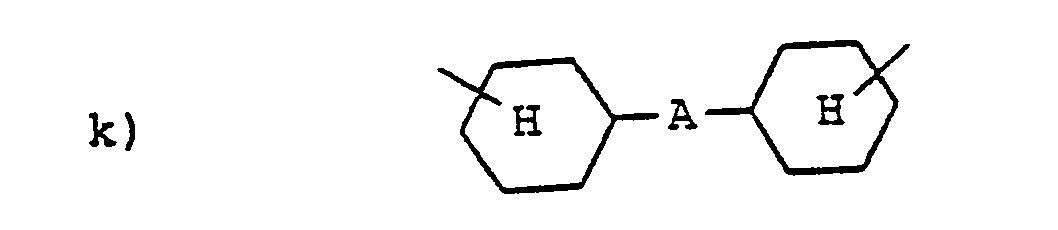


- Die für die Herstellung der erfindungsgemäßen Glycidyl-1,2,4-triazolidin-3,5-dione der Formel I notwendigen Ausgangstriazolidin-3,5-dione können nach verschiedenen Verfahren erhalten werden.
- So können Amine der Formel II

- R1 und n die für Formel I angegebene Bedeutung besitzen, mit Hydrazodicarbonamid (Verfahren 1) oder mit 1,2,4-Triazolidin-3,5-dion (Verfahren 2) bei 150-280°C in Gegenwart oder Abwesenheit eines Lösungsmittels wie N-Methylpyrrolidon oder Lösungsmittelgemisches bei Drücken von 50 mbar bis 5 bar, gegebenenfalls in Gegenwart eines sauren oder basischen Katalysators wie ALkoholaten oder tert. Aminen, unter Abspaltung von Ammoniak zu den Ausgangs-1,2,4-triazolidin-3,5-dionen umgesetzt werden.
- Eine weitere Möglichkeit für die Herstellung der Ausgangs-1,2,4-triazolidin-3,5-dione besteht darin, daßman N-monosubstituierte Hydrazodicarbonamide der Formel III

- R1 und n die in Formel I angegebene Bedeutung haben,
- unter den Bedingungen, wie vorstehend für die Verfahren 1 und 2 angegeben, unter Ammoniakabspaltung zu den Ausgangs-1,2,4-triazolidin-3,5-dionen umsetzt. Die N-monosubstituierten Hydrazodicarbonamide der Formel III können nach bekannten Verfahren aus Semicarbazid und Isocyanaten der Formel IV

- R1 und n die für Formel I angegebene Bedeutung haben, erhalten werden.
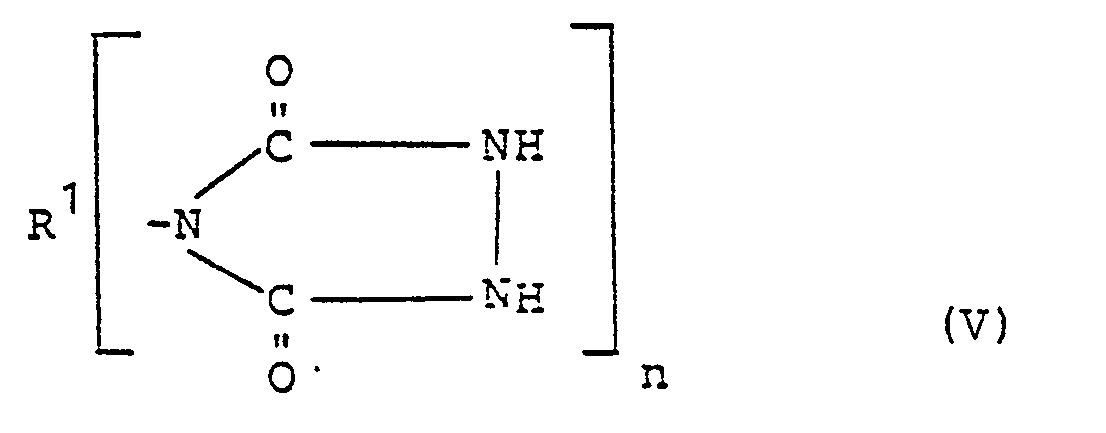
- Die erfindungsgemäßen Glycidyl-1,2,4-triazolidin-3,5-dione der allgemeinen Formel I werden erhalten, indem man 1,2,4-Triazolidin-3,5-dione der Formel V

- R1 und n die in Formel I angegebene Bedeutung haben,
- Beim bevorzugt verwendeten zweistufigen Verfahren werden in einer ersten Stufe 1,2,4-Triazolidin-3,5-dione der
- Formel V mit einem Epihalogenhydrin in Anwesenheit von basischen, sauren oder neutralen Katalysatoren zur Halogenhydrinverbindung der allgemeinen Formel VI
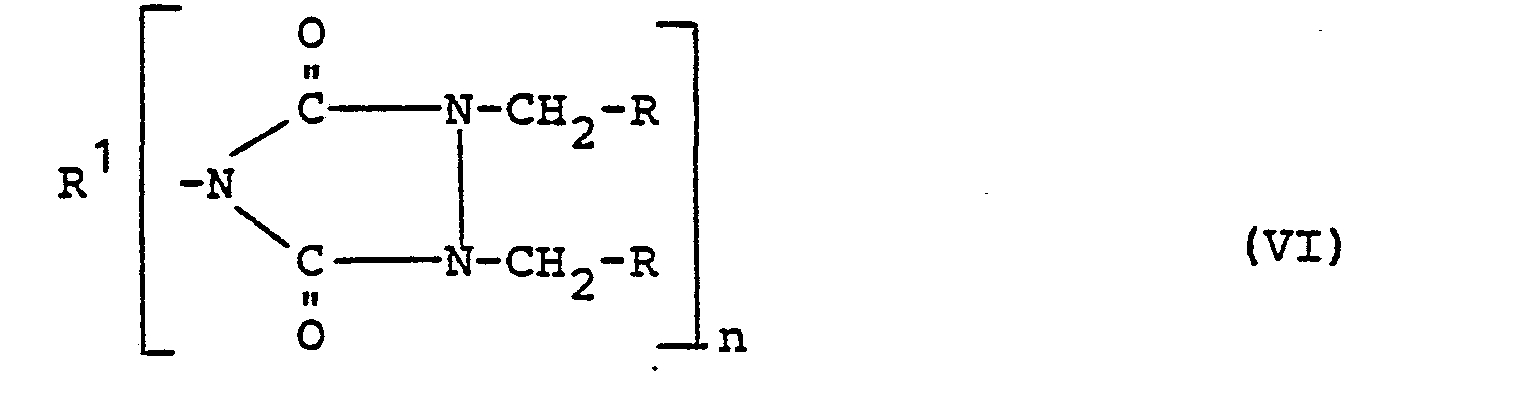
- Ein solcher, in einen 1,2-Epoxyethylrest umwandelbarer Rest R ist vor allem ein an verschiedenen Kohlenstoffatomen funktionelle Gruppen tragender Hydroxyhalogenethylrest wie die 2-Chlor-1-hydroxy- oder 2-Methyl-2-chlor-1-hydroxyethylreste.
- Vorzugsweise verwendet man bei der Addition des Halogenhydrins als Katalysatoren tertiäre Amine und/oder quaternäre Ammoniumsalze wie Trimethylbenzylammoniumhydroxid, Tetraethylammoniumchlorid, Trimethylbenzylammoniumchlorid und Trimethyl-phenylammoniumchlorid, Triethylamin, Trin-butylamin, Triethanolamin, N,N'-Dimethylanilin, Benzyldimethylamin, Pyridin, Endoethylenpiperazin und N,N'-Di- methylpiperazin.
- Ferner sind auch handelsübliche basische Ionenaustauscherharze mit tertiären oder quaternären Aminogruppen sowie mit Säureamidgruppen geeignet.
- Als Katalysatoren sind auch niedermolekulare Thioether und/oder deren Sulfoniumsalze wie Diethylsulfid, Dibenzylsulfid, ß-Hydroxyethyl-ethylsulfid, Thiodiglykol und Dibenzyl-methylsulfonium-bromid bzw. Verbindungen, welche mit Epihalogenhydrin in Thioether oder deren Sulfoniumverbindungen übergehen können, wie beispielsweise Schwefelwasserstoff, Natriumsulfid oder Mercaptane zu verwenden.
- Es können jedoch auch Alkalimetall- und Erdalkalimetallsalze wie Lithiumchlorid und Calciumrhodanid eingesetzt werden.
- Die Menge an Katalysator liegt vorzugsweise zwischen 0,01 und 5 Mol-%, bezogen auf eingesetztes 1,2,4-Tria- zolidin-3,5-dion der Formel V.
- Die Halogenhydrinverbindung der allgemeinen Formel (VI) kann auch hergestellt werden durch die Umsetzung von 1,2,4-Triazolidin-3,5-dion der Formel V mit Dihalogenhydrinpropan wie 1,3-Dichlorpropanol-2 oder 2-Methyl-1,3-dichlorpropanol-2 in Gegenwart von Halogenwasserstoff abspaltenden Mitteln wie Alkali- oder Erdalkalihydroxide, z.B. Natrium- und Bariumhydroxid, Alkali-oder Erdalkalicarbonate, z.B. Soda und Calciumcarbonat und tertiäre Amine wie Triethylamin.
- Die Reaktion der 1,2,4-Triazolidin-3,5-dione der Formel V mit dem Epihalogenhydrin wird mit mindestens äquivalenten Mengen an Epihalogenhydrin durchgeführt, d.h. eine NH-Gruppe der 1,2,4-Triazolidin-3,5-dione der Formel V wird mit mindestens einem Mol Epihalogenhydrin zur Reaktion gebracht. Vorzugsweise wird jedoch ein Überschuß an Epihalogenhydrin, und zwar 1,2 bis 20 Mol, besonders bevorzugt 3 bis 10 Mol Epihalogenhydrin pro NH-Gruppe, verwendet. Aus wirtschaftlichen Gründen wird man die Menge an Epihalogenhydrin natürlich so niedrig wie möglich halten.
- Die Reaktion zwischen den 1,2,4-Triazolidin-3,5-dionen der Formel V und Epihalogenhydrin wird bei 20 bis 200°C, vorzugsweise bei 50 bis 160°C, gegebenenfalls unter erhöhtem Druck, durchgeführt.
- Die Reaktionszeiten liegen im allgemeinen zwischen 30 Minuten und mehreren Tagen, können in besonderen Fällen jedoch auch darüber oder darunter liegen. Durch entsprechende Wahl der Reaktionsbedingungen, z.B. Druck, werden kürzere Reaktionszeiten erreicht.
- Prinzipiell kann die Umsetzung der 1,2,4-Triazolidin-3,5-dione der Formel V mit dem Epihalogenhydrin oder ß-Methylhalogenhydrin auch ohne Zusatz von Katalysatoren durchgeführt werden, jedoch sind dann höhere Temperaturen und/oder längere Reaktionszeiten als vorstehend angegeben, erforderlich.
- Anschließend wird in einer zweiten Stufe die Halogenhydrinverbindung, die jedoch je nach Epihalogenhydrin-oder ß-Methylhalogenhydrinüberschuß bereits gewisse Mengen an Glycidylverbindungen enthalten kann, mittels Halogenwasserstoff-abspaltender Verbindungen zu Glycidyl-1,2,4-triazolidin-3,5-dionen der Formel I dehydrohalogeniert.
- Die zur Halogenwasserstoffabspaltung eingesetzten alkalisch reagierenden Verbindungen sind insbesondere Alkali-oder Erdalkalimetallhydroxide wie Natriumhydroxid, Kaliumhydroxid, Calciumhydroxid, vorzugsweise Natriumhydroxid. Dies kann in fester Form oder in Lösung, vorzugsweise in 20-50 %igen Lösungen, eingesetzt werden.
- Ferner können zur Halogenwasserstoffabspaltung Alkalicarbonate, insbesondere Soda und Kaliumcarbonat in. fester oder gelöster Form, Alkalisilikate, Alkaliphosphate und Alkalialuminate sowie überschüssiges Epihalogenhydrin, oder 1,2-Alkylenoxide, wie Ethylenoxid Verwendung finden, wobei bei Verwendung von Epichlorhydrin dieses in Glycerindichlorhydrin umgewandelt wird.
- Auf eine Halogenhydrin-Gruppe der 1,2,4-Triazolidin-3,5-dione der Formel VI werden 1 bis 1,2 Äquivalente der Halogenwasserstoff abspaltenden Verbindungen eingesetzt.
- Zweckmäßig soll bei der Halogenwasserstoffabspaltung der pH-Wert nicht über 13, vorzugsweise nicht über pH 11 ansteigen. Um dies zu erreichen, setzt man das Alkali nach und nach zu bzw. tropft die Lösung allmählich zu und kontrolliert dabei den pH-Wert der Reaktionsmischung.
- Die Halogenwasserstoffabspaltung kann im Temperaturbereich von 5°C bis 120°C erfolgen. Wird die Halogenwasserstoffabspaltung mit Alkali, z.B. Kalilauge, durchgeführt, so ist zur Erzielung optimaler Ausbeuten eine Reaktionstemperatur von 70°C nicht zu überschreiten. Die besten Ergebnisse werden bei Temperaturen um 30 bis 35°C erhalten. Bei Einsatz von Alkalicarbonaten sollte die Reaktionstemperatur jedoch über 70°C liegen, wobei die Höchstgrenze in der Regel durch die Siedetemperatur des überschüssigen Epihalogenhydrins vorgegeben ist.
- Bei der Dehydrohalogenierung ist es vorteilhaft, ein mit Wasser nicht mischbares organisches Lösungsmittel zuzusetzen, um das bei der Reaktion entstehende bzw. das über die Alkalilösung zugetropfte Wasser azeotrop entfernen zu können. Die Mengen an zugesetztem Lösungsmittel sind nicht kritisch. Geeignete Lösungsmittel sind chlorierte Kohlenwasserstoffe wie Methylenchlorid, Chloroform, Ethylenchlorid oder Trichlorethylen. Sofern für die Bildung der 1,2,4-Triazolidin-3,5-dion-chlorhydrinverbin- dungen der Formel VI ein großer Überschuß an Epihalogenhydrin eingesetzt wurde, kann das überschüssige Epihalogenhydrin als mit Wasser nicht mischbares Lösungsmittel fungieren.
- Eine besonders bevorzugte Ausführungsform besteht darin, daß man 1,2,4-Triazolidin-3,5-dione der Formel V mit Epihalogenhydrin, vorzugsweise Epichlorhydrin, in Gegenwart eines Katalysators, vorzugsweise eines tert. Amins, einer quaternären Ammoniumbase, eines-quaternären Ammoniumsalzes oder eines organischen Sulfids.bzw. Sulfoniumsalzes, in einer ersten Stufe umsetzt und das dabei entstandene Halogenhydringruppen enthaltende 1,2,4-Tria- zolidin-3,5-dion in einer zweiten Stufe mit halogenwasserstoffabspaltenden Verbindungen, insbesondere Alkali-, Erdalkalihydroxiden oder Alkalicarbonaten in fester oder gelöster Form, behandelt.
- Die Aufarbeitung der 1,2,4-Glycidyl-triazolidin-3,5-dione der Formel I erfolgt in der Regel so, daß das bei der Halogenwasserstoffabspaltung entstehende Nebenprodukt, z.B. Kochsalz bei Verwendung von Natronlauge als Säurefänger, durch Absaugen entfernt wird. Eventuell noch vorhandene Kochsalz- und Alkalireste werden durch Auswaschen mit Wasser entfernt. Selbstverständlich können jedoch auch das gesamte Kochsalz und eventuell vorhandene Alkalireste ohne vorheriges Absaugen durch Auswaschen mit Wasser entfernt werden: Die verbleibende Lösung wird dann gegebenenfalls nach dem Trocknen über einem geeigneten Trocknungsmittel wie wasserfreiem Natriumsulfat, vom Lösungsmittel, z.B. überschüssigem Epichlorhydrin, welches in den nächsten Ansätzen wieder mitverwendet werden kann, gegebenenfalls im Vakuum entfernt, und das erhaltene hellgelb bis gelb gefärbte viskose öl wird gegebenenfalls durch Auflösen in geeigneten Lösungsmitteln wie C1-C4-Alkanolen, vorzugsweise Methanol, Ketonen wie Butanon, Glykol- bzw. Diglykolmonoether oder deren Acetate wie Ethylen-glykolmonomethylether, Diethylen-glykolmonoethylether und Ethylenglykolmonomethyletheracetat und nachfolgendem Abkühlen zur Kristallisation gebracht.
- Die erhaltenen, kristallinen Verbindungen, können abgesaugt und gegebenenfalls durch Umkristallisieren, z.B. aus Methanol, nochmals gereinigt werden. Häufig kann jedoch auf eine Reinigung verzichtet und das Rohprodukt sofort weiterverarbeitet werden. Je nach Konstitution des Restes R1 entstehen häufig jedoch dünnflüssige bis hochviskose Harze, die dann ohne weitere Reinigung weiter umgesetzt werden können.
- Die erfindungsgemäßen 1,2,4-Glycidyl-triazolidin-3,5-dione der Formel I besitzen Epoxidwerte von 0,2 bis 0,91, vorzugsweise 0,64 bis 0,91. Unter Epoxidwert wird die Anzahl von Epoxidäquivalenten verstanden, die in 100 g Substanz enthalten ist. Das Epoxidäquivalent ist definiert als die Grammenge Substanz, in der eine 1,2-Epoxidgruppe enthalten ist. Eine 1,2-Epoxidgruppe ist einem Mol Halogenwasserstoff äquivalent. Von der Herstellung her können die Polyglycidylverbindungen der 1,2,4-Tria- zolidin-3,5-dione noch verseifbares Halogen (bis ca. 5 Gew.-% Chlor bzw. ca. 13 Gew.-% Brom) enthalten, das durch weitere Behandlung mit Halogenwasserstoff abspaltenden Mitteln, falls gewünscht, praktisch vollständig entfernt werden kann und zumindest teilweise den Gehalt an Epoxidgruppen erhöht.
- Prinzipiell ist es möglich, die erfindungsgemäßen Verbindungen der Formel (I) aus Verbindungen der Formel (VI) in der R einen Ethenylrest (CH2=CH-) darstellt, durch Peroxidierung, z.B. mittels Wasserstoffperoxid oder Persäuren herzustellen.
- Die erfindungsgemäßen 1,2,4-Glycidyl-triazolidin-3,5-dione der Formel I, Polyglycidylverbindungen können, allein oder zusammen mit üblichen Härtungsmitteln, als Imprägnierungsmittel für Textilien, z.B. Fasern aus Polyester, als Überzugsmittel, z.B. für Anstrichzwecke auf Glas, Metallen und Holz, als Klebemittel für Kunststoffe verschiedenster Art, z.B. zum Verkleben von ungewebten textilartigen Gebilden, sowie zur Herstellung von Formkörpern, z.B. Gieß-, Preßkörpern und Laminaten verwendet werden.
- Die nachfolgenden Beispiele sollen die Erfindung näher erläutern, wobei, wenn nicht anders angegeben, die Prozente und Teile sich auf das Gewicht beziehen. '
- Herstellung der Ausgangs-1,2,4-triazolidin-3,5-dione der Formel V
- 600 g Eydrazodicarbonamid und 150 g Ethylendiamin werden in 500 ml N-Methylpyrrolidon 4 Stunden bei 175°C und 20 Stunden bei 200°C gerührt. Beim Abkühlen fällt ein Niederschlag aus, der abgesaugt und mit Ethanol gewaschen wird. Man erhält 462 g (80 % der Theorie) 1,2-Ethandiyl-4,4'-bis-1,2,4-triazolidin-3,5-dion als farblose Kristalle vom Fp. >330°C.

- 420 g 4,4'-Diaminodicyclohexylmethan und 472 g Hydrazodicarbonamid werden in 750 ml N-Methylpyrrolidon 4 Stunden bei 175°C, 8 Stunden bei 200°C und 4 Stunden bei 220°C gerührt. Das Reaktionsprodukt wird abgekühlt und anschließend in 3 1 Wasser eingerührt. Dabei fällt ein Niederschlag aus, der abgesaugt und mit Wasser gewaschen wird. Man erhält 566 g (75 % der Theorie) an .4,4'-Bis-(1,2,4-triazolidin-3,5-dion-4-yl)-dicyclohexylmethan als farblose Kristalle vom Fp. 305°C (Zersetzung).
- MS (m/e): Molpeak 378.
- Zu einer Lösung von 111,5 g Semicarbazidhydrochlorid in 700 g Wasser wird so lange in kleinen Portionen Soda zugesetzt, bis keine Gasentwicklung mehr zu beobachten ist.
- Dann wird bei 40°C eine Lösung aus 119 g Phenylisocyanat in 100 g Aceton zugetropft. Zur Vervollständigung der Reaktion wird 2 Stunden bei 40°C nachgerührt und der gebildete Niederschlag durch Absaugen isoliert.
- Der über Nacht an der Luft getrocknete Niederschlag wird in 300 g Sulfolan suspendiert und auf 205°C aufgeheizt, wobei ab 160°C durch Anlegen eines Wasserstrahlvakuums von 420 mbar das freiwerdende Ammoniak abgezogen wird. Nach einer Reaktionszeit von 5 Stunden wird bei einem Druck von 0,3 mbar das Lösungsmittel größtenteils entfernt und der verbliebene Rückstand aus n-Butanol umkristallisiert. Nach dem Absaugen und Trocknen werden 134 g 4-Phenyl-1,2,4-triazolidin-3,5-dion vom Fp. = 202-203°C (Lit. 203°C) erhalten.
- 60 g Hydrazodicarbonamid und 29 g 1,6-Diaminohexan werden in 100 ml Sulfolan 2 Stunden bei 175°C und 9 Stunden bei 200°C gerührt. Beim Abkühlen fällt ein Niederschlag aus, der abgesaugt und aus Wasser umkristallisiert wird. Man erhält 36 g (51 % d.Th.) 1,6-Hexandiyl-4,4'-bis-1,2,4-triazolidin-3,5-dion als farblose Kristalle vom Fp.: 215-217°C.

- 102 g 1,4-Butandiolbis-(3-aminopropylether) und 120 g Hydrazodicarbonamid werden in 300 ml N-Methylpyrrolidon 1 Stunde bei 150°C, 2 Stunden bei 175°C und 5 Stunden bei 200°C gerührt. Beim Abkühlen fällt ein Niederschlag aus, der abgesaugt und mit 200 ml Acetonitril ausgekocht wird. Als Rückstand erhält man 142 g (76 % d.Th.) 1,4-Butandiol-bis-[3-(3,5-dioxo-1,2,4-tria- zolidin-4-yl)-propylether7 als farblose Kristalle vom-Fp.: 152-154°C.

- 111,5 g Semicarbazidhydrochlorid werden in 400 ml H20 gelöst und mit Soda neutralisiert. Anschließend werden unter starkem Rühren bei Raumtemperatur 57 g Methylisocyanat, gelöst in 300 ml Dioxan innerhalb von 1 Stunde zugetropft. Man rührt 2 Stunden bei Raumtemperatur nach und saugt vom entstandenen Niederschlag ab. Der Niederschlag wird in 1 1 N-Methylpyrrolidon suspendiert und 10 Stunden bei 200°C und 300 mbar pyrrolysiert. Anschließend wird das Lösungsmittel im Vakuum abdestilliert und der Rückstand aus Ethanol umkristallisiert. Man erhält 96 g (83 %.d.Th.) 4-Methyl-1,2,4-triazolidin-3,5-dion als farblose Kristalle vom Fp.: 230-232°C. (Lit. 232-233°C).
- 101 g 1,2,4-Triazolidin-3,5-dion und 57 g 1,4-Diaminocyclohexan werden in 500 ml N-Methylpyrrolidon 4 h auf 175°C und 30 Stunden auf 200°C unter Rühren erhitzt. Beim Abkühlen kristallisiert ein Niederschlag aus, der abgesaugt, mit Ethanol gewaschen und getrocknet wird. Man erhält 110 g (78 % d.Th.) 1,4-Cyclohexandiyl-bis-(1,2,4-triazolidin-3,5-dion-4-yl) als farblose Kristalle vom Fp. > 300°C.

- 100 g 1,12-Diaminododecan und 120 g Hydrazodicarbonamid werden in 300 ml N-Methylpyrrolidon 1 Stunde bei 175°C und 4 Stunden bei 200°C gerührt. Beim Abkühlen fällt ein Niederschlag aus, der abgesaugt und mit 300 ml Acetonitril ausgekocht wird. Man erhält 156 g (85 % d.Th.) 1,2-Dodecan-4,4'-bis-(1,2,4-triazolidin-3,5-dion) als farblose Kristalle von Fp. 172-175°C.

- 2000 g Epichlorhydrin, 228 g 1,2-Ethandiyl-4,4'-bis-(l,2,4-triazolidin-3,5-dionl (Ausgangsstoff 1), 2 g Triethylamin und 200 ml Wasser werden 3,5 Stunden unter Rückfluß gerührt. Anschließend wird das Wasser durch azeotrope Destillation am Wasserabscheider entfernt. Zum Reaktionsgemisch werden bei 40-45°C unter vermindertem Druck 170 g Natriumhydroxid als 45 %ige wäßrige Lösung zugetropft und gleichzeitig Wasser durch azeotrope Destillation am Wasserabscheider entfernt. Anschließend wird so lange bei 40-45°C nachgerührt, bis alles Wasser entfernt ist. Man saugt vom entstandenen Natriumchlorid ab und wäscht es zweimal mit je 200 g Epichlorhydrin. Die vereinigten Epichlorhydrinlösungen werden mit 200 ml Wasser ausgeschüttelt. Nach dem Trocknen der organischen Phase über Natriumsulfat wird das Lösungsmittel im Vakuum entfernt und der Rückstand zuletzt bei 60°C und 0,3 mbar bis zur Gewichtskonstanz getrocknet. Es werden 421 g eines hellgelben hochviskosen Harzes erhalten, dessen Epoxidwert 0,82 und dessen Chlorgehalt = 1,35 % Gesamtchlor beträgt.
- 37,8 g 4,4'-Bis-(1,2,4-triazolidin-3,5-dion-4-yl)-dicyclohexylmethan (Ausgangsstoff 2), 0,1 g Triethylamin und 300 g Epichlorhydrin werden 5 Stunden unter Rückfluß gerührt. Zu der auf 30°C abgekühlten Lösung werden innerhalb von 2 Stunden in kleinen Portionen 16,5 g pulverisiertes Ätznatron zugesetzt und zur Vervollständigung der Reaktion noch 2 Stunden bei 30°C nachgerührt. Das entstandene Kochsalz wird durch Filtration abgetrennt und zweimal mit je 30 g Epichlorhydrin gewaschen. Die vereinigten Epichlorhydrinlösungen werden mit 50 ml Wasser ausgeschüttelt. Nach dem Trocknen der organischen Phase über Natriumsulfat wird das Lösungsmittel im Vakuum entfernt und der Rückstand zuletzt bei 60°C und 0,3 mbar bis zur Gewichtskonstanz getrocknet. Es werden 52,1 g eines hellgelben hochviskosen Öles erhalten, dessen Epoxidwert 0,59 und dessen Chlorgehalt = 2,1 % Gesamtchlor beträgt.
- 70,8 g 4-Phenyl-1,2,4-triazolidin-3,5-dion (Ausgangsstoff 3), 1 g Tetraethylammoniumchlorid und 500 g Epichlorhydrin werden 5 Stunden bei 80°C gerührt. Nach dem Abkühlen auf 40°C werden innerhalb von 2 Stunden 85 g 40 %ige Natronlauge zugetropft, wobei das eingebrachte und das bei der Reaktion freiwerdende Wasser über einen Wasserabscheider bei vermindertem Druck aus dem Reaktionsgemisch entfernt wird. Zur Vervollständigung der Reaktion wird noch eine Stunde bei 40°C unter azeotropem Rückfluß nachgerührt. Das entstandene Kochsalz wird durch Filtration abgetrennt und mit 100 g Epichlorhydrin gewaschen. Die vereinigten Epichlorhydrinlösungen werden zweimal mit 30 ml Wasser gewaschen und über Natriumsulfat getrocknet. Anschließend wird das Epichlorhydrin im Vakuum abdestilliert. Der bei 70°C und 0,2 mbar bis zur Gewichtskonstanz getrocknete Rückstand wiegt 107 g. Er hat einen Epoxidwert von 0,66 und einen Chlorgehalt von 1,3 % Gesamtchlor.
- 56,8 g 1,6-Hexandiyl-4,4'-bis-i1,2,4-triazolidin-3,5-dion) (Ausgangsstoff 4), 0,5 g Thioglykol und 1,2 kg Epichlorhydrin werden 7 Stunden bei 100°C gerührt. Nach dem Abkühlen werden bei 50°C 46 g Kaliumhydroxid als 25 %ige wäßrige Lösung innerhalb von 1,5 Stunden zugetropft, wobei das eingebrachte und das bei der Reaktion entstehende Wasser über einen Wasserabscheider bei vermindertem Druck aus dem Reaktionsgemisch entfernt wird. Zur Vervollständigung der Reaktion wird noch 2 Stunden bei 50°C unter a-zeotropem Rückfluß nachgerührt. Das entstandene Salz wird durch Auswaschen mit Wasser entfernt. Die Epichlorhydrinlösung wird anschließend über Natriumsulfat getrocknet und im Vakuum eingeengt. Nach dem Trocknen bei 60°C und 0,25 mbar bis zur Gewichtskonstanz werden 95 g eines viskosen, gelblich gefärbten Epoxidharzes mit einem Epoxidwert von 0,73 und einem Chlorgehalt von 1,6 % Gesamtchlor erhalten.
- 55,8 g 1,4-Butanbisoxypropyl-3-diyl- [1,2,4-Triazoli- din-3,5-dion-4-yl] (Ausgangsstoff 5), 0,2 g Triethylamin und 1,2 kg Epichlorhydrin werden 10 Stunden bei 80°C gerührt. Nach dem Abkühlen werden 26 g pulverisiertes Natriumhydroxid portionsweise innerhalb 3 Stunden bei 30°C zugegeben. Das bei der Reaktion entstandene Wasser wird als Azeotrop mit Epichlorhydrin abdestilliert. Durch Filtrieren wird das Kochsalz entfernt und das restliche Epichlorhydrin im Vakuum abdestilliert. Nach dem Trocknen bei 70°C und 0,4 mbar zur Gewichtskonstanz wird ein gelblich gefärbtes öl mit einem Epoxidwert von 0,61 und einem Chlorgehalt von 0,7 % Gesamtchlor erhalten.
- a) 115 4-Methyl-1,2,4-triazolidin-3,5-dion (Ausgangsstoff 6.), 1 g Triethylamin und 750 g Epichlorhydrin .werden 4 Stunden bei Rückfluß gerührt. Nach dem Abkühlen werden bei 35°C 82 g Natriumhydroxid, gelöst in 100 g Wasser innerhalb von 4 Stunden zugetropft, wobei das Wasser über einen Wasserabscheider bei vermindertem Druck aus dem Reaktionskolben entfernt wird.'Zur Vervollständigung der Reaktion wird noch 3 Stunden bei 35°C und azeotropem Rückfluß bei vermindertem Druck nachgerührt, unlösliche Bestandteile durch Absaugen entfernt und die Epoxidharzlösung durch Waschen mit Wasser von anorganischen Bestandteilen befreit. Nach dem Trocknen der Epoxidharzlösung über Na2S04 wird am Rotationsverdampfer eingeengt und der Rückstand bei 60°C und 0,25 mbar bis zur Gewichtskonstanz getrocknet. Es verbleiben 190 g eines viskosen, gelb gefärbten Epoxidharzes mit einem Epoxidwert von 0,79 und einem Chlorgehalt von 1,1 % Gesamtchlor, welches nach zweitägigem Stehen erstarrt. Durch Verreiben mit Ethanol wird praktisch reines 1,2-Bisglycidyl-4-methyl-1,2,4-triazolidin-3,5-dion vom Fp. = 115-116°C (aus Ethanol) erhalten.
- IR- und NMR-Spektren sowie die Elementaranalyse bestätigen die angenommene Struktur

- b) Zu 100 g eines zuvor entgasten, rohen Epoxidharzes mit einem Epoxidwert von 0,79 (aus Beispiel 6a) werden unter Kühlen 21 g Triethylentetramin eingerührt und entgast. Die Masse wird in eine Form gegossen und bei Raumtemperatur gehärtet. Nach 12 Tagen erhält man einen harten Formling von hellgelber Farbe.
- c) 100 g kristallines 1,2-Bisglycidyl-4-methyltria- zolidin-3,5-dion und 135 g Hexahydrophthalsäureanhydrid werden getrennt aufgeschmolzen, bei 120°C vermischt und in eine Form gegossen. Nach der Härtung von 10 Stunden bei 120°C und 2 Stunden bei 160°C werden Prüfkörper mit einem Martensgrad von 142°C erhalten.
- 141 g 1,4-Cyclohexandiyl-bis-(1,2,4-triazolidin-3,5-dion-4-yl) (Ausgangsstoff 7), 0,5 ml Triethylamin und 1 kg Epichlorhydrin werden 15 Stunden bei 100°C gerührt. Nach dem Abkühlen werden bei 35°C 94 g einer 50 %igen Natronlauge innerhalb von 4 Stunden zugetropft, wobei das Wasser über einen Wasserabscheider bei. vermindertem Druck aus dem Reaktionsgefäß entfernt wird. Zur Vervollständigung der Reaktion wird noch 3 Stunden bei 35°C und azeotropem Rückfluß bei vermindertem Druck nachgerührt. Die Epoxidharzlösung wird durch Absaugen, von unlöslichen Bestandteilen und durch Auswaschen mit Wasser von anorganischen Bestandteilen befreit. Die über Natriumsulfat getrocknete Epoxidlösung wird im Vakuum, zuletzt bei 60°C und 0,3 mbar, eingeengt. Es werden 187 g eines viskosen Epoxidharzes mit einem Epoxidwert von 0,71 und einem Chlorgehalt von 1,1 % Gesamtchlor erhalten.
- 184 g 1,12-Dodecandiyl-4,4'-bis-(1,2,4-triazolidin-3,5-dion)(Ausgangsstoff 8), 0,5 ml Triethylamin und 1 kg Epichlorhydrin werden 10 Stunden bei 80°C gerührt. Nach dem Abkühlen auf 35°C wird die Reaktion analog Beispiel 7 weitergeführt. Es werden 271 g eines viskosen Epoxidharzes mit einem Epoxidwert von 0,52 und einem Chlorgehalt von 3,9 % Gesamtchlor erhalten.
- 200 g des nach Beispiel 8 erhaltenen Epoxidharzes werden in 500 g Methylenchlorid gelöst. Zu dieser Lösung wird bei Rückfluß des Methylenchlorids innerhalb von 2 Stunden eine dem Chlorgehalt äquivalente Menge (+ 10 % Uberschuß) an Natriumhydroxid als 45 %ige Natronlauge zugetropft, wobei das Wasser über einen Wasserabscheider aus dem Reaktionsgefäß entfernt wird. Nach Beendigung der Reaktion wird abgesaugt, die organische Phase mit Wasser gewaschen und eingeengt, zuletzt bei 60°C/0,3 mbar. Es entstehen 188 g eines hellgelben Epoxidharzes mit einem Epoxidwert von 0,56 und einem Chlorgehalt von 0,4 % Gesamtchlor.
Claims (7)





Applications Claiming Priority (2)
| Application Number | Priority Date | Filing Date | Title |
|---|---|---|---|
| DE19803027623 DE3027623A1 (de) | 1980-07-21 | 1980-07-21 | Neue glycidyl-1,2,4-triazolidin-3,5-dione und ein verfahren zu ihrer herstellung |
| DE3027623 | 1980-07-21 |
Publications (2)
| Publication Number | Publication Date |
|---|---|
| EP0044422A1 true EP0044422A1 (de) | 1982-01-27 |
| EP0044422B1 EP0044422B1 (de) | 1983-10-19 |
Family
ID=6107745
Family Applications (1)
| Application Number | Title | Priority Date | Filing Date |
|---|---|---|---|
| EP81104775A Expired EP0044422B1 (de) | 1980-07-21 | 1981-06-22 | Neue Glycidyl-1,2,4-triazolidin-3,5-dione und ein Verfahren zu ihrer Herstellung |
Country Status (4)
| Country | Link |
|---|---|
| US (1) | US4467099A (de) |
| EP (1) | EP0044422B1 (de) |
| JP (1) | JPS5745183A (de) |
| DE (2) | DE3027623A1 (de) |
Cited By (2)
| Publication number | Priority date | Publication date | Assignee | Title |
|---|---|---|---|---|
| EP0061051A1 (de) * | 1981-03-21 | 1982-09-29 | Bayer Ag | Substituierte Triazolylmethyl-oxirane, Verfahren zu ihrer Herstellung sowie ihre Verwendung als Zwischenprodukte |
| CN1096897C (zh) * | 1998-04-23 | 2002-12-25 | Sms舒路曼-斯玛公司 | 斯蒂克尔热轧机 |
Families Citing this family (4)
| Publication number | Priority date | Publication date | Assignee | Title |
|---|---|---|---|---|
| DE3102373A1 (de) * | 1981-01-24 | 1982-08-26 | Henkel KGaA, 4000 Düsseldorf | "neue n-substituierte polyglycidyl-urazolverbindungen, verfahren zu ihrer herstellung sowie pharmzeutische zubereitungen |
| US4767552A (en) * | 1986-06-23 | 1988-08-30 | The Lubrizol Corporation | Urazole compositions useful as additives for functional fluids |
| IT1247835B (it) * | 1991-02-05 | 1995-01-02 | Ciba Geigy Spa | Composizione stabilizzante per materiali polimerici termoplastici comprendente derivati del 1,2,4-triazolidin-3,5-dione |
| JP6950501B2 (ja) * | 2017-12-06 | 2021-10-13 | 住友ベークライト株式会社 | 検査方法およびエポキシ樹脂組成物の製造方法 |
Citations (2)
| Publication number | Priority date | Publication date | Assignee | Title |
|---|---|---|---|---|
| US3634445A (en) * | 1968-08-02 | 1972-01-11 | Basf Ag | Substituted triazolidine derivatives |
| US3681374A (en) * | 1970-08-11 | 1972-08-01 | Asahi Chemical Ind | Synthetic nacreous triazole crystals and method for production thereof |
Family Cites Families (1)
| Publication number | Priority date | Publication date | Assignee | Title |
|---|---|---|---|---|
| DE2935354A1 (de) * | 1979-09-01 | 1981-03-19 | Bayer Ag, 5090 Leverkusen | Triglycidyl-triazolidin-3,5-dione und verfahren zu ihrer herstellung |
-
1980
- 1980-07-21 DE DE19803027623 patent/DE3027623A1/de not_active Withdrawn
-
1981
- 1981-06-22 EP EP81104775A patent/EP0044422B1/de not_active Expired
- 1981-06-22 DE DE8181104775T patent/DE3161240D1/de not_active Expired
- 1981-06-29 US US06/278,646 patent/US4467099A/en not_active Expired - Fee Related
- 1981-06-30 JP JP56100757A patent/JPS5745183A/ja active Pending
Patent Citations (2)
| Publication number | Priority date | Publication date | Assignee | Title |
|---|---|---|---|---|
| US3634445A (en) * | 1968-08-02 | 1972-01-11 | Basf Ag | Substituted triazolidine derivatives |
| US3681374A (en) * | 1970-08-11 | 1972-08-01 | Asahi Chemical Ind | Synthetic nacreous triazole crystals and method for production thereof |
Non-Patent Citations (1)
| Title |
|---|
| CHEMICAL ABSTRACTS, Vol. 61, no. 3, 03-08-1964, Columbus, Ohio, USA J. BOURDAIS " Hetroyclic series II. New syntheses and physicochemical properties of the 1,2,4-triazolidine-3,5-diones " column 3094-95, abstract no. 3094h & Bull. Soc. Chim. France 1964 (3), 500-7 * |
Cited By (3)
| Publication number | Priority date | Publication date | Assignee | Title |
|---|---|---|---|---|
| EP0061051A1 (de) * | 1981-03-21 | 1982-09-29 | Bayer Ag | Substituierte Triazolylmethyl-oxirane, Verfahren zu ihrer Herstellung sowie ihre Verwendung als Zwischenprodukte |
| US4499281A (en) * | 1981-03-21 | 1985-02-12 | Bayer Aktiengesellschaft | Substituted triazolylmethyl-oxiranes and their use as intermediates for fungicides |
| CN1096897C (zh) * | 1998-04-23 | 2002-12-25 | Sms舒路曼-斯玛公司 | 斯蒂克尔热轧机 |
Also Published As
| Publication number | Publication date |
|---|---|
| DE3161240D1 (en) | 1983-11-24 |
| EP0044422B1 (de) | 1983-10-19 |
| JPS5745183A (en) | 1982-03-13 |
| US4467099A (en) | 1984-08-21 |
| DE3027623A1 (de) | 1982-02-18 |
Similar Documents
| Publication | Publication Date | Title |
|---|---|---|
| EP0042592B1 (de) | N-Heteroaryl-alkylendiamine, Verfahren zu ihrer Herstellung sowie ihre Verwendung | |
| EP0022073B1 (de) | Diglycidyläther von di-sekundären Alkoholen, ihre Herstellung und Verwendung | |
| DE3723782C2 (de) | ||
| DE2811764C2 (de) | Addukte von Isocyanursäure mit substituierten Imidazolen sowie Verfahren zu deren Herstellung und deren Verwendung | |
| EP0019726A1 (de) | N-Azidosulfonylaryl-maleinimide sowie deren Verwendung | |
| EP0044422B1 (de) | Neue Glycidyl-1,2,4-triazolidin-3,5-dione und ein Verfahren zu ihrer Herstellung | |
| EP0044416B1 (de) | Triazolidin-3,5-dion-oxyalkylverbindungen und Verfahren zu ihrer Herstellung | |
| DE2934948A1 (de) | Verfahren zur herstellung von 2-mercaptoalkylsulfiden und 2-mercaptoalkylethern | |
| EP0026312B1 (de) | 1,2,4-Triglycidyl-triazolidin-3,5-dione, Verfahren zu ihrer Herstellung und ihre Verwendung | |
| EP0044420B1 (de) | Hydroxyalkyl-1,2,4-triazolidin-3,5-dione und Verfahren zu ihrer Herstellung | |
| EP0137176B1 (de) | N,N'-Bis-(2,3-epoxypropyl)-derivate cyclischer Dicarbonsäurehydrazide und ein Verfahren zu ihrer Herstellung | |
| EP0016956B1 (de) | Neue Trishydroxyalkylheterocyclen und Verfahren zu ihrer Herstellung | |
| DE2803755A1 (de) | Verfahren zur herstellung von n-substituierten 3-amino-1.2-benzisothiazolen | |
| EP0093959B1 (de) | Verfahren zur Herstellung von Glycidyl-1,2,4-triazolidin-3,5-dionen | |
| WO1992015559A1 (de) | Verfahren zur herstellung von 3'-aminopropyl-2-sulfatoethylsulfon | |
| DE1670490B2 (de) | N,N'-Diglycidyl-bis-hydantoinylverbindungen, Verfahren zu ihrer Herstellung ihre Verwendung | |
| EP0039483A1 (de) | Verfahren zur Herstellung von 2-Hydroxybenzthiazolen | |
| CH415685A (de) | Verfahren zur Herstellung von Hydroxyäthern hydroxyalkylierter Amide | |
| DE1812183C3 (de) | S^'-Diglycidyl-M'-methylen-bis-(5,6-dihydrouracile) und ihre Verwendung | |
| DE1670840A1 (de) | Verfahren zur Herstellung von Tetra-hydro-1,4-thiazin-1,1-dioxiden | |
| AT367762B (de) | Verfahren zur herstellung neuer ergolinderivate | |
| CH453710A (de) | Verfahren zur Herstellung von in Wasser unlöslichen schwefelhaltigen Kondensationsprodukten | |
| AT235307B (de) | Verfahren zur Herstellung von 4,4'-Diisoamyloxy-thiocarbanilid | |
| AT244983B (de) | Verfahren zur Herstellung von neuen, substituierten Phenylamino-1,3-diazacyclopentenen-(2) | |
| DE3244657A1 (de) | Verfahren zur herstellung von triazolin-3,5-dionen |
Legal Events
| Date | Code | Title | Description |
|---|---|---|---|
| PUAI | Public reference made under article 153(3) epc to a published international application that has entered the european phase |
Free format text: ORIGINAL CODE: 0009012 |
|
| 17P | Request for examination filed |
Effective date: 19810622 |
|
| AK | Designated contracting states |
Designated state(s): CH DE FR GB IT |
|
| ITF | It: translation for a ep patent filed | ||
| GRAA | (expected) grant |
Free format text: ORIGINAL CODE: 0009210 |
|
| AK | Designated contracting states |
Designated state(s): CH DE FR GB IT LI |
|
| REF | Corresponds to: |
Ref document number: 3161240 Country of ref document: DE Date of ref document: 19831124 |
|
| ET | Fr: translation filed | ||
| PGFP | Annual fee paid to national office [announced via postgrant information from national office to epo] |
Ref country code: DE Payment date: 19840526 Year of fee payment: 4 |
|
| PGFP | Annual fee paid to national office [announced via postgrant information from national office to epo] |
Ref country code: FR Payment date: 19840601 Year of fee payment: 4 |
|
| PLBE | No opposition filed within time limit |
Free format text: ORIGINAL CODE: 0009261 |
|
| STAA | Information on the status of an ep patent application or granted ep patent |
Free format text: STATUS: NO OPPOSITION FILED WITHIN TIME LIMIT |
|
| PGFP | Annual fee paid to national office [announced via postgrant information from national office to epo] |
Ref country code: CH Payment date: 19840924 Year of fee payment: 4 |
|
| 26N | No opposition filed | ||
| PG25 | Lapsed in a contracting state [announced via postgrant information from national office to epo] |
Ref country code: GB Effective date: 19880622 |
|
| PG25 | Lapsed in a contracting state [announced via postgrant information from national office to epo] |
Ref country code: LI Effective date: 19880630 Ref country code: CH Effective date: 19880630 |
|
| GBPC | Gb: european patent ceased through non-payment of renewal fee | ||
| PG25 | Lapsed in a contracting state [announced via postgrant information from national office to epo] |
Ref country code: FR Free format text: LAPSE BECAUSE OF NON-PAYMENT OF DUE FEES Effective date: 19890228 |
|
| REG | Reference to a national code |
Ref country code: CH Ref legal event code: PL |
|
| PG25 | Lapsed in a contracting state [announced via postgrant information from national office to epo] |
Ref country code: DE Effective date: 19890301 |
|
| REG | Reference to a national code |
Ref country code: FR Ref legal event code: ST |