EP0044955A1 - Flüssige Herbizidmischung - Google Patents
Flüssige Herbizidmischung Download PDFInfo
- Publication number
- EP0044955A1 EP0044955A1 EP81105004A EP81105004A EP0044955A1 EP 0044955 A1 EP0044955 A1 EP 0044955A1 EP 81105004 A EP81105004 A EP 81105004A EP 81105004 A EP81105004 A EP 81105004A EP 0044955 A1 EP0044955 A1 EP 0044955A1
- Authority
- EP
- European Patent Office
- Prior art keywords
- acid amide
- mixture according
- per liter
- herbicide mixture
- carbon atoms
- Prior art date
- Legal status (The legal status is an assumption and is not a legal conclusion. Google has not performed a legal analysis and makes no representation as to the accuracy of the status listed.)
- Granted
Links
- 239000000203 mixture Substances 0.000 title claims abstract description 52
- 230000002363 herbicidal effect Effects 0.000 title claims abstract description 18
- 239000007788 liquid Substances 0.000 title claims abstract description 13
- 239000004009 herbicide Substances 0.000 title claims description 16
- 239000004480 active ingredient Substances 0.000 claims abstract description 22
- 150000001408 amides Chemical class 0.000 claims abstract description 11
- 125000004432 carbon atom Chemical group C* 0.000 claims abstract description 8
- 239000005594 Phenmedipham Substances 0.000 claims description 15
- IDOWTHOLJBTAFI-UHFFFAOYSA-N phenmedipham Chemical compound COC(=O)NC1=CC=CC(OC(=O)NC=2C=C(C)C=CC=2)=C1 IDOWTHOLJBTAFI-UHFFFAOYSA-N 0.000 claims description 15
- WYKYKTKDBLFHCY-UHFFFAOYSA-N chloridazon Chemical compound O=C1C(Cl)=C(N)C=NN1C1=CC=CC=C1 WYKYKTKDBLFHCY-UHFFFAOYSA-N 0.000 claims description 10
- 239000003995 emulsifying agent Substances 0.000 claims description 7
- XLYOFNOQVPJJNP-UHFFFAOYSA-N water Substances O XLYOFNOQVPJJNP-UHFFFAOYSA-N 0.000 claims description 7
- 239000000080 wetting agent Substances 0.000 claims description 5
- 150000001875 compounds Chemical class 0.000 claims description 4
- 125000001495 ethyl group Chemical group [H]C([H])([H])C([H])([H])* 0.000 claims description 4
- CIUQDSCDWFSTQR-UHFFFAOYSA-N [C]1=CC=CC=C1 Chemical compound [C]1=CC=CC=C1 CIUQDSCDWFSTQR-UHFFFAOYSA-N 0.000 claims description 3
- 125000002496 methyl group Chemical group [H]C([H])([H])* 0.000 claims description 3
- WKBOTKDWSSQWDR-UHFFFAOYSA-N Bromine atom Chemical group [Br] WKBOTKDWSSQWDR-UHFFFAOYSA-N 0.000 claims 1
- NINIDFKCEFEMDL-UHFFFAOYSA-N Sulfur Chemical group [S] NINIDFKCEFEMDL-UHFFFAOYSA-N 0.000 claims 1
- QVGXLLKOCUKJST-UHFFFAOYSA-N atomic oxygen Chemical group [O] QVGXLLKOCUKJST-UHFFFAOYSA-N 0.000 claims 1
- GDTBXPJZTBHREO-UHFFFAOYSA-N bromine Chemical group BrBr GDTBXPJZTBHREO-UHFFFAOYSA-N 0.000 claims 1
- 229910052794 bromium Chemical group 0.000 claims 1
- 229910052801 chlorine Inorganic materials 0.000 claims 1
- 239000000460 chlorine Substances 0.000 claims 1
- 125000001309 chloro group Chemical group Cl* 0.000 claims 1
- 229910052736 halogen Inorganic materials 0.000 claims 1
- 150000002367 halogens Chemical class 0.000 claims 1
- 229910052760 oxygen Inorganic materials 0.000 claims 1
- 239000001301 oxygen Substances 0.000 claims 1
- 229910052717 sulfur Chemical group 0.000 claims 1
- 239000011593 sulfur Chemical group 0.000 claims 1
- -1 ethyl-substituted phenyl Chemical group 0.000 abstract description 5
- 125000000217 alkyl group Chemical group 0.000 abstract 2
- 238000009472 formulation Methods 0.000 description 19
- 239000000839 emulsion Substances 0.000 description 17
- 239000002904 solvent Substances 0.000 description 17
- ZMXDDKWLCZADIW-UHFFFAOYSA-N N,N-Dimethylformamide Chemical compound CN(C)C=O ZMXDDKWLCZADIW-UHFFFAOYSA-N 0.000 description 12
- 239000012141 concentrate Substances 0.000 description 12
- 230000015556 catabolic process Effects 0.000 description 6
- 238000006731 degradation reaction Methods 0.000 description 5
- RTZKZFJDLAIYFH-UHFFFAOYSA-N Diethyl ether Chemical compound CCOCC RTZKZFJDLAIYFH-UHFFFAOYSA-N 0.000 description 4
- IAZDPXIOMUYVGZ-UHFFFAOYSA-N Dimethylsulphoxide Chemical compound CS(C)=O IAZDPXIOMUYVGZ-UHFFFAOYSA-N 0.000 description 4
- YNAVUWVOSKDBBP-UHFFFAOYSA-N Morpholine Chemical compound C1COCCN1 YNAVUWVOSKDBBP-UHFFFAOYSA-N 0.000 description 4
- SECXISVLQFMRJM-UHFFFAOYSA-N N-Methylpyrrolidone Chemical compound CN1CCCC1=O SECXISVLQFMRJM-UHFFFAOYSA-N 0.000 description 4
- HJOVHMDZYOCNQW-UHFFFAOYSA-N isophorone Chemical compound CC1=CC(=O)CC(C)(C)C1 HJOVHMDZYOCNQW-UHFFFAOYSA-N 0.000 description 4
- 239000007787 solid Substances 0.000 description 4
- 239000000126 substance Substances 0.000 description 4
- 239000004563 wettable powder Substances 0.000 description 4
- 238000004128 high performance liquid chromatography Methods 0.000 description 3
- 239000007921 spray Substances 0.000 description 3
- 239000013543 active substance Substances 0.000 description 2
- 238000002425 crystallisation Methods 0.000 description 2
- 230000008025 crystallization Effects 0.000 description 2
- JHIVVAPYMSGYDF-UHFFFAOYSA-N cyclohexanone Chemical compound O=C1CCCCC1 JHIVVAPYMSGYDF-UHFFFAOYSA-N 0.000 description 2
- 238000010790 dilution Methods 0.000 description 2
- 239000012895 dilution Substances 0.000 description 2
- 239000002270 dispersing agent Substances 0.000 description 2
- 230000000694 effects Effects 0.000 description 2
- 230000009969 flowable effect Effects 0.000 description 2
- 229920000151 polyglycol Polymers 0.000 description 2
- 239000010695 polyglycol Substances 0.000 description 2
- 239000013049 sediment Substances 0.000 description 2
- 239000000243 solution Substances 0.000 description 2
- 239000004546 suspension concentrate Substances 0.000 description 2
- ZNFVUXRVQPFJKY-UHFFFAOYSA-N (3-chloro-4-fluorophenyl)carbamic acid Chemical compound OC(=O)NC1=CC=C(F)C(Cl)=C1 ZNFVUXRVQPFJKY-UHFFFAOYSA-N 0.000 description 1
- QQGRFMIMXPWKPM-UHFFFAOYSA-N 2,3,4-tributylphenol Chemical compound CCCCC1=CC=C(O)C(CCCC)=C1CCCC QQGRFMIMXPWKPM-UHFFFAOYSA-N 0.000 description 1
- NFAOATPOYUWEHM-UHFFFAOYSA-N 2-(6-methylheptyl)phenol Chemical class CC(C)CCCCCC1=CC=CC=C1O NFAOATPOYUWEHM-UHFFFAOYSA-N 0.000 description 1
- WBIQQQGBSDOWNP-UHFFFAOYSA-N 2-dodecylbenzenesulfonic acid Chemical compound CCCCCCCCCCCCC1=CC=CC=C1S(O)(=O)=O WBIQQQGBSDOWNP-UHFFFAOYSA-N 0.000 description 1
- ODNZLRLWXRXPOH-UHFFFAOYSA-N 5-amino-4-bromo-2-phenylpyridazin-3-one Chemical compound O=C1C(Br)=C(N)C=NN1C1=CC=CC=C1 ODNZLRLWXRXPOH-UHFFFAOYSA-N 0.000 description 1
- 0 C*CN(C)C(C(CCCC1)CC1(CNC(C)=C)*1CCCC1)=C Chemical compound C*CN(C)C(C(CCCC1)CC1(CNC(C)=C)*1CCCC1)=C 0.000 description 1
- 239000005493 Chloridazon (aka pyrazone) Substances 0.000 description 1
- MMOXZBCLCQITDF-UHFFFAOYSA-N N,N-diethyl-m-toluamide Chemical compound CCN(CC)C(=O)C1=CC=CC(C)=C1 MMOXZBCLCQITDF-UHFFFAOYSA-N 0.000 description 1
- IGFHQQFPSIBGKE-UHFFFAOYSA-N Nonylphenol Natural products CCCCCCCCCC1=CC=C(O)C=C1 IGFHQQFPSIBGKE-UHFFFAOYSA-N 0.000 description 1
- 239000002253 acid Substances 0.000 description 1
- 230000002411 adverse Effects 0.000 description 1
- 238000004220 aggregation Methods 0.000 description 1
- 230000002776 aggregation Effects 0.000 description 1
- 150000001412 amines Chemical class 0.000 description 1
- 238000004458 analytical method Methods 0.000 description 1
- 125000000129 anionic group Chemical group 0.000 description 1
- 239000007864 aqueous solution Substances 0.000 description 1
- 125000004429 atom Chemical group 0.000 description 1
- KXDHJXZQYSOELW-UHFFFAOYSA-N carbonic acid monoamide Natural products NC(O)=O KXDHJXZQYSOELW-UHFFFAOYSA-N 0.000 description 1
- 239000004359 castor oil Substances 0.000 description 1
- 235000019438 castor oil Nutrition 0.000 description 1
- 150000001805 chlorine compounds Chemical class 0.000 description 1
- 230000015271 coagulation Effects 0.000 description 1
- 238000005345 coagulation Methods 0.000 description 1
- 238000007865 diluting Methods 0.000 description 1
- 229940060296 dodecylbenzenesulfonic acid Drugs 0.000 description 1
- 210000001035 gastrointestinal tract Anatomy 0.000 description 1
- ZEMPKEQAKRGZGQ-XOQCFJPHSA-N glycerol triricinoleate Natural products CCCCCC[C@@H](O)CC=CCCCCCCCC(=O)OC[C@@H](COC(=O)CCCCCCCC=CC[C@@H](O)CCCCCC)OC(=O)CCCCCCCC=CC[C@H](O)CCCCCC ZEMPKEQAKRGZGQ-XOQCFJPHSA-N 0.000 description 1
- 239000012669 liquid formulation Substances 0.000 description 1
- 238000002844 melting Methods 0.000 description 1
- 230000008018 melting Effects 0.000 description 1
- 238000000034 method Methods 0.000 description 1
- SNQQPOLDUKLAAF-UHFFFAOYSA-N nonylphenol Chemical compound CCCCCCCCCC1=CC=CC=C1O SNQQPOLDUKLAAF-UHFFFAOYSA-N 0.000 description 1
- BOWVQLFMWHZBEF-KTKRTIGZSA-N oleoyl ethanolamide Chemical class CCCCCCCC\C=C/CCCCCCCC(=O)NCCO BOWVQLFMWHZBEF-KTKRTIGZSA-N 0.000 description 1
- 239000002798 polar solvent Substances 0.000 description 1
- 238000001556 precipitation Methods 0.000 description 1
- JWQSOOZHYMZRBT-UHFFFAOYSA-N propan-2-ylsulfamic acid Chemical compound CC(C)NS(O)(=O)=O JWQSOOZHYMZRBT-UHFFFAOYSA-N 0.000 description 1
- 150000003839 salts Chemical class 0.000 description 1
- 238000001228 spectrum Methods 0.000 description 1
- 238000005507 spraying Methods 0.000 description 1
Classifications
-
- A—HUMAN NECESSITIES
- A01—AGRICULTURE; FORESTRY; ANIMAL HUSBANDRY; HUNTING; TRAPPING; FISHING
- A01N—PRESERVATION OF BODIES OF HUMANS OR ANIMALS OR PLANTS OR PARTS THEREOF; BIOCIDES, e.g. AS DISINFECTANTS, AS PESTICIDES OR AS HERBICIDES; PEST REPELLANTS OR ATTRACTANTS; PLANT GROWTH REGULATORS
- A01N25/00—Biocides, pest repellants or attractants, or plant growth regulators, characterised by their forms, or by their non-active ingredients or by their methods of application, e.g. seed treatment or sequential application; Substances for reducing the noxious effect of the active ingredients to organisms other than pests
- A01N25/02—Biocides, pest repellants or attractants, or plant growth regulators, characterised by their forms, or by their non-active ingredients or by their methods of application, e.g. seed treatment or sequential application; Substances for reducing the noxious effect of the active ingredients to organisms other than pests containing liquids as carriers, diluents or solvents
-
- A—HUMAN NECESSITIES
- A01—AGRICULTURE; FORESTRY; ANIMAL HUSBANDRY; HUNTING; TRAPPING; FISHING
- A01N—PRESERVATION OF BODIES OF HUMANS OR ANIMALS OR PLANTS OR PARTS THEREOF; BIOCIDES, e.g. AS DISINFECTANTS, AS PESTICIDES OR AS HERBICIDES; PEST REPELLANTS OR ATTRACTANTS; PLANT GROWTH REGULATORS
- A01N47/00—Biocides, pest repellants or attractants, or plant growth regulators containing organic compounds containing a carbon atom not being member of a ring and having no bond to a carbon or hydrogen atom, e.g. derivatives of carbonic acid
- A01N47/08—Biocides, pest repellants or attractants, or plant growth regulators containing organic compounds containing a carbon atom not being member of a ring and having no bond to a carbon or hydrogen atom, e.g. derivatives of carbonic acid the carbon atom having one or more single bonds to nitrogen atoms
- A01N47/10—Carbamic acid derivatives, i.e. containing the group —O—CO—N<; Thio analogues thereof
- A01N47/22—O-Aryl or S-Aryl esters thereof
Definitions
- the present invention relates to a liquid herbicide mixture based on a pyridazone derivative and a bicarbamate, which are dissolved in an acid amide.
- two or more formulations of two or more individual active ingredients can be mixed in one vessel (tank mix) or the mixture of active ingredients used in a finished formulation to produce a mixture.
- a tank mix is the aqueous dilution adjusted to the application concentration from the mixture of the two formulations of the two active ingredients, which are present in the form of an emulsion concentrate (liquid), as a suspension concentrate (flowable) (liquid-solid) or as wettable powder (wettable powder) (solid) can.
- emulsion concentrate liquid
- suspension concentrate liquid-solid
- wettable powder wettable powder
- solid solid
- the compatibility of the formulations used often causes difficulties. Since the type of formulation is determined by the chemical-physical Eigen-Sws / BL properties of an active ingredient, these properties determine the choice of solvents and auxiliaries, for example emulsifiers, dispersants, wetting agents. With two different, even with the same types of formulation, there may be incompatibilities in the tank mix. The consequences include creaming, coagulation, aggregation, precipitation, which make it impossible to apply (spray) the mixture.
- a finished formulation of a mixture is based on a formulation with at least two active ingredients, which can be present together, formulated as an emulsion concentrate, as a suspension concentrate (flowable) or as wettable powder (wettable powder).
- active ingredients which can be present together, formulated as an emulsion concentrate, as a suspension concentrate (flowable) or as wettable powder (wettable powder).
- These formulations can be converted directly into spray liquors at the desired application concentration by dilution with water.
- any combination of different types of active ingredient is possible.
- the formulation of two or more active substances according to one type of formulation is, however, significantly influenced or made impossible by differences in, for example, the solubilities, the melting points, the specific weights and the stability. Another difficulty lies in finding a suitable, uniform auxiliary system, such as emulsifiers, wetting agents or dispersing agents, for the active compounds to be mixed.
- the liquid formulation (emulsion concentrate) of two or more solid active ingredients which have extremely different solubilities in different solvents, has proven to be particularly difficult, although the choice of solvent can also be very limited from the outset due to the stability of one of the active ingredients.
- Another difficulty "lies in the emulsion stability of such mixtures, since, for example, the tendency of the various active ingredients to crystallize in the spray liquors can have a disruptive effect due to their different solubilities during application (spraying).
- the tendency towards crystallization of the active ingredients increases the better the solvents are soluble in water because When these solvents are diluted with water, they form an aqueous solution in which the active ingredients are no longer soluble and therefore tend to crystallize out.
- the difficulties mentioned occur in particular in the case of the known herbicidally active mixtures of chloridazone with phenmedipham (DE-PS 1 642 216)
- the present invention therefore relates to liquid herbicide mixtures in the form of stable emulsion concentrates (EC) of pyridazone derivatives with biscarbamates in a solvent.
- the pyridazone derivatives can only be dissolved in extremely polar solvents, such as dimethylformamide, N-methylpyrrolidone and dimethylsulfoxide, which are not very suitable for EC formulations, whereas biscarbamates are very soluble but extremely unstable in the solvents mentioned, and only in isophorone or cyclohexanone can be formulated in a sufficiently stable manner, but these solvents do not or hardly dissolve pyridazone derivatives and are therefore unsuitable for these compounds. Mixtures of both types of solvent are possible in principle, but the proportion of the polar component must be chosen so high that one again falls into the range of insufficient stability of the biscarbamates or the poor solubility of the pyridazone derivatives.
- extremely polar solvents such as dimethylformamide, N-methylpyrrolidone and dimethylsulfoxide
- Table 2 shows the active ingredient stability of the above-mentioned substance 2 in various solvents as an example.
- Substance 1 shows no difficulty in stability in these solvents difficulties.
- the concentration of active ingredient was 0.002 molar in these tests.
- the analysis was carried out using high pressure liquid chromatography (HPLC).
- Table 3 summarizes the results of two formulations with the active ingredients chloridazone (substance 1) and phenmedipham as examples.
- a liquid herbicide mixture based on a pyridazone derivative and a biscarbamate meets the above conditions when it contains a solution of the active compounds in an acid amide of the general formula contains in which R 1 is an alkyl radical with up to 8 C atoms or a phenyl radical which is optionally substituted by methyl or ethyl and R 2 , R3 each represent an alkyl radical with up to 8 C atoms and the acid amide has a total of 8 to 15 C Contains atoms.
- Examples of acid amides are summarized in Table 4. The solubilities of substances 1 (chloridazone) and 2 (biscarbamate) as listed in Table 1 and the water solubility of the solvents were determined.
- the amides listed in Table 4 were prepared in a known manner by reacting the acid chlorides with the corresponding amines with the addition of auxiliary bases.
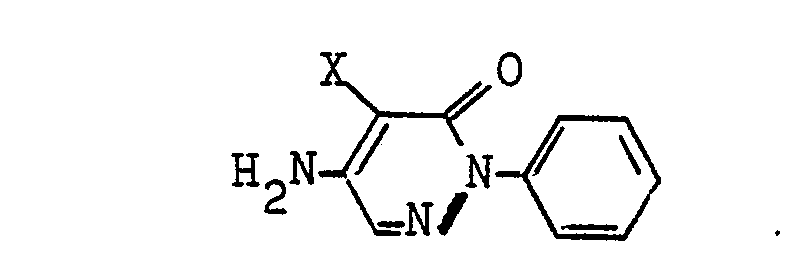
- 'Pyridazone derivatives are, for example, chloridazone, 5-amino-4-bromo-2-phenyl-3 (2H-) pyridazinone.
- Biscarbamates are, for example, phenmedipham, (3-chloro-4-fluorophenyl) carbamic acid 3 [(ethoxycarbonyl) amino] phenyl ester; (3,4-Trifluorophenyl) carbamic acid 3 - [(ethoxycarbonyl) amino] phenyl ester.
- solubility of solid active substances in emulsion concentrates should also be ensured at lower temperatures, for example down to -5 ° C., it may be necessary for reasons of low temperature stability to add up to 10 to 15% of polar additional solvents to some of the solvents listed in Table 4. (% By weight). The cheapest solvent was found to be dimethyl sulfoxide.
- emulsifiers are, for example, ethoxylated castor oil, Ca salt of dodecylbenzenesulfonic acid, ethoxylated oleic acid monoethanolamide, ethoxylated isooctylphenol.
- Wetting agents are, for example, ethoxylated octylphenol, nonylphenol, alkylphenol polyglycol ether, tributylphenol polyglycol ether.
- the liquid herbicide mixtures according to the invention contain, for example, 80 to 150 g of pyridazone derivative per liter of liquid, in particular 100 to 120 g per liter.
- the liquid herbicide mixtures according to the invention further contain, for example, 50 to 100 g of biscarbamate per liter of liquid, in particular 70 to 90 g per liter. They contain, for example, 30 to 100 g of emulsifier per liter of liquid, in particular 40 to 60 g per liter. They also contain, for example, 50 to 120 g of net mit tel per liter of liquid, in particular 90 to 110 g per liter.
- An emulsion concentrate of the following composition was produced: Storage of this emulsion concentrate at 50 ° C for 4 weeks showed only a slight degradation of the phenmedipham.
- Emulsion stability of a 0.5 or 2.0% aqueous emulsion prepared by diluting the emulsion concentrate with water over a period of 6 hours at room temperature showed 0.4 to 0.6 ml of sediment.
- An emulsion concentrate was prepared as in Example 2, but an additional 3 g / 1 N-isopropylsulfamic acid was added to it. Storage at 50 ° C for 4 weeks showed no degradation of the Biscarbamates Phenmedipham.
- Example 4 an emulsion concentrate was prepared from chloridazone and phenmedipham, but dimethylformamide was used instead of the N, N-diethyl-3-methyl-benzenecarboxamide. After storage of the formulation at 50 ° C. for six months, an active ingredient breakdown of the phenmedipham of 36% was found.
Landscapes
- Life Sciences & Earth Sciences (AREA)
- General Health & Medical Sciences (AREA)
- Health & Medical Sciences (AREA)
- Wood Science & Technology (AREA)
- Pest Control & Pesticides (AREA)
- Plant Pathology (AREA)
- Engineering & Computer Science (AREA)
- Dentistry (AREA)
- Agronomy & Crop Science (AREA)
- Zoology (AREA)
- Environmental Sciences (AREA)
- Toxicology (AREA)
- Agricultural Chemicals And Associated Chemicals (AREA)
- Medicines Containing Plant Substances (AREA)
Abstract

- R1 einen Alkylrest mit bis zu 8 C-Atomen oder einen gegebenenfalls durch Methyl oder Äthyl substituierten Phenylrest und
- R2, R3 je einen Alkylrest mit zusammen bis zu 8 C-Atomen bedeuten und das Säureamid insgesamt 8 bis 15 C-Atome enthält.
Description
- Die vorliegende Erfindung betrifft eine flüssige Herbizidmischung auf der Grundlage eines Pyridazonderivats und eines Bicarbamats, die in einem Säureamid gelöst sind.
- Es ist bekannt, 1-Phenyl-4-amino-5-chlor-pyridazon-(6) (Chloridazon) als Herbizid zu verwenden (DE-PS 1 105 232, GB-PS 871 674). Es ist ferner bekannt, das 3-Methoxy- carbonylaminophenyl-N-(3'-methyl-phenyl)-carbamat (Phenmedipham) als Herbizid zu verwenden (DE-PS 1 567 151, GB-PS 1 173 753). Es ist ferner bekannt, eine Mischung aus Chloridazon und Phenmedipham als Herbizid zu verwenden (DE-PS 1 642 216). Es ist ferner bekannt, Chloridazon in N-Methylpyrrolidon zu lösen (DE-PS 1 216 010). Ferner ist es bekannt, die Mischung aus Chloridazon und Phenmedipham in einer Mischung aus N-Methylpyrrolidon und Morpholin zu lösen (DE-PS 1 642 216).
- Zur Verbreiterung des Wirkungsspektrums von herbiziden Wirkstoffen kann man zur Herstellung einer Mischung zwei oder mehrere Formulierungen von zwei oder mehr Einzelwirkstoffen in einem Gefäß mischen (Tankmischung) oder in einer Fertigformulierung die Mischung der Wirkstoffe verwenden.
- Eine Tankmischung ist die auf die Anwendungskonzentration eingestellte wäßrige Verdünnung aus der Mischung der beiden Formulierungen der beiden Wirkstoffe, die in Form eines Emulsionskonzentrats (flüssig), als Suspensionskonzentrat (Flowable) (flüssig-fest) oder als Spritzpulver (Wettable Powder) (fest) vorliegen können. Bei solchen Tankmischungen bereitet die Mischverträglichkeit der verwendeten Formulierungen häufig Schwierigkeiten. Da die Formulierungsart durch die chemisch-physikalischen Eigen-Sws/BL schaften eines Wirkstoffes bedingt ist, bestimmen diese Eigenschaften die Auwahl der Lösungsmittel und der Hilfsstoffe, z.B. Emulgatoren, Dispergiermittel, Netzmittel. Bei zwei unterschiedlichen, ja selbst bei gleichen Formulierungsarten kann es deshalb zu Unverträglichkeiten in der Tankmischung kommen. Die Folgen sind u.a. Aufrahmung, Koagulation, Aggregation, Ausfällung, die es unmöglich machen, die Mischung auszubringen (zu verspritzen).
- Bei einer Fertigformulierung einer Mischung geht man dagegen von einer Formulierung mit mindestens zwei Wirkstoffen aus, die zusammen, als Emulsionskonzentrat, als Suspensionskonzentrat (Flowable) oder als Spritzpulver (Wettable Powder) formuliert, vorliegen können. Diese Formulierungen können durch Verdünnung mit Wasser direkt in Spritzbrühen mit der gewünschten Anwendungskonzentration überführt werden. Dabei ist prinzipiell jede Kombination von verschiedenen Wirkstoffarten möglich. Die Formulierung zweier oder mehrerer Wirkstoffe nach einer Formulierungsart wird jedoch durch Unterschiede beispielsweise in den Löslichkeiten, den Schmelzpunkten, den spezifischen Gewichten sowie in der Stabilität erheblich beeinflußt bzw. unmöglich gemacht. Eine weitere Schwierigkeit liegt darin, ein geeignetes, einheitliches Hilfsstoffsystem, wie Emulgatoren, Netzmittel oder Dispergiermittel für die zu mischenden Wirkstoffe zu finden.
- Als besonders schwierig erweist sich hierbei die Flüssigformulierung (Emulsionskonzentrat) zweier oder auch mehrerer fester Wirkstoffe, die extrem unterschiedliche Löslichkeiten in verschiedenen Lösungsmitteln aufweisen, wobei zusätzlich aus Gründen der Stabilität einer der Wirkstoffe die Auswahl der Lösungsmittel schon von vorneherein sehr begrenzt sein kann. Eine weitere Schwierigkeit "liegt in der Emulsionsstabilität solcher Mischungen, da z.B. die Kristallisationsneigung der verschiedenen Wirkstoffe in den Spritzbrühen aufgrund ihrer unterschiedlichen Löslichkeiten bei der Anwendung (Spritzung) störend wirken kann. Die Kristalisationsneigung der Wirkstoffe wird erhöht, je besser die Lösungsmittel in Wasser löslich sind, weil sich bei der Verdünnung dieser Lösungsmittel mit Wasser keine Emulsion sondern eine wäßrige Lösung bildet, in der die Wirkstoffe nicht mehr löslich sind und daher zur Auskristallisation neigen. Die genannten Schwierigkeiten treten insbesondere bei den bekannten herbizid gut wirksamen Mischungen von Chloridazon mit Phenmedipham auf (DE-PS 1 642 216). Gegenstand der vorliegenden Erdindung sind daher flüssige Herbizidmischungen in Form stabiler Emulsionskonzentrate (EC) von Pyridazonderivaten mit Biscarbamaten in einem Lösungsmittel.
- Die Pyridazonderivate lassen sich nur in extrem polaren, für EC-Formulierungen wenig geeigneten Lösungsmitteln wie Dimethylformamid, N-Methylpyrrolidon und Dimethylsulfoxid in ausrechender Menge lösen, während Biscarbamate zwar sehr gut löslich aber extrem instabil in den genannten Lösungsmitteln sind, und nur in Isophoron oder Cyclohexanon ausreichend stabil formulierbar sind, wobei diese Lösungsmittel Pyridazonderivate aber nicht oder kaum lösen und daher für diese Verbindungen ungeeignet sind. Mischungen aus beiden Lösungsmittelarten sind zwar prinzipiell möglich, doch muß dabei der Anteil an der polaren Komponente so hoch gewählt werden, daß man wieder in den Bereich mangelnder Stabilität der Biscarbamate oder der schlechten Löslichkeit der Pyridazonderivate gerät.

- In der Tabelle 2 wird die Wirkstoffstabilität der oben genannten Substanz 2 in verschiedenen Lösungsmitteln als Beispiel aufgeführt. Die Substanz 1 zeigt in diesen Lösungsmitteln hinsichtlich der Stabilität keine Schwierigkeiten. Die Konzentration an Wirkstoff war bei diesen Untersuchungen 0,002 molar. Die Analyse wurde mit Hilfe der Hochdruckflüssigkeitschromatographie (HPLC) durchgeführt.
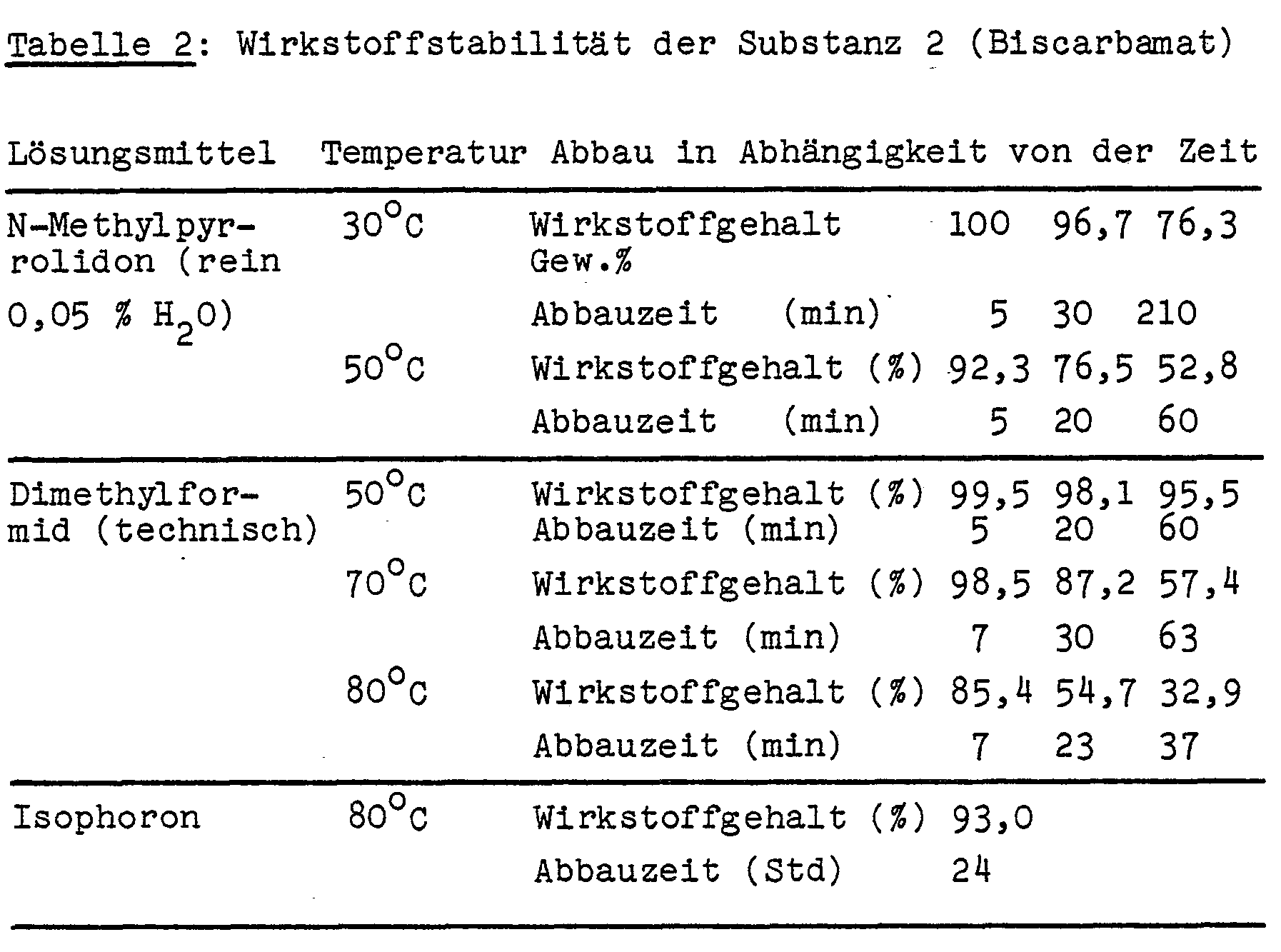
- Berücksichtigt man, daß Formulierungen durchaus über einen Zeitraum von 1 - 2 Jahren bei Temperaturen von 30 bis 400C lagerstabil sein sollen, so verdeutlichen die obengefundenen Daten die Schwierigkeit, eine Fertigformulierung aus Pyridazonen mit Biscarbamaten herzustellen. Eine weitere, ebenfalls zu beachtende Schwierigkeit liegt in der Auswahl eines geeigneten Hilfsmittelsystems, wie Emulgatoren und Netzmitteln, das die Stabilität der Biscarbamate nicht zusätzlich negativ beeinflussen darf.
- So zeigt die Fertigformulierung, die in der DE-PS 1 642 216 unter Beispiel 6/I aufgeführt ist und das wenig geeignete 'N-Methylpyrrolidon neben Morpholin enthält, ein schlechtes Laberstabilitätsverhalten.
- In Tabelle 3 sind die Ergebnisse zweier Formulierungen mit den Wirkstoffen Chloridazon (Substanz 1) und Phenmedipham als Beispiele zusammgengefaßt.
- Es wurde der Abbau des Phenmedipham bei verschiedenen Temperaturen verfolgt.

- Auf Grund der oben gefundenen Daten sollten also für eine Fertigformulierung Lösungsmittel verwendet werden, die folgende Bedingungen erfüllen:
- a) geringe Wasserlöslichkeit (= geringe Kristallisationsneigung der Wirkstoffe)
- b) gute Biscarbamatstabilität
- c) relativ gutes Lösungsvermögen für Pyridazonderivat und Biscarbamat
- Es wurde gefunden, daß eine flüssige Herbizidmischung auf der Grundlage eines Pyridazonderivats und eines Biscarbamats die obengenannten Bedingungen erfüllt, wenn sie eine Lösung der Wirkstoffe in einem Säureamid der allgemeinen Formel

- Die Herstellung der in Tabelle 4 aufgeführten Amide erfolgte in bekannter Weise durch die Umsetzung der Säurechloride mit den entsprechenden Aminen unter Zusatz von Hilfsbasen.


- 'Pyridazondervate sind beispielsweise Chloridazon, 5-Amino--4-brom-2-phenyl-3(2H-)pyridazinon. Biscarbamate sind beispielsweise Phenmedipham, (3-Chlor-4-fluorphenyl)-carbaminsäure-3[(ethoxycarbonyl)amino]phenylester; (3,4-Trifluorphenyl)carbaminsäure-3-[(ethoxycarbonyl)amino]phenylester.
- Da die Löslichkeit von festen Wirkstoffen in Emulsionskonzentraten auch bei niedrigeren Temperaturen, beispielsweise bis -5°C, gewährleistet sein sollte, kann es aus Kältestabilitätsgründen nötig sein, bei einigen der in Tabelle 4 aufgeführten Lösungsmitteln polare Zusatzlösungsmittel in einer Menge bis zu 10 bis 15 % (Gew.%) zuzusetzen. Als günstigstes Lösungsmittel erwies sich hierbei das Dimethylsulfoxid.
- Als Emulgatoren werden die im Pflanzenschutz üblichen nichtionogenen bzw. anionaktiven Produkte eingesetzt. Solche Emulgatoren sind beispielsweise ethoxyliertes Rizinusöl, Ca-Salz der Dodecylbenzolsulfonsäure, ethoxyliertes ölsäuremonoäthanolamid, ethoxyliertes Isooctylphenol. Netzmittel sind beispielsweise ethoxyliertes Octylphenol-, Nonylphenol, Alkylphenolpolyglykolether, Tributylphenolpolyglykolether.
- Die flüssigen Herbizidmischungen gemäß der Erfindung enthalten beispielsweise 80 bis 150 g Pyridazonderivat je Liter Flüssigkeit, insbesondere 100 bis 120 g pro Liter. Die flüssigen Herbizidmischungen gemäß der Erfindung enthalten ferner beispielsweise 50 bis 100 g Biscarbamat pro Liter Flüssigkeit, insbesondere 70 bis 90 g pro Liter. Sie enthalten beispielsweise 30 bis 100 g Emulgiermittel je Liter Flüssigkeit, insbesondere 40 bis 60 g je Liter. Sie enthalten ferner beispielsweise 50 bis 120 g Netzmittel je Liter Flüssigkeit, insbesondere 90 bis 110 g je Liter.
- In der folgenden Tabelle sind die Stabilitätsuntersuchungen von Phenmedipham bei verschiedenen Temperaturen und konstanter Zeit zusammengefaßt. Es wurden 500 mg technischer Wirkstoff in 25 ml Lösungsmittel gelöst, die Lösungen bei der entsprechend gewählten Temperatur 24 Stunden gelagert und der Restwirkstoffgehalt analytisch mit Hilfe der HPLC-Methode bestimmt.

- Es wurde ein Emulsionskonzentrat folgender Zusammensetzung hergestellt:

- Die Prüfung der. Emulsionsstabilität einer durch Verdünnung des Emulsionskonzentrats mit Wasser hergestellten 0,5 oder 2,0%igen wäßrigen Emulsion über einen Zeitraum von 6 Stunden bei Raumtemperatur zeigte 0,4 bis 0,6 ml Bodensatz.
- Entsprechend dem Beispiel 2 wurde ein Emulsionskonzentrat hergestellt, dem jedoch noch zusätzlich 3 g/1 N-Isopropylsulfaminsäure zugesetzt wurde. Die Lagerung bei 50°C über 4 Wochen zeigte keinen Abbau der Biscarbamates Phenmedipham.
- Es wurde ein Emulsionskonzentrat folgender Zusammensetzung hergestellt:

- Die Stabilitätsuntersuchung des Phenmedipham bei Lagerung der Formulierung bei 50 C über einen Zeitraum von einem halben Jahr zeigte keinen Abbau.
- Es wurde ein Emulsionskonzentrat folgender Zusammensetzung hergestellt:

- Nach vierwöchiger Lagerung bei 50°C zeigte sich kein Biscarbamatabbau.
- Die Überprüfung der Emulsionsstabilität einer 0,5 oder 2,0 %igen wäßrigen Emulsion zeigte nach 6 Stunden bei Raumtemperatur geringfügig Bodensatz.
- Entsprechend dem Beispiel 4 wurde ein Emulsionskonzentrat aus Chloridazon und Phenmedipham hergestellt, jedoch anstelle des N,N-Diäthyl-3-methyl-benzolcarbonsäureamids Dimethylformamid eingesetzt. Nach halbjähriger Lagerung der Formulierung bei 50°C zeigte sich hierbei ein Wirkstoffabbau des Phenmedipham von 36 %.
Claims (7)


Priority Applications (1)
| Application Number | Priority Date | Filing Date | Title |
|---|---|---|---|
| AT81105004T ATE2987T1 (de) | 1980-07-24 | 1981-06-27 | Fluessige herbizidmischung. |
Applications Claiming Priority (2)
| Application Number | Priority Date | Filing Date | Title |
|---|---|---|---|
| DE19803027959 DE3027959A1 (de) | 1980-07-24 | 1980-07-24 | Fluessige herbizidmischung |
| DE3027959 | 1980-07-24 |
Publications (2)
| Publication Number | Publication Date |
|---|---|
| EP0044955A1 true EP0044955A1 (de) | 1982-02-03 |
| EP0044955B1 EP0044955B1 (de) | 1983-04-13 |
Family
ID=6107941
Family Applications (1)
| Application Number | Title | Priority Date | Filing Date |
|---|---|---|---|
| EP81105004A Expired EP0044955B1 (de) | 1980-07-24 | 1981-06-27 | Flüssige Herbizidmischung |
Country Status (9)
| Country | Link |
|---|---|
| EP (1) | EP0044955B1 (de) |
| AT (1) | ATE2987T1 (de) |
| CS (1) | CS224617B2 (de) |
| DD (1) | DD202230A5 (de) |
| DE (2) | DE3027959A1 (de) |
| DK (1) | DK328381A (de) |
| HU (1) | HU185641B (de) |
| PL (1) | PL127150B2 (de) |
| SU (1) | SU1314946A3 (de) |
Cited By (9)
| Publication number | Priority date | Publication date | Assignee | Title |
|---|---|---|---|---|
| EP0273799A3 (de) * | 1986-12-12 | 1988-07-20 | GERONAZZO S.p.A. | Herbizide Emulsionskonzentrate auf Basis von Metabiscarbamaten |
| EP0358494A3 (de) * | 1988-09-06 | 1991-08-28 | Dowelanco | Emulsionskonzentrat eines Pestizids |
| WO2005036962A1 (de) * | 2003-09-19 | 2005-04-28 | Bayer Cropscience Gmbh | Tensid/lösungsmittelgemische |
| WO2006040022A1 (de) * | 2004-10-12 | 2006-04-20 | Bayer Cropscience Gmbh | Tensid/lösungsmittelgemische |
| WO2007140332A2 (en) | 2006-05-26 | 2007-12-06 | Huntsman Petrochemical Corporation | Low odor, low volatility solvent for agricultural chemicals |
| WO2011010082A3 (en) * | 2009-07-24 | 2012-02-16 | Syngenta Limited | Benzamide derivatives, preparation and use thereof |
| WO2012100865A1 (en) | 2011-01-24 | 2012-08-02 | Syngenta Limited | Formulation component |
| WO2015067524A1 (en) * | 2013-11-05 | 2015-05-14 | Basf Se | Composition comprising a pesticide and amide |
| WO2016156075A1 (en) | 2015-03-31 | 2016-10-06 | Basf Se | Composition comprising a pesticide and isononanoic acid n,n-dimethyl amide |
Families Citing this family (1)
| Publication number | Priority date | Publication date | Assignee | Title |
|---|---|---|---|---|
| RU2117426C1 (ru) * | 1996-06-26 | 1998-08-20 | Акционерное общество открытого типа Щелковское предприятие "Агрохим" | Гербицидная композиция |
Citations (3)
| Publication number | Priority date | Publication date | Assignee | Title |
|---|---|---|---|---|
| US3342673A (en) * | 1964-09-11 | 1967-09-19 | Mobil Oil Corp | Solvent system for formulating carbamates |
| BE709065A (de) * | 1967-01-10 | 1968-07-08 | ||
| US3810751A (en) * | 1967-01-10 | 1974-05-14 | Basf Ag | Herbicidal composition of a pyridazone derivative and carbamoyl-oxy phenyl methyl carbamate |
-
1980
- 1980-07-24 DE DE19803027959 patent/DE3027959A1/de not_active Withdrawn
-
1981
- 1981-06-27 DE DE8181105004T patent/DE3160179D1/de not_active Expired
- 1981-06-27 EP EP81105004A patent/EP0044955B1/de not_active Expired
- 1981-06-27 AT AT81105004T patent/ATE2987T1/de active
- 1981-07-21 PL PL1981232306A patent/PL127150B2/xx unknown
- 1981-07-21 SU SU813375303A patent/SU1314946A3/ru active
- 1981-07-22 DD DD81231994A patent/DD202230A5/de unknown
- 1981-07-23 CS CS815644A patent/CS224617B2/cs unknown
- 1981-07-23 DK DK328381A patent/DK328381A/da not_active Application Discontinuation
- 1981-07-23 HU HU812161A patent/HU185641B/hu unknown
Patent Citations (7)
| Publication number | Priority date | Publication date | Assignee | Title |
|---|---|---|---|---|
| US3342673A (en) * | 1964-09-11 | 1967-09-19 | Mobil Oil Corp | Solvent system for formulating carbamates |
| BE709065A (de) * | 1967-01-10 | 1968-07-08 | ||
| FR1558512A (de) * | 1967-01-10 | 1969-02-28 | ||
| GB1203511A (en) * | 1967-01-10 | 1970-08-26 | Basf Ag | Herbicides |
| CH498561A (de) * | 1967-01-10 | 1970-11-15 | Basf Ag | Herbizide Mischung |
| DE1642216A1 (de) * | 1967-01-10 | 1971-07-15 | Basf Ag | Herbizid |
| US3810751A (en) * | 1967-01-10 | 1974-05-14 | Basf Ag | Herbicidal composition of a pyridazone derivative and carbamoyl-oxy phenyl methyl carbamate |
Cited By (17)
| Publication number | Priority date | Publication date | Assignee | Title |
|---|---|---|---|---|
| EP0273799A3 (de) * | 1986-12-12 | 1988-07-20 | GERONAZZO S.p.A. | Herbizide Emulsionskonzentrate auf Basis von Metabiscarbamaten |
| EP0358494A3 (de) * | 1988-09-06 | 1991-08-28 | Dowelanco | Emulsionskonzentrat eines Pestizids |
| WO2005036962A1 (de) * | 2003-09-19 | 2005-04-28 | Bayer Cropscience Gmbh | Tensid/lösungsmittelgemische |
| WO2006040022A1 (de) * | 2004-10-12 | 2006-04-20 | Bayer Cropscience Gmbh | Tensid/lösungsmittelgemische |
| EP2031966A4 (de) * | 2006-05-26 | 2013-07-31 | Huntsman Petrochemical Llc | Geruchsarmes lösungsmittel mit geringer flüchtigkeit für agrarchemikalien |
| WO2007140332A2 (en) | 2006-05-26 | 2007-12-06 | Huntsman Petrochemical Corporation | Low odor, low volatility solvent for agricultural chemicals |
| WO2011010082A3 (en) * | 2009-07-24 | 2012-02-16 | Syngenta Limited | Benzamide derivatives, preparation and use thereof |
| CN102740690A (zh) * | 2009-07-24 | 2012-10-17 | 先正达有限公司 | 苯甲酰胺衍生物及其制备和用途 |
| WO2012100865A1 (en) | 2011-01-24 | 2012-08-02 | Syngenta Limited | Formulation component |
| CN103402974A (zh) * | 2011-01-24 | 2013-11-20 | 辛根塔有限公司 | 配制品组分 |
| CN103402974B (zh) * | 2011-01-24 | 2016-08-17 | 辛根塔有限公司 | 配制品组分 |
| US10051857B2 (en) | 2011-01-24 | 2018-08-21 | Syngenta Limited | Formulation component |
| CN106212457B (zh) * | 2011-01-24 | 2019-03-08 | 辛根塔有限公司 | 配制品组分 |
| WO2015067524A1 (en) * | 2013-11-05 | 2015-05-14 | Basf Se | Composition comprising a pesticide and amide |
| CN105682459A (zh) * | 2013-11-05 | 2016-06-15 | 巴斯夫欧洲公司 | 包含农药和酰胺的组合物 |
| WO2016156075A1 (en) | 2015-03-31 | 2016-10-06 | Basf Se | Composition comprising a pesticide and isononanoic acid n,n-dimethyl amide |
| US10463040B2 (en) | 2015-03-31 | 2019-11-05 | Basf Se | Composition comprising a pesticide and isononanoic acid N,N-dimethyl amide |
Also Published As
| Publication number | Publication date |
|---|---|
| DE3160179D1 (en) | 1983-05-19 |
| CS224617B2 (en) | 1984-01-16 |
| PL127150B2 (en) | 1983-09-30 |
| DE3027959A1 (de) | 1982-03-04 |
| HU185641B (en) | 1985-03-28 |
| ATE2987T1 (de) | 1983-04-15 |
| PL232306A2 (de) | 1982-03-29 |
| DK328381A (da) | 1982-01-25 |
| SU1314946A3 (ru) | 1987-05-30 |
| EP0044955B1 (de) | 1983-04-13 |
| DD202230A5 (de) | 1983-09-07 |
Similar Documents
| Publication | Publication Date | Title |
|---|---|---|
| DE3910921C1 (de) | ||
| EP0453915B1 (de) | Verwendung von N-Alkyl-lactamen als Kristallisationsinhibitoren | |
| EP0044955B1 (de) | Flüssige Herbizidmischung | |
| DE3009944C2 (de) | Insektizide Öl-in-Wasser-Emulsion | |
| DE69426130T2 (de) | Herbizide Mischungen auf der Basis von Flurtamon und einer 3-Phenylpyrazole-Verbindung | |
| CH648187A5 (de) | Herbizide zusammensetzung, enthaltend n-(phosphonomethyl)-glycin. | |
| DE3919036A1 (de) | Fluessige herbizide mischformulierungen | |
| EP0658308B1 (de) | Herbizide zusammensetzung und verfahren zur bekämpfung unerwünschter vegetation | |
| EP0167776A1 (de) | Pflanzenwachstumsregulierende Mittel | |
| EP0017001B1 (de) | Herbizide in Form einer wässrigen Suspension, die Mischungen aus einem Pyridazon und einem Thiolcarbamat, einem Chloracetanilid oder einem Dinitroanilin enthalten, sowie ein Verfahren zu ihrer Herstellung und ihre Verwendung zur Bekämpfung unerwünschten Pflanzenwuchses | |
| EP0017879B1 (de) | Flüssige Formulierungen enthaltend 3-(3,4-Dichlorphenyl)-1-methyl-1-methoxy-harnstoff und ihre Verwendung zur Unkrautbekämpfung | |
| EP0031454B1 (de) | Fungizide Mischungen auf der Basis von Triforin und Carbendazim und Verfahren zu deren Herstellung | |
| DE2526455A1 (de) | Herbizid | |
| EP0085922B1 (de) | Herbizide Mittel | |
| EP0296319A1 (de) | Herbizide Mittel auf der Basis von Heteroaryloxyphenoxycarbonsäure-Derivaten | |
| EP0402770B1 (de) | Flüssige herbizide Mischformulierungen | |
| DD262992A5 (de) | Nematizide und insektizide zusammensetzung | |
| DE3918287A1 (de) | Herbizide mittel | |
| DE4329974A1 (de) | Wäßrige herbizide Suspensionskonzentrate | |
| DE3618535A1 (de) | Stabilisierte fluessige herbizid-zusammensetzungen auf basis von m-biscarbamaten und ihre verwendung | |
| DD250042A5 (de) | Fluessige pestizide zusammensetzung | |
| DE1542801A1 (de) | Unkrautvertilgungsmittel | |
| DE69833677T2 (de) | Chloracetamid zusammensetzungen mit unterdrückter fällung | |
| EP0223029A2 (de) | Herbizide Mittel | |
| DE69016762T2 (de) | Pestizide Zusammensetzung. |
Legal Events
| Date | Code | Title | Description |
|---|---|---|---|
| PUAI | Public reference made under article 153(3) epc to a published international application that has entered the european phase |
Free format text: ORIGINAL CODE: 0009012 |
|
| 17P | Request for examination filed |
Effective date: 19811021 |
|
| AK | Designated contracting states |
Designated state(s): AT BE CH DE FR GB IT NL SE |
|
| ITF | It: translation for a ep patent filed | ||
| GRAA | (expected) grant |
Free format text: ORIGINAL CODE: 0009210 |
|
| AK | Designated contracting states |
Designated state(s): AT BE CH DE FR GB IT LI NL SE |
|
| REF | Corresponds to: |
Ref document number: 2987 Country of ref document: AT Date of ref document: 19830415 Kind code of ref document: T |
|
| REF | Corresponds to: |
Ref document number: 3160179 Country of ref document: DE Date of ref document: 19830519 |
|
| ET | Fr: translation filed | ||
| PGFP | Annual fee paid to national office [announced via postgrant information from national office to epo] |
Ref country code: DE Payment date: 19840519 Year of fee payment: 4 |
|
| PGFP | Annual fee paid to national office [announced via postgrant information from national office to epo] |
Ref country code: CH Payment date: 19840521 Year of fee payment: 4 |
|
| PGFP | Annual fee paid to national office [announced via postgrant information from national office to epo] |
Ref country code: FR Payment date: 19840522 Year of fee payment: 4 |
|
| PGFP | Annual fee paid to national office [announced via postgrant information from national office to epo] |
Ref country code: SE Payment date: 19840630 Year of fee payment: 4 Ref country code: BE Payment date: 19840630 Year of fee payment: 4 |
|
| PGFP | Annual fee paid to national office [announced via postgrant information from national office to epo] |
Ref country code: AT Payment date: 19860528 Year of fee payment: 6 |
|
| PGFP | Annual fee paid to national office [announced via postgrant information from national office to epo] |
Ref country code: NL Payment date: 19870630 Year of fee payment: 7 |
|
| PG25 | Lapsed in a contracting state [announced via postgrant information from national office to epo] |
Ref country code: GB Effective date: 19880627 Ref country code: AT Effective date: 19880627 |
|
| PG25 | Lapsed in a contracting state [announced via postgrant information from national office to epo] |
Ref country code: SE Effective date: 19880628 |
|
| PG25 | Lapsed in a contracting state [announced via postgrant information from national office to epo] |
Ref country code: LI Effective date: 19880630 Ref country code: CH Effective date: 19880630 |
|
| PG25 | Lapsed in a contracting state [announced via postgrant information from national office to epo] |
Ref country code: NL Effective date: 19890101 |
|
| NLV4 | Nl: lapsed or anulled due to non-payment of the annual fee | ||
| GBPC | Gb: european patent ceased through non-payment of renewal fee | ||
| REG | Reference to a national code |
Ref country code: CH Ref legal event code: PL |
|
| PG25 | Lapsed in a contracting state [announced via postgrant information from national office to epo] |
Ref country code: DE Effective date: 19890621 |
|
| PG25 | Lapsed in a contracting state [announced via postgrant information from national office to epo] |
Ref country code: BE Effective date: 19890630 |
|
| BERE | Be: lapsed |
Owner name: BASF A.G. Effective date: 19890630 |
|
| PG25 | Lapsed in a contracting state [announced via postgrant information from national office to epo] |
Ref country code: FR Free format text: LAPSE BECAUSE OF NON-PAYMENT OF DUE FEES Effective date: 19900228 |
|
| REG | Reference to a national code |
Ref country code: FR Ref legal event code: ST |
|
| EUG | Se: european patent has lapsed |
Ref document number: 81105004.6 Effective date: 19890220 |
|
| PLBE | No opposition filed within time limit |
Free format text: ORIGINAL CODE: 0009261 |
|
| STAA | Information on the status of an ep patent application or granted ep patent |
Free format text: STATUS: NO OPPOSITION FILED WITHIN TIME LIMIT |