EP0051204A1 - Neues Dekapeptid, Verfahren zu seiner Herstellung und Verwendung - Google Patents
Neues Dekapeptid, Verfahren zu seiner Herstellung und Verwendung Download PDFInfo
- Publication number
- EP0051204A1 EP0051204A1 EP81108535A EP81108535A EP0051204A1 EP 0051204 A1 EP0051204 A1 EP 0051204A1 EP 81108535 A EP81108535 A EP 81108535A EP 81108535 A EP81108535 A EP 81108535A EP 0051204 A1 EP0051204 A1 EP 0051204A1
- Authority
- EP
- European Patent Office
- Prior art keywords
- decapeptide
- ser
- leu
- hydrazide
- protected
- Prior art date
- Legal status (The legal status is an assumption and is not a legal conclusion. Google has not performed a legal analysis and makes no representation as to the accuracy of the status listed.)
- Withdrawn
Links
Images




Classifications
-
- C—CHEMISTRY; METALLURGY
- C07—ORGANIC CHEMISTRY
- C07K—PEPTIDES
- C07K16/00—Immunoglobulins [IG], e.g. monoclonal or polyclonal antibodies
- C07K16/18—Immunoglobulins [IG], e.g. monoclonal or polyclonal antibodies against material from animals or humans
- C07K16/24—Immunoglobulins [IG], e.g. monoclonal or polyclonal antibodies against material from animals or humans against cytokines, lymphokines or interferons
- C07K16/249—Interferons
-
- C—CHEMISTRY; METALLURGY
- C07—ORGANIC CHEMISTRY
- C07K—PEPTIDES
- C07K14/00—Peptides having more than 20 amino acids; Gastrins; Somatostatins; Melanotropins; Derivatives thereof
- C07K14/435—Peptides having more than 20 amino acids; Gastrins; Somatostatins; Melanotropins; Derivatives thereof from animals; from humans
- C07K14/52—Cytokines; Lymphokines; Interferons
- C07K14/555—Interferons [IFN]
-
- G—PHYSICS
- G01—MEASURING; TESTING
- G01N—INVESTIGATING OR ANALYSING MATERIALS BY DETERMINING THEIR CHEMICAL OR PHYSICAL PROPERTIES
- G01N33/00—Investigating or analysing materials by specific methods not covered by groups G01N1/00 - G01N31/00
- G01N33/48—Biological material, e.g. blood, urine; Haemocytometers
- G01N33/50—Chemical analysis of biological material, e.g. blood, urine; Testing involving biospecific ligand binding methods; Immunological testing
- G01N33/53—Immunoassay; Biospecific binding assay; Materials therefor
- G01N33/531—Production of immunochemical test materials
-
- G—PHYSICS
- G01—MEASURING; TESTING
- G01N—INVESTIGATING OR ANALYSING MATERIALS BY DETERMINING THEIR CHEMICAL OR PHYSICAL PROPERTIES
- G01N33/00—Investigating or analysing materials by specific methods not covered by groups G01N1/00 - G01N31/00
- G01N33/48—Biological material, e.g. blood, urine; Haemocytometers
- G01N33/50—Chemical analysis of biological material, e.g. blood, urine; Testing involving biospecific ligand binding methods; Immunological testing
- G01N33/58—Chemical analysis of biological material, e.g. blood, urine; Testing involving biospecific ligand binding methods; Immunological testing involving labelled substances
-
- Y—GENERAL TAGGING OF NEW TECHNOLOGICAL DEVELOPMENTS; GENERAL TAGGING OF CROSS-SECTIONAL TECHNOLOGIES SPANNING OVER SEVERAL SECTIONS OF THE IPC; TECHNICAL SUBJECTS COVERED BY FORMER USPC CROSS-REFERENCE ART COLLECTIONS [XRACs] AND DIGESTS
- Y10—TECHNICAL SUBJECTS COVERED BY FORMER USPC
- Y10S—TECHNICAL SUBJECTS COVERED BY FORMER USPC CROSS-REFERENCE ART COLLECTIONS [XRACs] AND DIGESTS
- Y10S530/00—Chemistry: natural resins or derivatives; peptides or proteins; lignins or reaction products thereof
- Y10S530/806—Antigenic peptides or proteins
-
- Y—GENERAL TAGGING OF NEW TECHNOLOGICAL DEVELOPMENTS; GENERAL TAGGING OF CROSS-SECTIONAL TECHNOLOGIES SPANNING OVER SEVERAL SECTIONS OF THE IPC; TECHNICAL SUBJECTS COVERED BY FORMER USPC CROSS-REFERENCE ART COLLECTIONS [XRACs] AND DIGESTS
- Y10—TECHNICAL SUBJECTS COVERED BY FORMER USPC
- Y10S—TECHNICAL SUBJECTS COVERED BY FORMER USPC CROSS-REFERENCE ART COLLECTIONS [XRACs] AND DIGESTS
- Y10S930/00—Peptide or protein sequence
- Y10S930/01—Peptide or protein sequence
- Y10S930/14—Lymphokine; related peptides
- Y10S930/142—Interferon
Definitions
- the present invention relates to a new decapeptide, namely H-Ser-Asp-Leu-Pro-Gln-Thr-His-Ser-Leu-Gly-OH, a process for its preparation after solid-phase synthesis and its use, for example as a hapten for coupling with an immunogen.
- the new decapeptide is prepared after solid phase synthesis (see RB Merrifield in J. Amer. Chem. Soc. 2149-2154 (1963)).
- the C-terminal amino acid of a peptide is linked via its carboxyl group to a polymer as an insoluble carrier. This is done either preferably via an alkali or alkaline earth metal salt of the corresponding N-protected amino acid if a chloromethyl resin is used, or by activating the carboxyl function of the corresponding N-protected amino acid, for example with N, N'-dicyclohexylcarbodiimide, if a hydroxymethyl Resin is used.
- the peptide is then built up step by step by gradually adding the individual amino acids to the N-'end of the peptide fragment (see FIG. 1) and then splitting off the amino protective residue used.
- the connection of the next N-protected amino acid to the now free and reactive terminal amino group of the peptide fragment is done by activating their carboxyl function or via a reactive ester.
- the peptide is split off from the resin.
- the presence of the amino acids aspartic acid, serine, threonine and histidine requires additional protection of the side functions, for example by converting them into the corresponding O-benzylthreonine, O-benzylserine, N-im-2,4-dinitrophenyl-histidine and aspartic acid. ⁇ -tert-butyl ester derivatives.
- a swellable polymer e.g. chloromethylated polystyrene, which is preferably crosslinked with 1% divinylbenzene, is used (PS-1% DVB).
- the process is particularly advantageously carried out in such a way that glycine is the first amino acid in its protected form, such as, for example with the aid of its cesium salt, which is expediently obtained by reacting the protected amino acid mentioned above with cesium carbonate or cesium hydroxide, on chloromethylated polystyrene in a solvent, preferably in an aprotic solvent such as dimethylformamide.
- the amino protecting group used is then split off, for example the N-tert-butoxycarbonyl group with an acid, for example with 50% strength trifluoroacetic acid in dichloromethane, preferably after prewashing with dichloromethane and the Fmoc group with diethylamine in dimethylformamide.
- Each subsequent synthesis cycle is coupled with an excess of the corresponding Boc or Fmoc amino acid or its activated ester, for example with 3 to 6 times the amount, optionally in the presence of a coupling reagent such as N, N'-dicyclohexyl-carbodiimide, this process being repeated several times, for example 2 to 5 times, without prior checking for any free spaces that may still be present Amino groups are repeated with a further comparable excess of the corresponding Boc or Fmoc amino acid and coupling reagent or their activated ester (post-coupling). After prewashing, the Boc or Fmoc protective residue is split off as described above.
- a coupling reagent such as N, N'-dicyclohexyl-carbodiimide
- the amino acid derivative Boc-Gln is preferably made using one of its reactive esters, e.g. via its p-nitrophenyl ester, coupled. Furthermore, 1-hydroxy-benzotriazole can be added as a catalyst in the couplings and post-couplings.
- acetylation is carried out with acetic anhydride / N-methylmorpholine in order to block an amino group of the peptide fragment which may not have reacted during the coupling for the next coupling.
- the Fmoc protective residue is treated with a base, e.g. with diethylamine, split off.
- the partially protected decapeptide hydrazide is obtained after the synthesis has been carried out by adding hydrazine to the fully protected Pepti4 resin suspended in dimethylformamide. This is overturned for further cleaning, e.g. from DMF / ether, the yellow Dnp products being largely removed, via a gel column, e.g. Sephadex LH20, chromatographed with methanol, reversed-phase chromatography on silica gel, e.g. Silica gel RP-8, subjected to methanol / water (90/10) and reprecipitated from methanol / ether.
- a gel column e.g. Sephadex LH20
- silica gel e.g. Silica gel RP-8
- the protective group-free decapeptide is obtained by adding hydrogen bromide / glacial acetic acid to the suspension of the peptide resin in trifluoroacetic acid with the addition of resorcinol and thioanisole. Boc, Bzl and O-Bu t residues are removed at the same time.
- the free decapeptide is obtained.
- step -2 After deprotection and neutralization analogous to step -2, 5.9 g (20 mmol) of BOC-Ser (Bzl) -OH are dissolved in 60 ml of dichloromethane and added to the dipeptide resin. Then 20 ml (20 mmol) of a 1 molar solution of DCC in dichloromethane are added. After 45 minutes, 5.9 g (20 mmol) of Boc-Ser (Bzl) -OH in 60 ml of dichloromethane and 20 ml of DCC solution (1 molar in dichloromethane) are added to the first coupling.
- the mixture is then reacted for 15 minutes with 6 ml of acetic anhydride in 40 ml of DMF and 3.3 ml of N-methylmorpholine in 40 ml of DMF, then 3 times with DMF, 3 times with methanol / dichloromethane 1: 4, 3 times with ethanol and 3 times washed with dichloromethane.
- decapeptide hydrazide derivative appears in the elution volume 590-723 ml (fraction volume 19 ml). After combining the fractions and evaporating off the methanol, 2.24 g of partially protected decapeptide hydrazide are obtained, which still shows a yellow color. The highly hydrophilic impurities are removed by this Sephadex-LH 20 chromatography.
- the amino acid analysis is carried out in a LC 6000 E biotronic amino acid analyzer, the hydrolysis is carried out with 6N HCL at 110 ° C for 24 hours. Without correcting the hydrolysis losses, the following distribution of amino acids is found:
- the 13 C-NMR spectra are measured in the NMR spectrometer WH-90 from Bruker-Physik, Düsseldorf, the decapeptide hydrazide derivative was dissolved in methanol.
- the pale yellow precipitate of the peptide is washed twice with ether and then dissolved in 10 ml of water.
- the clear peptide solution (pH 1) is adjusted to pH 8.0 with sodium carbonate solution and then mixed with 2 ml of mercaptoethanol.
- the precipitate which then precipitated is dissolved again with 7 ml of DMF.
- After adding a further 2 ml of mercaptoethanol the mixture is stirred at pH 8.75 for one hour. Then it is extracted with 4 x 80 ml ether.
- the aqueous phase is acidified to pH 4.8 with acetic acid and extracted again with 4 ⁇ 50 ml of ether.
- the brown-yellow peptide solution obtained above is chromatographed on Sephadex G-15 with 0.1 molar acetic acid (column: 2.5 ⁇ 95 cm, elution rate 1 ml / min).
- the fractions (10 ml) detected after 185-300 ml appearing peptide-containing, thin layer chromatography with the system 1-butanol / glacial acetic acid / water ⁇ (3: 1: 1) are combined, lyophilized and chromatographed a second time.
- the Peptide solution contained in the fractions 201-275 ml is evaporated. Yield: 2.24 g
- the amino acid analysis is carried out in a biotronic amino acid analyzer Q r LC 600 E.
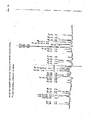
- the hydrolysis is carried out with 6 N hydrochloric acid at 110 ° C. and for 18 to 72 hours. Without correcting the hydrolysis losses, the following amino acid composition is determined: Gas chromatographic analysis of the N-pentafluoropropiomylamino acid n-propyl ester of the total hydrolyzate of the decapeptide on the chiral phase Chirasil-Val (J. Chromatogr. 146, 197 (1978)) showed a very high enantiomeric purity of the amino acid residues of the decapeptide (see Fig. 2) .
- the new decapeptide and its hydrazide can be used as haptens that are linked to a natural protein, e.g. Human serum albumin, bovine serum albumin, egg albumin or with a synthetic polypeptide such as e.g. poly-L-lysine, poly-L-alanyl-L-lysine or other carriers such as e.g. modified dextrans can be coupled according to known methods.
- the peptide can also be obtained via other polyamines, e.g. Link 1,6-diaminohexane.
- An immunogen produced in this way, or the decapeptide itself, can be used in known methods for generating antisera or antibodies against human lymphoblast interferon.
- the new decapeptide can be used in place of human lymphoblast interferon in a suitable preparation for therapy.
- the new decapeptide is suitable as a tracer for the immunological determination of human lymphoblast interferon.
- it can be done directly using known methods, e.g. with radioactive iodine or other suitable markers, e.g. with enzymes such as peroxidases or with fluorescent compounds.
- it can also be marked in the form of the coupling products mentioned above using the same or similar methods and used as a tracer.
- the new decapeptide is also suitable in the form of a coupling product with an immobile carrier, e.g. Dextrans, sepharose or polystyrene, or modified inorganic carriers such as e.g. Biogel or CPG-10, for the isolation and purification of antibodies against human lymphoblast interferons.
- an immobile carrier e.g. Dextrans, sepharose or polystyrene, or modified inorganic carriers such as e.g. Biogel or CPG-10
- Antibodies obtained in this way allow the purification and isolation of human lymphoblast interferon in a known manner.
- the fully protected decapeptide on the support can also be cleaved off from the support by saponification or transesterification.
- the partially or fully protected decapeptide derivatives that are split off also represent valuable intermediates for the synthesis of higher peptides of the lymphoblast interferon or the lymphobiasten interferon itself.
- the conjugate dried over phosphorus pentoxide are mixed with 2 ml of trifluoroacetic acid. After 10 minutes, 8 ml of 40% hydrogen bromide in glacial acetic acid (mixed with about 30 mg resorcinol and thioanisole each) are added to this suspension and stirred for 30 minutes in the dark at room temperature. After concentration in vacuo, the conjugate is precipitated by stirring the glacial acetic acid solution in absolute ether (approx. 100 ml). After washing twice with 100 ml of ether in a centrifuge glass, the precipitate (180 mg) is dissolved in water and against 1 N acetic acid for 24 hours and then against dist. Water dialysed for 24 hours (exclusion limit 8,000).
- the reaction is stopped after one hour by adding 90 ⁇ l of 0.3 M glycine in 0.1 M sodium borate, pH 9.0. After a further 10 minutes, the entire volume is now placed on a chromatography column (7 ml bed volume, Sephadex G 25 medium (Pharmacia, Uppsala), which had been equilibrated with 50 mM sodium phosphate pH 7.5 and 0.25% gelatin and in this buffer The high molecular weight labeled substance is separated from low molecular weight radioactive reaction products and appears in the first fractions of the void volume.
- a better yield - compared to these original BOLTON and HUNTER instructions - is achieved if the solution is brought to an acidic pH after the end of the reaction.
- the pH is adjusted from 9 to 4 by a further addition of 100 ul 20 mM sodium acetate pH 4.0.
- the chromatography column is pretreated accordingly with 20 mM sodium acetate pH 4.0 and 0.25% gelatin and is developed in this buffer.
- 35 mg (25 pmol) of partially protected decapeptide hydrazide are dissolved in 2 ml of trifluoroacetic acid and 4 ml of 33% hydrobromic acid / glacial acetic acid are added. After one hour, the mixture is concentrated on a rotary evaporator, the residue is taken up in 2 ml of glacial acetic acid and the solution is added dropwise to 50 ml of anhydrous ether with stirring. The precipitate is centrifuged off and dried in vacuo over solid potassium hydroxide.
- the unprotected decapeptide hydrazide dihydrobromide obtained is converted into the azide analogously to Example A (b) and coupled to the amino groups of 300 mg AH-Sepharose 4B in DMF / water. After a reaction time of 24 hours, the AH-Sepharose 4B decapeptide is washed with DMF, dioxane and water until no low-molecular components can be detected in the thin-layer chromatogram.
- 35 mg of partially protected decapeptide hydrazide are, as described under Example C, treated with hydrogen bromide / trifluoroacetic acid and converted into the azide, which is coupled to 300 mg of lysine-Sepharose 4B (Pharmacia).
- Controlled-Pore Glass CPG 10 (pore sizes 75 and 120, coated with aminopropyl groups) are coupled with the azide obtained from 70 mg of partially protected decapeptide hydrazide analogously to Example C.
- Example A 70 mg (50 ⁇ mol) of partially protected decapeptide hydrazide are converted into the azide as described in Example A (b). 2.9 mg (25 ⁇ mol) 1,6-diaminohexane in 200 ⁇ l DMF are added to the azide at -10 ° C. After adjusting to about pH 8.5 with triethylamine, the mixture is stirred at -10 ° C. for 2 hours, left to stand at 4 ° C. for 24 hours and stirred again at room temperature for 8 hours. The reaction solution is then added dropwise to anhydrous ether with stirring. The precipitate is washed twice with ether and dried over diphosphorus pentoxide / potassium hydroxide.
Landscapes
- Health & Medical Sciences (AREA)
- Life Sciences & Earth Sciences (AREA)
- Chemical & Material Sciences (AREA)
- Immunology (AREA)
- Molecular Biology (AREA)
- Engineering & Computer Science (AREA)
- Organic Chemistry (AREA)
- General Health & Medical Sciences (AREA)
- Hematology (AREA)
- Biochemistry (AREA)
- Medicinal Chemistry (AREA)
- Urology & Nephrology (AREA)
- Biomedical Technology (AREA)
- Physics & Mathematics (AREA)
- Biophysics (AREA)
- Analytical Chemistry (AREA)
- Microbiology (AREA)
- Cell Biology (AREA)
- General Physics & Mathematics (AREA)
- Pathology (AREA)
- Food Science & Technology (AREA)
- Genetics & Genomics (AREA)
- Proteomics, Peptides & Aminoacids (AREA)
- Biotechnology (AREA)
- Toxicology (AREA)
- Zoology (AREA)
- Gastroenterology & Hepatology (AREA)
- Peptides Or Proteins (AREA)
- Medicines That Contain Protein Lipid Enzymes And Other Medicines (AREA)
Abstract
Description
- Die vorliegende Erfindung betrifft ein neues Dekapeptid, nämlich H-Ser-Asp-Leu-Pro-Gln-Thr-His-Ser-Leu-Gly-OH, ein Verfahren zu seiner Herstellung nach der Festphasen-Synthese und seine Verwendung, beispielsweise als Hapten zur Kupplung mit einem Immunogen.
- Hochgereinigtes Interferon, das weltweit als hochinteressante Substanz bearbeitet wird, steht bis heute nur in äußerst geringen Mengen für medizinische Untersuchungen zur Verfügung. Es war daher bisher nicht möglich, an Interferonproteinen strukturelle oder biochemische Untersuchungen durchzuführen. Nachdem nunmehr die N-terminale Sequenz des menschlichen Lymphoblasteninterferons aufgeklärt werden konnte (Science 207, 527 (1980)), wurde das obige Dekapeptid erstmalig synthetisiert und seine Eigenschaften untersucht. Diese Aminosäuresequenz läßt sich ebenfalls aus der Deoxyribonukleinsäuresequenz des 5'-terminalen Endes des Interferon-Strukturgens oder der Ribonukleotidsequenz des 5'-Endes der Translationseinheit der Interferonmessenger Ribonukleinsäure, beginnend mit dem Initiationstri- plet A.U.G. (A = Adenosin, U - Uridin, G = Guanosin) nach der Regel des genetischen Codes ableiten.
- Im Nachfolgenden werden folgende in der Peptidchemie übliche Abkürzungen benützt:

- Die Herstellung des neuen Dekapeptids erfolgt nach der Festphasen-Synthese (siehe R. B. Merrifield in J. Amer. chem. Soc. 2149-2154 (1963)). Bei dieser wird die C-terminale Aminosäure eines Peptids über ihre Carboxylgruppe an ein Polymer als unlöslicher Träger angeknüpft. Dies geschieht entweder vorzugsweise über ein Alkali- oder Erdalkalisalz der entsprechenden N-geschützten Aminosäure, wenn ein Chlormethyl-Harz verwendet wird, oder durch Aktivierung der Carboxylfunktion der entsprechenden N-geschützten Aminosäure, beispielsweise mit N,N'-Dicyclohexylcarbodiimid, wenn ein Hydroxymethyl-Harz verwendet wird. Anschließend erfolgt der schrittweise Aufbau des Peptids durch stufenweisen Anbau der einzelnen Aminosäuren an das N-'Ende des Peptidfragments (siehe Abb. 1) und anschließende Abspaltung des verwendeten Aminoschutzrestes. Die Anknüpfung der nächstfolgenden N-geschützten Aminosäure an die nun freie und reaktionsfähige endständige Aminogruppe des Peptidfragments erfolgt durch Aktivierung ihrer Carboxylfunktion oder über einen reaktiven Ester. Nach erfolgtem Aufbau der Sequenz wird das Peptid vom Harz abgespalten. Die Anwesenheit der Aminosäuren Asparaginsäure, Serin, Threonin und Histidin erfordert hierbei zusätzlichen Schutz der Seitenfunktionen, z.B. durch ihre Überführung in die entsprechenden O-Benzylthreonin-, O-Benzylserin-, N-im-2,4-Dinitrophenyl-histidin- und Asparaginsäure-ß-tert.-butylester-Derivate.
- Bei der erfindungsgemäßen Festphasen-Synthese wird vorzugsweise ein quellbares Polymer, z.B. chlormethyliertes Polystyrol, das vorzugsweise mit 1 % Divinylbenzol quervernetzt ist, verwendet (PS-1 % DVB).
- Besonders vorteilhaft wird erfindungsgemäß das Verfahren in der Weise durchgeführt, daß Glycin als erste Aminosäure in seiner geschützten Form, wie z.B.mit Hilfe seines Cäsium-Salzes, das man zweckmäßigerweise durch Umsetzung der oben erwähnten geschützten Aminosäure mit Cäsiumcarbonat oder Cäsiumhydroxid erhält, an chlormethyliertes Polystyrol in einem Lösungsmittel, vorzugsweise in einem aprotischen Lösungsmittel wie Dimethylformamid, verestert wird. Anschließend wird die verwendete Aminoschutzgruppe abgespalten, z.B. die N-tert.Butoxycarbonylgruppe mit einer Säure, z.B. mit 50%iger Trifluoressigsäure in Dichlormethan, vorzugsweise nach Vorwaschen it Dichlormethan und die Fmoc-Gruppe mit Diethylamin in Dimethylformamid.

- Pro anschließendem Synthese-Zyklus wird mit einem Überschuß der entsprechenden Boc- oder Fmoc-Aminosäure bzw. deren aktiviertem Ester, z.B. mit der 3- bis 6-fachen Menge, gegebenenfalls in Gegenwart eines Kupplungsreagenzes wie N,N'-Dicyclohexyl-carbodiimid gekuppelt, wobei dieser Vorgang mehrmals, z.B. 2 bis 5 mal, ohne vorherige Prüfung auf noch gegebenenfalls vorhandene freie Aminogruppen mit einem weiteren vergleichbaren Überschuß der entsprechenden Boc- oder Fmoc-Aminosäure und Kupplungsreagenz oder deren aktiviertem Ester wiederholt wird (Nachkupplung). Nach Vorwaschen wird der Boc- oder Fmoc-Schutzrest wie vorstehend beschrieben abgespalten.
- Dieser Synthese-Zyklus wird gemäß Abb. 1 solange mit den entsprechenden N-geschützten Aminosäuren bzw. deren reaktiven Estern wiederholt, bis das gewünschte geschützte Dekapeptid-Harz erhalten ist.
- Das Aminosäure-Derivat Boc-Gln wird hierbei vorzugsweise mit Hilfe eines seiner reaktiven Ester, z.B. über seinen p-Nitrophenylester, gekuppelt. Desweiteren kann bei den Kupplungen und den Nachkupplungen 1-Hydroxy-benzotriazol als Katalysator zugesetzt werden.
- Nach jedem Synthese-Zyklus wird mit Essigsäureanhydrid/N-Methylmorpholin acetyliert, um eine gegebenenfalls bei der Kupplung nicht umgesetzte Aminogruppe des Peptidfragments für die nächste Kupplung zu blockieren. Außerdem wird nach der 9. Kupplung der Fmoc-Schutzrest mit einer Base, z.B. mit Diethylamin, abgespalten.
- Das partiell geschützte Dekapeptidhydrazid erhält man nach durch geführter Synthese durch Zugabe von Hydrazin zu dem voll geschützten Pepti4harz, suspendiert in Dimethylformamid. Zur weiteren Reinigung wird dieses umgefällt, z.B. aus DMF/Ether, wobei die gelben Dnp-Produkte weitgehend entfernt werden, über eine Gelsäule, z.B. Sephadex LH20, mit Methanol chromatographiert, einer Reversed-phase-Chromatographie an Kieselgel, z.B. Kieselgel RP-8, mit Methanol/Wasser (90/10) unterworfen und aus Methanol/Ether umgefällt.
- Das schutzgruppenfreie Dekapeptid erhält man nach durchgeführter Synthese durch Zugabe von Bromwasserstoff/Eisessig in die Suspension des Peptidharzes in Trifluoressigsäure unter Zugabe von Resorcin und Thioanisol. Boc-, Bzl- und O-But-Reste werden gleichzeitig entfernt. Nach Behandlung des so erhaltenen N-im-Dnp-His-Dekapeptids mit Mercaptoethanol und anschließender Gel-chromatographie, z.B. Sephadex LH20, und Reversed-phase-Chromatographie, z.B. an Kieselgel RP-8, erhält man das freie Dekapeptid.
- Das nachstehende Beispiel soll die Erfindung näher erläutern ohne sie zu beschränken. Die Synthese des Dekapeptids kann natürlich auch unter Verwendung anderer in der Peptidchemie üblicher Kondensationsverfahren und anderer üblicher Schutzgruppen in ähnlicher Weise durchgeführt werden:
- Beispiel für die Festphasen-Synthese:
- I. Herstellung des Dekapeptids am Träger:
- Veresterung von N-tert.Butyloxycarbonyl-glycin mit chlormethyliertem Polystyrol:
- 15 g trockenes PS-1% DVB und 12,3 g (40 mmol) N-tert.Butoxycarbonyl-glycin-Cäsiumsalz werden 28 Stunden bei 50°C in DMF gerührt. Anschließend wird je dreimal mit DMF, DMF/ Wasser (9:1) und Ethanol gewaschen und über Phosphorpentoxid im Vakuum getrocknet. Die Beladungsbestimmung ergab 0,4 mmol Gly/g.
- Nach Abspaltung der Boc-Gruppe mit Dichlormethan/Trifluoressigsäure (1:1) (1 x 2 Minuten, 1 x 5 Minuten Reaktionsdauer) und Neutralisation mit Triethviamin in Chloroform (1:5) (1 x 2 Minuten, 1 x 5 Minuten) erfolgt die Kupplung mit 7,5 (30 mmol) BOC-Leu-OH x H20 (vorgetrocknet) und die Nachkupplung mit 7,5 g (30 mmol) BOC-Leu-OH x H20 analog Stufe 3.
- Nach Schutzgruppenabspaltung und Neutralisation analog Stufe -2 werden 5,9 g (20 mmol) BOC-Ser(Bzl)-OH in 60 ml Dichlormethan gelöst und zum Dipeptid-Harz gegeben. Dann werden 20 ml (20 mmol) einer 1 molaren Lösung von DCC in Dichlormethan zugefügt. Nach 45 Minuten werden zur 1. Nachkupplung 5,9 g (20 mmol) Boc-Ser(Bzl)-OH in 60 ml Dichlormethan und 20 ml DCC-Lösung (1 molar in Dichlormethan) zugefügt. Nach 40 Minuten wird 2 x mit Methanol/Dichlormethan 1 : 4, 2 mal mit Dichlormethan, 1 mal mit 10 % Triethylamin in Dichlormethan und 3 mal mit Dichlormethan gewaschen. Zur 2. Nachkupplung werden 5,9 g (20 mmol) Boc-Ser(Bzl)-OH in 60 ml Dichlormethan, 20 mmol HOBt und 20 ml DCC-Lösung (1 molar in Dichlormethan) zugefügt und 60 Minuten reagieren lassen. Dann wird 3 mal mit DMF gewaschen. Anschließend wird 15 Minuten mit 6 ml Essigsäureanhydrid in 40 ml DMF und 3,3 ml N-Methylmorpholin in 40 ml DMF reagieren lassen, dann 3 mal mit DMF, 3 mal mit Methanol/Dichlormethan 1:4, 3 mal mit Ethanol und 3 mal mit Dichlormethan gewaschen.
- Kupplung mit 9,6 g (20 mmol) BOC-His(Dnp)-OH, Nachkupplung mit 9,6 g (20 mmol) BOC-His(Dnp)-OH analog Stufe 3. Boc-His-(Dnp)-OH muß vor Zusatz des Dichlormethans in etwas DMF gelöst werden.
- Kupplung mit 6,18 g (20 mmol) BOC-Thr(Bzl)-OH, Nachkupplung mit 6,18 g (20 mmol) BOC-Thr(Bzl)-OH analog Stufe 3.
- Nach Abspaltung der Boc-Schutzgruppe und Neutralisation ana- log Stufe 2 werden 22,0 g (60 mmol) BOC-Gln-ONp in 60 ml DMF gelöst und zum Peptid-Harz gegeben. Nach 1/2 Stunde werden 8,1 g (60 mmol) HOBt zugefügt und weitere 11 Stunden reagieren lassen. Dann wird 3 mal mit DMF, 3 mal mit Methanol und 2 mal mit DMF gewaschen. Dann wird 15 Minuten mit 6 ml Essigsäureanhydrid und 3,3 ml N-Methylmorpholin in 60 ml DMF behandelt. Anschließend wird 2 mal mit DMF, 3 mal mit Methanol und 3 mal mit Dichlormethan gewaschen.
- Kupplung mit 4,3 g (20 mmol) Boc-Pro-OH, 1. Nachkupplung mit 4,3 g (20 mmol) Boc-Pro-OH, 2. Nachkupplung mit 4,3 g (20 mmol) Boc-Pro-OH analog Stufe 3.
- Kupplung mit 7,5 g (30 mmol) Boc-Leu-OH x H20, Nachkupplung mit 7,5 g (30 mmol) Boc-Leu-OH x H20 analog Stufe 3.
- Kupplung mit 12,34 g (30 mmol) FMOC-Asp(But)-OH, 1. Nachkupplung mit 12,34 g (30 mmol) FMOC-Asp(But)-OH, 2. Nachkupplung mit 8,23 g (20 mmol) FMOC-Asp(But)-OH analog Stufe 3 Die Fmoc-Gruppe wird mit Diethylamin/DMF (1:9) in 30 Minuten Reaktionszeit abgespalten.
- Kupplung mit 5,9 g (20 mmol) Boc-Ser(Bzl)-OH, 1. Nachkupplung mit 5,9 g (20 mmol) Boc-Ser(Bzl)-OH, 2. Nachkupplung mit 5,9 g (20 mmol) Boc-Ser(Bzl)-OH analog Stufe 3.
- 5 g Peptidharz werden in einer Lösung von 2,5 g Hydraziniumhydroxid in 40 ml DMF 20 Stunden gerührt. Dann wird die Lösung des partiell geschützten Dekapeptidhydrazids abgesaugt und das Harz dreimal mit insgesamt 20 ml DMF nachgewaschen. Die DMF-Lösung wird unter Rühren zu wasserfreiem Ether getropft. Dabei flockt das Dekapeptidderivat aus. Es wird - zweimal unter Zentrifugieren mit Ether gewaschen, wodurch sich die gelben Nebenprodukte teilweise entfernen lassen. Dann wird noch einmal in jeweils 2 ml DMF und 2 ml Methanol gelöst und wieder mit Ether gefällt. Ausbeute: 2,91 g.
- 2,9 g partiell geschütztes Dekapeptidhydrazid werden in 20 ml Methanol gelöst und an Sephadex LH 20 mit Methanol als Fließmittel chromatographiert (Säule: 5 x 86 cm). Die nach 350 ml Elutionsvolumen erscheinenden Fraktionen werden im System Chloroform/Methanol/Wasser/Eisessig (65:25:4:3) auf Kieselgel-Platten untersucht (Sprühreagens: Chlor/4,4'-Bis(dimethylamino)diphenyl-methan und Hydrazid-Reagens: K3[Fe(CN)6]/FeCl3). Die Hauptmenge an Dekapeptidhydrazid-Derivat erscheint im Elutionsvolumen 590-723 ml (Fraktionsvolumen 19 ml). Nach Vereinigung der Fraktionen und Abdampfen des Methanols werden 2,24 g partiell geschütztes Dekapeptidhydrazid erhalten, das immer noch eine Gelbfärbung zeigt. Durch diese Sephadex-LH 20-Chromatographie werden die stark hydrophilen Verunreinigungen entfernt.
- 2 g partiell geschütztes Dekapeptidhydrazid werden an Kiesel gel RP-8 (Merck-Fertigsäule Lobar B, Lichroprep RP-8, Art. Nr. 11804) mit Methanol/Wasser (90:10) chromatographiert. Die gelben Nebenprodukte werden dabei später als das Peptid eluiert.
- Die Identität des gemäß vorstehenden Beispiels erhaltenen partiell geschützten Dekapeptidhydrazids wird durch Aminosäurenanalyse, gaschromatographischen Racemattest (siehe Abb. 2) sowie durch 13C-NMR-spektroskopische Untersuchungen (siehe Abb. 3a und 3b) bewiesen.
- Die Aminosäurenanalyse wird in einem Biotronik-Aminosäureanalysator LC 6000 E durchgeführt, die Hydrolyse erfolgt mit 6n HCL bei 110°C über 24 Stunden. Ohne Korrektur der Hydrolyseverluste wird die nachstehende Verteilung an Aminosäuren festgestellt:

- 3 g getrocknetes voll geschütztes Peptidharz werden in 10 ml Trifluoressigsäure suspendiert. Nach 10 Minuten werden 20 ml 17%ige Bromwasserstoff/Eisessig-Lösung zugegeben. Die mit etwas Thioanisol und Resorcin versetzte Reaktionsmischung wird bei Raumtemperatur im Dunkeln 2 Stunden gerührt. Nach Verdünnen mit 20 ml Eisessig wird am Rotationsverdampfer auf die Hälfte eingeengt. Nach nochmaliger Zugabe von 20 ml Eisessig wird das Harz unter Ausschluß von Feuchtigkeit abfiltriert. Das gelbe, klare Filtrat wird wieder auf etwa 10 ml eingeengt und zu 100 ml wasserfreiem Ether unter Rühren zugetropft. Die schwach gelbe Ausfällung des Peptids wird zweimal mit Ether gewaschen und dann in 10 ml Wasser gelöst. Die klare Peptid-Lösung (pH 1) wird mit Soda-Lösung auf pH 8.0 eingestellt und dann mit 2 ml Mercaptoethanol versetzt. Der danach ausgefallene Niederschlag wird mit 7 ml DMF wieder gelöst. Nach Zugabe von weiteren 2 ml Mercaptoethanol wird bei pH 8.75 eine Stunde gerührt. Dann wird mit 4 x 80 ml Ether extrahiert. Die wäßrige Phase wird mit Essigsäure auf pH 4.8 angesäuert und nochmals mit 4 x 50 ml Ether extrahiert.
- Die oben erhaltene, braungelbe Peptidlösung wird an Sephadex G-15 mit 0,1 molare Essigsäure chromatographiert (Säule: 2.5 x 95 cm, Elutionsgeschwindigkeit 1 ml/min). Die nach 185-300 ml erscheinenden peptidhaltigen, dünnschichtchromatographisch mit dem System 1-Butanol/Eisessig/Wasser \ (3:1:1) detektierten Fraktionen (10 ml) werden vereinigt, lyophilisiert und ein zweites Mal chromatographiert. Die in den Fraktionen 201-275 ml enthaltene Peptid-Lösung wird eingedampft. Ausbeute: 2,24 g
- 300 mg des so erhaltenen gelben Pulvers werden in 1,5 ml Methanol/Wasser (9:1) gelöst und an Kieselgel RP-8 (Lichroprep RP-8, Lobar Säule Typ C, Fa. Merck) chromatographiert (Elutionsgeschwindigkeit: 1 ml/min, Fraktionsvplumen 6 ml). Die im Elutionsvolumen von 376-424 ml enthaltene Peptid-- fraktion wird im Vakuum eingedampft und lyophilisiert. Ausbeute: 174 mg; Rf 0.23 (Kieselgel, System: 1-Butanol/ Eisessig/Wasser (3:1:1)).
- Die Identität des gemäß vorstehenden Beispiels erhaltenen Dekapeptids wurde durch 13C-NMR-spektroskopische Untersuchungen (siehe Abb. 4a und 4b) und durch Aminosäurenanalyse bewiesen.
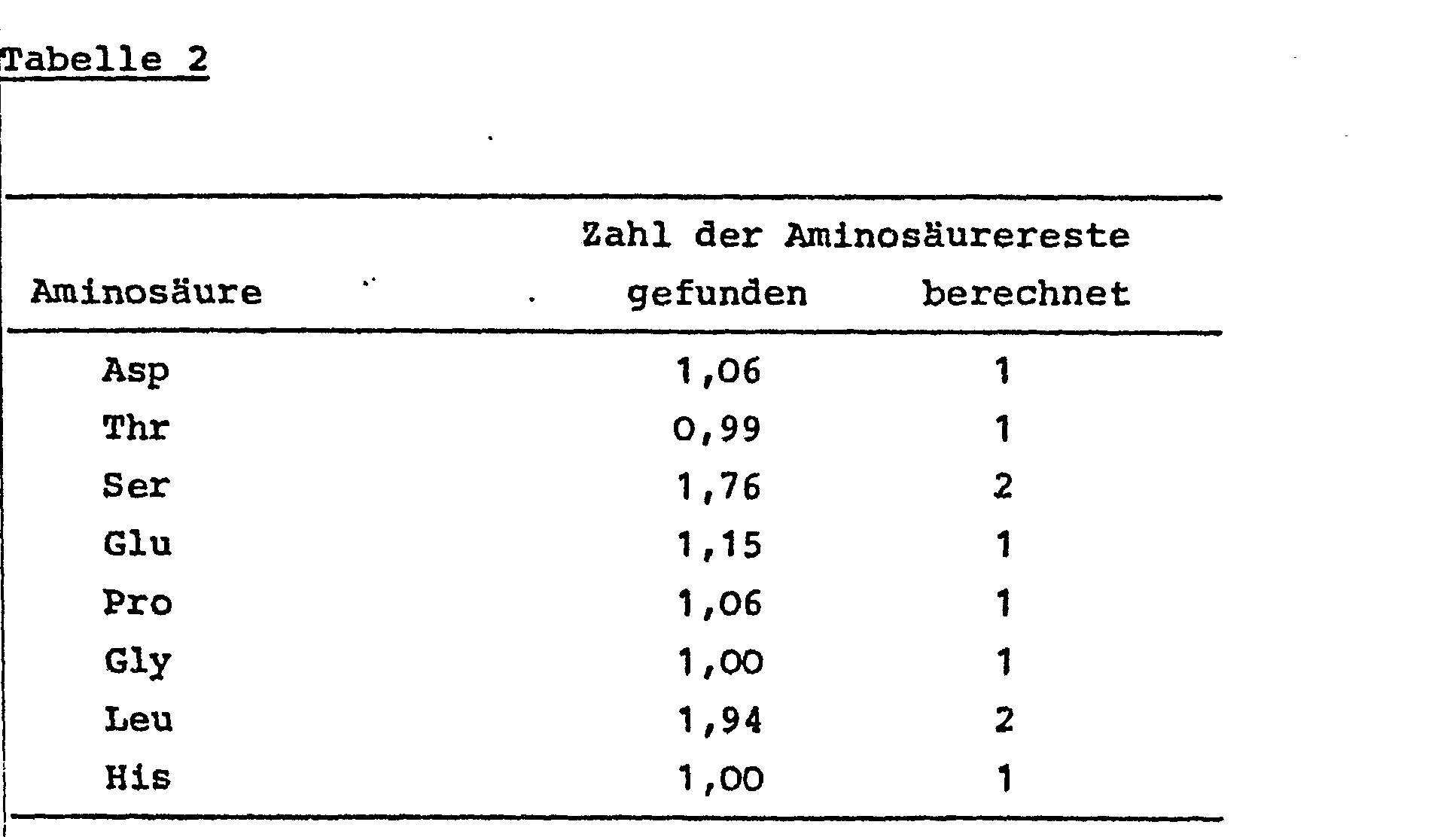
- Die Aminosäurenanalyse wird in einem Biotronik-Aminosäurenana- lysatQr LC 600 E durchgeführt. Die Hydrolyse erfolgt mit 6 N Salzsäure bei 110°C und über 18 bis 72 Stunden. Ohne Korrektur der Hydrolyseverluste wird die nachstehende Zusammensetzung an Aminosäuren festgestellt:
- Die 13C-NMR-Spektren werden im NMR-Spektrometer WH-90 der Firma Bruker-Physik, Karlsruhe, bei 30°C vermessen, Lösungsmittel:
- 2H2O (siehe Abb. 4a und 4b).
- Das neue Dekapeptid und sein Hydrazid können als Haptene eingesetzt werden, die mit einem natürlichen Protein, wie z.B. Humanserumalbumin, Rinderserumalbumin, Eialbumin oder mit einem synthetischen Polypeptid wie z.B. poly-L-Lysin, poly-L-Alanyl-L-lysin oder anderen Trägern wie z.B. modifizierte Dextrane nach bekannten Methoden gekuppelt werden. Das Peptid läßt sich auch über andere Polyamine, wie z.B. 1,6-Diaminohexan, verknüpfen. Ein so hergestelltes Immunogen oder das Dekapeptid selbst können t bekannten Methoden zur Erzeugung von Antiseren bzw. Antikörpern gegen menschliches Lymphoblasteninterferon eingesetzt werden.
- Das neue Dekapeptid kann an Stelle des menschlichen Lymphoblasteninterferons in geeigneter Zubereitung zur Therapie verwendet werden.
- Das neue Dekapeptid ist als Tracer für die immunologische Bestimmung von menschlichem Lymphoblasteninterferon geeignet. Dazu kann es einerseits direkt nach bekannten Methoden, wie z.B. mit radioaktivem Jod oder anderen geeigneten Markern, z.B. mit Enzymen wie Peroxydasen oder mit fluoreszierenden Verbindungen, markiert werden. Andererseits läßt es sich auch in Form der oben erwähnten Kupplungsprodukte mit den gleichen oder ähnlichen Methoden markieren und als Tracer verwenden.
- Das neue Dekapeptid eignet sich ferner in Form eines Kupplungsproduktes mit einem immobilen Träger, wie z.B. Dextranen, Sepharose oder Polystyrol, oder modifizierten anorganischen Trägern, wie z.B. Biogel oder CPG-10, zur Isolierung und Reinigung von Antikörpern gegen menschliche Lymphoblasteninterferone. Derart gewonnene Antikörper gestatten in bekannter Weise die Reinigung und Isolierung von menschlichem Lymphoblasteninterferon.
- nach der schrittweisen Synthese am Träger befindliche voll geschützte Dekapeptid kann auch durch Verseifen oder Umesterung vom Träger abgespalten werden. Die abgespaltenen partiell bzw. voll geschützten Dekapeptidderivate stellen außerdem wertvolle Zwischenprodukte für die Synthese von höheren Peptiden des Lymphoblasteninterferons oder des Lymphobiasteninterferons selbst dar.
- Die nachstehenden Beispiele beschreiben verschiedene Anwendungsmöglichkeiten des Dekapeptids und seines Hydrazids:
- 79 mg (62,5 nmol) partiell geschütztes Dekapeptidhydrazid werden in 3 ml Dioxan gelöst und mit 1 ml Wasser pH 7 versetzt. Dazu werden unter Rühren 30 µl (ca. 200 nmol) m-Xylylendiisocyanat gegeben. Nach 3 Minuten wird eine Lösung von 50 mg Poly-L-lysin-hydrobromid (M. G. 37 300) in 1 ml Wasser (pH 9.5, mit 1 N Natronlauge eingestellt) zugegeben. Nach 4 Stunden bei Raumtemperatur werden ca. 20 ml Wasser zugegeben und mit Eisessig ca. pH 7 eingestellt. Anschließend wird im Vakuum zur Hälfte eingeengt und nach Zugabe von 20 ml Wasser lyophilisiert. Ausbeute: 170 mg.
- 100 mg des über Phosphorpentoxid getrockneten Konjugats werden mit 2 ml Trifluoressigsäure versetzt. Nach 10 Minuten werden zu dieser Suspension 8 ml 40%iger Bromwasserstoff in Eisessig (versetzt mit je ca. 30 mg Resorcin und Thioanisol) zugegeben und 30 Minuten im Dunkeln bei Raumtemperatur gerührt. Nach dem Einengen im Vakuum wird das Konjugat durch Einrühren der Eisessig-Lösung in absoluten Ether (ca. 100 ml) ausgefällt. Nach 2-maligem Waschen mit je 100 ml Ether im - Zentrifugenglas wird der Niederschlag (180 mg) in Wasser gelöst und gegen 1 N Essigsäure 24 Stunden und anschließend gegen dest. Wasser 24 Stunden dialysiert (Ausschlußgrenze 8 000). Nach Zentrifugation des Dialysats erhält man 31 mg wasserunlösliches Konjugat der Beladung 6.4 Mol Dekapeptidhydrazid pro Mol poly-L-Lysin. Aus der wäßrigen Lösung lassen sich nach deren Lyophilisation 1,7 mg lösliches Konjugat der Beladung 42:1 erhalten.
- 70 mg (50 µmol) partiell geschütztes Dekapeptidhydrazid werden in 1,5 ml DMF gelöst und bei -20°C mit 70 pl (126 pmol = 2.5 Äquivalente) 1.8 N HCl/Essigsäureethylester versetzt. Dann werden bei -20°C zuerst 8 µl (60 µmol = 1.2 Äquivalente) Isoamylnitrit und nach 5 Minuten bei -10°C weitere 2 µl Isoamylnitrit zugefügt bis zur Blaufärbung mit Kaliumjodid/Stärke-Papier). Nach 10 Minuten bei -10°C wird eine eiskalte Lösung von 70 mg poly-L-Lysin-hydrobromid in 0,5 ml Wasser (mit 4 pl Triethylamin auf pH 9 eingestellt) zugegeben. Dabei tritt eine Trübung der Lösung ein. Nach 20 Minuten wird mit weiteren 6 µl Triethylamin auf pH 8,5 eingestellt und die stark trübe, viskose Lösung bei -10°C 30 Minuten gerührt und dann bei +4°C 18 Stunden aufbewahrt. Es wird noch bei Raumtemperatur 8 Stunden gerührt, dann mit 10%iger Essigsäure auf pH 6 gestellt und nach Zugabe von viel tert.Butanol und etwas Wasser lyophilisiert. Zur Abspaltung der Schutzgruppen wird wie unter a) verfahren. Man erhält 36,5 mg gut wasserlösliches, farbloses Konjugat mit einer Beladung von 14,9 Mol Dekapeptid pro Mol poly-L-Lysin.
- Jodmarkierung des Kupplungsprodukts des Dekapeptids bzw. seines Hydrazids mit poly-L-Lysin
- Von dem getrockneten Kupplungsprodukt werden 2 mg eingewogen und in 25 µl Wasser gelöst. Diese Lösung wird mit 0,1 mM Natrium-Borat-Puffer pH 9 verdünnt bis die Konzentration des Kupplungsproduktes 10 µg/µl beträgt. 12 µl davon mit einer Konzentration von Borat von 0,1 M pH 9,0 und vom Kupplungsprodukt mit 10 µg/µl werden bei einer Temperatur von 0°C (auf Eis) in ein Reaktionsgefäß gefüllt, in welchem das BOLTON-HUNTER-Reagenz (N-Hydroxy-succinimidester der mit 125J-jodierten p-Hydroxyphenylpropionsäure) aus Benzol getrocknet war.
- Die Reaktion wird nach einer Stunde gestoppt durch Zugabe von 90 µl 0,3 M Glycin in 0,1 M Natrium-Borat, pH 9,0. Nach weiteren 10 Minuten wird das gesamte Volumen nun auf eine Chromatographiesäule gegeben (7 ml Bettvolumen, Sephadex G 25 Medium (Pharmacia, Uppsala), welche mit 50 mM Natriumphosphat pH 7,5 und 0,25 % Gelatine äquilibriert worden war und in diesem Puffer auch entwickelt wird. Die hochmolekulare markierte Substanz wird hierbei von niedrigmolekularen radioaktiven Reaktionsprodukten getrennt und erscheint in den ersten Fraktionen des Voidvolumens.
- ine bessere Ausbeute - verglichen mit diesen ursprünglichen Vorschriften von BOLTON und HUNTER - wird erreicht, wenn nach dem Ende der Reaktion die Lösung auf einen sauren pH gebracht ird. Nach der Zugabe von Glycin wird der pH von 9 auf 4 eingestellt, durch eine weitere Zugabe von 100 µl 20 mM Natrium-Acetat pH 4,0. Die Chromatographiesäule ist entsprechend mit 20 mM Natrium-Acetat pH 4,0 und 0,25 % Gelatine vorbehandelt iund wird in diesem Puffer entwickelt.
- Ausgehend von einer Radioaktivität von 0,2 mCi eines BOLTON- HUNTER-Reagenzes mit der spezifischen Radioaktivität von 2000 Ci/ mmol wird eine Markierung von mindestens 3 x 10⁵cpm (counts per minutes)/µg Kupplungsprodukt erreicht.
- Kupplung an AH-Sepharose 4B zur Herstellung von Materialien zur Affinitätschromatographie
- 35 mg (25 pmol) partiell geschütztes Dekapeptidhydrazid werden in 2 ml Trifluoressigsäure gelöst und mit 4 ml 33%ige Bromwasser stoffsäure/Eisessig versetzt. Nach einer Stunde wird am Rotationsverdampfer eingeengt, der Rückstand in 2 ml Eisessig aufgenommen und die Lösung unter Rühren zu 50 ml wasserfreiem Ether getropft. Der Niederschlag wird abzentrifugiert und über festem Kaliumhydroxid im Vakuum getrocknet. Das erhaltene ungeschützte Dekapeptidhydrazid-dihydrobromid wird analog Beispiel A(b) in das Azid überführt und in DMF/Wasser an die Aminogruppen von 300 mg AH-Sepharose 4B gekuppelt. Nach 24 Stunden Reaktionszeit wird das AH-Sepharose 4B-Dekapeptid solange mit DMF, Dioxan und Wasser gewaschen, bis keine niedermolekularen Bestandteile im Dünnschichtchromatogramm nachweisbar sind.
- Kupplung des Dekapeptids an Lysin-Sepharose 4B zur Affinitätschromatographie
- 35 mg partiell geschütztes Dekapeptidhydrazid werden, wie unter Beispiel C beschrieben, mit Bromwasserstoff/Trifluoressigsäure behandelt und in das Azid überführt, das an 300 mg Lysin-Sepharose 4B (Pharmacia) gekuppelt wird.
- Herstellung von Kupplungsprodukten des Dekapeptids an Aminopropyl-CPG-10 zur Affinitätschromatogrphie
- 500 mg Controlled-Pore Glass CPG 10 (Porengröße 75 und 120 , belegt mit Aminopropylgruppen) werden mit dem aus 70 mg partiell geschütztem Dekapeptidhydrazid erhaltenen Azid analog Beispiel C gekuppelt.
- Verknüpfung von zwei Molekülen Dekapeptidhydrazid über 1,6-Diaminohexan
- 70 mg (50 µmol) partiell geschütztes Dekapeptidhydrazid werden wie unter Beispiel A(b) beschrieben in das Azid überführt. Zu dem Azid werden bei -10°C 2,9 mg (25 umol) 1,6-Diaminohexan in 200 µl DMF gegeben. Nach Einstellen auf ca. pH 8.5 mit Triethylamin wird 2 Stunden bei -10°C gerührt, 24 Stunden bei 4°C stehengelassen und nochmals 8 Stunden bei Raumtemperatur gerührt. Anschließend wird die Reaktionslösung unter Rühren in wasserfreien Ether getropft. Der ausgefallene Niederschlag wird 2 x mit Ether gewaschen und über Diphosphorpentoxid/Kaliumhydroxid getrocknet. Dann wird in Trifluoressigsäure gelöst und mit 4 ml 33%igem Bromwasserstoff/Eisessig versetzt. Das schutzgruppenfreie Produk wurde nach 2 Stunden mit Ether ausgefällt, über Kaliumhydroxid getrocknet und anschließend in DMF über Sephadex LH 20 chromatographiert (Säule 1 x 90 cm). Die das Dimere enthaltenden, zuerst eluierten Fraktionen (dünnschichtchromatographische Detektion) werden im Vakuum zur Trockne eingeengt.
Claims (16)
Applications Claiming Priority (2)
| Application Number | Priority Date | Filing Date | Title |
|---|---|---|---|
| DE19803040824 DE3040824A1 (de) | 1980-10-30 | 1980-10-30 | Neues dekapeptid, verfahren zu seiner herstellung und verwendung |
| DE3040824 | 1980-10-30 |
Publications (1)
| Publication Number | Publication Date |
|---|---|
| EP0051204A1 true EP0051204A1 (de) | 1982-05-12 |
Family
ID=6115503
Family Applications (1)
| Application Number | Title | Priority Date | Filing Date |
|---|---|---|---|
| EP81108535A Withdrawn EP0051204A1 (de) | 1980-10-30 | 1981-10-20 | Neues Dekapeptid, Verfahren zu seiner Herstellung und Verwendung |
Country Status (5)
| Country | Link |
|---|---|
| US (1) | US4370312A (de) |
| EP (1) | EP0051204A1 (de) |
| JP (1) | JPS57163350A (de) |
| DE (1) | DE3040824A1 (de) |
| IL (1) | IL64156A (de) |
Families Citing this family (3)
| Publication number | Priority date | Publication date | Assignee | Title |
|---|---|---|---|---|
| DE3211263A1 (de) * | 1981-03-31 | 1983-01-27 | Otsuka Pharmaceutical Co. Ltd., Tokyo | Human-interferon verwandte peptide, antigene und antikoerper, sowie verfahren zu deren herstellung |
| CA2026377A1 (en) * | 1989-10-03 | 1991-04-04 | John L. Krstenansky | Radiolabeled anticoagulant peptides |
| US7229835B2 (en) * | 2001-10-25 | 2007-06-12 | The University Of Maryland, Baltimore County | Amine detection method and materials |
-
1980
- 1980-10-30 DE DE19803040824 patent/DE3040824A1/de not_active Withdrawn
-
1981
- 1981-10-20 EP EP81108535A patent/EP0051204A1/de not_active Withdrawn
- 1981-10-26 US US06/315,213 patent/US4370312A/en not_active Expired - Fee Related
- 1981-10-29 JP JP56176281A patent/JPS57163350A/ja active Pending
- 1981-10-29 IL IL64156A patent/IL64156A/xx unknown
Non-Patent Citations (2)
| Title |
|---|
| CHEMICAL ABSTRACTS Band 92, Nr. 11 17. Marz 1980 Columbus, Ohio, USA ZOON et al. "Amino Terminal Sequence of the Major Component of Human Lymphoblastoid Interferon" seite 443, spalte 2, Abstract Nr. 92554j & Science (Washington, D.C.), Band 207 Nr. 4430, 1980, seiten 527 bis 528 * |
| CHEMICAL ABSTRACTS Band 94, Nr. 21 25. Mai 1981 Columbus, Ohio, USA JUNG et al. "Synthesis and Carbon-13 NMR Spectra of the N-Terminal Decapeptide of the Sequence of Human Lymphoblast Interferon" seite 531, spalte 2, Abstract Nr. 172633r & Hoppe-Seyler's Z. Physiol. Chem. Band 362, Nr. 3, 1981, seiten 291 bis 304 * |
Also Published As
| Publication number | Publication date |
|---|---|
| DE3040824A1 (de) | 1982-08-19 |
| JPS57163350A (en) | 1982-10-07 |
| US4370312A (en) | 1983-01-25 |
| IL64156A0 (en) | 1982-01-31 |
| IL64156A (en) | 1984-10-31 |
Similar Documents
| Publication | Publication Date | Title |
|---|---|---|
| DE3211263C2 (de) | ||
| Kangawa et al. | Purification and complete amino acid sequence of α-human atrial natriuretic polypeptide (α-hANP) | |
| US4033940A (en) | Cyclization of peptides | |
| US3926938A (en) | Synthesis of salmon calcitonin | |
| JPS60136596A (ja) | ペプチド及びこれを有効成分とする利尿剤 | |
| JPS6118799A (ja) | 効力のあるサイモペンチン類似体 | |
| GB2116564A (en) | Calcitonin derivatives | |
| US4217268A (en) | Synthesis of peptides | |
| WO1988006596A1 (en) | New cardiodilatin fragment, process for preparing same and use thereof | |
| EP0051205B1 (de) | Neues Tridekapeptid, Verfahren zu seiner Herstellung und Verwendung | |
| US4606856A (en) | [Des-1-amino, 8-glycine]calcitonin | |
| US4537716A (en) | Des-serine2 or des-glycine2 -leucine22 calcitonin | |
| US4397780A (en) | Leucine22 -calcitonin | |
| DE3151738C2 (de) | ||
| Albericio et al. | Solid phase synthesis and HPLC purification of the protected 1-12 sequence of apamin for rapid synthesis of apamin analogues differing in the C-terminal region | |
| EP0075776A1 (de) | Bis-thymosin Alpha 1-Verbindungen | |
| FI79117B (fi) | Foerfarande foer framstaellning av bovine-, svin- eller humaninsulin. | |
| US4764589A (en) | [N-alpha-acyl,8-glycine, des-19-leucine]-calcitonin | |
| DE60226324T2 (de) | Glykopeptide, deren herstellung und verwendung in der diagnose oder behandlung von multipler sklerose | |
| US4212795A (en) | Cyclization of peptides | |
| US3988309A (en) | EEL calcitonin | |
| US4304692A (en) | Synthesis of biologically active peptides | |
| DE3040824A1 (de) | Neues dekapeptid, verfahren zu seiner herstellung und verwendung | |
| US4239680A (en) | Synthesis of biologically active peptides | |
| US4058512A (en) | Synthetic peptides having growth promoting activity |
Legal Events
| Date | Code | Title | Description |
|---|---|---|---|
| PUAI | Public reference made under article 153(3) epc to a published international application that has entered the european phase |
Free format text: ORIGINAL CODE: 0009012 |
|
| 17P | Request for examination filed |
Effective date: 19811020 |
|
| AK | Designated contracting states |
Designated state(s): AT BE CH DE FR GB IT LU NL SE |
|
| STAA | Information on the status of an ep patent application or granted ep patent |
Free format text: STATUS: THE APPLICATION IS DEEMED TO BE WITHDRAWN |
|
| 18D | Application deemed to be withdrawn |
Effective date: 19860117 |
|
| RIN1 | Information on inventor provided before grant (corrected) |
Inventor name: SWETLY, PETER, DR. Inventor name: JUNG, GUENTHER, DIPL.-CHEM. PROF. DR. Inventor name: BOZLER, GERHARD, DIPL.-CHEM. DR. Inventor name: BRUECKNER, HANS, DIPL.-CHEM. DR. |