EP0051488A2 - Procédé de fabrication d'un dispositif semiconducteur - Google Patents
Procédé de fabrication d'un dispositif semiconducteur Download PDFInfo
- Publication number
- EP0051488A2 EP0051488A2 EP81305215A EP81305215A EP0051488A2 EP 0051488 A2 EP0051488 A2 EP 0051488A2 EP 81305215 A EP81305215 A EP 81305215A EP 81305215 A EP81305215 A EP 81305215A EP 0051488 A2 EP0051488 A2 EP 0051488A2
- Authority
- EP
- European Patent Office
- Prior art keywords
- layer
- oxidizable material
- oxidation
- substrate
- mask
- Prior art date
- Legal status (The legal status is an assumption and is not a legal conclusion. Google has not performed a legal analysis and makes no representation as to the accuracy of the status listed.)
- Granted
Links
Images


Classifications
-
- H—ELECTRICITY
- H10—SEMICONDUCTOR DEVICES; ELECTRIC SOLID-STATE DEVICES NOT OTHERWISE PROVIDED FOR
- H10W—GENERIC PACKAGES, INTERCONNECTIONS, CONNECTORS OR OTHER CONSTRUCTIONAL DETAILS OF DEVICES COVERED BY CLASS H10
- H10W10/00—Isolation regions in semiconductor bodies between components of integrated devices
- H10W10/01—Manufacture or treatment
- H10W10/011—Manufacture or treatment of isolation regions comprising dielectric materials
- H10W10/012—Manufacture or treatment of isolation regions comprising dielectric materials using local oxidation of silicon [LOCOS]
- H10W10/0125—Manufacture or treatment of isolation regions comprising dielectric materials using local oxidation of silicon [LOCOS] comprising introducing electrical impurities in local oxidation regions, e.g. to alter LOCOS oxide growth characteristics
- H10W10/0126—Manufacture or treatment of isolation regions comprising dielectric materials using local oxidation of silicon [LOCOS] comprising introducing electrical impurities in local oxidation regions, e.g. to alter LOCOS oxide growth characteristics introducing electrical active impurities in local oxidation regions to create channel stoppers
-
- H—ELECTRICITY
- H10—SEMICONDUCTOR DEVICES; ELECTRIC SOLID-STATE DEVICES NOT OTHERWISE PROVIDED FOR
- H10W—GENERIC PACKAGES, INTERCONNECTIONS, CONNECTORS OR OTHER CONSTRUCTIONAL DETAILS OF DEVICES COVERED BY CLASS H10
- H10W10/00—Isolation regions in semiconductor bodies between components of integrated devices
- H10W10/10—Isolation regions comprising dielectric materials
- H10W10/13—Isolation regions comprising dielectric materials formed using local oxidation of silicon [LOCOS], e.g. sealed interface localised oxidation [SILO] or side-wall mask isolation [SWAMI]
-
- Y—GENERAL TAGGING OF NEW TECHNOLOGICAL DEVELOPMENTS; GENERAL TAGGING OF CROSS-SECTIONAL TECHNOLOGIES SPANNING OVER SEVERAL SECTIONS OF THE IPC; TECHNICAL SUBJECTS COVERED BY FORMER USPC CROSS-REFERENCE ART COLLECTIONS [XRACs] AND DIGESTS
- Y10—TECHNICAL SUBJECTS COVERED BY FORMER USPC
- Y10S—TECHNICAL SUBJECTS COVERED BY FORMER USPC CROSS-REFERENCE ART COLLECTIONS [XRACs] AND DIGESTS
- Y10S148/00—Metal treatment
- Y10S148/106—Masks, special
-
- Y—GENERAL TAGGING OF NEW TECHNOLOGICAL DEVELOPMENTS; GENERAL TAGGING OF CROSS-SECTIONAL TECHNOLOGIES SPANNING OVER SEVERAL SECTIONS OF THE IPC; TECHNICAL SUBJECTS COVERED BY FORMER USPC CROSS-REFERENCE ART COLLECTIONS [XRACs] AND DIGESTS
- Y10—TECHNICAL SUBJECTS COVERED BY FORMER USPC
- Y10S—TECHNICAL SUBJECTS COVERED BY FORMER USPC CROSS-REFERENCE ART COLLECTIONS [XRACs] AND DIGESTS
- Y10S148/00—Metal treatment
- Y10S148/117—Oxidation, selective
-
- Y—GENERAL TAGGING OF NEW TECHNOLOGICAL DEVELOPMENTS; GENERAL TAGGING OF CROSS-SECTIONAL TECHNOLOGIES SPANNING OVER SEVERAL SECTIONS OF THE IPC; TECHNICAL SUBJECTS COVERED BY FORMER USPC CROSS-REFERENCE ART COLLECTIONS [XRACs] AND DIGESTS
- Y10—TECHNICAL SUBJECTS COVERED BY FORMER USPC
- Y10S—TECHNICAL SUBJECTS COVERED BY FORMER USPC CROSS-REFERENCE ART COLLECTIONS [XRACs] AND DIGESTS
- Y10S148/00—Metal treatment
- Y10S148/131—Reactive ion etching rie
-
- Y—GENERAL TAGGING OF NEW TECHNOLOGICAL DEVELOPMENTS; GENERAL TAGGING OF CROSS-SECTIONAL TECHNOLOGIES SPANNING OVER SEVERAL SECTIONS OF THE IPC; TECHNICAL SUBJECTS COVERED BY FORMER USPC CROSS-REFERENCE ART COLLECTIONS [XRACs] AND DIGESTS
- Y10—TECHNICAL SUBJECTS COVERED BY FORMER USPC
- Y10S—TECHNICAL SUBJECTS COVERED BY FORMER USPC CROSS-REFERENCE ART COLLECTIONS [XRACs] AND DIGESTS
- Y10S148/00—Metal treatment
- Y10S148/15—Silicon on sapphire SOS
Definitions
- This invention relates to the production method for a semiconductor device, particularly to the element isolation technique utilizing an insulating material and a semiconductor device which is manufactured by means of this technique.
- isolation technique in semiconductor integrated circuits there are generally known methods in which the isolation regions are formed by selective oxidation for facilitating higher packaging density and a more effective manufacturing process. According to such methods, since the periphery of the active region is surrounded by the oxide layer, self-alignment is possible by methods such as base diffusion so that unnecessary parts which have been conventionally required for masking may be eliminated. This allows a higher packaging density. Furthermore, since on the sides of element region are disposed deep oxide layers, the coupling capacitance is significantly reduced.
- This method however, adopts a structure in which the thermally oxidized layer is selectively embedded in the silicon substrate. This causes a great strain in the silicon substrate, degrades the electrical characteristics of the element, and thus imposes strict limits as to the selection of the structure, configuration, film thickness, the conditions for selective oxidation of the oxidation mask, and occasionally on the selection of the material itself for the silicon substrate. This is disclosed, for example, in IEDM, "High Pressure Oxidation for Isolation of High Speed Bipolar Devices", pp. 340 - 343, 1979.
- the field oxidizing time is long. This gives a significant rise to the diffusion and redistribution of the impurity layer in the channel stopper. For example, when the diffusion in the transverse direction is great, the effective channel width of the MOS transistor is reduced and the drain coupling capacitance increases, thus obstructing realization of a high speed device.
- a silicon nitride layer called "white ribbon" is formed in the silicon substrate below the silicon nitride layer, causing a poor voltage resistivity in the element.
- a double-layer mask composed of a silicon nitride layer and an oxide layer is used as an oxidation-proof mask, a bird's beak of almost 1 ⁇ m is thrusted into below the silicon nitride layer. As a result, it was difficult to form an isolation layer with the distance between elements been less than 2 ⁇ m. This is reported, for instance, in "Bird's Beak Configuration and Elimination of Gate Oxide Thinning Produced during Selection Oxidation", pp. 216 - 222, J.E.C.S., 1980.
- This invention has been made in view of the aforementioned background and offers a method to produce a semiconductor device which is suitable for the formation of fine semiconductor elements, has excellent electrical characteristics and is capable of preventing, at the time of selective oxidation for the formation of element isolation layers, the thermal effects upon semiconductor substrates resulting in defects, of suppressing the growth of the bird's beak at the time of the selective oxidation and also of preventing any formation of an oxynitride layer below a silicon nitride layer, and also offers semiconductor devices to be produced with this method.
- this invention offers a method of producing a semiconductor device, which comprises steps of creating an oxidizable material layer on a semiconductor substrate, selectively forming an oxidation proof mask directly on this oxidizable material layer and then selectively oxidizing the said oxidizable material layer using said mask thereby creating a thick oxide layer, performing a virtually perpendicular etching of an exposed oxidizable material layer on the substrate after removing the aforementioned oxidation-proof mask and to leave part of the said oxidizable material layer on the perpendicularly etched surface and oxidizing the oxidizable material layer remaining along the perpendicularly etched surface.
- this invention offers a semiconductor device which features in that the length of the bird's beak of an element isolation layer which is thrusted out over the upper side of a semiconductor substrate into the element region of the said substrate is less than one fourth of the thickness of the element isolation layer.
- the oxidizable material layer in this invention is utilized for forming an oxide layer as an element isolation layer by means of selective oxidation.
- materials for such oxidizable material layer polycrystalline silicon doped with high concentration of impurities such as phosphorus, arsenic and boron, non-monocrystalline silicon, such as polycrystalline silicon, containing substantially no impurities and metal silicides such as molybdenum silicide, tungsten silicide and tantalum silicide may be useful.
- Such an oxidizable material layer may be formed on a semiconductor substrate with or without an oxide layer interposed therebetween.
- the diffusion of impurities in an oxidizable material layer is mainly dependent upon the time period of and temperature of the selective oxidation step, a deposition of an oxide layer between the substrate and the oxidizable material layer sometimes may not be sufficient to prevent the impurities in the oxidizable material layer from diffusing. Therefore, if the temperature at the time of the selective oxidation is rather high or the duration of selective oxidation is long, it is advisable to make thicker the oxide layer, thereby securely preventing the diffusion of the impurities. To be more specific, when performing a selective oxidation for 200 minutes at 1,000 °C on a polycrystalline silicon layer with the phosphorous concentration of 1 x 10 16 /cm 3 , it is desirable to make
- the oxide layer more than 1,500 A thick.
- a thermally oxidized layer or a CVD-Si0 2 may be used.
- an impurity-doped polycrystalline silicon layer is employed as an oxidizable material layer and etching of the polycrystalline silicon remaining on the substrate after selective oxidation is to be carried out the aforementioned oxide layer works as an etching stopper for protecting the substrate.
- any oxynitride layer is not produced has the following effects.
- a thick oxide layer is formed through selective oxidation-in the region of the exposed portion of the oxidizable material layer and then the mask is removed. Subsequently, the remaining oxidizable material layer is also eliminated.
- the spatter ion etching technique is employed in order to prevent that the element isolation layer to be formed takes an overhung structure.
- the oxynitride layer acts as an etching mask to leave a portion of the oxidizable material layer to remain along the edges of the thick oxide layer.
- the element isolation layer will get larger, i.e., the size conversion difference will get larger to obstruct the production of finer semiconductor elements. It is therefore highly beneficial from the standpoint of making semiconductor elements finer that no oxynitride layer is formed on the surface of oxidizable material layer convered by the oxidation-proof mask at the time of selective oxidation.
- this oxidation-proof mask It is desirable to limit the thickness of this oxidation-proof mask to more than three times of the thickness of the oxide layer formed between the oxidizable material layer and the semiconductor 0 substrate and less than 4,000 A.
- a mask to prevent a diffusion of impurities may be placed upon this oxidation-proof mask.
- a mask consisting of for example CVD Si0 2 , to prevent a diffusion of impurities in the oxidation-proof mask, it is possible to prevent an erroneous formation of a channel stopper on the semiconductor surface below the oxidation-proof mask at the time of ion implantation for forming a channel stopper.
- a resist mask made of for example rubber which is previously used to create lamination layers cannot be used again as it is, so that another resist mask pattern has to be formed for providing a channel stopper after removing the resist mask previously formed, and also when in this case it is desired to form a channel stopper in self-alignment by making use of the resist mask used for making the lamination layers, it is inevitable that the prevention of an erroneous implantation of impurities in an element region is effected only with the resist mask which has been used to create the lamination layers.
- a formation of an impurities diffusion preventing layer on the oxidation-proof layer as an ion implantation mask is very important in the sense that the application of this invention can be extended to the production of complementary MOS IC.
- anisotropic etching techniques like the reactive spatter ion etching and the ion beam etching with which it is possible to perform a perpendicular etching on the remaining oxidizable material layers on the substrate and to prevent a formation of an overhung structure of the thick oxide layer edges.
- a semiconductor substrate a laminated structure comprising a P-type silicon substrate, a N-type silicon substrate or a compound substrate such as GaAs, and a monocrystalline semiconductor layer epitaxially grown on any one of aforementioned substrates such as P-type silicon substrate and etc.
- a monocrystalline insulation substrate such as sapphire substrate or spinel substrate, each superposed with a monocrystalline semiconductor may be used as a semiconductor substrate.
- a vapor epitaxial growth process As means to deposit a monocrystalline semiconductor layer on a monocrystalline insulation substrate, (1) a vapor epitaxial growth process; or (2) a process in which polycrystal or amorphous semiconductor layer is first deposited on the insulation substrate by means of a vapor growth method such as CVD method or PVD (Physical Vapor Deposition) method, and then the irradiation of an energy beam such as laser beam is effected to monocrystalize the polycrystal or amorphous semiconductor layer with the insulation substrate been utilized as a seed nucleus; may be adapted.
- a vapor growth method such as CVD method or PVD (Physical Vapor Deposition) method
- an element isolation layer is formed by means of selective oxidization of the polycrystalline silicon layer 3 which is oxidized faster than the monocrystalline silicon substrate 1 on which it is disposed, thermal effects upon the substrate 1 could be suppressed and thermally caused defects and rediffusion of impurities can be reduced.
- an element isolation layer 8 is formed by means of selective oxidization of the polycrystalline silicon 3 on the substrate 1 instead of producing an element isolation layer by directly oxidizing the substrate 1 as seen in the conventional method, a considerable stress upon the substrate 1 could be avoided.
- the monocrystalline silicon substrate 1 thus produced has very few defects and has excellent electrical characteristics to make it possible to produce highly reliable n channel MOS IC.
- the thrusting of the oxide layer into the polycrystalline silicon layer 3 below the silicon nitride pattern 4, i.e., bird's beak (A) (Fig. 4) could be controlled to less than 0.15 pm in length (less than one fourth of the thickness of the oxide layer (B) 0.8 ⁇ m) and no oxynitride layer is formed on the remaining polycrystalline silicon layer 3' and it is thus possible to etch in perpendicular to the thick oxide layer 6 the said polycrystalline silicon layer 3' with self-alignment. It is therefore possible to produce a fine element isolation layer 8 of small dimension-conversion difference and to obtain MOS IC comprising fine elements.
- an element isolation layer is formed by means of selective oxidation of the phosphorus-doped polycrystalline silicon layer 24 disposed on the monocrystalline silicon layer 22 which is superposed on the monocrystalline silicon layer 21
- thermal effects upon the monocrystalline silicon layer 22 can be suppressed and thermal effects to cause defects in the monocrystalline silicon layer 22 and diffusion of impurities into the layer 22 could be reduced.
- the element isolation layer is produced by means of selective oxidation of the phosphorus-doped polycrystalline silicon layer 24 on the said silicon layer 22 instead of forming it by means of direct oxidation of the monocrystalline silicon layer 22 as in the conventional selective oxidation method, stress upon the monocrystalline silicon layer 22 can be avoided and thus problems of slipping dislocation and defects due to stress could be avoided.
- Example 4 Except for the use of a monocrystalline sapphire substrate instead of the p-type monocrystalline silicon substrate 21, the exactly same process as Example 3 is employed to produce n channel MOS IC.
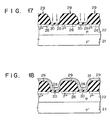
- Figures 14 through 18 may be referred to explain Example 4, assuming that a sapphire substrate is used instead of the p-type monocrystalline silicon substrate.
- a phosphorus-doped polycrystalline silicon layer disposed on the sapphire substrate 21 is selectively oxidized, an element isolation layer 29 of sufficient thickness 0 (8,000 A) can be formed in a considerably shorter time in comparison with selective oxidation of the monocrystalline silicon layer 22.
- thermal effects upon the sapphire substrate 21 and the monocrystalline silicon layer 22 can be suppressed. It is also possible to reduce stress due to difference in thermal expansion coefficient and in lattice distance between the sapphire substrate 21 and the silicon layer 22 and at the same time to reduce the diffusion of impurities into the silicon layer 22.
- This invention can be applied not only to the production of n channel MOS IC.and CMOS IC as discussed above but also to the production of p channel MOS IC, bipolar IC, 1 2 L and CCD.
- this invention offers a method to produce semiconductor devices having excellent electrical characteristics and which is suitable for making finer semiconductor elements.
Landscapes
- Element Separation (AREA)
- Local Oxidation Of Silicon (AREA)
Applications Claiming Priority (12)
| Application Number | Priority Date | Filing Date | Title |
|---|---|---|---|
| JP156146/80 | 1980-11-06 | ||
| JP55156147A JPS5779644A (en) | 1980-11-06 | 1980-11-06 | Manufacture of semiconductor device |
| JP55156146A JPS5779643A (en) | 1980-11-06 | 1980-11-06 | Semiconductor device |
| JP156141/80 | 1980-11-06 | ||
| JP55156141A JPS5779639A (en) | 1980-11-06 | 1980-11-06 | Manufacture of semiconductor device |
| JP55156139A JPS5779637A (en) | 1980-11-06 | 1980-11-06 | Manufacture of semiconductor device |
| JP156139/80 | 1980-11-06 | ||
| JP55156140A JPS5779638A (en) | 1980-11-06 | 1980-11-06 | Manufacture of semiconductor device |
| JP156140/80 | 1980-11-06 | ||
| JP156147/80 | 1980-11-06 | ||
| JP55165843A JPS5790960A (en) | 1980-11-27 | 1980-11-27 | Manufacture of semiconductor device |
| JP165843/80 | 1980-11-27 |
Publications (3)
| Publication Number | Publication Date |
|---|---|
| EP0051488A2 true EP0051488A2 (fr) | 1982-05-12 |
| EP0051488A3 EP0051488A3 (en) | 1982-09-22 |
| EP0051488B1 EP0051488B1 (fr) | 1985-01-30 |
Family
ID=27553175
Family Applications (1)
| Application Number | Title | Priority Date | Filing Date |
|---|---|---|---|
| EP81305215A Expired EP0051488B1 (fr) | 1980-11-06 | 1981-11-02 | Procédé de fabrication d'un dispositif semiconducteur |
Country Status (3)
| Country | Link |
|---|---|
| US (1) | US4459325A (fr) |
| EP (1) | EP0051488B1 (fr) |
| DE (1) | DE3168688D1 (fr) |
Families Citing this family (45)
| Publication number | Priority date | Publication date | Assignee | Title |
|---|---|---|---|---|
| DE3330895A1 (de) * | 1983-08-26 | 1985-03-14 | Siemens AG, 1000 Berlin und 8000 München | Verfahren zum herstellen von bipolartransistorstrukturen mit selbstjustierten emitter- und basisbereichen fuer hoechstfrequenzschaltungen |
| US4716131A (en) * | 1983-11-28 | 1987-12-29 | Nec Corporation | Method of manufacturing semiconductor device having polycrystalline silicon layer with metal silicide film |
| JPS60244072A (ja) * | 1984-05-17 | 1985-12-03 | Toshiba Corp | 半導体装置の製造方法 |
| JPS61191043A (ja) * | 1985-02-20 | 1986-08-25 | Toshiba Corp | 半導体装置 |
| US4613402A (en) * | 1985-07-01 | 1986-09-23 | Eastman Kodak Company | Method of making edge-aligned implants and electrodes therefor |
| US4968640A (en) * | 1987-02-10 | 1990-11-06 | Industrial Technology Research Institute | Isolation structures for integrated circuits |
| US5114833A (en) * | 1988-08-29 | 1992-05-19 | Eastman Kodak Company | Charge-coupled device and process of making the device |
| US5175123A (en) * | 1990-11-13 | 1992-12-29 | Motorola, Inc. | High-pressure polysilicon encapsulated localized oxidation of silicon |
| KR0172816B1 (ko) * | 1991-01-14 | 1999-03-30 | 문정환 | 마스크 제조방법 |
| US5460908A (en) * | 1991-08-02 | 1995-10-24 | Micron Technology, Inc. | Phase shifting retical fabrication method |
| US5580815A (en) * | 1993-08-12 | 1996-12-03 | Motorola Inc. | Process for forming field isolation and a structure over a semiconductor substrate |
| US5972746A (en) * | 1996-10-08 | 1999-10-26 | Mosel Vitelic, Inc. | Method for manufacturing semiconductor devices using double-charged implantation |
| US6096660A (en) * | 1997-08-21 | 2000-08-01 | Micron Technology, Inc. | Method for removing undesirable second oxide while minimally affecting a desirable first oxide |
| US6392257B1 (en) | 2000-02-10 | 2002-05-21 | Motorola Inc. | Semiconductor structure, semiconductor device, communicating device, integrated circuit, and process for fabricating the same |
| US6693033B2 (en) | 2000-02-10 | 2004-02-17 | Motorola, Inc. | Method of removing an amorphous oxide from a monocrystalline surface |
| AU2001257346A1 (en) | 2000-05-31 | 2001-12-11 | Motorola, Inc. | Semiconductor device and method for manufacturing the same |
| WO2002003437A1 (fr) * | 2000-06-30 | 2002-01-10 | Motorola, Inc., A Corporation Of The State Of Delaware | Structure et dispositif de semi-conducteur hybride |
| WO2002009187A2 (fr) | 2000-07-24 | 2002-01-31 | Motorola, Inc. | Diodes a heterojonction tunnel et processus de fabrication de celles-ci |
| US6590236B1 (en) | 2000-07-24 | 2003-07-08 | Motorola, Inc. | Semiconductor structure for use with high-frequency signals |
| US6555946B1 (en) | 2000-07-24 | 2003-04-29 | Motorola, Inc. | Acoustic wave device and process for forming the same |
| US6493497B1 (en) | 2000-09-26 | 2002-12-10 | Motorola, Inc. | Electro-optic structure and process for fabricating same |
| US6638838B1 (en) | 2000-10-02 | 2003-10-28 | Motorola, Inc. | Semiconductor structure including a partially annealed layer and method of forming the same |
| US6501121B1 (en) | 2000-11-15 | 2002-12-31 | Motorola, Inc. | Semiconductor structure |
| US6559471B2 (en) | 2000-12-08 | 2003-05-06 | Motorola, Inc. | Quantum well infrared photodetector and method for fabricating same |
| US20020096683A1 (en) | 2001-01-19 | 2002-07-25 | Motorola, Inc. | Structure and method for fabricating GaN devices utilizing the formation of a compliant substrate |
| US6673646B2 (en) | 2001-02-28 | 2004-01-06 | Motorola, Inc. | Growth of compound semiconductor structures on patterned oxide films and process for fabricating same |
| WO2002082551A1 (fr) | 2001-04-02 | 2002-10-17 | Motorola, Inc. | Structure de semi-conducteur a courant de fuite attenue |
| US6709989B2 (en) | 2001-06-21 | 2004-03-23 | Motorola, Inc. | Method for fabricating a semiconductor structure including a metal oxide interface with silicon |
| US6992321B2 (en) | 2001-07-13 | 2006-01-31 | Motorola, Inc. | Structure and method for fabricating semiconductor structures and devices utilizing piezoelectric materials |
| US6531740B2 (en) | 2001-07-17 | 2003-03-11 | Motorola, Inc. | Integrated impedance matching and stability network |
| US6646293B2 (en) | 2001-07-18 | 2003-11-11 | Motorola, Inc. | Structure for fabricating high electron mobility transistors utilizing the formation of complaint substrates |
| US6693298B2 (en) | 2001-07-20 | 2004-02-17 | Motorola, Inc. | Structure and method for fabricating epitaxial semiconductor on insulator (SOI) structures and devices utilizing the formation of a compliant substrate for materials used to form same |
| US7019332B2 (en) | 2001-07-20 | 2006-03-28 | Freescale Semiconductor, Inc. | Fabrication of a wavelength locker within a semiconductor structure |
| US6855992B2 (en) | 2001-07-24 | 2005-02-15 | Motorola Inc. | Structure and method for fabricating configurable transistor devices utilizing the formation of a compliant substrate for materials used to form the same |
| US6667196B2 (en) | 2001-07-25 | 2003-12-23 | Motorola, Inc. | Method for real-time monitoring and controlling perovskite oxide film growth and semiconductor structure formed using the method |
| US6639249B2 (en) | 2001-08-06 | 2003-10-28 | Motorola, Inc. | Structure and method for fabrication for a solid-state lighting device |
| US6589856B2 (en) | 2001-08-06 | 2003-07-08 | Motorola, Inc. | Method and apparatus for controlling anti-phase domains in semiconductor structures and devices |
| US20030034491A1 (en) | 2001-08-14 | 2003-02-20 | Motorola, Inc. | Structure and method for fabricating semiconductor structures and devices for detecting an object |
| US6673667B2 (en) | 2001-08-15 | 2004-01-06 | Motorola, Inc. | Method for manufacturing a substantially integral monolithic apparatus including a plurality of semiconductor materials |
| US20030071327A1 (en) | 2001-10-17 | 2003-04-17 | Motorola, Inc. | Method and apparatus utilizing monocrystalline insulator |
| US6916717B2 (en) | 2002-05-03 | 2005-07-12 | Motorola, Inc. | Method for growing a monocrystalline oxide layer and for fabricating a semiconductor device on a monocrystalline substrate |
| US7169619B2 (en) | 2002-11-19 | 2007-01-30 | Freescale Semiconductor, Inc. | Method for fabricating semiconductor structures on vicinal substrates using a low temperature, low pressure, alkaline earth metal-rich process |
| US6885065B2 (en) | 2002-11-20 | 2005-04-26 | Freescale Semiconductor, Inc. | Ferromagnetic semiconductor structure and method for forming the same |
| US6965128B2 (en) | 2003-02-03 | 2005-11-15 | Freescale Semiconductor, Inc. | Structure and method for fabricating semiconductor microresonator devices |
| US7020374B2 (en) | 2003-02-03 | 2006-03-28 | Freescale Semiconductor, Inc. | Optical waveguide structure and method for fabricating the same |
Family Cites Families (6)
| Publication number | Priority date | Publication date | Assignee | Title |
|---|---|---|---|---|
| US3753803A (en) * | 1968-12-06 | 1973-08-21 | Hitachi Ltd | Method of dividing semiconductor layer into a plurality of isolated regions |
| GB1437112A (en) * | 1973-09-07 | 1976-05-26 | Mullard Ltd | Semiconductor device manufacture |
| US3943542A (en) * | 1974-11-06 | 1976-03-09 | International Business Machines, Corporation | High reliability, low leakage, self-aligned silicon gate FET and method of fabricating same |
| US4137109A (en) * | 1976-04-12 | 1979-01-30 | Texas Instruments Incorporated | Selective diffusion and etching method for isolation of integrated logic circuit |
| JPS55115341A (en) * | 1979-02-28 | 1980-09-05 | Chiyou Lsi Gijutsu Kenkyu Kumiai | Manufacture of semiconductor device |
| FR2459551A1 (fr) * | 1979-06-19 | 1981-01-09 | Thomson Csf | Procede et structure de passivation a autoalignement sur l'emplacement d'un masque |
-
1981
- 1981-11-02 EP EP81305215A patent/EP0051488B1/fr not_active Expired
- 1981-11-02 DE DE8181305215T patent/DE3168688D1/de not_active Expired
- 1981-11-03 US US06/317,616 patent/US4459325A/en not_active Expired - Lifetime
Also Published As
| Publication number | Publication date |
|---|---|
| EP0051488A3 (en) | 1982-09-22 |
| DE3168688D1 (en) | 1985-03-14 |
| EP0051488B1 (fr) | 1985-01-30 |
| US4459325A (en) | 1984-07-10 |
Similar Documents
| Publication | Publication Date | Title |
|---|---|---|
| US4459325A (en) | Semiconductor device and method for manufacturing the same | |
| EP0146895B1 (fr) | Procédé pour la fabrication de dispositifs semi-conducteurs | |
| US5573963A (en) | Method of forming self-aligned twin tub CMOS devices | |
| US4642878A (en) | Method of making MOS device by sequentially depositing an oxidizable layer and a masking second layer over gated device regions | |
| US4749441A (en) | Semiconductor mushroom structure fabrication | |
| KR20010012906A (ko) | 집적회로 및 그 구성요소와 제조방법 | |
| US4891328A (en) | Method of manufacturing field effect transistors and lateral bipolar transistors on the same substrate | |
| US5895252A (en) | Field oxidation by implanted oxygen (FIMOX) | |
| US4372033A (en) | Method of making coplanar MOS IC structures | |
| US5106768A (en) | Method for the manufacture of CMOS FET by P+ maskless technique | |
| US5219783A (en) | Method of making semiconductor well structure | |
| JP2785919B2 (ja) | 絶縁層の上に成長層を有する半導体装置の製造方法 | |
| EP0398032B1 (fr) | Procédé de fabrication d'un circuit intégré à semi-conducteur comportant une région d'isolation | |
| JP2989051B2 (ja) | 炭化シリコンバイポーラ半導体装置およびその製造方法 | |
| EP0126292B1 (fr) | Dispositif semi-conducteur avec une couche d'isolement entre les éléments et procédé de fabrication | |
| EP0239384B1 (fr) | Procédé pour isoler les dispositifs semi-conducteurs dans un substrat | |
| KR0140444B1 (ko) | 바이폴라 소자 제조방법 | |
| JP3060948B2 (ja) | 半導体装置の製造方法 | |
| KR0180134B1 (ko) | 트윈 웰 형성 방법 | |
| KR100216510B1 (ko) | 트렌치를 이용한 바이폴라 트랜지스터의 컬렉터 형성방법 | |
| GB2218848A (en) | A method of fabricating semiconductor devices | |
| JPH0338742B2 (fr) | ||
| KR910008978B1 (ko) | 반도체 장치의 제조방법 | |
| KR100209765B1 (ko) | 바이모스 제조방법 | |
| JPH0223028B2 (fr) |
Legal Events
| Date | Code | Title | Description |
|---|---|---|---|
| PUAI | Public reference made under article 153(3) epc to a published international application that has entered the european phase |
Free format text: ORIGINAL CODE: 0009012 |
|
| 17P | Request for examination filed |
Effective date: 19811110 |
|
| AK | Designated contracting states |
Designated state(s): DE FR GB NL |
|
| PUAL | Search report despatched |
Free format text: ORIGINAL CODE: 0009013 |
|
| AK | Designated contracting states |
Designated state(s): DE FR GB NL |
|
| RAP1 | Party data changed (applicant data changed or rights of an application transferred) |
Owner name: KABUSHIKI KAISHA TOSHIBA |
|
| GRAA | (expected) grant |
Free format text: ORIGINAL CODE: 0009210 |
|
| AK | Designated contracting states |
Designated state(s): DE FR GB NL |
|
| REF | Corresponds to: |
Ref document number: 3168688 Country of ref document: DE Date of ref document: 19850314 |
|
| ET | Fr: translation filed | ||
| PLBE | No opposition filed within time limit |
Free format text: ORIGINAL CODE: 0009261 |
|
| STAA | Information on the status of an ep patent application or granted ep patent |
Free format text: STATUS: NO OPPOSITION FILED WITHIN TIME LIMIT |
|
| 26N | No opposition filed | ||
| REG | Reference to a national code |
Ref country code: GB Ref legal event code: 746 |
|
| PGFP | Annual fee paid to national office [announced via postgrant information from national office to epo] |
Ref country code: GB Payment date: 19971024 Year of fee payment: 17 |
|
| PGFP | Annual fee paid to national office [announced via postgrant information from national office to epo] |
Ref country code: DE Payment date: 19971110 Year of fee payment: 17 |
|
| PGFP | Annual fee paid to national office [announced via postgrant information from national office to epo] |
Ref country code: FR Payment date: 19971112 Year of fee payment: 17 |
|
| PG25 | Lapsed in a contracting state [announced via postgrant information from national office to epo] |
Ref country code: GB Free format text: LAPSE BECAUSE OF NON-PAYMENT OF DUE FEES Effective date: 19981102 |
|
| GBPC | Gb: european patent ceased through non-payment of renewal fee |
Effective date: 19981102 |
|
| PG25 | Lapsed in a contracting state [announced via postgrant information from national office to epo] |
Ref country code: FR Free format text: LAPSE BECAUSE OF NON-PAYMENT OF DUE FEES Effective date: 19990730 |
|
| REG | Reference to a national code |
Ref country code: FR Ref legal event code: ST |
|
| PG25 | Lapsed in a contracting state [announced via postgrant information from national office to epo] |
Ref country code: DE Free format text: LAPSE BECAUSE OF NON-PAYMENT OF DUE FEES Effective date: 19990901 |
|
| PGFP | Annual fee paid to national office [announced via postgrant information from national office to epo] |
Ref country code: NL Payment date: 19991130 Year of fee payment: 19 |
|
| PG25 | Lapsed in a contracting state [announced via postgrant information from national office to epo] |
Ref country code: NL Free format text: LAPSE BECAUSE OF NON-PAYMENT OF DUE FEES Effective date: 20010601 |
|
| NLV4 | Nl: lapsed or anulled due to non-payment of the annual fee |
Effective date: 20010601 |