EP0051813B1 - 7-Oxo-4-thia-1-aza(3.2.0)heptan- und 7-Oxo-4-thia-1-aza-(3.2.0)hept-2-en-Derivate - Google Patents
7-Oxo-4-thia-1-aza(3.2.0)heptan- und 7-Oxo-4-thia-1-aza-(3.2.0)hept-2-en-Derivate Download PDFInfo
- Publication number
- EP0051813B1 EP0051813B1 EP81109176A EP81109176A EP0051813B1 EP 0051813 B1 EP0051813 B1 EP 0051813B1 EP 81109176 A EP81109176 A EP 81109176A EP 81109176 A EP81109176 A EP 81109176A EP 0051813 B1 EP0051813 B1 EP 0051813B1
- Authority
- EP
- European Patent Office
- Prior art keywords
- compound
- formula
- group
- solution
- acid
- Prior art date
- Legal status (The legal status is an assumption and is not a legal conclusion. Google has not performed a legal analysis and makes no representation as to the accuracy of the status listed.)
- Expired
Links
- 0 CC(C*(N1/C(/C(O*)=O)=C(\*)/*I)=O)C1S(C(*)(*)/C(/*)=C/*)O Chemical compound CC(C*(N1/C(/C(O*)=O)=C(\*)/*I)=O)C1S(C(*)(*)/C(/*)=C/*)O 0.000 description 10
Classifications
-
- C—CHEMISTRY; METALLURGY
- C07—ORGANIC CHEMISTRY
- C07D—HETEROCYCLIC COMPOUNDS
- C07D513/00—Heterocyclic compounds containing in the condensed system at least one hetero ring having nitrogen and sulfur atoms as the only ring hetero atoms, not provided for in groups C07D463/00, C07D477/00 or C07D499/00 - C07D507/00
- C07D513/02—Heterocyclic compounds containing in the condensed system at least one hetero ring having nitrogen and sulfur atoms as the only ring hetero atoms, not provided for in groups C07D463/00, C07D477/00 or C07D499/00 - C07D507/00 in which the condensed system contains two hetero rings
- C07D513/04—Ortho-condensed systems
-
- A—HUMAN NECESSITIES
- A61—MEDICAL OR VETERINARY SCIENCE; HYGIENE
- A61P—SPECIFIC THERAPEUTIC ACTIVITY OF CHEMICAL COMPOUNDS OR MEDICINAL PREPARATIONS
- A61P31/00—Antiinfectives, i.e. antibiotics, antiseptics, chemotherapeutics
- A61P31/04—Antibacterial agents
-
- C—CHEMISTRY; METALLURGY
- C07—ORGANIC CHEMISTRY
- C07D—HETEROCYCLIC COMPOUNDS
- C07D205/00—Heterocyclic compounds containing four-membered rings with one nitrogen atom as the only ring hetero atom
- C07D205/02—Heterocyclic compounds containing four-membered rings with one nitrogen atom as the only ring hetero atom not condensed with other rings
- C07D205/06—Heterocyclic compounds containing four-membered rings with one nitrogen atom as the only ring hetero atom not condensed with other rings having one double bond between ring members or between a ring member and a non-ring member
- C07D205/08—Heterocyclic compounds containing four-membered rings with one nitrogen atom as the only ring hetero atom not condensed with other rings having one double bond between ring members or between a ring member and a non-ring member with one oxygen atom directly attached in position 2, e.g. beta-lactams
- C07D205/09—Heterocyclic compounds containing four-membered rings with one nitrogen atom as the only ring hetero atom not condensed with other rings having one double bond between ring members or between a ring member and a non-ring member with one oxygen atom directly attached in position 2, e.g. beta-lactams with a sulfur atom directly attached in position 4
-
- C—CHEMISTRY; METALLURGY
- C07—ORGANIC CHEMISTRY
- C07D—HETEROCYCLIC COMPOUNDS
- C07D499/00—Heterocyclic compounds containing 4-thia-1-azabicyclo [3.2.0] heptane ring systems, i.e. compounds containing a ring system of the formula:, e.g. penicillins, penems; Such ring systems being further condensed, e.g. 2,3-condensed with an oxygen-, nitrogen- or sulfur-containing hetero ring
- C07D499/88—Compounds with a double bond between positions 2 and 3 and a carbon atom having three bonds to hetero atoms with at the most one bond to halogen, e.g. an ester or nitrile radical, directly attached in position 2
-
- C—CHEMISTRY; METALLURGY
- C07—ORGANIC CHEMISTRY
- C07F—ACYCLIC, CARBOCYCLIC OR HETEROCYCLIC COMPOUNDS CONTAINING ELEMENTS OTHER THAN CARBON, HYDROGEN, HALOGEN, OXYGEN, NITROGEN, SULFUR, SELENIUM OR TELLURIUM
- C07F7/00—Compounds containing elements of Groups 4 or 14 of the Periodic Table
- C07F7/02—Silicon compounds
- C07F7/08—Compounds having one or more C—Si linkages
- C07F7/18—Compounds having one or more C—Si linkages as well as one or more C—O—Si linkages
- C07F7/1804—Compounds having Si-O-C linkages
Definitions
- This invention relates to substituted 7-oxo-4-thia-1-azabicyclo[3,2,0]heptane and 7-oxo-4-thia-1-azabicydo[3,2,0]hept-2-ene derivatives.
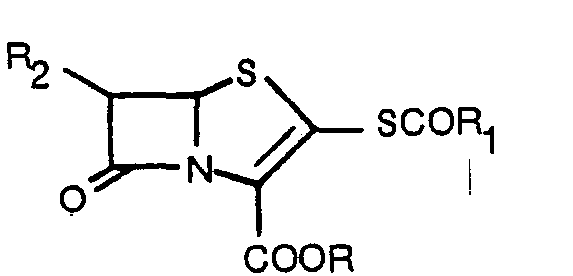
- the present invention provides a compound of the general formula la and its tautomer Ib in which formulae R is an esterifying group, and R 2 is hydrogen, C 1 ⁇ C 4 -alkyl, C 1 ⁇ C 4 -hydroxyalkyl, C 1 ⁇ C 4 - alkoxy-C,-C 4 -alkyl, C 1 ⁇ C 4 -acyloxy-C 1 ⁇ C 4 -alkyl or tri-C 1 ⁇ C 4 -alkylsilyloxy-C 1 ⁇ C 4 -alkyl and salts thereof.
- R is an esterifying group
- R 2 is hydrogen, C 1 ⁇ C 4 -alkyl, C 1 ⁇ C 4 -hydroxyalkyl, C 1 ⁇ C 4 - alkoxy-C,-C 4 -alkyl, C 1 ⁇ C 4 -acyloxy-C 1 ⁇ C 4 -alkyl or tri-C 1 ⁇ C 4 -alkylsilyloxy-C 1 ⁇
- a compound of the general formula I and "a compound of formula I” are both used hereinafter to denote a compound of the general formula la, a compound of the general formula Ib, or any mixture thereof.
- R 2 may be cis or trans to the carbon-sulfuric moiety at position 5.
- the stereochemistry at position 5 can be R or S i.e. a compound of formula I may be 5R, 6R, 5R, 6S, 5S, R6 or 5S, 6S. It is preferably, however, to have the 5R stereochemistry, (as defined by the Cahn-Ingold-Prelog system of nomenclature).
- a chiral carbon atom is also present at position 2 in formula la, giving further R and S isomers.
- the present invention also provides a process forthe production of a compound of the general formula I, which comprises treating a compound of the general formula II in which R and R 2 are as defined above, and R 1 represents a lower alkyl group or a phenyl group and represents especially a methyl group, with a nucleophilic compound and, if desired, carrying out any one or more of the following steps in any desired order:
- the treatment of the compound of formula II with a nucleophilic compound is generally carried out in a solvent, and in some cases the solvent itself may also function as the nucleophilic compound.
- an organic nucleophilic compound on an inorganic nucleophilic compound there can be used an organic nucleophilic compound on an inorganic nucleophilic compound.
- inorganic nucleophilic compounds are water, alkali metal and alkaline earth metal hydroxides, carbonates and bicarbonates, for example, sodium hydroxide, sodium carbonate, sodium bicarbonate, potassium carbonate, potassium bicarbonate, and magnesium carbonate; borates and phosphates.
- Organic nucleophilic compounds are, for example, amines, for example, primary and secondary aliphatic amines, for example, ethylamine, methylamine, diethylamine, and dimethylamine; cycloaliphatic amines, for example, cyclohexylamine; non-aromatic heterocyclic amines, ,for example, morpholine, piperidine and piperazine; aromatic heterocyclic amines, for example, pyridine and substituted pyridines, for example, 4-N,N-dimethylaminopyridine, imidazole and substituted, especially lower alkyl substituted, imidazoles, for example, methylimidazole; aromatic amines, for example, aniline and substituted anilines, for example, methyl-substituted anilines, for example, toluidine; and hydrazine and hydroxylamine.
- the treatment of a compound of formula II with a nucleophilic compound is generally carried out in a solvent.
- the solvent itself may function also as the nucleophilic compound, as is the case with water.
- the solvent is, for example, a water-miscible ether, for example dioxan or tetrahydrofuran; an alcohol, for example, having up to 4 carbon atoms, for example, methanol, ethanol or propanol; water; an amide for example dimethylformamide, dimethylacetamide, or hexamethylphosphoramide; or dimethylsulphoxide, acetonitrile or sulpholane.
- a water-miscible ether for example dioxan or tetrahydrofuran
- an alcohol for example, having up to 4 carbon atoms, for example, methanol, ethanol or propanol
- water an amide for example dimethylformamide, dimethylacetamide, or hexamethylphosphoramide
- dimethylsulphoxide acetonitrile or sulpholane.
- a mixture of any two or more solvents may be used, for example, a mixture of water and another solvent, for example, an amide, an alcohol, or an ether.
- the nucleophilic compound is, for example, an alkali metal borate or phosphate salt
- this is preferably used in the form of a solution thereof in water or in a mixture of water and another solvent, the solution having a pH within the range of from 8 to 11.
- the nucleophilic csompound is an amine having a pK greater than 7, it is preferable to buffer the reaction mixture so the pH is within the range of from 6 to 8, for example, using Sqrenson's phosphate buffer or Clark and Lubs's borate buffer.
- Preferred nucleophilic compounds are alkali metal hydroxides, carbonates and bicarbonates, especially sodium carbonate, and aromatic heterocyclic amis, especially imidazole.
- a preferred solvent is a water/dioxan mixture, preferably comprising from 1 to 50% by volume of water in dioxan, especially from 5 to 25% water in dioxan.
- the reaction is generally carried out at a temperature within the range of from the freezing point of the solvent or solvent mixture or -10°C (whichever is the higher), to 50°C, preferably from 0 to 25°C.
- the reaction mixture comprising the resulting compound of formula I is preferably diluted with water or an aqueous acid for example, aqueous citric acid, so the resulting mixture has a pH of from 1 to 4, and extracted into an organic solvent, for example, an ester, for example, ethyl acetate or a halogenated hydrocarbon, for example, choroform.
- an organic solvent for example, an ester, for example, ethyl acetate or a halogenated hydrocarbon, for example, choroform.
- the resulting compound of formula I is then generally pure enough for further use, but if desired, it may be purified further, for example by crystallisation or chromatography.
- lower denotes a molecule, group or radical having up to 8 carbon atoms, and especially up to 4 carbon atoms.
- halogen atoms are fluorine, chlorine, bromine and iodine atoms.
- a hetercyclic group preferably has up to 4 heteroatoms, which may be the same or different, selected from nitrogen, oxygen and sulphur atoms, and up to 14 atoms in total.
- R 2 especially represents a hydrogen atom, a lower alkyl group, or a hydroxyl-lower alkyl group, for example, a methyl, ethyl, hydroxymethyl, 1-hydroxyethyl (R or S) or 2-hydroxyprop-2-yl group, or a vinyl group.
- An esterified carboxyl group -COOR is, for example, an ester. formed with an unsubstituted or substituted aliphatic, cycloaliphatic, cycloaliphatic-aliphatic, aryl, araliphatic, heterocyclic or heterocyclic- aliphatic alcohol having up to 20 carbon atoms, or is, for example, a silyl or stannyl ester.
- R may represent, for example a straight or branched chain substituted or unsubstituted alkyl, alkenyl or alkynyl group having up to 18 carbon atoms, preferably up to 8 carbon atoms, and especially up to 4 carbon atoms, for example, a methyl, ethyl, n-propyl, iso-propyl, n-butyl, sec-butyl, iso-butyl, tert-butyl, n-pentyl, n-hexyl, allyl or vinyl group.
- An aliphatic group R especially a methyl group, may be substituted by a cycloalkyl, aryl or heterocyclic group, or R may itself represent a cycloalkyl, aryl or heterocyclic group.
- a cycloaliphatic group R may have up to 18 carbon atoms and is, for example, a cyclopentyl, cyclohexyl or adamantyl group.
- An aryl group may have up to 12 carbon atoms and may have two or more fused rings.
- An aryl group R is, for example, an unsubstituted or substituted phenyl group, and an unsubstituted or substituted aralkyl group is, for example, a benzyl, p-nitrobenzyl or benzhydryl group.
- a heterocyclic group may have one or more heteroatoms, selected from oxygen, nitrogen and sulphur, and up to 14 atoms in total.
- a heterocyclic group is, for example, an oxygen-containing heterocyclic group, for example, a tetrahydropyranyl or phthalidyl group.
- a stannyl group R may have up to 24 carbon atoms, for example, R may represent a stannyl group having three substituents, which may be the same or different, selected from alkyl, alkenyl, cycloalkyl, aryl, aralkyl, alkoxy and aralkoxy groups, for example, alkyl groups having up to 4 carbon atoms, for example, n-butyl groups, phenyl and benzyl groups, especially three n-butyl groups.
- a silyl group R may also have up to 24 carbon atoms and three substituents, which may be the same or different, selected from alkyl, alkenyl, cycloalkyl,. aryl and aralkyl groups, for example, alkyl groups having up to 4 carbon atoms, for example, methyl and t-butyl groups.
- R Any group R that is capable of substitution may be substituted. Examples of substituents are given above in relation to R 2 . Substituents for phenyl groups are, for example, as described above in relation to R 2 .
- the group Ris removable by hydrolysis, by photolysis, by reduction or by enzyme action to give the free acid, or two or more methods may be used, for example, reduction followed by hydrolysis.
- a group R that may be removed readily without sunstantial degradation of the rest of the molecule is particularly useful as a carboxyl protecting group.
- esters that are readily split by reduction are arylmethyl esters, for example, benzyl, p-nitrobenzyl, benzhydryl and trityl esters.
- Reduction of an ester may be carried out using hydrogen and a metal catalyst, for example, a noble metal, for example, platinum, palladium or rhodium, which catalyst may be supported, for example, on charcoal or kieselguhr.
- a metal catalyst for example, a noble metal, for example, platinum, palladium or rhodium, which catalyst may be supported, for example, on charcoal or kieselguhr.
- a p-nitrobenzyl ester may be converted to the free acid, by a two-step method, with an initial reduction of the nitro group, followed by hydrolysis.
- the nitro group may be reduced by chemical or catalytic reduction, for example, using a metal reducing agent, for example, zinc in acetic acid, aqueous tetrahydrofuran or acetone.
- the pH should be maintained within the range of from 3 to 6, preferably from 4 to 5.5, preferably by the use of aqueous hydrochloric acid.
- reducing agents are, for example, aluminium amalgam in a moist ether, for example, tetrahydrofuran, and iron and ammonium chloride in an aqueous ether, for example, aqueous tetrahydrofuran.
- Reduction of the nitro group is followed by hydrolsis which may occur in situ during reduction of the nitro group or which may be carried out subsequently by treatment with an acid or a base.
- An o-nitrobenzyl ester may be converted to the free acid by photolysis.
- a stannyl ester for example, a tri-n-butyl stannyl ester, may be split readily by hydrolysis, for example, by solvolysis, for example, using water, an alcohol, a phenol or a carboxyl acid, for example, acetic acid.
- ester groups may be split off by base hydrolysis, for example, acetylmethyl and acetoxymethyl ester groups.
- an esterifying group that is removable under physiological conditions that is to say, the esterifying group is split off in vivo to give the free acid or the carboxylate
- an acyloxymethyl ester e.g. an acetoxymethyl or pivaloyloxymethyl ester
- an aminoalkanyloxymethyl ester for example, an L-glycyloxymethyl, L-valyloxymethyl or L-leucyloxymethyl ester, or a phthalidyl ester
- 2-aminoethyl ester for example, a 2-diethylamino-ethyl or 2-(1-morpholino)-ethyl ester.
- Preferred esters are the p-nitrobenzyl, phthalidyl, pivaloyloxymethyl, acetylmethyl and acetoxy-methyl esters.
- An ester of formula I, or of any other free acid described herein, may be prepared by reaction with an alcohol, phenol or stannanol or a reactive derivative thereof.
- the reaction is preferably carried out under mild conditions in order to prevent rupture of the ring or ring system, for example, under neutral or mild acidic or basic conditions, and at temperatures within the range of from -70° to +35°C.
- An alkyl, alkoxyalkyl or aralkyl ester may be prepared by reaction of an acid of formula I or any other free acid with the appropriate diazoalkane or diazoaralkane for example, diazomethane or diphenyldiazomethane.
- the reaction is preferably carried out in an ether, ester or halogenohydrocarbon as solvent, for example, in diethyl ether, ethyl acetate or dichloromethane.
- temperatures below room temperature are preferred, for example, from -15° to +15°c.
- An ester derived from an alcohol may also be produced by reaction of a reactive derivative of the alcohol, for example, a halide, for example a chloride, bromide or iodide, or a hydrocarbonsulphonyl derivative, for example, a mesyl or tosyl ester, with a salt of an acid of formula I or another free acid described herein for example, an alkali or alkaline earth metal salt, for example, a lithium, sodium, potassium, calcium or barium salt or an amine salt, for example, a triethylammonium salt.
- a reactive derivative of the alcohol for example, a halide, for example a chloride, bromide or iodide, or a hydrocarbonsulphonyl derivative, for example, a mesyl or tosyl ester
- a salt of an acid of formula I or another free acid described herein for example, an alkali or alkaline earth metal salt, for example, a lithium, sodium, potassium,
- This reaction is preferably carried out in a substituted sulphoxide or amide solvent for example, in dimethylsulphoxide, dimethylformamide or hexamethylphosphoramide or, alternatively, an ester may be prepared by reaction of the acid with the alcohol in the presence of a condensing agent, for example, dicyclohexylcarbodiimide.
- a condensing agent for example, dicyclohexylcarbodiimide.
- a stannyl ester may be formed by reaction of a carboxylic acid of formula I or another free acid described herein, or a salt thereof with a reactive tetravalent tin compound, especially a trialkyl tin oxide.
- the present invention also provides the salts of those compounds of formula I that have salt-forming groups, especially the salts of free acids of formula I and the acid addition salts of compounds of formula I having a basic group.
- the salts are especially physiologically tolerable salts, for example, alkali metal and alkaline earth metal salts, for example, sodium, potassium, lithium, calcium and magnesium salts, ammonium salts and salts with an appropriate organic amine; also physiologically tolerable acid addition salts. These may be formed, with suitable inorganic and organic acids, for example, hydrochloric acid, sulphuric acid, carboxylic and organic sulphonic acids, for example, trifluoroacetic acid and p-toluenesulphonic acid.
- suitable inorganic and organic acids for example, hydrochloric acid, sulphuric acid, carboxylic and organic sulphonic acids, for example, trifluoroacetic acid and p-toluenesulphonic acid.
- a salt of a free acid of formula I may be produced by reacting the free acid with the appropriate base in a solvent, preferably under conditions under which the salt precipitates.
- a solvent preferably under conditions under which the salt precipitates.
- the preferred base is an alkoxide.
- a salt may be produced directly from an ester by splitting off the ester group under suitable reaction conditions, for example, catalytic reduction of an ester, for example, a p-nitrobenzyl ester, in an aqueous/ organic solvent, for example, comprising water and ethyl acetate, dioxane, or tetrahydrofuran, in the presence of a metal salt, especially a bicarbonate, for example, in an equivalent amount or in a slight excess, yields a salt directly.
- suitable reaction conditions for example, catalytic reduction of an ester, for example, a p-nitrobenzyl ester, in an aqueous/ organic solvent, for example, comprising water and ethyl acetate, dioxane, or tetrahydrofuran, in the presence of a metal salt, especially a bicarbonate, for example, in an equivalent amount or in a slight excess, yields a salt directly.
- a compound of formula II may be prepared by a process which comprises
- a compound of formula IV is preferably produced by effecting ring closure in a compound of formula III as defined above.
- Ring closure of the compound of formula III occurs spontaneously at room temperature, but the reaction is generally carried out at a temperature within the range of from 20 to 150°c, preferably from 60 to 120°C, and generally under an inert gas atmosphere, for example, under an atmosphere of nitrogen or argon.
- the cyclisation may be carried out in a solvent, which should be capable of achieving the desired temperature, for example, benzene toluene or dioxan.
- the cyclisation is preferably carried out in the presence of an acid, which reduces significantly the reaction time.
- the acid may be a protic inorganic acid a protic organic acid, or a Lewis acid.
- protic inorganic acids are sulphuric acid and phosphoric acid.
- a protic organic acid may be a carboxylic acid, for example, formic acid or acetic acid, or a derivative thereof, for example, chloroacetic acid, dichloroacetic acid or, especially, trifluoroacetic acid.
- Sulphonic acids are further example of organic acids which may be present during the cyclisation of the compound of formula III.
- a sulphonic acoid may be an alkyl sulphonic acid, for example, methanesulphonic acid or d- or I-camphor-10-sulphonic acid; or an aryl sulphonic acid, for example, benzenesulphonic acid, toluenesulphonic acid, benzenedisulphonic acid or a derivative thereof, for example, a chlorinated sulphonic acid.
- a Lewis acid is, for example, boron trifluoride, boron trichloride, aluminium trichloride, titanium tetrachloride, tin tetrachloride, tin dichloride, zinc chloride and zinc bromide.
- Preferred acids are boron trifluoride, in the form of an etherate e.g. boron trifluoride diethyl etherate, and toluenesulphonic acid.
- a preferred solvent is dioxan.
- the water, lower alkanol, or mixture thereof is preferably used in an amount of from 1 to 20 equivalents, calculated on the compound of formula III.
- a lower alkanol is preferably methanol, ethanol or a propanol.
- the water, lower alkanol or mixture thereof may be used either alone or in addition to the use of an acid.
- the compound of formula III may be cyclised to give compound IV, which is then treated with a trivalent organophosphorus compound, or the compound of formula III may be converted into the corresponding compound of formula II in one step.
- the intermediate of formula IV may be isolated, or the treatment with the phosphine compound may be carried out in situ on the reaction mixture resulting from the cyclisation step.
- the trivalent organophosphorus compound is especially one of the general formula wherein R 6 , R 7 or R 8 , which may be the same or different, each represents an unsubstituted or substituted hydrocarbon group, for example, a straight or branched chain aliphatic for example, alkyl group, an unsubstituted or substituted cycloaliphatic for example cyclopentyl or cyclohexyl group, an unsubstituted or substituted aryl for example, phenyl group; or an unsubstituted or substituted hydrocarbon group in which one or more carbon atoms are replaced by hetero atoms, especially nitrogen, oxygen and sulphur atoms, for example, alkoxy groups, amine groups, and aromatic and non-aromatic heterocyclic groups.
- Preferred tervalent organophosphorus compounds are triphenylphosphine, tributylphosphine, trimethylphosphite and triethylphosphite.
- a further preferred group of tervalent organophosphorus compounds are those in which, in PR 6 R'R 8 one or more of the groups R 6 , R 7 and R 8 comprises an insoluble polymer, which aids removal after the reaction.
- one polymeric substituent is adequate.
- Another preferred group of trivalent organophosphorus compounds are those in which, in PR 6 R'R 8 , one of more of the groups R 6 , R 7 and R 8 comprise a cationic or anionic centre, for example, a quaternary ammonium group or a carboxylate or sulphate group.
- a charged group assists removal of the resulting organophosphorus sulphide, for example, by partition or by absorption on an insoluble ion exchange resin or by extraction into an aqueous solution at an appropriate pH, when the organophosphorus sulphide is water soluble.
- the reaction of the compound of formula IV with the trivalent organophosphorus compound is preferably carried out in a dry, inert, aprotic organic solvent or diluent, for example, an ether or an ester, for example, diethylether, tetrahydrofuran or ethyl acetate; an aromatic hydrocarbon for example, benzene or toluene; a halogenated hydrocarbon, for example, methylene chloride or chloroform; or another organic solvent, for example, dimethylformamide or acetonitrile.
- Preferred solvents are methylene chloride and ethyl acetate.
- a mixture of two or more solvents or diluents may be used.
- the reaction may be carried out at a temperature of from 0 to 80°C, preferably from 0 to 20°C, and it is preferable to use at least 1 equivalent of the phosphorus compound per equivalent of the compound of formula IV.
- the resulting compound of formula II may be isolated from the reaction mixture, for example, by chromatography or crystallisation.
- the compound of formula II may be obtained as a mixture of the 5Rand 5S-isomers. These isomers can be separated by known methods, if desired, or the compound of formula II can be used in the form of an isomeric mixture.
- the preferred stereochemistry in compound II is generally that of natural penicillins and cephalosporins i.e. 5R.
- R in formula II represents an esterifying group
- this may be removed in the usual manner, depending on the nature of the ester group, for example, by hydrolysis, reduction, or enzymatically, to yield the free acid.
- a free acid or an ester may be converted into a salt, especially a physiologically tolerable salt, or a salt may be converted into another salt or the free acid or an ester.
- An ester may be transesterified, or a free acid converted into an ester, for example, to give an ester capable of removal under physiological conditions. Examples of such procedures are given above.
- a compound of the general formula II may be produced in various ways, for example, as shown in the reaction scheme below, in which in which Ra to Re are as defined above. in which
- a compound of formula VIII may be prepared as described by K. Claus, D. Grimm and G. Prossel, Annalen 1974, pp. 539-560; DT-OS 1 906 401; UK Specification No. 2 013 674; Japanese Published Application JA 80641; or H. R. Pfaendler, J. Gostelli and R. B. Woodward, J. Amer. Chem. Soc. 102:6 (1980), 2039-2043; Belgian Patent Specification No. 882.764.
- a compound of formula VIII may be converted into a compound of formula VII by reaction with a compound of formula in which R 10 represents a hydrogen atom or an alkali metal atom especially a sodium or potassium atom, and Ra to Re are as defined above.
- the reaction is generally carried out in a solvent, preferably a protic solvent, for example, water or an alcohol, or a non-protic, water-miscible solvent which is preferably polar, for example, dimethyl formamide, dimethyl sulphoxide, tetrahydrofuran or dioxane.
- a solvent preferably a protic solvent, for example, water or an alcohol, or a non-protic, water-miscible solvent which is preferably polar, for example, dimethyl formamide, dimethyl sulphoxide, tetrahydrofuran or dioxane.
- the reaction temperature is, for example, from -20 to +100°C, preferably from -10 to +20°C.
- a compound of formula VII may be reacted with a compound of formula IX in which Y and R are as defined above in the presence of a base, to give a compound of formula VI.
- the base may be inorganic, organic or organometallic, for example, an alkali metal or alkaline earth metal hydroxide, oxide, carbonate, bicarbonate or hydride, for example, sodium hydroxide, magnesium oxide, potassium carbonate, potassium bicarbonate or sodium hydride; an amine, for example, a dialkylamine or trialkylamine, for example, triethylamine, dabco (diazabicyclo(2,2,2)octane), pyridine, or an alkyl-substituted or amino-substituted or dialkylamino-substituted pyridine for example, N,N-dimethylaminopyridine, or collidine; a guanidine, for example, tetramethylguanidine; DBN (diazabicyclononene) or DBU (diazabicycloundecane), a polymeric base i.e.
- a base attached to an inert polymeric support e.g. Hunig's base (diisopropylethylamine attached to e.g. polystyrene); a metallated amine, for example, a metallated alkyl or arylamine, for example, lithium diisopropylamide (LDA), lithium hexamethyldisilazide, lithium piperidide, lithium 2,2,6,6-tetramethylpiperidide, or a Grignard reagent.
- Preferred bases are, for example, potassium carbonate, sodium hydride, lithium diisopropylamide and triethylamine.
- the reaction is generally carried out in a solvent or diluent that is inert under the reaction conditions, for example, an amide, for example, dimethylformamide, dimethylacetamide or hexamethylphosphoramide; a hydrocarbon, for example, benzene or toluene; an inert, aprotic solvent or diluent, for example, an ester, for example, ethyl acetate, or an ether, for example, diethylether, tetrahydrofuran or dioxane; a chlorinated hydrocarbon for example, methylene chloride or chloroform; or acetonitrile, nitromethane, dimethyl-sulphoxide, or sulpholane.
- Dimethylformamide and dimethylacetamide are preferred.
- a mixture of two or more solvents and/or diluents may be used.
- the reaction may be carried out at a temperature within the range of from -80°C to the reflux point of the reaction mixture, preferably from -40 to +50°C, and especially from -20 to +30C.
- From 1 to 1.5 moles of compound IX are preferably used per mole of compound VII, especially from 1 to 1.1 mole of IX per mole of VII.
- the base is used in an amount for example, from 1 to 4 moles of base per mole of compound VIII.
- the reaction is preferably carried out by dissolving compound VII in a solvent, advantageously in dimethylformamide with stirring, adding the base, adding the compound of formula IX and reacting at the desired temperature.
- the resulting compound of formula VI may be worked up and isolated in the usual manner, for example, using chromatographic and/or crystallisation techniques, or the subsequent reaction may be carried out directly on the resulting reaction mixture after removal of any solvent that is not compatible with the subsequent reaction.
- R in formula VI represents a carboxyl esterifying group
- this group may be converted into another esterifying group R, for example, to introduce a group R that is more easily removable under desired conditions.
- This transesterification is generally carried out as follows: the ester of formula VI is hydrolysed in known manner using, for example, acid or alkaline hydrolysis, preferably an alkali metal hydroxide, especially sodium or potassium hydroxide.
- the ester of formula VI for example, a methyl ester, is preferably hydrolysed using an alkali metal hydroxide especially one mole thereof per mole of the ester of formula VI in a solvent, for example ethanol, methanol or water, or an aqueous-organic solvent, for example, tetrahydrofuran/water, ethanol/water, or acetonitrile/water.
- a solvent for example ethanol, methanol or water
- an aqueous-organic solvent for example, tetrahydrofuran/water, ethanol/water, or acetonitrile/water.
- the reaction mixture is then generally acidified, and the free acid is preferably isolated and, if desired, the free acid is then esterified with an esterifying agent capable of introducing a different esterifying group R, for example with an alcohol ROH in the presence of an acid or another activating agent, for example, dicyclohexylcarbodiimide, or with an alkylating agent RY in which Y is as defined above.
- Esterification methods are described above in relation to the compound of formula I.
- Transesterification may be carried out on compound VI as described above, or on any other intermediate or on the final product of formula I.
- compound VI may be converted to compound III by the addition of the group to the side chain attached to the nitrogen atom, followed by oxidation of the sulphur atom attached to position 3 of the azetidinone ring.
- a compound offormula VI may be converted into a compound offormula V by treatment with a base in the presence of carbon disulphide followed by reaction with an acylating agent, or by treatment with a base, then with carbon disulphide, and finally reaction with an acylating agent.
- An acylating agent is generally an activated carboxylic acid.
- the activated carboxylic acid may be any activated acid derivative comprising the group R 1 .
- Such derivatives are well known in the art, and include acid chlorides; acid anhydrides, and activated esters.
- An anhydride may be symmetrical or asymmetrical.
- An activated acid may comprise an unsubstituted or substituted carbonic, sulphonic or phosphoric ester group.
- the acylating agent may have the general formula X in which Z represents a halogen atom, especially a chlorine atom, ⁇ OCOR 11 in which R 11 is as defined for R 1 and may be the same as R 1 or different, ⁇ O 2 COR 12 or ⁇ OSO 2 R 12 , in which R' 2 is as defined above for R 9 , in which
- the compound of formula VI is preferably reacted first with a base, then with carbon disulphide, and then finally with the acylating agent.
- the base preferably has a pK , 20, and is preferably a metallated amine.
- preferred bases are lithium diisopropylamide, lithium 2,2,6,6-tetramethylpiperidide, lithium cyclohexyl isopopylamide, lithium hexamethyl disilazide, and sodamide.
- the reaction is generally carried out in an inert solvent, for example, an oxygenated hydrocarbon, preferably an ether, for example, diethyl ether, tetrahydrofuran, dioxane, glyme or diglyme.
- an inert solvent for example, an oxygenated hydrocarbon, preferably an ether, for example, diethyl ether, tetrahydrofuran, dioxane, glyme or diglyme.
- the reaction temperature is, for example, from -120 to +30°C, preferably from -100 to -20°C.
- the amount of base used is for example, from 1 to 4 moles, calculated per mole of compound VI, preferably from 2.0 to 3.0 moles of base.
- Carbon disulphide is preferably used in an amount of from 1 to 5 moles, especially from 2 to 3 moles, per mole of compound VI.
- the reaction is preferably carried out as follows: to a stirred solution of compound VI under an inert atmosphere is added the base then a solution of carbon disulphide in the same or a different solvent and finally the acylating agent to complete the reaction.
- protic source having a pK less than 10, and especially from 5 to 2, for example, acetic, citric, oxalic or formic acid.
- Oxidation of the resulting compound V may be carried out by aby method capable of converting a sulphide into a sulphoxide, for example, there may be used an oxidising agent, for example, hydrogen peroxide, a periodate e.g. sodium periodate, ozone, a peracid e.g. peracetic acid or perbenzoic acid, a substituted perbenzoic acid e.g. m-chloroperbenzoic acid, or a permanganate salt, e.g. potassium permanganate.
- Preferred oxidising agents are hydrogen peroxide and m-chloroperbenzoic acid. Over oxidation should be avoided, for example, by using only one equivalent of a peracid.
- the oxidation is preferably conducted in an inert solvent at a preferred temperature of from -40 to +30°C.
- Preferred solvents are ethyl acetate, methylene chloride, chloroform, acetonitrile, and lower alcohols, for example methanol and ethanol.
- the resulting compound of formula III maybe isolated and worked up using known methods.
- esterify a free carboxyl group in a compound of formula III prior to cyclisation It is advisable to esterify a free carboxyl group in a compound of formula III prior to cyclisation.
- an ester group may be introduced immediately prior to cyclisation, it is preferable to esterify the carboxyl group at an earlier stage in the preferred reaction sequence, for example, to esterify a free carboxyl group in a compound of formula V or VI to ensure that the carboxyl group does not take part in any of the subsequent reactions.
- An esterifying group may be transesterified to another ester group having more desirable properties for a particular stage of the reaction sequence.
- any reactive moiety present in any of R, R 1 and R 2 so that such a moiety does not take part in any subsequent reaction.
- moieties are hydroxy, carboxy and amine moieties.
- Groups suitable for protecting such reactive moieties are well known, as are methods for their removal. (cf Protective Groups in Organic Chemistry, editor J. F. W. McOmie, Plenum Press, 1973).
- groups suitable for protecting hydroxyl moieties are tetrahydropyranyl groups, methoxyethoxymethyl groups, acyl groups, for example, acetyl, chloroacetyl and formyl groups, and silyl groups, for example, as described above for R, for example, trimethyl silyl and t-butyltrimethylsilyl groups.
- Carboxy protecting groups are, for example, as described above for R.
- Amino protecting groups are, for example, t-butyloxycarbonyl, benzyloxycarbonyl, p-nitrobenzyloxycarbonyl, p-nitrobenzenesulphenyl and trityl groups.
- Reactive moieties may be protected at any appropriate point in the reaction sequence, and the protective groups are preferably removed during or after the formation of the compound of formula I.
- any one or more of the above steps a), to d) may be carried out, if appropriate, before conversion to a compound of formula I.
- the desired compound may be isolated from the reaction mixture and, if desire, purified by appropriate techniques generally used for the purification of organic compounds, for example, chromatography or crystallisation.
- various intermediates may be produced in the form of mixtures of isomers of various kinds. Such a mixture may be separated or resolved at any stage, or the isomeric mixture may be used per se for subsequent reactions.
- a compound of the general formula I may exist in the tautomeric forms of formulae la and Ib, and each of these forms may have the R or S stereochemistry independently at positions 5 and 6 also, in formula la, at position 2. Further isomeric forms will occur when any substituent contains a chiral atom. Any mixture of any two or more isomeric forms may be resolved, if desired, and/or an isomeric mixture may be prepared.
- the compounds of the general formula I are particularly useful in the synthesis of substituted penems.
- a compound of formula I is reacted in an inert solvent in the presence of an excess of a base, preferably 1 to 2 equivalents and an excess of an alkylating agents, preferably 1 to 3 equivalents.
- Preferred bases are organic bases such as secondary or tertiary alkylamines, e.g. triethylamine, diisopropylamine, methyl-diisopropylamine or inorganic bases such as Na 2 CO 3 , K 2 CO 3 , NaHCO 3 .
- Preferred alkylating agents are alkyl halides preferably brominated or iodinated lower alkyls.
- reaction is carried out in an appropriate solvent such as tetrahydrofuran, dioxane, ethylacetate, methylene chloride, chloroform, dimethylformamide.
- an appropriate solvent such as tetrahydrofuran, dioxane, ethylacetate, methylene chloride, chloroform, dimethylformamide.
- the preferred reaction temperature is 0 to 40°C.
- the reaction mixture was poured into water (500 ml), and extracted into ethyl acetate (3 x 500 ml); the organic layer was washed with hydrochloric acid (pH 2.0, 400 ml), then water (2 x 500 ml), dried over magnesium sulphate and evaporated to dryness.
- the crude product was purified over silica gel eluting with hexane-ethyl acetate to give the above product as a pale yellow oil (20.1 g, 63%).
- a solution of lithium hexamethyldisilazide was prepared by the addition of 5.12 ml of a 1.6M solution of n-butyllithium in hexan to 1.75 ml of hexamethyldisilazane in 25 ml of dry THF at -10° with stirring, under argon.
- the solution was cooled to -78° and added to 1.0 g of methyl 2-(4-allylthioazetidin-2-on-1-yl)acetate in 12 ml of dry tetrahydrofuran at -78°, with stirring, under argon.
- 0.846 ml of carbon disulphide was added by syringe.
- 1.77 ml of acetic anhydride was then added, followed by 1.07 ml of glacial acetic acid.
- the solution was allowed to warm to room temperature and evaporated to leave a yellow oil.
- a solution of lithium hexamethyldisilazide was prepared by the addition of 32.9 ml of a 1.6M solution of n-butyllithium in hexane to 11.25 ml of hexamethyldisilazane in 125 ml of dry THF at -10° with stirring, under argon.
- the solution was cooled to -78° and added to 5.0 g of methyl 2-(4-allylthioazetidin-2-on-1-yl) acetate in 60 ml of dry tetrahydrofuran at -78°, with stirring, under argon. After 5 min, 4.23 ml of carbon disulphide was added by syringe. 885 ml of acetic anhydride was then added. The solution was allowed to warm to room temperature and evaporated to give a yellow oil.
- Example 9c The procedure described in Example 9c was carried out, substituting 0.30 ml of trifluoroacetic acid for the 0.242 g of 4-toluenesulphonic acid hydrate, and refluxing for 2 hours. 0.064 g of purified product was obtained (17% of the theoretical yield).
- a solution of lithium hexamethyldisilazide was prepared by the addition of 3.53 ml of a 1.6 M solution of n-butyllithium in hexane to 1.19 ml of hexamethyldisilazane in 25 ml of fry tetrahydrofuran at -10° with stirring under argon.
- the solution was cooled to -78° and added by cannula to 1.02 g of pivaloyloxymethyl 2-(4-allylthioazetidin-2-on-1-yl) acetate in 10 ml of dry tetrahydrofuran at -78° with stirring under argon.
- a solution of lithium hexamethyldisalazide was prepared by the addition of 5.12 ml of a 1.6 M solution of n-butyllithium in hexane to 1.75 ml of hexamethyldisilazane in 25 ml of dry THF at -10° with stirring, under argon.
- the solution was cooled to -78° and added by cannula to 1.57 g of 4-nitrobenzyl 2-(4- allylthioazetidin-2-on-1-yl) acetate in 12 ml of dry THF at -78°, with stirring under argon.
- 0.846 ml of carbon-disulphide was added by syringe.
- 1.77 ml of acetic anhydride was then added, followed by 1.07 ml of glacial acetic acid.
- the solution was allowed to warm to room temperature and evaporated to leave an orange oil.
- a solution of lithium hexamethyldisalazide was prepared by the addition of 8.66 ml of a 1.6 M solution of n-butyllithium in hexane to 2.96 ml of hexamethyldisilazane in 30 ml of dry THF at -10° with stirring under argon.
- the solution was cooled to -78° and added by cannula to 2.07 g of 4-nitrobenzyl 2-(4- allylthioazetidin-2-on-1-yl) acetate in 15 ml of dry THF at -78°, with stirring, under argon. After 5 minutes 1.11 ml of carbon disulphide was added by syringe.
- Example 17a The procedure described in Example 17a was carried out, refluxing 0.300 g of the propenoate and 75.9 ⁇ l of boron trifluoride diethyl etherate for 45 minutes. 0.102 g (41 %) of purified product was obtained.
- Example 17a The procedure described in Example 17a was carried out, using 0.200 g of the propenoate and 98 ⁇ l of boron trifluoride diethyl etherate and 50 ml of water in 5 ml of dioxan, and refluxing for 30 minutes. 0.087 g (54%) of purified product was obtained.
- Example 17a The procedure described in Example 17a was carried out, refluxing 0.200 g of the propenoate, 45 ⁇ l of stannic chloride, 50 ⁇ l of water and 5 ml of dioxan for 60 minutes. 0.052 g (32%) of purified product was obtained.
- the aqueous phase was extracted twice with dichloromethane, and then the combined dichlormethane extracts were re-extracted with aqueous sodium bicarbonate (2.7 mol equivalents in 27 ml) and then discarded.
- the aqueous bicarbonate layer was then layered with dichloromethane and acidified to pH 1.5 with hydrochloric acid.
- the aqueous layer was then further extracted with dichloromethane.
- the combined organic layer was dried over magnesium sulphate and evaporated in vacuo to give the title compound as a colourless crystalline solid. (Yield 2.56 g).
- This compound was prepared analogously to its 4(R) isomer, as described in Example 31 a, using the corresponding 4(s) starting material.
- This compound was prepared analogously to its 4(R) isomer, as described in Example 32a, using the corresponding 4(S) starting material.
- a solution of lithium hexamethyldisilazide was prepared by the addition of n-butyllithium in hexane (2.79 ml of a 1.6M solution) to 0.982 ml of hexamethyldisilazane in 8 ml of dry tetrahydrofuran at -10°C, while stirring under argon.
- This compound was prepared analogously to its 6(S) isomer, as described in Example 35b, using the corresponding 4(R) starting material (described in Example 34b).
- This compound was prepared analogously to its 6(S) isomer, as described in Example 36a using the corresponding 6(R) starting material (described in Example 35b). A mixture of the 5(R) and 5(S) isomers was obtained.
- This compound was prepared analogous to its 6(S) isomer, as described in Example 37a, using the corresponding 6(R) starting material (described in Example 36b). A mixture of the 5(R) and 5(S) isomers was obtained.
Landscapes
- Chemical & Material Sciences (AREA)
- Organic Chemistry (AREA)
- Health & Medical Sciences (AREA)
- Chemical Kinetics & Catalysis (AREA)
- Life Sciences & Earth Sciences (AREA)
- General Chemical & Material Sciences (AREA)
- Medicinal Chemistry (AREA)
- Nuclear Medicine, Radiotherapy & Molecular Imaging (AREA)
- Communicable Diseases (AREA)
- Pharmacology & Pharmacy (AREA)
- Oncology (AREA)
- Animal Behavior & Ethology (AREA)
- General Health & Medical Sciences (AREA)
- Public Health (AREA)
- Veterinary Medicine (AREA)
- Pharmaceuticals Containing Other Organic And Inorganic Compounds (AREA)
- Nitrogen And Oxygen Or Sulfur-Condensed Heterocyclic Ring Systems (AREA)
- Organic Low-Molecular-Weight Compounds And Preparation Thereof (AREA)
- Heterocyclic Carbon Compounds Containing A Hetero Ring Having Oxygen Or Sulfur (AREA)
Claims (13)



Priority Applications (1)
| Application Number | Priority Date | Filing Date | Title |
|---|---|---|---|
| AT81109176T ATE21105T1 (de) | 1980-11-06 | 1981-10-29 | 7-oxo-4-thia-1-aza(3.2.0)heptan- und 7-oxo-4-thia-1-aza-(3.2.0)hept-2-en-derivate. |
Applications Claiming Priority (2)
| Application Number | Priority Date | Filing Date | Title |
|---|---|---|---|
| GB8035657 | 1980-11-06 | ||
| GB8035657 | 1980-11-06 |
Related Child Applications (1)
| Application Number | Title | Priority Date | Filing Date |
|---|---|---|---|
| EP85111993.3 Division-Into | 1985-09-21 |
Publications (3)
| Publication Number | Publication Date |
|---|---|
| EP0051813A2 EP0051813A2 (de) | 1982-05-19 |
| EP0051813A3 EP0051813A3 (en) | 1982-08-18 |
| EP0051813B1 true EP0051813B1 (de) | 1986-07-30 |
Family
ID=10517119
Family Applications (2)
| Application Number | Title | Priority Date | Filing Date |
|---|---|---|---|
| EP81109176A Expired EP0051813B1 (de) | 1980-11-06 | 1981-10-29 | 7-Oxo-4-thia-1-aza(3.2.0)heptan- und 7-Oxo-4-thia-1-aza-(3.2.0)hept-2-en-Derivate |
| EP85111993A Withdrawn EP0176064A1 (de) | 1980-11-06 | 1981-10-29 | Zwischenprodukte zur Herstellung von 7-Oxo-4-thia-1-aza[3,2,0]heptan- und 7-oxo-4-thia-1-aza[3,2,0]hept-2-en-Derivaten |
Family Applications After (1)
| Application Number | Title | Priority Date | Filing Date |
|---|---|---|---|
| EP85111993A Withdrawn EP0176064A1 (de) | 1980-11-06 | 1981-10-29 | Zwischenprodukte zur Herstellung von 7-Oxo-4-thia-1-aza[3,2,0]heptan- und 7-oxo-4-thia-1-aza[3,2,0]hept-2-en-Derivaten |
Country Status (7)
| Country | Link |
|---|---|
| US (3) | US4474793A (de) |
| EP (2) | EP0051813B1 (de) |
| JP (1) | JPS57108092A (de) |
| AT (1) | ATE21105T1 (de) |
| CA (1) | CA1197839A (de) |
| DE (1) | DE3175042D1 (de) |
| GB (1) | GB2087880B (de) |
Cited By (3)
| Publication number | Priority date | Publication date | Assignee | Title |
|---|---|---|---|---|
| DE3109086A1 (de) * | 1980-03-10 | 1981-12-24 | Sankyo Co., Ltd., Tokyo | 2-penem-3-carbonsaeure-derivate, verfahren zu ihrer herstellung und ihre verwendung |
| US7998986B2 (en) | 2001-12-21 | 2011-08-16 | Exelixis Patent Company Llc | Modulators of LXR |
| US8013001B2 (en) | 2001-12-21 | 2011-09-06 | Exelixis, Inc. | Modulators of LXR |
Families Citing this family (28)
| Publication number | Priority date | Publication date | Assignee | Title |
|---|---|---|---|---|
| DE3167198D1 (en) * | 1980-08-16 | 1984-12-20 | Beecham Group Plc | Process for the preparation of 2-thio penem derivatives and intermediates therefor |
| ES8305366A1 (es) * | 1981-07-08 | 1983-04-01 | Hoechst Uk Ltd | "procedimiento para la preparacion de derivados de penem". |
| EP0069378B1 (de) * | 1981-07-08 | 1987-01-07 | Hoechst Uk Limited | Antibakterielle Penemderivate |
| GB2159519B (en) * | 1982-03-26 | 1986-08-20 | Hoechst Uk Ltd | 7-oxo-4-thia-1-azabicyclo3,2,0heptane derivatives; azetidinones |
| ATE28648T1 (de) * | 1982-03-26 | 1987-08-15 | Hoechst Uk Ltd | 7-oxo-4-thia-1-azabicyclo(3,2,0)heptan-derivate |
| FI77459C (fi) * | 1982-12-08 | 1989-03-10 | Erba Farmitalia | Foerfarande foer framstaellning av (5r)-penemderivat. |
| US4610823A (en) * | 1983-01-25 | 1986-09-09 | Merck & Co., Inc. | Process for preparing substituted 2-thioxopenams and 2-substituted thiopenems |
| EP0115308A3 (de) * | 1983-01-25 | 1984-10-10 | Merck & Co. Inc. | 2-Ungesättigte Alkylthio-Pen-2-em-3-Carbonsäuren und Verfahren zur Herstellung von substituierten 2-Thioxopenamen und 2-substituierten Thiopenemen |
| EP0320497A1 (de) * | 1983-01-25 | 1989-06-14 | Merck & Co. Inc. | Substituierte 2-Thioxopename, deren Zwischenprodukte und Verfahren zur Herstellung von substituierten 2-Thioxopenamen und 2-substituierten Thiopenemen |
| US4725678A (en) * | 1983-06-10 | 1988-02-16 | Pfizer Inc. | Azetidinone intermediates for the preparation of penem derivatives |
| US4595539A (en) * | 1983-06-10 | 1986-06-17 | Pfizer Inc. | Preparation of penem derivatives and azetidinone intermediates |
| US4619783A (en) * | 1983-06-10 | 1986-10-28 | Pfizer Inc. | Process and intermediates for the preparation of penem derivatives |
| US5229510A (en) * | 1983-12-01 | 1993-07-20 | Merck & Co., Inc. | β-lactams useful in determining the amount of elastase in a clinical sample |
| US5229381A (en) * | 1983-12-01 | 1993-07-20 | Merck & Co., Inc. | Substituted azetidinones as anti-inflammatory and antidegenerative agents |
| US4680391A (en) * | 1983-12-01 | 1987-07-14 | Merck & Co., Inc. | Substituted azetidinones as anti-inflammatory and antidegenerative agents |
| US4791198A (en) * | 1984-07-05 | 1988-12-13 | Kanegafuchi Kagaku Kogyo Kabushiki Kaisha | Beta-lactam compound and preparation thereof |
| US4861877A (en) * | 1984-07-05 | 1989-08-29 | Kanegafuchi Kagaku Kogyo Kabushiki Kaisha | Process for preparing 4-acetoxy-3-hydroxyethylazetidin-2-one derivatives |
| US4782145A (en) * | 1986-06-02 | 1988-11-01 | Pfizer Inc. | Process for penem derivatives |
| US4695626A (en) * | 1986-07-29 | 1987-09-22 | Pfizer Inc. | 1-aza-4,5-dithiabicyclo [4.2.0] oct-2-en-8-one-2 carboxylate esters |
| US5104862A (en) * | 1991-03-20 | 1992-04-14 | Merck & Co., Inc. | Bethalactam elastase inhibitors containing phosphorous acid derivatives at the 4-position of the 2-azetidinone |
| US5100880A (en) * | 1991-03-20 | 1992-03-31 | Merck & Co., Inc. | Novel betalactam elastase inhibitors containing phosphorous acid derivatives at the 4-position of the 2-azetidinone |
| US5348953A (en) * | 1991-06-25 | 1994-09-20 | Merck & Co., Inc. | Substituted azetidinones as anti-inflammatory and antidegenerative agents |
| JPH08502752A (ja) * | 1992-10-27 | 1996-03-26 | メルク エンド カンパニー インコーポレーテッド | 抗炎症剤及び抗変性剤としての新規の置換アゼチジノン |
| US5591737A (en) * | 1992-12-17 | 1997-01-07 | Merck & Co., Inc. | Substituted azetidinones as anti-inflammatory and antidegenerative agents |
| TW467896B (en) * | 1993-03-19 | 2001-12-11 | Bristol Myers Squibb Co | Novel β-lactams, methods for the preparation of taxanes and sidechain-bearing taxanes |
| US5747485A (en) * | 1995-04-13 | 1998-05-05 | Merck & Co., Inc. | Substituted azetidiones as anti-inflammatory and antidegenerative agents |
| EP1451168A4 (de) * | 2001-11-30 | 2005-08-24 | Bristol Myers Squibb Co | Paclitaxelsolvate |
| KR101122603B1 (ko) * | 2008-10-02 | 2012-03-15 | 유형근 | 사운드 송출 기능을 갖는 알에프 전자카드 |
Family Cites Families (7)
| Publication number | Priority date | Publication date | Assignee | Title |
|---|---|---|---|---|
| CH541577A (de) * | 1970-11-03 | 1973-09-15 | Ciba Geigy Ag | Verfahren zur Herstellung thiaheterocyclischer Verbindungen |
| LU77306A1 (de) * | 1977-05-09 | 1979-01-18 | ||
| JPS5466695A (en) * | 1977-11-08 | 1979-05-29 | Sankyo Co Ltd | Azetidinone derivative and its preparation |
| EP0003960B1 (de) * | 1978-02-02 | 1983-06-29 | Ciba-Geigy Ag | 6-Substituierte Thia-Azaverbindungen, ihre Herstellung und diese enthaltende pharmazeutische Präparate |
| US4290948A (en) * | 1978-11-22 | 1981-09-22 | Beecham Group Limited | Process for their preparation of β-lactam antibacterial agents |
| SE8101464L (sv) * | 1980-03-10 | 1981-09-11 | Sankyo Co | 2-penem-3-karboxylsyraderivat, deras framstellning och anvendning |
| JPS572290A (en) * | 1980-06-03 | 1982-01-07 | Sankyo Co Ltd | Production of penem-3-carboxylic derivative |
-
1981
- 1981-10-29 EP EP81109176A patent/EP0051813B1/de not_active Expired
- 1981-10-29 DE DE8181109176T patent/DE3175042D1/de not_active Expired
- 1981-10-29 EP EP85111993A patent/EP0176064A1/de not_active Withdrawn
- 1981-10-29 AT AT81109176T patent/ATE21105T1/de not_active IP Right Cessation
- 1981-11-04 US US06/318,113 patent/US4474793A/en not_active Expired - Fee Related
- 1981-11-05 CA CA000389542A patent/CA1197839A/en not_active Expired
- 1981-11-05 JP JP56176568A patent/JPS57108092A/ja active Pending
- 1981-11-06 GB GB8133564A patent/GB2087880B/en not_active Expired
-
1983
- 1983-08-22 US US06/524,977 patent/US4526718A/en not_active Expired - Fee Related
- 1983-08-22 US US06/524,973 patent/US4510086A/en not_active Expired - Fee Related
Cited By (3)
| Publication number | Priority date | Publication date | Assignee | Title |
|---|---|---|---|---|
| DE3109086A1 (de) * | 1980-03-10 | 1981-12-24 | Sankyo Co., Ltd., Tokyo | 2-penem-3-carbonsaeure-derivate, verfahren zu ihrer herstellung und ihre verwendung |
| US7998986B2 (en) | 2001-12-21 | 2011-08-16 | Exelixis Patent Company Llc | Modulators of LXR |
| US8013001B2 (en) | 2001-12-21 | 2011-09-06 | Exelixis, Inc. | Modulators of LXR |
Also Published As
| Publication number | Publication date |
|---|---|
| ATE21105T1 (de) | 1986-08-15 |
| EP0051813A3 (en) | 1982-08-18 |
| GB2087880B (en) | 1985-05-01 |
| EP0051813A2 (de) | 1982-05-19 |
| JPS57108092A (en) | 1982-07-05 |
| CA1197839A (en) | 1985-12-10 |
| US4510086A (en) | 1985-04-09 |
| US4474793A (en) | 1984-10-02 |
| DE3175042D1 (en) | 1986-09-04 |
| GB2087880A (en) | 1982-06-03 |
| US4526718A (en) | 1985-07-02 |
| EP0176064A1 (de) | 1986-04-02 |
Similar Documents
| Publication | Publication Date | Title |
|---|---|---|
| US4510086A (en) | 2(4-Allylthioazetidin-2-on-1-yl)acetic acid ester compounds | |
| US5998612A (en) | Antibiotic synthesis | |
| EP0054917B1 (de) | 6- und 4-Substituierte-1-Azabicyclo(3.2.0)heptan-3,7-dion-2-carboxylate | |
| NZ192542A (en) | 2-alkylthio-penem compounds and pharmaceutical compositions | |
| EP0018305A1 (de) | Oxapenem-Derivate, ihre Herstellung, ihre Verwendung, sie enthaltende pharmazeutische Zusammensetzungen, verschiedene Ausgangsverbindungen und deren Herstellung | |
| EP0294934B1 (de) | Diastereomere 5R,6S-6-(1R-hydroxyethyl)-2-(Cis-1-oxo-3-thiolanylthio)-2-Penem-3-Carbonsäuren | |
| EP0069377B1 (de) | Antibakterielle Penemderivate | |
| EP0110280B1 (de) | Verfahren zur Herstellung von Penem-Verbindungen | |
| EP0069378B1 (de) | Antibakterielle Penemderivate | |
| US5189158A (en) | 4-substituted azetidinones as precursors to 2-substituted-3-carboxy carbapenem antibiotics and a method of producing them | |
| EP0180189B1 (de) | Beta-Lactame und ihre Herstellung | |
| US4675396A (en) | 7-Oxo-4-thia-1-azabicyclo(3,2,0)heptane derivatives | |
| EP0249358A1 (de) | Verfahren zur Herstellung von Penemderivaten | |
| JPH0737462B2 (ja) | ペネム類の合成方法 | |
| PL163376B1 (pl) | S p osób w y tw a r z a n ia p o ch o d n y ch p e n e m u PL PL PL | |
| JPH0427978B2 (de) | ||
| US5656753A (en) | 4-substituted azetidinones as precursors to 2-substituted-3-carboxy carbapenem antibiotics and a method of producing them | |
| NO863304L (no) | 7-okso-4-tia-1-azabicyklo(3,2,0)hept-2-en-derivater. | |
| CA1197841A (en) | 7-oxo-4-thia-1-aza[3,2,0]heptane and 7-oxo-4-thia- 1-aza[3,2,0]-hept-2-ene derivatives | |
| US4895939A (en) | High percentage β-yield synthesis of carbapenem intermediates | |
| EP0061205B1 (de) | 2-Penem-Verbindungen, Verfahren zu ihrer Herstellung und sie enthaltende pharmazeutische Zusammensetzungen | |
| EP0257419A1 (de) | Verfahren zur Herstellung von antibakteriellen 7-Oxo-4-thia-1-aza-bicyclo[3.2.0]hept-2-en-Derivaten | |
| IE871080L (en) | Preparing 2-thiacephems | |
| CS253736B2 (cs) | Způsob stereospecificky řízené výroby derivátů penicilanové kyseliny | |
| GB2252769A (en) | Improved process for azetidin-2-ones and intermediates therefor |
Legal Events
| Date | Code | Title | Description |
|---|---|---|---|
| PUAI | Public reference made under article 153(3) epc to a published international application that has entered the european phase |
Free format text: ORIGINAL CODE: 0009012 |
|
| AK | Designated contracting states |
Designated state(s): AT BE CH DE FR GB IT NL SE |
|
| PUAL | Search report despatched |
Free format text: ORIGINAL CODE: 0009013 |
|
| AK | Designated contracting states |
Designated state(s): AT BE CH DE FR GB IT NL SE |
|
| 17P | Request for examination filed |
Effective date: 19830212 |
|
| RBV | Designated contracting states (corrected) |
Designated state(s): AT BE CH DE FR IT LI NL SE |
|
| GRAA | (expected) grant |
Free format text: ORIGINAL CODE: 0009210 |
|
| AK | Designated contracting states |
Kind code of ref document: B1 Designated state(s): AT BE CH DE FR IT LI NL SE |
|
| REF | Corresponds to: |
Ref document number: 21105 Country of ref document: AT Date of ref document: 19860815 Kind code of ref document: T |
|
| ITF | It: translation for a ep patent filed | ||
| REF | Corresponds to: |
Ref document number: 3175042 Country of ref document: DE Date of ref document: 19860904 |
|
| PGFP | Annual fee paid to national office [announced via postgrant information from national office to epo] |
Ref country code: AT Payment date: 19860922 Year of fee payment: 6 |
|
| ET | Fr: translation filed | ||
| PLBE | No opposition filed within time limit |
Free format text: ORIGINAL CODE: 0009261 |
|
| STAA | Information on the status of an ep patent application or granted ep patent |
Free format text: STATUS: NO OPPOSITION FILED WITHIN TIME LIMIT |
|
| 26N | No opposition filed | ||
| PGFP | Annual fee paid to national office [announced via postgrant information from national office to epo] |
Ref country code: NL Payment date: 19871031 Year of fee payment: 7 |
|
| PG25 | Lapsed in a contracting state [announced via postgrant information from national office to epo] |
Ref country code: AT Effective date: 19891029 |
|
| PG25 | Lapsed in a contracting state [announced via postgrant information from national office to epo] |
Ref country code: SE Effective date: 19891030 |
|
| PG25 | Lapsed in a contracting state [announced via postgrant information from national office to epo] |
Ref country code: LI Effective date: 19891031 Ref country code: CH Effective date: 19891031 Ref country code: BE Effective date: 19891031 |
|
| BERE | Be: lapsed |
Owner name: HOECHST U.K. LTD Effective date: 19891031 |
|
| PG25 | Lapsed in a contracting state [announced via postgrant information from national office to epo] |
Ref country code: NL Effective date: 19900501 |
|
| NLV4 | Nl: lapsed or anulled due to non-payment of the annual fee | ||
| PG25 | Lapsed in a contracting state [announced via postgrant information from national office to epo] |
Ref country code: FR Effective date: 19900629 |
|
| REG | Reference to a national code |
Ref country code: CH Ref legal event code: PL |
|
| PG25 | Lapsed in a contracting state [announced via postgrant information from national office to epo] |
Ref country code: DE Effective date: 19900703 |
|
| REG | Reference to a national code |
Ref country code: FR Ref legal event code: ST |
|
| EUG | Se: european patent has lapsed |
Ref document number: 81109176.8 Effective date: 19900705 |