EP0054917B1 - 6- und 4-Substituierte-1-Azabicyclo(3.2.0)heptan-3,7-dion-2-carboxylate - Google Patents
6- und 4-Substituierte-1-Azabicyclo(3.2.0)heptan-3,7-dion-2-carboxylate Download PDFInfo
- Publication number
- EP0054917B1 EP0054917B1 EP81110531A EP81110531A EP0054917B1 EP 0054917 B1 EP0054917 B1 EP 0054917B1 EP 81110531 A EP81110531 A EP 81110531A EP 81110531 A EP81110531 A EP 81110531A EP 0054917 B1 EP0054917 B1 EP 0054917B1
- Authority
- EP
- European Patent Office
- Prior art keywords
- product
- formula
- azetidinone
- isolating
- carbon atoms
- Prior art date
- Legal status (The legal status is an assumption and is not a legal conclusion. Google has not performed a legal analysis and makes no representation as to the accuracy of the status listed.)
- Expired
Links
- 0 *C(CC(C1*)=O)C(C2(*)*)N1C2=O Chemical compound *C(CC(C1*)=O)C(C2(*)*)N1C2=O 0.000 description 10
- NUANPKHPWJNZBR-BJMCJPPVSA-N CCC(C([C@@H](C)C(O)=O)N1)C1O Chemical compound CCC(C([C@@H](C)C(O)=O)N1)C1O NUANPKHPWJNZBR-BJMCJPPVSA-N 0.000 description 1
Classifications
-
- C—CHEMISTRY; METALLURGY
- C07—ORGANIC CHEMISTRY
- C07F—ACYCLIC, CARBOCYCLIC OR HETEROCYCLIC COMPOUNDS CONTAINING ELEMENTS OTHER THAN CARBON, HYDROGEN, HALOGEN, OXYGEN, NITROGEN, SULFUR, SELENIUM OR TELLURIUM
- C07F7/00—Compounds containing elements of Groups 4 or 14 of the Periodic Table
- C07F7/02—Silicon compounds
- C07F7/08—Compounds having one or more C—Si linkages
- C07F7/10—Compounds having one or more C—Si linkages containing nitrogen having a Si-N linkage
-
- A—HUMAN NECESSITIES
- A61—MEDICAL OR VETERINARY SCIENCE; HYGIENE
- A61P—SPECIFIC THERAPEUTIC ACTIVITY OF CHEMICAL COMPOUNDS OR MEDICINAL PREPARATIONS
- A61P31/00—Antiinfectives, i.e. antibiotics, antiseptics, chemotherapeutics
-
- A—HUMAN NECESSITIES
- A61—MEDICAL OR VETERINARY SCIENCE; HYGIENE
- A61P—SPECIFIC THERAPEUTIC ACTIVITY OF CHEMICAL COMPOUNDS OR MEDICINAL PREPARATIONS
- A61P31/00—Antiinfectives, i.e. antibiotics, antiseptics, chemotherapeutics
- A61P31/04—Antibacterial agents
-
- C—CHEMISTRY; METALLURGY
- C07—ORGANIC CHEMISTRY
- C07C—ACYCLIC OR CARBOCYCLIC COMPOUNDS
- C07C17/00—Preparation of halogenated hydrocarbons
- C07C17/26—Preparation of halogenated hydrocarbons by reactions involving an increase in the number of carbon atoms in the skeleton
- C07C17/272—Preparation of halogenated hydrocarbons by reactions involving an increase in the number of carbon atoms in the skeleton by addition reactions
- C07C17/275—Preparation of halogenated hydrocarbons by reactions involving an increase in the number of carbon atoms in the skeleton by addition reactions of hydrocarbons and halogenated hydrocarbons
-
- C—CHEMISTRY; METALLURGY
- C07—ORGANIC CHEMISTRY
- C07C—ACYCLIC OR CARBOCYCLIC COMPOUNDS
- C07C29/00—Preparation of compounds having hydroxy or O-metal groups bound to a carbon atom not belonging to a six-membered aromatic ring
- C07C29/132—Preparation of compounds having hydroxy or O-metal groups bound to a carbon atom not belonging to a six-membered aromatic ring by reduction of an oxygen containing functional group
- C07C29/136—Preparation of compounds having hydroxy or O-metal groups bound to a carbon atom not belonging to a six-membered aromatic ring by reduction of an oxygen containing functional group of >C=O containing groups, e.g. —COOH
- C07C29/147—Preparation of compounds having hydroxy or O-metal groups bound to a carbon atom not belonging to a six-membered aromatic ring by reduction of an oxygen containing functional group of >C=O containing groups, e.g. —COOH of carboxylic acids or derivatives thereof
-
- C—CHEMISTRY; METALLURGY
- C07—ORGANIC CHEMISTRY
- C07D—HETEROCYCLIC COMPOUNDS
- C07D205/00—Heterocyclic compounds containing four-membered rings with one nitrogen atom as the only ring hetero atom
- C07D205/02—Heterocyclic compounds containing four-membered rings with one nitrogen atom as the only ring hetero atom not condensed with other rings
- C07D205/06—Heterocyclic compounds containing four-membered rings with one nitrogen atom as the only ring hetero atom not condensed with other rings having one double bond between ring members or between a ring member and a non-ring member
- C07D205/08—Heterocyclic compounds containing four-membered rings with one nitrogen atom as the only ring hetero atom not condensed with other rings having one double bond between ring members or between a ring member and a non-ring member with one oxygen atom directly attached in position 2, e.g. beta-lactams
-
- C—CHEMISTRY; METALLURGY
- C07—ORGANIC CHEMISTRY
- C07D—HETEROCYCLIC COMPOUNDS
- C07D477/00—Heterocyclic compounds containing 1-azabicyclo [3.2.0] heptane ring systems, i.e. compounds containing a ring system of the formula:, e.g. carbapenicillins, thienamycins; Such ring systems being further condensed, e.g. 2,3-condensed with an oxygen-, nitrogen- or sulphur-containing hetero ring
- C07D477/10—Heterocyclic compounds containing 1-azabicyclo [3.2.0] heptane ring systems, i.e. compounds containing a ring system of the formula:, e.g. carbapenicillins, thienamycins; Such ring systems being further condensed, e.g. 2,3-condensed with an oxygen-, nitrogen- or sulphur-containing hetero ring with hydrogen atoms, hydrocarbon or substituted hydrocarbon radicals, directly attached in position 4, and with a carbon atom having three bonds to hetero atoms with at the most one bond to halogen, e.g. an ester or nitrile radical, directly attached in position 2
- C07D477/12—Heterocyclic compounds containing 1-azabicyclo [3.2.0] heptane ring systems, i.e. compounds containing a ring system of the formula:, e.g. carbapenicillins, thienamycins; Such ring systems being further condensed, e.g. 2,3-condensed with an oxygen-, nitrogen- or sulphur-containing hetero ring with hydrogen atoms, hydrocarbon or substituted hydrocarbon radicals, directly attached in position 4, and with a carbon atom having three bonds to hetero atoms with at the most one bond to halogen, e.g. an ester or nitrile radical, directly attached in position 2 with hydrogen atoms, hydrocarbon or substituted hydrocarbon radicals, attached in position 6
- C07D477/16—Heterocyclic compounds containing 1-azabicyclo [3.2.0] heptane ring systems, i.e. compounds containing a ring system of the formula:, e.g. carbapenicillins, thienamycins; Such ring systems being further condensed, e.g. 2,3-condensed with an oxygen-, nitrogen- or sulphur-containing hetero ring with hydrogen atoms, hydrocarbon or substituted hydrocarbon radicals, directly attached in position 4, and with a carbon atom having three bonds to hetero atoms with at the most one bond to halogen, e.g. an ester or nitrile radical, directly attached in position 2 with hydrogen atoms, hydrocarbon or substituted hydrocarbon radicals, attached in position 6 with hetero atoms or carbon atoms having three bonds to hetero atoms with at the most one bond to halogen, e.g. an ester or nitrile radical, directly attached in position 3
- C07D477/18—Oxygen atoms
-
- Y—GENERAL TAGGING OF NEW TECHNOLOGICAL DEVELOPMENTS; GENERAL TAGGING OF CROSS-SECTIONAL TECHNOLOGIES SPANNING OVER SEVERAL SECTIONS OF THE IPC; TECHNICAL SUBJECTS COVERED BY FORMER USPC CROSS-REFERENCE ART COLLECTIONS [XRACs] AND DIGESTS
- Y02—TECHNOLOGIES OR APPLICATIONS FOR MITIGATION OR ADAPTATION AGAINST CLIMATE CHANGE
- Y02P—CLIMATE CHANGE MITIGATION TECHNOLOGIES IN THE PRODUCTION OR PROCESSING OF GOODS
- Y02P20/00—Technologies relating to chemical industry
- Y02P20/50—Improvements relating to the production of bulk chemicals
- Y02P20/55—Design of synthesis routes, e.g. reducing the use of auxiliary or protecting groups
Definitions
- This invention relates to intermediates which are useful in the preparation of antibiotics of formulae I, I', and II: wherein R 5 is a salt cation such as sodium, potassium, or a removable carboxyl protecting group, or a pharmaceutically acceptable ester moiety; and wherein R', R 3 , R 4 and R 8 are independently selected from the group consisting of hydrogen (with the exception of R I ), substituted and unsubstituted: alkyl, alkenyl, and alkynyl, having from 1-10 carbon atoms; cycloalkyl, spirocycloalkyl, cycloalkylalkyl, and alkylcycloalkyl, having 3-6 carbon atoms in the cycloalkyl ring and 1-6 carbon atoms in the alkyl moieties; aryl, such as phenyl; aralkyl, aralkenyl, and aralkynyl wherein the aryl moiety is phenyl and the alkyl
- EP-A-10316 is concerned with a process similar to that of the present invention.
- This known process employs a Wittig ring closure as an essential step whereas according to the present process a carboxyl group is prepared from a hydroxyl intermediate by oxidation without adding the elements of a Wittig reactant.
- Subject matter of the present invention is a process for preparing a compound having the structure: wherein R 1 , R 3 and R' are independently selected from the group consisting of substituted and unsubstituted: alkyl, alkenyl, and alkynyl, having from 1-10 carbon atoms; cycloalkyl, cycloalkylalkyl, and alkylcycloalkyl, having 3-6 carbon atoms in the cycloalkyl ring and 1-6 carbon atoms in the alkyl moieties; spirocycloalkyl having 3-6 carbon atoms; phenyl; aralkyl, aralkenyl, and aralkynyl wherein the aryl moiety is phenyl and the alkyl chain has 1-6 carbon atoms; heteroaryl, heteroaralkyl, heterocyclyl and heterocyclylalkyl wherein the substituent or substituents relative to the above-named radicals are selected from the group consisting of:
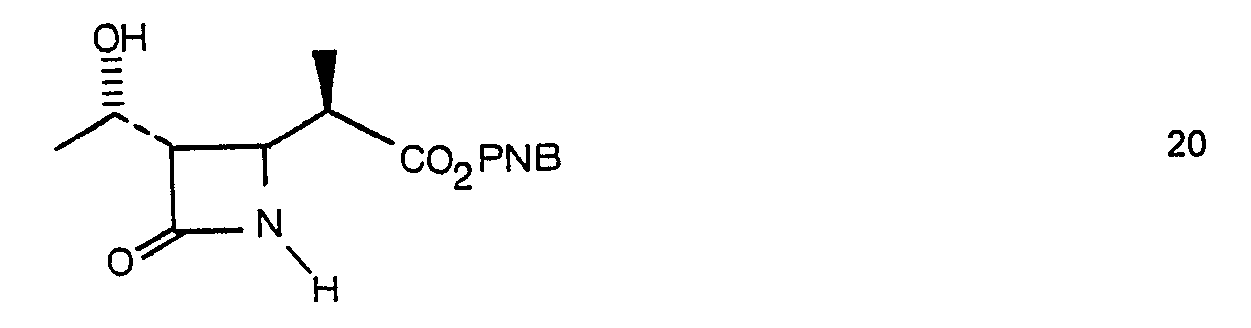
- this invention provides a process for preparing the intermediate of formula 26 starting from the compound offormula 18 (a formula 3 compound, which carries a protected 1-hydroxyethyl substituent in the 7-position).
- the oxidation 2 ⁇ 3 is accomplished by treating 2 in a solvent such as methylenechloride, methanol, chloroform, or the like, with an oxidizing agent such as ozone, or the like, at a temperature of from -100°C to 0°C for from 0.1 to 4 hours, followed by treating the crude product with an oxidizing agent such as m-chloroperbenzoic acid, hydrogen peroxide, peracetic acid, or the like, at a temperature of from 0°C to 100°C for from 1 to 100 hours.
- R° is a readily removable protecting group and is defined below.
- the addition 3 ⁇ 4 is accomplished by treating 3 with 1,1'-carbonyldiimidazole, or the like, in a solvent such as tetrahydrofuran, dimethoxyethane, acetonitrile or the like, at a temperature of from 0 to 70°C, followed by the addition of 1.1 to 3.0 equivalent of (R 7 O 2 CCH 2 CO 2 ) 2 Mg, at a temperature of from 0 to 70°C for from 1 to 48 hours.
- R 7 is a pharmaceutically acceptable ester moiety or a readily removable carboxyl protecting groups such as p-nitrobenzyl, benzyl, or the like.
- the diazo species 6 is prepared from 5 by treating 5 in a solvent such as CH 3 CN, CH 2 CI 2 , THF, or the like with an azide such as p-carboxybenzenesulfonylazide, toluenesulfonylazide, methanesulfonylazide, or the like in the presence of a base such as triethylamine, pyridine, diethylamine or the like for from 1 to 50 hours at 0 ⁇ 50°C.
- a solvent such as CH 3 CN, CH 2 CI 2 , THF, or the like
- an azide such as p-carboxybenzenesulfonylazide, toluenesulfonylazide, methanesulfonylazide, or the like in the presence of a base such as triethylamine, pyridine, diethylamine or the like for from 1 to 50 hours at 0 ⁇ 50°C.
- Cyclization (6 ⁇ 7) is accomplished by treating 6 in a solvent such as benzene, toluene, THF, cyclohexane, ethylacetate or the like at a temperature of from 25 to 110°C for from 1-5 hours in the presence of a catalyst such as bis (acetylacetonato)Cu(II)[Cu(acac) 2] , C U S0 4 , Cu powder, Rh(OAc) 2 or Pd(OAc) 2 .
- a solvent such as benzene, toluene, THF, cyclohexane, ethylacetate or the like
- a catalyst such as bis (acetylacetonato)Cu(II)[Cu(acac) 2] , C U S0 4 , Cu powder, Rh(OAc) 2 or Pd(OAc) 2 .
- the cyclization may be accomplished by irradiating 6 through a pyrex filter (a wave length greater than 300nm) in a solvent such as benzene, CCI 4 , diethylether, or the like, at a temperature of from 025°C for from 0.5 to 2 hours.
- a pyrex filter a wave length greater than 300nm
- a solvent such as benzene, CCI 4 , diethylether, or the like
- Establishment of leaving group X (7-j 8) is accomplished by acylating the keto ester 7 with an acylating agent RX such as p-toluenesulfonic acid anhydride, p-nitrophenylsulfonic acid anhydride, 2,4,6-triisopropylphenylsulfonic acid anhydride, methanesulfonic acid anhydride, toluenesulfonyl chloride, p-bromophenylsulfonyl chloride, diphenylchlorophosphate, or the like; wherein X is the corresponding leaving group such as toluene sulfonyloxy, p-nitrophenylsulfonyloxy, methanesulfonyloxy, p-bromophenylsulfonyloxy and other leaving groups which are established by conventional procedures and which are well known in the art.
- RX such as p-toluenesulfonic acid
- the above acylation to establish leaving groups X is conducted in a solvent such as methylene chloride, acetonitrile or dimethylformamide, in the presence of a base such as diisopropylethylamine, triethylamine, 4-dimethylamino-pyridine or the like at a temperature of from -20 to 40°C for from 0.5 to 5 hours.
- a solvent such as methylene chloride, acetonitrile or dimethylformamide
- a base such as diisopropylethylamine, triethylamine, 4-dimethylamino-pyridine or the like at a temperature of from -20 to 40°C for from 0.5 to 5 hours.
- the leaving group X of intermediate 8 can also be halogen.
- the halogen leaving group is established by treating 7 with a halogenating agent such as ⁇ 3 PCl 2 , 0 3 PBr 2 , ( ⁇ ) 3 PBr 2 , oxalyl chloride, PBr 3 or the like in a solvent such as CH 2 CI 2 , CH 3 CN, THF, or the like in the presence of a base such as diisopropylethylamine, triethylamine, or 4-dimethylaminopyridine or the like.
- a halogenating agent such as ⁇ 3 PCl 2 , 0 3 PBr 2 , ( ⁇ ) 3 PBr 2 , oxalyl chloride, PBr 3 or the like
- a solvent such as CH 2 CI 2 , CH 3 CN, THF, or the like
- a base such as diisopropylethylamine, triethylamine, or 4-dimethylaminopyridine or the like.
- the reaction 8 ⁇ 9 is accomplished by treating 8 in a solvent such as dioxane, dimethylformamide, dimethylsulfoxide, acetonitrile, hexamethylphosphoramide, or the like in the presence of an approximately equivalent to excess of the mercaptan reagent HSR 8 wherein R 8 as defined above.
- a solvent such as dioxane, dimethylformamide, dimethylsulfoxide, acetonitrile, hexamethylphosphoramide, or the like in the presence of an approximately equivalent to excess of the mercaptan reagent HSR 8 wherein R 8 as defined above.
- a representative mercaptan reagent is HSCH z CH 2 NHR 8 ' wherein R 8' is hydrogen or a readily removable N-protecting group such as p-nitrobenzyloxycarbonyl, o-nitrobenzyloxy carbonal, or the like in the presence of a base such as sodium hydrogen carbonate, potassium carbonate, triethylamine, diisopropylethylamine, or the like at a temperature of from -40 to 25°C for from 1 to 72 hours.
- a base such as sodium hydrogen carbonate, potassium carbonate, triethylamine, diisopropylethylamine, or the like at a temperature of from -40 to 25°C for from 1 to 72 hours.
- the mercaptan reagent, HSCH 2 CH 2 NHR 8 ' is typically prepared by treating aminoethylmercaptan in the presence of the desired acid chloride in the presence of a base such as sodium bicarbonate, sodium hydroxide, or the like in a solvent such as aqueous diethylether, aqueous dioxane, aqueous acetone, or the like at a temperature of from 0 to 25°C for from 0.5 to 4 hours.
- a base such as sodium bicarbonate, sodium hydroxide, or the like
- a solvent such as aqueous diethylether, aqueous dioxane, aqueous acetone, or the like at a temperature of from 0 to 25°C for from 0.5 to 4 hours.
- the final deblocking step 9 ⁇ 11 is accomplished by conventional procedures such as hydrolysis or hydrogenation.
- a solvent such as dioxane-water-ethanol, tetrahydrofuran-aqueous dipotassium hydrogen phosphate-isopropanol or the like is treated under a hydrogen pressure of from 1 to 4 atmospheres in the presence of a hydrogenation catalyst such as palladium on charcoal, palladium hydroxide, or the like at a temperature of from 0 to 50°C for from 0.5 to 4 hours to provide 11.
- acyloxybutadiene (1') such as 1-acetoxy-2-methylbutadiene
- a solvent such as anhydrous diethyl ether
- the reduction of 3' to provide 4-(1-methyl-2-acetoxyethyl)-2-azetidinone (4') is conducted by any convenient means such as hydrogenation in the presence of a catalyst such as platinum, palladium or oxides thereof under a hydrogen pressure of from 1 to 20 atmospheres in a solvent such as ethanol, ethylacetate, or the like at a temperature of from 0° to 25°C for from 5 minutes to 1 hour.
- a catalyst such as platinum, palladium or oxides thereof under a hydrogen pressure of from 1 to 20 atmospheres in a solvent such as ethanol, ethylacetate, or the like at a temperature of from 0° to 25°C for from 5 minutes to 1 hour.
- the 4-(2-hydroxy-1-methyl-ethyl)-2-azetidinone species 5' is obtained from 4' by hydrolysis.
- the 8-oxo-2,2,5-trimethyl-3-oxa-1-azabicyclo(4.2.0]octane species 6' is obtained on treatment of 5' with 2,2-dimethoxypropane in the presence of a catalyst such as boron trifluoride etherate in a solvent such as methylene chloride at a temperature of from 0° to 40°C for from 1 to 40 minutes. Alkylation of 6' provides 7'.
- a catalyst such as boron trifluoride etherate
- solvent such as methylene chloride
- 6' is treated with a strong base such as lithium diisopropylamide, sodium hydride, phenyl lithium or butyl lithium and the like in a solvent such as tetrahydrofuran (THF), ether, dimethoxyethane, and the like at a temperature of from -80° to 0°C., whereupon the alkylating agent of choice, R 3 X is added (R 3 is as described above and X is chloro or bromo; alternatively, the alkylating agent may be R 3 tosylate, R 3- mesylate or an aldehyde or ketone such as acetaldehyde and the like) to provide mono-alkylated species 7'.
- a strong base such as lithium diisopropylamide, sodium hydride, phenyl lithium or butyl lithium and the like
- a solvent such as tetrahydrofuran (THF), ether, dimethoxyethane, and the like
- the conversion 8' - ⁇ 3 is obtained by oxidation.
- the most preferred oxidation is achieved by suspending 8' in a solvent such as acetone, benzene, hexane, or the like at a temperature of from 0°C to 50°C and treating with an oxidizing agent such as Jones reagent.
- compound 3 may be prepared from 8' by treating 8' with 50% trifluoroacetic acid/water at 0° to 50°C for from 10 min. to 1 hr. to give the intermediate alcohol which is then oxidized with Jones reagent to 3.
- the N-protecting group R° may be established on 3, as originally shown in Diagram I, by following the procedure 16 ⁇ 17, below; wherein R° is also defined.
- the diester 12 is prepared by treating the diacid 11 with thionyl chloride at reflux for two hours followed by reacting with ethanol at 80°C for 4 hours. Reduction of the diester 12 with lithium alumium hydride in ether at reflux for 4 hours followed by hydrolysis with 10% NaOH gives diol 13 which on further reaction with thionyl chloride gives dichloride 14.
- the dichloride 14 can be alternatively prepared by treating 15 with ethylene in the presence of alumium chloride. Treatment of the dichloride 14 with base such as 2-methylquinoline, DBU or sodium hydroxide in polyethylene glycol gives the expected 3-substituted 1,4-pentadiene 1.
- the substituted azetidinone 16 is prepared by reacting a 3- substituted 1,4-pentadiene 1 with chlorosulfonylisocyanate at 25°C to 60°C in a pressure bottle for 3-12 days, then the resulting mixture is hydrolyzed with aqueous sodium sulfite solution between pH 6.5-7.5 at 0°C to 25°C for from 5 mins. to 60 mins.
- Azetidinone 16 is transformed (16 ⁇ 17) to establish the protecting group R° which may be a triorganosilyl group, such as t-butyldimethylsilyl, t-butyldiphenylsilyl, triphenylsilyl, isopropyldimethylsilyl, for example, or may be 3,4-dimethoxybenzyl, for example.
- R° may be a triorganosilyl group, such as t-butyldimethylsilyl, t-butyldiphenylsilyl, triphenylsilyl, isopropyldimethylsilyl, for example, or may be 3,4-dimethoxybenzyl, for example.
- Silyl protection is preferred, and typically R° is established by treating 16 in a solvent such as dimethylformamide, acetonitrile, hexamethylphosphoramide, tetrahydrofuran and the like with a silylating agent such as t-butyldimethylchlorosilane, t-butyldiphenylchlorosilane, triphenylchlorosilane, and the like at a temperature of from -20°C to 25°C for from 0.5 to 24 hours in the presence of a base such as triethylamine, diisopropylethylamine, or imidazole.
- a solvent such as dimethylformamide, acetonitrile, hexamethylphosphoramide, tetrahydrofuran and the like
- a silylating agent such as t-butyldimethylchlorosilane, t-butyldiphenylchlorosilane, triphenylchlor
- Alkylation of 17 provides 18.
- 17 is treated with a strong base such as lithium diisopropylamide, sodium hydride, phenyl lithium or butyl lithium and the like in a solvent such as tetrahydrofuran (THF), ether, dimethoxyethane and the like at a temperature of from -80°C to 0°C, whereupon the alkylating agent of choice, R°X is added (R 3 is as described above and X is lodo, chloro or bromo; alternatively the alkylating agent may be R 3- tosylate, R 3- mesylate or an aldehyde or ketone such as acetaldehyde and the like) to provide mono-alkylated species 18.
- R°X tetrahydrofuran
- the alkylating agent may be R 3- tosylate, R 3- mesylate or an aldehyde or ketone such as acetaldehyde and the like
- Suitable alkylating agents for establishing R 3 and/or R 4 at ultimate ring position 6 (17 - 18 - 2) are:
- R' The most preferred values for R' include:
- R 3 ' is benzyl, p-nitrobenzyl, o-nitrobenzyl, t-butyl, bromo-t-butyl, t-butyl-dimethylsilyl, trimethylsilyl, trichloroethyl; or R 3' represents pharmaceutically acceptable ester moieties such as pivalolyloxymethyl, allyl, methallyl, (2-methylthio)-ethyl, 3-methyl-2-butenyl, p-t-butylbenzyl, 5-indanyl, 3-phthalidyl.
- the disilyl azetidinone 23 (55 mg) dissolved in methanol (1 ml) is treated with 0.1N HCI (0.2 ml) at room temperature for 3 hrs. The mixture is evaporated in vacuo to give oil residue which is taken up in ethylacetate. After the mixture is washed with brine, the organic layer is separated, dried over anhydrous sodium sulfate. The crude product is chromatographed by silica gel plates eluting with ethyl acetate to give product 24 (11.8 mg).
Landscapes
- Chemical & Material Sciences (AREA)
- Organic Chemistry (AREA)
- Chemical Kinetics & Catalysis (AREA)
- Health & Medical Sciences (AREA)
- Nuclear Medicine, Radiotherapy & Molecular Imaging (AREA)
- Oncology (AREA)
- General Chemical & Material Sciences (AREA)
- Medicinal Chemistry (AREA)
- Communicable Diseases (AREA)
- Pharmacology & Pharmacy (AREA)
- Life Sciences & Earth Sciences (AREA)
- Animal Behavior & Ethology (AREA)
- General Health & Medical Sciences (AREA)
- Public Health (AREA)
- Veterinary Medicine (AREA)
- Pharmaceuticals Containing Other Organic And Inorganic Compounds (AREA)
- Nitrogen Condensed Heterocyclic Rings (AREA)
Claims (2)




Applications Claiming Priority (4)
| Application Number | Priority Date | Filing Date | Title |
|---|---|---|---|
| US21793180A | 1980-12-18 | 1980-12-18 | |
| US217931 | 1980-12-18 | ||
| US06/245,005 US4350631A (en) | 1980-12-18 | 1981-03-18 | 6- and 4-Substituted-1-azabicyclo[3.2.0]heptan-3,7-dione-2-carboxylates |
| US245005 | 1981-03-18 |
Publications (3)
| Publication Number | Publication Date |
|---|---|
| EP0054917A2 EP0054917A2 (de) | 1982-06-30 |
| EP0054917A3 EP0054917A3 (en) | 1982-09-01 |
| EP0054917B1 true EP0054917B1 (de) | 1988-03-09 |
Family
ID=26912399
Family Applications (1)
| Application Number | Title | Priority Date | Filing Date |
|---|---|---|---|
| EP81110531A Expired EP0054917B1 (de) | 1980-12-18 | 1981-12-17 | 6- und 4-Substituierte-1-Azabicyclo(3.2.0)heptan-3,7-dion-2-carboxylate |
Country Status (4)
| Country | Link |
|---|---|
| US (1) | US4350631A (de) |
| EP (1) | EP0054917B1 (de) |
| JP (1) | JP2940836B2 (de) |
| DE (1) | DE3176681D1 (de) |
Cited By (7)
| Publication number | Priority date | Publication date | Assignee | Title |
|---|---|---|---|---|
| US4683301A (en) * | 1982-04-08 | 1987-07-28 | Bristol-Myers Company | Carbapenem antibiotics |
| US4732977A (en) * | 1982-09-28 | 1988-03-22 | Bristol Myers Company | Carbapenem antibiotics |
| US4746736A (en) * | 1982-09-28 | 1988-05-24 | Bristol-Myers Company | Carbapenem antibiotics |
| EP0229384A3 (en) * | 1985-12-28 | 1989-08-23 | Sumitomo Pharmaceuticals Company, Limited | Novel amino acid compounds and their production |
| EP0504612A3 (en) * | 1991-03-20 | 1993-01-27 | American Cyanamid Company | Novel 4-substituted azetidinones as precursors to 2-substituted-3-carboxy carbapenem antibiotics and a method of producing them |
| US5480987A (en) * | 1990-04-10 | 1996-01-02 | American Cyanamid Company | 2-substituted alkyl-3-carboxy carbapenems as antibiotics and a method of producing them |
| US5496816A (en) * | 1994-03-14 | 1996-03-05 | Merck & Co., Inc. | Carbapenem antibacterial compounds, compositions containing such compounds and methods of treatment |
Families Citing this family (19)
| Publication number | Priority date | Publication date | Assignee | Title |
|---|---|---|---|---|
| US4414155A (en) * | 1980-01-14 | 1983-11-08 | Merck & Co., Inc. | Synthesis of thienamycin via esters of (3SR, 4RS)-3-[(SR)-1-hydroxyethyl]-β,2-dioxo-4-azetidinebutanoic acid |
| US5310897A (en) * | 1984-12-27 | 1994-05-10 | Sumitomo Pharmaceuticals Co., Ltd. | Beta-lactams and their production |
| CA1272719A (en) | 1986-03-06 | 1990-08-14 | Pierre Dextraze | Carbapenem antibiotics |
| EP0464900A3 (en) | 1990-06-26 | 1992-07-22 | Merck & Co. Inc. | 2-biphenyl-carbapenems |
| CA2052730A1 (en) | 1990-10-11 | 1992-04-12 | Frank P. Dininno | 2-(substituted-dibenzofuranyl and dibenzothienyl) carbapenem antibacterial agents |
| US5371215A (en) * | 1991-03-20 | 1994-12-06 | American Cyanamid Company | 4-substituted azetidinones as precursors to 2-substituted-3-carboxy carbapenem antibiotics and a method of producing them |
| US5382575A (en) * | 1991-10-17 | 1995-01-17 | Merck & Co., Inc. | (N-pyridiniumphenyl)-carbapenems |
| US5442055A (en) * | 1992-11-13 | 1995-08-15 | Tanabe Seiyaku Co., Ltd. | Azetidinone compound and process for preparation thereof |
| US5631363A (en) * | 1992-11-13 | 1997-05-20 | Tanabe Seiyaku Co., Ltd. | Azetidinone compound and process for preparation thereof |
| US6011150A (en) * | 1992-11-13 | 2000-01-04 | Tanabe Seiyaku Co., Ltd. | Azetidinone compound and process for preparation thereof |
| US5350746A (en) * | 1993-04-14 | 1994-09-27 | Merck & Co., Inc. | Triazolyl and tetrazolyl phenyl substituted carbapenems, compositions containing such compounds and methods of use |
| US5578722A (en) * | 1994-03-29 | 1996-11-26 | Sumitomo Pharmaceuticals Co., Ltd. | Process for preparing carbapenem compounds |
| US6504027B1 (en) | 1998-03-02 | 2003-01-07 | Merck & Co., Inc. | Decarboxylation process for synthesizing carbapenem antibiotics |
| US6194568B1 (en) * | 1998-07-13 | 2001-02-27 | Merck & Co., Inc. | Process for synthesizing carbapenem intermediates |
| JP4463520B2 (ja) * | 2003-10-02 | 2010-05-19 | 高砂香料工業株式会社 | カルバペネム誘導体の製造方法 |
| PL1956027T3 (pl) | 2005-11-02 | 2010-12-31 | Nippon Soda Co | Związek karbapenemowy |
| AU2009277936B2 (en) * | 2008-07-30 | 2014-11-27 | Sun Pharmaceutical Industries Limited | Process for the preparation of carbapenem compounds |
| CN102137865A (zh) * | 2008-07-30 | 2011-07-27 | 兰贝克赛实验室有限公司 | 制备碳青霉烯化合物的方法 |
| WO2011048583A1 (en) | 2009-10-23 | 2011-04-28 | Ranbaxy Laboratories Limited | Process for the preparation of carbapenem compounds |
Citations (2)
| Publication number | Priority date | Publication date | Assignee | Title |
|---|---|---|---|---|
| EP0030031A2 (de) * | 1979-12-03 | 1981-06-10 | Merck & Co. Inc. | 1.1-Disubstituierte 6-(1-Hydroxyethyl)-2-(aminoethylthio)-1-carbadethiapen-2-emcarbonsäuren, Verfahren zu ihrer Herstellung, antibiotisch wirksame pharmazeutische Zusammensetzungen, die diese Verbindungen enthalten, Zwischenprodukte zu ihrer Herstellung und Verfahren zur Herstellung der in diesem Verfahren verwendbaren Zwischenprodukte |
| EP0030032A2 (de) * | 1979-12-03 | 1981-06-10 | Merck & Co. Inc. | In 6-,1- und 2-Stellung substituierte 1-Carbadethiapen-2-em-carbonsäuren, Verfahren zu ihrer Herstellung, sie enthaltende pharmazeutische Zusammensetzungen und Zwischenprodukte |
Family Cites Families (9)
| Publication number | Priority date | Publication date | Assignee | Title |
|---|---|---|---|---|
| GB1584762A (en) * | 1977-04-01 | 1981-02-18 | Beecham Group Ltd | Azabicycloheptenes |
| US4218462A (en) * | 1978-10-24 | 1980-08-19 | Merck & Co., Inc. | 6-(1-Hydroxyethyl)-2-(2-aminoethylthio)-1-substituted-1-carbade-thiapen-2-em-3-carboxylic acids |
| US4260627A (en) * | 1978-10-24 | 1981-04-07 | Merck & Co., Inc. | 1-, 6- And 2-substituted-1-carba-2-penem-3-carboxylic acids |
| US4232036A (en) * | 1978-10-24 | 1980-11-04 | Merck & Co., Inc. | 6-, 1- and 2-Substituted-1-carbadethiapen-2-em-3-carboxylic acids |
| US4290947A (en) * | 1979-04-27 | 1981-09-22 | Merck & Co., Inc. | Process for the preparation of thienamycin and intermediates |
| US4273709A (en) * | 1979-07-23 | 1981-06-16 | Merck & Co., Inc. | Process for the preparation of thienamycin and intermediates |
| US4312871A (en) * | 1979-12-03 | 1982-01-26 | Merck & Co., Inc. | 6-, 1- And 2-substituted-1-carbadethiapen-2-em-3-carboxylic acids |
| US4282148A (en) * | 1980-01-14 | 1981-08-04 | Merck & Co., Inc. | Synthesis of thienamycin via esters of (3SR, 4RS)-3-[(SR)-1-hydroxyethyl]-β,2-dioxo-4-azetidinebutanoic acid |
| US4269772A (en) * | 1980-01-14 | 1981-05-26 | Merck & Co., Inc. | Synthesis of thienamycin via trans-3-carboxymethylene-4-carboxy-5-methyl-Δ2 -isoxazoline |
-
1981
- 1981-03-18 US US06/245,005 patent/US4350631A/en not_active Expired - Lifetime
- 1981-12-17 EP EP81110531A patent/EP0054917B1/de not_active Expired
- 1981-12-17 DE DE8181110531T patent/DE3176681D1/de not_active Expired
-
1991
- 1991-04-16 JP JP3084274A patent/JP2940836B2/ja not_active Expired - Lifetime
Patent Citations (2)
| Publication number | Priority date | Publication date | Assignee | Title |
|---|---|---|---|---|
| EP0030031A2 (de) * | 1979-12-03 | 1981-06-10 | Merck & Co. Inc. | 1.1-Disubstituierte 6-(1-Hydroxyethyl)-2-(aminoethylthio)-1-carbadethiapen-2-emcarbonsäuren, Verfahren zu ihrer Herstellung, antibiotisch wirksame pharmazeutische Zusammensetzungen, die diese Verbindungen enthalten, Zwischenprodukte zu ihrer Herstellung und Verfahren zur Herstellung der in diesem Verfahren verwendbaren Zwischenprodukte |
| EP0030032A2 (de) * | 1979-12-03 | 1981-06-10 | Merck & Co. Inc. | In 6-,1- und 2-Stellung substituierte 1-Carbadethiapen-2-em-carbonsäuren, Verfahren zu ihrer Herstellung, sie enthaltende pharmazeutische Zusammensetzungen und Zwischenprodukte |
Cited By (7)
| Publication number | Priority date | Publication date | Assignee | Title |
|---|---|---|---|---|
| US4683301A (en) * | 1982-04-08 | 1987-07-28 | Bristol-Myers Company | Carbapenem antibiotics |
| US4732977A (en) * | 1982-09-28 | 1988-03-22 | Bristol Myers Company | Carbapenem antibiotics |
| US4746736A (en) * | 1982-09-28 | 1988-05-24 | Bristol-Myers Company | Carbapenem antibiotics |
| EP0229384A3 (en) * | 1985-12-28 | 1989-08-23 | Sumitomo Pharmaceuticals Company, Limited | Novel amino acid compounds and their production |
| US5480987A (en) * | 1990-04-10 | 1996-01-02 | American Cyanamid Company | 2-substituted alkyl-3-carboxy carbapenems as antibiotics and a method of producing them |
| EP0504612A3 (en) * | 1991-03-20 | 1993-01-27 | American Cyanamid Company | Novel 4-substituted azetidinones as precursors to 2-substituted-3-carboxy carbapenem antibiotics and a method of producing them |
| US5496816A (en) * | 1994-03-14 | 1996-03-05 | Merck & Co., Inc. | Carbapenem antibacterial compounds, compositions containing such compounds and methods of treatment |
Also Published As
| Publication number | Publication date |
|---|---|
| US4350631A (en) | 1982-09-21 |
| JP2940836B2 (ja) | 1999-08-25 |
| EP0054917A2 (de) | 1982-06-30 |
| EP0054917A3 (en) | 1982-09-01 |
| DE3176681D1 (en) | 1988-04-14 |
| JPH04217985A (ja) | 1992-08-07 |
Similar Documents
| Publication | Publication Date | Title |
|---|---|---|
| US4350631A (en) | 6- and 4-Substituted-1-azabicyclo[3.2.0]heptan-3,7-dione-2-carboxylates | |
| EP0180252B1 (de) | Verfahren zur Herstellung von Azetidinonverbindungen | |
| EP0051813B1 (de) | 7-Oxo-4-thia-1-aza(3.2.0)heptan- und 7-Oxo-4-thia-1-aza-(3.2.0)hept-2-en-Derivate | |
| EP0001628B1 (de) | 3,6-Disubstituierte 7-oxo-1-azabicylo-(3.2.0.)-2-hepten-2-carbonsäure, ihre Herstellung und sie enthaltende pharmazeutische Zusammensetzungen | |
| US4312871A (en) | 6-, 1- And 2-substituted-1-carbadethiapen-2-em-3-carboxylic acids | |
| EP0037080B1 (de) | 4-(3-Carboxy-2-oxopropyl)-azetidino-2-one und Verfahren zu ihrer Herstellung | |
| US4273709A (en) | Process for the preparation of thienamycin and intermediates | |
| EP0030031B1 (de) | 1.1-Disubstituierte 6-(1-Hydroxyethyl)-2-(aminoethylthio)-1-carbadethiapen-2-emcarbonsäuren, Verfahren zu ihrer Herstellung, antibiotisch wirksame pharmazeutische Zusammensetzungen, die diese Verbindungen enthalten, Zwischenprodukte zu ihrer Herstellung und Verfahren zur Herstellung der in diesem Verfahren verwendbaren Zwischenprodukte | |
| EP0146730B1 (de) | Verfahren zur Herstellung von Penemen | |
| US4639335A (en) | Stereocontrolled acetoxyazetidinone process | |
| EP0030032B1 (de) | In 6-,1- und 2-Stellung substituierte 1-Carbadethiapen-2-em-carbonsäuren, Verfahren zu ihrer Herstellung, sie enthaltende pharmazeutische Zusammensetzungen und Zwischenprodukte | |
| US4341706A (en) | Process for the preparation of carbapenem antibiotics | |
| EP0180189B1 (de) | Beta-Lactame und ihre Herstellung | |
| US4675396A (en) | 7-Oxo-4-thia-1-azabicyclo(3,2,0)heptane derivatives | |
| US4994568A (en) | 6- and 4-substituted-1-azabicyclo(3.2.0)heptan-3, 7-dione-2-carboxylates | |
| PL171202B1 (pl) | Sposób wytwarzania 2 podstawionych 3-karboksy-karbapenemów PL PL PL PL PL PL | |
| JPH0623187B2 (ja) | β−ラクタム化合物の新規製造法 | |
| JPWO2004043961A1 (ja) | 経口投与用カルバペネム化合物の製造方法 | |
| AU644805B2 (en) | Process for penems | |
| EP0026817B1 (de) | Herstellung zur Thienamycinsynthese geeigneter Azetidin-2-one und für eine derartige Synthese verwendbare Azetidin-2-one | |
| EP0223397B1 (de) | Verfahren für 2-(1-Oxo-3-thiolanyl)-2-penemantibiotika | |
| US4885362A (en) | Azetidinone intermediates for 1-carba(dethia)caphalosporins | |
| EP0066301B1 (de) | Zwischenprodukte zur Herstellung von Thienamycin und Verfahren zu ihrer Herstellung | |
| JP2003064087A (ja) | アゼチジノン化合物の結晶 | |
| JP3543016B2 (ja) | β−ラクタム系化合物の製法 |
Legal Events
| Date | Code | Title | Description |
|---|---|---|---|
| PUAI | Public reference made under article 153(3) epc to a published international application that has entered the european phase |
Free format text: ORIGINAL CODE: 0009012 |
|
| AK | Designated contracting states |
Designated state(s): CH DE FR GB IT NL |
|
| PUAL | Search report despatched |
Free format text: ORIGINAL CODE: 0009013 |
|
| ITCL | It: translation for ep claims filed |
Representative=s name: SOCIETA' ITALIANA BREVETTI S.P.A. |
|
| AK | Designated contracting states |
Designated state(s): CH DE FR GB IT NL |
|
| 17P | Request for examination filed |
Effective date: 19830301 |
|
| GRAA | (expected) grant |
Free format text: ORIGINAL CODE: 0009210 |
|
| AK | Designated contracting states |
Kind code of ref document: B1 Designated state(s): CH DE FR GB IT LI NL |
|
| REF | Corresponds to: |
Ref document number: 3176681 Country of ref document: DE Date of ref document: 19880414 |
|
| ET | Fr: translation filed | ||
| ITF | It: translation for a ep patent filed | ||
| PLBE | No opposition filed within time limit |
Free format text: ORIGINAL CODE: 0009261 |
|
| STAA | Information on the status of an ep patent application or granted ep patent |
Free format text: STATUS: NO OPPOSITION FILED WITHIN TIME LIMIT |
|
| 26N | No opposition filed | ||
| ITTA | It: last paid annual fee | ||
| PGFP | Annual fee paid to national office [announced via postgrant information from national office to epo] |
Ref country code: GB Payment date: 20000925 Year of fee payment: 20 Ref country code: CH Payment date: 20000925 Year of fee payment: 20 |
|
| PGFP | Annual fee paid to national office [announced via postgrant information from national office to epo] |
Ref country code: FR Payment date: 20000928 Year of fee payment: 20 |
|
| PGFP | Annual fee paid to national office [announced via postgrant information from national office to epo] |
Ref country code: DE Payment date: 20001127 Year of fee payment: 20 |
|
| PGFP | Annual fee paid to national office [announced via postgrant information from national office to epo] |
Ref country code: NL Payment date: 20001231 Year of fee payment: 20 |
|
| PG25 | Lapsed in a contracting state [announced via postgrant information from national office to epo] |
Ref country code: LI Free format text: LAPSE BECAUSE OF EXPIRATION OF PROTECTION Effective date: 20011216 Ref country code: GB Free format text: LAPSE BECAUSE OF EXPIRATION OF PROTECTION Effective date: 20011216 Ref country code: CH Free format text: LAPSE BECAUSE OF EXPIRATION OF PROTECTION Effective date: 20011216 |
|
| PG25 | Lapsed in a contracting state [announced via postgrant information from national office to epo] |
Ref country code: NL Free format text: LAPSE BECAUSE OF EXPIRATION OF PROTECTION Effective date: 20011217 |
|
| REG | Reference to a national code |
Ref country code: GB Ref legal event code: PE20 Effective date: 20011216 |
|
| REG | Reference to a national code |
Ref country code: CH Ref legal event code: PL |
|
| NLV7 | Nl: ceased due to reaching the maximum lifetime of a patent |
Effective date: 20011217 |