EP0052707B1 - Mittels einer zentralen Rechnereinheit überwachtes steuersystem für Werkzeugmaschinen - Google Patents
Mittels einer zentralen Rechnereinheit überwachtes steuersystem für Werkzeugmaschinen Download PDFInfo
- Publication number
- EP0052707B1 EP0052707B1 EP81107296A EP81107296A EP0052707B1 EP 0052707 B1 EP0052707 B1 EP 0052707B1 EP 81107296 A EP81107296 A EP 81107296A EP 81107296 A EP81107296 A EP 81107296A EP 0052707 B1 EP0052707 B1 EP 0052707B1
- Authority
- EP
- European Patent Office
- Prior art keywords
- data
- processor
- deserializer
- serializer
- machine tool
- Prior art date
- Legal status (The legal status is an assumption and is not a legal conclusion. Google has not performed a legal analysis and makes no representation as to the accuracy of the status listed.)
- Expired
Links
Images



Classifications
-
- G—PHYSICS
- G06—COMPUTING OR CALCULATING; COUNTING
- G06F—ELECTRIC DIGITAL DATA PROCESSING
- G06F11/00—Error detection; Error correction; Monitoring
- G06F11/22—Detection or location of defective computer hardware by testing during standby operation or during idle time, e.g. start-up testing
- G06F11/26—Functional testing
- G06F11/261—Functional testing by simulating additional hardware, e.g. fault simulation
-
- G—PHYSICS
- G05—CONTROLLING; REGULATING
- G05B—CONTROL OR REGULATING SYSTEMS IN GENERAL; FUNCTIONAL ELEMENTS OF SUCH SYSTEMS; MONITORING OR TESTING ARRANGEMENTS FOR SUCH SYSTEMS OR ELEMENTS
- G05B19/00—Program-control systems
- G05B19/02—Program-control systems electric
- G05B19/18—Numerical control [NC], i.e. automatically operating machines, in particular machine tools, e.g. in a manufacturing environment, so as to execute positioning, movement or co-ordinated operations by means of program data in numerical form
- G05B19/406—Numerical control [NC], i.e. automatically operating machines, in particular machine tools, e.g. in a manufacturing environment, so as to execute positioning, movement or co-ordinated operations by means of program data in numerical form characterised by monitoring or safety
- G05B19/4063—Monitoring general control system
-
- G—PHYSICS
- G05—CONTROLLING; REGULATING
- G05B—CONTROL OR REGULATING SYSTEMS IN GENERAL; FUNCTIONAL ELEMENTS OF SUCH SYSTEMS; MONITORING OR TESTING ARRANGEMENTS FOR SUCH SYSTEMS OR ELEMENTS
- G05B2219/00—Program-control systems
- G05B2219/30—Nc systems
- G05B2219/33—Director till display
- G05B2219/33285—Diagnostic
-
- G—PHYSICS
- G05—CONTROLLING; REGULATING
- G05B—CONTROL OR REGULATING SYSTEMS IN GENERAL; FUNCTIONAL ELEMENTS OF SUCH SYSTEMS; MONITORING OR TESTING ARRANGEMENTS FOR SUCH SYSTEMS OR ELEMENTS
- G05B2219/00—Program-control systems
- G05B2219/30—Nc systems
- G05B2219/33—Director till display
- G05B2219/33286—Test, simulation analysator
-
- G—PHYSICS
- G05—CONTROLLING; REGULATING
- G05B—CONTROL OR REGULATING SYSTEMS IN GENERAL; FUNCTIONAL ELEMENTS OF SUCH SYSTEMS; MONITORING OR TESTING ARRANGEMENTS FOR SUCH SYSTEMS OR ELEMENTS
- G05B2219/00—Program-control systems
- G05B2219/30—Nc systems
- G05B2219/33—Director till display
- G05B2219/33324—What to diagnose, whole system, test, simulate
-
- G—PHYSICS
- G05—CONTROLLING; REGULATING
- G05B—CONTROL OR REGULATING SYSTEMS IN GENERAL; FUNCTIONAL ELEMENTS OF SUCH SYSTEMS; MONITORING OR TESTING ARRANGEMENTS FOR SUCH SYSTEMS OR ELEMENTS
- G05B2219/00—Program-control systems
- G05B2219/30—Nc systems
- G05B2219/34—Director, elements to supervisory
- G05B2219/34466—Bad circuits, watchdog, alarm, indication
-
- G—PHYSICS
- G06—COMPUTING OR CALCULATING; COUNTING
- G06F—ELECTRIC DIGITAL DATA PROCESSING
- G06F11/00—Error detection; Error correction; Monitoring
- G06F11/22—Detection or location of defective computer hardware by testing during standby operation or during idle time, e.g. start-up testing
- G06F11/2205—Detection or location of defective computer hardware by testing during standby operation or during idle time, e.g. start-up testing using arrangements specific to the hardware being tested
- G06F11/2221—Detection or location of defective computer hardware by testing during standby operation or during idle time, e.g. start-up testing using arrangements specific to the hardware being tested to test input/output devices or peripheral units
Definitions
- This invention relates to systems for controlling the operation of machine tools by machine tool controllers under the control of a central data processing unit. More particularly, the present invention relates to systems for testing the machine tool controllers.
- the machine tool controller performs complex transformation on the data provided to the controller from the central processor, e.g., the inclusion of clock pulses or other forms of encod- ing/decoding functions or even transformations, required for multiplexing or demultiplexing in order to make the data compatible with the machine tool itself.
- the controller would perform functions such as the separation of clock pulses or other decoding as well as demultiplexing on data received from the machine tool.
- a coupling machine or controller (10) controlling a device (12) which may be a magnetic tape unit.
- a CPU (11) is connected to the coupler (10) and communicate with the device (12).
- the coupler (10) consists of a set of "outbound circuits" (13) permitting the communication from CPU (11) to the device (12) and a set of inbound circuits (14) permitting the communication from the device (12) to the CPU (11). Commands cause the coupler (10) to loop the signals among outbound (13) and inbound (14) circuits for diagnostic purposes.
- the CPU (11) can also simulate outbound circuits (13) operation to diagnose the operability of the outbound circuits (13).
- the invention further disclosed is an improvement on this approach permitting, with very little additional hardware in the tool controller, to test independently the operability of the two "normal" communication modes (e.g. writing and reading mode in the case of a magnetic memory storage controller).
- the invention provides a solution of said problem by a system for controlling a machine tool by a tool controller under supervision of a central data processor, said tool controller comprising:
- the data in a first communication mode, can be transmitted from said processor through said first serializer/deserializer, then through said encoder and then to said machine tool whereby permitting a communication from said processor to said machine tool, and
- the data in a second communication mode the data can be transmitted from said machine tool through said decoder then through said first serializer/ deserializer, then to said processor whereby permitting a communication from said machine tool to said processor, and
- the data in a first diagnostic mode can be transmitted from said processor through said first serializer/deserializer then through said encoder, then through said second serializer/deserializer and then back to said processor to determine the operability of the said first means, and
- the data in a second diagnostic mode can be transmitted from said processor through said second serializer/deserializer, then through said decoder, then through said first serializer/ deserializer, then back to said processor to determine the operability of said second means.
- the present invention provides a solution to the problem of testing the tool controller independently of the machine tool being controlled.
- the expedient of the present invention is relatively inexpensive, requiring very little additional hardware in the tool controller.
- the testing is carried out isolated from the machine tool itself, isolation of failures and errors in the controller is greatly facilitated.
- the central processor which in operation supervises the machine tool controller in its controlling of the tool, contains a simulation of at least a substantial portion of the machine tool controller. This simulation is not involved in the normal operation of the system when the tool controller is operational to control the machine tool. Rather, the simulated tool controller functions during testing and failure diagnostics which are usually carried out by the central processsor in combination with the tool controller with the machine tool disconnected or isolated from the testing system.
- tool controller 10 under the supervision of central processor 11 will in normal operation provide the input which will activate or drive the various functions of magnetic medium storage device 12.
- the controller 10 will receive data from central processor 11 over I/0 buss 13. Among its other functions, the tool controller will condition or transform this data into a format which is utilizable by the serial magnetic storage device 12.
- the tool controller 10 may perform other functions with respect to the control of the serial magnetic storage device 12, for purposes of illustrating the test system of this invention, we will consider the testing of the operability of controller 10 carrying out its normal function of encoding clock data into non-coded initial data provided by central processor 11 over buss 13 and applying this clock encoded data along line 14 to serial storage device 12. The present illustration will also consider the testing of the operability of tool controller 10 in receiving and decoding clock encoded output data provided by serial storage device 12 on line 15 and outputting resulting non-coded data to central processor 11 back over buss 13.
- the first operation to be tested will be a write operation; during this operation, central processor 11 will provide a sequence of one byte increments of unencoded write data into I/0 buffer 16 of controller 10. These eight bit parallel increments will be shifted in parallel to serializer/deserializer register 17 along parallel lines 18 as needed as each succeeding byte is passed out in serial form from register 17.
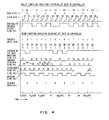
- serial data bits 01100111 are input to clock pulse encoder 22 respectively at time points D1D8 each respectively within time intervals T1T8.
- clock bits 11111111 are to be encoded to be above eight data bits, i.e., interleaved so that each data bit is separated by a clock bit.
- the sequence of the eight clock bits may be conveniently applied through terminal 53 of AND gate 24 synchronized with a second input to AND gate 24 along line 25 from clock generator 19 which provides a sequence of eight clock pulses at four microsecond interval time points designated as Cl-C8 in the timing chart of Fig. 4.
- Cl-C8 At each of time points Cl-C8 there is a coincident clock bit on terminal 53, a pulse output will be provided on line 26 from gate 24 to clock pulse encoder 22.
- clock input to clock pulse encoder 22 along line 26 is determined by input to AND gate 24 and the input along line 25 to AND gate 24 is a four microsecond interval pulse train.
- Timing chart illustration on Fig. 4 of the clock bits indicates a string of all "ones" which is the customary situation wherein the clock pulse is always present. However, there may be some circumstances wherein it would be required to have the absence of one or more clock pulses and this would be controlled by having one or more "zero" bits in the sequence applied to terminal 23.
- Clock pulse encoder 22 which may be any conventional circuit for alternately interleaving clock pulses with data pulses to produce a pulse train on line 71 wherein the presence or absence of data pulses at each alternate 2 microsecond position Dl-D8, (Fig. 4) indicates the presence or absence of a data bit, and the presence or absence of clock pulses at each alternate 2 microsecond position Cl-C8 indicates that presence or absence of a clock bit.
- Each occurrence of a pulse on line 71 causes bistable data latch 70 to change state so as to produce the controller encoded output on line 23 as indicated in the timing chart of Fig. 4.
- a controller encoded output on line 23 would have the form shown in Fig. 4.
- C1, D1, C2, D2, C3 ... D7, C8 and D8 if the data or alternate clock bit is "one" there will be a transition in the wave form; if the clock bit is "zero", there will be no transition in the wave form.
- the clock bits are all "ones", there is a transition at each of the clock bit points Cl-C8.
- the data bits at points D1, D4 and D5 are "zeros" there is no transition in the output wave form at these points.
- the controller encoded output shown in Fig. 4 would be applied along line 14 to an input to serial magnetic storage device 12.
- the serial magnetic storage device is detached or isolated from controller 10 as illustrated by switches 27 and 28 being open.
- This encoded output is applied through line 29 to encoded data serializer/deserializer register 30 which is a shift register under the control of clock generator 19.
- the clock encoded data long line 29 is shifted in one bit at a time to form parallel bytes of encoded data which will be output back to central processor 11 along I/O buss 32 connecting with I/O buss 13.
- serializer/deserializer register 30 in addition to serving the function of deserializing serial encoded data to be sent back to the central processor 11 as described above, also serves the function of serializing parallel encoded data being applied from the central processor 11 to controller 10 along line 32 as will be hereinafter described during the testing of a controller decoding or read operation.
- the mode in which the serializer/deserializer register 30 operates is determined by the input from central processor 11 along line 34 to register address means 35.
- the output of register address means 35 to the serializer/deserializer 30 on line 36 will determine whether register 30 is operating in a serializing or deserializing mode.
- register 30 is operating in the deserializing mode.
- This deserializing mode wherein the encoded data from register 30 is to be outputted in parallel form back to the central processor is known as a "dump".
- the apparatus When operating in this mode, the apparatus must insure that a full byte or eight bits of data and clock information is loaded in the serializing register 30 before the byte is returned to the central processor. Accordingly, during such a 'dump" operation, the register address means 35 provide an inhibit output along line 3.7 to READY gate 38. When thus inhibited READY gate 38 can only be released by an input along line 39 from clock generator 19.
- Clock generator 19 produces one output pulse along line 39 for every eight stepping pulses which it outputs along line 31 as previously described to step the eight bits of encoded data on line 29 into register 30.
- the output on line 39 to READY gate 38 indicates that eight bits have been loaded and are ready in register 30 at which point READY gate 38 sends a ready signal along line 40 back to central processor 11 which now completes the sequence and receives the parallel byte of data through busses 32 and 13. This procedure is continued until all of the bytes of encoded data produced by clock pulse encoder 22 in response to the non-coded data input from central processor 11 initially applied to I/0 buffer 16 of controller 10 has been output back to the central processor 11 in encoded form through register 30.
- the central processor will now proceed to decode clock encoded data which a controller has provided back to the central processor and to compare the decoded data with the original non-encoded data which the central processor initially input into the controller.
- the central processor will determine the operability of the controller in its encoding function and thus test that function of the controller.
- the central processor may be any available program general purpose central processor such as the IBM 370 CPU or it may be any standard general purpose microprocessor such as the Intel 8086.
- the decode function carried out by the central processor is in effect a programmed central processor simulation of the clock pulse decode operation and hardware in controller 10 which will subsequently be described in greater detail.
- register address means 35 coacts with the READY gate 38 in a manner similar to that previously described for outputting encoded data from register 30 back to the central processor 11. Consequently, central processor 11 sends a signal along line 34 to address means 35 which puts register 30 in the serializing mode.
- This serializing mode wherein encoded data from central processor 11 is loaded one byte at a time into register 30 in which each byte is serialized and output on line 41, is known as the "load" mode.
- register address means 35 provide an inhibit input signal along line 37 to READY gate 38.
- READY gate 38 can only be released by an input along line 39 from clock generator 19.
- Clock generator 19 controls the serializing operation in register 30 by providing stepping pulses to register 30 along line 31 to serially step the bits out of register 30 onto line 41 at two microsecond intervals.
- Clock generator 19 produces one output pulse along line 39 to READY gate 38 for each 8 stepping pulses which it outputs along line 31.
- READY gate 38 indicates that the eight bits which had been loaded into register 30 are now stepped out of the register and register 30 is empty.
- READY gate 38 sends a READY signal along line 40 back to central processor 11 which now loads the next parallel byte of data into register 30 through busses 13 and 32. This procedure is continued until all the bytes of encoded data which were to be loaded into register 30 for purposes of the testing procedure have been loaded and serialized.
- clock bits at time points Cl-C8 are encoded between data bits at time points Dl-D8.
- This input is ANDED with a two microsecond interval pulse input to AND gate 42 along line 43 from clock generator 19 to provide the "Encoded Read Data" wave form shown in Fig. 4 which would be the equivalent of a typical wave form input to the controller along line 15 from the serial magnetic storage device 12 if that storage device were operational, i.e., connected.
- clock pulse decoder 45 distinguishes the clock pulse from the data and provides an output on line 49 which is in effect a clock window wave form as shown in Fig. 4.
- This clock window wave form has an elevated two microsecond interval corresponding to each clock pulse and alternating two microsecond lower or depressed level corresponding to each of the data points Dl-D8.
- the decoder also provides an output on line 48 having a series of clock pulses 46 corresponding to encoder clock bits and data pulses 47 corresponding to the data bits.
- Clock pulse decoder circuit 45 may be implemented with conventional circuit logic as shown in Fig. 5. Outputs on output lines 48 and 49 as well as the encoded read data input on line 44 have the wave forms already described and shown with respect to Fig. 4. The outputs are synchronized under the control of selected fixed clock phase (timing) pulses obtained from clock generator 19 (Fig. 1) over buss 72. Now with reference to Fig. 5, the encoded read data on line 44 is applied to a synchronizer 73 which synchronizes the clock and data pulses under the control of a first clock (timing) phase obtained through buss 72. The output of synchronizer 73 is applied to pulse shaping circuit 74 which outputs the encoded clock and data pulses having the wave form shown in Fig. 4 on line 48.
- the encoded read data input on line 44 is also applied to the circuit including a phase comparator circuit 76 which controls a variable frequency oscillator 77 through feedback on line 75 so that an output signal is provided on line 80 which has a fixed frequency which for the present case provides pulses at two microsecond time intervals as shown in the timing chart of Fig. 4.
- the output on line 80 is then applied to a frequency divider circuit 79 which functions to divide the frequency of the pulse train by two.
- the output of frequency divider 79 is synchronized in synchronizer circuit 78 with a second clock (timing) phase from clock generator over buss 72 to provide the synchronized fixed window on line 49 as previously described and shown in the timing chart of Fig. 4.
- serializer/deserializer register 17 which is functioning in its deserializing mode.
- Deserializer 17 functions so that it only samples for the presence or absence of a pulse on line 48 during the window or low portion of the wave form input on line 49.
- deserializer register 17 determines whether a pulse 47 is not present on input line 48 in coincidence with a window on line 49.
- a pulse 47 is not present on input line 48 in coincidence with a window on line 49, then a "zero" will be loaded into the register of deserializer 17.
- a pulse 47 is present on line 48 in coincidence with the presence of a window on line 49, then a "one” will be loaded into the register 17.
- the eight decoded data bits will have the sequence 01100111.
- the byte of deserialized data will then be transferred along lines 18 back to I/O buffer 16 from which each byte of decoded data will be input into central processor 11 through data buss 13.
- the central processor will now proceed to re- encode decoded data which the controller has provided and to compare this re-encoded data with the original encoded data which the central processor input into the controller for this functional test.
- the central processor will determine the operability of the controller in its decoding function and thus test that function for the controller.
- This re-encoding function which is carried out by the central processor is in effect a programmed central processor simulation of the pulse encoding operation and hardware in contoller 10 which has been previously described in detail.
- block 51 data bits are encoded; this involves the operation of the clock pulse encoder 22 wherein a data "one" is represented by the presence of a narrow pulse.
- block 52 clock and data bits are merged. This covers the merger of the data bits being applied along line 21 of Fig. 1 with the selected clock bit input being applied to terminal 23 of AND gate 24. The pattern of clock bits applied to terminal 23 determines the clock bit input to clock pulse encoder 22 along line 26 as previously described.
- the encoded timed data after the operation set forth in blocks 51 and 52 is the controller encoder output on line 23, the wave form of which is shown in the timing chart of Fig. 4. This is the wave form which during normal operations would be sent to the serial magnetic storage device if it were attached. This is indicated by the dashed output line in Fig. 2.
- the encoded data is deserialized; this covers the operation previously described as carried out by serializer/deserializer 30 on the encoded data appplied to it via line 29.
- the deserialized clock bit encoded data from register 30 is applied to the central processor via busses 32 and 13.
- the central processor decodes (block 55) the data which has been encoded in the tool controller and removes the encoded clock pulses therefrom, block 56.
- central processor 11 is in effect programmed with operations which involve processor simulations of a clock pulse decoder 45 coupled to the serializer/deserializer 17 through outputs 49 in the hardware of Fig. 1.
- the central processor compares, block 57, this data with a stored representation of the original non-encoded data, block 58, which was initially provided to the tool controller for encoding. If the data compares, this indicates that there is no failure in tool controller encoding hardware. If the data fails to compare, this normally indicates a failure in the tool controller encoding hardware.
- encoded data provided from the central processor is first serialized, block 60. This is the operation wherein encoded data is provided to controller 10 on busses 13 and 32 and proceeds through the serializer/deserializer register as previously described to provide an encoded serial output on line 41 which is shown in the timing chart of Fig. 4. Then, block 61, timing is provided.
- the decoded data is deserialized, block 65, and output back to the central processor 11.
- This block covers the action of the serializer/ deserializer register 17 through output buffer 16 which provides bytes of parallel decoded data back to central processor 11 along buss 13.
- the central processor encodes the data which has been decoded into controller 10 and merges clock bits with data bits, block 67.
- the central processor is in effect programmed with the operations which involve processor simulation of clock pulse encoder 22 together with AND gate 24 in the hardware of Fig. 1.
- the central processor compares, block 68, this data with a stored representation of the original encoded data, block 69, which was initially provided to the tool controller for decoding. If the data compares, this indicates that there is no failure in the tool controller decoding hardware. If the data fails to compare, this indicates a failure in the tool controller decoding hardware.
Landscapes
- Engineering & Computer Science (AREA)
- Physics & Mathematics (AREA)
- General Physics & Mathematics (AREA)
- Computer Hardware Design (AREA)
- General Engineering & Computer Science (AREA)
- Theoretical Computer Science (AREA)
- Human Computer Interaction (AREA)
- Manufacturing & Machinery (AREA)
- Automation & Control Theory (AREA)
- Quality & Reliability (AREA)
- Test And Diagnosis Of Digital Computers (AREA)
Claims (5)
Applications Claiming Priority (2)
| Application Number | Priority Date | Filing Date | Title |
|---|---|---|---|
| US06/208,735 US4385349A (en) | 1980-11-20 | 1980-11-20 | Central processor supervised controller system having a simulation of the controller in the central processor for test purposes |
| US208735 | 1980-11-20 |
Publications (3)
| Publication Number | Publication Date |
|---|---|
| EP0052707A2 EP0052707A2 (de) | 1982-06-02 |
| EP0052707A3 EP0052707A3 (en) | 1984-03-28 |
| EP0052707B1 true EP0052707B1 (de) | 1989-05-24 |
Family
ID=22775826
Family Applications (1)
| Application Number | Title | Priority Date | Filing Date |
|---|---|---|---|
| EP81107296A Expired EP0052707B1 (de) | 1980-11-20 | 1981-09-16 | Mittels einer zentralen Rechnereinheit überwachtes steuersystem für Werkzeugmaschinen |
Country Status (7)
| Country | Link |
|---|---|
| US (1) | US4385349A (de) |
| EP (1) | EP0052707B1 (de) |
| JP (1) | JPS605014B2 (de) |
| AU (1) | AU542444B2 (de) |
| BR (1) | BR8106999A (de) |
| CA (1) | CA1169558A (de) |
| DE (1) | DE3177058D1 (de) |
Families Citing this family (28)
| Publication number | Priority date | Publication date | Assignee | Title |
|---|---|---|---|---|
| GB2079492B (en) * | 1980-06-25 | 1984-06-06 | Yokogawa Electric Works Ltd | Programmable controller |
| US4454575A (en) * | 1980-12-29 | 1984-06-12 | International Business Machines Corporation | Shared memory system with access by specialized peripherals managed by controller initialized by supervisory CPU |
| JPS5884305A (ja) * | 1981-11-12 | 1983-05-20 | Mitsubishi Electric Corp | シミユレ−シヨン装置 |
| US4613952A (en) * | 1983-07-11 | 1986-09-23 | Foster Wheeler Energy Corporation | Simulator for an industrial plant |
| JPS6093511A (ja) * | 1983-10-27 | 1985-05-25 | Fanuc Ltd | フォーマット変換インタフェース装置 |
| JPH0760169B2 (ja) * | 1984-11-02 | 1995-06-28 | 三洋電機株式会社 | 論理回路のシミュレーション方法及びシミュレータ |
| JPS61153228U (de) * | 1985-03-14 | 1986-09-22 | ||
| JPS61229106A (ja) * | 1985-04-04 | 1986-10-13 | Canon Inc | 制御装置 |
| JPS63236103A (ja) * | 1987-03-25 | 1988-10-03 | Toshiba Corp | プラント制御システム |
| US4912625A (en) * | 1987-09-30 | 1990-03-27 | The Boeing Company | Graphics verification system for numerical control programs |
| US5561787A (en) * | 1989-03-07 | 1996-10-01 | Xerox Corporation | User interface module |
| US5167020A (en) * | 1989-05-25 | 1992-11-24 | The Boeing Company | Serial data transmitter with dual buffers operating separately and having scan and self test modes |
| US5033049A (en) * | 1989-06-12 | 1991-07-16 | International Business Machines Corporation | On-board diagnostic sub-system for SCSI interface |
| JPH0371515A (ja) * | 1989-08-11 | 1991-03-27 | Toshiba Corp | 同軸ケーブル |
| US5233611A (en) * | 1990-08-20 | 1993-08-03 | International Business Machines Corporation | Automated function testing of application programs |
| US5574894A (en) * | 1994-11-03 | 1996-11-12 | Motorola, Inc. | Integrated circuit data processor which provides external sensibility of internal signals during reset |
| US5878249A (en) * | 1996-12-19 | 1999-03-02 | Ido East Systems, Ltd. | Method for synchronizing the simulation of the environment of a real-time system |
| US6163874A (en) * | 1997-09-23 | 2000-12-19 | National Semiconductor Corporation | Apparatus and method for doubling speed of random events generator |
| DE10341325B4 (de) * | 2003-09-08 | 2006-01-26 | Siemens Ag | Testeinrichtung und Testverfahren zum Testen von Werkzeug- oder Produktionsmaschinen |
| US7801710B2 (en) * | 2007-09-28 | 2010-09-21 | Rockwell Automation Technologies, Inc. | Simulation controls for model variability and randomness |
| US20090089234A1 (en) * | 2007-09-28 | 2009-04-02 | Rockwell Automation Technologies, Inc. | Automated code generation for simulators |
| US8548777B2 (en) * | 2007-09-28 | 2013-10-01 | Rockwell Automation Technologies, Inc. | Automated recommendations from simulation |
| US8069021B2 (en) * | 2007-09-28 | 2011-11-29 | Rockwell Automation Technologies, Inc. | Distributed simulation and synchronization |
| US20090089029A1 (en) * | 2007-09-28 | 2009-04-02 | Rockwell Automation Technologies, Inc. | Enhanced execution speed to improve simulation performance |
| US7643892B2 (en) * | 2007-09-28 | 2010-01-05 | Rockwell Automation Technologies, Inc. | Historian integrated with MES appliance |
| US20090089031A1 (en) * | 2007-09-28 | 2009-04-02 | Rockwell Automation Technologies, Inc. | Integrated simulation of controllers and devices |
| US10955810B2 (en) | 2015-11-13 | 2021-03-23 | International Business Machines Corporation | Monitoring communications flow in an industrial system to detect and mitigate hazardous conditions |
| CN113126587A (zh) * | 2019-12-30 | 2021-07-16 | 观致汽车有限公司 | 整车的诊断方法、装置、车辆及电子设备 |
Family Cites Families (7)
| Publication number | Priority date | Publication date | Assignee | Title |
|---|---|---|---|---|
| US3609312A (en) * | 1968-03-11 | 1971-09-28 | Robert K Higgins | Data conversion and control system |
| GB1502184A (en) * | 1974-07-05 | 1978-02-22 | Sperry Rand Corp | Automatic flight control systems |
| US3958111A (en) * | 1975-03-20 | 1976-05-18 | Bell Telephone Laboratories, Incorporated | Remote diagnostic apparatus |
| US4167786A (en) * | 1978-01-24 | 1979-09-11 | General Electric Company | Load control processor |
| JPS54150907A (en) * | 1978-05-19 | 1979-11-27 | Fujitsu Ltd | Loop test control system |
| US4227244A (en) * | 1978-11-30 | 1980-10-07 | Sperry Corporation | Closed loop address |
| US4285059A (en) * | 1979-12-10 | 1981-08-18 | The United States Of America As Represented By The Secretary Of The Army | Circuit for test of ultra high speed digital arithmetic units |
-
1980
- 1980-11-20 US US06/208,735 patent/US4385349A/en not_active Expired - Lifetime
-
1981
- 1981-08-18 JP JP56128255A patent/JPS605014B2/ja not_active Expired
- 1981-09-16 EP EP81107296A patent/EP0052707B1/de not_active Expired
- 1981-09-16 DE DE8181107296T patent/DE3177058D1/de not_active Expired
- 1981-09-30 CA CA000387026A patent/CA1169558A/en not_active Expired
- 1981-10-29 BR BR8106999A patent/BR8106999A/pt unknown
- 1981-11-12 AU AU77424/81A patent/AU542444B2/en not_active Ceased
Also Published As
| Publication number | Publication date |
|---|---|
| US4385349A (en) | 1983-05-24 |
| DE3177058D1 (en) | 1989-06-29 |
| AU7742481A (en) | 1982-05-27 |
| EP0052707A3 (en) | 1984-03-28 |
| BR8106999A (pt) | 1982-07-13 |
| AU542444B2 (en) | 1985-02-21 |
| CA1169558A (en) | 1984-06-19 |
| JPS605014B2 (ja) | 1985-02-07 |
| JPS5789158A (en) | 1982-06-03 |
| EP0052707A2 (de) | 1982-06-02 |
Similar Documents
| Publication | Publication Date | Title |
|---|---|---|
| EP0052707B1 (de) | Mittels einer zentralen Rechnereinheit überwachtes steuersystem für Werkzeugmaschinen | |
| US4939735A (en) | Information handling system having serial channel to control unit link | |
| US4872009A (en) | Method and apparatus for data compression and restoration | |
| US4597042A (en) | Device for loading and reading strings of latches in a data processing system | |
| JPS5912666Y2 (ja) | デ−タ通信システム | |
| US6490641B2 (en) | Addressable shadow port circuit | |
| US5581541A (en) | Hierarchical connection method apparatus and protocol | |
| EP0319185B1 (de) | Verfahren und Vorrichtung zur überprüfung der Zustände einer Maschine | |
| US4688171A (en) | Serial bus for master/slave computer system | |
| US5274765A (en) | Multifunctional coupler for connecting a central processing unit of a computer to one or more peripheral devices | |
| US4843539A (en) | Information transfer system for transferring binary information | |
| US3710350A (en) | System for diagnosing an input-output control unit | |
| JPH0787161A (ja) | 階層接続方法、装置およびプロトコル | |
| US3964088A (en) | Multi-unit equipment maintenance system | |
| US4434474A (en) | Single pin time-sharing for serially inputting and outputting data from state machine register apparatus | |
| US3911402A (en) | Diagnostic circuit for data processing system | |
| US4205301A (en) | Error detecting system for integrated circuit | |
| JPH0331928A (ja) | フレーム変換回路 | |
| JP3252229B2 (ja) | デジタル・データ送信システム | |
| US4701917A (en) | Diagnostic circuit | |
| JP2580558B2 (ja) | インタフェース装置 | |
| JPS6052458B2 (ja) | 二重化した計算機制御システム | |
| JP2776679B2 (ja) | 情報処理システム | |
| SU1288706A1 (ru) | Устройство дл сопр жени ЭВМ с каналами св зи | |
| KR910008417B1 (ko) | 재시도 회로를 포함한 프로세서 장치 |
Legal Events
| Date | Code | Title | Description |
|---|---|---|---|
| PUAI | Public reference made under article 153(3) epc to a published international application that has entered the european phase |
Free format text: ORIGINAL CODE: 0009012 |
|
| 17P | Request for examination filed |
Effective date: 19810916 |
|
| AK | Designated contracting states |
Designated state(s): DE FR GB IT |
|
| PUAL | Search report despatched |
Free format text: ORIGINAL CODE: 0009013 |
|
| AK | Designated contracting states |
Designated state(s): DE FR GB IT |
|
| GRAA | (expected) grant |
Free format text: ORIGINAL CODE: 0009210 |
|
| AK | Designated contracting states |
Kind code of ref document: B1 Designated state(s): DE FR GB IT |
|
| REF | Corresponds to: |
Ref document number: 3177058 Country of ref document: DE Date of ref document: 19890629 |
|
| ITF | It: translation for a ep patent filed | ||
| ET | Fr: translation filed | ||
| PLBE | No opposition filed within time limit |
Free format text: ORIGINAL CODE: 0009261 |
|
| STAA | Information on the status of an ep patent application or granted ep patent |
Free format text: STATUS: NO OPPOSITION FILED WITHIN TIME LIMIT |
|
| 26N | No opposition filed | ||
| PGFP | Annual fee paid to national office [announced via postgrant information from national office to epo] |
Ref country code: GB Payment date: 19910823 Year of fee payment: 11 |
|
| PGFP | Annual fee paid to national office [announced via postgrant information from national office to epo] |
Ref country code: FR Payment date: 19910903 Year of fee payment: 11 |
|
| PGFP | Annual fee paid to national office [announced via postgrant information from national office to epo] |
Ref country code: DE Payment date: 19910926 Year of fee payment: 11 |
|
| ITTA | It: last paid annual fee | ||
| PG25 | Lapsed in a contracting state [announced via postgrant information from national office to epo] |
Ref country code: GB Effective date: 19920916 |
|
| GBPC | Gb: european patent ceased through non-payment of renewal fee |
Effective date: 19920916 |
|
| PG25 | Lapsed in a contracting state [announced via postgrant information from national office to epo] |
Ref country code: FR Effective date: 19930528 |
|
| PG25 | Lapsed in a contracting state [announced via postgrant information from national office to epo] |
Ref country code: DE Effective date: 19930602 |
|
| REG | Reference to a national code |
Ref country code: FR Ref legal event code: ST |