EP0054205B1 - Antimykotische Mittel in Emulsionsform mit hoher Wirkstoff-Freisetzung - Google Patents
Antimykotische Mittel in Emulsionsform mit hoher Wirkstoff-Freisetzung Download PDFInfo
- Publication number
- EP0054205B1 EP0054205B1 EP81109946A EP81109946A EP0054205B1 EP 0054205 B1 EP0054205 B1 EP 0054205B1 EP 81109946 A EP81109946 A EP 81109946A EP 81109946 A EP81109946 A EP 81109946A EP 0054205 B1 EP0054205 B1 EP 0054205B1
- Authority
- EP
- European Patent Office
- Prior art keywords
- isopropyl
- weight
- contain
- acid esters
- ester
- Prior art date
- Legal status (The legal status is an assumption and is not a legal conclusion. Google has not performed a legal analysis and makes no representation as to the accuracy of the status listed.)
- Expired
Links
- 239000000839 emulsion Substances 0.000 title claims abstract description 14
- 229940079593 drug Drugs 0.000 title description 2
- 239000003814 drug Substances 0.000 title description 2
- 239000012871 anti-fungal composition Substances 0.000 title 1
- 239000000203 mixture Substances 0.000 claims abstract description 25
- WVDDGKGOMKODPV-UHFFFAOYSA-N Benzyl alcohol Chemical compound OCC1=CC=CC=C1 WVDDGKGOMKODPV-UHFFFAOYSA-N 0.000 claims abstract description 24
- 238000009472 formulation Methods 0.000 claims abstract description 17
- 239000003795 chemical substances by application Substances 0.000 claims abstract description 11
- -1 fatty acid esters Chemical class 0.000 claims abstract description 10
- 150000007980 azole derivatives Chemical class 0.000 claims abstract description 9
- 235000019445 benzyl alcohol Nutrition 0.000 claims abstract description 8
- 150000001875 compounds Chemical class 0.000 claims abstract description 8
- HIQIXEFWDLTDED-UHFFFAOYSA-N 4-hydroxy-1-piperidin-4-ylpyrrolidin-2-one Chemical compound O=C1CC(O)CN1C1CCNCC1 HIQIXEFWDLTDED-UHFFFAOYSA-N 0.000 claims abstract description 7
- 239000002904 solvent Substances 0.000 claims abstract description 6
- 239000002253 acid Substances 0.000 claims abstract description 4
- 235000014113 dietary fatty acids Nutrition 0.000 claims abstract description 4
- 239000000194 fatty acid Substances 0.000 claims abstract description 4
- 229930195729 fatty acid Natural products 0.000 claims abstract description 4
- 150000002191 fatty alcohols Chemical class 0.000 claims abstract description 4
- XUGNVMKQXJXZCD-UHFFFAOYSA-N isopropyl palmitate Chemical compound CCCCCCCCCCCCCCCC(=O)OC(C)C XUGNVMKQXJXZCD-UHFFFAOYSA-N 0.000 claims abstract description 4
- 229940089456 isopropyl stearate Drugs 0.000 claims abstract description 4
- FBUKVWPVBMHYJY-UHFFFAOYSA-N nonanoic acid Chemical class CCCCCCCCC(O)=O FBUKVWPVBMHYJY-UHFFFAOYSA-N 0.000 claims abstract description 4
- 229920006395 saturated elastomer Polymers 0.000 claims abstract description 4
- 229920002545 silicone oil Polymers 0.000 claims abstract description 4
- 239000003429 antifungal agent Substances 0.000 claims abstract 6
- 125000001449 isopropyl group Chemical group [H]C([H])([H])C([H])(*)C([H])([H])[H] 0.000 claims abstract 6
- LEACJMVNYZDSKR-UHFFFAOYSA-N 2-octyldodecan-1-ol Chemical compound CCCCCCCCCCC(CO)CCCCCCCC LEACJMVNYZDSKR-UHFFFAOYSA-N 0.000 claims abstract 3
- 235000019864 coconut oil Nutrition 0.000 claims abstract 3
- 239000003240 coconut oil Substances 0.000 claims abstract 3
- SASYSVUEVMOWPL-NXVVXOECSA-N decyl oleate Chemical compound CCCCCCCCCCOC(=O)CCCCCCC\C=C/CCCCCCCC SASYSVUEVMOWPL-NXVVXOECSA-N 0.000 claims abstract 3
- 230000001857 anti-mycotic effect Effects 0.000 claims abstract 2
- 239000002543 antimycotic Substances 0.000 claims abstract 2
- DALSNPRWUFOYDT-UHFFFAOYSA-N 1-[(2-chlorophenyl)-(4-phenylphenyl)methyl]imidazole Chemical compound ClC1=CC=CC=C1C(N1C=NC=C1)C1=CC=C(C=2C=CC=CC=2)C=C1 DALSNPRWUFOYDT-UHFFFAOYSA-N 0.000 claims description 3
- OCAPBUJLXMYKEJ-UHFFFAOYSA-N 1-[biphenyl-4-yl(phenyl)methyl]imidazole Chemical compound C1=NC=CN1C(C=1C=CC(=CC=1)C=1C=CC=CC=1)C1=CC=CC=C1 OCAPBUJLXMYKEJ-UHFFFAOYSA-N 0.000 claims description 3
- 229960002206 bifonazole Drugs 0.000 claims description 3
- 229950000194 lombazole Drugs 0.000 claims description 3
- 229960004022 clotrimazole Drugs 0.000 claims description 2
- VNFPBHJOKIVQEB-UHFFFAOYSA-N clotrimazole Chemical compound ClC1=CC=CC=C1C(N1C=NC=C1)(C=1C=CC=CC=1)C1=CC=CC=C1 VNFPBHJOKIVQEB-UHFFFAOYSA-N 0.000 claims description 2
- 238000002360 preparation method Methods 0.000 abstract description 8
- 238000000034 method Methods 0.000 abstract 1
- PEDCQBHIVMGVHV-UHFFFAOYSA-N Glycerine Chemical compound OCC(O)CO PEDCQBHIVMGVHV-UHFFFAOYSA-N 0.000 description 9
- 239000004480 active ingredient Substances 0.000 description 8
- 239000006071 cream Substances 0.000 description 7
- 208000015181 infectious disease Diseases 0.000 description 7
- DNIAPMSPPWPWGF-UHFFFAOYSA-N Propylene glycol Chemical compound CC(O)CO DNIAPMSPPWPWGF-UHFFFAOYSA-N 0.000 description 6
- 230000000843 anti-fungal effect Effects 0.000 description 6
- 229940121375 antifungal agent Drugs 0.000 description 6
- 241001465754 Metazoa Species 0.000 description 5
- 239000013543 active substance Substances 0.000 description 5
- POJWUDADGALRAB-UHFFFAOYSA-N allantoin Chemical compound NC(=O)NC1NC(=O)NC1=O POJWUDADGALRAB-UHFFFAOYSA-N 0.000 description 4
- 230000000694 effects Effects 0.000 description 4
- 150000002148 esters Chemical class 0.000 description 4
- RTZKZFJDLAIYFH-UHFFFAOYSA-N ether Substances CCOCC RTZKZFJDLAIYFH-UHFFFAOYSA-N 0.000 description 4
- 235000011187 glycerol Nutrition 0.000 description 4
- 239000012188 paraffin wax Substances 0.000 description 4
- 238000003756 stirring Methods 0.000 description 4
- 239000000725 suspension Substances 0.000 description 4
- 238000002560 therapeutic procedure Methods 0.000 description 4
- 102000008186 Collagen Human genes 0.000 description 3
- 108010035532 Collagen Proteins 0.000 description 3
- LFQSCWFLJHTTHZ-UHFFFAOYSA-N Ethanol Chemical compound CCO LFQSCWFLJHTTHZ-UHFFFAOYSA-N 0.000 description 3
- KFZMGEQAYNKOFK-UHFFFAOYSA-N Isopropanol Chemical compound CC(C)O KFZMGEQAYNKOFK-UHFFFAOYSA-N 0.000 description 3
- 208000031888 Mycoses Diseases 0.000 description 3
- ZMXDDKWLCZADIW-UHFFFAOYSA-N N,N-Dimethylformamide Chemical compound CN(C)C=O ZMXDDKWLCZADIW-UHFFFAOYSA-N 0.000 description 3
- HEMHJVSKTPXQMS-UHFFFAOYSA-M Sodium hydroxide Chemical compound [OH-].[Na+] HEMHJVSKTPXQMS-UHFFFAOYSA-M 0.000 description 3
- 229920001436 collagen Polymers 0.000 description 3
- BXWNKGSJHAJOGX-UHFFFAOYSA-N hexadecan-1-ol Chemical compound CCCCCCCCCCCCCCCCO BXWNKGSJHAJOGX-UHFFFAOYSA-N 0.000 description 3
- 229920002521 macromolecule Polymers 0.000 description 3
- 230000035515 penetration Effects 0.000 description 3
- 238000012360 testing method Methods 0.000 description 3
- VBICKXHEKHSIBG-UHFFFAOYSA-N 1-monostearoylglycerol Chemical compound CCCCCCCCCCCCCCCCCC(=O)OCC(O)CO VBICKXHEKHSIBG-UHFFFAOYSA-N 0.000 description 2
- IIZPXYDJLKNOIY-JXPKJXOSSA-N 1-palmitoyl-2-arachidonoyl-sn-glycero-3-phosphocholine Chemical compound CCCCCCCCCCCCCCCC(=O)OC[C@H](COP([O-])(=O)OCC[N+](C)(C)C)OC(=O)CCC\C=C/C\C=C/C\C=C/C\C=C/CCCCC IIZPXYDJLKNOIY-JXPKJXOSSA-N 0.000 description 2
- MRBKEAMVRSLQPH-UHFFFAOYSA-N 3-tert-butyl-4-hydroxyanisole Chemical compound COC1=CC=C(O)C(C(C)(C)C)=C1 MRBKEAMVRSLQPH-UHFFFAOYSA-N 0.000 description 2
- POJWUDADGALRAB-PVQJCKRUSA-N Allantoin Natural products NC(=O)N[C@@H]1NC(=O)NC1=O POJWUDADGALRAB-PVQJCKRUSA-N 0.000 description 2
- 241000700198 Cavia Species 0.000 description 2
- 206010012504 Dermatophytosis Diseases 0.000 description 2
- IAZDPXIOMUYVGZ-UHFFFAOYSA-N Dimethylsulphoxide Chemical compound CS(C)=O IAZDPXIOMUYVGZ-UHFFFAOYSA-N 0.000 description 2
- 241001460074 Microsporum distortum Species 0.000 description 2
- 229920002125 Sokalan® Polymers 0.000 description 2
- WYURNTSHIVDZCO-UHFFFAOYSA-N Tetrahydrofuran Chemical compound C1CCOC1 WYURNTSHIVDZCO-UHFFFAOYSA-N 0.000 description 2
- 208000002474 Tinea Diseases 0.000 description 2
- GSEJCLTVZPLZKY-UHFFFAOYSA-N Triethanolamine Chemical compound OCCN(CCO)CCO GSEJCLTVZPLZKY-UHFFFAOYSA-N 0.000 description 2
- 229960000458 allantoin Drugs 0.000 description 2
- JHIVVAPYMSGYDF-UHFFFAOYSA-N cyclohexanone Chemical compound O=C1CCCCC1 JHIVVAPYMSGYDF-UHFFFAOYSA-N 0.000 description 2
- GUJOJGAPFQRJSV-UHFFFAOYSA-N dialuminum;dioxosilane;oxygen(2-);hydrate Chemical compound O.[O-2].[O-2].[O-2].[Al+3].[Al+3].O=[Si]=O.O=[Si]=O.O=[Si]=O.O=[Si]=O GUJOJGAPFQRJSV-UHFFFAOYSA-N 0.000 description 2
- 239000000787 lecithin Substances 0.000 description 2
- 235000010445 lecithin Nutrition 0.000 description 2
- 229940067606 lecithin Drugs 0.000 description 2
- 229910052901 montmorillonite Inorganic materials 0.000 description 2
- 239000002304 perfume Substances 0.000 description 2
- 229920000151 polyglycol Polymers 0.000 description 2
- 239000010695 polyglycol Substances 0.000 description 2
- 150000003839 salts Chemical group 0.000 description 2
- 239000011734 sodium Substances 0.000 description 2
- 239000000126 substance Substances 0.000 description 2
- XLYOFNOQVPJJNP-UHFFFAOYSA-N water Substances O XLYOFNOQVPJJNP-UHFFFAOYSA-N 0.000 description 2
- WRIDQFICGBMAFQ-UHFFFAOYSA-N (E)-8-Octadecenoic acid Natural products CCCCCCCCCC=CCCCCCCC(O)=O WRIDQFICGBMAFQ-UHFFFAOYSA-N 0.000 description 1
- ZORQXIQZAOLNGE-UHFFFAOYSA-N 1,1-difluorocyclohexane Polymers FC1(F)CCCCC1 ZORQXIQZAOLNGE-UHFFFAOYSA-N 0.000 description 1
- VWBHJJNWHBJGKS-UHFFFAOYSA-N 1,2,3-trihydroxypropyl octadecanoate Chemical compound CCCCCCCCCCCCCCCCCC(=O)OC(O)C(O)CO VWBHJJNWHBJGKS-UHFFFAOYSA-N 0.000 description 1
- RYHBNJHYFVUHQT-UHFFFAOYSA-N 1,4-Dioxane Chemical compound C1COCCO1 RYHBNJHYFVUHQT-UHFFFAOYSA-N 0.000 description 1
- XNWFRZJHXBZDAG-UHFFFAOYSA-N 2-METHOXYETHANOL Chemical compound COCCO XNWFRZJHXBZDAG-UHFFFAOYSA-N 0.000 description 1
- LCZVSXRMYJUNFX-UHFFFAOYSA-N 2-[2-(2-hydroxypropoxy)propoxy]propan-1-ol Chemical compound CC(O)COC(C)COC(C)CO LCZVSXRMYJUNFX-UHFFFAOYSA-N 0.000 description 1
- ZNQVEEAIQZEUHB-UHFFFAOYSA-N 2-ethoxyethanol Chemical compound CCOCCO ZNQVEEAIQZEUHB-UHFFFAOYSA-N 0.000 description 1
- LQJBNNIYVWPHFW-UHFFFAOYSA-N 20:1omega9c fatty acid Natural products CCCCCCCCCCC=CCCCCCCCC(O)=O LQJBNNIYVWPHFW-UHFFFAOYSA-N 0.000 description 1
- QSBYPNXLFMSGKH-UHFFFAOYSA-N 9-Heptadecensaeure Natural products CCCCCCCC=CCCCCCCCC(O)=O QSBYPNXLFMSGKH-UHFFFAOYSA-N 0.000 description 1
- 201000004384 Alopecia Diseases 0.000 description 1
- 229920000945 Amylopectin Polymers 0.000 description 1
- 239000004255 Butylated hydroxyanisole Substances 0.000 description 1
- 208000019300 CLIPPERS Diseases 0.000 description 1
- 208000007163 Dermatomycoses Diseases 0.000 description 1
- 108010010803 Gelatin Proteins 0.000 description 1
- 229920002907 Guar gum Polymers 0.000 description 1
- 229920002153 Hydroxypropyl cellulose Polymers 0.000 description 1
- DGAQECJNVWCQMB-PUAWFVPOSA-M Ilexoside XXIX Chemical compound C[C@@H]1CC[C@@]2(CC[C@@]3(C(=CC[C@H]4[C@]3(CC[C@@H]5[C@@]4(CC[C@@H](C5(C)C)OS(=O)(=O)[O-])C)C)[C@@H]2[C@]1(C)O)C)C(=O)O[C@H]6[C@@H]([C@H]([C@@H]([C@H](O6)CO)O)O)O.[Na+] DGAQECJNVWCQMB-PUAWFVPOSA-M 0.000 description 1
- 239000005642 Oleic acid Substances 0.000 description 1
- ZQPPMHVWECSIRJ-UHFFFAOYSA-N Oleic acid Natural products CCCCCCCCC=CCCCCCCCC(O)=O ZQPPMHVWECSIRJ-UHFFFAOYSA-N 0.000 description 1
- 229920002845 Poly(methacrylic acid) Polymers 0.000 description 1
- HDSBZMRLPLPFLQ-UHFFFAOYSA-N Propylene glycol alginate Chemical compound OC1C(O)C(OC)OC(C(O)=O)C1OC1C(O)C(O)C(C)C(C(=O)OCC(C)O)O1 HDSBZMRLPLPFLQ-UHFFFAOYSA-N 0.000 description 1
- VYPSYNLAJGMNEJ-UHFFFAOYSA-N Silicium dioxide Chemical compound O=[Si]=O VYPSYNLAJGMNEJ-UHFFFAOYSA-N 0.000 description 1
- HVUMOYIDDBPOLL-XWVZOOPGSA-N Sorbitan monostearate Chemical compound CCCCCCCCCCCCCCCCCC(=O)OC[C@@H](O)[C@H]1OC[C@H](O)[C@H]1O HVUMOYIDDBPOLL-XWVZOOPGSA-N 0.000 description 1
- 229920002472 Starch Polymers 0.000 description 1
- 241001045770 Trichophyton mentagrophytes Species 0.000 description 1
- 235000010489 acacia gum Nutrition 0.000 description 1
- 239000001785 acacia senegal l. willd gum Substances 0.000 description 1
- DPXJVFZANSGRMM-UHFFFAOYSA-N acetic acid;2,3,4,5,6-pentahydroxyhexanal;sodium Chemical compound [Na].CC(O)=O.OCC(O)C(O)C(O)C(O)C=O DPXJVFZANSGRMM-UHFFFAOYSA-N 0.000 description 1
- 235000010443 alginic acid Nutrition 0.000 description 1
- 239000000783 alginic acid Substances 0.000 description 1
- 229920000615 alginic acid Polymers 0.000 description 1
- 229960001126 alginic acid Drugs 0.000 description 1
- 150000004781 alginic acids Chemical class 0.000 description 1
- 125000000129 anionic group Chemical group 0.000 description 1
- 239000003963 antioxidant agent Substances 0.000 description 1
- 235000006708 antioxidants Nutrition 0.000 description 1
- 244000052616 bacterial pathogen Species 0.000 description 1
- 235000019282 butylated hydroxyanisole Nutrition 0.000 description 1
- 229940043253 butylated hydroxyanisole Drugs 0.000 description 1
- XKFPLJZUUIEQLF-UHFFFAOYSA-N c1c(-c2c(C3c(cc4)ccc4-c4ccccc4)cccc2)[n]3cn1 Chemical compound c1c(-c2c(C3c(cc4)ccc4-c4ccccc4)cccc2)[n]3cn1 XKFPLJZUUIEQLF-UHFFFAOYSA-N 0.000 description 1
- 239000001768 carboxy methyl cellulose Substances 0.000 description 1
- 239000004359 castor oil Substances 0.000 description 1
- 235000019438 castor oil Nutrition 0.000 description 1
- 125000002091 cationic group Chemical group 0.000 description 1
- 229960000541 cetyl alcohol Drugs 0.000 description 1
- WOWHHFRSBJGXCM-UHFFFAOYSA-M cetyltrimethylammonium chloride Chemical compound [Cl-].CCCCCCCCCCCCCCCC[N+](C)(C)C WOWHHFRSBJGXCM-UHFFFAOYSA-M 0.000 description 1
- 238000002144 chemical decomposition reaction Methods 0.000 description 1
- 208000021930 chronic lymphocytic inflammation with pontine perivascular enhancement responsive to steroids Diseases 0.000 description 1
- 239000008119 colloidal silica Substances 0.000 description 1
- 230000000052 comparative effect Effects 0.000 description 1
- 230000007547 defect Effects 0.000 description 1
- MOTZDAYCYVMXPC-UHFFFAOYSA-N dodecyl hydrogen sulfate Chemical compound CCCCCCCCCCCCOS(O)(=O)=O MOTZDAYCYVMXPC-UHFFFAOYSA-N 0.000 description 1
- 229940043264 dodecyl sulfate Drugs 0.000 description 1
- 238000009510 drug design Methods 0.000 description 1
- 238000001035 drying Methods 0.000 description 1
- 230000008030 elimination Effects 0.000 description 1
- 238000003379 elimination reaction Methods 0.000 description 1
- 239000003995 emulsifying agent Substances 0.000 description 1
- 230000002538 fungal effect Effects 0.000 description 1
- 229920000159 gelatin Polymers 0.000 description 1
- 235000019322 gelatine Nutrition 0.000 description 1
- 235000011852 gelatine desserts Nutrition 0.000 description 1
- 230000000762 glandular Effects 0.000 description 1
- YQEMORVAKMFKLG-UHFFFAOYSA-N glycerine monostearate Natural products CCCCCCCCCCCCCCCCCC(=O)OC(CO)CO YQEMORVAKMFKLG-UHFFFAOYSA-N 0.000 description 1
- SVUQHVRAGMNPLW-UHFFFAOYSA-N glycerol monostearate Natural products CCCCCCCCCCCCCCCCC(=O)OCC(O)CO SVUQHVRAGMNPLW-UHFFFAOYSA-N 0.000 description 1
- ZEMPKEQAKRGZGQ-XOQCFJPHSA-N glycerol triricinoleate Natural products CCCCCC[C@@H](O)CC=CCCCCCCCC(=O)OC[C@@H](COC(=O)CCCCCCCC=CC[C@@H](O)CCCCCC)OC(=O)CCCCCCCC=CC[C@H](O)CCCCCC ZEMPKEQAKRGZGQ-XOQCFJPHSA-N 0.000 description 1
- 239000000665 guar gum Substances 0.000 description 1
- 235000010417 guar gum Nutrition 0.000 description 1
- 229960002154 guar gum Drugs 0.000 description 1
- 208000024963 hair loss Diseases 0.000 description 1
- 230000003676 hair loss Effects 0.000 description 1
- 239000001863 hydroxypropyl cellulose Substances 0.000 description 1
- 235000010977 hydroxypropyl cellulose Nutrition 0.000 description 1
- 230000002458 infectious effect Effects 0.000 description 1
- 230000002757 inflammatory effect Effects 0.000 description 1
- QXJSBBXBKPUZAA-UHFFFAOYSA-N isooleic acid Natural products CCCCCCCC=CCCCCCCCCC(O)=O QXJSBBXBKPUZAA-UHFFFAOYSA-N 0.000 description 1
- 239000007788 liquid Substances 0.000 description 1
- 229920000609 methyl cellulose Polymers 0.000 description 1
- 239000001923 methylcellulose Substances 0.000 description 1
- 235000010981 methylcellulose Nutrition 0.000 description 1
- 150000002780 morpholines Chemical class 0.000 description 1
- 235000015097 nutrients Nutrition 0.000 description 1
- 239000003921 oil Substances 0.000 description 1
- ZQPPMHVWECSIRJ-KTKRTIGZSA-N oleic acid Chemical compound CCCCCCCC\C=C/CCCCCCCC(O)=O ZQPPMHVWECSIRJ-KTKRTIGZSA-N 0.000 description 1
- 239000003960 organic solvent Substances 0.000 description 1
- 239000002245 particle Substances 0.000 description 1
- 244000052769 pathogen Species 0.000 description 1
- 230000001717 pathogenic effect Effects 0.000 description 1
- WVDDGKGOMKODPV-ZQBYOMGUSA-N phenyl(114C)methanol Chemical compound O[14CH2]C1=CC=CC=C1 WVDDGKGOMKODPV-ZQBYOMGUSA-N 0.000 description 1
- NBIIXXVUZAFLBC-UHFFFAOYSA-N phosphoric acid Substances OP(O)(O)=O NBIIXXVUZAFLBC-UHFFFAOYSA-N 0.000 description 1
- 235000011007 phosphoric acid Nutrition 0.000 description 1
- 239000004014 plasticizer Substances 0.000 description 1
- 239000004584 polyacrylic acid Substances 0.000 description 1
- 229920000642 polymer Polymers 0.000 description 1
- 235000010409 propane-1,2-diol alginate Nutrition 0.000 description 1
- 239000000770 propane-1,2-diol alginate Substances 0.000 description 1
- 108090000623 proteins and genes Proteins 0.000 description 1
- 102000004169 proteins and genes Human genes 0.000 description 1
- 238000009419 refurbishment Methods 0.000 description 1
- 238000005067 remediation Methods 0.000 description 1
- 238000012154 short term therapy Methods 0.000 description 1
- 238000004904 shortening Methods 0.000 description 1
- 229910052708 sodium Inorganic materials 0.000 description 1
- 235000019812 sodium carboxymethyl cellulose Nutrition 0.000 description 1
- 229920001027 sodium carboxymethylcellulose Polymers 0.000 description 1
- 159000000000 sodium salts Chemical class 0.000 description 1
- 239000001587 sorbitan monostearate Substances 0.000 description 1
- 235000011076 sorbitan monostearate Nutrition 0.000 description 1
- 229940035048 sorbitan monostearate Drugs 0.000 description 1
- 239000003381 stabilizer Substances 0.000 description 1
- 235000019698 starch Nutrition 0.000 description 1
- 239000004094 surface-active agent Substances 0.000 description 1
- 208000024891 symptom Diseases 0.000 description 1
- YLQBMQCUIZJEEH-UHFFFAOYSA-N tetrahydrofuran Natural products C=1C=COC=1 YLQBMQCUIZJEEH-UHFFFAOYSA-N 0.000 description 1
- 239000011732 tocopherol Substances 0.000 description 1
- 229930003799 tocopherol Natural products 0.000 description 1
- 235000019149 tocopherols Nutrition 0.000 description 1
- 229940024986 topical antifungal imidazole and triazole derivative Drugs 0.000 description 1
- 239000001993 wax Substances 0.000 description 1
- 239000000080 wetting agent Substances 0.000 description 1
- 239000000230 xanthan gum Substances 0.000 description 1
- 235000010493 xanthan gum Nutrition 0.000 description 1
- 229920001285 xanthan gum Polymers 0.000 description 1
- 229940082509 xanthan gum Drugs 0.000 description 1
- QUEDXNHFTDJVIY-UHFFFAOYSA-N γ-tocopherol Chemical class OC1=C(C)C(C)=C2OC(CCCC(C)CCCC(C)CCCC(C)C)(C)CCC2=C1 QUEDXNHFTDJVIY-UHFFFAOYSA-N 0.000 description 1
Classifications
-
- A—HUMAN NECESSITIES
- A61—MEDICAL OR VETERINARY SCIENCE; HYGIENE
- A61K—PREPARATIONS FOR MEDICAL, DENTAL OR TOILETRY PURPOSES
- A61K9/00—Medicinal preparations characterised by special physical form
- A61K9/06—Ointments; Bases therefor; Other semi-solid forms, e.g. creams, sticks, gels
-
- A—HUMAN NECESSITIES
- A61—MEDICAL OR VETERINARY SCIENCE; HYGIENE
- A61K—PREPARATIONS FOR MEDICAL, DENTAL OR TOILETRY PURPOSES
- A61K47/00—Medicinal preparations characterised by the non-active ingredients used, e.g. carriers or inert additives; Targeting or modifying agents chemically bound to the active ingredient
- A61K47/06—Organic compounds, e.g. natural or synthetic hydrocarbons, polyolefins, mineral oil, petrolatum or ozokerite
-
- A—HUMAN NECESSITIES
- A61—MEDICAL OR VETERINARY SCIENCE; HYGIENE
- A61K—PREPARATIONS FOR MEDICAL, DENTAL OR TOILETRY PURPOSES
- A61K47/00—Medicinal preparations characterised by the non-active ingredients used, e.g. carriers or inert additives; Targeting or modifying agents chemically bound to the active ingredient
- A61K47/06—Organic compounds, e.g. natural or synthetic hydrocarbons, polyolefins, mineral oil, petrolatum or ozokerite
- A61K47/08—Organic compounds, e.g. natural or synthetic hydrocarbons, polyolefins, mineral oil, petrolatum or ozokerite containing oxygen, e.g. ethers, acetals, ketones, quinones, aldehydes, peroxides
- A61K47/10—Alcohols; Phenols; Salts thereof, e.g. glycerol; Polyethylene glycols [PEG]; Poloxamers; PEG/POE alkyl ethers
-
- A—HUMAN NECESSITIES
- A61—MEDICAL OR VETERINARY SCIENCE; HYGIENE
- A61K—PREPARATIONS FOR MEDICAL, DENTAL OR TOILETRY PURPOSES
- A61K47/00—Medicinal preparations characterised by the non-active ingredients used, e.g. carriers or inert additives; Targeting or modifying agents chemically bound to the active ingredient
- A61K47/06—Organic compounds, e.g. natural or synthetic hydrocarbons, polyolefins, mineral oil, petrolatum or ozokerite
- A61K47/08—Organic compounds, e.g. natural or synthetic hydrocarbons, polyolefins, mineral oil, petrolatum or ozokerite containing oxygen, e.g. ethers, acetals, ketones, quinones, aldehydes, peroxides
- A61K47/12—Carboxylic acids; Salts or anhydrides thereof
-
- A—HUMAN NECESSITIES
- A61—MEDICAL OR VETERINARY SCIENCE; HYGIENE
- A61K—PREPARATIONS FOR MEDICAL, DENTAL OR TOILETRY PURPOSES
- A61K47/00—Medicinal preparations characterised by the non-active ingredients used, e.g. carriers or inert additives; Targeting or modifying agents chemically bound to the active ingredient
- A61K47/06—Organic compounds, e.g. natural or synthetic hydrocarbons, polyolefins, mineral oil, petrolatum or ozokerite
- A61K47/08—Organic compounds, e.g. natural or synthetic hydrocarbons, polyolefins, mineral oil, petrolatum or ozokerite containing oxygen, e.g. ethers, acetals, ketones, quinones, aldehydes, peroxides
- A61K47/14—Esters of carboxylic acids, e.g. fatty acid monoglycerides, medium-chain triglycerides, parabens or PEG fatty acid esters
-
- A—HUMAN NECESSITIES
- A61—MEDICAL OR VETERINARY SCIENCE; HYGIENE
- A61K—PREPARATIONS FOR MEDICAL, DENTAL OR TOILETRY PURPOSES
- A61K9/00—Medicinal preparations characterised by special physical form
- A61K9/0012—Galenical forms characterised by the site of application
- A61K9/0014—Skin, i.e. galenical aspects of topical compositions
-
- A—HUMAN NECESSITIES
- A61—MEDICAL OR VETERINARY SCIENCE; HYGIENE
- A61P—SPECIFIC THERAPEUTIC ACTIVITY OF CHEMICAL COMPOUNDS OR MEDICINAL PREPARATIONS
- A61P17/00—Drugs for dermatological disorders
-
- A—HUMAN NECESSITIES
- A61—MEDICAL OR VETERINARY SCIENCE; HYGIENE
- A61P—SPECIFIC THERAPEUTIC ACTIVITY OF CHEMICAL COMPOUNDS OR MEDICINAL PREPARATIONS
- A61P31/00—Antiinfectives, i.e. antibiotics, antiseptics, chemotherapeutics
- A61P31/04—Antibacterial agents
-
- A—HUMAN NECESSITIES
- A61—MEDICAL OR VETERINARY SCIENCE; HYGIENE
- A61P—SPECIFIC THERAPEUTIC ACTIVITY OF CHEMICAL COMPOUNDS OR MEDICINAL PREPARATIONS
- A61P31/00—Antiinfectives, i.e. antibiotics, antiseptics, chemotherapeutics
- A61P31/10—Antimycotics
Definitions
- the present invention relates to novel formulations of the known antifungal azole derivatives which have a higher release of the active ingredients and thereby enable short-term therapy.
- vaginal or buccal mycoses or dermatomycoses a shortening of the therapy duration is required, especially for the elimination of the germs or in order to achieve a mycologically safe remediation, a higher release of the active substances in the aqueous environment.
- the known formulations are only suitable for this to a limited extent because only a small proportion of the liquid volume at the site of the infection is released from the available active substance. If one now shortens the duration of therapy by or without further increasing the active substance concentration, e.g. to achieve one day with a single application, you have to ensure an optimal bioavailability of the active ingredient.
- Active ingredients that can be formulated in this way are all antifungal azole derivatives, especially imidazole and triazole derivatives. They are present in the agents according to the invention in amounts of 0.05-1%, preferably 0.1-1%.
- auxiliary and / or formulation base auxiliaries can be used in the preparation of the agents according to the invention.
- Such macromolecular compounds which can dissolve or swell both in water and in organic solvents and form a kind of film after drying are suitable as gel formers.
- ionic macromolecules in their salt form are primarily used. These include sodium carboxymethyl cellulose, polyacrylic acid, polymethacrylic acid and their salts , Sodium amylopectin semiglycolate, alginic acid and propylene glycol alginate as sodium salt, arabic gum, xanthan gum, guar gum.
- Amphoteric macromolecules such as protein derivatives, e.g. Gelatins are just as suitable as nonionic polymers, e.g. Methyl cellulose, hydroxypropyl cellulose and soluble starches that meet the above requirements.
- Water and all water-miscible solvents are suitable as solvents.
- Alkanols such as ethanol and isopropyl alcohol, propylene glycol, methyl cellosolve, cellosolve, esters, morpholines, dioxane, dimethyl sulfoxide, dimethylformamide, tetrahydrofuran, cyclohexanone.
- One or more solvents can be used in the preparation of the formulations according to the invention.
- the mixture is stirred and melted at 70 ° C.
- Phase I heated to 70 ° C., is added to phase II, heated to 75 ° C., with stirring.
- the mixture is allowed to cool slowly to 40 ° C., phase III is added and the mixture is allowed to cool to room temperature with stirring.
- the raw emulsion is homogenized at 20 to 25 ° C in a high pressure homogenizer.
- Example 4 Cream, soft consistency O / W
- Example 5 Cream, soft consistency O / W
- Example 6 Cream, soft consistency O / W
- the mixture is stirred at 70 ° C for 10 minutes and melted.
- Phase I at 70 ° C., is added to phase II, which is at a temperature of 75 ° C., while stirring and cooled to 45 ° C. Stir in Carbopol slime at 45 ° C and cool further until 40 ° C. Add 1.00 g collagen at 40 ° C and cool to 25 ° C. Dissolve 1.0 g of lombazole in 3.0 g of benzyl alcohol and add to phases I and II.
- Example 8 Emulsion, non-greasy O / W
- Example 10 Emulsion, non-greasy O / W
- Example 11 Emulsion, non-greasy O / W
- Example 12 Cream, soft consistency O / W
- Example 13 Cream, soft consistency O / W
- Trichophyton mentagrophytes was infected by gently rubbing in a spore suspension of the pathogen germinated in Sabouraud nutrient solution for 24 hours on an approx. 2 x 2 cm area of the sheared back of the animals. 0.5 ml of germ suspension containing 1-3 x 10 5 infectious fungal particles were applied to each animal.
- the first symptoms of dermatophytosis appear as reddening and scaling of the skin 2 - 3 days after infection.
- untreated animals approx. 14 days p.i. the dermatophytosis is maximal.
Landscapes
- Health & Medical Sciences (AREA)
- Chemical & Material Sciences (AREA)
- General Health & Medical Sciences (AREA)
- Public Health (AREA)
- Medicinal Chemistry (AREA)
- Veterinary Medicine (AREA)
- Pharmacology & Pharmacy (AREA)
- Life Sciences & Earth Sciences (AREA)
- Animal Behavior & Ethology (AREA)
- Chemical Kinetics & Catalysis (AREA)
- General Chemical & Material Sciences (AREA)
- Epidemiology (AREA)
- Engineering & Computer Science (AREA)
- Oil, Petroleum & Natural Gas (AREA)
- Organic Chemistry (AREA)
- Nuclear Medicine, Radiotherapy & Molecular Imaging (AREA)
- Communicable Diseases (AREA)
- Oncology (AREA)
- Dermatology (AREA)
- Bioinformatics & Cheminformatics (AREA)
- Pharmaceuticals Containing Other Organic And Inorganic Compounds (AREA)
- Medicinal Preparation (AREA)
- Acyclic And Carbocyclic Compounds In Medicinal Compositions (AREA)
- Agricultural Chemicals And Associated Chemicals (AREA)
- Body Structure For Vehicles (AREA)
- Catching Or Destruction (AREA)
- Stereophonic Arrangements (AREA)
Description
- Die vorliegende Erfindung betrifft neuartige Formulierungen der bekannten antimykotischen Azolderivate, die eine höhere Freisetzung der Wirkstoffe aufweisen und dadurch eine Kurzzeittherapie ermöglichen.
- Für die Behandlung von Mykosen beim Menschen, vor allem die Mykosen der Haut und der Hautanhangsgebilde sind bereits Zubereitungen von antimykotischen Derivaten bekannt geworden. Mit diesen Zubereitungen wurden für eine vollständige Sanierung 14 bis 21 Tage Therapiezeit benötigt.
- Um z.B. bei Vaginal- oder Buccal-Mykosen oder Dermatomykosen zu einer Verkürzung der Therapiedauer zu kommen, benötigt man, besonders zur Eliminierung der Keime, bzw. um eine mykologisch gesicherte Sanierung zu erzielen, eine höhere Freisetzung der Wirkstoffe im wässrigen Milieu. Dafür sind die bekannten Formulierungen nur begrenzt geeignet, weil sich von dem vorhandenen Wirkstoffangebot nur ein kleiner Anteil im Flüssigkeitsvolumen am Ort der Infektion löst. Wenn man nun durch oder ohne weitere Erhöhung der Wirkstoffkonzentration eine Verkürzung der Therapiedauer, z.B. auf einen Tag bei einmaliger Applikation, erreichen will, muss man für eine optimale Bioverfügbarkeit des Wirkstoffes Sorge tragen.
- Es wurde nun gefunden, dass solche Formulierungen antimykotischer Azolderivate in Emulsionsform, die neben üblichen Formulierungsstoffen 3-5% Benzylalkohol und 2,5-20% Spreitmittel enthalten, den Wirkstoff in höherem Masse freisetzen und dadurch eine Verkürzung der Therapiedauer auf einen Tag ermöglichen. Dieser Effekt der höheren Wirkstoff-Freisetzung kann bis zu einer Zehnerpotenz erreichen.
- Wirkstoffe, die in dieser Weise formuliert werden können, sind alle antimykotisch wirksamen Azolderivate, insbesondere Imidazol-und Triazolderivate. Sie sind in den erfindungsgemässen Mitteln in Mengen von 0,05-1 %, vorzugsweise 0,1-1 %, vorhanden.
- Beispielsweise seien als Wirkstoff die Verbindungen der nachstehenden Formeln genannt:
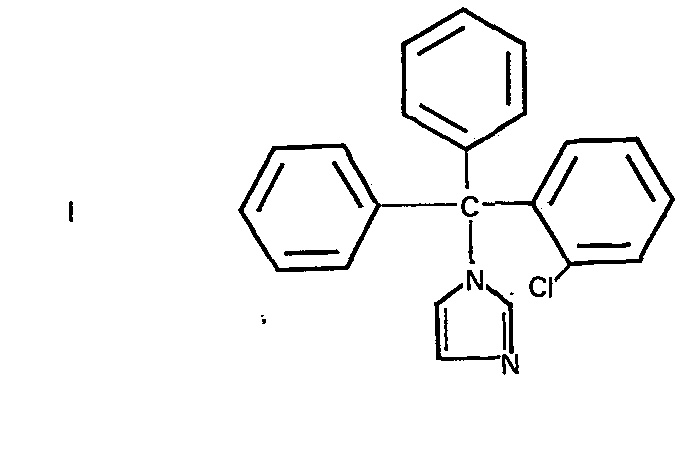


- Zahlreiche weitere antimykotisch wirksame Azolderivate sind bekannt aus der DE-OS 2 430 039. Sie können ebenfalls in den erfindungsgemässen Mitteln als Wirkstoffe dienen.
- Aus der DE-A-2 461 406 sind zwar schon Zubereitungen mit einem Gehalt an antimykotischen Azolderivaten, Benzylalkohol und Spreitmitteln bekannt. Aus DRUG DESIGN, E.J. Ariens, Volume IV, Academic Press, 1976, Seite 172, ist ausserdem bekannt, dass Benzylalkohol die Penetration von Arzneimitteln durch die Haut begünstigt. Bei den erfindungsgemässen Zubereitungen ist jedoch eine Penetration des Wirkstoffes durch die Haut durchaus unerwünscht, weil die Wirkung auf der Oberfläche der Haut stattfinden soll. Es war nun sehr überraschend, dass in den erfindungsgemässen Zubereitungen trotz der Gegenwart des Benzylalkohols praktisch keine Penetration stattfindet. Dieser Effekt wird erreicht durch die erfindungsgemässen Mengenverhältnisse, die durch die DE-A-2 461 406 keinesfalls offenbart oder nahegelegt werden.
- Gemäss der Erfindung werden die folgenden Spreitmittel verwendet:
- Isopropylmyristat, Isopropylpalmitat, Capryl/Caprinsäureester von gesättigten Fettalkoholen der Kettenlänge C12-C18, wachsartige Fettsäureester wie künstliches Entenbürzeldrüsenfett, Silikonöle, lsopropylmyristat/Isopropyistearat/Isopropylpaimitat-Gemisch, 2-Octyldodecanol, Ölsäuredecylester oder Koskosfettsäureisopropylester.
- Folgende Hilfs- und/oder Formulierungs-Grundhilfsstoffe können bei der Herstellung der erfindungsgemässen Mittel verwendet werden.


- Weiterhin können auch folgende Formulierungshilfsstoffe verwendet werden:
- Glycerin, Paraffin dickflüssig, Paraffin dünnflüssig, Triethanolamin, Collagen, Allantoin, Novantisolsäure, Parfümöle.
- Ferner sind geeignet:
- a. Substanzen, die z.B. eine Suspension stabilisieren können, z.B. kolloidale Kieselsäure, Montmorillonite u.a.
- b. Tenside (beinhaltet Emulgatoren und Netzmittel), z.B.
- 1. anionaktive, wie Na-Laurylsulfat, Fettalkoholethersulfate, Mono/Dialkylpolyglykolether-orthophosphorsäureester-Monoethanolaminsalz;
- 2. kationaktive, wie Cetyltrimethylammoniumchlorid;
- 3. ampholytische, wie Di-Na-N-lauryl-ß-ininodipropionat oder Lecithin;
- 4. nicht ionogene, z.B. polyoxyethyliertes Rizinusöl, polyoxyethyliertes Sorbitan-Monooleat, Sorbitan-Monostearat, Cetylalkohol. Glycerinmonostearat, Polyoxyethylenstearat, Alkylphenolpolyglykolether.
- c. Stabilisatoren zur Verhinderung des bei einigen Wirkstoffen eintretenden chemischen Abbaues wie Antioxydantien, z.B. Tocopherole, Butylhydroxyanisol.
- d. Weichmacher, z.B. Propylenglykol, Glycerin, Di-und tripropylenglykol, Triaethanolamin, Wachse.
- Als Gelbildner kommen solche makromolekularen Verbindungen in Frage, die sich sowohl in Wasser als auch in organischen Lösungsmitteln lösen bzw. anquellen können und nach dem Trocknen eine Art Film bilden.
- Folgt man einer Einteilung der makromolekularen Hilfsstoffe, (Keipert et al., Die Pharmazie 28, 145 bis 183 (1973)1, so kommen vor allem ionische Makromoleküle in deren Salzform zur Anwendung. Dies sind unter anderem Natriumcarboxymethylcellulose, Polyacrylsäure, Polymethacrylsäure und deren Salze, Natriumamylopektinsemiglykolat, Alginsäure und Propylenglykol-Alginat als Natriumsalz, arabisches Gummi, Xanthan-Gummi, Guar-Gummi.
- Amphotere Makromoleküle wie Protein-Derivate, z.B. Gelatine sind ebenso geeignet wie nichtionische Polymere, z.B. Methylcellulose, Hydroxypropylcellulose und lösliche Stärken, die obige Anforderungen erfüllen.
- Als Lösungsmittel sind Wasser und auch alle mit Wasser mischbaren Lösungsmittel geeignet. In Betracht kommen z.B. Alkanole wie Ethanol und Isopropylalkohol, Propylenglykol, Methylcellosolve, Cellosolve, Ester, Morpholine, Dioxan, Dimethylsulfoxid, Dimethylformamid, Tetrahydrofuran, Cyclohexanon.
- Es können bei der Herstellung der erfindungsgemässen Formulierungen ein oder mehrere Lösungsmittel eingesetzt werden.
-

- Die Mischung wird gerührt und bei 70°C geschmolzen.
-

- Zur auf 75°C erwärmten Phase II wird die auf 70°C erwärmte Phase I unter Rühren hinzugefügt. Man lässt langsam auf 40°C abkühlen, gibt Phase III zu und lässt unter Rühren auf Raumtemperatur abkühlen. Die Rohemulsion wird bei 20 bis 25°C im Hochdruckhomogenisator homogenisiert.
- In analoger Weise werden die Beispiele 2 und 3 verarbeitet.

-

-

-

-

-

- Die Mischung wird 10 Minuten bei 70°C gerührt und geschmolzen.
-

- Man dispergiert mit Turrax, lässt 2 Stunden quellen und neutralisiert dann mit 0,155 g 45%iger Natronlauge.
- Zur 75°C heissen Phase II gibt man die 70°C warme Phase I unter Rühren hinzu und kühlt auf 45°C ab. Bei 45°C Carbopol-Schleim einrühren und bis 40°C weiter abkühlen. Bei 40°C 1,00 g Collagen zugeben und auf 25°C abkühlen. 1,0 g Lombazol in 3,0 g Benzylalkohol lösen und zur Phase I und II zugeben.
- Anschliessend wird 0,600 g Parfum hinzugegeben und die Rohemulsion unter Rühren bei 20°C bis 25°C im Hochdruckhomogenisator homogenisiert.
- In analoger Weise werden die Beispiele 8, 9,10,11 verarbeitet.
-

-

-


-

-

-


-

-

- Wirksamkeit der erfindungsgemässen Mittel am Trichophyton-infizierten Meerschweinchen.
- Als Testmodell zur vergleichenden Wirksamkeitsprüfung der erfindungsgemässen Formulierungen verwendeten wir Trichophyton-infizierte Pirbrightwhite-Meerschweinchen mit einem durchschnittlichen Gewicht von 600 g. Die Tiere wurde auf dem Rücken mit einer elektrischen Haarschneidmaschine sogeschoren, dass ca. 1/10 mm lange Haarstümpfe stehen blieben.
- Die Infektion mit Trichophyton mentagrophytes erfolgte durch leichtes Verreiben einer 24 Stunden in Sabouraud-Nährlösung angekeimten Sporensuspension des Erregers auf einer ca. 2 x 2 cm grossen Fläche des geschorenen Rückens der Tiere. Aufgetragen wurden pro Tier 0,5 ml Keimsuspension, die 1 - 3 x 10⁵ infektiöse Pilzpartikel enthielten.
- Bei diesem Infektionsmodus zeigen sich 2 - 3 Tage post infectionem die ersten Symptome der Dermatophytose als Rötung und Schuppung der Haut. Bei unbehandelten Tieren ist ca. 14 Tage p.i. die Dermatophytose maximal ausgeprägt. Flächiger Haarausfall und blutige Integument-Defekte innerhalb einer entzündlich veränderten, schuppigen Randzone.
- Die zu prüfenden Formulierungen wurden 1 mal, am 2. Tag post infectionem, lokal auf die gerötete Infektionsstelle der Tiere appliziert und mit einem Hornspatel leicht verrieben. Es wurden jeweils 0,5 ml der Formulierungen = 5 mg Wirkstoff (1 %ige Formulierung) aufgetragen. Die Bewertung des Infektionsablaufs erfolgte täglich bis zum 20. Tag p.i.
- Die Testergebnisse sind aus der nachstehenden Tabelle ersichtlich.

- Verwendet man anstelle der erfindungsgemässen Formulierungen, die keinen Benzylalkohol und kein Spreitmittel enthalten, so wird ein Effekt, der dem der erfindungsgemässen Formulierungen entspricht, erst nach dreimaliger Applikation erreicht.
Claims (5)


Priority Applications (1)
| Application Number | Priority Date | Filing Date | Title |
|---|---|---|---|
| AT81109946T ATE11219T1 (de) | 1980-12-05 | 1981-11-27 | Antimykotische mittel in emulsionsform mit hoher wirkstoff-freisetzung. |
Applications Claiming Priority (2)
| Application Number | Priority Date | Filing Date | Title |
|---|---|---|---|
| DE3045913 | 1980-12-05 | ||
| DE19803045913 DE3045913A1 (de) | 1980-12-05 | 1980-12-05 | Antimykotische mittel mit hoher wirkstoff-freisetzung |
Publications (2)
| Publication Number | Publication Date |
|---|---|
| EP0054205A1 EP0054205A1 (de) | 1982-06-23 |
| EP0054205B1 true EP0054205B1 (de) | 1985-01-16 |
Family
ID=6118422
Family Applications (1)
| Application Number | Title | Priority Date | Filing Date |
|---|---|---|---|
| EP81109946A Expired EP0054205B1 (de) | 1980-12-05 | 1981-11-27 | Antimykotische Mittel in Emulsionsform mit hoher Wirkstoff-Freisetzung |
Country Status (13)
| Country | Link |
|---|---|
| EP (1) | EP0054205B1 (de) |
| JP (1) | JPS57120516A (de) |
| KR (1) | KR880000724B1 (de) |
| AT (1) | ATE11219T1 (de) |
| AU (1) | AU546451B2 (de) |
| CA (1) | CA1180661A (de) |
| DE (2) | DE3045913A1 (de) |
| DK (1) | DK538481A (de) |
| ES (1) | ES8400241A1 (de) |
| FI (1) | FI813883L (de) |
| IL (1) | IL64434A0 (de) |
| NO (1) | NO158922C (de) |
| ZA (1) | ZA818430B (de) |
Cited By (4)
| Publication number | Priority date | Publication date | Assignee | Title |
|---|---|---|---|---|
| RU2379027C2 (ru) * | 2004-07-08 | 2010-01-20 | Драгтек Корпорейшн | Система доставки |
| US8932624B2 (en) | 2007-06-20 | 2015-01-13 | The Trustees Of Columbia University In The City Of New York | Bio-film resistant surfaces |
| US9497975B2 (en) | 2011-12-06 | 2016-11-22 | The Trustees Of Columbia University In The City Of New York | Broad spectrum natural preservative composition |
| US9511040B2 (en) | 2007-06-20 | 2016-12-06 | The Trustees Of Columbia University In The City Of New York | Skin and surface disinfectant compositions containing botanicals |
Families Citing this family (25)
| Publication number | Priority date | Publication date | Assignee | Title |
|---|---|---|---|---|
| CH655656B (de) * | 1982-10-07 | 1986-05-15 | ||
| DE3244027A1 (de) * | 1982-11-27 | 1984-05-30 | Bayer Ag, 5090 Leverkusen | Antimykotische mittel mit hoher wirkstoff-freisetzung in form von gelsystemen |
| DE3311700A1 (de) * | 1983-03-30 | 1984-10-04 | Bayer Ag | Antimykotische mittel mit hoher wirkstoff-freisetzung in form von loesung und spray |
| DE3311701A1 (de) * | 1983-03-30 | 1984-10-04 | Bayer Ag | Antimykotische mittel mit hoher wirkstoff-freisetzung in form von creme |
| DE3323832A1 (de) * | 1983-07-01 | 1985-01-03 | Troponwerke Gmbh & Co Kg | Etofenamat-zubereitung |
| US4731384A (en) * | 1983-07-01 | 1988-03-15 | Troponwerke Gmbh & Co, Kg | Etofenamate formulation |
| DE3323833A1 (de) * | 1983-07-01 | 1985-01-03 | Troponwerke Gmbh & Co Kg | Etofenamat-zubereitung |
| JPS6058914A (ja) * | 1983-09-12 | 1985-04-05 | Shionogi & Co Ltd | イミダゾ−ル系抗真菌性外用ゲル製剤 |
| CS253719B2 (en) * | 1984-03-07 | 1987-12-17 | Janssen Pharmaceutica Nv | Emulsible concentrate with fungicide activity and process for preparing thereof |
| DE3520098A1 (de) * | 1985-06-05 | 1986-12-11 | Bayer Ag, 5090 Leverkusen | Azolderivate enthaltende formulierungen sowie ihre verwendung zur atraumatischen nagelentfernung |
| JPS6261915A (ja) * | 1985-09-10 | 1987-03-18 | Taisho Pharmaceut Co Ltd | 抗真菌外用製剤 |
| DE3600947A1 (de) * | 1986-01-15 | 1987-07-16 | Kali Chemie Pharma Gmbh | Antimykotische emulsionen |
| HU200914B (en) * | 1987-03-09 | 1990-09-28 | Horvath Gyoengyi Lengyelne | Process for producing new medical dosage unit suitable for local treatment of fungus infection of nails |
| JPH01246219A (ja) * | 1988-03-25 | 1989-10-02 | Nippon Nohyaku Co Ltd | 抗真菌外用クリーム組成物 |
| JPH0725675B2 (ja) * | 1989-05-08 | 1995-03-22 | ホーユー株式会社 | 液状真菌症治療剤 |
| BG95755A (bg) * | 1991-01-19 | 1993-12-24 | Hoechst Aktiengesellschaft | Метод за получаване на препаративна форма за приложение чрез поливане на антихелминтни средства |
| RU2120305C1 (ru) * | 1997-11-27 | 1998-10-20 | Открытое акционерное общество Химико-фармацевтический комбинат "Акрихин" | Фармацевтический состав, обладающий противогрибковой активностью, и способ его получения |
| KR20020045152A (ko) * | 2000-12-08 | 2002-06-19 | 류정열 | 호스클램프용 클램프홀더 |
| EP1805465A1 (de) * | 2004-07-09 | 2007-07-11 | Pandura Farms PTY Ltd | Sequenzielle kühlverfahren und -vorrichtung |
| US9687429B2 (en) | 2007-06-20 | 2017-06-27 | The Trustees Of Columbia University In The City Of New York | Antimicrobial compositions containing low concentrations of botanicals |
| US9981069B2 (en) | 2007-06-20 | 2018-05-29 | The Trustees Of Columbia University In The City Of New York | Bio-film resistant surfaces |
| EP2448416A4 (de) * | 2009-06-30 | 2013-03-20 | Univ Columbia | Antimikrobielle/konservierende zusammensetzungen mit pflanzlichen stoffen |
| DK2773334T3 (da) | 2011-11-03 | 2019-12-09 | Univ Columbia | Sammensætning med forlænget antimikrobiel aktivitet |
| US9968101B2 (en) | 2011-11-03 | 2018-05-15 | The Trustees Of Columbia University In The City Of New York | Botanical antimicrobial compositions |
| CN111423328B (zh) * | 2020-04-02 | 2022-04-15 | 广州隽沐生物科技股份有限公司 | 油酸癸酯的制备方法 |
Family Cites Families (7)
| Publication number | Priority date | Publication date | Assignee | Title |
|---|---|---|---|---|
| US3502594A (en) * | 1965-12-28 | 1970-03-24 | Gerhard W Ahrens | Synergistic antioxidant composition for natural oleaginous materials |
| US3483008A (en) * | 1966-08-01 | 1969-12-09 | Daniel A Naeve | Method of preparing a water-soluble protein lotion |
| DE2333355C2 (de) * | 1973-06-30 | 1984-01-19 | Bayer Ag, 5090 Leverkusen | Antimikrobielle Mittel |
| DE2430039C2 (de) * | 1974-06-22 | 1983-11-10 | Bayer Ag, 5090 Leverkusen | Climbazol in kosmetischen Mitteln |
| DE2461406C2 (de) * | 1974-12-24 | 1984-06-14 | Bayer Ag, 5090 Leverkusen | Azolyl-(1)-methane und deren Salze, Verfahren zu ihrer Herstellung sowie diese enthaltende Arzneimittel |
| DE2628421A1 (de) * | 1976-06-24 | 1978-01-05 | Bayer Ag | Antimikrobielle mittel |
| DE2811916A1 (de) * | 1978-03-18 | 1979-09-27 | Bayer Ag | Antimikrobielle mittel |
-
1980
- 1980-12-05 DE DE19803045913 patent/DE3045913A1/de not_active Withdrawn
-
1981
- 1981-11-19 NO NO813930A patent/NO158922C/no unknown
- 1981-11-27 DE DE8181109946T patent/DE3168402D1/de not_active Expired
- 1981-11-27 AT AT81109946T patent/ATE11219T1/de not_active IP Right Cessation
- 1981-11-27 EP EP81109946A patent/EP0054205B1/de not_active Expired
- 1981-12-02 IL IL64434A patent/IL64434A0/xx not_active IP Right Cessation
- 1981-12-03 FI FI813883A patent/FI813883L/fi not_active Application Discontinuation
- 1981-12-04 AU AU78263/81A patent/AU546451B2/en not_active Ceased
- 1981-12-04 CA CA000391479A patent/CA1180661A/en not_active Expired
- 1981-12-04 DK DK538481A patent/DK538481A/da not_active Application Discontinuation
- 1981-12-04 ES ES507726A patent/ES8400241A1/es not_active Expired
- 1981-12-04 ZA ZA818430A patent/ZA818430B/xx unknown
- 1981-12-04 JP JP56194672A patent/JPS57120516A/ja active Granted
- 1981-12-05 KR KR1019810004748A patent/KR880000724B1/ko not_active Expired
Non-Patent Citations (1)
| Title |
|---|
| E.J. ARIENS "Drug Design", Vol. IV, Academie Press (1978), p. 172 * |
Cited By (4)
| Publication number | Priority date | Publication date | Assignee | Title |
|---|---|---|---|---|
| RU2379027C2 (ru) * | 2004-07-08 | 2010-01-20 | Драгтек Корпорейшн | Система доставки |
| US8932624B2 (en) | 2007-06-20 | 2015-01-13 | The Trustees Of Columbia University In The City Of New York | Bio-film resistant surfaces |
| US9511040B2 (en) | 2007-06-20 | 2016-12-06 | The Trustees Of Columbia University In The City Of New York | Skin and surface disinfectant compositions containing botanicals |
| US9497975B2 (en) | 2011-12-06 | 2016-11-22 | The Trustees Of Columbia University In The City Of New York | Broad spectrum natural preservative composition |
Also Published As
| Publication number | Publication date |
|---|---|
| DE3045913A1 (de) | 1982-07-08 |
| FI813883A7 (fi) | 1982-06-06 |
| ATE11219T1 (de) | 1985-02-15 |
| EP0054205A1 (de) | 1982-06-23 |
| KR830007071A (ko) | 1983-10-12 |
| JPS57120516A (en) | 1982-07-27 |
| NO813930L (no) | 1982-06-07 |
| AU546451B2 (en) | 1985-09-05 |
| IL64434A0 (en) | 1982-03-31 |
| AU7826381A (en) | 1982-06-10 |
| KR880000724B1 (ko) | 1988-04-29 |
| DE3168402D1 (en) | 1985-02-28 |
| ES507726A0 (es) | 1983-11-01 |
| DK538481A (da) | 1982-06-06 |
| JPH0380775B2 (de) | 1991-12-26 |
| NO158922C (no) | 1988-11-23 |
| CA1180661A (en) | 1985-01-08 |
| ES8400241A1 (es) | 1983-11-01 |
| ZA818430B (en) | 1982-11-24 |
| NO158922B (no) | 1988-08-08 |
| FI813883L (fi) | 1982-06-06 |
Similar Documents
| Publication | Publication Date | Title |
|---|---|---|
| EP0054205A1 (de) | Antimykotische Mittel in Emulsionsform mit hoher Wirkstoff-Freisetzung | |
| EP0058887B1 (de) | Antimykotische Mittel mit hoher Wirkstoff-Freisetzung in Form von Stiften | |
| EP0055397B1 (de) | Antimykotische Mittel mit hoher Wirkstoff-Freisetzung in Form von elastischen Flüssig-Pflastern | |
| DE69427639T3 (de) | Verwendung von nicht-ionischen oberflächenaktiven substanzen in retinoid enthaltenden stabilen topischen zusammensetzungen | |
| DE4215677B4 (de) | Pharmazeutisches Mittel | |
| EP0055396B1 (de) | Antimykotische Mittel mit hoher Wirkstoff-Freisetzung in Form von elastischen Flüssig-Pflastern | |
| DE2721831A1 (de) | Entzuendungshemmende, topisch anzuwendende arzneipraeparate | |
| DE3204124A1 (de) | Antimykotische tampons mit hoher wirkstoff-freisetzung | |
| DE3781182T2 (de) | Tamoxifen zur topischen verwendung. | |
| DE112009005131T5 (de) | Topisches Medikament zur Behandlung von Psoriasis | |
| DE69402259T2 (de) | Zusammensetzungen enthaltend 8-Hydroxychinolin zur Behandlung hyperproliferativer Hautkrankheiten | |
| DE60103284T2 (de) | Antifungizide zusammensetzung von ketoconazole zum auftragen | |
| EP1196159B1 (de) | Verwendung von tosylchloramid(en) zur behandlung von erkrankungen der haut, der schleimhaut, von organen und geweben | |
| EP0928192A1 (de) | Antimykotisches gel mit hoher wirkstofffreisetzung | |
| WO2005018585A1 (de) | Pharmazeutische und kosmetische formulierungen zur behandlung der nägel | |
| DE3244027A1 (de) | Antimykotische mittel mit hoher wirkstoff-freisetzung in form von gelsystemen | |
| DE69203071T2 (de) | Verfahren zur erhoehung der therapeutischen wirksamkeit fettloeslicher fungizideaus der familie der imidazole sowie mittel zur durchfuehrung dieses verfahren. | |
| EP2316443A1 (de) | Arzneimittelformulierung zur Behandlung von Nagelerkrankungen | |
| CH660304A5 (de) | Antimykotische mittel mit hoher wirkstoff-freisetzung enthaltend bifonazol in form von loesung und spray. | |
| DE3243544A1 (de) | Antimykotische mittel fuer einmalige gynaekologische behandlung | |
| DE3904674A1 (de) | Verwendung einer wirkstoffkombination zur behandlung rheumatischer erkrankungen | |
| DE3321043A1 (de) | Antimykotische mittel fuer einmalige gynaekologische behandlung | |
| DE19641259A1 (de) | Arzneimittel auf Basis von Diclofenac | |
| DE1918907C3 (de) | Antiseborrhoeisches Mittel | |
| CH660126A5 (de) | Antimykotisches mittel und verfahren zu seiner herstellung. |
Legal Events
| Date | Code | Title | Description |
|---|---|---|---|
| PUAI | Public reference made under article 153(3) epc to a published international application that has entered the european phase |
Free format text: ORIGINAL CODE: 0009012 |
|
| 17P | Request for examination filed |
Effective date: 19811128 |
|
| AK | Designated contracting states |
Designated state(s): AT BE CH DE FR GB IT NL SE |
|
| ITF | It: translation for a ep patent filed | ||
| GRAA | (expected) grant |
Free format text: ORIGINAL CODE: 0009210 |
|
| AK | Designated contracting states |
Designated state(s): AT BE CH DE FR GB IT LI NL SE |
|
| REF | Corresponds to: |
Ref document number: 11219 Country of ref document: AT Date of ref document: 19850215 Kind code of ref document: T |
|
| REF | Corresponds to: |
Ref document number: 3168402 Country of ref document: DE Date of ref document: 19850228 |
|
| ET | Fr: translation filed | ||
| PLBI | Opposition filed |
Free format text: ORIGINAL CODE: 0009260 |
|
| 26 | Opposition filed |
Opponent name: HEXAL-CHEMIE GMBH & CO. KG Effective date: 19851016 |
|
| NLR1 | Nl: opposition has been filed with the epo |
Opponent name: HEXAL-CHEMIE GMBH & CO. KG |
|
| PLBN | Opposition rejected |
Free format text: ORIGINAL CODE: 0009273 |
|
| STAA | Information on the status of an ep patent application or granted ep patent |
Free format text: STATUS: OPPOSITION REJECTED |
|
| 27O | Opposition rejected |
Effective date: 19890502 |
|
| NLR2 | Nl: decision of opposition | ||
| PGFP | Annual fee paid to national office [announced via postgrant information from national office to epo] |
Ref country code: DE Payment date: 19911024 Year of fee payment: 11 Ref country code: AT Payment date: 19911024 Year of fee payment: 11 |
|
| PGFP | Annual fee paid to national office [announced via postgrant information from national office to epo] |
Ref country code: FR Payment date: 19911030 Year of fee payment: 11 |
|
| PGFP | Annual fee paid to national office [announced via postgrant information from national office to epo] |
Ref country code: CH Payment date: 19911105 Year of fee payment: 11 |
|
| PGFP | Annual fee paid to national office [announced via postgrant information from national office to epo] |
Ref country code: SE Payment date: 19911111 Year of fee payment: 11 |
|
| PGFP | Annual fee paid to national office [announced via postgrant information from national office to epo] |
Ref country code: GB Payment date: 19911115 Year of fee payment: 11 |
|
| PGFP | Annual fee paid to national office [announced via postgrant information from national office to epo] |
Ref country code: BE Payment date: 19911127 Year of fee payment: 11 |
|
| ITTA | It: last paid annual fee | ||
| PGFP | Annual fee paid to national office [announced via postgrant information from national office to epo] |
Ref country code: NL Payment date: 19911130 Year of fee payment: 11 |
|
| PG25 | Lapsed in a contracting state [announced via postgrant information from national office to epo] |
Ref country code: GB Effective date: 19921127 Ref country code: AT Effective date: 19921127 |
|
| PG25 | Lapsed in a contracting state [announced via postgrant information from national office to epo] |
Ref country code: SE Effective date: 19921128 |
|
| PG25 | Lapsed in a contracting state [announced via postgrant information from national office to epo] |
Ref country code: LI Effective date: 19921130 Ref country code: CH Effective date: 19921130 Ref country code: BE Effective date: 19921130 |
|
| BERE | Be: lapsed |
Owner name: BAYER A.G. Effective date: 19921130 |
|
| PG25 | Lapsed in a contracting state [announced via postgrant information from national office to epo] |
Ref country code: NL Effective date: 19930601 |
|
| NLV4 | Nl: lapsed or anulled due to non-payment of the annual fee | ||
| GBPC | Gb: european patent ceased through non-payment of renewal fee |
Effective date: 19921127 |
|
| PG25 | Lapsed in a contracting state [announced via postgrant information from national office to epo] |
Ref country code: FR Effective date: 19930730 |
|
| REG | Reference to a national code |
Ref country code: CH Ref legal event code: PL |
|
| PG25 | Lapsed in a contracting state [announced via postgrant information from national office to epo] |
Ref country code: DE Effective date: 19930803 |
|
| REG | Reference to a national code |
Ref country code: FR Ref legal event code: ST |
|
| EUG | Se: european patent has lapsed |
Ref document number: 81109946.4 Effective date: 19930610 |
|
| APAH | Appeal reference modified |
Free format text: ORIGINAL CODE: EPIDOSCREFNO |