EP0056890B1 - Liaison de matières plastiques et appareil pour la préparation de matières plastiques pour leur liaison - Google Patents
Liaison de matières plastiques et appareil pour la préparation de matières plastiques pour leur liaison Download PDFInfo
- Publication number
- EP0056890B1 EP0056890B1 EP81300356A EP81300356A EP0056890B1 EP 0056890 B1 EP0056890 B1 EP 0056890B1 EP 81300356 A EP81300356 A EP 81300356A EP 81300356 A EP81300356 A EP 81300356A EP 0056890 B1 EP0056890 B1 EP 0056890B1
- Authority
- EP
- European Patent Office
- Prior art keywords
- flame
- gas
- burner
- current
- produced
- Prior art date
- Legal status (The legal status is an assumption and is not a legal conclusion. Google has not performed a legal analysis and makes no representation as to the accuracy of the status listed.)
- Expired
Links
Images
Classifications
-
- F—MECHANICAL ENGINEERING; LIGHTING; HEATING; WEAPONS; BLASTING
- F23—COMBUSTION APPARATUS; COMBUSTION PROCESSES
- F23M—CASINGS, LININGS, WALLS OR DOORS SPECIALLY ADAPTED FOR COMBUSTION CHAMBERS, e.g. FIREBRIDGES; DEVICES FOR DEFLECTING AIR, FLAMES OR COMBUSTION PRODUCTS IN COMBUSTION CHAMBERS; SAFETY ARRANGEMENTS SPECIALLY ADAPTED FOR COMBUSTION APPARATUS; DETAILS OF COMBUSTION CHAMBERS, NOT OTHERWISE PROVIDED FOR
- F23M11/00—Safety arrangements
- F23M11/04—Means for supervising combustion, e.g. windows
- F23M11/045—Means for supervising combustion, e.g. windows by observing the flame
-
- B—PERFORMING OPERATIONS; TRANSPORTING
- B29—WORKING OF PLASTICS; WORKING OF SUBSTANCES IN A PLASTIC STATE IN GENERAL
- B29C—SHAPING OR JOINING OF PLASTICS; SHAPING OF MATERIAL IN A PLASTIC STATE, NOT OTHERWISE PROVIDED FOR; AFTER-TREATMENT OF THE SHAPED PRODUCTS, e.g. REPAIRING
- B29C59/00—Surface shaping of articles, e.g. embossing; Apparatus therefor
- B29C59/08—Surface shaping of articles, e.g. embossing; Apparatus therefor by flame treatment ; using hot gases
-
- B—PERFORMING OPERATIONS; TRANSPORTING
- B29—WORKING OF PLASTICS; WORKING OF SUBSTANCES IN A PLASTIC STATE IN GENERAL
- B29K—INDEXING SCHEME ASSOCIATED WITH SUBCLASSES B29B, B29C OR B29D, RELATING TO MOULDING MATERIALS OR TO MATERIALS FOR MOULDS, REINFORCEMENTS, FILLERS OR PREFORMED PARTS, e.g. INSERTS
- B29K2023/00—Use of polyalkenes or derivatives thereof as moulding material
- B29K2023/10—Polymers of propylene
- B29K2023/12—PP, i.e. polypropylene
Definitions
- This invention relates to the bonding of plastics materials and more particularly to the preparation of plastics materials for bonding to like or different plastics material or to non-plastics material using an adhesive.
- Polypropylene can be bonded to itself, or even to other plastics materials or to non-plastics materials, with a bond strength which is adequate for many purposes using an adhesive. It is known that the bond strength attainable can be improved if prior to bonding with adhesive the surface of the polypropylene or other plastics material is pre-treated by exposure to a hot, blue gas flame for a few seconds in order to achieve an adhesive compatible, oxidised (dull) finish of the said surface. However, despite such oxidative pre-treatment it has not hitherto been possible to produce a truly adequate bond capable of withstanding substantial stress so that plastics products incorporating the bond can be employed for structural purposes.
- a method for the pre-treatment of plastics surfaces prior to bonding of the plastics surfaces to other surfaces by use of an adhesive which comprises exposing the plastics surface to a hot blue gas flame having an oxygen content as little as possible in excess of that which produces the maximum ionisation of gases within the blue zone of the gas flame whereby a dull adhesive- compatible finish is produced on the surface of the plastics material, the oxygen content of the gas at which the maximum ionisation of gases within the blue zone occurs being determined by inserting into the flame a pair of electrically connected current conductors having a gap therebetween, monitoring the minute current produced in the flame, usually after electronic amplification, and setting the oxygen content of the gas flame to a value as little as possible in excess of that at which the maximum current or voltage is produced in the flame and conducted therefrom by said current conductors.
- apparatus for use in the method set forth in the preceding paragraph which comprises a gas-fuelled burner constituted by a tube for producing a flame for rendering dull the surface of a plastics article to be bonded, the burner having gas inlet means, gas outlet means, current collector means for positioning within the flame produced by the burner, an amplifier for amplifying the current or voltage produced as a result of ionisation within the flame and means for reading or recording the current or voltage thereby produced.
- the method of this invention is particularly well suited to the pre-treatment of polypropylene surfaces to be bonded to like or different plastics materials. Nevertheless, the method is generally applicable to the bonding of plastics materials which benefit from subjecting to surface oxidation and hence dulling before undergoing bonding.
- the method of the invention has been found to give good results when applied to the pre-treatment of fluorine-containing polymers such as polytetrafluorethylene, polycarbonates, silicon resins, and melamine-formaldehyde resins. In the case of the last identified plastics, it has been found that the method of the invention places them in a condition in which they can be bonded by means of cyanoacrylate resins which it has not hitherto been possible to employ with such plastics.
- plastics materials pre-treated by the method of the invention may be bonded to other materials such as properly degreased metals using, for example, such silicon adhesives as Silcoset 152 and 153 and Dow Corning RTV adhesives. Bonding to brickwork can be achieved using silicone-based sealing compounds which are currently available in the building trade.
- the extent of exposure of a plastics surface to the blue zone of a flame will depend upon the particular material being treated and will need to be determined by trial for each particular material. Whilst the best test of the success of the pre-treatment will lie in sophisticated methods of structural testing, in practice, in fact, the quality of preparation can generally be evaluated by viewing the appearance of the treated area to see that it has a high degree of dullness and by carrying out simple wetting tests. In general, it has been found that the method of this invention produces particularly good results when an organosilicon adhesive which cures to a resilient mass is produced from the adhesive.
- the ionisation which occurs in the blue oxidising zone of the treatment flame can conveniently be determined by electronic amplification of the minute current produced in the flame when a suitable heat resistant gauze or even a pair of electronically connected wires with a gap therebetween is inserted into the flame to produce a current of the order usually of a few nano amps but which may amount to a few micro amps, depending on the current collector used.
- a gauze may be used, the word "gauze” is used herein to denote any electrically conductive and usually metal structure which nevertheless possesses a large open surface area to allow the flame to penetrate therethrough to act on the plastics material being treated.
- gauzes in the conventional sense may be employed, it is also possible to employ perforated or expanded metal sheet structures.
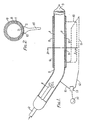
- a burner embodying this invention comprises an angled metal, for example copper, tube 1 having an inlet tube 2 for gas and air passing through one end thereof and being closed at the opposite end 3.
- the inlet tube 2 is closed at its inner end and formed with a plurality of circumferentially disposed outlets 4 thereby ensuring an even distribution of combustion mixture within the tube 1 and helping to ensure that an even flame height is achieved.
- the tube 1 is surrounded by a copper tube 6.
- the inner tube 1 is formed with an opening 7 which is matched by an opening 10 in the copper tube 6 and over which double thickness opening is laid a stainless steel fine mesh gauge 8.
- the gauze is held in position by an outer tube 9 around the copper tube 6 and preferably made of aluminium the high thermal conductivity of which prevents the setting up of excessive temperature along the edge of the flame.
- the opening 7 in the inner tube 6 is narrower than the corresponding opening 10 in the copper tube 6.
- a suitable supported metal gauze 11 Spaced apart from the gauze 8 is a suitable supported metal gauze 11 which will generally be much coarser than the gauze 8 and from which extends a lead 12 to a current amplifier 13 fitted with a microammeter 14.
- the amplifier 13 is additionally connected through a lead 15 to the copper tube 1.
- a mixture of gas and air is fed into the angled copper tube 1 through the inlet tube 2 and outlets 4.
- a flame 16 whose configuration is shown better in Figure 2 is produced.
- This elongate flame is played over the surface of a sheet of plastics materials which is to undergo adhesive bonding to achieve dulling of the surface.
- the metal gauze 11 is positioned in the flame produced, preferably in the blue part thereof, and ionisation which takes place in the flame and which is at a maximum in the blue part thereof is conducted to the amplifier 13 and the amplifier current thereby produced is read off by means of the microammeter 14.
- control of the flame is effected until, for a particular combination of gas, for example propane or butane, and oxidising gas, generally air or oxygen, ionisation is at a maximum and hence optimum pre-treatment of the plastics material is obtained.
- gas for example propane or butane
- oxidising gas generally air or oxygen
- a machine may be constructed for the flame treatment of zones along the edges of sheet plastics material, for example sheet polypropylene, according to this invention.
- sheet plastics material for example sheet polypropylene
- two of the burners shown in the accompanying drawings may be disposed on a carriage having a reversible drive mechanism to carry them at a substantially uniform rate along the edge to be treated.
- the burner flames play upon the respective ion collector gauzes and the minute current generated is electronically amplified as aforementioned to enable the optimum flame conditions to be established prior to setting the carriage in motion to effect pre-treatment of the sheet plastics material.
Landscapes
- Engineering & Computer Science (AREA)
- Chemical & Material Sciences (AREA)
- Combustion & Propulsion (AREA)
- Mechanical Engineering (AREA)
- General Engineering & Computer Science (AREA)
- Manufacture Of Macromolecular Shaped Articles (AREA)
- Adhesives Or Adhesive Processes (AREA)
- Treatments Of Macromolecular Shaped Articles (AREA)
- Application Of Or Painting With Fluid Materials (AREA)
- Lining Or Joining Of Plastics Or The Like (AREA)
Claims (12)
Priority Applications (3)
| Application Number | Priority Date | Filing Date | Title |
|---|---|---|---|
| AT81300356T ATE19607T1 (de) | 1981-01-27 | 1981-01-27 | Verbinden von kunststoffmaterialien und vorrichtung zum vorbereiten der kunststoffmaterialien fuer ihre verbindung. |
| EP81300356A EP0056890B1 (fr) | 1981-01-27 | 1981-01-27 | Liaison de matières plastiques et appareil pour la préparation de matières plastiques pour leur liaison |
| DE8181300356T DE3174537D1 (en) | 1981-01-27 | 1981-01-27 | Improvements in or relating to the bonding of plastics materials and apparatus for use in the preparation of plastics materials for bonding |
Applications Claiming Priority (1)
| Application Number | Priority Date | Filing Date | Title |
|---|---|---|---|
| EP81300356A EP0056890B1 (fr) | 1981-01-27 | 1981-01-27 | Liaison de matières plastiques et appareil pour la préparation de matières plastiques pour leur liaison |
Publications (3)
| Publication Number | Publication Date |
|---|---|
| EP0056890A2 EP0056890A2 (fr) | 1982-08-04 |
| EP0056890A3 EP0056890A3 (en) | 1983-06-15 |
| EP0056890B1 true EP0056890B1 (fr) | 1986-05-07 |
Family
ID=8188201
Family Applications (1)
| Application Number | Title | Priority Date | Filing Date |
|---|---|---|---|
| EP81300356A Expired EP0056890B1 (fr) | 1981-01-27 | 1981-01-27 | Liaison de matières plastiques et appareil pour la préparation de matières plastiques pour leur liaison |
Country Status (3)
| Country | Link |
|---|---|
| EP (1) | EP0056890B1 (fr) |
| AT (1) | ATE19607T1 (fr) |
| DE (1) | DE3174537D1 (fr) |
Family Cites Families (3)
| Publication number | Priority date | Publication date | Assignee | Title |
|---|---|---|---|---|
| BE637743A (fr) * | 1962-10-17 | |||
| SE328115B (fr) * | 1964-10-30 | 1970-09-07 | Du Pont | |
| JPS4885126A (fr) * | 1972-02-14 | 1973-11-12 |
-
1981
- 1981-01-27 AT AT81300356T patent/ATE19607T1/de not_active IP Right Cessation
- 1981-01-27 DE DE8181300356T patent/DE3174537D1/de not_active Expired
- 1981-01-27 EP EP81300356A patent/EP0056890B1/fr not_active Expired
Also Published As
| Publication number | Publication date |
|---|---|
| DE3174537D1 (en) | 1986-06-12 |
| EP0056890A2 (fr) | 1982-08-04 |
| EP0056890A3 (en) | 1983-06-15 |
| ATE19607T1 (de) | 1986-05-15 |
Similar Documents
| Publication | Publication Date | Title |
|---|---|---|
| US2372737A (en) | Torch for welding thermoplastic material | |
| US3188366A (en) | Heating process | |
| Li et al. | Analysis of an arc light mechanism and its application in sensing of the GTAW process | |
| JPS6326259A (ja) | ヒ−タおよび予め定められた温度輪郭を作り出すための方法 | |
| KR970067593A (ko) | 기판처리장치 | |
| EP0056890B1 (fr) | Liaison de matières plastiques et appareil pour la préparation de matières plastiques pour leur liaison | |
| FI63210C (fi) | Stroemmatare foer smaelt material | |
| GB2052379A (en) | Improvements in or relating to the bonding of plastics materials and apparatus for use in the preparation of plastics materials for bonding | |
| Komanduri et al. | On the diffusion wear of diamond in grinding pure iron | |
| CA1179469A (fr) | Fusionnement de materiaux plastiques et appareil de prepartion des materiaux a fusionner | |
| JPH08254525A (ja) | 水素炎イオン化検出器とその動作方法及び製造方法 | |
| ATE181267T1 (de) | Vorrichtung und verfahren zum herstellen von drahtelektroden zum funkenerosiven schneiden | |
| JPH0159099B2 (fr) | ||
| DE69732406D1 (de) | Herstellungsverfahren für Flächenheizkörper und damit hergestellte Flächenheizkörper | |
| FANG et al. | Combustion of a premixed system in stagnation flow—II. experiments with carbon monoxide oxidation | |
| Ivanova et al. | Investigation of the Thermally-Activated Parameters of Iron Deformation of the Quasi-Relaxation Method | |
| JPS55107421A (en) | Fusion welding and binding method for sheet-like body | |
| US3647193A (en) | Fire simulation facility | |
| Lum | Laser‐induced decomposition of PVC | |
| US3750957A (en) | Torch for thermochemical processing of work pieces | |
| SU1161305A1 (ru) | СПОСОБ КОНТРОЛЯ ПРОЦЕССА ДИФФУЗИОННОЙ СВАРКИ по температуре нагрева технологических прокладок, устанавливаемых между пуансоном и свариваемыми деталями | |
| US522328A (en) | Charring-tool for ornamenting wood | |
| EP0156545A3 (en) | Heat treatment with an autoregulating heater | |
| Di Giorgio et al. | Experimental study of fire propagation along a vertical wall in a lab scale device | |
| EP0151752A3 (fr) | Dispositif pour la spectroscopie atomique d'une substance |
Legal Events
| Date | Code | Title | Description |
|---|---|---|---|
| PUAI | Public reference made under article 153(3) epc to a published international application that has entered the european phase |
Free format text: ORIGINAL CODE: 0009012 |
|
| AK | Designated contracting states |
Designated state(s): AT BE CH DE FR IT LI LU NL SE |
|
| PUAL | Search report despatched |
Free format text: ORIGINAL CODE: 0009013 |
|
| AK | Designated contracting states |
Designated state(s): AT BE CH DE FR IT LI LU NL SE |
|
| 17P | Request for examination filed |
Effective date: 19830525 |
|
| GRAA | (expected) grant |
Free format text: ORIGINAL CODE: 0009210 |
|
| AK | Designated contracting states |
Kind code of ref document: B1 Designated state(s): AT BE CH DE FR IT LI LU NL SE |
|
| PG25 | Lapsed in a contracting state [announced via postgrant information from national office to epo] |
Ref country code: NL Effective date: 19860507 Ref country code: AT Effective date: 19860507 Ref country code: BE Effective date: 19860507 |
|
| REF | Corresponds to: |
Ref document number: 19607 Country of ref document: AT Date of ref document: 19860515 Kind code of ref document: T |
|
| REF | Corresponds to: |
Ref document number: 3174537 Country of ref document: DE Date of ref document: 19860612 |
|
| ITF | It: translation for a ep patent filed | ||
| ET | Fr: translation filed | ||
| NLV1 | Nl: lapsed or annulled due to failure to fulfill the requirements of art. 29p and 29m of the patents act | ||
| PG25 | Lapsed in a contracting state [announced via postgrant information from national office to epo] |
Ref country code: LU Free format text: LAPSE BECAUSE OF NON-PAYMENT OF DUE FEES Effective date: 19870131 |
|
| PLBE | No opposition filed within time limit |
Free format text: ORIGINAL CODE: 0009261 |
|
| STAA | Information on the status of an ep patent application or granted ep patent |
Free format text: STATUS: NO OPPOSITION FILED WITHIN TIME LIMIT |
|
| 26N | No opposition filed | ||
| PGFP | Annual fee paid to national office [announced via postgrant information from national office to epo] |
Ref country code: SE Payment date: 19900118 Year of fee payment: 10 |
|
| PGFP | Annual fee paid to national office [announced via postgrant information from national office to epo] |
Ref country code: LU Payment date: 19900123 Year of fee payment: 10 |
|
| PGFP | Annual fee paid to national office [announced via postgrant information from national office to epo] |
Ref country code: FR Payment date: 19900129 Year of fee payment: 10 |
|
| ITTA | It: last paid annual fee | ||
| PGFP | Annual fee paid to national office [announced via postgrant information from national office to epo] |
Ref country code: CH Payment date: 19900207 Year of fee payment: 10 |
|
| PGFP | Annual fee paid to national office [announced via postgrant information from national office to epo] |
Ref country code: DE Payment date: 19900328 Year of fee payment: 10 |
|
| PG25 | Lapsed in a contracting state [announced via postgrant information from national office to epo] |
Ref country code: SE Effective date: 19910128 |
|
| PG25 | Lapsed in a contracting state [announced via postgrant information from national office to epo] |
Ref country code: LI Effective date: 19910131 Ref country code: CH Effective date: 19910131 |
|
| PG25 | Lapsed in a contracting state [announced via postgrant information from national office to epo] |
Ref country code: FR Effective date: 19910930 |
|
| REG | Reference to a national code |
Ref country code: CH Ref legal event code: PL |
|
| PG25 | Lapsed in a contracting state [announced via postgrant information from national office to epo] |
Ref country code: DE Effective date: 19911001 |
|
| REG | Reference to a national code |
Ref country code: FR Ref legal event code: ST |
|
| EUG | Se: european patent has lapsed |
Ref document number: 81300356.3 Effective date: 19910910 |