EP0059335B1 - Procédé pour la préparation des esters de l'acide thréo-hydroxy-2 (méthoxy-4 phényl)-3 (nitro-2 phénylthio)-3 propionique - Google Patents
Procédé pour la préparation des esters de l'acide thréo-hydroxy-2 (méthoxy-4 phényl)-3 (nitro-2 phénylthio)-3 propionique Download PDFInfo
- Publication number
- EP0059335B1 EP0059335B1 EP82100807A EP82100807A EP0059335B1 EP 0059335 B1 EP0059335 B1 EP 0059335B1 EP 82100807 A EP82100807 A EP 82100807A EP 82100807 A EP82100807 A EP 82100807A EP 0059335 B1 EP0059335 B1 EP 0059335B1
- Authority
- EP
- European Patent Office
- Prior art keywords
- stannous
- integer
- stannic
- acid
- halide
- Prior art date
- Legal status (The legal status is an assumption and is not a legal conclusion. Google has not performed a legal analysis and makes no representation as to the accuracy of the status listed.)
- Expired
Links
- 0 CCCC(C)(*)Sc(cccc1)c1[N+]([O-])=O Chemical compound CCCC(C)(*)Sc(cccc1)c1[N+]([O-])=O 0.000 description 3
- JKIFPWHZEZQCQA-UHFFFAOYSA-N [O-][N+](c1ccccc1S)=O Chemical compound [O-][N+](c1ccccc1S)=O JKIFPWHZEZQCQA-UHFFFAOYSA-N 0.000 description 2
- ISCWXSVVEPSWGT-UHFFFAOYSA-N [O-][N+](C1=C=C=C=CC1S)=O Chemical compound [O-][N+](C1=C=C=C=CC1S)=O ISCWXSVVEPSWGT-UHFFFAOYSA-N 0.000 description 1
Classifications
-
- C—CHEMISTRY; METALLURGY
- C07—ORGANIC CHEMISTRY
- C07C—ACYCLIC OR CARBOCYCLIC COMPOUNDS
- C07C67/00—Preparation of carboxylic acid esters
-
- C—CHEMISTRY; METALLURGY
- C07—ORGANIC CHEMISTRY
- C07C—ACYCLIC OR CARBOCYCLIC COMPOUNDS
- C07C323/00—Thiols, sulfides, hydropolysulfides or polysulfides substituted by halogen, oxygen or nitrogen atoms, or by sulfur atoms not being part of thio groups
-
- C—CHEMISTRY; METALLURGY
- C07—ORGANIC CHEMISTRY
- C07F—ACYCLIC, CARBOCYCLIC OR HETEROCYCLIC COMPOUNDS CONTAINING ELEMENTS OTHER THAN CARBON, HYDROGEN, HALOGEN, OXYGEN, NITROGEN, SULFUR, SELENIUM OR TELLURIUM
- C07F7/00—Compounds containing elements of Groups 4 or 14 of the Periodic Table
- C07F7/22—Tin compounds
- C07F7/226—Compounds with one or more Sn-S linkages
Definitions
- This invention relates to a novel process for preparing a threo-2-hydroxy-3-(4-methoxyphenyl)-3-(2-nitrophenylthio)propionic ester of the formula: wherein R is an ester residue.
- 2-Hydroxy-3-(4-methoxyphenyl)-3-(2-nitrophenylthio)propionic ester can exist in the form of two diastereoisomers, i.e., erythro- and threo-isomers, due to the difference in the steric configuration of the hydroxy and nitrophenylthio groups substituted at the 2nd- and 3rd-positions of propionic acid, and the threo isomer (I) thereof (i.e., the compound in which said hydroxy and nitrophenylthio groups have the threo-type configuration) is known to be useful as an intermediate in the synthesis of diltiazem hydrochloride (chemical name: d-3-acetoxy-cis-2,3-dihydro-5-[2-(dimethylamino)ethyl]-2-(p-methoxyphenyl)-1,5-benzothiazepin-4(5H)-one), a Ca
- Known method for preparing the compound (I) comprises condensing a trans-3-(4-methoxyphenyl)-glycidic ester with 2-nitrothiophenol under nitrogen gas atmosphere in a solvent such as acetonitrile (Japanese Patent Publication (examined) No. 36221/1974, Chem. Pharm. Bull., Vol. 18, p.2028 (1970)).
- This method gives the compound (I) in a yield of 38 to 56%.
- this known method is still unsatisfactory in that it requires a long reaction period such as 68 to 120 hours until completion of said condensation reaction.
- Chem. Pharm. Bull., Vol. 18, p.2284 (1970) discloses that the condensation reaction of trans-3-phenylglycidic ester or trans-3-(4-mehoxyphenyl)glycidic ester with 2-nitrothiophenol may be carried out in the presence of sodium bicarbonate.
- Said Chem. Pharm. Bull. also discloses a method of carrying out the condensation of trans-3-phenylglycidic ester and 2-nitrothiophenol in the presence of boron trifluoride.
- the Lewis acid present in this reaction system greatly accelerates said condensation reaction, and the threo-isomer (I) is thereby obtained under mild conditions (e.g., at room temperature) and within a remarkably shorter period of time as compared with the method disclosed in Japanese Patent Publication (examined) No. 36221/1974.
- the threo-2-hydroxy-3-(4-methoxyphenyl)-3-(2-nitrophenylthio)-propionic ester (1) can be obtained by condensing a trans-3-(4-methoxyphenyl)glycidic ester of the formula: wherein R is the same as defined above, with 2-nitrothiophenol (III) in the presence of a Lewis acid.
- Lewis acids can be employed in the method of the present invention.
- Representative examples of such Lewis acids include boron trifluoride, stannous halide (e.g., stannous fluoride, stannous chloride, stannous bromide, stannous iodide), stannic halide (e.g., stannic fluoride, stannic chloride, stannic bromide, stannic iodide), zinc halide (e.g., zinc chloride, zinc bromide, zinc iodide, zinc fluoride), ferrous halide (e.g., ferrous chloride, ferrous bromide), ferric halide (e.g., ferric chloride, ferric bromide), cuprous halide (e.g., cuprous chloride, cuprous bromide), cupric halide (e.g., cupric chloride, cupric bromide), antimony trihalide (e.g., antimony trichloride, antimony triflu
- a preferred subgenus include boron trifluoride (or its etherate), stannous halide (e.g., stannous fluoride, stannous chloride, stannous bromide, stannous iodide), stannic halide (e.g., stannic fluoride, stannic chloride, stannic bromide, stannic iodide), zinc halide (e.g., zinc chloride, zinc bromide, zinc fluoride, zinc iodide), stannous alkanoate (e.g., stannous acetate, stannous octylate, stannous stearate), stannic alkanoate (e.g., stannic octylate), zinc alkanoate (e.g., zinc acetate, zinc stearate), zinc salicylate, zinc oxalate, perhalogenic acid (e.g., perchloric acid, perbromic acid
- More preferred subgenus include boron trifluoride (or it etherate), stannous chloride, stannous fluoride, stannous bromide, stannous iodide, stannic chloride, stannic bromide, stannic iodide, zinc chloride, stannous octylate, stannous stearate, stannic -octylate, zinc acetate, perchloric acid and sulfuric acid.
- the ester residue (R) of the starting compound (II) may be either alkyl, aryl or aralkyl groups. Among them, alkyl of one to 4 carbon atoms such as methyl, ethyl, propyl or butyl is especially suitable as the ester residue of the compound (II).
- the condensation of the compound (II) with the compound (III) is readily accomplished in a solvent.
- Ether, tetrahydrofuran, isopropyl ether, dimethoxyethane, dioxane, benzene, toluene, acetonitrile, chloroform, acetone, carbon tetrachloride, and the like are suitably used as the solvent.
- the starting compounds and Lewis acid may be added in any order to the solvent.
- the reaction is carried out by dissolving 2-nitrothiophenol (III) and the trans-3-(4-methoxyphenyl)glycidic ester (II) in the solvent and then adding the Lewis acid thereto, or by mixing 2-nitrothiophenol (III) and the Lewis acid in the solvent and then adding the trans-3-(4-methoxyphenyl)glycidic ester (II) to the mixture. It is also preferred to carry out the reaction at a temperature of 0° to 80°C, especially 10° to 50°C. Though the reaction speed may vary depending on particular conditions used such as Lewis acid, reaction temperature and so forth, said condensation reaction is completed within about 5 minutes to about 20 hours and in most of cases within 5 minutes to 10 hours.
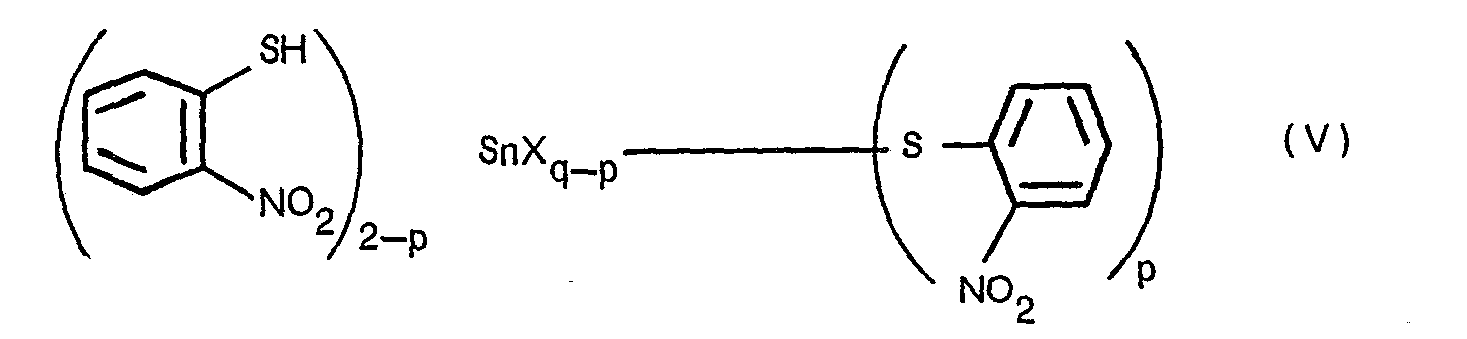
- the above-mentioned condensation reaction of the invention may be conducted by first reacting said stannous or stannic compound (IV) with 2-nitrothiophenol (III) to give a compound of the formula: wherein p is an integer of 0, 1 or 2, and X and q are the same as defined above, and then using the compound (V) as a catalyst or as one of the starting compounds instead of 2-nitrothiophenol (III).
- the threo-2-hydroxy-3-(4-methoxyphenyi)-3-(2-nitrophenyithio)propionic ester (I) is prepared by (i) reacting the compound (V) directly with the trans-3-(4-methoxyphenyl)glycidic ester (II), or (ii) condensing the trans-3-(4-methoxyphenyl)glycidic ester (II) with 2-nitrothiophenol (III) in the presence of a catalytic amount of the compound (V).
- the stannous or stannic compound (IV) which can be used for this purpose includes, for example, stannous halide (e.g., stannous fluoride, stannous chloride, stannous bromide, stannous iodide), stannic halide (e.g., stannic fluoride, stannic chloride, stannic bromide, stannic iodide), stannous alkanoate (e.g., stannous octylate, stannous stearate) and stannic alkanoate (e.g., stannic octylate, stannic stearate).
- stannous halide e.g., stannous fluoride, stannous chloride, stannous bromide, stannous iodide
- stannic halide e.g., stannic fluoride, stannic chloride, stannic bromide, stannic iodide
- the reaction of the stannous or stannic compound (IV) with 2-nitrothiophenol (III) is accomplished in a suitable solvent.
- suitable solvent include benzene, toluene, xylene, n-pentane, n-hexane, cyclohexane, cycloheptane and a mixture thereof.
- the subsequent condensation reaction of the compound (V) with the trans-3-(4-methoxyphenyl)-glycidic ester (II) is conducted in a solvent.
- Benzene, toluene, xylene, cyclohexane, cycloheptane and a mixture thereof are suitable as the solvent. It is preferred to carry out the reaction at a temperature of 0° to 60°C, especially 10° to 25°C. Generally, the reaction is completed within 10 minutes to one hour.
- the condensation of the trans-3-(4-methoxyphenyl)glycidic ester (II) and 2-nitrothiophenol (III) in the presence of a catalytic amount of the compound (V) may also be readily conducted in a solvent.
- the solvent include benzene, toluene, xylene, cyclohexane, cycloheptane, dioxane, tetrahydrofuran and mixture thereof. In this latter case, it is preferred to use 0.005 to 0.01 mole of the compound (V) per mole of 2-nitrothiophenol (III). It is also preferred to carry out the reaction at a temperature of 0° to 60°C, especially 10° to 25°C. Generally, the reaction may be completed within 4 to 20 hours.
- the compound (I) thus obtained can be converted to diltiazem hydrochloride, for example, in accordance with the methods described in Japanese Patent Publication (examined) Nos. 27576/1974 and 18038/ 1978.
- the method of the present invention gives the threo isomer (I) in an yield of about 40 to about 75% and said yield of the invention is almost comparable to or somewhat superior to the yield of the compound (I) obtained by the method of Japanese Patent Publication (examined) No. 36221/1974 (i.e., the method wherein the condensation reaction is carried out in the absence of the catalyst).
- Japanese Patent Publication (examined) No. 36221/1974 i.e., the method wherein the condensation reaction is carried out in the absence of the catalyst.
- the method of the present invention makes it possible to complete the reaction within a shorter period of time such as within about 20 hours and in most of cases within 5 minutes to 10 hours.
- the addition of a Lewis acid to the condensation reaction system of the glycidate (II) and 2-nitrothiophenol (III) accelerates said reaction quite efficiently and at the same time, as compared with the method of Japanese Patent Publication (examined) No. 36221/1974, the method of the present invention is more advantageous for the production of the threo-2-hydroxy-3-(4-methoxyphenyl)-3-(2-nitrophenylthio)-propionic ester (I) in industrial scale.
- threo means that the hydroxy and 2-nitro- phenylthio groups substituted at the 2nd- and 3rd-positions of propionic acid have threo type configuration (i.e., said two groups and placed on opposite sides of the central bond in the Fisher's projection formula), and the term “erythro” means that said hydroxy and 2-nitro-phenylthio groups have erythro-type configuration (i.e., said two groups are placed on the same side of the central bond).
- erythro means that said hydroxy and 2-nitro-phenylthio groups have erythro-type configuration (i.e., said two groups are placed on the same side of the central bond).
- alkanoate alkanoic acid
- alkanoyl alkanoyl
Landscapes
- Chemical & Material Sciences (AREA)
- Organic Chemistry (AREA)
- Organic Low-Molecular-Weight Compounds And Preparation Thereof (AREA)
- Low-Molecular Organic Synthesis Reactions Using Catalysts (AREA)
Claims (10)


Priority Applications (1)
| Application Number | Priority Date | Filing Date | Title |
|---|---|---|---|
| AT82100807T ATE13292T1 (de) | 1981-02-27 | 1982-02-04 | Verfahren zur herstellung von threo-2-hydroxy-3-(-methoxyphenyl)-3-(2-nitroph nylthio)- propionsaeureestern. |
Applications Claiming Priority (4)
| Application Number | Priority Date | Filing Date | Title |
|---|---|---|---|
| JP28779/81 | 1981-02-27 | ||
| JP56028779A JPS57142963A (en) | 1981-02-27 | 1981-02-27 | Preparation of 2-hydroxy-3,3-di-substituted-propionic acid derivative |
| JP56078317A JPS57193449A (en) | 1981-05-22 | 1981-05-22 | Novel tin 2-nitrothiophenol complex compound, its preparation and preparation of threo substituted- propionic acid derivative with the same |
| JP78317/81 | 1981-05-22 |
Publications (2)
| Publication Number | Publication Date |
|---|---|
| EP0059335A1 EP0059335A1 (fr) | 1982-09-08 |
| EP0059335B1 true EP0059335B1 (fr) | 1985-05-15 |
Family
ID=26366925
Family Applications (1)
| Application Number | Title | Priority Date | Filing Date |
|---|---|---|---|
| EP82100807A Expired EP0059335B1 (fr) | 1981-02-27 | 1982-02-04 | Procédé pour la préparation des esters de l'acide thréo-hydroxy-2 (méthoxy-4 phényl)-3 (nitro-2 phénylthio)-3 propionique |
Country Status (11)
| Country | Link |
|---|---|
| US (1) | US4420628A (fr) |
| EP (1) | EP0059335B1 (fr) |
| KR (1) | KR900000520B1 (fr) |
| BG (1) | BG40650A3 (fr) |
| CA (1) | CA1175855A (fr) |
| DE (1) | DE3263466D1 (fr) |
| DK (1) | DK170159B1 (fr) |
| ES (1) | ES8307213A1 (fr) |
| FI (1) | FI76556C (fr) |
| HU (1) | HU187655B (fr) |
| SU (1) | SU1149873A3 (fr) |
Families Citing this family (12)
| Publication number | Priority date | Publication date | Assignee | Title |
|---|---|---|---|---|
| US4552695A (en) * | 1983-04-21 | 1985-11-12 | Shionogi & Co., Ltd. | Process for production of diltiazem hydrochloride |
| US4871731A (en) * | 1987-10-07 | 1989-10-03 | Marion Laboratories, Inc. | Captopril and diltiazem composition and the like |
| US4908469A (en) * | 1988-05-18 | 1990-03-13 | Marion Laboratories, Inc. | 2-Hydroxy-propanoic acid acyclic alkyl esters for benzothiazepines |
| NL8801311A (nl) | 1988-05-20 | 1989-12-18 | Stamicarbon | Fenylglycidaatstereoisomeren, omzettingsprodukten daarvan met 2-nitrothiofenol en de bereiding van diltiazem. |
| FR2637285B1 (fr) * | 1988-10-03 | 1991-04-12 | Synthelabo | Procede de preparation de derives de l'acide propionique et produits obtenus |
| FR2641535B1 (fr) * | 1989-01-11 | 1991-03-15 | Synthelabo | Procede de preparation de (+) - (2s, 3s)-hydroxy-3 (methoxy-4 phenyl)-2 dihydro-2,3 5h-benzothiazepine-1,5 one-4 |
| USRE34935E (en) * | 1989-01-11 | 1995-05-09 | Synthelabo | Method for preparing (+)-(2S,3S)-3-hydroxy-2-(4-methoxyphenyl)-2,3-dihydro-5H-1,5-benzothiazepine-4-one and chlorinated derivatives thereof |
| IT1234387B (it) * | 1989-07-12 | 1992-05-18 | Zambon Spa | Processo di purificazione di intermedi utili nella preparazione del diltiazem |
| IT1237526B (it) * | 1989-12-06 | 1993-06-08 | Zambon Spa | Processo di preparazione di un intermedio per il diltiazem |
| IT1240651B (it) * | 1990-05-17 | 1993-12-17 | Zambon Spa | Processo per la risoluzione di derivati glicidici |
| IT1295376B1 (it) * | 1997-10-22 | 1999-05-12 | Zambon Spa | Processo per il riciclo di un sottoprodotto della sintesi del diltiazem |
| WO2014030106A2 (fr) | 2012-08-18 | 2014-02-27 | Unimark Remedies Ltd. | Procédé de préparation d'ester méthylique d'acide (2r,3s)-3-(4- méthoxyphényl) glycidique et de cis lactam optiquement actifs et applications associées |
Family Cites Families (2)
| Publication number | Priority date | Publication date | Assignee | Title |
|---|---|---|---|---|
| JPS4948305A (fr) * | 1972-07-26 | 1974-05-10 | ||
| JPS4936221A (fr) * | 1972-08-03 | 1974-04-04 |
-
1982
- 1982-02-04 EP EP82100807A patent/EP0059335B1/fr not_active Expired
- 1982-02-04 DE DE8282100807T patent/DE3263466D1/de not_active Expired
- 1982-02-08 US US06/346,922 patent/US4420628A/en not_active Expired - Lifetime
- 1982-02-12 CA CA000396154A patent/CA1175855A/fr not_active Expired
- 1982-02-23 FI FI820598A patent/FI76556C/fi not_active IP Right Cessation
- 1982-02-25 DK DK082682A patent/DK170159B1/da not_active IP Right Cessation
- 1982-02-25 SU SU823396151A patent/SU1149873A3/ru active
- 1982-02-26 HU HU82601A patent/HU187655B/hu not_active IP Right Cessation
- 1982-02-26 ES ES509973A patent/ES8307213A1/es not_active Expired
- 1982-02-26 BG BG055565A patent/BG40650A3/xx unknown
- 1982-02-27 KR KR8200877A patent/KR900000520B1/ko not_active Expired
Also Published As
| Publication number | Publication date |
|---|---|
| DK82682A (da) | 1982-08-28 |
| DK170159B1 (da) | 1995-06-06 |
| ES509973A0 (es) | 1983-06-16 |
| CA1175855A (fr) | 1984-10-09 |
| FI820598L (fi) | 1982-08-28 |
| SU1149873A3 (ru) | 1985-04-07 |
| KR900000520B1 (ko) | 1990-01-31 |
| ES8307213A1 (es) | 1983-06-16 |
| EP0059335A1 (fr) | 1982-09-08 |
| FI76556C (fi) | 1988-11-10 |
| FI76556B (fi) | 1988-07-29 |
| KR830008976A (ko) | 1983-12-16 |
| US4420628A (en) | 1983-12-13 |
| BG40650A3 (en) | 1986-01-15 |
| HU187655B (en) | 1986-02-28 |
| DE3263466D1 (en) | 1985-06-20 |
Similar Documents
| Publication | Publication Date | Title |
|---|---|---|
| EP0059335B1 (fr) | Procédé pour la préparation des esters de l'acide thréo-hydroxy-2 (méthoxy-4 phényl)-3 (nitro-2 phénylthio)-3 propionique | |
| FI91760C (fi) | Menetelmä terapeuttisesti käyttökelpoisten 7-substituoitujen asetamido-3-alkenyyli-3-kefeemijohdannaisten valmistamiseksi | |
| HU196198B (en) | Process for producing cis-1-aryl-2-(fluoromethyl)-oxiranes | |
| EP0038614A2 (fr) | Esters de 5- et 6-oxo-prostaglandines | |
| EP0380982A2 (fr) | Procédé de préparation d'un dérivé du naphtalène et d'un intermédiaire synthétique de celui-ci | |
| HU212195B (en) | Process for the preparation of l-5-(2-acetoxy-propionylamino)-2,4,6,-triiodo-isophtalic acid dichloride | |
| US5198557A (en) | Process for the resolution of 3-(4-substituted-phenyl)-glycidic acid derivatives | |
| US4687859A (en) | Monoesters of imidazolidinone dicarboxylic acids | |
| IE47037B1 (en) | Isopenicillins, processes for their preparation, and compositions containing them | |
| JP2964423B2 (ja) | 3―フルオロスルホニルオキシセフ―3―エム置換法 | |
| EP0117872B1 (fr) | Procede de preparation de composes de cephalosporine | |
| US4883878A (en) | Process for unsymmetrical dithioacetals and dithioketals | |
| JPS6351148B2 (fr) | ||
| EP0242001B1 (fr) | Procédé de fabrication de N-(sulfonylméthyl)-formamides et de sulfonylméthylisocyanides | |
| US5304641A (en) | Process for the synthesis of exomethylenecephams | |
| JPS63139188A (ja) | 混合置換された1、2‐ジーアシルーsn−グリセロ‐3‐ホスホコリンの一段階製造法 | |
| JP2631846B2 (ja) | テトラヒドロフラン誘導体 | |
| EP0217376B1 (fr) | Procédé pour la fabrication des cétones aryliques alpha-haloalkylés optiquement actives | |
| US5705657A (en) | Isocyanate process for the preparation of 1,3A,8-trimethyl-1,2,3,3A, 8, 8A-hexahydro-pyrrole 2,3-B! indol-5 (3AS, 8AR) -hepthylcarbamate | |
| EP0571434B1 (fr) | PROCEDE DE PREPARATION DE 1,3a,8-TRIMETHYLE-1,2,3,3a,8,8,8a-HEXAHYDRO-PYRROLE 2,3-b]INDOLE-5(3aS,8aR)-HEPTYLCARBAMATE | |
| JP2530142B2 (ja) | O−アルキルs,s−ジアルキルホスホロジチオエ−トの製造方法 | |
| US5268491A (en) | Process for the dehalogenation of naphthalene derivatives | |
| EP0430012B1 (fr) | Procédé de préparation des 3-Halobenzothiazépines substituées en 2 par un reste aromatique | |
| Mahato et al. | A novel application of the Friedel-Crafts reaction to the synthesis of differently substituted polynuclear compounds | |
| EP0094691B1 (fr) | Procédé pour la préparation des 8-acylthio-1,2,3,4,5,6-hexahydro-2,6-méthano-3,6(e),11(a)-triméthyle-3-benzazocines |
Legal Events
| Date | Code | Title | Description |
|---|---|---|---|
| PUAI | Public reference made under article 153(3) epc to a published international application that has entered the european phase |
Free format text: ORIGINAL CODE: 0009012 |
|
| AK | Designated contracting states |
Designated state(s): AT BE CH DE FR GB IT LI NL SE |
|
| 17P | Request for examination filed |
Effective date: 19820921 |
|
| ITF | It: translation for a ep patent filed | ||
| GRAA | (expected) grant |
Free format text: ORIGINAL CODE: 0009210 |
|
| AK | Designated contracting states |
Designated state(s): AT BE CH DE FR GB IT LI NL SE |
|
| REF | Corresponds to: |
Ref document number: 13292 Country of ref document: AT Date of ref document: 19850615 Kind code of ref document: T |
|
| REF | Corresponds to: |
Ref document number: 3263466 Country of ref document: DE Date of ref document: 19850620 |
|
| ET | Fr: translation filed | ||
| PLBE | No opposition filed within time limit |
Free format text: ORIGINAL CODE: 0009261 |
|
| STAA | Information on the status of an ep patent application or granted ep patent |
Free format text: STATUS: NO OPPOSITION FILED WITHIN TIME LIMIT |
|
| 26N | No opposition filed | ||
| ITTA | It: last paid annual fee | ||
| EAL | Se: european patent in force in sweden |
Ref document number: 82100807.5 |
|
| PGFP | Annual fee paid to national office [announced via postgrant information from national office to epo] |
Ref country code: GB Payment date: 19990204 Year of fee payment: 18 Ref country code: SE Payment date: 19990204 Year of fee payment: 18 |
|
| PGFP | Annual fee paid to national office [announced via postgrant information from national office to epo] |
Ref country code: FR Payment date: 19990209 Year of fee payment: 18 |
|
| PGFP | Annual fee paid to national office [announced via postgrant information from national office to epo] |
Ref country code: AT Payment date: 19990211 Year of fee payment: 18 |
|
| PGFP | Annual fee paid to national office [announced via postgrant information from national office to epo] |
Ref country code: DE Payment date: 19990212 Year of fee payment: 18 |
|
| PGFP | Annual fee paid to national office [announced via postgrant information from national office to epo] |
Ref country code: NL Payment date: 19990224 Year of fee payment: 18 |
|
| PGFP | Annual fee paid to national office [announced via postgrant information from national office to epo] |
Ref country code: CH Payment date: 19990226 Year of fee payment: 18 |
|
| PGFP | Annual fee paid to national office [announced via postgrant information from national office to epo] |
Ref country code: BE Payment date: 19990416 Year of fee payment: 18 |
|
| PG25 | Lapsed in a contracting state [announced via postgrant information from national office to epo] |
Ref country code: GB Free format text: LAPSE BECAUSE OF NON-PAYMENT OF DUE FEES Effective date: 20000204 Ref country code: AT Free format text: LAPSE BECAUSE OF NON-PAYMENT OF DUE FEES Effective date: 20000204 |
|
| PG25 | Lapsed in a contracting state [announced via postgrant information from national office to epo] |
Ref country code: SE Free format text: LAPSE BECAUSE OF NON-PAYMENT OF DUE FEES Effective date: 20000205 |
|
| PG25 | Lapsed in a contracting state [announced via postgrant information from national office to epo] |
Ref country code: BE Free format text: LAPSE BECAUSE OF NON-PAYMENT OF DUE FEES Effective date: 20000228 |
|
| PG25 | Lapsed in a contracting state [announced via postgrant information from national office to epo] |
Ref country code: CH Free format text: LAPSE BECAUSE OF NON-PAYMENT OF DUE FEES Effective date: 20000229 Ref country code: LI Free format text: LAPSE BECAUSE OF NON-PAYMENT OF DUE FEES Effective date: 20000229 |
|
| BERE | Be: lapsed |
Owner name: TANABE SEIYAKU CO. LTD. Effective date: 20000228 |
|
| PG25 | Lapsed in a contracting state [announced via postgrant information from national office to epo] |
Ref country code: NL Free format text: LAPSE BECAUSE OF NON-PAYMENT OF DUE FEES Effective date: 20000901 |
|
| GBPC | Gb: european patent ceased through non-payment of renewal fee |
Effective date: 20000204 |
|
| EUG | Se: european patent has lapsed |
Ref document number: 82100807.5 |
|
| REG | Reference to a national code |
Ref country code: CH Ref legal event code: PL |
|
| PG25 | Lapsed in a contracting state [announced via postgrant information from national office to epo] |
Ref country code: FR Free format text: LAPSE BECAUSE OF NON-PAYMENT OF DUE FEES Effective date: 20001031 |
|
| NLV4 | Nl: lapsed or anulled due to non-payment of the annual fee |
Effective date: 20000901 |
|
| PG25 | Lapsed in a contracting state [announced via postgrant information from national office to epo] |
Ref country code: DE Free format text: LAPSE BECAUSE OF NON-PAYMENT OF DUE FEES Effective date: 20001201 |
|
| REG | Reference to a national code |
Ref country code: FR Ref legal event code: ST |