EP0061265B1 - Méthode de copiage électrostatique du type transfert - Google Patents
Méthode de copiage électrostatique du type transfert Download PDFInfo
- Publication number
- EP0061265B1 EP0061265B1 EP82301259A EP82301259A EP0061265B1 EP 0061265 B1 EP0061265 B1 EP 0061265B1 EP 82301259 A EP82301259 A EP 82301259A EP 82301259 A EP82301259 A EP 82301259A EP 0061265 B1 EP0061265 B1 EP 0061265B1
- Authority
- EP
- European Patent Office
- Prior art keywords
- receptor member
- image
- copying
- photosensitive material
- copying cycle
- Prior art date
- Legal status (The legal status is an assumption and is not a legal conclusion. Google has not performed a legal analysis and makes no representation as to the accuracy of the status listed.)
- Expired
Links
Images

Classifications
-
- G—PHYSICS
- G03—PHOTOGRAPHY; CINEMATOGRAPHY; ANALOGOUS TECHNIQUES USING WAVES OTHER THAN OPTICAL WAVES; ELECTROGRAPHY; HOLOGRAPHY
- G03G—ELECTROGRAPHY; ELECTROPHOTOGRAPHY; MAGNETOGRAPHY
- G03G21/00—Arrangements not provided for by groups G03G13/00 - G03G19/00, e.g. cleaning, elimination of residual charge
- G03G21/0005—Arrangements not provided for by groups G03G13/00 - G03G19/00, e.g. cleaning, elimination of residual charge for removing solid developer or debris from the electrographic recording medium
Definitions
- This invention relates to transfer-type electrostatic copying methods, and in particular to transfer-type electrostatic copying methods which comprise repeatedly performing a copying cycle including a transfer step of transferring a latent electrostatic image or a toner image formed on a photosensitive material to the surface of a receptor member.
- an electrostatic copying method which performs a copying cycle comprising forming a latent electrostatic image on a photosensitive sheet having photosensitive properties by itself and then developing the latent electrostatic image to a toner image
- an electrostatic copying method adapted for the transfer of a latent electrostatic image or a toner image which comprises performing a copying cycle including an image-forming step of forming a latent electrostatic image on a suitable photosensitive material or a toner image obtained by developing it, a subsequent transfer step of transferring the latent electrostatic image or the toner image formed on the photosensitive material to a suitable receptor member such as plain paper, and a subsequent cleaning step of cleaning the photosensitive material for the next copying cycle.
- the latent electrostatic image-transferring type method the latent electrostatic image formed on the photosensitive material is transferred to the receptor member without development and the latent electrostatic image so transferred is then developed to a toner image.
- the conventional electrostatic copying method adapted for the transfer of a latent electrostatic image or a toner image presents the following problems in repeatedly performing the copying cycle comprising the image-forming step, the transfer step and the cleaning step. It frequently happens in the aforesaid copying cycle that the size of the latent electrostatic image or the toner image formed on the photosensitive material does not correspond to that of the receptor member to which the latent electrostatic image or the toner image has been transferred. For example, when only a part of an original document having a relatively large size is to be copied, a latent electrostatic image or a toner image of a relatively large size is formed on the photosensitive material, whereas in most cases a receptor member of a relatively small size is used.
- a latent electrostatic image or toner image corresponding to the original document might often exceed the receptor member in size.
- the surrounding of the book cannot be sufficiently isolated optically by an original-holding device because of the thickness of the book, and, consequently, the resulting latent electrostatic image or toner image on the photosensitive -material consists of an image corresponding to the particular'page of the book and a grey region surrounding it.
- US-A-4095980 teaches an additional cleaning step in the case of small size receptors to prevent the roller following the image transfer station from being contaminated.
- a latent electrostatic image or a toner image formed on a photosensitive material necessarily has a larger size (particularly, a larger width) than that (particularly, the width) of a receptor member used.
- the latent electrostatic image of the.toner image on the photosensitive material is partly transferred to the receptor member in the subsequent transfer step, but that part of the latent electrostatic image or toner image which is located outside the receptor member will remain on the photosensitive material without being transferred to the receptor member.
- one cleaning step subsequently performed can well remove the static charge (when the image on the photosensitive material is a latent electrostatic image) or both the static charge and the toner particles (when the image on the photosensitive material is a toner image) remaining on that area of the photosensitive material.
- one cleaning step can fully remove the static charge or both the static charge and the toner particles remaining on that part of the photosensitive material.
- an electrostatic copying method of the transfer type which comprises repeatedly performing a copying cycle including an image-forming step of forming a latent electrostatic image on a photosensitive material moved through an endless moving path or a toner image obtained by developing it, a transfer step of transferring the latent electrostatic image or the toner image on the photosensitive material to a receptor member subsequent to the image-forming step, and a cleaning step of cleaning the photosensitive material subsequent to the transfer step, wherein the method includes the additional steps of comparing at least one of the width and length of a receptor member to be used in the next copying cycle with at least one of the width and length, respectively, of a receptor member used in the preceding cycle, and when the width or length of the receptor member to be used in the next copying cycle is found to be larger than the width or length of the receptor member used in the preceding copying cycle, additionally performing said cleaning step after the end of the preceding copying cycle before the next copying cycle is started.
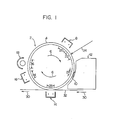
- FIG. 1 diagrammatically shows one example of a copying apparatus used for practicing one specific embodiment of the transfer-type electrostatic copying method in accordance with this invention.
- the copying apparatus shown in Figure 1 includes a rotary drum 2 having a photosensitive material 4 disposed on at least a part of its peripheral surface.
- the rotary drum 2 is rotated in the direction shown by an arrow 6, and by the rotation of the rotary drum 2, the photosensitive material 4 is moved through a circular endless moving path defined by the peripheral surface of the drum.
- a charging corona discharge device 8 Around the rotary drum 2 are disposed a charging corona discharge device 8, a developing and eliminating device 12 having a magnetic brush mechanism 10, a transferring corona discharge device 14, a charge-eliminating corona discharge device 16 and a charge-eliminating lamp 18 disposed successively in this order when viewed in the direction of rotation of the rotary drum 2 indicated by the arrow 6.
- the copying cycle is performed in the following manner according to the rotation of the rotary drum 2 in the direction of arrow 6.
- a corona discharge is applied to the photosensitive material 4 by the action of the charging corona discharge device 8 in an area shown by reference numeral 20.
- the image of an original document (not shown) to be copied is projected onto the photosensitive material 4 as shown by an arrow 24 by the action of an optical unit (not shown), whereupon a latent electrostatic image corresponding to the image of the original document is formed on the photosensitive material 4.
- an image-forming step is performed which comprises forming a latent electrostatic image on the photosensitive material 4 in the areas 20, 22, and 26 and applying toner particles to the latent electrostatic image to develop it to a toner image.
- a transfer step is carried out in an area shown by reference numeral 28.
- a receptor member 32 such as plain paper delivered from a suitable receptor member feeding mechanism (not shown) and conveyed in the direction shown by an arrow 30 is brought into intimate contact with the surface of the photosensitive material 4, and, simultaneously, a corona discharge is applied to the back of the receptor member 32 by the action of the transferring corona discharge device 14. As a result, the toner image on the photosensitive material 4 is transferred to the receptor member 32.
- the receptor member 32 having the toner image transferred thereto is separated from the surface of the photosensitive material 4 and further conveyor in the direction shown by the arrow 30. After the transferred toner image is fixed by the fixing action of a fixing device (not shown), it is discharged as a copy out of the copying apparatus.
- the rotary drum 2 continues to rotate.
- a corona discharge is applied to the photosensitive material 4 by the action of the charge-eliminating corona discharge device 16 in an area shown by reference numeral 34, and the photosensitive material 4 is then irradiated by the charge-eliminating lamp 18 in an area shown by 36.
- the rotary drum 2 rotates further and begins its second rotation. During the second rotation, the magnetic brush mechanism 10 of the developing and eliminating device 12 acts on the photosensitive material 4 in the area 26.
- the toner particles remaining on the photosensitive material 4 after the transfer step are attracted to the magnetic brush mechanism 10 and thus eliminated (therefore, the developing and eliminating device 12 acts as an eliminating device at this time). Accordingly, in the illustrated copying apparatus, a cleaning step for removing the residual charge and the residual toner particles from the photosensitive material 4 after the transfer step is performed in the areas 34, 36 and 26. Of course, when the rotary drum 2 rotates for the second revolution and the residual toner particles are removed in the area 26, formation of a latent electrostatic image is not effected in the areas 20 and 22.
- the charging corona discharge device 8 and the optical unit are out of operation, and the transferring corona discharge device 14, too, is set out of operation as soon as the transfer of the toner image from the photosensitive material 4 to the receptor member 32 is over.
- the copying cycle to be performed in the illustrated copying machine consisting of the image-forming step, the transfer step and the cleaning step is the same as that in a conventional transfer-type electrostatic copying method.
- the above copying cycle is simply repeated. Accordingly, when the size of the toner image formed on the photosensitive material 4 is larger than the size of the receptor member 32 and even after the transfer step in the area 28, a part of the toner image on the photosensitive material 4 remains untransferred to the receptor member 32, insufficient cleaning occurs on part of the photosensitive material 4.
- the size of a receptor member 32 to be used in the next copying cycle is larger than that of the receptor member 32 used in the preceding copying cycle, a part of the copy obtained in the next copying cycle has a poor image quality.
- the transfer-type electrostatic copying method in accordance with this invention further involves comparing the size of the receptor member 32 to be used in the next copying cycle with that of the receptor member 32 used in the preceding copying cycle, and when the size of the receptor member 32 to be used in the next cycle is found to be larger than that of the receptor member 32 used in the preceding copying cycle, performing an additional cleaning step. Specifically, the rotary drum 2 is further rotated and the residual static charge is removed in the areas 34 and 36 and the residual toner particles are removed in the area 26.
- FIG. 2 is a flow chart of the transfer-type electrostatic copying method of this invention performed by the copying apparatus shown- in Figure 1.
- the copying cycle is started by manually closing a start switch (not shown).
- the start switch is closed by manual operation, the rotary drum 2 is set in rotation.
- the operations of various constituent elements such as the charging corona discharge device 8, the developing and eliminating device 12, the transferring corona discharge device 14, the charge-eliminating corona discharge device 16, the charge-eliminating lamp 18, the optical unit (not shown) and the receptor member feeding mechanism (not shown) are properly controlled, and the aforesaid copying cycle consisting of the image-forming step, the transfer step and the cleaning step is performed.
- the size of the receptor member 32 used in this cycle is compared with the size of a receptor member 32 to be used in the next copying cycle.
- the size of the receptor member 32 to be used in the next copying cycle is larger than that of the receptor member 32 used in the preceding copying cycle.
- the receptor member 32 fed from the receptor member feeding mechanism (not shown) has a variable width but a constant length
- the image-forming step in the copying cycle is controlled according to the length of the receptor member 32 actually fed from the receptor member feeding mechanism to make the length of a toner image formed on the photosensitive material 4 substantially equal to that of the receptor member 32 to which the toner image . is to be transferred, it is possible to compare only the widths of the receptor members 32 and judge that only in the instance (ii) above, the size of the receptor member 32 to be used in the next copying cycle is larger than that of the receptor member 32 used in the preceding copying cycle.
- the receptor member 32 fed from the receptor member feeding mechanism has a variable length but a constant width
- the comparison and judgement of the sizes of the receptor members 32 can be effected by detecting changes in the condition of, for example, a change-over switch to be manually operated for the selection of the receptor sheet of the specified size.
- the receptor member feeding mechanism (not shown) is of the type adapted to feed a receptor member unwound from a roll and cut to a suitable length, the comparison and judgement of the sizes can be performed by detecting the size of a receptor sheet actually supplied.
- the next thing to do is to judge whether the copying cycle has been repeated the required number of times prescribed, for example, by the operator (that is, whether the required number of copies have been formed).
- an output is generated to stop the operation of the copying apparatus and to show that as required, the next cycle of copying can be started, namely preparations for the next cycle of copying have been completed.
- the operator can start the next cycle of copying by manually operating the start switch (not shown).
- the copying cycle has not been repeated the required number of times, the copying cycle is repeated after the end of the preceding cycle.
- the usual operating procedure of the copying apparatus is terminated and the additional cleaning step is performed, irrespective of whether the copying cycle has been repeated the required number of times.
- the rotary drum 2 is further rotated to remove the residual static charge in the areas 34 and 36 and the residual toner particles in the area 26. If required, the additional cleaning step can be performed two or more times.
- an output is generated to stop the operation of the copying apparatus and show that the aforesaid preparations for the start of the next copying cycle have been completed.
- the operator can start the next cycle of copying operations by manually operating the start switch (not shown). If the copying cycle has not been repeated the required number of times, it is possible, if desired, to start the next copying cycle instead of stopping the operation of the copying apparatus subsequent to the end of the additional cleaning step.
- the operation of the copying apparatus may be properly controlled by providing the copying apparatus with a suitable control circuit which can be constructed by properly combining logical circuits, or with a microcomputer, for example.
- the cleaning step is additionally performed independently from the normal copying cycle after the end of the preceding copying cycle but before the start of the next copying cycle.
- the additional cleaning step performed after the end of the preceding copying cycle but before the start of the next copying cycle achieves good cleaning of the above described insufficiently cleaned area. Accordingly, a degradation in the quality of the image in a part of a copy obtained in the next copying cycle can be reliably avoided.
- the method of this invention has been described hereinabove with regard to a toner image transferring type method adapted to form a latent electrostatic image on the photosensitive material 4, apply toner particles to the latent electrostatic image to develop it to a toner image, and transfer the toner image on the photosensitive material 4 to the receptor member 32.
- the present invention can also be applied to a latent electrostatic image-transferring type electrostatic copying method which comprises transferring the latent electrostatic image formed on the photosensitive material 4 directly to the receptor member 32 without prior development to a toner image.
- the copying apparatus shown in Figure 1 is merely one form of copying machine on which the transfer-type electrostatic copying method of this inventoin can be practiced.
- the electrostatic copying method of this invention can be performed on other different forms of electrostatic copying machines of the transfer type.
Landscapes
- Physics & Mathematics (AREA)
- General Physics & Mathematics (AREA)
- Cleaning In Electrography (AREA)
- Combination Of More Than One Step In Electrophotography (AREA)
- Control Or Security For Electrophotography (AREA)
Claims (3)
Applications Claiming Priority (2)
| Application Number | Priority Date | Filing Date | Title |
|---|---|---|---|
| JP41795/81 | 1981-03-24 | ||
| JP56041795A JPS57157279A (en) | 1981-03-24 | 1981-03-24 | Method for transfer type electrostatic copy |
Publications (2)
| Publication Number | Publication Date |
|---|---|
| EP0061265A1 EP0061265A1 (fr) | 1982-09-29 |
| EP0061265B1 true EP0061265B1 (fr) | 1984-07-25 |
Family
ID=12618264
Family Applications (1)
| Application Number | Title | Priority Date | Filing Date |
|---|---|---|---|
| EP82301259A Expired EP0061265B1 (fr) | 1981-03-24 | 1982-03-12 | Méthode de copiage électrostatique du type transfert |
Country Status (4)
| Country | Link |
|---|---|
| US (1) | US4456673A (fr) |
| EP (1) | EP0061265B1 (fr) |
| JP (1) | JPS57157279A (fr) |
| DE (1) | DE3260430D1 (fr) |
Families Citing this family (2)
| Publication number | Priority date | Publication date | Assignee | Title |
|---|---|---|---|---|
| JPH03293677A (ja) * | 1990-04-12 | 1991-12-25 | Canon Inc | 画像形成装置 |
| DE69509449T2 (de) * | 1994-06-21 | 1999-12-23 | Seiko Epson Corp., Tokio/Tokyo | Papierzufuhrsteuersystem für eine Druckeinheit |
Family Cites Families (4)
| Publication number | Priority date | Publication date | Assignee | Title |
|---|---|---|---|---|
| US3637306A (en) * | 1970-12-02 | 1972-01-25 | Ibm | Copying system featuring alternate developing and cleaning of successive image areas on photoconductor |
| US3923004A (en) * | 1973-12-27 | 1975-12-02 | Xerox Corp | Development and cleaning apparatus for reverse path machine |
| JPS51146831A (en) * | 1975-06-11 | 1976-12-16 | Ricoh Co Ltd | Photo-sensible element non-image part cleaning method and its device |
| JPS5446044A (en) * | 1977-09-19 | 1979-04-11 | Mita Industrial Co Ltd | Cleaning of residual toner in transfer type electrostatic copying machine |
-
1981
- 1981-03-24 JP JP56041795A patent/JPS57157279A/ja active Pending
-
1982
- 1982-03-09 US US06/356,538 patent/US4456673A/en not_active Expired - Fee Related
- 1982-03-12 EP EP82301259A patent/EP0061265B1/fr not_active Expired
- 1982-03-12 DE DE8282301259T patent/DE3260430D1/de not_active Expired
Also Published As
| Publication number | Publication date |
|---|---|
| US4456673A (en) | 1984-06-26 |
| JPS57157279A (en) | 1982-09-28 |
| DE3260430D1 (en) | 1984-08-30 |
| EP0061265A1 (fr) | 1982-09-29 |
Similar Documents
| Publication | Publication Date | Title |
|---|---|---|
| EP0166874B1 (fr) | Machine à copier électrostatique | |
| CN1166635A (zh) | 图象形成装置及接触式复印装置的清扫方法 | |
| US5758226A (en) | Image forming apparatus and method in which a circumferential speed of an intermediate transfer member is reduced when charging the intermediate transfer member | |
| WO1989006384A1 (fr) | Appareil de nettoyage a double fonction | |
| EP0061265B1 (fr) | Méthode de copiage électrostatique du type transfert | |
| JPH0697365B2 (ja) | 感光体の帯電領域制御装置 | |
| US4764790A (en) | Method for cleaning photoreceptor of image forming apparatus | |
| JPH08211760A (ja) | 画像形成装置 | |
| JP2840967B2 (ja) | 画像形成装置の制御方法 | |
| JPS5882282A (ja) | 画像形成装置 | |
| JP3428716B2 (ja) | 画像形成装置 | |
| JPS6150170A (ja) | 画像形成装置 | |
| JPS6232469B2 (fr) | ||
| EP0682295A2 (fr) | Rétrogradation adaptive d'une machine à copier xérographique pour des originaux positionnés manuellement | |
| JPS63169683A (ja) | 静電記録装置 | |
| JPS60241080A (ja) | 画像形成装置 | |
| JPS62209555A (ja) | 感光体の初期設定方法 | |
| JP3239412B2 (ja) | 静電印刷装置 | |
| JPH02213883A (ja) | 電子写真装置の転写装置 | |
| JPH01108594A (ja) | ブレードの潤滑性保持装置 | |
| JPH05333671A (ja) | 画像形成装置 | |
| JPH09152759A (ja) | 画像形成装置に適用される帯電装置 | |
| JPH08190280A (ja) | 画像形成機 | |
| JPH0836315A (ja) | 画像形成装置 | |
| JPS58127950A (ja) | 静電印刷装置 |
Legal Events
| Date | Code | Title | Description |
|---|---|---|---|
| PUAI | Public reference made under article 153(3) epc to a published international application that has entered the european phase |
Free format text: ORIGINAL CODE: 0009012 |
|
| AK | Designated contracting states |
Designated state(s): DE FR GB NL |
|
| 17P | Request for examination filed |
Effective date: 19821223 |
|
| GRAA | (expected) grant |
Free format text: ORIGINAL CODE: 0009210 |
|
| AK | Designated contracting states |
Designated state(s): DE FR GB NL |
|
| REF | Corresponds to: |
Ref document number: 3260430 Country of ref document: DE Date of ref document: 19840830 |
|
| ET | Fr: translation filed | ||
| PGFP | Annual fee paid to national office [announced via postgrant information from national office to epo] |
Ref country code: NL Payment date: 19850331 Year of fee payment: 4 |
|
| PLBE | No opposition filed within time limit |
Free format text: ORIGINAL CODE: 0009261 |
|
| STAA | Information on the status of an ep patent application or granted ep patent |
Free format text: STATUS: NO OPPOSITION FILED WITHIN TIME LIMIT |
|
| 26N | No opposition filed | ||
| PG25 | Lapsed in a contracting state [announced via postgrant information from national office to epo] |
Ref country code: NL Effective date: 19861001 |
|
| GBPC | Gb: european patent ceased through non-payment of renewal fee | ||
| PG25 | Lapsed in a contracting state [announced via postgrant information from national office to epo] |
Ref country code: FR Free format text: LAPSE BECAUSE OF NON-PAYMENT OF DUE FEES Effective date: 19861128 |
|
| PG25 | Lapsed in a contracting state [announced via postgrant information from national office to epo] |
Ref country code: DE Effective date: 19861202 |
|
| NLV4 | Nl: lapsed or anulled due to non-payment of the annual fee | ||
| REG | Reference to a national code |
Ref country code: FR Ref legal event code: ST |
|
| PG25 | Lapsed in a contracting state [announced via postgrant information from national office to epo] |
Ref country code: GB Effective date: 19881121 |