EP0061633B1 - Composition d'isolement thermique et procédé pour sa fabrication - Google Patents
Composition d'isolement thermique et procédé pour sa fabrication Download PDFInfo
- Publication number
- EP0061633B1 EP0061633B1 EP19820102046 EP82102046A EP0061633B1 EP 0061633 B1 EP0061633 B1 EP 0061633B1 EP 19820102046 EP19820102046 EP 19820102046 EP 82102046 A EP82102046 A EP 82102046A EP 0061633 B1 EP0061633 B1 EP 0061633B1
- Authority
- EP
- European Patent Office
- Prior art keywords
- density
- thermally insulating
- foam
- insulating composite
- low
- Prior art date
- Legal status (The legal status is an assumption and is not a legal conclusion. Google has not performed a legal analysis and makes no representation as to the accuracy of the status listed.)
- Expired
Links
Images


Classifications
-
- C—CHEMISTRY; METALLURGY
- C04—CEMENTS; CONCRETE; ARTIFICIAL STONE; CERAMICS; REFRACTORIES
- C04B—LIME, MAGNESIA; SLAG; CEMENTS; COMPOSITIONS THEREOF, e.g. MORTARS, CONCRETE OR LIKE BUILDING MATERIALS; ARTIFICIAL STONE; CERAMICS; REFRACTORIES; TREATMENT OF NATURAL STONE
- C04B38/00—Porous mortars, concrete, artificial stone or ceramic ware; Preparation thereof
- C04B38/007—Porous mortars, concrete, artificial stone or ceramic ware; Preparation thereof characterised by the pore distribution, e.g. inhomogeneous distribution of pores
-
- B—PERFORMING OPERATIONS; TRANSPORTING
- B28—WORKING CEMENT, CLAY, OR STONE
- B28B—SHAPING CLAY OR OTHER CERAMIC COMPOSITIONS; SHAPING SLAG; SHAPING MIXTURES CONTAINING CEMENTITIOUS MATERIAL, e.g. PLASTER
- B28B1/00—Producing shaped prefabricated articles from the material
- B28B1/50—Producing shaped prefabricated articles from the material specially adapted for producing articles of expanded material, e.g. cellular concrete
-
- Y—GENERAL TAGGING OF NEW TECHNOLOGICAL DEVELOPMENTS; GENERAL TAGGING OF CROSS-SECTIONAL TECHNOLOGIES SPANNING OVER SEVERAL SECTIONS OF THE IPC; TECHNICAL SUBJECTS COVERED BY FORMER USPC CROSS-REFERENCE ART COLLECTIONS [XRACs] AND DIGESTS
- Y10—TECHNICAL SUBJECTS COVERED BY FORMER USPC
- Y10T—TECHNICAL SUBJECTS COVERED BY FORMER US CLASSIFICATION
- Y10T428/00—Stock material or miscellaneous articles
- Y10T428/23—Sheet including cover or casing
- Y10T428/232—Encased layer derived from inorganic settable ingredient
-
- Y—GENERAL TAGGING OF NEW TECHNOLOGICAL DEVELOPMENTS; GENERAL TAGGING OF CROSS-SECTIONAL TECHNOLOGIES SPANNING OVER SEVERAL SECTIONS OF THE IPC; TECHNICAL SUBJECTS COVERED BY FORMER USPC CROSS-REFERENCE ART COLLECTIONS [XRACs] AND DIGESTS
- Y10—TECHNICAL SUBJECTS COVERED BY FORMER USPC
- Y10T—TECHNICAL SUBJECTS COVERED BY FORMER US CLASSIFICATION
- Y10T428/00—Stock material or miscellaneous articles
- Y10T428/23—Sheet including cover or casing
- Y10T428/233—Foamed or expanded material encased
-
- Y—GENERAL TAGGING OF NEW TECHNOLOGICAL DEVELOPMENTS; GENERAL TAGGING OF CROSS-SECTIONAL TECHNOLOGIES SPANNING OVER SEVERAL SECTIONS OF THE IPC; TECHNICAL SUBJECTS COVERED BY FORMER USPC CROSS-REFERENCE ART COLLECTIONS [XRACs] AND DIGESTS
- Y10—TECHNICAL SUBJECTS COVERED BY FORMER USPC
- Y10T—TECHNICAL SUBJECTS COVERED BY FORMER US CLASSIFICATION
- Y10T428/00—Stock material or miscellaneous articles
- Y10T428/249921—Web or sheet containing structurally defined element or component
- Y10T428/249953—Composite having voids in a component [e.g., porous, cellular, etc.]
- Y10T428/249967—Inorganic matrix in void-containing component
- Y10T428/249968—Of hydraulic-setting material
-
- Y—GENERAL TAGGING OF NEW TECHNOLOGICAL DEVELOPMENTS; GENERAL TAGGING OF CROSS-SECTIONAL TECHNOLOGIES SPANNING OVER SEVERAL SECTIONS OF THE IPC; TECHNICAL SUBJECTS COVERED BY FORMER USPC CROSS-REFERENCE ART COLLECTIONS [XRACs] AND DIGESTS
- Y10—TECHNICAL SUBJECTS COVERED BY FORMER USPC
- Y10T—TECHNICAL SUBJECTS COVERED BY FORMER US CLASSIFICATION
- Y10T428/00—Stock material or miscellaneous articles
- Y10T428/249921—Web or sheet containing structurally defined element or component
- Y10T428/249953—Composite having voids in a component [e.g., porous, cellular, etc.]
- Y10T428/249987—With nonvoid component of specified composition
- Y10T428/249988—Of about the same composition as, and adjacent to, the void-containing component
Definitions
- This invention relates to thermally insulating composite materials, and more particularly, to improved cellular, cementitious materials and a process for making the same.
- Inorganic materials such as fiberglass and so- called rock-wool find widespread application for residential housing.
- U.S. Patent N° 4,161,855 and U.S. Patent N° 4,240,839 improved materials particularly suited for thermal insulation of building structures, such as residential housing, are disclosed.
- the thermal insulation materials in said patents comprise an inorganic, low-density foam with gypsum as the major constituent.
- the low-density cellular gypsum material has a dry density in the range of about 40 to about 96 kg/m 3
- U.S. Patent N° 4,240,839 the low-density cellular gypsum material has a dry density of less than about 48 kg/m 3.
- FR-A-2 011 075 describes a compressed concrete product formed by applying a pressure of 24.5 to 35 kg/cm 2 which is lighter in weight than a poured concrete product. There is no suggestion in this document of a product having a skin of higher density and including fibers in the mixture.
- DE-A-2,833,427 discloses a product in which density varies continuously from the outer surface toward the inner portion of the gypsum wall panel. This document also discloses that the product is made by using a pulsating pressure.
- Still another object of this invention is to provide a process for making an inorganic, cellular, low-density, cementitious thermally insulating material which may be flexible or rigid.
- a thermally insulating composite comprising: (a) a low-density, cellular cementitous material containing fibrous material (b) at last one structural surface element (30) of cellular cementitious material formed from, integrally with, and upon at least part of the low-density material, the structural surface element containing fibrous material and having a higher density than the low-density material; and (c) a permeable enclosure element (34) upon the higher density structural surface.
- the skin is formed upon a low-density foam with a cementitious material as the major constituent, by placing a slurry of the low-densityfoam having entrapped gas, in an enclosure at last part of which is permeable to the gas; and applying a pressure of 2.76 x 10- 4 to 137.9 x 10- 3 N/ mm 2 to a surface of the enclosure to remove gas at the permeable enclosure, thereby increasing the density of the foam adjacent the permeable enclosure.
- the foam then hardens or cures.
- the permeable enclosure may be removed from the structural surface after formation of the skin.
- FIG. 1 there is shown a simplified flow diagram of the process for producing a composite low-density, fiber-containing, inorganic, cementitious insulation in accordance with the invention.
- the cementitious foam may be made by any suitable method in the art including the method described and illustrated in U.S. Patent No. 4,161,855, incorporated herein by reference.
- U.S. Patent No. 4,161,855 describes an inorganic, low-density foam with gypsum as the major constituent and having minute cavities homogeneously distributed in the gypsum material, the gypsum material having a dry density in the range of about 48 kg/m 3 to about 96 kg/ m 3 .
- a cementitious composition is prepared by combining a cementitious material, water, a fibrous material and optionally, other adjuvants and additives, in slurry mixer 2.
- a foaming agent solution is fed to froth generator 4, and the froth of foaming agent solution from froth generator 4 and the cementitious slurry from slurry mixer 2 are fed to froth slurry mixer 6 to form the wet foam containing entrapped gas used in the invention.
- Pumps and various other aux- illary devices are not shown.
- the wet, cementitious, low-density foam having entrapped gas, such as air, from froth slurry mixer 6, is placed in an enclosure at least part of which is permeable to the gas and to the liquid medium, such as water, used to form the foam.
- the wet, cementitious foam may be pumped, poured, or transferred by any suitable means into permeable enclosure 8. Once the wet, cementitious foam is placed in permeable enclosure 8, pressure sufficient to cause the entrapped gas and the liquid medium from the slurry to pass through the permeable surface of the enclosure, may be applied thereto by any suitable pressure means 10.
- Suitable means must be provided at the surface of the permeable enclosure to remove the entrapped gas and liquid medium from the portions of the enclosure which are permeable to the gas and the liquid medium. This is generally accomplished by using a porous backup, a grid or a patterned surface adjacent the permeable enclosure.
- a porous backup When the gas and/or water is removed from the surface area of the wet foam through the permeable enclosure, the density of that surface area increases and a skin forms adjacent the permeable portions of the enclosure upon the foam, the skin having a higher density than the foam from which it is formed.
- the compressed cementitious foam material hardens and/or cures about the entrapped gas bubbles to form the low-density thermal insulation material having the skin formed internal with and on the low-density insulation material.
- Curing step 12 is generally inherent in the cementitious composition, and although no additional steps are required to cure the cementitious foam, in certain cases it may be advantageous to provide conditions, accelerators and/or promotors which accelerate the curing
- the wet, cementitious foam is produced by intimately mixing a water-based cementitious slurry, for example, a gypsum or Portland cement slurry, with a water-based froth of a foaming agent, such as sodium lauryl sulfate.
- a water-based cementitious slurry for example, a gypsum or Portland cement slurry
- a water-based froth of a foaming agent such as sodium lauryl sulfate.
- the froth provides the small stable bubbles of air, which upon mixing with the wet, cementitious slurry composition, become entrapped thereby.
- a variety of additives such as accelerators and retarders can be added to the slurry mixture to accelerate curing and to provide other desired features.
- a typical froth/slurry mixture would have a wet density of greater than about 136 kg/ m 3 .
- non-woven dacron fiber bags may be used as the permeable enclosure, and any suitable mold may be used to obtain a desired shape or configuration for the thermal insulation product having the skin forms thereon in accordance with the invention.
- Conventional pressure techniques for example, a hydraulic press, may be used to apply pressure for the removal of entrapped gas and liquid medium.
- Enclosure 16 in preferred embodiments, is a non-woven dacron material in the form of a bag having a neck or opening (not shown) suitable for adding foam 14.
- FIG. 2b assembly 15 is placed between two press plates 18 having a pair of porous grids 20 interposed between the surface of assembly 15 and press plates 18.
- porous grids 20 are required to provide a region for the removal of the entrapped gas and/ or liquid medium from the permeable surface of enclosure 16 when pressure is applied thereto.
- any suitable means may be used to convey, dispense or otherwise remove the entrapped gas and/or liquid medium which passes through the permeable enclosure, and to carry the entrapped gas and/or liquid medium away from said surface.
- grids 20 may be a screen, a porous body, a solid plate having a patterned surface, for example, grooves or channels, by which gas and liquids can be removed from the permeable surface.
- a continuous pressure of 2.76 x 10- 4 to 137.9 x 10- 3 N/mm 2 is applied to assembly 15 by press plates 18.
- the pressure exerted by press plates 18 is illustrated by dotted arrows 22.
- continuous pressure is applied to the low-density foam entrapped gas and liquid medium in the foam near the surface of permeable enclosure 16, diffuse through of permeate the non-woven dacron fabric comprising enclosure 16 and pass from the surface of enclosure 16 into grid 20.
- the entrapped gas and liquid medium leave the surface of permeable enclosure 16, the density of the cementitious foam adjacent the surface thereof increased.
- the gas bubbles in the foam insulation material close to the permeable portions of the enclosure are driven through the permeable membrane or permeable surface of the enclosure, and the fibers and reacting foam are densified at the enclosure surface.
- Pressure can be applied for any suitable length of time until the desired thickness of skin is achieved. This can be determined by one skilled in the art by.taking into consideration various parameters, such as the initial density of the fiber-containing, cementitious foam, the amount of pressure applied to the enclosure, and the porosity of the enclosure material.
- the pressure can be released, and the thermally insulating composite of a low-density foam and having the skin formed thereon can be removed from the press or other suitable molding device.
- an alternative embodiment illustrates applying a continuous pressure of 2.76 x 10- 4 to 137.9 x 10- 3 N/mm 2 to a surface of the permeable enclosure from within the enclosure.
- the skin can be formed upon the thermally insulating composite by adding wet, cementitious foam to the permeable enclosure and creating internal pressure therein during and/or after the addition of the foam.
- Dotted arrows 26 illustrate the internal application of pressure upon the surfaces of the permeable enclosure, and arrows 24 illustrate the direction of flow of the entrapped gas and the liquid medium from the foam into porous grids 20.
- press plates 18 can merely be fixed or backup plates.
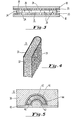
- a three-dimensional cut-away structural wall section 28 employing the thermally insulating composite of a low-density foam with a cementitious material as the major constituent and with a fiber-containing material as a minor constituent, has a structural surface element (skin) 30 integrally connected to and formed from low-density, cellular, cementitious material 32 which contains fibrous material.
- a permeable enclosure element 34 remains upon skin 30 of the composite. In other embodiments (not shown) permeable enclosure element 34 can be removed from the higher density structural surface 32.
- a plurality of structural surface elements 30 of the higher density, cellular, cementitious material containing fibrous material define a core of low-density, cellular, cementitious material 32.
- only one surface or only a portion of a surface may have skin 30 formed thereon, depending upon the extent of the permeable enclosure element 34.
- the thermally insulating composite of the present invention may be cast, molded or otherwise formed into any desired shape and/or pattern.
- the product may be in the form of a flat plate or a board as shown in Figure 4, or, as shown in Figure 5, a section of pipe insulation can be formed in a product mold.
- Figure 5 shows the cross-section of a mold 36 which can be used to produce, for example, a pipe-type of insulation.
- Mold 36 contains a solid steel plate 38 and a steel plate 40 having the desired configurations.
- Porous grids 42 are used to line the mold in the areas where skin formation is desired to be formed upon the final composite.
- a permeable enclosure (not shown) is used to conform to the shape of the mold and to allow the passage of entrapped air and liquid medium from a foam 44 of low-density, cellular, cementitious material having entrapped gas therein.
- Low-density, cellular, cementitious foam 44 is placed in the mold, and pressure is applied thereto.
- the entrapped gas and liquid medium pass from the foam at the surfaces adjacent the permeable enclosure into porous grids 42.
- a high-density skin or structural surface element 46 forms upon the surface of the low-density, cellular, cementitious material, said skin or structural surface element 46 being formed from and integral with the low-density, cellular, cementitious material.
- the cementitious material cures, and the cured composite can be removed from the mold.
- any conventional mold can be used as long as the porous grid, for example, a fine-wire mesh or plastic screen element, can be used in the mold to collect the entrapped air and liquid medium from the foam, and as long as a sufficient amount of pressure can be applied to the low density cellular, cementitious material to form the skin thereon.
- a mold to form a block-type product can be formed so that the product has an insulating non-load bearing wall, or a mold can be used which would have ribs upon the surface to produce added stiffness in the length of the product.
- the mold into which the wet foam is cast may take a variety of forms. In its most simple form this may involve no more than pouring the wet foam of slurry onto a casting table having suitable restraining dams, means for applying pressure and means for removing gas and/or liquid which passes from the wet foam of cementitious material through a permeable enclosure used as a liner on the casting table. It may be desirable to vibrate the mold to ensure proper filling of the mold, and to apply other common techniques normally used in the molding of insulating material.
- a permeable enclosure element or membrane 34 may be used, which may become an integral part of the wall of the composite, or alternatively, which may be removed after the formation of the skin or layer of higher density upon the low-density cementitious material.
- a permeable enclosure element must be used in conjunction with the mold.
- the mold when it is permeable to entrapped gas and/or fluid medium from the wet foam, may be the permeable enclosure, however, in most preferred embodiments of the invention, the permeable enclosure element is an element separate from the mold.
- the permeable enclosure can be made of any material which permits the entrapped gas and/or fluid medium from the wet foam to pass therethrough under pressure.
- the permeable enclosure element may be a woven or non-woven synthetic or natural fabric or blend thereof, a permeable metal or plastic, a wire screen and the like.
- the permeable enclosure may be permeable at all surfaces, or one surface, or at a portion of all surfaces or a portion of one surface. In most preferred embodiments, the permeable enclosure element can have a pore size of from less than about 0.42 mm to about 0.149 mm.
- the permeable enclosure is a non-woven dacron fiber product, manufactured by E.I. Dupont de Nemours and Co.
- the non-woven dacron fiber product may be formed into a bag or other desired shape, filled with the wet foam subjected to pressure sufficient to remove some of the gas and some of the liquid medium from the wet foam adjacent the non-woven dacron fiber bag to form the skin or higher density cementitious surface.
- this permeable bag may be removed from the composite after the desired amount of gas and the desired amount of liquid have been removed through the pores of the bag by the application of pressure.
- permeable enclosure is used to designate the enclosure in those cases where only a portion of the enclosure is permeable and in those cases where all of the enclosure is permeable.
- the amount of pressure is not critical in the practice of the present invention, it is necessary to apply pressure to at least one surface of the enclosure to remove gas and liquid medium through the surface thereof to form the skin.
- the gas and/or liquid which passes from the foam of cementitious material through the permeable enclosure must be removed from the surface of the permeable enclosure or conveyed therefrom by any suitable means.
- means for removing gas and/or liquid which passes from the wet foam material through the permeable enclosure must be provided in a mold, pressure device or any other device used to form or shape the thermally insulating composite, and any press plate, retainer member or other member juxtaposed against a permeable portion of the permeable enclosure, must be capable of removing the gas and/or liquid. This is generally accomplished by providing a porous grid, screen or any other element which can remove the gas and/or liquid emanating from the surface of the permeable enclosure element.
- the gas and/or fluid which passes through the permeable enclosure element may also be removed by providing suitable patterned surfaces, for example, grooves or channels, in the mold adjacent the permeable enclosure.
- suitable patterned surfaces for example, grooves or channels, in the mold adjacent the permeable enclosure.
- the porous grid or other means for removing gas and/or liquid must be positioned adjacent any area of the permeable enclosure through which the gas and/or liquid medium is removed.
- the raw materials that is, the composition which forms the wet foam containing entrapped gas utilized in the practice of the invention, are readily available in most areas of the world.
- the strength of the thermally insulating composite of the invention is provided by a cementitious material, such as hydraulic cement or gypsum cement which hardens on the surface of the froth bubbles (entrapped gas, such as air), to form a low-density, cellular structure.
- Hydraulic cements are mixtures of fine-ground lime, alumina and silica that will set to a hard product by an admixture of water, which combines chemically with the other ingredients to form a hydrate.
- Portland cement is a type of hydraulic cement in the form of finely divided gray powder composed of lime, alumina, silica and iron oxide as tetracalcium aluminoferrate, tricalcium aluminate, tricalcium silicate and dicalcium silicate. Small amounts of other elements are also present. Sand is often added as a diluent, and the cement may be modified with various materials, such as plastic lattices.
- Gypsum cement is found as a natural rock deposit in most parts of the world. In the natural state gypsum purity ranges from about 80% to about 99%, and natural gypsum is basically calcium sulfate with two waters of hydration. The heating of the gypsum to roughly 204°C that is, calcining, removes all but one-half of the two waters of hydration providing a product designated as hemihydrate gypsum which is the form that is normally used for making all plaster products. This form is also available as a synthetic by-product of the fertilizer industry. The impurities and neutralization effects are described in U.S. Patent No. 4,161,855. Although two cementitious materials have been described, any cementitious material or mixtures thereof in which air or other gas can be entrapped to form a foam, may be used in the invention.
- the wet foam of low-density, cementitious material containing entrapped air may be prepared as described in Figure 1 above and as explained in U.S. Patent No. 4,161,855, or it may be prepared by any suitable means available in the art.
- the foam of cementitious material is preferably a water-based slurry, but can be a combination of water and other liquid media.
- gas which forms the cellular structure of the cured composite and which is entrapped within the slurry or froth/slurry composition is usually air
- any other suitable gas or mixture of gases may also be used in the present invention including nitrogen and other inert gases.
- the various cementitious materials for example, Portland cement, gypsum cement, and the like, have a variety of different cure rates, and accelerator/retarder systems may be used therein and may be tailored to the particular material being used. Even various gypsums have a variety of different cure rates, and the accelerator/retarder system must be tailored to the particular gypsum cement being used.
- accelerators such as alum, or known retarders, such as sodium citrate, or in some instances a combination thereof, nearly any dihydrate gypsum material can be used to produce the foam of the invention.
- the curing is inherent for the particular cementitious material, and curing takes place upon standing, however, various techniques may be applied to promote or accelerate and/or to retard the curing of the cementitious material to form the thermally insulating composite of a low-density foam having a higher density skin in accordance with the present invention.
- the skin or outer surface of the thermally insulating composite has a higher density than the inner portions or core of the thermally insulating composite.
- the composite comprises a low-density, fiber-containing, cellu-' lar, cementitious element and a higher density, fiber-containing, cellular, cementitious surface element integrally formed upon at least part of the low-density, cellular, cementitious element.
- the dry density of the low-density, cellular cementitious material containing fibrous material is greater than about 96 kg/m 3 .
- the dry density of the low-density, cellular cementitious material containing fibrous material is between about 96 kg/m 3 and about 560 kg/m 3 .
- the wet density of the wet foam of cementitious material is not critical. However, in preferred embodiments, the wet density generally ranges from 1.3 to about 2 times the dry density of the cellular, cementitious thermal insulation material.
- the area or region of the thermally insulating composite adjacent the permeable enclosure where entrapped gas and liquid medium has been removed from the wet foam, thereby increasing the density of the cementitious material as the permeable enclosure, is described herein as the skin of the thermally insulating composite.
- the removal of the entrapped gas compresses the wet form at the surface area and thereby increases the density of the material at that point.
- the differential in density between the low-density, cementitious material and the high-density cementitious material is not critical, however, in most embodiments, the differential in density is between about 256 kg/m 3 and about 1920 kgfm 3 , the higher density being the skin and the lower density being the core or inner portions of the thermally insulating composite.
- the dry density of the structural surface element (skin) is about 800 kg/m 3 to about 1920 kgf m 3 .
- the thermally insulating composite of the present invention also contains therein a minor constituent of fibrous material or fiber-containing material.
- fibrous material may be either inorganic or organic, such as fiberglass, mineral wool or cellulose fibers obtained from paper. Since the skin is formed from the low-density cementitious foam of the core, both the skin and the core contain the fibrous material.
- the cementitious material contains about .25 weight percent to about 7.0 weight percent fiberglass based upon the weight of the cementitious material.
- 4% by weight of fiberglass having a length of 6.4 mm was used with gypsum cement in a REEMAY bag having a pore size of 0.142 mm and was pressed at 13.8.10- 3 N/mm 2 for 2 minutes to form a skin on the surface of the cementitious foam.
- the amount of cellulose fiber may range from 1/2% to as high as 30% by weight (based upon the weight of the cement portion of the cementitious material) and more typically 16% by weight.
- the length and size of the fibers may vary in the same composition in the practice of the present invention, however, fibers are preferably from about 1.2 mm to about 5.0 mm in length.
- the cellulose fibers have a length to diameter ratio of greater than 30:1, and length may be about 7.0 mm to about 0.2 mm or smaller.
- the fibrous material is generally incorporated into the formulation to provide increased resistance to vibration and to increase the strength of the low-density cementitious composite material.
- additives can also be used to minimize the weakening of the cementitious material in the event the thermally insulating composite is subjected to moisture or exposed to water.
- Coating agents for the cementitious material such as emulsified tar and asphalt and emulsified polymers such as polyvinyl chloride, polyvinyl acetate, acrylics and other inexpensive water compatible polymers, may be utilized in the formulations.
- Reactive systems such as urea and melamine formaldehyde may also be utilized.
- Other adjuvants and agents such as those disclosed in U.S. Patent No. 4,161,855, may be also used in the composition of the present invention.
- the low-density, inorganic foam thermally insulating composite of the invention finds particular application as thermal insulation in building structures, such as residential housing. Improved thermal, fire retardant and smoke emission characteristics are realized from the composite of the invention at a reduced cost compared to conventional materials.
- the composite of the invention is particularly suited for industrialized construction and is formed from raw materials readily available in most areas of the world.
- the thermally insulating composite of the invention may also be used as clapboard, in homosote type applications, in ceiling tiles and as wall board because of the skin which is integrally formed upon the surface of the composite and because of the varying densities which are attainable.
- the thermally insulating composite of the invention can be made lighter than wall board, yet have the same strength because of increased strength of the skin or other layer.
- the material is less expensive than the prior art materials having the same strength.
- the thermally insulating composite does not need paper or other surface coatings to hold the composite together, thereby reducing material and manufacturing costs.
- Thermally insulating composites of a low-density foam with a cementitious material as the major constituent and having a skin formed thereon from the low-density foam similar to the thermally insulating composite illustrated in Figure 4 were made by providing a gypsum cementitious foam material similar to that described in U.S. Patent No. 4,161,855 and incorporating various fibrous materials.
- the various samples of gypsum material formed by the pressure techniques previously described had skins ranging from about 0.51 mm to about 0.64 mm. Naturally, almost any thickness of skin can be provided depending upon the porosity of the bag enclosure, the pressure applied, the length of time the pressure is applied, and the amount of fibrous material in the composition. As the amount of fibrous material, e.g., fiberglass, is increased in the composition, the skin thickness decreases due to the mating of the fibers resulting in a blocking of the flow of entrapped gas and liquid from the wet foam.
- fibrous material e.g., fiberglass
Landscapes
- Chemical & Material Sciences (AREA)
- Engineering & Computer Science (AREA)
- Ceramic Engineering (AREA)
- Materials Engineering (AREA)
- Structural Engineering (AREA)
- Organic Chemistry (AREA)
- Manufacturing & Machinery (AREA)
- Mechanical Engineering (AREA)
- Laminated Bodies (AREA)
- Thermal Insulation (AREA)
- Processing And Handling Of Plastics And Other Materials For Molding In General (AREA)
- Polymers With Sulfur, Phosphorus Or Metals In The Main Chain (AREA)
- Porous Artificial Stone Or Porous Ceramic Products (AREA)
Claims (17)
Applications Claiming Priority (2)
| Application Number | Priority Date | Filing Date | Title |
|---|---|---|---|
| US247669 | 1981-03-26 | ||
| US06/247,669 US4351867A (en) | 1981-03-26 | 1981-03-26 | Thermal insulation composite of cellular cementitious material |
Publications (2)
| Publication Number | Publication Date |
|---|---|
| EP0061633A1 EP0061633A1 (fr) | 1982-10-06 |
| EP0061633B1 true EP0061633B1 (fr) | 1985-10-23 |
Family
ID=22935844
Family Applications (1)
| Application Number | Title | Priority Date | Filing Date |
|---|---|---|---|
| EP19820102046 Expired EP0061633B1 (fr) | 1981-03-26 | 1982-03-13 | Composition d'isolement thermique et procédé pour sa fabrication |
Country Status (6)
| Country | Link |
|---|---|
| US (1) | US4351867A (fr) |
| EP (1) | EP0061633B1 (fr) |
| JP (1) | JPS57175770A (fr) |
| DE (1) | DE3266986D1 (fr) |
| DK (1) | DK140082A (fr) |
| NO (1) | NO158619C (fr) |
Families Citing this family (66)
| Publication number | Priority date | Publication date | Assignee | Title |
|---|---|---|---|---|
| AU531527B2 (en) * | 1979-05-30 | 1983-08-25 | Bpb Industries Ltd. | Cementitious building board |
| CH663052A5 (de) * | 1983-04-21 | 1987-11-13 | Amrotex Ag | Formstueck aus hydraulisch abgebundenem material. |
| US5220762A (en) * | 1984-02-27 | 1993-06-22 | Georgia-Pacific Corporation | Fibrous mat-faced gypsum board in exterior and interior finishing systems for buildings |
| US5644880A (en) * | 1984-02-27 | 1997-07-08 | Georgia-Pacific Corporation | Gypsum board and systems containing same |
| US4810569A (en) * | 1984-02-27 | 1989-03-07 | Georgia-Pacific Corporation | Fibrous mat-faced gypsum board |
| JPS6136183A (ja) * | 1984-07-30 | 1986-02-20 | ミサワホ−ム株式会社 | 気泡コンクリ−トの製造法 |
| US4916004A (en) * | 1986-02-20 | 1990-04-10 | United States Gypsum Company | Cement board having reinforced edges |
| CA1290587C (fr) * | 1986-02-20 | 1991-10-15 | Robert P. Ensminger | Panneau de ciment a rives armees |
| JPS6344066A (ja) * | 1986-08-07 | 1988-02-25 | 株式会社 ラザ− | 合成樹脂製の塗り材料のための下地材 |
| US4879173A (en) * | 1988-01-06 | 1989-11-07 | Georgia-Pacific Corporation | Glass mat with reinforcing binder |
| US4876151A (en) * | 1988-03-11 | 1989-10-24 | Treestone Corporation | Building material and method of producing the building material |
| US5116671A (en) * | 1989-02-17 | 1992-05-26 | Domtar, Inc. | Gypsum board |
| US5085929A (en) * | 1989-02-17 | 1992-02-04 | Domtar Inc. | Gypsum board |
| US5030502A (en) * | 1990-02-02 | 1991-07-09 | Teare John W | Cementitious construction panel |
| DE4017057C2 (de) * | 1990-05-26 | 1999-11-04 | Peter Breidenbach | Lehmbauplatte und Verfahren zu ihrer Herstellung |
| GB2263084B (en) * | 1991-12-20 | 1995-07-05 | Micropore International Ltd | Shaping panels of microporous thermal insulation |
| CA2146277C (fr) * | 1994-05-25 | 2002-03-26 | John L. Phillips | Appareil et methode pour la fabrication de plaques de platre |
| WO1996031341A1 (fr) * | 1995-04-04 | 1996-10-10 | Diversitech Corporation | Pastille composite legere et hautement resistante et son procede de production |
| CA2211984C (fr) | 1997-09-12 | 2002-11-05 | Marc-Andre Mathieu | Panneau a base de ciment a rebords renforces |
| US6485821B1 (en) * | 1999-02-25 | 2002-11-26 | E. I. Du Pont De Nemours And Company | Gypsum-based construction material |
| US6613424B1 (en) * | 1999-10-01 | 2003-09-02 | Awi Licensing Company | Composite structure with foamed cementitious layer |
| US6443258B1 (en) * | 1999-10-01 | 2002-09-03 | Awi Licensing Company | Durable porous article of manufacture and a process to create same |
| AU2929101A (en) | 2000-01-05 | 2001-07-16 | Saint-Gobain Technical Fabrics America, Inc. | Smooth reinforced cementitious boards and methods of making same |
| ATE368017T1 (de) | 2000-03-14 | 2007-08-15 | James Hardie Int Finance Bv | Faserzementbaumaterialien mit zusatzstoffen niedriger dichte |
| KR100855848B1 (ko) * | 2000-10-04 | 2008-09-01 | 제임스 하디 인터내셔널 파이낸스 비.브이. | 사이징된 셀룰로즈 섬유를 이용한 섬유 시멘트 복합 재료 |
| US20050126430A1 (en) * | 2000-10-17 | 2005-06-16 | Lightner James E.Jr. | Building materials with bioresistant properties |
| NZ525393A (en) | 2000-10-17 | 2006-03-31 | James Hardie Int Finance Bv | Method and apparatus for reducing impurities in cellulose fibers for manufacture of fiber reinforced cement composite materials |
| CZ20032693A3 (cs) | 2001-03-09 | 2004-07-14 | James Hardie Research Pty. Limited | Vlákny vyztužené cementové kompozitní materiály používající chemicky ošetřená vlákna se zlepšenou dispergovatelností |
| US20050284339A1 (en) * | 2001-04-03 | 2005-12-29 | Greg Brunton | Durable building article and method of making same |
| US6746533B2 (en) * | 2002-05-31 | 2004-06-08 | Georgia-Pacific Gypsum, Inc. | Quick drying plaster |
| MXPA05003691A (es) | 2002-10-07 | 2005-11-17 | James Hardie Int Finance Bv | Material mixto de fibrocemento de densidad media durable. |
| US7155866B2 (en) * | 2002-11-05 | 2007-01-02 | Certainteed Corporation | Cementitious exterior sheathing product having improved interlaminar bond strength |
| US7028436B2 (en) | 2002-11-05 | 2006-04-18 | Certainteed Corporation | Cementitious exterior sheathing product with rigid support member |
| CL2004000021A1 (es) | 2003-01-09 | 2005-02-18 | James Hardie Int Finance Bv | Material compuesto que comprende una matriz cementosa, y una mezcla de fibras celulosicas blanqueadas y sin blanquear que son incorporadas dentro de la matriz cementosa; metodo para fabricar un material compuesto de cemento reforzado con fibras. |
| AU2003900156A0 (en) * | 2003-01-15 | 2003-01-30 | Commonwealth Scientific And Industrial Research Organisation | Cementitious products |
| US7049251B2 (en) | 2003-01-21 | 2006-05-23 | Saint-Gobain Technical Fabrics Canada Ltd | Facing material with controlled porosity for construction boards |
| WO2004093054A2 (fr) * | 2003-04-07 | 2004-10-28 | Pike Technologies, Llc | Systemes de parois d'insonorisation acoustique et procedes de production |
| US8091313B2 (en) * | 2003-10-15 | 2012-01-10 | Progressive Foam Technologies, Inc. | Drainage place for exterior wall product |
| US8225567B1 (en) | 2003-10-17 | 2012-07-24 | Exterior Portfolio, Llc | Siding having backer with features for drainage, ventilation, and receiving adhesive |
| US7625827B2 (en) * | 2003-12-19 | 2009-12-01 | Basf Construction Chemicals, Llc | Exterior finishing system and building wall containing a corrosion-resistant enhanced thickness fabric and method of constructing same |
| US7786026B2 (en) | 2003-12-19 | 2010-08-31 | Saint-Gobain Technical Fabrics America, Inc. | Enhanced thickness fabric and method of making same |
| AU2005206522B2 (en) | 2004-01-12 | 2010-03-11 | James Hardie Technology Limited | Composite fiber cement article with radiation curable component |
| US7449125B2 (en) * | 2004-05-20 | 2008-11-11 | Guardian Fiberglass, Inc. | Insulation with mixture of fiberglass and cellulose |
| US7998571B2 (en) * | 2004-07-09 | 2011-08-16 | James Hardie Technology Limited | Composite cement article incorporating a powder coating and methods of making same |
| US8910443B2 (en) | 2004-08-12 | 2014-12-16 | Progressive Foam Technologies, Inc. | Foam backer for insulation |
| US7762040B2 (en) | 2004-08-12 | 2010-07-27 | Progressive Foam Technologies, Inc. | Insulated fiber cement siding |
| US8910444B2 (en) | 2004-08-12 | 2014-12-16 | Progressive Foam Technologies, Inc. | Foam insulation backer board |
| US8857123B2 (en) | 2004-08-12 | 2014-10-14 | Progressive Foam Technologies, Inc. | Foam insulation board |
| US8844233B2 (en) | 2004-08-12 | 2014-09-30 | Progressive Foam Technologies, Inc. | Foam insulation board with edge sealer |
| US20060068188A1 (en) | 2004-09-30 | 2006-03-30 | Morse Rick J | Foam backed fiber cement |
| US8006455B1 (en) | 2004-12-29 | 2011-08-30 | Exterior Portfolio, Llc | Backed panel and system for connecting backed panels |
| US20060245830A1 (en) * | 2005-04-27 | 2006-11-02 | Jon Woolstencroft | Reinforcement membrane and methods of manufacture and use |
| US20070175154A1 (en) * | 2005-12-21 | 2007-08-02 | Progressive Foam Technologies, Inc. | Exterior wall panel with enhanced interior facing surface |
| US7908814B2 (en) | 2005-12-30 | 2011-03-22 | Progressive Foam Technologies, Inc. | Composite siding using a shape molded foam backing member |
| US8993462B2 (en) | 2006-04-12 | 2015-03-31 | James Hardie Technology Limited | Surface sealed reinforced building element |
| US8187423B1 (en) | 2006-05-09 | 2012-05-29 | The United States Of America As Represented By The Secretary Of Agriculture | Fiber reinforced composites |
| US7992837B2 (en) * | 2006-12-29 | 2011-08-09 | Lacuna Inc. | Techniques and tools for assembling and disassembling compactable molds and forming building blocks |
| JP5150975B2 (ja) * | 2007-08-31 | 2013-02-27 | Esファイバービジョンズ株式会社 | 多孔質成形体用収縮性繊維 |
| US7918950B2 (en) * | 2007-12-20 | 2011-04-05 | United States Gypsum Company | Low fiber calcination process for making gypsum fiberboard |
| JP4324977B1 (ja) * | 2008-04-07 | 2009-09-02 | 株式会社プロテックエンジニアリング | 耐荷材 |
| US8111813B2 (en) * | 2008-09-30 | 2012-02-07 | Avaya Inc. | Unified greeting service for telecommunications events |
| NL2003576C2 (en) * | 2009-09-30 | 2011-03-31 | Univ Delft Technology | Sheet-like building material. |
| GB2482196B (en) * | 2010-07-23 | 2014-12-31 | Page Concrete & Steel Ltd | A concrete slab |
| US8795813B2 (en) | 2011-02-22 | 2014-08-05 | Exterior Portfolio, Llc | Ribbed backed panels |
| JP6685549B2 (ja) * | 2015-06-11 | 2020-04-22 | 国立研究開発法人産業技術総合研究所 | 多孔質体及びその製造方法 |
| US11414864B2 (en) * | 2017-12-29 | 2022-08-16 | Certainteed Gypsum, Inc. | Plasterboards and methods for making them |
Family Cites Families (12)
| Publication number | Priority date | Publication date | Assignee | Title |
|---|---|---|---|---|
| GB772581A (en) * | 1954-06-23 | 1957-04-17 | Saint Gobain | Reinforced plaster panels and process for their manufacture |
| US3147177A (en) * | 1962-04-16 | 1964-09-01 | Armstrong Cork Co | Low-density, heat-insulating material |
| DE1929257A1 (de) * | 1968-06-17 | 1970-02-12 | Nat Res Dev | Verfahren zum Herstellen gepresster Leichtbetonfertigteile |
| CA993779A (en) * | 1971-08-17 | 1976-07-27 | Nicholas F. Morrone | Inorganic felt covered gypsum board |
| BE791262A (fr) * | 1971-11-11 | 1973-03-01 | Battelle Development Corp | Perfectionnements aux elements de construction en beton |
| US4124669A (en) * | 1973-05-08 | 1978-11-07 | Urmston Charles W B | Aerated concrete process |
| US4053677A (en) * | 1975-04-17 | 1977-10-11 | Corao Manuel J | Light concrete monolithic slab |
| US4161855A (en) * | 1976-04-21 | 1979-07-24 | General Electric Company | Thermal insulation material and process for making the same |
| FR2399308A1 (fr) * | 1977-08-03 | 1979-03-02 | Roales Gabriel | Carreau de platre, ainsi que procede utilise pour sa fabrication |
| US4334786A (en) * | 1978-02-08 | 1982-06-15 | Saint Gobain Industries | Process and mechanism for evolutive pulp flow regulation |
| DE2833427A1 (de) * | 1978-07-29 | 1980-02-07 | Porelith Baustoffwerk | Bauteil, insbesondere wandbauplatte, aus porengips sowie verfahren und vorrichtung zu seiner herstellung |
| US4240839A (en) * | 1979-06-28 | 1980-12-23 | General Electric Company | Thermal insulation material |
-
1981
- 1981-03-26 US US06/247,669 patent/US4351867A/en not_active Expired - Fee Related
-
1982
- 1982-03-13 DE DE8282102046T patent/DE3266986D1/de not_active Expired
- 1982-03-13 EP EP19820102046 patent/EP0061633B1/fr not_active Expired
- 1982-03-25 JP JP4881982A patent/JPS57175770A/ja active Pending
- 1982-03-25 NO NO821004A patent/NO158619C/no unknown
- 1982-03-26 DK DK140082A patent/DK140082A/da not_active Application Discontinuation
Also Published As
| Publication number | Publication date |
|---|---|
| DE3266986D1 (en) | 1985-11-28 |
| US4351867A (en) | 1982-09-28 |
| NO158619B (no) | 1988-07-04 |
| NO158619C (no) | 1988-10-12 |
| NO821004L (no) | 1982-09-27 |
| DK140082A (da) | 1982-09-27 |
| EP0061633A1 (fr) | 1982-10-06 |
| JPS57175770A (en) | 1982-10-28 |
Similar Documents
| Publication | Publication Date | Title |
|---|---|---|
| EP0061633B1 (fr) | Composition d'isolement thermique et procédé pour sa fabrication | |
| EP1228277B1 (fr) | Plaque de panneau mural comprenant un coeur de beton aere | |
| KR100437300B1 (ko) | 벽 부재 및 그 건조 방법 | |
| CN102561532B (zh) | 一种功能梯度泡沫混凝土保温材料及其制备方法 | |
| CA2320641C (fr) | Article manufacture poreux et durable et procede de fabrication dudit article | |
| US4031684A (en) | Decorative precast concrete boards and process for producing the same | |
| US4630419A (en) | Building components | |
| RU97110217A (ru) | Композиционный материал, содержащий аэрогель, способ его изготовления, а также его применение | |
| US20020128142A1 (en) | Lightweight substance molded body, method for the production and use thereof | |
| US3839521A (en) | Process for making ferro-cement structures | |
| US2008718A (en) | Structural material and method of making the same | |
| JP6681272B2 (ja) | 組成物及び不燃材 | |
| JP3173816B2 (ja) | 複合パネル材料の製造方法 | |
| US6787486B1 (en) | Backerboard sheet including aerated concrete core | |
| EP3109217A1 (fr) | Moulures stabiles ou de plaques d'isolation thermique et de protection contre les incendies, le processus pour leur fabrication et leur utilisation ainsi qu'une construction de telles | |
| JPH01160882A (ja) | 無機質系断熱材 | |
| JP2024526555A (ja) | 石膏ベースの音響パネル | |
| JP2883586B2 (ja) | ガラス繊維強化石膏製品及びその製造方法 | |
| GB2097837A (en) | Building components | |
| HU209116B (en) | Heat-isolating powder-compositions and masses for building purposes | |
| HU184553B (en) | Method for producing heat-insulating building board | |
| JPH09221850A (ja) | 吸遮音性alcパネル | |
| JPS59187807A (ja) | 複合継手管の製造方法 | |
| JPS581077B2 (ja) | ヒフクキヨウカキホウコンクリ−ト | |
| JPH08208347A (ja) | 建築用耐火材及び耐火構造 |
Legal Events
| Date | Code | Title | Description |
|---|---|---|---|
| PUAI | Public reference made under article 153(3) epc to a published international application that has entered the european phase |
Free format text: ORIGINAL CODE: 0009012 |
|
| AK | Designated contracting states |
Designated state(s): DE FR SE |
|
| 17P | Request for examination filed |
Effective date: 19830321 |
|
| GRAA | (expected) grant |
Free format text: ORIGINAL CODE: 0009210 |
|
| AK | Designated contracting states |
Designated state(s): DE FR SE |
|
| REF | Corresponds to: |
Ref document number: 3266986 Country of ref document: DE Date of ref document: 19851128 |
|
| ET | Fr: translation filed | ||
| PLBI | Opposition filed |
Free format text: ORIGINAL CODE: 0009260 |
|
| 26 | Opposition filed |
Opponent name: RIGIPS GMBH Effective date: 19860702 |
|
| PLBN | Opposition rejected |
Free format text: ORIGINAL CODE: 0009273 |
|
| STAA | Information on the status of an ep patent application or granted ep patent |
Free format text: STATUS: OPPOSITION REJECTED |
|
| 27O | Opposition rejected |
Effective date: 19880318 |
|
| PG25 | Lapsed in a contracting state [announced via postgrant information from national office to epo] |
Ref country code: SE Effective date: 19890314 |
|
| PG25 | Lapsed in a contracting state [announced via postgrant information from national office to epo] |
Ref country code: FR Effective date: 19890331 |
|
| PG25 | Lapsed in a contracting state [announced via postgrant information from national office to epo] |
Ref country code: DE Effective date: 19891201 |
|
| REG | Reference to a national code |
Ref country code: FR Ref legal event code: ST |
|
| EUG | Se: european patent has lapsed |
Ref document number: 82102046.8 Effective date: 19900124 |