EP0062905A1 - Heterocyclische Phenylether, Verfahren zu deren Herstellung und diese enthaltende herbizide Mittel - Google Patents
Heterocyclische Phenylether, Verfahren zu deren Herstellung und diese enthaltende herbizide Mittel Download PDFInfo
- Publication number
- EP0062905A1 EP0062905A1 EP82103032A EP82103032A EP0062905A1 EP 0062905 A1 EP0062905 A1 EP 0062905A1 EP 82103032 A EP82103032 A EP 82103032A EP 82103032 A EP82103032 A EP 82103032A EP 0062905 A1 EP0062905 A1 EP 0062905A1
- Authority
- EP
- European Patent Office
- Prior art keywords
- formula
- compounds
- halogen
- alkyl
- grasses
- Prior art date
- Legal status (The legal status is an assumption and is not a legal conclusion. Google has not performed a legal analysis and makes no representation as to the accuracy of the status listed.)
- Granted
Links
Classifications
-
- C—CHEMISTRY; METALLURGY
- C07—ORGANIC CHEMISTRY
- C07D—HETEROCYCLIC COMPOUNDS
- C07D263/00—Heterocyclic compounds containing 1,3-oxazole or hydrogenated 1,3-oxazole rings
- C07D263/52—Heterocyclic compounds containing 1,3-oxazole or hydrogenated 1,3-oxazole rings condensed with carbocyclic rings or ring systems
- C07D263/54—Benzoxazoles; Hydrogenated benzoxazoles
- C07D263/58—Benzoxazoles; Hydrogenated benzoxazoles with hetero atoms or with carbon atoms having three bonds to hetero atoms with at the most one bond to halogen, e.g. ester or nitrile radicals, directly attached in position 2
-
- A—HUMAN NECESSITIES
- A01—AGRICULTURE; FORESTRY; ANIMAL HUSBANDRY; HUNTING; TRAPPING; FISHING
- A01N—PRESERVATION OF BODIES OF HUMANS OR ANIMALS OR PLANTS OR PARTS THEREOF; BIOCIDES, e.g. AS DISINFECTANTS, AS PESTICIDES OR AS HERBICIDES; PEST REPELLANTS OR ATTRACTANTS; PLANT GROWTH REGULATORS
- A01N43/00—Biocides, pest repellants or attractants, or plant growth regulators containing heterocyclic compounds
- A01N43/72—Biocides, pest repellants or attractants, or plant growth regulators containing heterocyclic compounds having rings with nitrogen atoms and oxygen or sulfur atoms as ring hetero atoms
- A01N43/74—Biocides, pest repellants or attractants, or plant growth regulators containing heterocyclic compounds having rings with nitrogen atoms and oxygen or sulfur atoms as ring hetero atoms five-membered rings with one nitrogen atom and either one oxygen atom or one sulfur atom in positions 1,3
-
- C—CHEMISTRY; METALLURGY
- C07—ORGANIC CHEMISTRY
- C07D—HETEROCYCLIC COMPOUNDS
- C07D277/00—Heterocyclic compounds containing 1,3-thiazole or hydrogenated 1,3-thiazole rings
- C07D277/60—Heterocyclic compounds containing 1,3-thiazole or hydrogenated 1,3-thiazole rings condensed with carbocyclic rings or ring systems
- C07D277/62—Benzothiazoles
- C07D277/68—Benzothiazoles with hetero atoms or with carbon atoms having three bonds to hetero atoms with at the most one bond to halogen, e.g. ester or nitrile radicals, directly attached in position 2
Definitions
- Preferred compounds of the general formula I are those in which R is halogen (in particular F, Cl, Br) or CF 3 and n are zero or 1 and Z has the meaning given.
- Heterocyclic ring systems in the R 3 position can be, for example:
- Cation equivalents in the R 2 position are preferably Na and K + .
- the compounds of general formula I have an asymmetry center and are usually obtained as racemates in their preparation.
- the invention also includes the isolated optical antipodes and in particular their D-forms.
- the starting compounds of the formulas II-VII are known or can be prepared by known processes.
- optically active starting materials of the formulas III, V or VI it is possible to prepare optical isomers of the compounds according to the invention (preferably the D form) of the general formula I in high optical purities.
- the compounds of the general formula I according to the invention are very effective in the pre- and post-emergence process against a broad spectrum of annual and perennial harmful grasses, but at the same time they are excellently tolerated by dicotyledonous crop plants and some cereals.
- the compounds are therefore suitable for the selective control of annual and perennial harmful grasses in crop plants.
- Such harmful grasses are, for example, wild oat (Avena), foxtail (Alopecurus spp.), Panicle grass (Poa spp.), Ray grass (Lolium spp.), Annual and perennial wild millet (Echinochloa spp., Setaria spp., Digitaria spp., Panicum spp ., Sorghum spp.), Bermuda grass (Cynodon spp.) And couch grass (Agropyron spp.).
- the present invention therefore also relates to herbicidal compositions which are characterized in that they contain a herbicidally effective amount of a compound of the general formula I in addition to conventional additives and formulation auxiliaries.
- the agents according to the invention generally contain the active ingredients of the formula I in an amount of 2-95% by weight. They can be used in the customary formulations as wettable powders, emulsifiable concentrates, sprayable solutions, dusts or granules.
- Wettable powders are preparations which are uniformly dispersible in water and which, in addition to the active ingredient, contain wetting agents, in addition to a diluent or inert substance, e.g. polyoxethylated alkylphenols, polyoxethylated oleyl, stearylamines, alkyl or alkylphenyl sulfonates and dispersants, e.g. sodium lignosulfonate, 2,2'-dinaphthylmethane-6,6'-disulfonic acid sodium, or also oleylmethyl tauric acid sodium.
- wetting agents in addition to a diluent or inert substance
- a diluent or inert substance e.g. polyoxethylated alkylphenols, polyoxethylated oleyl, stearylamines, alkyl or alkylphenyl sulfonates and dispersants,
- Emulsifiable concentrates are made by dissolving the active ingredient in an organic solvent, e.g. Butanol, cyclohexanone, dimethylformamide, xylene or higher-boiling aromatics and addition of a nonionic wetting agent, for example a polyoxethylated alkylphenol or a polyoxethylated oleyl or stearylamine.
- organic solvent e.g. Butanol, cyclohexanone, dimethylformamide, xylene or higher-boiling aromatics
- a nonionic wetting agent for example a polyoxethylated alkylphenol or a polyoxethylated oleyl or stearylamine.
- Dusts are obtained by grinding the active ingredient with finely divided, solid substances, e.g. Talc, natural clays, such as kaolin, bentonite, pyrophillite or diatomaceous earth.
- finely divided, solid substances e.g. Talc, natural clays, such as kaolin, bentonite, pyrophillite or diatomaceous earth.
- Granules can either be produced by spraying the active ingredient onto adsorbable, granulated inert material or by applying active ingredient concentrates by means of adhesives, e.g. Polyvinyl alcohol, sodium polyacrylic acid, or mineral oils on the surface of carriers such as sand, kaolinite or granulated inert material. Suitable active substances can also be produced in the manner customary for the production of fertilizer granules - if desired in a mixture with fertilizers.
- adhesives e.g. Polyvinyl alcohol, sodium polyacrylic acid, or mineral oils
- the concentrations of the active compounds in the commercial formulations can be different.
- the active ingredient concentration varies, for example, between about 10% and 95%, the rest consists of the formulation additives given above.
- the active substance concentration is approximately 10% to 80%.
- Dust-like formulations usually contain 5% to 20% of active ingredient.
- the active ingredient content depends in part on whether the active compound is liquid or solid and which granulation aids, fillers etc. are used.
- the commercially available concentrates are optionally diluted in the customary manner, e.g. for wettable powders and emulsifiable concentrates using water. Dust-like and granulated preparations and sprayable solutions are no longer diluted with other inert substances before use.
- the required application rate varies. It can fluctuate within wide limits, e.g. between 0.05 and 10.0 kg / ha or more of active substance, but is preferably between 0.1 and 5 kg / ha.
- the active compounds according to the invention can be combined with other herbicides, insecticides and fungicides.
- the batch is cooled with 100 ml of dry toluene are added, then 12 g (0.1 mol) of morpholine ethanol dissolved in 100 ml of toluene are added, after the addition the mixture is stirred at 50 ° C. for 1 h, resulting first in the hydrochloride of the compound, by adding 200 ml of saturated bicarbonate solution and subsequent water washing gives a toluene product solution which is separated off. After toluene has been distilled off, a viscous residue is obtained, which is dried for one hour at 100 ° C. in vacuo (0.05 mbar).
- reaction product is washed twice with 50 ml of 5% sodium hydroxide solution and twice with 100 ml of water. After drying and concentration, 26 g (96% of theory) of 4- (ethoxycar) remain as an oily residue bonyl-1-ethoxy) phenyl-2- [4- (6-chloro-2-benzothiazolyloxy) phenoxy] propanoate.
- the identification was carried out by 1 H nuclear magnetic resonance spectroscopy.
- Seeds of grass were sown in pots and the preparations according to the invention formulated as wettable powder or as emulsion concentrates were sprayed onto the surface of the earth in various dosages.
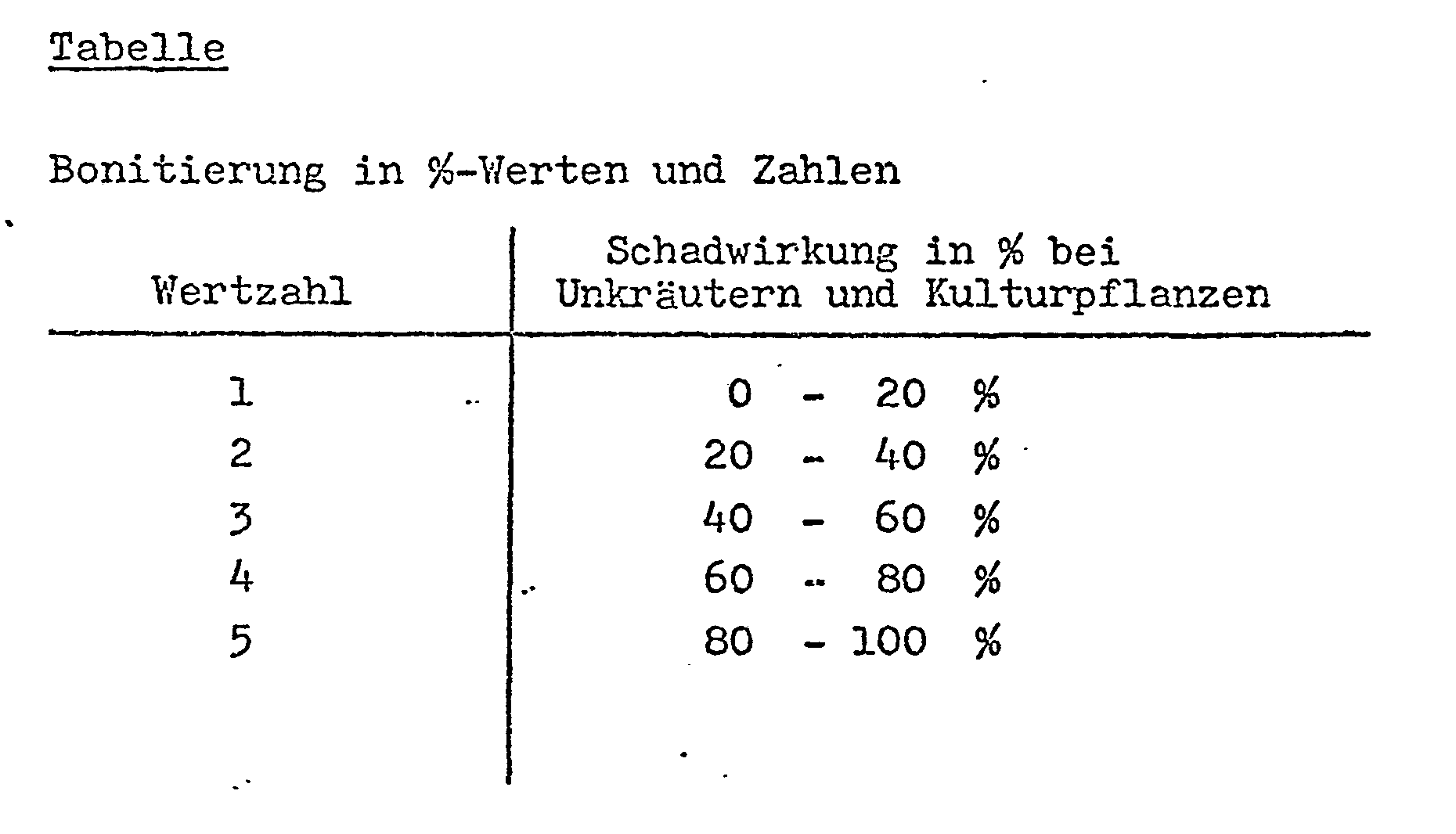
- the pots were then placed in a greenhouse for 4 weeks and the result of the treatment (as in the following examples) was recorded by rating according to the following scheme (see table).
- the agents according to the invention were herbicidally active against a broad spectrum of annual grasses. Some specimens also fought the perennial harmful grasses Cynodon dactylon, Sorghum halepense and Agropyron repens; May be mentioned as current patent example 1.
Landscapes
- Chemical & Material Sciences (AREA)
- Organic Chemistry (AREA)
- Life Sciences & Earth Sciences (AREA)
- Dentistry (AREA)
- Wood Science & Technology (AREA)
- Plant Pathology (AREA)
- Health & Medical Sciences (AREA)
- Engineering & Computer Science (AREA)
- Agronomy & Crop Science (AREA)
- General Health & Medical Sciences (AREA)
- Pest Control & Pesticides (AREA)
- Zoology (AREA)
- Environmental Sciences (AREA)
- Agricultural Chemicals And Associated Chemicals (AREA)
- Plural Heterocyclic Compounds (AREA)
- Heterocyclic Carbon Compounds Containing A Hetero Ring Having Nitrogen And Oxygen As The Only Ring Hetero Atoms (AREA)
- Thiazole And Isothizaole Compounds (AREA)
- Hydrogenated Pyridines (AREA)
- Organic Low-Molecular-Weight Compounds And Preparation Thereof (AREA)
Abstract
Description
- Gegenstand der vorliegenden Erfindung sind neue heterocyclisch substituierte 4-Oxyphenoxyalkancarbonsäurederivate der allgemeinen Formel I

- R: Halogen, CF3, NO2 oder CN,
- n: 0, 1 oder 2,
- X: O oder S und
- Z: eine Gruppe der Formeln

- R 1 : (C 1-C4)Alkyl oder Phenyl,
- m: 0-2, p: 1 oder 2,
- R2 : H, (C1-C4)-Alkyl oder ein Kationäquivalent,
- R3: ein beliebiges 3-7-gliedriges, ggf. ein- oder zweifach durch (C 1-C 4).-Alkyl substituiertes und/oder oxogruppenhaltiges heterocyclisches Ringsystem mit bis zu drei Heteroatomen, welches auch einen ankondensierten Benzolring enthalten kann,
- Bevorzugte Verbindungen der allgemeinen Formel I sind solche, in denen R Halogen (insbesondere F, Cl, Br) oder CF3 und n null oder 1 sind und Z die angegebene Bedeutung hat.
- Heterocyclische Ringsysteme in R3-Position können z.B. folgende sein:


- Kationenäquivalenten in R2-Stellung sind bevorzugt Na und K+.
- Die Verbindungen der allgemeinen Formel I besitzen ein Asymmetriezentrum und werden bei ihrer Herstellung gewöhnlich als Racemate erhalten. Die Erfindung umfaßt jedoch auch die isolierten optischen Antipoden und dabei insbesondere deren D-Formen.
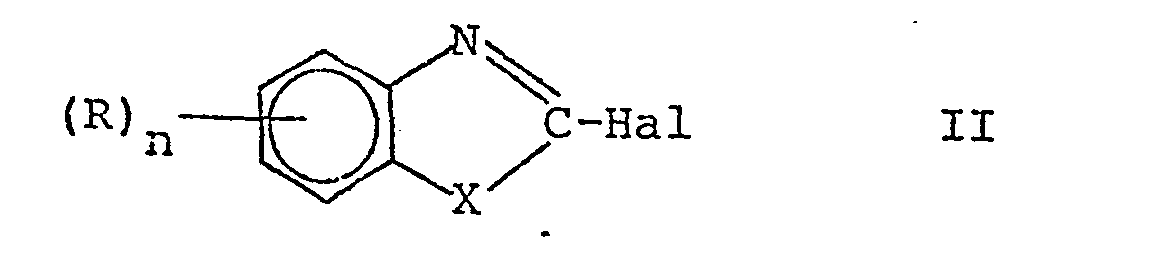
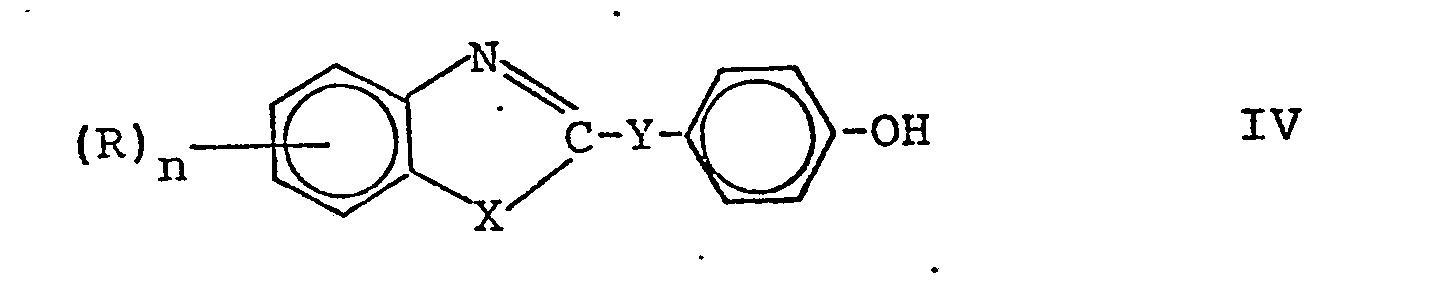
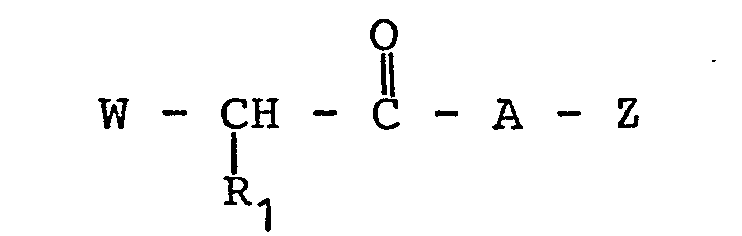
- Gegenstand der Erfindung ist ferner ein Verfahren zur Herstellung der Verbindungen der Formel I, das dadurch gekennzeichnet ist, daß man
- a) Verbindungen der Formel


- b) Verbindungen der Formel


- c) Verbindungen der Formel

- Die Umsetzungen nach a) bis c) erfolgen in der für den Fachmann geläufigen Weise, wobei entweder in Gegenwart von säurebindenden Mitteln gearbeitet wird oder die Ausgangsstoffe III, IV bzw. VI (VII) in Form ihrer Salze eingesetzt werden, die ggf. in situ erzeugt werden können. Die allgemeinen Verfahren sind z.B. in der US-PS 4 130 413 näher beschrieben.
- Die Ausgangsverbindungen der Formeln II - VII sind bekannt bzw. lassen sich nach bekannten Verfahren herstellen. Bei Verwendung von optisch aktiven Ausgangsmaterialien der Formeln III, V oder VI
ist es möglich, optische Isomere der erfindungsgemäßen Verbindungen (bevorzugt die D-Form) der allgemeinen Formel I in hohen optischen Reinheiten herzustellen. - Die erfindungsgemäßen Verbindungen der allgemeinen Formel I sind im Vor- und Nachauflaufverfahren gegen ein breites Spektrum von ein- und mehrjährigen Schadgräsern sehr gut wirksam, gleichzeitig werden sie jedoch von zweikeimblättrigen Kulturpflanzen sowie einigen Getreidearten vorzüglich toleriert. Die Verbindungen sind daher zur selektiven Bekämpfung von ein- und mehrjährigen Schadgräsern in Kulturpflanzen geeignet. Solche Schadgräser sind beispielsweise Wildhafer (Avena), Fuchsschwanz (Alopecurus spp.), Rispengras (Poa spp.), Raygras (Lolium spp.), ein-und mehrjährige Wildhirsen (Echinochloa spp., Setaria spp., Digitaria spp., Panicum spp., Sorghum spp.), Bermudagras (Cynodon spp.) und Quecke (Agropyron spp.).
- Gegenstand der vorliegenden Erfindung sind daher auch herbizide Mittel, die dadurch gekennzeichnet sind, daß sie eine herbizid wirksame Menge einer Verbindung der allgemeinen Formel I neben üblichen Zusatz- und Formulierungshilsmitteln enthalten.
- Die erfindungsgemäßen Mittel enthalten die Wirkstoffe der Formel I im allgemeinen zu 2 - 95 Gew.-%. Sie können als benetzbare Pulver, emulgierbare Konzentrate, versprühbare Lösuugen, Stäubemittel oder Granulate in den üblichen Zu- .bereitungen angewendet werden.
- Benetzbare Pulver sind in Wasser gleichmäßig dispergierbare Präparate, die neben dem Wirkstoff außer einem Verdünnungs- oder Inertstoff noch Netzmittel, z.B. polyoxethylierte Alkylphenole, polyoxethylierte Oleyl-, Stearylamine, Alkyl- oder Alkylphenyl-sulfonate und Dispergiermittel, z.B. ligninsulfonsaures Natrium, 2,2'-dinaphthyl- methan-6,6'-disulfonsaures Natrium, oder auch oleylmethyltaurinsaures Natrium enthalten.
- Emulgierbare Konzentrate werden durch Auflösen des Wirkstoffes in einem organischen Lösungsmittel, z.B. Butanol, Cyclohexanon, Dimethylformamid, Xylol oder auch höhersiedenden Aromaten und Zusatz eines nichtionischen Netzmittels, beispielsweise eines polyoxethylierten Alkylphenols oder eines polyoxethylierten Oleyl oder Stearylamins, erhalten.
- Stäubemittel erhält man durch Vermahlen des Wirkstoffes mit fein verteilten, festen Stoffen, z.B. Talkum, natürlichen Tonen, wie Kaolin, Bentonit, Pyrophillit oder Diatomeenerde.
- Granulate-können entweder durch Verdüsen des Wirkstoffes auf adsorptionsfähiges, granuliertes Inertmaterial hergestellt werden oder durch Aufbringen von Wirkstoffkonzentraten mittels Klebemitteln, z.B. Polyvinylalkohol, polyacrylsaurem Natrium, oder auch Mineralölen auf die Oberfläche von Trägerstoffen, wie Sand, Kaolinite oder von granuliertem Inertmaterial. Auch können geeignete Wirkstoffe in der für die Herstellung von Düngemittelgranalien üblichen Weise - gewünschtenfalls in Mischung mit Düngemitteln - hergestellt werden.
- Bei den herbiziden Mitteln können die Konzentrationen der Wirkstoffe in den handelsüblichen Formulierungen verschieden sein. In benetzbaren Pulvern variiert die Wirkstoffkonzentration z.B. zwischen etwa 10 % und 95 %, der Rest besteht aus den oben angegebenen Formulierungszusätzen. Bei emulgierbaren Konzentraten ist die Wirkstoffkonzentration etwa 10 % bis 80 %. Staubförmige Formulierungen enthalten meistens 5 % bis 20 % an Wirkstoff. Bei Granulaten hängt der Wirkstoffgehalt z.T. davon ab, ob die wirksame Verbindung flüssig oder fest vorliegt und welche Granulierhilfsmittel, Füllstoffe usw. verwendet werden.
- Zur Anwendung werden die handelsüblichen Konzentrate gegebenenfalls in üblicher Weise verdünnt, z.B. bei benetzbaren Pulvern und emulgierbaren Konzentraten mittels Wasser. Staubförmige und granulierte Zubereitungen sowie versprühbare Lösungen werden vor der Anwendung nicht mehr mit weiteren inerten Stoffen verdünnt. Mit den äußeren Bedingungen wie Temperatur, Feuchtigkeit u.a. variiert die erforderliche Aufwandmenge. Sie kann innerhalb weiter Grenzen schwanken, z.B. zwischen 0,05 und 10,0 kg/ha oder mehr Aktivsubstanz, vorzugsweise liegt sie jedoch zwischen 0,1 und 5 kg/ha.
- Die erfindungsgemäßen Wirkstoffe können mit anderen Herbiziden, Insektiziden und Fungiziden kombiniert werden.
- Bei der Kombination mit Herbiziden eignen sich insbesondere die gegen Dikotyledonen wirksamen Präparate aus der Gruppe der Nitrodiphenylether sowie Phermedipham, Desmedipham, Bentazon, Metamitron und folgender Harnstoff

- Ein emulgierbares Konzentrat wird erhalten aus
- 15 Gew.-Teilen Wirkstoff
- 75 Gew.-Teilen Cyclohexanon als Lösungsmittel
- und 10 Gew.-Teilen oxethyliertes Nonylphenol (10 Ae0) als Emulgator.
- Ein in Wasser leicht dispergierbares benetzbares Pulver wird erhalten, indem man
- 25 Gew.-Teile Wirkstoff
- 64 Gew.-Teile kaolinhaltiges Quarz als Inertstoff
- 10 Gew.-Teile ligninsulfonsaures Kalium
- und 1 Gew.-Teil oleylmethyltaurinsaures Natrium als Netz- und Dispergiermittel
- mischt und in einer Stiftmühle mahlt.
- Ein Stäubemittel wird erhalten, indem man
- 10 Gew.-Teile Wirkstoff und 90 Gew.-Teile Talkum als Inertstoff mischt und in einer Schlagmühle zerkleinert.
- Ein Granulat besteht z.B. aus etwa
- 2 - 15 Gew.-Teilen Wirkstoff
- 98 - 85 Gew.-Teilen inerten Granulatmaterialien, wie z.B. Attapulgit, Bimsstein und Quarzsand.
- 2-Oxotetrahydrofuranyl-(3)-2-[4-(6-chlor-2-benzthiazolyloxy)-phenoxy_7-propanoat
- 21 g (0.06 Mol) 2-[4-(6-Chlor-2-benzthiazolyloxy)-phenoxy]-propionsäure werden mit 10,4 g (0.075 Mol) Kaliumcarbonat in 100 ml Aceton vorgelegt und ca. 1/2 Stunde bei 45°C nachgerührt, es resultiert eine dicke Paste. Es werden anschließend innerhalb von 1/2 Stunde 11,6 g (0.07 Mol) 2-Brombutyrolacton in 50 ml Aceton zugetropft. Nach der Zugabe wird das Reaktionsgemisch dünnflüssig, der Umsatz wird dünnschichtchromatographisch verfolgt, nach ca. 5 Stunden beträgt er ca. 70 %. Insgesamt wird die Mischung 16 Stunden bei ca. 50°C gerührt. Nach Abkühlen wird vom S alz abgesaugt, Aceton abdestilliert, der Rückstand in ca. 200 ml Toluol aufgenommen und mit Wasser und gesättigter Natriumbicarbonatlösung gewaschen. Nach Trocknen wird Toluol abdestilliert und der verbleibende Rückstand eine Stunde bei ca. 70°C im Vakuum (0,05 mbar) getrocknet. Es resultieren nach dem Trocknen 22 g (91,3 % der Theorie) eines sehr zähen Oels, welches durch 1H Kernresonanzspektroskopie als 2-Oxotetrahydrofuranyl-(3)-2-[4-(6-benz- thiazolyloxy)-phenoxy]-propanoat identifiziert wird.

- (D+)-2-Oxotetrahydrofuranyl-(3)-2-[4-(6-chlor-2-benzthia- zolyloxy)-phenoxy]-propanoat
- Wird analog Beispiel 1 verfahren und anstelle des Racemats die D-Form der Säure angesetzt, so kommt man mit gleicher Ausbeute zu (D+)-2-Oxotetrahydrofuranyl-(3)-2-[4-(6-chlor-2-benz- thiazolyloxy)-phenoxy]-propanoat. Die Identifiziertung erfolgt durch 1H-Kernresonanzspektroskopie und durch Messung des Drehwinkels in Chloroform.

- 2-Morpholinoethyl-2-[4-(6-chlor-2-benzthiazolyloxy)-phen- oxy]-propanoat
- 35 g (0.1 Mol) 2-[4-(6-Chlor-2-benzthiazolyloxy)-phenoxy]-propionsäure werden in 250 ml trockenem Toluol suspendiert und bei 60°C innerhalb von 1 Stunde mit 14.,3 g (0.12 Mol) Thionylchlorid verdünnt mit 50 ml Toluol, versetzt. Nach der Zugabe wird insgesamt 7 Stunden bei 70°C nachgerührt, anschließend wird überschüssiges Thionylchlorid mit ca. 100 ml Toluol abdestilliert, es resultiert eine klare Lösung des Säurechlorids. Der Ansatz wird abgekühlt, mit 100 ml trockenem Toluol versetzt, anschließend werden 12 g (0.1 Mol) Morpholinethanol gelöst in 100 ml Toluol zugegeben, nach der Zugabe wird 1 h bei 50°C nachgerührt, es resultiert zunächst das Hydrochlorid der Verbindung, durch Zugabe von 200 ml gesättigter Bicarbonatlösung und anschließende Wasserwäsche erhält man eine toluolische Produktlösung, die abgetrennt wird. Nach Abdestillieren von Toluol erhält man einen zähen Rückstand, der eine Stunde bei 100°C im Vakuum (0.05 mbar) getrocknet wird. Nach dem Trocknen erhält man 40.4 g (89,8 % der Theorie) an 2-Morpholinoethyl-2- 4-(6-chlor-2-benzthiazolyloxy)-phenoxy -propanoat als zähes Oel. Die Struktur der Verbindung wird mit Hilfe der H-Kernresonanzspektroskopie nachgewiesen.

- 4-(Ethoxycarbonyl-1-ethoxy)-phenyl-2-[4-(6-chlor-2-benz- thiazolyloxy)-phenoxy]-propanoat
- 17.5 g (0.05 mol 2-[4-(6-Chlor-2-benzthiazolyloxy)-phenoxy]-propionsäure werden in 100 ml trockenem Toluol gelöst und mit 7.15 g (0.06 mol) Thionylchlorid unter Erwärmen in das Säurechlorid überführt. Nach Abdestillieren von überschüssigem Thionylchlorid und ca. 50 ml Toluol werden 10.5 g (0.05 mol) Ethyl-2-{4-Hydroxyphenoxy)-propanoat und 6.1 g (0.06 mol) Triethylamin in 100 ml Toluol zugetropft. Nach der Zugabe wird 1 h bei 50°C nachgerührt und abgekühlt. Das Reaktionsprodukt wird zweimal mit je 50 ml 5%iger Natronlauge und zweimal mit je 100 ml Wasser gewaschen. Nach Trocknen und Einengen verbleiben als öliger Rückstand 26 g (96 % d.Th.) 4-(Ethoxycarbonyl-1-ethoxy)-phenyl-2-[4-(6-chlor-2-benzthiazolyloxy)-phenoxy]-propanoat. Die Identifizierung erfolgte durch 1H-Kernresonanzspektroskopie.

- Analog den vorigen Beispielen lassen sich folgende Verbindungen herstellen.
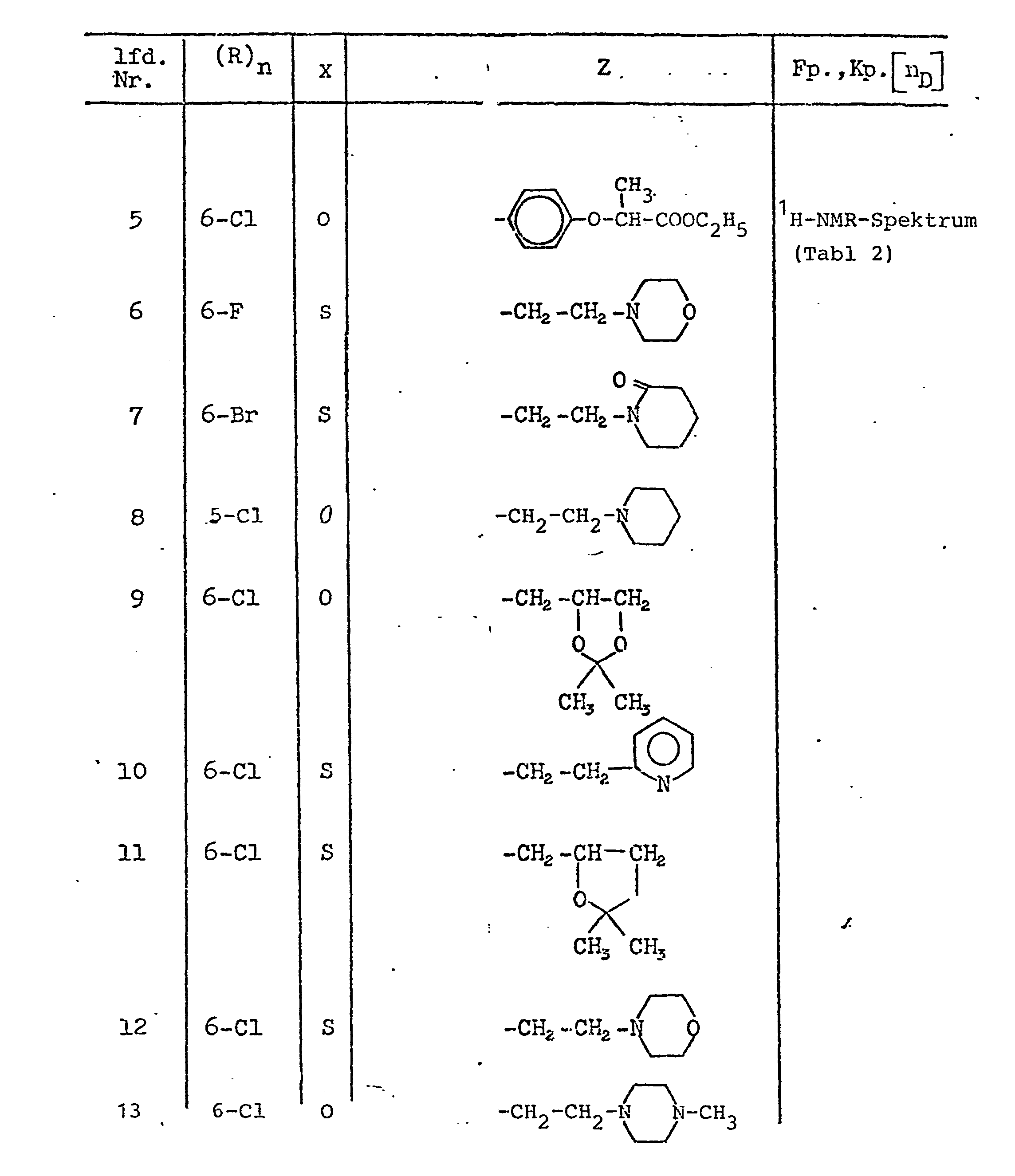

- Vorauflaufbehandlung
- Samen von Gräsern wurden in Töpfen ausgesät und die als Spritzpulver bzw. als Emulsionskonzentrate formulierten erfindungsgemäßen Präparate in verschiedenen Dosierungen auf die Erdoberfläche gesprüht. Anschließend wurden die Töpfe für 4 Wochen in einem Gewächshaus aufgestellt und das Resultat der Behandlung (ebenso wie bei den folgenden Beispielen) durch eine Bonitierung nach folgendem Schema (siehe Tabelle) festgehalten.
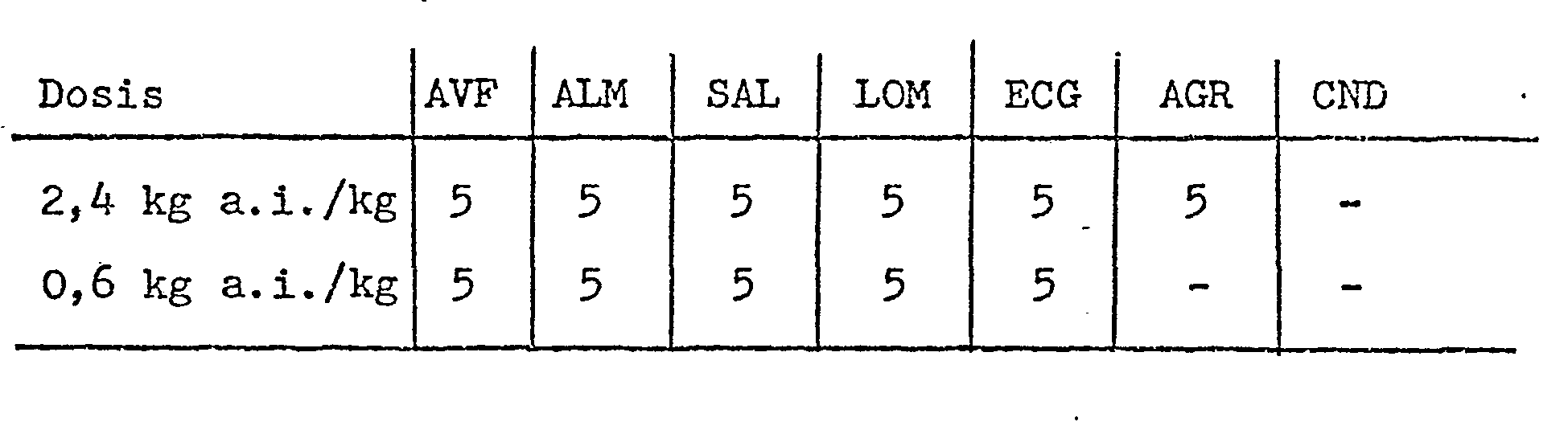
- Die erfindungsgemäßen Präparate zeigten eine gute Wirkung gegen einjährige und zum Teil auch mehrjährige Schadgräser :

- Nachauflaufbehandlung
- Samen von Gräsern wurden in Töpfen ausgesät und im Gewächshaus angezogen. 3.Wochen nach der Aussaat wurden die als Spritzpulver bzw. als Emulsionskonzentrate formulierten erfindungsgemäßen Präparate in verschiedenen Dosierungen auf die Pflanzen gesprüht und nach 4 Wochen Standzeit im Gewächshaus die Wirkung der Präparate bonitiert.
- Die erfindungsgemäßen Mittel waren gut gegen ein breites Spektrum von einjährigen Schadgräsern herbizid wirksam. Einige Präparate bekämpften ferner auch die mehrjährigen Schadgräser Cynodon dactylon, Sorghum halepense sowie Agropyron repens; genannt sei da lfd. Patentbeispiel 1.
- Kulturpflanzenverträglichkeit
- In weiteren Versuchen im Gewächshaus wurden Samen einer größeren Anzahl von Kulturpflanzen in Töpfen ausgelegt. Ein Teil der Töpfe wurde sofort behandelt, die übrigen wurden im Gewächshaus aufgestellt, bis die Pflanzen 2 bis 3 echte Blätter entwickelt hatten und dann mit erfindungsgemäßen Substanzen besprüht.
- Die Ergebnisse, die 4 bis 5 Wochen nach Applikation festgestellt wurden, zeigen, daß die erfindungsgemäßen Substanzen zweikeimblättrigen Kulturen im Vor- und Nachauflauf-Verfahren selbst mit 2,5 kg/ha völlig oder fast völlig ungeschädigt lassen. Einige Substanzen schonen darüber hinaus auch Gramineen-Kulturen wie Gerste, Sorghum, Mais, Weizen oder Reis. Die Substanzen sind somit bezüglich der in den vorigen Beispielen beschriebenen Unkrautwirkung hoch selektiv.
Claims (9)







Priority Applications (1)
| Application Number | Priority Date | Filing Date | Title |
|---|---|---|---|
| AT82103032T ATE12107T1 (de) | 1981-04-15 | 1982-04-08 | Heterocyclische phenylether, verfahren zu deren herstellung und diese enthaltende herbizide mittel. |
Applications Claiming Priority (2)
| Application Number | Priority Date | Filing Date | Title |
|---|---|---|---|
| DE3115152 | 1981-04-15 | ||
| DE19813115152 DE3115152A1 (de) | 1981-04-15 | 1981-04-15 | "heterocyclische phenylether und diese enthaltende herbizide mittel" |
Publications (2)
| Publication Number | Publication Date |
|---|---|
| EP0062905A1 true EP0062905A1 (de) | 1982-10-20 |
| EP0062905B1 EP0062905B1 (de) | 1985-03-13 |
Family
ID=6130168
Family Applications (1)
| Application Number | Title | Priority Date | Filing Date |
|---|---|---|---|
| EP82103032A Expired EP0062905B1 (de) | 1981-04-15 | 1982-04-08 | Heterocyclische Phenylether, Verfahren zu deren Herstellung und diese enthaltende herbizide Mittel |
Country Status (7)
| Country | Link |
|---|---|
| US (1) | US4383850A (de) |
| EP (1) | EP0062905B1 (de) |
| JP (2) | JPS57179173A (de) |
| AT (1) | ATE12107T1 (de) |
| CA (1) | CA1187875A (de) |
| DE (2) | DE3115152A1 (de) |
| IL (1) | IL65500A0 (de) |
Cited By (3)
| Publication number | Priority date | Publication date | Assignee | Title |
|---|---|---|---|---|
| WO2004002925A3 (en) * | 2002-06-26 | 2004-06-24 | Korea Res Inst Chem Tech | Process for preparing (r)-aryloxypropionic acid ester derivatives |
| EP3110415A4 (de) * | 2014-02-28 | 2017-12-13 | The Texas A & M University System | Zusammensetzungen und verfahren zur hemmung von myobakterien |
| EP4209486A1 (de) | 2022-01-07 | 2023-07-12 | Adama Agan Ltd. | Verfahren zur herstellung von aryloxyphenoxypropionsäurederivaten in einer unpolarer lössungsmittel mit einem tertiä-amine katalysator |
Families Citing this family (13)
| Publication number | Priority date | Publication date | Assignee | Title |
|---|---|---|---|---|
| DE3240694A1 (de) * | 1982-11-04 | 1984-05-10 | Hoechst Ag, 6230 Frankfurt | Herbizide mittel |
| JPS6051189A (ja) * | 1983-08-30 | 1985-03-22 | Sankyo Co Ltd | チアゾリジン誘導体およびその製造法 |
| JPS6092277A (ja) * | 1983-10-25 | 1985-05-23 | Nippon Tokushu Noyaku Seizo Kk | 置換フエノキシアルカンカルボン酸エステル,その製法及び除草剤 |
| EP0157225B1 (de) * | 1984-03-14 | 1988-01-20 | CASSELLA Aktiengesellschaft | Verfahren zur Herstellung von Benzimidazolyl,-Benzoxazolyl- und Benzthiazolyloxyphenoxypropionsäurederivaten |
| US5300526A (en) * | 1984-07-27 | 1994-04-05 | The Board Of Trustees Of The University Of Illinois | Porphyric insecticides |
| US5242892A (en) * | 1984-07-27 | 1993-09-07 | The Board Of Trustees Of The University Of Illinois | Chlorophyll biosynthesis modulators |
| ZA855561B (en) * | 1984-07-27 | 1986-03-26 | Univ Illinois | Photodynamic herbicides |
| EP0190203B1 (de) * | 1984-07-27 | 1992-09-16 | The Board Of Trustees Of The University Of Illinois | Photodynamische unkrautvertilger |
| US4935522A (en) * | 1988-03-21 | 1990-06-19 | Hoechst Celanese Corporation | Process for producing ethyl 2-[4'-(6"-chloro-2"-benzoxazolyloxy)phenoxy]propionate |
| DE4031158A1 (de) * | 1990-04-21 | 1991-10-24 | Bayer Ag | Aryloxycarbonylverbindungen |
| US6544482B1 (en) * | 2000-03-14 | 2003-04-08 | Advanced Technology Materials, Inc. | Chamber cleaning mechanism |
| CN105399715B (zh) * | 2015-11-05 | 2017-08-29 | 中国农业大学 | 取代苯氧乙酸类化合物及其制备方法与应用 |
| CN106831631B (zh) * | 2015-12-04 | 2019-03-12 | 沈阳中化农药化工研发有限公司 | 一种6-氯代苯并恶(噻)唑氧基苯氧丙酸酯类化合物及其应用 |
Citations (2)
| Publication number | Priority date | Publication date | Assignee | Title |
|---|---|---|---|---|
| US4130413A (en) * | 1976-09-10 | 1978-12-19 | Hoechst Aktiengesellschaft | Heterocyclic phenyl ethers and herbicides containing same |
| GB2046753A (en) * | 1979-04-09 | 1980-11-19 | Hoechst Ag | Heterocyclic phenyl ethers and herbicidal compositions containing them |
Family Cites Families (1)
| Publication number | Priority date | Publication date | Assignee | Title |
|---|---|---|---|---|
| CH650493A5 (en) * | 1977-12-24 | 1985-07-31 | Hoechst Ag | D-(+)-alpha-phenoxypropionic acid derivatives |
-
1981
- 1981-04-15 DE DE19813115152 patent/DE3115152A1/de not_active Withdrawn
-
1982
- 1982-04-08 EP EP82103032A patent/EP0062905B1/de not_active Expired
- 1982-04-08 DE DE8282103032T patent/DE3262519D1/de not_active Expired
- 1982-04-08 AT AT82103032T patent/ATE12107T1/de not_active IP Right Cessation
- 1982-04-13 US US06/367,882 patent/US4383850A/en not_active Expired - Lifetime
- 1982-04-14 JP JP57061179A patent/JPS57179173A/ja active Granted
- 1982-04-14 CA CA000400933A patent/CA1187875A/en not_active Expired
- 1982-04-15 IL IL65500A patent/IL65500A0/xx not_active IP Right Cessation
-
1990
- 1990-09-26 JP JP2256765A patent/JPH04210976A/ja active Pending
Patent Citations (2)
| Publication number | Priority date | Publication date | Assignee | Title |
|---|---|---|---|---|
| US4130413A (en) * | 1976-09-10 | 1978-12-19 | Hoechst Aktiengesellschaft | Heterocyclic phenyl ethers and herbicides containing same |
| GB2046753A (en) * | 1979-04-09 | 1980-11-19 | Hoechst Ag | Heterocyclic phenyl ethers and herbicidal compositions containing them |
Cited By (4)
| Publication number | Priority date | Publication date | Assignee | Title |
|---|---|---|---|---|
| WO2004002925A3 (en) * | 2002-06-26 | 2004-06-24 | Korea Res Inst Chem Tech | Process for preparing (r)-aryloxypropionic acid ester derivatives |
| EP3110415A4 (de) * | 2014-02-28 | 2017-12-13 | The Texas A & M University System | Zusammensetzungen und verfahren zur hemmung von myobakterien |
| EP4209486A1 (de) | 2022-01-07 | 2023-07-12 | Adama Agan Ltd. | Verfahren zur herstellung von aryloxyphenoxypropionsäurederivaten in einer unpolarer lössungsmittel mit einem tertiä-amine katalysator |
| WO2023131947A1 (en) | 2022-01-07 | 2023-07-13 | Adama Agan Ltd. | Process for the preparation of aryloxyphenoxypropionic acid derivatives in a non polar solvent with a tertiary amine catalyst |
Also Published As
| Publication number | Publication date |
|---|---|
| CA1187875A (en) | 1985-05-28 |
| JPH0371425B2 (de) | 1991-11-13 |
| JPH04210976A (ja) | 1992-08-03 |
| DE3115152A1 (de) | 1982-12-02 |
| DE3262519D1 (en) | 1985-04-18 |
| ATE12107T1 (de) | 1985-03-15 |
| IL65500A0 (en) | 1982-07-30 |
| US4383850A (en) | 1983-05-17 |
| EP0062905B1 (de) | 1985-03-13 |
| JPS57179173A (en) | 1982-11-04 |
Similar Documents
| Publication | Publication Date | Title |
|---|---|---|
| DE2640730C2 (de) | Benzoxazolyloxy- und Benzothiazolyloxy-phenoxy-Verbindungen und diese enthaltende herbizide Mittel | |
| DE2623558C2 (de) | 2-[4'-Phenoxy-phenoxy]propionsäure-Derivate, Verfahren zu ihrer Herstellung und sie enthaltende herbizide Mittel | |
| EP0062905B1 (de) | Heterocyclische Phenylether, Verfahren zu deren Herstellung und diese enthaltende herbizide Mittel | |
| EP0014684A2 (de) | 2-Substituierte 5-Phenoxy-phenylphosphonsäurederivate, Verfahren zu ihrer Herstellung und ihre Verwendung als Herbizide | |
| DE3877802T2 (de) | Phenoxypropionsaeure-derivate, anwendbar als herbizide. | |
| EP0129513A2 (de) | Oxamidsäure-Derivate | |
| EP0248968A1 (de) | (R)-2-[4-(5-Chlor-3-fluorpyridin-2-yloxy)-phenoxy]-propionsäure-propinylester mit herbizider Wirkung | |
| EP0075840B1 (de) | Heterocyclische Phenyläther, Verfahren zu deren Herstellung und diese enthaltende herbizide Mittel | |
| DE2509416A1 (de) | Dinitrobenzotrifluoride | |
| EP0264865A2 (de) | Alpha-Iminocarbonsäureanilide enthaltende herbizide Mittel sowie neue Alpha-Iminocarbonsäureanilide und Verfahren zu ihrer Herstellung | |
| DD149993A5 (de) | Herbizide mittel | |
| DE2914300C2 (de) | ||
| EP0171724A2 (de) | Phenoxypropionsäurederivate, Verfahren zu ihrer Herstellung und ihre Verwendung als Herbizide | |
| EP0141319B1 (de) | Substituierte Phenoxyalkancarbonsäureester | |
| EP0227045B1 (de) | Heterocyclische Phenyläther, Verfahren zu deren Herstellung und diese enthaltende herbizide Mittel | |
| EP0011802B1 (de) | Neue Phenoxy-phenoxypropionsäureamide, Verfahren zu ihrer Herstellung, sie enthaltende herbizide Mittel und ihre Verwendung zur Bekämpfung von Schadpflanzen | |
| EP0149427B1 (de) | (Poly-)Oxyalkylamino-diphenyläther mit herbizider Wirkung | |
| EP0001804B1 (de) | Beta-Naphthyl- und Beta-Tetrahydronaphthyl-phenyläther, Verfahren zu ihrer Herstellung und ihre Verwendung als herbizide Mittel | |
| WO1991004969A1 (de) | Herbizide hetrocyclisch substituierte phenoxyalkancarbonsäurederivate und verfahren zu ihrer herstellung | |
| EP0071572A2 (de) | Derivate der 2-Nitro-4- oder 5-Pyridyloxy-phenylphosphonsäure, Verfahren zu ihrer Herstellung, ihre Verwendung als Herbizide und/oder Pflanzenwachstumsregulatoren und/oder Mikrobizide, sowie zur Herstellung der Derivate verwendete Zwischenprodukte, Verfahren zu deren Herstellung und deren Verwendung als Herbizide | |
| AT382295B (de) | Herbizide mittel | |
| EP0375613A2 (de) | Nitroenamine | |
| DE2830066A1 (de) | 4-oxyphenoxyalkansaeurederivate und diese enthaltende herbizide mittel | |
| EP0144001B1 (de) | Substituierte Phenoxypropionyl-isoharnstoffderivate, Verfahren zu ihrer Herstellung und ihre Verwendung im Pflanzenschutz | |
| DE3502629A1 (de) | Phenoxybenzoesaeurederivate, verfahren zu ihrer herstellung sowie ihre verwendung im pflanzenschutz |
Legal Events
| Date | Code | Title | Description |
|---|---|---|---|
| PUAI | Public reference made under article 153(3) epc to a published international application that has entered the european phase |
Free format text: ORIGINAL CODE: 0009012 |
|
| AK | Designated contracting states |
Designated state(s): AT BE CH DE FR GB IT NL |
|
| 17P | Request for examination filed |
Effective date: 19830118 |
|
| ITF | It: translation for a ep patent filed | ||
| GRAA | (expected) grant |
Free format text: ORIGINAL CODE: 0009210 |
|
| AK | Designated contracting states |
Designated state(s): AT BE CH DE FR GB IT LI NL |
|
| REF | Corresponds to: |
Ref document number: 12107 Country of ref document: AT Date of ref document: 19850315 Kind code of ref document: T |
|
| REF | Corresponds to: |
Ref document number: 3262519 Country of ref document: DE Date of ref document: 19850418 |
|
| ET | Fr: translation filed | ||
| PLBE | No opposition filed within time limit |
Free format text: ORIGINAL CODE: 0009261 |
|
| STAA | Information on the status of an ep patent application or granted ep patent |
Free format text: STATUS: NO OPPOSITION FILED WITHIN TIME LIMIT |
|
| 26N | No opposition filed | ||
| ITTA | It: last paid annual fee | ||
| PGFP | Annual fee paid to national office [announced via postgrant information from national office to epo] |
Ref country code: CH Payment date: 19920309 Year of fee payment: 11 |
|
| PGFP | Annual fee paid to national office [announced via postgrant information from national office to epo] |
Ref country code: AT Payment date: 19920317 Year of fee payment: 11 |
|
| PGFP | Annual fee paid to national office [announced via postgrant information from national office to epo] |
Ref country code: BE Payment date: 19920401 Year of fee payment: 11 |
|
| PGFP | Annual fee paid to national office [announced via postgrant information from national office to epo] |
Ref country code: NL Payment date: 19920430 Year of fee payment: 11 |
|
| PG25 | Lapsed in a contracting state [announced via postgrant information from national office to epo] |
Ref country code: AT Effective date: 19930408 |
|
| PG25 | Lapsed in a contracting state [announced via postgrant information from national office to epo] |
Ref country code: LI Effective date: 19930430 Ref country code: CH Effective date: 19930430 Ref country code: BE Effective date: 19930430 |
|
| BERE | Be: lapsed |
Owner name: HOECHST A.G. Effective date: 19930430 |
|
| PG25 | Lapsed in a contracting state [announced via postgrant information from national office to epo] |
Ref country code: NL Effective date: 19931101 |
|
| NLV4 | Nl: lapsed or anulled due to non-payment of the annual fee | ||
| REG | Reference to a national code |
Ref country code: CH Ref legal event code: PL |
|
| PGFP | Annual fee paid to national office [announced via postgrant information from national office to epo] |
Ref country code: FR Payment date: 19950313 Year of fee payment: 14 |
|
| PGFP | Annual fee paid to national office [announced via postgrant information from national office to epo] |
Ref country code: GB Payment date: 19950316 Year of fee payment: 14 |
|
| PGFP | Annual fee paid to national office [announced via postgrant information from national office to epo] |
Ref country code: DE Payment date: 19950621 Year of fee payment: 14 |
|
| PG25 | Lapsed in a contracting state [announced via postgrant information from national office to epo] |
Ref country code: GB Effective date: 19960408 |
|
| GBPC | Gb: european patent ceased through non-payment of renewal fee |
Effective date: 19960408 |
|
| PG25 | Lapsed in a contracting state [announced via postgrant information from national office to epo] |
Ref country code: FR Effective date: 19961227 |
|
| PG25 | Lapsed in a contracting state [announced via postgrant information from national office to epo] |
Ref country code: DE Effective date: 19970101 |
|
| REG | Reference to a national code |
Ref country code: FR Ref legal event code: ST |