EP0062927B1 - Zündzeitpunktsteuereinrichtung - Google Patents
Zündzeitpunktsteuereinrichtung Download PDFInfo
- Publication number
- EP0062927B1 EP0062927B1 EP82103187A EP82103187A EP0062927B1 EP 0062927 B1 EP0062927 B1 EP 0062927B1 EP 82103187 A EP82103187 A EP 82103187A EP 82103187 A EP82103187 A EP 82103187A EP 0062927 B1 EP0062927 B1 EP 0062927B1
- Authority
- EP
- European Patent Office
- Prior art keywords
- spark timing
- output signal
- engine
- control system
- frequency components
- Prior art date
- Legal status (The legal status is an assumption and is not a legal conclusion. Google has not performed a legal analysis and makes no representation as to the accuracy of the status listed.)
- Expired
Links
- 230000000979 retarding effect Effects 0.000 claims description 28
- 238000002485 combustion reaction Methods 0.000 claims description 11
- 238000000034 method Methods 0.000 claims description 6
- 238000004804 winding Methods 0.000 description 9
- 238000010586 diagram Methods 0.000 description 2
- 230000007257 malfunction Effects 0.000 description 2
- 230000001133 acceleration Effects 0.000 description 1
- 238000010276 construction Methods 0.000 description 1
- 230000000694 effects Effects 0.000 description 1
Images

Classifications
-
- F—MECHANICAL ENGINEERING; LIGHTING; HEATING; WEAPONS; BLASTING
- F02—COMBUSTION ENGINES; HOT-GAS OR COMBUSTION-PRODUCT ENGINE PLANTS
- F02P—IGNITION, OTHER THAN COMPRESSION IGNITION, FOR INTERNAL-COMBUSTION ENGINES; TESTING OF IGNITION TIMING IN COMPRESSION-IGNITION ENGINES
- F02P5/00—Advancing or retarding ignition; Control therefor
- F02P5/04—Advancing or retarding ignition; Control therefor automatically, as a function of the working conditions of the engine or vehicle or of the atmospheric conditions
- F02P5/145—Advancing or retarding ignition; Control therefor automatically, as a function of the working conditions of the engine or vehicle or of the atmospheric conditions using electrical means
- F02P5/15—Digital data processing
- F02P5/152—Digital data processing dependent on pinking
-
- Y—GENERAL TAGGING OF NEW TECHNOLOGICAL DEVELOPMENTS; GENERAL TAGGING OF CROSS-SECTIONAL TECHNOLOGIES SPANNING OVER SEVERAL SECTIONS OF THE IPC; TECHNICAL SUBJECTS COVERED BY FORMER USPC CROSS-REFERENCE ART COLLECTIONS [XRACs] AND DIGESTS
- Y02—TECHNOLOGIES OR APPLICATIONS FOR MITIGATION OR ADAPTATION AGAINST CLIMATE CHANGE
- Y02T—CLIMATE CHANGE MITIGATION TECHNOLOGIES RELATED TO TRANSPORTATION
- Y02T10/00—Road transport of goods or passengers
- Y02T10/10—Internal combustion engine [ICE] based vehicles
- Y02T10/40—Engine management systems
Definitions
- This invention relates to a spark timing control system and a method for reducing engine noise in an internal combustion engine by retarding the spark timing as described in the precharacterizing portions of independent claims 1 and 8, respectively.
- spark timing control system which is operatively connected to a plurality of spark plugs and forms one of the most essential parts of an engine control system.
- an ignition coil 1 includes a primary winding 1a whose end is electrically connected through a ballast resistor 2 and an ignition switch 3 to the positive terminal of a battery 4. The other end of the primary winding 1a is grounded through a power transistor 5.
- the power transistor 5 is controlled in response to the output signal from an amplifier circuit 7 which functions to amplify ignition pulses produced by a signal generator 6.
- a secondary winding 1 b of the ignition coil 1 is electrically connected to a distributor 8 which is, in turn, electrically connected to a plurality of spark plugs, so that the output of the secondary winding 1b is supplied through the distributor to each spark plug.
- the reference numeral 9 denotes a shield member for the purpose of preventing the malfunction of the implements contained therein.
- the signal generator 6 operates to generate intermittently ignition signals in timed relation to the rotation of an engine crankshaft.
- the power transistor circuit 5 is controlled ON under the action of the amplifier circuit 7, a primary current flows through the ignition coil primary winding 1a and the power transistor 5.
- the ignition signal is supplied to the base B of the power transistor 5 after amplified by the amplifier circuit 7.
- the power transistor 5 is compulsorily and momentarily controlled OFF because of the fact that the signal from the amplifier circuit 7 is positive.
- the signal generator 6 is arranged to control the generation timings of ignition signals, thereby controlling the spark timings of the engine.
- spark timing control system has encountered the following shortcomings depending upon the fact that the generation timings of the ignition signals are controlled only in response to engine speed and intake vacuum:
- a noise level difference ranging of 1-2 dB(A) is made among respective engines even though the engines are of the same kind, which depends on a slight amount of scatter in construction, rigidity etc of respective engines.
- This scatter is exemplified by a range A in Fig. 2 in which overall engine noise is indicated on engine speeds.
- engines within an oblique- lined range in Fig. 2 may emit noise over an allowable limit, particularly in case where the engine is operated at a spark timing near MBT under high engine speed and load condition such as in full throttle.
- spark timing control system for reduc- . ing engine noise in an internal combustion engine is known from US-A-4,111,035.
- This spark timing control system comprises a sensor 27 for sensing engine noise and for generating a sensor output signal for responding to this noise, a band- pass filter 30 connected to said sensor 27 for extracting a range of frequency components from said sensor output signal, a generating means 32 responsive to said extracted frequency components for generating an output signal when the level of said extracted frequency components of said band-pass filter 30 exceeds a reference value, and means 22 for retarding the spark timing of the engine in response to the output signal of said generating means 32.
- spark timing is retarded in response to a signal from a knock sensor for minimizing audible knock in an internal combustion engine.
- spark timing is retarded when the engine vibration is, for example, within 6000 to 10 000 Hz for the purpose of avoiding engine knock.
- the bandpass filter is so arranged as to extract the frequency components within a frequency range of 500 to 2000 Hz, and a RMS value circuit is connected between the bandpass filter and the generating means to provide the generating means with an output corresponding to the RMS value of said extracted frequency components.
- the method for reducing engine noise is characterized by the further step of extracting frequency components from said sensor output signals in a frequency range of 500 to 2000 Hz, and providing said generating means with a signal corresponding to the RMS value of said extracted frequency components.
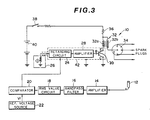
- the spark timing control system 10 in this embodiment is, for example, used for an automotive internal combustion engine though not shown.
- the spark ignition control system 10 comprises a sensor 12 for sensing noise or vibration of the engine and, as such, secured on, for example, an engine block (not shown) of the engine.
- the sensor 12 is electrically connected to an amplifier circuit 14 for amplifying the output signal of the sensor 12.
- the amplifier circuit 14 is, in turn, electrically connected to a bandpass filter 16 which suppresses frequencies outside a predetermined band width to extract the predetermined band width frequencies.
- the bandpass filter 16 is electrically connected to a RMS value circuit for providing the effective value or RMS (root mean square) value by processing the output signal of the bandpass filter 16 within a predetermined time span.
- the RMS value circuit 18 is electrically connected to a comparator 20 which is arranged to generate a signal "H” only when the level of the output signal of the RMS value circuit exceeds a reference value Vr from a reference source 22, while a signal “L” when the level of the output signal of the RMS value circuit 18 is below the reference value Vr.
- the comparator 20 is, in turn, electrically connected to a retarding circuit 24 which is electrically connected between a signal generator 26 and an amplifier circuit 28.
- the signal generator 26 is, for example, of the type to generate ignition signals whose timings are controlled in response to engine speed and engine intake vaccum.
- the retarding circuit 24 is so arranged as to directly supply the output signal from the signal generator 26 to the amplifier circuit 28 when the comparator 20 provides the retarding circuit 24 with the signal "L", while to supply the amplifier circuit 28 the output signal from the signal generator 26 after the timing of the output signal from the signal generator 26 is retarded a predetermined time duration, for example, 0.5 degree in crank angle.
- the amplifier circuit 28 is electrically connected to the base B of a power transistor 30 whose emitter E is electrically connected to a primary winding 32a of an ignition coil 32 and whose collector C is grounded.
- a secondary winding 32b of the ignition coil 32 is electrically connected through a distributor 34 to a plurality of spark plugs which are disposed within engine cylinders of the engine though not shown.
- the ignition coil 32 is electrically connected through a ballast resistor 36 to an ignition switch 38 which is, in turn, connected to a battery 40 as usual.
- the reference numeral 42 denotes a shielding member for preventing the malfunction of the spark timing control system 10, particularly of the retarding circuit 24, the amplifier circuit 28, and the power transistor 30.
- the comparator 20 In operation of the thus arranged spark timing control system 10, when the noise or vibration " level of the engine is relatively low, the comparator 20 generates the signal "L” and therefore the retarding action of the retarding circuit 24 is not effected on the output signal from the signal generator 26. Thus the output signal from the signal generator 26 is directly provided through the amplifier circuit 28 to the base B of the power transistor 30. Accordingly, in this state, the ignition of the spark plugs takes place in accordance with the signal output timings of the signal generator 26 which timings are controlled in response to engine speed and engine intake vacuum just as in usual spark timing control systems.
- the output of the sensor 12 rises so that high level output signals are supplied to the amplifier circuit 14.
- the signal is provided to the bandpass filter 16 in which only frequency components representing engine noise or vibration are picked up to generate the output signal corresponding thereto.
- the output signal of the bandpass filter 16 is supplied to the RMS value circuit 18 in which the RMS value within the predetermined time span is computed or given, and the output signal corresponding to the RMS value is applied to the comparator 20.
- the output signal of the RMS value circuit exceeds the reference value Vr from the reference voltage source 22 to represent a condition where the noise or vibration level of the engine exceeds an allowable limit or predetermined level
- the output signal of the comparator 20 is inverted from “L” to "H”.
- the retarding circuit 24 takes a retarding mode.
- the ignition signal from the signal generator 26 is provided through the amplifier circuit 28 to the base B of the power transistor 30 after the timing of the ignition signal is retarded by 0.5 degree in crank angle under the action of the retarding circuit 24.
- the power transistor 30 is controlled with a time lag under a condition where the noise or vibration level of the engine exceeds the allowable limit. This retards the generation timing of the high tension current produced at the secondary winding 32b of the ignition coil 32, thus effectively retarding the spark timings of the spark plugs.
- Fig. 4 the relationship between engine noise and spark timing is shown in Fig. 4 which reveals that the sound pressure level lowers 1 dB upon the spark timing retardation of 3 degrees in crank angle relative to MBT (Minimum Advance for the Best Torque). Therefore, when the level of the frequency components taken out by the bandpass filter 16 exceeds a predetermined allowable value, the retarding circuit 24 initiates its retarding action by the output signal from the comparator 20 and continues the action until the level of the taken out frequency components lowers below the predetermined allowable value.
- the comparator 20 Upon the level below the allowable value, the comparator 20 stops to generate the output signal, and consequently the retarding circuit 24 interrupts its retarding action on the signal generator 26 and is gradually restored to the state where the retarding action is not made.
- the loss of brake torque under the action of spark timing retardation of 3 degrees is within a range of from 0.1 to 0.5 Kgm in the vicinity of MBT and, as such, is negligible from the point of view of engine power output.
- the spark retardation by the retarding circuit 24 is within a range of ⁇ 10% relative to the preset or inherent spark advance characteristics.
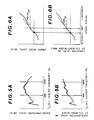
- the bandpass filter 16 is so arranged as to take out the frequency components within a range of 500-2000 Hz because of the fact that a predominant frequency range for engine noise is of 500 to 2000 Hz as shown in Figs. 5A and 5B.
- the spark timing retardation by the retarding circuit 24 is made relative to the preset or inherent spark advance characteristics of the engine so that the spark timing within the engine noise level range of from 500-2000 Hz is controlled at a retarded side relative to MBT.
- the spark timing control system of the present invention is provided with the sensor for detecting engine noise or vibration related to engine noise, and so arranged as to control the spark timing to retard when the level of the output of the sensor exceeds the reference value, thereby always suppressing engine noise below the allowable limit.
Landscapes
- Engineering & Computer Science (AREA)
- Signal Processing (AREA)
- Chemical & Material Sciences (AREA)
- Combustion & Propulsion (AREA)
- Mechanical Engineering (AREA)
- General Engineering & Computer Science (AREA)
- Electrical Control Of Ignition Timing (AREA)
- Combined Controls Of Internal Combustion Engines (AREA)
Claims (10)
dadurch gekennzeichnet, daß
Applications Claiming Priority (2)
| Application Number | Priority Date | Filing Date | Title |
|---|---|---|---|
| JP54001/81U | 1981-04-15 | ||
| JP5400181 | 1981-04-15 |
Publications (3)
| Publication Number | Publication Date |
|---|---|
| EP0062927A2 EP0062927A2 (de) | 1982-10-20 |
| EP0062927A3 EP0062927A3 (en) | 1983-11-30 |
| EP0062927B1 true EP0062927B1 (de) | 1987-03-18 |
Family
ID=12958356
Family Applications (1)
| Application Number | Title | Priority Date | Filing Date |
|---|---|---|---|
| EP82103187A Expired EP0062927B1 (de) | 1981-04-15 | 1982-04-15 | Zündzeitpunktsteuereinrichtung |
Country Status (3)
| Country | Link |
|---|---|
| US (1) | US4442814A (de) |
| EP (1) | EP0062927B1 (de) |
| DE (1) | DE3275741D1 (de) |
Families Citing this family (4)
| Publication number | Priority date | Publication date | Assignee | Title |
|---|---|---|---|---|
| US4711212A (en) * | 1985-11-26 | 1987-12-08 | Nippondenso Co., Ltd. | Anti-knocking in internal combustion engine |
| US5397945A (en) * | 1992-08-04 | 1995-03-14 | Samsung Semiconductor, Inc. | Duty cycle control circuit |
| US6439039B1 (en) * | 2001-09-04 | 2002-08-27 | Ford Global Technologies, Inc. | Method to verify cold start spark retard |
| JP6555323B2 (ja) * | 2017-11-10 | 2019-08-07 | マツダ株式会社 | 圧縮着火式エンジンの制御装置 |
Family Cites Families (10)
| Publication number | Priority date | Publication date | Assignee | Title |
|---|---|---|---|---|
| US4061116A (en) * | 1974-10-17 | 1977-12-06 | Nissan Motor Co., Ltd. | Knock level control apparatus for an internal combustion engine |
| US4211194A (en) * | 1976-11-10 | 1980-07-08 | Nippon Soken, Inc. | Ignition system for internal combustion engines |
| US4153020A (en) * | 1977-07-26 | 1979-05-08 | The United States Of America As Represented By The Administrator Of The United States Environmental Protection Agency | Method and apparatus for spark control of engine knock |
| US4111035A (en) * | 1977-11-07 | 1978-09-05 | General Motors Corporation | Engine knock signal generating apparatus with noise channel inhibiting feedback |
| JPS54162032A (en) * | 1978-06-13 | 1979-12-22 | Nippon Soken Inc | Ignition time controlling apparatus for interval combustion engine |
| US4282841A (en) * | 1978-06-27 | 1981-08-11 | Nissan Motor Company, Limited | Ignition timing control system for an internal combustion engine |
| FR2449798A1 (fr) * | 1979-02-23 | 1980-09-19 | Sev Marchal | Dispositif electronique permettant de detecter le cliquetis au cours du fonctionnement d'un moteur a combustion interne |
| JPS55143428A (en) * | 1979-04-26 | 1980-11-08 | Nissan Motor Co Ltd | Knocking discriminating unit |
| JPS605786B2 (ja) * | 1979-05-25 | 1985-02-14 | 三菱電機株式会社 | 内燃機関の点火時期制御装置 |
| DE2923056C2 (de) * | 1979-06-07 | 1982-05-13 | Daimler-Benz Ag, 7000 Stuttgart | Vorrichtung zum Erkennen unerwünschter Verbrennungsverläufe bei fremdgezündeten Brennkraftmaschinen |
-
1982
- 1982-04-13 US US06/367,925 patent/US4442814A/en not_active Expired - Fee Related
- 1982-04-15 EP EP82103187A patent/EP0062927B1/de not_active Expired
- 1982-04-15 DE DE8282103187T patent/DE3275741D1/de not_active Expired
Also Published As
| Publication number | Publication date |
|---|---|
| US4442814A (en) | 1984-04-17 |
| EP0062927A2 (de) | 1982-10-20 |
| EP0062927A3 (en) | 1983-11-30 |
| DE3275741D1 (en) | 1987-04-23 |
Similar Documents
| Publication | Publication Date | Title |
|---|---|---|
| US4710881A (en) | Knock control apparatus for internal combustion engine | |
| US4364260A (en) | Engine with knock sensing apparatus having multiple frequency tuning | |
| US4002155A (en) | Engine and engine spark timing control with knock limiting etc. | |
| US4211194A (en) | Ignition system for internal combustion engines | |
| US4131097A (en) | Ignition system for internal combustion engines | |
| EP0443708A2 (de) | Steuerungsanlage von einer inneren Brennkraftmaschine | |
| SE9504659L (sv) | Metod för reglering av knackning i en förbränningsmotor | |
| US4290398A (en) | Ignition timing control system for internal combustion engine | |
| EP0326193A3 (de) | Verfahren und Vorrichtung zur Steuerung des Zündzeitpunktes einer mehrzylindrigen Brennkraftmaschine | |
| US4599982A (en) | Knock control apparatus for internal combustion engines | |
| US4424706A (en) | Engine with knock sensing using product component of knock vibration signal | |
| EP0087162B1 (de) | Klopfsteuereinrichtung und Verfahren für eine Brennkraftmaschine | |
| EP0062927B1 (de) | Zündzeitpunktsteuereinrichtung | |
| JPH0346666B2 (de) | ||
| US4945876A (en) | System and method for detecting knocking in an internal combustion engine | |
| US4711213A (en) | Knock control system for internal combustion engines | |
| US4269155A (en) | Ignition timing control system for internal combustion engines | |
| EP0098584A2 (de) | Zündzeitpunktsteuerverfahren für Brennkraftmaschine | |
| EP0095081B1 (de) | Zündzeit-Steuersystem für Brennkraftmaschinen | |
| ES488378A1 (es) | Perfeccionamientos en los sistemas de encendido para motoresde combustion interna | |
| US4426975A (en) | Ignition timing control system for internal combustion engines | |
| JPS6320860Y2 (de) | ||
| EP0039993B1 (de) | Brennkraftmaschinen mit Klopfsteuerung | |
| CA1257916A (en) | Knock detection circuit with gated automatic gain control | |
| US4499877A (en) | Ignition timing control device for an internal combustion engine |
Legal Events
| Date | Code | Title | Description |
|---|---|---|---|
| PUAI | Public reference made under article 153(3) epc to a published international application that has entered the european phase |
Free format text: ORIGINAL CODE: 0009012 |
|
| 17P | Request for examination filed |
Effective date: 19820415 |
|
| AK | Designated contracting states |
Designated state(s): DE FR GB |
|
| PUAL | Search report despatched |
Free format text: ORIGINAL CODE: 0009013 |
|
| AK | Designated contracting states |
Designated state(s): DE FR GB |
|
| RAP1 | Party data changed (applicant data changed or rights of an application transferred) |
Owner name: NISSAN MOTOR CO., LTD. |
|
| GRAA | (expected) grant |
Free format text: ORIGINAL CODE: 0009210 |
|
| AK | Designated contracting states |
Kind code of ref document: B1 Designated state(s): DE FR GB |
|
| PG25 | Lapsed in a contracting state [announced via postgrant information from national office to epo] |
Ref country code: FR Free format text: THE PATENT HAS BEEN ANNULLED BY A DECISION OF A NATIONAL AUTHORITY Effective date: 19870318 |
|
| REF | Corresponds to: |
Ref document number: 3275741 Country of ref document: DE Date of ref document: 19870423 |
|
| EN | Fr: translation not filed | ||
| PLBE | No opposition filed within time limit |
Free format text: ORIGINAL CODE: 0009261 |
|
| STAA | Information on the status of an ep patent application or granted ep patent |
Free format text: STATUS: NO OPPOSITION FILED WITHIN TIME LIMIT |
|
| 26N | No opposition filed | ||
| PG25 | Lapsed in a contracting state [announced via postgrant information from national office to epo] |
Ref country code: GB Effective date: 19890415 |
|
| GBPC | Gb: european patent ceased through non-payment of renewal fee | ||
| PGFP | Annual fee paid to national office [announced via postgrant information from national office to epo] |
Ref country code: DE Payment date: 19930421 Year of fee payment: 12 |
|
| PG25 | Lapsed in a contracting state [announced via postgrant information from national office to epo] |
Ref country code: DE Effective date: 19950103 |